Cambridge IGCSE Sciences - Co-ordinated (Double) 0654 — 2016 May/June Paper 5 · Variant 2
0654/52/M/J/16 · 45 marks · ≈51 min
The question paper and its mark scheme, free to read here and free to download. This is Cambridge’s own paper, exactly as it was sat.
Question paper12 pages


Mark scheme4 pages
Answers below. Sit the paper first if you are practising.
Paper as text
Question paper, page 1
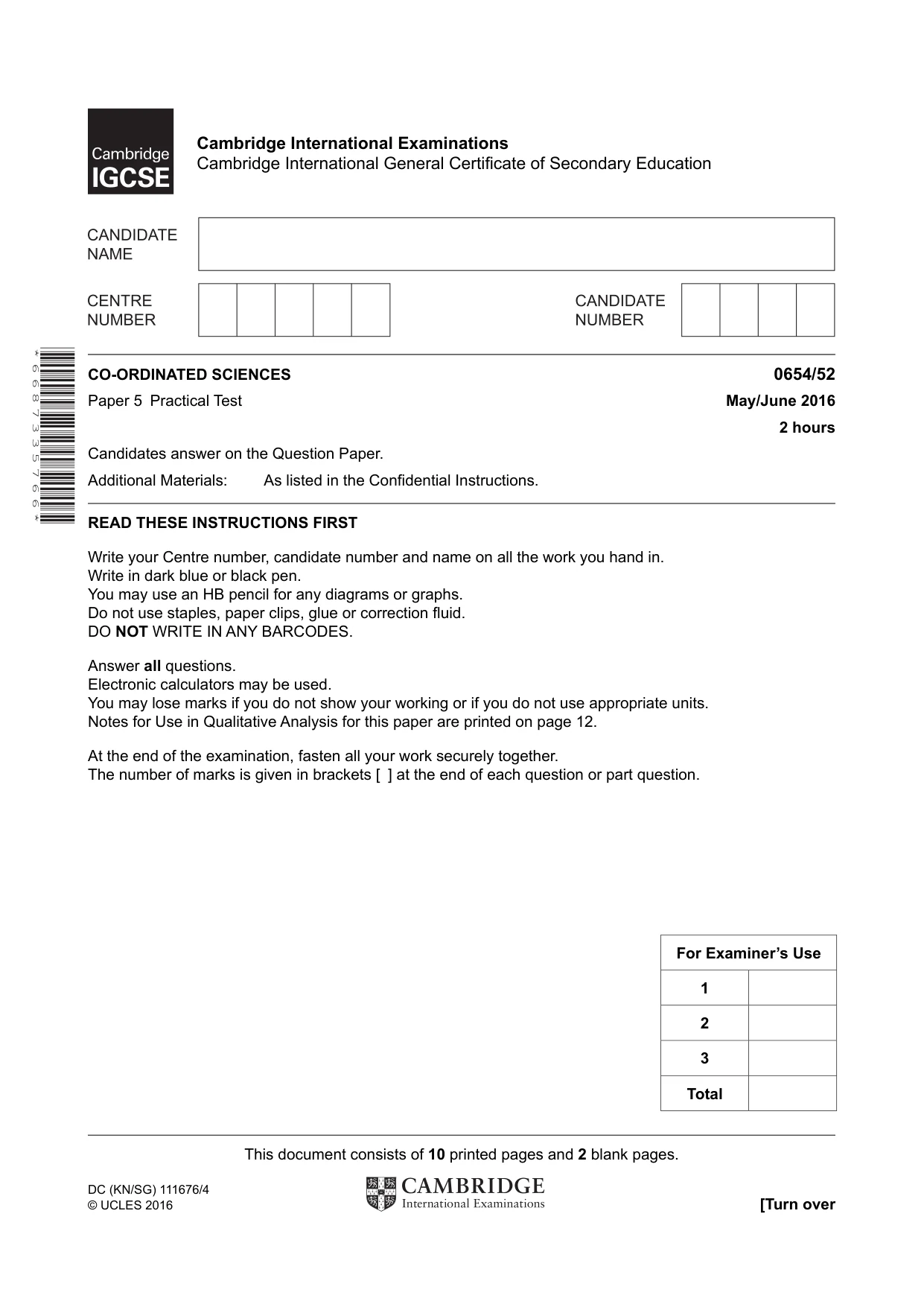
This document consists of 10 printed pages and 2 blank pages. DC (KN/SG) 111676/4 © UCLES 2016 [Turn over Cambridge International Examinations Cambridge International General Certificate of Secondary Education * 6 6 8 7 3 3 5 7 6 6 * CO-ORDINATED SCIENCES 0654/52 Paper 5 Practical Test May/June 2016 2 hours Candidates answer on the Question Paper. Additional Materials: As listed in the Confidential Instructions. READ THESE INSTRUCTIONS FIRST Write your Centre number, candidate number and name on all the work you hand in. Write in dark blue or black pen. You may use an HB pencil for any diagrams or graphs. Do not use staples, paper clips, glue or correction fluid. DO NOT WRITE IN ANY BARCODES. Answer all questions. Electronic calculators may be used. You may lose marks if you do not show your working or if you do not use appropriate units. Notes for Use in Qualitative Analysis for this paper are printed on page 12. At the end of the examination, fasten all your work securely together. The number of marks is given in brackets [ ] at the end of each question or part question. For Examiner’s Use 1 2 3 Total
Question paper, page 2
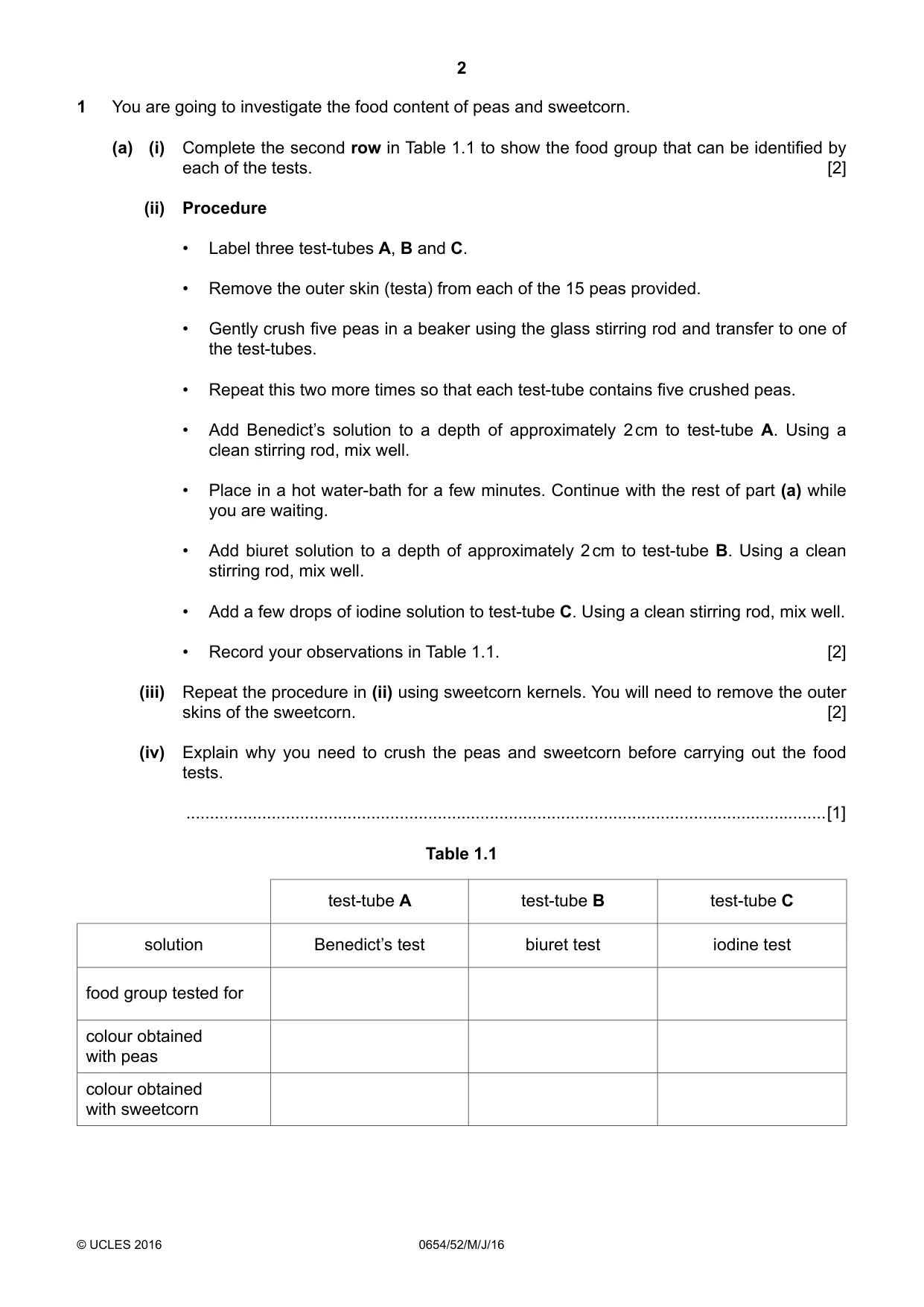
2 0654/52/M/J/16 © UCLES 2016 1 You are going to investigate the food content of peas and sweetcorn. (a) (i) Complete the second row in Table 1.1 to show the food group that can be identified by each of the tests. [2] (ii) Procedure • Label three test-tubes A, B and C. • Remove the outer skin (testa) from each of the 15 peas provided. • Gently crush five peas in a beaker using the glass stirring rod and transfer to one of the test-tubes. • Repeat this two more times so that each test-tube contains five crushed peas. • Add Benedict’s solution to a depth of approximately 2 cm to test-tube A. Using a clean stirring rod, mix well. • Place in a hot water-bath for a few minutes. Continue with the rest of part (a) while you are waiting. • Add biuret solution to a depth of approximately 2 cm to test-tube B. Using a clean stirring rod, mix well. • Add a few drops of iodine solution to test-tube C. Using a clean stirring rod, mix well. • Record your observations in Table 1.1. [2] (iii) Repeat the procedure in (ii) using sweetcorn kernels. You will need to remove the outer skins of the sweetcorn. [2] (iv) Explain why you need to crush the peas and sweetcorn before carrying out the food tests. …[1] Table 1.1 test-tube A test-tube B test-tube C solution Benedict’s test biuret test iodine test food group tested for colour obtained with peas colour obtained with sweetcorn
Question paper, page 3
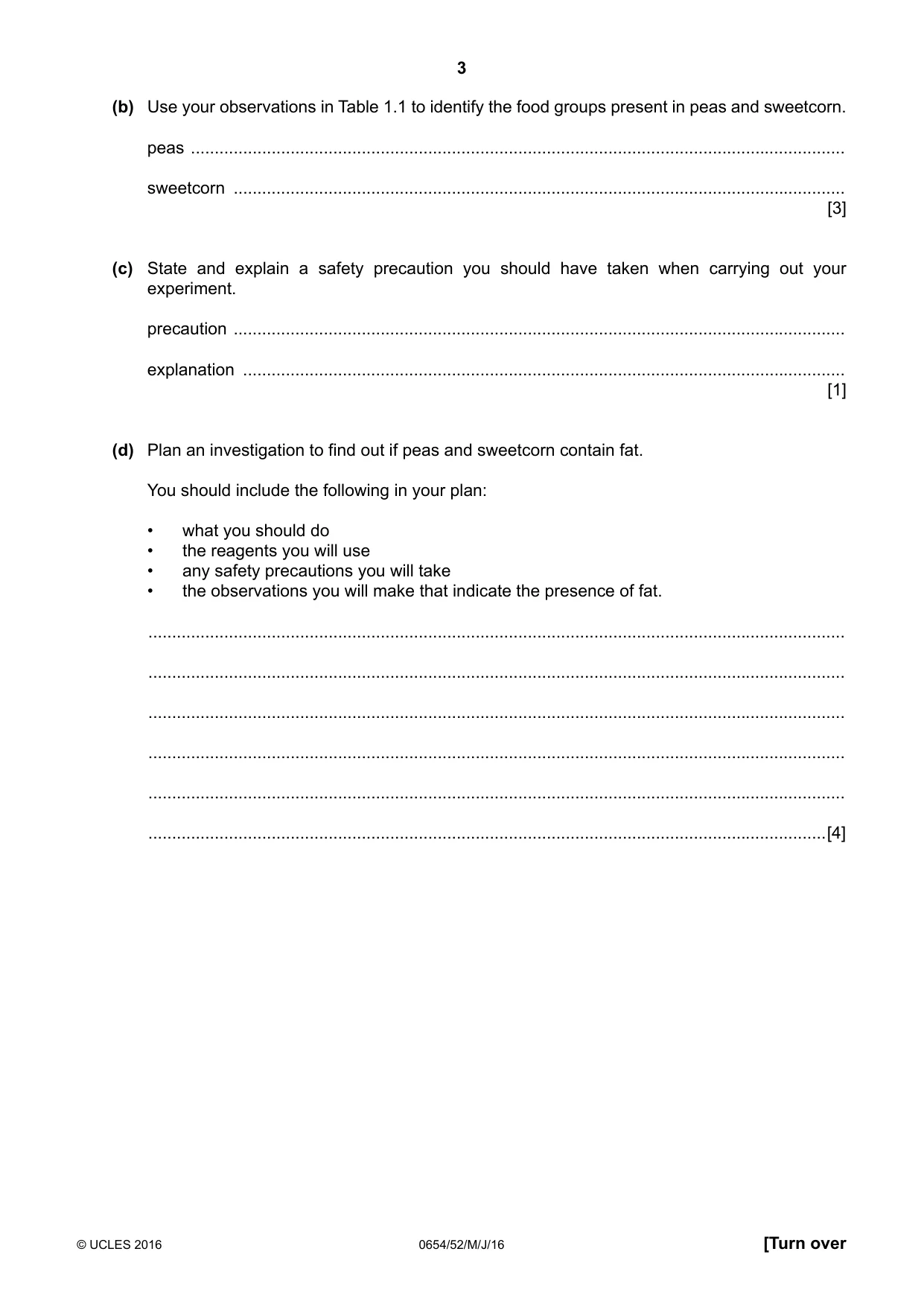
3 0654/52/M/J/16 © UCLES 2016 [Turn over (b) Use your observations in Table 1.1 to identify the food groups present in peas and sweetcorn. peas … sweetcorn … [3] (c) State and explain a safety precaution you should have taken when carrying out your experiment. precaution … explanation … [1] (d) Plan an investigation to find out if peas and sweetcorn contain fat. You should include the following in your plan: • what you should do • the reagents you will use • any safety precautions you will take • the observations you will make that indicate the presence of fat. … … … … … …[4]
Question paper, page 4
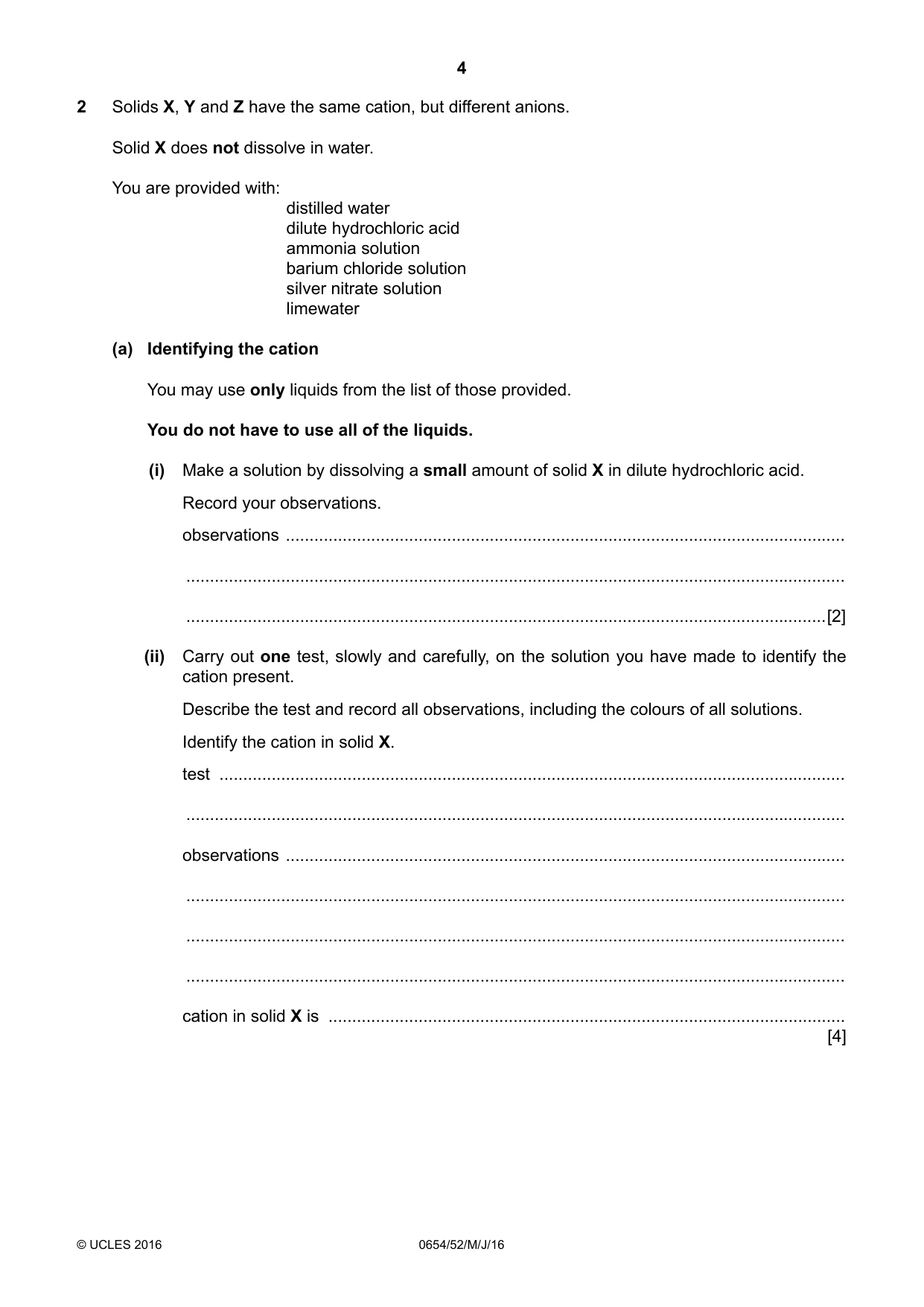
4 0654/52/M/J/16 © UCLES 2016 2 Solids X, Y and Z have the same cation, but different anions. Solid X does not dissolve in water. You are provided with: distilled water dilute hydrochloric acid ammonia solution barium chloride solution silver nitrate solution limewater (a) Identifying the cation You may use only liquids from the list of those provided. You do not have to use all of the liquids. (i) Make a solution by dissolving a small amount of solid X in dilute hydrochloric acid. Record your observations. observations … … …[2] (ii) Carry out one test, slowly and carefully, on the solution you have made to identify the cation present. Describe the test and record all observations, including the colours of all solutions. Identify the cation in solid X. test … … observations … … … … cation in solid X is … [4]
Question paper, page 5
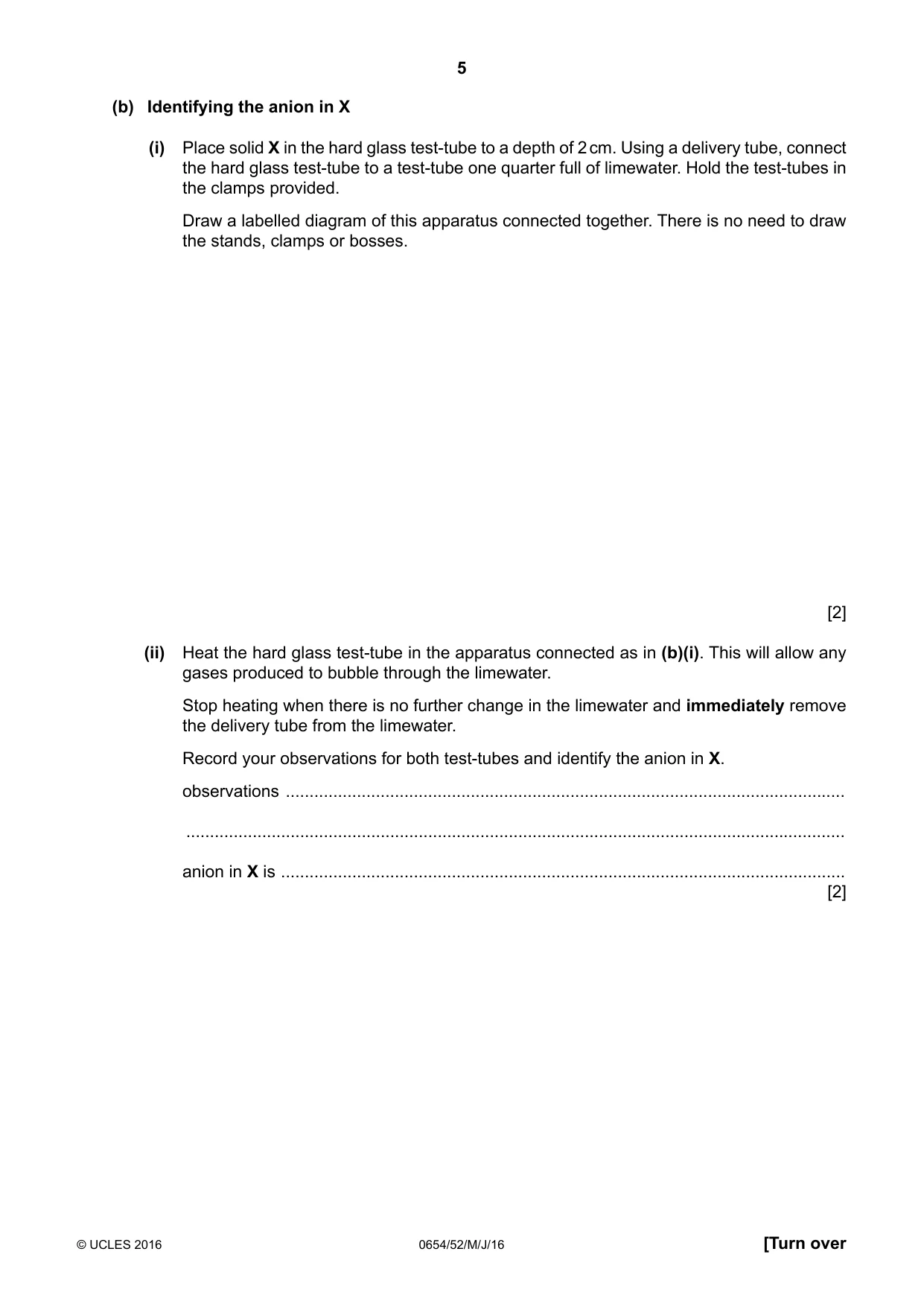
5 0654/52/M/J/16 © UCLES 2016 [Turn over (b) Identifying the anion in X (i) Place solid X in the hard glass test-tube to a depth of 2 cm. Using a delivery tube, connect the hard glass test-tube to a test-tube one quarter full of limewater. Hold the test-tubes in the clamps provided. Draw a labelled diagram of this apparatus connected together. There is no need to draw the stands, clamps or bosses. [2] (ii) Heat the hard glass test-tube in the apparatus connected as in (b)(i). This will allow any gases produced to bubble through the limewater. Stop heating when there is no further change in the limewater and immediately remove the delivery tube from the limewater. Record your observations for both test-tubes and identify the anion in X. observations … … anion in X is … [2]
Question paper, page 6
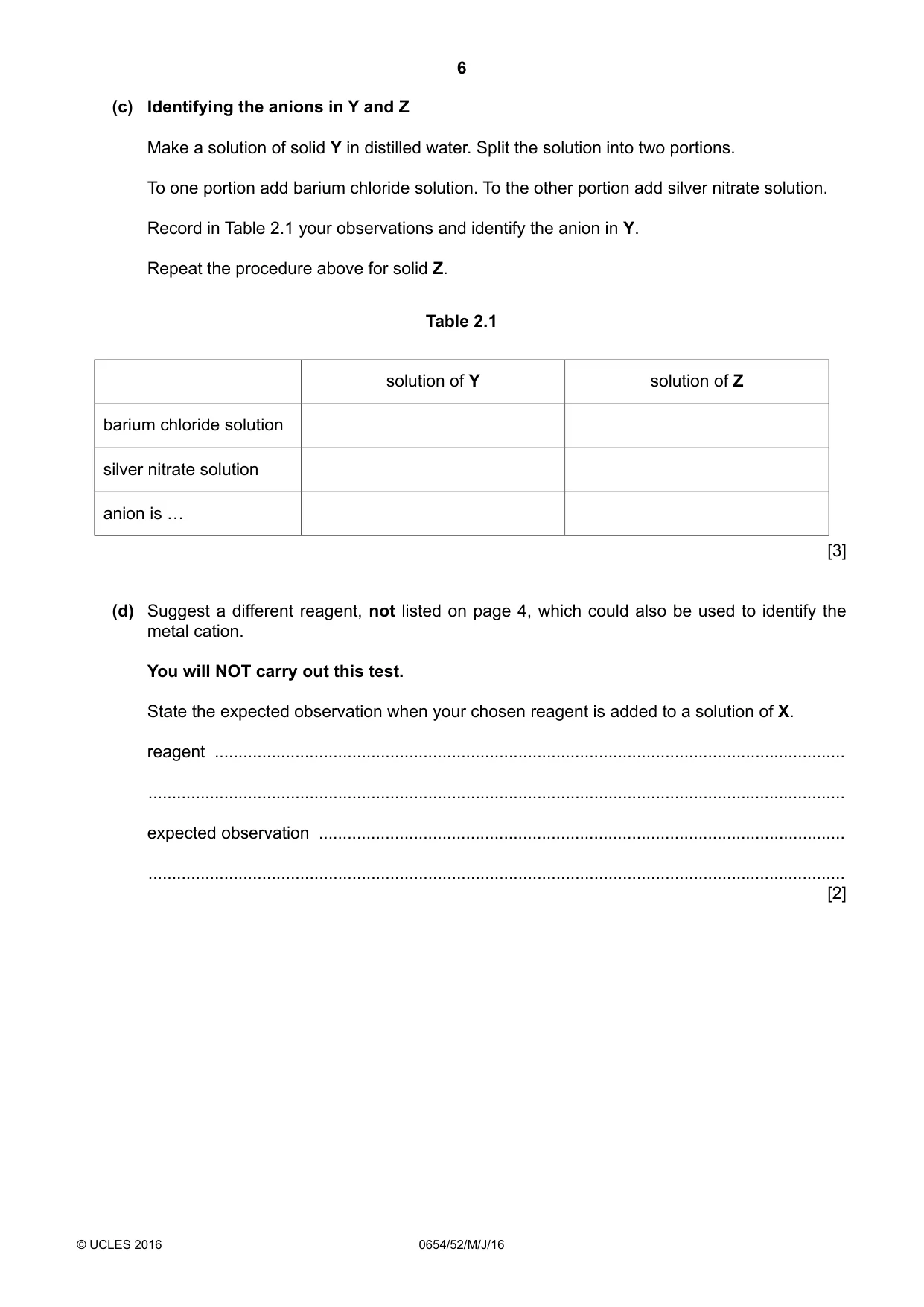
6 0654/52/M/J/16 © UCLES 2016 (c) Identifying the anions in Y and Z Make a solution of solid Y in distilled water. Split the solution into two portions. To one portion add barium chloride solution. To the other portion add silver nitrate solution. Record in Table 2.1 your observations and identify the anion in Y. Repeat the procedure above for solid Z. Table 2.1 solution of Y solution of Z barium chloride solution silver nitrate solution anion is … [3] (d) Suggest a different reagent, not listed on page 4, which could also be used to identify the metal cation. You will NOT carry out this test. State the expected observation when your chosen reagent is added to a solution of X. reagent … … expected observation … … [2]
Question paper, page 7
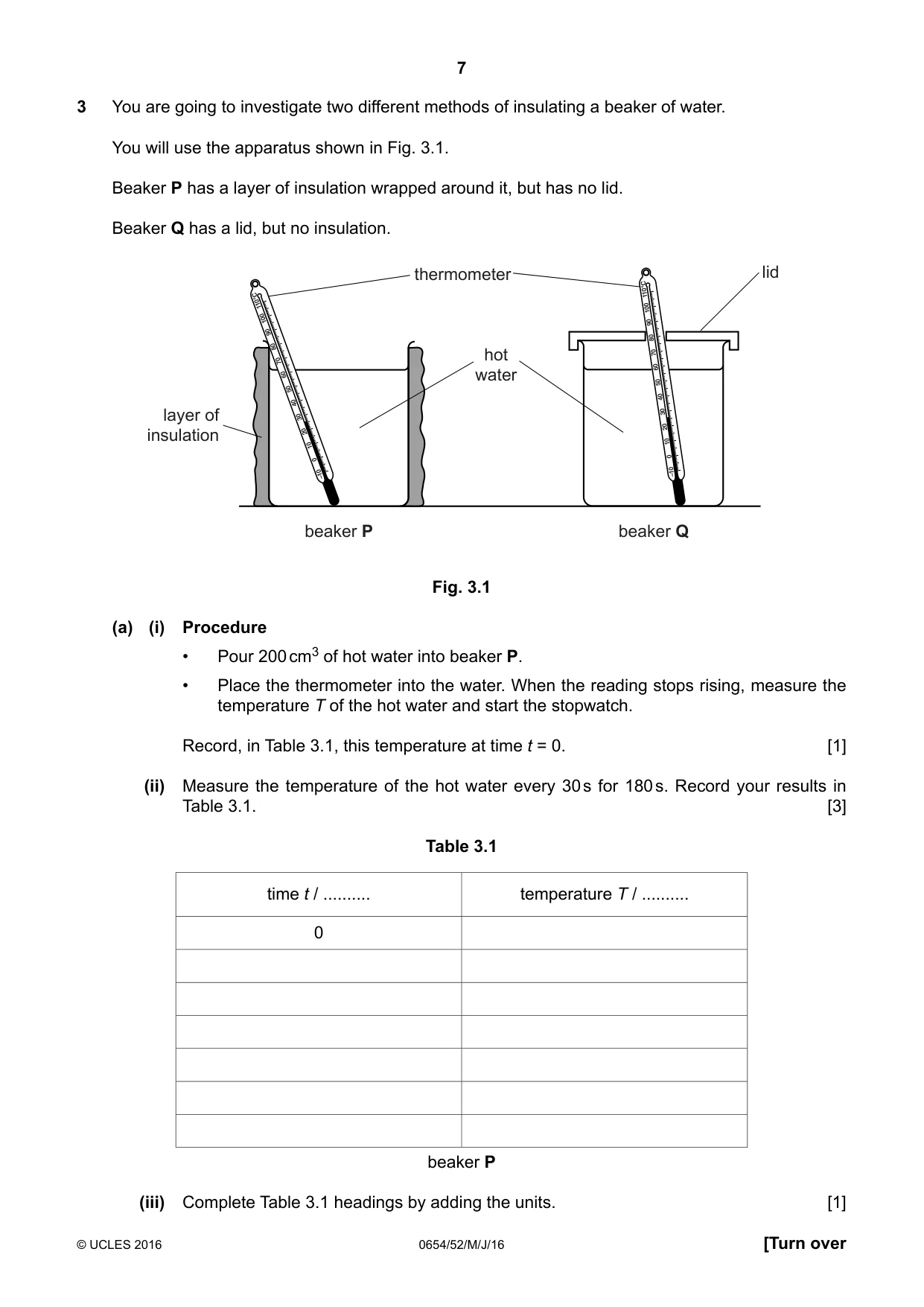
7 0654/52/M/J/16 © UCLES 2016 [Turn over 3 You are going to investigate two different methods of insulating a beaker of water. You will use the apparatus shown in Fig. 3.1. Beaker P has a layer of insulation wrapped around it, but has no lid. Beaker Q has a lid, but no insulation. –10 0 10 20 30 40 50 60 70 80 90 100 110°C –10 0 10 20 30 40 50 60 70 80 90 100 110°C layer of insulation thermometer hot water beaker P beaker Q lid Fig. 3.1 (a) (i) Procedure • Pour 200 cm3 of hot water into beaker P. • Place the thermometer into the water. When the reading stops rising, measure the temperature T of the hot water and start the stopwatch. Record, in Table 3.1, this temperature at time t = 0. [1] (ii) Measure the temperature of the hot water every 30 s for 180 s. Record your results in Table 3.1. [3] Table 3.1 time t / … temperature T / … 0 beaker P (iii) Complete Table 3.1 headings by adding the units. [1]
Question paper, page 8
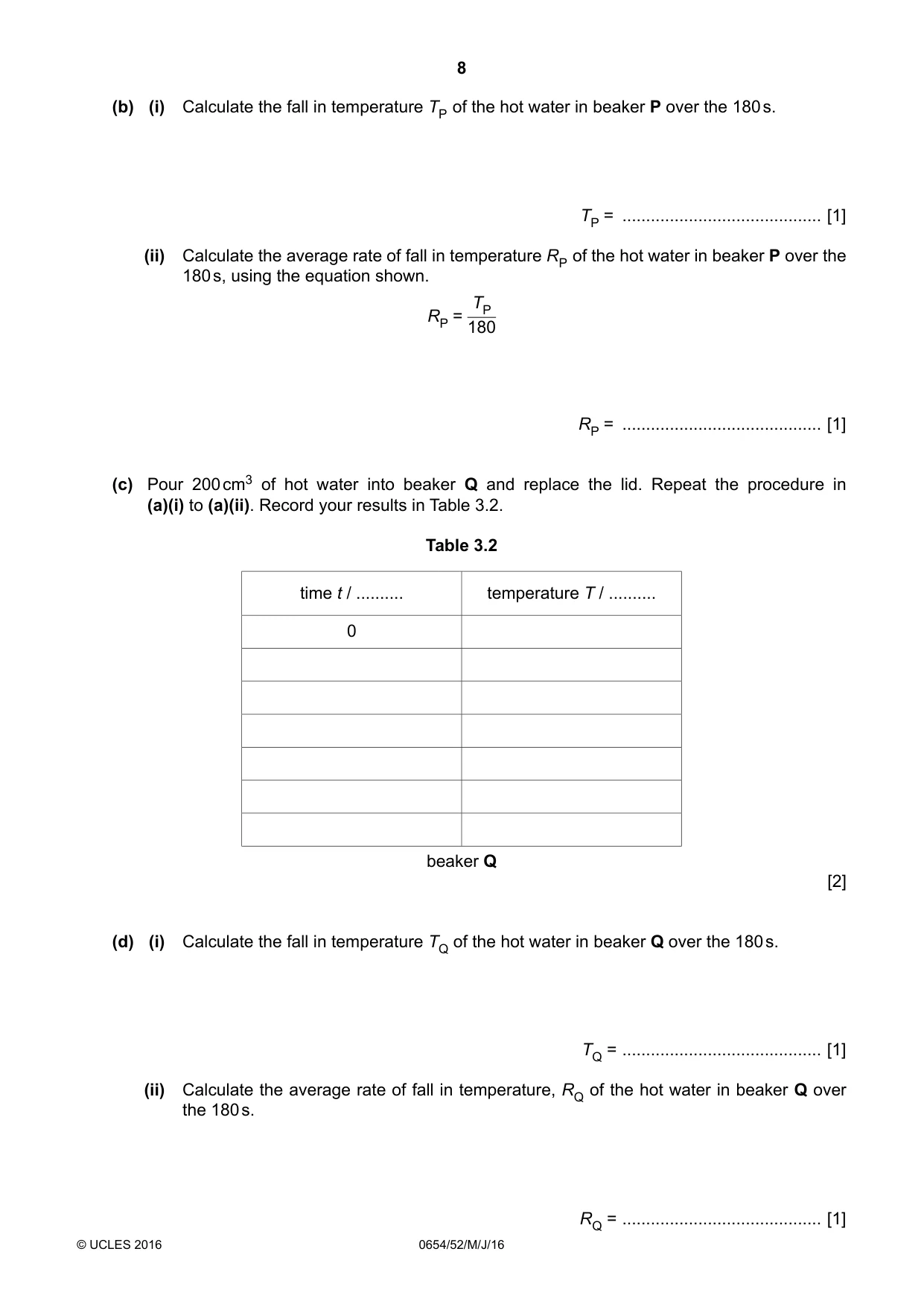
8 0654/52/M/J/16 © UCLES 2016 (b) (i) Calculate the fall in temperature TP of the hot water in beaker P over the 180 s. TP = … [1] (ii) Calculate the average rate of fall in temperature RP of the hot water in beaker P over the 180 s, using the equation shown. RP = TP 180 RP = … [1] (c) Pour 200 cm3 of hot water into beaker Q and replace the lid. Repeat the procedure in (a)(i) to (a)(ii). Record your results in Table 3.2. Table 3.2 time t / … temperature T / … 0 beaker Q [2] (d) (i) Calculate the fall in temperature TQ of the hot water in beaker Q over the 180 s. TQ = … [1] (ii) Calculate the average rate of fall in temperature, RQ of the hot water in beaker Q over the 180 s. RQ = … [1]
Question paper, page 9
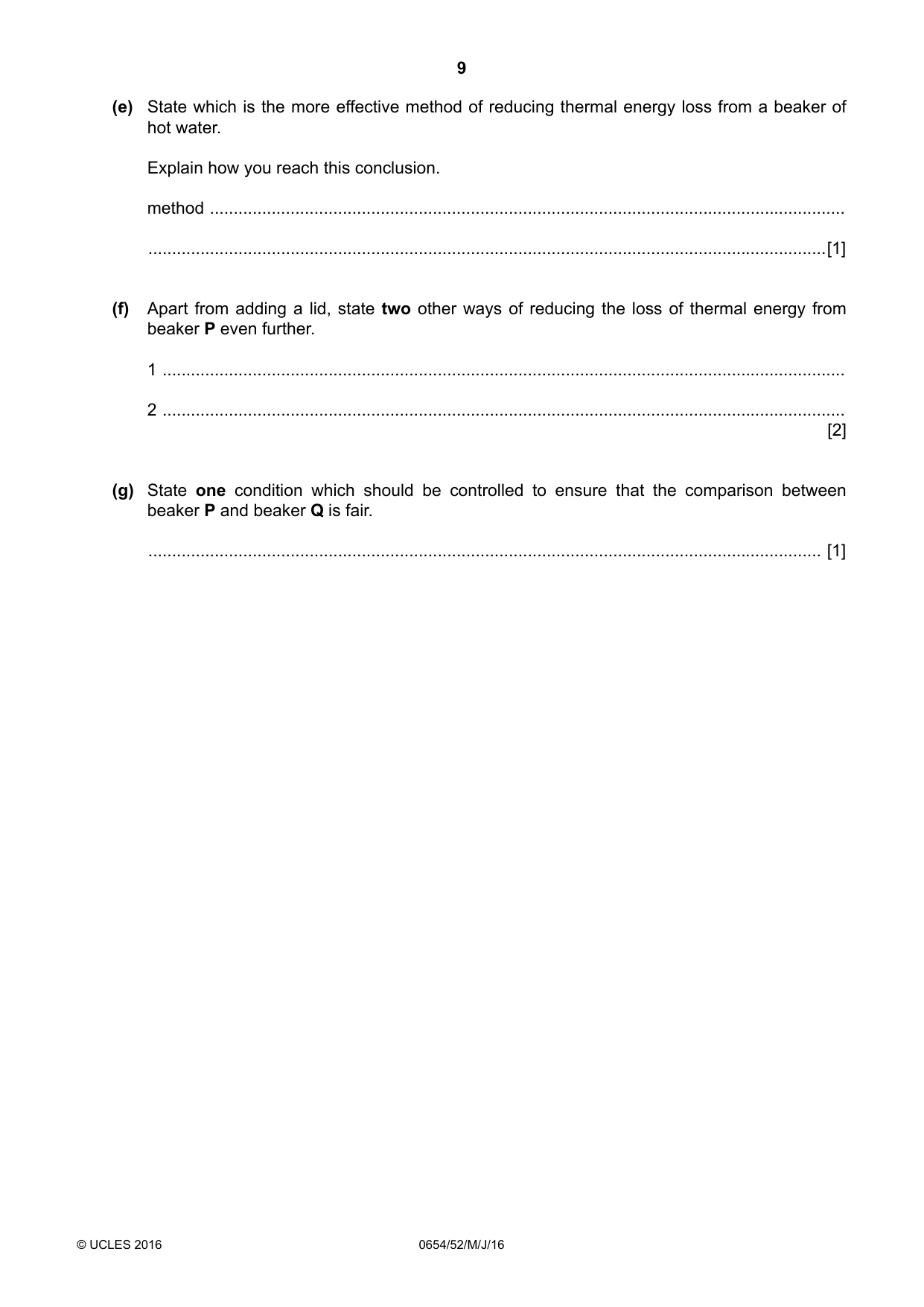
9 0654/52/M/J/16 © UCLES 2016 (e) State which is the more effective method of reducing thermal energy loss from a beaker of hot water. Explain how you reach this conclusion. method … …[1] (f) Apart from adding a lid, state two other ways of reducing the loss of thermal energy from beaker P even further. 1 … 2 … [2] (g) State one condition which should be controlled to ensure that the comparison between beaker P and beaker Q is fair. … [1]
Question paper, page 10
10 0654/52/M/J/16 © UCLES 2016 BLANK PAGE
Question paper, page 11
11 0654/52/M/J/16 © UCLES 2016 BLANK PAGE
Question paper, page 12
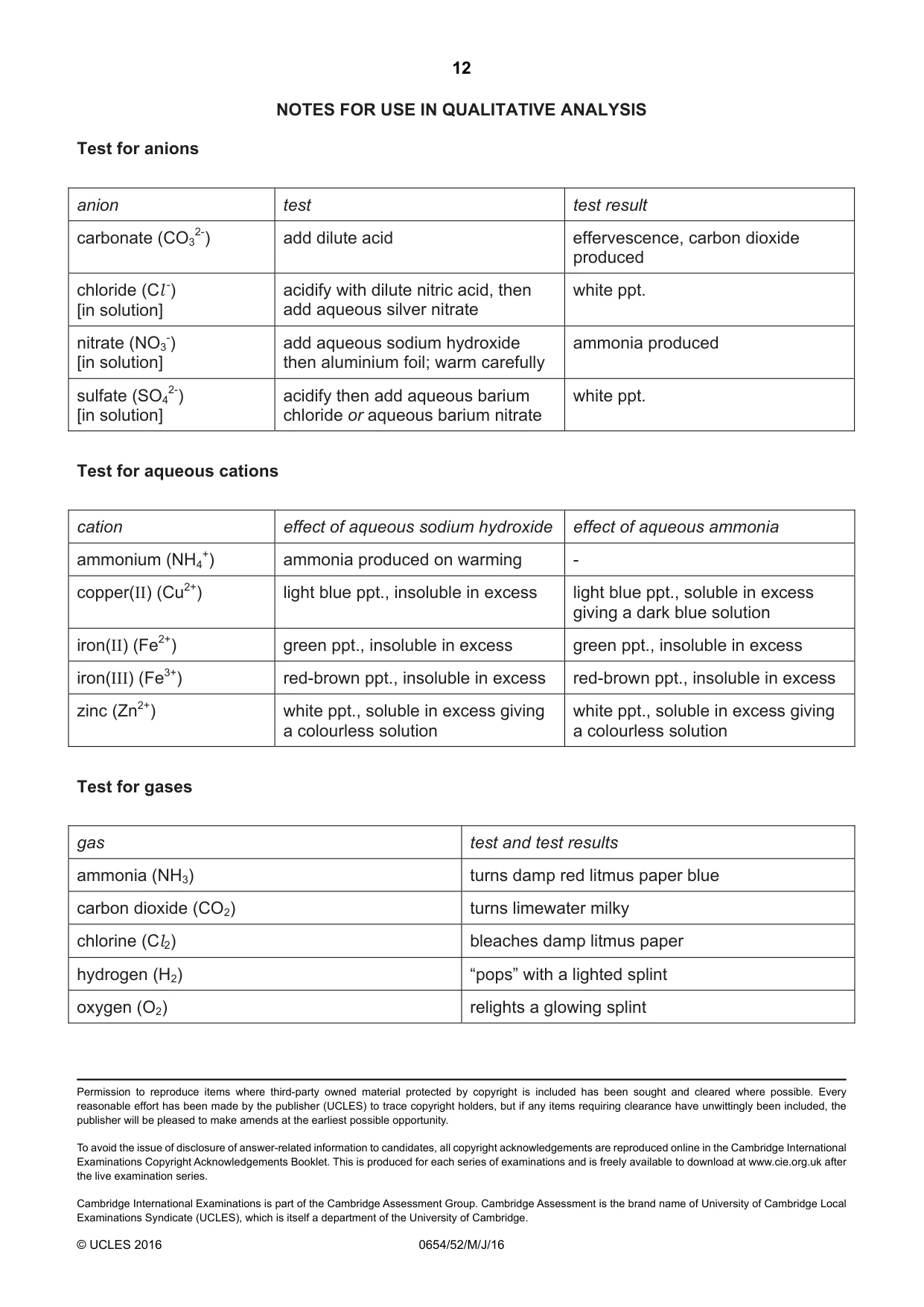
12 0654/52/M/J/16 © UCLES 2016 Permission to reproduce items where third-party owned material protected by copyright is included has been sought and cleared where possible. Every reasonable effort has been made by the publisher (UCLES) to trace copyright holders, but if any items requiring clearance have unwittingly been included, the publisher will be pleased to make amends at the earliest possible opportunity. To avoid the issue of disclosure of answer-related information to candidates, all copyright acknowledgements are reproduced online in the Cambridge International Examinations Copyright Acknowledgements Booklet. This is produced for each series of examinations and is freely available to download at www.cie.org.uk after the live examination series. Cambridge International Examinations is part of the Cambridge Assessment Group. Cambridge Assessment is the brand name of University of Cambridge Local Examinations Syndicate (UCLES), which is itself a department of the University of Cambridge. NOTES FOR USE IN QUALITATIVE ANALYSIS Test for anions anion test test result carbonate (CO3 2-) add dilute acid effervescence, carbon dioxide produced chloride (Cl -) [in solution] acidify with dilute nitric acid, then add aqueous silver nitrate white ppt. nitrate (NO3 -) [in solution] add aqueous sodium hydroxide then aluminium foil; warm carefully ammonia produced sulfate (SO4 2-) [in solution] acidify then add aqueous barium chloride or aqueous barium nitrate white ppt. Test for aqueous cations cation effect of aqueous sodium hydroxide effect of aqueous ammonia ammonium (NH4 +) ammonia produced on warming - copper(II) (Cu2+) light blue ppt., insoluble in excess light blue ppt., soluble in excess giving a dark blue solution iron(II) (Fe2+) green ppt., insoluble in excess green ppt., insoluble in excess iron(III) (Fe3+) red-brown ppt., insoluble in excess red-brown ppt., insoluble in excess zinc (Zn2+) white ppt., soluble in excess giving a colourless solution white ppt., soluble in excess giving a colourless solution Test for gases gas test and test results ammonia (NH3) turns damp red litmus paper blue carbon dioxide (CO2) turns limewater milky chlorine (Cl2) bleaches damp litmus paper hydrogen (H2) “pops” with a lighted splint oxygen (O2) relights a glowing splint
Mark scheme, page 1
® IGCSE is the registered trademark of Cambridge International Examinations. This document consists of 4 printed pages. © UCLES 2016 [Turn over Cambridge International Examinations Cambridge International General Certificate of Secondary Education CO-ORDINATED SCIENCES 0654/52 Paper 5 Practical Test May/June 2016 MARK SCHEME Maximum Mark: 45 Published This mark scheme is published as an aid to teachers and candidates, to indicate the requirements of the examination. It shows the basis on which Examiners were instructed to award marks. It does not indicate the details of the discussions that took place at an Examiners’ meeting before marking began, which would have considered the acceptability of alternative answers. Mark schemes should be read in conjunction with the question paper and the Principal Examiner Report for Teachers. Cambridge will not enter into discussions about these mark schemes. Cambridge is publishing the mark schemes for the May/June 2016 series for most Cambridge IGCSE®, Cambridge International A and AS Level components and some Cambridge O Level components.
Mark scheme, page 2
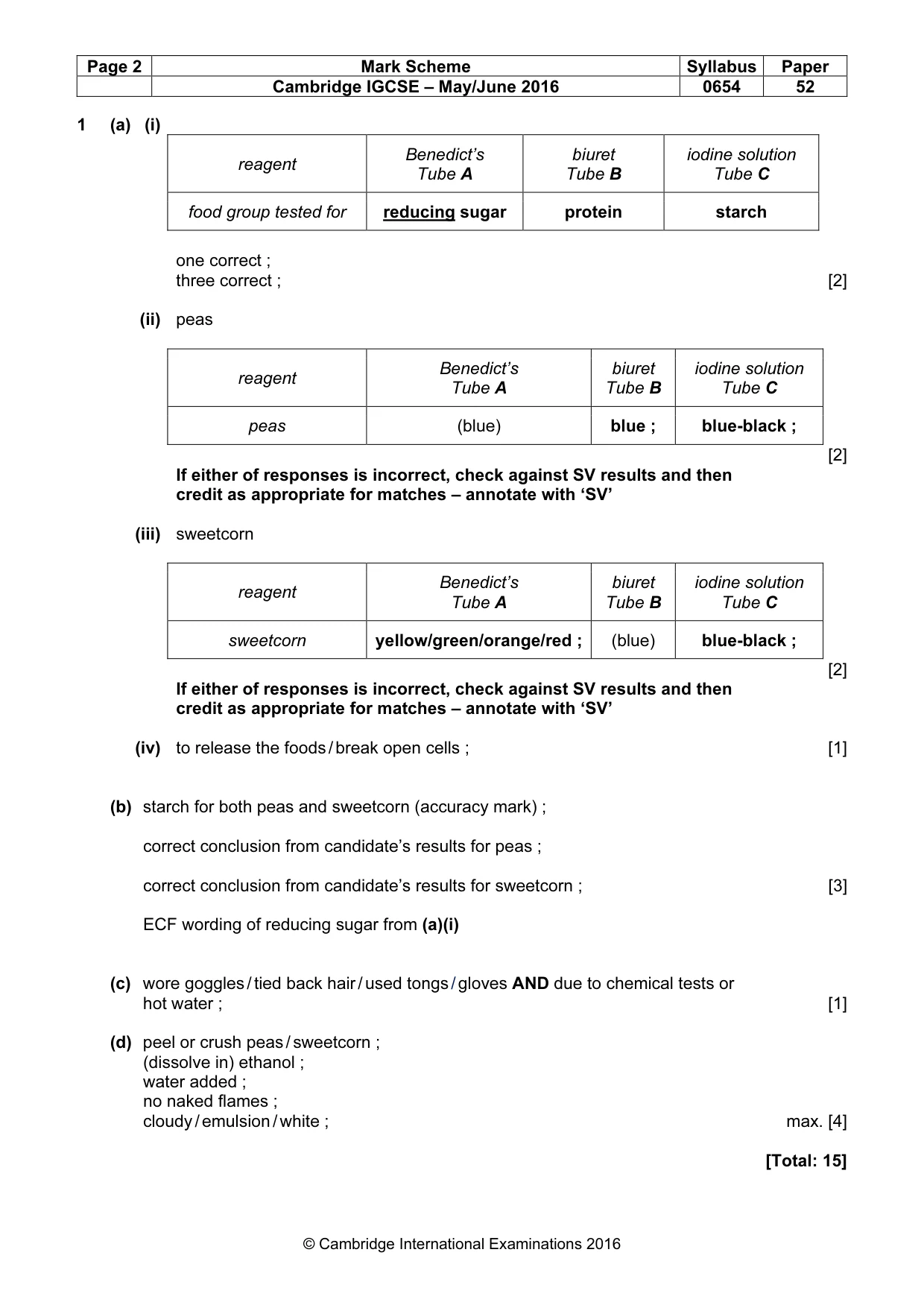
Page 2 Mark Scheme Syllabus Paper Cambridge IGCSE – May/June 2016 0654 52 © Cambridge International Examinations 2016 1 (a) (i) reagent Benedict’s Tube A biuret Tube B iodine solution Tube C food group tested for reducing sugar protein starch one correct ; three correct ; [2] (ii) peas reagent Benedict’s Tube A biuret Tube B iodine solution Tube C peas (blue) blue ; blue-black ; [2] If either of responses is incorrect, check against SV results and then credit as appropriate for matches – annotate with ‘SV’ (iii) sweetcorn reagent Benedict’s Tube A biuret Tube B iodine solution Tube C sweetcorn yellow/green/orange/red ; (blue) blue-black ; [2] If either of responses is incorrect, check against SV results and then credit as appropriate for matches – annotate with ‘SV’ (iv) to release the foods / break open cells ; [1] (b) starch for both peas and sweetcorn (accuracy mark) ; correct conclusion from candidate’s results for peas ; correct conclusion from candidate’s results for sweetcorn ; [3] ECF wording of reducing sugar from (a)(i) (c) wore goggles / tied back hair / used tongs / gloves AND due to chemical tests or hot water ; [1] (d) peel or crush peas / sweetcorn ; (dissolve in) ethanol ; water added ; no naked flames ; cloudy / emulsion / white ; max. [4] [Total: 15]
Mark scheme, page 3
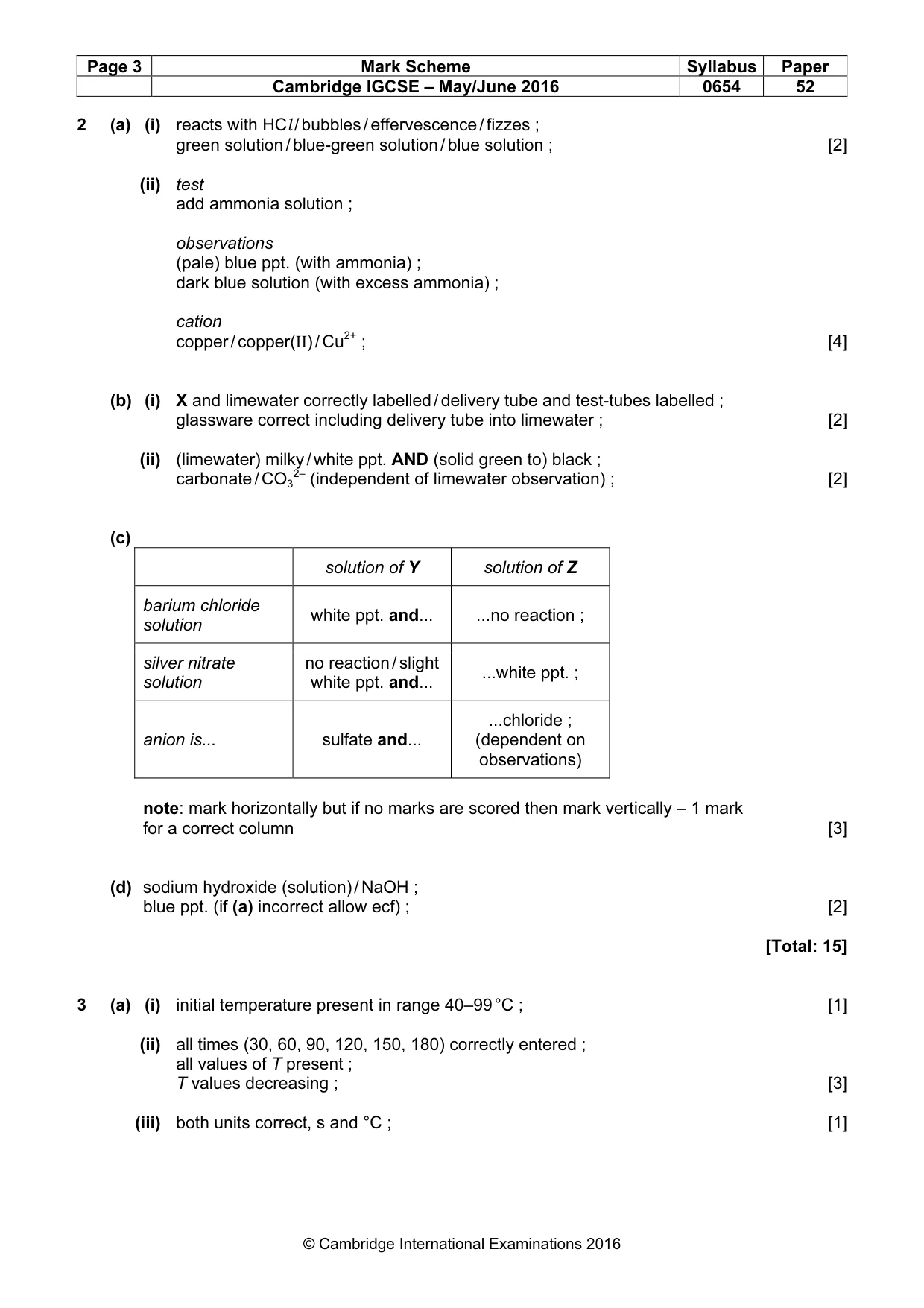
Page 3 Mark Scheme Syllabus Paper Cambridge IGCSE – May/June 2016 0654 52 © Cambridge International Examinations 2016 2 (a) (i) reacts with HCl / bubbles / effervescence / fizzes ; green solution / blue-green solution / blue solution ; [2] (ii) test add ammonia solution ; observations (pale) blue ppt. (with ammonia) ; dark blue solution (with excess ammonia) ; cation copper / copper(II) / Cu2+ ; [4] (b) (i) X and limewater correctly labelled / delivery tube and test-tubes labelled ; glassware correct including delivery tube into limewater ; [2] (ii) (limewater) milky / white ppt. AND (solid green to) black ; carbonate / CO3 2– (independent of limewater observation) ; [2] (c) solution of Y solution of Z barium chloride solution white ppt. and... ...no reaction ; silver nitrate solution no reaction / slight white ppt. and... ...white ppt. ; anion is... sulfate and... ...chloride ; (dependent on observations) note: mark horizontally but if no marks are scored then mark vertically – 1 mark for a correct column [3] (d) sodium hydroxide (solution) / NaOH ; blue ppt. (if (a) incorrect allow ecf) ; [2] [Total: 15] 3 (a) (i) initial temperature present in range 40–99 °C ; [1] (ii) all times (30, 60, 90, 120, 150, 180) correctly entered ; all values of T present ; T values decreasing ; [3] (iii) both units correct, s and °C ; [1]
Mark scheme, page 4
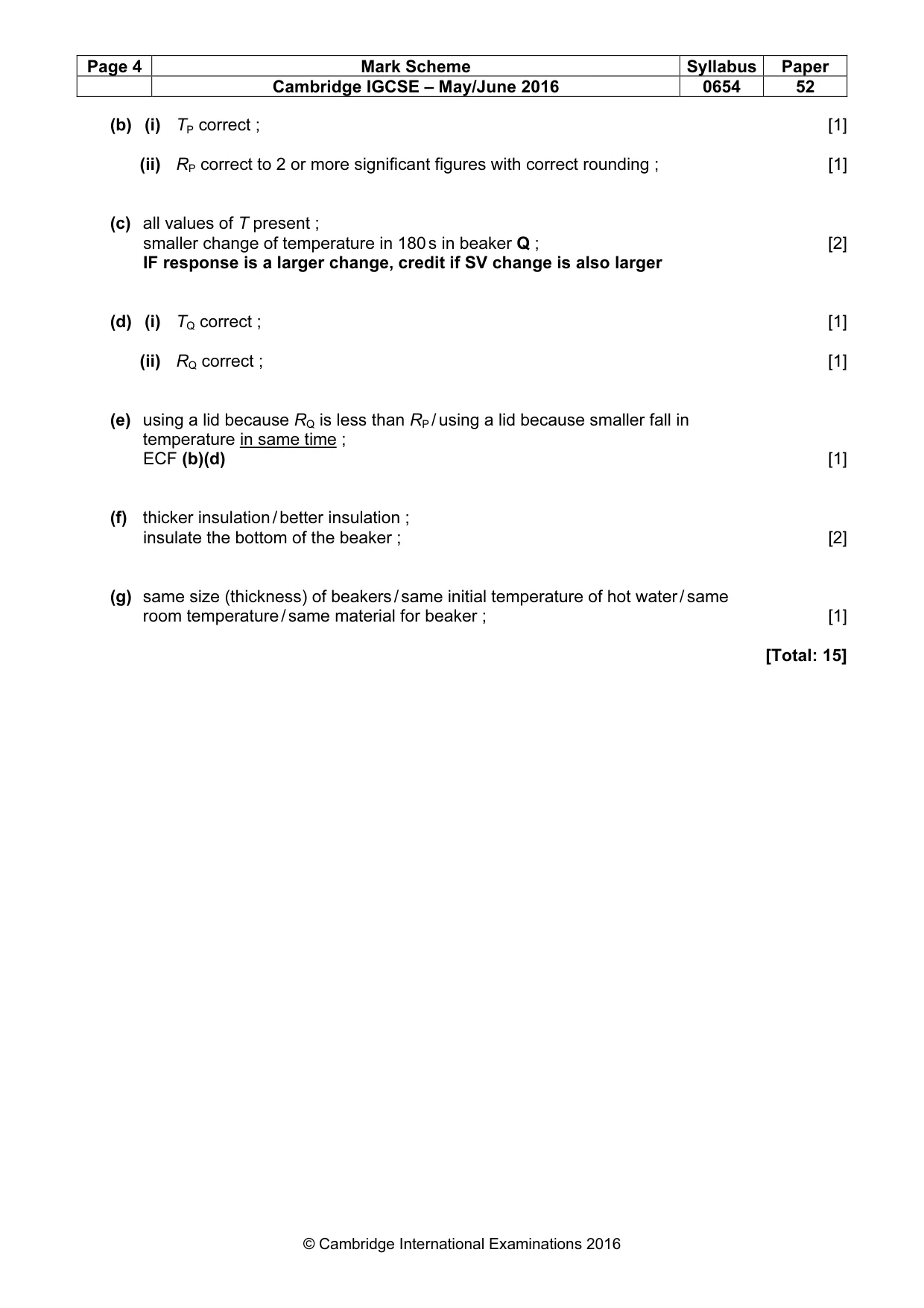
Page 4 Mark Scheme Syllabus Paper Cambridge IGCSE – May/June 2016 0654 52 © Cambridge International Examinations 2016 (b) (i) TP correct ; [1] (ii) RP correct to 2 or more significant figures with correct rounding ; [1] (c) all values of T present ; smaller change of temperature in 180 s in beaker Q ; [2] IF response is a larger change, credit if SV change is also larger (d) (i) TQ correct ; [1] (ii) RQ correct ; [1] (e) using a lid because RQ is less than RP / using a lid because smaller fall in temperature in same time ; ECF (b)(d) [1] (f) thicker insulation / better insulation ; insulate the bottom of the beaker ; [2] (g) same size (thickness) of beakers / same initial temperature of hot water / same room temperature / same material for beaker ; [1] [Total: 15]
What you needed in this session
Cambridge’s own grade thresholds for 2016 May/June, Paper 5 · Variant 2. A higher threshold means an easier paper — the bar moves with how the cohort did.