Cambridge IGCSE Sciences - Co-ordinated (Double) 0654 — 2015 May/June Paper 5 · Variant 1
0654/51/M/J/15 · 45 marks · ≈51 min
The question paper and its mark scheme, free to read here and free to download. This is Cambridge’s own paper, exactly as it was sat.
Question paper16 pages





Mark scheme4 pages
Answers below. Sit the paper first if you are practising.
Paper as text
Question paper, page 1
This document consists of 15 printed pages and 1 blank page. IB15 06_0654_51/5RP © UCLES 2015 [Turn over *1624860544* For Examiner's Use 1 2 3 Total Cambridge International Examinations Cambridge International General Certificate of Secondary Education CO-ORDINATED SCIENCES 0654/51 Paper 5 Practical Test May/June 2015 2 hours Candidates answer on the Question Paper. Additional Materials: As listed in the Confidential Instructions. READ THESE INSTRUCTIONS FIRST Write your Centre number, candidate number and name on all the work you hand in. Write in dark blue or black pen. You may use an HB pencil for any diagrams or graphs. Do not use staples, paper clips, glue or correction fluid. DO NOT WRITE IN ANY BARCODES. Answer all questions. Electronic calculators may be used. You may lose marks if you do not show your working or if you do not use appropriate units. Notes for Use in Qualitative Analysis for this paper are printed on page 16. At the end of the examination, fasten all your work securely together. The number of marks is given in brackets [ ] at the end of each question or part question.
Question paper, page 2
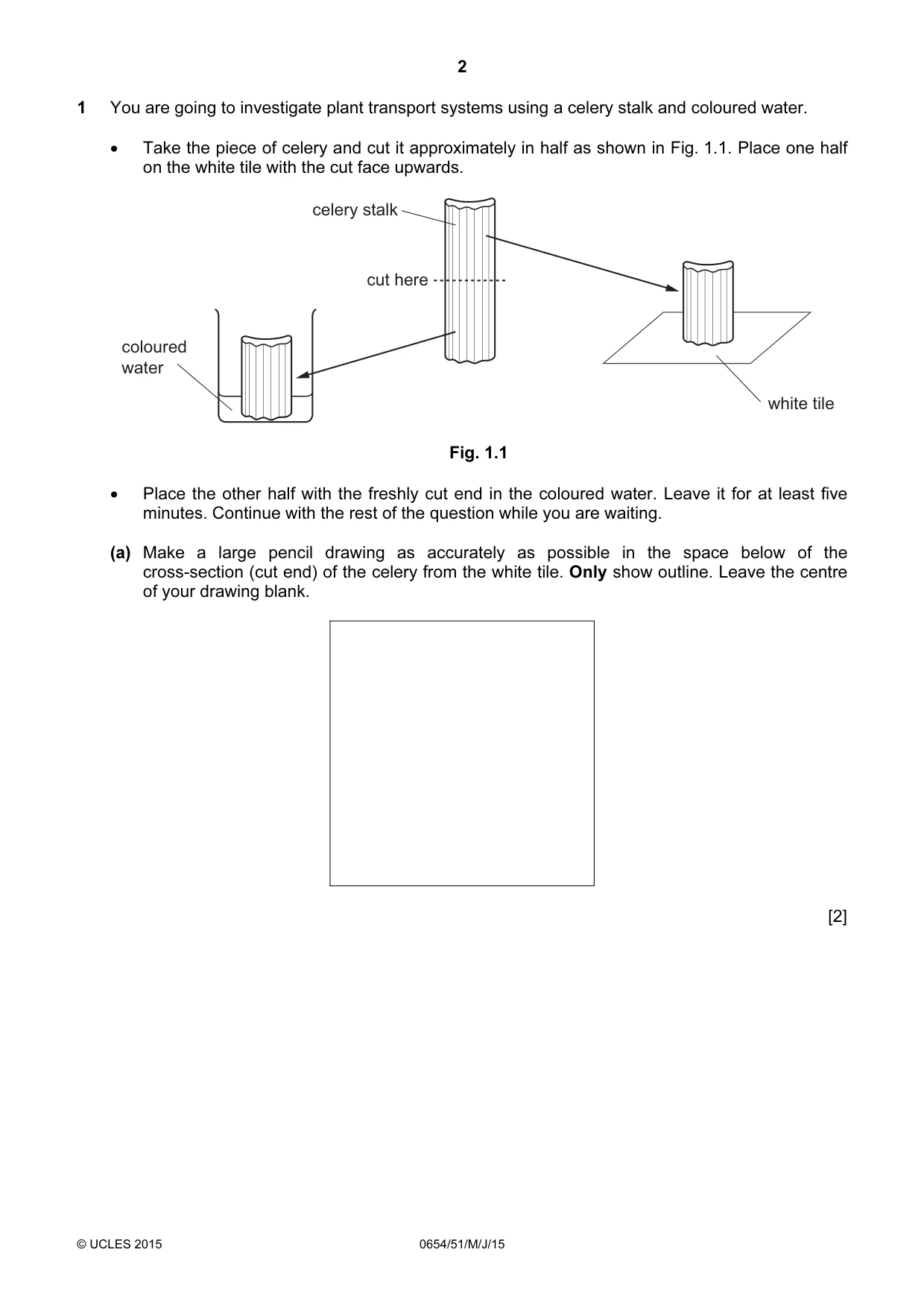
2 © UCLES 2015 0654/51/M/J/15 1 You are going to investigate plant transport systems using a celery stalk and coloured water. • Take the piece of celery and cut it approximately in half as shown in Fig. 1.1. Place one half on the white tile with the cut face upwards. celery stalk coloured water white tile cut here Fig. 1.1 • Place the other half with the freshly cut end in the coloured water. Leave it for at least five minutes. Continue with the rest of the question while you are waiting. (a) Make a large pencil drawing as accurately as possible in the space below of the cross-section (cut end) of the celery from the white tile. Only show outline. Leave the centre of your drawing blank. [2]
Question paper, page 3
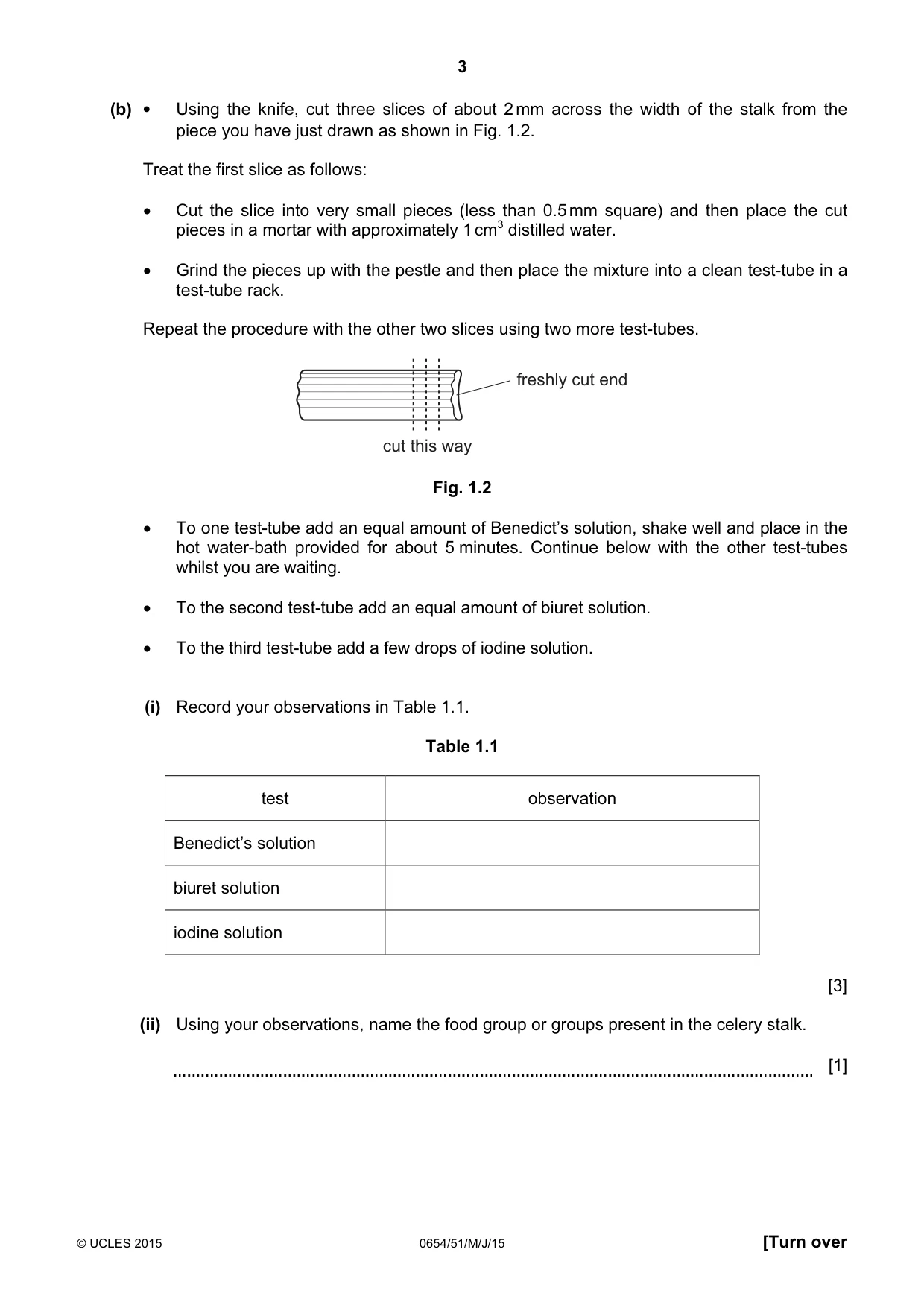
3 © UCLES 2015 0654/51/M/J/15 [Turn over (b) • Using the knife, cut three slices of about 2 mm across the width of the stalk from the piece you have just drawn as shown in Fig. 1.2. Treat the first slice as follows: • Cut the slice into very small pieces (less than 0.5 mm square) and then place the cut pieces in a mortar with approximately 1 cm3 distilled water. • Grind the pieces up with the pestle and then place the mixture into a clean test-tube in a test-tube rack. Repeat the procedure with the other two slices using two more test-tubes. cut this way freshly cut end Fig. 1.2 • To one test-tube add an equal amount of Benedict’s solution, shake well and place in the hot water-bath provided for about 5 minutes. Continue below with the other test-tubes whilst you are waiting. • To the second test-tube add an equal amount of biuret solution. • To the third test-tube add a few drops of iodine solution. (i) Record your observations in Table 1.1. Table 1.1 test observation Benedict’s solution biuret solution iodine solution [3] (ii) Using your observations, name the food group or groups present in the celery stalk. [1]
Question paper, page 4
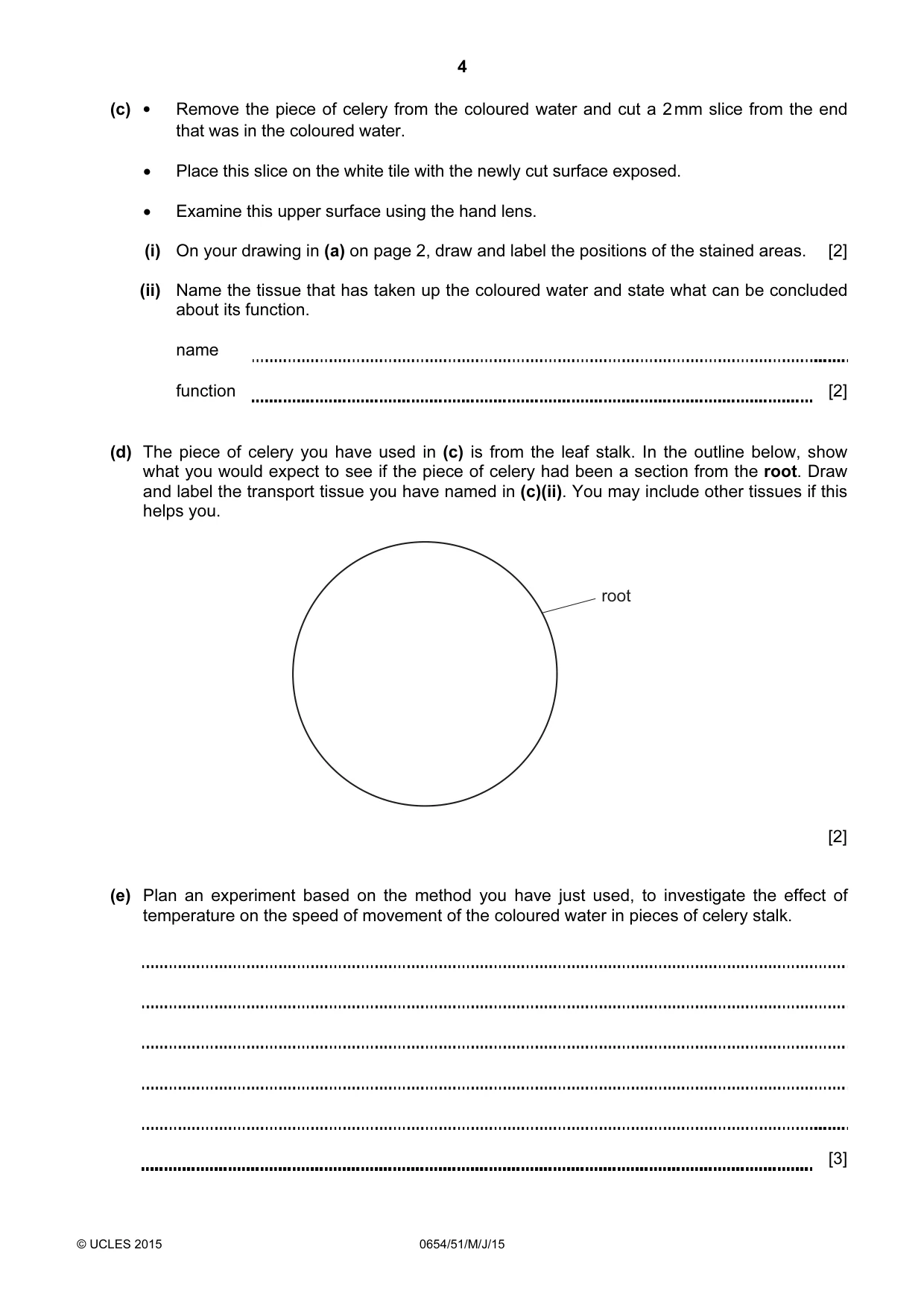
4 © UCLES 2015 0654/51/M/J/15 (c) • Remove the piece of celery from the coloured water and cut a 2 mm slice from the end that was in the coloured water. • Place this slice on the white tile with the newly cut surface exposed. • Examine this upper surface using the hand lens. (i) On your drawing in (a) on page 2, draw and label the positions of the stained areas. [2] (ii) Name the tissue that has taken up the coloured water and state what can be concluded about its function. name function [2] (d) The piece of celery you have used in (c) is from the leaf stalk. In the outline below, show what you would expect to see if the piece of celery had been a section from the root. Draw and label the transport tissue you have named in (c)(ii). You may include other tissues if this helps you. root [2] (e) Plan an experiment based on the method you have just used, to investigate the effect of temperature on the speed of movement of the coloured water in pieces of celery stalk. [3]
Question paper, page 5
5 © UCLES 2015 0654/51/M/J/15 [Turn over Please turn over for Question 2.
Question paper, page 6
6 © UCLES 2015 0654/51/M/J/15 2 Solid X is a mixture of three metal oxides, compounds A, B and C. You are going to carry out a series of experiments and suggest the identities of the metal oxides. (a) Experiment to identify compound A Place two large spatula loads of solid X into a small beaker and add approximately 25 cm3 distilled water. Stir well for 30 seconds. Filter the mixture to collect two test-tubes half full of filtrate for use in (i) and (ii) below. The remainder of the liquid may be discarded but the residue in the filter paper should be placed in the second beaker. Add 25 cm3 dilute nitric acid and stir the mixture. Keep this for use in part (b). (i) To the marble chips in the test-tube provided, add hydrochloric acid until the test-tube is one third full. Attach the delivery tube to this test-tube and pass the gas produced into one of the test-tubes containing the filtrate. Record your observations of the filtrate. observations [1] (ii) To the second test-tube containing filtrate, add a few drops of full range Universal Indicator. Record the colour of the resulting mixture and its pH. colour pH [1] (iii) Using your observations in (i) and (ii), suggest the identity of compound A. compound A is [1] (iv) Using your observations in (ii), classify the oxide in compound A which is present in the filtrate. classification of oxide in compound A [1]
Question paper, page 7
7 © UCLES 2015 0654/51/M/J/15 [Turn over (b) Experiment to identify compound B If the residue from part (a) has not all dissolved in the dilute nitric acid, gently warm the beaker and carefully stir the mixture. Do NOT boil the mixture. If not all of the solid has dissolved after warming then filter or decant the mixture into two large test-tubes so that they are each one quarter full. (i) In one of the test-tubes, add sodium hydroxide solution slowly until the test-tube is nearly full. Use red litmus paper to check that the mixture is alkaline. If not, add more sodium hydroxide solution until the mixture is alkaline. Stir the mixture carefully. Keep this mixture for part (c). Record your observations. observations [1] (ii) To the liquid in the other large test-tube slowly add ammonia solution until there is no further change. Record your observations. Looking down through the test-tube from the top will help you. observations [3] (iii) Use your observations in (i) and (ii) to identify the cation present in compound B and hence name compound B present in solid X. cation present compound B is [2]
Question paper, page 8
8 © UCLES 2015 0654/51/M/J/15 (c) Experiment to identify compound C (i) Wash out one of the beakers from part (a) with distilled water. The contents of the large test-tube from (b)(i) should now have settled. Decant about 20 cm3 of the liquid into the beaker. Describe the appearance of the liquid and keep this liquid for (ii). appearance of liquid [1] (ii) To the liquid in the beaker from (i) add dilute hydrochloric acid very slowly, with stirring, until you have added an equal volume of acid. Record your observations. observations [2] (iii) The scheme below shows the other compounds that compound C changed into during your experiment. Complete the missing compound. oxide (C) nitrate (in (a)) hydroxide (during (b)(i)) … (at end of (c)(ii)) [1] (iv) Look at what you have done and your observations in parts (b) and (c). Using the Notes for Qualitative Analysis, on page 16, suggest the formula of the cation which is in compound C. formula of cation [1]
Question paper, page 9
9 © UCLES 2015 0654/51/M/J/15 [Turn over Please turn over for Question 3.
Question paper, page 10
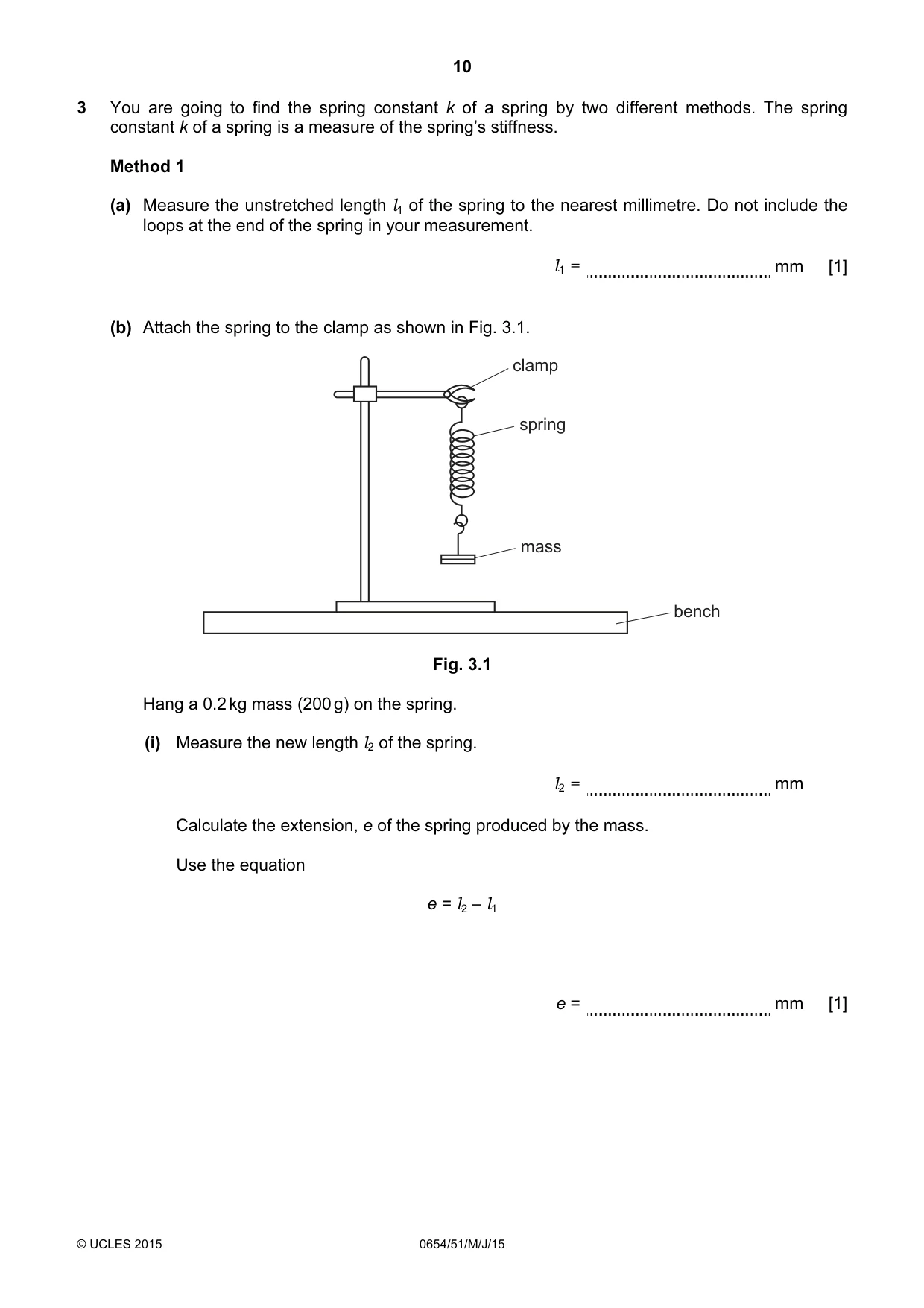
10 © UCLES 2015 0654/51/M/J/15 3 You are going to find the spring constant k of a spring by two different methods. The spring constant k of a spring is a measure of the spring’s stiffness. Method 1 (a) Measure the unstretched length l1 of the spring to the nearest millimetre. Do not include the loops at the end of the spring in your measurement. l1 = mm [1] (b) Attach the spring to the clamp as shown in Fig. 3.1. spring mass clamp bench Fig. 3.1 Hang a 0.2 kg mass (200 g) on the spring. (i) Measure the new length l2 of the spring. l2 = mm Calculate the extension, e of the spring produced by the mass. Use the equation e = l2 – l1 e = mm [1]
Question paper, page 11
11 © UCLES 2015 0654/51/M/J/15 [Turn over (ii) Calculate the spring constant k of the spring. Use the equation k = e F where the weight of the mass F is 2 N. k = N / mm [1]
Question paper, page 12
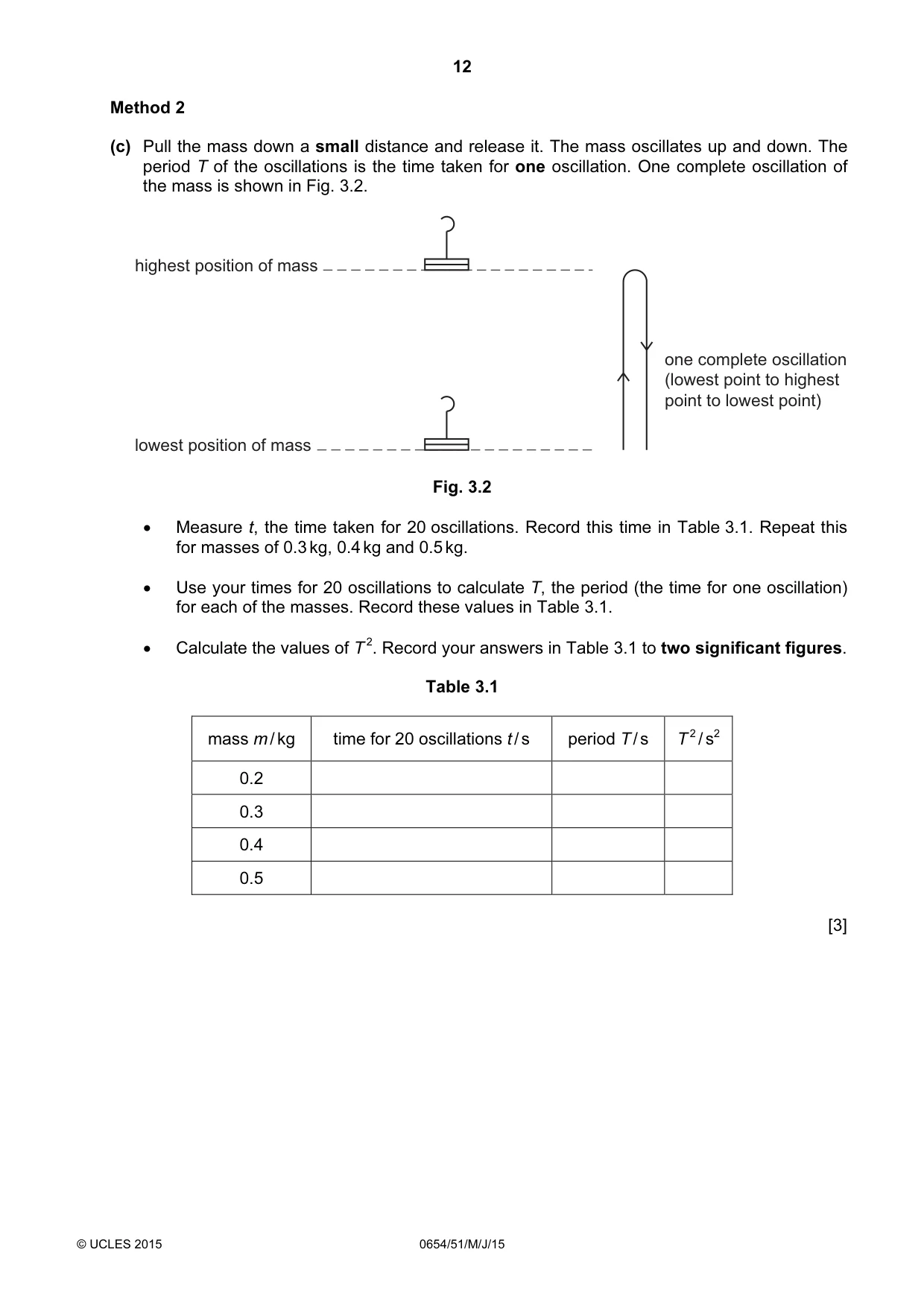
12 © UCLES 2015 0654/51/M/J/15 Method 2 (c) Pull the mass down a small distance and release it. The mass oscillates up and down. The period T of the oscillations is the time taken for one oscillation. One complete oscillation of the mass is shown in Fig. 3.2. highest position of mass lowest position of mass one complete oscillation (lowest point to highest point to lowest point) Fig. 3.2 • Measure t, the time taken for 20 oscillations. Record this time in Table 3.1. Repeat this for masses of 0.3 kg, 0.4 kg and 0.5 kg. • Use your times for 20 oscillations to calculate T, the period (the time for one oscillation) for each of the masses. Record these values in Table 3.1. • Calculate the values of T 2. Record your answers in Table 3.1 to two significant figures. Table 3.1 mass m / kg time for 20 oscillations t / s period T / s T 2 / s2 0.2 0.3 0.4 0.5 [3]
Question paper, page 13
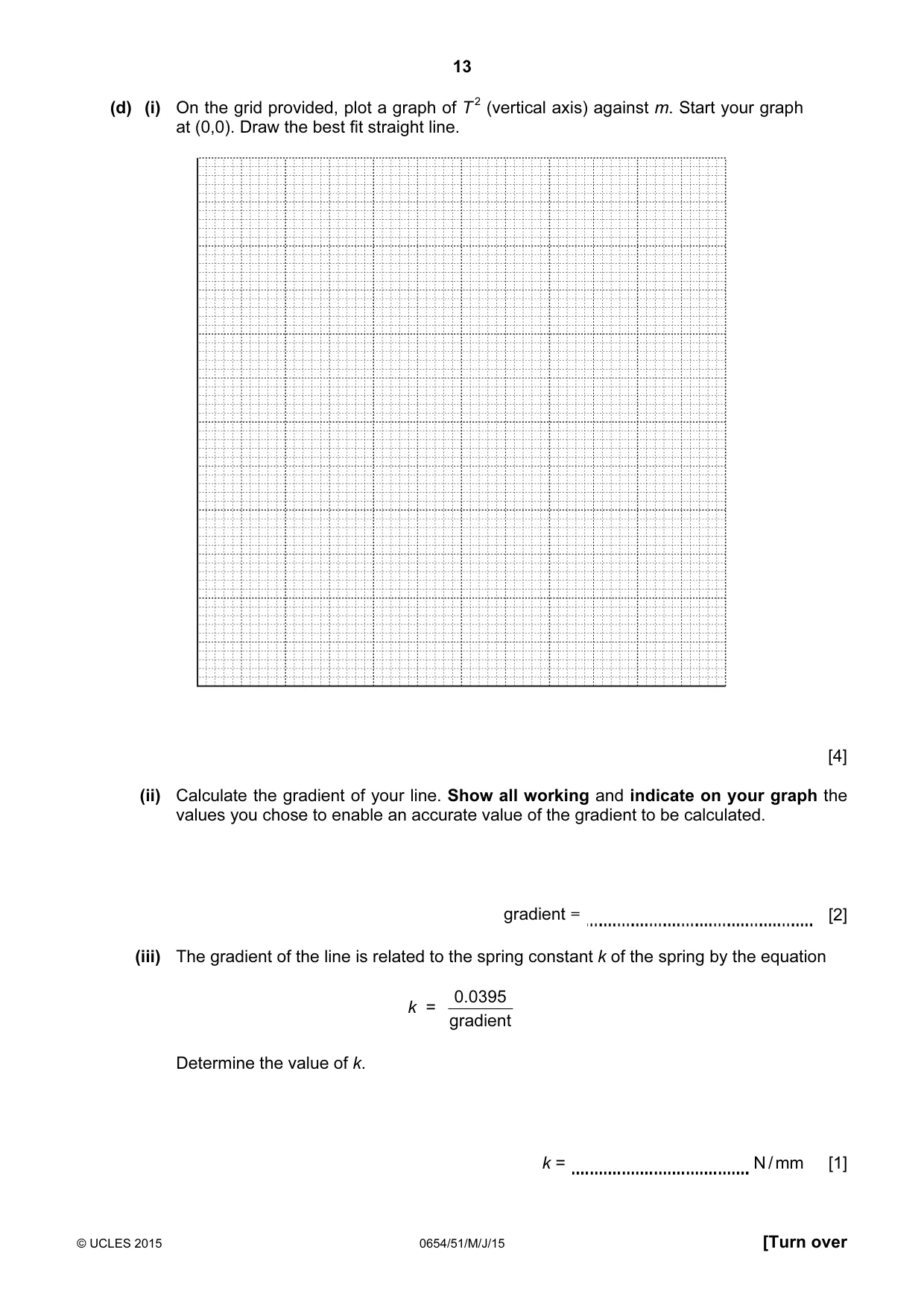
13 © UCLES 2015 0654/51/M/J/15 [Turn over (d) (i) On the grid provided, plot a graph of T 2 (vertical axis) against m. Start your graph at (0,0). Draw the best fit straight line. [4] (ii) Calculate the gradient of your line. Show all working and indicate on your graph the values you chose to enable an accurate value of the gradient to be calculated. gradient = [2] (iii) The gradient of the line is related to the spring constant k of the spring by the equation k = gradient 0.0395 Determine the value of k. k = N / mm [1]
Question paper, page 14
14 © UCLES 2015 0654/51/M/J/15 (e) In both methods it is important to avoid line of sight (parallax) errors when measuring the length of the spring and timing the oscillations. Describe how you avoided this error in each method. Method 1 Method 2 [2]
Question paper, page 15
15 © UCLES 2015 0654/51/M/J/15 BLANK PAGE
Question paper, page 16
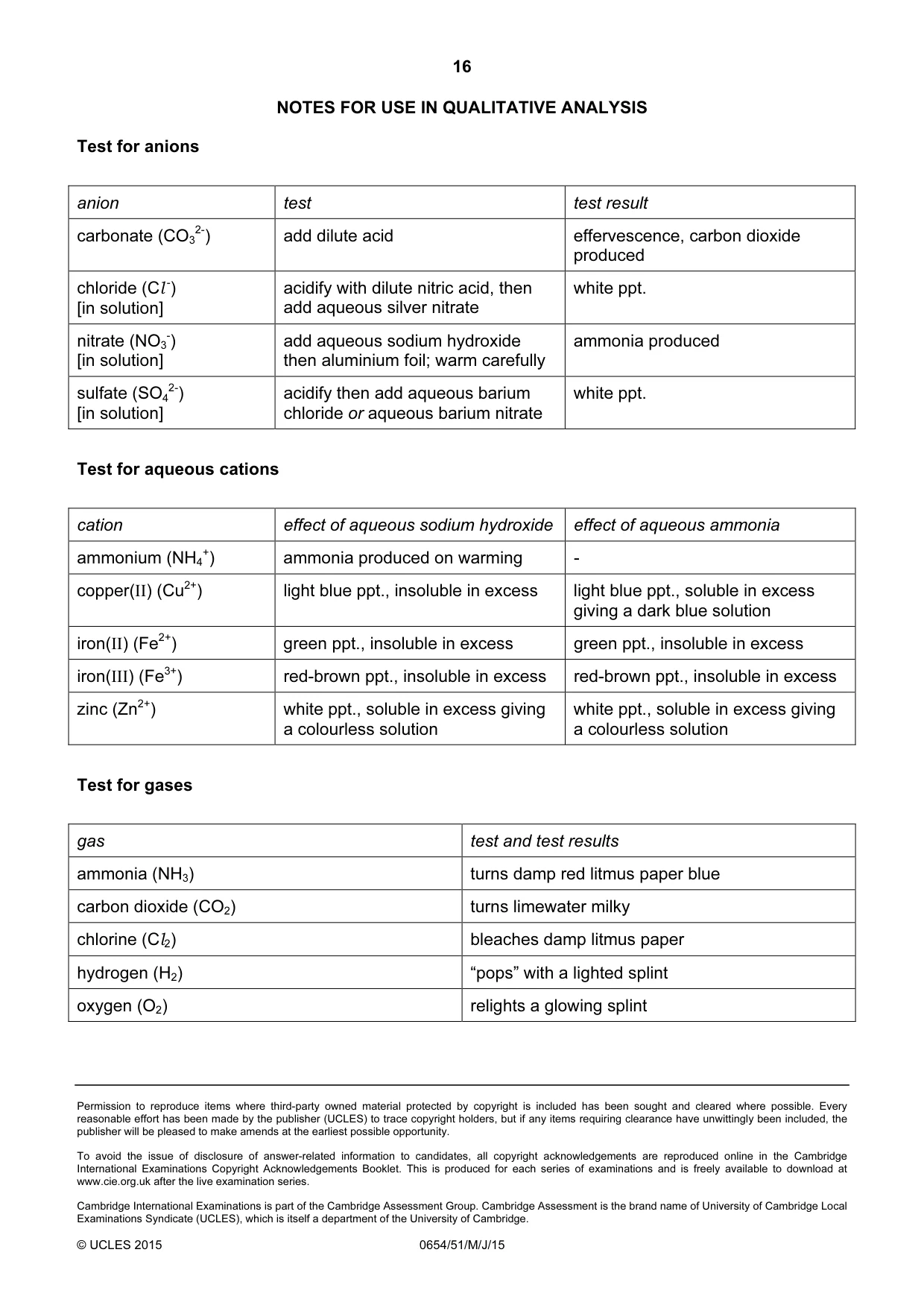
16 Permission to reproduce items where third-party owned material protected by copyright is included has been sought and cleared where possible. Every reasonable effort has been made by the publisher (UCLES) to trace copyright holders, but if any items requiring clearance have unwittingly been included, the publisher will be pleased to make amends at the earliest possible opportunity. To avoid the issue of disclosure of answer-related information to candidates, all copyright acknowledgements are reproduced online in the Cambridge International Examinations Copyright Acknowledgements Booklet. This is produced for each series of examinations and is freely available to download at www.cie.org.uk after the live examination series. Cambridge International Examinations is part of the Cambridge Assessment Group. Cambridge Assessment is the brand name of University of Cambridge Local Examinations Syndicate (UCLES), which is itself a department of the University of Cambridge. © UCLES 2015 0654/51/M/J/15 NOTES FOR USE IN QUALITATIVE ANALYSIS Test for anions anion test test result carbonate (CO3 2-) add dilute acid effervescence, carbon dioxide produced chloride (Cl -) [in solution] acidify with dilute nitric acid, then add aqueous silver nitrate white ppt. nitrate (NO3 -) [in solution] add aqueous sodium hydroxide then aluminium foil; warm carefully ammonia produced sulfate (SO4 2-) [in solution] acidify then add aqueous barium chloride or aqueous barium nitrate white ppt. Test for aqueous cations cation effect of aqueous sodium hydroxide effect of aqueous ammonia ammonium (NH4 +) ammonia produced on warming - copper(II) (Cu2+) light blue ppt., insoluble in excess light blue ppt., soluble in excess giving a dark blue solution iron(II) (Fe2+) green ppt., insoluble in excess green ppt., insoluble in excess iron(III) (Fe3+) red-brown ppt., insoluble in excess red-brown ppt., insoluble in excess zinc (Zn2+) white ppt., soluble in excess giving a colourless solution white ppt., soluble in excess giving a colourless solution Test for gases gas test and test results ammonia (NH3) turns damp red litmus paper blue carbon dioxide (CO2) turns limewater milky chlorine (Cl2) bleaches damp litmus paper hydrogen (H2) “pops” with a lighted splint oxygen (O2) relights a glowing splint
Mark scheme, page 1
® IGCSE is the registered trademark of Cambridge International Examinations. CAMBRIDGE INTERNATIONAL EXAMINATIONS Cambridge International General Certificate of Secondary Education MARK SCHEME for the May/June 2015 series 0654 CO-ORDINATED SCIENCES 0654/51 Paper 5 (Practical), maximum raw mark 45 This mark scheme is published as an aid to teachers and candidates, to indicate the requirements of the examination. It shows the basis on which Examiners were instructed to award marks. It does not indicate the details of the discussions that took place at an Examiners’ meeting before marking began, which would have considered the acceptability of alternative answers. Mark schemes should be read in conjunction with the question paper and the Principal Examiner Report for Teachers. Cambridge will not enter into discussions about these mark schemes. Cambridge is publishing the mark schemes for the May/June 2015 series for most Cambridge IGCSE®, Cambridge International A and AS Level components and some Cambridge O Level components.
Mark scheme, page 2
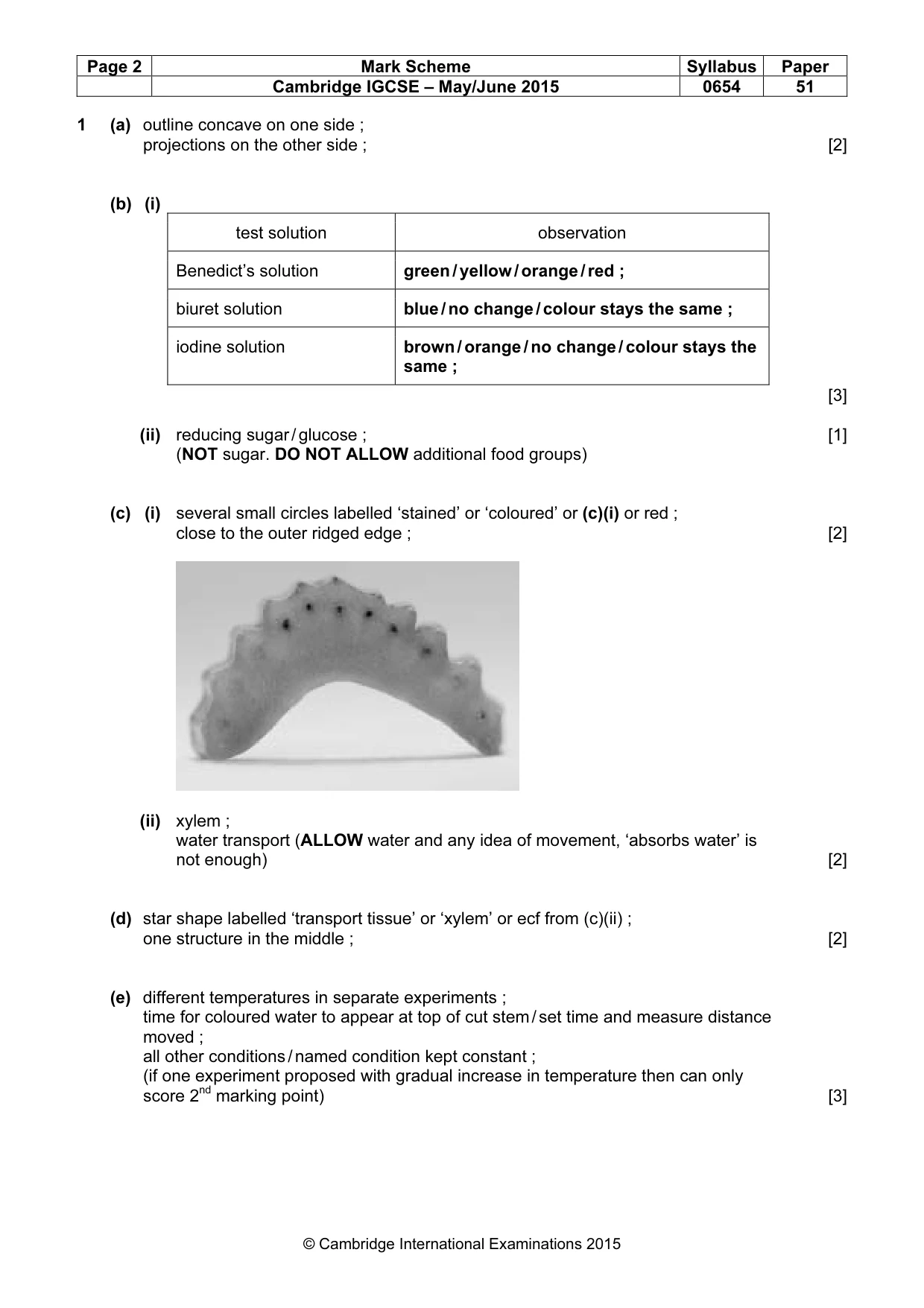
Page 2 Mark Scheme Syllabus Paper Cambridge IGCSE – May/June 2015 0654 51 © Cambridge International Examinations 2015 1 (a) outline concave on one side ; projections on the other side ; [2] (b) (i) test solution observation Benedict’s solution green / yellow / orange / red ; biuret solution blue / no change / colour stays the same ; iodine solution brown / orange / no change / colour stays the same ; [3] (ii) reducing sugar / glucose ; [1] (NOT sugar. DO NOT ALLOW additional food groups) (c) (i) several small circles labelled ‘stained’ or ‘coloured’ or (c)(i) or red ; close to the outer ridged edge ; [2] (ii) xylem ; water transport (ALLOW water and any idea of movement, ‘absorbs water’ is not enough) [2] (d) star shape labelled ‘transport tissue’ or ‘xylem’ or ecf from (c)(ii) ; one structure in the middle ; [2] (e) different temperatures in separate experiments ; time for coloured water to appear at top of cut stem / set time and measure distance moved ; all other conditions / named condition kept constant ; (if one experiment proposed with gradual increase in temperature then can only score 2nd marking point) [3]
Mark scheme, page 3
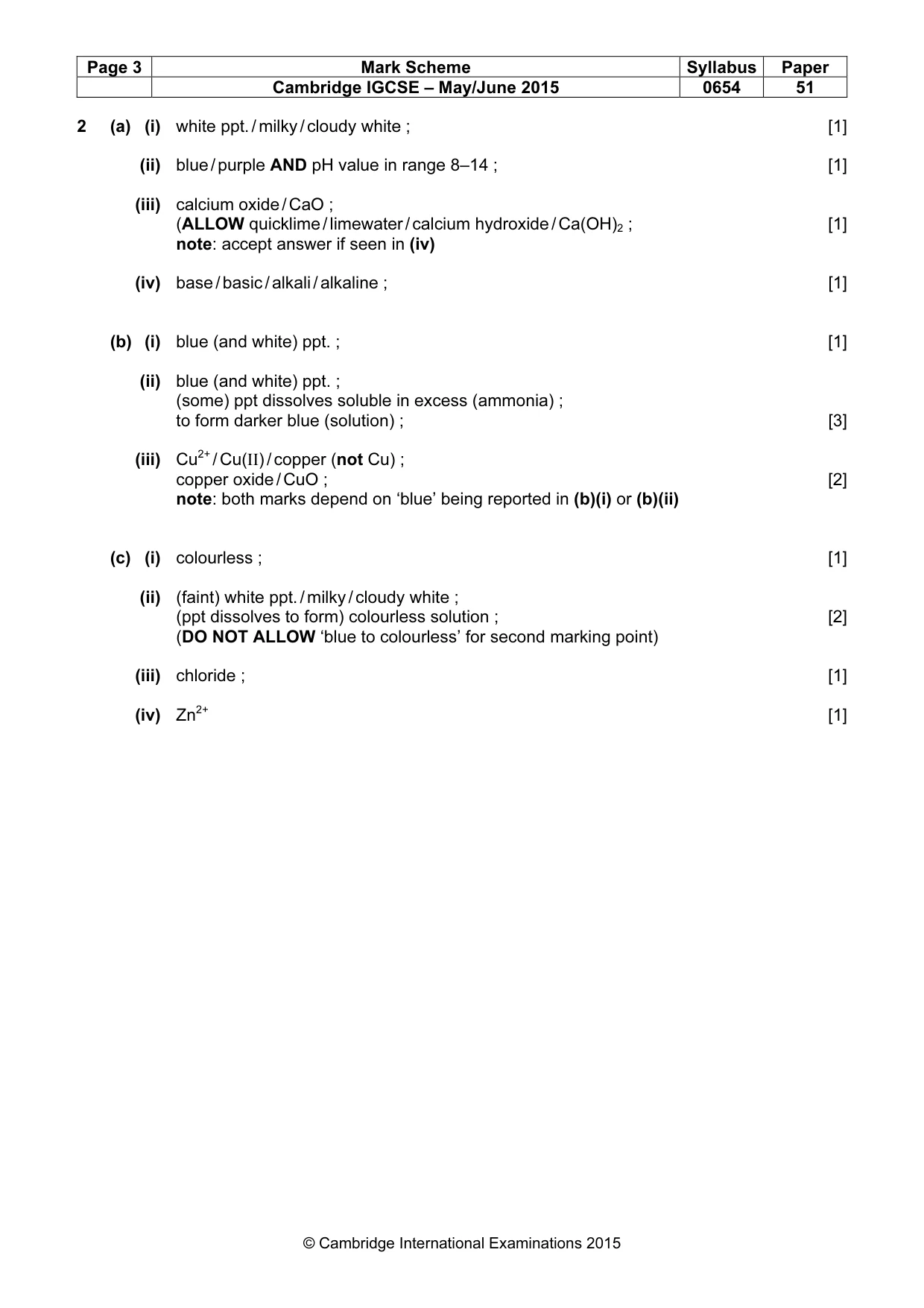
Page 3 Mark Scheme Syllabus Paper Cambridge IGCSE – May/June 2015 0654 51 © Cambridge International Examinations 2015 2 (a) (i) white ppt. / milky / cloudy white ; [1] (ii) blue / purple AND pH value in range 8–14 ; [1] (iii) calcium oxide / CaO ; (ALLOW quicklime / limewater / calcium hydroxide / Ca(OH)2 ; [1] note: accept answer if seen in (iv) (iv) base / basic / alkali / alkaline ; [1] (b) (i) blue (and white) ppt. ; [1] (ii) blue (and white) ppt. ; (some) ppt dissolves soluble in excess (ammonia) ; to form darker blue (solution) ; [3] (iii) Cu2+ / Cu(II) / copper (not Cu) ; copper oxide / CuO ; [2] note: both marks depend on ‘blue’ being reported in (b)(i) or (b)(ii) (c) (i) colourless ; [1] (ii) (faint) white ppt. / milky / cloudy white ; (ppt dissolves to form) colourless solution ; [2] (DO NOT ALLOW ‘blue to colourless’ for second marking point) (iii) chloride ; [1] (iv) Zn2+ [1]
Mark scheme, page 4
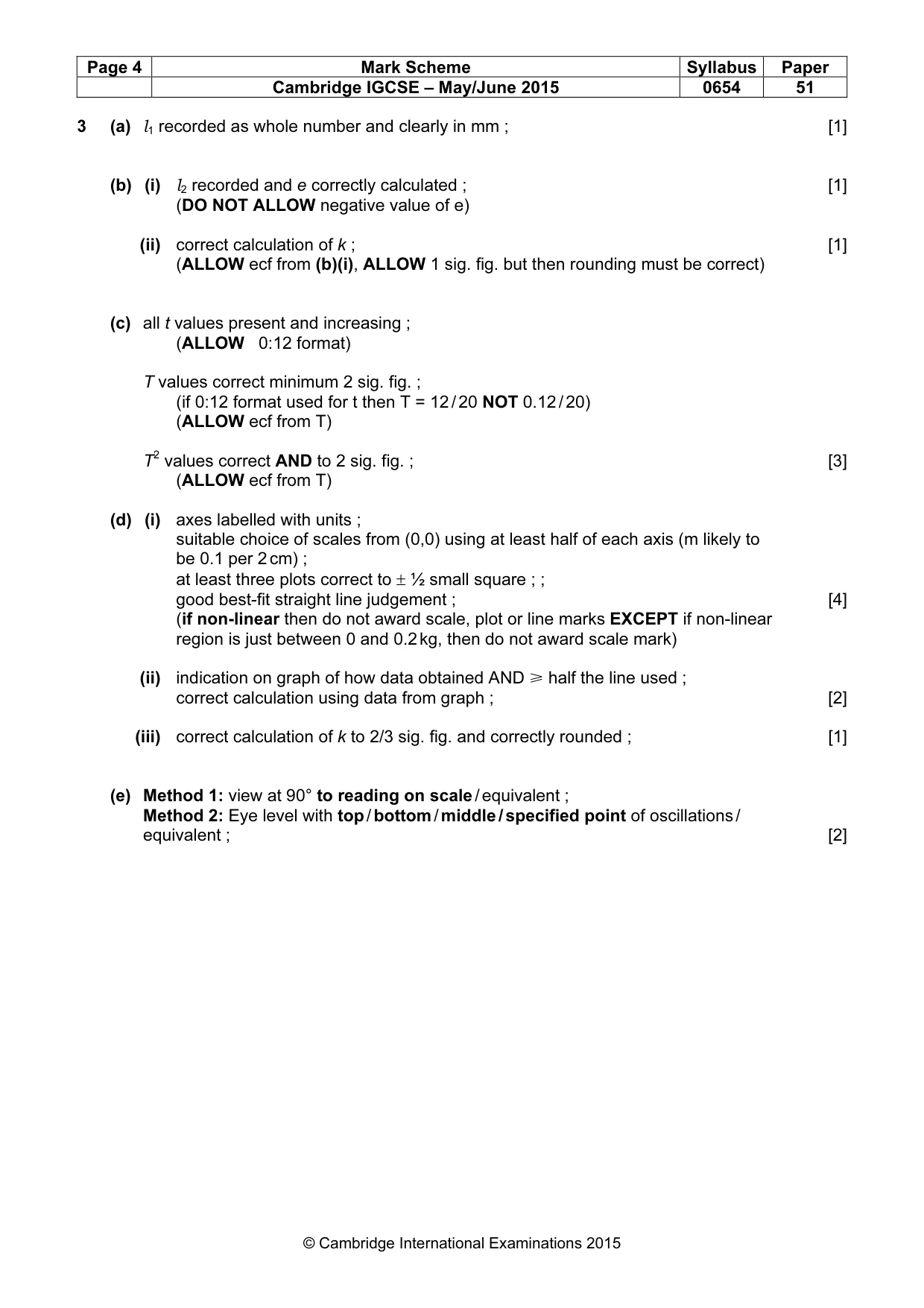
Page 4 Mark Scheme Syllabus Paper Cambridge IGCSE – May/June 2015 0654 51 © Cambridge International Examinations 2015 3 (a) l1 recorded as whole number and clearly in mm ; [1] (b) (i) l2 recorded and e correctly calculated ; [1] (DO NOT ALLOW negative value of e) (ii) correct calculation of k ; [1] (ALLOW ecf from (b)(i), ALLOW 1 sig. fig. but then rounding must be correct) (c) all t values present and increasing ; (ALLOW 0:12 format) T values correct minimum 2 sig. fig. ; (if 0:12 format used for t then T = 12 / 20 NOT 0.12 / 20) (ALLOW ecf from T) T2 values correct AND to 2 sig. fig. ; [3] (ALLOW ecf from T) (d) (i) axes labelled with units ; suitable choice of scales from (0,0) using at least half of each axis (m likely to be 0.1 per 2 cm) ; at least three plots correct to ± ½ small square ; ; good best-fit straight line judgement ; [4] (if non-linear then do not award scale, plot or line marks EXCEPT if non-linear region is just between 0 and 0.2 kg, then do not award scale mark) (ii) indication on graph of how data obtained AND > half the line used ; correct calculation using data from graph ; [2] (iii) correct calculation of k to 2/3 sig. fig. and correctly rounded ; [1] (e) Method 1: view at 90° to reading on scale / equivalent ; Method 2: Eye level with top / bottom / middle / specified point of oscillations / equivalent ; [2]
What you needed in this session
Cambridge’s own grade thresholds for 2015 May/June, Paper 5 · Variant 1. A higher threshold means an easier paper — the bar moves with how the cohort did.