Cambridge IGCSE Sciences - Co-ordinated (Double) 0654 — 2008 May/June Paper 5 · Variant 1
0654/51/M/J/08 · 45 marks · ≈51 min
The question paper and its mark scheme, free to read here and free to download. This is Cambridge’s own paper, exactly as it was sat.
Question paper12 pages


Mark scheme3 pages
Answers below. Sit the paper first if you are practising.
Paper as text
Question paper, page 1
This document consists of 10 printed pages and 2 blank pages. IB08 06_0654_05/3RP © UCLES 2008 [Turn over *9274367695* For Examiner's Use 1 2 3 Total UNIVERSITY OF CAMBRIDGE INTERNATIONAL EXAMINATIONS International General Certificate of Secondary Education CO-ORDINATED SCIENCES 0654/05 Paper 5 Practical Test May/June 2008 2 hours Candidates answer on the Question Paper. Additional Materials: As listed in Instructions to Supervisors READ THESE INSTRUCTIONS FIRST Write your Centre number, candidate number and name on all the work you hand in. Write in dark blue or black pen. You may use a pencil for any diagrams, graphs or rough working. Do not use staples, paper clips, highlighters, glue or correction fluid. DO NOT WRITE IN ANY BARCODES Answer all questions. Chemistry practical notes for this paper are printed on page 12 At the end of the examination, fasten all your work securely together. The number of marks is given in brackets [ ] at the end of each question or part question. www.XtremePapers.com
Question paper, page 2
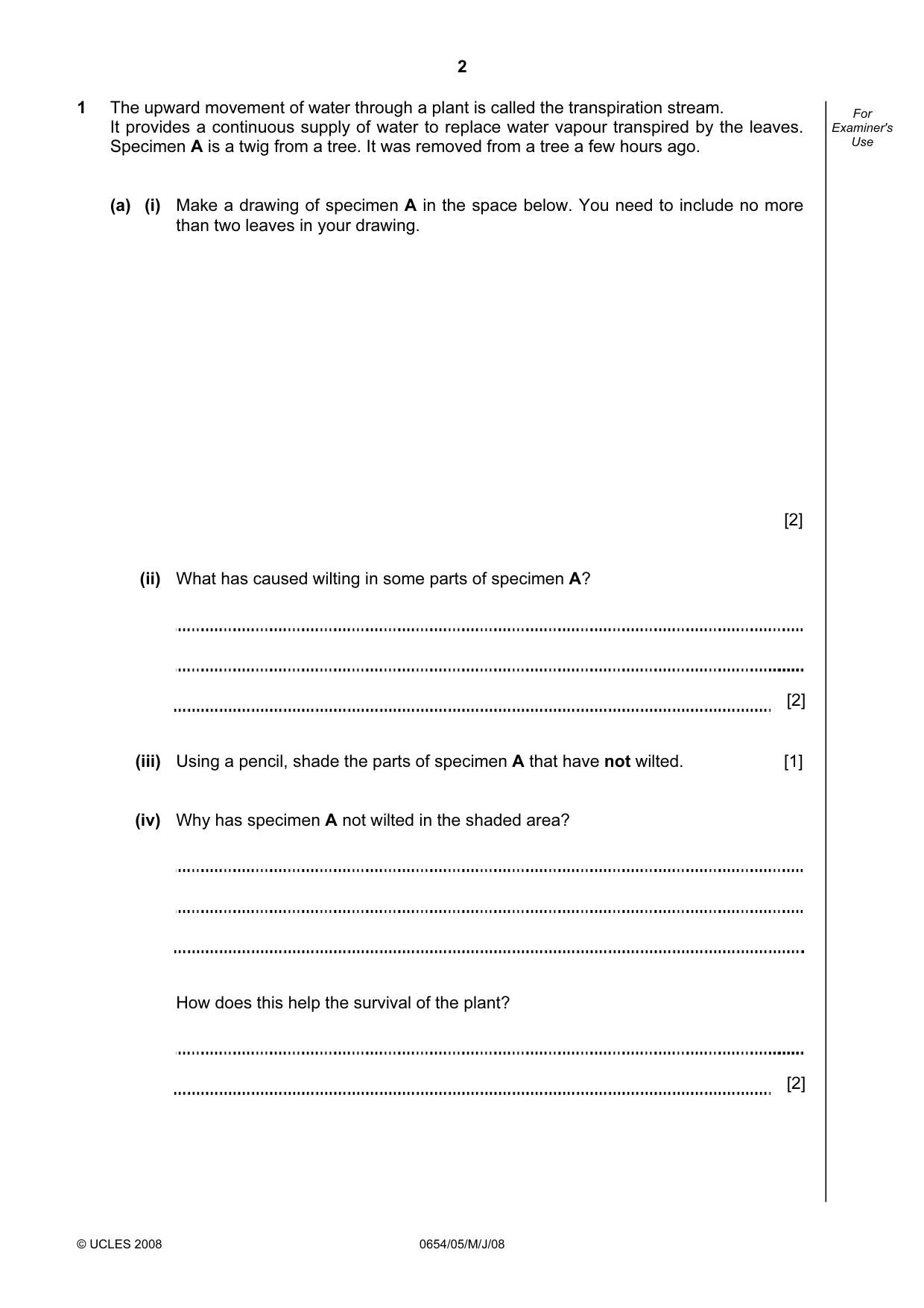
2 © UCLES 2008 0654/05/M/J/08 For Examiner's Use 1 The upward movement of water through a plant is called the transpiration stream. It provides a continuous supply of water to replace water vapour transpired by the leaves. Specimen A is a twig from a tree. It was removed from a tree a few hours ago. (a) (i) Make a drawing of specimen A in the space below. You need to include no more than two leaves in your drawing. [2] (ii) What has caused wilting in some parts of specimen A? [2] (iii) Using a pencil, shade the parts of specimen A that have not wilted. [1] (iv) Why has specimen A not wilted in the shaded area? How does this help the survival of the plant? [2]
Question paper, page 3
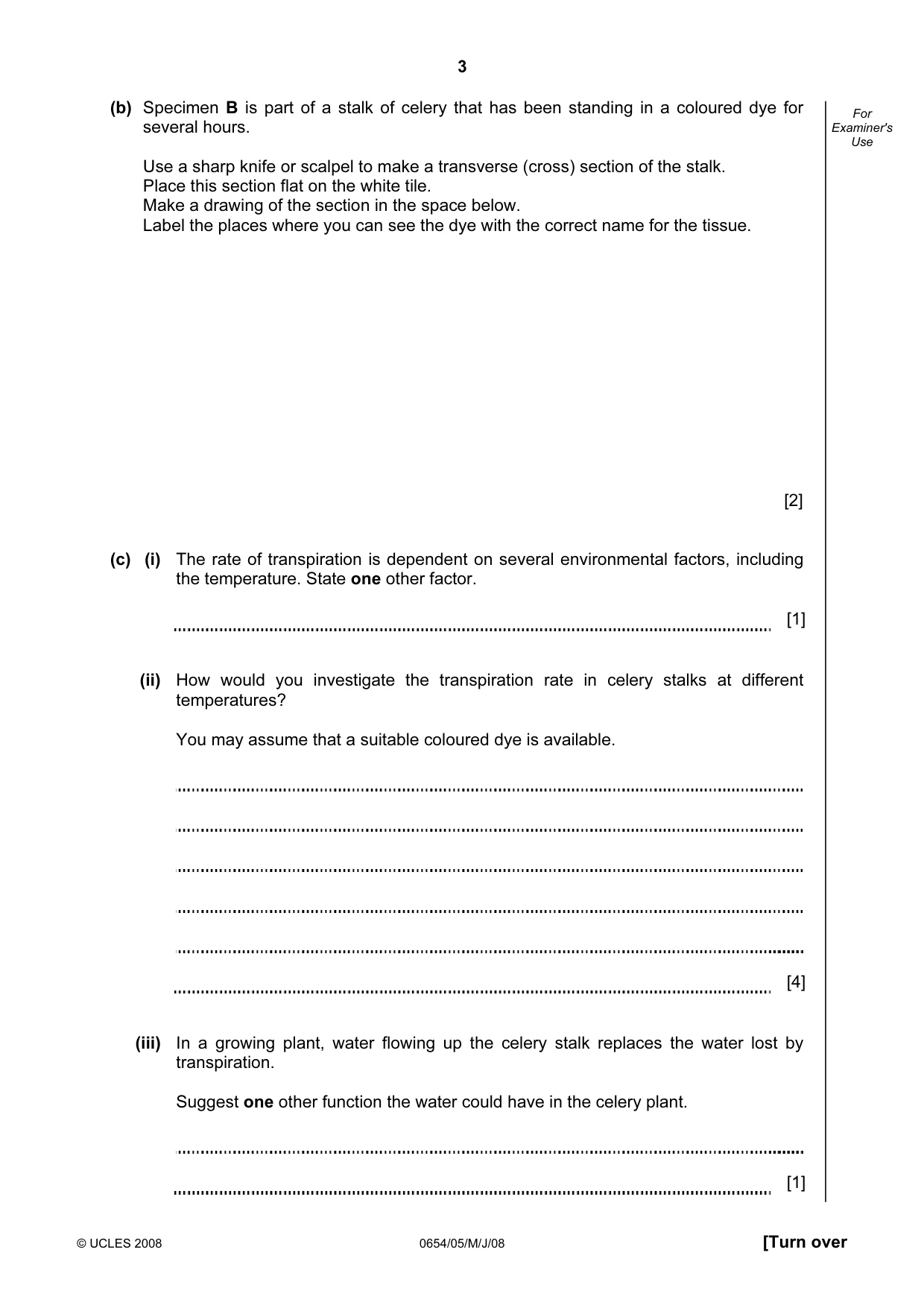
3 © UCLES 2008 0654/05/M/J/08 [Turn over For Examiner's Use (b) Specimen B is part of a stalk of celery that has been standing in a coloured dye for several hours. Use a sharp knife or scalpel to make a transverse (cross) section of the stalk. Place this section flat on the white tile. Make a drawing of the section in the space below. Label the places where you can see the dye with the correct name for the tissue. [2] (c) (i) The rate of transpiration is dependent on several environmental factors, including the temperature. State one other factor. [1] (ii) How would you investigate the transpiration rate in celery stalks at different temperatures? You may assume that a suitable coloured dye is available. [4] (iii) In a growing plant, water flowing up the celery stalk replaces the water lost by transpiration. Suggest one other function the water could have in the celery plant. [1]
Question paper, page 4
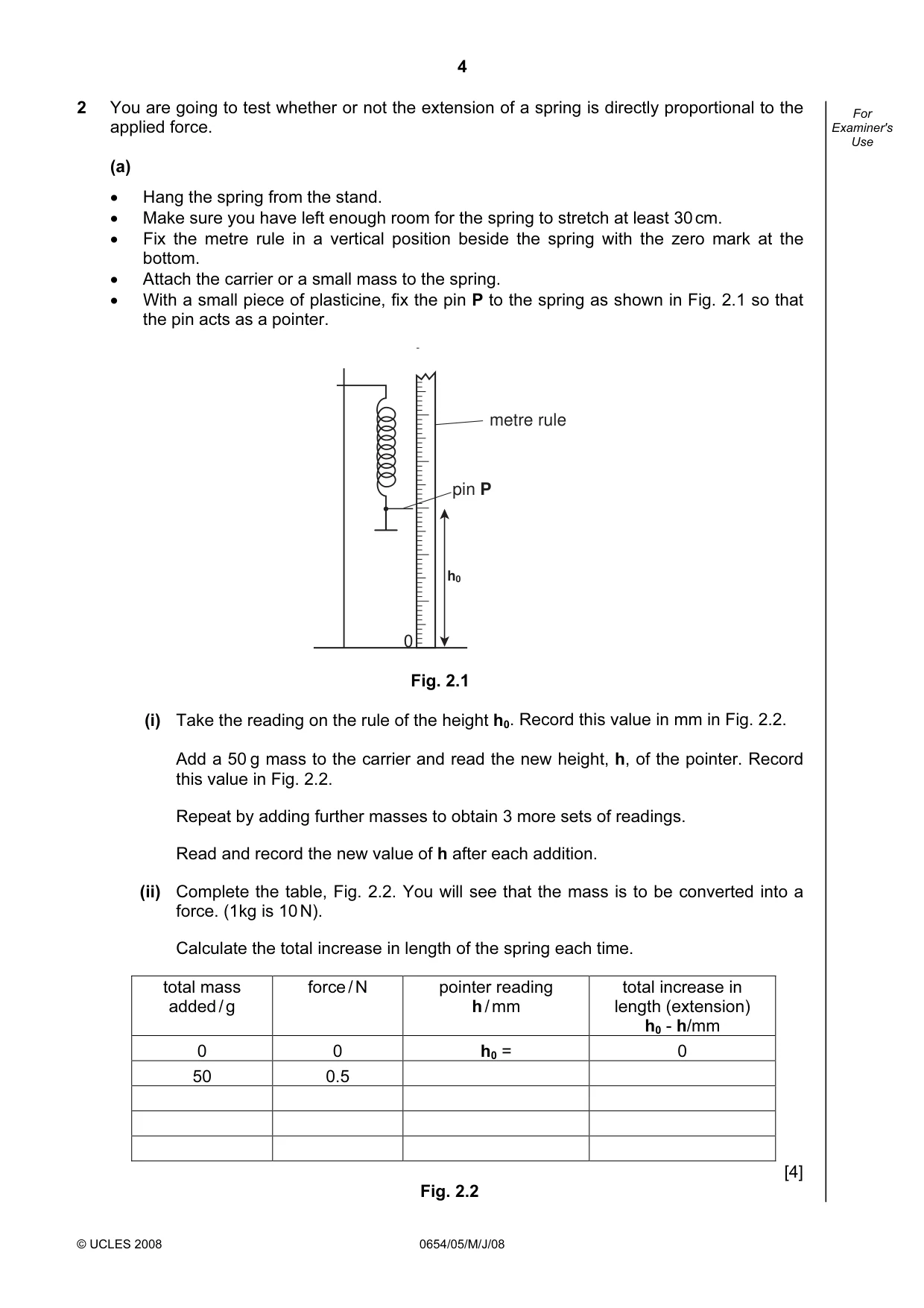
4 © UCLES 2008 0654/05/M/J/08 For Examiner's Use 2 You are going to test whether or not the extension of a spring is directly proportional to the applied force. (a) • Hang the spring from the stand. • Make sure you have left enough room for the spring to stretch at least 30 cm. • Fix the metre rule in a vertical position beside the spring with the zero mark at the bottom. • Attach the carrier or a small mass to the spring. • With a small piece of plasticine, fix the pin P to the spring as shown in Fig. 2.1 so that the pin acts as a pointer. 0 metre rule pin P h0 Fig. 2.1 (i) Take the reading on the rule of the height h0. Record this value in mm in Fig. 2.2. Add a 50 g mass to the carrier and read the new height, h, of the pointer. Record this value in Fig. 2.2. Repeat by adding further masses to obtain 3 more sets of readings. Read and record the new value of h after each addition. (ii) Complete the table, Fig. 2.2. You will see that the mass is to be converted into a force. (1kg is 10 N). Calculate the total increase in length of the spring each time. total mass added / g force / N pointer reading h / mm total increase in length (extension) h0 - h/mm 0 0 h0 = 0 50 0.5 [4] Fig. 2.2
Question paper, page 5
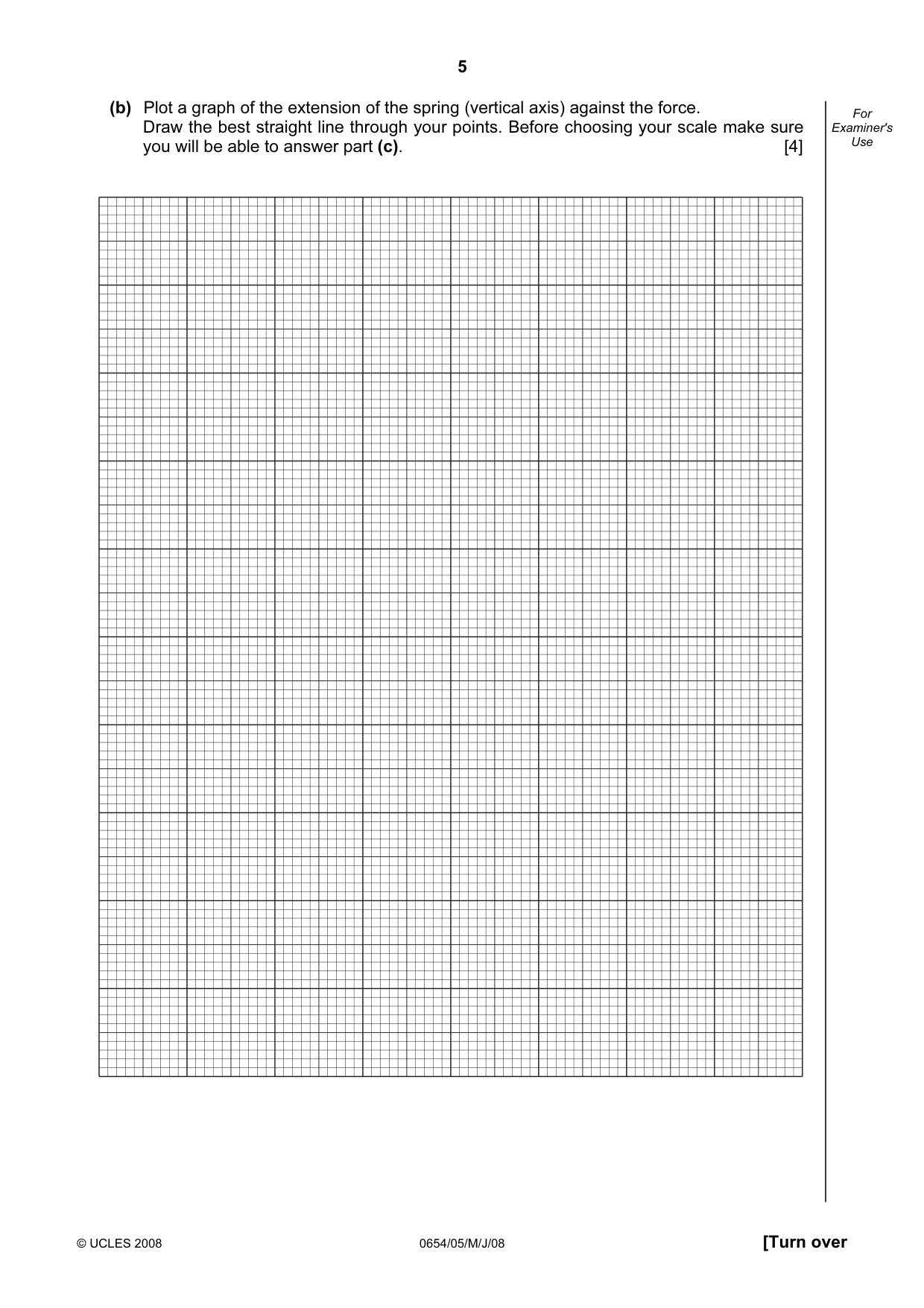
5 © UCLES 2008 0654/05/M/J/08 [Turn over For Examiner's Use (b) Plot a graph of the extension of the spring (vertical axis) against the force. Draw the best straight line through your points. Before choosing your scale make sure you will be able to answer part (c). [4]
Question paper, page 6
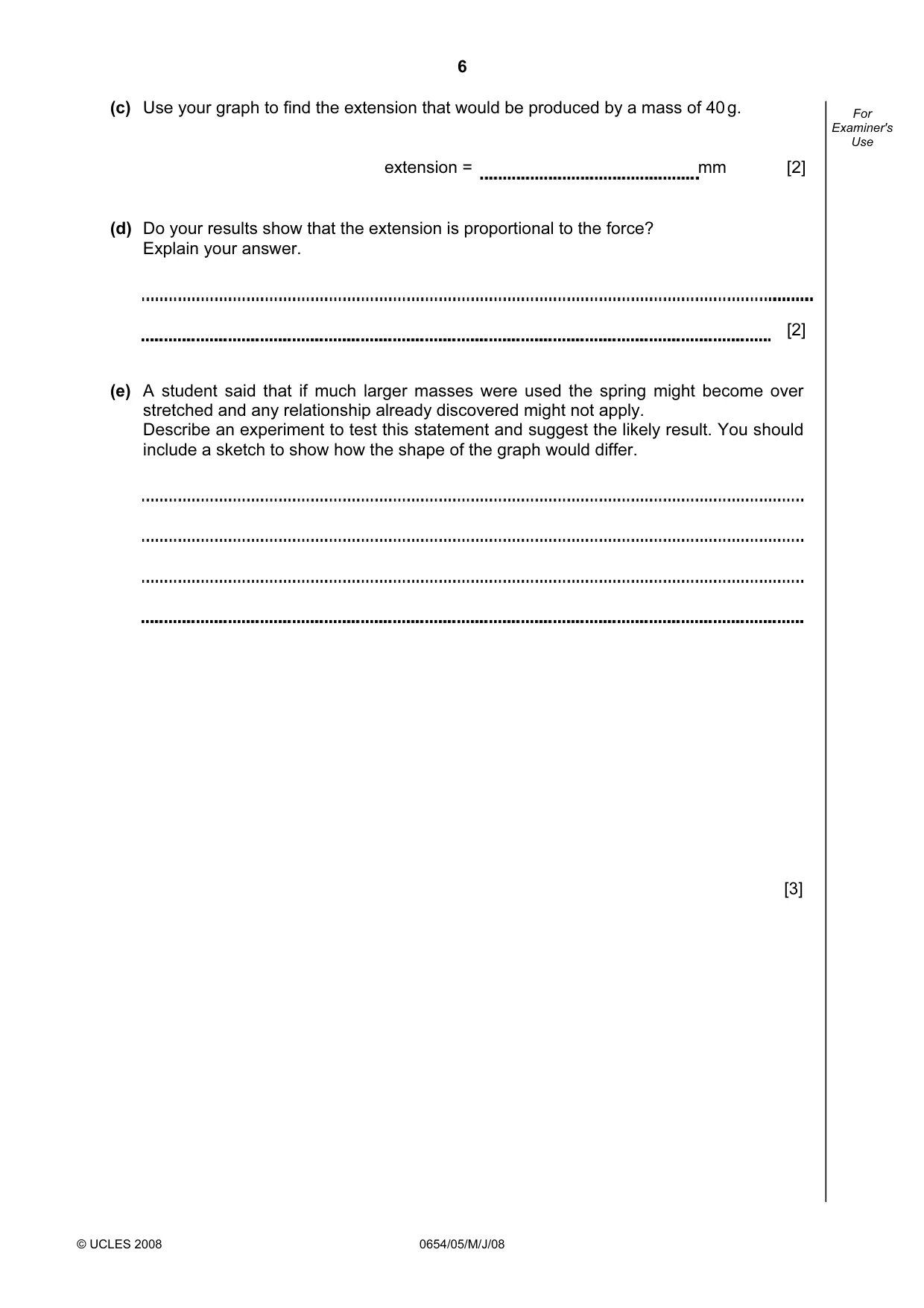
6 © UCLES 2008 0654/05/M/J/08 For Examiner's Use (c) Use your graph to find the extension that would be produced by a mass of 40 g. extension = mm [2] (d) Do your results show that the extension is proportional to the force? Explain your answer. [2] (e) A student said that if much larger masses were used the spring might become over stretched and any relationship already discovered might not apply. Describe an experiment to test this statement and suggest the likely result. You should include a sketch to show how the shape of the graph would differ. [3]
Question paper, page 7
7 0654/05/M/J/08 [Turn over For Examiner's Use BLANK PAGE
Question paper, page 8
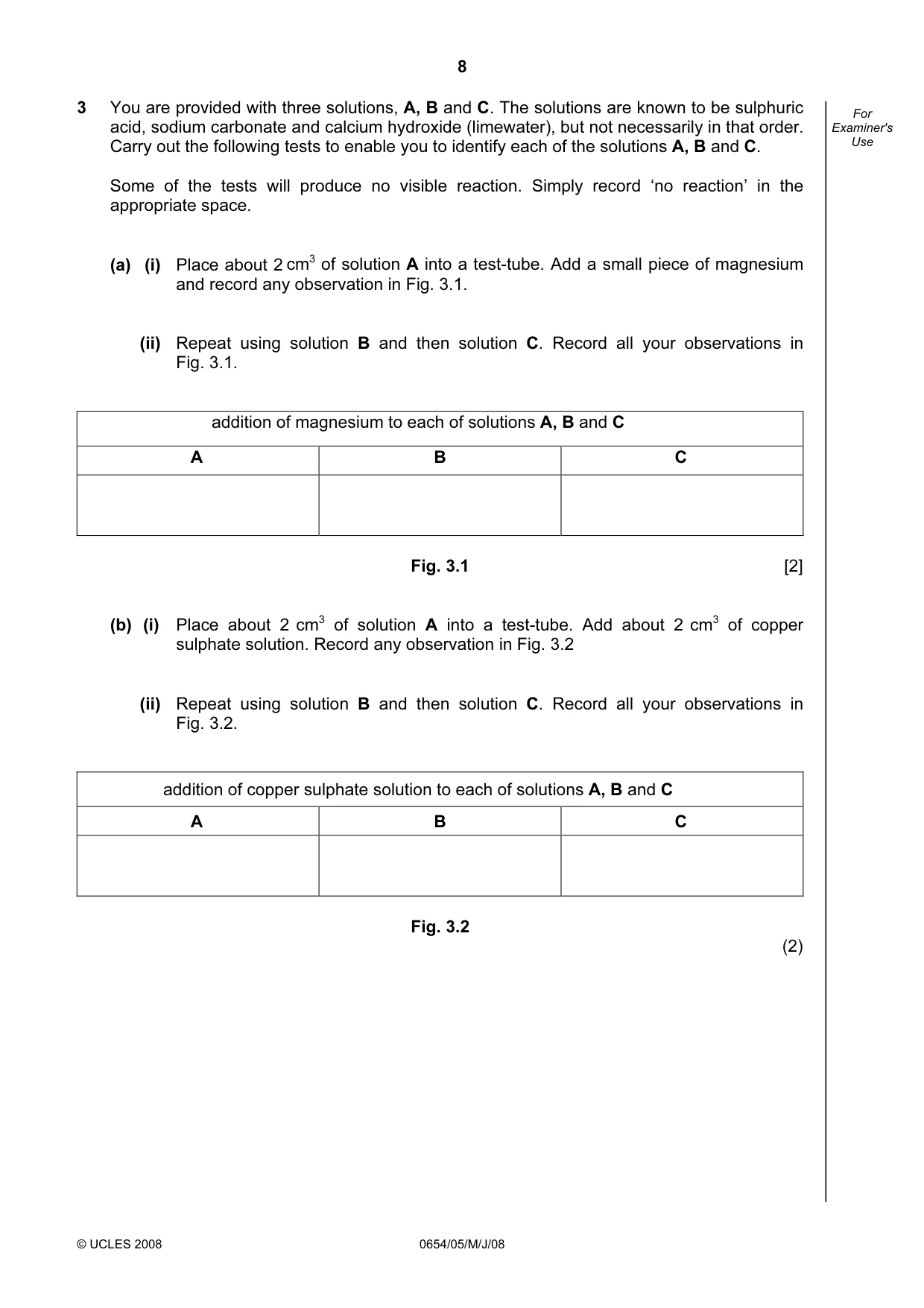
8 © UCLES 2008 0654/05/M/J/08 For Examiner's Use 3 You are provided with three solutions, A, B and C. The solutions are known to be sulphuric acid, sodium carbonate and calcium hydroxide (limewater), but not necessarily in that order. Carry out the following tests to enable you to identify each of the solutions A, B and C. Some of the tests will produce no visible reaction. Simply record ‘no reaction’ in the appropriate space. (a) (i) Place about 2 cm3 of solution A into a test-tube. Add a small piece of magnesium and record any observation in Fig. 3.1. (ii) Repeat using solution B and then solution C. Record all your observations in Fig. 3.1. addition of magnesium to each of solutions A, B and C A B C Fig. 3.1 [2] (b) (i) Place about 2 cm3 of solution A into a test-tube. Add about 2 cm3 of copper sulphate solution. Record any observation in Fig. 3.2 (ii) Repeat using solution B and then solution C. Record all your observations in Fig. 3.2. addition of copper sulphate solution to each of solutions A, B and C A B C Fig. 3.2 (2)
Question paper, page 9
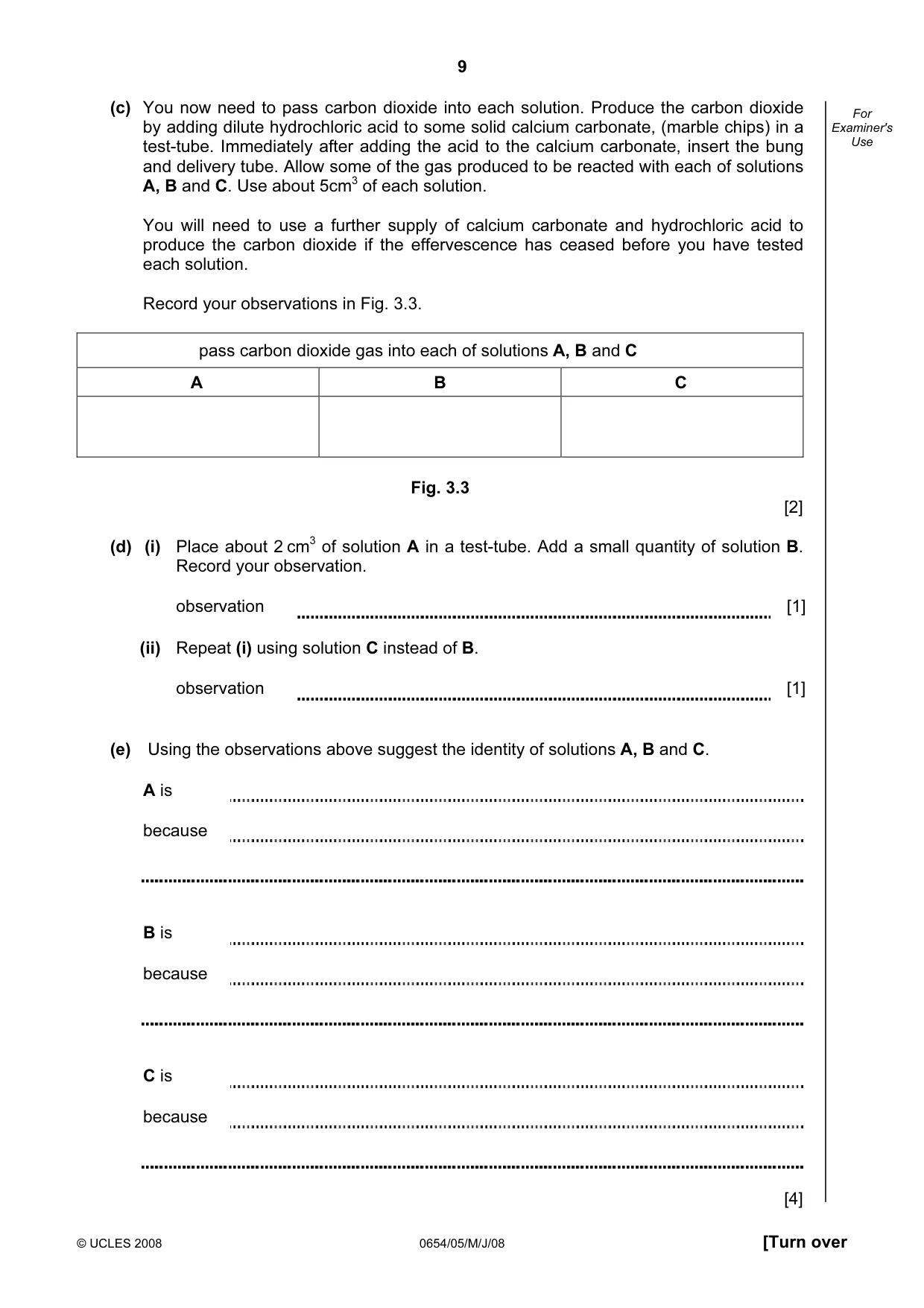
9 © UCLES 2008 0654/05/M/J/08 [Turn over For Examiner's Use (c) You now need to pass carbon dioxide into each solution. Produce the carbon dioxide by adding dilute hydrochloric acid to some solid calcium carbonate, (marble chips) in a test-tube. Immediately after adding the acid to the calcium carbonate, insert the bung and delivery tube. Allow some of the gas produced to be reacted with each of solutions A, B and C. Use about 5cm3 of each solution. You will need to use a further supply of calcium carbonate and hydrochloric acid to produce the carbon dioxide if the effervescence has ceased before you have tested each solution. Record your observations in Fig. 3.3. pass carbon dioxide gas into each of solutions A, B and C A B C Fig. 3.3 [2] (d) (i) Place about 2 cm3 of solution A in a test-tube. Add a small quantity of solution B. Record your observation. observation [1] (ii) Repeat (i) using solution C instead of B. observation [1] (e) Using the observations above suggest the identity of solutions A, B and C. A is because B is because C is because [4]
Question paper, page 10
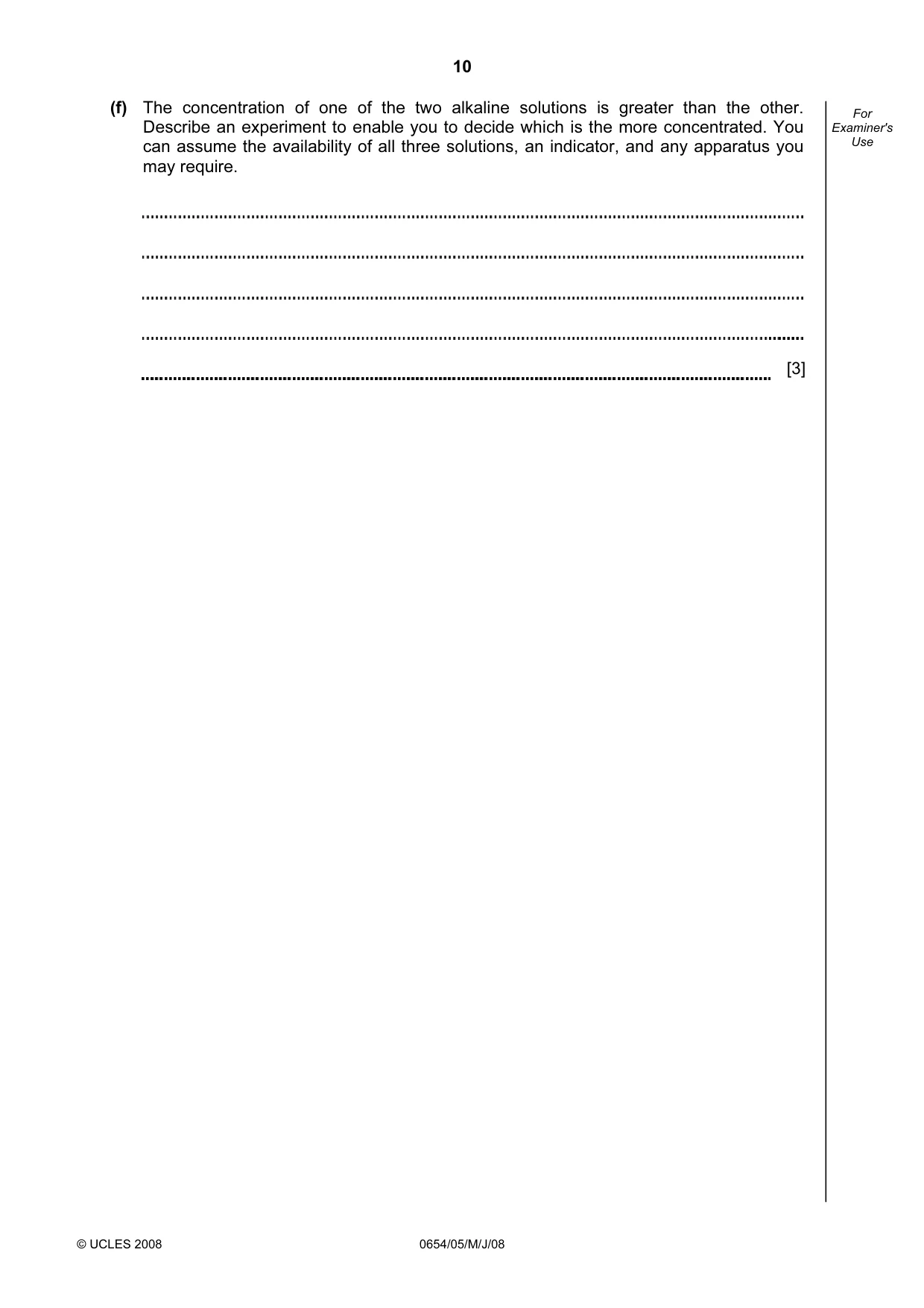
10 © UCLES 2008 0654/05/M/J/08 For Examiner's Use (f) The concentration of one of the two alkaline solutions is greater than the other. Describe an experiment to enable you to decide which is the more concentrated. You can assume the availability of all three solutions, an indicator, and any apparatus you may require. [3]
Question paper, page 12
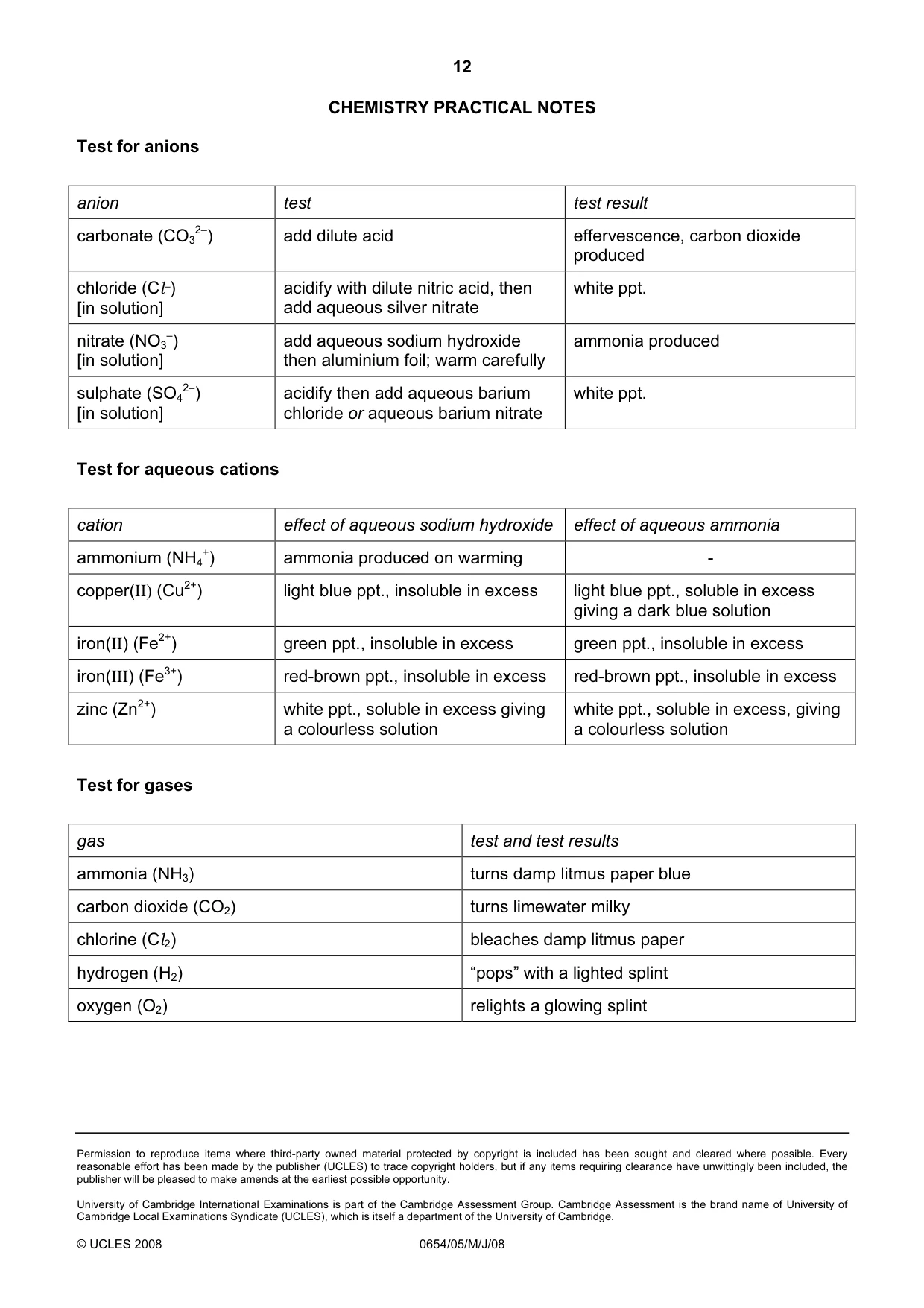
12 Permission to reproduce items where third-party owned material protected by copyright is included has been sought and cleared where possible. Every reasonable effort has been made by the publisher (UCLES) to trace copyright holders, but if any items requiring clearance have unwittingly been included, the publisher will be pleased to make amends at the earliest possible opportunity. University of Cambridge International Examinations is part of the Cambridge Assessment Group. Cambridge Assessment is the brand name of University of Cambridge Local Examinations Syndicate (UCLES), which is itself a department of the University of Cambridge. © UCLES 2008 0654/05/M/J/08 CHEMISTRY PRACTICAL NOTES Test for anions anion test test result carbonate (CO3 2–) add dilute acid effervescence, carbon dioxide produced chloride (Cl–) [in solution] acidify with dilute nitric acid, then add aqueous silver nitrate white ppt. nitrate (NO3 –) [in solution] add aqueous sodium hydroxide then aluminium foil; warm carefully ammonia produced sulphate (SO4 2–) [in solution] acidify then add aqueous barium chloride or aqueous barium nitrate white ppt. Test for aqueous cations cation effect of aqueous sodium hydroxide effect of aqueous ammonia ammonium (NH4 +) ammonia produced on warming - copper(II) (Cu2+) light blue ppt., insoluble in excess light blue ppt., soluble in excess giving a dark blue solution iron(II) (Fe2+) green ppt., insoluble in excess green ppt., insoluble in excess iron(III) (Fe3+) red-brown ppt., insoluble in excess red-brown ppt., insoluble in excess zinc (Zn2+) white ppt., soluble in excess giving a colourless solution white ppt., soluble in excess, giving a colourless solution Test for gases gas test and test results ammonia (NH3) turns damp litmus paper blue carbon dioxide (CO2) turns limewater milky chlorine (Cl2) bleaches damp litmus paper hydrogen (H2) “pops” with a lighted splint oxygen (O2) relights a glowing splint
Mark scheme, page 1
UNIVERSITY OF CAMBRIDGE INTERNATIONAL EXAMINATIONS International General Certificate of Secondary Education MARK SCHEME for the May/June 2008 question paper 0654 CO-ORDINATED SCIENCES 0654/05 Paper 5 (Practical), maximum raw mark 45 This mark scheme is published as an aid to teachers and candidates, to indicate the requirements of the examination. It shows the basis on which Examiners were instructed to award marks. It does not indicate the details of the discussions that took place at an Examiners’ meeting before marking began. All Examiners are instructed that alternative correct answers and unexpected approaches in candidates’ scripts must be given marks that fairly reflect the relevant knowledge and skills demonstrated. Mark schemes must be read in conjunction with the question papers and the report on the examination. • CIE will not enter into discussions or correspondence in connection with these mark schemes. CIE is publishing the mark schemes for the May/June 2008 question papers for most IGCSE, GCE Advanced Level and Advanced Subsidiary Level syllabuses and some Ordinary Level syllabuses. www.XtremePapers.com
Mark scheme, page 2
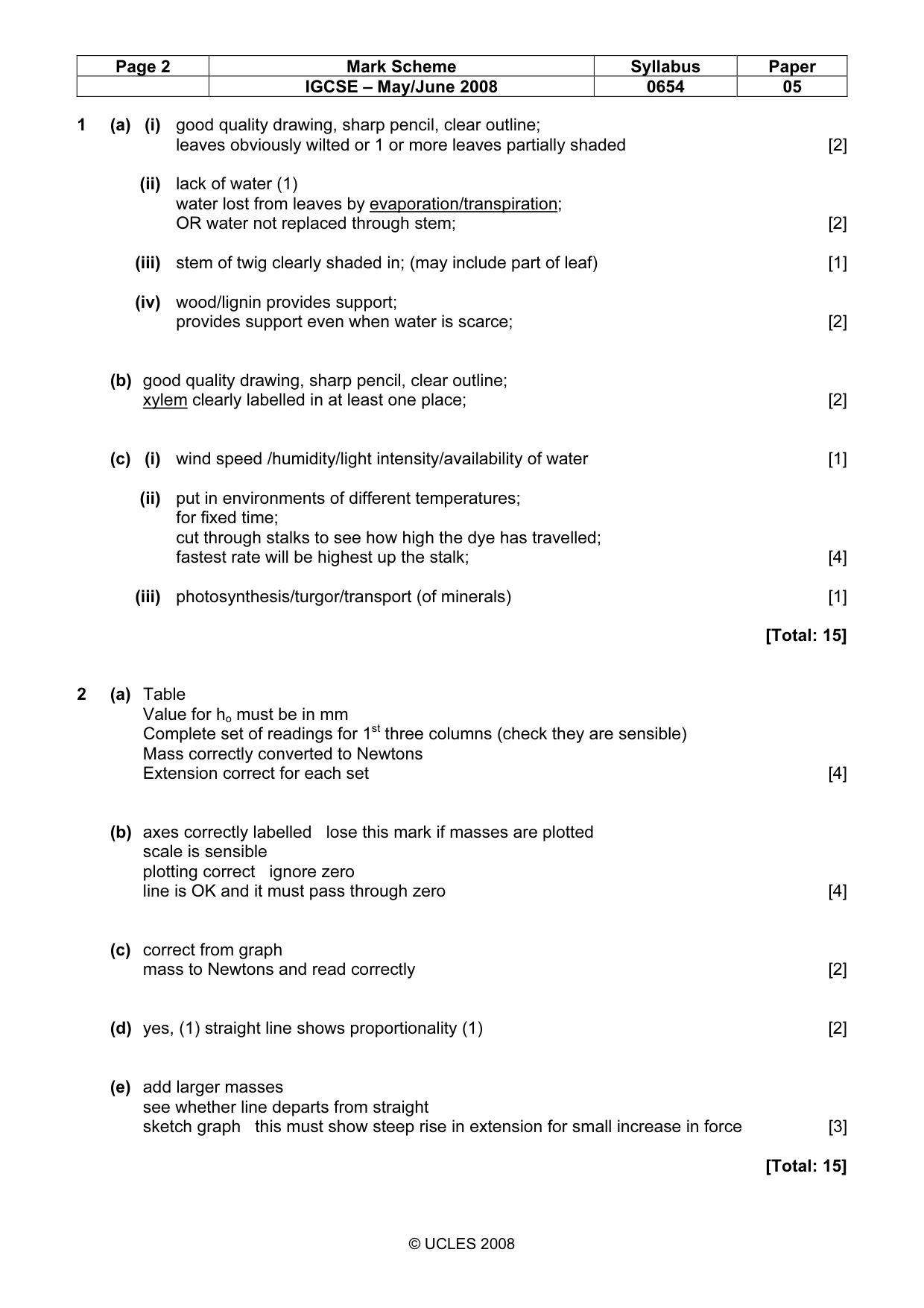
Page 2 Mark Scheme Syllabus Paper IGCSE – May/June 2008 0654 05 © UCLES 2008 1 (a) (i) good quality drawing, sharp pencil, clear outline; leaves obviously wilted or 1 or more leaves partially shaded [2] (ii) lack of water (1) water lost from leaves by evaporation/transpiration; OR water not replaced through stem; [2] (iii) stem of twig clearly shaded in; (may include part of leaf) [1] (iv) wood/lignin provides support; provides support even when water is scarce; [2] (b) good quality drawing, sharp pencil, clear outline; xylem clearly labelled in at least one place; [2] (c) (i) wind speed /humidity/light intensity/availability of water [1] (ii) put in environments of different temperatures; for fixed time; cut through stalks to see how high the dye has travelled; fastest rate will be highest up the stalk; [4] (iii) photosynthesis/turgor/transport (of minerals) [1] [Total: 15] 2 (a) Table Value for ho must be in mm Complete set of readings for 1st three columns (check they are sensible) Mass correctly converted to Newtons Extension correct for each set [4] (b) axes correctly labelled lose this mark if masses are plotted scale is sensible plotting correct ignore zero line is OK and it must pass through zero [4] (c) correct from graph mass to Newtons and read correctly [2] (d) yes, (1) straight line shows proportionality (1) [2] (e) add larger masses see whether line departs from straight sketch graph this must show steep rise in extension for small increase in force [3] [Total: 15]
Mark scheme, page 3
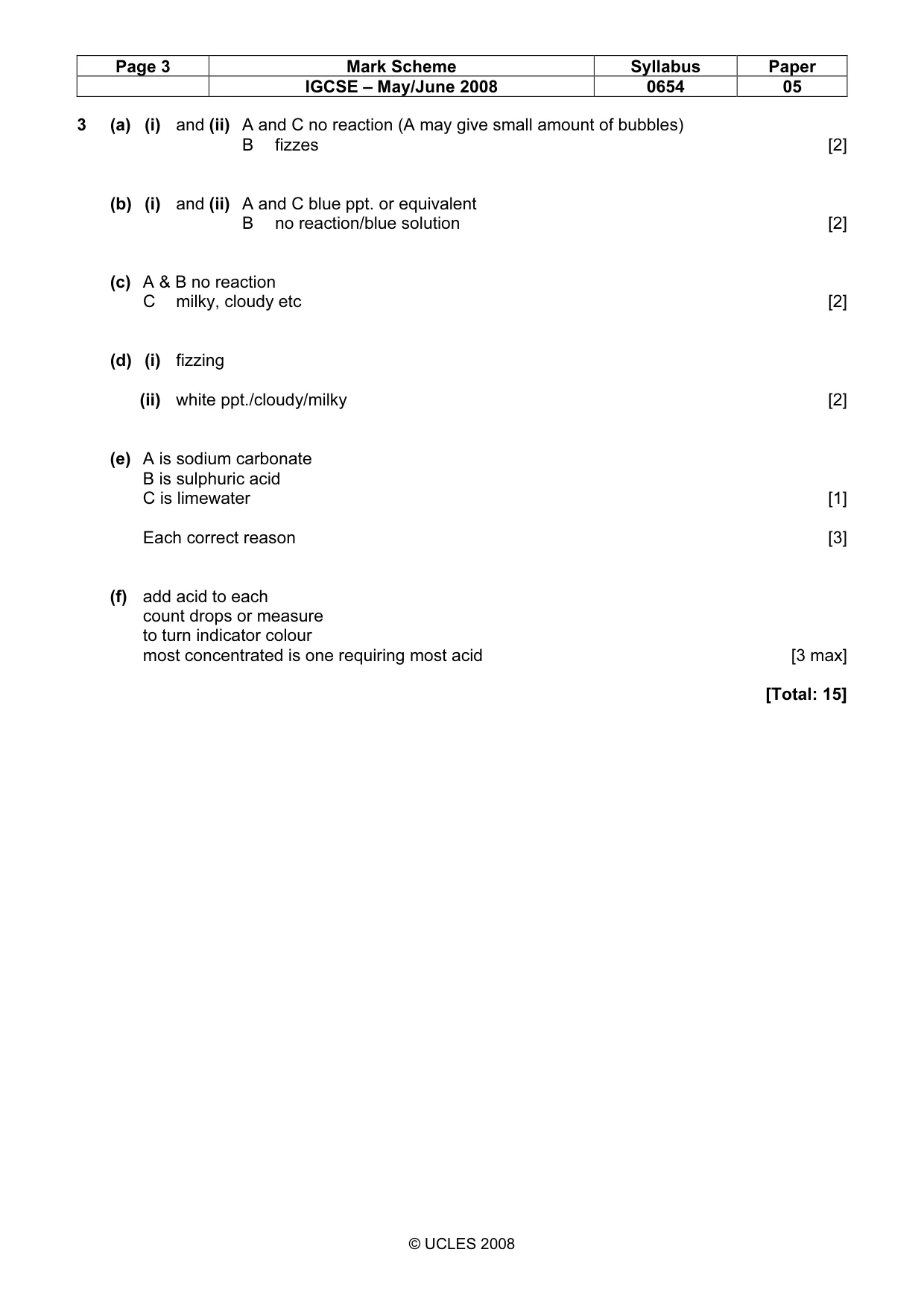
Page 3 Mark Scheme Syllabus Paper IGCSE – May/June 2008 0654 05 © UCLES 2008 3 (a) (i) and (ii) A and C no reaction (A may give small amount of bubbles) B fizzes [2] (b) (i) and (ii) A and C blue ppt. or equivalent B no reaction/blue solution [2] (c) A & B no reaction C milky, cloudy etc [2] (d) (i) fizzing (ii) white ppt./cloudy/milky [2] (e) A is sodium carbonate B is sulphuric acid C is limewater [1] Each correct reason [3] (f) add acid to each count drops or measure to turn indicator colour most concentrated is one requiring most acid [3 max] [Total: 15]
What you needed in this session
Cambridge’s own grade thresholds for 2008 May/June, Paper 5 · Variant 1. A higher threshold means an easier paper — the bar moves with how the cohort did.