Cambridge IGCSE Sciences - Co-ordinated (Double) 0654 — 2006 May/June Paper 5 · Variant 1
0654/51/M/J/06 · 45 marks · ≈51 min
The question paper and its mark scheme, free to read here and free to download. This is Cambridge’s own paper, exactly as it was sat.
Question paper12 pages

Mark scheme3 pages
Answers below. Sit the paper first if you are practising.
Paper as text
Question paper, page 1
Centre Number Candidate Number Name UNIVERSITY OF CAMBRIDGE INTERNATIONAL EXAMINATIONS International General Certificate of Secondary Education CO-ORDINATED SCIENCES 0654/05 Paper 5 Practical Test May/June 2006 2 hours Candidates answer on the Question Paper. Additional Materials: As listed in Instructions to Supervisors READ THESE INSTRUCTIONS FIRST Write your Centre number, candidate number and name on all the work you hand in. Write in dark blue or black pen. You may use a pencil for any diagrams, graphs or rough working. Do not use staples, paper clips, highlighters, glue or correction fluid. Answer all questions. Chemistry practical notes for this paper are printed on page 12. At the end of the examination, fasten all your work securely together. The number of marks is given in brackets [ ] at the end of each question or part question. For Examiner’s Use 1 2 3 Total This document consists of 11 printed pages and 1 blank page. IB06 06_0654_05/3RP UCLES 2006 [Turn over www.XtremePapers.com
Question paper, page 2
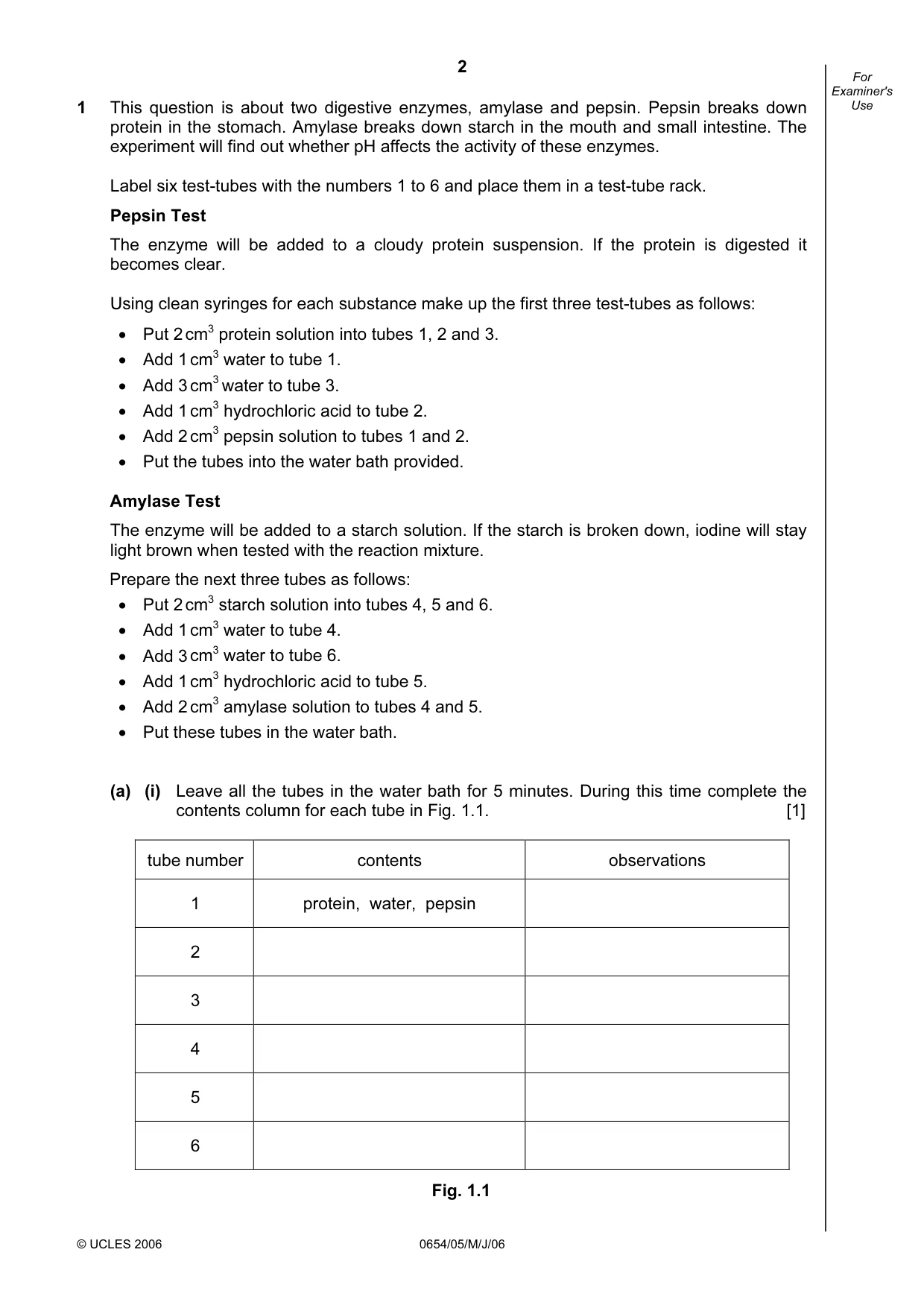
2 © UCLES 2006 0654/05/M/J/06 For Examiner's Use 1 This question is about two digestive enzymes, amylase and pepsin. Pepsin breaks down protein in the stomach. Amylase breaks down starch in the mouth and small intestine. The experiment will find out whether pH affects the activity of these enzymes. Label six test-tubes with the numbers 1 to 6 and place them in a test-tube rack. Pepsin Test The enzyme will be added to a cloudy protein suspension. If the protein is digested it becomes clear. Using clean syringes for each substance make up the first three test-tubes as follows: • Put 2 cm3 protein solution into tubes 1, 2 and 3. • Add 1 cm3 water to tube 1. • Add 3 cm3 water to tube 3. • Add 1 cm3 hydrochloric acid to tube 2. • Add 2 cm3 pepsin solution to tubes 1 and 2. • Put the tubes into the water bath provided. Amylase Test The enzyme will be added to a starch solution. If the starch is broken down, iodine will stay light brown when tested with the reaction mixture. Prepare the next three tubes as follows: • Put 2 cm3 starch solution into tubes 4, 5 and 6. • Add 1 cm3 water to tube 4. • Add 3 cm3 water to tube 6. • Add 1 cm3 hydrochloric acid to tube 5. • Add 2 cm3 amylase solution to tubes 4 and 5. • Put these tubes in the water bath. (a) (i) Leave all the tubes in the water bath for 5 minutes. During this time complete the contents column for each tube in Fig. 1.1. [1] tube number contents observations 1 protein, water, pepsin 2 3 4 5 6 Fig. 1.1
Question paper, page 3
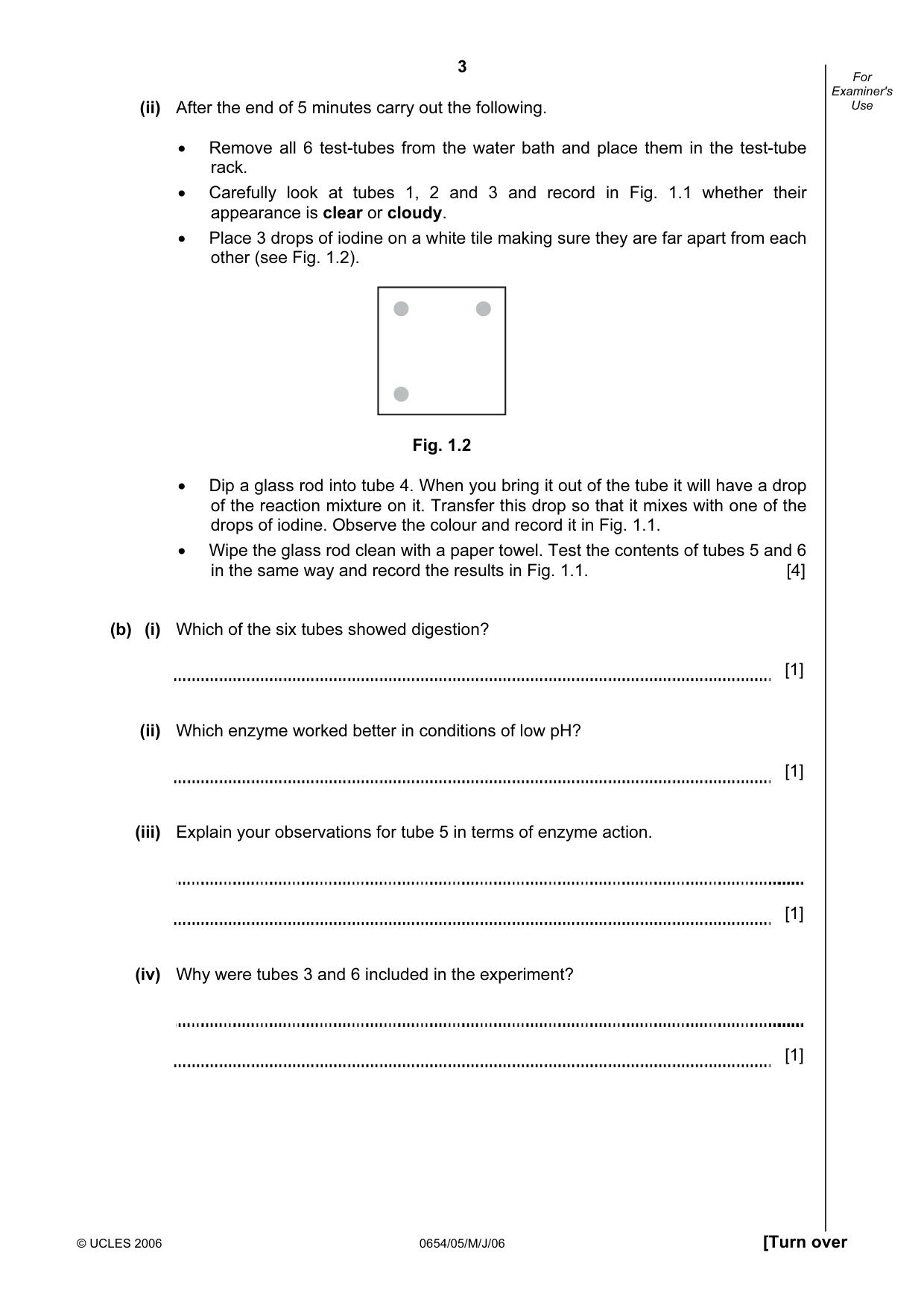
3 © UCLES 2006 0654/05/M/J/06 [Turn over For Examiner's Use (ii) After the end of 5 minutes carry out the following. • Remove all 6 test-tubes from the water bath and place them in the test-tube rack. • Carefully look at tubes 1, 2 and 3 and record in Fig. 1.1 whether their appearance is clear or cloudy. • Place 3 drops of iodine on a white tile making sure they are far apart from each other (see Fig. 1.2). Fig. 1.2 • Dip a glass rod into tube 4. When you bring it out of the tube it will have a drop of the reaction mixture on it. Transfer this drop so that it mixes with one of the drops of iodine. Observe the colour and record it in Fig. 1.1. • Wipe the glass rod clean with a paper towel. Test the contents of tubes 5 and 6 in the same way and record the results in Fig. 1.1. [4] (b) (i) Which of the six tubes showed digestion? [1] (ii) Which enzyme worked better in conditions of low pH? [1] (iii) Explain your observations for tube 5 in terms of enzyme action. [1] (iv) Why were tubes 3 and 6 included in the experiment? [1]
Question paper, page 4
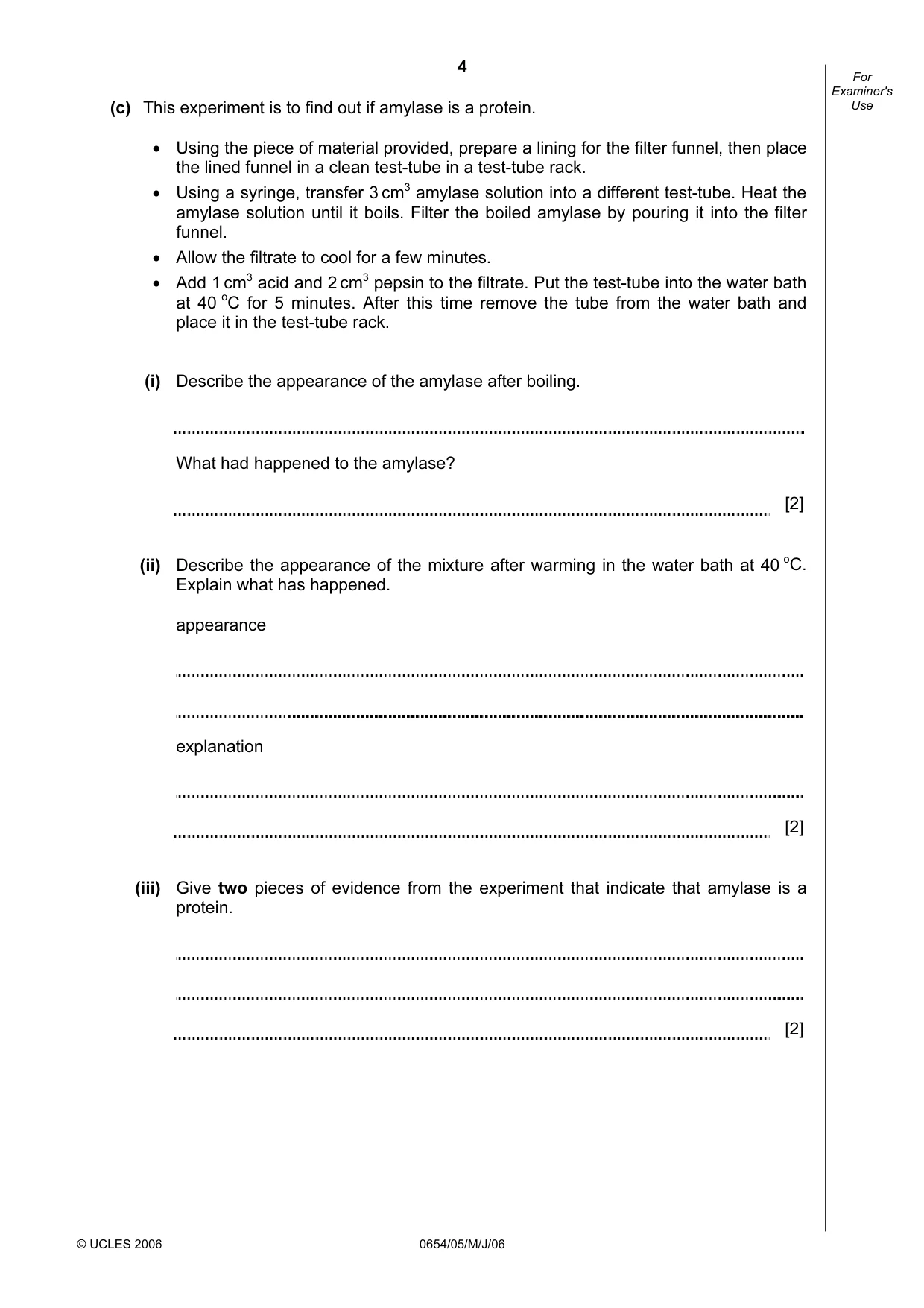
4 © UCLES 2006 0654/05/M/J/06 For Examiner's Use (c) This experiment is to find out if amylase is a protein. • Using the piece of material provided, prepare a lining for the filter funnel, then place the lined funnel in a clean test-tube in a test-tube rack. • Using a syringe, transfer 3 cm3 amylase solution into a different test-tube. Heat the amylase solution until it boils. Filter the boiled amylase by pouring it into the filter funnel. • Allow the filtrate to cool for a few minutes. • Add 1 cm3 acid and 2 cm3 pepsin to the filtrate. Put the test-tube into the water bath at 40 oC for 5 minutes. After this time remove the tube from the water bath and place it in the test-tube rack. (i) Describe the appearance of the amylase after boiling. What had happened to the amylase? [2] (ii) Describe the appearance of the mixture after warming in the water bath at 40 oC. Explain what has happened. appearance explanation [2] (iii) Give two pieces of evidence from the experiment that indicate that amylase is a protein. [2]
Question paper, page 5
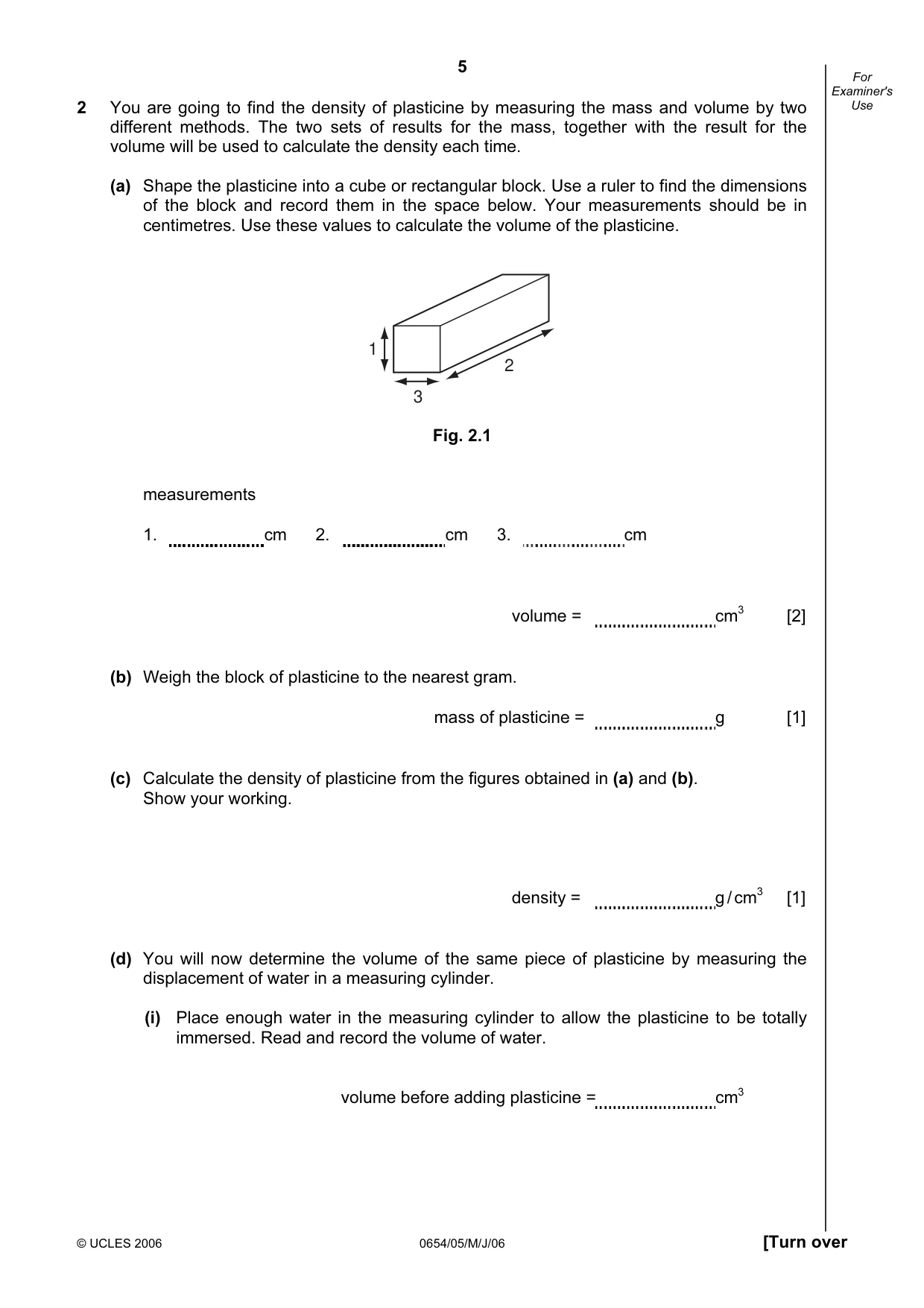
5 © UCLES 2006 0654/05/M/J/06 [Turn over For Examiner's Use 2 You are going to find the density of plasticine by measuring the mass and volume by two different methods. The two sets of results for the mass, together with the result for the volume will be used to calculate the density each time. (a) Shape the plasticine into a cube or rectangular block. Use a ruler to find the dimensions of the block and record them in the space below. Your measurements should be in centimetres. Use these values to calculate the volume of the plasticine. 1 3 2 Fig. 2.1 measurements 1. cm 2. cm 3. cm volume = cm3 [2] (b) Weigh the block of plasticine to the nearest gram. mass of plasticine = g [1] (c) Calculate the density of plasticine from the figures obtained in (a) and (b). Show your working. density = g / cm3 [1] (d) You will now determine the volume of the same piece of plasticine by measuring the displacement of water in a measuring cylinder. (i) Place enough water in the measuring cylinder to allow the plasticine to be totally immersed. Read and record the volume of water. volume before adding plasticine = cm3
Question paper, page 6
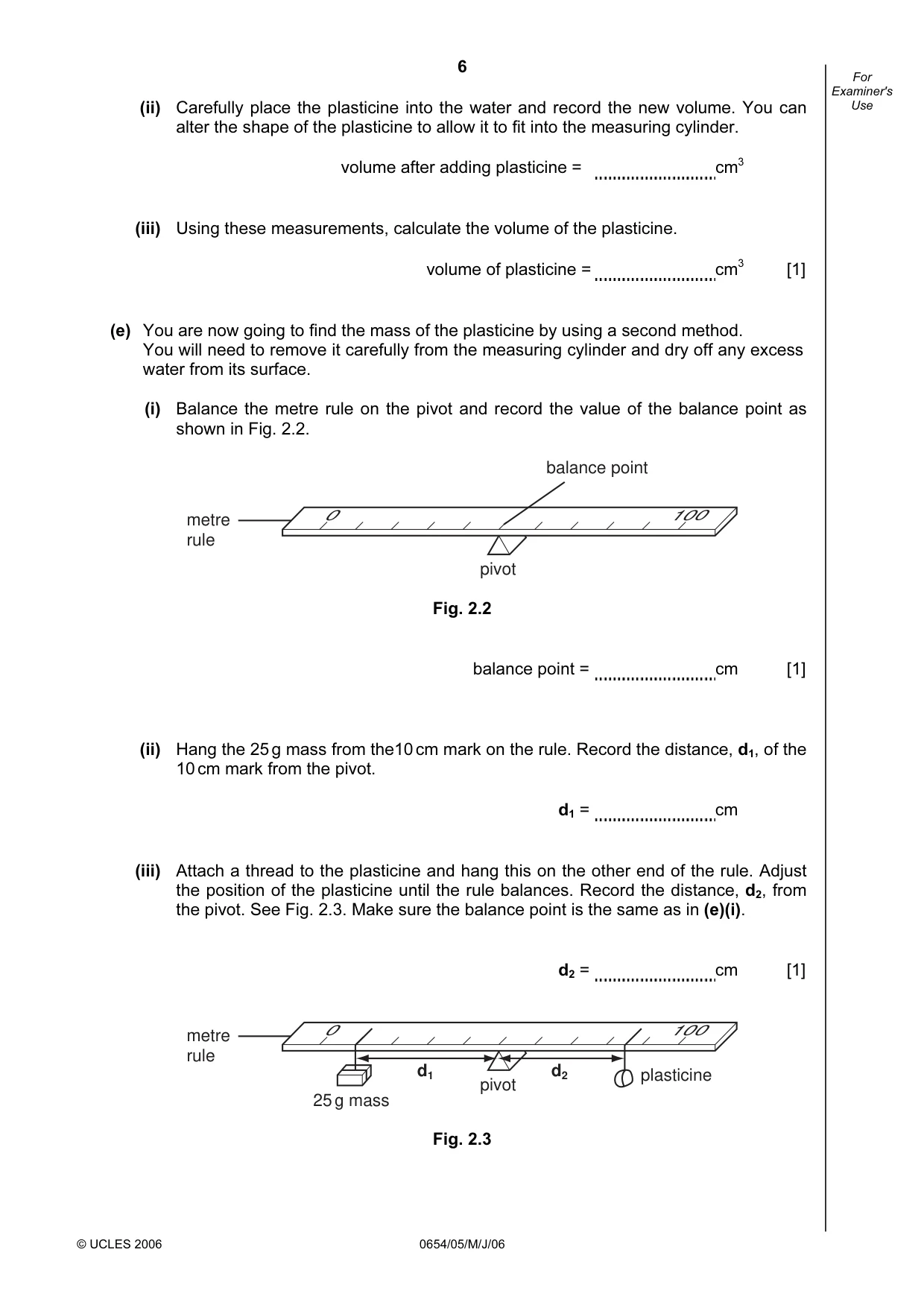
6 © UCLES 2006 0654/05/M/J/06 For Examiner's Use (ii) Carefully place the plasticine into the water and record the new volume. You can alter the shape of the plasticine to allow it to fit into the measuring cylinder. volume after adding plasticine = cm3 (iii) Using these measurements, calculate the volume of the plasticine. volume of plasticine = cm3 [1] (e) You are now going to find the mass of the plasticine by using a second method. You will need to remove it carefully from the measuring cylinder and dry off any excess water from its surface. (i) Balance the metre rule on the pivot and record the value of the balance point as shown in Fig. 2.2. 100 0 pivot balance point metre rule Fig. 2.2 balance point = cm [1] (ii) Hang the 25 g mass from the10 cm mark on the rule. Record the distance, d1, of the 10 cm mark from the pivot. d1 = cm (iii) Attach a thread to the plasticine and hang this on the other end of the rule. Adjust the position of the plasticine until the rule balances. Record the distance, d2, from the pivot. See Fig. 2.3. Make sure the balance point is the same as in (e)(i). d2 = cm [1] 100 0 pivot metre rule 25 g mass plasticine d1 d2 Fig. 2.3
Question paper, page 7
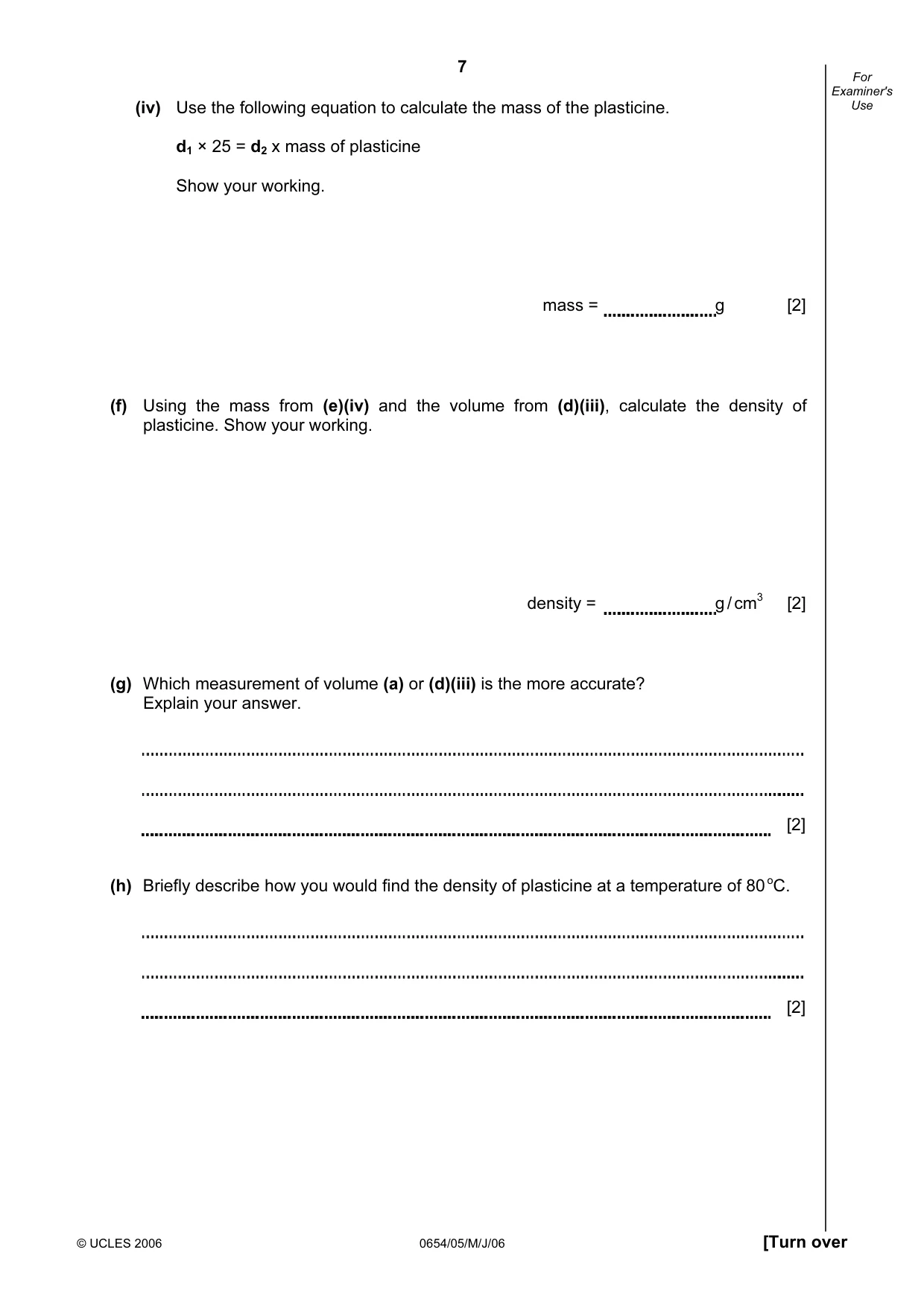
7 © UCLES 2006 0654/05/M/J/06 [Turn over For Examiner's Use (iv) Use the following equation to calculate the mass of the plasticine. d1 × 25 = d2 x mass of plasticine Show your working. mass = g [2] (f) Using the mass from (e)(iv) and the volume from (d)(iii), calculate the density of plasticine. Show your working. density = g / cm3 [2] (g) Which measurement of volume (a) or (d)(iii) is the more accurate? Explain your answer. [2] (h) Briefly describe how you would find the density of plasticine at a temperature of 80 oC. [2]
Question paper, page 8
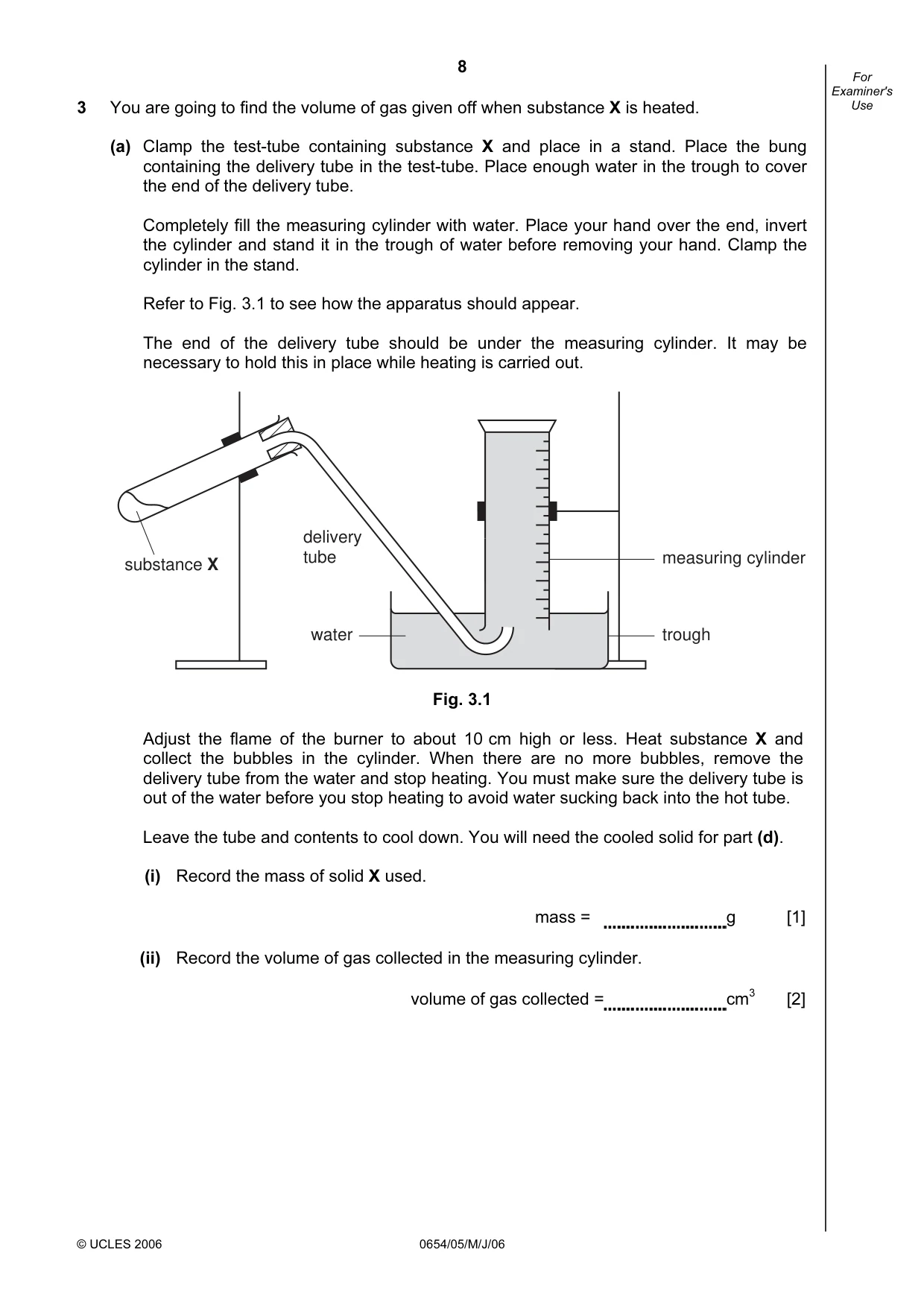
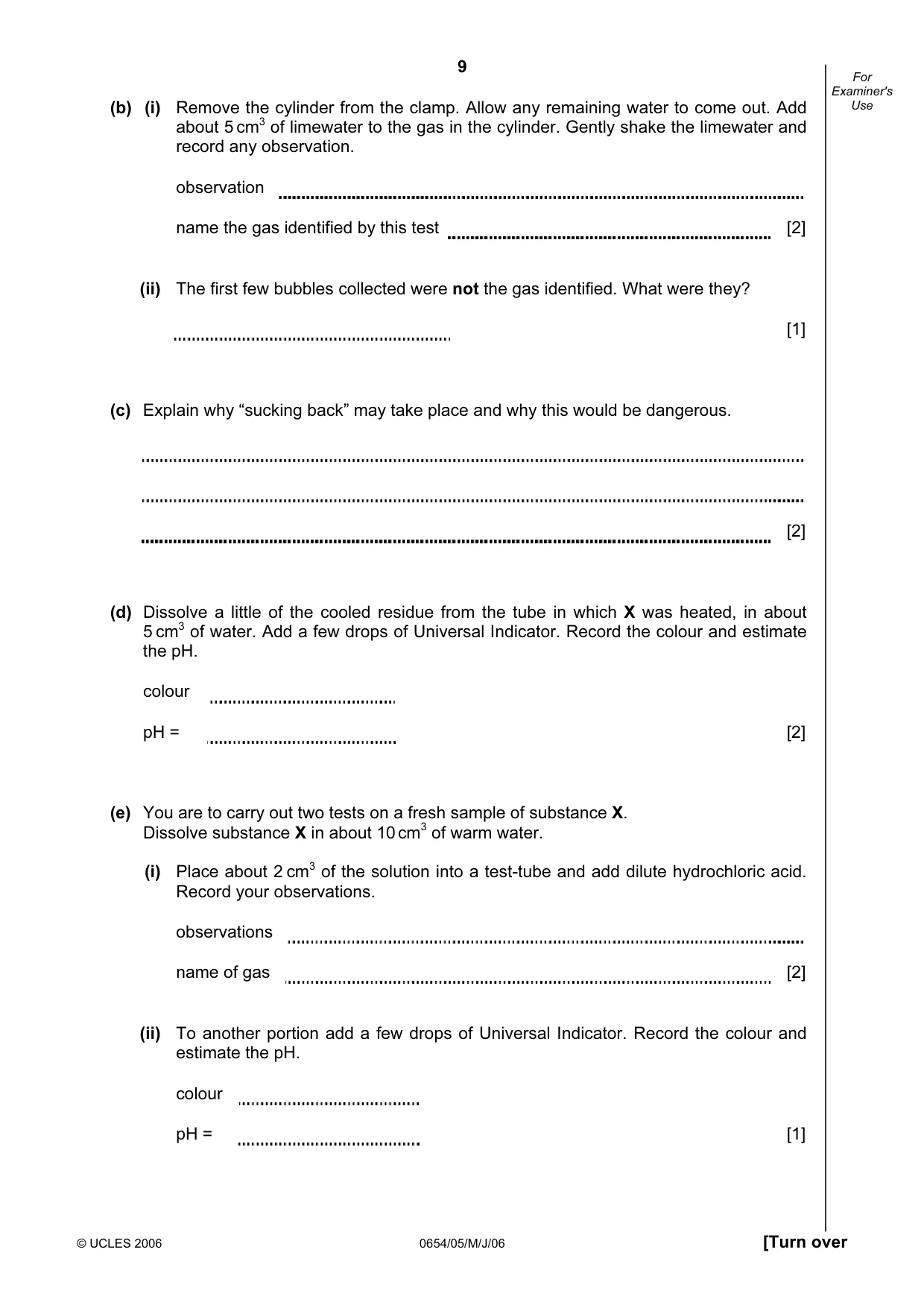
8 © UCLES 2006 0654/05/M/J/06 For Examiner's Use 3 You are going to find the volume of gas given off when substance X is heated. (a) Clamp the test-tube containing substance X and place in a stand. Place the bung containing the delivery tube in the test-tube. Place enough water in the trough to cover the end of the delivery tube. Completely fill the measuring cylinder with water. Place your hand over the end, invert the cylinder and stand it in the trough of water before removing your hand. Clamp the cylinder in the stand. Refer to Fig. 3.1 to see how the apparatus should appear. The end of the delivery tube should be under the measuring cylinder. It may be necessary to hold this in place while heating is carried out. delivery tube water trough measuring cylinder substance X Fig. 3.1 Adjust the flame of the burner to about 10 cm high or less. Heat substance X and collect the bubbles in the cylinder. When there are no more bubbles, remove the delivery tube from the water and stop heating. You must make sure the delivery tube is out of the water before you stop heating to avoid water sucking back into the hot tube. Leave the tube and contents to cool down. You will need the cooled solid for part (d). (i) Record the mass of solid X used. mass = g [1] (ii) Record the volume of gas collected in the measuring cylinder. volume of gas collected = cm3 [2]
Question paper, page 9
9 © UCLES 2006 0654/05/M/J/06 [Turn over For Examiner's Use (b) (i) Remove the cylinder from the clamp. Allow any remaining water to come out. Add about 5 cm3 of limewater to the gas in the cylinder. Gently shake the limewater and record any observation. observation name the gas identified by this test [2] (ii) The first few bubbles collected were not the gas identified. What were they? [1] (c) Explain why “sucking back” may take place and why this would be dangerous. [2] (d) Dissolve a little of the cooled residue from the tube in which X was heated, in about 5 cm3 of water. Add a few drops of Universal Indicator. Record the colour and estimate the pH. colour pH = [2] (e) You are to carry out two tests on a fresh sample of substance X. Dissolve substance X in about 10 cm3 of warm water. (i) Place about 2 cm3 of the solution into a test-tube and add dilute hydrochloric acid. Record your observations. observations name of gas [2] (ii) To another portion add a few drops of Universal Indicator. Record the colour and estimate the pH. colour pH = [1]
Question paper, page 10
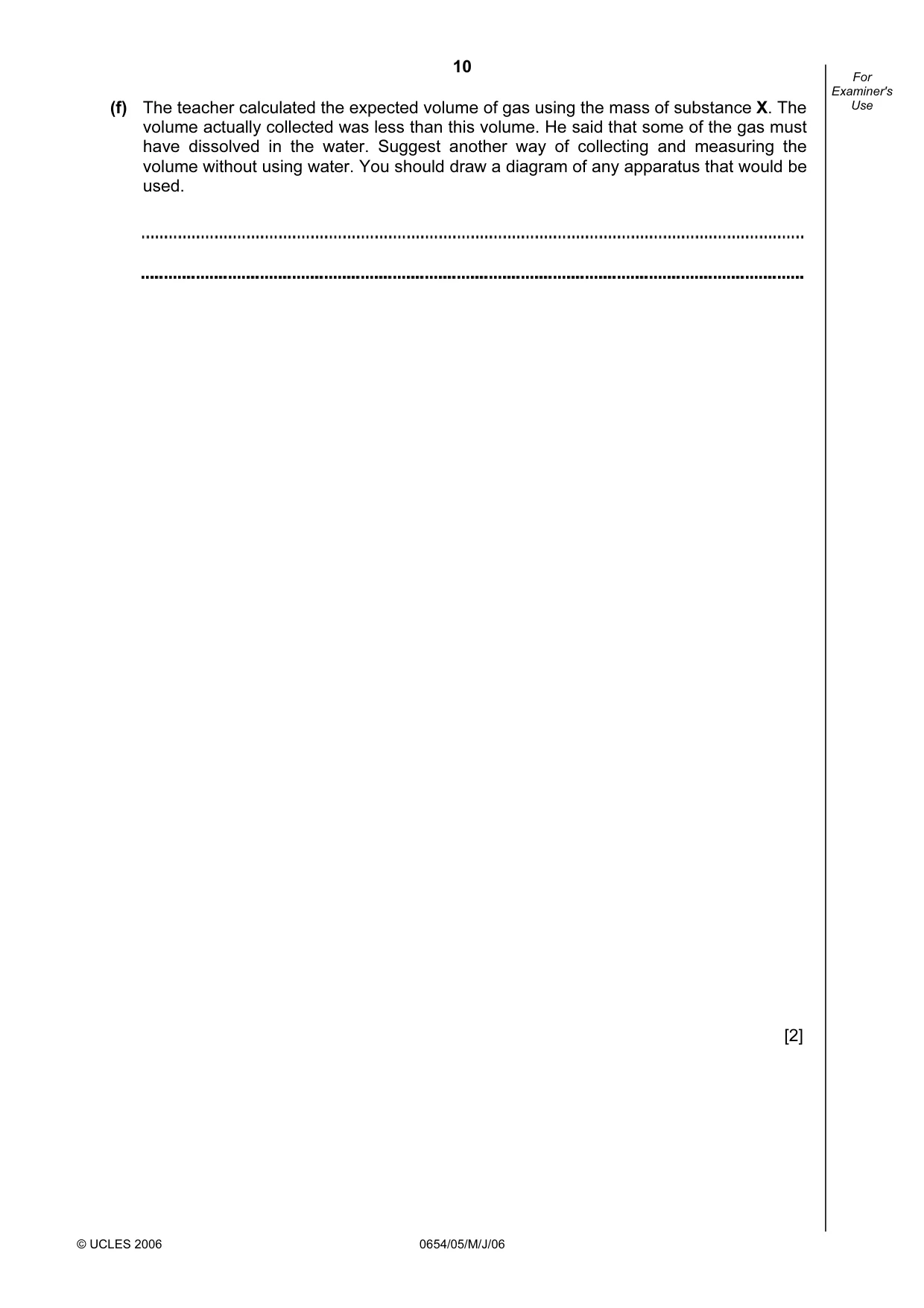
10 © UCLES 2006 0654/05/M/J/06 For Examiner's Use (f) The teacher calculated the expected volume of gas using the mass of substance X. The volume actually collected was less than this volume. He said that some of the gas must have dissolved in the water. Suggest another way of collecting and measuring the volume without using water. You should draw a diagram of any apparatus that would be used. [2]
Question paper, page 12
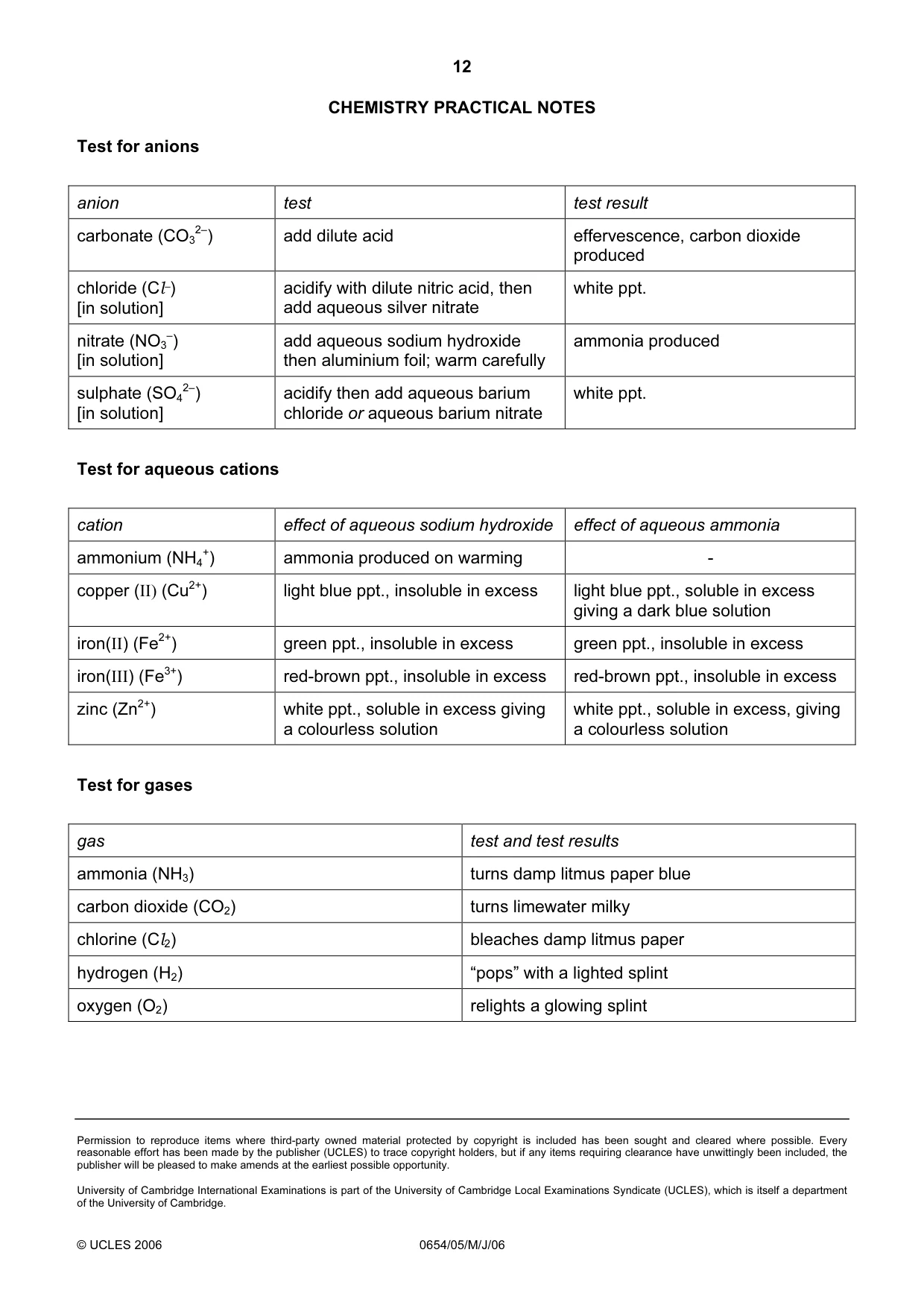
12 Permission to reproduce items where third-party owned material protected by copyright is included has been sought and cleared where possible. Every reasonable effort has been made by the publisher (UCLES) to trace copyright holders, but if any items requiring clearance have unwittingly been included, the publisher will be pleased to make amends at the earliest possible opportunity. University of Cambridge International Examinations is part of the University of Cambridge Local Examinations Syndicate (UCLES), which is itself a department of the University of Cambridge. © UCLES 2006 0654/05/M/J/06 CHEMISTRY PRACTICAL NOTES Test for anions anion test test result carbonate (CO3 2–) add dilute acid effervescence, carbon dioxide produced chloride (Cl–) [in solution] acidify with dilute nitric acid, then add aqueous silver nitrate white ppt. nitrate (NO3 –) [in solution] add aqueous sodium hydroxide then aluminium foil; warm carefully ammonia produced sulphate (SO4 2–) [in solution] acidify then add aqueous barium chloride or aqueous barium nitrate white ppt. Test for aqueous cations cation effect of aqueous sodium hydroxide effect of aqueous ammonia ammonium (NH4 +) ammonia produced on warming - copper (II) (Cu2+) light blue ppt., insoluble in excess light blue ppt., soluble in excess giving a dark blue solution iron(II) (Fe2+) green ppt., insoluble in excess green ppt., insoluble in excess iron(III) (Fe3+) red-brown ppt., insoluble in excess red-brown ppt., insoluble in excess zinc (Zn2+) white ppt., soluble in excess giving a colourless solution white ppt., soluble in excess, giving a colourless solution Test for gases gas test and test results ammonia (NH3) turns damp litmus paper blue carbon dioxide (CO2) turns limewater milky chlorine (Cl2) bleaches damp litmus paper hydrogen (H2) “pops” with a lighted splint oxygen (O2) relights a glowing splint
Mark scheme, page 1
UNIVERSITY OF CAMBRIDGE INTERNATIONAL EXAMINATIONS International General Certificate of Secondary Education MARK SCHEME for the May/June 2006 question paper 0654 CO-ORDINATED SCIENCES 0654/05 Paper 5, maximum raw mark 45 These mark schemes are published as an aid to teachers and students, to indicate the requirements of the examination. They show the basis on which Examiners were initially instructed to award marks. They do not indicate the details of the discussions that took place at an Examiners’ meeting before marking began. Any substantial changes to the mark scheme that arose from these discussions will be recorded in the published Report on the Examination. All Examiners are instructed that alternative correct answers and unexpected approaches in candidates’ scripts must be given marks that fairly reflect the relevant knowledge and skills demonstrated. Mark schemes must be read in conjunction with the question papers and the Report on the Examination. The minimum marks in these components needed for various grades were previously published with these mark schemes, but are now instead included in the Report on the Examination for this session. • CIE will not enter into discussion or correspondence in connection with these mark schemes. CIE is publishing the mark schemes for the May/June 2006 question papers for most IGCSE and GCE Advanced Level and Advanced Subsidiary Level syllabuses and some Ordinary Level syllabuses. www.XtremePapers.com
Mark scheme, page 2
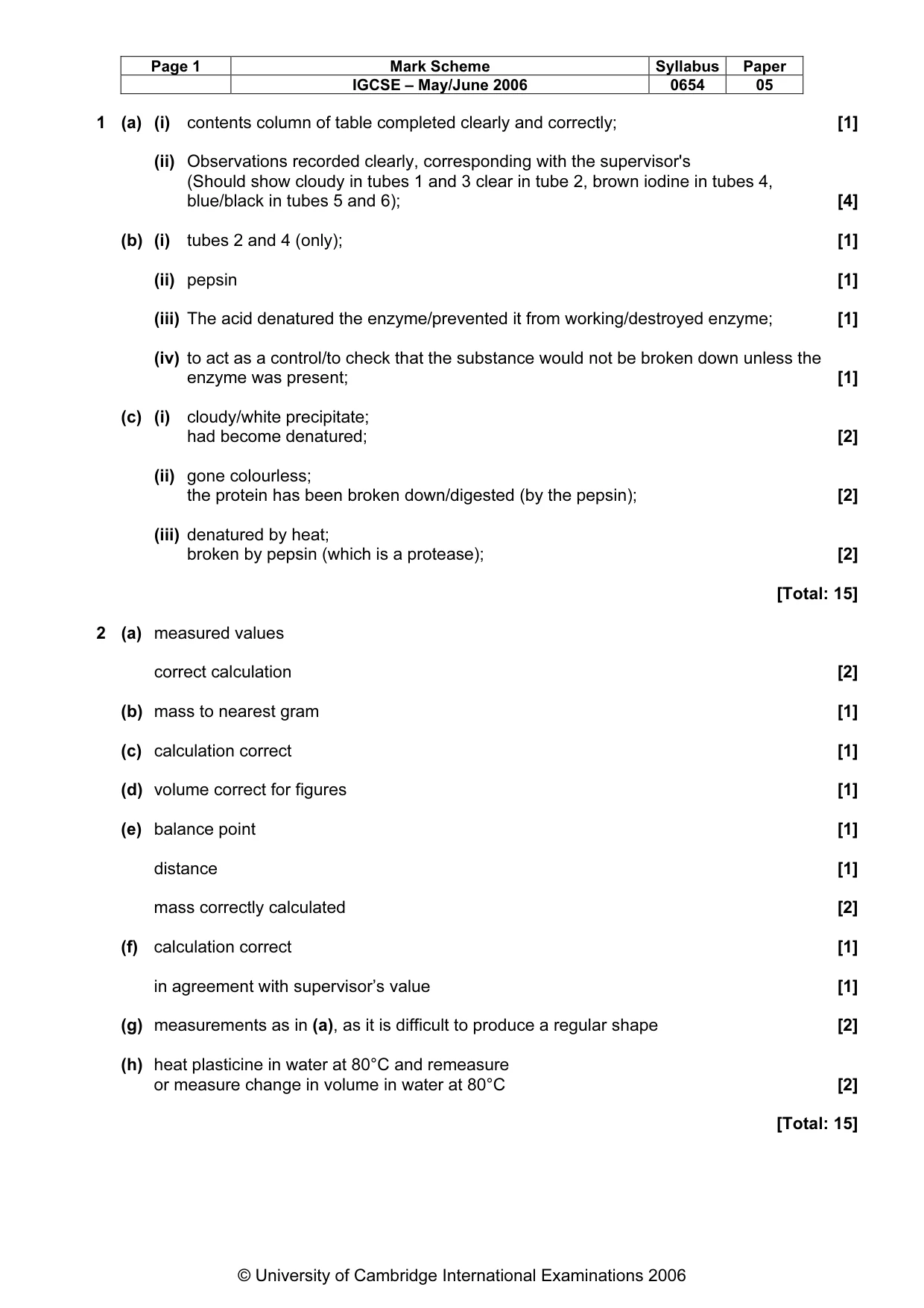
Page 1 Mark Scheme Syllabus Paper IGCSE – May/June 2006 0654 05 © University of Cambridge International Examinations 2006 1 (a) (i) contents column of table completed clearly and correctly; [1] (ii) Observations recorded clearly, corresponding with the supervisor's (Should show cloudy in tubes 1 and 3 clear in tube 2, brown iodine in tubes 4, blue/black in tubes 5 and 6); [4] (b) (i) tubes 2 and 4 (only); [1] (ii) pepsin [1] (iii) The acid denatured the enzyme/prevented it from working/destroyed enzyme; [1] (iv) to act as a control/to check that the substance would not be broken down unless the enzyme was present; [1] (c) (i) cloudy/white precipitate; had become denatured; [2] (ii) gone colourless; the protein has been broken down/digested (by the pepsin); [2] (iii) denatured by heat; broken by pepsin (which is a protease); [2] [Total: 15] 2 (a) measured values correct calculation [2] (b) mass to nearest gram [1] (c) calculation correct [1] (d) volume correct for figures [1] (e) balance point [1] distance [1] mass correctly calculated [2] (f) calculation correct [1] in agreement with supervisor’s value [1] (g) measurements as in (a), as it is difficult to produce a regular shape [2] (h) heat plasticine in water at 80°C and remeasure or measure change in volume in water at 80°C [2] [Total: 15]
Mark scheme, page 3
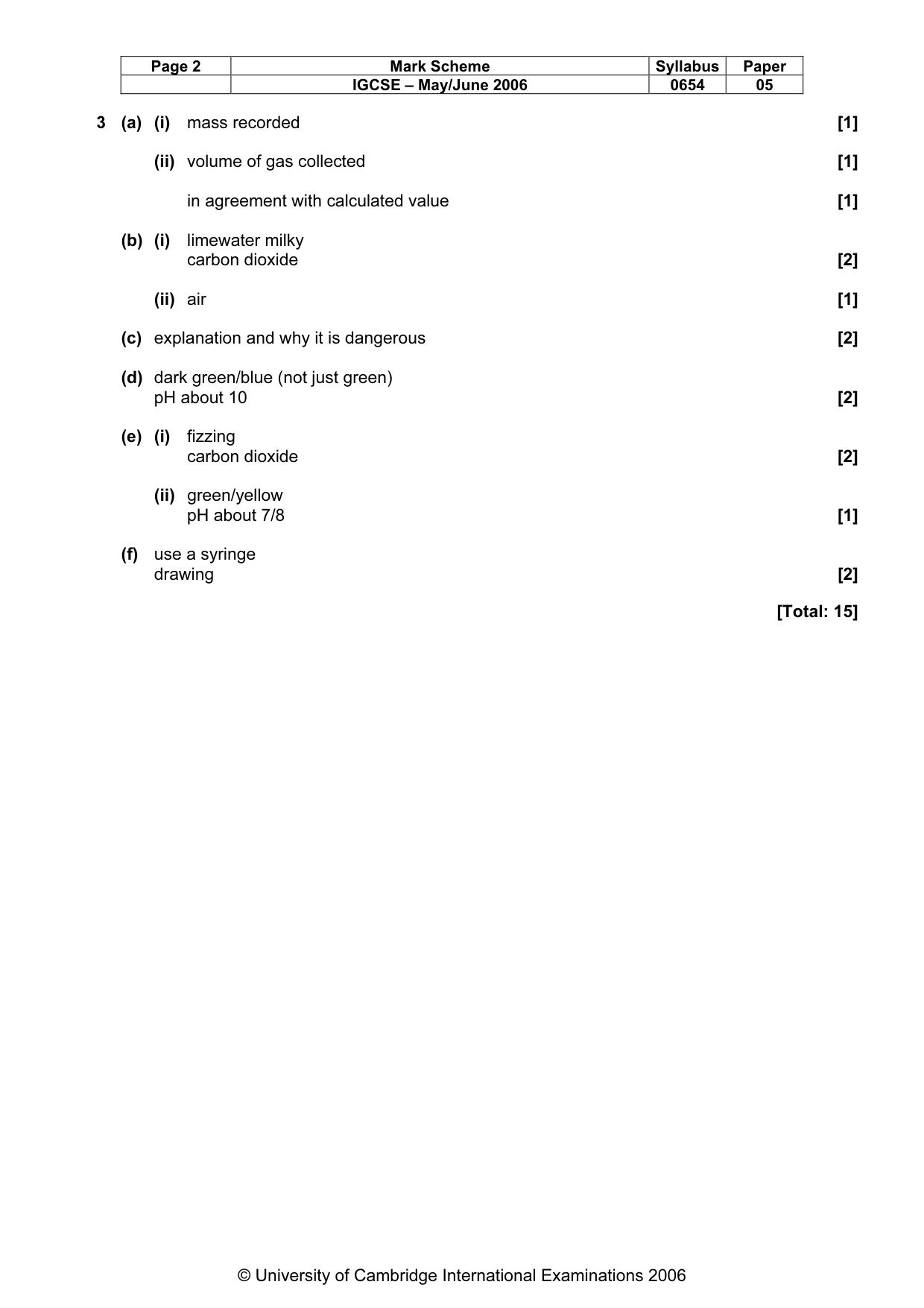
Page 2 Mark Scheme Syllabus Paper IGCSE – May/June 2006 0654 05 © University of Cambridge International Examinations 2006 3 (a) (i) mass recorded [1] (ii) volume of gas collected [1] in agreement with calculated value [1] (b) (i) limewater milky carbon dioxide [2] (ii) air [1] (c) explanation and why it is dangerous [2] (d) dark green/blue (not just green) pH about 10 [2] (e) (i) fizzing carbon dioxide [2] (ii) green/yellow pH about 7/8 [1] (f) use a syringe drawing [2] [Total: 15]
What you needed in this session
Cambridge’s own grade thresholds for 2006 May/June, Paper 5 · Variant 1. A higher threshold means an easier paper — the bar moves with how the cohort did.