Questions as text
Q1 · Radio waves and X-rays have different wavelengths 0973/12 May/June 2020
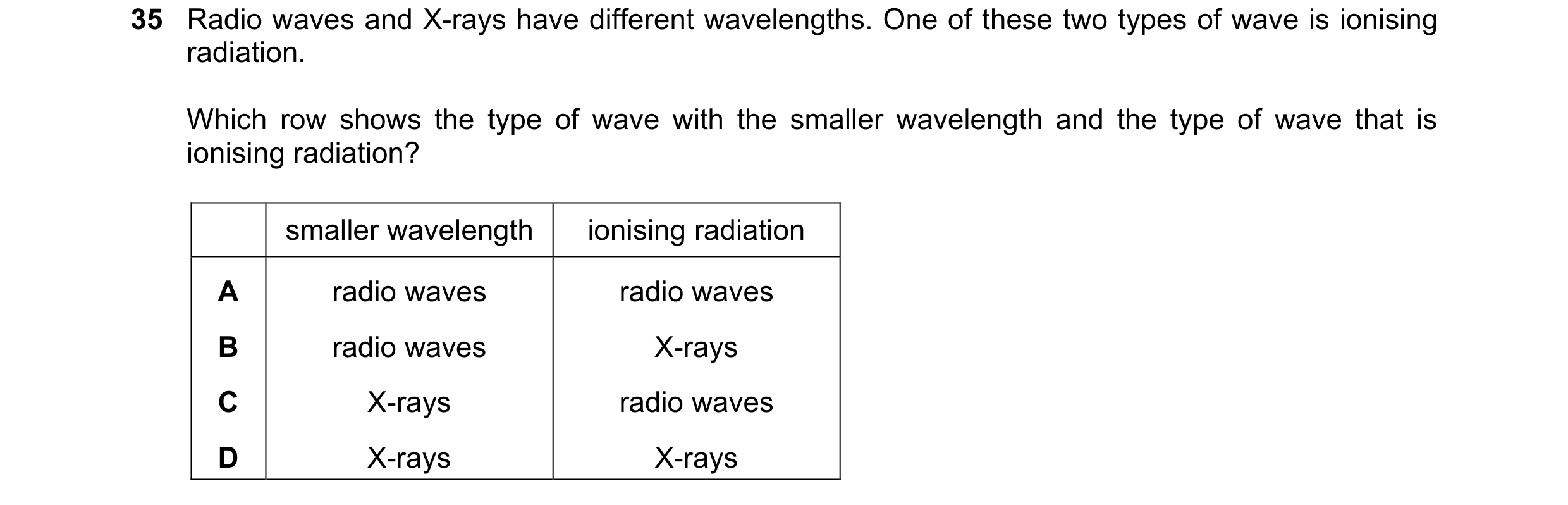
35 Radio waves and X-rays have different wavelengths. One of these two types of wave is ionising radiation. Which row shows the type of wave with the smaller wavelength and the type of wave that is ionising radiation? smaller wavelength ionising radiation A radio waves radio waves B radio waves X-rays C X-rays radio waves D X-rays X-rays
1 marks
Answer: D
This question in 0973/12 May/June 2020
Q2 · Which type of radiation has the greatest ionising effect? 0973/11 Oct/Nov 2020
40 Which type of radiation has the greatest ionising effect? A infrared rays B -particles C -particles D -rays
1 marks
Answer: B
This question in 0973/11 Oct/Nov 2020
Q3 · A radioactive nucleus emits a -particle 0973/11 May/June 2021
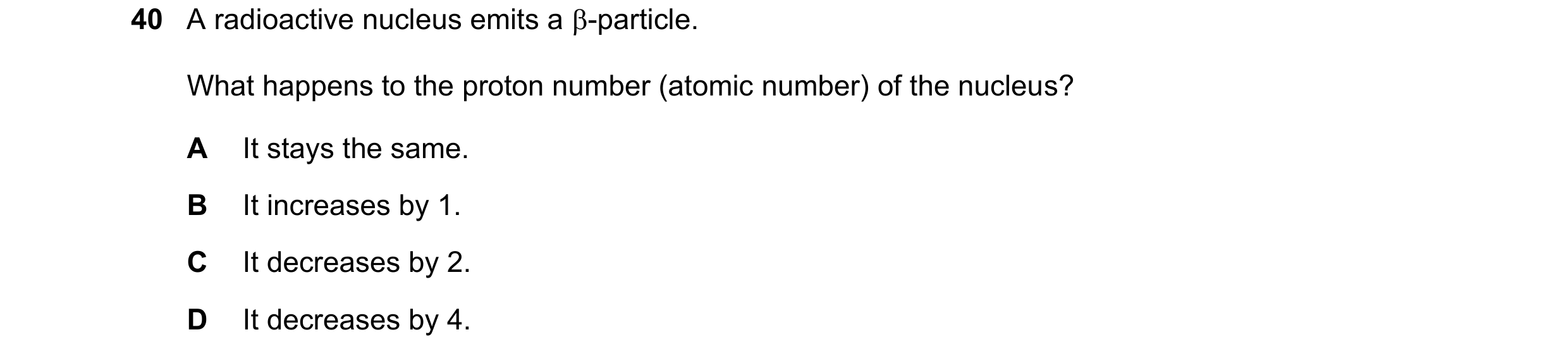
40 A radioactive nucleus emits a -particle. What happens to the proton number (atomic number) of the nucleus? A It stays the same. B It increases by 1. C It decreases by 2. D It decreases by 4.
1 marks
Answer: B
This question in 0973/11 May/June 2021
Q4 · A radioactive nucleus emits a -particle 0973/12 May/June 2021
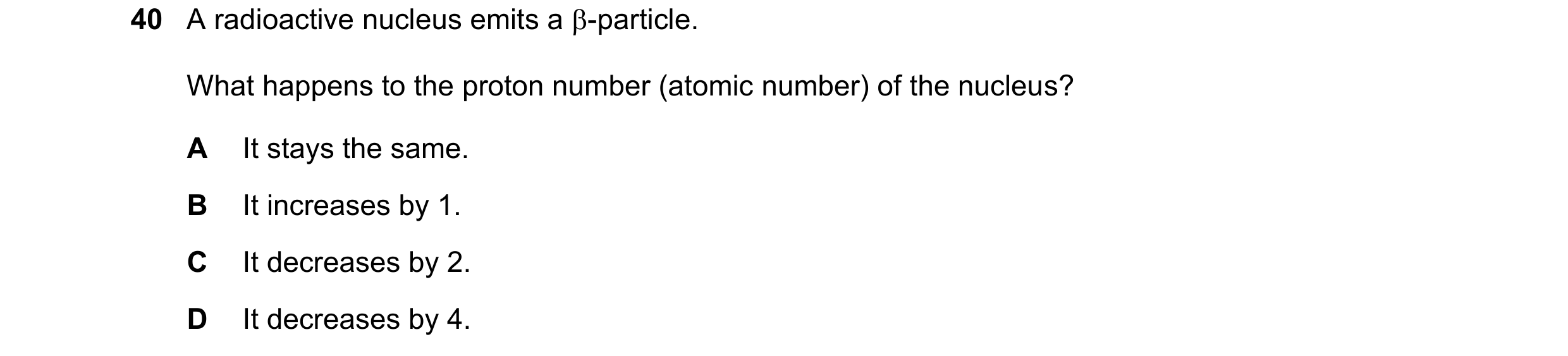
40 A radioactive nucleus emits a -particle. What happens to the proton number (atomic number) of the nucleus? A It stays the same. B It increases by 1. C It decreases by 2. D It decreases by 4.
1 marks
Answer: B
This question in 0973/12 May/June 2021
Q5 · A pure sample of a radioactive substance decays 0973/11 May/June 2022
40 A pure sample of a radioactive substance decays. The graph shows how the number of these radioactive atoms in the sample changes with time. 800 number of 700 radioactive atoms 600 500 400 300 200 100 0 0 10 20 30 40 time / s What is the half-life of the substance? A 10 s B 20 s C 30 s D 40 s
1 marks
Answer: A
This question in 0973/11 May/June 2022
Q6 · A radioactive isotope has a half-life of 3.0 days 0973/11 May/June 2023
40 A radioactive isotope has a half-life of 3.0 days. A sample contains 4000 atoms of this isotope. How many atoms of the isotope remain after 6.0 days? A 0 B 500 C 1000 D 2000
1 marks
Answer: C
This question in 0973/11 May/June 2023
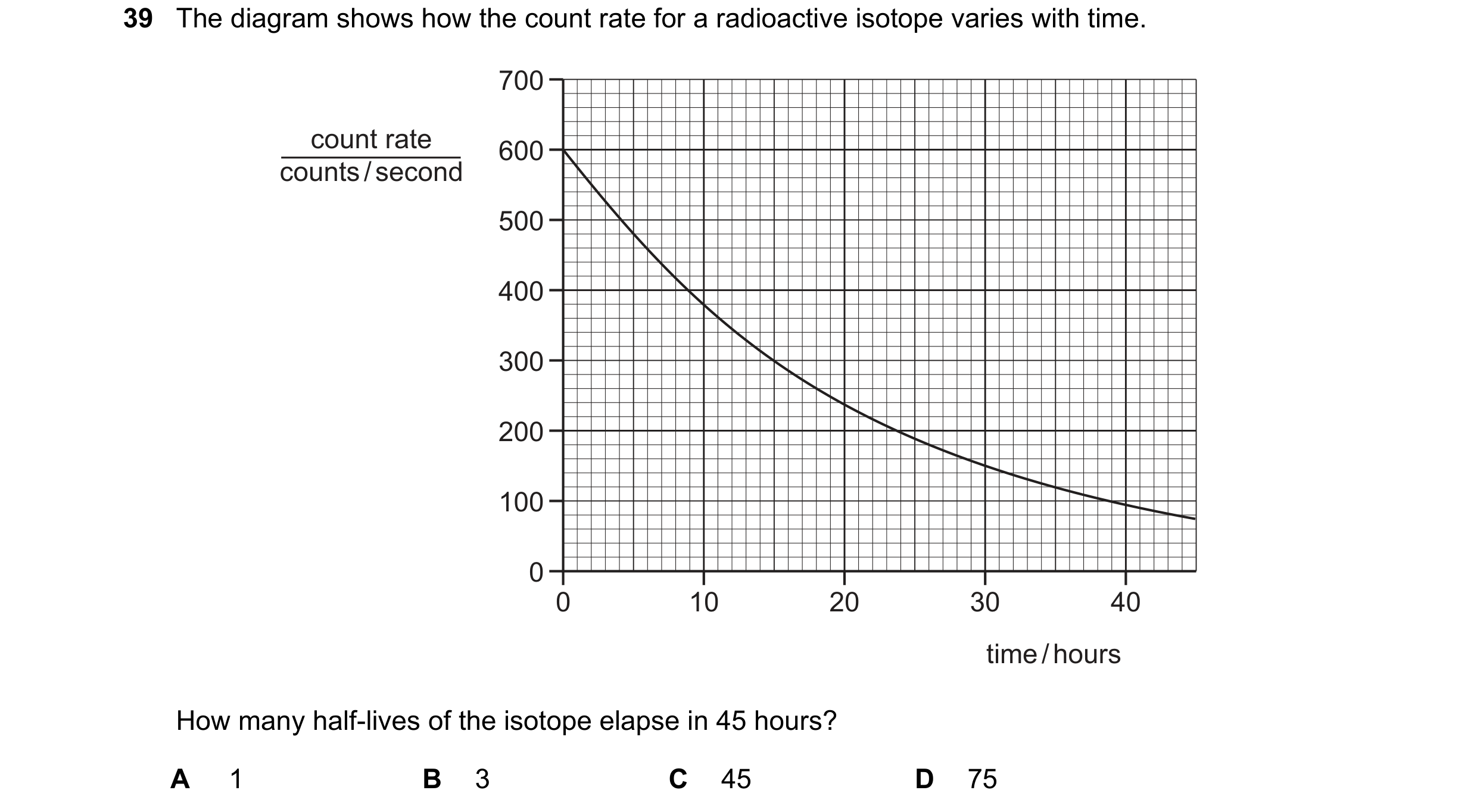
Q7 · The diagram shows how the count rate for a radioactive isotope varies with time 0973/12 May/June 2023
39 The diagram shows how the count rate for a radioactive isotope varies with time. 700 count rate 600 counts / second 500 400 300 200 100 0 0 10 20 30 40 time / hours How many half-lives of the isotope elapse in 45 hours? A 1 B 3 C 45 D 75
1 marks
Answer: B
This question in 0973/12 May/June 2023
Q8 · The diagram represents three types of ionising radiation L, M and N directed towards a… 0973/12 May/June 2023
40 The diagram represents three types of ionising radiation L, M and N directed towards a sheet of paper, a sheet of aluminium foil and a block of lead. The diagram shows whether each type of radiation penetrates each of the materials. aluminium paper foil lead L M N Which row identifies the radiations L, M and N? L M N A α β γ B α γ β C β α γ D β γ α
1 marks
Answer: C
This question in 0973/12 May/June 2023
Q9 · A radioactive material has a half-life of 4.0 days 0973/11 May/June 2024
40 A radioactive material has a half-life of 4.0 days. The rate of emission of radiation from a sample of the material is 32 emissions per minute. What was the rate of emission from the sample 8.0 days earlier? A 8.0 emissions per minute B 128 emissions per minute C 256 emissions per minute D 1024 emissions per minute
1 marks
Answer: B
This question in 0973/11 May/June 2024
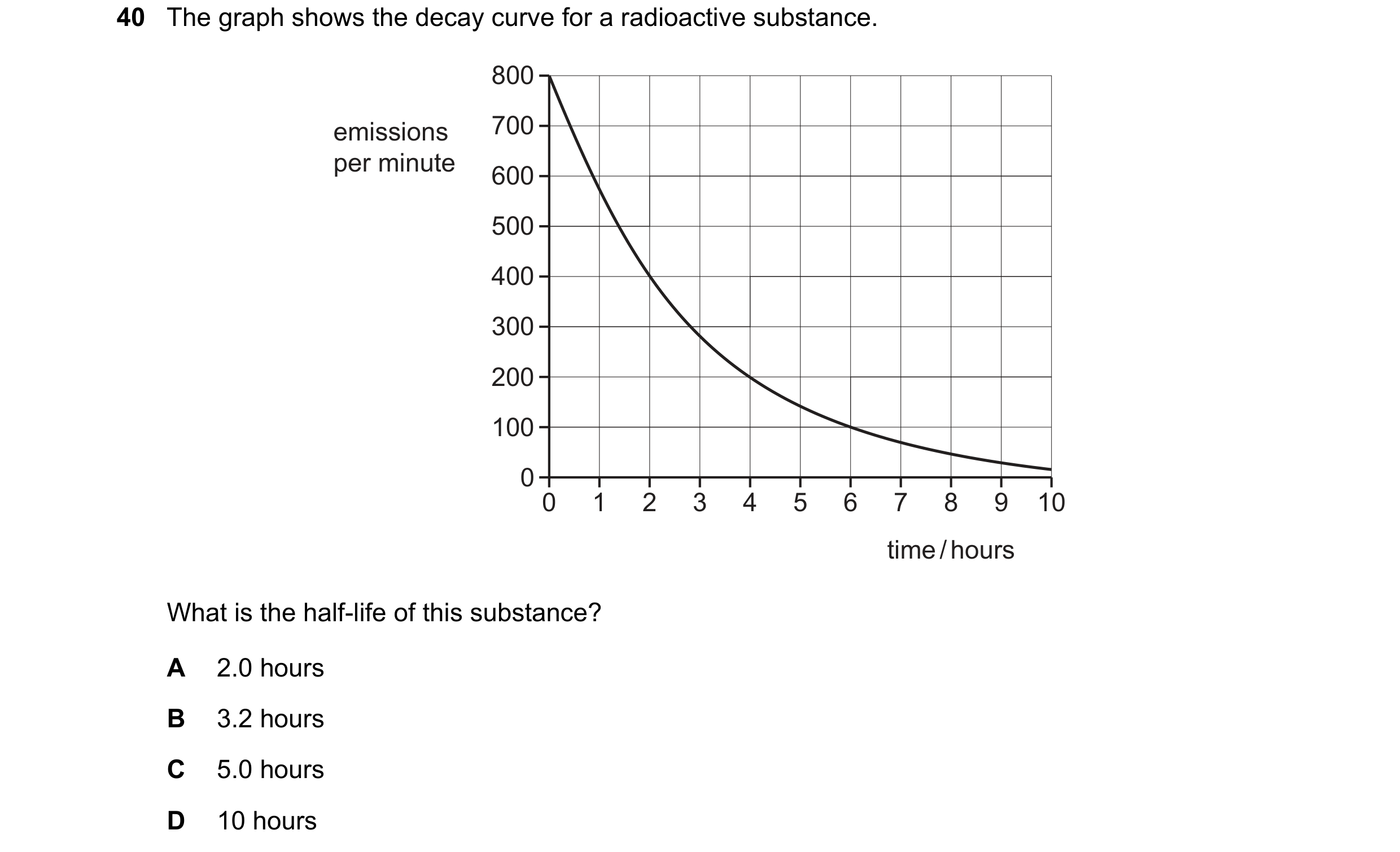
Q10 · The graph shows the decay curve for a radioactive substance 0973/12 May/June 2024
40 The graph shows the decay curve for a radioactive substance. 800 emissions 700 per minute 600 500 400 300 200 100 0 0 1 2 3 4 5 6 7 8 9 10 time / hours What is the half-life of this substance? A 2.0 hours B 3.2 hours C 5.0 hours D 10 hours
1 marks
Answer: A
This question in 0973/12 May/June 2024
Q11 · The graph shows how the rate of emission of radiation from a radioactive sample changes… 0973/11 Oct/Nov 2024
40 The graph shows how the rate of emission of radiation from a radioactive sample changes with time. 80 rate of emission 70 emissions / minute 60 50 40 30 20 10 0 0 1 2 3 4 5 6 7 8 9 10 time / years What is the half-life of this sample? A 40 minutes B 2.0 years C 5.0 years D 10 years
1 marks
Answer: B
This question in 0973/11 Oct/Nov 2024
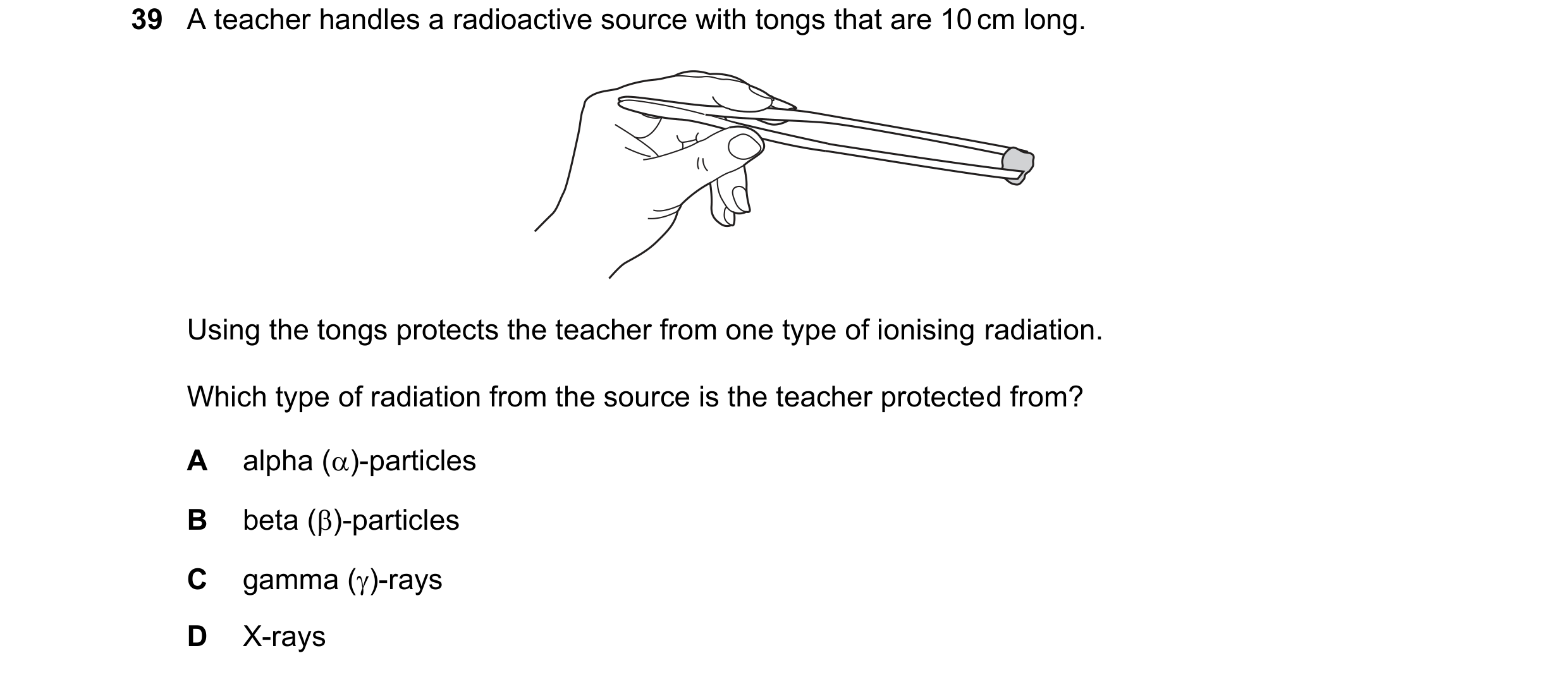
Q12 · A teacher handles a radioactive source with tongs that are 10 cm long 0973/11 May/June 2025
39 A teacher handles a radioactive source with tongs that are 10 cm long. Using the tongs protects the teacher from one type of ionising radiation. Which type of radiation from the source is the teacher protected from? A alpha ()-particles B beta ()-particles C gamma ()-rays D X-rays
1 marks
Answer: A
This question in 0973/11 May/June 2025
Q13 · A scientist works with a radioactive source that emits gamma ()-rays 0973/12 May/June 2025
39 A scientist works with a radioactive source that emits gamma ()-rays. The scientist takes several precautions. Which precaution does not give the scientist any protection? A Keep a lead screen between the scientist and the source. B Use a detector to measure the count rate of the source. C Only use the source for a short period of time. D Have a large distance between the scientist and the source.
1 marks
Answer: B
This question in 0973/12 May/June 2025
Q14 · The mass of a radioactive isotope in a sample is 720 g 0973/11 Oct/Nov 2025
39 The mass of a radioactive isotope in a sample is 720 g. The half-life of the isotope is 4.0 hours. Which mass of the isotope remains undecayed after 12 hours? A 60 g B 90 g C 180 g D 240 g
1 marks
Answer: B
This question in 0973/11 Oct/Nov 2025

 1 / 5
1 / 5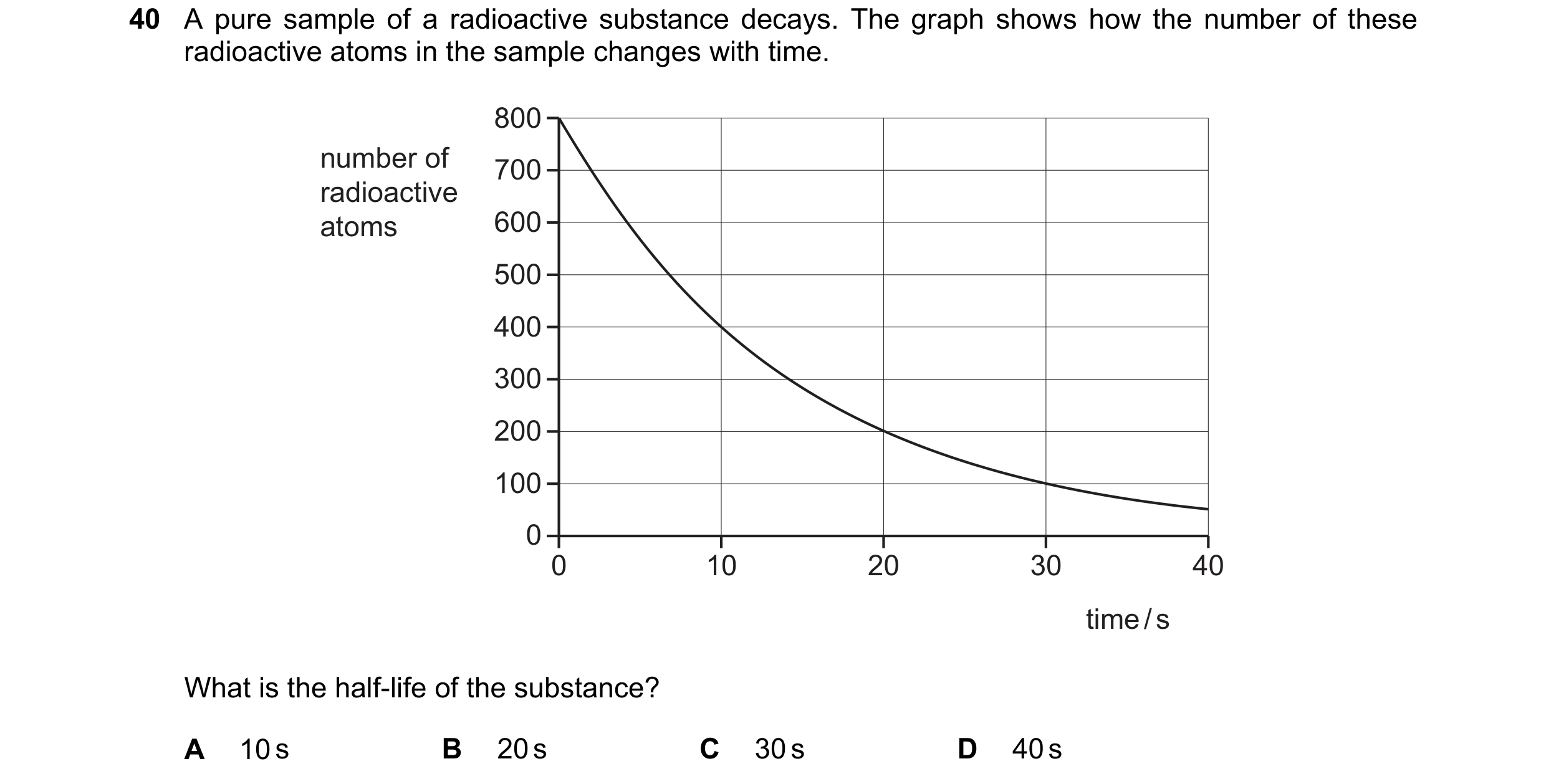

 2 / 5
2 / 5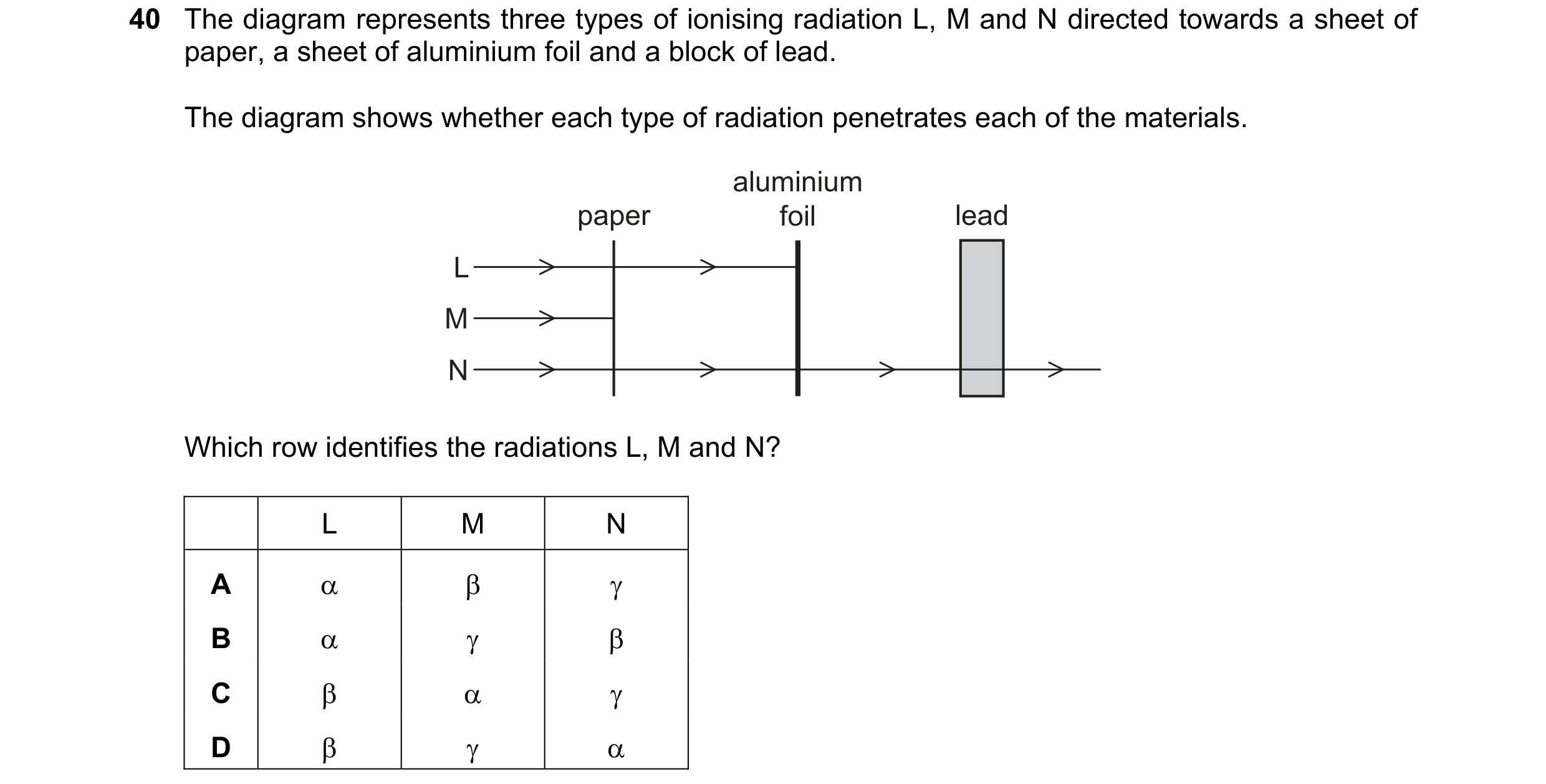
 3 / 5
3 / 5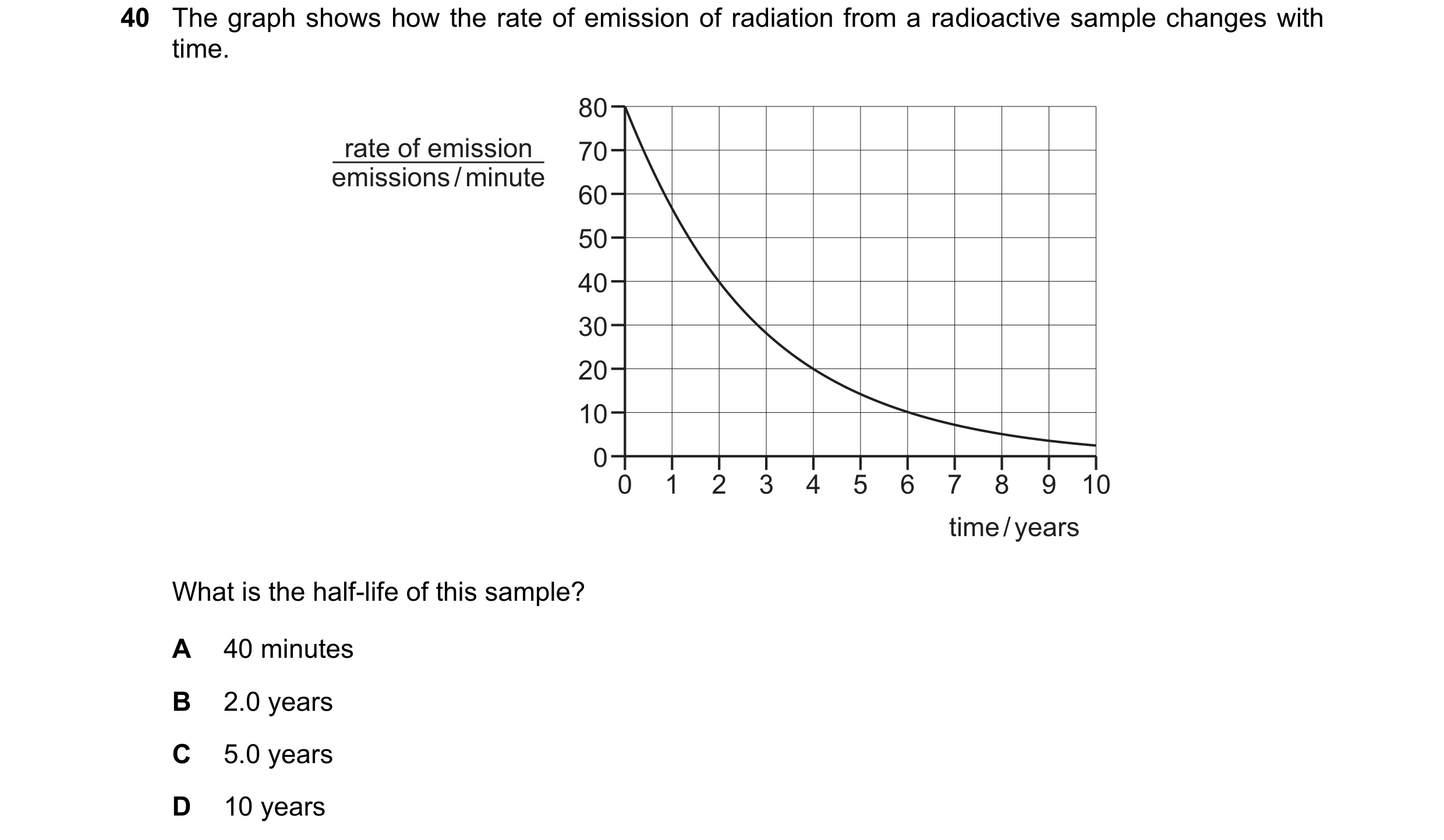
 4 / 5
4 / 5 5 / 5
5 / 5