Questions as text
Q1 · A sports field is next to a large school building 0973/11 May/June 2019
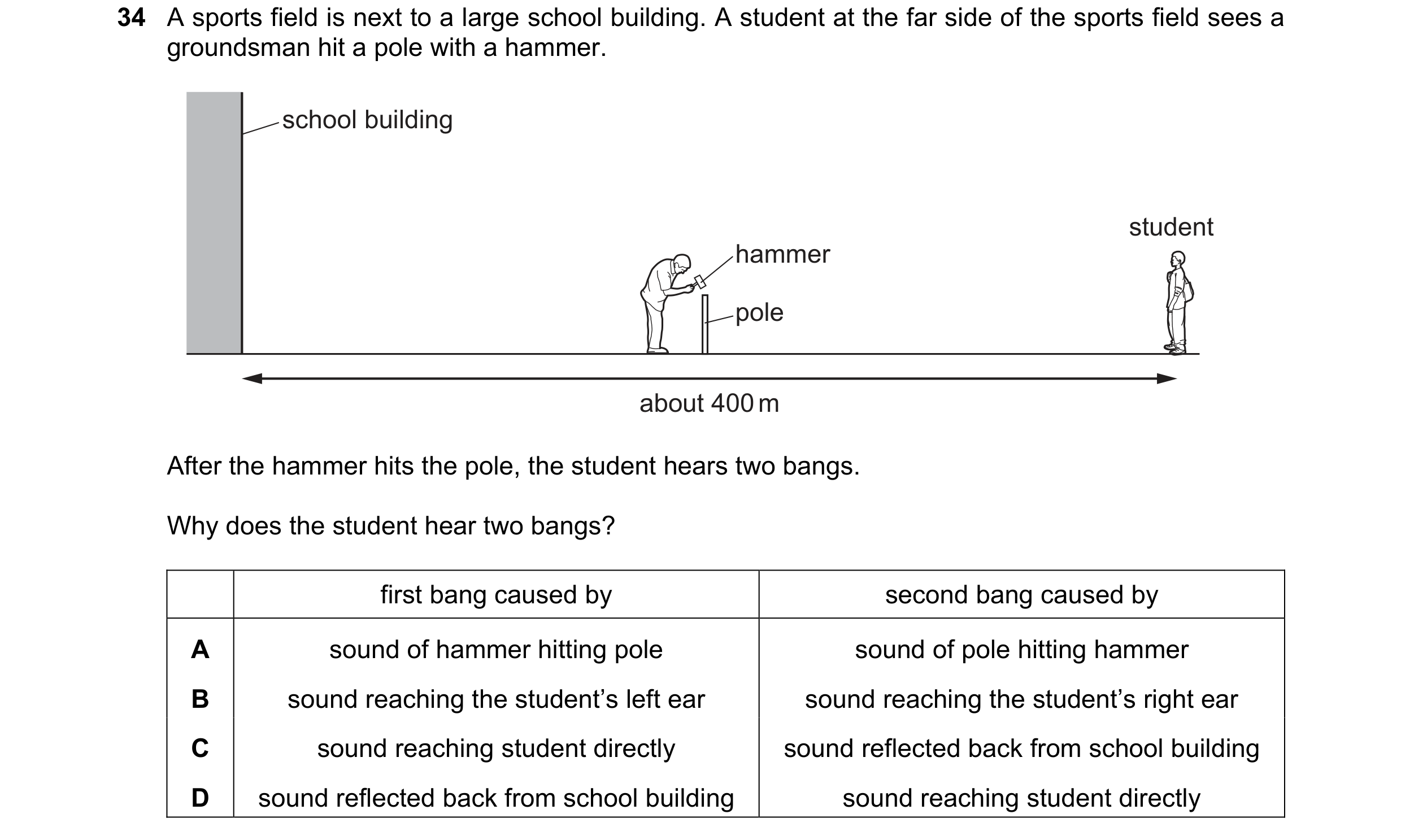
34 A sports field is next to a large school building. A student at the far side of the sports field sees a groundsman hit a pole with a hammer. school building student hammer pole about 400 m After the hammer hits the pole, the student hears two bangs. Why does the student hear two bangs? first bang caused by second bang caused by A sound of hammer hitting pole sound of pole hitting hammer B sound reaching the student’s left ear sound reaching the student’s right ear C sound reaching student directly sound reflected back from school building D sound reflected back from school building sound reaching student directly
1 marks
Answer: C
This question in 0973/11 May/June 2019
Q2 · A person stands 80 m from a high wall and claps his hands 0973/11 May/June 2020
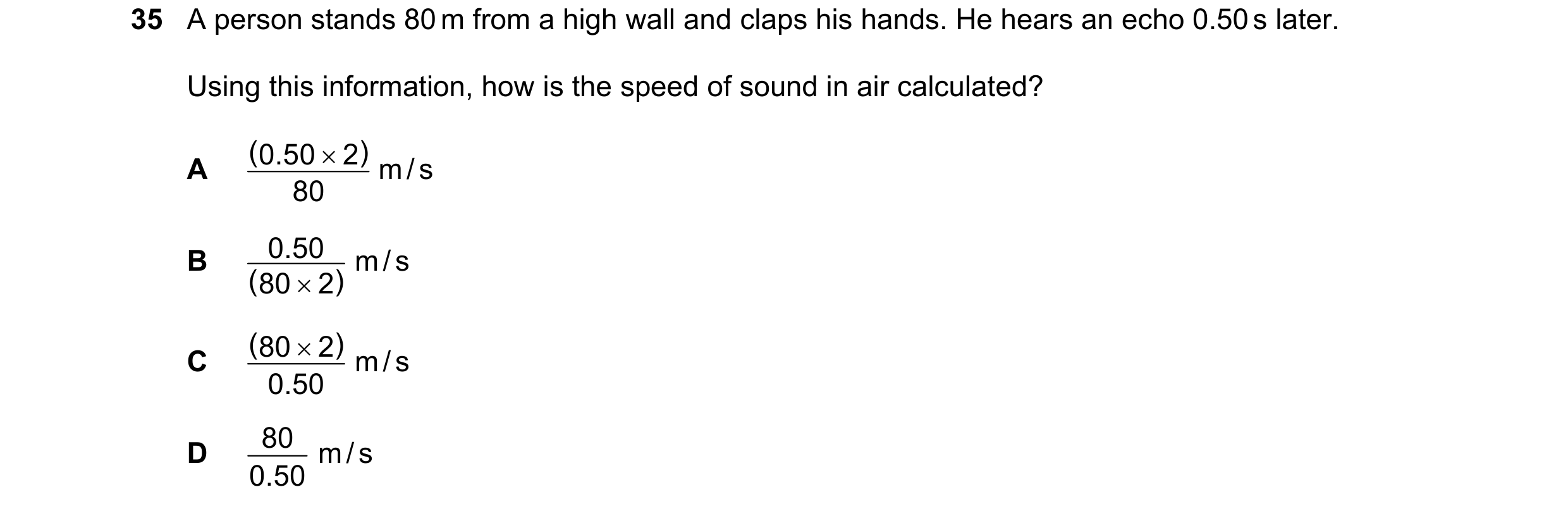
35 A person stands 80 m from a high wall and claps his hands. He hears an echo 0.50 s later. Using this information, how is the speed of sound in air calculated? ( 0.50 × 2 ) A m / s 80 B 0.50 m / s ( 80 × 2 ) ( 80 × 2 ) C m / s 0.50 80 D m / s 0.50
1 marks
Answer: C
This question in 0973/11 May/June 2020
Q3 · A worker in a quarry stands 0.90 km away from an explosion 0973/11 Oct/Nov 2020
34 A worker in a quarry stands 0.90 km away from an explosion. She sees the explosion 3.0 s before she hears the sound of the explosion. Using this information, what value can be determined for the speed of sound? A 300 m / s B 600 m / s C 2700 m / s D 5400 m / s
1 marks
Answer: A
This question in 0973/11 Oct/Nov 2020
Q4 · Sound from a loudspeaker at P travels directly to Q 0973/11 May/June 2021
35 Sound from a loudspeaker at P travels directly to Q. Sound also reaches Q after being reflected from a wall at R. loudspeaker wall P 8 m 10 m R 8 m Q The speed of sound is 330 m / s. What is the difference in time for sound to travel from P to Q by the two routes? 6 16 A s B s C (6 330) s D (16 330) s 330 330
1 marks
Answer: A
This question in 0973/11 May/June 2021
Q5 · Sound from a loudspeaker at P travels directly to Q 0973/12 May/June 2021
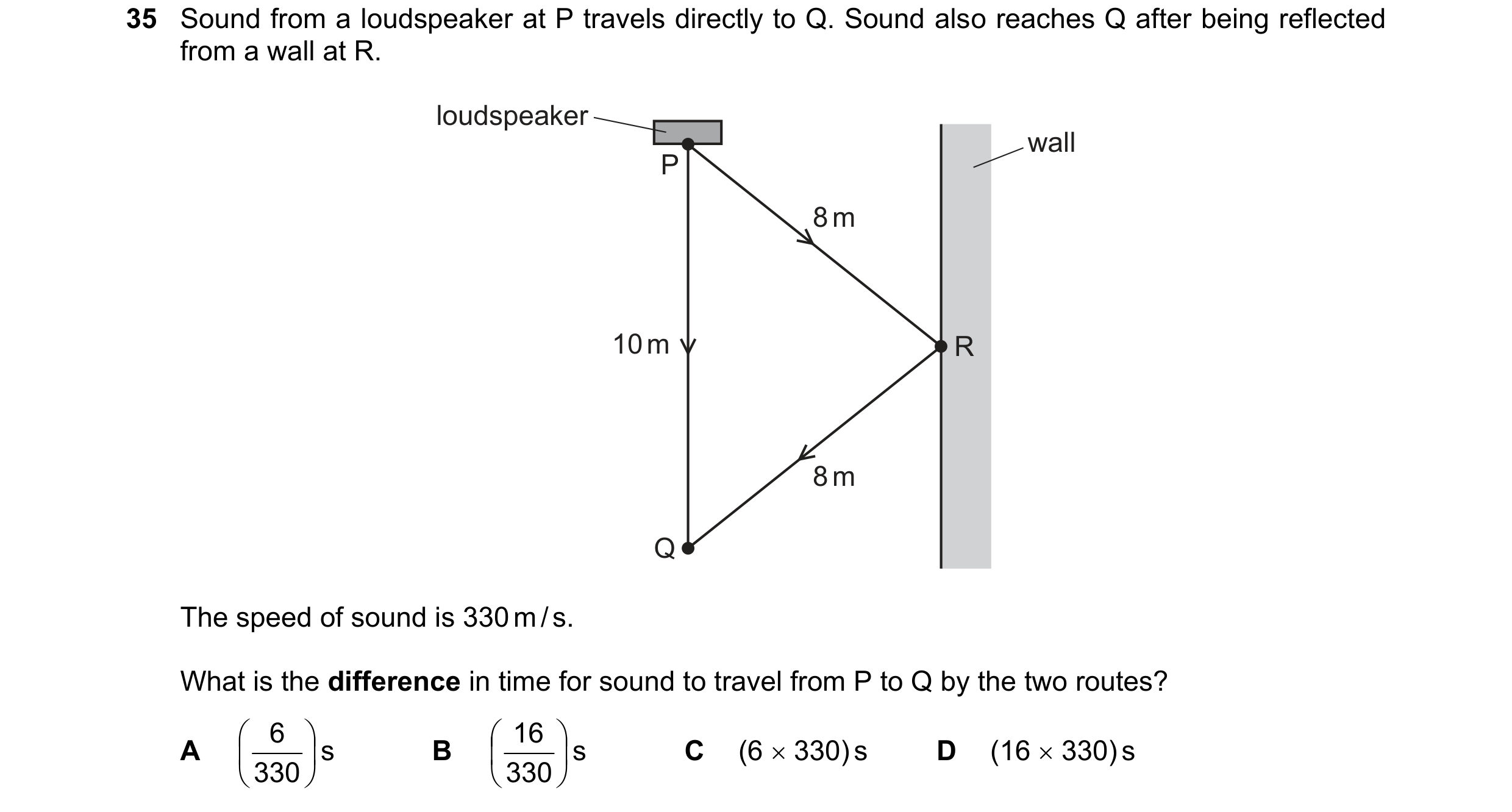
35 Sound from a loudspeaker at P travels directly to Q. Sound also reaches Q after being reflected from a wall at R. loudspeaker wall P 8 m 10 m R 8 m Q The speed of sound is 330 m / s. What is the difference in time for sound to travel from P to Q by the two routes? 6 16 A s B s C (6 330) s D (16 330) s 330 330
1 marks
Answer: A
This question in 0973/12 May/June 2021
Q6 · Which statement about sound is correct? 0973/11 May/June 2022
35 Which statement about sound is correct? A An echo is produced by refraction of sound waves. B The amplitude of a sound wave affects the pitch of a sound. C The approximate range of audible frequencies for a human is 20 Hz–20 kHz. D Sound waves travel more quickly in a vacuum than in air.
1 marks
Answer: C
This question in 0973/11 May/June 2022
Q7 · Two students conduct an experiment to determine the speed of sound in air 0973/11 Oct/Nov 2022
35 Two students conduct an experiment to determine the speed of sound in air. They stand 639 m apart. One student hits two blocks of wood together while the other uses a stop-watch to time how long it takes for the sound to reach him. It takes 1.80 s for the sound to reach the second student. What is the speed of sound in air, calculated using these results? A 330 m / s B 355 m / s C 710 m / s D 1150 m / s
1 marks
Answer: B
This question in 0973/11 Oct/Nov 2022
Q8 · A man stands 420 m away from a high wall 0973/11 May/June 2023
34 A man stands 420 m away from a high wall. He bangs a drum once and starts a stop-watch at the same time. When he hears an echo from the wall, the stop-watch reads 2.4 s. What is the speed of sound, calculated from this information? A 87.5 m / s B 175 m / s C 330 m / s D 350 m / s
1 marks
Answer: D
This question in 0973/11 May/June 2023
Q9 · Which change to a sound wave makes the sound louder? 0973/11 Oct/Nov 2023
35 Which change to a sound wave makes the sound louder? A decreasing the amplitude B decreasing the wavelength C increasing the amplitude D increasing the wavelength
1 marks
Answer: C
This question in 0973/11 Oct/Nov 2023
Q10 · An electric bell is suspended by a rubber band in a glass jar 0973/11 May/June 2024
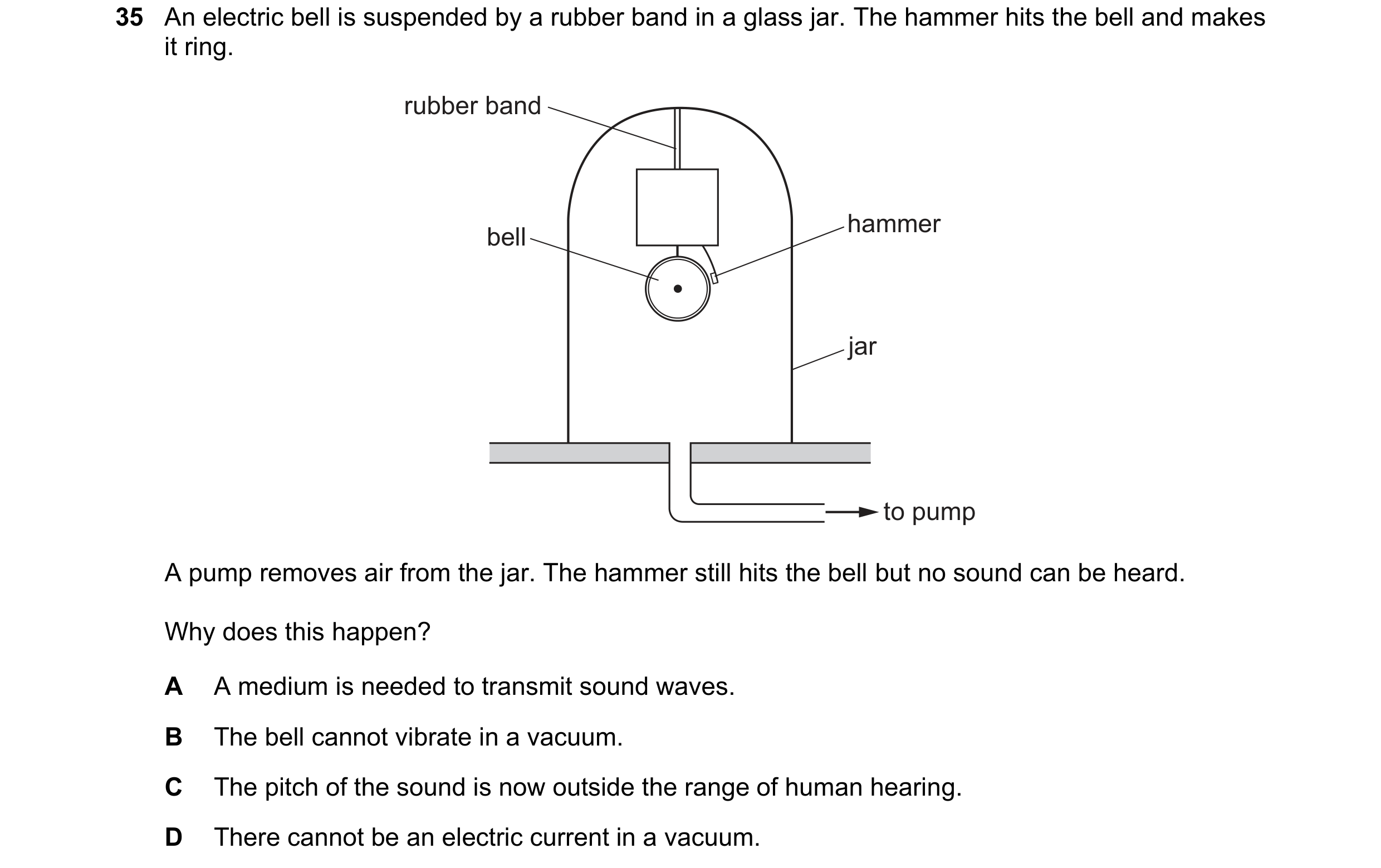
35 An electric bell is suspended by a rubber band in a glass jar. The hammer hits the bell and makes it ring. rubber band hammer bell jar to pump A pump removes air from the jar. The hammer still hits the bell but no sound can be heard. Why does this happen? A A medium is needed to transmit sound waves. B The bell cannot vibrate in a vacuum. C The pitch of the sound is now outside the range of human hearing. D There cannot be an electric current in a vacuum.
1 marks
Answer: A
This question in 0973/11 May/June 2024
Q11 · The diagrams represent two different sound waves, P and Q, drawn to the same scale 0973/12 May/June 2024
34 The diagrams represent two different sound waves, P and Q, drawn to the same scale. wave P displacement time wave Q displacement time How do the loudness and the pitch of the sounds compare? higher- louder pitched sound sound A P P B P Q C Q P D Q Q
1 marks
Answer: D
This question in 0973/12 May/June 2024
Q12 · The table shows the highest frequency of sound heard by different animals 0973/12 May/June 2025
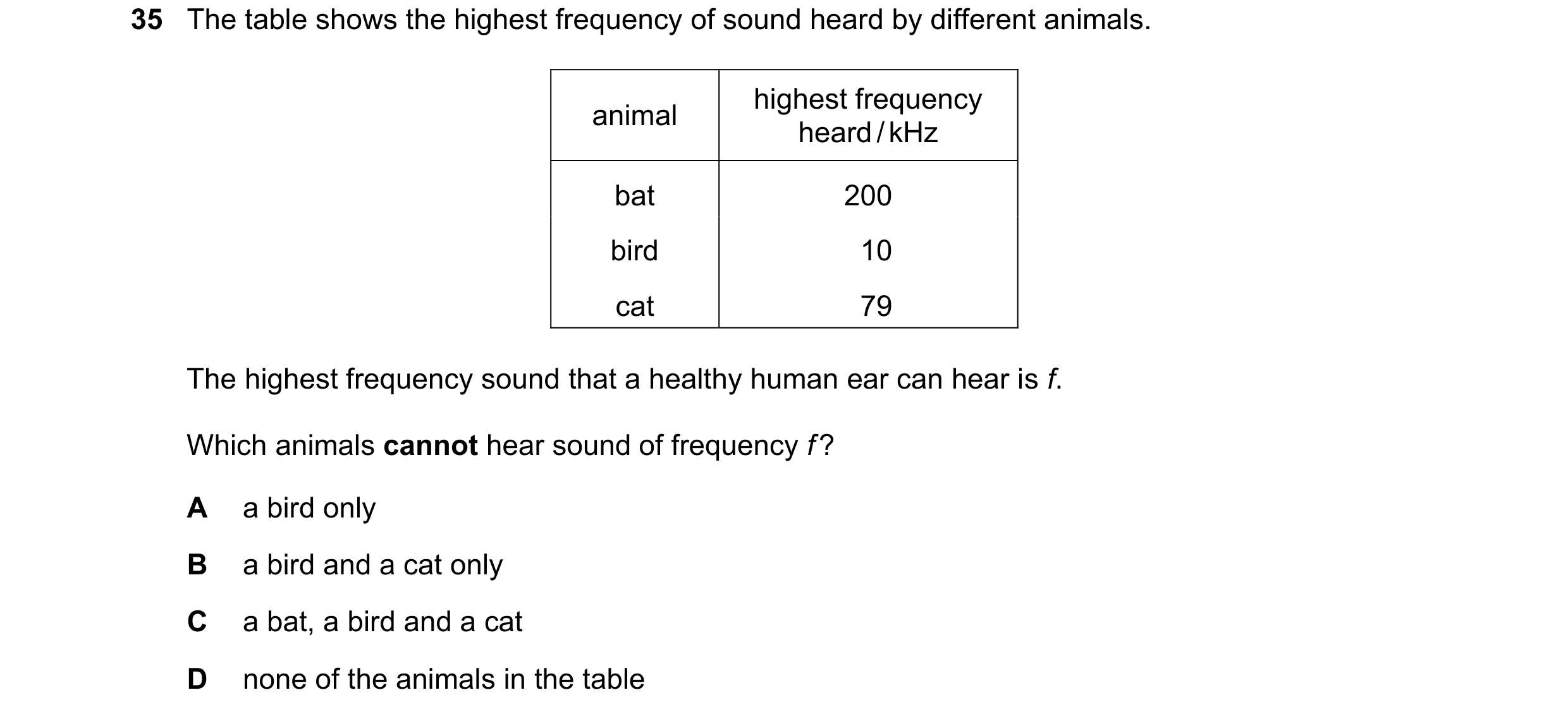
35 The table shows the highest frequency of sound heard by different animals. highest frequency animal heard / kHz bat 200 bird 10 cat 79 The highest frequency sound that a healthy human ear can hear is f. Which animals cannot hear sound of frequency f ? A a bird only B a bird and a cat only C a bat, a bird and a cat D none of the animals in the table
1 marks
Answer: A
This question in 0973/12 May/June 2025
Q13 · The diagram shows a loudspeaker 0973/11 Oct/Nov 2025
35 The diagram shows a loudspeaker. The cone of the loudspeaker vibrates backwards and forwards in the direction of the arrows. These vibrations produce a sound wave in the air. cone of loudspeaker Which change results in the loudspeaker producing sound with a higher pitch? A increasing the distance moved by the cone during each vibration B increasing the time taken for each vibration C decreasing the distance moved by the cone during each vibration D decreasing the time taken for each vibration
1 marks
Answer: D
This question in 0973/11 Oct/Nov 2025
 1 / 5
1 / 5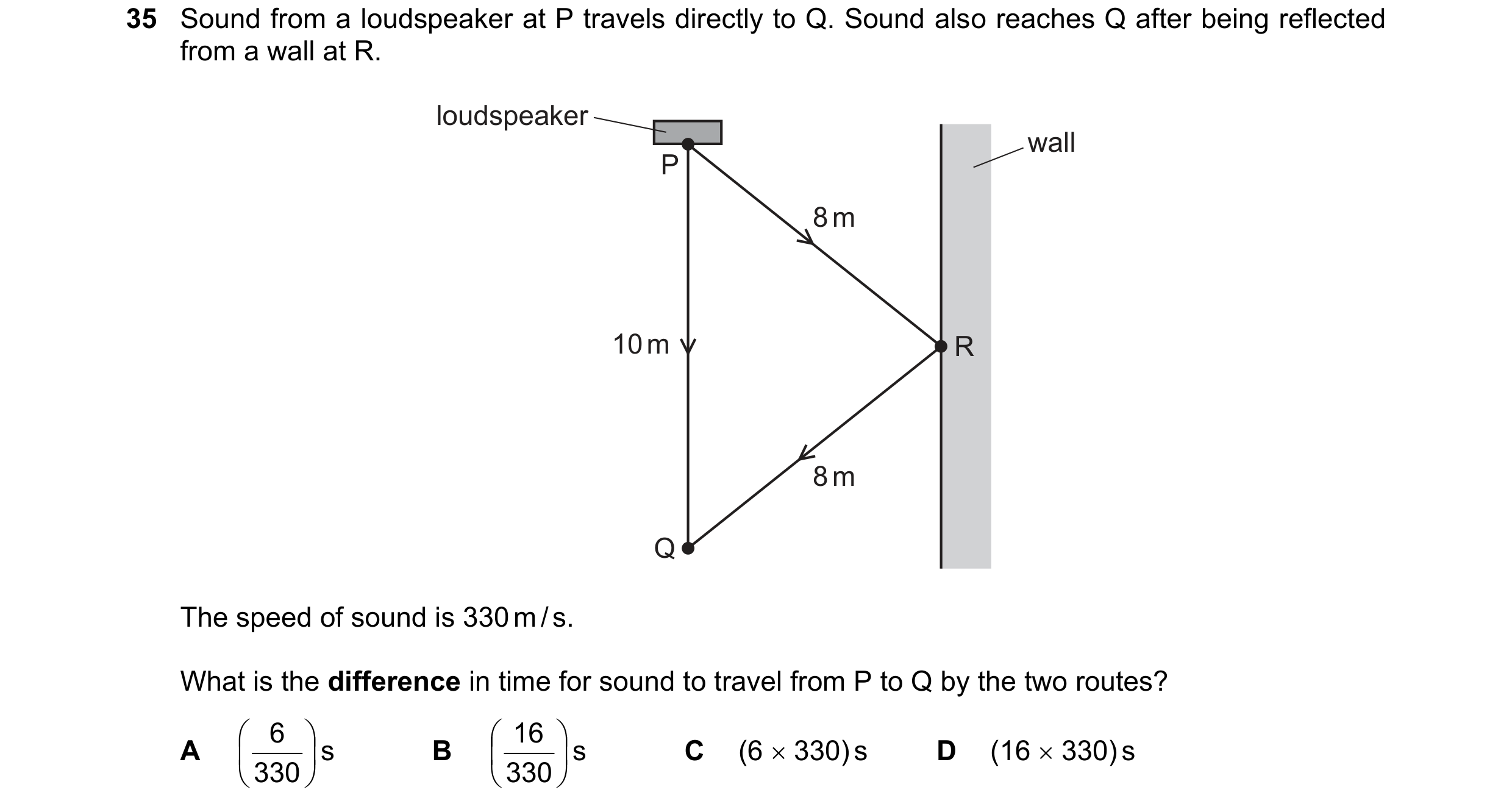
 2 / 5
2 / 5


 3 / 5
3 / 5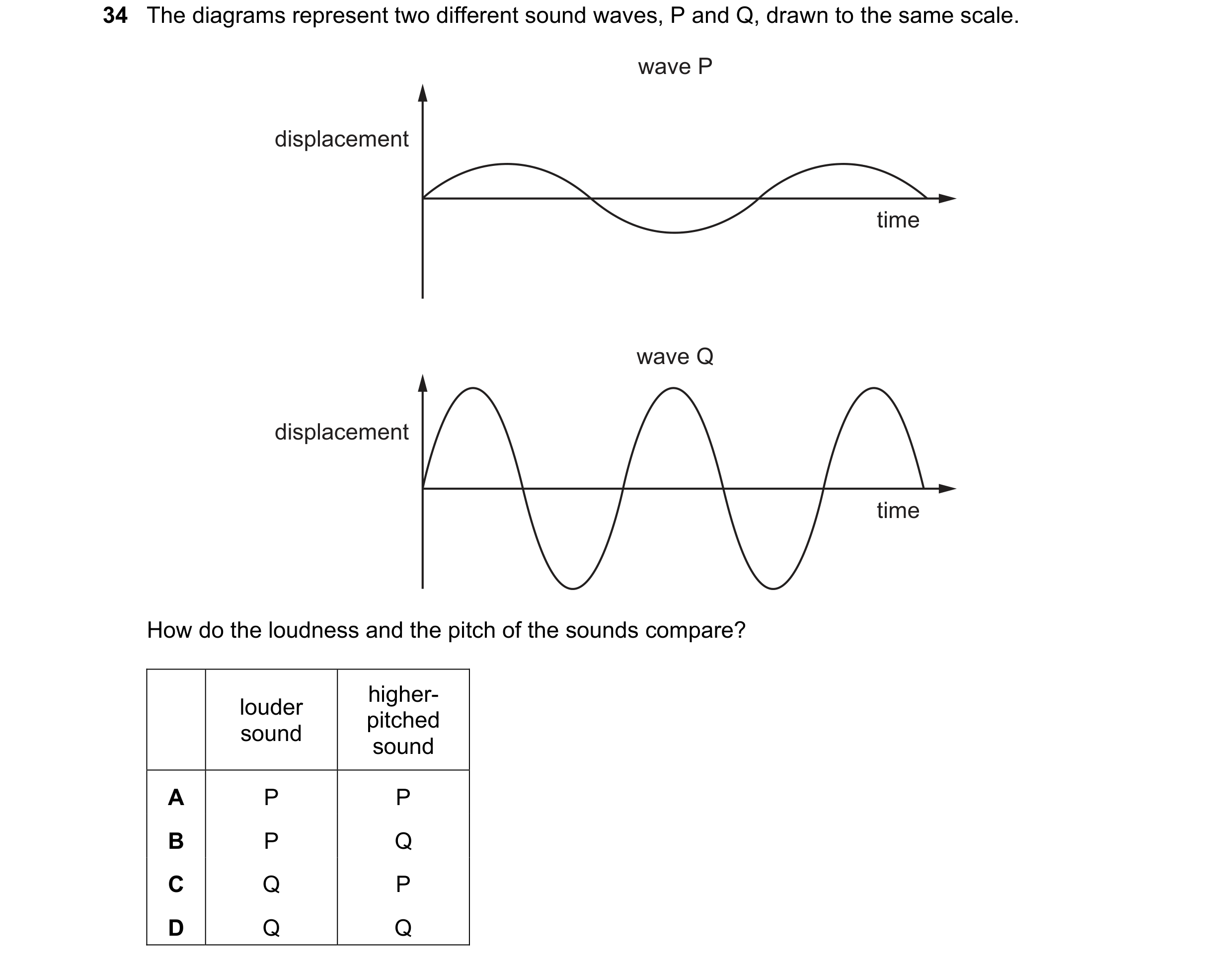
 4 / 5
4 / 5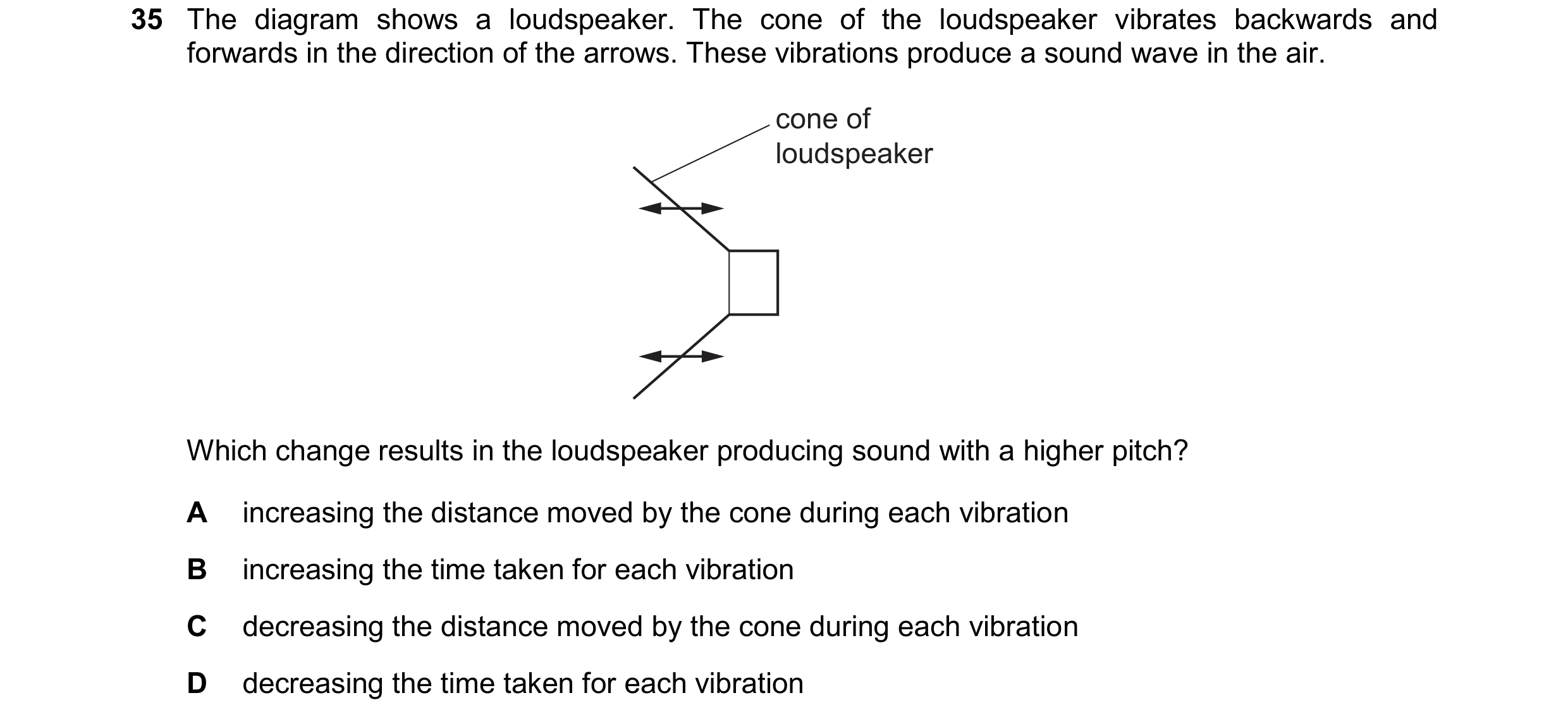 5 / 5
5 / 5