Cambridge IGCSE Sciences - Co-ordinated (9-1) 0973 — 2022 Oct/Nov Paper 4 · Variant 1
0973/41/O/N/22 · 12 questions · 120 marks · ≈135 min
The question paper and its mark scheme, free to read here and free to download. This is Cambridge’s own paper, exactly as it was sat.
Question paper28 pages
Mark scheme15 pages
Answers below. Sit the paper first if you are practising.
Questions as text
Q1 · A diagram of the male reproductive system in humans
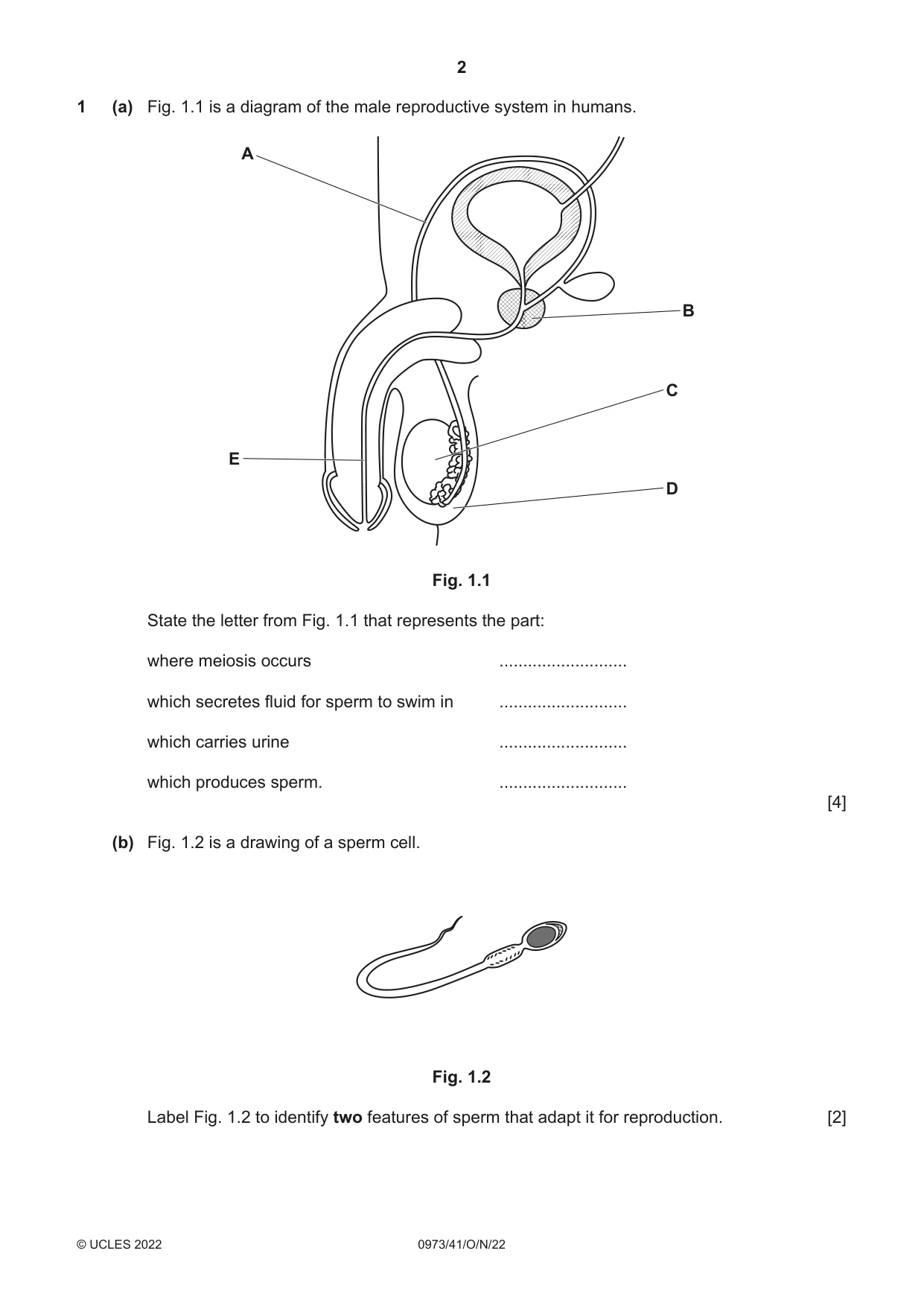
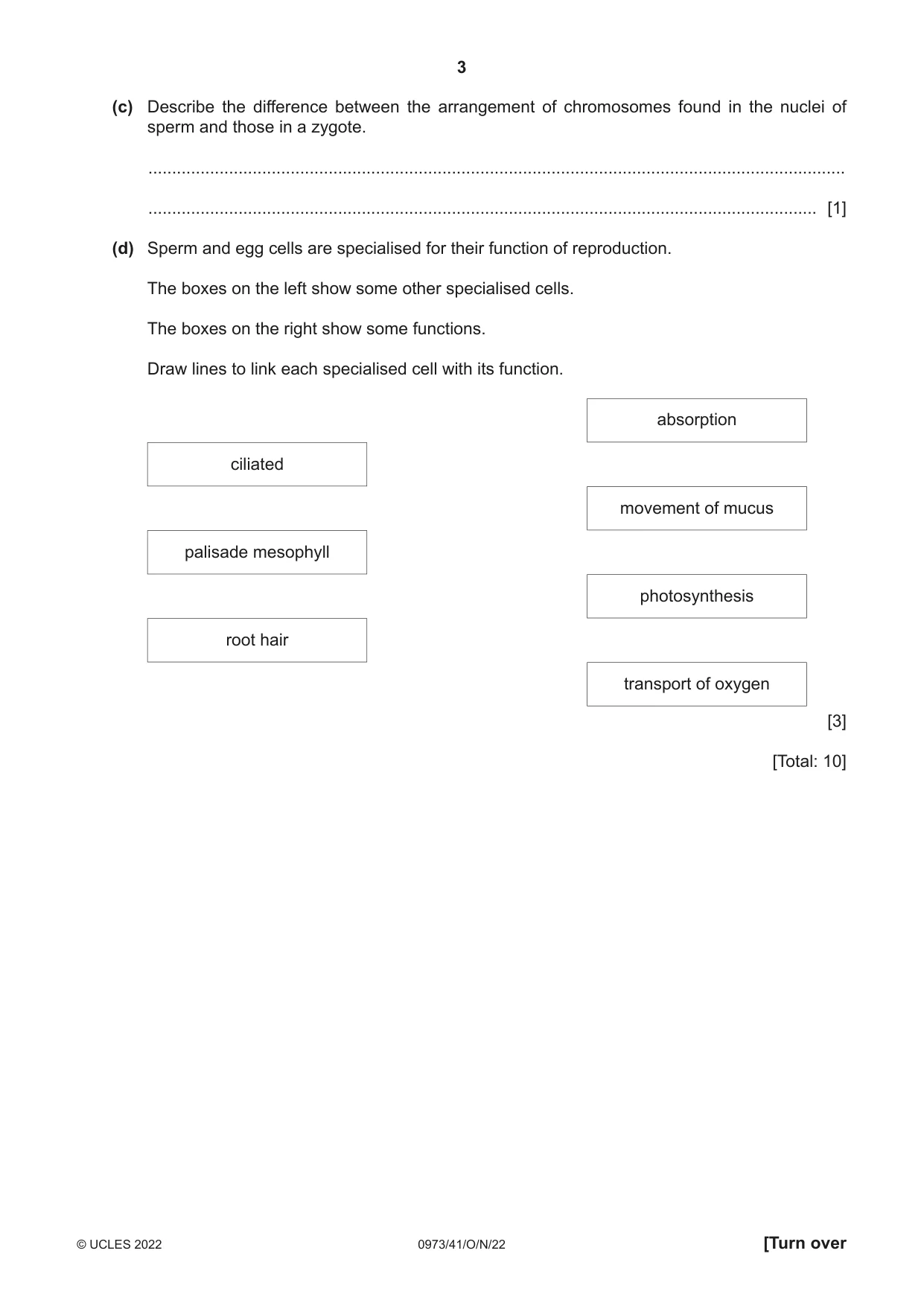
1 (a) Fig. 1.1 is a diagram of the male reproductive system in humans. A B C E D Fig. 1.1 State the letter from Fig. 1.1 that represents the part: where meiosis occurs ........................... which secretes fluid for sperm to swim in ........................... which carries urine ........................... which produces sperm. ........................... [4] (b) Fig. 1.2 is a drawing of a sperm cell. Fig. 1.2 Label Fig. 1.2 to identify two features of sperm that adapt it for reproduction. [2] (c) Describe the difference between the arrangement of chromosomes found in the nuclei of sperm and those in a zygote. ................................................................................................................................................... ............................................................................................................................................. [1] (d) Sperm and egg cells are specialised for their function of reproduction. The boxes on the left show some other specialised cells. The boxes on the right show some functions. Draw lines to link each specialised cell with its function. absorption ciliated movement of mucus palisade mesophyll photosynthesis root hair transport of oxygen [3] [Total: 10]
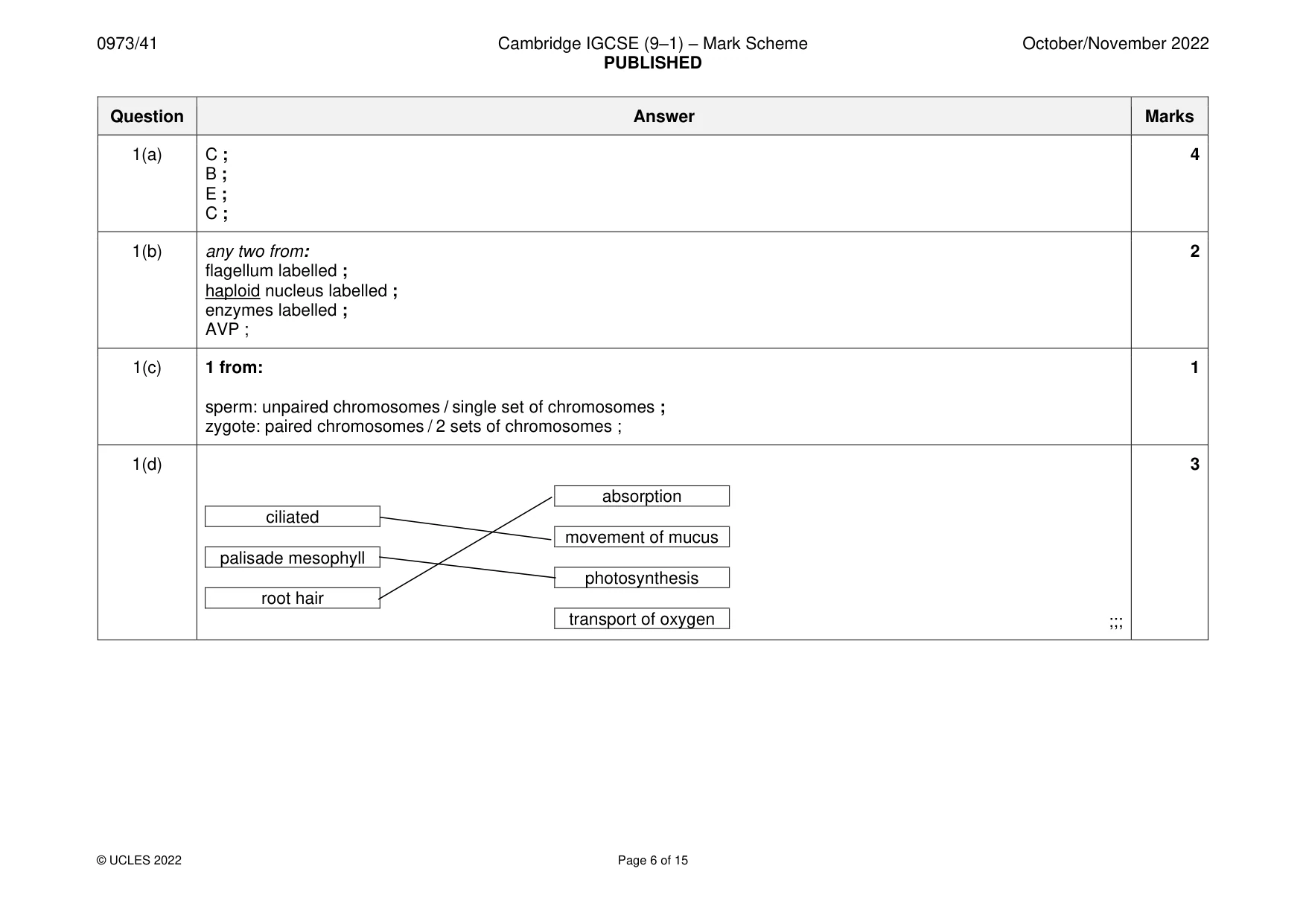
Mark scheme: Question Answer Marks 1(a) C ; 4 B ; E ; C ; 1(b) any two from: 2 flagellum labelled ; haploid nucleus labelled ; enzymes labelled ; AVP ; 1(c) 1 from: 1 sperm: unpaired chromosomes / single set of chromosomes ; zygote: paired chromosomes / 2 sets of chromosomes ; 1(d) 3 absorption ciliated movement of mucus palisade mesophyll photosynthesis root hair transport of oxygen ;;;
Q2 · Alkanes are a type of hydrocarbon
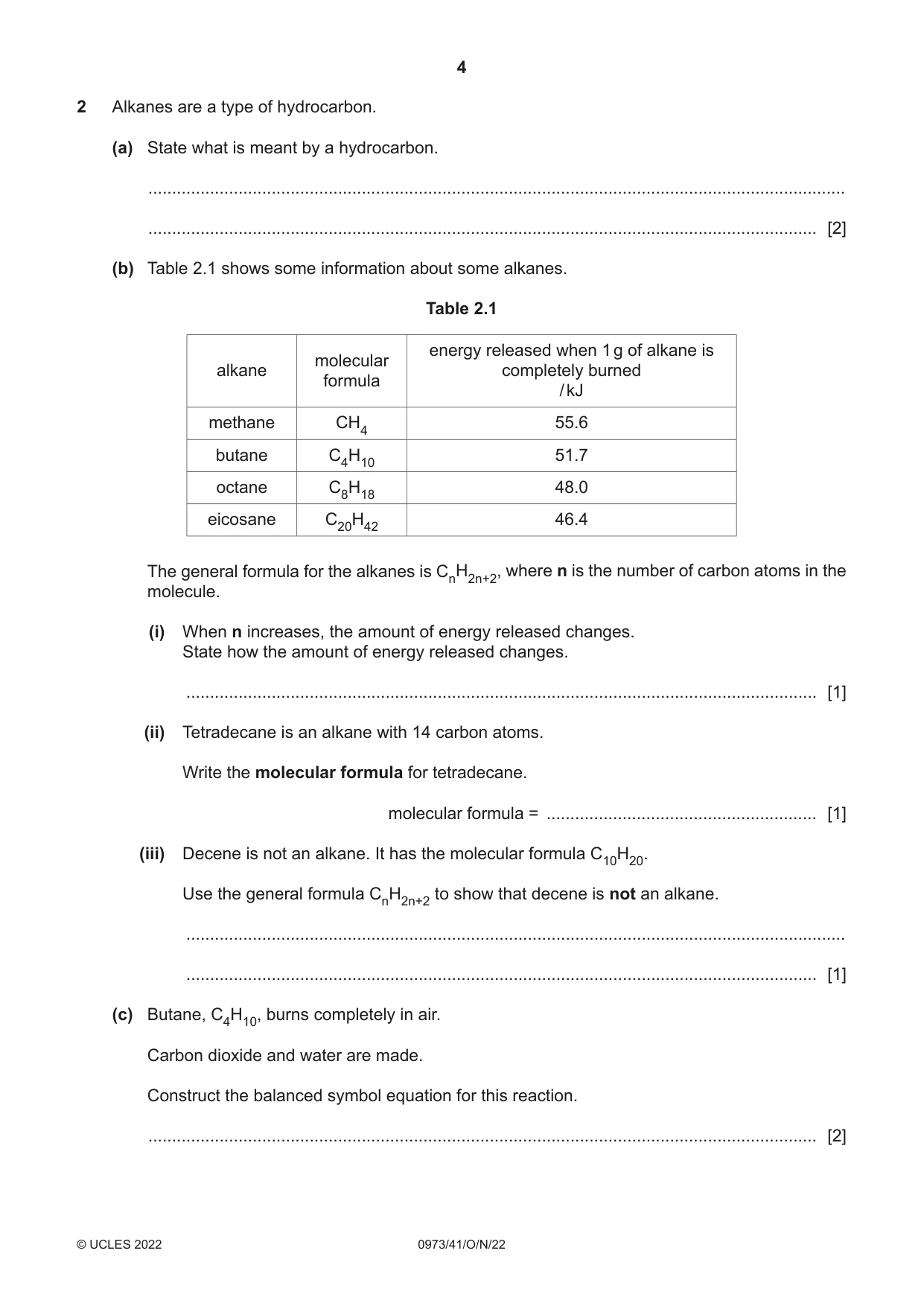
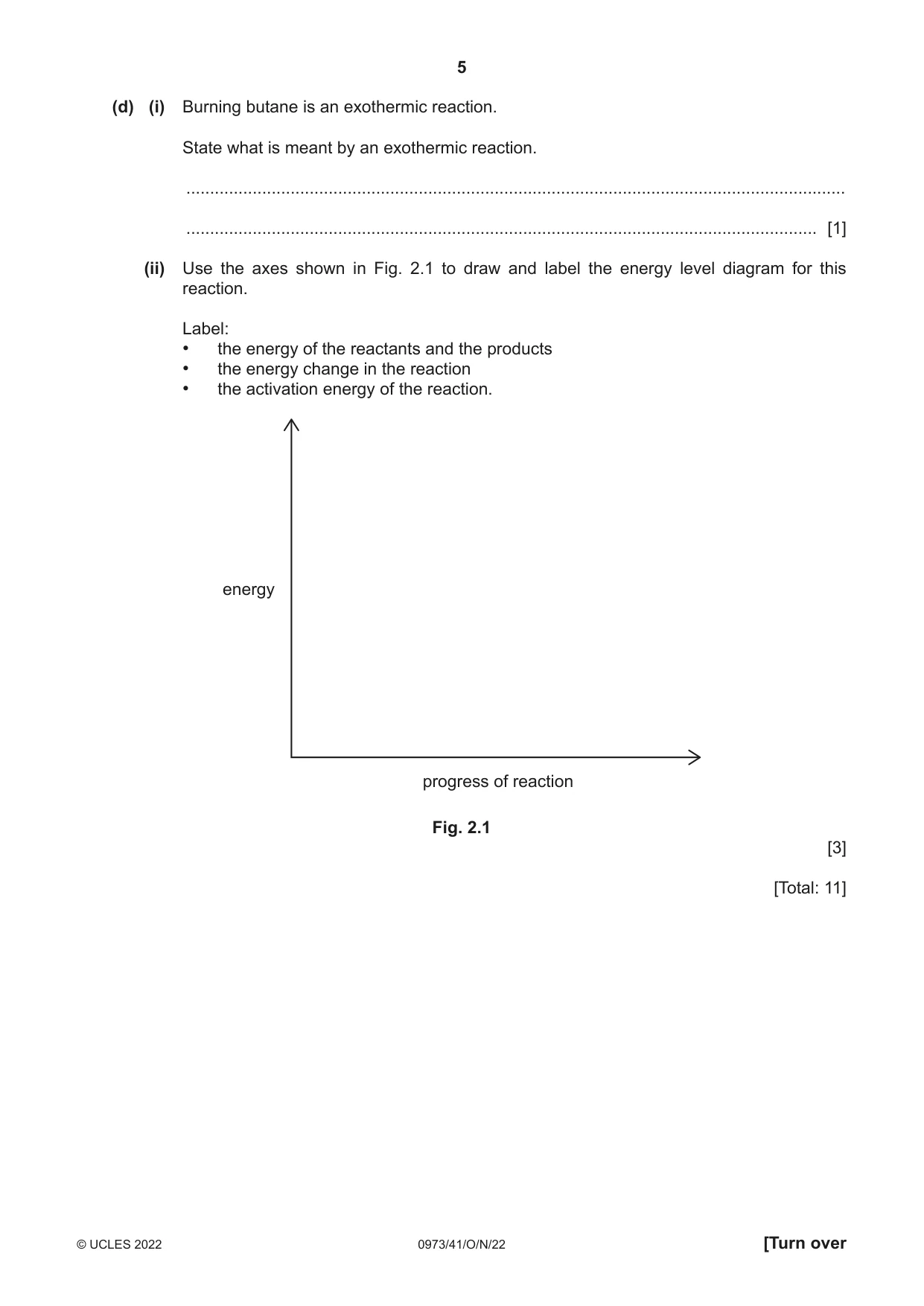
2 Alkanes are a type of hydrocarbon. (a) State what is meant by a hydrocarbon. ................................................................................................................................................... ............................................................................................................................................. [2] (b) Table 2.1 shows some information about some alkanes. Table 2.1 energy released when 1 g of alkane is molecular alkane completely burned formula / kJ methane CH4 55.6 butane C4H10 51.7 octane C8H18 48.0 eicosane C20H42 46.4 The general formula for the alkanes is CnH2n+2, where n is the number of carbon atoms in the molecule. (i) When n increases, the amount of energy released changes. State how the amount of energy released changes. ..................................................................................................................................... [1] (ii) Tetradecane is an alkane with 14 carbon atoms. Write the molecular formula for tetradecane. molecular formula = ......................................................... [1] (iii) Decene is not an alkane. It has the molecular formula C10H20. Use the general formula CnH2n+2 to show that decene is not an alkane. ........................................................................................................................................... ..................................................................................................................................... [1] (c) Butane, C4H10, burns completely in air. Carbon dioxide and water are made. Construct the balanced symbol equation for this reaction. ............................................................................................................................................. [2] (d) (i) Burning butane is an exothermic reaction. State what is meant by an exothermic reaction. ........................................................................................................................................... ..................................................................................................................................... [1] (ii) Use the axes shown in Fig. 2.1 to draw and label the energy level diagram for this reaction. Label: • the energy of the reactants and the products • the energy change in the reaction • the activation energy of the reaction. energy progress of reaction Fig. 2.1 [3] [Total: 11]
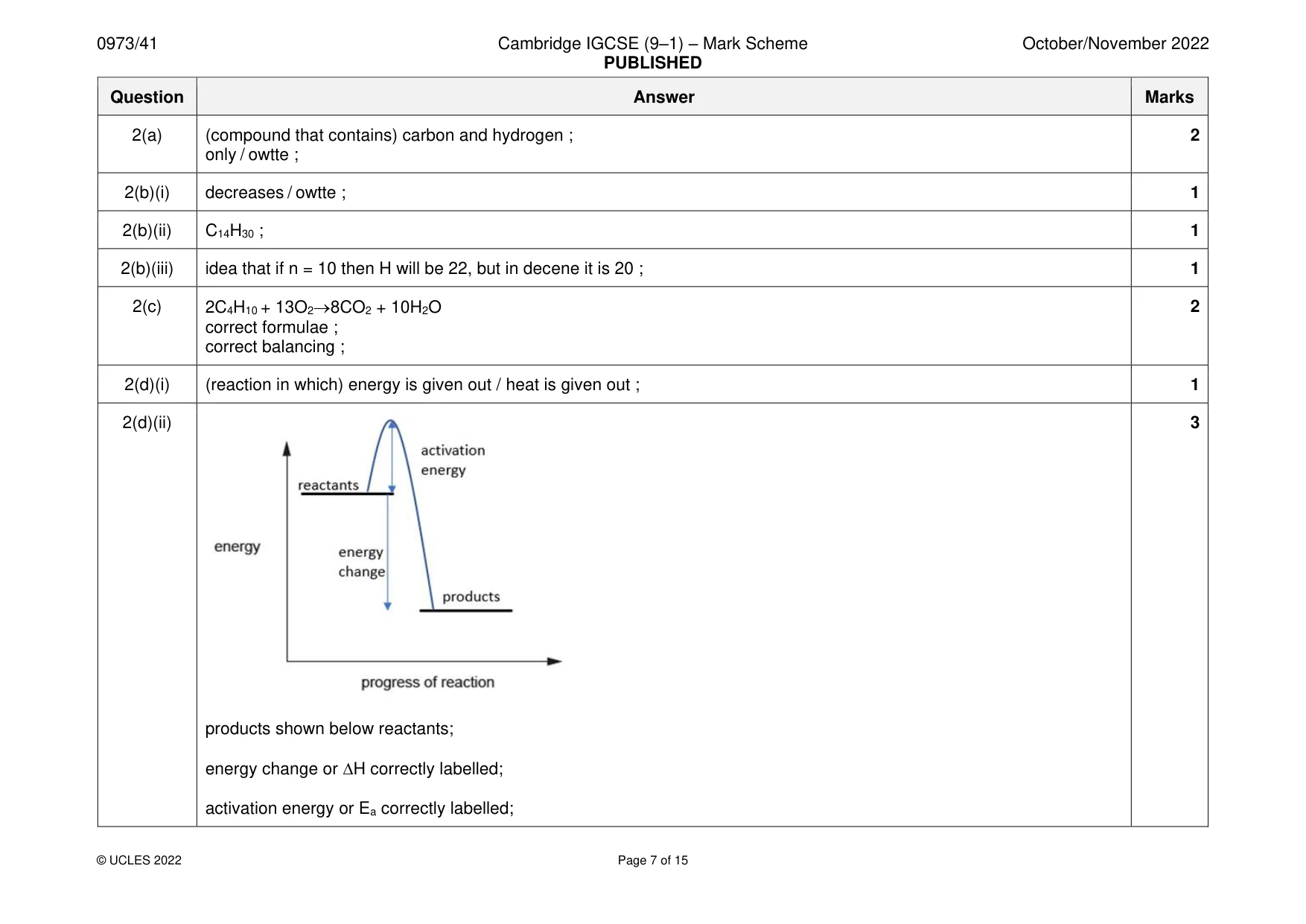
Mark scheme: 2(a) (compound that contains) carbon and hydrogen ; 2 only / owtte ; 2(b)(i) decreases / owtte ; 1 2(b)(ii) C14H30 ; 1 2(b)(iii) idea that if n = 10 then H will be 22, but in decene it is 20 ; 1 2(c) 2C4H10 + 13O2→8CO2 + 10H2O 2 correct formulae ; correct balancing ; 2(d)(i) (reaction in which) energy is given out / heat is given out ; 1 2(d)(ii) 3 products shown below reactants; energy change or H correctly labelled; activation energy or Ea correctly labelled;
Q3 · A crane lifting a wooden crate
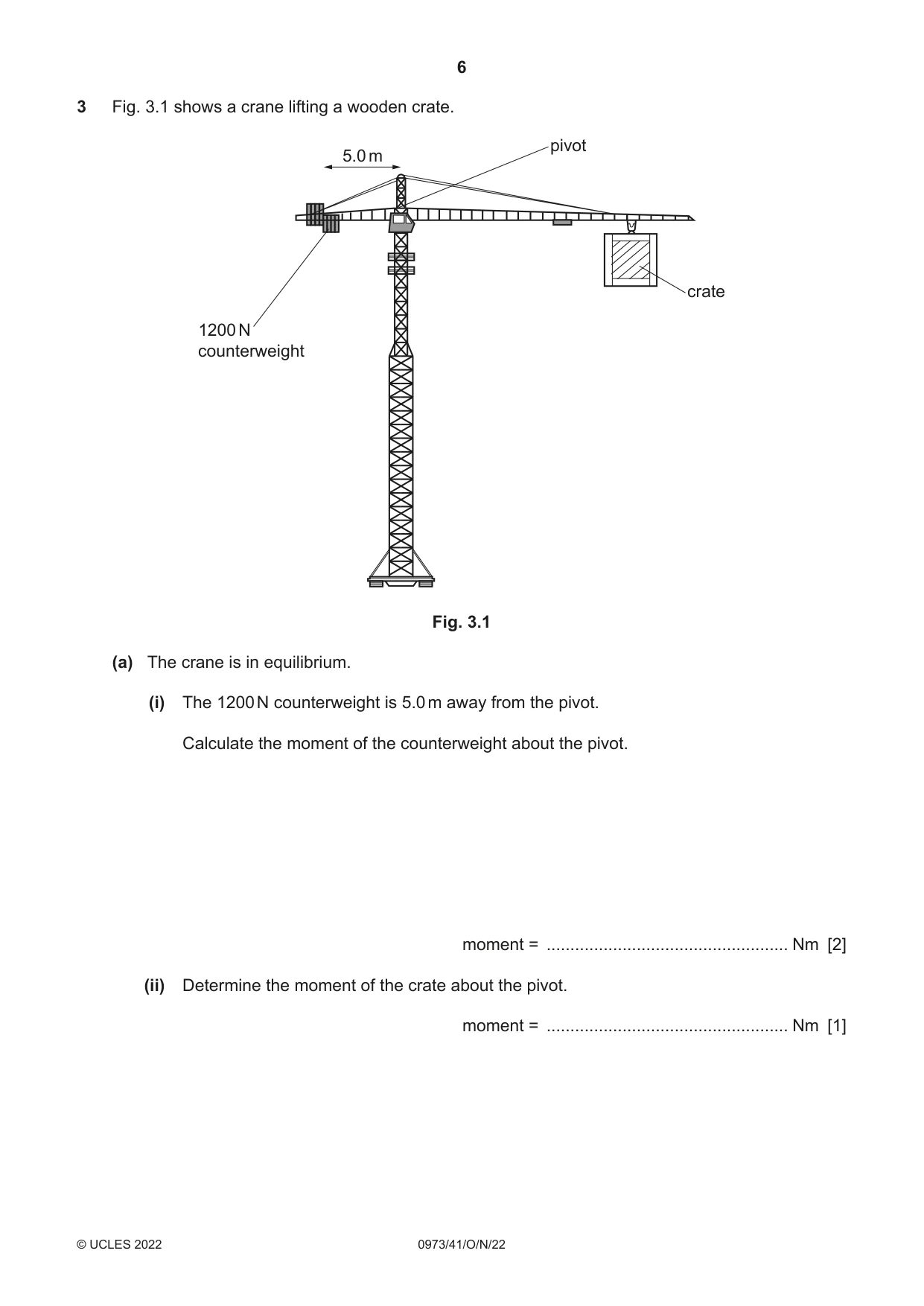
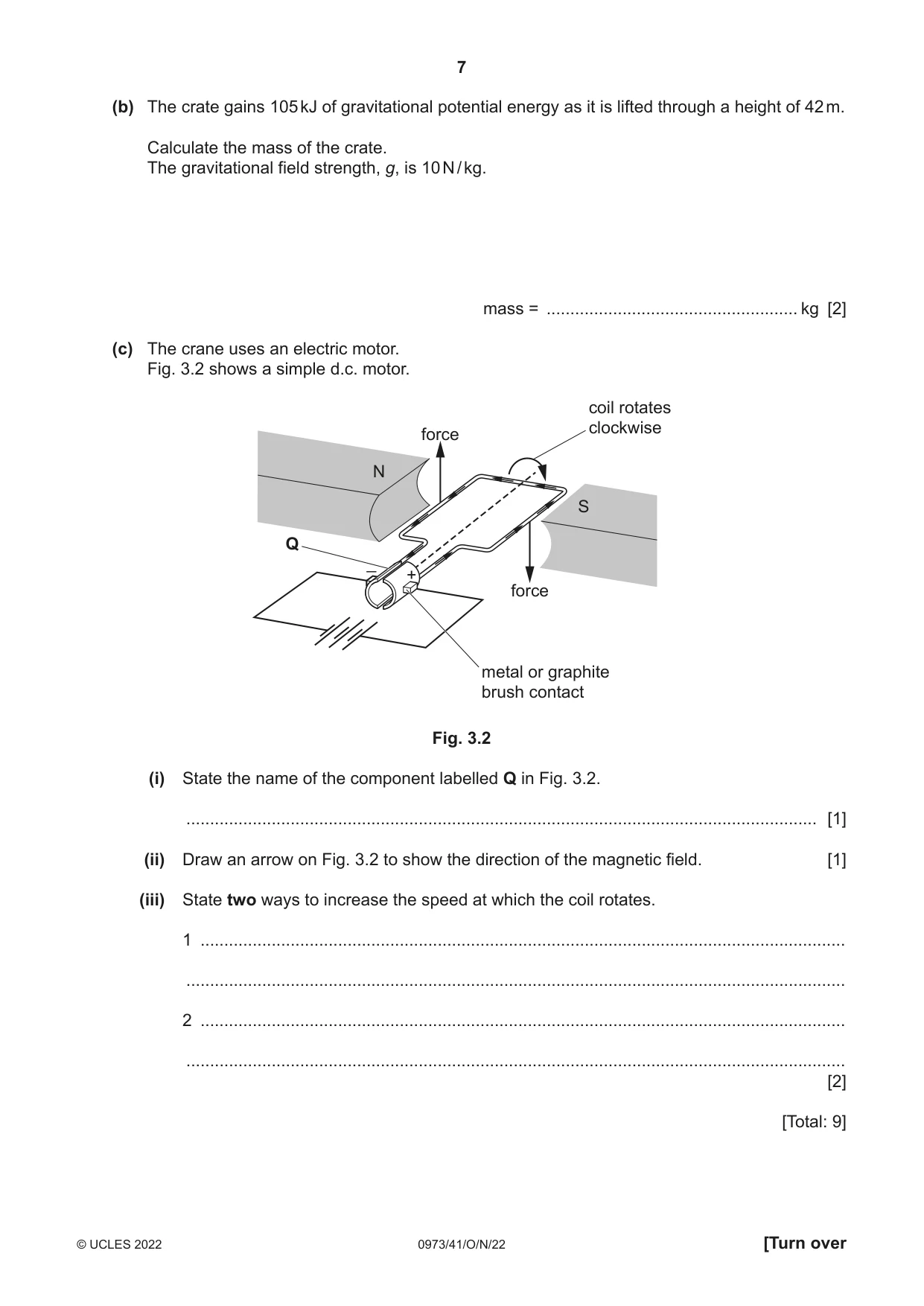
3 Fig. 3.1 shows a crane lifting a wooden crate. pivot 5.0 m crate 1200 N counterweight Fig. 3.1 (a) The crane is in equilibrium. (i) The 1200 N counterweight is 5.0 m away from the pivot. Calculate the moment of the counterweight about the pivot. moment = ................................................... Nm [2] (ii) Determine the moment of the crate about the pivot. moment = ................................................... Nm [1] (b) The crate gains 105 kJ of gravitational potential energy as it is lifted through a height of 42 m. Calculate the mass of the crate. The gravitational field strength, g, is 10 N / kg. mass = ..................................................... kg [2] (c) The crane uses an electric motor. Fig. 3.2 shows a simple d.c. motor. coil rotates clockwise force N S Q _ + force metal or graphite brush contact Fig. 3.2 (i) State the name of the component labelled Q in Fig. 3.2. ..................................................................................................................................... [1] (ii) Draw an arrow on Fig. 3.2 to show the direction of the magnetic field. [1] (iii) State two ways to increase the speed at which the coil rotates. 1 ........................................................................................................................................ ........................................................................................................................................... 2 ........................................................................................................................................ ........................................................................................................................................... [2] [Total: 9]
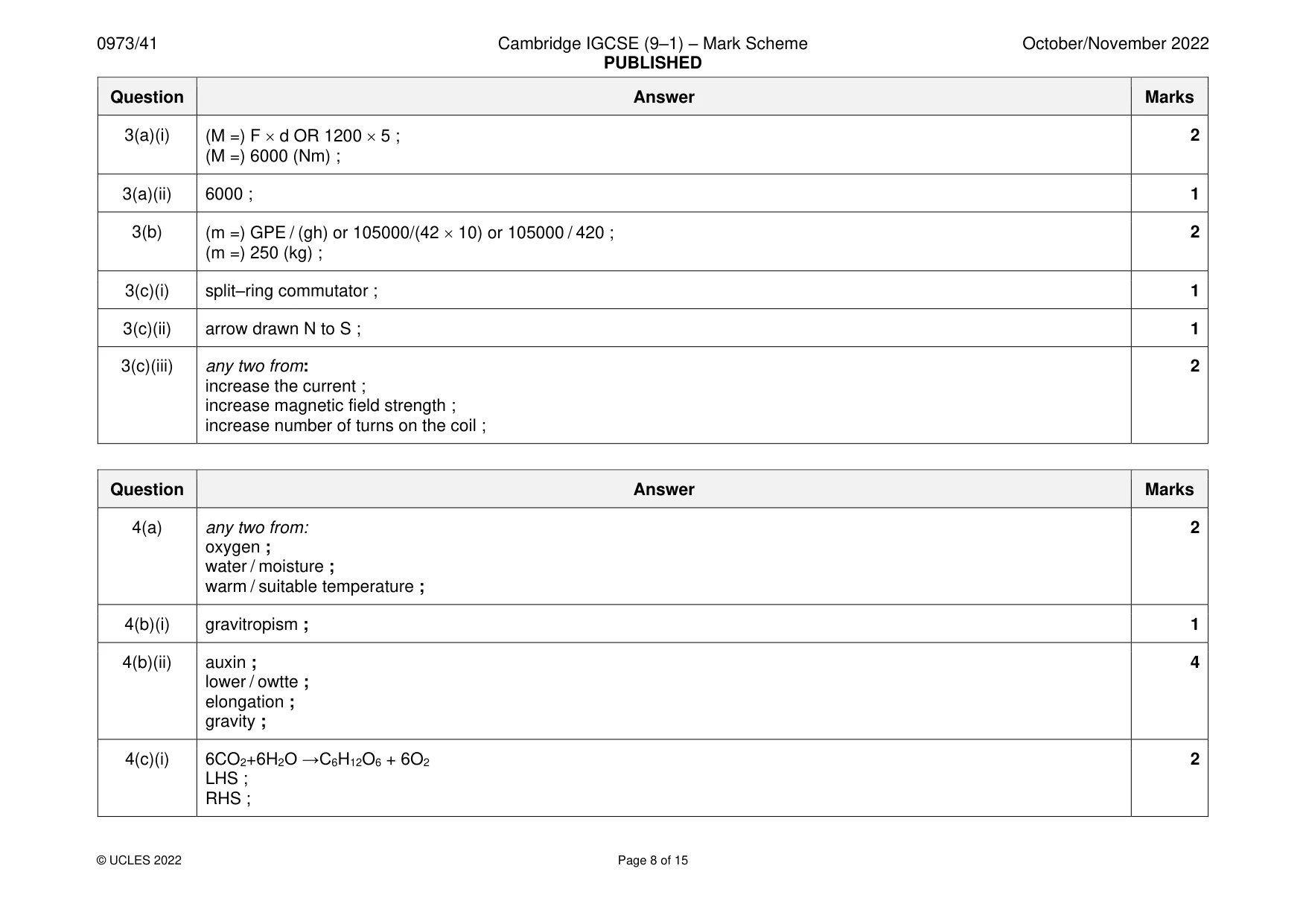
Mark scheme: 3(a)(i) (M =) F d OR 1200 5 ; 2 (M =) 6000 (Nm) ; 3(a)(ii) 6000 ; 1 3(b) (m =) GPE / (gh) or 105000/(42 10) or 105000 / 420 ; 2 (m =) 250 (kg) ; 3(c)(i) split–ring commutator ; 1 3(c)(ii) arrow drawn N to S ; 1 3(c)(iii) any two from: 2 increase the current ; increase magnetic field strength ; increase number of turns on the coil ;
Question 4
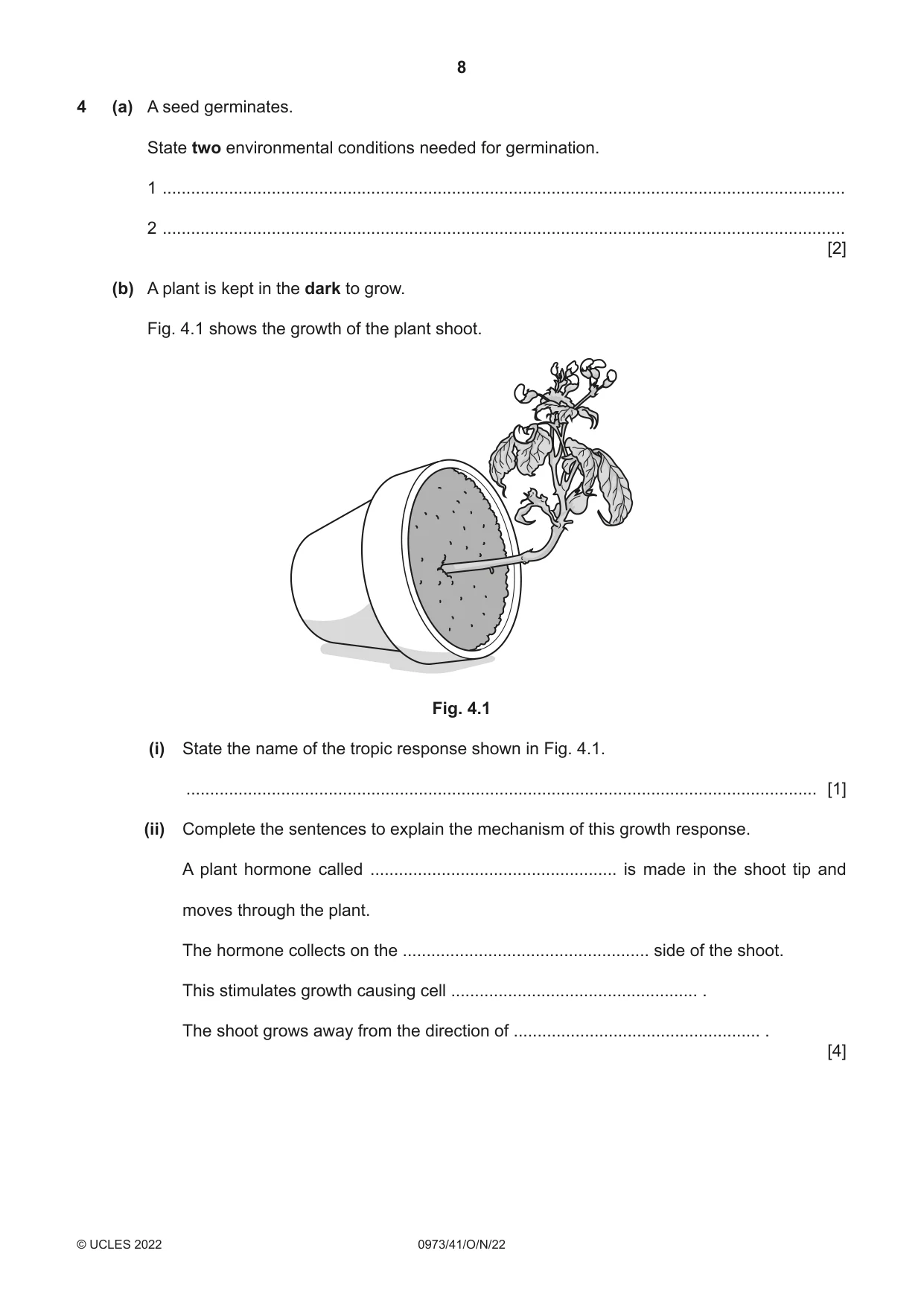
4 (a) A seed germinates. State two environmental conditions needed for germination. 1 ................................................................................................................................................ 2 ................................................................................................................................................ [2] (b) A plant is kept in the dark to grow. Fig. 4.1 shows the growth of the plant shoot. Fig. 4.1 (i) State the name of the tropic response shown in Fig. 4.1. ..................................................................................................................................... [1] (ii) Complete the sentences to explain the mechanism of this growth response. A plant hormone called .................................................... is made in the shoot tip and moves through the plant. The hormone collects on the .................................................... side of the shoot. This stimulates growth causing cell .................................................... . The shoot grows away from the direction of .................................................... . [4] (c) Plants photosynthesise. (i) State the balanced symbol equation for photosynthesis. ..................................................................................................................................... [2] (ii) Explain why chlorophyll is needed for photosynthesis. ........................................................................................................................................... ........................................................................................................................................... ..................................................................................................................................... [2] [Total: 11]
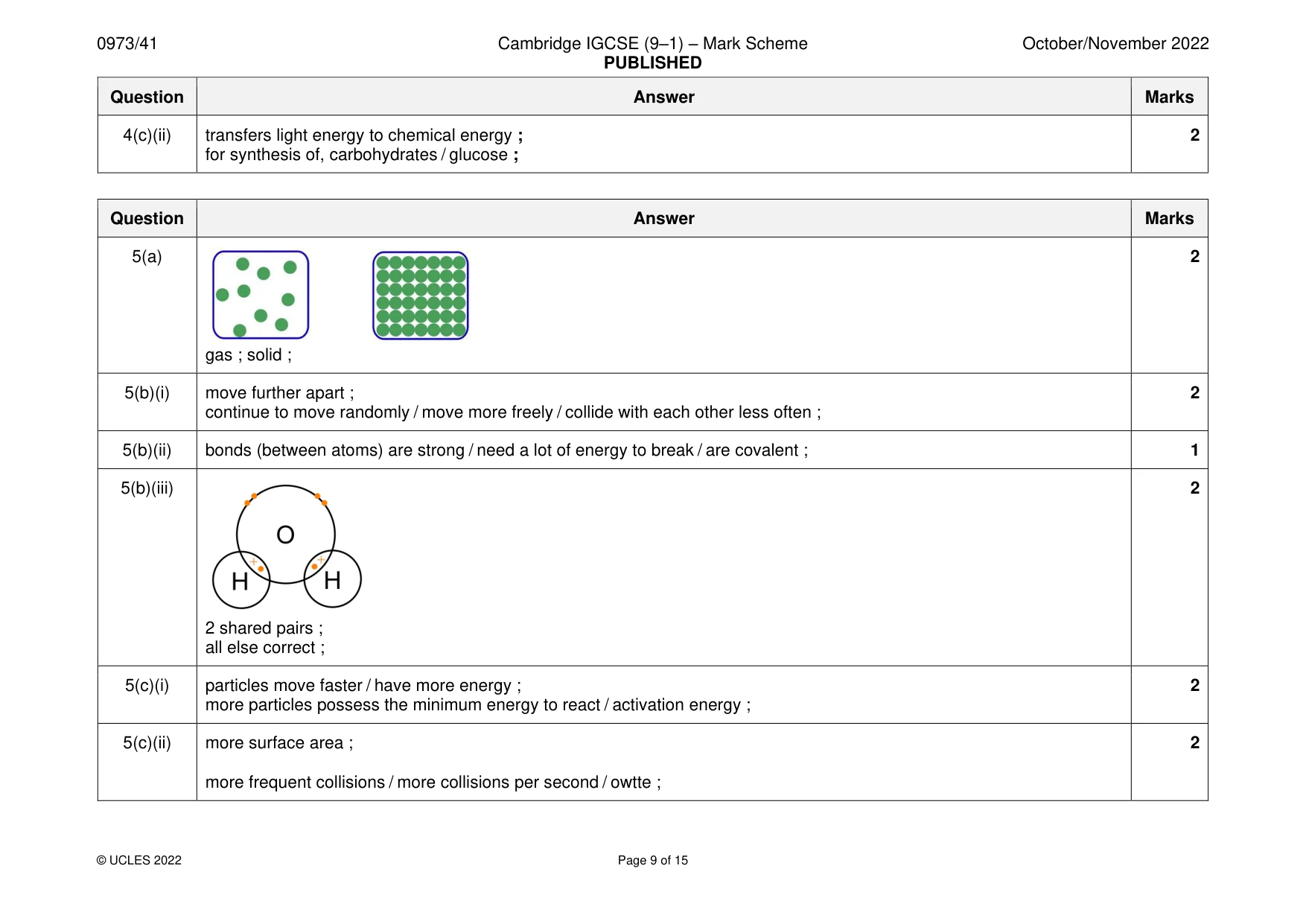
Mark scheme: 4(a) any two from: 2 oxygen ; water / moisture ; warm / suitable temperature ; 4(b)(i) gravitropism ; 1 4(b)(ii) auxin ; 4 lower / owtte ; elongation ; gravity ; 4(c)(i) 6CO2+6H2O →C6H12O6 + 6O2 2 LHS ; RHS ; 4(c)(ii) transfers light energy to chemical energy ; 2 for synthesis of, carbohydrates / glucose ;
Q5 · The arrangement of particles in a liquid
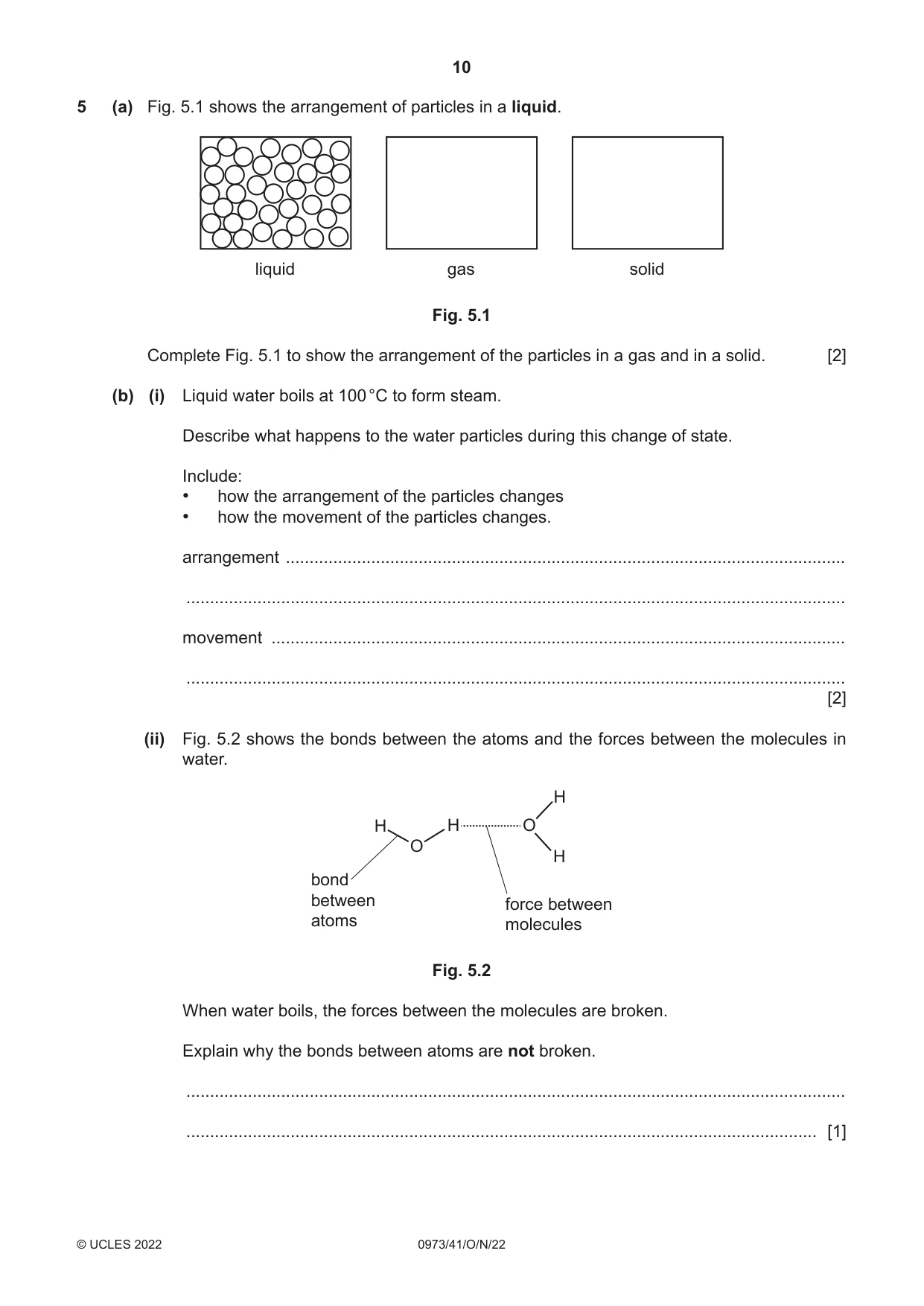
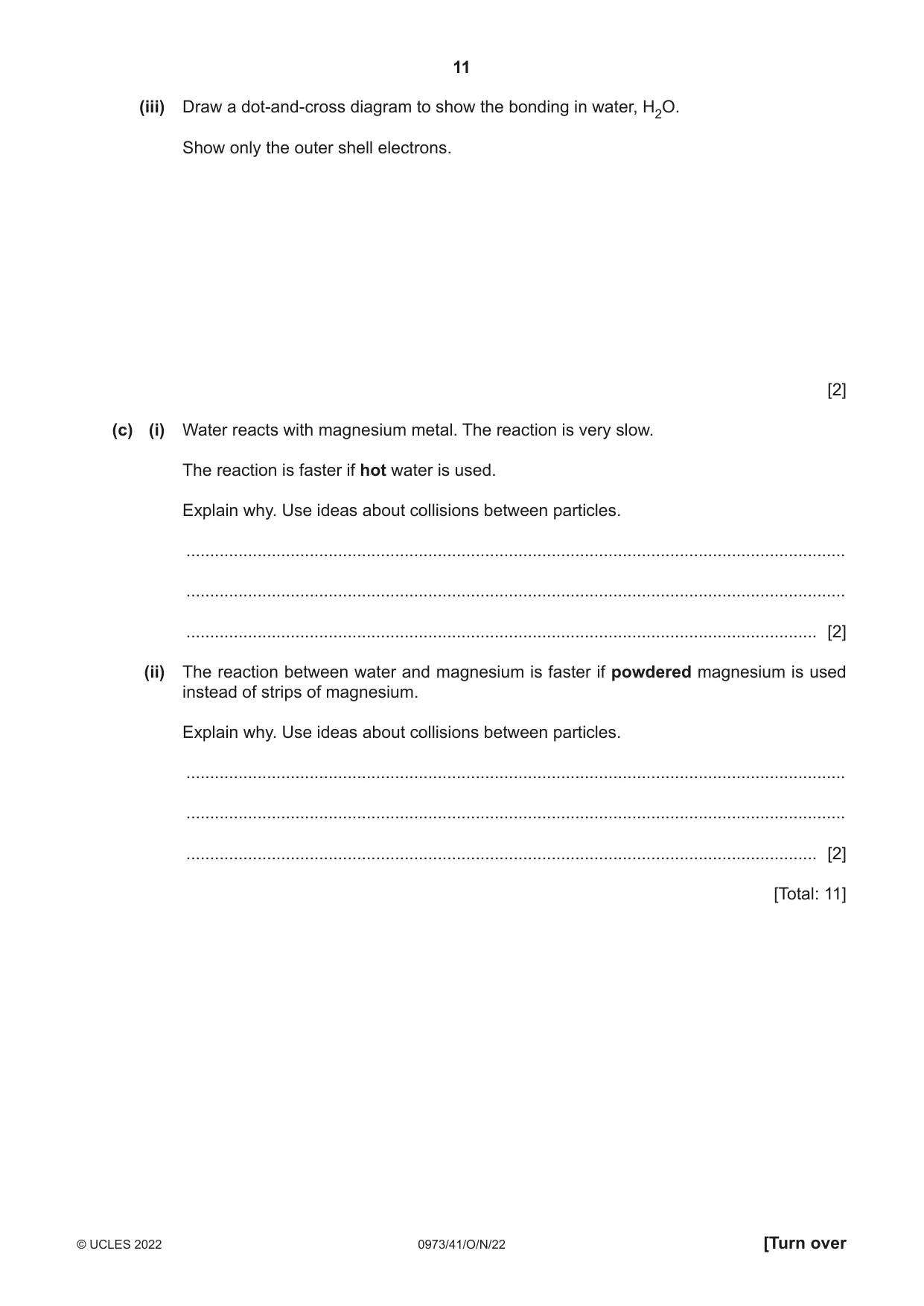
5 (a) Fig. 5.1 shows the arrangement of particles in a liquid. liquid gas solid Fig. 5.1 Complete Fig. 5.1 to show the arrangement of the particles in a gas and in a solid. [2] (b) (i) Liquid water boils at 100 °C to form steam. Describe what happens to the water particles during this change of state. Include: • how the arrangement of the particles changes • how the movement of the particles changes. arrangement ...................................................................................................................... ........................................................................................................................................... movement ......................................................................................................................... ........................................................................................................................................... [2] (ii) Fig. 5.2 shows the bonds between the atoms and the forces between the molecules in water. H H H O O H bond between force between atoms molecules Fig. 5.2 When water boils, the forces between the molecules are broken. Explain why the bonds between atoms are not broken. ........................................................................................................................................... ..................................................................................................................................... [1] (iii) Draw a dot-and-cross diagram to show the bonding in water, H2O. Show only the outer shell electrons. [2] (c) (i) Water reacts with magnesium metal. The reaction is very slow. The reaction is faster if hot water is used. Explain why. Use ideas about collisions between particles. ........................................................................................................................................... ........................................................................................................................................... ..................................................................................................................................... [2] (ii) The reaction between water and magnesium is faster if powdered magnesium is used instead of strips of magnesium. Explain why. Use ideas about collisions between particles. ........................................................................................................................................... ........................................................................................................................................... ..................................................................................................................................... [2] [Total: 11]
Mark scheme: 5(a) 2 gas ; solid ; 5(b)(i) move further apart ; 2 continue to move randomly / move more freely / collide with each other less often ; 5(b)(ii) bonds (between atoms) are strong / need a lot of energy to break / are covalent ; 1 5(b)(iii) 2 2 shared pairs ; all else correct ; 5(c)(i) particles move faster / have more energy ; 2 more particles possess the minimum energy to react / activation energy ; 5(c)(ii) more surface area ; 2 more frequent collisions / more collisions per second / owtte ;
Q6 · A man paddling a canoe on a lake
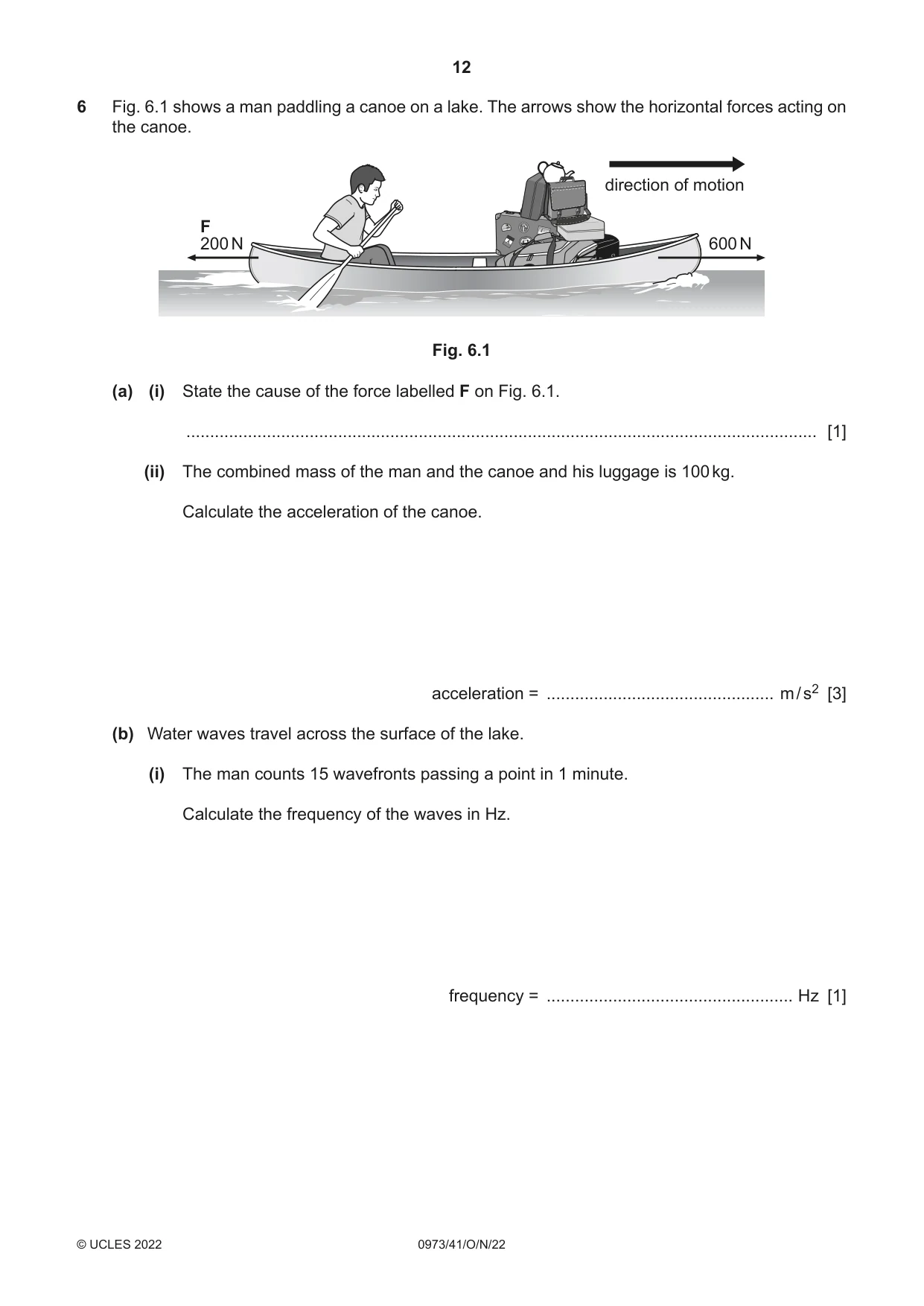
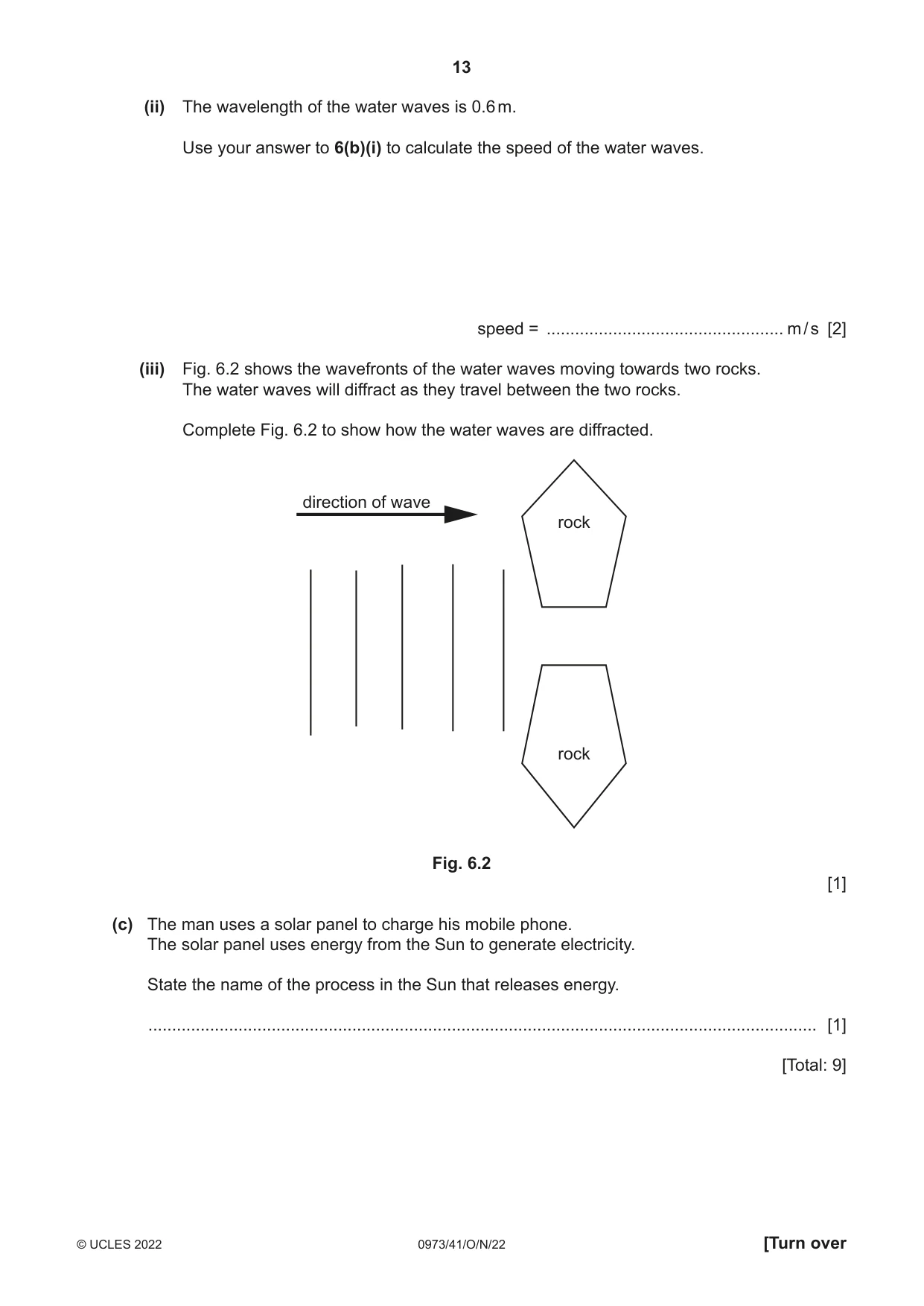
6 Fig. 6.1 shows a man paddling a canoe on a lake. The arrows show the horizontal forces acting on the canoe. direction of motion F 200 N 600 N Fig. 6.1 (a) (i) State the cause of the force labelled F on Fig. 6.1. ..................................................................................................................................... [1] (ii) The combined mass of the man and the canoe and his luggage is 100 kg. Calculate the acceleration of the canoe. acceleration = ................................................ m / s2 [3] (b) Water waves travel across the surface of the lake. (i) The man counts 15 wavefronts passing a point in 1 minute. Calculate the frequency of the waves in Hz. frequency = .................................................... Hz [1] (ii) The wavelength of the water waves is 0.6 m. Use your answer to 6(b)(i) to calculate the speed of the water waves. speed = .................................................. m / s [2] (iii) Fig. 6.2 shows the wavefronts of the water waves moving towards two rocks. The water waves will diffract as they travel between the two rocks. Complete Fig. 6.2 to show how the water waves are diffracted. direction of wave rock rock Fig. 6.2 [1] (c) The man uses a solar panel to charge his mobile phone. The solar panel uses energy from the Sun to generate electricity. State the name of the process in the Sun that releases energy. ............................................................................................................................................. [1] [Total: 9]
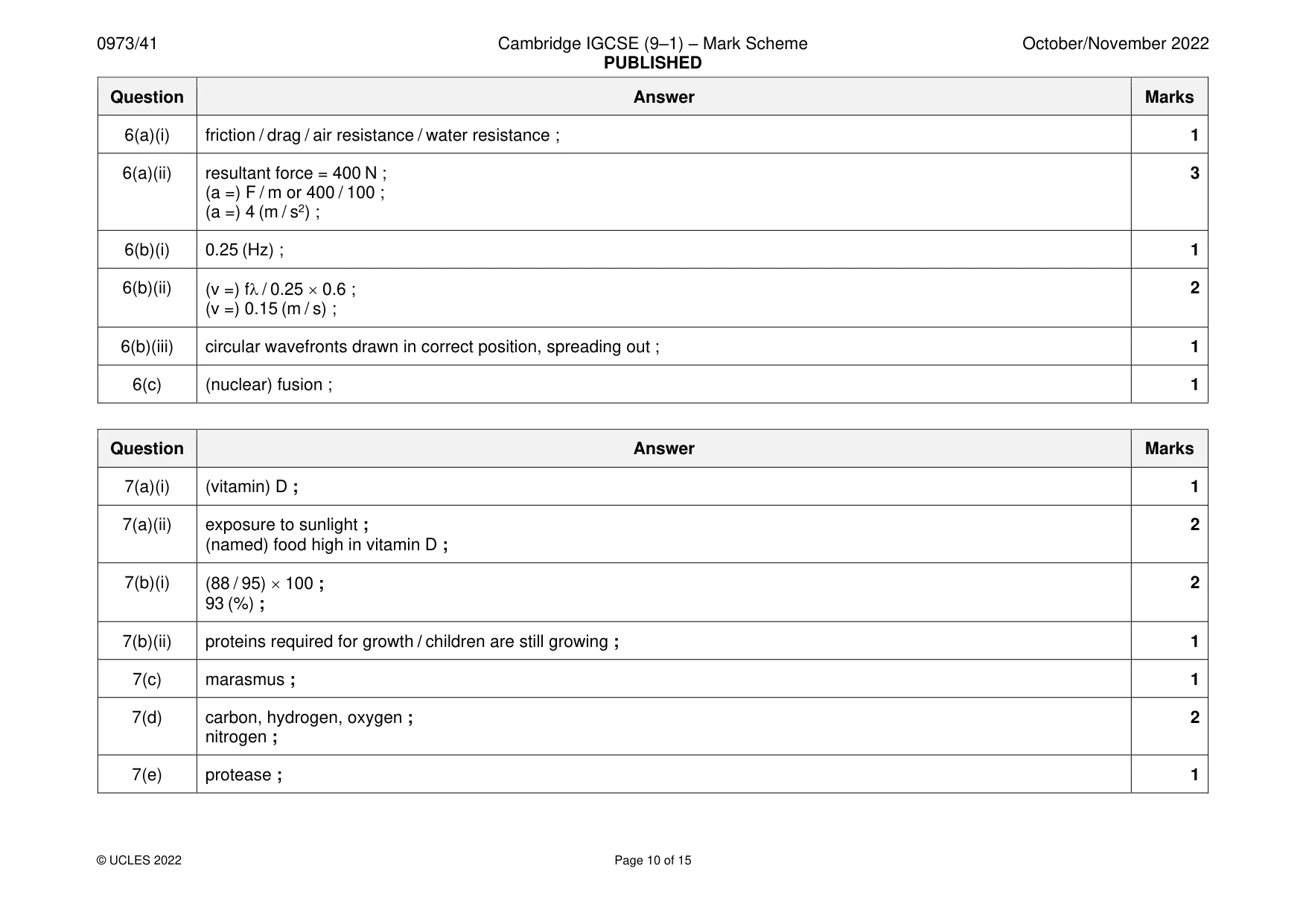
Mark scheme: 6(a)(i) friction / drag / air resistance / water resistance ; 1 6(a)(ii) resultant force = 400 N ; 3 (a =) F / m or 400 / 100 ; (a =) 4 (m / s2) ; 6(b)(i) 0.25 (Hz) ; 1 6(b)(ii) (v =) f / 0.25 0.6 ; 2 (v =) 0.15 (m / s) ; 6(b)(iii) circular wavefronts drawn in correct position, spreading out ; 1 6(c) (nuclear) fusion ; 1
Q7 · A photograph of a person with a deficiency disease that has affected their bone growth
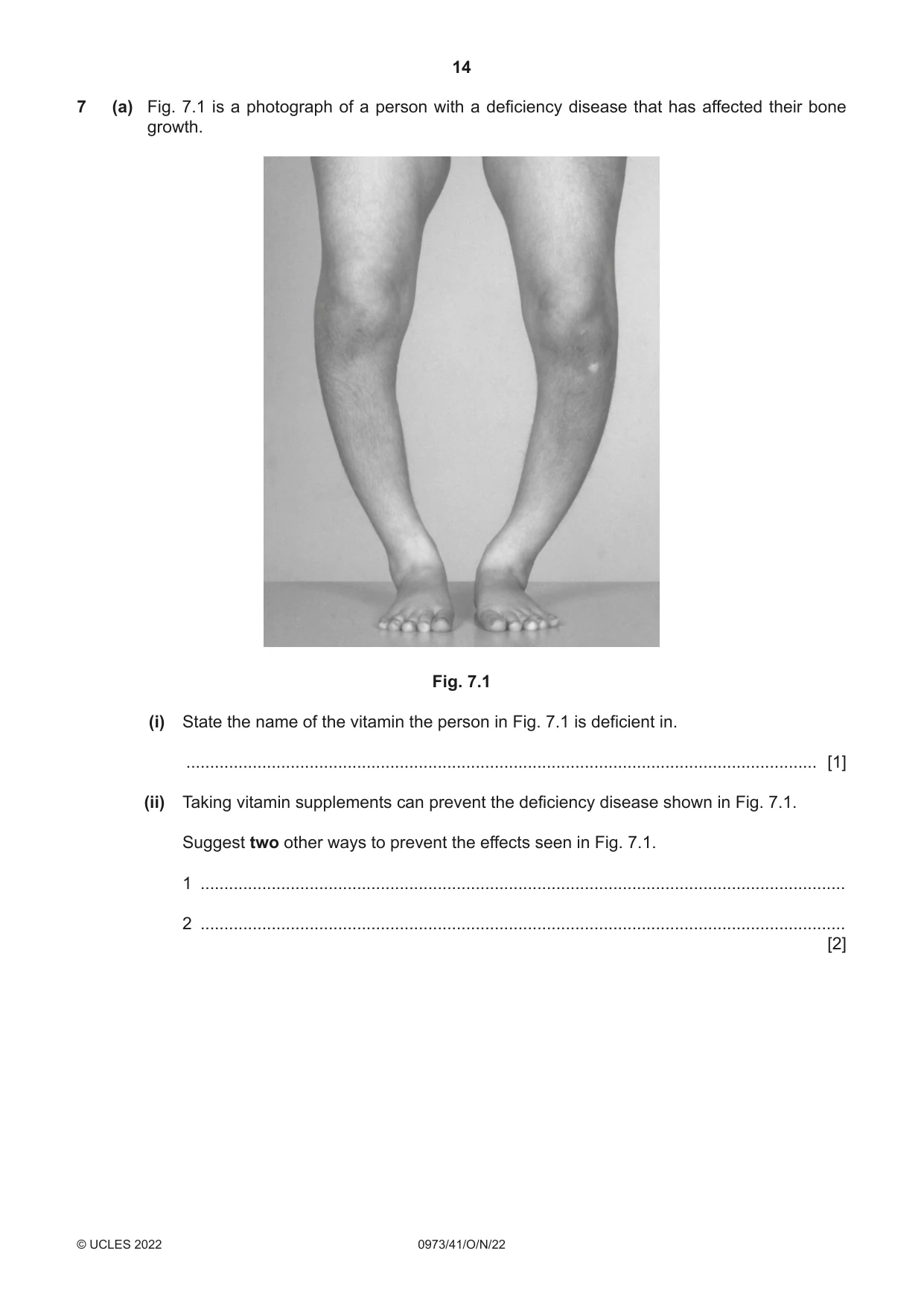
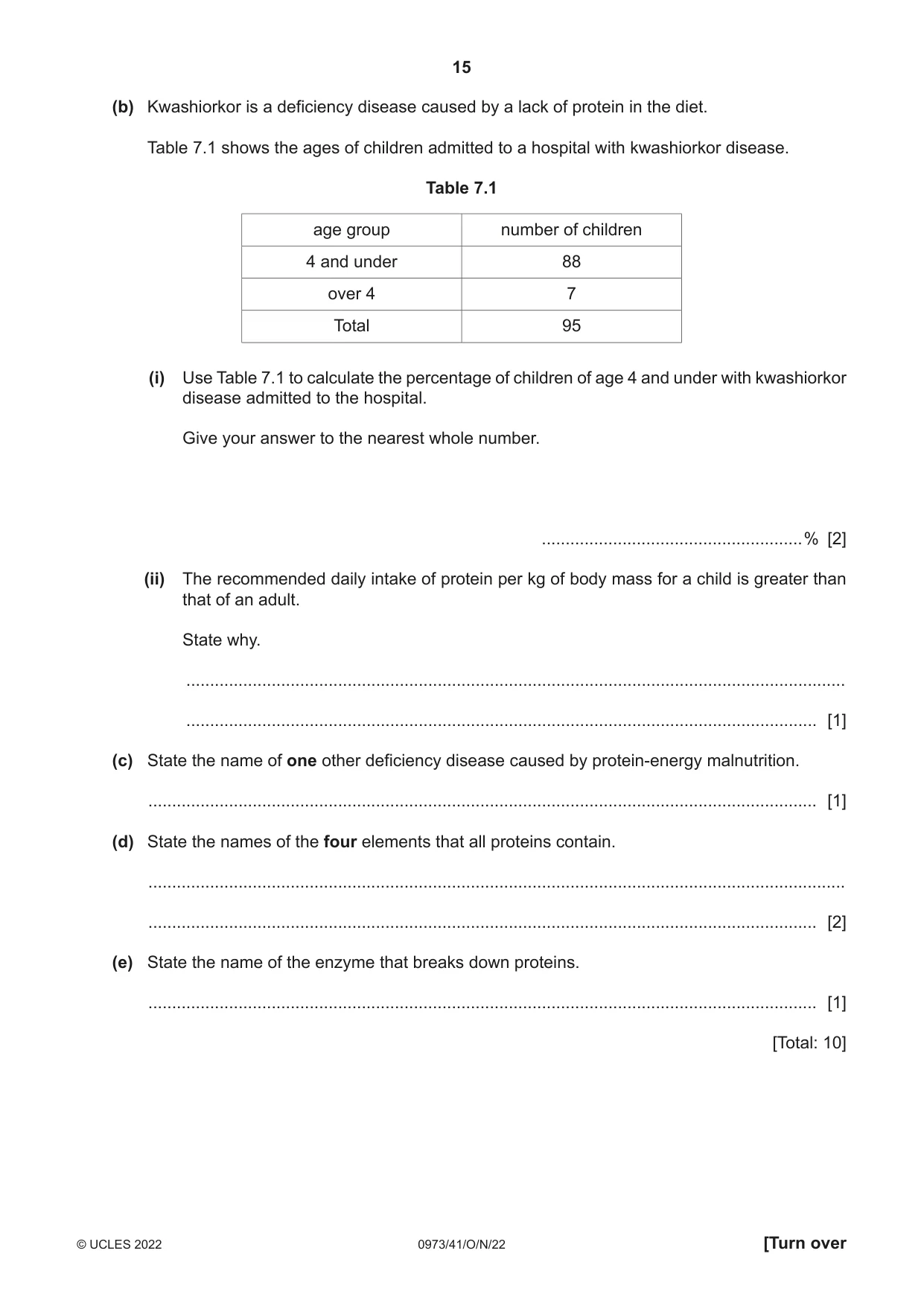
7 (a) Fig. 7.1 is a photograph of a person with a deficiency disease that has affected their bone growth. Fig. 7.1 (i) State the name of the vitamin the person in Fig. 7.1 is deficient in. ..................................................................................................................................... [1] (ii) Taking vitamin supplements can prevent the deficiency disease shown in Fig. 7.1. Suggest two other ways to prevent the effects seen in Fig. 7.1. 1 ........................................................................................................................................ 2 ........................................................................................................................................ [2] (b) Kwashiorkor is a deficiency disease caused by a lack of protein in the diet. Table 7.1 shows the ages of children admitted to a hospital with kwashiorkor disease. Table 7.1 age group number of children 4 and under 88 over 4 7 Total 95 (i) Use Table 7.1 to calculate the percentage of children of age 4 and under with kwashiorkor disease admitted to the hospital. Give your answer to the nearest whole number. .......................................................% [2] (ii) The recommended daily intake of protein per kg of body mass for a child is greater than that of an adult. State why. ........................................................................................................................................... ..................................................................................................................................... [1] (c) State the name of one other deficiency disease caused by protein-energy malnutrition. ............................................................................................................................................. [1] (d) State the names of the four elements that all proteins contain. ................................................................................................................................................... ............................................................................................................................................. [2] (e) State the name of the enzyme that breaks down proteins. ............................................................................................................................................. [1] [Total: 10]
Mark scheme: 7(a)(i) (vitamin) D ; 1 7(a)(ii) exposure to sunlight ; 2 (named) food high in vitamin D ; 7(b)(i) (88 / 95) 100 ; 2 93 (%) ; 7(b)(ii) proteins required for growth / children are still growing ; 1 7(c) marasmus ; 1 7(d) carbon, hydrogen, oxygen ; 2 nitrogen ; 7(e) protease ; 1
Q8 · Some cars use petrol as a fuel
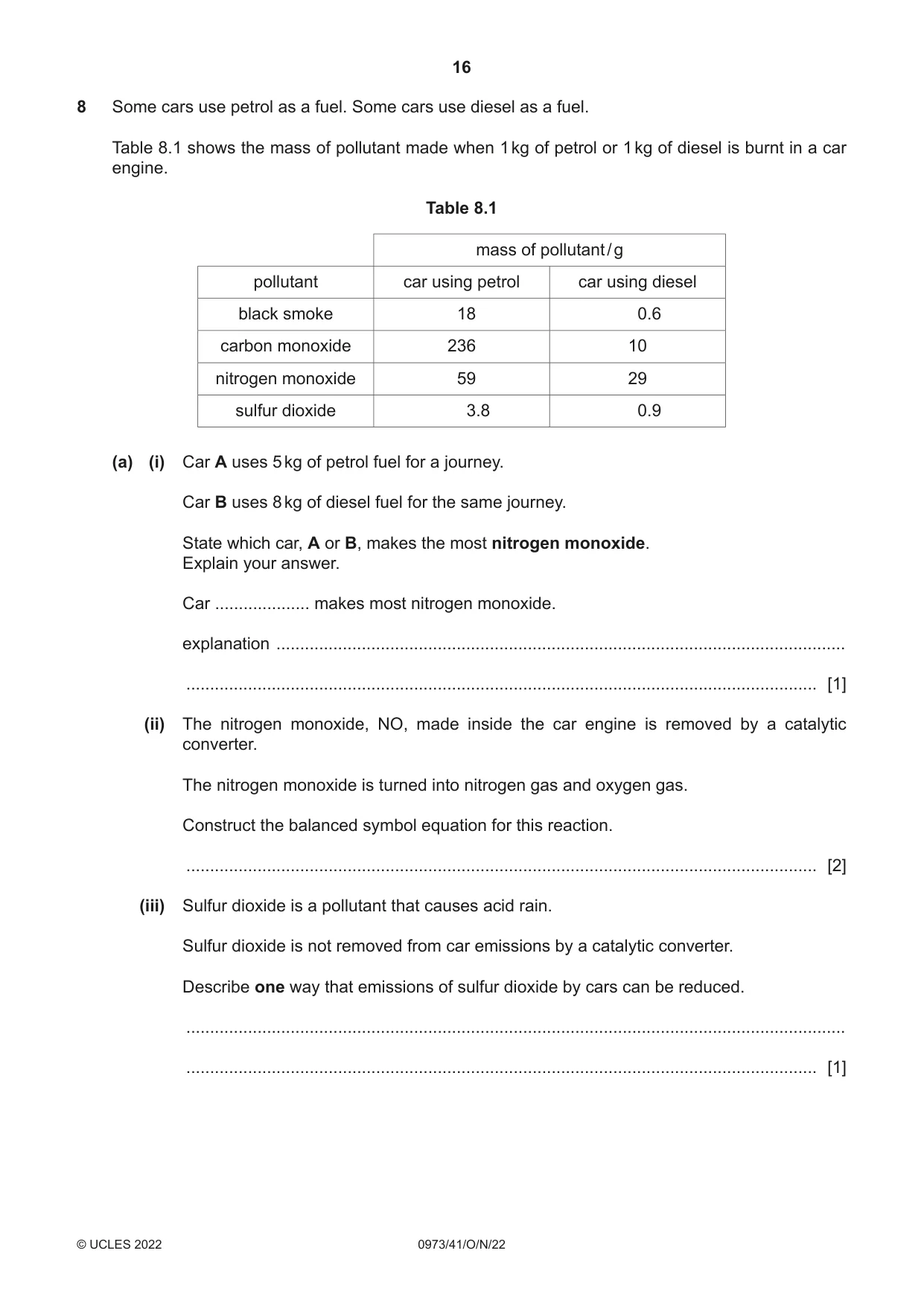
8 Some cars use petrol as a fuel. Some cars use diesel as a fuel. Table 8.1 shows the mass of pollutant made when 1 kg of petrol or 1 kg of diesel is burnt in a car engine. Table 8.1 mass of pollutant / g pollutant car using petrol car using diesel black smoke 18 0.6 carbon monoxide 236 10 nitrogen monoxide 59 29 sulfur dioxide 3.8 0.9 (a) (i) Car A uses 5 kg of petrol fuel for a journey. Car B uses 8 kg of diesel fuel for the same journey. State which car, A or B, makes the most nitrogen monoxide. Explain your answer. Car .................... makes most nitrogen monoxide. explanation ........................................................................................................................ ..................................................................................................................................... [1] (ii) The nitrogen monoxide, NO, made inside the car engine is removed by a catalytic converter. The nitrogen monoxide is turned into nitrogen gas and oxygen gas. Construct the balanced symbol equation for this reaction. ..................................................................................................................................... [2] (iii) Sulfur dioxide is a pollutant that causes acid rain. Sulfur dioxide is not removed from car emissions by a catalytic converter. Describe one way that emissions of sulfur dioxide by cars can be reduced. ........................................................................................................................................... ..................................................................................................................................... [1] (b) A petrol car makes 236 g of carbon monoxide gas when 1 kg of petrol is burnt. Calculate the volume occupied by 236 g of carbon monoxide gas. The molar gas volume at room temperature and pressure is 24 dm3. Show your working. volume = .................................................. dm3 [3] (c) Sulfur dioxide is used in the manufacture of sulfuric acid in the Contact process. 2SO2(g) + O2(g) 2SO3(g) Describe two conditions used for this reversible reaction. 1 ................................................................................................................................................ 2 ................................................................................................................................................ [2] [Total: 9]
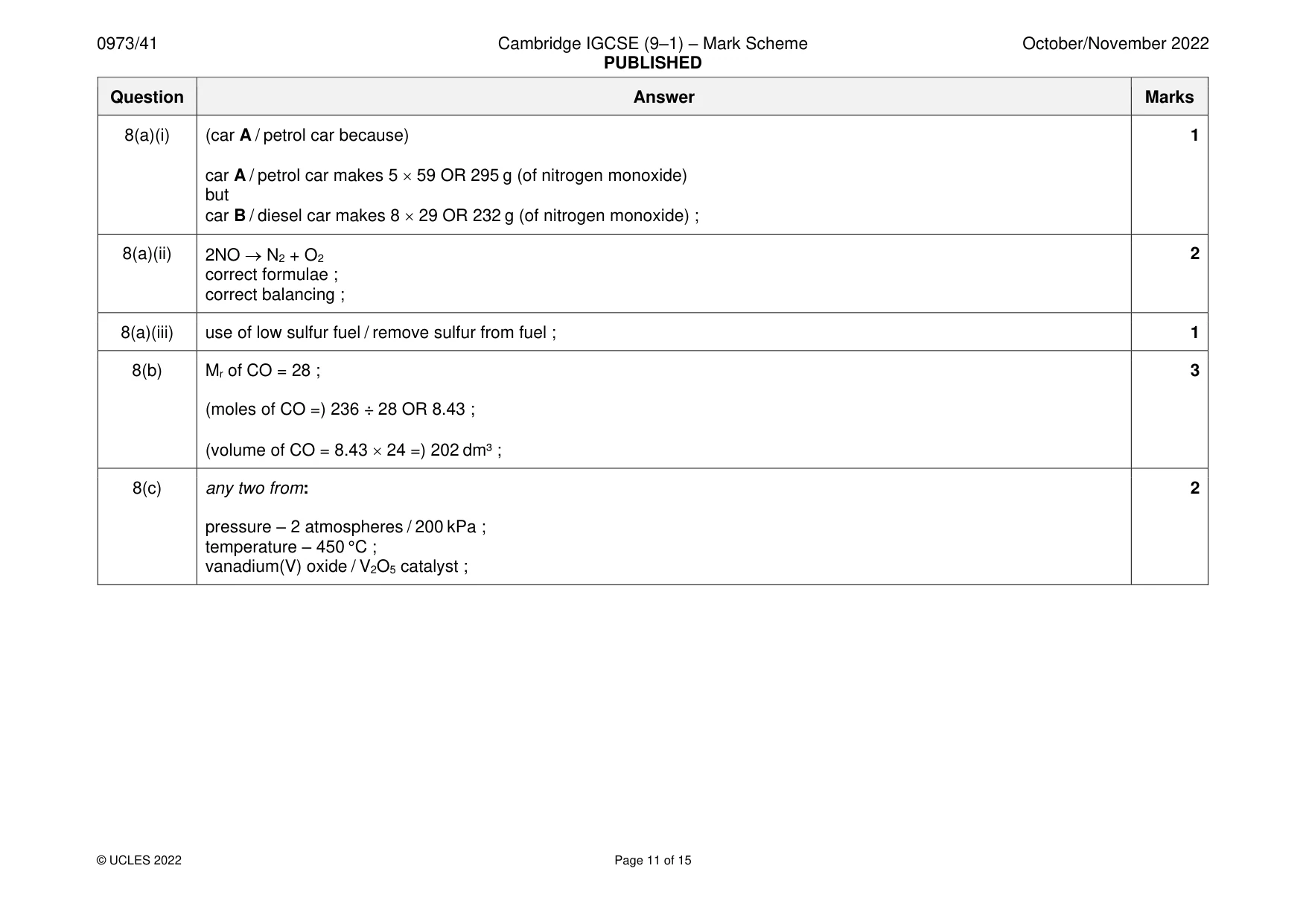
Mark scheme: 8(a)(i) (car A / petrol car because) 1 car A / petrol car makes 5 59 OR 295 g (of nitrogen monoxide) but car B / diesel car makes 8 29 OR 232 g (of nitrogen monoxide) ; 8(a)(ii) 2NO → N2 + O2 2 correct formulae ; correct balancing ; 8(a)(iii) use of low sulfur fuel / remove sulfur from fuel ; 1 8(b) Mr of CO = 28 ; 3 (moles of CO =) 236 ÷ 28 OR 8.43 ; (volume of CO = 8.43 24 =) 202 dm³ ; 8(c) any two from: 2 pressure – 2 atmospheres / 200 kPa ; temperature – 450 °C ; vanadium(V) oxide / V2O5 catalyst ;
Q9 · A student investigates the effect of changing temperature on the current through a…
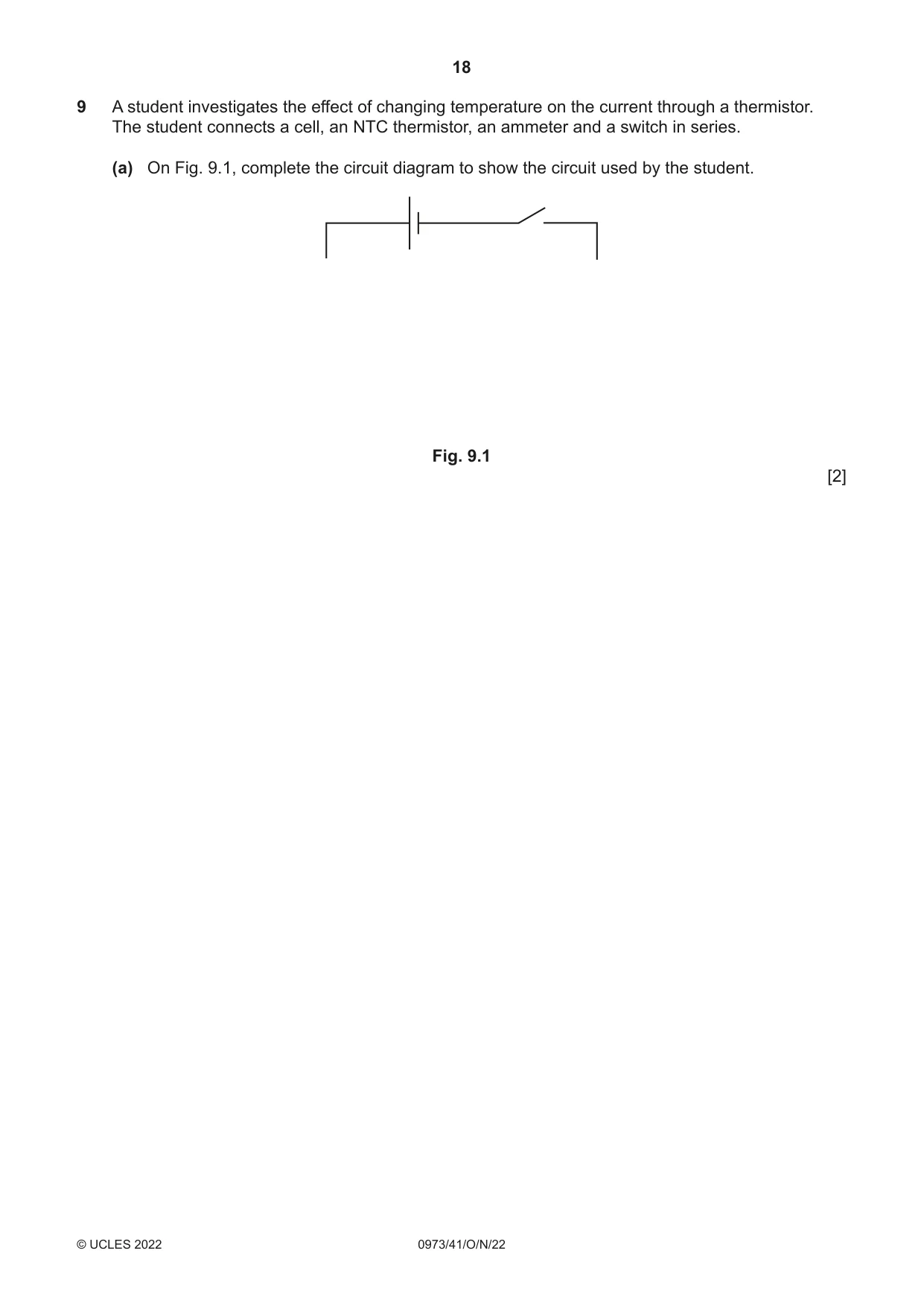
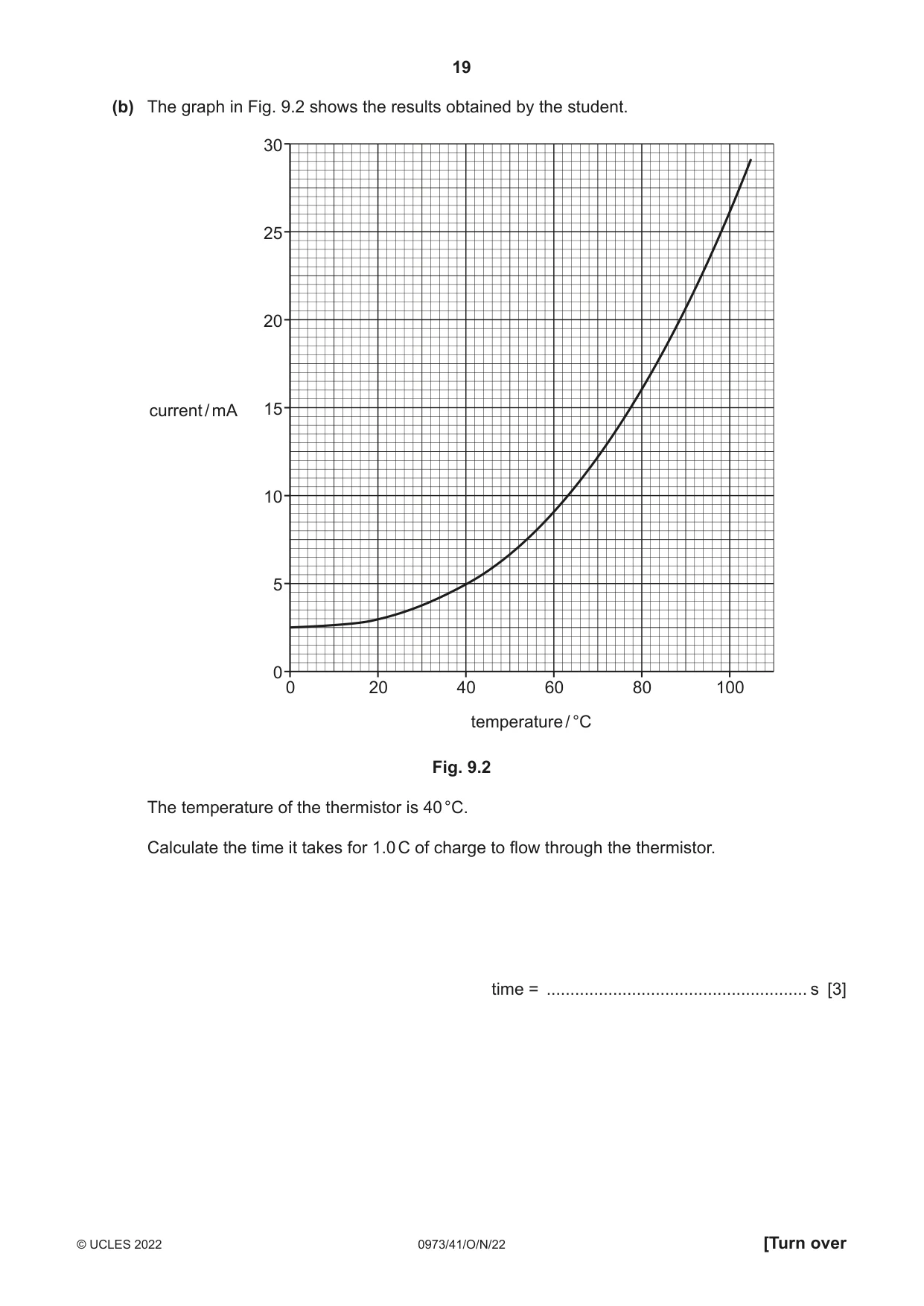
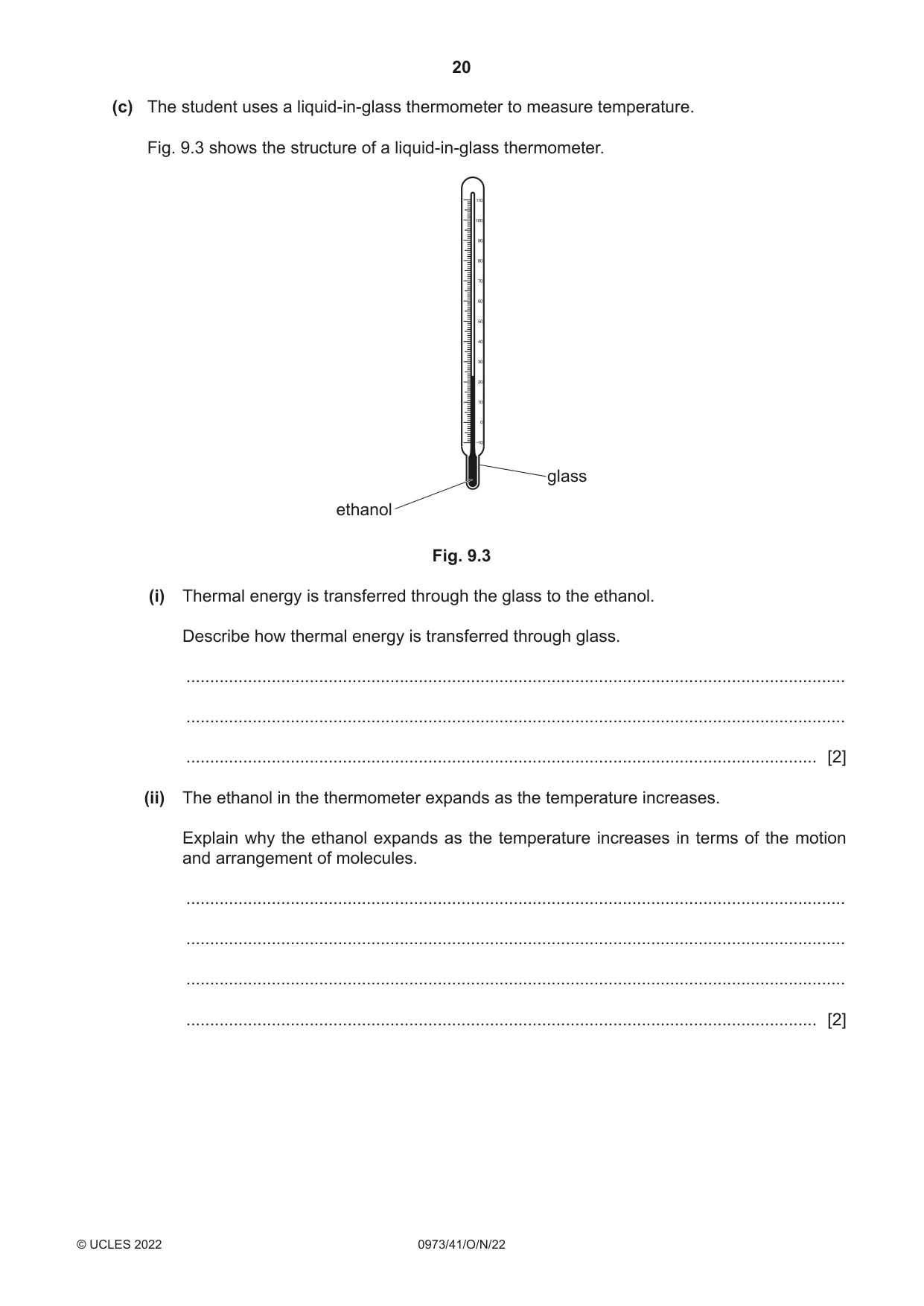
9 A student investigates the effect of changing temperature on the current through a thermistor. The student connects a cell, an NTC thermistor, an ammeter and a switch in series. (a) On Fig. 9.1, complete the circuit diagram to show the circuit used by the student. Fig. 9.1 [2] (b) The graph in Fig. 9.2 shows the results obtained by the student. 30 25 20 current / mA 15 10 5 0 0 20 40 60 80 100 temperature / °C Fig. 9.2 The temperature of the thermistor is 40 °C. Calculate the time it takes for 1.0 C of charge to flow through the thermistor. time = ....................................................... s [3] (c) The student uses a liquid-in-glass thermometer to measure temperature. Fig. 9.3 shows the structure of a liquid-in-glass thermometer. glass ethanol Fig. 9.3 (i) Thermal energy is transferred through the glass to the ethanol. Describe how thermal energy is transferred through glass. ........................................................................................................................................... ........................................................................................................................................... ..................................................................................................................................... [2] (ii) The ethanol in the thermometer expands as the temperature increases. Explain why the ethanol expands as the temperature increases in terms of the motion and arrangement of molecules. ........................................................................................................................................... ........................................................................................................................................... ........................................................................................................................................... ..................................................................................................................................... [2] (iii) The volume of the ethanol in the thermometer at 25 °C is 2.00 cm3 and the density of the ethanol is 0.78 g / cm3. When the thermometer is cooled to 3 °C, the volume decreases to 1.95 cm3. Calculate the density of the ethanol at 3 °C. density of ethanol = .............................................. g / cm3 [3] [Total: 12]
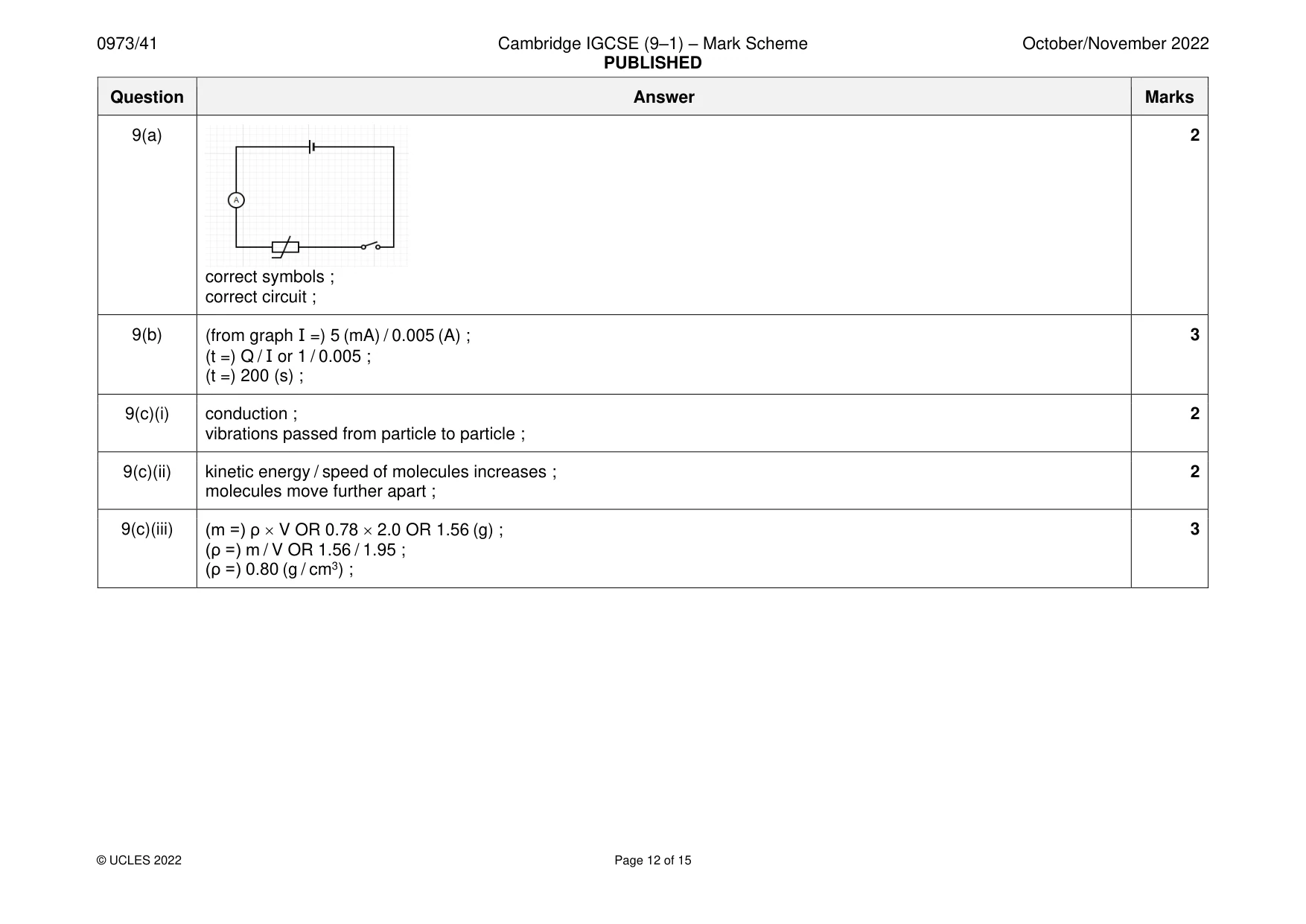
Mark scheme: 9(a) 2 correct symbols ; correct circuit ; 9(b) (from graph I =) 5 (mA) / 0.005 (A) ; 3 (t =) Q / I or 1 / 0.005 ; (t =) 200 (s) ; 9(c)(i) conduction ; 2 vibrations passed from particle to particle ; 9(c)(ii) kinetic energy / speed of molecules increases ; 2 molecules move further apart ; 9(c)(iii) (m =) ρ V OR 0.78 2.0 OR 1.56 (g) ; 3 (ρ =) m / V OR 1.56 / 1.95 ; (ρ =) 0.80 (g / cm3) ;
Q10 · A diagram of a cross-section through skin
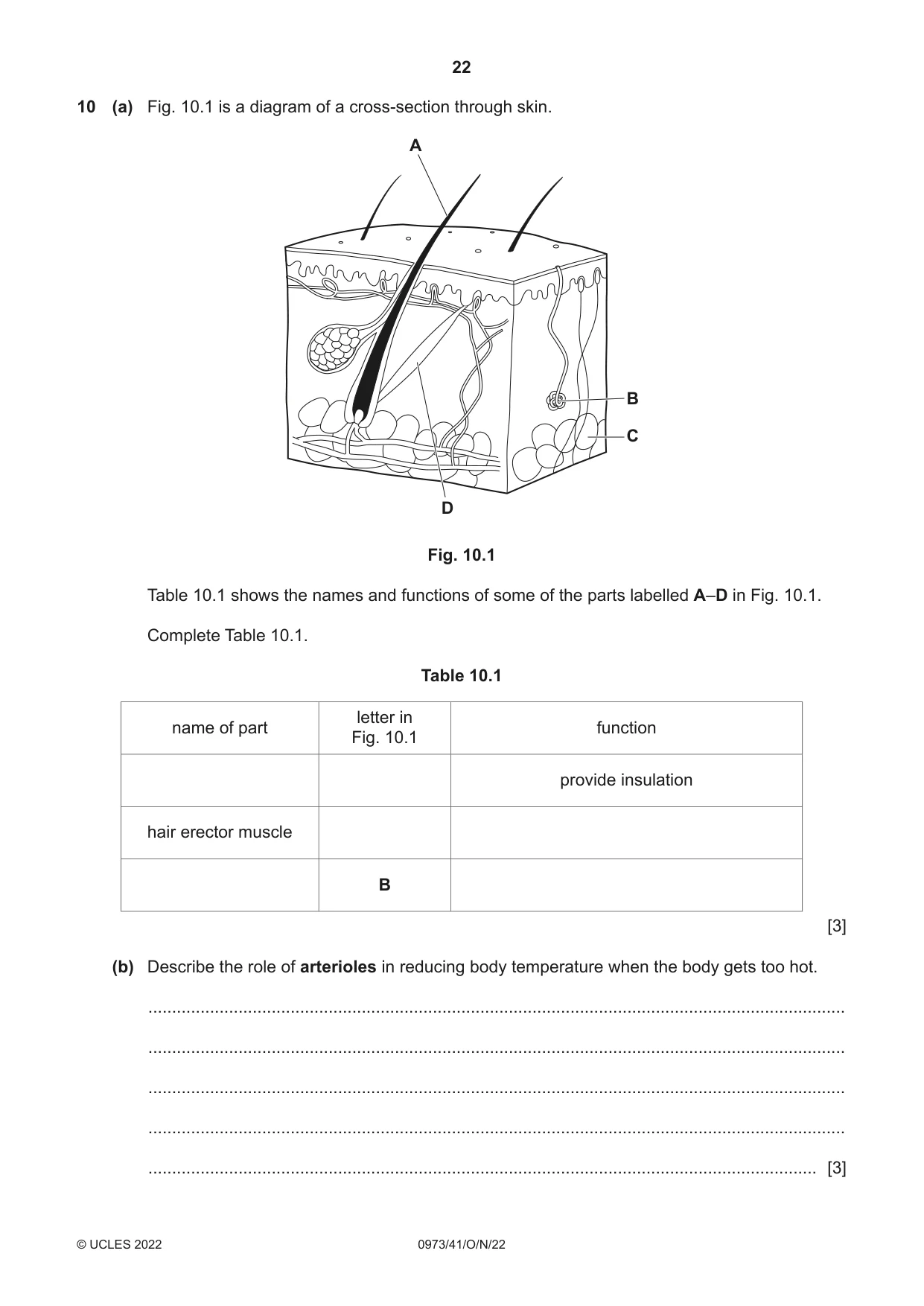
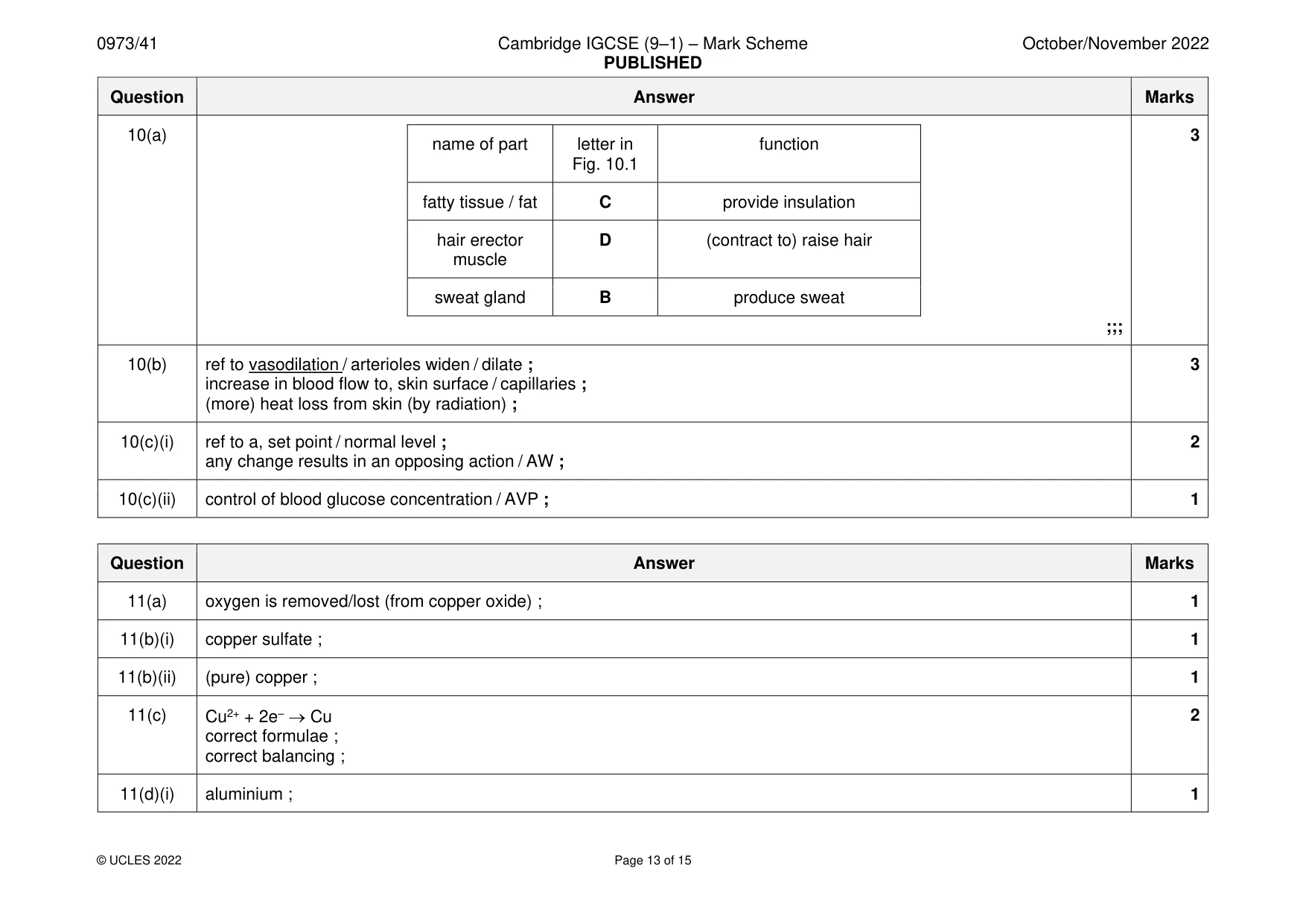
10 (a) Fig. 10.1 is a diagram of a cross-section through skin. A B C D Fig. 10.1 Table 10.1 shows the names and functions of some of the parts labelled A–D in Fig. 10.1. Complete Table 10.1. Table 10.1 letter in name of part function Fig. 10.1 provide insulation hair erector muscle B [3] (b) Describe the role of arterioles in reducing body temperature when the body gets too hot. ................................................................................................................................................... ................................................................................................................................................... ................................................................................................................................................... ................................................................................................................................................... ............................................................................................................................................. [3] (c) The control of internal body temperature is an example of negative feedback. (i) Explain what is meant by the term negative feedback. ........................................................................................................................................... ........................................................................................................................................... ..................................................................................................................................... [2] (ii) State one other example of negative feedback. ..................................................................................................................................... [1] [Total: 9]
Mark scheme: 10(a) 3 name of part letter in function Fig. 10.1 fatty tissue / fat C provide insulation hair erector D (contract to) raise hair muscle sweat gland B produce sweat ;;; 10(b) ref to vasodilation / arterioles widen / dilate ; 3 increase in blood flow to, skin surface / capillaries ; (more) heat loss from skin (by radiation) ; 10(c)(i) ref to a, set point / normal level ; 2 any change results in an opposing action / AW ; 10(c)(ii) control of blood glucose concentration / AVP ; 1
Q11 · Copper oxide, CuO, is heated with carbon, C
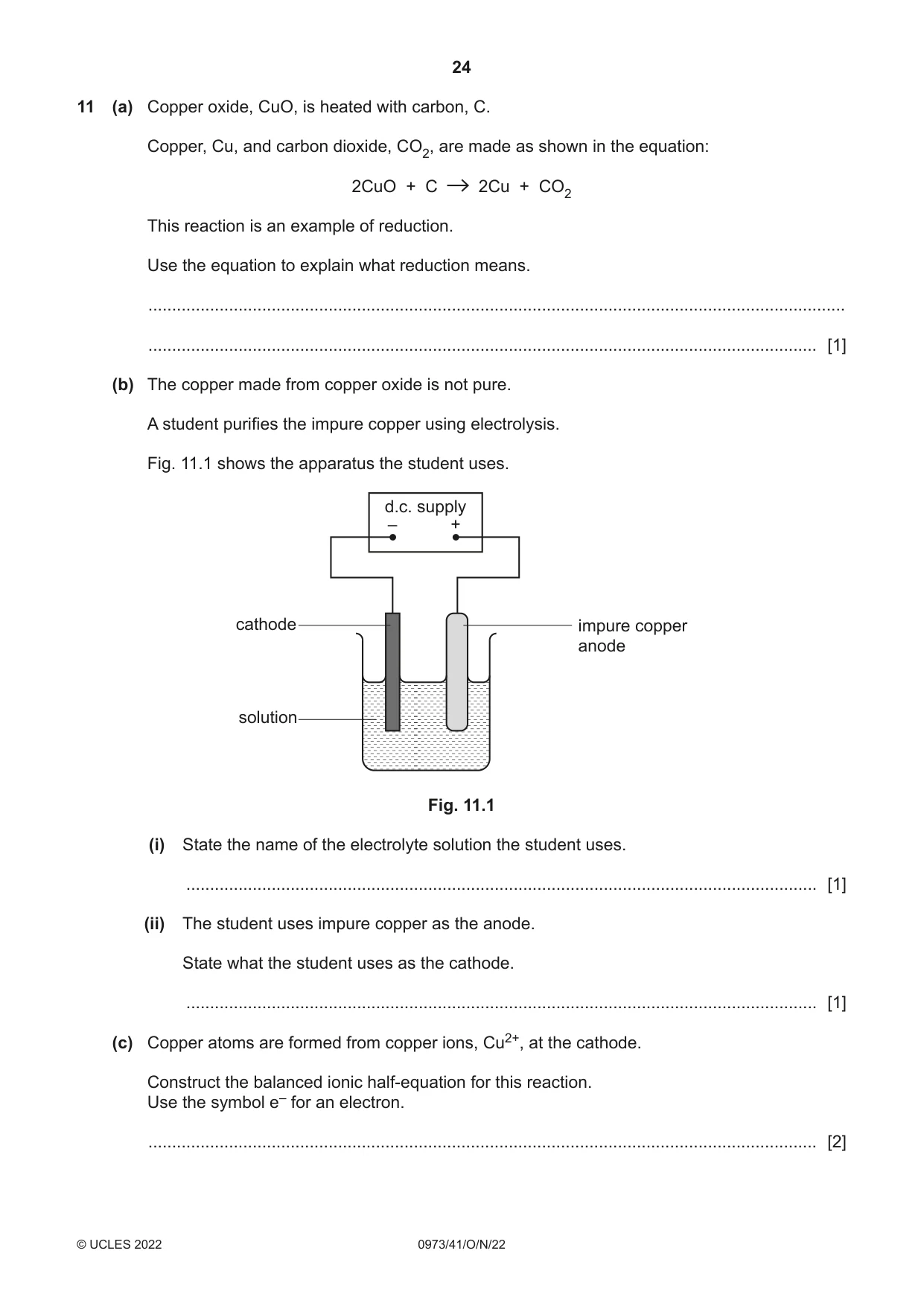
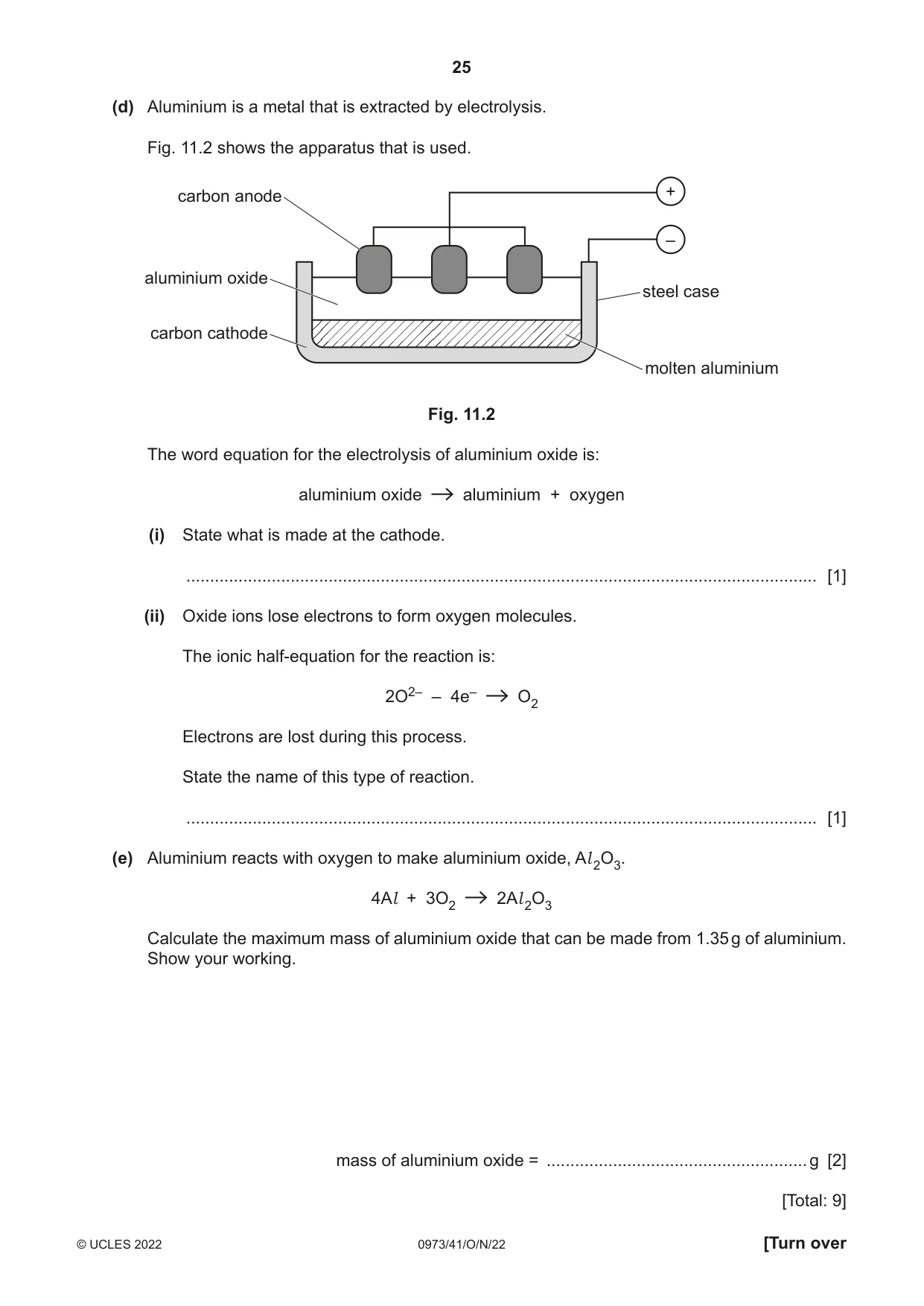
11 (a) Copper oxide, CuO, is heated with carbon, C. Copper, Cu, and carbon dioxide, CO2, are made as shown in the equation: 2CuO + C 2Cu + CO2 This reaction is an example of reduction. Use the equation to explain what reduction means. ................................................................................................................................................... ............................................................................................................................................. [1] (b) The copper made from copper oxide is not pure. A student purifies the impure copper using electrolysis. Fig. 11.1 shows the apparatus the student uses. d.c. supply – + cathode impure copper anode solution Fig. 11.1 (i) State the name of the electrolyte solution the student uses. ..................................................................................................................................... [1] (ii) The student uses impure copper as the anode. State what the student uses as the cathode. ..................................................................................................................................... [1] (c) Copper atoms are formed from copper ions, Cu2+, at the cathode. Construct the balanced ionic half-equation for this reaction. Use the symbol e– for an electron. ............................................................................................................................................. [2] (d) Aluminium is a metal that is extracted by electrolysis. Fig. 11.2 shows the apparatus that is used. + carbon anode – aluminium oxide steel case carbon cathode molten aluminium Fig. 11.2 The word equation for the electrolysis of aluminium oxide is: aluminium oxide aluminium + oxygen (i) State what is made at the cathode. ..................................................................................................................................... [1] (ii) Oxide ions lose electrons to form oxygen molecules. The ionic half-equation for the reaction is: 2O2– – 4e– O2 Electrons are lost during this process. State the name of this type of reaction. ..................................................................................................................................... [1] (e) Aluminium reacts with oxygen to make aluminium oxide, Al 2O3. 4Al + 3O2 2Al 2O3 Calculate the maximum mass of aluminium oxide that can be made from 1.35 g of aluminium. Show your working. mass of aluminium oxide = ....................................................... g [2] [Total: 9]
Mark scheme: 11(a) oxygen is removed/lost (from copper oxide) ; 1 11(b)(i) copper sulfate ; 1 11(b)(ii) (pure) copper ; 1 11(c) Cu2+ + 2e– → Cu 2 correct formulae ; correct balancing ; 11(d)(i) aluminium ; 1 11(d)(ii) oxidation ; 1 11(e) relative formular mass of Al2O3 =102 ; 2 (204 x 1.35 OR 102 x 1.35 = ) 2.55 (g) ; 108 54
Q12 · Α-particles, β-particles and γ-rays are all forms of ionising radiation
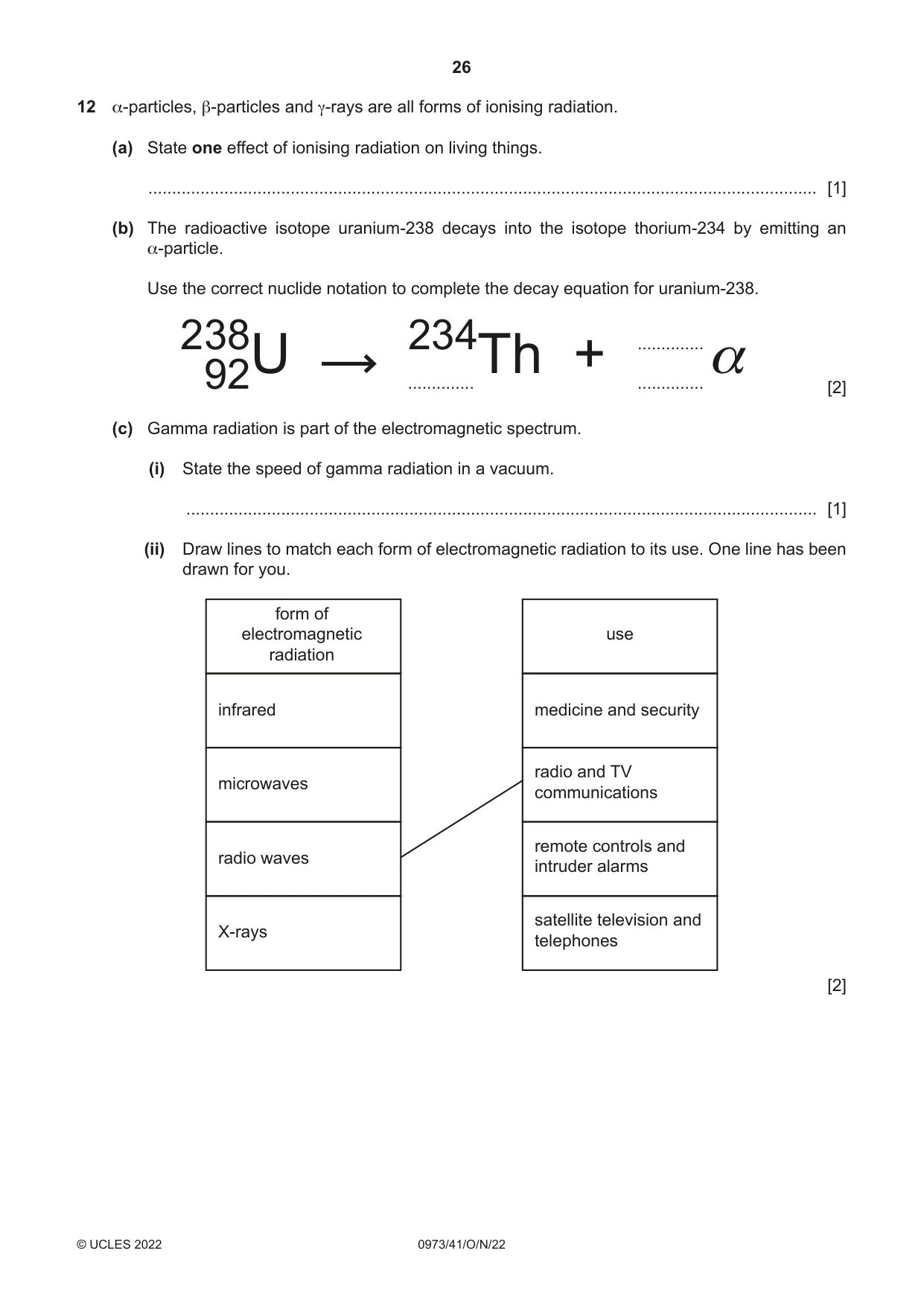
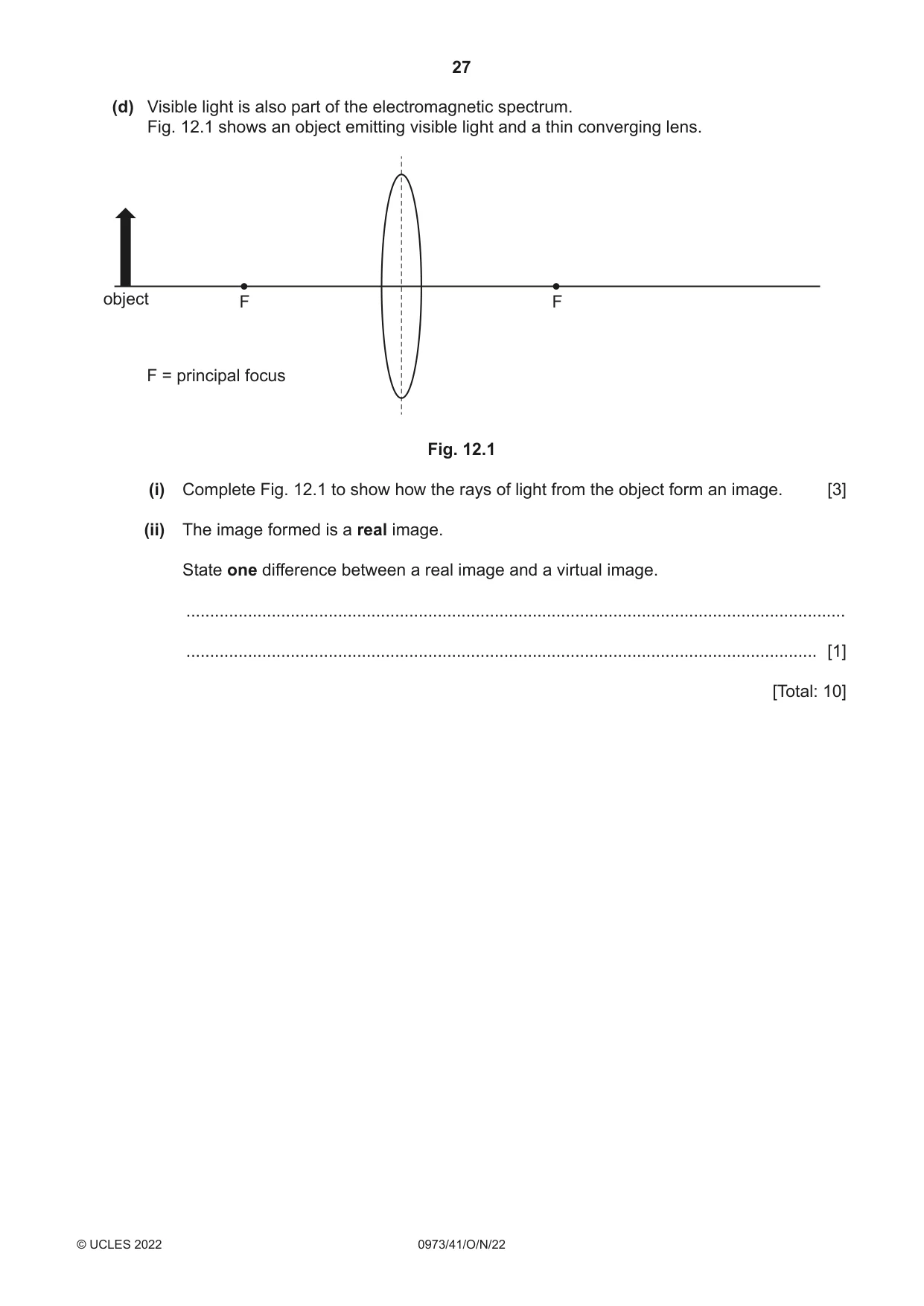
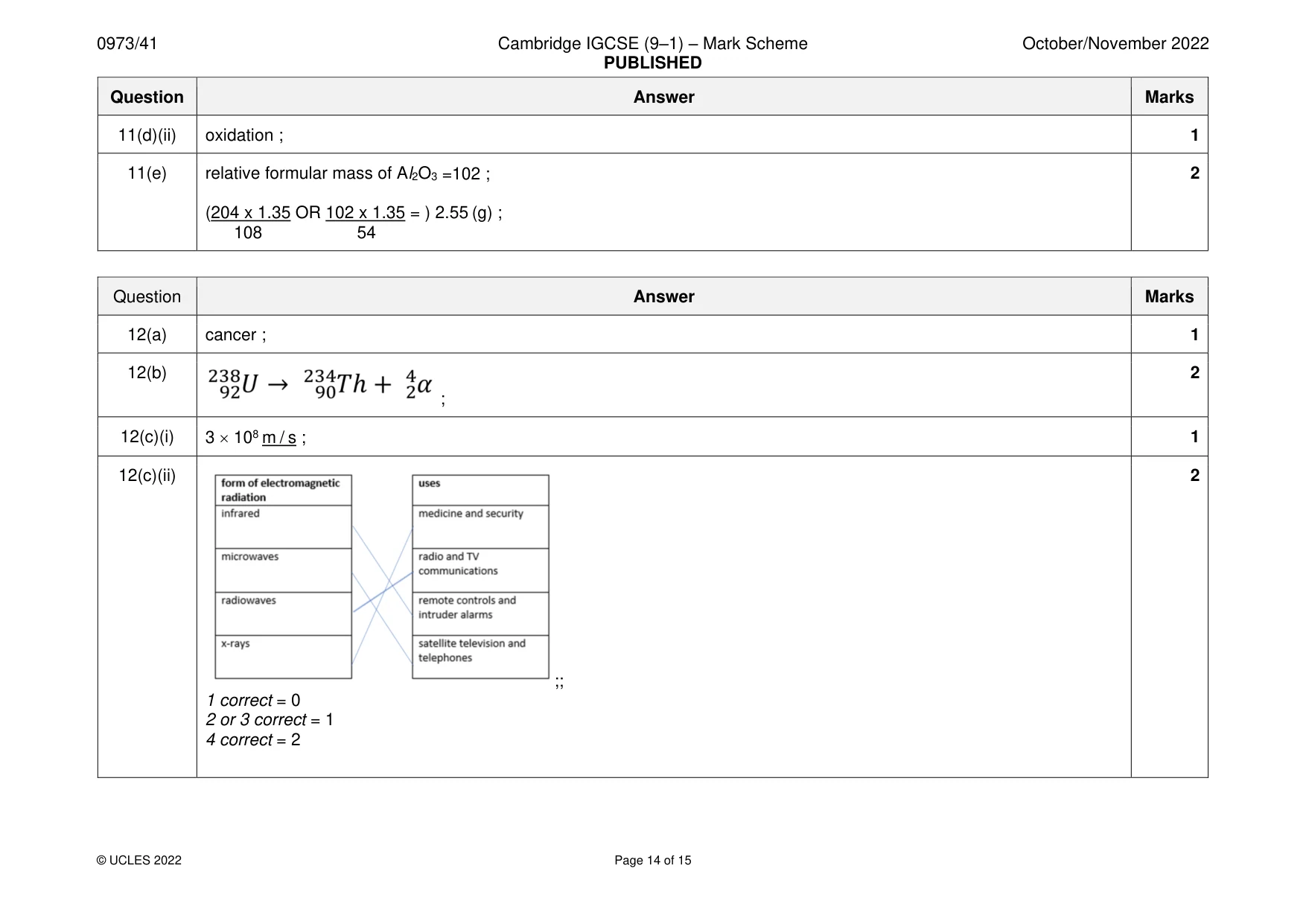
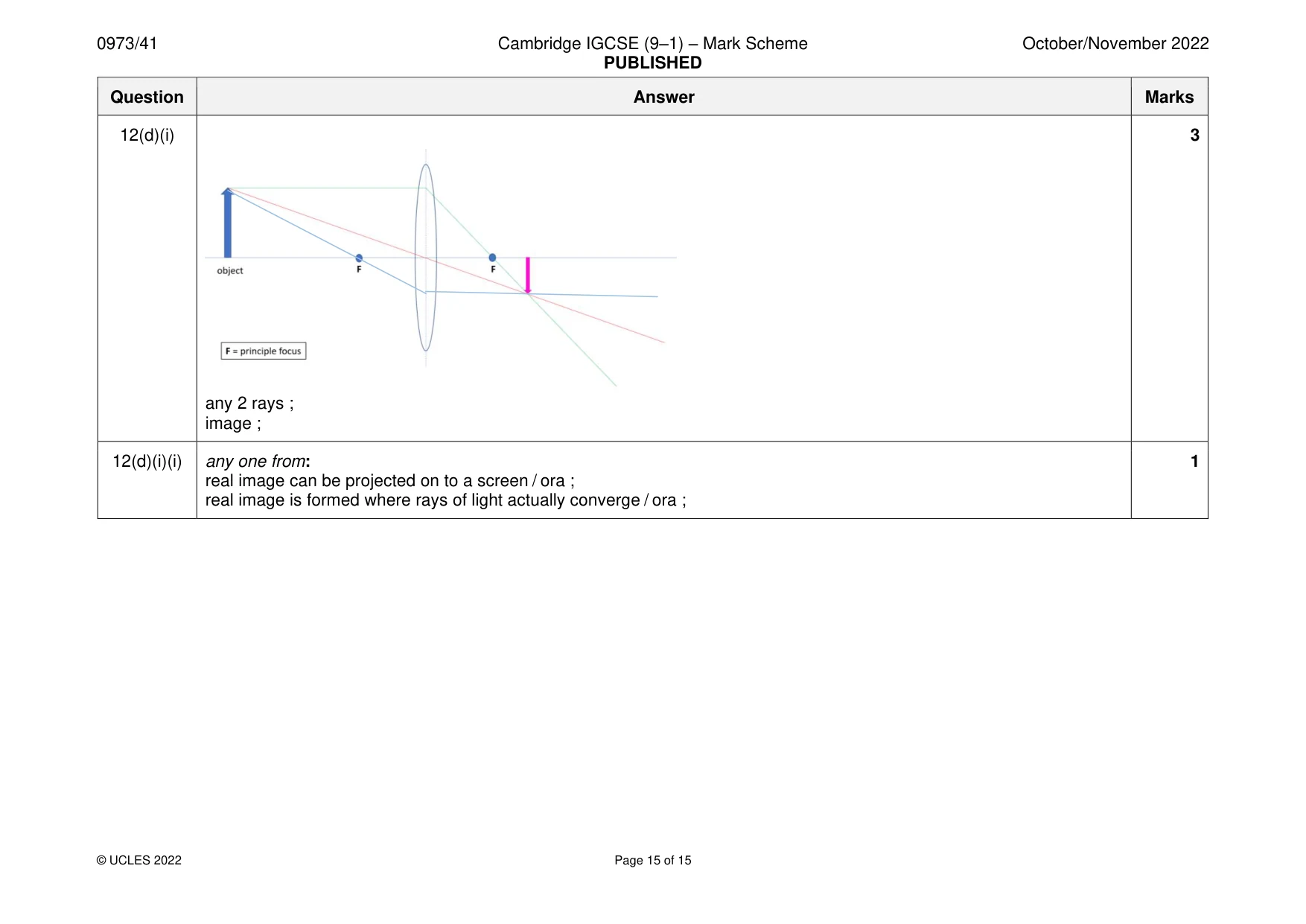
12 α-particles, β-particles and γ-rays are all forms of ionising radiation. (a) State one effect of ionising radiation on living things. ............................................................................................................................................. [1] (b) The radioactive isotope uranium-238 decays into the isotope thorium-234 by emitting an α-particle. Use the correct nuclide notation to complete the decay equation for uranium-238. .............. 238 234 ..............α [2] 92U ..............Th + (c) Gamma radiation is part of the electromagnetic spectrum. (i) State the speed of gamma radiation in a vacuum. ..................................................................................................................................... [1] (ii) Draw lines to match each form of electromagnetic radiation to its use. One line has been drawn for you. form of electromagnetic use radiation infrared medicine and security radio and TV microwaves communications remote controls and radio waves intruder alarms satellite television and X-rays telephones [2] (d) Visible light is also part of the electromagnetic spectrum. Fig. 12.1 shows an object emitting visible light and a thin converging lens. object F F F = principal focus Fig. 12.1 (i) Complete Fig. 12.1 to show how the rays of light from the object form an image. [3] (ii) The image formed is a real image. State one difference between a real image and a virtual image. ........................................................................................................................................... ..................................................................................................................................... [1] [Total: 10]
Mark scheme: 12(a) cancer ; 1 12(b) 2 ; 12(c)(i) 3 108 m / s ; 1 12(c)(ii) 2 ;; 1 correct = 0 2 or 3 correct = 1 4 correct = 2 12(d)(i) 3 any 2 rays ; image ; 12(d)(i)(i) any one from: 1 real image can be projected on to a screen / ora ; real image is formed where rays of light actually converge / ora ;
What was in this paper
The subtopics covered by these 12 questions, and how many questions each got. Open one in a new tab to see every Cambridge question on it.
What you needed in this session
Cambridge’s own grade thresholds for 2022 Oct/Nov, Paper 4 · Variant 1. A higher threshold means an easier paper — the bar moves with how the cohort did.