Cambridge IGCSE Sciences - Co-ordinated (9-1) 0973 — 2022 May/June Paper 5 · Variant 1
0973/51/M/J/22 · 6 questions · 60 marks · ≈68 min
The question paper and its mark scheme, free to read here and free to download. This is Cambridge’s own paper, exactly as it was sat.
Question paper16 pages



Mark scheme9 pages
Answers below. Sit the paper first if you are practising.
Questions as text
Q1 · You are going to investigate two leaves from the same plant
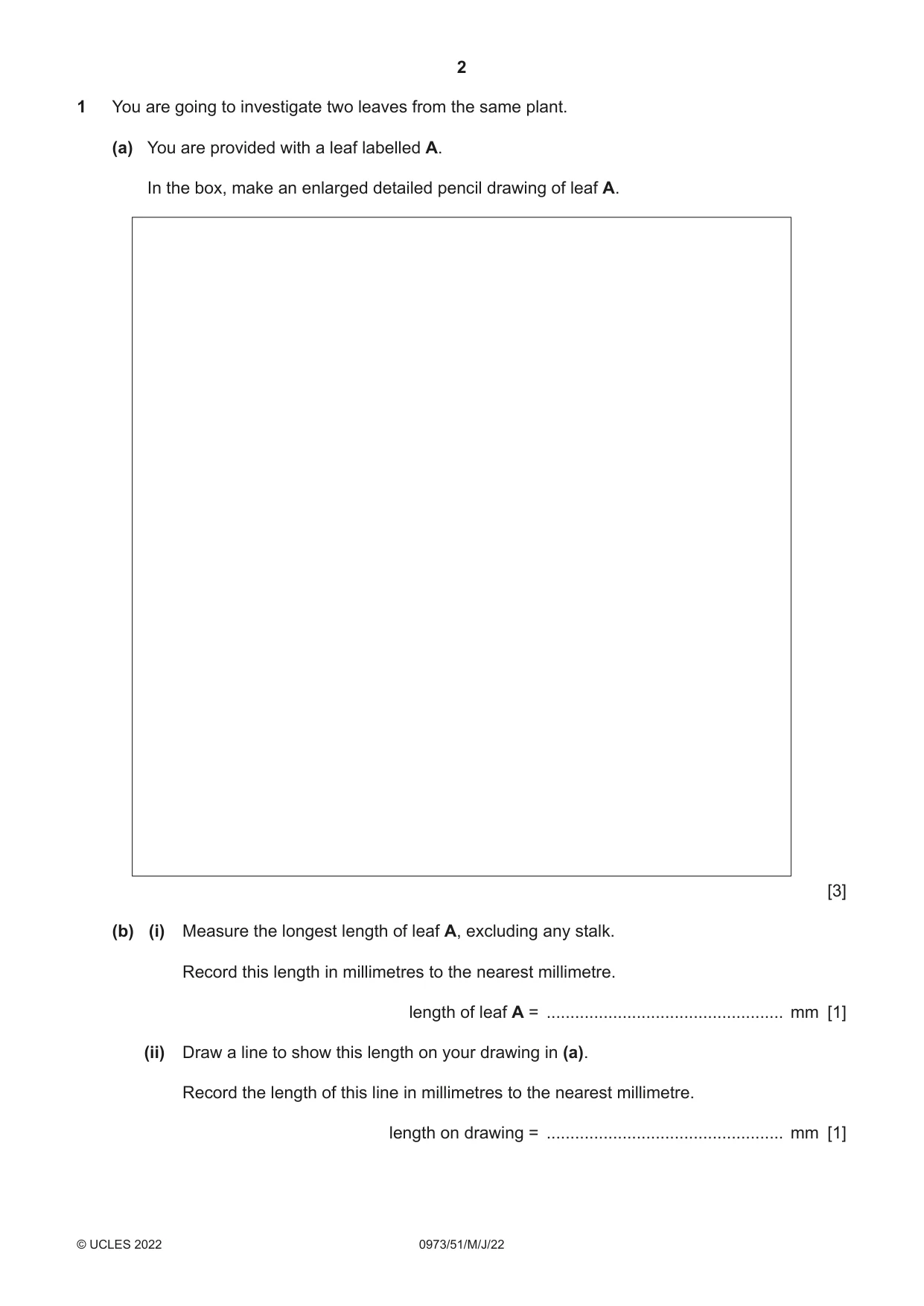
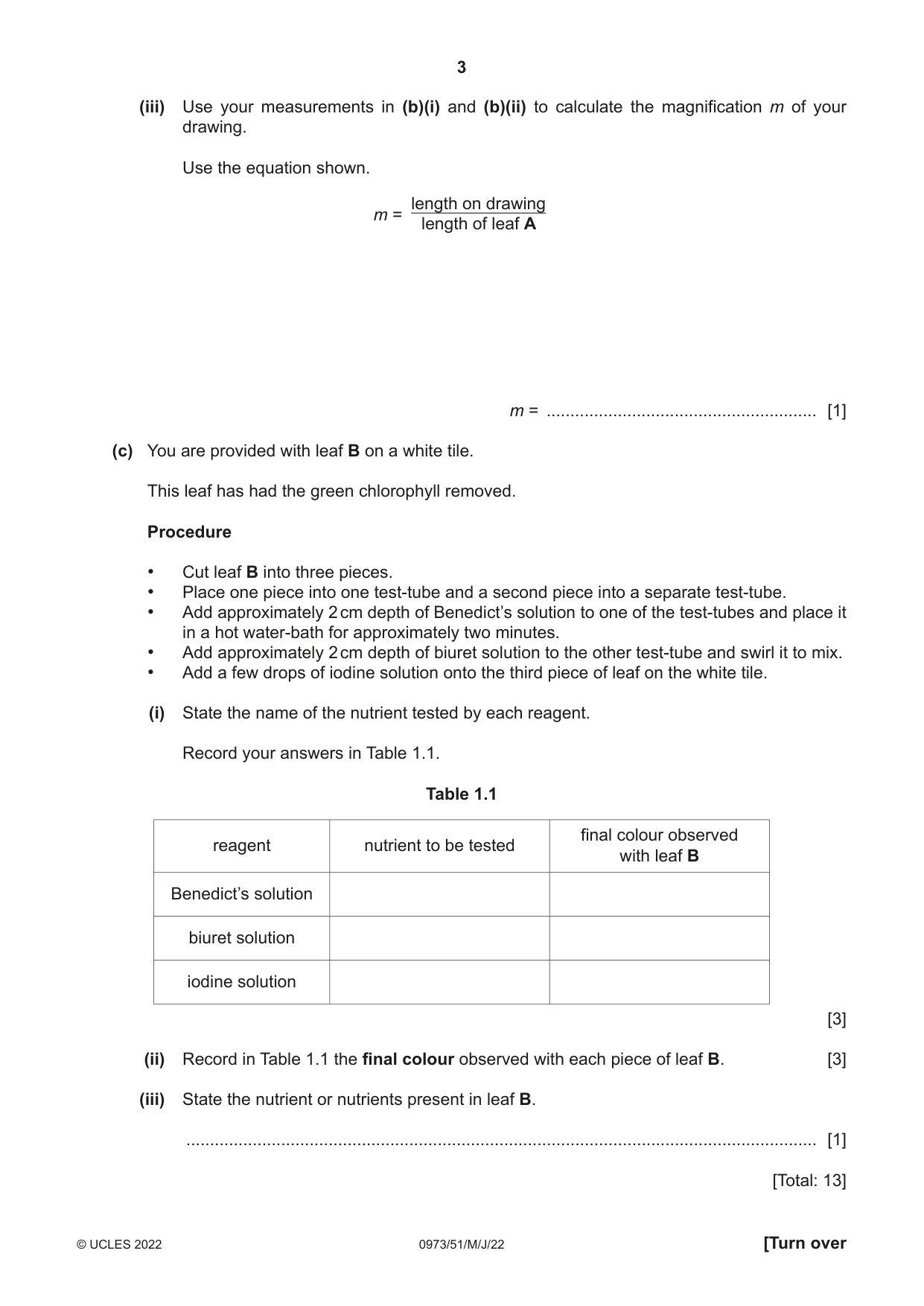
1 You are going to investigate two leaves from the same plant. (a) You are provided with a leaf labelled A. In the box, make an enlarged detailed pencil drawing of leaf A. [3] (b) (i) Measure the longest length of leaf A, excluding any stalk. Record this length in millimetres to the nearest millimetre. length of leaf A = .................................................. mm [1] (ii) Draw a line to show this length on your drawing in (a). Record the length of this line in millimetres to the nearest millimetre. length on drawing = .................................................. mm [1] (iii) Use your measurements in (b)(i) and (b)(ii) to calculate the magnification m of your drawing. Use the equation shown. length on drawing m = length of leaf A m = ......................................................... [1] (c) You are provided with leaf B on a white tile. This leaf has had the green chlorophyll removed. Procedure • Cut leaf B into three pieces. • Place one piece into one test-tube and a second piece into a separate test-tube. • Add approximately 2 cm depth of Benedict’s solution to one of the test-tubes and place it in a hot water-bath for approximately two minutes. • Add approximately 2 cm depth of biuret solution to the other test-tube and swirl it to mix. • Add a few drops of iodine solution onto the third piece of leaf on the white tile. (i) State the name of the nutrient tested by each reagent. Record your answers in Table 1.1. Table 1.1 final colour observed reagent nutrient to be tested with leaf B Benedict’s solution biuret solution iodine solution [3] (ii) Record in Table 1.1 the final colour observed with each piece of leaf B. [3] (iii) State the nutrient or nutrients present in leaf B. ..................................................................................................................................... [1] [Total: 13]
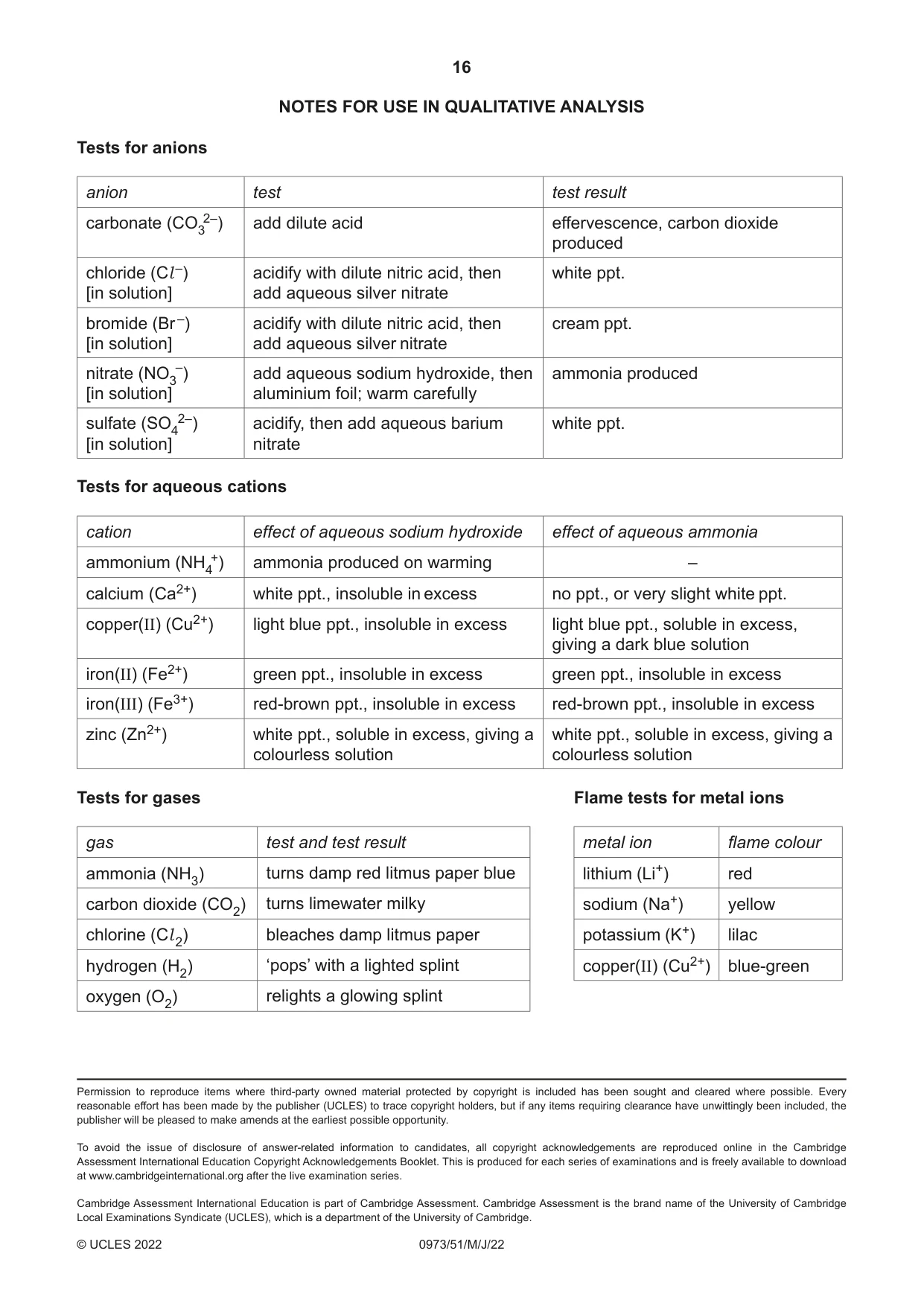
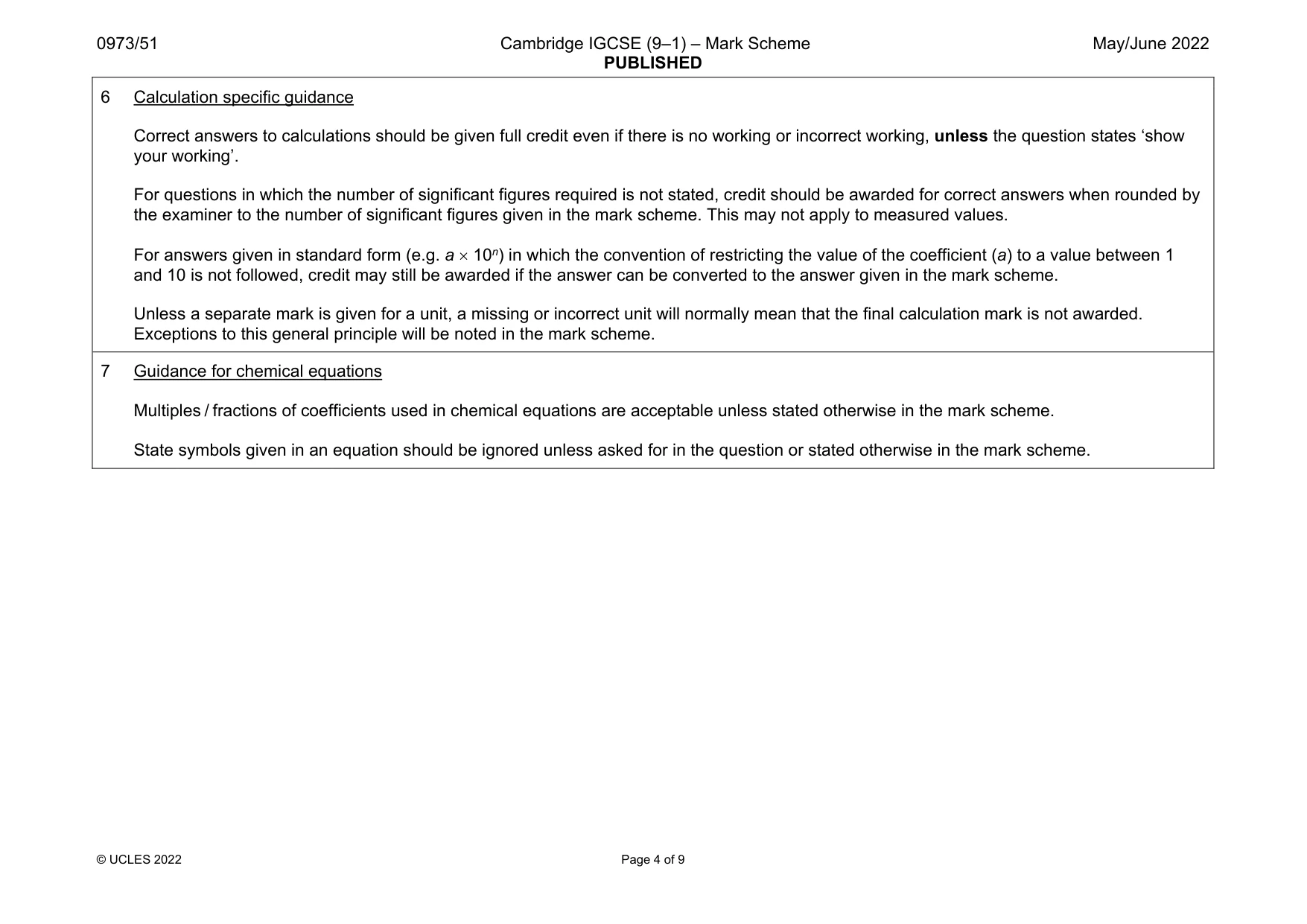
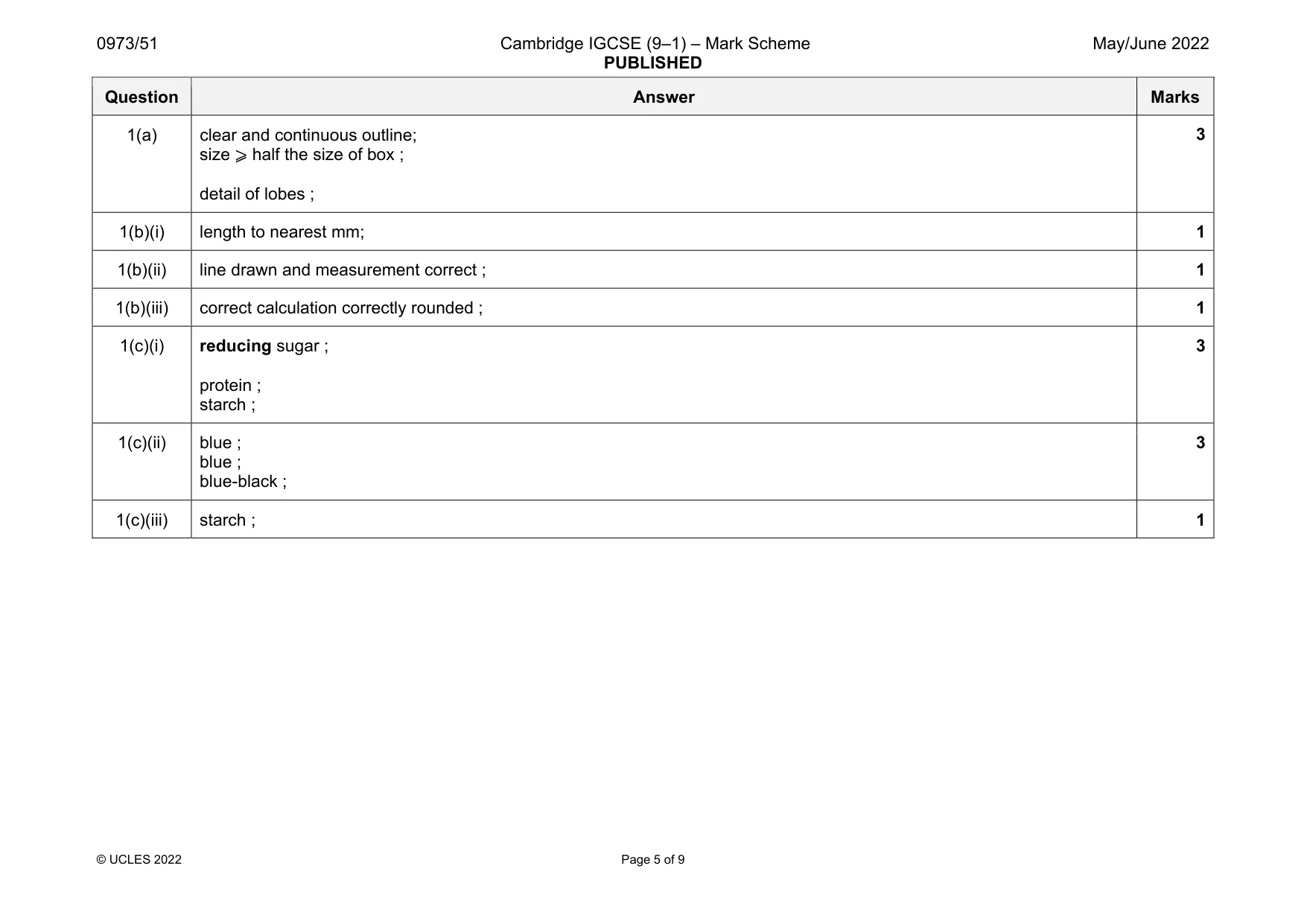
Mark scheme: 1(a) clear and continuous outline; size ⩾ half the size of box ; detail of lobes ; 1(b)(i) length to nearest mm; 1 1(b)(ii) line drawn and measurement correct ; 1 1(b)(iii) correct calculation correctly rounded ; 1 1(c)(i) reducing sugar ; protein ; starch ; 3 1(c)(ii) blue ; blue ; blue-black ; 3 1(c)(iii) starch ; 1
Q2 · Water from the soil enters a plant through its roots, travels up the plant in xylem…
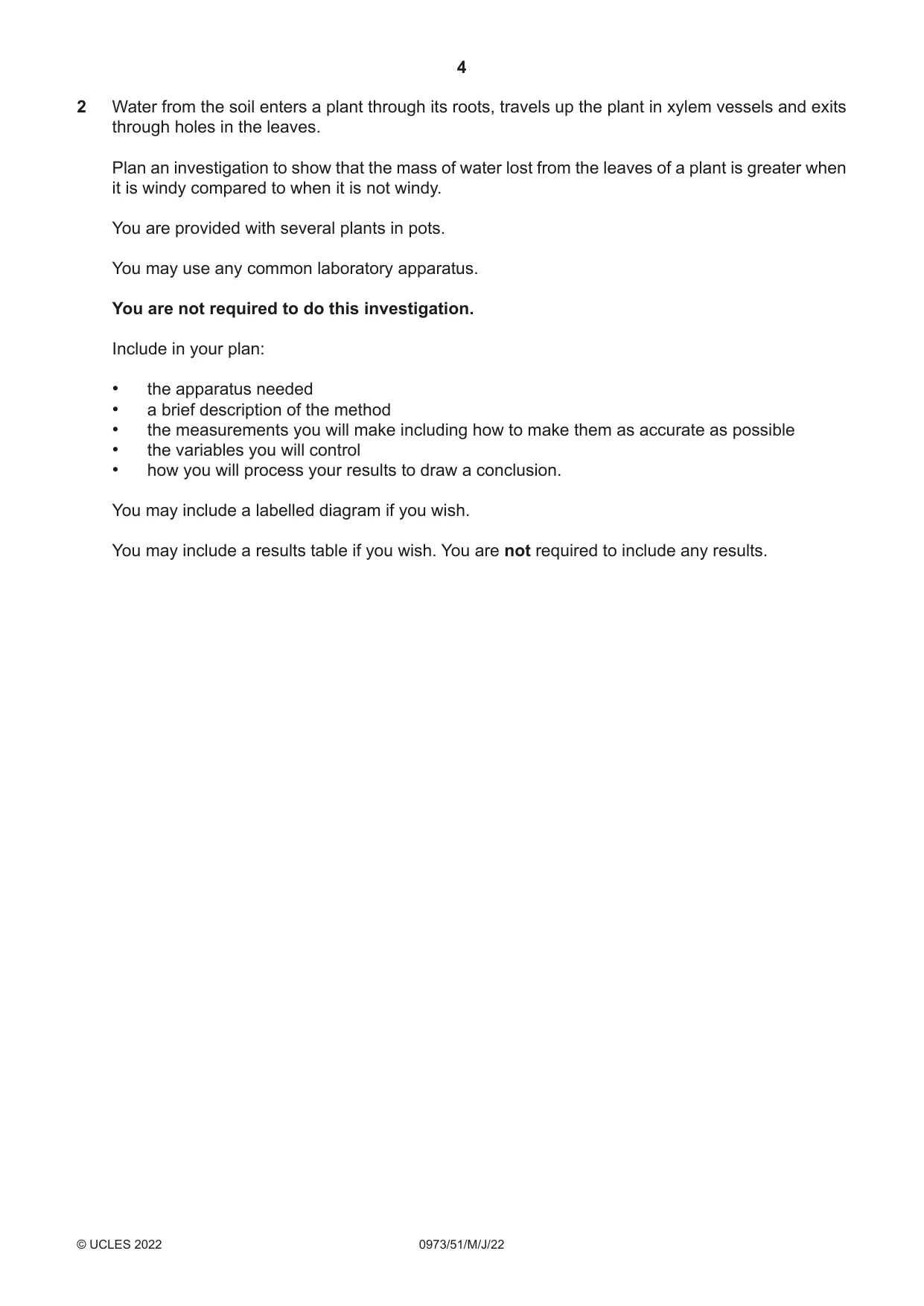
2 Water from the soil enters a plant through its roots, travels up the plant in xylem vessels and exits through holes in the leaves. Plan an investigation to show that the mass of water lost from the leaves of a plant is greater when it is windy compared to when it is not windy. You are provided with several plants in pots. You may use any common laboratory apparatus. You are not required to do this investigation. Include in your plan: • the apparatus needed • a brief description of the method • the measurements you will make including how to make them as accurate as possible • the variables you will control • how you will process your results to draw a conclusion. You may include a labelled diagram if you wish. You may include a results table if you wish. You are not required to include any results. .......................................................................................................................................................... .......................................................................................................................................................... .......................................................................................................................................................... .......................................................................................................................................................... .......................................................................................................................................................... .......................................................................................................................................................... .......................................................................................................................................................... .......................................................................................................................................................... .......................................................................................................................................................... .......................................................................................................................................................... .......................................................................................................................................................... .......................................................................................................................................................... .......................................................................................................................................................... .......................................................................................................................................................... .......................................................................................................................................................... .......................................................................................................................................................... .......................................................................................................................................................... .......................................................................................................................................................... .......................................................................................................................................................... .......................................................................................................................................................... .................................................................................................................................................... [7]
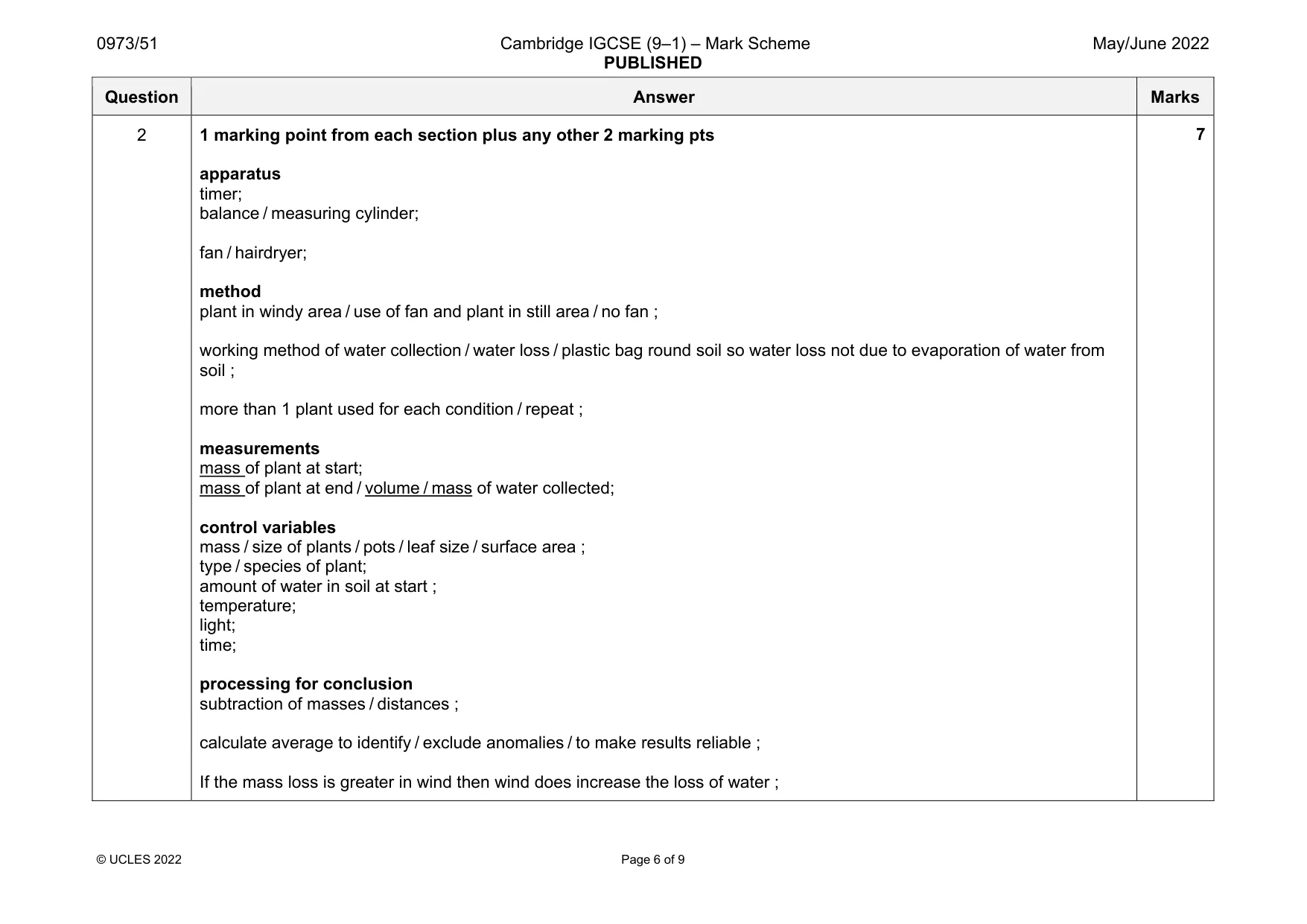
Mark scheme: 2 1 marking point from each section plus any other 2 marking pts apparatus timer; balance / measuring cylinder; fan / hairdryer; method plant in windy area / use of fan and plant in still area / no fan ; working method of water collection / water loss / plastic bag round soil so water loss not due to evaporation of water from soil ; more than 1 plant used for each condition / repeat ; measurements mass of plant at start; mass of plant at end / volume / mass of water collected; control variables mass / size of plants / pots / leaf size / surface area ; type / species of plant; amount of water in soil at start ; temperature; light; time; processing for conclusion subtraction of masses / distances ; calculate average to identify / exclude anomalies / to make results reliable ; If the mass loss is greater in wind then wind does increase the loss of water ;
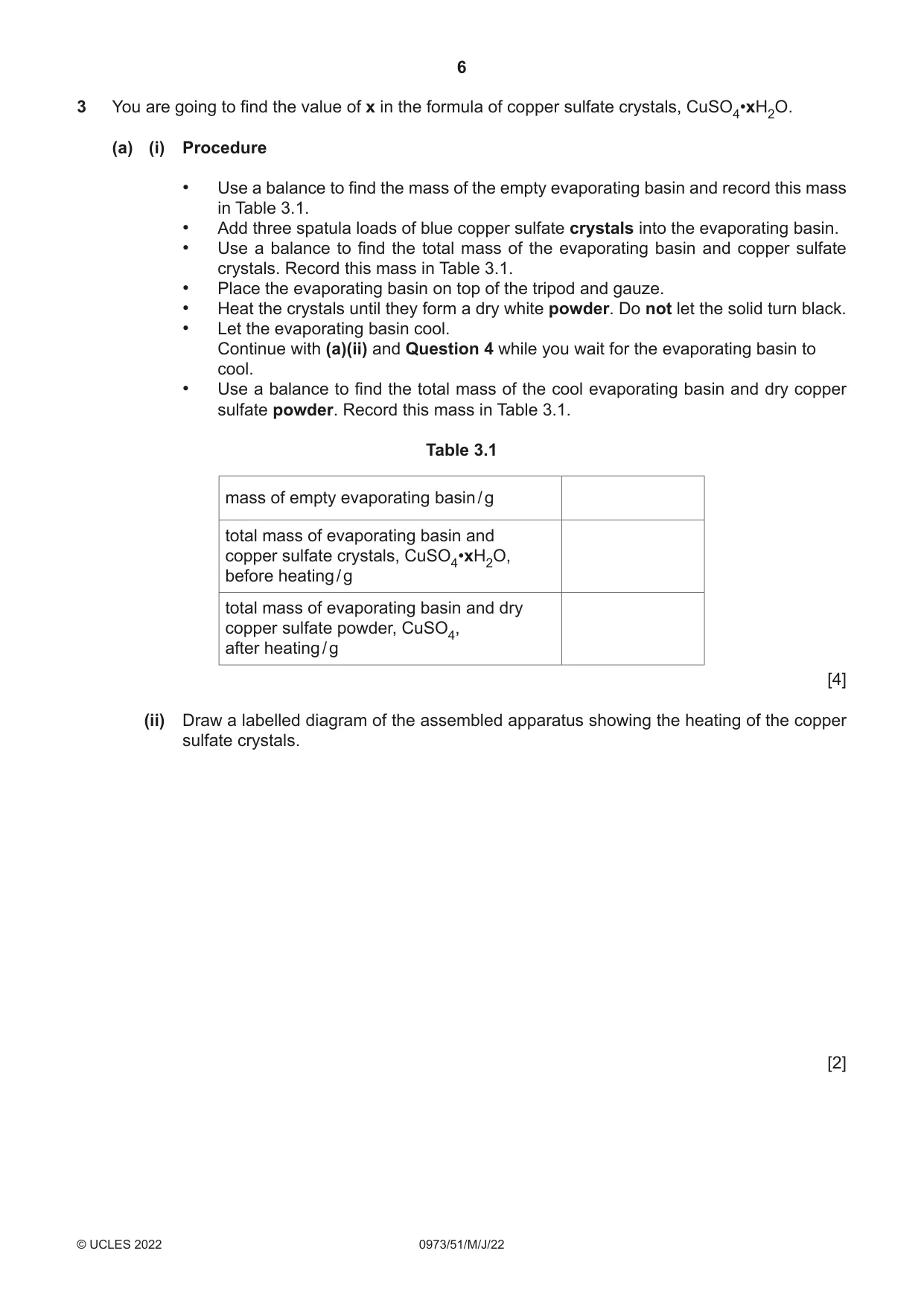
Q3 · You are going to find the value of x in the formula of copper sulfate crystals, CuSO4•xH2O
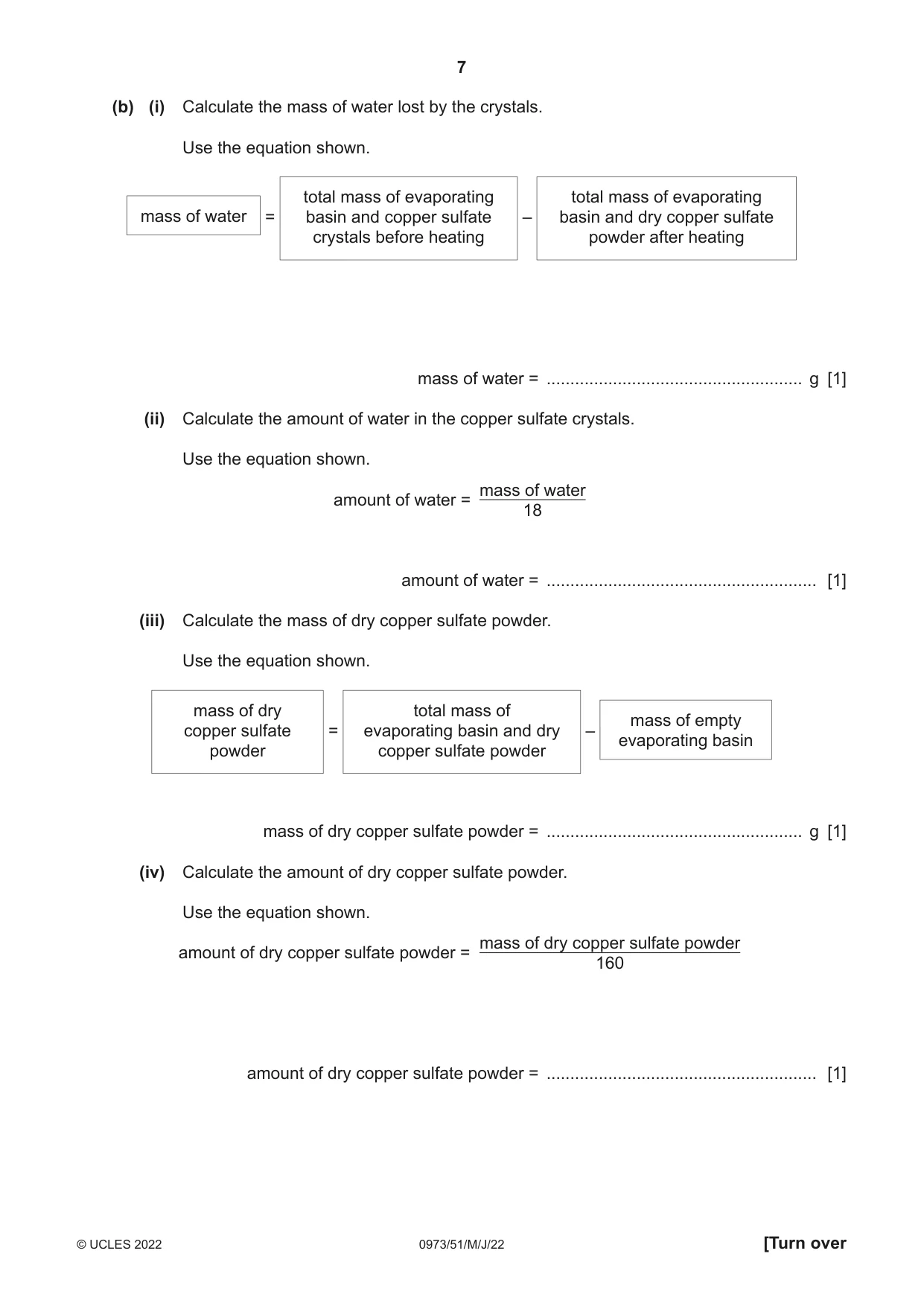
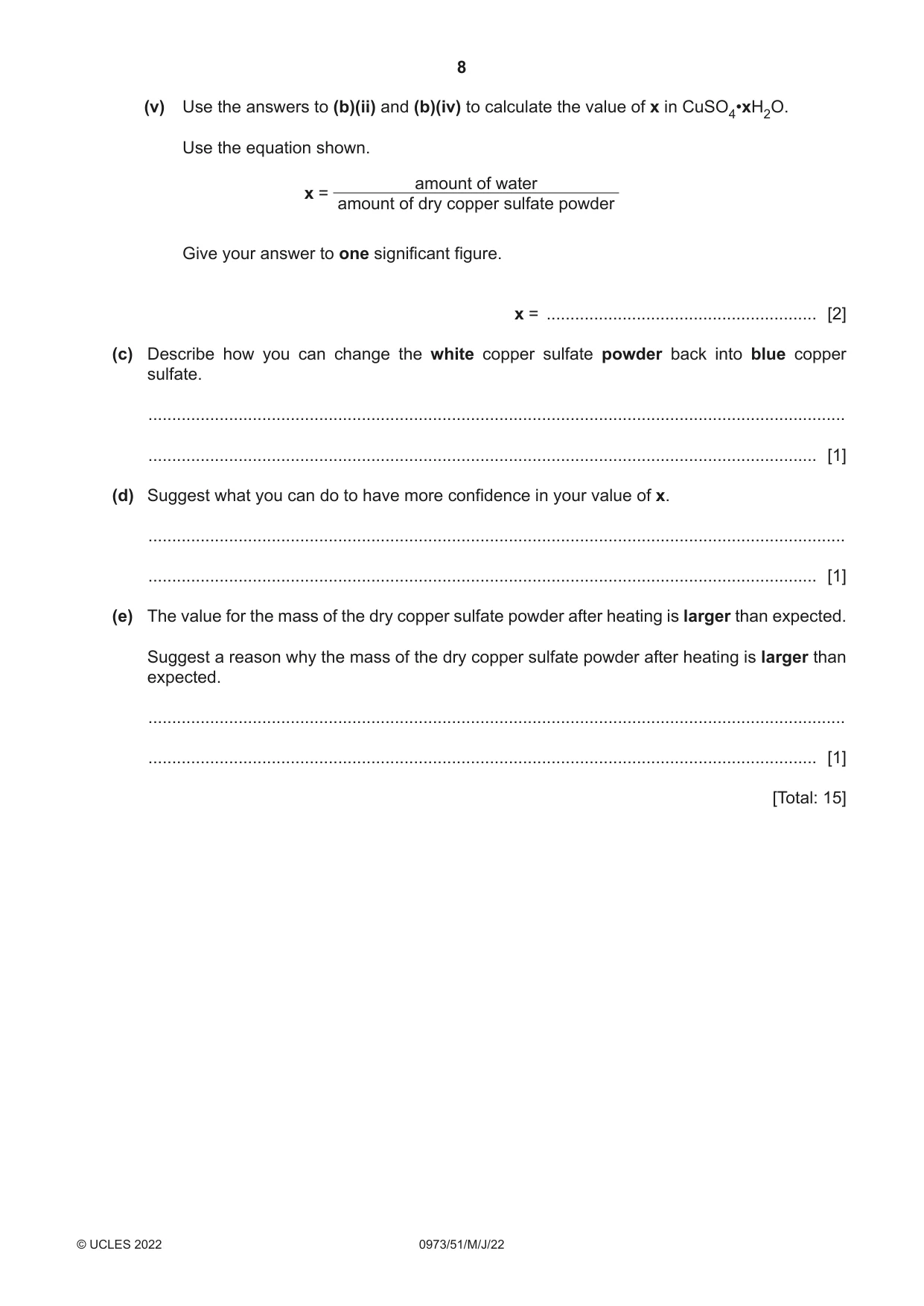
3 You are going to find the value of x in the formula of copper sulfate crystals, CuSO4•xH2O. (a) (i) Procedure • Use a balance to find the mass of the empty evaporating basin and record this mass in Table 3.1. • Add three spatula loads of blue copper sulfate crystals into the evaporating basin. • Use a balance to find the total mass of the evaporating basin and copper sulfate crystals. Record this mass in Table 3.1. • Place the evaporating basin on top of the tripod and gauze. • Heat the crystals until they form a dry white powder. Do not let the solid turn black. • Let the evaporating basin cool. Continue with (a)(ii) and Question 4 while you wait for the evaporating basin to cool. • Use a balance to find the total mass of the cool evaporating basin and dry copper sulfate powder. Record this mass in Table 3.1. Table 3.1 mass of empty evaporating basin / g total mass of evaporating basin and copper sulfate crystals, CuSO4•xH2O, before heating / g total mass of evaporating basin and dry copper sulfate powder, CuSO4, after heating / g [4] (ii) Draw a labelled diagram of the assembled apparatus showing the heating of the copper sulfate crystals. [2] (b) (i) Calculate the mass of water lost by the crystals. Use the equation shown. total mass of evaporating total mass of evaporating mass of water = basin and copper sulfate – basin and dry copper sulfate crystals before heating powder after heating mass of water = ...................................................... g [1] (ii) Calculate the amount of water in the copper sulfate crystals. Use the equation shown. mass of water amount of water = 18 amount of water = ......................................................... [1] (iii) Calculate the mass of dry copper sulfate powder. Use the equation shown. mass of dry total mass of mass of empty copper sulfate = evaporating basin and dry – evaporating basin powder copper sulfate powder mass of dry copper sulfate powder = ...................................................... g [1] (iv) Calculate the amount of dry copper sulfate powder. Use the equation shown. mass of dry copper sulfate powder amount of dry copper sulfate powder = 160 amount of dry copper sulfate powder = ......................................................... [1] (v) Use the answers to (b)(ii) and (b)(iv) to calculate the value of x in CuSO4•xH2O. Use the equation shown. amount of water x = amount of dry copper sulfate powder Give your answer to one significant figure. x = ......................................................... [2] (c) Describe how you can change the white copper sulfate powder back into blue copper sulfate. ................................................................................................................................................... ............................................................................................................................................. [1] (d) Suggest what you can do to have more confidence in your value of x. ................................................................................................................................................... ............................................................................................................................................. [1] (e) The value for the mass of the dry copper sulfate powder after heating is larger than expected. Suggest a reason why the mass of the dry copper sulfate powder after heating is larger than expected. ................................................................................................................................................... ............................................................................................................................................. [1] [Total: 15]
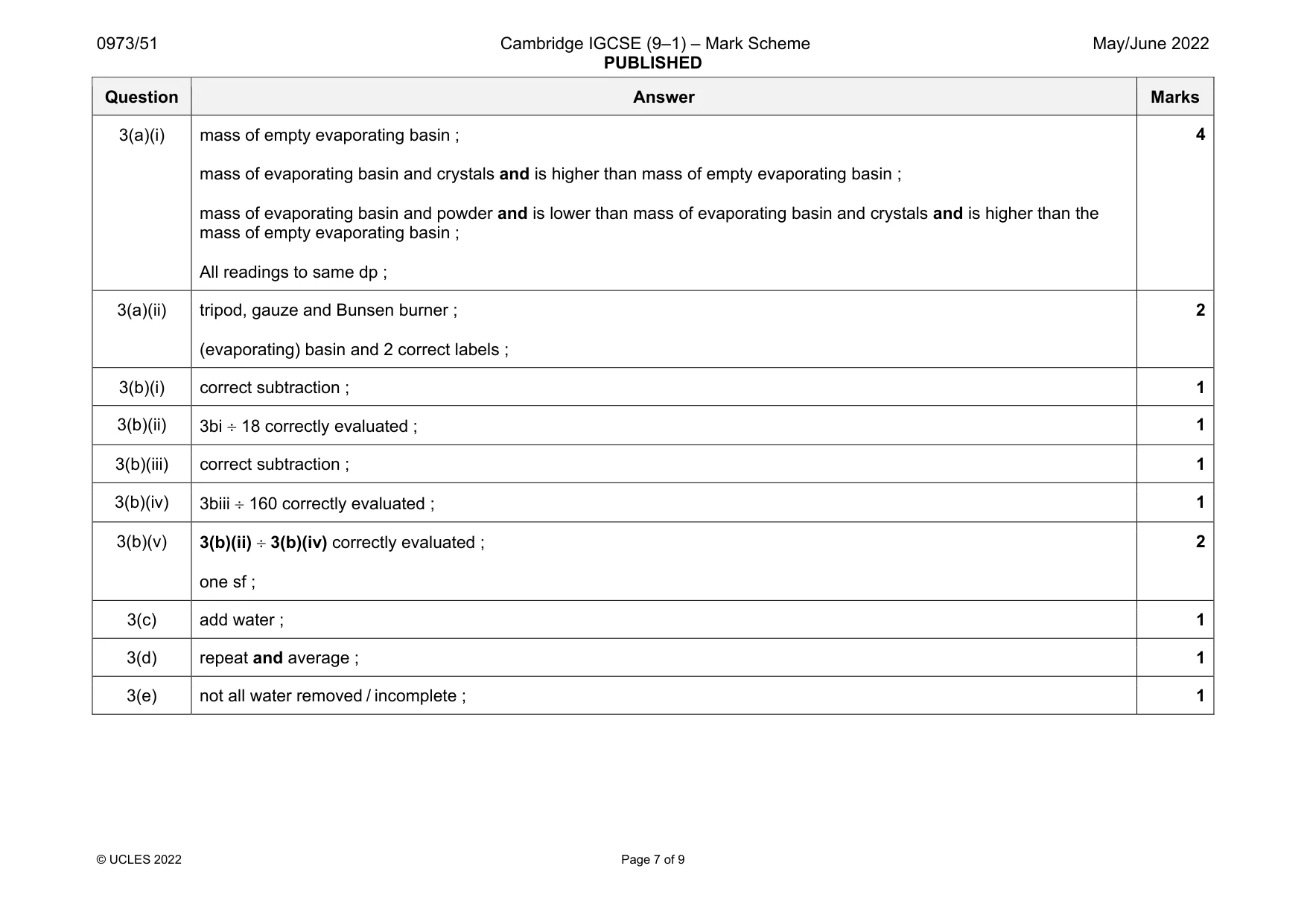
Mark scheme: 3(a)(i) mass of empty evaporating basin ; mass of evaporating basin and crystals and is higher than mass of empty evaporating basin ; mass of evaporating basin and powder and is lower than mass of evaporating basin and crystals and is higher than the mass of empty evaporating basin ; All readings to same dp ; 3(a)(ii) tripod, gauze and Bunsen burner ; (evaporating) basin and 2 correct labels ; 2 3(b)(i) correct subtraction ; 1 3(b)(ii) 3bi 18 correctly evaluated ; 1 3(b)(iii) correct subtraction ; 1 3(b)(iv) 3biii 160 correctly evaluated ; 1 3(b)(v) 3(b)(ii) 3(b)(iv) correctly evaluated ; one sf ; 2 3(c) add water ; 1 3(d) repeat and average ; 1 3(e) not all water removed / incomplete ; 1
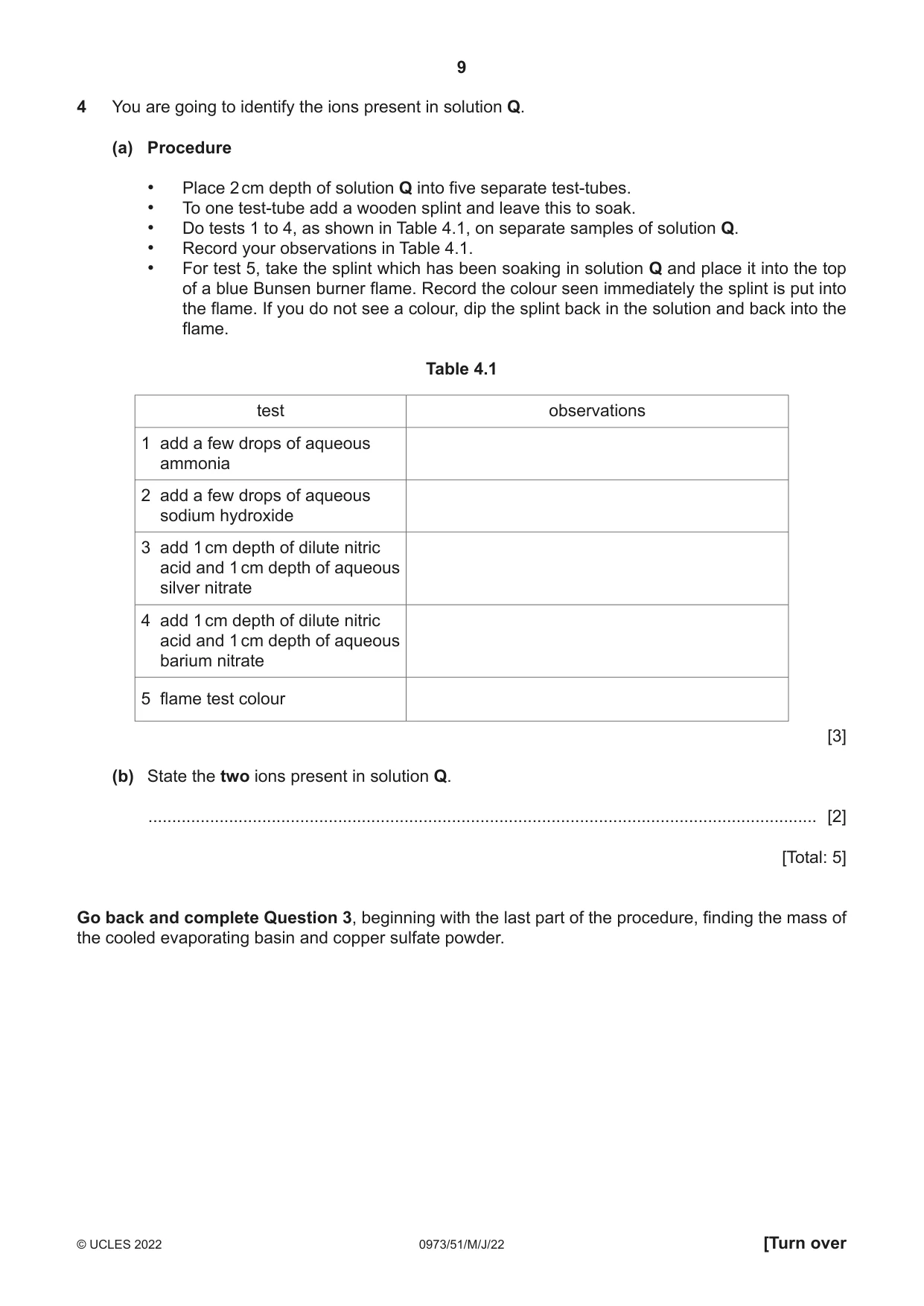
Q4 · You are going to identify the ions present in solution Q
4 You are going to identify the ions present in solution Q. (a) Procedure • Place 2 cm depth of solution Q into five separate test-tubes. • To one test-tube add a wooden splint and leave this to soak. • Do tests 1 to 4, as shown in Table 4.1, on separate samples of solution Q. • Record your observations in Table 4.1. • For test 5, take the splint which has been soaking in solution Q and place it into the top of a blue Bunsen burner flame. Record the colour seen immediately the splint is put into the flame. If you do not see a colour, dip the splint back in the solution and back into the flame. Table 4.1 test observations 1 add a few drops of aqueous ammonia 2 add a few drops of aqueous sodium hydroxide 3 add 1 cm depth of dilute nitric acid and 1 cm depth of aqueous silver nitrate 4 add 1 cm depth of dilute nitric acid and 1 cm depth of aqueous barium nitrate 5 flame test colour [3] (b) State the two ions present in solution Q. ............................................................................................................................................. [2] [Total: 5] Go back and complete Question 3, beginning with the last part of the procedure, finding the mass of the cooled evaporating basin and copper sulfate powder.
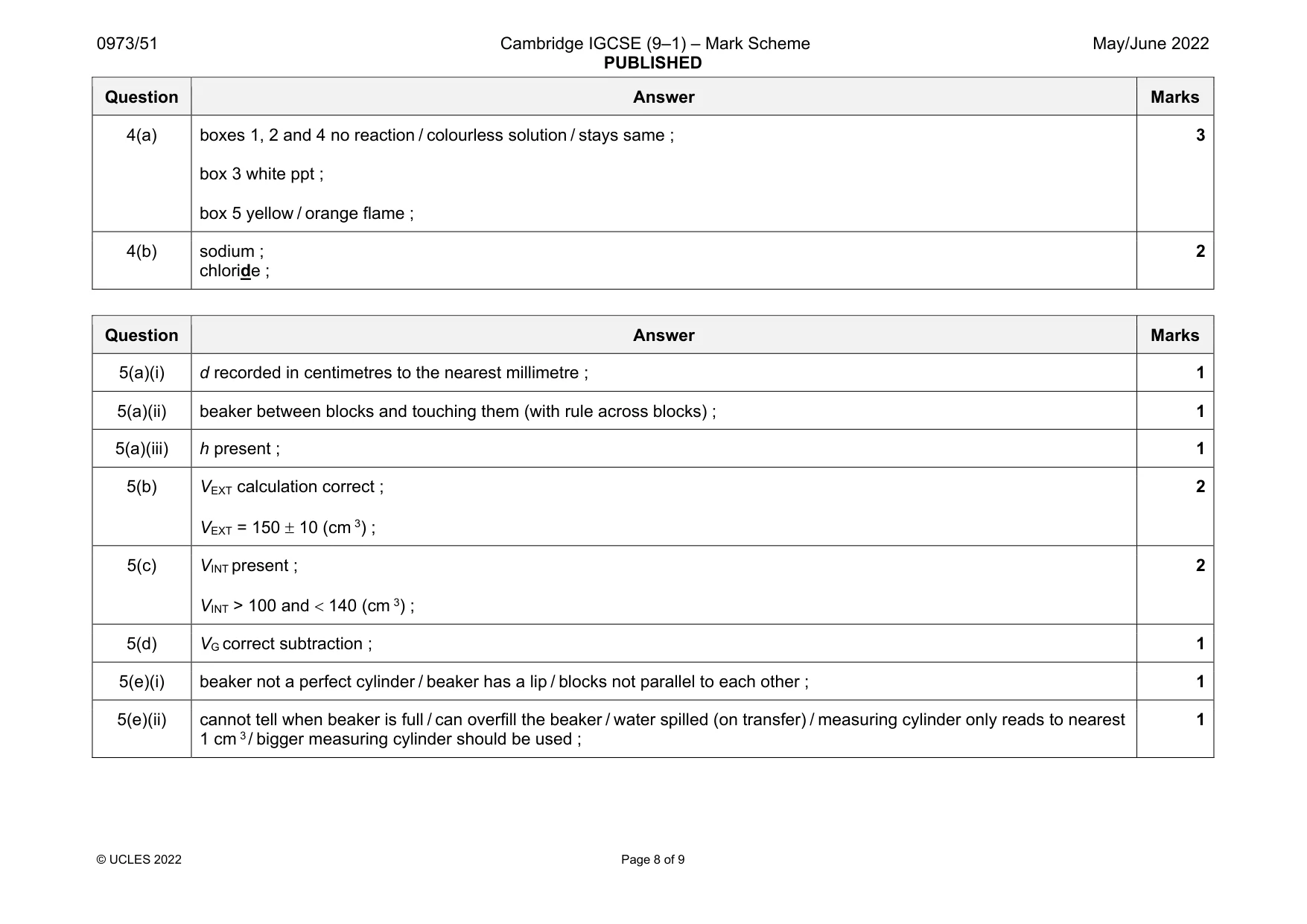
Mark scheme: 4(a) boxes 1, 2 and 4 no reaction / colourless solution / stays same ; box 3 white ppt ; box 5 yellow / orange flame ; 3 4(b) sodium ; chloride ; 2
Q5 · You are going to determine the volume of glass used to make a 100 cm3 beaker
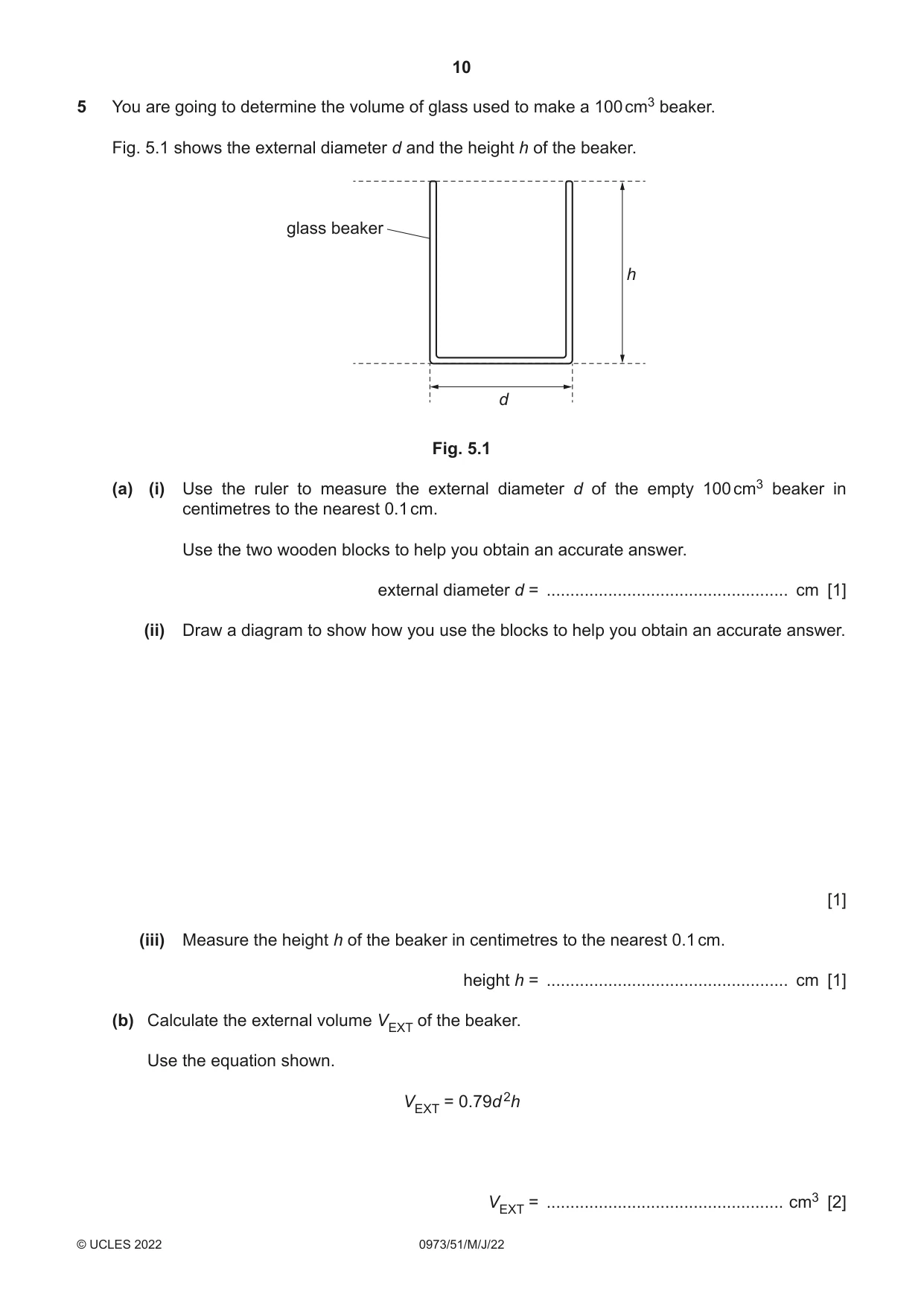
5 You are going to determine the volume of glass used to make a 100 cm3 beaker. Fig. 5.1 shows the external diameter d and the height h of the beaker. glass beaker h d Fig. 5.1 (a) (i) Use the ruler to measure the external diameter d of the empty 100 cm3 beaker in centimetres to the nearest 0.1 cm. Use the two wooden blocks to help you obtain an accurate answer. external diameter d = ................................................... cm [1] (ii) Draw a diagram to show how you use the blocks to help you obtain an accurate answer. [1] (iii) Measure the height h of the beaker in centimetres to the nearest 0.1 cm. height h = ................................................... cm [1] (b) Calculate the external volume VEXT of the beaker. Use the equation shown. VEXT = 0.79d 2h VEXT = .................................................. cm3 [2] (c) Fill the empty 100 cm3 beaker to the top with water. Use the measuring cylinder to measure the volume of water that the beaker contains. This is the internal volume VINT of the beaker. Use the space below to record any readings taken. VINT = .................................................. cm3 [2] (d) Calculate the volume VG of glass used to make the beaker. Use the equation shown. VG = VEXT –VINT VG = .................................................. cm3 [1] (e) Your answer for VG is approximate. State one source of error in measuring: (i) the external volume VEXT of the beaker. ........................................................................................................................................... ..................................................................................................................................... [1] (ii) the internal volume VINT of the beaker. ........................................................................................................................................... ..................................................................................................................................... [1] [Total: 10]
Mark scheme: 5(a)(i) d recorded in centimetres to the nearest millimetre ; 1 5(a)(ii) beaker between blocks and touching them (with rule across blocks) ; 1 5(a)(iii) h present ; 1 5(b) VEXT calculation correct ; VEXT = 150 10 (cm 3) ; 2 5(c) VINT present ; VINT > 100 and 140 (cm 3) ; 2 5(d) VG correct subtraction ; 1 5(e)(i) beaker not a perfect cylinder / beaker has a lip / blocks not parallel to each other ; 1 5(e)(ii) cannot tell when beaker is full / can overfill the beaker / water spilled (on transfer) / measuring cylinder only reads to nearest 1 cm 3 / bigger measuring cylinder should be used ; 1
More questions on Physical quantities and measurement techniques
Q6 · You are going to investigate how the resistance R of a lamp changes as the potential…
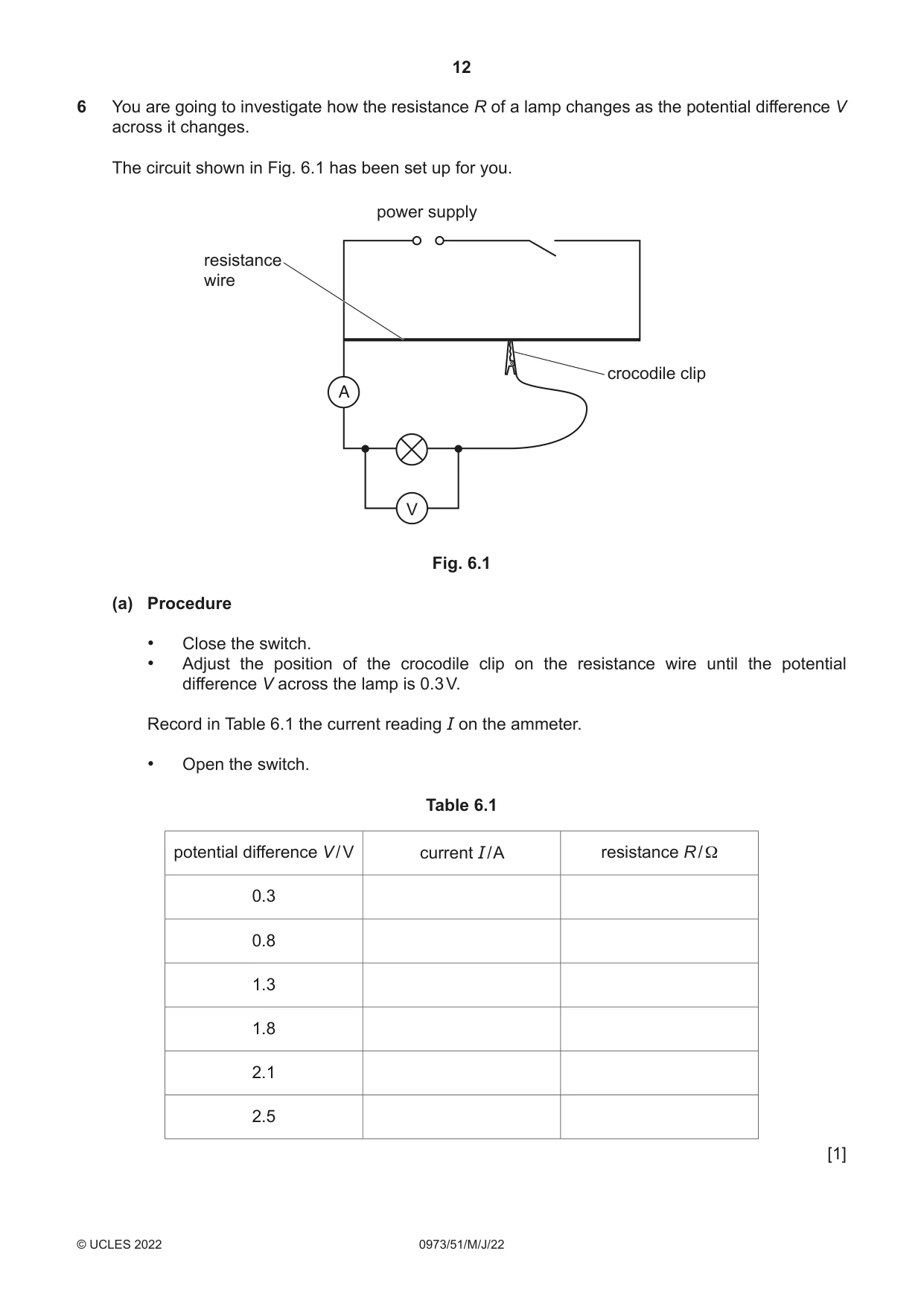
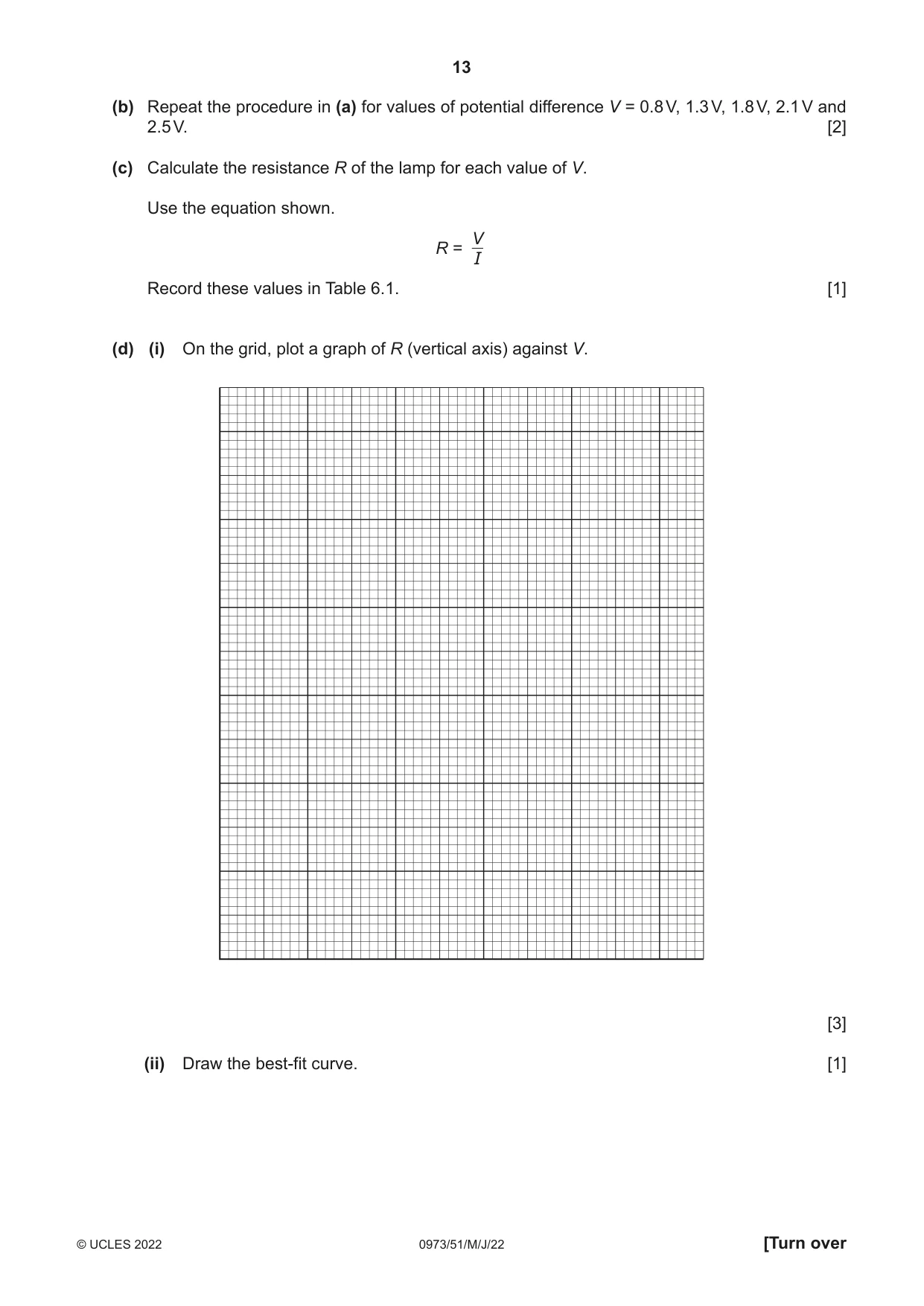
6 You are going to investigate how the resistance R of a lamp changes as the potential difference V across it changes. The circuit shown in Fig. 6.1 has been set up for you. power supply resistance wire crocodile clip A V Fig. 6.1 (a) Procedure • Close the switch. • Adjust the position of the crocodile clip on the resistance wire until the potential difference V across the lamp is 0.3 V. Record in Table 6.1 the current reading I on the ammeter. • Open the switch. Table 6.1 potential difference V / V current I / A resistance R / Ω 0.3 0.8 1.3 1.8 2.1 2.5 [1] (b) Repeat the procedure in (a) for values of potential difference V = 0.8 V, 1.3 V, 1.8 V, 2.1 V and 2.5 V. [2] (c) Calculate the resistance R of the lamp for each value of V. Use the equation shown. V R = I Record these values in Table 6.1. [1] (d) (i) On the grid, plot a graph of R (vertical axis) against V. [3] (ii) Draw the best-fit curve. [1] (e) Use your graph to describe in detail how the resistance of the lamp changes as the potential difference across it increases. ................................................................................................................................................... ................................................................................................................................................... ............................................................................................................................................. [2] [Total: 10]
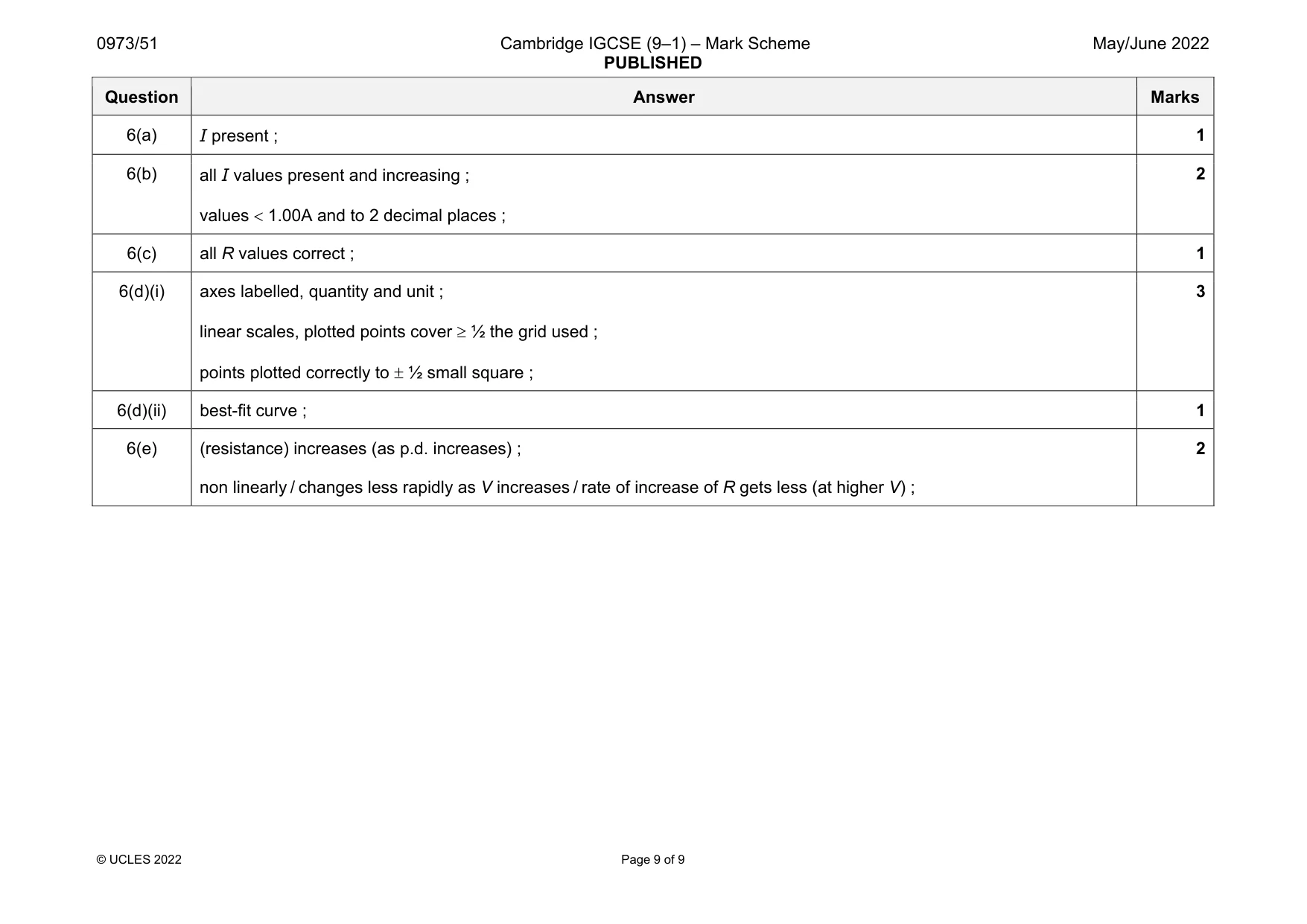
Mark scheme: 6(a) 1 6(b) all I values present and increasing ; values 1.00A and to 2 decimal places ; 2 6(c) all R values correct ; 1 6(d)(i) axes labelled, quantity and unit ; linear scales, plotted points cover ½ the grid used ; points plotted correctly to ½ small square ; 3 6(d)(ii) best-fit curve ; 1 6(e) (resistance) increases (as p.d. increases) ; non linearly / changes less rapidly as V increases / rate of increase of R gets less (at higher V) ; 2
What was in this paper
The subtopics covered by these 6 questions, and how many questions each got. Open one in a new tab to see every Cambridge question on it.
What you needed in this session
Cambridge’s own grade thresholds for 2022 May/June, Paper 5 · Variant 1. A higher threshold means an easier paper — the bar moves with how the cohort did.