Cambridge IGCSE Sciences - Co-ordinated (9-1) 0973 — 2022 May/June Paper 3 · Variant 2
0973/32/M/J/22 · 12 questions · 120 marks · ≈135 min
The question paper and its mark scheme, free to read here and free to download. This is Cambridge’s own paper, exactly as it was sat.
Question paper32 pages



Mark scheme12 pages
Answers below. Sit the paper first if you are practising.
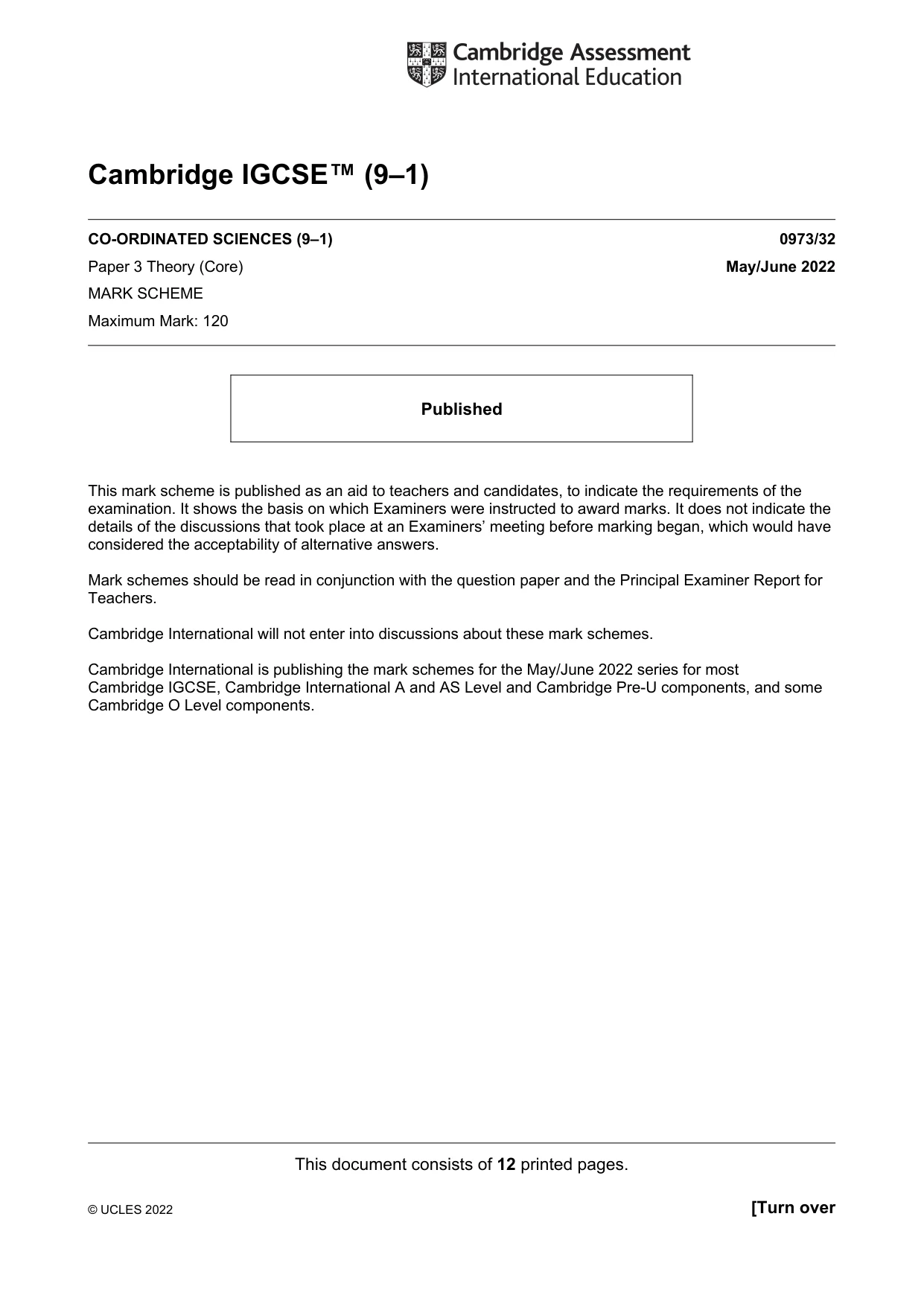
Questions as text
Q1 · Three different types of neurones
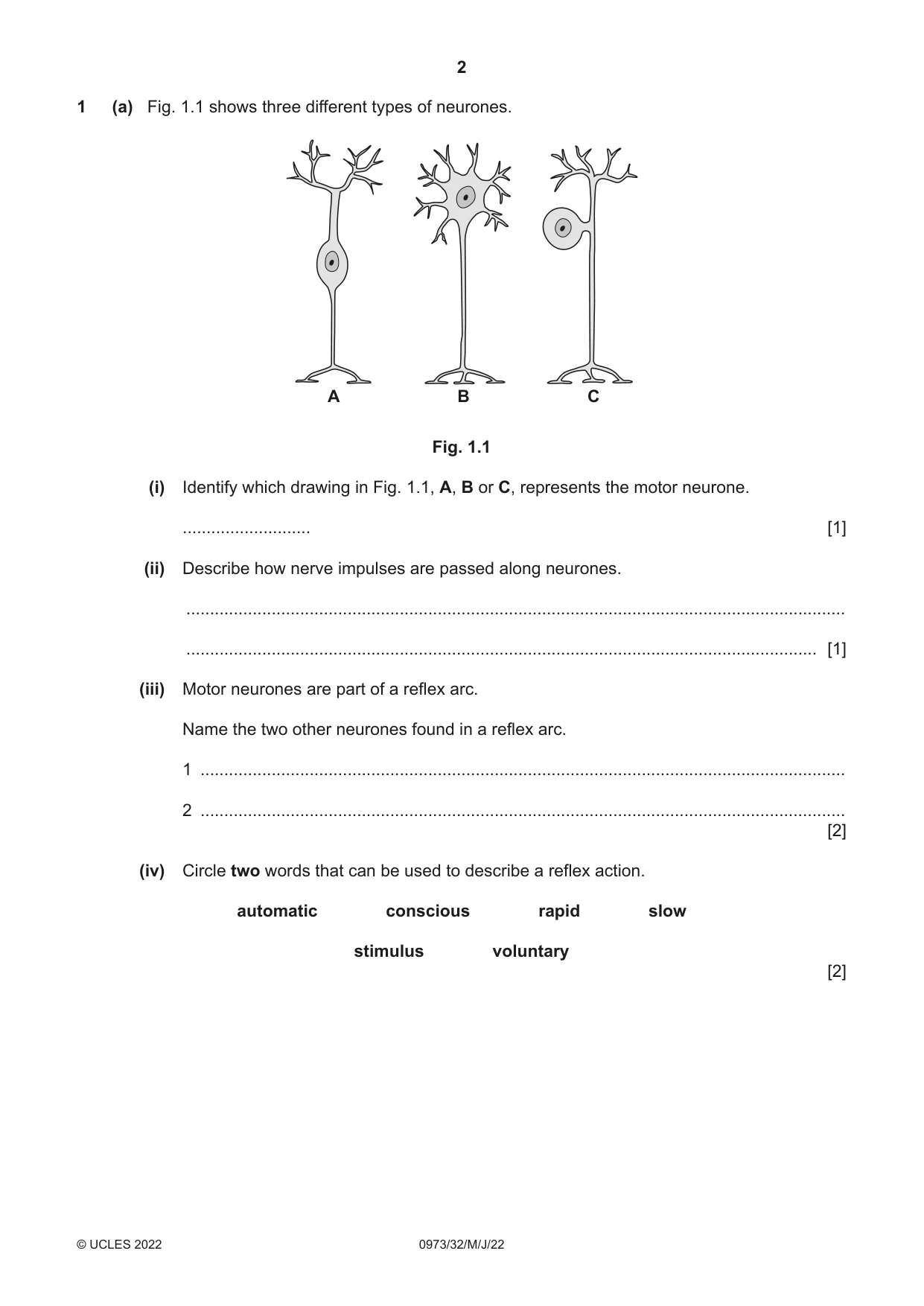
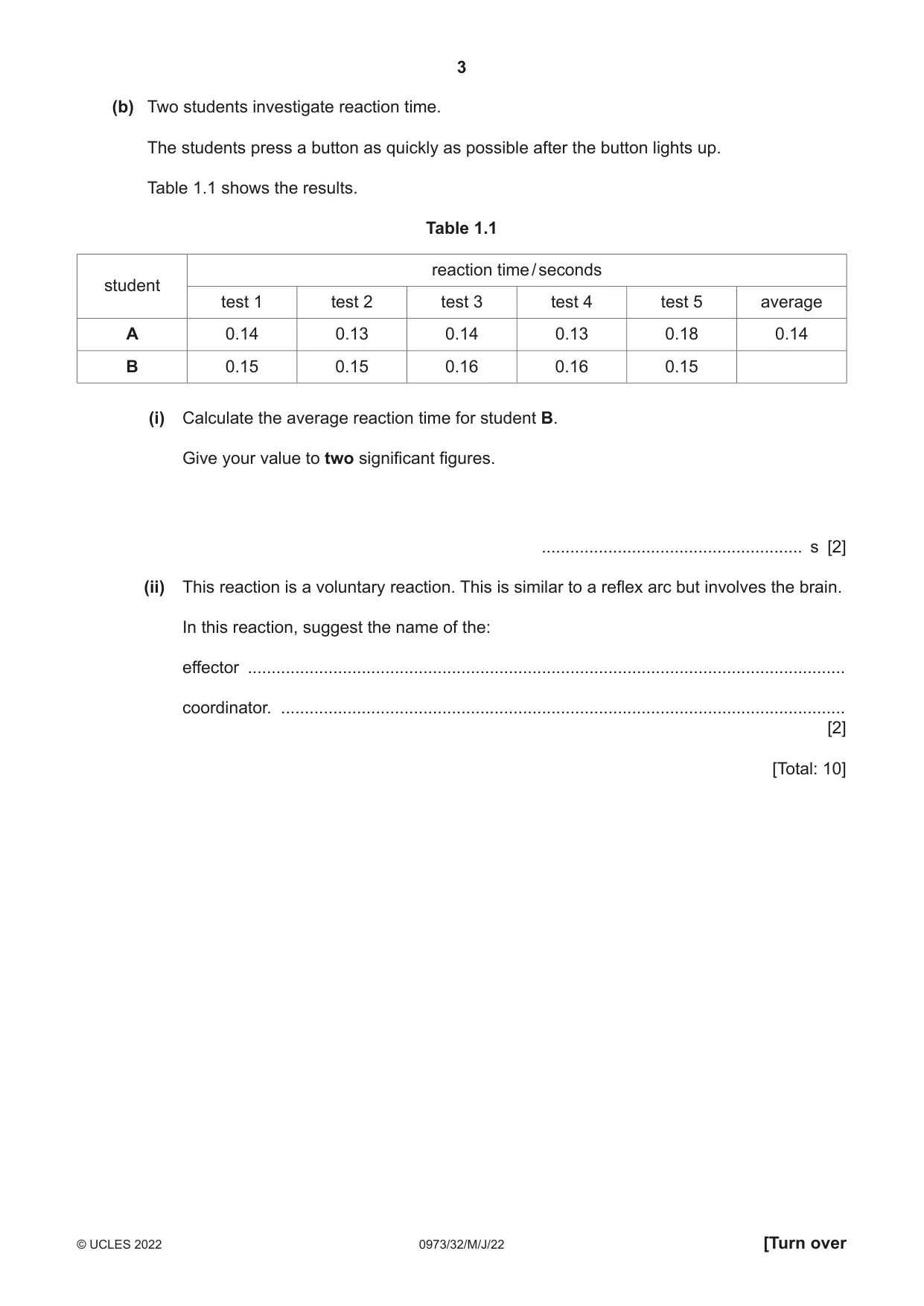
1 (a) Fig. 1.1 shows three different types of neurones. A B C Fig. 1.1 (i) Identify which drawing in Fig. 1.1, A, B or C, represents the motor neurone. ........................... [1] (ii) Describe how nerve impulses are passed along neurones. ........................................................................................................................................... ..................................................................................................................................... [1] (iii) Motor neurones are part of a reflex arc. Name the two other neurones found in a reflex arc. 1 ........................................................................................................................................ 2 ........................................................................................................................................ [2] (iv) Circle two words that can be used to describe a reflex action. automatic conscious rapid slow stimulus voluntary [2] (b) Two students investigate reaction time. The students press a button as quickly as possible after the button lights up. Table 1.1 shows the results. Table 1.1 reaction time / seconds student test 1 test 2 test 3 test 4 test 5 average A 0.14 0.13 0.14 0.13 0.18 0.14 B 0.15 0.15 0.16 0.16 0.15 (i) Calculate the average reaction time for student B. Give your value to two significant figures. ....................................................... s [2] (ii) This reaction is a voluntary reaction. This is similar to a reflex arc but involves the brain. In this reaction, suggest the name of the: effector .............................................................................................................................. coordinator. ....................................................................................................................... [2] [Total: 10]
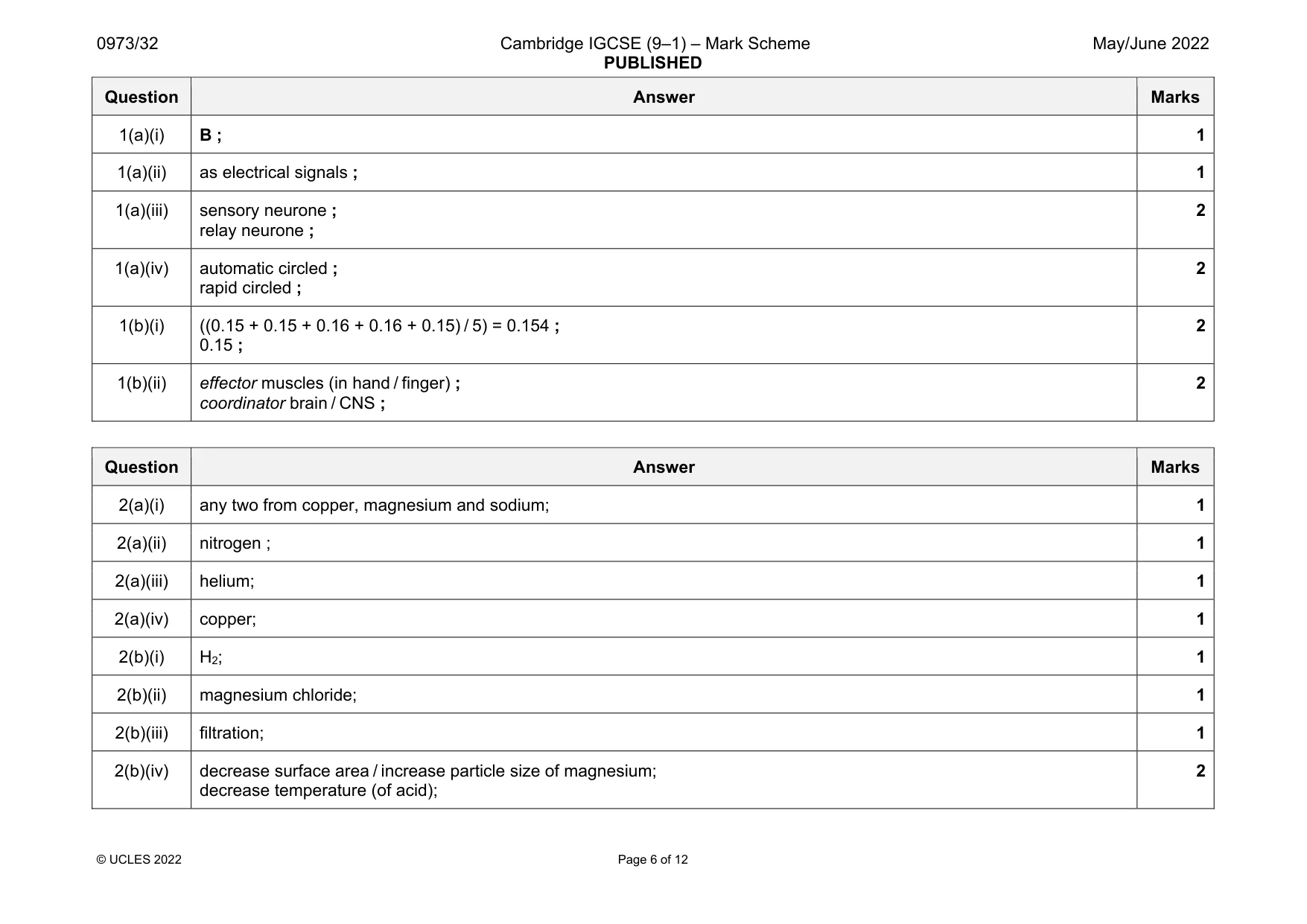
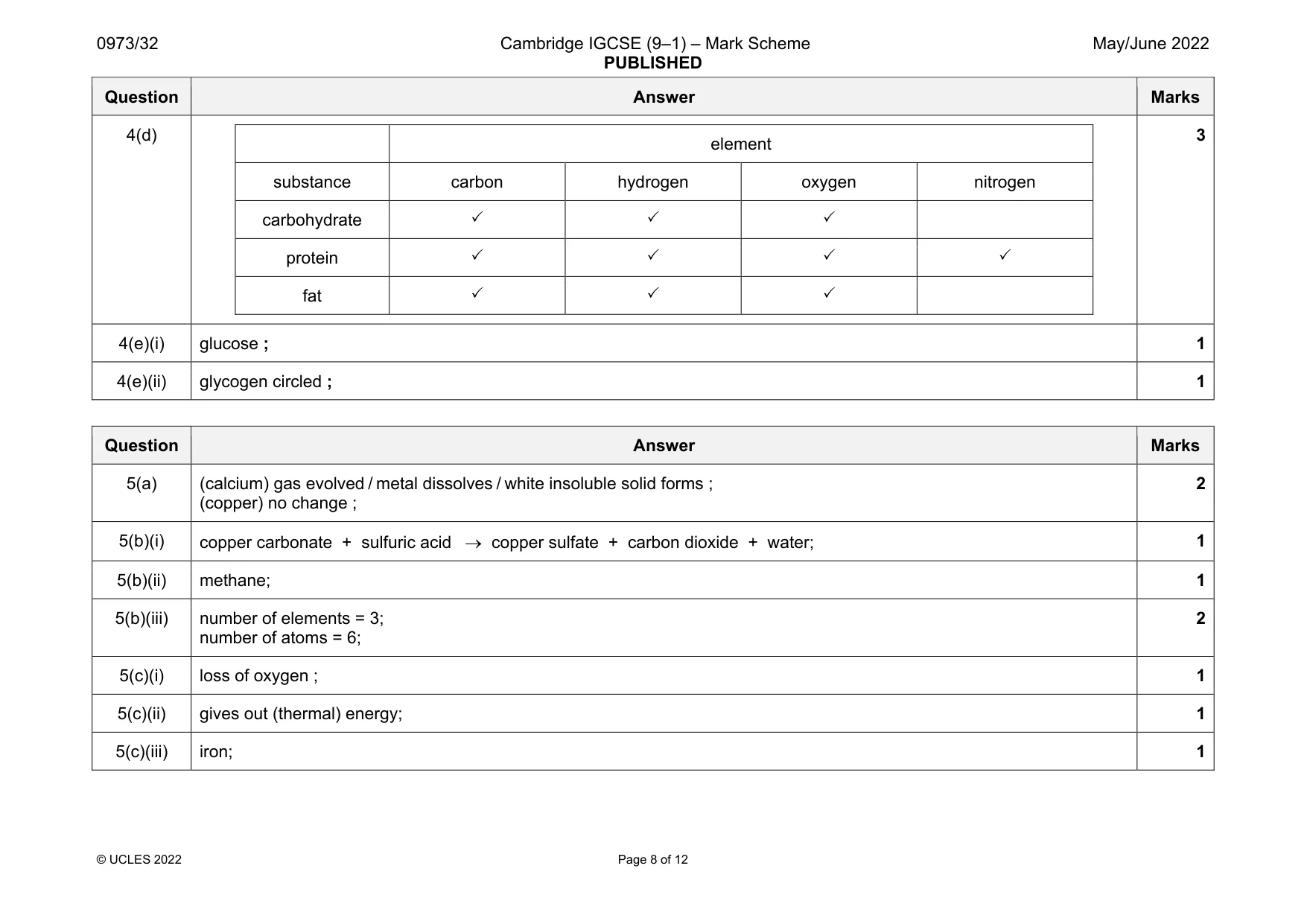
Mark scheme: 1(a)(i) B ; 1 1(a)(ii) as electrical signals ; 1 1(a)(iii) sensory neurone ; relay neurone ; 2 1(a)(iv) automatic circled ; rapid circled ; 2 1(b)(i) ((0.15 + 0.15 + 0.16 + 0.16 + 0.15) / 5) = 0.154 ; 0.15 ; 2 1(b)(ii) effector muscles (in hand / finger) ; coordinator brain / CNS ; 2
Q2 · A list of six elements
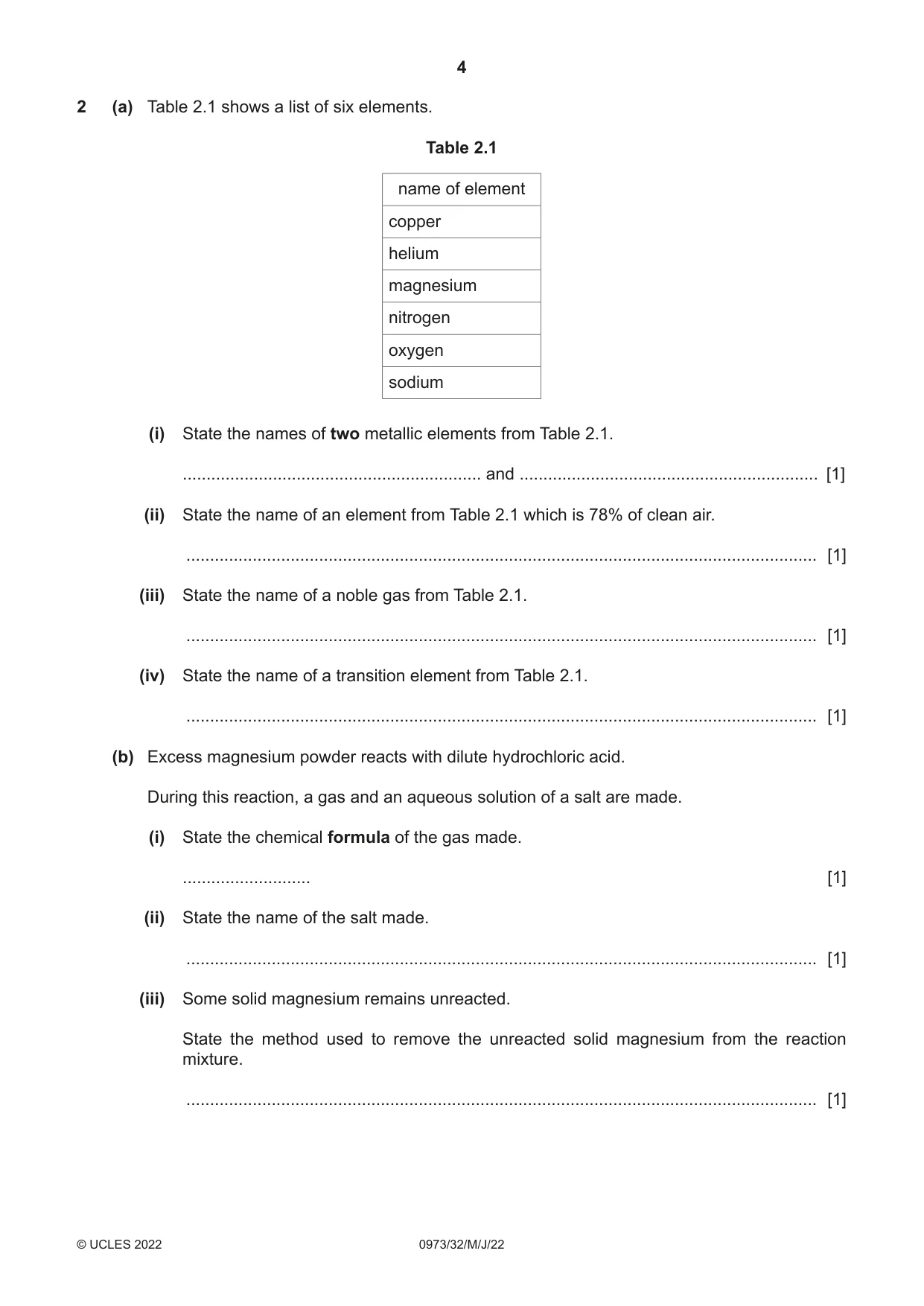
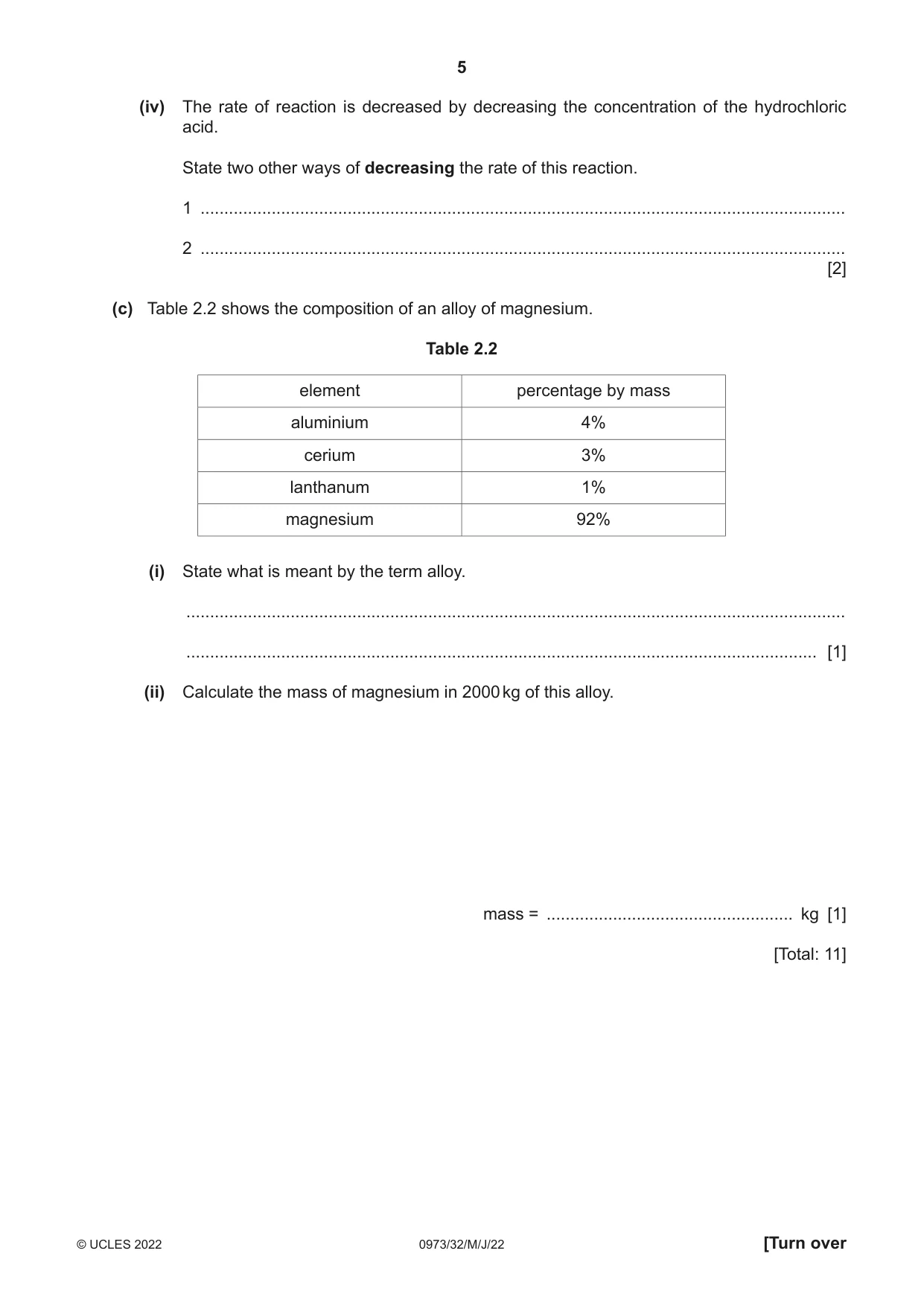
2 (a) Table 2.1 shows a list of six elements. Table 2.1 name of element copper helium magnesium nitrogen oxygen sodium (i) State the names of two metallic elements from Table 2.1. ............................................................... and ............................................................... [1] (ii) State the name of an element from Table 2.1 which is 78% of clean air. ..................................................................................................................................... [1] (iii) State the name of a noble gas from Table 2.1. ..................................................................................................................................... [1] (iv) State the name of a transition element from Table 2.1. ..................................................................................................................................... [1] (b) Excess magnesium powder reacts with dilute hydrochloric acid. During this reaction, a gas and an aqueous solution of a salt are made. (i) State the chemical formula of the gas made. ........................... [1] (ii) State the name of the salt made. ..................................................................................................................................... [1] (iii) Some solid magnesium remains unreacted. State the method used to remove the unreacted solid magnesium from the reaction mixture. ..................................................................................................................................... [1] (iv) The rate of reaction is decreased by decreasing the concentration of the hydrochloric acid. State two other ways of decreasing the rate of this reaction. 1 ........................................................................................................................................ 2 ........................................................................................................................................ [2] (c) Table 2.2 shows the composition of an alloy of magnesium. Table 2.2 element percentage by mass aluminium 4% cerium 3% lanthanum 1% magnesium 92% (i) State what is meant by the term alloy. ........................................................................................................................................... ..................................................................................................................................... [1] (ii) Calculate the mass of magnesium in 2000 kg of this alloy. mass = .................................................... kg [1] [Total: 11]
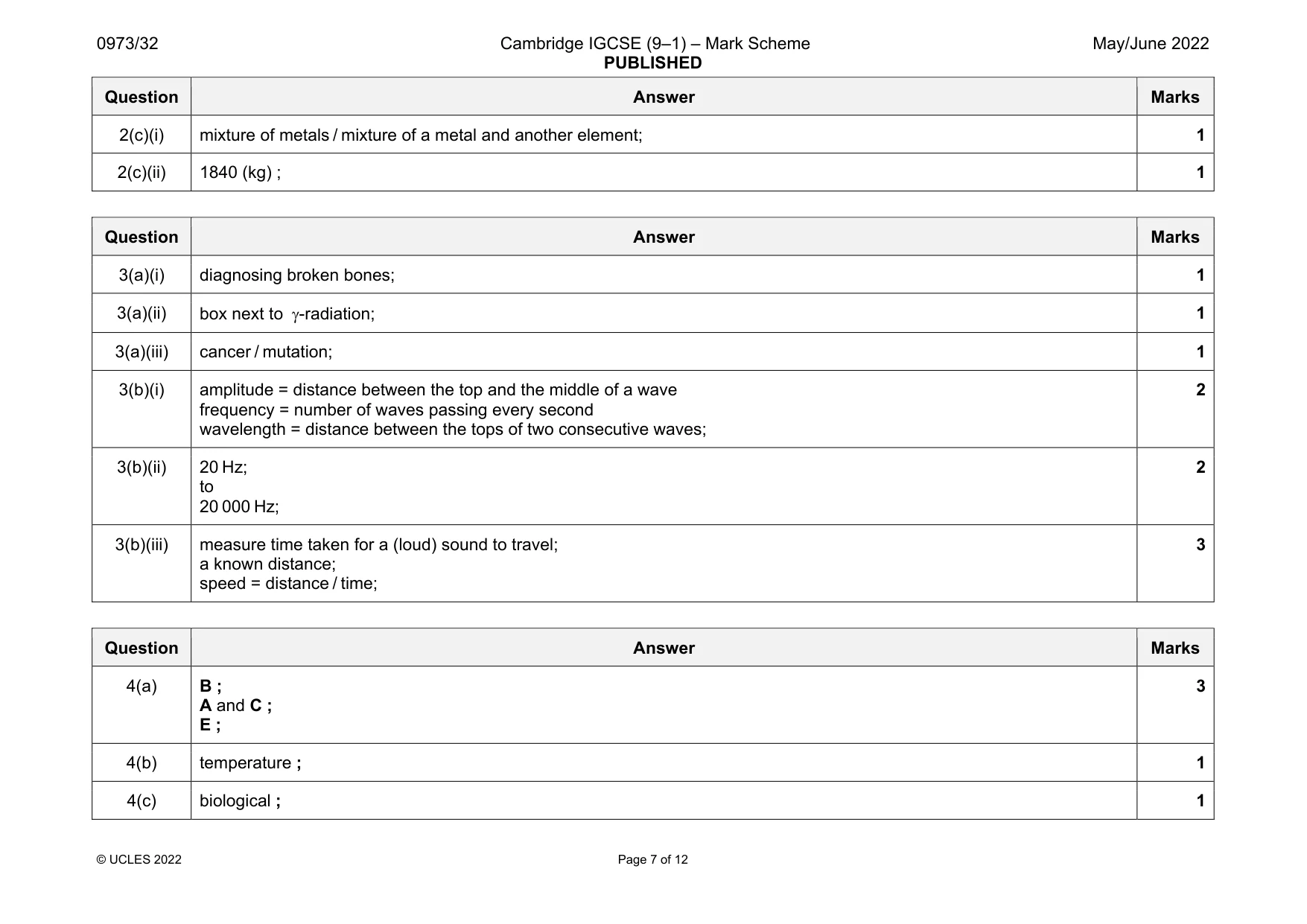
Mark scheme: 2(a)(i) any two from copper, magnesium and sodium; 1 2(a)(ii) nitrogen ; 1 2(a)(iii) helium; 1 2(a)(iv) copper; 1 2(b)(i) H2; 1 2(b)(ii) magnesium chloride; 1 2(b)(iii) filtration; 1 2(b)(iv) decrease surface area / increase particle size of magnesium; decrease temperature (of acid); 2 Question Answer Marks 2(c)(i) mixture of metals / mixture of a metal and another element; 1 2(c)(ii) 1840 (kg) ; 1
More questions on The characteristic properties of acids and bases
Q3 · X-rays and γ-radiation are used in hospitals
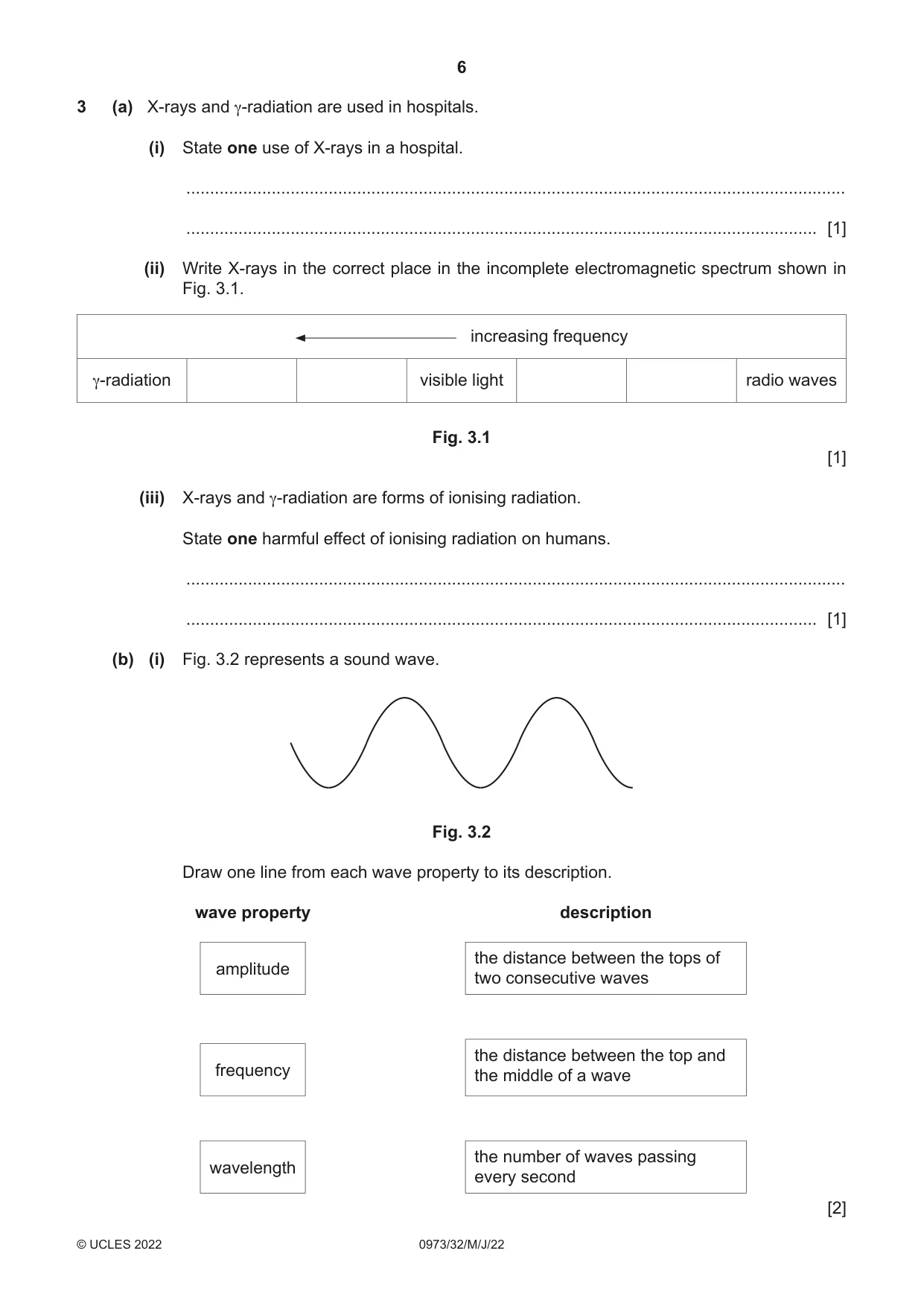
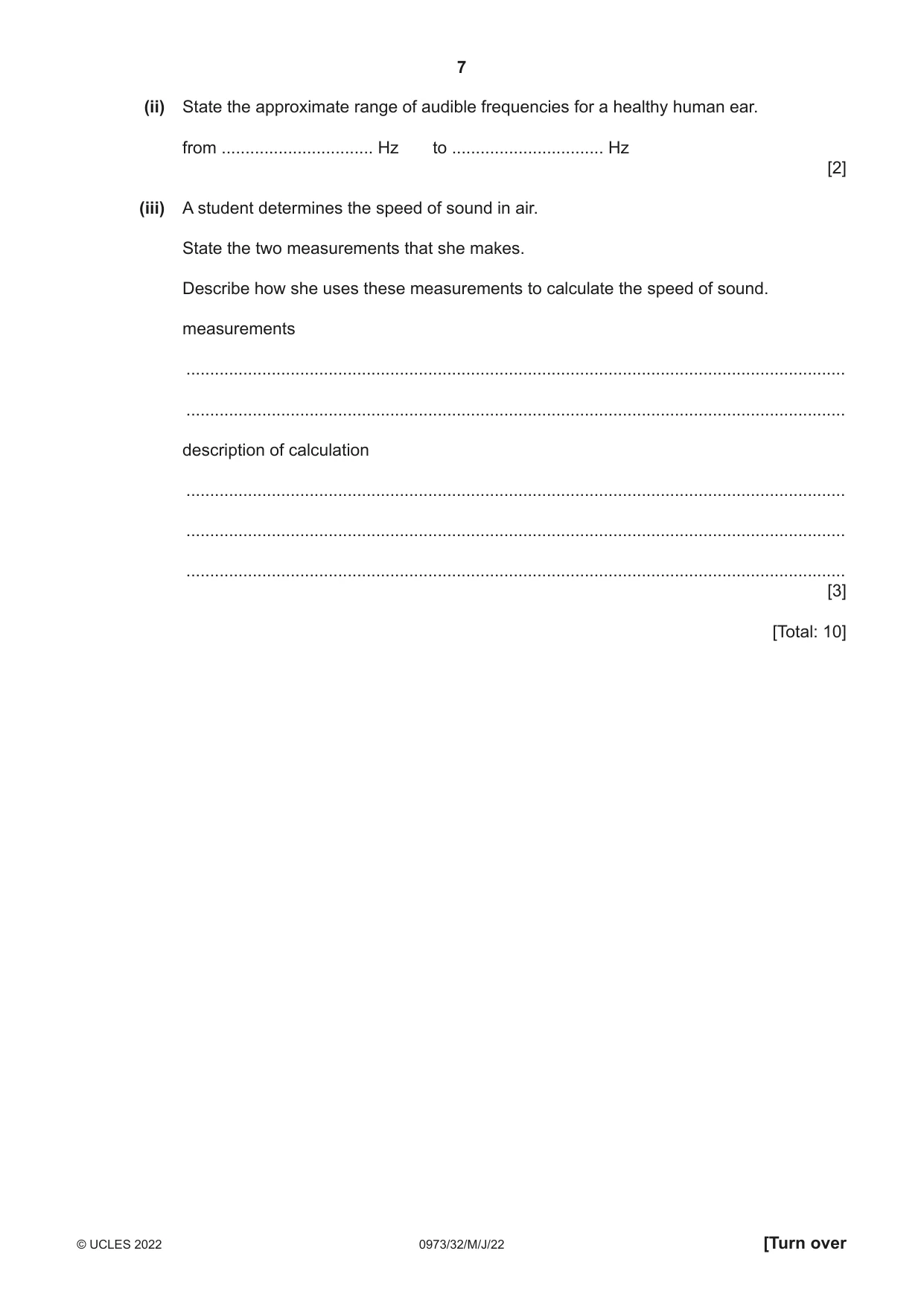
3 (a) X-rays and γ-radiation are used in hospitals. (i) State one use of X-rays in a hospital. ........................................................................................................................................... ..................................................................................................................................... [1] (ii) Write X-rays in the correct place in the incomplete electromagnetic spectrum shown in Fig. 3.1. increasing frequency γ-radiation visible light radio waves Fig. 3.1 [1] (iii) X-rays and γ-radiation are forms of ionising radiation. State one harmful effect of ionising radiation on humans. ........................................................................................................................................... ..................................................................................................................................... [1] (b) (i) Fig. 3.2 represents a sound wave. Fig. 3.2 Draw one line from each wave property to its description. wave property description the distance between the tops of amplitude two consecutive waves the distance between the top and frequency the middle of a wave the number of waves passing wavelength every second [2] (ii) State the approximate range of audible frequencies for a healthy human ear. from ................................ Hz to ................................ Hz [2] (iii) A student determines the speed of sound in air. State the two measurements that she makes. Describe how she uses these measurements to calculate the speed of sound. measurements ........................................................................................................................................... ........................................................................................................................................... description of calculation ........................................................................................................................................... ........................................................................................................................................... ........................................................................................................................................... [3] [Total: 10]
Mark scheme: 3(a)(i) diagnosing broken bones; 1 3(a)(ii) box next to -radiation; 1 3(a)(iii) cancer / mutation; 1 3(b)(i) amplitude = distance between the top and the middle of a wave frequency = number of waves passing every second wavelength = distance between the tops of two consecutive waves; 2 3(b)(ii) 20 Hz; to 20 000 Hz; 2 3(b)(iii) measure time taken for a (loud) sound to travel; a known distance; speed = distance / time; 3
Q4 · Different digestive enzymes work best at different pH values
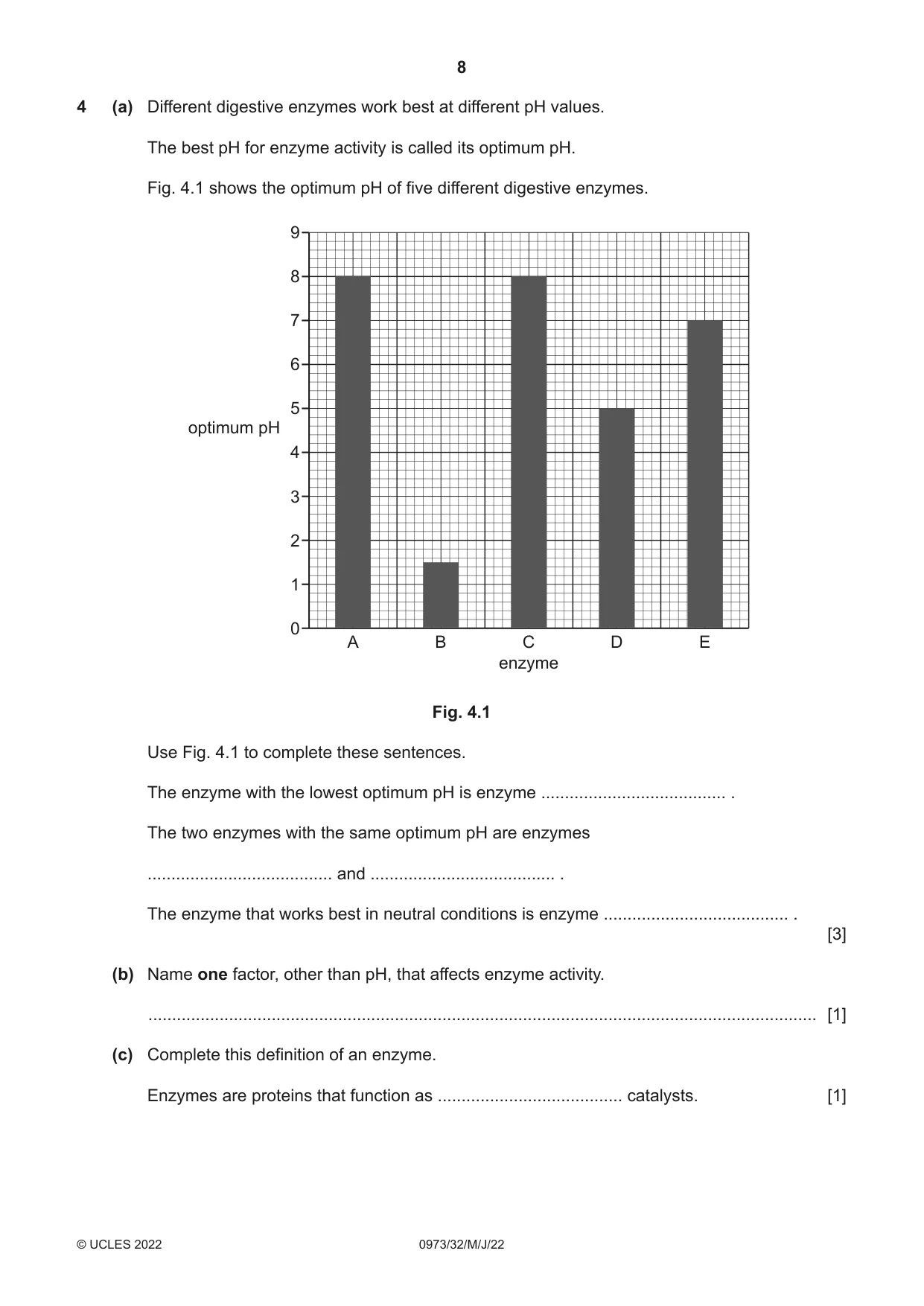
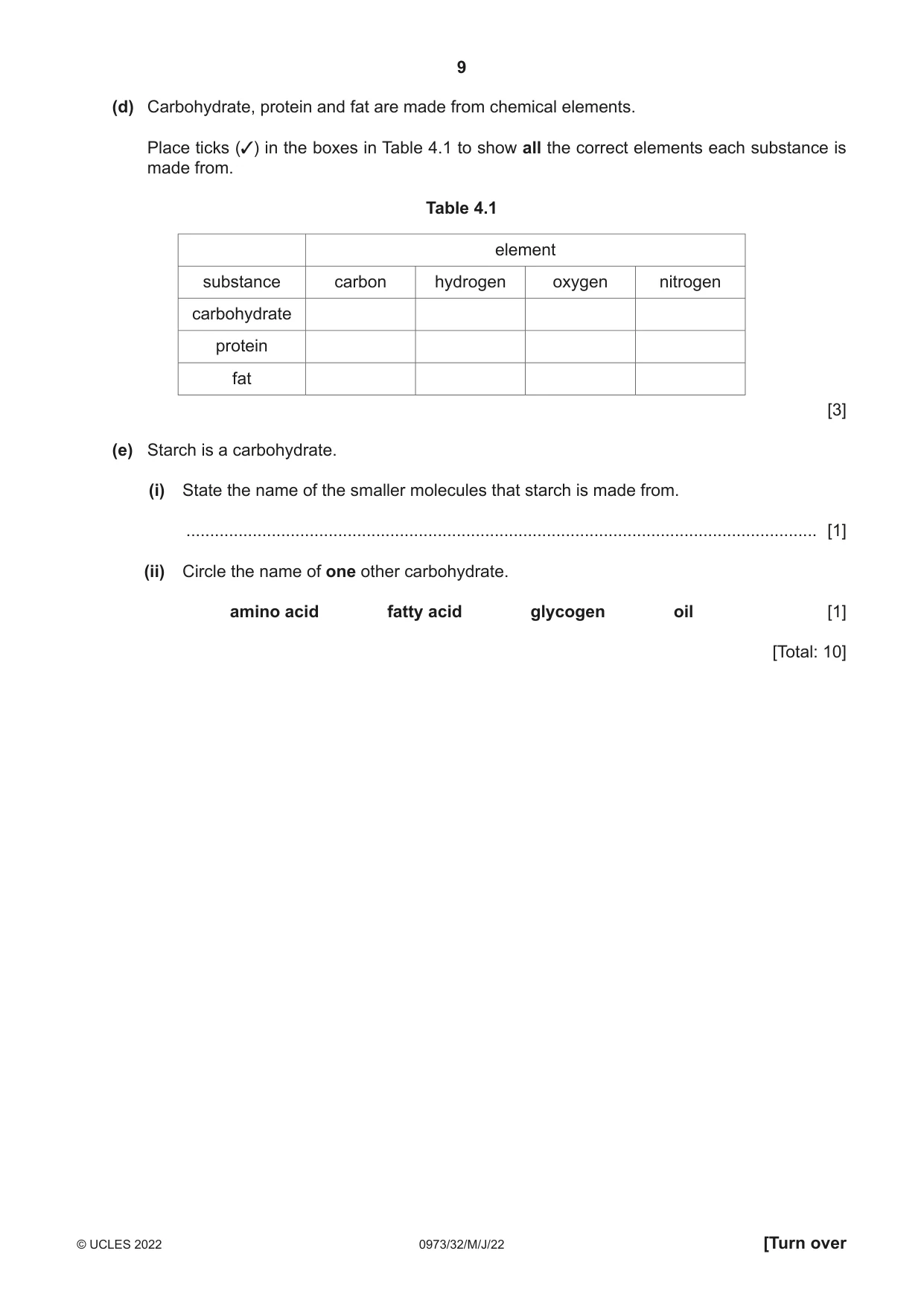
4 (a) Different digestive enzymes work best at different pH values. The best pH for enzyme activity is called its optimum pH. Fig. 4.1 shows the optimum pH of five different digestive enzymes. 9 8 7 6 5 optimum pH 4 3 2 1 0 A B C D E enzyme Fig. 4.1 Use Fig. 4.1 to complete these sentences. The enzyme with the lowest optimum pH is enzyme ....................................... . The two enzymes with the same optimum pH are enzymes ....................................... and ....................................... . The enzyme that works best in neutral conditions is enzyme ....................................... . [3] (b) Name one factor, other than pH, that affects enzyme activity. ............................................................................................................................................. [1] (c) Complete this definition of an enzyme. Enzymes are proteins that function as ....................................... catalysts. [1] (d) Carbohydrate, protein and fat are made from chemical elements. Place ticks (3) in the boxes in Table 4.1 to show all the correct elements each substance is made from. Table 4.1 element substance carbon hydrogen oxygen nitrogen carbohydrate protein fat [3] (e) Starch is a carbohydrate. (i) State the name of the smaller molecules that starch is made from. ..................................................................................................................................... [1] (ii) Circle the name of one other carbohydrate. amino acid fatty acid glycogen oil [1] [Total: 10]
Mark scheme: 4(a) B ; A and C ; E ; 3 4(b) temperature ; 1 4(c) biological ; 1 Question Answer Marks 4(d) element substance carbon hydrogen oxygen nitrogen carbohydrate protein fat 3 4(e)(i) glucose ; 1 4(e)(ii) glycogen circled ; 1
Q5 · A student adds calcium and copper to separate test-tubes of cold water
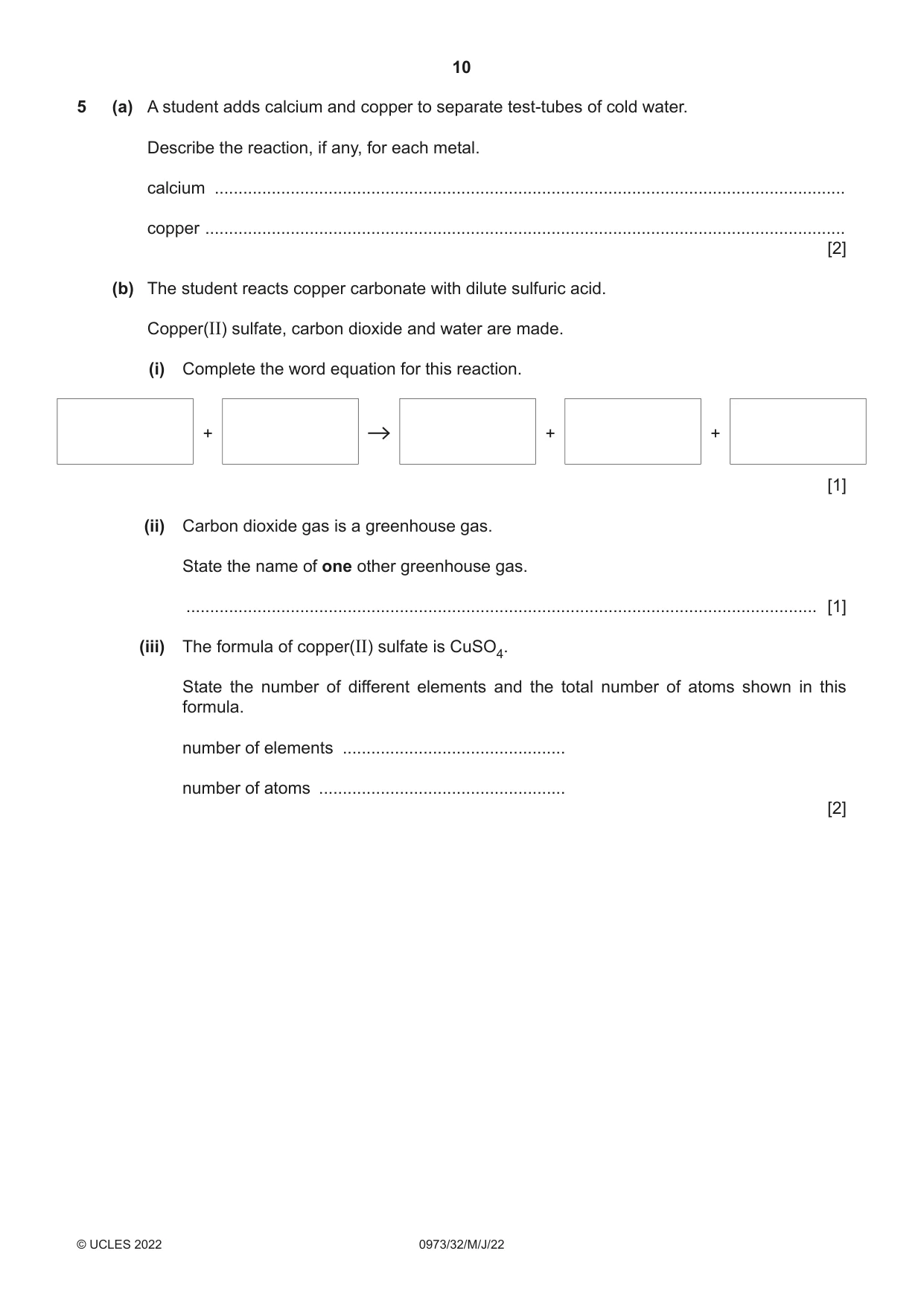
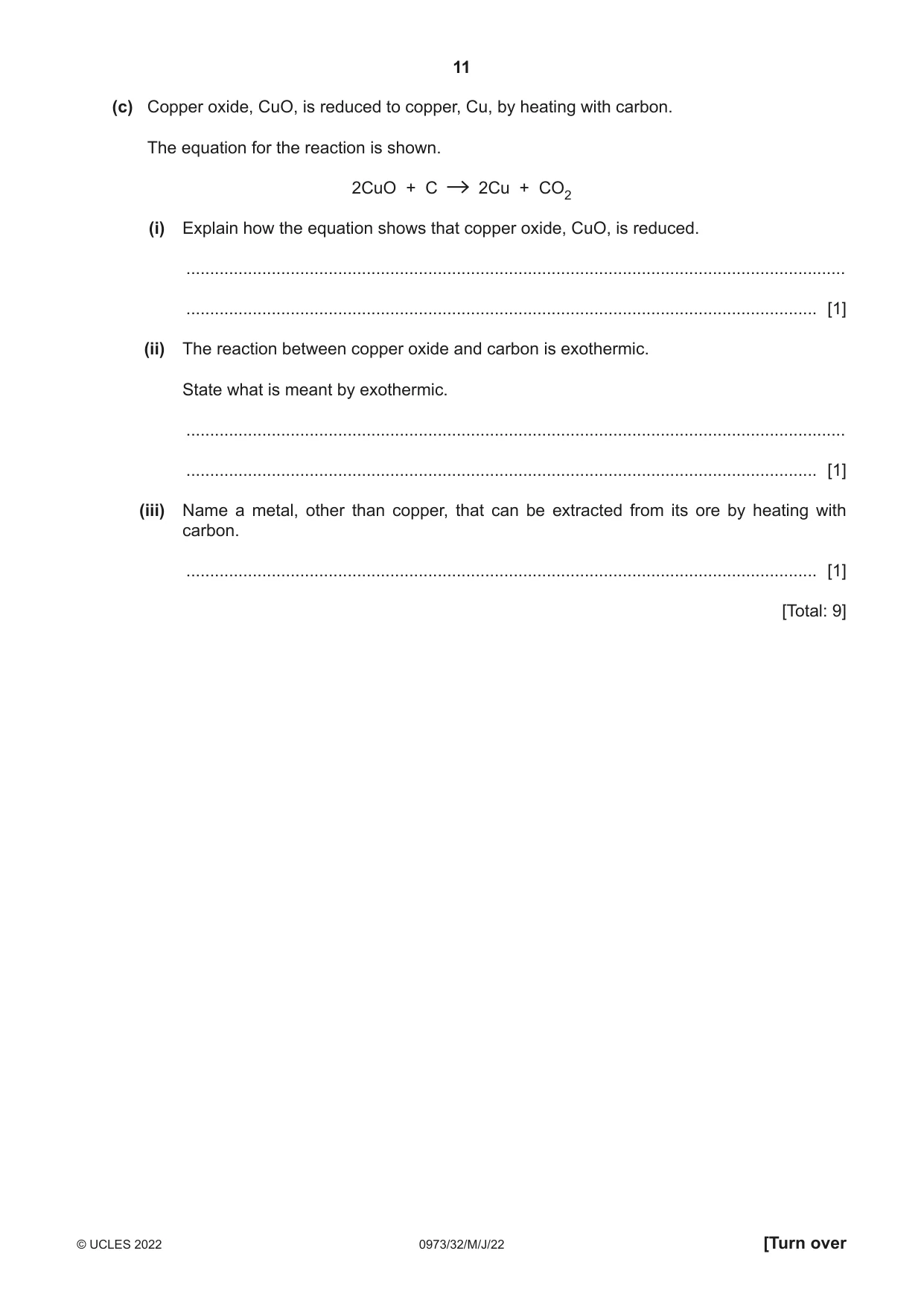
5 (a) A student adds calcium and copper to separate test-tubes of cold water. Describe the reaction, if any, for each metal. calcium ..................................................................................................................................... copper ....................................................................................................................................... [2] (b) The student reacts copper carbonate with dilute sulfuric acid. Copper(II) sulfate, carbon dioxide and water are made. (i) Complete the word equation for this reaction. + + + [1] (ii) Carbon dioxide gas is a greenhouse gas. State the name of one other greenhouse gas. ..................................................................................................................................... [1] (iii) The formula of copper(II) sulfate is CuSO4. State the number of different elements and the total number of atoms shown in this formula. number of elements ............................................... number of atoms .................................................... [2] (c) Copper oxide, CuO, is reduced to copper, Cu, by heating with carbon. The equation for the reaction is shown. 2CuO + C 2Cu + CO2 (i) Explain how the equation shows that copper oxide, CuO, is reduced. ........................................................................................................................................... ..................................................................................................................................... [1] (ii) The reaction between copper oxide and carbon is exothermic. State what is meant by exothermic. ........................................................................................................................................... ..................................................................................................................................... [1] (iii) Name a metal, other than copper, that can be extracted from its ore by heating with carbon. ..................................................................................................................................... [1] [Total: 9]
Mark scheme: 5(a) (calcium) gas evolved / metal dissolves / white insoluble solid forms ; (copper) no change ; 2 5(b)(i) copper carbonate + sulfuric acid copper sulfate + carbon dioxide + water; 1 5(b)(ii) methane; 1 5(b)(iii) number of elements = 3; number of atoms = 6; 2 5(c)(i) loss of oxygen ; 1 5(c)(ii) gives out (thermal) energy; 1 5(c)(iii) iron; 1
More questions on The characteristic properties of acids and bases
Q6 · A farmer uses solar panels to generate the electricity needed for his farm
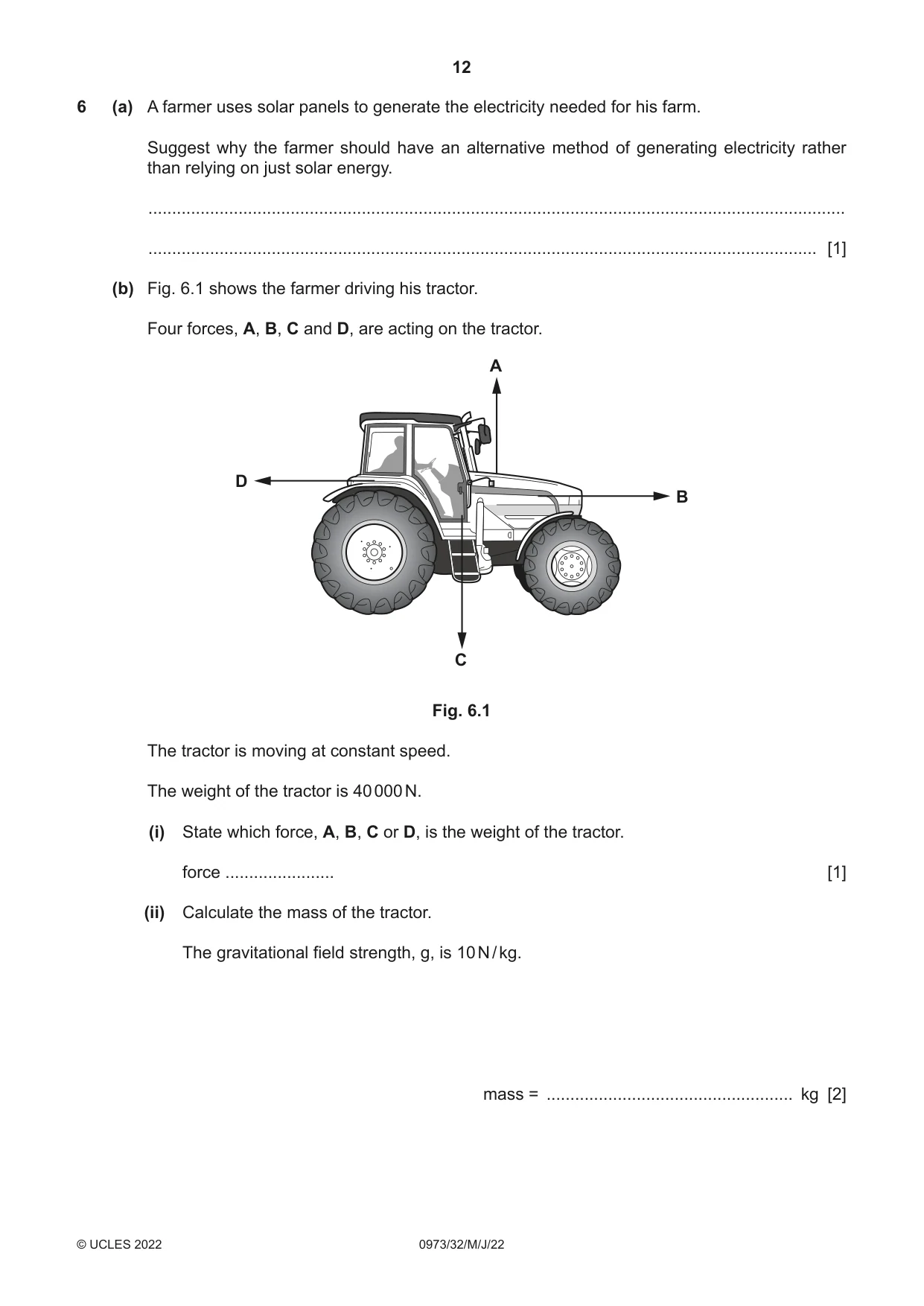
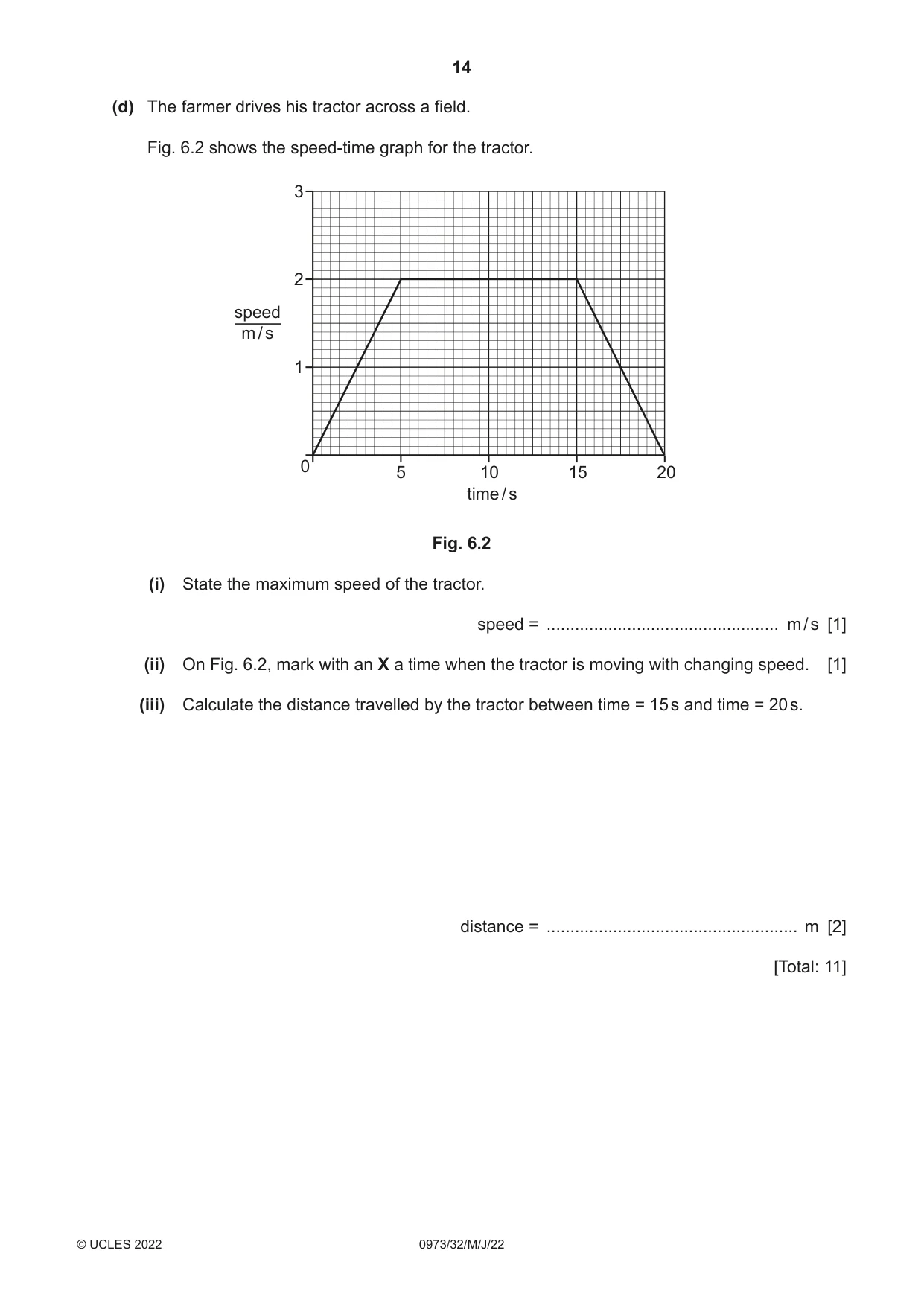
6 (a) A farmer uses solar panels to generate the electricity needed for his farm. Suggest why the farmer should have an alternative method of generating electricity rather than relying on just solar energy. ................................................................................................................................................... ............................................................................................................................................. [1] (b) Fig. 6.1 shows the farmer driving his tractor. Four forces, A, B, C and D, are acting on the tractor. A D B C Fig. 6.1 The tractor is moving at constant speed. The weight of the tractor is 40 000 N. (i) State which force, A, B, C or D, is the weight of the tractor. force ....................... [1] (ii) Calculate the mass of the tractor. The gravitational field strength, g, is 10 N / kg. mass = .................................................... kg [2] (iii) Force B is 2000 N. State the value of force D. Explain your answer. force D = ................................. N explanation ........................................................................................................................................... ........................................................................................................................................... [2] (c) The tractor uses diesel fuel. State the form of energy stored in the diesel fuel. ............................................................................................................................................. [1] (d) The farmer drives his tractor across a field. Fig. 6.2 shows the speed-time graph for the tractor. 3 2 speed m / s 1 0 5 10 15 20 time / s Fig. 6.2 (i) State the maximum speed of the tractor. speed = ................................................. m / s [1] (ii) On Fig. 6.2, mark with an X a time when the tractor is moving with changing speed. [1] (iii) Calculate the distance travelled by the tractor between time = 15 s and time = 20 s. distance = ..................................................... m [2] [Total: 11]
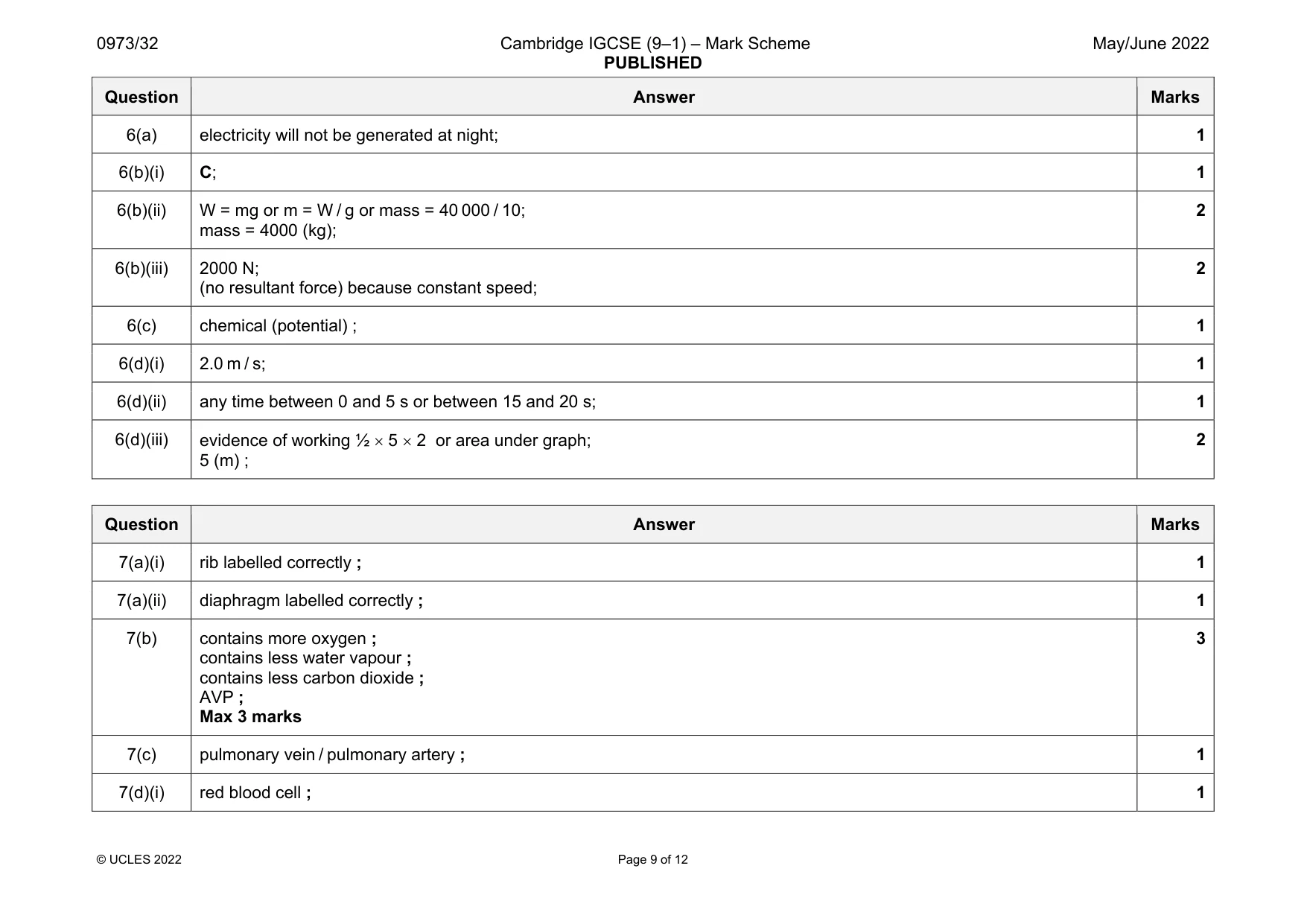
Mark scheme: 6(a) electricity will not be generated at night; 1 6(b)(i) C; 1 6(b)(ii) W = mg or m = W / g or mass = 40 000 / 10; mass = 4000 (kg); 2 6(b)(iii) 2000 N; (no resultant force) because constant speed; 2 6(c) chemical (potential) ; 1 6(d)(i) 2.0 m / s; 1 6(d)(ii) any time between 0 and 5 s or between 15 and 20 s; 1 6(d)(iii) evidence of working ½ 5 2 or area under graph; 5 (m) ; 2
Q7 · A diagram of the gas exchange system in humans
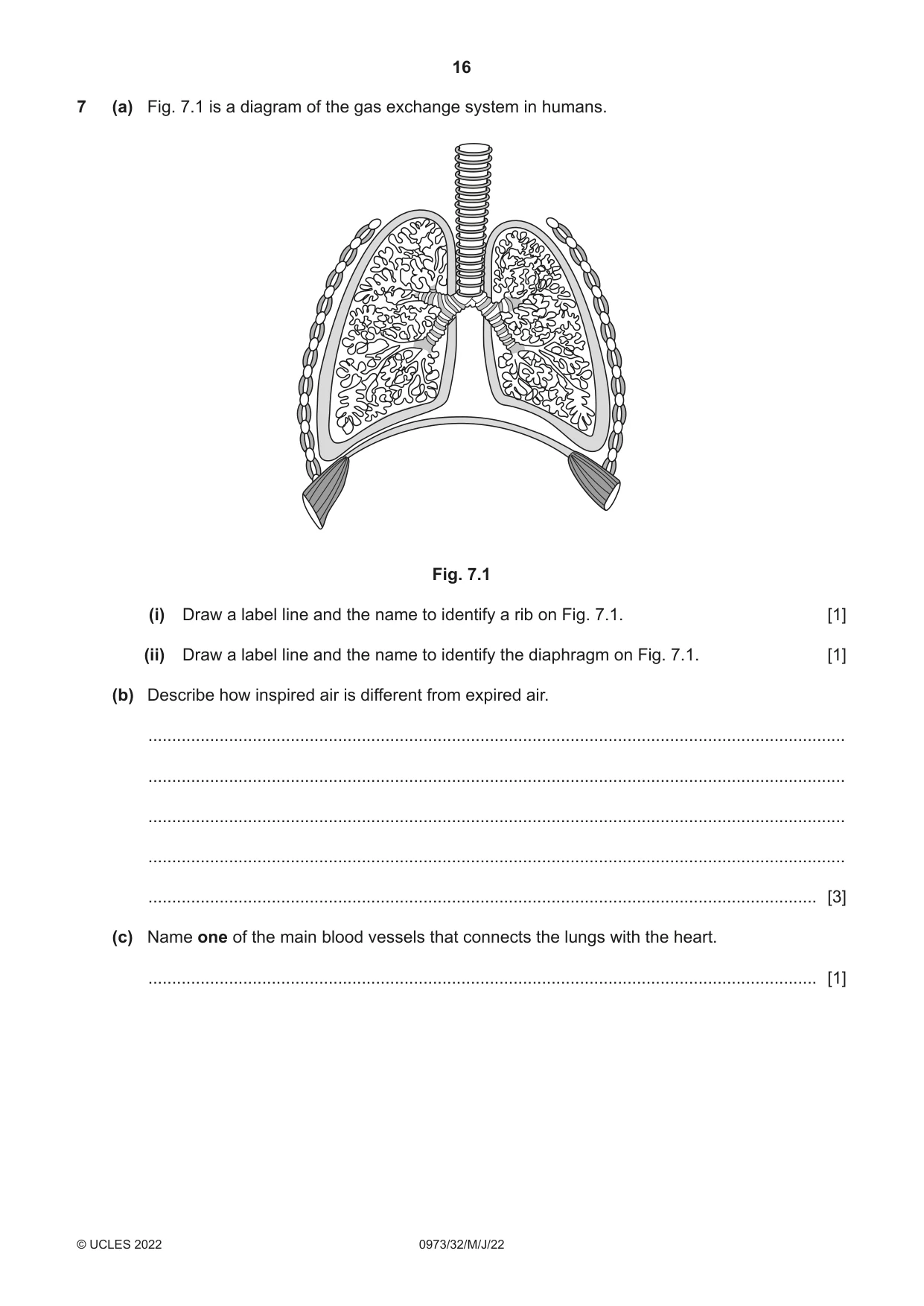
7 (a) Fig. 7.1 is a diagram of the gas exchange system in humans. Fig. 7.1 (i) Draw a label line and the name to identify a rib on Fig. 7.1. [1] (ii) Draw a label line and the name to identify the diaphragm on Fig. 7.1. [1] (b) Describe how inspired air is different from expired air. ................................................................................................................................................... ................................................................................................................................................... ................................................................................................................................................... ................................................................................................................................................... ............................................................................................................................................. [3] (c) Name one of the main blood vessels that connects the lungs with the heart. ............................................................................................................................................. [1] (d) Blood transports substances around the body. (i) State the name of the part of the blood that transports oxygen. ..................................................................................................................................... [1] (ii) State the name of the part of the blood that transports hormones. ..................................................................................................................................... [1] (e) State the name of the hormone secreted in a ‘fight or flight’ situation. ............................................................................................................................................. [1] [Total: 9]
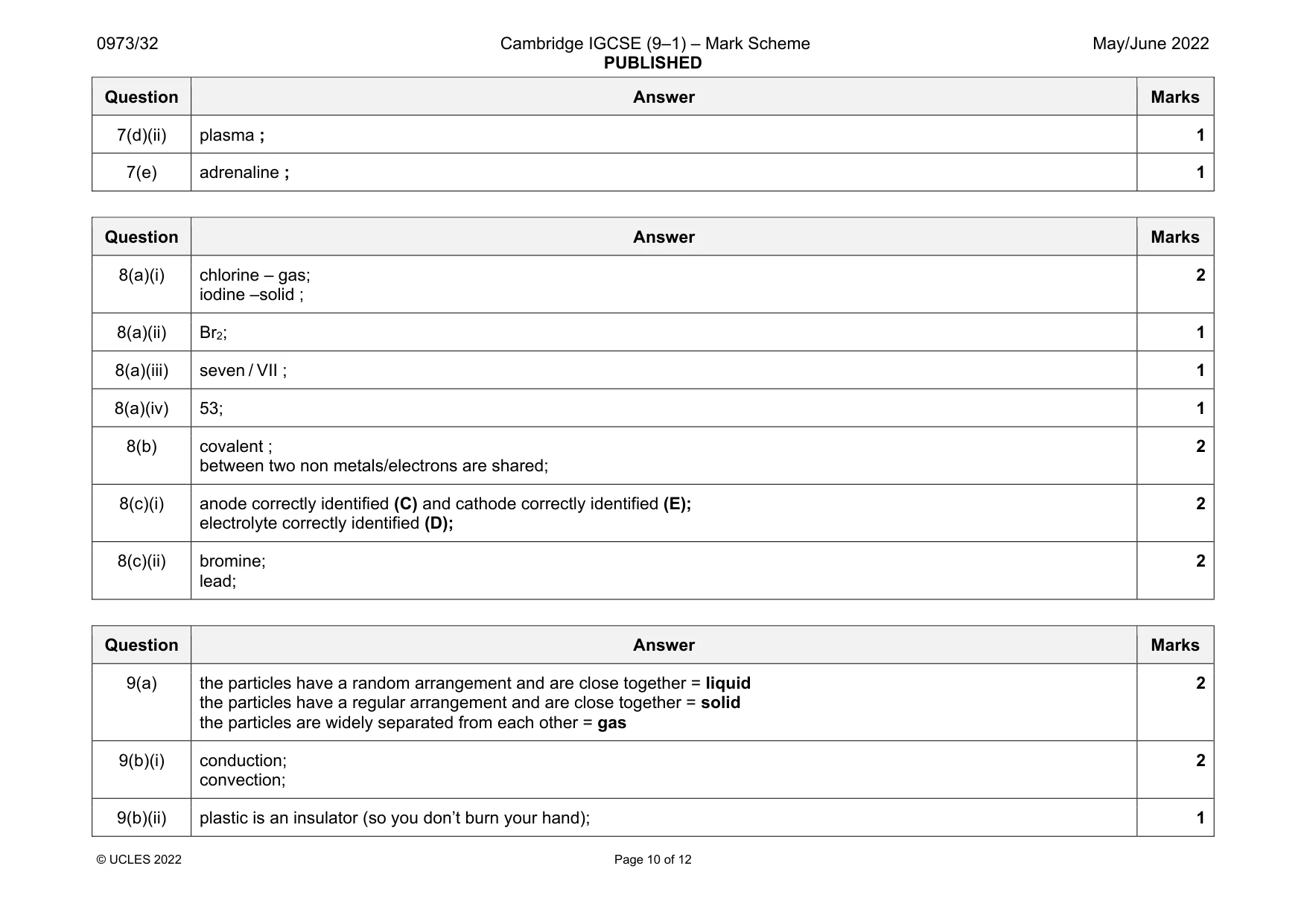
Mark scheme: 7(a)(i) rib labelled correctly ; 1 7(a)(ii) diaphragm labelled correctly ; 1 7(b) contains more oxygen ; contains less water vapour ; contains less carbon dioxide ; AVP ; Max 3 marks 3 7(c) pulmonary vein / pulmonary artery ; 1 7(d)(i) red blood cell ; 1 Question Answer Marks 7(d)(ii) plasma ; 1 7(e) adrenaline ; 1
Q8 · Information about some of the halogens in the Periodic Table
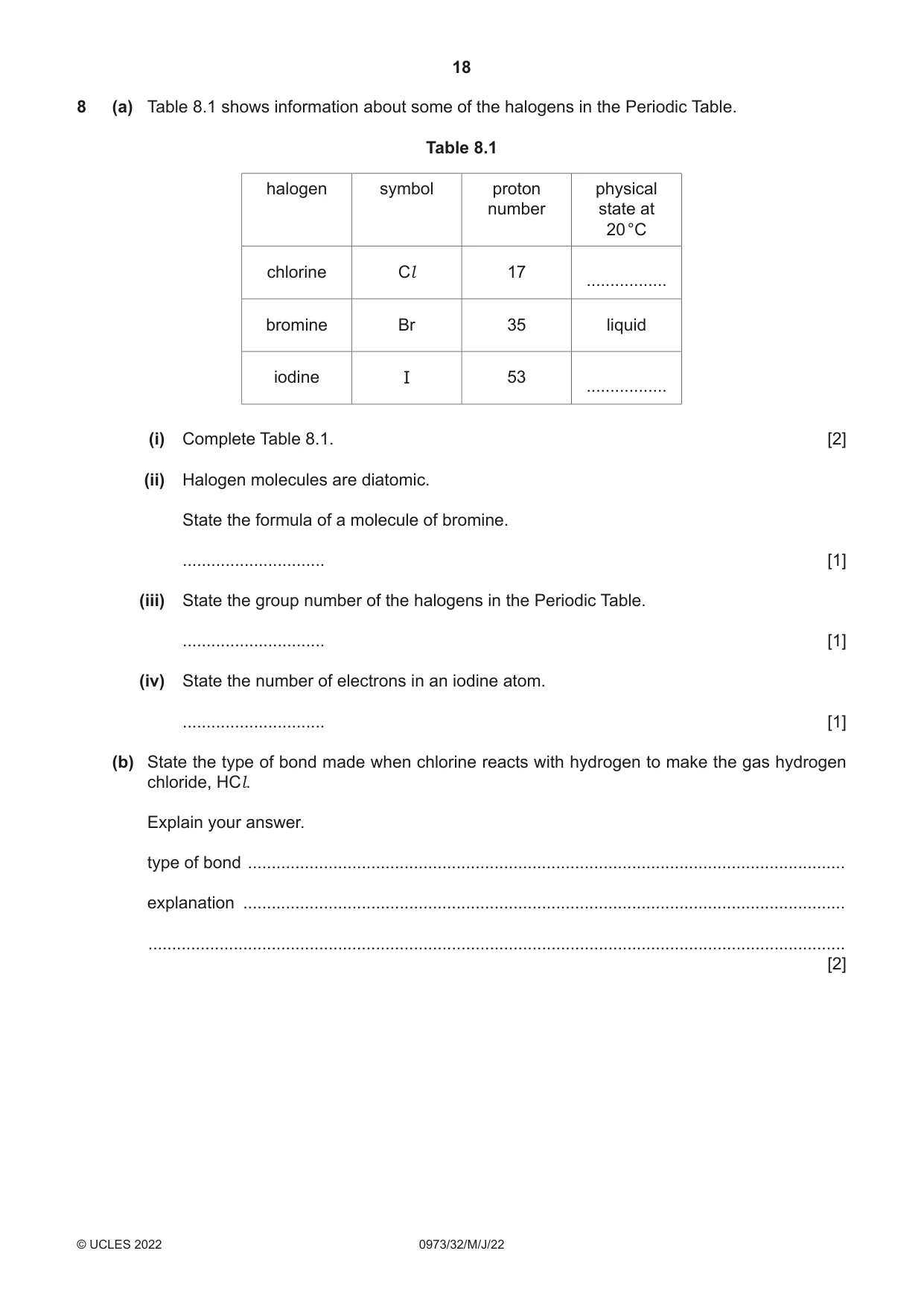
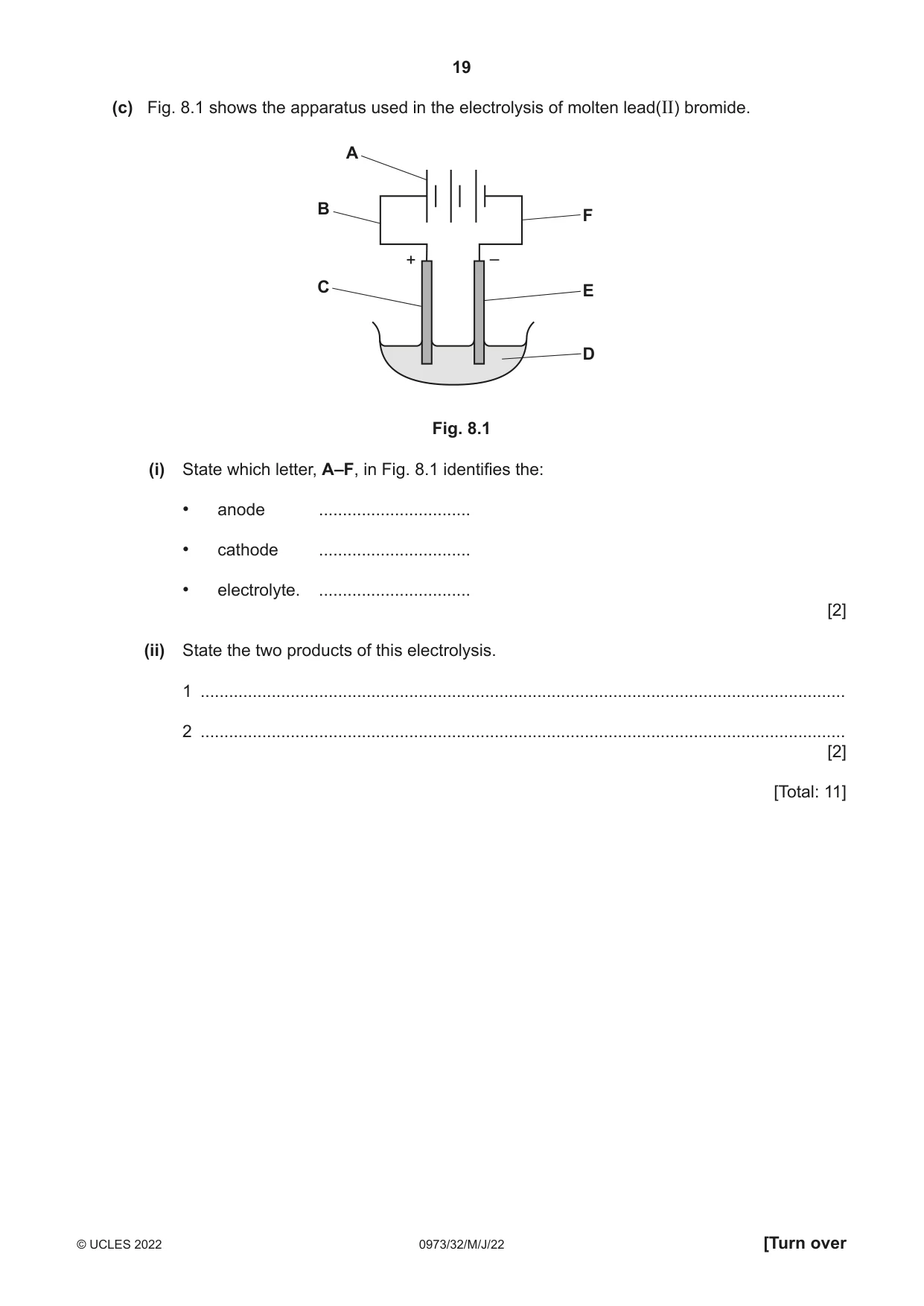
8 (a) Table 8.1 shows information about some of the halogens in the Periodic Table. Table 8.1 halogen symbol proton physical number state at 20 °C chlorine Cl 17 ................. bromine Br 35 liquid iodine I 53 ................. (i) Complete Table 8.1. [2] (ii) Halogen molecules are diatomic. State the formula of a molecule of bromine. .............................. [1] (iii) State the group number of the halogens in the Periodic Table. .............................. [1] (iv) State the number of electrons in an iodine atom. .............................. [1] (b) State the type of bond made when chlorine reacts with hydrogen to make the gas hydrogen chloride, HCl. Explain your answer. type of bond .............................................................................................................................. explanation ............................................................................................................................... ................................................................................................................................................... [2] (c) Fig. 8.1 shows the apparatus used in the electrolysis of molten lead(II) bromide. A B F + – C E D Fig. 8.1 (i) State which letter, A–F, in Fig. 8.1 identifies the: • anode ................................ • cathode ................................ • electrolyte. ................................ [2] (ii) State the two products of this electrolysis. 1 ........................................................................................................................................ 2 ........................................................................................................................................ [2] [Total: 11]
Mark scheme: 8(a)(i) chlorine – gas; iodine –solid ; 2 8(a)(ii) Br2; 1 8(a)(iii) seven / VII ; 1 8(a)(iv) 53; 1 8(b) covalent ; between two non metals/electrons are shared; 2 8(c)(i) anode correctly identified (C) and cathode correctly identified (E); electrolyte correctly identified (D); 2 8(c)(ii) bromine; lead; 2
Q9 · Table 9.1 contains descriptions of a solid, a liquid and a gas
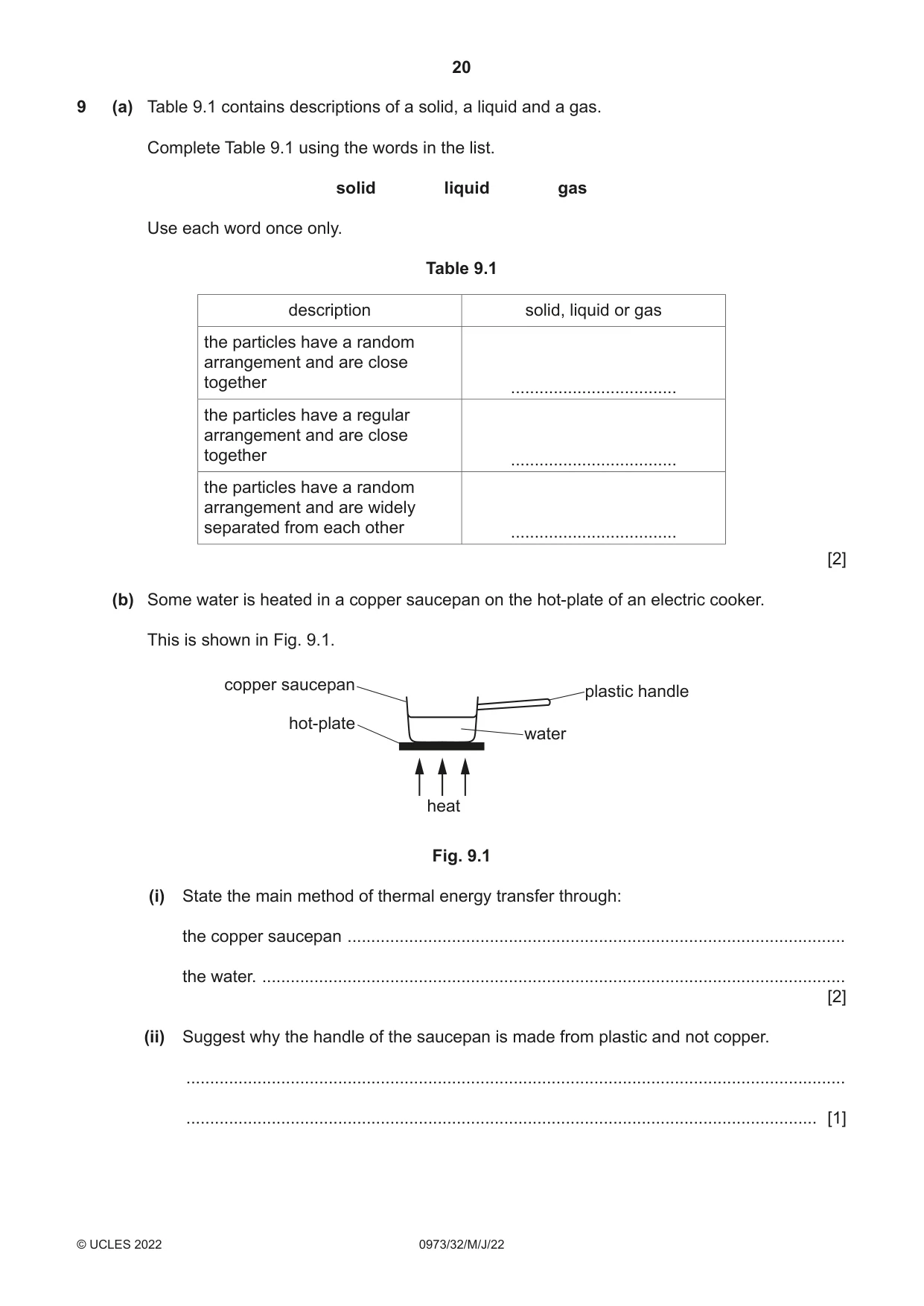
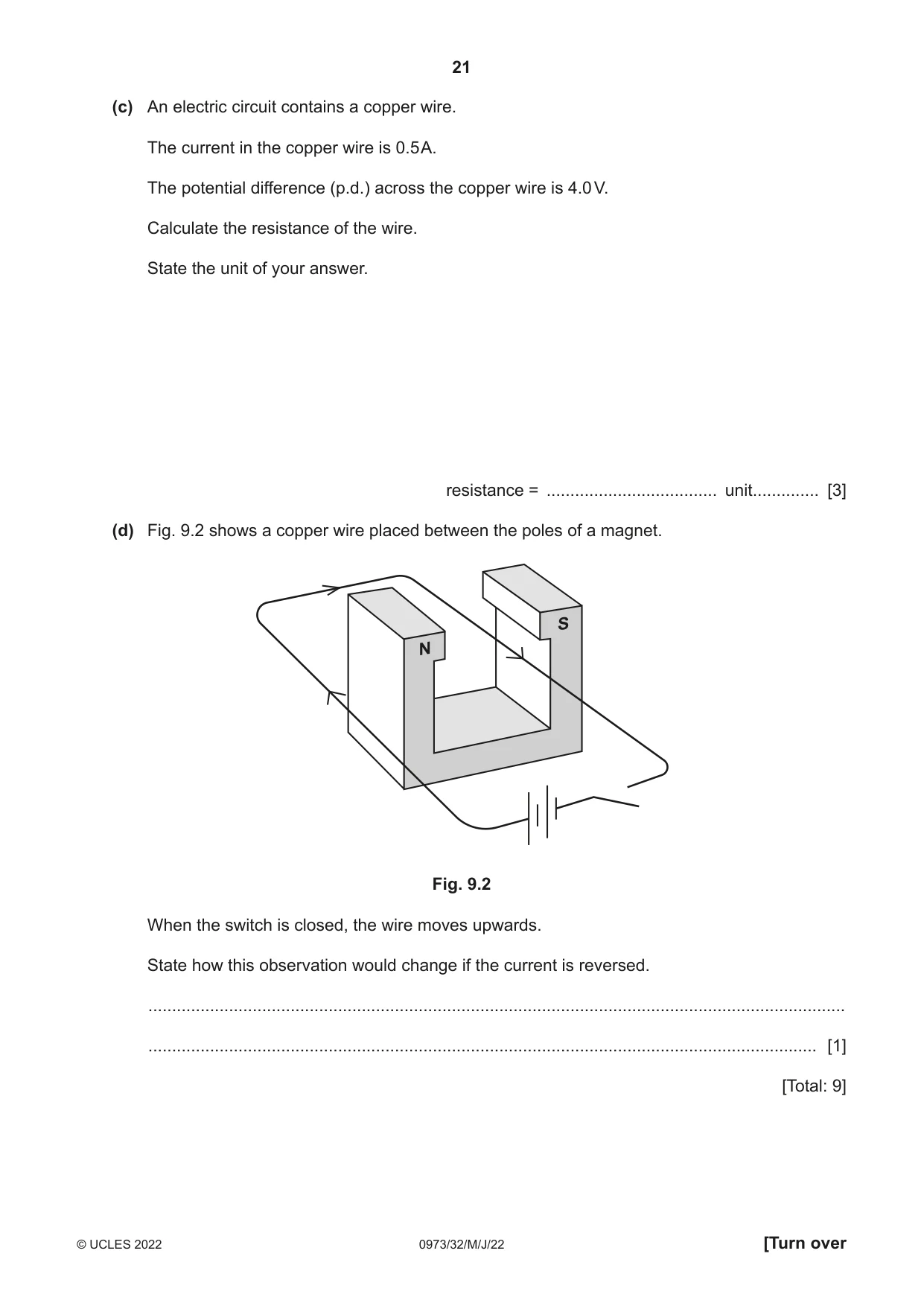
9 (a) Table 9.1 contains descriptions of a solid, a liquid and a gas. Complete Table 9.1 using the words in the list. solid liquid gas Use each word once only. Table 9.1 description solid, liquid or gas the particles have a random arrangement and are close together ................................... the particles have a regular arrangement and are close together ................................... the particles have a random arrangement and are widely separated from each other ................................... [2] (b) Some water is heated in a copper saucepan on the hot-plate of an electric cooker. This is shown in Fig. 9.1. copper saucepan plastic handle hot-plate water heat Fig. 9.1 (i) State the main method of thermal energy transfer through: the copper saucepan ......................................................................................................... the water. ........................................................................................................................... [2] (ii) Suggest why the handle of the saucepan is made from plastic and not copper. ........................................................................................................................................... ..................................................................................................................................... [1] (c) An electric circuit contains a copper wire. The current in the copper wire is 0.5 A. The potential difference (p.d.) across the copper wire is 4.0 V. Calculate the resistance of the wire. State the unit of your answer. resistance = .................................... unit.............. [3] (d) Fig. 9.2 shows a copper wire placed between the poles of a magnet. S N Fig. 9.2 When the switch is closed, the wire moves upwards. State how this observation would change if the current is reversed. ................................................................................................................................................... ............................................................................................................................................. [1] [Total: 9]
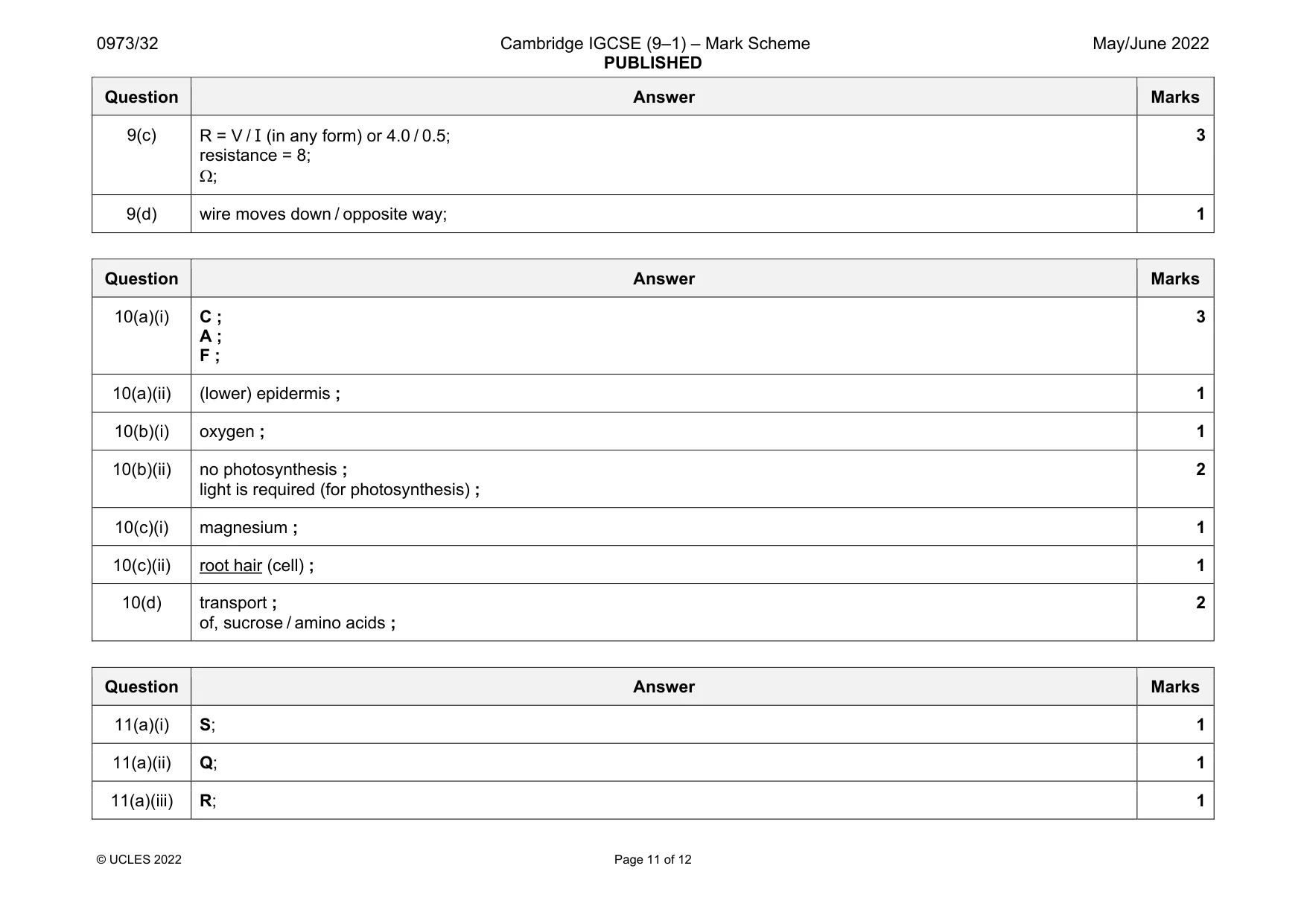
Mark scheme: 9(a) the particles have a random arrangement and are close together = liquid the particles have a regular arrangement and are close together = solid the particles are widely separated from each other = gas 2 9(b)(i) conduction; convection; 2 9(b)(ii) plastic is an insulator (so you don’t burn your hand); 1 Question Answer Marks 9(c) R = V / I (in any form) or 4.0 / 0.5; resistance = 8; ; 3 9(d) wire moves down / opposite way; 1
Q10 · A diagram of a cross-section through a leaf
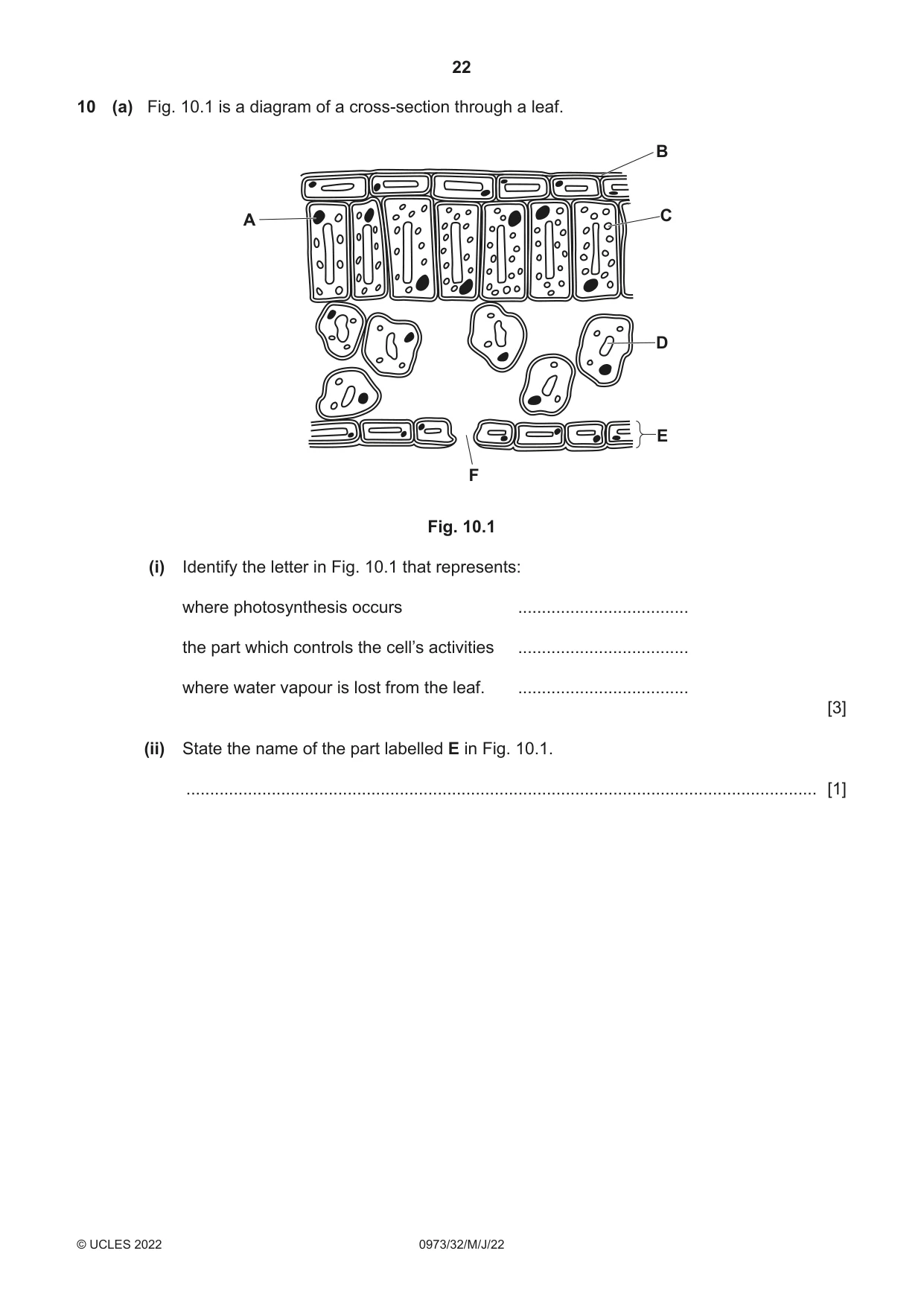
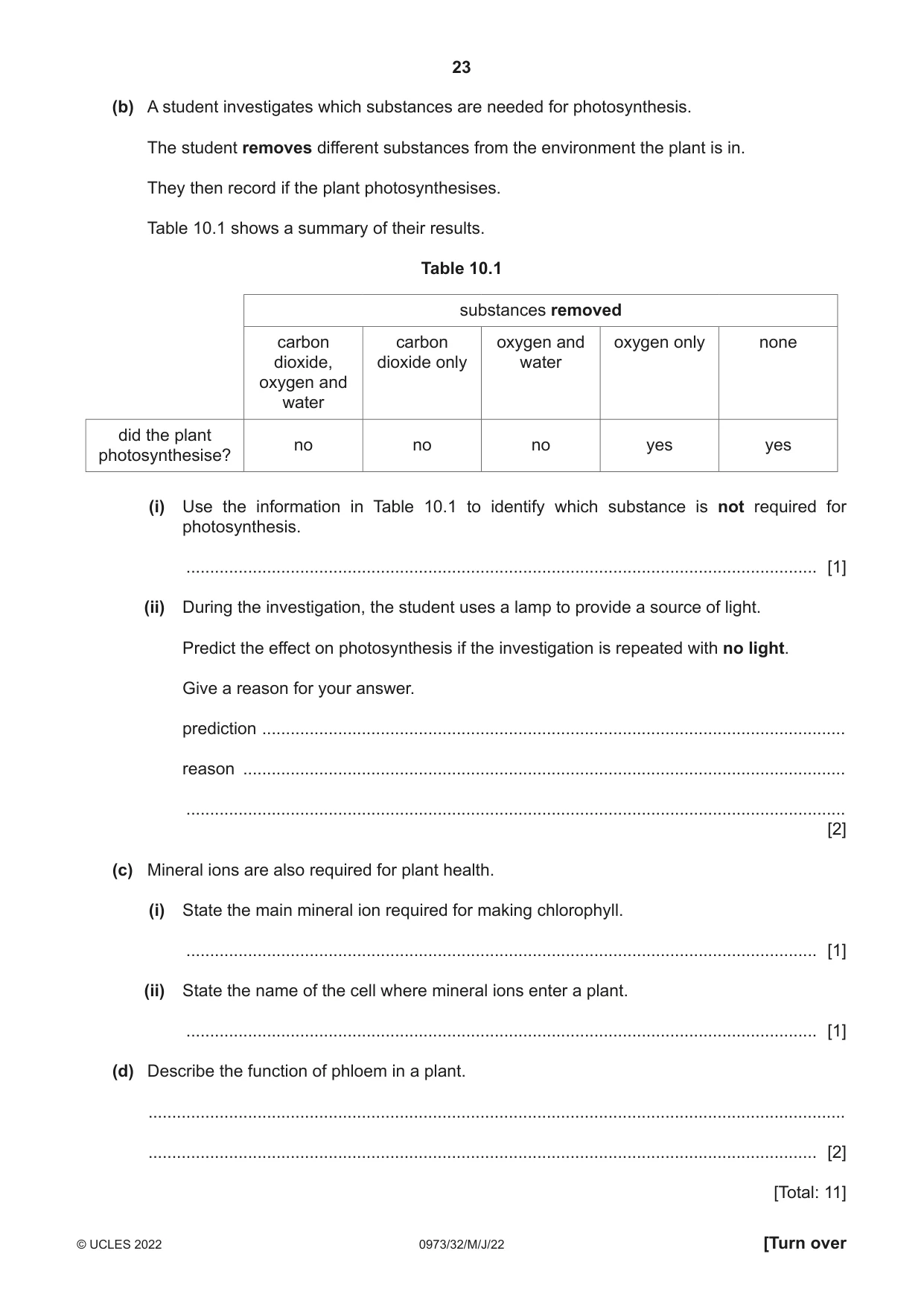
10 (a) Fig. 10.1 is a diagram of a cross-section through a leaf. B A C D E F Fig. 10.1 (i) Identify the letter in Fig. 10.1 that represents: where photosynthesis occurs .................................... the part which controls the cell’s activities .................................... where water vapour is lost from the leaf. .................................... [3] (ii) State the name of the part labelled E in Fig. 10.1. ..................................................................................................................................... [1] (b) A student investigates which substances are needed for photosynthesis. The student removes different substances from the environment the plant is in. They then record if the plant photosynthesises. Table 10.1 shows a summary of their results. Table 10.1 substances removed carbon carbon oxygen and oxygen only none dioxide, dioxide only water oxygen and water did the plant no no no yes yesphotosynthesise? (i) Use the information in Table 10.1 to identify which substance is not required for photosynthesis. ..................................................................................................................................... [1] (ii) During the investigation, the student uses a lamp to provide a source of light. Predict the effect on photosynthesis if the investigation is repeated with no light. Give a reason for your answer. prediction ........................................................................................................................... reason ............................................................................................................................... ........................................................................................................................................... [2] (c) Mineral ions are also required for plant health. (i) State the main mineral ion required for making chlorophyll. ..................................................................................................................................... [1] (ii) State the name of the cell where mineral ions enter a plant. ..................................................................................................................................... [1] (d) Describe the function of phloem in a plant. ................................................................................................................................................... ............................................................................................................................................. [2] [Total: 11]
Mark scheme: 10(a)(i) C ; A ; F ; 3 10(a)(ii) (lower) epidermis ; 1 10(b)(i) oxygen ; 1 10(b)(ii) no photosynthesis ; light is required (for photosynthesis) ; 2 10(c)(i) magnesium ; 1 10(c)(ii) root hair (cell) ; 1 10(d) transport ; of, sucrose / amino acids ; 2
Q11 · The structures of four molecules, P, Q, R and S
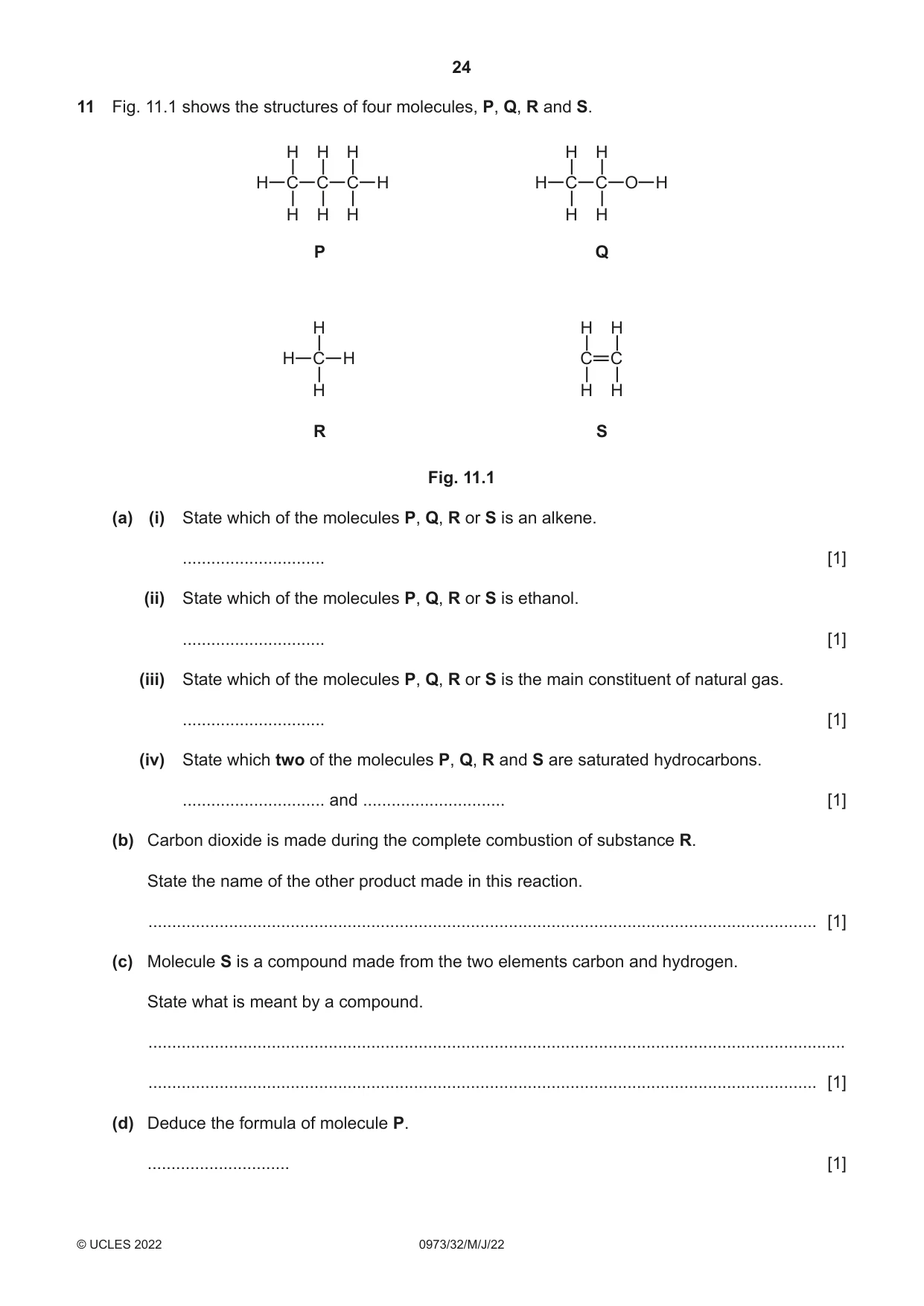
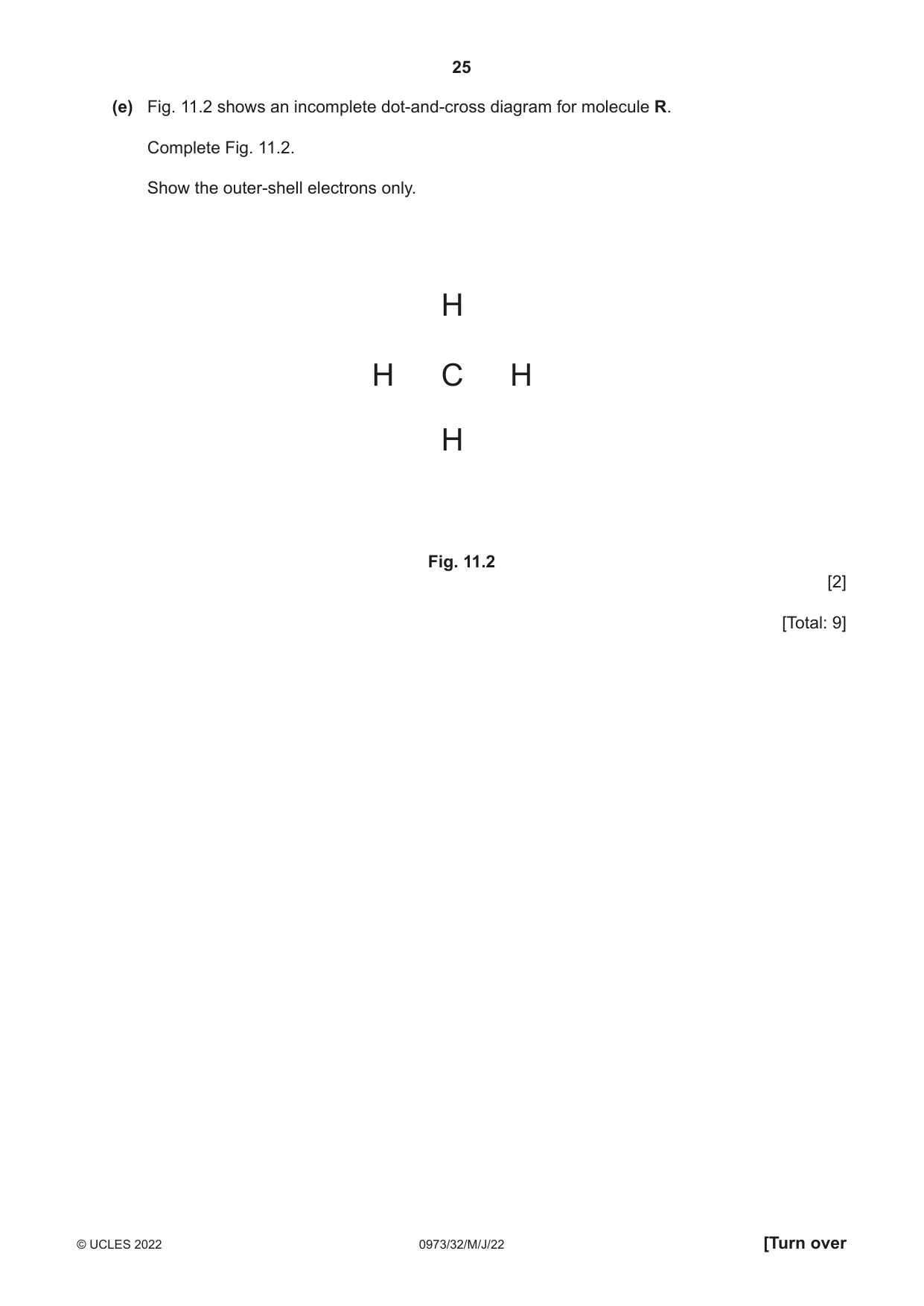
11 Fig. 11.1 shows the structures of four molecules, P, Q, R and S. H H H H H H C C C H H C C O H H H H H H P Q H H H H C H C C H H H R S Fig. 11.1 (a) (i) State which of the molecules P, Q, R or S is an alkene. .............................. [1] (ii) State which of the molecules P, Q, R or S is ethanol. .............................. [1] (iii) State which of the molecules P, Q, R or S is the main constituent of natural gas. .............................. [1] (iv) State which two of the molecules P, Q, R and S are saturated hydrocarbons. .............................. and .............................. [1] (b) Carbon dioxide is made during the complete combustion of substance R. State the name of the other product made in this reaction. ............................................................................................................................................. [1] (c) Molecule S is a compound made from the two elements carbon and hydrogen. State what is meant by a compound. ................................................................................................................................................... ............................................................................................................................................. [1] (d) Deduce the formula of molecule P. .............................. [1] (e) Fig. 11.2 shows an incomplete dot-and-cross diagram for molecule R. Complete Fig. 11.2. Show the outer-shell electrons only. H H C H H Fig. 11.2 [2] [Total: 9]
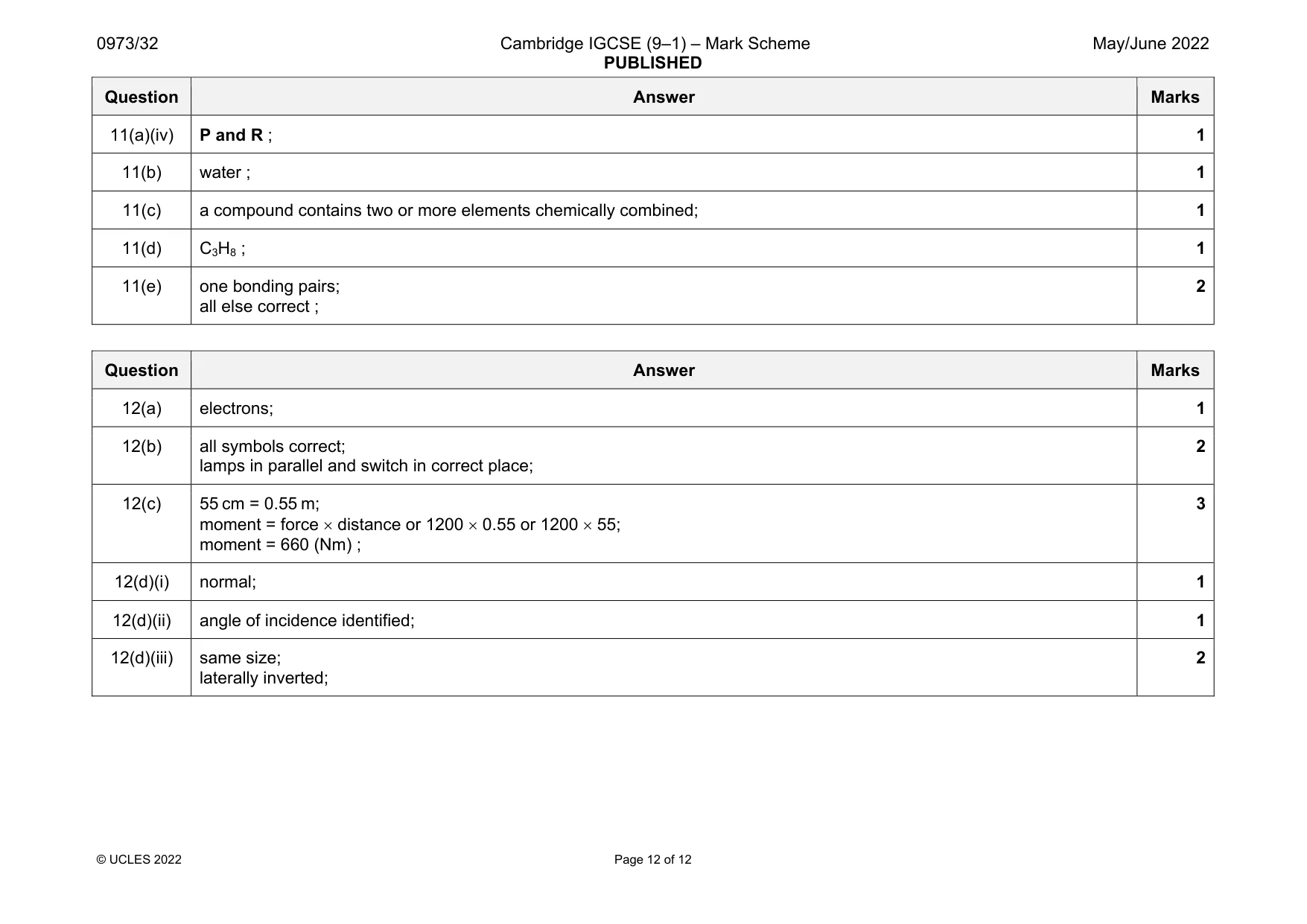
Mark scheme: 11(a)(i) S; 1 11(a)(ii) Q; 1 11(a)(iii) R; 1 Question Answer Marks 11(a)(iv) P and R ; 1 11(b) water ; 1 11(c) a compound contains two or more elements chemically combined; 1 11(d) C3H8 ; 1 11(e) one bonding pairs; all else correct ; 2
Q12 · During a journey, a car becomes positively charged with static electricity
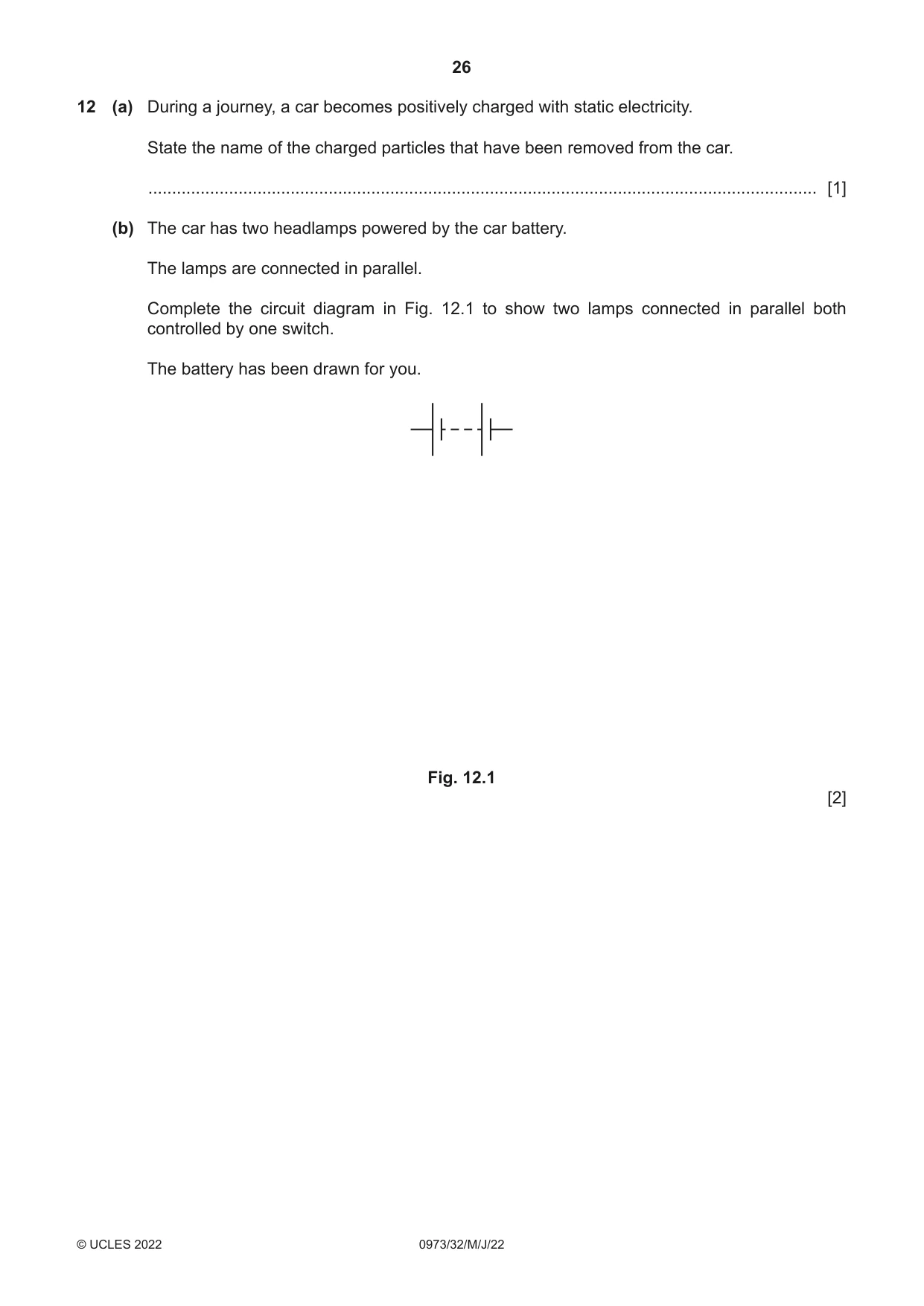
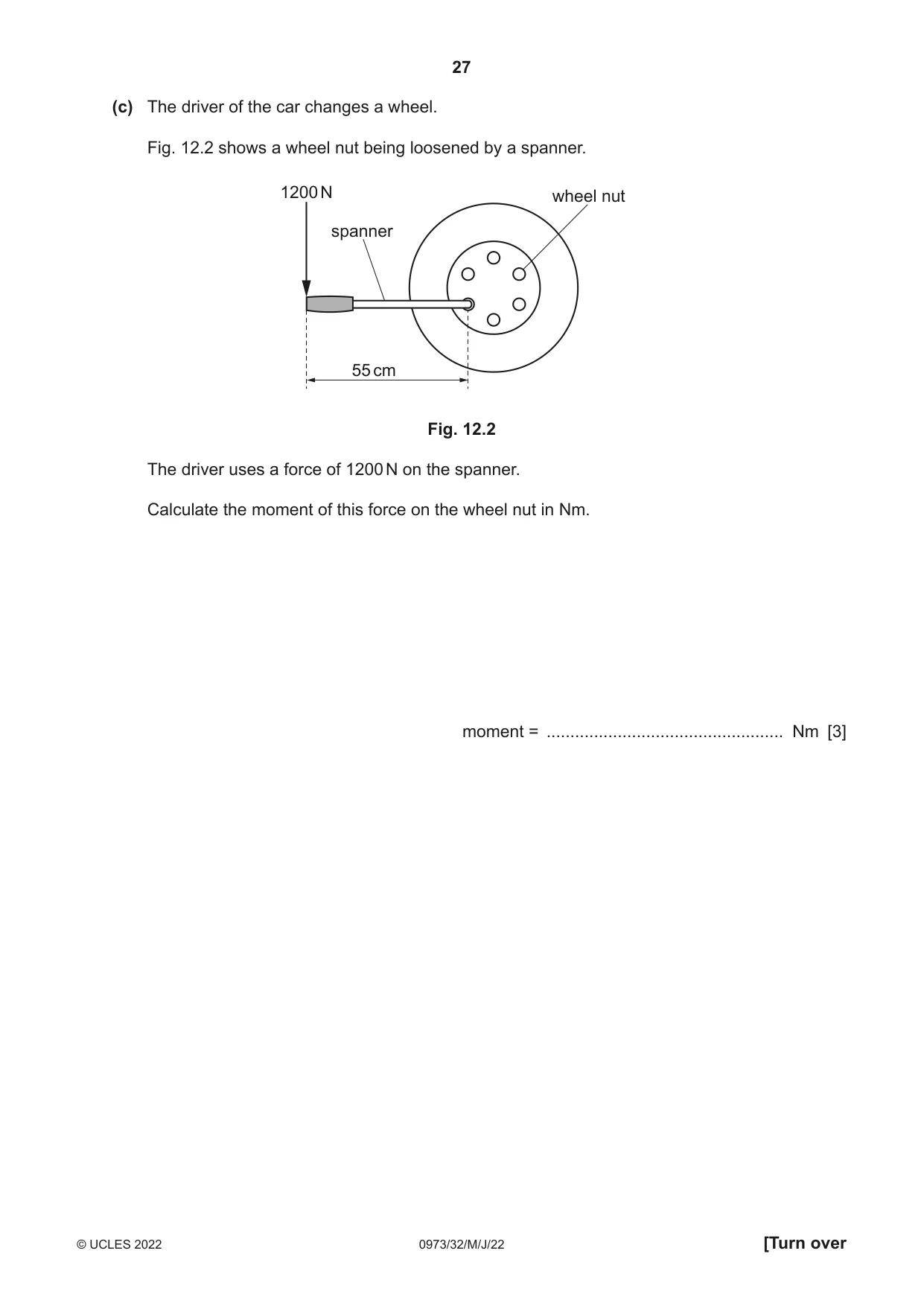
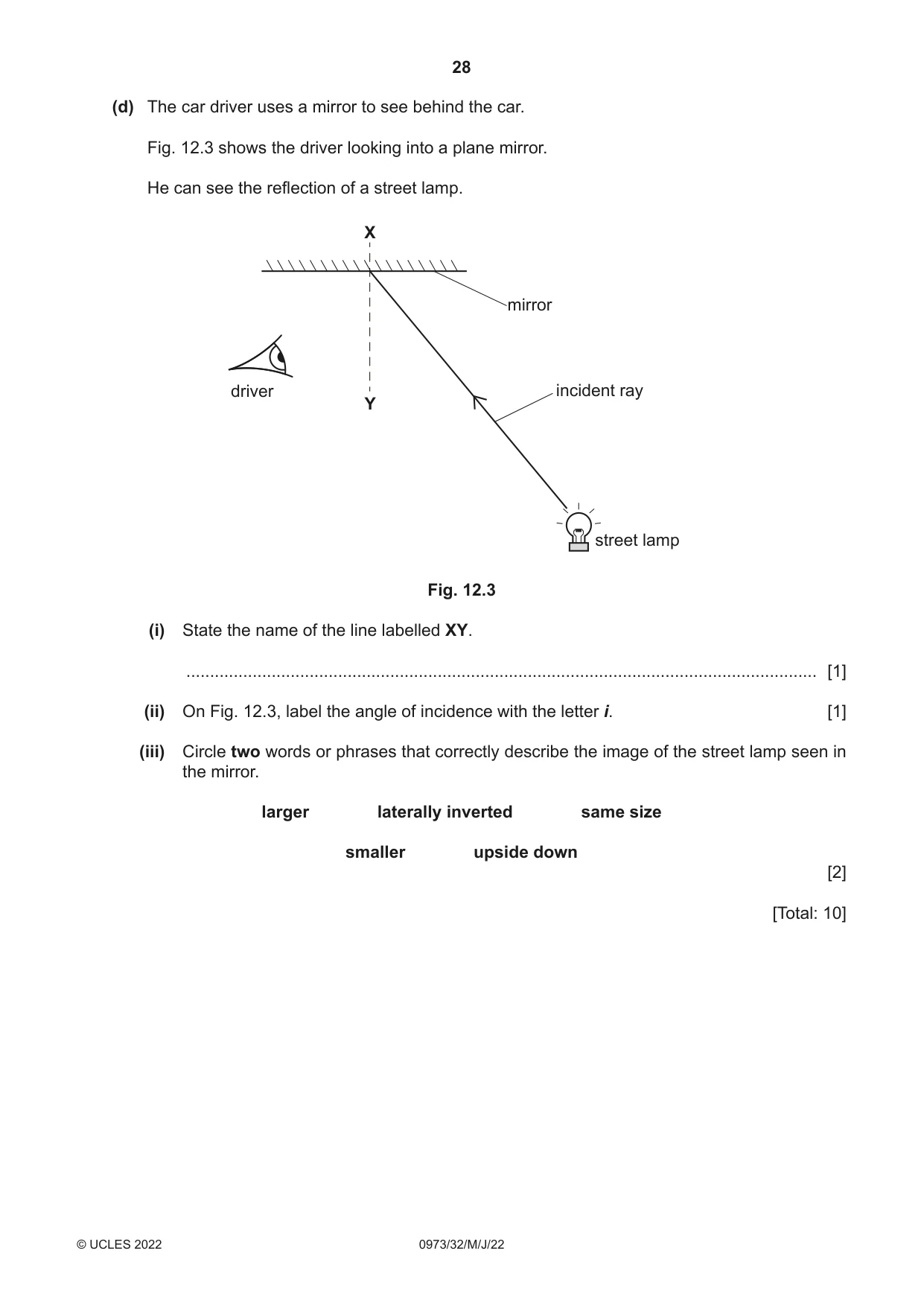
12 (a) During a journey, a car becomes positively charged with static electricity. State the name of the charged particles that have been removed from the car. ............................................................................................................................................. [1] (b) The car has two headlamps powered by the car battery. The lamps are connected in parallel. Complete the circuit diagram in Fig. 12.1 to show two lamps connected in parallel both controlled by one switch. The battery has been drawn for you. Fig. 12.1 [2] (c) The driver of the car changes a wheel. Fig. 12.2 shows a wheel nut being loosened by a spanner. 1200 N wheel nut spanner 55 cm Fig. 12.2 The driver uses a force of 1200 N on the spanner. Calculate the moment of this force on the wheel nut in Nm. moment = .................................................. Nm [3] (d) The car driver uses a mirror to see behind the car. Fig. 12.3 shows the driver looking into a plane mirror. He can see the reflection of a street lamp. X mirror driver incident ray Y street lamp Fig. 12.3 (i) State the name of the line labelled XY. ..................................................................................................................................... [1] (ii) On Fig. 12.3, label the angle of incidence with the letter i. [1] (iii) Circle two words or phrases that correctly describe the image of the street lamp seen in the mirror. larger laterally inverted same size smaller upside down [2] [Total: 10]
Mark scheme: 12(a) electrons; 1 12(b) all symbols correct; lamps in parallel and switch in correct place; 2 12(c) 55 cm = 0.55 m; moment = force distance or 1200 0.55 or 1200 55; moment = 660 (Nm) ; 3 12(d)(i) normal; 1 12(d)(ii) angle of incidence identified; 1 12(d)(iii) same size; laterally inverted; 2
What was in this paper
The subtopics covered by these 12 questions, and how many questions each got. Open one in a new tab to see every Cambridge question on it.
What you needed in this session
Cambridge’s own grade thresholds for 2022 May/June, Paper 3 · Variant 2. A higher threshold means an easier paper — the bar moves with how the cohort did.