Cambridge IGCSE Sciences - Co-ordinated (9-1) 0973 — 2020 May/June Paper 3 · Variant 2
0973/32/M/J/20 · 12 questions · 120 marks · ≈135 min
The question paper and its mark scheme, free to read here and free to download. This is Cambridge’s own paper, exactly as it was sat.
Question paper32 pages
Mark scheme12 pages
Answers below. Sit the paper first if you are practising.
Questions as text
Q1 · A student investigates the conditions that affect germination of seeds
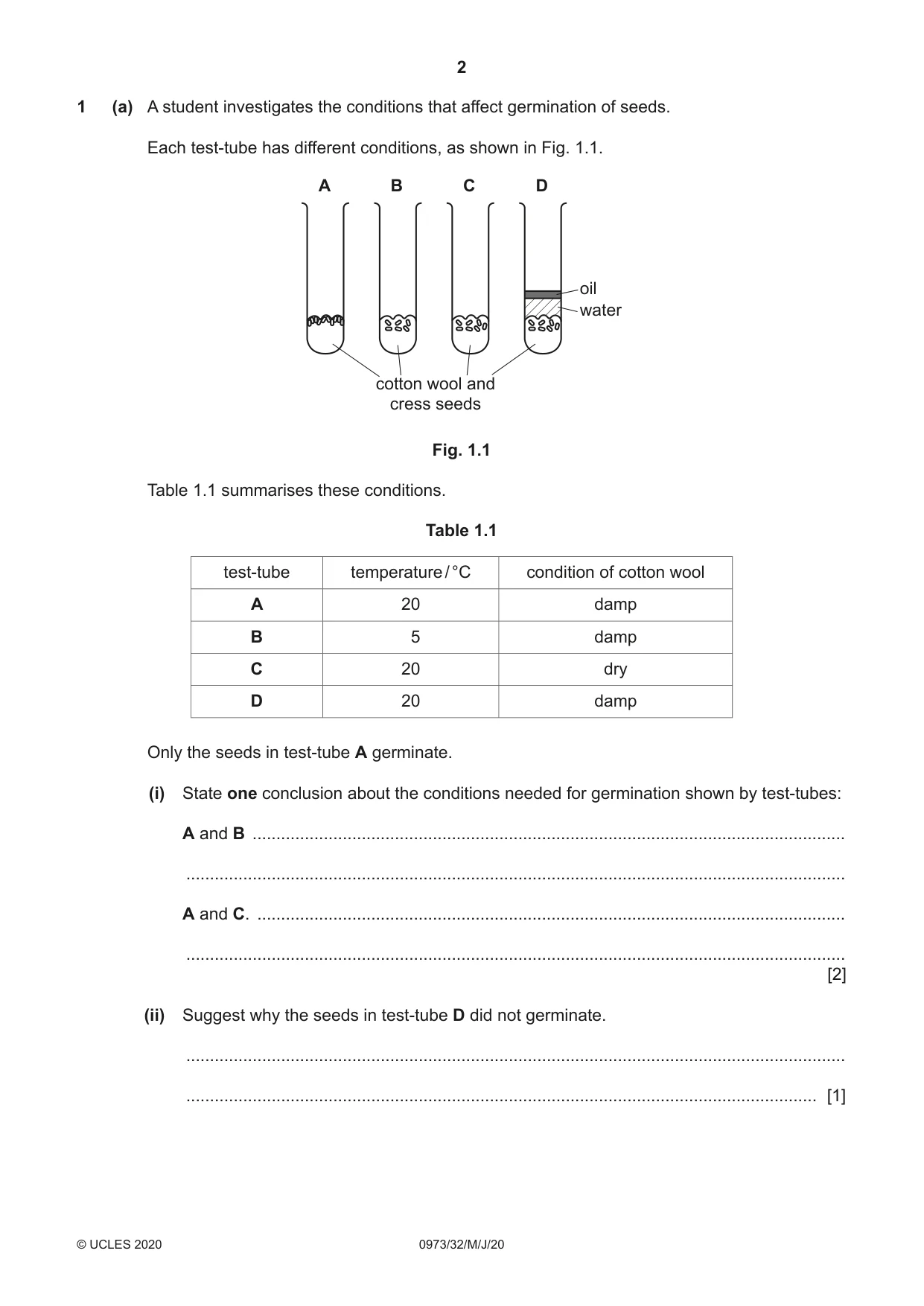
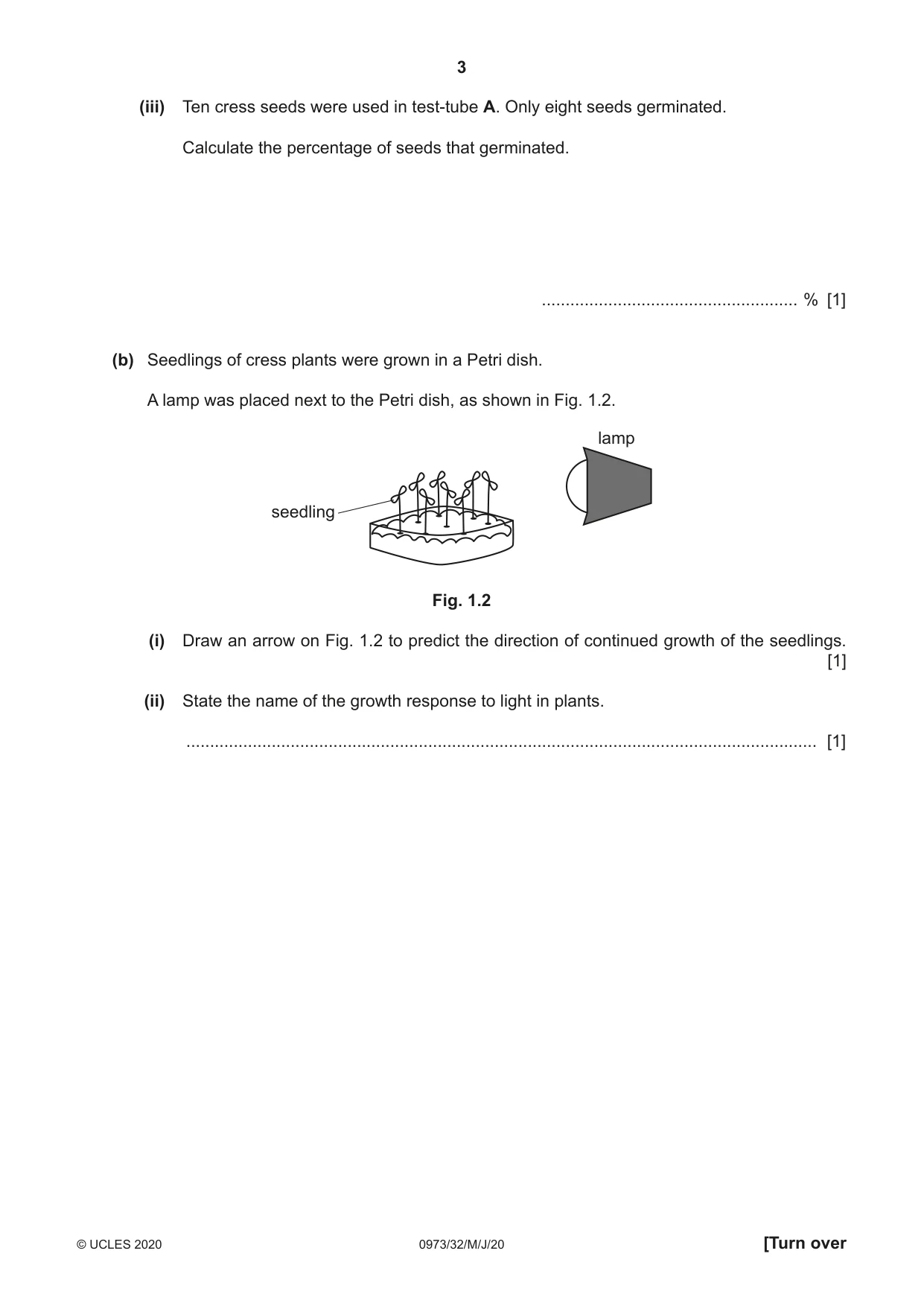
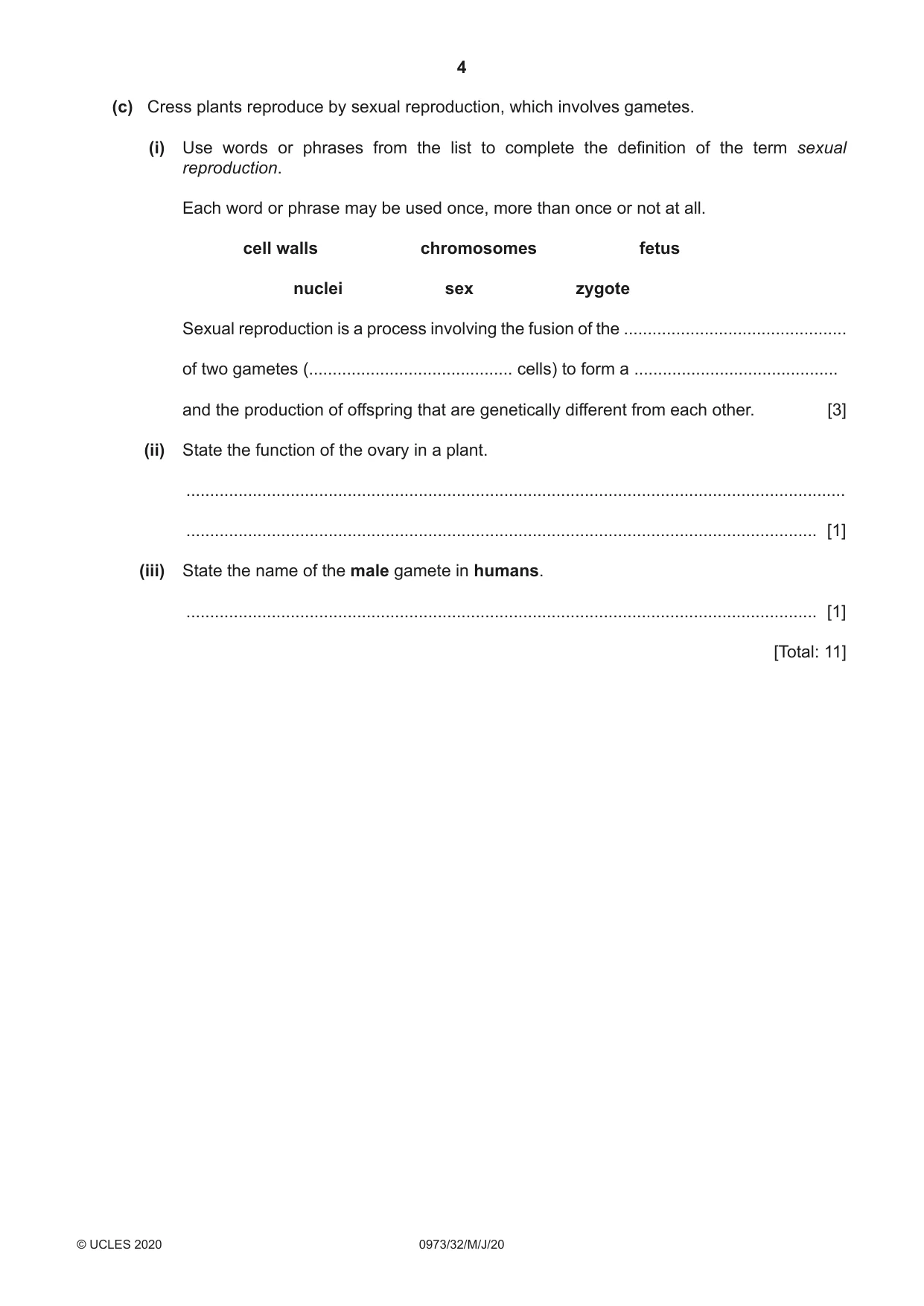
1 (a) A student investigates the conditions that affect germination of seeds. Each test-tube has different conditions, as shown in Fig. 1.1. A B C D oil water cotton wool and cress seeds Fig. 1.1 Table 1.1 summarises these conditions. Table 1.1 test-tube temperature / °C condition of cotton wool A 20 damp B 5 damp C 20 dry D 20 damp Only the seeds in test-tube A germinate. (i) State one conclusion about the conditions needed for germination shown by test-tubes: A and B ............................................................................................................................. ........................................................................................................................................... A and C. ............................................................................................................................ ........................................................................................................................................... [2] (ii) Suggest why the seeds in test-tube D did not germinate. ........................................................................................................................................... ..................................................................................................................................... [1] (iii) Ten cress seeds were used in test-tube A. Only eight seeds germinated. Calculate the percentage of seeds that germinated. ...................................................... % [1] (b) Seedlings of cress plants were grown in a Petri dish. A lamp was placed next to the Petri dish, as shown in Fig. 1.2. lamp seedling Fig. 1.2 (i) Draw an arrow on Fig. 1.2 to predict the direction of continued growth of the seedlings. [1] (ii) State the name of the growth response to light in plants. ..................................................................................................................................... [1] (c) Cress plants reproduce by sexual reproduction, which involves gametes. (i) Use words or phrases from the list to complete the definition of the term sexual reproduction. Each word or phrase may be used once, more than once or not at all. cell walls chromosomes fetus nuclei sex zygote Sexual reproduction is a process involving the fusion of the ............................................... of two gametes (........................................... cells) to form a ........................................... and the production of offspring that are genetically different from each other. [3] (ii) State the function of the ovary in a plant. ........................................................................................................................................... ..................................................................................................................................... [1] (iii) State the name of the male gamete in humans. ..................................................................................................................................... [1] [Total: 11]
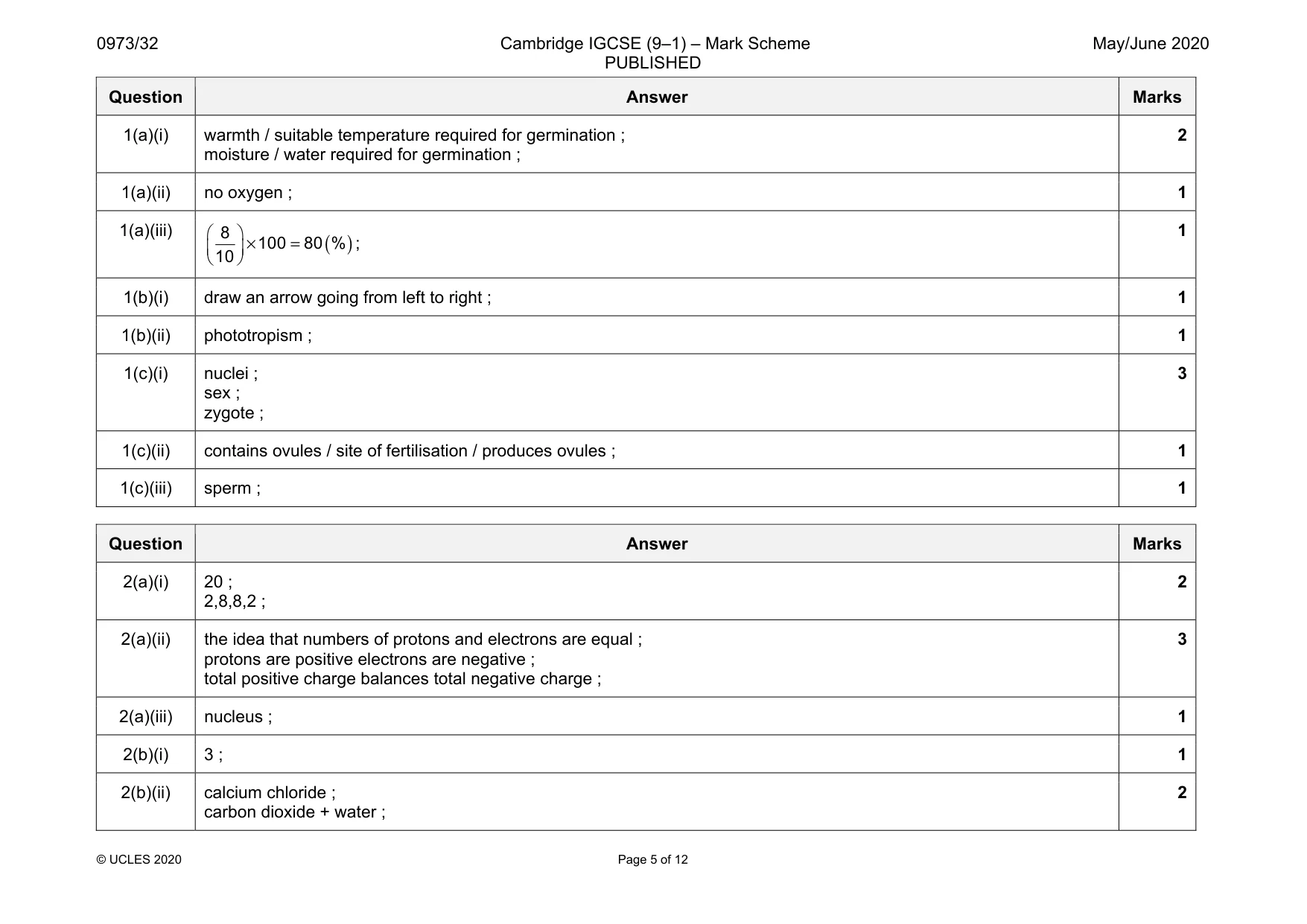
Mark scheme: 1(a)(i) warmth / suitable temperature required for germination ; moisture / water required for germination ; 2 1(a)(ii) no oxygen ; 1 1(a)(iii) ( ) 8 100 80 % ; 10 × = 1 1(b)(i) draw an arrow going from left to right ; 1 1(b)(ii) phototropism ; 1 1(c)(i) nuclei ; sex ; zygote ; 3 1(c)(ii) contains ovules / site of fertilisation / produces ovules ; 1 1(c)(iii) sperm ; 1
Q2 · Calcium is in Group II of the Periodic Table
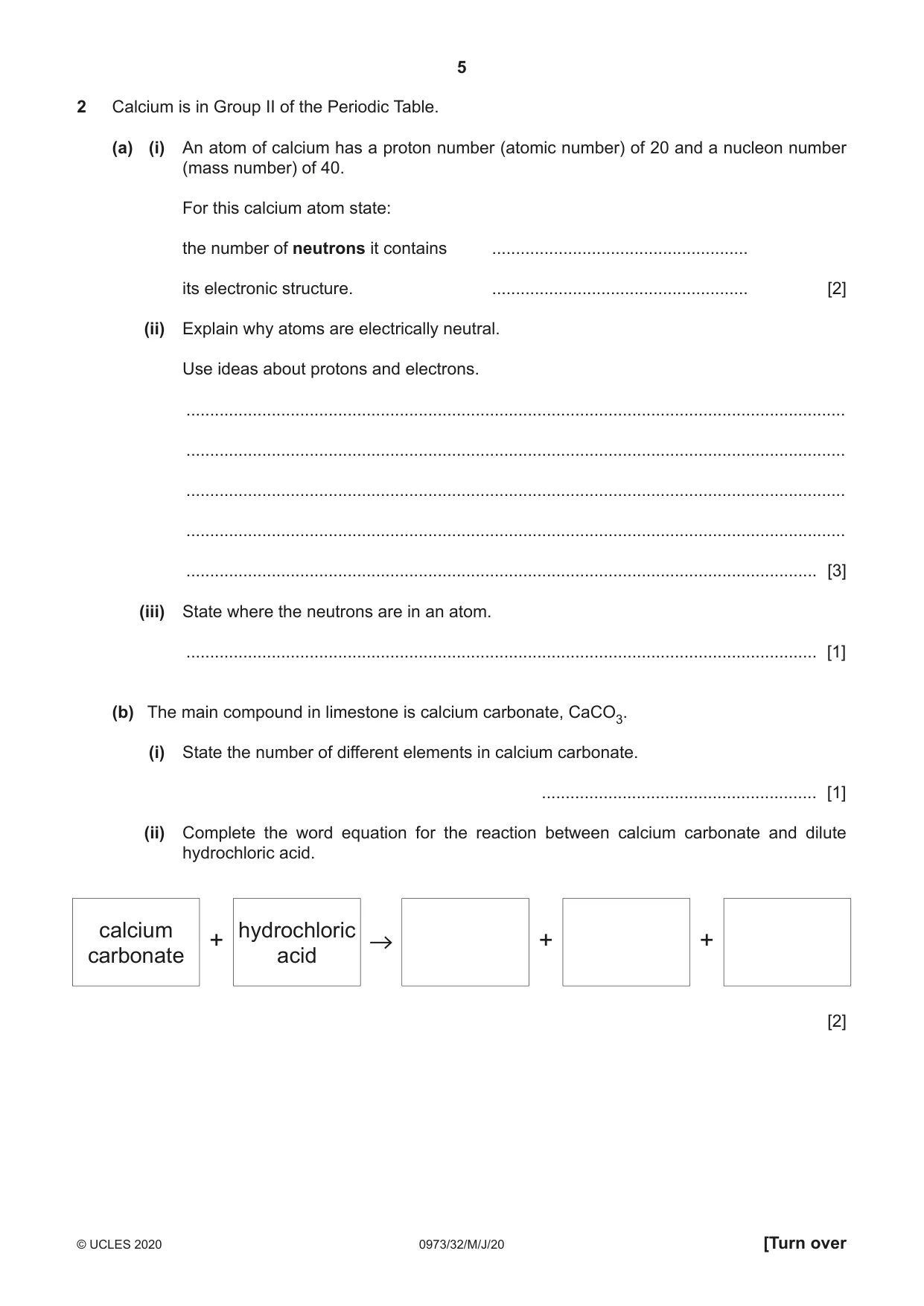
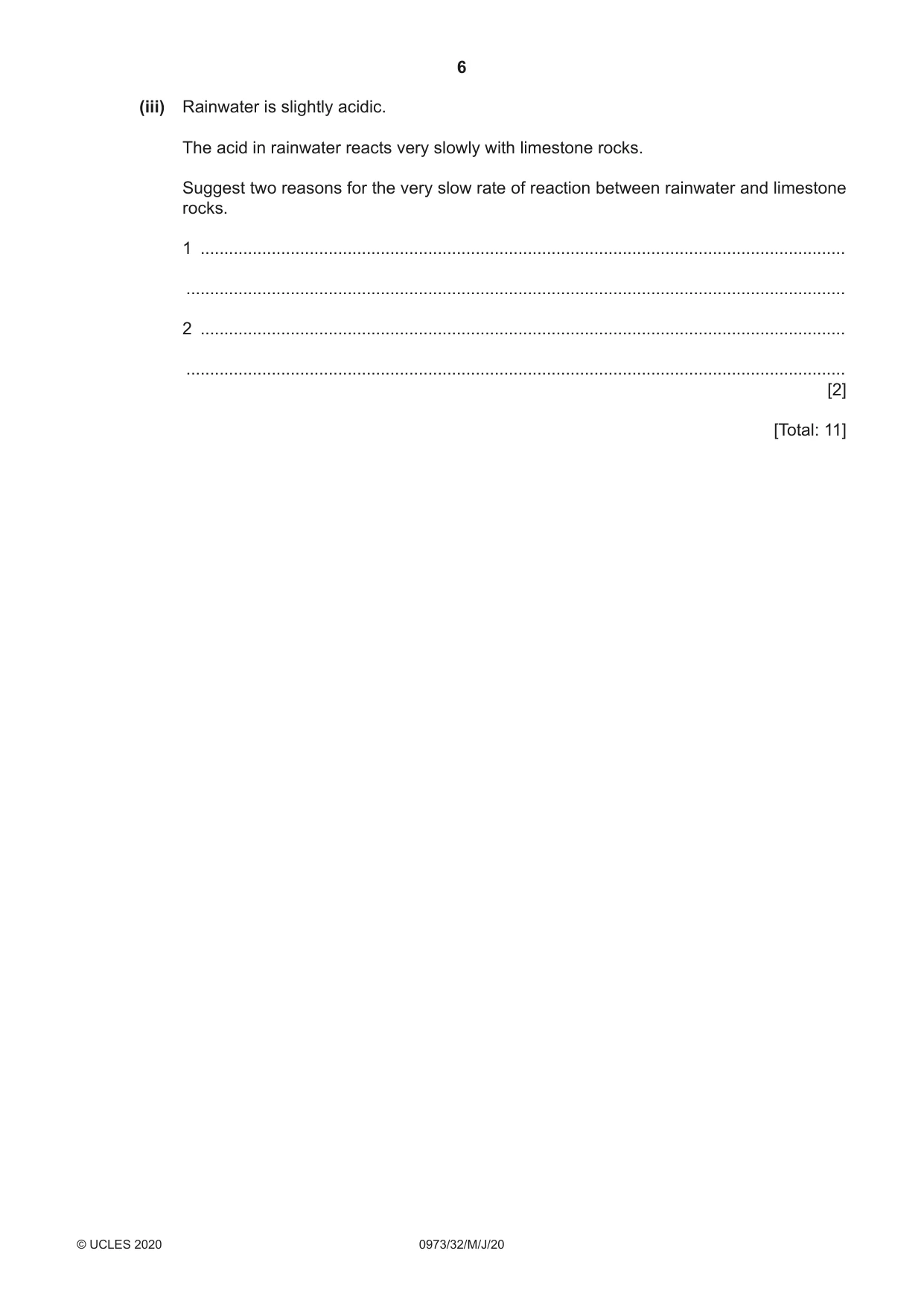
2 Calcium is in Group II of the Periodic Table. (a) (i) An atom of calcium has a proton number (atomic number) of 20 and a nucleon number (mass number) of 40. For this calcium atom state: the number of neutrons it contains ...................................................... its electronic structure. ...................................................... [2] (ii) Explain why atoms are electrically neutral. Use ideas about protons and electrons. ........................................................................................................................................... ........................................................................................................................................... ........................................................................................................................................... ........................................................................................................................................... ..................................................................................................................................... [3] (iii) State where the neutrons are in an atom. ..................................................................................................................................... [1] (b) The main compound in limestone is calcium carbonate, CaCO3. (i) State the number of different elements in calcium carbonate. .......................................................... [1] (ii) Complete the word equation for the reaction between calcium carbonate and dilute hydrochloric acid. calcium hydrochloric + + + carbonate acid [2] (iii) Rainwater is slightly acidic. The acid in rainwater reacts very slowly with limestone rocks. Suggest two reasons for the very slow rate of reaction between rainwater and limestone rocks. 1 ........................................................................................................................................ ........................................................................................................................................... 2 ........................................................................................................................................ ........................................................................................................................................... [2] [Total: 11]
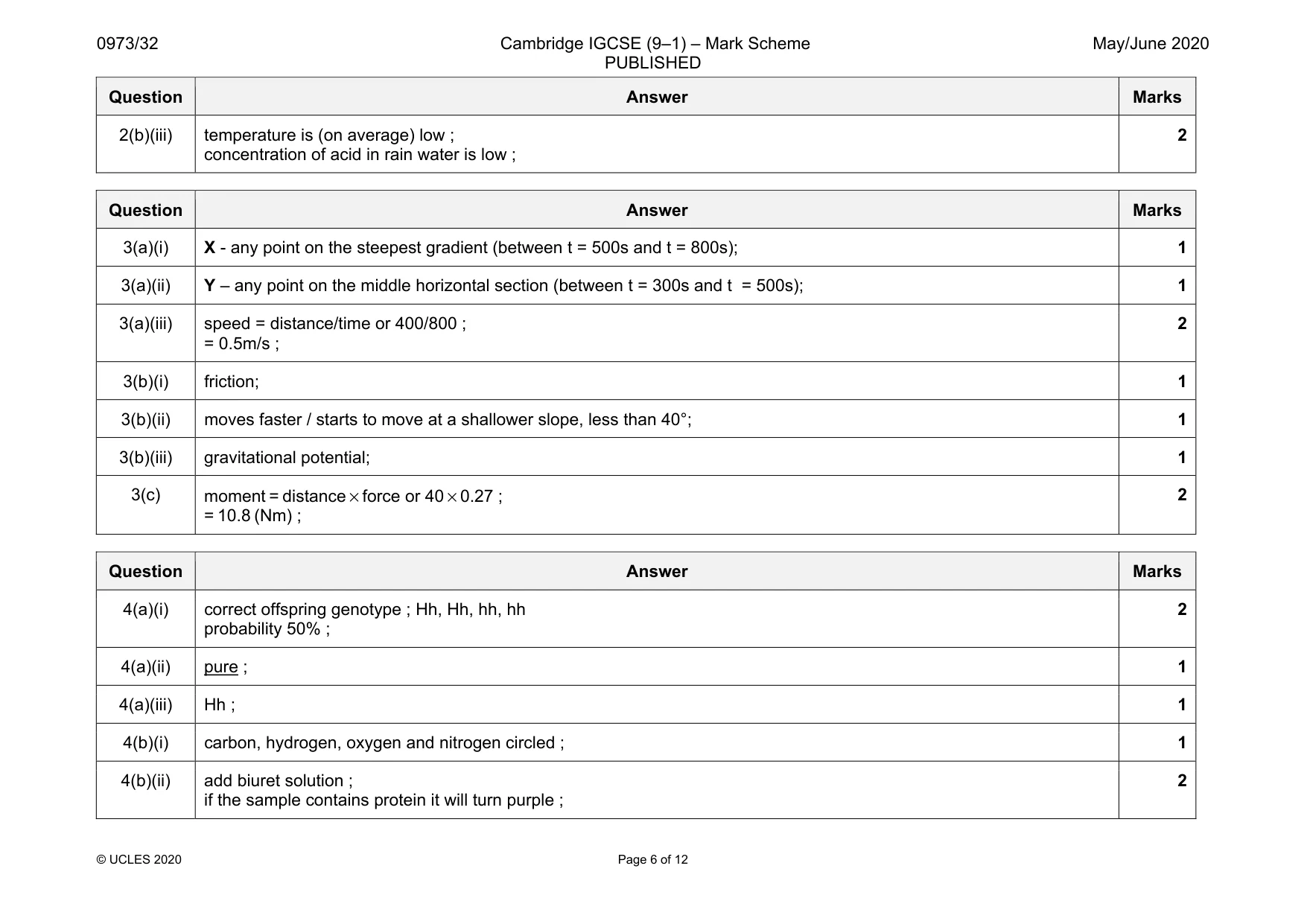
Mark scheme: 2(a)(i) 20 ; 2,8,8,2 ; 2 2(a)(ii) the idea that numbers of protons and electrons are equal ; protons are positive electrons are negative ; total positive charge balances total negative charge ; 3 2(a)(iii) nucleus ; 1 2(b)(i) 3 ; 1 2(b)(ii) calcium chloride ; carbon dioxide + water ; 2 Question Answer Marks 2(b)(iii) temperature is (on average) low ; concentration of acid in rain water is low ; 2
Q3 · A distance-time graph of a girl’s journey to school
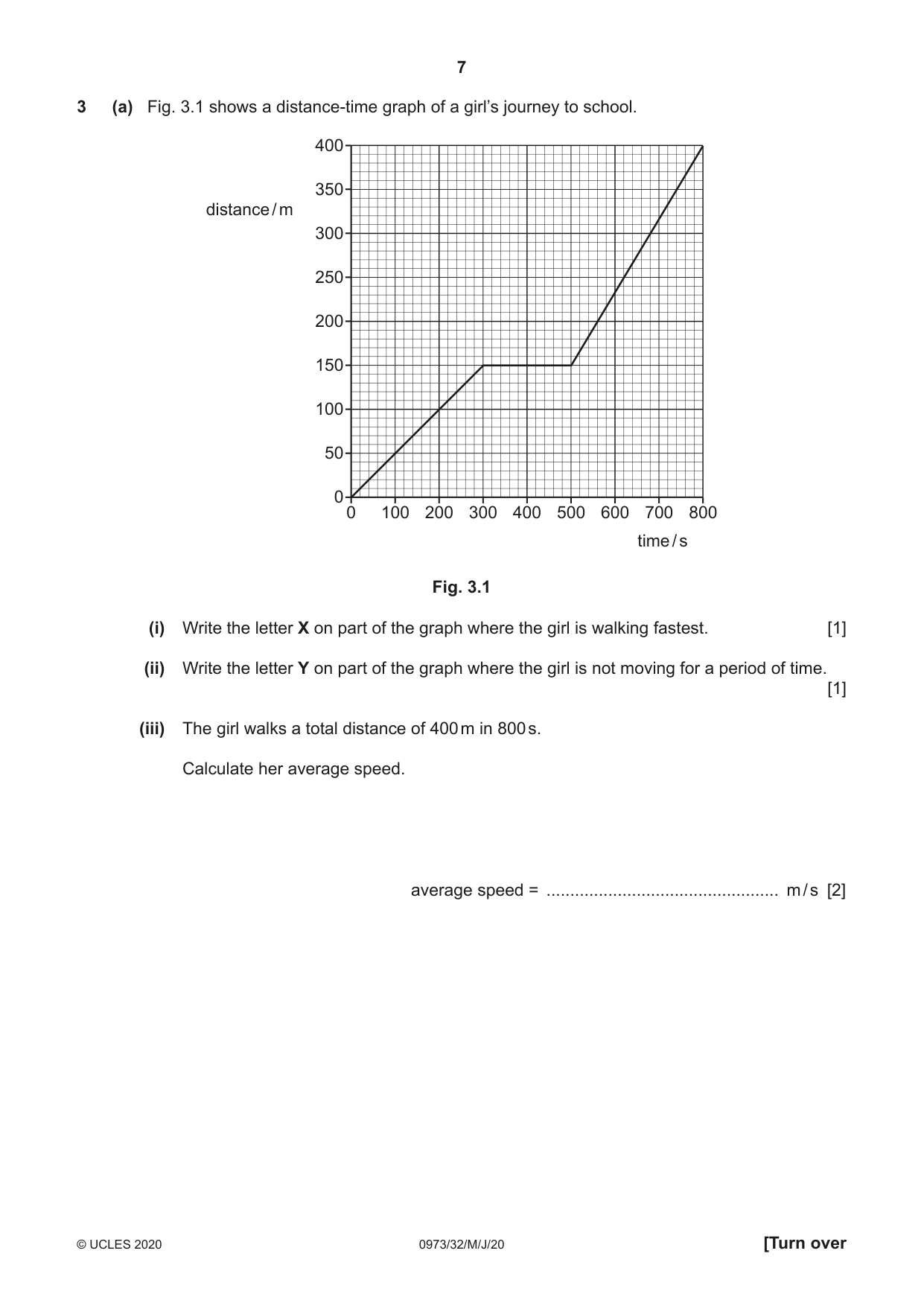
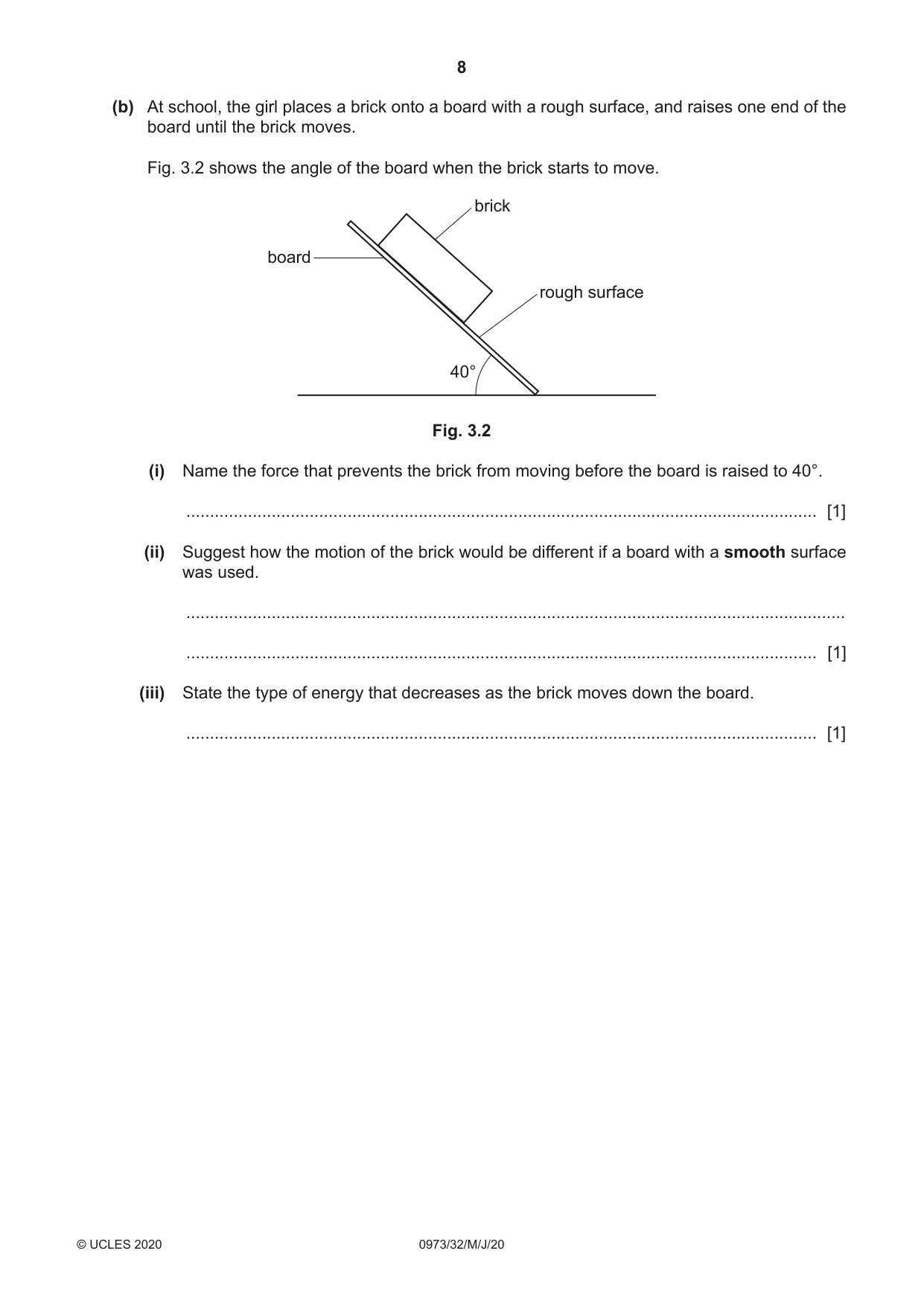
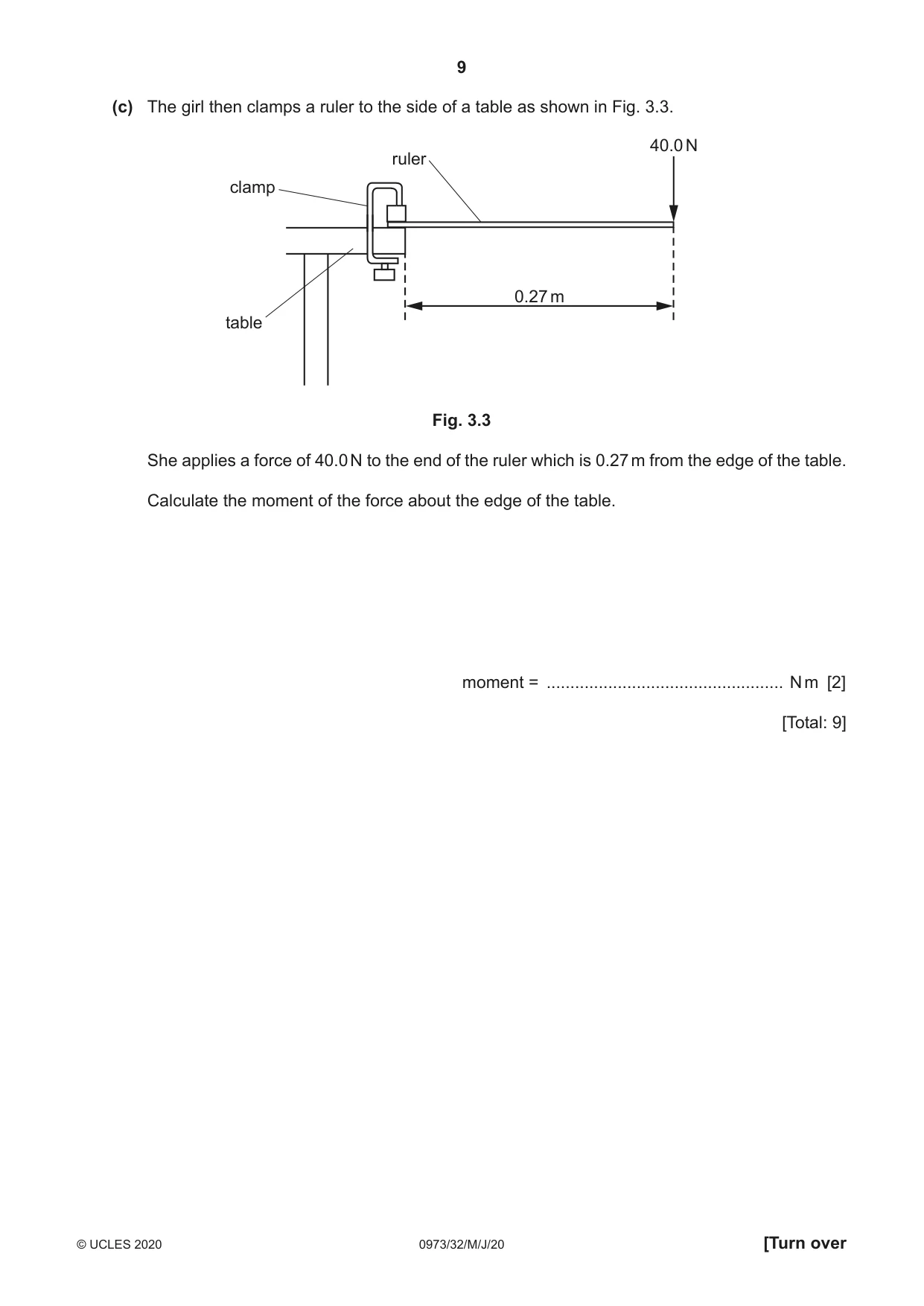
3 (a) Fig. 3.1 shows a distance-time graph of a girl’s journey to school. 400 350 distance / m 300 250 200 150 100 50 0 0 100 200 300 400 500 600 700 800 time / s Fig. 3.1 (i) Write the letter X on part of the graph where the girl is walking fastest. [1] (ii) Write the letter Y on part of the graph where the girl is not moving for a period of time. [1] (iii) The girl walks a total distance of 400 m in 800 s. Calculate her average speed. average speed = ................................................. m / s [2] (b) At school, the girl places a brick onto a board with a rough surface, and raises one end of the board until the brick moves. Fig. 3.2 shows the angle of the board when the brick starts to move. brick board rough surface 40° Fig. 3.2 (i) Name the force that prevents the brick from moving before the board is raised to 40°. ..................................................................................................................................... [1] (ii) Suggest how the motion of the brick would be different if a board with a smooth surface was used. ........................................................................................................................................... ..................................................................................................................................... [1] (iii) State the type of energy that decreases as the brick moves down the board. ..................................................................................................................................... [1] (c) The girl then clamps a ruler to the side of a table as shown in Fig. 3.3. 40.0 N ruler clamp 0.27 m table Fig. 3.3 She applies a force of 40.0 N to the end of the ruler which is 0.27 m from the edge of the table. Calculate the moment of the force about the edge of the table. moment = .................................................. N m [2] [Total: 9]
Mark scheme: 3(a)(i) X - any point on the steepest gradient (between t = 500s and t = 800s); 1 3(a)(ii) Y – any point on the middle horizontal section (between t = 300s and t = 500s); 1 3(a)(iii) speed = distance/time or 400/800 ; = 0.5m/s ; 2 3(b)(i) friction; 1 3(b)(ii) moves faster / starts to move at a shallower slope, less than 40°; 1 3(b)(iii) gravitational potential; 1 3(c) moment = distance × force or 40 × 0.27 ; = 10.8 (Nm) ; 2
Q4 · Huntington’s disease is an inherited disease which damages neurones in the brain
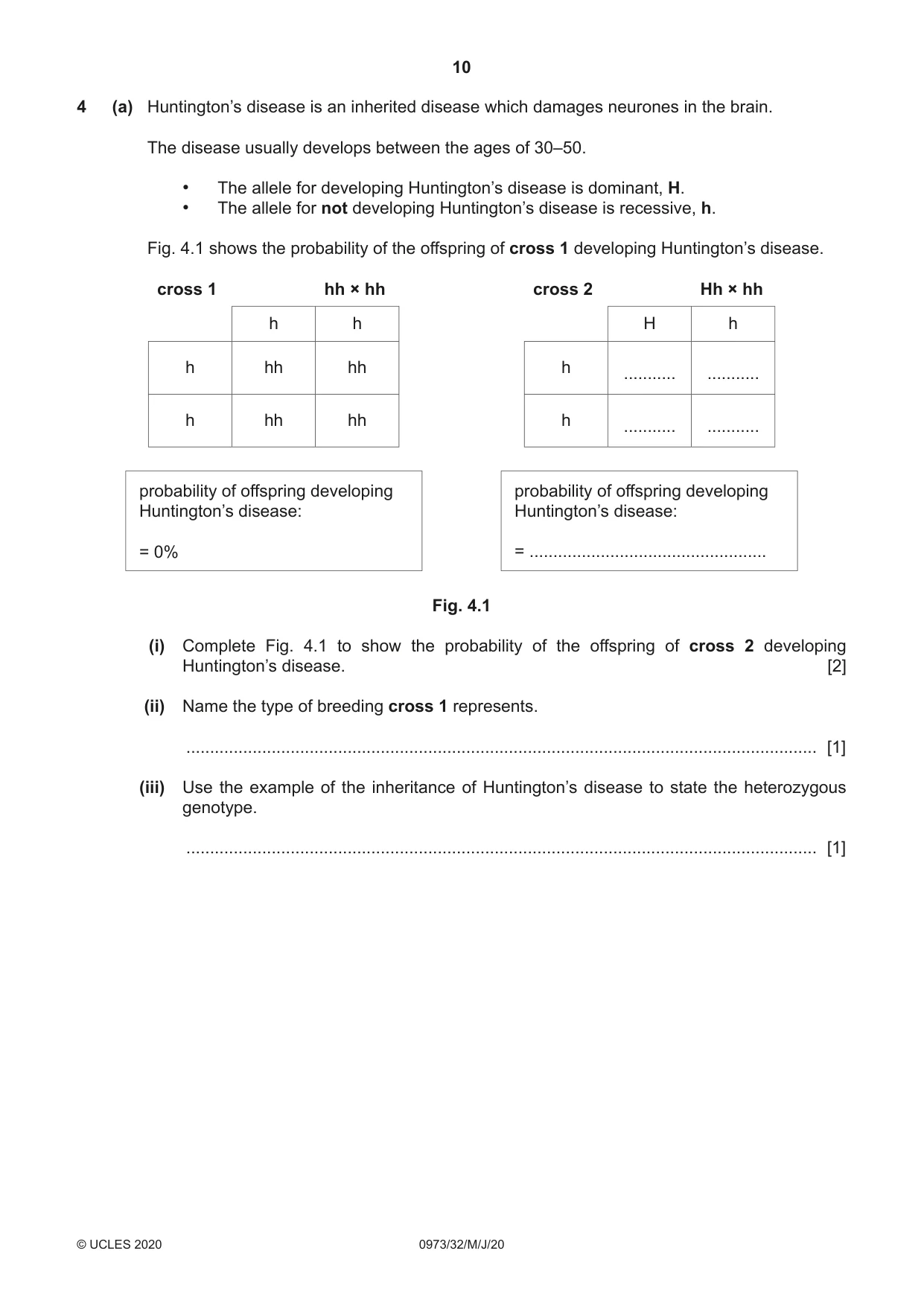
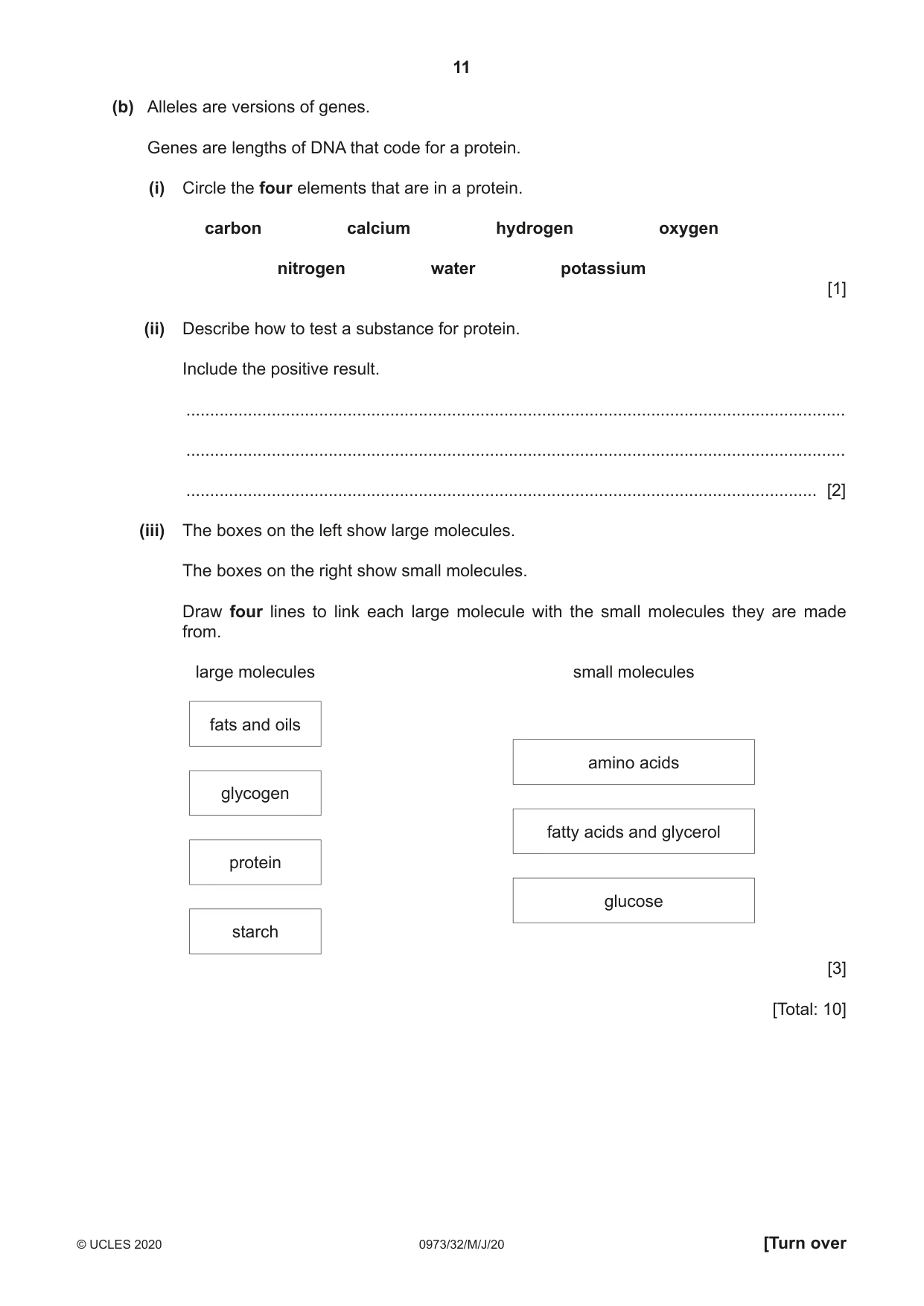
4 (a) Huntington’s disease is an inherited disease which damages neurones in the brain. The disease usually develops between the ages of 30–50. • The allele for developing Huntington’s disease is dominant, H. • The allele for not developing Huntington’s disease is recessive, h. Fig. 4.1 shows the probability of the offspring of cross 1 developing Huntington’s disease. cross 1 hh × hh cross 2 Hh × hh h h H h h hh hh h ........... ........... h hh hh h ........... ........... probability of offspring developing probability of offspring developing Huntington’s disease: Huntington’s disease: = 0% = .................................................. Fig. 4.1 (i) Complete Fig. 4.1 to show the probability of the offspring of cross 2 developing Huntington’s disease. [2] (ii) Name the type of breeding cross 1 represents. ..................................................................................................................................... [1] (iii) Use the example of the inheritance of Huntington’s disease to state the heterozygous genotype. ..................................................................................................................................... [1] (b) Alleles are versions of genes. Genes are lengths of DNA that code for a protein. (i) Circle the four elements that are in a protein. carbon calcium hydrogen oxygen nitrogen water potassium [1] (ii) Describe how to test a substance for protein. Include the positive result. ........................................................................................................................................... ........................................................................................................................................... ..................................................................................................................................... [2] (iii) The boxes on the left show large molecules. The boxes on the right show small molecules. Draw four lines to link each large molecule with the small molecules they are made from. large molecules small molecules fats and oils amino acids glycogen fatty acids and glycerol protein glucose starch [3] [Total: 10]
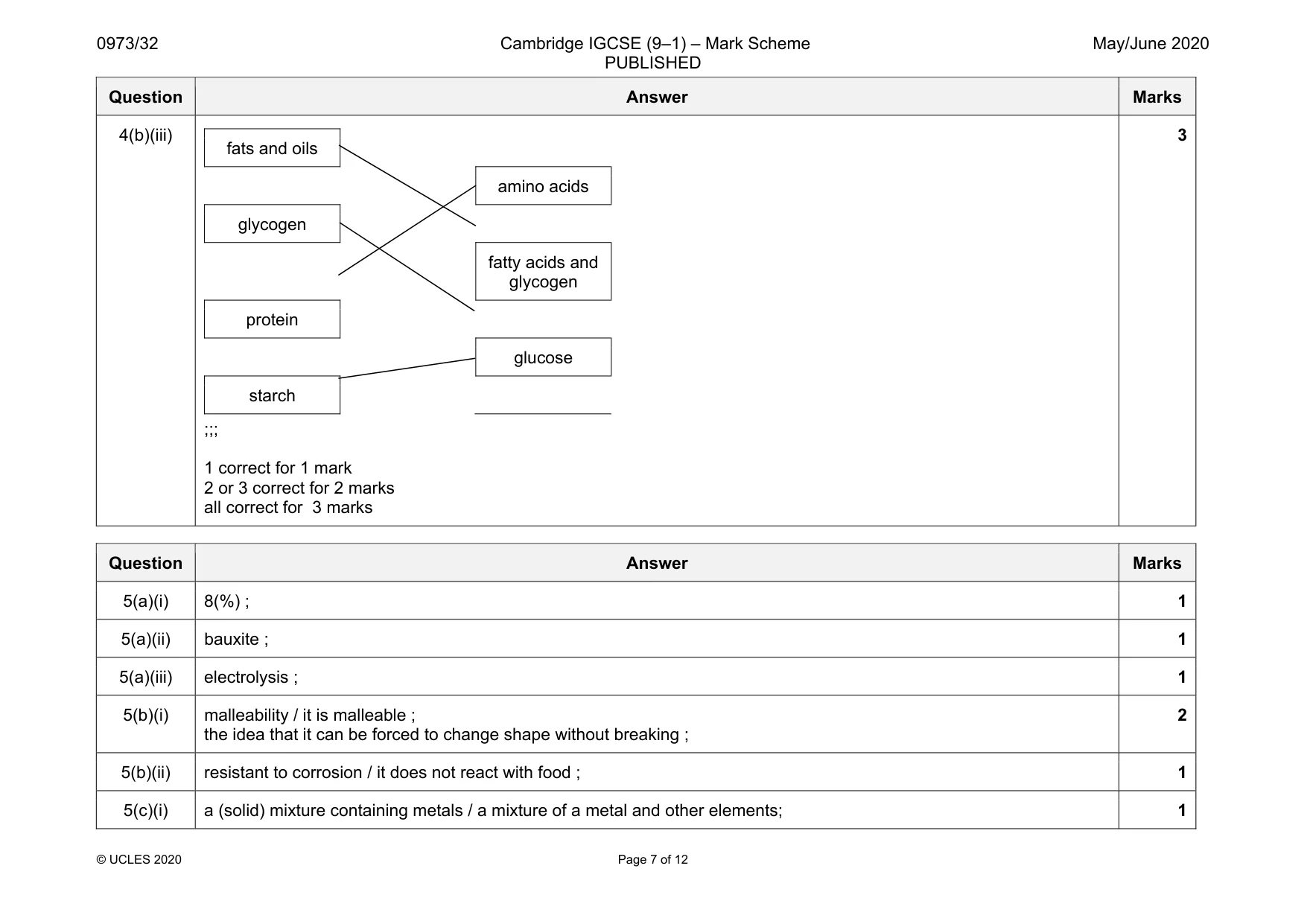
Mark scheme: 4(a)(i) correct offspring genotype ; Hh, Hh, hh, hh probability 50% ; 2 4(a)(ii) pure ; 1 4(a)(iii) Hh ; 1 4(b)(i) carbon, hydrogen, oxygen and nitrogen circled ; 1 4(b)(ii) add biuret solution ; if the sample contains protein it will turn purple ; 2 Question Answer Marks 4(b)(iii) ;;; 1 correct for 1 mark 2 or 3 correct for 2 marks all correct for 3 marks fats and oils amino acids glycogen fatty acids and glycogen protein glucose starch 3
Q5 · A pie chart showing the percentages of some of the elements in the Earth’s crust
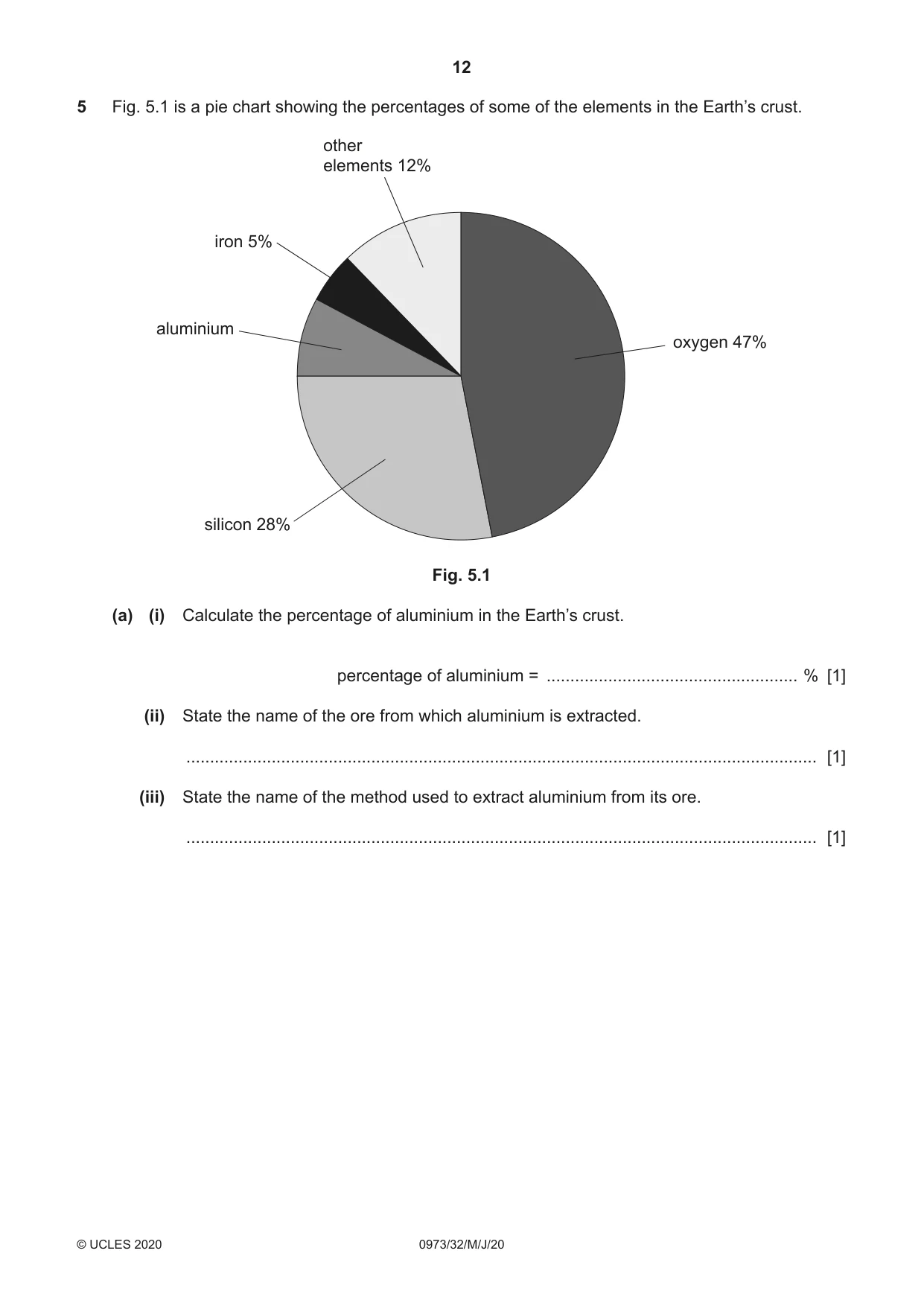
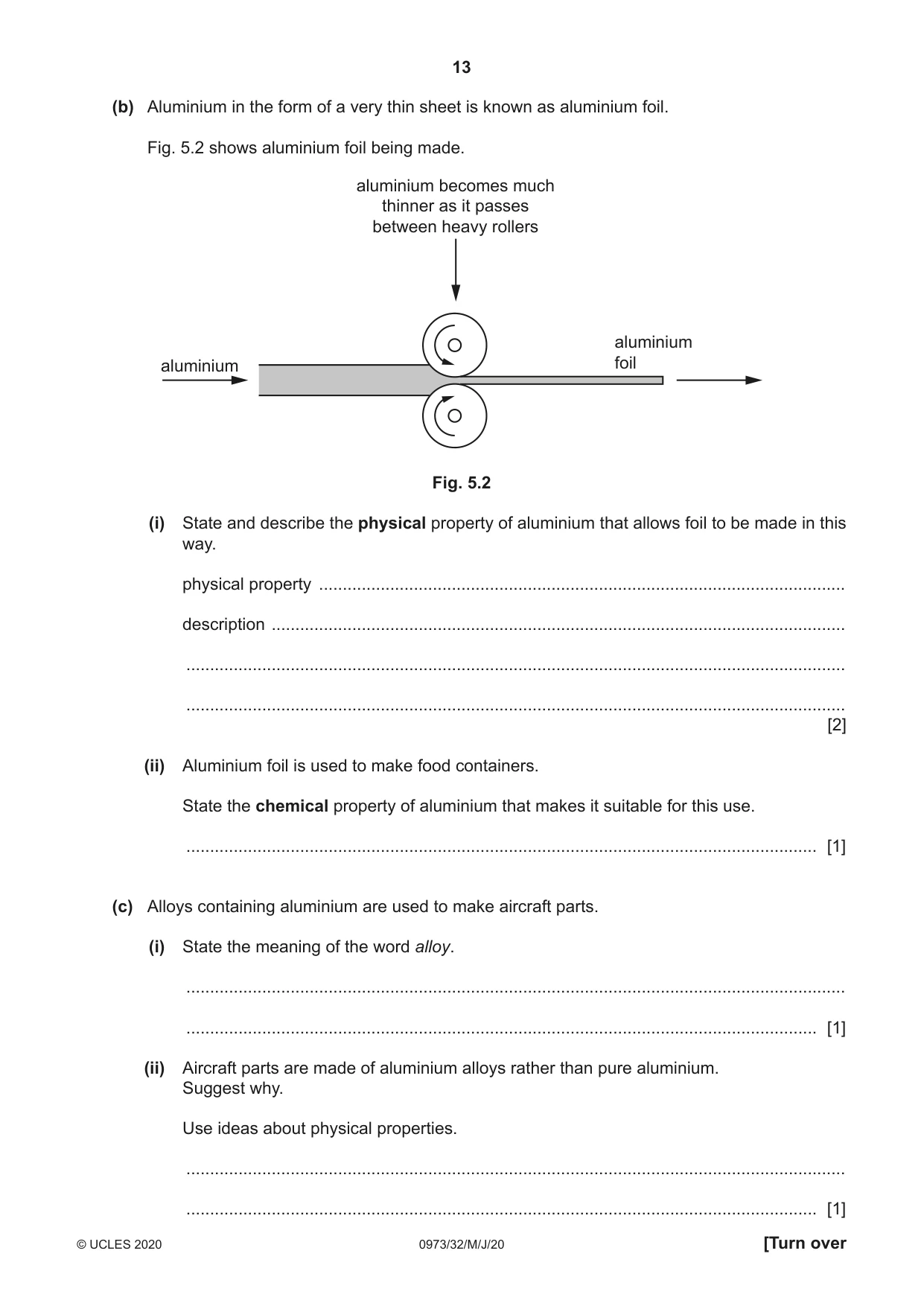
5 Fig. 5.1 is a pie chart showing the percentages of some of the elements in the Earth’s crust. other elements 12% iron 5% aluminium oxygen 47% silicon 28% Fig. 5.1 (a) (i) Calculate the percentage of aluminium in the Earth’s crust. percentage of aluminium = ..................................................... % [1] (ii) State the name of the ore from which aluminium is extracted. ..................................................................................................................................... [1] (iii) State the name of the method used to extract aluminium from its ore. ..................................................................................................................................... [1] (b) Aluminium in the form of a very thin sheet is known as aluminium foil. Fig. 5.2 shows aluminium foil being made. aluminium becomes much thinner as it passes between heavy rollers aluminium aluminium foil Fig. 5.2 (i) State and describe the physical property of aluminium that allows foil to be made in this way. physical property ............................................................................................................... description ......................................................................................................................... ........................................................................................................................................... ........................................................................................................................................... [2] (ii) Aluminium foil is used to make food containers. State the chemical property of aluminium that makes it suitable for this use. ..................................................................................................................................... [1] (c) Alloys containing aluminium are used to make aircraft parts. (i) State the meaning of the word alloy. ........................................................................................................................................... ..................................................................................................................................... [1] (ii) Aircraft parts are made of aluminium alloys rather than pure aluminium. Suggest why. Use ideas about physical properties. ........................................................................................................................................... ..................................................................................................................................... [1] (d) Mild steel is an alloy containing iron. Mild steel is used to make car bodies. Car bodies are painted to prevent rusting. Explain in detail why painting car bodies prevents rusting. ................................................................................................................................................... ................................................................................................................................................... ................................................................................................................................................... ............................................................................................................................................. [3] [Total: 11]
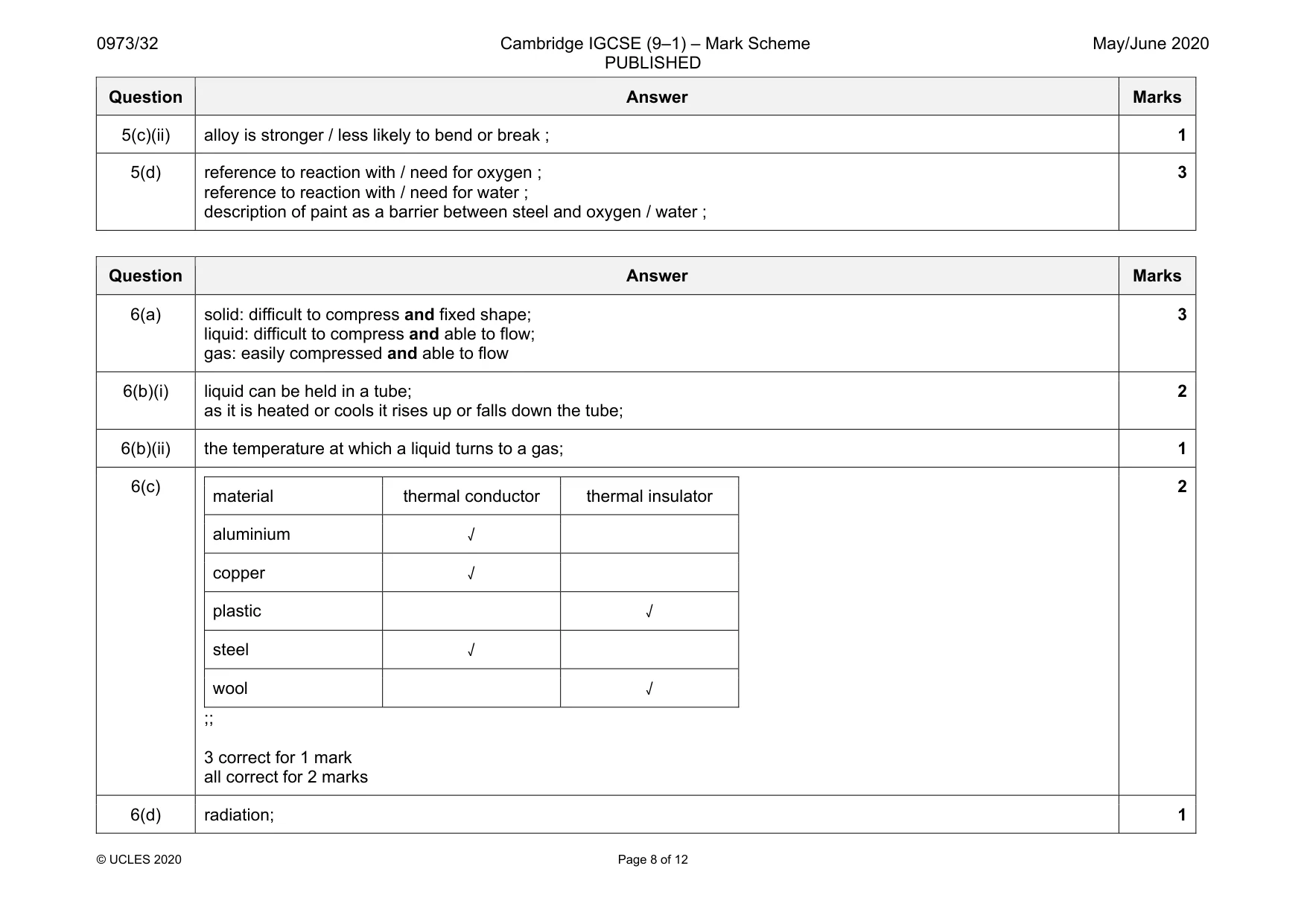
Mark scheme: 5(a)(i) 8(%) ; 1 5(a)(ii) bauxite ; 1 5(a)(iii) electrolysis ; 1 5(b)(i) malleability / it is malleable ; the idea that it can be forced to change shape without breaking ; 2 5(b)(ii) resistant to corrosion / it does not react with food ; 1 5(c)(i) a (solid) mixture containing metals / a mixture of a metal and other elements; 1 Question Answer Marks 5(c)(ii) alloy is stronger / less likely to bend or break ; 1 5(d) reference to reaction with / need for oxygen ; reference to reaction with / need for water ; description of paint as a barrier between steel and oxygen / water ; 3
Q6 · Solids, liquids and gases have different properties
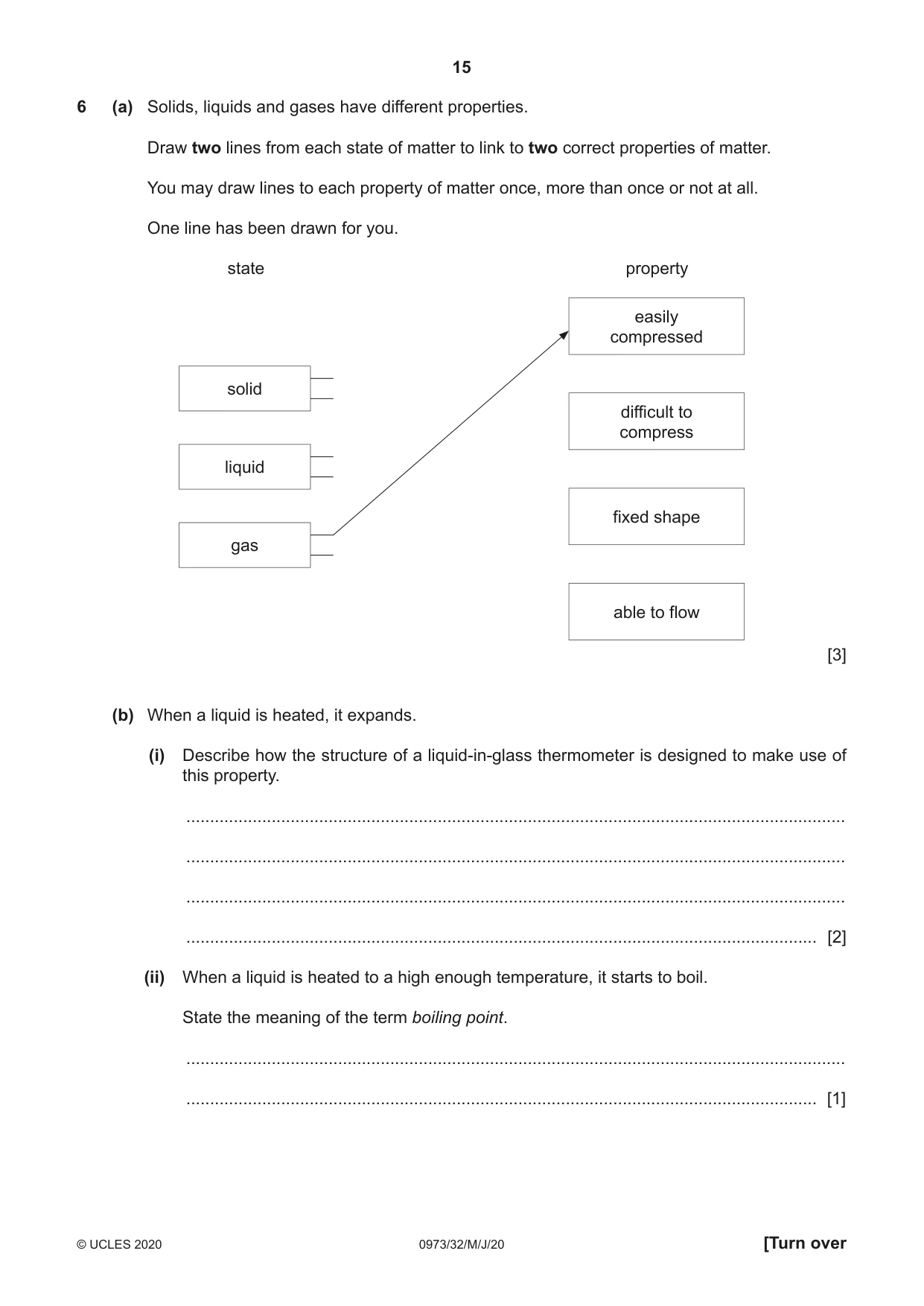
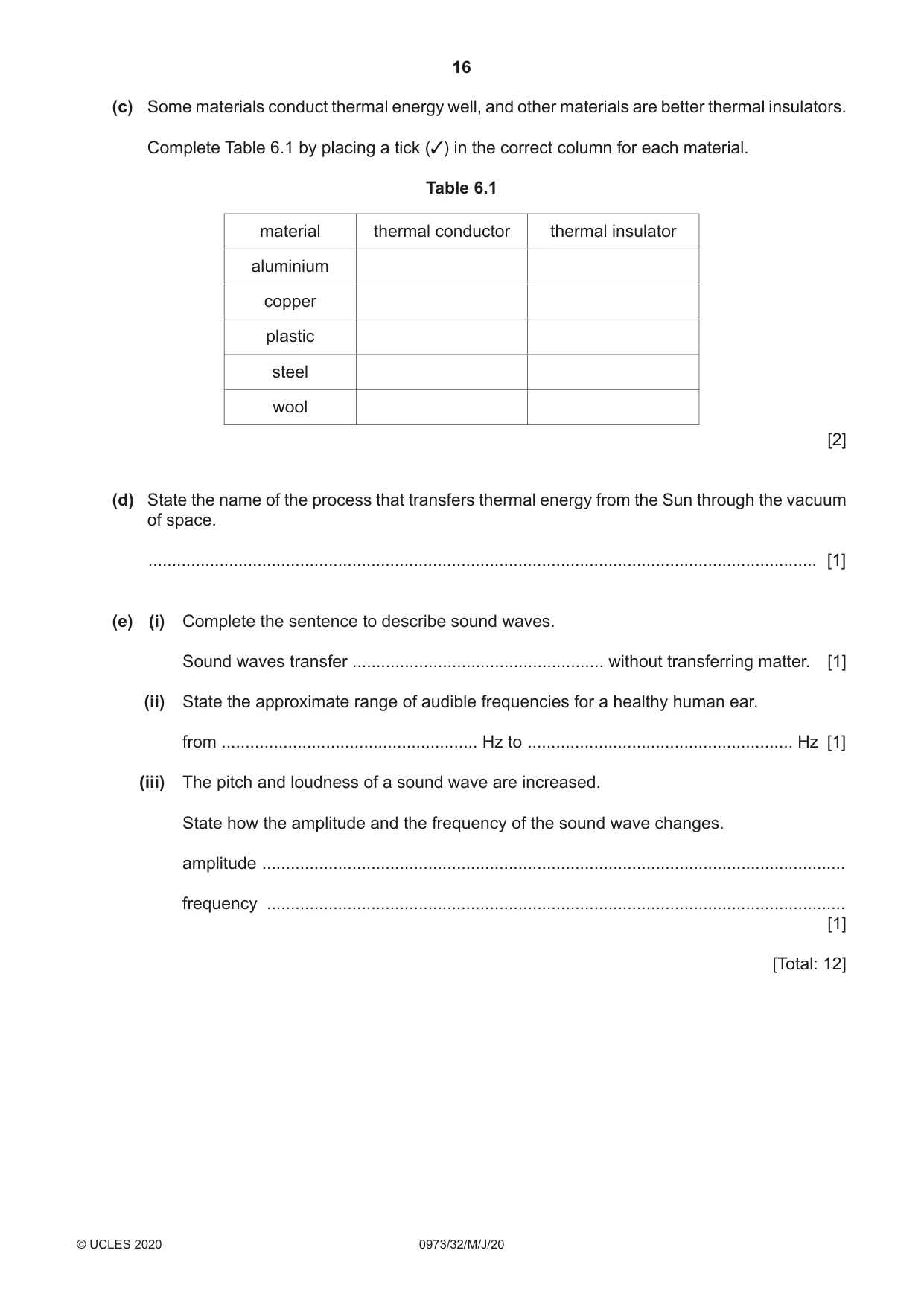
6 (a) Solids, liquids and gases have different properties. Draw two lines from each state of matter to link to two correct properties of matter. You may draw lines to each property of matter once, more than once or not at all. One line has been drawn for you. state property easily compressed solid difficult to compress liquid fixed shape gas able to flow [3] (b) When a liquid is heated, it expands. (i) Describe how the structure of a liquid-in-glass thermometer is designed to make use of this property. ........................................................................................................................................... ........................................................................................................................................... ........................................................................................................................................... ..................................................................................................................................... [2] (ii) When a liquid is heated to a high enough temperature, it starts to boil. State the meaning of the term boiling point. ........................................................................................................................................... ..................................................................................................................................... [1] (c) Some materials conduct thermal energy well, and other materials are better thermal insulators. Complete Table 6.1 by placing a tick (3) in the correct column for each material. Table 6.1 material thermal conductor thermal insulator aluminium copper plastic steel wool [2] (d) State the name of the process that transfers thermal energy from the Sun through the vacuum of space. ............................................................................................................................................. [1] (e) (i) Complete the sentence to describe sound waves. Sound waves transfer ..................................................... without transferring matter. [1] (ii) State the approximate range of audible frequencies for a healthy human ear. from ...................................................... Hz to ........................................................ Hz [1] (iii) The pitch and loudness of a sound wave are increased. State how the amplitude and the frequency of the sound wave changes. amplitude ........................................................................................................................... frequency .......................................................................................................................... [1] [Total: 12]
Mark scheme: 6(a) solid: difficult to compress and fixed shape; liquid: difficult to compress and able to flow; gas: easily compressed and able to flow 3 6(b)(i) liquid can be held in a tube; as it is heated or cools it rises up or falls down the tube; 2 6(b)(ii) the temperature at which a liquid turns to a gas; 1 6(c) material thermal conductor thermal insulator aluminium √ copper √ plastic √ steel √ wool √ ;; 3 correct for 1 mark all correct for 2 marks 2 6(d) radiation; 1 Question Answer Marks 6(e)(i) energy; 1 6(e)(ii) 20 to 20 000; 1 6(e)(iii) amplitude increases and frequency increases; 1
Question 7
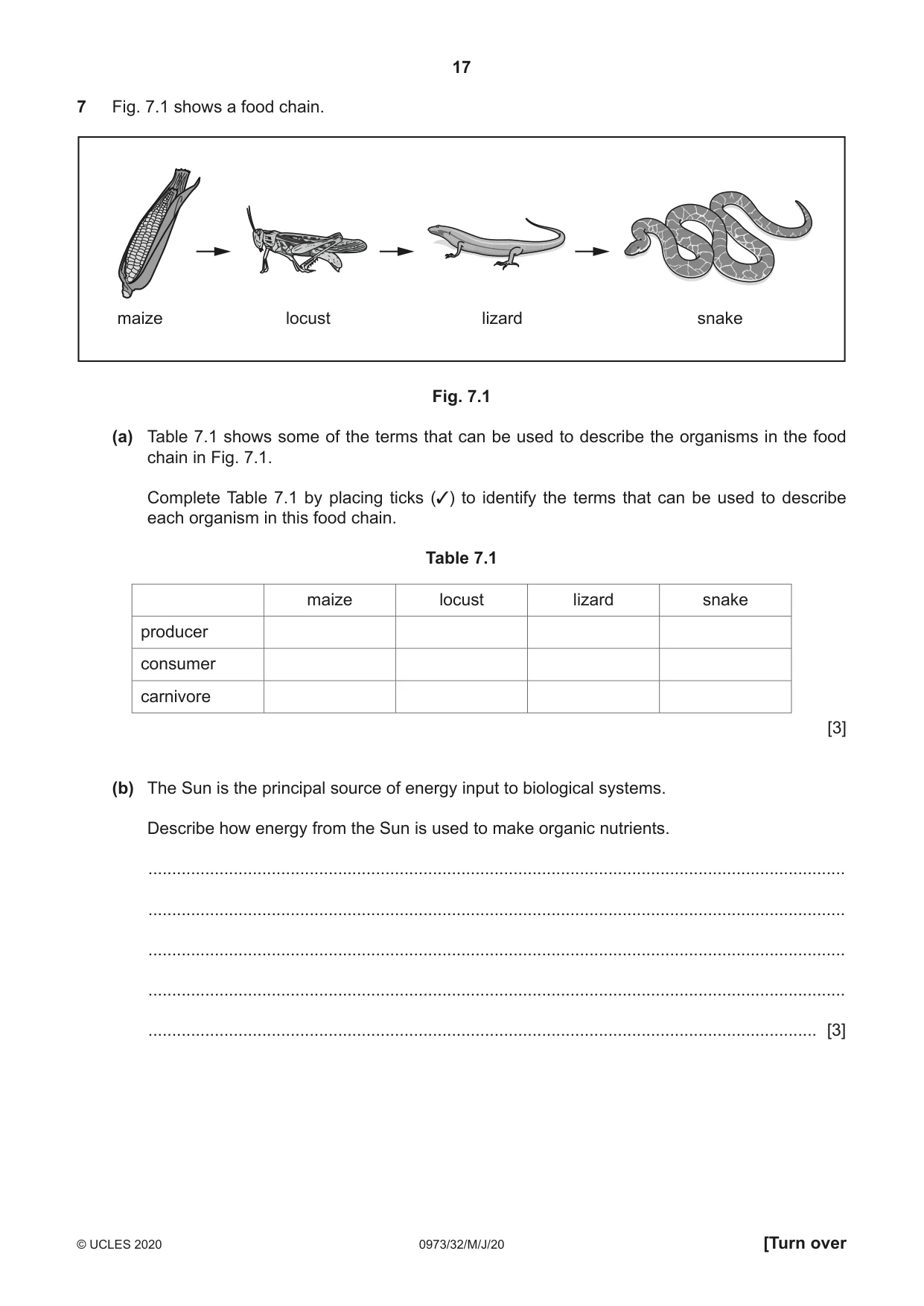
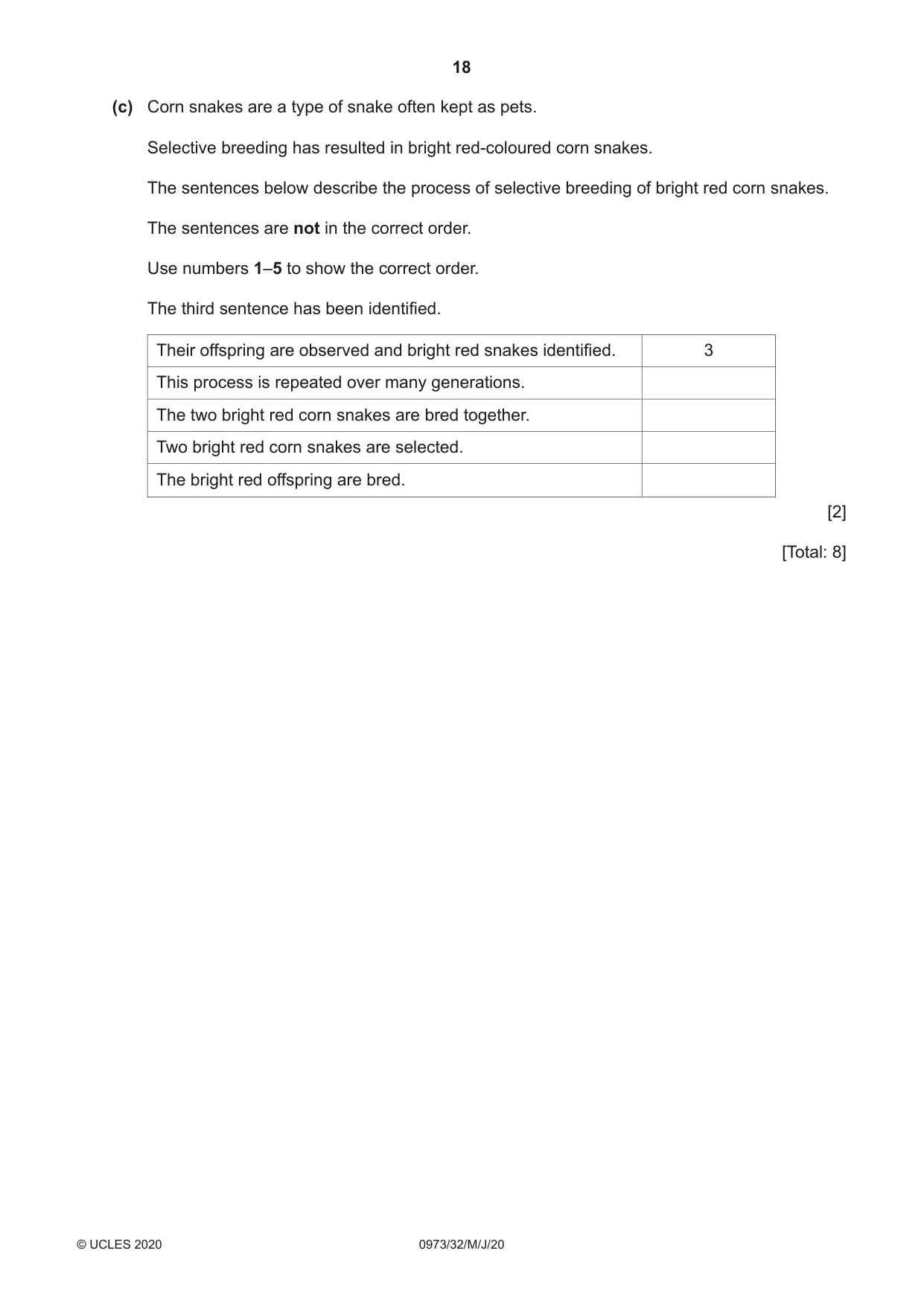
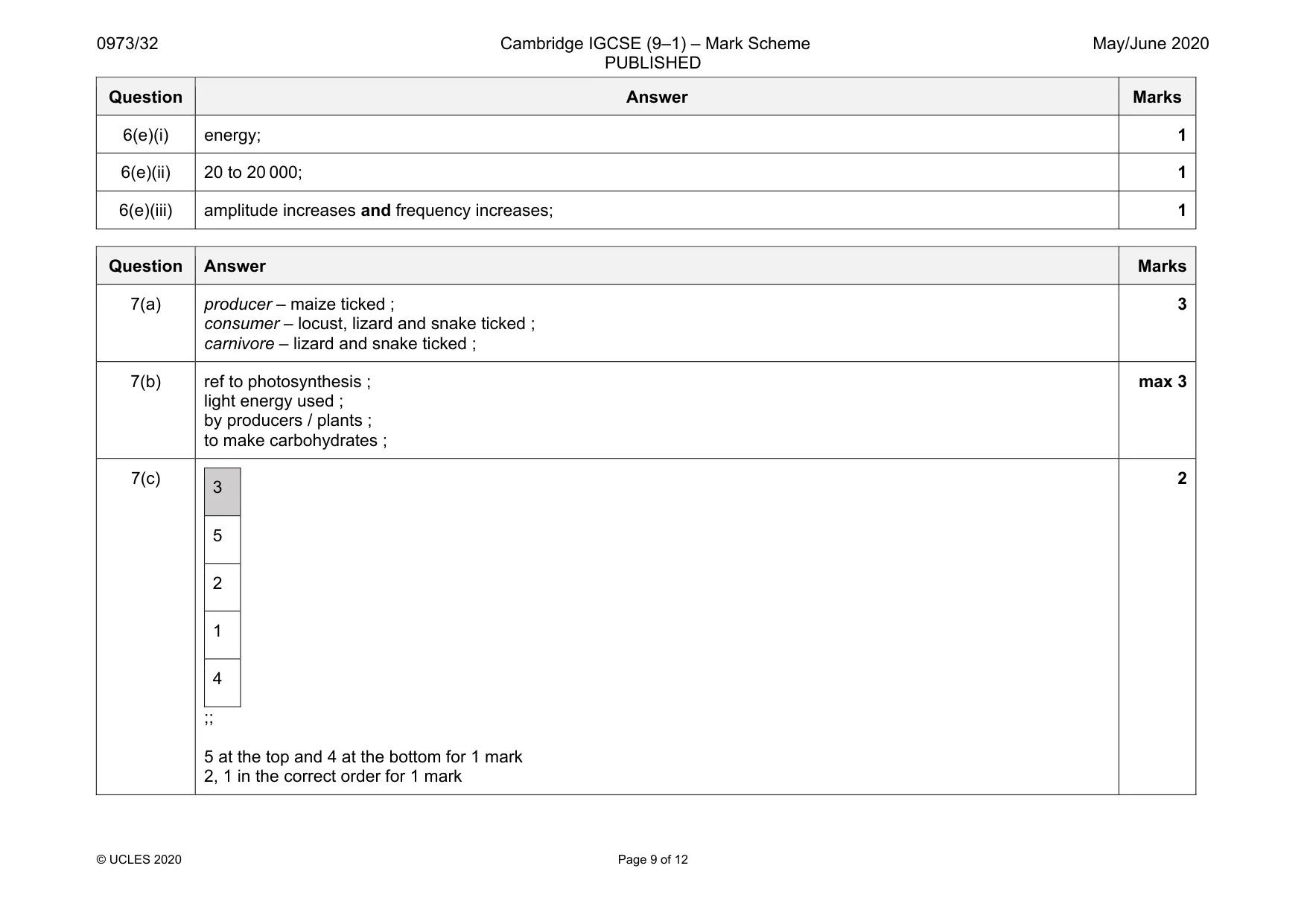
7 Fig. 7.1 shows a food chain. maize locust lizard snake Fig. 7.1 (a) Table 7.1 shows some of the terms that can be used to describe the organisms in the food chain in Fig. 7.1. Complete Table 7.1 by placing ticks (3) to identify the terms that can be used to describe each organism in this food chain. Table 7.1 maize locust lizard snake producer consumer carnivore [3] (b) The Sun is the principal source of energy input to biological systems. Describe how energy from the Sun is used to make organic nutrients. ................................................................................................................................................... ................................................................................................................................................... ................................................................................................................................................... ................................................................................................................................................... ............................................................................................................................................. [3] (c) Corn snakes are a type of snake often kept as pets. Selective breeding has resulted in bright red-coloured corn snakes. The sentences below describe the process of selective breeding of bright red corn snakes. The sentences are not in the correct order. Use numbers 1–5 to show the correct order. The third sentence has been identified. Their offspring are observed and bright red snakes identified. 3 This process is repeated over many generations. The two bright red corn snakes are bred together. Two bright red corn snakes are selected. The bright red offspring are bred. [2] [Total: 8]
Mark scheme: 7(a) producer – maize ticked ; consumer – locust, lizard and snake ticked ; carnivore – lizard and snake ticked ; 3 7(b) ref to photosynthesis ; light energy used ; by producers / plants ; to make carbohydrates ; max 3 7(c) 3 5 2 1 4 ;; 5 at the top and 4 at the bottom for 1 mark 2, 1 in the correct order for 1 mark 2
Q8 · Water is a compound of the elements hydrogen and oxygen
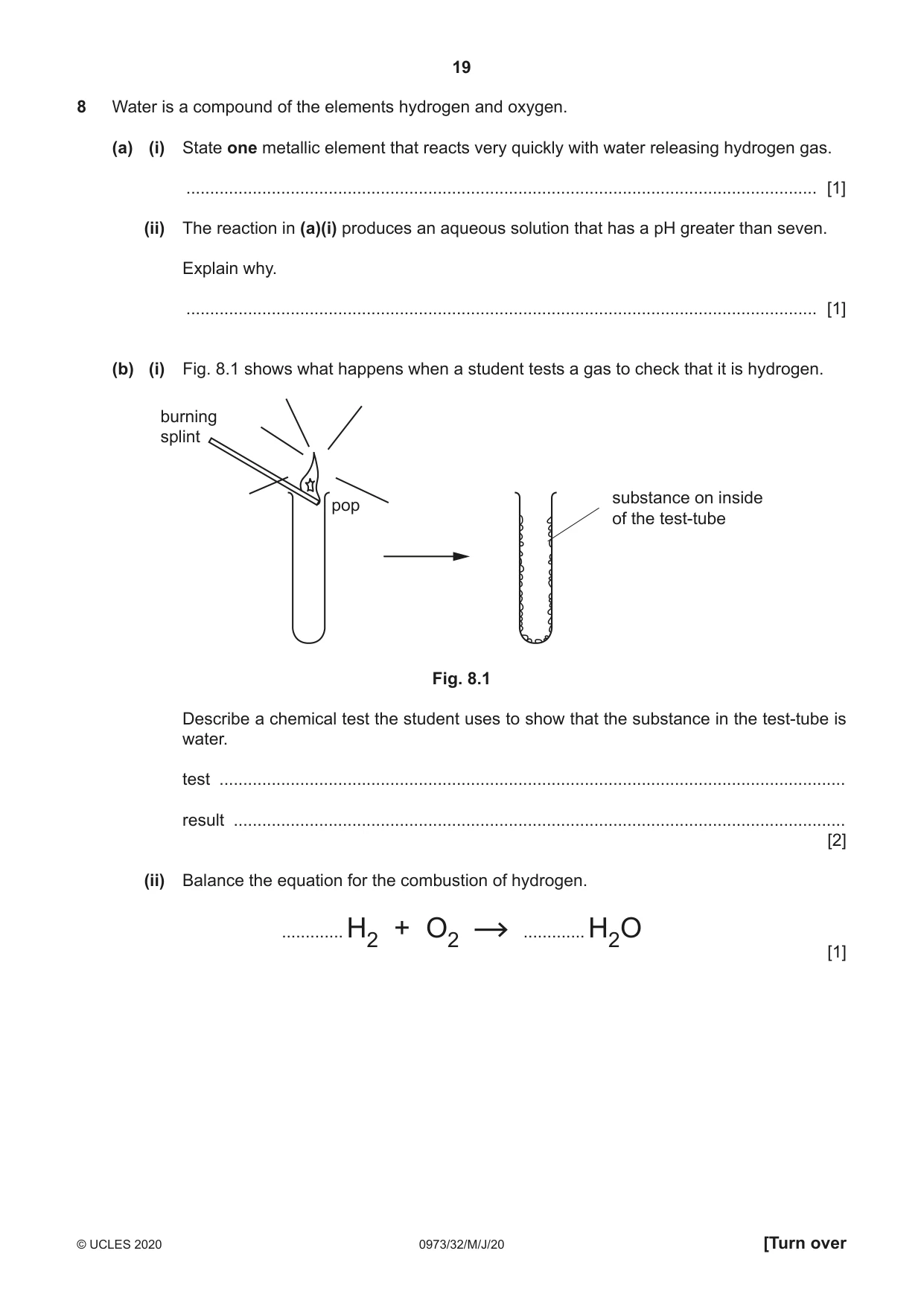
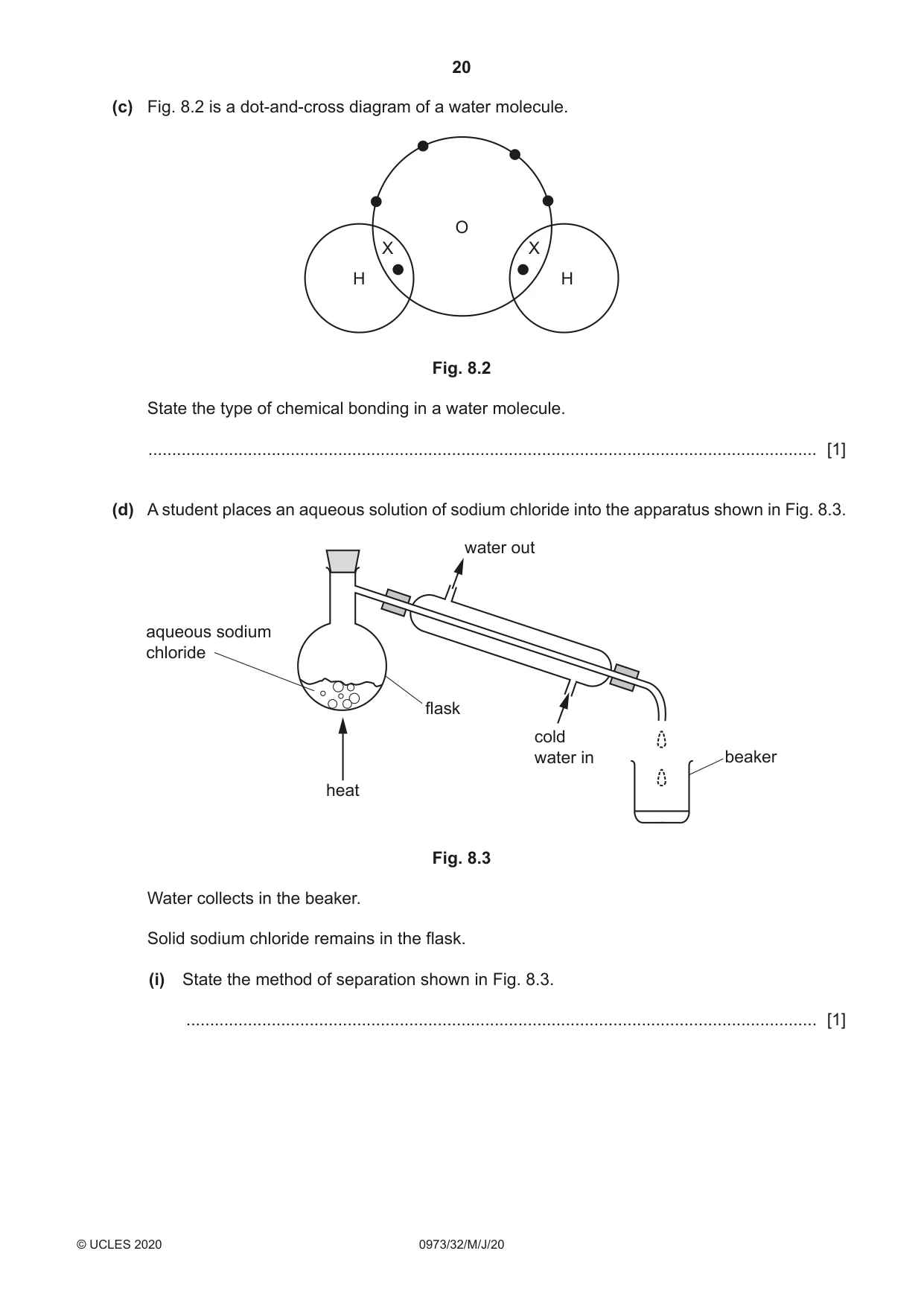
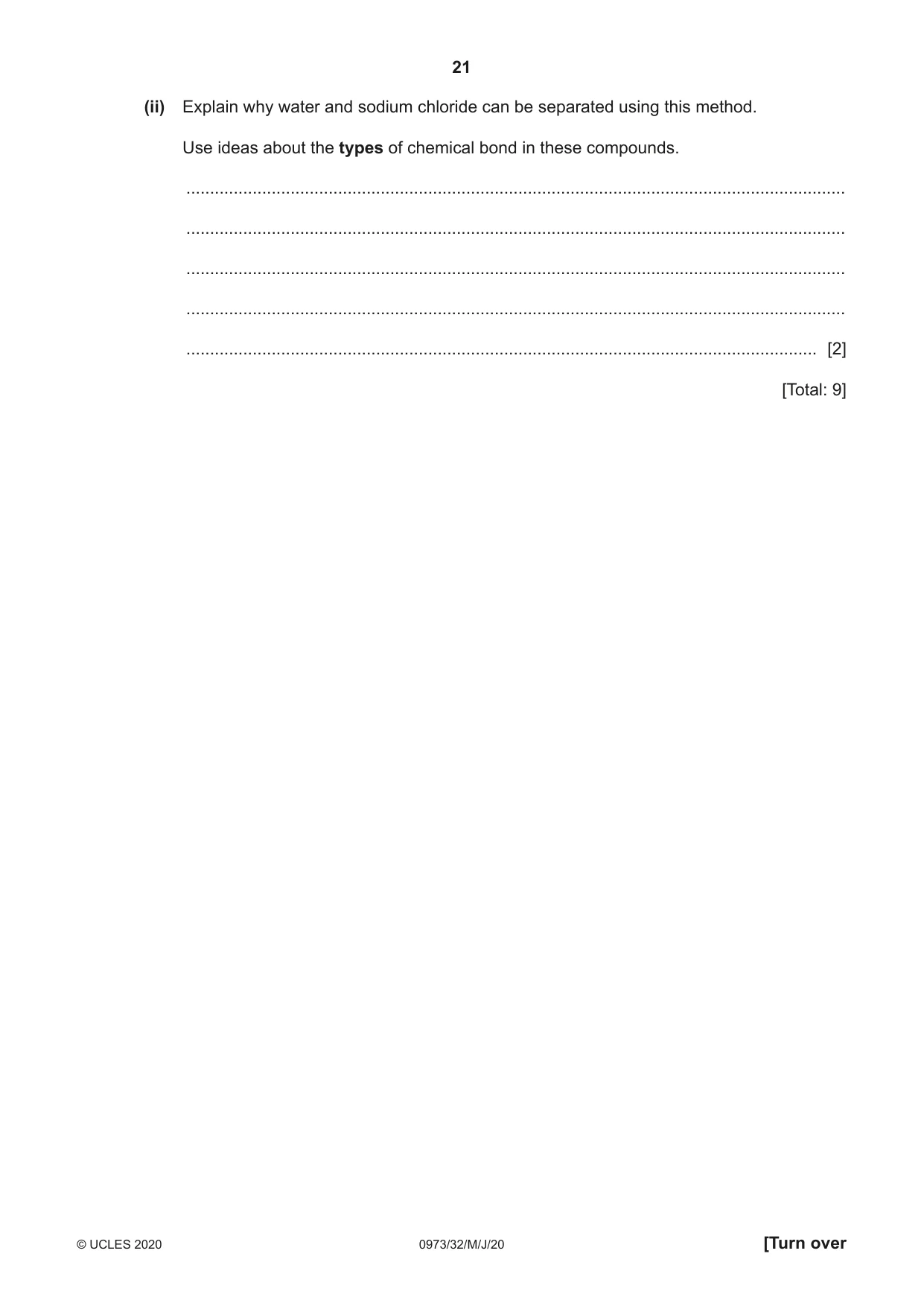
8 Water is a compound of the elements hydrogen and oxygen. (a) (i) State one metallic element that reacts very quickly with water releasing hydrogen gas. ..................................................................................................................................... [1] (ii) The reaction in (a)(i) produces an aqueous solution that has a pH greater than seven. Explain why. ..................................................................................................................................... [1] (b) (i) Fig. 8.1 shows what happens when a student tests a gas to check that it is hydrogen. burning splint substance on inside pop of the test-tube Fig. 8.1 Describe a chemical test the student uses to show that the substance in the test-tube is water. test .................................................................................................................................... result ................................................................................................................................. [2] (ii) Balance the equation for the combustion of hydrogen. ............. ............. H2 + O2 H2O [1] (c) Fig. 8.2 is a dot-and-cross diagram of a water molecule. O X X H H Fig. 8.2 State the type of chemical bonding in a water molecule. ............................................................................................................................................. [1] (d) A student places an aqueous solution of sodium chloride into the apparatus shown in Fig. 8.3. water out aqueous sodium chloride flask cold water in beaker heat Fig. 8.3 Water collects in the beaker. Solid sodium chloride remains in the flask. (i) State the method of separation shown in Fig. 8.3. ..................................................................................................................................... [1] (ii) Explain why water and sodium chloride can be separated using this method. Use ideas about the types of chemical bond in these compounds. ........................................................................................................................................... ........................................................................................................................................... ........................................................................................................................................... ........................................................................................................................................... ..................................................................................................................................... [2] [Total: 9]
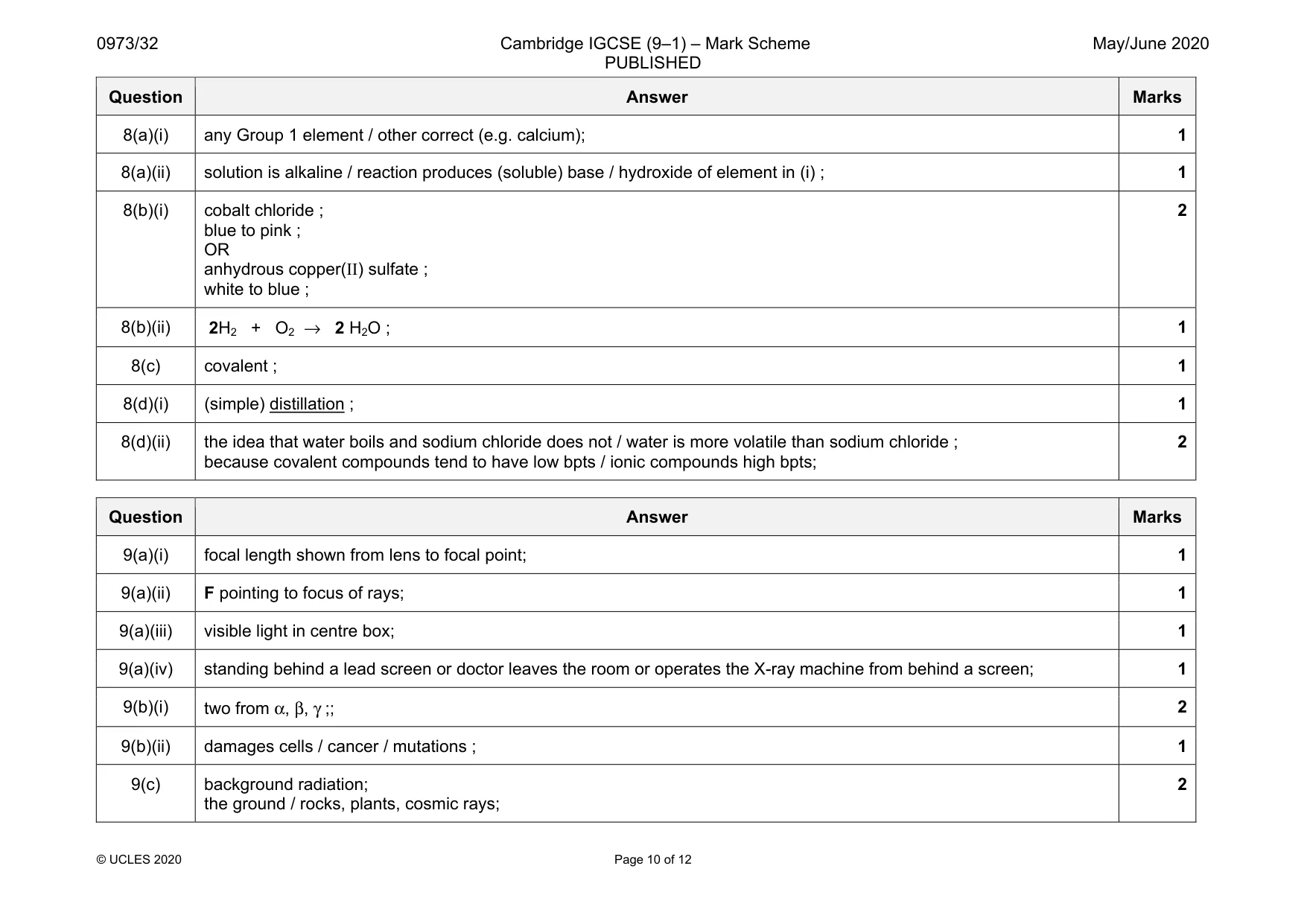
Mark scheme: 8(a)(i) any Group 1 element / other correct (e.g. calcium); 1 8(a)(ii) solution is alkaline / reaction produces (soluble) base / hydroxide of element in (i) ; 1 8(b)(i) cobalt chloride ; blue to pink ; OR anhydrous copper(II) sulfate ; white to blue ; 2 8(b)(ii) 2H2 + O2 → 2 H2O ; 1 8(c) covalent ; 1 8(d)(i) (simple) distillation ; 1 8(d)(ii) the idea that water boils and sodium chloride does not / water is more volatile than sodium chloride ; because covalent compounds tend to have low bpts / ionic compounds high bpts; 2
More questions on The characteristic properties of acids and bases
Q9 · Visible light rays passing through a thin converging lens onto a screen
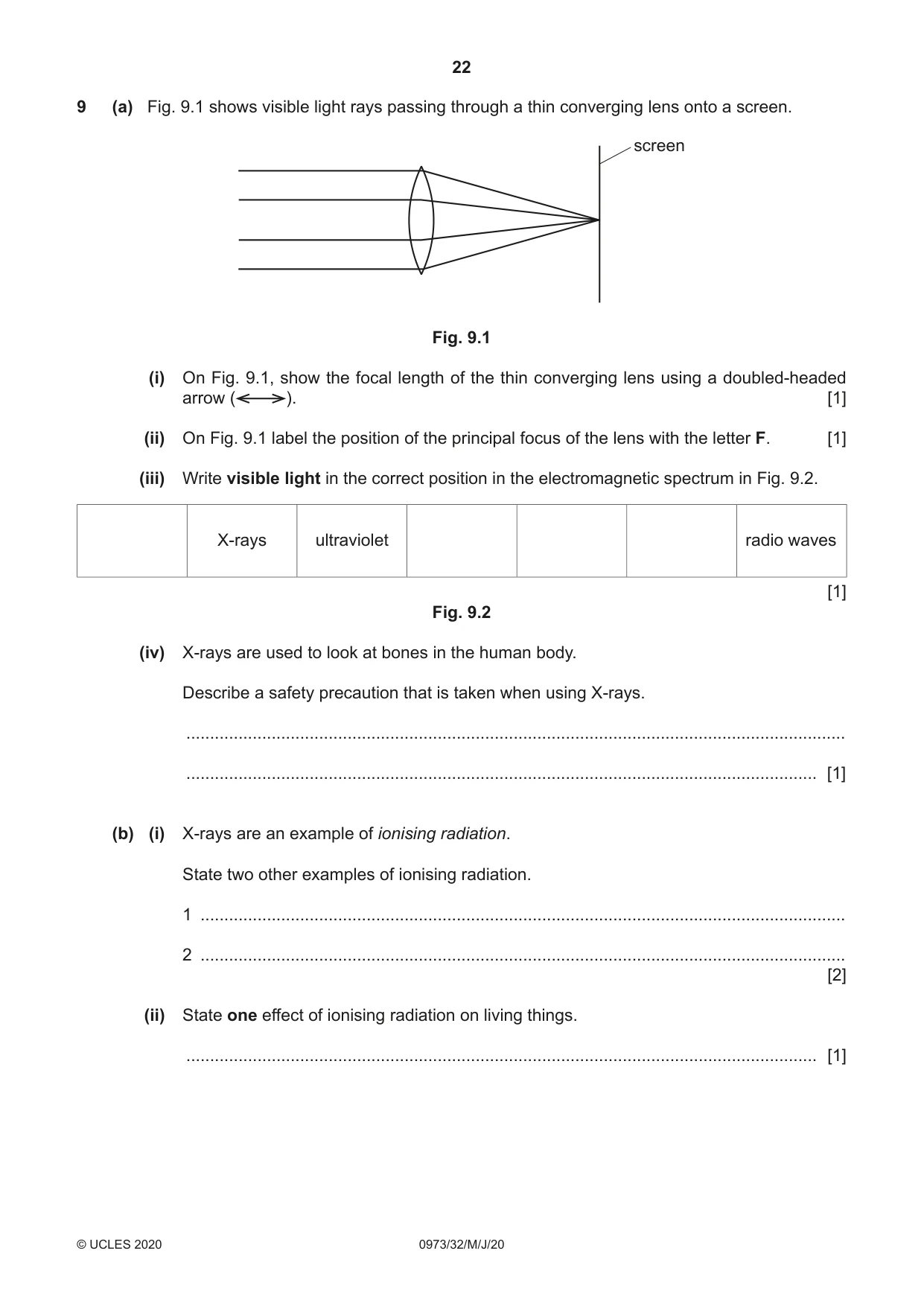
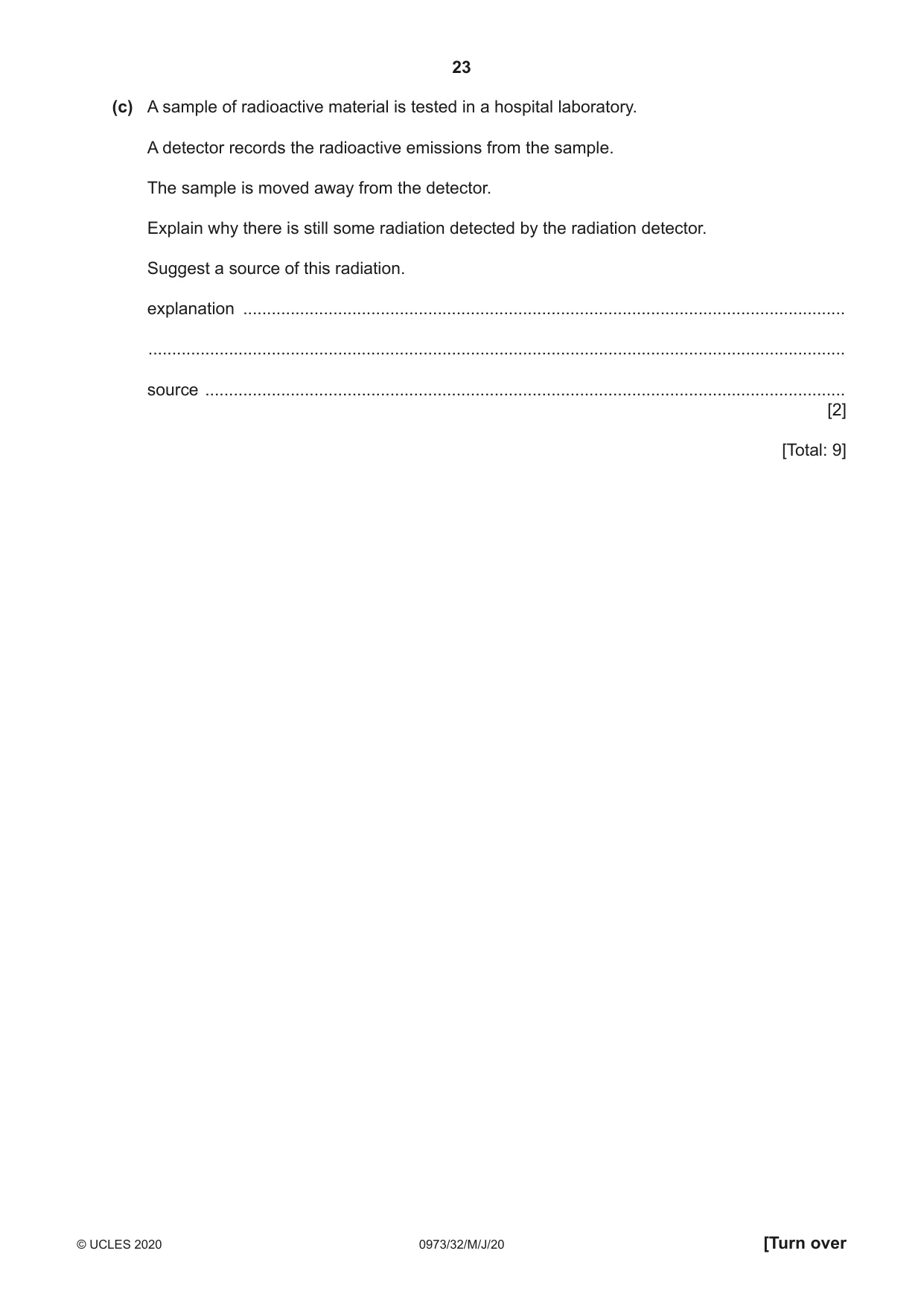
9 (a) Fig. 9.1 shows visible light rays passing through a thin converging lens onto a screen. screen Fig. 9.1 (i) On Fig. 9.1, show the focal length of the thin converging lens using a doubled-headed arrow ( ). [1] (ii) On Fig. 9.1 label the position of the principal focus of the lens with the letter F. [1] (iii) Write visible light in the correct position in the electromagnetic spectrum in Fig. 9.2. X-rays ultraviolet radio waves [1] Fig. 9.2 (iv) X-rays are used to look at bones in the human body. Describe a safety precaution that is taken when using X-rays. ........................................................................................................................................... ..................................................................................................................................... [1] (b) (i) X-rays are an example of ionising radiation. State two other examples of ionising radiation. 1 ........................................................................................................................................ 2 ........................................................................................................................................ [2] (ii) State one effect of ionising radiation on living things. ..................................................................................................................................... [1] (c) A sample of radioactive material is tested in a hospital laboratory. A detector records the radioactive emissions from the sample. The sample is moved away from the detector. Explain why there is still some radiation detected by the radiation detector. Suggest a source of this radiation. explanation ............................................................................................................................... ................................................................................................................................................... source ....................................................................................................................................... [2] [Total: 9]
Mark scheme: 9(a)(i) focal length shown from lens to focal point; 1 9(a)(ii) F pointing to focus of rays; 1 9(a)(iii) visible light in centre box; 1 9(a)(iv) standing behind a lead screen or doctor leaves the room or operates the X-ray machine from behind a screen; 1 9(b)(i) two from α, β, γ ;; 2 9(b)(ii) damages cells / cancer / mutations ; 1 9(c) background radiation; the ground / rocks, plants, cosmic rays; 2
Q10 · Simplified cross-sections of three different types of blood vessel
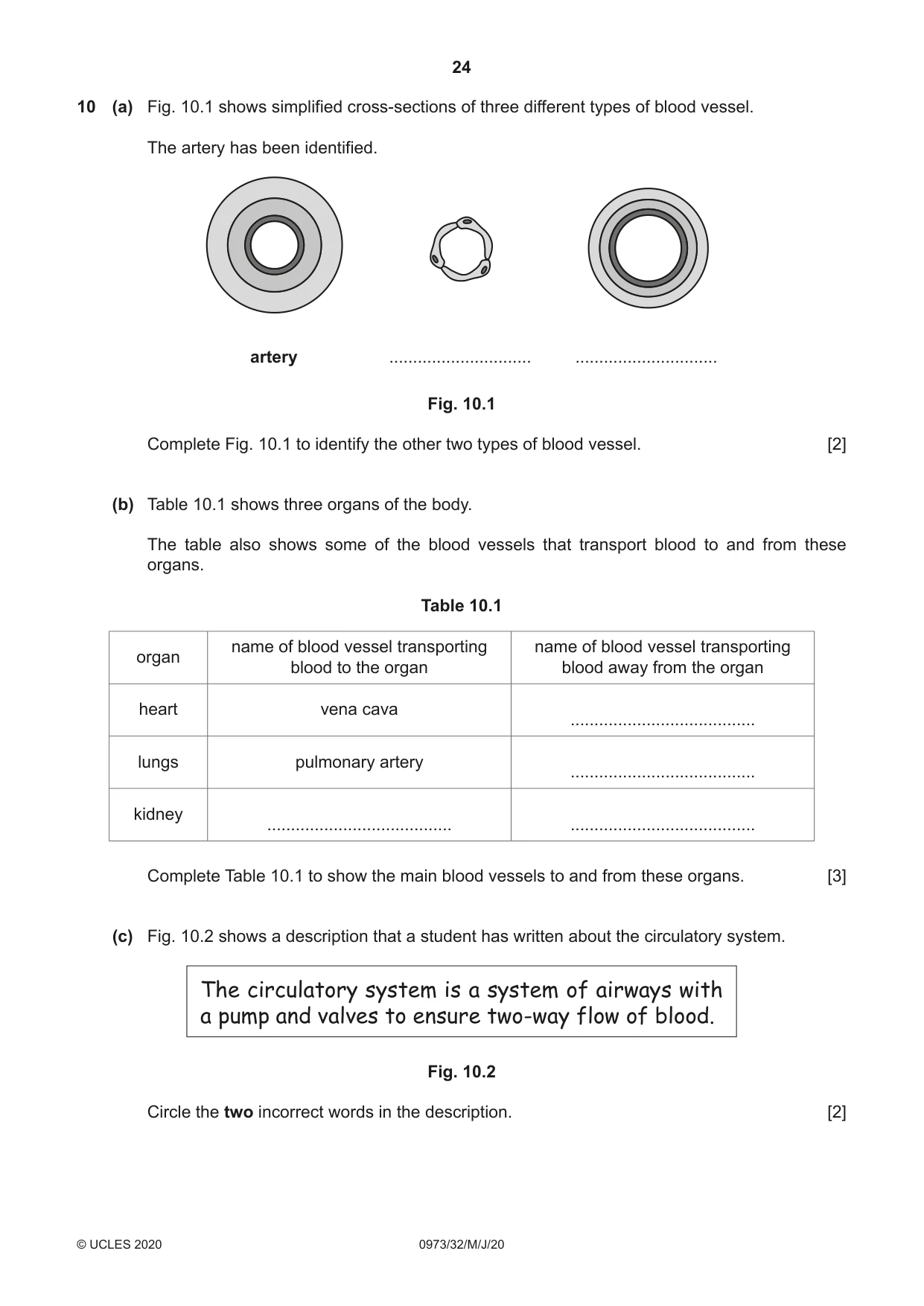
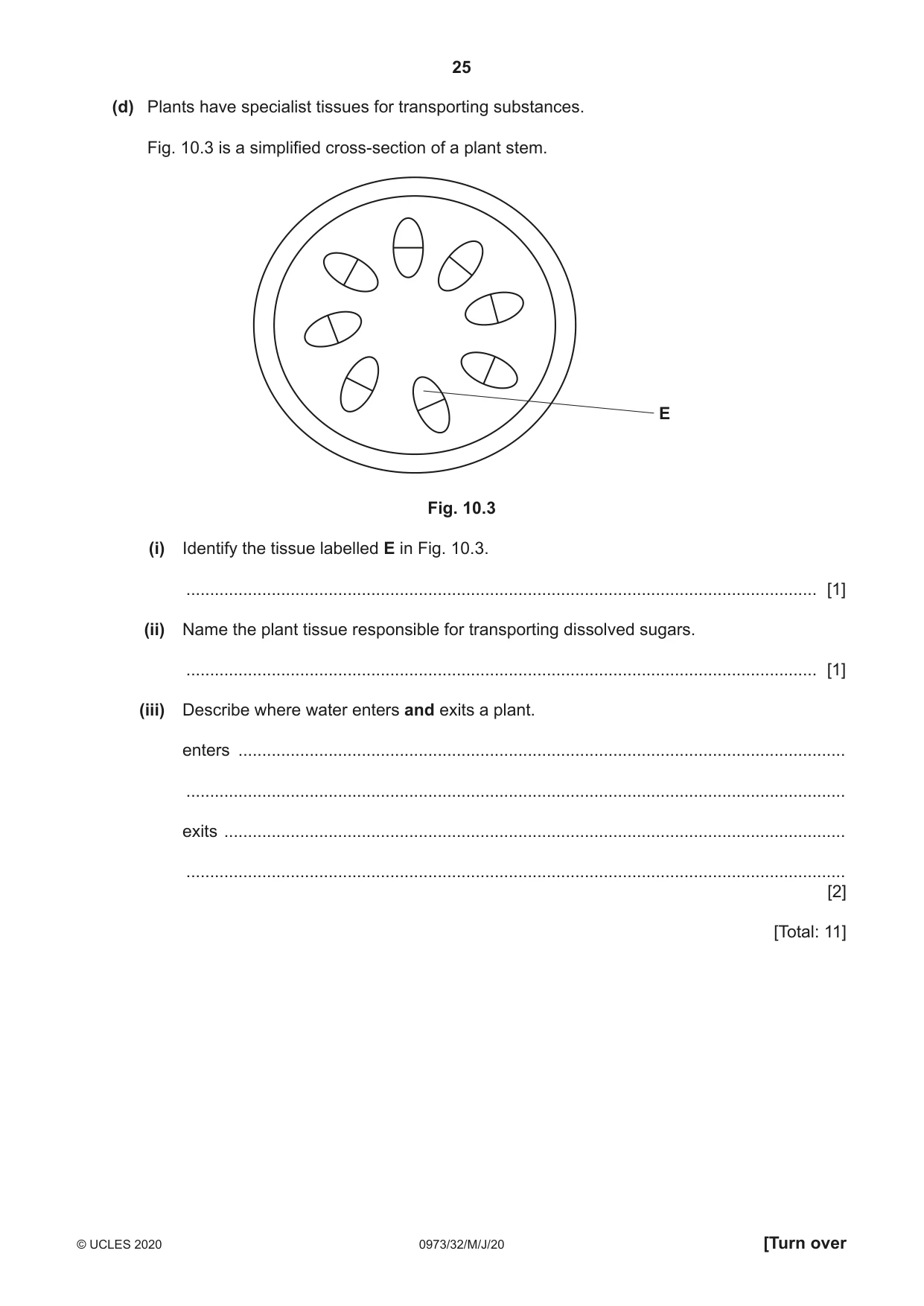
10 (a) Fig. 10.1 shows simplified cross-sections of three different types of blood vessel. The artery has been identified. artery .............................. .............................. Fig. 10.1 Complete Fig. 10.1 to identify the other two types of blood vessel. [2] (b) Table 10.1 shows three organs of the body. The table also shows some of the blood vessels that transport blood to and from these organs. Table 10.1 name of blood vessel transporting name of blood vessel transporting organ blood to the organ blood away from the organ heart vena cava ....................................... lungs pulmonary artery ....................................... kidney ....................................... ....................................... Complete Table 10.1 to show the main blood vessels to and from these organs. [3] (c) Fig. 10.2 shows a description that a student has written about the circulatory system. The circulatory system is a system of airways with a pump and valves to ensure two-way flow of blood. Fig. 10.2 Circle the two incorrect words in the description. [2] (d) Plants have specialist tissues for transporting substances. Fig. 10.3 is a simplified cross-section of a plant stem. E Fig. 10.3 (i) Identify the tissue labelled E in Fig. 10.3. ..................................................................................................................................... [1] (ii) Name the plant tissue responsible for transporting dissolved sugars. ..................................................................................................................................... [1] (iii) Describe where water enters and exits a plant. enters ................................................................................................................................ ........................................................................................................................................... exits ................................................................................................................................... ........................................................................................................................................... [2] [Total: 11]
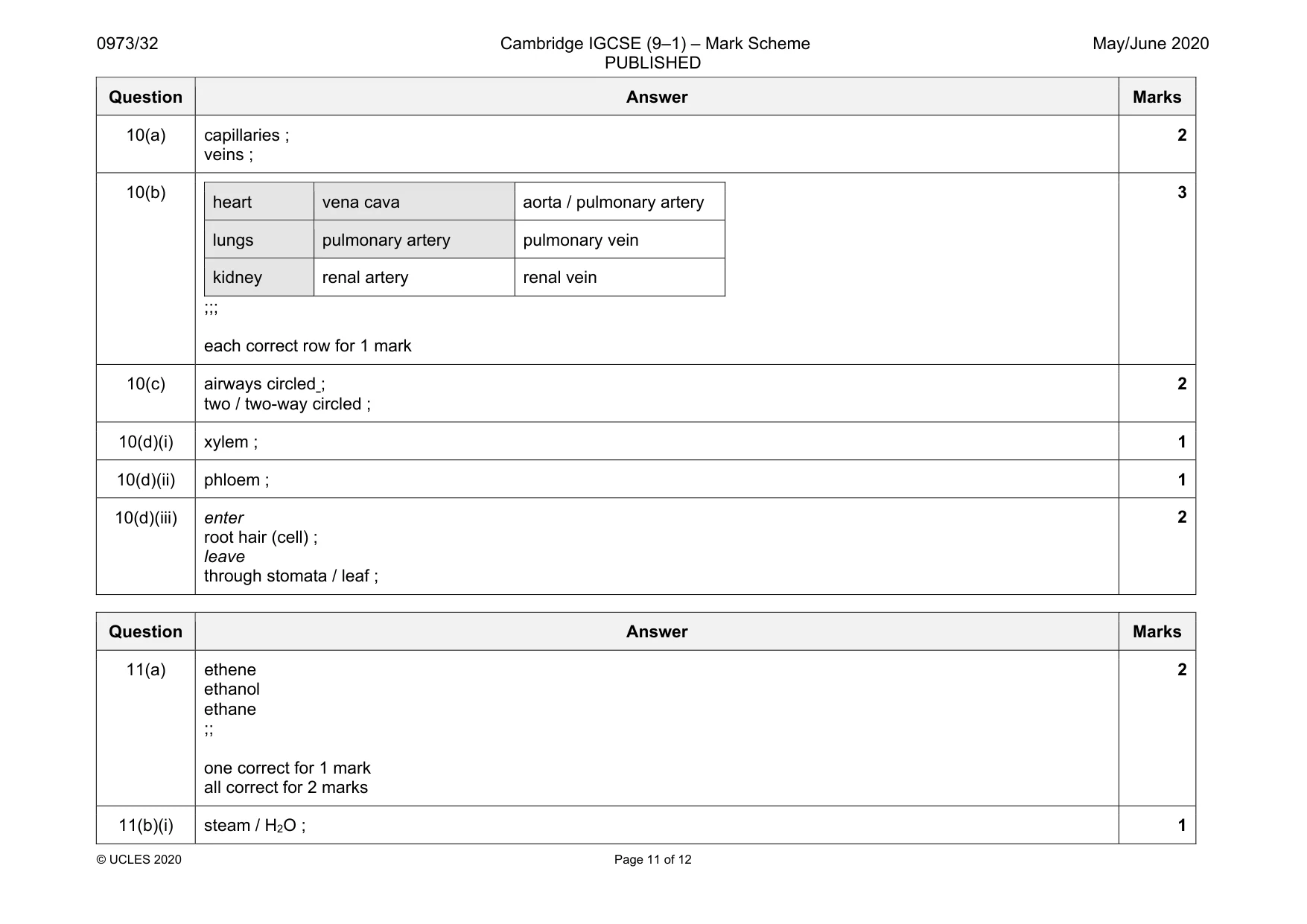
Mark scheme: 10(a) capillaries ; veins ; 2 10(b) heart vena cava aorta / pulmonary artery lungs pulmonary artery pulmonary vein kidney renal artery renal vein ;;; each correct row for 1 mark 3 10(c) airways circled ; two / two-way circled ; 2 10(d)(i) xylem ; 1 10(d)(ii) phloem ; 1 10(d)(iii) enter root hair (cell) ; leave through stomata / leaf ; 2
Q11 · Ethane, ethene and ethanol are carbon compounds
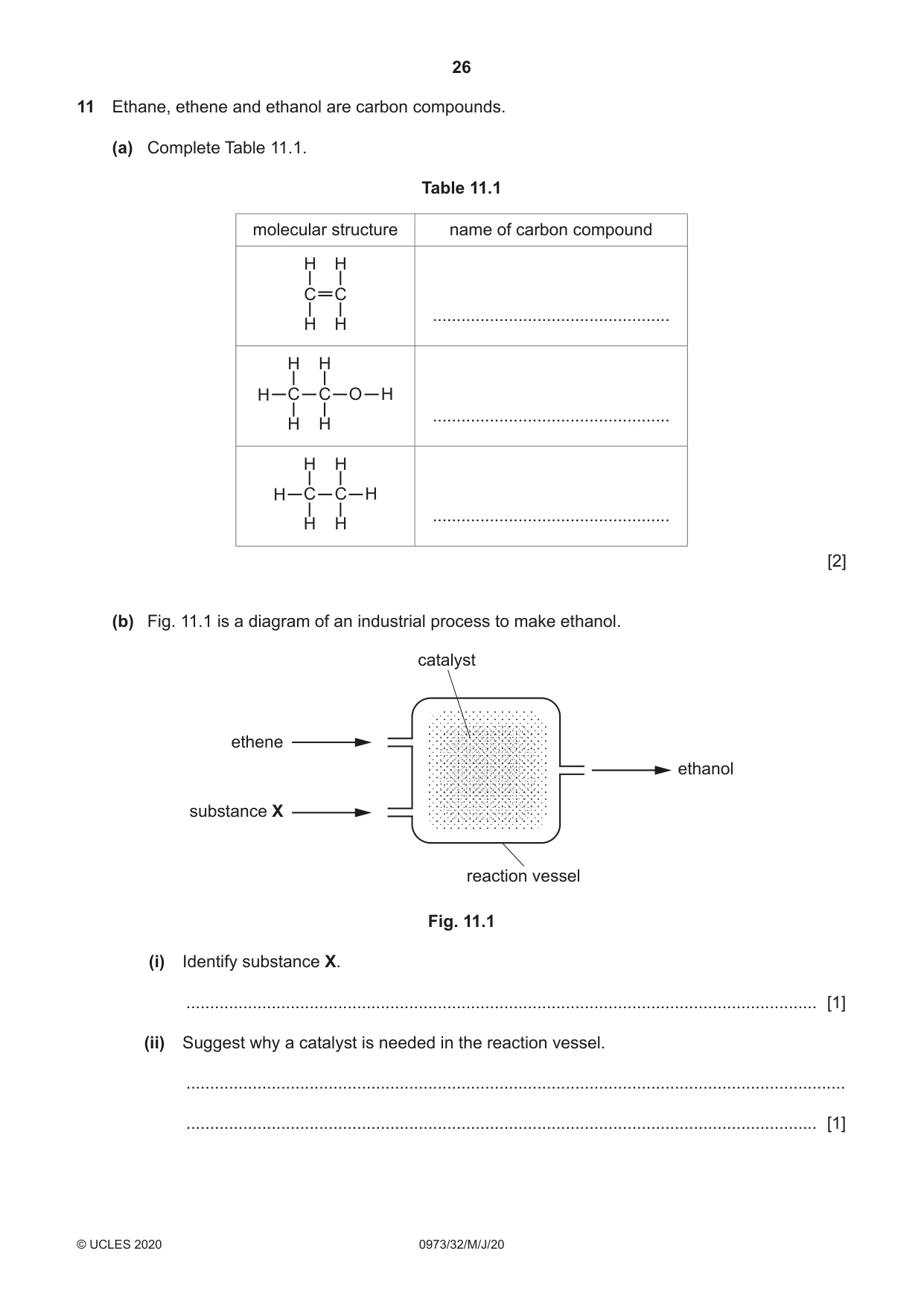
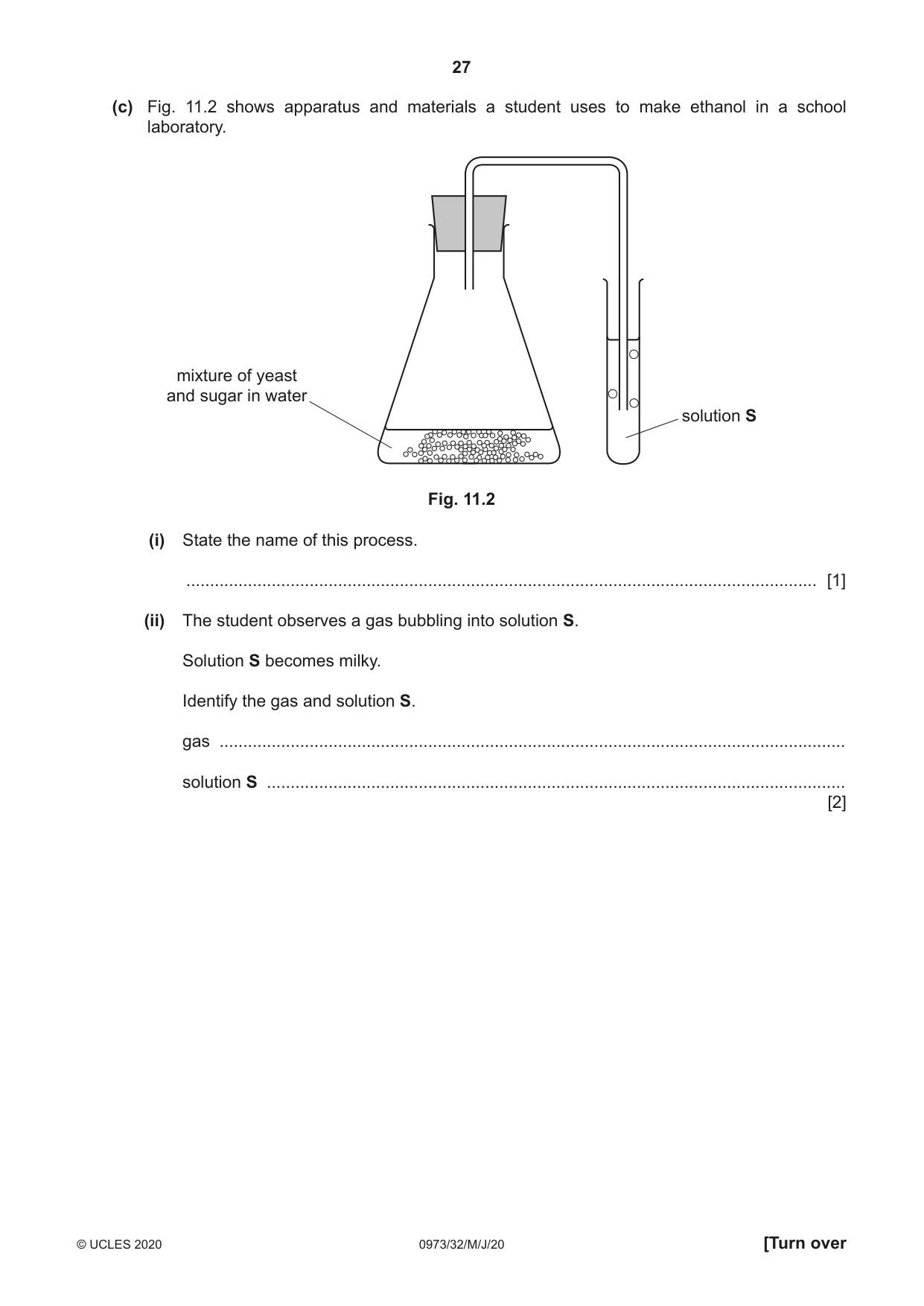
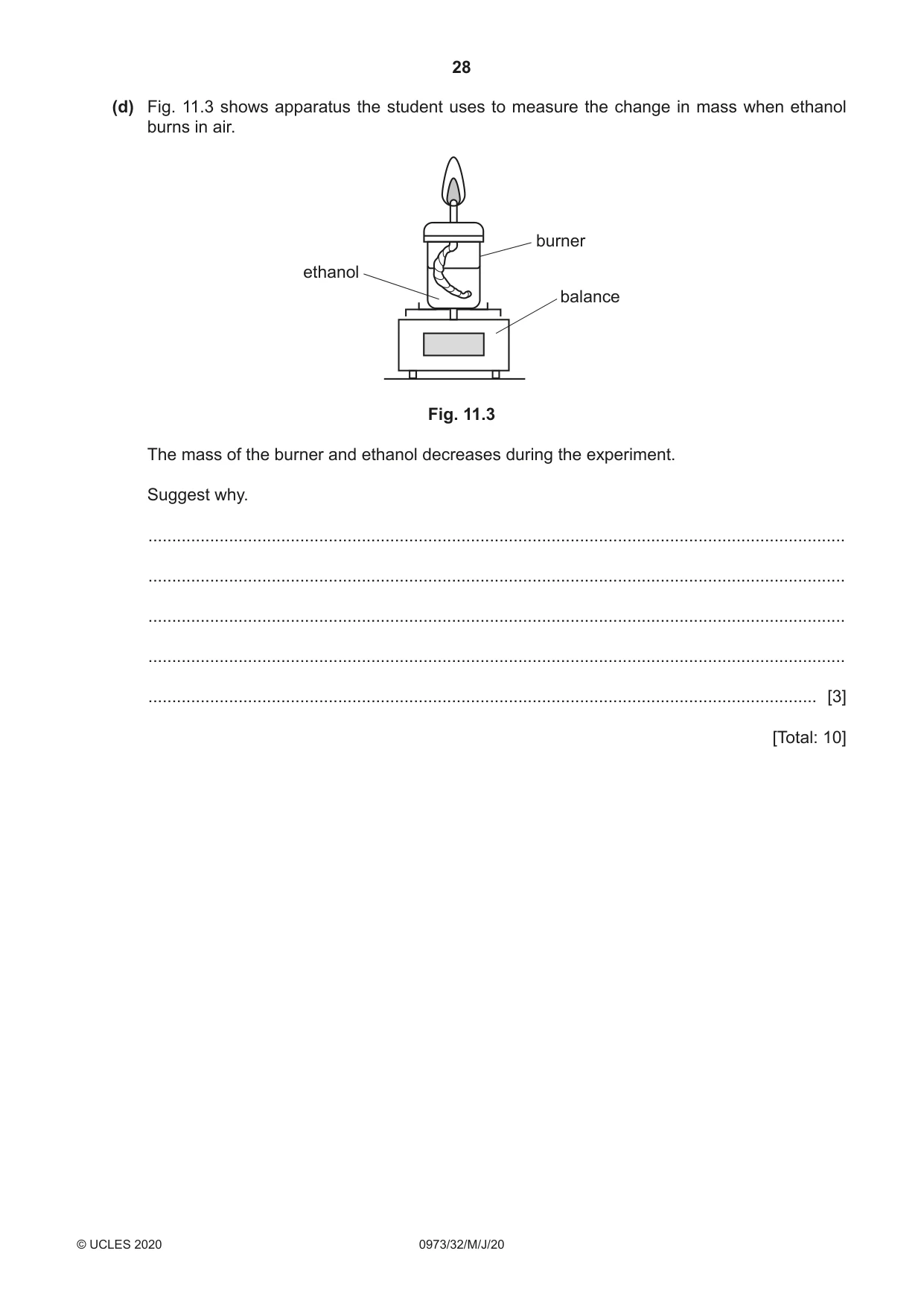
11 Ethane, ethene and ethanol are carbon compounds. (a) Complete Table 11.1. Table 11.1 molecular structure name of carbon compound H H C C .................................................. H H H H H C C O H .................................................. H H H H H C C H .................................................. H H [2] (b) Fig. 11.1 is a diagram of an industrial process to make ethanol. catalyst ethene ethanol substance X reaction vessel Fig. 11.1 (i) Identify substance X. ..................................................................................................................................... [1] (ii) Suggest why a catalyst is needed in the reaction vessel. ........................................................................................................................................... ..................................................................................................................................... [1] (c) Fig. 11.2 shows apparatus and materials a student uses to make ethanol in a school laboratory. mixture of yeast and sugar in water solution S Fig. 11.2 (i) State the name of this process. ..................................................................................................................................... [1] (ii) The student observes a gas bubbling into solution S. Solution S becomes milky. Identify the gas and solution S. gas .................................................................................................................................... solution S .......................................................................................................................... [2] (d) Fig. 11.3 shows apparatus the student uses to measure the change in mass when ethanol burns in air. burner ethanol balance Fig. 11.3 The mass of the burner and ethanol decreases during the experiment. Suggest why. ................................................................................................................................................... ................................................................................................................................................... ................................................................................................................................................... ................................................................................................................................................... ............................................................................................................................................. [3] [Total: 10]
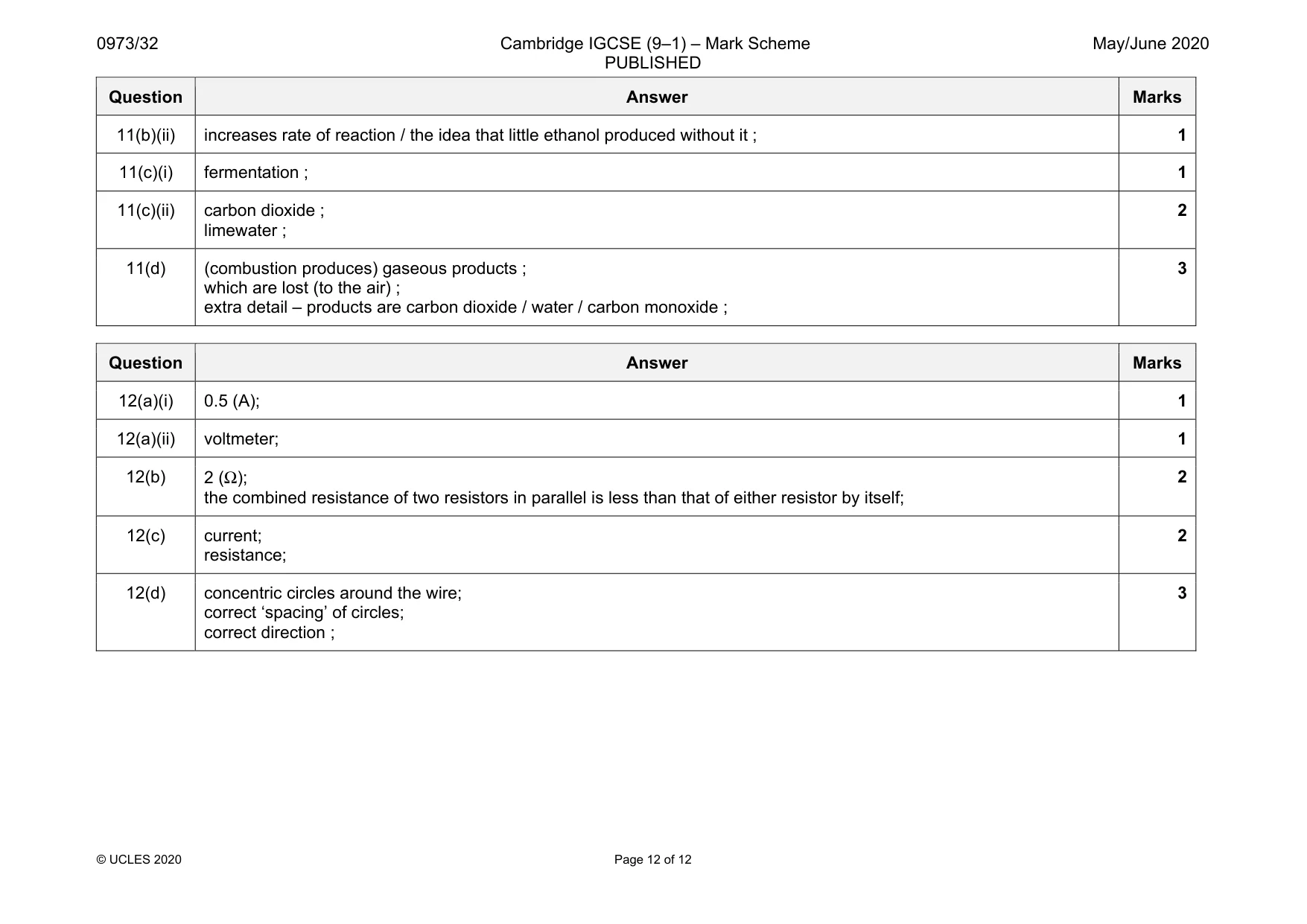
Mark scheme: 11(a) ethene ethanol ethane ;; one correct for 1 mark all correct for 2 marks 11(b)(i) steam / H2O ; 1 Question Answer Marks 11(b)(ii) increases rate of reaction / the idea that little ethanol produced without it ; 1 11(c)(i) fermentation ; 1 11(c)(ii) carbon dioxide ; limewater ; 2 11(d) (combustion produces) gaseous products ; which are lost (to the air) ; extra detail – products are carbon dioxide / water / carbon monoxide ; 3
Question 12
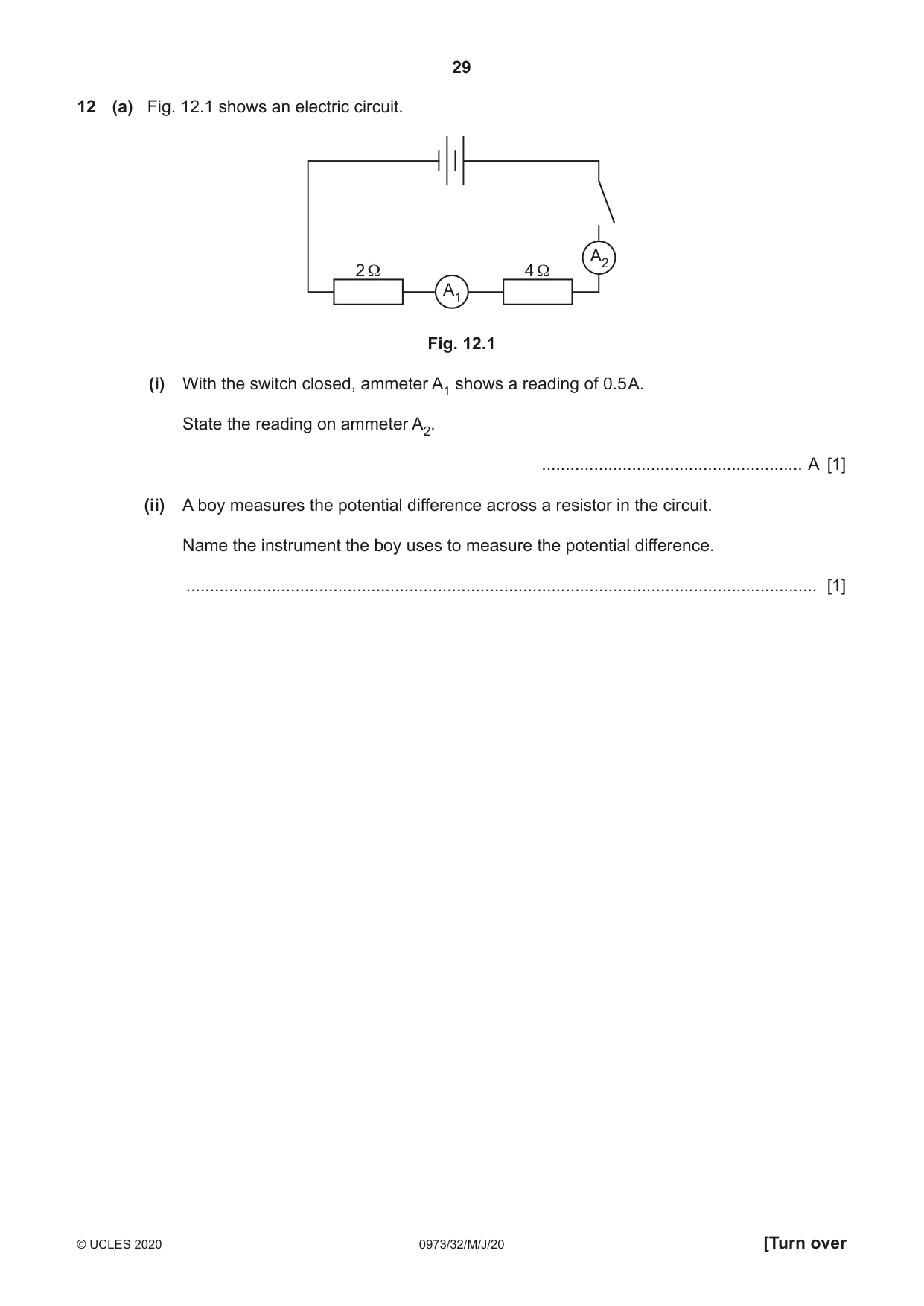
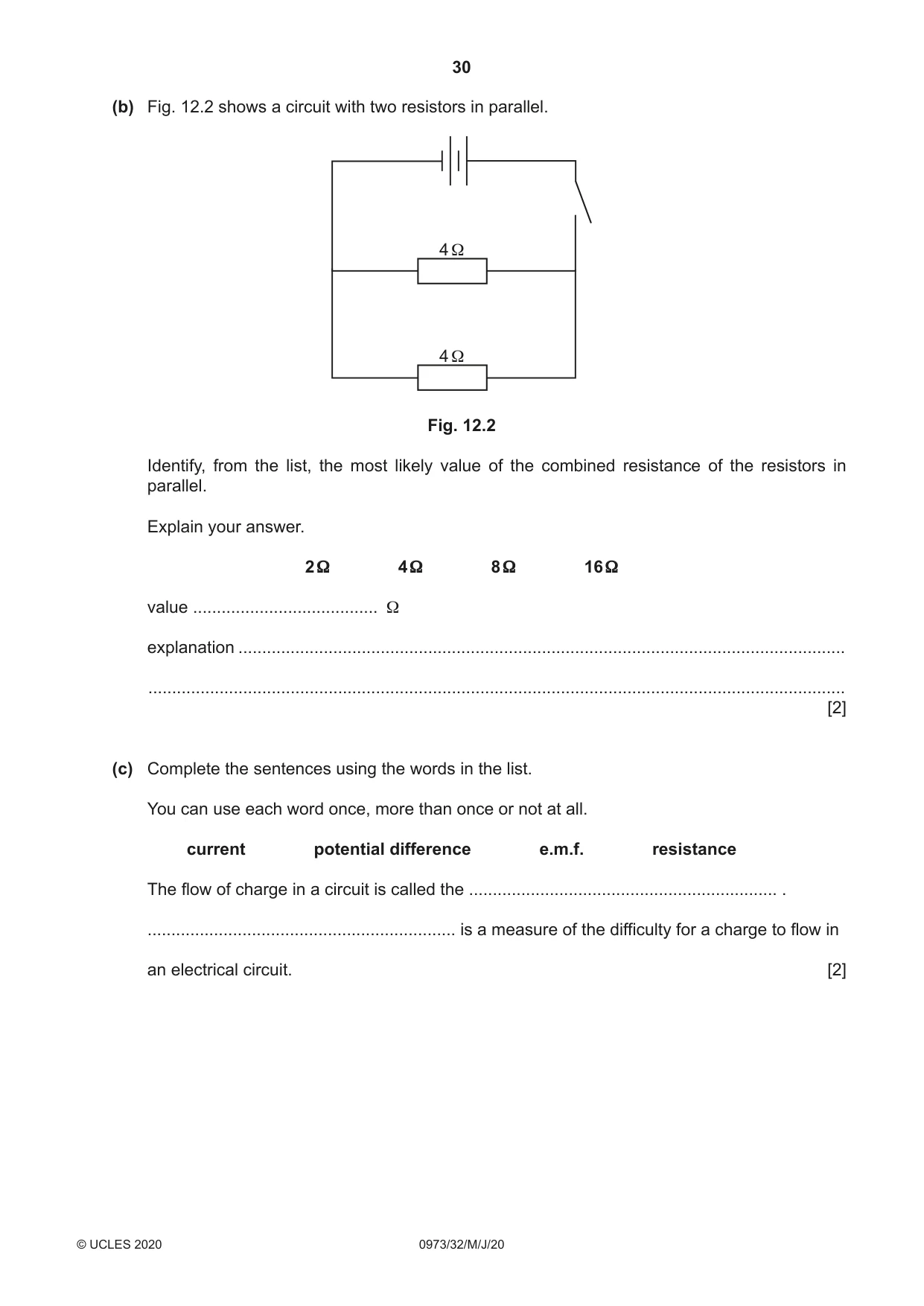
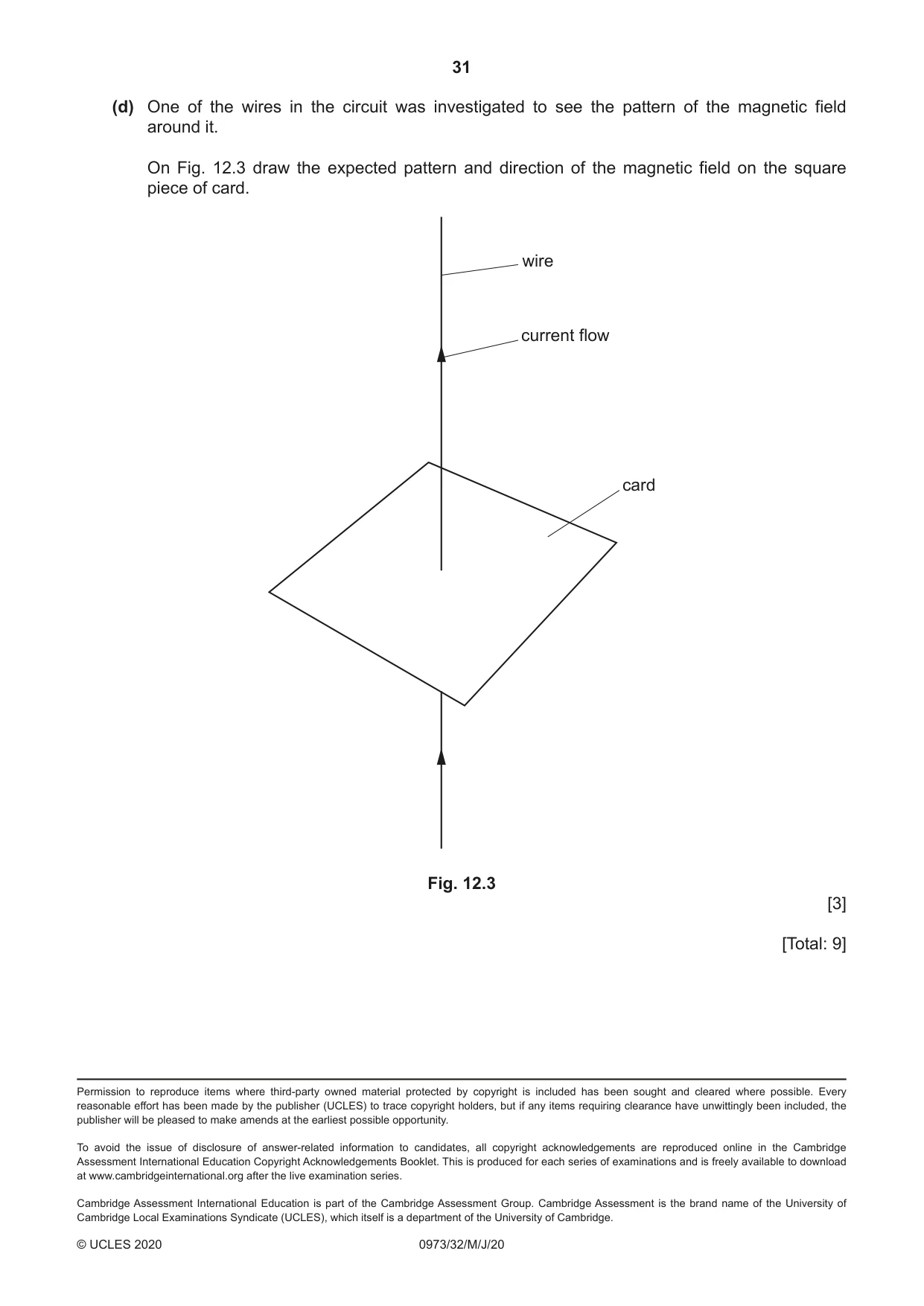
12 (a) Fig. 12.1 shows an electric circuit. A2 2 Ω 4 Ω A1 Fig. 12.1 (i) With the switch closed, ammeter A1 shows a reading of 0.5 A. State the reading on ammeter A2. ....................................................... A [1] (ii) A boy measures the potential difference across a resistor in the circuit. Name the instrument the boy uses to measure the potential difference. ..................................................................................................................................... [1] (b) Fig. 12.2 shows a circuit with two resistors in parallel. 4 Ω 4 Ω Fig. 12.2 Identify, from the list, the most likely value of the combined resistance of the resistors in parallel. Explain your answer. 2 Ω 4 Ω 8 Ω 16 Ω value ....................................... Ω explanation ................................................................................................................................ ................................................................................................................................................... [2] (c) Complete the sentences using the words in the list. You can use each word once, more than once or not at all. current potential difference e.m.f. resistance The flow of charge in a circuit is called the ................................................................. . ................................................................. is a measure of the difficulty for a charge to flow in an electrical circuit. [2] (d) One of the wires in the circuit was investigated to see the pattern of the magnetic field around it. On Fig. 12.3 draw the expected pattern and direction of the magnetic field on the square piece of card. wire current flow card Fig. 12.3 [3] [Total: 9]
Mark scheme: 12(a)(i) 0.5 (A); 1 12(a)(ii) voltmeter; 1 12(b) 2 (Ω); the combined resistance of two resistors in parallel is less than that of either resistor by itself; 2 12(c) current; resistance; 2 12(d) concentric circles around the wire; correct ‘spacing’ of circles; correct direction ; 3
What was in this paper
The subtopics covered by these 12 questions, and how many questions each got. Open one in a new tab to see every Cambridge question on it.