Cambridge IGCSE Sciences - Co-ordinated (9-1) 0973 — 2021 May/June Paper 3 · Variant 1
0973/31/M/J/21 · 12 questions · 120 marks · ≈135 min
The question paper and its mark scheme, free to read here and free to download. This is Cambridge’s own paper, exactly as it was sat.
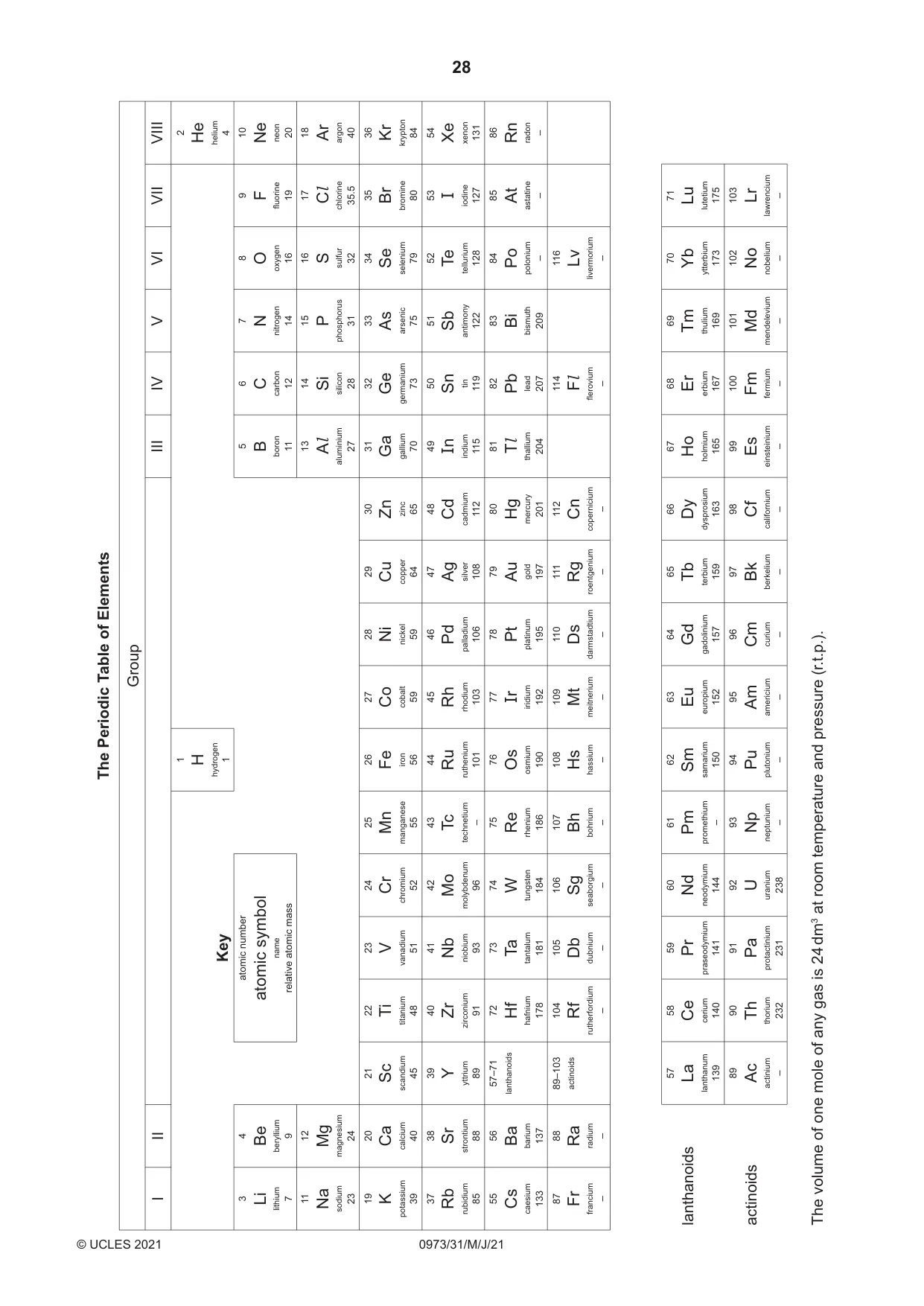
Question paper28 pages



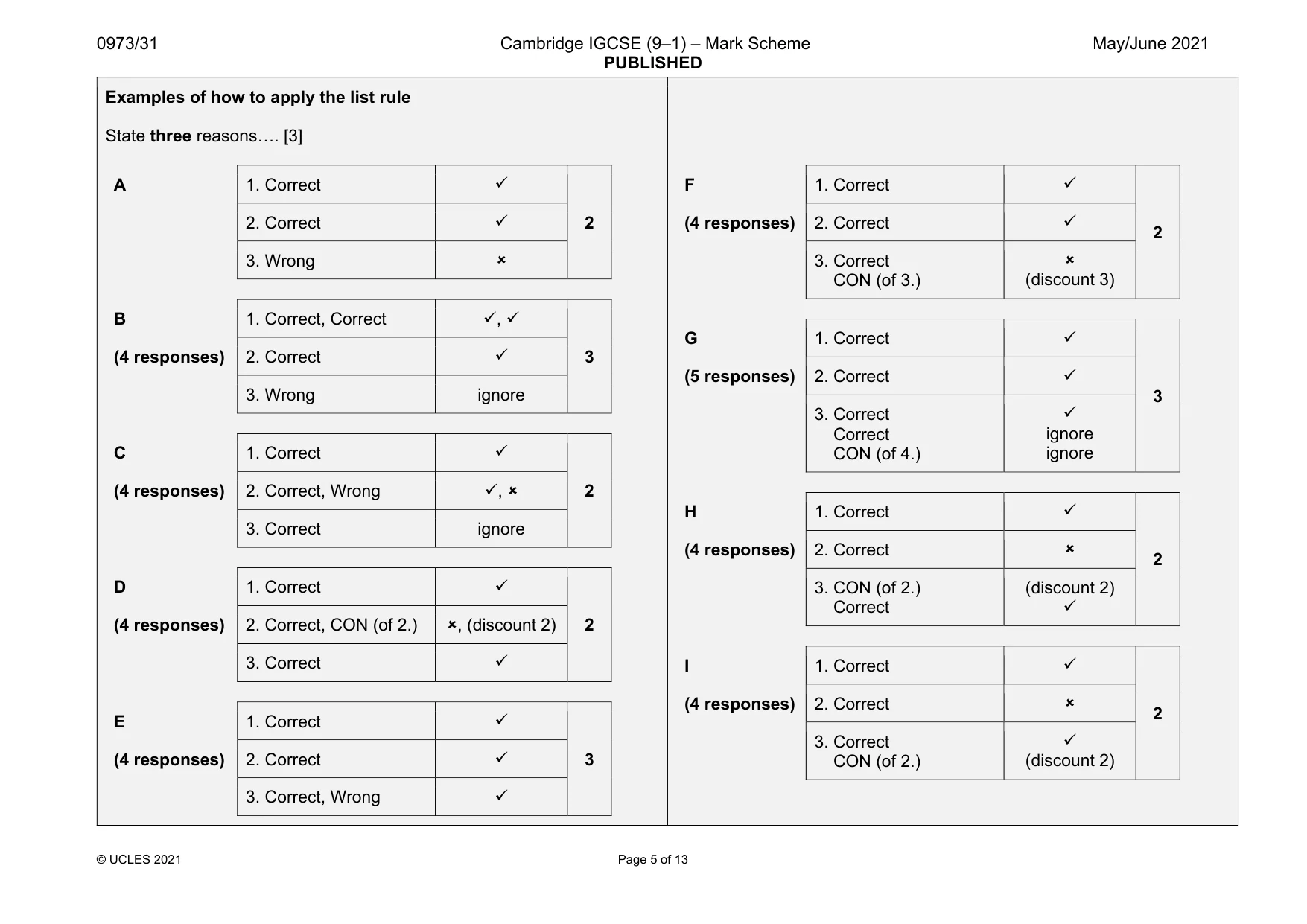
Mark scheme13 pages
Answers below. Sit the paper first if you are practising.
Questions as text
Q1 · A diagram of the human gas exchange system
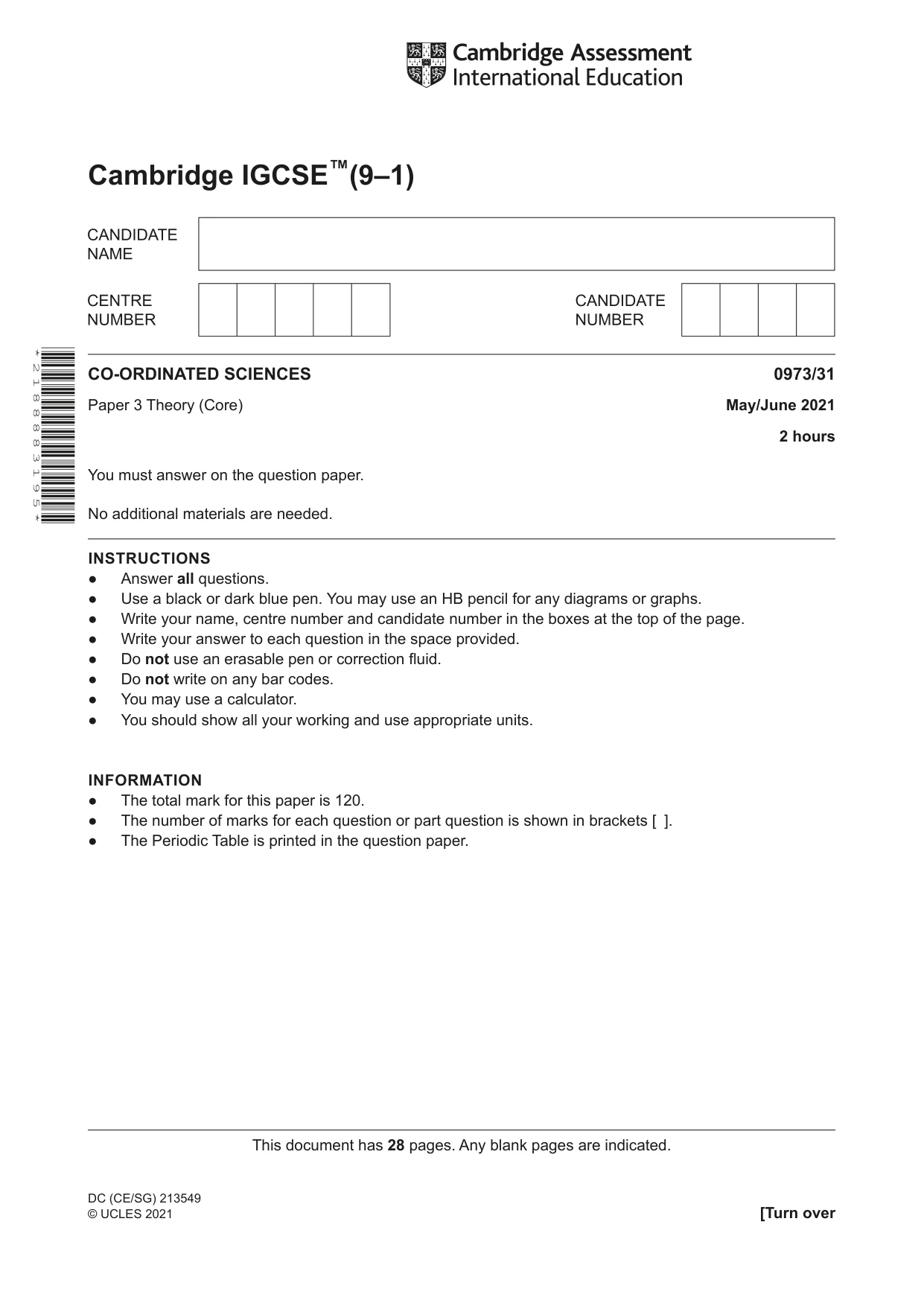
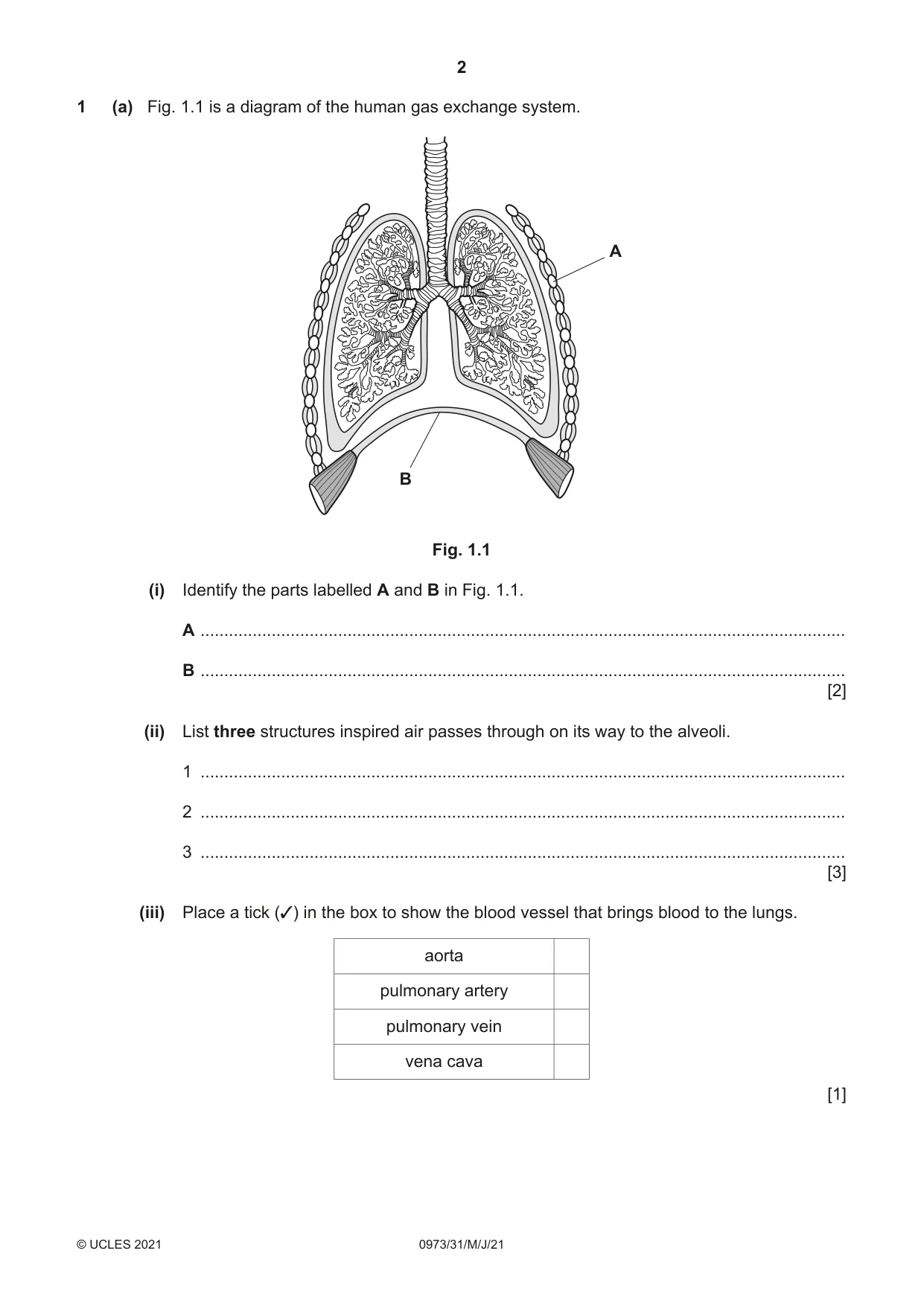
1 (a) Fig. 1.1 is a diagram of the human gas exchange system. A B Fig. 1.1 (i) Identify the parts labelled A and B in Fig. 1.1. A ........................................................................................................................................ B ........................................................................................................................................ [2] (ii) List three structures inspired air passes through on its way to the alveoli. 1 ........................................................................................................................................ 2 ........................................................................................................................................ 3 ........................................................................................................................................ [3] (iii) Place a tick (3) in the box to show the blood vessel that brings blood to the lungs. aorta pulmonary artery pulmonary vein vena cava [1] (b) Expired air contains a higher percentage of carbon dioxide than inspired air. (i) State one other way that the composition of expired air is different from inspired air. ........................................................................................................................................... ..................................................................................................................................... [1] (ii) State the test for carbon dioxide gas and give the observation for a positive result. test .................................................................................................................................... observation ........................................................................................................................ [2] (c) A student records their breathing rate while walking and while running. The results are shown in Fig. 1.2. 35 30 25 breathing rate 20 / breaths per minute 15 10 5 0 walking running activity Fig. 1.2 (i) State the breathing rate of the student while walking. ........................... breaths per minute [1] (ii) The student repeats the investigation and records the breathing rate while at rest. Describe the expected changes to the pattern of breathing while at rest when compared to running. ........................................................................................................................................... ........................................................................................................................................... ..................................................................................................................................... [2] [Total: 12]
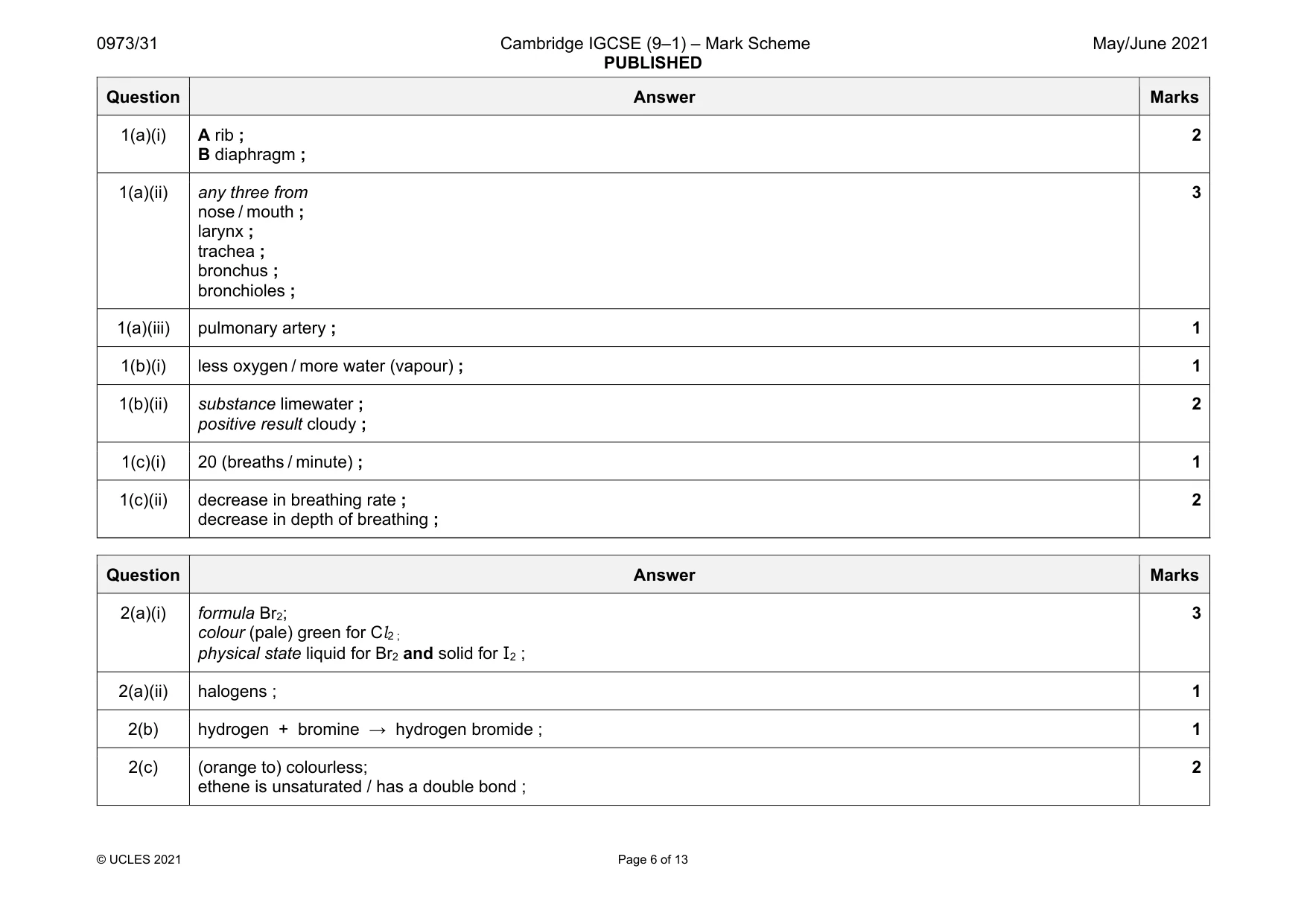
Mark scheme: 1(a)(i) A rib ; B diaphragm ; 2 1(a)(ii) any three from nose / mouth ; larynx ; trachea ; bronchus ; bronchioles ; 3 1(a)(iii) pulmonary artery ; 1 1(b)(i) less oxygen / more water (vapour) ; 1 1(b)(ii) substance limewater ; positive result cloudy ; 2 1(c)(i) 20 (breaths / minute) ; 1 1(c)(ii) decrease in breathing rate ; decrease in depth of breathing ; 2
Q2 · Information about three Group VII elements
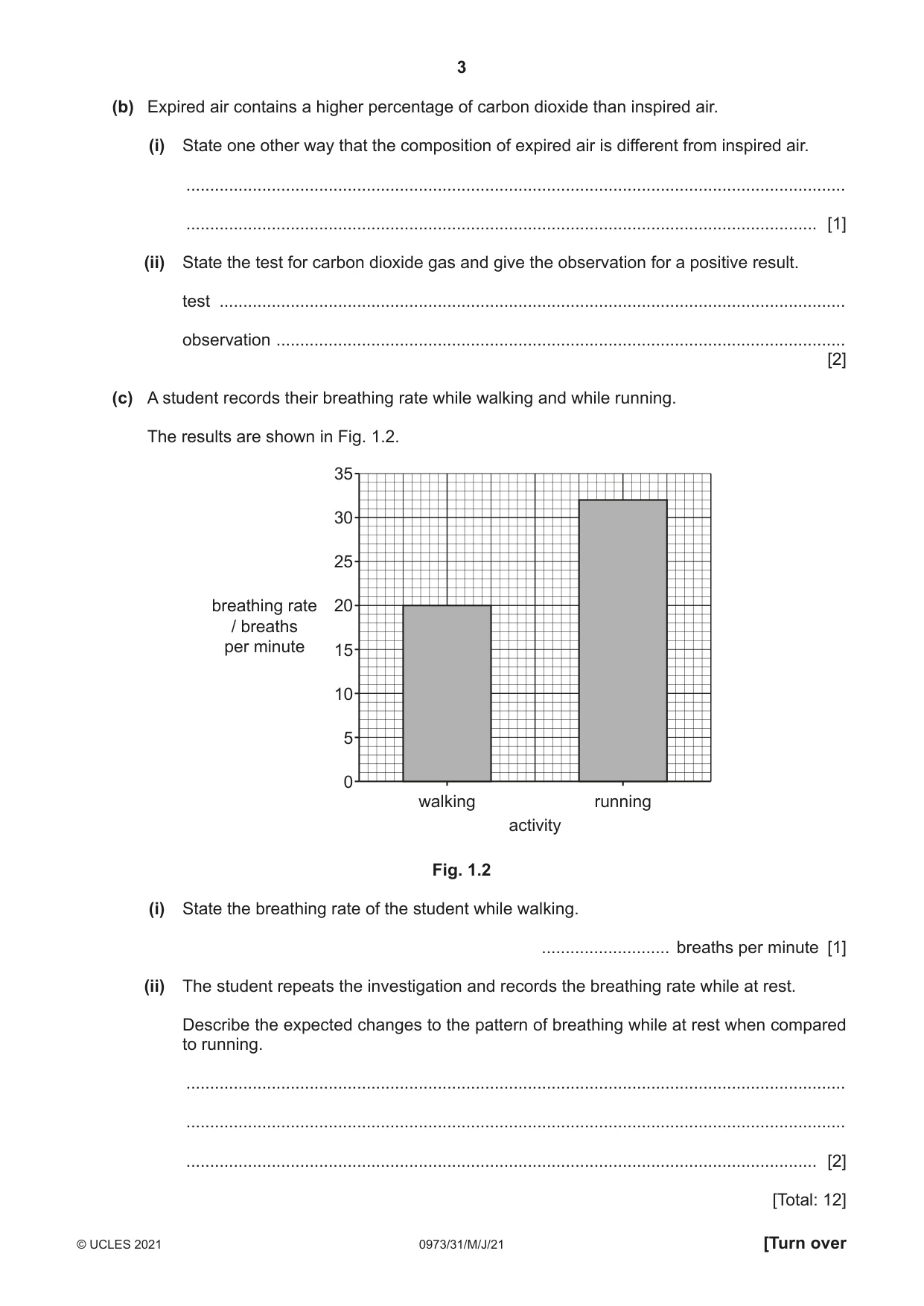
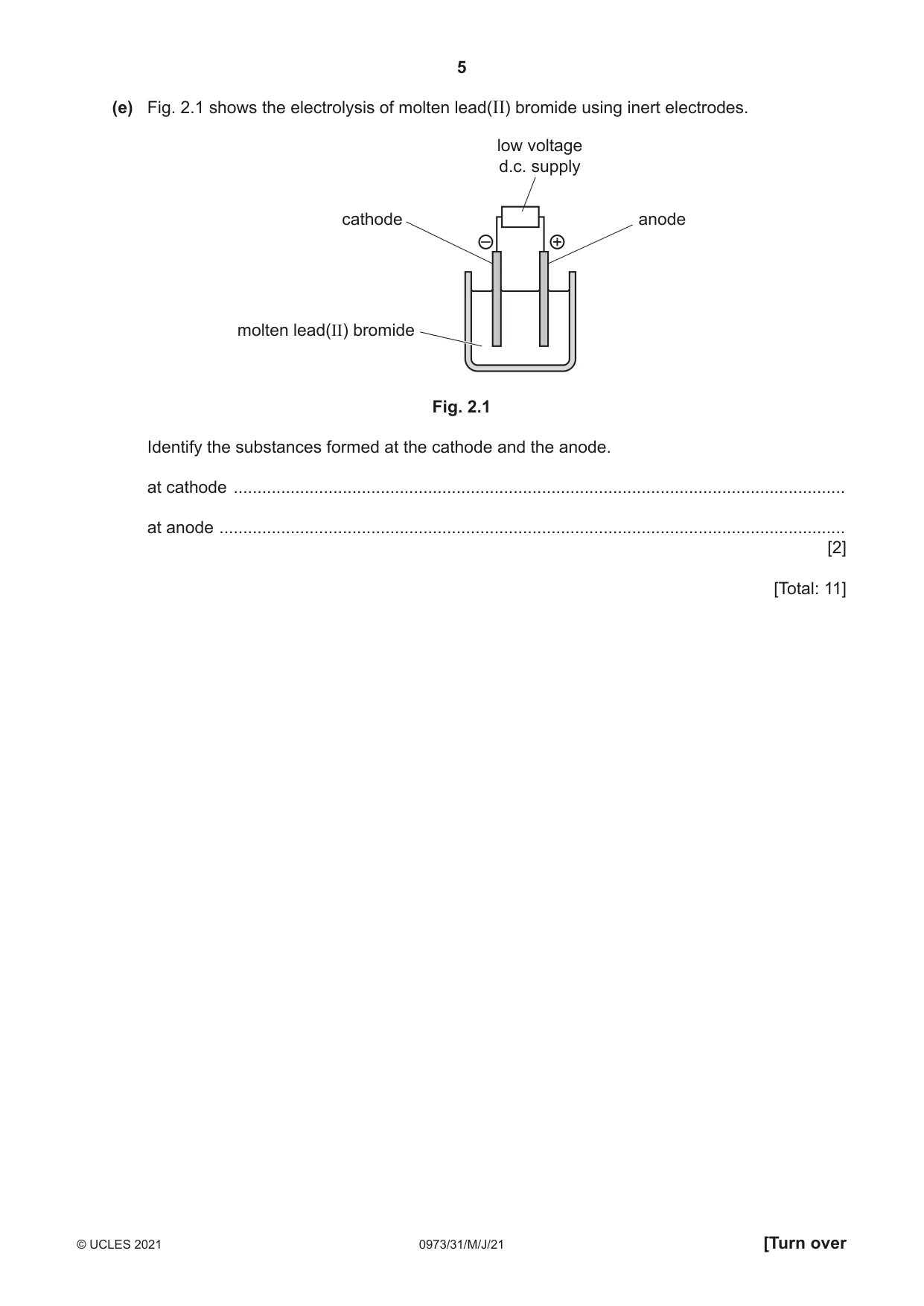
2 (a) Table 2.1 shows information about three Group VII elements. Table 2.1 element formula colour physical state at 20 °C chlorine Cl 2 gas bromine orange iodine I2 grey (i) Complete Table 2.1. [3] (ii) State the name given to the Group VII elements in the Periodic Table. ..................................................................................................................................... [1] (b) Bromine reacts with hydrogen to make hydrogen bromide. Construct the word equation for this reaction. ..................................... + ..................................... .................................................... [1] (c) Aqueous bromine is orange. Predict the colour change, if any, when aqueous bromine is mixed with ethene gas. Explain your answer. colour change ........................................................................................................................... explanation ............................................................................................................................... ................................................................................................................................................... [2] (d) An aqueous solution is tested to see if bromide ions are present. State the test for aqueous bromide ions and give the observation for a positive result. test ............................................................................................................................................ observation ............................................................................................................................... [2] (e) Fig. 2.1 shows the electrolysis of molten lead(II) bromide using inert electrodes. low voltage d.c. supply cathode anode – + molten lead(II) bromide Fig. 2.1 Identify the substances formed at the cathode and the anode. at cathode ................................................................................................................................. at anode .................................................................................................................................... [2] [Total: 11]
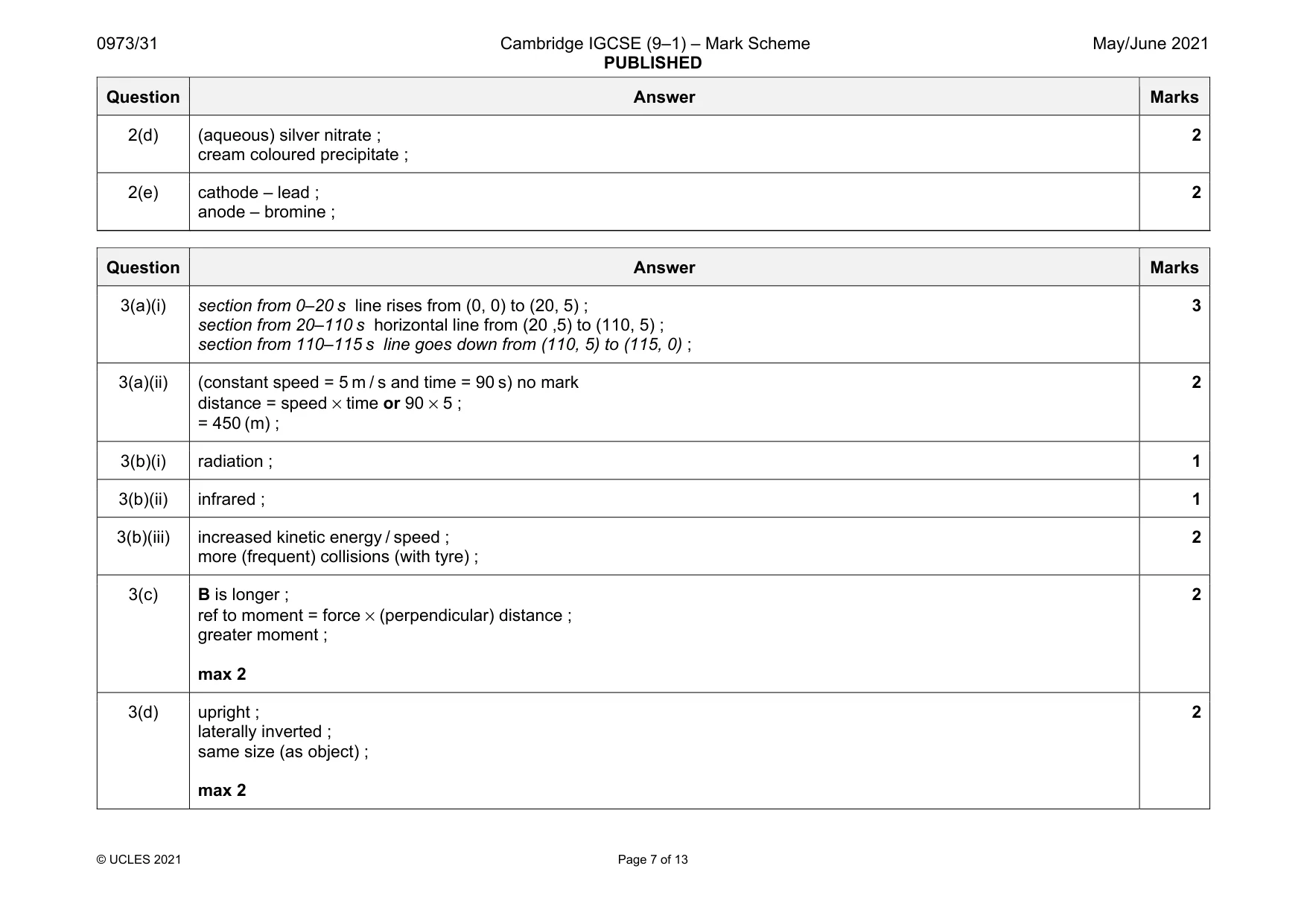
Mark scheme: 2(a)(i) formula Br2; colour (pale) green for Cl2 ; physical state liquid for Br2 and solid for I2 ; 3 2(a)(ii) halogens ; 1 2(b) hydrogen + bromine → hydrogen bromide ; 1 2(c) (orange to) colourless; ethene is unsaturated / has a double bond ; 2 Question Answer Marks 2(d) (aqueous) silver nitrate ; cream coloured precipitate ; 2 2(e) cathode – lead ; anode – bromine ; 2
Q3 · A cyclist starts from rest and accelerates for 20 s
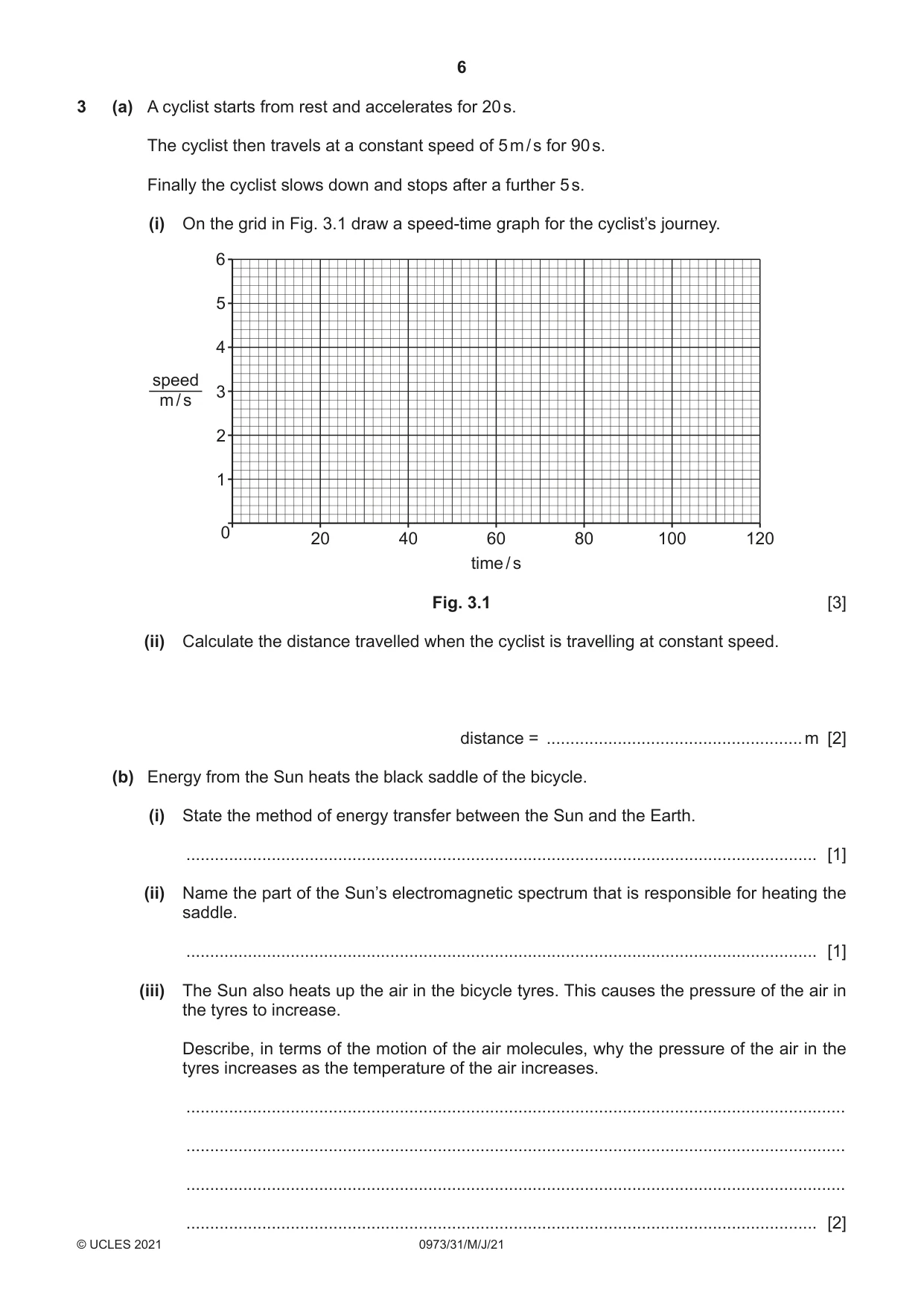
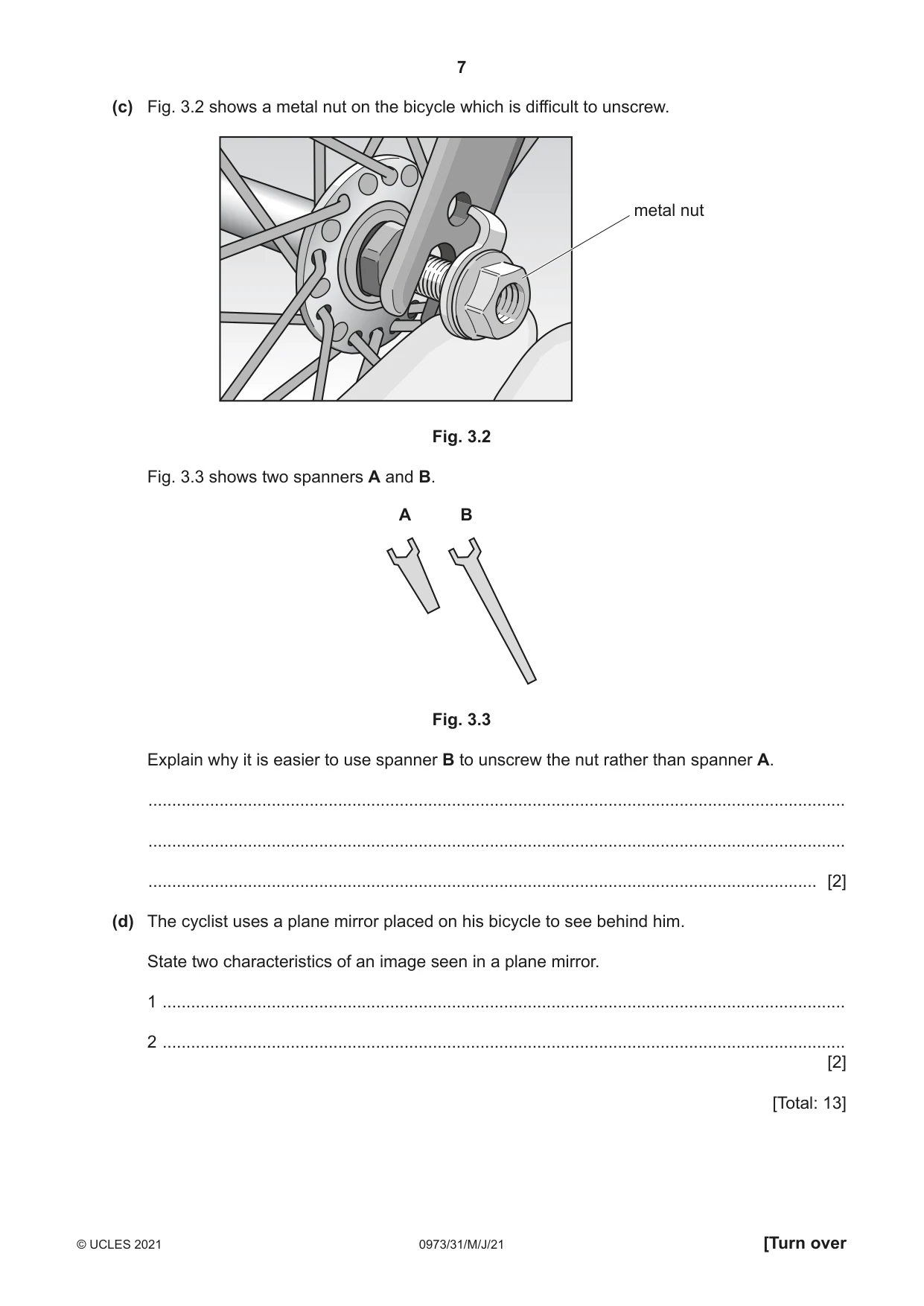
3 (a) A cyclist starts from rest and accelerates for 20 s. The cyclist then travels at a constant speed of 5 m / s for 90 s. Finally the cyclist slows down and stops after a further 5 s. (i) On the grid in Fig. 3.1 draw a speed‑time graph for the cyclist’s journey. 6 5 4 speed 3 m / s 2 1 0 20 40 60 80 100 120 time / s Fig. 3.1 [3] (ii) Calculate the distance travelled when the cyclist is travelling at constant speed. distance = ......................................................m [2] (b) Energy from the Sun heats the black saddle of the bicycle. (i) State the method of energy transfer between the Sun and the Earth. ..................................................................................................................................... [1] (ii) Name the part of the Sun’s electromagnetic spectrum that is responsible for heating the saddle. ..................................................................................................................................... [1] (iii) The Sun also heats up the air in the bicycle tyres. This causes the pressure of the air in the tyres to increase. Describe, in terms of the motion of the air molecules, why the pressure of the air in the tyres increases as the temperature of the air increases. ........................................................................................................................................... ........................................................................................................................................... ........................................................................................................................................... ..................................................................................................................................... [2] (c) Fig. 3.2 shows a metal nut on the bicycle which is difficult to unscrew. metal nut Fig. 3.2 Fig. 3.3 shows two spanners A and B. A B Fig. 3.3 Explain why it is easier to use spanner B to unscrew the nut rather than spanner A. ................................................................................................................................................... ................................................................................................................................................... ............................................................................................................................................. [2] (d) The cyclist uses a plane mirror placed on his bicycle to see behind him. State two characteristics of an image seen in a plane mirror. 1 ................................................................................................................................................ 2 ................................................................................................................................................ [2] [Total: 13]
Mark scheme: 3(a)(i) section from 0–20 s line rises from (0, 0) to (20, 5) ; section from 20–110 s horizontal line from (20 ,5) to (110, 5) ; section from 110–115 s line goes down from (110, 5) to (115, 0) ; 3 3(a)(ii) (constant speed = 5 m / s and time = 90 s) no mark distance = speed × time or 90 × 5 ; = 450 (m) ; 2 3(b)(i) radiation ; 1 3(b)(ii) infrared ; 1 3(b)(iii) increased kinetic energy / speed ; more (frequent) collisions (with tyre) ; 2 3(c) B is longer ; ref to moment = force × (perpendicular) distance ; greater moment ; max 2 2 3(d) upright ; laterally inverted ; same size (as object) ; max 2 2
Q4 · Some information about feeding relationships in a national park
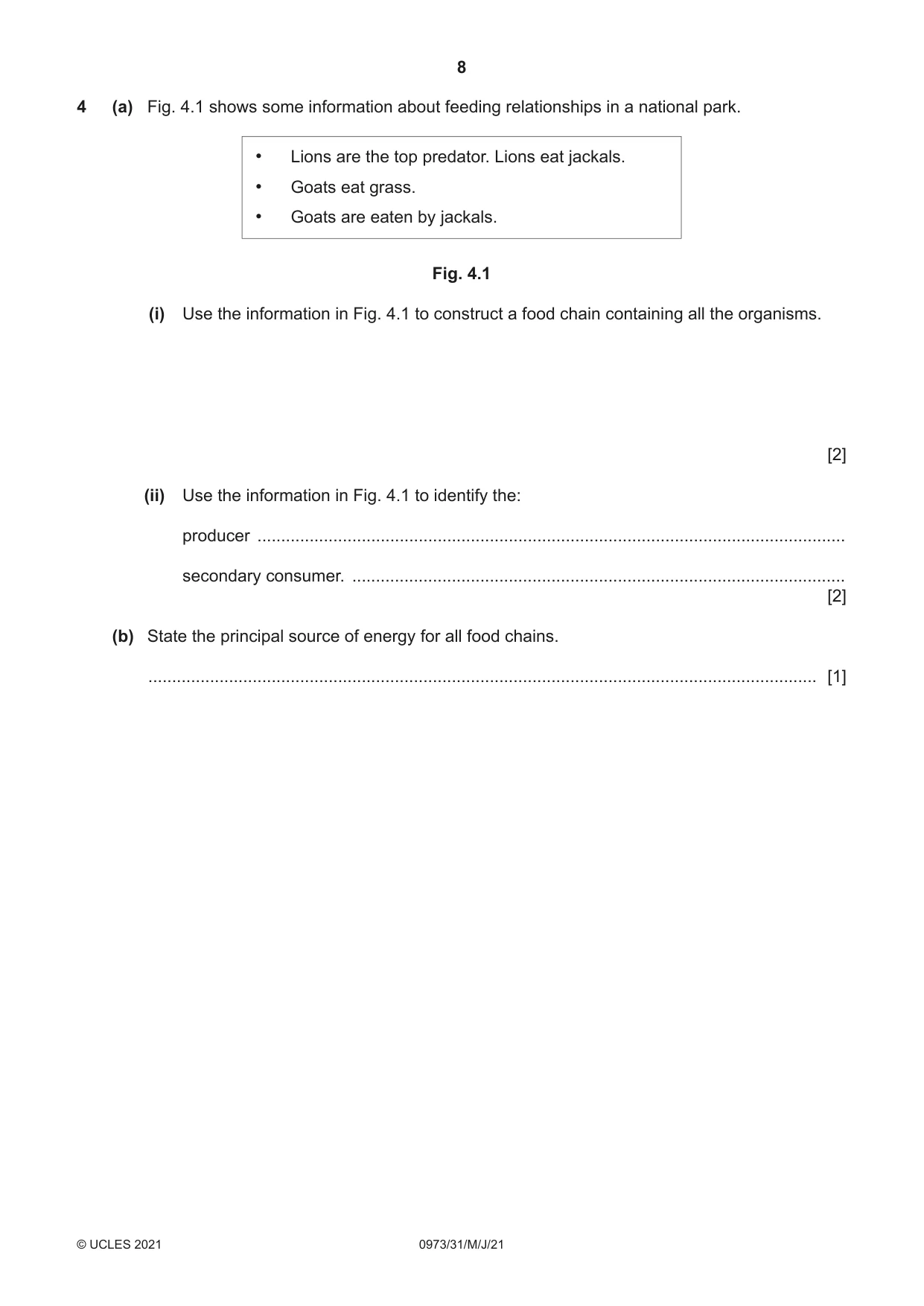
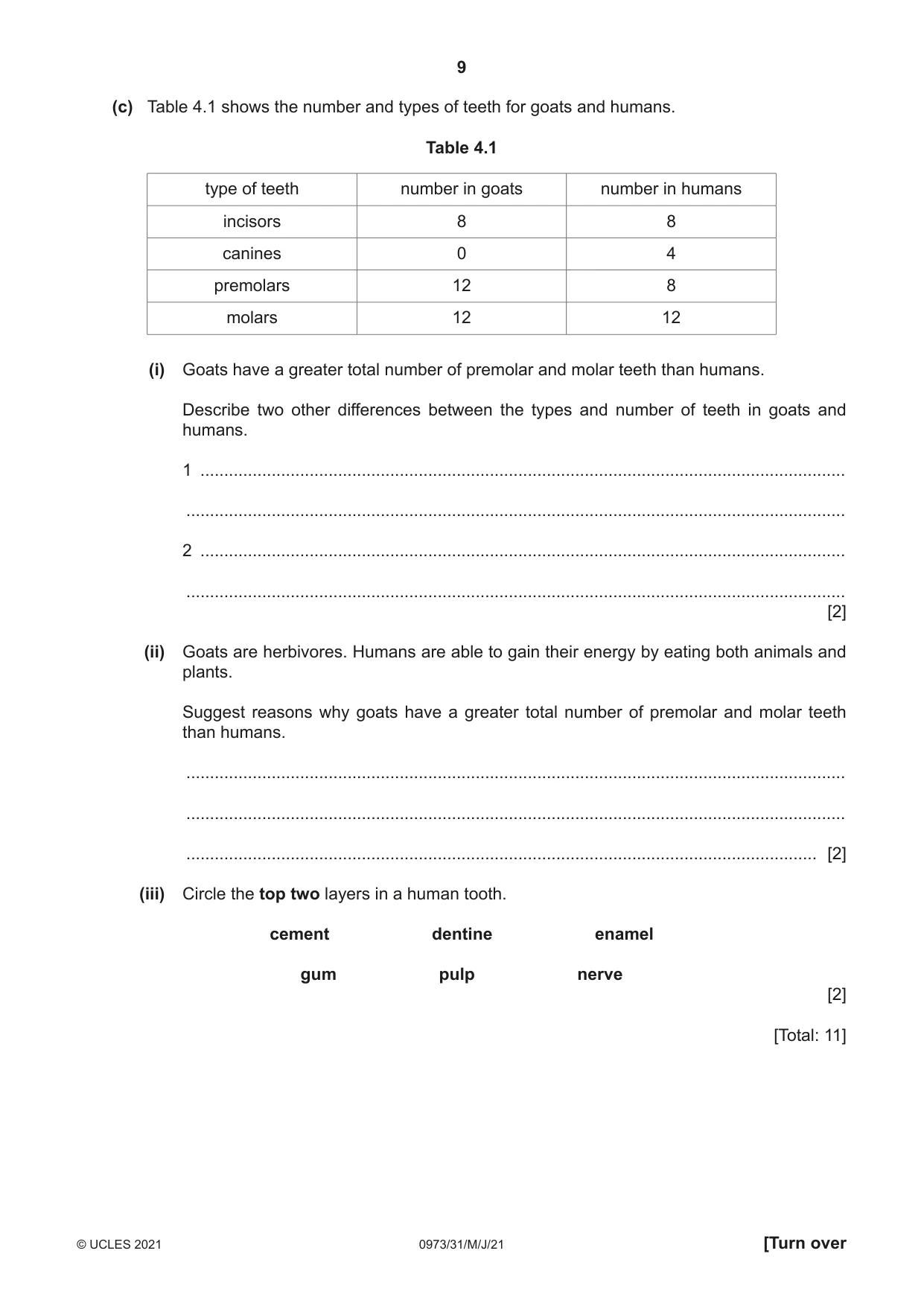
4 (a) Fig. 4.1 shows some information about feeding relationships in a national park. • Lions are the top predator. Lions eat jackals. • Goats eat grass. • Goats are eaten by jackals. Fig. 4.1 (i) Use the information in Fig. 4.1 to construct a food chain containing all the organisms. [2] (ii) Use the information in Fig. 4.1 to identify the: producer ............................................................................................................................ secondary consumer. ........................................................................................................ [2] (b) State the principal source of energy for all food chains. ............................................................................................................................................. [1] (c) Table 4.1 shows the number and types of teeth for goats and humans. Table 4.1 type of teeth number in goats number in humans incisors 8 8 canines 0 4 premolars 12 8 molars 12 12 (i) Goats have a greater total number of premolar and molar teeth than humans. Describe two other differences between the types and number of teeth in goats and humans. 1 ........................................................................................................................................ ........................................................................................................................................... 2 ........................................................................................................................................ ........................................................................................................................................... [2] (ii) Goats are herbivores. Humans are able to gain their energy by eating both animals and plants. Suggest reasons why goats have a greater total number of premolar and molar teeth than humans. ........................................................................................................................................... ........................................................................................................................................... ..................................................................................................................................... [2] (iii) Circle the top two layers in a human tooth. cement dentine enamel gum pulp nerve [2] [Total: 11]
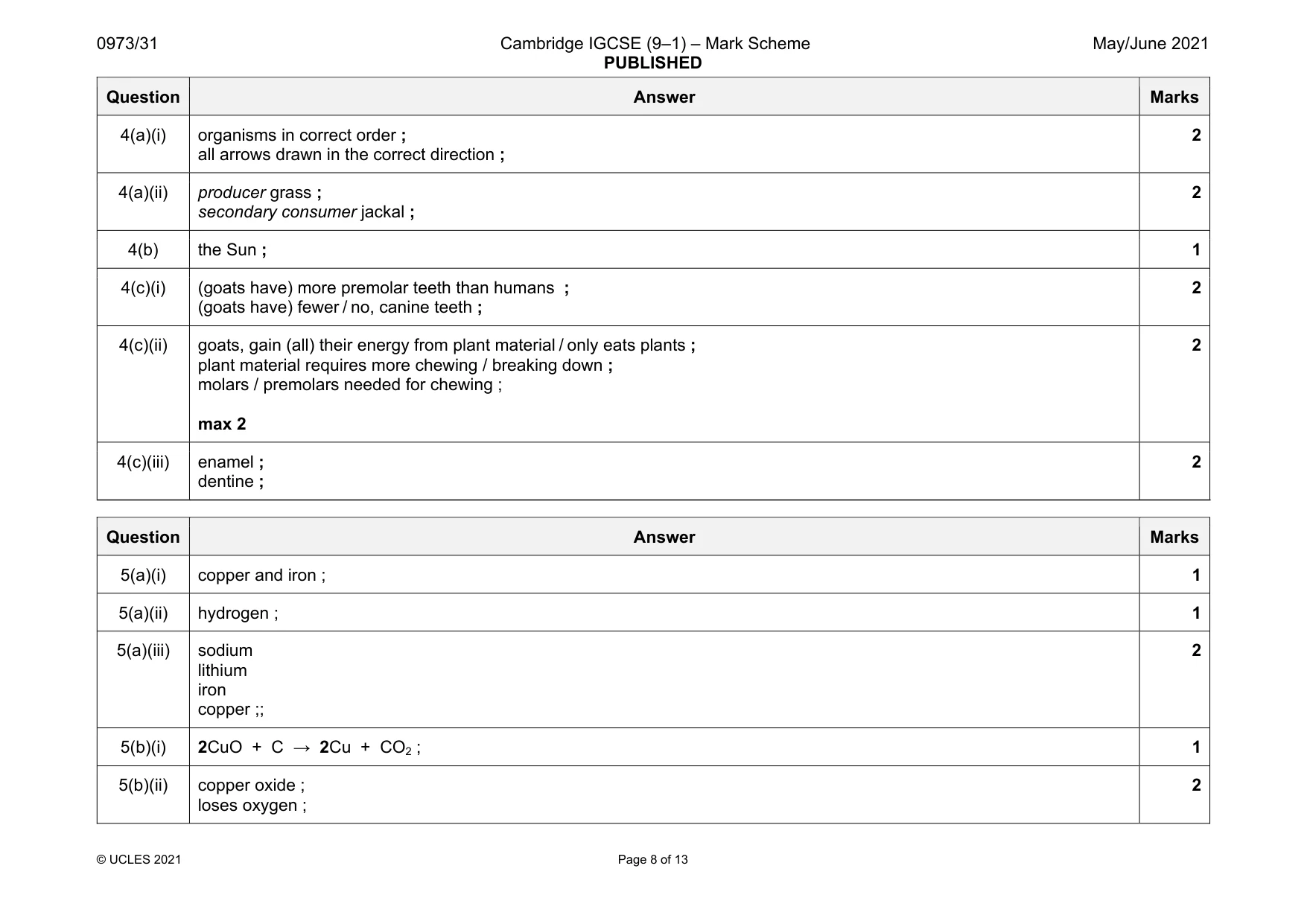
Mark scheme: 4(a)(i) organisms in correct order ; all arrows drawn in the correct direction ; 2 4(a)(ii) producer grass ; secondary consumer jackal ; 2 4(b) the Sun ; 1 4(c)(i) (goats have) more premolar teeth than humans ; (goats have) fewer / no, canine teeth ; 2 4(c)(ii) goats, gain (all) their energy from plant material / only eats plants ; plant material requires more chewing / breaking down ; molars / premolars needed for chewing ; max 2 2 4(c)(iii) enamel ; dentine ; 2
Q5 · Information about four metallic elements
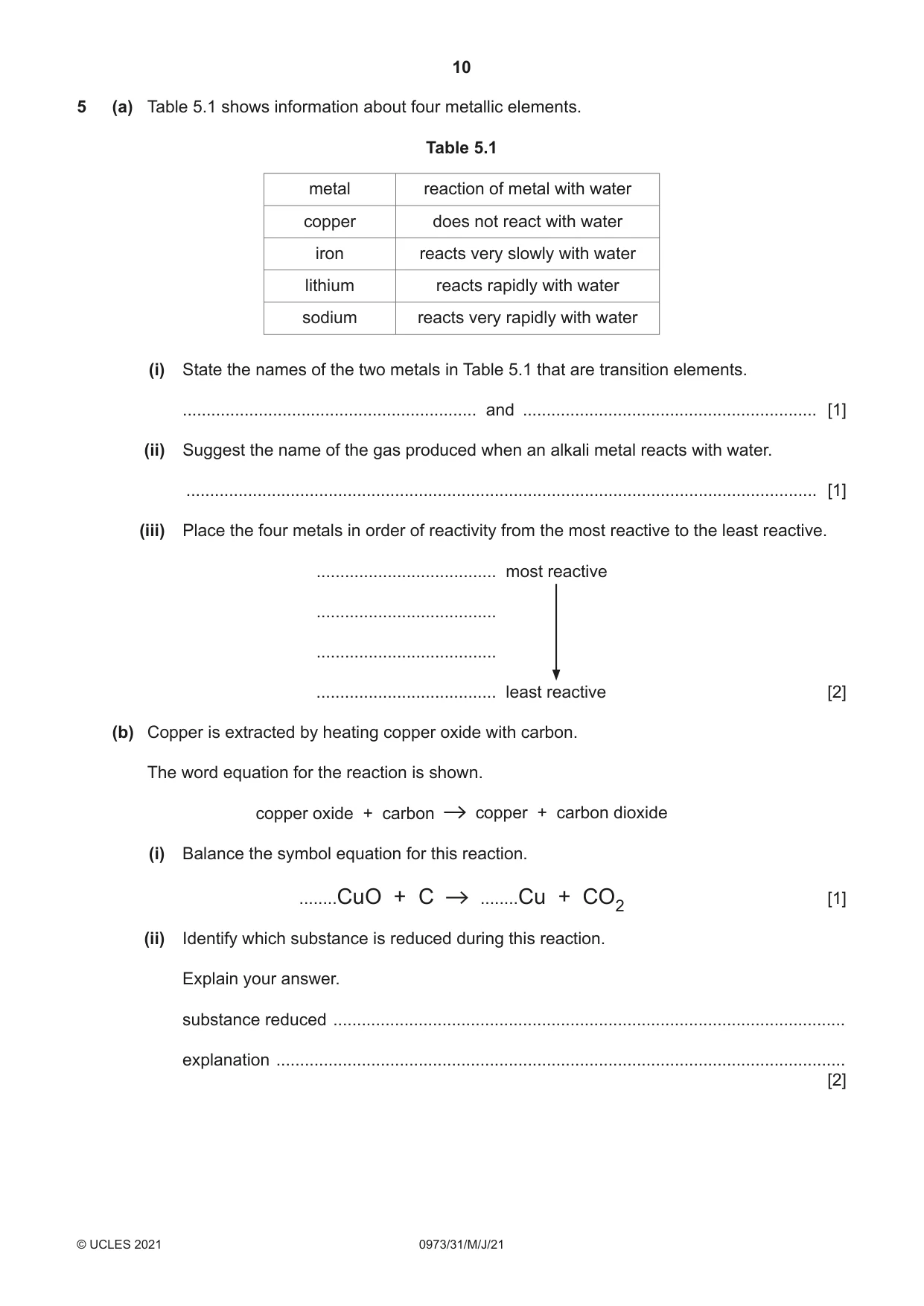
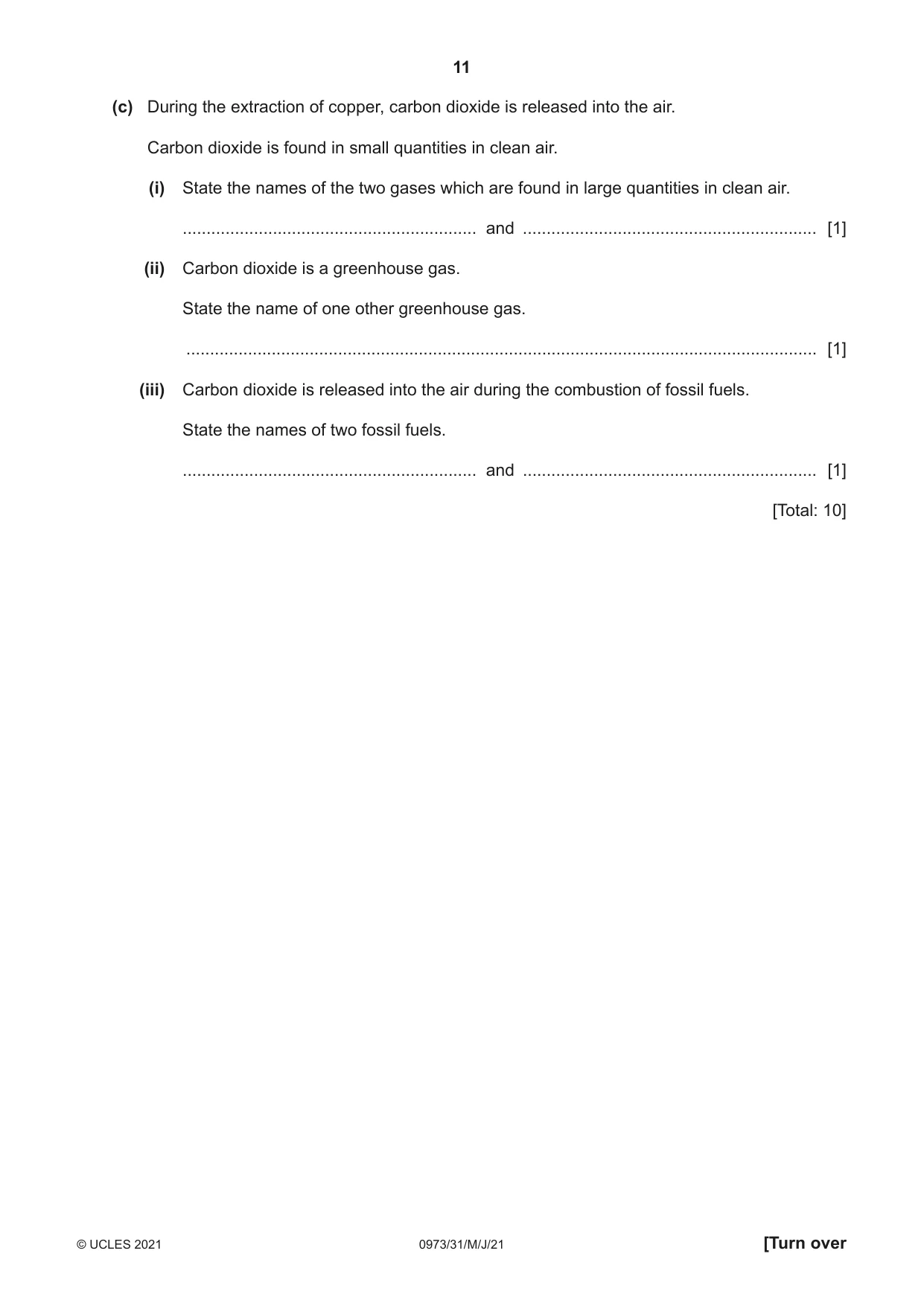
5 (a) Table 5.1 shows information about four metallic elements. Table 5.1 metal reaction of metal with water copper does not react with water iron reacts very slowly with water lithium reacts rapidly with water sodium reacts very rapidly with water (i) State the names of the two metals in Table 5.1 that are transition elements. .............................................................. and .............................................................. [1] (ii) Suggest the name of the gas produced when an alkali metal reacts with water. ..................................................................................................................................... [1] (iii) Place the four metals in order of reactivity from the most reactive to the least reactive. ...................................... most reactive ...................................... ...................................... ...................................... least reactive [2] (b) Copper is extracted by heating copper oxide with carbon. The word equation for the reaction is shown. copper oxide + carbon copper + carbon dioxide (i) Balance the symbol equation for this reaction. [1] ........CuO + C ........Cu + CO2 (ii) Identify which substance is reduced during this reaction. Explain your answer. substance reduced ............................................................................................................ explanation ........................................................................................................................ [2] (c) During the extraction of copper, carbon dioxide is released into the air. Carbon dioxide is found in small quantities in clean air. (i) State the names of the two gases which are found in large quantities in clean air. .............................................................. and .............................................................. [1] (ii) Carbon dioxide is a greenhouse gas. State the name of one other greenhouse gas. ..................................................................................................................................... [1] (iii) Carbon dioxide is released into the air during the combustion of fossil fuels. State the names of two fossil fuels. .............................................................. and .............................................................. [1] [Total: 10]
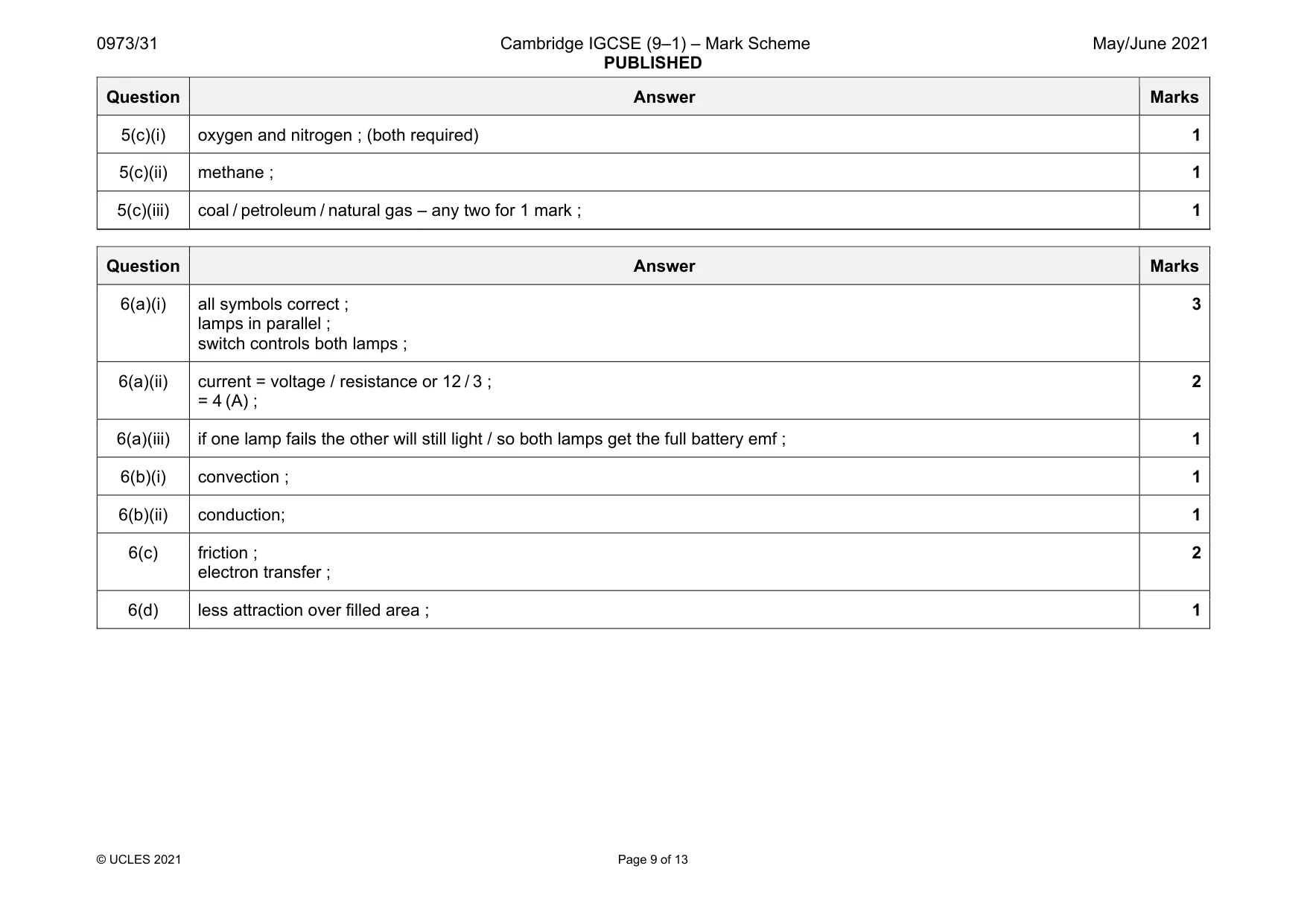
Mark scheme: 5(a)(i) copper and iron ; 1 5(a)(ii) hydrogen ; 1 5(a)(iii) sodium lithium iron copper ;; 2 5(b)(i) 2CuO + C → 2Cu + CO2 ; 1 5(b)(ii) copper oxide ; loses oxygen ; 2 Question Answer Marks 5(c)(i) oxygen and nitrogen ; (both required) 1 5(c)(ii) methane ; 1 5(c)(iii) coal / petroleum / natural gas – any two for 1 mark ; 1
Q6 · A car has two identical headlamps
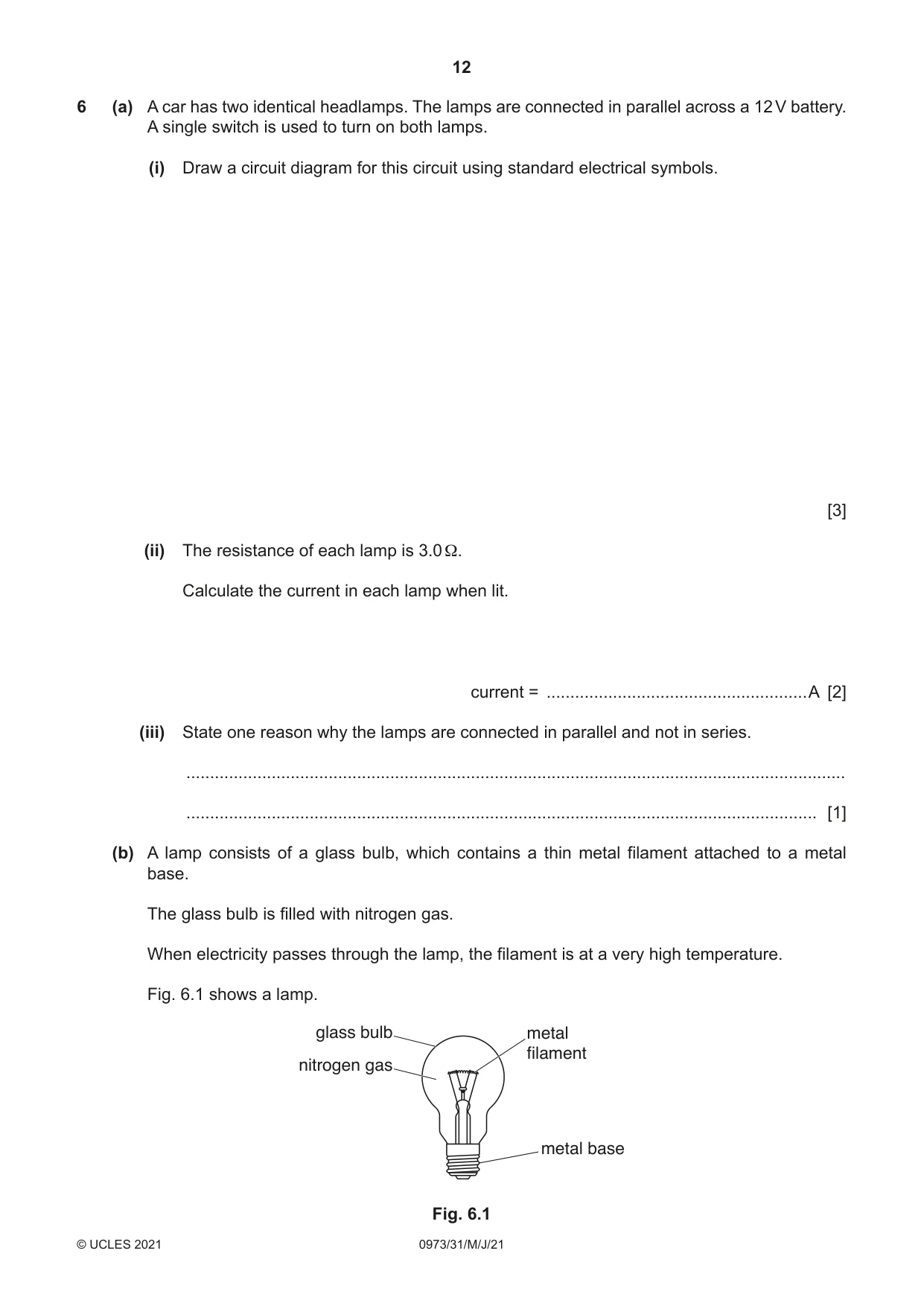
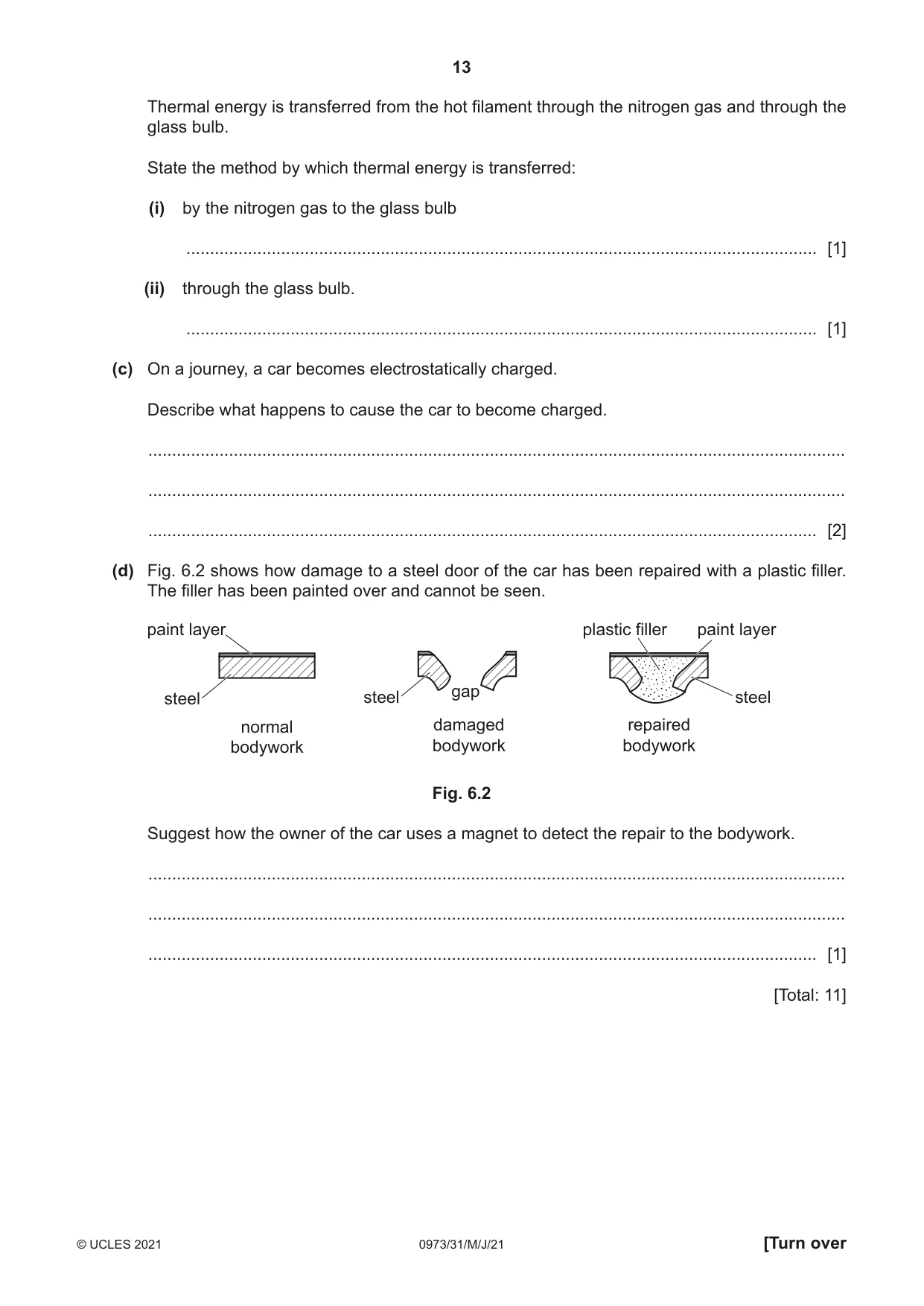
6 (a) A car has two identical headlamps. The lamps are connected in parallel across a 12 V battery. A single switch is used to turn on both lamps. (i) Draw a circuit diagram for this circuit using standard electrical symbols. [3] (ii) The resistance of each lamp is 3.0 Ω. Calculate the current in each lamp when lit. current = .......................................................A [2] (iii) State one reason why the lamps are connected in parallel and not in series. ........................................................................................................................................... ..................................................................................................................................... [1] (b) A lamp consists of a glass bulb, which contains a thin metal filament attached to a metal base. The glass bulb is filled with nitrogen gas. When electricity passes through the lamp, the filament is at a very high temperature. Fig. 6.1 shows a lamp. glass bulb metal filament nitrogen gas metal base Fig. 6.1 Thermal energy is transferred from the hot filament through the nitrogen gas and through the glass bulb. State the method by which thermal energy is transferred: (i) by the nitrogen gas to the glass bulb ..................................................................................................................................... [1] (ii) through the glass bulb. ..................................................................................................................................... [1] (c) On a journey, a car becomes electrostatically charged. Describe what happens to cause the car to become charged. ................................................................................................................................................... ................................................................................................................................................... ............................................................................................................................................. [2] (d) Fig. 6.2 shows how damage to a steel door of the car has been repaired with a plastic filler. The filler has been painted over and cannot be seen. paint layer plastic filler paint layer gap steel steel steel normal damaged repaired bodywork bodywork bodywork Fig. 6.2 Suggest how the owner of the car uses a magnet to detect the repair to the bodywork. ................................................................................................................................................... ................................................................................................................................................... ............................................................................................................................................. [1] [Total: 11]
Mark scheme: 6(a)(i) all symbols correct ; lamps in parallel ; switch controls both lamps ; 3 6(a)(ii) current = voltage / resistance or 12 / 3 ; = 4 (A) ; 2 6(a)(iii) if one lamp fails the other will still light / so both lamps get the full battery emf ; 1 6(b)(i) convection ; 1 6(b)(ii) conduction; 1 6(c) friction ; electron transfer ; 2 6(d) less attraction over filled area ; 1
Q7 · Some of the functions of the main components of blood
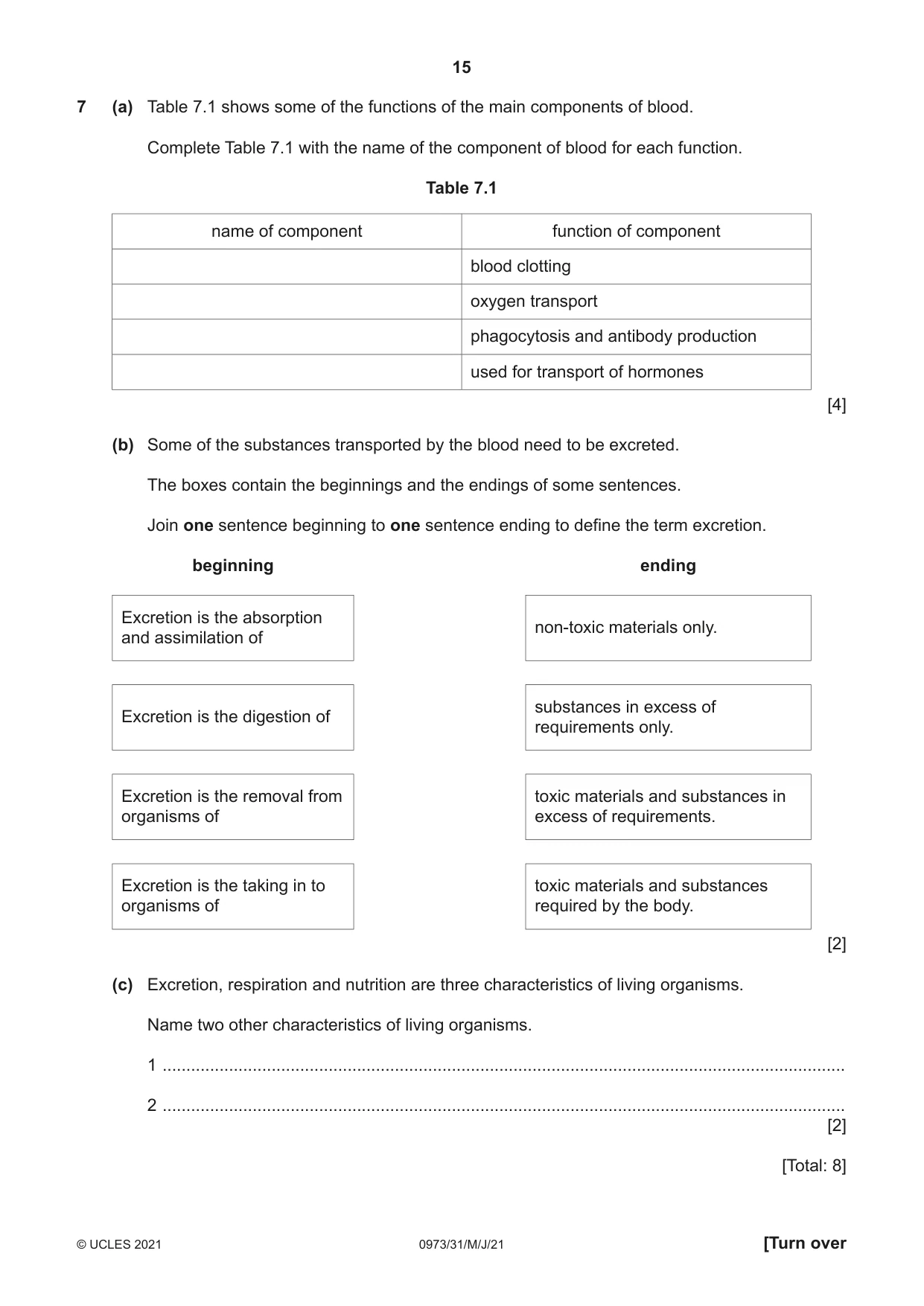
7 (a) Table 7.1 shows some of the functions of the main components of blood. Complete Table 7.1 with the name of the component of blood for each function. Table 7.1 name of component function of component blood clotting oxygen transport phagocytosis and antibody production used for transport of hormones [4] (b) Some of the substances transported by the blood need to be excreted. The boxes contain the beginnings and the endings of some sentences. Join one sentence beginning to one sentence ending to define the term excretion. beginning ending Excretion is the absorption non‑toxic materials only. and assimilation of substances in excess of Excretion is the digestion of requirements only. Excretion is the removal from toxic materials and substances in organisms of excess of requirements. Excretion is the taking in to toxic materials and substances organisms of required by the body. [2] (c) Excretion, respiration and nutrition are three characteristics of living organisms. Name two other characteristics of living organisms. 1 ................................................................................................................................................ 2 ................................................................................................................................................ [2] [Total: 8]
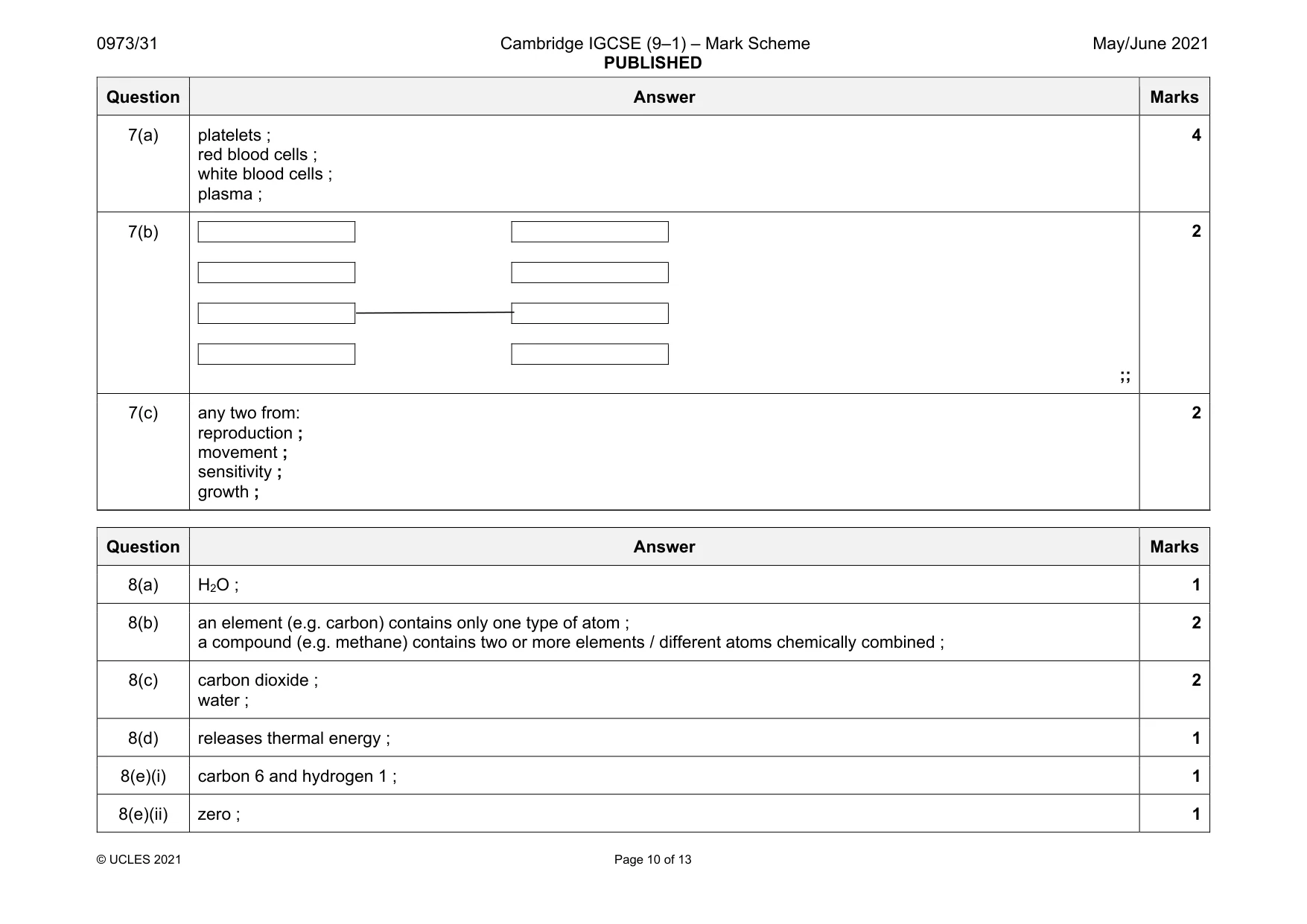
Mark scheme: 7(a) platelets ; red blood cells ; white blood cells ; plasma ; 4 7(b) ;; 2 7(c) any two from: reproduction ; movement ; sensitivity ; growth ; 2
Q8 · Three molecules A, B and C
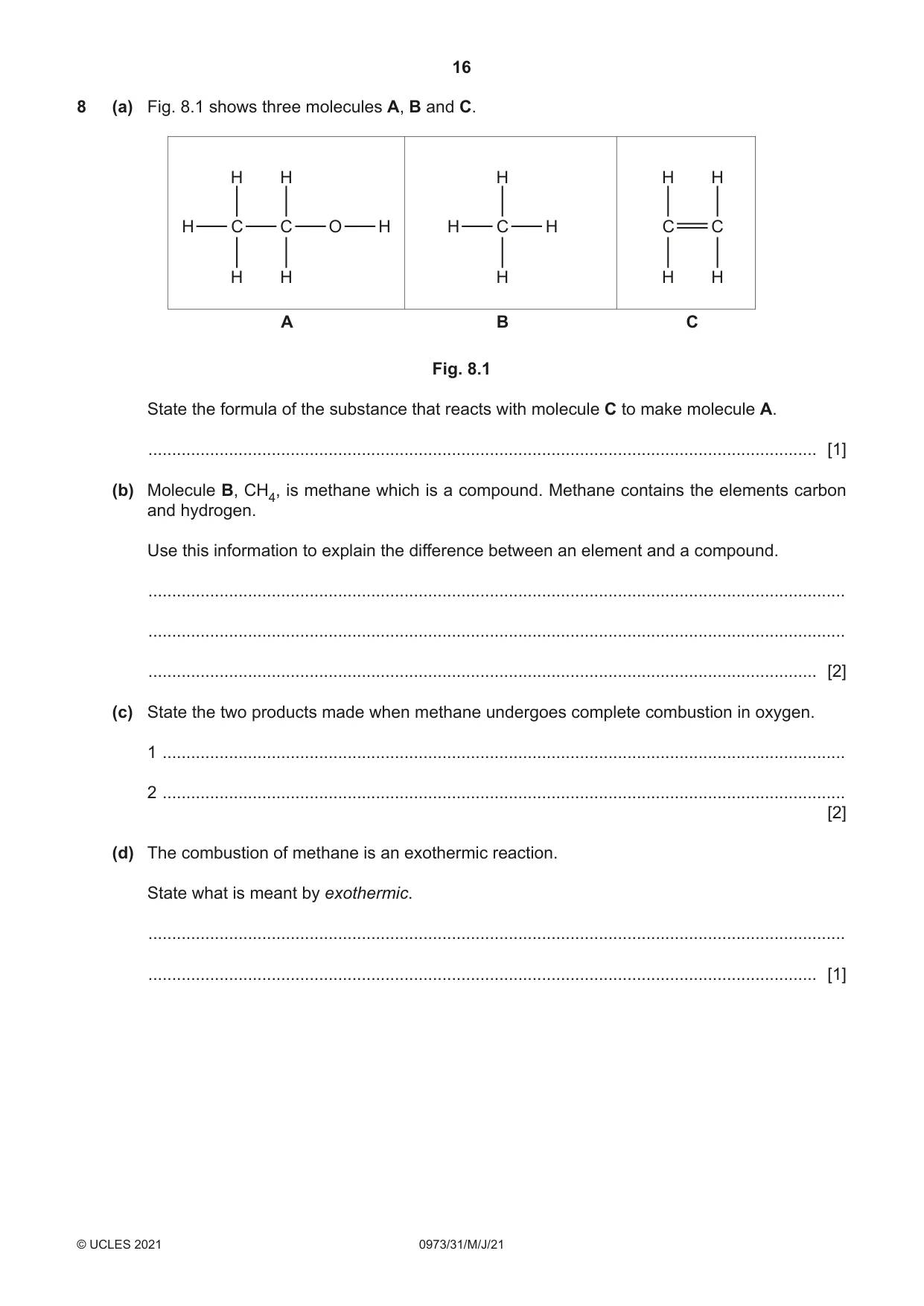
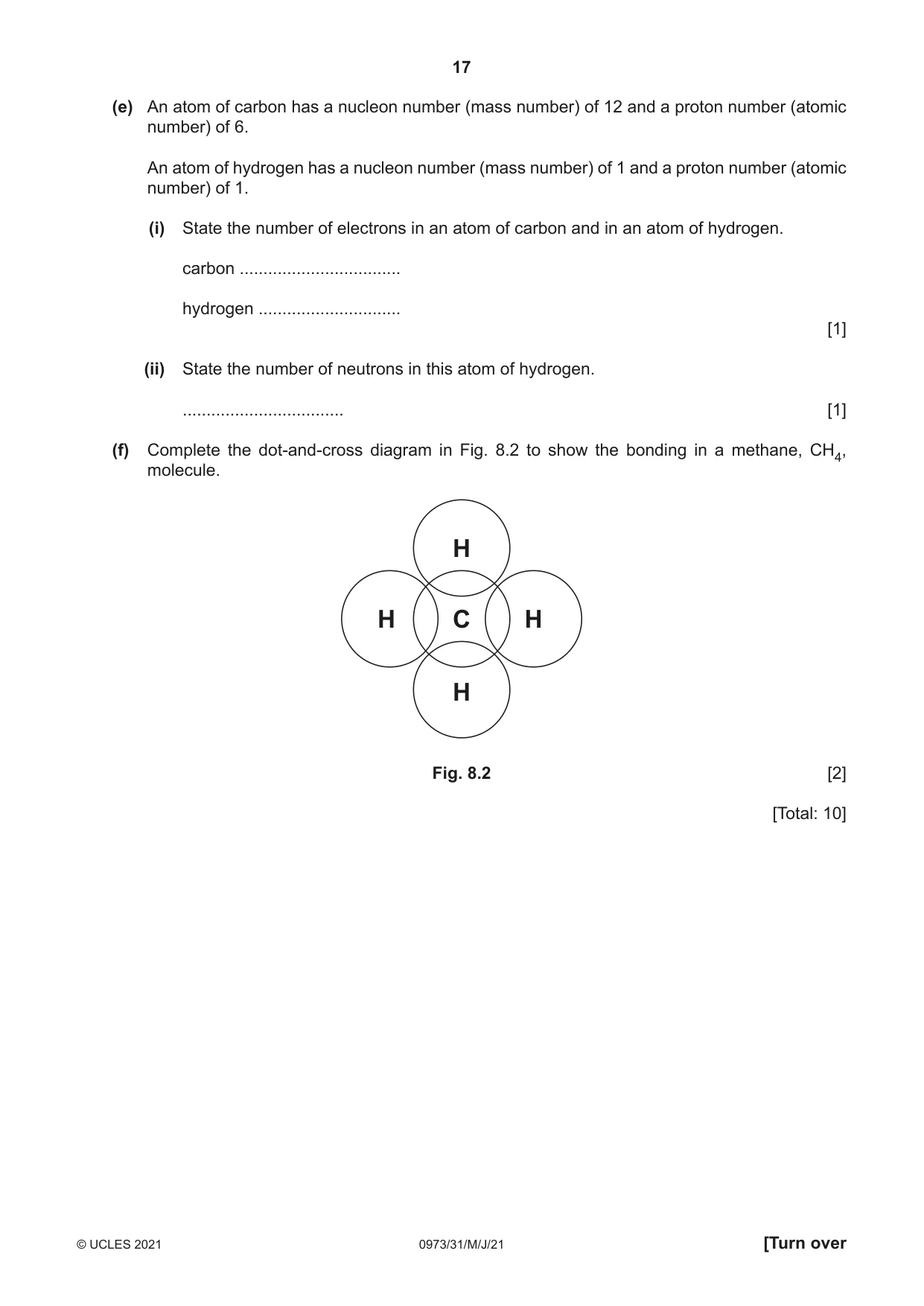
8 (a) Fig. 8.1 shows three molecules A, B and C. H H H H H H C C O H H C H C C H H H H H A B C Fig. 8.1 State the formula of the substance that reacts with molecule C to make molecule A. ............................................................................................................................................. [1] (b) Molecule B, CH4, is methane which is a compound. Methane contains the elements carbon and hydrogen. Use this information to explain the difference between an element and a compound. ................................................................................................................................................... ................................................................................................................................................... ............................................................................................................................................. [2] (c) State the two products made when methane undergoes complete combustion in oxygen. 1 ................................................................................................................................................ 2 ................................................................................................................................................ [2] (d) The combustion of methane is an exothermic reaction. State what is meant by exothermic. ................................................................................................................................................... ............................................................................................................................................. [1] (e) An atom of carbon has a nucleon number (mass number) of 12 and a proton number (atomic number) of 6. An atom of hydrogen has a nucleon number (mass number) of 1 and a proton number (atomic number) of 1. (i) State the number of electrons in an atom of carbon and in an atom of hydrogen. carbon .................................. hydrogen .............................. [1] (ii) State the number of neutrons in this atom of hydrogen. .................................. [1] (f) Complete the dot‑and‑cross diagram in Fig. 8.2 to show the bonding in a methane, CH4, molecule. H H C H H Fig. 8.2 [2] [Total: 10]
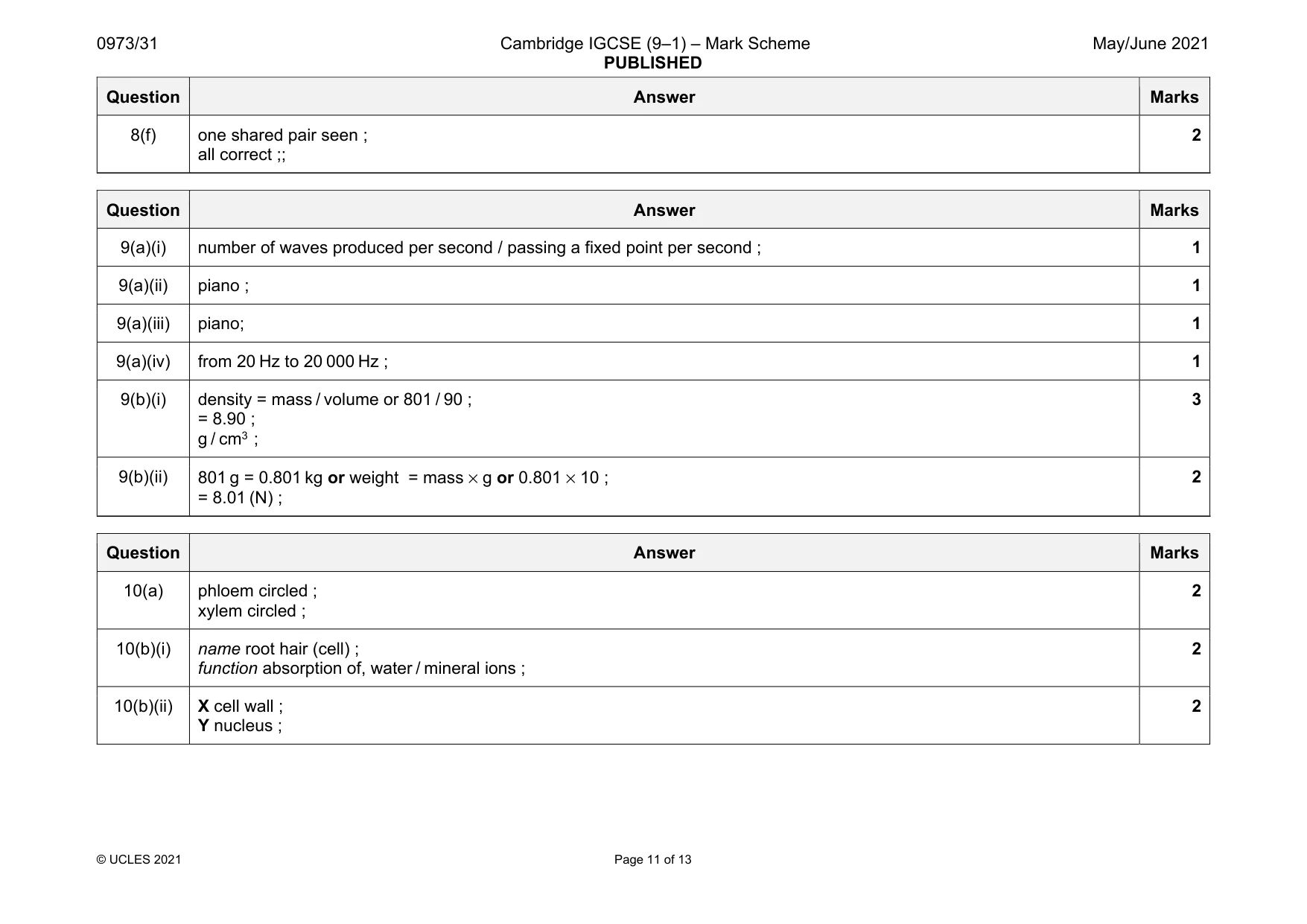
Mark scheme: 8(a) H2O ; 1 8(b) an element (e.g. carbon) contains only one type of atom ; a compound (e.g. methane) contains two or more elements / different atoms chemically combined ; 2 8(c) carbon dioxide ; water ; 2 8(d) releases thermal energy ; 1 8(e)(i) carbon 6 and hydrogen 1 ; 1 8(e)(ii) zero ; 1 Question Answer Marks 8(f) one shared pair seen ; all correct ;; 2
Q9 · A school orchestra is practising
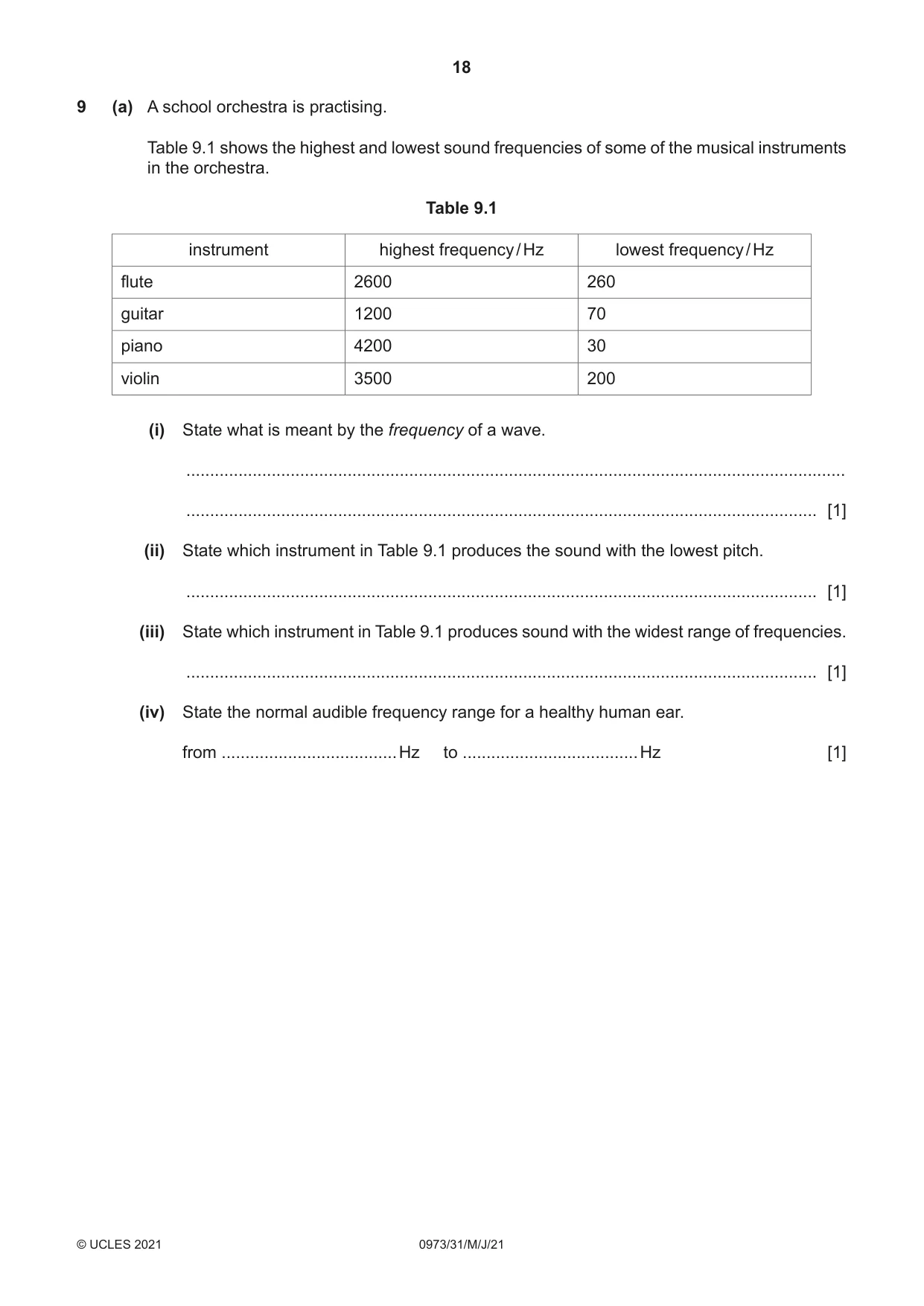
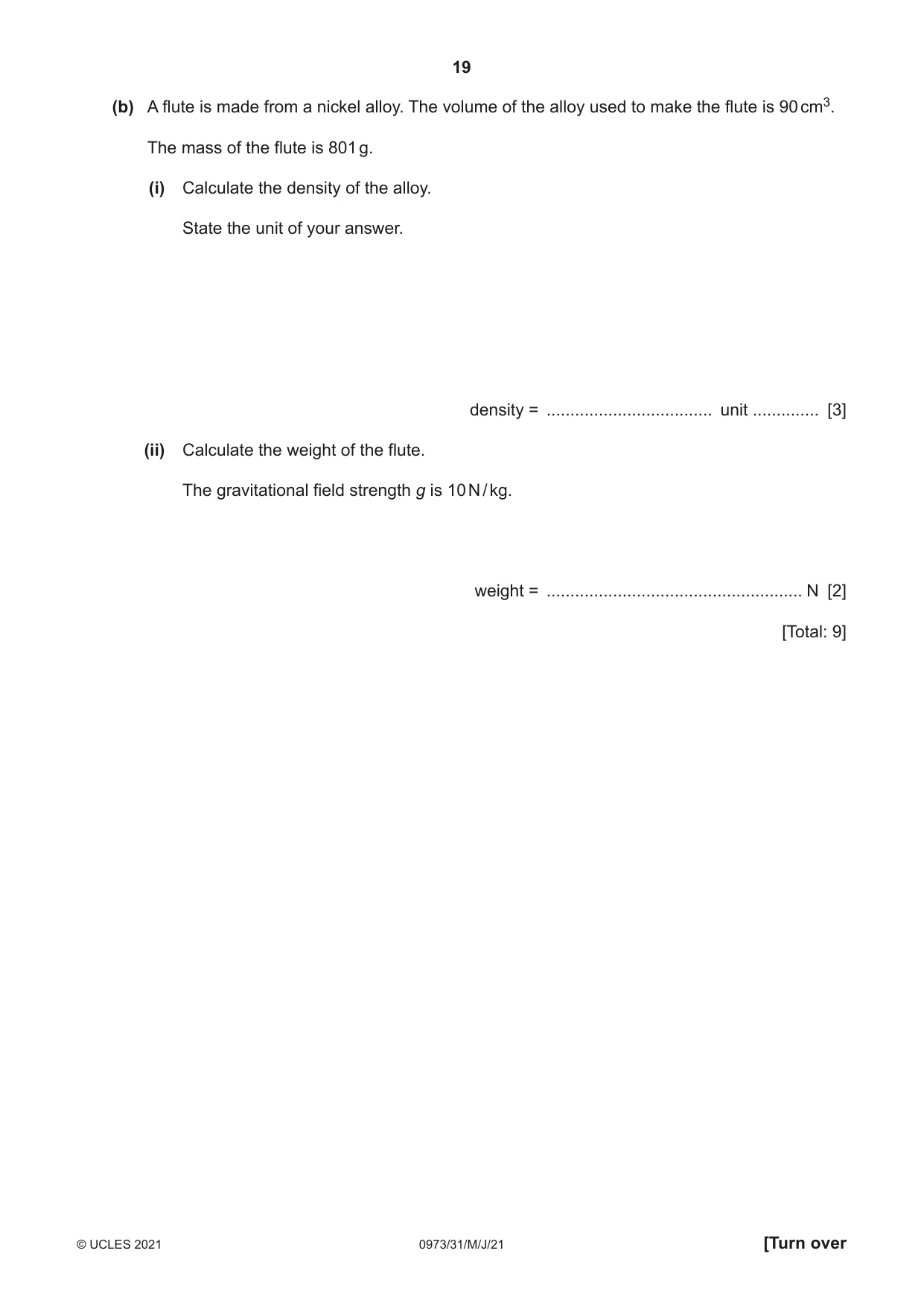
9 (a) A school orchestra is practising. Table 9.1 shows the highest and lowest sound frequencies of some of the musical instruments in the orchestra. Table 9.1 instrument highest frequency / Hz lowest frequency / Hz flute 2600 260 guitar 1200 70 piano 4200 30 violin 3500 200 (i) State what is meant by the frequency of a wave. ........................................................................................................................................... ..................................................................................................................................... [1] (ii) State which instrument in Table 9.1 produces the sound with the lowest pitch. ..................................................................................................................................... [1] (iii) State which instrument in Table 9.1 produces sound with the widest range of frequencies. ..................................................................................................................................... [1] (iv) State the normal audible frequency range for a healthy human ear. from ..................................... Hz to ..................................... Hz [1] (b) A flute is made from a nickel alloy. The volume of the alloy used to make the flute is 90 cm3. The mass of the flute is 801 g. (i) Calculate the density of the alloy. State the unit of your answer. density = ................................... unit .............. [3] (ii) Calculate the weight of the flute. The gravitational field strength g is 10 N / kg. weight = ...................................................... N [2] [Total: 9]
Mark scheme: 9(a)(i) number of waves produced per second / passing a fixed point per second ; 1 9(a)(ii) piano ; 1 9(a)(iii) piano; 1 9(a)(iv) from 20 Hz to 20 000 Hz ; 1 9(b)(i) density = mass / volume or 801 / 90 ; = 8.90 ; g / cm3 ; 3 9(b)(ii) 801 g = 0.801 kg or weight = mass × g or 0.801 × 10 ; = 8.01 (N) ; 2
Q10 · Plants use different tissues to transport substances around the plant
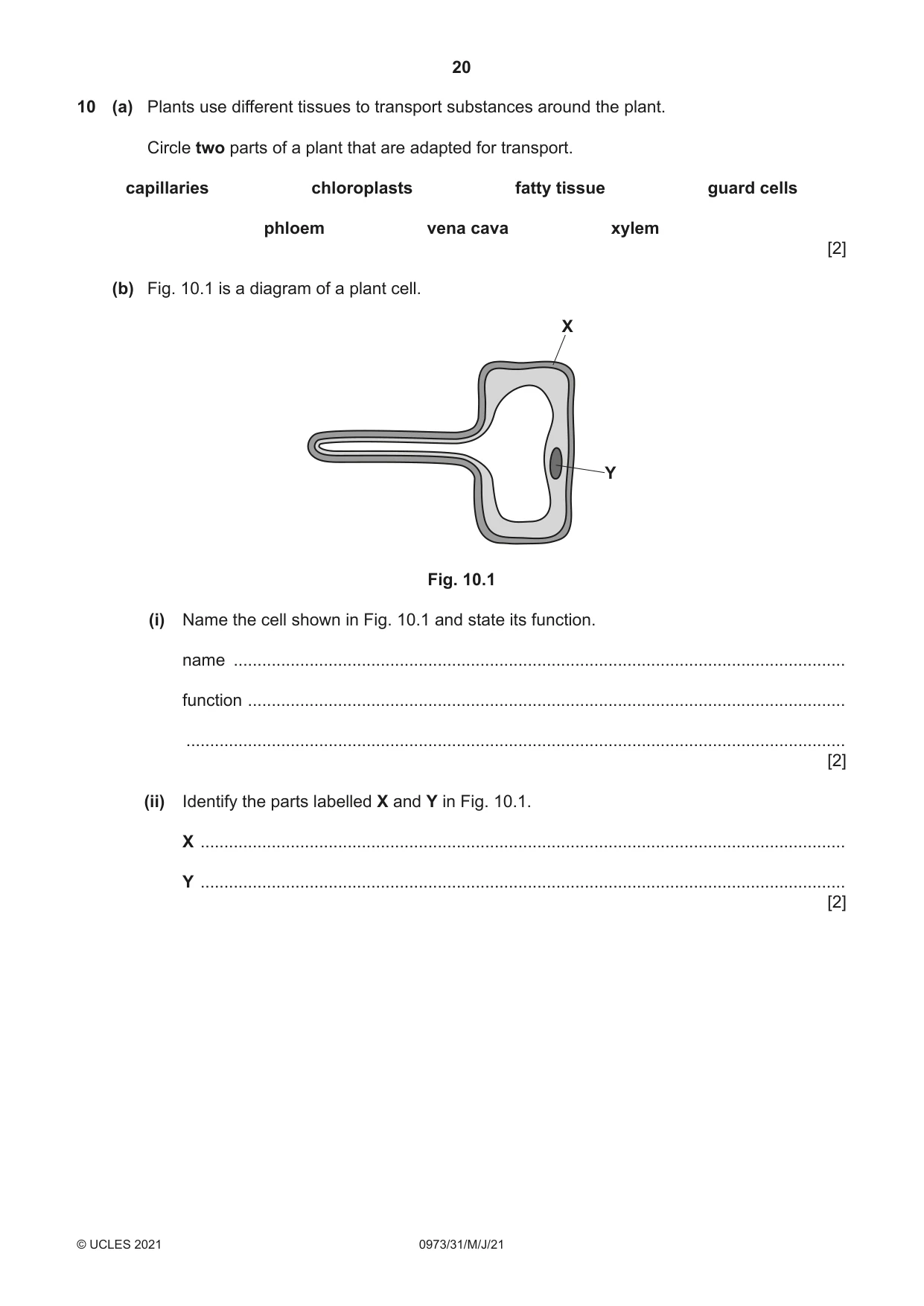
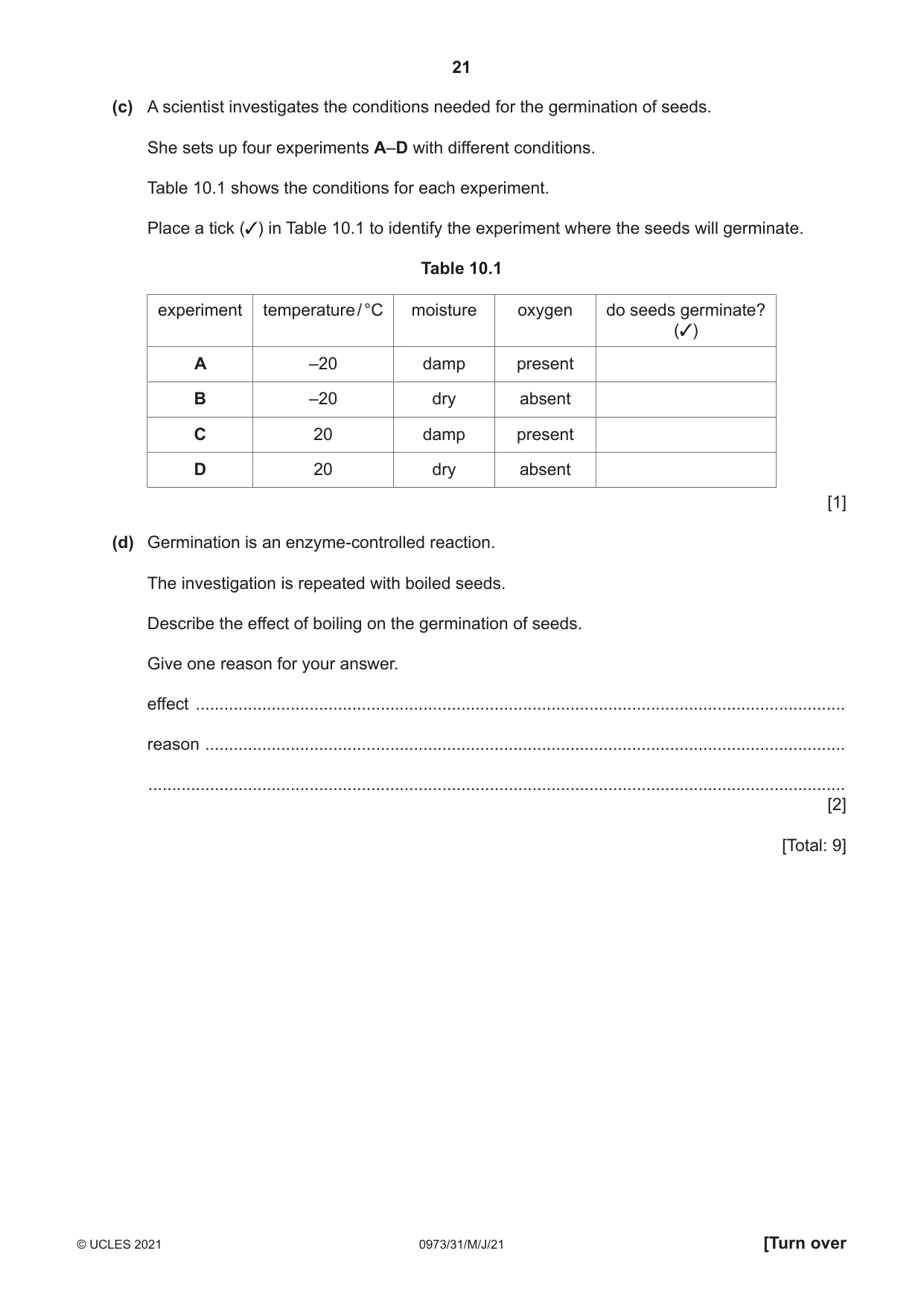
10 (a) Plants use different tissues to transport substances around the plant. Circle two parts of a plant that are adapted for transport. capillaries chloroplasts fatty tissue guard cells phloem vena cava xylem [2] (b) Fig. 10.1 is a diagram of a plant cell. X Y Fig. 10.1 (i) Name the cell shown in Fig. 10.1 and state its function. name ................................................................................................................................. function .............................................................................................................................. ........................................................................................................................................... [2] (ii) Identify the parts labelled X and Y in Fig. 10.1. X ........................................................................................................................................ Y ........................................................................................................................................ [2] (c) A scientist investigates the conditions needed for the germination of seeds. She sets up four experiments A–D with different conditions. Table 10.1 shows the conditions for each experiment. Place a tick (3) in Table 10.1 to identify the experiment where the seeds will germinate. Table 10.1 experiment temperature / °C moisture oxygen do seeds germinate? (3) A –20 damp present B –20 dry absent C 20 damp present D 20 dry absent [1] (d) Germination is an enzyme‑controlled reaction. The investigation is repeated with boiled seeds. Describe the effect of boiling on the germination of seeds. Give one reason for your answer. effect ......................................................................................................................................... reason ....................................................................................................................................... ................................................................................................................................................... [2] [Total: 9]
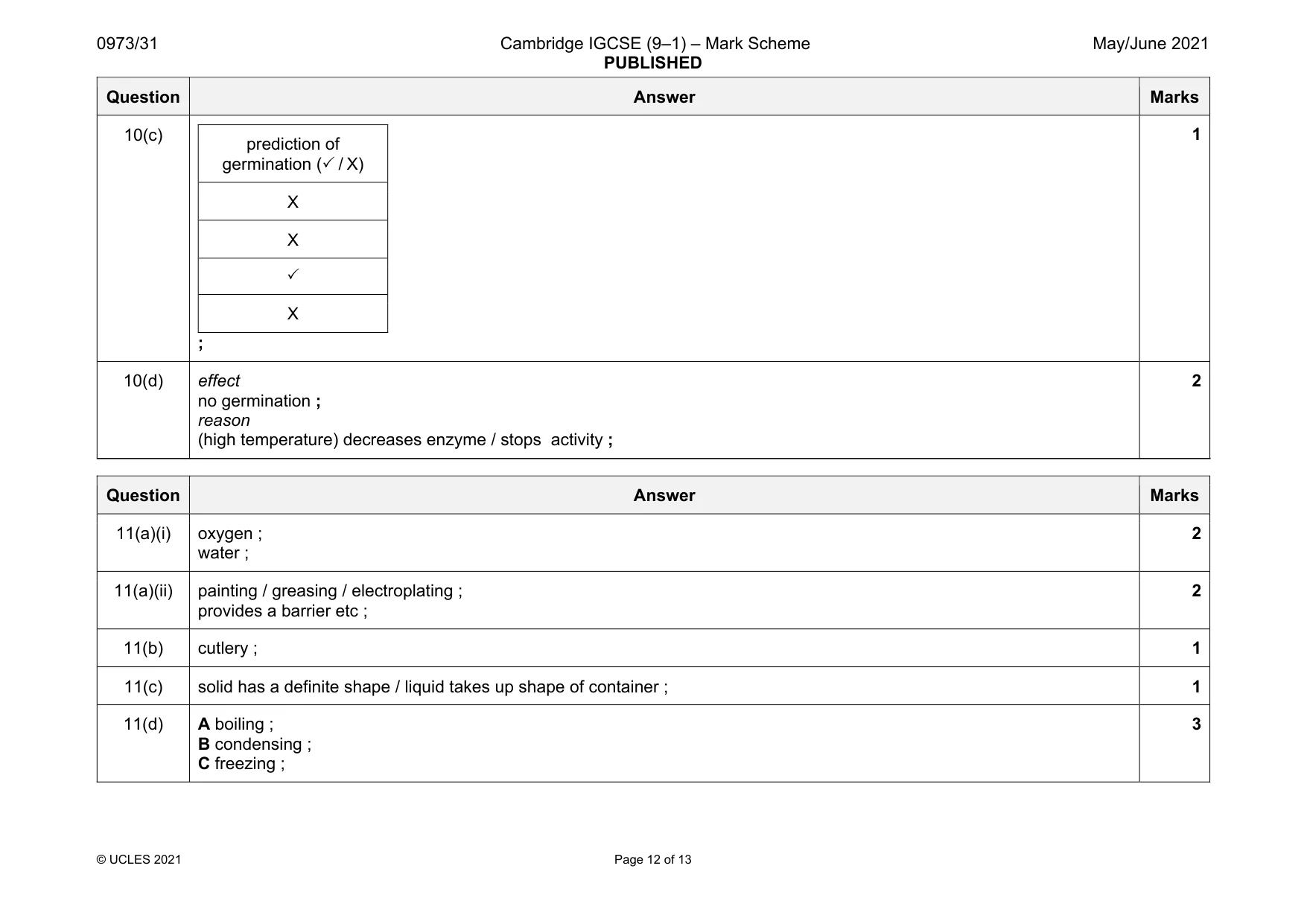
Mark scheme: 10(a) phloem circled ; xylem circled ; 2 10(b)(i) name root hair (cell) ; function absorption of, water / mineral ions ; 2 10(b)(ii) X cell wall ; Y nucleus ; 2 Question Answer Marks 10(c) prediction of germination (/ X) X X X ; 1 10(d) effect no germination ; reason (high temperature) decreases enzyme / stops activity ; 2
Question 11
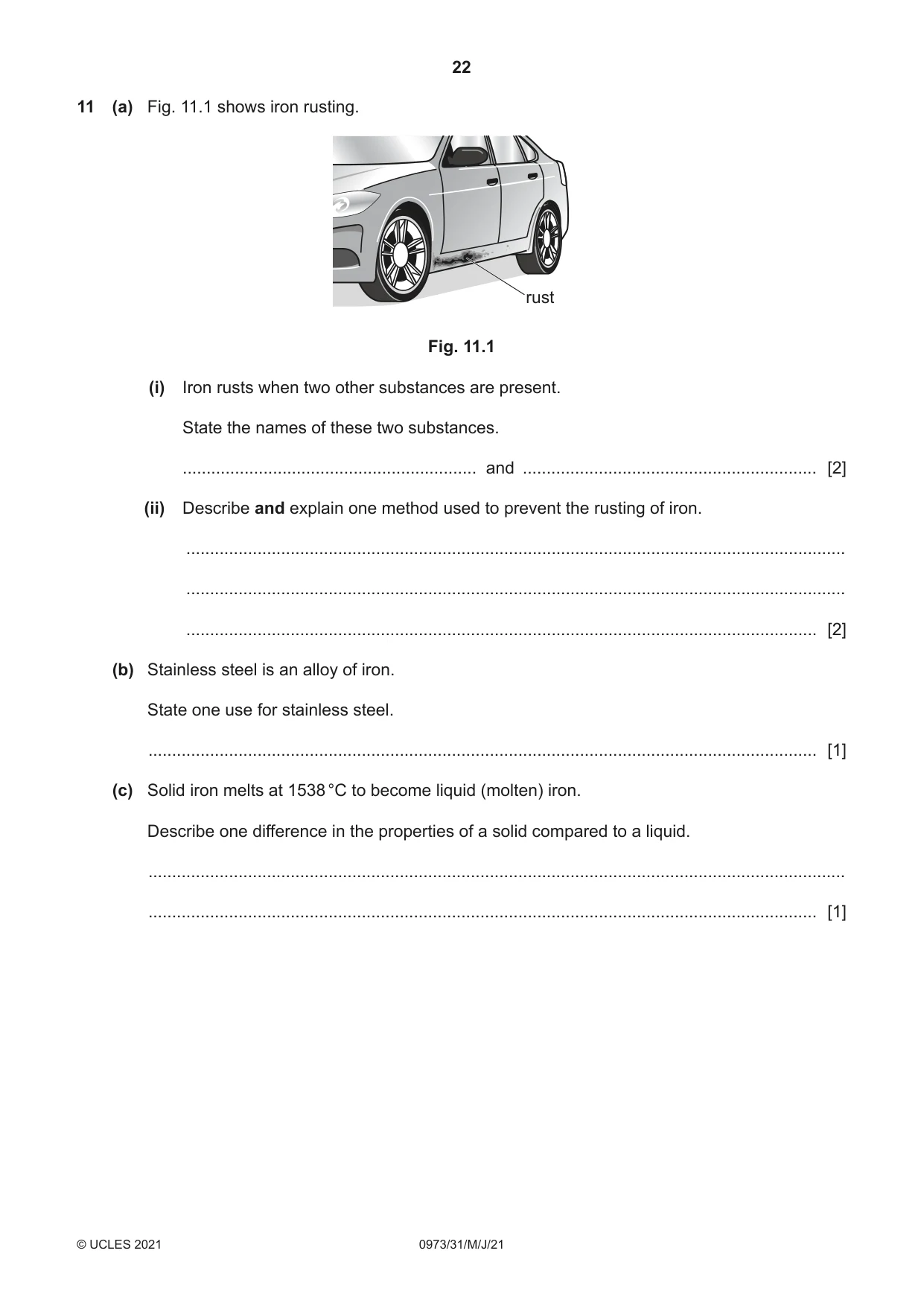
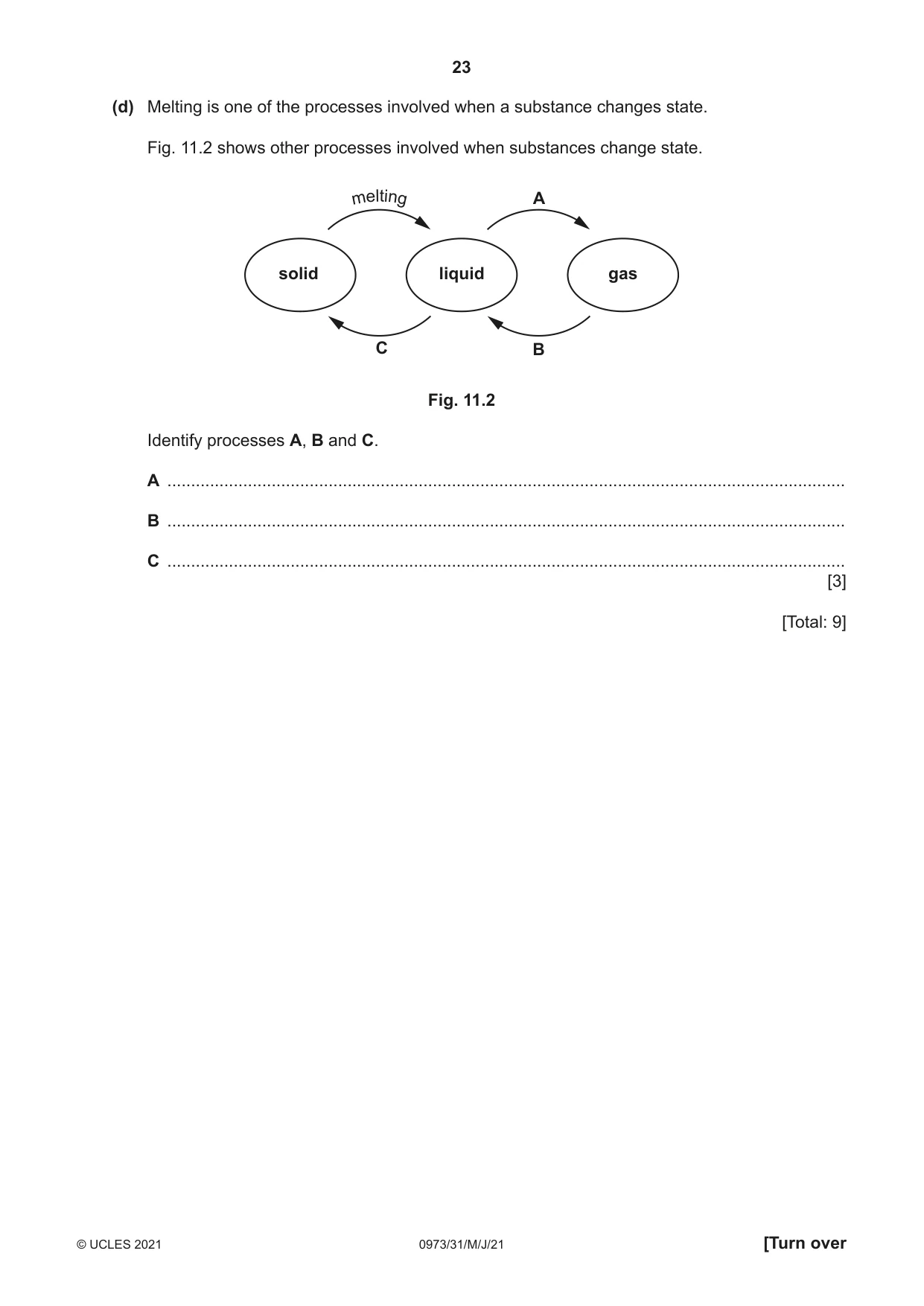
11 (a) Fig. 11.1 shows iron rusting. rust Fig. 11.1 (i) Iron rusts when two other substances are present. State the names of these two substances. .............................................................. and .............................................................. [2] (ii) Describe and explain one method used to prevent the rusting of iron. ........................................................................................................................................... ........................................................................................................................................... ..................................................................................................................................... [2] (b) Stainless steel is an alloy of iron. State one use for stainless steel. ............................................................................................................................................. [1] (c) Solid iron melts at 1538 °C to become liquid (molten) iron. Describe one difference in the properties of a solid compared to a liquid. ................................................................................................................................................... ............................................................................................................................................. [1] (d) Melting is one of the processes involved when a substance changes state. Fig. 11.2 shows other processes involved when substances change state. melting A solid liquid gas C B Fig. 11.2 Identify processes A, B and C. A ............................................................................................................................................... B ............................................................................................................................................... C ............................................................................................................................................... [3] [Total: 9]
Mark scheme: 11(a)(i) oxygen ; water ; 2 11(a)(ii) painting / greasing / electroplating ; provides a barrier etc ; 2 11(b) cutlery ; 1 11(c) solid has a definite shape / liquid takes up shape of container ; 1 11(d) A boiling ; B condensing ; C freezing ; 3
Q12 · Describe how to show that a radioactive isotope is releasing γ‑rays but not α‑particles…
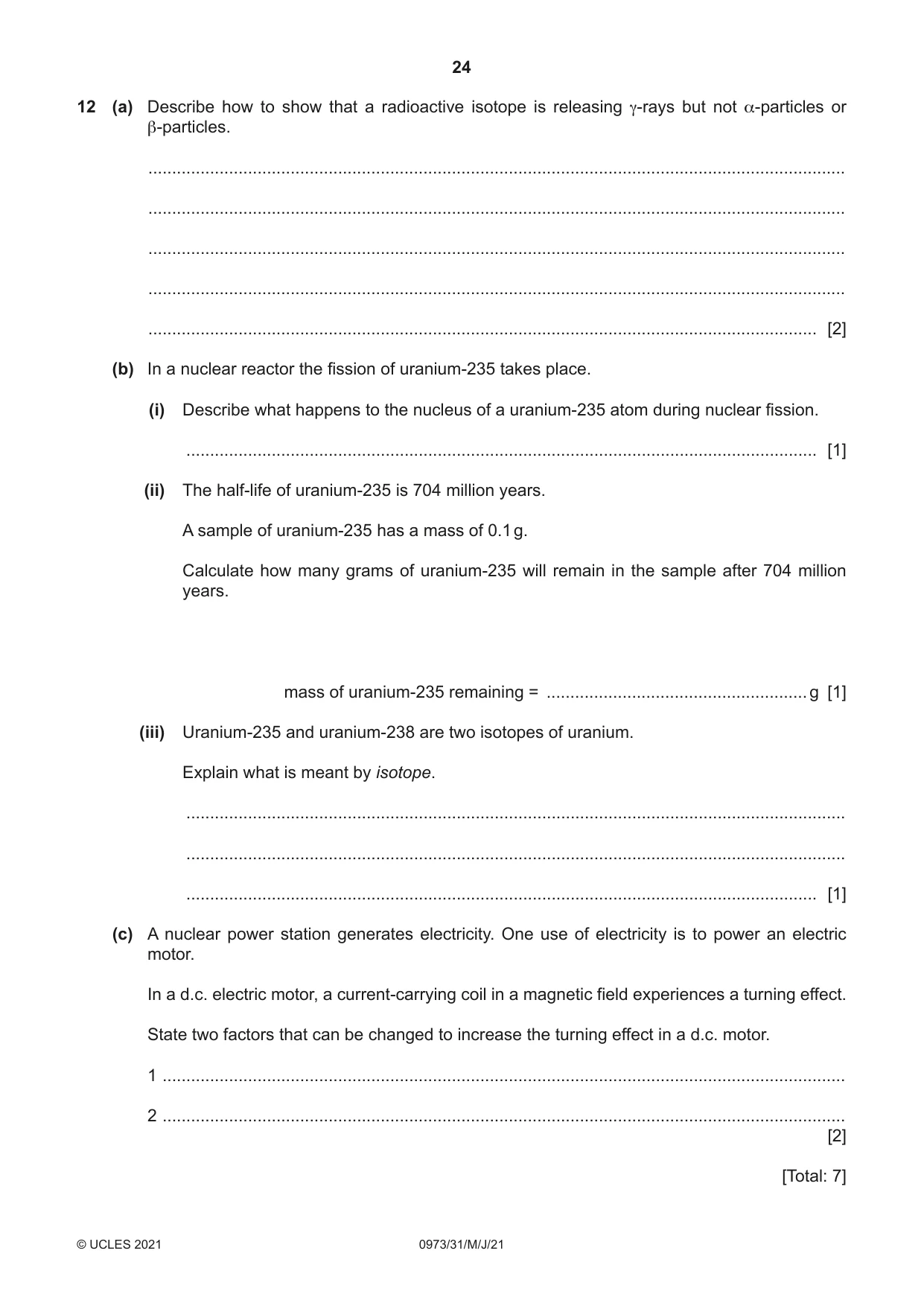
12 (a) Describe how to show that a radioactive isotope is releasing γ‑rays but not α‑particles or β‑particles. ................................................................................................................................................... ................................................................................................................................................... ................................................................................................................................................... ................................................................................................................................................... ............................................................................................................................................. [2] (b) In a nuclear reactor the fission of uranium‑235 takes place. (i) Describe what happens to the nucleus of a uranium‑235 atom during nuclear fission. ..................................................................................................................................... [1] (ii) The half‑life of uranium‑235 is 704 million years. A sample of uranium‑235 has a mass of 0.1 g. Calculate how many grams of uranium‑235 will remain in the sample after 704 million years. mass of uranium‑235 remaining = .......................................................g [1] (iii) Uranium‑235 and uranium‑238 are two isotopes of uranium. Explain what is meant by isotope. ........................................................................................................................................... ........................................................................................................................................... ..................................................................................................................................... [1] (c) A nuclear power station generates electricity. One use of electricity is to power an electric motor. In a d.c. electric motor, a current‑carrying coil in a magnetic field experiences a turning effect. State two factors that can be changed to increase the turning effect in a d.c. motor. 1 ................................................................................................................................................ 2 ................................................................................................................................................ [2] [Total: 7]
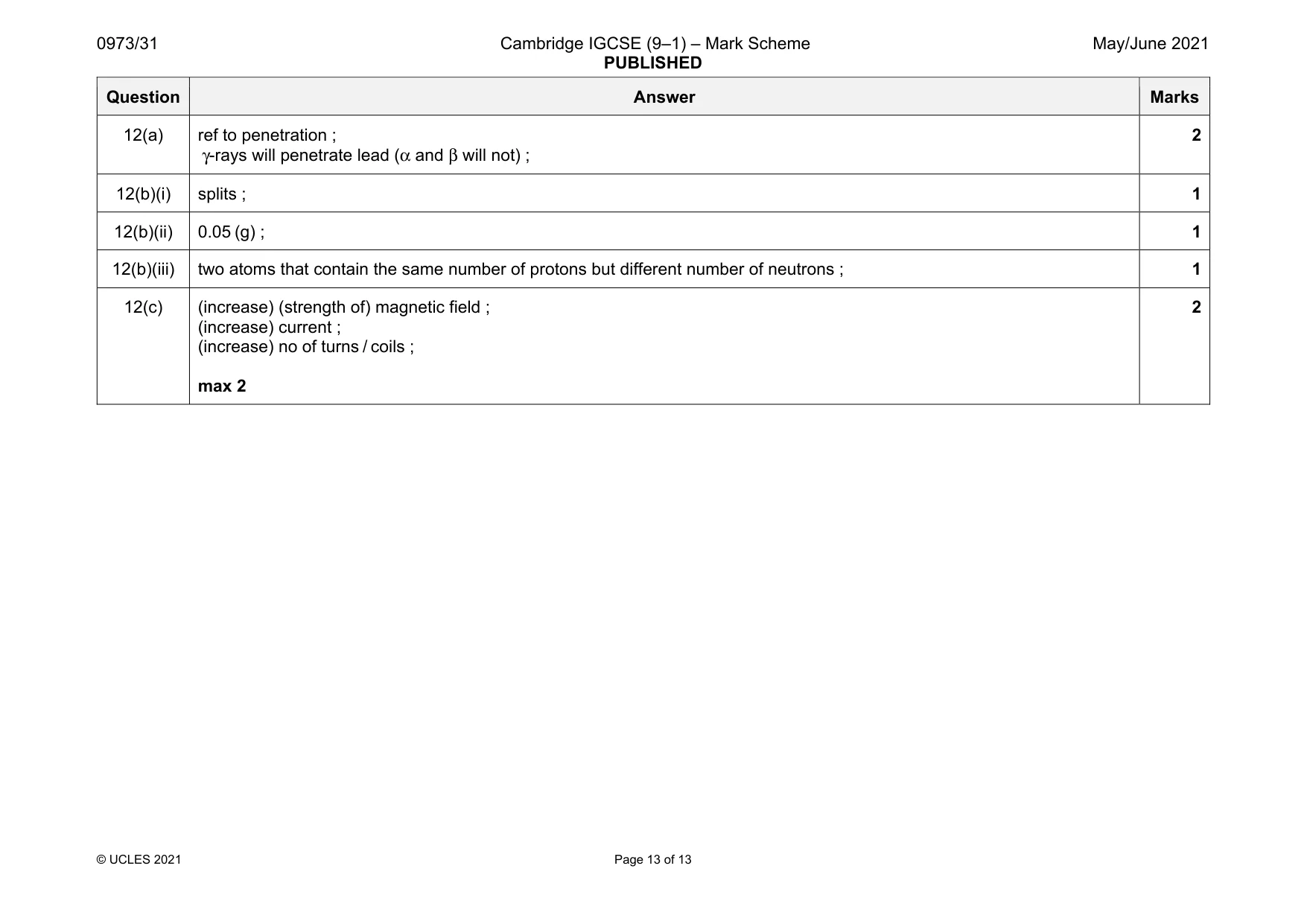
Mark scheme: 12(a) ref to penetration ; γ-rays will penetrate lead (α and β will not) ; 2 12(b)(i) splits ; 1 12(b)(ii) 0.05 (g) ; 1 12(b)(iii) two atoms that contain the same number of protons but different number of neutrons ; 1 12(c) (increase) (strength of) magnetic field ; (increase) current ; (increase) no of turns / coils ; max 2 2
What was in this paper
The subtopics covered by these 12 questions, and how many questions each got. Open one in a new tab to see every Cambridge question on it.
What you needed in this session
Cambridge’s own grade thresholds for 2021 May/June, Paper 3 · Variant 1. A higher threshold means an easier paper — the bar moves with how the cohort did.