Cambridge IGCSE Sciences - Co-ordinated (9-1) 0973 — 2024 May/June Paper 3 · Variant 1
0973/31/M/J/24 · 12 questions · 120 marks · ≈135 min
The question paper and its mark scheme, free to read here and free to download. This is Cambridge’s own paper, exactly as it was sat.
Question paper28 pages

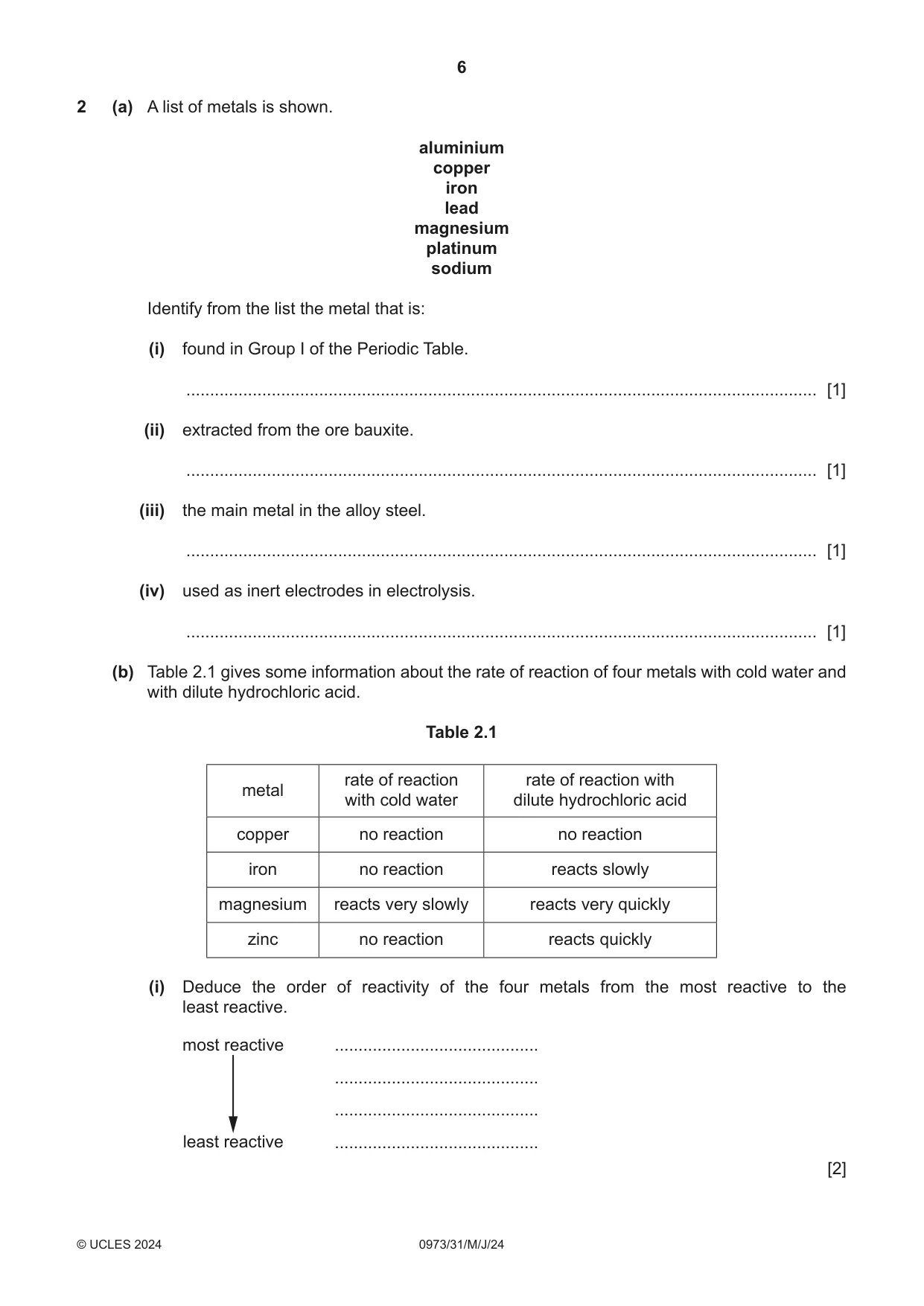
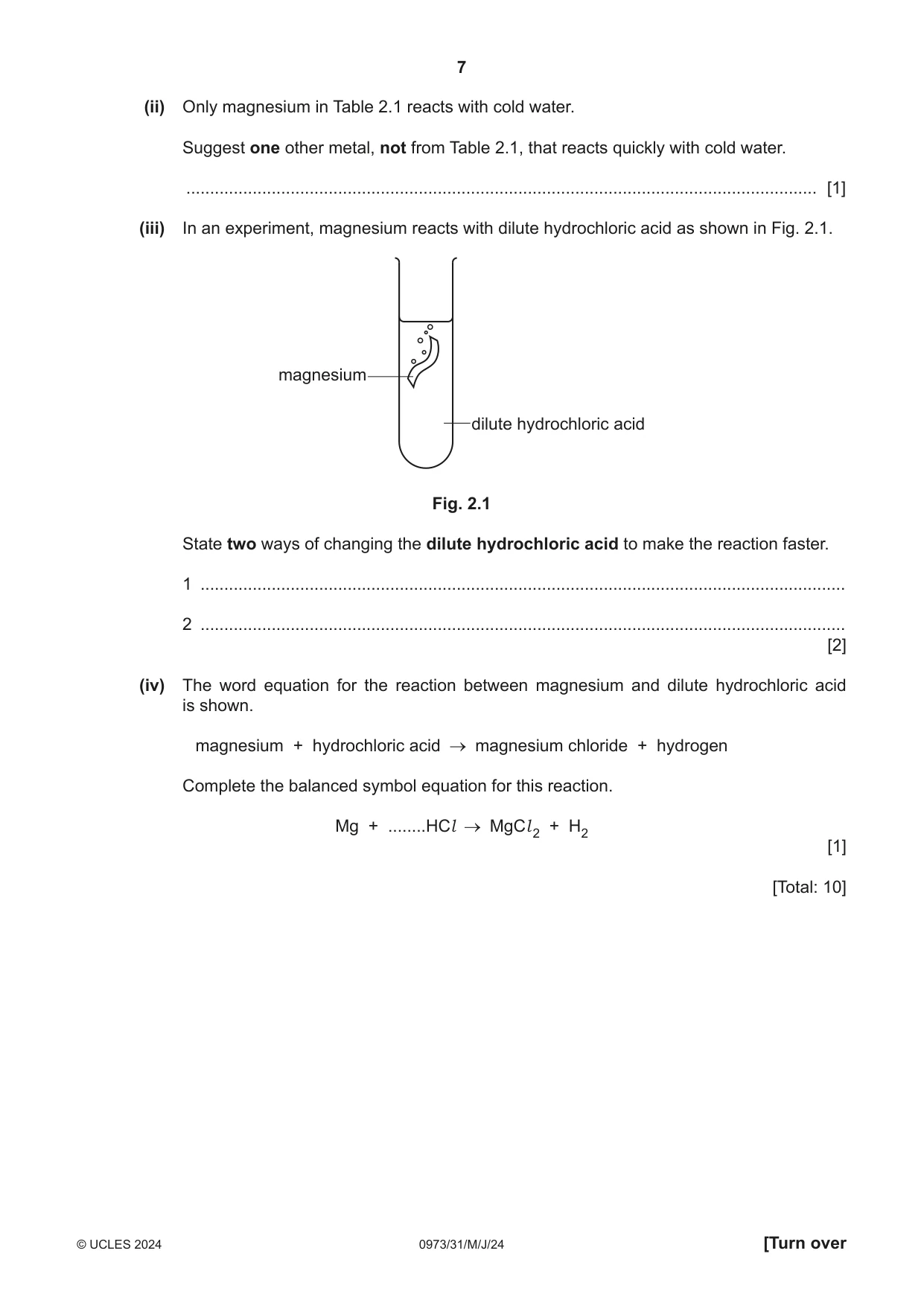
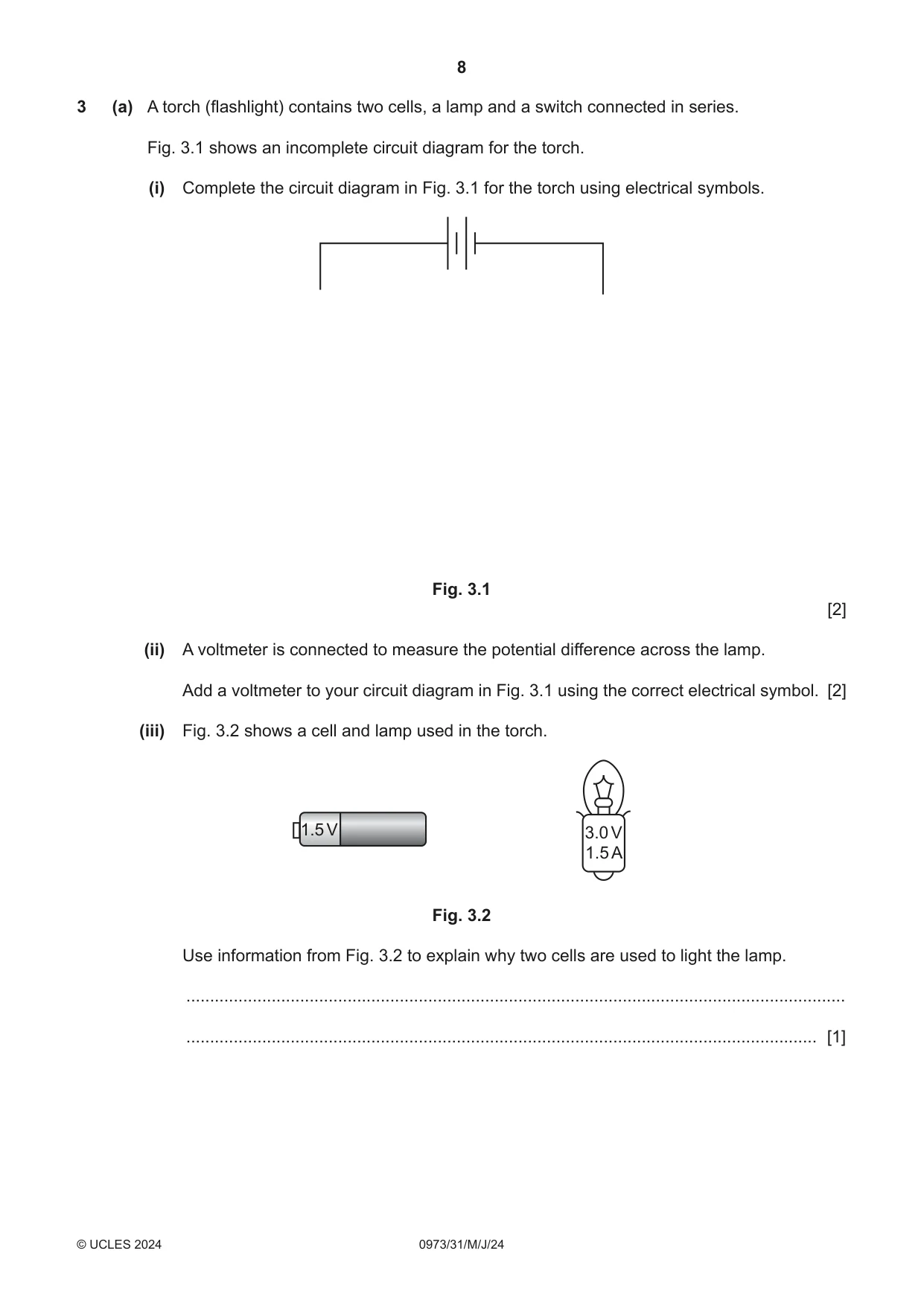
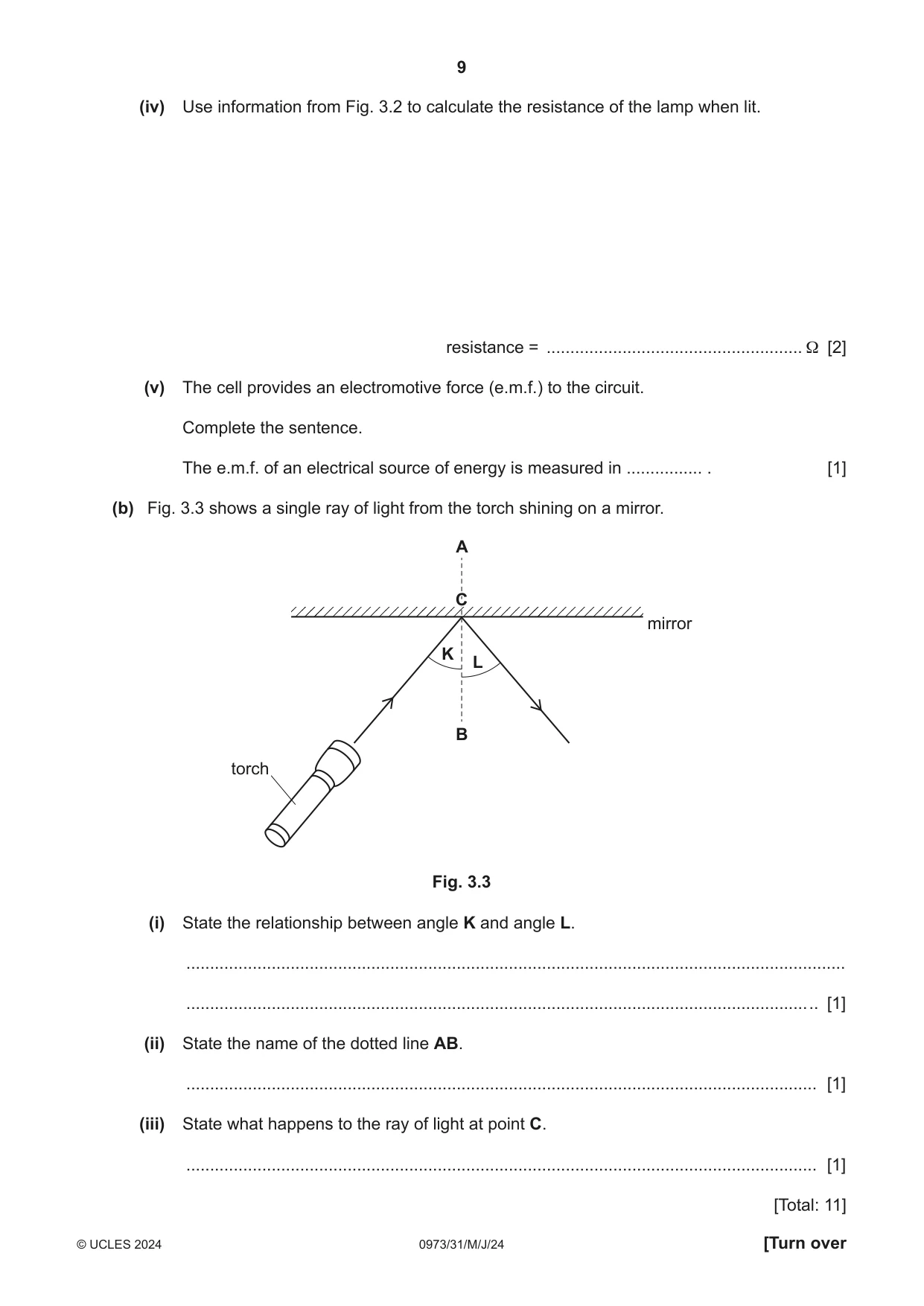

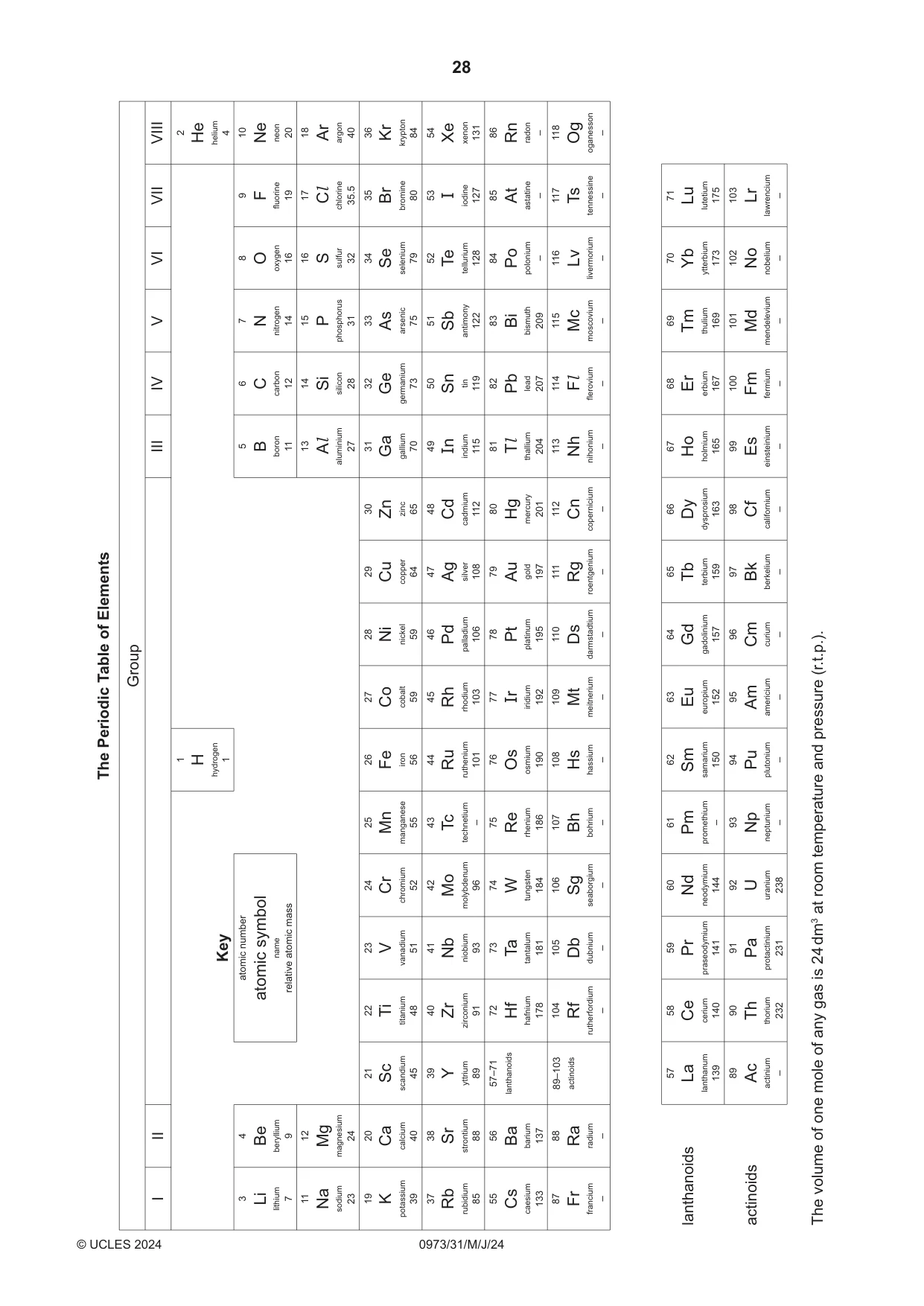
Mark scheme12 pages
Answers below. Sit the paper first if you are practising.
Questions as text
Q1 · The parts of a human tooth
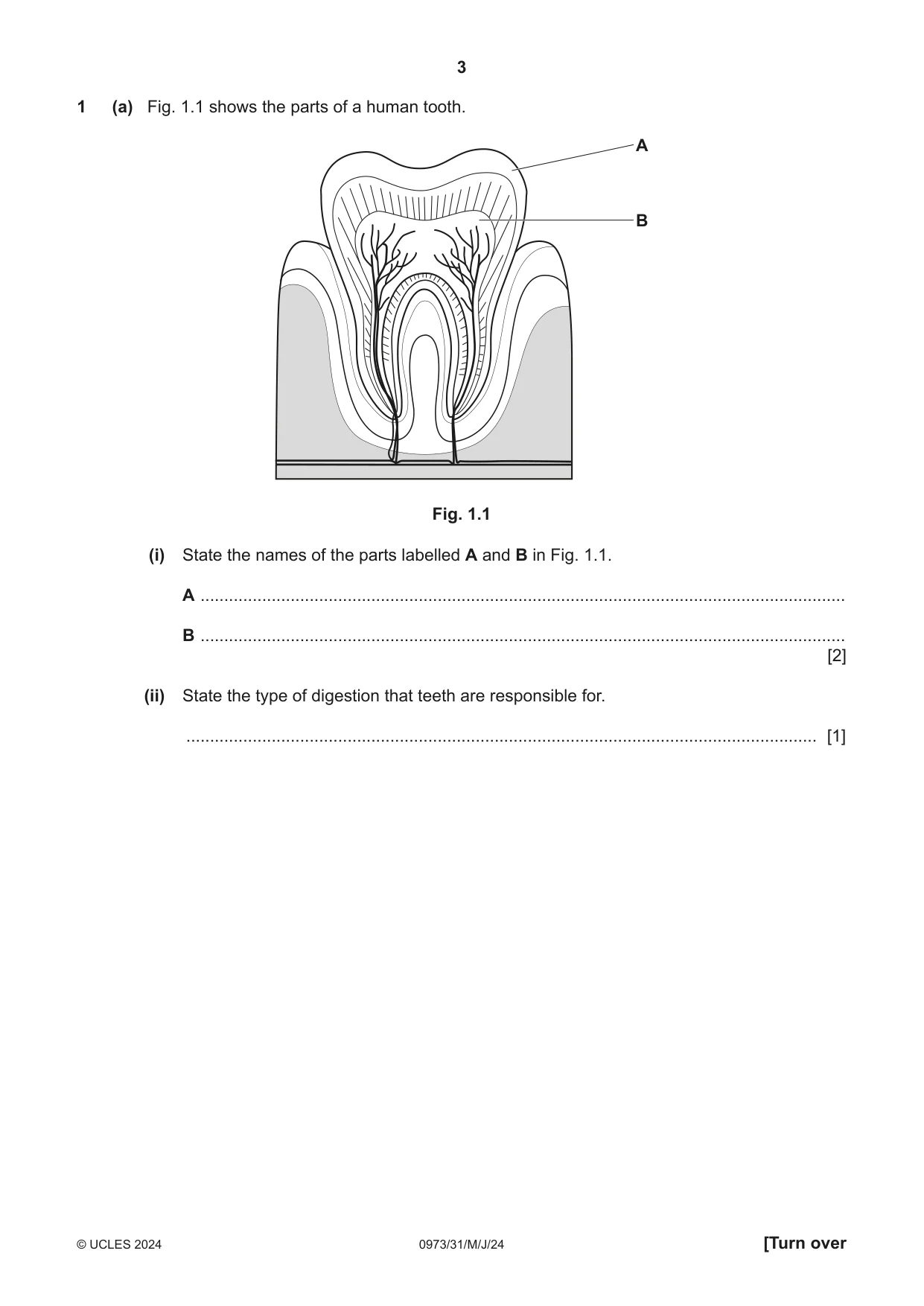
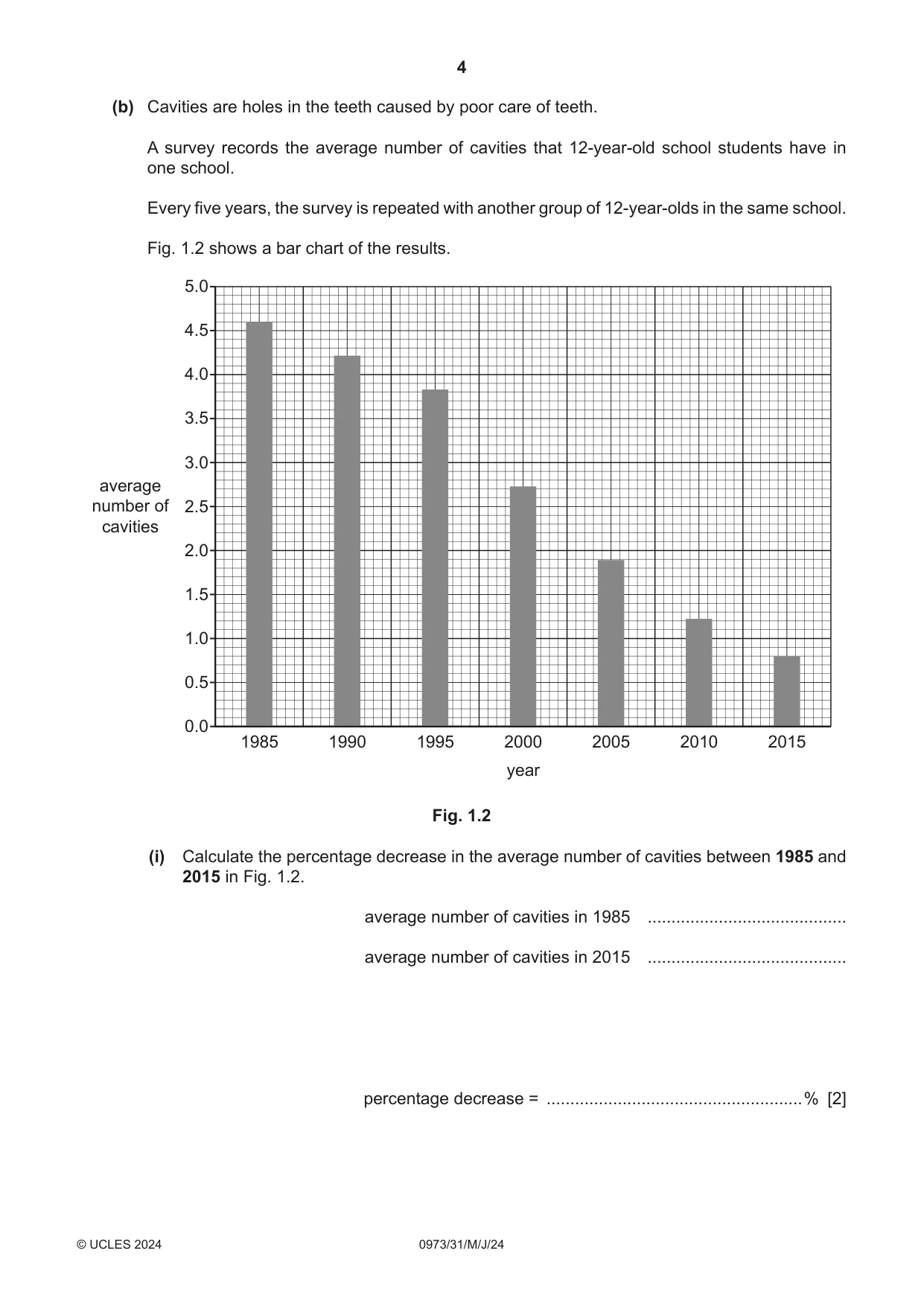
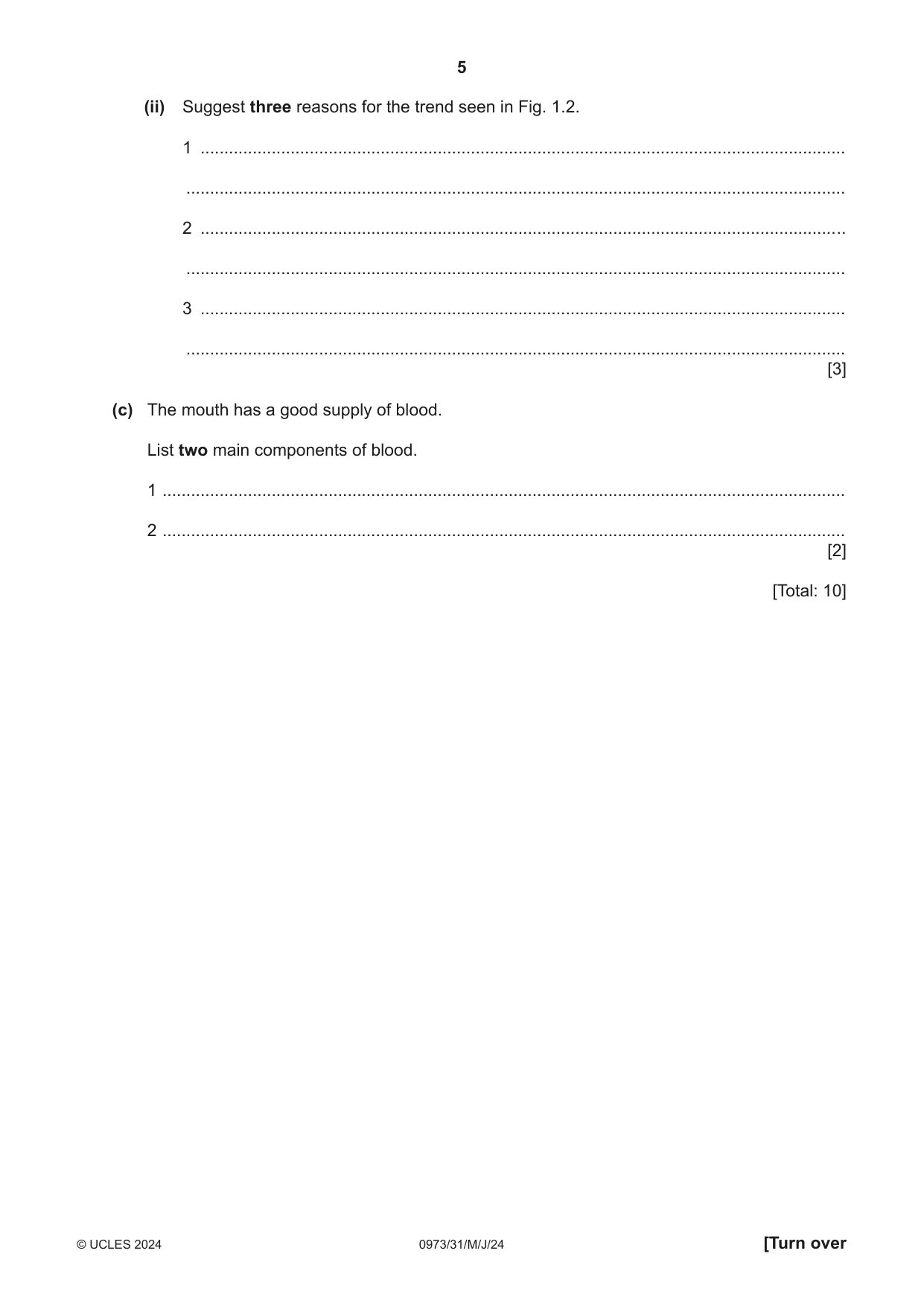
1 (a) Fig. 1.1 shows the parts of a human tooth. A B Fig. 1.1 (i) State the names of the parts labelled A and B in Fig. 1.1. A ........................................................................................................................................ B ........................................................................................................................................ [2] (ii) State the type of digestion that teeth are responsible for. ..................................................................................................................................... [1] (b) Cavities are holes in the teeth caused by poor care of teeth. A survey records the average number of cavities that 12‑year‑old school students have in one school. Every five years, the survey is repeated with another group of 12‑year‑olds in the same school. Fig. 1.2 shows a bar chart of the results. 5.0 4.5 4.0 3.5 3.0 average number of 2.5 cavities 2.0 1.5 1.0 0.5 0.0 1985 1990 1995 2000 2005 2010 2015 year Fig. 1.2 (i) Calculate the percentage decrease in the average number of cavities between 1985 and 2015 in Fig. 1.2. average number of cavities in 1985 .......................................... average number of cavities in 2015 .......................................... percentage decrease = ......................................................% [2] (ii) Suggest three reasons for the trend seen in Fig. 1.2. 1 ........................................................................................................................................ ........................................................................................................................................... 2 ........................................................................................................................................ ........................................................................................................................................... 3 ........................................................................................................................................ ........................................................................................................................................... [3] (c) The mouth has a good supply of blood. List two main components of blood. 1 ................................................................................................................................................ 2 ................................................................................................................................................ [2] [Total: 10]
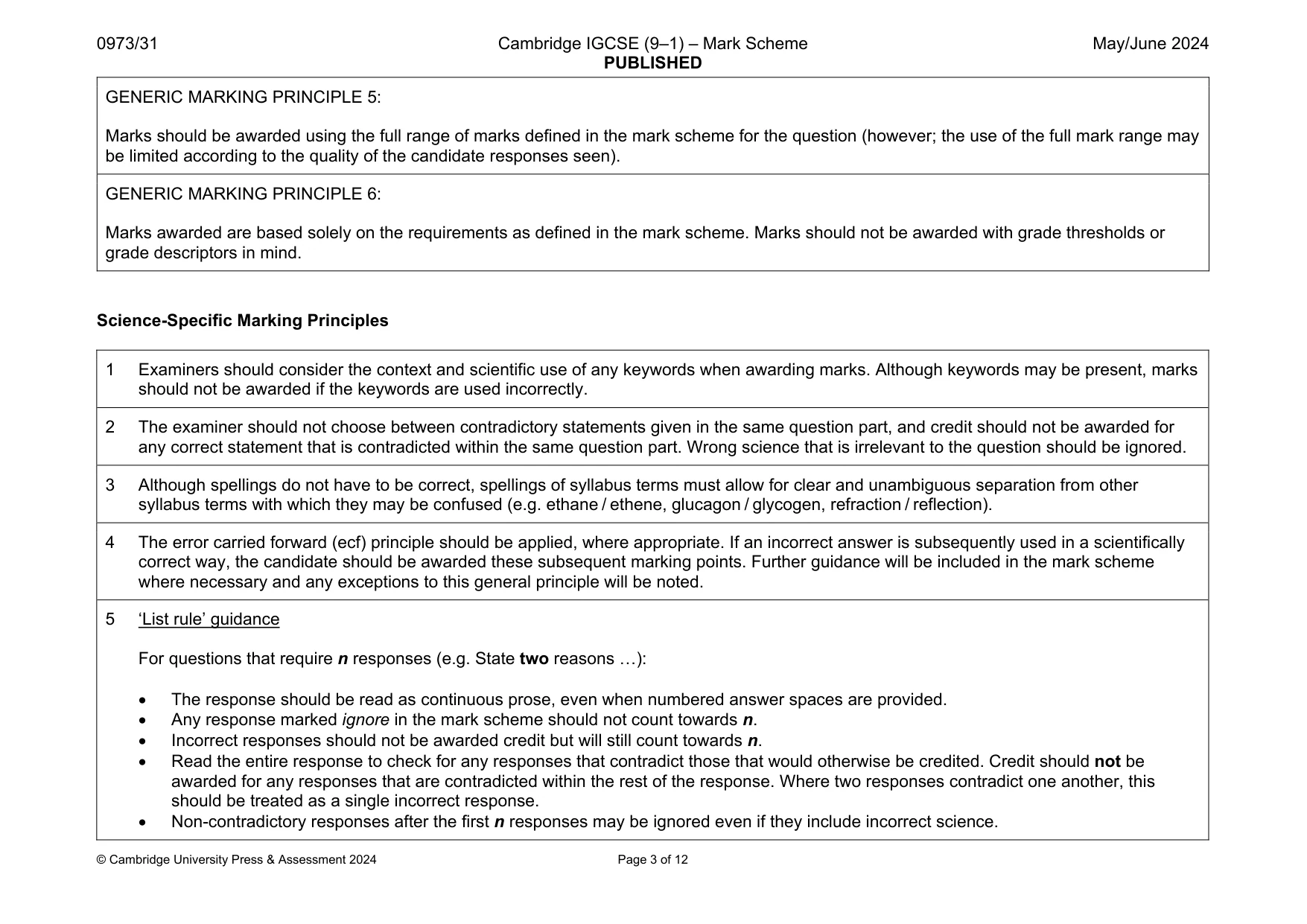
Mark scheme: 1(a)(i) A – enamel ; B – pulp (cavity) ; 2 1(a)(ii) mechanical ; 1 1(b)(i) 4.6 and 0.8 ; ((3.8 / 4.6) 100) = 83 (%) ; 2 1(b)(ii) any three from: improvement in dental care by people ; improvement in dental, care / technology ; reduction in consumption of sugar / more calcium in diet ; ref to education ; addition of fluoride to drinking water / toothpaste ; 3 1(c) any two from: red blood cells ; white blood cells ; plasma ; platelets ; 2
Q2 · A list of metals is shown
2 (a) A list of metals is shown. aluminium copper iron lead magnesium platinum sodium Identify from the list the metal that is: (i) found in Group I of the Periodic Table. ..................................................................................................................................... [1] (ii) extracted from the ore bauxite. ..................................................................................................................................... [1] (iii) the main metal in the alloy steel. ..................................................................................................................................... [1] (iv) used as inert electrodes in electrolysis. ..................................................................................................................................... [1] (b) Table 2.1 gives some information about the rate of reaction of four metals with cold water and with dilute hydrochloric acid. Table 2.1 rate of reaction rate of reaction with metal with cold water dilute hydrochloric acid copper no reaction no reaction iron no reaction reacts slowly magnesium reacts very slowly reacts very quickly zinc no reaction reacts quickly (i) Deduce the order of reactivity of the four metals from the most reactive to the least reactive. most reactive ........................................... ........................................... ........................................... least reactive ........................................... [2] (ii) Only magnesium in Table 2.1 reacts with cold water. Suggest one other metal, not from Table 2.1, that reacts quickly with cold water. ..................................................................................................................................... [1] (iii) In an experiment, magnesium reacts with dilute hydrochloric acid as shown in Fig. 2.1. magnesium dilute hydrochloric acid Fig. 2.1 State two ways of changing the dilute hydrochloric acid to make the reaction faster. 1 ........................................................................................................................................ 2 ........................................................................................................................................ [2] (iv) The word equation for the reaction between magnesium and dilute hydrochloric acid is shown. magnesium + hydrochloric acid magnesium chloride + hydrogen Complete the balanced symbol equation for this reaction. Mg + ........HCl MgCl 2 + H2 [1] [Total: 10]
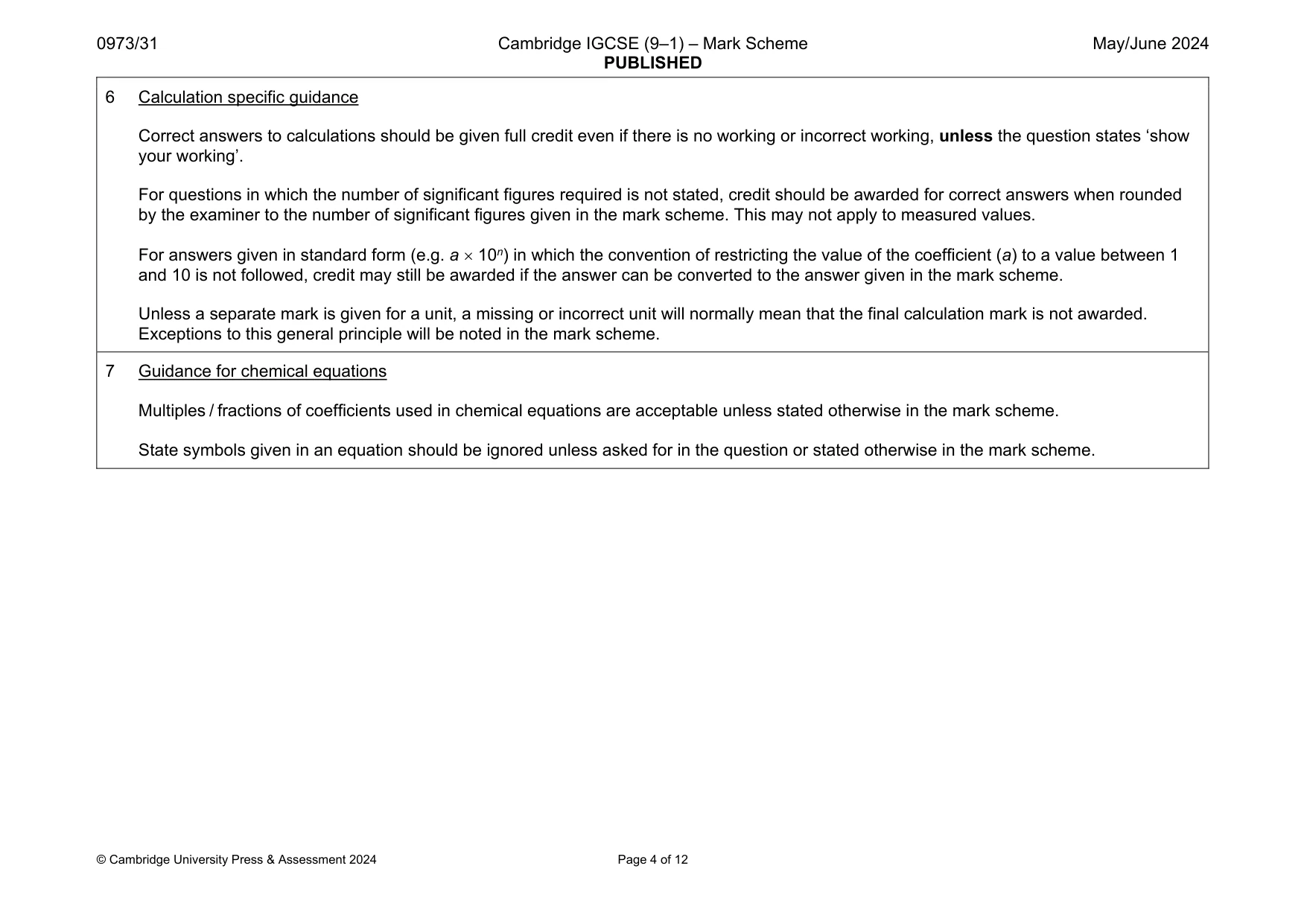
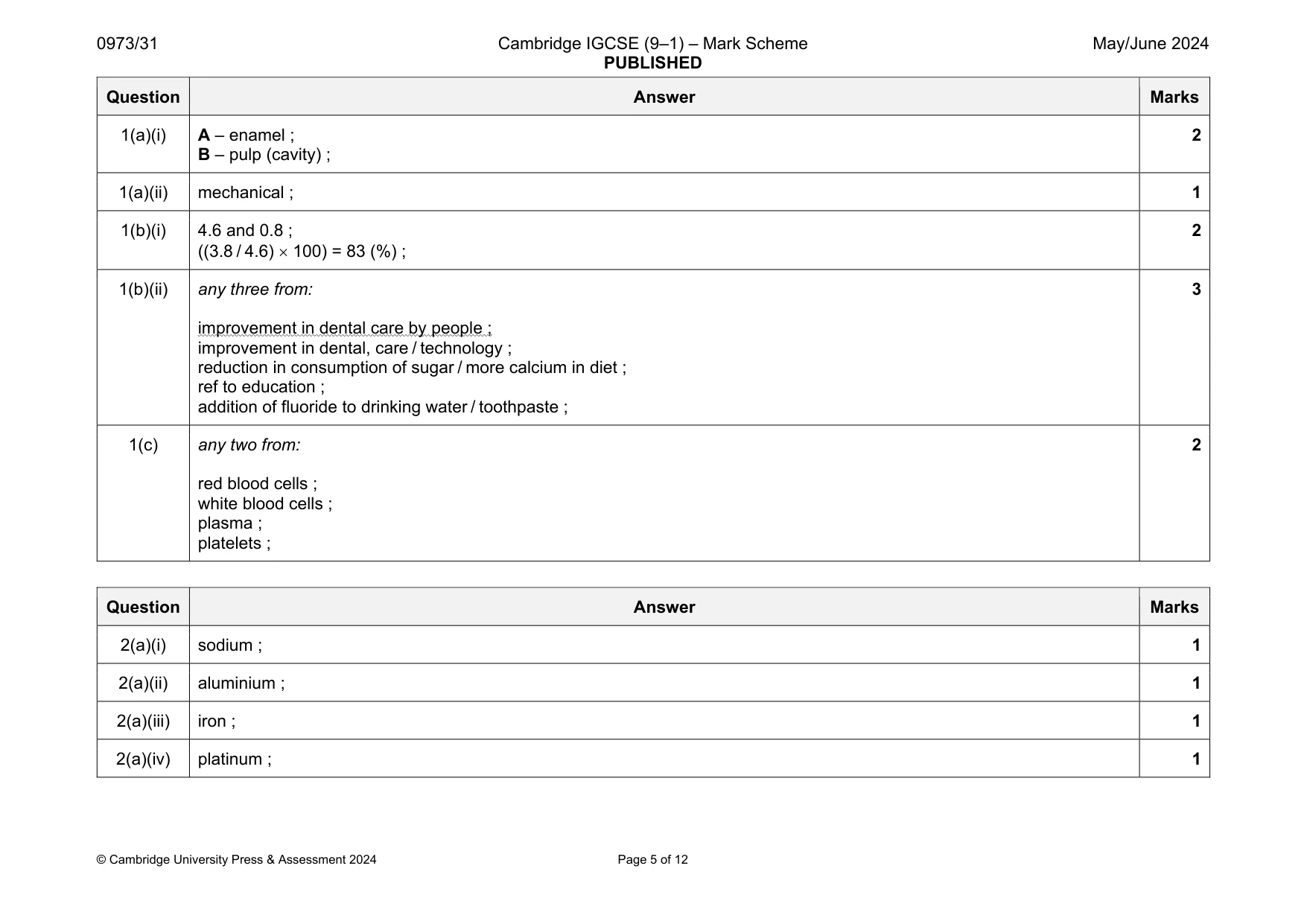
Mark scheme: 2(a)(i) sodium ; 1 2(a)(ii) aluminium ; 1 2(a)(iii) iron ; 1 2(a)(iv) platinum ; 1 Question Answer Marks 2(b)(i) magnesium zinc iron copper magnesium and copper correct ; zinc and iron correct ; 2 2(b)(ii) lithium, sodium, potassium etc. ; 1 2(b)(iii) increase concentration of acid ; increase temperature of acid ; 2 2(b)(iv) 2 HCl ; 1
Q3 · A torch (flashlight) contains two cells, a lamp and a switch connected in series
3 (a) A torch (flashlight) contains two cells, a lamp and a switch connected in series. Fig. 3.1 shows an incomplete circuit diagram for the torch. (i) Complete the circuit diagram in Fig. 3.1 for the torch using electrical symbols. Fig. 3.1 [2] (ii) A voltmeter is connected to measure the potential difference across the lamp. Add a voltmeter to your circuit diagram in Fig. 3.1 using the correct electrical symbol. [2] (iii) Fig. 3.2 shows a cell and lamp used in the torch. 1.5 V 3.0 V 1.5 A Fig. 3.2 Use information from Fig. 3.2 to explain why two cells are used to light the lamp. ........................................................................................................................................... ..................................................................................................................................... [1] (iv) Use information from Fig. 3.2 to calculate the resistance of the lamp when lit. resistance = ...................................................... Ω [2] (v) The cell provides an electromotive force (e.m.f.) to the circuit. Complete the sentence. The e.m.f. of an electrical source of energy is measured in ................ . [1] (b) Fig. 3.3 shows a single ray of light from the torch shining on a mirror. A C mirror K L B torch Fig. 3.3 (i) State the relationship between angle K and angle L. ........................................................................................................................................... ..................................................................................................................................... [1] (ii) State the name of the dotted line AB. ..................................................................................................................................... [1] (iii) State what happens to the ray of light at point C. ..................................................................................................................................... [1] [Total: 11]
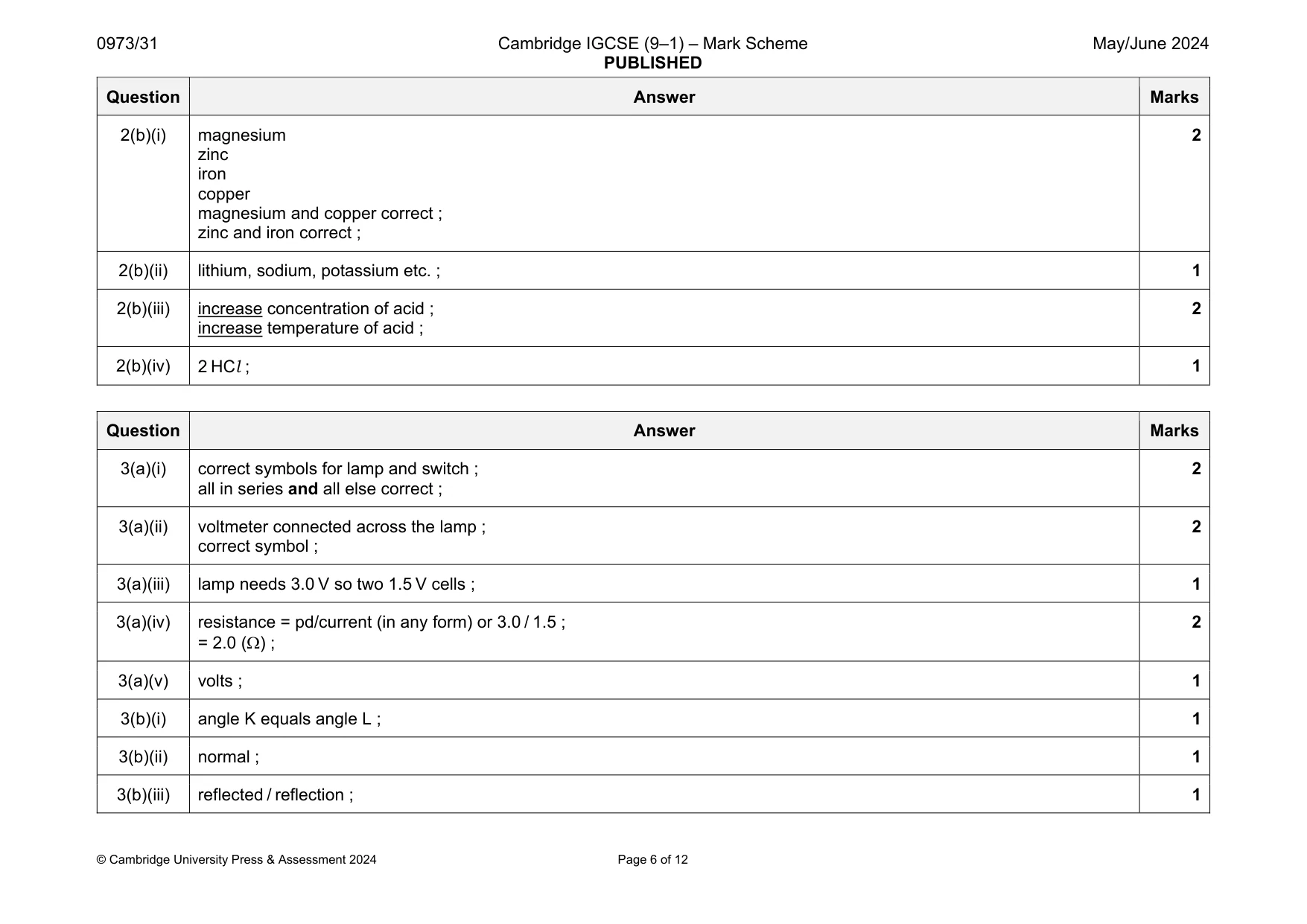
Mark scheme: 3(a)(i) correct symbols for lamp and switch ; all in series and all else correct ; 2 3(a)(ii) voltmeter connected across the lamp ; correct symbol ; 2 3(a)(iii) lamp needs 3.0 V so two 1.5 V cells ; 1 3(a)(iv) resistance = pd/current (in any form) or 3.0 / 1.5 ; = 2.0 () ; 2 3(a)(v) volts ; 1 3(b)(i) angle K equals angle L ; 1 3(b)(ii) normal ; 1 3(b)(iii) reflected / reflection ; 1
Q4 · A food web from a rainforest environment
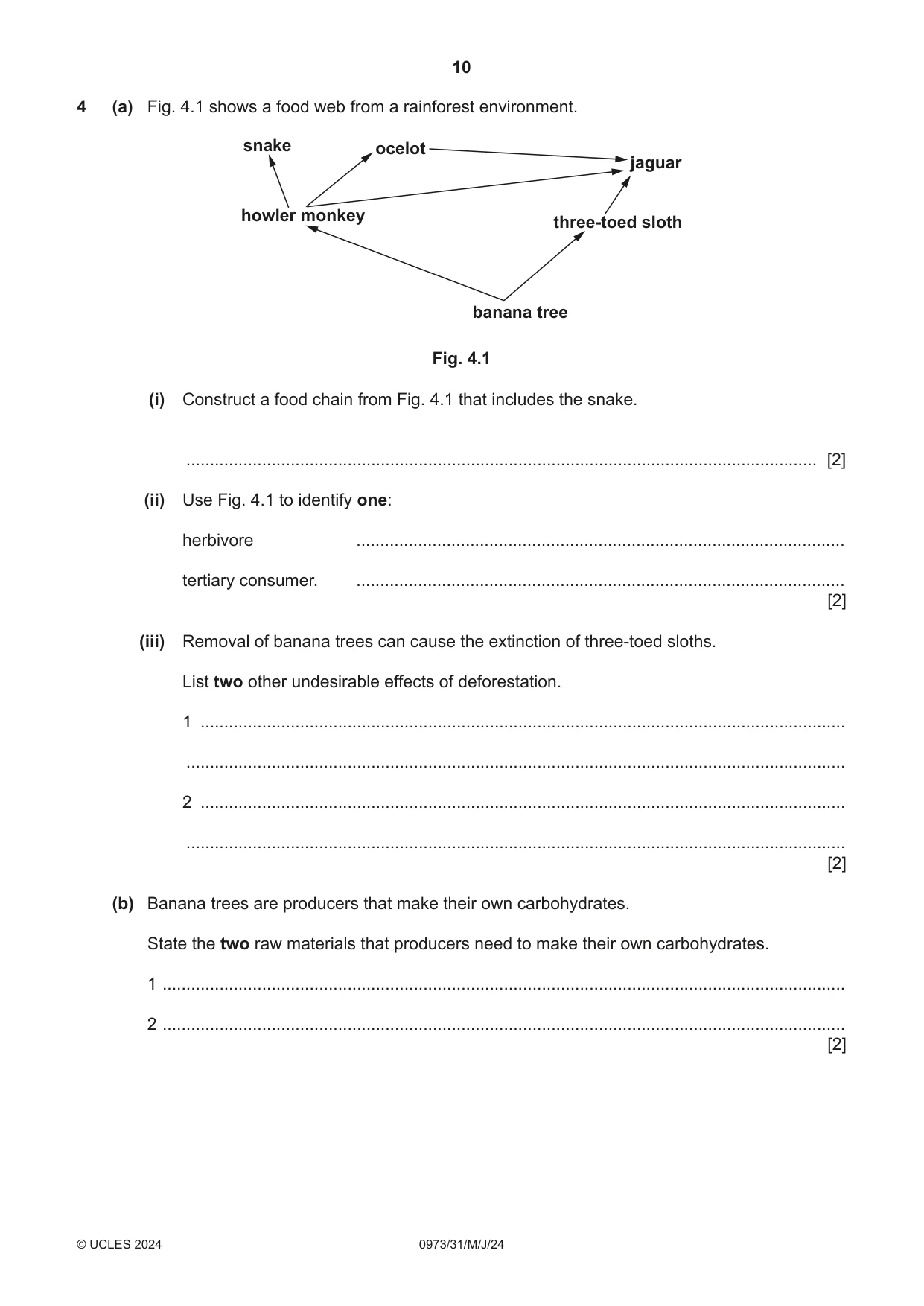
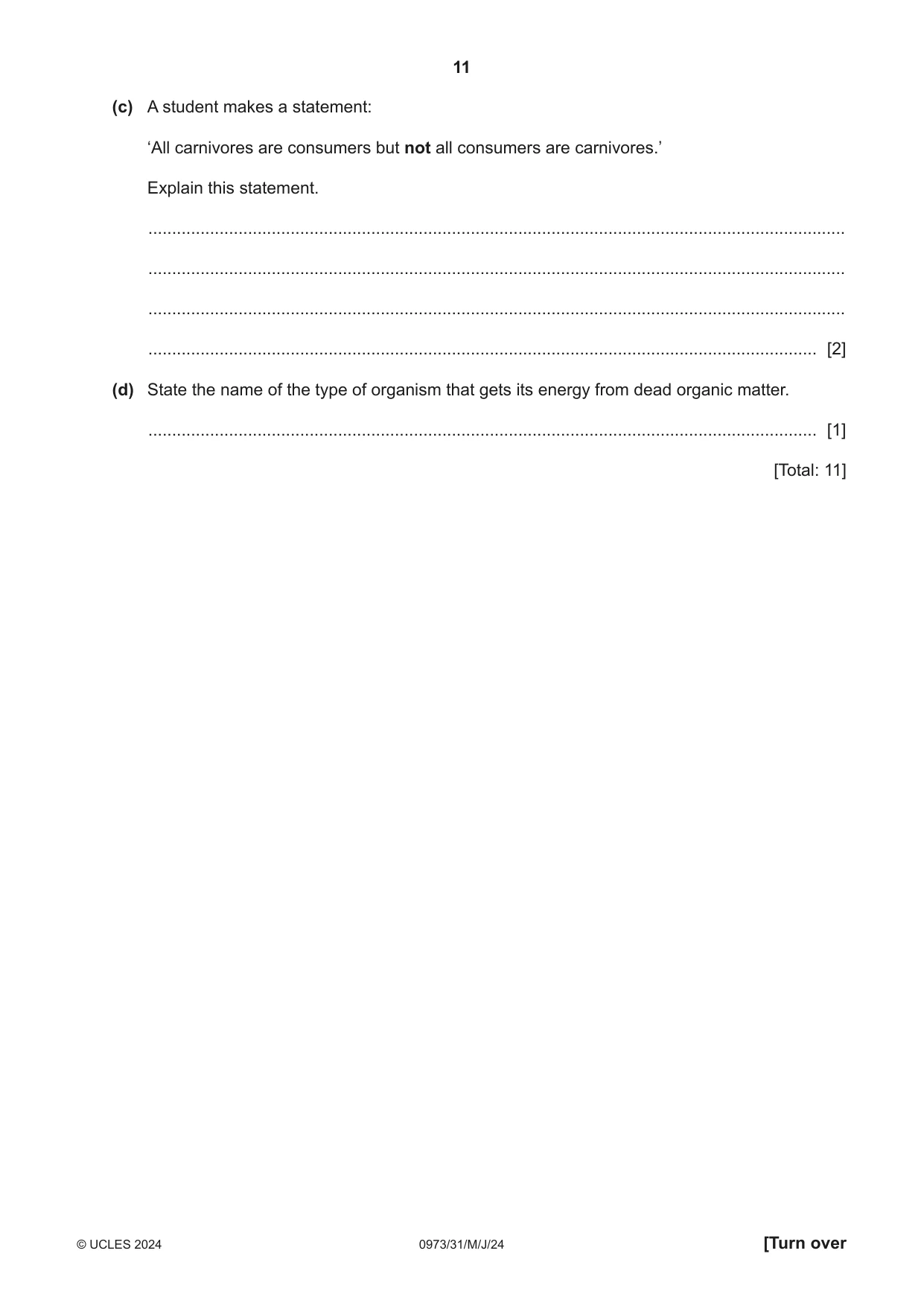
4 (a) Fig. 4.1 shows a food web from a rainforest environment. snake ocelot jaguar howler monkey three-toed sloth banana tree Fig. 4.1 (i) Construct a food chain from Fig. 4.1 that includes the snake. ..................................................................................................................................... [2] (ii) Use Fig. 4.1 to identify one: herbivore ....................................................................................................... tertiary consumer. ....................................................................................................... [2] (iii) Removal of banana trees can cause the extinction of three‑toed sloths. List two other undesirable effects of deforestation. 1 ........................................................................................................................................ ........................................................................................................................................... 2 ........................................................................................................................................ ........................................................................................................................................... [2] (b) Banana trees are producers that make their own carbohydrates. State the two raw materials that producers need to make their own carbohydrates. 1 ................................................................................................................................................ 2 ................................................................................................................................................ [2] (c) A student makes a statement: ‘All carnivores are consumers but not all consumers are carnivores.’ Explain this statement. ................................................................................................................................................... ................................................................................................................................................... ................................................................................................................................................... ............................................................................................................................................. [2] (d) State the name of the type of organism that gets its energy from dead organic matter. ............................................................................................................................................. [1] [Total: 11]
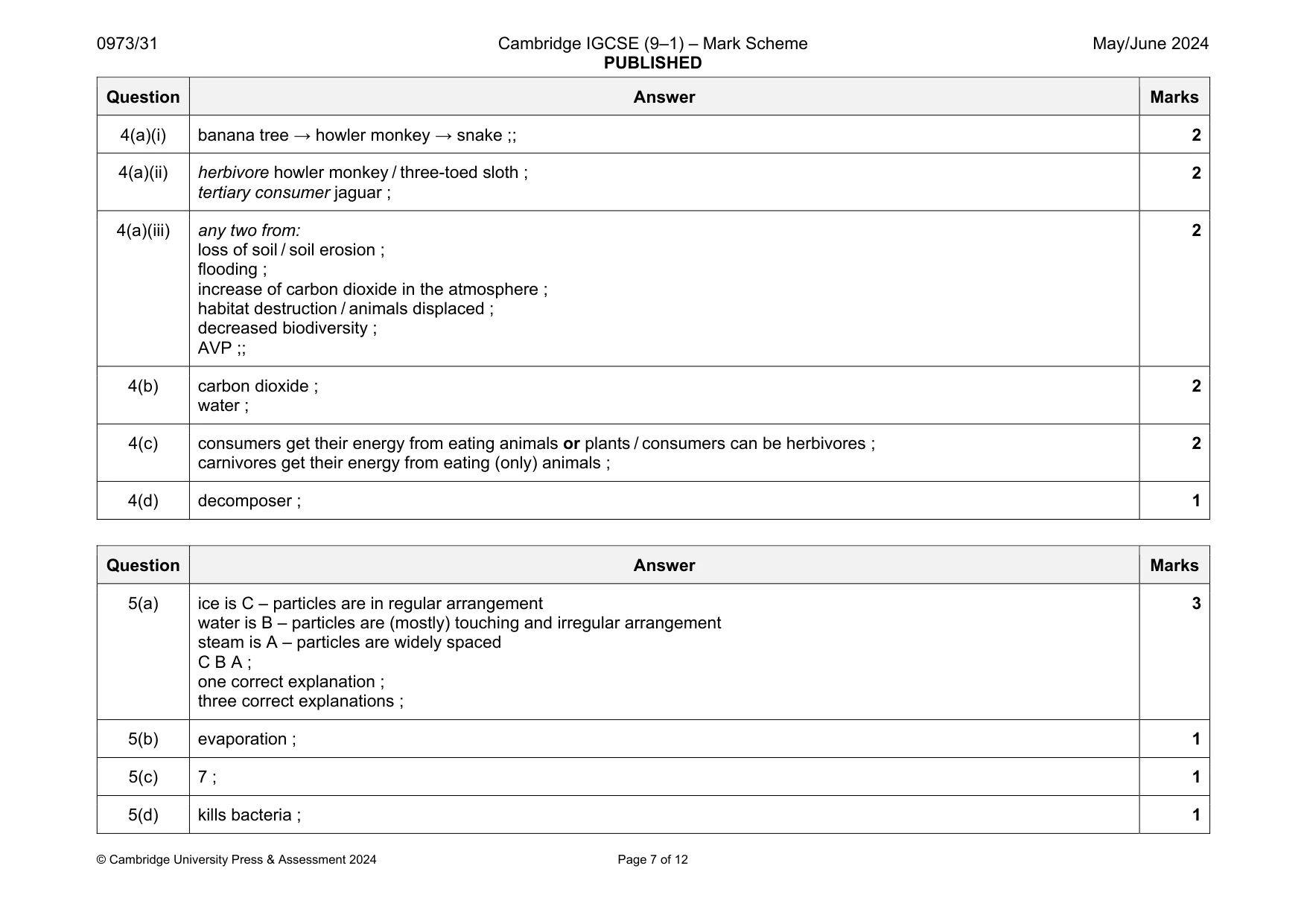
Mark scheme: 4(a)(i) banana tree → howler monkey → snake ;; 2 4(a)(ii) herbivore howler monkey / three-toed sloth ; tertiary consumer jaguar ; 2 4(a)(iii) any two from: loss of soil / soil erosion ; flooding ; increase of carbon dioxide in the atmosphere ; habitat destruction / animals displaced ; decreased biodiversity ; AVP ;; 2 4(b) carbon dioxide ; water ; 2 4(c) consumers get their energy from eating animals or plants / consumers can be herbivores ; carnivores get their energy from eating (only) animals ; 2 4(d) decomposer ; 1
Q5 · Ice is a solid
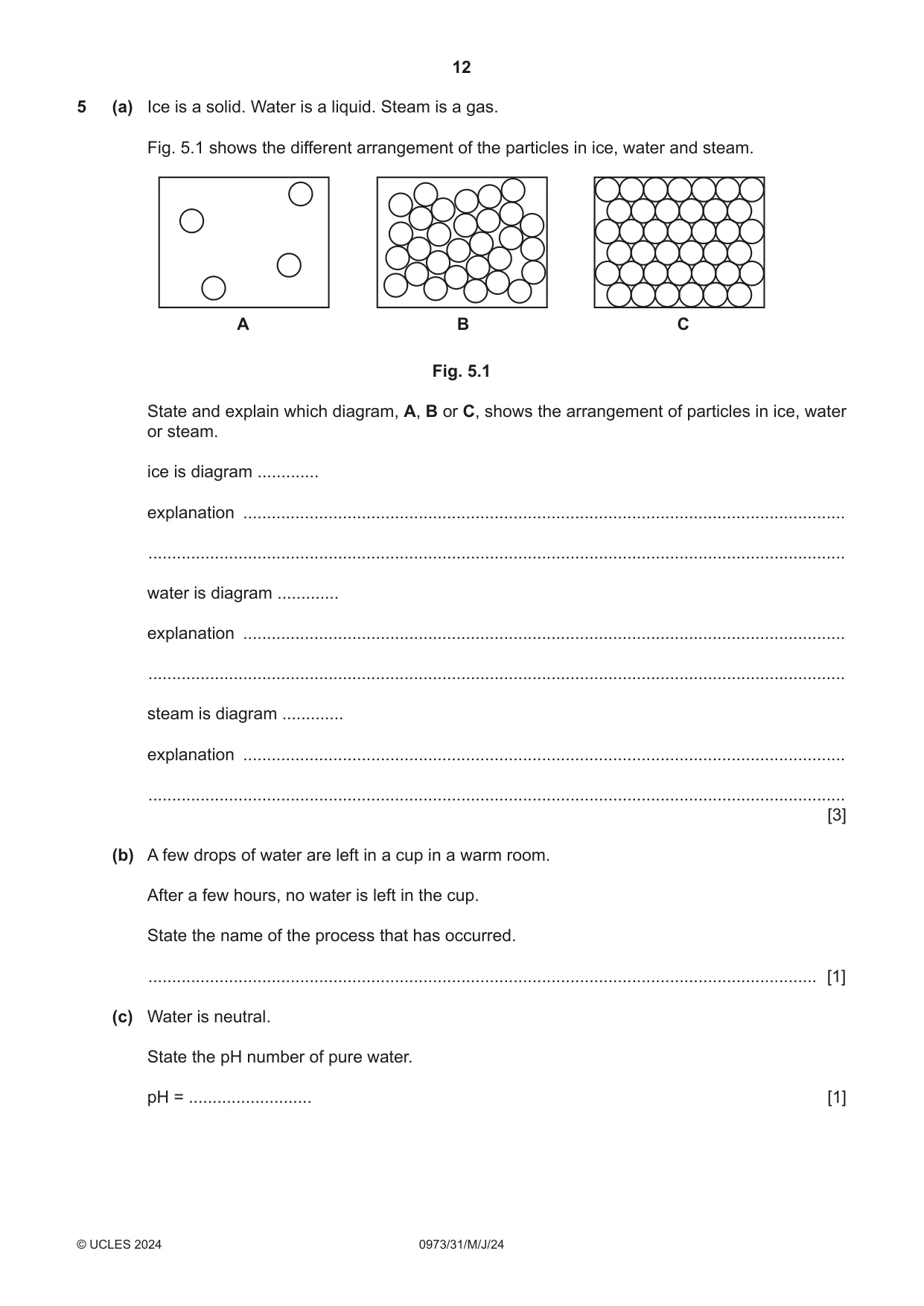
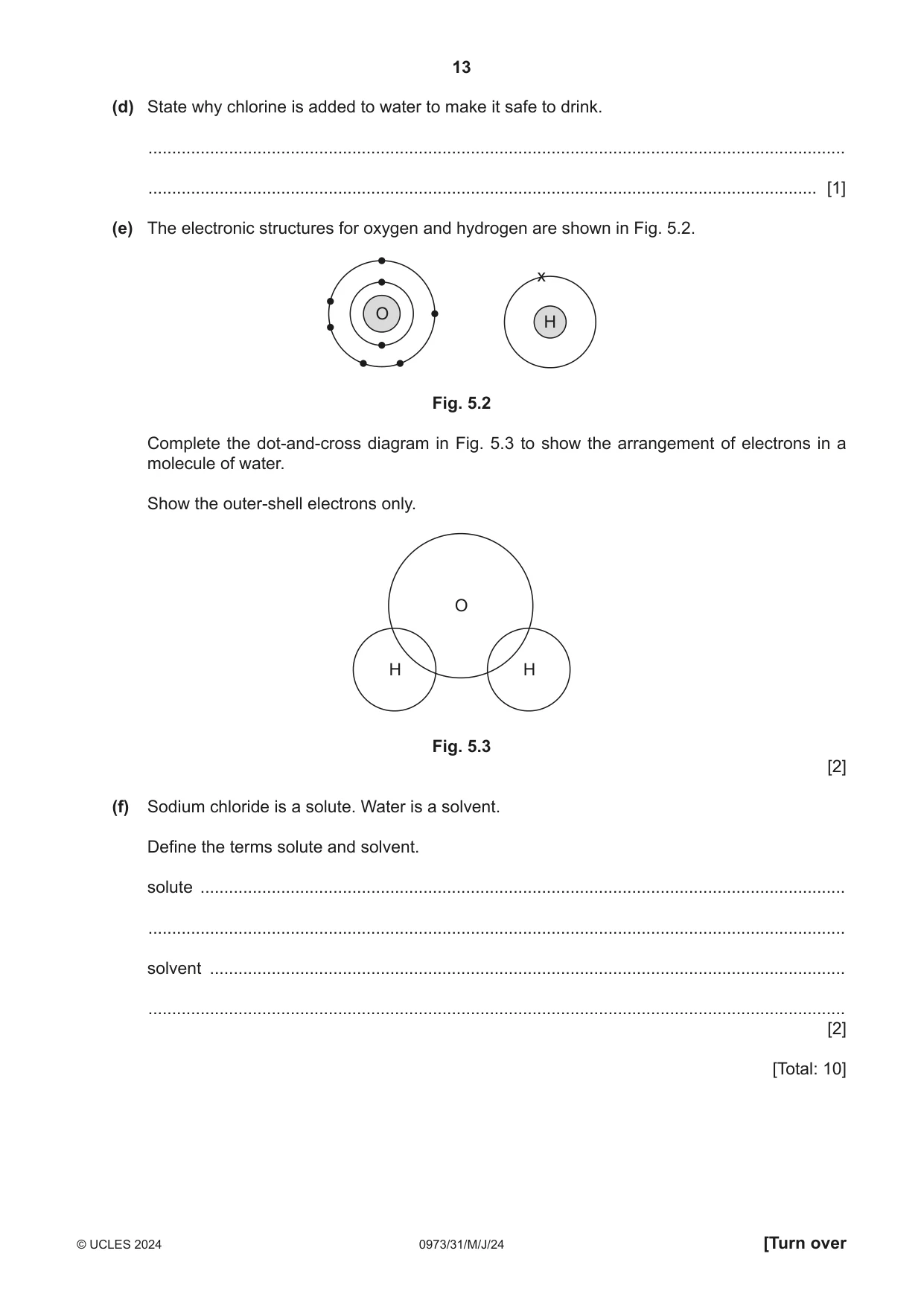
5 (a) Ice is a solid. Water is a liquid. Steam is a gas. Fig. 5.1 shows the different arrangement of the particles in ice, water and steam. A B C Fig. 5.1 State and explain which diagram, A, B or C, shows the arrangement of particles in ice, water or steam. ice is diagram ............. explanation ............................................................................................................................... ................................................................................................................................................... water is diagram ............. explanation ............................................................................................................................... ................................................................................................................................................... steam is diagram ............. explanation ............................................................................................................................... ................................................................................................................................................... [3] (b) A few drops of water are left in a cup in a warm room. After a few hours, no water is left in the cup. State the name of the process that has occurred. ............................................................................................................................................. [1] (c) Water is neutral. State the pH number of pure water. pH = .......................... [1] (d) State why chlorine is added to water to make it safe to drink. ................................................................................................................................................... ............................................................................................................................................. [1] (e) The electronic structures for oxygen and hydrogen are shown in Fig. 5.2. x O H Fig. 5.2 Complete the dot‑and‑cross diagram in Fig. 5.3 to show the arrangement of electrons in a molecule of water. Show the outer‑shell electrons only. O H H Fig. 5.3 [2] (f) Sodium chloride is a solute. Water is a solvent. Define the terms solute and solvent. solute ........................................................................................................................................ ................................................................................................................................................... solvent ...................................................................................................................................... ................................................................................................................................................... [2] [Total: 10]
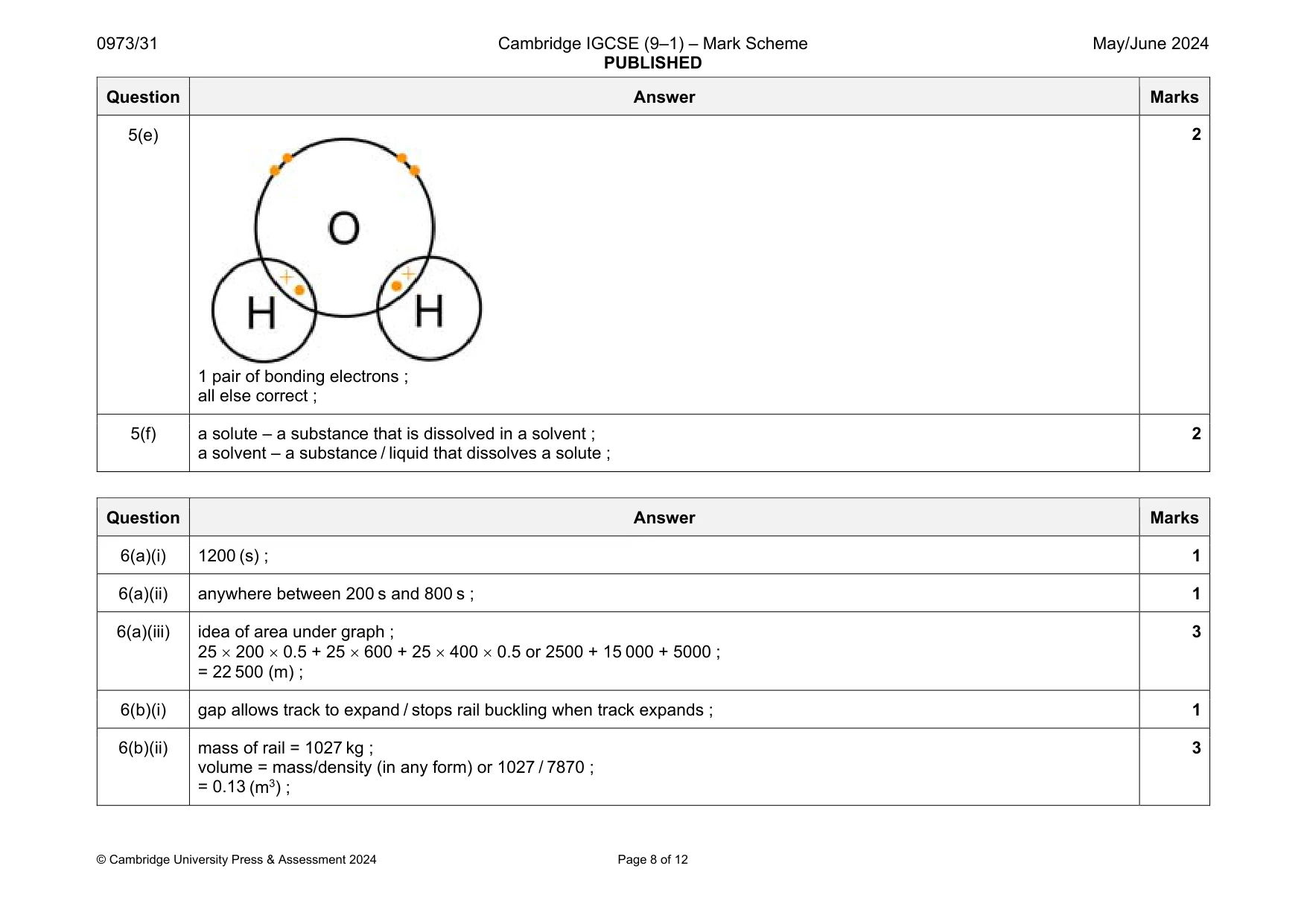
Mark scheme: 5(a) ice is C – particles are in regular arrangement water is B – particles are (mostly) touching and irregular arrangement steam is A – particles are widely spaced C B A ; one correct explanation ; three correct explanations ; 3 5(b) evaporation ; 1 5(c) 7 ; 1 5(d) kills bacteria ; 1 Question Answer Marks 5(e) 1 pair of bonding electrons ; all else correct ; 2 5(f) a solute – a substance that is dissolved in a solvent ; a solvent – a substance / liquid that dissolves a solute ; 2
Q6 · A train travels between two stations X and Y
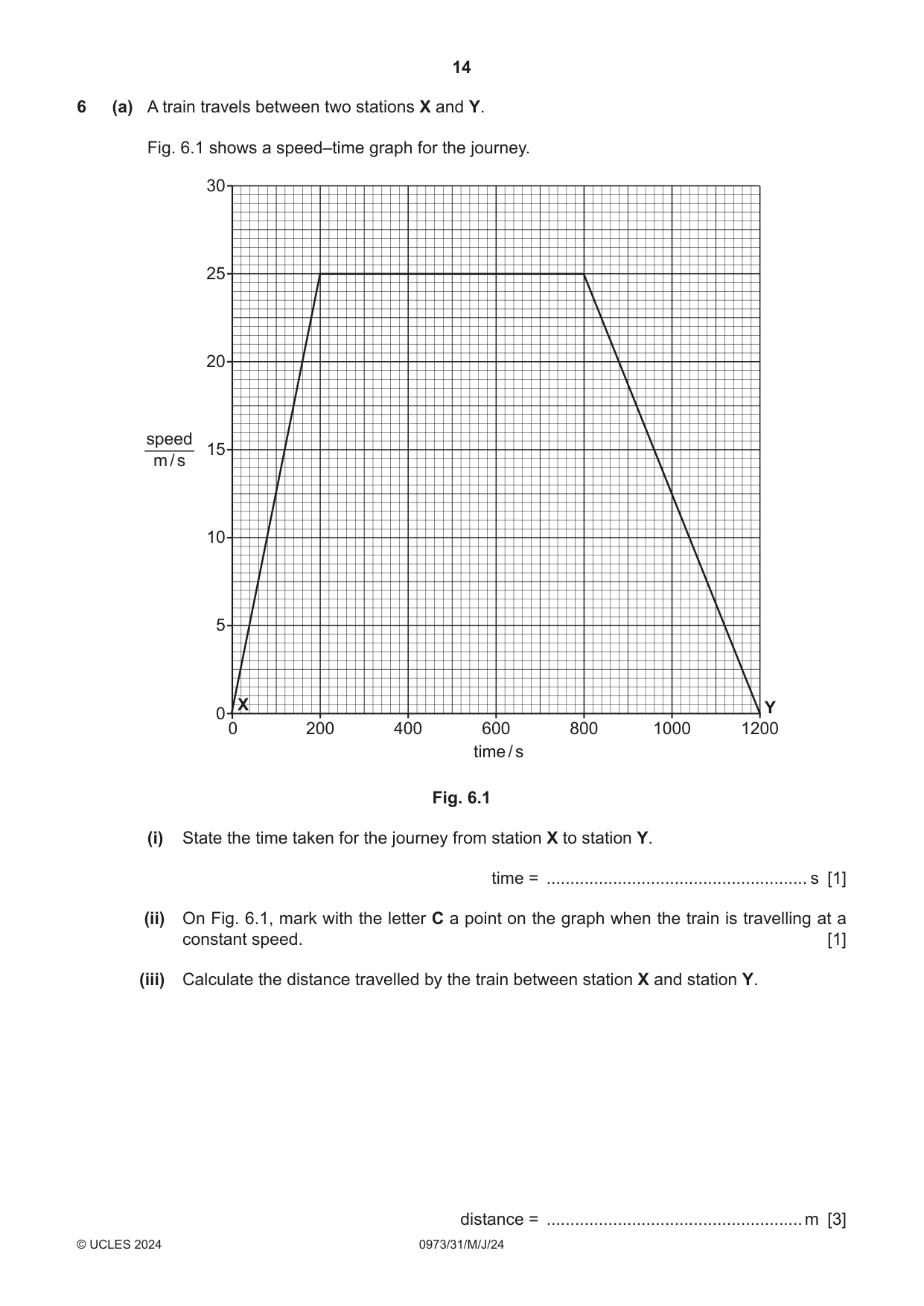
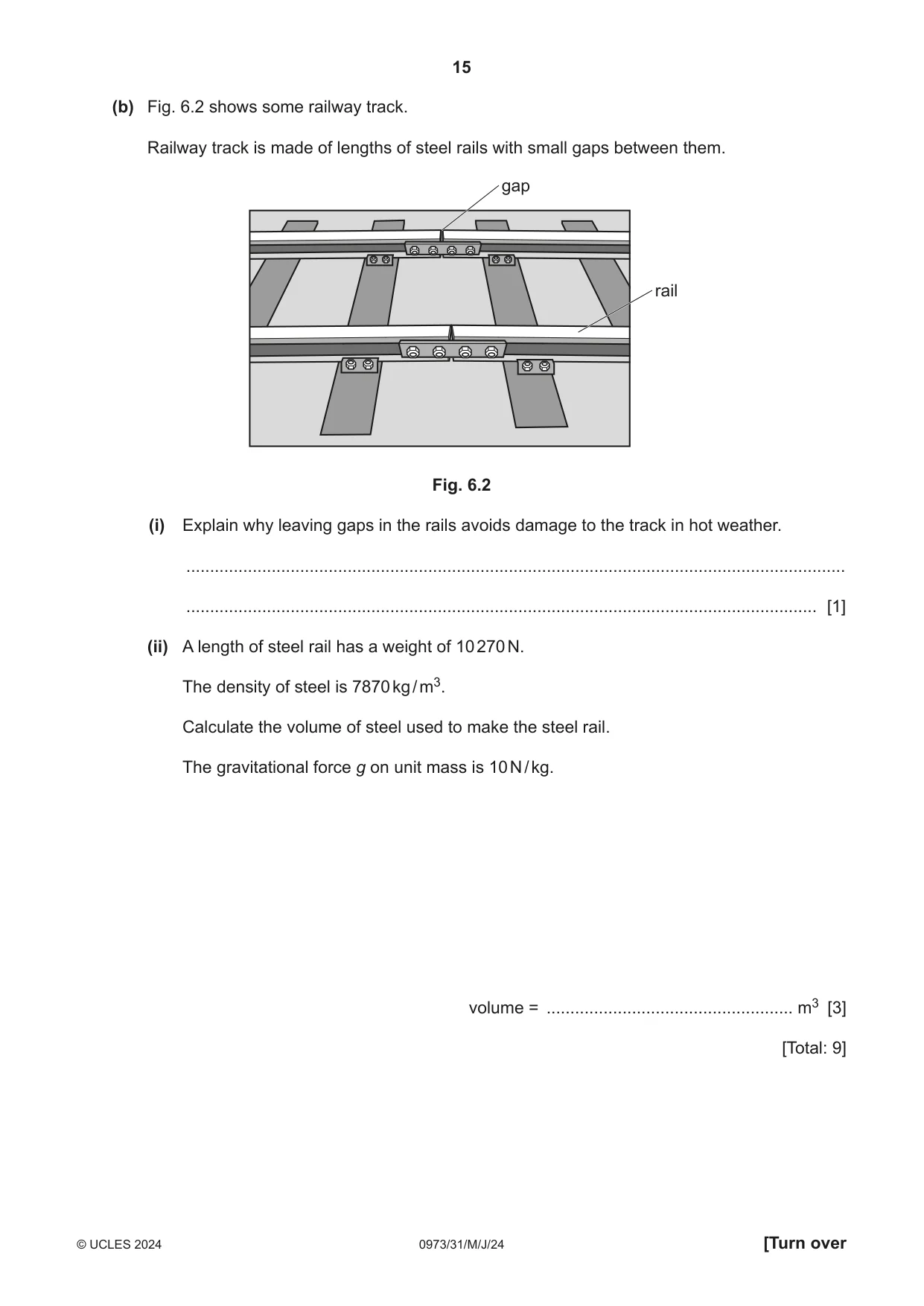
6 (a) A train travels between two stations X and Y. Fig. 6.1 shows a speed–time graph for the journey. 30 25 20 speed 15 m / s 10 5 X Y 0 0 200 400 600 800 1000 1200 time / s Fig. 6.1 (i) State the time taken for the journey from station X to station Y. time = ....................................................... s [1] (ii) On Fig. 6.1, mark with the letter C a point on the graph when the train is travelling at a constant speed. [1] (iii) Calculate the distance travelled by the train between station X and station Y. distance = ...................................................... m [3] (b) Fig. 6.2 shows some railway track. Railway track is made of lengths of steel rails with small gaps between them. gap rail Fig. 6.2 (i) Explain why leaving gaps in the rails avoids damage to the track in hot weather. ........................................................................................................................................... ..................................................................................................................................... [1] (ii) A length of steel rail has a weight of 10 270 N. The density of steel is 7870 kg / m3. Calculate the volume of steel used to make the steel rail. The gravitational force g on unit mass is 10 N / kg. volume = .................................................... m3 [3] [Total: 9]
Mark scheme: 6(a)(i) 1200 (s) ; 1 6(a)(ii) anywhere between 200 s and 800 s ; 1 6(a)(iii) idea of area under graph ; 25 200 0.5 + 25 600 + 25 400 0.5 or 2500 + 15 000 + 5000 ; = 22 500 (m) ; 3 6(b)(i) gap allows track to expand / stops rail buckling when track expands ; 1 6(b)(ii) mass of rail = 1027 kg ; volume = mass/density (in any form) or 1027 / 7870 ; = 0.13 (m3) ; 3
Q7 · A cross‑section through human skin
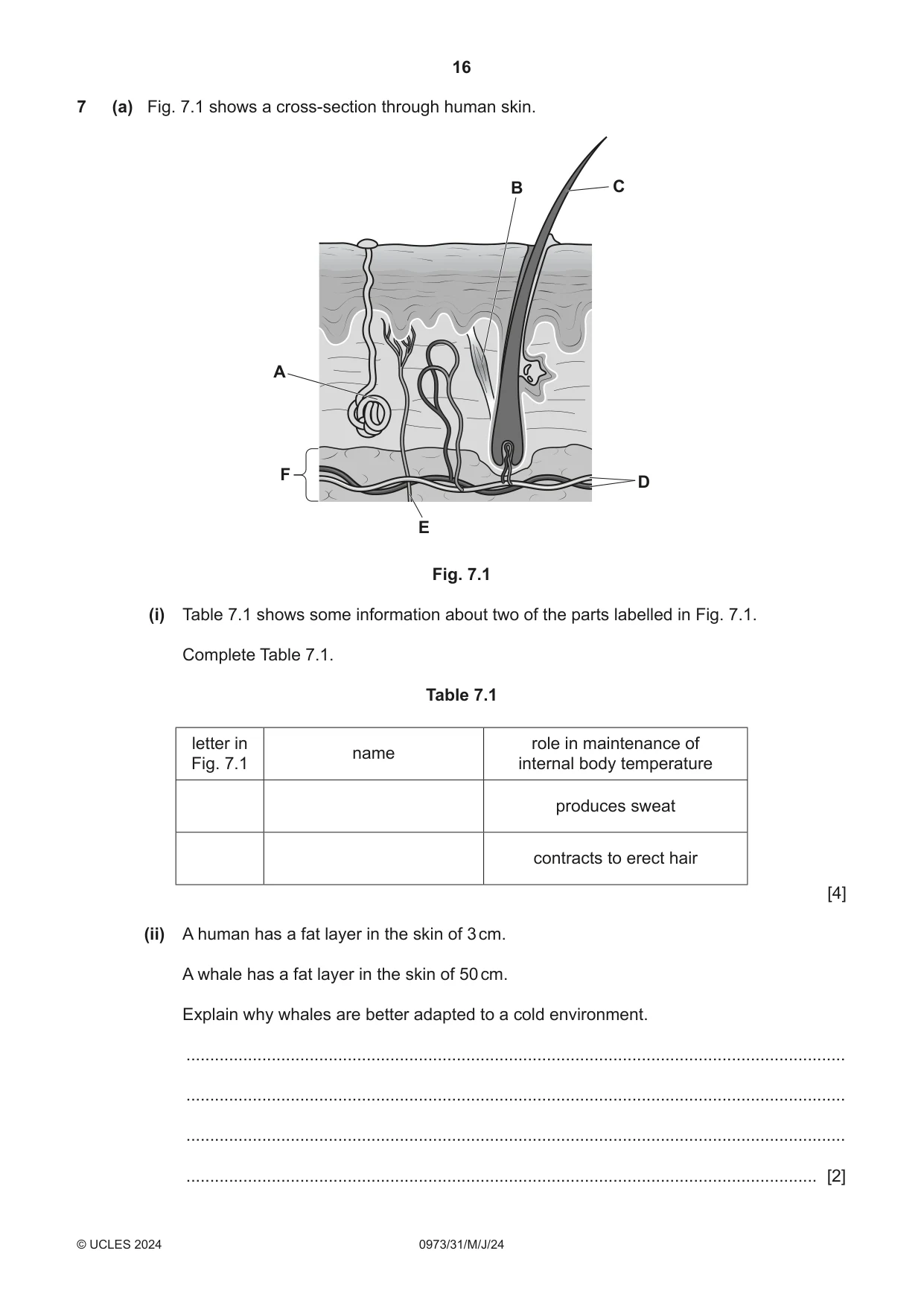
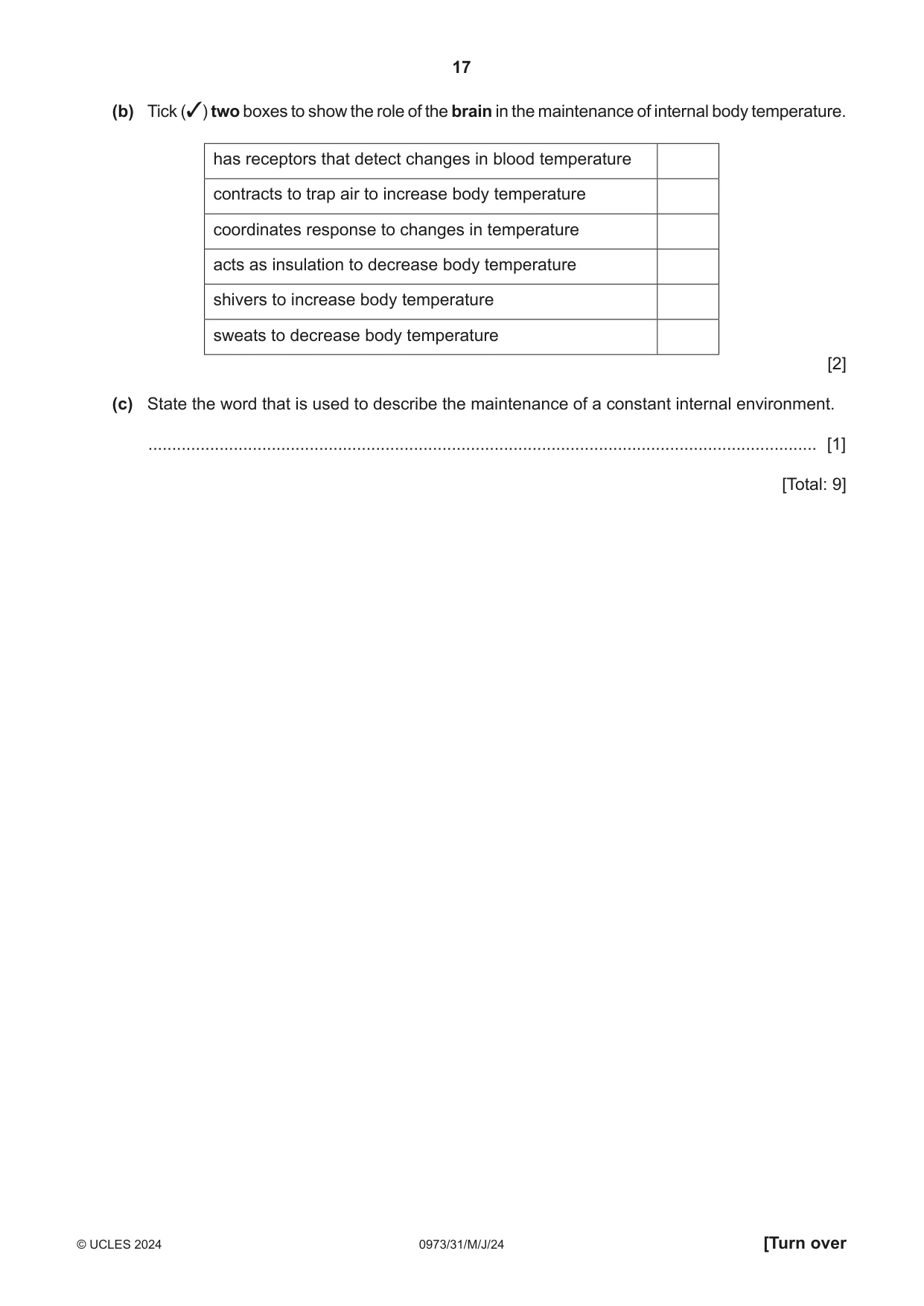
7 (a) Fig. 7.1 shows a cross‑section through human skin. B C A F D E Fig. 7.1 (i) Table 7.1 shows some information about two of the parts labelled in Fig. 7.1. Complete Table 7.1. Table 7.1 letter in role in maintenance of name Fig. 7.1 internal body temperature produces sweat contracts to erect hair [4] (ii) A human has a fat layer in the skin of 3 cm. A whale has a fat layer in the skin of 50 cm. Explain why whales are better adapted to a cold environment. ........................................................................................................................................... ........................................................................................................................................... ........................................................................................................................................... ..................................................................................................................................... [2] (b) Tick (3) two boxes to show the role of the brain in the maintenance of internal body temperature. has receptors that detect changes in blood temperature contracts to trap air to increase body temperature coordinates response to changes in temperature acts as insulation to decrease body temperature shivers to increase body temperature sweats to decrease body temperature [2] (c) State the word that is used to describe the maintenance of a constant internal environment. ............................................................................................................................................. [1] [Total: 9]
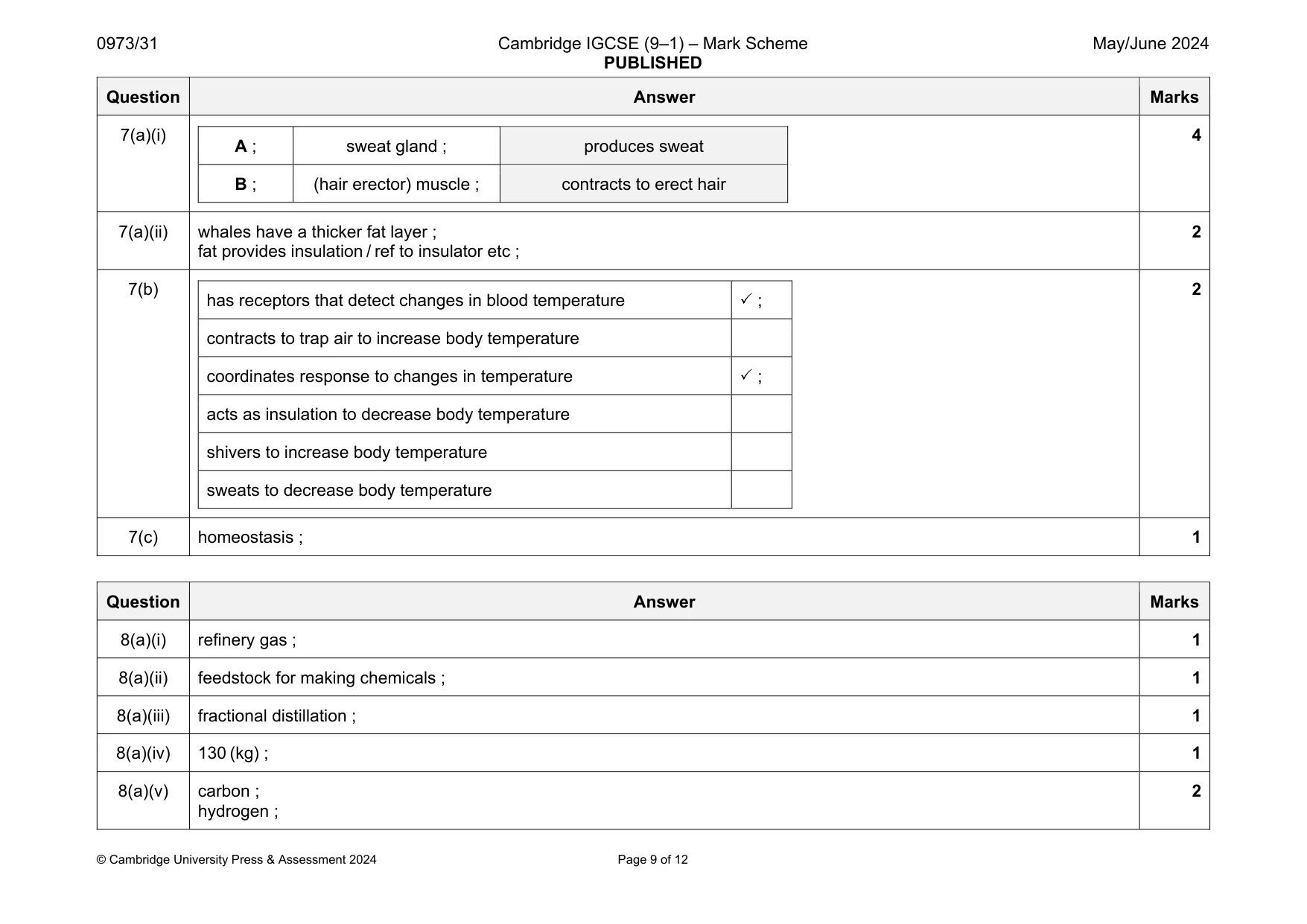
Mark scheme: 7(a)(i) A ; sweat gland ; produces sweat B ; (hair erector) muscle ; contracts to erect hair 4 7(a)(ii) whales have a thicker fat layer ; fat provides insulation / ref to insulator etc ; 2 7(b) has receptors that detect changes in blood temperature ; contracts to trap air to increase body temperature coordinates response to changes in temperature ; acts as insulation to decrease body temperature shivers to increase body temperature sweats to decrease body temperature 2 7(c) homeostasis ; 1
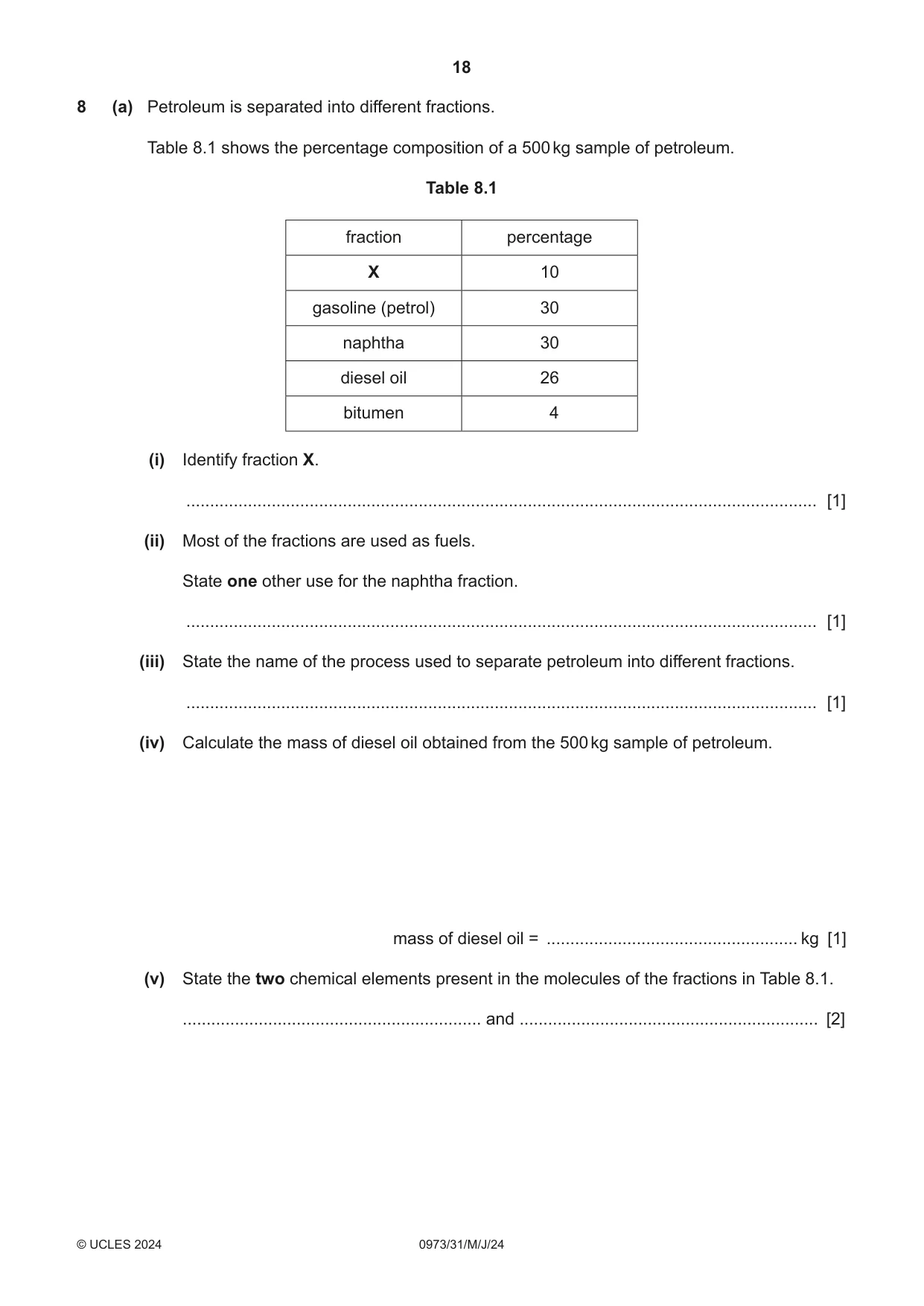
Q8 · Petroleum is separated into different fractions
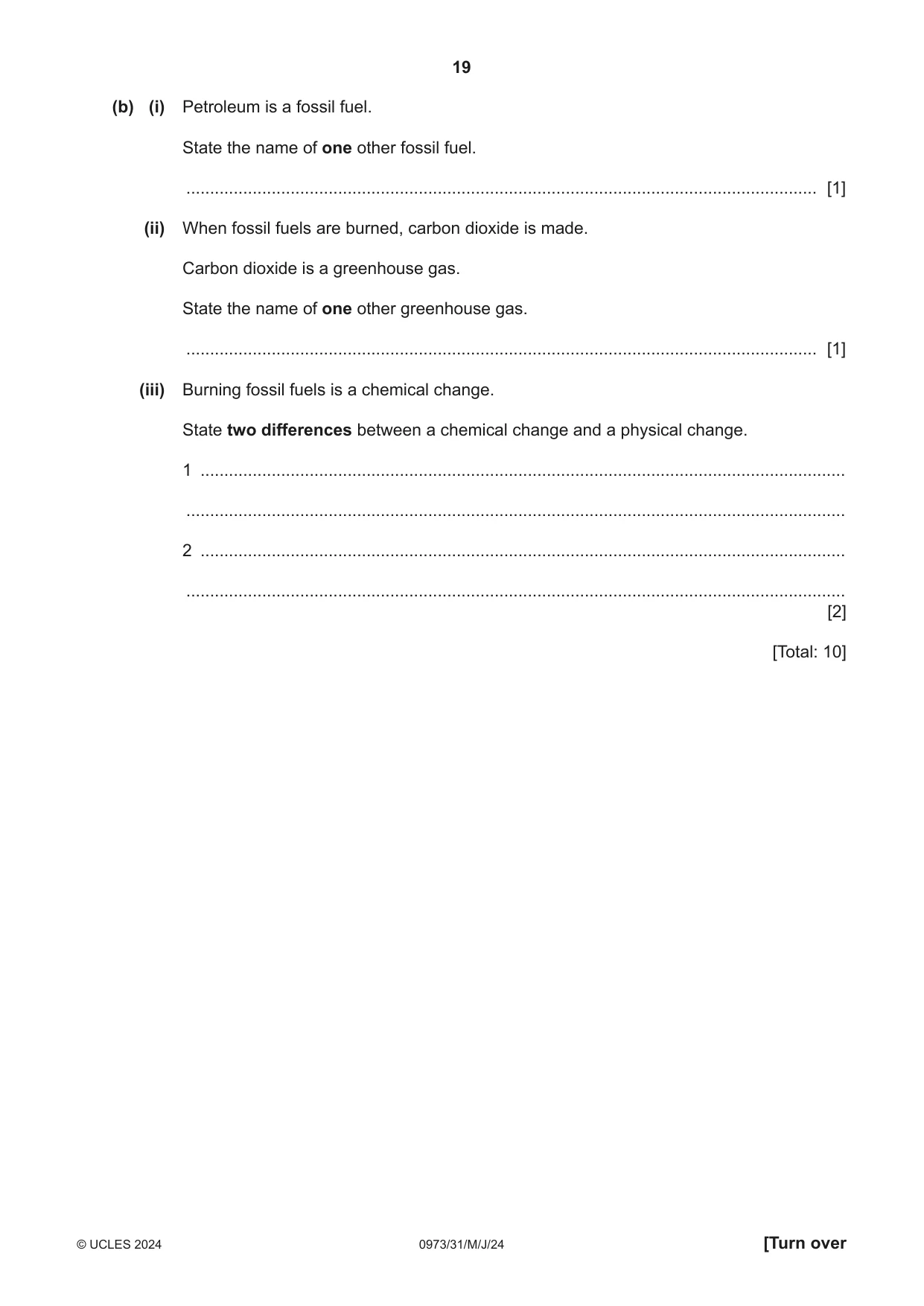
8 (a) Petroleum is separated into different fractions. Table 8.1 shows the percentage composition of a 500 kg sample of petroleum. Table 8.1 fraction percentage X 10 gasoline (petrol) 30 naphtha 30 diesel oil 26 bitumen 4 (i) Identify fraction X. ..................................................................................................................................... [1] (ii) Most of the fractions are used as fuels. State one other use for the naphtha fraction. ..................................................................................................................................... [1] (iii) State the name of the process used to separate petroleum into different fractions. ..................................................................................................................................... [1] (iv) Calculate the mass of diesel oil obtained from the 500 kg sample of petroleum. mass of diesel oil = ..................................................... kg [1] (v) State the two chemical elements present in the molecules of the fractions in Table 8.1. ............................................................... and ............................................................... [2] (b) (i) Petroleum is a fossil fuel. State the name of one other fossil fuel. ..................................................................................................................................... [1] (ii) When fossil fuels are burned, carbon dioxide is made. Carbon dioxide is a greenhouse gas. State the name of one other greenhouse gas. ..................................................................................................................................... [1] (iii) Burning fossil fuels is a chemical change. State two differences between a chemical change and a physical change. 1 ........................................................................................................................................ ........................................................................................................................................... 2 ........................................................................................................................................ ........................................................................................................................................... [2] [Total: 10]
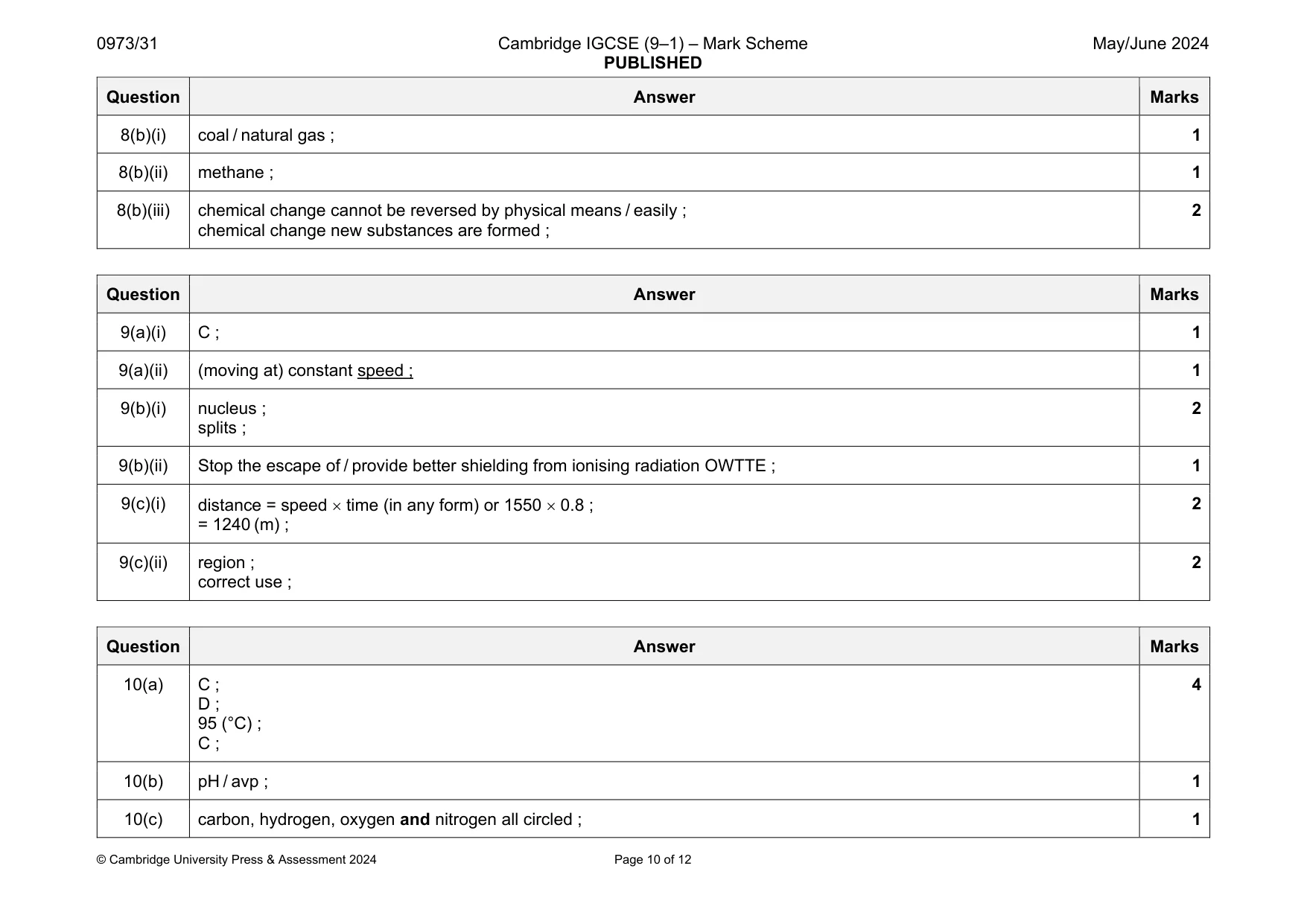
Mark scheme: 8(a)(i) refinery gas ; 1 8(a)(ii) feedstock for making chemicals ; 1 8(a)(iii) fractional distillation ; 1 8(a)(iv) 130 (kg) ; 1 8(a)(v) carbon ; hydrogen ; 2 Question Answer Marks 8(b)(i) coal / natural gas ; 1 8(b)(ii) methane ; 1 8(b)(iii) chemical change cannot be reversed by physical means / easily ; chemical change new substances are formed ; 2
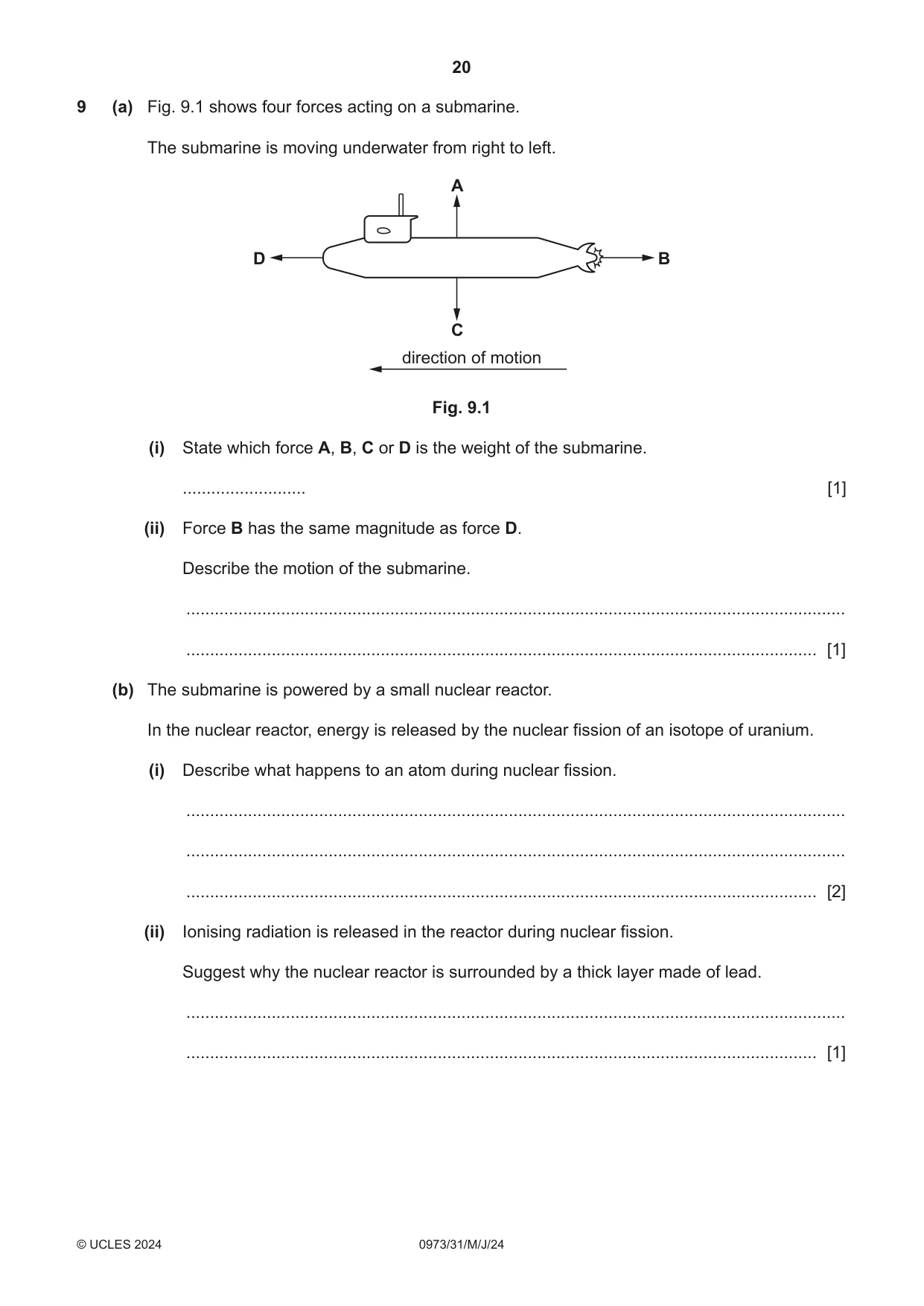
Q9 · Four forces acting on a submarine
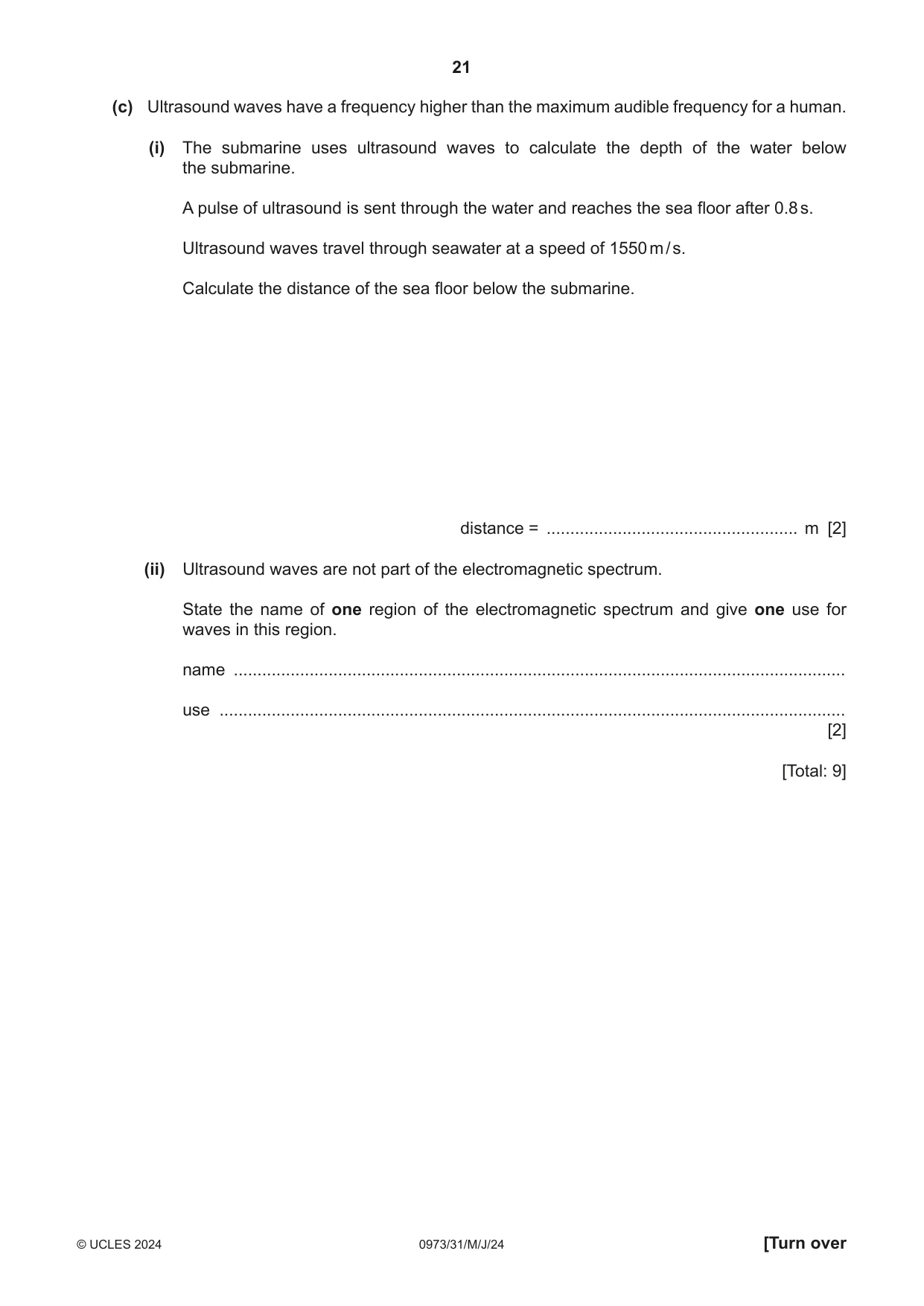
9 (a) Fig. 9.1 shows four forces acting on a submarine. The submarine is moving underwater from right to left. A D B C direction of motion Fig. 9.1 (i) State which force A, B, C or D is the weight of the submarine. .......................... [1] (ii) Force B has the same magnitude as force D. Describe the motion of the submarine. ........................................................................................................................................... ..................................................................................................................................... [1] (b) The submarine is powered by a small nuclear reactor. In the nuclear reactor, energy is released by the nuclear fission of an isotope of uranium. (i) Describe what happens to an atom during nuclear fission. ........................................................................................................................................... ........................................................................................................................................... ..................................................................................................................................... [2] (ii) Ionising radiation is released in the reactor during nuclear fission. Suggest why the nuclear reactor is surrounded by a thick layer made of lead. ........................................................................................................................................... ..................................................................................................................................... [1] (c) Ultrasound waves have a frequency higher than the maximum audible frequency for a human. (i) The submarine uses ultrasound waves to calculate the depth of the water below the submarine. A pulse of ultrasound is sent through the water and reaches the sea floor after 0.8 s. Ultrasound waves travel through seawater at a speed of 1550 m / s. Calculate the distance of the sea floor below the submarine. distance = ..................................................... m [2] (ii) Ultrasound waves are not part of the electromagnetic spectrum. State the name of one region of the electromagnetic spectrum and give one use for waves in this region. name ................................................................................................................................. use .................................................................................................................................... [2] [Total: 9]
Mark scheme: 9(a)(i) C ; 1 9(a)(ii) (moving at) constant speed ; 1 9(b)(i) nucleus ; splits ; 2 9(b)(ii) Stop the escape of / provide better shielding from ionising radiation OWTTE ; 1 9(c)(i) distance = speed time (in any form) or 1550 0.8 ; = 1240 (m) ; 2 9(c)(ii) region ; correct use ; 2
Q10 · The activity of some bacterial enzymes at different temperatures
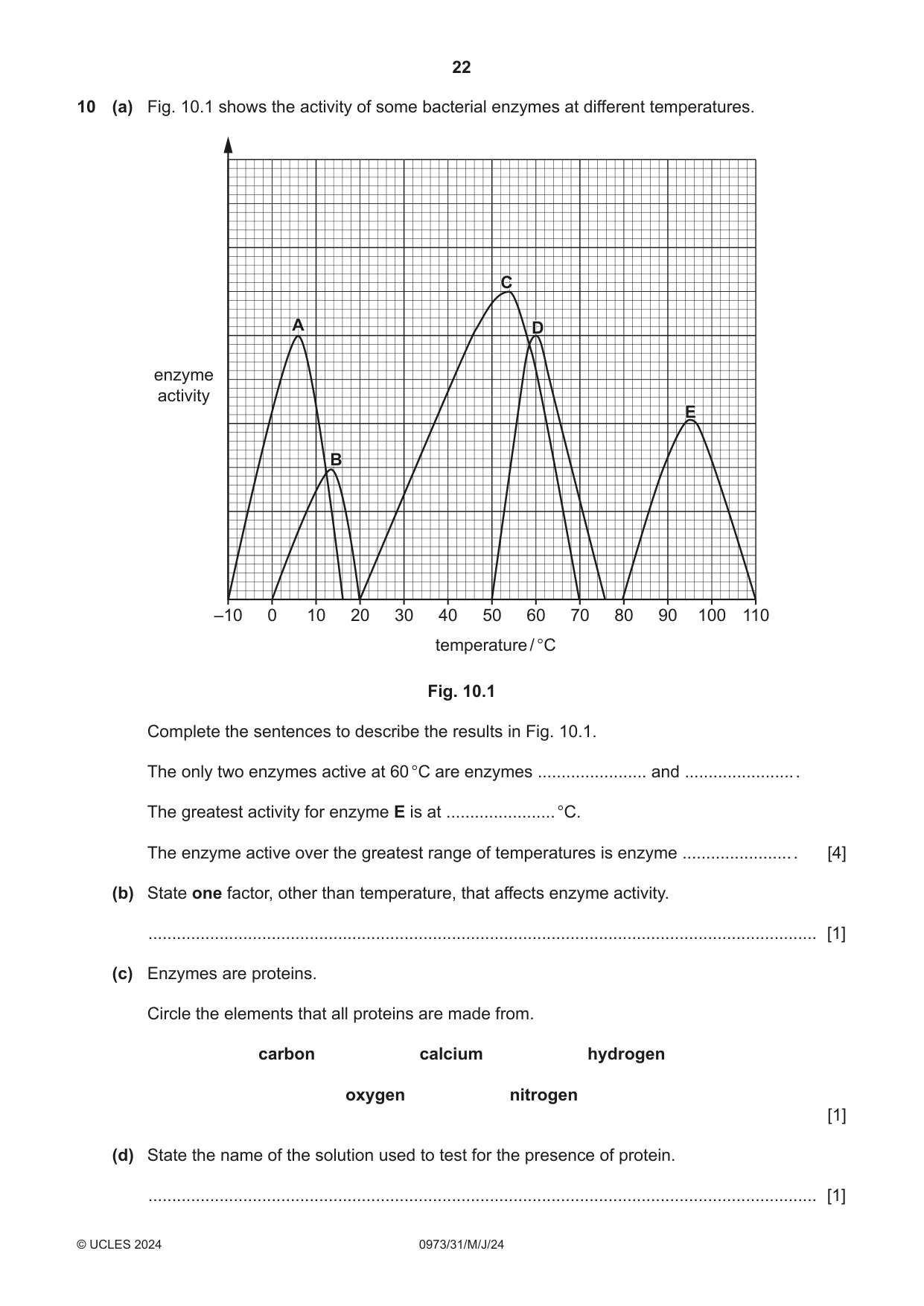
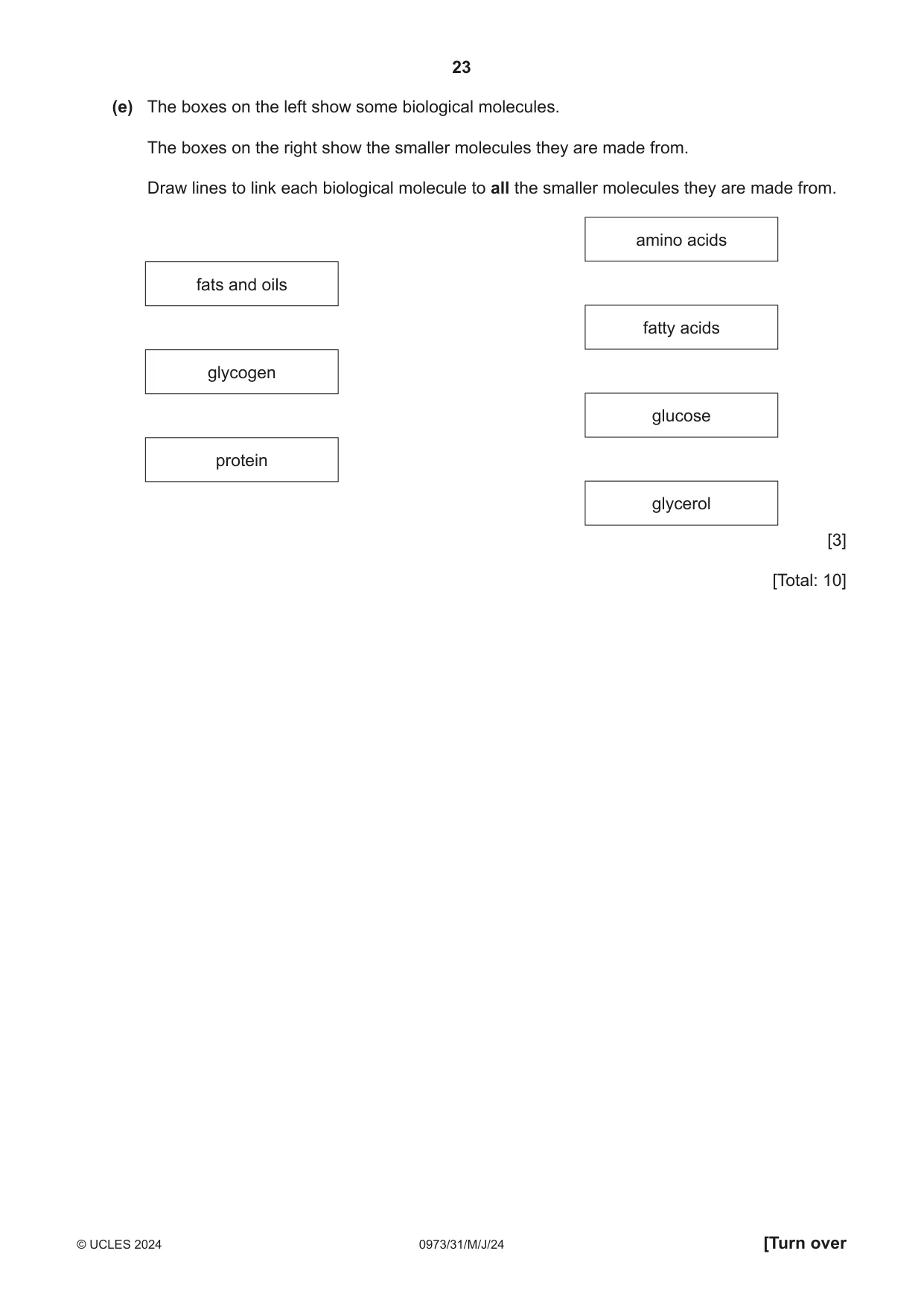
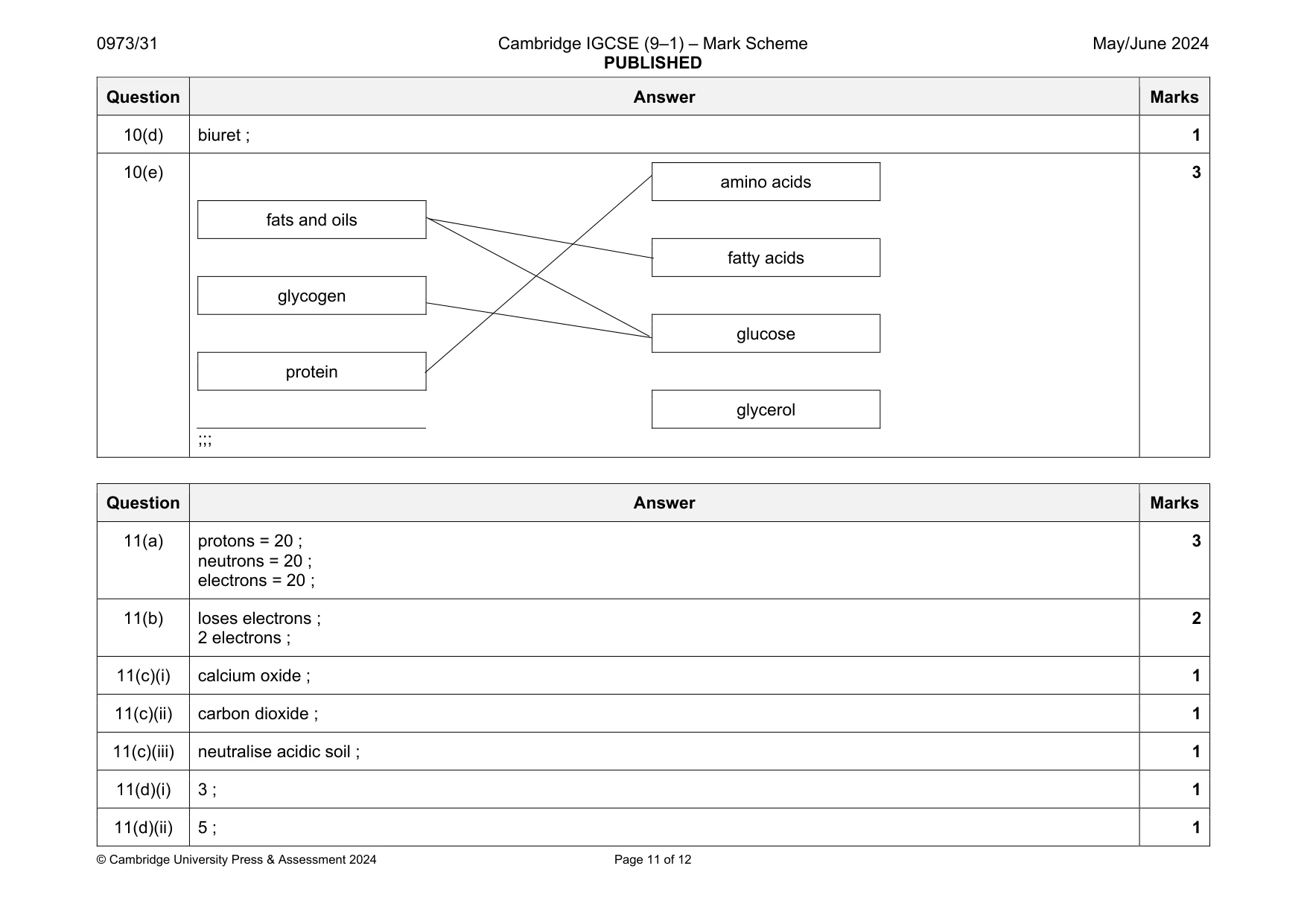
10 (a) Fig. 10.1 shows the activity of some bacterial enzymes at different temperatures. CC AA DD enzyme activity EE BB –10 0 10 20 30 40 50 60 70 80 90 100 110 temperature / °C Fig. 10.1 Complete the sentences to describe the results in Fig. 10.1. The only two enzymes active at 60 °C are enzymes ....................... and ....................... . The greatest activity for enzyme E is at ....................... °C. The enzyme active over the greatest range of temperatures is enzyme ....................... . [4] (b) State one factor, other than temperature, that affects enzyme activity. ............................................................................................................................................. [1] (c) Enzymes are proteins. Circle the elements that all proteins are made from. carbon calcium hydrogen oxygen nitrogen [1] (d) State the name of the solution used to test for the presence of protein. ............................................................................................................................................. [1] (e) The boxes on the left show some biological molecules. The boxes on the right show the smaller molecules they are made from. Draw lines to link each biological molecule to all the smaller molecules they are made from. amino acids fats and oils fatty acids glycogen glucose protein glycerol [3] [Total: 10]
Mark scheme: 10(a) C ; D ; 95 (°C) ; C ; 4 10(b) pH / avp ; 1 10(c) carbon, hydrogen, oxygen and nitrogen all circled ; 1 Question Answer Marks 10(d) biuret ; 1 10(e) amino acids fats and oils fatty acids glycogen glucose protein glycerol ;;; 3
Q11 · A calcium atom has a proton number of 20 and a nucleon number of 40
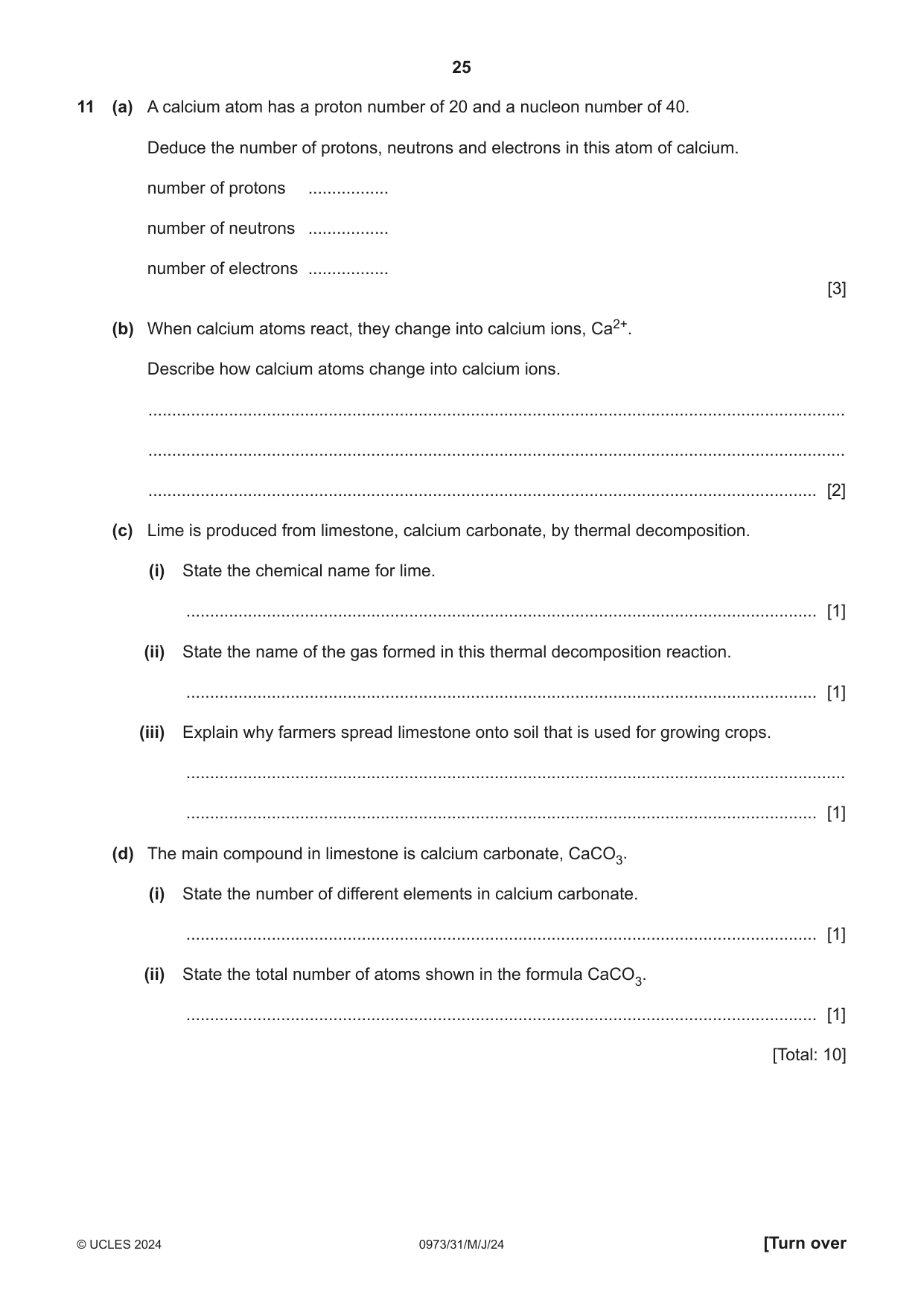
11 (a) A calcium atom has a proton number of 20 and a nucleon number of 40. Deduce the number of protons, neutrons and electrons in this atom of calcium. number of protons ................. number of neutrons ................. number of electrons ................. [3] (b) When calcium atoms react, they change into calcium ions, Ca2+. Describe how calcium atoms change into calcium ions. ................................................................................................................................................... ................................................................................................................................................... ............................................................................................................................................. [2] (c) Lime is produced from limestone, calcium carbonate, by thermal decomposition. (i) State the chemical name for lime. ..................................................................................................................................... [1] (ii) State the name of the gas formed in this thermal decomposition reaction. ..................................................................................................................................... [1] (iii) Explain why farmers spread limestone onto soil that is used for growing crops. ........................................................................................................................................... ..................................................................................................................................... [1] (d) The main compound in limestone is calcium carbonate, CaCO3. (i) State the number of different elements in calcium carbonate. ..................................................................................................................................... [1] (ii) State the total number of atoms shown in the formula CaCO3. ..................................................................................................................................... [1] [Total: 10]
Mark scheme: 11(a) protons = 20 ; neutrons = 20 ; electrons = 20 ; 3 11(b) loses electrons ; 2 electrons ; 2 11(c)(i) calcium oxide ; 1 11(c)(ii) carbon dioxide ; 1 11(c)(iii) neutralise acidic soil ; 1 11(d)(i) 3 ; 1 11(d)(ii) 5 ; 1
Q12 · The driver of a car fills the fuel tank with gasoline (petrol)
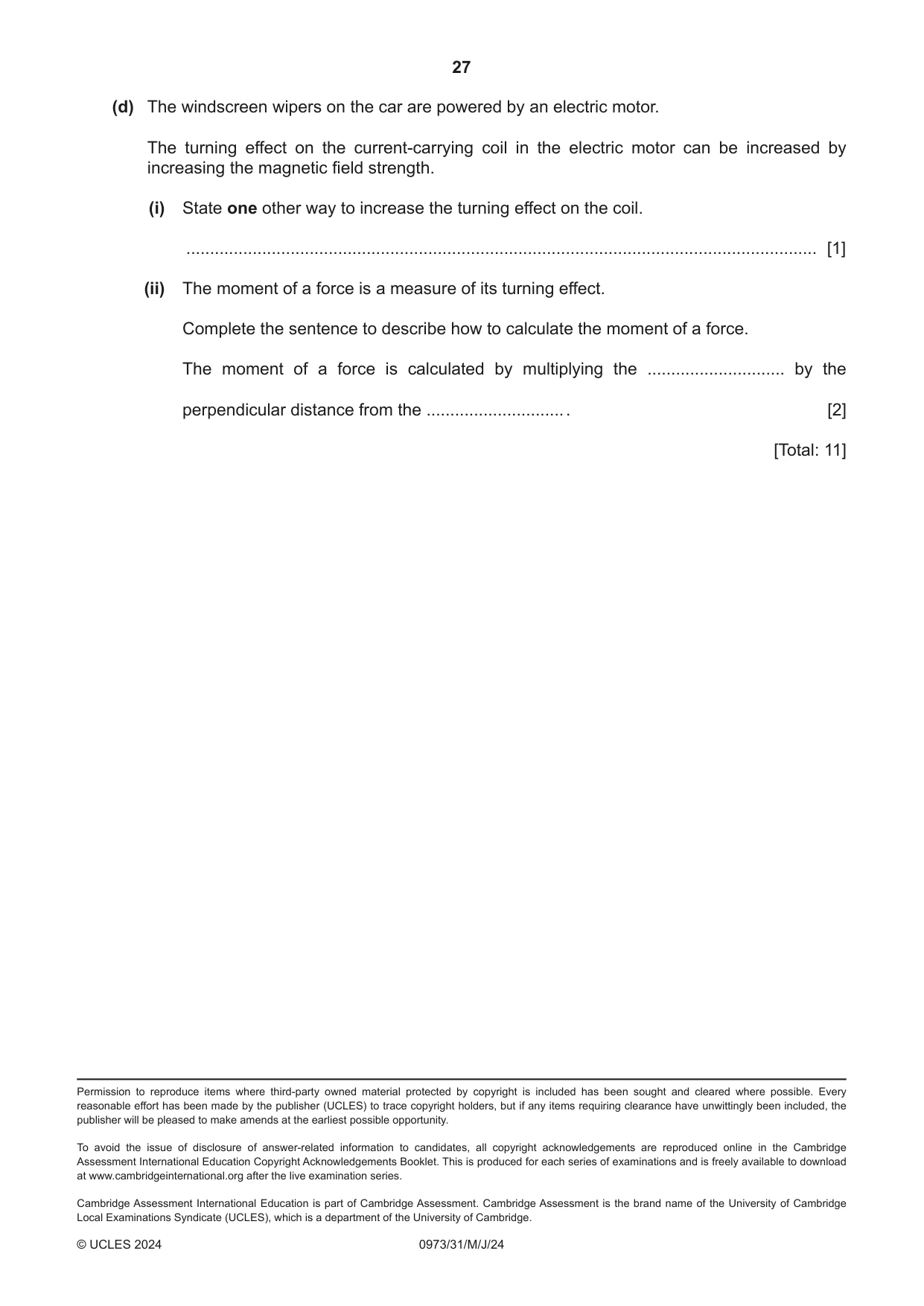
12 (a) The driver of a car fills the fuel tank with gasoline (petrol). As the gasoline flows into the fuel tank, the gasoline becomes charged. (i) State the force that causes the gasoline to become charged. ..................................................................................................................................... [1] (ii) State the name and the charge on the particles transferred when the gasoline becomes charged. name .................................................................................................................................. charge ................................................................................................................................ [2] (b) Some of the gasoline spills onto the hand of the driver. The gasoline evaporates and the driver’s hand cools down. Explain this cooling effect. Use ideas about molecules in your answer. ................................................................................................................................................... ................................................................................................................................................... ................................................................................................................................................... . ............................................................................................................................................ [2] (c) (i) During a journey in the car, the car engine transfers 5.8 × 10⁷ J of useful energy to the car. State the work done on the car by the car engine. State the unit of your answer. work done = ..................................... unit ................... [2] (ii) During the journey, the air in the tyres of the car warms up. Describe what happens to the motion of the air particles in the tyres as the air warms up. ........................................................................................................................................... ..................................................................................................................................... [1] (d) The windscreen wipers on the car are powered by an electric motor. The turning effect on the current‑carrying coil in the electric motor can be increased by increasing the magnetic field strength. (i) State one other way to increase the turning effect on the coil. ..................................................................................................................................... [1] (ii) The moment of a force is a measure of its turning effect. Complete the sentence to describe how to calculate the moment of a force. The moment of a force is calculated by multiplying the ............................. by the perpendicular distance from the ............................. . [2] [Total: 11]
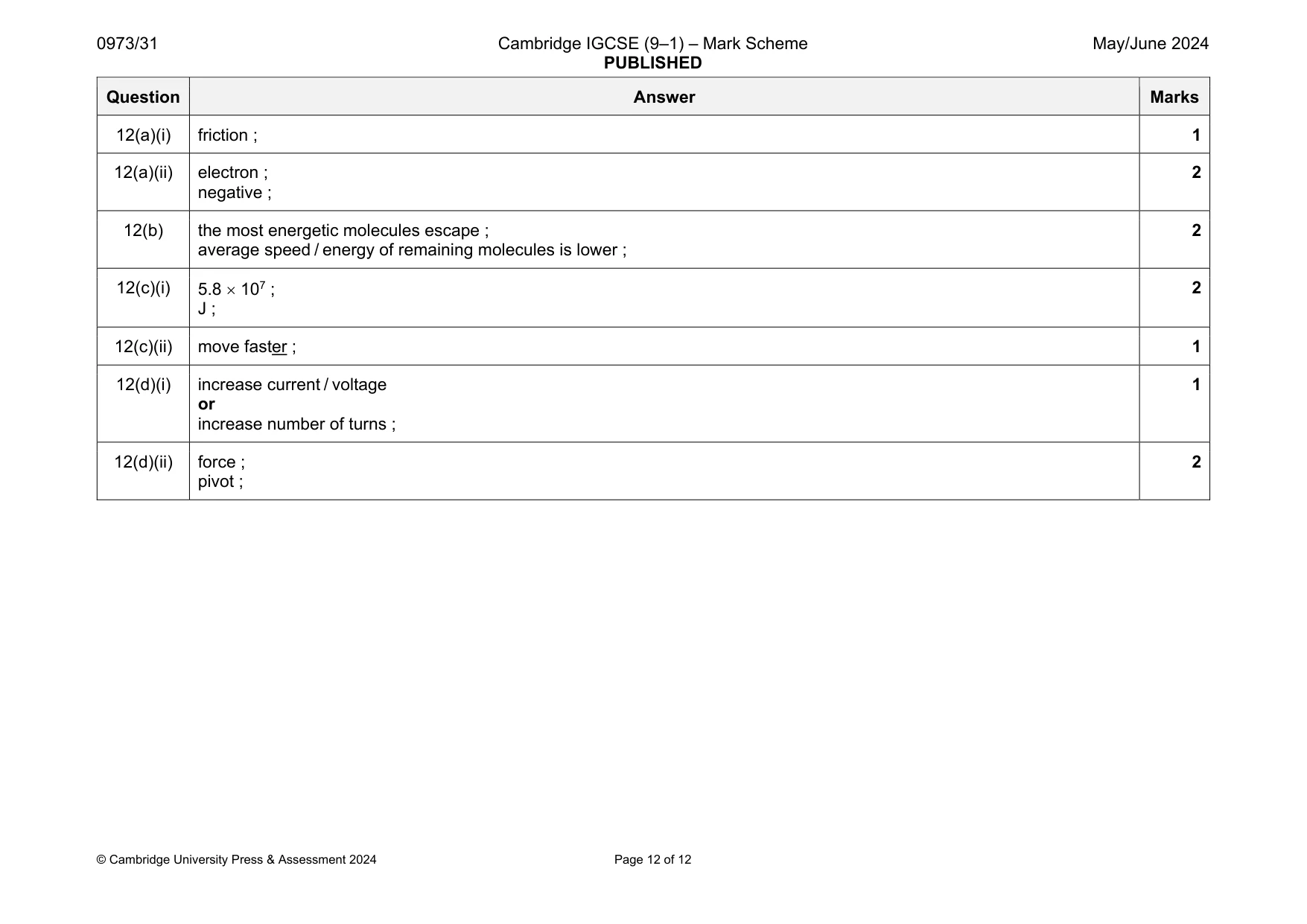
Mark scheme: 12(a)(i) friction ; 1 12(a)(ii) electron ; negative ; 2 12(b) the most energetic molecules escape ; average speed / energy of remaining molecules is lower ; 2 12(c)(i) 5.8 107 ; J ; 2 12(c)(ii) move faster ; 1 12(d)(i) increase current / voltage or increase number of turns ; 1 12(d)(ii) force ; pivot ; 2
What was in this paper
The subtopics covered by these 12 questions, and how many questions each got. Open one in a new tab to see every Cambridge question on it.
What you needed in this session
Cambridge’s own grade thresholds for 2024 May/June, Paper 3 · Variant 1. A higher threshold means an easier paper — the bar moves with how the cohort did.