Cambridge IGCSE Sanskrit 0499 — 2022 May/June Paper 1 · Variant 2
0499/12/M/J/22 · 90 marks · ≈101 min
The question paper and its mark scheme, free to read here and free to download. This is Cambridge’s own paper, exactly as it was sat.
Question paper8 pages
Mark scheme5 pages
Answers below. Sit the paper first if you are practising.
Paper as text
Question paper, page 1
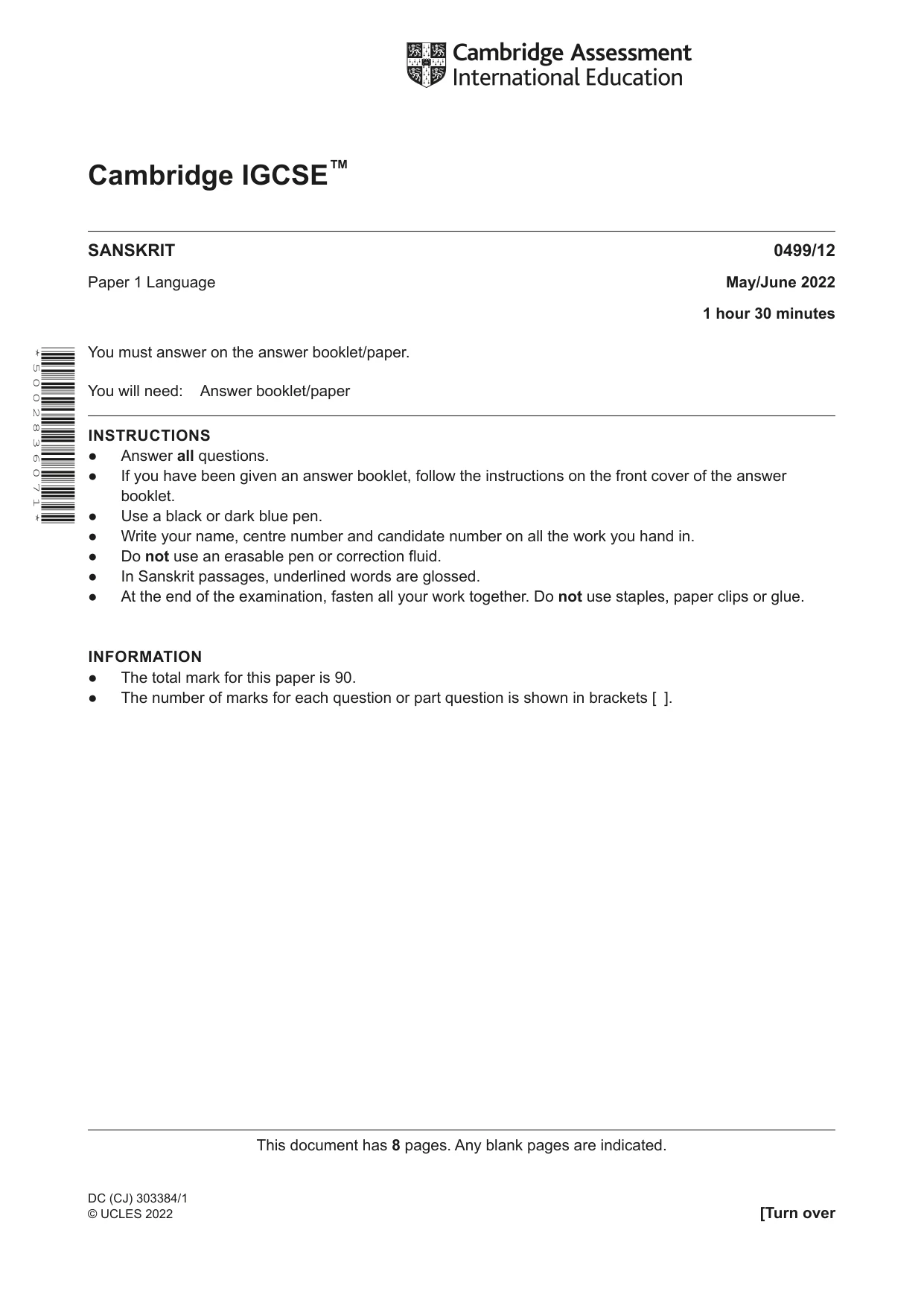
This document has 8 pages. Any blank pages are indicated. [Turn over Cambridge IGCSE™ SANSKRIT 0499/12 Paper 1 Language May/June 2022 1 hour 30 minutes You must answer on the answer booklet/paper. You will need: Answer booklet/paper INSTRUCTIONS ● Answer all questions. ● If you have been given an answer booklet, follow the instructions on the front cover of the answer booklet. ● Use a black or dark blue pen. ● Write your name, centre number and candidate number on all the work you hand in. ● Do not use an erasable pen or correction fluid. ● In Sanskrit passages, underlined words are glossed. ● At the end of the examination, fasten all your work together. Do not use staples, paper clips or glue. INFORMATION ● The total mark for this paper is 90. ● The number of marks for each question or part question is shown in brackets [ ]. * 5 0 0 2 8 3 6 0 7 1 * DC (CJ) 303384/1 © UCLES 2022
Question paper, page 2
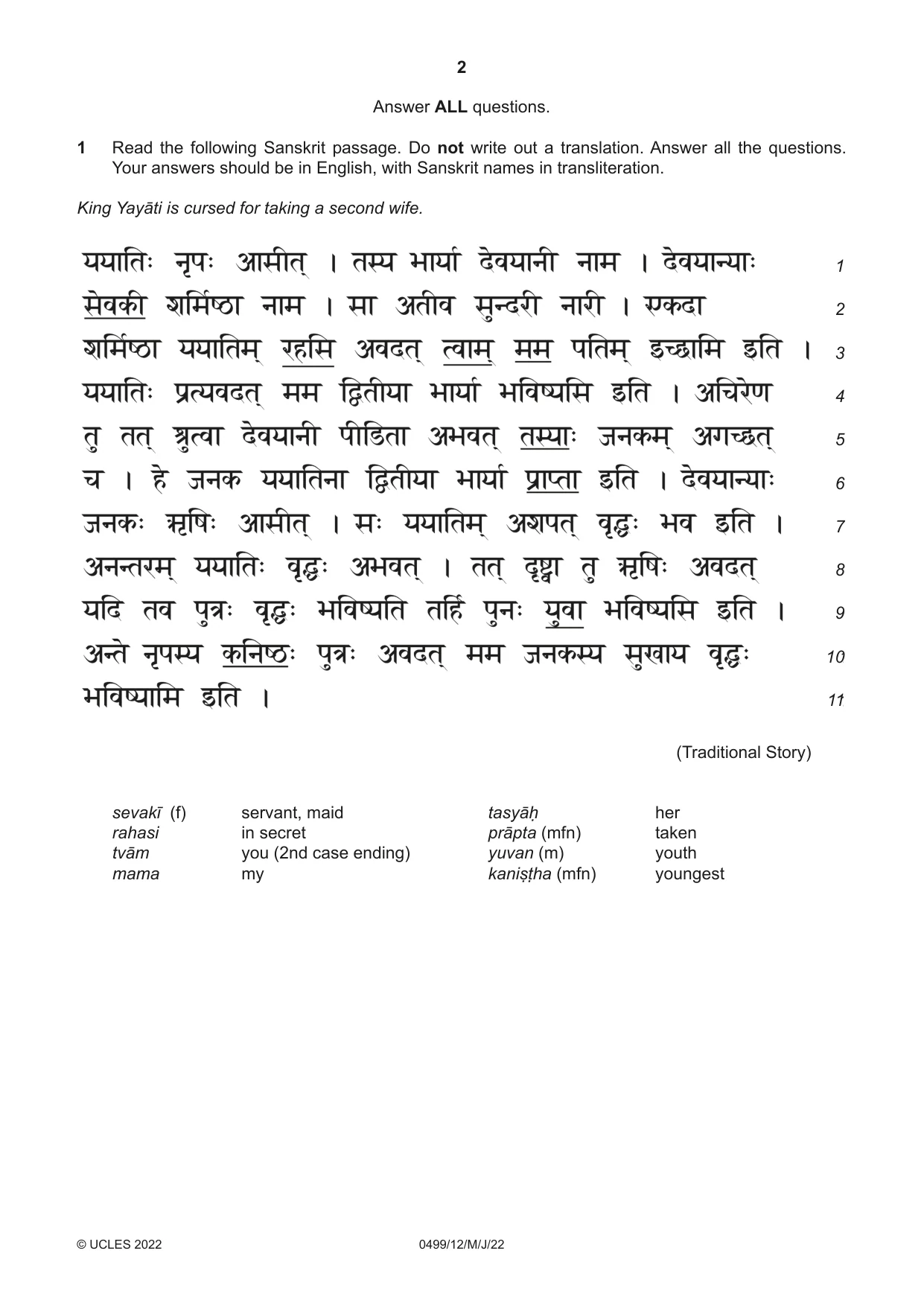
2 0499/12/M/J/22 © UCLES 2022 Answer ALL questions. 1 Read the following Sanskrit passage. Do not write out a translation. Answer all the questions. Your answers should be in English, with Sanskrit names in transliteration. King Yayāti is cursed for taking a second wife. (Traditional Story) sevakī (f) servant, maid tasyāḥ her rahasi in secret prāpta (mfn) taken tvām you (2nd case ending) yuvan (m) youth mama my kaniṣṭha (mfn) youngest 1 2 3 4 5 6 7 8 9 10 11
Question paper, page 3
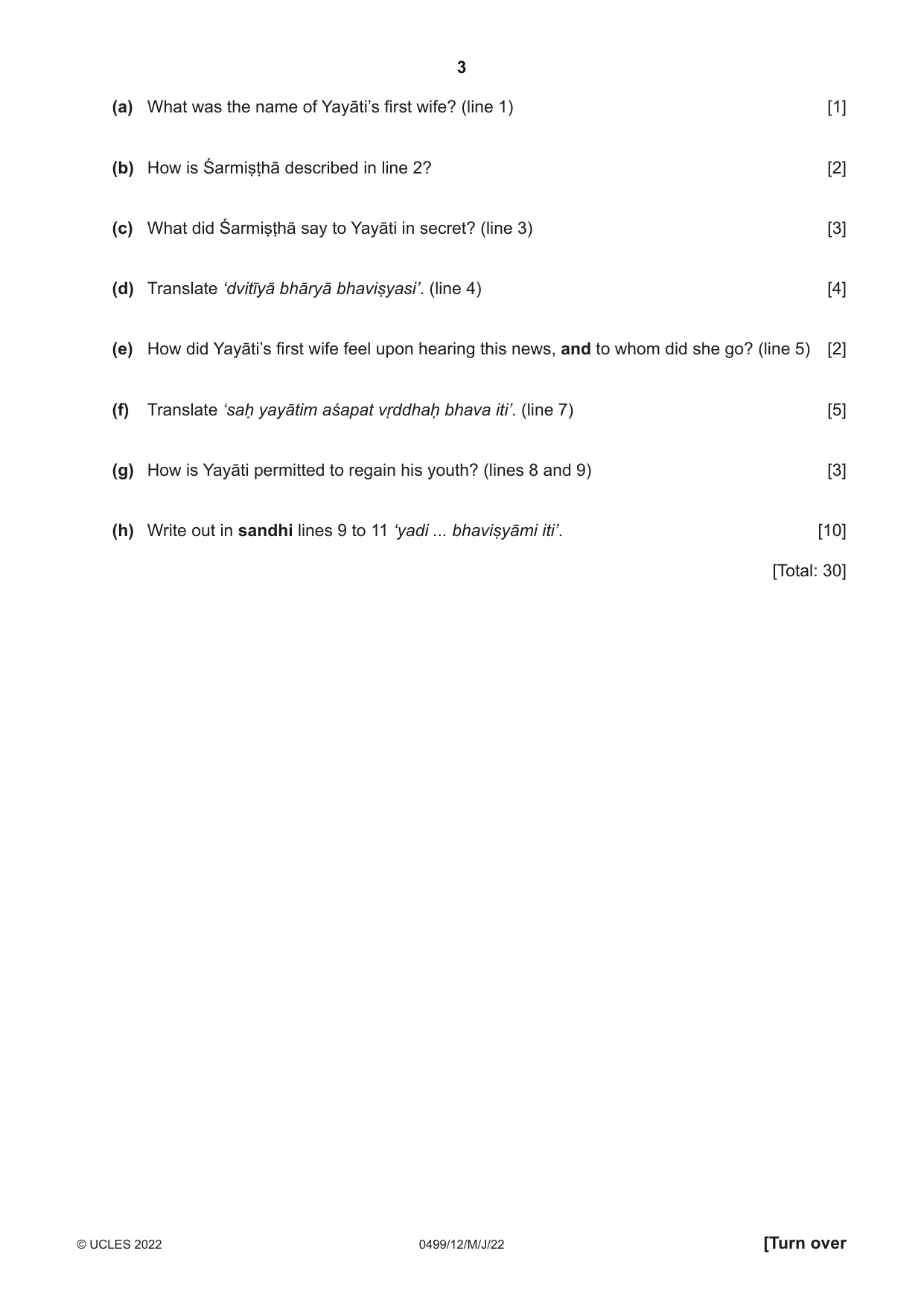
3 0499/12/M/J/22 © UCLES 2022 [Turn over (a) What was the name of Yayāti’s first wife? (line 1) [1] (b) How is Śarmiṣṭhā described in line 2? [2] (c) What did Śarmiṣṭhā say to Yayāti in secret? (line 3) [3] (d) Translate ‘dvitīyā bhāryā bhaviṣyasi’. (line 4) [4] (e) How did Yayāti’s first wife feel upon hearing this news, and to whom did she go? (line 5) [2] (f) Translate ‘saḥ yayātim aśapat vṛddhaḥ bhava iti’. (line 7) [5] (g) How is Yayāti permitted to regain his youth? (lines 8 and 9) [3] (h) Write out in sandhi lines 9 to 11 ‘yadi ... bhaviṣyāmi iti’. [10] [Total: 30]
Question paper, page 4
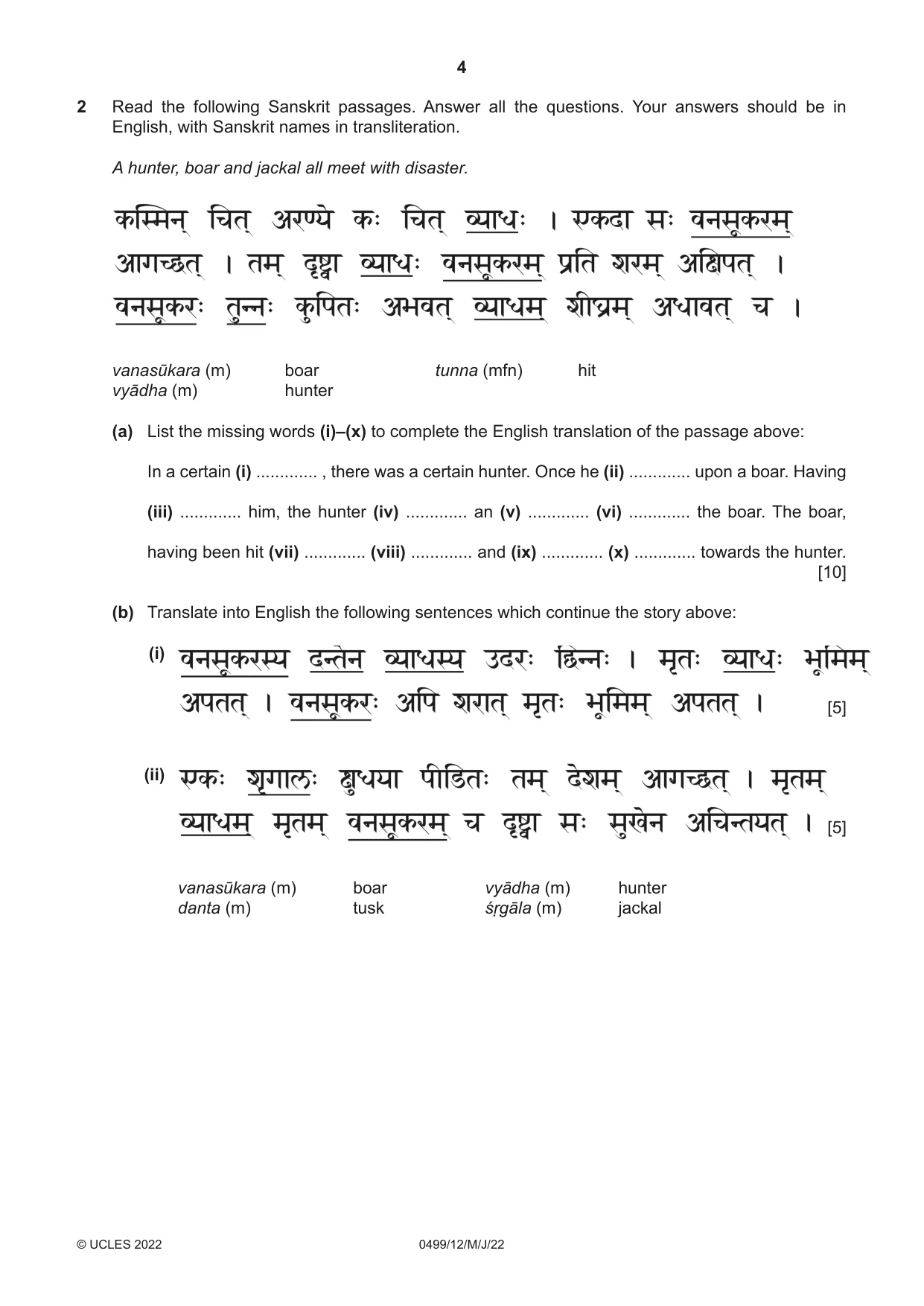
4 0499/12/M/J/22 © UCLES 2022 2 Read the following Sanskrit passages. Answer all the questions. Your answers should be in English, with Sanskrit names in transliteration. A hunter, boar and jackal all meet with disaster. vanasūkara (m) boar tunna (mfn) hit vyādha (m) hunter (a) List the missing words (i)–(x) to complete the English translation of the passage above: In a certain (i) … , there was a certain hunter. Once he (ii) … upon a boar. Having (iii) … him, the hunter (iv) … an (v) … (vi) … the boar. The boar, having been hit (vii) … (viii) … and (ix) … (x) … towards the hunter. [10] (b) Translate into English the following sentences which continue the story above: (i) [5] (ii) [5] vanasūkara (m) boar vyādha (m) hunter danta (m) tusk śṛgāla (m) jackal
Question paper, page 5
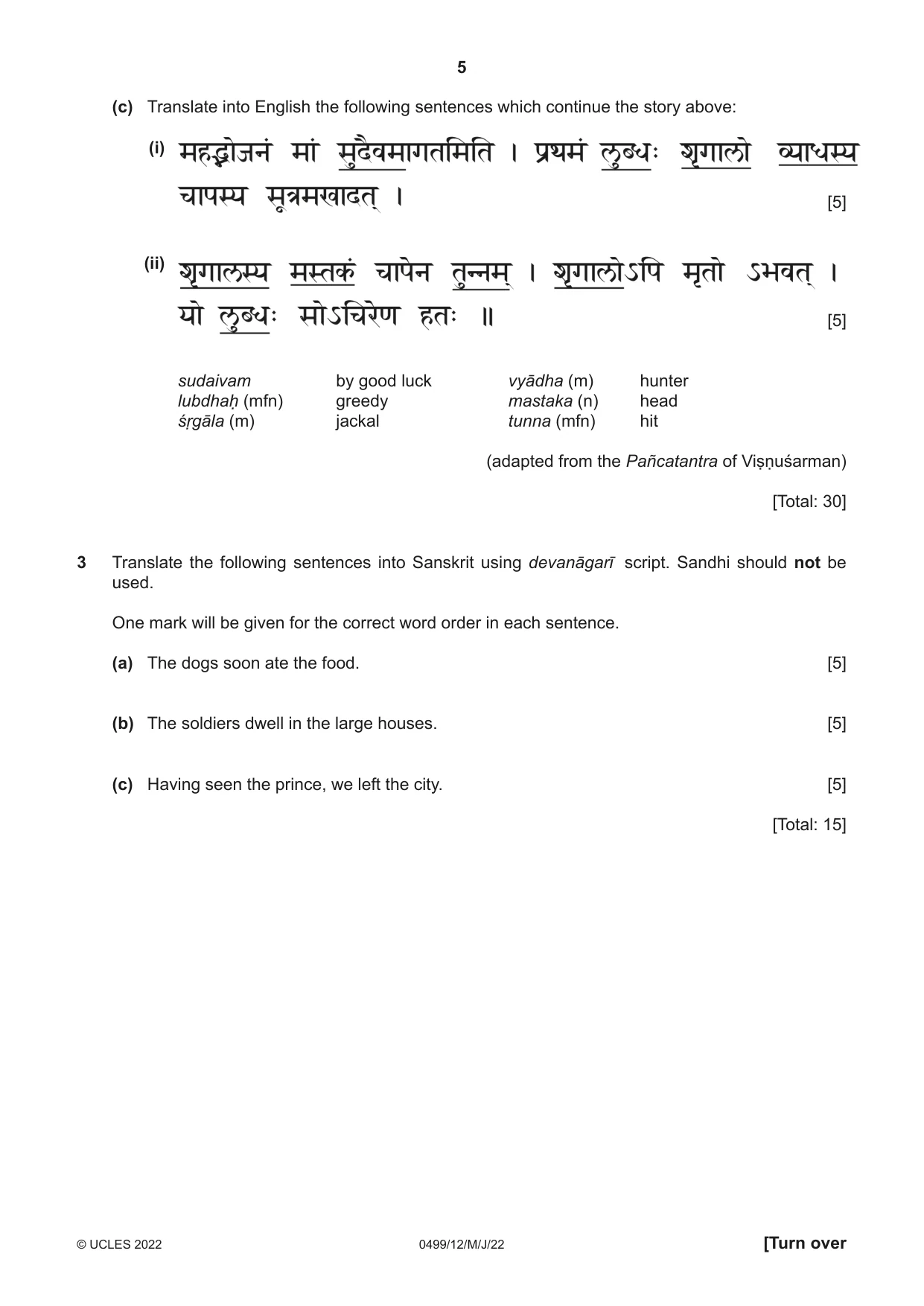
5 0499/12/M/J/22 © UCLES 2022 [Turn over (c) Translate into English the following sentences which continue the story above: (i) [5] (ii) [5] sudaivam by good luck vyādha (m) hunter lubdhaḥ (mfn) greedy mastaka (n) head śṛgāla (m) jackal tunna (mfn) hit (adapted from the Pañcatantra of Viṣṇuśarman) [Total: 30] 3 Translate the following sentences into Sanskrit using devanāgarī script. Sandhi should not be used. One mark will be given for the correct word order in each sentence. (a) The dogs soon ate the food. [5] (b) The soldiers dwell in the large houses. [5] (c) Having seen the prince, we left the city. [5] [Total: 15]
Question paper, page 6
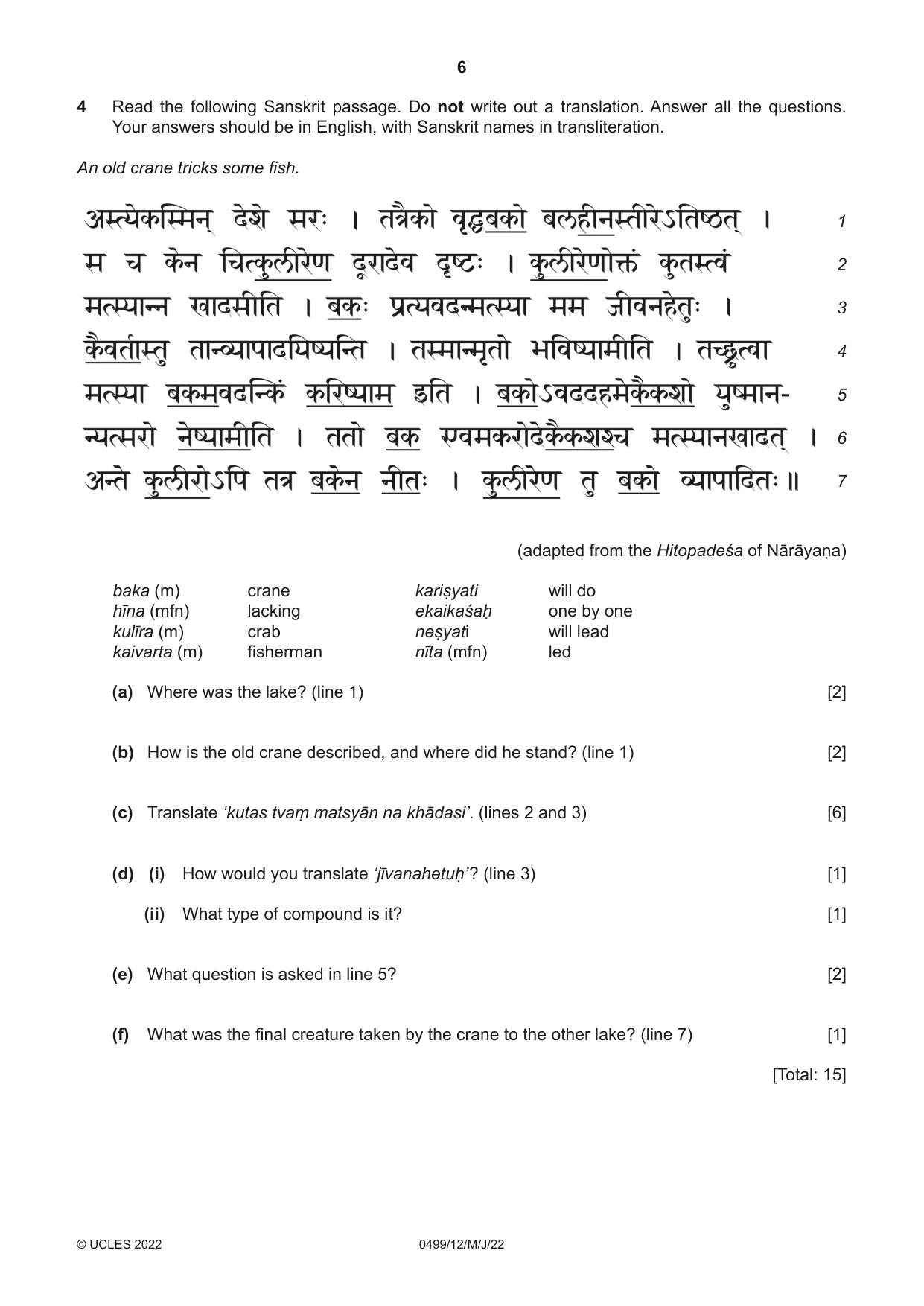
6 0499/12/M/J/22 © UCLES 2022 4 Read the following Sanskrit passage. Do not write out a translation. Answer all the questions. Your answers should be in English, with Sanskrit names in transliteration. An old crane tricks some fish. (adapted from the Hitopadeśa of Nārāyaṇa) baka (m) crane kariṣyati will do hīna (mfn) lacking ekaikaśaḥ one by one kulīra (m) crab neṣyati will lead kaivarta (m) fisherman nīta (mfn) led (a) Where was the lake? (line 1) [2] (b) How is the old crane described, and where did he stand? (line 1) [2] (c) Translate ‘kutas tvaṃ matsyān na khādasi’. (lines 2 and 3) [6] (d) (i) How would you translate ‘jīvanahetuḥ’ ? (line 3) [1] (ii) What type of compound is it? [1] (e) What question is asked in line 5? [2] (f) What was the final creature taken by the crane to the other lake? (line 7) [1] [Total: 15] 1 2 3 4 5 6 7
Question paper, page 7
7 0499/12/M/J/22 © UCLES 2022 BLANK PAGE
Question paper, page 8
8 0499/12/M/J/22 © UCLES 2022 Permission to reproduce items where third-party owned material protected by copyright is included has been sought and cleared where possible. Every reasonable effort has been made by the publisher (UCLES) to trace copyright holders, but if any items requiring clearance have unwittingly been included, the publisher will be pleased to make amends at the earliest possible opportunity. To avoid the issue of disclosure of answer-related information to candidates, all copyright acknowledgements are reproduced online in the Cambridge Assessment International Education Copyright Acknowledgements Booklet. This is produced for each series of examinations and is freely available to download at www.cambridgeinternational.org after the live examination series. Cambridge Assessment International Education is part of Cambridge Assessment. Cambridge Assessment is the brand name of the University of Cambridge Local Examinations Syndicate (UCLES), which is a department of the University of Cambridge. BLANK PAGE
Mark scheme, page 1
This document consists of 5 printed pages. © UCLES 2022 [Turn over Cambridge IGCSE™ SANSKRIT 0499/12 Paper 1 Language May/June 2022 MARK SCHEME Maximum Mark: 90 Published This mark scheme is published as an aid to teachers and candidates, to indicate the requirements of the examination. It shows the basis on which Examiners were instructed to award marks. It does not indicate the details of the discussions that took place at an Examiners’ meeting before marking began, which would have considered the acceptability of alternative answers. Mark schemes should be read in conjunction with the question paper and the Principal Examiner Report for Teachers. Cambridge International will not enter into discussions about these mark schemes. Cambridge International is publishing the mark schemes for the May/June 2022 series for most Cambridge IGCSE, Cambridge International A and AS Level and Cambridge Pre-U components, and some Cambridge O Level components.
Mark scheme, page 2
0499/12 Cambridge IGCSE – Mark Scheme PUBLISHED May/June 2022 © UCLES 2022 Page 2 of 5 Generic Marking Principles These general marking principles must be applied by all examiners when marking candidate answers. They should be applied alongside the specific content of the mark scheme or generic level descriptors for a question. Each question paper and mark scheme will also comply with these marking principles. GENERIC MARKING PRINCIPLE 1: Marks must be awarded in line with: the specific content of the mark scheme or the generic level descriptors for the question the specific skills defined in the mark scheme or in the generic level descriptors for the question the standard of response required by a candidate as exemplified by the standardisation scripts. GENERIC MARKING PRINCIPLE 2: Marks awarded are always whole marks (not half marks, or other fractions). GENERIC MARKING PRINCIPLE 3: Marks must be awarded positively: marks are awarded for correct/valid answers, as defined in the mark scheme. However, credit is given for valid answers which go beyond the scope of the syllabus and mark scheme, referring to your Team Leader as appropriate marks are awarded when candidates clearly demonstrate what they know and can do marks are not deducted for errors marks are not deducted for omissions answers should only be judged on the quality of spelling, punctuation and grammar when these features are specifically assessed by the question as indicated by the mark scheme. The meaning, however, should be unambiguous. GENERIC MARKING PRINCIPLE 4: Rules must be applied consistently, e.g. in situations where candidates have not followed instructions or in the application of generic level descriptors. GENERIC MARKING PRINCIPLE 5: Marks should be awarded using the full range of marks defined in the mark scheme for the question (however; the use of the full mark range may be limited according to the quality of the candidate responses seen). GENERIC MARKING PRINCIPLE 6: Marks awarded are based solely on the requirements as defined in the mark scheme. Marks should not be awarded with grade thresholds or grade descriptors in mind.
Mark scheme, page 3
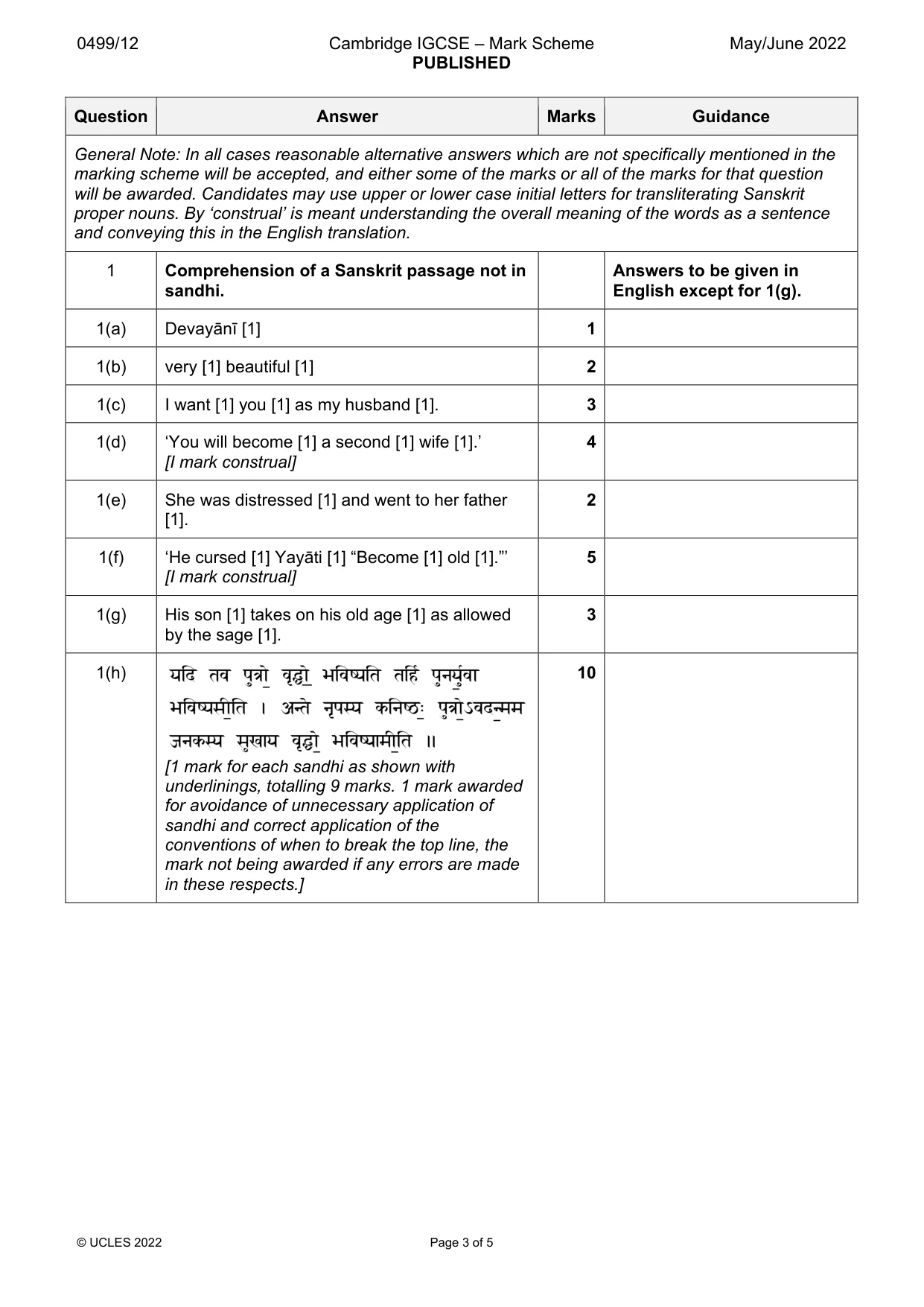
0499/12 Cambridge IGCSE – Mark Scheme PUBLISHED May/June 2022 © UCLES 2022 Page 3 of 5 Question Answer Marks Guidance General Note: In all cases reasonable alternative answers which are not specifically mentioned in the marking scheme will be accepted, and either some of the marks or all of the marks for that question will be awarded. Candidates may use upper or lower case initial letters for transliterating Sanskrit proper nouns. By ‘construal’ is meant understanding the overall meaning of the words as a sentence and conveying this in the English translation. 1 Comprehension of a Sanskrit passage not in sandhi. Answers to be given in English except for 1(g). 1(a) Devayānī [1] 1 1(b) very [1] beautiful [1] 2 1(c) I want [1] you [1] as my husband [1]. 3 1(d) ‘You will become [1] a second [1] wife [1].’ [I mark construal] 4 1(e) She was distressed [1] and went to her father [1]. 2 1(f) ‘He cursed [1] Yayāti [1] “Become [1] old [1].”’ [I mark construal] 5 1(g) His son [1] takes on his old age [1] as allowed by the sage [1]. 3 1(h) [1 mark for each sandhi as shown with underlinings, totalling 9 marks. 1 mark awarded for avoidance of unnecessary application of sandhi and correct application of the conventions of when to break the top line, the mark not being awarded if any errors are made in these respects.] 10
Mark scheme, page 4
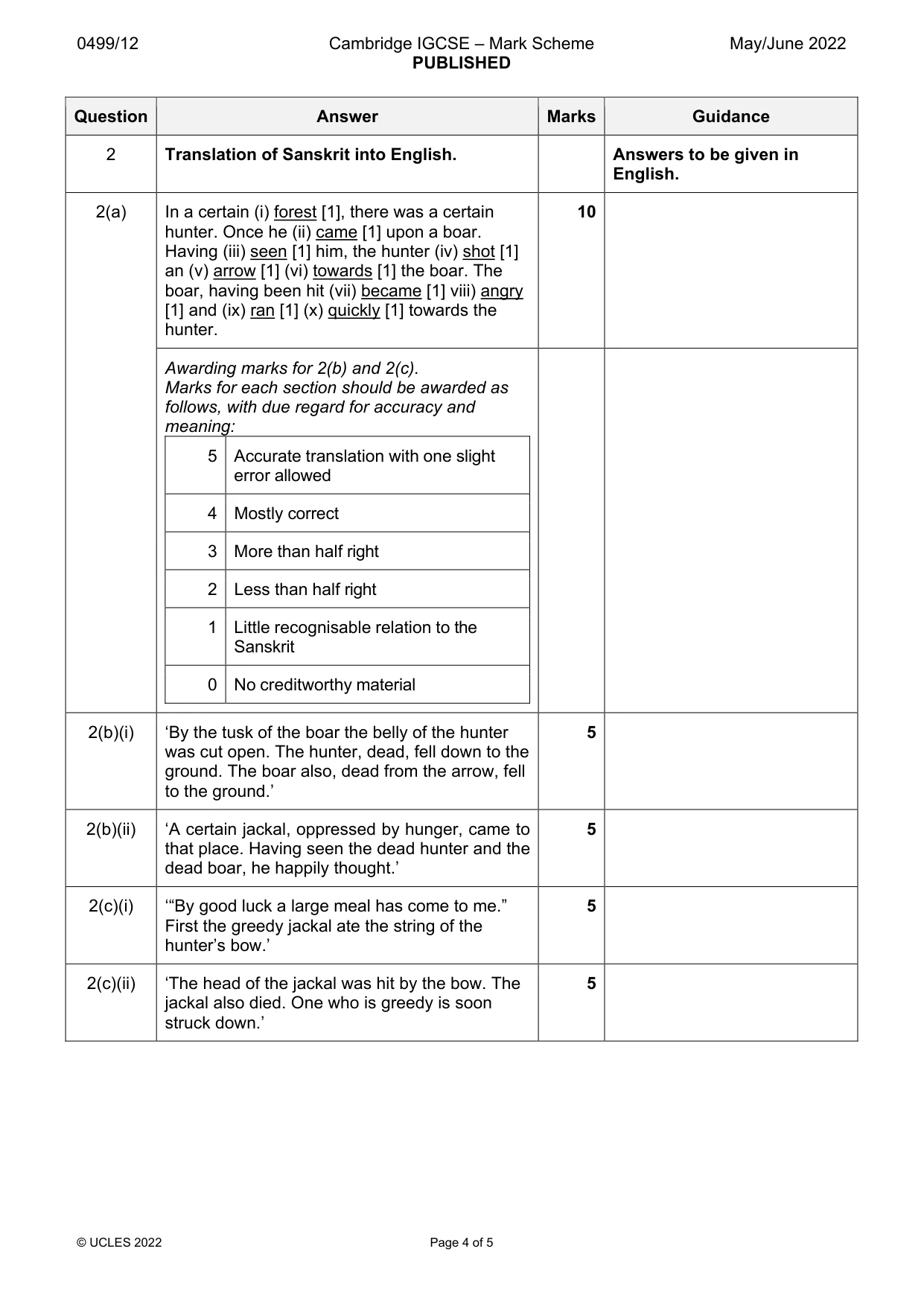
0499/12 Cambridge IGCSE – Mark Scheme PUBLISHED May/June 2022 © UCLES 2022 Page 4 of 5 Question Answer Marks Guidance 2 Translation of Sanskrit into English. Answers to be given in English. 2(a) In a certain (i) forest [1], there was a certain hunter. Once he (ii) came [1] upon a boar. Having (iii) seen [1] him, the hunter (iv) shot [1] an (v) arrow [1] (vi) towards [1] the boar. The boar, having been hit (vii) became [1] viii) angry [1] and (ix) ran [1] (x) quickly [1] towards the hunter. 10 Awarding marks for 2(b) and 2(c). Marks for each section should be awarded as follows, with due regard for accuracy and meaning: 5 Accurate translation with one slight error allowed 4 Mostly correct 3 More than half right 2 Less than half right 1 Little recognisable relation to the Sanskrit 0 No creditworthy material 2(b)(i) ‘By the tusk of the boar the belly of the hunter was cut open. The hunter, dead, fell down to the ground. The boar also, dead from the arrow, fell to the ground.’ 5 2(b)(ii) ‘A certain jackal, oppressed by hunger, came to that place. Having seen the dead hunter and the dead boar, he happily thought.’ 5 2(c)(i) ‘“By good luck a large meal has come to me.” First the greedy jackal ate the string of the hunter’s bow.’ 5 2(c)(ii) ‘The head of the jackal was hit by the bow. The jackal also died. One who is greedy is soon struck down.’ 5
Mark scheme, page 5
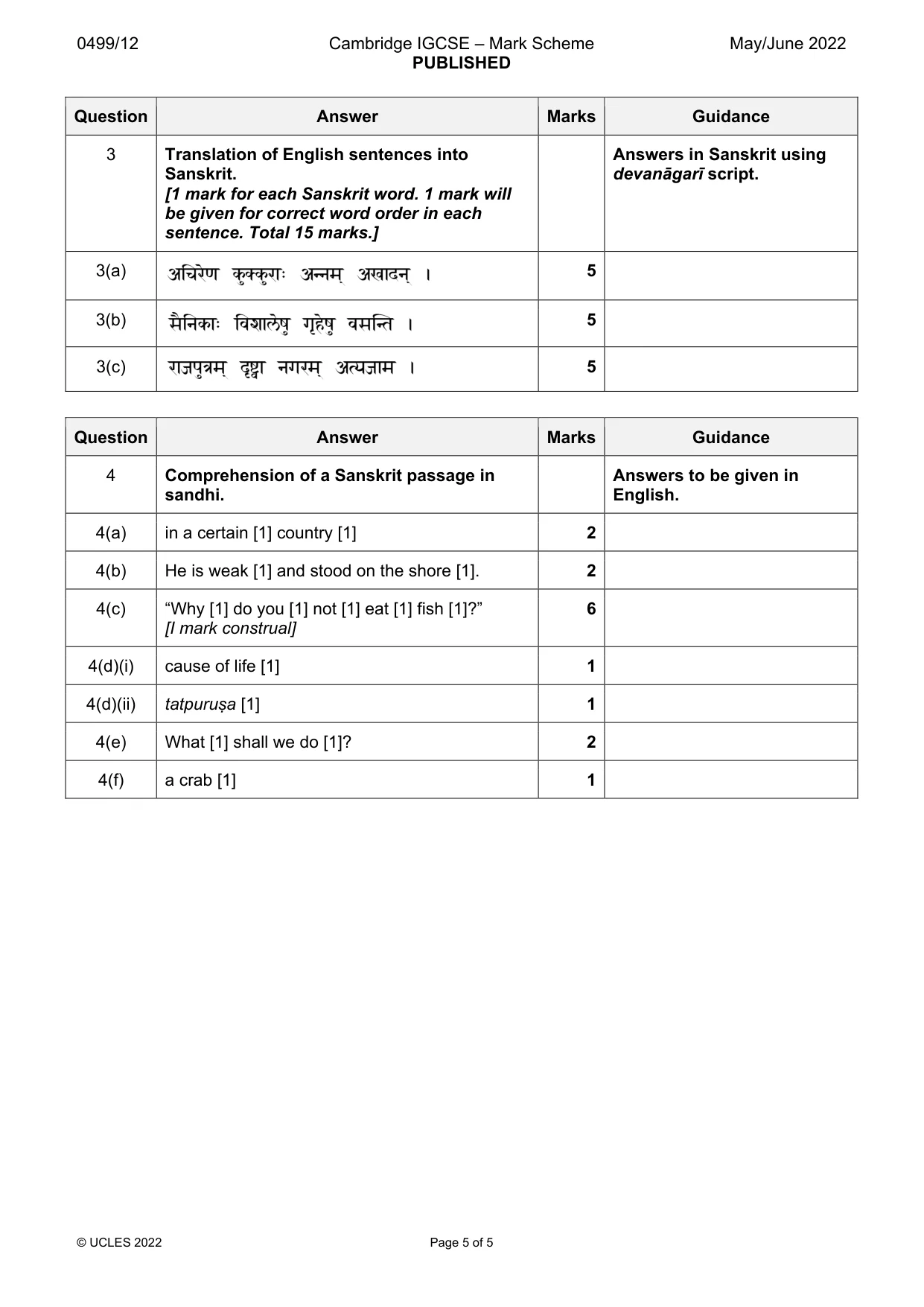
0499/12 Cambridge IGCSE – Mark Scheme PUBLISHED May/June 2022 © UCLES 2022 Page 5 of 5 Question Answer Marks Guidance 3 Translation of English sentences into Sanskrit. [1 mark for each Sanskrit word. 1 mark will be given for correct word order in each sentence. Total 15 marks.] Answers in Sanskrit using devanāgarī script. 3(a) 5 3(b) 5 3(c) 5 Question Answer Marks Guidance 4 Comprehension of a Sanskrit passage in sandhi. Answers to be given in English. 4(a) in a certain [1] country [1] 2 4(b) He is weak [1] and stood on the shore [1]. 2 4(c) “Why [1] do you [1] not [1] eat [1] fish [1]?” [I mark construal] 6 4(d)(i) cause of life [1] 1 4(d)(ii) tatpuruṣa [1] 1 4(e) What [1] shall we do [1]? 2 4(f) a crab [1] 1
What you needed in this session
Cambridge’s own grade thresholds for 2022 May/June, Paper 1 · Variant 2. A higher threshold means an easier paper — the bar moves with how the cohort did.