Cambridge IGCSE Sanskrit 0499 — 2021 May/June Paper 2 · Variant 0
0499/20/M/J/21 · 4 questions · 90 marks · ≈101 min
The question paper and its mark scheme, free to read here and free to download. This is Cambridge’s own paper, exactly as it was sat.
Question paper8 pages



Mark scheme
No mark scheme is in the library for this paper.
Questions as text
Q1 · Mahābhārata (adapted text) Read the following Sanskrit passage
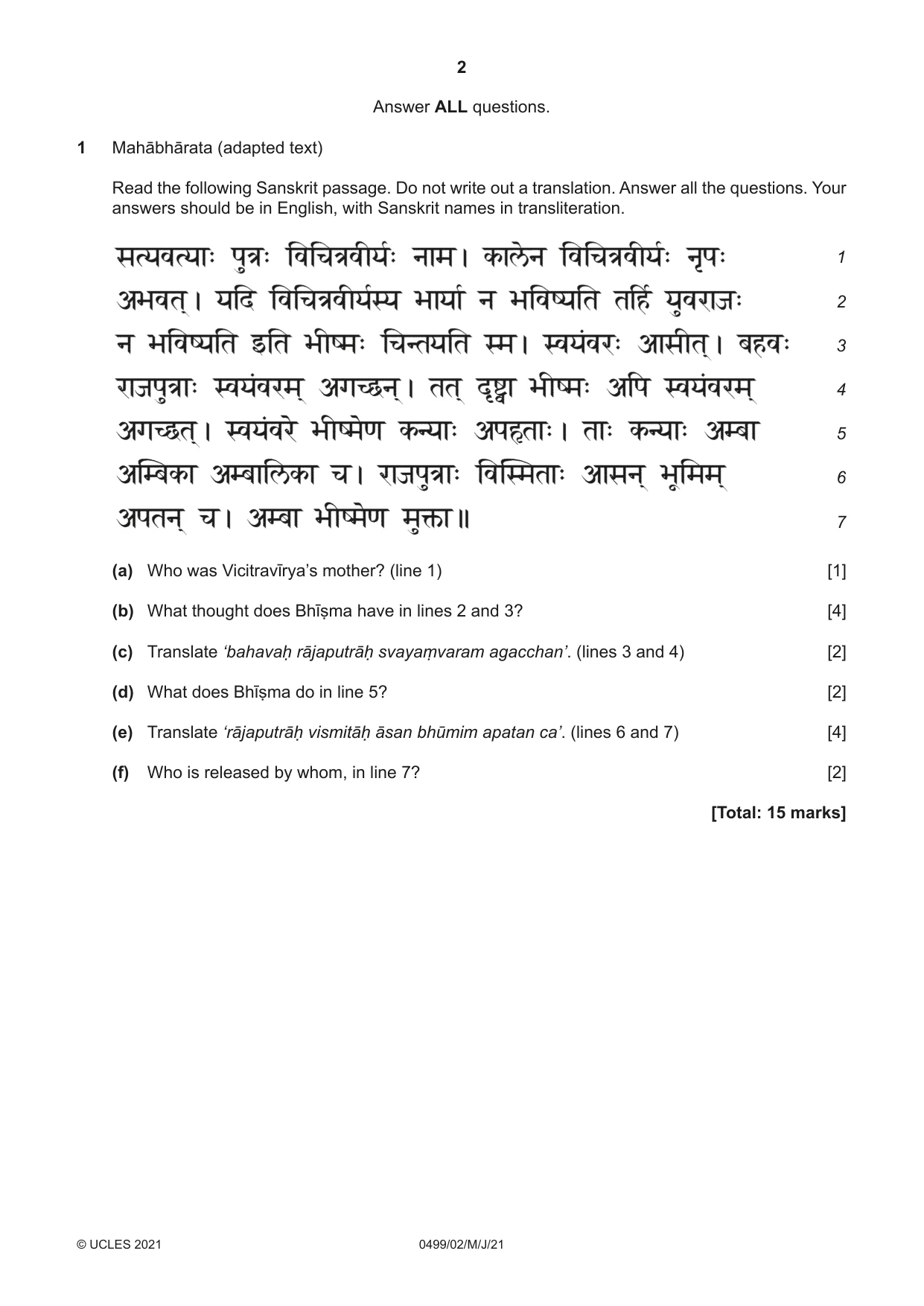
1 Mahābhārata (adapted text) Read the following Sanskrit passage. Do not write out a translation. Answer all the questions. Your answers should be in English, with Sanskrit names in transliteration. 1 2 3 4 5 6 7 (a) Who was Vicitravīrya’s mother? (line 1) [1] (b) What thought does Bhīṣma have in lines 2 and 3? [4] (c) Translate ‘bahavaḥ rājaputrāḥ svayaṃvaram agacchan’. (lines 3 and 4) [2] (d) What does Bhīṣma do in line 5? [2] (e) Translate ‘rājaputrāḥ vismitāḥ āsan bhūmim apatan ca’. (lines 6 and 7) [4] (f) Who is released by whom, in line 7? [2] [Total: 15 marks]
Q2 · Mahābhārata – Bhagavad Gītā Read the following Sanskrit verses
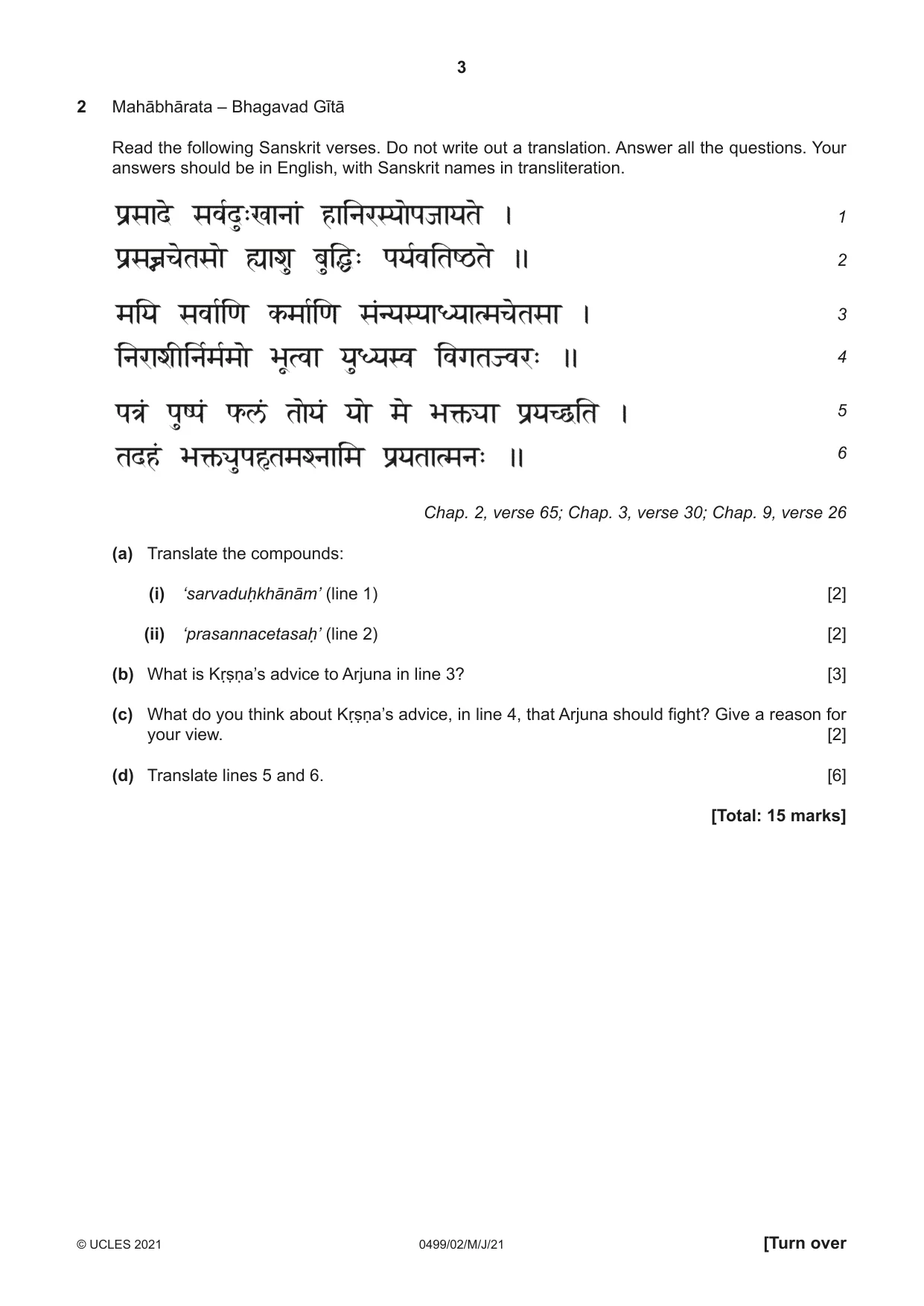
2 Mahābhārata – Bhagavad Gītā Read the following Sanskrit verses. Do not write out a translation. Answer all the questions. Your answers should be in English, with Sanskrit names in transliteration. 1 2 3 4 5 6 Chap. 2, verse 65; Chap. 3, verse 30; Chap. 9, verse 26 (a) Translate the compounds: (i) ‘sarvaduḥkhānām’ (line 1) [2] (ii) ‘prasannacetasaḥ’ (line 2) [2] (b) What is Kṛṣṇa’s advice to Arjuna in line 3? [3] (c) What do you think about Kṛṣṇa’s advice, in line 4, that Arjuna should fight? Give a reason for your view. [2] (d) Translate lines 5 and 6. [6] [Total: 15 marks]
Q3 · Sanskrit Epic Civilisation (a) Briefly explain each of the following concepts: (i) avidyā…
3 Sanskrit Epic Civilisation (a) Briefly explain each of the following concepts: (i) avidyā [2] (ii) karman [2] (iii) ahaṅkāra [2] (iv) samaṣṭi [2] (b) Explain the terms puruṣa and prakṛti, and how they relate. [3] (c) Sattva is the quality of purity, intelligence and brightness. Give the Sanskrit names of the other two qualities of nature, explaining each. [4] (d) Briefly explain each of the following Sanskrit terms: (i) śruti [2] (ii) āraṇyaka [2] (iii) vyākaraṇa [2] (iv) manusmṛti [2] (e) What do the terms deva and devī mean? [2] (f) Write a short essay of about 100 words, in English, on one of these two topics: EITHER (i) Discuss the system of the five great subtle elements. Do you think this is a useful way of viewing creation? OR (ii) Outline the system of classes of human being, beginning with the brāhmaṇa, the priest. Is this system useful, in your view, in the present age? [10] [Total: 35 marks]
Q4 · Hitopadeśa Read the following Sanskrit passage
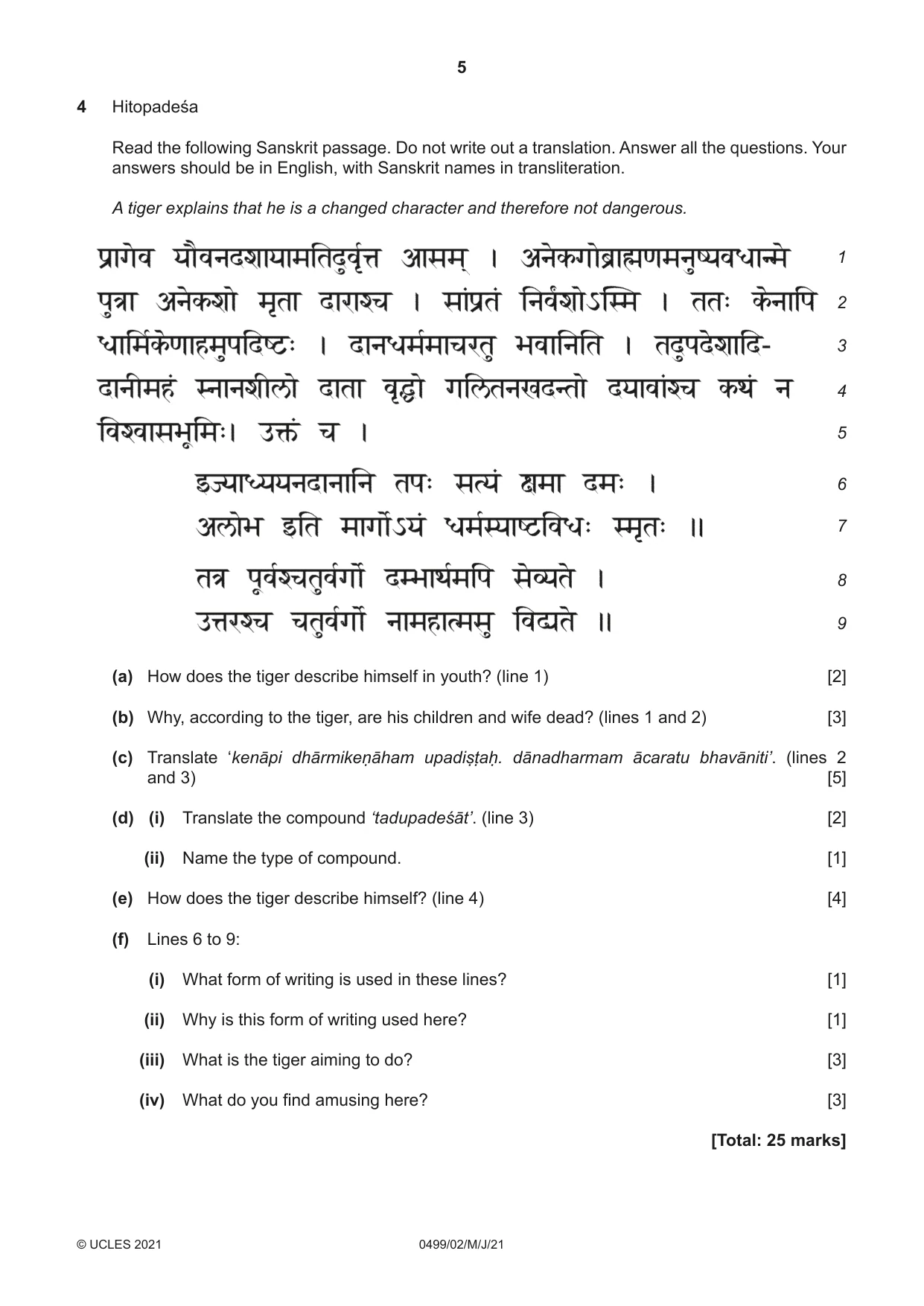
4 Hitopadeśa Read the following Sanskrit passage. Do not write out a translation. Answer all the questions. Your answers should be in English, with Sanskrit names in transliteration. A tiger explains that he is a changed character and therefore not dangerous. 1 2 3 4 5 6 7 8 9 (a) How does the tiger describe himself in youth? (line 1) [2] (b) Why, according to the tiger, are his children and wife dead? (lines 1 and 2) [3] (c) Translate ‘kenāpi dhārmikeṇāham upadiṣṭaḥ. dānadharmam ācaratu bhavāniti’. (lines 2 and 3) [5] (d) (i) Translate the compound ‘tadupadeśāt’. (line 3) [2] (ii) Name the type of compound. [1] (e) How does the tiger describe himself? (line 4) [4] (f) Lines 6 to 9: (i) What form of writing is used in these lines? [1] (ii) Why is this form of writing used here? [1] (iii) What is the tiger aiming to do? [3] (iv) What do you find amusing here? [3] [Total: 25 marks]