Cambridge IGCSE Sanskrit 0499 — 2020 May/June Paper 2 · Variant 0
0499/20/M/J/20 · 4 questions · 90 marks · ≈101 min
The question paper and its mark scheme, free to read here and free to download. This is Cambridge’s own paper, exactly as it was sat.
Question paper8 pages



Mark scheme
No mark scheme is in the library for this paper.
Questions as text
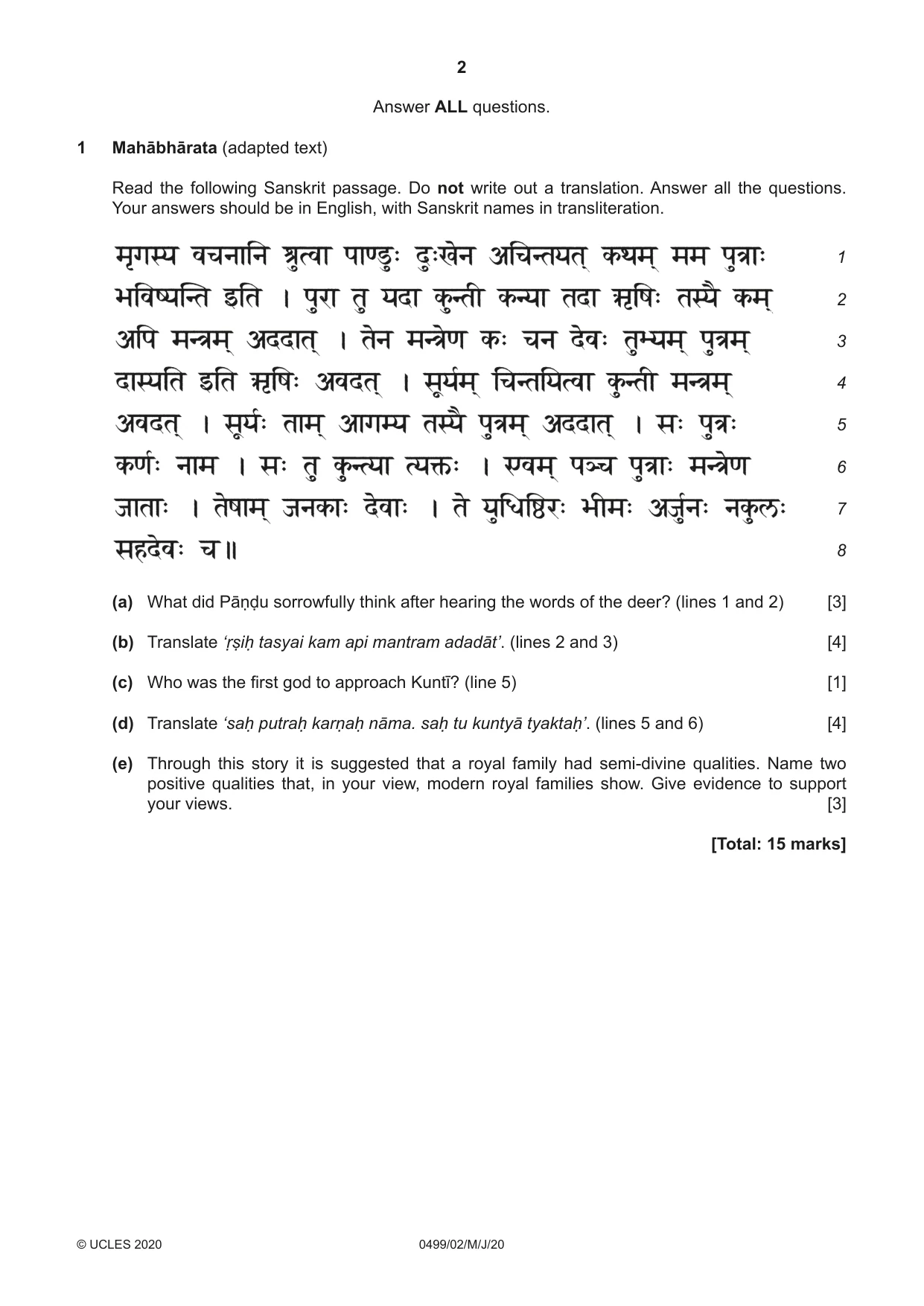
Q1 · Mahābhārata (adapted text) Read the following Sanskrit passage
1 Mahābhārata (adapted text) Read the following Sanskrit passage. Do not write out a translation. Answer all the questions. Your answers should be in English, with Sanskrit names in transliteration. 1 2 3 4 5 6 7 8 (a) What did Pāṇḍu sorrowfully think after hearing the words of the deer? (lines 1 and 2) [3] (b) Translate ‘ṛṣiḥ tasyai kam api mantram adadāt’. (lines 2 and 3) [4] (c) Who was the first god to approach Kuntī? (line 5) [1] (d) Translate ‘saḥ putraḥ karṇaḥ nāma. saḥ tu kuntyā tyaktaḥ’. (lines 5 and 6) [4] (e) Through this story it is suggested that a royal family had semi-divine qualities. Name two positive qualities that, in your view, modern royal families show. Give evidence to support your views. [3] [Total: 15 marks]
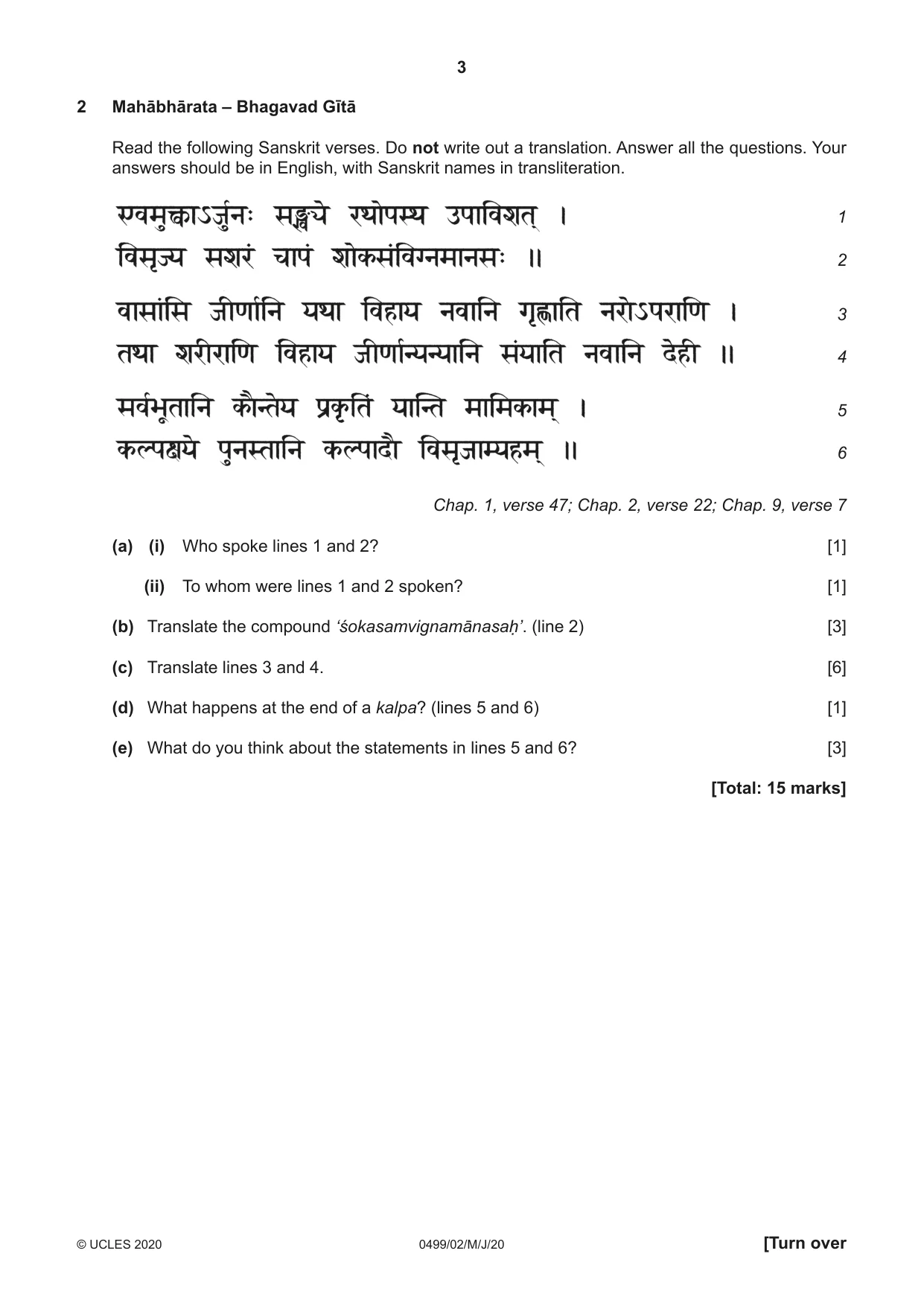
Q2 · Mahābhārata – Bhagavad Gītā Read the following Sanskrit verses
2 Mahābhārata – Bhagavad Gītā Read the following Sanskrit verses. Do not write out a translation. Answer all the questions. Your answers should be in English, with Sanskrit names in transliteration. 1 2 3 4 5 6 Chap. 1, verse 47; Chap. 2, verse 22; Chap. 9, verse 7 (a) (i) Who spoke lines 1 and 2? [1] (ii) To whom were lines 1 and 2 spoken? [1] (b) Translate the compound ‘śokasamvignamānasaḥ’. (line 2) [3] (c) Translate lines 3 and 4. [6] (d) What happens at the end of a kalpa? (lines 5 and 6) [1] (e) What do you think about the statements in lines 5 and 6? [3] [Total: 15 marks]
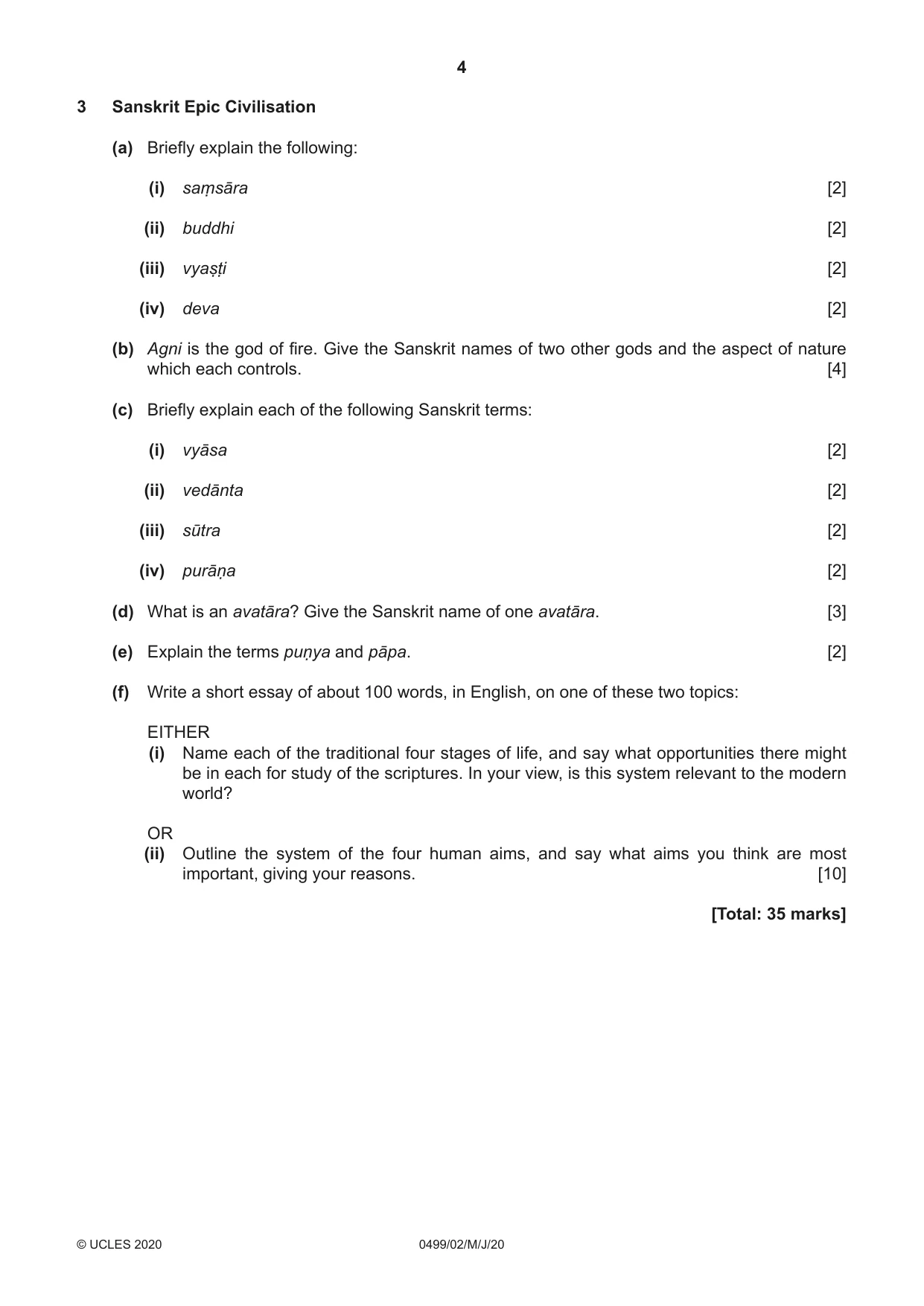
Q3 · Sanskrit Epic Civilisation (a) Briefly explain the following: (i) saṃsāra [2] (ii) buddhi…
3 Sanskrit Epic Civilisation (a) Briefly explain the following: (i) saṃsāra [2] (ii) buddhi [2] (iii) vyaṣṭi [2] (iv) deva [2] (b) Agni is the god of fire. Give the Sanskrit names of two other gods and the aspect of nature which each controls. [4] (c) Briefly explain each of the following Sanskrit terms: (i) vyāsa [2] (ii) vedānta [2] (iii) sūtra [2] (iv) purāṇa [2] (d) What is an avatāra? Give the Sanskrit name of one avatāra. [3] (e) Explain the terms puṇya and pāpa. [2] (f) Write a short essay of about 100 words, in English, on one of these two topics: EITHER (i) Name each of the traditional four stages of life, and say what opportunities there might be in each for study of the scriptures. In your view, is this system relevant to the modern world? OR (ii) Outline the system of the four human aims, and say what aims you think are most important, giving your reasons. [10] [Total: 35 marks]
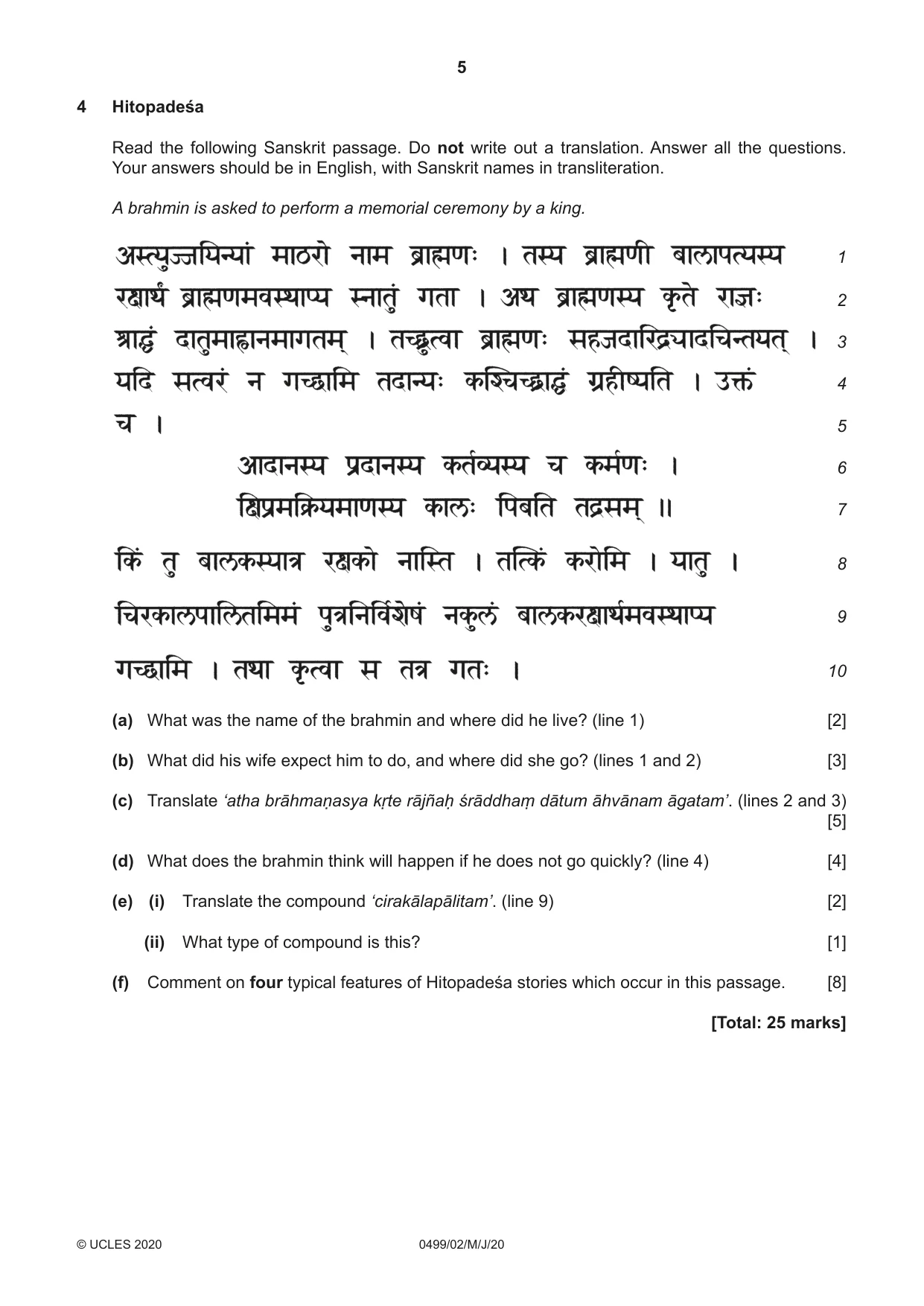
Q4 · Hitopadeśa Read the following Sanskrit passage
4 Hitopadeśa Read the following Sanskrit passage. Do not write out a translation. Answer all the questions. Your answers should be in English, with Sanskrit names in transliteration. A brahmin is asked to perform a memorial ceremony by a king. 1 2 3 4 5 6 7 8 9 10 (a) What was the name of the brahmin and where did he live? (line 1) [2] (b) What did his wife expect him to do, and where did she go? (lines 1 and 2) [3] (c) Translate ‘atha brāhmaṇasya kṛte rājñaḥ śrāddhaṃ dātum āhvānam āgatam’. (lines 2 and 3) [5] (d) What does the brahmin think will happen if he does not go quickly? (line 4) [4] (e) (i) Translate the compound ‘cirakālapālitam’. (line 9) [2] (ii) What type of compound is this? [1] (f) Comment on four typical features of Hitopadeśa stories which occur in this passage. [8] [Total: 25 marks]