Cambridge IGCSE Religious Studies 0490 — 2006 Oct/Nov Paper 1 · Variant 1
0490/11/O/N/06 · 102 marks · ≈115 min
The question paper and its mark scheme, free to read here and free to download. This is Cambridge’s own paper, exactly as it was sat.
Question paper4 pages
Mark scheme7 pages
Answers below. Sit the paper first if you are practising.
Paper as text
Question paper, page 1
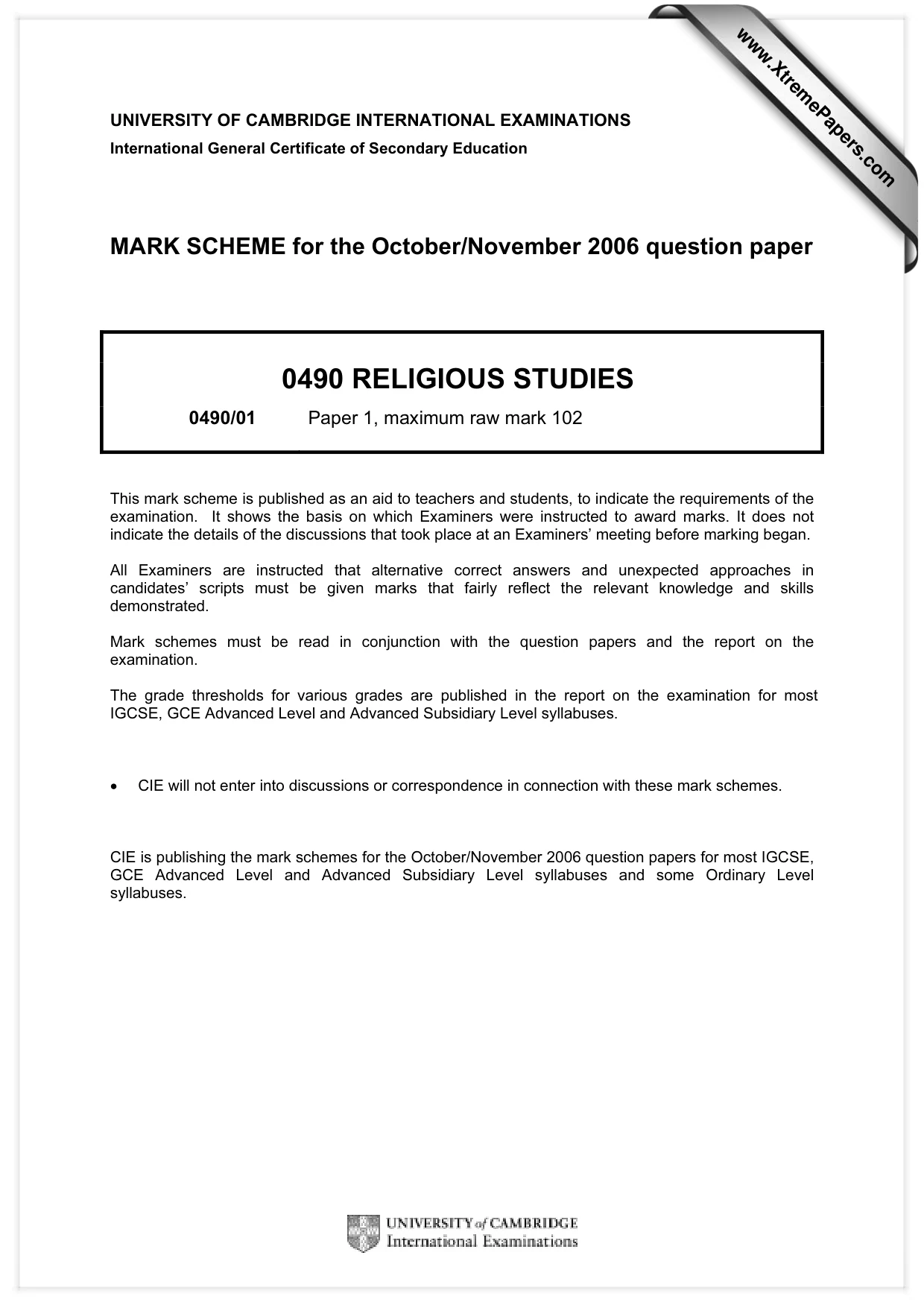
This document consists of 3 printed pages and 1 blank page. SJF3747 T01288/2 © UCLES 2006 [Turn over UNIVERSITY OF CAMBRIDGE INTERNATIONAL EXAMINATIONS International General Certificate of Secondary Education RELIGIOUS STUDIES 0490/01 Paper 1 October/November 2006 1 hour 15 minutes Additional Materials: Answer Booklet/Paper READ THESE INSTRUCTIONS FIRST If you have been given an Answer Booklet, follow the instructions on the front cover of the Booklet. Write your Centre number, candidate number and name on all the work you hand in. Write in dark blue or black pen. Do not use staples, paper clips, highlighters, glue or correction fluid. Answer all questions in Section A, two questions from Section B and one question from Section C. At the end of the examination, fasten all your work securely together. The number of marks is given in brackets [ ] at the end of each question or part question. www.XtremePapers.com
Question paper, page 2
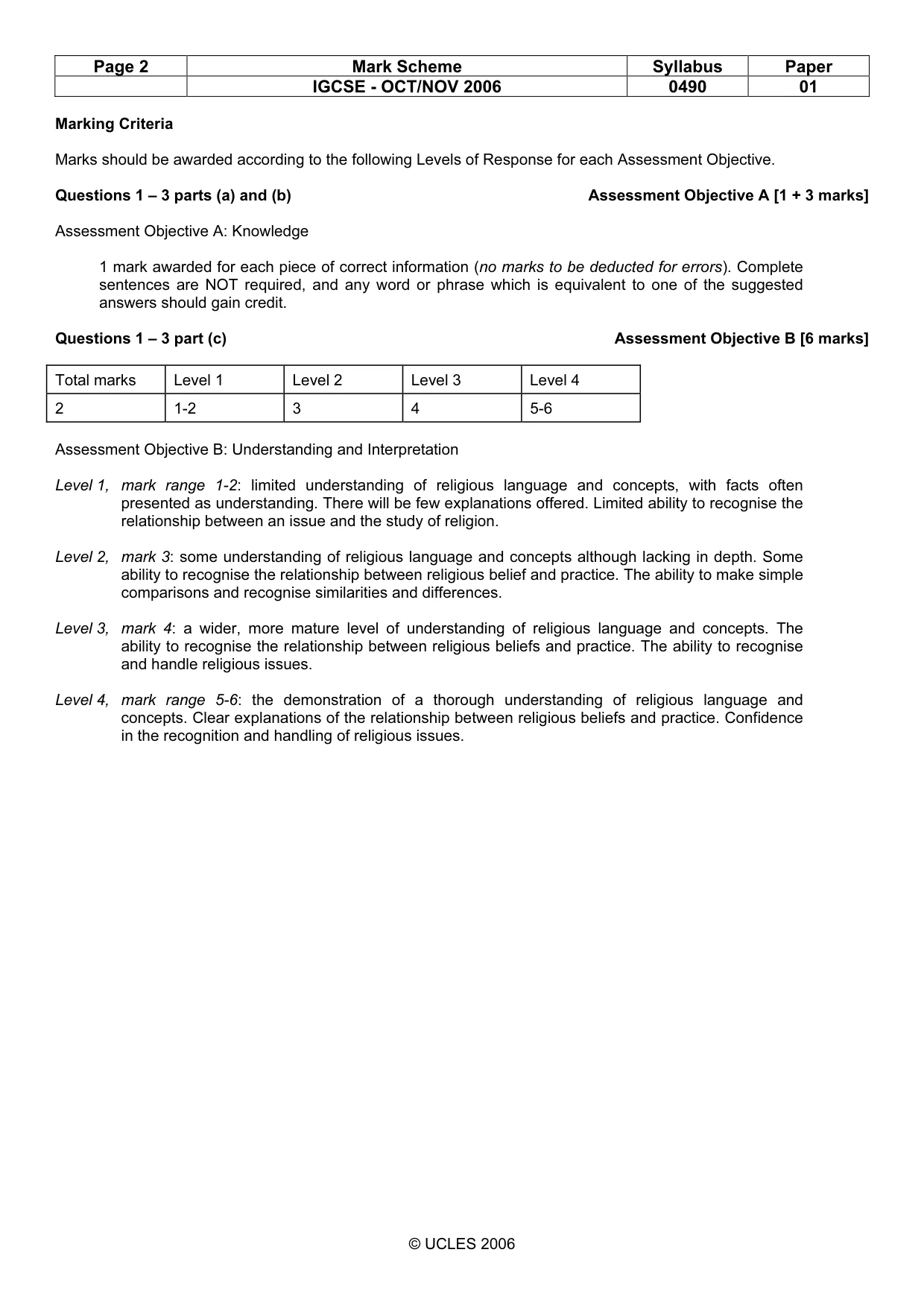
2 0490/01/O/N/06 Section A In this section, answer all the questions. 1 CHRISTIANITY (a) What does the festival of Pentecost (Whitsun) celebrate? [1] (b) State three things that happened in the story of Pentecost. [3] (c) Explain the importance of this festival for Christians. [6] 2 ISLAM (a) What is Ramadan? [1] (b) Name three special rules which Muslims keep during Ramadan. [3] (c) Explain the importance of Ramadan in a Muslim’s life. [6] 3 JUDAISM (a) What is the name of the place where Jews attend religious services? [1] (b) Name three religious objects which you would expect to find in this building. [3] (c) Explain the importance of this building for the Jewish community. [6] Section B In this section, answer both parts of two questions. 4 CHRISTIANITY (a) Describe what happens in the service of Holy Communion (Eucharist). [12] (b) Explain the importance of this service for Christians. [12] 5 ISLAM (a) Describe a religious wedding ceremony in Islam. [12] (b) Explain the importance of a religious wedding for Muslims. [12] 6 JUDAISM (a) Describe what happens in a Jewish home at the festival of Pesach (Passover). [12] (b) Explain the importance for Jews of the events celebrated at the festival. [12] © UCLES 2006
Question paper, page 3
© UCLES 2006 3 0490/01/O/N/06 Section C In this section, answer both parts of either Question 7 or Question 8. 7 (a) For two of Christianity, Islam and Judaism, describe the sacred writings of the religion. [12] (b) Explain why these sacred writings are important to believers in each of the two religions you have chosen. [12] 8 (a) For two of Christianity, Islam and Judaism, name a place of pilgrimage and describe what pilgrims do there. [12] (b) Explain the importance of pilgrimage to the believers of each of the two religions you have chosen. [12]
Question paper, page 4
4 0490/01/O/N/06 BLANK PAGE Permission to reproduce items where third-party owned material protected by copyright is included has been sought and cleared where possible. Every reasonable effort has been made by the publisher (UCLES) to trace copyright holders, but if any items requiring clearance have unwittingly been included, the publisher will be pleased to make amends at the earliest possible opportunity. University of Cambridge International Examinations is part of the University of Cambridge Local Examinations Syndicate (UCLES), which is itself a department of the University of Cambridge.
Mark scheme, page 1
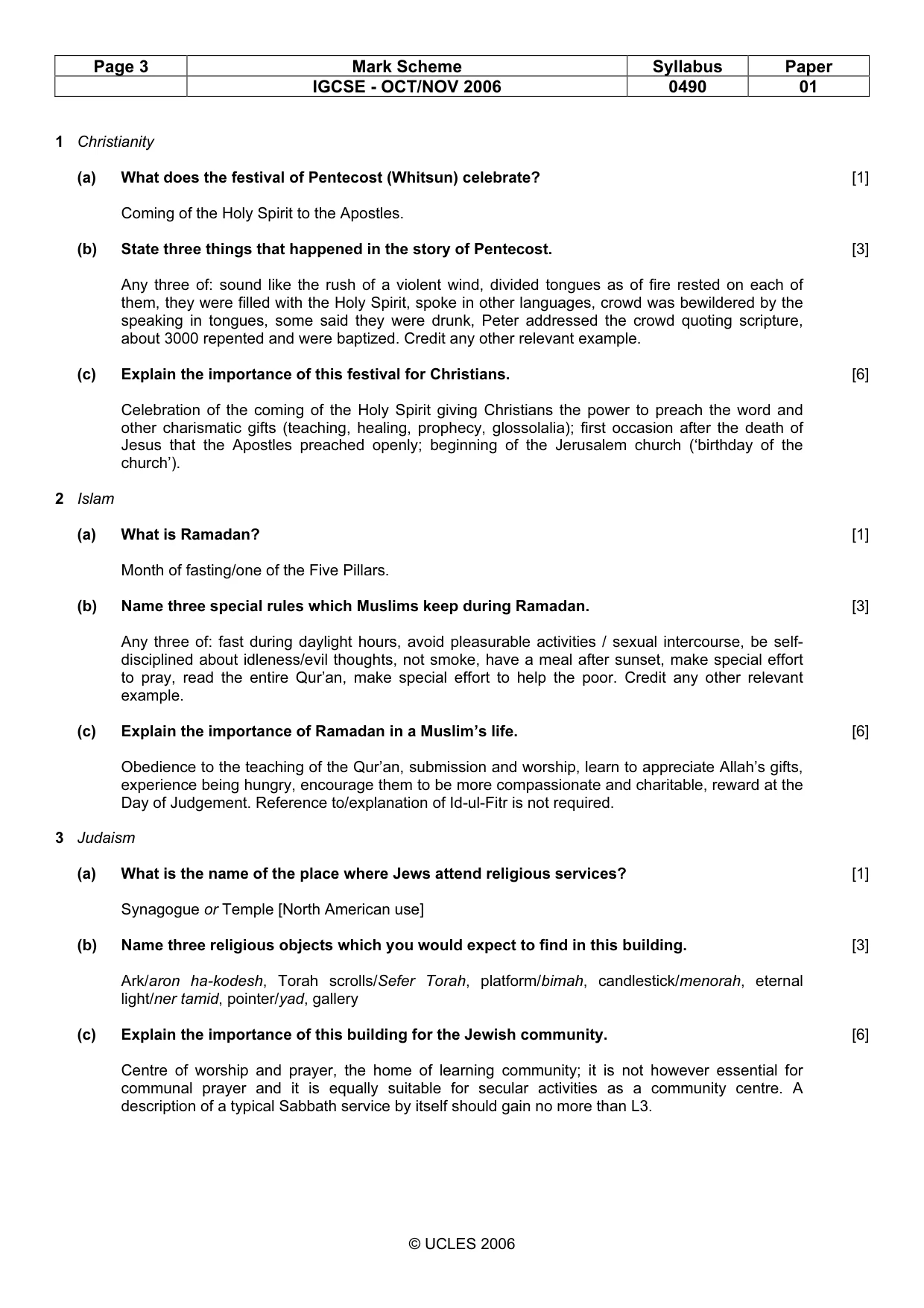
UNIVERSITY OF CAMBRIDGE INTERNATIONAL EXAMINATIONS International General Certificate of Secondary Education MARK SCHEME for the October/November 2006 question paper 0490 RELIGIOUS STUDIES 0490/01 Paper 1, maximum raw mark 102 This mark scheme is published as an aid to teachers and students, to indicate the requirements of the examination. It shows the basis on which Examiners were instructed to award marks. It does not indicate the details of the discussions that took place at an Examiners’ meeting before marking began. All Examiners are instructed that alternative correct answers and unexpected approaches in candidates’ scripts must be given marks that fairly reflect the relevant knowledge and skills demonstrated. Mark schemes must be read in conjunction with the question papers and the report on the examination. The grade thresholds for various grades are published in the report on the examination for most IGCSE, GCE Advanced Level and Advanced Subsidiary Level syllabuses. • CIE will not enter into discussions or correspondence in connection with these mark schemes. CIE is publishing the mark schemes for the October/November 2006 question papers for most IGCSE, GCE Advanced Level and Advanced Subsidiary Level syllabuses and some Ordinary Level syllabuses. www.XtremePapers.com
Mark scheme, page 2
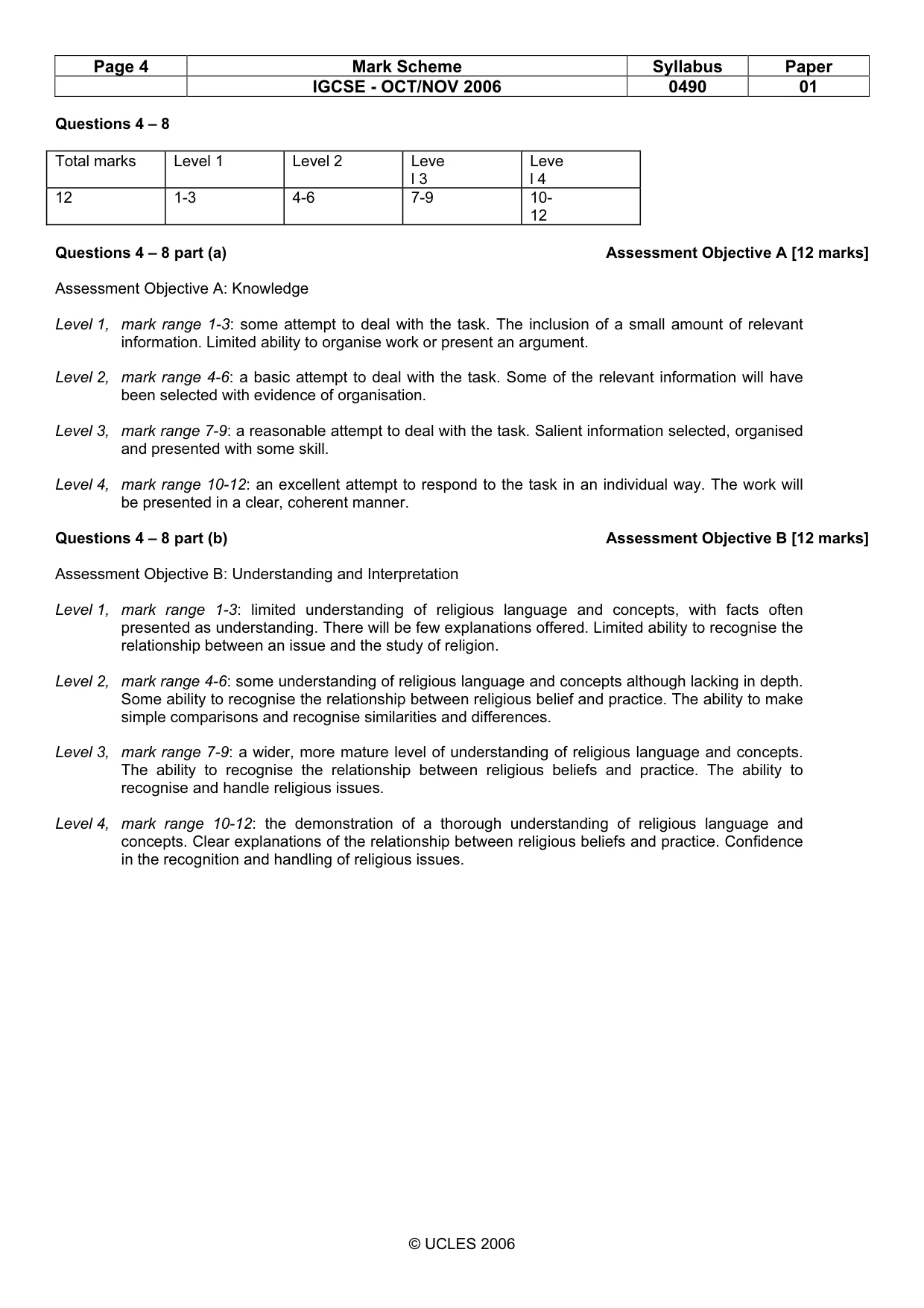
Page 2 Mark Scheme Syllabus Paper IGCSE - OCT/NOV 2006 0490 01 © UCLES 2006 Marking Criteria Marks should be awarded according to the following Levels of Response for each Assessment Objective. Questions 1 – 3 parts (a) and (b) Assessment Objective A [1 + 3 marks] Assessment Objective A: Knowledge 1 mark awarded for each piece of correct information (no marks to be deducted for errors). Complete sentences are NOT required, and any word or phrase which is equivalent to one of the suggested answers should gain credit. Questions 1 – 3 part (c) Assessment Objective B [6 marks] Total marks Level 1 Level 2 Level 3 Level 4 2 1-2 3 4 5-6 Assessment Objective B: Understanding and Interpretation Level 1, mark range 1-2: limited understanding of religious language and concepts, with facts often presented as understanding. There will be few explanations offered. Limited ability to recognise the relationship between an issue and the study of religion. Level 2, mark 3: some understanding of religious language and concepts although lacking in depth. Some ability to recognise the relationship between religious belief and practice. The ability to make simple comparisons and recognise similarities and differences. Level 3, mark 4: a wider, more mature level of understanding of religious language and concepts. The ability to recognise the relationship between religious beliefs and practice. The ability to recognise and handle religious issues. Level 4, mark range 5-6: the demonstration of a thorough understanding of religious language and concepts. Clear explanations of the relationship between religious beliefs and practice. Confidence in the recognition and handling of religious issues.
Mark scheme, page 3
Page 3 Mark Scheme Syllabus Paper IGCSE - OCT/NOV 2006 0490 01 © UCLES 2006 1 Christianity (a) What does the festival of Pentecost (Whitsun) celebrate? [1] Coming of the Holy Spirit to the Apostles. (b) State three things that happened in the story of Pentecost. [3] Any three of: sound like the rush of a violent wind, divided tongues as of fire rested on each of them, they were filled with the Holy Spirit, spoke in other languages, crowd was bewildered by the speaking in tongues, some said they were drunk, Peter addressed the crowd quoting scripture, about 3000 repented and were baptized. Credit any other relevant example. (c) Explain the importance of this festival for Christians. [6] Celebration of the coming of the Holy Spirit giving Christians the power to preach the word and other charismatic gifts (teaching, healing, prophecy, glossolalia); first occasion after the death of Jesus that the Apostles preached openly; beginning of the Jerusalem church (‘birthday of the church’). 2 Islam (a) What is Ramadan? [1] Month of fasting/one of the Five Pillars. (b) Name three special rules which Muslims keep during Ramadan. [3] Any three of: fast during daylight hours, avoid pleasurable activities / sexual intercourse, be self- disciplined about idleness/evil thoughts, not smoke, have a meal after sunset, make special effort to pray, read the entire Qur’an, make special effort to help the poor. Credit any other relevant example. (c) Explain the importance of Ramadan in a Muslim’s life. [6] Obedience to the teaching of the Qur’an, submission and worship, learn to appreciate Allah’s gifts, experience being hungry, encourage them to be more compassionate and charitable, reward at the Day of Judgement. Reference to/explanation of Id-ul-Fitr is not required. 3 Judaism (a) What is the name of the place where Jews attend religious services? [1] Synagogue or Temple [North American use] (b) Name three religious objects which you would expect to find in this building. [3] Ark/aron ha-kodesh, Torah scrolls/Sefer Torah, platform/bimah, candlestick/menorah, eternal light/ner tamid, pointer/yad, gallery (c) Explain the importance of this building for the Jewish community. [6] Centre of worship and prayer, the home of learning community; it is not however essential for communal prayer and it is equally suitable for secular activities as a community centre. A description of a typical Sabbath service by itself should gain no more than L3.
Mark scheme, page 4
Page 4 Mark Scheme Syllabus Paper IGCSE - OCT/NOV 2006 0490 01 © UCLES 2006 Questions 4 – 8 Total marks Level 1 Level 2 Leve l 3 Leve l 4 12 1-3 4-6 7-9 10- 12 Questions 4 – 8 part (a) Assessment Objective A [12 marks] Assessment Objective A: Knowledge Level 1, mark range 1-3: some attempt to deal with the task. The inclusion of a small amount of relevant information. Limited ability to organise work or present an argument. Level 2, mark range 4-6: a basic attempt to deal with the task. Some of the relevant information will have been selected with evidence of organisation. Level 3, mark range 7-9: a reasonable attempt to deal with the task. Salient information selected, organised and presented with some skill. Level 4, mark range 10-12: an excellent attempt to respond to the task in an individual way. The work will be presented in a clear, coherent manner. Questions 4 – 8 part (b) Assessment Objective B [12 marks] Assessment Objective B: Understanding and Interpretation Level 1, mark range 1-3: limited understanding of religious language and concepts, with facts often presented as understanding. There will be few explanations offered. Limited ability to recognise the relationship between an issue and the study of religion. Level 2, mark range 4-6: some understanding of religious language and concepts although lacking in depth. Some ability to recognise the relationship between religious belief and practice. The ability to make simple comparisons and recognise similarities and differences. Level 3, mark range 7-9: a wider, more mature level of understanding of religious language and concepts. The ability to recognise the relationship between religious beliefs and practice. The ability to recognise and handle religious issues. Level 4, mark range 10-12: the demonstration of a thorough understanding of religious language and concepts. Clear explanations of the relationship between religious beliefs and practice. Confidence in the recognition and handling of religious issues.
Mark scheme, page 5
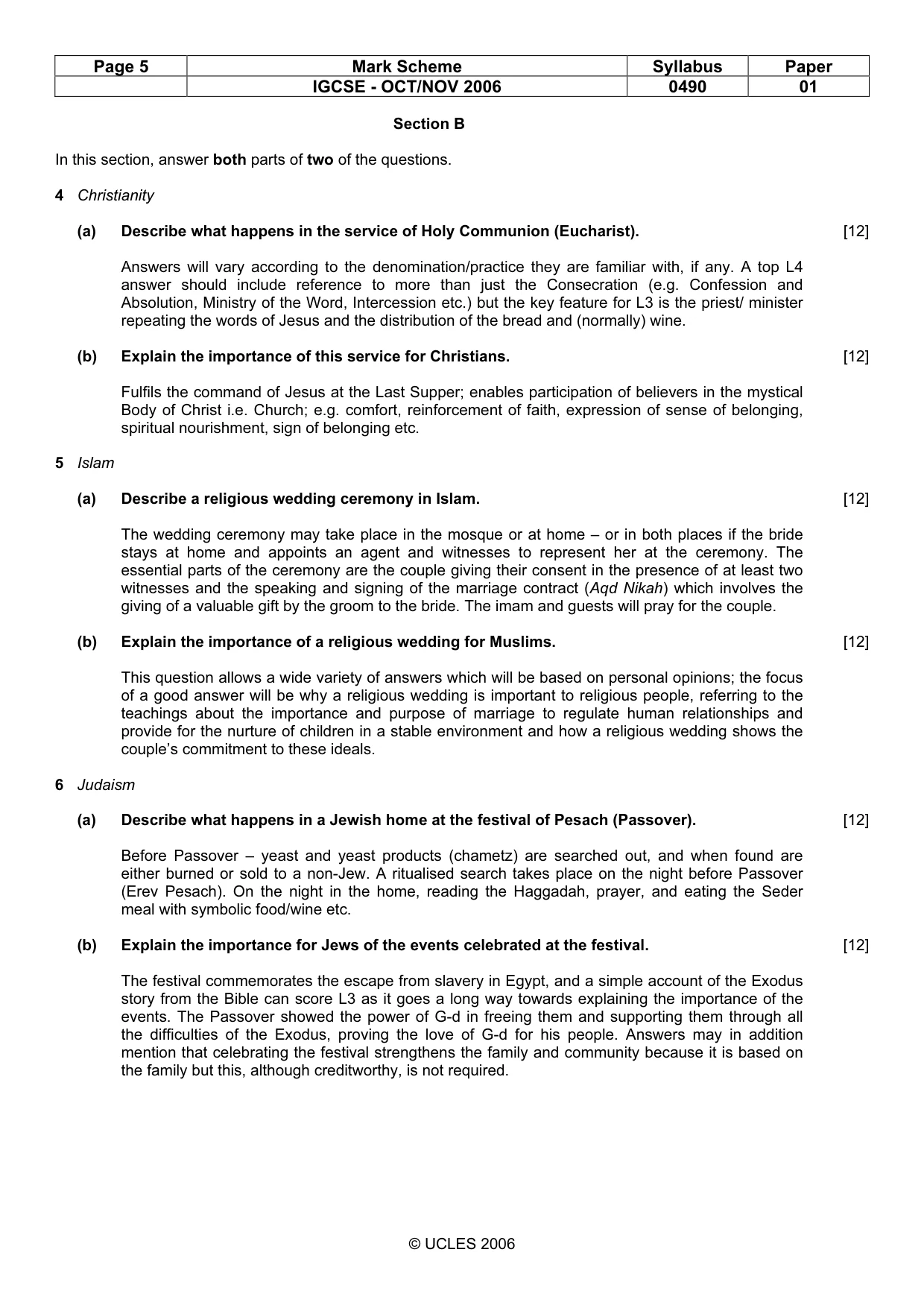
Page 5 Mark Scheme Syllabus Paper IGCSE - OCT/NOV 2006 0490 01 © UCLES 2006 Section B In this section, answer both parts of two of the questions. 4 Christianity (a) Describe what happens in the service of Holy Communion (Eucharist). [12] Answers will vary according to the denomination/practice they are familiar with, if any. A top L4 answer should include reference to more than just the Consecration (e.g. Confession and Absolution, Ministry of the Word, Intercession etc.) but the key feature for L3 is the priest/ minister repeating the words of Jesus and the distribution of the bread and (normally) wine. (b) Explain the importance of this service for Christians. [12] Fulfils the command of Jesus at the Last Supper; enables participation of believers in the mystical Body of Christ i.e. Church; e.g. comfort, reinforcement of faith, expression of sense of belonging, spiritual nourishment, sign of belonging etc. 5 Islam (a) Describe a religious wedding ceremony in Islam. [12] The wedding ceremony may take place in the mosque or at home – or in both places if the bride stays at home and appoints an agent and witnesses to represent her at the ceremony. The essential parts of the ceremony are the couple giving their consent in the presence of at least two witnesses and the speaking and signing of the marriage contract (Aqd Nikah) which involves the giving of a valuable gift by the groom to the bride. The imam and guests will pray for the couple. (b) Explain the importance of a religious wedding for Muslims. [12] This question allows a wide variety of answers which will be based on personal opinions; the focus of a good answer will be why a religious wedding is important to religious people, referring to the teachings about the importance and purpose of marriage to regulate human relationships and provide for the nurture of children in a stable environment and how a religious wedding shows the couple’s commitment to these ideals. 6 Judaism (a) Describe what happens in a Jewish home at the festival of Pesach (Passover). [12] Before Passover – yeast and yeast products (chametz) are searched out, and when found are either burned or sold to a non-Jew. A ritualised search takes place on the night before Passover (Erev Pesach). On the night in the home, reading the Haggadah, prayer, and eating the Seder meal with symbolic food/wine etc. (b) Explain the importance for Jews of the events celebrated at the festival. [12] The festival commemorates the escape from slavery in Egypt, and a simple account of the Exodus story from the Bible can score L3 as it goes a long way towards explaining the importance of the events. The Passover showed the power of G-d in freeing them and supporting them through all the difficulties of the Exodus, proving the love of G-d for his people. Answers may in addition mention that celebrating the festival strengthens the family and community because it is based on the family but this, although creditworthy, is not required.
Mark scheme, page 6
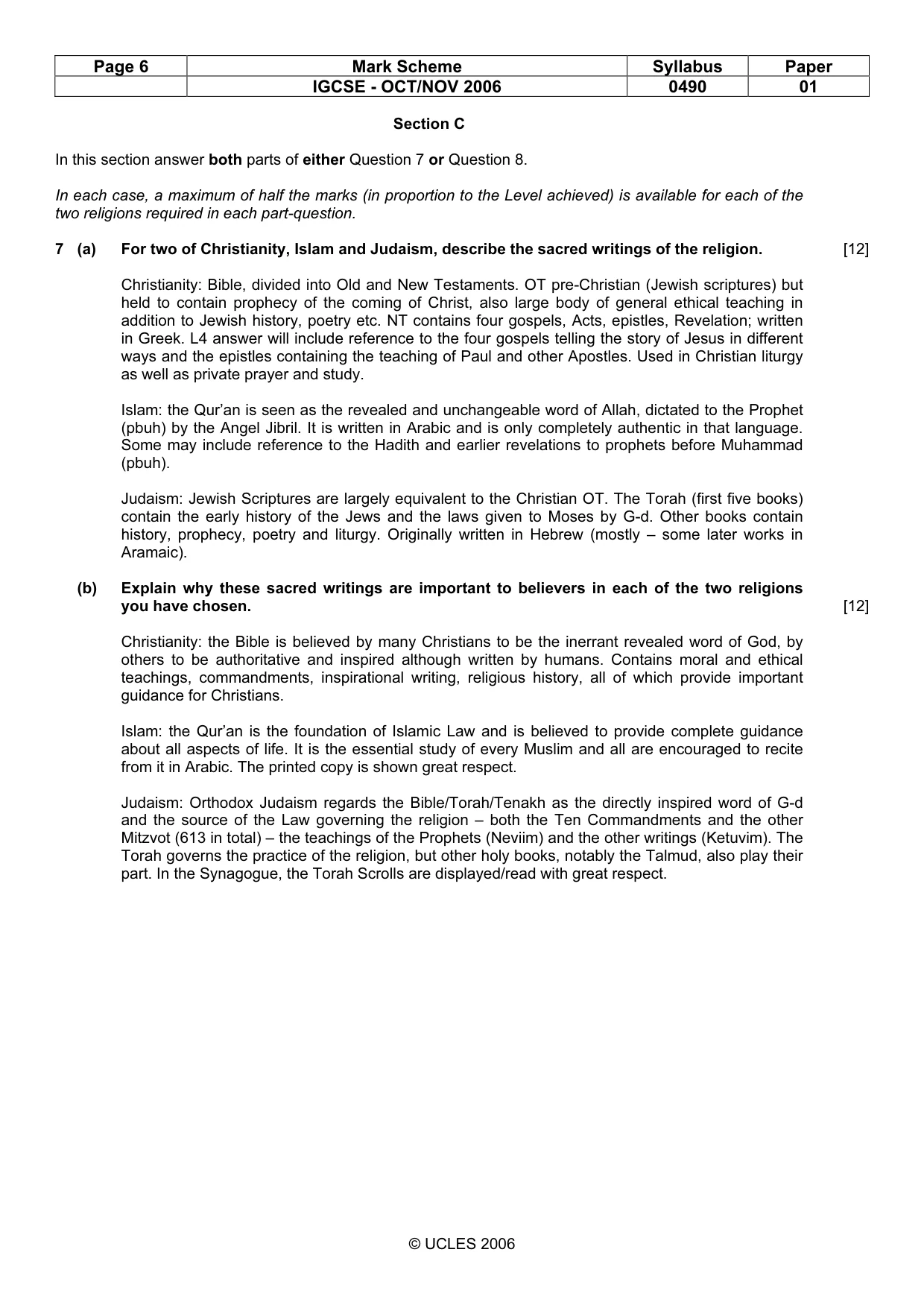
Page 6 Mark Scheme Syllabus Paper IGCSE - OCT/NOV 2006 0490 01 © UCLES 2006 Section C In this section answer both parts of either Question 7 or Question 8. In each case, a maximum of half the marks (in proportion to the Level achieved) is available for each of the two religions required in each part-question. 7 (a) For two of Christianity, Islam and Judaism, describe the sacred writings of the religion. [12] Christianity: Bible, divided into Old and New Testaments. OT pre-Christian (Jewish scriptures) but held to contain prophecy of the coming of Christ, also large body of general ethical teaching in addition to Jewish history, poetry etc. NT contains four gospels, Acts, epistles, Revelation; written in Greek. L4 answer will include reference to the four gospels telling the story of Jesus in different ways and the epistles containing the teaching of Paul and other Apostles. Used in Christian liturgy as well as private prayer and study. Islam: the Qur’an is seen as the revealed and unchangeable word of Allah, dictated to the Prophet (pbuh) by the Angel Jibril. It is written in Arabic and is only completely authentic in that language. Some may include reference to the Hadith and earlier revelations to prophets before Muhammad (pbuh). Judaism: Jewish Scriptures are largely equivalent to the Christian OT. The Torah (first five books) contain the early history of the Jews and the laws given to Moses by G-d. Other books contain history, prophecy, poetry and liturgy. Originally written in Hebrew (mostly – some later works in Aramaic). (b) Explain why these sacred writings are important to believers in each of the two religions you have chosen. [12] Christianity: the Bible is believed by many Christians to be the inerrant revealed word of God, by others to be authoritative and inspired although written by humans. Contains moral and ethical teachings, commandments, inspirational writing, religious history, all of which provide important guidance for Christians. Islam: the Qur’an is the foundation of Islamic Law and is believed to provide complete guidance about all aspects of life. It is the essential study of every Muslim and all are encouraged to recite from it in Arabic. The printed copy is shown great respect. Judaism: Orthodox Judaism regards the Bible/Torah/Tenakh as the directly inspired word of G-d and the source of the Law governing the religion – both the Ten Commandments and the other Mitzvot (613 in total) – the teachings of the Prophets (Neviim) and the other writings (Ketuvim). The Torah governs the practice of the religion, but other holy books, notably the Talmud, also play their part. In the Synagogue, the Torah Scrolls are displayed/read with great respect.
Mark scheme, page 7
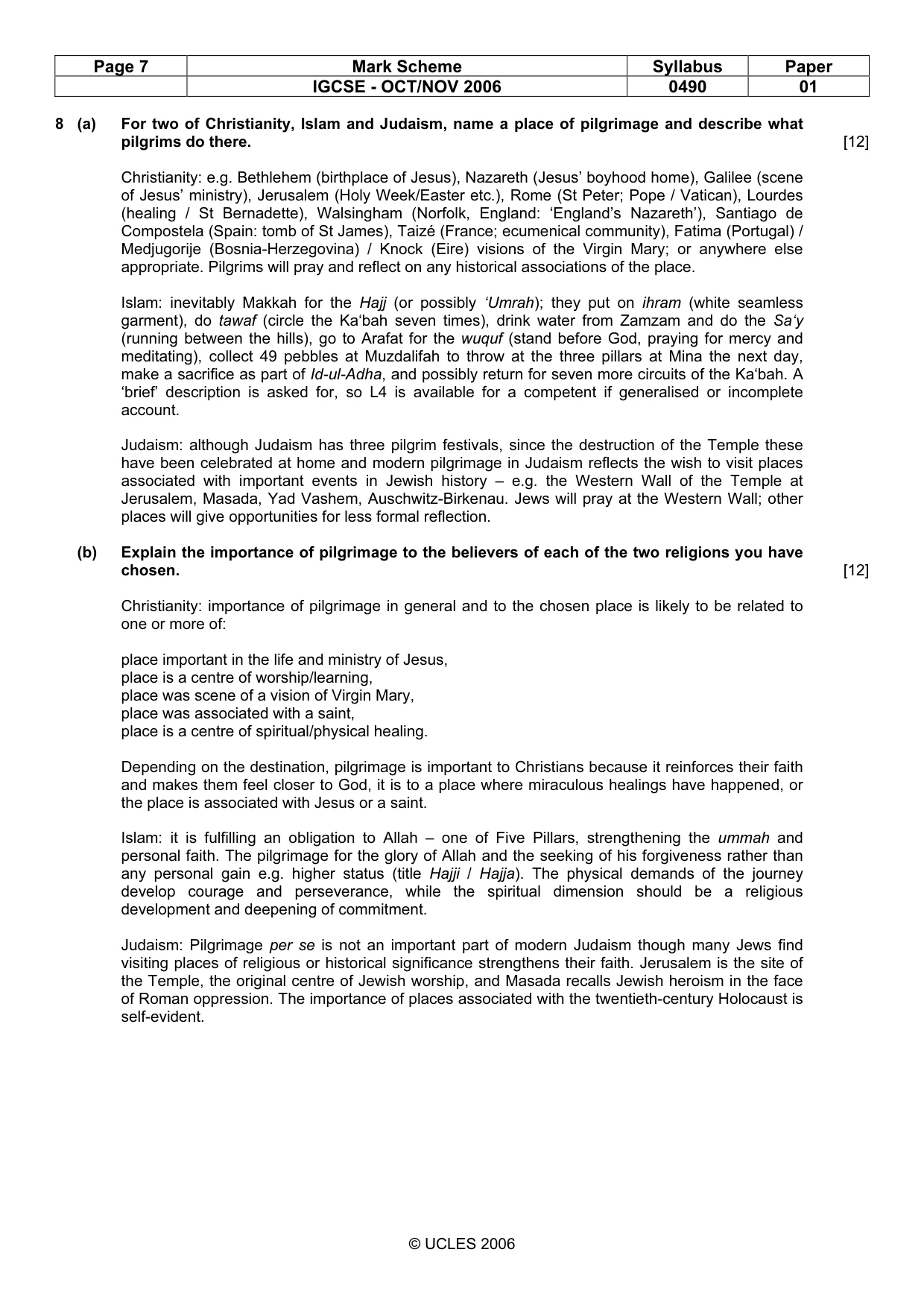
Page 7 Mark Scheme Syllabus Paper IGCSE - OCT/NOV 2006 0490 01 © UCLES 2006 8 (a) For two of Christianity, Islam and Judaism, name a place of pilgrimage and describe what pilgrims do there. [12] Christianity: e.g. Bethlehem (birthplace of Jesus), Nazareth (Jesus’ boyhood home), Galilee (scene of Jesus’ ministry), Jerusalem (Holy Week/Easter etc.), Rome (St Peter; Pope / Vatican), Lourdes (healing / St Bernadette), Walsingham (Norfolk, England: ‘England’s Nazareth’), Santiago de Compostela (Spain: tomb of St James), Taizé (France; ecumenical community), Fatima (Portugal) / Medjugorije (Bosnia-Herzegovina) / Knock (Eire) visions of the Virgin Mary; or anywhere else appropriate. Pilgrims will pray and reflect on any historical associations of the place. Islam: inevitably Makkah for the Hajj (or possibly ‘Umrah); they put on ihram (white seamless garment), do tawaf (circle the Ka‘bah seven times), drink water from Zamzam and do the Sa‘y (running between the hills), go to Arafat for the wuquf (stand before God, praying for mercy and meditating), collect 49 pebbles at Muzdalifah to throw at the three pillars at Mina the next day, make a sacrifice as part of Id-ul-Adha, and possibly return for seven more circuits of the Ka‘bah. A ‘brief’ description is asked for, so L4 is available for a competent if generalised or incomplete account. Judaism: although Judaism has three pilgrim festivals, since the destruction of the Temple these have been celebrated at home and modern pilgrimage in Judaism reflects the wish to visit places associated with important events in Jewish history – e.g. the Western Wall of the Temple at Jerusalem, Masada, Yad Vashem, Auschwitz-Birkenau. Jews will pray at the Western Wall; other places will give opportunities for less formal reflection. (b) Explain the importance of pilgrimage to the believers of each of the two religions you have chosen. [12] Christianity: importance of pilgrimage in general and to the chosen place is likely to be related to one or more of: place important in the life and ministry of Jesus, place is a centre of worship/learning, place was scene of a vision of Virgin Mary, place was associated with a saint, place is a centre of spiritual/physical healing. Depending on the destination, pilgrimage is important to Christians because it reinforces their faith and makes them feel closer to God, it is to a place where miraculous healings have happened, or the place is associated with Jesus or a saint. Islam: it is fulfilling an obligation to Allah – one of Five Pillars, strengthening the ummah and personal faith. The pilgrimage for the glory of Allah and the seeking of his forgiveness rather than any personal gain e.g. higher status (title Hajji / Hajja). The physical demands of the journey develop courage and perseverance, while the spiritual dimension should be a religious development and deepening of commitment. Judaism: Pilgrimage per se is not an important part of modern Judaism though many Jews find visiting places of religious or historical significance strengthens their faith. Jerusalem is the site of the Temple, the original centre of Jewish worship, and Masada recalls Jewish heroism in the face of Roman oppression. The importance of places associated with the twentieth-century Holocaust is self-evident.
What you needed in this session
Cambridge’s own grade thresholds for 2006 Oct/Nov, Paper 1 · Variant 1. A higher threshold means an easier paper — the bar moves with how the cohort did.