Cambridge IGCSE Physics (9-1) 0972 — 2023 May/June Paper 3 · Variant 2
0972/32/M/J/23 · 11 questions · 80 marks · ≈90 min
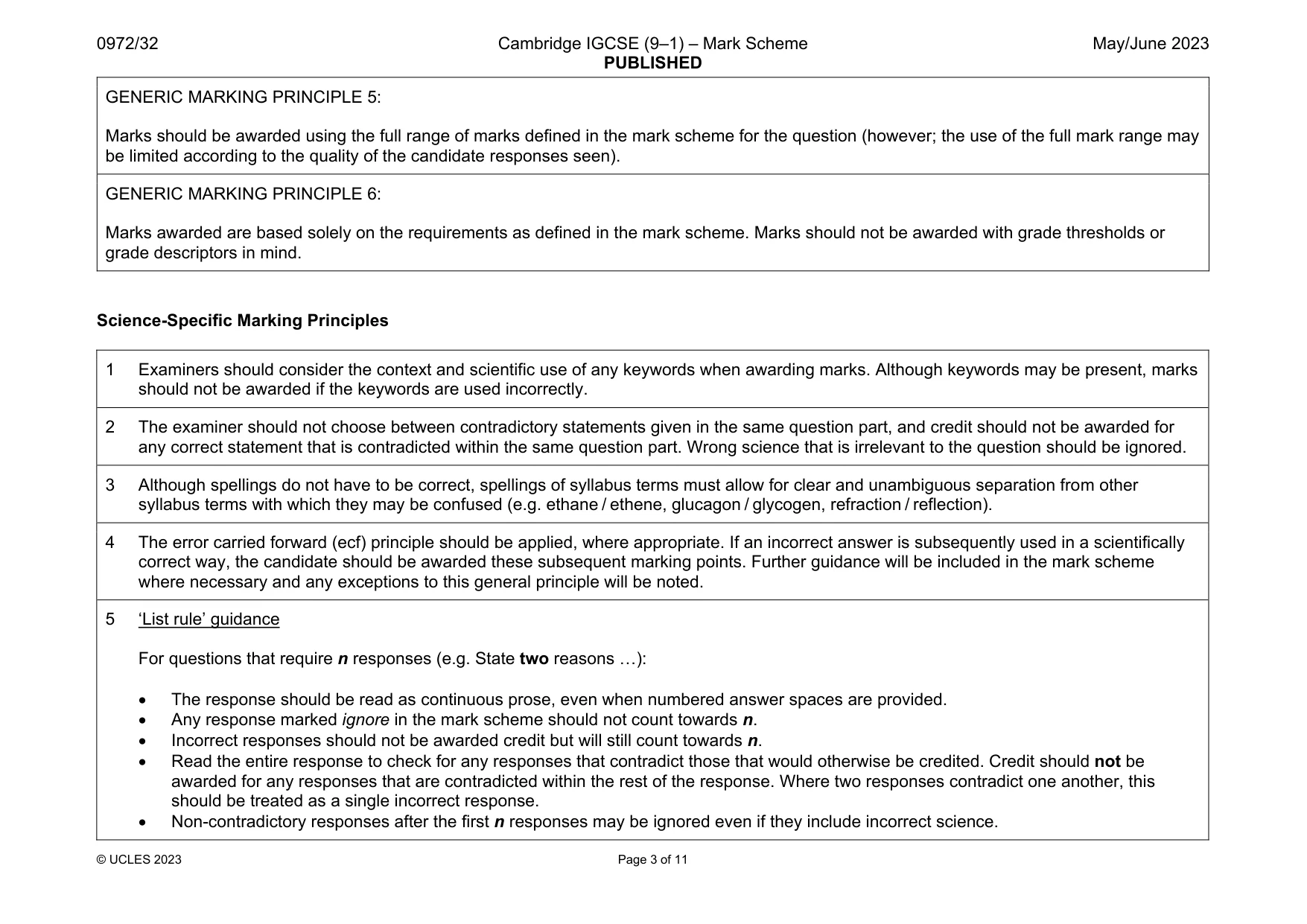
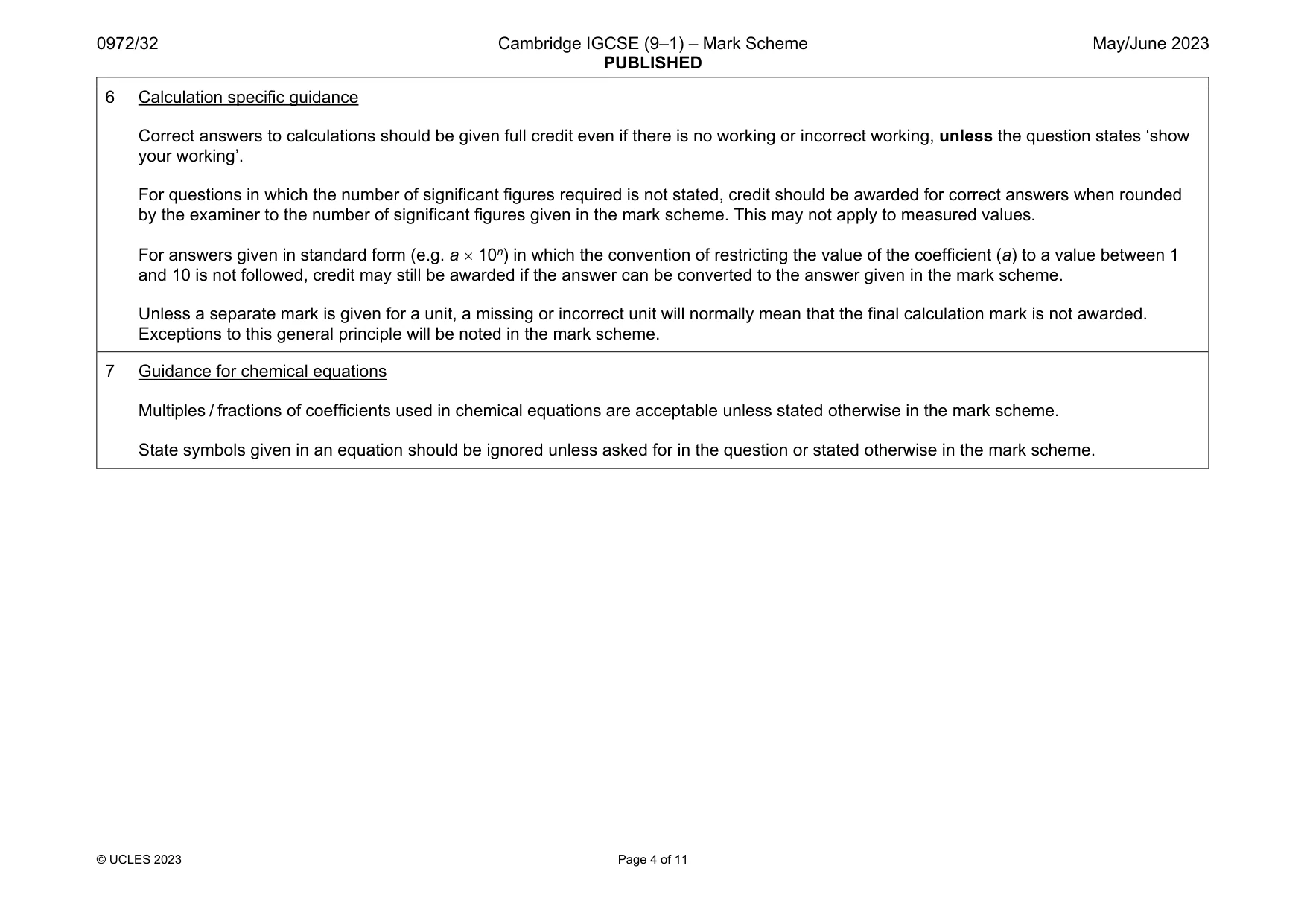
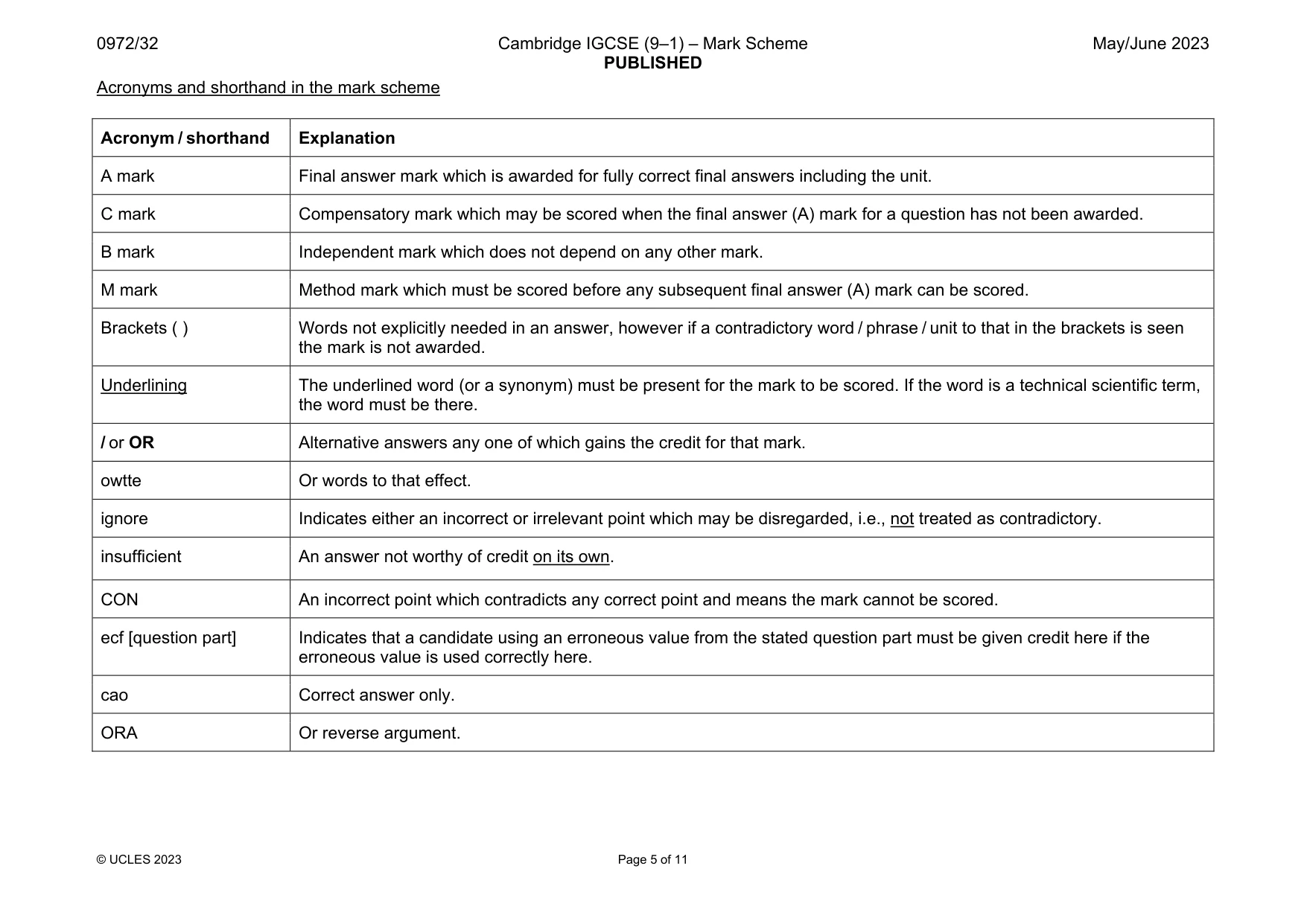
The question paper and its mark scheme, free to read here and free to download. This is Cambridge’s own paper, exactly as it was sat.
Question paper16 pages


Mark scheme11 pages
Answers below. Sit the paper first if you are practising.
Questions as text
Q1 · A student measures the diameter of some identical steel balls
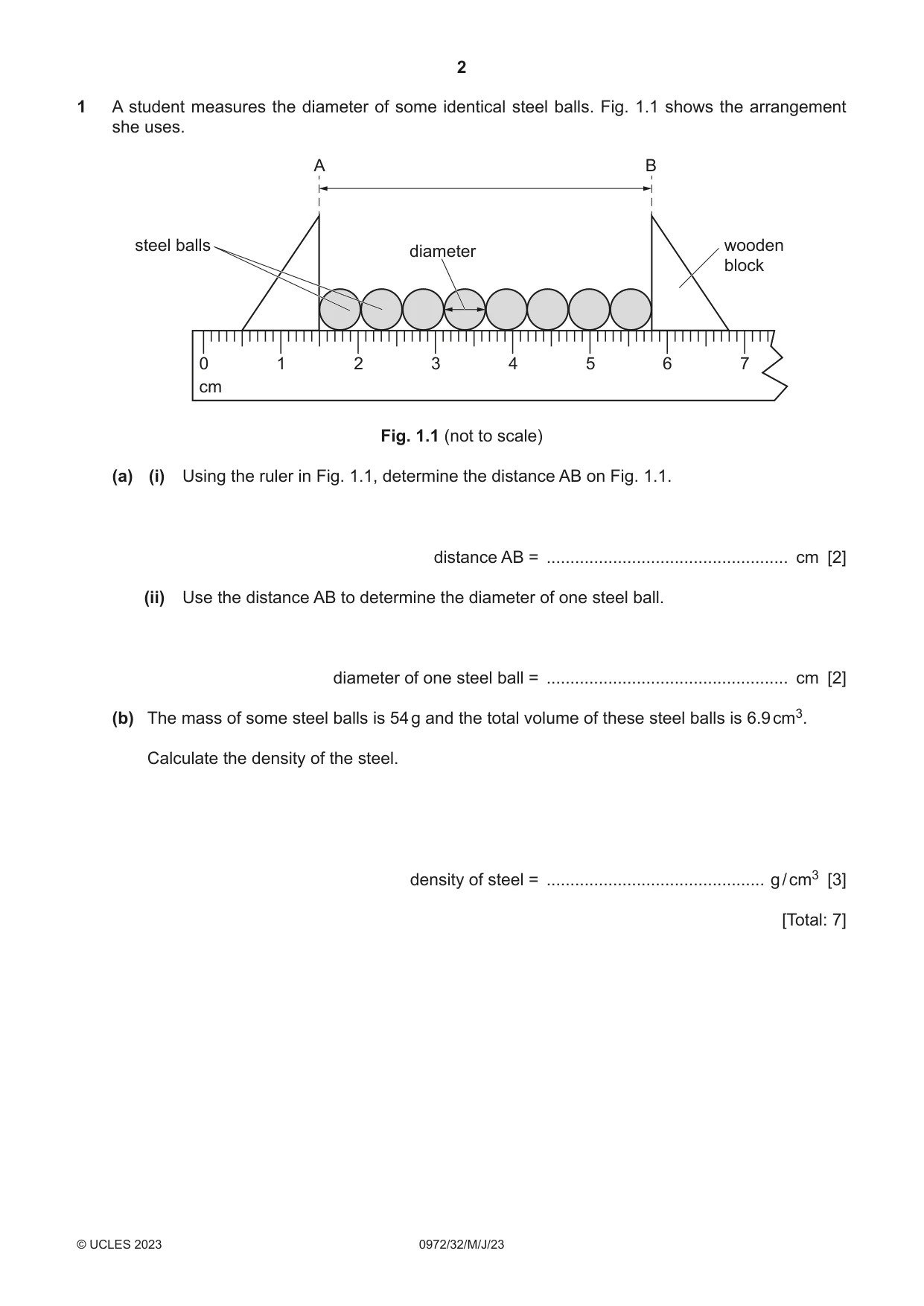
1 A student measures the diameter of some identical steel balls. Fig. 1.1 shows the arrangement she uses. A B steel balls wooden diameter block 0 1 2 3 4 5 6 7 cm Fig. 1.1 (not to scale) (a) (i) Using the ruler in Fig. 1.1, determine the distance AB on Fig. 1.1. distance AB = ................................................... cm [2] (ii) Use the distance AB to determine the diameter of one steel ball. diameter of one steel ball = ................................................... cm [2] (b) The mass of some steel balls is 54 g and the total volume of these steel balls is 6.9 cm3. Calculate the density of the steel. density of steel = .............................................. g / cm3 [3] [Total: 7]
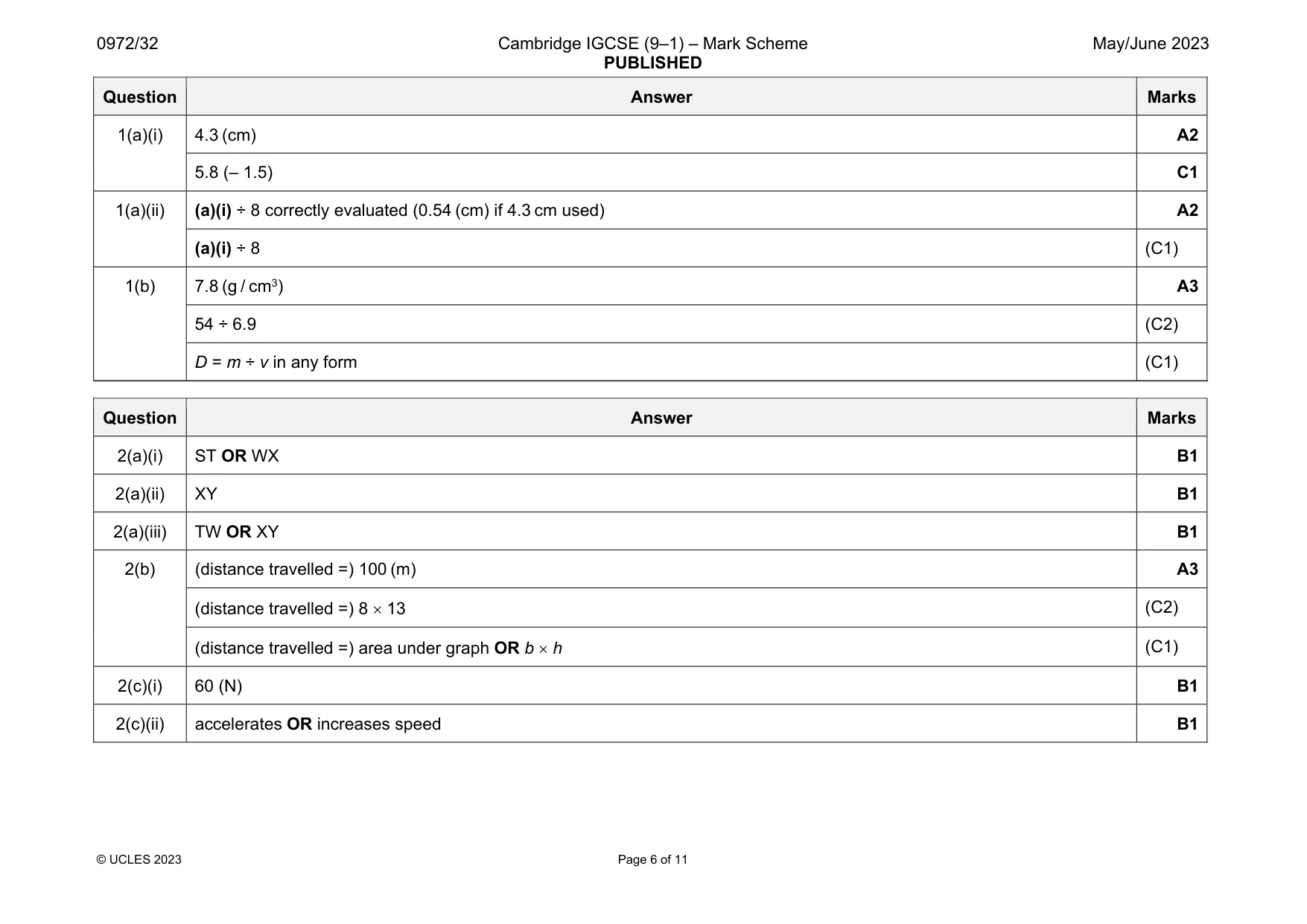
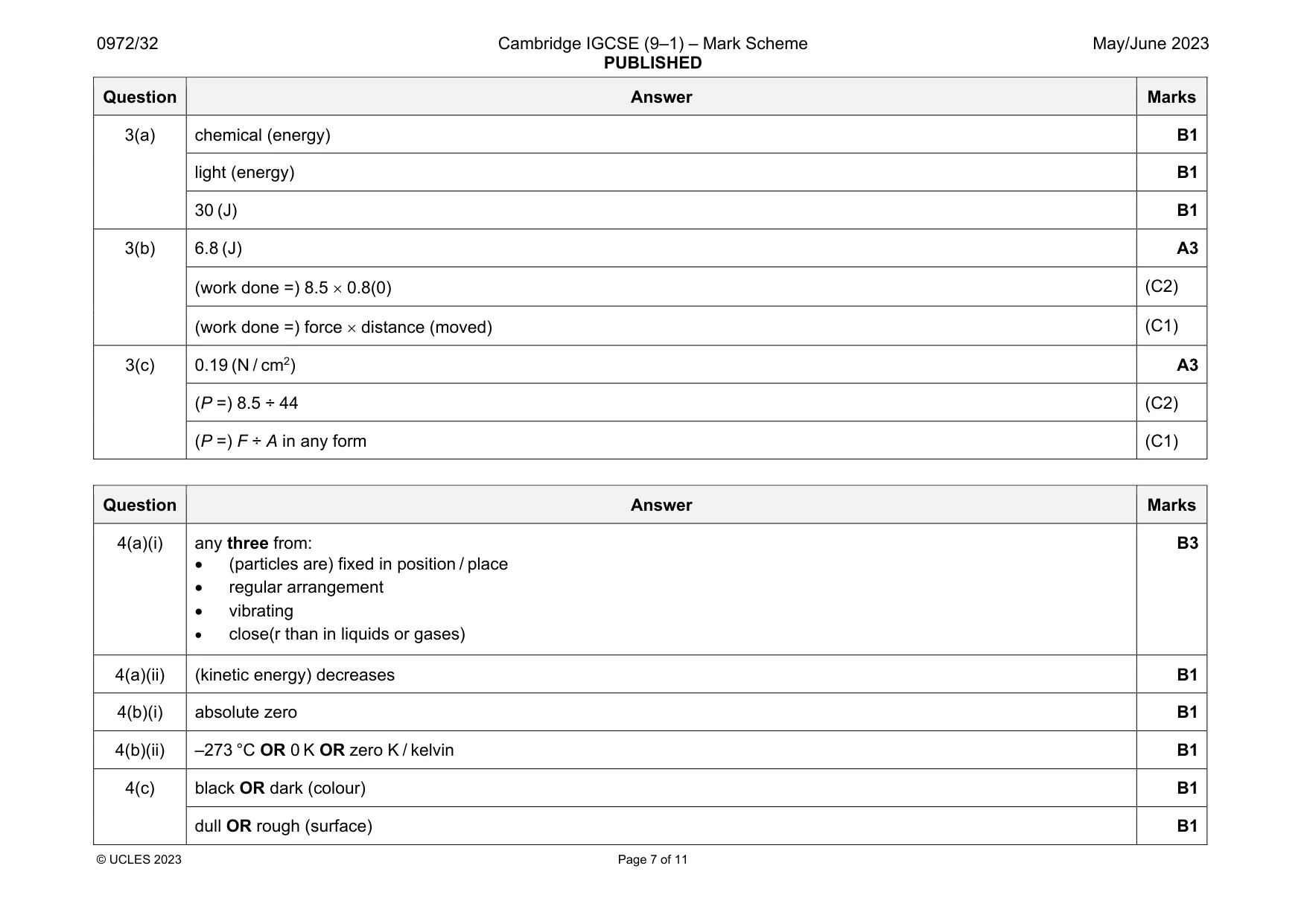
Mark scheme: 1(a)(i) 4.3 (cm) A2 5.8 (– 1.5) C1 1(a)(ii) (a)(i) ÷ 8 correctly evaluated (0.54 (cm) if 4.3 cm used) A2 (a)(i) ÷ 8 (C1) 1(b) 7.8 (g / cm3) A3 54 ÷ 6.9 (C2) D = m ÷ v in any form (C1)
More questions on Physical quantities and measurement techniques
Q2 · The speed–time graph for a cyclist
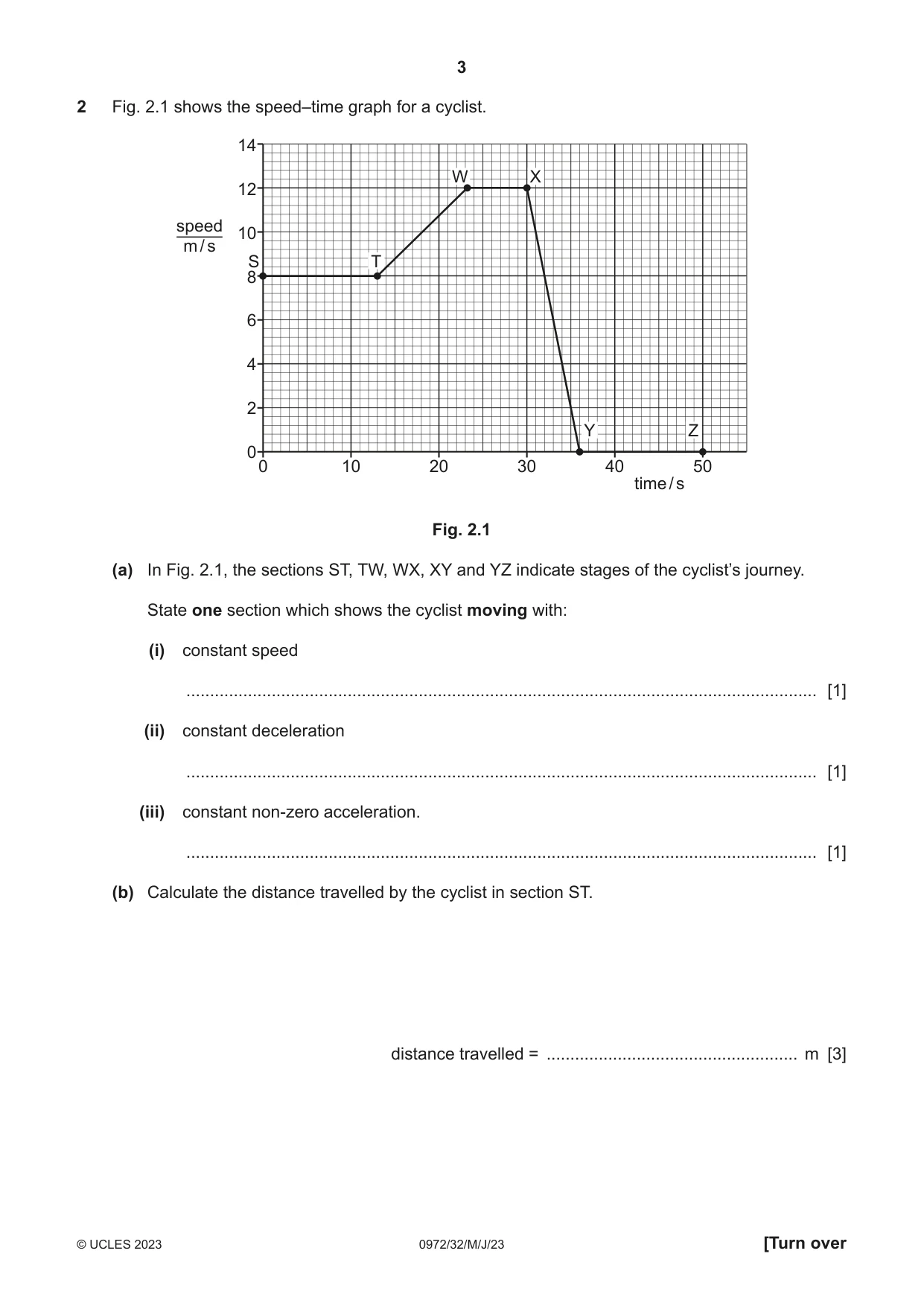
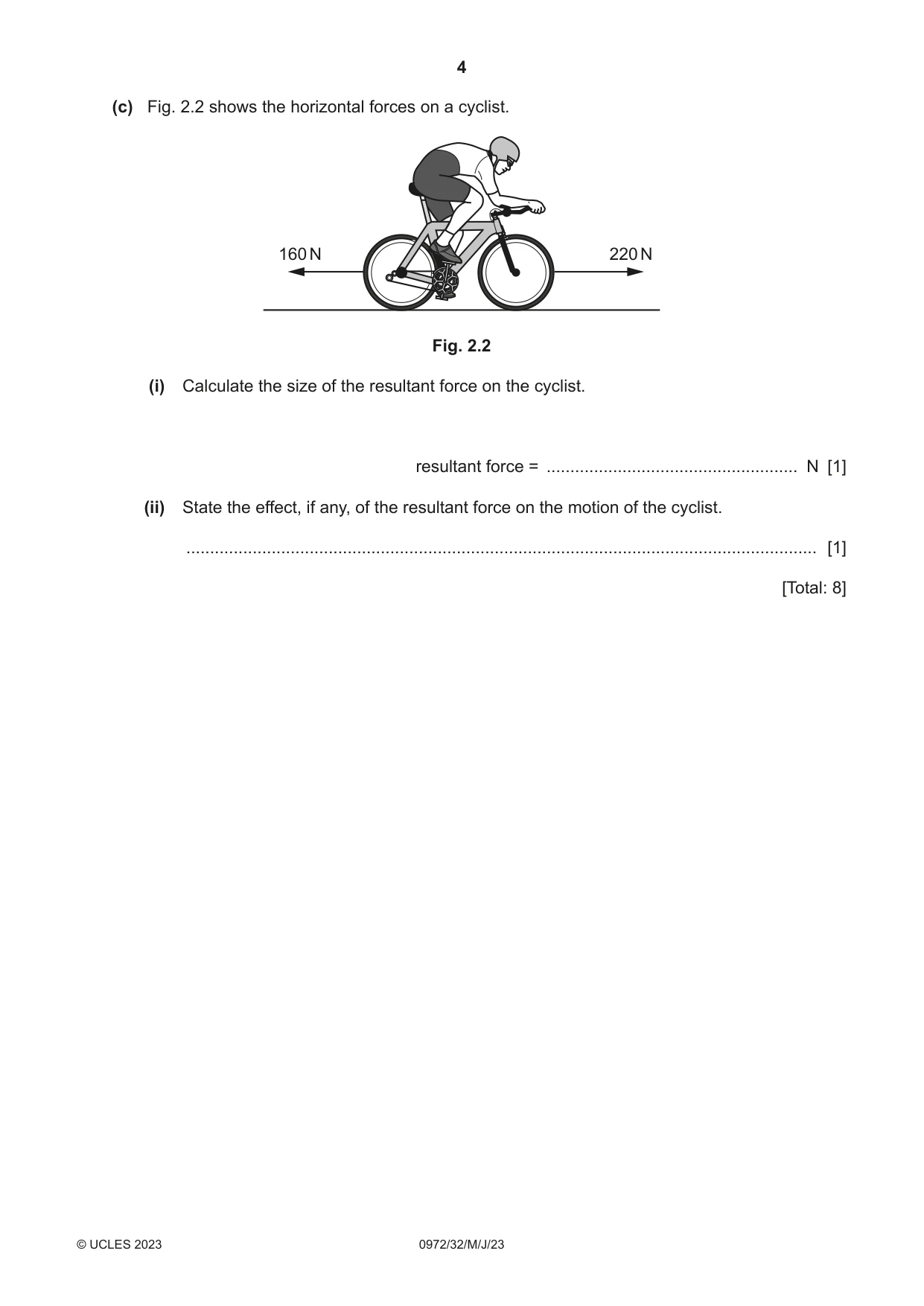
2 Fig. 2.1 shows the speed–time graph for a cyclist. 14 W X 12 speed 10 m / s S T 8 6 4 2 Y Z 0 0 10 20 30 40 50 time / s Fig. 2.1 (a) In Fig. 2.1, the sections ST, TW, WX, XY and YZ indicate stages of the cyclist’s journey. State one section which shows the cyclist moving with: (i) constant speed ..................................................................................................................................... [1] (ii) constant deceleration ..................................................................................................................................... [1] (iii) constant non-zero acceleration. ..................................................................................................................................... [1] (b) Calculate the distance travelled by the cyclist in section ST. distance travelled = ..................................................... m [3] (c) Fig. 2.2 shows the horizontal forces on a cyclist. 160 N 220 N Fig. 2.2 (i) Calculate the size of the resultant force on the cyclist. resultant force = ..................................................... N [1] (ii) State the effect, if any, of the resultant force on the motion of the cyclist. ..................................................................................................................................... [1] [Total: 8]
Mark scheme: 2(a)(i) ST OR WX B1 2(a)(ii) XY B1 2(a)(iii) TW OR XY B1 2(b) (distance travelled =) 100 (m) A3 (distance travelled =) 8 13 (C2) (distance travelled =) area under graph OR b h (C1) 2(c)(i) 60 (N) B1 2(c)(ii) accelerates OR increases speed B1
Q3 · A student has a battery-powered torch
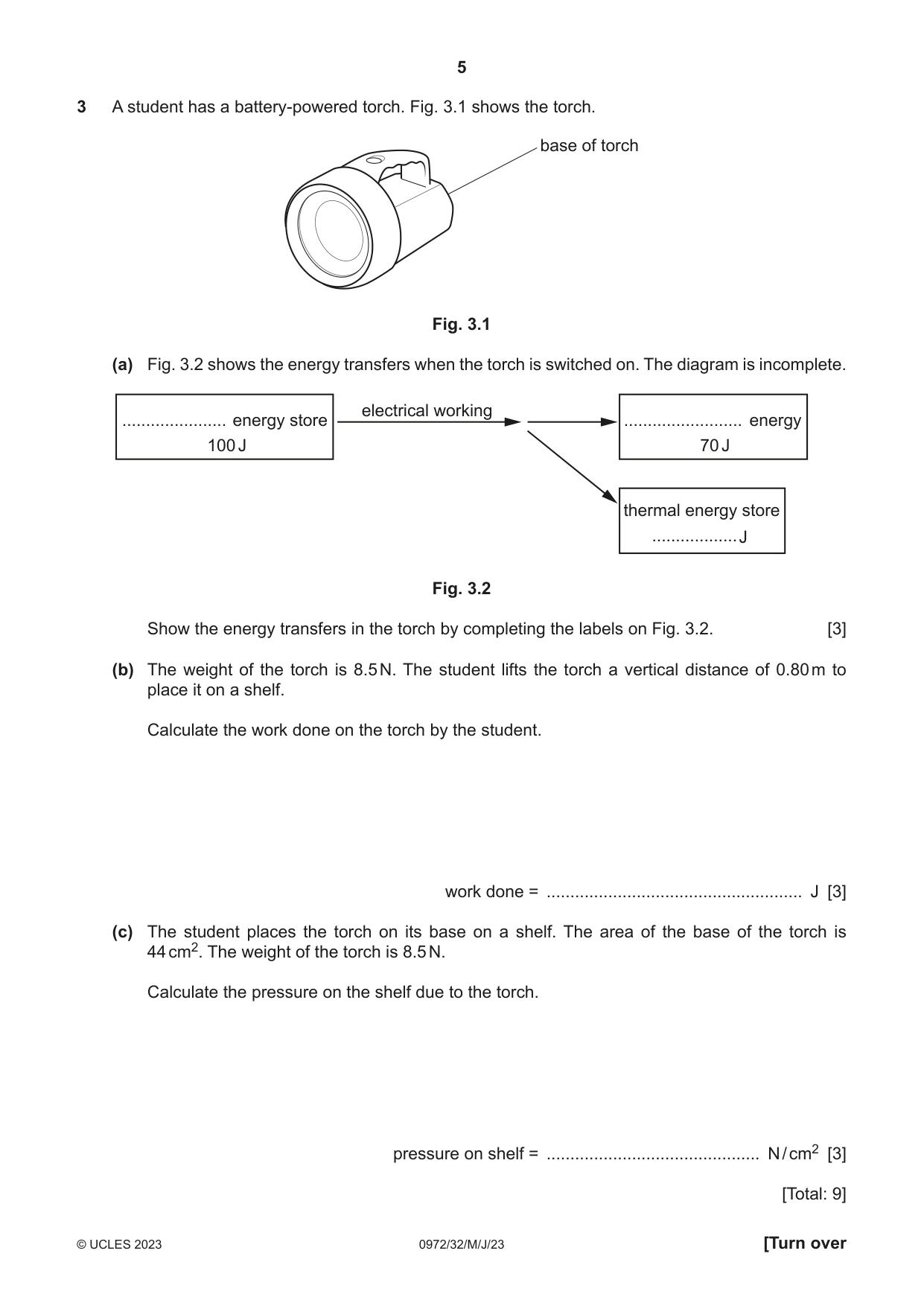
3 A student has a battery-powered torch. Fig. 3.1 shows the torch. base of torch Fig. 3.1 (a) Fig. 3.2 shows the energy transfers when the torch is switched on. The diagram is incomplete. electrical working ...................... energy store ......................... energy 100 J 70 J thermal energy store .................. J Fig. 3.2 Show the energy transfers in the torch by completing the labels on Fig. 3.2. [3] (b) The weight of the torch is 8.5 N. The student lifts the torch a vertical distance of 0.80 m to place it on a shelf. Calculate the work done on the torch by the student. work done = ...................................................... J [3] (c) The student places the torch on its base on a shelf. The area of the base of the torch is 44 cm2. The weight of the torch is 8.5 N. Calculate the pressure on the shelf due to the torch. pressure on shelf = ............................................. N / cm2 [3] [Total: 9]
Mark scheme: 3(a) chemical (energy) B1 light (energy) B1 30 (J) B1 3(b) 6.8 (J) A3 (work done =) 8.5 0.8(0) (C2) (work done =) force distance (moved) (C1) 3(c) 0.19 (N / cm2) A3 (P =) 8.5 ÷ 44 (C2) (P =) F ÷ A in any form (C1)
Q4 · A student has a block of solid metal at room temperature
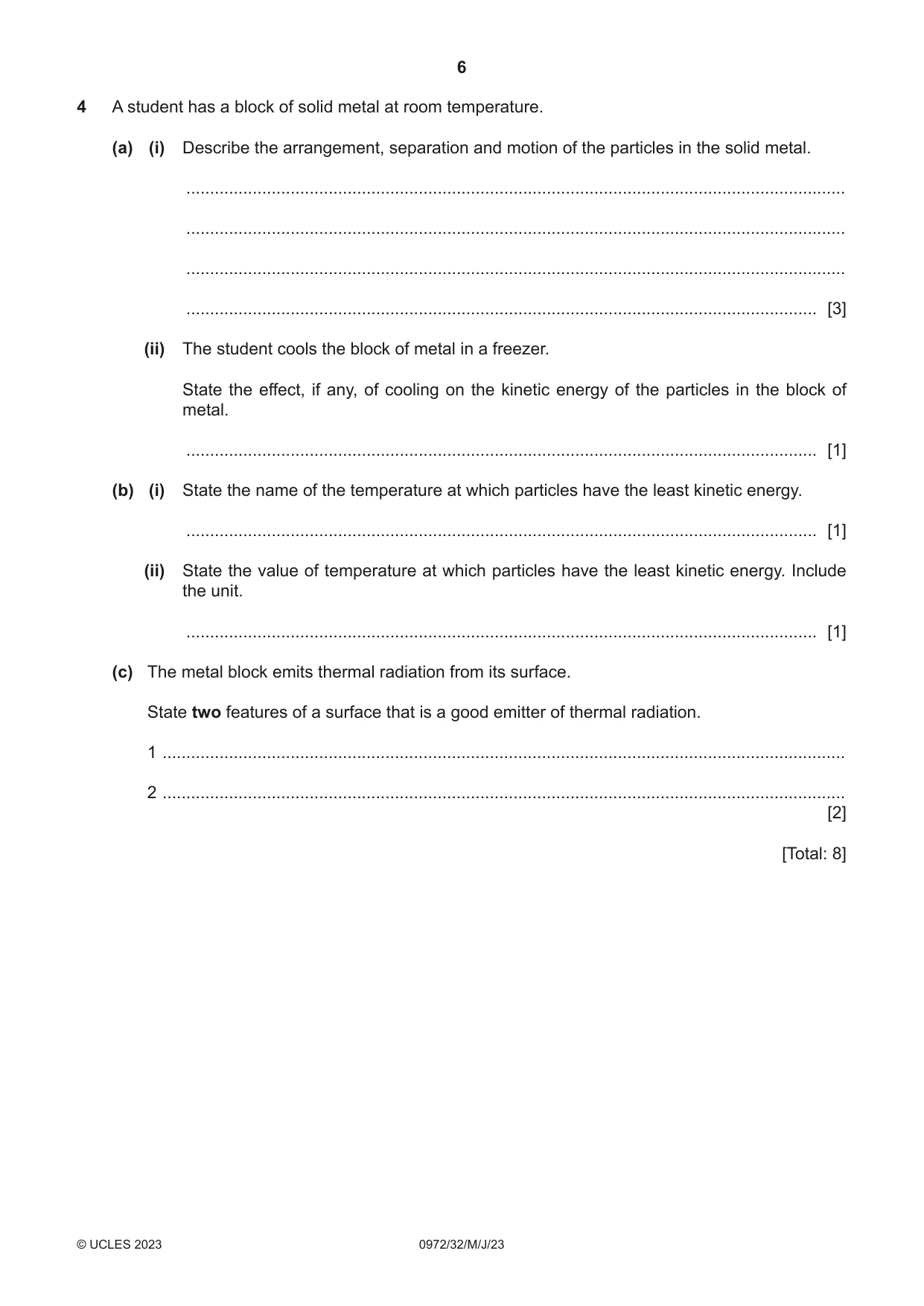
4 A student has a block of solid metal at room temperature. (a) (i) Describe the arrangement, separation and motion of the particles in the solid metal. ........................................................................................................................................... ........................................................................................................................................... ........................................................................................................................................... ..................................................................................................................................... [3] (ii) The student cools the block of metal in a freezer. State the effect, if any, of cooling on the kinetic energy of the particles in the block of metal. ..................................................................................................................................... [1] (b) (i) State the name of the temperature at which particles have the least kinetic energy. ..................................................................................................................................... [1] (ii) State the value of temperature at which particles have the least kinetic energy. Include the unit. ..................................................................................................................................... [1] (c) The metal block emits thermal radiation from its surface. State two features of a surface that is a good emitter of thermal radiation. 1 ................................................................................................................................................ 2 ................................................................................................................................................ [2] [Total: 8]
Mark scheme: 4(a)(i) any three from: (particles are) fixed in position / place regular arrangement vibrating close(r than in liquids or gases) B3 4(a)(ii) (kinetic energy) decreases B1 4(b)(i) absolute zero B1 4(b)(ii) –273 °C OR 0 K OR zero K / kelvin B1 4(c) black OR dark (colour) B1 dull OR rough (surface) B1
Q5 · An observer stands at P and looks into a rock quarry
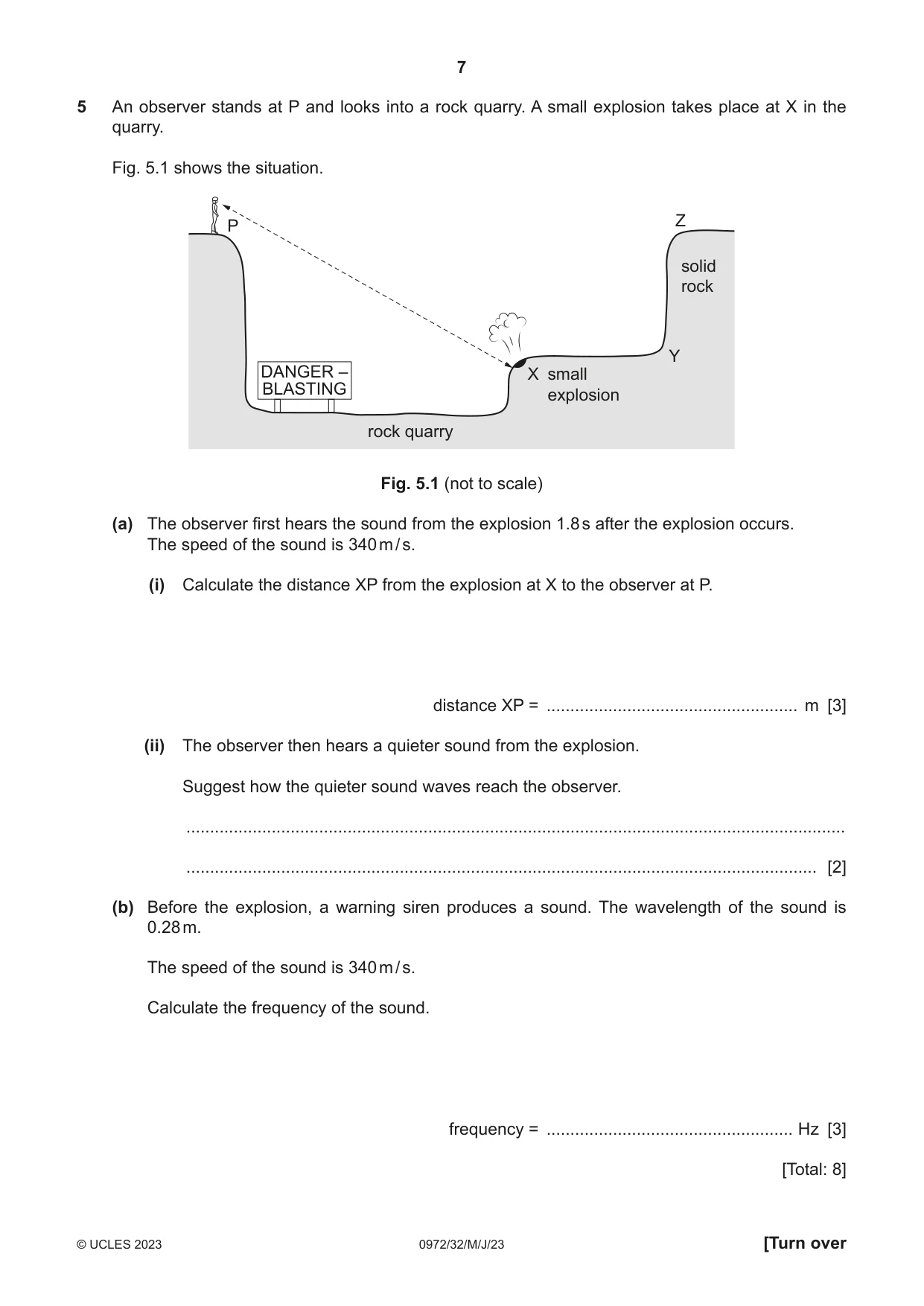
5 An observer stands at P and looks into a rock quarry. A small explosion takes place at X in the quarry. Fig. 5.1 shows the situation. Z P solid rock Y DANGER – X small BLASTING explosion rock quarry Fig. 5.1 (not to scale) (a) The observer first hears the sound from the explosion 1.8 s after the explosion occurs. The speed of the sound is 340 m / s. (i) Calculate the distance XP from the explosion at X to the observer at P. distance XP = ..................................................... m [3] (ii) The observer then hears a quieter sound from the explosion. Suggest how the quieter sound waves reach the observer. ........................................................................................................................................... ..................................................................................................................................... [2] (b) Before the explosion, a warning siren produces a sound. The wavelength of the sound is 0.28 m. The speed of the sound is 340 m / s. Calculate the frequency of the sound. frequency = .................................................... Hz [3] [Total: 8]
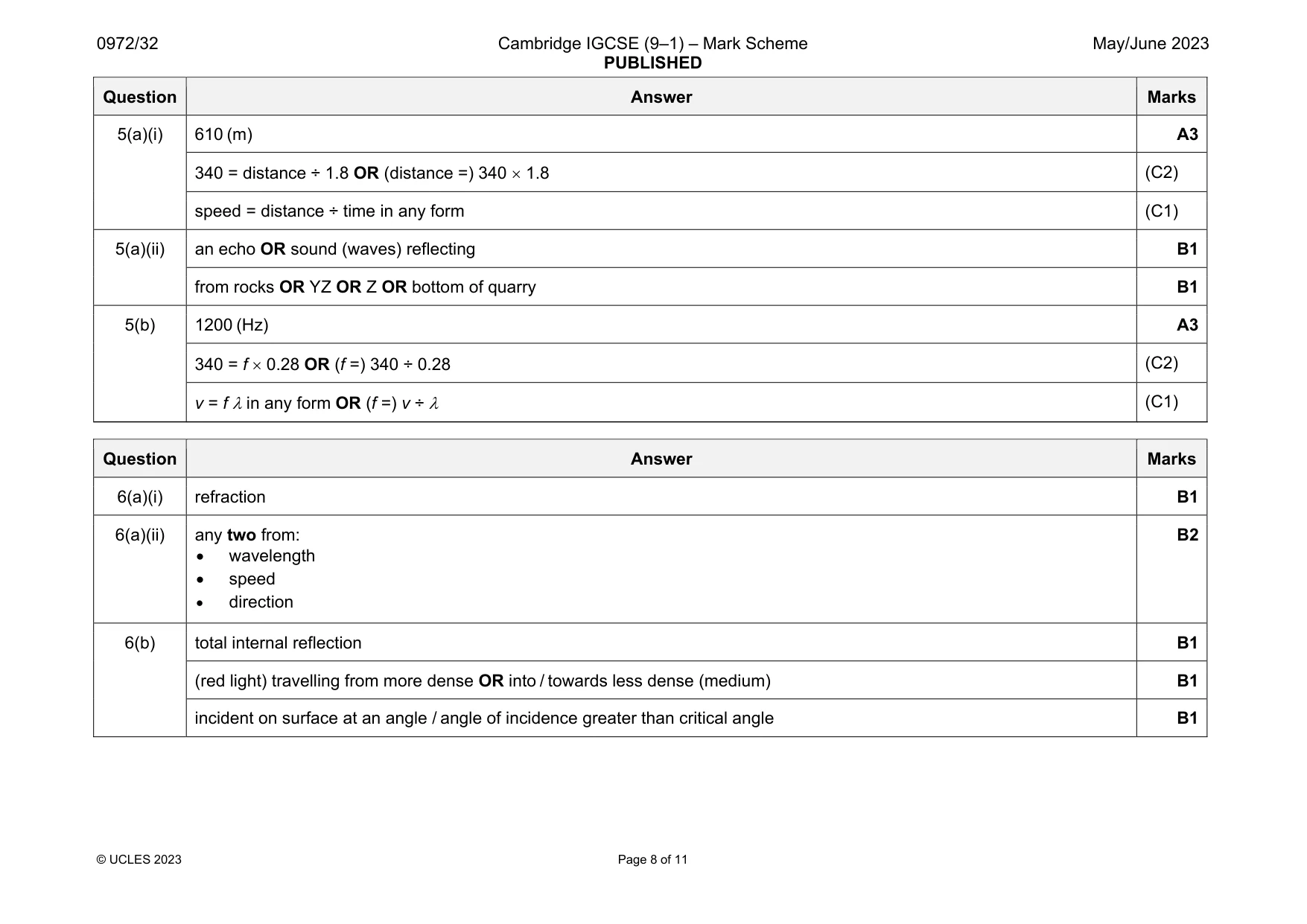
Mark scheme: 5(a)(i) 610 (m) A3 340 = distance ÷ 1.8 OR (distance =) 340 1.8 (C2) speed = distance ÷ time in any form (C1) 5(a)(ii) an echo OR sound (waves) reflecting B1 from rocks OR YZ OR Z OR bottom of quarry B1 5(b) 1200 (Hz) A3 340 = f 0.28 OR (f =) 340 ÷ 0.28 (C2) v = f in any form OR (f =) v ÷ (C1)
Q6 · Light waves passing from air into a glass block
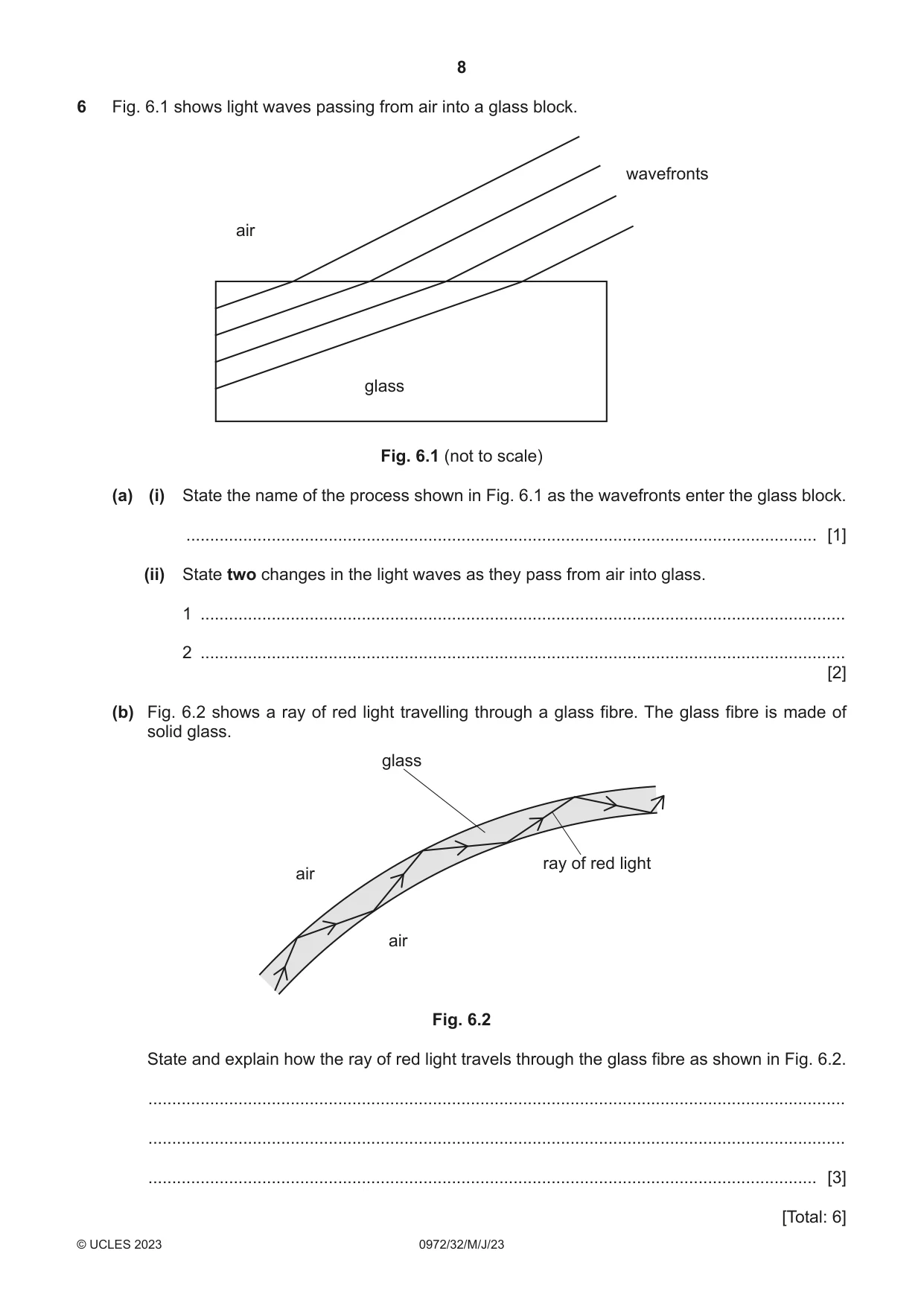
6 Fig. 6.1 shows light waves passing from air into a glass block. wavefronts air glass Fig. 6.1 (not to scale) (a) (i) State the name of the process shown in Fig. 6.1 as the wavefronts enter the glass block. ..................................................................................................................................... [1] (ii) State two changes in the light waves as they pass from air into glass. 1 ........................................................................................................................................ 2 ........................................................................................................................................ [2] (b) Fig. 6.2 shows a ray of red light travelling through a glass fibre. The glass fibre is made of solid glass. glass ray of red light air air Fig. 6.2 State and explain how the ray of red light travels through the glass fibre as shown in Fig. 6.2. ................................................................................................................................................... ................................................................................................................................................... ............................................................................................................................................. [3] [Total: 6]
Mark scheme: 6(a)(i) refraction B1 6(a)(ii) any two from: wavelength speed direction B2 6(b) total internal reflection B1 (red light) travelling from more dense OR into / towards less dense (medium) B1 incident on surface at an angle / angle of incidence greater than critical angle B1
Q7 · A student uses a permanent magnet to lift some unmagnetised nails
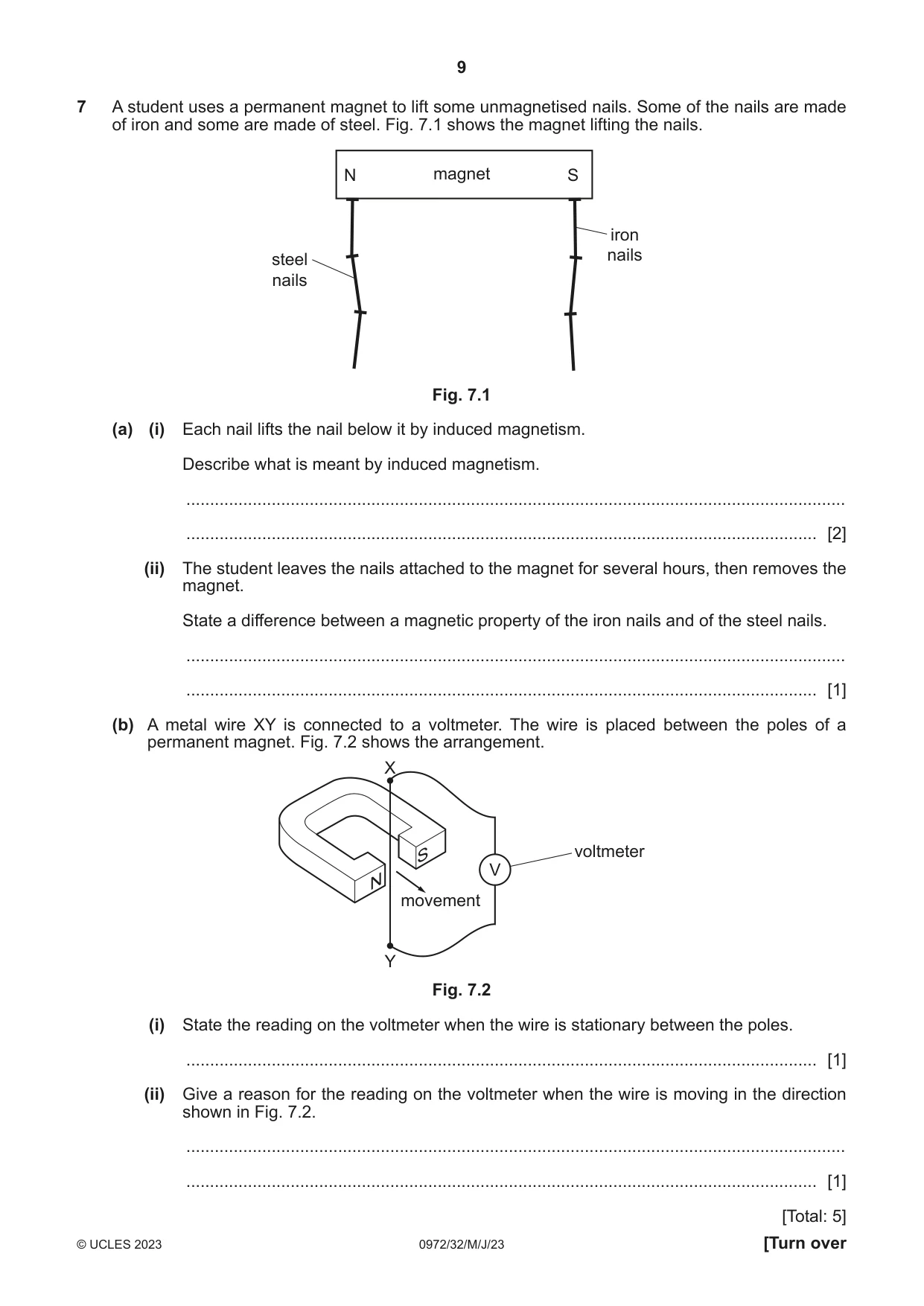
7 A student uses a permanent magnet to lift some unmagnetised nails. Some of the nails are made of iron and some are made of steel. Fig. 7.1 shows the magnet lifting the nails. N magnet S iron steel nails nails Fig. 7.1 (a) (i) Each nail lifts the nail below it by induced magnetism. Describe what is meant by induced magnetism. ........................................................................................................................................... ..................................................................................................................................... [2] (ii) The student leaves the nails attached to the magnet for several hours, then removes the magnet. State a difference between a magnetic property of the iron nails and of the steel nails. ........................................................................................................................................... ..................................................................................................................................... [1] (b) A metal wire XY is connected to a voltmeter. The wire is placed between the poles of a permanent magnet. Fig. 7.2 shows the arrangement. X S voltmeter V N movement Y Fig. 7.2 (i) State the reading on the voltmeter when the wire is stationary between the poles. ..................................................................................................................................... [1] (ii) Give a reason for the reading on the voltmeter when the wire is moving in the direction shown in Fig. 7.2. ........................................................................................................................................... ..................................................................................................................................... [1] [Total: 5]
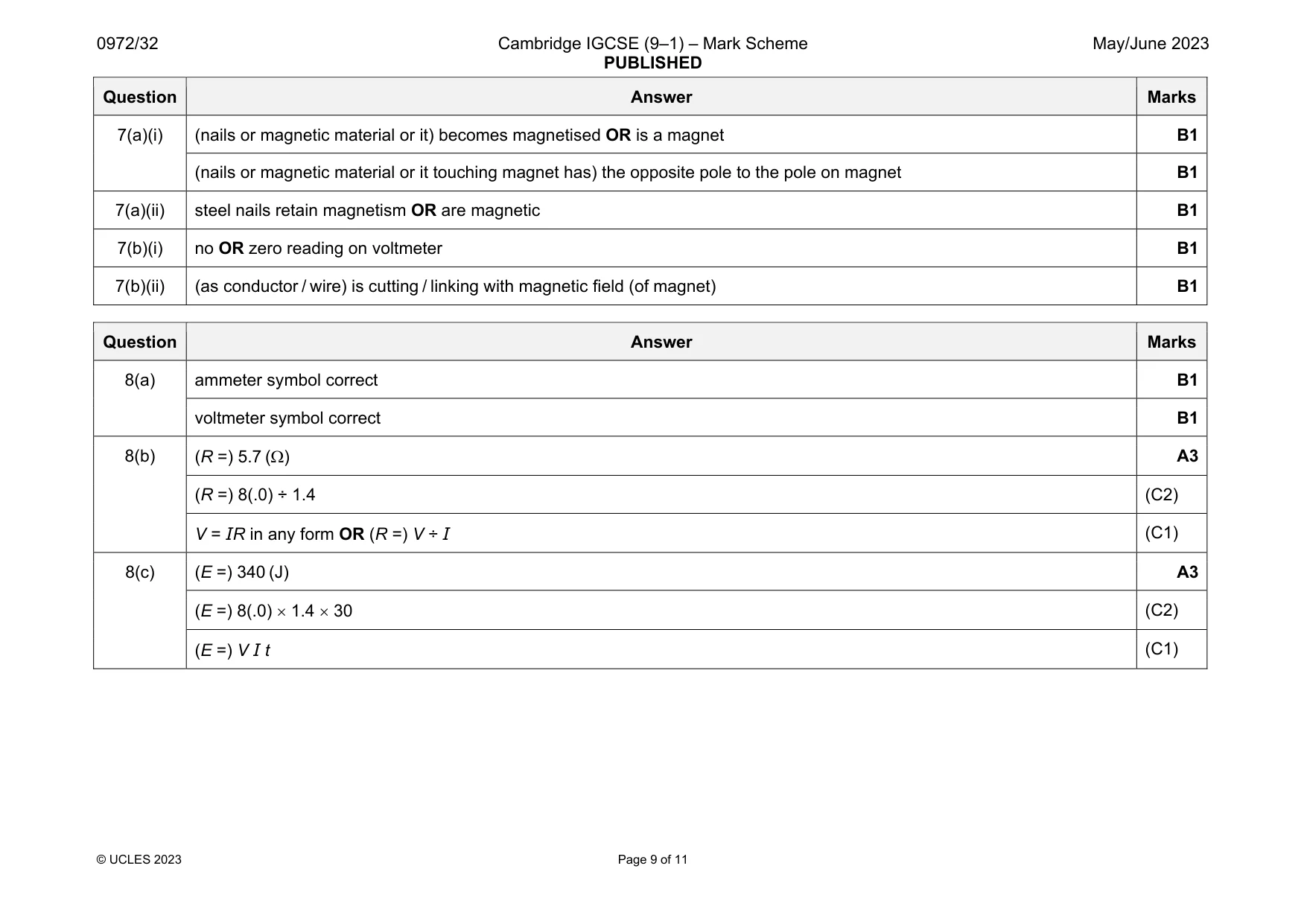
Mark scheme: 7(a)(i) (nails or magnetic material or it) becomes magnetised OR is a magnet B1 (nails or magnetic material or it touching magnet has) the opposite pole to the pole on magnet B1 7(a)(ii) steel nails retain magnetism OR are magnetic B1 7(b)(i) no OR zero reading on voltmeter B1 7(b)(ii) (as conductor / wire) is cutting / linking with magnetic field (of magnet) B1
Q8 · A student uses the circuit in Fig
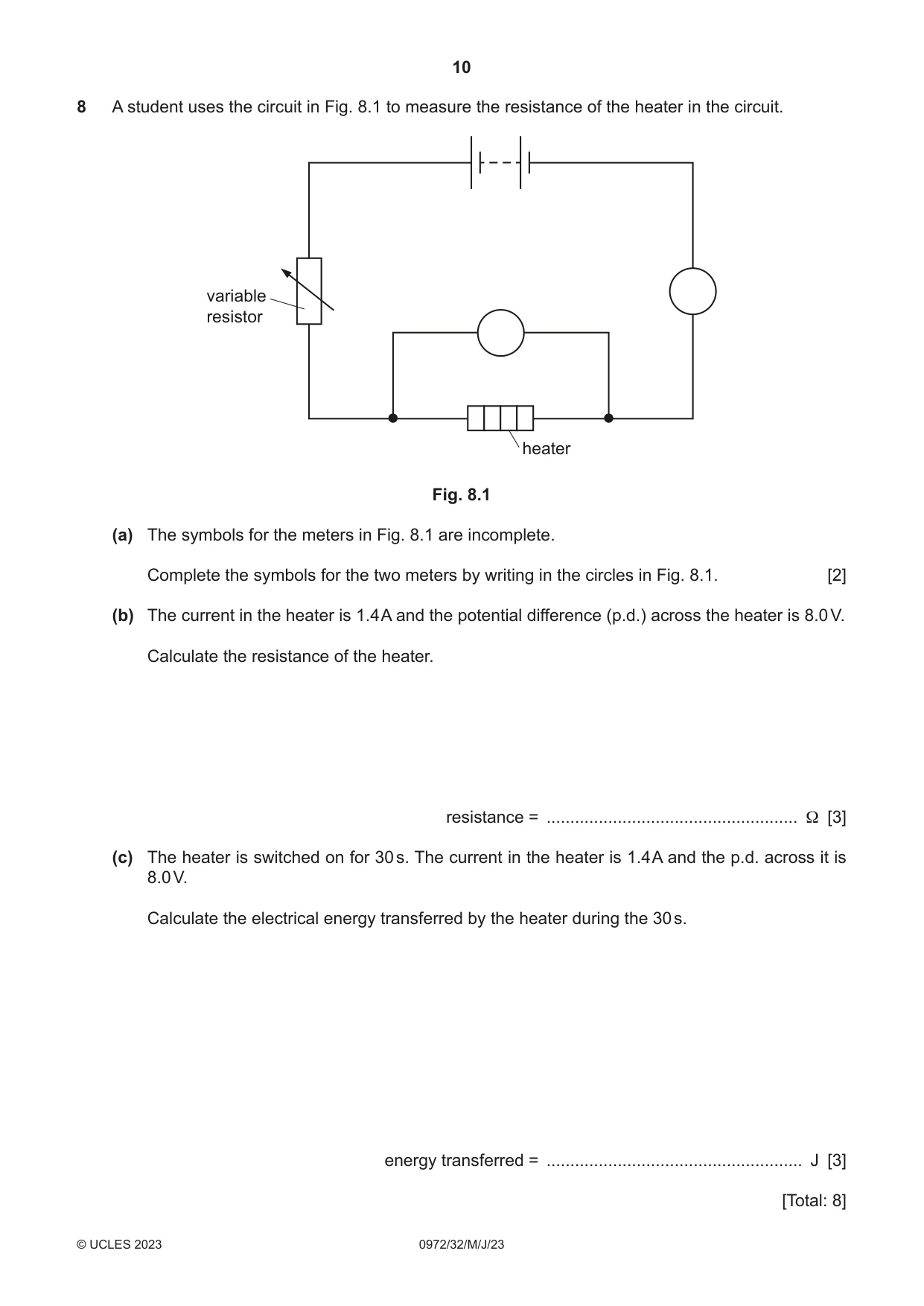
8 A student uses the circuit in Fig. 8.1 to measure the resistance of the heater in the circuit. variable resistor heater Fig. 8.1 (a) The symbols for the meters in Fig. 8.1 are incomplete. Complete the symbols for the two meters by writing in the circles in Fig. 8.1. [2] (b) The current in the heater is 1.4 A and the potential difference (p.d.) across the heater is 8.0 V. Calculate the resistance of the heater. resistance = ..................................................... Ω [3] (c) The heater is switched on for 30 s. The current in the heater is 1.4 A and the p.d. across it is 8.0 V. Calculate the electrical energy transferred by the heater during the 30 s. energy transferred = ...................................................... J [3] [Total: 8]
Mark scheme: 8(a) ammeter symbol correct B1 voltmeter symbol correct B1 8(b) (R =) 5.7 () A3 (R =) 8(.0) ÷ 1.4 (C2) V = IR in any form OR (R =) V ÷ I (C1) 8(c) (E =) 340 (J) A3 (E =) 8(.0) 1.4 30 (C2) (E =) V I t (C1)
Q9 · A student has a desktop computer that connects to the 240 V a.c
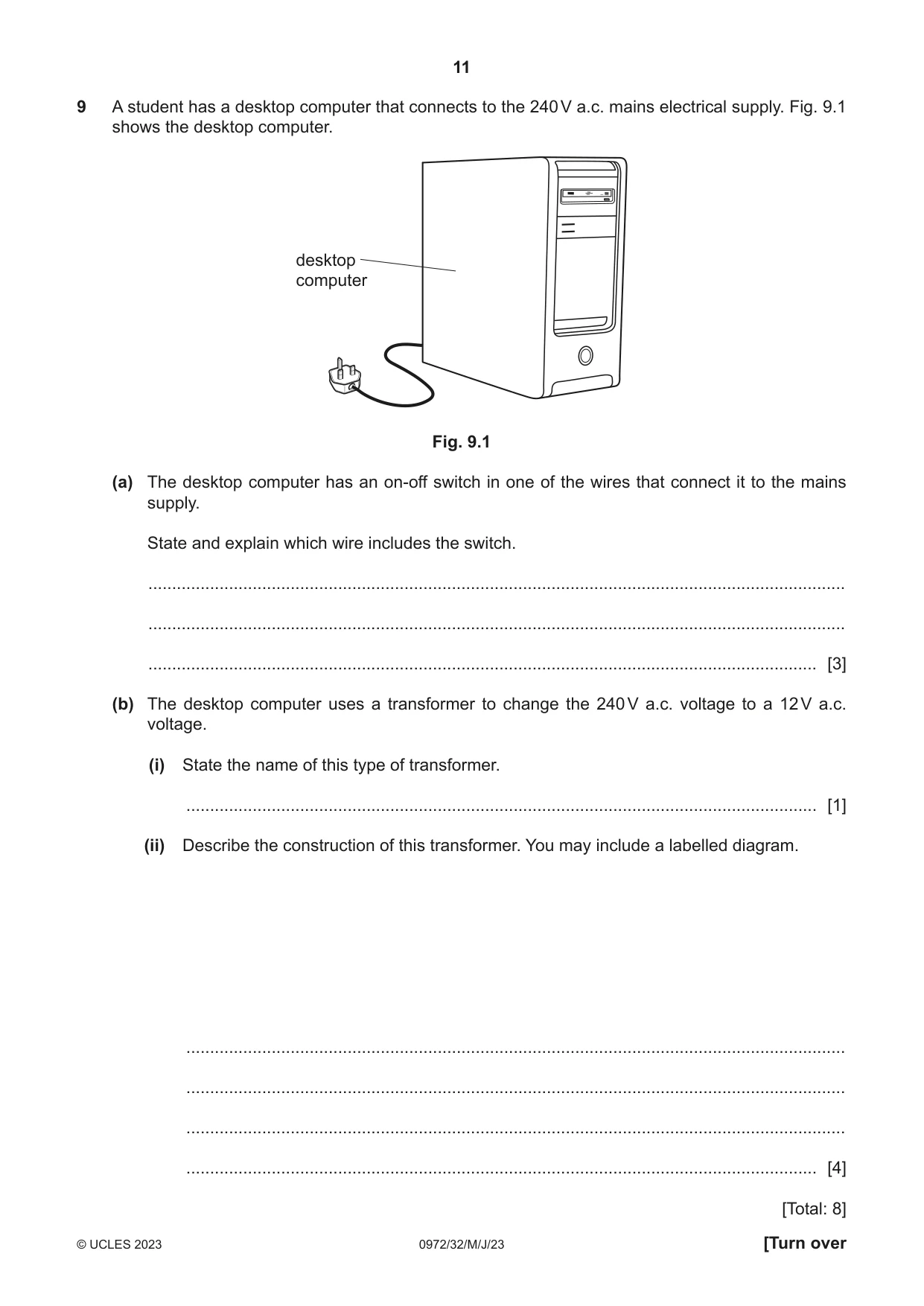
9 A student has a desktop computer that connects to the 240 V a.c. mains electrical supply. Fig. 9.1 shows the desktop computer. desktop computer Fig. 9.1 (a) The desktop computer has an on-off switch in one of the wires that connect it to the mains supply. State and explain which wire includes the switch. ................................................................................................................................................... ................................................................................................................................................... ............................................................................................................................................. [3] (b) The desktop computer uses a transformer to change the 240 V a.c. voltage to a 12 V a.c. voltage. (i) State the name of this type of transformer. ..................................................................................................................................... [1] (ii) Describe the construction of this transformer. You may include a labelled diagram. ........................................................................................................................................... ........................................................................................................................................... ........................................................................................................................................... ..................................................................................................................................... [4] [Total: 8]
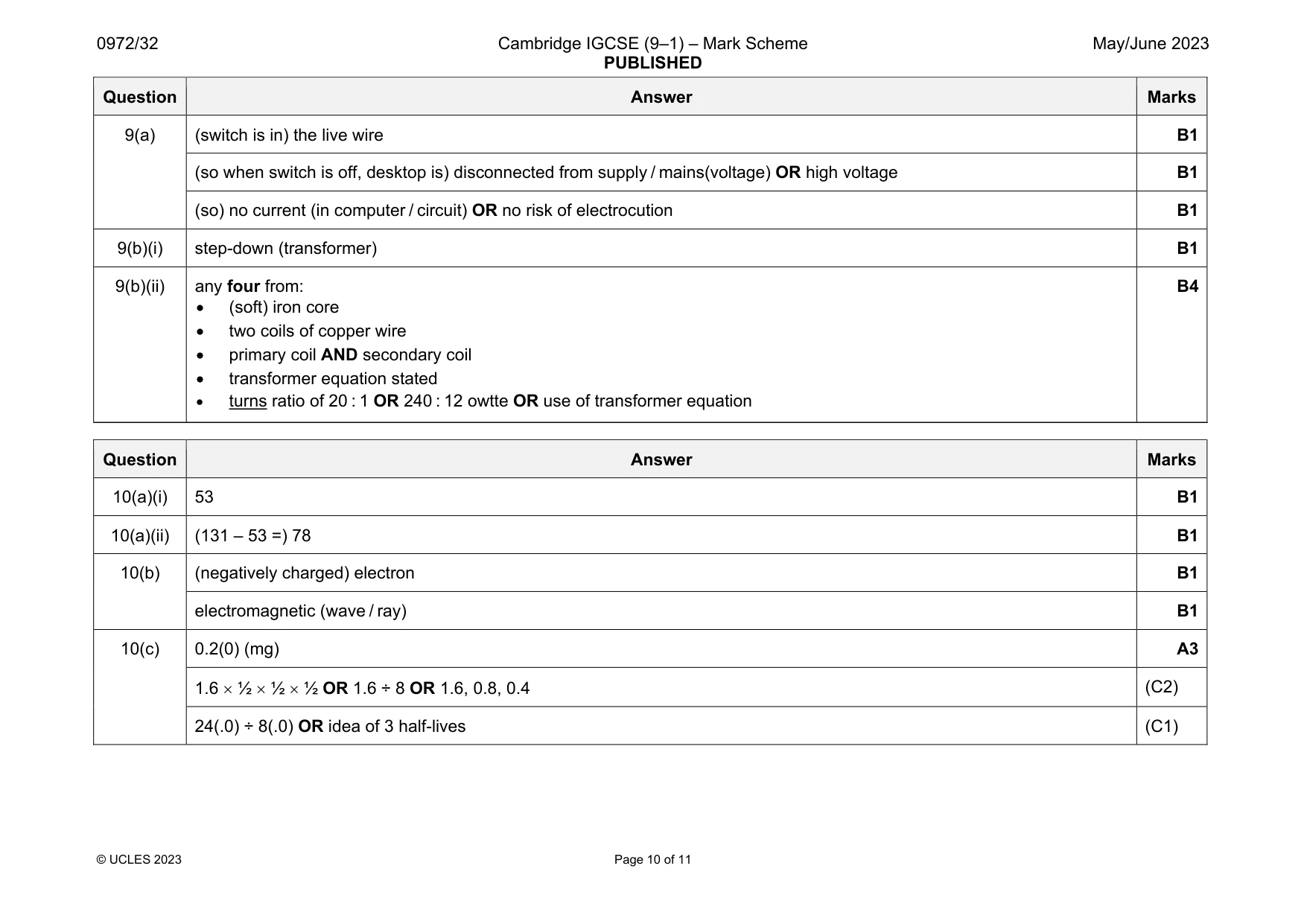
Mark scheme: 9(a) (switch is in) the live wire B1 (so when switch is off, desktop is) disconnected from supply / mains(voltage) OR high voltage B1 (so) no current (in computer / circuit) OR no risk of electrocution B1 9(b)(i) step-down (transformer) B1 9(b)(ii) any four from: (soft) iron core two coils of copper wire primary coil AND secondary coil transformer equation stated turns ratio of 20 : 1 OR 240 : 12 owtte OR use of transformer equation B4
Q10 · Iodine-131 is a radioactive isotope of the element iodine
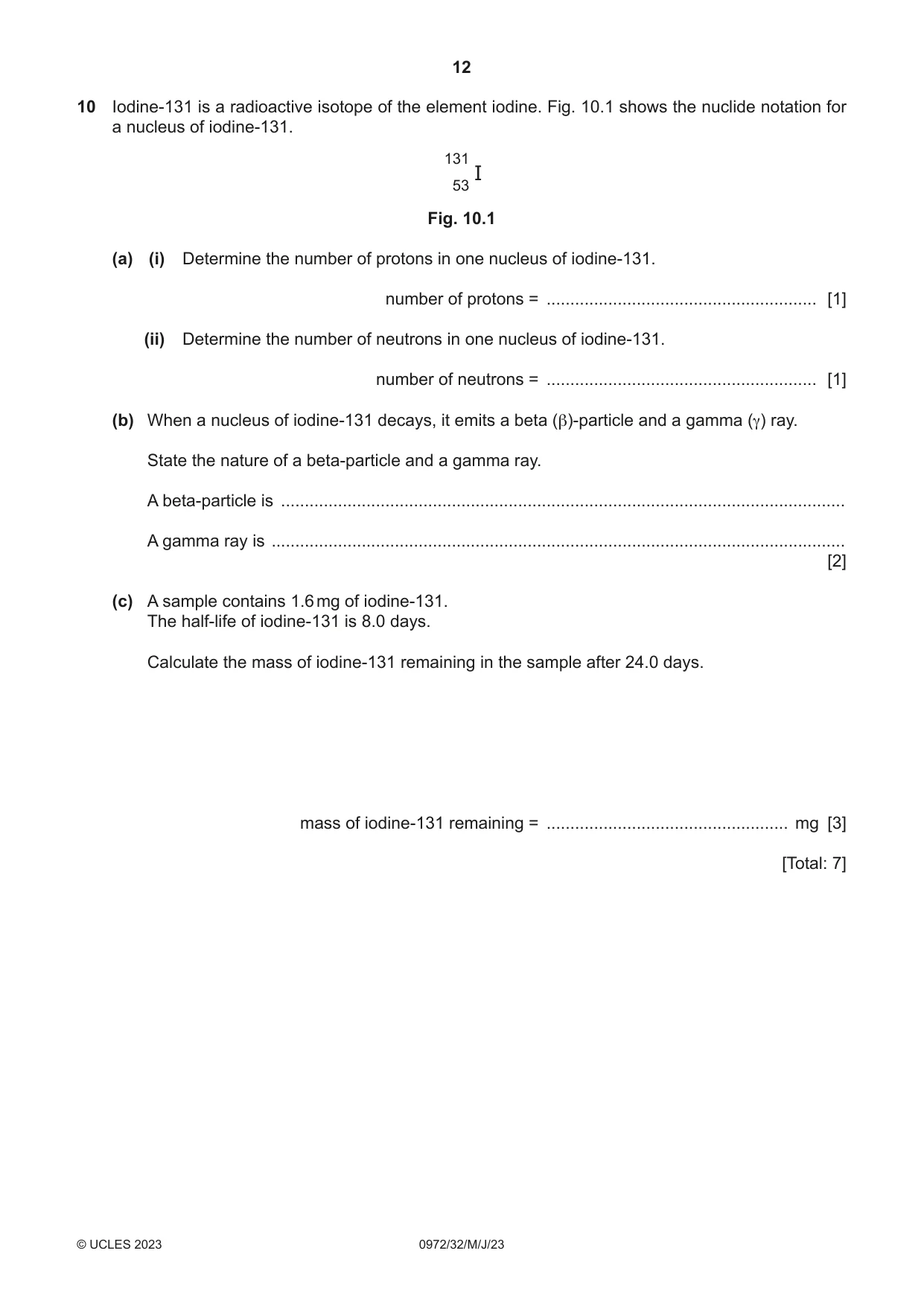
10 Iodine-131 is a radioactive isotope of the element iodine. Fig. 10.1 shows the nuclide notation for a nucleus of iodine-131. 131 I 53 Fig. 10.1 (a) (i) Determine the number of protons in one nucleus of iodine-131. number of protons = ......................................................... [1] (ii) Determine the number of neutrons in one nucleus of iodine-131. number of neutrons = ......................................................... [1] (b) When a nucleus of iodine-131 decays, it emits a beta (β)-particle and a gamma (γ) ray. State the nature of a beta-particle and a gamma ray. A beta-particle is ....................................................................................................................... A gamma ray is ......................................................................................................................... [2] (c) A sample contains 1.6 mg of iodine-131. The half-life of iodine-131 is 8.0 days. Calculate the mass of iodine-131 remaining in the sample after 24.0 days. mass of iodine-131 remaining = ................................................... mg [3] [Total: 7]
Mark scheme: 10(a)(i) 53 B1 10(a)(ii) (131 – 53 =) 78 B1 10(b) (negatively charged) electron B1 electromagnetic (wave / ray) B1 10(c) 0.2(0) (mg) A3 1.6 ½ ½ ½ OR 1.6 ÷ 8 OR 1.6, 0.8, 0.4 (C2) 24(.0) ÷ 8(.0) OR idea of 3 half-lives (C1)
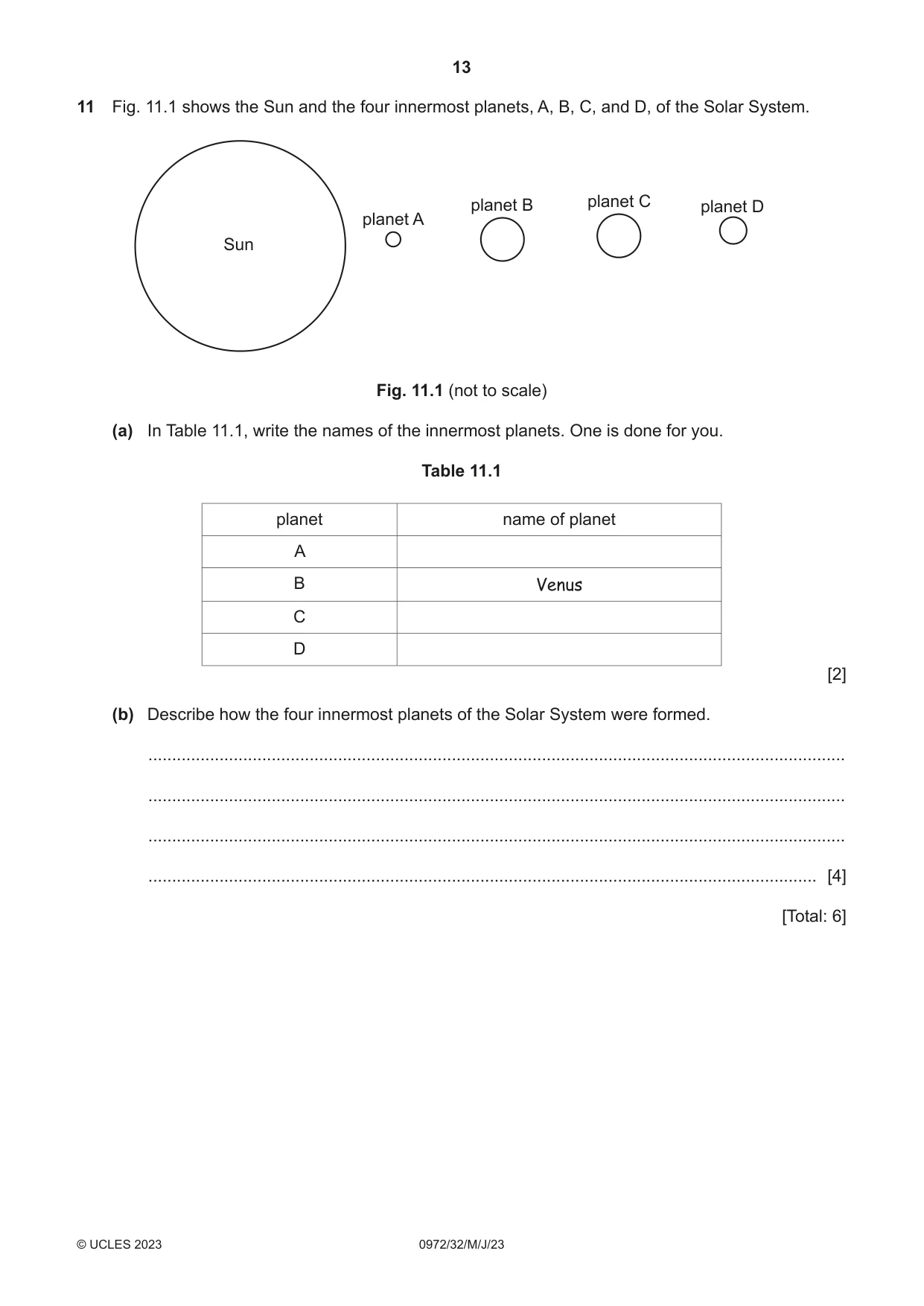
Q11 · The Sun and the four innermost planets, A, B, C, and D, of the Solar System
11 Fig. 11.1 shows the Sun and the four innermost planets, A, B, C, and D, of the Solar System. planet B planet C planet D planet A Sun Fig. 11.1 (not to scale) (a) In Table 11.1, write the names of the innermost planets. One is done for you. Table 11.1 planet name of planet A B Venus C D [2] (b) Describe how the four innermost planets of the Solar System were formed. ................................................................................................................................................... ................................................................................................................................................... ................................................................................................................................................... ............................................................................................................................................. [4] [Total: 6]
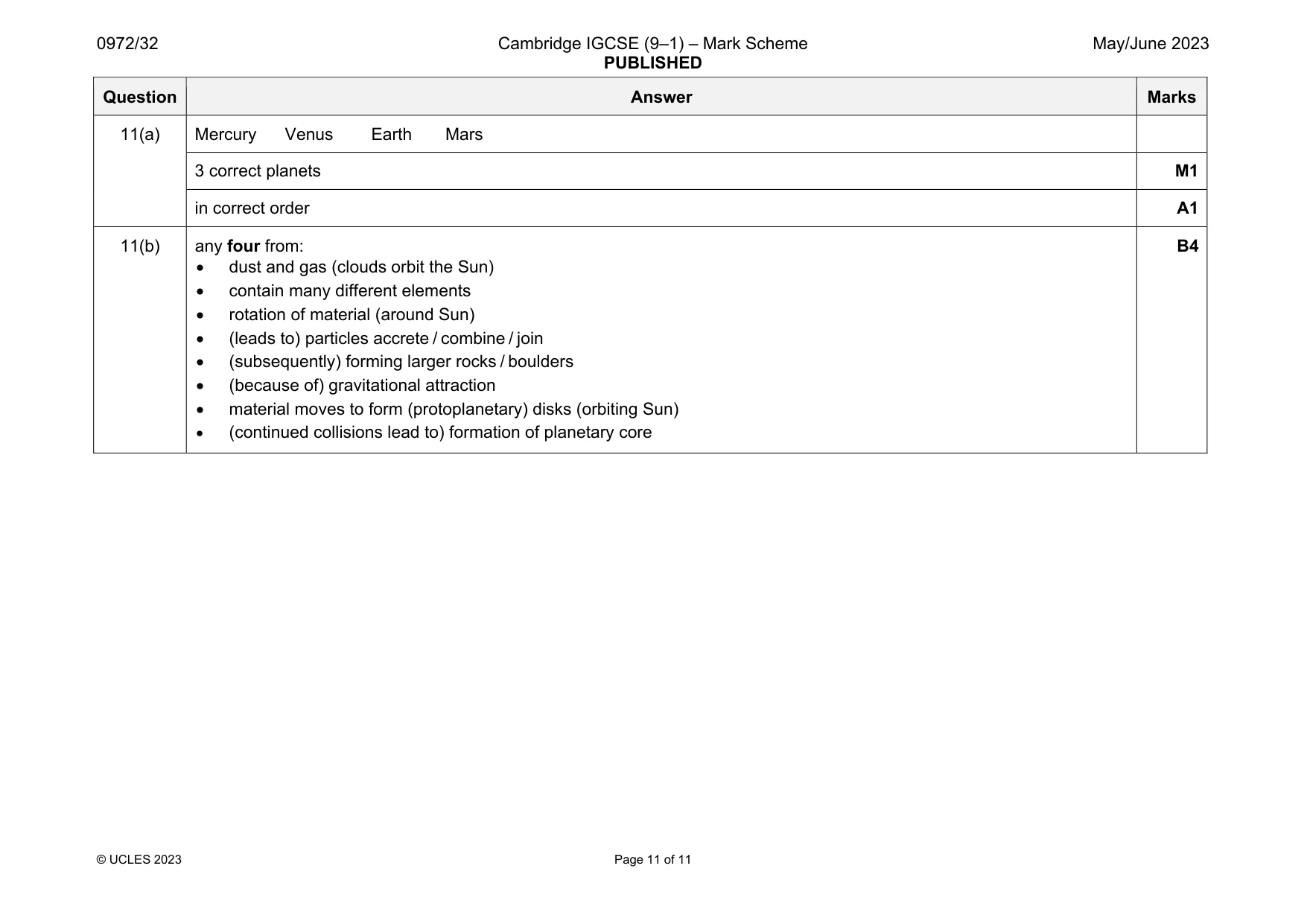
Mark scheme: 11(a) Mercury Venus Earth Mars 3 correct planets M1 in correct order A1 11(b) any four from: dust and gas (clouds orbit the Sun) contain many different elements rotation of material (around Sun) (leads to) particles accrete / combine / join (subsequently) forming larger rocks / boulders (because of) gravitational attraction material moves to form (protoplanetary) disks (orbiting Sun) (continued collisions lead to) formation of planetary core B4
What was in this paper
The subtopics covered by these 11 questions, and how many questions each got. Open one in a new tab to see every Cambridge question on it.
What you needed in this session
Cambridge’s own grade thresholds for 2023 May/June, Paper 3 · Variant 2. A higher threshold means an easier paper — the bar moves with how the cohort did.