Cambridge IGCSE Physics (9-1) 0972 — 2022 May/June Paper 3 · Variant 2
0972/32/M/J/22 · 11 questions · 80 marks · ≈90 min
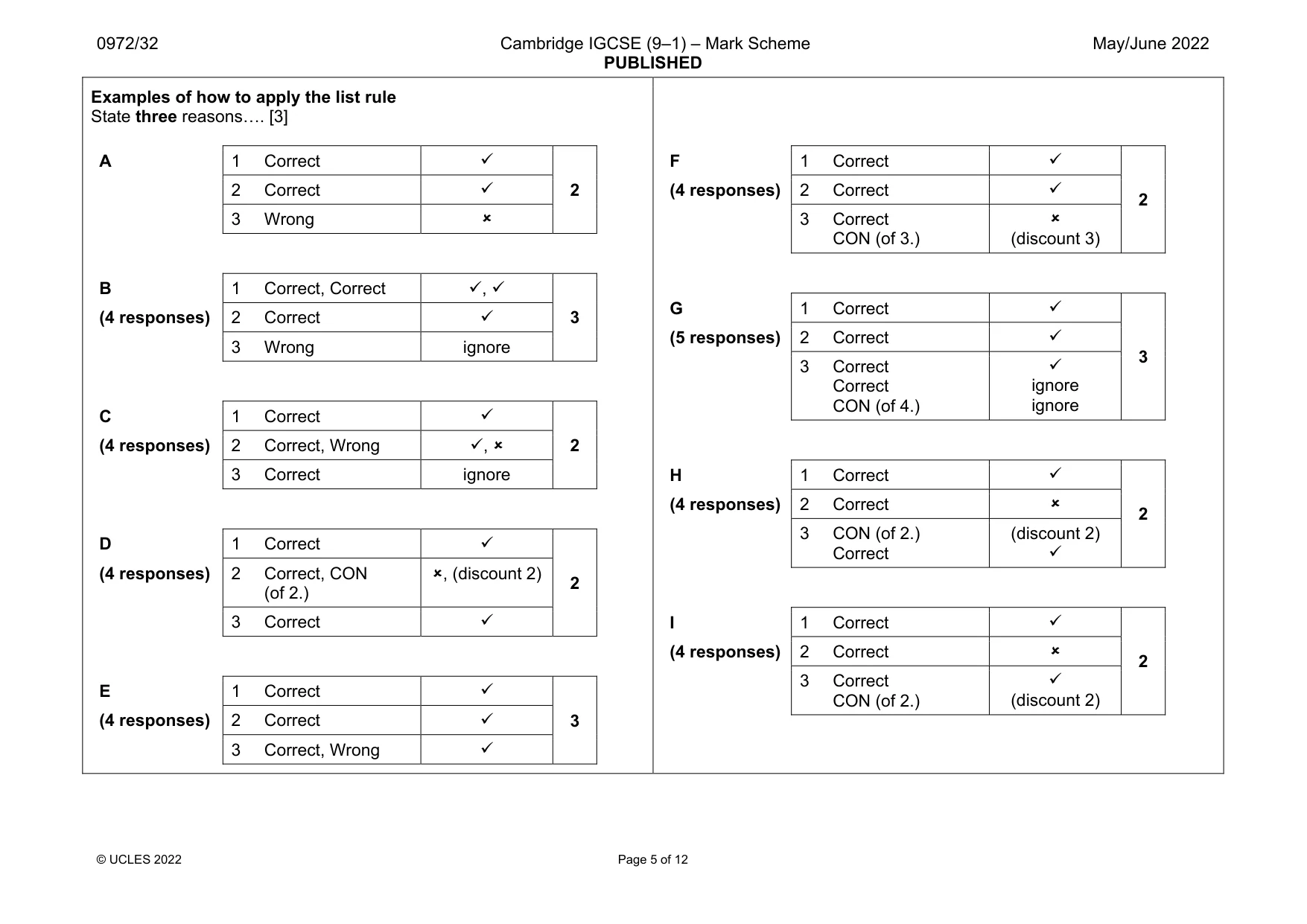
The question paper and its mark scheme, free to read here and free to download. This is Cambridge’s own paper, exactly as it was sat.
Question paper16 pages
Mark scheme12 pages
Answers below. Sit the paper first if you are practising.
Questions as text
Q1 · A student investigates the motion of a trolley as it travels down a slope
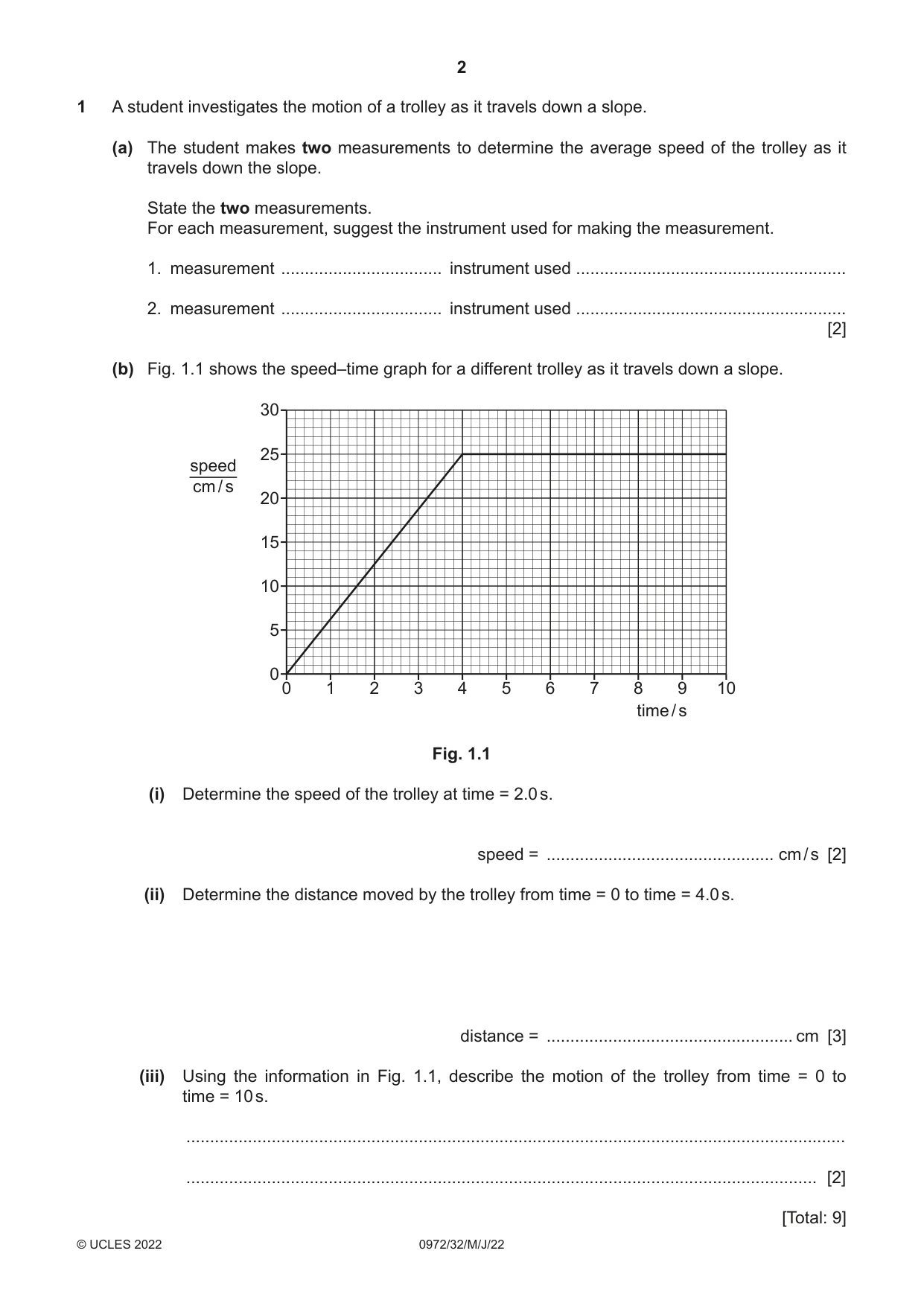
1 A student investigates the motion of a trolley as it travels down a slope. (a) The student makes two measurements to determine the average speed of the trolley as it travels down the slope. State the two measurements. For each measurement, suggest the instrument used for making the measurement. 1. measurement .................................. instrument used ......................................................... 2. measurement .................................. instrument used ......................................................... [2] (b) Fig. 1.1 shows the speed–time graph for a different trolley as it travels down a slope. 30 25 speed cm / s 20 15 10 5 0 0 1 2 3 4 5 6 7 8 9 10 time / s Fig. 1.1 (i) Determine the speed of the trolley at time = 2.0 s. speed = ................................................ cm / s [2] (ii) Determine the distance moved by the trolley from time = 0 to time = 4.0 s. distance = .................................................... cm [3] (iii) Using the information in Fig. 1.1, describe the motion of the trolley from time = 0 to time = 10 s. ........................................................................................................................................... ..................................................................................................................................... [2] [Total: 9]
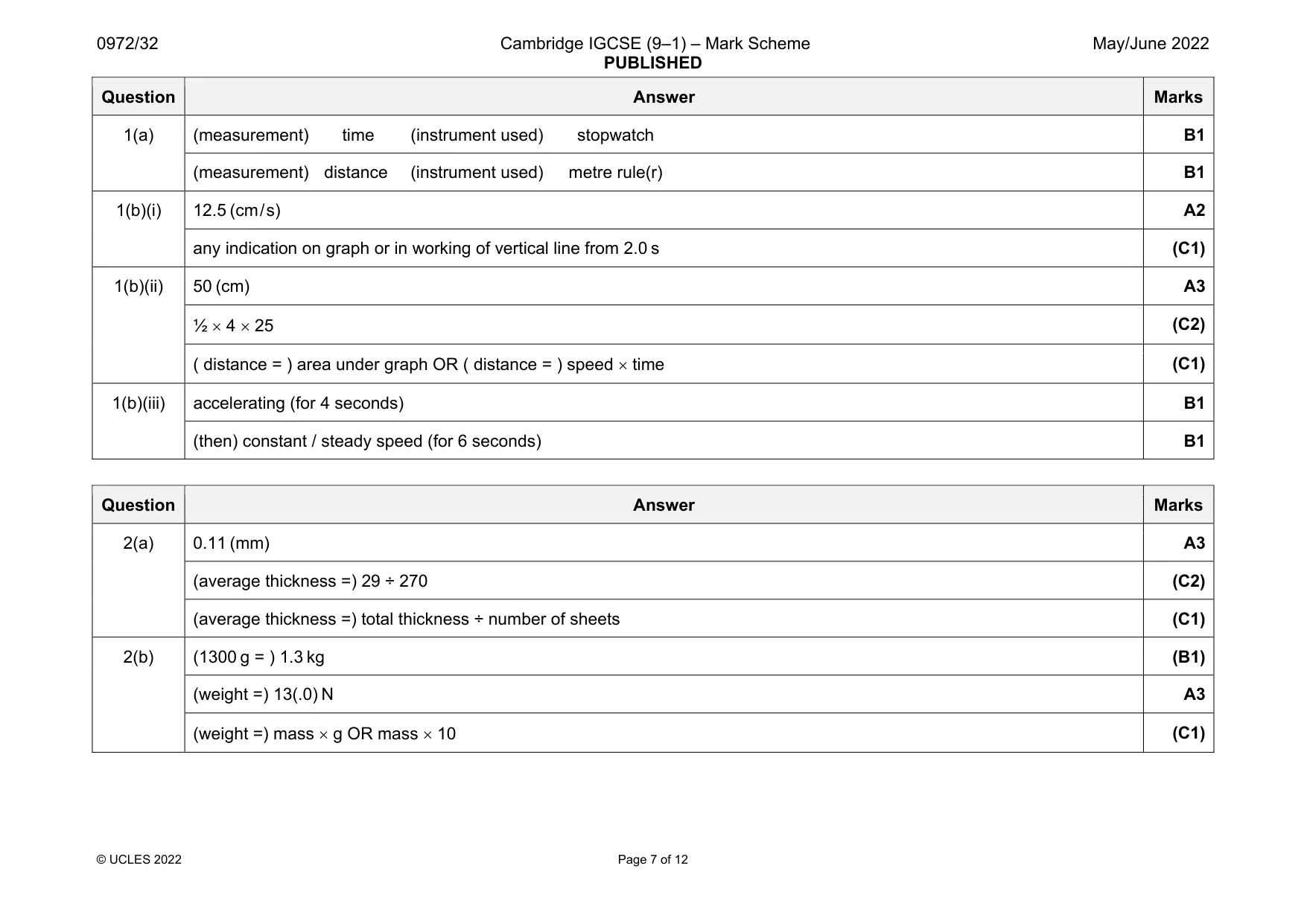
Mark scheme: 1(a) (measurement) time (instrument used) stopwatch B1 (measurement) distance (instrument used) metre rule(r) B1 1(b)(i) 12.5 (cm / s) A2 any indication on graph or in working of vertical line from 2.0 s (C1) 1(b)(ii) 50 (cm) A3 ½ 4 25 (C2) ( distance = ) area under graph OR ( distance = ) speed time (C1) 1(b)(iii) accelerating (for 4 seconds) B1 (then) constant / steady speed (for 6 seconds) B1
Question 2
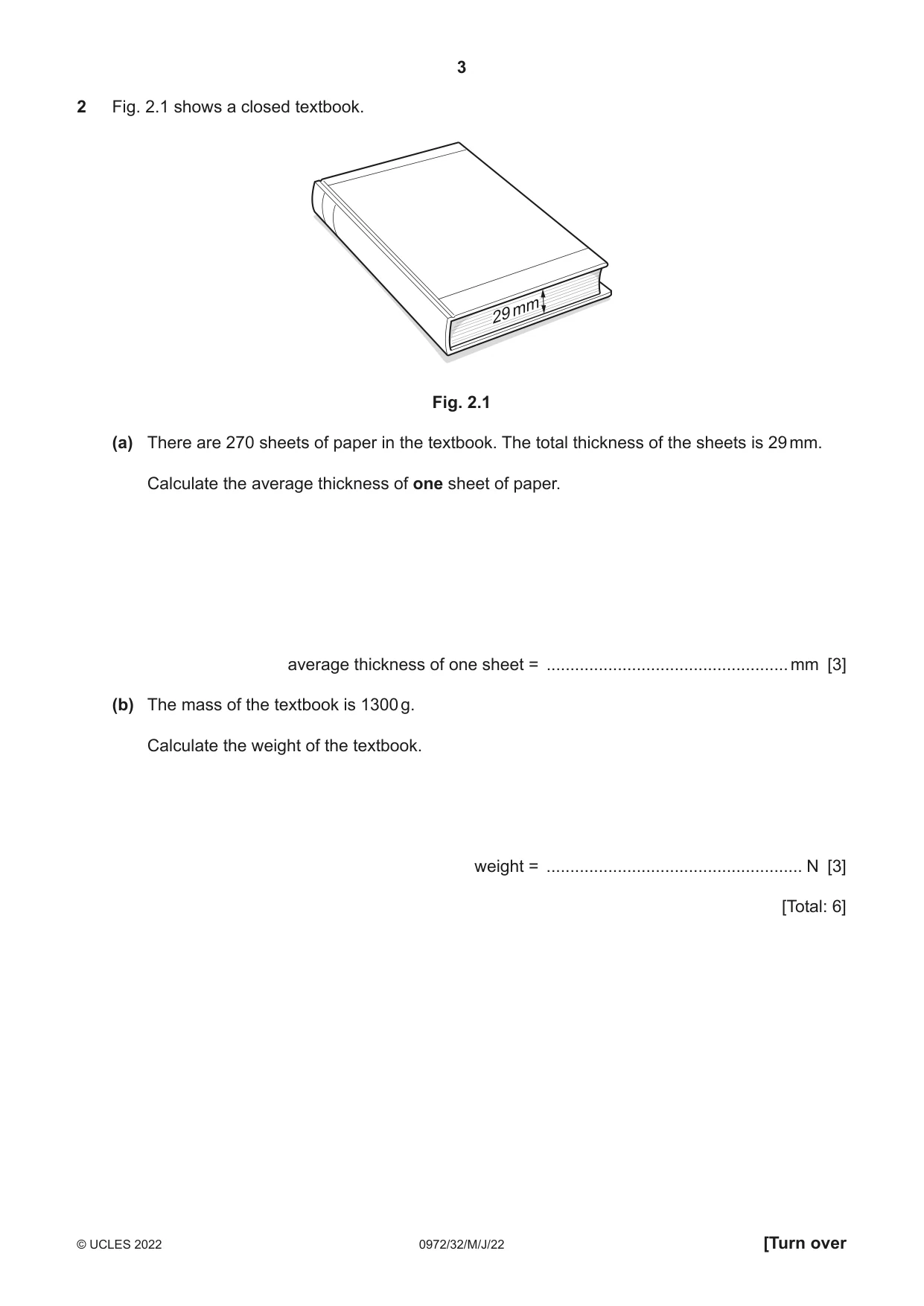
2 Fig. 2.1 shows a closed textbook. mm 29 Fig. 2.1 (a) There are 270 sheets of paper in the textbook. The total thickness of the sheets is 29 mm. Calculate the average thickness of one sheet of paper. average thickness of one sheet = ................................................... mm [3] (b) The mass of the textbook is 1300 g. Calculate the weight of the textbook. weight = ...................................................... N [3] [Total: 6]
Mark scheme: 2(a) 0.11 (mm) A3 (average thickness =) 29 ÷ 270 (C2) (average thickness =) total thickness ÷ number of sheets (C1) 2(b) (1300 g = ) 1.3 kg (B1) (weight =) 13(.0) N A3 (weight =) mass g OR mass 10 (C1)
More questions on Physical quantities and measurement techniques
Question 3
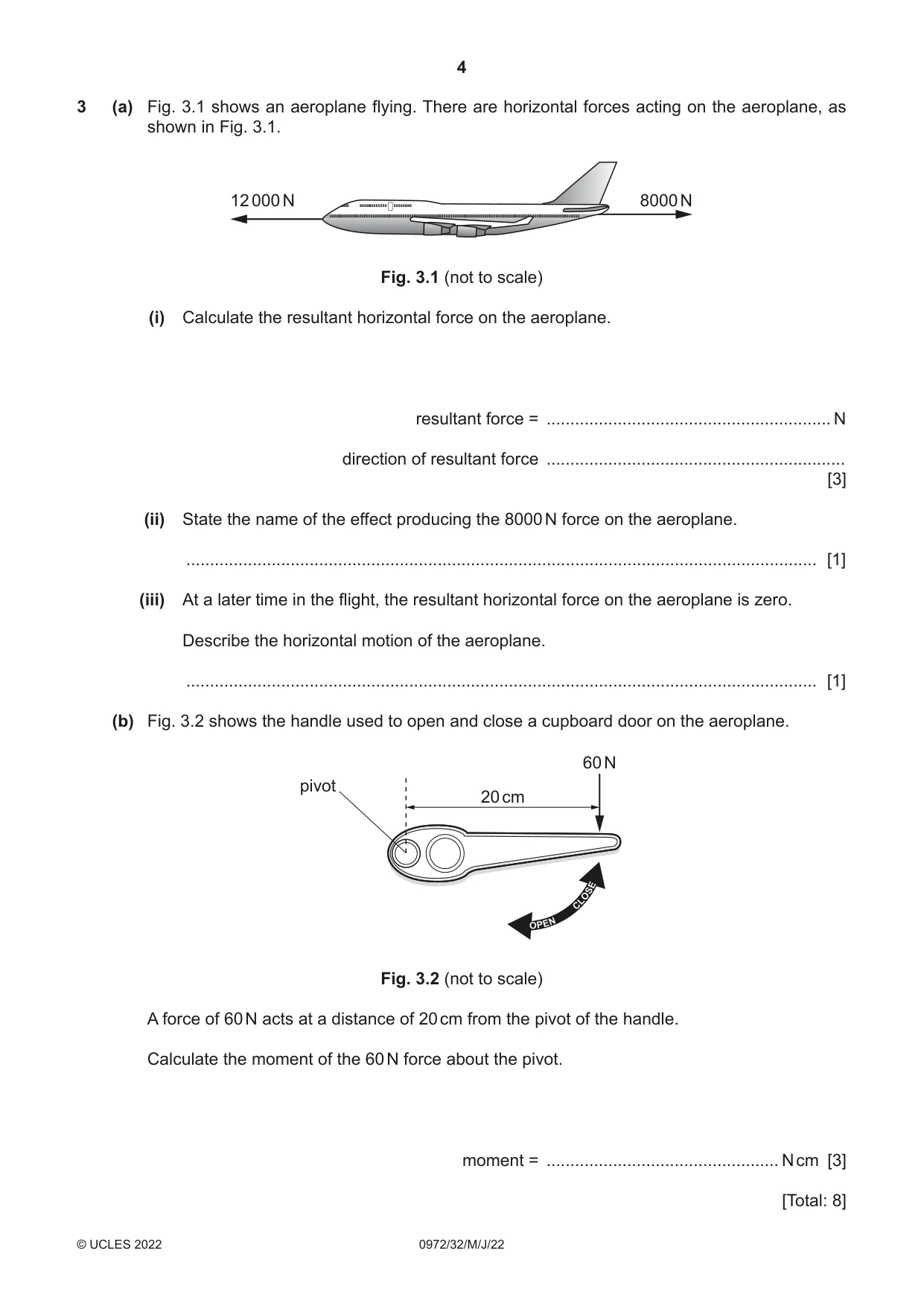
3 (a) Fig. 3.1 shows an aeroplane flying. There are horizontal forces acting on the aeroplane, as shown in Fig. 3.1. 12 000 N 8000 N Fig. 3.1 (not to scale) (i) Calculate the resultant horizontal force on the aeroplane. resultant force = ............................................................ N direction of resultant force ............................................................... [3] (ii) State the name of the effect producing the 8000 N force on the aeroplane. ..................................................................................................................................... [1] (iii) At a later time in the flight, the resultant horizontal force on the aeroplane is zero. Describe the horizontal motion of the aeroplane. ..................................................................................................................................... [1] (b) Fig. 3.2 shows the handle used to open and close a cupboard door on the aeroplane. 60 N pivot 20 cm Fig. 3.2 (not to scale) A force of 60 N acts at a distance of 20 cm from the pivot of the handle. Calculate the moment of the 60 N force about the pivot. moment = ................................................. N cm [3] [Total: 8]
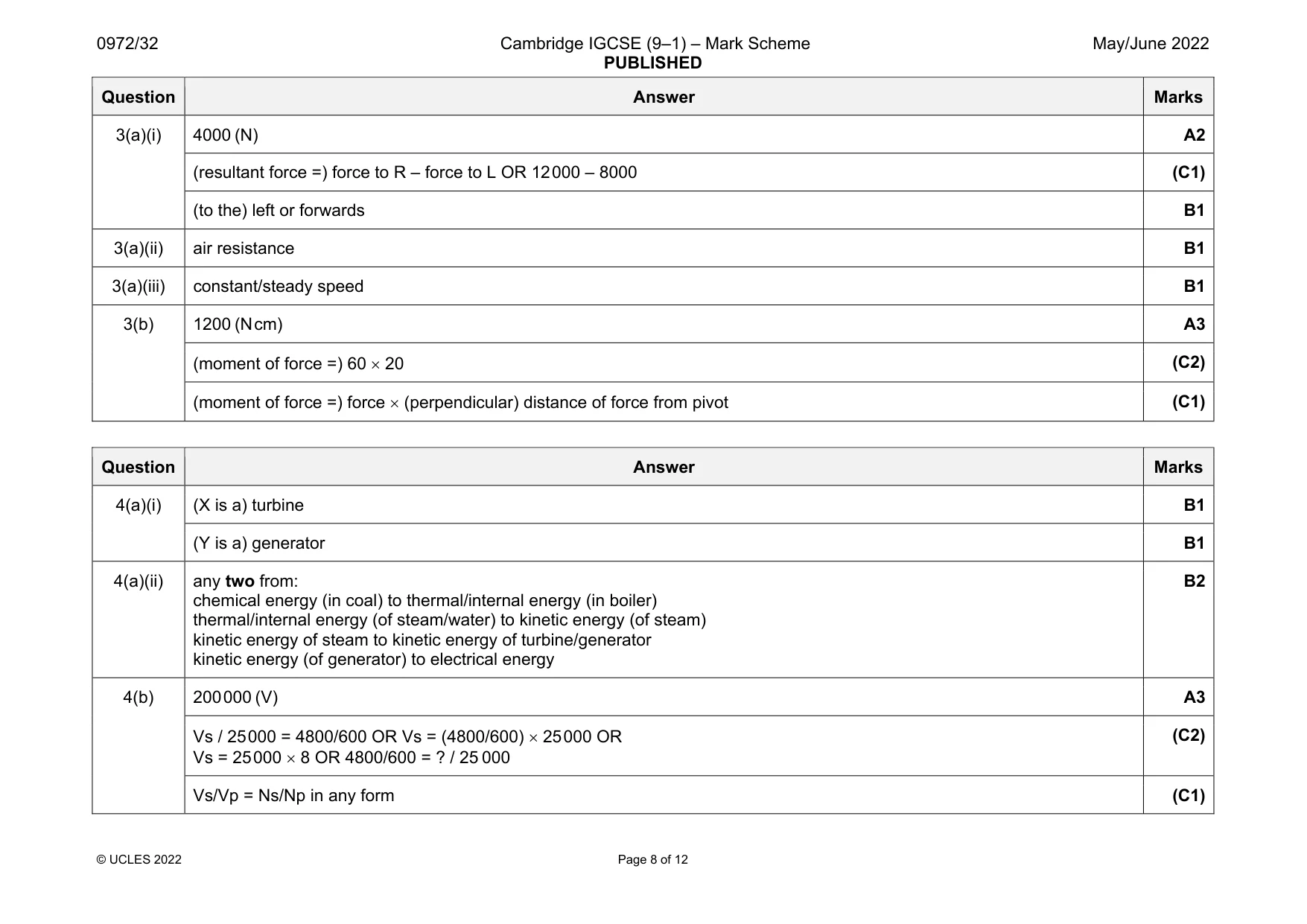
Mark scheme: 3(a)(i) 4000 (N) A2 (resultant force =) force to R – force to L OR 12 000 – 8000 (C1) (to the) left or forwards B1 3(a)(ii) air resistance B1 3(a)(iii) constant/steady speed B1 3(b) 1200 (N cm) A3 (moment of force =) 60 20 (C2) (moment of force =) force (perpendicular) distance of force from pivot (C1)
Q4 · Parts of a coal-fired power station
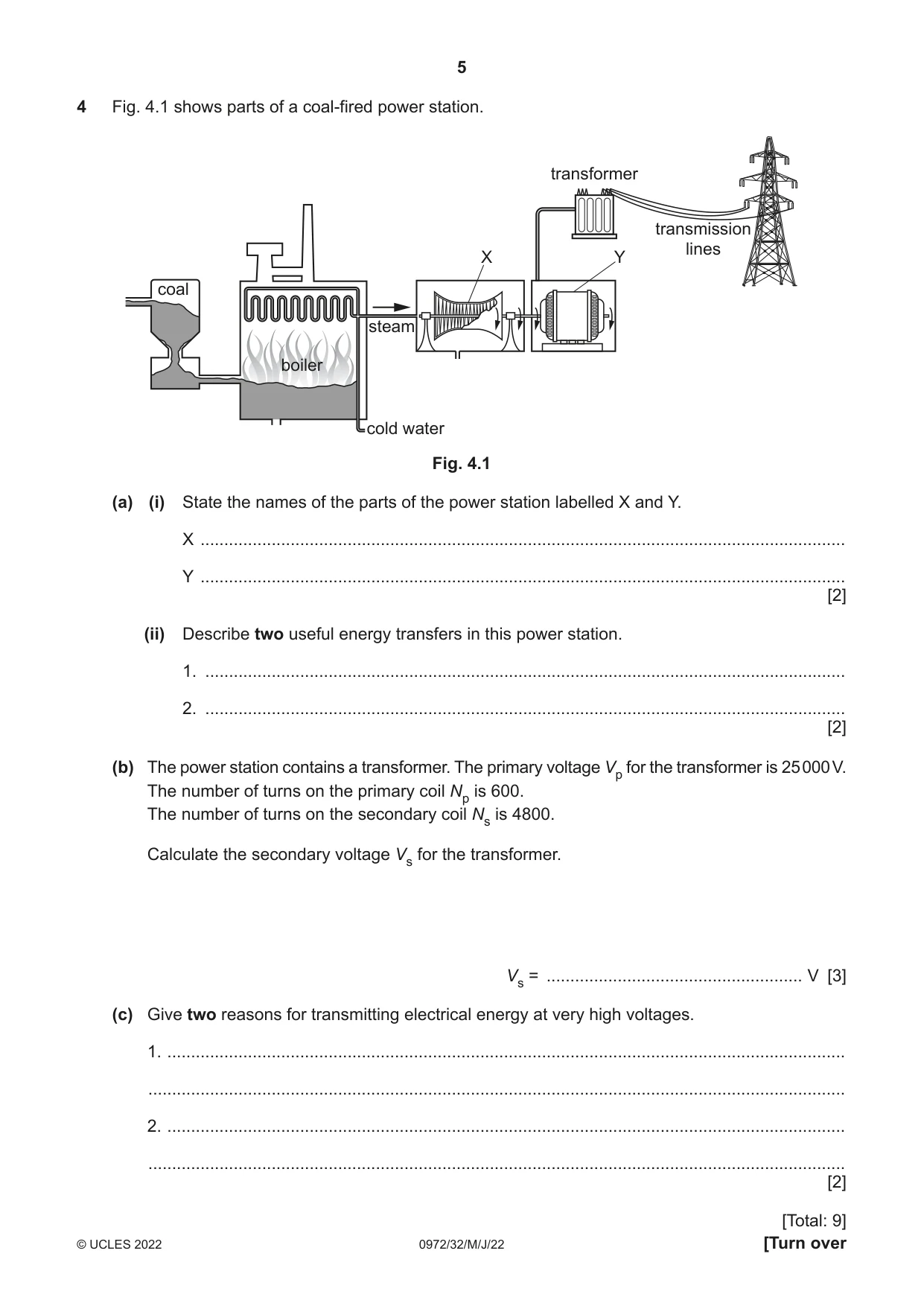
4 Fig. 4.1 shows parts of a coal-fired power station. transformer transmission lines X Y coal steam boiler cold water Fig. 4.1 (a) (i) State the names of the parts of the power station labelled X and Y. X ........................................................................................................................................ Y ........................................................................................................................................ [2] (ii) Describe two useful energy transfers in this power station. 1. ....................................................................................................................................... 2. ....................................................................................................................................... [2] (b) The power station contains a transformer. The primary voltage Vp for the transformer is 25 000 V. The number of turns on the primary coil Np is 600. The number of turns on the secondary coil Ns is 4800. Calculate the secondary voltage Vs for the transformer. Vs = ...................................................... V [3] (c) Give two reasons for transmitting electrical energy at very high voltages. 1. ............................................................................................................................................... ................................................................................................................................................... 2. ............................................................................................................................................... ................................................................................................................................................... [2] [Total: 9]
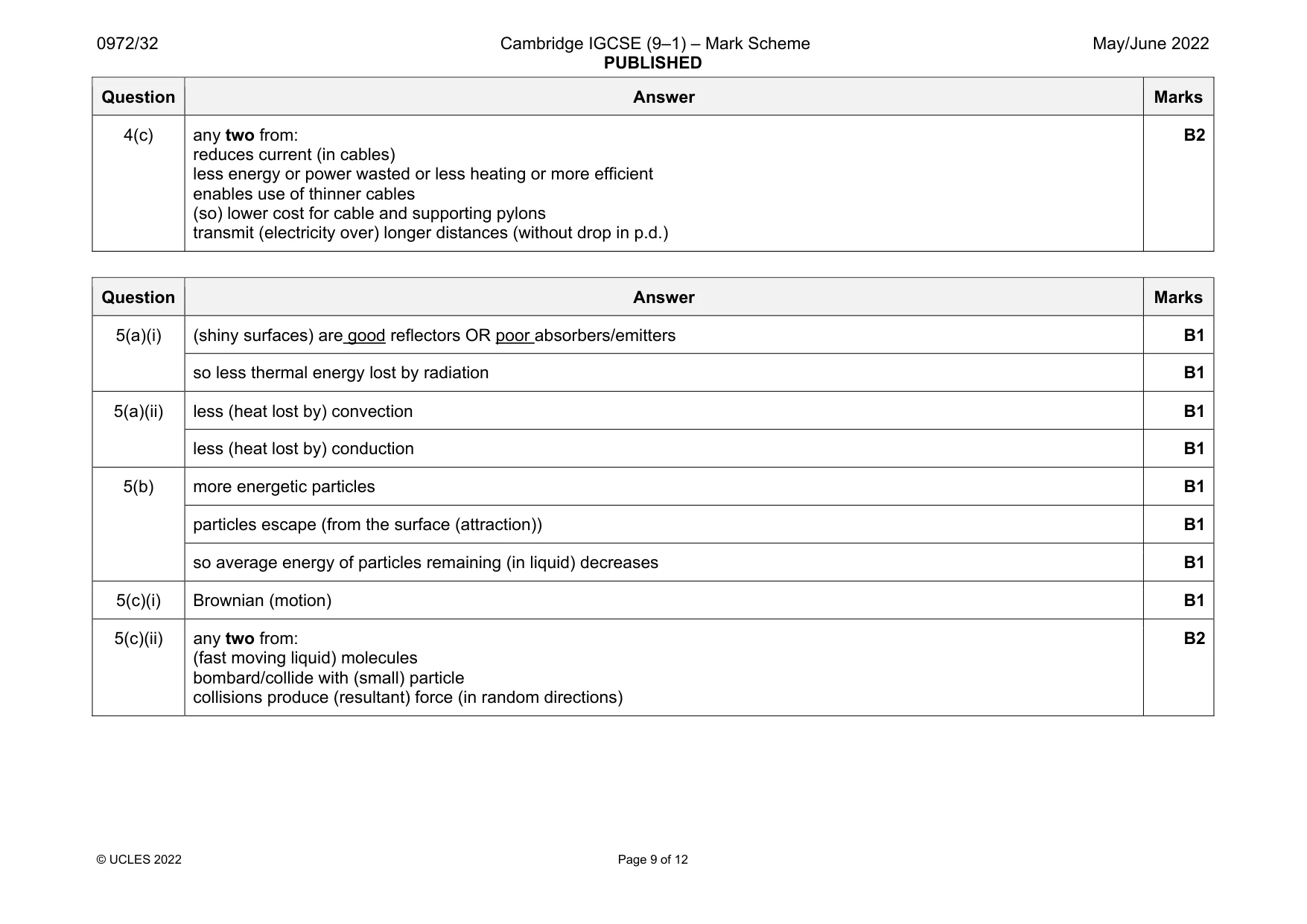
Mark scheme: 4(a)(i) (X is a) turbine B1 (Y is a) generator B1 4(a)(ii) any two from: chemical energy (in coal) to thermal/internal energy (in boiler) thermal/internal energy (of steam/water) to kinetic energy (of steam) kinetic energy of steam to kinetic energy of turbine/generator kinetic energy (of generator) to electrical energy B2 4(b) 200 000 (V) A3 Vs / 25 000 = 4800/600 OR Vs = (4800/600) 25 000 OR Vs = 25 000 8 OR 4800/600 = ? / 25 000 (C2) Vs/Vp = Ns/Np in any form (C1) Question Answer Marks 4(c) any two from: reduces current (in cables) less energy or power wasted or less heating or more efficient enables use of thinner cables (so) lower cost for cable and supporting pylons transmit (electricity over) longer distances (without drop in p.d.) B2
Q5 · A cross-section of a flask
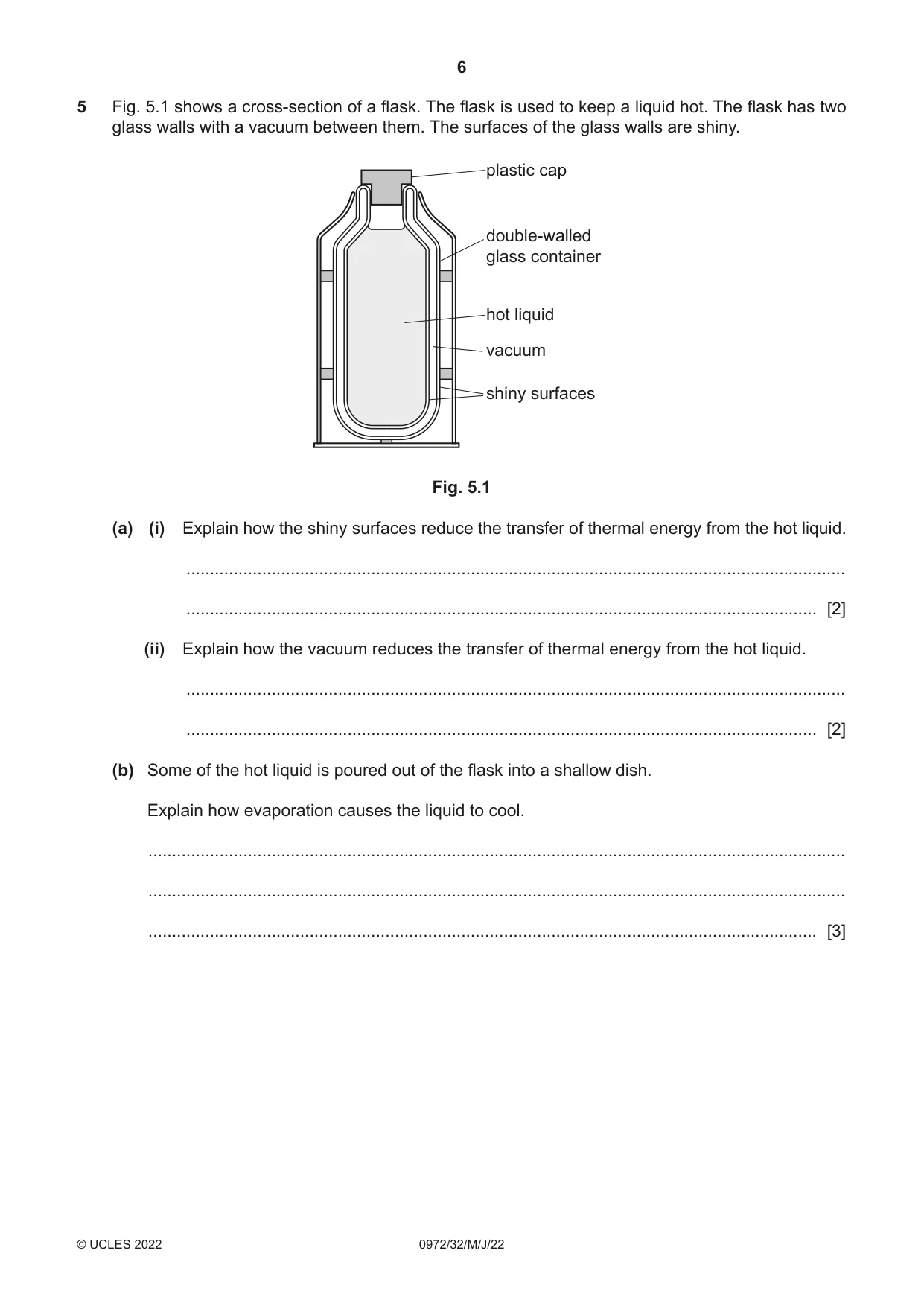
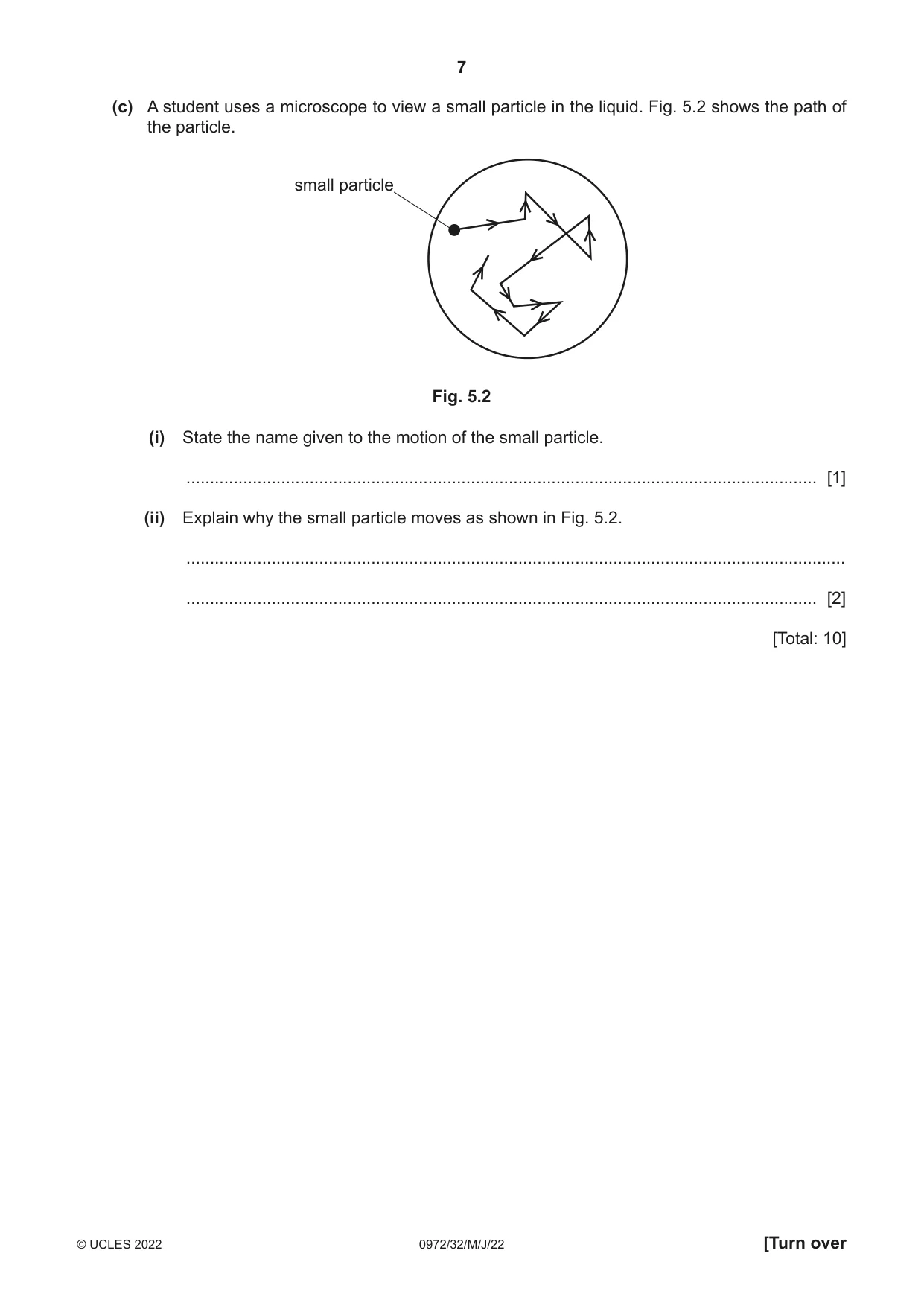
5 Fig. 5.1 shows a cross-section of a flask. The flask is used to keep a liquid hot. The flask has two glass walls with a vacuum between them. The surfaces of the glass walls are shiny. plastic cap double-walled glass container hot liquid vacuum shiny surfaces Fig. 5.1 (a) (i) Explain how the shiny surfaces reduce the transfer of thermal energy from the hot liquid. ........................................................................................................................................... ..................................................................................................................................... [2] (ii) Explain how the vacuum reduces the transfer of thermal energy from the hot liquid. ........................................................................................................................................... ..................................................................................................................................... [2] (b) Some of the hot liquid is poured out of the flask into a shallow dish. Explain how evaporation causes the liquid to cool. ................................................................................................................................................... ................................................................................................................................................... ............................................................................................................................................. [3] (c) A student uses a microscope to view a small particle in the liquid. Fig. 5.2 shows the path of the particle. small particle Fig. 5.2 (i) State the name given to the motion of the small particle. ..................................................................................................................................... [1] (ii) Explain why the small particle moves as shown in Fig. 5.2. ........................................................................................................................................... ..................................................................................................................................... [2] [Total: 10]
Mark scheme: 5(a)(i) (shiny surfaces) are good reflectors OR poor absorbers/emitters B1 so less thermal energy lost by radiation B1 5(a)(ii) less (heat lost by) convection B1 less (heat lost by) conduction B1 5(b) more energetic particles B1 particles escape (from the surface (attraction)) B1 so average energy of particles remaining (in liquid) decreases B1 5(c)(i) Brownian (motion) B1 5(c)(ii) any two from: (fast moving liquid) molecules bombard/collide with (small) particle collisions produce (resultant) force (in random directions) B2
Q6 · The main regions of the electromagnetic spectrum
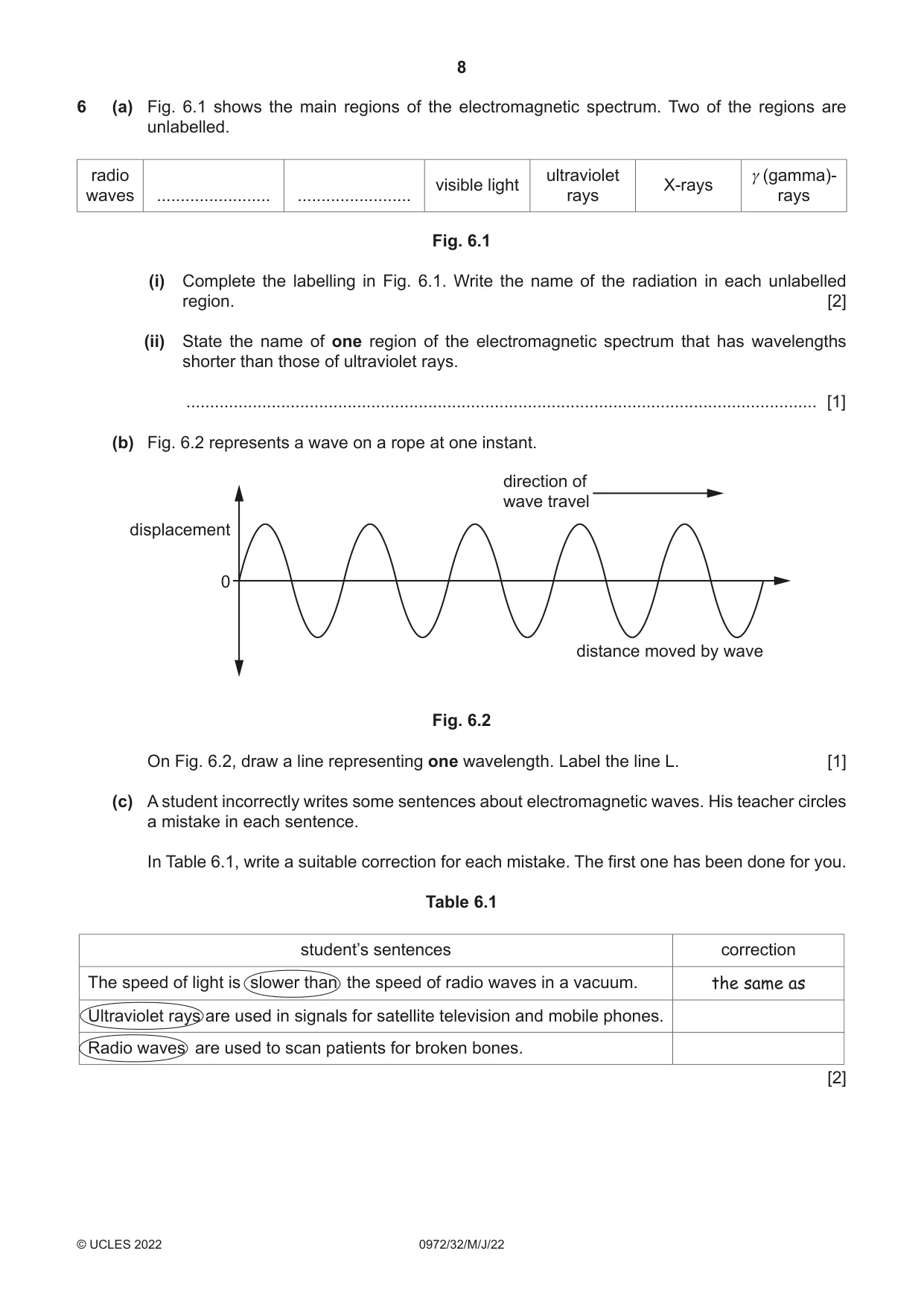
6 (a) Fig. 6.1 shows the main regions of the electromagnetic spectrum. Two of the regions are unlabelled. radio ultraviolet γ (gamma)- visible light X-rays waves ........................ ........................ rays rays Fig. 6.1 (i) Complete the labelling in Fig. 6.1. Write the name of the radiation in each unlabelled region. [2] (ii) State the name of one region of the electromagnetic spectrum that has wavelengths shorter than those of ultraviolet rays. ..................................................................................................................................... [1] (b) Fig. 6.2 represents a wave on a rope at one instant. direction of wave travel displacement 0 distance moved by wave Fig. 6.2 On Fig. 6.2, draw a line representing one wavelength. Label the line L. [1] (c) A student incorrectly writes some sentences about electromagnetic waves. His teacher circles a mistake in each sentence. In Table 6.1, write a suitable correction for each mistake. The first one has been done for you. Table 6.1 student’s sentences correction The speed of light is slower than the speed of radio waves in a vacuum. the same as Ultraviolet rays are used in signals for satellite television and mobile phones. Radio waves are used to scan patients for broken bones. [2] (d) Describe the difference between the vibrations of longitudinal waves and transverse waves. ................................................................................................................................................... ................................................................................................................................................... ............................................................................................................................................. [2] [Total: 8]
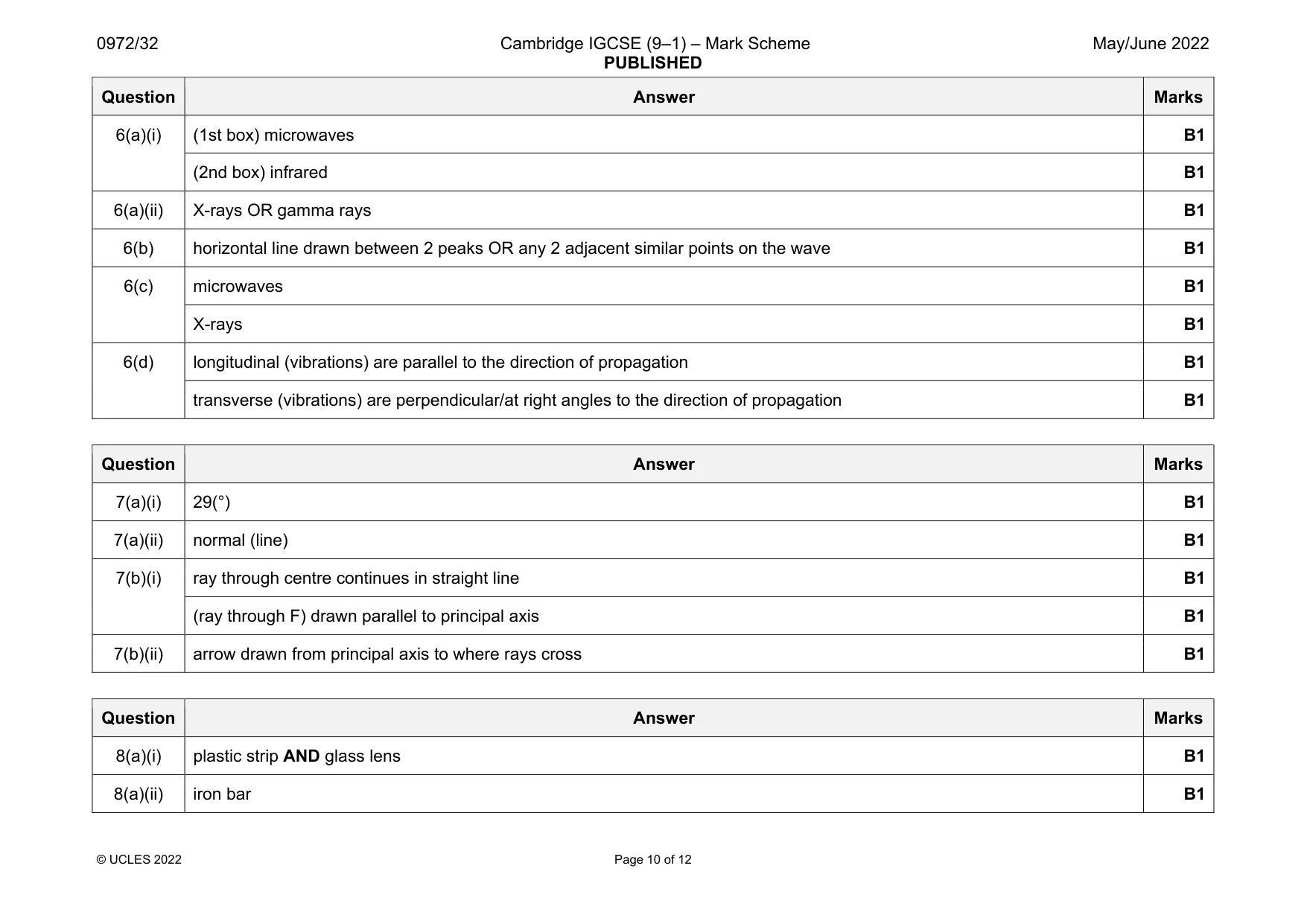
Mark scheme: 6(a)(i) (1st box) microwaves B1 (2nd box) infrared B1 6(a)(ii) X-rays OR gamma rays B1 6(b) horizontal line drawn between 2 peaks OR any 2 adjacent similar points on the wave B1 6(c) microwaves B1 X-rays B1 6(d) longitudinal (vibrations) are parallel to the direction of propagation B1 transverse (vibrations) are perpendicular/at right angles to the direction of propagation B1
Q7 · A student investigates refraction through a parallel- sided glass block
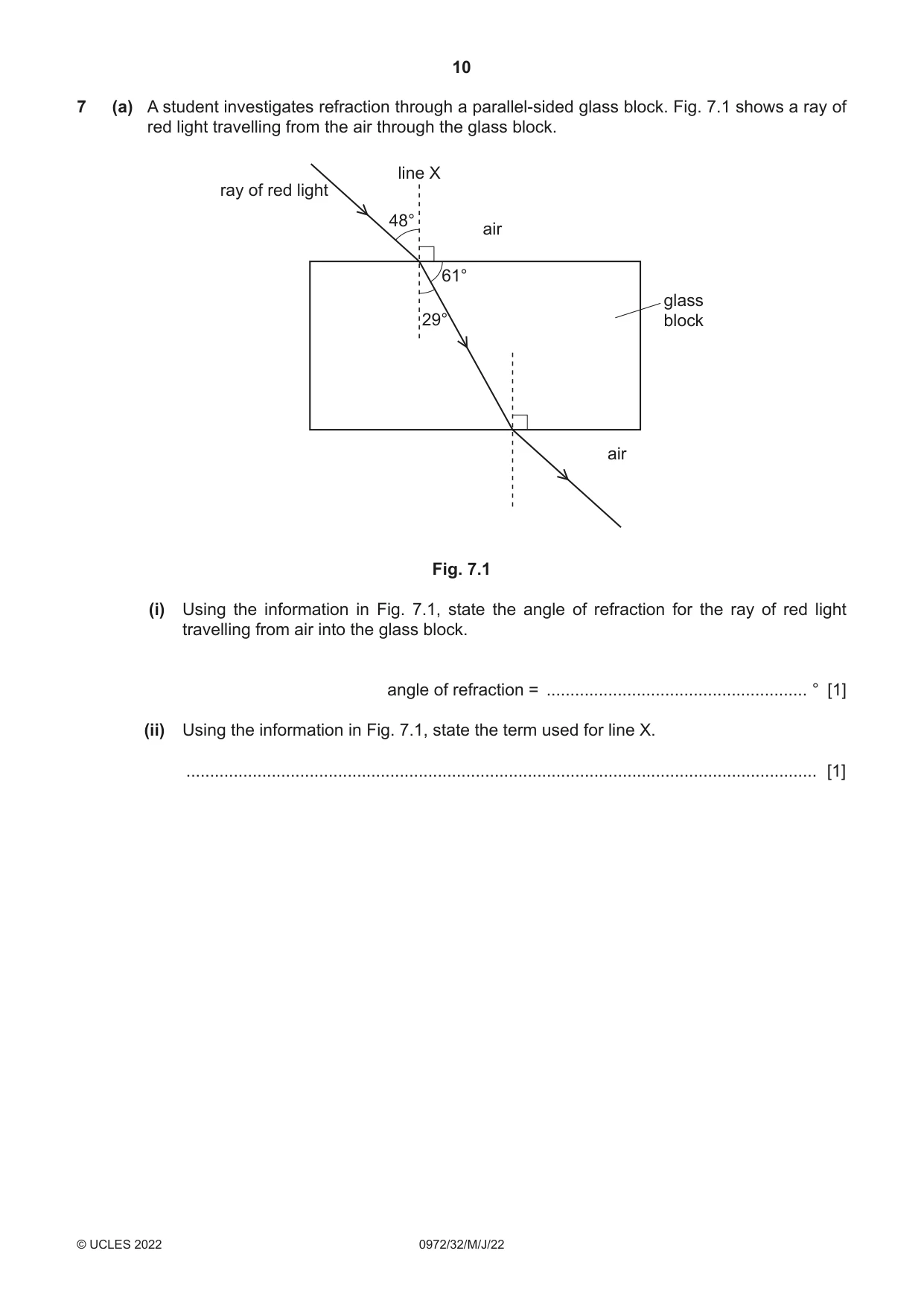
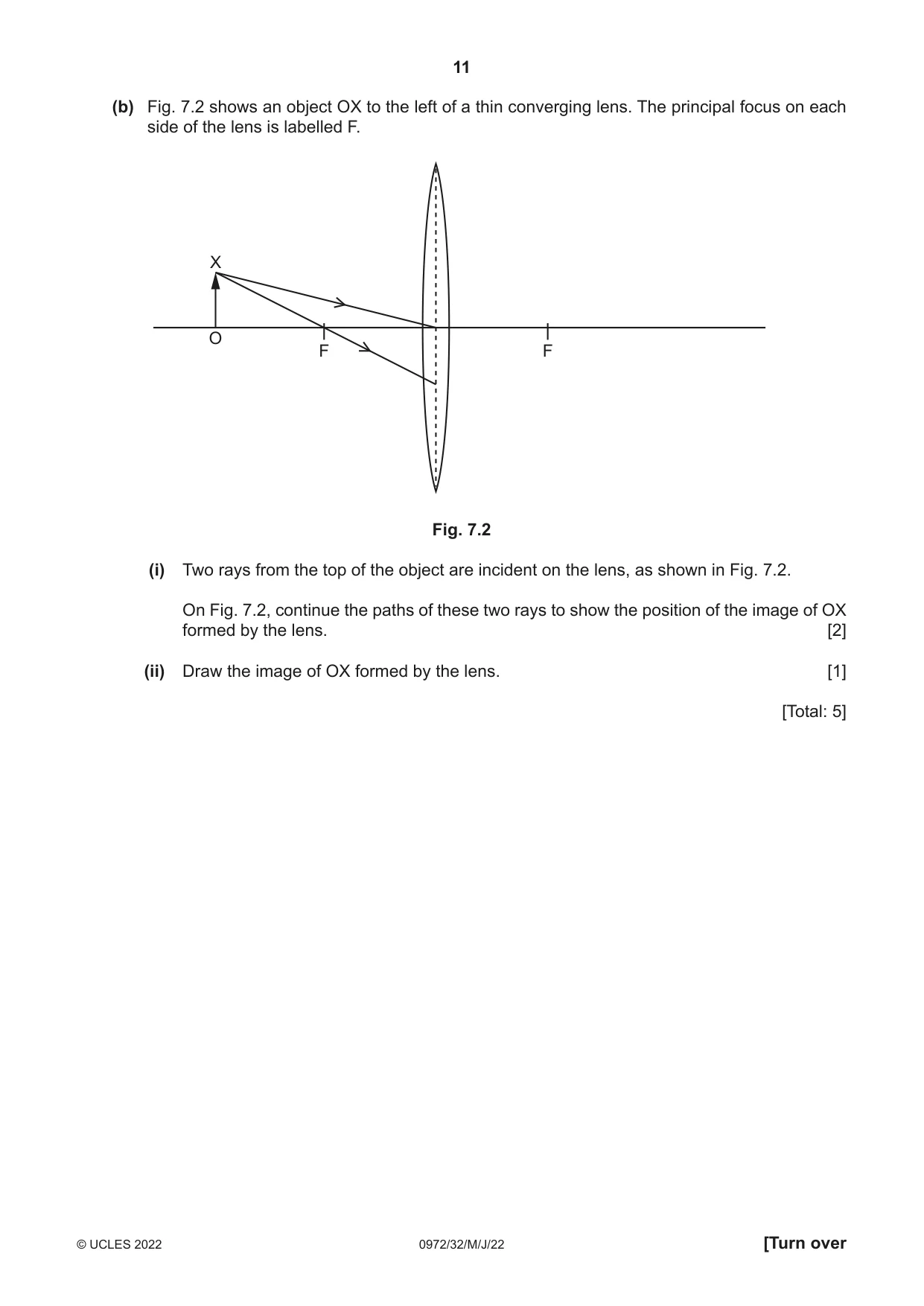
7 (a) A student investigates refraction through a parallel- sided glass block. Fig. 7.1 shows a ray of red light travelling from the air through the glass block. line X ray of red light 48° air 61° glass 29° block air Fig. 7.1 (i) Using the information in Fig. 7.1, state the angle of refraction for the ray of red light travelling from air into the glass block. angle of refraction = ....................................................... ° [1] (ii) Using the information in Fig. 7.1, state the term used for line X. ..................................................................................................................................... [1] (b) Fig. 7.2 shows an object OX to the left of a thin converging lens. The principal focus on each side of the lens is labelled F. X O F F Fig. 7.2 (i) Two rays from the top of the object are incident on the lens, as shown in Fig. 7.2. On Fig. 7.2, continue the paths of these two rays to show the position of the image of OX formed by the lens. [2] (ii) Draw the image of OX formed by the lens. [1] [Total: 5]
Mark scheme: 7(a)(i) 29(°) B1 7(a)(ii) normal (line) B1 7(b)(i) ray through centre continues in straight line B1 (ray through F) drawn parallel to principal axis B1 7(b)(ii) arrow drawn from principal axis to where rays cross B1
Q8 · A student has a box containing objects made of different materials
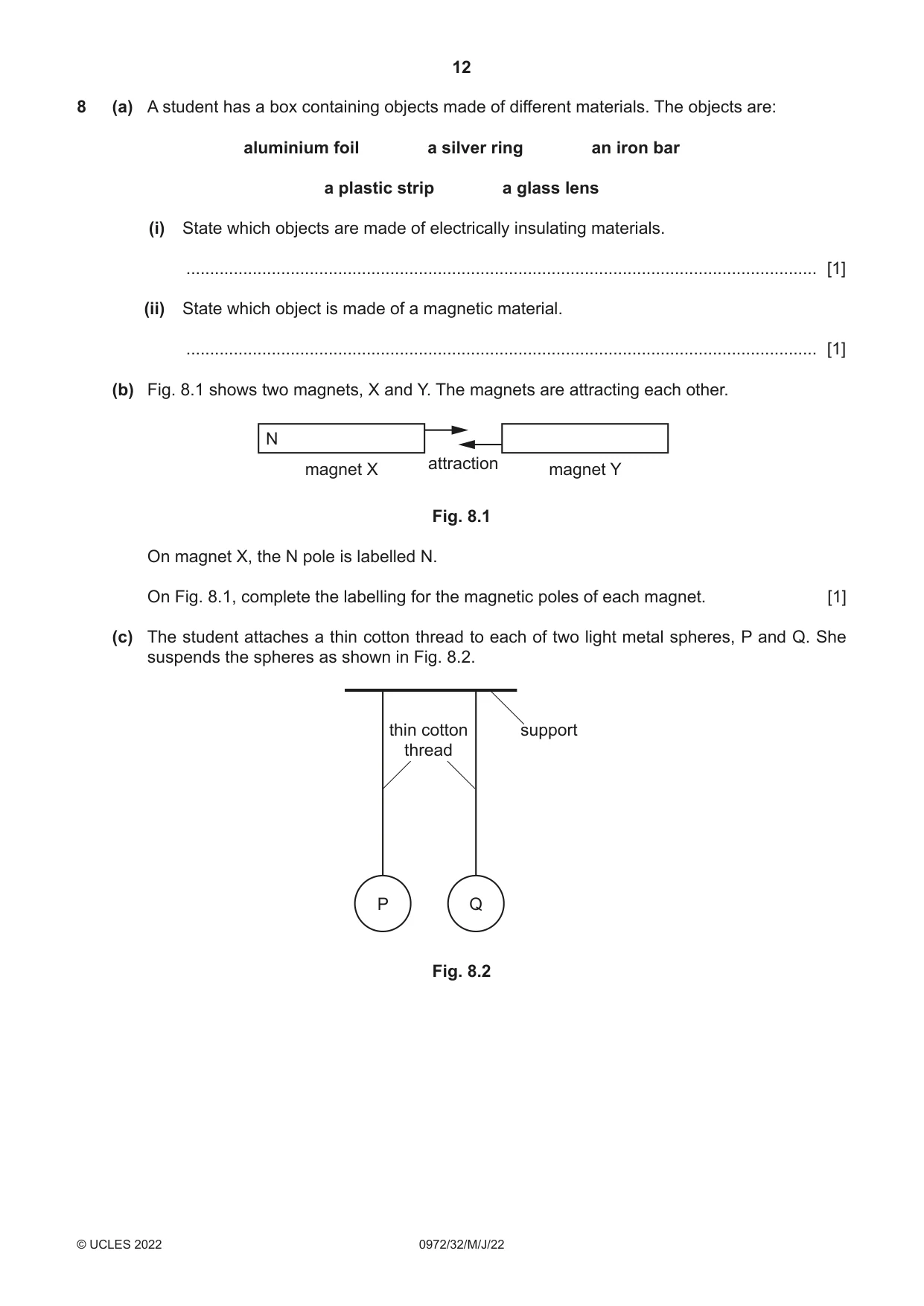
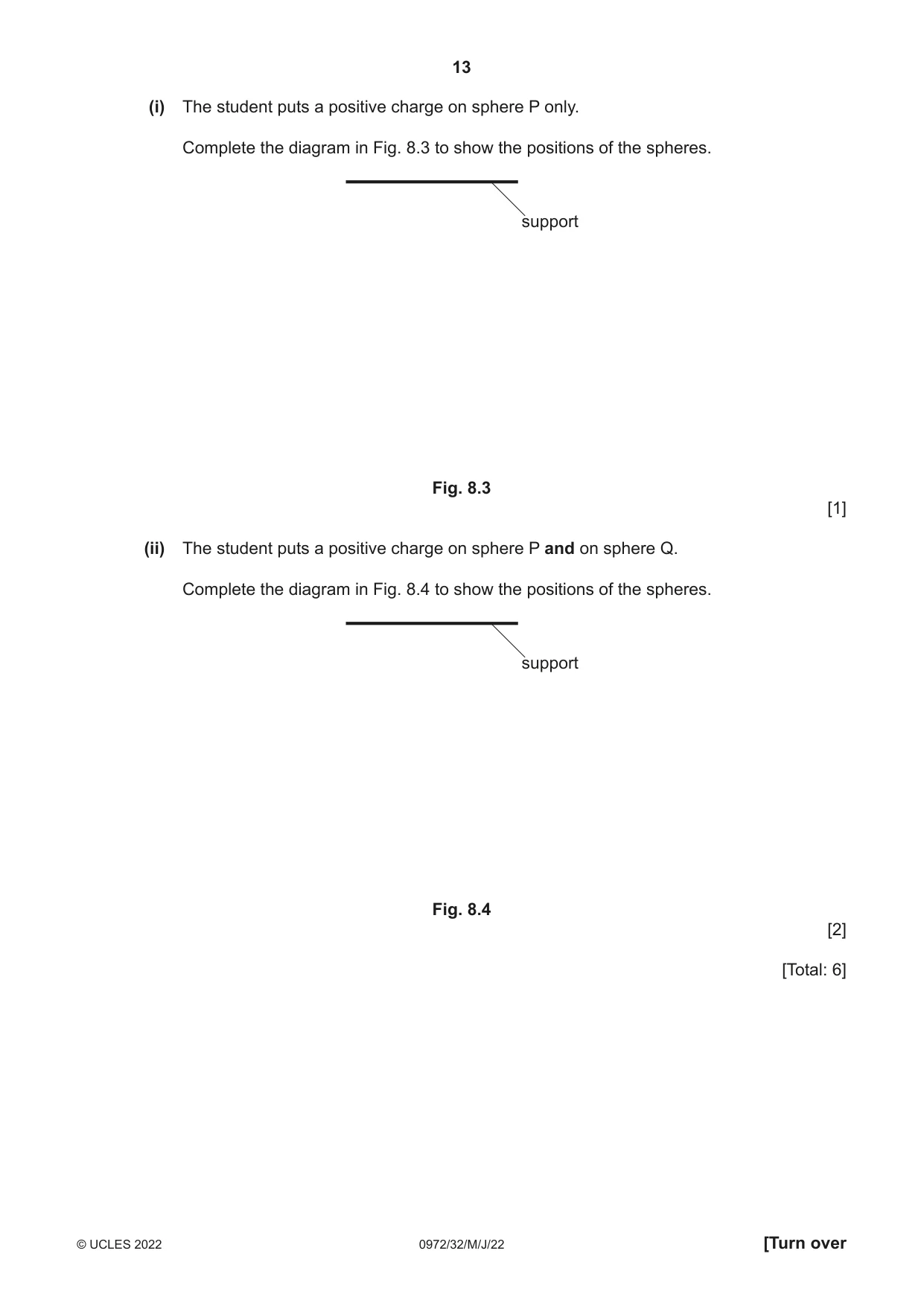
8 (a) A student has a box containing objects made of different materials. The objects are: aluminium foil a silver ring an iron bar a plastic strip a glass lens (i) State which objects are made of electrically insulating materials. ..................................................................................................................................... [1] (ii) State which object is made of a magnetic material. ..................................................................................................................................... [1] (b) Fig. 8.1 shows two magnets, X and Y. The magnets are attracting each other. N attraction magnet X magnet Y Fig. 8.1 On magnet X, the N pole is labelled N. On Fig. 8.1, complete the labelling for the magnetic poles of each magnet. [1] (c) The student attaches a thin cotton thread to each of two light metal spheres, P and Q. She suspends the spheres as shown in Fig. 8.2. thin cotton support thread P Q Fig. 8.2 (i) The student puts a positive charge on sphere P only. Complete the diagram in Fig. 8.3 to show the positions of the spheres. support Fig. 8.3 [1] (ii) The student puts a positive charge on sphere P and on sphere Q. Complete the diagram in Fig. 8.4 to show the positions of the spheres. support Fig. 8.4 [2] [Total: 6]
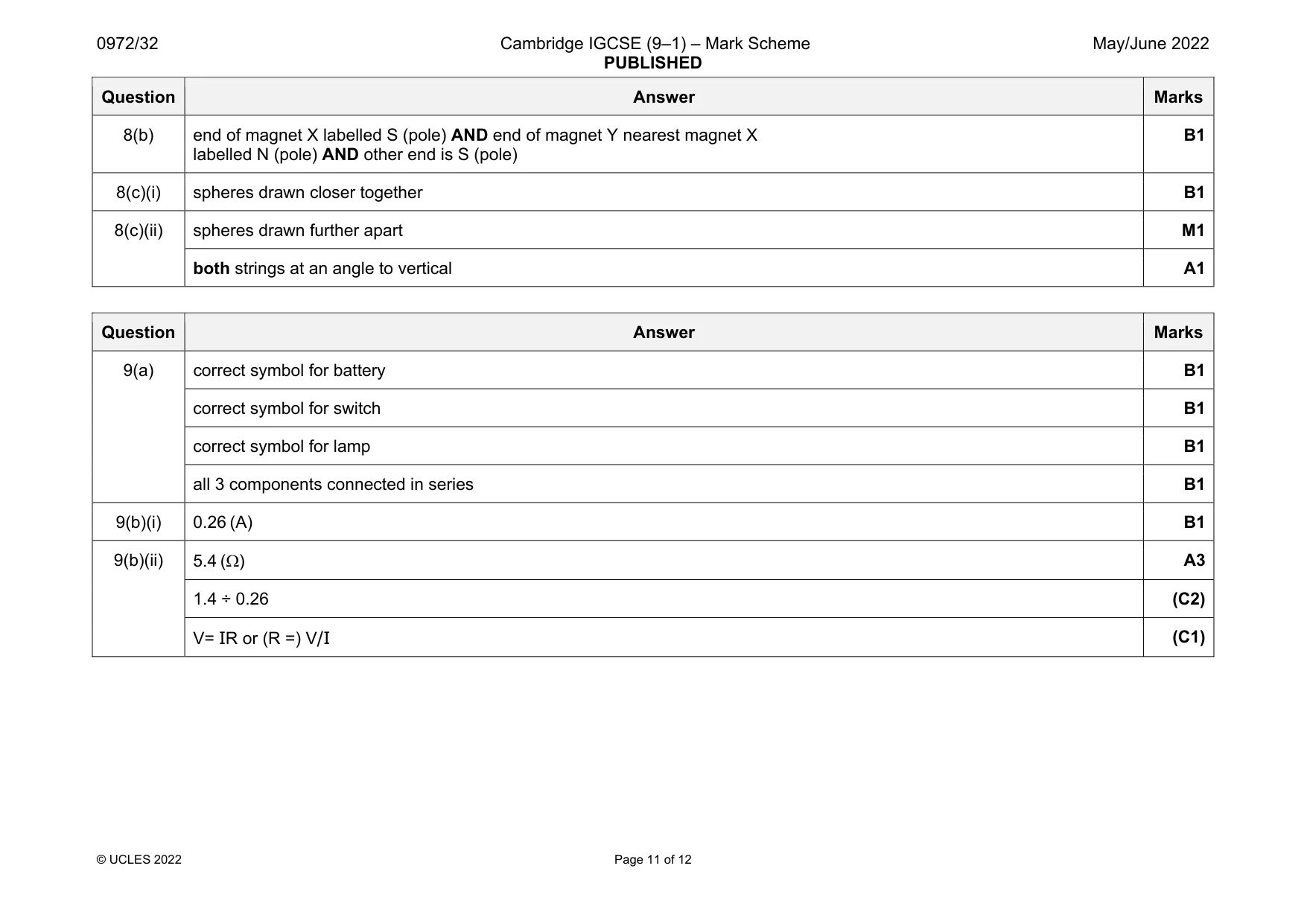
Mark scheme: 8(a)(i) plastic strip AND glass lens B1 8(a)(ii) iron bar B1 Question Answer Marks 8(b) end of magnet X labelled S (pole) AND end of magnet Y nearest magnet X labelled N (pole) AND other end is S (pole) B1 8(c)(i) spheres drawn closer together B1 8(c)(ii) spheres drawn further apart M1 both strings at an angle to vertical A1
Q9 · A student has a battery-operated torch
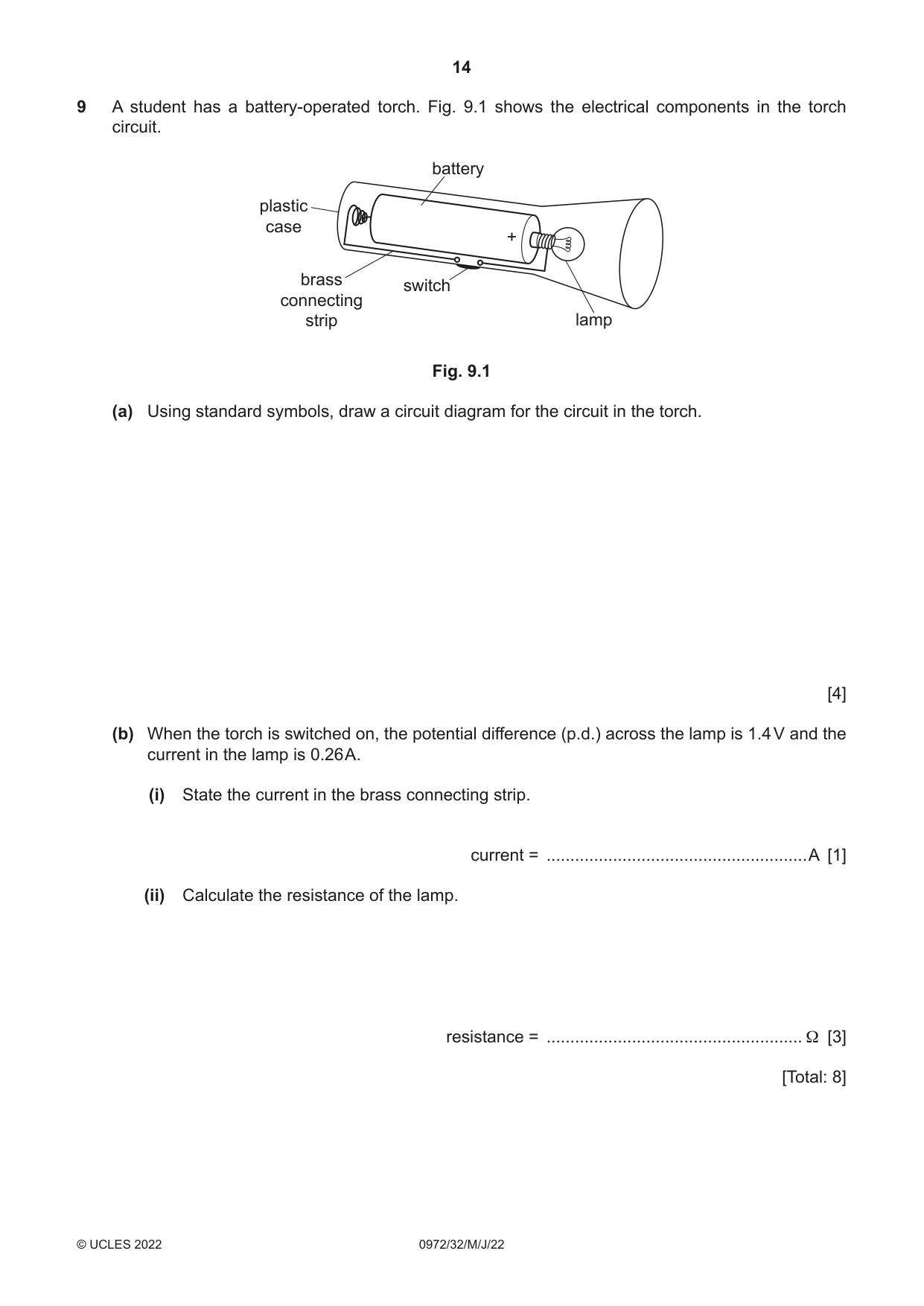
9 A student has a battery-operated torch. Fig. 9.1 shows the electrical components in the torch circuit. battery plastic case + brass switch connecting strip lamp Fig. 9.1 (a) Using standard symbols, draw a circuit diagram for the circuit in the torch. [4] (b) When the torch is switched on, the potential difference (p.d.) across the lamp is 1.4 V and the current in the lamp is 0.26 A. (i) State the current in the brass connecting strip. current = ....................................................... A [1] (ii) Calculate the resistance of the lamp. resistance = ...................................................... Ω [3] [Total: 8]
Mark scheme: 9(a) correct symbol for battery B1 correct symbol for switch B1 correct symbol for lamp B1 all 3 components connected in series B1 9(b)(i) 0.26 (A) B1 9(b)(ii) 5.4 () A3 1.4 ÷ 0.26 (C2) V= IR or (R =) V/I (C1)
Q10 · A wire passing through a card
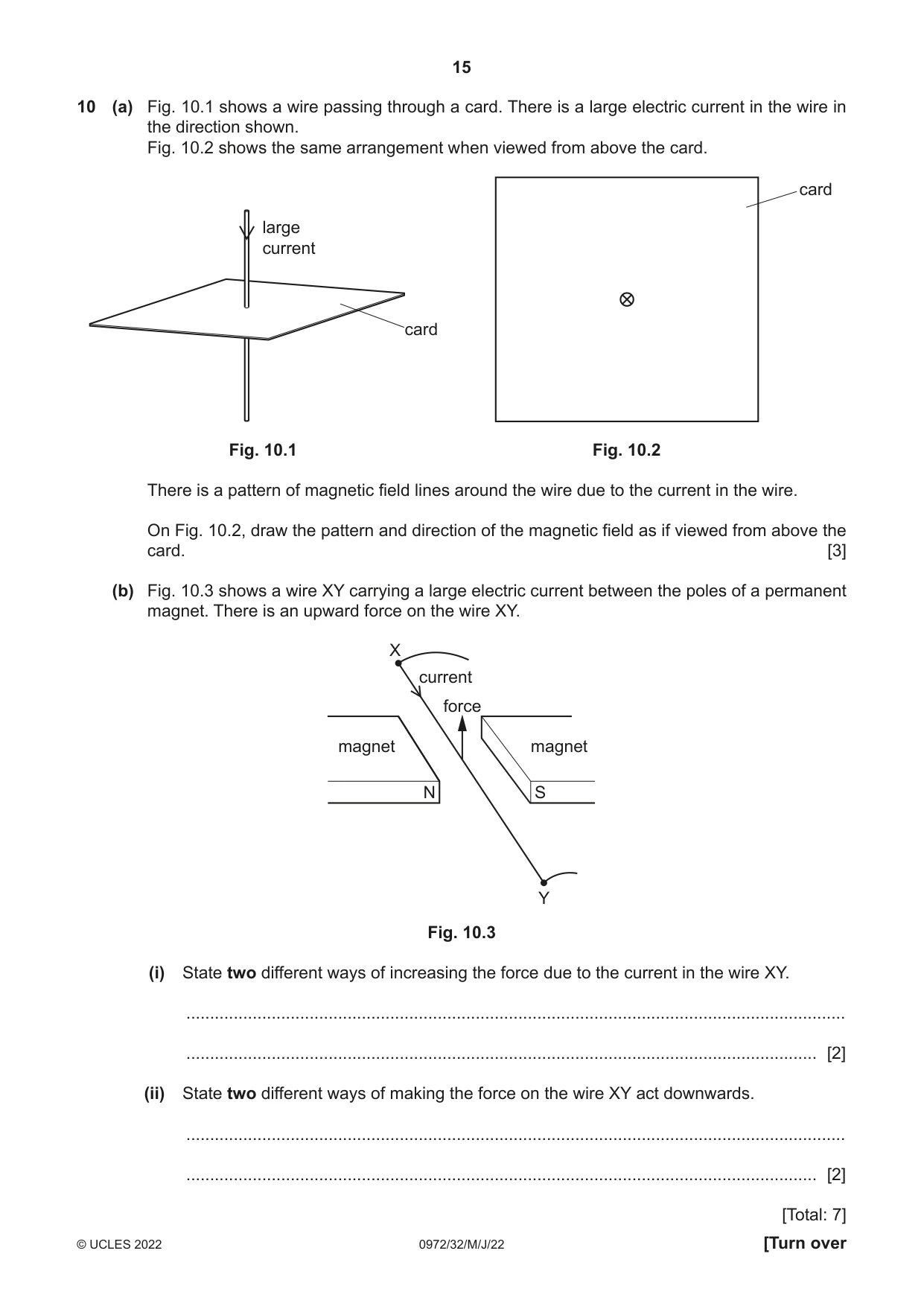
10 (a) Fig. 10.1 shows a wire passing through a card. There is a large electric current in the wire in the direction shown. Fig. 10.2 shows the same arrangement when viewed from above the card. card large current card Fig. 10.1 Fig. 10.2 There is a pattern of magnetic field lines around the wire due to the current in the wire. On Fig. 10.2, draw the pattern and direction of the magnetic field as if viewed from above the card. [3] (b) Fig. 10.3 shows a wire XY carrying a large electric current between the poles of a permanent magnet. There is an upward force on the wire XY. X current force magnet magnet N S Y Fig. 10.3 (i) State two different ways of increasing the force due to the current in the wire XY. ........................................................................................................................................... ..................................................................................................................................... [2] (ii) State two different ways of making the force on the wire XY act downwards. ........................................................................................................................................... ..................................................................................................................................... [2] [Total: 7]
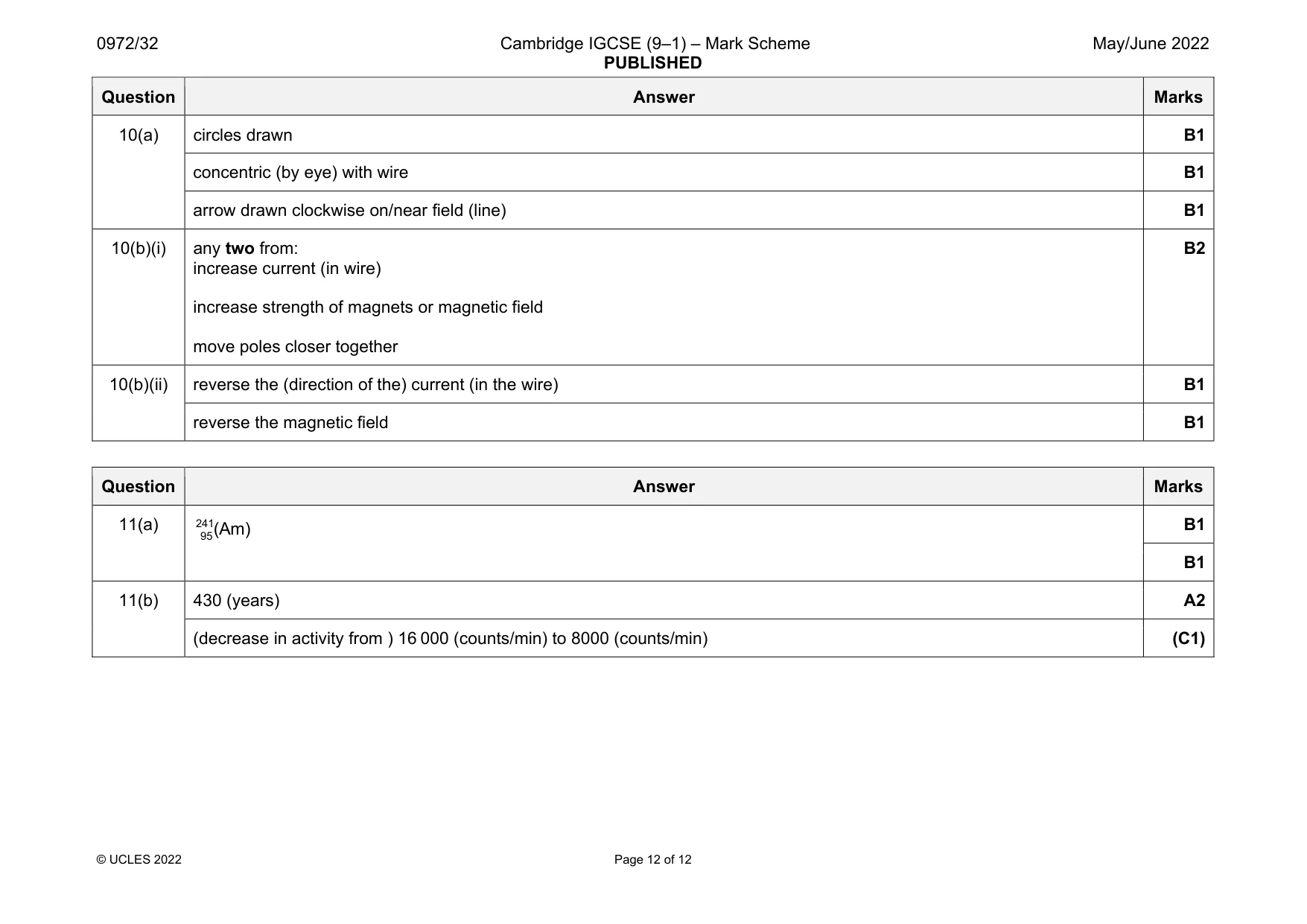
Mark scheme: 10(a) circles drawn B1 concentric (by eye) with wire B1 arrow drawn clockwise on/near field (line) B1 10(b)(i) any two from: increase current (in wire) increase strength of magnets or magnetic field move poles closer together B2 10(b)(ii) reverse the (direction of the) current (in the wire) B1 reverse the magnetic field B1
Q11 · An isotope of americium has 95 protons and 146 neutrons in its nucleus
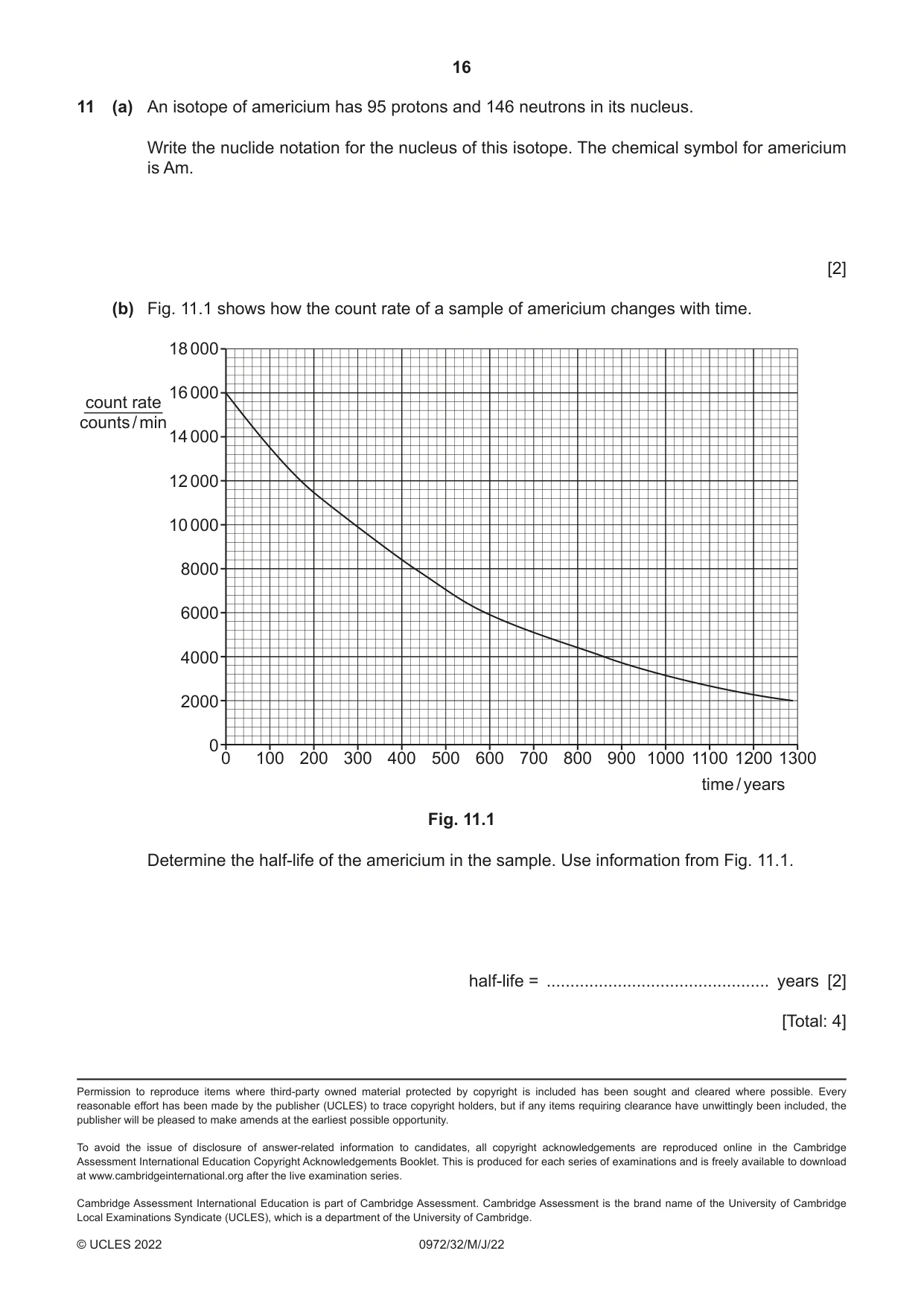
11 (a) An isotope of americium has 95 protons and 146 neutrons in its nucleus. Write the nuclide notation for the nucleus of this isotope. The chemical symbol for americium is Am. [2] (b) Fig. 11.1 shows how the count rate of a sample of americium changes with time. 18 000 16 000 count rate counts / min 14 000 12 000 10 000 8000 6000 4000 2000 0 0 100 200 300 400 500 600 700 800 900 1000 1100 1200 1300 time / years Fig. 11.1 Determine the half-life of the americium in the sample. Use information from Fig. 11.1. half-life = ............................................... years [2] [Total: 4]
Mark scheme: 11(a) 241 95(Am) B1 11(b) 430 (years) A2 (decrease in activity from ) 16 000 (counts/min) to 8000 (counts/min) (C1)
What was in this paper
The subtopics covered by these 11 questions, and how many questions each got. Open one in a new tab to see every Cambridge question on it.
What you needed in this session
Cambridge’s own grade thresholds for 2022 May/June, Paper 3 · Variant 2. A higher threshold means an easier paper — the bar moves with how the cohort did.