Cambridge IGCSE Physics (9-1) 0972 — 2021 Oct/Nov Paper 3 · Variant 1
0972/31/O/N/21 · 11 questions · 80 marks · ≈90 min
The question paper and its mark scheme, free to read here and free to download. This is Cambridge’s own paper, exactly as it was sat.
Question paper16 pages
Mark scheme14 pages
Answers below. Sit the paper first if you are practising.
Questions as text
Q1 · A student uses a ruler to measure the length of a piece of wire, as shown in Fig
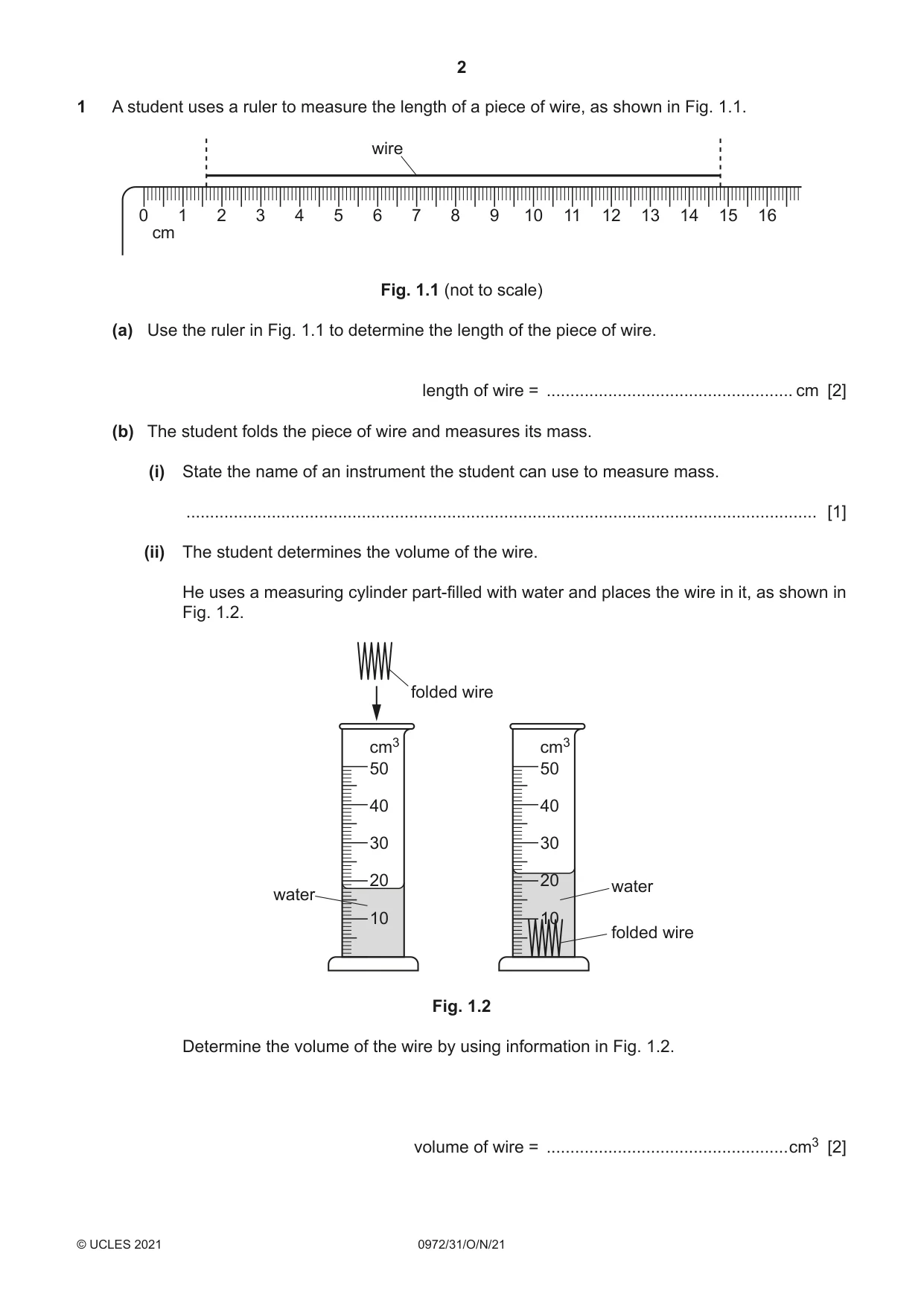
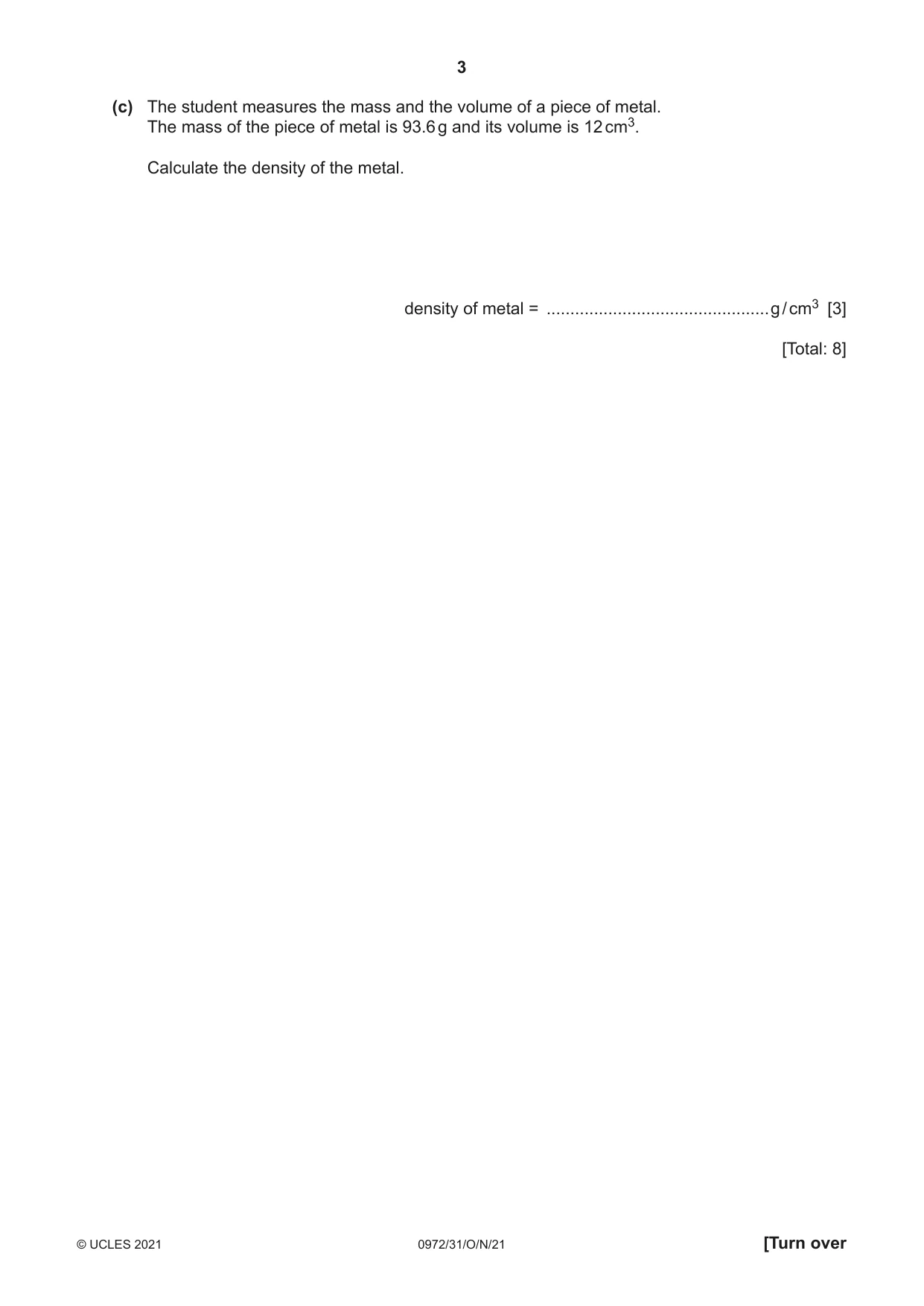
1 A student uses a ruler to measure the length of a piece of wire, as shown in Fig. 1.1. wire 0 1 2 3 4 5 6 7 8 9 10 11 12 13 14 15 16 cm Fig. 1.1 (not to scale) (a) Use the ruler in Fig. 1.1 to determine the length of the piece of wire. length of wire = .................................................... cm [2] (b) The student folds the piece of wire and measures its mass. (i) State the name of an instrument the student can use to measure mass. ..................................................................................................................................... [1] (ii) The student determines the volume of the wire. He uses a measuring cylinder part‑filled with water and places the wire in it, as shown in Fig. 1.2. folded wire cm3 cm3 50 50 40 40 30 30 20 20 water water 10 10 folded wire Fig. 1.2 Determine the volume of the wire by using information in Fig. 1.2. volume of wire = ...................................................cm3 [2] (c) The student measures the mass and the volume of a piece of metal. The mass of the piece of metal is 93.6 g and its volume is 12 cm3. Calculate the density of the metal. density of metal = ...............................................g / cm3 [3] [Total: 8]
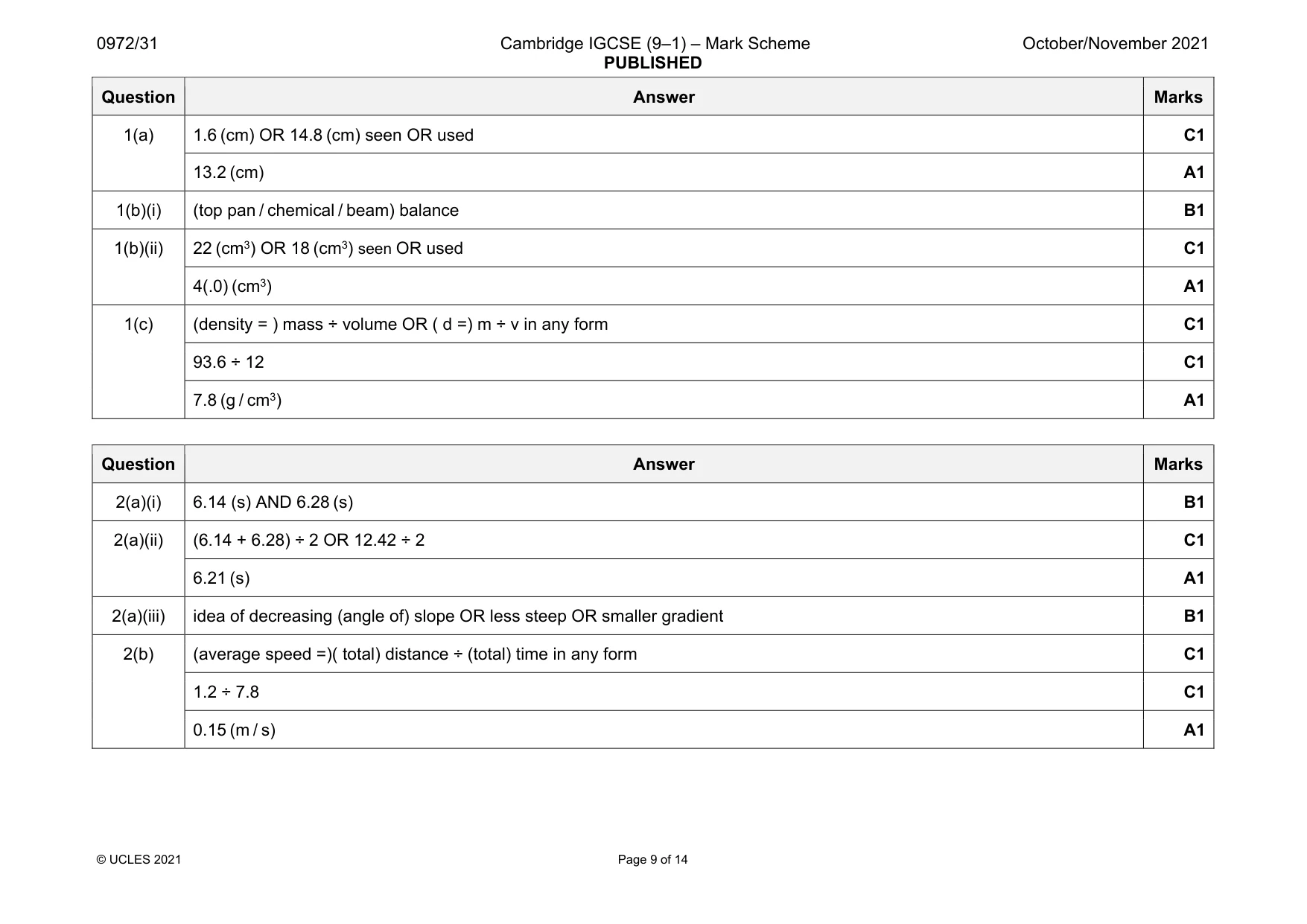
Mark scheme: 1(a) 1.6 (cm) OR 14.8 (cm) seen OR used C1 13.2 (cm) A1 1(b)(i) (top pan / chemical / beam) balance B1 1(b)(ii) 22 (cm3) OR 18 (cm3) seen OR used C1 4(.0) (cm3) A1 1(c) (density = ) mass ÷ volume OR ( d =) m ÷ v in any form C1 93.6 ÷ 12 C1 7.8 (g / cm3) A1
More questions on Physical quantities and measurement techniques
Q2 · A slope is made by resting one end of a plank of wood on a block, as shown in Fig
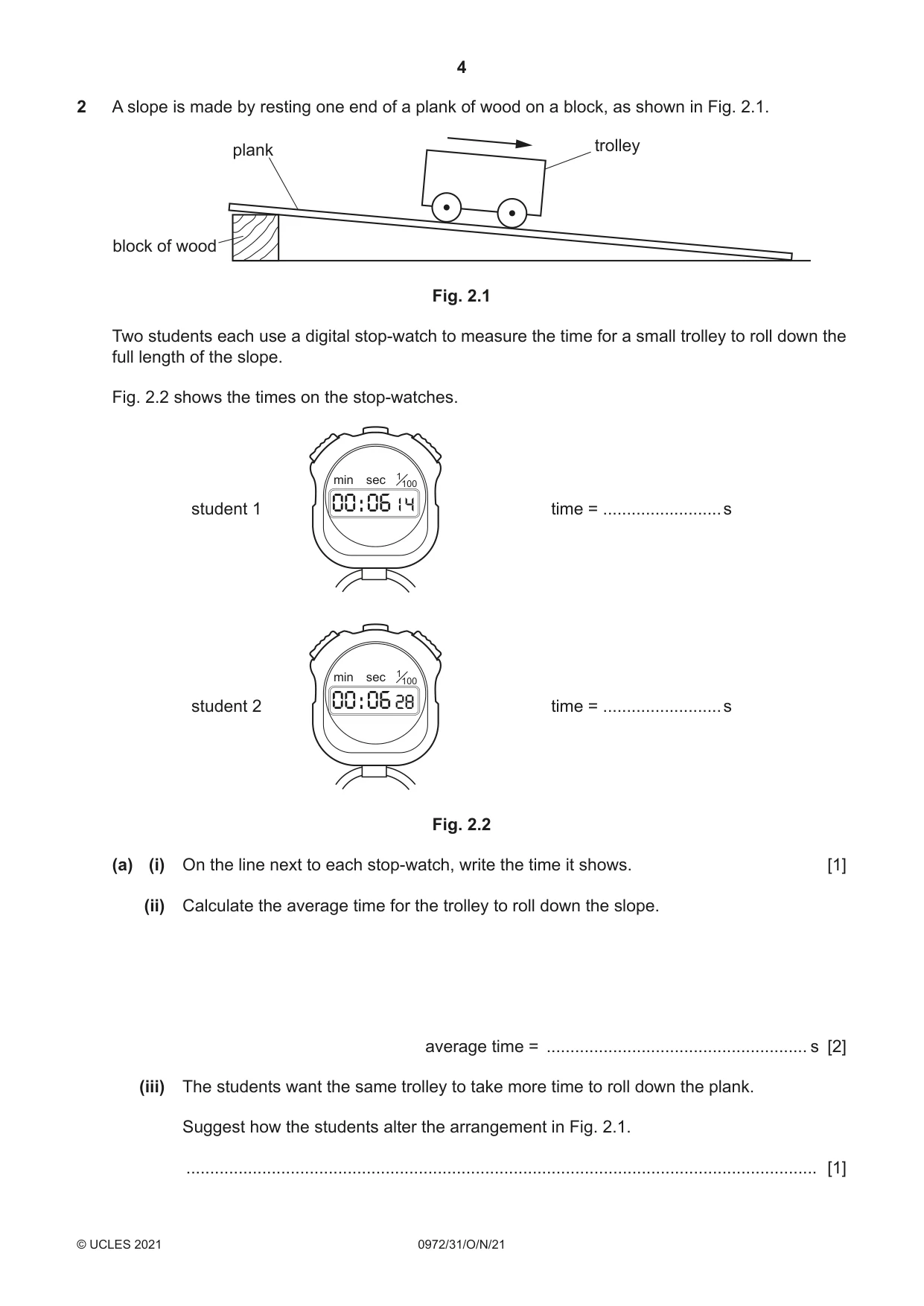
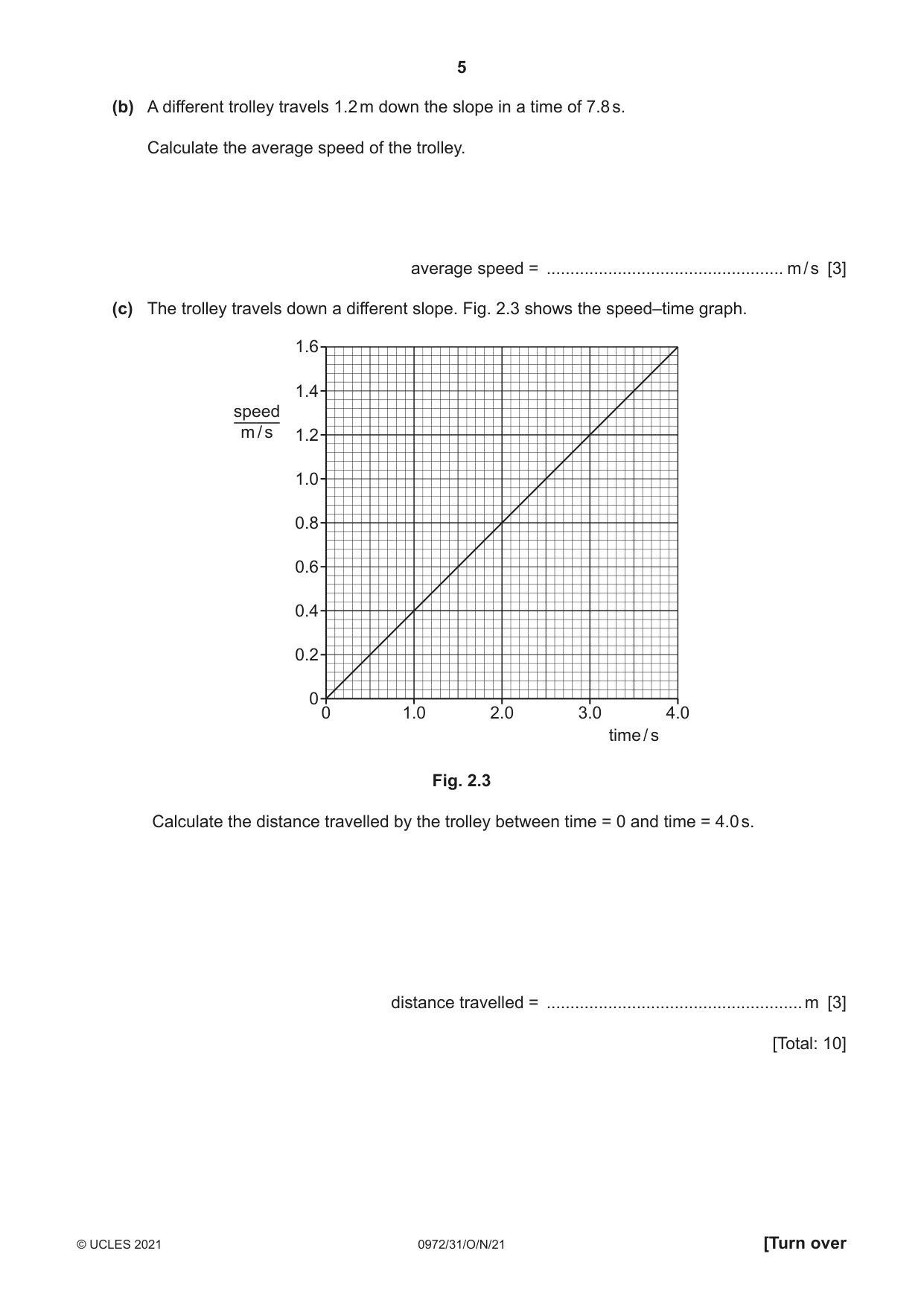
2 A slope is made by resting one end of a plank of wood on a block, as shown in Fig. 2.1. plank trolley block of wood Fig. 2.1 Two students each use a digital stop‑watch to measure the time for a small trolley to roll down the full length of the slope. Fig. 2.2 shows the times on the stop‑watches. min sec 1100 student 1 00 : 06 14 time = ......................... s min sec 1100 student 2 00 : 06 28 time = ......................... s Fig. 2.2 (a) (i) On the line next to each stop‑watch, write the time it shows. [1] (ii) Calculate the average time for the trolley to roll down the slope. average time = ....................................................... s [2] (iii) The students want the same trolley to take more time to roll down the plank. Suggest how the students alter the arrangement in Fig. 2.1. ..................................................................................................................................... [1] (b) A different trolley travels 1.2 m down the slope in a time of 7.8 s. Calculate the average speed of the trolley. average speed = .................................................. m / s [3] (c) The trolley travels down a different slope. Fig. 2.3 shows the speed–time graph. 1.6 1.4 speed m / s 1.2 1.0 0.8 0.6 0.4 0.2 0 0 1.0 2.0 3.0 4.0 time / s Fig. 2.3 Calculate the distance travelled by the trolley between time = 0 and time = 4.0 s. distance travelled = ......................................................m [3] [Total: 10]
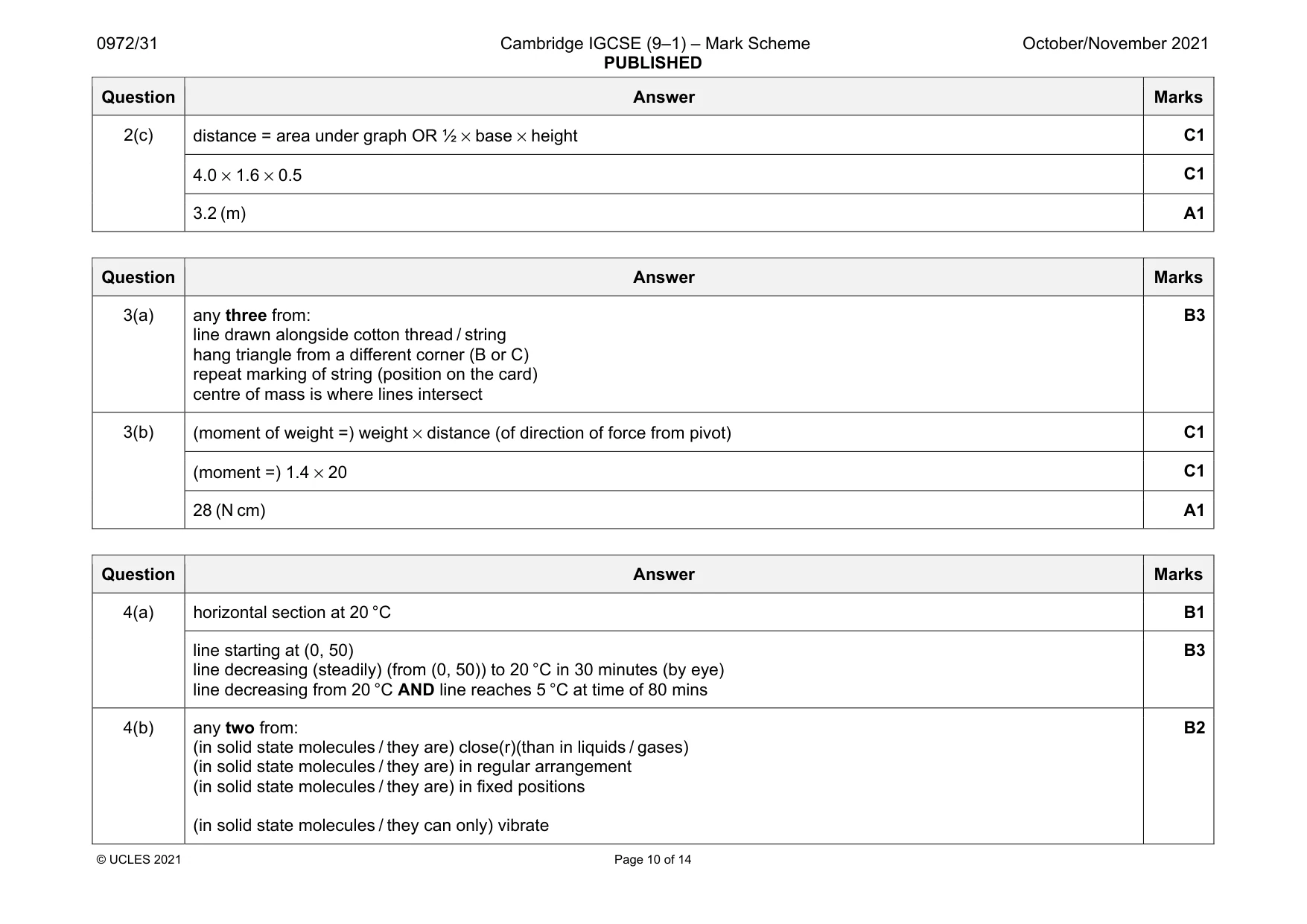
Mark scheme: 2(a)(i) 6.14 (s) AND 6.28 (s) B1 2(a)(ii) (6.14 + 6.28) ÷ 2 OR 12.42 ÷ 2 C1 6.21 (s) A1 2(a)(iii) idea of decreasing (angle of) slope OR less steep OR smaller gradient B1 2(b) (average speed =)( total) distance ÷ (total) time in any form C1 1.2 ÷ 7.8 C1 0.15 (m / s) A1 Question Answer Marks 2(c) distance = area under graph OR ½ × base × height C1 4.0 × 1.6 × 0.5 C1 3.2 (m) A1
Q3 · A student determines the centre of mass of a piece of card
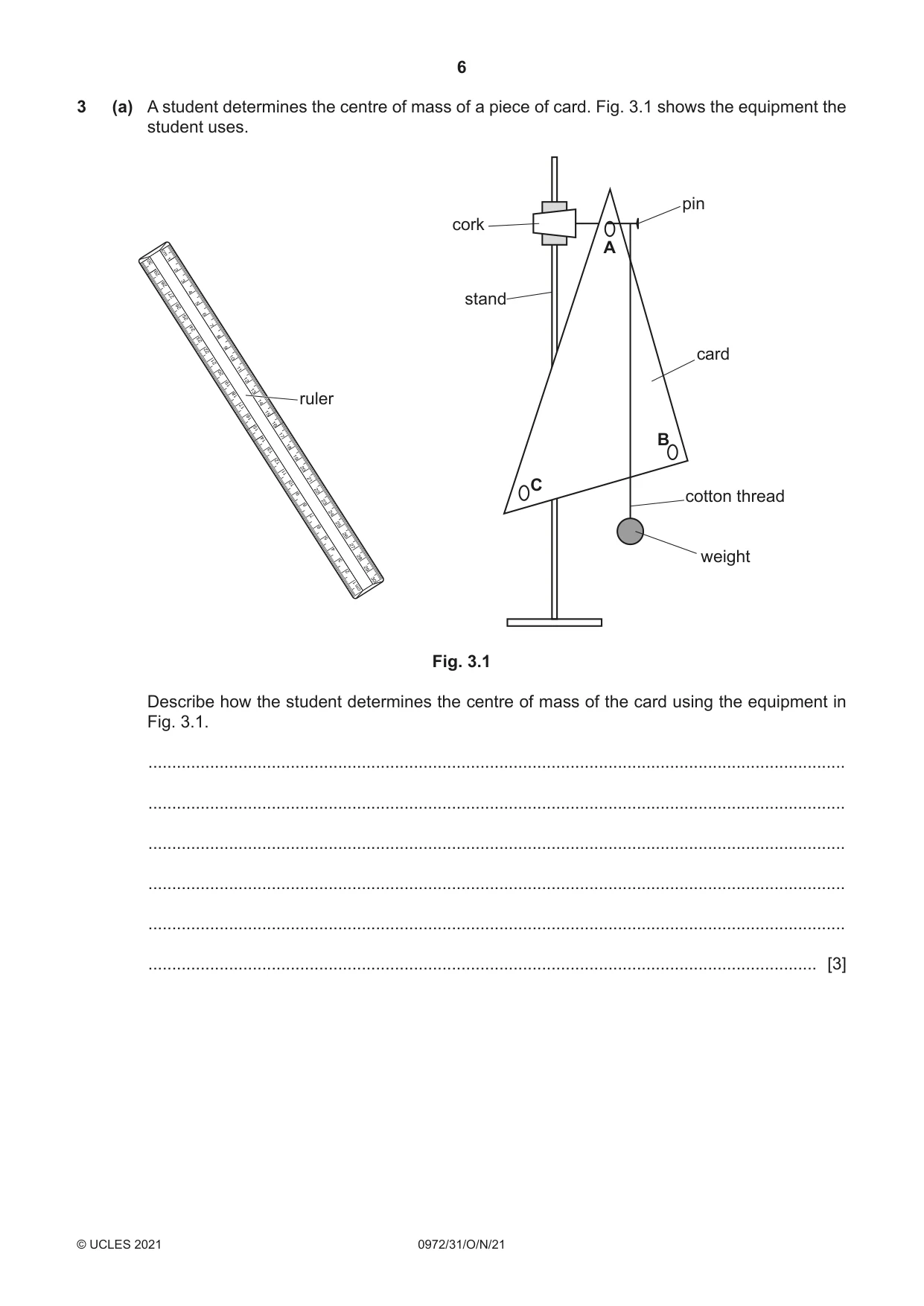
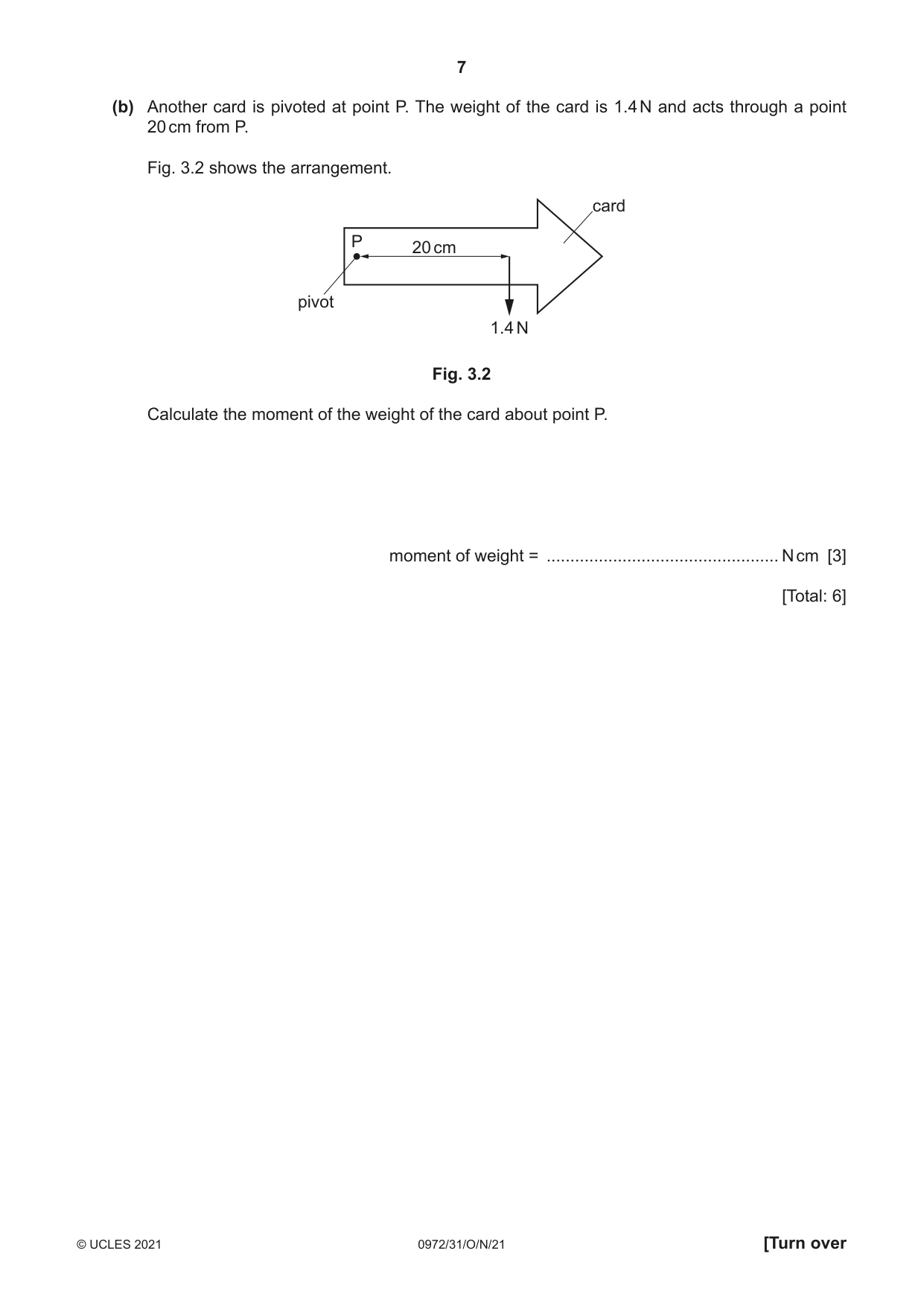
3 (a) A student determines the centre of mass of a piece of card. Fig. 3.1 shows the equipment the student uses. pin cork A stand card ruler B C cotton thread weight Fig. 3.1 Describe how the student determines the centre of mass of the card using the equipment in Fig. 3.1. ................................................................................................................................................... ................................................................................................................................................... ................................................................................................................................................... ................................................................................................................................................... ................................................................................................................................................... ............................................................................................................................................. [3] (b) Another card is pivoted at point P. The weight of the card is 1.4 N and acts through a point 20 cm from P. Fig. 3.2 shows the arrangement. card P 20 cm pivot 1.4 N Fig. 3.2 Calculate the moment of the weight of the card about point P. moment of weight = ................................................. N cm [3] [Total: 6]
Mark scheme: 3(a) any three from: line drawn alongside cotton thread / string hang triangle from a different corner (B or C) repeat marking of string (position on the card) centre of mass is where lines intersect B3 3(b) (moment of weight =) weight × distance (of direction of force from pivot) C1 (moment =) 1.4 × 20 C1 28 (N cm) A1
Q4 · A substance cools from 50 °C to 5.0 °C
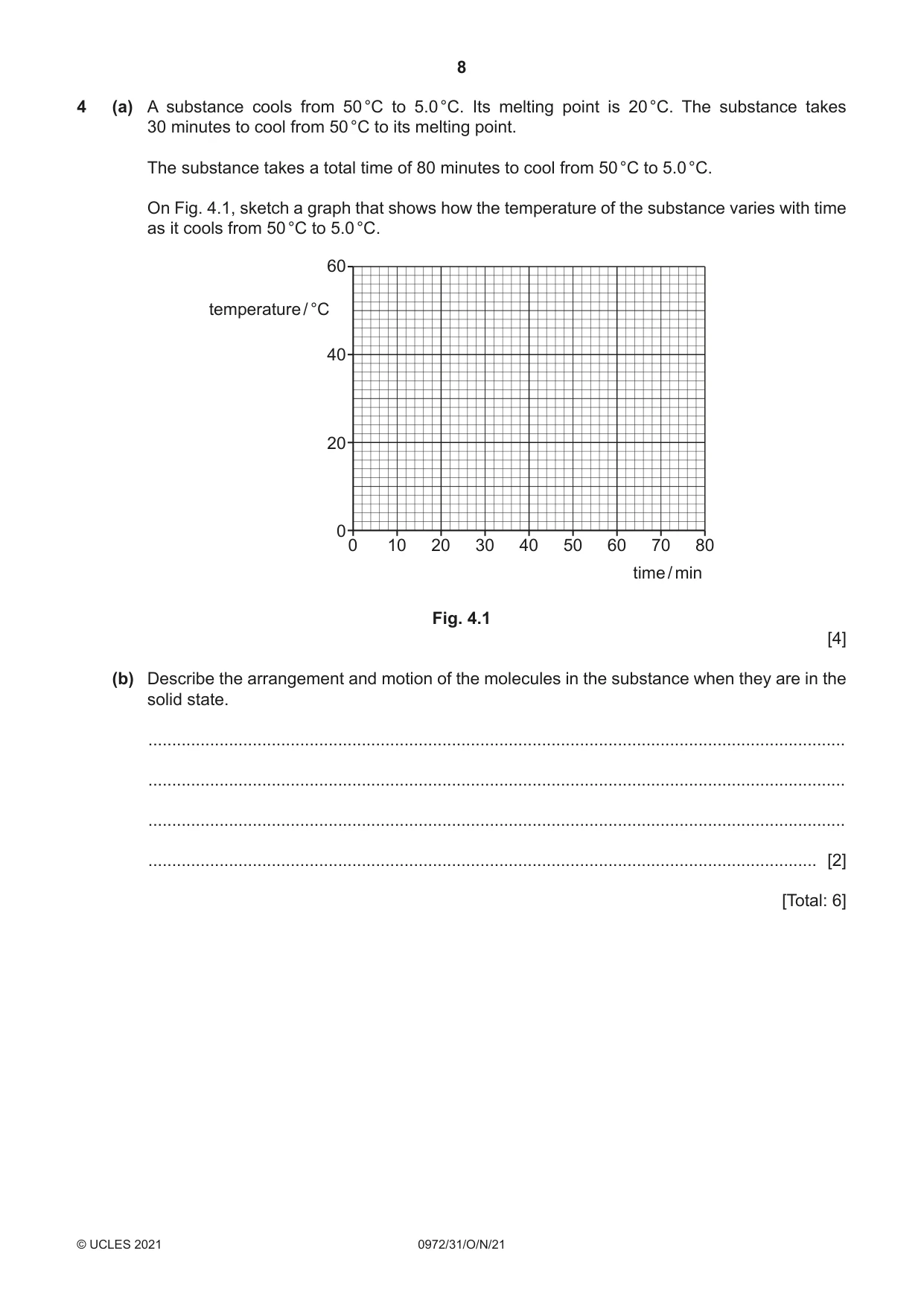
4 (a) A substance cools from 50 °C to 5.0 °C. Its melting point is 20 °C. The substance takes 30 minutes to cool from 50 °C to its melting point. The substance takes a total time of 80 minutes to cool from 50 °C to 5.0 °C. On Fig. 4.1, sketch a graph that shows how the temperature of the substance varies with time as it cools from 50 °C to 5.0 °C. 60 temperature / °C 40 20 0 0 10 20 30 40 50 60 70 80 time / min Fig. 4.1 [4] (b) Describe the arrangement and motion of the molecules in the substance when they are in the solid state. ................................................................................................................................................... ................................................................................................................................................... ................................................................................................................................................... ............................................................................................................................................. [2] [Total: 6]
Mark scheme: 4(a) horizontal section at 20 °C B1 line starting at (0, 50) line decreasing (steadily) (from (0, 50)) to 20 °C in 30 minutes (by eye) line decreasing from 20 °C AND line reaches 5 °C at time of 80 mins B3 4(b) any two from: (in solid state molecules / they are) close(r)(than in liquids / gases) (in solid state molecules / they are) in regular arrangement (in solid state molecules / they are) in fixed positions (in solid state molecules / they can only) vibrate B2
Q5 · A plastic bottle on a bench
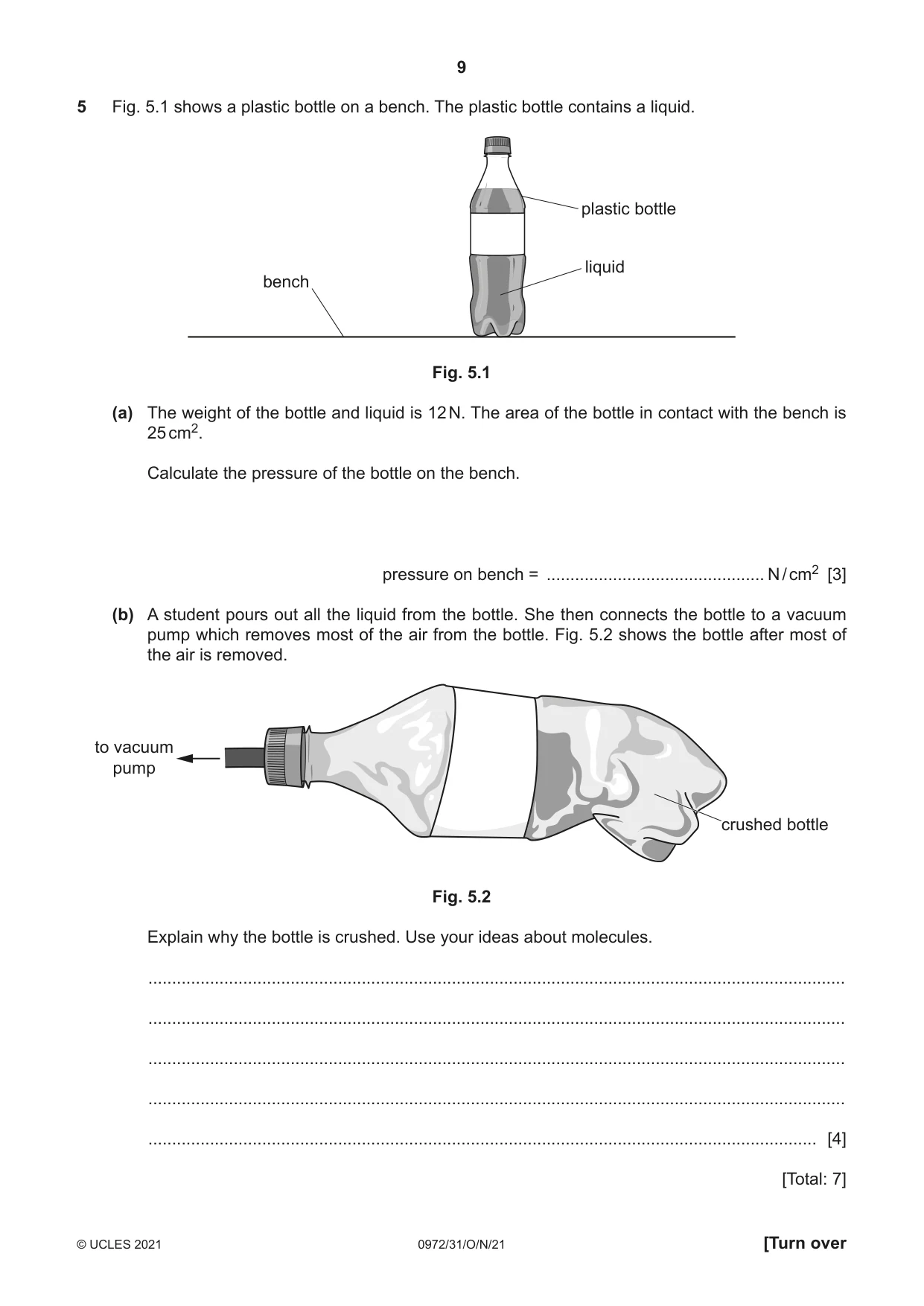
5 Fig. 5.1 shows a plastic bottle on a bench. The plastic bottle contains a liquid. plastic bottle liquid bench Fig. 5.1 (a) The weight of the bottle and liquid is 12 N. The area of the bottle in contact with the bench is 25 cm2. Calculate the pressure of the bottle on the bench. pressure on bench = .............................................. N / cm2 [3] (b) A student pours out all the liquid from the bottle. She then connects the bottle to a vacuum pump which removes most of the air from the bottle. Fig. 5.2 shows the bottle after most of the air is removed. to vacuum pump crushed bottle Fig. 5.2 Explain why the bottle is crushed. Use your ideas about molecules. ................................................................................................................................................... ................................................................................................................................................... ................................................................................................................................................... ................................................................................................................................................... ............................................................................................................................................. [4] [Total: 7]
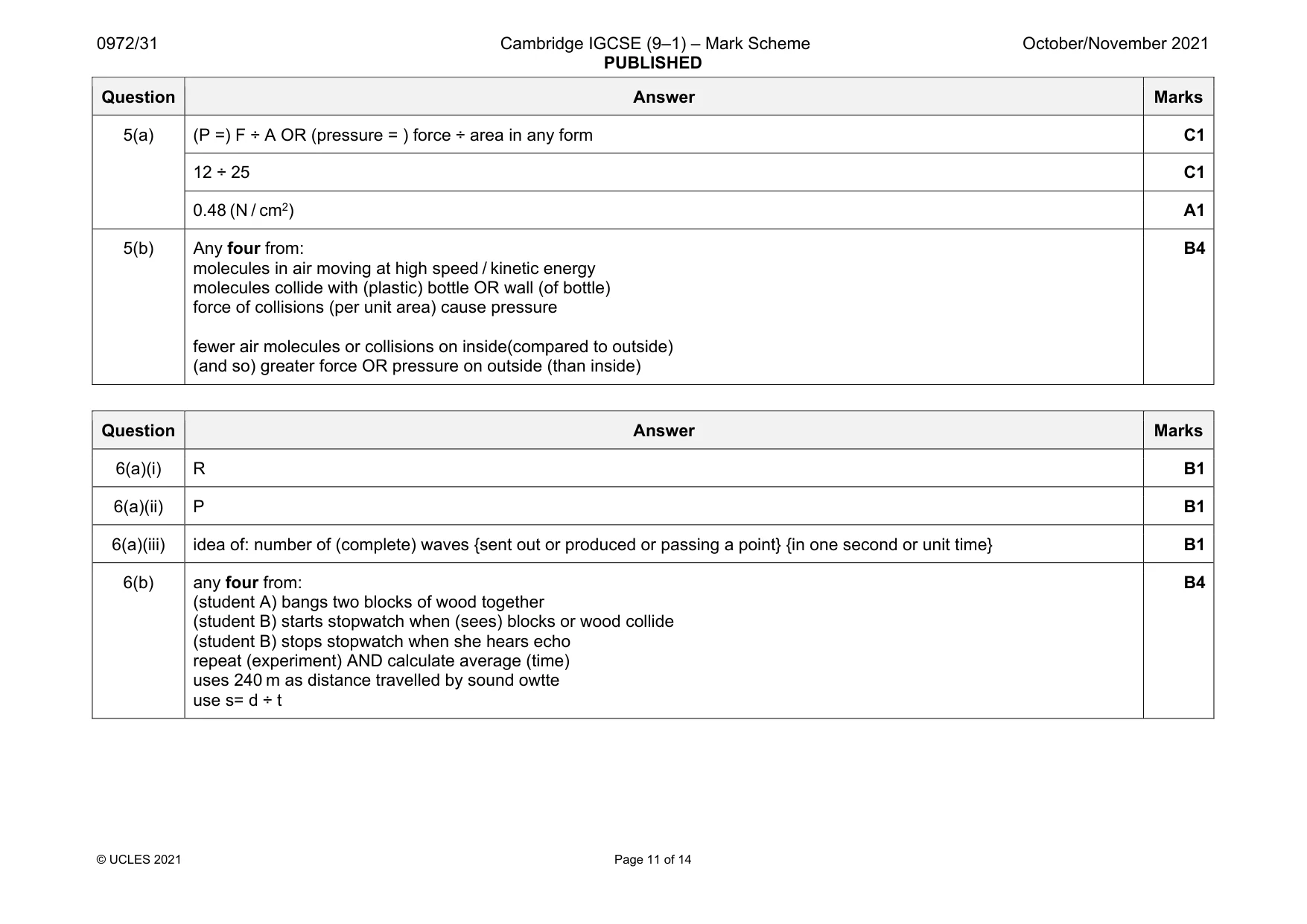
Mark scheme: 5(a) (P =) F ÷ A OR (pressure = ) force ÷ area in any form C1 12 ÷ 25 C1 0.48 (N / cm2) A1 5(b) Any four from: molecules in air moving at high speed / kinetic energy molecules collide with (plastic) bottle OR wall (of bottle) force of collisions (per unit area) cause pressure fewer air molecules or collisions on inside(compared to outside) (and so) greater force OR pressure on outside (than inside) B4
Q6 · Part of a water wave
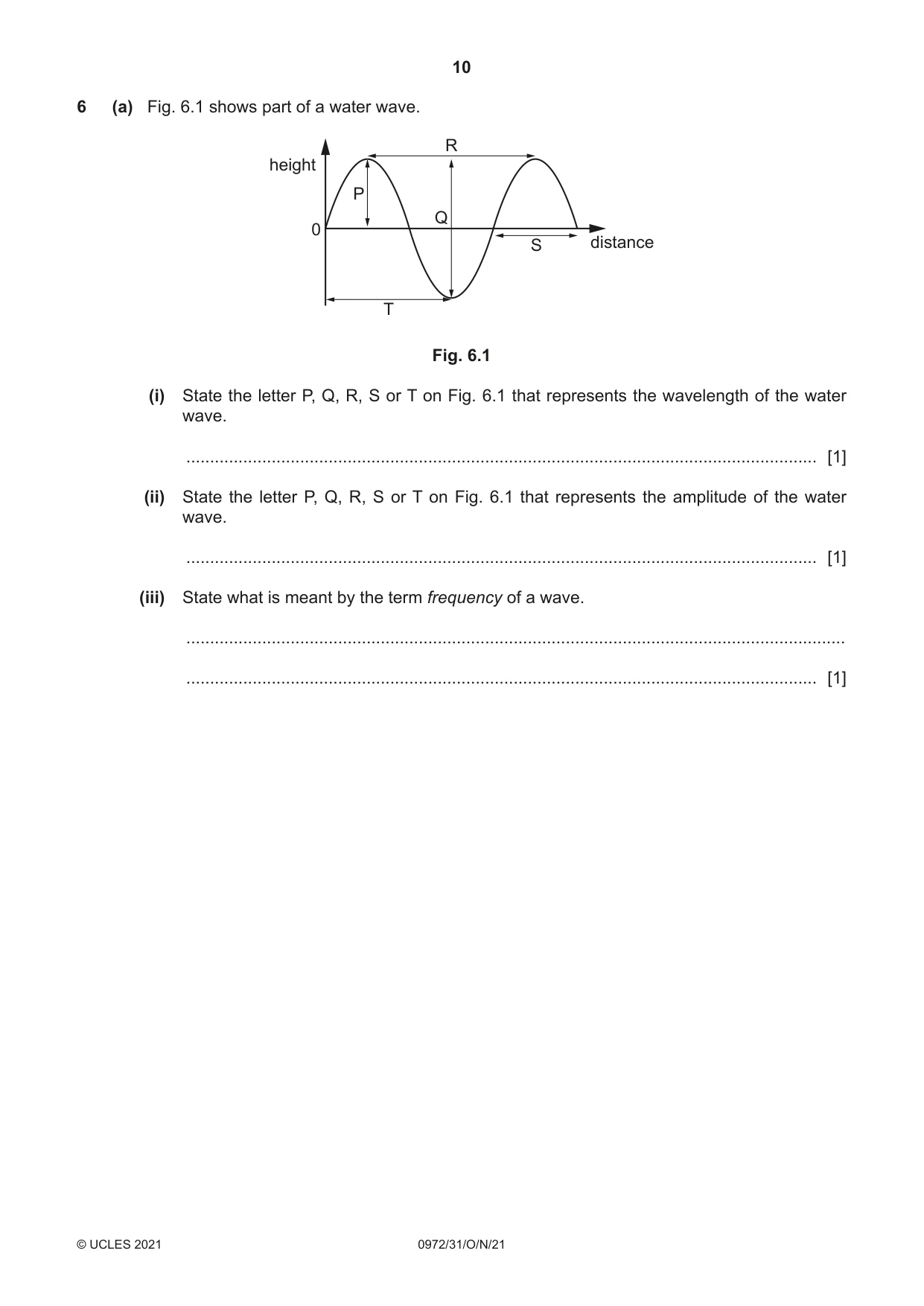
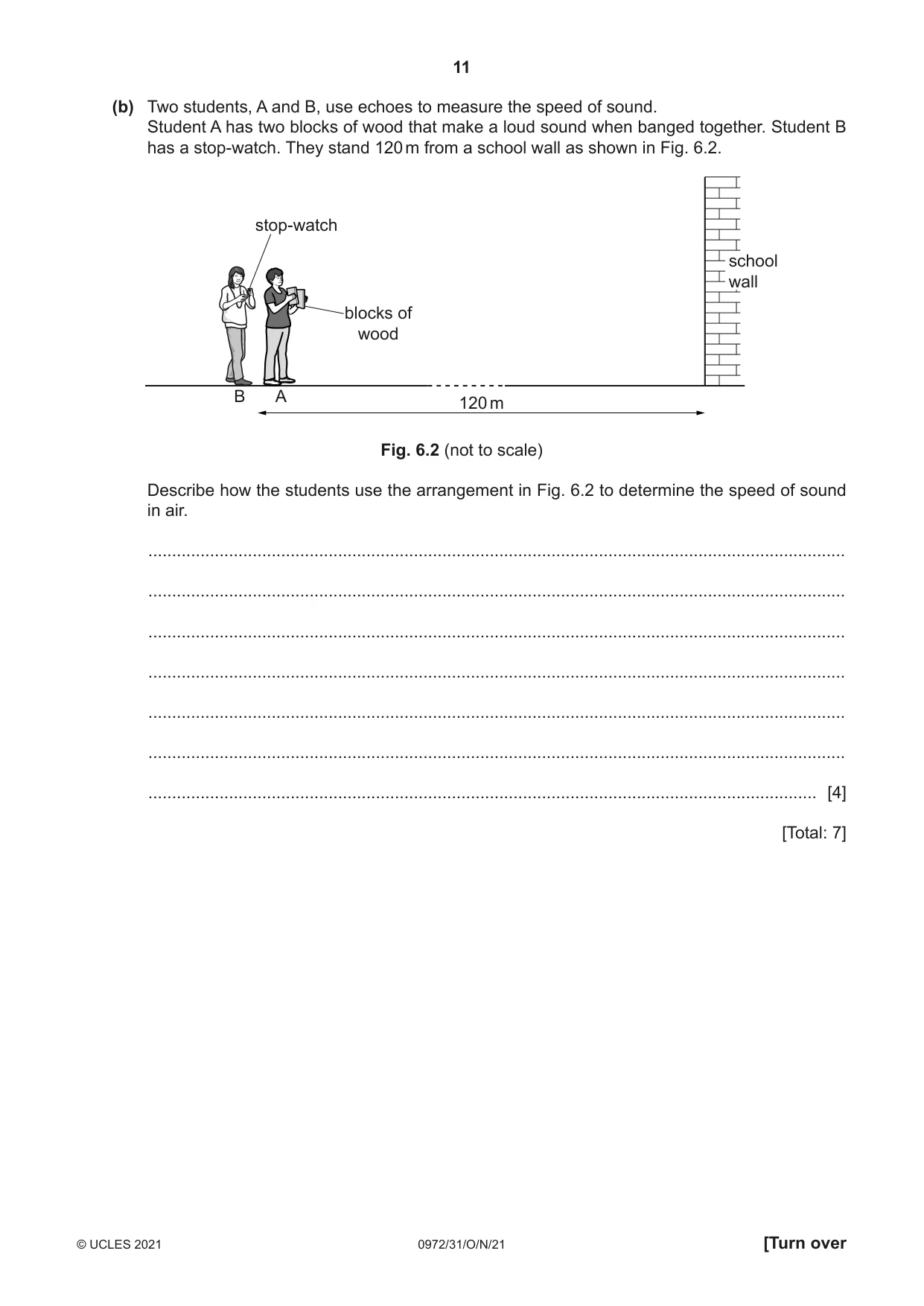
6 (a) Fig. 6.1 shows part of a water wave. R height P Q 0 S distance T Fig. 6.1 (i) State the letter P, Q, R, S or T on Fig. 6.1 that represents the wavelength of the water wave. ..................................................................................................................................... [1] (ii) State the letter P, Q, R, S or T on Fig. 6.1 that represents the amplitude of the water wave. ..................................................................................................................................... [1] (iii) State what is meant by the term frequency of a wave. ........................................................................................................................................... ..................................................................................................................................... [1] (b) Two students, A and B, use echoes to measure the speed of sound. Student A has two blocks of wood that make a loud sound when banged together. Student B has a stop‑watch. They stand 120 m from a school wall as shown in Fig. 6.2. stop-watch school wall blocks of wood B A 120 m Fig. 6.2 (not to scale) Describe how the students use the arrangement in Fig. 6.2 to determine the speed of sound in air. ................................................................................................................................................... ................................................................................................................................................... ................................................................................................................................................... ................................................................................................................................................... ................................................................................................................................................... ................................................................................................................................................... ............................................................................................................................................. [4] [Total: 7]
Mark scheme: 6(a)(i) R B1 6(a)(ii) P B1 6(a)(iii) idea of: number of (complete) waves {sent out or produced or passing a point} {in one second or unit time} B1 6(b) any four from: (student A) bangs two blocks of wood together (student B) starts stopwatch when (sees) blocks or wood collide (student B) stops stopwatch when she hears echo repeat (experiment) AND calculate average (time) uses 240 m as distance travelled by sound owtte use s= d ÷ t B4
Q7 · A ray of red light entering a semicircular glass block
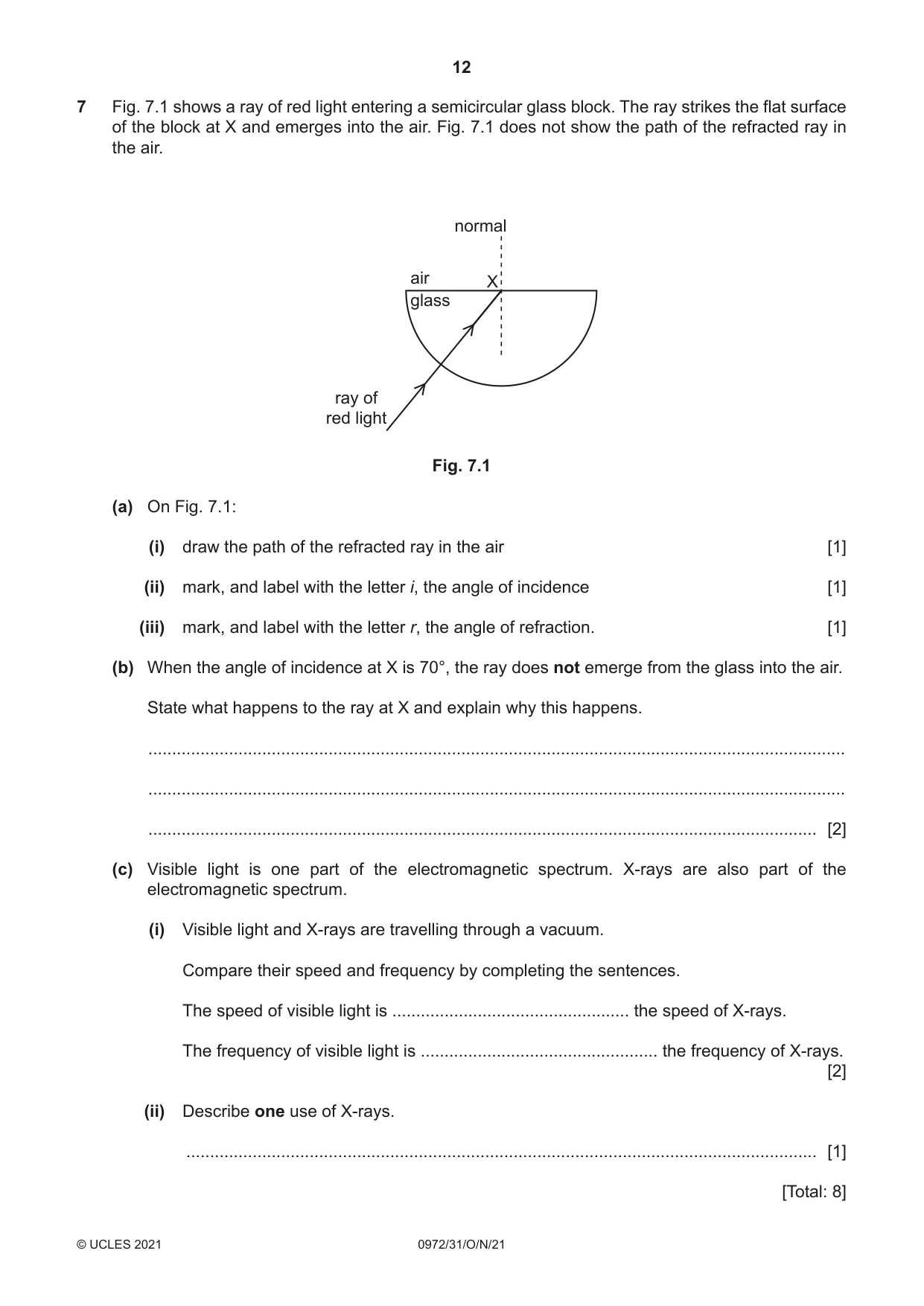
7 Fig. 7.1 shows a ray of red light entering a semicircular glass block. The ray strikes the flat surface of the block at X and emerges into the air. Fig. 7.1 does not show the path of the refracted ray in the air. normal air X glass ray of red light Fig. 7.1 (a) On Fig. 7.1: (i) draw the path of the refracted ray in the air [1] (ii) mark, and label with the letter i, the angle of incidence [1] (iii) mark, and label with the letter r, the angle of refraction. [1] (b) When the angle of incidence at X is 70°, the ray does not emerge from the glass into the air. State what happens to the ray at X and explain why this happens. ................................................................................................................................................... ................................................................................................................................................... ............................................................................................................................................. [2] (c) Visible light is one part of the electromagnetic spectrum. X‑rays are also part of the electromagnetic spectrum. (i) Visible light and X‑rays are travelling through a vacuum. Compare their speed and frequency by completing the sentences. The speed of visible light is .................................................. the speed of X‑rays. The frequency of visible light is .................................................. the frequency of X‑rays. [2] (ii) Describe one use of X‑rays. ..................................................................................................................................... [1] [Total: 8]
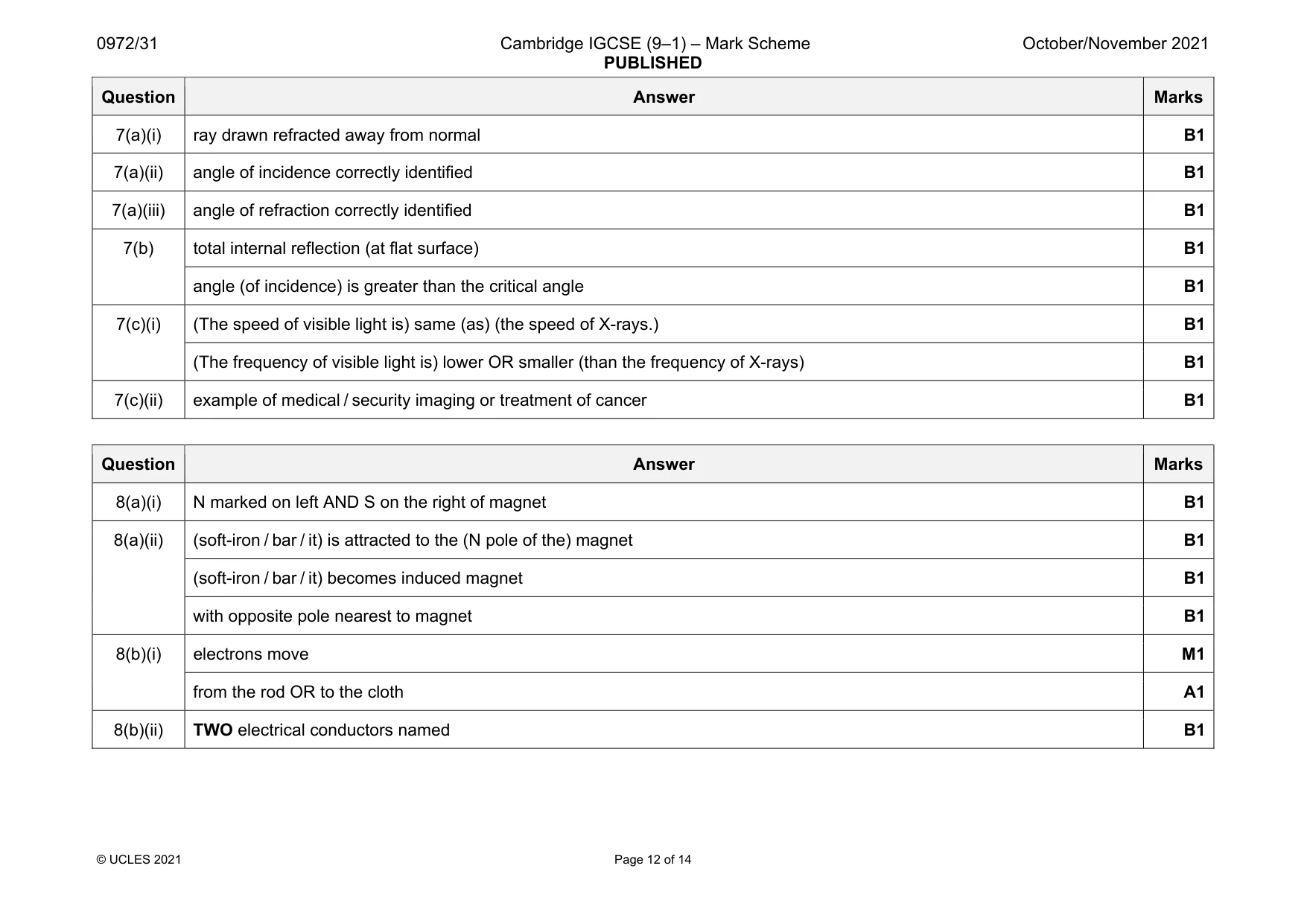
Mark scheme: 7(a)(i) ray drawn refracted away from normal B1 7(a)(ii) angle of incidence correctly identified B1 7(a)(iii) angle of refraction correctly identified B1 7(b) total internal reflection (at flat surface) B1 angle (of incidence) is greater than the critical angle B1 7(c)(i) (The speed of visible light is) same (as) (the speed of X-rays.) B1 (The frequency of visible light is) lower OR smaller (than the frequency of X-rays) B1 7(c)(ii) example of medical / security imaging or treatment of cancer B1
Q8 · The magnetic field pattern around a bar magnet
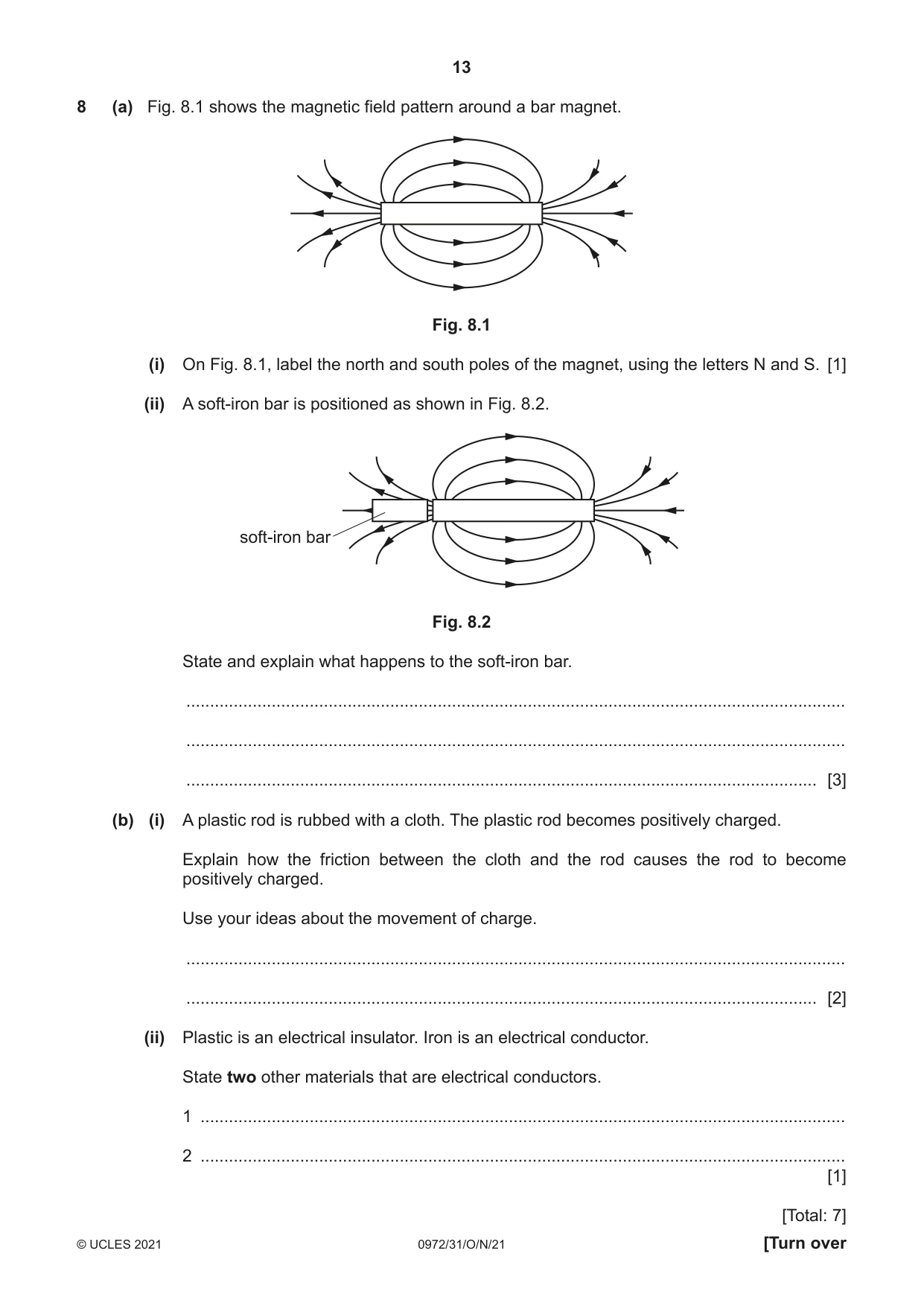
8 (a) Fig. 8.1 shows the magnetic field pattern around a bar magnet. Fig. 8.1 (i) On Fig. 8.1, label the north and south poles of the magnet, using the letters N and S. [1] (ii) A soft‑iron bar is positioned as shown in Fig. 8.2. soft-iron bar Fig. 8.2 State and explain what happens to the soft‑iron bar. ........................................................................................................................................... ........................................................................................................................................... ..................................................................................................................................... [3] (b) (i) A plastic rod is rubbed with a cloth. The plastic rod becomes positively charged. Explain how the friction between the cloth and the rod causes the rod to become positively charged. Use your ideas about the movement of charge. ........................................................................................................................................... ..................................................................................................................................... [2] (ii) Plastic is an electrical insulator. Iron is an electrical conductor. State two other materials that are electrical conductors. 1 ........................................................................................................................................ 2 ........................................................................................................................................ [1] [Total: 7]
Mark scheme: 8(a)(i) N marked on left AND S on the right of magnet B1 8(a)(ii) (soft-iron / bar / it) is attracted to the (N pole of the) magnet B1 (soft-iron / bar / it) becomes induced magnet B1 with opposite pole nearest to magnet B1 8(b)(i) electrons move M1 from the rod OR to the cloth A1 8(b)(ii) TWO electrical conductors named B1
Q9 · This question is about electric circuits
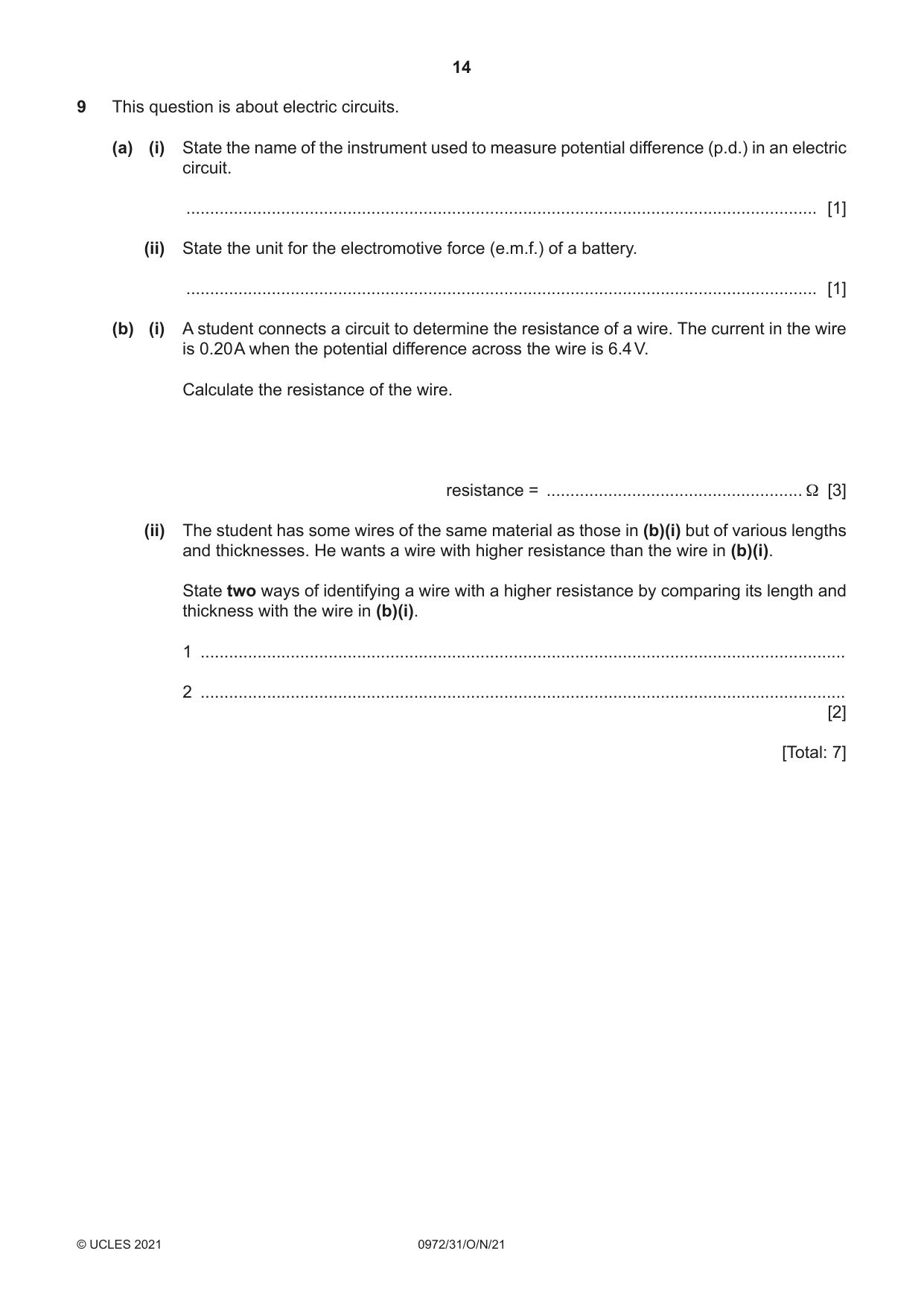
9 This question is about electric circuits. (a) (i) State the name of the instrument used to measure potential difference (p.d.) in an electric circuit. ..................................................................................................................................... [1] (ii) State the unit for the electromotive force (e.m.f.) of a battery. ..................................................................................................................................... [1] (b) (i) A student connects a circuit to determine the resistance of a wire. The current in the wire is 0.20 A when the potential difference across the wire is 6.4 V. Calculate the resistance of the wire. resistance = ...................................................... Ω [3] (ii) The student has some wires of the same material as those in (b)(i) but of various lengths and thicknesses. He wants a wire with higher resistance than the wire in (b)(i). State two ways of identifying a wire with a higher resistance by comparing its length and thickness with the wire in (b)(i). 1 ........................................................................................................................................ 2 ........................................................................................................................................ [2] [Total: 7]
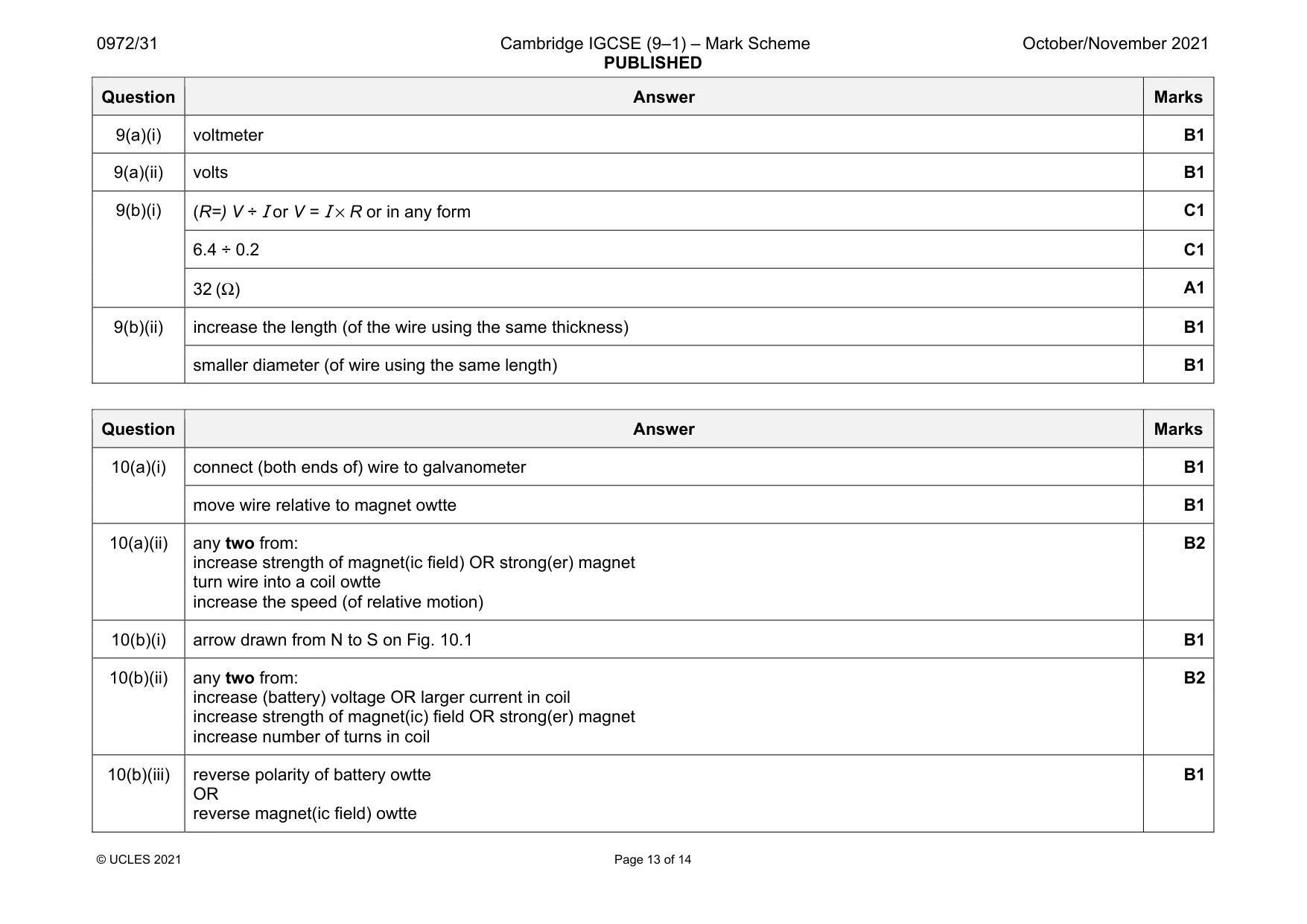
Mark scheme: 9(a)(i) voltmeter B1 9(a)(ii) volts B1 9(b)(i) (R=) V ÷ I or V = I × R or in any form C1 6.4 ÷ 0.2 C1 32 (Ω) A1 9(b)(ii) increase the length (of the wire using the same thickness) B1 smaller diameter (of wire using the same length) B1
Q10 · A student plans to demonstrate the induction of an electromotive force (e.m.f.) in a wire
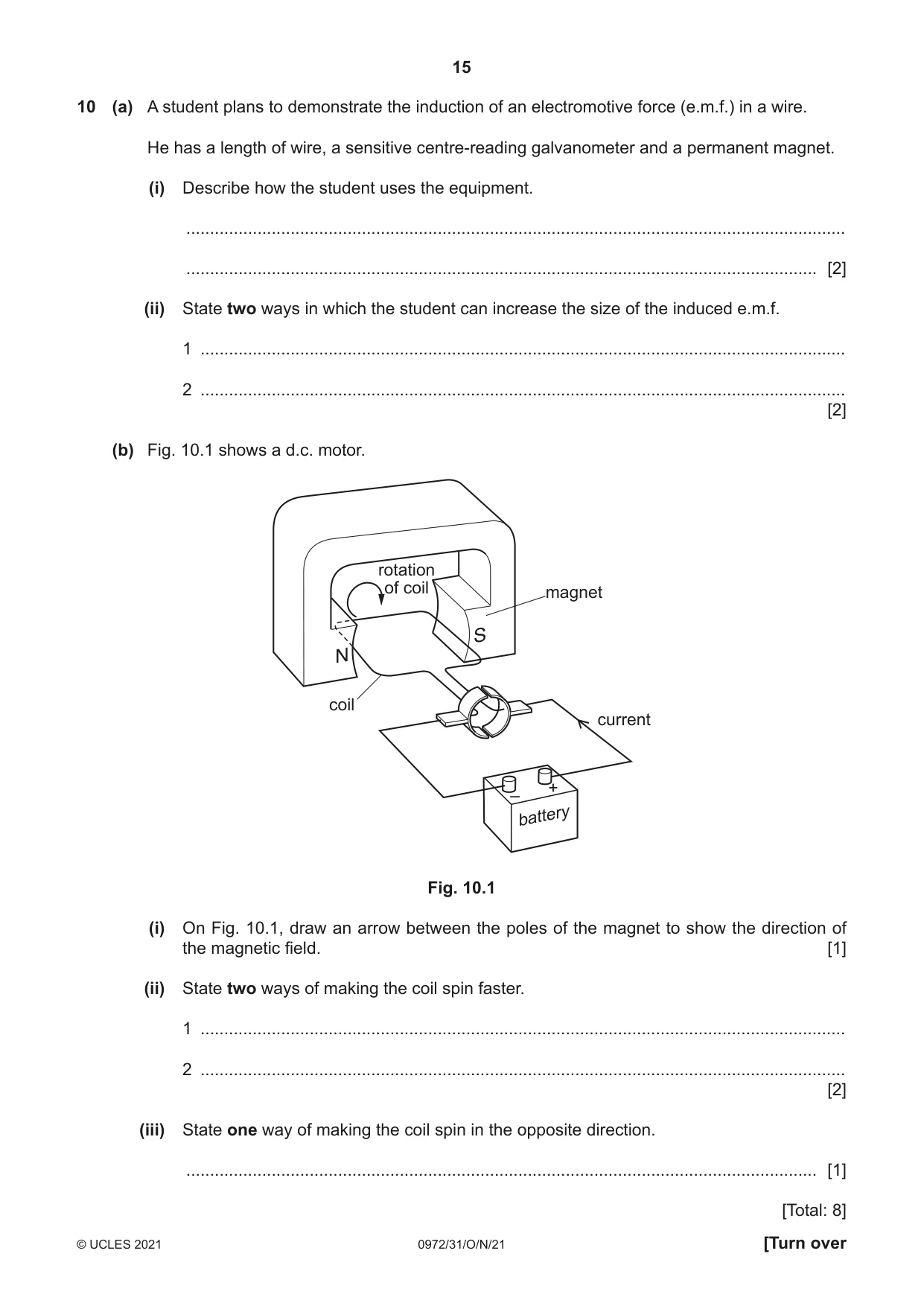
10 (a) A student plans to demonstrate the induction of an electromotive force (e.m.f.) in a wire. He has a length of wire, a sensitive centre‑reading galvanometer and a permanent magnet. (i) Describe how the student uses the equipment. ........................................................................................................................................... ..................................................................................................................................... [2] (ii) State two ways in which the student can increase the size of the induced e.m.f. 1 ........................................................................................................................................ 2 ........................................................................................................................................ [2] (b) Fig. 10.1 shows a d.c. motor. rotation of coil magnet coil current + – battery Fig. 10.1 (i) On Fig. 10.1, draw an arrow between the poles of the magnet to show the direction of the magnetic field. [1] (ii) State two ways of making the coil spin faster. 1 ........................................................................................................................................ 2 ........................................................................................................................................ [2] (iii) State one way of making the coil spin in the opposite direction. ..................................................................................................................................... [1] [Total: 8]
Mark scheme: 10(a)(i) connect (both ends of) wire to galvanometer B1 move wire relative to magnet owtte B1 10(a)(ii) any two from: increase strength of magnet(ic field) OR strong(er) magnet turn wire into a coil owtte increase the speed (of relative motion) B2 10(b)(i) arrow drawn from N to S on Fig. 10.1 B1 10(b)(ii) any two from: increase (battery) voltage OR larger current in coil increase strength of magnet(ic) field OR strong(er) magnet increase number of turns in coil B2 10(b)(iii) reverse polarity of battery owtte OR reverse magnet(ic field) owtte B1
Q11 · Α (alpha)‑particles, β (beta)‑particles and γ (gamma)‑rays have different characteristics
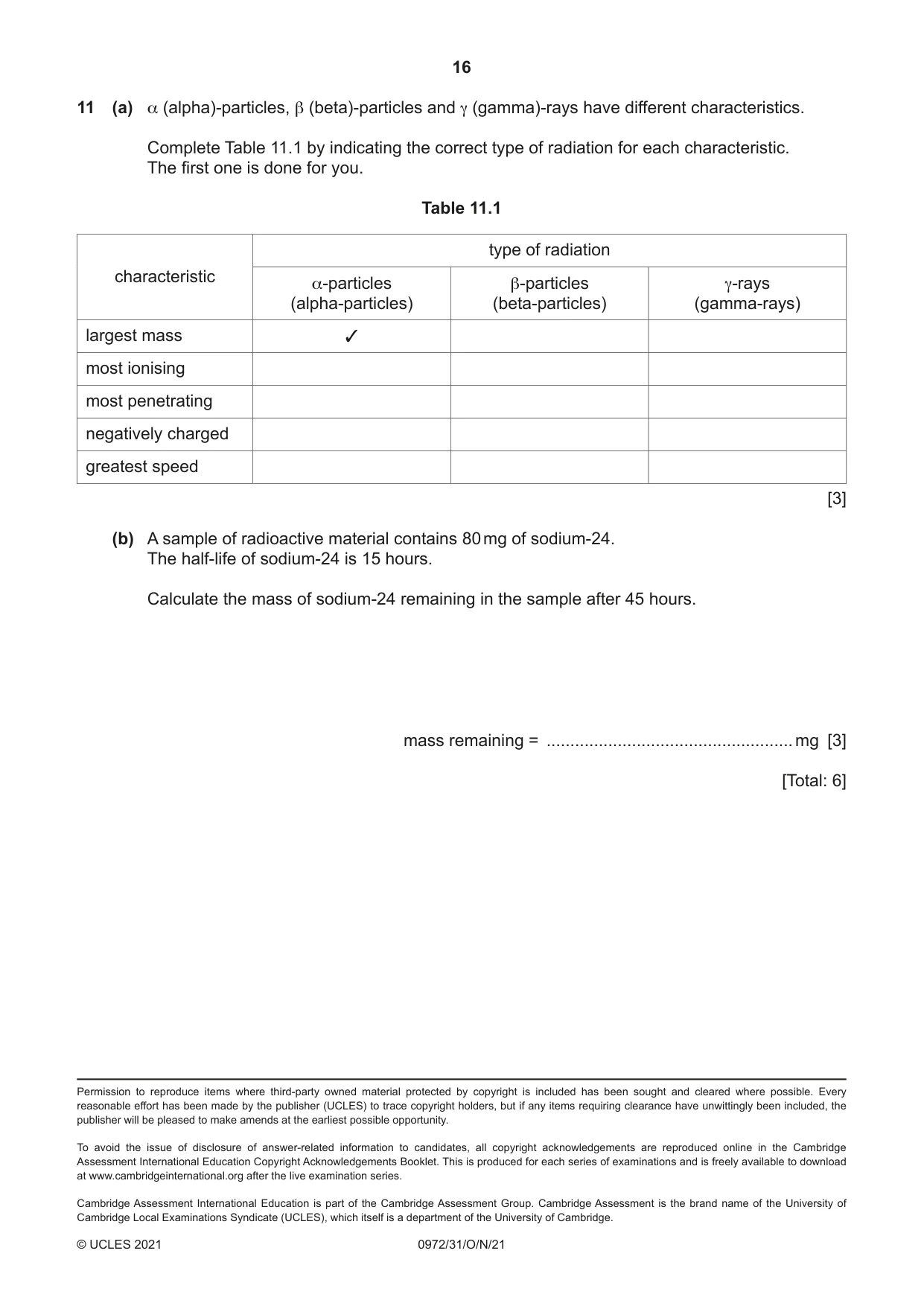
11 (a) α (alpha)‑particles, β (beta)‑particles and γ (gamma)‑rays have different characteristics. Complete Table 11.1 by indicating the correct type of radiation for each characteristic. The first one is done for you. Table 11.1 type of radiation characteristic α‑particles β‑particles γ‑rays (alpha‑particles) (beta‑particles) (gamma‑rays) largest mass ✓ most ionising most penetrating negatively charged greatest speed [3] (b) A sample of radioactive material contains 80 mg of sodium‑24. The half‑life of sodium‑24 is 15 hours. Calculate the mass of sodium‑24 remaining in the sample after 45 hours. mass remaining = ....................................................mg [3] [Total: 6]
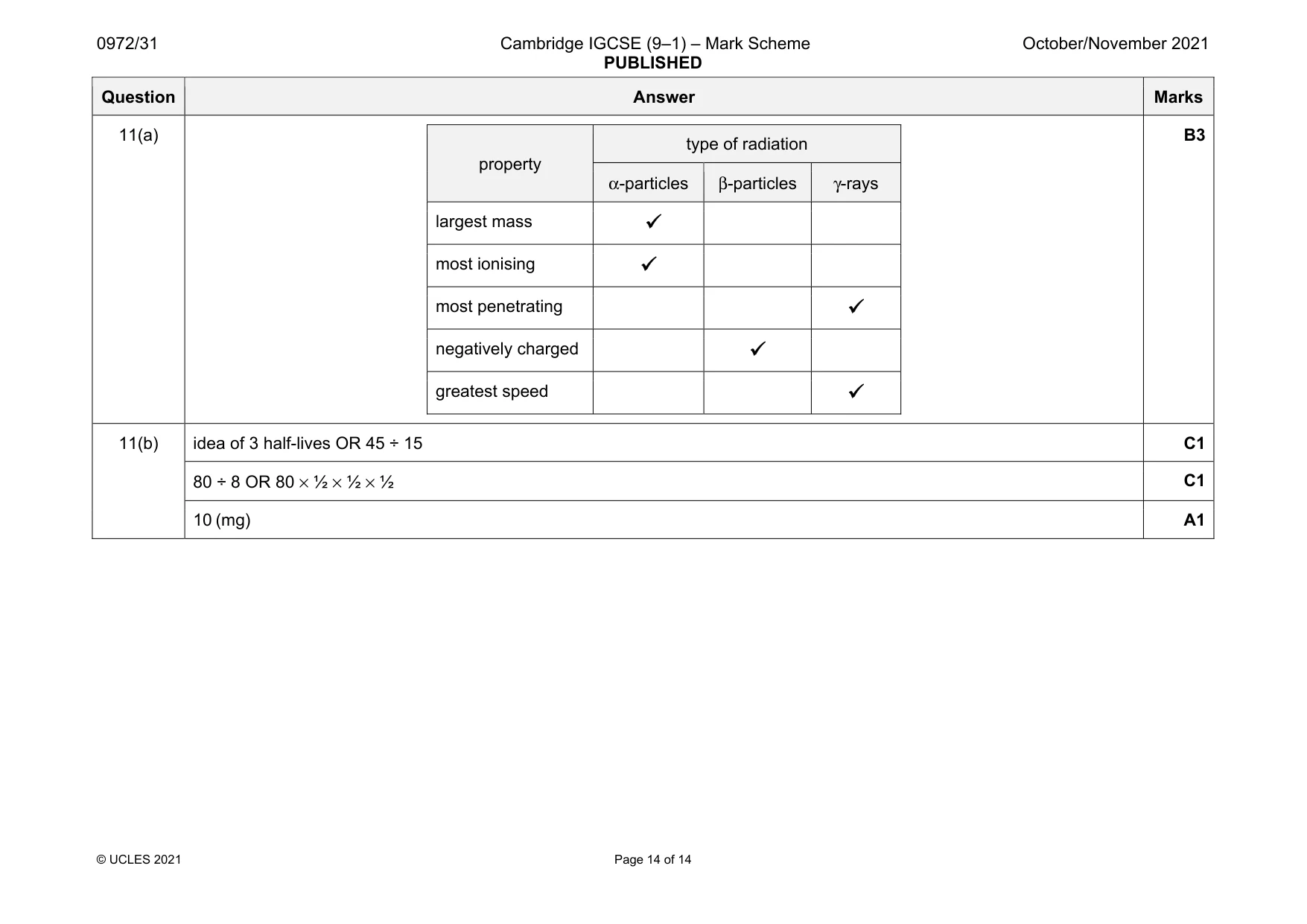
Mark scheme: 11(a) property type of radiation α-particles β-particles γ-rays largest mass most ionising most penetrating negatively charged greatest speed B3 11(b) idea of 3 half-lives OR 45 ÷ 15 C1 80 ÷ 8 OR 80 × ½ × ½ × ½ C1 10 (mg) A1
What was in this paper
The subtopics covered by these 11 questions, and how many questions each got. Open one in a new tab to see every Cambridge question on it.
What you needed in this session
Cambridge’s own grade thresholds for 2021 Oct/Nov, Paper 3 · Variant 1. A higher threshold means an easier paper — the bar moves with how the cohort did.