Cambridge IGCSE Physics (9-1) 0972 — 2024 May/June Paper 3 · Variant 1
0972/31/M/J/24 · 11 questions · 80 marks · ≈90 min
The question paper and its mark scheme, free to read here and free to download. This is Cambridge’s own paper, exactly as it was sat.
Question paper16 pages
Mark scheme13 pages
Answers below. Sit the paper first if you are practising.
Questions as text
Q1 · The speed–time graph for a car
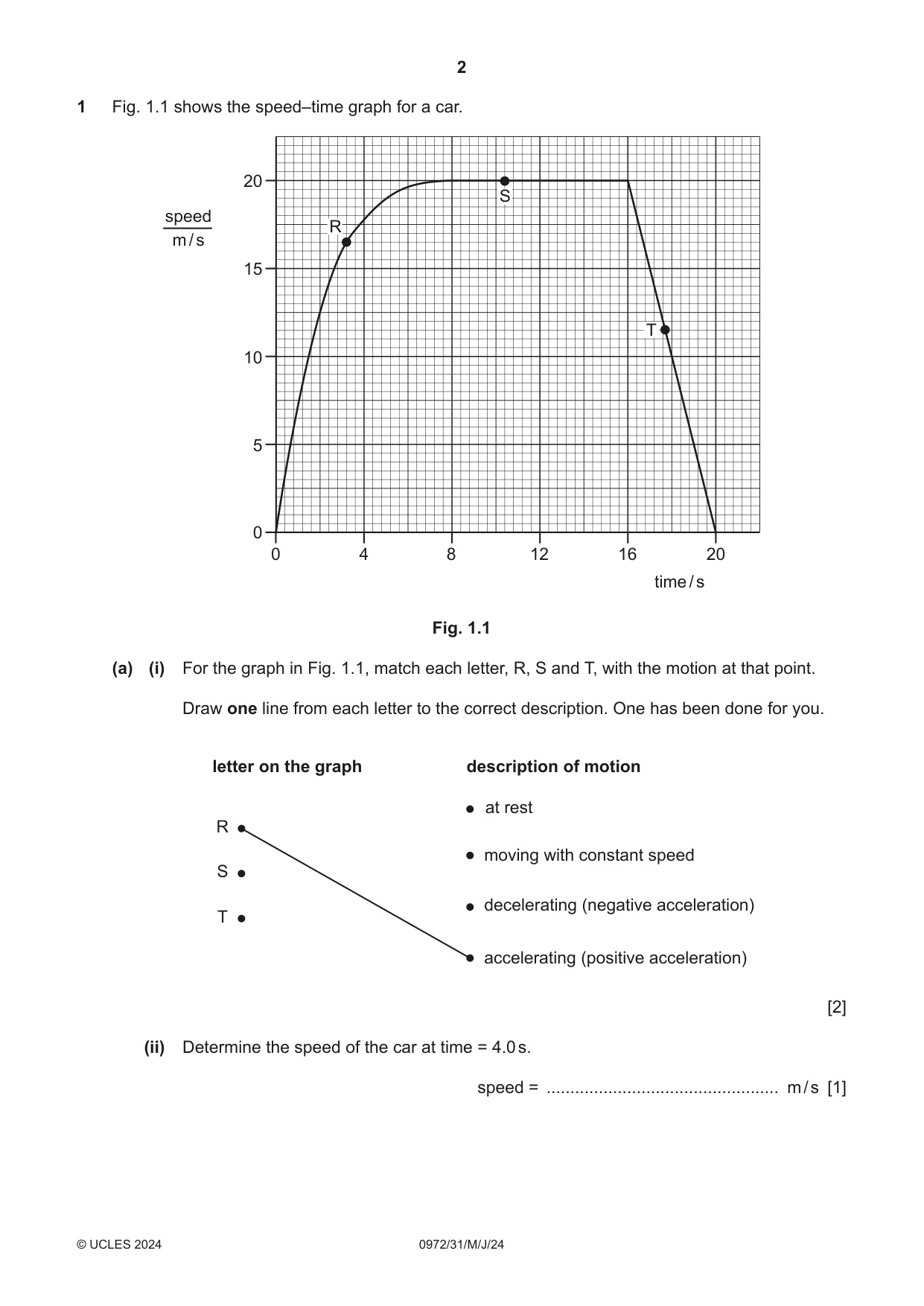
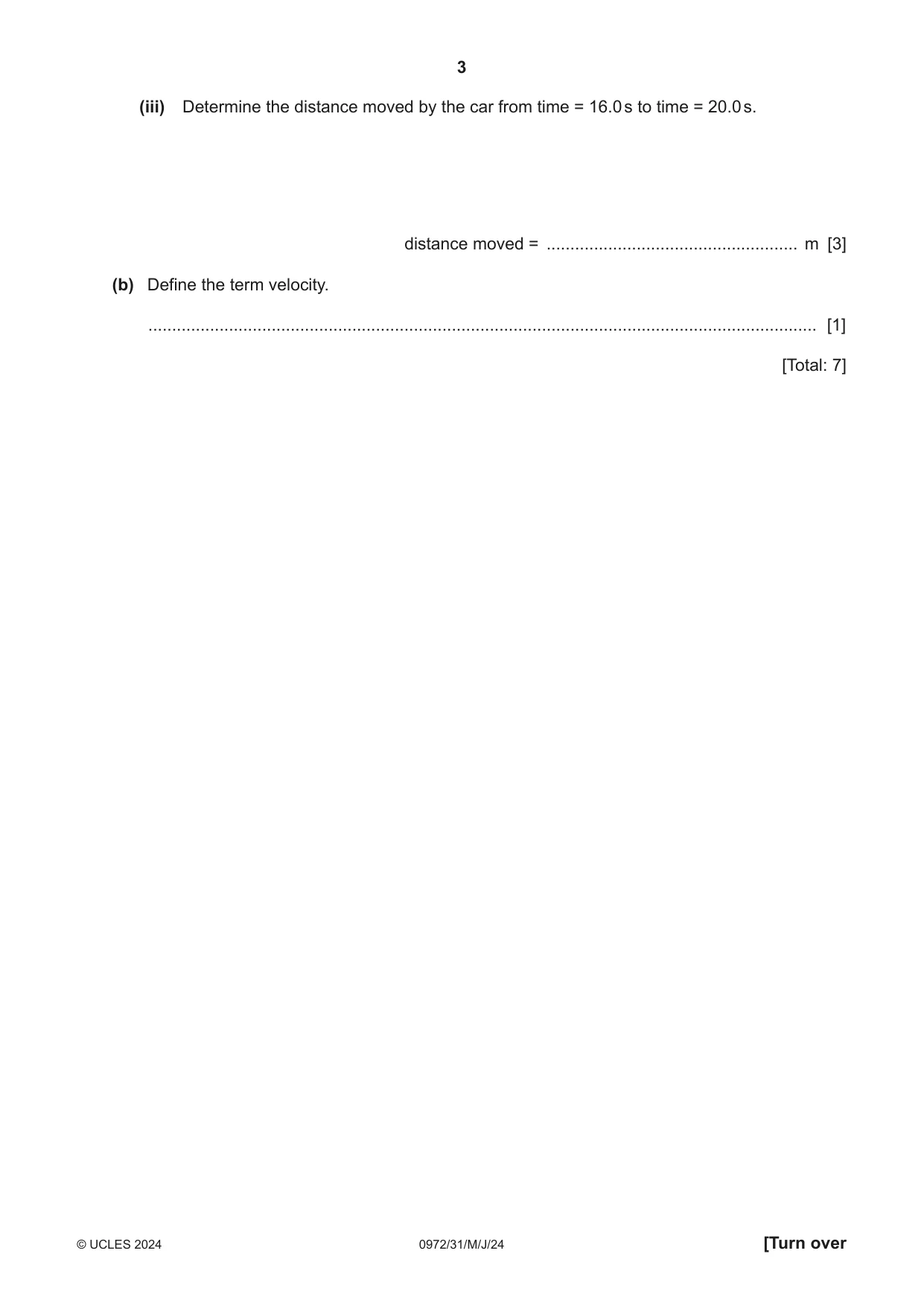
1 Fig. 1.1 shows the speed–time graph for a car. 20 S speed R m / s 15 T 10 5 0 0 4 8 12 16 20 time / s Fig. 1.1 (a) (i) For the graph in Fig. 1.1, match each letter, R, S and T, with the motion at that point. Draw one line from each letter to the correct description. One has been done for you. letter on the graph description of motion at rest R moving with constant speed S decelerating (negative acceleration) T accelerating (positive acceleration) [2] (ii) Determine the speed of the car at time = 4.0 s. speed = ................................................. m / s [1] (iii) Determine the distance moved by the car from time = 16.0 s to time = 20.0 s. distance moved = ..................................................... m [3] (b) Define the term velocity. ............................................................................................................................................. [1] [Total: 7]
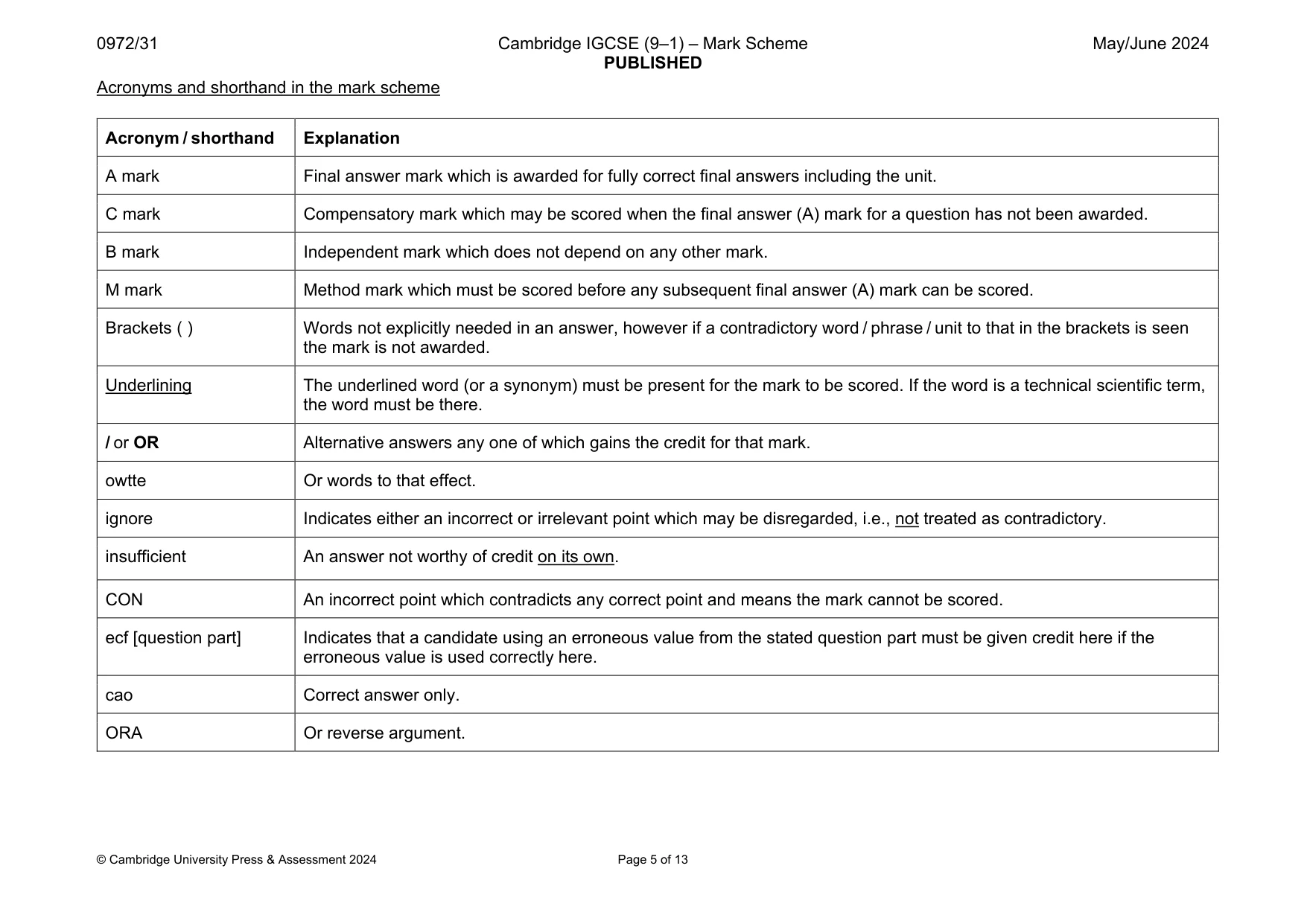
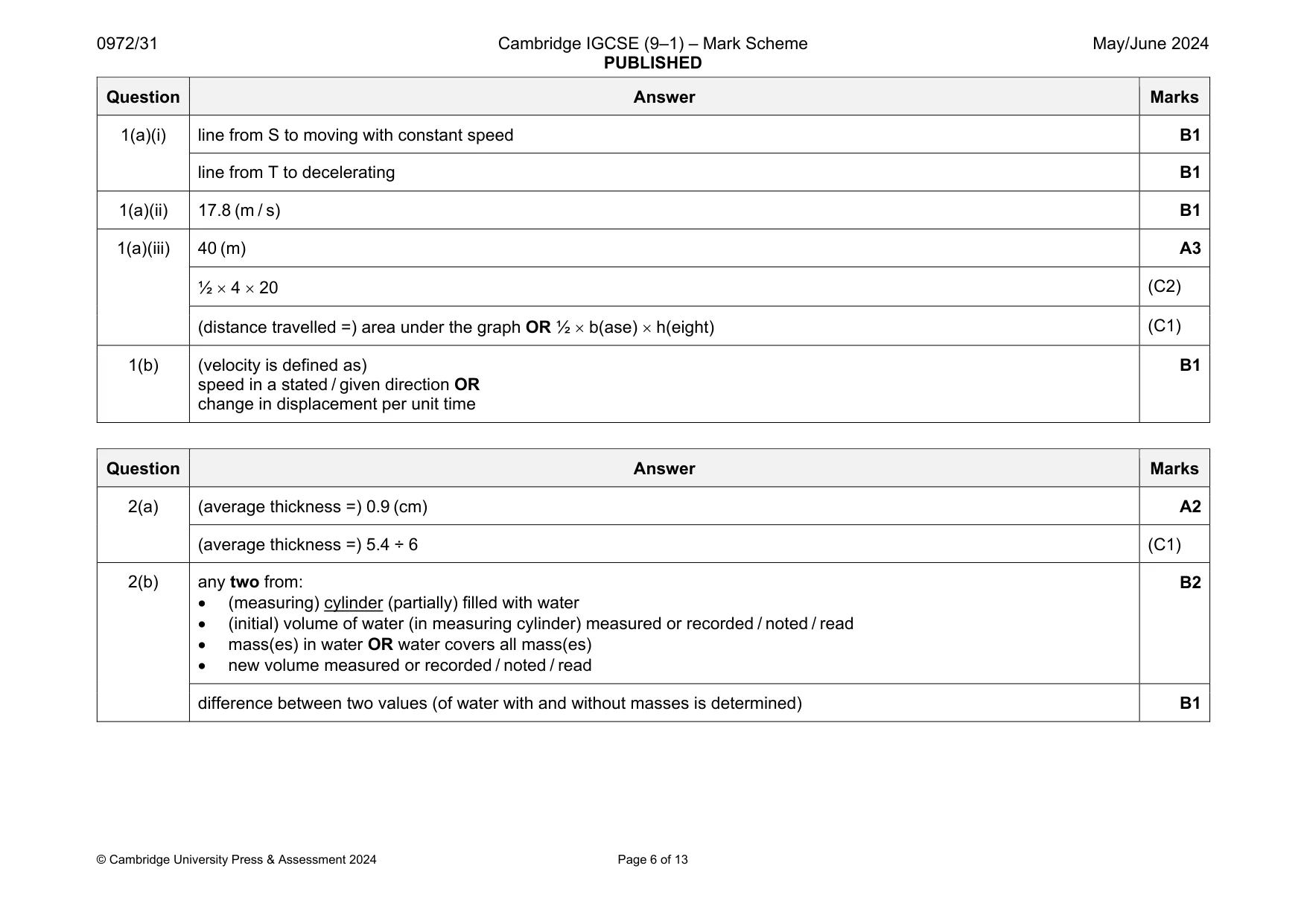
Mark scheme: 1(a)(i) line from S to moving with constant speed B1 line from T to decelerating B1 1(a)(ii) 17.8 (m / s) B1 1(a)(iii) 40 (m) A3 ½ 4 20 (C2) (distance travelled =) area under the graph OR ½ b(ase) h(eight) (C1) 1(b) (velocity is defined as) speed in a stated / given direction OR change in displacement per unit time B1
Q2 · A student places six 100 g masses in a stack, as shown in Fig
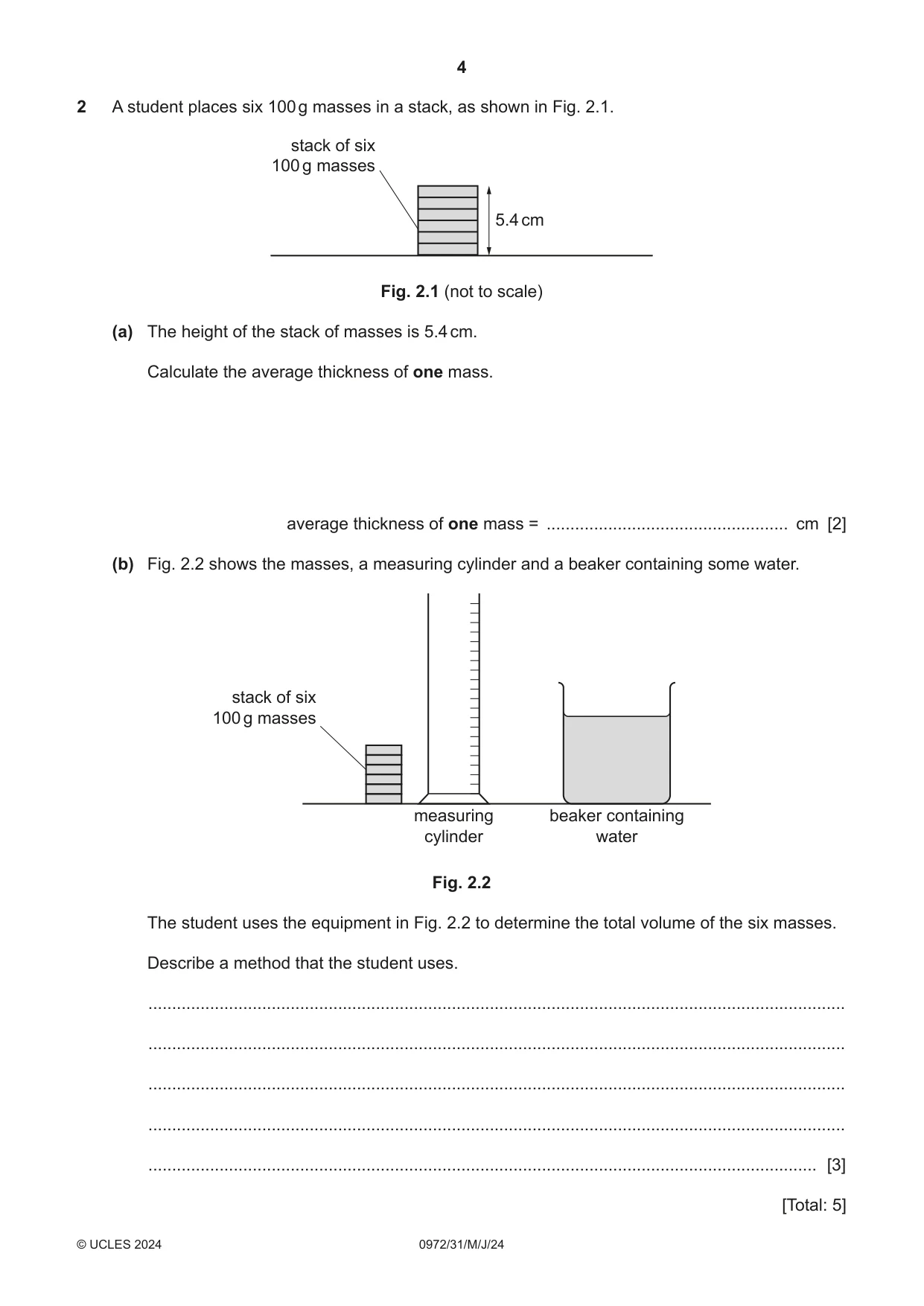
2 A student places six 100 g masses in a stack, as shown in Fig. 2.1. stack of six 100 g masses 5.4 cm Fig. 2.1 (not to scale) (a) The height of the stack of masses is 5.4 cm. Calculate the average thickness of one mass. average thickness of one mass = ................................................... cm [2] (b) Fig. 2.2 shows the masses, a measuring cylinder and a beaker containing some water. stack of six 100 g masses measuring beaker containing cylinder water Fig. 2.2 The student uses the equipment in Fig. 2.2 to determine the total volume of the six masses. Describe a method that the student uses. ................................................................................................................................................... ................................................................................................................................................... ................................................................................................................................................... ................................................................................................................................................... ............................................................................................................................................. [3] [Total: 5]
Mark scheme: 2(a) (average thickness =) 0.9 (cm) A2 (average thickness =) 5.4 ÷ 6 (C1) 2(b) any two from: (measuring) cylinder (partially) filled with water (initial) volume of water (in measuring cylinder) measured or recorded / noted / read mass(es) in water OR water covers all mass(es) new volume measured or recorded / noted / read B2 difference between two values (of water with and without masses is determined) B1
More questions on Physical quantities and measurement techniques
Q3 · The horizontal forces acting on a boat
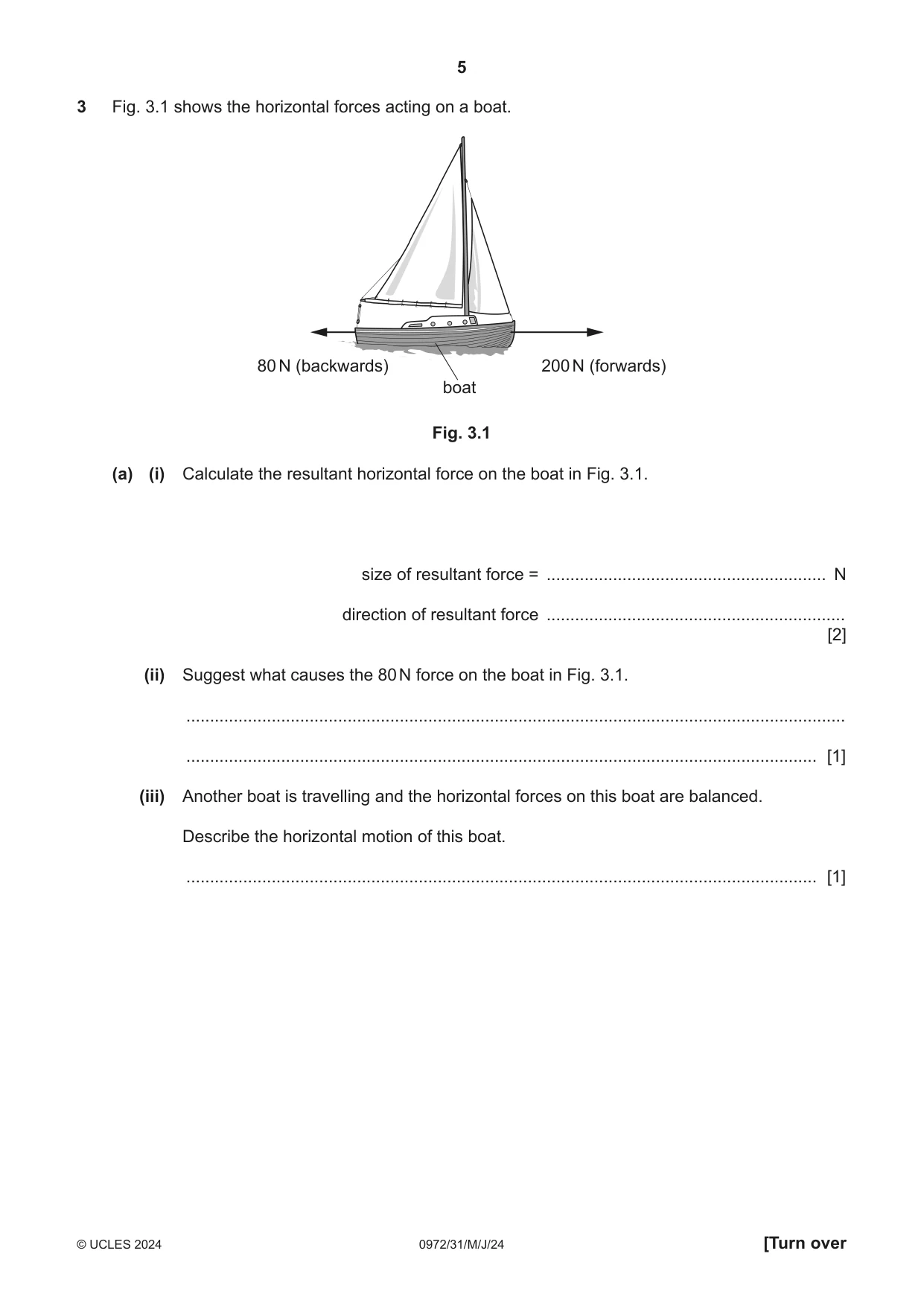
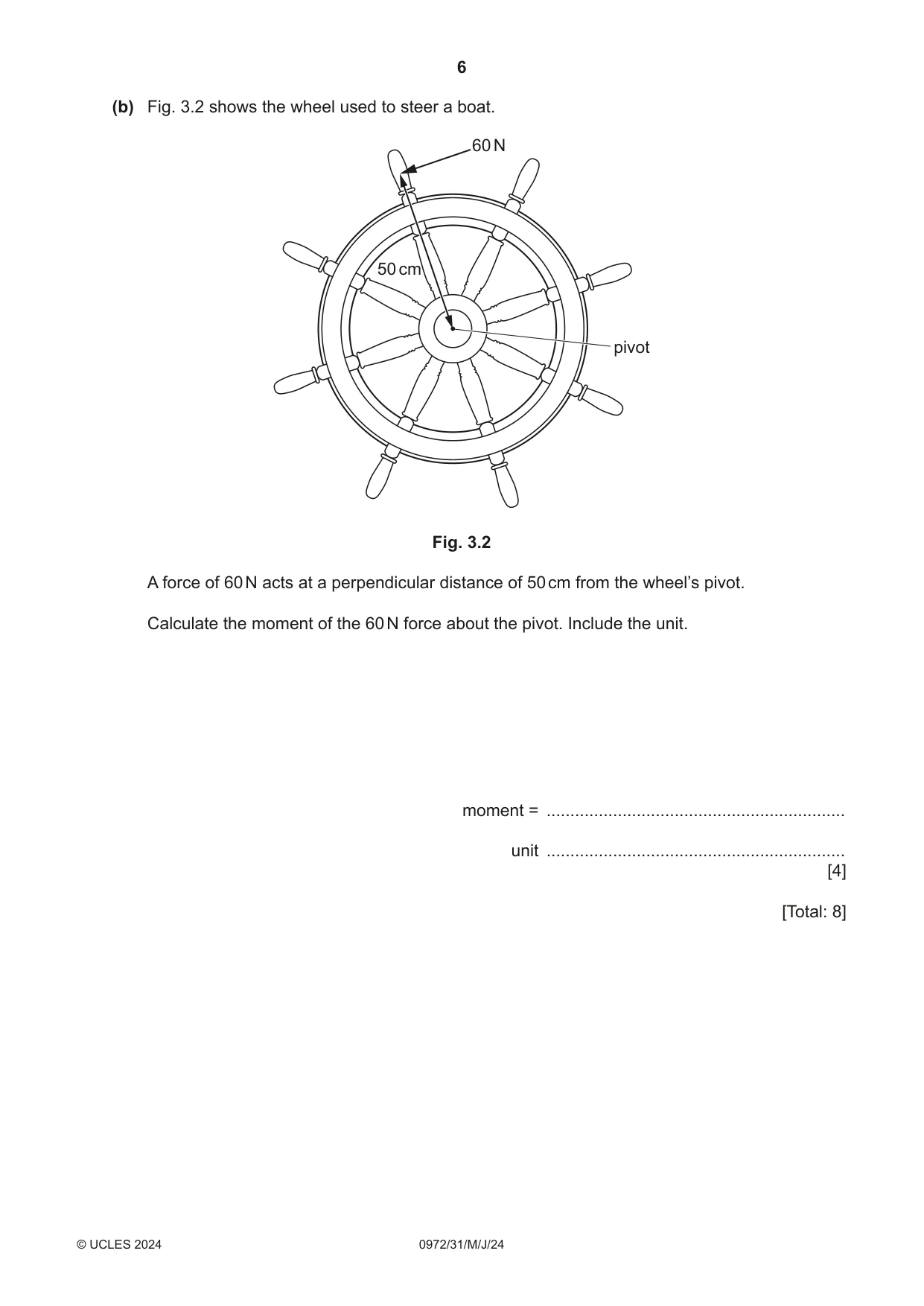
3 Fig. 3.1 shows the horizontal forces acting on a boat. 80 N (backwards) 200 N (forwards) boat Fig. 3.1 (a) (i) Calculate the resultant horizontal force on the boat in Fig. 3.1. size of resultant force = ........................................................... N direction of resultant force ............................................................... [2] (ii) Suggest what causes the 80 N force on the boat in Fig. 3.1. ........................................................................................................................................... ..................................................................................................................................... [1] (iii) Another boat is travelling and the horizontal forces on this boat are balanced. Describe the horizontal motion of this boat. ..................................................................................................................................... [1] (b) Fig. 3.2 shows the wheel used to steer a boat. 60 N 50 cm50 cm pivot Fig. 3.2 A force of 60 N acts at a perpendicular distance of 50 cm from the wheel’s pivot. Calculate the moment of the 60 N force about the pivot. Include the unit. moment = ............................................................... unit ............................................................... [4] [Total: 8]
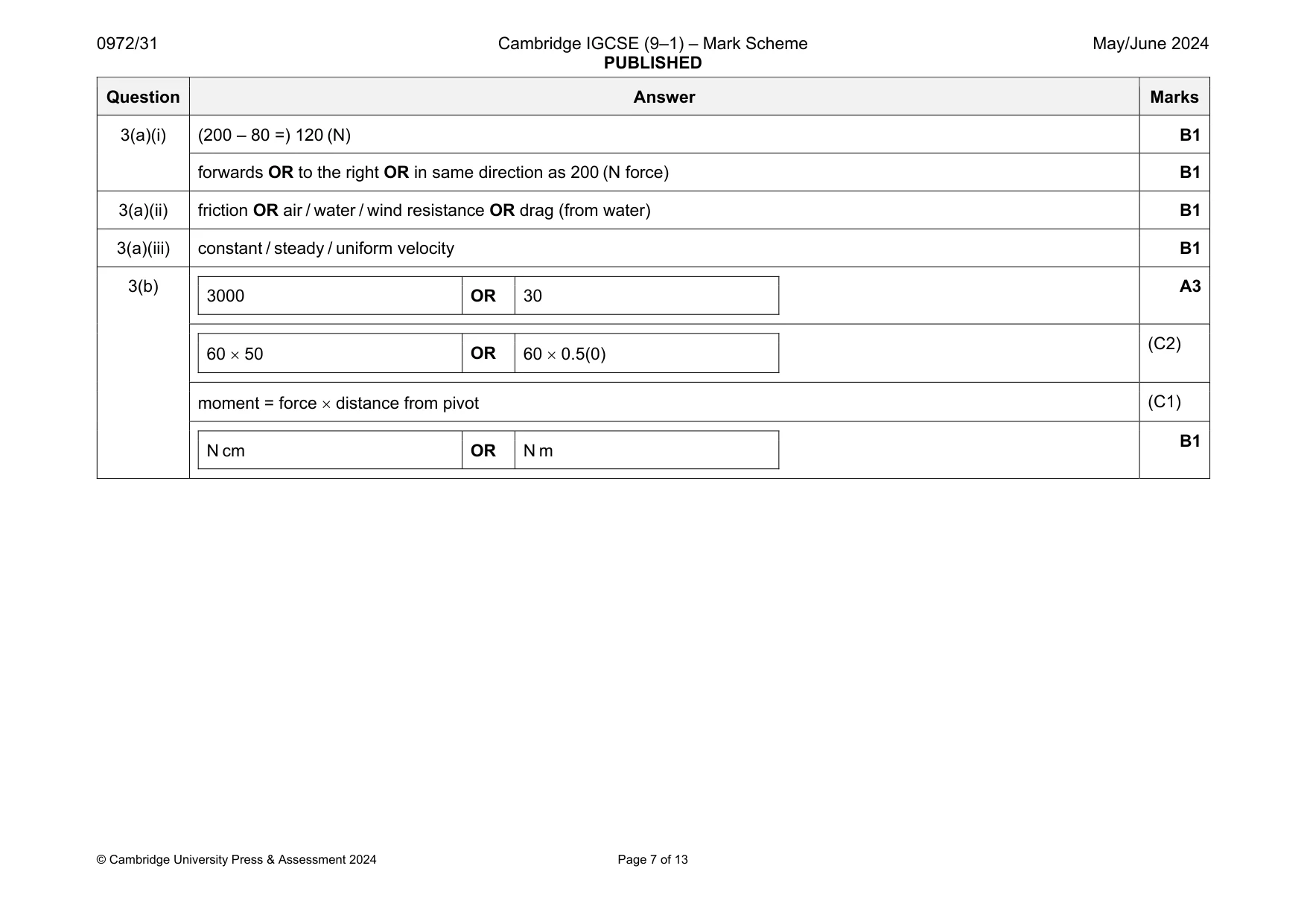
Mark scheme: 3(a)(i) (200 – 80 =) 120 (N) B1 forwards OR to the right OR in same direction as 200 (N force) B1 3(a)(ii) friction OR air / water / wind resistance OR drag (from water) B1 3(a)(iii) constant / steady / uniform velocity B1 3(b) 3000 OR 30 A3 60 50 OR 60 0.5(0) (C2) moment = force distance from pivot (C1) N cm OR N m B1
Q4 · The government of a country decides to reduce the amount of fossil fuel burned for…
4 The government of a country decides to reduce the amount of fossil fuel burned for generating electrical power. (a) State two reasons, apart from cost, for reducing the amount of fossil fuel burned. 1 ................................................................................................................................................ ................................................................................................................................................... 2 ................................................................................................................................................ ................................................................................................................................................... [2] (b) (i) Describe how a hydroelectric power station generates electrical power. ........................................................................................................................................... ........................................................................................................................................... ........................................................................................................................................... ........................................................................................................................................... ..................................................................................................................................... [3] (ii) Hydroelectric power stations are expensive to build. State two other disadvantages of using a hydroelectric power station to generate electrical power. 1 ........................................................................................................................................ ........................................................................................................................................... 2 ........................................................................................................................................ ........................................................................................................................................... [2] (c) The government plans to build some wind turbines. The government plans to store some of the electrical energy generated by the wind turbines. Suggest one method of storing the electrical energy generated by a wind turbine. ................................................................................................................................................... ............................................................................................................................................. [1] [Total: 8]
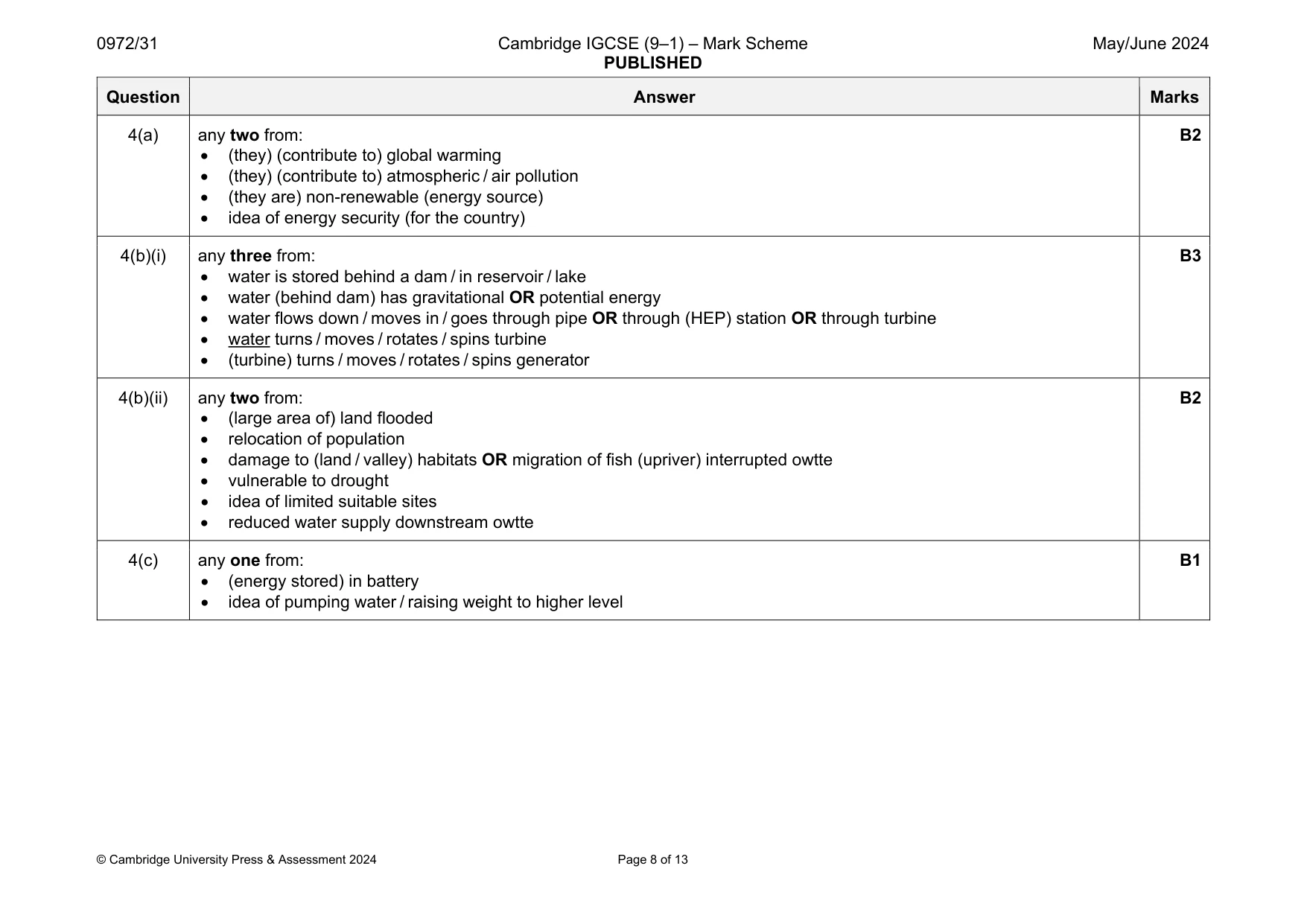
Mark scheme: 4(a) any two from: (they) (contribute to) global warming (they) (contribute to) atmospheric / air pollution (they are) non-renewable (energy source) idea of energy security (for the country) B2 4(b)(i) any three from: water is stored behind a dam / in reservoir / lake water (behind dam) has gravitational OR potential energy water flows down / moves in / goes through pipe OR through (HEP) station OR through turbine water turns / moves / rotates / spins turbine (turbine) turns / moves / rotates / spins generator B3 4(b)(ii) any two from: (large area of) land flooded relocation of population damage to (land / valley) habitats OR migration of fish (upriver) interrupted owtte vulnerable to drought idea of limited suitable sites reduced water supply downstream owtte B2 4(c) any one from: (energy stored) in battery idea of pumping water / raising weight to higher level B1
Q5 · Describe the arrangement, separation and motion of gas particles
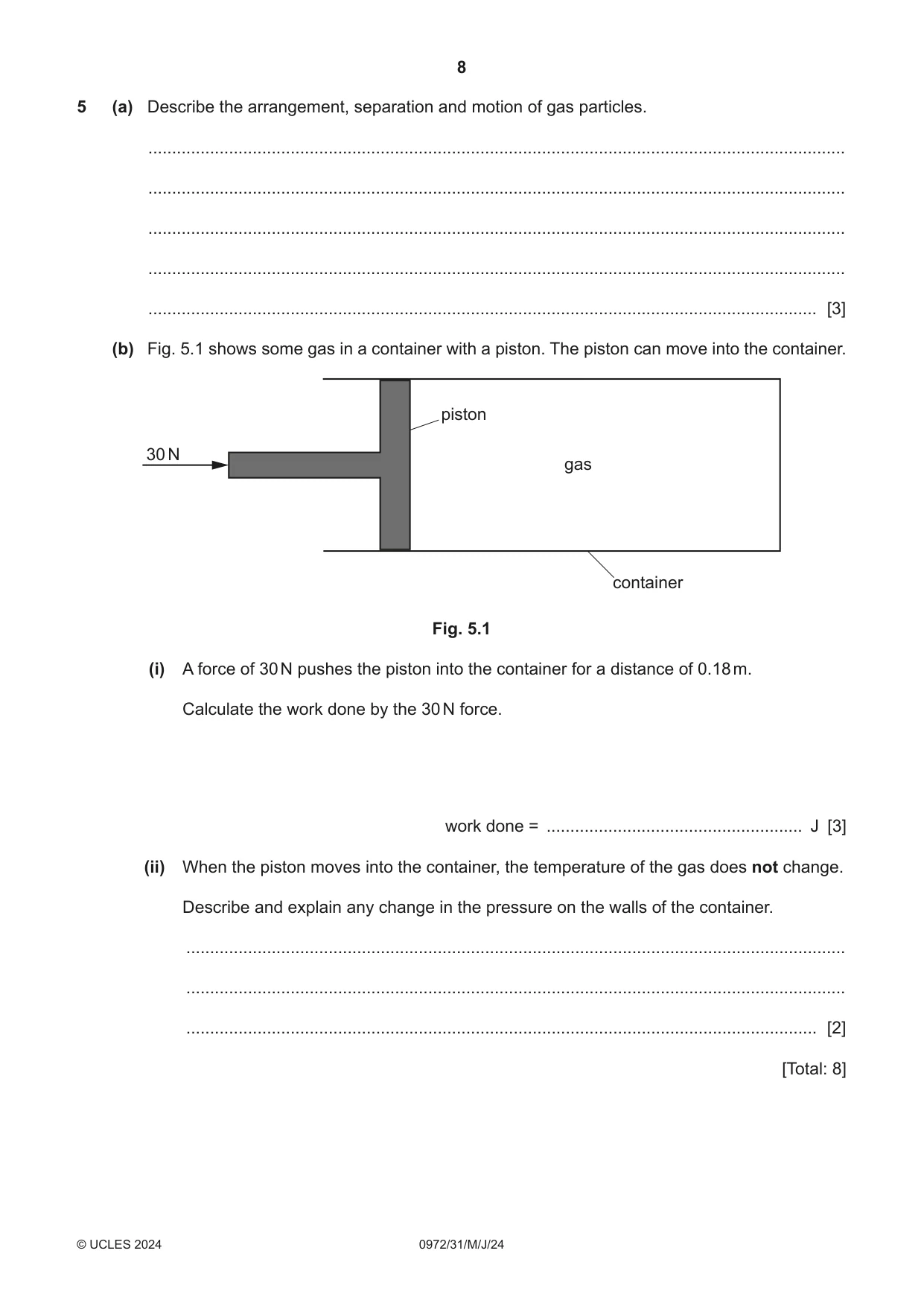
5 (a) Describe the arrangement, separation and motion of gas particles. ................................................................................................................................................... ................................................................................................................................................... ................................................................................................................................................... ................................................................................................................................................... ............................................................................................................................................. [3] (b) Fig. 5.1 shows some gas in a container with a piston. The piston can move into the container. piston 30 N gas container Fig. 5.1 (i) A force of 30 N pushes the piston into the container for a distance of 0.18 m. Calculate the work done by the 30 N force. work done = ...................................................... J [3] (ii) When the piston moves into the container, the temperature of the gas does not change. Describe and explain any change in the pressure on the walls of the container. ........................................................................................................................................... ........................................................................................................................................... ..................................................................................................................................... [2] [Total: 8]
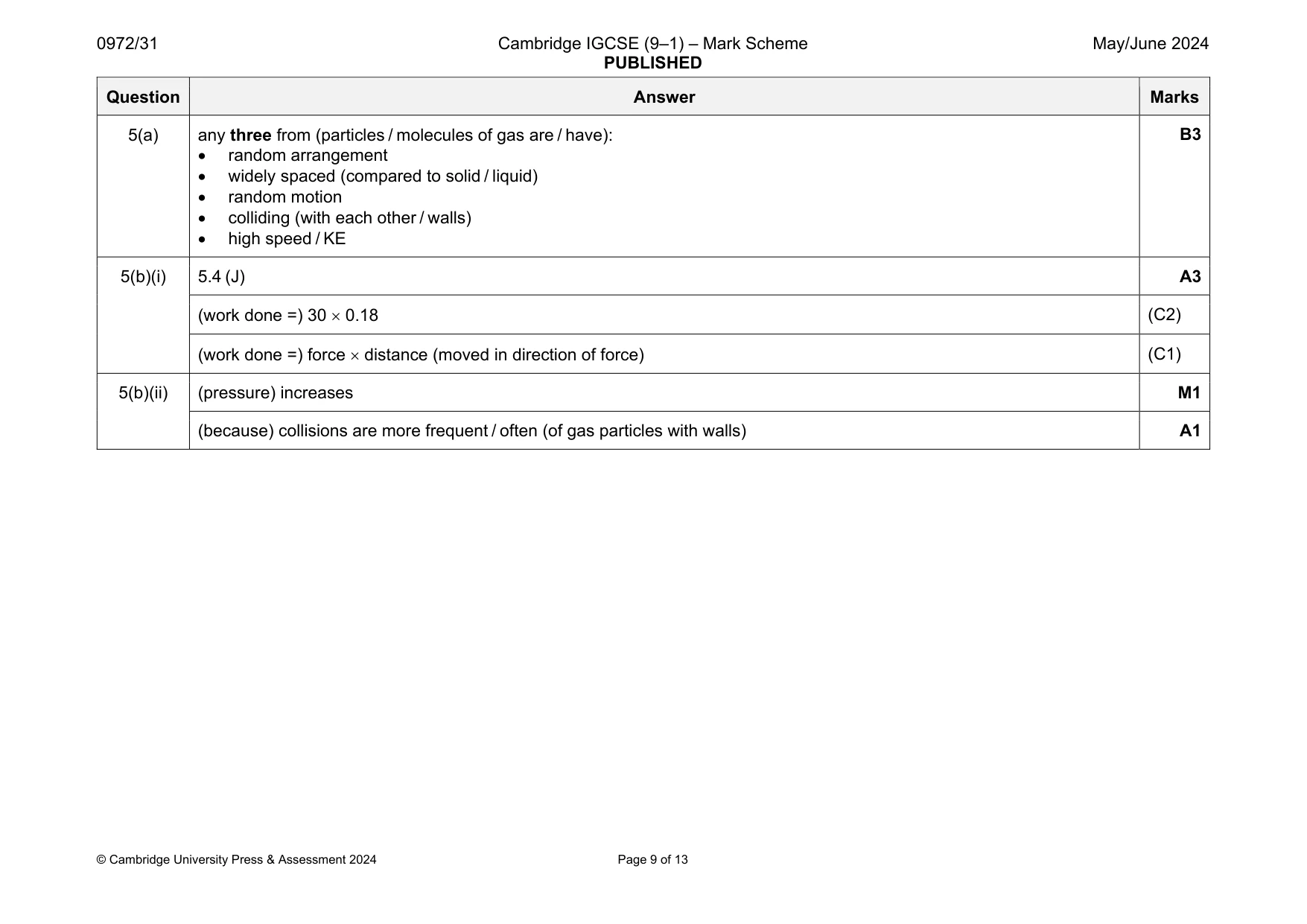
Mark scheme: 5(a) any three from (particles / molecules of gas are / have): random arrangement widely spaced (compared to solid / liquid) random motion colliding (with each other / walls) high speed / KE 5(b)(i) 5.4 (J) A3 (work done =) 30 0.18 (C2) (work done =) force distance (moved in direction of force) (C1) 5(b)(ii) (pressure) increases M1 (because) collisions are more frequent / often (of gas particles with walls) A1
Q6 · A student wants to compare the conduction of thermal energy through rods made of iron…
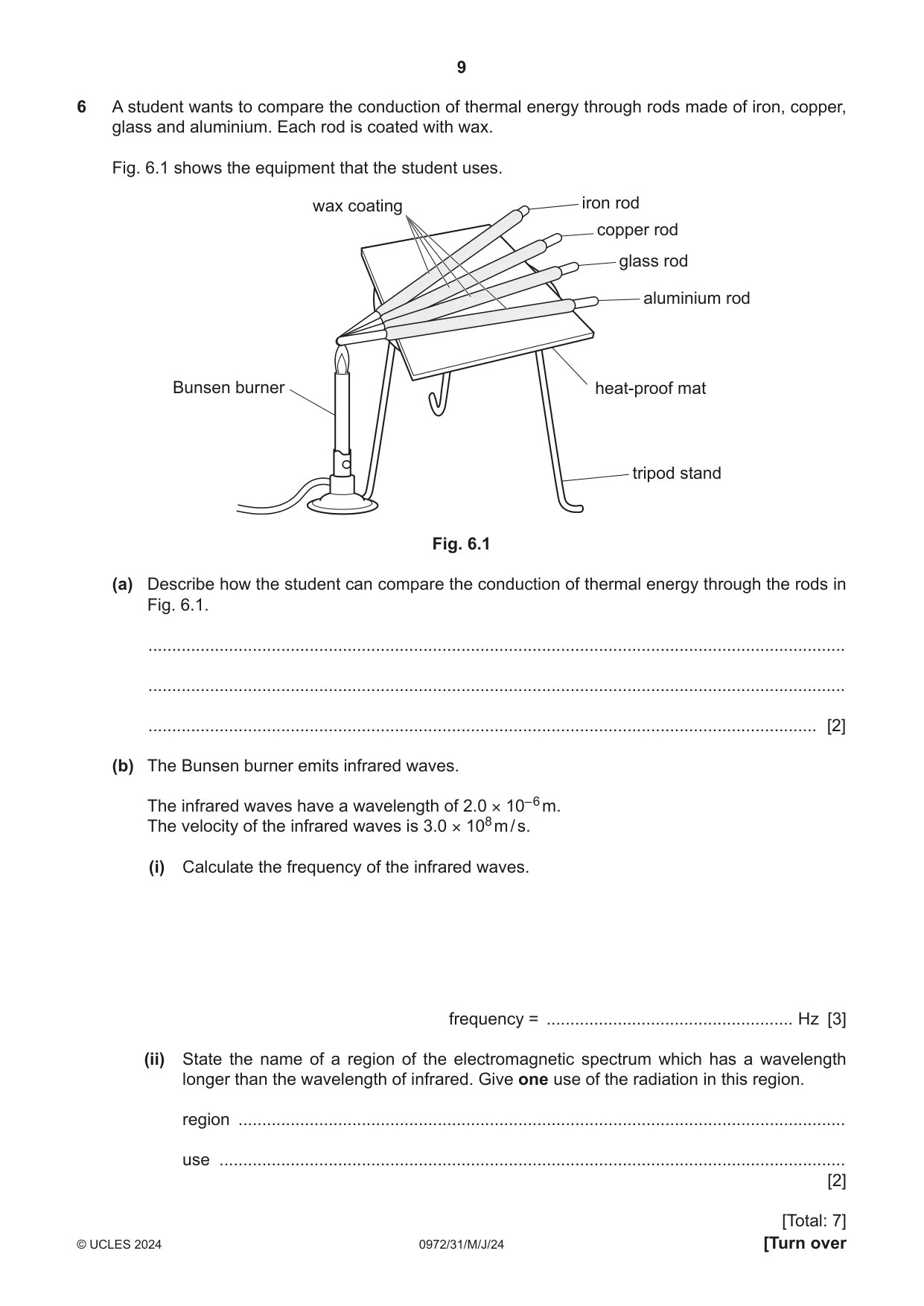
6 A student wants to compare the conduction of thermal energy through rods made of iron, copper, glass and aluminium. Each rod is coated with wax. Fig. 6.1 shows the equipment that the student uses. wax coating iron rod copper rod glass rod aluminium rod Bunsen burner heat-proof mat tripod stand Fig. 6.1 (a) Describe how the student can compare the conduction of thermal energy through the rods in Fig. 6.1. ................................................................................................................................................... ................................................................................................................................................... ............................................................................................................................................. [2] (b) The Bunsen burner emits infrared waves. The infrared waves have a wavelength of 2.0 × 10– 6 m. The velocity of the infrared waves is 3.0 × 10⁸ m / s. (i) Calculate the frequency of the infrared waves. frequency = .................................................... Hz [3] (ii) State the name of a region of the electromagnetic spectrum which has a wavelength longer than the wavelength of infrared. Give one use of the radiation in this region. region ................................................................................................................................ use .................................................................................................................................... [2] [Total: 7]
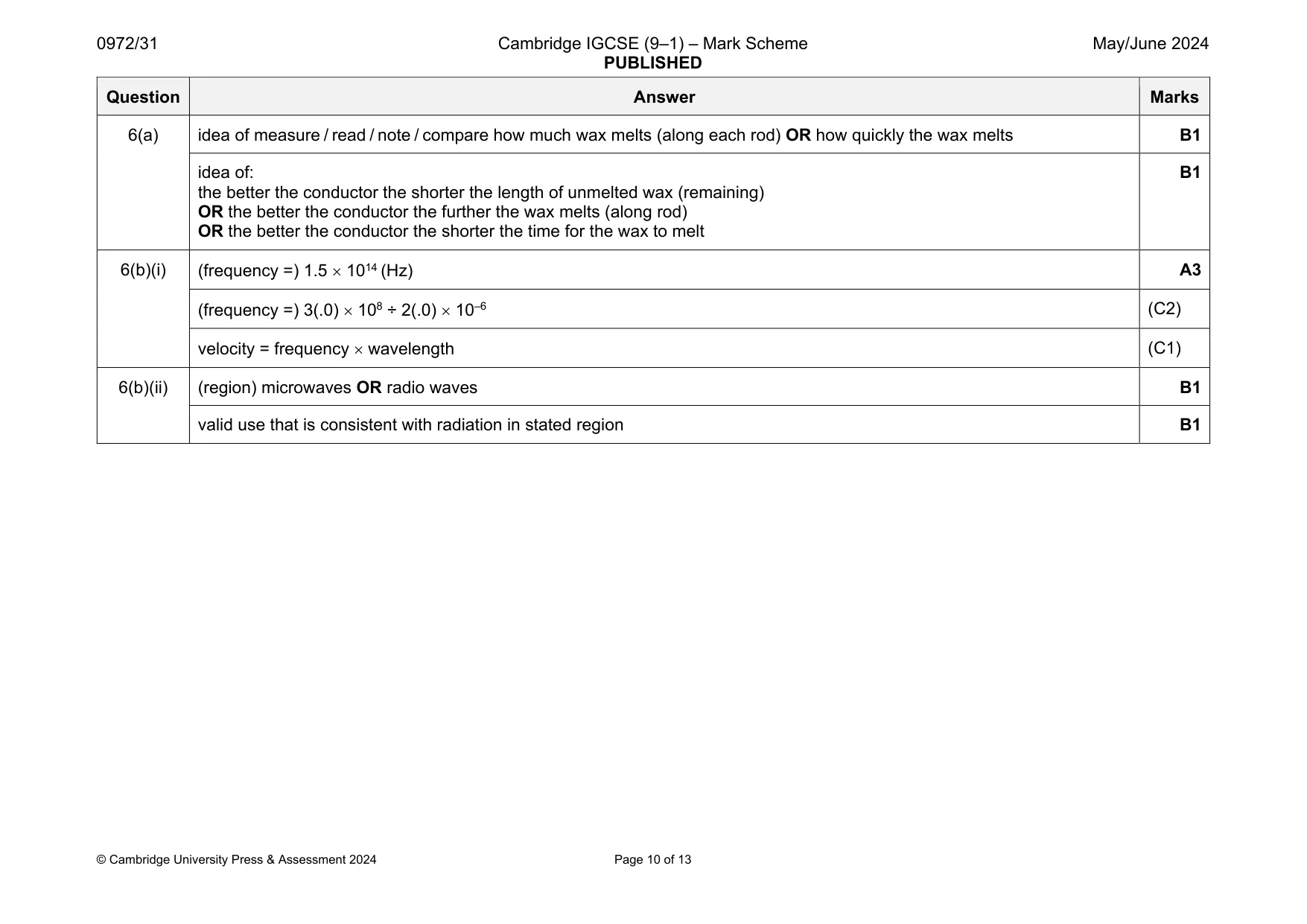
Mark scheme: 6(a) idea of measure / read / note / compare how much wax melts (along each rod) OR how quickly the wax melts B1 idea of: the better the conductor the shorter the length of unmelted wax (remaining) OR the better the conductor the further the wax melts (along rod) OR the better the conductor the shorter the time for the wax to melt B1 6(b)(i) (frequency =) 1.5 1014 (Hz) A3 (frequency =) 3(.0) 108 ÷ 2(.0) 10–6 (C2) velocity = frequency wavelength (C1) 6(b)(ii) (region) microwaves OR radio waves B1 valid use that is consistent with radiation in stated region B1
Q7 · A ray of light striking a plane mirror
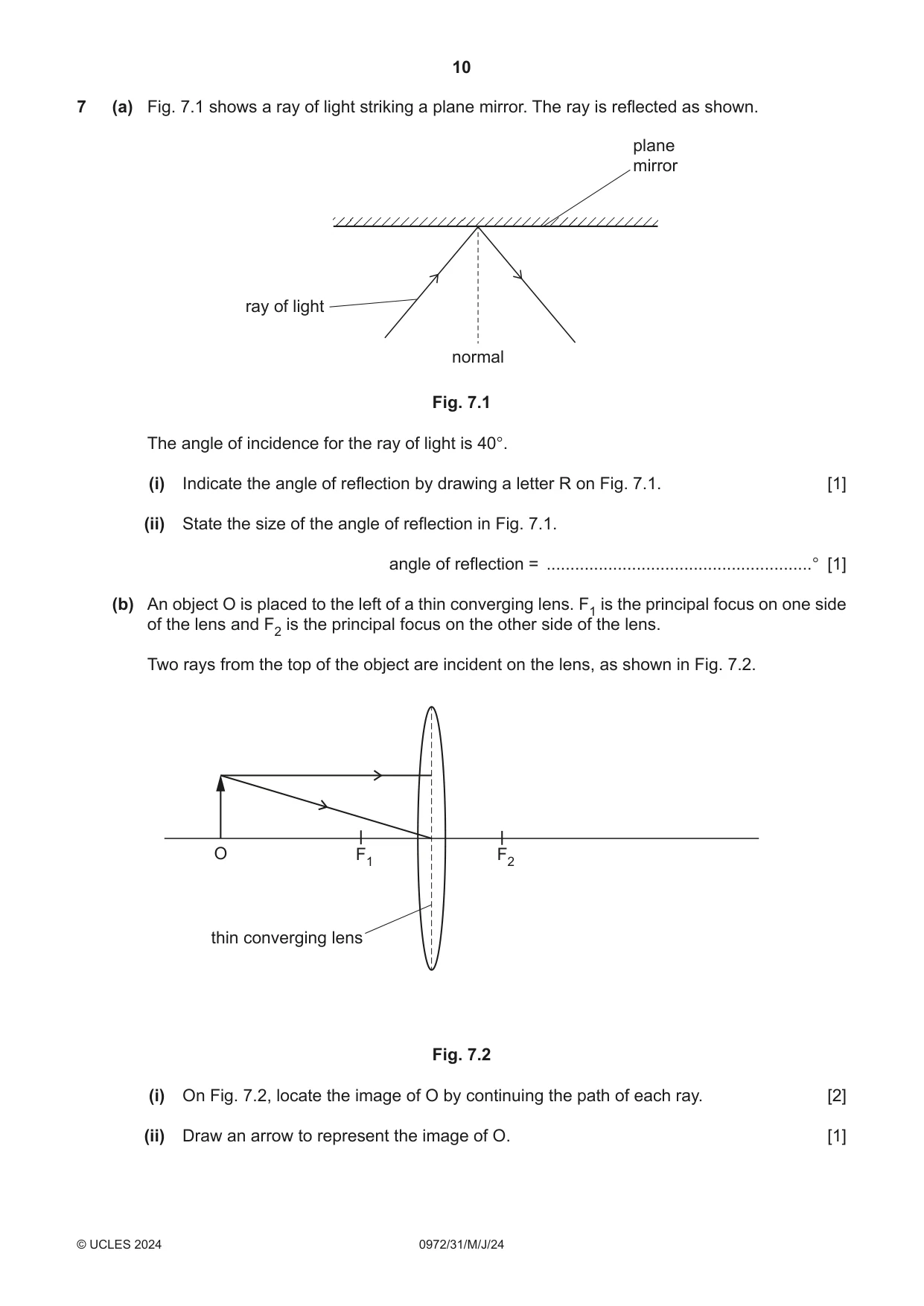
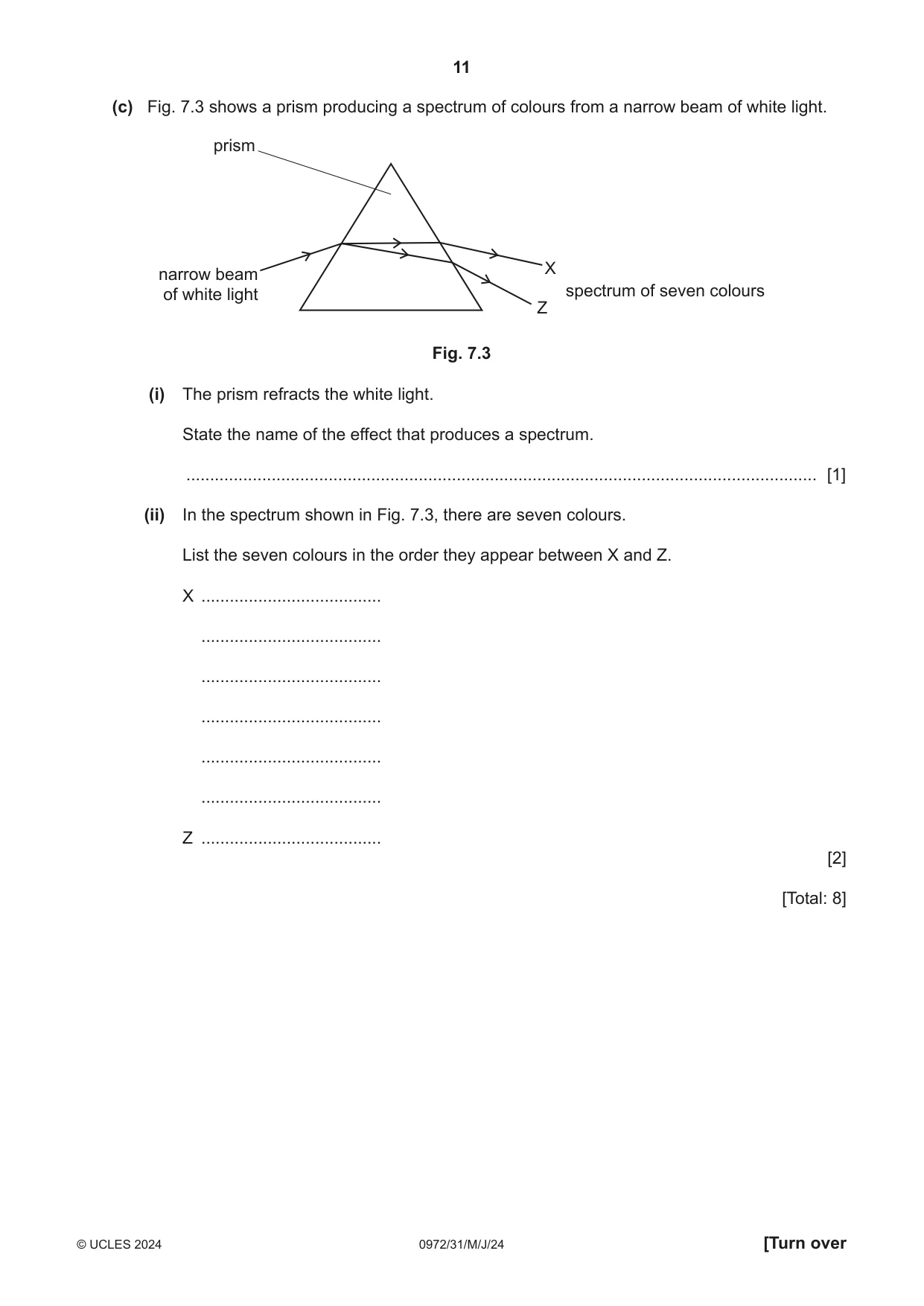
7 (a) Fig. 7.1 shows a ray of light striking a plane mirror. The ray is reflected as shown. plane mirror ray of light normal Fig. 7.1 The angle of incidence for the ray of light is 40°. (i) Indicate the angle of reflection by drawing a letter R on Fig. 7.1. [1] (ii) State the size of the angle of reflection in Fig. 7.1. angle of reflection = ........................................................° [1] (b) An object O is placed to the left of a thin converging lens. F1 is the principal focus on one side of the lens and F2 is the principal focus on the other side of the lens. Two rays from the top of the object are incident on the lens, as shown in Fig. 7.2. O F1 F2 thin converging lens Fig. 7.2 (i) On Fig. 7.2, locate the image of O by continuing the path of each ray. [2] (ii) Draw an arrow to represent the image of O. [1] (c) Fig. 7.3 shows a prism producing a spectrum of colours from a narrow beam of white light. prism X narrow beam of white light spectrum of seven colours Z Fig. 7.3 (i) The prism refracts the white light. State the name of the effect that produces a spectrum. ..................................................................................................................................... [1] (ii) In the spectrum shown in Fig. 7.3, there are seven colours. List the seven colours in the order they appear between X and Z. X ...................................... ...................................... ...................................... ...................................... ...................................... ...................................... Z ...................................... [2] [Total: 8]
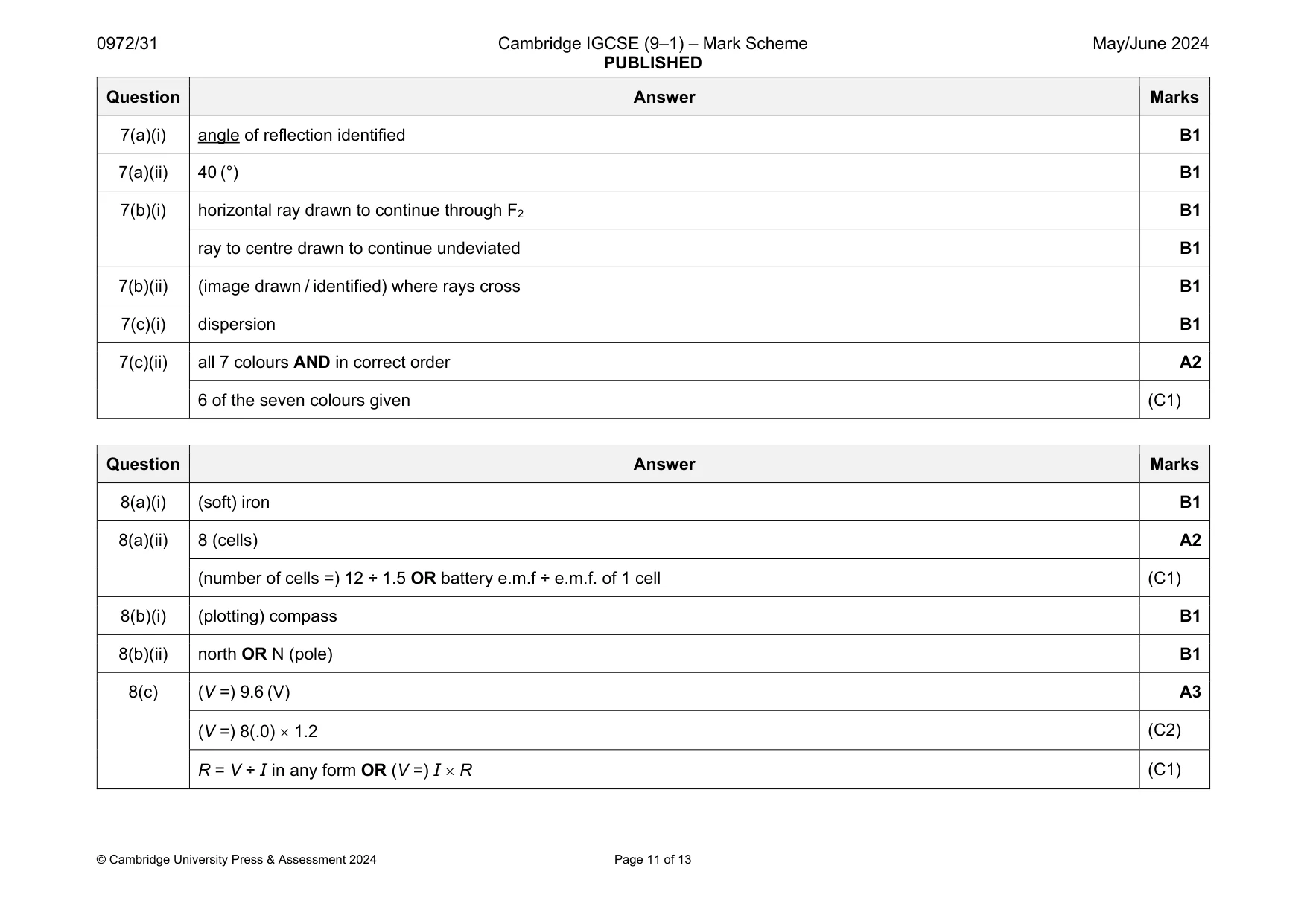
Mark scheme: 7(a)(i) angle of reflection identified B1 7(a)(ii) 40 (°) B1 7(b)(i) horizontal ray drawn to continue through F2 B1 ray to centre drawn to continue undeviated B1 7(b)(ii) (image drawn / identified) where rays cross B1 7(c)(i) dispersion B1 7(c)(ii) all 7 colours AND in correct order A2 6 of the seven colours given (C1)
Q8 · An arrangement for making an electromagnet
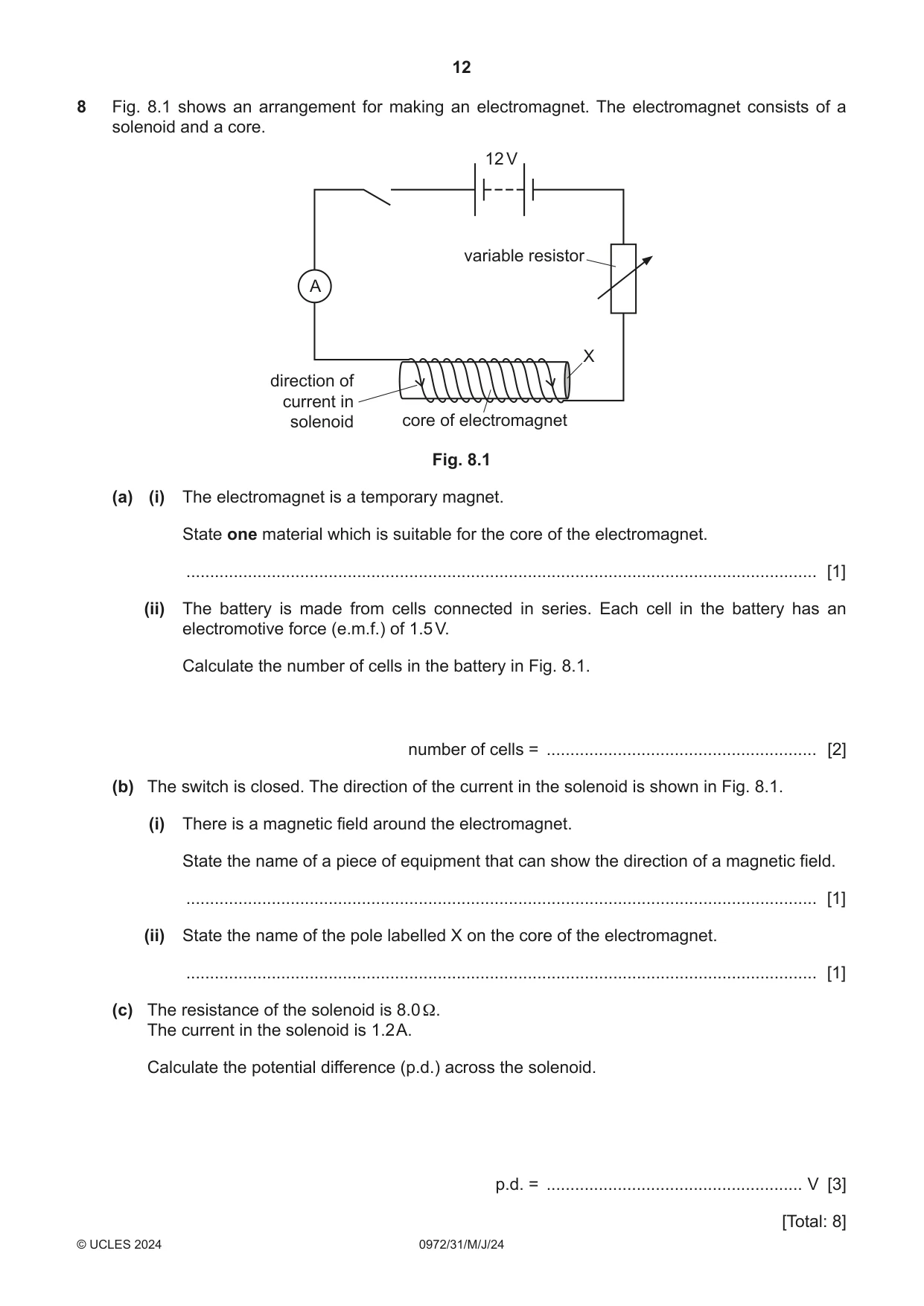
8 Fig. 8.1 shows an arrangement for making an electromagnet. The electromagnet consists of a solenoid and a core. 12 V variable resistor A X direction of current in solenoid core of electromagnet Fig. 8.1 (a) (i) The electromagnet is a temporary magnet. State one material which is suitable for the core of the electromagnet. ..................................................................................................................................... [1] (ii) The battery is made from cells connected in series. Each cell in the battery has an electromotive force (e.m.f.) of 1.5 V. Calculate the number of cells in the battery in Fig. 8.1. number of cells = ......................................................... [2] (b) The switch is closed. The direction of the current in the solenoid is shown in Fig. 8.1. (i) There is a magnetic field around the electromagnet. State the name of a piece of equipment that can show the direction of a magnetic field. ..................................................................................................................................... [1] (ii) State the name of the pole labelled X on the core of the electromagnet. ..................................................................................................................................... [1] (c) The resistance of the solenoid is 8.0 Ω. The current in the solenoid is 1.2 A. Calculate the potential difference (p.d.) across the solenoid. p.d. = ...................................................... V [3] [Total: 8]
Mark scheme: 8(a)(i) (soft) iron B1 8(a)(ii) 8 (cells) A2 (number of cells =) 12 ÷ 1.5 OR battery e.m.f ÷ e.m.f. of 1 cell (C1) 8(b)(i) (plotting) compass B1 8(b)(ii) north OR N (pole) B1 8(c) (V =) 9.6 (V) A3 (V =) 8(.0) 1.2 (C2) R = V ÷ I in any form OR (V =) I R (C1)
Q9 · The power cable for connecting a desktop computer to the mains electricity circuit
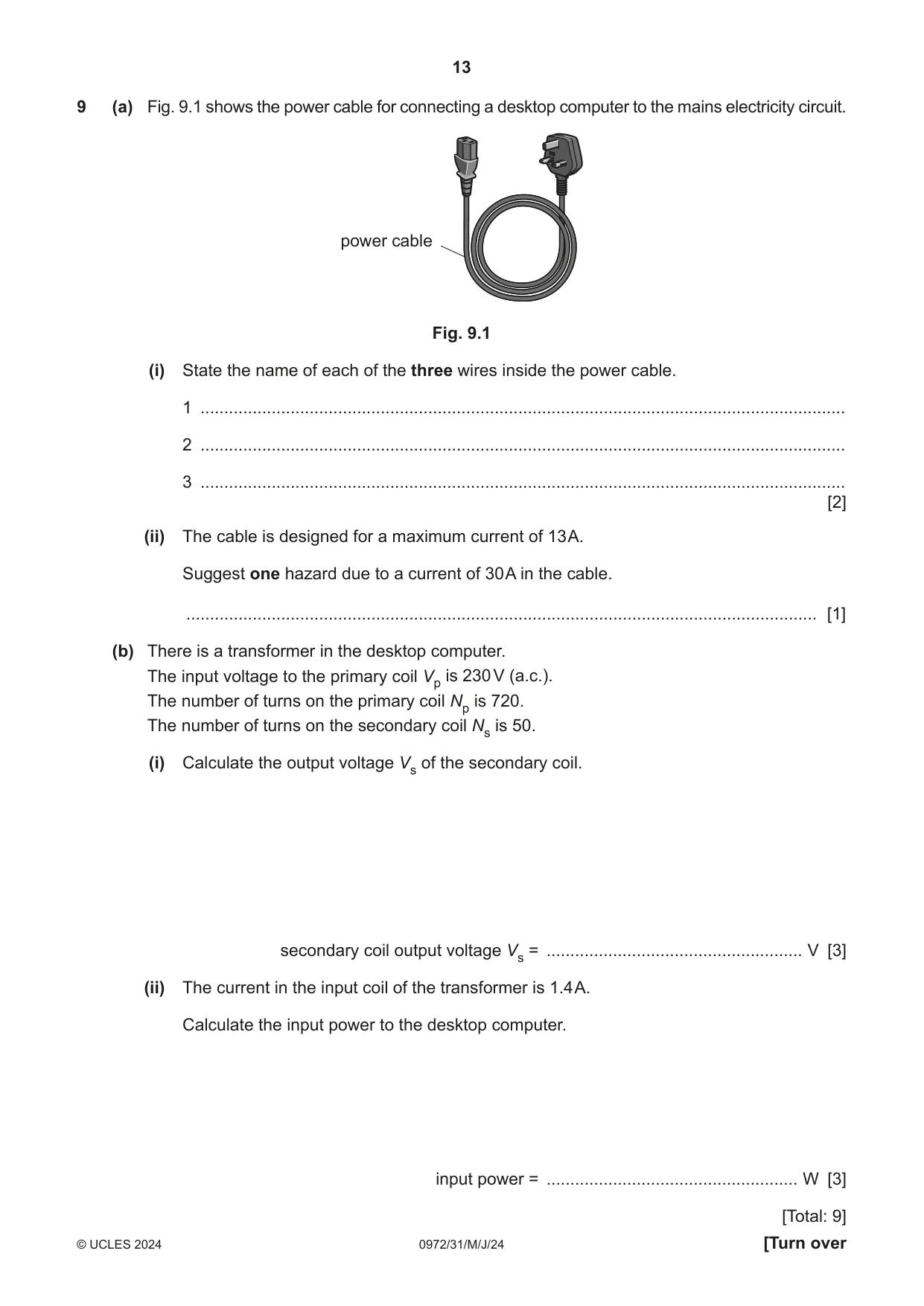
9 (a) Fig. 9.1 shows the power cable for connecting a desktop computer to the mains electricity circuit. power cable Fig. 9.1 (i) State the name of each of the three wires inside the power cable. 1 ........................................................................................................................................ 2 ........................................................................................................................................ 3 ........................................................................................................................................ [2] (ii) The cable is designed for a maximum current of 13 A. Suggest one hazard due to a current of 30 A in the cable. ..................................................................................................................................... [1] (b) There is a transformer in the desktop computer. The input voltage to the primary coil Vp is 230 V (a.c.). The number of turns on the primary coil Np is 720. The number of turns on the secondary coil Ns is 50. (i) Calculate the output voltage Vs of the secondary coil. secondary coil output voltage Vs = ...................................................... V [3] (ii) The current in the input coil of the transformer is 1.4 A. Calculate the input power to the desktop computer. input power = ..................................................... W [3] [Total: 9]
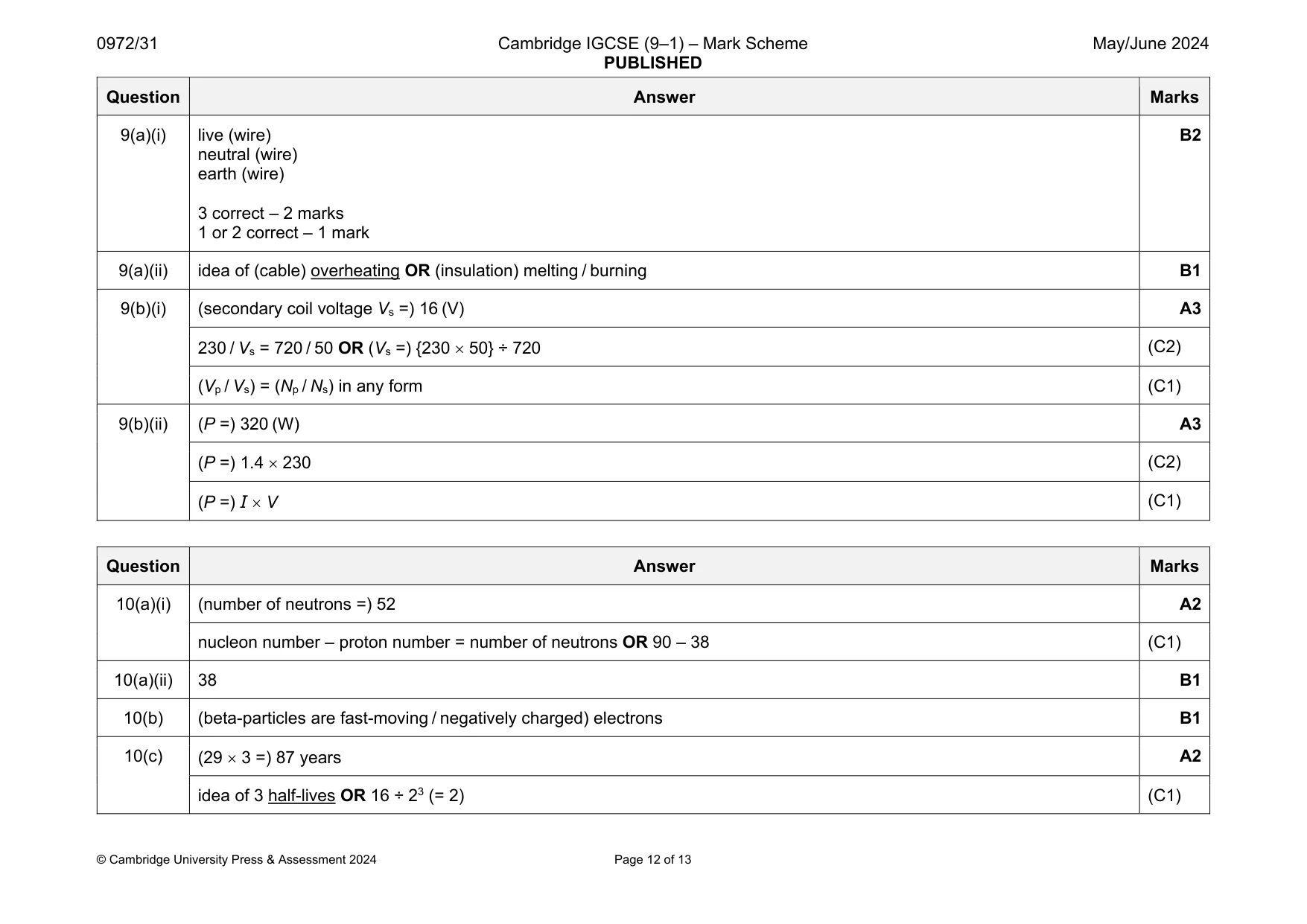
Mark scheme: 9(a)(i) live (wire) neutral (wire) earth (wire) 3 correct – 2 marks 1 or 2 correct – 1 mark B2 9(a)(ii) idea of (cable) overheating OR (insulation) melting / burning B1 9(b)(i) (secondary coil voltage Vs =) 16 (V) A3 230 / Vs = 720 / 50 OR (Vs =) {230 50} ÷ 720 (C2) (Vp / Vs) = (Np / Ns) in any form (C1) 9(b)(ii) (P =) 320 (W) A3 (P =) 1.4 230 (C2) (P =) I V (C1)
Q10 · A nucleus of strontium-90 is represented using nuclide notation as shown
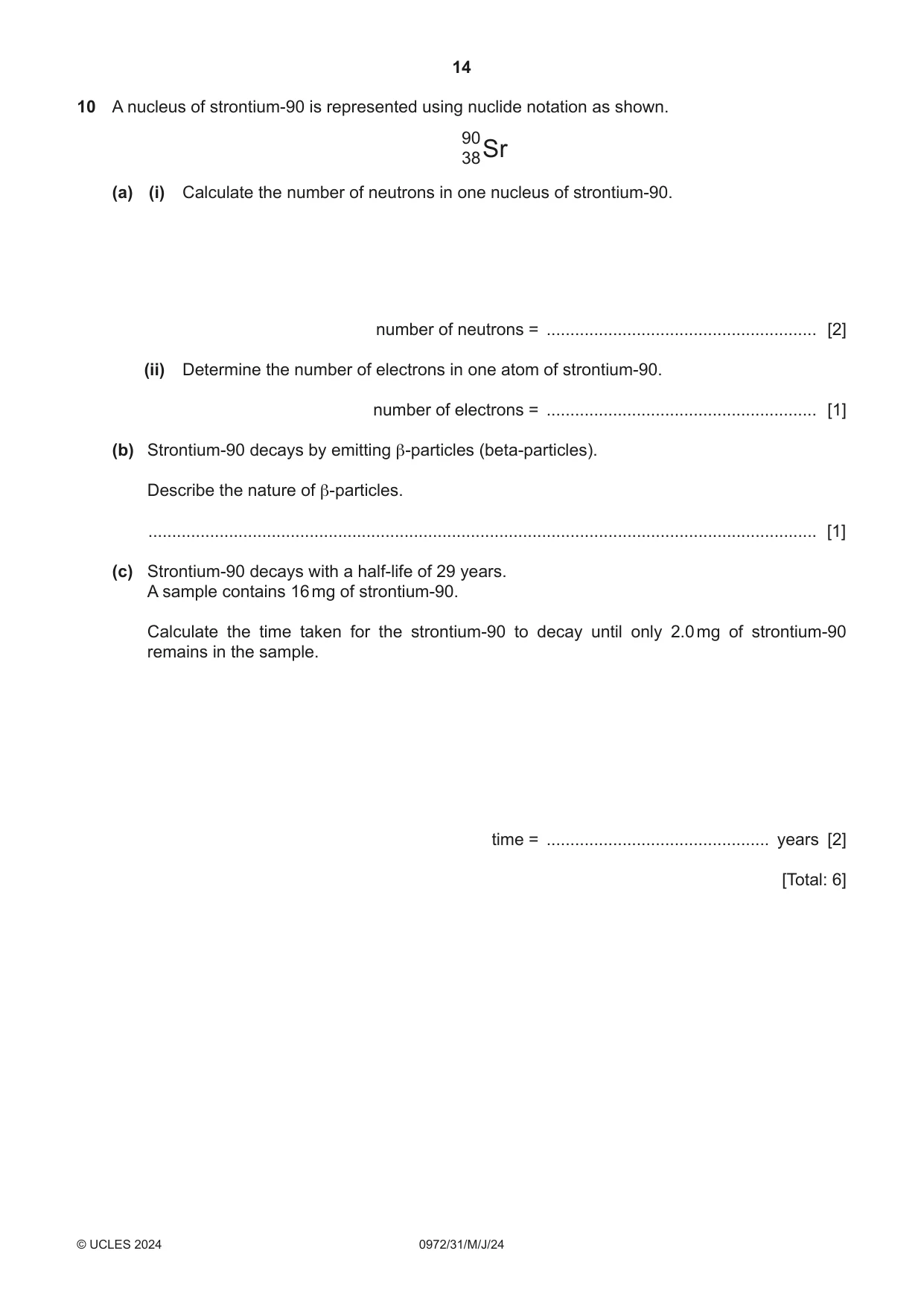
10 A nucleus of strontium-90 is represented using nuclide notation as shown. 90 38 Sr (a) (i) Calculate the number of neutrons in one nucleus of strontium-90. number of neutrons = ......................................................... [2] (ii) Determine the number of electrons in one atom of strontium-90. number of electrons = ......................................................... [1] (b) Strontium-90 decays by emitting β-particles (beta-particles). Describe the nature of β-particles. ............................................................................................................................................. [1] (c) Strontium-90 decays with a half-life of 29 years. A sample contains 16 mg of strontium-90. Calculate the time taken for the strontium-90 to decay until only 2.0 mg of strontium-90 remains in the sample. time = ............................................... years [2] [Total: 6]
Mark scheme: 10(a)(i) (number of neutrons =) 52 A2 nucleon number – proton number = number of neutrons OR 90 – 38 (C1) 10(a)(ii) 38 B1 10(b) (beta-particles are fast-moving / negatively charged) electrons B1 10(c) (29 3 =) 87 years A2 idea of 3 half-lives OR 16 ÷ 23 (= 2) (C1)
Q11 · The Sun is the star in our Solar System
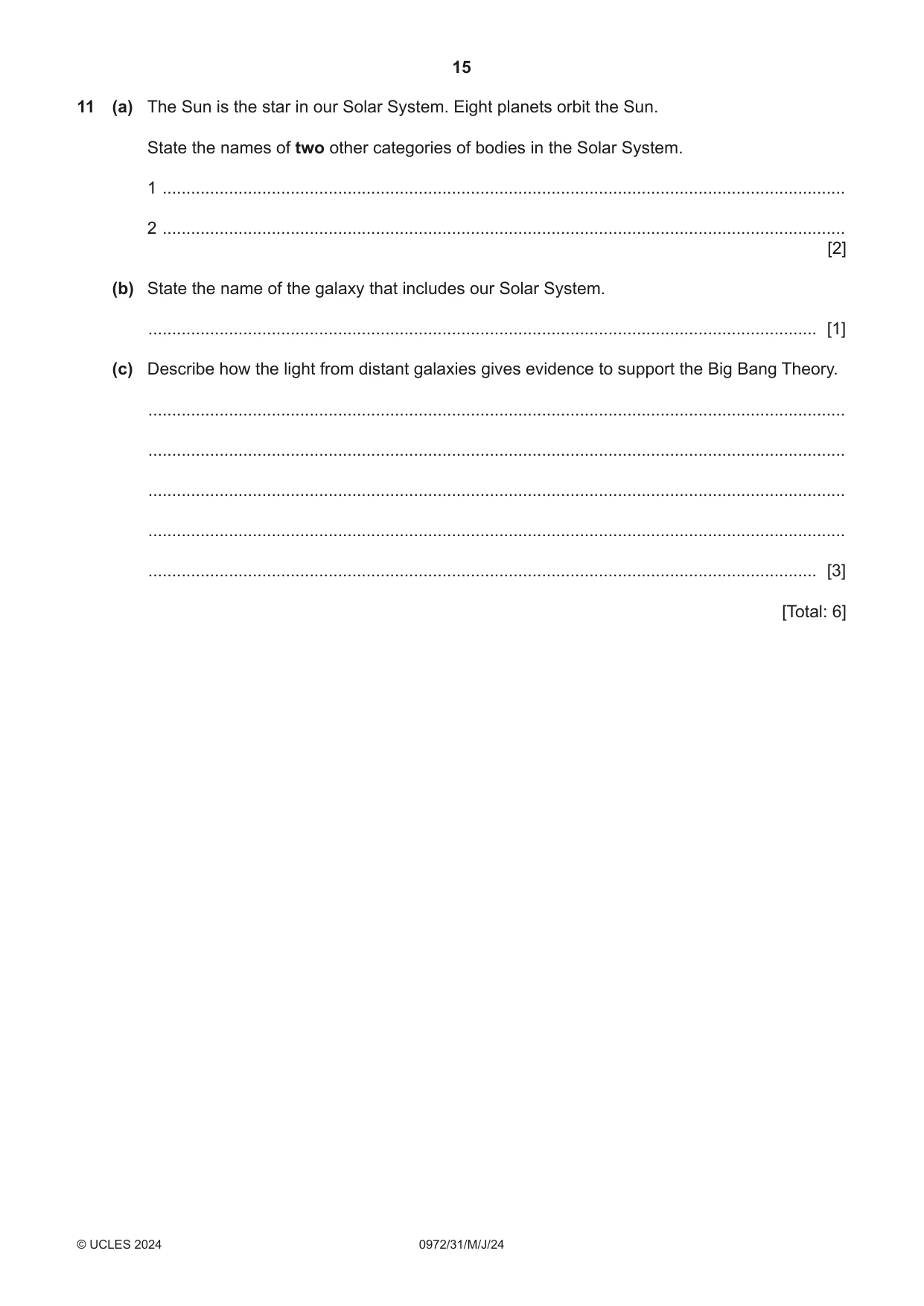
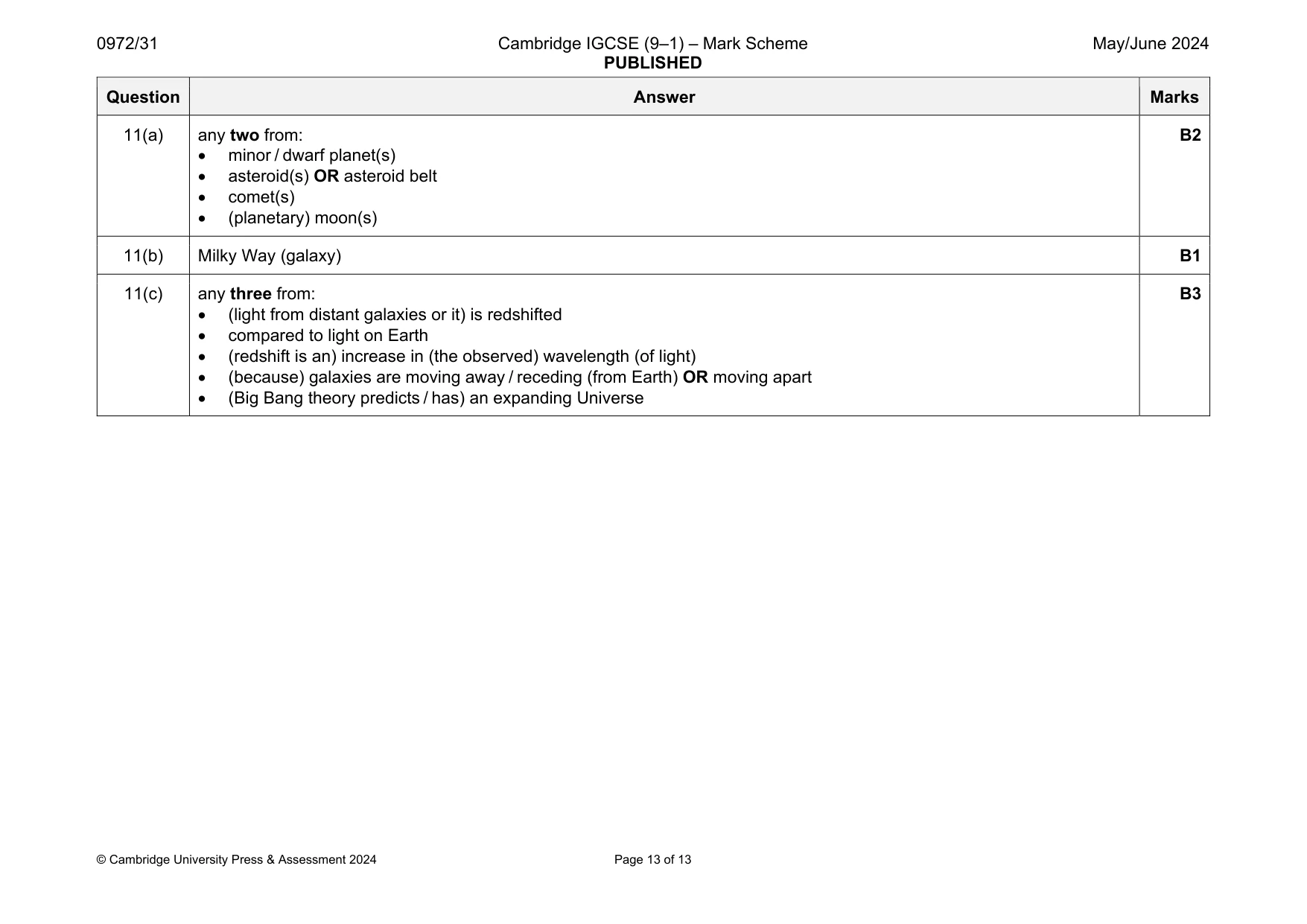
11 (a) The Sun is the star in our Solar System. Eight planets orbit the Sun. State the names of two other categories of bodies in the Solar System. 1 ................................................................................................................................................ 2 ................................................................................................................................................ [2] (b) State the name of the galaxy that includes our Solar System. ............................................................................................................................................. [1] (c) Describe how the light from distant galaxies gives evidence to support the Big Bang Theory. ................................................................................................................................................... ................................................................................................................................................... ................................................................................................................................................... ................................................................................................................................................... ............................................................................................................................................. [3] [Total: 6]
Mark scheme: 11(a) any two from: minor / dwarf planet(s) asteroid(s) OR asteroid belt comet(s) (planetary) moon(s) B2 11(b) Milky Way (galaxy) B1 11(c) any three from: (light from distant galaxies or it) is redshifted compared to light on Earth (redshift is an) increase in (the observed) wavelength (of light) (because) galaxies are moving away / receding (from Earth) OR moving apart (Big Bang theory predicts / has) an expanding Universe B3
What was in this paper
The subtopics covered by these 11 questions, and how many questions each got. Open one in a new tab to see every Cambridge question on it.
What you needed in this session
Cambridge’s own grade thresholds for 2024 May/June, Paper 3 · Variant 1. A higher threshold means an easier paper — the bar moves with how the cohort did.