Cambridge IGCSE Physics (9-1) 0972 — 2019 May/June Paper 3 · Variant 1
0972/31/M/J/19 · 12 questions · 80 marks · ≈90 min
The question paper and its mark scheme, free to read here and free to download. This is Cambridge’s own paper, exactly as it was sat.
Question paper16 pages
Mark scheme11 pages
Answers below. Sit the paper first if you are practising.
Questions as text
Q1 · A student has a metal object
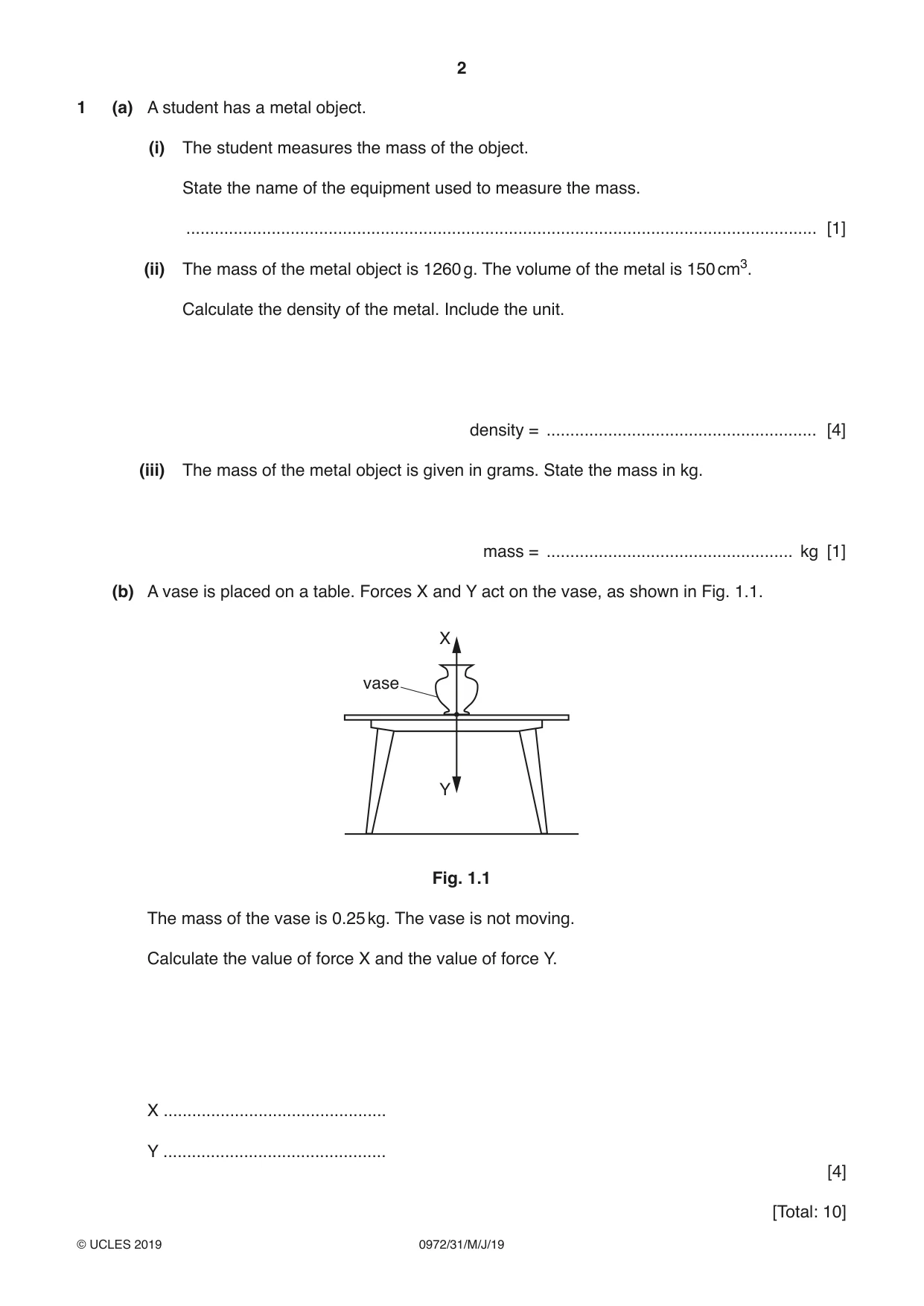
1 (a) A student has a metal object. (i) The student measures the mass of the object. State the name of the equipment used to measure the mass. ..................................................................................................................................... [1] (ii) The mass of the metal object is 1260 g. The volume of the metal is 150 cm3. Calculate the density of the metal. Include the unit. density = ......................................................... [4] (iii) The mass of the metal object is given in grams. State the mass in kg. mass = .................................................... kg [1] (b) A vase is placed on a table. Forces X and Y act on the vase, as shown in Fig. 1.1. X vase Y Fig. 1.1 The mass of the vase is 0.25 kg. The vase is not moving. Calculate the value of force X and the value of force Y. X ............................................... Y ............................................... [4] [Total: 10]
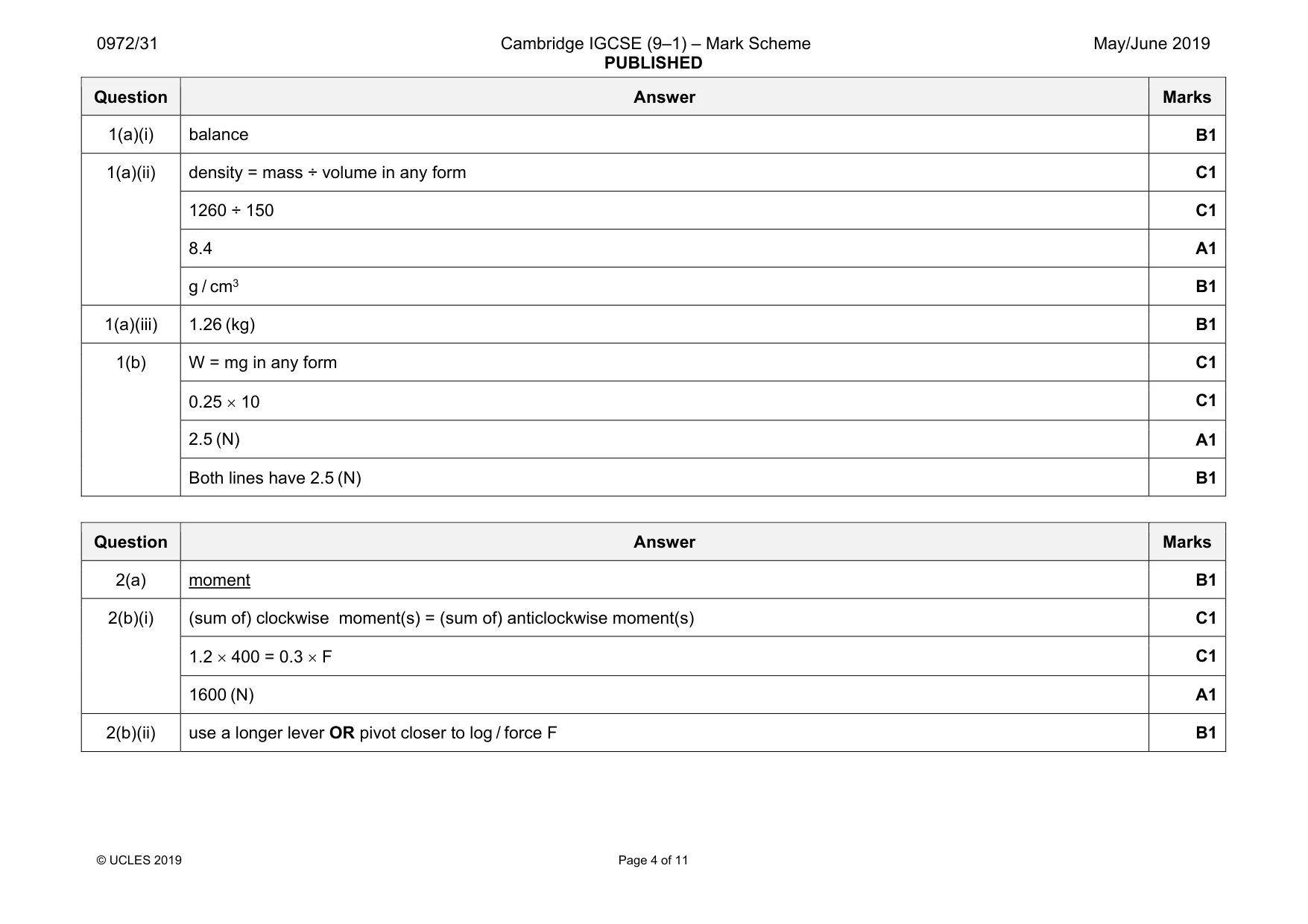
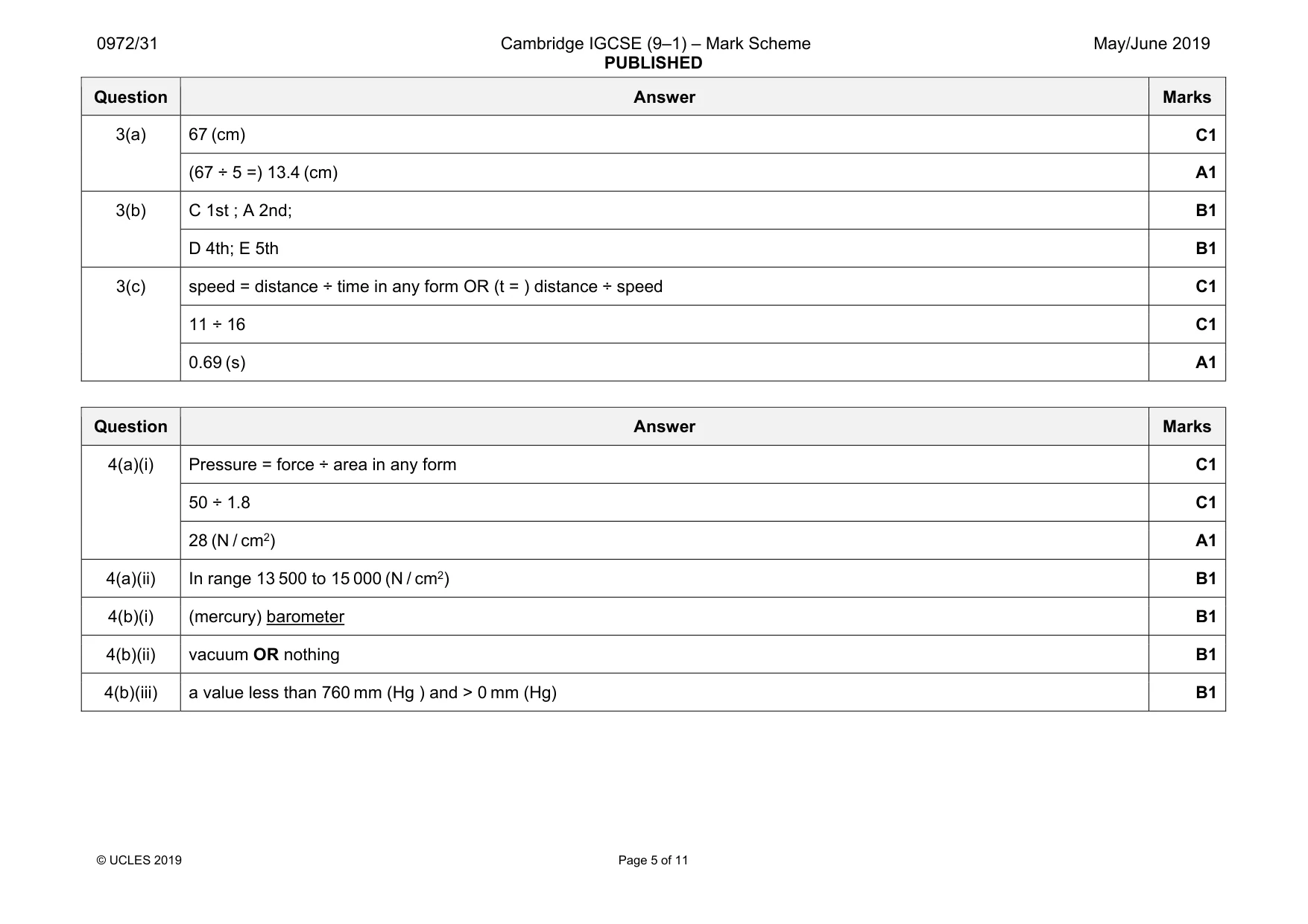
Mark scheme: 1(a)(i) balance B1 1(a)(ii) density = mass ÷ volume in any form C1 1260 ÷ 150 C1 8.4 A1 g / cm3 B1 1(a)(iii) 1.26 (kg) B1 1(b) W = mg in any form C1 0.25 × 10 C1 2.5 (N) A1 Both lines have 2.5 (N) B1
More questions on Physical quantities and measurement techniques
Q2 · A man pushing down on a lever to lift one end of a heavy log
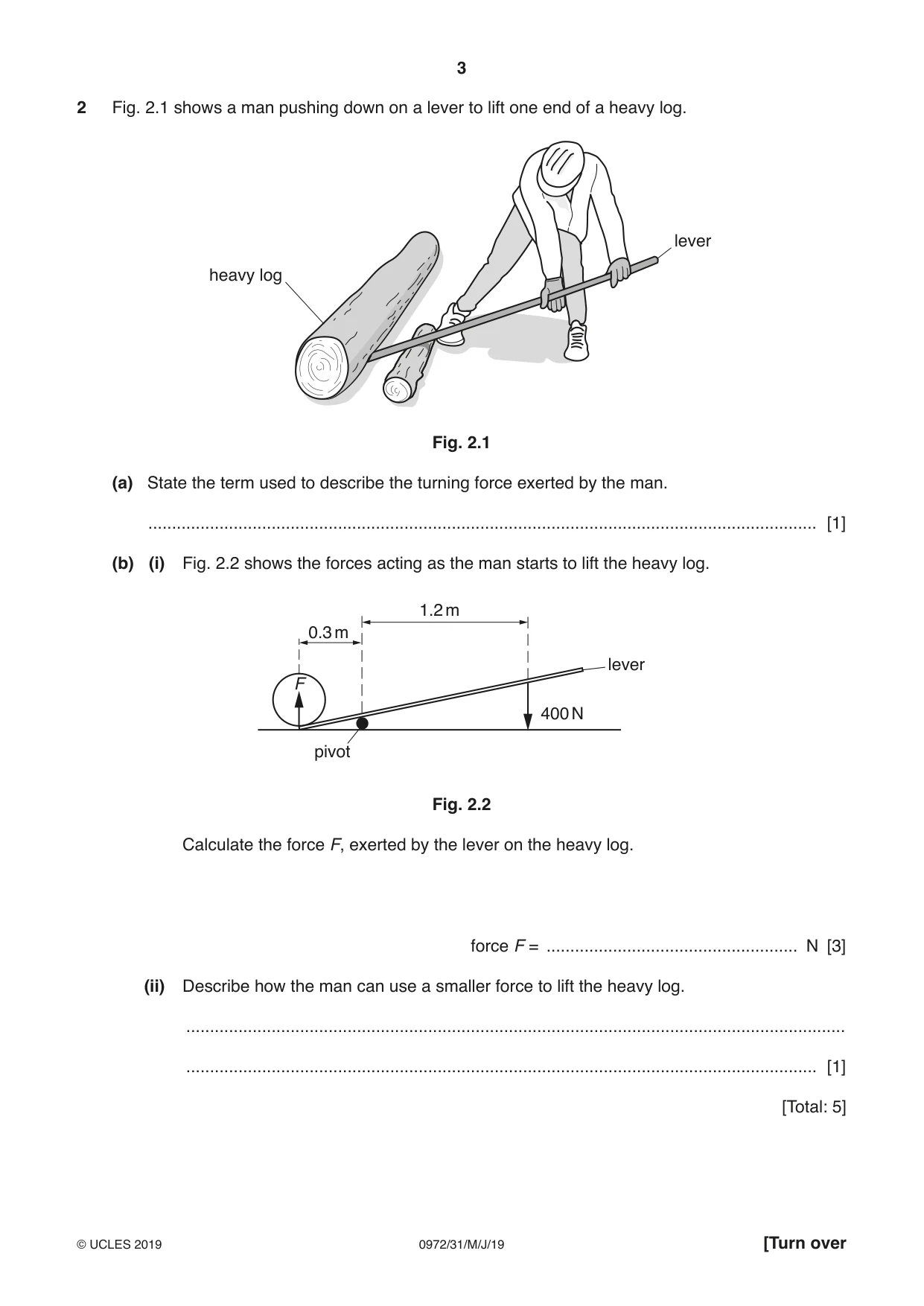
2 Fig. 2.1 shows a man pushing down on a lever to lift one end of a heavy log. lever heavy log Fig. 2.1 (a) State the term used to describe the turning force exerted by the man. ............................................................................................................................................. [1] (b) (i) Fig. 2.2 shows the forces acting as the man starts to lift the heavy log. 1.2 m 0.3 m lever F 400 N pivot Fig. 2.2 Calculate the force F, exerted by the lever on the heavy log. force F = ..................................................... N [3] (ii) Describe how the man can use a smaller force to lift the heavy log. ........................................................................................................................................... ..................................................................................................................................... [1] [Total: 5]
Mark scheme: 2(a) moment B1 2(b)(i) (sum of) clockwise moment(s) = (sum of) anticlockwise moment(s) C1 1.2 × 400 = 0.3 × F C1 1600 (N) A1 2(b)(ii) use a longer lever OR pivot closer to log / force F B1
Q3 · A teacher investigates the reaction time of five students
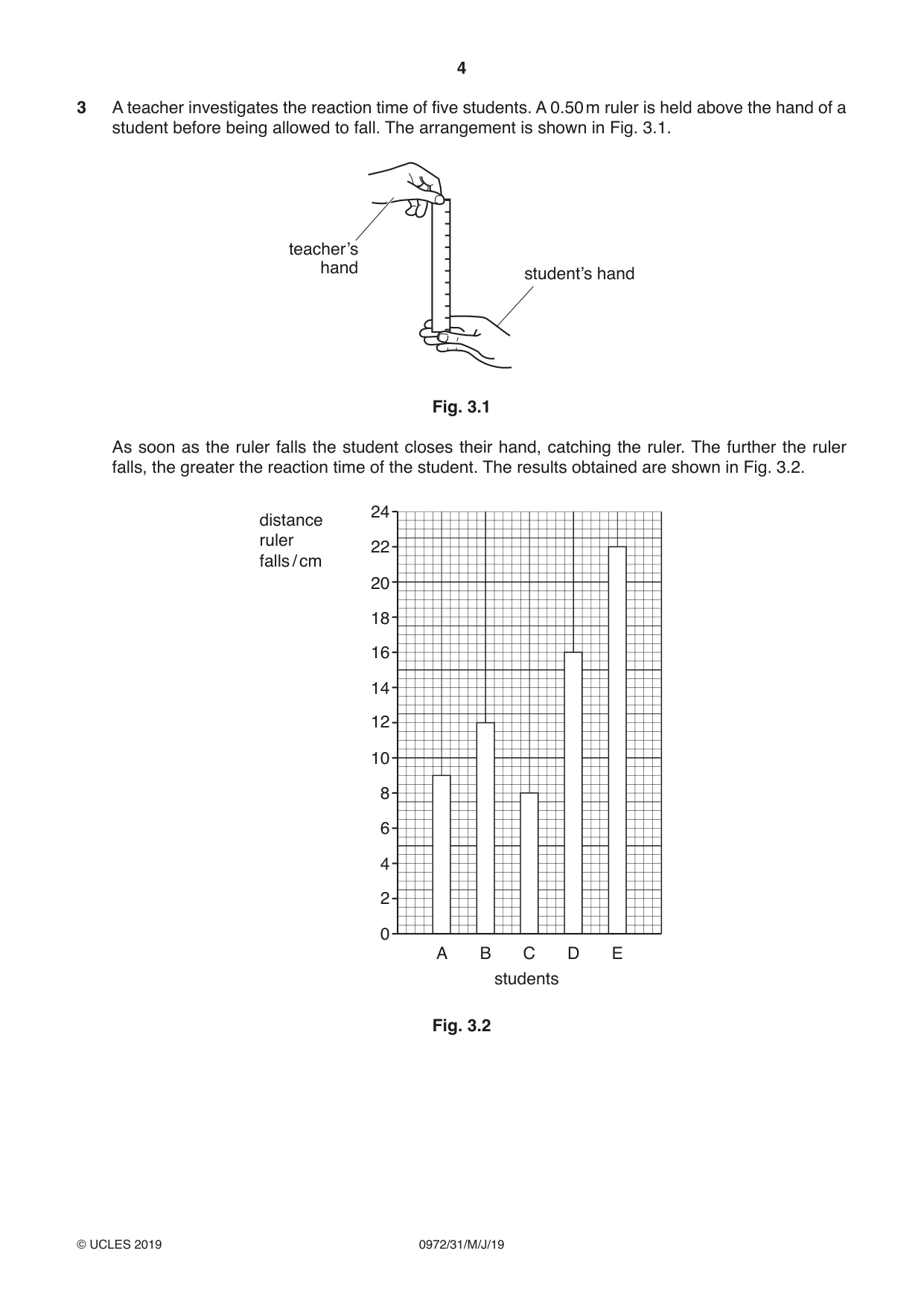
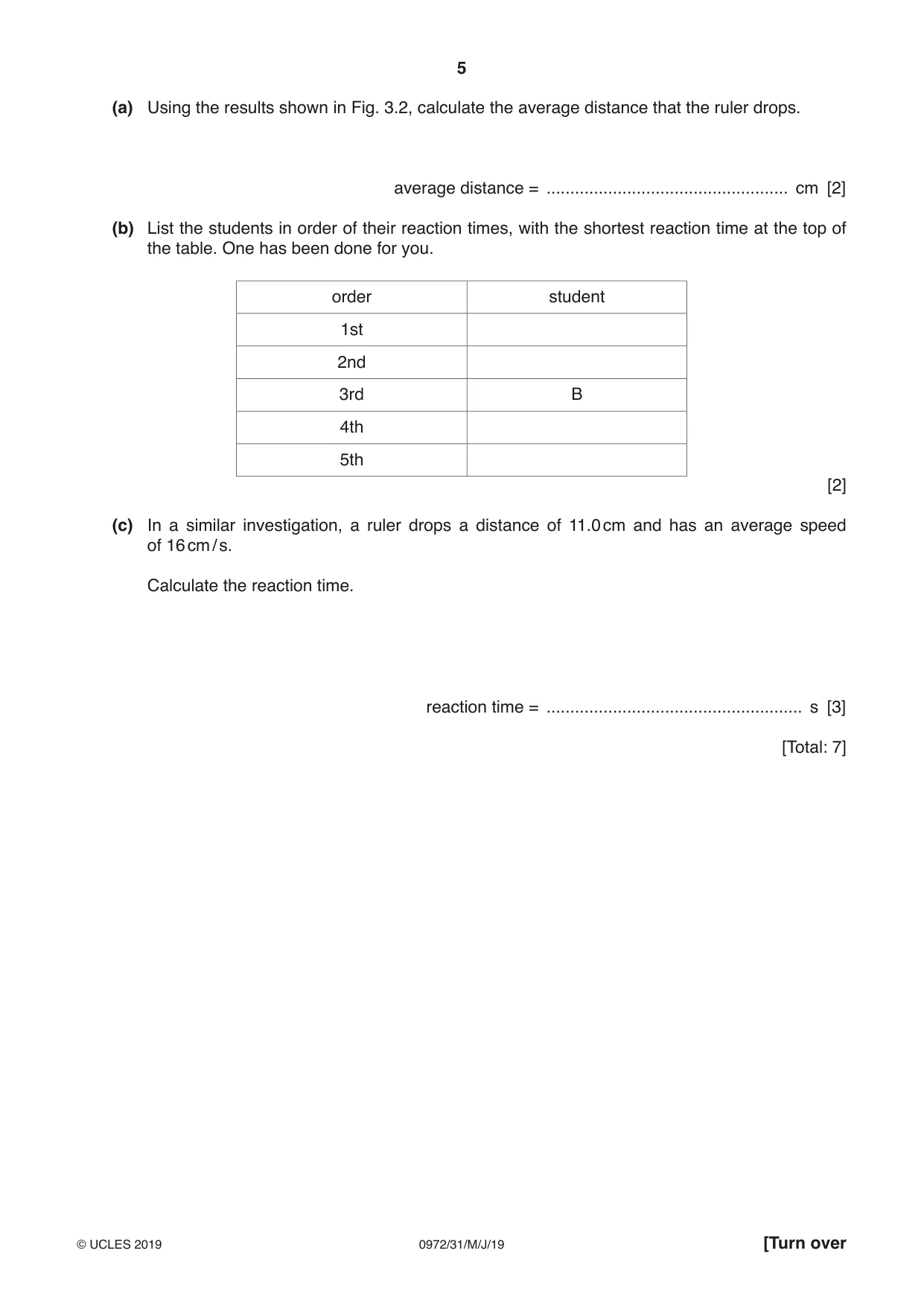
3 A teacher investigates the reaction time of five students. A 0.50 m ruler is held above the hand of a student before being allowed to fall. The arrangement is shown in Fig. 3.1. teacher’s hand student’s hand Fig. 3.1 As soon as the ruler falls the student closes their hand, catching the ruler. The further the ruler falls, the greater the reaction time of the student. The results obtained are shown in Fig. 3.2. 24 distance ruler 22 falls / cm 20 18 16 14 12 10 8 6 4 2 0 A B C D E students Fig. 3.2 (a) Using the results shown in Fig. 3.2, calculate the average distance that the ruler drops. average distance = ................................................... cm [2] (b) List the students in order of their reaction times, with the shortest reaction time at the top of the table. One has been done for you. order student 1st 2nd 3rd B 4th 5th [2] (c) In a similar investigation, a ruler drops a distance of 11.0 cm and has an average speed of 16 cm / s. Calculate the reaction time. reaction time = ...................................................... s [3] [Total: 7]
Mark scheme: 3(a) 67 (cm) C1 (67 ÷ 5 =) 13.4 (cm) A1 3(b) C 1st ; A 2nd; B1 D 4th; E 5th B1 3(c) speed = distance ÷ time in any form OR (t = ) distance ÷ speed C1 11 ÷ 16 C1 0.69 (s) A1
Question 4
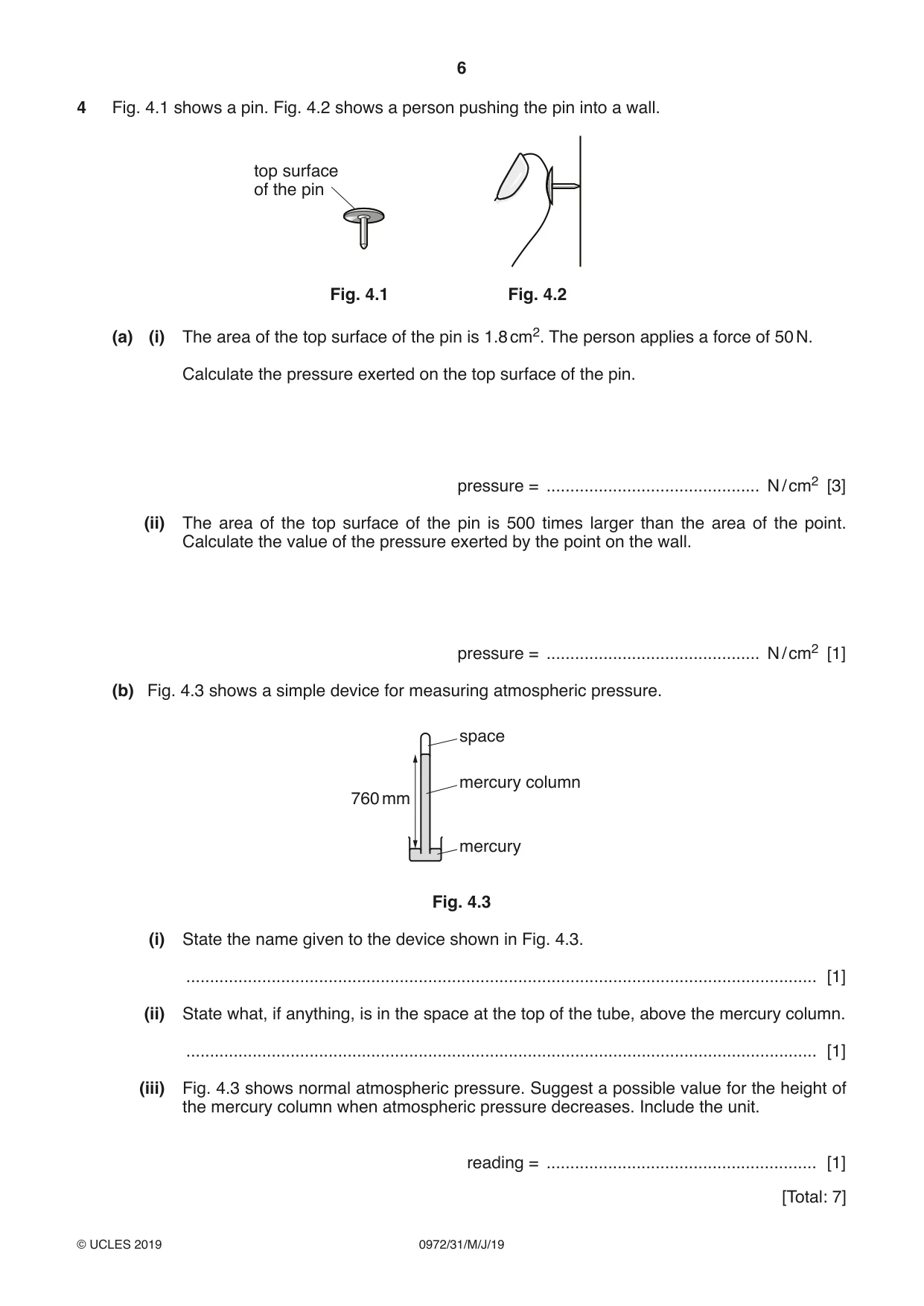
4 Fig. 4.1 shows a pin. Fig. 4.2 shows a person pushing the pin into a wall. top surface of the pin Fig. 4.1 Fig. 4.2 (a) (i) The area of the top surface of the pin is 1.8 cm2. The person applies a force of 50 N. Calculate the pressure exerted on the top surface of the pin. pressure = ............................................. N / cm2 [3] (ii) The area of the top surface of the pin is 500 times larger than the area of the point. Calculate the value of the pressure exerted by the point on the wall. pressure = ............................................. N / cm2 [1] (b) Fig. 4.3 shows a simple device for measuring atmospheric pressure. space mercury column 760 mm mercury Fig. 4.3 (i) State the name given to the device shown in Fig. 4.3. ..................................................................................................................................... [1] (ii) State what, if anything, is in the space at the top of the tube, above the mercury column. ..................................................................................................................................... [1] (iii) Fig. 4.3 shows normal atmospheric pressure. Suggest a possible value for the height of the mercury column when atmospheric pressure decreases. Include the unit. reading = ......................................................... [1] [Total: 7]
Mark scheme: 4(a)(i) Pressure = force ÷ area in any form C1 50 ÷ 1.8 C1 28 (N / cm2) A1 4(a)(ii) In range 13 500 to 15 000 (N / cm2) B1 4(b)(i) (mercury) barometer B1 4(b)(ii) vacuum OR nothing B1 4(b)(iii) a value less than 760 mm (Hg ) and > 0 mm (Hg) B1
Q5 · Coal is a non-renewable source of energy
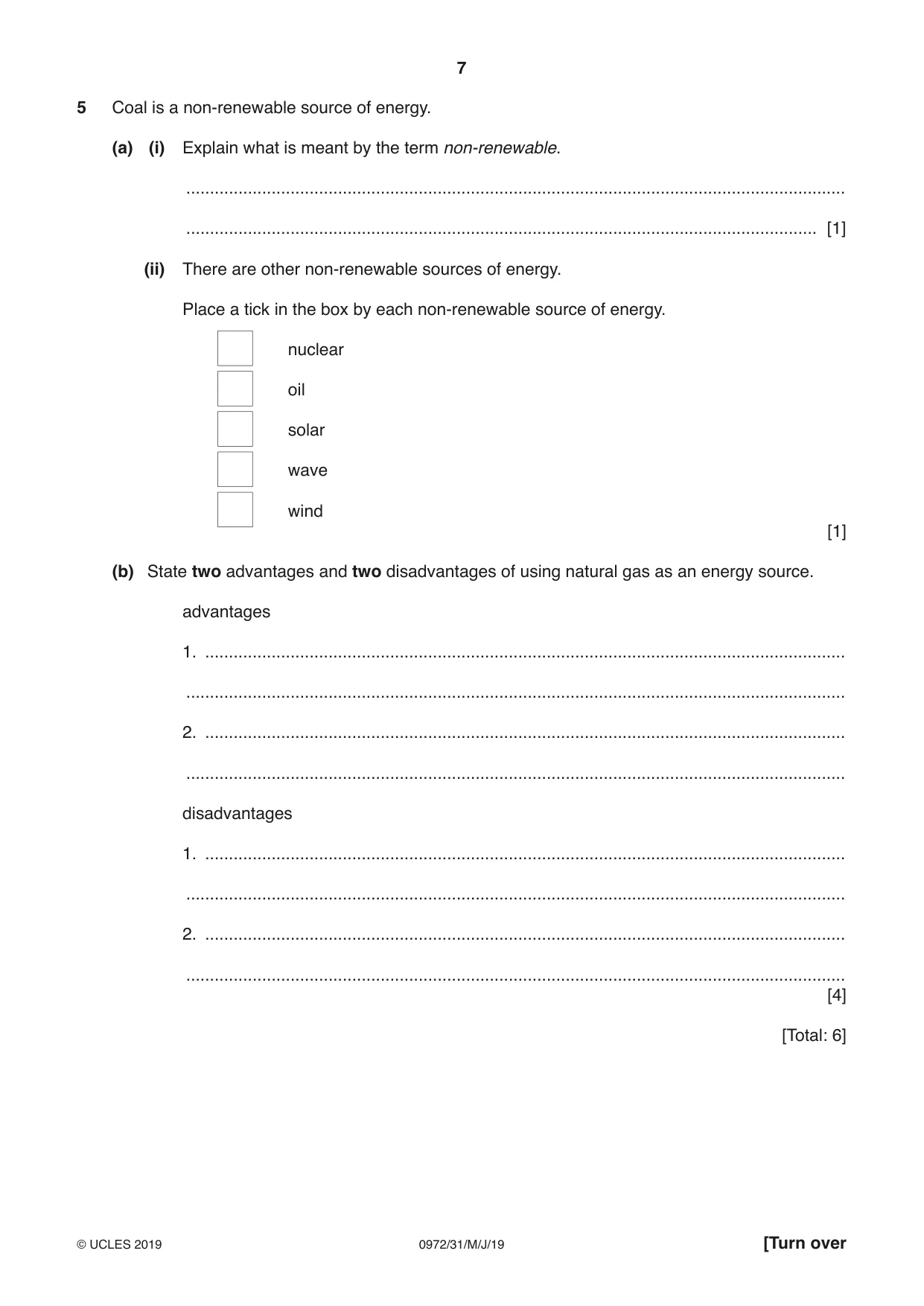
5 Coal is a non-renewable source of energy. (a) (i) Explain what is meant by the term non-renewable. ........................................................................................................................................... ..................................................................................................................................... [1] (ii) There are other non-renewable sources of energy. Place a tick in the box by each non-renewable source of energy. nuclear oil solar wave wind [1] (b) State two advantages and two disadvantages of using natural gas as an energy source. advantages 1. ....................................................................................................................................... ........................................................................................................................................... 2. ....................................................................................................................................... ........................................................................................................................................... disadvantages 1. ....................................................................................................................................... ........................................................................................................................................... 2. ....................................................................................................................................... ........................................................................................................................................... [4] [Total: 6]
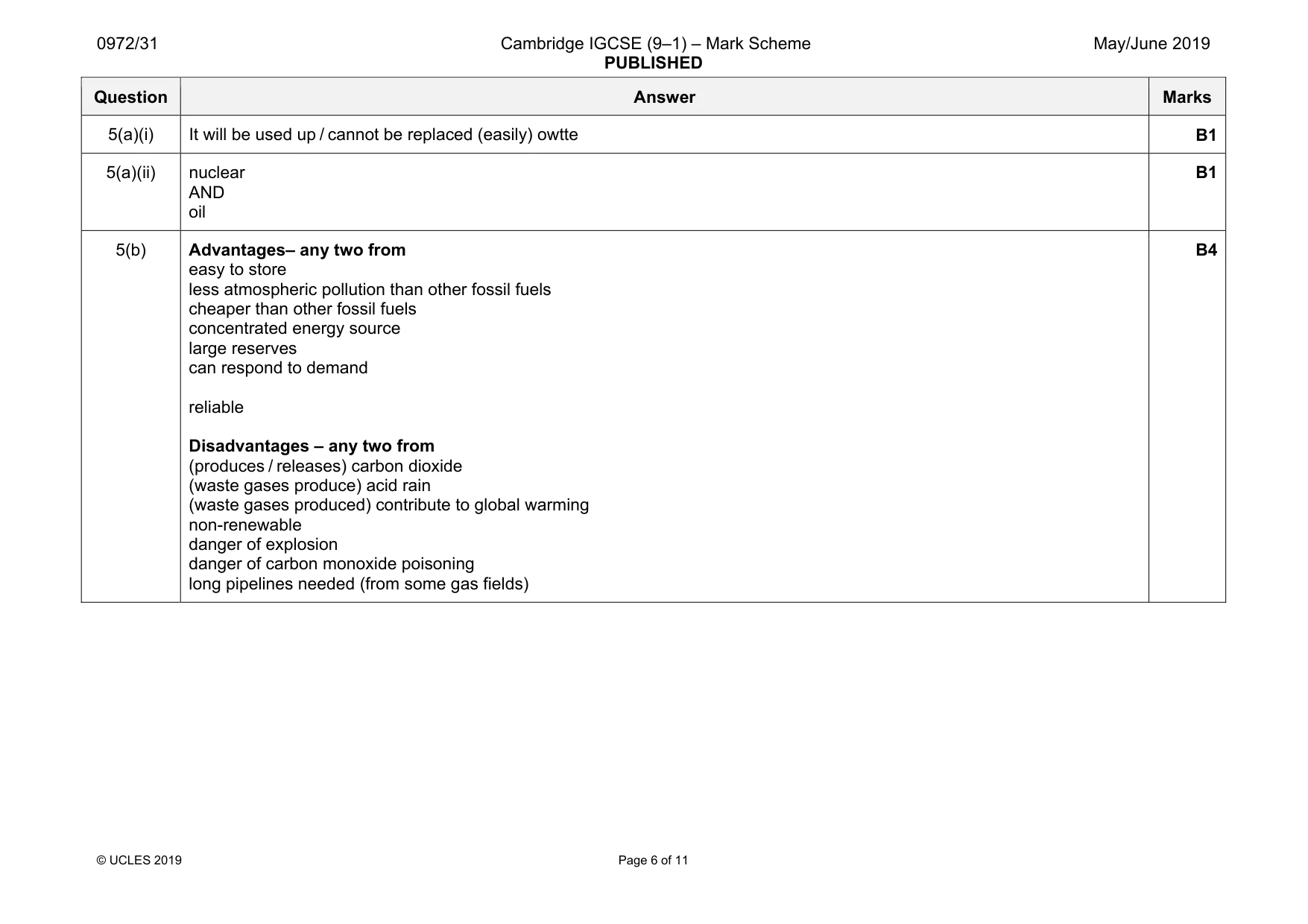
Mark scheme: 5(a)(i) It will be used up / cannot be replaced (easily) owtte B1 5(a)(ii) nuclear AND oil B1 5(b) Advantages– any two from easy to store less atmospheric pollution than other fossil fuels cheaper than other fossil fuels concentrated energy source large reserves can respond to demand reliable Disadvantages – any two from (produces / releases) carbon dioxide (waste gases produce) acid rain (waste gases produced) contribute to global warming non-renewable danger of explosion danger of carbon monoxide poisoning long pipelines needed (from some gas fields) B4
Q6 · A liquid-in-glass thermometer is placed in some ice made from pure water
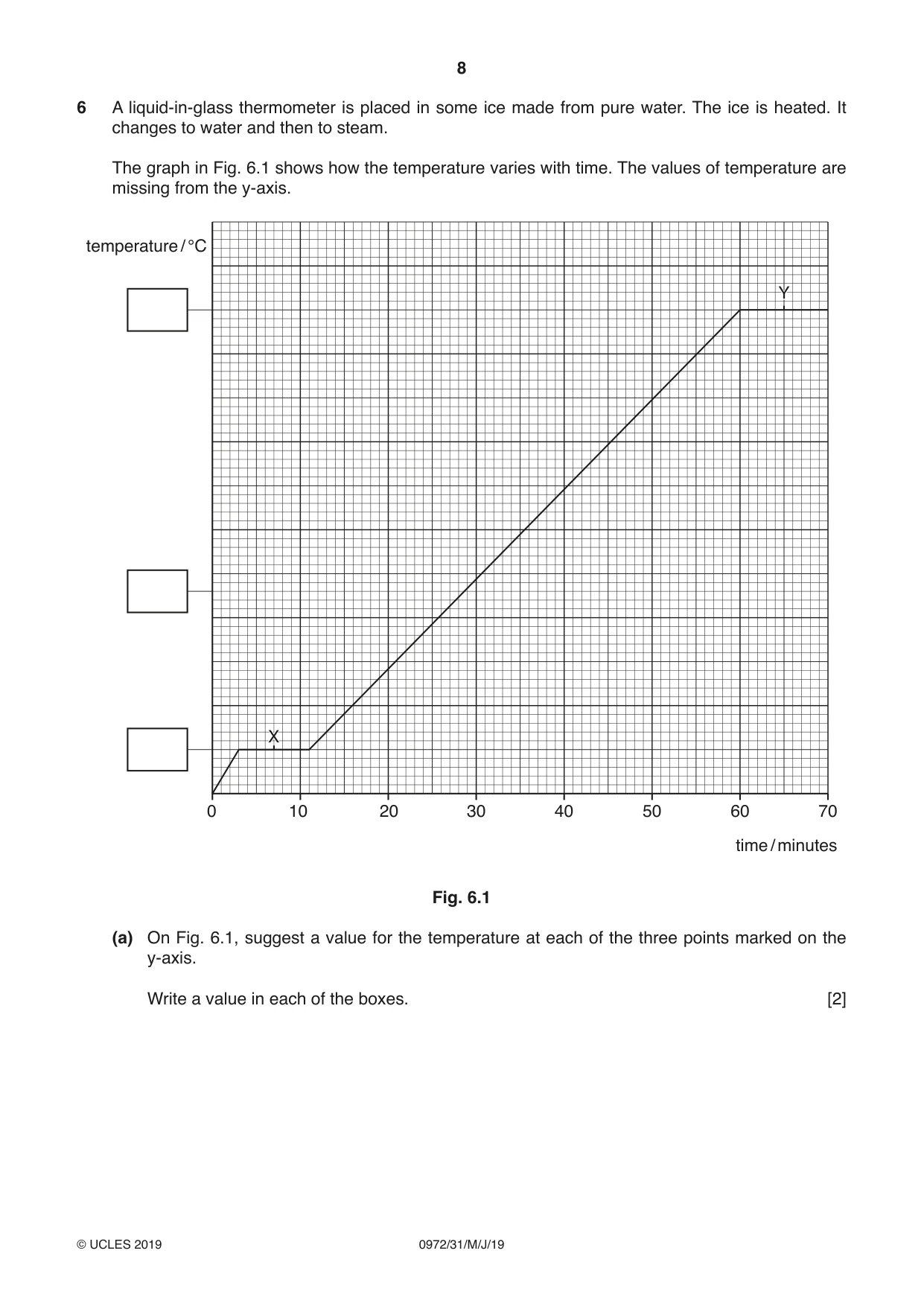
6 A liquid-in-glass thermometer is placed in some ice made from pure water. The ice is heated. It changes to water and then to steam. The graph in Fig. 6.1 shows how the temperature varies with time. The values of temperature are missing from the y-axis. temperature / °C Y X 0 10 20 30 40 50 60 70 time / minutes Fig. 6.1 (a) On Fig. 6.1, suggest a value for the temperature at each of the three points marked on the y-axis. Write a value in each of the boxes. [2] (b) In both section X and section Y the line on the graph is horizontal. For each section, state the name for the process taking place and explain what is happening to the molecules. (i) section X name ................................................................................................................................. explanation ........................................................................................................................ ........................................................................................................................................... ........................................................................................................................................... ........................................................................................................................................... [2] (ii) section Y name ................................................................................................................................. explanation ........................................................................................................................ ........................................................................................................................................... ........................................................................................................................................... ........................................................................................................................................... [2] [Total: 6]
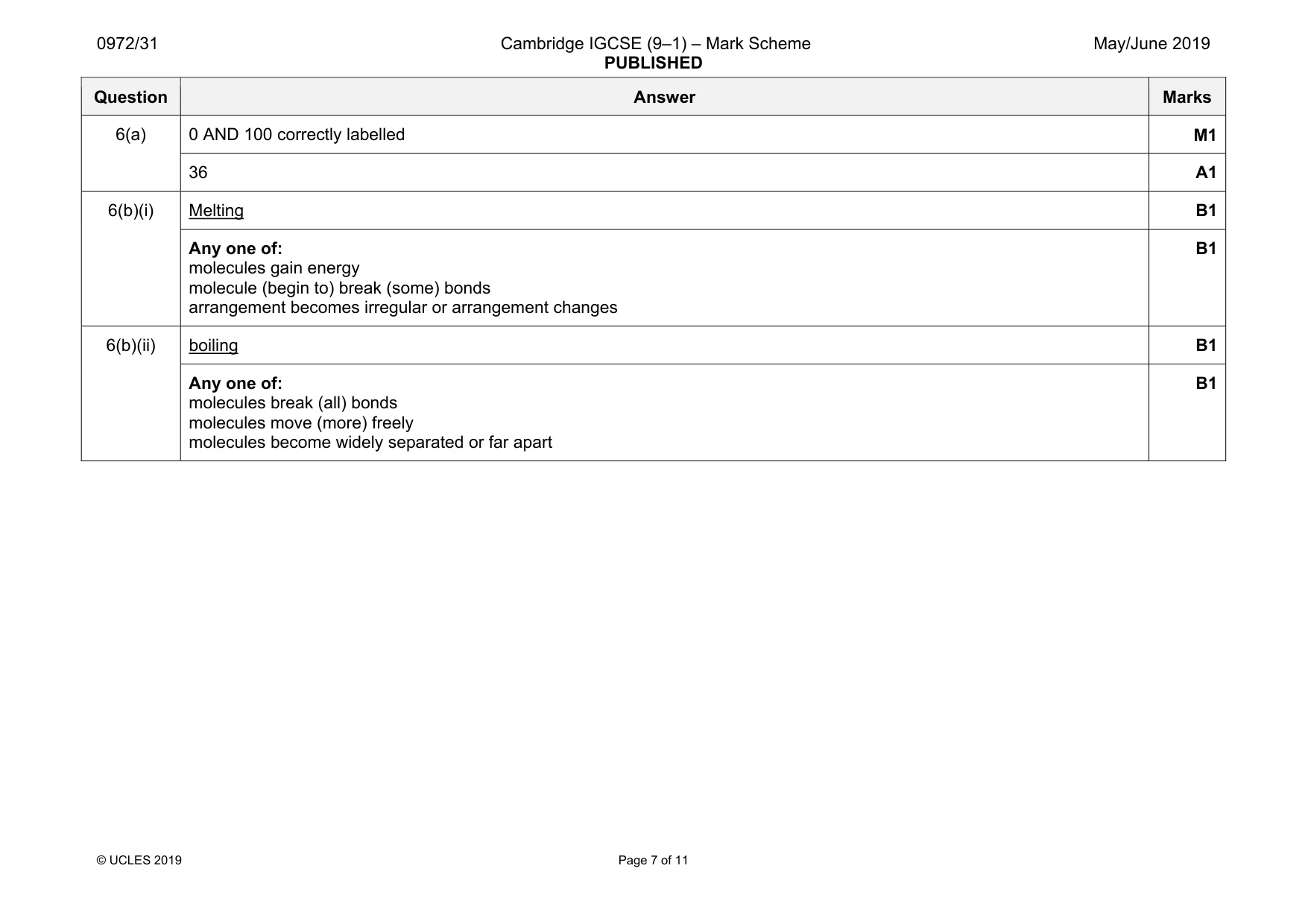
Mark scheme: 6(a) 0 AND 100 correctly labelled M1 36 A1 6(b)(i) Melting B1 Any one of: molecules gain energy molecule (begin to) break (some) bonds arrangement becomes irregular or arrangement changes B1 6(b)(ii) boiling B1 Any one of: molecules break (all) bonds molecules move (more) freely molecules become widely separated or far apart B1
Q7 · Some devices that each use one type of electromagnetic radiation
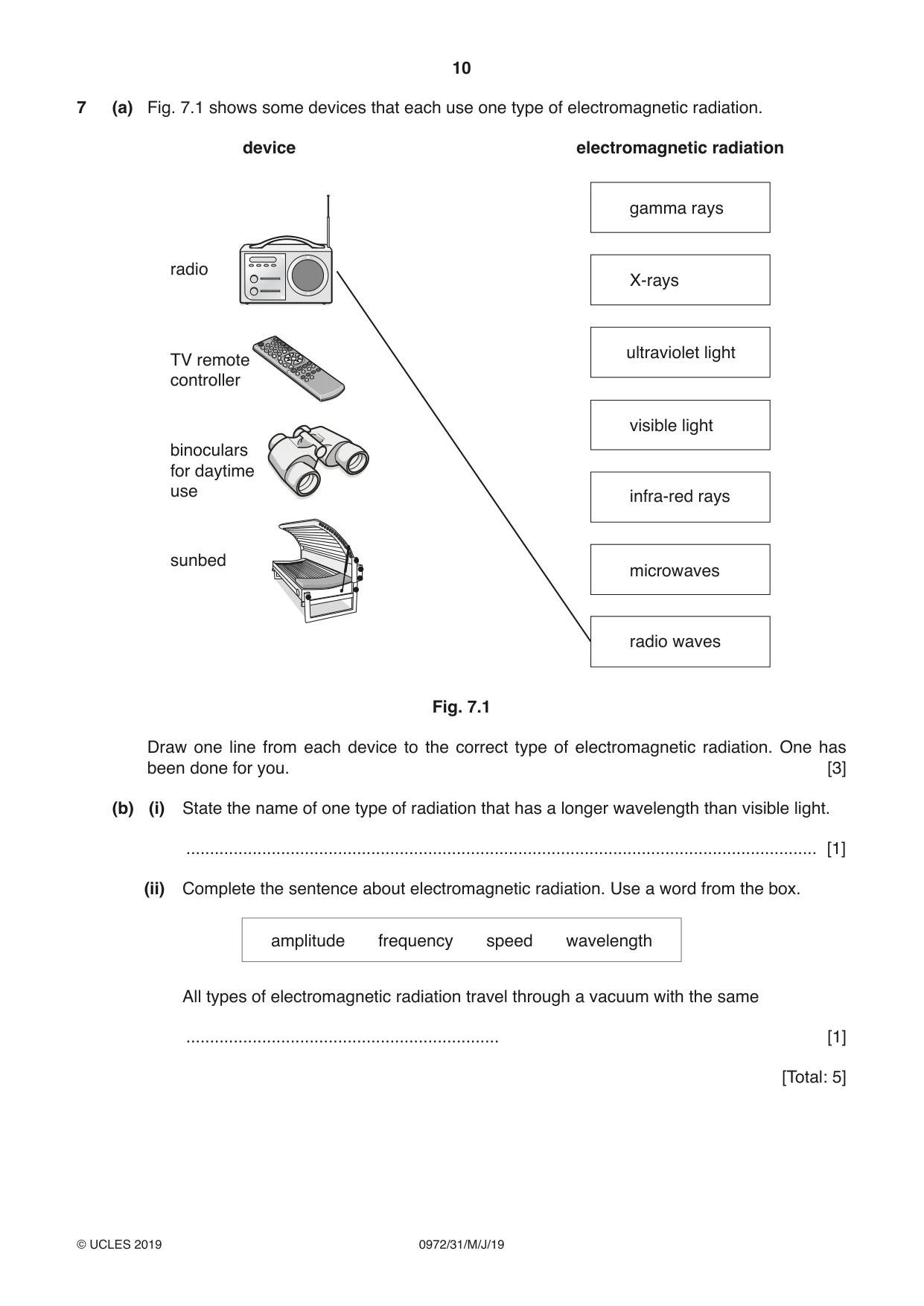
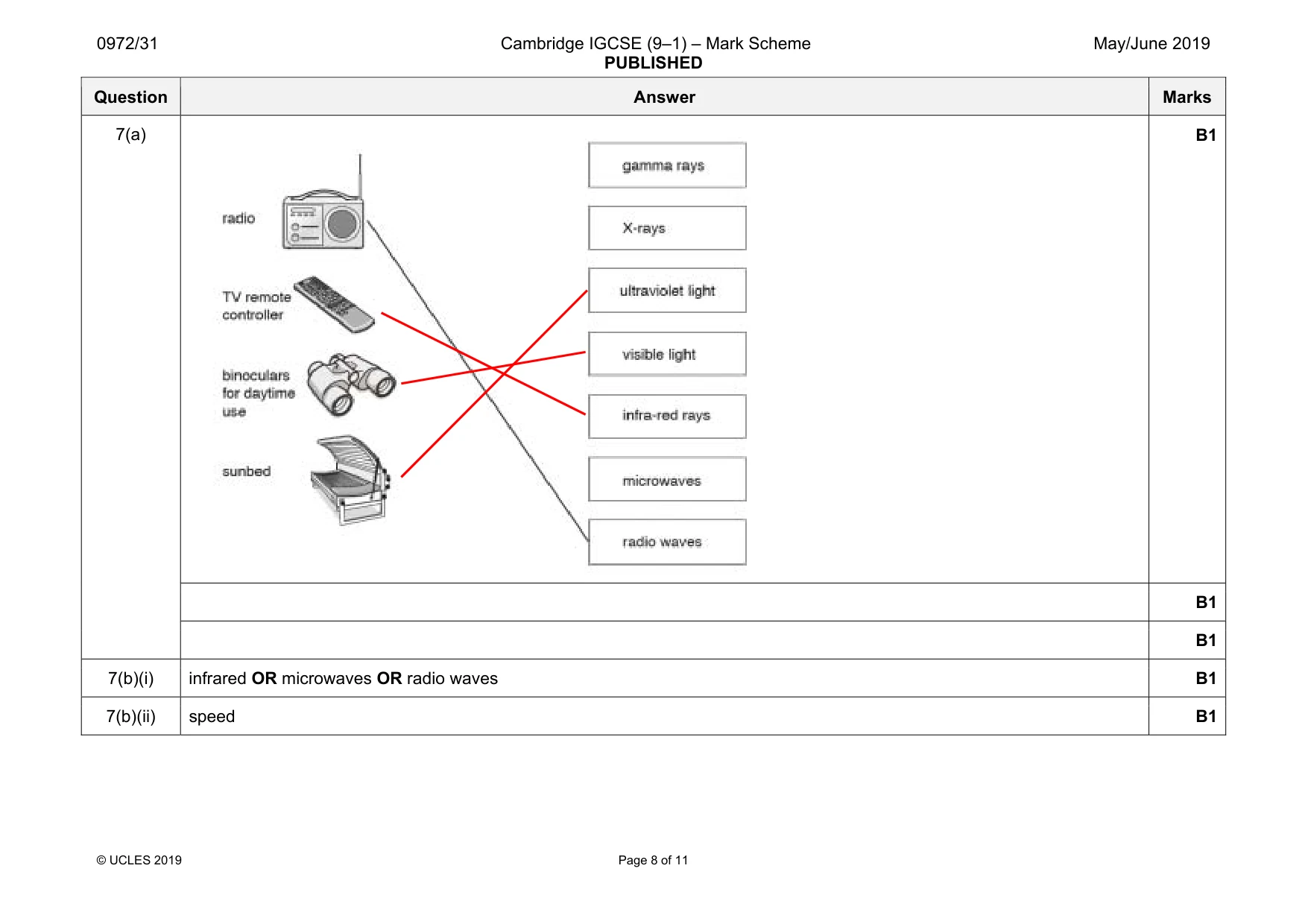
7 (a) Fig. 7.1 shows some devices that each use one type of electromagnetic radiation. device electromagnetic radiation gamma rays radio X-rays ultraviolet light TV remote controller visible light binoculars for daytime use infra-red rays sunbed microwaves radio waves Fig. 7.1 Draw one line from each device to the correct type of electromagnetic radiation. One has been done for you. [3] (b) (i) State the name of one type of radiation that has a longer wavelength than visible light. ..................................................................................................................................... [1] (ii) Complete the sentence about electromagnetic radiation. Use a word from the box. amplitude frequency speed wavelength All types of electromagnetic radiation travel through a vacuum with the same .................................................................. [1] [Total: 5]
Mark scheme: 7(a) B1 B1 B1 7(b)(i) infrared OR microwaves OR radio waves B1 7(b)(ii) speed B1
Q8 · A student rubs a plastic rod with a dry cloth, as shown in Fig
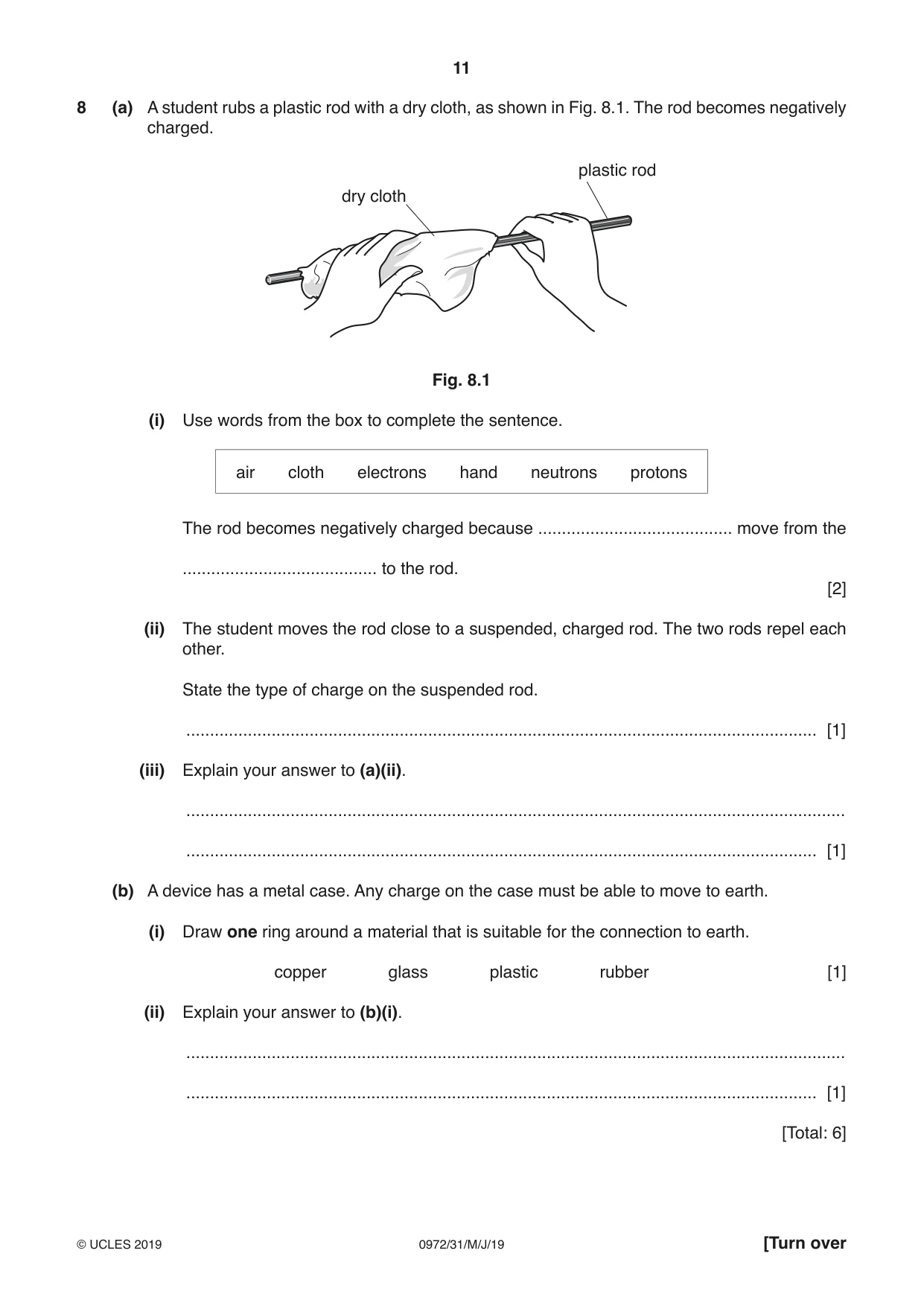
8 (a) A student rubs a plastic rod with a dry cloth, as shown in Fig. 8.1. The rod becomes negatively charged. plastic rod dry cloth Fig. 8.1 (i) Use words from the box to complete the sentence. air cloth electrons hand neutrons protons The rod becomes negatively charged because ......................................... move from the ......................................... to the rod. [2] (ii) The student moves the rod close to a suspended, charged rod. The two rods repel each other. State the type of charge on the suspended rod. ..................................................................................................................................... [1] (iii) Explain your answer to (a)(ii). ........................................................................................................................................... ..................................................................................................................................... [1] (b) A device has a metal case. Any charge on the case must be able to move to earth. (i) Draw one ring around a material that is suitable for the connection to earth. copper glass plastic rubber [1] (ii) Explain your answer to (b)(i). ........................................................................................................................................... ..................................................................................................................................... [1] [Total: 6]
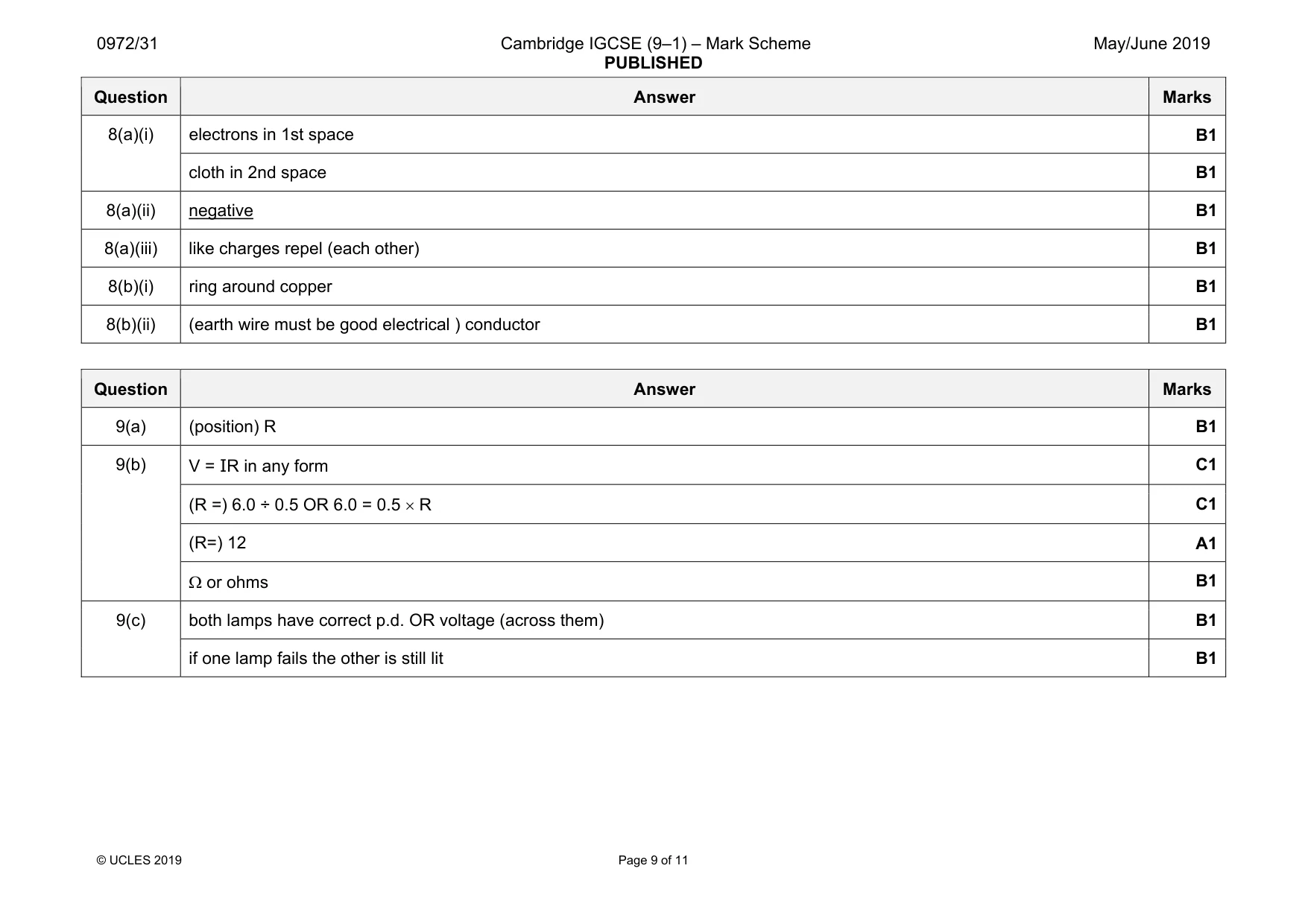
Mark scheme: 8(a)(i) electrons in 1st space B1 cloth in 2nd space B1 8(a)(ii) negative B1 8(a)(iii) like charges repel (each other) B1 8(b)(i) ring around copper B1 8(b)(ii) (earth wire must be good electrical ) conductor B1
Q9 · A student makes a circuit to switch on a 6.0 V lamp from two different switches X and Y
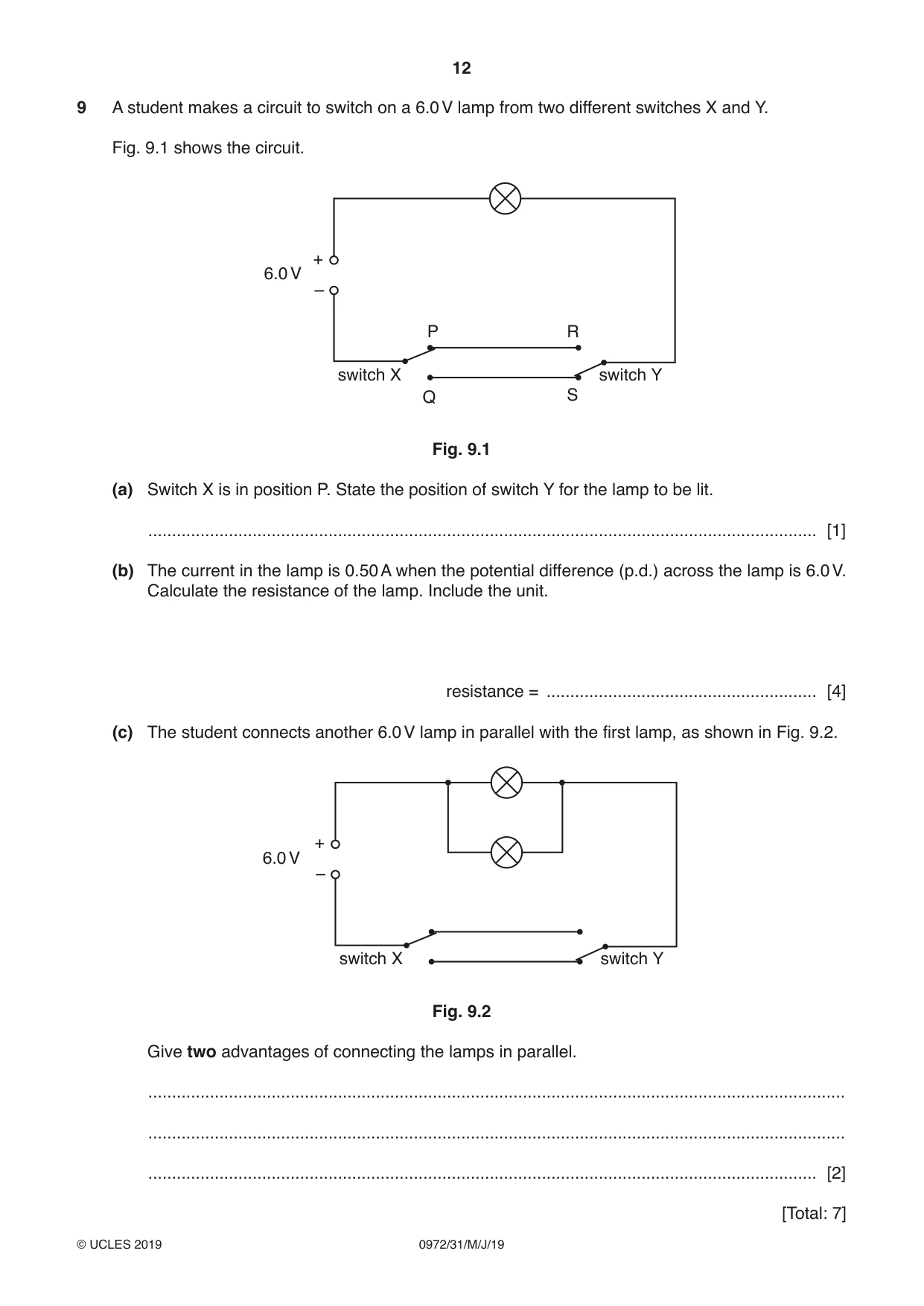
9 A student makes a circuit to switch on a 6.0 V lamp from two different switches X and Y. Fig. 9.1 shows the circuit. + 6.0 V – P R switch X switch Y Q S Fig. 9.1 (a) Switch X is in position P. State the position of switch Y for the lamp to be lit. ............................................................................................................................................. [1] (b) The current in the lamp is 0.50 A when the potential difference (p.d.) across the lamp is 6.0 V. Calculate the resistance of the lamp. Include the unit. resistance = ......................................................... [4] (c) The student connects another 6.0 V lamp in parallel with the first lamp, as shown in Fig. 9.2. + 6.0 V – switch X switch Y Fig. 9.2 Give two advantages of connecting the lamps in parallel. ................................................................................................................................................... ................................................................................................................................................... ............................................................................................................................................. [2] [Total: 7]
Mark scheme: 9(a) (position) R B1 9(b) V = IR in any form C1 (R =) 6.0 ÷ 0.5 OR 6.0 = 0.5 × R C1 (R=) 12 A1 Ω or ohms B1 9(c) both lamps have correct p.d. OR voltage (across them) B1 if one lamp fails the other is still lit B1
Q10 · A teacher demonstrates the action of a device
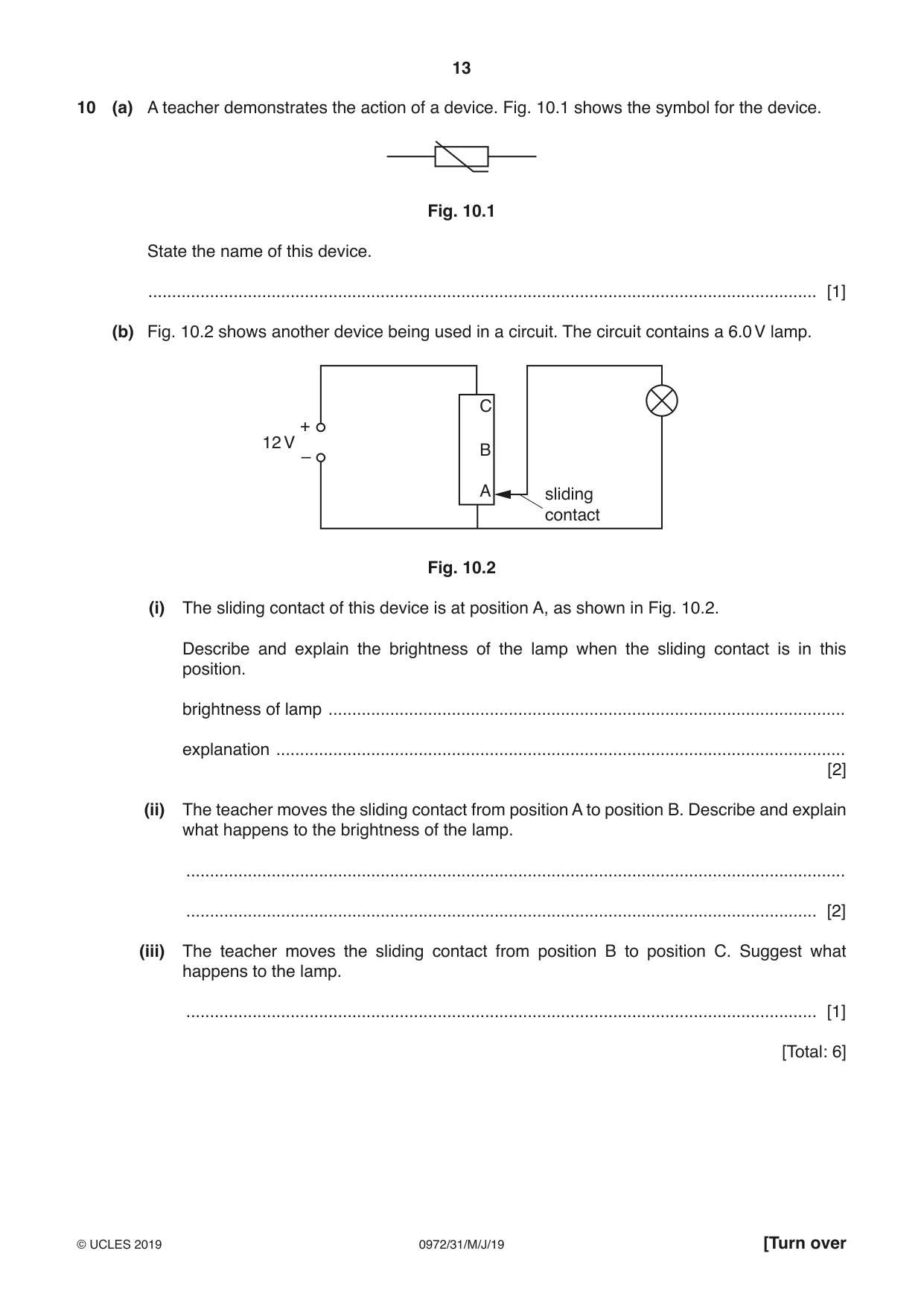
10 (a) A teacher demonstrates the action of a device. Fig. 10.1 shows the symbol for the device. Fig. 10.1 State the name of this device. ............................................................................................................................................. [1] (b) Fig. 10.2 shows another device being used in a circuit. The circuit contains a 6.0 V lamp. C + 12 V B – A sliding contact Fig. 10.2 (i) The sliding contact of this device is at position A, as shown in Fig. 10.2. Describe and explain the brightness of the lamp when the sliding contact is in this position. brightness of lamp ............................................................................................................. explanation ........................................................................................................................ [2] (ii) The teacher moves the sliding contact from position A to position B. Describe and explain what happens to the brightness of the lamp. ........................................................................................................................................... ..................................................................................................................................... [2] (iii) The teacher moves the sliding contact from position B to position C. Suggest what happens to the lamp. ..................................................................................................................................... [1] [Total: 6]
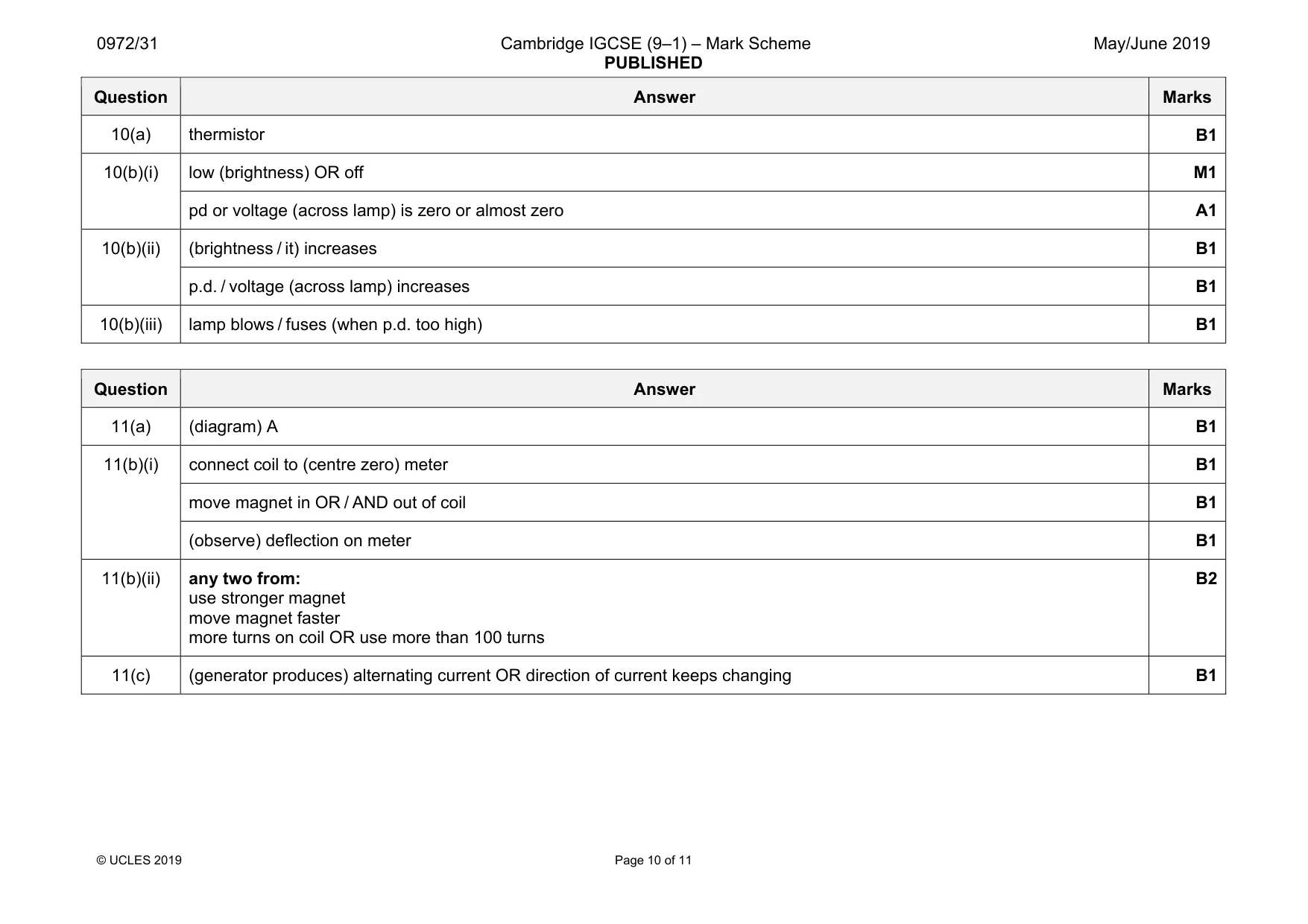
Mark scheme: 10(a) thermistor B1 10(b)(i) low (brightness) OR off M1 pd or voltage (across lamp) is zero or almost zero A1 10(b)(ii) (brightness / it) increases B1 p.d. / voltage (across lamp) increases B1 10(b)(iii) lamp blows / fuses (when p.d. too high) B1
Q11 · In each of the diagrams a current-carrying conductor and a magnetic field pattern
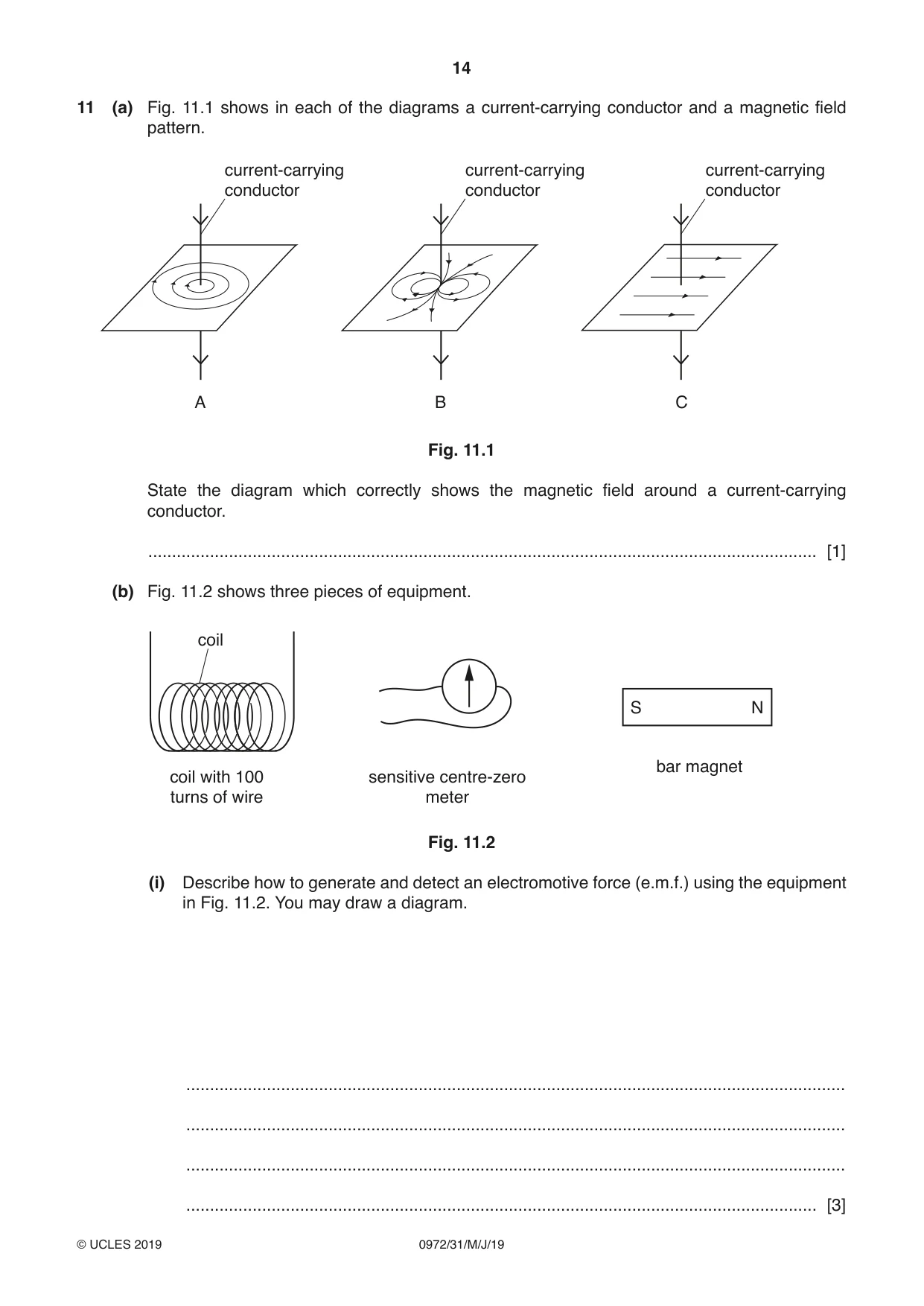
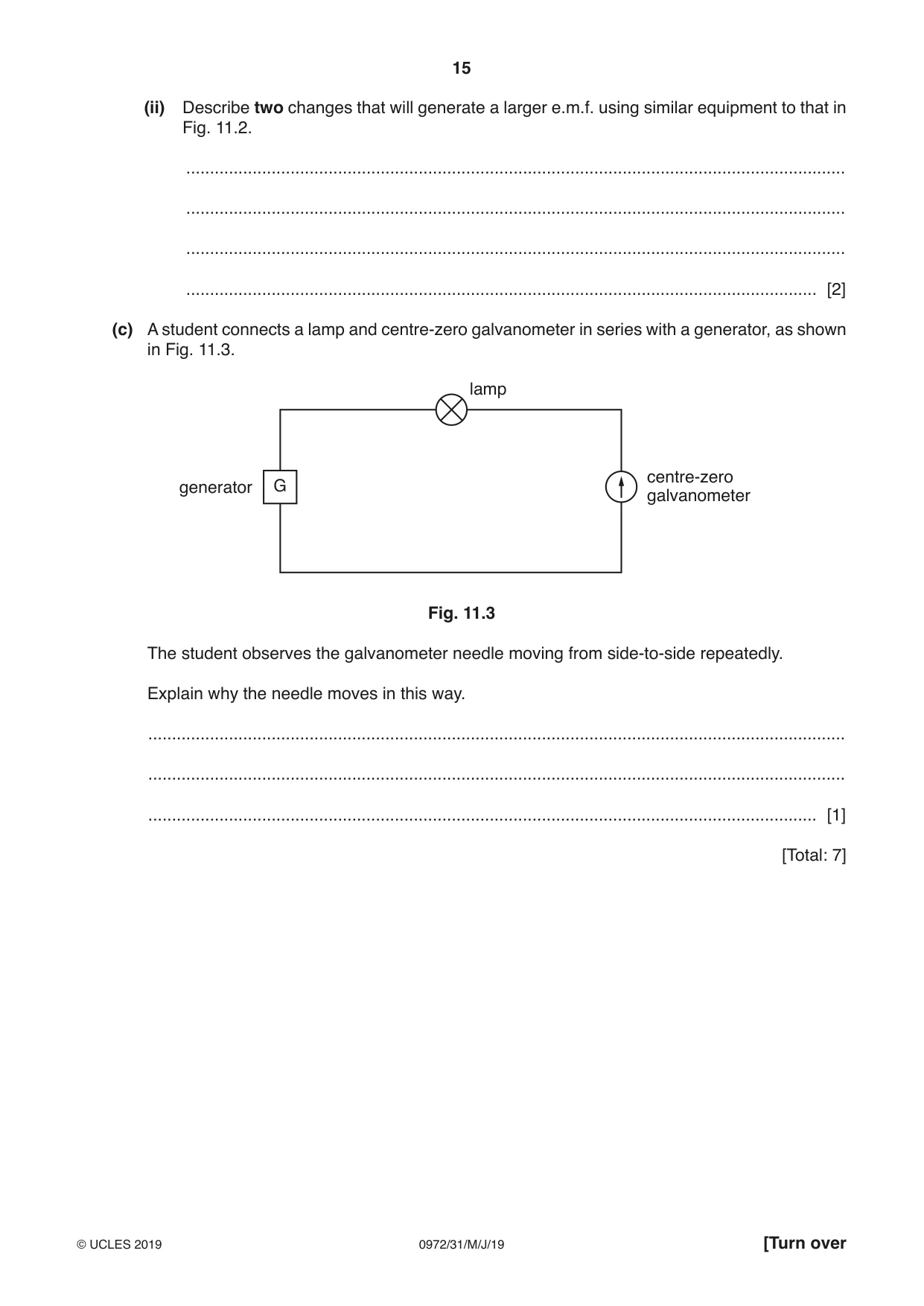
11 (a) Fig. 11.1 shows in each of the diagrams a current-carrying conductor and a magnetic field pattern. current-carrying current-carrying current-carrying conductor conductor conductor A B C Fig. 11.1 State the diagram which correctly shows the magnetic field around a current-carrying conductor. ............................................................................................................................................. [1] (b) Fig. 11.2 shows three pieces of equipment. coil S N bar magnet coil with 100 sensitive centre-zero turns of wire meter Fig. 11.2 (i) Describe how to generate and detect an electromotive force (e.m.f.) using the equipment in Fig. 11.2. You may draw a diagram. ........................................................................................................................................... ........................................................................................................................................... ........................................................................................................................................... ..................................................................................................................................... [3] (ii) Describe two changes that will generate a larger e.m.f. using similar equipment to that in Fig. 11.2. ........................................................................................................................................... ........................................................................................................................................... ........................................................................................................................................... ..................................................................................................................................... [2] (c) A student connects a lamp and centre-zero galvanometer in series with a generator, as shown in Fig. 11.3. lamp centre-zero generator G galvanometer Fig. 11.3 The student observes the galvanometer needle moving from side-to-side repeatedly. Explain why the needle moves in this way. ................................................................................................................................................... ................................................................................................................................................... ............................................................................................................................................. [1] [Total: 7]
Mark scheme: 11(a) (diagram) A B1 11(b)(i) connect coil to (centre zero) meter B1 move magnet in OR / AND out of coil B1 (observe) deflection on meter B1 11(b)(ii) any two from: use stronger magnet move magnet faster more turns on coil OR use more than 100 turns B2 11(c) (generator produces) alternating current OR direction of current keeps changing B1
Q12 · Use words from the box to complete the sentences about the charges in an atom
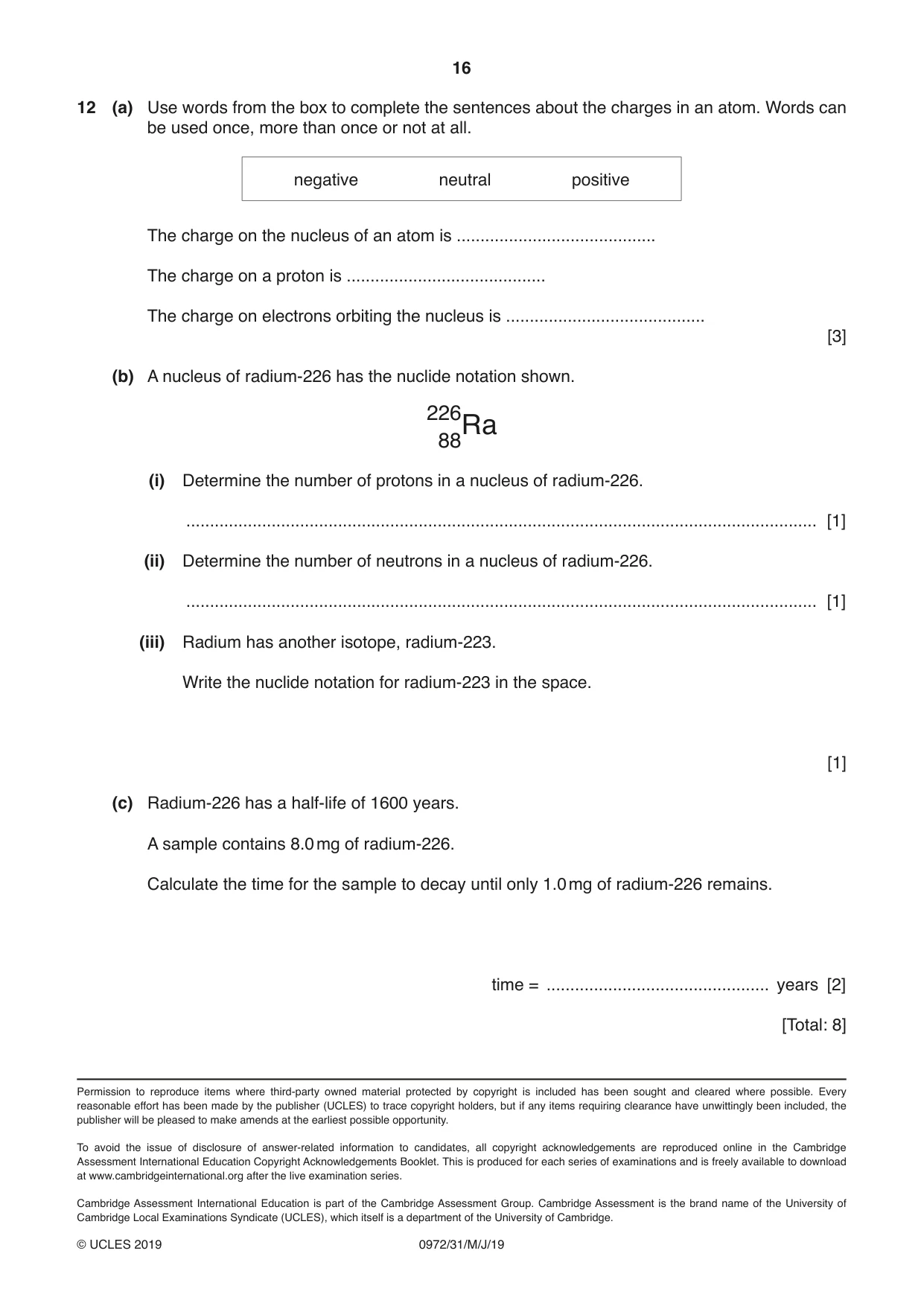
12 (a) Use words from the box to complete the sentences about the charges in an atom. Words can be used once, more than once or not at all. negative neutral positive The charge on the nucleus of an atom is .......................................... The charge on a proton is .......................................... The charge on electrons orbiting the nucleus is .......................................... [3] (b) A nucleus of radium-226 has the nuclide notation shown. 226 88Ra (i) Determine the number of protons in a nucleus of radium-226. ..................................................................................................................................... [1] (ii) Determine the number of neutrons in a nucleus of radium-226. ..................................................................................................................................... [1] (iii) Radium has another isotope, radium-223. Write the nuclide notation for radium-223 in the space. [1] (c) Radium-226 has a half-life of 1600 years. A sample contains 8.0 mg of radium-226. Calculate the time for the sample to decay until only 1.0 mg of radium-226 remains. time = ............................................... years [2] [Total: 8]
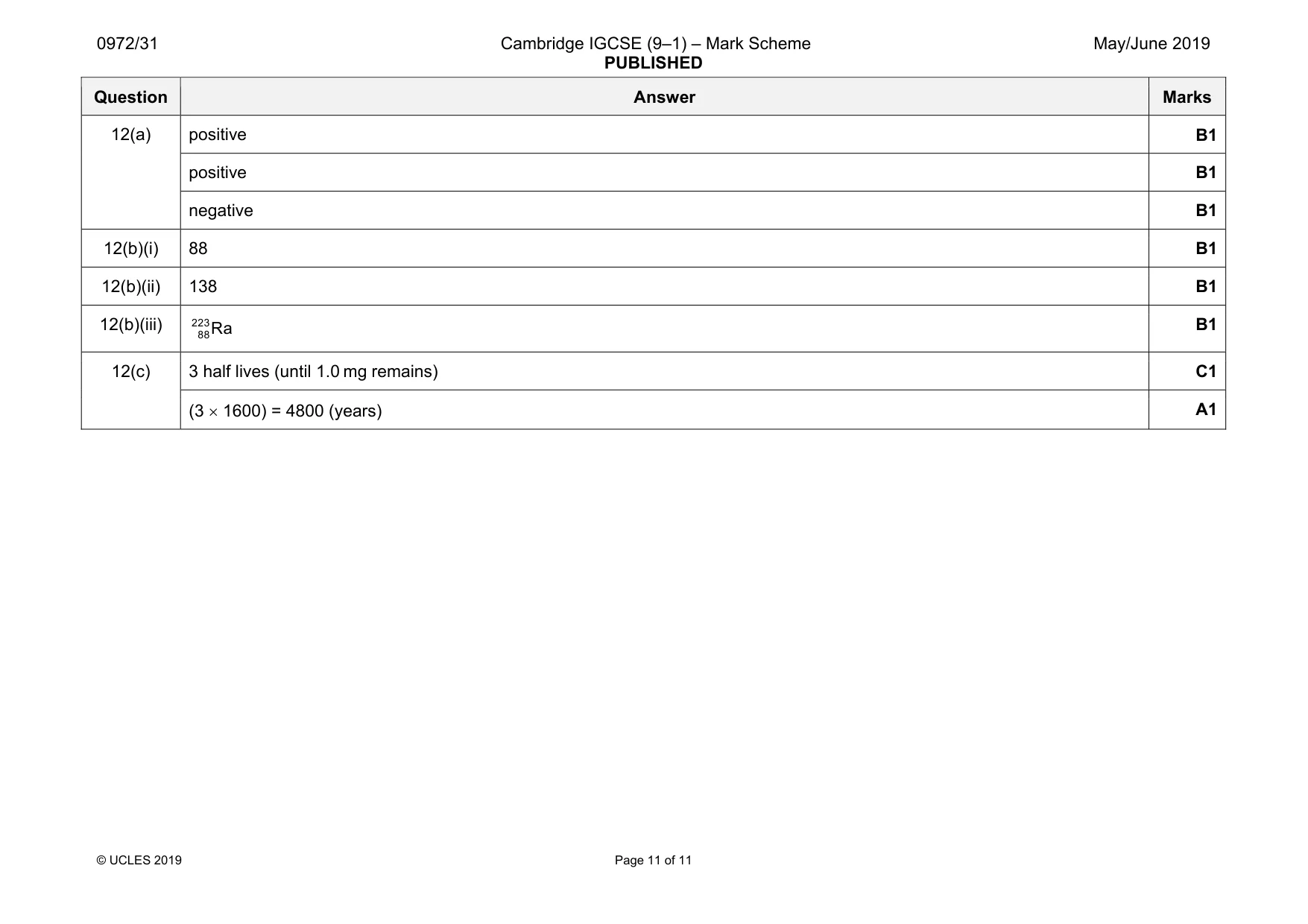
Mark scheme: 12(a) positive B1 positive B1 negative B1 12(b)(i) 88 B1 12(b)(ii) 138 B1 12(b)(iii) 223 88Ra B1 12(c) 3 half lives (until 1.0 mg remains) C1 (3 × 1600) = 4800 (years) A1
What was in this paper
The subtopics covered by these 12 questions, and how many questions each got. Open one in a new tab to see every Cambridge question on it.
What you needed in this session
Cambridge’s own grade thresholds for 2019 May/June, Paper 3 · Variant 1. A higher threshold means an easier paper — the bar moves with how the cohort did.