Cambridge IGCSE Physics (9-1) 0972 — 2018 May/June Paper 3 · Variant 1
0972/31/M/J/18 · 12 questions · 80 marks · ≈90 min
The question paper and its mark scheme, free to read here and free to download. This is Cambridge’s own paper, exactly as it was sat.
Question paper20 pages
Mark scheme9 pages
Answers below. Sit the paper first if you are practising.
Questions as text
Q1 · Model trains move along a track passing through two model stations
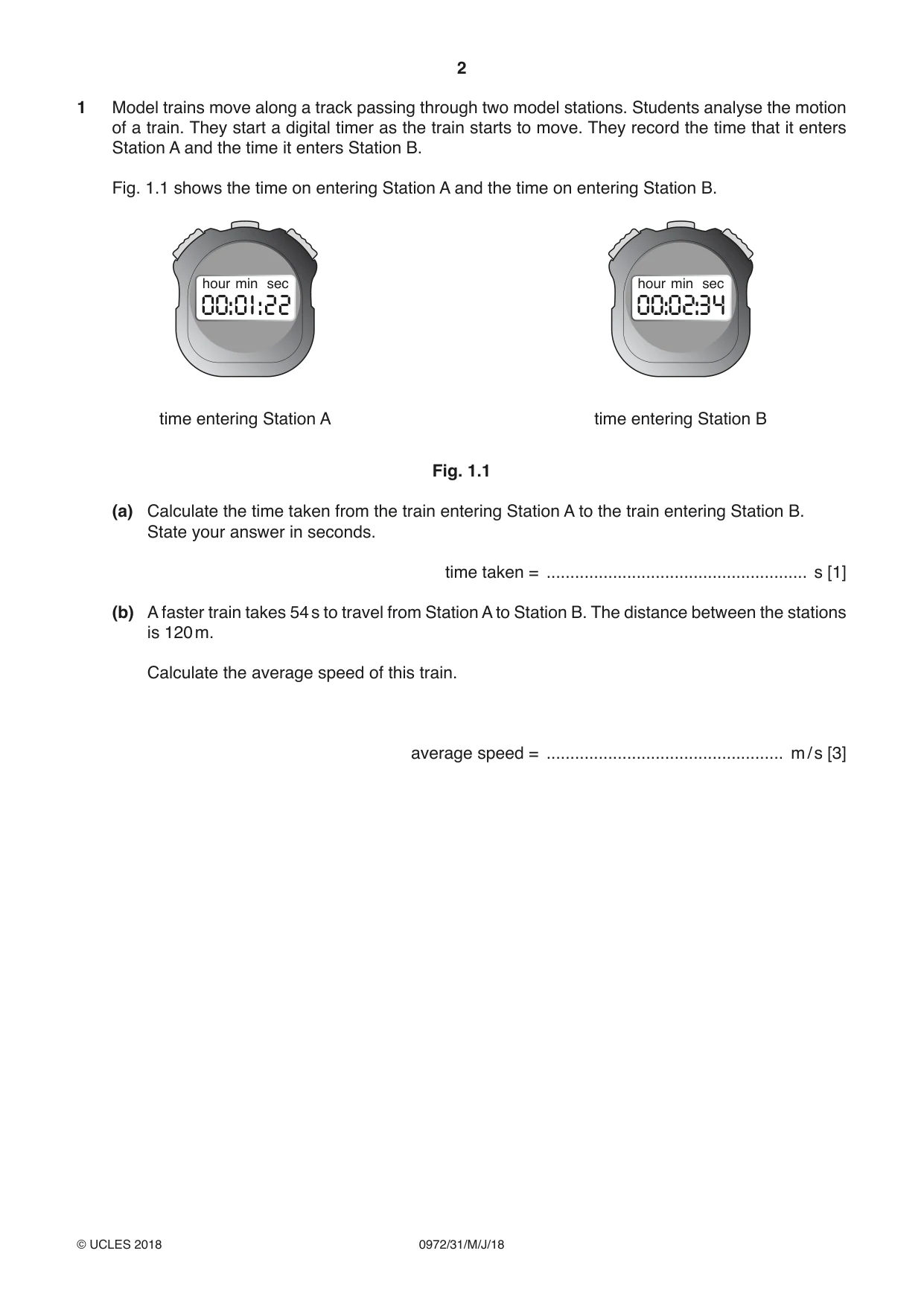
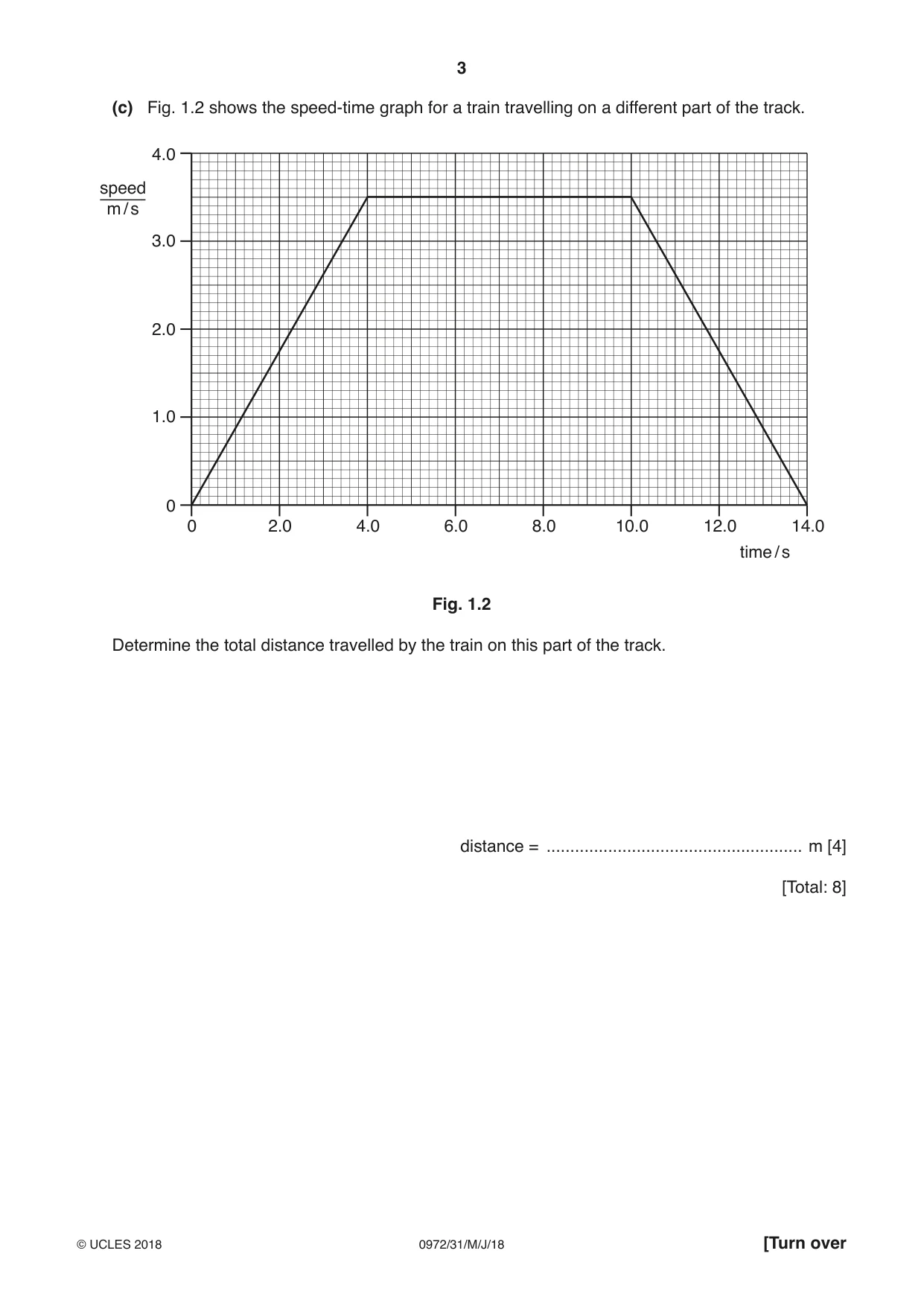
1 Model trains move along a track passing through two model stations. Students analyse the motion of a train. They start a digital timer as the train starts to move. They record the time that it enters Station A and the time it enters Station B. Fig. 1.1 shows the time on entering Station A and the time on entering Station B. hour min sec hour min sec time entering Station A time entering Station B Fig. 1.1 (a) Calculate the time taken from the train entering Station A to the train entering Station B. State your answer in seconds. time taken = ....................................................... s [1] (b) A faster train takes 54 s to travel from Station A to Station B. The distance between the stations is 120 m. Calculate the average speed of this train. average speed = .................................................. m / s [3] (c) Fig. 1.2 shows the speed-time graph for a train travelling on a different part of the track. 4.0 speed m / s 3.0 2.0 1.0 0 0 2.0 4.0 6.0 8.0 10.0 12.0 14.0 time / s Fig. 1.2 Determine the total distance travelled by the train on this part of the track. distance = ...................................................... m [4] [Total: 8]
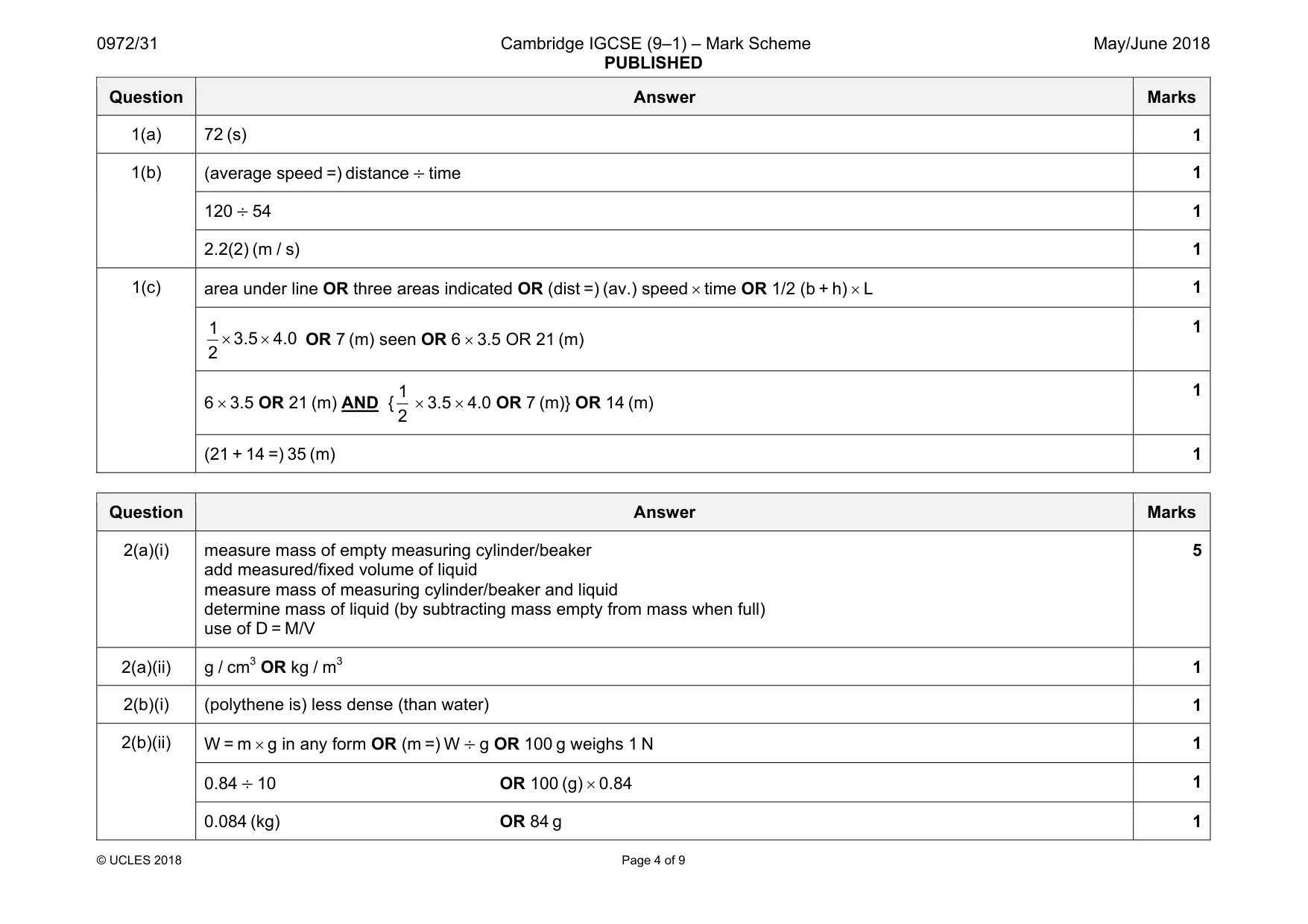
Mark scheme: 1(a) 72 (s) 1 1(b) (average speed =) distance ÷ time 1 120 ÷ 54 1 2.2(2) (m / s) 1 1(c) area under line OR three areas indicated OR (dist =) (av.) speed × time OR 1/2 (b + h) × L 1 1 3.5 4.0 2 × × OR 7 (m) seen OR 6 × 3.5 OR 21 (m) 1 6 × 3.5 OR 21 (m) AND { 1 2 × 3.5 × 4.0 OR 7 (m)} OR 14 (m) 1 (21 + 14 =) 35 (m) 1
Q2 · A 250 cm3 beaker containing some liquid is shown in Fig
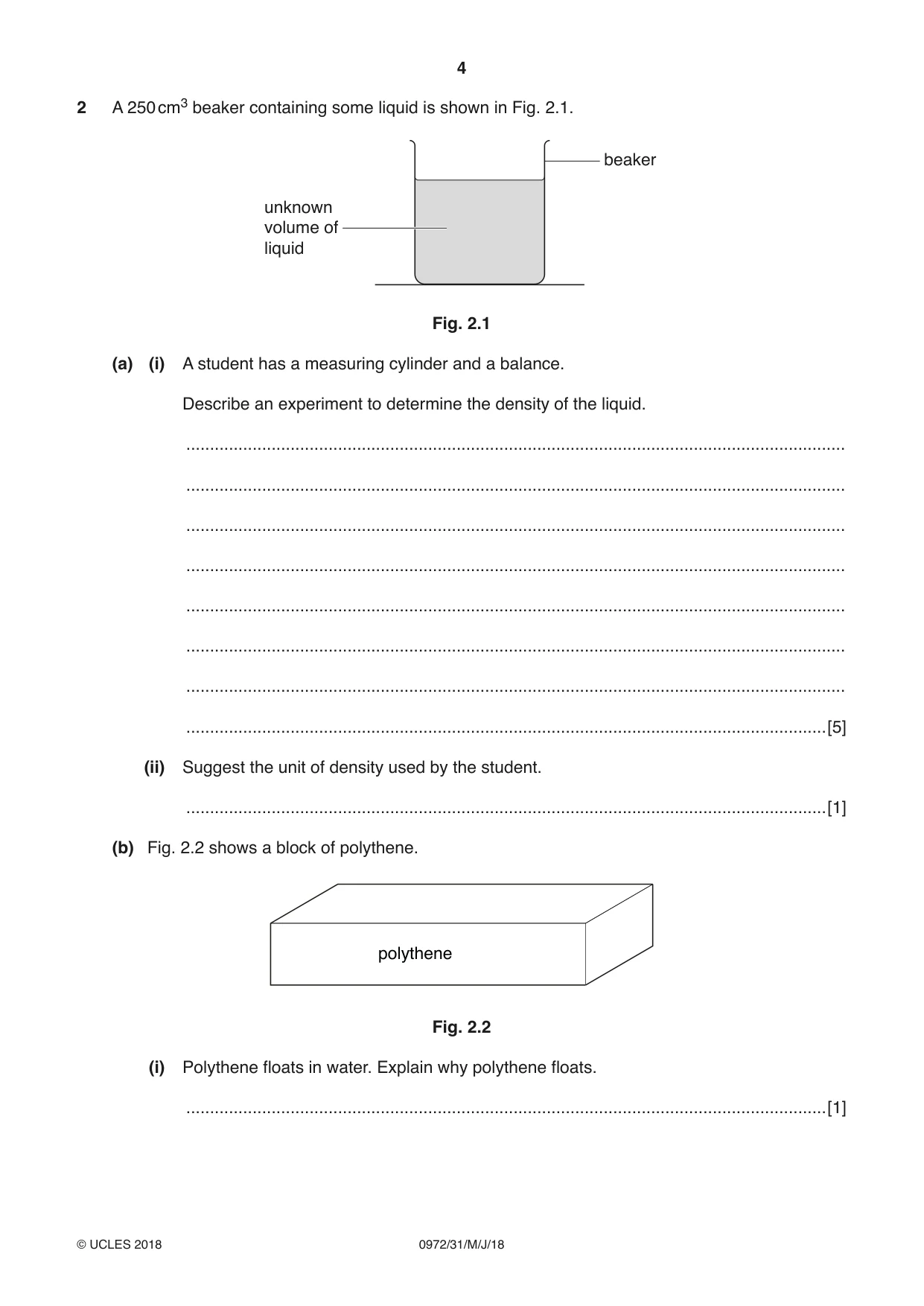
2 A 250 cm3 beaker containing some liquid is shown in Fig. 2.1. beaker unknown volume of liquid Fig. 2.1 (a) (i) A student has a measuring cylinder and a balance. Describe an experiment to determine the density of the liquid. ........................................................................................................................................... ........................................................................................................................................... ........................................................................................................................................... ........................................................................................................................................... ........................................................................................................................................... ........................................................................................................................................... ........................................................................................................................................... .......................................................................................................................................[5] (ii) Suggest the unit of density used by the student. .......................................................................................................................................[1] (b) Fig. 2.2 shows a block of polythene. polythene Fig. 2.2 (i) Polythene floats in water. Explain why polythene floats. .......................................................................................................................................[1] (ii) The weight of the polythene block is 0.84 N. Calculate the mass of the block. mass = ..................................................... kg [3] [Total: 10]
Mark scheme: 2(a)(i) measure mass of empty measuring cylinder/beaker add measured/fixed volume of liquid measure mass of measuring cylinder/beaker and liquid determine mass of liquid (by subtracting mass empty from mass when full) use of D = M/V 5 2(a)(ii) g / cm3 OR kg / m3 1 2(b)(i) (polythene is) less dense (than water) 1 2(b)(ii) W = m × g in any form OR (m =) W ÷ g OR 100 g weighs 1 N 1 0.84 ÷ 10 OR 100 (g) × 0.84 1 0.084 (kg) OR 84 g 1
Q3 · The vertical forces on a rocket
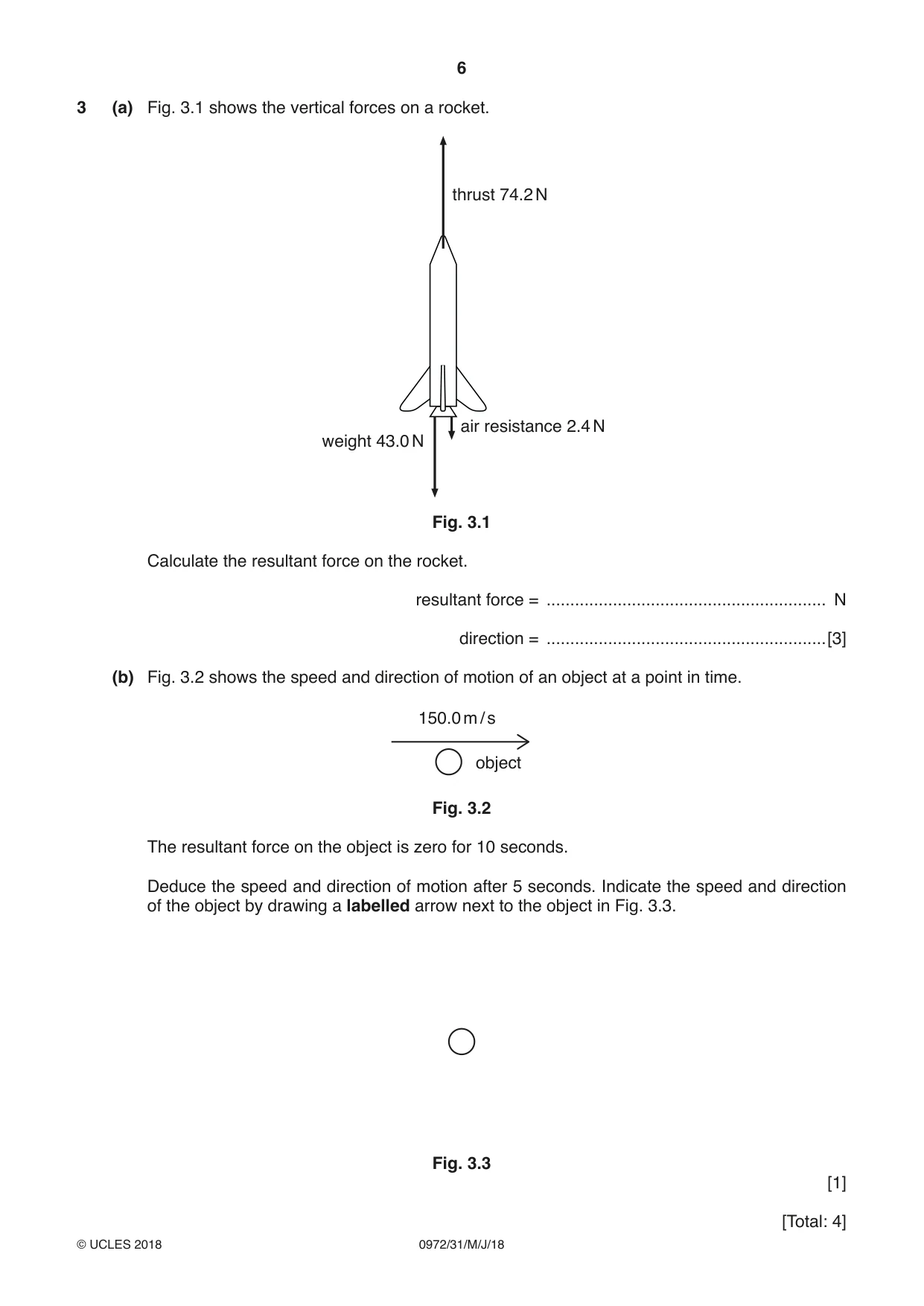
3 (a) Fig. 3.1 shows the vertical forces on a rocket. thrust 74.2 N air resistance 2.4 N weight 43.0 N Fig. 3.1 Calculate the resultant force on the rocket. resultant force = ........................................................... N direction = ...........................................................[3] (b) Fig. 3.2 shows the speed and direction of motion of an object at a point in time. 150.0 m / s object Fig. 3.2 The resultant force on the object is zero for 10 seconds. Deduce the speed and direction of motion after 5 seconds. Indicate the speed and direction of the object by drawing a labelled arrow next to the object in Fig. 3.3. Fig. 3.3 [1] [Total: 4]
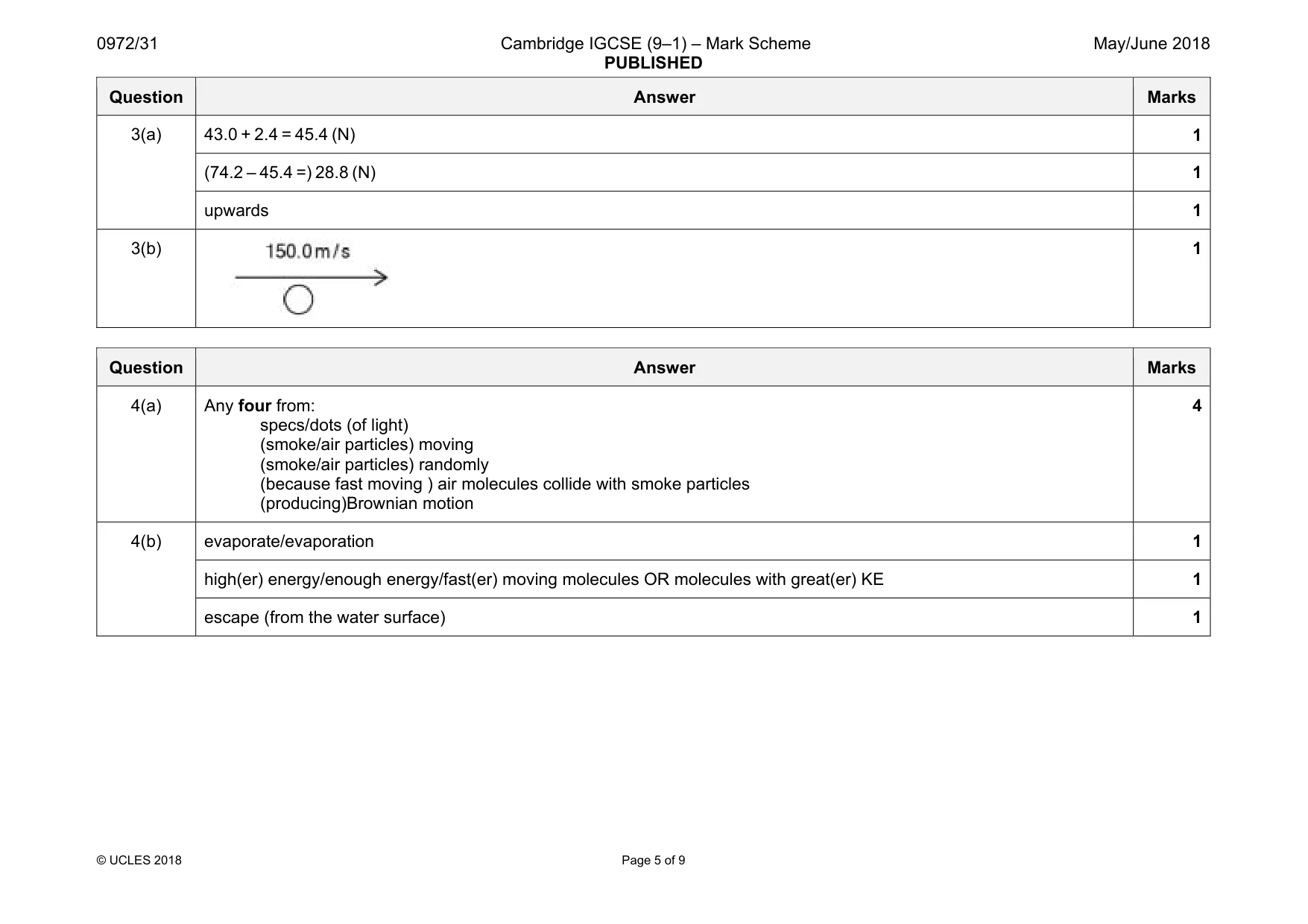
Mark scheme: 3(a) 43.0 + 2.4 = 45.4 (N) 1 (74.2 – 45.4 =) 28.8 (N) 1 upwards 1 3(b) 1
Question 4
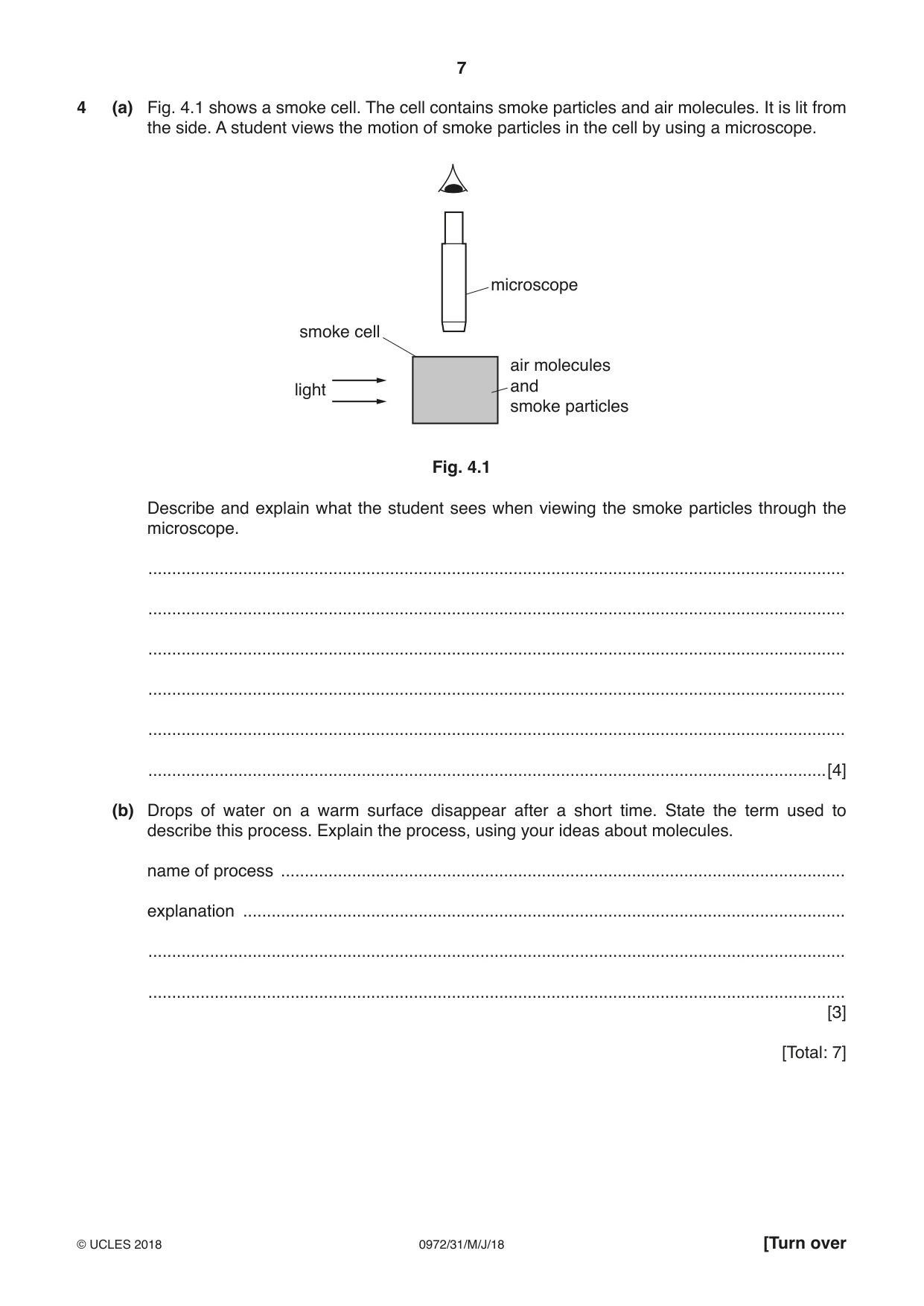
4 (a) Fig. 4.1 shows a smoke cell. The cell contains smoke particles and air molecules. It is lit from the side. A student views the motion of smoke particles in the cell by using a microscope. microscope smoke cell air molecules light and smoke particles Fig. 4.1 Describe and explain what the student sees when viewing the smoke particles through the microscope. ................................................................................................................................................... ................................................................................................................................................... ................................................................................................................................................... ................................................................................................................................................... ................................................................................................................................................... ...............................................................................................................................................[4] (b) Drops of water on a warm surface disappear after a short time. State the term used to describe this process. Explain the process, using your ideas about molecules. name of process ....................................................................................................................... explanation ............................................................................................................................... ................................................................................................................................................... ................................................................................................................................................... [3] [Total: 7]
Mark scheme: 4(a) Any four from: specs/dots (of light) (smoke/air particles) moving (smoke/air particles) randomly (because fast moving ) air molecules collide with smoke particles (producing)Brownian motion 4 4(b) evaporate/evaporation 1 high(er) energy/enough energy/fast(er) moving molecules OR molecules with great(er) KE 1 escape (from the water surface) 1
Q5 · A geothermal power station
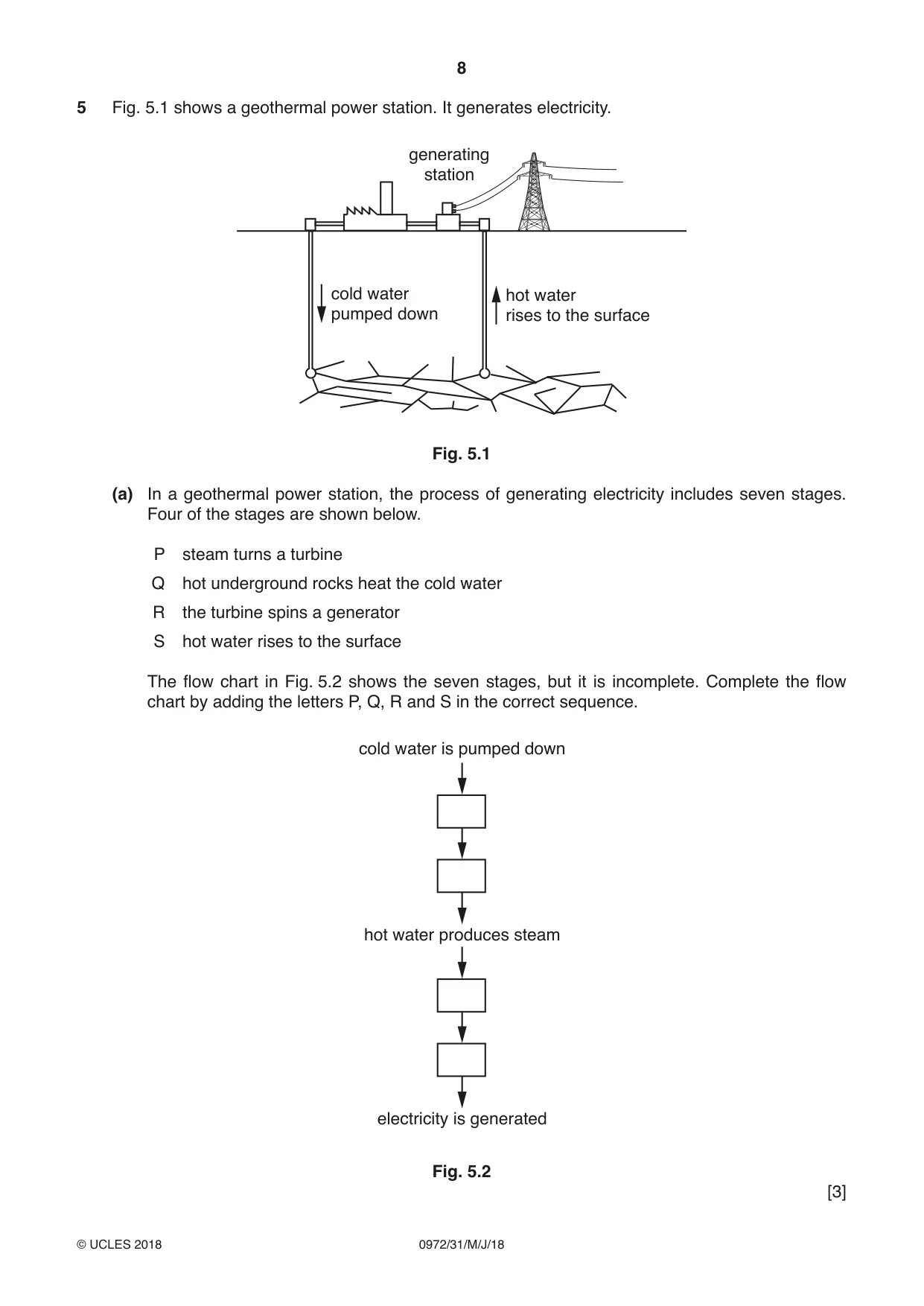
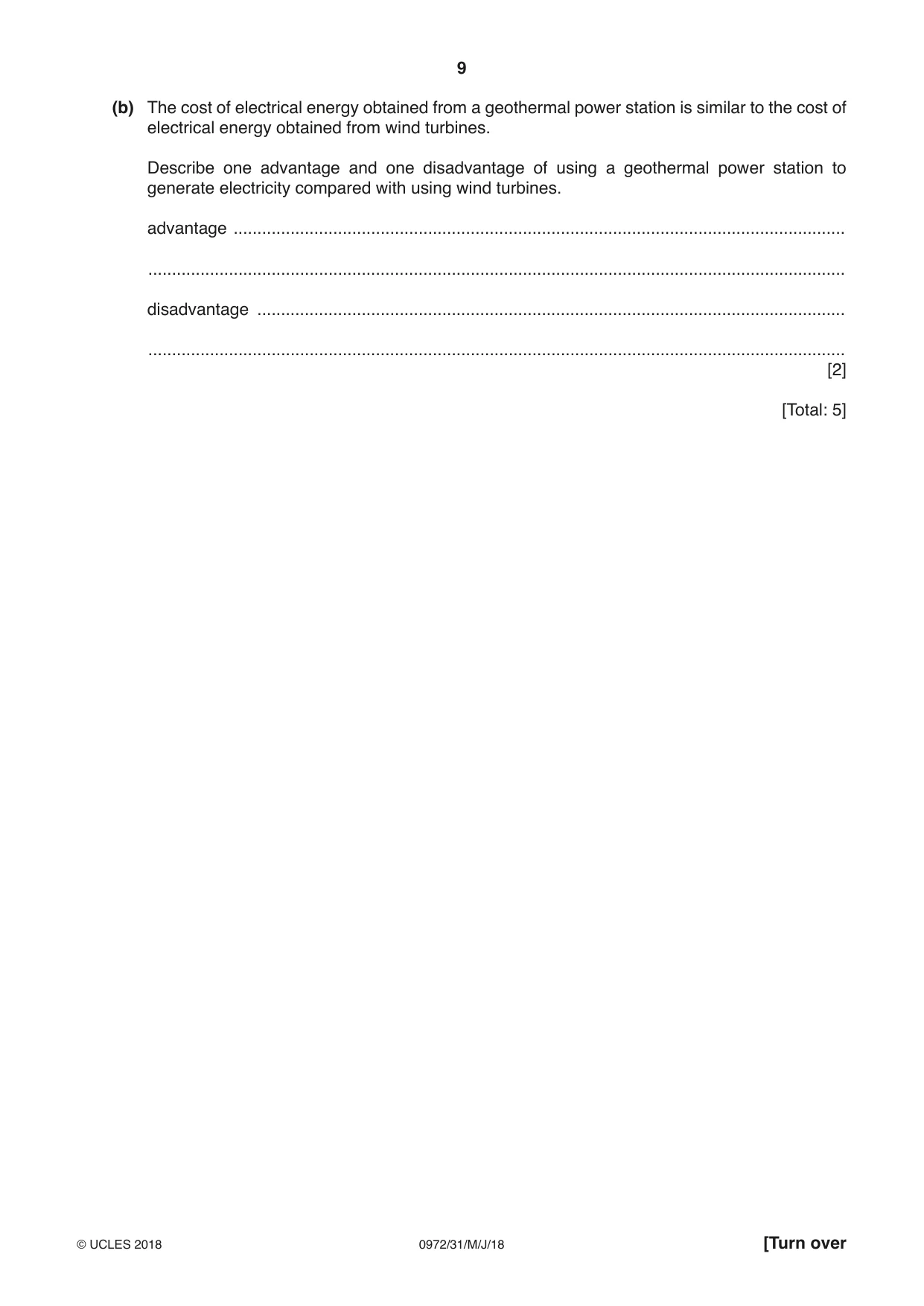
5 Fig. 5.1 shows a geothermal power station. It generates electricity. generating station cold water hot water pumped down rises to the surface Fig. 5.1 (a) In a geothermal power station, the process of generating electricity includes seven stages. Four of the stages are shown below. P steam turns a turbine Q hot underground rocks heat the cold water R the turbine spins a generator S hot water rises to the surface The flow chart in Fig. 5.2 shows the seven stages, but it is incomplete. Complete the flow chart by adding the letters P, Q, R and S in the correct sequence. cold water is pumped down hot water produces steam electricity is generated Fig. 5.2 [3] (b) The cost of electrical energy obtained from a geothermal power station is similar to the cost of electrical energy obtained from wind turbines. Describe one advantage and one disadvantage of using a geothermal power station to generate electricity compared with using wind turbines. advantage ................................................................................................................................. ................................................................................................................................................... disadvantage ............................................................................................................................ ................................................................................................................................................... [2] [Total: 5]
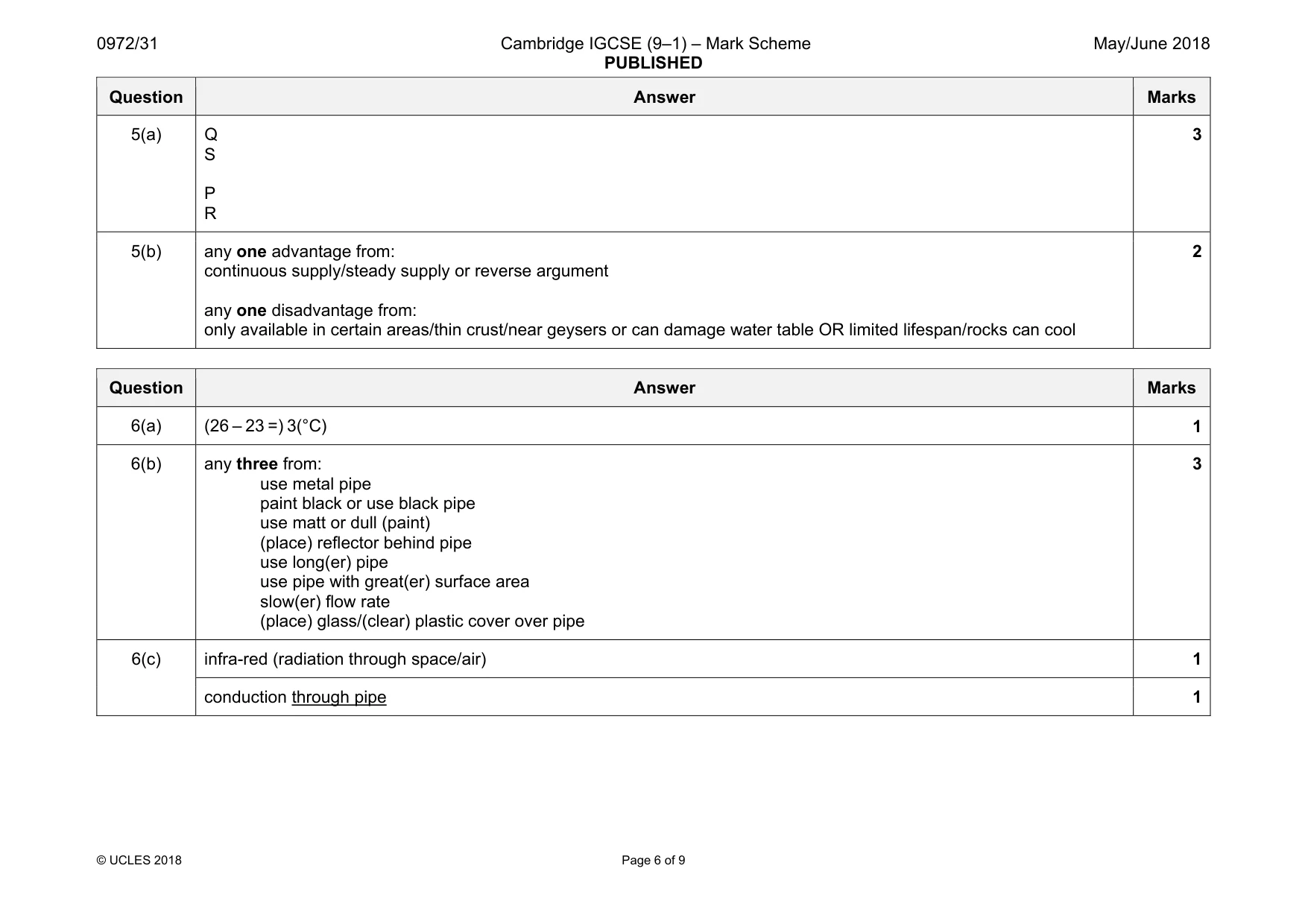
Mark scheme: 5(a) Q S P R 3 5(b) any one advantage from: continuous supply/steady supply or reverse argument any one disadvantage from: only available in certain areas/thin crust/near geysers or can damage water table OR limited lifespan/rocks can cool 2
Q6 · A student constructs a device for absorbing thermal energy from the Sun
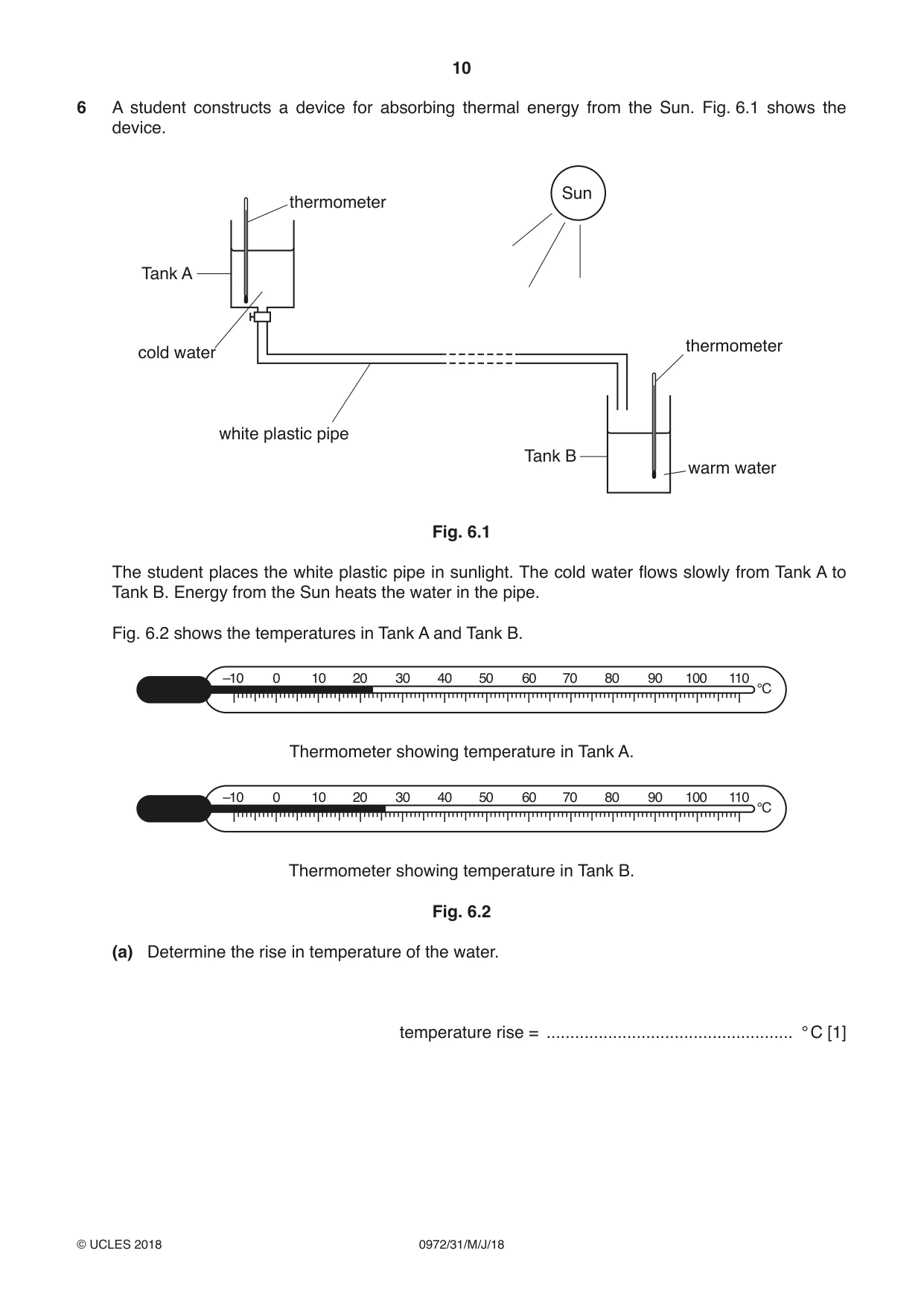
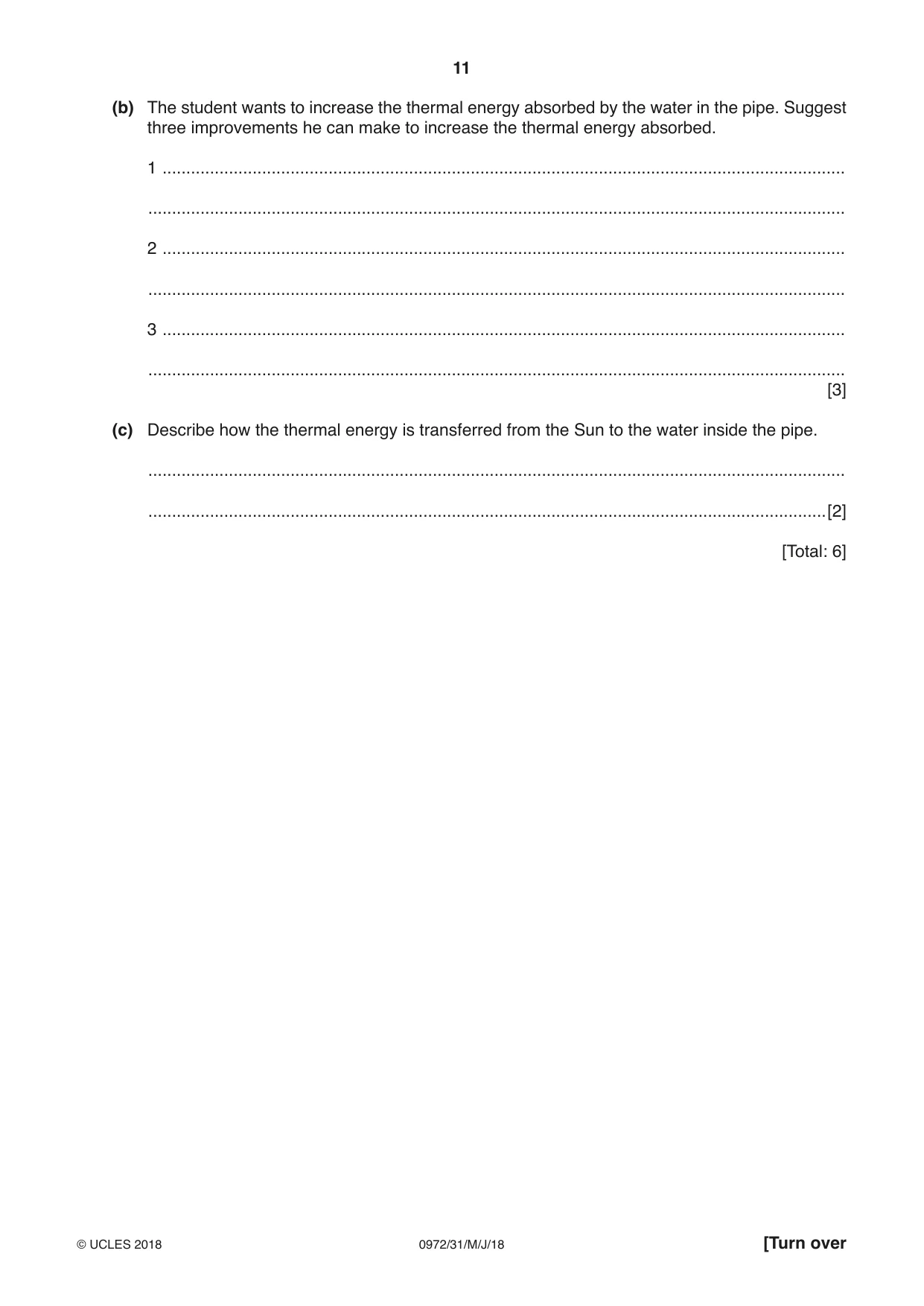
6 A student constructs a device for absorbing thermal energy from the Sun. Fig. 6.1 shows the device. Sun thermometer Tank A thermometer cold water white plastic pipe Tank B warm water Fig. 6.1 The student places the white plastic pipe in sunlight. The cold water flows slowly from Tank A to Tank B. Energy from the Sun heats the water in the pipe. Fig. 6.2 shows the temperatures in Tank A and Tank B. –10 0 10 20 30 40 50 60 70 80 90 100 110 °C Thermometer showing temperature in Tank A. –10 0 10 20 30 40 50 60 70 80 90 100 110 °C Thermometer showing temperature in Tank B. Fig. 6.2 (a) Determine the rise in temperature of the water. temperature rise = .................................................... ° C [1] (b) The student wants to increase the thermal energy absorbed by the water in the pipe. Suggest three improvements he can make to increase the thermal energy absorbed. 1 ................................................................................................................................................ ................................................................................................................................................... 2 ................................................................................................................................................ ................................................................................................................................................... 3 ................................................................................................................................................ ................................................................................................................................................... [3] (c) Describe how the thermal energy is transferred from the Sun to the water inside the pipe. ................................................................................................................................................... ...............................................................................................................................................[2] [Total: 6]
Mark scheme: 6(a) (26 – 23 =) 3(°C) 1 6(b) any three from: use metal pipe paint black or use black pipe use matt or dull (paint) (place) reflector behind pipe use long(er) pipe use pipe with great(er) surface area slow(er) flow rate (place) glass/(clear) plastic cover over pipe 3 6(c) infra-red (radiation through space/air) 1 conduction through pipe 1
Q7 · The spectrum of white light is made up of seven colours
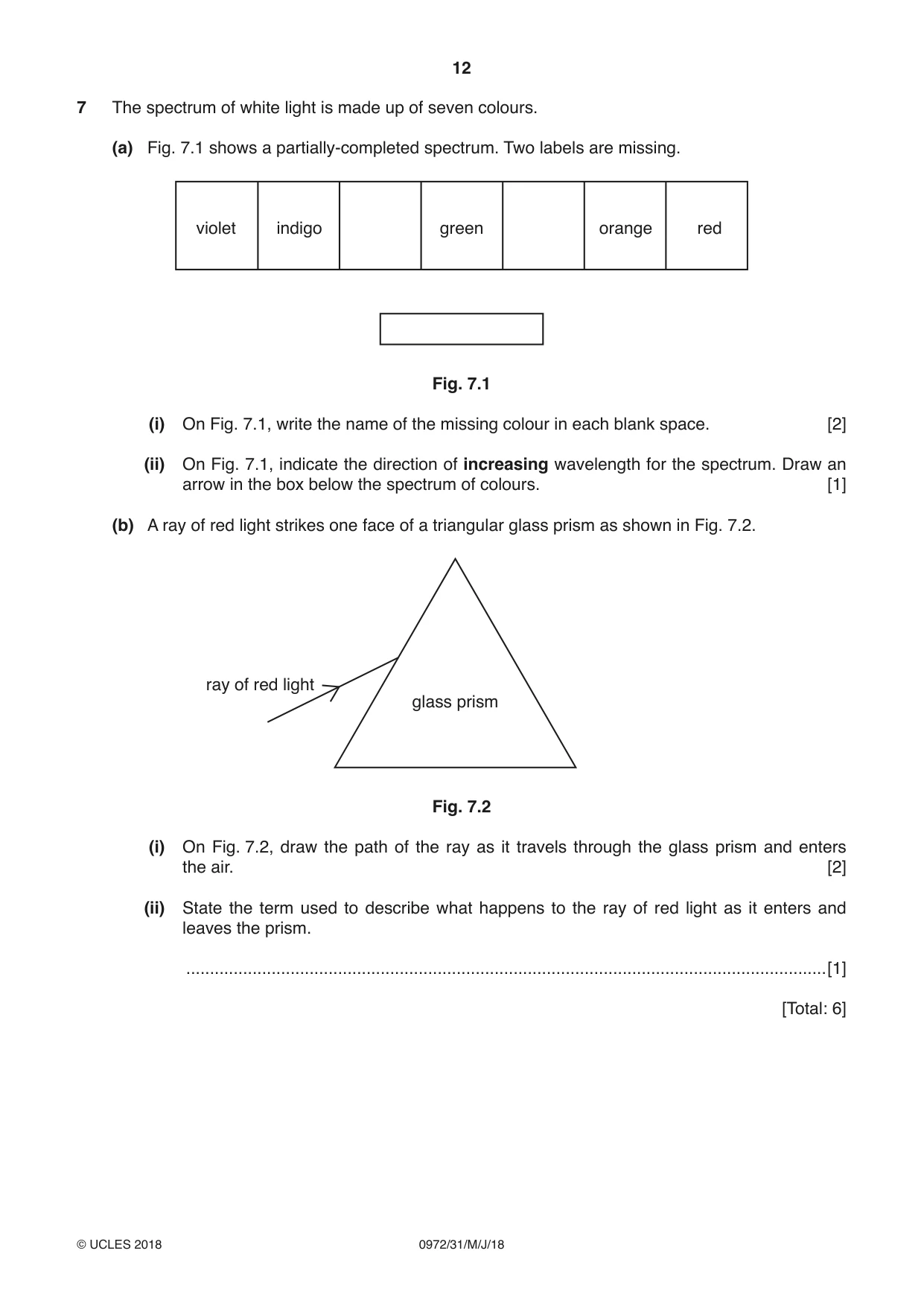
7 The spectrum of white light is made up of seven colours. (a) Fig. 7.1 shows a partially-completed spectrum. Two labels are missing. violet indigo green orange red Fig. 7.1 (i) On Fig. 7.1, write the name of the missing colour in each blank space. [2] (ii) On Fig. 7.1, indicate the direction of increasing wavelength for the spectrum. Draw an arrow in the box below the spectrum of colours. [1] (b) A ray of red light strikes one face of a triangular glass prism as shown in Fig. 7.2. ray of red light glass prism Fig. 7.2 (i) On Fig. 7.2, draw the path of the ray as it travels through the glass prism and enters the air. [2] (ii) State the term used to describe what happens to the ray of red light as it enters and leaves the prism. .......................................................................................................................................[1] [Total: 6]
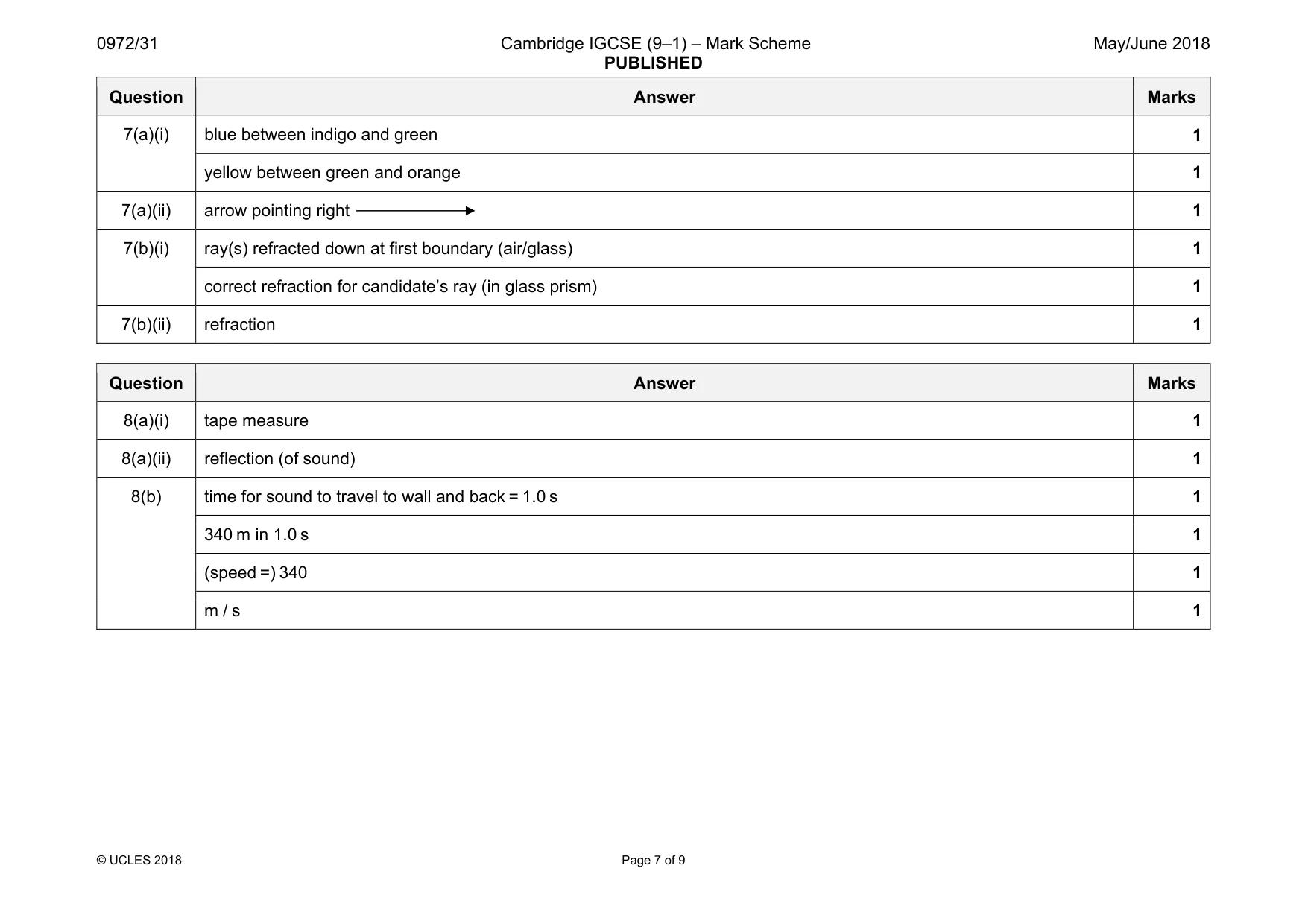
Mark scheme: 7(a)(i) blue between indigo and green 1 yellow between green and orange 1 7(a)(ii) arrow pointing right 1 7(b)(i) ray(s) refracted down at first boundary (air/glass) 1 correct refraction for candidate’s ray (in glass prism) 1 7(b)(ii) refraction 1
Q8 · This question is about measuring the speed of sound in air
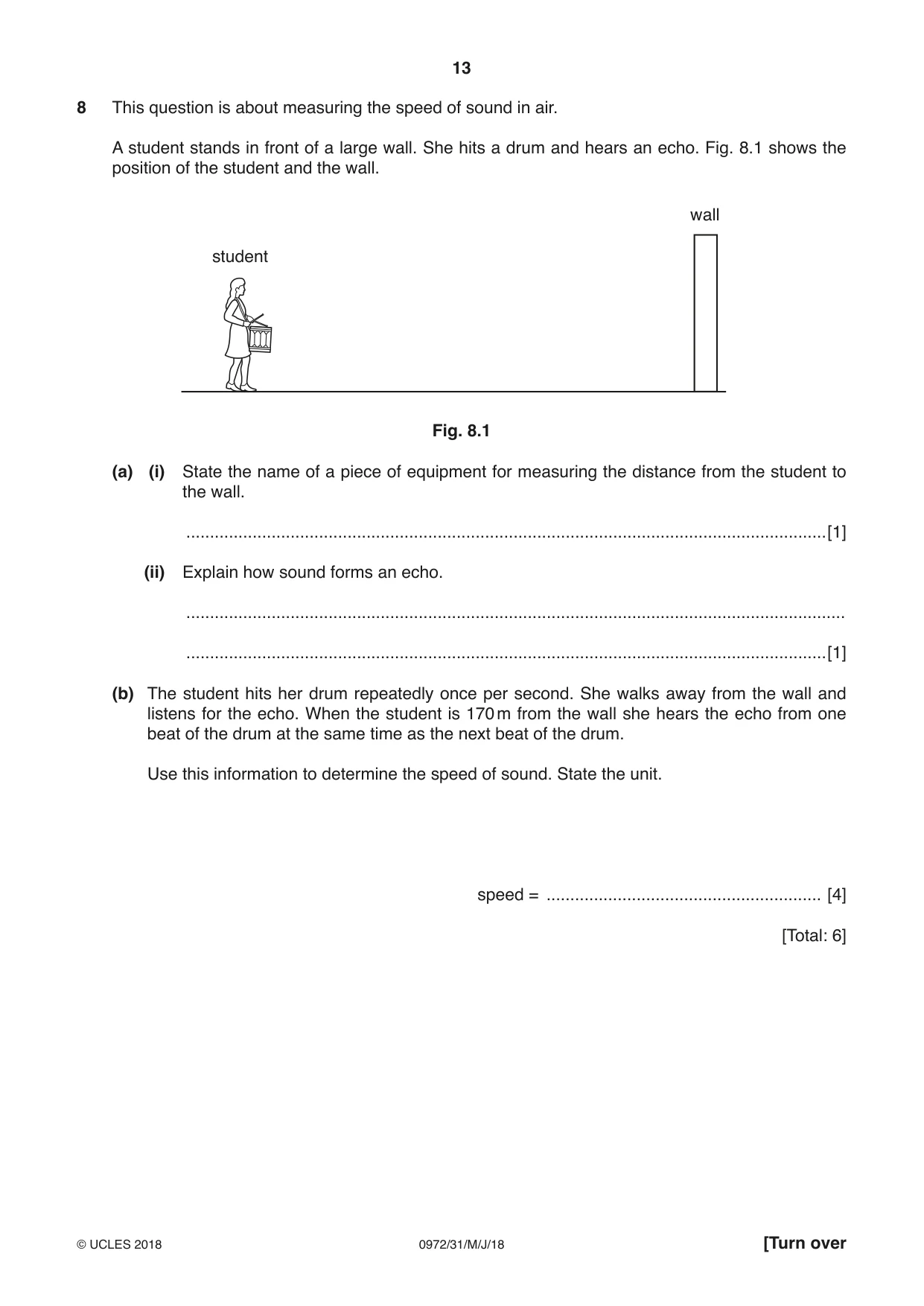
8 This question is about measuring the speed of sound in air. A student stands in front of a large wall. She hits a drum and hears an echo. Fig. 8.1 shows the position of the student and the wall. wall student Fig. 8.1 (a) (i) State the name of a piece of equipment for measuring the distance from the student to the wall. .......................................................................................................................................[1] (ii) Explain how sound forms an echo. ........................................................................................................................................... .......................................................................................................................................[1] (b) The student hits her drum repeatedly once per second. She walks away from the wall and listens for the echo. When the student is 170 m from the wall she hears the echo from one beat of the drum at the same time as the next beat of the drum. Use this information to determine the speed of sound. State the unit. speed = .......................................................... [4] [Total: 6]
Mark scheme: 8(a)(i) tape measure 1 8(a)(ii) reflection (of sound) 1 8(b) time for sound to travel to wall and back = 1.0 s 1 340 m in 1.0 s 1 (speed =) 340 1 m / s 1
Q9 · A partially-labelled diagram of the electromagnetic spectrum
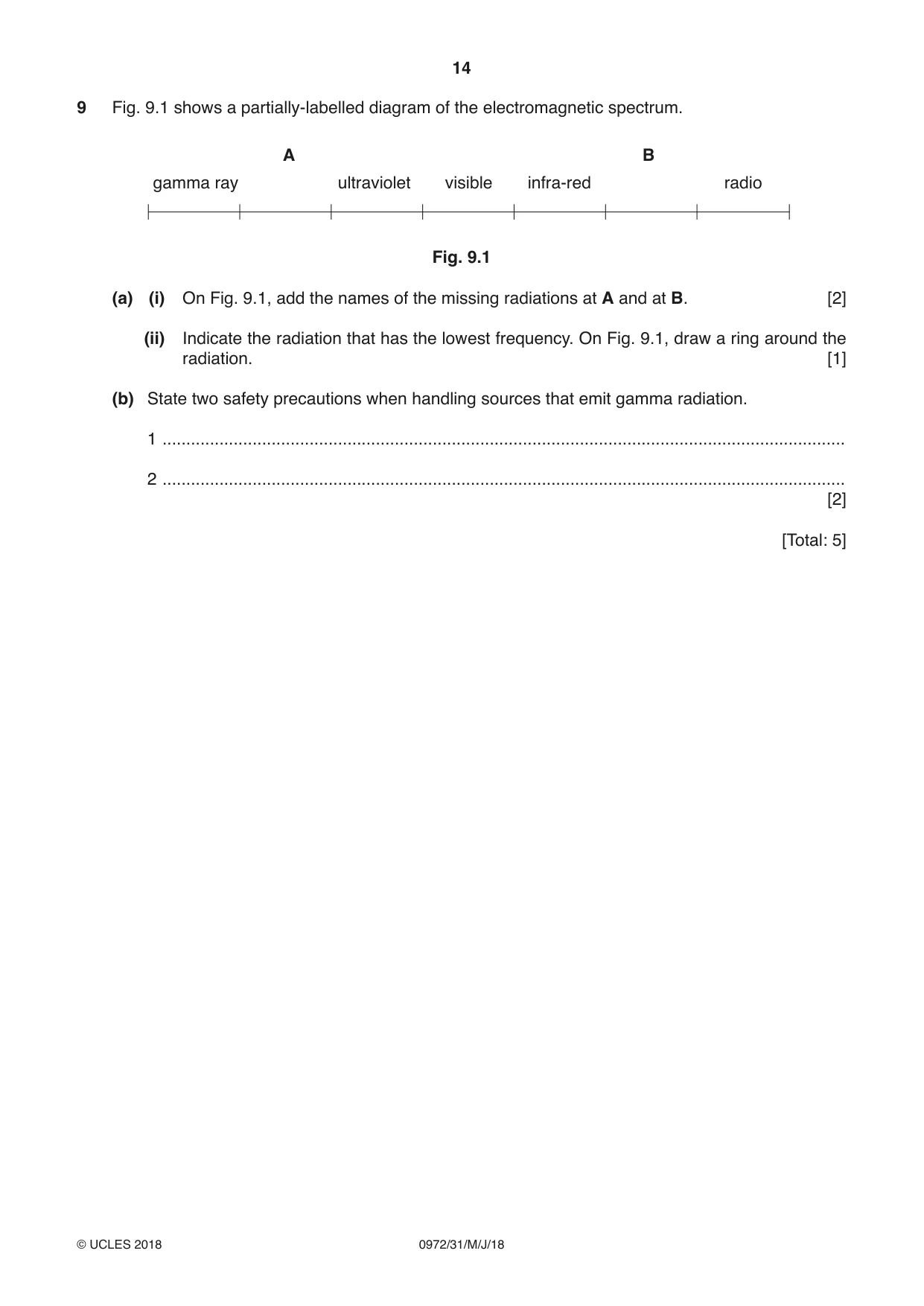
9 Fig. 9.1 shows a partially-labelled diagram of the electromagnetic spectrum. A B gamma ray ultraviolet visible infra-red radio Fig. 9.1 (a) (i) On Fig. 9.1, add the names of the missing radiations at A and at B. [2] (ii) Indicate the radiation that has the lowest frequency. On Fig. 9.1, draw a ring around the radiation. [1] (b) State two safety precautions when handling sources that emit gamma radiation. 1 ................................................................................................................................................ 2 ................................................................................................................................................ [2] [Total: 5]
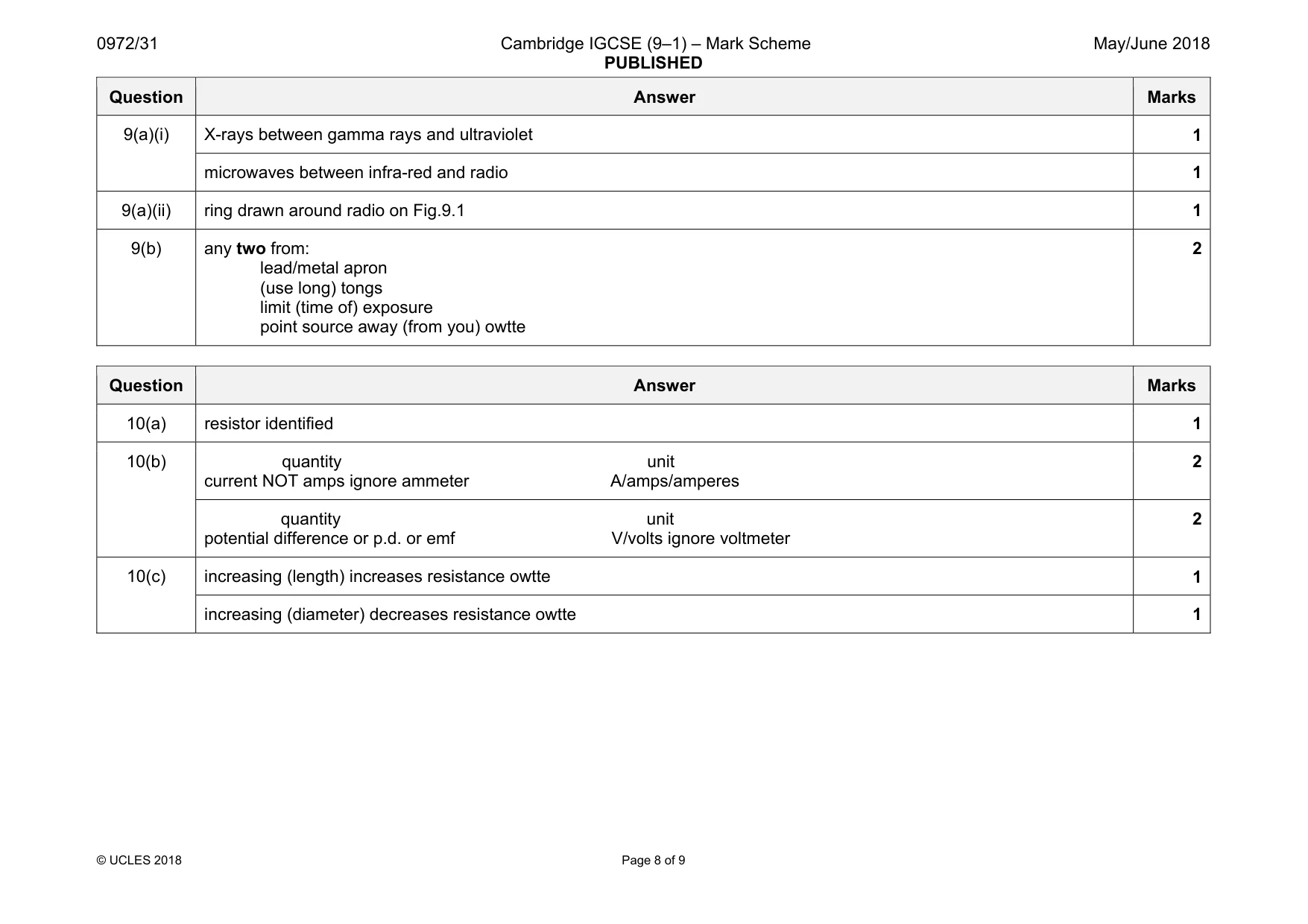
Mark scheme: 9(a)(i) X-rays between gamma rays and ultraviolet 1 microwaves between infra-red and radio 1 9(a)(ii) ring drawn around radio on Fig.9.1 1 9(b) any two from: lead/metal apron (use long) tongs limit (time of) exposure point source away (from you) owtte 2
Q10 · A circuit for determining the resistance of a component
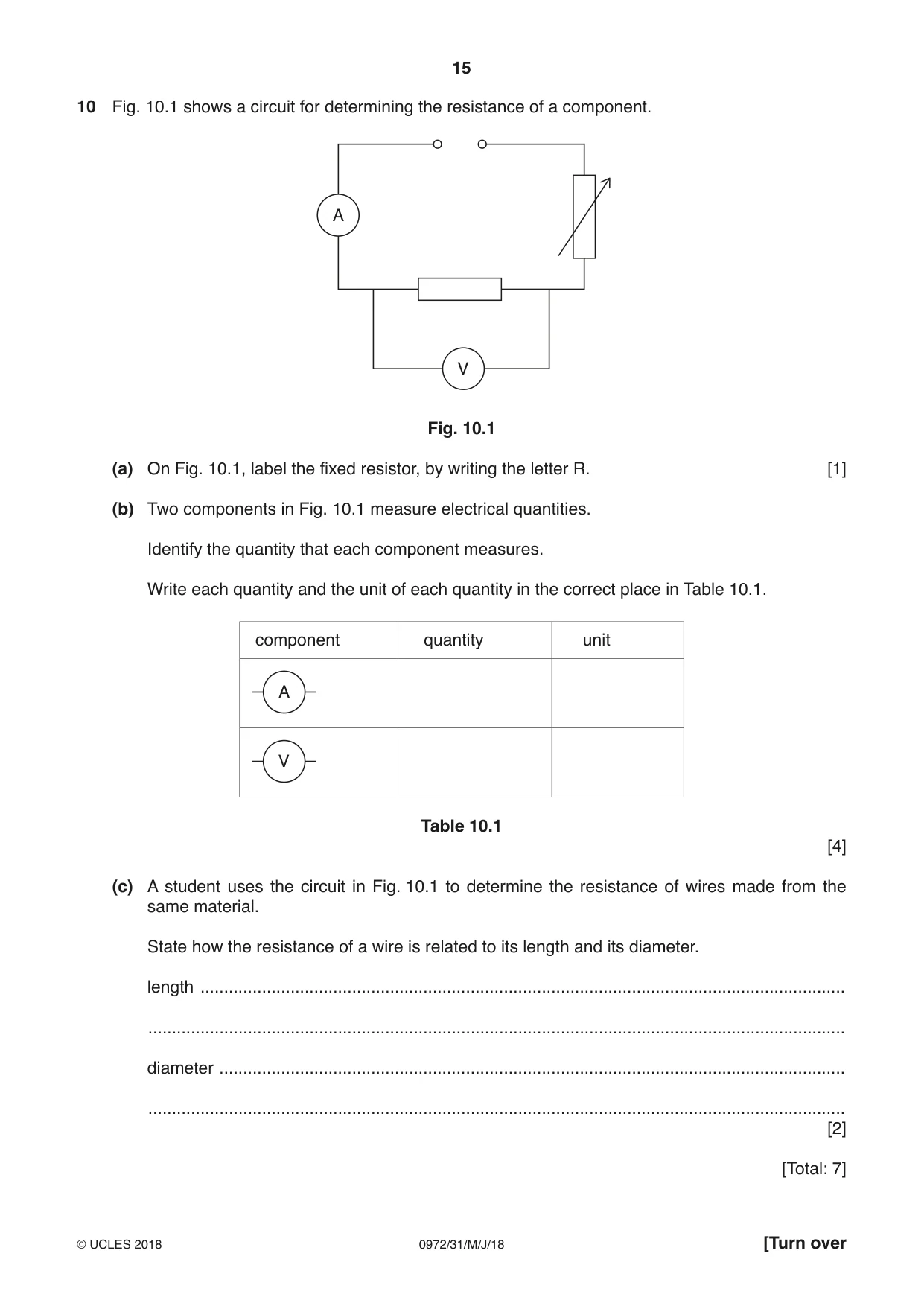
10 Fig. 10.1 shows a circuit for determining the resistance of a component. A V Fig. 10.1 (a) On Fig. 10.1, label the fixed resistor, by writing the letter R. [1] (b) Two components in Fig. 10.1 measure electrical quantities. Identify the quantity that each component measures. Write each quantity and the unit of each quantity in the correct place in Table 10.1. component quantity unit A V Table 10.1 [4] (c) A student uses the circuit in Fig. 10.1 to determine the resistance of wires made from the same material. State how the resistance of a wire is related to its length and its diameter. length ........................................................................................................................................ ................................................................................................................................................... diameter .................................................................................................................................... ................................................................................................................................................... [2] [Total: 7]
Mark scheme: 10(a) resistor identified 1 10(b) quantity unit current NOT amps ignore ammeter A/amps/amperes 2 quantity unit potential difference or p.d. or emf V/volts ignore voltmeter 2 10(c) increasing (length) increases resistance owtte 1 increasing (diameter) decreases resistance owtte 1
Q11 · A vertical conductor passing through a horizontal piece of card
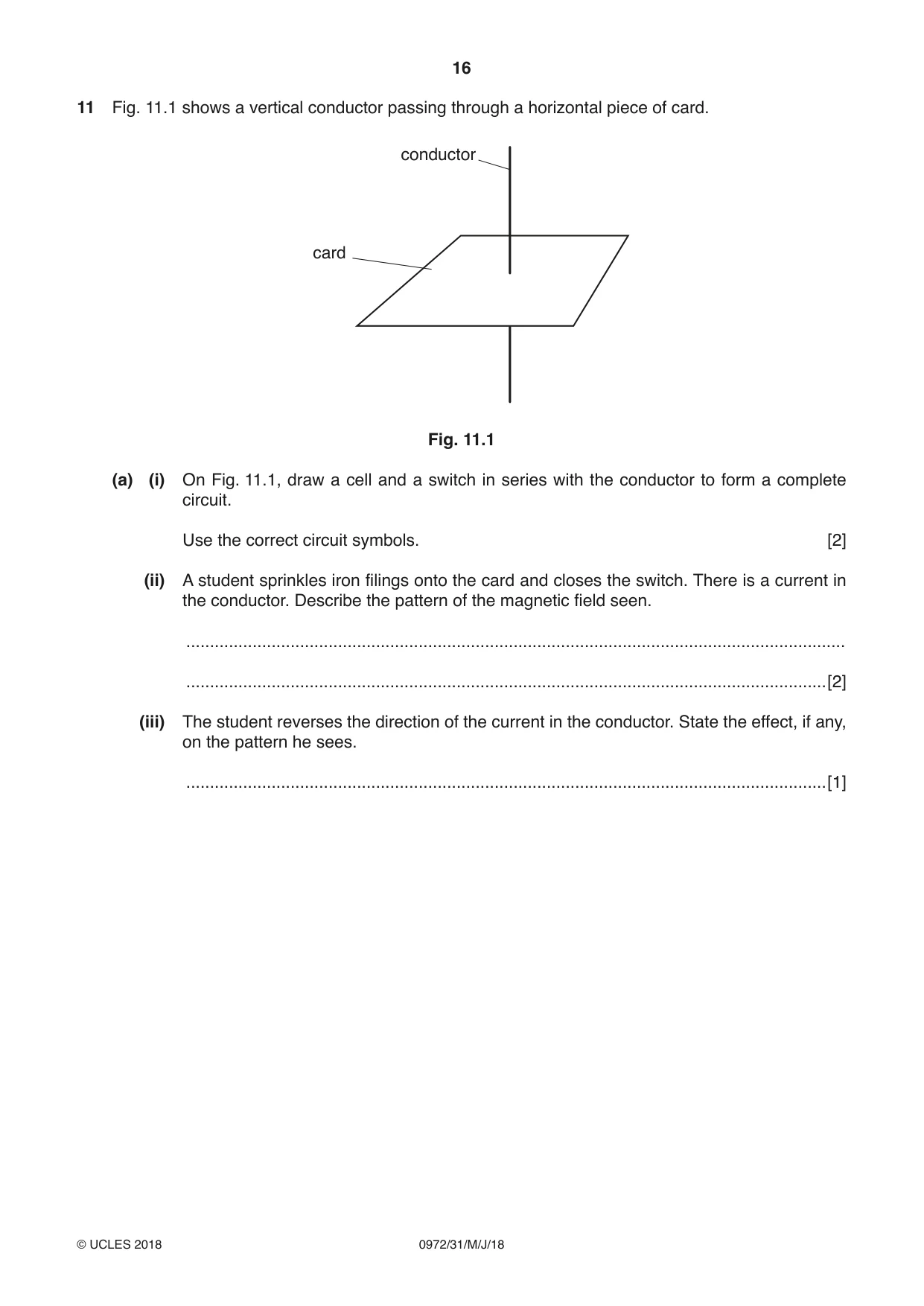
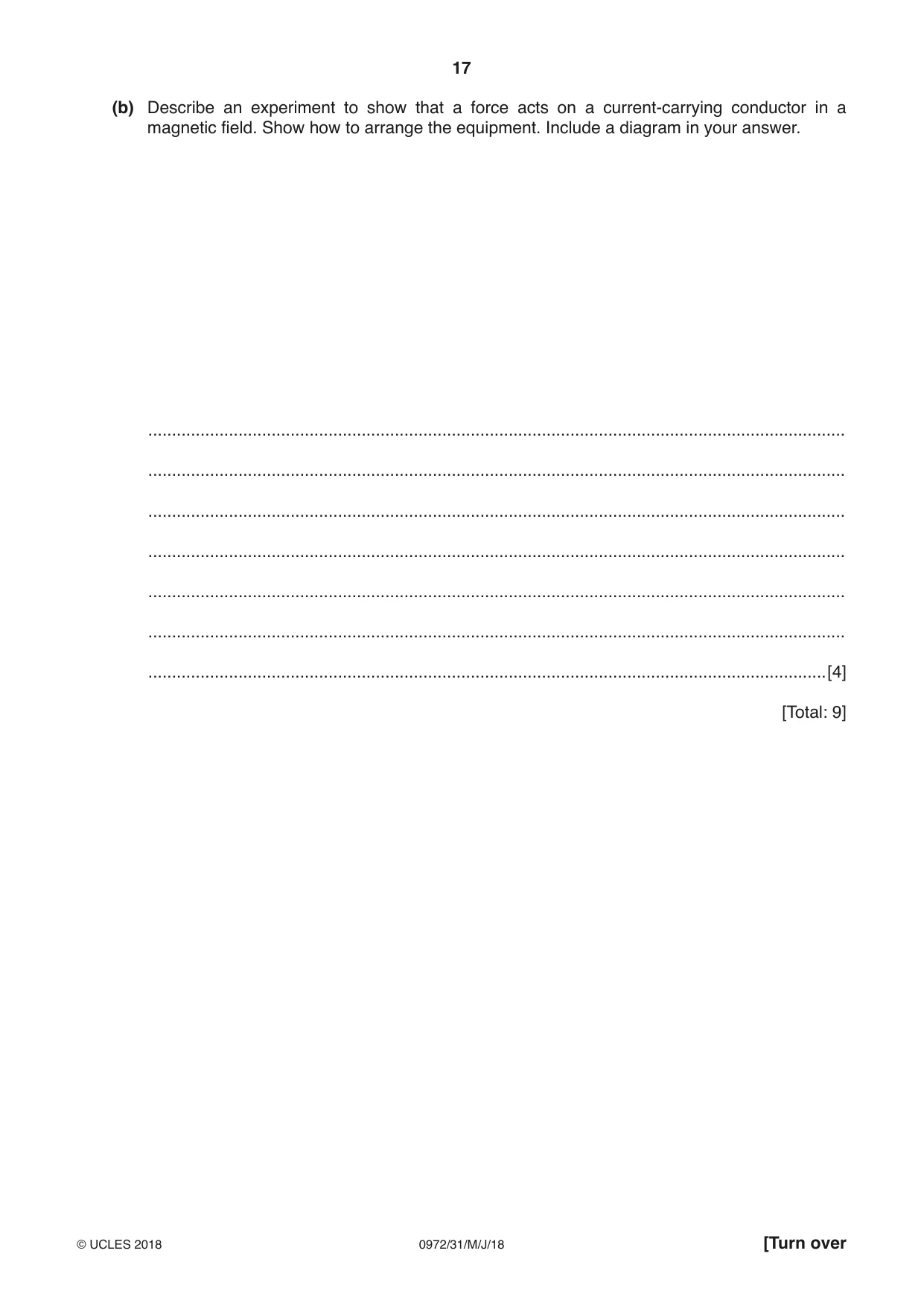
11 Fig. 11.1 shows a vertical conductor passing through a horizontal piece of card. conductor card Fig. 11.1 (a) (i) On Fig. 11.1, draw a cell and a switch in series with the conductor to form a complete circuit. Use the correct circuit symbols. [2] (ii) A student sprinkles iron filings onto the card and closes the switch. There is a current in the conductor. Describe the pattern of the magnetic field seen. ........................................................................................................................................... .......................................................................................................................................[2] (iii) The student reverses the direction of the current in the conductor. State the effect, if any, on the pattern he sees. .......................................................................................................................................[1] (b) Describe an experiment to show that a force acts on a current-carrying conductor in a magnetic field. Show how to arrange the equipment. Include a diagram in your answer. ................................................................................................................................................... ................................................................................................................................................... ................................................................................................................................................... ................................................................................................................................................... ................................................................................................................................................... ................................................................................................................................................... ...............................................................................................................................................[4] [Total: 9]
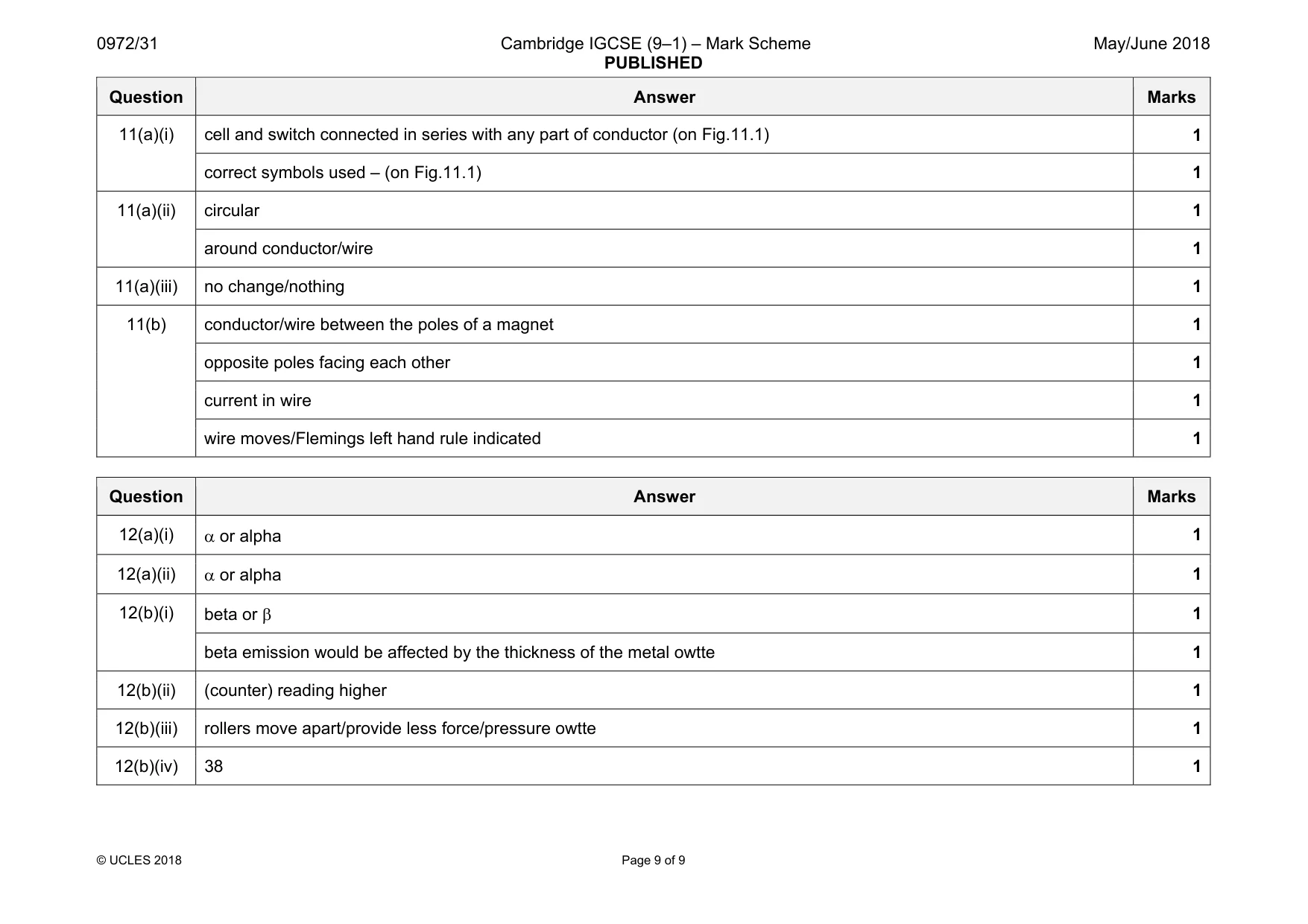
Mark scheme: 11(a)(i) cell and switch connected in series with any part of conductor (on Fig.11.1) 1 correct symbols used – (on Fig.11.1) 1 11(a)(ii) circular 1 around conductor/wire 1 11(a)(iii) no change/nothing 1 11(b) conductor/wire between the poles of a magnet 1 opposite poles facing each other 1 current in wire 1 wire moves/Flemings left hand rule indicated 1
Q12 · Radioactive decay may include the emission of: α-radiation β-radiation γ-radiation (a)…
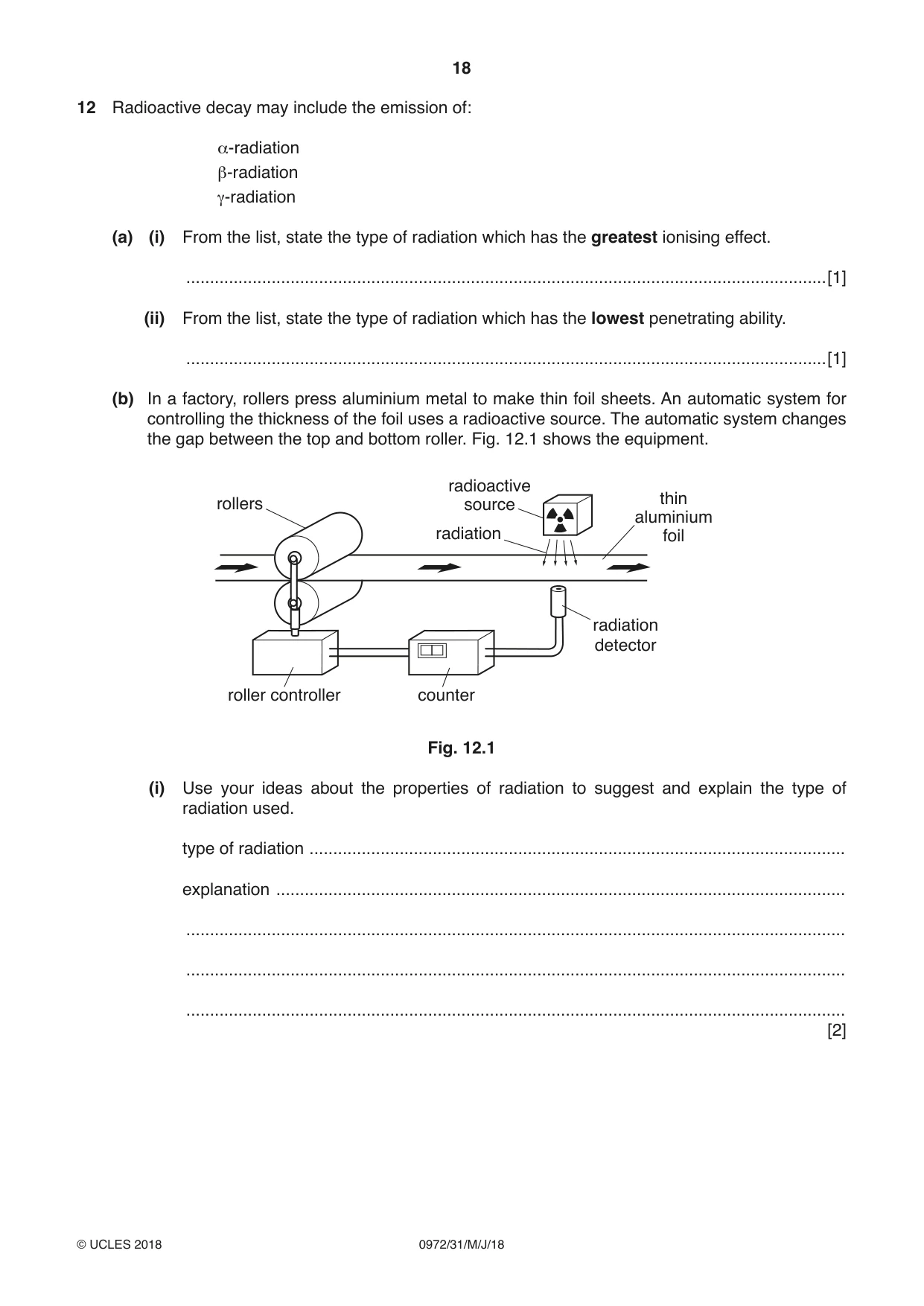
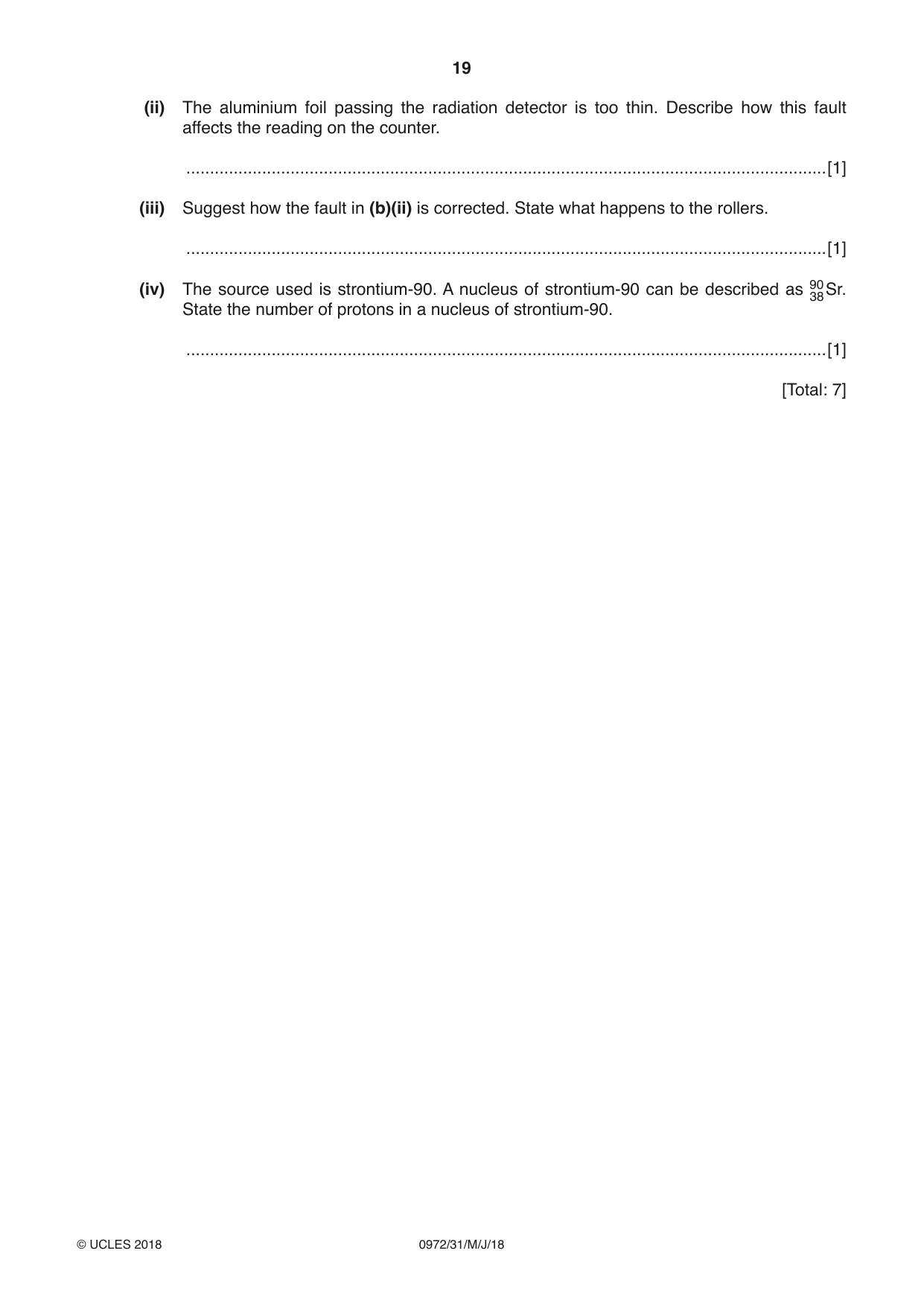
12 Radioactive decay may include the emission of: α-radiation β-radiation γ-radiation (a) (i) From the list, state the type of radiation which has the greatest ionising effect. .......................................................................................................................................[1] (ii) From the list, state the type of radiation which has the lowest penetrating ability. .......................................................................................................................................[1] (b) In a factory, rollers press aluminium metal to make thin foil sheets. An automatic system for controlling the thickness of the foil uses a radioactive source. The automatic system changes the gap between the top and bottom roller. Fig. 12.1 shows the equipment. radioactive thin rollers source aluminium radiation foil radiation detector roller controller counter Fig. 12.1 (i) Use your ideas about the properties of radiation to suggest and explain the type of radiation used. type of radiation ................................................................................................................. explanation ........................................................................................................................ ........................................................................................................................................... ........................................................................................................................................... ........................................................................................................................................... [2] (ii) The aluminium foil passing the radiation detector is too thin. Describe how this fault affects the reading on the counter. .......................................................................................................................................[1] (iii) Suggest how the fault in (b)(ii) is corrected. State what happens to the rollers. .......................................................................................................................................[1] (iv) The source used is strontium-90. A nucleus of strontium-90 can be described as 9038 Sr. State the number of protons in a nucleus of strontium-90. .......................................................................................................................................[1] [Total: 7]
Mark scheme: 12(a)(i) 1 12(a)(ii) α or alpha 1 12(b)(i) beta or β 1 beta emission would be affected by the thickness of the metal owtte 1 12(b)(ii) (counter) reading higher 1 12(b)(iii) rollers move apart/provide less force/pressure owtte 1 12(b)(iv) 38 1
What was in this paper
The subtopics covered by these 12 questions, and how many questions each got. Open one in a new tab to see every Cambridge question on it.
What you needed in this session
Cambridge’s own grade thresholds for 2018 May/June, Paper 3 · Variant 1. A higher threshold means an easier paper — the bar moves with how the cohort did.