Cambridge IGCSE Physics 0625 — 2007 May/June Paper 5 · Variant 1
0625/51/M/J/07 · 40 marks · ≈45 min
The question paper and its mark scheme, free to read here and free to download. This is Cambridge’s own paper, exactly as it was sat.
Question paper8 pages
Mark scheme3 pages
Answers below. Sit the paper first if you are practising.
Paper as text
Question paper, page 1
This document consists of 8 printed pages and 1 Answer Booklet. SPA (MML 13215 4/06) T25790/7 © UCLES 2007 [Turn over UNIVERSITY OF CAMBRIDGE INTERNATIONAL EXAMINATIONS International General Certificate of Secondary Education READ THESE INSTRUCTIONS FIRST If you have been given an Answer Booklet, follow the instructions on the front cover of the Booklet. Write your Centre number, candidate number and name on all the work you hand in. Write in dark blue or black pen. Do not use staples, paper clips, highlighters, glue or correction fluid. Answer all questions. You are expected to record all your observations as soon as these observations are made. An account of the method of carrying out the experiments is not required. At the end of the examination, hand in only the Answer Booklet. * 7 4 7 3 5 3 0 6 1 4 * PHYSICS 0625/05 Paper 5 Practical Test May/June 2007 1 hour 15 minutes Additional Materials: As listed in the Confidential Instructions www.XtremePapers.com
Question paper, page 2
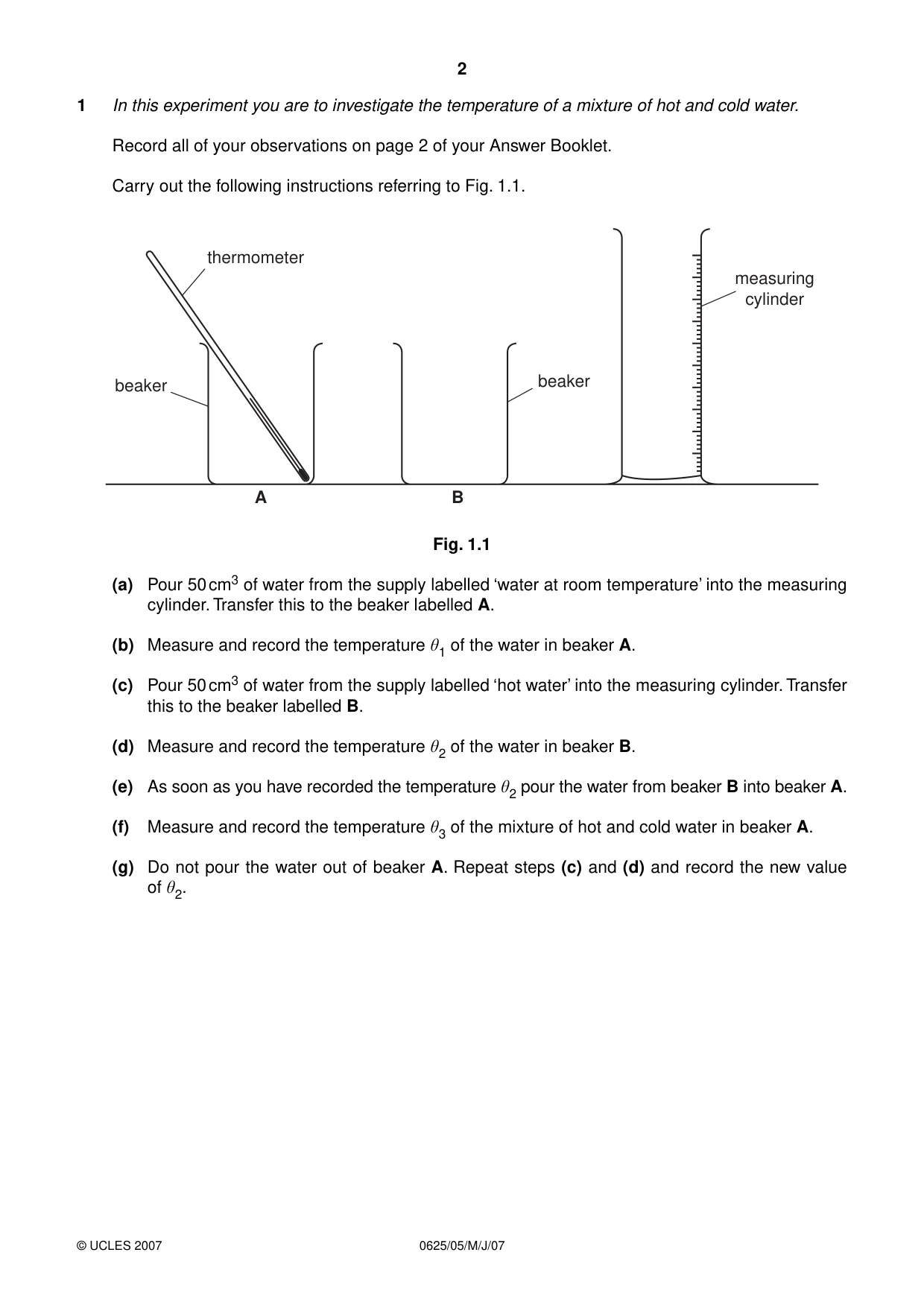
2 0625/05/M/J/07 © UCLES 2007 1 In this experiment you are to investigate the temperature of a mixture of hot and cold water. Record all of your observations on page 2 of your Answer Booklet. Carry out the following instructions referring to Fig. 1.1. thermometer beaker beaker measuring cylinder A B Fig. 1.1 (a) Pour 50 cm3 of water from the supply labelled ‘water at room temperature’ into the measuring cylinder. Transfer this to the beaker labelled A. (b) Measure and record the temperature h1 of the water in beaker A. (c) Pour 50 cm3 of water from the supply labelled ‘hot water’ into the measuring cylinder. Transfer this to the beaker labelled B. (d) Measure and record the temperature h2 of the water in beaker B. (e) As soon as you have recorded the temperature h2 pour the water from beaker B into beaker A. (f) Measure and record the temperature h3 of the mixture of hot and cold water in beaker A. (g) Do not pour the water out of beaker A. Repeat steps (c) and (d) and record the new value of h2.
Question paper, page 3
3 0625/05/M/J/07 © UCLES 2007 [Turn over (h) As soon as you have recorded the new temperature h2 add the water from beaker B to the water already in beaker A. (i) Measure and record the new temperature h3 of the mixture of hot and cold water in beaker A. (j) A theoretical calculation based on the equation thermal energy lost by hot water = thermal energy gained by cold water predicts higher values of the temperature h3 than the values that are obtained by this experiment. Suggest (i) a practical explanation for this difference, (ii) two practical improvements that you could make to the procedure for this experiment to obtain a result that is closer to the theoretical result.
Question paper, page 4
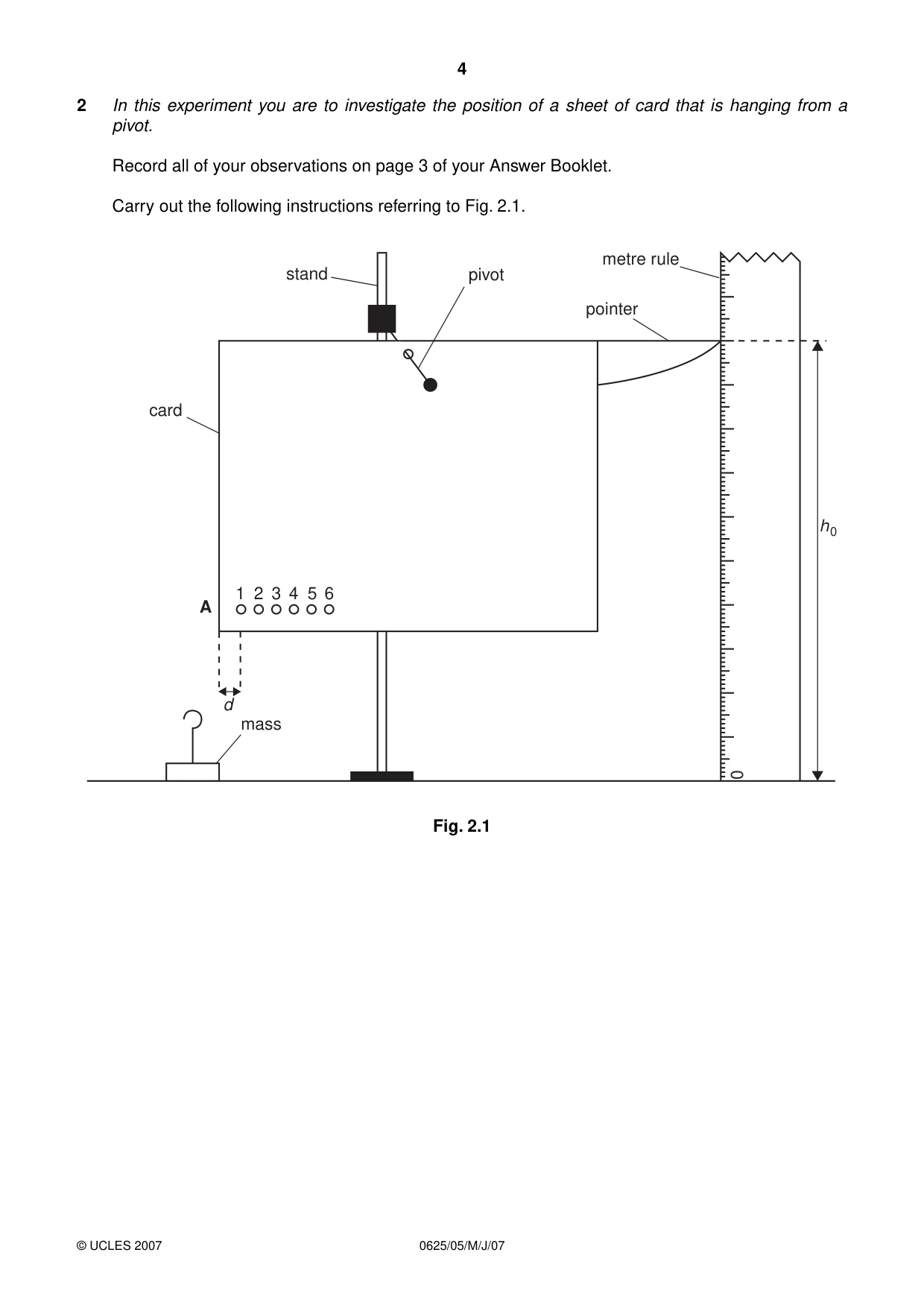
4 0625/05/M/J/07 © UCLES 2007 2 In this experiment you are to investigate the position of a sheet of card that is hanging from a pivot. Record all of your observations on page 3 of your Answer Booklet. Carry out the following instructions referring to Fig. 2.1. stand card mass metre rule pointer 0 h0 A 1 2 3 4 5 6 pivot d Fig. 2.1
Question paper, page 5
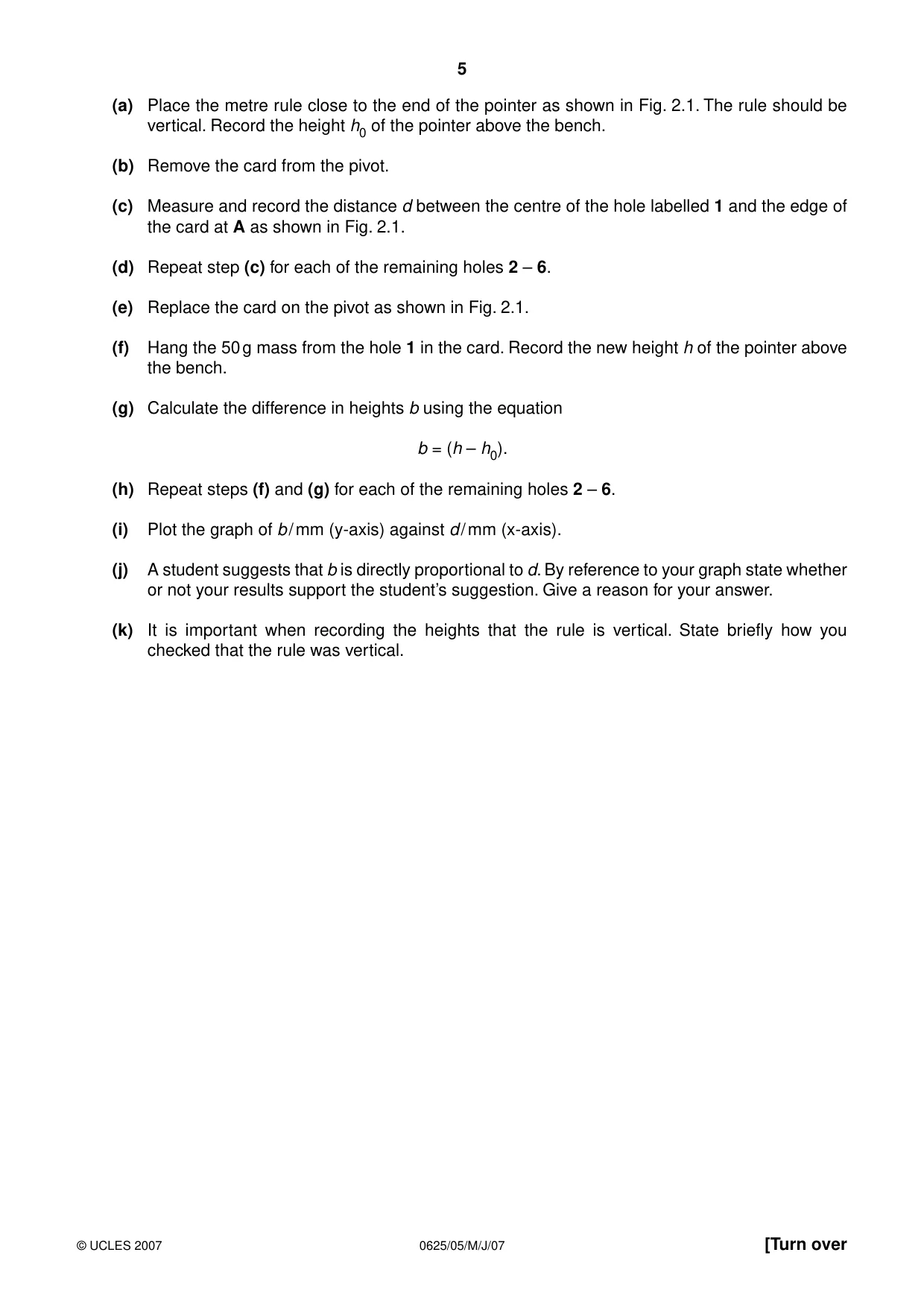
5 0625/05/M/J/07 © UCLES 2007 [Turn over (a) Place the metre rule close to the end of the pointer as shown in Fig. 2.1. The rule should be vertical. Record the height h0 of the pointer above the bench. (b) Remove the card from the pivot. (c) Measure and record the distance d between the centre of the hole labelled 1 and the edge of the card at A as shown in Fig. 2.1. (d) Repeat step (c) for each of the remaining holes 2 – 6. (e) Replace the card on the pivot as shown in Fig. 2.1. (f) Hang the 50 g mass from the hole 1 in the card. Record the new height h of the pointer above the bench. (g) Calculate the difference in heights b using the equation b = (h – h0). (h) Repeat steps (f) and (g) for each of the remaining holes 2 – 6. (i) Plot the graph of b / mm (y-axis) against d / mm (x-axis). (j) A student suggests that b is directly proportional to d. By reference to your graph state whether or not your results support the student’s suggestion. Give a reason for your answer. (k) It is important when recording the heights that the rule is vertical. State briefly how you checked that the rule was vertical.
Question paper, page 6
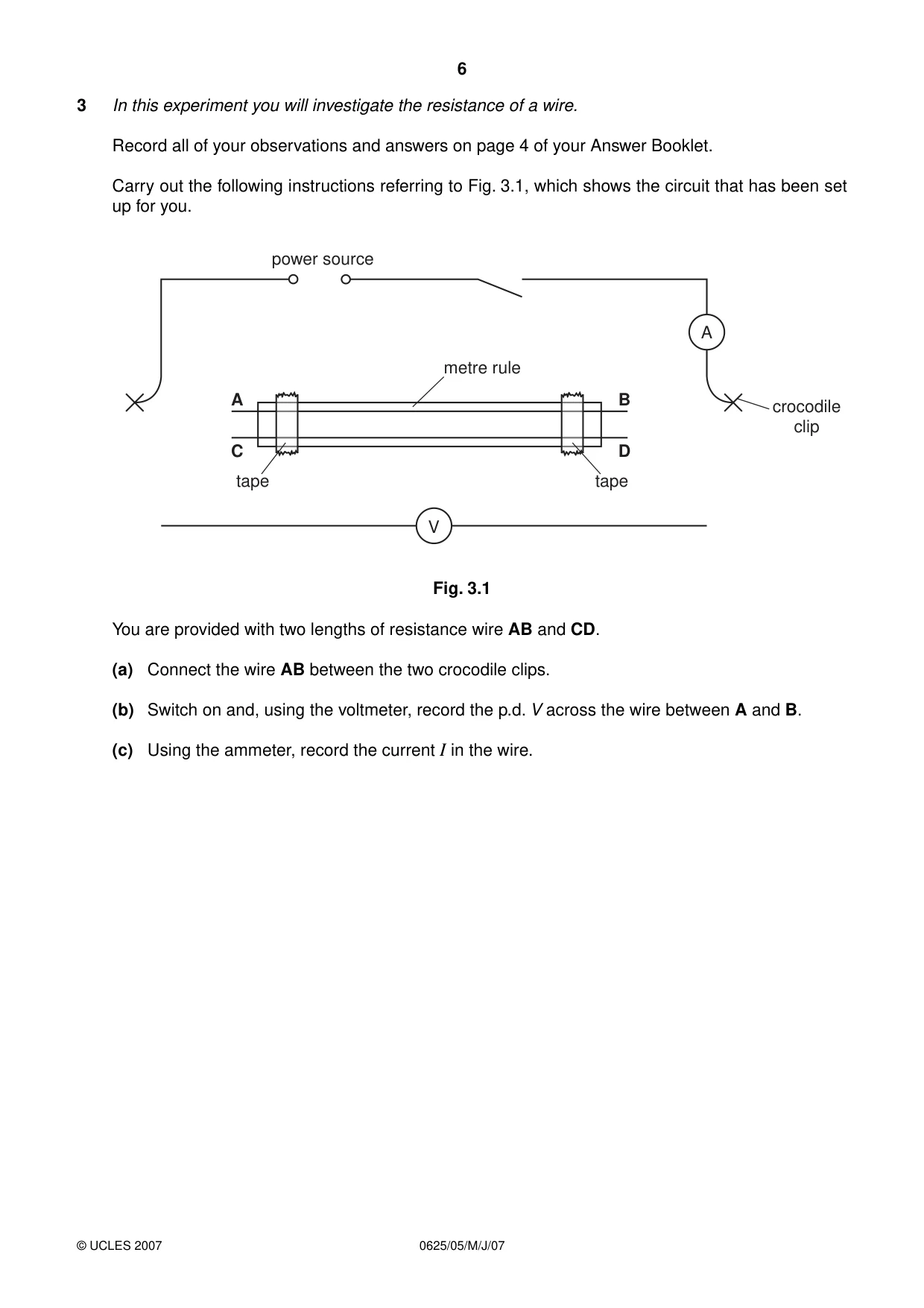
6 0625/05/M/J/07 © UCLES 2007 3 In this experiment you will investigate the resistance of a wire. Record all of your observations and answers on page 4 of your Answer Booklet. Carry out the following instructions referring to Fig. 3.1, which shows the circuit that has been set up for you. power source A V crocodile clip A B C D tape metre rule tape Fig. 3.1 You are provided with two lengths of resistance wire AB and CD. (a) Connect the wire AB between the two crocodile clips. (b) Switch on and, using the voltmeter, record the p.d. V across the wire between A and B. (c) Using the ammeter, record the current I in the wire.
Question paper, page 7
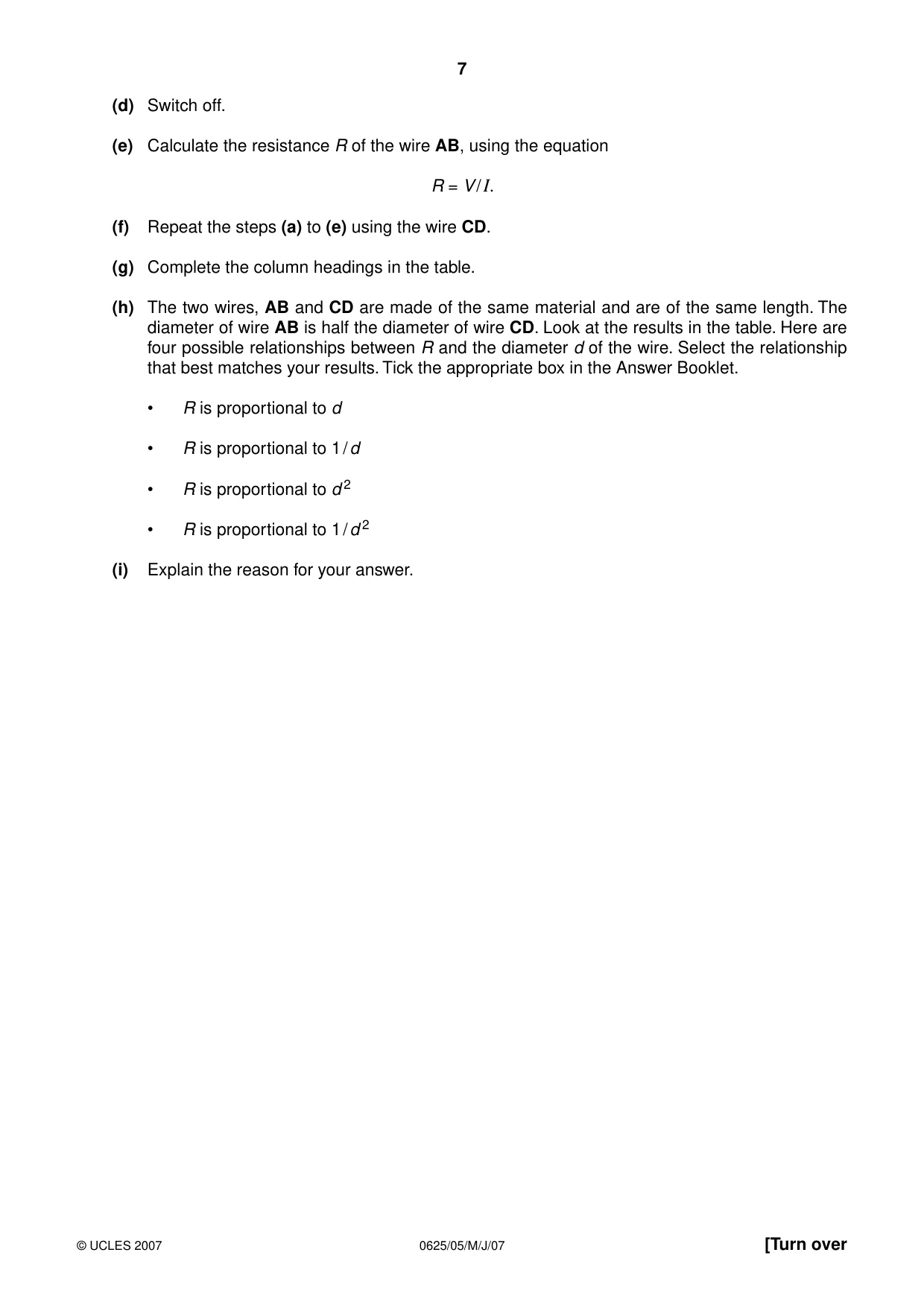
7 0625/05/M/J/07 © UCLES 2007 [Turn over (d) Switch off. (e) Calculate the resistance R of the wire AB, using the equation R = V / I. (f) Repeat the steps (a) to (e) using the wire CD. (g) Complete the column headings in the table. (h) The two wires, AB and CD are made of the same material and are of the same length. The diameter of wire AB is half the diameter of wire CD. Look at the results in the table. Here are four possible relationships between R and the diameter d of the wire. Select the relationship that best matches your results. Tick the appropriate box in the Answer Booklet. • R is proportional to d • R is proportional to 1 / d • R is proportional to d 2 • R is proportional to 1 / d 2 (i) Explain the reason for your answer.
Question paper, page 8
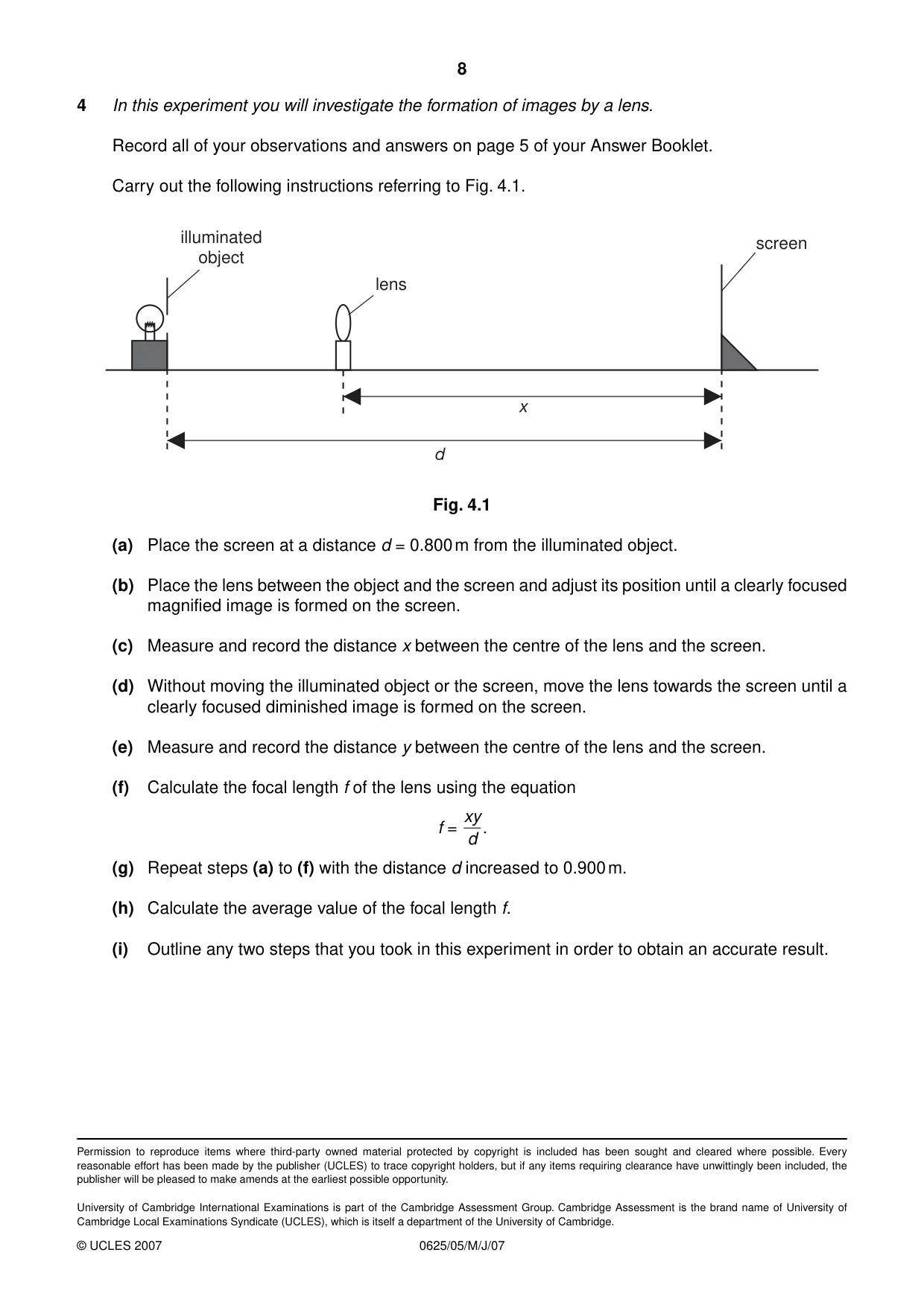
8 0625/05/M/J/07 © UCLES 2007 4 In this experiment you will investigate the formation of images by a lens. Record all of your observations and answers on page 5 of your Answer Booklet. Carry out the following instructions referring to Fig. 4.1. illuminated object lens screen x d Fig. 4.1 (a) Place the screen at a distance d = 0.800 m from the illuminated object. (b) Place the lens between the object and the screen and adjust its position until a clearly focused magnified image is formed on the screen. (c) Measure and record the distance x between the centre of the lens and the screen. (d) Without moving the illuminated object or the screen, move the lens towards the screen until a clearly focused diminished image is formed on the screen. (e) Measure and record the distance y between the centre of the lens and the screen. (f) Calculate the focal length f of the lens using the equation f = xy d . (g) Repeat steps (a) to (f) with the distance d increased to 0.900 m. (h) Calculate the average value of the focal length f. (i) Outline any two steps that you took in this experiment in order to obtain an accurate result. Permission to reproduce items where third-party owned material protected by copyright is included has been sought and cleared where possible. Every reasonable effort has been made by the publisher (UCLES) to trace copyright holders, but if any items requiring clearance have unwittingly been included, the publisher will be pleased to make amends at the earliest possible opportunity. University of Cambridge International Examinations is part of the Cambridge Assessment Group. Cambridge Assessment is the brand name of University of Cambridge Local Examinations Syndicate (UCLES), which is itself a department of the University of Cambridge.
Mark scheme, page 1
UNIVERSITY OF CAMBRIDGE INTERNATIONAL EXAMINATIONS International General Certificate of Secondary Education MARK SCHEME for the May/June 2007 question paper 0625 PHYSICS 0625/05 Paper 5 (Practical), maximum raw mark 40 This mark scheme is published as an aid to teachers and candidates, to indicate the requirements of the examination. It shows the basis on which Examiners were instructed to award marks. It does not indicate the details of the discussions that took place at an Examiners’ meeting before marking began. All Examiners are instructed that alternative correct answers and unexpected approaches in candidates’ scripts must be given marks that fairly reflect the relevant knowledge and skills demonstrated. Mark schemes must be read in conjunction with the question papers and the report on the examination. • CIE will not enter into discussions or correspondence in connection with these mark schemes. CIE is publishing the mark schemes for the May/June 2007 question papers for most IGCSE, GCE Advanced Level and Advanced Subsidiary Level syllabuses and some Ordinary Level syllabuses. www.XtremePapers.com
Mark scheme, page 2
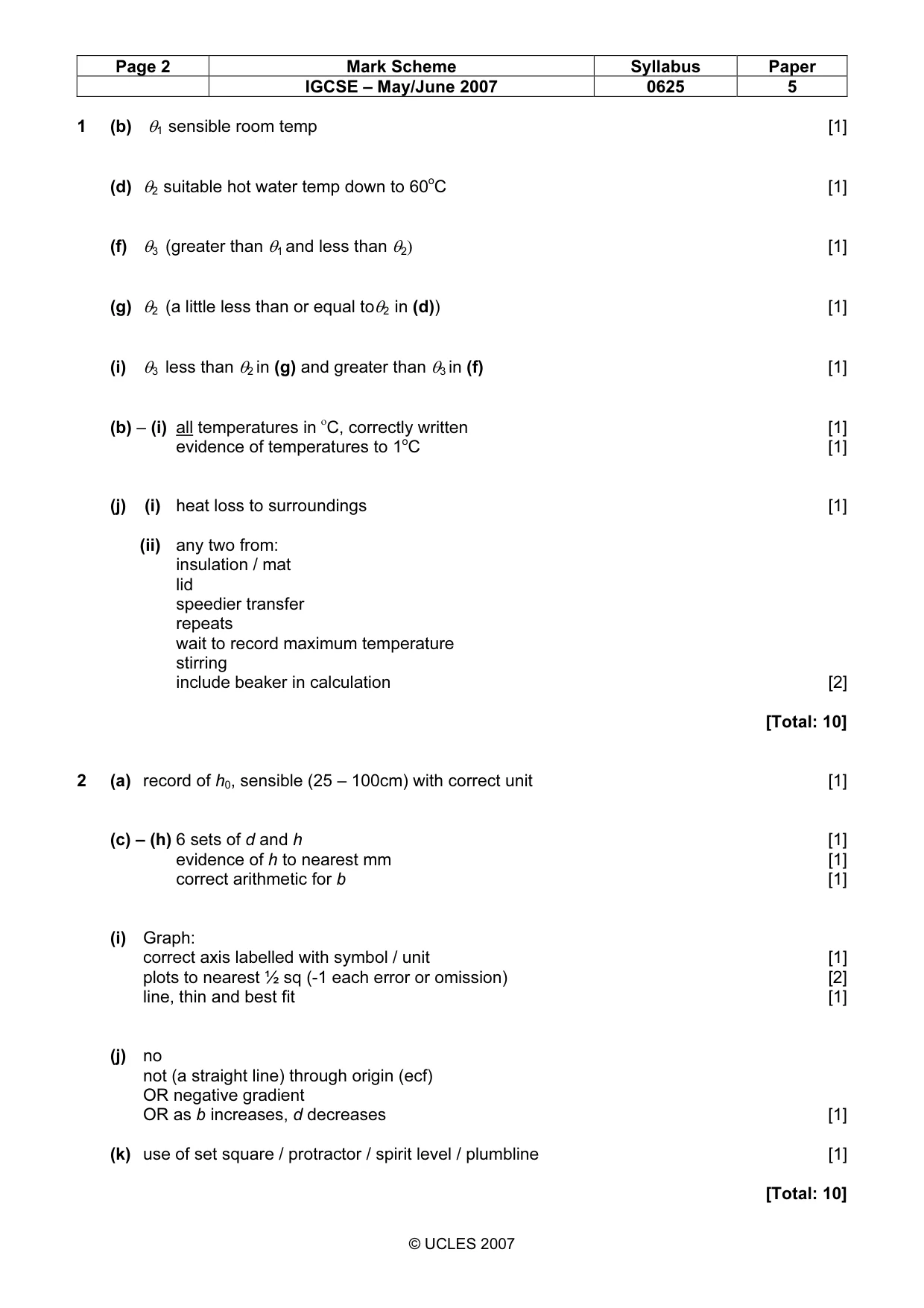
Page 2 Mark Scheme Syllabus Paper IGCSE – May/June 2007 0625 5 © UCLES 2007 1 (b) θ1 sensible room temp [1] (d) θ2 suitable hot water temp down to 60oC [1] (f) θ3 (greater than θ1 and less than θ2) [1] (g) θ2 (a little less than or equal toθ2 in (d)) [1] (i) θ3 less than θ2 in (g) and greater than θ3 in (f) [1] (b) – (i) all temperatures in οC, correctly written [1] evidence of temperatures to 1oC [1] (j) (i) heat loss to surroundings [1] (ii) any two from: insulation / mat lid speedier transfer repeats wait to record maximum temperature stirring include beaker in calculation [2] [Total: 10] 2 (a) record of h0, sensible (25 – 100cm) with correct unit [1] (c) – (h) 6 sets of d and h [1] evidence of h to nearest mm [1] correct arithmetic for b [1] (i) Graph: correct axis labelled with symbol / unit [1] plots to nearest ½ sq (-1 each error or omission) [2] line, thin and best fit [1] (j) no not (a straight line) through origin (ecf) OR negative gradient OR as b increases, d decreases [1] (k) use of set square / protractor / spirit level / plumbline [1] [Total: 10]
Mark scheme, page 3
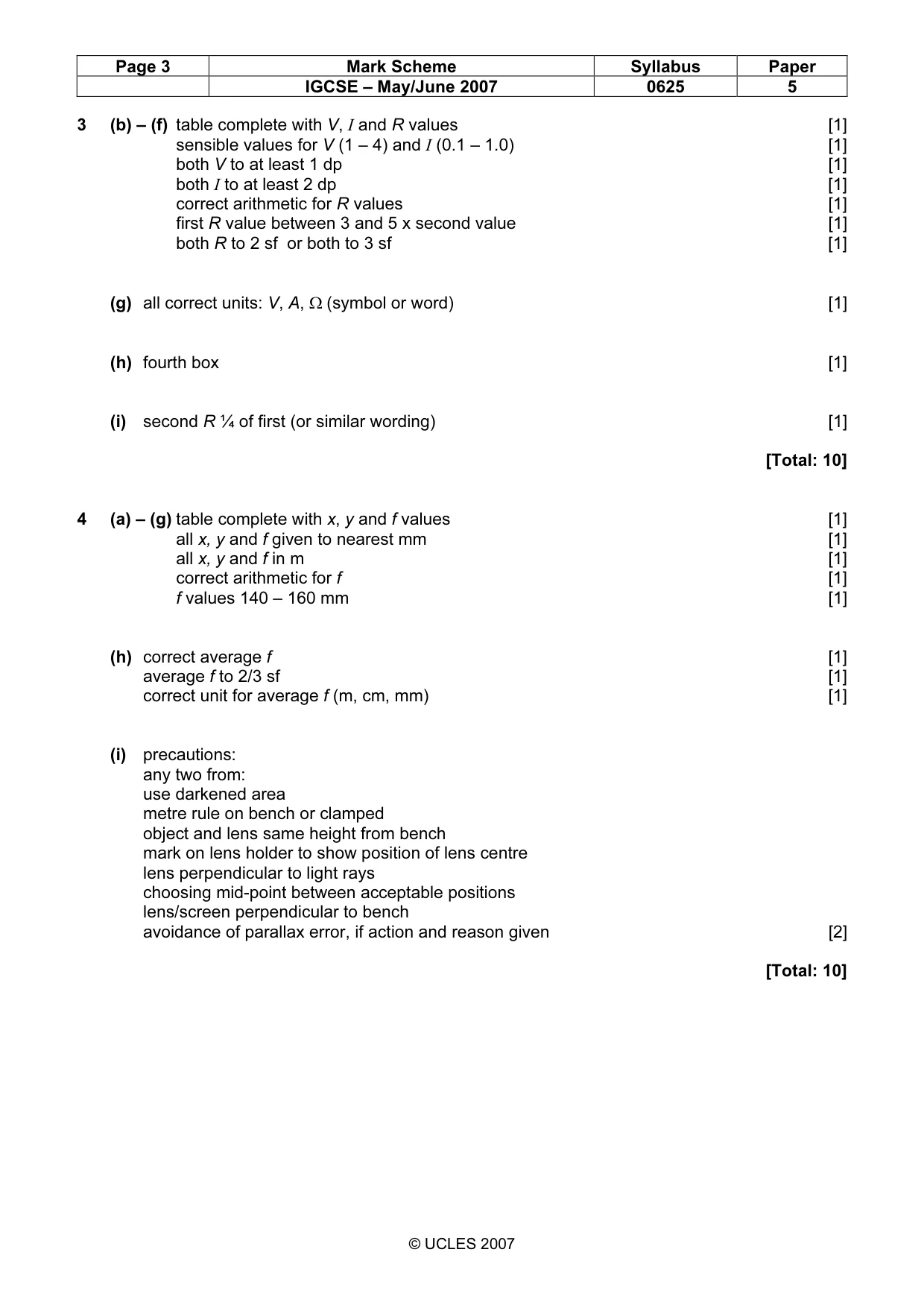
Page 3 Mark Scheme Syllabus Paper IGCSE – May/June 2007 0625 5 © UCLES 2007 3 (b) – (f) table complete with V, I and R values [1] sensible values for V (1 – 4) and I (0.1 – 1.0) [1] both V to at least 1 dp [1] both I to at least 2 dp [1] correct arithmetic for R values [1] first R value between 3 and 5 x second value [1] both R to 2 sf or both to 3 sf [1] (g) all correct units: V, A, Ω (symbol or word) [1] (h) fourth box [1] (i) second R ¼ of first (or similar wording) [1] [Total: 10] 4 (a) – (g) table complete with x, y and f values [1] all x, y and f given to nearest mm [1] all x, y and f in m [1] correct arithmetic for f [1] f values 140 – 160 mm [1] (h) correct average f [1] average f to 2/3 sf [1] correct unit for average f (m, cm, mm) [1] (i) precautions: any two from: use darkened area metre rule on bench or clamped object and lens same height from bench mark on lens holder to show position of lens centre lens perpendicular to light rays choosing mid-point between acceptable positions lens/screen perpendicular to bench avoidance of parallax error, if action and reason given [2] [Total: 10]
What you needed in this session
Cambridge’s own grade thresholds for 2007 May/June, Paper 5 · Variant 1. A higher threshold means an easier paper — the bar moves with how the cohort did.