Cambridge IGCSE Physical Science 0652 — 2016 Oct/Nov Paper 6 · Variant 1
0652/61/O/N/16 · 60 marks · ≈68 min
The question paper and its mark scheme, free to read here and free to download. This is Cambridge’s own paper, exactly as it was sat.
Question paper20 pages

Mark scheme6 pages
Answers below. Sit the paper first if you are practising.
Paper as text
Question paper, page 1
This document consists of 18 printed pages and 2 blank pages. DC (RW/SG) 128600/3 © UCLES 2016 [Turn over * 4 4 9 3 0 8 2 6 1 2 * PHYSICAL SCIENCE 0652/61 Paper 6 Alternative to Practical October/November 2016 1 hour Candidates answer on the Question Paper. No Additional Materials are required. READ THESE INSTRUCTIONS FIRST Write your Centre number, candidate number and name on all the work you hand in. Write in dark blue or black pen. You may use an HB pencil for any diagrams or graphs. Do not use staples, paper clips, glue or correction fluid. DO NOT WRITE IN ANY BARCODES. Answer all questions. Electronic calculators may be used. You may lose marks if you do not show your working or if you do not use appropriate units. At the end of the examination, fasten all your work securely together. The number of marks is given in brackets [ ] at the end of each question or part question. Cambridge International Examinations Cambridge International General Certificate of Secondary Education
Question paper, page 2
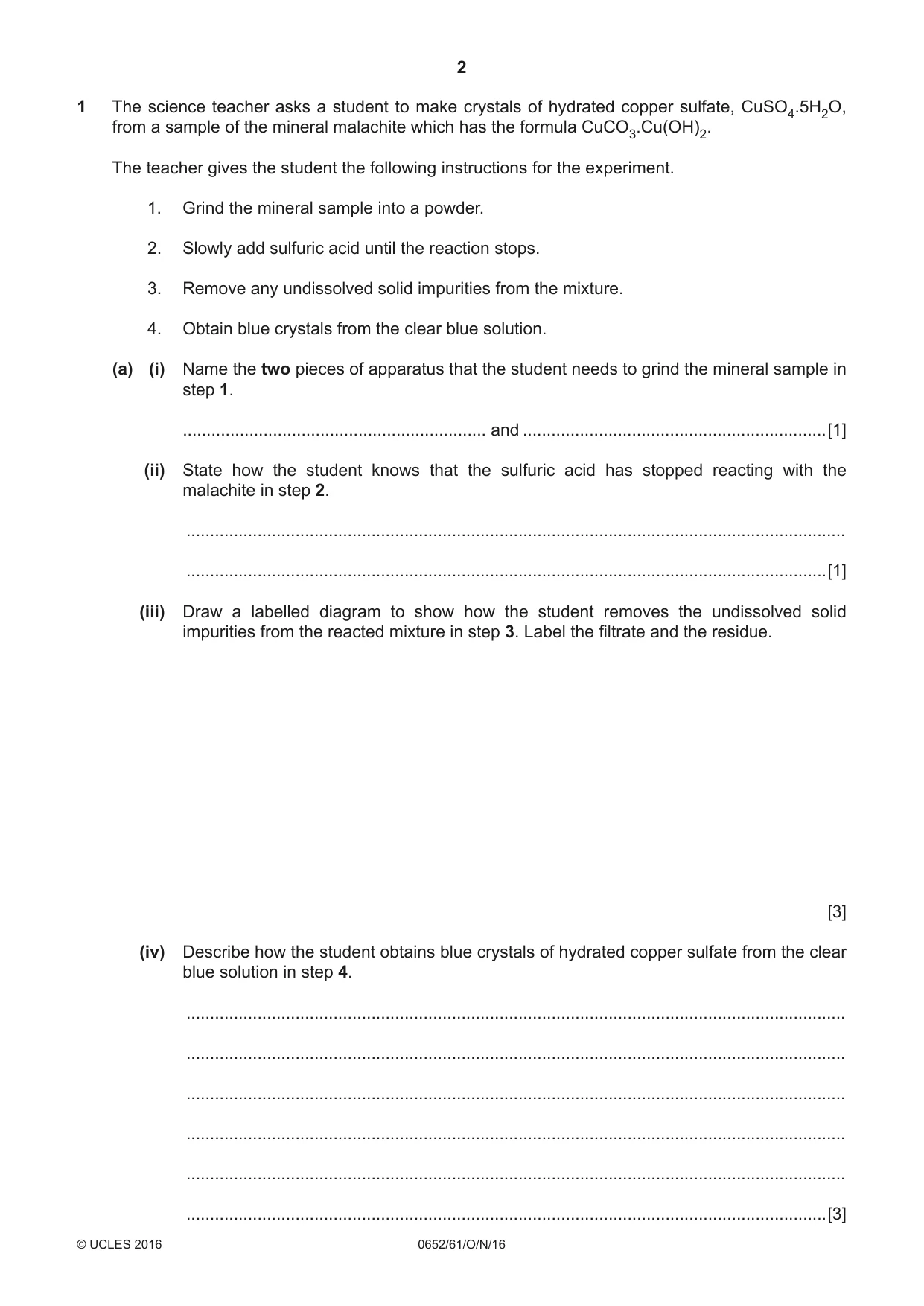
2 0652/61/O/N/16 © UCLES 2016 1 The science teacher asks a student to make crystals of hydrated copper sulfate, CuSO4.5H2O, from a sample of the mineral malachite which has the formula CuCO3.Cu(OH)2. The teacher gives the student the following instructions for the experiment. 1. Grind the mineral sample into a powder. 2. Slowly add sulfuric acid until the reaction stops. 3. Remove any undissolved solid impurities from the mixture. 4. Obtain blue crystals from the clear blue solution. (a) (i) Name the two pieces of apparatus that the student needs to grind the mineral sample in step 1. … and …[1] (ii) State how the student knows that the sulfuric acid has stopped reacting with the malachite in step 2. … …[1] (iii) Draw a labelled diagram to show how the student removes the undissolved solid impurities from the reacted mixture in step 3. Label the filtrate and the residue. [3] (iv) Describe how the student obtains blue crystals of hydrated copper sulfate from the clear blue solution in step 4. … … … … … …[3]
Question paper, page 3
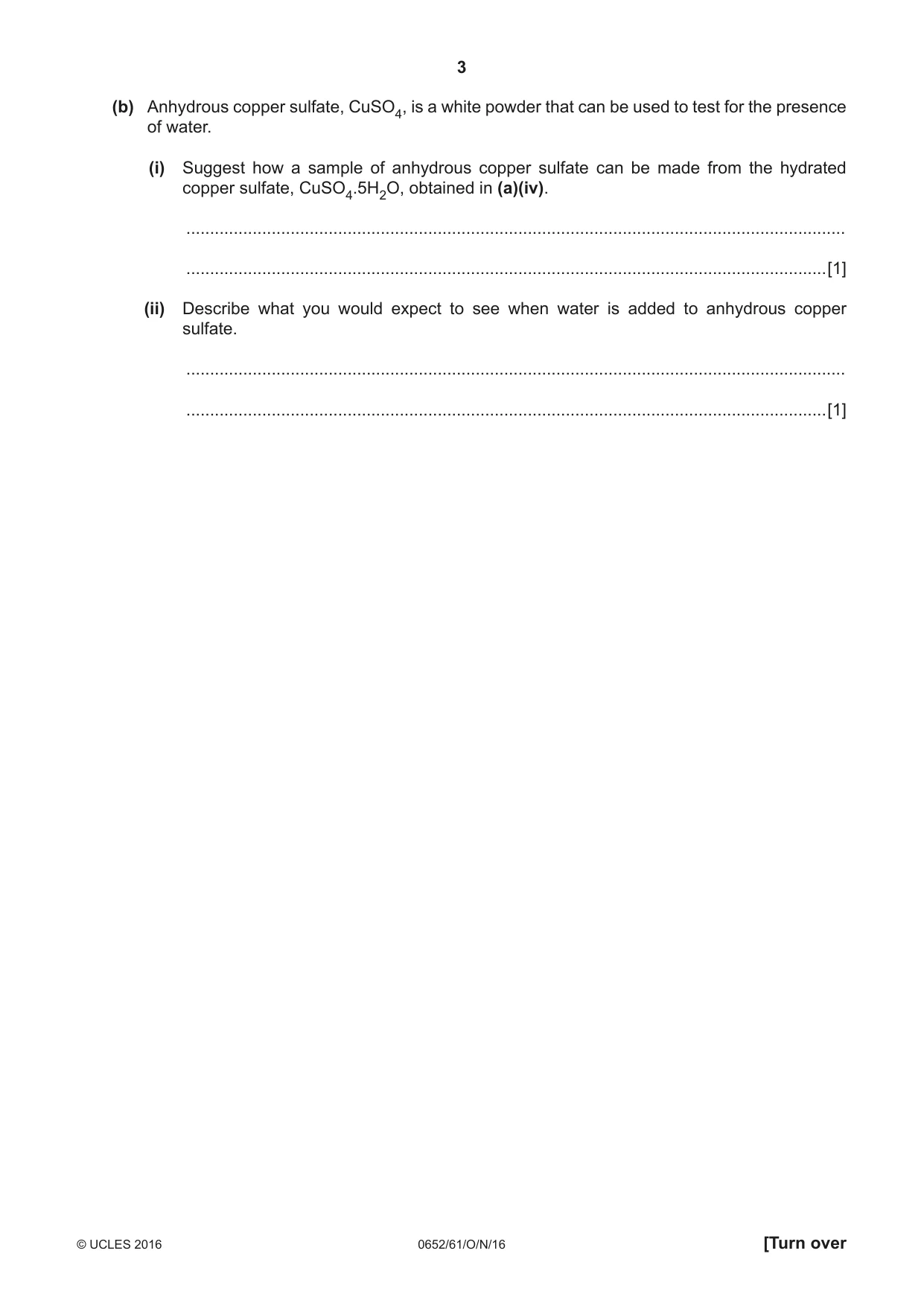
3 0652/61/O/N/16 © UCLES 2016 [Turn over (b) Anhydrous copper sulfate, CuSO4, is a white powder that can be used to test for the presence of water. (i) Suggest how a sample of anhydrous copper sulfate can be made from the hydrated copper sulfate, CuSO4.5H2O, obtained in (a)(iv). … …[1] (ii) Describe what you would expect to see when water is added to anhydrous copper sulfate. … …[1]
Question paper, page 4
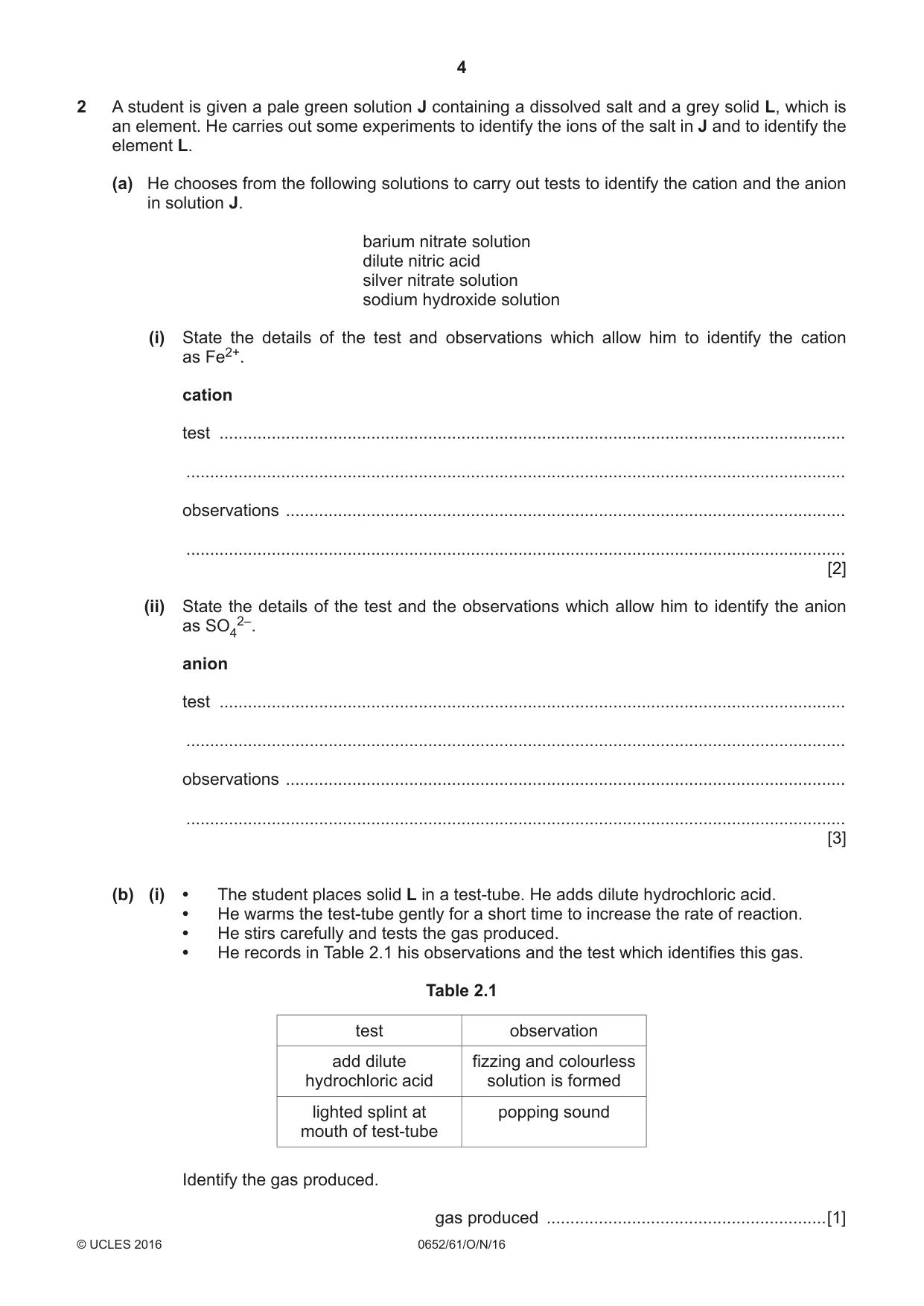
4 0652/61/O/N/16 © UCLES 2016 2 A student is given a pale green solution J containing a dissolved salt and a grey solid L, which is an element. He carries out some experiments to identify the ions of the salt in J and to identify the element L. (a) He chooses from the following solutions to carry out tests to identify the cation and the anion in solution J. barium nitrate solution dilute nitric acid silver nitrate solution sodium hydroxide solution (i) State the details of the test and observations which allow him to identify the cation as Fe2+. cation test … … observations … … [2] (ii) State the details of the test and the observations which allow him to identify the anion as SO4 2–. anion test … … observations … … [3] (b) (i) • The student places solid L in a test-tube. He adds dilute hydrochloric acid. • He warms the test-tube gently for a short time to increase the rate of reaction. • He stirs carefully and tests the gas produced. • He records in Table 2.1 his observations and the test which identifies this gas. Table 2.1 test observation add dilute hydrochloric acid fizzing and colourless solution is formed lighted splint at mouth of test-tube popping sound Identify the gas produced. gas produced …[1]
Question paper, page 5
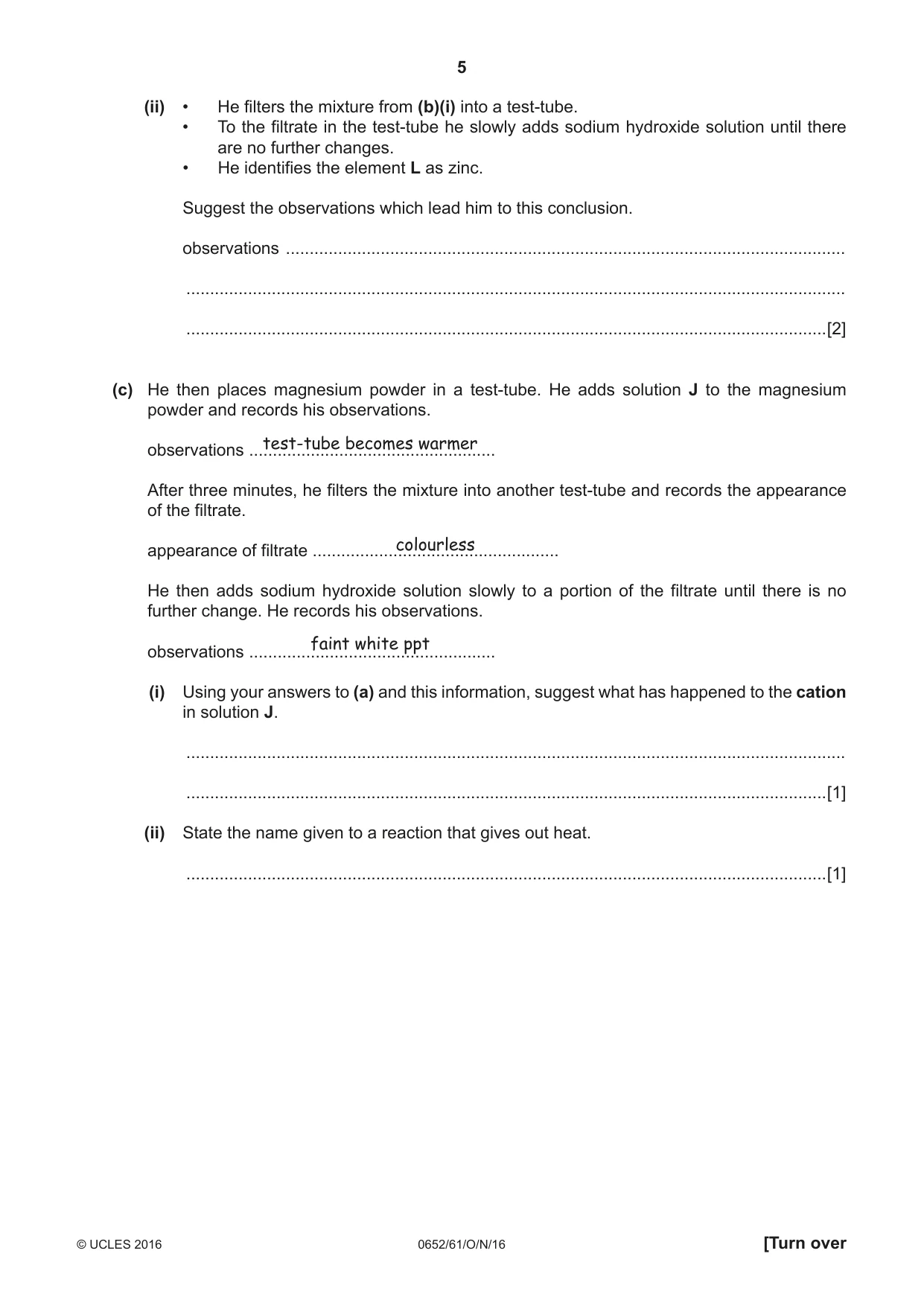
5 0652/61/O/N/16 © UCLES 2016 [Turn over (ii) • He filters the mixture from (b)(i) into a test-tube. • To the filtrate in the test-tube he slowly adds sodium hydroxide solution until there are no further changes. • He identifies the element L as zinc. Suggest the observations which lead him to this conclusion. observations … … …[2] (c) He then places magnesium powder in a test-tube. He adds solution J to the magnesium powder and records his observations. test-tube becomes warmer observations … After three minutes, he filters the mixture into another test-tube and records the appearance of the filtrate. colourless appearance of filtrate … He then adds sodium hydroxide solution slowly to a portion of the filtrate until there is no further change. He records his observations. faint white ppt observations … (i) Using your answers to (a) and this information, suggest what has happened to the cation in solution J. … …[1] (ii) State the name given to a reaction that gives out heat. …[1]
Question paper, page 6
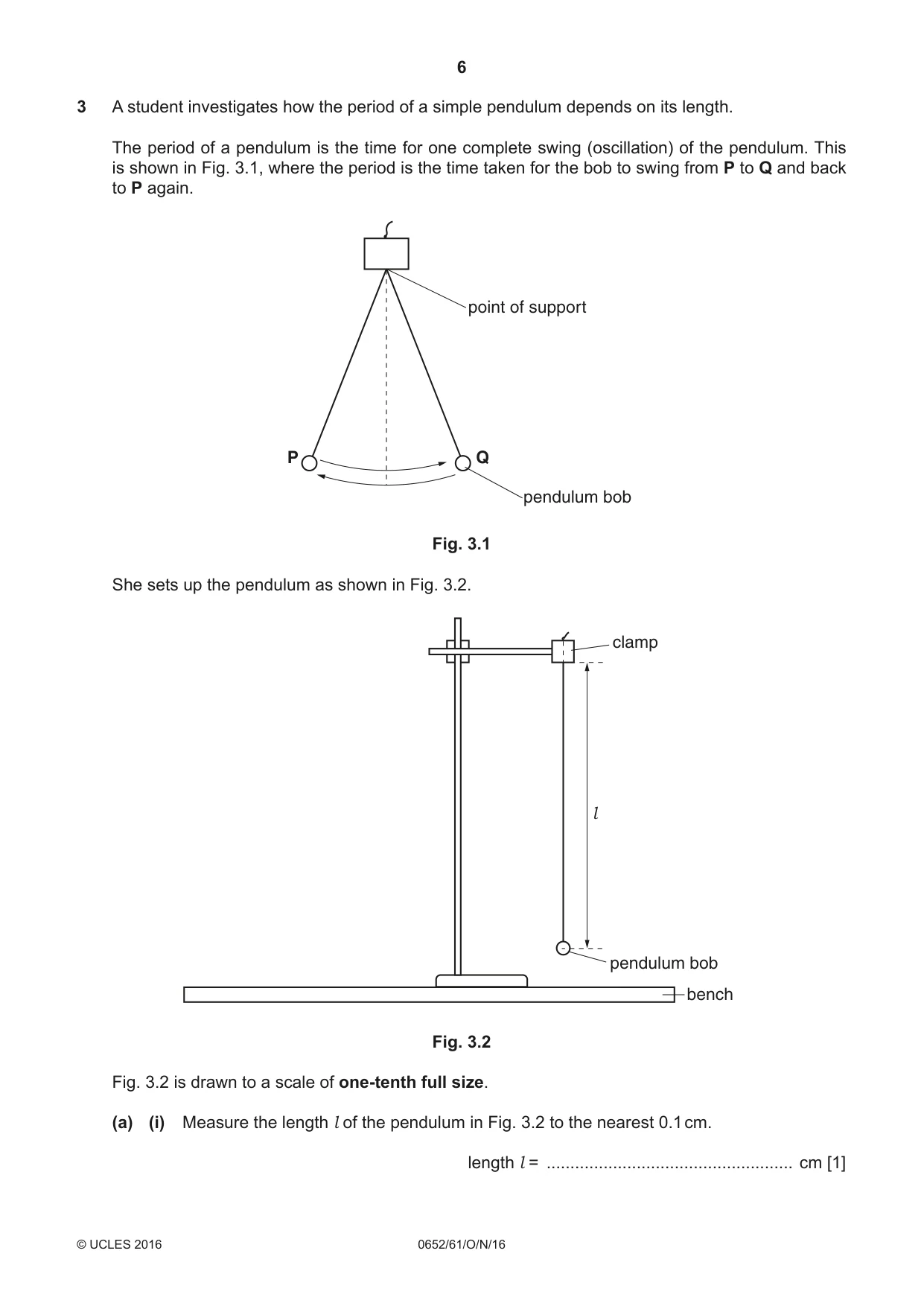
6 0652/61/O/N/16 © UCLES 2016 3 A student investigates how the period of a simple pendulum depends on its length. The period of a pendulum is the time for one complete swing (oscillation) of the pendulum. This is shown in Fig. 3.1, where the period is the time taken for the bob to swing from P to Q and back to P again. point of support pendulum bob P Q Fig. 3.1 She sets up the pendulum as shown in Fig. 3.2. clamp pendulum bob l bench Fig. 3.2 Fig. 3.2 is drawn to a scale of one-tenth full size. (a) (i) Measure the length l of the pendulum in Fig. 3.2 to the nearest 0.1 cm. length l = … cm [1]
Question paper, page 7
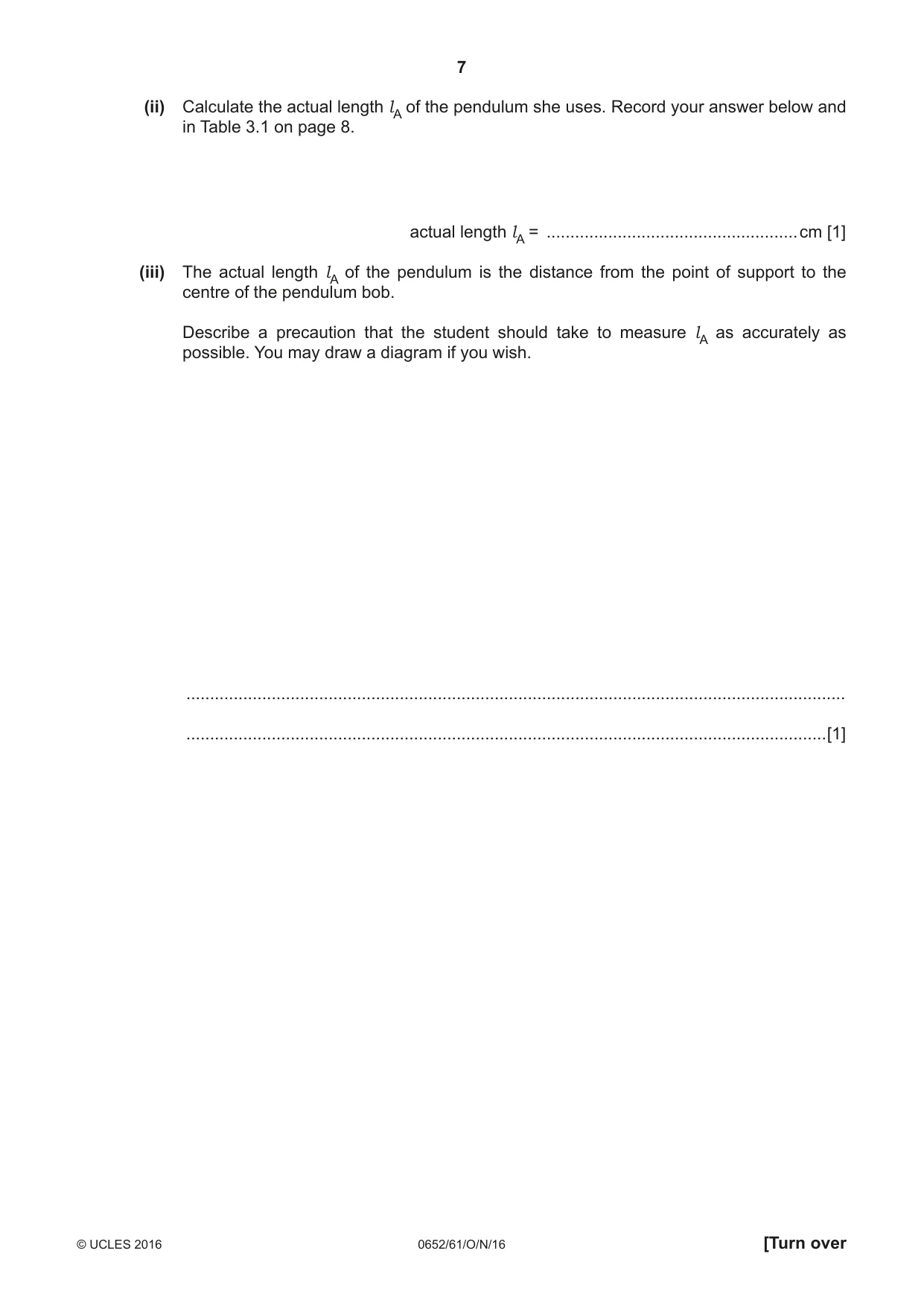
7 0652/61/O/N/16 © UCLES 2016 [Turn over (ii) Calculate the actual length lA of the pendulum she uses. Record your answer below and in Table 3.1 on page 8. actual length lA = …cm [1] (iii) The actual length lA of the pendulum is the distance from the point of support to the centre of the pendulum bob. Describe a precaution that the student should take to measure lA as accurately as possible. You may draw a diagram if you wish. … …[1]
Question paper, page 8
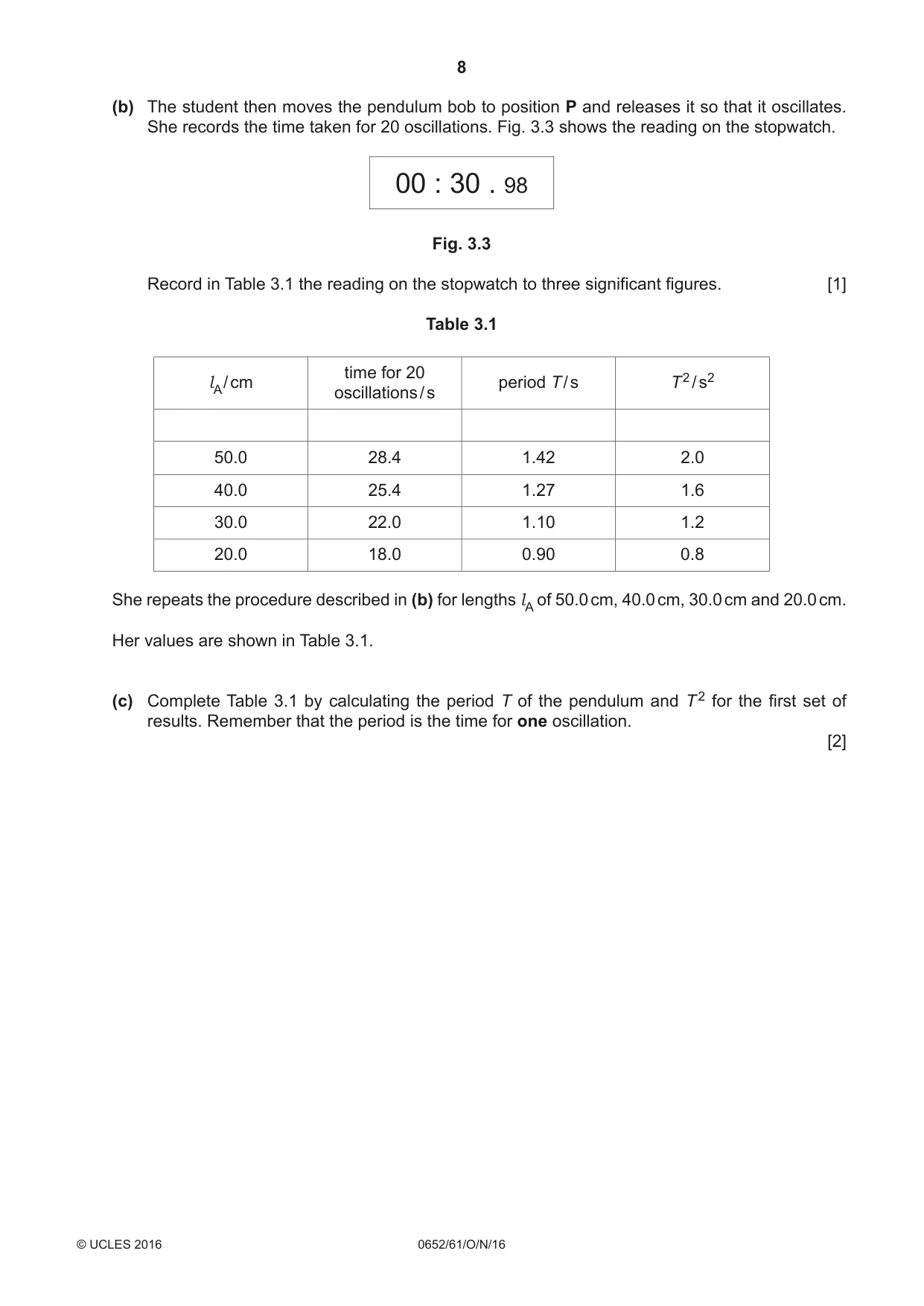
8 0652/61/O/N/16 © UCLES 2016 (b) The student then moves the pendulum bob to position P and releases it so that it oscillates. She records the time taken for 20 oscillations. Fig. 3.3 shows the reading on the stopwatch. 00 : 30 . 98 Fig. 3.3 Record in Table 3.1 the reading on the stopwatch to three significant figures. [1] Table 3.1 lA / cm time for 20 oscillations / s period T / s T 2 / s2 50.0 28.4 1.42 2.0 40.0 25.4 1.27 1.6 30.0 22.0 1.10 1.2 20.0 18.0 0.90 0.8 She repeats the procedure described in (b) for lengths lA of 50.0 cm, 40.0 cm, 30.0 cm and 20.0 cm. Her values are shown in Table 3.1. (c) Complete Table 3.1 by calculating the period T of the pendulum and T 2 for the first set of results. Remember that the period is the time for one oscillation. [2]
Question paper, page 9
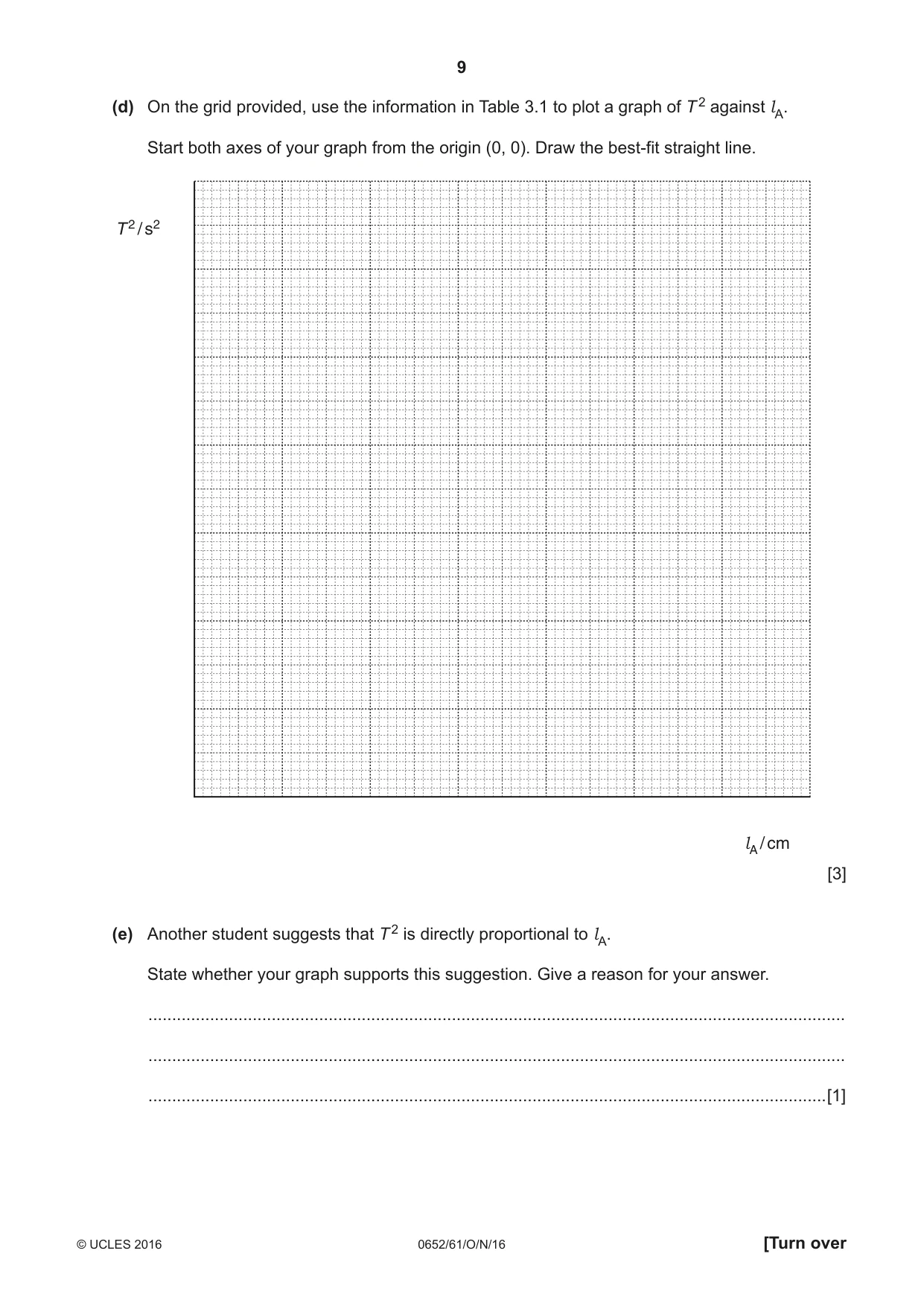
9 0652/61/O/N/16 © UCLES 2016 [Turn over (d) On the grid provided, use the information in Table 3.1 to plot a graph of T 2 against lA. Start both axes of your graph from the origin (0, 0). Draw the best-fit straight line. T 2 / s2 lA / cm [3] (e) Another student suggests that T 2 is directly proportional to lA. State whether your graph supports this suggestion. Give a reason for your answer. … … …[1]
Question paper, page 10
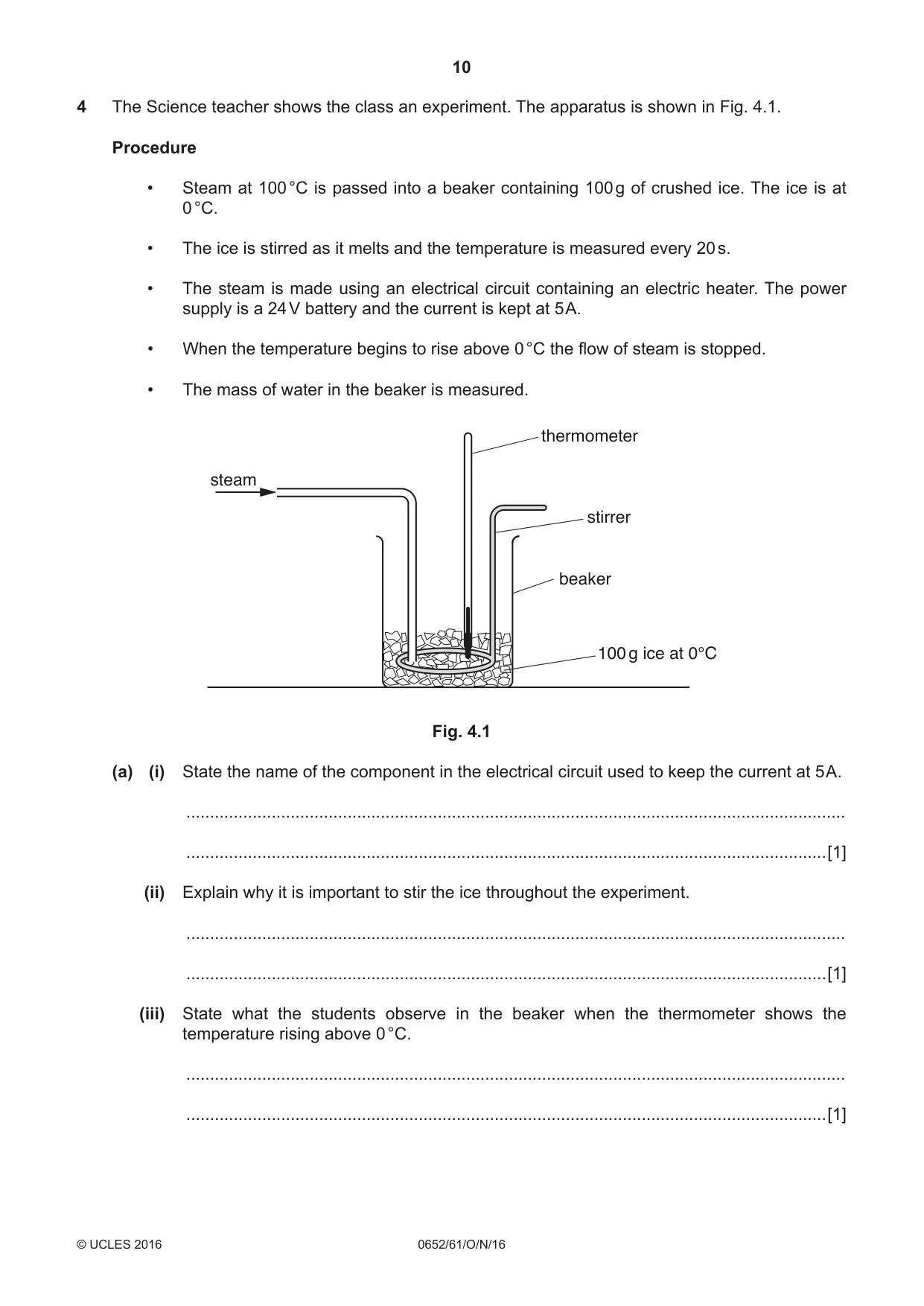
10 0652/61/O/N/16 © UCLES 2016 4 The Science teacher shows the class an experiment. The apparatus is shown in Fig. 4.1. Procedure • Steam at 100 °C is passed into a beaker containing 100 g of crushed ice. The ice is at 0 °C. • The ice is stirred as it melts and the temperature is measured every 20 s. • The steam is made using an electrical circuit containing an electric heater. The power supply is a 24 V battery and the current is kept at 5 A. • When the temperature begins to rise above 0 °C the flow of steam is stopped. • The mass of water in the beaker is measured. steam 100 g ice at 0°C beaker stirrer thermometer Fig. 4.1 (a) (i) State the name of the component in the electrical circuit used to keep the current at 5 A. … …[1] (ii) Explain why it is important to stir the ice throughout the experiment. … …[1] (iii) State what the students observe in the beaker when the thermometer shows the temperature rising above 0 °C. … …[1]
Question paper, page 11
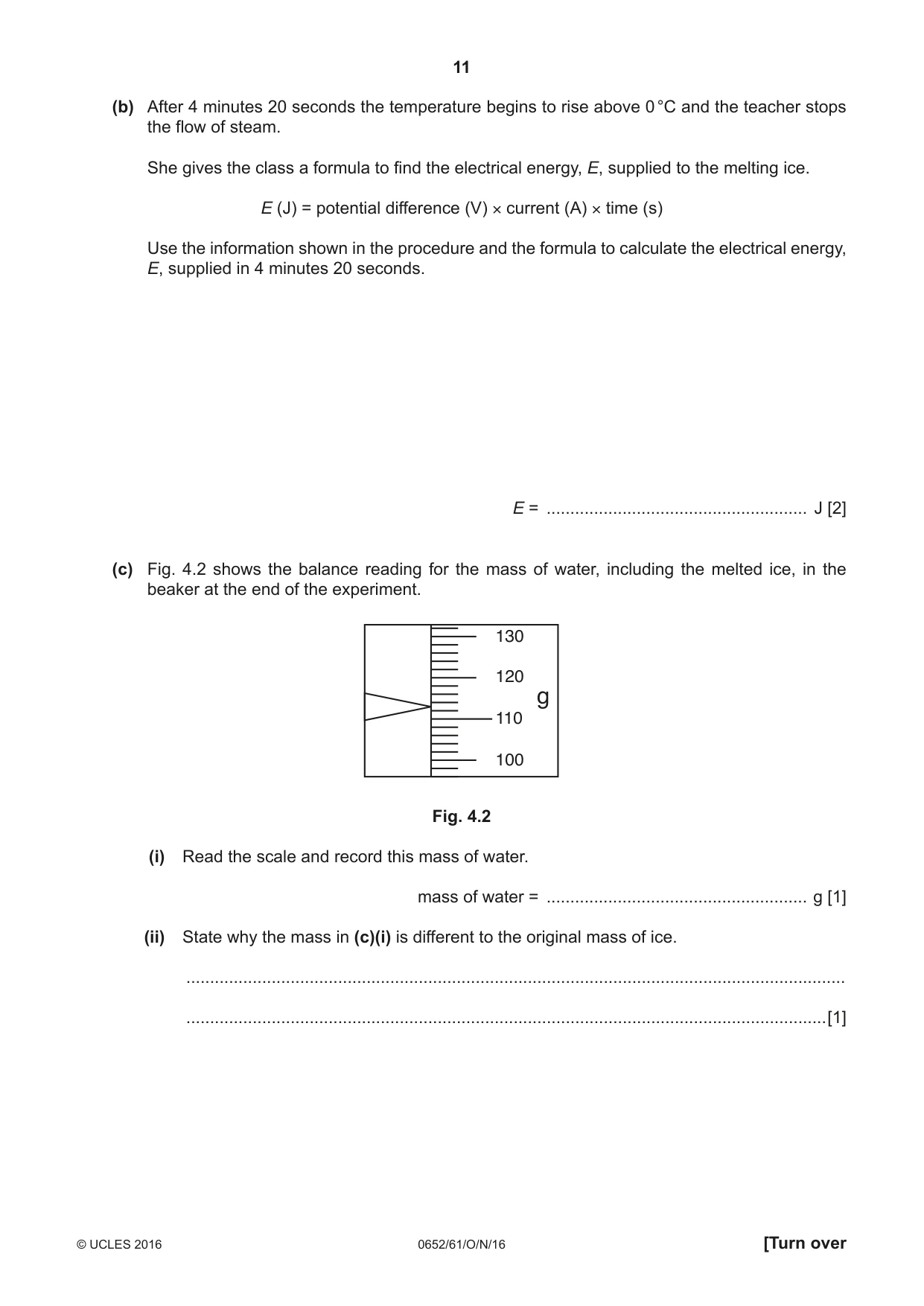
11 0652/61/O/N/16 © UCLES 2016 [Turn over (b) After 4 minutes 20 seconds the temperature begins to rise above 0 °C and the teacher stops the flow of steam. She gives the class a formula to find the electrical energy, E, supplied to the melting ice. E (J) = potential difference (V) × current (A) × time (s) Use the information shown in the procedure and the formula to calculate the electrical energy, E, supplied in 4 minutes 20 seconds. E = … J [2] (c) Fig. 4.2 shows the balance reading for the mass of water, including the melted ice, in the beaker at the end of the experiment. 120 130 110 100 g Fig. 4.2 (i) Read the scale and record this mass of water. mass of water = … g [1] (ii) State why the mass in (c)(i) is different to the original mass of ice. … …[1]
Question paper, page 12
12 0652/61/O/N/16 © UCLES 2016 (d) The amount of energy, Eice, needed to melt 100 g of ice is less than the electrical energy, E, calculated in (b). (i) Explain why Eice is less than E. … … … …[2] (ii) Suggest a modification to the apparatus in Fig. 4.1 which would reduce the difference between Eice and E. … …[1]
Question paper, page 13
13 0652/61/O/N/16 © UCLES 2016 [Turn over Please turn over for Question 5.
Question paper, page 14
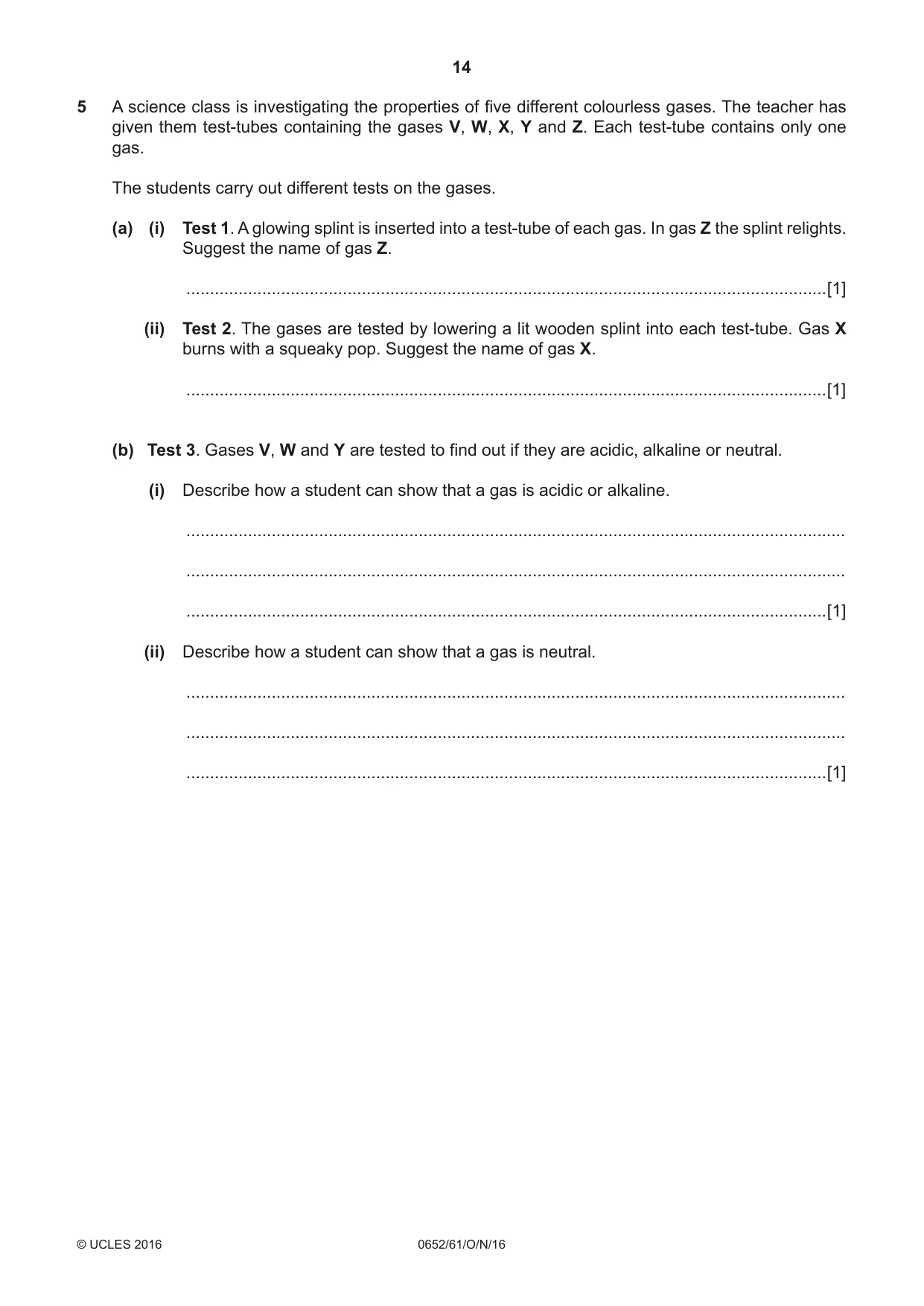
14 0652/61/O/N/16 © UCLES 2016 5 A science class is investigating the properties of five different colourless gases. The teacher has given them test-tubes containing the gases V, W, X, Y and Z. Each test-tube contains only one gas. The students carry out different tests on the gases. (a) (i) Test 1. A glowing splint is inserted into a test-tube of each gas. In gas Z the splint relights. Suggest the name of gas Z. …[1] (ii) Test 2. The gases are tested by lowering a lit wooden splint into each test-tube. Gas X burns with a squeaky pop. Suggest the name of gas X. …[1] (b) Test 3. Gases V, W and Y are tested to find out if they are acidic, alkaline or neutral. (i) Describe how a student can show that a gas is acidic or alkaline. … … …[1] (ii) Describe how a student can show that a gas is neutral. … … …[1]
Question paper, page 15
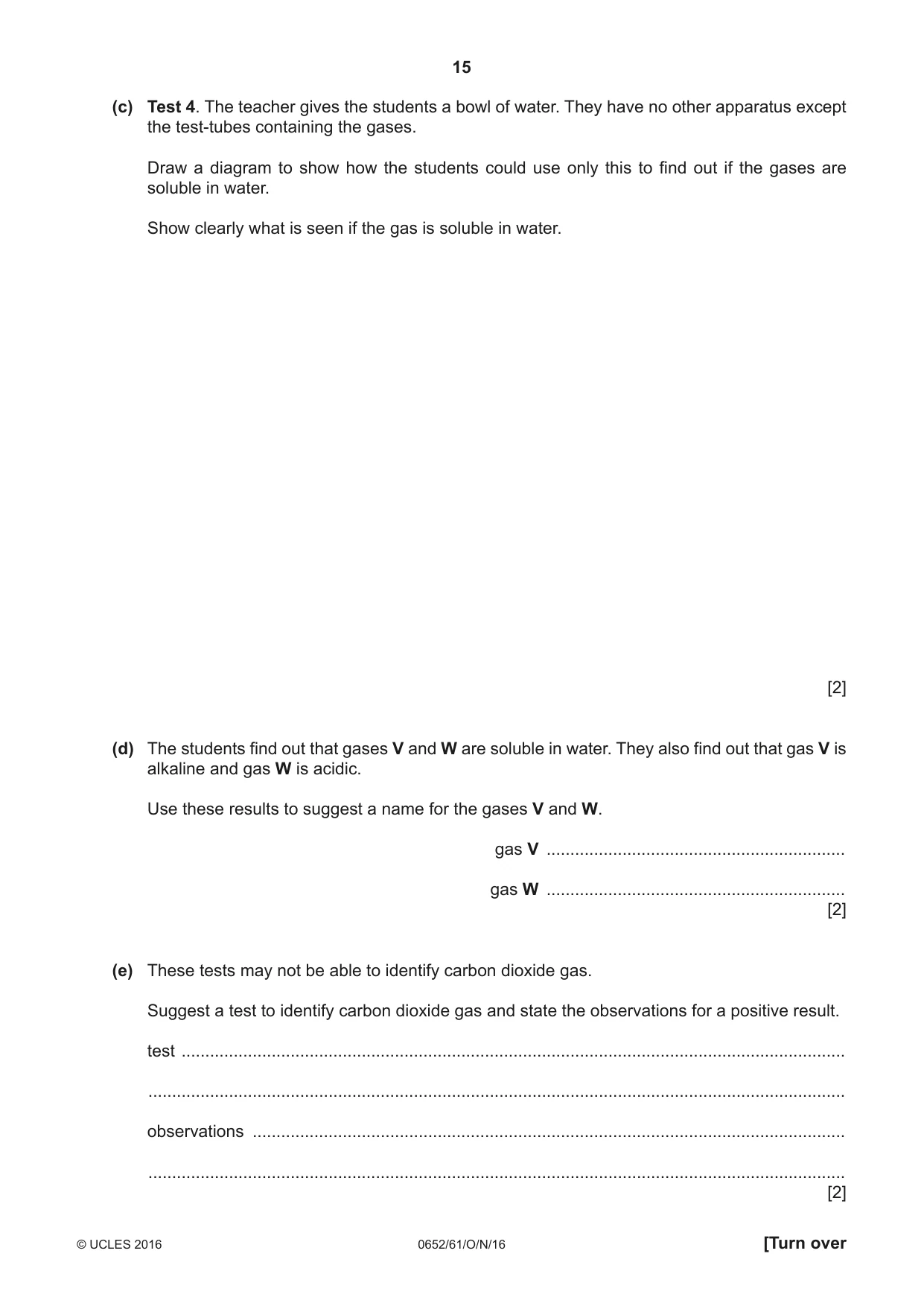
15 0652/61/O/N/16 © UCLES 2016 [Turn over (c) Test 4. The teacher gives the students a bowl of water. They have no other apparatus except the test-tubes containing the gases. Draw a diagram to show how the students could use only this to find out if the gases are soluble in water. Show clearly what is seen if the gas is soluble in water. [2] (d) The students find out that gases V and W are soluble in water. They also find out that gas V is alkaline and gas W is acidic. Use these results to suggest a name for the gases V and W. gas V … gas W … [2] (e) These tests may not be able to identify carbon dioxide gas. Suggest a test to identify carbon dioxide gas and state the observations for a positive result. test … … observations … … [2]
Question paper, page 16
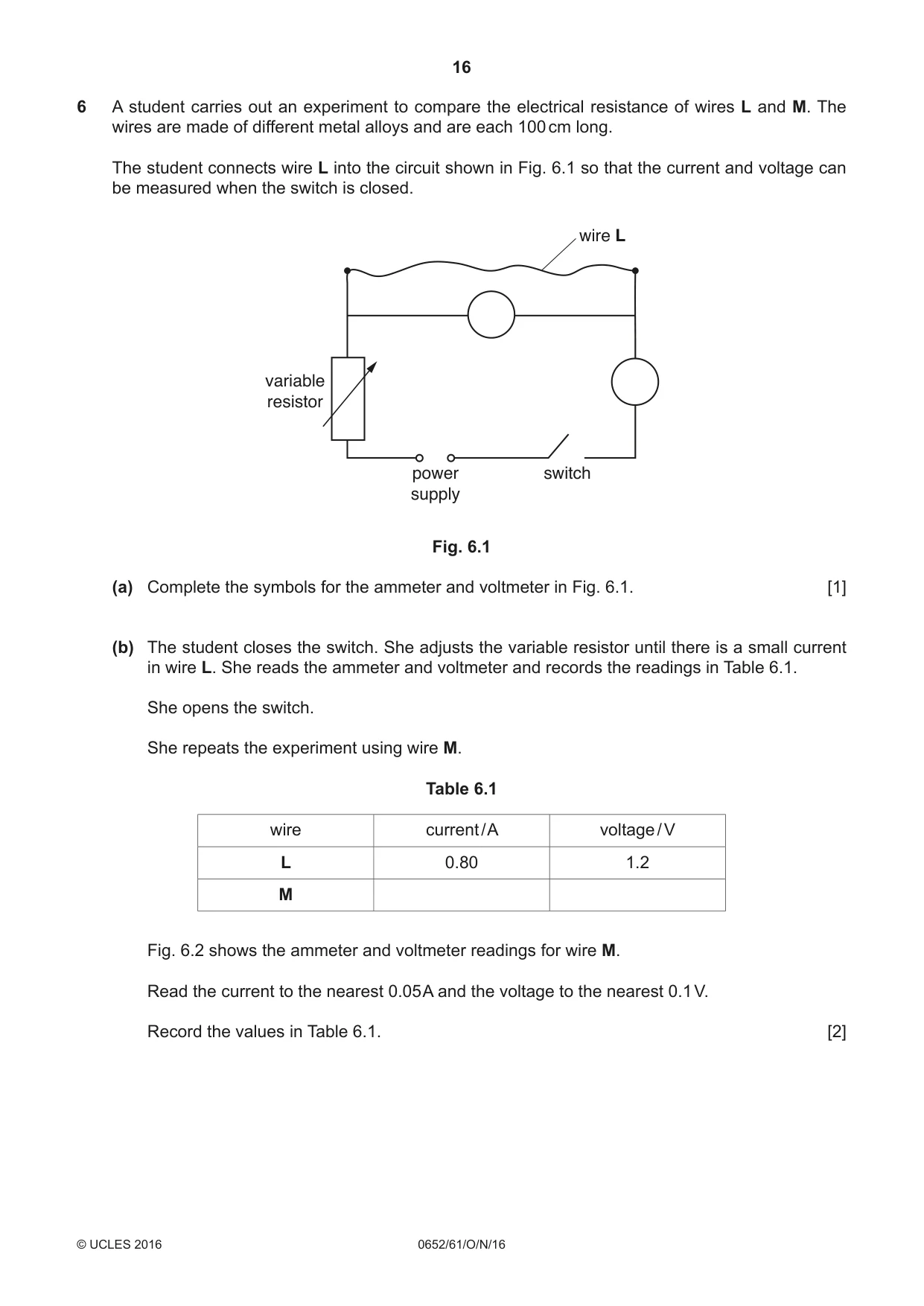
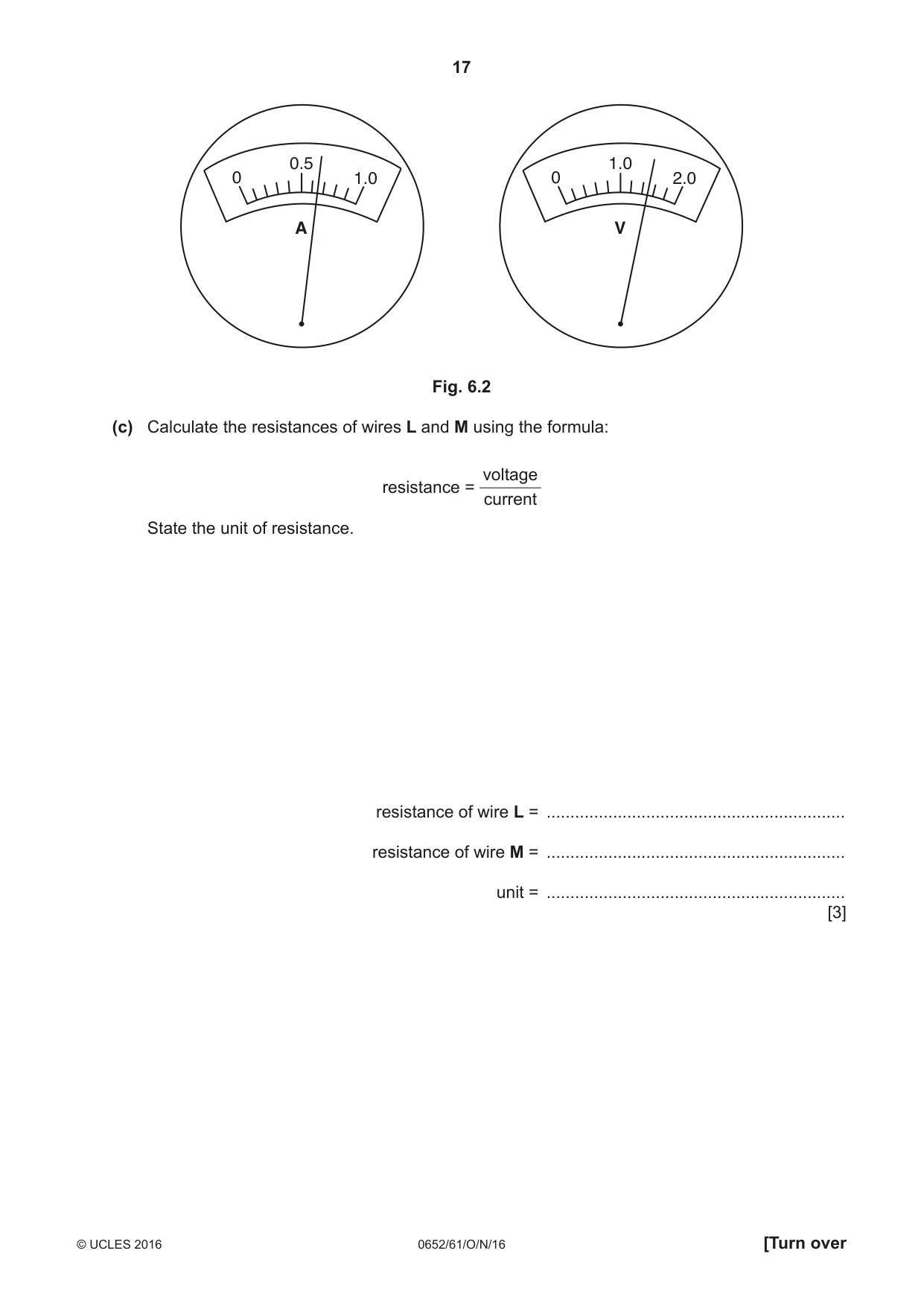
16 0652/61/O/N/16 © UCLES 2016 6 A student carries out an experiment to compare the electrical resistance of wires L and M. The wires are made of different metal alloys and are each 100 cm long. The student connects wire L into the circuit shown in Fig. 6.1 so that the current and voltage can be measured when the switch is closed. switch power supply variable resistor wire L Fig. 6.1 (a) Complete the symbols for the ammeter and voltmeter in Fig. 6.1. [1] (b) The student closes the switch. She adjusts the variable resistor until there is a small current in wire L. She reads the ammeter and voltmeter and records the readings in Table 6.1. She opens the switch. She repeats the experiment using wire M. Table 6.1 wire current / A voltage / V L 0.80 1.2 M Fig. 6.2 shows the ammeter and voltmeter readings for wire M. Read the current to the nearest 0.05 A and the voltage to the nearest 0.1 V. Record the values in Table 6.1. [2]
Question paper, page 17
17 0652/61/O/N/16 © UCLES 2016 [Turn over A 0 0.5 1.0 V 0 1.0 2.0 Fig. 6.2 (c) Calculate the resistances of wires L and M using the formula: resistance = voltage current State the unit of resistance. resistance of wire L = … resistance of wire M = … unit = … [3]
Question paper, page 18
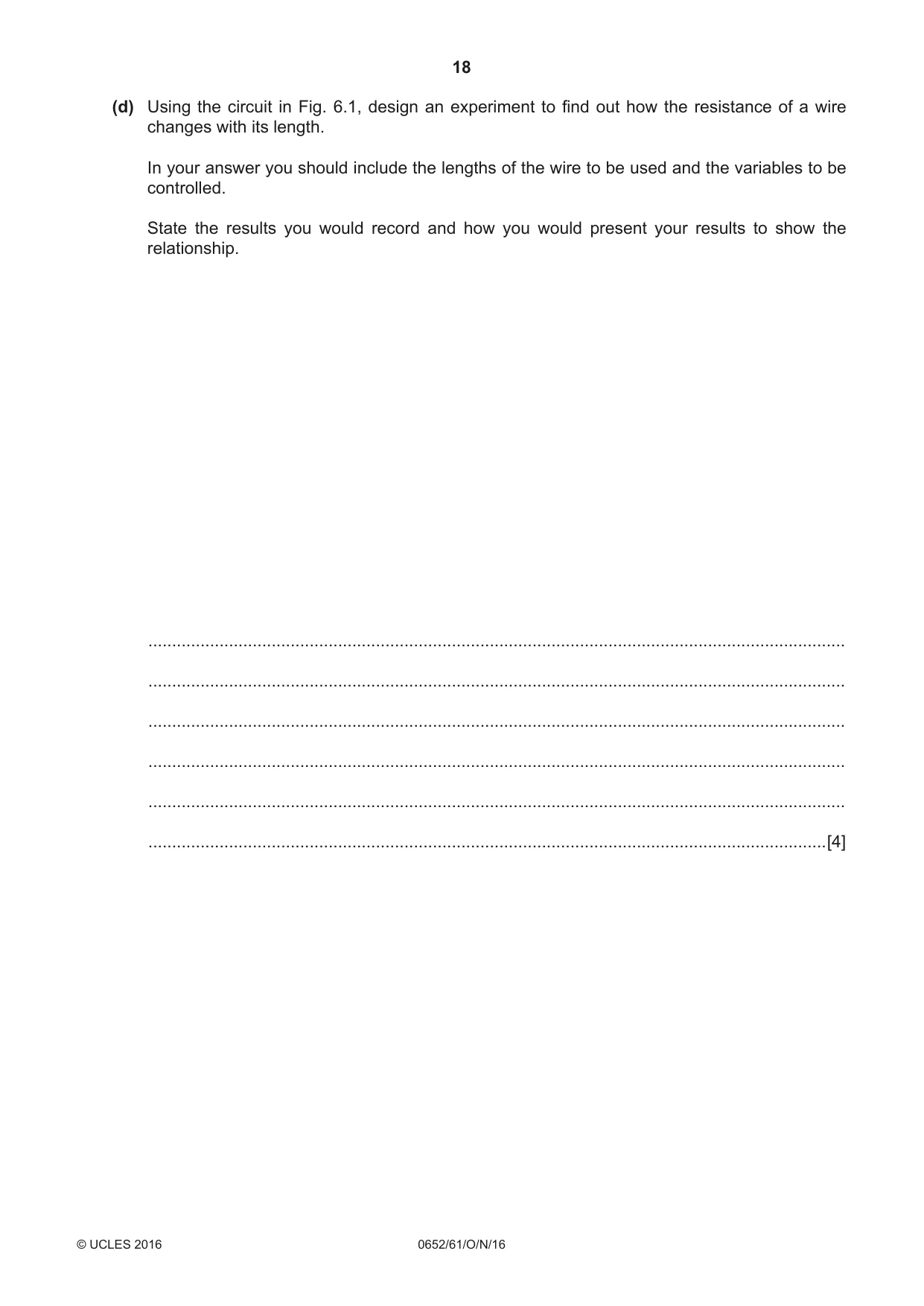
18 0652/61/O/N/16 © UCLES 2016 (d) Using the circuit in Fig. 6.1, design an experiment to find out how the resistance of a wire changes with its length. In your answer you should include the lengths of the wire to be used and the variables to be controlled. State the results you would record and how you would present your results to show the relationship. … … … … … …[4]
Question paper, page 19
19 0652/61/O/N/16 © UCLES 2016 BLANK PAGE
Question paper, page 20
20 0652/61/O/N/16 © UCLES 2016 Permission to reproduce items where third-party owned material protected by copyright is included has been sought and cleared where possible. Every reasonable effort has been made by the publisher (UCLES) to trace copyright holders, but if any items requiring clearance have unwittingly been included, the publisher will be pleased to make amends at the earliest possible opportunity. To avoid the issue of disclosure of answer-related information to candidates, all copyright acknowledgements are reproduced online in the Cambridge International Examinations Copyright Acknowledgements Booklet. This is produced for each series of examinations and is freely available to download at www.cie.org.uk after the live examination series. Cambridge International Examinations is part of the Cambridge Assessment Group. Cambridge Assessment is the brand name of University of Cambridge Local Examinations Syndicate (UCLES), which is itself a department of the University of Cambridge. BLANK PAGE
Mark scheme, page 1
® IGCSE is the registered trademark of Cambridge International Examinations. This document consists of 6 printed pages. © UCLES 2016 [Turn over Cambridge International Examinations Cambridge International General Certificate of Secondary Education PHYSICAL SCIENCE 0652/61 Paper 6 Alternative to Practical October/November 2016 MARK SCHEME Maximum Mark: 60 Published This mark scheme is published as an aid to teachers and candidates, to indicate the requirements of the examination. It shows the basis on which Examiners were instructed to award marks. It does not indicate the details of the discussions that took place at an Examiners’ meeting before marking began, which would have considered the acceptability of alternative answers. Mark schemes should be read in conjunction with the question paper and the Principal Examiner Report for Teachers. Cambridge will not enter into discussions about these mark schemes. Cambridge is publishing the mark schemes for the October/November 2016 series for most Cambridge IGCSE®, Cambridge International A and AS Level components and some Cambridge O Level components.
Mark scheme, page 2
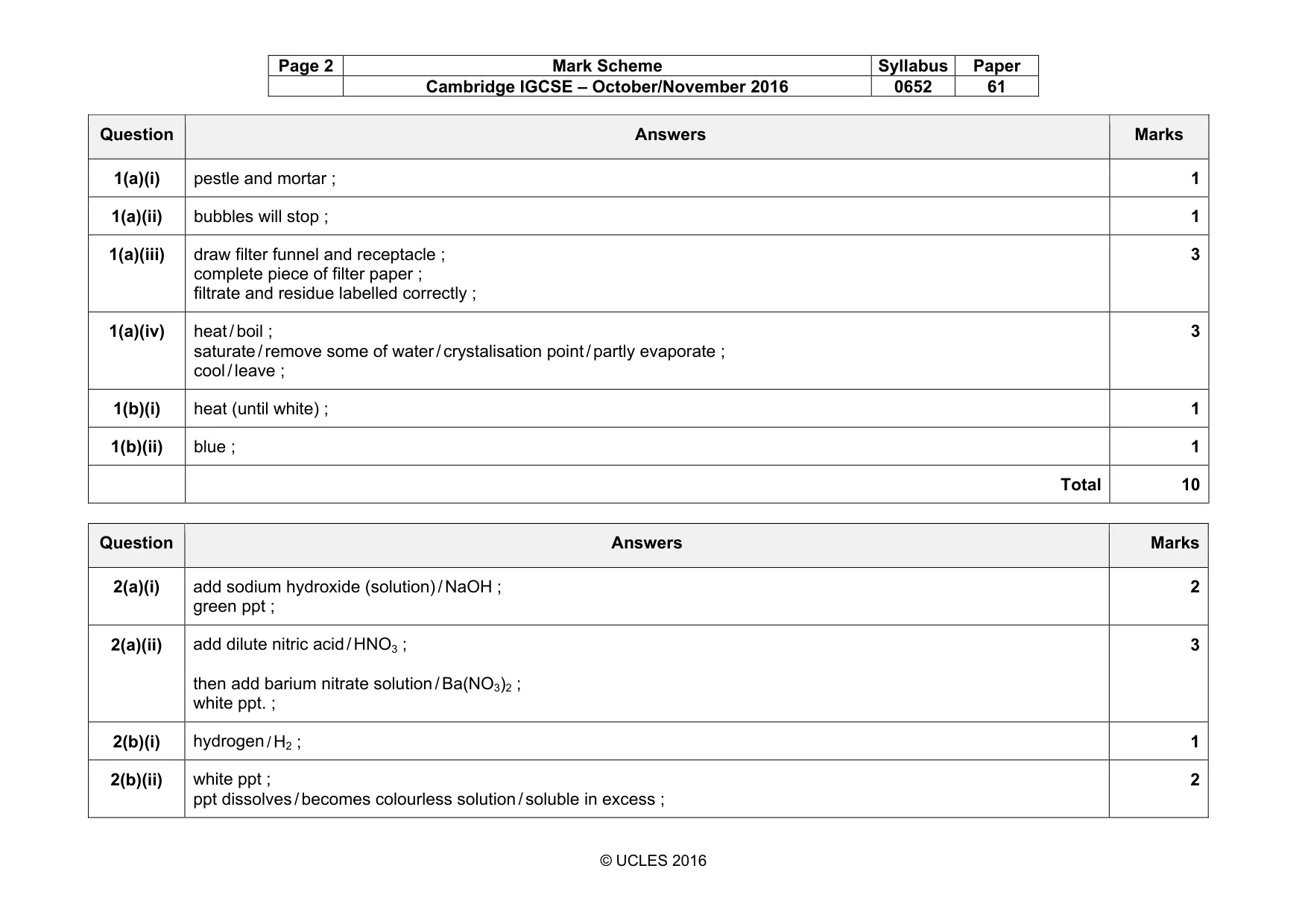
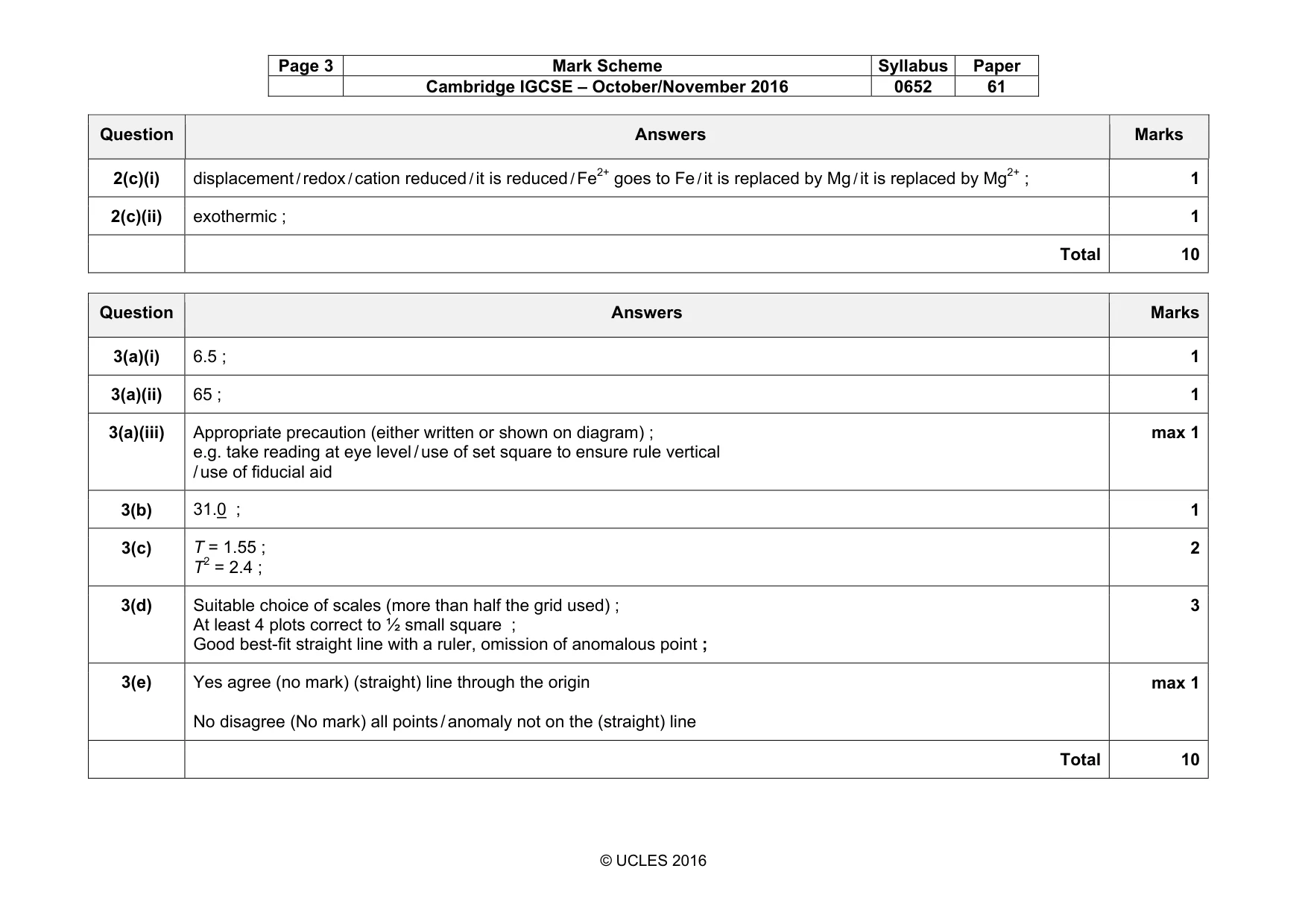
Page 2 Mark Scheme Syllabus Paper Cambridge IGCSE – October/November 2016 0652 61 © UCLES 2016 Question Answers Marks 1(a)(i) pestle and mortar ; 1 1(a)(ii) bubbles will stop ; 1 1(a)(iii) draw filter funnel and receptacle ; complete piece of filter paper ; filtrate and residue labelled correctly ; 3 1(a)(iv) heat / boil ; saturate / remove some of water / crystalisation point / partly evaporate ; cool / leave ; 3 1(b)(i) heat (until white) ; 1 1(b)(ii) blue ; 1 Total 10 Question Answers Marks 2(a)(i) add sodium hydroxide (solution) / NaOH ; green ppt ; 2 2(a)(ii) add dilute nitric acid / HNO3 ; then add barium nitrate solution / Ba(NO3)2 ; white ppt. ; 3 2(b)(i) hydrogen / H2 ; 1 2(b)(ii) white ppt ; ppt dissolves / becomes colourless solution / soluble in excess ; 2
Mark scheme, page 3
Page 3 Mark Scheme Syllabus Paper Cambridge IGCSE – October/November 2016 0652 61 © UCLES 2016 Question Answers Marks 2(c)(i) displacement / redox / cation reduced / it is reduced / Fe2+ goes to Fe / it is replaced by Mg / it is replaced by Mg2+ ; 1 2(c)(ii) exothermic ; 1 Total 10 Question Answers Marks 3(a)(i) 6.5 ; 1 3(a)(ii) 65 ; 1 3(a)(iii) Appropriate precaution (either written or shown on diagram) ; e.g. take reading at eye level / use of set square to ensure rule vertical / use of fiducial aid max 1 3(b) 31.0 ; 1 3(c) T = 1.55 ; T2 = 2.4 ; 2 3(d) Suitable choice of scales (more than half the grid used) ; At least 4 plots correct to ½ small square ; Good best-fit straight line with a ruler, omission of anomalous point ; 3 3(e) Yes agree (no mark) (straight) line through the origin No disagree (No mark) all points / anomaly not on the (straight) line max 1 Total 10
Mark scheme, page 4
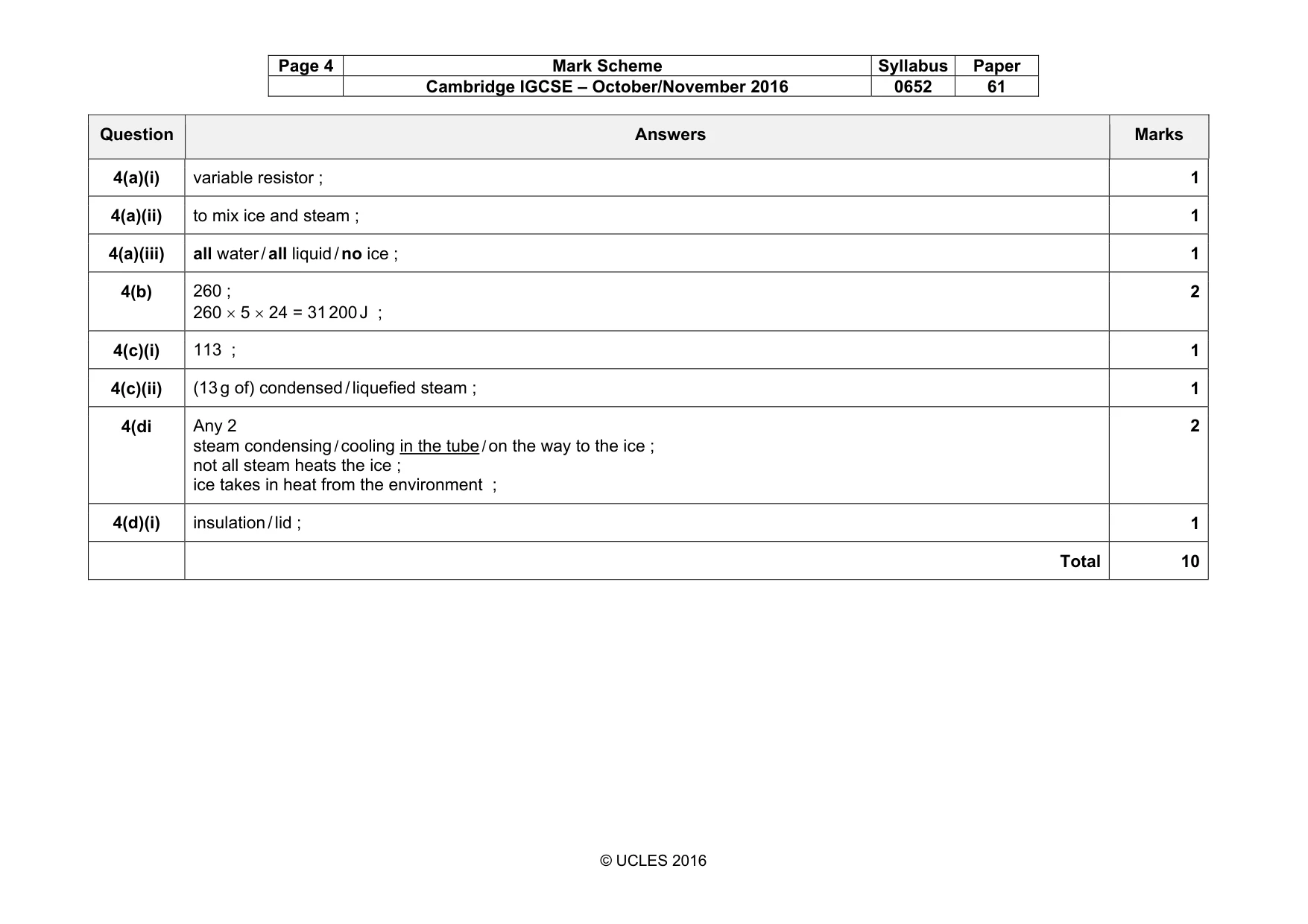
Page 4 Mark Scheme Syllabus Paper Cambridge IGCSE – October/November 2016 0652 61 © UCLES 2016 Question Answers Marks 4(a)(i) variable resistor ; 1 4(a)(ii) to mix ice and steam ; 1 4(a)(iii) all water / all liquid / no ice ; 1 4(b) 260 ; 260 × 5 × 24 = 31 200 J ; 2 4(c)(i) 113 ; 1 4(c)(ii) (13 g of) condensed / liquefied steam ; 1 4(di Any 2 steam condensing / cooling in the tube / on the way to the ice ; not all steam heats the ice ; ice takes in heat from the environment ; 2 4(d)(i) insulation / lid ; 1 Total 10
Mark scheme, page 5
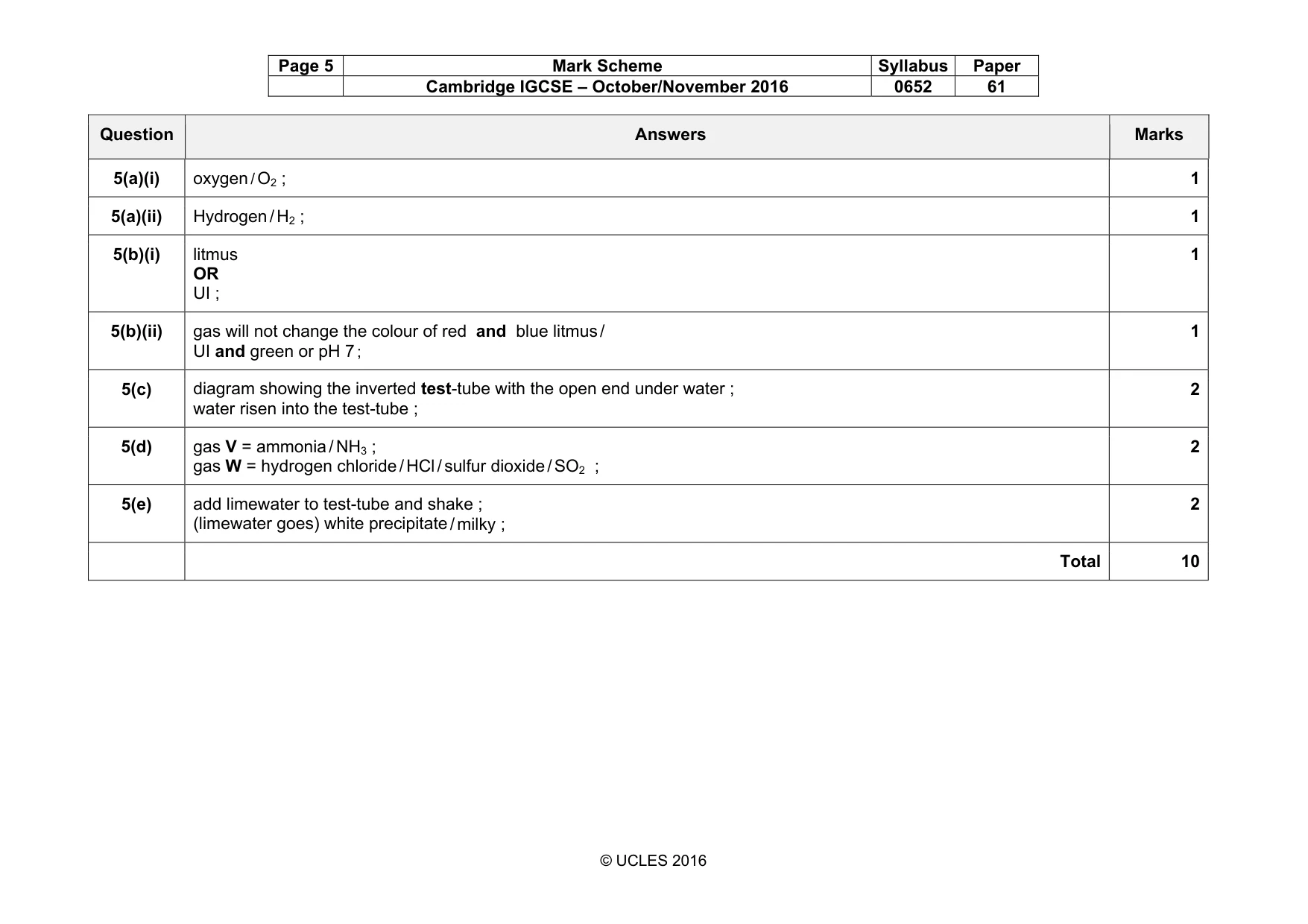
Page 5 Mark Scheme Syllabus Paper Cambridge IGCSE – October/November 2016 0652 61 © UCLES 2016 Question Answers Marks 5(a)(i) oxygen / O2 ; 1 5(a)(ii) Hydrogen / H2 ; 1 5(b)(i) litmus OR UI ; 1 5(b)(ii) gas will not change the colour of red and blue litmus / UI and green or pH 7 ; 1 5(c) diagram showing the inverted test-tube with the open end under water ; water risen into the test-tube ; 2 5(d) gas V = ammonia / NH3 ; gas W = hydrogen chloride / HCl / sulfur dioxide / SO2 ; 2 5(e) add limewater to test-tube and shake ; (limewater goes) white precipitate / milky ; 2 Total 10
Mark scheme, page 6
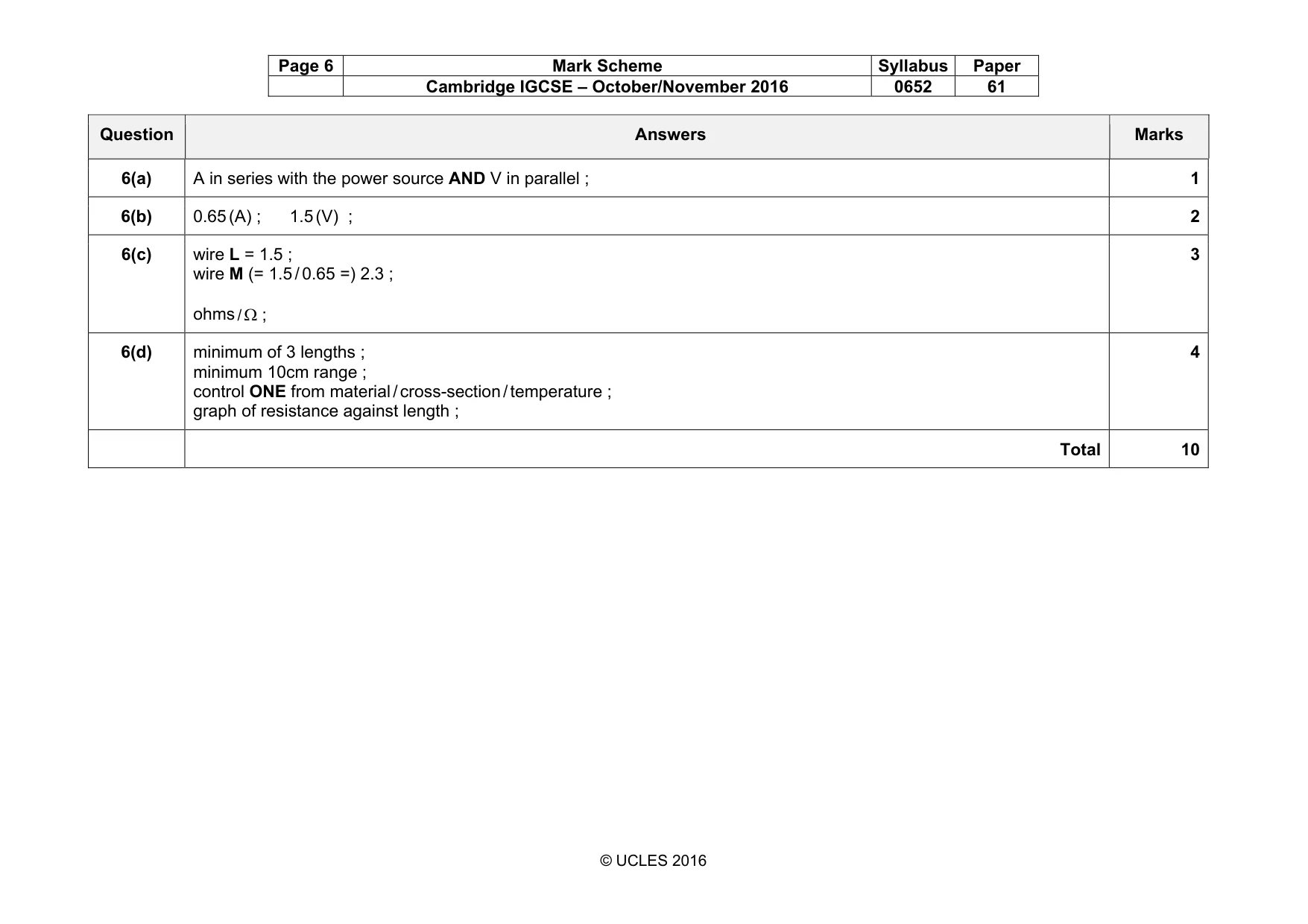
Page 6 Mark Scheme Syllabus Paper Cambridge IGCSE – October/November 2016 0652 61 © UCLES 2016 Question Answers Marks 6(a) A in series with the power source AND V in parallel ; 1 6(b) 0.65 (A) ; 1.5 (V) ; 2 6(c) wire L = 1.5 ; wire M (= 1.5 / 0.65 =) 2.3 ; ohms / Ω ; 3 6(d) minimum of 3 lengths ; minimum 10cm range ; control ONE from material / cross-section / temperature ; graph of resistance against length ; 4 Total 10
What you needed in this session
Cambridge’s own grade thresholds for 2016 Oct/Nov, Paper 6 · Variant 1. A higher threshold means an easier paper — the bar moves with how the cohort did.