Cambridge IGCSE Physical Science 0652 — 2004 Oct/Nov Paper 6 · Variant 1
0652/61/O/N/04
The question paper and its mark scheme, free to read here and free to download. This is Cambridge’s own paper, exactly as it was sat.
Question paper16 pages

Mark scheme7 pages
Answers below. Sit the paper first if you are practising.
Paper as text
Question paper, page 1
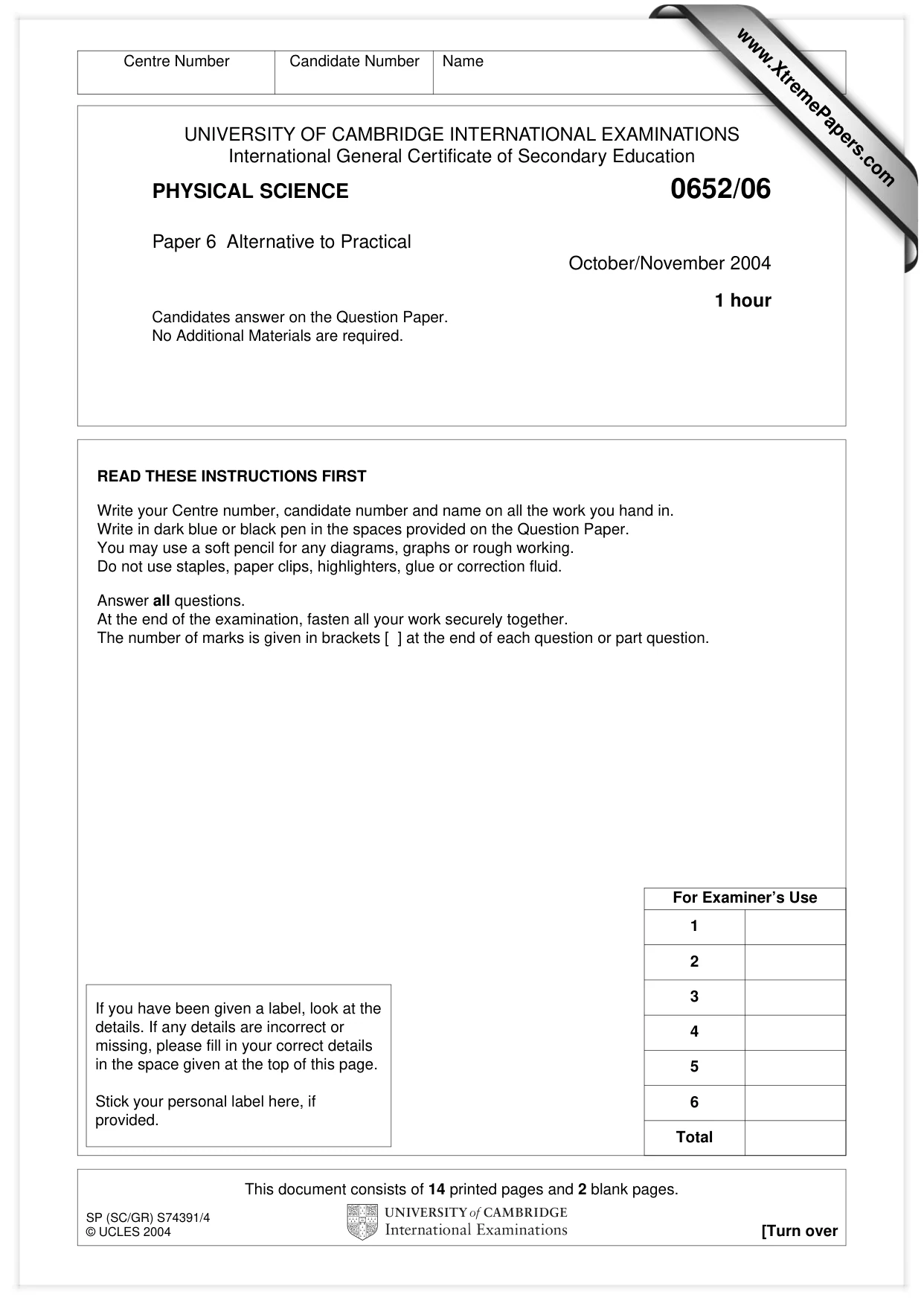
This document consists of 14 printed pages and 2 blank pages. SP (SC/GR) S74391/4 © UCLES 2004 [Turn over UNIVERSITY OF CAMBRIDGE INTERNATIONAL EXAMINATIONS International General Certificate of Secondary Education PHYSICAL SCIENCE 0652/06 Paper 6 Alternative to Practical October/November 2004 1 hour Candidates answer on the Question Paper. No Additional Materials are required. READ THESE INSTRUCTIONS FIRST Write your Centre number, candidate number and name on all the work you hand in. Write in dark blue or black pen in the spaces provided on the Question Paper. You may use a soft pencil for any diagrams, graphs or rough working. Do not use staples, paper clips, highlighters, glue or correction fluid. Answer all questions. At the end of the examination, fasten all your work securely together. The number of marks is given in brackets [ ] at the end of each question or part question. Centre Number Candidate Number Name If you have been given a label, look at the details. If any details are incorrect or missing, please fill in your correct details in the space given at the top of this page. Stick your personal label here, if provided. For Examiner’s Use 1 2 3 4 5 6 Total www.XtremePapers.com
Question paper, page 2
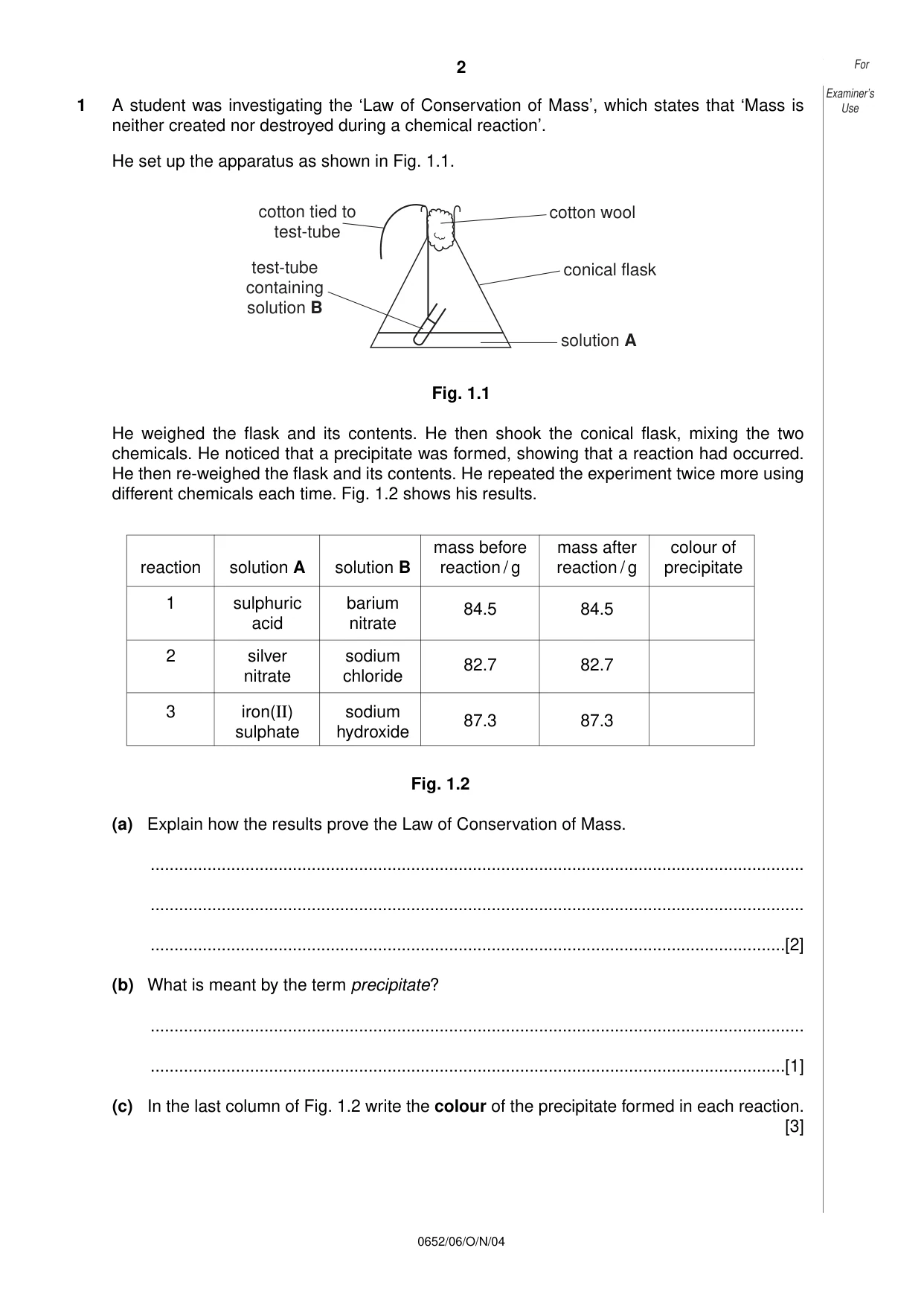
For Examiner’s Use 2 0652/06/O/N/04 1 A student was investigating the ‘Law of Conservation of Mass’, which states that ‘Mass is neither created nor destroyed during a chemical reaction’. He set up the apparatus as shown in Fig. 1.1. Fig. 1.1 He weighed the flask and its contents. He then shook the conical flask, mixing the two chemicals. He noticed that a precipitate was formed, showing that a reaction had occurred. He then re-weighed the flask and its contents. He repeated the experiment twice more using different chemicals each time. Fig. 1.2 shows his results. Fig. 1.2 (a) Explain how the results prove the Law of Conservation of Mass. … … …[2] (b) What is meant by the term precipitate? … …[1] (c) In the last column of Fig. 1.2 write the colour of the precipitate formed in each reaction. [3] cotton tied to test-tube test-tube containing solution B solution A conical flask cotton wool mass before mass after colour of reaction solution A solution B reaction / g reaction / g precipitate 1 sulphuric barium 84.5 84.5 acid nitrate 2 silver sodium 82.7 82.7 nitrate chloride 3 iron(II) sodium 87.3 87.3 sulphate hydroxide
Question paper, page 3
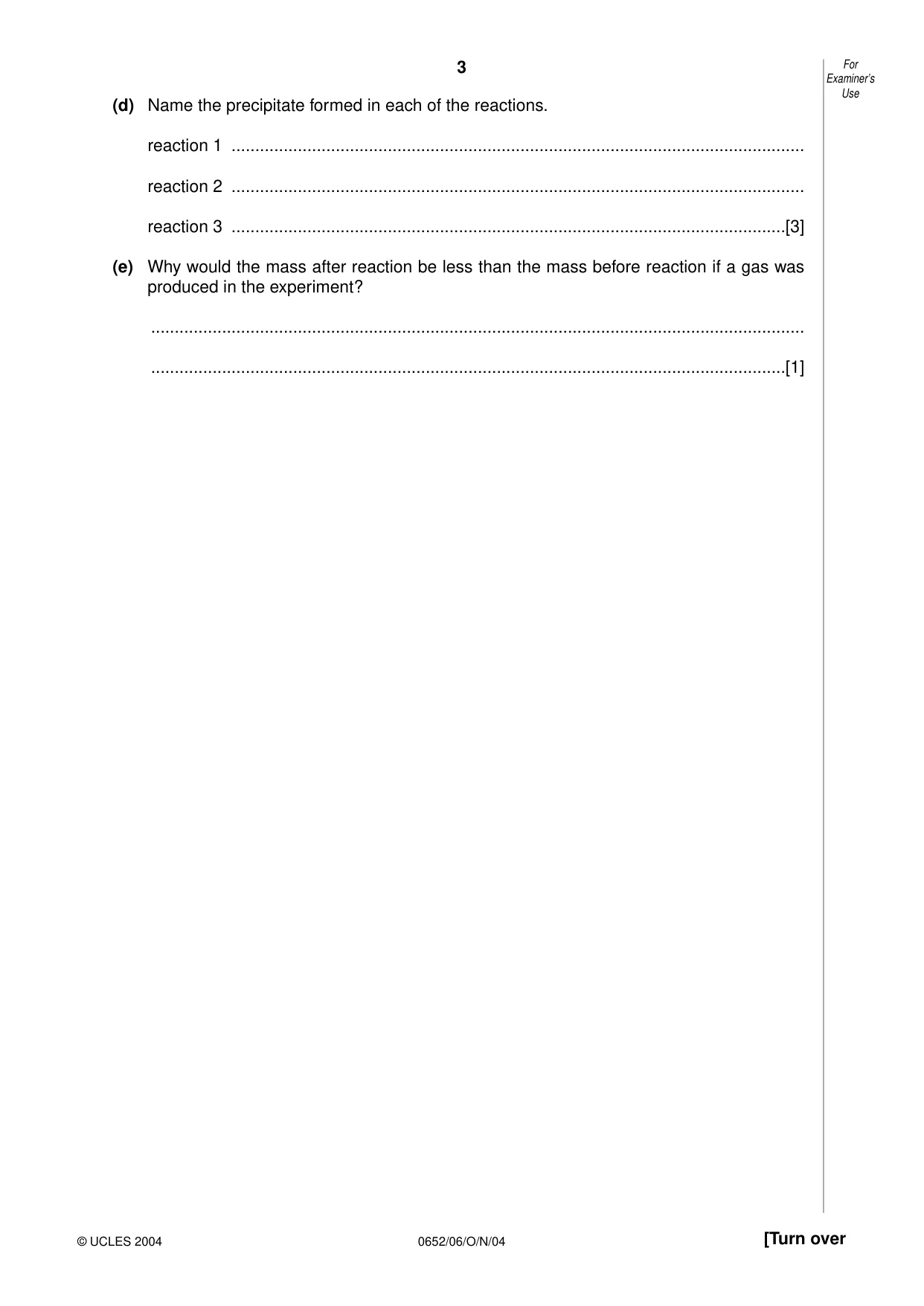
3 0652/06/O/N/04 [Turn over (d) Name the precipitate formed in each of the reactions. reaction 1 … reaction 2 … reaction 3 …[3] (e) Why would the mass after reaction be less than the mass before reaction if a gas was produced in the experiment? … …[1] For Examiner’s Use © UCLES 2004
Question paper, page 4
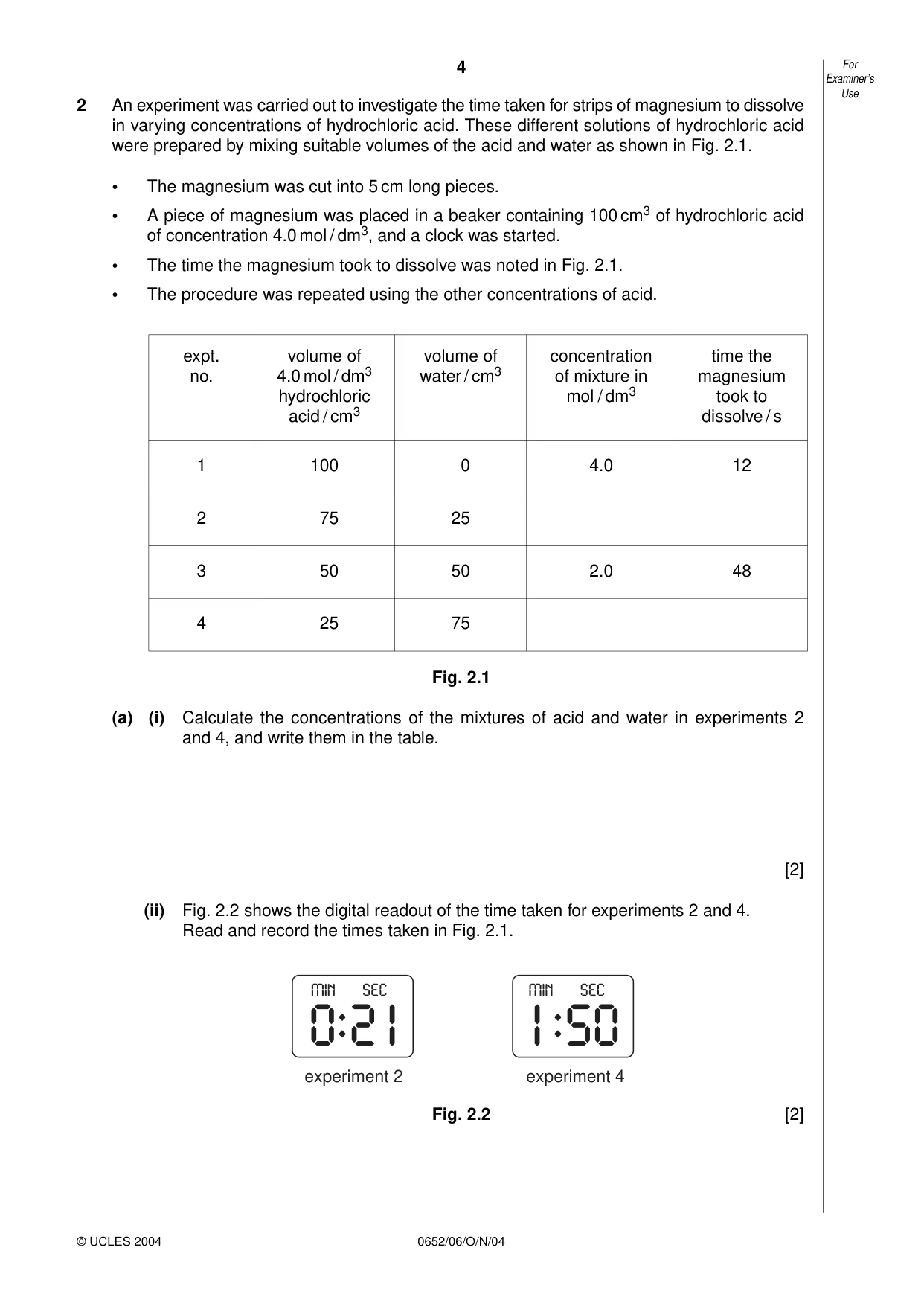
4 0652/06/O/N/04 2 An experiment was carried out to investigate the time taken for strips of magnesium to dissolve in varying concentrations of hydrochloric acid. These different solutions of hydrochloric acid were prepared by mixing suitable volumes of the acid and water as shown in Fig. 2.1. • The magnesium was cut into 5 cm long pieces. • A piece of magnesium was placed in a beaker containing 100 cm3 of hydrochloric acid of concentration 4.0 mol / dm3, and a clock was started. • The time the magnesium took to dissolve was noted in Fig. 2.1. • The procedure was repeated using the other concentrations of acid. Fig. 2.1 (a) (i) Calculate the concentrations of the mixtures of acid and water in experiments 2 and 4, and write them in the table. [2] (ii) Fig. 2.2 shows the digital readout of the time taken for experiments 2 and 4. Read and record the times taken in Fig. 2.1. Fig. 2.2 [2] experiment 2 experiment 4 For Examiner’s Use © UCLES 2004 expt. no. 1 100 0 4.0 12 48 2.0 25 50 75 75 50 25 2 3 4 volume of 4.0 mol / dm3 hydrochloric acid / cm3 volume of water / cm3 concentration of mixture in mol / dm3 time the magnesium took to dissolve / s
Question paper, page 5
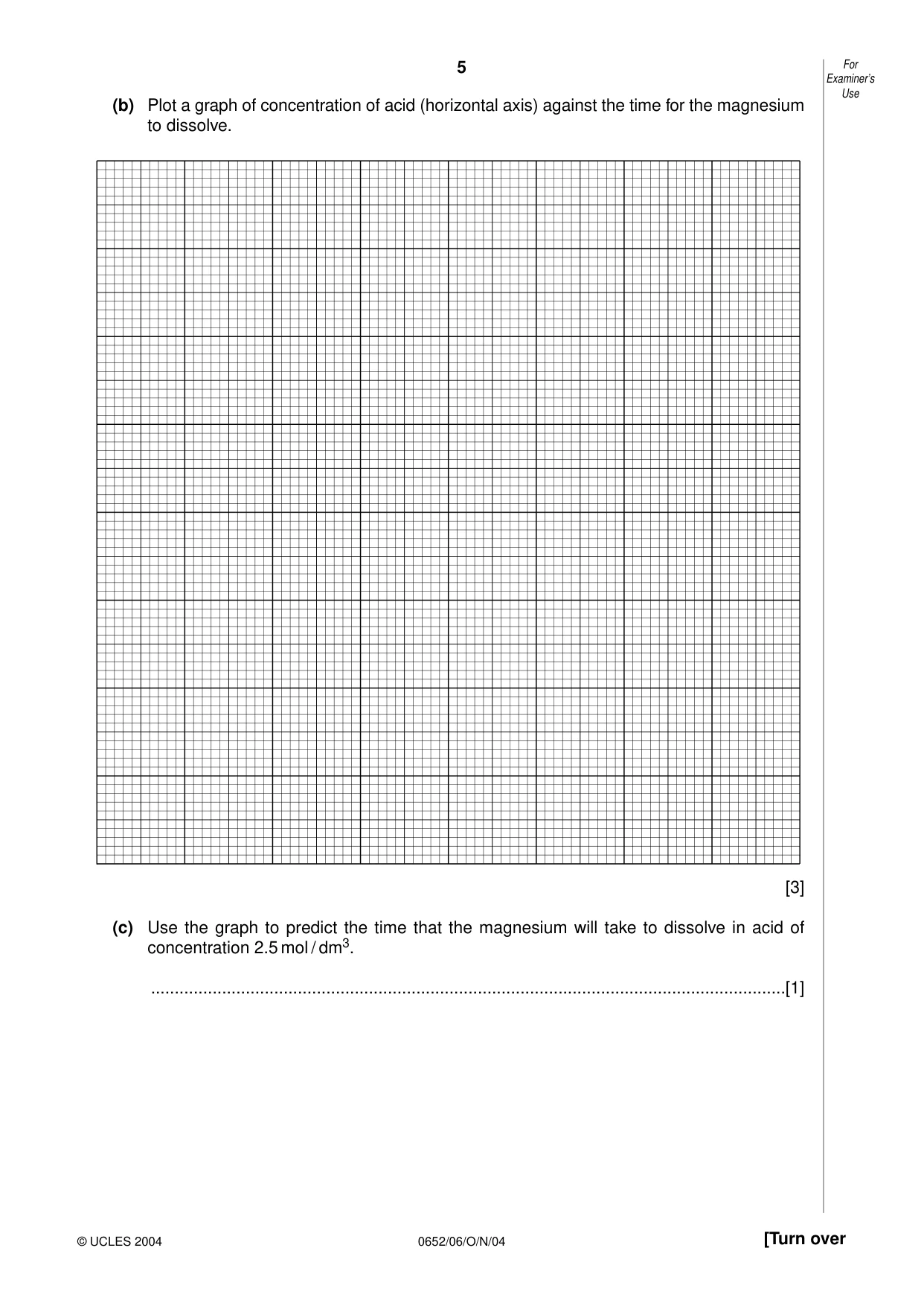
5 0652/06/O/N/04 [Turn over (b) Plot a graph of concentration of acid (horizontal axis) against the time for the magnesium to dissolve. [3] (c) Use the graph to predict the time that the magnesium will take to dissolve in acid of concentration 2.5 mol / dm3. …[1] For Examiner’s Use © UCLES 2004
Question paper, page 6
6 0652/06/O/N/04 (d) A student read in a book that 0.1 g of magnesium produces 100 cm3 of hydrogen when it dissolves in acid. Draw a diagram of the apparatus you would use to test this statement. [2] For Examiner’s Use © UCLES 2004
Question paper, page 7
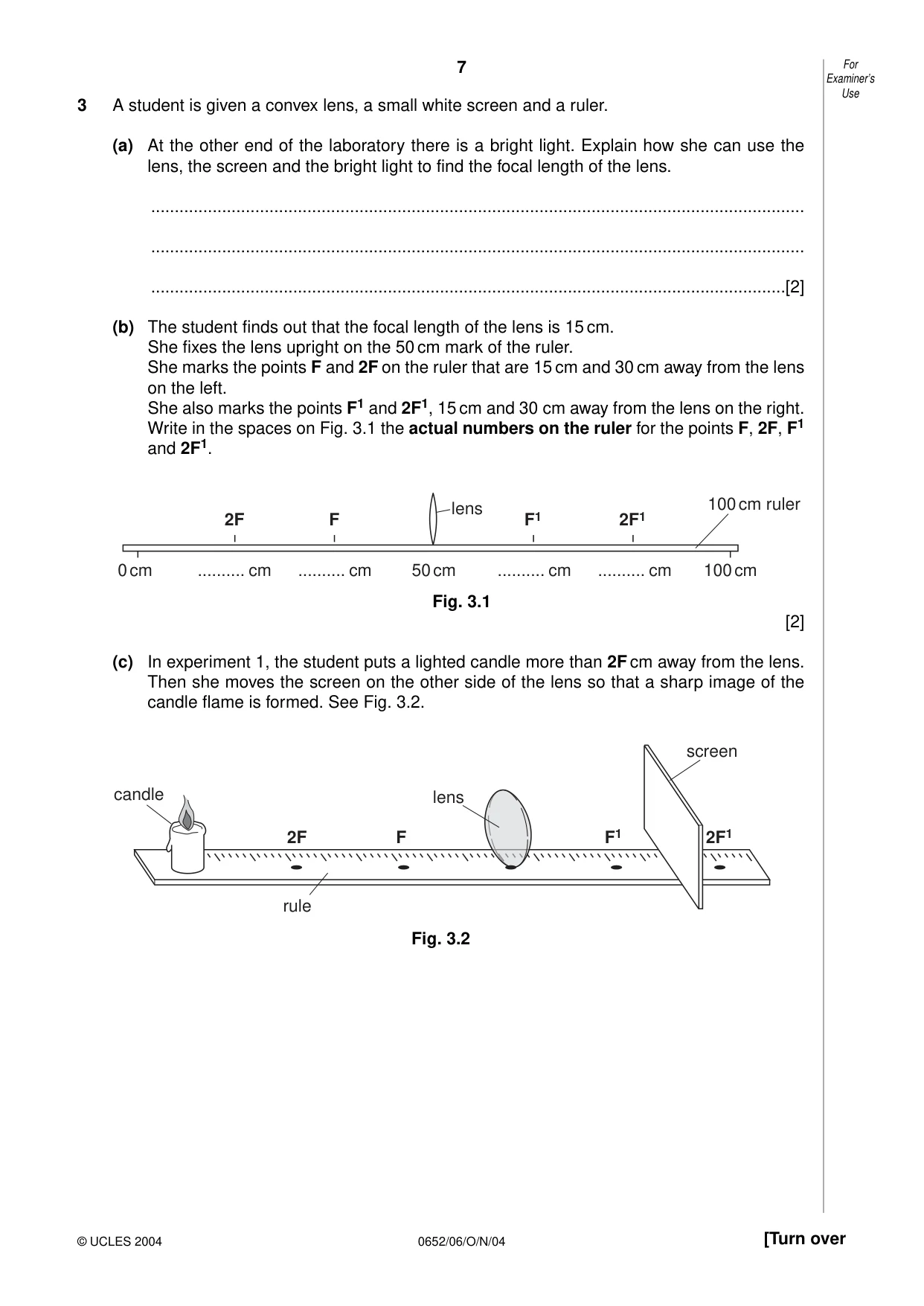
7 0652/06/O/N/04 [Turn over 3 A student is given a convex lens, a small white screen and a ruler. (a) At the other end of the laboratory there is a bright light. Explain how she can use the lens, the screen and the bright light to find the focal length of the lens. … … …[2] (b) The student finds out that the focal length of the lens is 15 cm. She fixes the lens upright on the 50 cm mark of the ruler. She marks the points F and 2F on the ruler that are 15 cm and 30 cm away from the lens on the left. She also marks the points F1 and 2F1, 15 cm and 30 cm away from the lens on the right. Write in the spaces on Fig. 3.1 the actual numbers on the ruler for the points F, 2F, F1 and 2F1. Fig. 3.1 [2] (c) In experiment 1, the student puts a lighted candle more than 2F cm away from the lens. Then she moves the screen on the other side of the lens so that a sharp image of the candle flame is formed. See Fig. 3.2. Fig. 3.2 lens rule screen candle 2F F F1 2F1 0 cm 100 cm 50 cm … cm 2F F lens 100 cm ruler F1 2F1 … cm … cm … cm For Examiner’s Use © UCLES 2004
Question paper, page 8
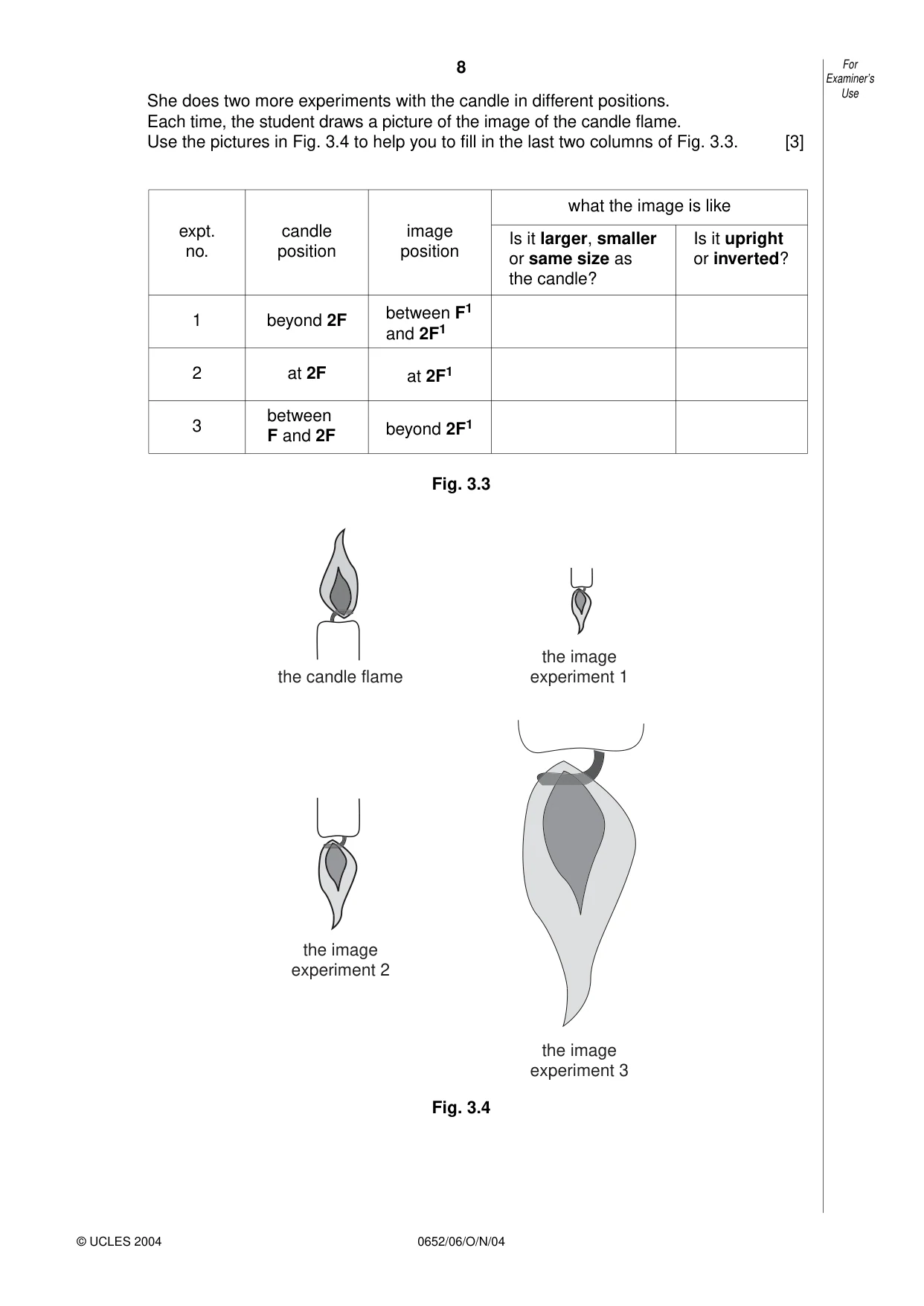
8 0652/06/O/N/04 She does two more experiments with the candle in different positions. Each time, the student draws a picture of the image of the candle flame. Use the pictures in Fig. 3.4 to help you to fill in the last two columns of Fig. 3.3. [3] Fig. 3.3 Fig. 3.4 the candle flame the image experiment 1 the image experiment 2 the image experiment 3 For Examiner’s Use © UCLES 2004 expt. no. 1 beyond 2F between F1 and 2F1 at 2F1 beyond 2F1 at 2F between F and 2F 2 3 candle position image position Is it larger, smaller or same size as the candle? Is it upright or inverted? what the image is like
Question paper, page 9
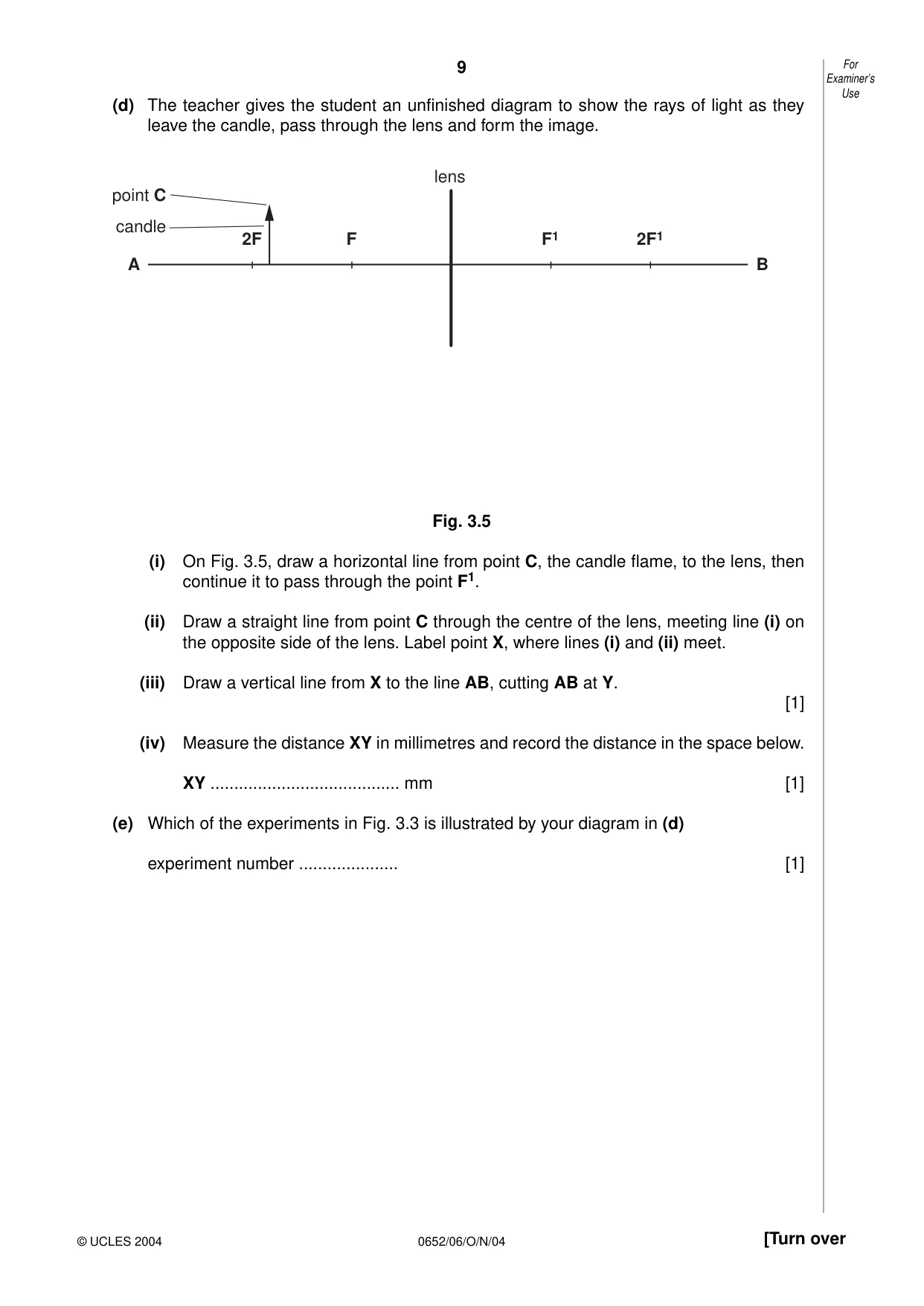
9 0652/06/O/N/04 [Turn over (d) The teacher gives the student an unfinished diagram to show the rays of light as they leave the candle, pass through the lens and form the image. Fig. 3.5 (i) On Fig. 3.5, draw a horizontal line from point C, the candle flame, to the lens, then continue it to pass through the point F1. (ii) Draw a straight line from point C through the centre of the lens, meeting line (i) on the opposite side of the lens. Label point X, where lines (i) and (ii) meet. (iii) Draw a vertical line from X to the line AB, cutting AB at Y. [1] (iv) Measure the distance XY in millimetres and record the distance in the space below. XY … mm [1] (e) Which of the experiments in Fig. 3.3 is illustrated by your diagram in (d) experiment number … [1] A B 2F F lens F1 2F1 point C candle For Examiner’s Use © UCLES 2004
Question paper, page 10
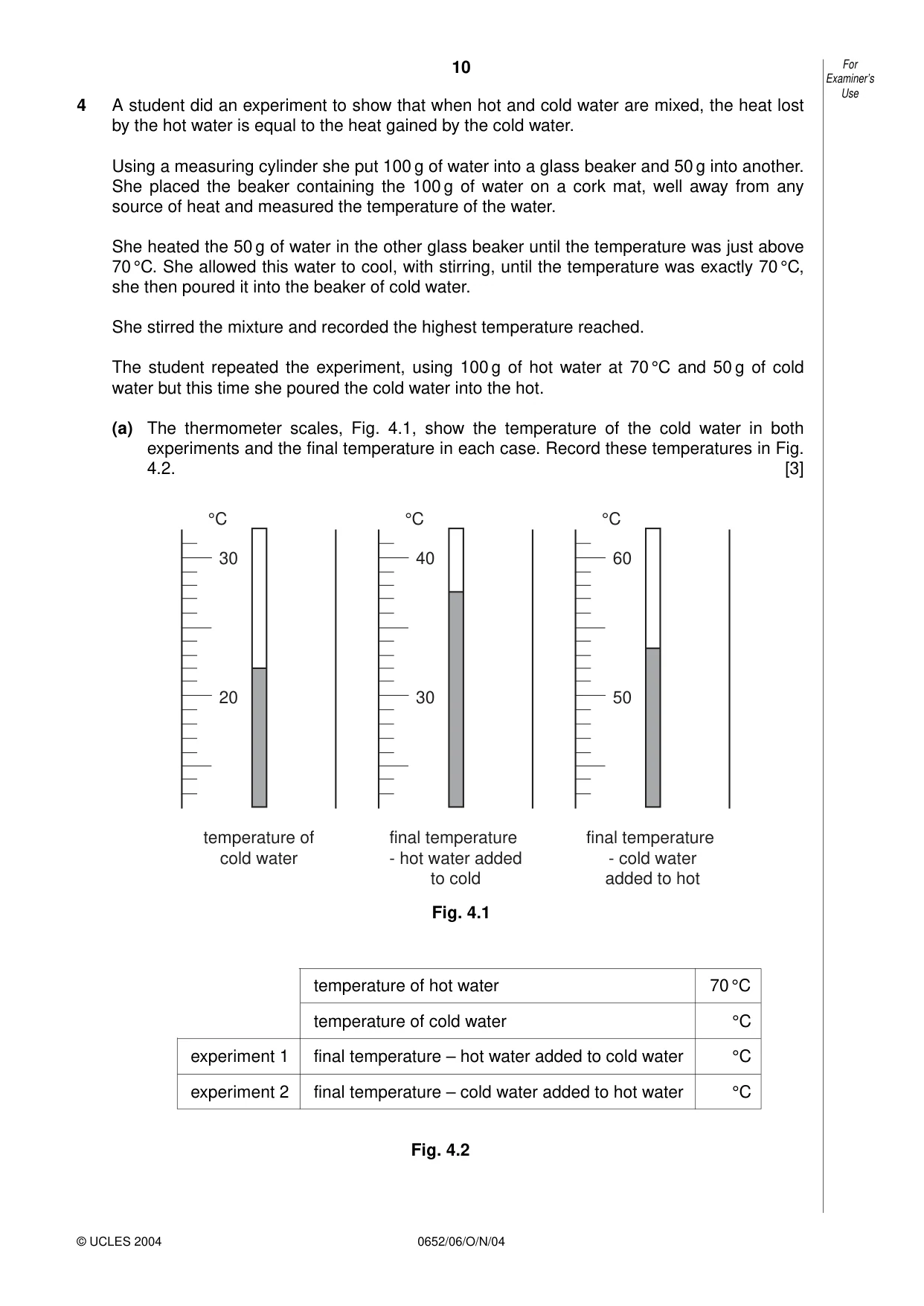
10 0652/06/O/N/04 4 A student did an experiment to show that when hot and cold water are mixed, the heat lost by the hot water is equal to the heat gained by the cold water. Using a measuring cylinder she put 100 g of water into a glass beaker and 50 g into another. She placed the beaker containing the 100 g of water on a cork mat, well away from any source of heat and measured the temperature of the water. She heated the 50 g of water in the other glass beaker until the temperature was just above 70 °C. She allowed this water to cool, with stirring, until the temperature was exactly 70 °C, she then poured it into the beaker of cold water. She stirred the mixture and recorded the highest temperature reached. The student repeated the experiment, using 100 g of hot water at 70 °C and 50 g of cold water but this time she poured the cold water into the hot. (a) The thermometer scales, Fig. 4.1, show the temperature of the cold water in both experiments and the final temperature in each case. Record these temperatures in Fig. 4.2. [3] Fig. 4.1 Fig. 4.2 °C 30 20 temperature of cold water °C 40 30 final temperature - hot water added to cold °C 60 50 final temperature - cold water added to hot For Examiner’s Use © UCLES 2004 temperature of hot water 70 °C temperature of cold water °C experiment 1 final temperature – hot water added to cold water °C experiment 2 final temperature – cold water added to hot water °C
Question paper, page 11
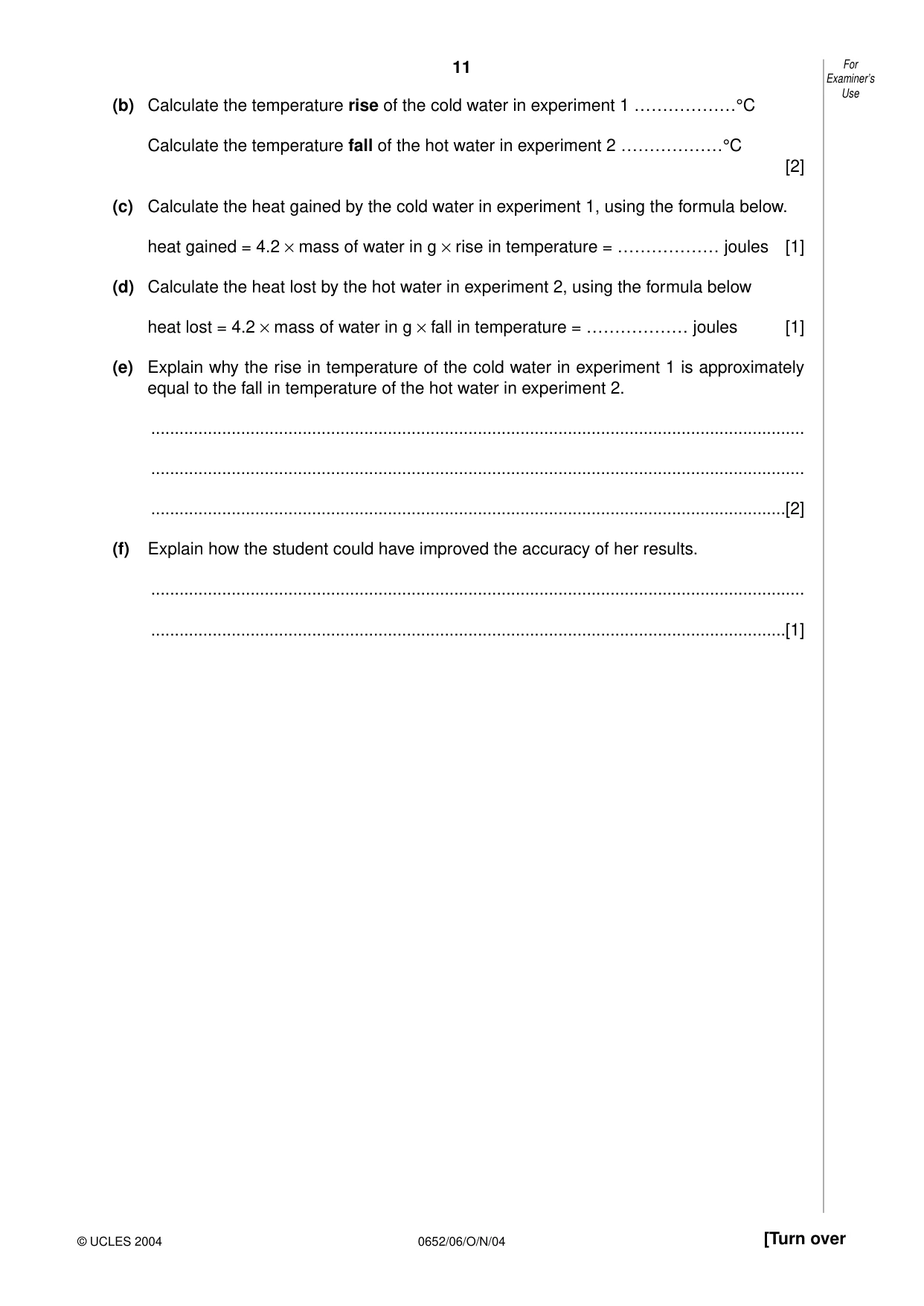
11 0652/06/O/N/04 [Turn over (b) Calculate the temperature rise of the cold water in experiment 1 ………………°C Calculate the temperature fall of the hot water in experiment 2 ………………°C [2] (c) Calculate the heat gained by the cold water in experiment 1, using the formula below. heat gained = 4.2 × mass of water in g × rise in temperature = ……………… joules [1] (d) Calculate the heat lost by the hot water in experiment 2, using the formula below heat lost = 4.2 × mass of water in g × fall in temperature = ……………… joules [1] (e) Explain why the rise in temperature of the cold water in experiment 1 is approximately equal to the fall in temperature of the hot water in experiment 2. … … …[2] (f) Explain how the student could have improved the accuracy of her results. … …[1] For Examiner’s Use © UCLES 2004
Question paper, page 12
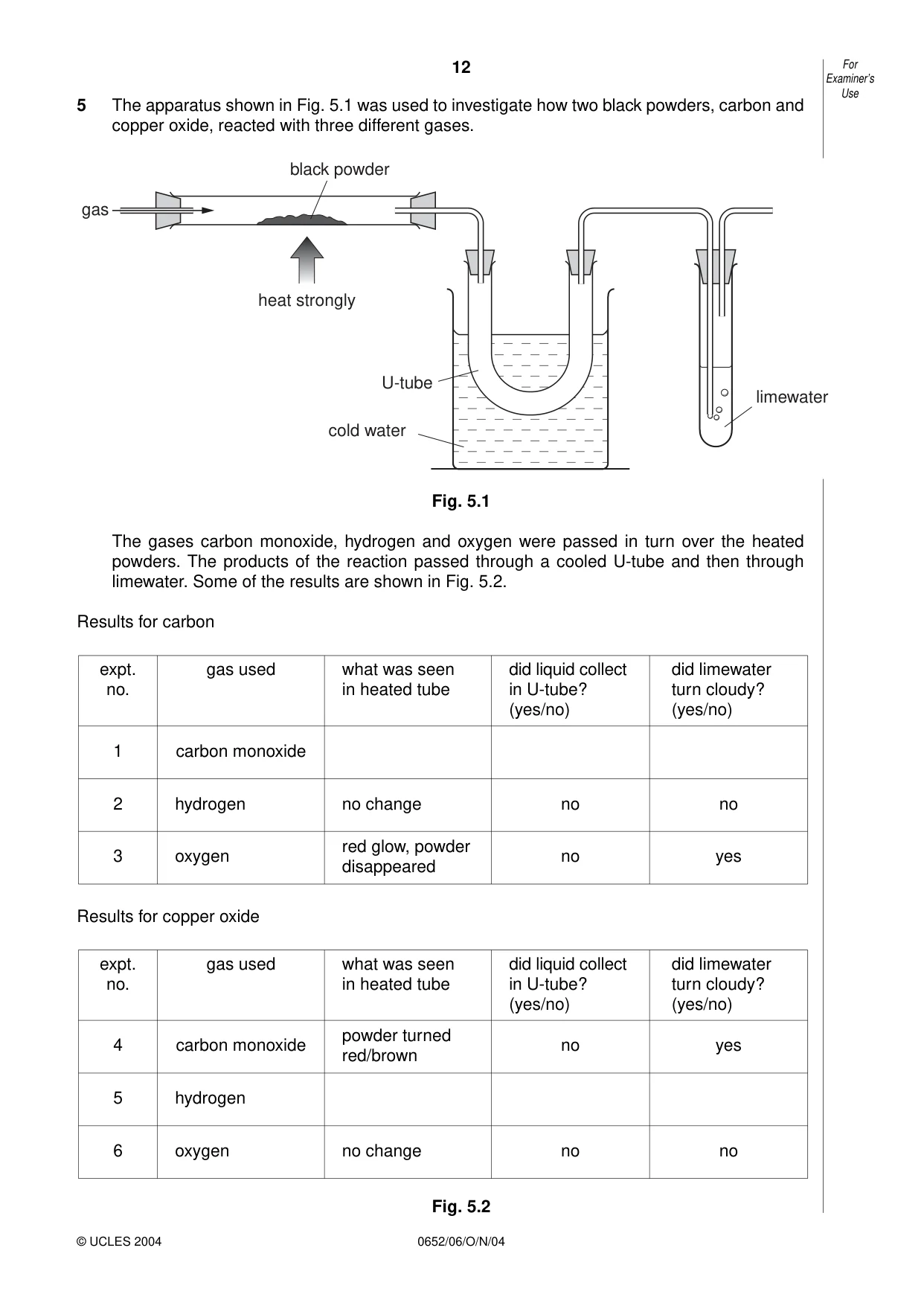
12 0652/06/O/N/04 5 The apparatus shown in Fig. 5.1 was used to investigate how two black powders, carbon and copper oxide, reacted with three different gases. Fig. 5.1 The gases carbon monoxide, hydrogen and oxygen were passed in turn over the heated powders. The products of the reaction passed through a cooled U-tube and then through limewater. Some of the results are shown in Fig. 5.2. Results for carbon Results for copper oxide Fig. 5.2 For Examiner’s Use © UCLES 2004 limewater cold water U-tube heat strongly gas black powder expt. no. 1 2 3 gas used carbon monoxide hydrogen no change no no no yes oxygen red glow, powder disappeared what was seen in heated tube did liquid collect in U-tube? (yes/no) did limewater turn cloudy? (yes/no) expt. no. 4 5 6 gas used carbon monoxide powder turned red/brown hydrogen no change no no no yes oxygen what was seen in heated tube did liquid collect in U-tube? (yes/no) did limewater turn cloudy? (yes/no)
Question paper, page 13
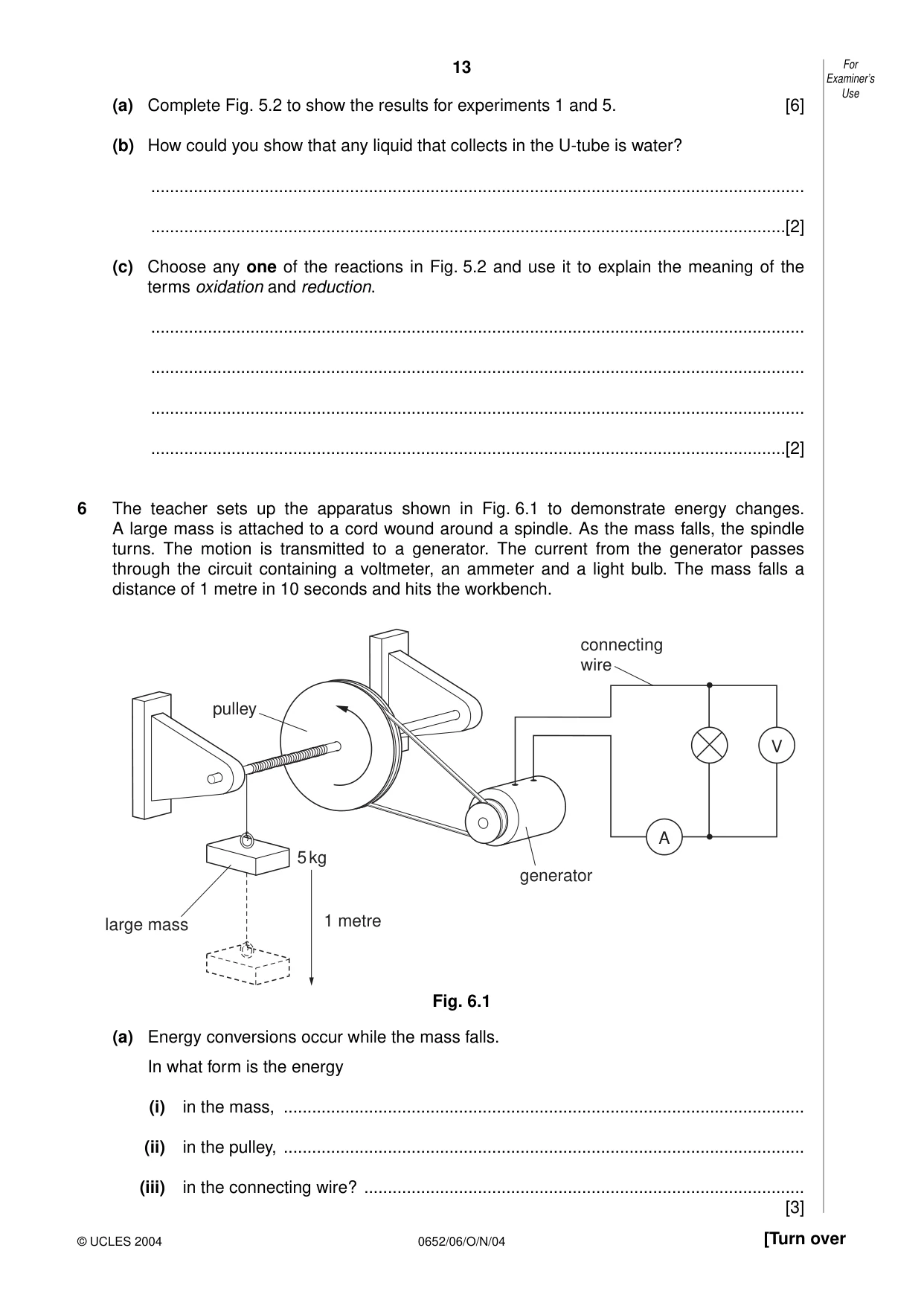
13 0652/06/O/N/04 [Turn over (a) Complete Fig. 5.2 to show the results for experiments 1 and 5. [6] (b) How could you show that any liquid that collects in the U-tube is water? … …[2] (c) Choose any one of the reactions in Fig. 5.2 and use it to explain the meaning of the terms oxidation and reduction. … … … …[2] 6 The teacher sets up the apparatus shown in Fig. 6.1 to demonstrate energy changes. A large mass is attached to a cord wound around a spindle. As the mass falls, the spindle turns. The motion is transmitted to a generator. The current from the generator passes through the circuit containing a voltmeter, an ammeter and a light bulb. The mass falls a distance of 1 metre in 10 seconds and hits the workbench. Fig. 6.1 (a) Energy conversions occur while the mass falls. In what form is the energy (i) in the mass, … (ii) in the pulley, … (iii) in the connecting wire? … [3] A generator large mass 5 kg 1 metre pulley connecting wire V For Examiner’s Use © UCLES 2004
Question paper, page 14
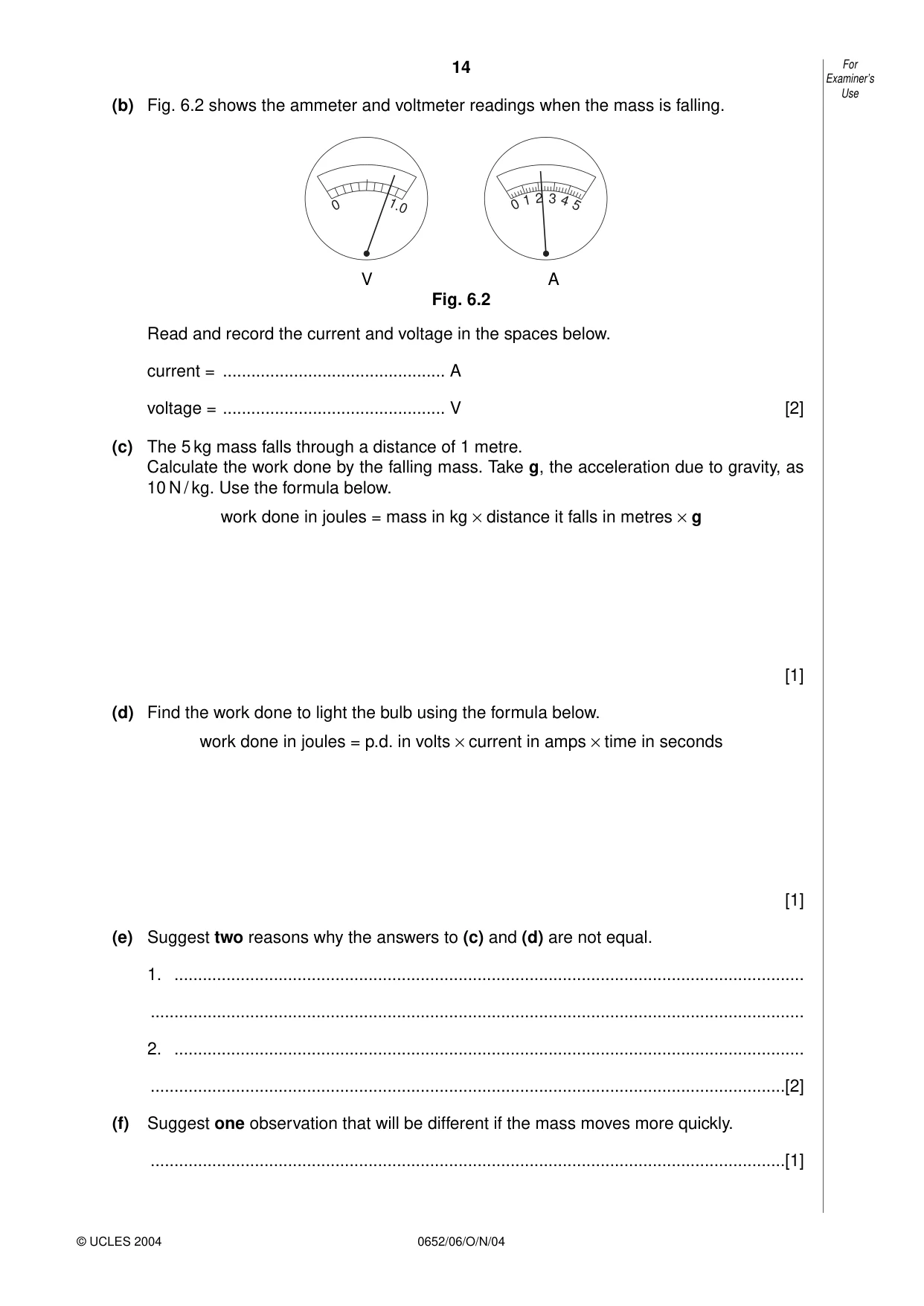
14 0652/06/O/N/04 (b) Fig. 6.2 shows the ammeter and voltmeter readings when the mass is falling. V A Fig. 6.2 Read and record the current and voltage in the spaces below. current = … A voltage = … V [2] (c) The 5 kg mass falls through a distance of 1 metre. Calculate the work done by the falling mass. Take g, the acceleration due to gravity, as 10 N / kg. Use the formula below. work done in joules = mass in kg × distance it falls in metres × g [1] (d) Find the work done to light the bulb using the formula below. work done in joules = p.d. in volts × current in amps × time in seconds [1] (e) Suggest two reasons why the answers to (c) and (d) are not equal. 1. … … 2. … …[2] (f) Suggest one observation that will be different if the mass moves more quickly. …[1] 0 1.0 0 1 2 3 4 5 For Examiner’s Use © UCLES 2004
Question paper, page 15
15 0652/06/O/N/04 BLANK PAGE © UCLES 2004
Question paper, page 16
16 0652/06/O/N/04 BLANK PAGE © UCLES 2004 Every reasonable effort has been made to trace all copyright holders where the publishers (i.e UCLES) are aware that third-party material has been reproduced. The publishers would be pleased to hear from anyone whose rights we have unwittingly infringed. University of Cambridge International Examinations is part of the University of Cambridge Local Examinations Syndicate (UCLES), which is itself a department of the University of Cambridge.
Mark scheme, page 1
UNIVERSITY OF CAMBRIDGE INTERNATIONAL EXAMINATIONS International General Certificate of Secondary Education MARK SCHEME for the NOVEMBER 2004 question paper 0652 PHYSICAL SCIENCE 0652/06 Paper 6 (Alternative to Practical), maximum raw mark 60 This mark scheme is published as an aid to teachers and students, to indicate the requirements of the examination. It shows the basis on which Examiners were initially instructed to award marks. It does not indicate the details of the discussions that took place at an Examiners’ meeting before marking began. Any substantial changes to the mark scheme that arose from these discussions will be recorded in the published Report on the Examination. All Examiners are instructed that alternative correct answers and unexpected approaches in candidates’ scripts must be given marks that fairly reflect the relevant knowledge and skills demonstrated. Mark schemes must be read in conjunction with the question papers and the Report on the Examination. • CIE will not enter into discussion or correspondence in connection with these mark schemes. CIE is publishing the mark schemes for the November 2004 question papers for most IGCSE and GCE Advanced Level syllabuses. www.XtremePapers.com
Mark scheme, page 2
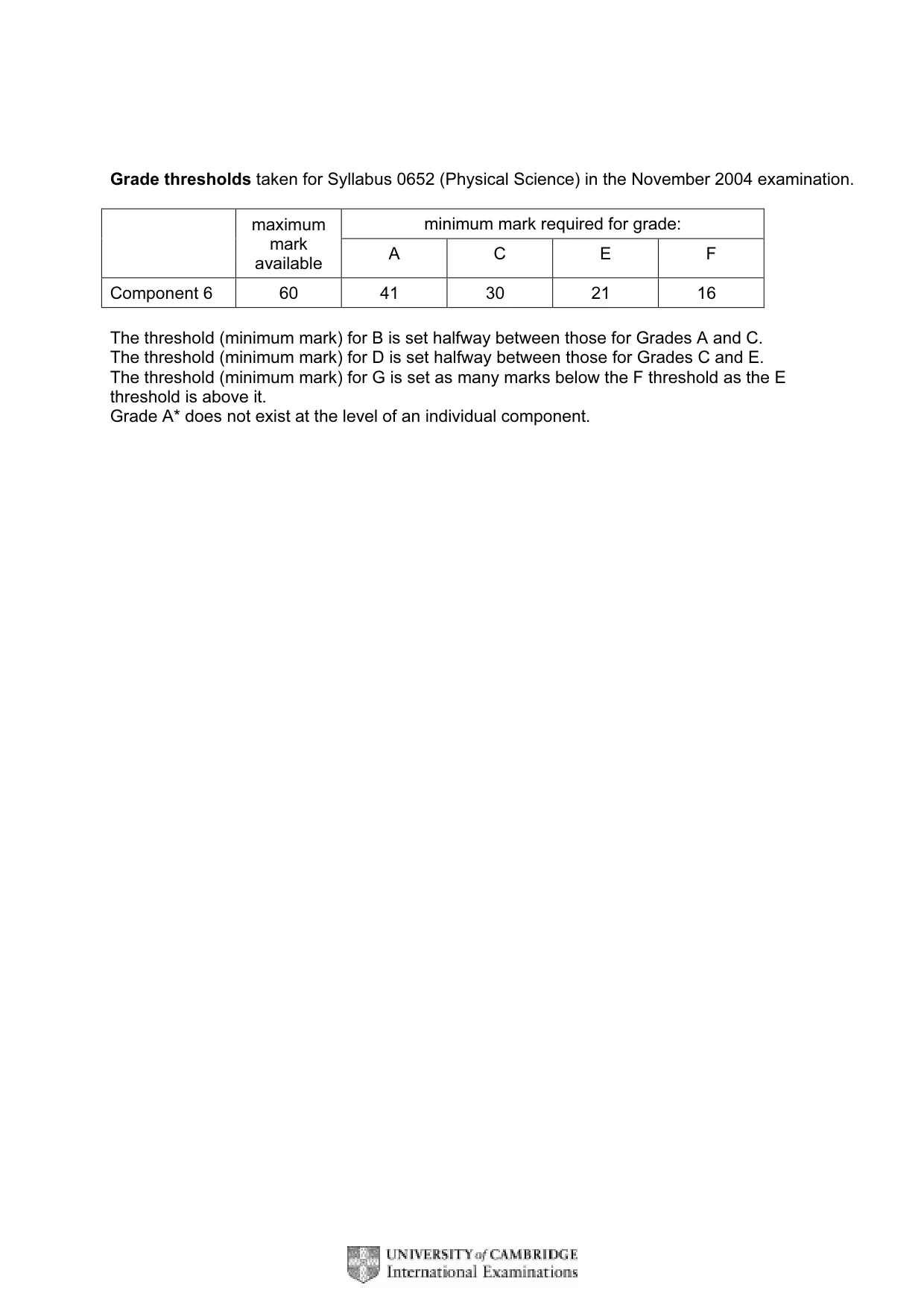
Grade thresholds taken for Syllabus 0652 (Physical Science) in the November 2004 examination. minimum mark required for grade: maximum mark available A C E F Component 6 60 41 30 21 16 The threshold (minimum mark) for B is set halfway between those for Grades A and C. The threshold (minimum mark) for D is set halfway between those for Grades C and E. The threshold (minimum mark) for G is set as many marks below the F threshold as the E threshold is above it. Grade A* does not exist at the level of an individual component.
Mark scheme, page 3
November 2004 INTERNATIONAL GCSE MARK SCHEME MAXIMUM MARK: 60 SYLLABUS/COMPONENT: 0652/06 PHYSICAL SCIENCE Paper 6 (Alternative to Practical)
Mark scheme, page 4
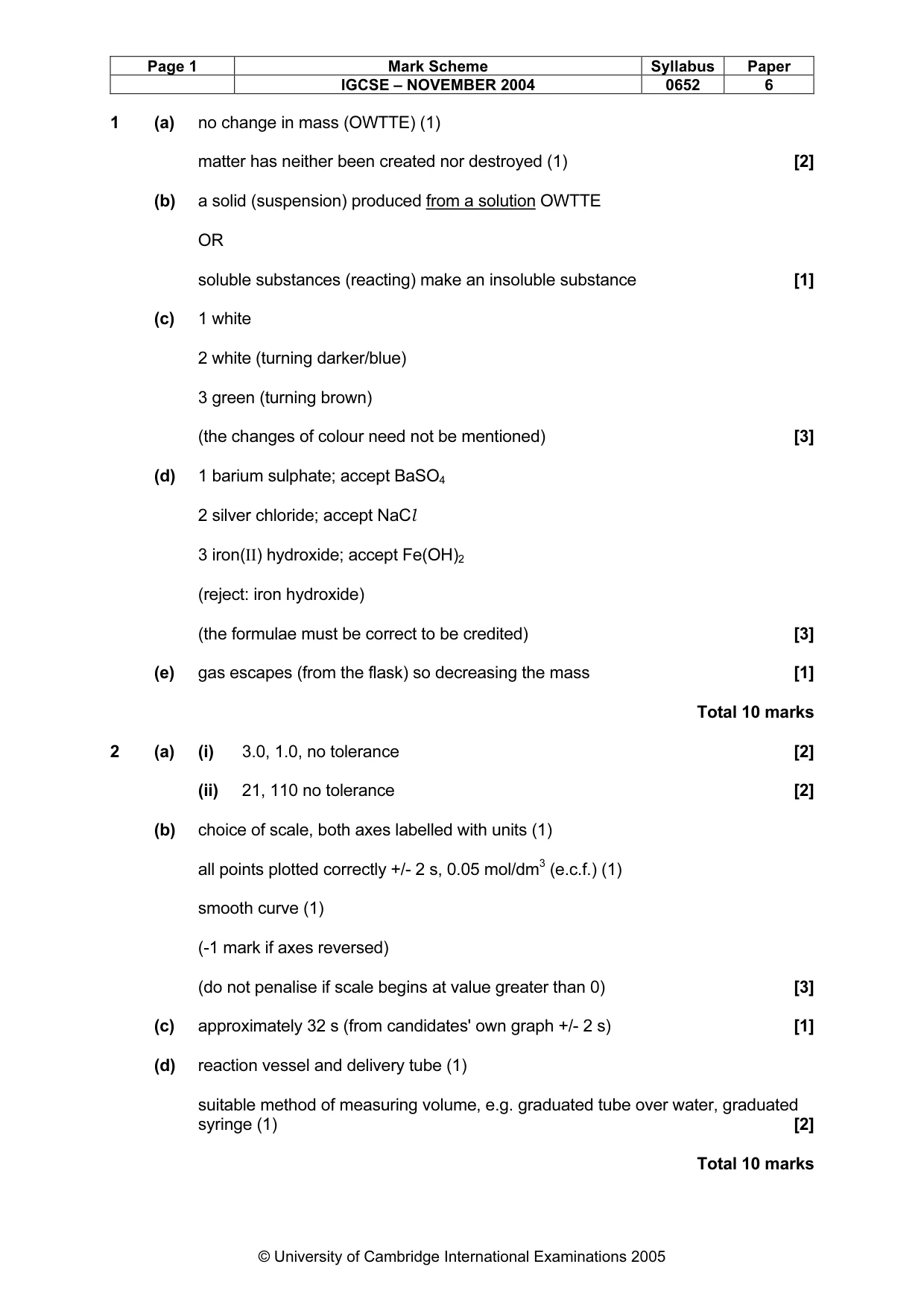
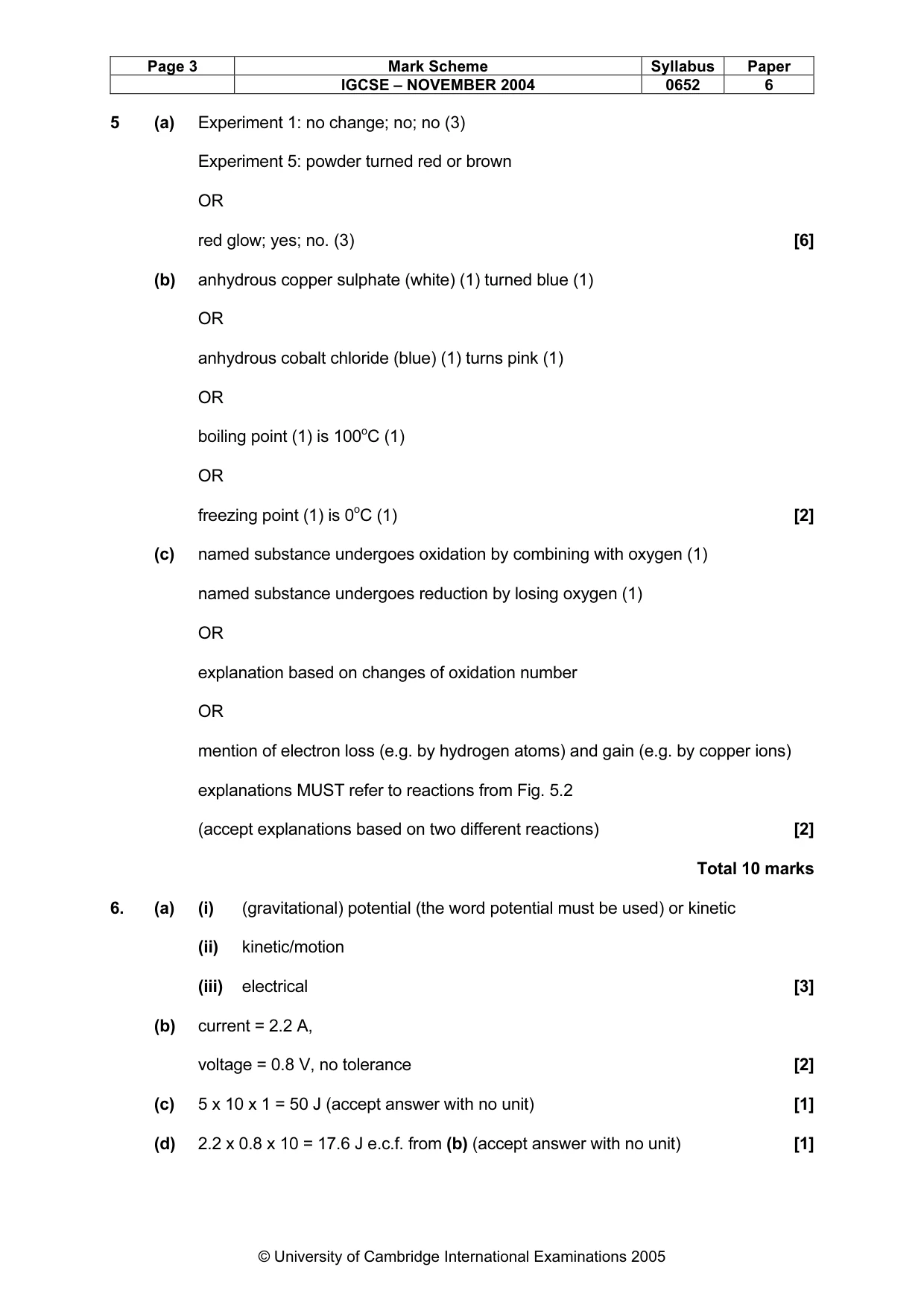
Page 1 Mark Scheme Syllabus Paper IGCSE – NOVEMBER 2004 0652 6 © University of Cambridge International Examinations 2005 1 (a) no change in mass (OWTTE) (1) matter has neither been created nor destroyed (1) [2] (b) a solid (suspension) produced from a solution OWTTE OR soluble substances (reacting) make an insoluble substance [1] (c) 1 white 2 white (turning darker/blue) 3 green (turning brown) (the changes of colour need not be mentioned) [3] (d) 1 barium sulphate; accept BaSO4 2 silver chloride; accept NaCl 3 iron(II) hydroxide; accept Fe(OH)2 (reject: iron hydroxide) (the formulae must be correct to be credited) [3] (e) gas escapes (from the flask) so decreasing the mass [1] Total 10 marks 2 (a) (i) 3.0, 1.0, no tolerance [2] (ii) 21, 110 no tolerance [2] (b) choice of scale, both axes labelled with units (1) all points plotted correctly +/- 2 s, 0.05 mol/dm3 (e.c.f.) (1) smooth curve (1) (-1 mark if axes reversed) (do not penalise if scale begins at value greater than 0) [3] (c) approximately 32 s (from candidates' own graph +/- 2 s) [1] (d) reaction vessel and delivery tube (1) suitable method of measuring volume, e.g. graduated tube over water, graduated syringe (1) [2] Total 10 marks
Mark scheme, page 5
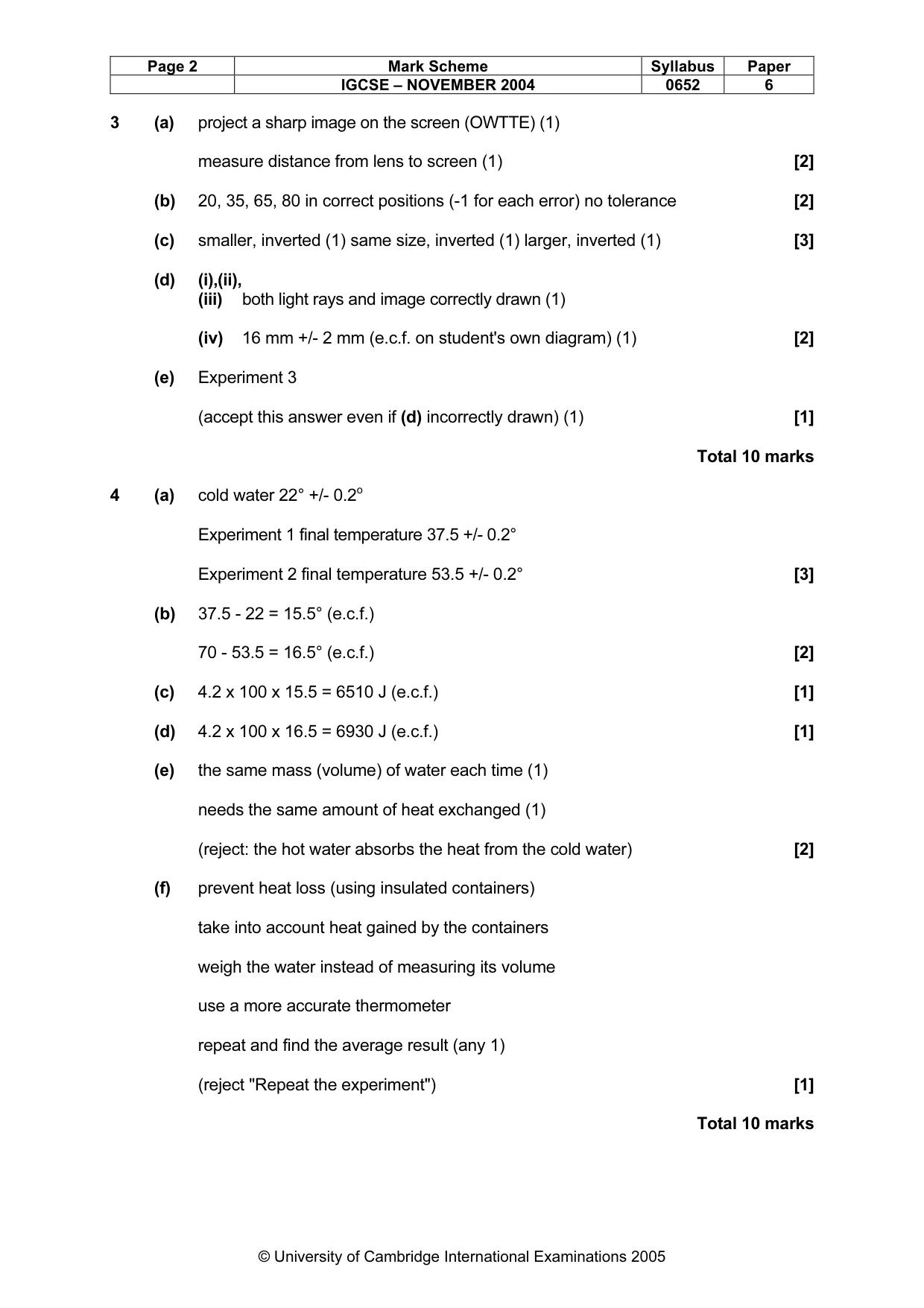
Page 2 Mark Scheme Syllabus Paper IGCSE – NOVEMBER 2004 0652 6 © University of Cambridge International Examinations 2005 3 (a) project a sharp image on the screen (OWTTE) (1) measure distance from lens to screen (1) [2] (b) 20, 35, 65, 80 in correct positions (-1 for each error) no tolerance [2] (c) smaller, inverted (1) same size, inverted (1) larger, inverted (1) [3] (d) (i),(ii), (iii) both light rays and image correctly drawn (1) (iv) 16 mm +/- 2 mm (e.c.f. on student's own diagram) (1) [2] (e) Experiment 3 (accept this answer even if (d) incorrectly drawn) (1) [1] Total 10 marks 4 (a) cold water 22° +/- 0.2o Experiment 1 final temperature 37.5 +/- 0.2° Experiment 2 final temperature 53.5 +/- 0.2° [3] (b) 37.5 - 22 = 15.5° (e.c.f.) 70 - 53.5 = 16.5° (e.c.f.) [2] (c) 4.2 x 100 x 15.5 = 6510 J (e.c.f.) [1] (d) 4.2 x 100 x 16.5 = 6930 J (e.c.f.) [1] (e) the same mass (volume) of water each time (1) needs the same amount of heat exchanged (1) (reject: the hot water absorbs the heat from the cold water) [2] (f) prevent heat loss (using insulated containers) take into account heat gained by the containers weigh the water instead of measuring its volume use a more accurate thermometer repeat and find the average result (any 1) (reject "Repeat the experiment") [1] Total 10 marks
Mark scheme, page 6
Page 3 Mark Scheme Syllabus Paper IGCSE – NOVEMBER 2004 0652 6 © University of Cambridge International Examinations 2005 5 (a) Experiment 1: no change; no; no (3) Experiment 5: powder turned red or brown OR red glow; yes; no. (3) [6] (b) anhydrous copper sulphate (white) (1) turned blue (1) OR anhydrous cobalt chloride (blue) (1) turns pink (1) OR boiling point (1) is 100oC (1) OR freezing point (1) is 0oC (1) [2] (c) named substance undergoes oxidation by combining with oxygen (1) named substance undergoes reduction by losing oxygen (1) OR explanation based on changes of oxidation number OR mention of electron loss (e.g. by hydrogen atoms) and gain (e.g. by copper ions) explanations MUST refer to reactions from Fig. 5.2 (accept explanations based on two different reactions) [2] Total 10 marks 6. (a) (i) (gravitational) potential (the word potential must be used) or kinetic (ii) kinetic/motion (iii) electrical [3] (b) current = 2.2 A, voltage = 0.8 V, no tolerance [2] (c) 5 x 10 x 1 = 50 J (accept answer with no unit) [1] (d) 2.2 x 0.8 x 10 = 17.6 J e.c.f. from (b) (accept answer with no unit) [1]
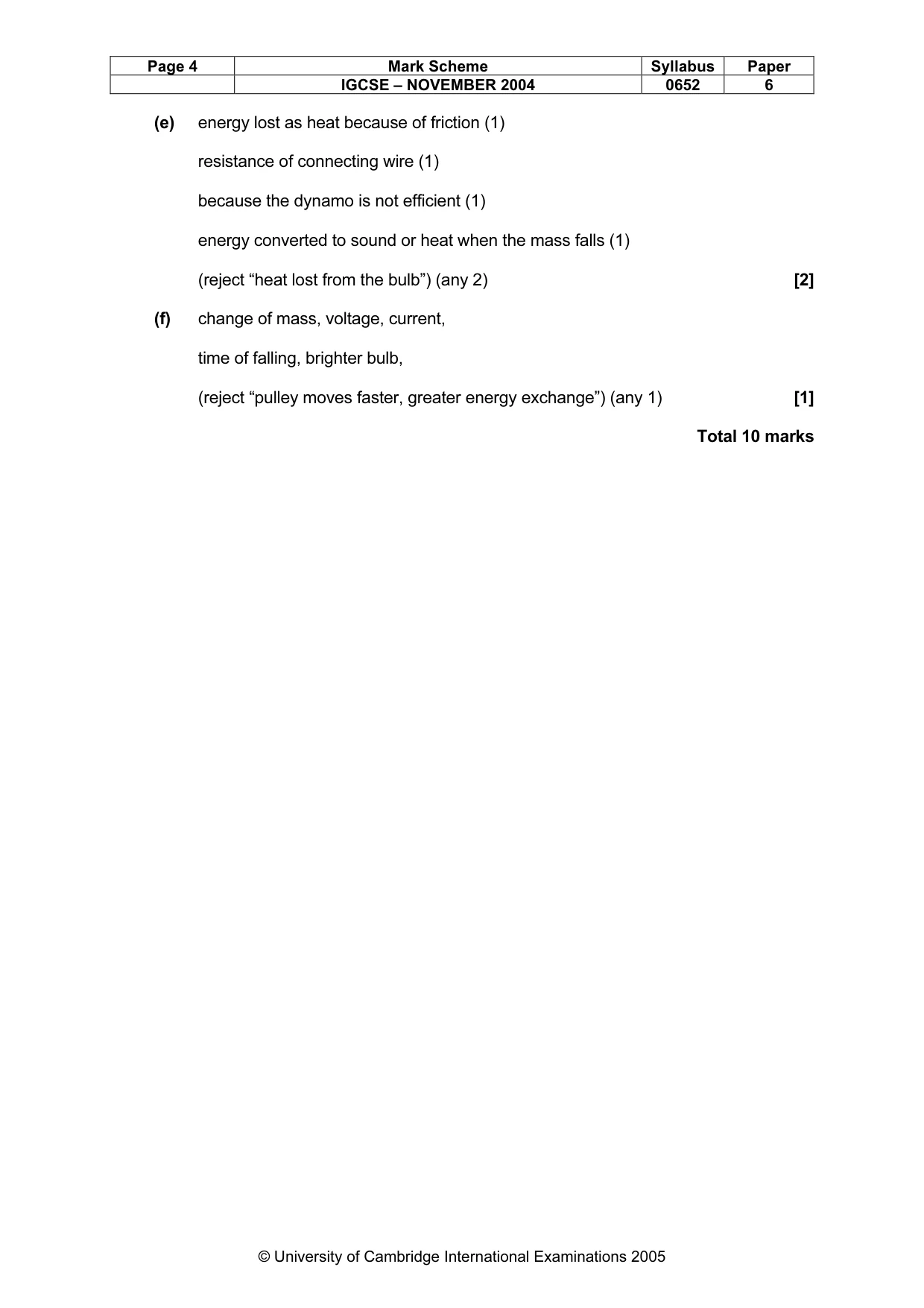
Mark scheme, page 7
Page 4 Mark Scheme Syllabus Paper IGCSE – NOVEMBER 2004 0652 6 © University of Cambridge International Examinations 2005 (e) energy lost as heat because of friction (1) resistance of connecting wire (1) because the dynamo is not efficient (1) energy converted to sound or heat when the mass falls (1) (reject “heat lost from the bulb”) (any 2) [2] (f) change of mass, voltage, current, time of falling, brighter bulb, (reject “pulley moves faster, greater energy exchange”) (any 1) [1] Total 10 marks