Cambridge IGCSE Physical Science 0652 — 2003 May/June Paper 6 · Variant 1
0652/61/M/J/03
The question paper and its mark scheme, free to read here and free to download. This is Cambridge’s own paper, exactly as it was sat.
Question paper16 pages
Mark scheme
No mark scheme is in the library for this paper.
Paper as text
Question paper, page 1
This document consists of 14 printed pages and 2 blank pages. SP (SM/SLC) S41616/5 © CIE 2003 [Turn over CAMBRIDGE INTERNATIONAL EXAMINATIONS International General Certificate of Secondary Education PHYSICAL SCIENCE 0652/06 Paper 6 Alternative to Practical May/June 2003 1 hour Candidates answer on the Question Paper. No Additional Materials are required. READ THESE INSTRUCTIONS FIRST Write your Centre number, candidate number and name on all the work you hand in. Write in dark blue or black pen in the spaces provided on the Question Paper. You may use a soft pencil for any diagrams, graphs, tables or rough working. Do not use staples, paper clips, highlighters, glue or correction fluid. Answer all questions. At the end of the examination, fasten all your work securely together. The number of marks is given in brackets [ ] at the end of each question or part question. Centre Number Candidate Number Name If you have been given a label, look at the details. If any details are incorrect or missing, please fill in your correct details in the space given at the top of this page. Stick your personal label here, if provided. For Examiner’s Use 1 2 3 4 5 6 Total www.XtremePapers.com
Question paper, page 2
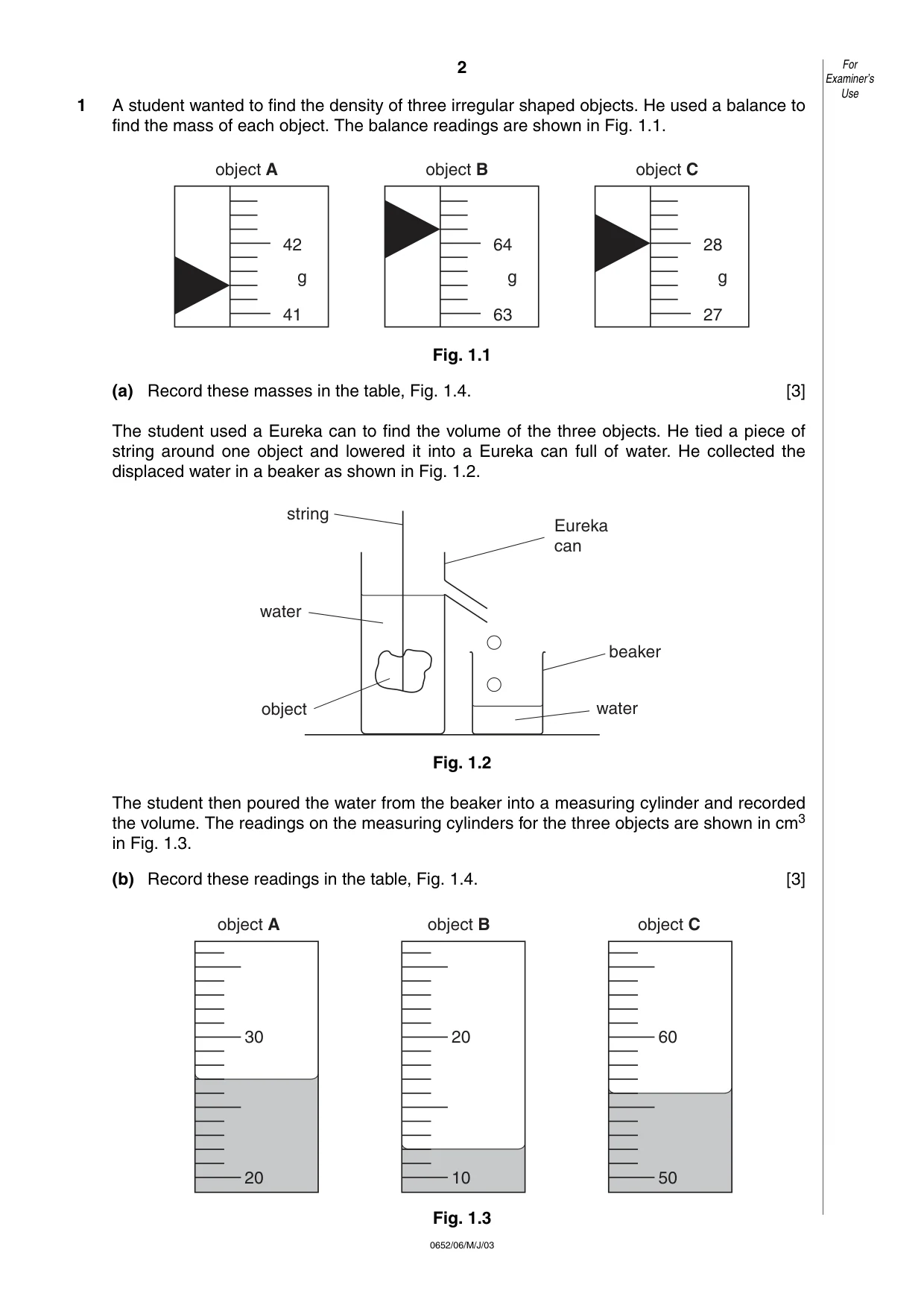
2 0652/06/M/J/03 1 A student wanted to find the density of three irregular shaped objects. He used a balance to find the mass of each object. The balance readings are shown in Fig. 1.1. Fig. 1.1 (a) Record these masses in the table, Fig. 1.4. [3] The student used a Eureka can to find the volume of the three objects. He tied a piece of string around one object and lowered it into a Eureka can full of water. He collected the displaced water in a beaker as shown in Fig. 1.2. Fig. 1.2 The student then poured the water from the beaker into a measuring cylinder and recorded the volume. The readings on the measuring cylinders for the three objects are shown in cm3 in Fig. 1.3. (b) Record these readings in the table, Fig. 1.4. [3] Fig. 1.3 20 30 10 20 50 60 object A object B object C string water object Eureka can beaker water object A 42 41 g object B 64 63 g object C 28 27 g For Examiner’s Use
Question paper, page 3
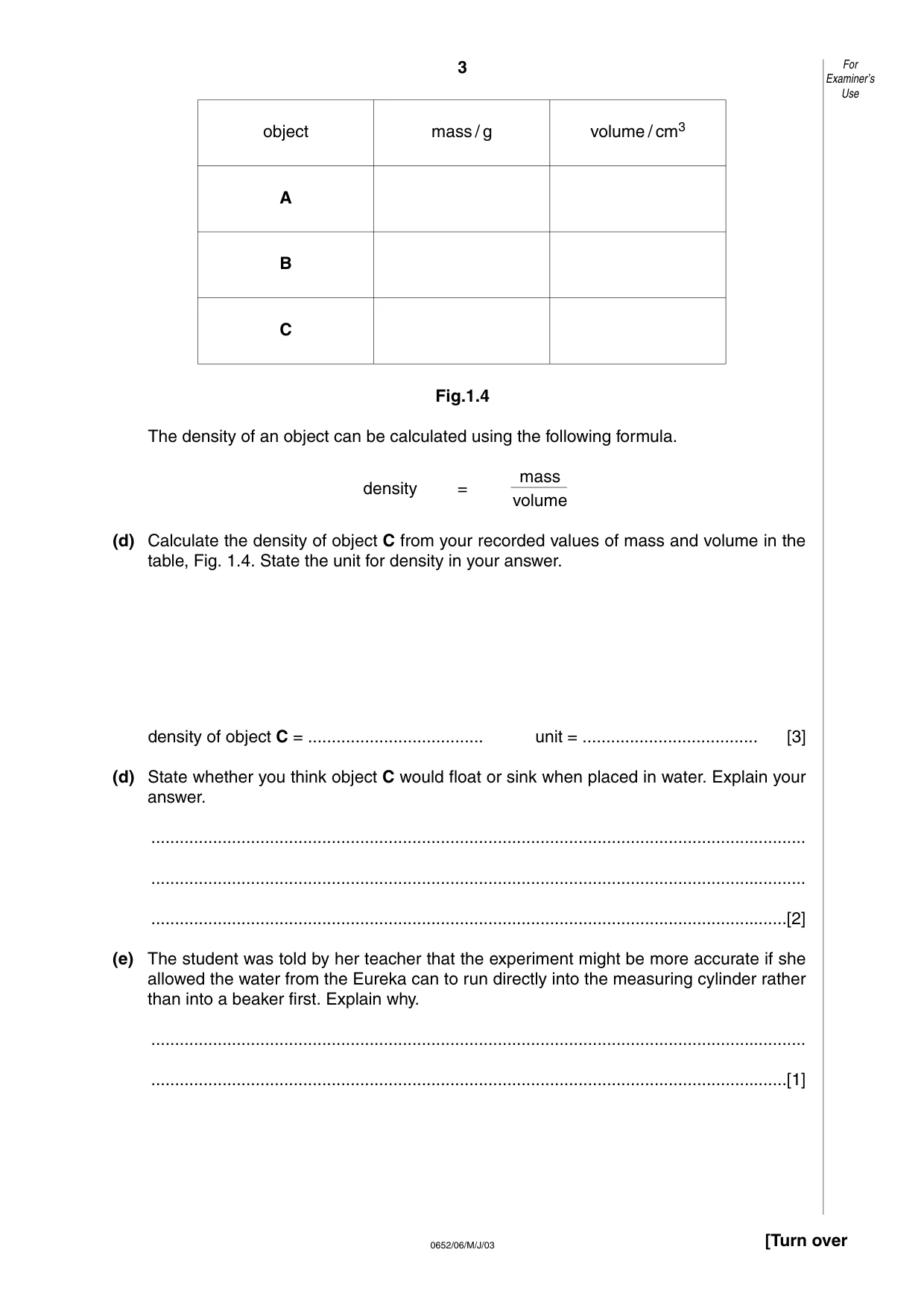
3 0652/06/M/J/03 [Turn over Fig.1.4 The density of an object can be calculated using the following formula. mass density = volume (d) Calculate the density of object C from your recorded values of mass and volume in the table, Fig. 1.4. State the unit for density in your answer. density of object C = … unit = … [3] (d) State whether you think object C would float or sink when placed in water. Explain your answer. … … …[2] (e) The student was told by her teacher that the experiment might be more accurate if she allowed the water from the Eureka can to run directly into the measuring cylinder rather than into a beaker first. Explain why. … …[1] For Examiner’s Use object A B C mass / g volume / cm3
Question paper, page 4
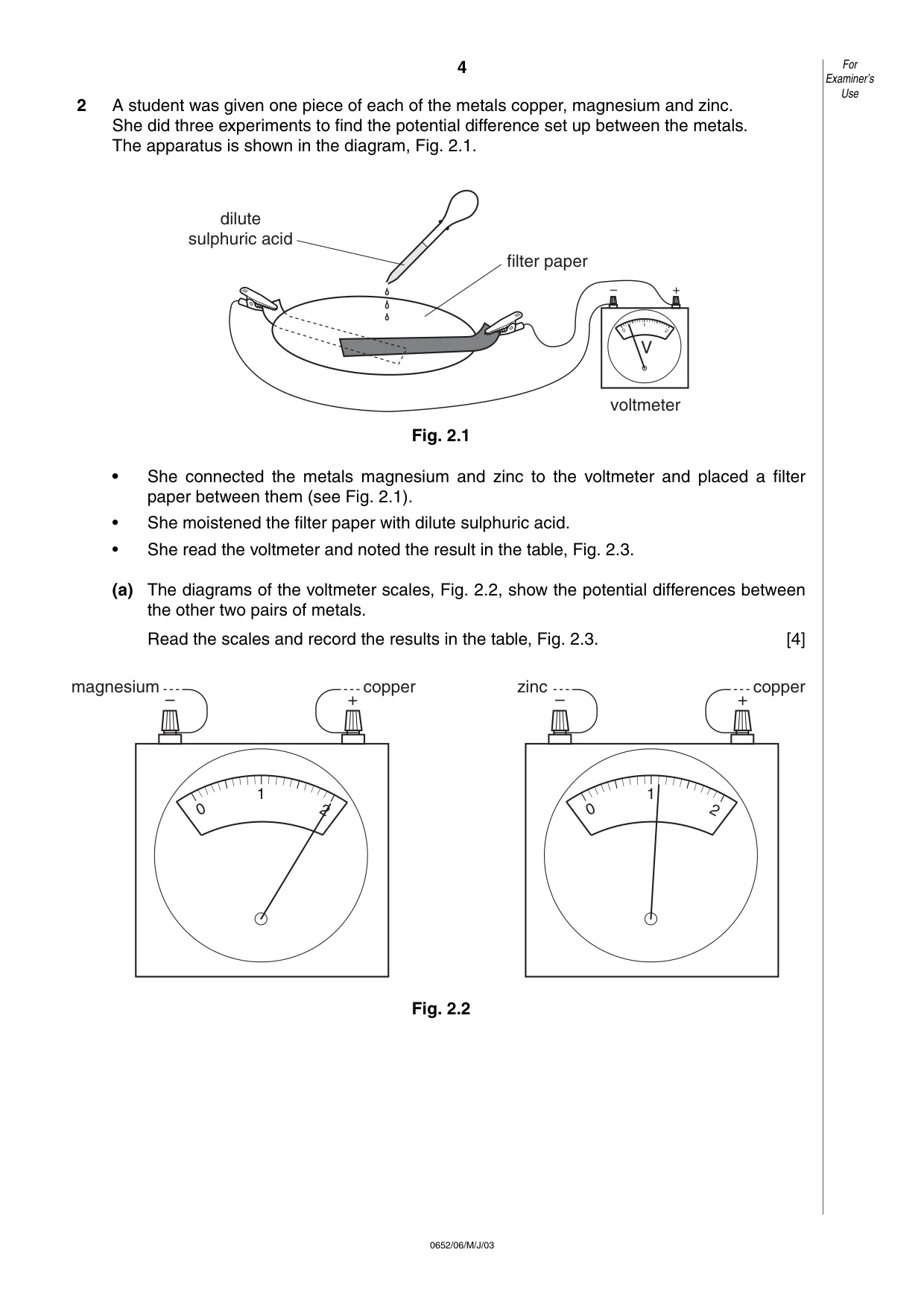
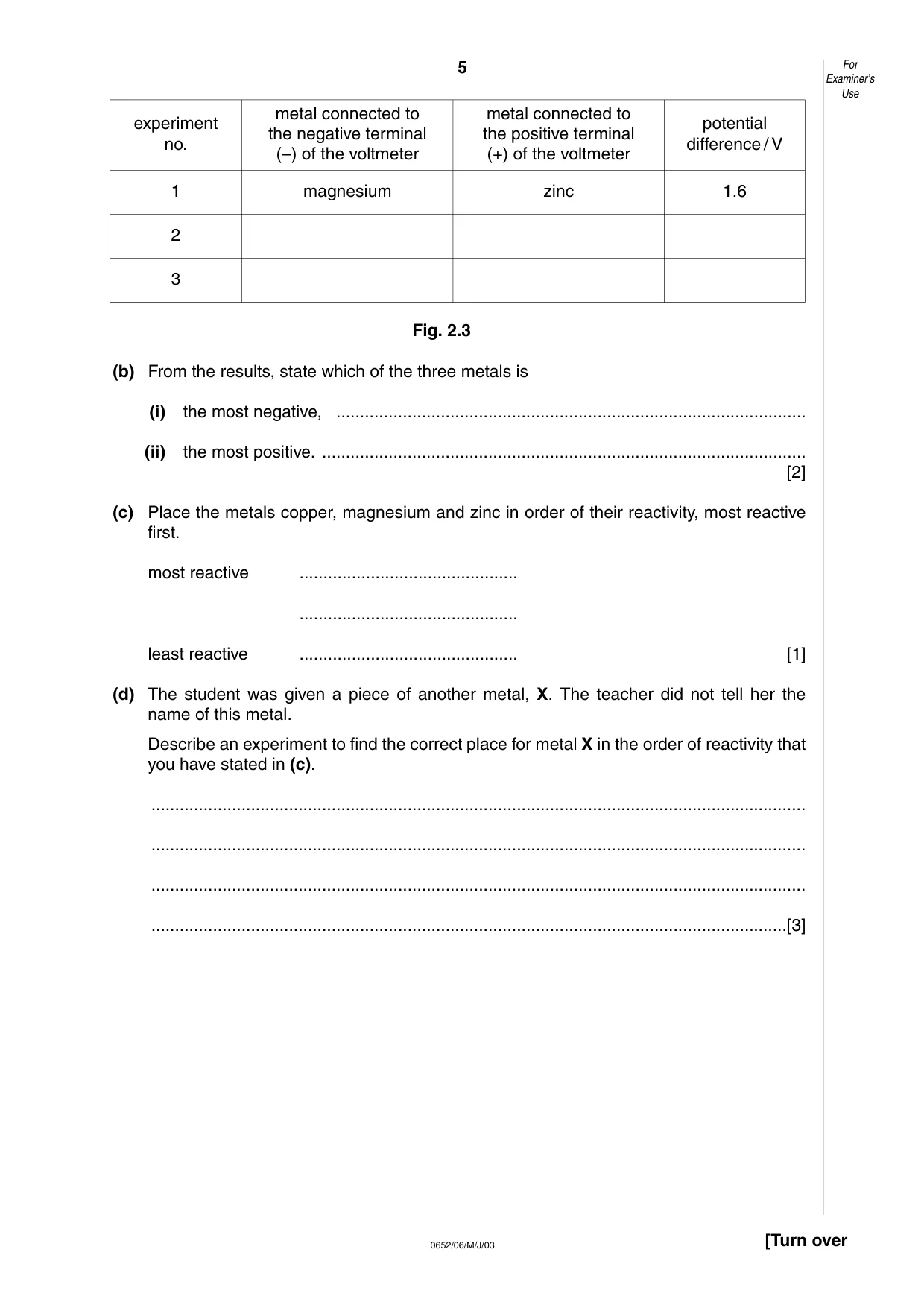
4 0652/06/M/J/03 2 A student was given one piece of each of the metals copper, magnesium and zinc. She did three experiments to find the potential difference set up between the metals. The apparatus is shown in the diagram, Fig. 2.1. Fig. 2.1 • She connected the metals magnesium and zinc to the voltmeter and placed a filter paper between them (see Fig. 2.1). • She moistened the filter paper with dilute sulphuric acid. • She read the voltmeter and noted the result in the table, Fig. 2.3. (a) The diagrams of the voltmeter scales, Fig. 2.2, show the potential differences between the other two pairs of metals. Read the scales and record the results in the table, Fig. 2.3. [4] Fig. 2.2 2 1 0 – + V filter paper dilute sulphuric acid voltmeter For Examiner’s Use 2 1 0 – + magnesium copper 2 1 0 – + zinc copper
Question paper, page 5
5 0652/06/M/J/03 [Turn over Fig. 2.3 (b) From the results, state which of the three metals is (i) the most negative, … (ii) the most positive. … [2] (c) Place the metals copper, magnesium and zinc in order of their reactivity, most reactive first. most reactive … … least reactive … [1] (d) The student was given a piece of another metal, X. The teacher did not tell her the name of this metal. Describe an experiment to find the correct place for metal X in the order of reactivity that you have stated in (c). … … … …[3] For Examiner’s Use experiment no. 1 magnesium zinc 1.6 2 3 metal connected to the negative terminal (–) of the voltmeter metal connected to the positive terminal (+) of the voltmeter potential difference / V
Question paper, page 7
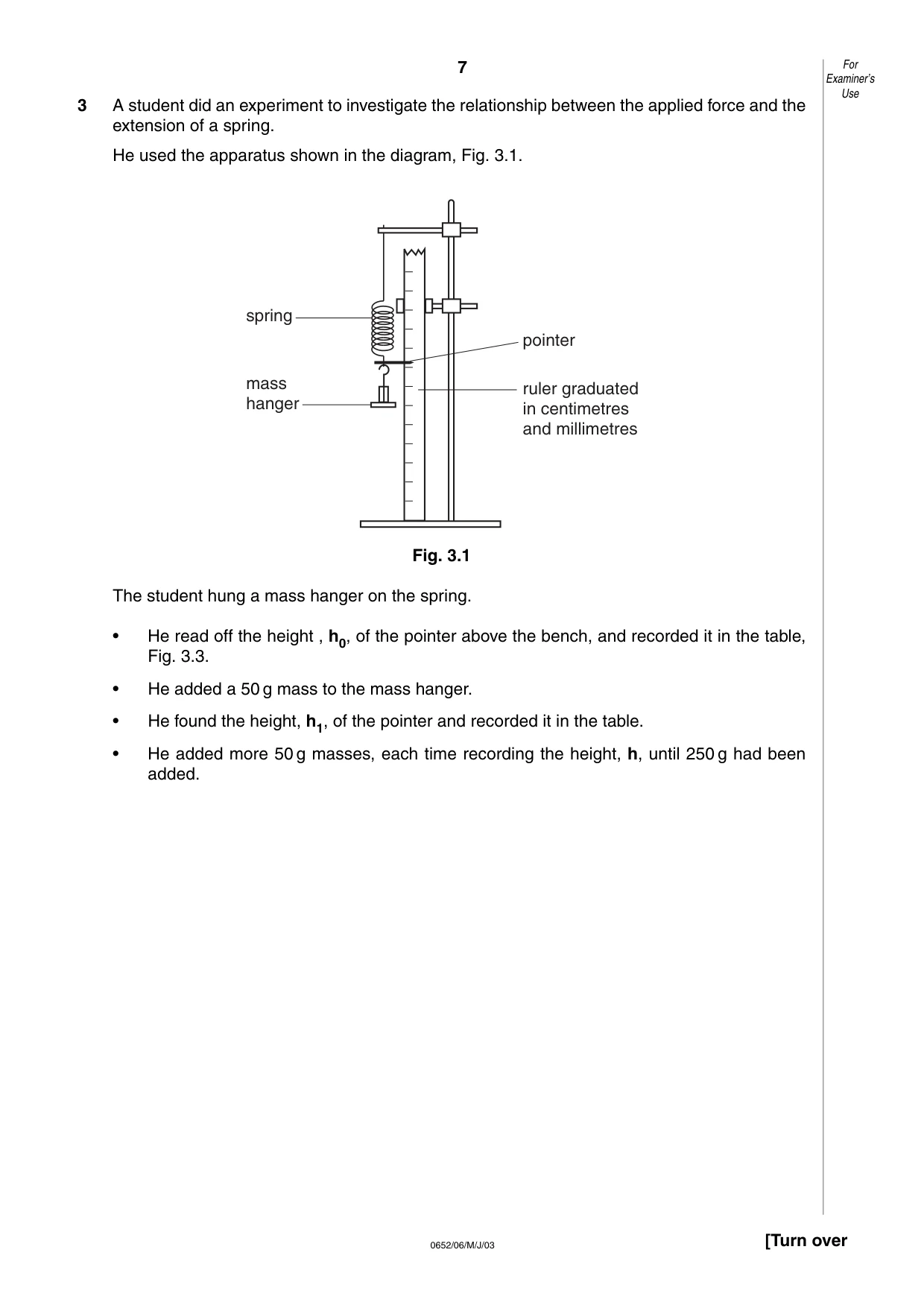
7 0652/06/M/J/03 [Turn over 3 A student did an experiment to investigate the relationship between the applied force and the extension of a spring. He used the apparatus shown in the diagram, Fig. 3.1. Fig. 3.1 The student hung a mass hanger on the spring. • He read off the height , h0, of the pointer above the bench, and recorded it in the table, Fig. 3.3. • He added a 50 g mass to the mass hanger. • He found the height, h1, of the pointer and recorded it in the table. • He added more 50 g masses, each time recording the height, h, until 250 g had been added. spring mass hanger pointer ruler graduated in centimetres and millimetres For Examiner’s Use
Question paper, page 8
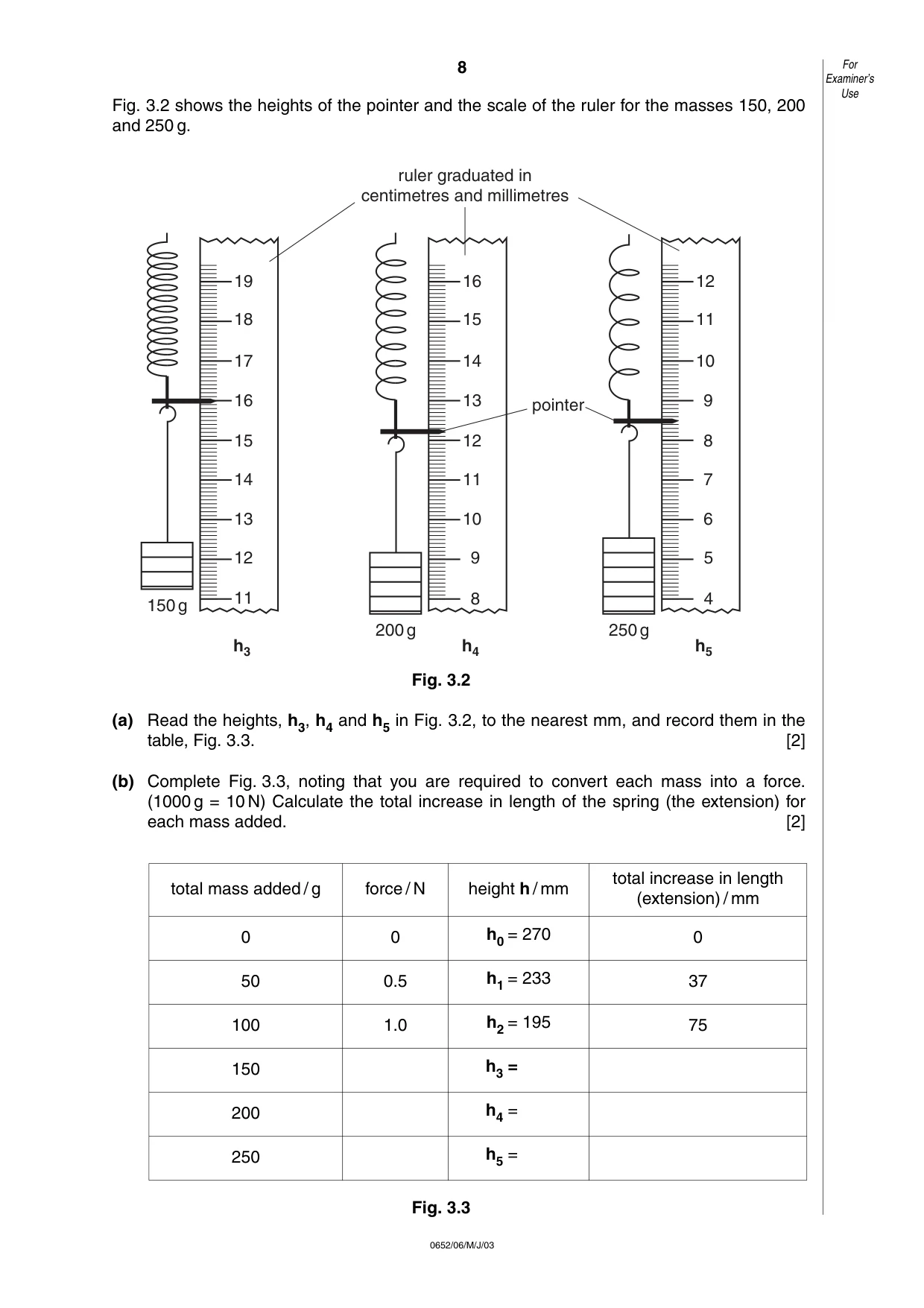
8 0652/06/M/J/03 Fig. 3.2 shows the heights of the pointer and the scale of the ruler for the masses 150, 200 and 250 g. Fig. 3.2 (a) Read the heights, h3, h4 and h5 in Fig. 3.2, to the nearest mm, and record them in the table, Fig. 3.3. [2] (b) Complete Fig. 3.3, noting that you are required to convert each mass into a force. (1000 g = 10 N) Calculate the total increase in length of the spring (the extension) for each mass added. [2] Fig. 3.3 19 18 17 16 15 14 13 12 11 150g h3 16 15 14 13 12 11 10 9 8 200g h4 12 11 10 9 8 7 6 5 4 250g h5 ruler graduated in centimetres and millimetres pointer For Examiner’s Use total mass added / g 0 0 h0 = 270 0 37 75 h1 = 233 h2 = 195 h3 = h4 = h5 = 0.5 1.0 50 100 150 200 250 force / N height h / mm total increase in length (extension) / mm
Question paper, page 9
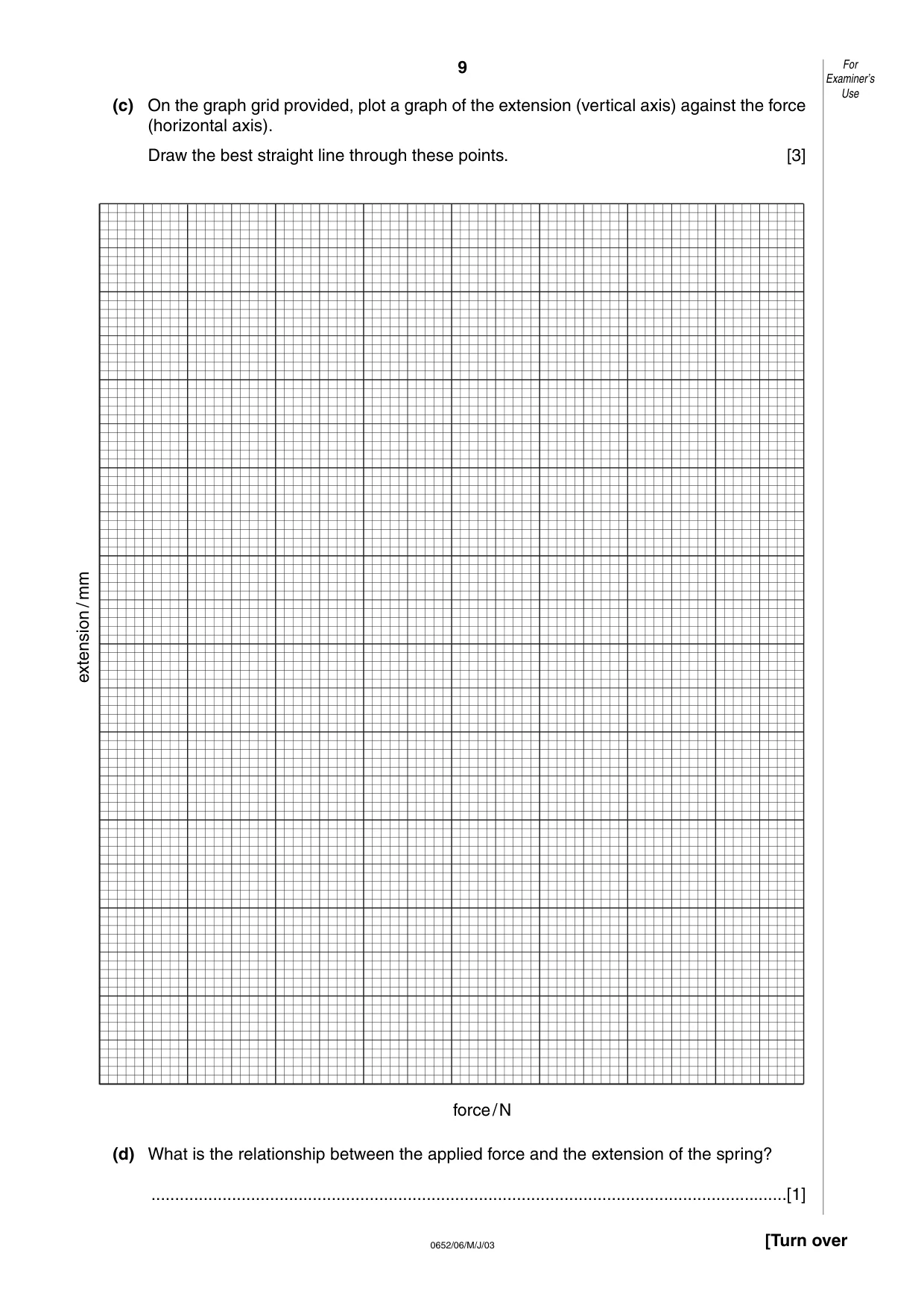
9 0652/06/M/J/03 [Turn over (c) On the graph grid provided, plot a graph of the extension (vertical axis) against the force (horizontal axis). Draw the best straight line through these points. [3] (d) What is the relationship between the applied force and the extension of the spring? …[1] For Examiner’s Use force/N extension / mm
Question paper, page 10
10 0652/06/M/J/03 (e) Describe how you would find the mass of an object using the same apparatus. You need to state the measurements you would make and show how the mass can be calculated. … … … …[2] For Examiner’s Use
Question paper, page 11
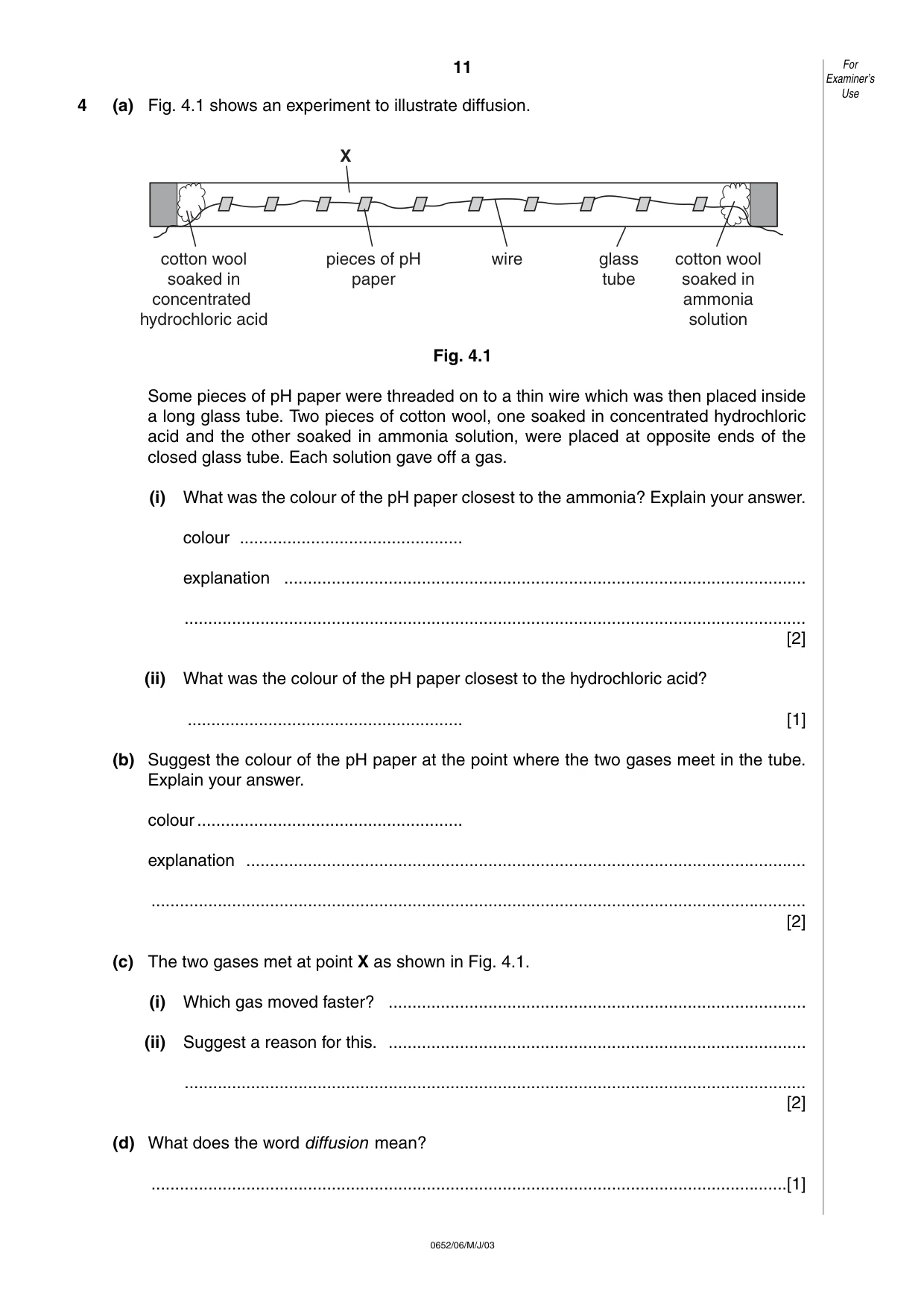
11 0652/06/M/J/03 4 (a) Fig. 4.1 shows an experiment to illustrate diffusion. Fig. 4.1 Some pieces of pH paper were threaded on to a thin wire which was then placed inside a long glass tube. Two pieces of cotton wool, one soaked in concentrated hydrochloric acid and the other soaked in ammonia solution, were placed at opposite ends of the closed glass tube. Each solution gave off a gas. (i) What was the colour of the pH paper closest to the ammonia? Explain your answer. colour … explanation … … [2] (ii) What was the colour of the pH paper closest to the hydrochloric acid? … [1] (b) Suggest the colour of the pH paper at the point where the two gases meet in the tube. Explain your answer. colour… explanation … … [2] (c) The two gases met at point X as shown in Fig. 4.1. (i) Which gas moved faster? … (ii) Suggest a reason for this. … … [2] (d) What does the word diffusion mean? …[1] X cotton wool soaked in concentrated hydrochloric acid pieces of pH paper wire glass tube cotton wool soaked in ammonia solution For Examiner’s Use
Question paper, page 12
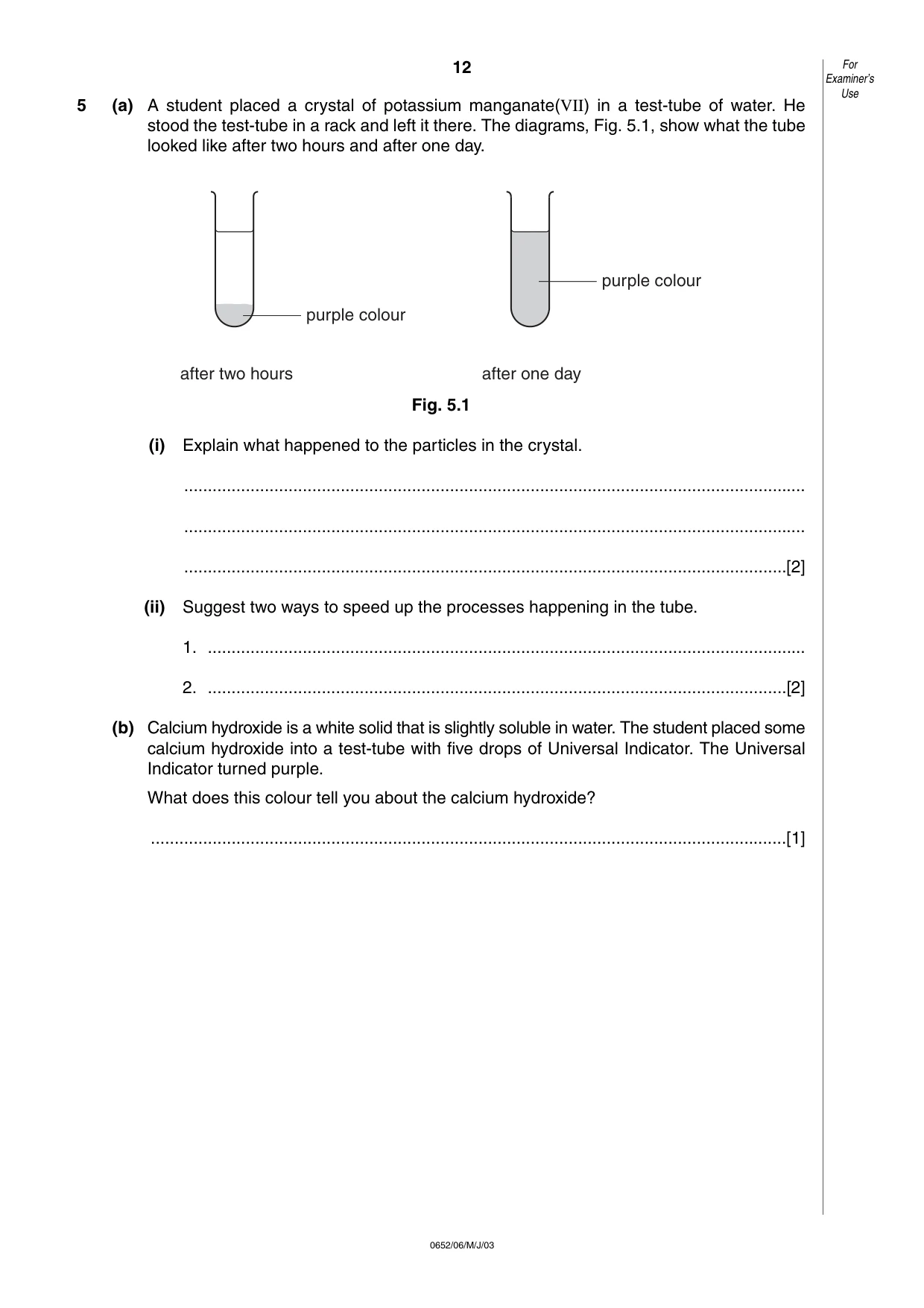
12 0652/06/M/J/03 5 (a) A student placed a crystal of potassium manganate(VII) in a test-tube of water. He stood the test-tube in a rack and left it there. The diagrams, Fig. 5.1, show what the tube looked like after two hours and after one day. Fig. 5.1 (i) Explain what happened to the particles in the crystal. … … …[2] (ii) Suggest two ways to speed up the processes happening in the tube. 1. … 2. …[2] (b) Calcium hydroxide is a white solid that is slightly soluble in water. The student placed some calcium hydroxide into a test-tube with five drops of Universal Indicator. The Universal Indicator turned purple. What does this colour tell you about the calcium hydroxide? …[1] purple colour purple colour after two hours after one day For Examiner’s Use
Question paper, page 13
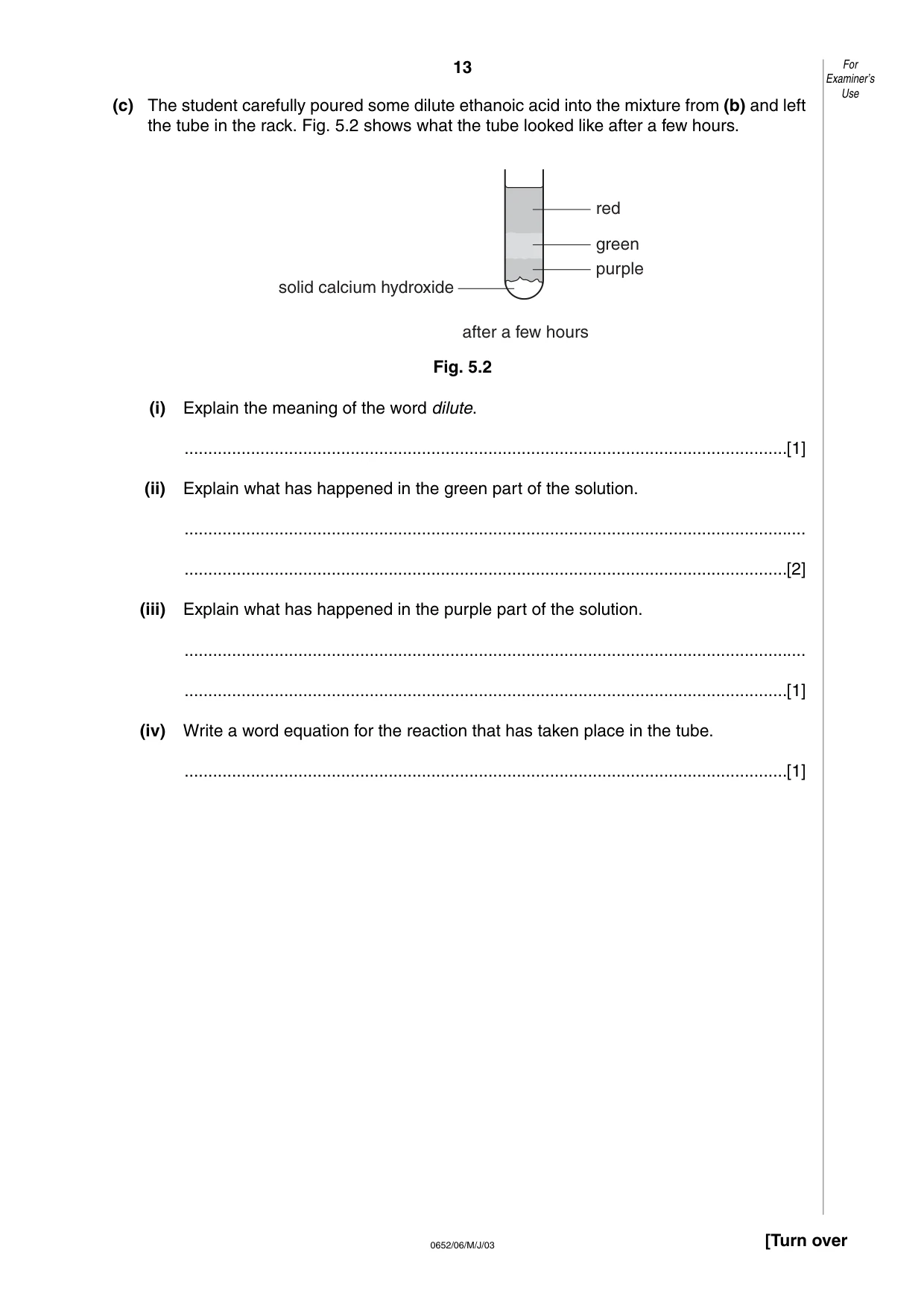
13 0652/06/M/J/03 [Turn over (c) The student carefully poured some dilute ethanoic acid into the mixture from (b) and left the tube in the rack. Fig. 5.2 shows what the tube looked like after a few hours. Fig. 5.2 (i) Explain the meaning of the word dilute. …[1] (ii) Explain what has happened in the green part of the solution. … …[2] (iii) Explain what has happened in the purple part of the solution. … …[1] (iv) Write a word equation for the reaction that has taken place in the tube. …[1] purple green red after a few hours solid calcium hydroxide For Examiner’s Use
Question paper, page 14
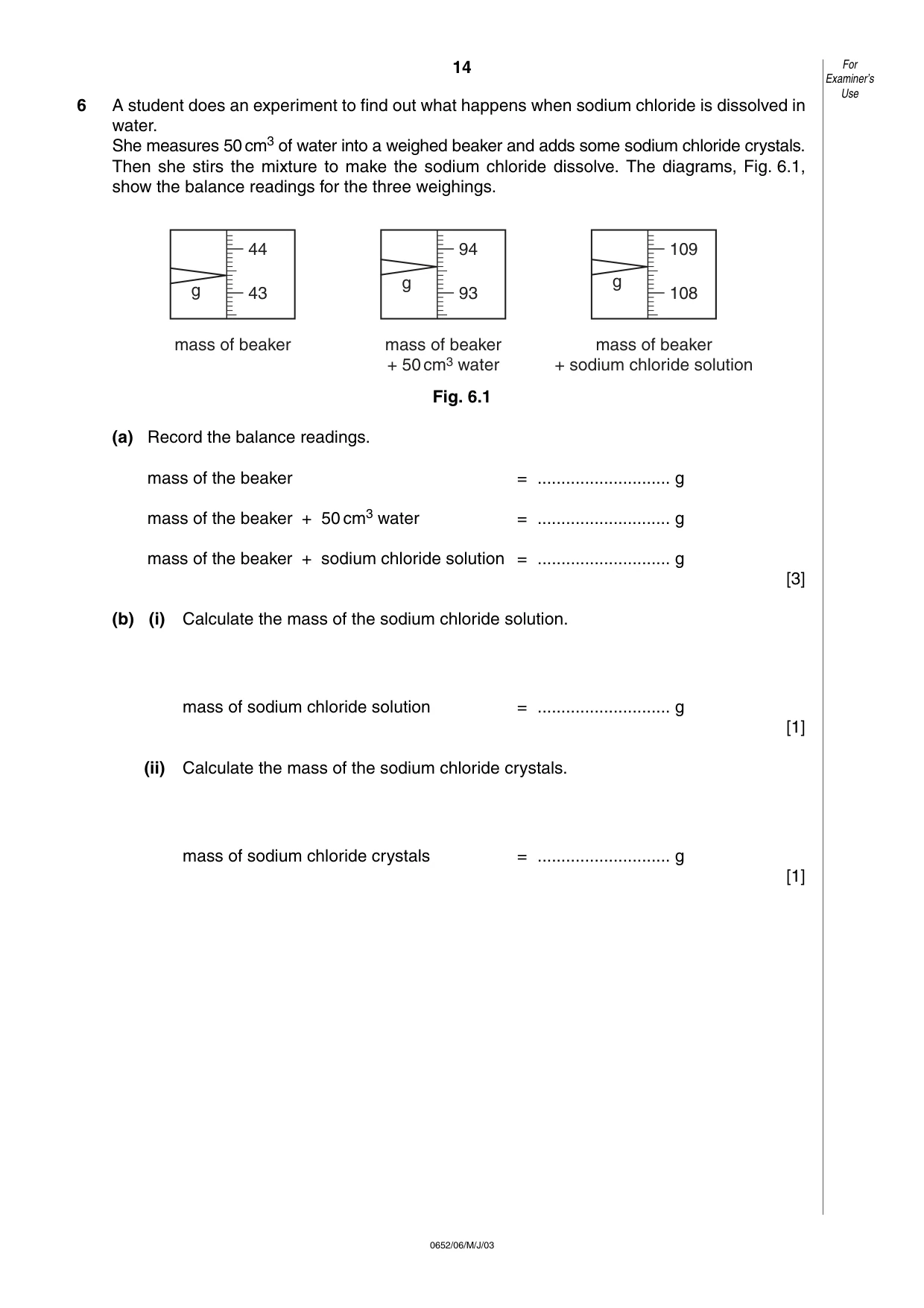
14 0652/06/M/J/03 6 A student does an experiment to find out what happens when sodium chloride is dissolved in water. She measures 50 cm3 of water into a weighed beaker and adds some sodium chloride crystals. Then she stirs the mixture to make the sodium chloride dissolve. The diagrams, Fig. 6.1, show the balance readings for the three weighings. Fig. 6.1 (a) Record the balance readings. mass of the beaker = … g mass of the beaker + 50 cm3 water = … g mass of the beaker + sodium chloride solution = … g [3] (b) (i) Calculate the mass of the sodium chloride solution. mass of sodium chloride solution = … g [1] (ii) Calculate the mass of the sodium chloride crystals. mass of sodium chloride crystals = … g [1] g 44 43 mass of beaker g 94 93 mass of beaker + 50cm3 water g 109 108 mass of beaker + sodium chloride solution For Examiner’s Use
Question paper, page 15
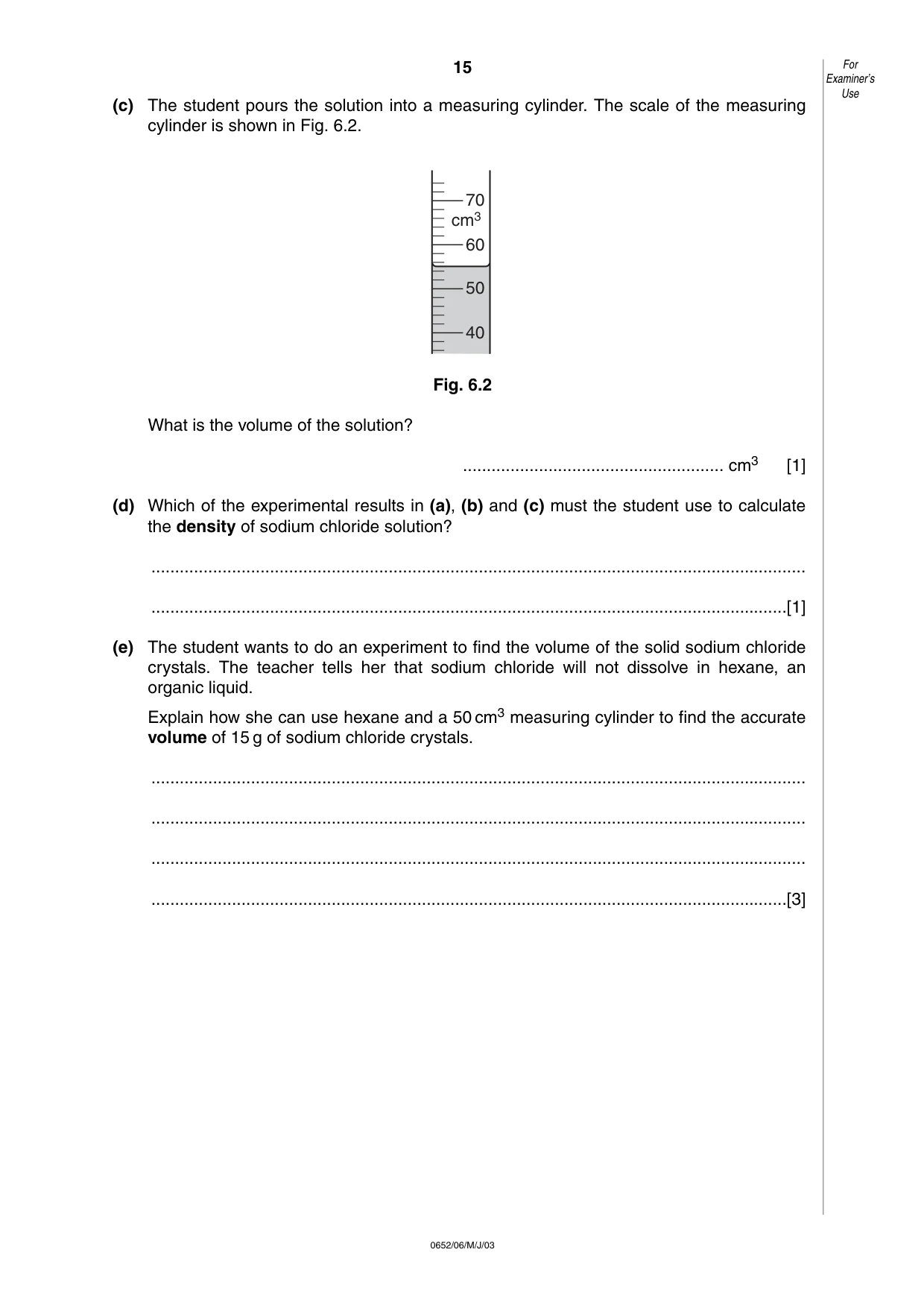
15 0652/06/M/J/03 (c) The student pours the solution into a measuring cylinder. The scale of the measuring cylinder is shown in Fig. 6.2. Fig. 6.2 What is the volume of the solution? … cm3 [1] (d) Which of the experimental results in (a), (b) and (c) must the student use to calculate the density of sodium chloride solution? … …[1] (e) The student wants to do an experiment to find the volume of the solid sodium chloride crystals. The teacher tells her that sodium chloride will not dissolve in hexane, an organic liquid. Explain how she can use hexane and a 50 cm3 measuring cylinder to find the accurate volume of 15 g of sodium chloride crystals. … … … …[3] 70 60 50 40 cm3 For Examiner’s Use