Cambridge IGCSE Pakistan Studies 0448 — 2025 May/June Paper 1 · Variant 0
0448/10/M/J/25 · 75 marks · ≈84 min
The question paper and its mark scheme, free to read here and free to download. This is Cambridge’s own paper, exactly as it was sat.
Question paper4 pages
Mark scheme
No mark scheme is in the library for this paper.
Paper as text
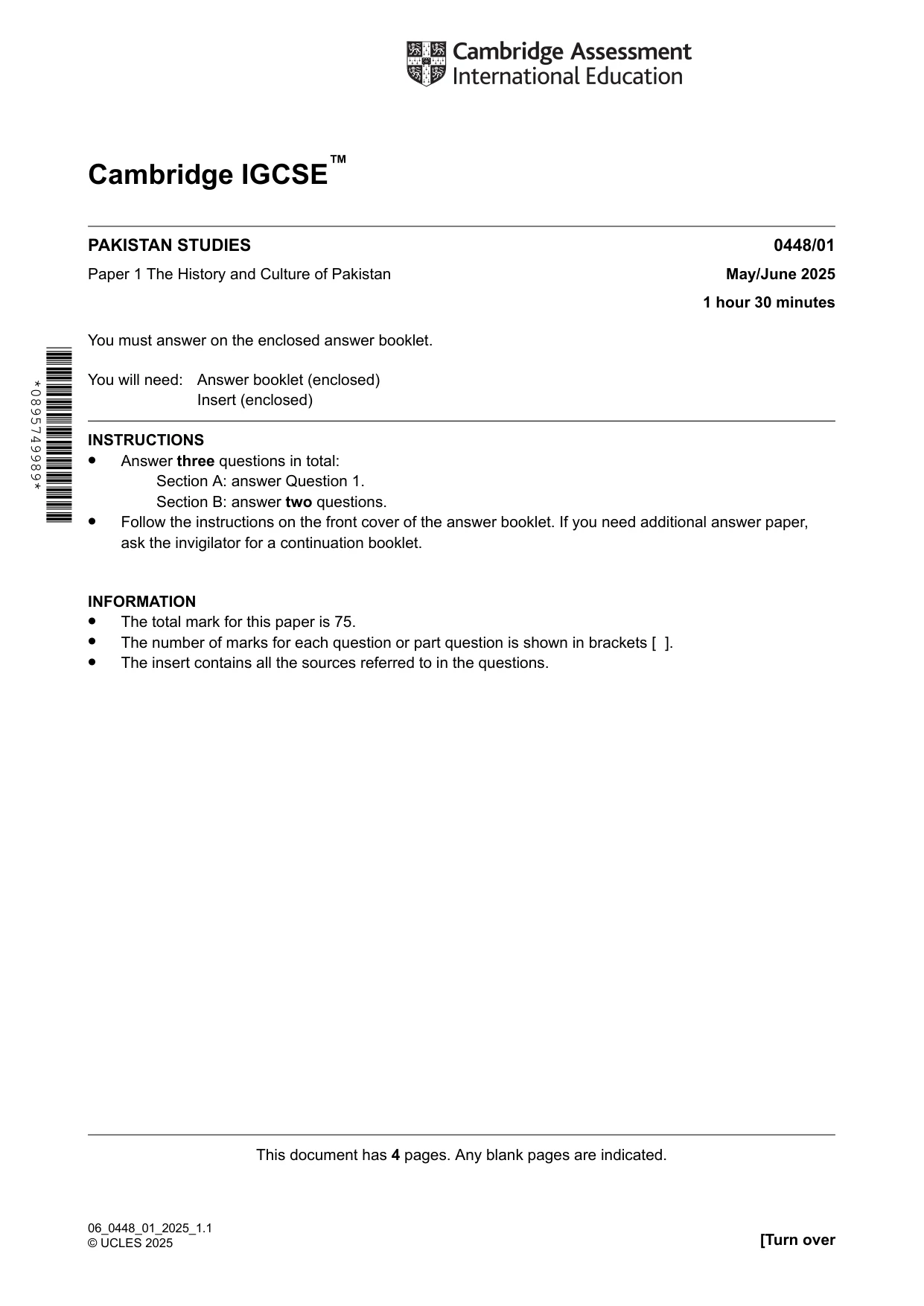
Question paper, page 1
Cambridge IGCSE™ 0448/01 May/June 2025 1 hour 30 minutes PAKISTAN STUDIES Paper 1 The History and Culture of Pakistan You must answer on the enclosed answer booklet. You will need: Answer booklet (enclosed) Insert (enclosed) INSTRUCTIONS • Answer three questions in total: Section A: answer Question 1. Section B: answer two questions. • Follow the instructions on the front cover of the answer booklet. If you need additional answer paper, ask the invigilator for a continuation booklet. INFORMATION • The total mark for this paper is 75. • The number of marks for each question or part question is shown in brackets [ ]. • The insert contains all the sources referred to in the questions. This document has 4 pages. Any blank pages are indicated. [Turn over 06_0448_01_2025_1.1 © UCLES 2025 *0895749989*
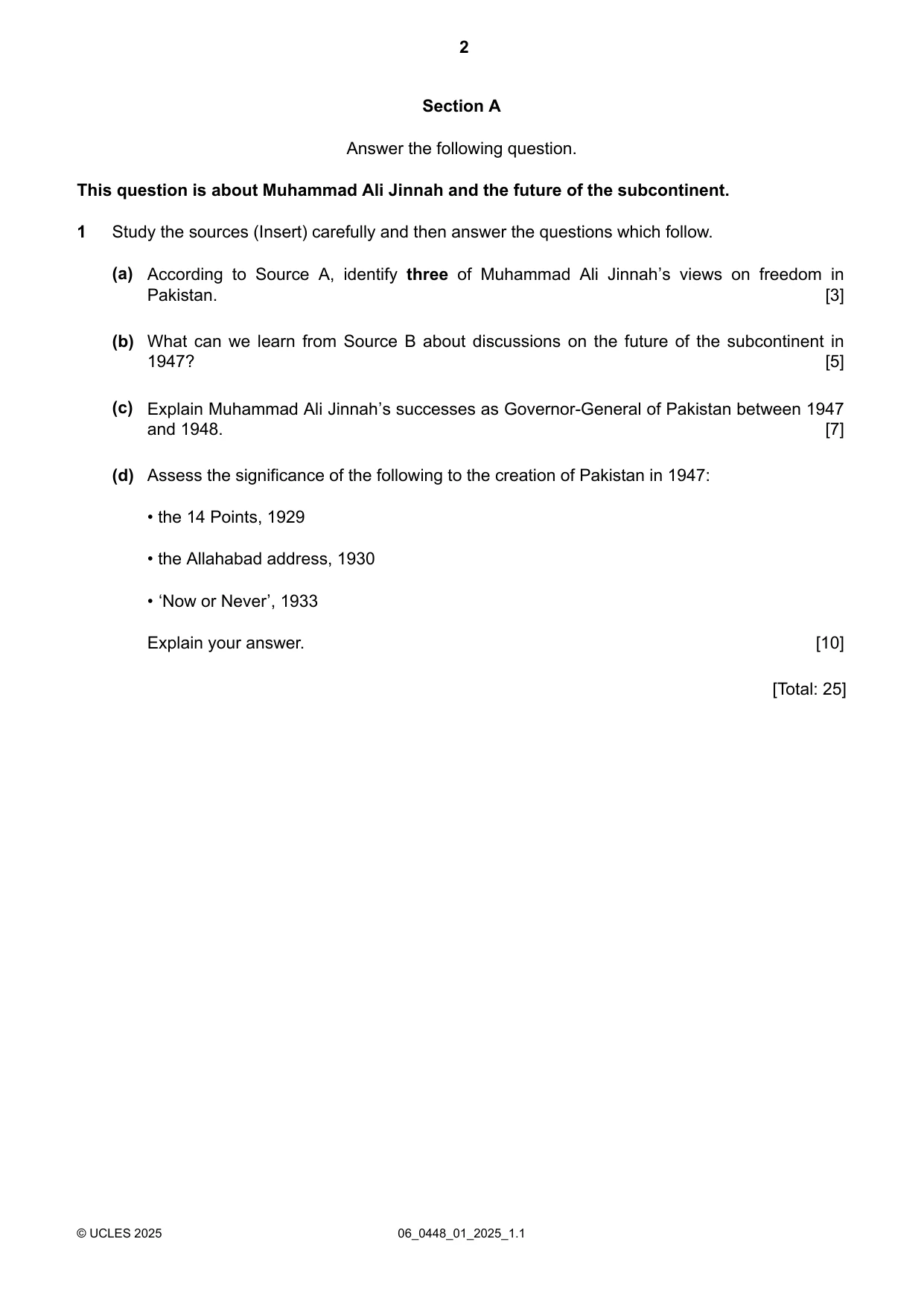
Question paper, page 2
Section A Answer the following question. This question is about Muhammad Ali Jinnah and the future of the subcontinent. Study the sources (Insert) carefully and then answer the questions which follow. 1 According to Source A, identify three of Muhammad Ali Jinnah’s views on freedom in Pakistan. [3] (a) What can we learn from Source B about discussions on the future of the subcontinent in 1947? [5] (b) Explain Muhammad Ali Jinnah’s successes as Governor-General of Pakistan between 1947 and 1948. [7] (c) Assess the significance of the following to the creation of Pakistan in 1947: • the 14 Points, 1929 • the Allahabad address, 1930 • ‘Now or Never’, 1933 Explain your answer. [10] (d) [Total: 25] 06_0448_01_2025_1.1 © UCLES 2025 2
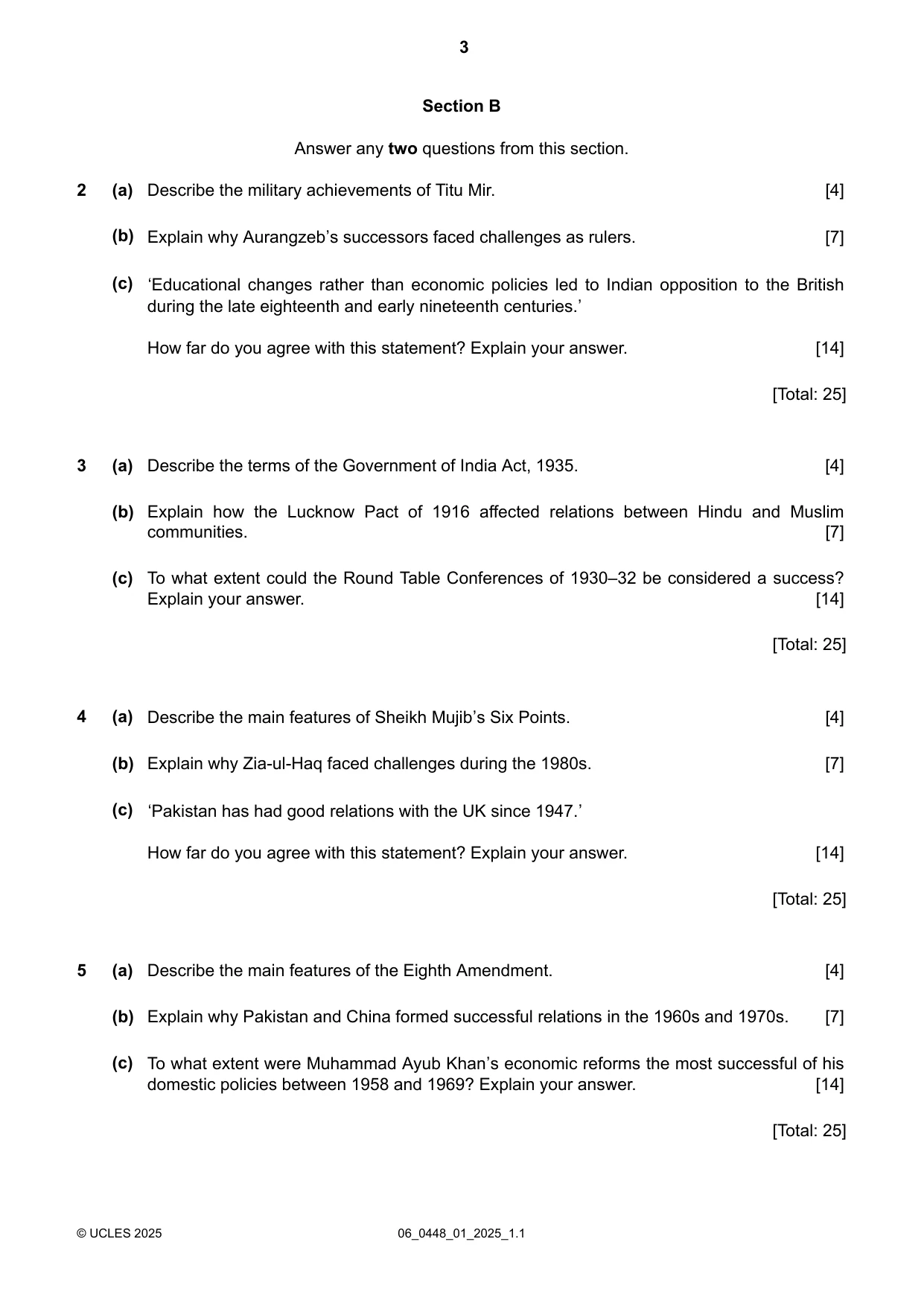
Question paper, page 3
Section B Answer any two questions from this section. Describe the military achievements of Titu Mir. [4] (a) 2 Explain why Aurangzeb’s successors faced challenges as rulers. [7] (b) ‘Educational changes rather than economic policies led to Indian opposition to the British during the late eighteenth and early nineteenth centuries.’ How far do you agree with this statement? Explain your answer. [14] (c) [Total: 25] Describe the terms of the Government of India Act, 1935. [4] (a) 3 Explain how the Lucknow Pact of 1916 affected relations between Hindu and Muslim communities. [7] (b) To what extent could the Round Table Conferences of 1930–32 be considered a success? Explain your answer. [14] (c) [Total: 25] Describe the main features of Sheikh Mujib’s Six Points. [4] (a) 4 Explain why Zia-ul-Haq faced challenges during the 1980s. [7] (b) ‘Pakistan has had good relations with the UK since 1947.’ How far do you agree with this statement? Explain your answer. [14] (c) [Total: 25] Describe the main features of the Eighth Amendment. [4] (a) 5 Explain why Pakistan and China formed successful relations in the 1960s and 1970s. [7] (b) To what extent were Muhammad Ayub Khan’s economic reforms the most successful of his domestic policies between 1958 and 1969? Explain your answer. [14] (c) [Total: 25] 06_0448_01_2025_1.1 © UCLES 2025 3
Question paper, page 4
BLANK PAGE Permission to reproduce items where third-party owned material protected by copyright is included has been sought and cleared where possible. Every reasonable effort has been made by the publisher (UCLES) to trace copyright holders, but if any items requiring clearance have unwittingly been included, the publisher will be pleased to make amends at the earliest possible opportunity. To avoid the issue of disclosure of answer-related information to candidates, all copyright acknowledgements are reproduced online in the Cambridge Assessment International Education Copyright Acknowledgements Booklet. This is produced for each series of examinations and is freely available to download at www.cambridgeinternational.org after the live examination series. Cambridge Assessment International Education is part of Cambridge Assessment. Cambridge Assessment is the brand name of the University of Cambridge Local Examinations Syndicate (UCLES), which is a department of the University of Cambridge. 06_0448_01_2025_1.1 © UCLES 2025 4
What you needed in this session
Cambridge’s own grade thresholds for 2025 May/June, Paper 1 · Variant 0. A higher threshold means an easier paper — the bar moves with how the cohort did.