Cambridge IGCSE Pakistan Studies 0448 — 2020 May/June Paper 1 · Variant 0
0448/10/M/J/20
The question paper and its mark scheme, free to read here and free to download. This is Cambridge’s own paper, exactly as it was sat.
Question paper4 pages
Mark scheme
No mark scheme is in the library for this paper.
Paper as text
Question paper, page 1
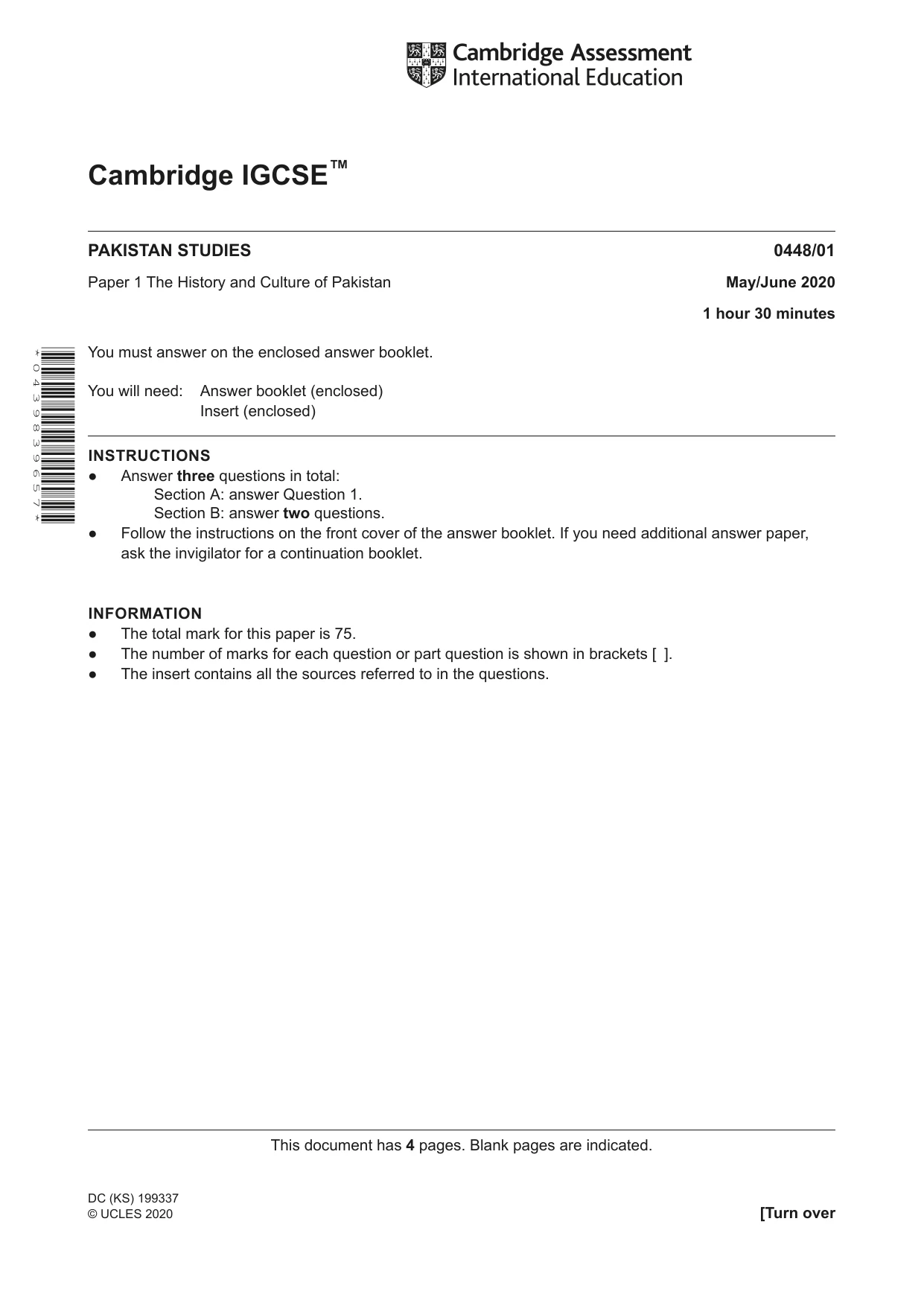
DC (KS) 199337 © UCLES 2020 [Turn over This document has 4 pages. Blank pages are indicated. * 0 4 3 9 8 3 9 6 5 7 * PAKISTAN STUDIES 0448/01 Paper 1 The History and Culture of Pakistan May/June 2020 1 hour 30 minutes You must answer on the enclosed answer booklet. You will need: Answer booklet (enclosed) Insert (enclosed) INSTRUCTIONS ● Answer three questions in total: Section A: answer Question 1. Section B: answer two questions. ● Follow the instructions on the front cover of the answer booklet. If you need additional answer paper, ask the invigilator for a continuation booklet. INFORMATION ● The total mark for this paper is 75. ● The number of marks for each question or part question is shown in brackets [ ]. ● The insert contains all the sources referred to in the questions. Cambridge IGCSE™
Question paper, page 2
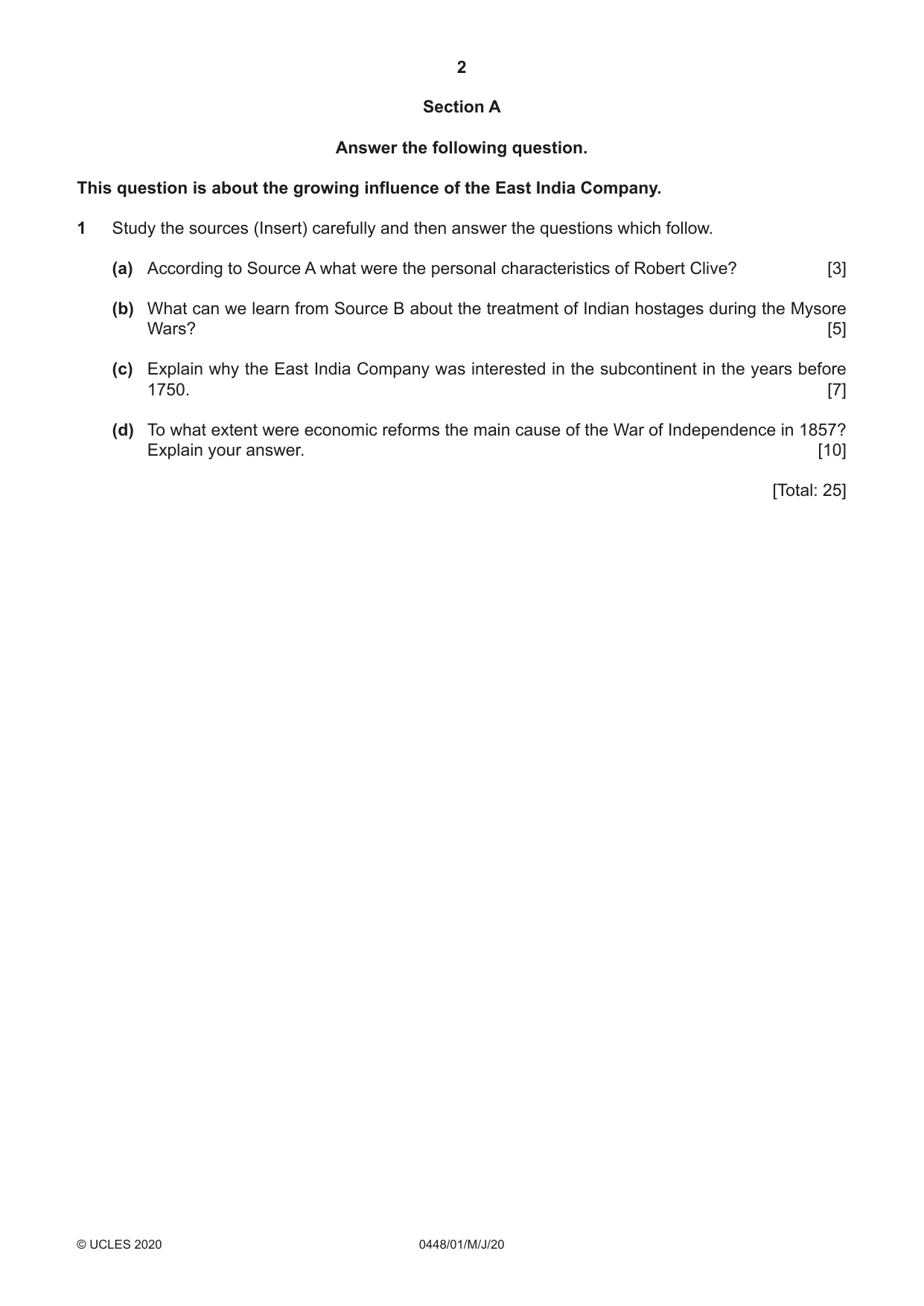
2 0448/01/M/J/20 © UCLES 2020 Section A Answer the following question. This question is about the growing influence of the East India Company. 1 Study the sources (Insert) carefully and then answer the questions which follow. (a) According to Source A what were the personal characteristics of Robert Clive? [3] (b) What can we learn from Source B about the treatment of Indian hostages during the Mysore Wars? [5] (c) Explain why the East India Company was interested in the subcontinent in the years before 1750. [7] (d) To what extent were economic reforms the main cause of the War of Independence in 1857? Explain your answer. [10] [Total: 25]
Question paper, page 3
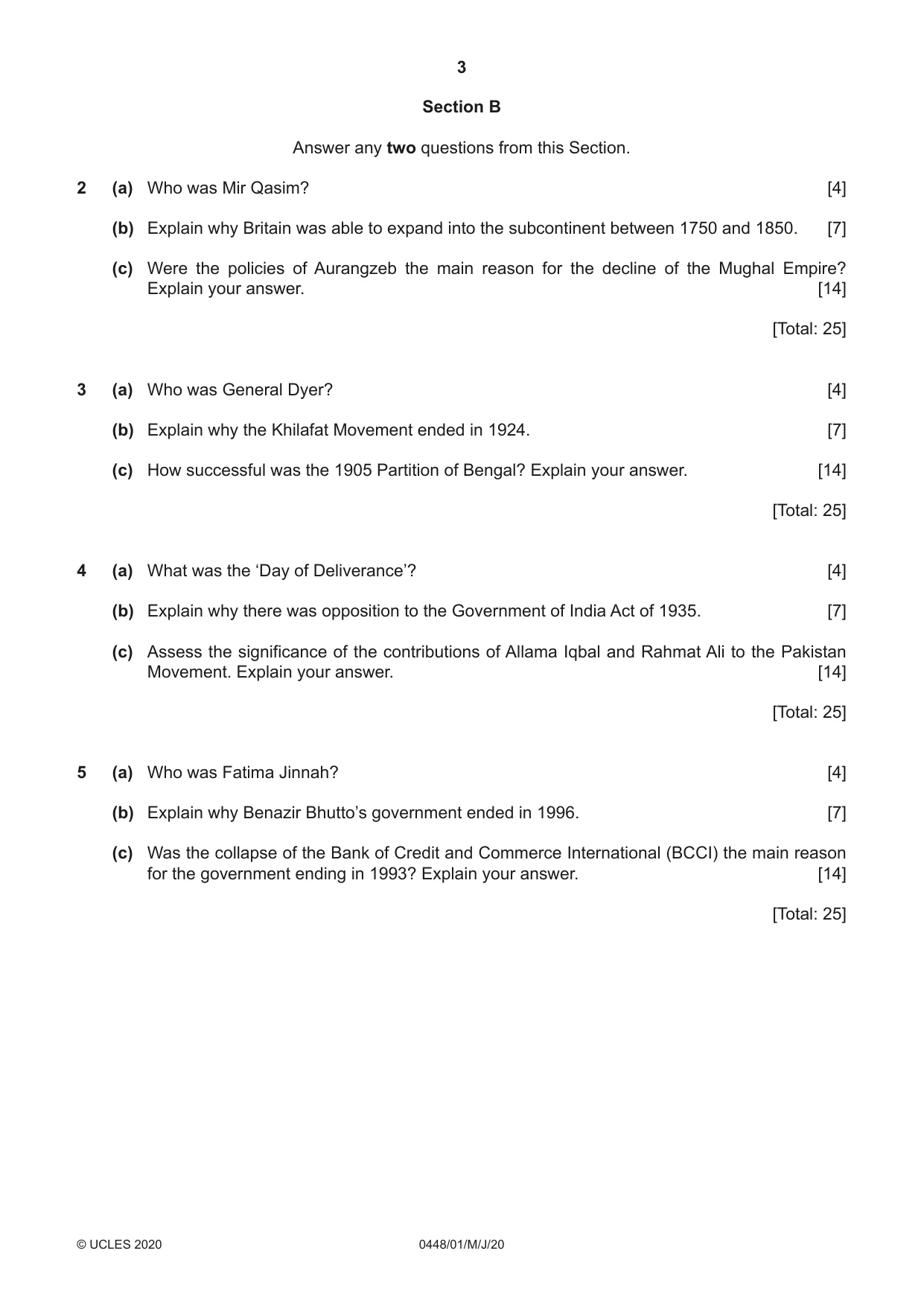
3 0448/01/M/J/20 © UCLES 2020 Section B Answer any two questions from this Section. 2 (a) Who was Mir Qasim? [4] (b) Explain why Britain was able to expand into the subcontinent between 1750 and 1850. [7] (c) Were the policies of Aurangzeb the main reason for the decline of the Mughal Empire? Explain your answer. [14] [Total: 25] 3 (a) Who was General Dyer? [4] (b) Explain why the Khilafat Movement ended in 1924. [7] (c) How successful was the 1905 Partition of Bengal? Explain your answer. [14] [Total: 25] 4 (a) What was the ‘Day of Deliverance’? [4] (b) Explain why there was opposition to the Government of India Act of 1935. [7] (c) Assess the significance of the contributions of Allama Iqbal and Rahmat Ali to the Pakistan Movement. Explain your answer. [14] [Total: 25] 5 (a) Who was Fatima Jinnah? [4] (b) Explain why Benazir Bhutto’s government ended in 1996. [7] (c) Was the collapse of the Bank of Credit and Commerce International (BCCI) the main reason for the government ending in 1993? Explain your answer. [14] [Total: 25]
Question paper, page 4
4 0448/01/M/J/20 © UCLES 2020 BLANK PAGE Permission to reproduce items where third-party owned material protected by copyright is included has been sought and cleared where possible. Every reasonable effort has been made by the publisher (UCLES) to trace copyright holders, but if any items requiring clearance have unwittingly been included, the publisher will be pleased to make amends at the earliest possible opportunity. To avoid the issue of disclosure of answer-related information to candidates, all copyright acknowledgements are reproduced online in the Cambridge Assessment International Education Copyright Acknowledgements Booklet. This is produced for each series of examinations and is freely available to download at www.cambridgeinternational.org after the live examination series. Cambridge Assessment International Education is part of the Cambridge Assessment Group. Cambridge Assessment is the brand name of the University of Cambridge Local Examinations Syndicate (UCLES), which itself is a department of the University of Cambridge.