Cambridge IGCSE Pakistan Studies 0448 — 2008 May/June Paper 1 · Variant 1
0448/11/M/J/08 · 75 marks · ≈84 min
The question paper and its mark scheme, free to read here and free to download. This is Cambridge’s own paper, exactly as it was sat.
Question paper4 pages
Mark scheme11 pages
Answers below. Sit the paper first if you are practising.
Paper as text
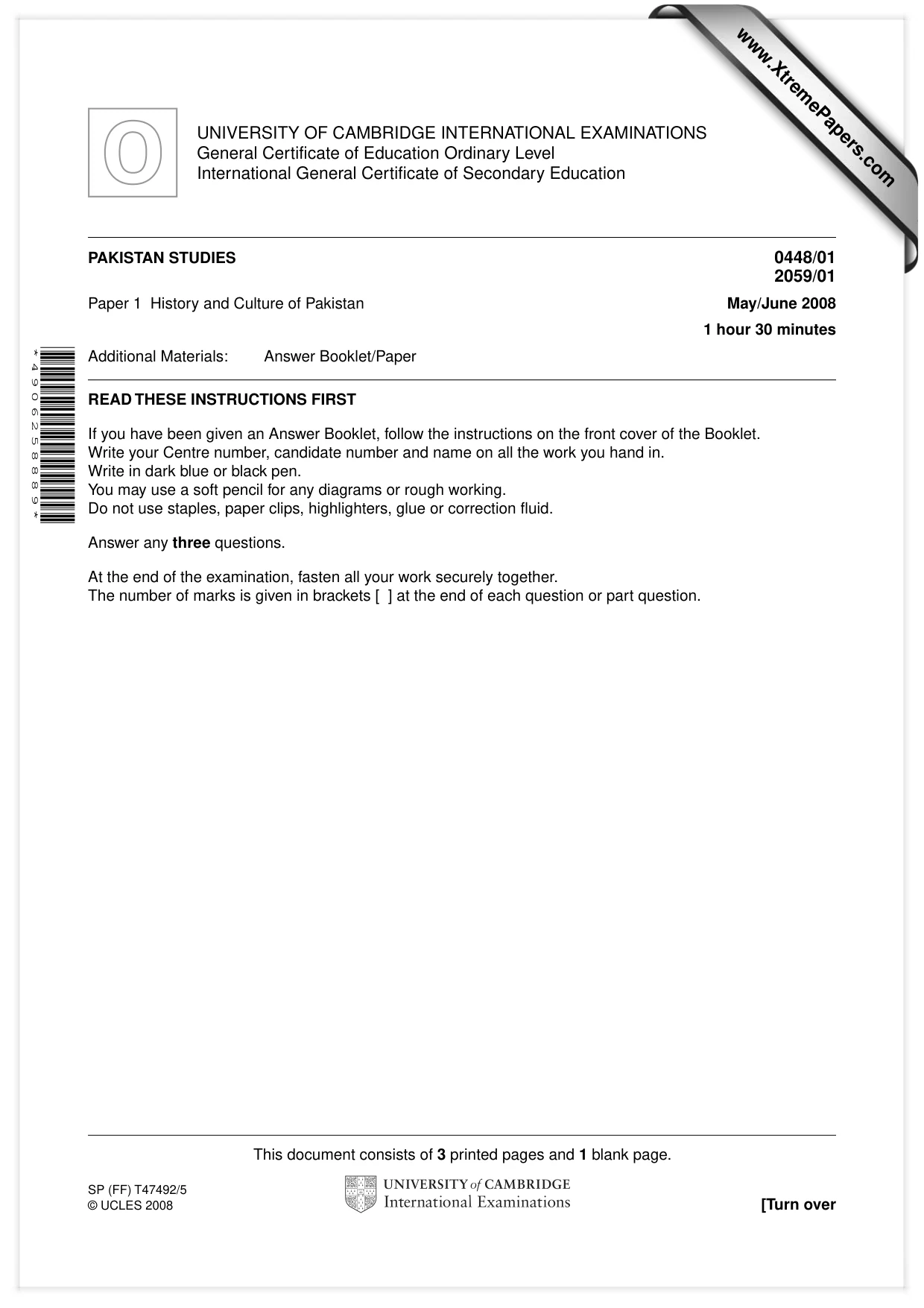
Question paper, page 1
This document consists of 3 printed pages and 1 blank page. SP (FF) T47492/5 © UCLES 2008 [Turn over UNIVERSITY OF CAMBRIDGE INTERNATIONAL EXAMINATIONS General Certificate of Education Ordinary Level International General Certificate of Secondary Education READ THESE INSTRUCTIONS FIRST If you have been given an Answer Booklet, follow the instructions on the front cover of the Booklet. Write your Centre number, candidate number and name on all the work you hand in. Write in dark blue or black pen. You may use a soft pencil for any diagrams or rough working. Do not use staples, paper clips, highlighters, glue or correction fluid. Answer any three questions. At the end of the examination, fasten all your work securely together. The number of marks is given in brackets [ ] at the end of each question or part question. * 4 9 0 6 2 5 8 8 8 9 * PAKISTAN STUDIES 0448/01 2059/01 Paper 1 History and Culture of Pakistan May/June 2008 1 hour 30 minutes Additional Materials: Answer Booklet/Paper www.XtremePapers.com
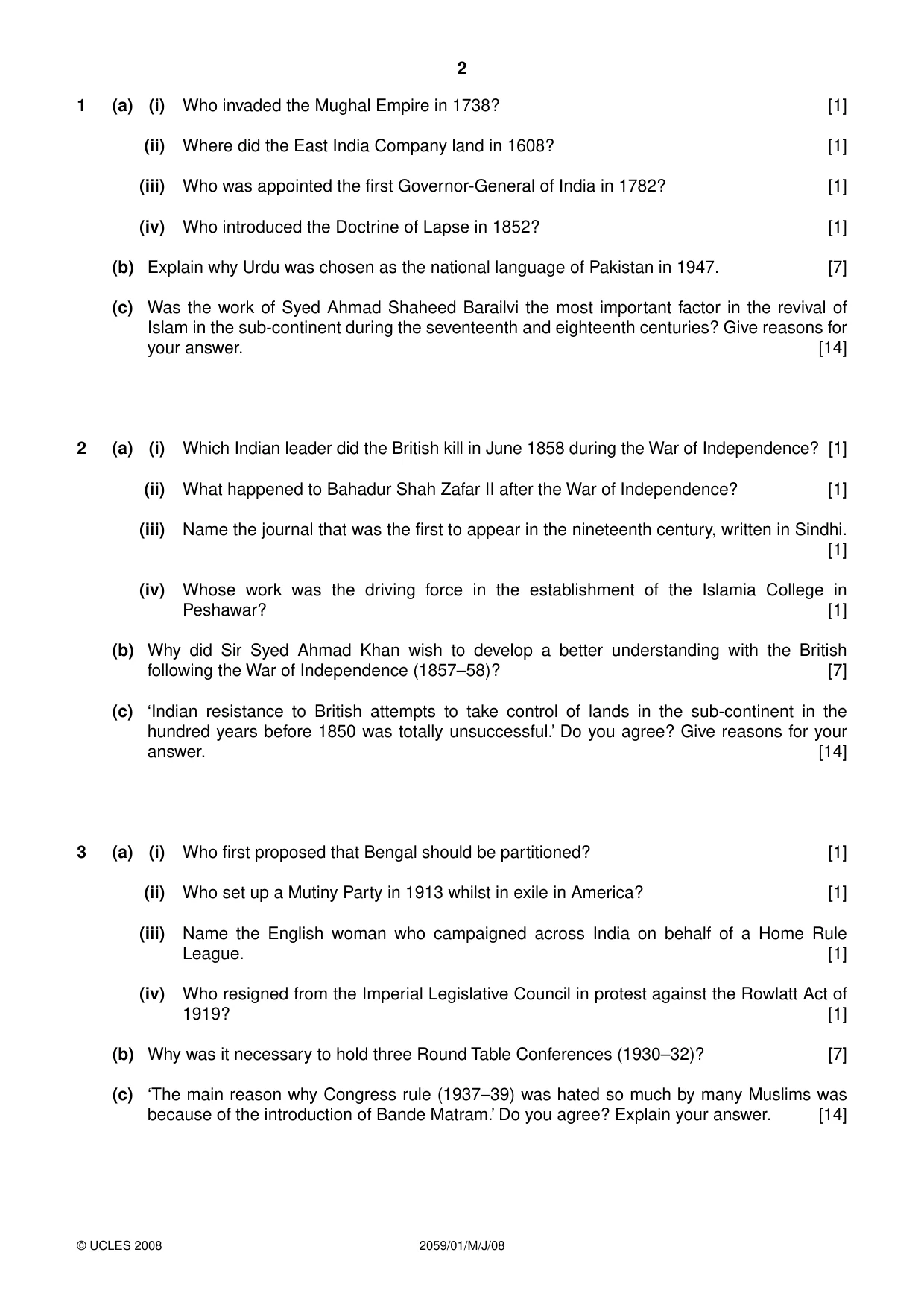
Question paper, page 2
2 2059/01/M/J/08 © UCLES 2008 1 (a) (i) Who invaded the Mughal Empire in 1738? [1] (ii) Where did the East India Company land in 1608? [1] (iii) Who was appointed the first Governor-General of India in 1782? [1] (iv) Who introduced the Doctrine of Lapse in 1852? [1] (b) Explain why Urdu was chosen as the national language of Pakistan in 1947. [7] (c) Was the work of Syed Ahmad Shaheed Barailvi the most important factor in the revival of Islam in the sub-continent during the seventeenth and eighteenth centuries? Give reasons for your answer. [14] 2 (a) (i) Which Indian leader did the British kill in June 1858 during the War of Independence? [1] (ii) What happened to Bahadur Shah Zafar II after the War of Independence? [1] (iii) Name the journal that was the first to appear in the nineteenth century, written in Sindhi. [1] (iv) Whose work was the driving force in the establishment of the Islamia College in Peshawar? [1] (b) Why did Sir Syed Ahmad Khan wish to develop a better understanding with the British following the War of Independence (1857–58)? [7] (c) ‘Indian resistance to British attempts to take control of lands in the sub-continent in the hundred years before 1850 was totally unsuccessful.’ Do you agree? Give reasons for your answer. [14] 3 (a) (i) Who first proposed that Bengal should be partitioned? [1] (ii) Who set up a Mutiny Party in 1913 whilst in exile in America? [1] (iii) Name the English woman who campaigned across India on behalf of a Home Rule League. [1] (iv) Who resigned from the Imperial Legislative Council in protest against the Rowlatt Act of 1919? [1] (b) Why was it necessary to hold three Round Table Conferences (1930–32)? [7] (c) ‘The main reason why Congress rule (1937–39) was hated so much by many Muslims was because of the introduction of Bande Matram.’ Do you agree? Explain your answer. [14]
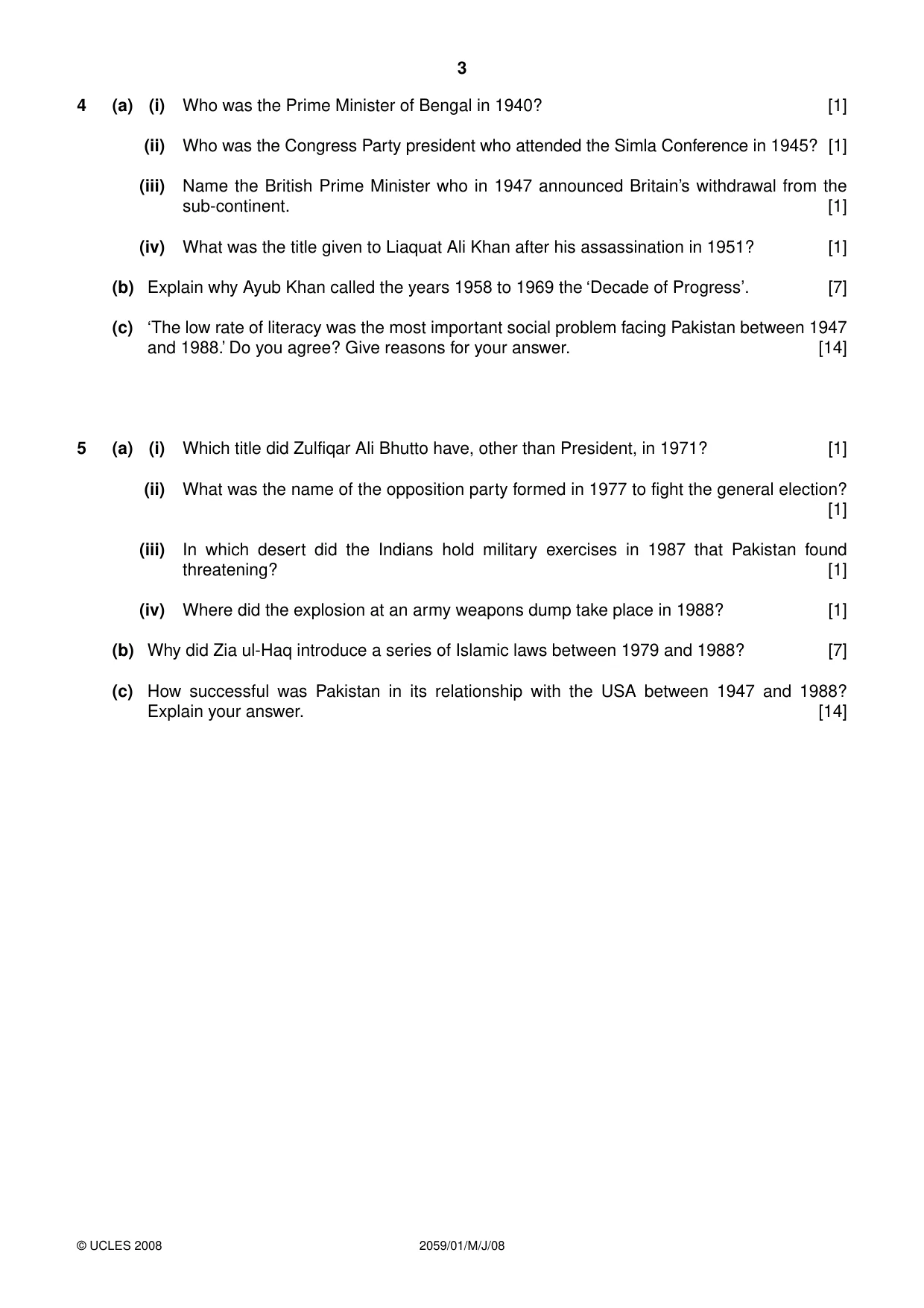
Question paper, page 3
3 2059/01/M/J/08 © UCLES 2008 4 (a) (i) Who was the Prime Minister of Bengal in 1940? [1] (ii) Who was the Congress Party president who attended the Simla Conference in 1945? [1] (iii) Name the British Prime Minister who in 1947 announced Britain’s withdrawal from the sub-continent. [1] (iv) What was the title given to Liaquat Ali Khan after his assassination in 1951? [1] (b) Explain why Ayub Khan called the years 1958 to 1969 the ‘Decade of Progress’. [7] (c) ‘The low rate of literacy was the most important social problem facing Pakistan between 1947 and 1988.’ Do you agree? Give reasons for your answer. [14] 5 (a) (i) Which title did Zulfiqar Ali Bhutto have, other than President, in 1971? [1] (ii) What was the name of the opposition party formed in 1977 to fight the general election? [1] (iii) In which desert did the Indians hold military exercises in 1987 that Pakistan found threatening? [1] (iv) Where did the explosion at an army weapons dump take place in 1988? [1] (b) Why did Zia ul-Haq introduce a series of Islamic laws between 1979 and 1988? [7] (c) How successful was Pakistan in its relationship with the USA between 1947 and 1988? Explain your answer. [14]
Question paper, page 4
4 2059/01/M/J/08 BLANK PAGE Permission to reproduce items where third-party owned material protected by copyright is included has been sought and cleared where possible. Every reasonable effort has been made by the publisher (UCLES) to trace copyright holders, but if any items requiring clearance have unwittingly been included, the publisher will be pleased to make amends at the earliest possible opportunity. University of Cambridge International Examinations is part of the Cambridge Assessment Group. Cambridge Assessment is the brand name of University of Cambridge Local Examinations Syndicate (UCLES), which is itself a department of the University of Cambridge.
Mark scheme, page 1
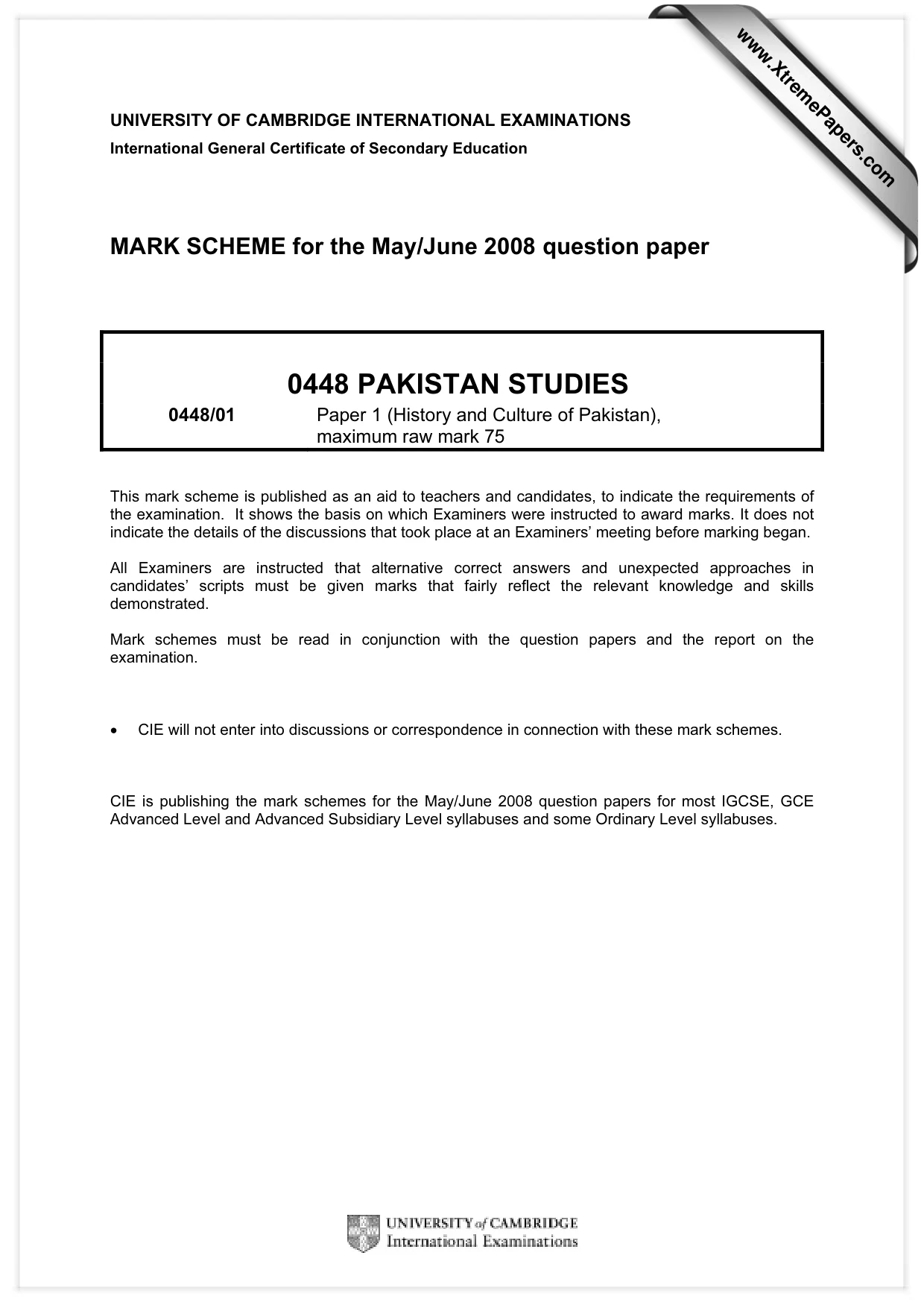
UNIVERSITY OF CAMBRIDGE INTERNATIONAL EXAMINATIONS International General Certificate of Secondary Education MARK SCHEME for the May/June 2008 question paper 0448 PAKISTAN STUDIES 0448/01 Paper 1 (History and Culture of Pakistan), maximum raw mark 75 This mark scheme is published as an aid to teachers and candidates, to indicate the requirements of the examination. It shows the basis on which Examiners were instructed to award marks. It does not indicate the details of the discussions that took place at an Examiners’ meeting before marking began. All Examiners are instructed that alternative correct answers and unexpected approaches in candidates’ scripts must be given marks that fairly reflect the relevant knowledge and skills demonstrated. Mark schemes must be read in conjunction with the question papers and the report on the examination. • CIE will not enter into discussions or correspondence in connection with these mark schemes. CIE is publishing the mark schemes for the May/June 2008 question papers for most IGCSE, GCE Advanced Level and Advanced Subsidiary Level syllabuses and some Ordinary Level syllabuses. www.XtremePapers.com
Mark scheme, page 2
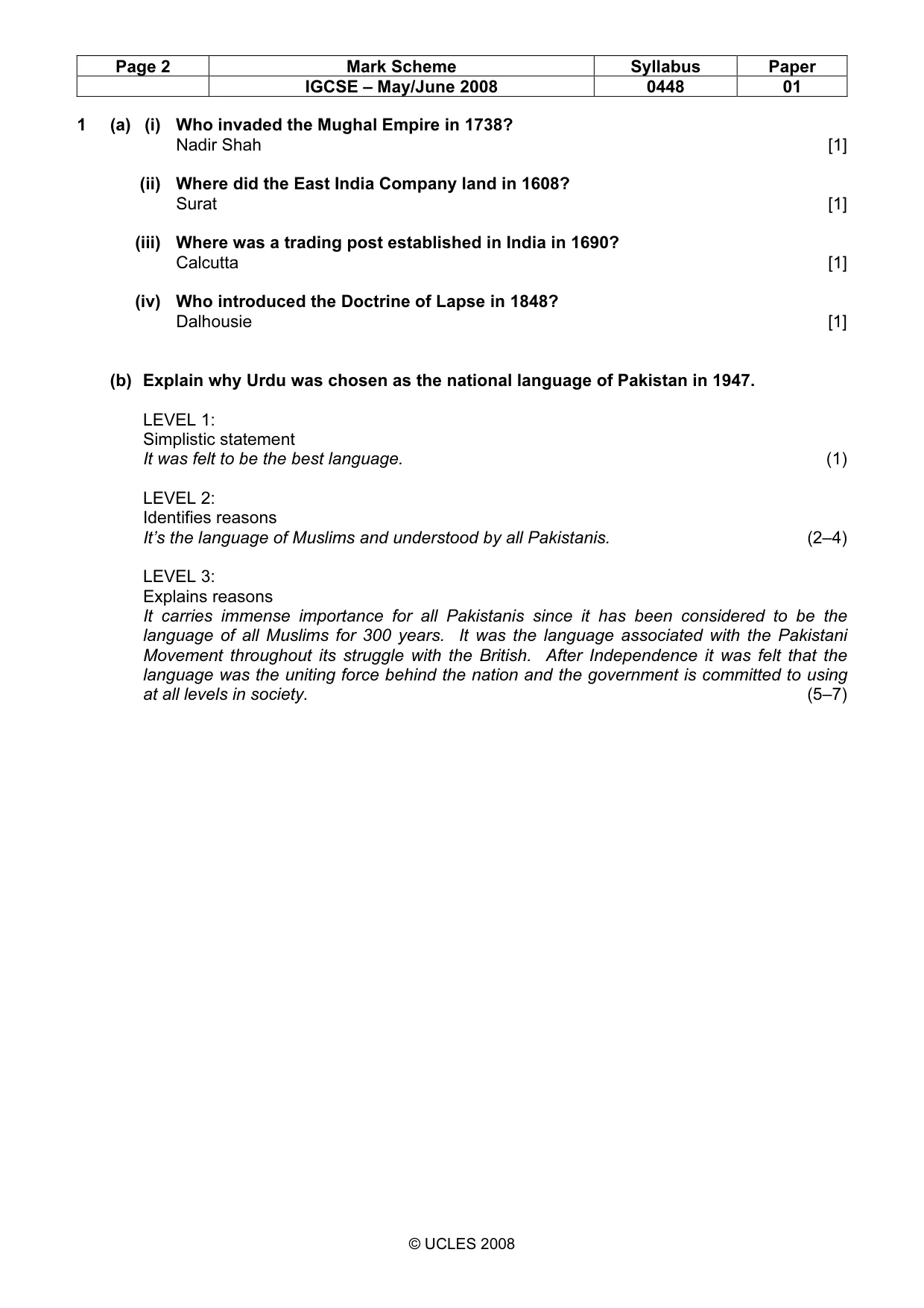
Page 2 Mark Scheme Syllabus Paper IGCSE – May/June 2008 0448 01 © UCLES 2008 1 (a) (i) Who invaded the Mughal Empire in 1738? Nadir Shah [1] (ii) Where did the East India Company land in 1608? Surat [1] (iii) Where was a trading post established in India in 1690? Calcutta [1] (iv) Who introduced the Doctrine of Lapse in 1848? Dalhousie [1] (b) Explain why Urdu was chosen as the national language of Pakistan in 1947. LEVEL 1: Simplistic statement It was felt to be the best language. (1) LEVEL 2: Identifies reasons It’s the language of Muslims and understood by all Pakistanis. (2–4) LEVEL 3: Explains reasons It carries immense importance for all Pakistanis since it has been considered to be the language of all Muslims for 300 years. It was the language associated with the Pakistani Movement throughout its struggle with the British. After Independence it was felt that the language was the uniting force behind the nation and the government is committed to using at all levels in society. (5–7)
Mark scheme, page 3
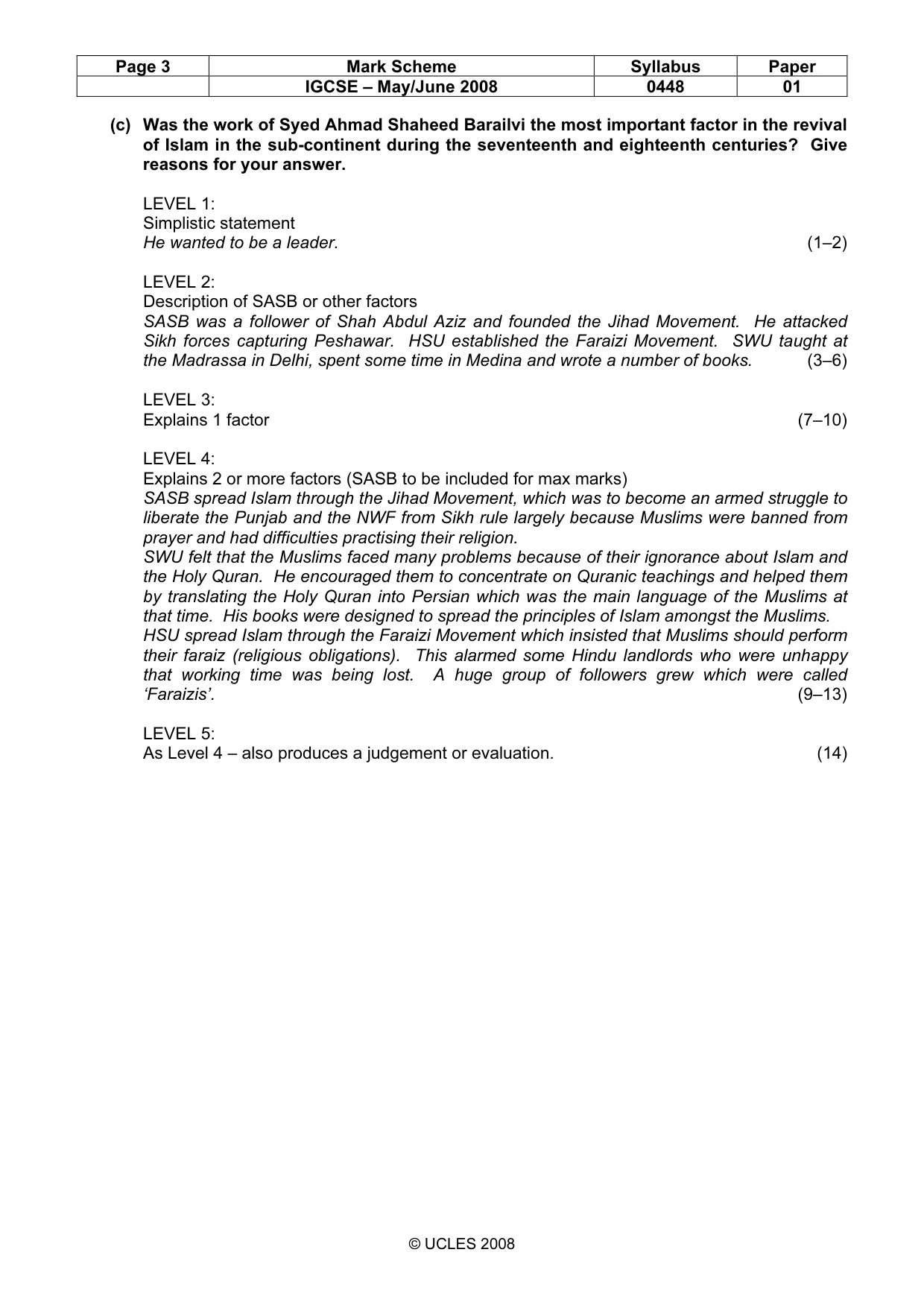
Page 3 Mark Scheme Syllabus Paper IGCSE – May/June 2008 0448 01 © UCLES 2008 (c) Was the work of Syed Ahmad Shaheed Barailvi the most important factor in the revival of Islam in the sub-continent during the seventeenth and eighteenth centuries? Give reasons for your answer. LEVEL 1: Simplistic statement He wanted to be a leader. (1–2) LEVEL 2: Description of SASB or other factors SASB was a follower of Shah Abdul Aziz and founded the Jihad Movement. He attacked Sikh forces capturing Peshawar. HSU established the Faraizi Movement. SWU taught at the Madrassa in Delhi, spent some time in Medina and wrote a number of books. (3–6) LEVEL 3: Explains 1 factor (7–10) LEVEL 4: Explains 2 or more factors (SASB to be included for max marks) SASB spread Islam through the Jihad Movement, which was to become an armed struggle to liberate the Punjab and the NWF from Sikh rule largely because Muslims were banned from prayer and had difficulties practising their religion. SWU felt that the Muslims faced many problems because of their ignorance about Islam and the Holy Quran. He encouraged them to concentrate on Quranic teachings and helped them by translating the Holy Quran into Persian which was the main language of the Muslims at that time. His books were designed to spread the principles of Islam amongst the Muslims. HSU spread Islam through the Faraizi Movement which insisted that Muslims should perform their faraiz (religious obligations). This alarmed some Hindu landlords who were unhappy that working time was being lost. A huge group of followers grew which were called ‘Faraizis’. (9–13) LEVEL 5: As Level 4 – also produces a judgement or evaluation. (14)
Mark scheme, page 4
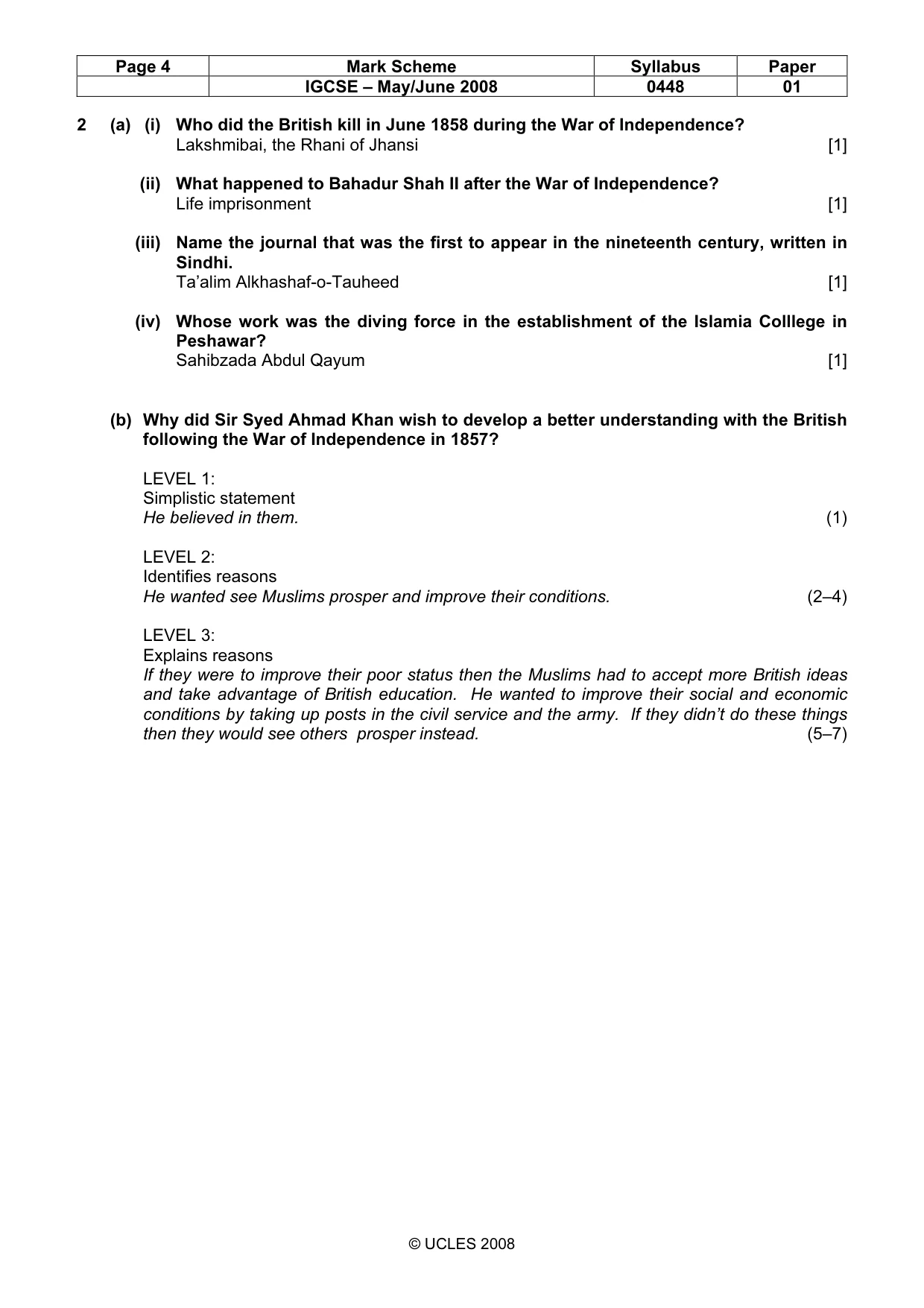
Page 4 Mark Scheme Syllabus Paper IGCSE – May/June 2008 0448 01 © UCLES 2008 2 (a) (i) Who did the British kill in June 1858 during the War of Independence? Lakshmibai, the Rhani of Jhansi [1] (ii) What happened to Bahadur Shah II after the War of Independence? Life imprisonment [1] (iii) Name the journal that was the first to appear in the nineteenth century, written in Sindhi. Ta’alim Alkhashaf-o-Tauheed [1] (iv) Whose work was the diving force in the establishment of the Islamia Colllege in Peshawar? Sahibzada Abdul Qayum [1] (b) Why did Sir Syed Ahmad Khan wish to develop a better understanding with the British following the War of Independence in 1857? LEVEL 1: Simplistic statement He believed in them. (1) LEVEL 2: Identifies reasons He wanted see Muslims prosper and improve their conditions. (2–4) LEVEL 3: Explains reasons If they were to improve their poor status then the Muslims had to accept more British ideas and take advantage of British education. He wanted to improve their social and economic conditions by taking up posts in the civil service and the army. If they didn’t do these things then they would see others prosper instead. (5–7)
Mark scheme, page 5
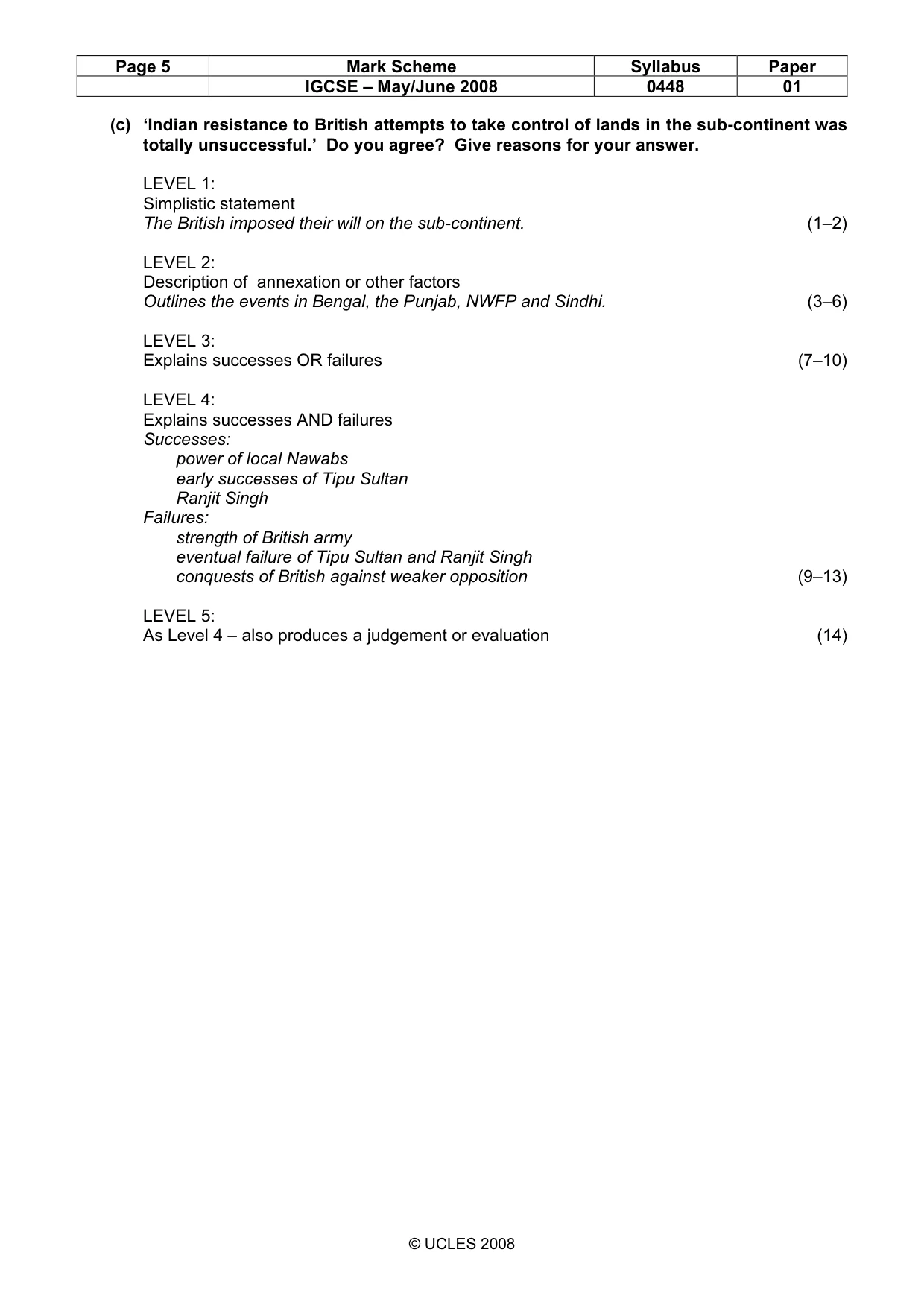
Page 5 Mark Scheme Syllabus Paper IGCSE – May/June 2008 0448 01 © UCLES 2008 (c) ‘Indian resistance to British attempts to take control of lands in the sub-continent was totally unsuccessful.’ Do you agree? Give reasons for your answer. LEVEL 1: Simplistic statement The British imposed their will on the sub-continent. (1–2) LEVEL 2: Description of annexation or other factors Outlines the events in Bengal, the Punjab, NWFP and Sindhi. (3–6) LEVEL 3: Explains successes OR failures (7–10) LEVEL 4: Explains successes AND failures Successes: power of local Nawabs early successes of Tipu Sultan Ranjit Singh Failures: strength of British army eventual failure of Tipu Sultan and Ranjit Singh conquests of British against weaker opposition (9–13) LEVEL 5: As Level 4 – also produces a judgement or evaluation (14)
Mark scheme, page 6
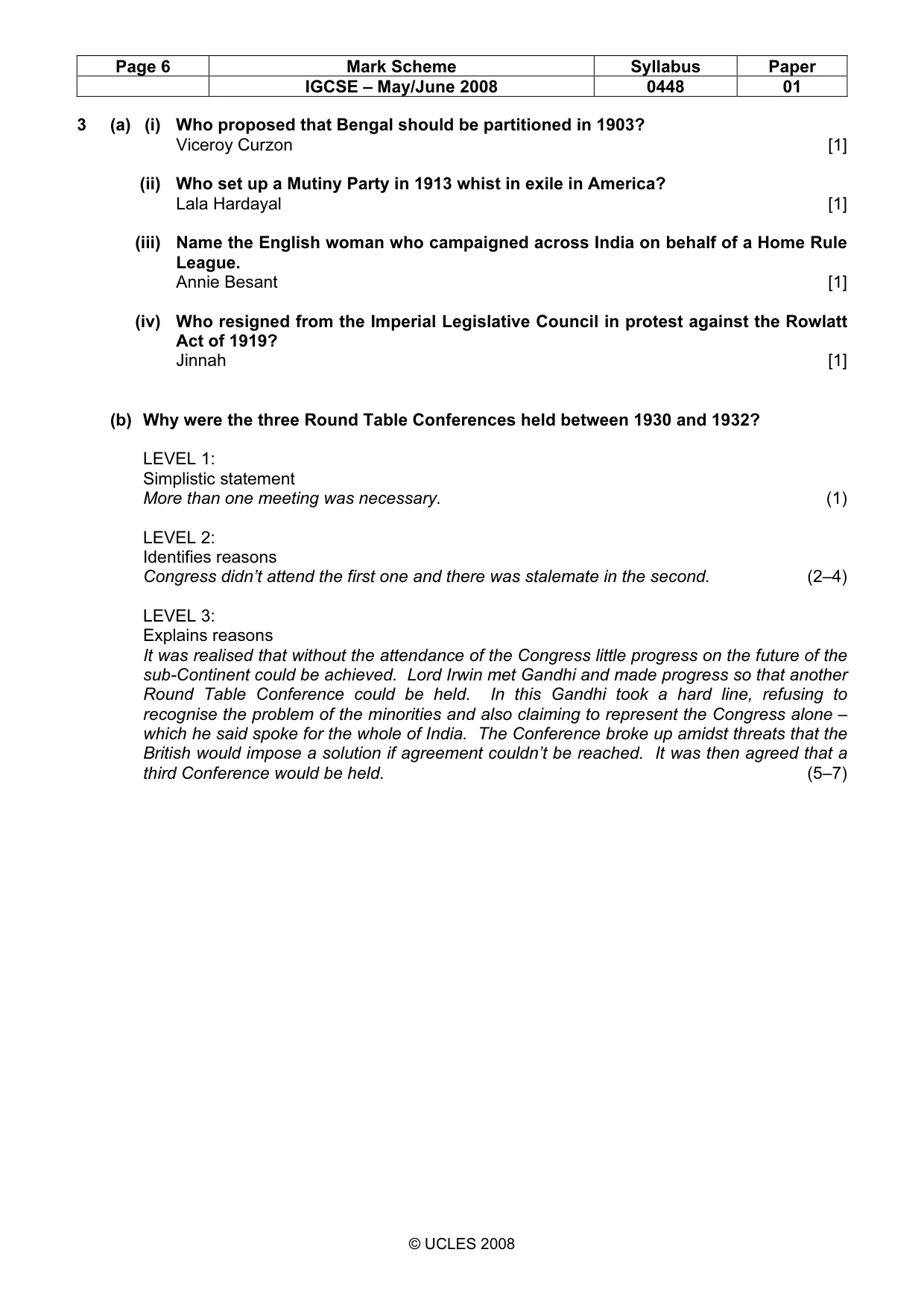
Page 6 Mark Scheme Syllabus Paper IGCSE – May/June 2008 0448 01 © UCLES 2008 3 (a) (i) Who proposed that Bengal should be partitioned in 1903? Viceroy Curzon [1] (ii) Who set up a Mutiny Party in 1913 whist in exile in America? Lala Hardayal [1] (iii) Name the English woman who campaigned across India on behalf of a Home Rule League. Annie Besant [1] (iv) Who resigned from the Imperial Legislative Council in protest against the Rowlatt Act of 1919? Jinnah [1] (b) Why were the three Round Table Conferences held between 1930 and 1932? LEVEL 1: Simplistic statement More than one meeting was necessary. (1) LEVEL 2: Identifies reasons Congress didn’t attend the first one and there was stalemate in the second. (2–4) LEVEL 3: Explains reasons It was realised that without the attendance of the Congress little progress on the future of the sub-Continent could be achieved. Lord Irwin met Gandhi and made progress so that another Round Table Conference could be held. In this Gandhi took a hard line, refusing to recognise the problem of the minorities and also claiming to represent the Congress alone – which he said spoke for the whole of India. The Conference broke up amidst threats that the British would impose a solution if agreement couldn’t be reached. It was then agreed that a third Conference would be held. (5–7)
Mark scheme, page 7
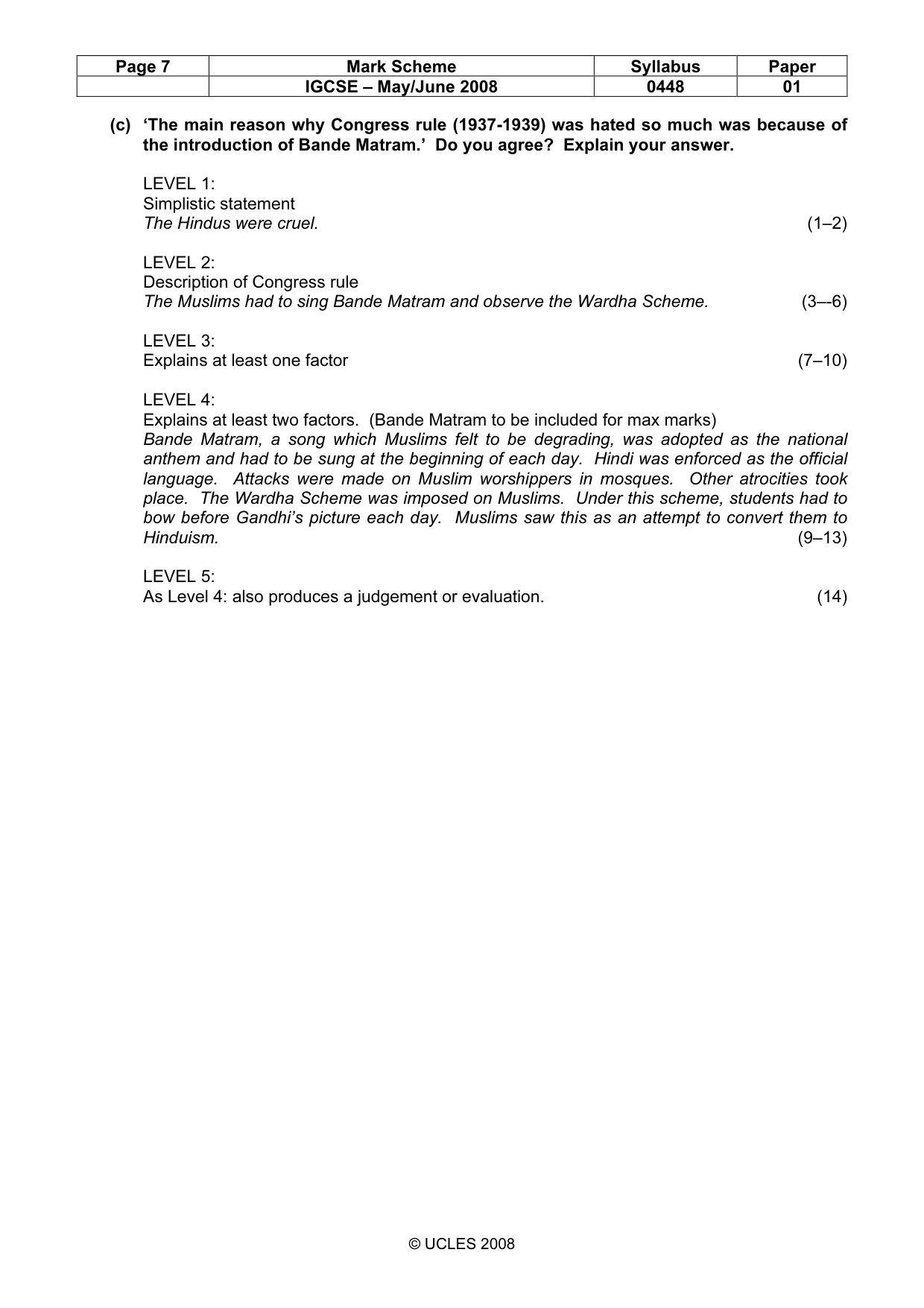
Page 7 Mark Scheme Syllabus Paper IGCSE – May/June 2008 0448 01 © UCLES 2008 (c) ‘The main reason why Congress rule (1937-1939) was hated so much was because of the introduction of Bande Matram.’ Do you agree? Explain your answer. LEVEL 1: Simplistic statement The Hindus were cruel. (1–2) LEVEL 2: Description of Congress rule The Muslims had to sing Bande Matram and observe the Wardha Scheme. (3–-6) LEVEL 3: Explains at least one factor (7–10) LEVEL 4: Explains at least two factors. (Bande Matram to be included for max marks) Bande Matram, a song which Muslims felt to be degrading, was adopted as the national anthem and had to be sung at the beginning of each day. Hindi was enforced as the official language. Attacks were made on Muslim worshippers in mosques. Other atrocities took place. The Wardha Scheme was imposed on Muslims. Under this scheme, students had to bow before Gandhi’s picture each day. Muslims saw this as an attempt to convert them to Hinduism. (9–13) LEVEL 5: As Level 4: also produces a judgement or evaluation. (14)
Mark scheme, page 8
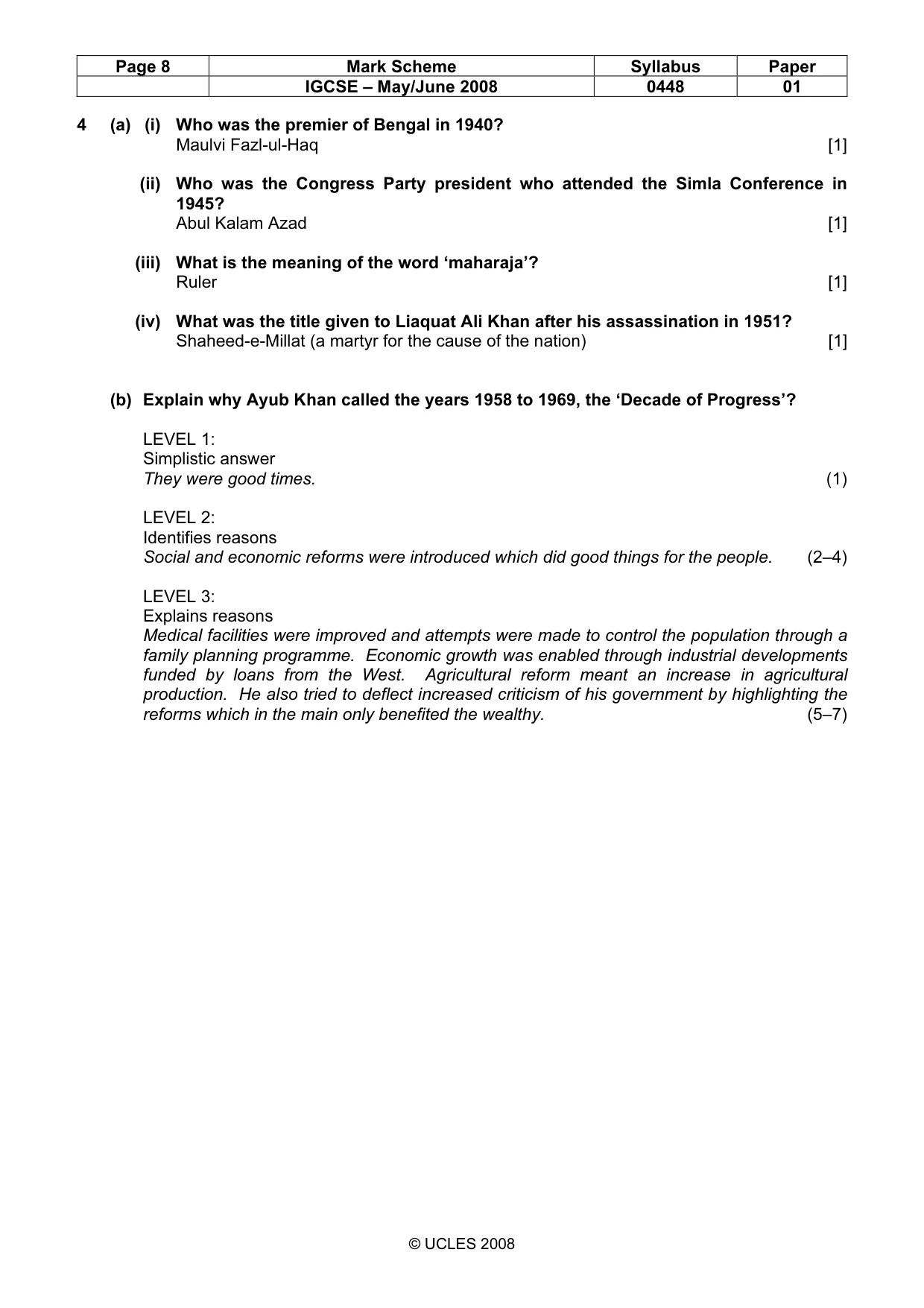
Page 8 Mark Scheme Syllabus Paper IGCSE – May/June 2008 0448 01 © UCLES 2008 4 (a) (i) Who was the premier of Bengal in 1940? Maulvi Fazl-ul-Haq [1] (ii) Who was the Congress Party president who attended the Simla Conference in 1945? Abul Kalam Azad [1] (iii) What is the meaning of the word ‘maharaja’? Ruler [1] (iv) What was the title given to Liaquat Ali Khan after his assassination in 1951? Shaheed-e-Millat (a martyr for the cause of the nation) [1] (b) Explain why Ayub Khan called the years 1958 to 1969, the ‘Decade of Progress’? LEVEL 1: Simplistic answer They were good times. (1) LEVEL 2: Identifies reasons Social and economic reforms were introduced which did good things for the people. (2–4) LEVEL 3: Explains reasons Medical facilities were improved and attempts were made to control the population through a family planning programme. Economic growth was enabled through industrial developments funded by loans from the West. Agricultural reform meant an increase in agricultural production. He also tried to deflect increased criticism of his government by highlighting the reforms which in the main only benefited the wealthy. (5–7)
Mark scheme, page 9
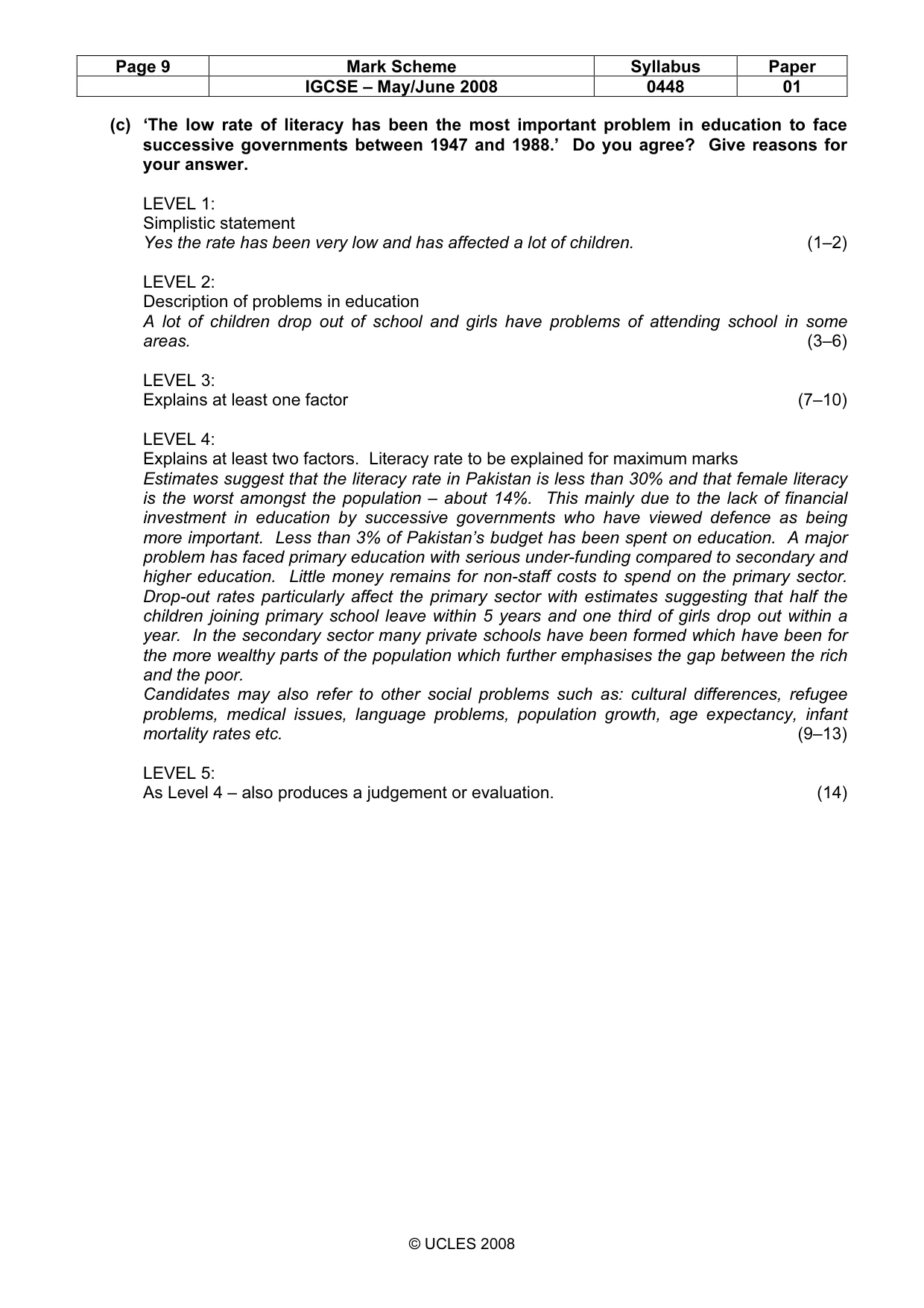
Page 9 Mark Scheme Syllabus Paper IGCSE – May/June 2008 0448 01 © UCLES 2008 (c) ‘The low rate of literacy has been the most important problem in education to face successive governments between 1947 and 1988.’ Do you agree? Give reasons for your answer. LEVEL 1: Simplistic statement Yes the rate has been very low and has affected a lot of children. (1–2) LEVEL 2: Description of problems in education A lot of children drop out of school and girls have problems of attending school in some areas. (3–6) LEVEL 3: Explains at least one factor (7–10) LEVEL 4: Explains at least two factors. Literacy rate to be explained for maximum marks Estimates suggest that the literacy rate in Pakistan is less than 30% and that female literacy is the worst amongst the population – about 14%. This mainly due to the lack of financial investment in education by successive governments who have viewed defence as being more important. Less than 3% of Pakistan’s budget has been spent on education. A major problem has faced primary education with serious under-funding compared to secondary and higher education. Little money remains for non-staff costs to spend on the primary sector. Drop-out rates particularly affect the primary sector with estimates suggesting that half the children joining primary school leave within 5 years and one third of girls drop out within a year. In the secondary sector many private schools have been formed which have been for the more wealthy parts of the population which further emphasises the gap between the rich and the poor. Candidates may also refer to other social problems such as: cultural differences, refugee problems, medical issues, language problems, population growth, age expectancy, infant mortality rates etc. (9–13) LEVEL 5: As Level 4 – also produces a judgement or evaluation. (14)
Mark scheme, page 10
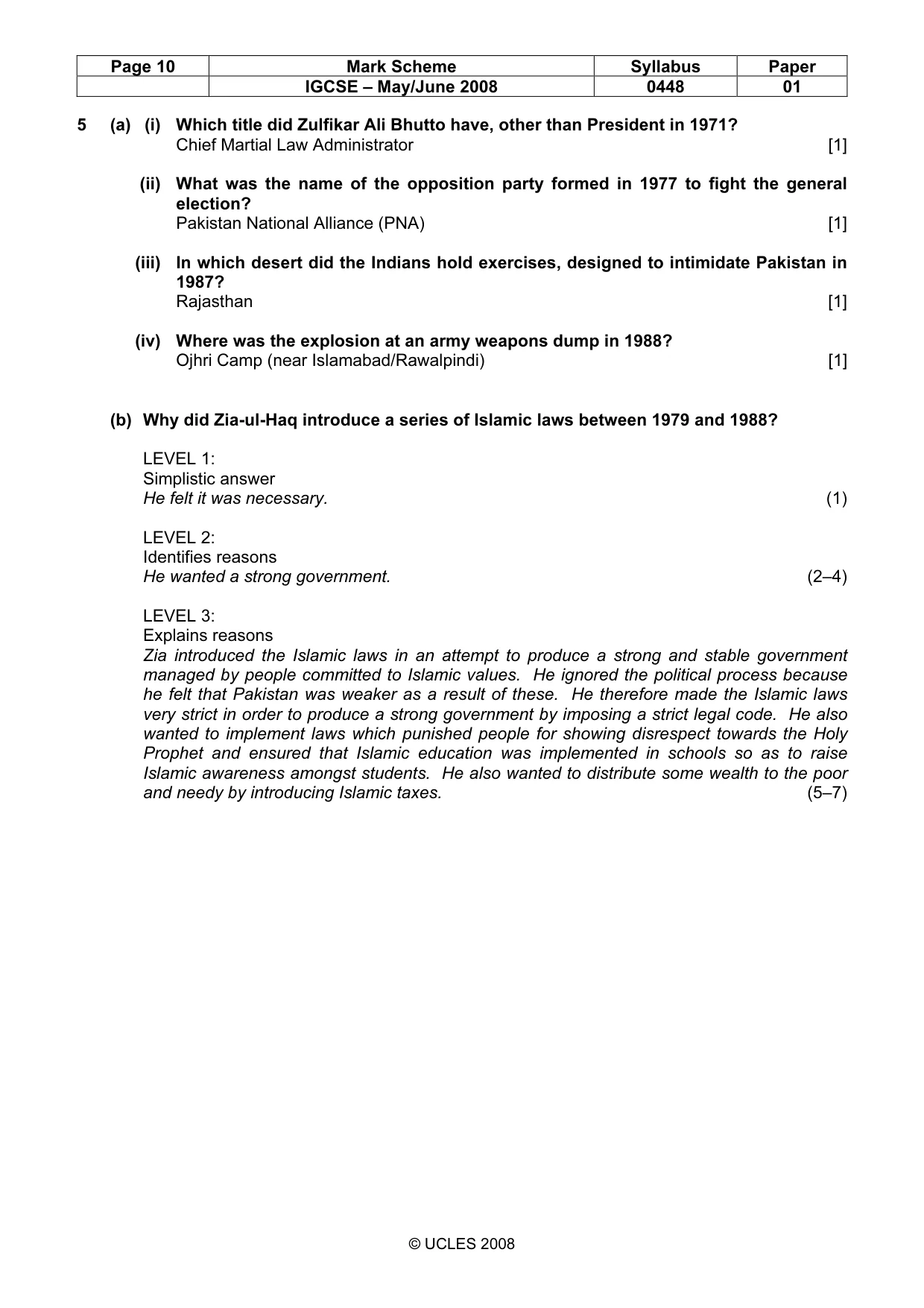
Page 10 Mark Scheme Syllabus Paper IGCSE – May/June 2008 0448 01 © UCLES 2008 5 (a) (i) Which title did Zulfikar Ali Bhutto have, other than President in 1971? Chief Martial Law Administrator [1] (ii) What was the name of the opposition party formed in 1977 to fight the general election? Pakistan National Alliance (PNA) [1] (iii) In which desert did the Indians hold exercises, designed to intimidate Pakistan in 1987? Rajasthan [1] (iv) Where was the explosion at an army weapons dump in 1988? Ojhri Camp (near Islamabad/Rawalpindi) [1] (b) Why did Zia-ul-Haq introduce a series of Islamic laws between 1979 and 1988? LEVEL 1: Simplistic answer He felt it was necessary. (1) LEVEL 2: Identifies reasons He wanted a strong government. (2–4) LEVEL 3: Explains reasons Zia introduced the Islamic laws in an attempt to produce a strong and stable government managed by people committed to Islamic values. He ignored the political process because he felt that Pakistan was weaker as a result of these. He therefore made the Islamic laws very strict in order to produce a strong government by imposing a strict legal code. He also wanted to implement laws which punished people for showing disrespect towards the Holy Prophet and ensured that Islamic education was implemented in schools so as to raise Islamic awareness amongst students. He also wanted to distribute some wealth to the poor and needy by introducing Islamic taxes. (5–7)
Mark scheme, page 11
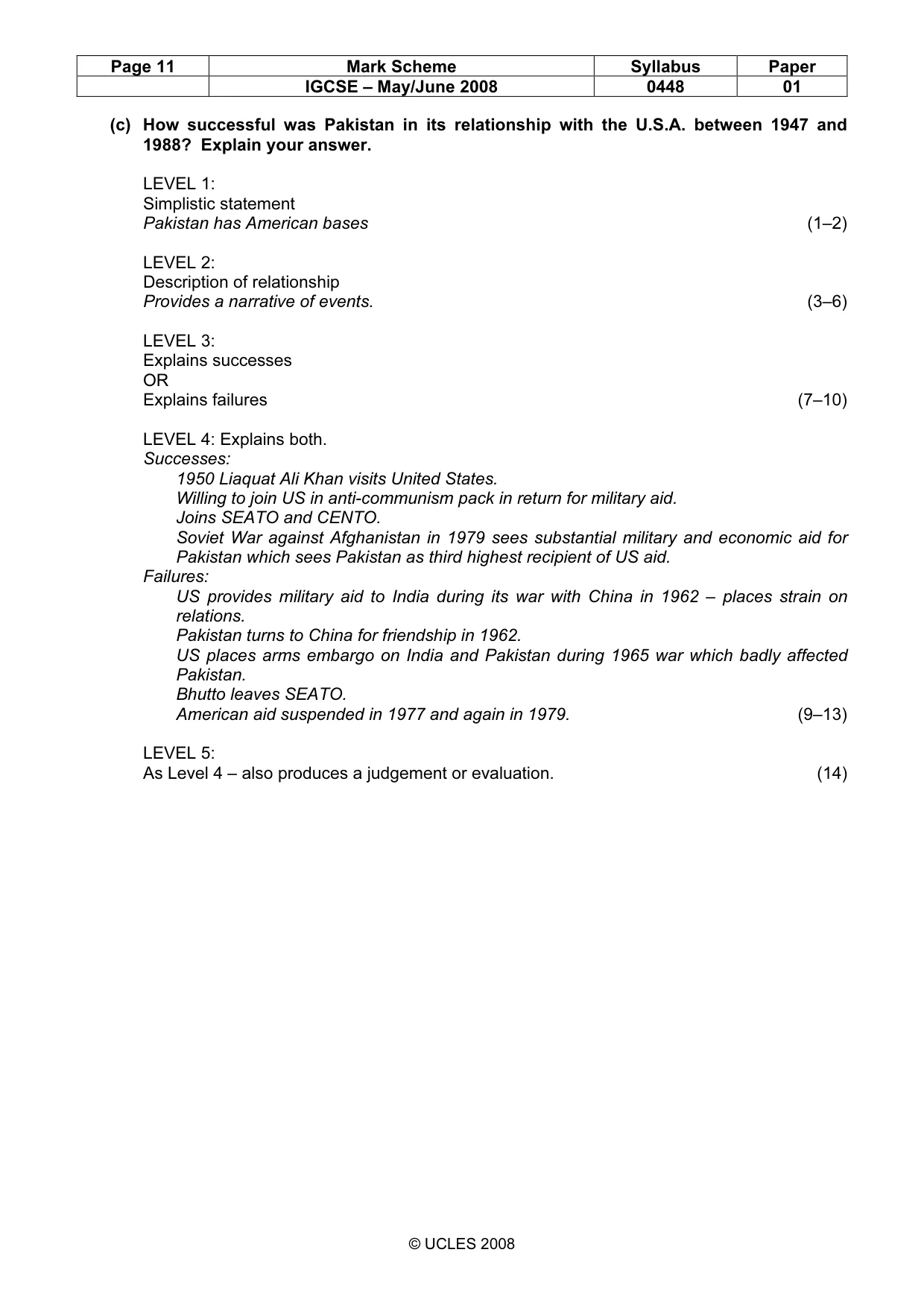
Page 11 Mark Scheme Syllabus Paper IGCSE – May/June 2008 0448 01 © UCLES 2008 (c) How successful was Pakistan in its relationship with the U.S.A. between 1947 and 1988? Explain your answer. LEVEL 1: Simplistic statement Pakistan has American bases (1–2) LEVEL 2: Description of relationship Provides a narrative of events. (3–6) LEVEL 3: Explains successes OR Explains failures (7–10) LEVEL 4: Explains both. Successes: 1950 Liaquat Ali Khan visits United States. Willing to join US in anti-communism pack in return for military aid. Joins SEATO and CENTO. Soviet War against Afghanistan in 1979 sees substantial military and economic aid for Pakistan which sees Pakistan as third highest recipient of US aid. Failures: US provides military aid to India during its war with China in 1962 – places strain on relations. Pakistan turns to China for friendship in 1962. US places arms embargo on India and Pakistan during 1965 war which badly affected Pakistan. Bhutto leaves SEATO. American aid suspended in 1977 and again in 1979. (9–13) LEVEL 5: As Level 4 – also produces a judgement or evaluation. (14)
What you needed in this session
Cambridge’s own grade thresholds for 2008 May/June, Paper 1 · Variant 1. A higher threshold means an easier paper — the bar moves with how the cohort did.