Cambridge IGCSE Pakistan Studies 0448 — 2013 May/June Paper 1 · Variant 1
0448/11/M/J/13 · 75 marks · ≈84 min
The question paper and its mark scheme, free to read here and free to download. This is Cambridge’s own paper, exactly as it was sat.
Question paper5 pages

Mark scheme10 pages
Answers below. Sit the paper first if you are practising.
Paper as text
Question paper, page 1
UNIVERSITY OF CAMBRIDGE INTERNATIONAL EXAMINATIONS International General Certificate of Secondary Education 0448 PAKISTAN STUDIES 0448/01 Paper 1 Due to a security breach we required all candidates in Pakistan who sat the paper for 0448/01 to attend a re-sit examination in June 2013. Candidates outside of Pakistan sat only the original paper and were not involved in a re-sit. www.XtremePapers.com
Question paper, page 2
This document consists of 3 printed pages and 1 blank page. DC (LK) 73517 © UCLES 2013 [Turn over * 4 9 2 4 9 2 1 8 8 8 * PAKISTAN STUDIES 0448/01 Paper 1 History and Culture of Pakistan May/June 2013 1 hour 30 minutes Additional Materials: Answer Booklet/Paper READ THESE INSTRUCTIONS FIRST If you have been given an Answer Booklet, follow the instructions on the front cover of the Booklet. Write your Centre number, candidate number and name on all the work you hand in. Write in dark blue or black pen. You may use a soft pencil for any diagrams or rough working. Do not use staples, paper clips, highlighters, glue or correction fluid. Answer any three questions. At the end of the examination, fasten all your work securely together. The number of marks is given in brackets [ ] at the end of each question or part question. UNIVERSITY OF CAMBRIDGE INTERNATIONAL EXAMINATIONS International General Certificate of Secondary Education
Question paper, page 3
2 0448/01/M/J/13 © UCLES 2013 1 Read the source below carefully to answer question (a). The Mughal Empire took 150 years from the death of Aurangzeb in 1707 to break up. His empire was facing difficulties at the time of his death and following this, the tensions and problems only became worse. The most serious challenge to Mughal authority came from the Marathas. (a) Describe what the Marathas did. [4] (b) Why have regional languages been promoted by the Pakistan government since 1947? [7] (c) Who of the following was the most important in the spread of Islam during the seventeenth and eighteenth centuries: (i) Shah Wali Ullah; (ii) Syed Ahmad Shaheed Barailvi; (iii) Hajji Shariat Ullah? Explain your answer with reference to all three of the above. [14] 2 Read the source below carefully to answer question (a). Indians began to resent British control of the sub-continent, and in 1857 the British faced a serious challenge to their control of India. For the British it was a revolt against their authority but for the Indians it was a revolt to throw off foreign domination. (a) Describe the events of the War of Independence, 1857–1858. [4] (b) Why was Britain successful in maintaining its control of the sub-continent in the years 1750 to 1850? [7] (c) Was the Two Nation Theory the most important contribution of Sir Syed Ahmad Khan? Explain your answer. [14] 3 Read the source below carefully to answer question (a). War broke out with Germany on 3rd September 1939 and Britain counted on the support from her Empire, including India. After the Japanese attack on Pearl Harbour, India was threatened by their advance through South East Asia. As a result the British government sent the Cripps Mission to India. (a) Describe the Cripps Mission. [4] (b) Explain why the Lucknow Pact of 1916 came about. [7] (c) Was anything achieved by the Round Table Conferences of 1930 to 1932? Explain your answer. [14]
Question paper, page 4
3 0448/01/M/J/13 © UCLES 2013 4 Read the source below carefully to answer question (a). In December 1971, Zulfikar Ali Bhutto became President with an overwhelming majority in the National Assembly. However, India had just defeated Pakistan and East Pakistan had gained independence, so the morale of Pakistan was low. One highlight, however, came in the Simla Agreement. (a) Describe the Simla Agreement. [4] (b) Why was Pakistan faced with a refugee problem in 1947? [7] (c) Who of the following contributed the most to Pakistan’s domestic policies between 1948 and 1958: (i) Liaquat Ali Khan; (ii) Malik Ghulam Muhammad; (iii) Iskander Mirza? Explain your answer with reference to all three of the above. [14] 5 Read the source below carefully to answer question (a). In 1997, Nawaz Sharif returned to power as Prime Minister but he faced many serious problems. Pakistan’s relations with the USA were damaged because of Pakistan’s support for the Taliban in Afghanistan, and her army was forced to pull back from territory it had gained in Kargil, Kashmir. Perhaps the greatest threat came from General Pervez Musharraf. (a) Describe General Pervez Musharraf’s coup. [4] (b) Explain why East Pakistan wished to become independent of West Pakistan. [7] (c) How successful was Pakistan in its relationship with Great Britain and the Commonwealth between 1947 and 1999? Explain your answer. [14]
Question paper, page 5
4 0448/01/M/J/13 © UCLES 2013 BLANK PAGE Permission to reproduce items where third-party owned material protected by copyright is included has been sought and cleared where possible. Every reasonable effort has been made by the publisher (UCLES) to trace copyright holders, but if any items requiring clearance have unwittingly been included, the publisher will be pleased to make amends at the earliest possible opportunity. University of Cambridge International Examinations is part of the Cambridge Assessment Group. Cambridge Assessment is the brand name of University of Cambridge Local Examinations Syndicate (UCLES), which is itself a department of the University of Cambridge.
Mark scheme, page 1
UNIVERSITY OF CAMBRIDGE INTERNATIONAL EXAMINATIONS International General Certificate of Secondary Education 0448 PAKISTAN STUDIES 0448/01 Paper 1 Due to a security breach we required all candidates in Pakistan who sat the paper for 0448/01 to attend a re-sit examination in June 2013. Candidates outside of Pakistan sat only the original paper and were not involved in a re-sit. www.XtremePapers.com
Mark scheme, page 2
CAMBRIDGE INTERNATIONAL EXAMINATIONS International General Certificate of Secondary Education MARK SCHEME for the May/June 2013 series 0448 PAKISTAN STUDIES 0448/01 Paper 1 (History and Culture of Pakistan), maximum raw mark 75 This mark scheme is published as an aid to teachers and candidates, to indicate the requirements of the examination. It shows the basis on which Examiners were instructed to award marks. It does not indicate the details of the discussions that took place at an Examiners’ meeting before marking began, which would have considered the acceptability of alternative answers. Mark schemes should be read in conjunction with the question paper and the Principal Examiner Report for Teachers. Cambridge will not enter into discussions about these mark schemes. Cambridge is publishing the mark schemes for the May/June 2013 series for most IGCSE, GCE Advanced Level and Advanced Subsidiary Level components and some Ordinary Level components.
Mark scheme, page 3
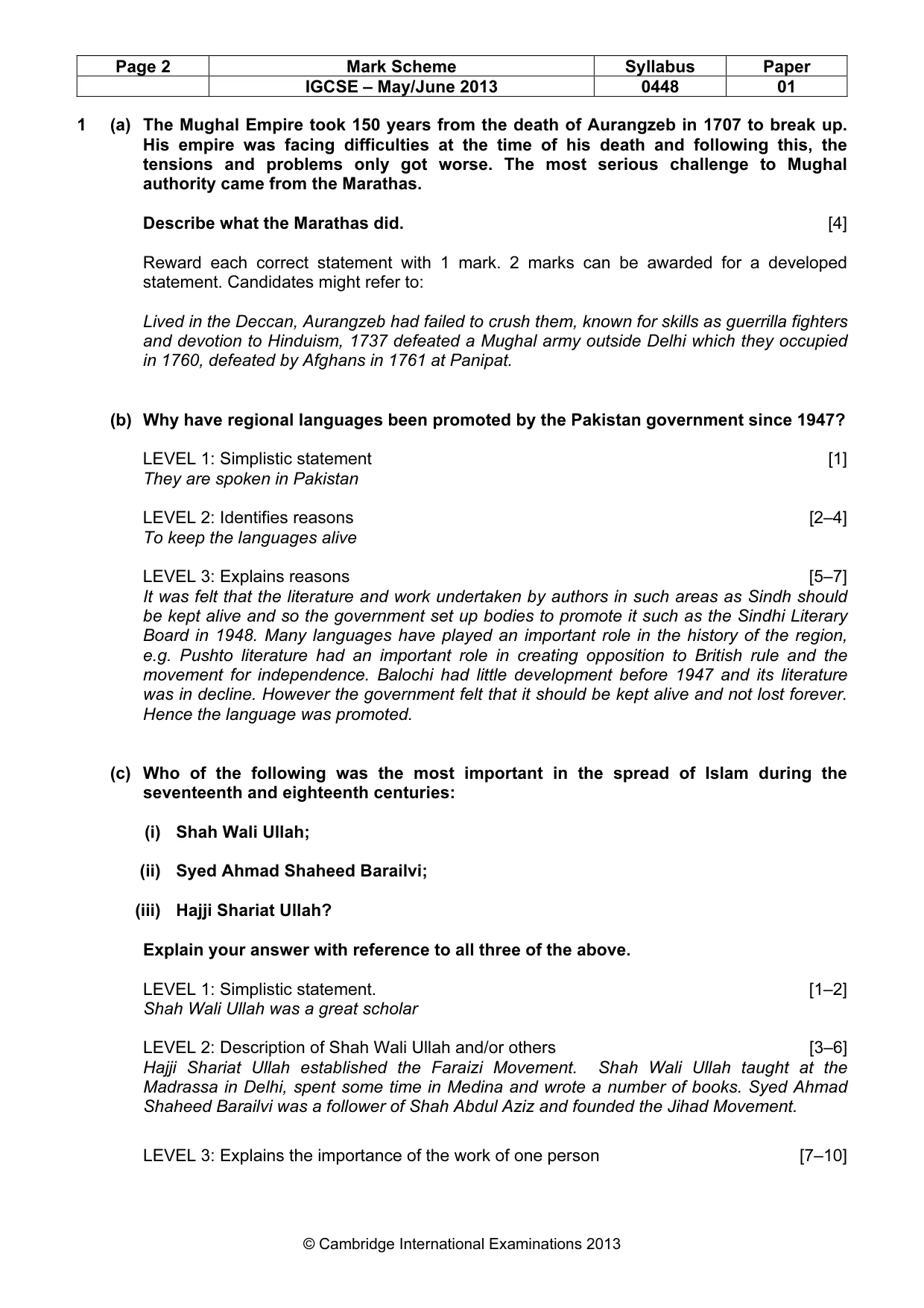
Page 2 Mark Scheme Syllabus Paper IGCSE – May/June 2013 0448 01 © Cambridge International Examinations 2013 1 (a) The Mughal Empire took 150 years from the death of Aurangzeb in 1707 to break up. His empire was facing difficulties at the time of his death and following this, the tensions and problems only got worse. The most serious challenge to Mughal authority came from the Marathas. Describe what the Marathas did. [4] Reward each correct statement with 1 mark. 2 marks can be awarded for a developed statement. Candidates might refer to: Lived in the Deccan, Aurangzeb had failed to crush them, known for skills as guerrilla fighters and devotion to Hinduism, 1737 defeated a Mughal army outside Delhi which they occupied in 1760, defeated by Afghans in 1761 at Panipat. (b) Why have regional languages been promoted by the Pakistan government since 1947? LEVEL 1: Simplistic statement [1] They are spoken in Pakistan LEVEL 2: Identifies reasons [2–4] To keep the languages alive LEVEL 3: Explains reasons [5–7] It was felt that the literature and work undertaken by authors in such areas as Sindh should be kept alive and so the government set up bodies to promote it such as the Sindhi Literary Board in 1948. Many languages have played an important role in the history of the region, e.g. Pushto literature had an important role in creating opposition to British rule and the movement for independence. Balochi had little development before 1947 and its literature was in decline. However the government felt that it should be kept alive and not lost forever. Hence the language was promoted. (c) Who of the following was the most important in the spread of Islam during the seventeenth and eighteenth centuries: (i) Shah Wali Ullah; (ii) Syed Ahmad Shaheed Barailvi; (iii) Hajji Shariat Ullah? Explain your answer with reference to all three of the above. LEVEL 1: Simplistic statement. [1–2] Shah Wali Ullah was a great scholar LEVEL 2: Description of Shah Wali Ullah and/or others [3–6] Hajji Shariat Ullah established the Faraizi Movement. Shah Wali Ullah taught at the Madrassa in Delhi, spent some time in Medina and wrote a number of books. Syed Ahmad Shaheed Barailvi was a follower of Shah Abdul Aziz and founded the Jihad Movement. LEVEL 3: Explains the importance of the work of one person [7–10]
Mark scheme, page 4
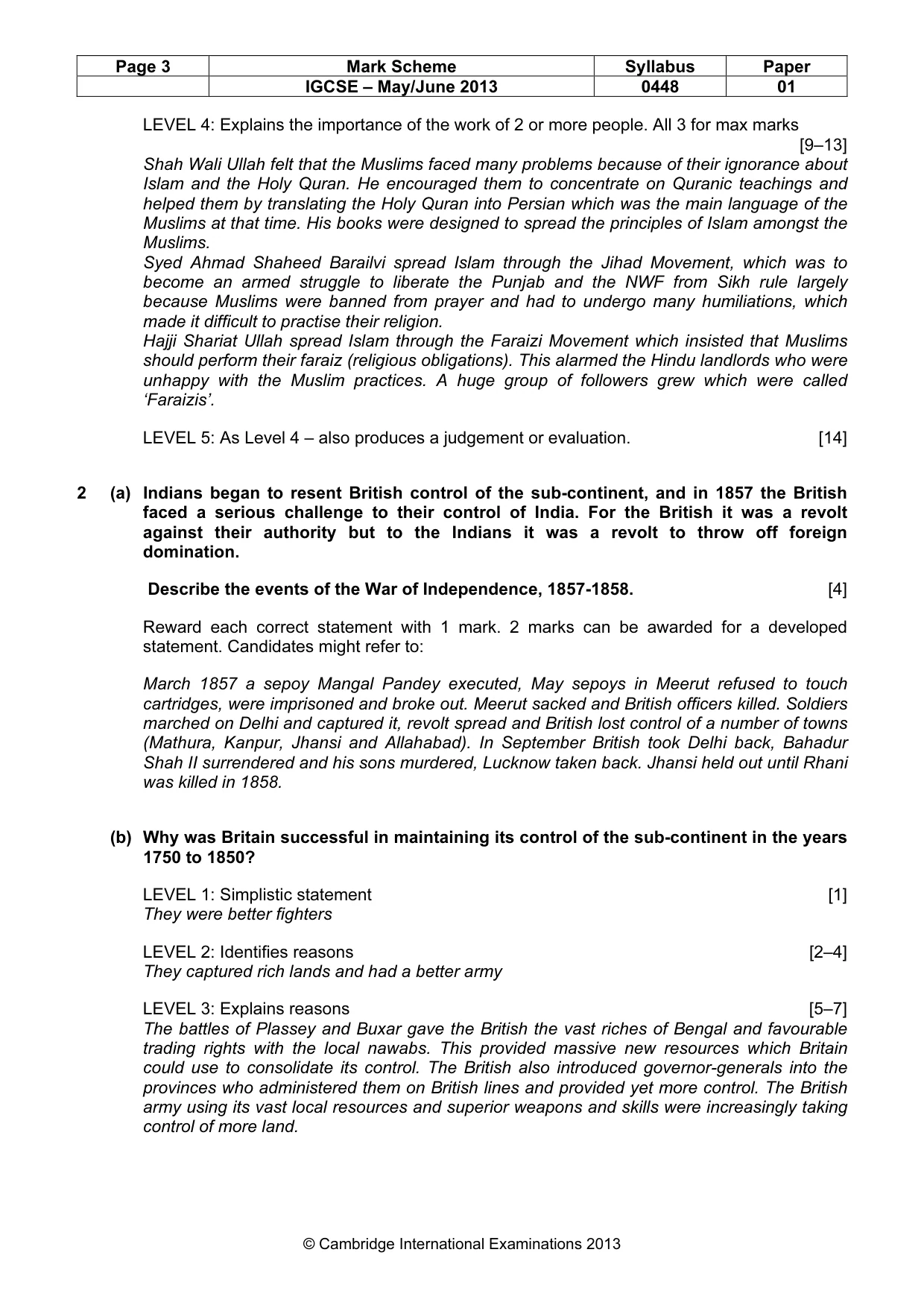
Page 3 Mark Scheme Syllabus Paper IGCSE – May/June 2013 0448 01 © Cambridge International Examinations 2013 LEVEL 4: Explains the importance of the work of 2 or more people. All 3 for max marks [9–13] Shah Wali Ullah felt that the Muslims faced many problems because of their ignorance about Islam and the Holy Quran. He encouraged them to concentrate on Quranic teachings and helped them by translating the Holy Quran into Persian which was the main language of the Muslims at that time. His books were designed to spread the principles of Islam amongst the Muslims. Syed Ahmad Shaheed Barailvi spread Islam through the Jihad Movement, which was to become an armed struggle to liberate the Punjab and the NWF from Sikh rule largely because Muslims were banned from prayer and had to undergo many humiliations, which made it difficult to practise their religion. Hajji Shariat Ullah spread Islam through the Faraizi Movement which insisted that Muslims should perform their faraiz (religious obligations). This alarmed the Hindu landlords who were unhappy with the Muslim practices. A huge group of followers grew which were called ‘Faraizis’. LEVEL 5: As Level 4 – also produces a judgement or evaluation. [14] 2 (a) Indians began to resent British control of the sub-continent, and in 1857 the British faced a serious challenge to their control of India. For the British it was a revolt against their authority but to the Indians it was a revolt to throw off foreign domination. Describe the events of the War of Independence, 1857-1858. [4] Reward each correct statement with 1 mark. 2 marks can be awarded for a developed statement. Candidates might refer to: March 1857 a sepoy Mangal Pandey executed, May sepoys in Meerut refused to touch cartridges, were imprisoned and broke out. Meerut sacked and British officers killed. Soldiers marched on Delhi and captured it, revolt spread and British lost control of a number of towns (Mathura, Kanpur, Jhansi and Allahabad). In September British took Delhi back, Bahadur Shah II surrendered and his sons murdered, Lucknow taken back. Jhansi held out until Rhani was killed in 1858. (b) Why was Britain successful in maintaining its control of the sub-continent in the years 1750 to 1850? LEVEL 1: Simplistic statement [1] They were better fighters LEVEL 2: Identifies reasons [2–4] They captured rich lands and had a better army LEVEL 3: Explains reasons [5–7] The battles of Plassey and Buxar gave the British the vast riches of Bengal and favourable trading rights with the local nawabs. This provided massive new resources which Britain could use to consolidate its control. The British also introduced governor-generals into the provinces who administered them on British lines and provided yet more control. The British army using its vast local resources and superior weapons and skills were increasingly taking control of more land.
Mark scheme, page 5
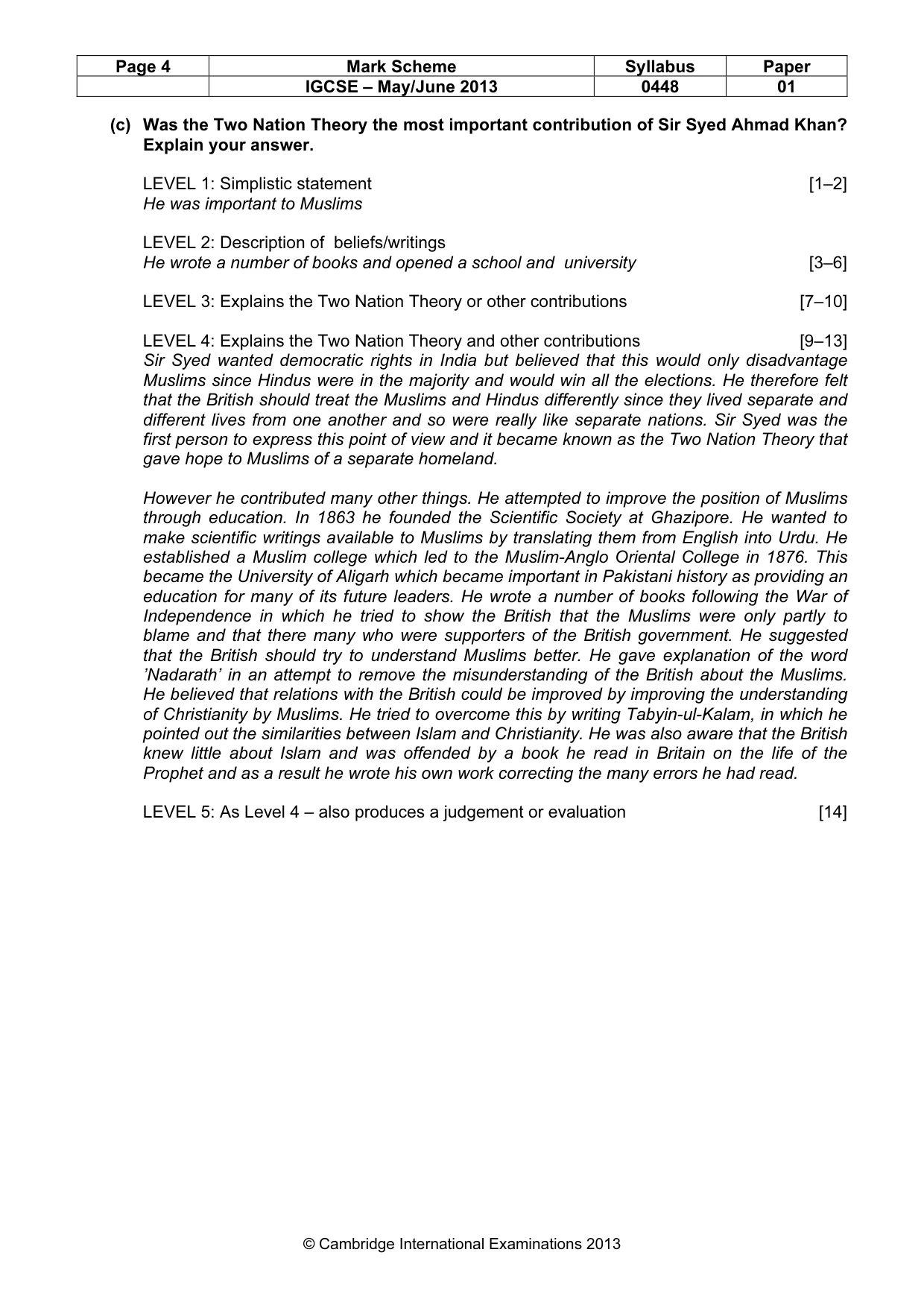
Page 4 Mark Scheme Syllabus Paper IGCSE – May/June 2013 0448 01 © Cambridge International Examinations 2013 (c) Was the Two Nation Theory the most important contribution of Sir Syed Ahmad Khan? Explain your answer. LEVEL 1: Simplistic statement [1–2] He was important to Muslims LEVEL 2: Description of beliefs/writings He wrote a number of books and opened a school and university [3–6] LEVEL 3: Explains the Two Nation Theory or other contributions [7–10] LEVEL 4: Explains the Two Nation Theory and other contributions [9–13] Sir Syed wanted democratic rights in India but believed that this would only disadvantage Muslims since Hindus were in the majority and would win all the elections. He therefore felt that the British should treat the Muslims and Hindus differently since they lived separate and different lives from one another and so were really like separate nations. Sir Syed was the first person to express this point of view and it became known as the Two Nation Theory that gave hope to Muslims of a separate homeland. However he contributed many other things. He attempted to improve the position of Muslims through education. In 1863 he founded the Scientific Society at Ghazipore. He wanted to make scientific writings available to Muslims by translating them from English into Urdu. He established a Muslim college which led to the Muslim-Anglo Oriental College in 1876. This became the University of Aligarh which became important in Pakistani history as providing an education for many of its future leaders. He wrote a number of books following the War of Independence in which he tried to show the British that the Muslims were only partly to blame and that there many who were supporters of the British government. He suggested that the British should try to understand Muslims better. He gave explanation of the word ’Nadarath’ in an attempt to remove the misunderstanding of the British about the Muslims. He believed that relations with the British could be improved by improving the understanding of Christianity by Muslims. He tried to overcome this by writing Tabyin-ul-Kalam, in which he pointed out the similarities between Islam and Christianity. He was also aware that the British knew little about Islam and was offended by a book he read in Britain on the life of the Prophet and as a result he wrote his own work correcting the many errors he had read. LEVEL 5: As Level 4 – also produces a judgement or evaluation [14]
Mark scheme, page 6
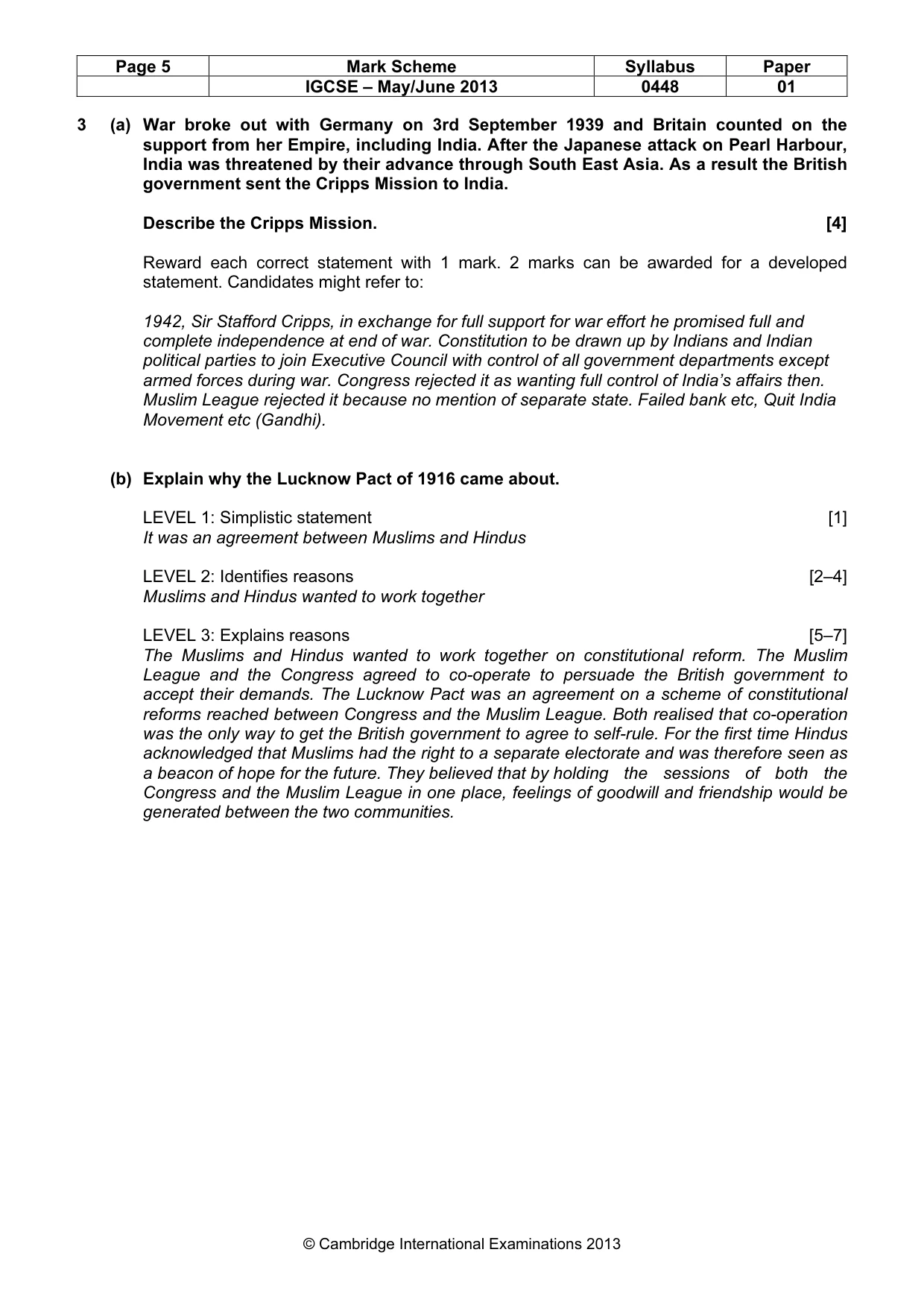
Page 5 Mark Scheme Syllabus Paper IGCSE – May/June 2013 0448 01 © Cambridge International Examinations 2013 3 (a) War broke out with Germany on 3rd September 1939 and Britain counted on the support from her Empire, including India. After the Japanese attack on Pearl Harbour, India was threatened by their advance through South East Asia. As a result the British government sent the Cripps Mission to India. Describe the Cripps Mission. [4] Reward each correct statement with 1 mark. 2 marks can be awarded for a developed statement. Candidates might refer to: 1942, Sir Stafford Cripps, in exchange for full support for war effort he promised full and complete independence at end of war. Constitution to be drawn up by Indians and Indian political parties to join Executive Council with control of all government departments except armed forces during war. Congress rejected it as wanting full control of India’s affairs then. Muslim League rejected it because no mention of separate state. Failed bank etc, Quit India Movement etc (Gandhi). (b) Explain why the Lucknow Pact of 1916 came about. LEVEL 1: Simplistic statement [1] It was an agreement between Muslims and Hindus LEVEL 2: Identifies reasons [2–4] Muslims and Hindus wanted to work together LEVEL 3: Explains reasons [5–7] The Muslims and Hindus wanted to work together on constitutional reform. The Muslim League and the Congress agreed to co-operate to persuade the British government to accept their demands. The Lucknow Pact was an agreement on a scheme of constitutional reforms reached between Congress and the Muslim League. Both realised that co-operation was the only way to get the British government to agree to self-rule. For the first time Hindus acknowledged that Muslims had the right to a separate electorate and was therefore seen as a beacon of hope for the future. They believed that by holding the sessions of both the Congress and the Muslim League in one place, feelings of goodwill and friendship would be generated between the two communities.
Mark scheme, page 7
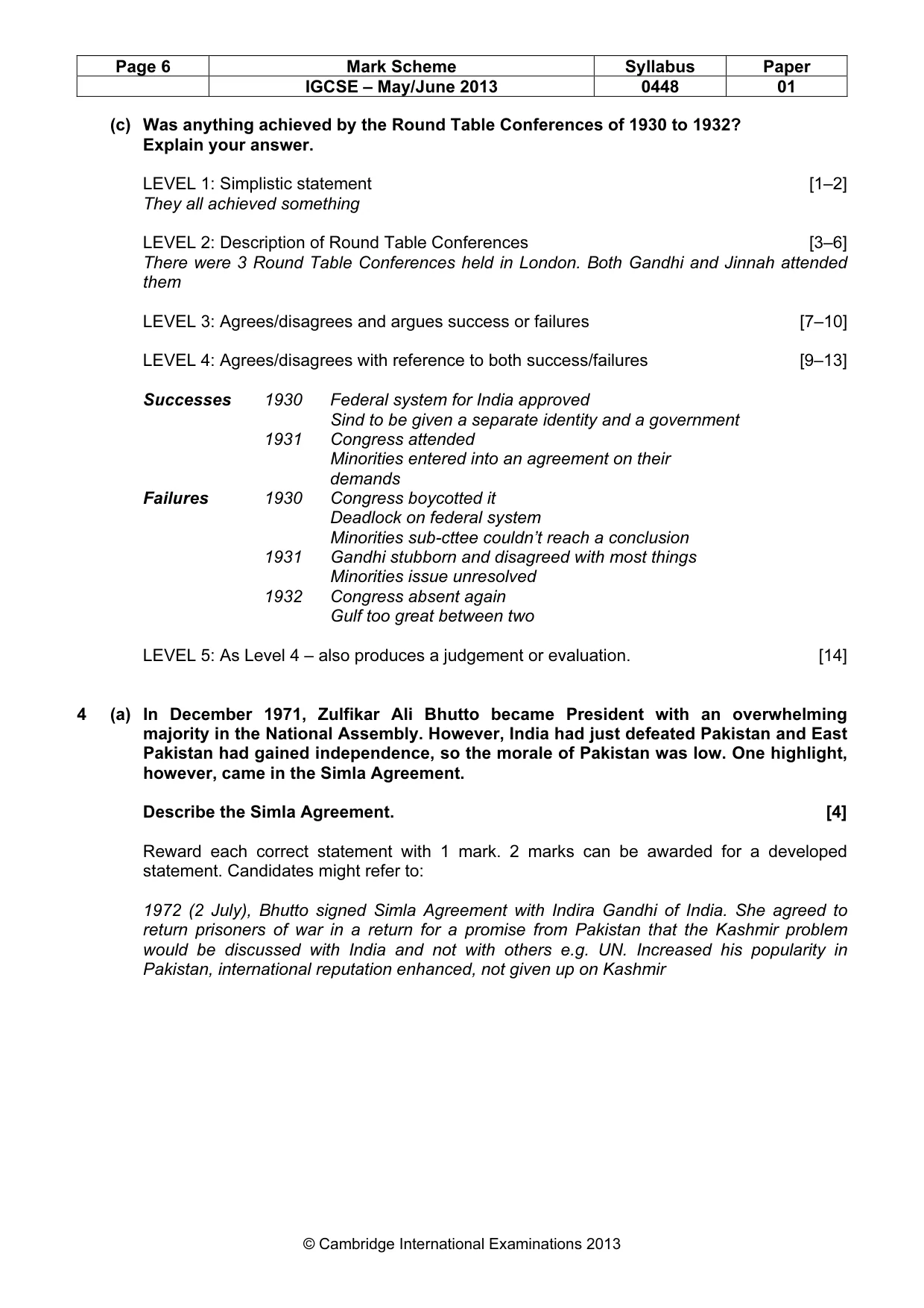
Page 6 Mark Scheme Syllabus Paper IGCSE – May/June 2013 0448 01 © Cambridge International Examinations 2013 (c) Was anything achieved by the Round Table Conferences of 1930 to 1932? Explain your answer. LEVEL 1: Simplistic statement [1–2] They all achieved something LEVEL 2: Description of Round Table Conferences [3–6] There were 3 Round Table Conferences held in London. Both Gandhi and Jinnah attended them LEVEL 3: Agrees/disagrees and argues success or failures [7–10] LEVEL 4: Agrees/disagrees with reference to both success/failures [9–13] Successes 1930 Federal system for India approved Sind to be given a separate identity and a government 1931 Congress attended Minorities entered into an agreement on their demands Failures 1930 Congress boycotted it Deadlock on federal system Minorities sub-cttee couldn’t reach a conclusion 1931 Gandhi stubborn and disagreed with most things Minorities issue unresolved 1932 Congress absent again Gulf too great between two LEVEL 5: As Level 4 – also produces a judgement or evaluation. [14] 4 (a) In December 1971, Zulfikar Ali Bhutto became President with an overwhelming majority in the National Assembly. However, India had just defeated Pakistan and East Pakistan had gained independence, so the morale of Pakistan was low. One highlight, however, came in the Simla Agreement. Describe the Simla Agreement. [4] Reward each correct statement with 1 mark. 2 marks can be awarded for a developed statement. Candidates might refer to: 1972 (2 July), Bhutto signed Simla Agreement with Indira Gandhi of India. She agreed to return prisoners of war in a return for a promise from Pakistan that the Kashmir problem would be discussed with India and not with others e.g. UN. Increased his popularity in Pakistan, international reputation enhanced, not given up on Kashmir
Mark scheme, page 8
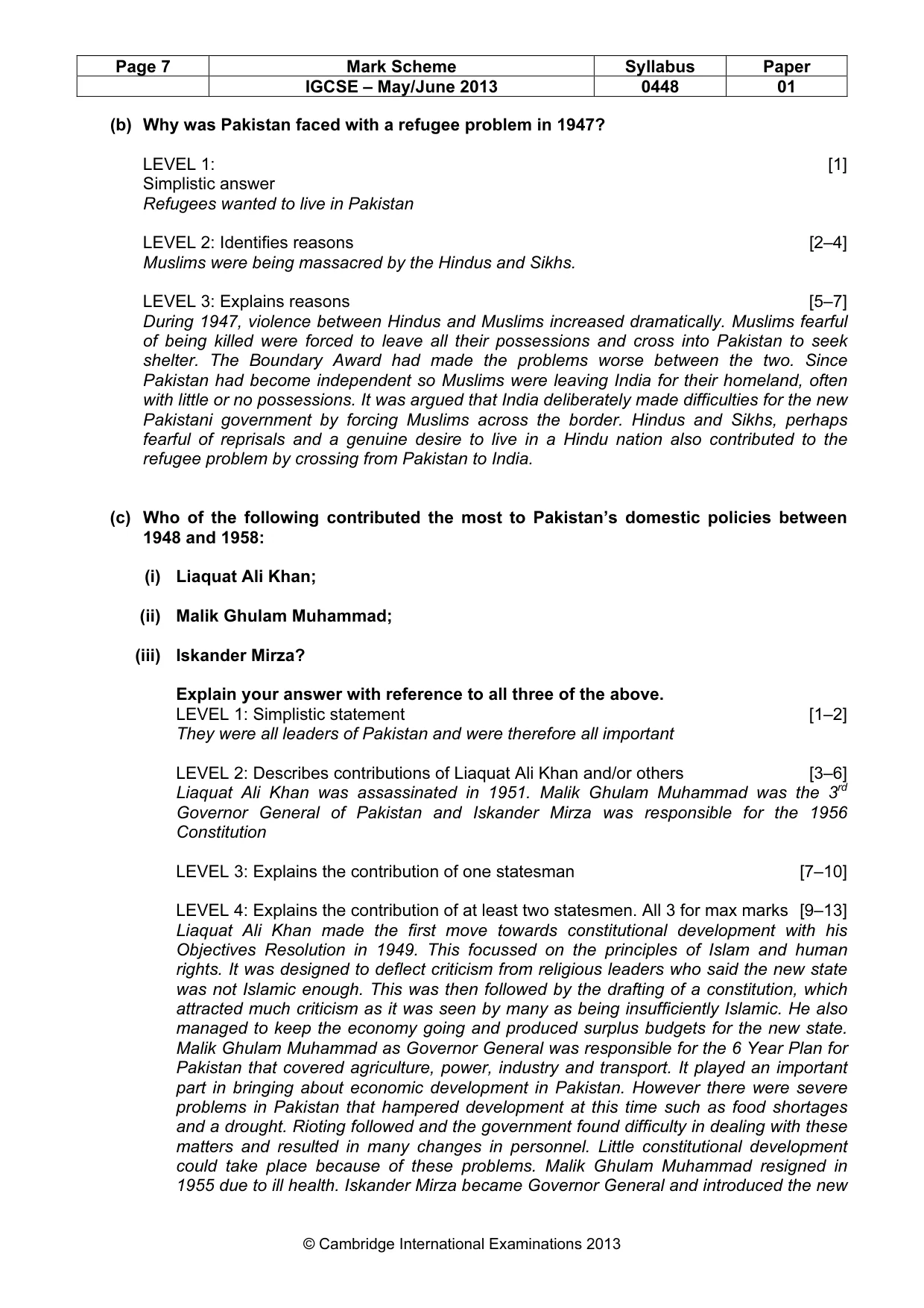
Page 7 Mark Scheme Syllabus Paper IGCSE – May/June 2013 0448 01 © Cambridge International Examinations 2013 (b) Why was Pakistan faced with a refugee problem in 1947? LEVEL 1: [1] Simplistic answer Refugees wanted to live in Pakistan LEVEL 2: Identifies reasons [2–4] Muslims were being massacred by the Hindus and Sikhs. LEVEL 3: Explains reasons [5–7] During 1947, violence between Hindus and Muslims increased dramatically. Muslims fearful of being killed were forced to leave all their possessions and cross into Pakistan to seek shelter. The Boundary Award had made the problems worse between the two. Since Pakistan had become independent so Muslims were leaving India for their homeland, often with little or no possessions. It was argued that India deliberately made difficulties for the new Pakistani government by forcing Muslims across the border. Hindus and Sikhs, perhaps fearful of reprisals and a genuine desire to live in a Hindu nation also contributed to the refugee problem by crossing from Pakistan to India. (c) Who of the following contributed the most to Pakistan’s domestic policies between 1948 and 1958: (i) Liaquat Ali Khan; (ii) Malik Ghulam Muhammad; (iii) Iskander Mirza? Explain your answer with reference to all three of the above. LEVEL 1: Simplistic statement [1–2] They were all leaders of Pakistan and were therefore all important LEVEL 2: Describes contributions of Liaquat Ali Khan and/or others [3–6] Liaquat Ali Khan was assassinated in 1951. Malik Ghulam Muhammad was the 3rd Governor General of Pakistan and Iskander Mirza was responsible for the 1956 Constitution LEVEL 3: Explains the contribution of one statesman [7–10] LEVEL 4: Explains the contribution of at least two statesmen. All 3 for max marks [9–13] Liaquat Ali Khan made the first move towards constitutional development with his Objectives Resolution in 1949. This focussed on the principles of Islam and human rights. It was designed to deflect criticism from religious leaders who said the new state was not Islamic enough. This was then followed by the drafting of a constitution, which attracted much criticism as it was seen by many as being insufficiently Islamic. He also managed to keep the economy going and produced surplus budgets for the new state. Malik Ghulam Muhammad as Governor General was responsible for the 6 Year Plan for Pakistan that covered agriculture, power, industry and transport. It played an important part in bringing about economic development in Pakistan. However there were severe problems in Pakistan that hampered development at this time such as food shortages and a drought. Rioting followed and the government found difficulty in dealing with these matters and resulted in many changes in personnel. Little constitutional development could take place because of these problems. Malik Ghulam Muhammad resigned in 1955 due to ill health. Iskander Mirza became Governor General and introduced the new
Mark scheme, page 9
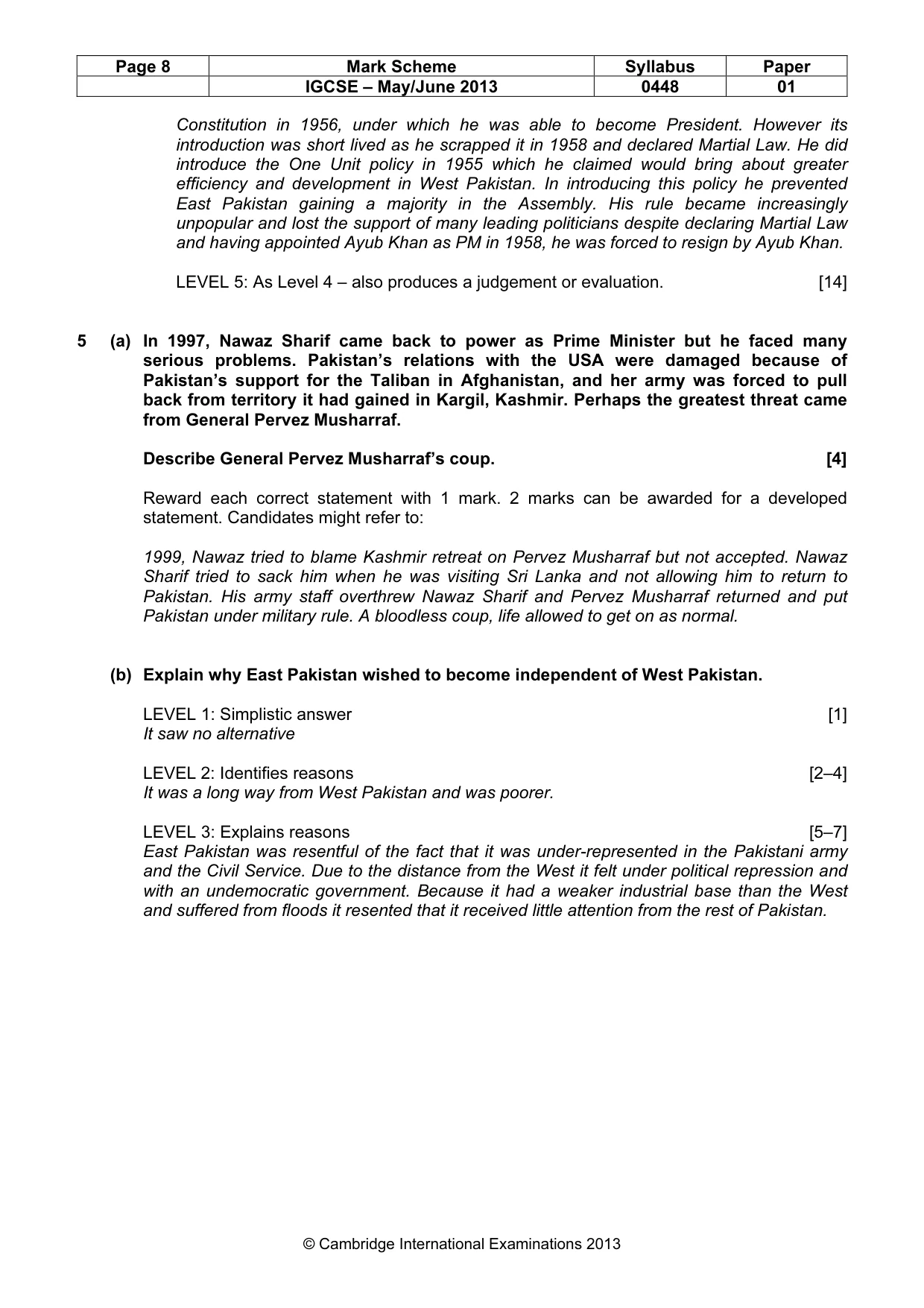
Page 8 Mark Scheme Syllabus Paper IGCSE – May/June 2013 0448 01 © Cambridge International Examinations 2013 Constitution in 1956, under which he was able to become President. However its introduction was short lived as he scrapped it in 1958 and declared Martial Law. He did introduce the One Unit policy in 1955 which he claimed would bring about greater efficiency and development in West Pakistan. In introducing this policy he prevented East Pakistan gaining a majority in the Assembly. His rule became increasingly unpopular and lost the support of many leading politicians despite declaring Martial Law and having appointed Ayub Khan as PM in 1958, he was forced to resign by Ayub Khan. LEVEL 5: As Level 4 – also produces a judgement or evaluation. [14] 5 (a) In 1997, Nawaz Sharif came back to power as Prime Minister but he faced many serious problems. Pakistan’s relations with the USA were damaged because of Pakistan’s support for the Taliban in Afghanistan, and her army was forced to pull back from territory it had gained in Kargil, Kashmir. Perhaps the greatest threat came from General Pervez Musharraf. Describe General Pervez Musharraf’s coup. [4] Reward each correct statement with 1 mark. 2 marks can be awarded for a developed statement. Candidates might refer to: 1999, Nawaz tried to blame Kashmir retreat on Pervez Musharraf but not accepted. Nawaz Sharif tried to sack him when he was visiting Sri Lanka and not allowing him to return to Pakistan. His army staff overthrew Nawaz Sharif and Pervez Musharraf returned and put Pakistan under military rule. A bloodless coup, life allowed to get on as normal. (b) Explain why East Pakistan wished to become independent of West Pakistan. LEVEL 1: Simplistic answer [1] It saw no alternative LEVEL 2: Identifies reasons [2–4] It was a long way from West Pakistan and was poorer. LEVEL 3: Explains reasons [5–7] East Pakistan was resentful of the fact that it was under-represented in the Pakistani army and the Civil Service. Due to the distance from the West it felt under political repression and with an undemocratic government. Because it had a weaker industrial base than the West and suffered from floods it resented that it received little attention from the rest of Pakistan.
Mark scheme, page 10
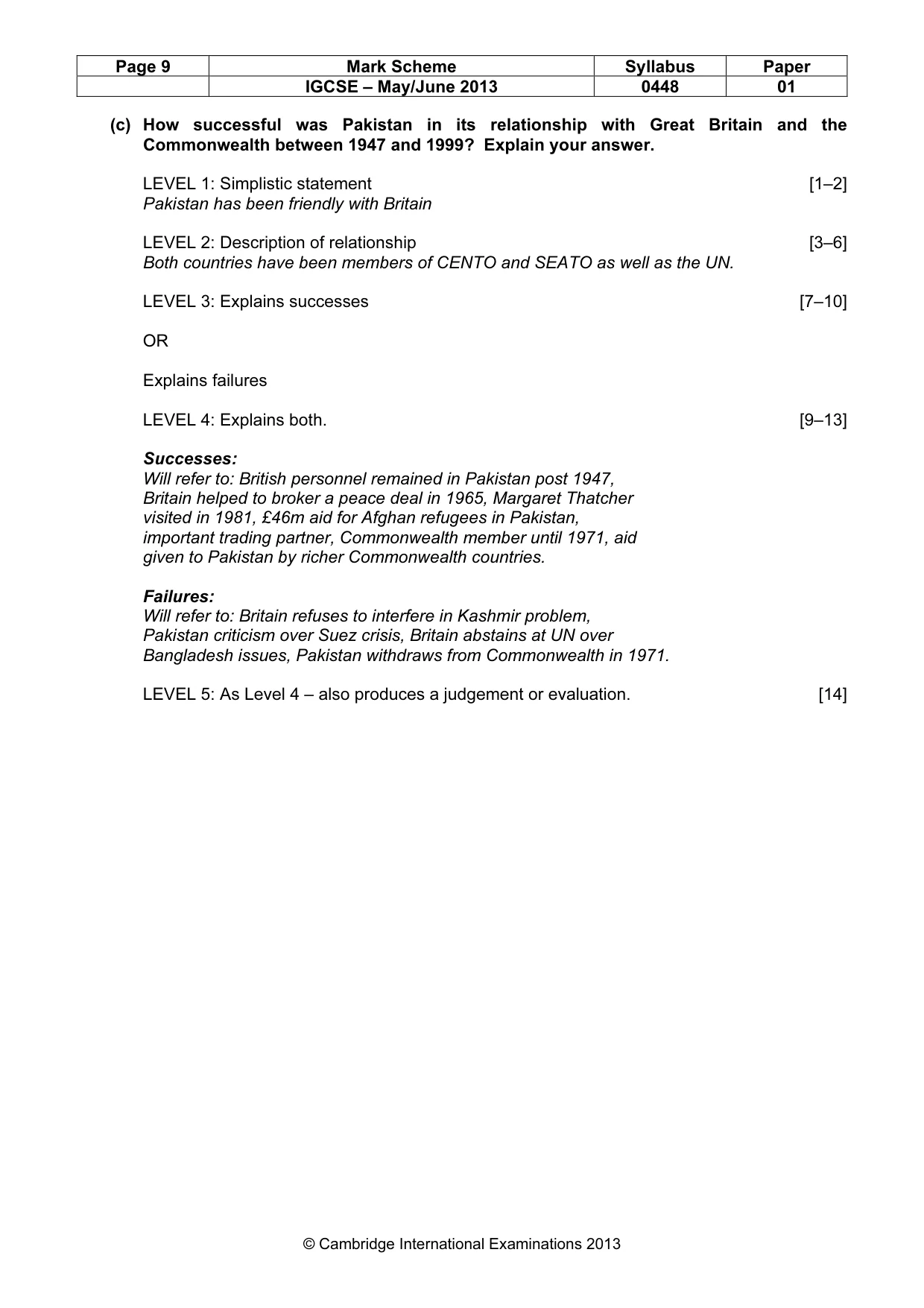
Page 9 Mark Scheme Syllabus Paper IGCSE – May/June 2013 0448 01 © Cambridge International Examinations 2013 (c) How successful was Pakistan in its relationship with Great Britain and the Commonwealth between 1947 and 1999? Explain your answer. LEVEL 1: Simplistic statement [1–2] Pakistan has been friendly with Britain LEVEL 2: Description of relationship [3–6] Both countries have been members of CENTO and SEATO as well as the UN. LEVEL 3: Explains successes [7–10] OR Explains failures LEVEL 4: Explains both. [9–13] Successes: Will refer to: British personnel remained in Pakistan post 1947, Britain helped to broker a peace deal in 1965, Margaret Thatcher visited in 1981, £46m aid for Afghan refugees in Pakistan, important trading partner, Commonwealth member until 1971, aid given to Pakistan by richer Commonwealth countries. Failures: Will refer to: Britain refuses to interfere in Kashmir problem, Pakistan criticism over Suez crisis, Britain abstains at UN over Bangladesh issues, Pakistan withdraws from Commonwealth in 1971. LEVEL 5: As Level 4 – also produces a judgement or evaluation. [14]
What you needed in this session
Cambridge’s own grade thresholds for 2013 May/June, Paper 1 · Variant 1. A higher threshold means an easier paper — the bar moves with how the cohort did.