Cambridge IGCSE Music 0410 — 2022 May/June Paper 1 · Variant 3
0410/13/M/J/22 · 70 marks · ≈79 min
The question paper and its mark scheme, free to read here and free to download. This is Cambridge’s own paper, exactly as it was sat.
Question paper16 pages
Mark scheme6 pages
Answers below. Sit the paper first if you are practising.
Paper as text
Question paper, page 1
This document has 16 pages. Any blank pages are indicated. [Turn over DC (RW) 302536/3 © UCLES 2022 * 3 0 2 2 7 7 4 2 1 7 * MUSIC 0410/13 Paper 1 Listening May/June 2022 Approximately 1 hour 15 minutes You must answer on the question paper. You will need: Insert (enclosed) INSTRUCTIONS ● Answer all questions in Sections A, B and C. ● Section D: answer all questions on the one Set Work you have studied, in the space provided. ● There will be time for you to look at the questions before you hear each extract of music. You may find it helpful to make notes on the music as you listen. ● Use a black or dark blue pen. ● Write your name, centre number and candidate number in the boxes at the top of the page. ● Write your answer to each question in the space provided. ● Do not use an erasable pen or correction fluid. ● Do not write on any bar codes. ● You may use an HB pencil for any music. ● The insert contains the scores for Music C1 and your chosen Set Work in Section D. INFORMATION ● The total mark for this paper is 70. ● The number of marks for each question or part question is shown in brackets [ ]. Cambridge IGCSE™
Question paper, page 2
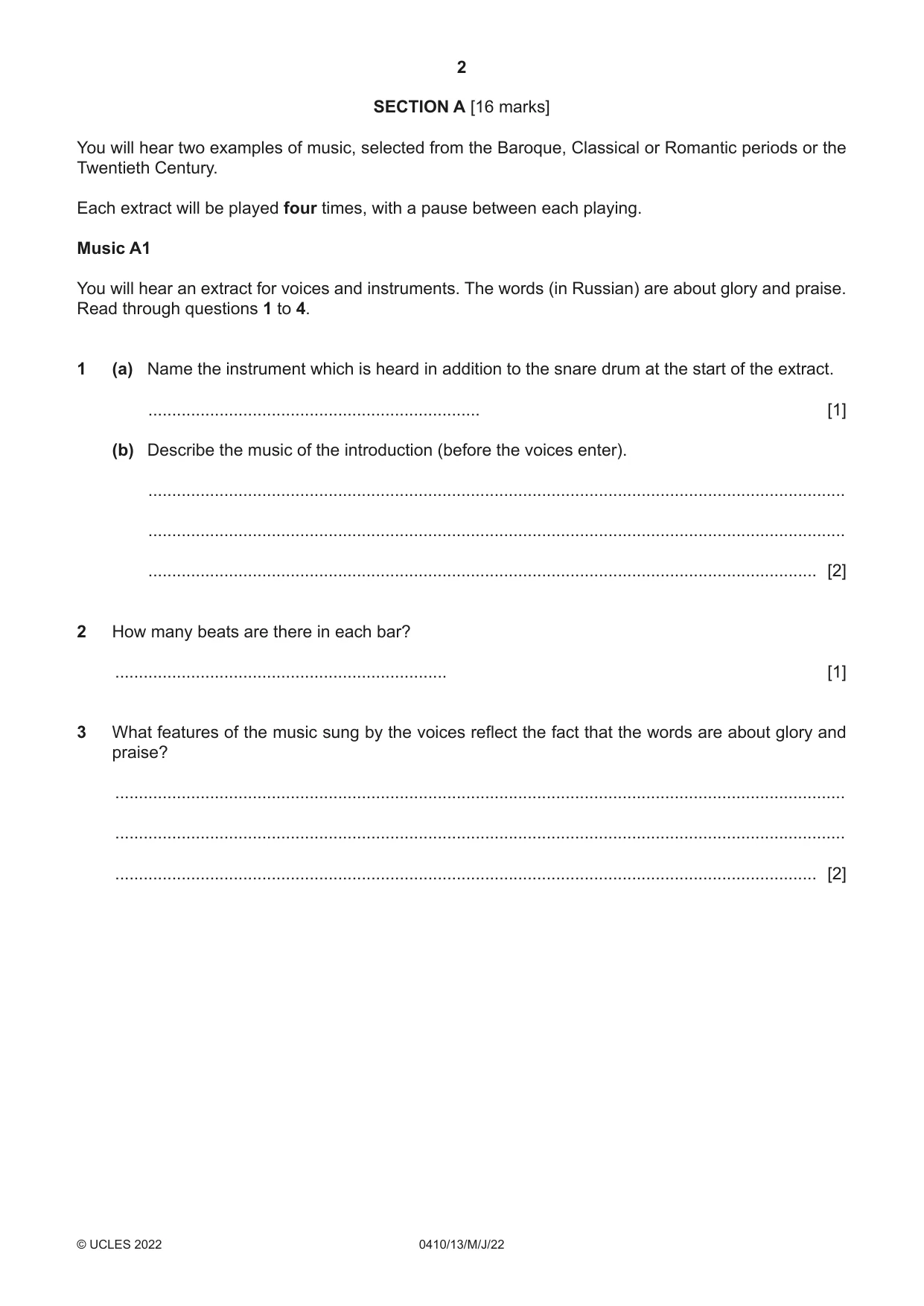
2 0410/13/M/J/22 © UCLES 2022 SECTION A [16 marks] You will hear two examples of music, selected from the Baroque, Classical or Romantic periods or the Twentieth Century. Each extract will be played four times, with a pause between each playing. Music A1 You will hear an extract for voices and instruments. The words (in Russian) are about glory and praise. Read through questions 1 to 4. 1 (a) Name the instrument which is heard in addition to the snare drum at the start of the extract. … [1] (b) Describe the music of the introduction (before the voices enter). … … … [2] 2 How many beats are there in each bar? … [1] 3 What features of the music sung by the voices reflect the fact that the words are about glory and praise? … … … [2]
Question paper, page 3
3 0410/13/M/J/22 © UCLES 2022 [Turn over 4 (a) Which of the following best describes this extract? Aria Chorus Concerto Sonata [1] (b) When was this music written? Baroque Classical Romantic Twentieth Century [1]
Question paper, page 4
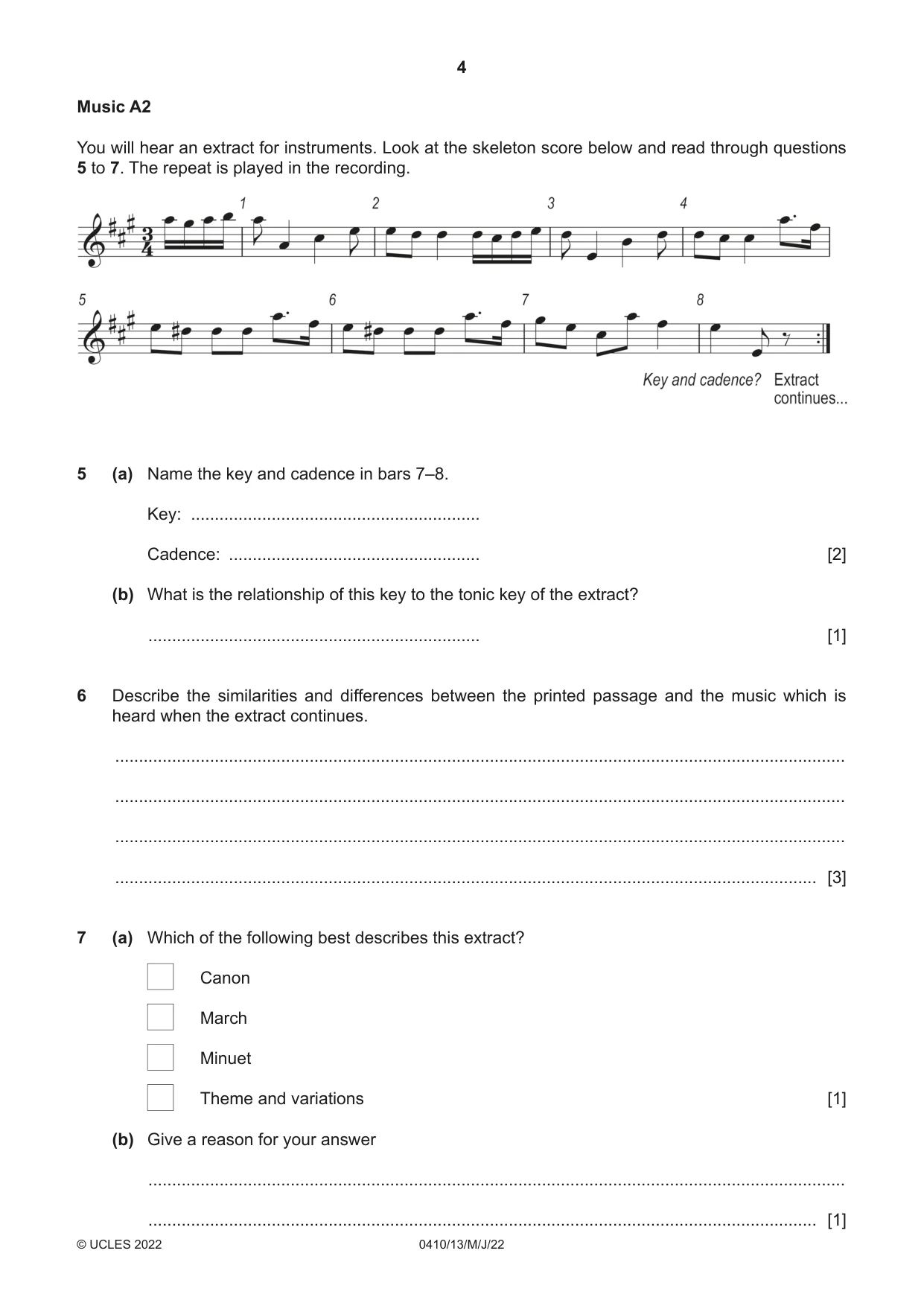
4 0410/13/ M / J /22 © UCLES 2022 Music A2 You will hear an extract for instruments. Look at the skeleton score below and read through questions 5 to 7. The repeat is played in the recording. 5 (a) Name the key and cadence in bars 7–8. Key: … Cadence: … [2] (b) What is the relationship of this key to the tonic key of the extract? … [1] 6 Describe the similarities and differences between the printed passage and the music which is heard when the extract continues. … … … … [3] 7 (a) Which of the following best describes this extract? Canon March Minuet Theme and variations [1] (b) Give a reason for your answer … … [1]
Question paper, page 5
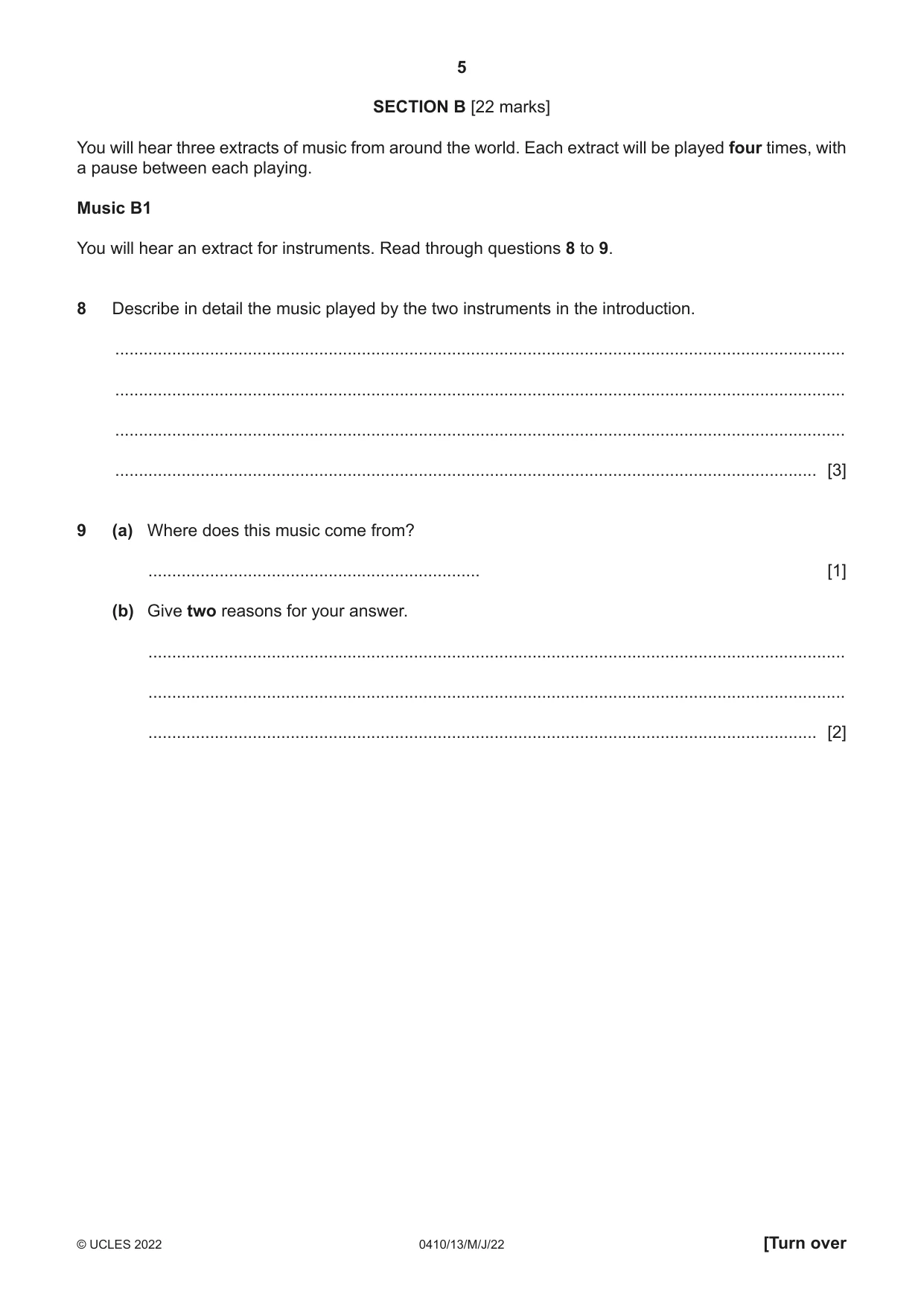
5 0410/13/M/J/22 © UCLES 2022 [Turn over SECTION B [22 marks] You will hear three extracts of music from around the world. Each extract will be played four times, with a pause between each playing. Music B1 You will hear an extract for instruments. Read through questions 8 to 9. 8 Describe in detail the music played by the two instruments in the introduction. … … … … [3] 9 (a) Where does this music come from? … [1] (b) Give two reasons for your answer. … … … [2]
Question paper, page 6
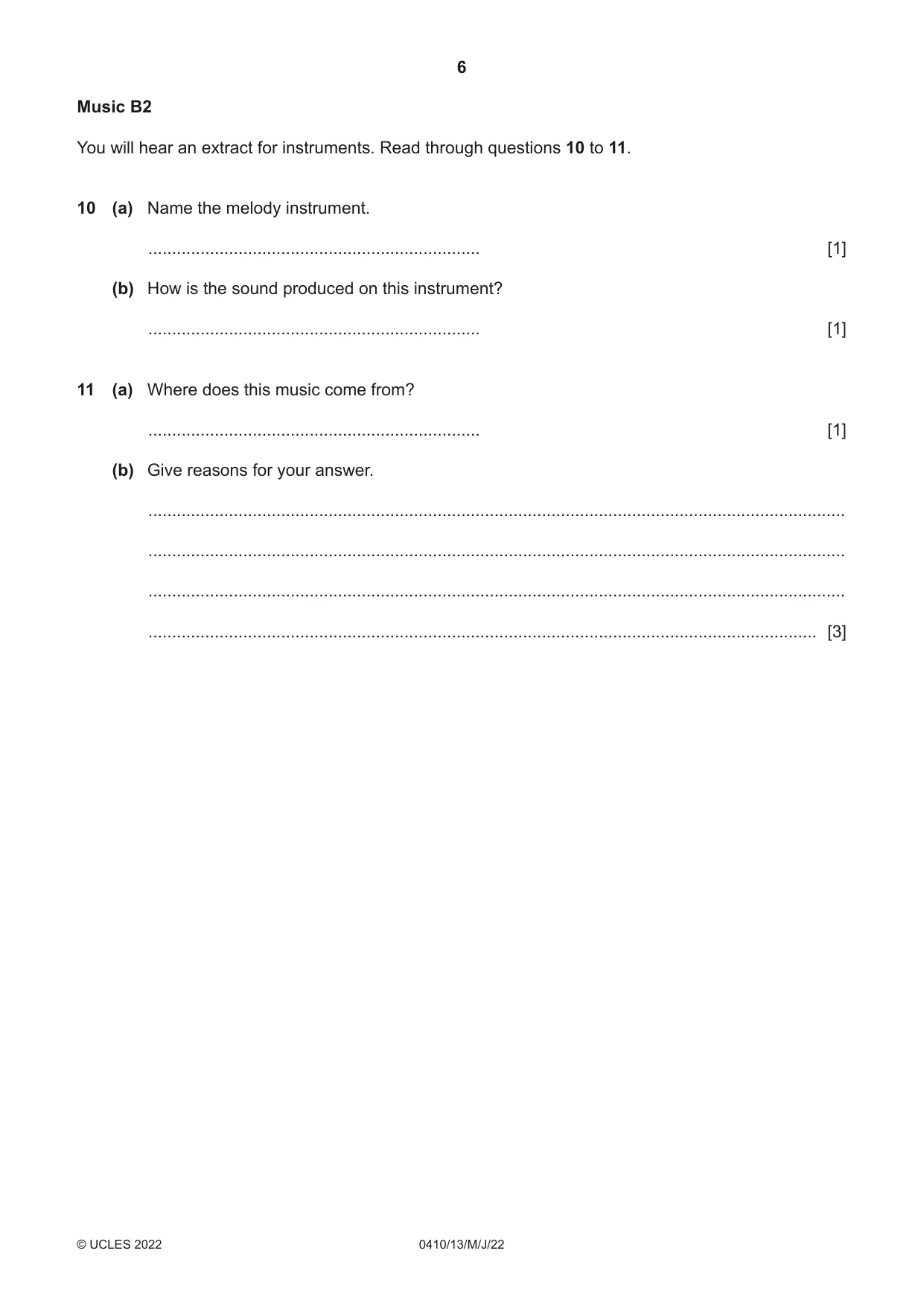
6 0410/13/M/J/22 © UCLES 2022 Music B2 You will hear an extract for instruments. Read through questions 10 to 11. 10 (a) Name the melody instrument. … [1] (b) How is the sound produced on this instrument? … [1] 11 (a) Where does this music come from? … [1] (b) Give reasons for your answer. … … … … [3]
Question paper, page 7
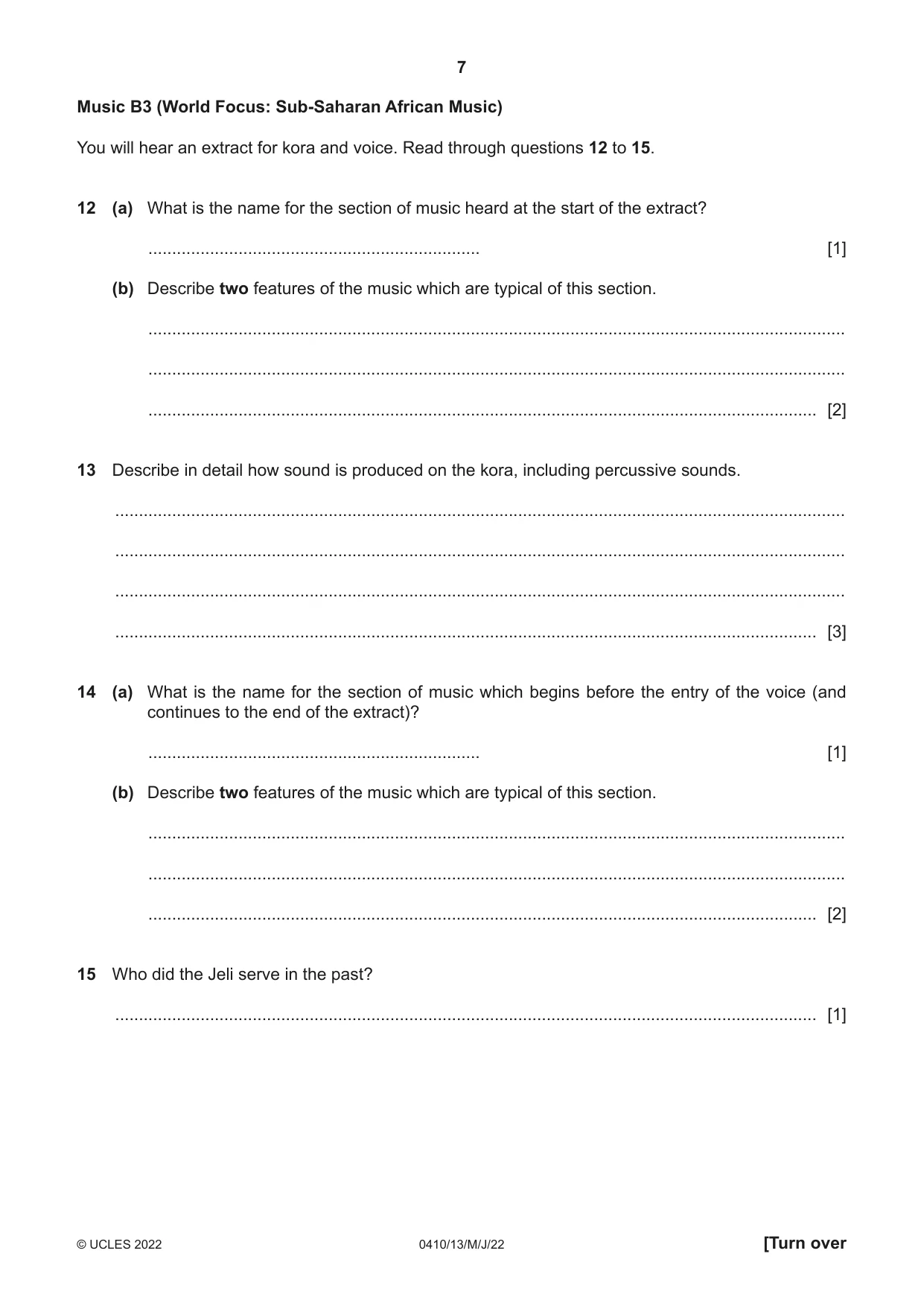
7 0410/13/M/J/22 © UCLES 2022 [Turn over Music B3 (World Focus: Sub-Saharan African Music) You will hear an extract for kora and voice. Read through questions 12 to 15. 12 (a) What is the name for the section of music heard at the start of the extract? … [1] (b) Describe two features of the music which are typical of this section. … … … [2] 13 Describe in detail how sound is produced on the kora, including percussive sounds. … … … … [3] 14 (a) What is the name for the section of music which begins before the entry of the voice (and continues to the end of the extract)? … [1] (b) Describe two features of the music which are typical of this section. … … … [2] 15 Who did the Jeli serve in the past? … [1]
Question paper, page 8
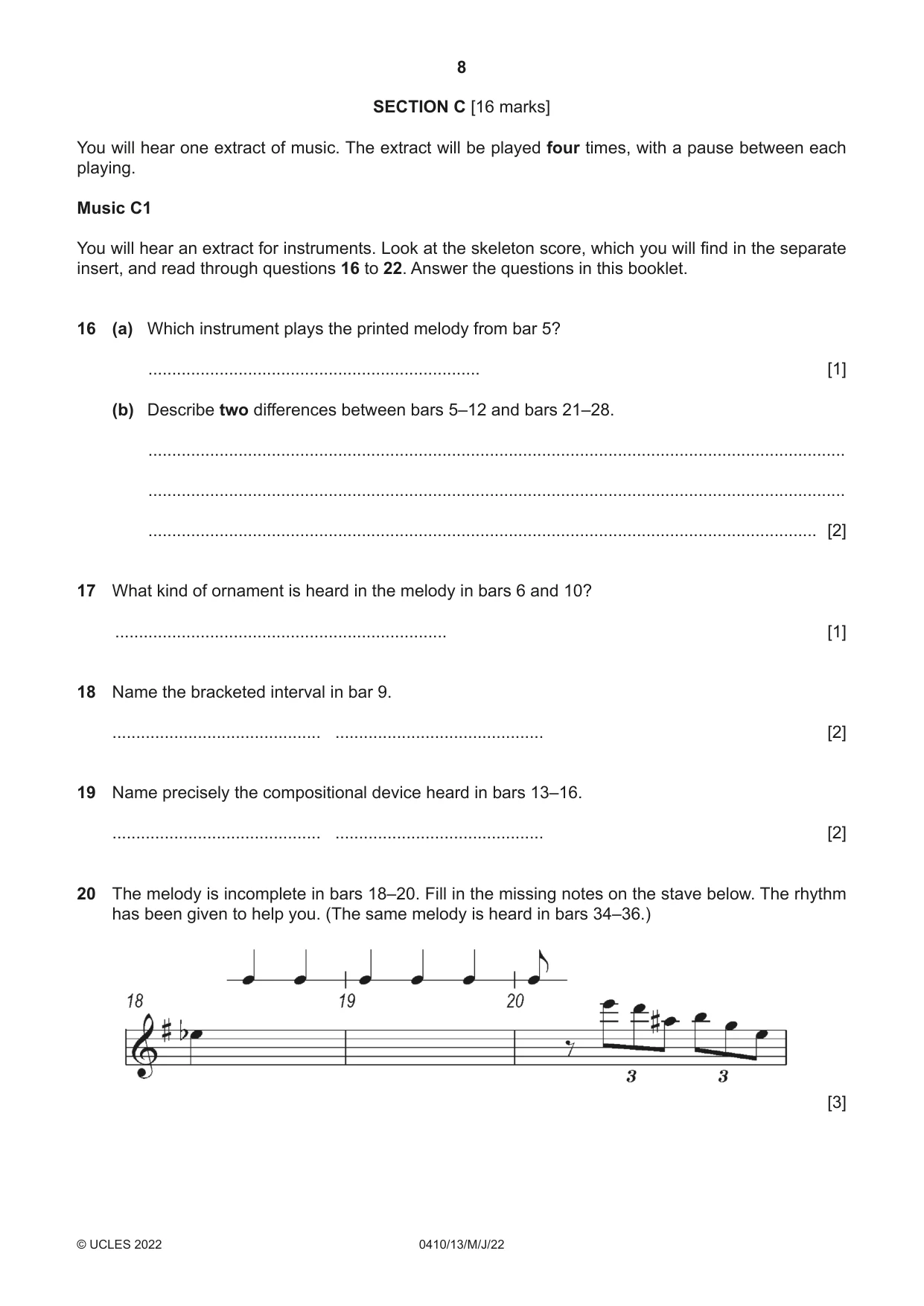
8 0410/13/M/J/22 © UCLES 2022 SECTION C [16 marks] You will hear one extract of music. The extract will be played four times, with a pause between each playing. Music C1 You will hear an extract for instruments. Look at the skeleton score, which you will find in the separate insert, and read through questions 16 to 22. Answer the questions in this booklet. 16 (a) Which instrument plays the printed melody from bar 5? … [1] (b) Describe two differences between bars 5–12 and bars 21–28. … … … [2] 17 What kind of ornament is heard in the melody in bars 6 and 10? … [1] 18 Name the bracketed interval in bar 9. … … [2] 19 Name precisely the compositional device heard in bars 13–16. … … [2] 20 The melody is incomplete in bars 18–20. Fill in the missing notes on the stave below. The rhythm has been given to help you. (The same melody is heard in bars 34–36.) [3]
Question paper, page 9
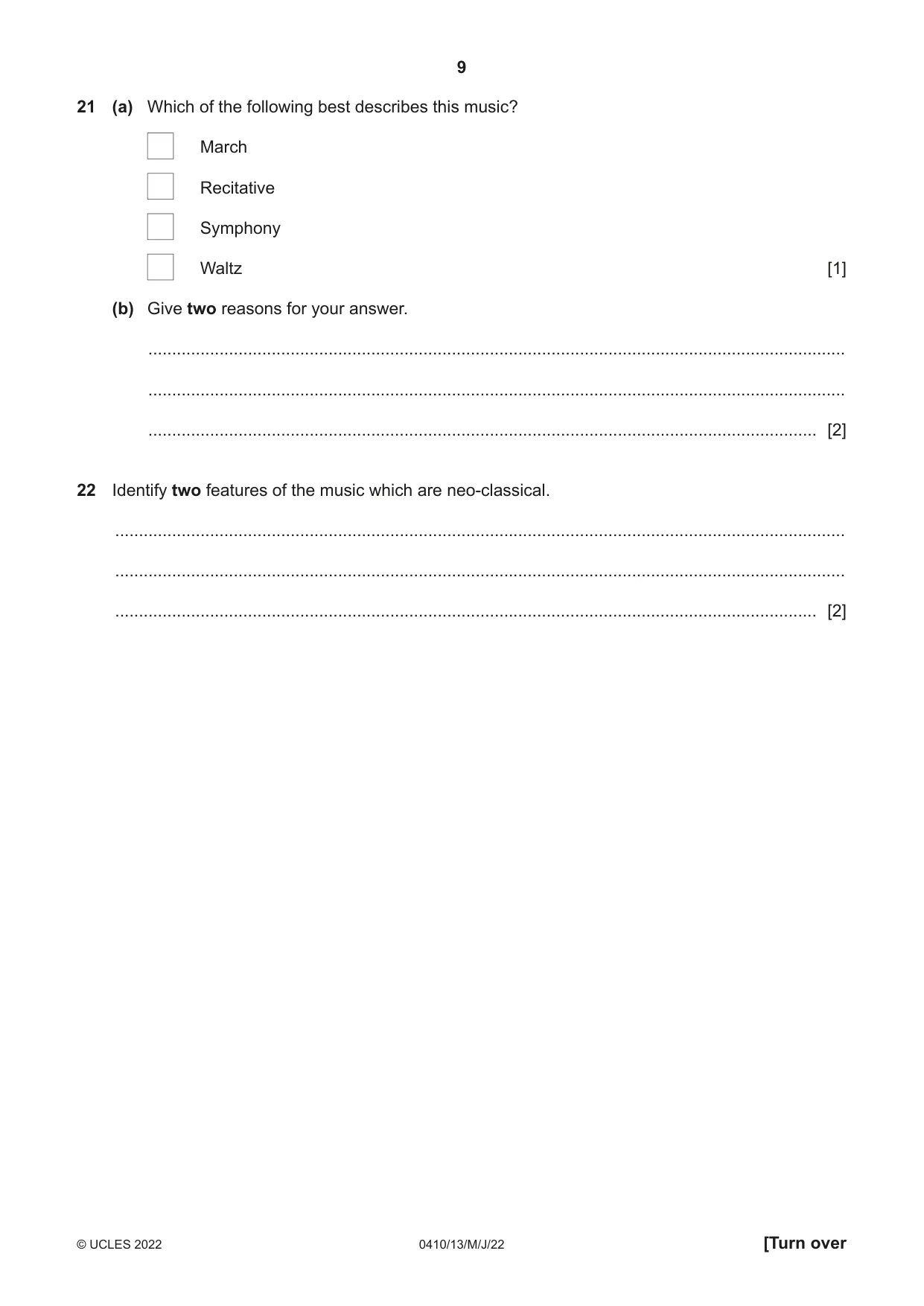
9 0410/13/M/J/22 © UCLES 2022 [Turn over 21 (a) Which of the following best describes this music? March Recitative Symphony Waltz [1] (b) Give two reasons for your answer. … … … [2] 22 Identify two features of the music which are neo-classical. … … … [2]
Question paper, page 10
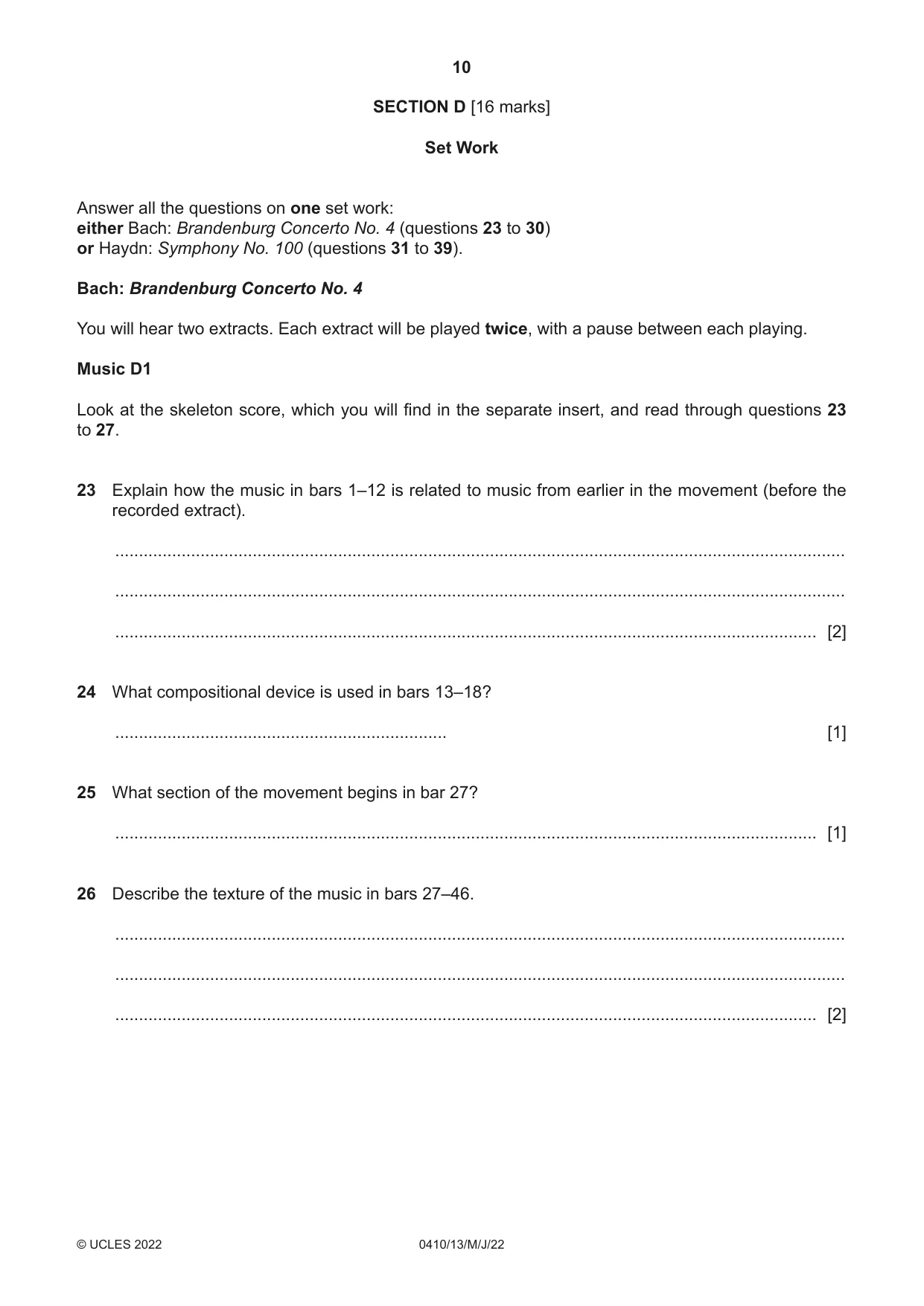
10 0410/13/M/J/22 © UCLES 2022 SECTION D [16 marks] Set Work Answer all the questions on one set work: either Bach: Brandenburg Concerto No. 4 (questions 23 to 30) or Haydn: Symphony No. 100 (questions 31 to 39). Bach: Brandenburg Concerto No. 4 You will hear two extracts. Each extract will be played twice, with a pause between each playing. Music D1 Look at the skeleton score, which you will find in the separate insert, and read through questions 23 to 27. 23 Explain how the music in bars 1–12 is related to music from earlier in the movement (before the recorded extract). … … … [2] 24 What compositional device is used in bars 13–18? … [1] 25 What section of the movement begins in bar 27? … [1] 26 Describe the texture of the music in bars 27–46. … … … [2]
Question paper, page 11
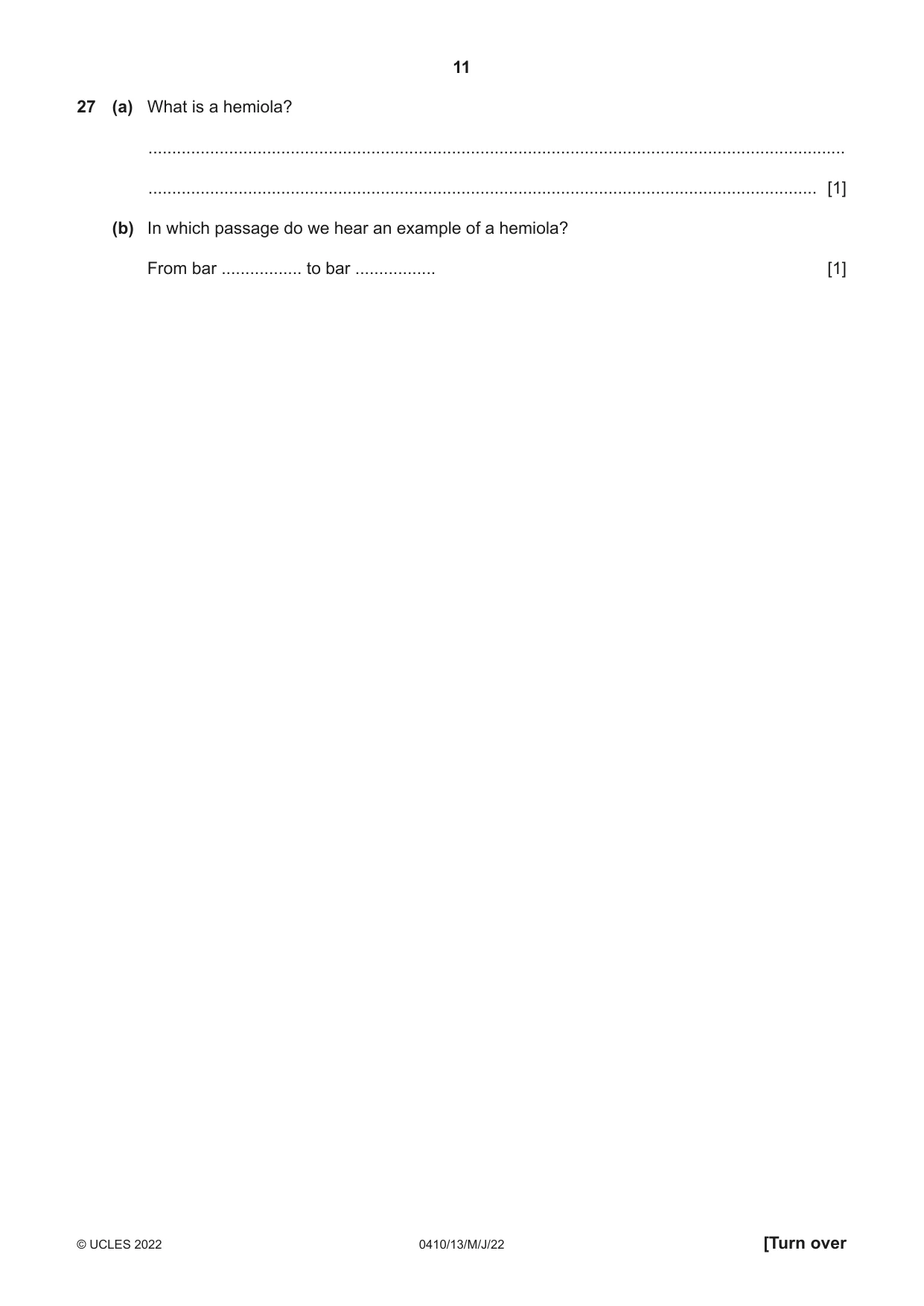
11 0410/13/M/J/22 © UCLES 2022 [Turn over 27 (a) What is a hemiola? … … [1] (b) In which passage do we hear an example of a hemiola? From bar … to bar … [1]
Question paper, page 12
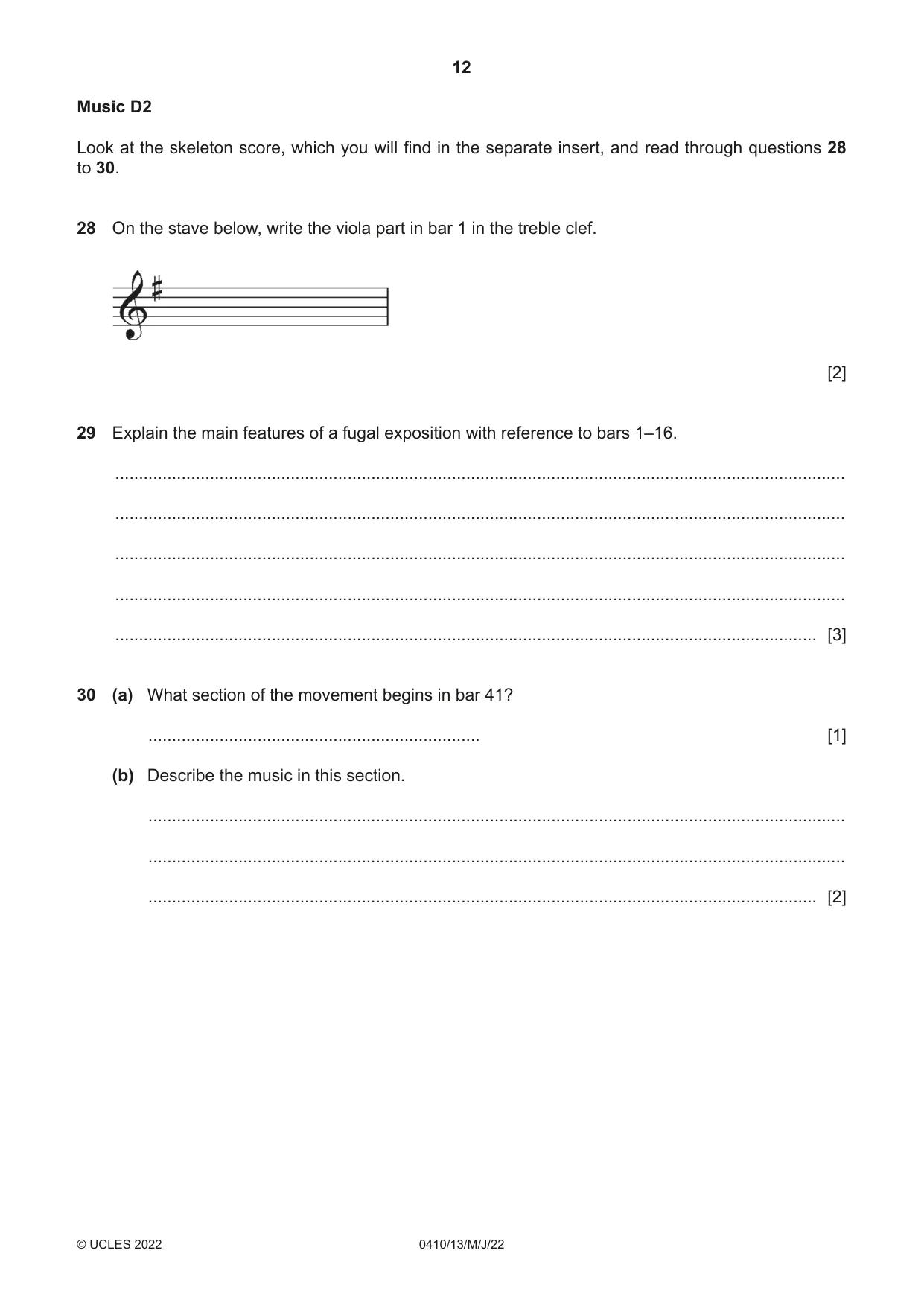
12 0410/13/M/J/22 © UCLES 2022 Music D2 Look at the skeleton score, which you will find in the separate insert, and read through questions 28 to 30. 28 On the stave below, write the viola part in bar 1 in the treble clef. [2] 29 Explain the main features of a fugal exposition with reference to bars 1–16. … … … … … [3] 30 (a) What section of the movement begins in bar 41? … [1] (b) Describe the music in this section. … … … [2]
Question paper, page 13
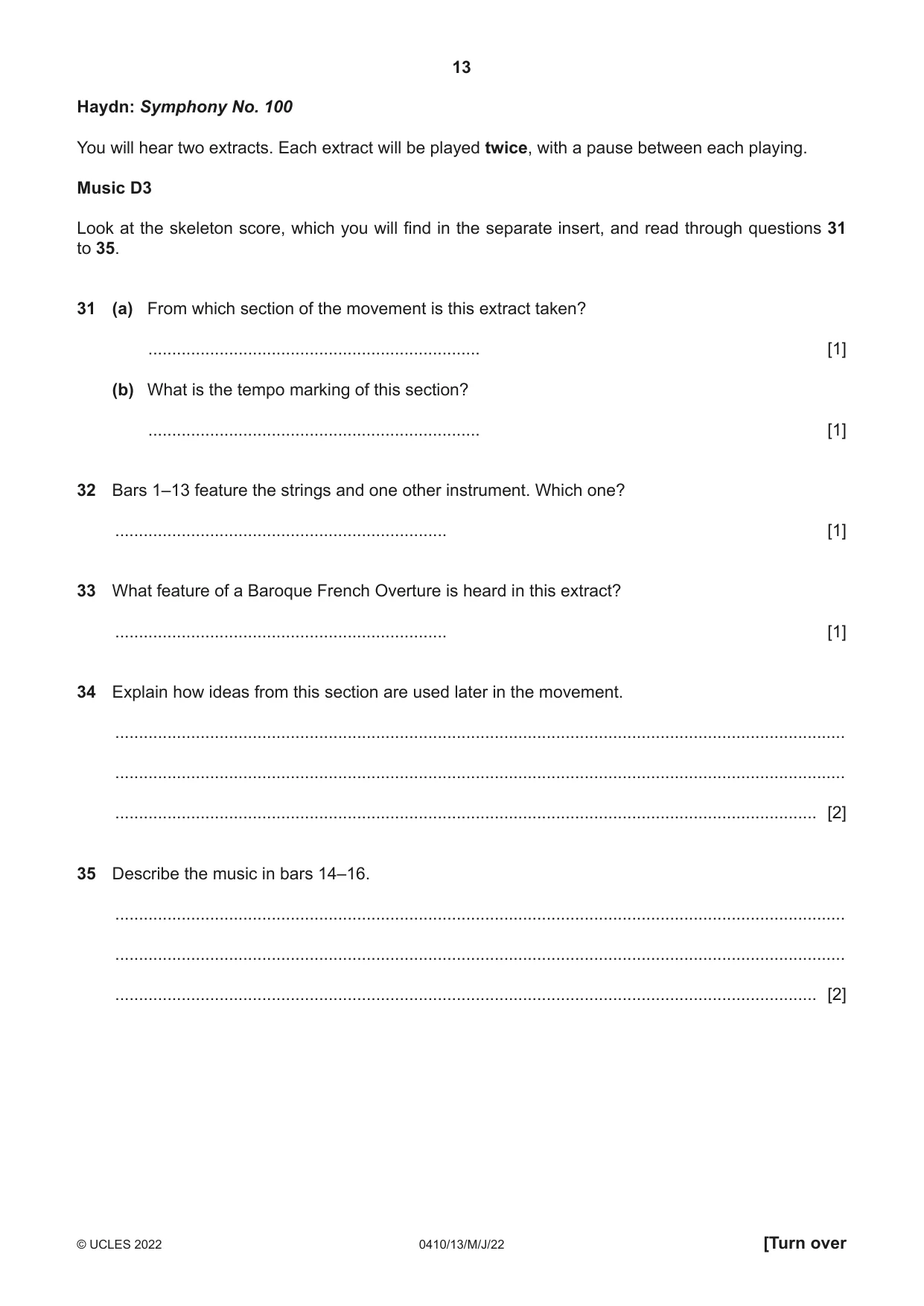
13 0410/13/M/J/22 © UCLES 2022 [Turn over Haydn: Symphony No. 100 You will hear two extracts. Each extract will be played twice, with a pause between each playing. Music D3 Look at the skeleton score, which you will find in the separate insert, and read through questions 31 to 35. 31 (a) From which section of the movement is this extract taken? … [1] (b) What is the tempo marking of this section? … [1] 32 Bars 1–13 feature the strings and one other instrument. Which one? … [1] 33 What feature of a Baroque French Overture is heard in this extract? … [1] 34 Explain how ideas from this section are used later in the movement. … … … [2] 35 Describe the music in bars 14–16. … … … [2]
Question paper, page 14
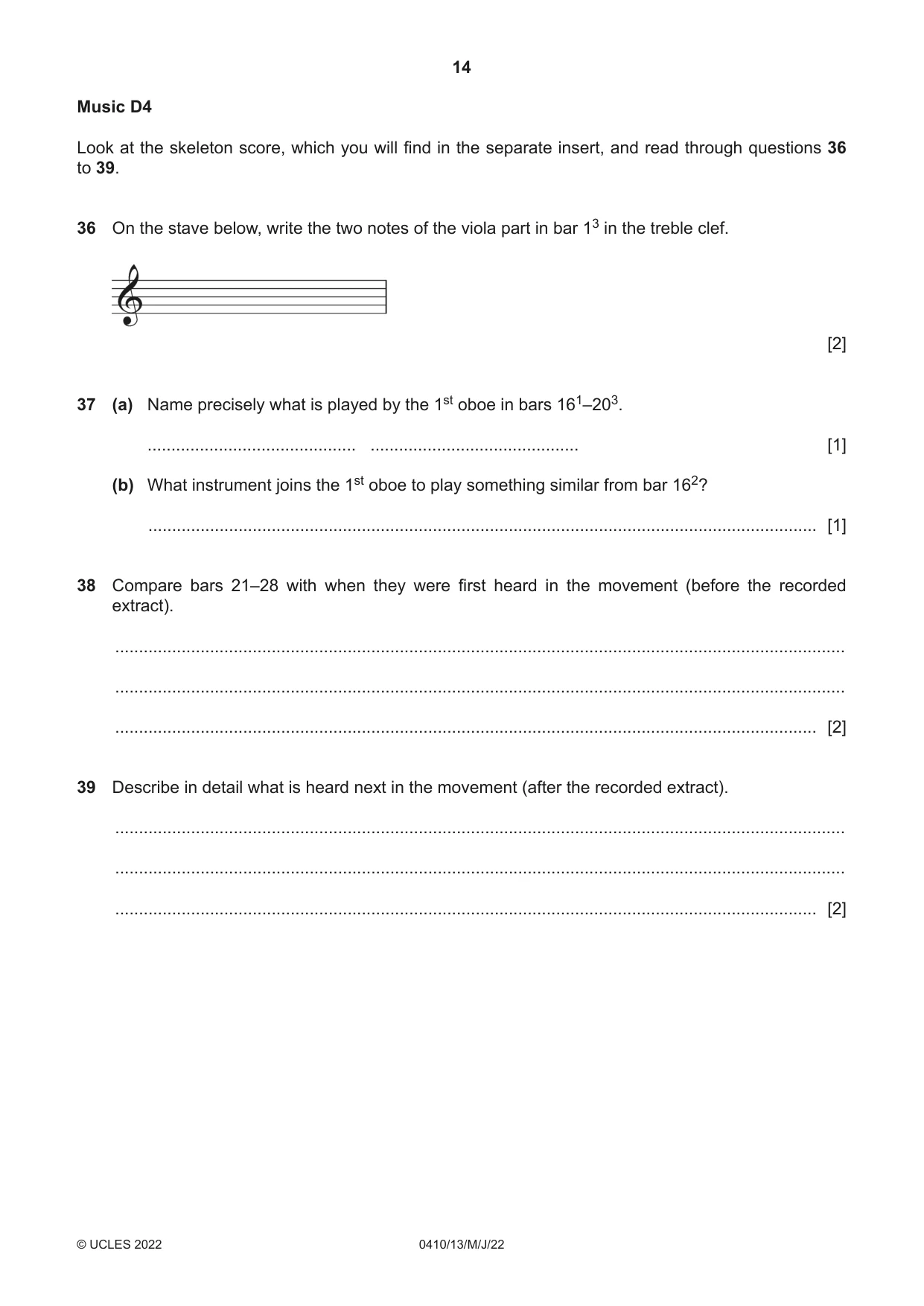
14 0410/13/M/J/22 © UCLES 2022 Music D4 Look at the skeleton score, which you will find in the separate insert, and read through questions 36 to 39. 36 On the stave below, write the two notes of the viola part in bar 13 in the treble clef. [2] 37 (a) Name precisely what is played by the 1st oboe in bars 161–203. … … [1] (b) What instrument joins the 1st oboe to play something similar from bar 162? … [1] 38 Compare bars 21–28 with when they were first heard in the movement (before the recorded extract). … … … [2] 39 Describe in detail what is heard next in the movement (after the recorded extract). … … … [2]
Question paper, page 15
15 0410/13/M/J/22 © UCLES 2022 BLANK PAGE
Question paper, page 16
16 0410/13/M/J/22 © UCLES 2022 Permission to reproduce items where third-party owned material protected by copyright is included has been sought and cleared where possible. Every reasonable effort has been made by the publisher (UCLES) to trace copyright holders, but if any items requiring clearance have unwittingly been included, the publisher will be pleased to make amends at the earliest possible opportunity. To avoid the issue of disclosure of answer-related information to candidates, all copyright acknowledgements are reproduced online in the Cambridge Assessment International Education Copyright Acknowledgements Booklet. This is produced for each series of examinations and is freely available to download at www.cambridgeinternational.org after the live examination series. Cambridge Assessment International Education is part of Cambridge Assessment. Cambridge Assessment is the brand name of the University of Cambridge Local Examinations Syndicate (UCLES), which is a department of the University of Cambridge. BLANK PAGE
Mark scheme, page 1
This document consists of 6 printed pages. © UCLES 2022 [Turn over Cambridge IGCSE™ MUSIC 0410/13 Paper 1 Listening May/June 2022 MARK SCHEME Maximum Mark: 70 Published This mark scheme is published as an aid to teachers and candidates, to indicate the requirements of the examination. It shows the basis on which Examiners were instructed to award marks. It does not indicate the details of the discussions that took place at an Examiners’ meeting before marking began, which would have considered the acceptability of alternative answers. Mark schemes should be read in conjunction with the question paper and the Principal Examiner Report for Teachers. Cambridge International will not enter into discussions about these mark schemes. Cambridge International is publishing the mark schemes for the May/June 2022 series for most Cambridge IGCSE, Cambridge International A and AS Level and Cambridge Pre-U components, and some Cambridge O Level components.
Mark scheme, page 2
0410/13 Cambridge IGCSE – Mark Scheme PUBLISHED May/June 2022 © UCLES 2022 Page 2 of 6 Generic Marking Principles These general marking principles must be applied by all examiners when marking candidate answers. They should be applied alongside the specific content of the mark scheme or generic level descriptors for a question. Each question paper and mark scheme will also comply with these marking principles. GENERIC MARKING PRINCIPLE 1: Marks must be awarded in line with: the specific content of the mark scheme or the generic level descriptors for the question the specific skills defined in the mark scheme or in the generic level descriptors for the question the standard of response required by a candidate as exemplified by the standardisation scripts. GENERIC MARKING PRINCIPLE 2: Marks awarded are always whole marks (not half marks, or other fractions). GENERIC MARKING PRINCIPLE 3: Marks must be awarded positively: marks are awarded for correct/valid answers, as defined in the mark scheme. However, credit is given for valid answers which go beyond the scope of the syllabus and mark scheme, referring to your Team Leader as appropriate marks are awarded when candidates clearly demonstrate what they know and can do marks are not deducted for errors marks are not deducted for omissions answers should only be judged on the quality of spelling, punctuation and grammar when these features are specifically assessed by the question as indicated by the mark scheme. The meaning, however, should be unambiguous. GENERIC MARKING PRINCIPLE 4: Rules must be applied consistently, e.g. in situations where candidates have not followed instructions or in the application of generic level descriptors. GENERIC MARKING PRINCIPLE 5: Marks should be awarded using the full range of marks defined in the mark scheme for the question (however; the use of the full mark range may be limited according to the quality of the candidate responses seen). GENERIC MARKING PRINCIPLE 6: Marks awarded are based solely on the requirements as defined in the mark scheme. Marks should not be awarded with grade thresholds or grade descriptors in mind.
Mark scheme, page 3
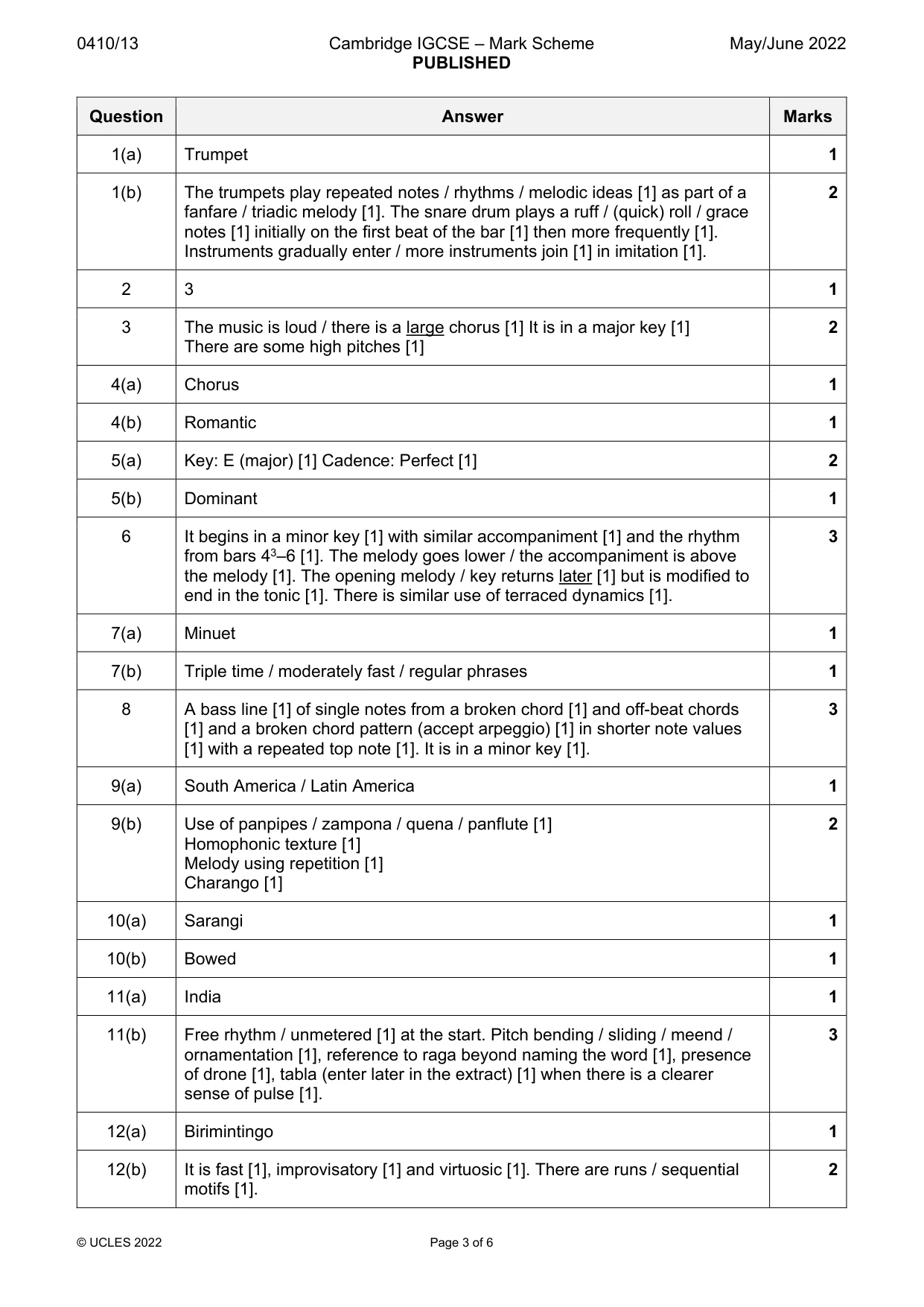
0410/13 Cambridge IGCSE – Mark Scheme PUBLISHED May/June 2022 © UCLES 2022 Page 3 of 6 Question Answer Marks 1(a) Trumpet 1 1(b) The trumpets play repeated notes / rhythms / melodic ideas [1] as part of a fanfare / triadic melody [1]. The snare drum plays a ruff / (quick) roll / grace notes [1] initially on the first beat of the bar [1] then more frequently [1]. Instruments gradually enter / more instruments join [1] in imitation [1]. 2 2 3 1 3 The music is loud / there is a large chorus [1] It is in a major key [1] There are some high pitches [1] 2 4(a) Chorus 1 4(b) Romantic 1 5(a) Key: E (major) [1] Cadence: Perfect [1] 2 5(b) Dominant 1 6 It begins in a minor key [1] with similar accompaniment [1] and the rhythm from bars 43–6 [1]. The melody goes lower / the accompaniment is above the melody [1]. The opening melody / key returns later [1] but is modified to end in the tonic [1]. There is similar use of terraced dynamics [1]. 3 7(a) Minuet 1 7(b) Triple time / moderately fast / regular phrases 1 8 A bass line [1] of single notes from a broken chord [1] and off-beat chords [1] and a broken chord pattern (accept arpeggio) [1] in shorter note values [1] with a repeated top note [1]. It is in a minor key [1]. 3 9(a) South America / Latin America 1 9(b) Use of panpipes / zampona / quena / panflute [1] Homophonic texture [1] Melody using repetition [1] Charango [1] 2 10(a) Sarangi 1 10(b) Bowed 1 11(a) India 1 11(b) Free rhythm / unmetered [1] at the start. Pitch bending / sliding / meend / ornamentation [1], reference to raga beyond naming the word [1], presence of drone [1], tabla (enter later in the extract) [1] when there is a clearer sense of pulse [1]. 3 12(a) Birimintingo 1 12(b) It is fast [1], improvisatory [1] and virtuosic [1]. There are runs / sequential motifs [1]. 2
Mark scheme, page 4
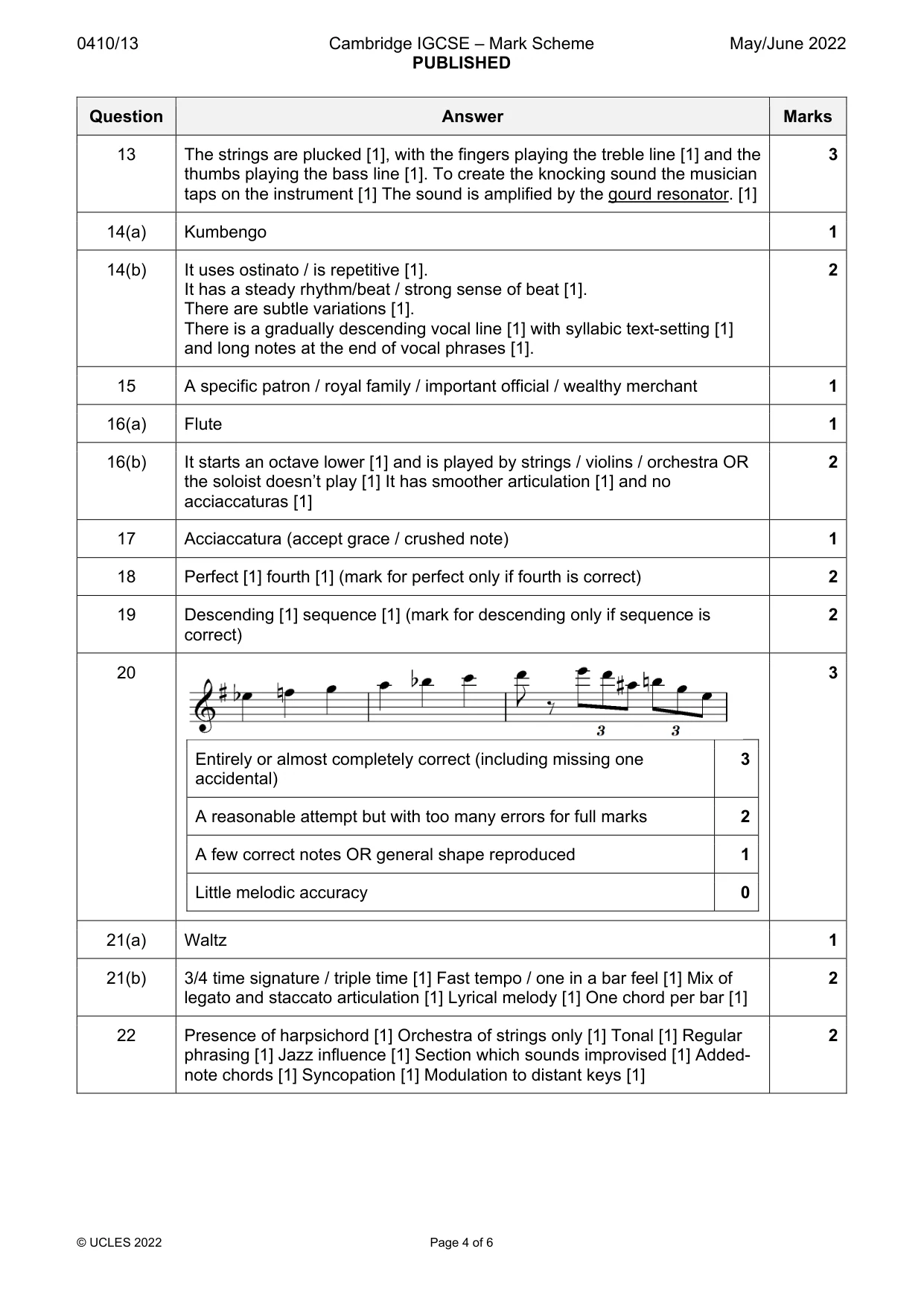
0410/13 Cambridge IGCSE – Mark Scheme PUBLISHED May/June 2022 © UCLES 2022 Page 4 of 6 Question Answer Marks 13 The strings are plucked [1], with the fingers playing the treble line [1] and the thumbs playing the bass line [1]. To create the knocking sound the musician taps on the instrument [1] The sound is amplified by the gourd resonator. [1] 3 14(a) Kumbengo 1 14(b) It uses ostinato / is repetitive [1]. It has a steady rhythm/beat / strong sense of beat [1]. There are subtle variations [1]. There is a gradually descending vocal line [1] with syllabic text-setting [1] and long notes at the end of vocal phrases [1]. 2 15 A specific patron / royal family / important official / wealthy merchant 1 16(a) Flute 1 16(b) It starts an octave lower [1] and is played by strings / violins / orchestra OR the soloist doesn’t play [1] It has smoother articulation [1] and no acciaccaturas [1] 2 17 Acciaccatura (accept grace / crushed note) 1 18 Perfect [1] fourth [1] (mark for perfect only if fourth is correct) 2 19 Descending [1] sequence [1] (mark for descending only if sequence is correct) 2 20 Entirely or almost completely correct (including missing one accidental) 3 A reasonable attempt but with too many errors for full marks 2 A few correct notes OR general shape reproduced 1 Little melodic accuracy 0 3 21(a) Waltz 1 21(b) 3/4 time signature / triple time [1] Fast tempo / one in a bar feel [1] Mix of legato and staccato articulation [1] Lyrical melody [1] One chord per bar [1] 2 22 Presence of harpsichord [1] Orchestra of strings only [1] Tonal [1] Regular phrasing [1] Jazz influence [1] Section which sounds improvised [1] Added- note chords [1] Syncopation [1] Modulation to distant keys [1] 2
Mark scheme, page 5
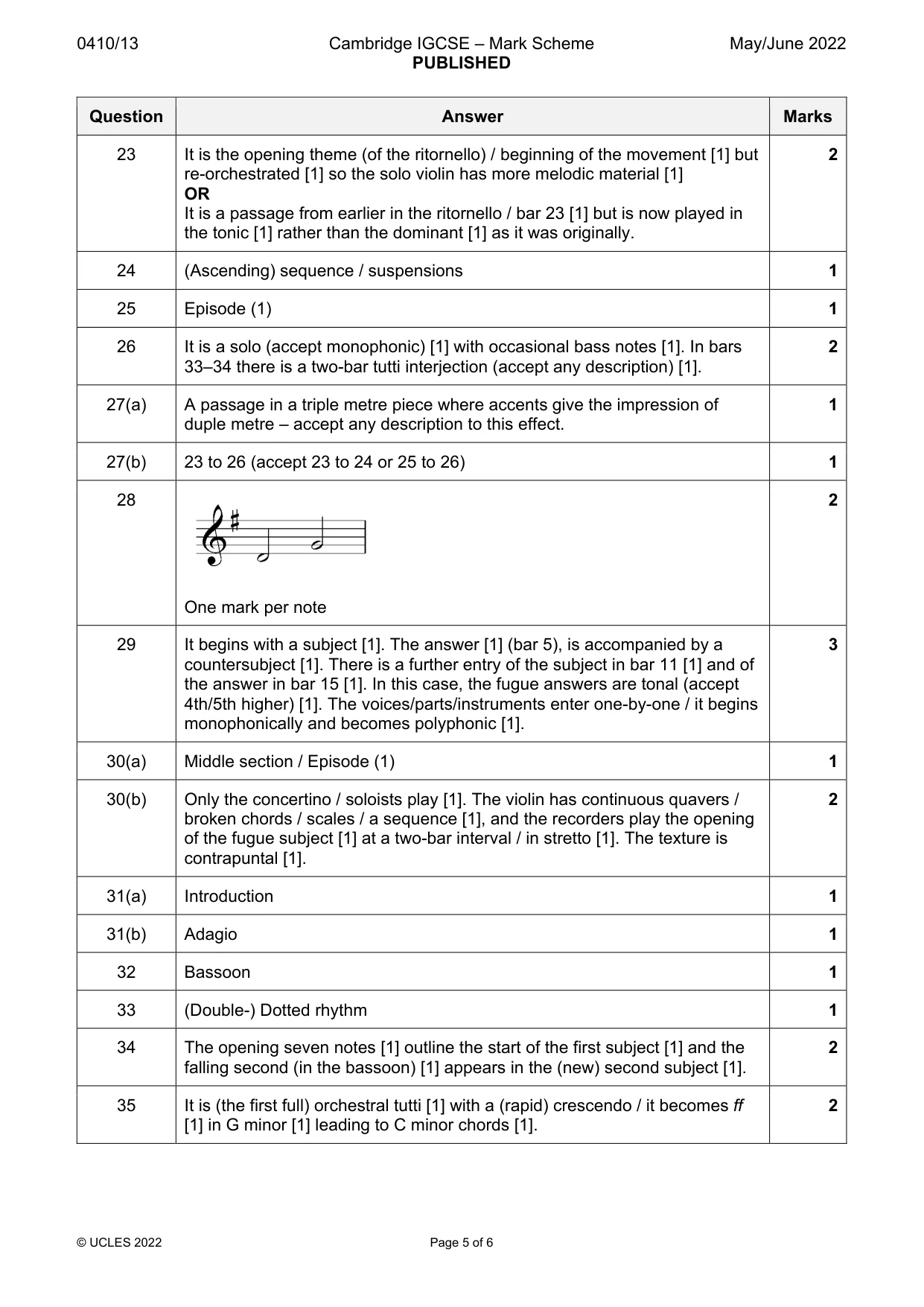
0410/13 Cambridge IGCSE – Mark Scheme PUBLISHED May/June 2022 © UCLES 2022 Page 5 of 6 Question Answer Marks 23 It is the opening theme (of the ritornello) / beginning of the movement [1] but re-orchestrated [1] so the solo violin has more melodic material [1] OR It is a passage from earlier in the ritornello / bar 23 [1] but is now played in the tonic [1] rather than the dominant [1] as it was originally. 2 24 (Ascending) sequence / suspensions 1 25 Episode (1) 1 26 It is a solo (accept monophonic) [1] with occasional bass notes [1]. In bars 33–34 there is a two-bar tutti interjection (accept any description) [1]. 2 27(a) A passage in a triple metre piece where accents give the impression of duple metre – accept any description to this effect. 1 27(b) 23 to 26 (accept 23 to 24 or 25 to 26) 1 28 One mark per note 2 29 It begins with a subject [1]. The answer [1] (bar 5), is accompanied by a countersubject [1]. There is a further entry of the subject in bar 11 [1] and of the answer in bar 15 [1]. In this case, the fugue answers are tonal (accept 4th/5th higher) [1]. The voices/parts/instruments enter one-by-one / it begins monophonically and becomes polyphonic [1]. 3 30(a) Middle section / Episode (1) 1 30(b) Only the concertino / soloists play [1]. The violin has continuous quavers / broken chords / scales / a sequence [1], and the recorders play the opening of the fugue subject [1] at a two-bar interval / in stretto [1]. The texture is contrapuntal [1]. 2 31(a) Introduction 1 31(b) Adagio 1 32 Bassoon 1 33 (Double-) Dotted rhythm 1 34 The opening seven notes [1] outline the start of the first subject [1] and the falling second (in the bassoon) [1] appears in the (new) second subject [1]. 2 35 It is (the first full) orchestral tutti [1] with a (rapid) crescendo / it becomes ff [1] in G minor [1] leading to C minor chords [1]. 2
Mark scheme, page 6
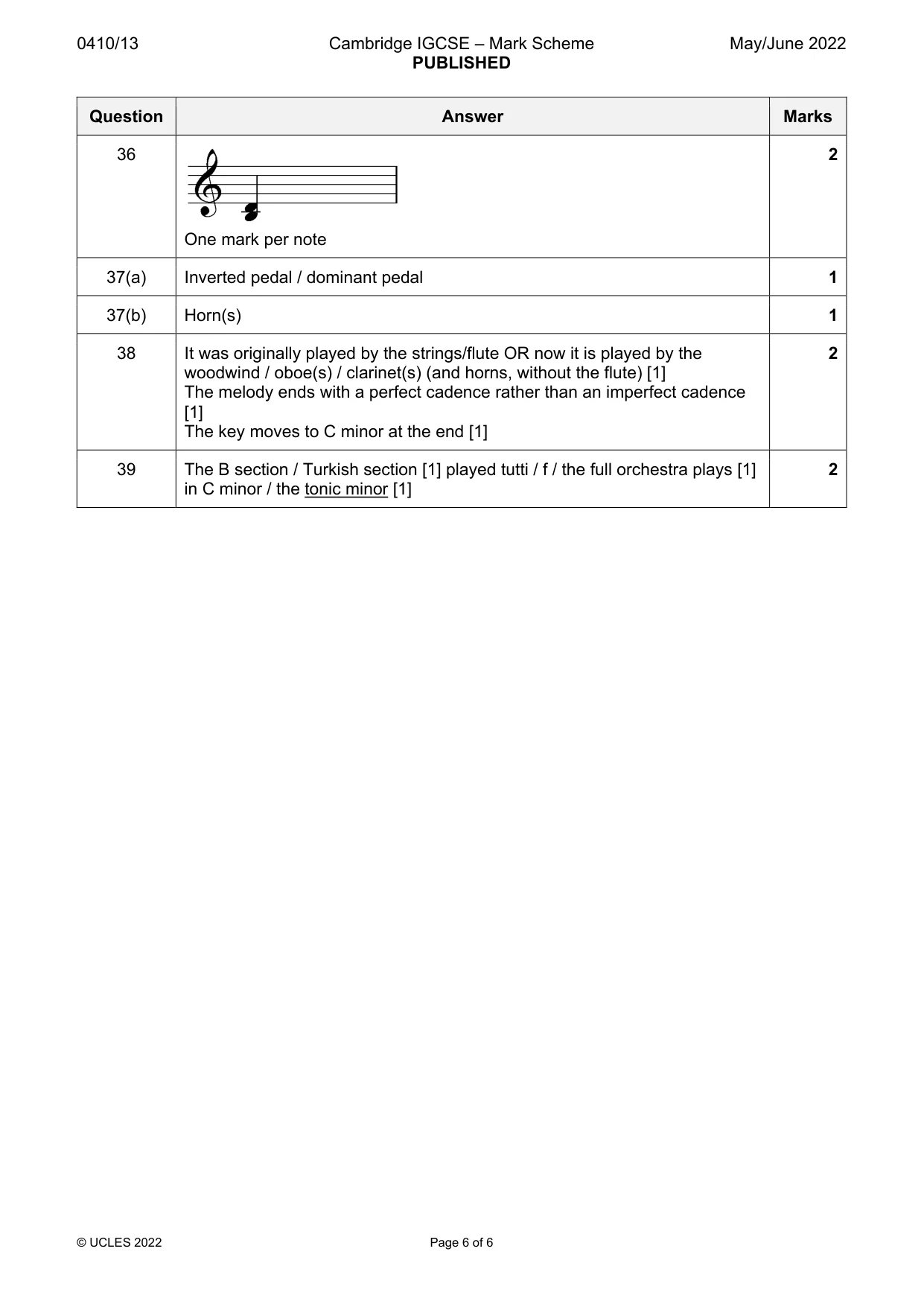
0410/13 Cambridge IGCSE – Mark Scheme PUBLISHED May/June 2022 © UCLES 2022 Page 6 of 6 Question Answer Marks 36 One mark per note 2 37(a) Inverted pedal / dominant pedal 1 37(b) Horn(s) 1 38 It was originally played by the strings/flute OR now it is played by the woodwind / oboe(s) / clarinet(s) (and horns, without the flute) [1] The melody ends with a perfect cadence rather than an imperfect cadence [1] The key moves to C minor at the end [1] 2 39 The B section / Turkish section [1] played tutti / f / the full orchestra plays [1] in C minor / the tonic minor [1] 2
What you needed in this session
Cambridge’s own grade thresholds for 2022 May/June, Paper 1 · Variant 3. A higher threshold means an easier paper — the bar moves with how the cohort did.