Cambridge IGCSE Mathematics (with coursework) 0581 — 2014 May/June Paper 2 · Variant 3
0581/23/M/J/14 · 70 marks · ≈79 min
The question paper and its mark scheme, free to read here and free to download. This is Cambridge’s own paper, exactly as it was sat.
Question paper12 pages
Mark scheme5 pages
Answers below. Sit the paper first if you are practising.
Paper as text
Question paper, page 1
READ THESE INSTRUCTIONS FIRST Write your Centre number, candidate number and name on all the work you hand in. Write in dark blue or black pen. You may use an HB pencil for any diagrams or graphs. Do not use staples, paper clips, glue or correction fl uid. DO NOT WRITE IN ANY BARCODES. Answer all questions. If working is needed for any question it must be shown below that question. Electronic calculators should be used. If the degree of accuracy is not specifi ed in the question, and if the answer is not exact, give the answer to three signifi cant fi gures. Give answers in degrees to one decimal place. For π, use either your calculator value or 3.142. At the end of the examination, fasten all your work securely together. The number of marks is given in brackets [ ] at the end of each question or part question. The total of the marks for this paper is 70. MATHEMATICS 0581/23 Paper 2 (Extended) May/June 2014 1 hour 30 minutes Candidates answer on the Question Paper. Additional Materials: Electronic calculator Geometrical instruments Tracing paper (optional) This document consists of 12 printed pages. [Turn over IB14 06_0581_23/RP © UCLES 2014 *4334449958* Cambridge International Examinations Cambridge International General Certifi cate of Secondary Education PAPA CAMBRIDGE
Question paper, page 2
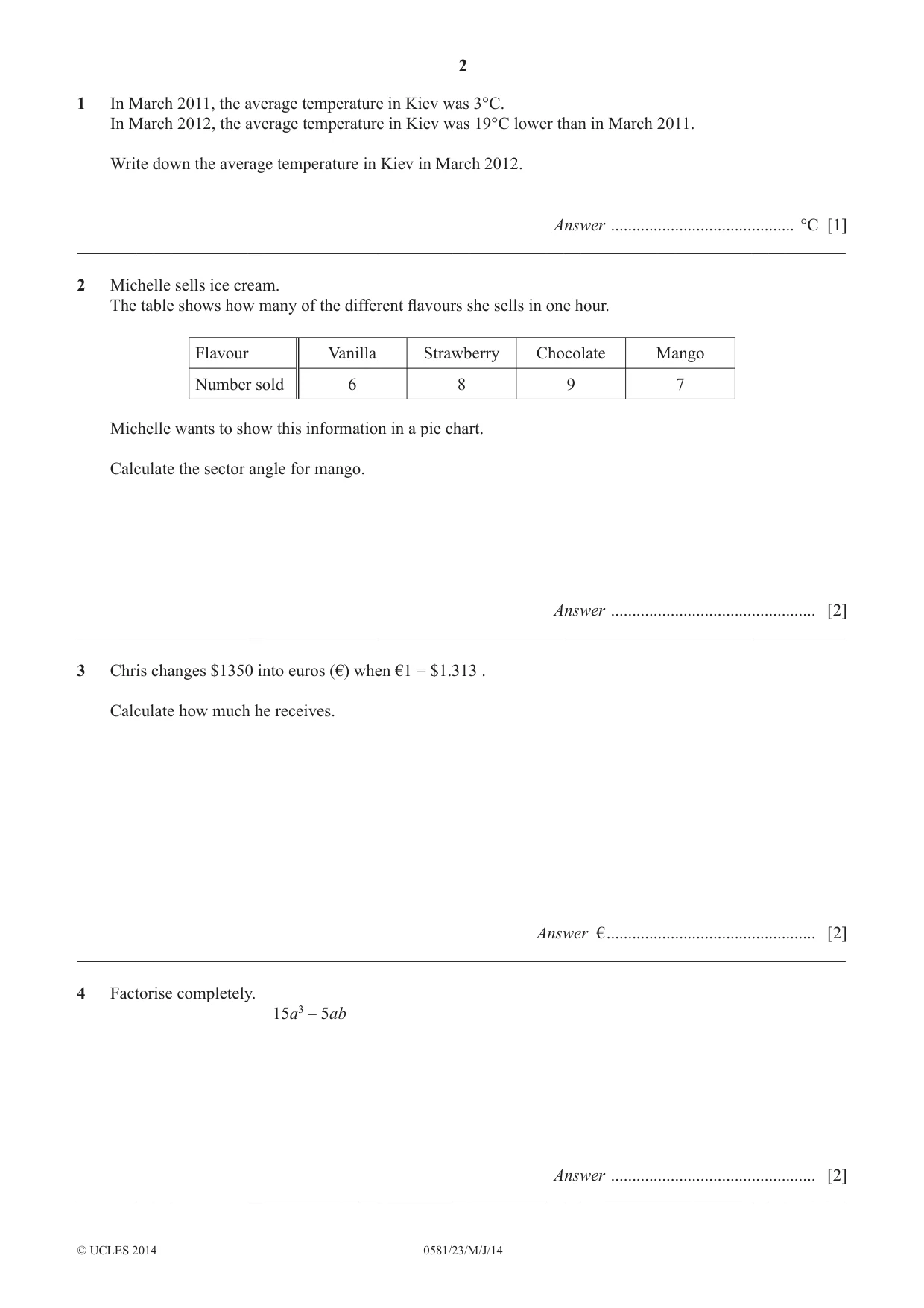
2 0581/23/M/J/14 © UCLES 2014 1 In March 2011, the average temperature in Kiev was 3°C. In March 2012, the average temperature in Kiev was 19°C lower than in March 2011. Write down the average temperature in Kiev in March 2012. Answer … °C [1] __________________________________________________________________________________________ 2 Michelle sells ice cream. The table shows how many of the different fl avours she sells in one hour. Flavour Vanilla Strawberry Chocolate Mango Number sold 6 8 9 7 Michelle wants to show this information in a pie chart. Calculate the sector angle for mango. Answer … [2] __________________________________________________________________________________________ 3 Chris changes $1350 into euros (€) when €1 = $1.313 . Calculate how much he receives. Answer € … [2] __________________________________________________________________________________________ 4 Factorise completely. 15a3 – 5ab Answer … [2] __________________________________________________________________________________________
Question paper, page 3
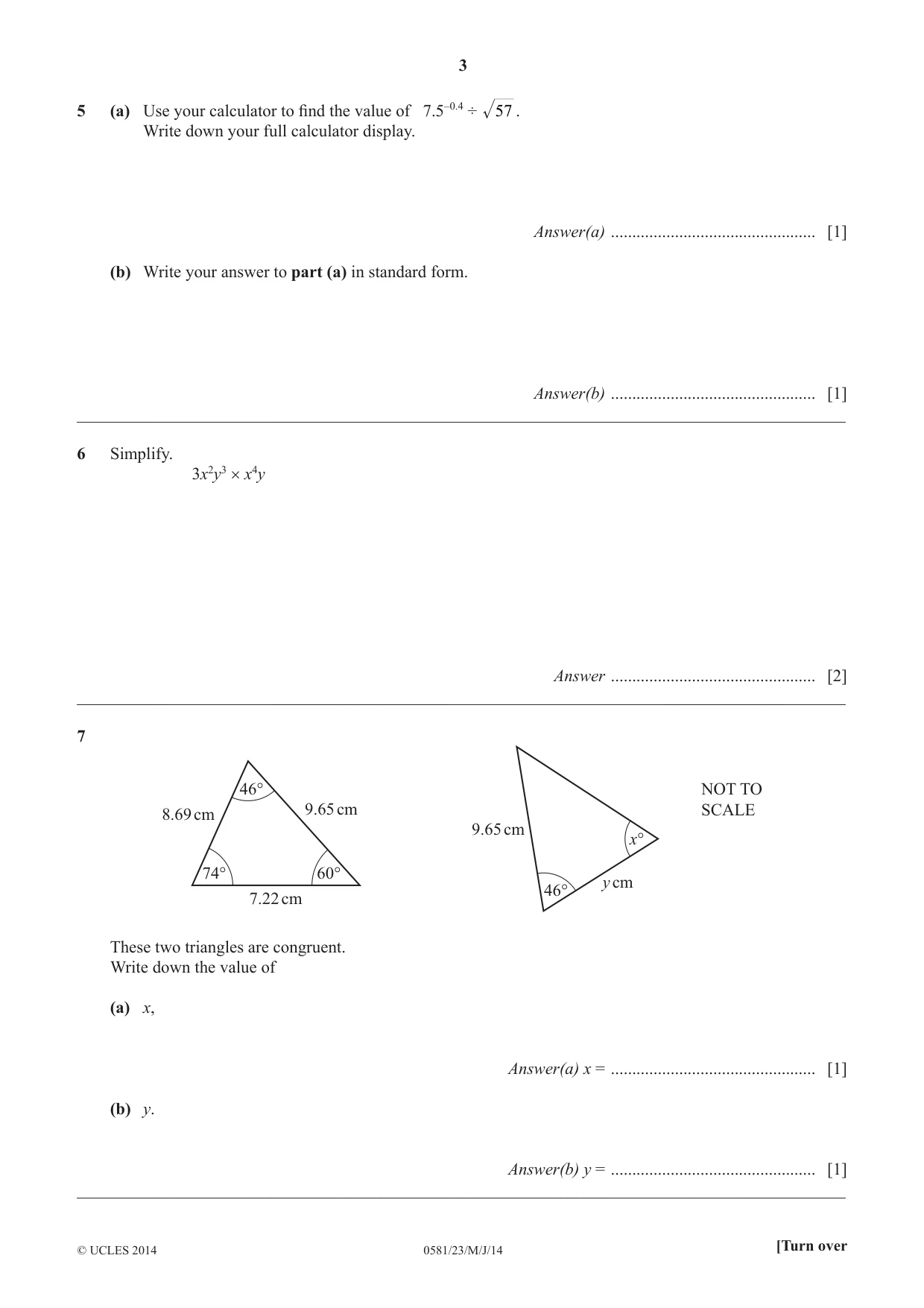
3 0581/23/M/J/14 © UCLES 2014 [Turn over 5 (a) Use your calculator to fi nd the value of 7.5–0.4 ÷ 57 . Write down your full calculator display. Answer(a) … [1] (b) Write your answer to part (a) in standard form. Answer(b) … [1] __________________________________________________________________________________________ 6 Simplify. 3x2y3 × x4y Answer … [2] __________________________________________________________________________________________ 7 46° 74° 60° 46° x° 9.65 cm 9.65 cm 8.69 cm 7.22 cm y cm NOT TO SCALE These two triangles are congruent. Write down the value of (a) x, Answer(a) x = … [1] (b) y. Answer(b) y = … [1] __________________________________________________________________________________________
Question paper, page 4
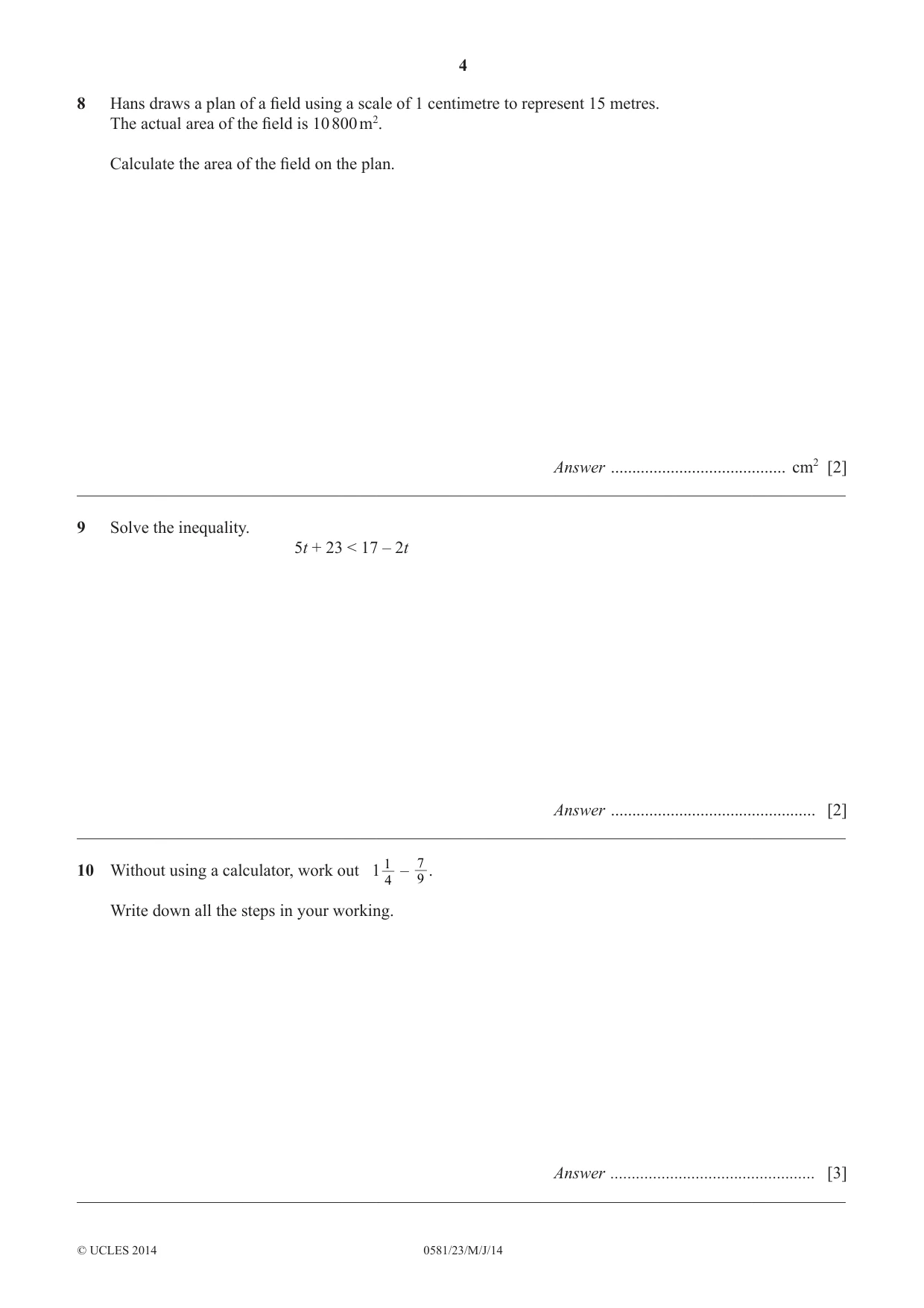
4 0581/23/M/J/14 © UCLES 2014 8 Hans draws a plan of a fi eld using a scale of 1 centimetre to represent 15 metres. The actual area of the fi eld is 10 800 m2. Calculate the area of the fi eld on the plan. Answer … cm2 [2] __________________________________________________________________________________________ 9 Solve the inequality. 5t + 23 < 17 – 2t Answer … [2] __________________________________________________________________________________________ 10 Without using a calculator, work out 1 4 1 – 9 7 . Write down all the steps in your working. Answer … [3] __________________________________________________________________________________________
Question paper, page 5
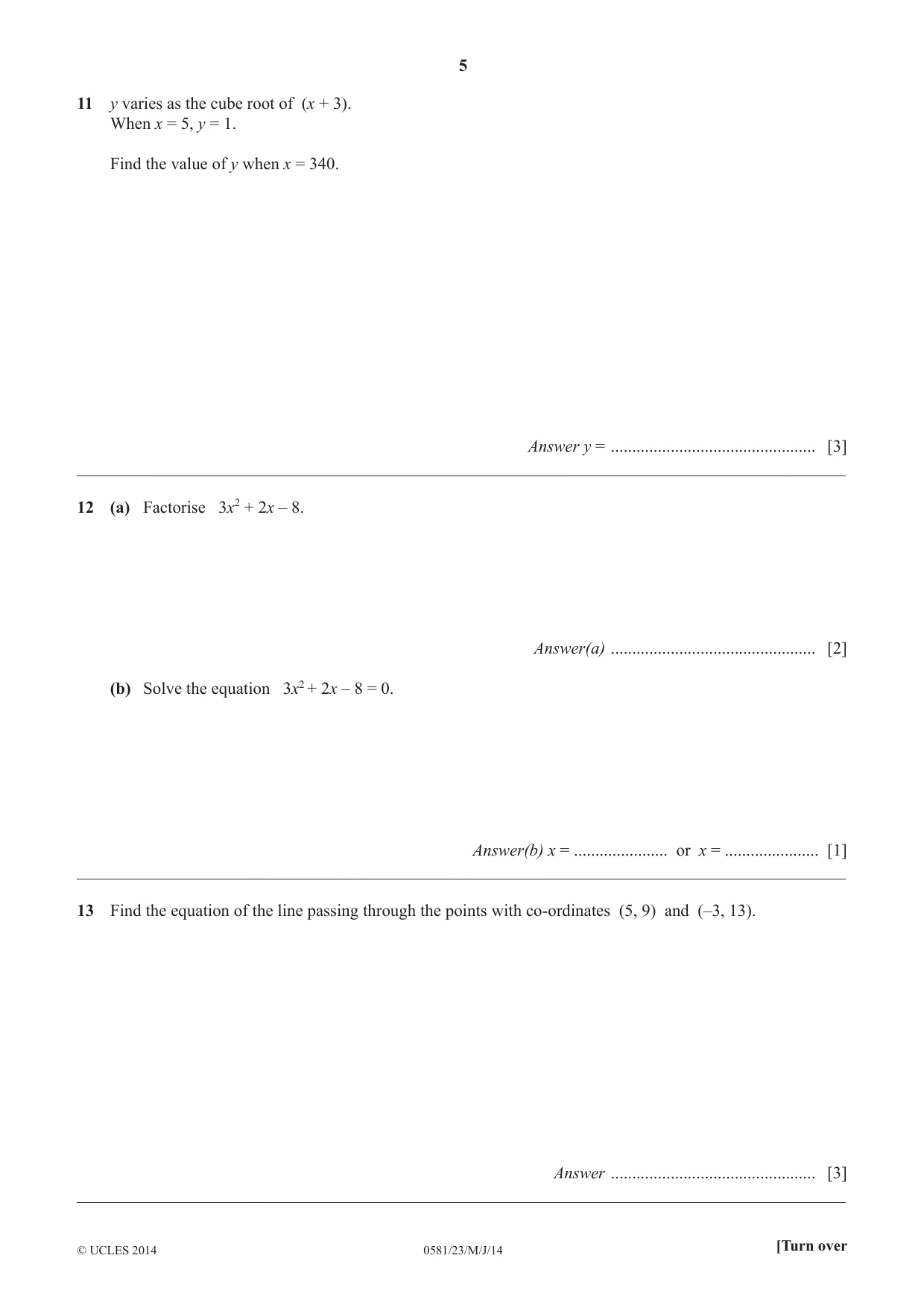
5 0581/23/M/J/14 © UCLES 2014 [Turn over 11 y varies as the cube root of (x + 3). When x = 5, y = 1. Find the value of y when x = 340. Answer y = … [3] __________________________________________________________________________________________ 12 (a) Factorise 3x2 + 2x – 8. Answer(a) … [2] (b) Solve the equation 3x2 + 2x – 8 = 0. Answer(b) x = … or x = … [1] __________________________________________________________________________________________ 13 Find the equation of the line passing through the points with co-ordinates (5, 9) and (–3, 13). Answer … [3] __________________________________________________________________________________________
Question paper, page 6
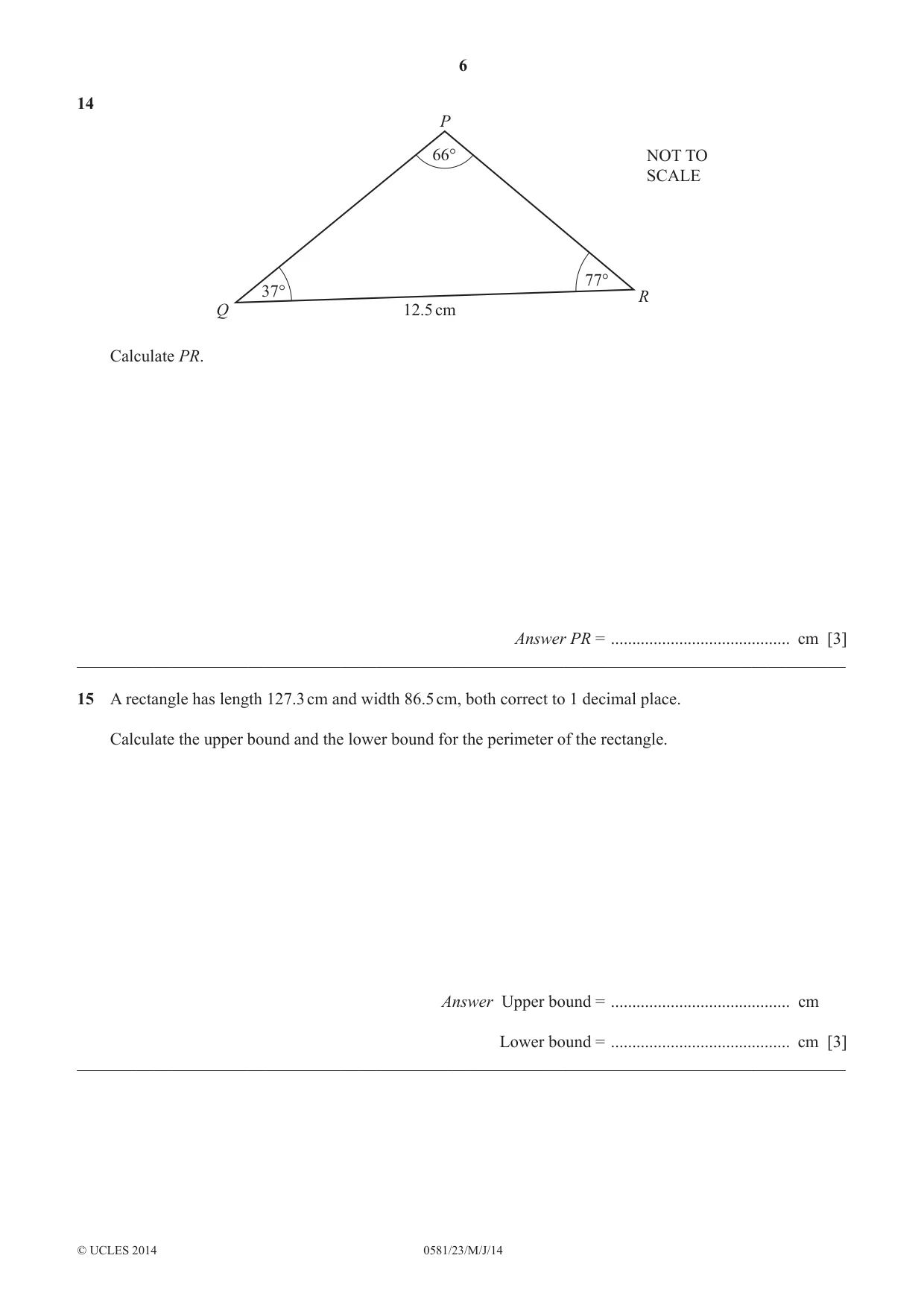
6 0581/23/M/J/14 © UCLES 2014 14 66° 77° 37° P R Q 12.5 cm NOT TO SCALE Calculate PR. Answer PR = … cm [3] __________________________________________________________________________________________ 15 A rectangle has length 127.3 cm and width 86.5 cm, both correct to 1 decimal place. Calculate the upper bound and the lower bound for the perimeter of the rectangle. Answer Upper bound = … cm Lower bound = … cm [3] __________________________________________________________________________________________
Question paper, page 7
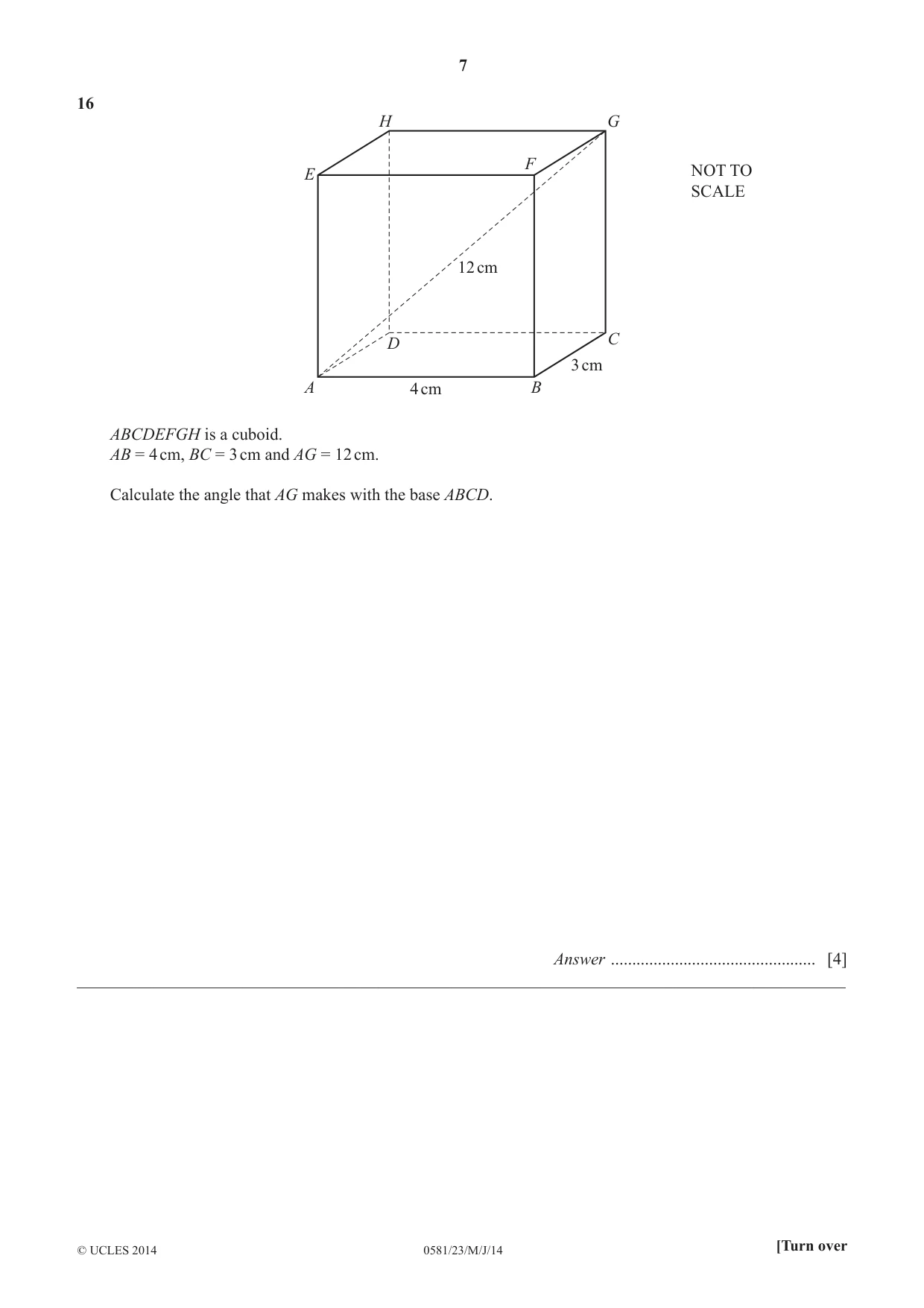
7 0581/23/M/J/14 © UCLES 2014 [Turn over 16 H G C B A E F D 3 cm 4 cm 12 cm NOT TO SCALE ABCDEFGH is a cuboid. AB = 4 cm, BC = 3 cm and AG = 12 cm. Calculate the angle that AG makes with the base ABCD. Answer … [4] __________________________________________________________________________________________
Question paper, page 8
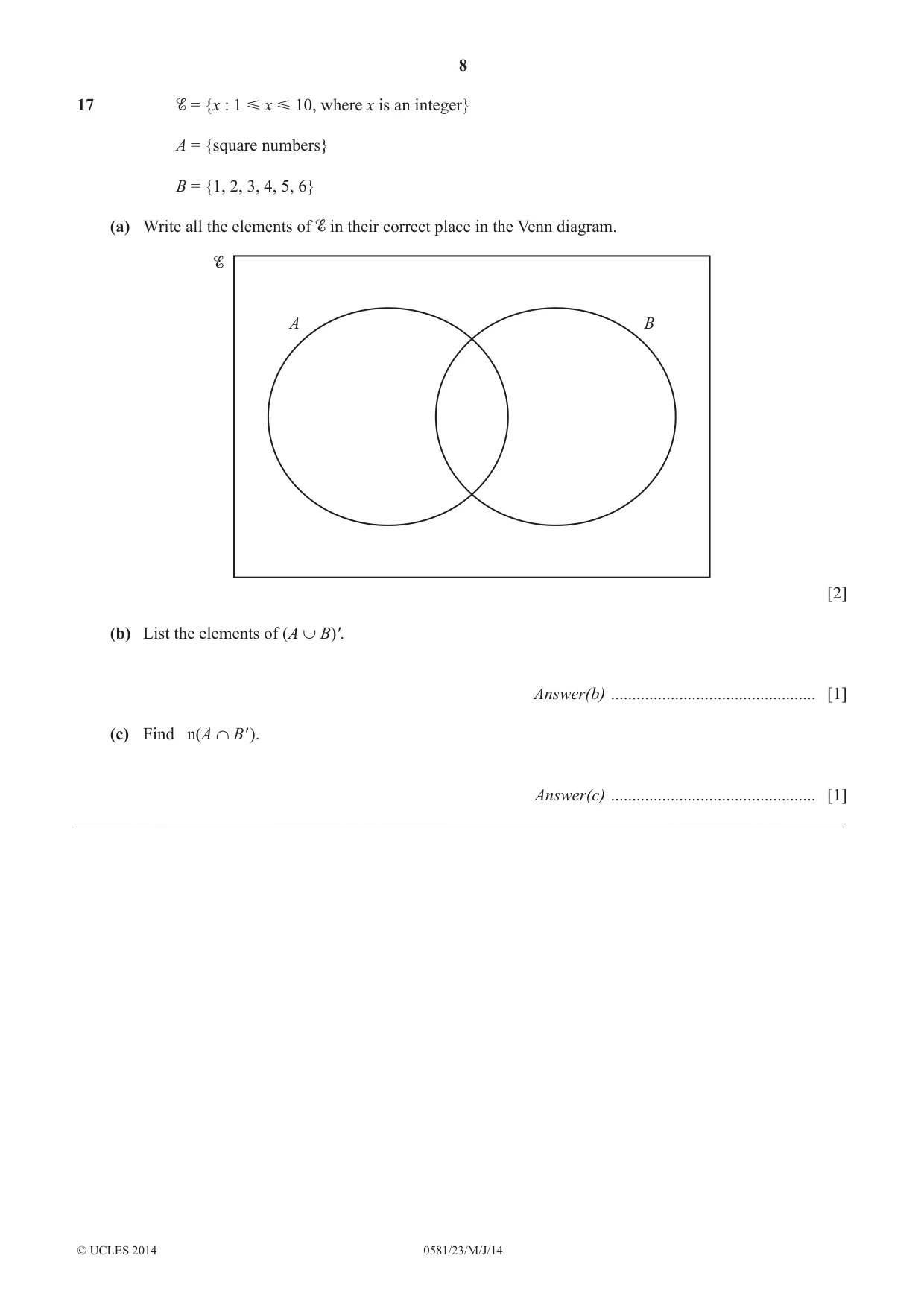
8 0581/23/M/J/14 © UCLES 2014 17 = {x : 1 Y x Y 10, where x is an integer} A = {square numbers} B = {1, 2, 3, 4, 5, 6} (a) Write all the elements of in their correct place in the Venn diagram. A B [2] (b) List the elements of (A ∪ B)'. Answer(b) … [1] (c) Find n(A ∩ B' ). Answer(c) … [1] __________________________________________________________________________________________
Question paper, page 9
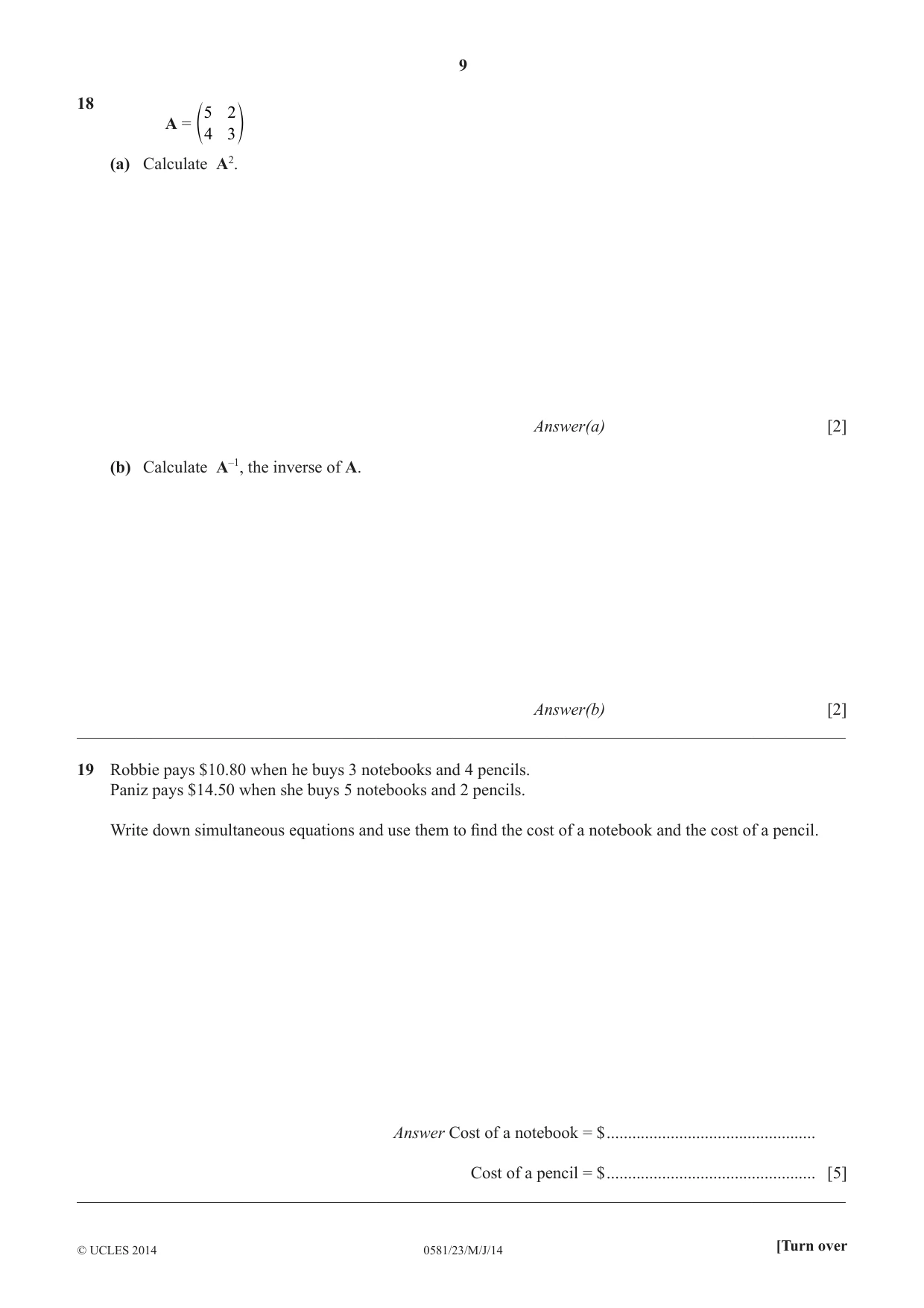
9 0581/23/M/J/14 © UCLES 2014 [Turn over 18 A = 5 4 2 3 e o (a) Calculate A2. Answer(a) [2] (b) Calculate A–1, the inverse of A. Answer(b) [2] __________________________________________________________________________________________ 19 Robbie pays $10.80 when he buys 3 notebooks and 4 pencils. Paniz pays $14.50 when she buys 5 notebooks and 2 pencils. Write down simultaneous equations and use them to fi nd the cost of a notebook and the cost of a pencil. Answer Cost of a notebook = $ … Cost of a pencil = $ … [5] __________________________________________________________________________________________
Question paper, page 10
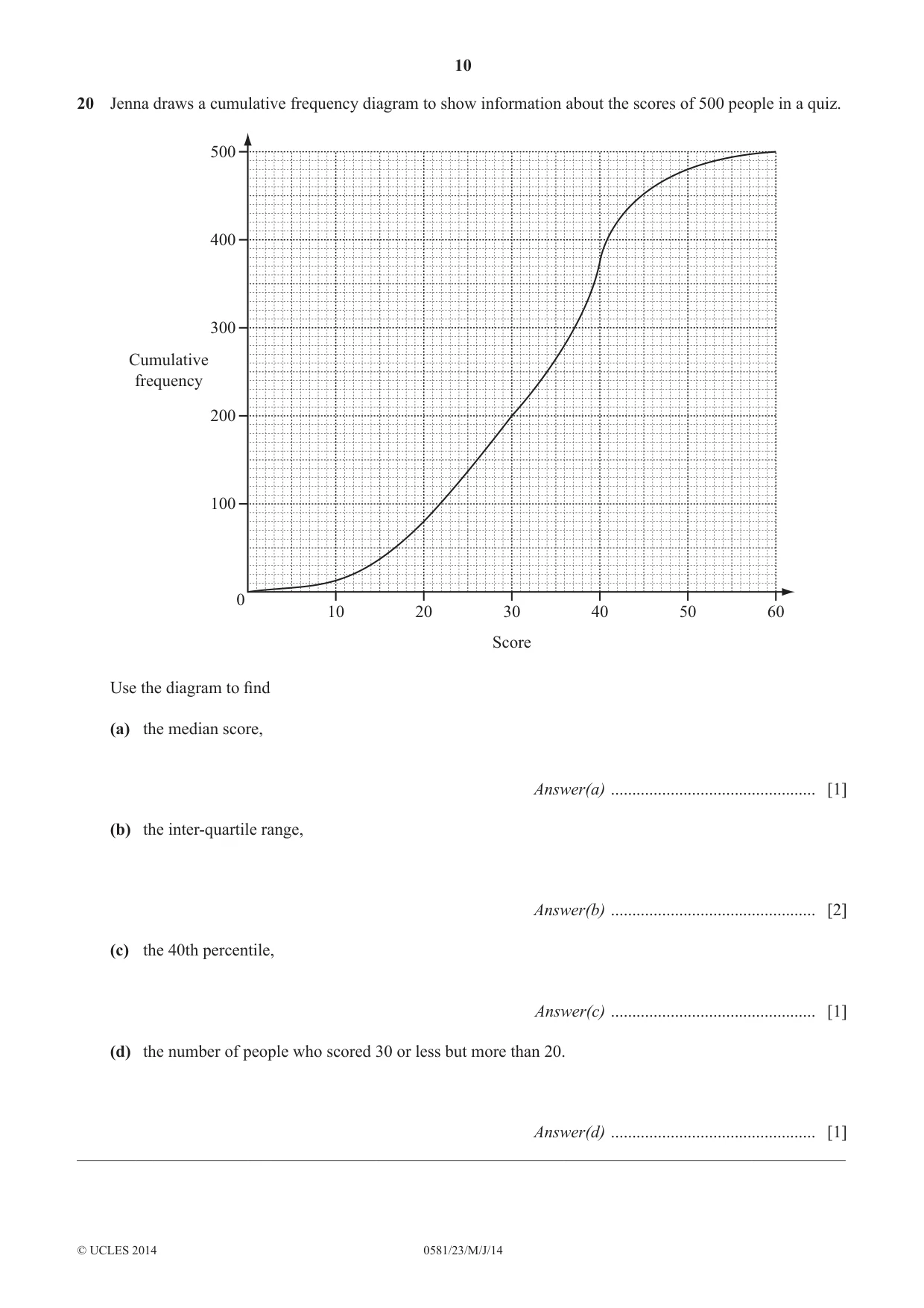
10 0581/23/M/J/14 © UCLES 2014 20 Jenna draws a cumulative frequency diagram to show information about the scores of 500 people in a quiz. 500 400 300 200 100 10 0 20 30 Score Cumulative frequency 40 50 60 Use the diagram to fi nd (a) the median score, Answer(a) … [1] (b) the inter-quartile range, Answer(b) … [2] (c) the 40th percentile, Answer(c) … [1] (d) the number of people who scored 30 or less but more than 20. Answer(d) … [1] __________________________________________________________________________________________
Question paper, page 11
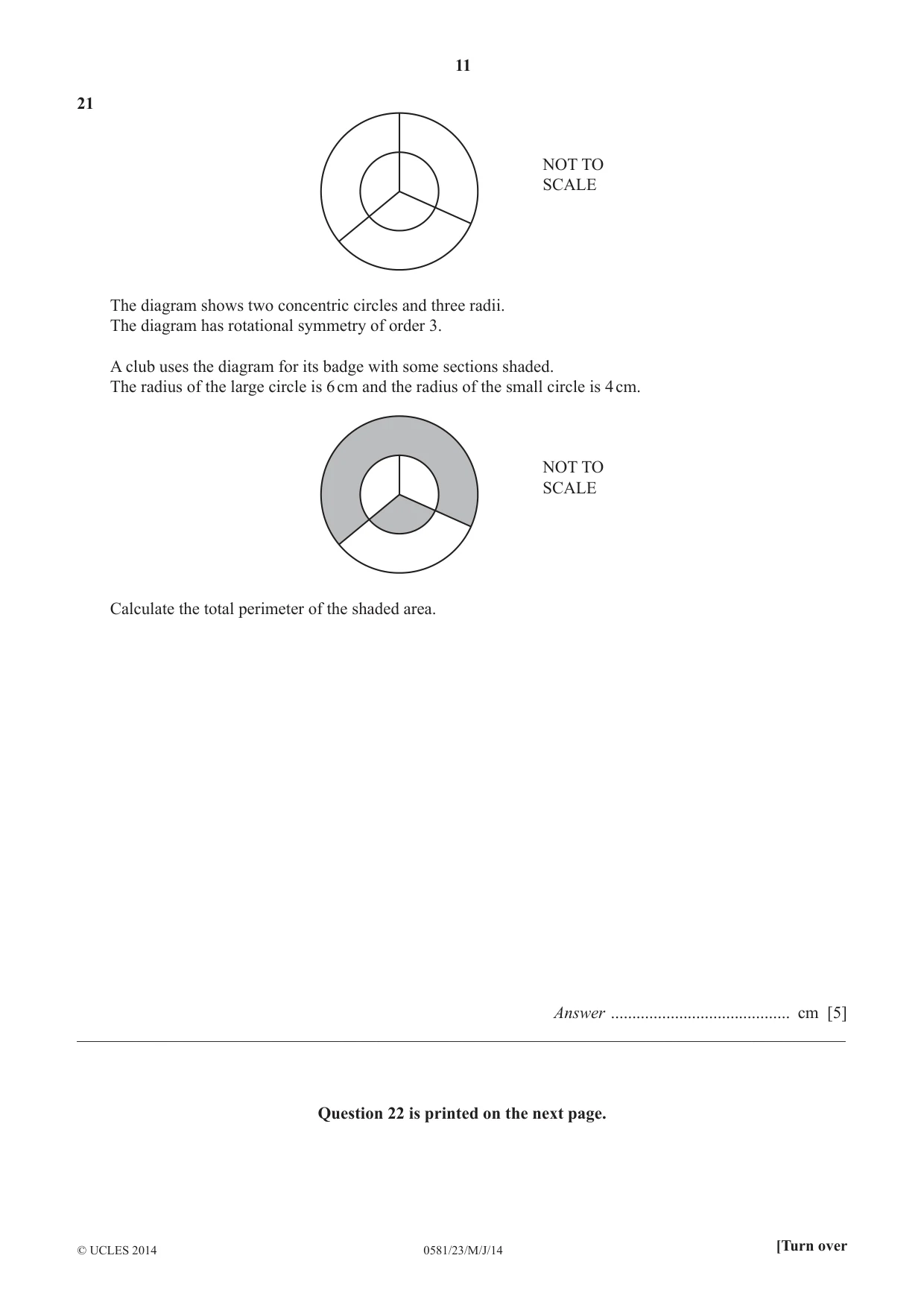
11 0581/23/M/J/14 © UCLES 2014 [Turn over 21 NOT TO SCALE The diagram shows two concentric circles and three radii. The diagram has rotational symmetry of order 3. A club uses the diagram for its badge with some sections shaded. The radius of the large circle is 6 cm and the radius of the small circle is 4 cm. NOT TO SCALE Calculate the total perimeter of the shaded area. Answer … cm [5] __________________________________________________________________________________________ Question 22 is printed on the next page.
Question paper, page 12
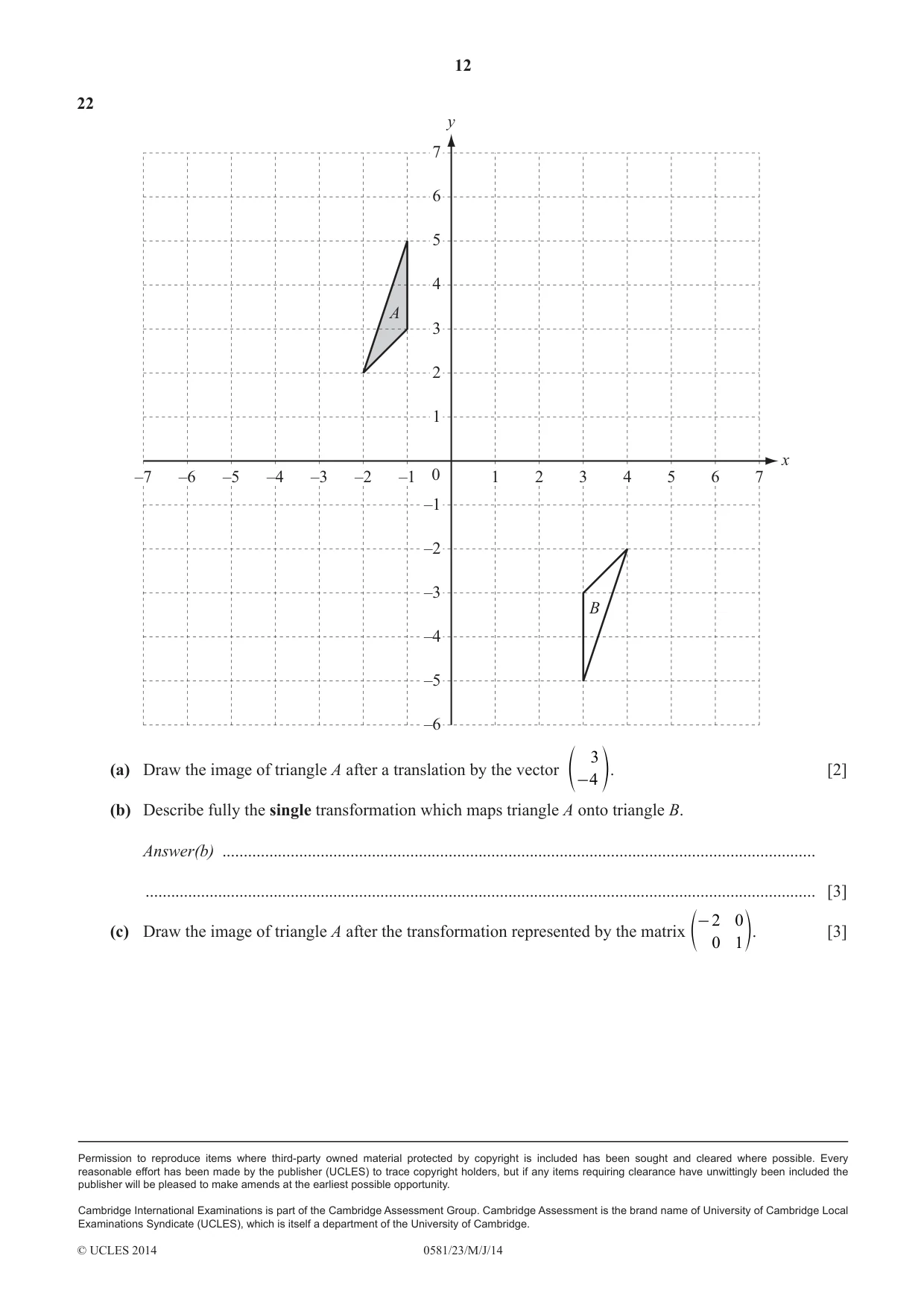
12 0581/23/M/J/14 © UCLES 2014 Permission to reproduce items where third-party owned material protected by copyright is included has been sought and cleared where possible. Every reasonable effort has been made by the publisher (UCLES) to trace copyright holders, but if any items requiring clearance have unwittingly been included the publisher will be pleased to make amends at the earliest possible opportunity. Cambridge International Examinations is part of the Cambridge Assessment Group. Cambridge Assessment is the brand name of University of Cambridge Local Examinations Syndicate (UCLES), which is itself a department of the University of Cambridge. 22 A B y x 7 6 5 4 3 2 1 –1 –2 –3 –4 –5 –6 0 –1 1 2 3 4 5 6 7 –2 –3 –4 –5 –6 –7 (a) Draw the image of triangle A after a translation by the vector 4 3 - e o. [2] (b) Describe fully the single transformation which maps triangle A onto triangle B. Answer(b) … … [3] (c) Draw the image of triangle A after the transformation represented by the matrix 2 0 - 1 0 e o. [3]
Mark scheme, page 1
CAMBRIDGE INTERNATIONAL EXAMINATIONS International General Certificate of Secondary Education MARK SCHEME for the May/June 2014 series 0581 MATHEMATICS 0581/23 Paper 2 (Extended), maximum raw mark 70 This mark scheme is published as an aid to teachers and candidates, to indicate the requirements of the examination. It shows the basis on which Examiners were instructed to award marks. It does not indicate the details of the discussions that took place at an Examiners’ meeting before marking began, which would have considered the acceptability of alternative answers. Mark schemes should be read in conjunction with the question paper and the Principal Examiner Report for Teachers. Cambridge will not enter into discussions about these mark schemes. Cambridge is publishing the mark schemes for the May/June 2014 series for most IGCSE, GCE Advanced Level and Advanced Subsidiary Level components and some Ordinary Level components. PAPA CAMBRIDGE
Mark scheme, page 2
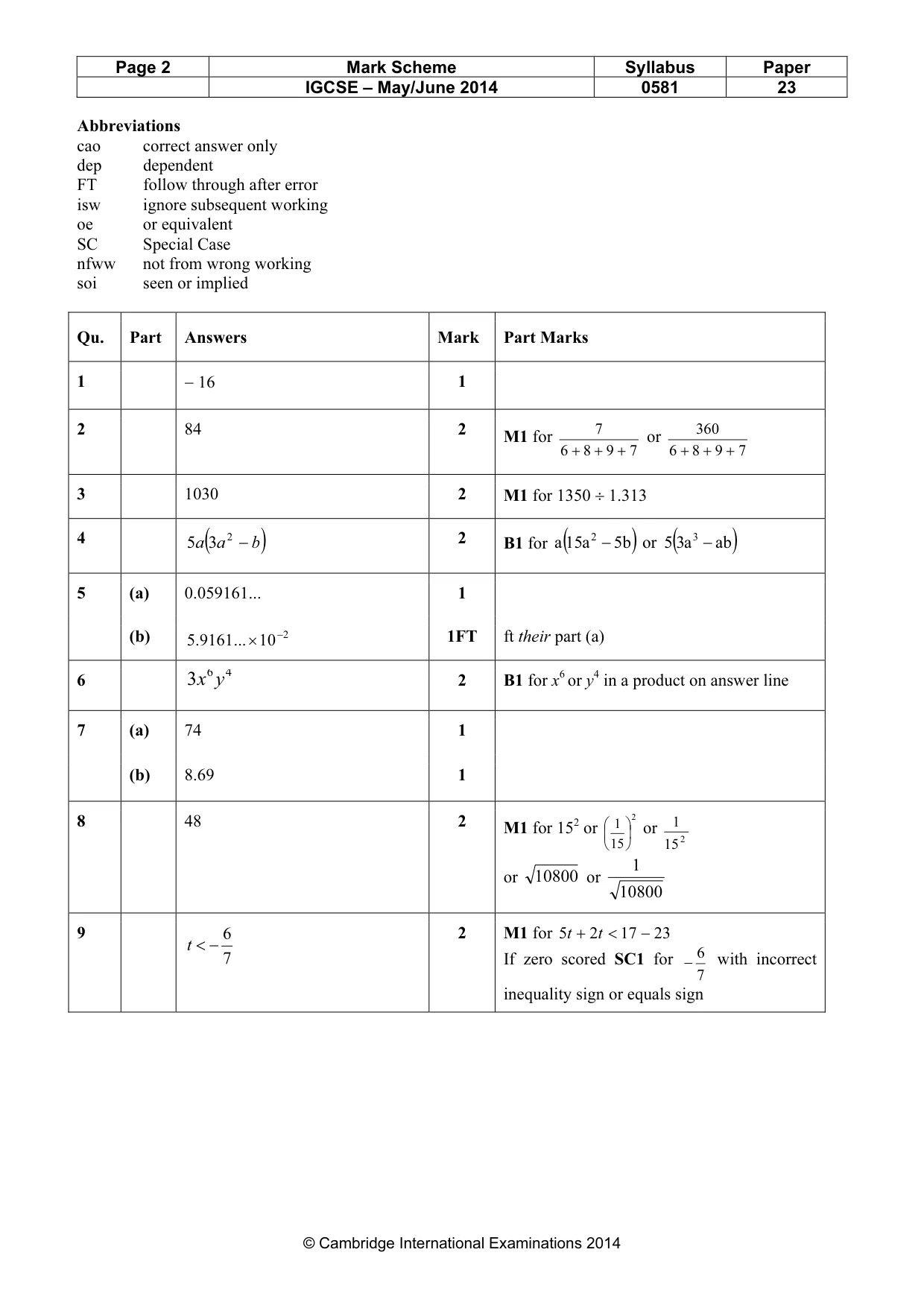
Page 2 Mark Scheme Syllabus Paper IGCSE – May/June 2014 0581 23 © Cambridge International Examinations 2014 Abbreviations cao correct answer only dep dependent FT follow through after error isw ignore subsequent working oe or equivalent SC Special Case nfww not from wrong working soi seen or implied Qu. Part Answers Mark Part Marks 1 − 16 1 2 84 2 M1 for 7 9 8 6 7 + + + or 7 9 8 6 360 + + + 3 1030 2 M1 for 1350 ÷ 1.313 4 ( ) b a a − 2 3 5 2 B1 for ( ) ( ) ab a 3 5 or b 5 a 15 a 3 2 − − 5 (a) 0.059161... 1 (b) 2 10 ... 9161 .5 − × 1FT ft their part (a) 6 4 6 3 y x 2 B1 for x6 or y4 in a product on answer line 7 (a) 74 1 (b) 8.69 1 8 48 2 M1 for 152 or 2 15 1 or 2 15 1 or 10800 or 10800 1 9 7 6 − < t 2 M1 for 23 17 2 5 − < + t t If zero scored SC1 for 7 6 − with incorrect inequality sign or equals sign
Mark scheme, page 3
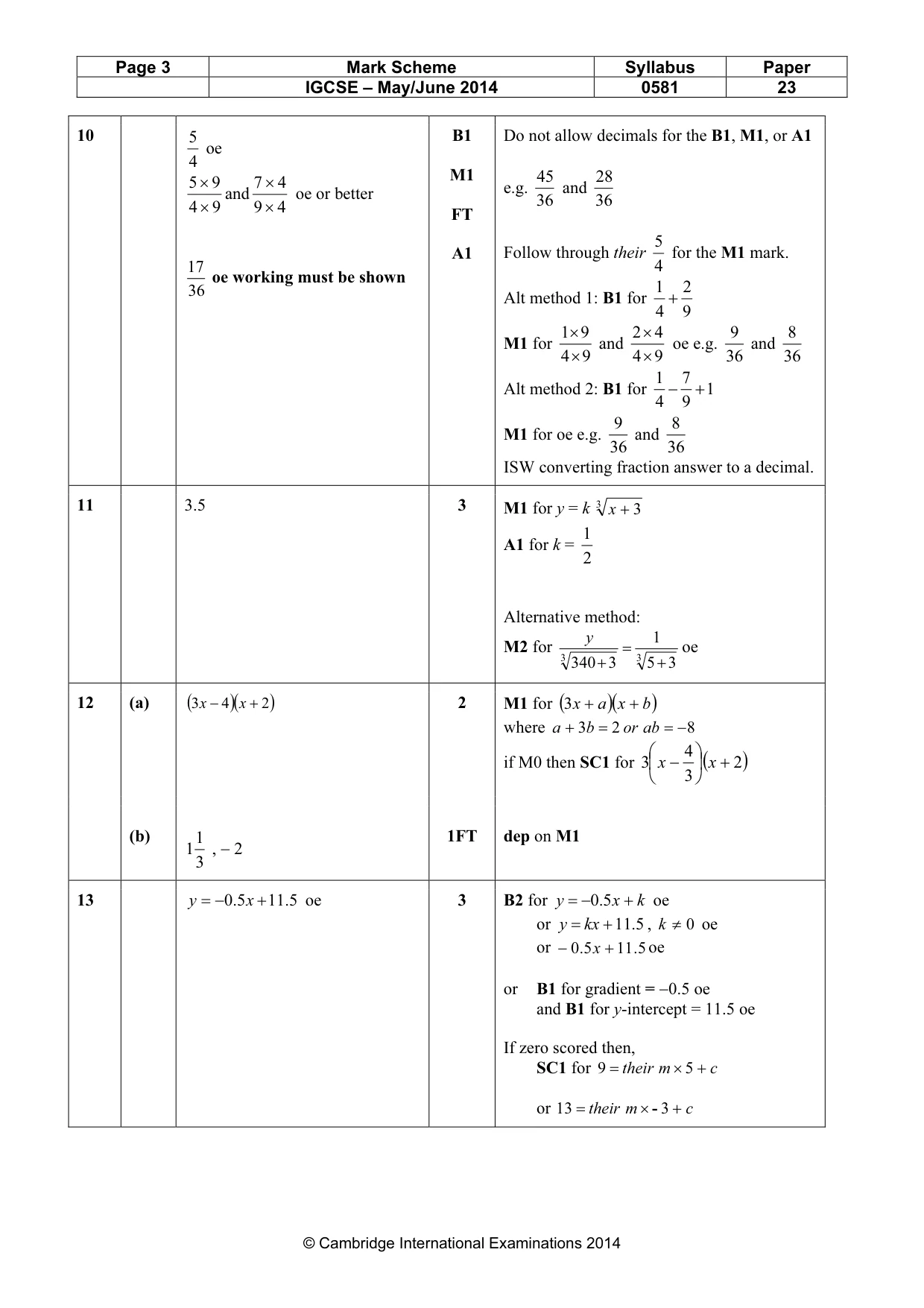
Page 3 Mark Scheme Syllabus Paper IGCSE – May/June 2014 0581 23 © Cambridge International Examinations 2014 10 4 5 oe 9 4 9 5 × × and 4 9 4 7 × × oe or better 36 17 oe working must be shown B1 M1 FT A1 Do not allow decimals for the B1, M1, or A1 e.g. 36 45 and 36 28 Follow through their 4 5 for the M1 mark. Alt method 1: B1 for 9 2 4 1 + M1 for 9 4 9 1 × × and 9 4 4 2 × × oe e.g. 36 9 and 36 8 Alt method 2: B1 for 1 9 7 4 1 + − M1 for oe e.g. 36 9 and 36 8 ISW converting fraction answer to a decimal. 11 3.5 3 M1 for y = k 3 3 + x A1 for k = 2 1 Alternative method: M2 for 3 3 3 5 1 3 340 + = + y oe 12 (a) ( )( ) 2 4 3 + − x x 2 M1 for ( )( ) b x a x + + 3 where 8 2 3 − = = + ab or b a if M0 then SC1 for ( ) 2 3 4 3 + − x x (b) 3 1 1 , − 2 1FT dep on M1 13 5. 11 5.0 + − = x y oe 3 B2 for k x y + − = 5.0 oe or 5. 11 + = kx y , 0 ≠ k oe or 5. 11 5.0 + − x oe or B1 for gradient = −0.5 oe and B1 for y-intercept = 11.5 oe If zero scored then, SC1 for c m their + × = 5 9 or c m their + × = 3 13 -
Mark scheme, page 4
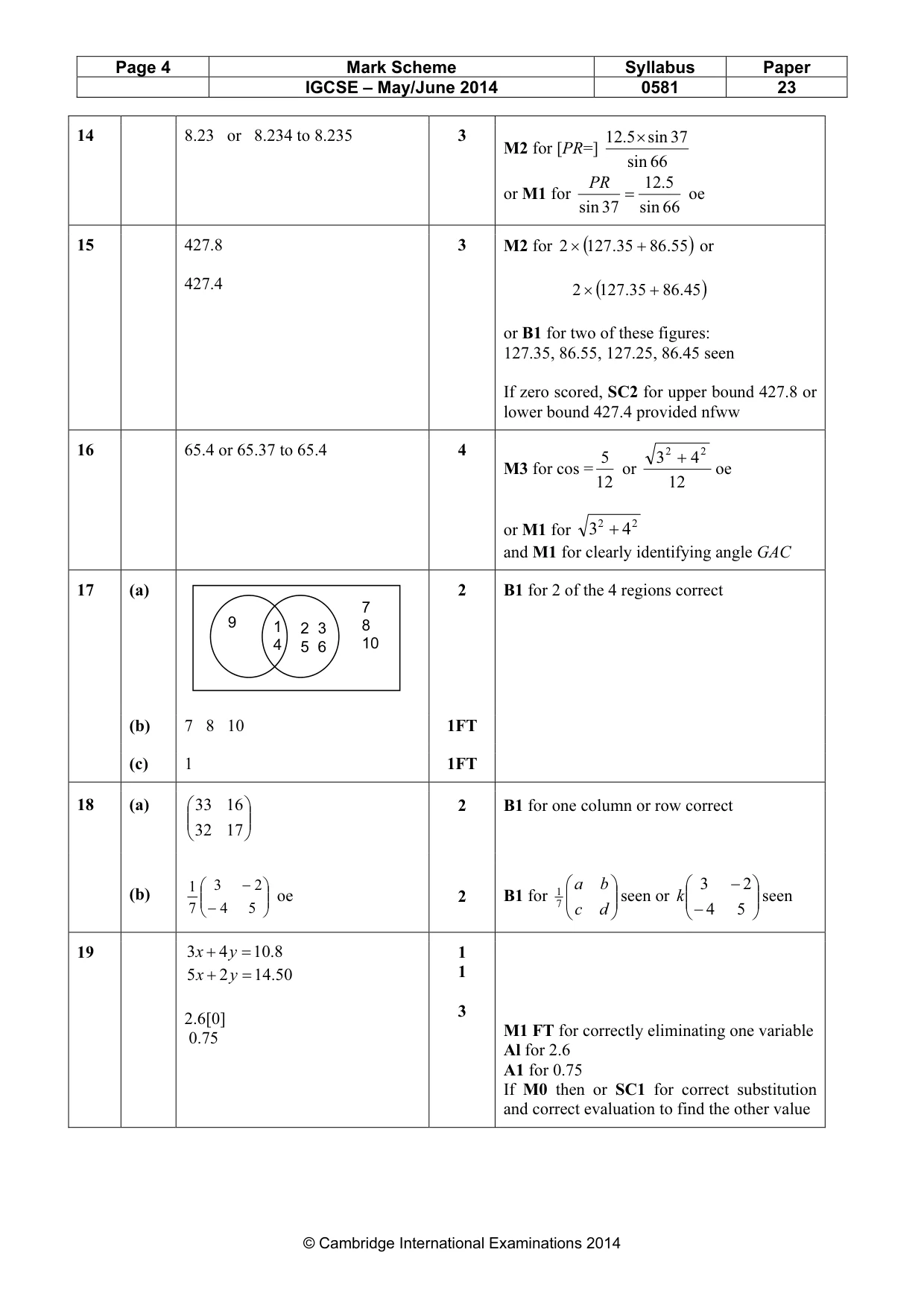
Page 4 Mark Scheme Syllabus Paper IGCSE – May/June 2014 0581 23 © Cambridge International Examinations 2014 14 8.23 or 8.234 to 8.235 3 M2 for [PR=] 66 sin 37 sin 5. 12 × or M1 for 66 sin 5. 12 37 sin = PR oe 15 427.8 427.4 3 M2 for ( ) 55 . 86 35 . 127 2 + × or ( ) 45 . 86 35 . 127 2 + × or B1 for two of these figures: 127.35, 86.55, 127.25, 86.45 seen If zero scored, SC2 for upper bound 427.8 or lower bound 427.4 provided nfww 16 65.4 or 65.37 to 65.4 4 M3 for cos =12 5 or 12 4 3 2 2 + oe or M1 for 2 2 4 3 + and M1 for clearly identifying angle GAC 17 (a) 2 B1 for 2 of the 4 regions correct (b) 7 8 10 1FT (c) 1 1FT 18 (a) 17 32 16 33 2 B1 for one column or row correct (b) − − 5 4 2 3 7 1 oe 2 B1 for d c b a 7 1 seen or − − 5 4 2 3 k seen 19 8. 10 4 3 = + y x 50 . 14 2 5 = + y x 2.6[0] 0.75 1 1 3 M1 FT for correctly eliminating one variable Al for 2.6 A1 for 0.75 If M0 then or SC1 for correct substitution and correct evaluation to find the other value 1 4 9 2 3 5 6 7 8 10
Mark scheme, page 5
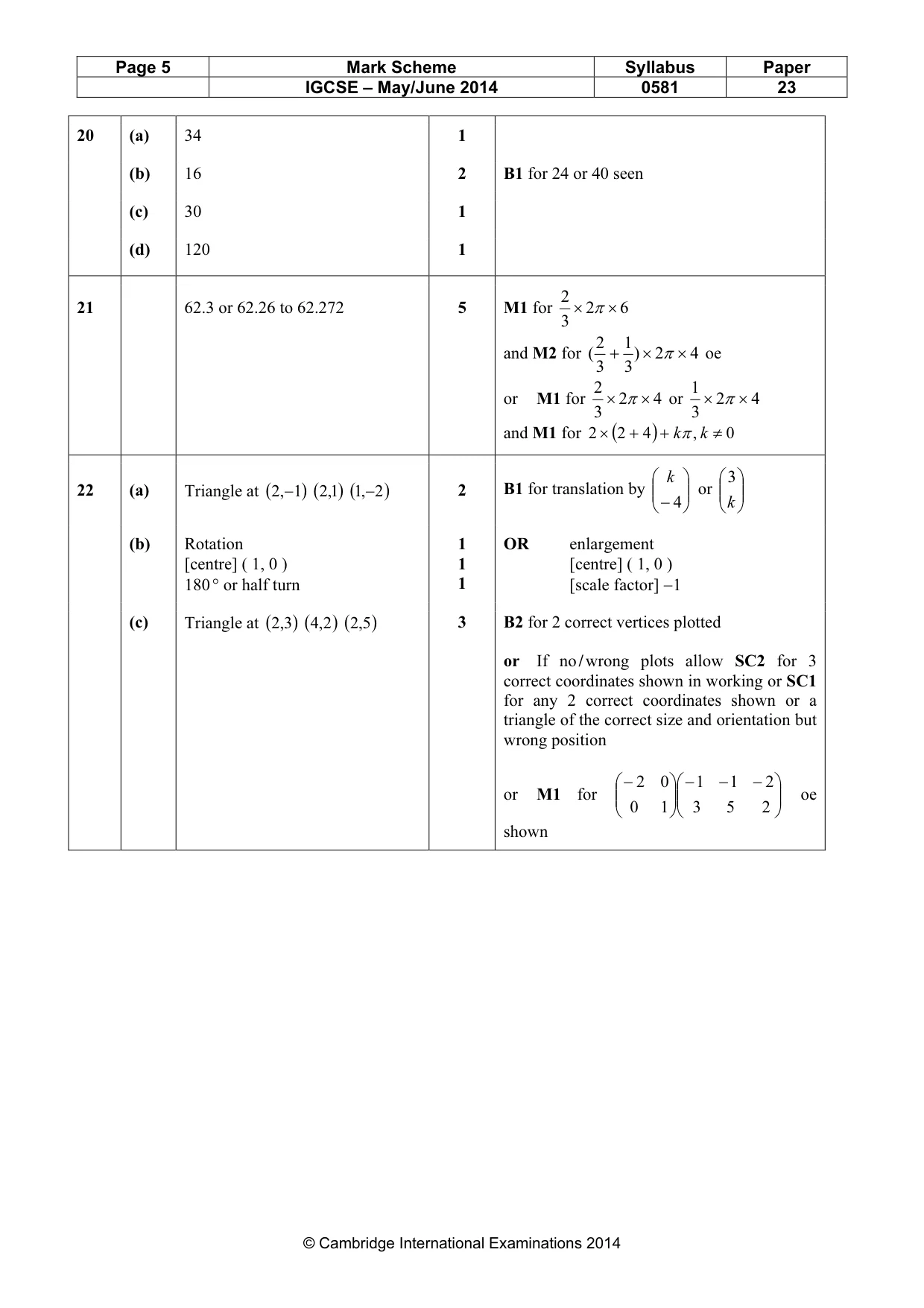
Page 5 Mark Scheme Syllabus Paper IGCSE – May/June 2014 0581 23 © Cambridge International Examinations 2014 20 (a) 34 1 (b) 16 2 B1 for 24 or 40 seen (c) 30 1 (d) 120 1 21 62.3 or 62.26 to 62.272 5 M1 for 6 2 3 2 × × π and M2 for 4 2 ) 3 1 3 2 ( × × + π oe or M1 for 4 2 3 2 × × π or 4 2 3 1 × × π and M1 for ( ) 0 , 4 2 2 ≠ + + × k k π 22 (a) Triangle at ( ) ( ) ( ) 2 ,1 1,2 1 ,2 − − 2 B1 for translation by −4 k or k 3 (b) Rotation [centre] ( 1, 0 ) 180 ° or half turn 1 1 1 OR enlargement [centre] ( 1, 0 ) [scale factor] −1 (c) Triangle at ( ) ( ) ( ) 5,2 2,4 3,2 3 B2 for 2 correct vertices plotted or If no / wrong plots allow SC2 for 3 correct coordinates shown in working or SC1 for any 2 correct coordinates shown or a triangle of the correct size and orientation but wrong position or M1 for − − − − 2 5 3 2 1 1 1 0 0 2 oe shown
What you needed in this session
Cambridge’s own grade thresholds for 2014 May/June, Paper 2 · Variant 3. A higher threshold means an easier paper — the bar moves with how the cohort did.