Cambridge IGCSE Mathematics (with coursework) 0581 — 2014 May/June Paper 2 · Variant 1
0581/21/M/J/14 · 70 marks · ≈79 min
The question paper and its mark scheme, free to read here and free to download. This is Cambridge’s own paper, exactly as it was sat.
Question paper12 pages
Mark scheme4 pages
Answers below. Sit the paper first if you are practising.
Paper as text
Question paper, page 1
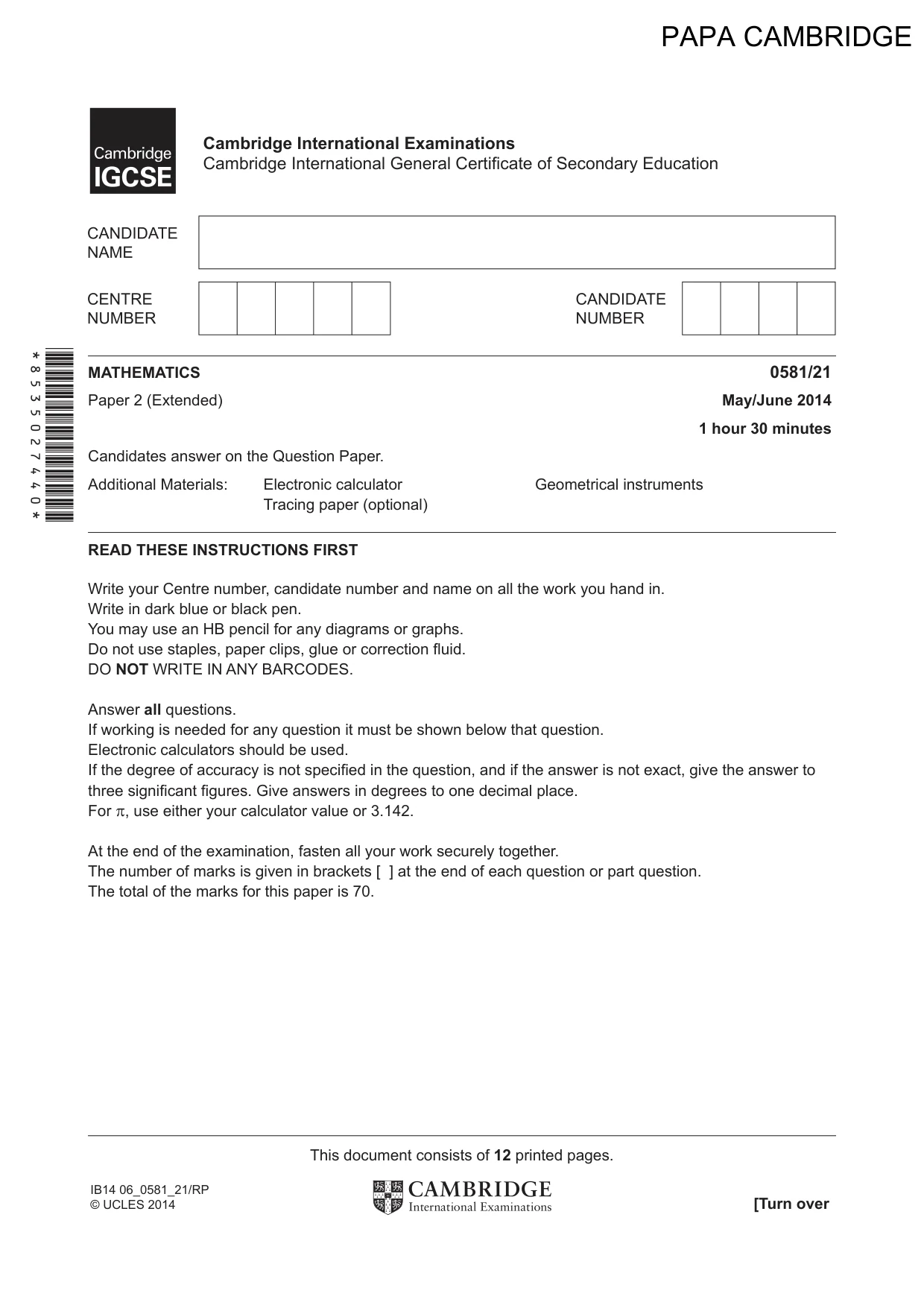
READ THESE INSTRUCTIONS FIRST Write your Centre number, candidate number and name on all the work you hand in. Write in dark blue or black pen. You may use an HB pencil for any diagrams or graphs. Do not use staples, paper clips, glue or correction fl uid. DO NOT WRITE IN ANY BARCODES. Answer all questions. If working is needed for any question it must be shown below that question. Electronic calculators should be used. If the degree of accuracy is not specifi ed in the question, and if the answer is not exact, give the answer to three signifi cant fi gures. Give answers in degrees to one decimal place. For π, use either your calculator value or 3.142. At the end of the examination, fasten all your work securely together. The number of marks is given in brackets [ ] at the end of each question or part question. The total of the marks for this paper is 70. MATHEMATICS 0581/21 Paper 2 (Extended) May/June 2014 1 hour 30 minutes Candidates answer on the Question Paper. Additional Materials: Electronic calculator Geometrical instruments Tracing paper (optional) Cambridge International Examinations Cambridge International General Certifi cate of Secondary Education This document consists of 12 printed pages. [Turn over IB14 06_0581_21/RP © UCLES 2014 *8535027440* PAPA CAMBRIDGE
Question paper, page 2
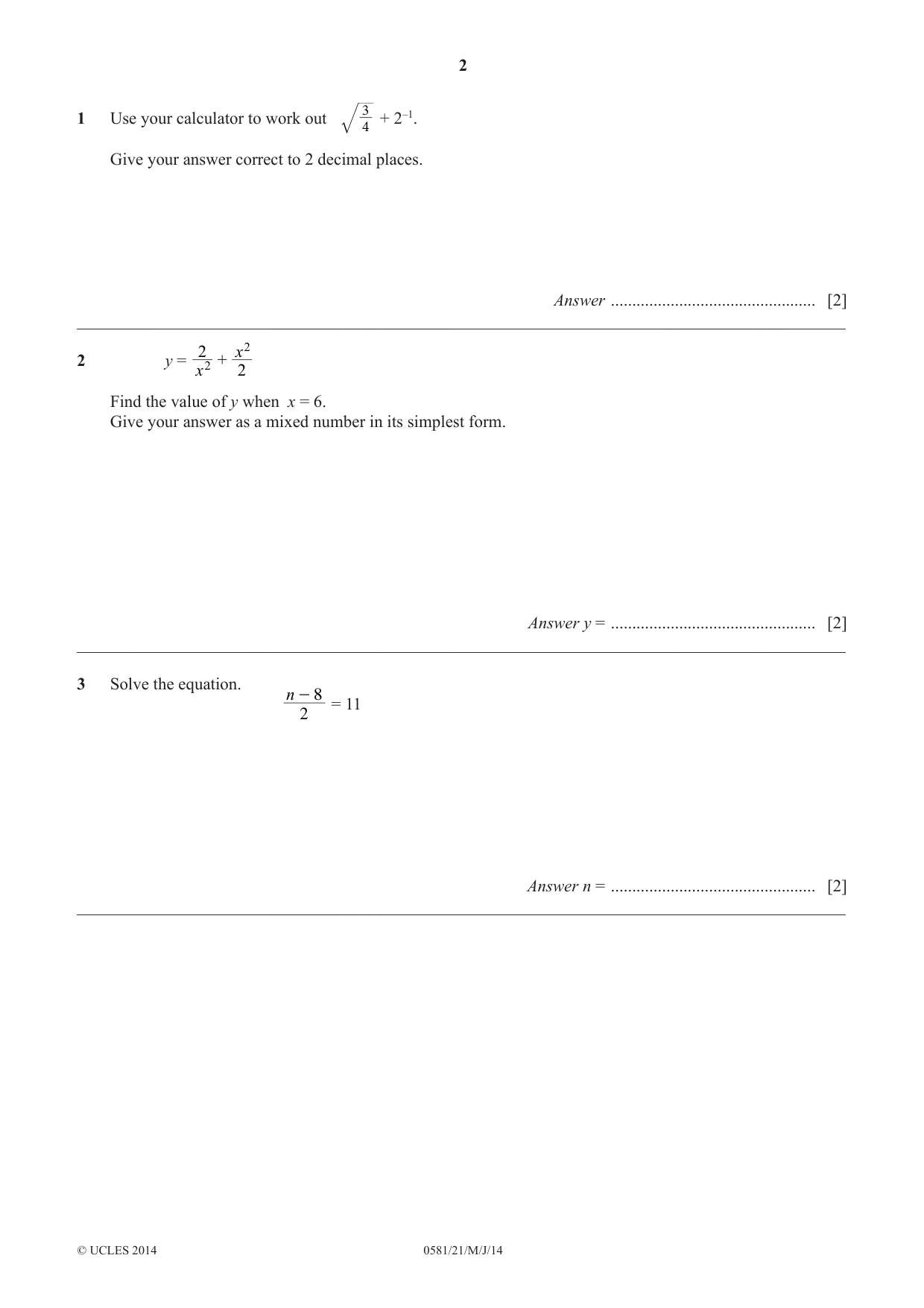
2 0581/21/M/J/14 © UCLES 2014 1 Use your calculator to work out 4 3 + 2–1. Give your answer correct to 2 decimal places. Answer … [2] __________________________________________________________________________________________ 2 y = 2 x x 2 + 2 2 Find the value of y when x = 6. Give your answer as a mixed number in its simplest form. Answer y = … [2] __________________________________________________________________________________________ 3 Solve the equation. 8 n 2 - = 11 Answer n = … [2] __________________________________________________________________________________________
Question paper, page 3
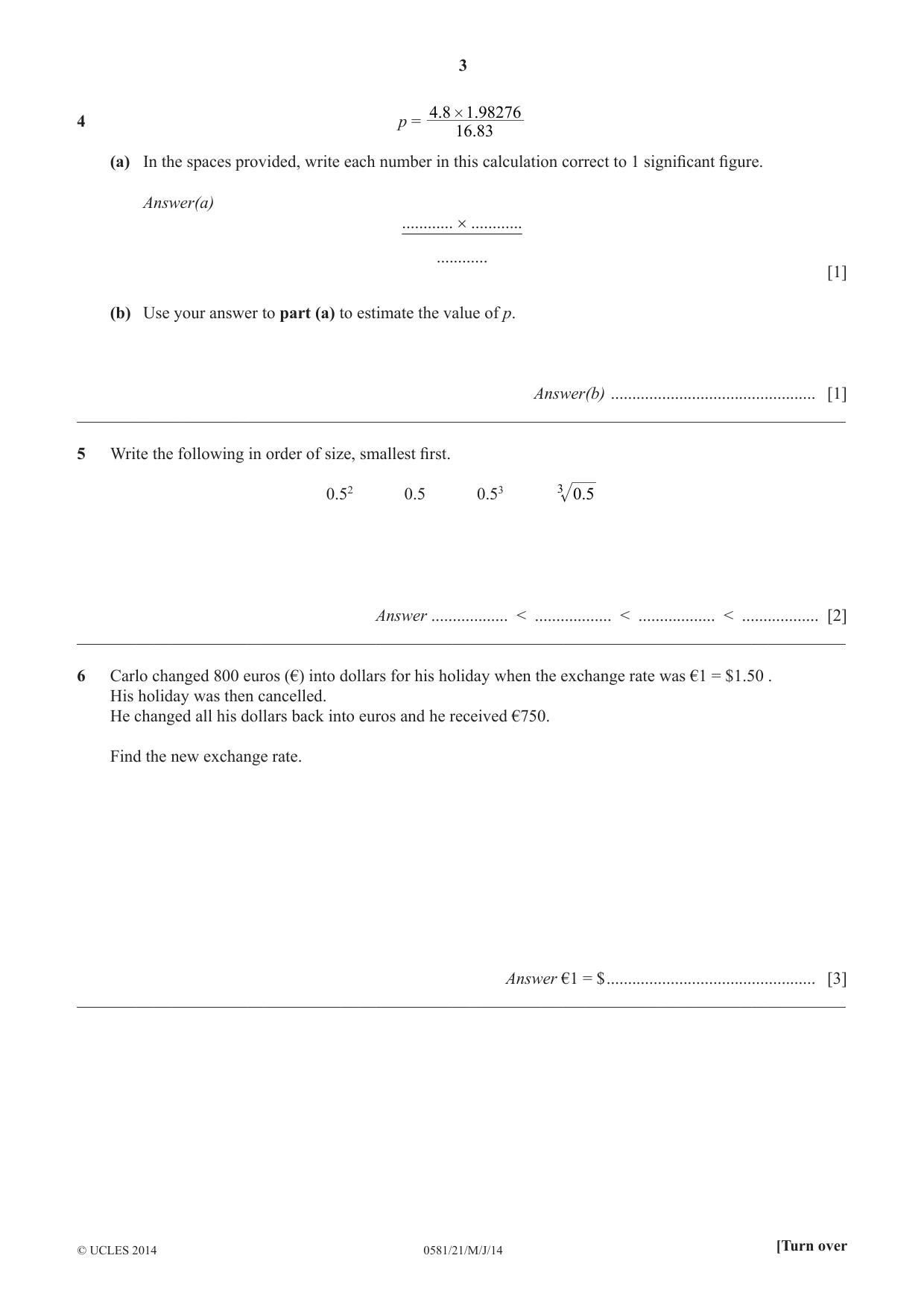
3 0581/21/M/J/14 © UCLES 2014 [Turn over 4 p = 16.83 4.8 1.98276 # (a) In the spaces provided, write each number in this calculation correct to 1 signifi cant fi gure. Answer(a) … × … … [1] (b) Use your answer to part (a) to estimate the value of p. Answer(b) … [1] __________________________________________________________________________________________ 5 Write the following in order of size, smallest fi rst. 0.52 0.5 0.53 0.5 3 Answer … < … < … < … [2] __________________________________________________________________________________________ 6 Carlo changed 800 euros (€) into dollars for his holiday when the exchange rate was €1 = $1.50 . His holiday was then cancelled. He changed all his dollars back into euros and he received €750. Find the new exchange rate. Answer €1 = $ … [3] __________________________________________________________________________________________
Question paper, page 4
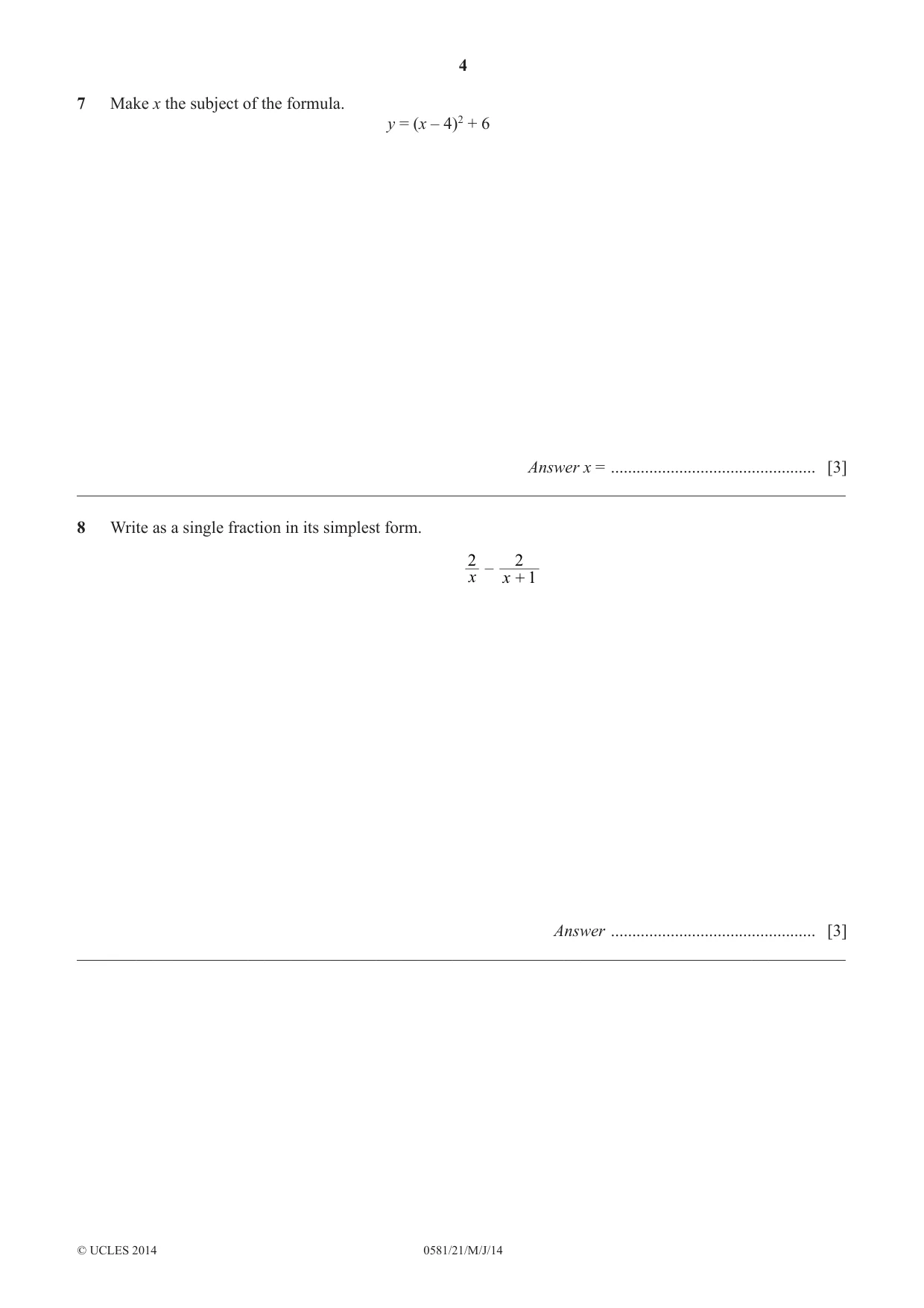
4 0581/21/M/J/14 © UCLES 2014 7 Make x the subject of the formula. y = (x – 4)2 + 6 Answer x = … [3] __________________________________________________________________________________________ 8 Write as a single fraction in its simplest form. x 2 – 1 x + 2 Answer … [3] __________________________________________________________________________________________
Question paper, page 5
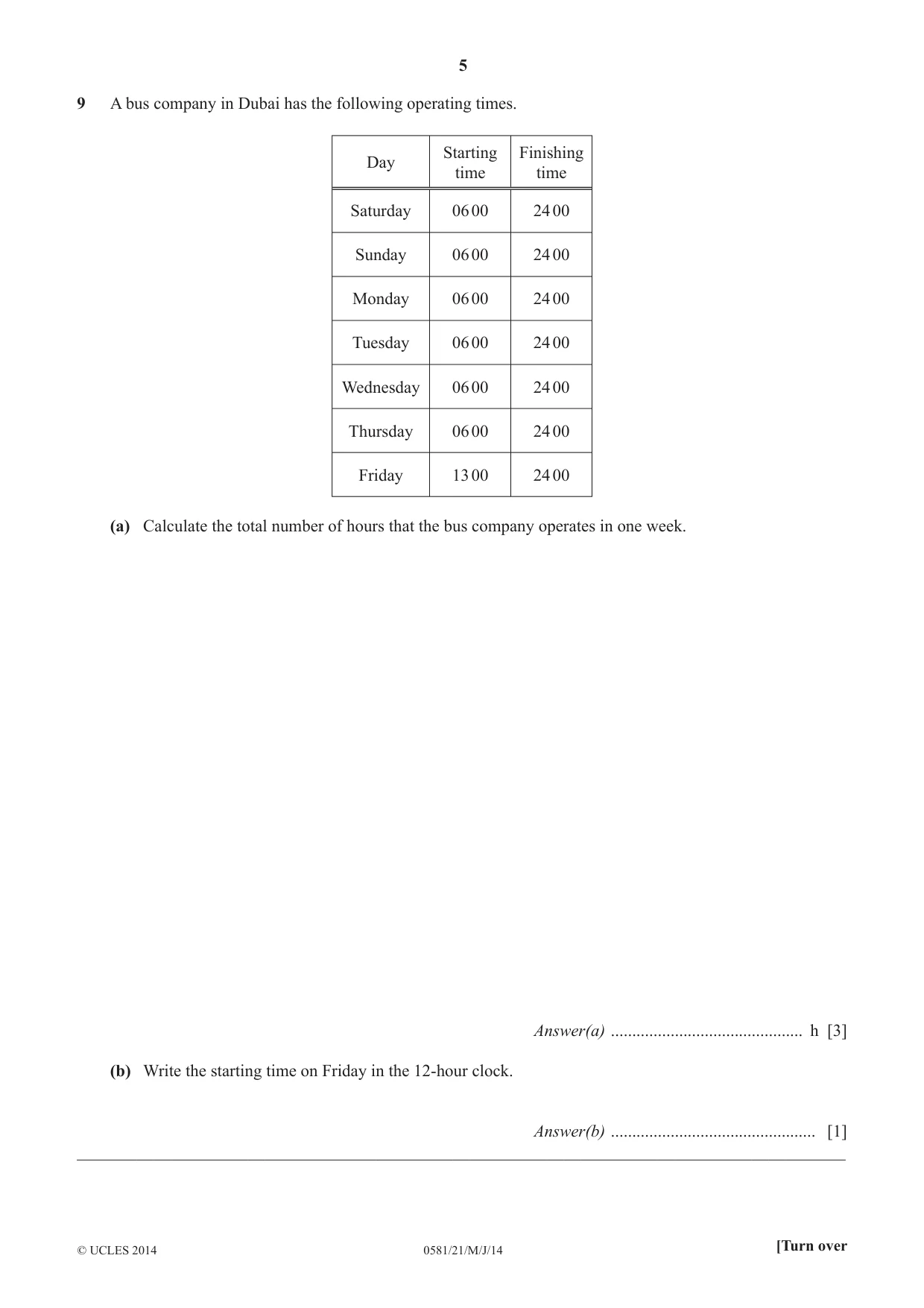
5 0581/21/M/J/14 © UCLES 2014 [Turn over 9 A bus company in Dubai has the following operating times. Day Starting time Finishing time Saturday 06 00 24 00 Sunday 06 00 24 00 Monday 06 00 24 00 Tuesday 06 00 24 00 Wednesday 06 00 24 00 Thursday 06 00 24 00 Friday 13 00 24 00 (a) Calculate the total number of hours that the bus company operates in one week. Answer(a) … h [3] (b) Write the starting time on Friday in the 12-hour clock. Answer(b) … [1] __________________________________________________________________________________________
Question paper, page 6
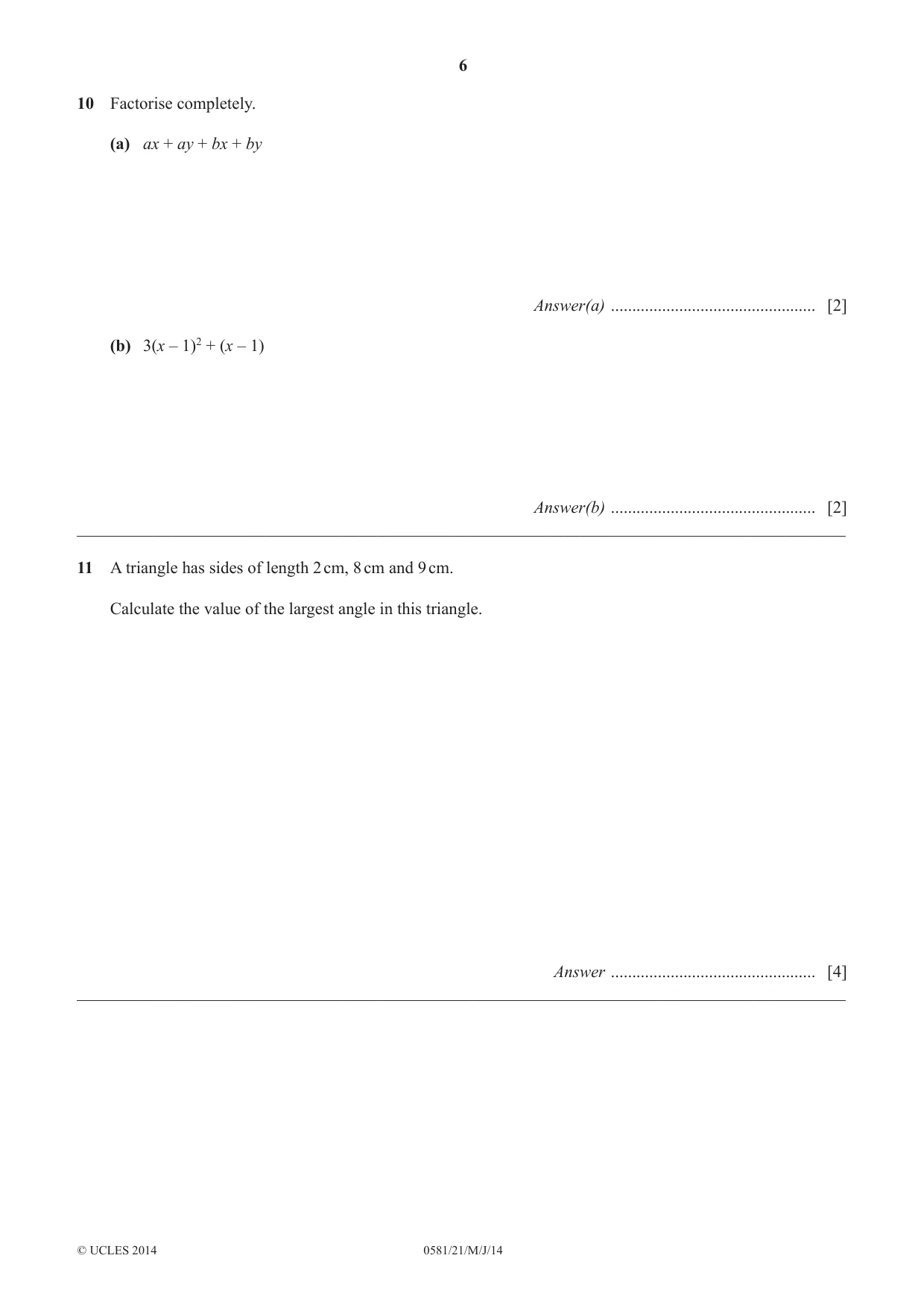
6 0581/21/M/J/14 © UCLES 2014 10 Factorise completely. (a) ax + ay + bx + by Answer(a) … [2] (b) 3(x – 1)2 + (x – 1) Answer(b) … [2] __________________________________________________________________________________________ 11 A triangle has sides of length 2 cm, 8 cm and 9 cm. Calculate the value of the largest angle in this triangle. Answer … [4] __________________________________________________________________________________________
Question paper, page 7
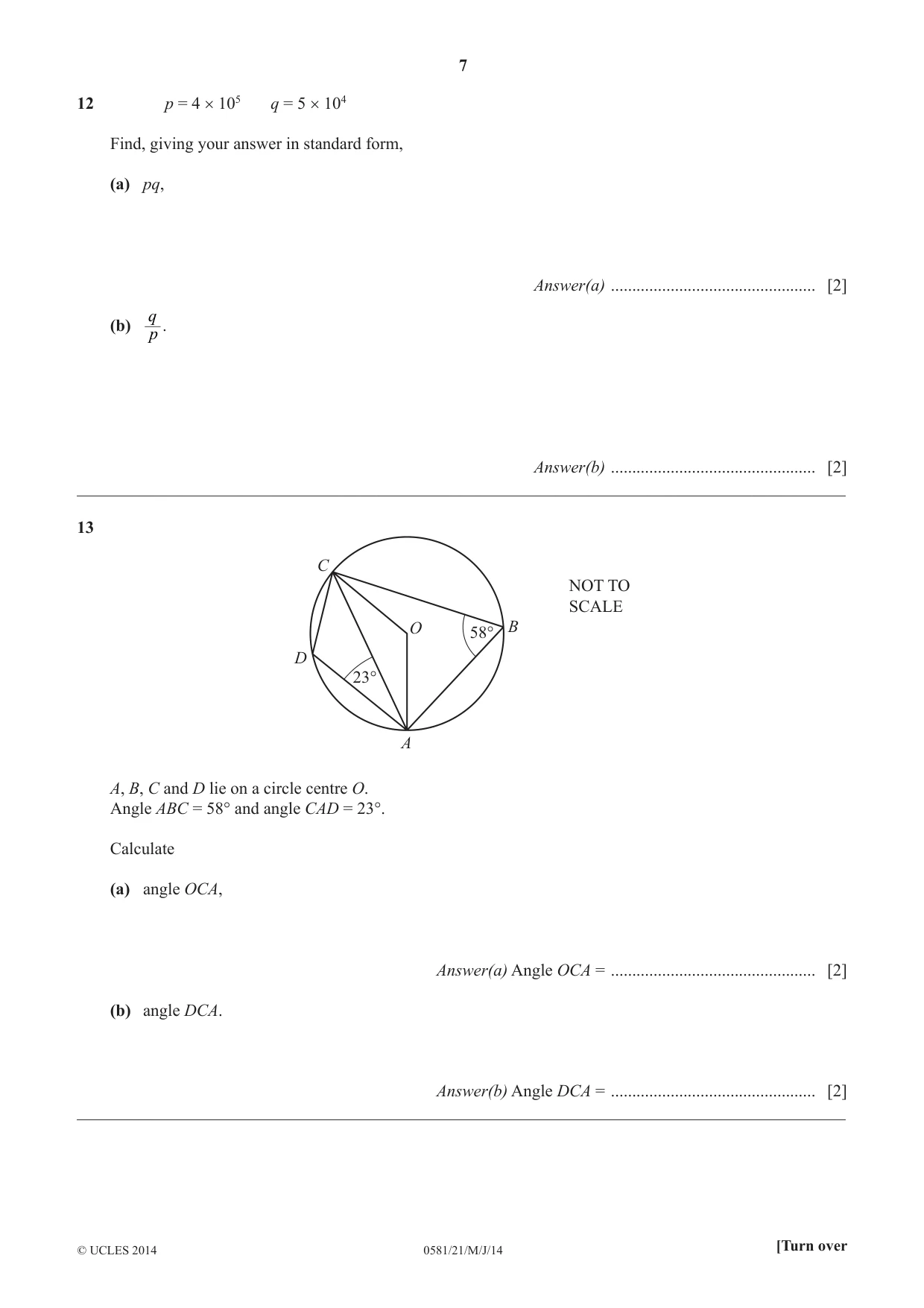
7 0581/21/M/J/14 © UCLES 2014 [Turn over 12 p = 4 × 10⁵ q = 5 × 10⁴ Find, giving your answer in standard form, (a) pq, Answer(a) … [2] (b) p q . Answer(b) … [2] __________________________________________________________________________________________ 13 O C D A B 58° 23° NOT TO SCALE A, B, C and D lie on a circle centre O. Angle ABC = 58° and angle CAD = 23°. Calculate (a) angle OCA, Answer(a) Angle OCA = … [2] (b) angle DCA. Answer(b) Angle DCA = … [2] __________________________________________________________________________________________
Question paper, page 8
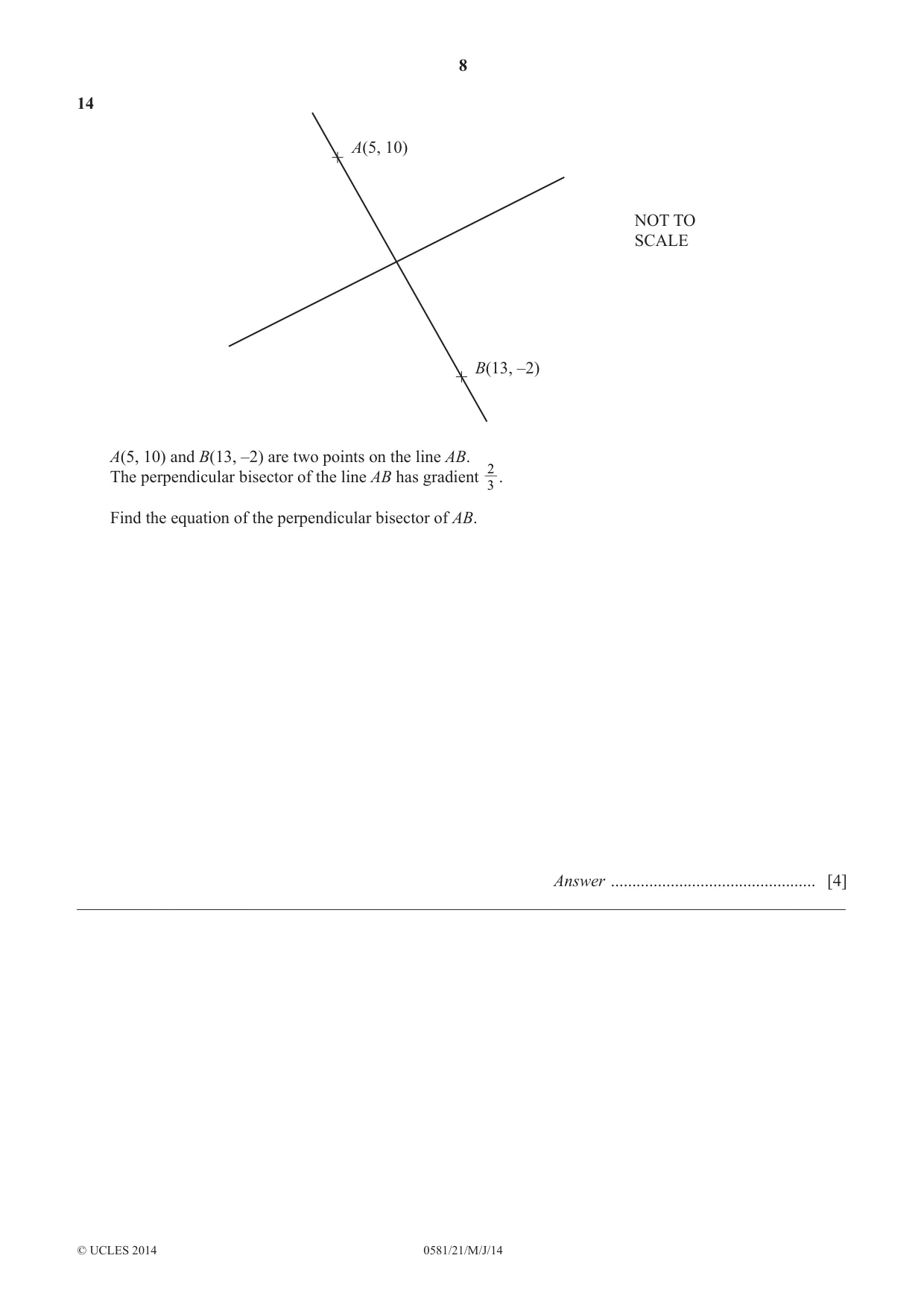
8 0581/21/M/J/14 © UCLES 2014 14 A(5, 10) B(13, –2) NOT TO SCALE A(5, 10) and B(13, –2) are two points on the line AB. The perpendicular bisector of the line AB has gradient 3 2 . Find the equation of the perpendicular bisector of AB. Answer … [4] __________________________________________________________________________________________
Question paper, page 9
9 0581/21/M/J/14 © UCLES 2014 [Turn over 15 Solve the inequality for positive integer values of x. 5 21 x + > x + 1 Answer … [4] __________________________________________________________________________________________ 16 (a) (224) 1 2 = p4 Find the value of p. Answer(a) p = … [2] (b) Simplify 2 2 q q 4 1 4 1 + # q q . Answer(b) … [3] __________________________________________________________________________________________
Question paper, page 10
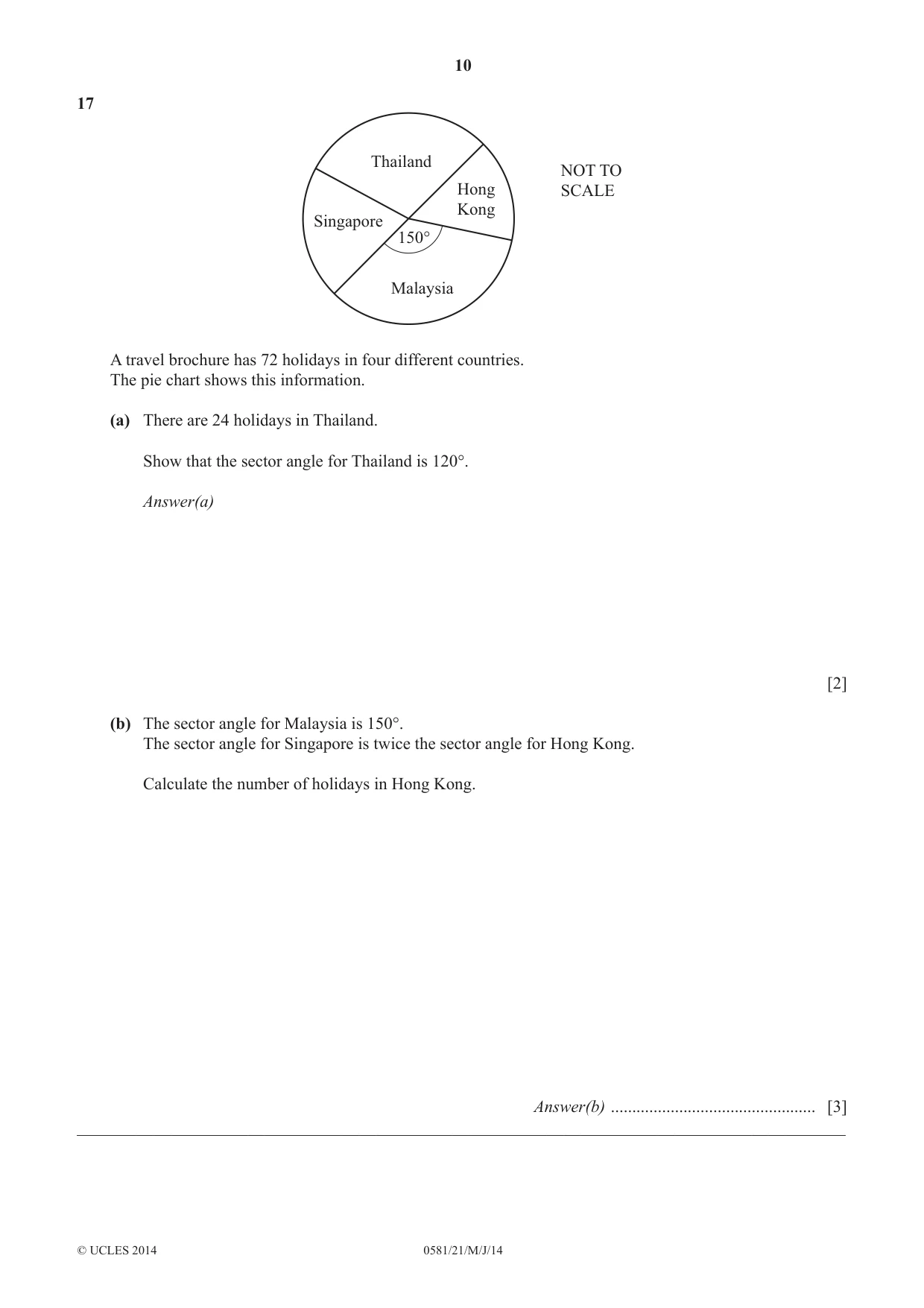
10 0581/21/M/J/14 © UCLES 2014 17 150° Thailand Hong Kong Malaysia Singapore NOT TO SCALE A travel brochure has 72 holidays in four different countries. The pie chart shows this information. (a) There are 24 holidays in Thailand. Show that the sector angle for Thailand is 120°. Answer(a) [2] (b) The sector angle for Malaysia is 150°. The sector angle for Singapore is twice the sector angle for Hong Kong. Calculate the number of holidays in Hong Kong. Answer(b) … [3] __________________________________________________________________________________________
Question paper, page 11
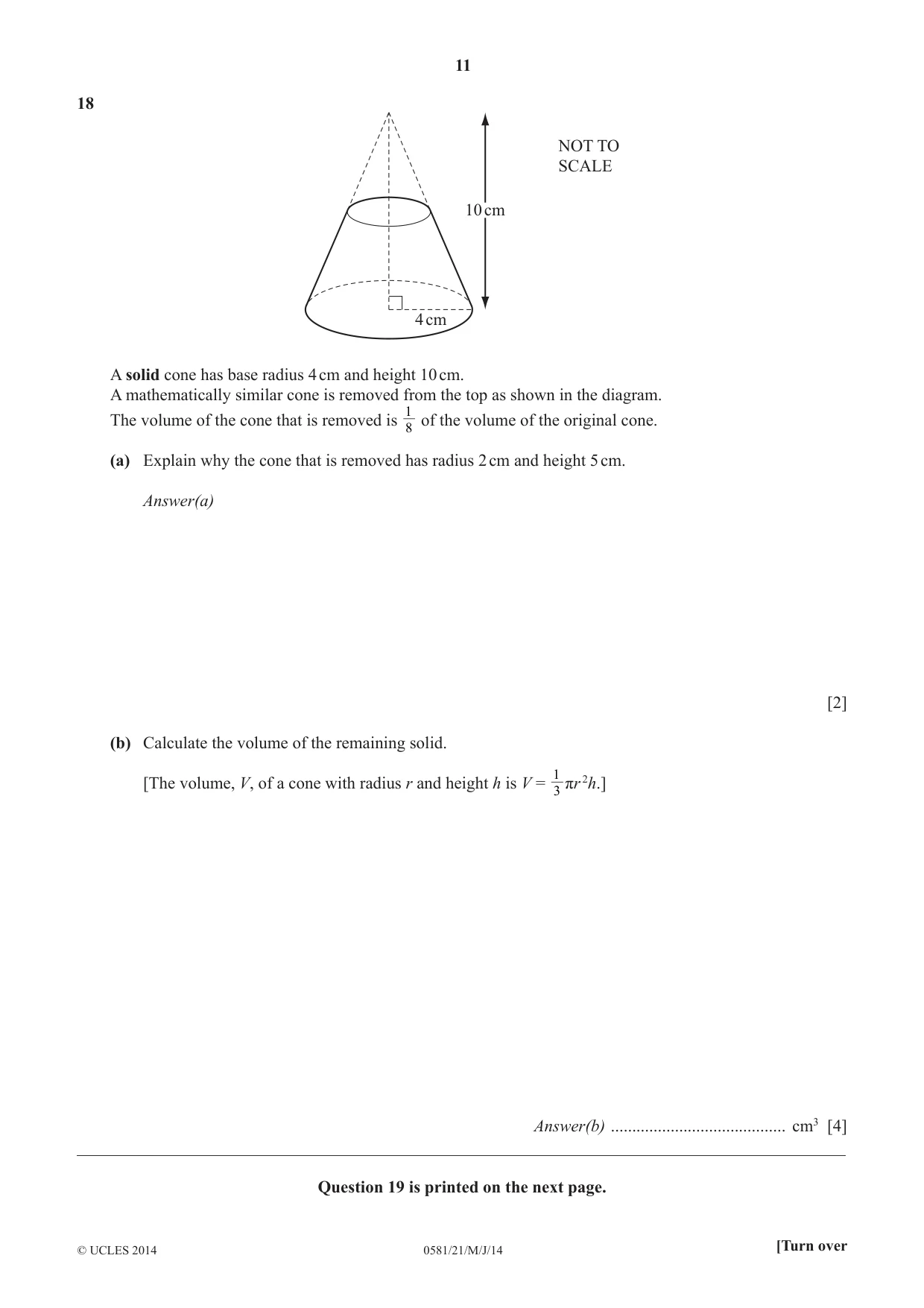
11 0581/21/M/J/14 © UCLES 2014 [Turn over 18 4 cm 10 cm NOT TO SCALE A solid cone has base radius 4 cm and height 10 cm. A mathematically similar cone is removed from the top as shown in the diagram. The volume of the cone that is removed is 8 1 of the volume of the original cone. (a) Explain why the cone that is removed has radius 2 cm and height 5 cm. Answer(a) [2] (b) Calculate the volume of the remaining solid. [The volume, V, of a cone with radius r and height h is V = 3 1 πr 2h.] Answer(b) … cm3 [4] __________________________________________________________________________________________ Question 19 is printed on the next page.
Question paper, page 12
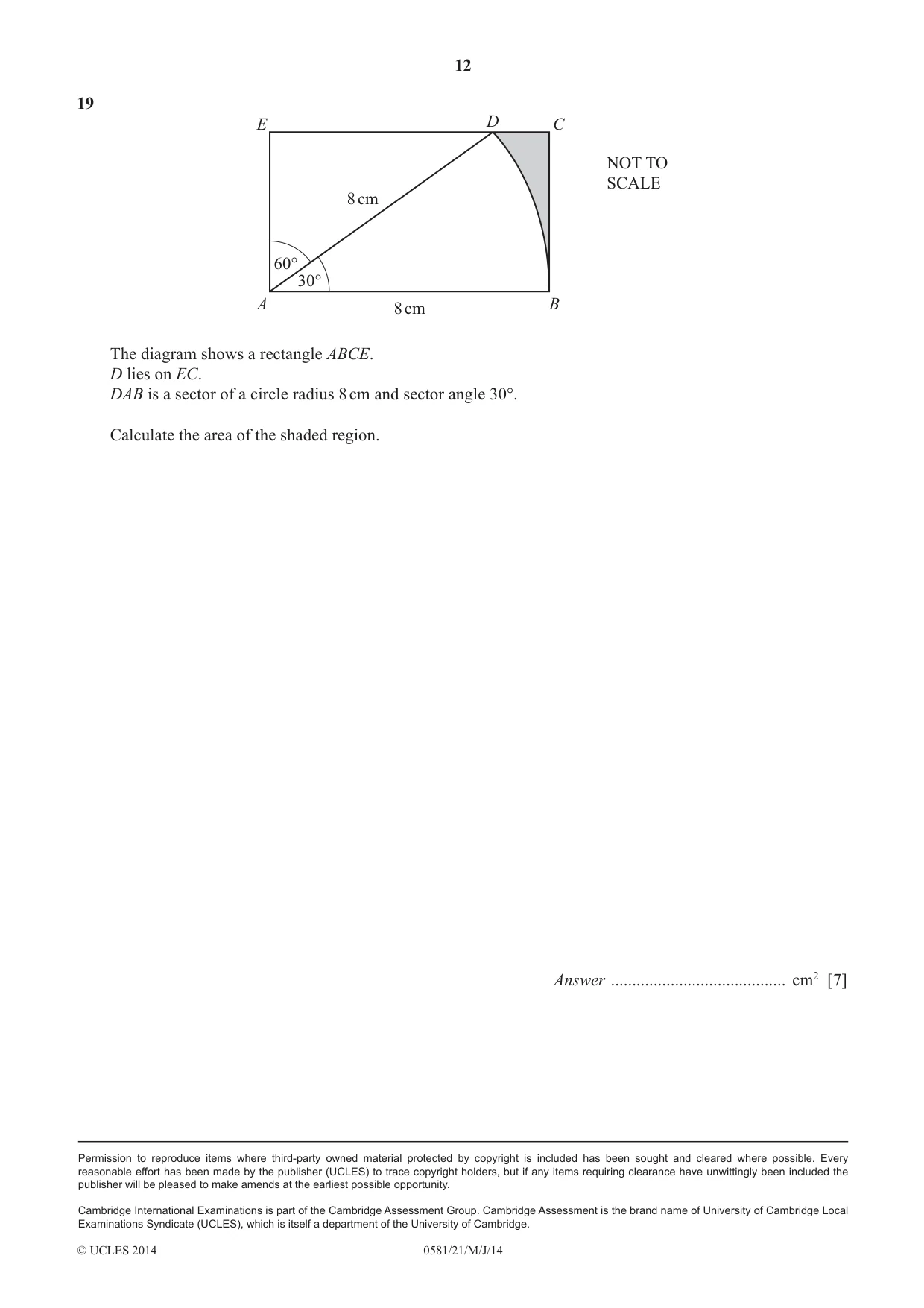
12 0581/21/M/J/14 © UCLES 2014 Permission to reproduce items where third-party owned material protected by copyright is included has been sought and cleared where possible. Every reasonable effort has been made by the publisher (UCLES) to trace copyright holders, but if any items requiring clearance have unwittingly been included the publisher will be pleased to make amends at the earliest possible opportunity. Cambridge International Examinations is part of the Cambridge Assessment Group. Cambridge Assessment is the brand name of University of Cambridge Local Examinations Syndicate (UCLES), which is itself a department of the University of Cambridge. 19 E A C B D 8 cm 8 cm 30° 60° NOT TO SCALE The diagram shows a rectangle ABCE. D lies on EC. DAB is a sector of a circle radius 8 cm and sector angle 30°. Calculate the area of the shaded region. Answer … cm2 [7]
Mark scheme, page 1
CAMBRIDGE INTERNATIONAL EXAMINATIONS International General Certificate of Secondary Education MARK SCHEME for the May/June 2014 series 0581 MATHEMATICS 0581/21 Paper 2 (Extended), maximum raw mark 70 This mark scheme is published as an aid to teachers and candidates, to indicate the requirements of the examination. It shows the basis on which Examiners were instructed to award marks. It does not indicate the details of the discussions that took place at an Examiners’ meeting before marking began, which would have considered the acceptability of alternative answers. Mark schemes should be read in conjunction with the question paper and the Principal Examiner Report for Teachers. Cambridge will not enter into discussions about these mark schemes. Cambridge is publishing the mark schemes for the May/June 2014 series for most IGCSE, GCE Advanced Level and Advanced Subsidiary Level components and some Ordinary Level components. PAPA CAMBRIDGE
Mark scheme, page 2
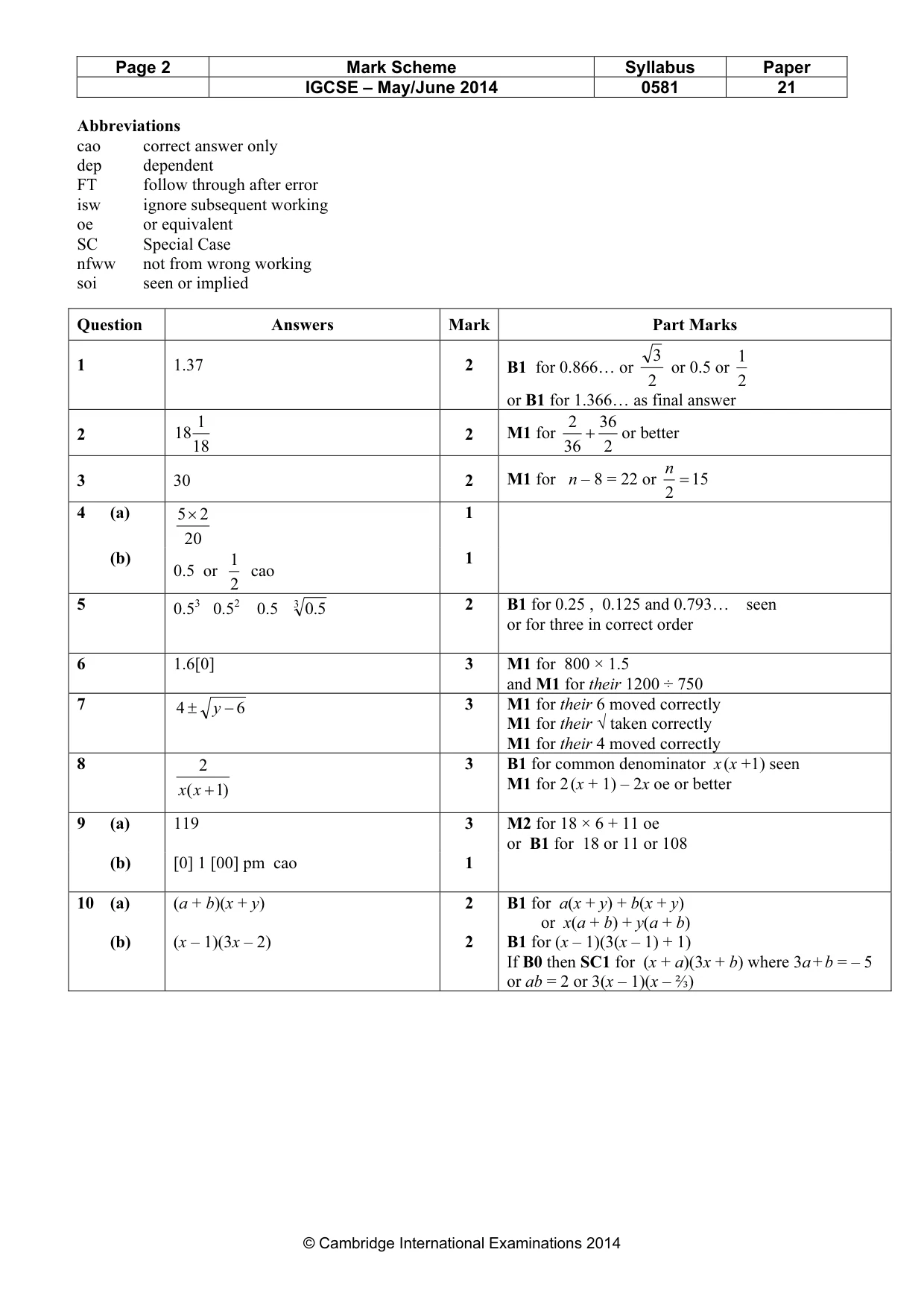
Page 2 Mark Scheme Syllabus Paper IGCSE – May/June 2014 0581 21 © Cambridge International Examinations 2014 Abbreviations cao correct answer only dep dependent FT follow through after error isw ignore subsequent working oe or equivalent SC Special Case nfww not from wrong working soi seen or implied Question Answers Mark Part Marks 1 1.37 2 B1 for 0.866… or 2 3 or 0.5 or 2 1 or B1 for 1.366… as final answer 2 18 1 18 2 M1 for 2 36 36 2 + or better 3 30 2 M1 for n – 8 = 22 or 15 2 = n 4 (a) 20 2 5× 1 (b) 0.5 or 2 1 cao 1 5 0.53 0.52 0.5 3 5.0 2 B1 for 0.25 , 0.125 and 0.793… seen or for three in correct order 6 1.6[0] 3 M1 for 800 × 1.5 and M1 for their 1200 ÷ 750 7 6 4 − ± y 3 M1 for their 6 moved correctly M1 for their √ taken correctly M1 for their 4 moved correctly 8 )1 ( 2 + x x 3 B1 for common denominator x (x +1) seen M1 for 2 (x + 1) – 2x oe or better 9 (a) 119 3 M2 for 18 × 6 + 11 oe or B1 for 18 or 11 or 108 (b) [0] 1 [00] pm cao 1 10 (a) (a + b)(x + y) 2 B1 for a(x + y) + b(x + y) or x(a + b) + y(a + b) (b) (x – 1)(3x – 2) 2 B1 for (x – 1)(3(x – 1) + 1) If B0 then SC1 for (x + a)(3x + b) where 3a + b = – 5 or ab = 2 or 3(x – 1)(x – ⅔)
Mark scheme, page 3
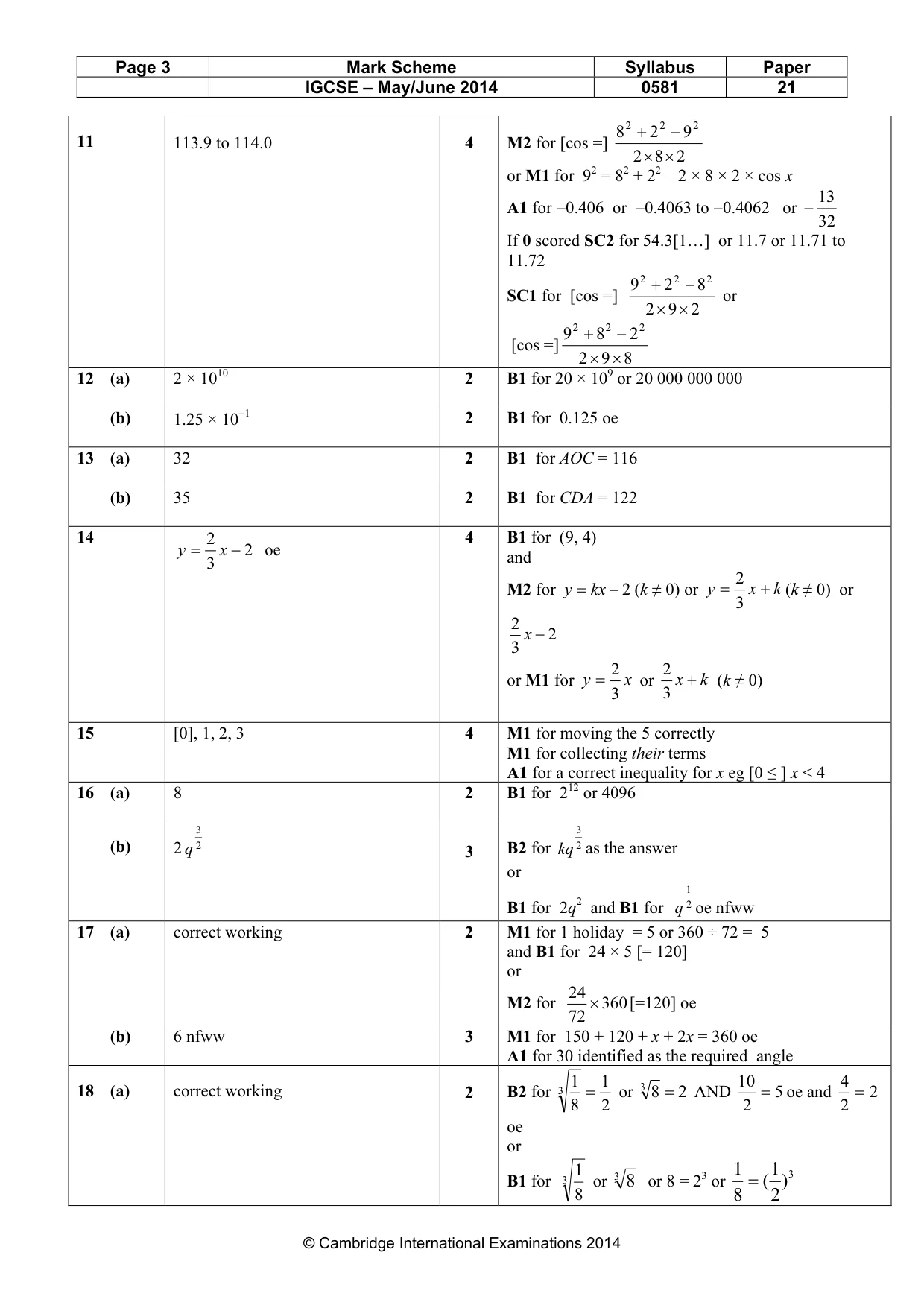
Page 3 Mark Scheme Syllabus Paper IGCSE – May/June 2014 0581 21 © Cambridge International Examinations 2014 11 113.9 to 114.0 4 M2 for [cos =] 2 8 2 9 2 8 2 2 2 × × − + or M1 for 92 = 82 + 22 – 2 × 8 × 2 × cos x A1 for −0.406 or −0.4063 to −0.4062 or 32 13 − If 0 scored SC2 for 54.3[1…] or 11.7 or 11.71 to 11.72 SC1 for [cos =] 2 9 2 8 2 9 2 2 2 × × − + or [cos =] 8 9 2 2 8 9 2 2 2 × × − + 12 (a) 2 × 10¹⁰ 2 B1 for 20 × 109 or 20 000 000 000 (b) 1.25 × 10⁻¹ 2 B1 for 0.125 oe 13 (a) 32 2 B1 for AOC = 116 (b) 35 2 B1 for CDA = 122 14 2 3 2 − = x y oe 4 B1 for (9, 4) and M2 for 2 − = kx y (k ≠ 0) or k x y + = 3 2 (k ≠ 0) or 2 3 2 − x or M1 for x y 3 2 = or k x + 3 2 (k ≠ 0) 15 [0], 1, 2, 3 4 M1 for moving the 5 correctly M1 for collecting their terms A1 for a correct inequality for x eg [0 ≤ ] x < 4 16 (a) 8 2 B1 for 212 or 4096 (b) 2 2 3 q 3 B2 for 2 3 kq as the answer or B1 for 2q2 and B1 for 2 1 q oe nfww 17 (a) correct working 2 M1 for 1 holiday = 5 or 360 ÷ 72 = 5 and B1 for 24 × 5 [= 120] or M2 for 360 72 24 × [=120] oe (b) 6 nfww 3 M1 for 150 + 120 + x + 2x = 360 oe A1 for 30 identified as the required angle 18 (a) correct working 2 B2 for 2 1 8 1 3 = or 2 8 3 = AND 5 2 10 = oe and 2 2 4 = oe or B1 for 3 8 1 or 3 8 or 8 = 23 or 3) 2 1 ( 8 1 =
Mark scheme, page 4
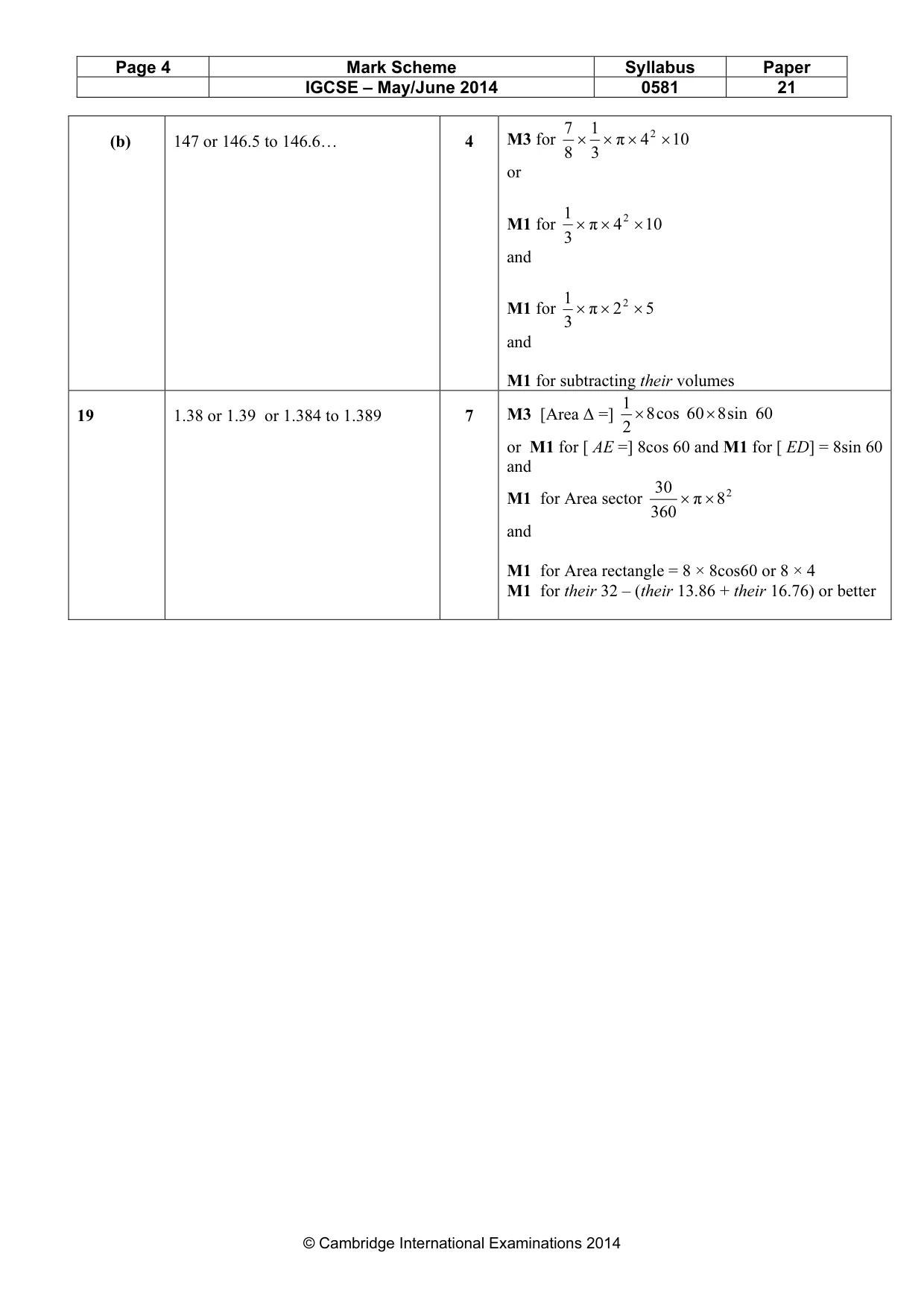
Page 4 Mark Scheme Syllabus Paper IGCSE – May/June 2014 0581 21 © Cambridge International Examinations 2014 (b) 147 or 146.5 to 146.6… 4 M3 for 10 4 π 3 1 8 7 2 × × × × or M1 for 10 4 π 3 1 2 × × × and M1 for 5 2 π 3 1 2 × × × and M1 for subtracting their volumes 19 1.38 or 1.39 or 1.384 to 1.389 7 M3 [Area ∆ =] 60 sin 8 60 cos 8 2 1 × × or M1 for [ AE =] 8cos 60 and M1 for [ ED] = 8sin 60 and M1 for Area sector 2 8 π 360 30 × × and M1 for Area rectangle = 8 × 8cos60 or 8 × 4 M1 for their 32 – (their 13.86 + their 16.76) or better
What you needed in this session
Cambridge’s own grade thresholds for 2014 May/June, Paper 2 · Variant 1. A higher threshold means an easier paper — the bar moves with how the cohort did.