Cambridge IGCSE Mathematics (with coursework) 0581 — 2009 May/June Paper 2 · Variant 1
0581/21/M/J/09
The question paper and its mark scheme, free to read here and free to download. This is Cambridge’s own paper, exactly as it was sat.
Question paper25 pages
Mark scheme9 pages
Answers below. Sit the paper first if you are practising.
Paper as text
Question paper, page 1
Location Entry Codes As part of CIE’s continual commitment to maintaining best practice in assessment, CIE uses different variants of some question papers for our most popular assessments with large and widespread candidature. The question papers are closely related and the relationships between them have been thoroughly established using our assessment expertise. All versions of the paper give assessment of equal standard. The content assessed by the examination papers and the type of questions is unchanged. This change means that for this component there are now two variant Question Papers, Mark Schemes and Principal Examiner’s Reports where previously there was only one. For any individual country, it is intended that only one variant is used. This document contains both variants which will give all Centres access to even more past examination material than is usually the case. The diagram shows the relationship between the Question Papers, Mark Schemes and Principal Examiners’ Reports that are available. Question Paper Mark Scheme Principal Examiner’s Report Introduction Introduction Introduction First variant Question Paper First variant Mark Scheme First variant Principal Examiner’s Report Second variant Question Paper Second variant Mark Scheme Second variant Principal Examiner’s Report Who can I contact for further information on these changes? Please direct any questions about this to CIE’s Customer Services team at: international@cie.org.uk The titles for the variant items should correspond with the table above, so that at the top of the first page of the relevant part of the document and on the header, it has the words: • First variant Question Paper / Mark Scheme / Principal Examiner’s Report or • Second variant Question Paper / Mark Scheme / Principal Examiner’s Report as appropriate. www.XtremePapers.com
Question paper, page 2
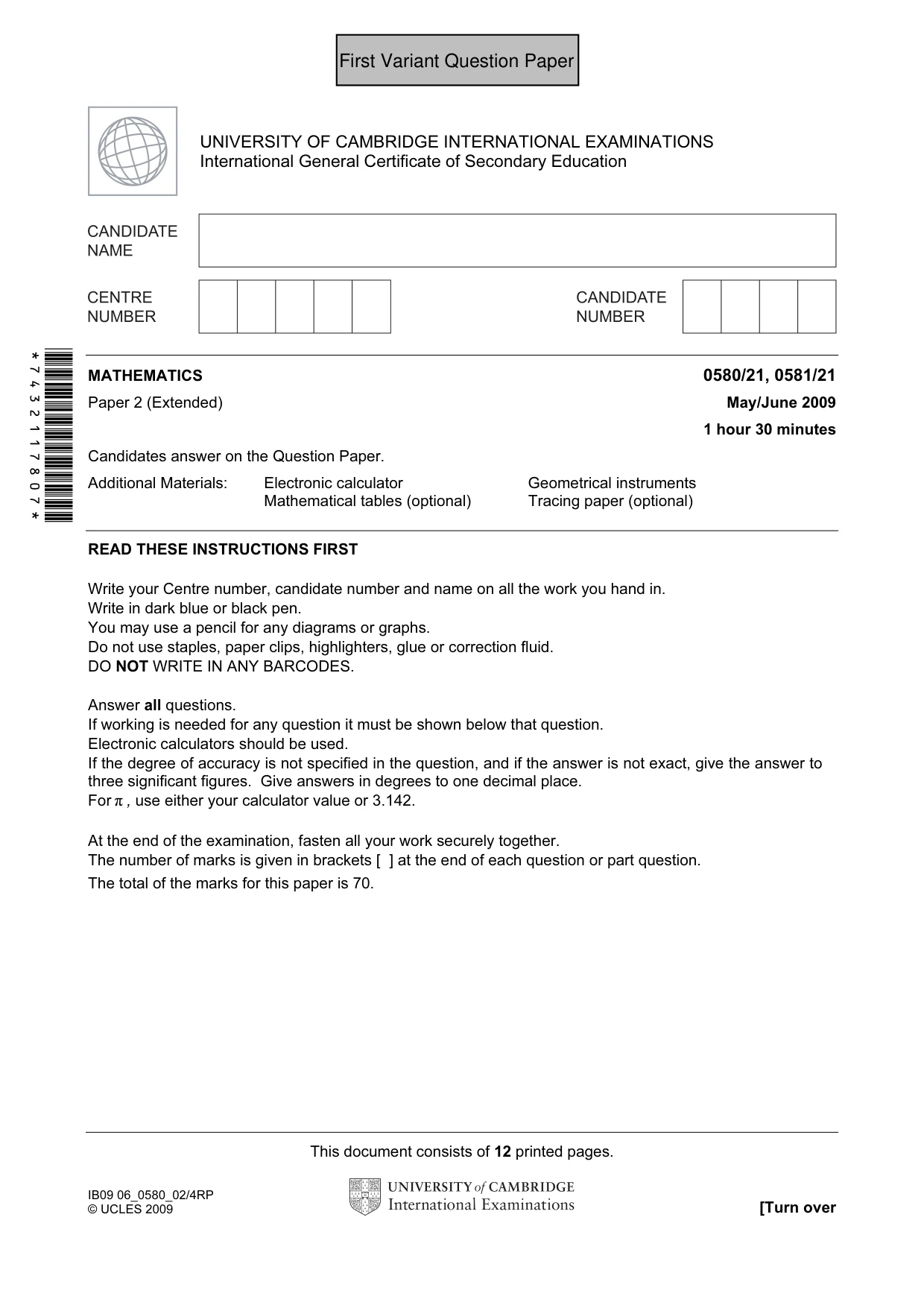
This document consists of 12 printed pages. IB09 06_0580_02/4RP © UCLES 2009 [Turn over *7432117807* UNIVERSITY OF CAMBRIDGE INTERNATIONAL EXAMINATIONS International General Certificate of Secondary Education MATHEMATICS 0580/21, 0581/21 Paper 2 (Extended) May/June 2009 1 hour 30 minutes Candidates answer on the Question Paper. Additional Materials: Electronic calculator Geometrical instruments Mathematical tables (optional) Tracing paper (optional) READ THESE INSTRUCTIONS FIRST Write your Centre number, candidate number and name on all the work you hand in. Write in dark blue or black pen. You may use a pencil for any diagrams or graphs. Do not use staples, paper clips, highlighters, glue or correction fluid. DO NOT WRITE IN ANY BARCODES. Answer all questions. If working is needed for any question it must be shown below that question. Electronic calculators should be used. If the degree of accuracy is not specified in the question, and if the answer is not exact, give the answer to three significant figures. Give answers in degrees to one decimal place. For π , use either your calculator value or 3.142. At the end of the examination, fasten all your work securely together. The number of marks is given in brackets [ ] at the end of each question or part question. The total of the marks for this paper is 70. First Variant Question Paper
Question paper, page 3
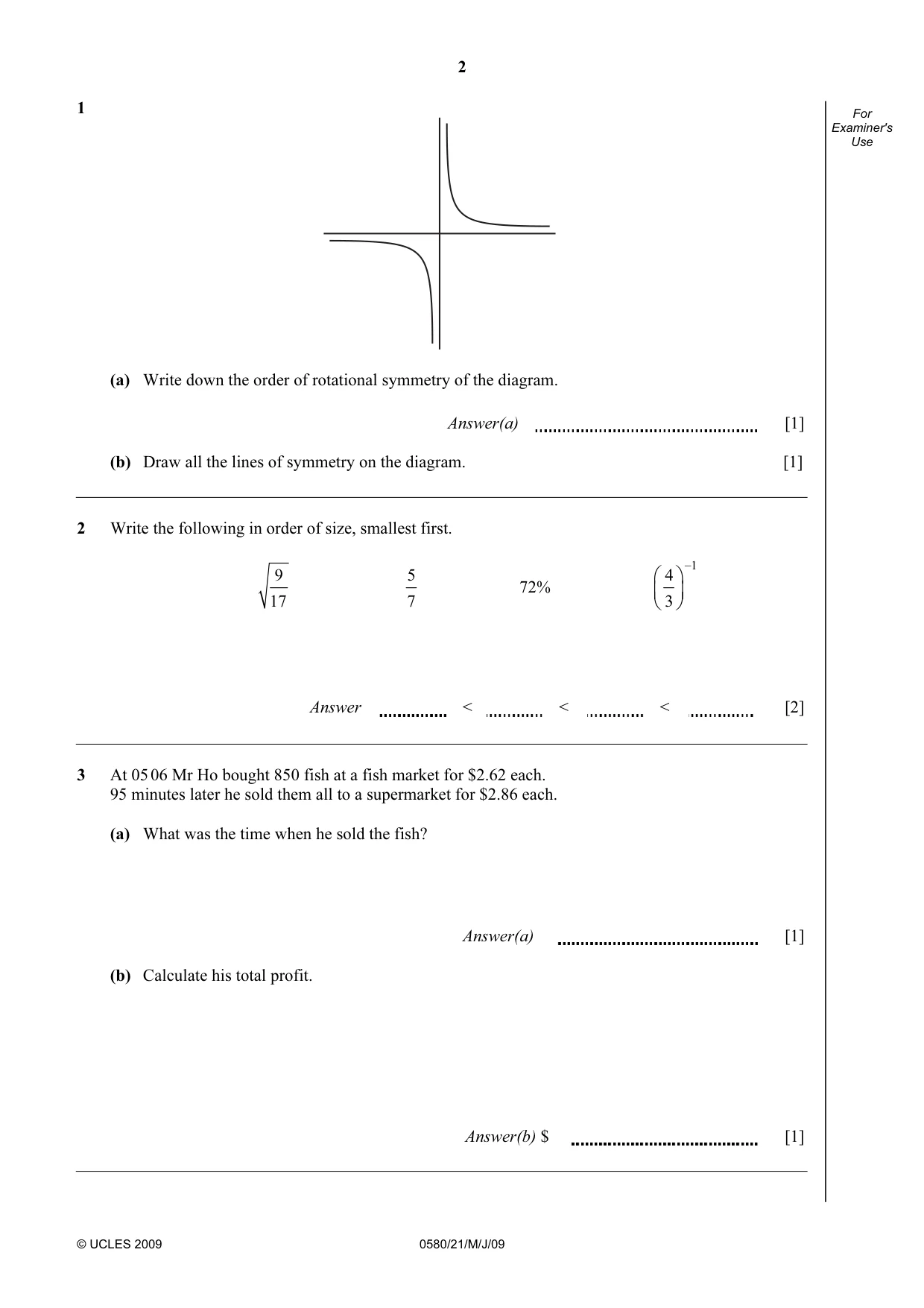
2 © UCLES 2009 0580/21/M/J/09 For Examiner's Use 1 (a) Write down the order of rotational symmetry of the diagram. Answer(a) [1] (b) Draw all the lines of symmetry on the diagram. [1] 2 Write the following in order of size, smallest first. 9 17 5 7 72% _1 4 3 Answer < < < [2] 3 At 05 06 Mr Ho bought 850 fish at a fish market for $2.62 each. 95 minutes later he sold them all to a supermarket for $2.86 each. (a) What was the time when he sold the fish? Answer(a) [1] (b) Calculate his total profit. Answer(b) $ [1]
Question paper, page 4
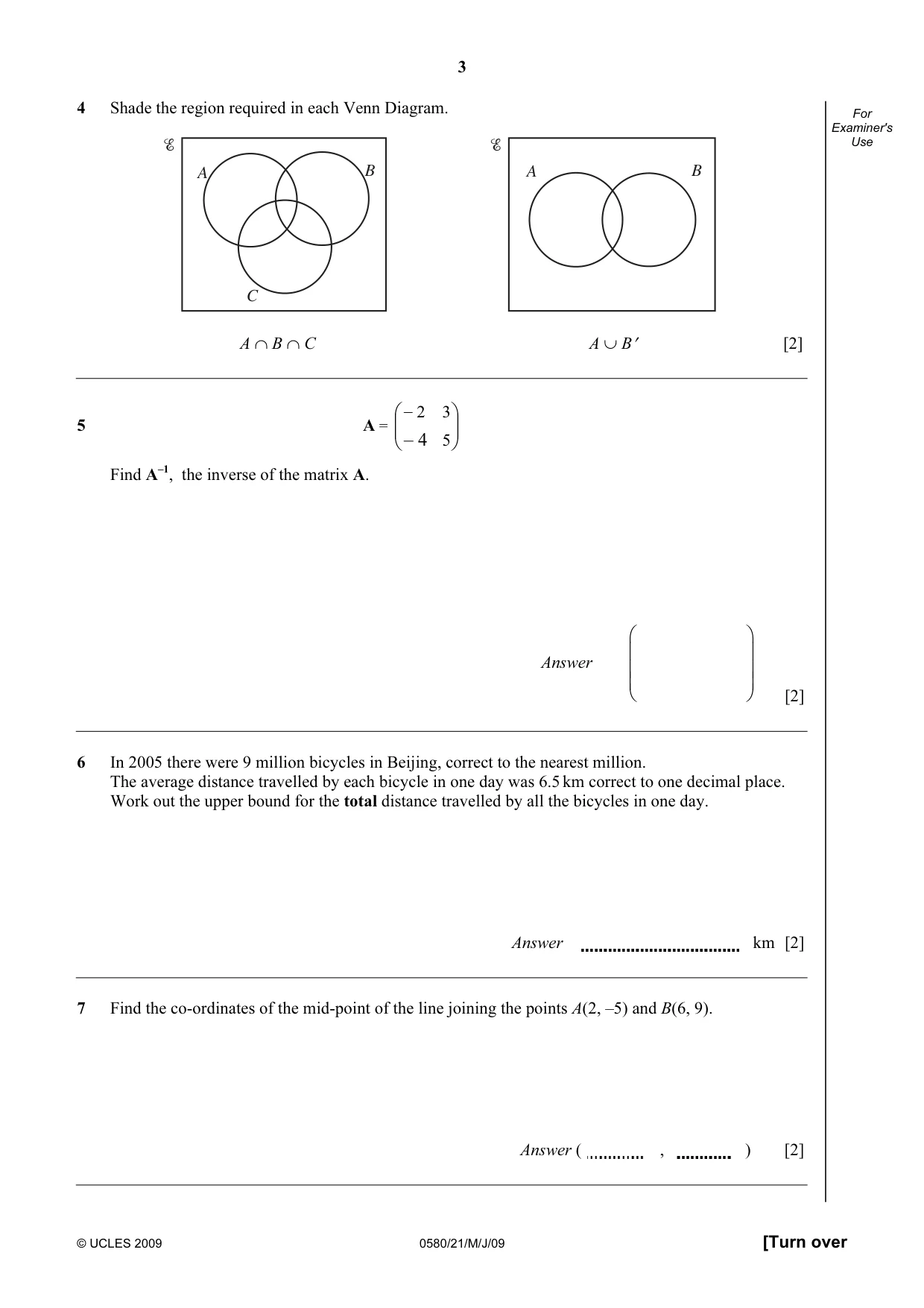
3 © UCLES 2009 0580/21/M/J/09 [Turn over For Examiner's Use 4 Shade the region required in each Venn Diagram. A C B A B A ∩ B ∩ C A ∪ B′ [2] 5 A = 5 3 2 _ 4 _ Find A–1, the inverse of the matrix A. Answer [2] 6 In 2005 there were 9 million bicycles in Beijing, correct to the nearest million. The average distance travelled by each bicycle in one day was 6.5 km correct to one decimal place. Work out the upper bound for the total distance travelled by all the bicycles in one day. Answer km [2] 7 Find the co-ordinates of the mid-point of the line joining the points A(2, –5) and B(6, 9). Answer ( , ) [2]
Question paper, page 5
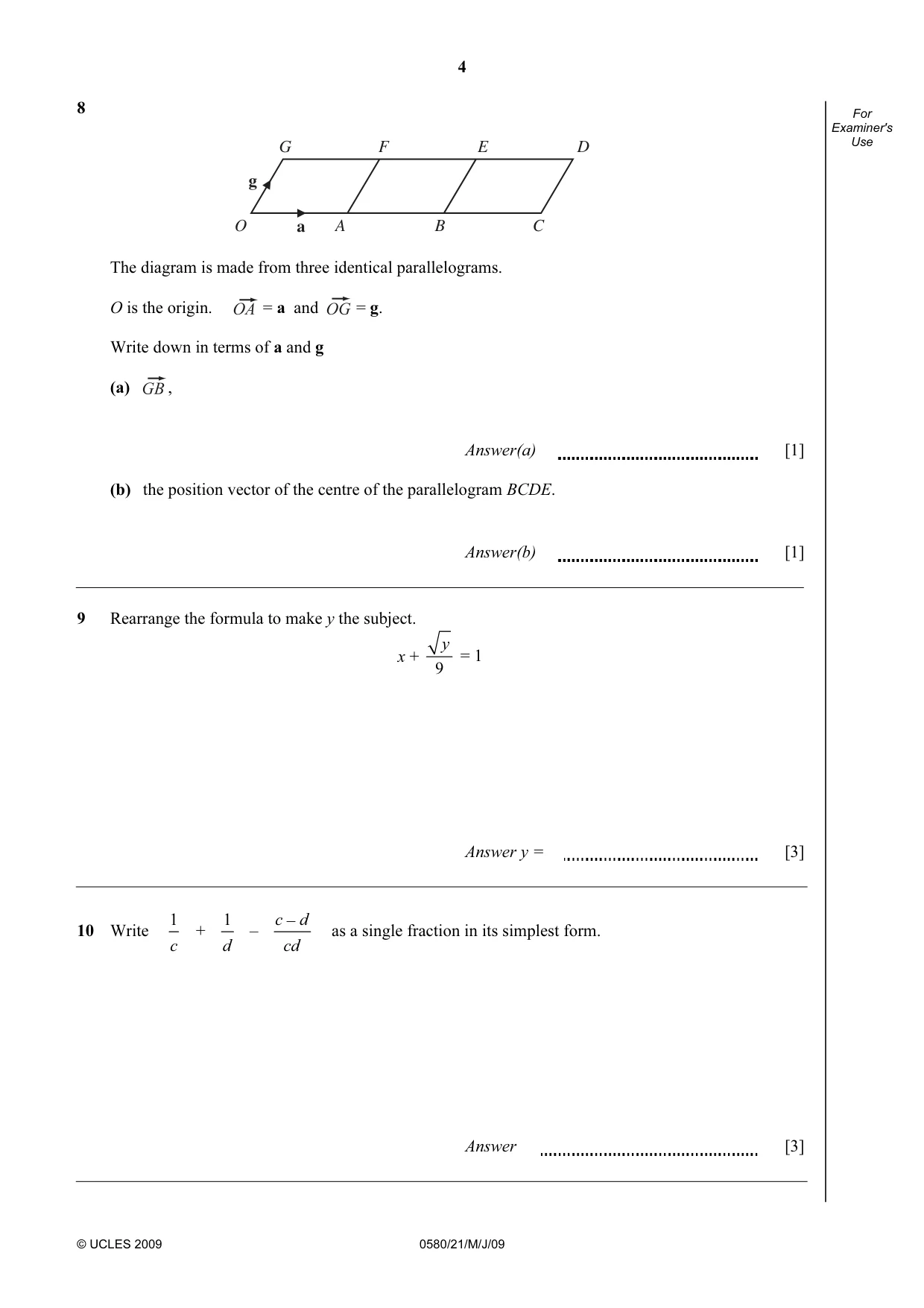
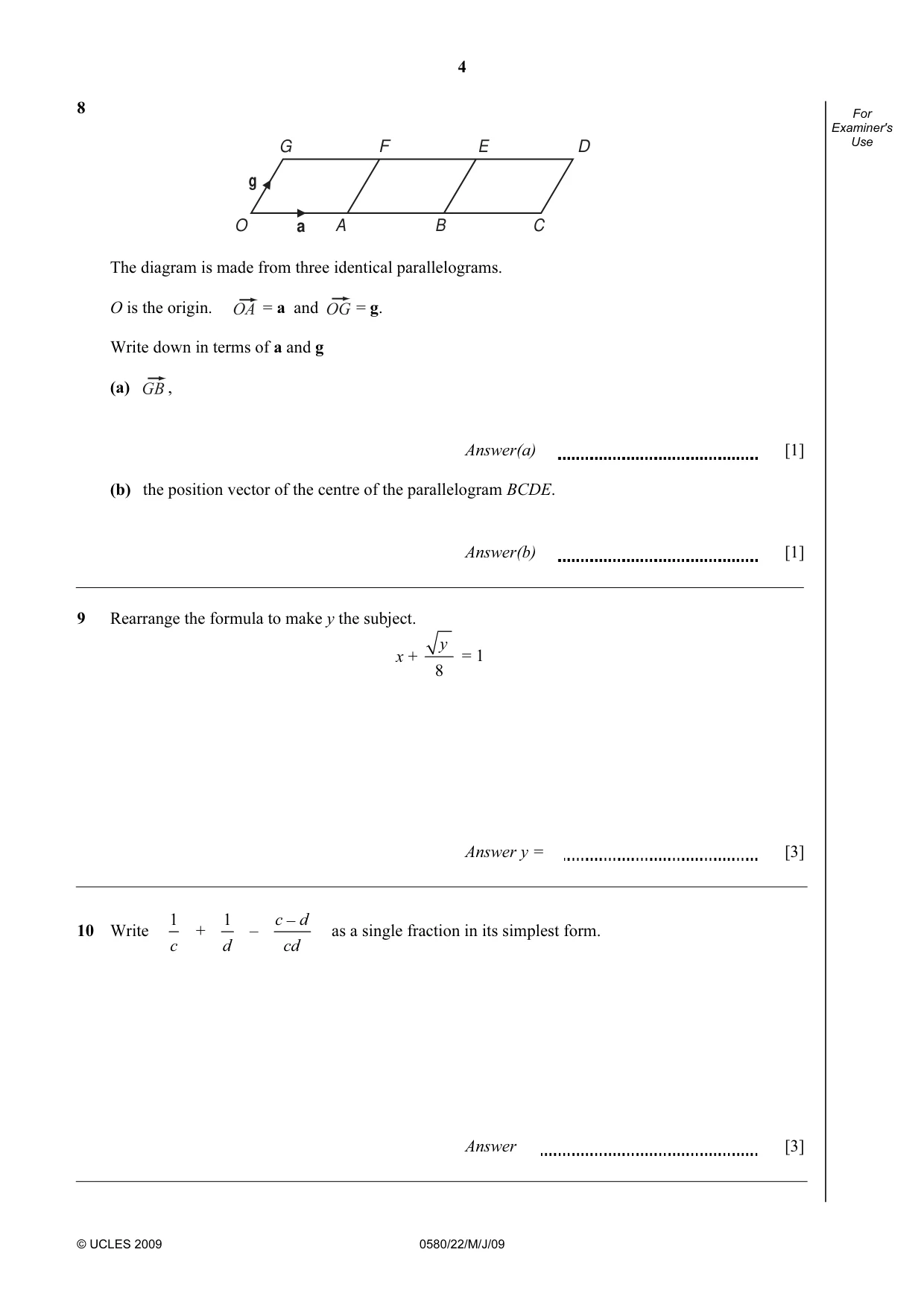
4 © UCLES 2009 0580/21/M/J/09 For Examiner's Use 8 O G A F B E C D a g The diagram is made from three identical parallelograms. O is the origin. = a and = g. Write down in terms of a and g (a) , Answer(a) [1] (b) the position vector of the centre of the parallelogram BCDE. Answer(b) [1] 9 Rearrange the formula to make y the subject. x + 9 y = 1 Answer y = [3] 10 Write 1 c + 1 d – _ c d cd as a single fraction in its simplest form. Answer [3]
Question paper, page 6
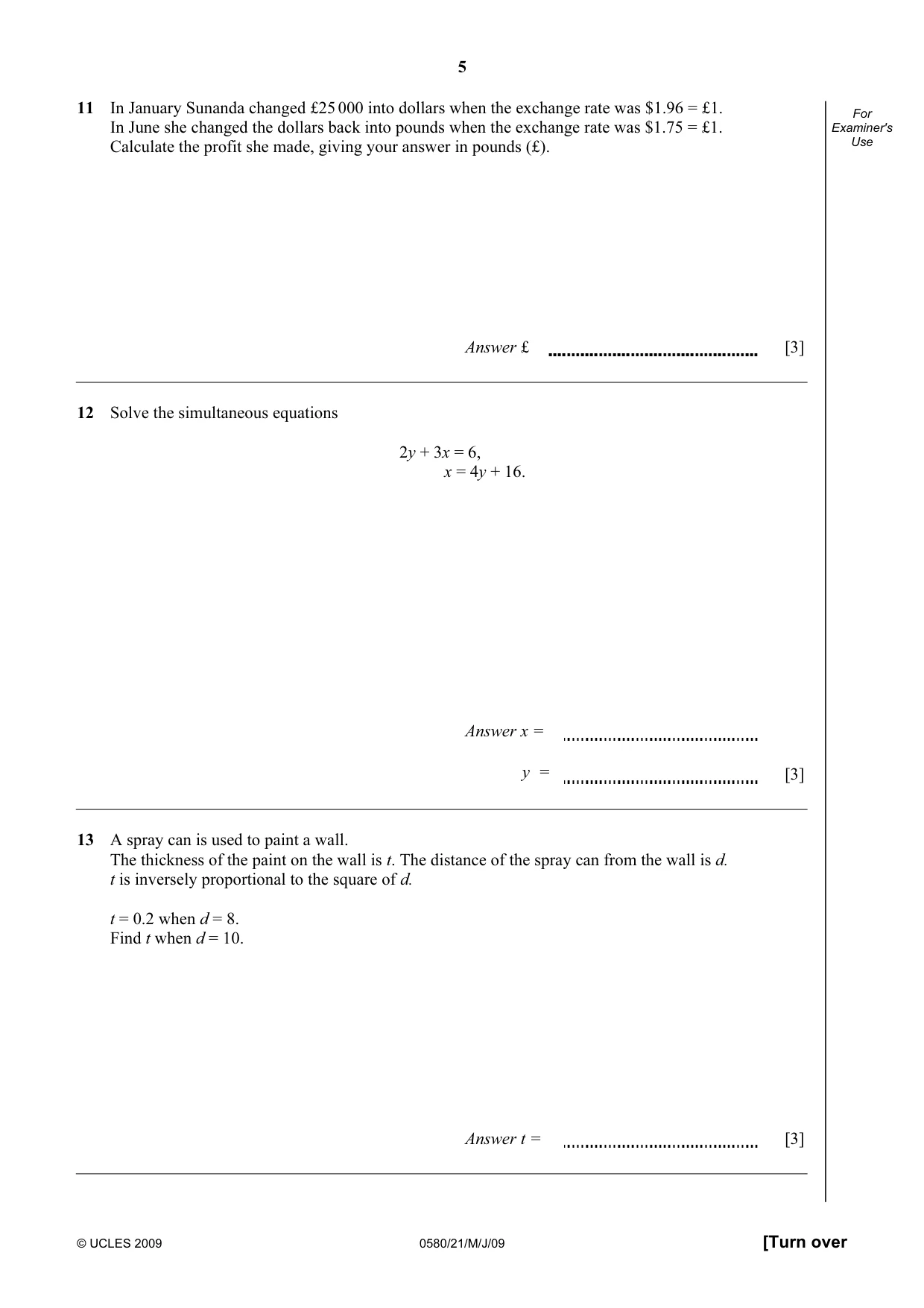
5 © UCLES 2009 0580/21/M/J/09 [Turn over For Examiner's Use 11 In January Sunanda changed £25 000 into dollars when the exchange rate was $1.96 = £1. In June she changed the dollars back into pounds when the exchange rate was $1.75 = £1. Calculate the profit she made, giving your answer in pounds (£). Answer £ [3] 12 Solve the simultaneous equations 2y + 3x = 6, x = 4y + 16. Answer x = y = [3] 13 A spray can is used to paint a wall. The thickness of the paint on the wall is t. The distance of the spray can from the wall is d. t is inversely proportional to the square of d. t = 0.2 when d = 8. Find t when d = 10. Answer t = [3]
Question paper, page 7
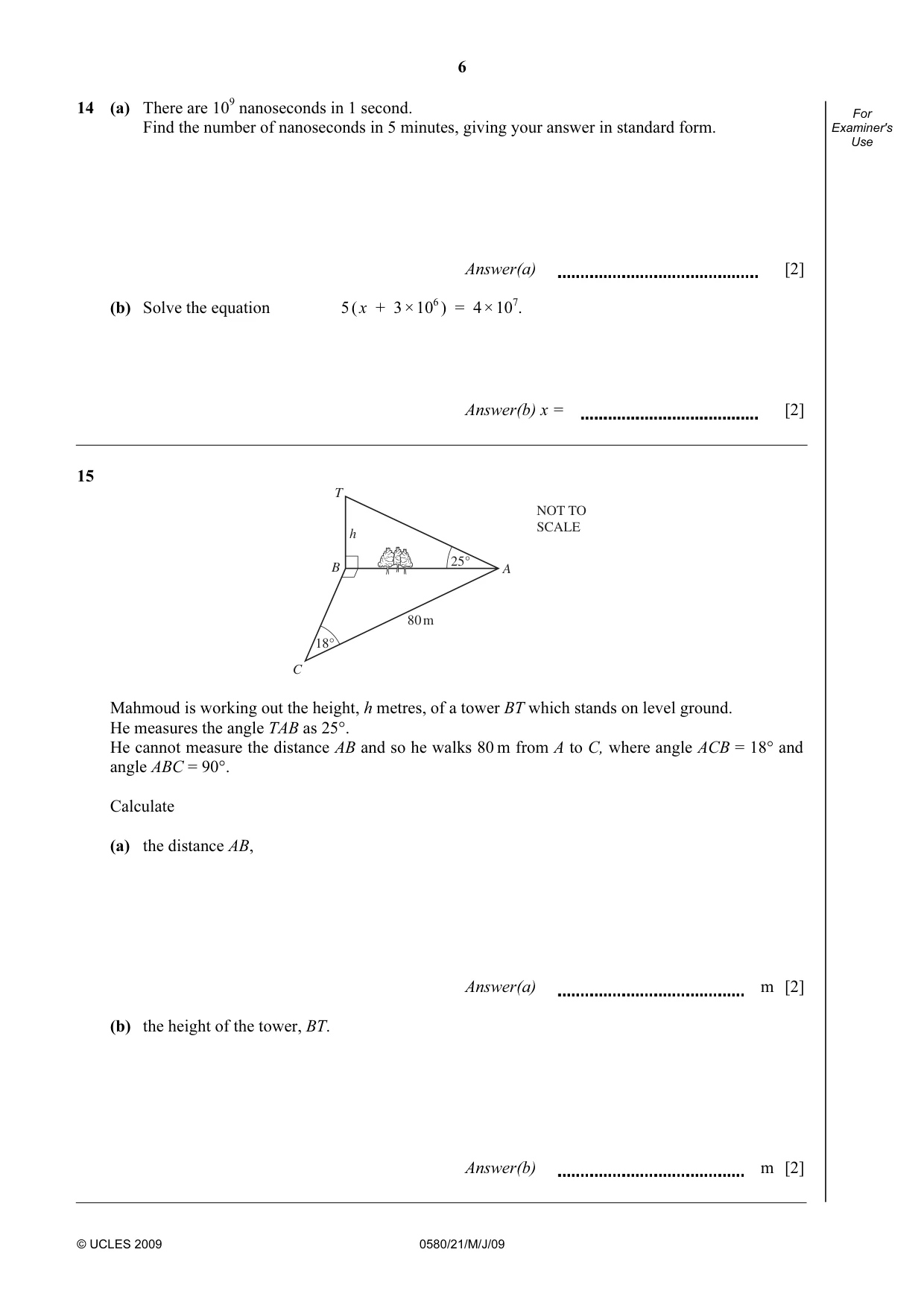
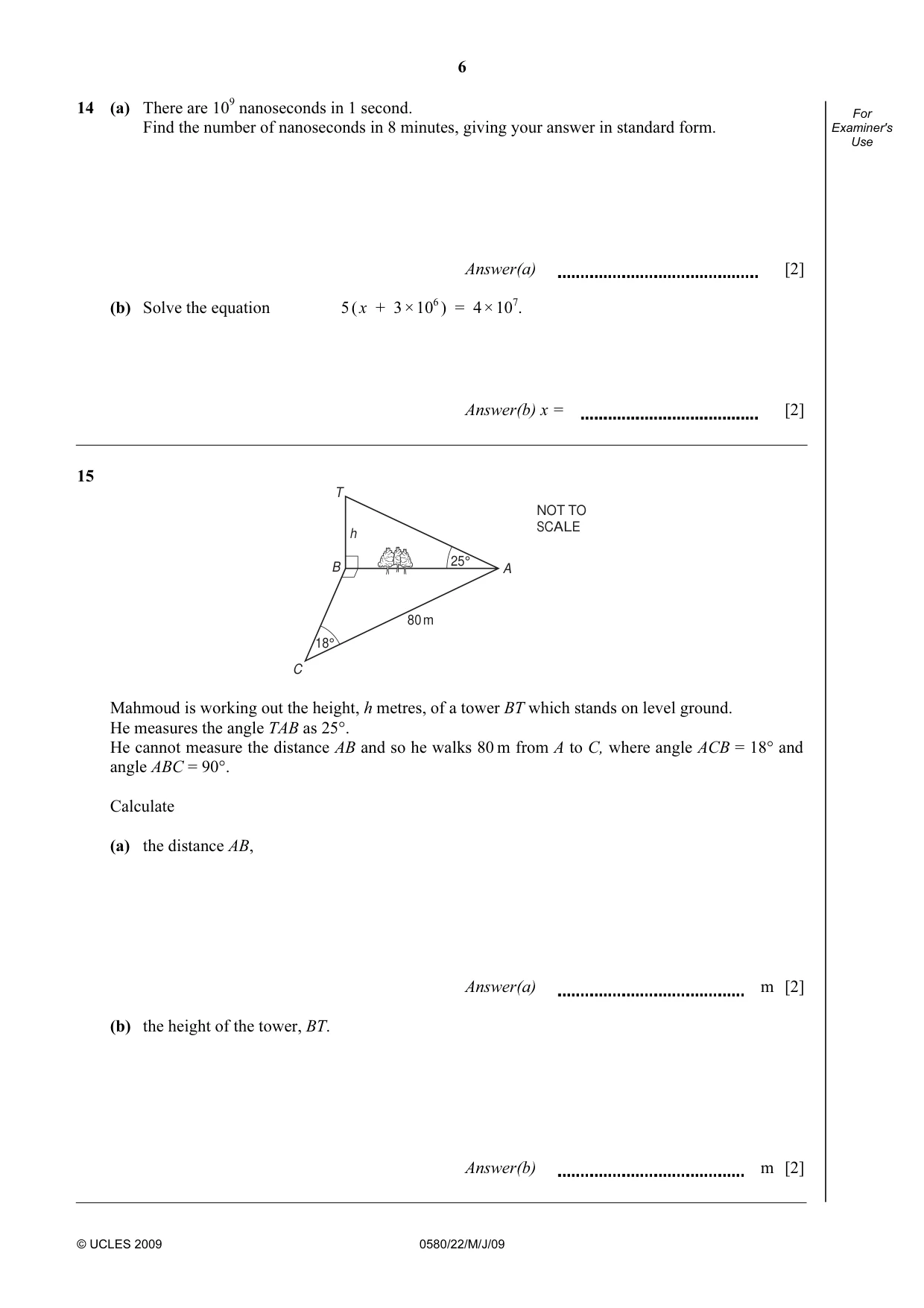
6 © UCLES 2009 0580/21/M/J/09 For Examiner's Use 14 (a) There are 109 nanoseconds in 1 second. Find the number of nanoseconds in 5 minutes, giving your answer in standard form. Answer(a) [2] (b) Solve the equation 5 ( x + 3 × 10⁶ ) = 4 × 10⁷. Answer(b) x = [2] 15 18° 25° h T B A C 80 m NOT TO SCALE Mahmoud is working out the height, h metres, of a tower BT which stands on level ground. He measures the angle TAB as 25°. He cannot measure the distance AB and so he walks 80 m from A to C, where angle ACB = 18° and angle ABC = 90°. Calculate (a) the distance AB, Answer(a) m [2] (b) the height of the tower, BT. Answer(b) m [2]
Question paper, page 8
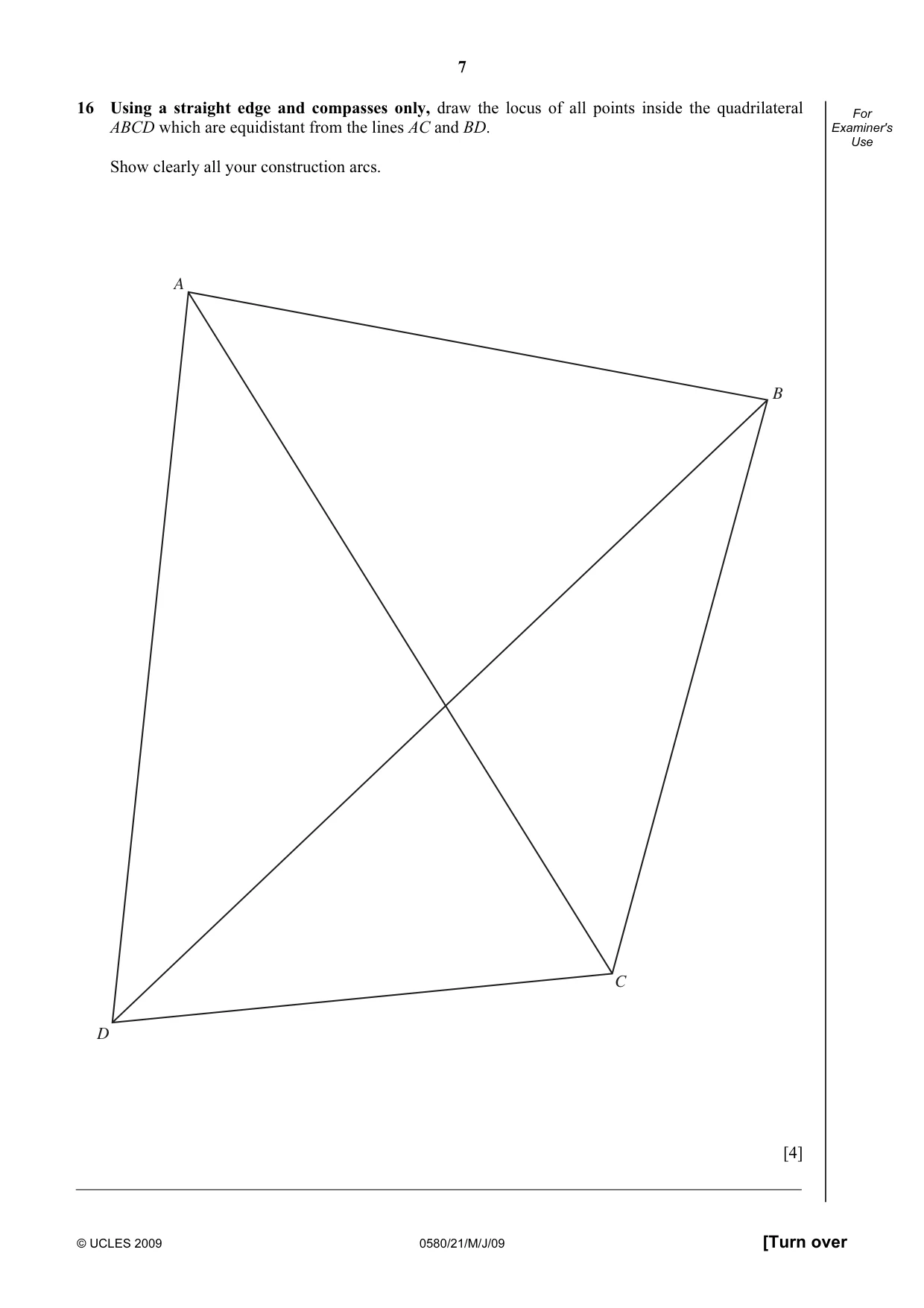
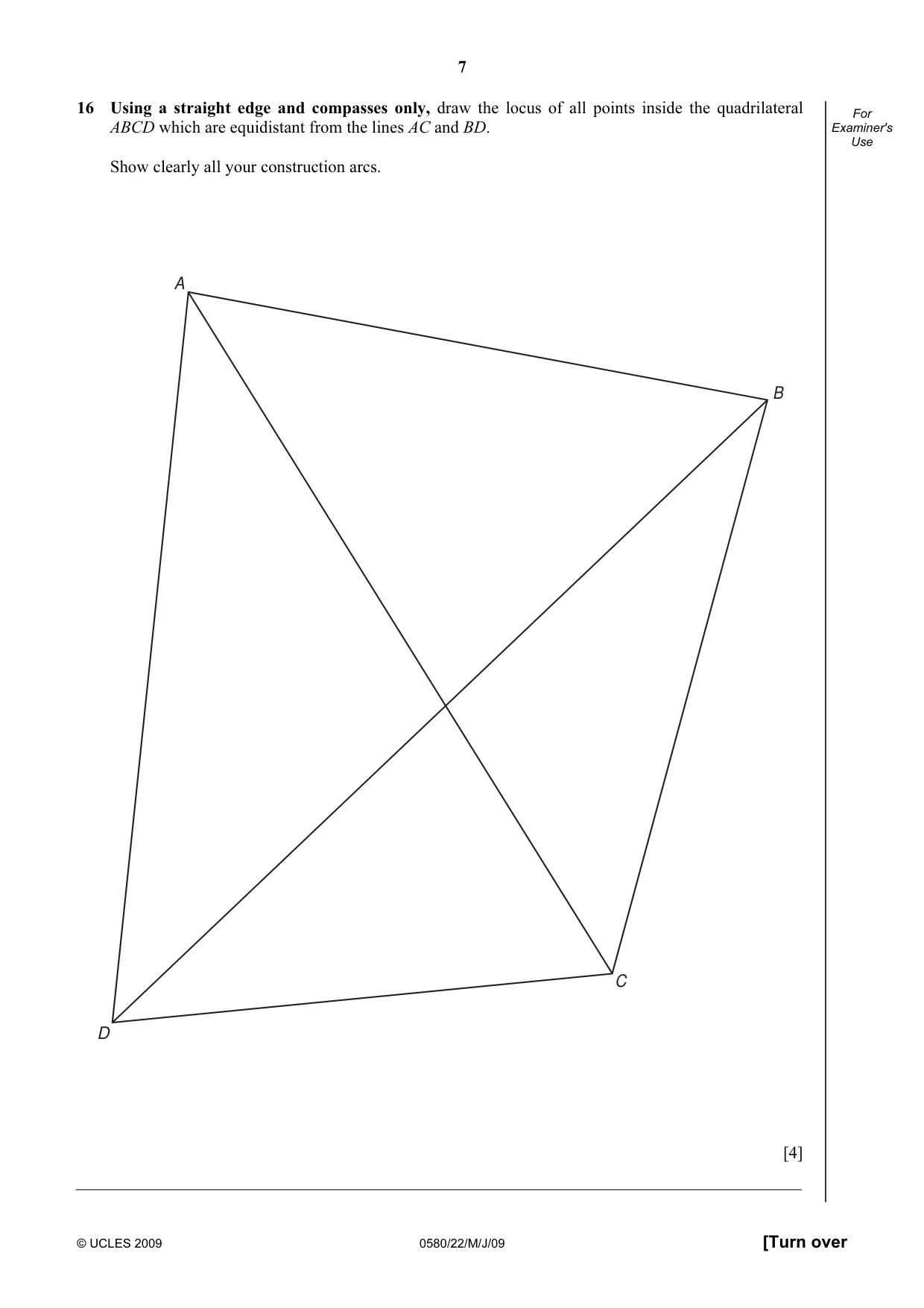
7 © UCLES 2009 0580/21/M/J/09 [Turn over For Examiner's Use 16 Using a straight edge and compasses only, draw the locus of all points inside the quadrilateral ABCD which are equidistant from the lines AC and BD. Show clearly all your construction arcs. A B D C [4]
Question paper, page 9
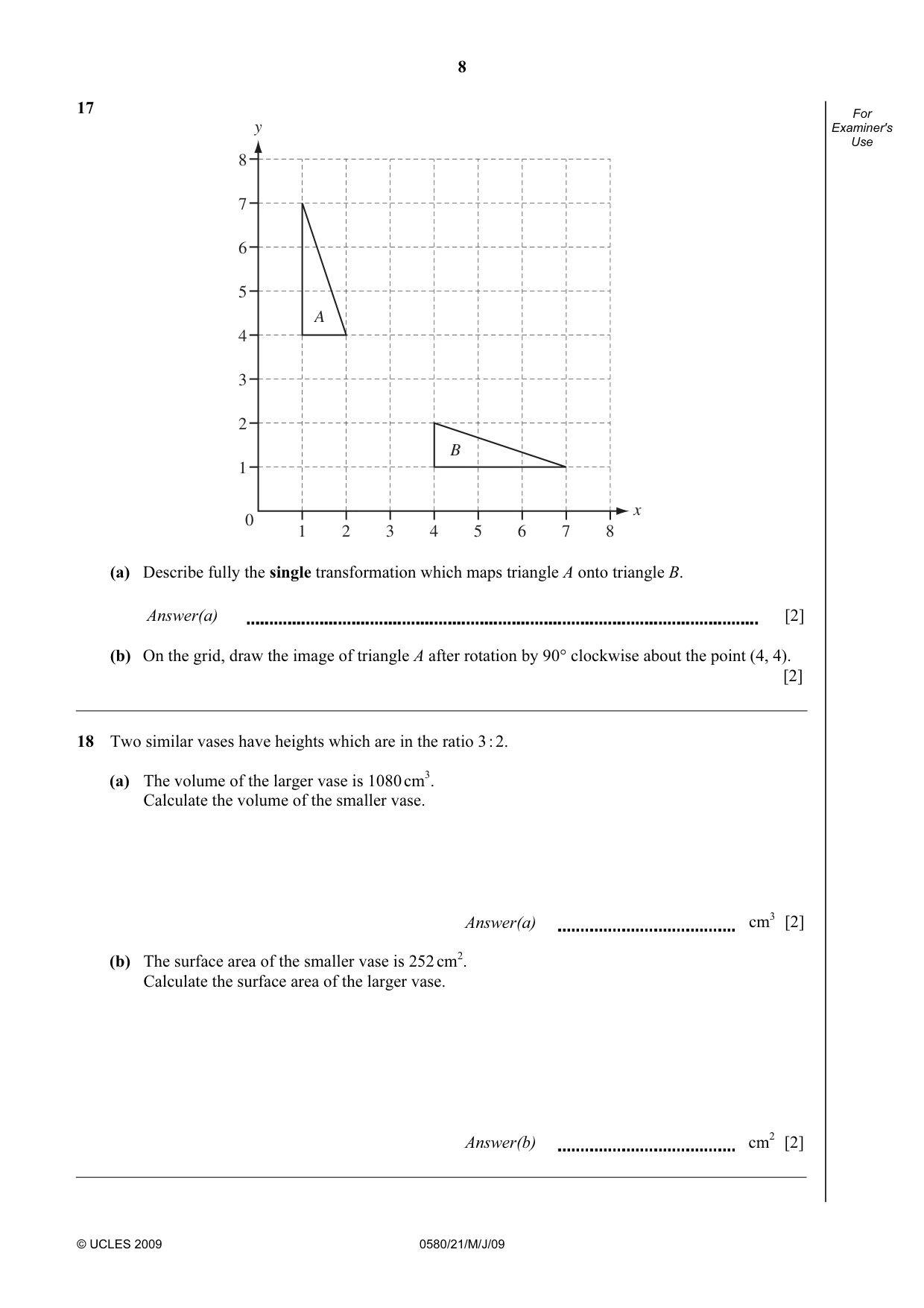
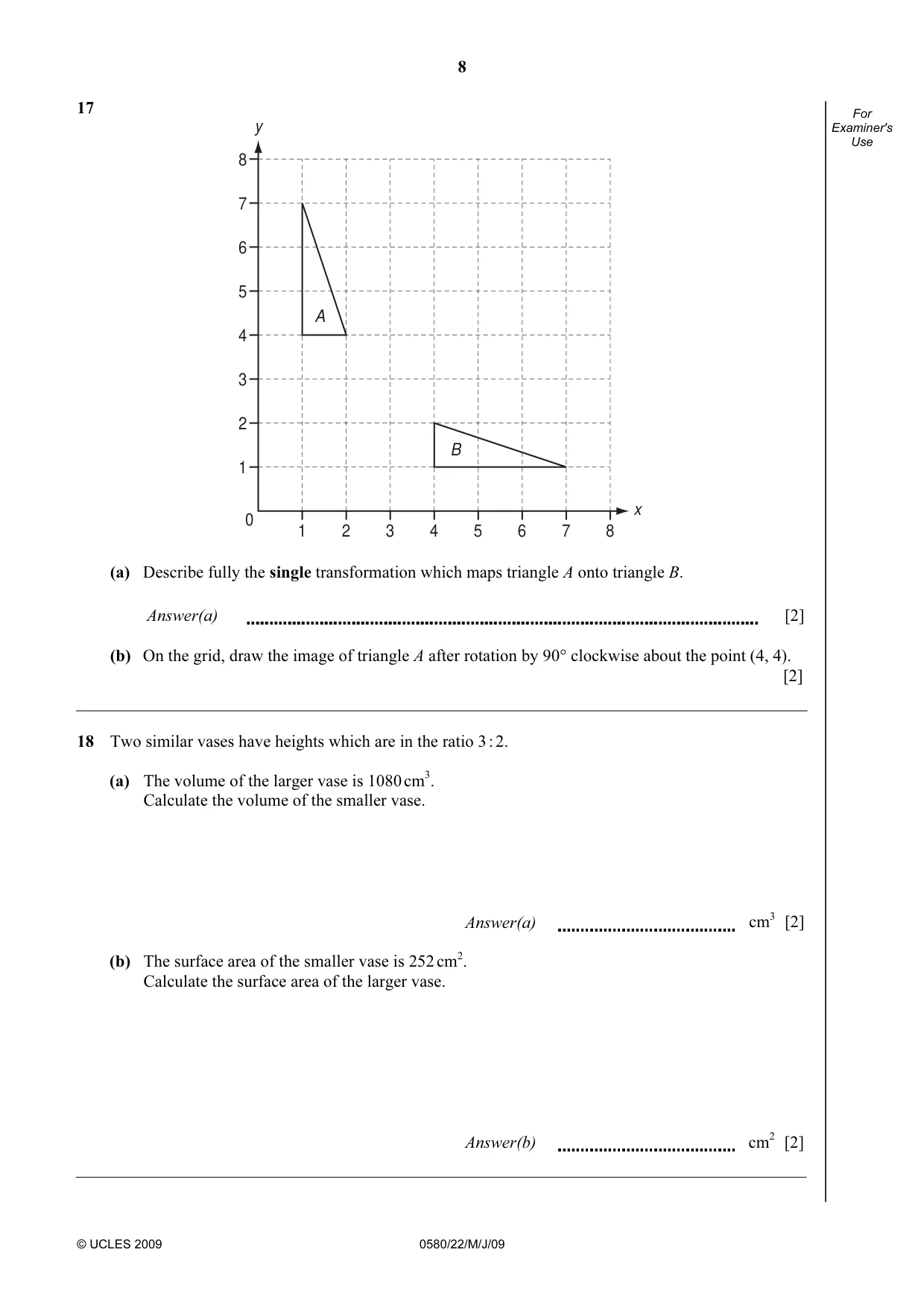
8 © UCLES 2009 0580/21/M/J/09 For Examiner's Use 17 y x 8 7 6 5 4 3 2 1 0 1 2 3 4 5 6 7 8 A B (a) Describe fully the single transformation which maps triangle A onto triangle B. Answer(a) [2] (b) On the grid, draw the image of triangle A after rotation by 90° clockwise about the point (4, 4). [2] 18 Two similar vases have heights which are in the ratio 3 : 2. (a) The volume of the larger vase is 1080 cm3. Calculate the volume of the smaller vase. Answer(a) cm3 [2] (b) The surface area of the smaller vase is 252 cm2. Calculate the surface area of the larger vase. Answer(b) cm2 [2]
Question paper, page 10
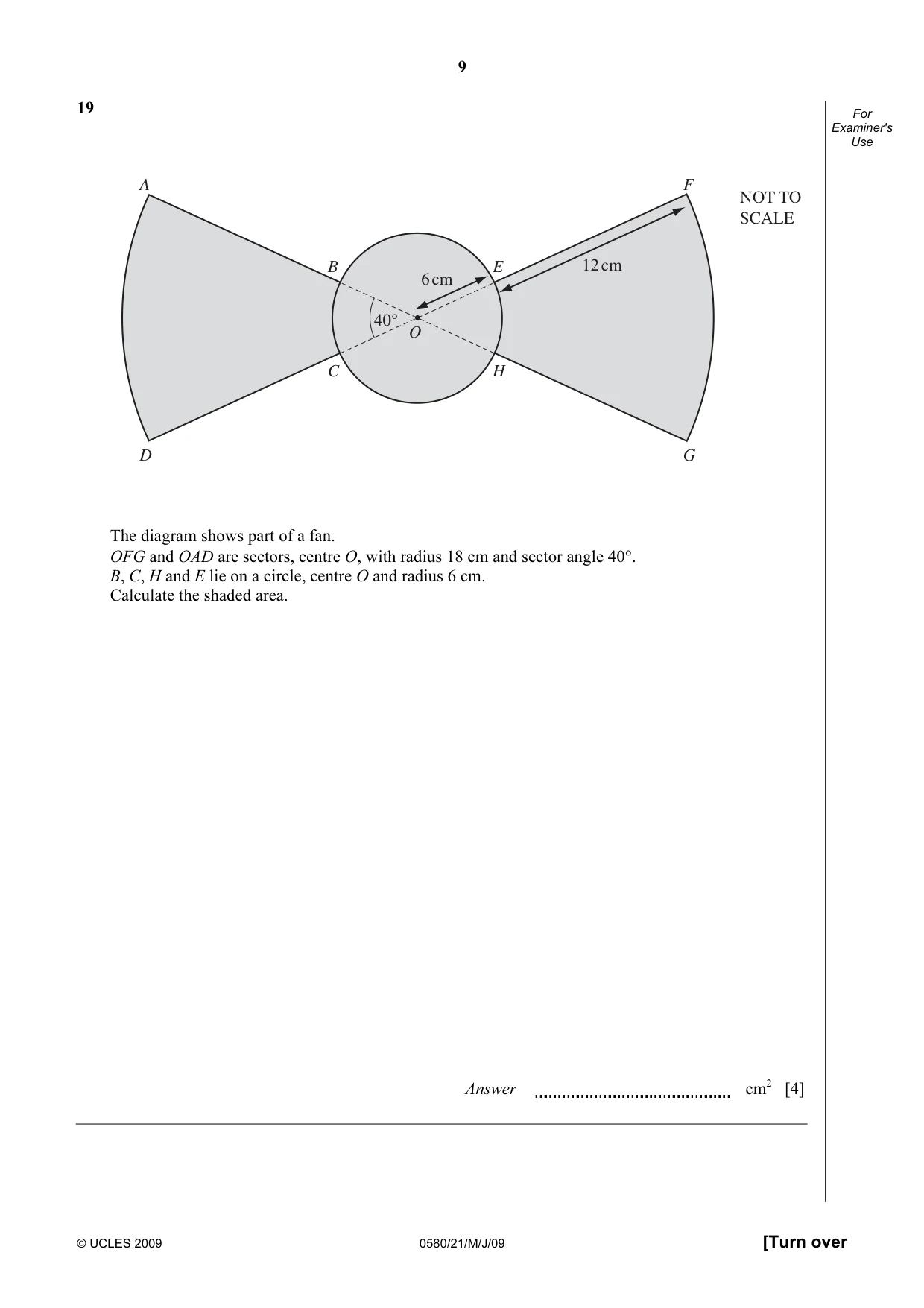
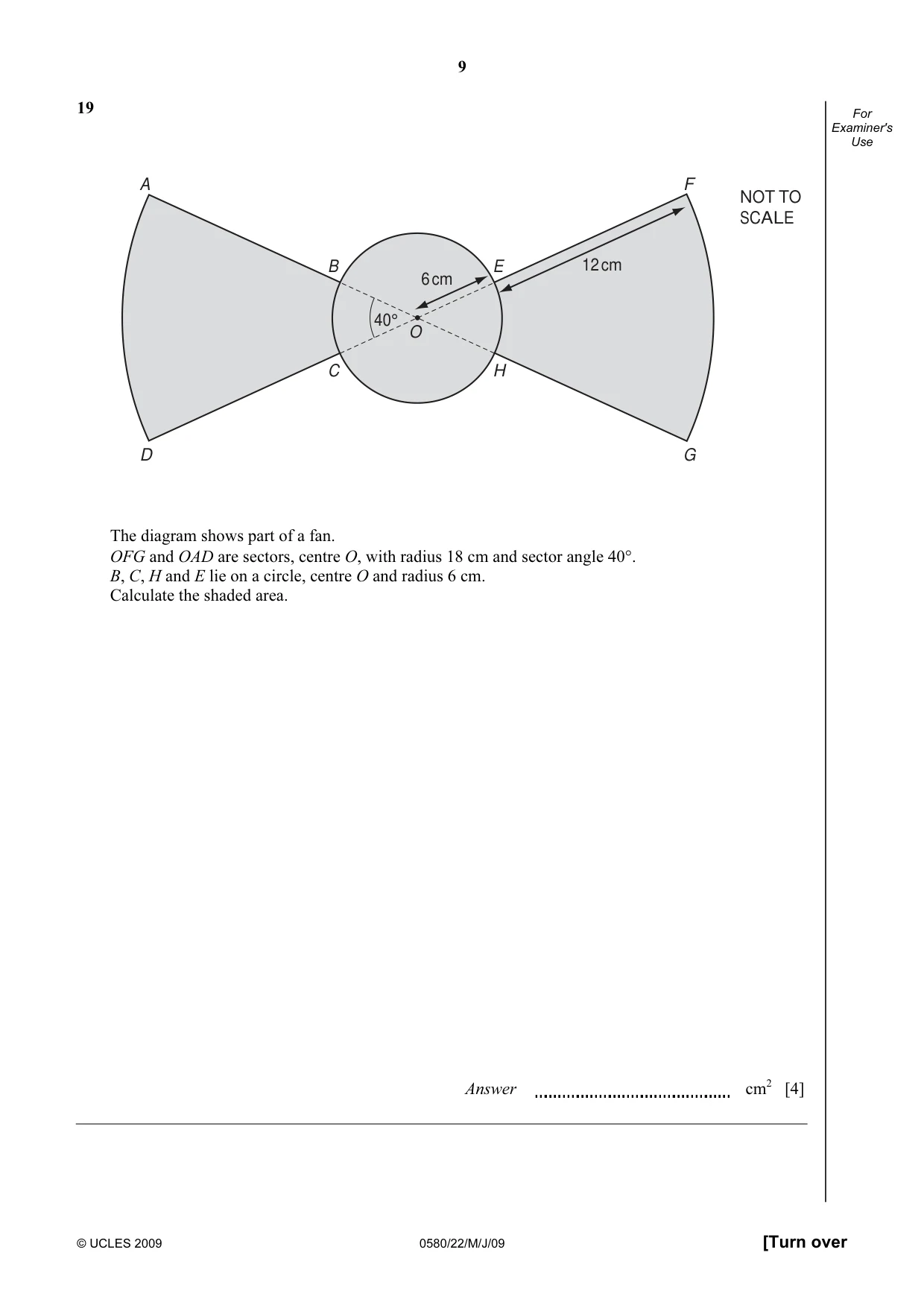
9 © UCLES 2009 0580/21/M/J/09 [Turn over For Examiner's Use 19 A D F G C B H E O 40° 6 cm 12 cm NOT TO SCALE The diagram shows part of a fan. OFG and OAD are sectors, centre O, with radius 18 cm and sector angle 40°. B, C, H and E lie on a circle, centre O and radius 6 cm. Calculate the shaded area. Answer cm2 [4]
Question paper, page 11
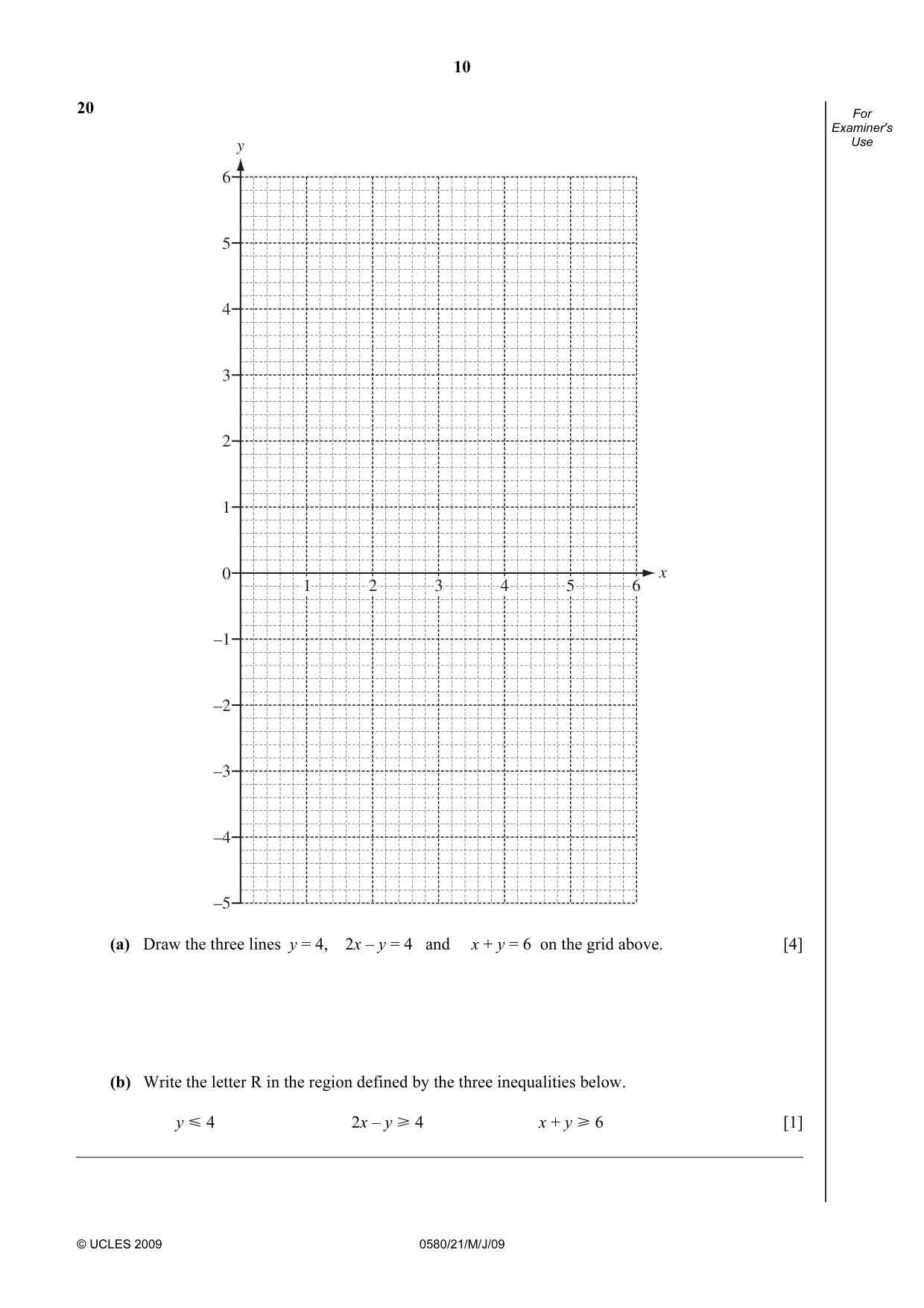
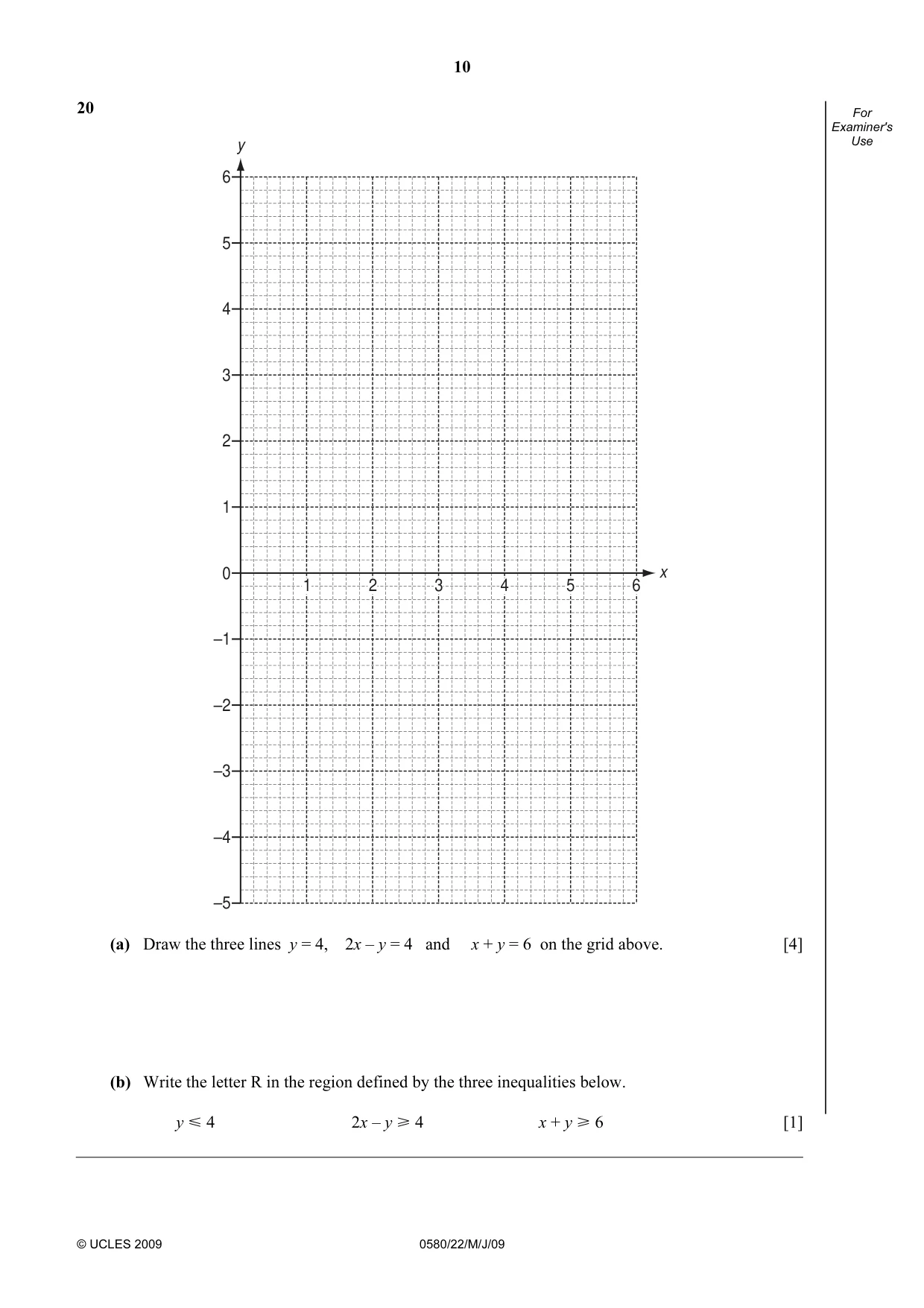
10 © UCLES 2009 0580/21/M/J/09 For Examiner's Use 20 6 5 4 3 2 1 0 –1 –2 –3 –4 –5 y x 1 2 3 4 5 6 (a) Draw the three lines y = 4, 2x – y = 4 and x + y = 6 on the grid above. [4] (b) Write the letter R in the region defined by the three inequalities below. y Y 4 2x – y [ 4 x + y [ 6 [1]
Question paper, page 12
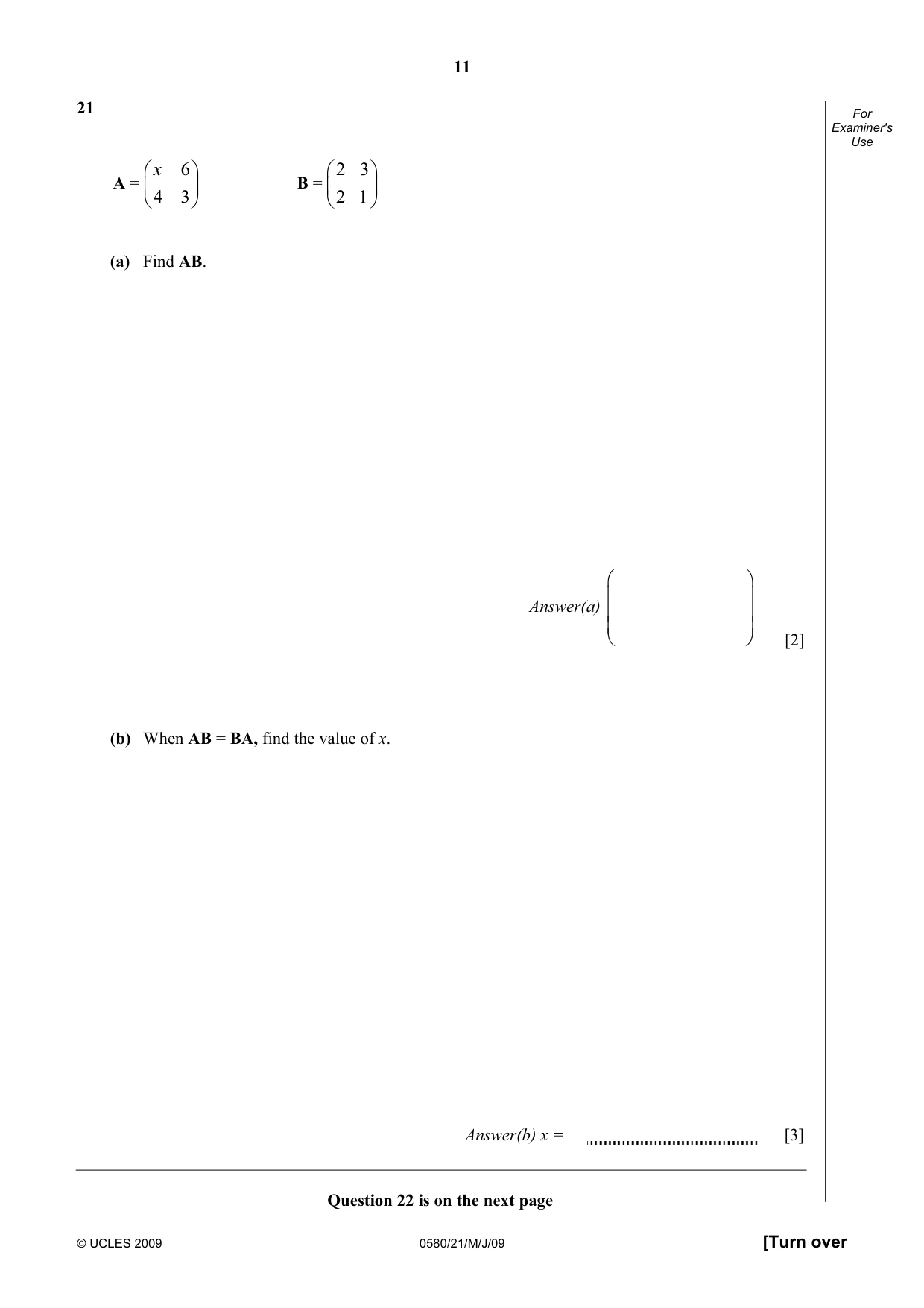
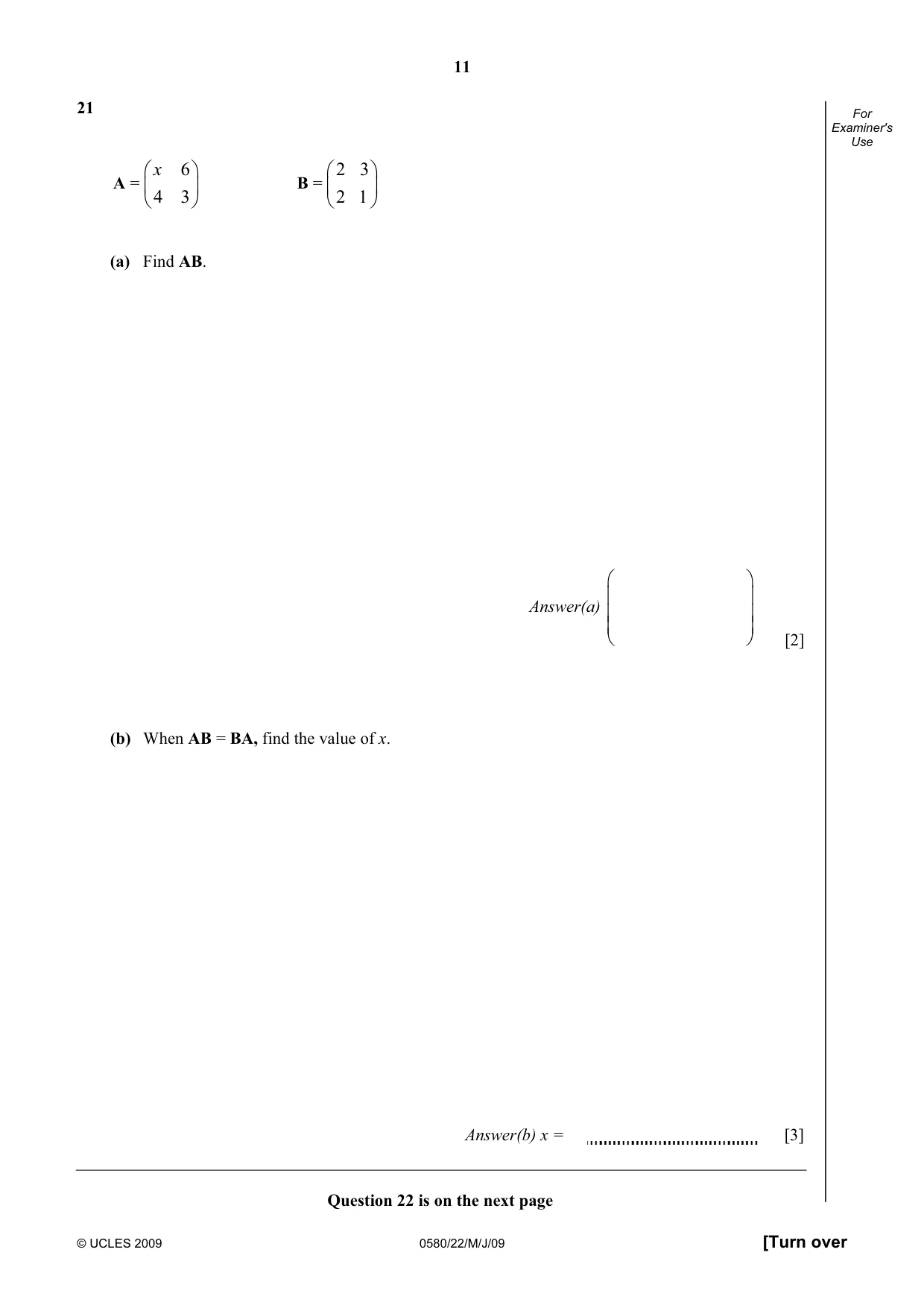
11 © UCLES 2009 0580/21/M/J/09 [Turn over For Examiner's Use 21 = 6 4 3 x A = 2 3 2 1 B (a) Find AB. Answer(a) [2] (b) When AB = BA, find the value of x. Answer(b) x = [3] Question 22 is on the next page
Question paper, page 13
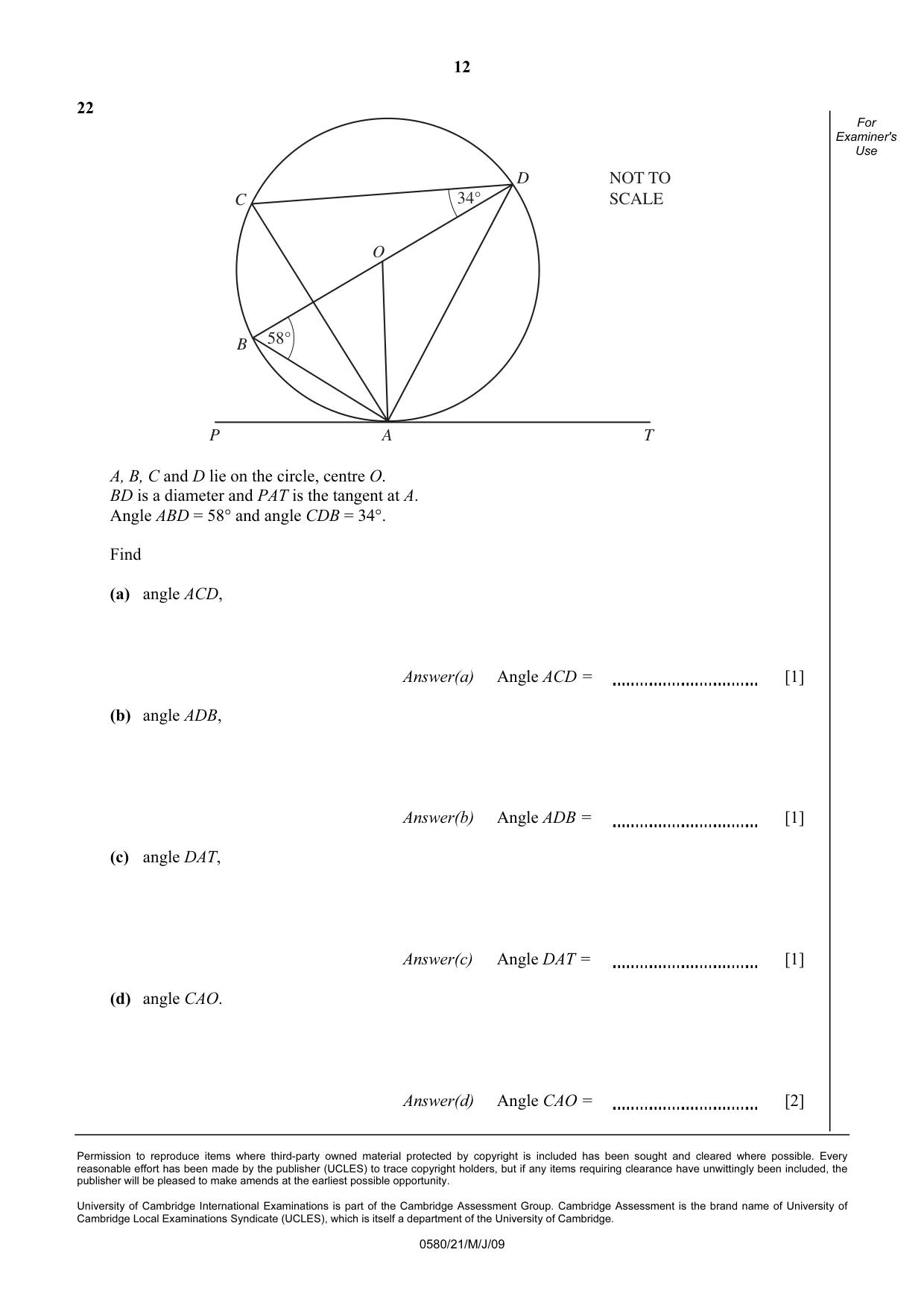
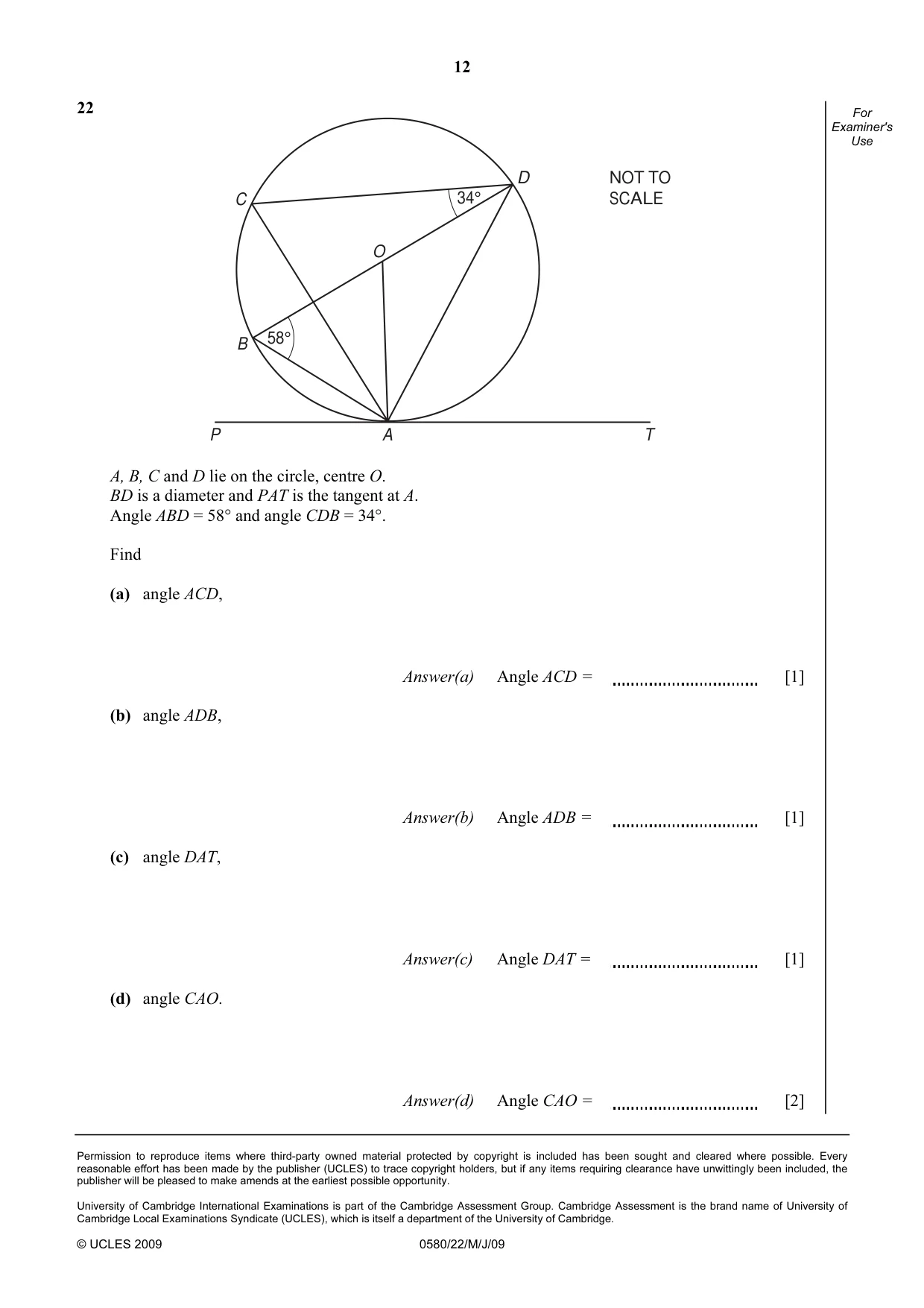
12 Permission to reproduce items where third-party owned material protected by copyright is included has been sought and cleared where possible. Every reasonable effort has been made by the publisher (UCLES) to trace copyright holders, but if any items requiring clearance have unwittingly been included, the publisher will be pleased to make amends at the earliest possible opportunity. University of Cambridge International Examinations is part of the Cambridge Assessment Group. Cambridge Assessment is the brand name of University of Cambridge Local Examinations Syndicate (UCLES), which is itself a department of the University of Cambridge. 0580/21/M/J/09 For Examiner's Use 22 A P T B C D O 34° 58° NOT TO SCALE A, B, C and D lie on the circle, centre O. BD is a diameter and PAT is the tangent at A. Angle ABD = 58° and angle CDB = 34°. Find (a) angle ACD, Answer(a) Angle ACD = [1] (b) angle ADB, Answer(b) Angle ADB = [1] (c) angle DAT, Answer(c) Angle DAT = [1] (d) angle CAO. Answer(d) Angle CAO = [2]
Question paper, page 14
This document consists of 12 printed pages. IB09 06_0580_22/FP © UCLES 2009 [Turn over * 8649386434* UNIVERSITY OF CAMBRIDGE INTERNATIONAL EXAMINATIONS International General Certificate of Secondary Education MATHEMATICS 0580/22, 0581/22 Paper 2 (Extended) May/June 2009 1 hour 30 minutes Candidates answer on the Question Paper. Additional Materials: Electronic calculator Geometrical instruments Mathematical tables (optional) Tracing paper (optional) READ THESE INSTRUCTIONS FIRST Write your Centre number, candidate number and name on all the work you hand in. Write in dark blue or black pen. You may use a pencil for any diagrams or graphs. Do not use staples, paper clips, highlighters, glue or correction fluid. DO NOT WRITE IN ANY BARCODES. Answer all questions. If working is needed for any question it must be shown below that question. Electronic calculators should be used. If the degree of accuracy is not specified in the question, and if the answer is not exact, give the answer to three significant figures. Give answers in degrees to one decimal place. For π , use either your calculator value or 3.142. At the end of the examination, fasten all your work securely together. The number of marks is given in brackets [ ] at the end of each question or part question. The total of the marks for this paper is 70. Second Variant Question Paper
Question paper, page 15
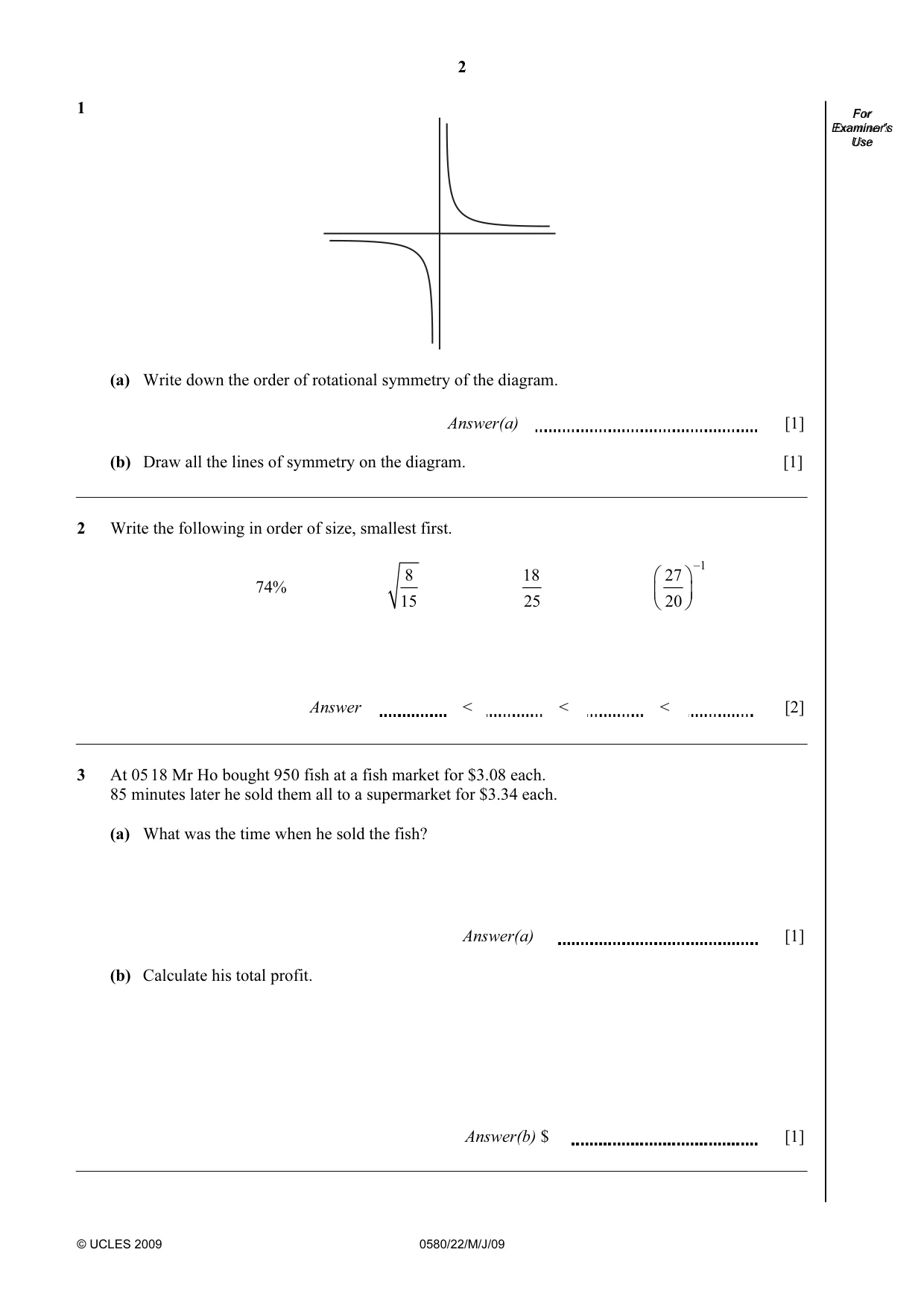
2 © UCLES 2009 0580/22/M/J/09 For Examiner's Use For Examiner's Use 1 (a) Write down the order of rotational symmetry of the diagram. Answer(a) [1] (b) Draw all the lines of symmetry on the diagram. [1] 2 Write the following in order of size, smallest first. 74% 8 15 18 25 _1 27 20 Answer < < < [2] 3 At 05 18 Mr Ho bought 950 fish at a fish market for $3.08 each. 85 minutes later he sold them all to a supermarket for $3.34 each. (a) What was the time when he sold the fish? Answer(a) [1] (b) Calculate his total profit. Answer(b) $ [1]
Question paper, page 16
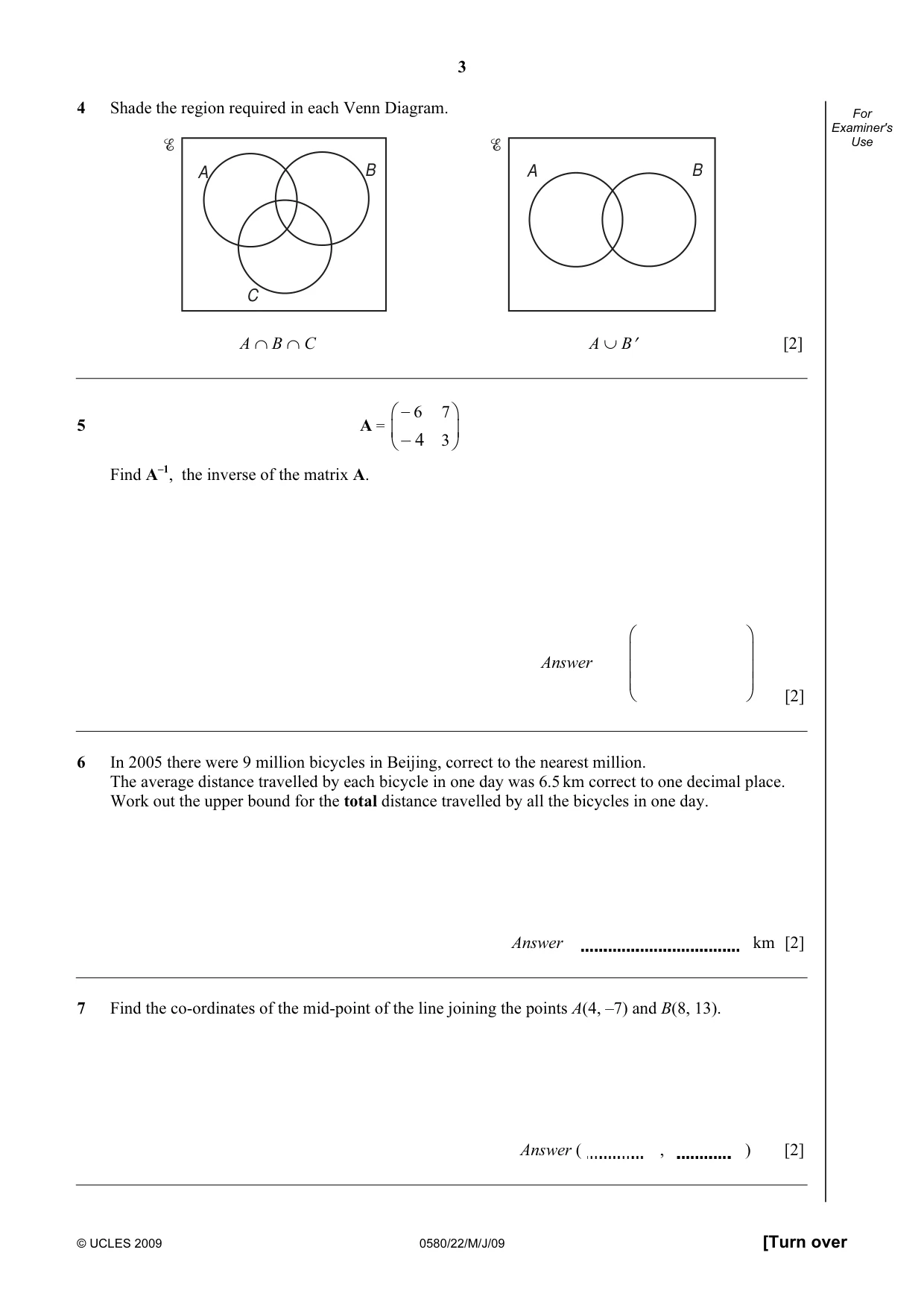
3 © UCLES 2009 0580/22/M/J/09 [Turn over For Examiner's Use 4 Shade the region required in each Venn Diagram. A C B A B A ∩ B ∩ C A ∪ B′ [2] 5 A = _ 6 7 3 _ 4 Find A–1, the inverse of the matrix A. Answer [2] 6 In 2005 there were 9 million bicycles in Beijing, correct to the nearest million. The average distance travelled by each bicycle in one day was 6.5 km correct to one decimal place. Work out the upper bound for the total distance travelled by all the bicycles in one day. Answer km [2] 7 Find the co-ordinates of the mid-point of the line joining the points A(4, –7) and B(8, 13). Answer ( , ) [2]
Question paper, page 17
4 © UCLES 2009 0580/22/M/J/09 For Examiner's Use 8 O G A F B E C D a g The diagram is made from three identical parallelograms. O is the origin. = a and = g. Write down in terms of a and g (a) , Answer(a) [1] (b) the position vector of the centre of the parallelogram BCDE. Answer(b) [1] 9 Rearrange the formula to make y the subject. x + 8 y = 1 Answer y = [3] 10 Write 1 c + 1 d – _ c d cd as a single fraction in its simplest form. Answer [3]
Question paper, page 18
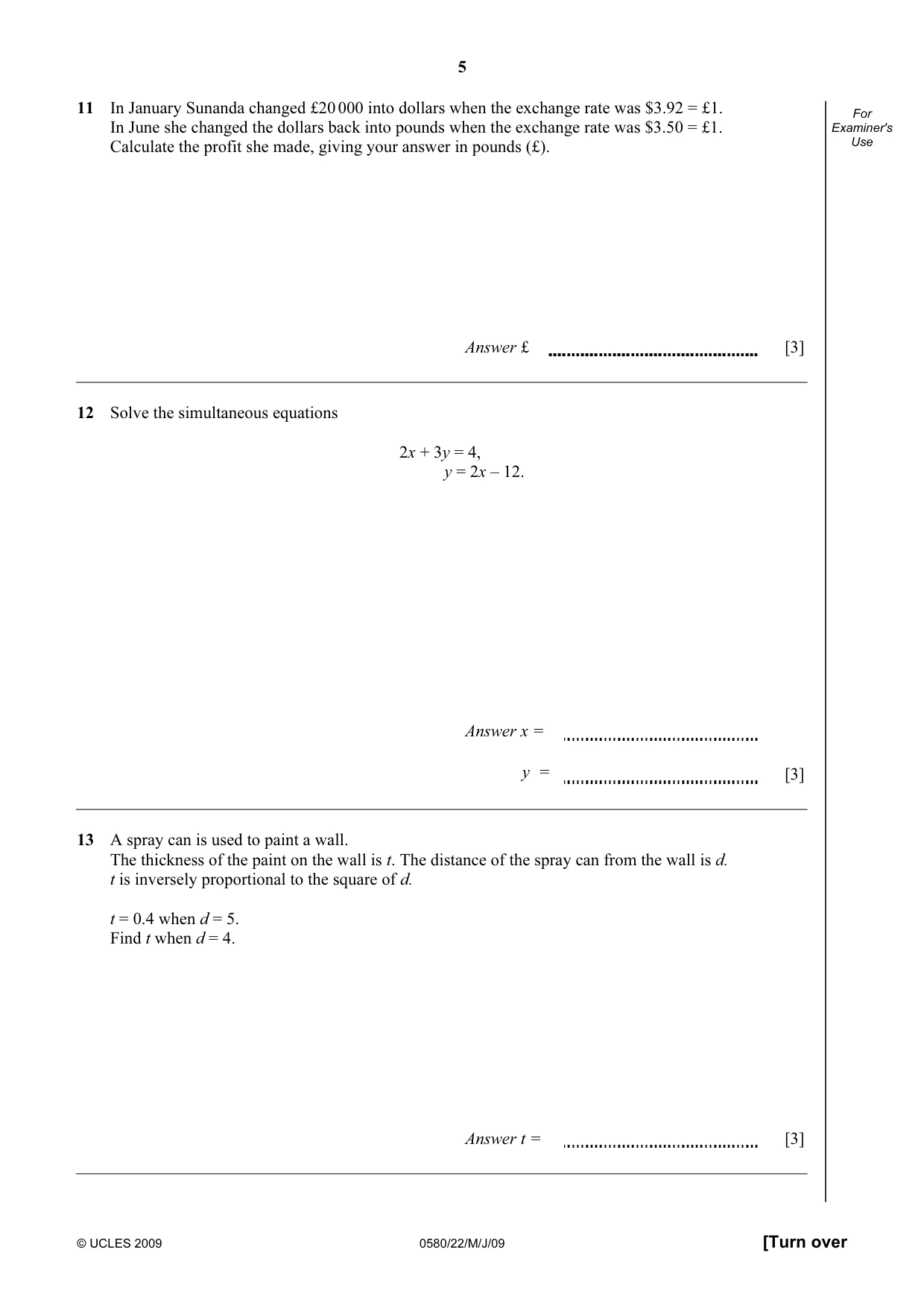
5 © UCLES 2009 0580/22/M/J/09 [Turn over For Examiner's Use 11 In January Sunanda changed £20 000 into dollars when the exchange rate was $3.92 = £1. In June she changed the dollars back into pounds when the exchange rate was $3.50 = £1. Calculate the profit she made, giving your answer in pounds (£). Answer £ [3] 12 Solve the simultaneous equations 2x + 3y = 4, y = 2x – 12. Answer x = y = [3] 13 A spray can is used to paint a wall. The thickness of the paint on the wall is t. The distance of the spray can from the wall is d. t is inversely proportional to the square of d. t = 0.4 when d = 5. Find t when d = 4. Answer t = [3]
Question paper, page 19
6 © UCLES 2009 0580/22/M/J/09 For Examiner's Use 14 (a) There are 109 nanoseconds in 1 second. Find the number of nanoseconds in 8 minutes, giving your answer in standard form. Answer(a) [2] (b) Solve the equation 5 ( x + 3 × 10⁶ ) = 4 × 10⁷. Answer(b) x = [2] 15 18° 25° h T B A C 80 m NOT TO SCALE Mahmoud is working out the height, h metres, of a tower BT which stands on level ground. He measures the angle TAB as 25°. He cannot measure the distance AB and so he walks 80 m from A to C, where angle ACB = 18° and angle ABC = 90°. Calculate (a) the distance AB, Answer(a) m [2] (b) the height of the tower, BT. Answer(b) m [2]
Question paper, page 20
7 © UCLES 2009 0580/22/M/J/09 [Turn over For Examiner's Use 16 Using a straight edge and compasses only, draw the locus of all points inside the quadrilateral ABCD which are equidistant from the lines AC and BD. Show clearly all your construction arcs. A B D C [4]
Question paper, page 21
8 © UCLES 2009 0580/22/M/J/09 For Examiner's Use 17 y x 8 7 6 5 4 3 2 1 0 1 2 3 4 5 6 7 8 A B (a) Describe fully the single transformation which maps triangle A onto triangle B. Answer(a) [2] (b) On the grid, draw the image of triangle A after rotation by 90° clockwise about the point (4, 4). [2] 18 Two similar vases have heights which are in the ratio 3 : 2. (a) The volume of the larger vase is 1080 cm3. Calculate the volume of the smaller vase. Answer(a) cm3 [2] (b) The surface area of the smaller vase is 252 cm2. Calculate the surface area of the larger vase. Answer(b) cm2 [2]
Question paper, page 22
9 © UCLES 2009 0580/22/M/J/09 [Turn over For Examiner's Use 19 A D F G C B H E O 40° 6 cm 12 cm NOT TO SCALE The diagram shows part of a fan. OFG and OAD are sectors, centre O, with radius 18 cm and sector angle 40°. B, C, H and E lie on a circle, centre O and radius 6 cm. Calculate the shaded area. Answer cm2 [4]
Question paper, page 23
10 © UCLES 2009 0580/22/M/J/09 For Examiner's Use 20 6 5 4 3 2 1 0 –1 –2 –3 –4 –5 y x 1 2 3 4 5 6 (a) Draw the three lines y = 4, 2x – y = 4 and x + y = 6 on the grid above. [4] (b) Write the letter R in the region defined by the three inequalities below. y Y 4 2x – y [ 4 x + y [ 6 [1]
Question paper, page 24
11 © UCLES 2009 0580/22/M/J/09 [Turn over For Examiner's Use 21 = 6 4 3 x A = 2 3 2 1 B (a) Find AB. Answer(a) [2] (b) When AB = BA, find the value of x. Answer(b) x = [3] Question 22 is on the next page
Question paper, page 25
12 Permission to reproduce items where third-party owned material protected by copyright is included has been sought and cleared where possible. Every reasonable effort has been made by the publisher (UCLES) to trace copyright holders, but if any items requiring clearance have unwittingly been included, the publisher will be pleased to make amends at the earliest possible opportunity. University of Cambridge International Examinations is part of the Cambridge Assessment Group. Cambridge Assessment is the brand name of University of Cambridge Local Examinations Syndicate (UCLES), which is itself a department of the University of Cambridge. © UCLES 2009 0580/22/M/J/09 For Examiner's Use 22 A P T B C D O 34° 58° NOT TO SCALE A, B, C and D lie on the circle, centre O. BD is a diameter and PAT is the tangent at A. Angle ABD = 58° and angle CDB = 34°. Find (a) angle ACD, Answer(a) Angle ACD = [1] (b) angle ADB, Answer(b) Angle ADB = [1] (c) angle DAT, Answer(c) Angle DAT = [1] (d) angle CAO. Answer(d) Angle CAO = [2]
Mark scheme, page 1
Location Entry Codes As part of CIE’s continual commitment to maintaining best practice in assessment, CIE has begun to use different variants of some question papers for our most popular assessments with extremely large and widespread candidature, The question papers are closely related and the relationships between them have been thoroughly established using our assessment expertise. All versions of the paper give assessment of equal standard. The content assessed by the examination papers and the type of questions are unchanged. This change means that for this component there are now two variant Question Papers, Mark Schemes and Principal Examiner’s Reports where previously there was only one. For any individual country, it is intended that only one variant is used. This document contains both variants which will give all Centres access to even more past examination material than is usually the case. The diagram shows the relationship between the Question Papers, Mark Schemes and Principal Examiner’s Reports. Question Paper Mark Scheme Principal Examiner’s Report Introduction Introduction Introduction First variant Question Paper First variant Mark Scheme First variant Principal Examiner’s Report Second variant Question Paper Second variant Mark Scheme Second variant Principal Examiner’s Report Who can I contact for further information on these changes? Please direct any questions about this to CIE’s Customer Services team at: international@cie.org.uk www.XtremePapers.com
Mark scheme, page 2
UNIVERSITY OF CAMBRIDGE INTERNATIONAL EXAMINATIONS International General Certificate of Secondary Education MARK SCHEME for the May/June 2009 question paper for the guidance of teachers 0580, 0581 MATHEMATICS 0580/21, 0581/21 Paper 2 (Extended), maximum raw mark 70 This mark scheme is published as an aid to teachers and candidates, to indicate the requirements of the examination. It shows the basis on which Examiners were instructed to award marks. It does not indicate the details of the discussions that took place at an Examiners’ meeting before marking began, which would have considered the acceptability of alternative answers. Mark schemes must be read in conjunction with the question papers and the report on the examination. • CIE will not enter into discussions or correspondence in connection with these mark schemes. CIE is publishing the mark schemes for the May/June 2009 question papers for most IGCSE, GCE Advanced Level and Advanced Subsidiary Level syllabuses and some Ordinary Level syllabuses. First variant Mark Scheme
Mark scheme, page 3
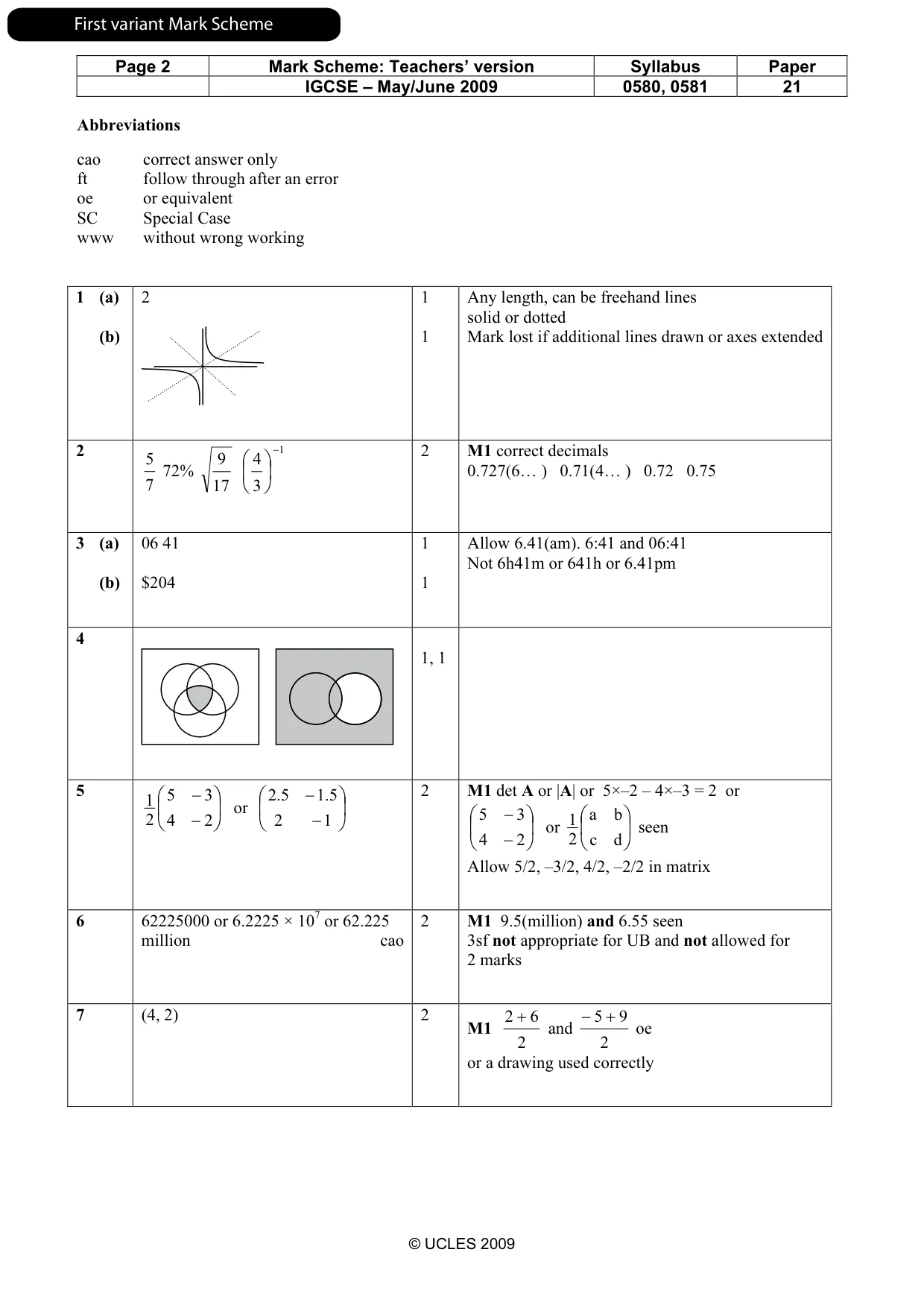
Page 2 Mark Scheme: Teachers’ version Syllabus Paper IGCSE – May/June 2009 0580, 0581 21 © UCLES 2009 Abbreviations cao correct answer only ft follow through after an error oe or equivalent SC Special Case www without wrong working 1 (a) (b) 2 1 1 Any length, can be freehand lines solid or dotted Mark lost if additional lines drawn or axes extended 2 7 5 72% 17 9 1 3 4 − 2 M1 correct decimals 0.727(6… ) 0.71(4… ) 0.72 0.75 3 (a) (b) 06 41 $204 1 1 Allow 6.41(am). 6:41 and 06:41 Not 6h41m or 641h or 6.41pm 4 1, 1 5 − − 2 4 3 5 2 1 or − − 1 2 5.1 5.2 2 M1 det A or |A| or 5×–2 – 4×–3 = 2 or − − 2 4 3 5 or d c b a 2 1 seen Allow 5/2, –3/2, 4/2, –2/2 in matrix 6 62225000 or 6.2225 × 10⁷ or 62.225 million cao 2 M1 9.5(million) and 6.55 seen 3sf not appropriate for UB and not allowed for 2 marks 7 (4, 2) 2 M1 2 6 2 + and 2 9 5 + − oe or a drawing used correctly First variant Mark Scheme
Mark scheme, page 4
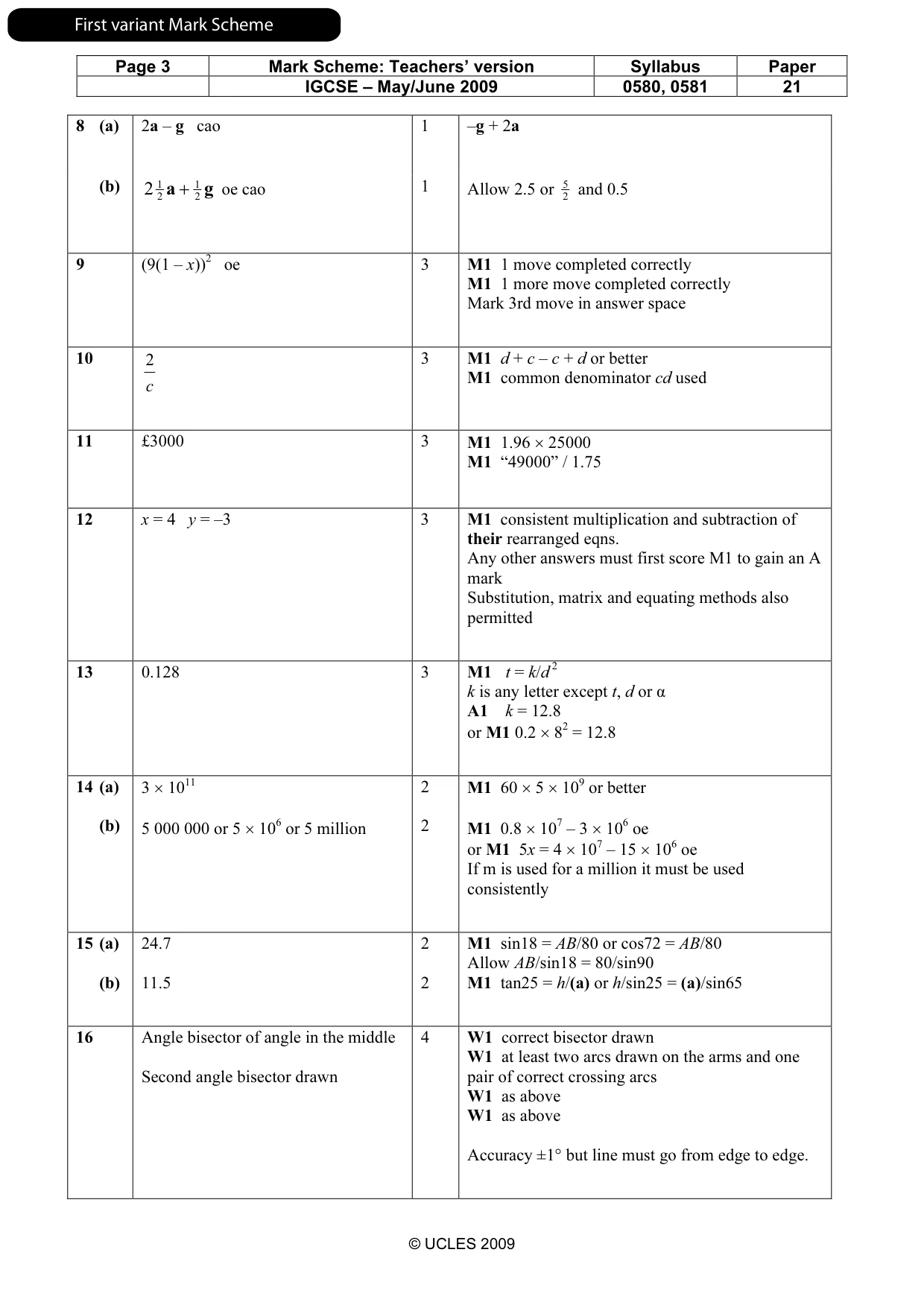
Page 3 Mark Scheme: Teachers’ version Syllabus Paper IGCSE – May/June 2009 0580, 0581 21 © UCLES 2009 8 (a) 2a – g cao 1 –g + 2a (b) g a 2 1 2 1 2 + oe cao 1 Allow 2.5 or 2 5 and 0.5 9 (9(1 – x))2 oe 3 M1 1 move completed correctly M1 1 more move completed correctly Mark 3rd move in answer space 10 c 2 3 M1 d + c – c + d or better M1 common denominator cd used 11 £3000 3 M1 1.96 × 25000 M1 “49000” / 1.75 12 x = 4 y = –3 3 M1 consistent multiplication and subtraction of their rearranged eqns. Any other answers must first score M1 to gain an A mark Substitution, matrix and equating methods also permitted 13 0.128 3 M1 t = k/d 2 k is any letter except t, d or α A1 k = 12.8 or M1 0.2 × 82 = 12.8 14 (a) (b) 3 × 10¹¹ 5 000 000 or 5 × 10⁶ or 5 million 2 2 M1 60 × 5 × 109 or better M1 0.8 × 10⁷ – 3 × 10⁶ oe or M1 5x = 4 × 10⁷ – 15 × 106 oe If m is used for a million it must be used consistently 15 (a) (b) 24.7 11.5 2 2 M1 sin18 = AB/80 or cos72 = AB/80 Allow AB/sin18 = 80/sin90 M1 tan25 = h/(a) or h/sin25 = (a)/sin65 16 Angle bisector of angle in the middle Second angle bisector drawn 4 W1 correct bisector drawn W1 at least two arcs drawn on the arms and one pair of correct crossing arcs W1 as above W1 as above Accuracy ±1° but line must go from edge to edge. First variant Mark Scheme
Mark scheme, page 5
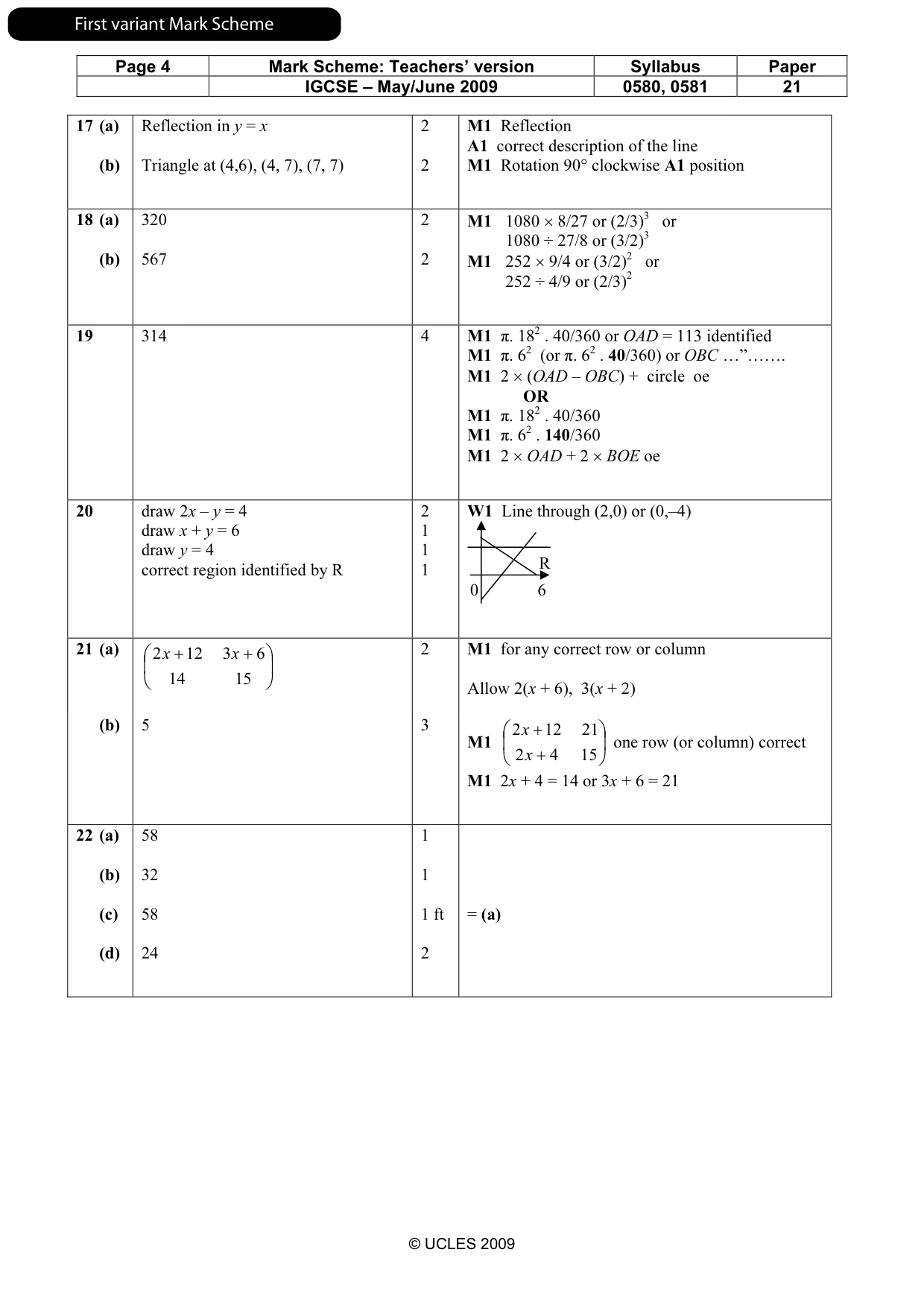
Page 4 Mark Scheme: Teachers’ version Syllabus Paper IGCSE – May/June 2009 0580, 0581 21 © UCLES 2009 17 (a) (b) Reflection in y = x Triangle at (4,6), (4, 7), (7, 7) 2 2 M1 Reflection A1 correct description of the line M1 Rotation 90° clockwise A1 position 18 (a) (b) 320 567 2 2 M1 1080 × 8/27 or (2/3)3 or 1080 ÷ 27/8 or (3/2)3 M1 252 × 9/4 or (3/2)2 or 252 ÷ 4/9 or (2/3)2 19 314 4 M1 π. 182 . 40/360 or OAD = 113 identified M1 π. 62 (or π. 62 . 40/360) or OBC …”……. M1 2 × (OAD – OBC) + circle oe OR M1 π. 182 . 40/360 M1 π. 62 . 140/360 M1 2 × OAD + 2 × BOE oe 20 draw 2x – y = 4 draw x + y = 6 draw y = 4 correct region identified by R 2 1 1 1 W1 Line through (2,0) or (0,–4) 21 (a) + + 15 6 3 14 12 2 x x 2 M1 for any correct row or column Allow 2(x + 6), 3(x + 2) (b) 5 3 M1 + + 15 21 4 2 12 2 x x one row (or column) correct M1 2x + 4 = 14 or 3x + 6 = 21 22 (a) (b) (c) (d) 58 32 58 24 1 1 1 ft 2 = (a) R 6 0 First variant Mark Scheme
Mark scheme, page 6
UNIVERSITY OF CAMBRIDGE INTERNATIONAL EXAMINATIONS International General Certificate of Secondary Education MARK SCHEME for the May/June 2009 question paper for the guidance of teachers 0580, 0581 MATHEMATICS 0580/22, 0581/22 Paper 2 (Extended), maximum raw mark 70 This mark scheme is published as an aid to teachers and candidates, to indicate the requirements of the examination. It shows the basis on which Examiners were instructed to award marks. It does not indicate the details of the discussions that took place at an Examiners’ meeting before marking began, which would have considered the acceptability of alternative answers. Mark schemes must be read in conjunction with the question papers and the report on the examination. • CIE will not enter into discussions or correspondence in connection with these mark schemes. CIE is publishing the mark schemes for the May/June 2009 question papers for most IGCSE, GCE Advanced Level and Advanced Subsidiary Level syllabuses and some Ordinary Level syllabuses. Second variant Mark Scheme
Mark scheme, page 7
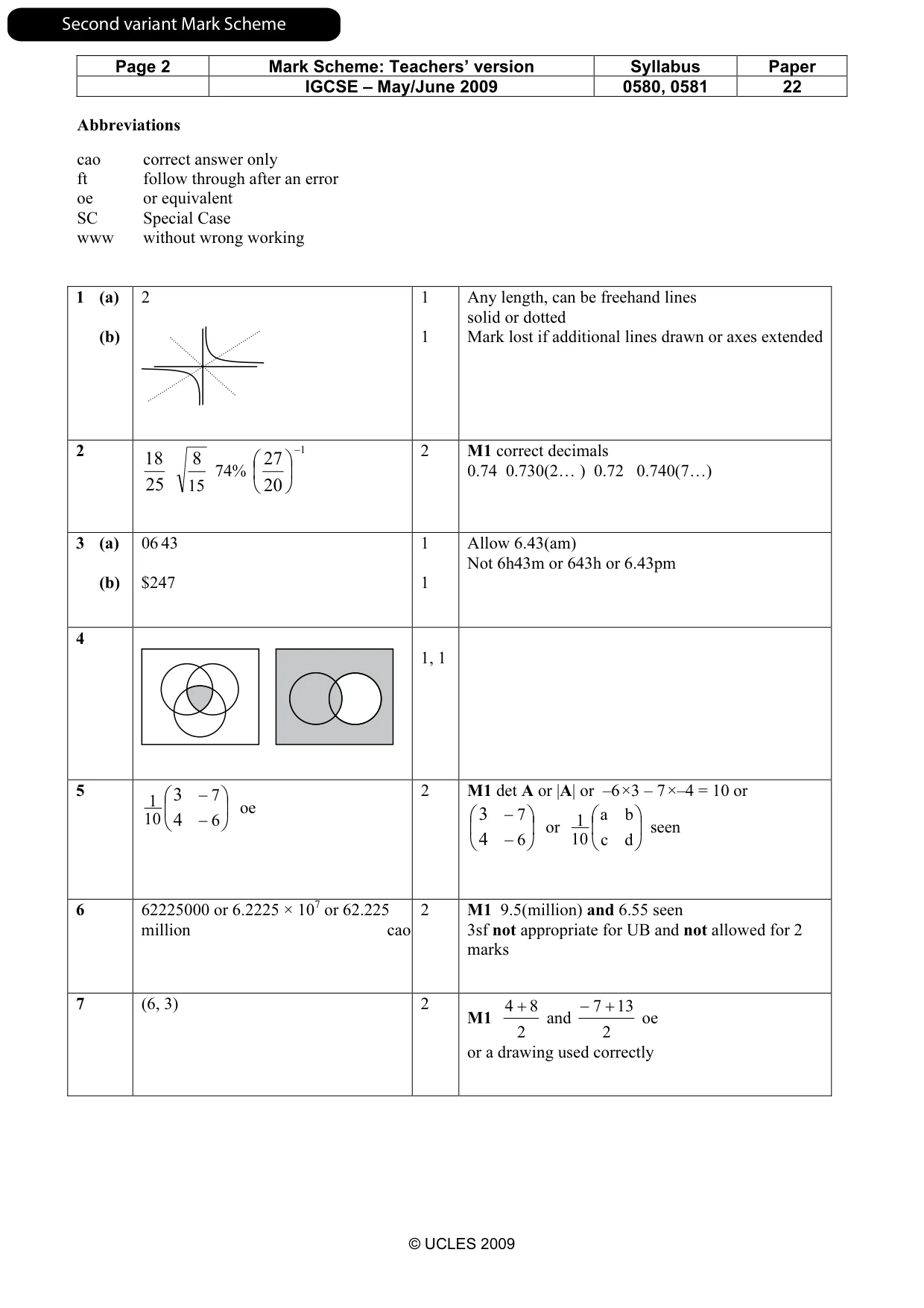
Page 2 Mark Scheme: Teachers’ version Syllabus Paper IGCSE – May/June 2009 0580, 0581 22 © UCLES 2009 Abbreviations cao correct answer only ft follow through after an error oe or equivalent SC Special Case www without wrong working 1 (a) (b) 2 1 1 Any length, can be freehand lines solid or dotted Mark lost if additional lines drawn or axes extended 2 25 18 15 8 74% 1 20 27 − 2 M1 correct decimals 0.74 0.730(2… ) 0.72 0.740(7…) 3 (a) (b) 06 43 $247 1 1 Allow 6.43(am) Not 6h43m or 643h or 6.43pm 4 1, 1 5 − − 6 7 10 1 4 3 oe 2 M1 det A or |A| or –6×3 – 7×–4 = 10 or − − 6 7 4 3 or d c b a 10 1 seen 6 62225000 or 6.2225 × 10⁷ or 62.225 million cao 2 M1 9.5(million) and 6.55 seen 3sf not appropriate for UB and not allowed for 2 marks 7 (6, 3) 2 M1 2 8 4 + and 2 13 7 + − oe or a drawing used correctly Second variant Mark Scheme
Mark scheme, page 8
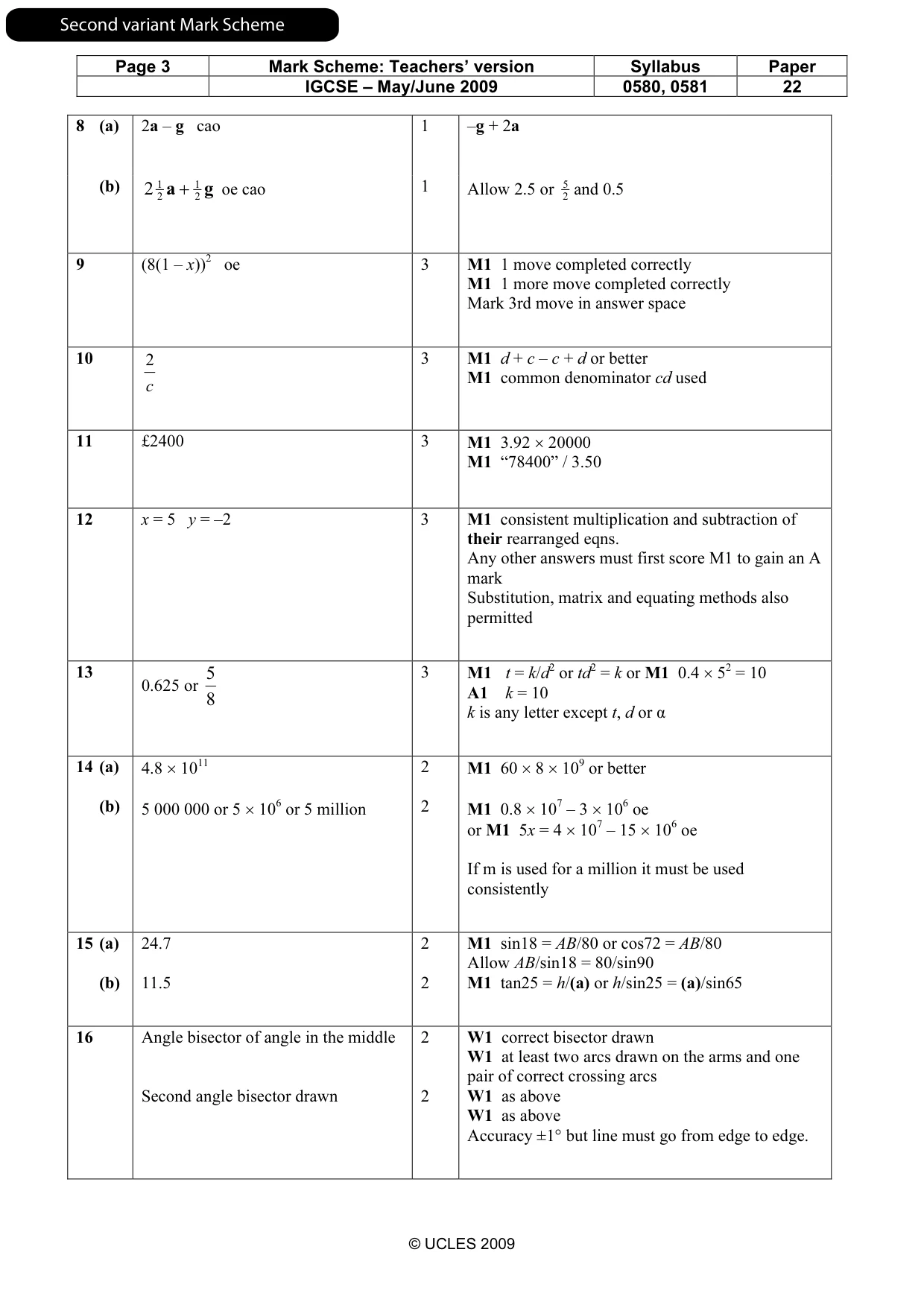
Page 3 Mark Scheme: Teachers’ version Syllabus Paper IGCSE – May/June 2009 0580, 0581 22 © UCLES 2009 8 (a) 2a – g cao 1 –g + 2a (b) g a 2 1 2 1 2 + oe cao 1 Allow 2.5 or 2 5 and 0.5 9 (8(1 – x))2 oe 3 M1 1 move completed correctly M1 1 more move completed correctly Mark 3rd move in answer space 10 c 2 3 M1 d + c – c + d or better M1 common denominator cd used 11 £2400 3 M1 3.92 × 20000 M1 “78400” / 3.50 12 x = 5 y = –2 3 M1 consistent multiplication and subtraction of their rearranged eqns. Any other answers must first score M1 to gain an A mark Substitution, matrix and equating methods also permitted 13 0.625 or 8 5 3 M1 t = k/d2 or td2 = k or M1 0.4 × 52 = 10 A1 k = 10 k is any letter except t, d or α 14 (a) (b) 4.8 × 10¹¹ 5 000 000 or 5 × 10⁶ or 5 million 2 2 M1 60 × 8 × 109 or better M1 0.8 × 10⁷ – 3 × 10⁶ oe or M1 5x = 4 × 10⁷ – 15 × 106 oe If m is used for a million it must be used consistently 15 (a) (b) 24.7 11.5 2 2 M1 sin18 = AB/80 or cos72 = AB/80 Allow AB/sin18 = 80/sin90 M1 tan25 = h/(a) or h/sin25 = (a)/sin65 16 Angle bisector of angle in the middle Second angle bisector drawn 2 2 W1 correct bisector drawn W1 at least two arcs drawn on the arms and one pair of correct crossing arcs W1 as above W1 as above Accuracy ±1° but line must go from edge to edge. Second variant Mark Scheme
Mark scheme, page 9
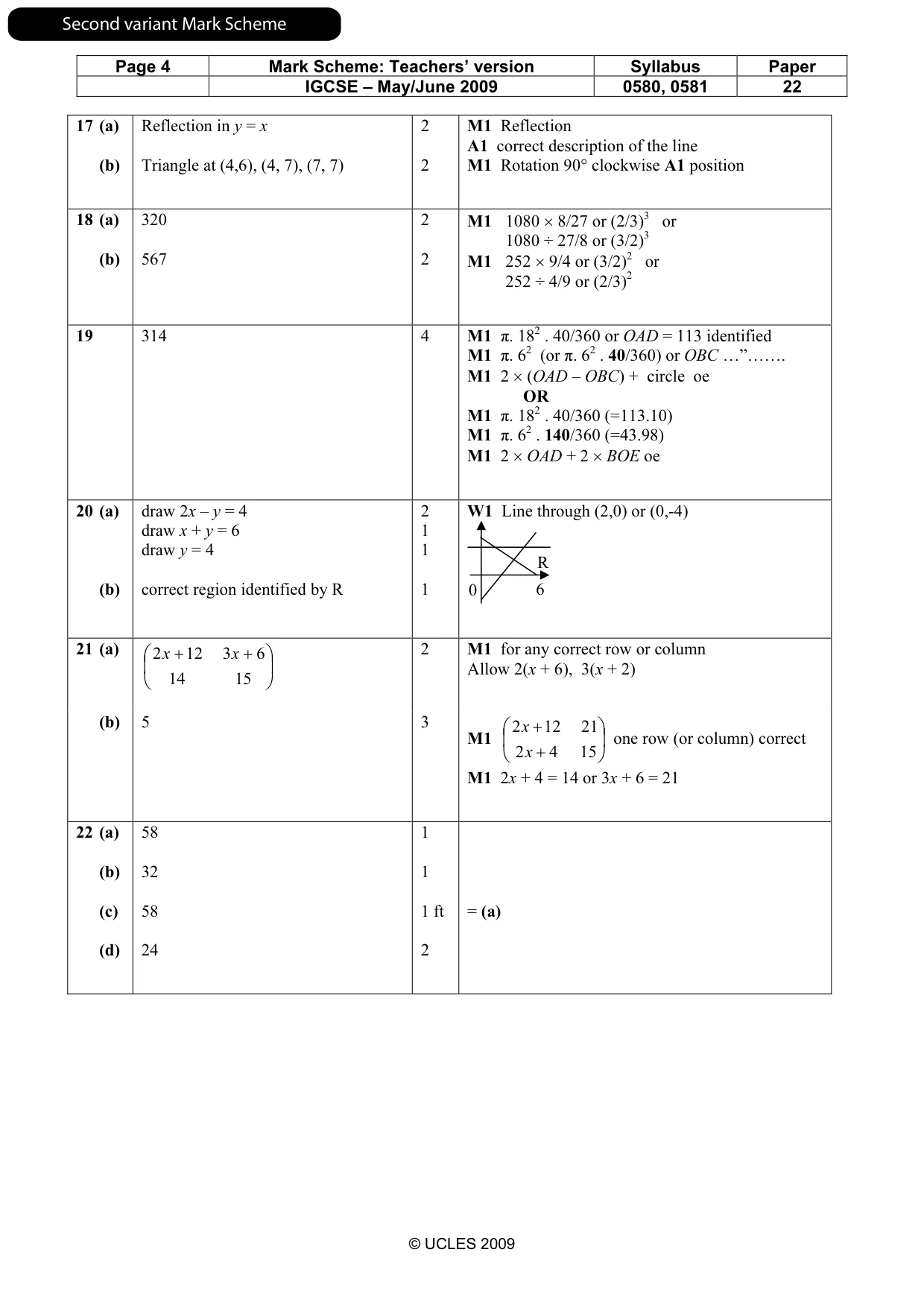
Page 4 Mark Scheme: Teachers’ version Syllabus Paper IGCSE – May/June 2009 0580, 0581 22 © UCLES 2009 17 (a) (b) Reflection in y = x Triangle at (4,6), (4, 7), (7, 7) 2 2 M1 Reflection A1 correct description of the line M1 Rotation 90° clockwise A1 position 18 (a) (b) 320 567 2 2 M1 1080 × 8/27 or (2/3)3 or 1080 ÷ 27/8 or (3/2)3 M1 252 × 9/4 or (3/2)2 or 252 ÷ 4/9 or (2/3)2 19 314 4 M1 π. 182 . 40/360 or OAD = 113 identified M1 π. 62 (or π. 62 . 40/360) or OBC …”……. M1 2 × (OAD – OBC) + circle oe OR M1 π. 182 . 40/360 (=113.10) M1 π. 62 . 140/360 (=43.98) M1 2 × OAD + 2 × BOE oe 20 (a) (b) draw 2x – y = 4 draw x + y = 6 draw y = 4 correct region identified by R 2 1 1 1 W1 Line through (2,0) or (0,-4) 21 (a) + + 15 6 3 14 12 2 x x 2 M1 for any correct row or column Allow 2(x + 6), 3(x + 2) (b) 5 3 M1 + + 15 21 4 2 12 2 x x one row (or column) correct M1 2x + 4 = 14 or 3x + 6 = 21 22 (a) (b) (c) (d) 58 32 58 24 1 1 1 ft 2 = (a) R 6 0 Second variant Mark Scheme