Cambridge IGCSE Mathematics (with coursework) 0581 — 2007 Oct/Nov Paper 2 · Variant 1
0581/21/O/N/07 · 70 marks · ≈79 min
The question paper and its mark scheme, free to read here and free to download. This is Cambridge’s own paper, exactly as it was sat.
Question paper12 pages
Mark scheme4 pages
Answers below. Sit the paper first if you are practising.
Paper as text
Question paper, page 1
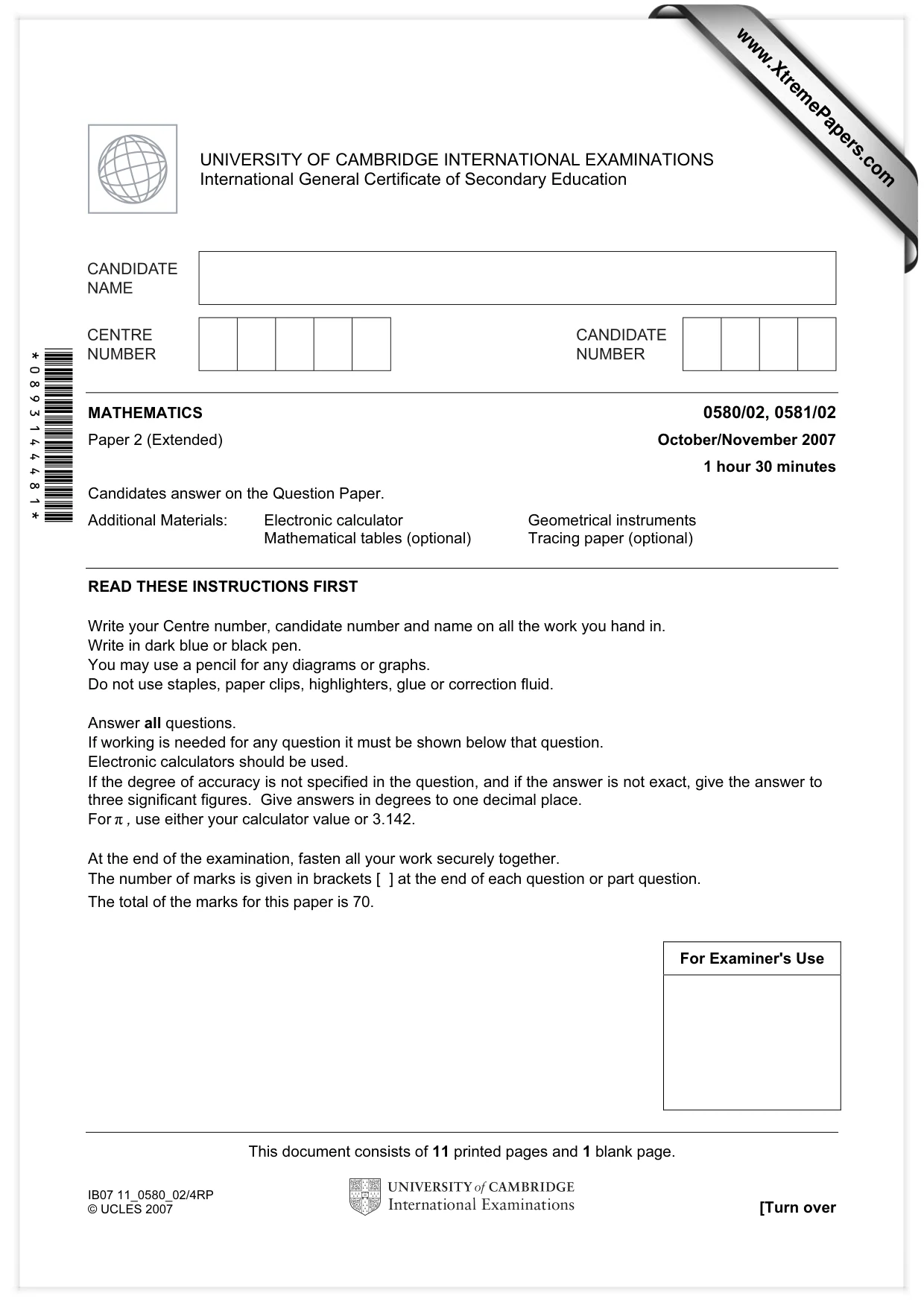
This document consists of 11 printed pages and 1 blank page. IB07 11_0580_02/4RP © UCLES 2007 [Turn over *0893144481* For Examiner's Use UNIVERSITY OF CAMBRIDGE INTERNATIONAL EXAMINATIONS International General Certificate of Secondary Education MATHEMATICS 0580/02, 0581/02 Paper 2 (Extended) October/November 2007 1 hour 30 minutes Candidates answer on the Question Paper. Additional Materials: Electronic calculator Geometrical instruments Mathematical tables (optional) Tracing paper (optional) READ THESE INSTRUCTIONS FIRST Write your Centre number, candidate number and name on all the work you hand in. Write in dark blue or black pen. You may use a pencil for any diagrams or graphs. Do not use staples, paper clips, highlighters, glue or correction fluid. Answer all questions. If working is needed for any question it must be shown below that question. Electronic calculators should be used. If the degree of accuracy is not specified in the question, and if the answer is not exact, give the answer to three significant figures. Give answers in degrees to one decimal place. For π , use either your calculator value or 3.142. At the end of the examination, fasten all your work securely together. The number of marks is given in brackets [ ] at the end of each question or part question. The total of the marks for this paper is 70. www.XtremePapers.com
Question paper, page 2
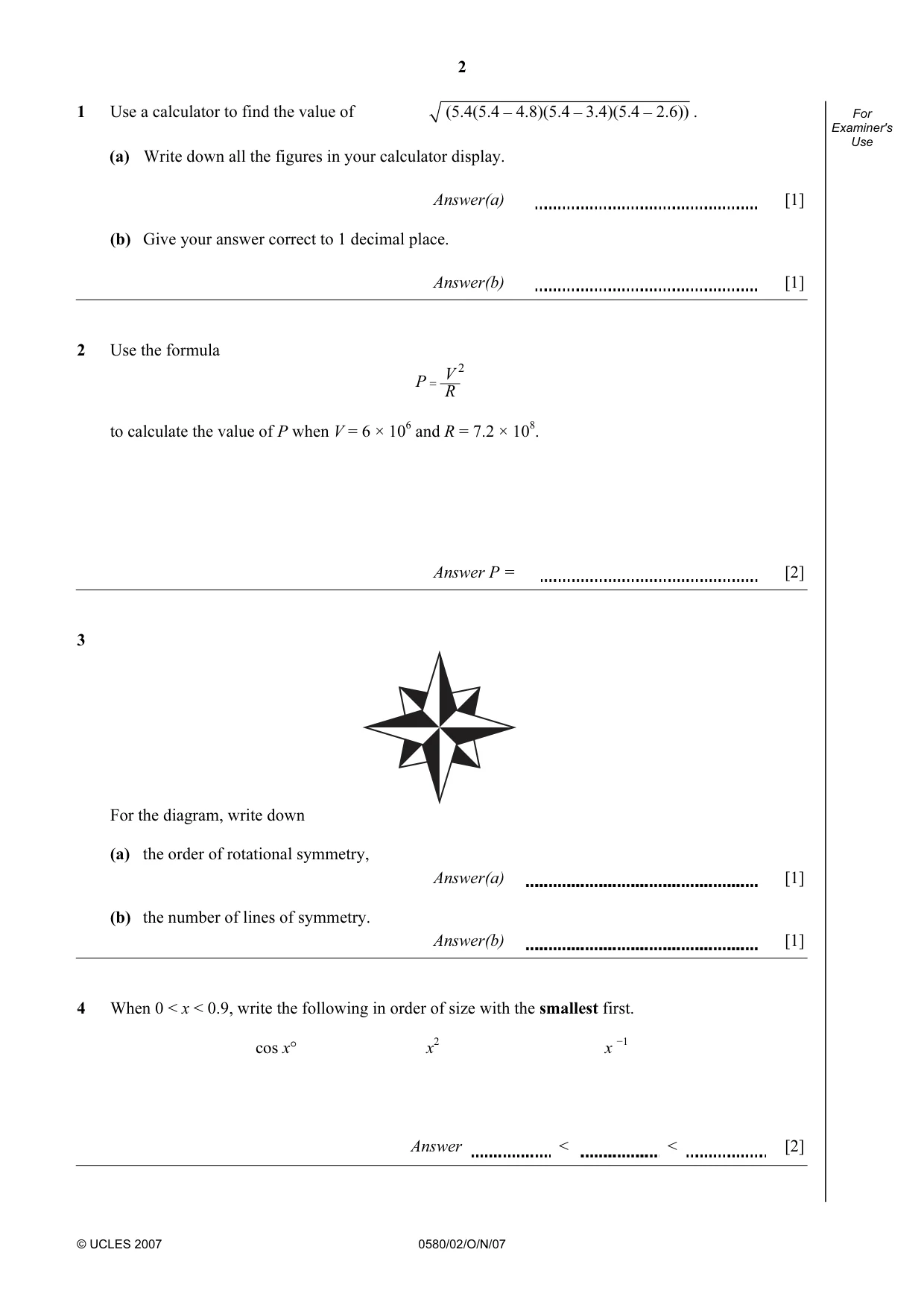
2 © UCLES 2007 0580/02/O/N/07 For Examiner's Use 1 Use a calculator to find the value of _ _ _ (5.4(5.4 4.8)(5.4 3.4)(5.4 2.6)) . (a) Write down all the figures in your calculator display. Answer(a) [1] (b) Give your answer correct to 1 decimal place. Answer(b) [1] 2 Use the formula 2 = V P R to calculate the value of P when V = 6 × 10⁶ and R = 7.2 × 10⁸. Answer P = [2] 3 For the diagram, write down (a) the order of rotational symmetry, Answer(a) [1] (b) the number of lines of symmetry. Answer(b) [1] 4 When 0 < x < 0.9, write the following in order of size with the smallest first. cos x° x2 x −1 Answer < < [2]
Question paper, page 3
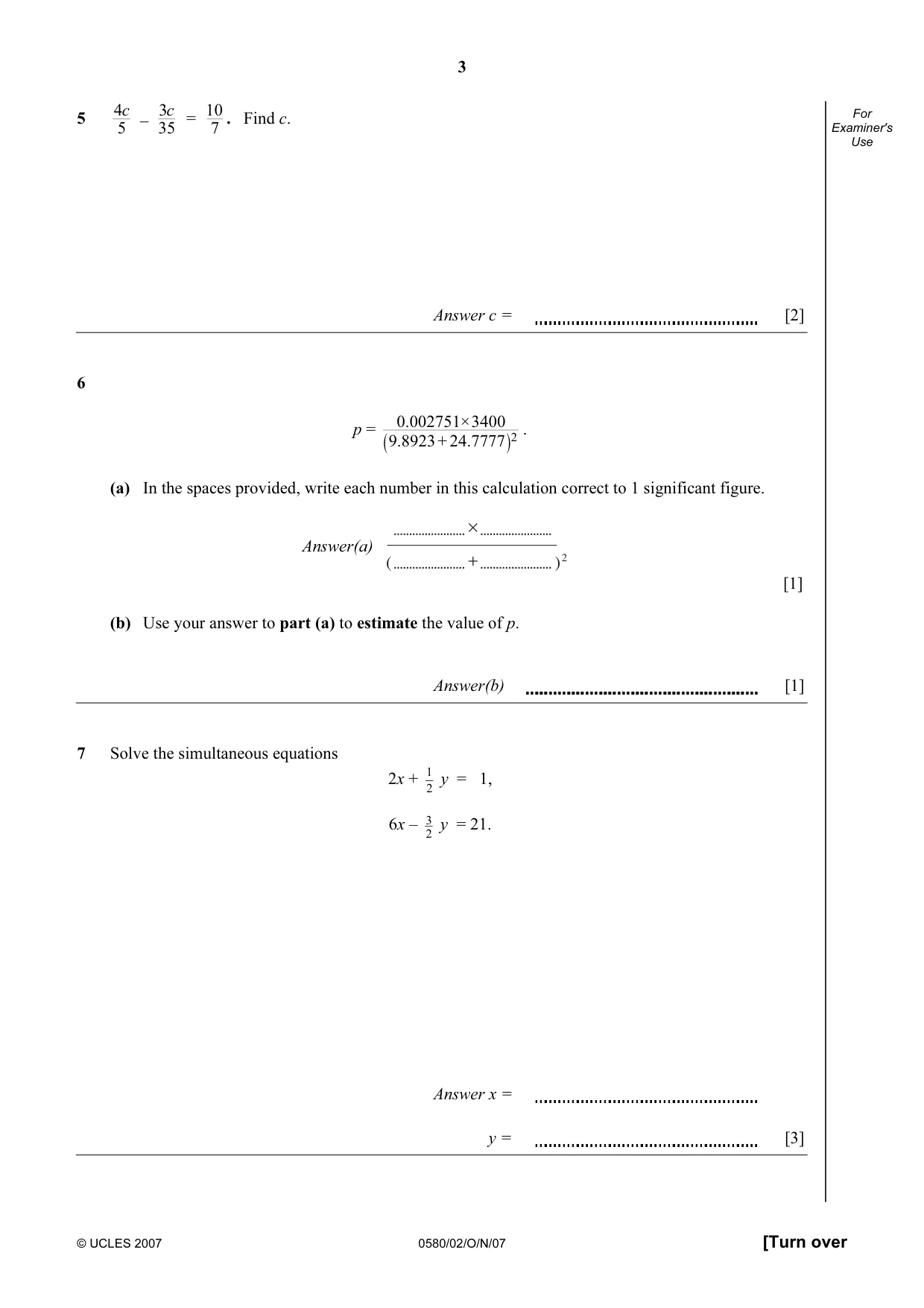
3 © UCLES 2007 0580/02/O/N/07 [Turn over For Examiner's Use 5 4 3 10 _ = 5 7 35 c c . Find c. Answer c = [2] 6 p = ( )2 0.002751×3400 9.8923+ 24.7777 . (a) In the spaces provided, write each number in this calculation correct to 1 significant figure. Answer(a) × + ( )2 [1] (b) Use your answer to part (a) to estimate the value of p. Answer(b) [1] 7 Solve the simultaneous equations 2x + 1 2 y = 1, 6x – 3 2 y = 21. Answer x = y = [3]
Question paper, page 4
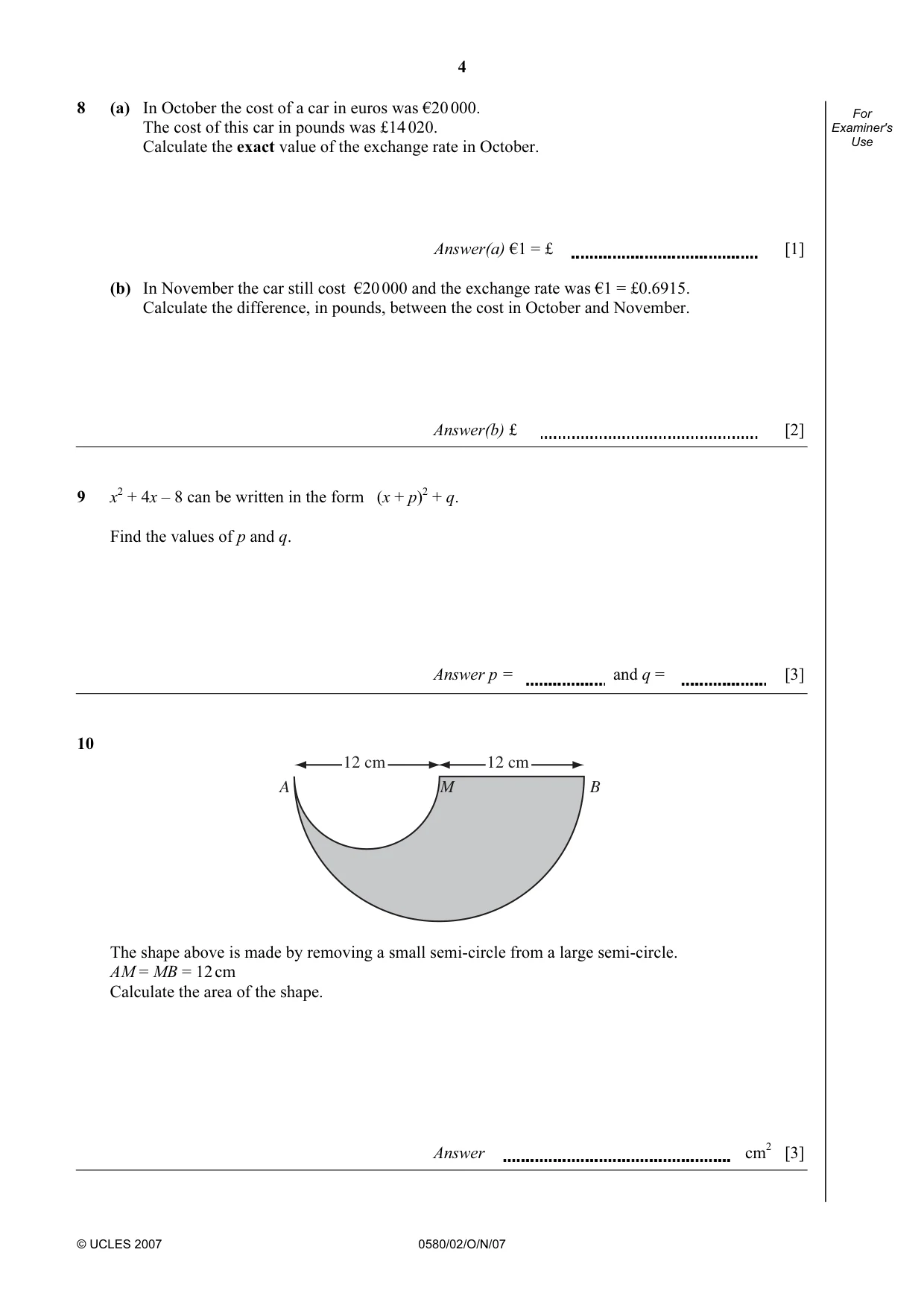
4 © UCLES 2007 0580/02/O/N/07 For Examiner's Use 8 (a) In October the cost of a car in euros was €20 000. The cost of this car in pounds was £14 020. Calculate the exact value of the exchange rate in October. Answer(a) €1 = £ [1] (b) In November the car still cost €20 000 and the exchange rate was €1 = £0.6915. Calculate the difference, in pounds, between the cost in October and November. Answer(b) £ [2] 9 x2 + 4x – 8 can be written in the form (x + p)2 + q. Find the values of p and q. Answer p = and q = [3] 10 B M A 12 cm 12 cm The shape above is made by removing a small semi-circle from a large semi-circle. AM = MB = 12 cm Calculate the area of the shape. Answer cm2 [3]
Question paper, page 5
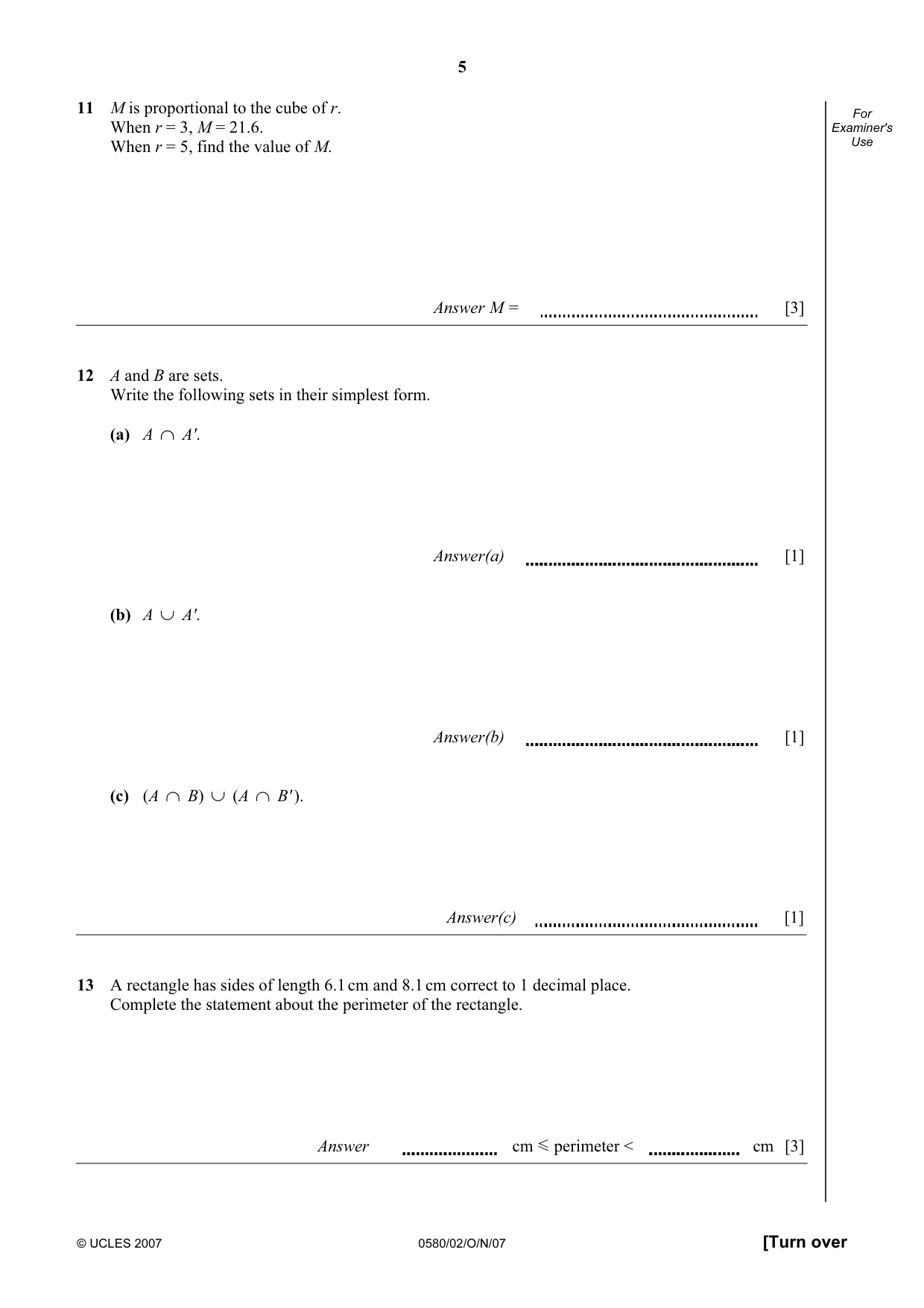
5 © UCLES 2007 0580/02/O/N/07 [Turn over For Examiner's Use 11 M is proportional to the cube of r. When r = 3, M = 21.6. When r = 5, find the value of M. Answer M = [3] 12 A and B are sets. Write the following sets in their simplest form. (a) A ∩ A'. Answer(a) [1] (b) A ∪ A'. Answer(b) [1] (c) (A ∩ B) ∪ (A ∩ B' ). Answer(c) [1] 13 A rectangle has sides of length 6.1 cm and 8.1 cm correct to 1 decimal place. Complete the statement about the perimeter of the rectangle. Answer cm perimeter < cm [3]
Question paper, page 6
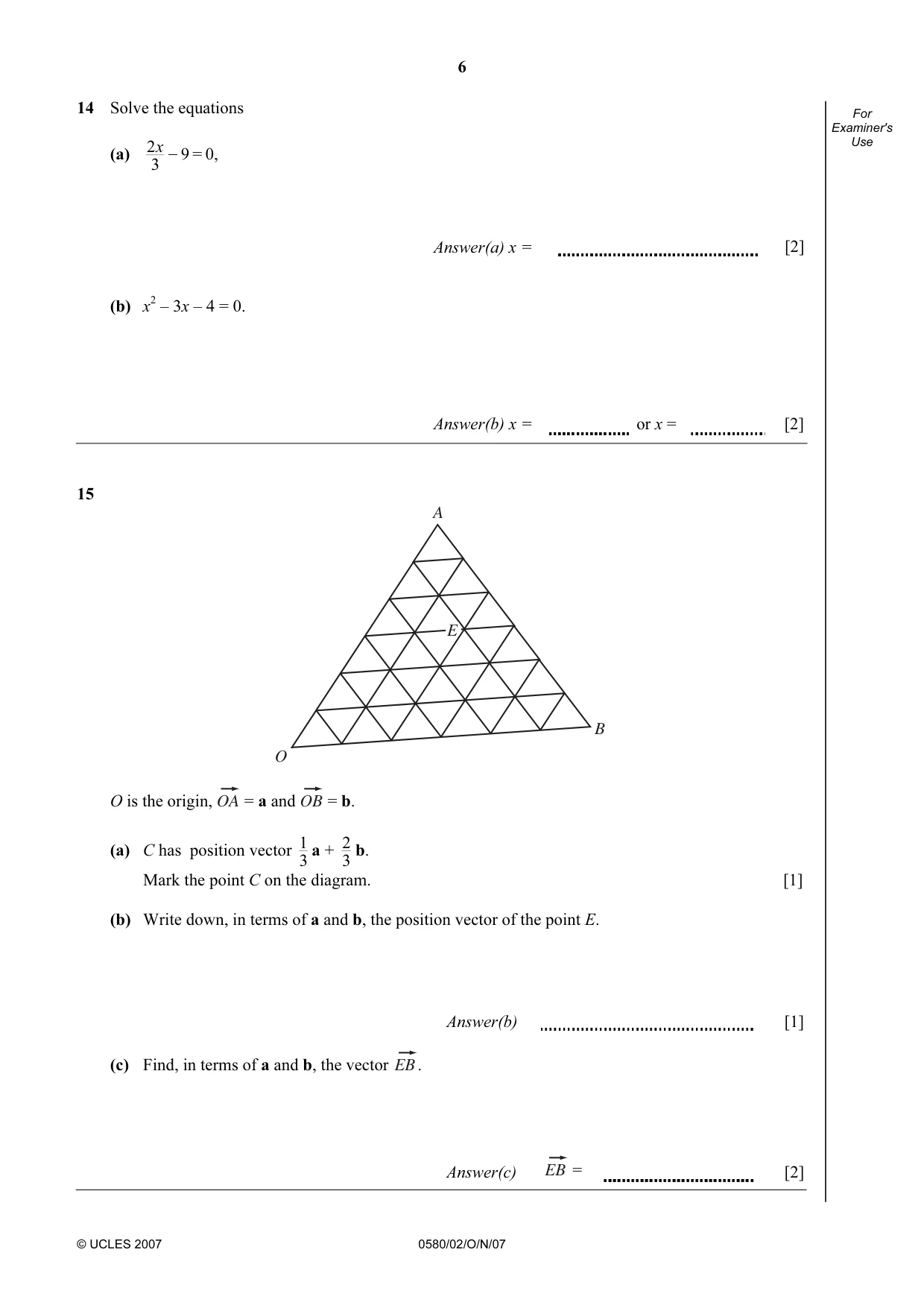
6 © UCLES 2007 0580/02/O/N/07 For Examiner's Use 14 Solve the equations (a) _ 2 9 = 0, 3 x Answer(a) x = [2] (b) x2 – 3x – 4 = 0. Answer(b) x = or x = [2] 15 A B O E O is the origin, OA = a and OB = b. (a) C has position vector 1 3 a + 2 3 b. Mark the point C on the diagram. [1] (b) Write down, in terms of a and b, the position vector of the point E. Answer(b) [1] (c) Find, in terms of a and b, the vector EB. Answer(c) EB = [2]
Question paper, page 7
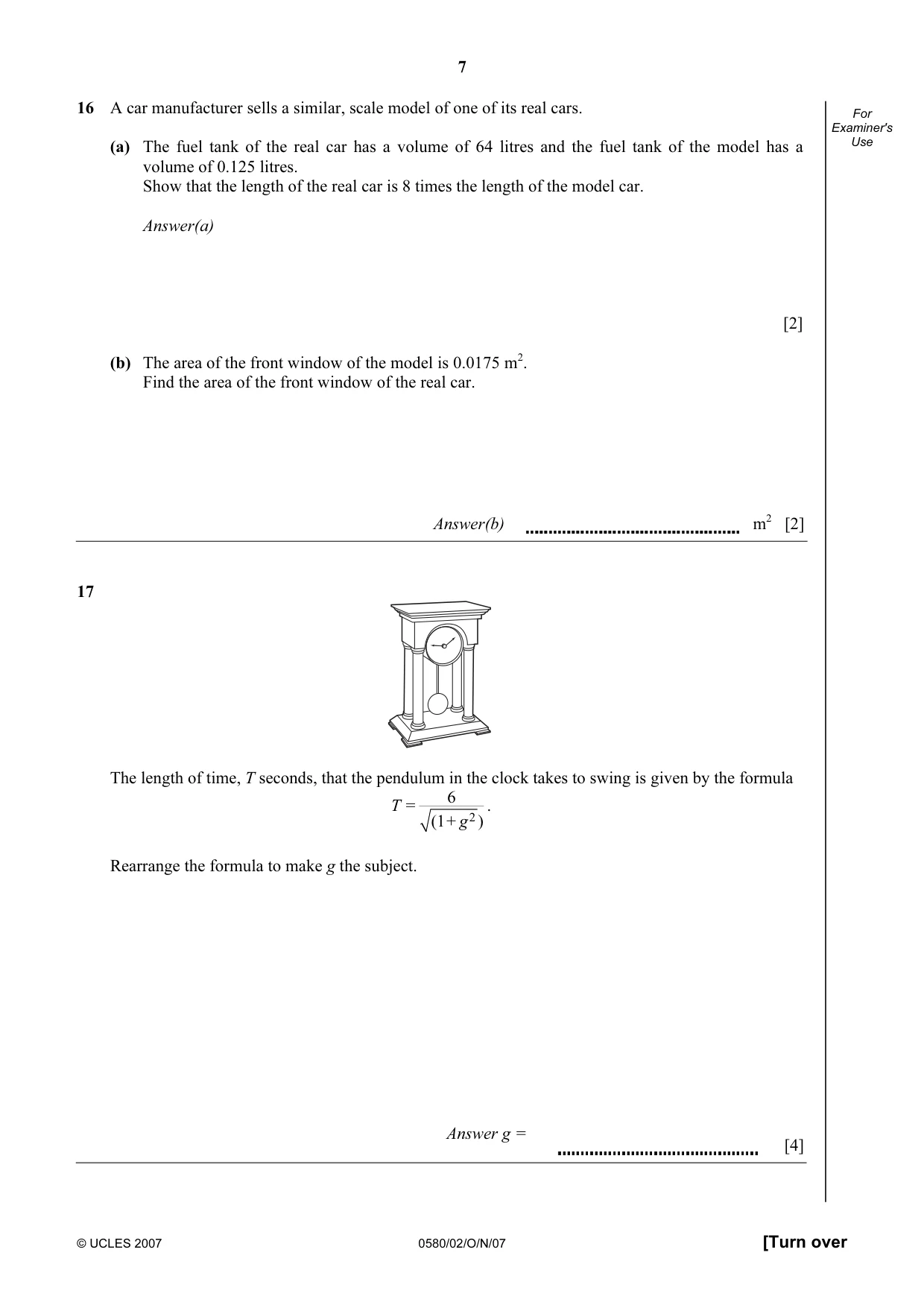
7 © UCLES 2007 0580/02/O/N/07 [Turn over For Examiner's Use 16 A car manufacturer sells a similar, scale model of one of its real cars. (a) The fuel tank of the real car has a volume of 64 litres and the fuel tank of the model has a volume of 0.125 litres. Show that the length of the real car is 8 times the length of the model car. Answer(a) [2] (b) The area of the front window of the model is 0.0175 m2. Find the area of the front window of the real car. Answer(b) m2 [2] 17 The length of time, T seconds, that the pendulum in the clock takes to swing is given by the formula 2 6 = (1+ ) T g . Rearrange the formula to make g the subject. Answer g = [4]
Question paper, page 8
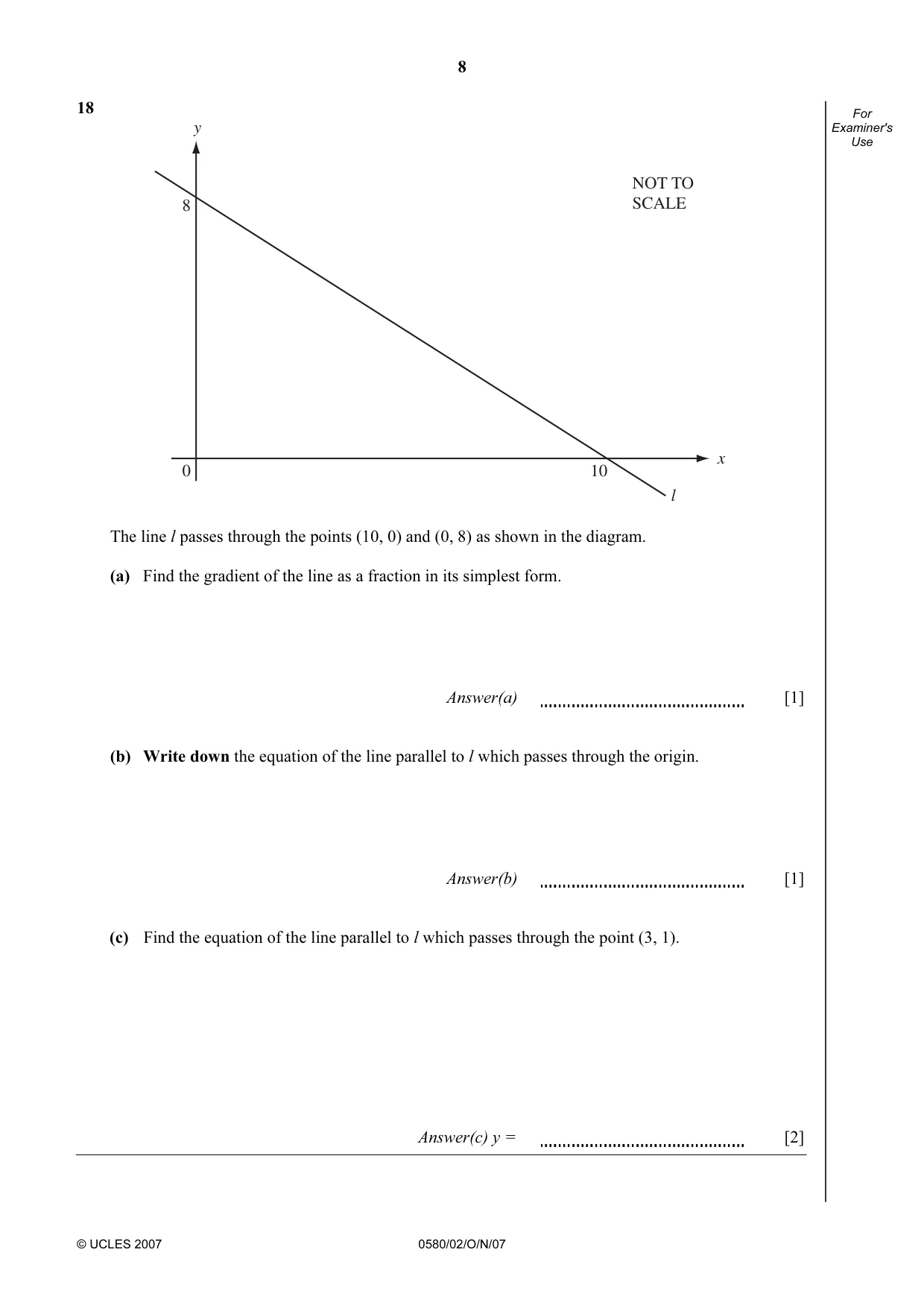
8 © UCLES 2007 0580/02/O/N/07 For Examiner's Use 18 0 10 8 x y NOT TO SCALE l The line l passes through the points (10, 0) and (0, 8) as shown in the diagram. (a) Find the gradient of the line as a fraction in its simplest form. Answer(a) [1] (b) Write down the equation of the line parallel to l which passes through the origin. Answer(b) [1] (c) Find the equation of the line parallel to l which passes through the point (3, 1). Answer(c) y = [2]
Question paper, page 9
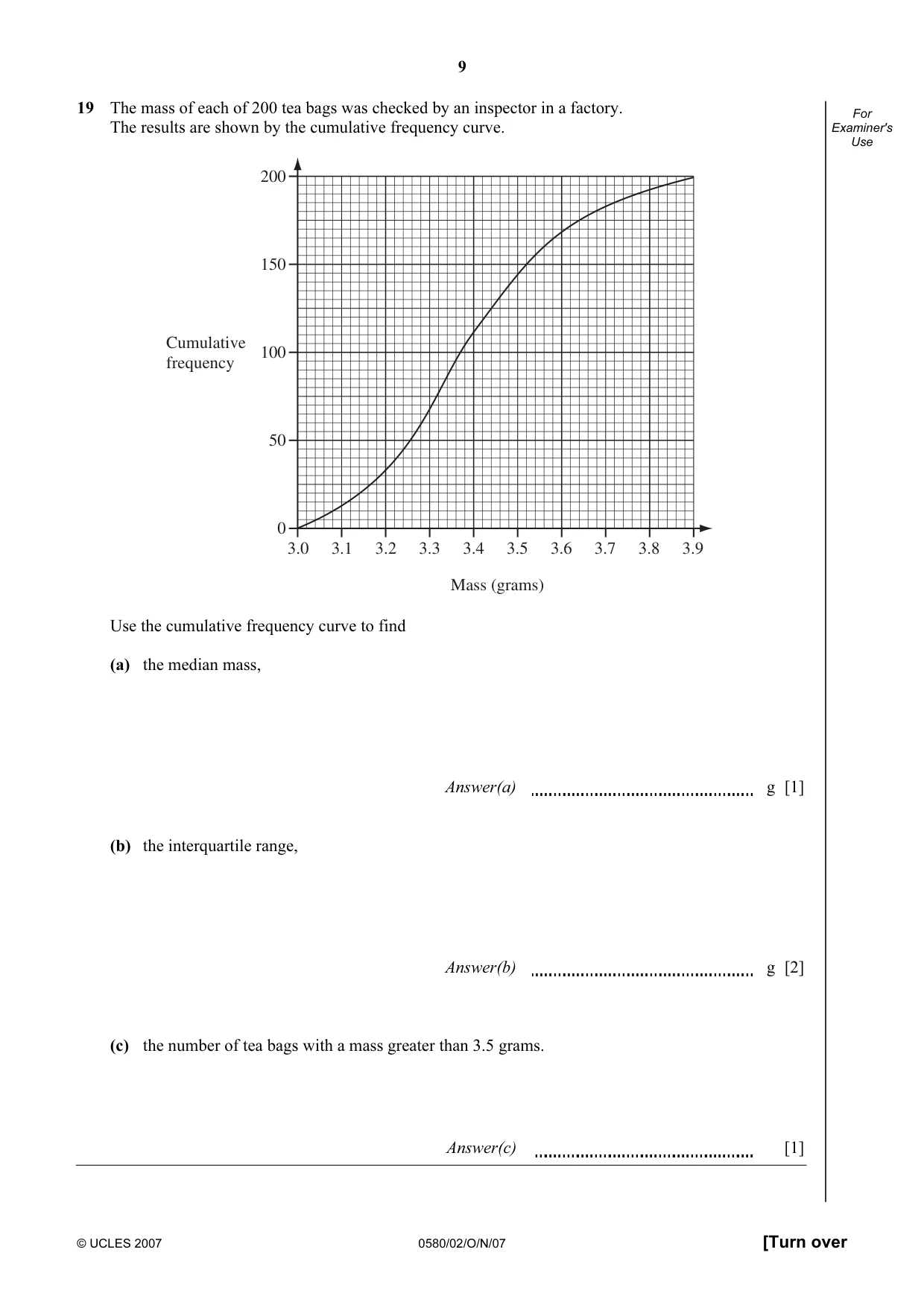
9 © UCLES 2007 0580/02/O/N/07 [Turn over For Examiner's Use 19 The mass of each of 200 tea bags was checked by an inspector in a factory. The results are shown by the cumulative frequency curve. 200 150 100 50 0 3.0 3.1 3.2 3.3 3.4 3.5 3.6 3.7 3.8 3.9 Cumulative frequency Mass (grams) Use the cumulative frequency curve to find (a) the median mass, Answer(a) g [1] (b) the interquartile range, Answer(b) g [2] (c) the number of tea bags with a mass greater than 3.5 grams. Answer(c) [1]
Question paper, page 10
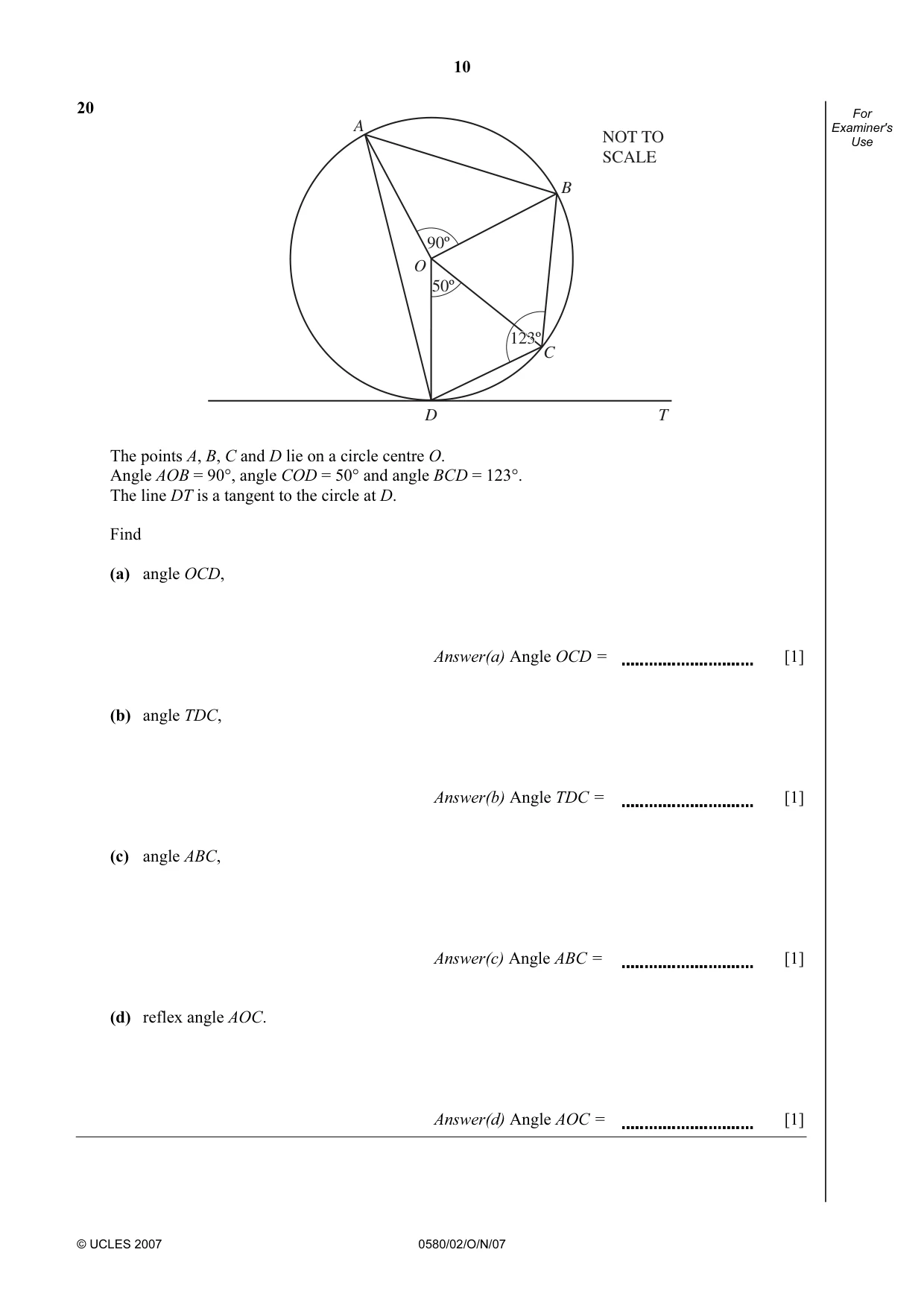
10 © UCLES 2007 0580/02/O/N/07 For Examiner's Use 20 A B C D T 90º 50º 123º 123º 123º O NOT TO SCALE The points A, B, C and D lie on a circle centre O. Angle AOB = 90°, angle COD = 50° and angle BCD = 123°. The line DT is a tangent to the circle at D. Find (a) angle OCD, Answer(a) Angle OCD = [1] (b) angle TDC, Answer(b) Angle TDC = [1] (c) angle ABC, Answer(c) Angle ABC = [1] (d) reflex angle AOC. Answer(d) Angle AOC = [1]
Question paper, page 11
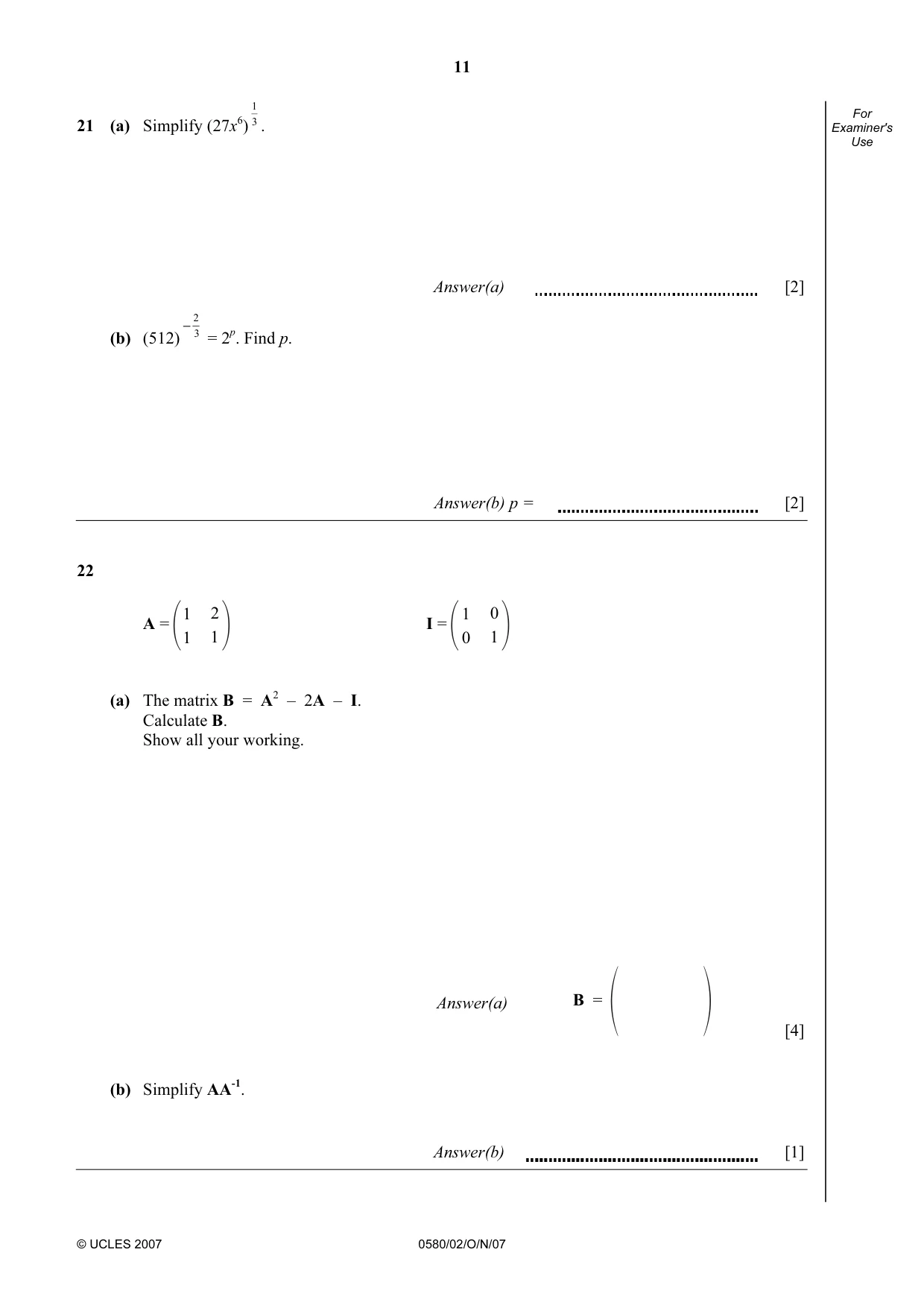
11 © UCLES 2007 0580/02/O/N/07 For Examiner's Use 21 (a) Simplify (27x6) 3 1 . Answer(a) [2] (b) (512) 2 3 _ = 2p. Find p. Answer(b) p = [2] 22 A = 2 1 1 1 I = 0 1 1 0 (a) The matrix B = A2 – 2A – I. Calculate B. Show all your working. Answer(a) B = [4] (b) Simplify AA-1. Answer(b) [1]
Question paper, page 12
12 Permission to reproduce items where third-party owned material protected by copyright is included has been sought and cleared where possible. Every reasonable effort has been made by the publisher (UCLES) to trace copyright holders, but if any items requiring clearance have unwittingly been included, the publisher will be pleased to make amends at the earliest possible opportunity. University of Cambridge International Examinations is part of the Cambridge Assessment Group. Cambridge Assessment is the brand name of University of Cambridge Local Examinations Syndicate (UCLES), which is itself a department of the University of Cambridge. © UCLES 2007 0580/02/O/N/07 BLANK PAGE
Mark scheme, page 1
UNIVERSITY OF CAMBRIDGE INTERNATIONAL EXAMINATIONS International General Certificate of Secondary Education MARK SCHEME for the October/November 2007 question paper 0580 and 0581 MATHEMATICS 0580/02 and 0581/02 Paper 2 (Extended), maximum raw mark 70 This mark scheme is published as an aid to teachers and candidates, to indicate the requirements of the examination. It shows the basis on which Examiners were instructed to award marks. It does not indicate the details of the discussions that took place at an Examiners’ meeting before marking began. All Examiners are instructed that alternative correct answers and unexpected approaches in candidates’ scripts must be given marks that fairly reflect the relevant knowledge and skills demonstrated. Mark schemes must be read in conjunction with the question papers and the report on the examination. • CIE will not enter into discussions or correspondence in connection with these mark schemes. CIE is publishing the mark schemes for the October/November 2007 question papers for most IGCSE, GCE Advanced Level and Advanced Subsidiary Level syllabuses and some Ordinary Level syllabuses. www.XtremePapers.com
Mark scheme, page 2
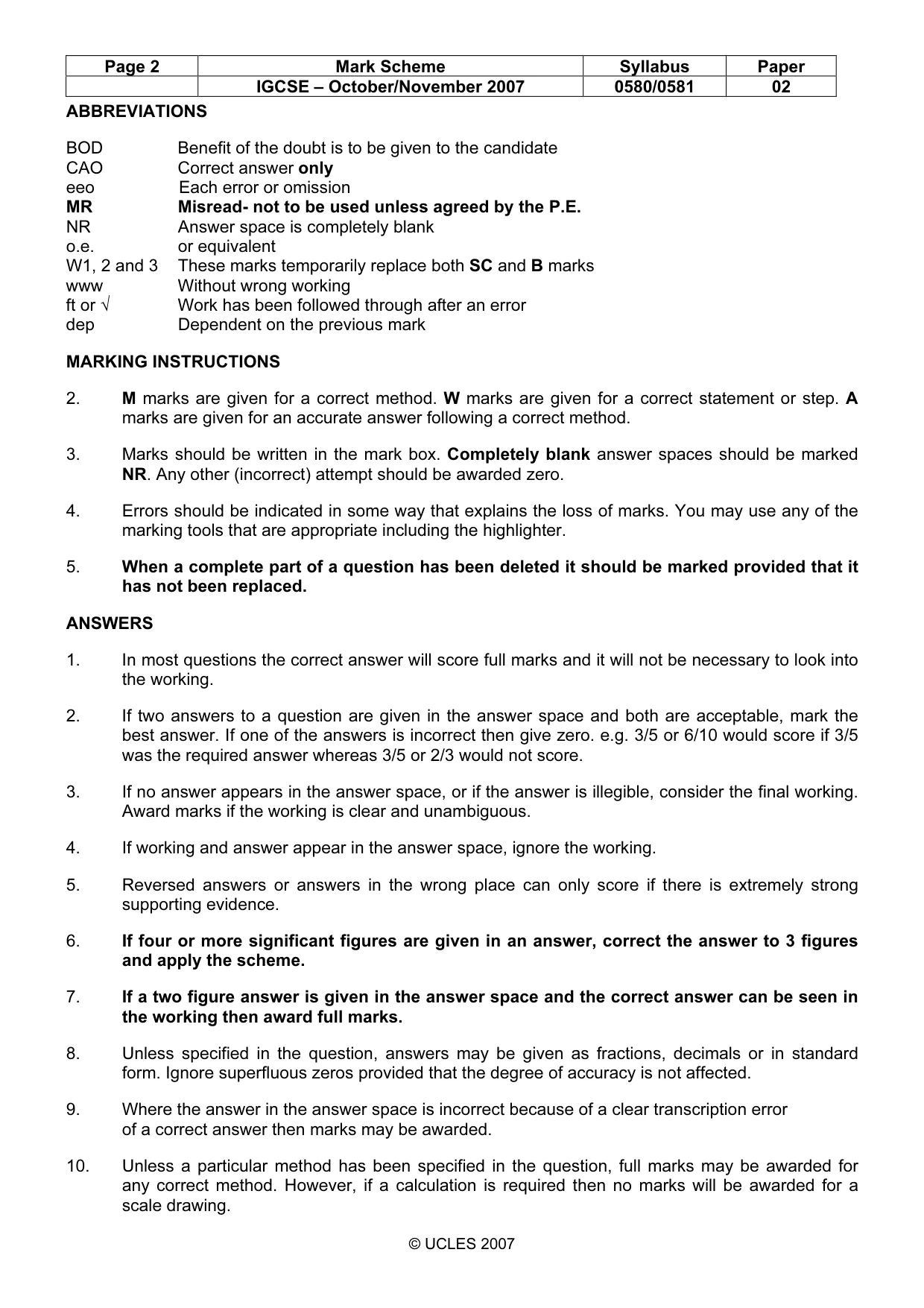
Page 2 Mark Scheme Syllabus Paper IGCSE – October/November 2007 0580/0581 02 © UCLES 2007 ABBREVIATIONS BOD Benefit of the doubt is to be given to the candidate CAO Correct answer only eeo Each error or omission MR Misread- not to be used unless agreed by the P.E. NR Answer space is completely blank o.e. or equivalent W1, 2 and 3 These marks temporarily replace both SC and B marks www Without wrong working ft or √ Work has been followed through after an error dep Dependent on the previous mark MARKING INSTRUCTIONS 2. M marks are given for a correct method. W marks are given for a correct statement or step. A marks are given for an accurate answer following a correct method. 3. Marks should be written in the mark box. Completely blank answer spaces should be marked NR. Any other (incorrect) attempt should be awarded zero. 4. Errors should be indicated in some way that explains the loss of marks. You may use any of the marking tools that are appropriate including the highlighter. 5. When a complete part of a question has been deleted it should be marked provided that it has not been replaced. ANSWERS 1. In most questions the correct answer will score full marks and it will not be necessary to look into the working. 2. If two answers to a question are given in the answer space and both are acceptable, mark the best answer. If one of the answers is incorrect then give zero. e.g. 3/5 or 6/10 would score if 3/5 was the required answer whereas 3/5 or 2/3 would not score. 3. If no answer appears in the answer space, or if the answer is illegible, consider the final working. Award marks if the working is clear and unambiguous. 4. If working and answer appear in the answer space, ignore the working. 5. Reversed answers or answers in the wrong place can only score if there is extremely strong supporting evidence. 6. If four or more significant figures are given in an answer, correct the answer to 3 figures and apply the scheme. 7. If a two figure answer is given in the answer space and the correct answer can be seen in the working then award full marks. 8. Unless specified in the question, answers may be given as fractions, decimals or in standard form. Ignore superfluous zeros provided that the degree of accuracy is not affected. 9. Where the answer in the answer space is incorrect because of a clear transcription error of a correct answer then marks may be awarded. 10. Unless a particular method has been specified in the question, full marks may be awarded for any correct method. However, if a calculation is required then no marks will be awarded for a scale drawing.
Mark scheme, page 3
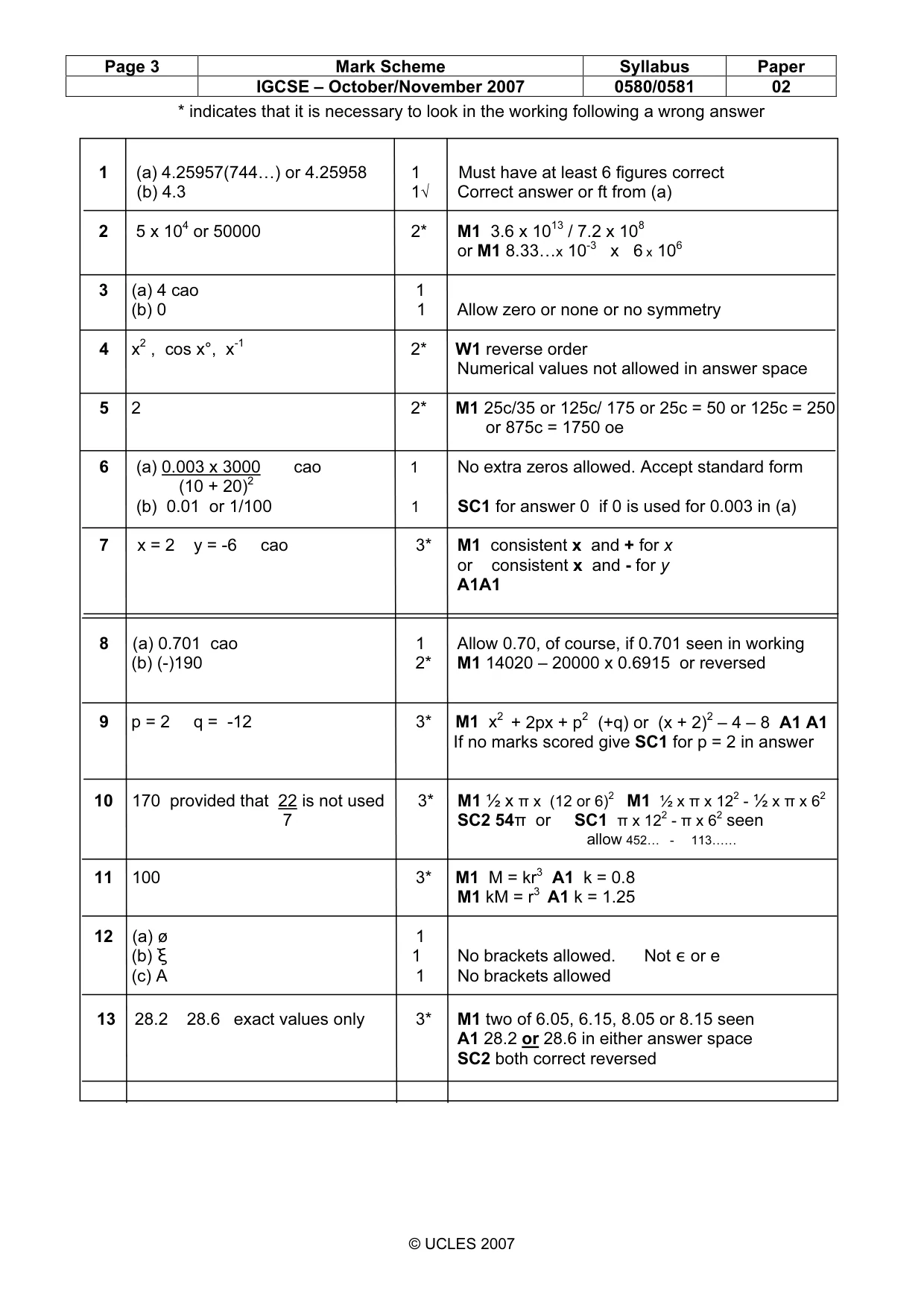
Page 3 Mark Scheme Syllabus Paper IGCSE – October/November 2007 0580/0581 02 © UCLES 2007 * indicates that it is necessary to look in the working following a wrong answer 1 (a) 4.25957(744…) or 4.25958 1 Must have at least 6 figures correct (b) 4.3 1√ Correct answer or ft from (a) 2 5 x 10⁴ or 50000 2* M1 3.6 x 10¹³ / 7.2 x 10⁸ or M1 8.33…x 10-3 x 6 x 106 3 (a) 4 cao 1 (b) 0 1 Allow zero or none or no symmetry 4 x2 , cos x°, x-1 2* W1 reverse order Numerical values not allowed in answer space 5 2 2* M1 25c/35 or 125c/ 175 or 25c = 50 or 125c = 250 or 875c = 1750 oe 6 (a) 0.003 x 3000 cao 1 No extra zeros allowed. Accept standard form (10 + 20)2 (b) 0.01 or 1/100 1 SC1 for answer 0 if 0 is used for 0.003 in (a) 7 x = 2 y = -6 cao 3* M1 consistent x and + for x or consistent x and - for y A1A1 8 (a) 0.701 cao 1 Allow 0.70, of course, if 0.701 seen in working (b) (-)190 2* M1 14020 – 20000 x 0.6915 or reversed 9 p = 2 q = -12 3* M1 x2 + 2px + p2 (+q) or (x + 2)2 – 4 – 8 A1 A1 If no marks scored give SC1 for p = 2 in answer 10 170 provided that 22 is not used 3* M1 ½ x π x (12 or 6)2 M1 ½ x π x 122 - ½ x π x 62 7 SC2 54π or SC1 π x 122 - π x 62 seen allow 452… - 113…… 11 100 3* M1 M = kr3 A1 k = 0.8 M1 kM = r3 A1 k = 1.25 12 (a) ø 1 (b) ξ 1 No brackets allowed. Not ε or e (c) A 1 No brackets allowed 13 28.2 28.6 exact values only 3* M1 two of 6.05, 6.15, 8.05 or 8.15 seen A1 28.2 or 28.6 in either answer space SC2 both correct reversed
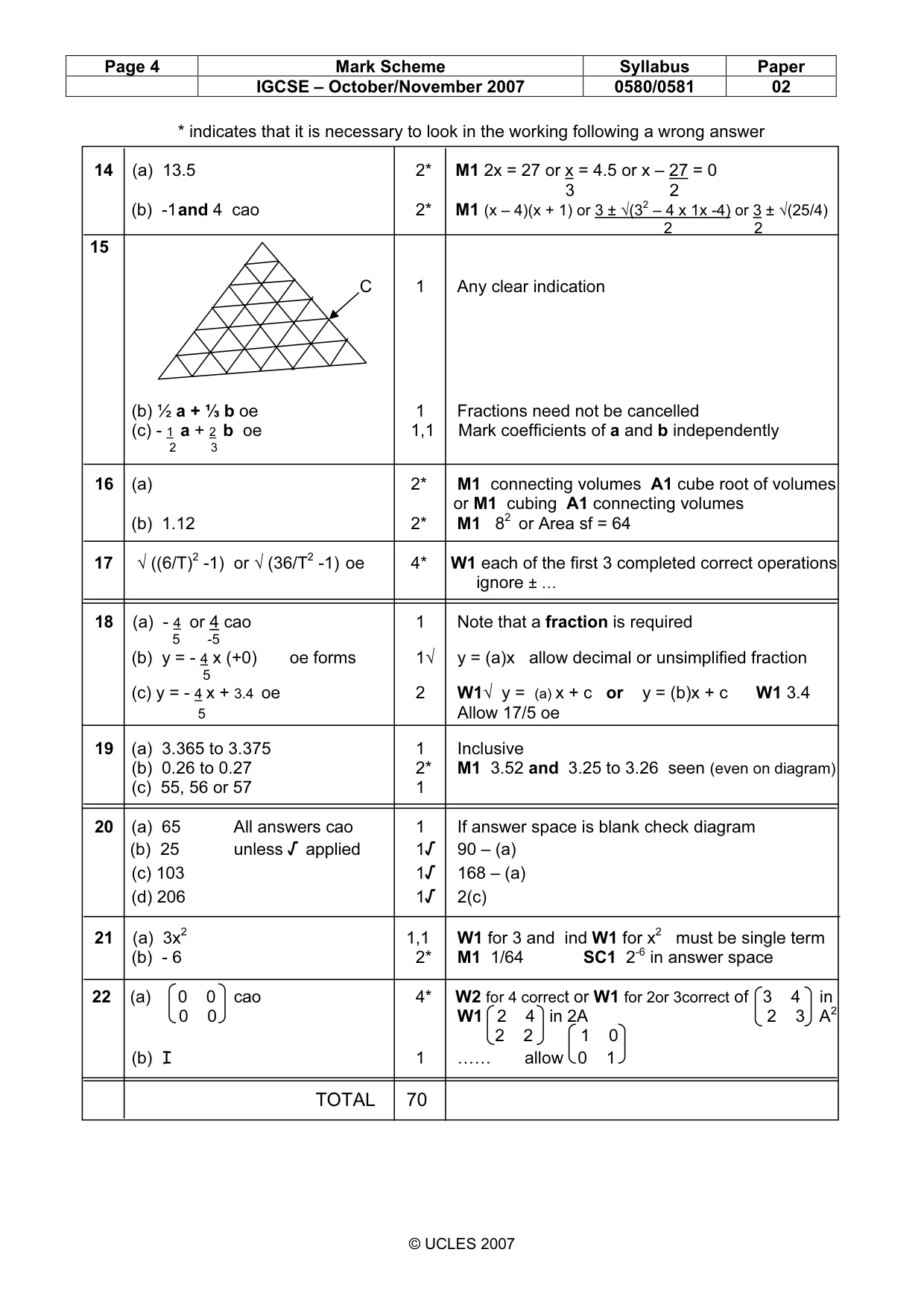
Mark scheme, page 4
Page 4 Mark Scheme Syllabus Paper IGCSE – October/November 2007 0580/0581 02 © UCLES 2007 * indicates that it is necessary to look in the working following a wrong answer 14 (a) 13.5 2* M1 2x = 27 or x = 4.5 or x – 27 = 0 3 2 (b) -1 and 4 cao 2* M1 (x – 4)(x + 1) or 3 ± √(32 – 4 x 1x -4) or 3 ± √(25/4) 2 2 15 C 1 Any clear indication (b) ½ a + ⅓ b oe 1 Fractions need not be cancelled (c) - 1 a + 2 b oe 1,1 Mark coefficients of a and b independently 2 3 16 (a) 2* M1 connecting volumes A1 cube root of volumes or M1 cubing A1 connecting volumes (b) 1.12 2* M1 82 or Area sf = 64 17 √ ((6/T)2 -1) or √ (36/T2 -1) oe 4* W1 each of the first 3 completed correct operations ignore ± … 18 (a) - 4 or 4 cao 1 Note that a fraction is required 5 -5 (b) y = - 4 x (+0) oe forms 1√ y = (a)x allow decimal or unsimplified fraction 5 (c) y = - 4 x + 3.4 oe 2 W1√ y = (a) x + c or y = (b)x + c W1 3.4 5 Allow 17/5 oe 19 (a) 3.365 to 3.375 1 Inclusive (b) 0.26 to 0.27 2* M1 3.52 and 3.25 to 3.26 seen (even on diagram) (c) 55, 56 or 57 1 20 (a) 65 All answers cao 1 If answer space is blank check diagram (b) 25 unless √ applied 1√ 90 – (a) (c) 103 1√ 168 – (a) (d) 206 1√ 2(c) 21 (a) 3x2 1,1 W1 for 3 and ind W1 for x2 must be single term (b) - 6 2* M1 1/64 SC1 2-6 in answer space 22 (a) 0 0 cao 4* W2 for 4 correct or W1 for 2or 3correct of 3 4 in 0 0 W1 2 4 in 2A 2 3 A2 2 2 1 0 (b) I 1 …… allow 0 1 TOTAL 70
What you needed in this session
Cambridge’s own grade thresholds for 2007 Oct/Nov, Paper 2 · Variant 1. A higher threshold means an easier paper — the bar moves with how the cohort did.