Cambridge IGCSE Mathematics (with coursework) 0581 — 2005 Oct/Nov Paper 2 · Variant 1
0581/21/O/N/05
The question paper and its mark scheme, free to read here and free to download. This is Cambridge’s own paper, exactly as it was sat.
Question paper12 pages
Mark scheme4 pages
Answers below. Sit the paper first if you are practising.
Paper as text
Question paper, page 1
This document consists of 11 printed pages and 1 blank page. IB05 11_0580_02/9RP UCLES 2005 [Turn over UNIVERSITY OF CAMBRIDGE INTERNATIONAL EXAMINATIONS International General Certificate of Secondary Education MATHEMATICS Paper 2 (Extended) 0580/02 0581/02 Candidates answer on the Question Paper. Additional Materials: Electronic calculator Geometrical instruments October/November 2005 Mathematical tables (optional) Tracing paper (optional) 1hour 30 minutes READ THESE INSTRUCTIONS FIRST Write your Centre number, candidate number and name on all the work you hand in. Write in dark blue or black pen in the spaces provided on the Question Paper. You may use a pencil for any diagrams or graphs. Do not use staples, paper clips, highlighters, glue or correction fluid. DO NOT WRITE IN THE BARCODE. DO NOT WRITE IN THE GREY AREAS BETWEEN THE PAGES. Answer all questions. If working is needed for any question it must be shown below that question. The number of marks is given in brackets [ ] at the end of each question or part question. The total number of marks for this paper is 70. Electronic calculators should be used. If the degree of accuracy is not specified in the question, and if the answer is not exact, give the answer to three significant figures. Given answers in degrees to one decimal place. For π , use either your calculator value or 3.142. Candidate Name Centre Number Candidate Number *058002* For Examiner's Use www.XtremePapers.com
Question paper, page 2
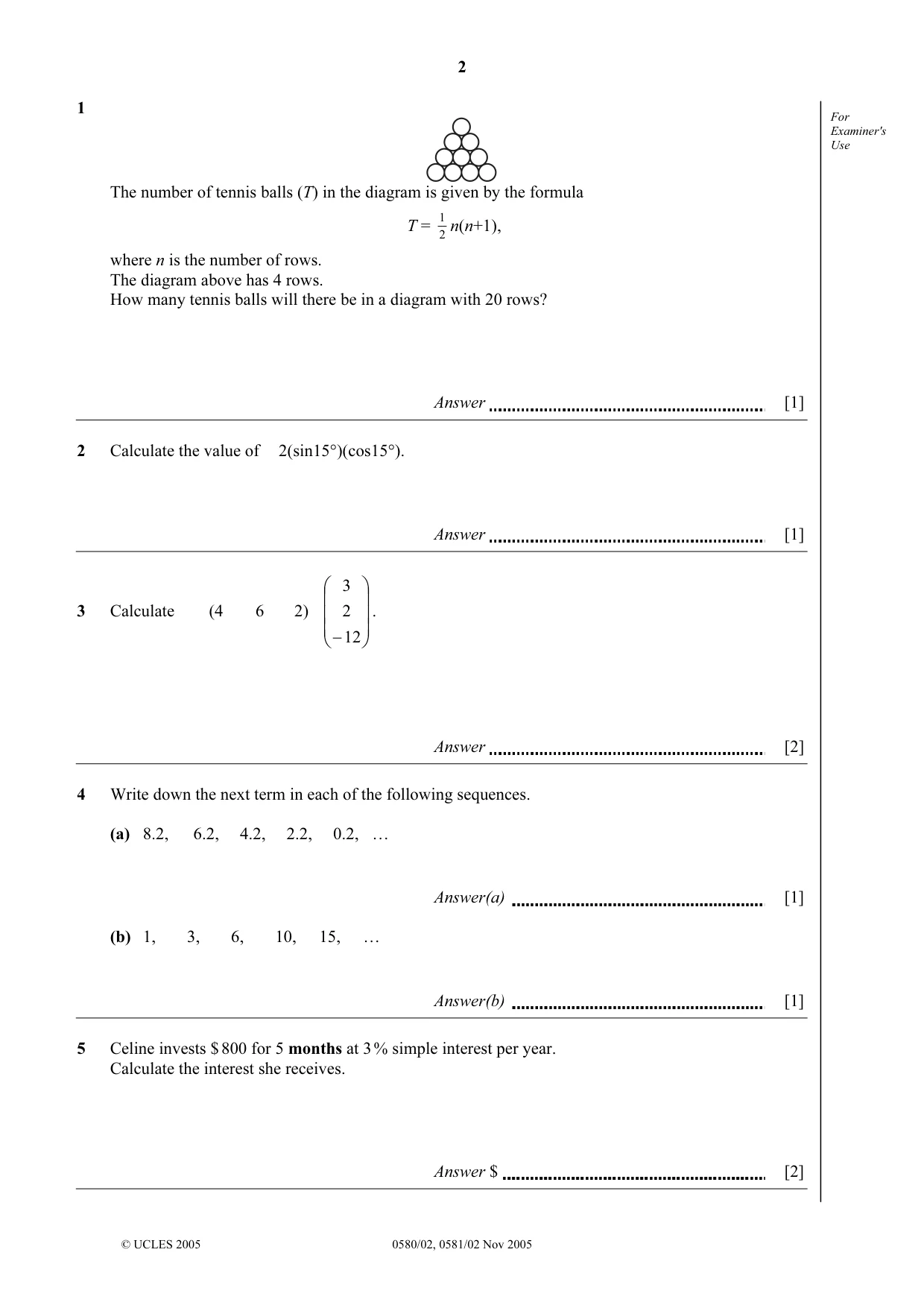
2 © UCLES 2005 0580/02, 0581/02 Nov 2005 For Examiner's Use 1 The number of tennis balls (T) in the diagram is given by the formula T = 2 1 n(n+1), where n is the number of rows. The diagram above has 4 rows. How many tennis balls will there be in a diagram with 20 rows? Answer [1] 2 Calculate the value of 2(sin15°)(cos15°). Answer [1] 3 Calculate (4 6 2) −12 2 3 . Answer [2] 4 Write down the next term in each of the following sequences. (a) 8.2, 6.2, 4.2, 2.2, 0.2, … Answer(a) [1] (b) 1, 3, 6, 10, 15, … Answer(b) [1] 5 Celine invests $ 800 for 5 months at 3 % simple interest per year. Calculate the interest she receives. Answer $ [2]
Question paper, page 3
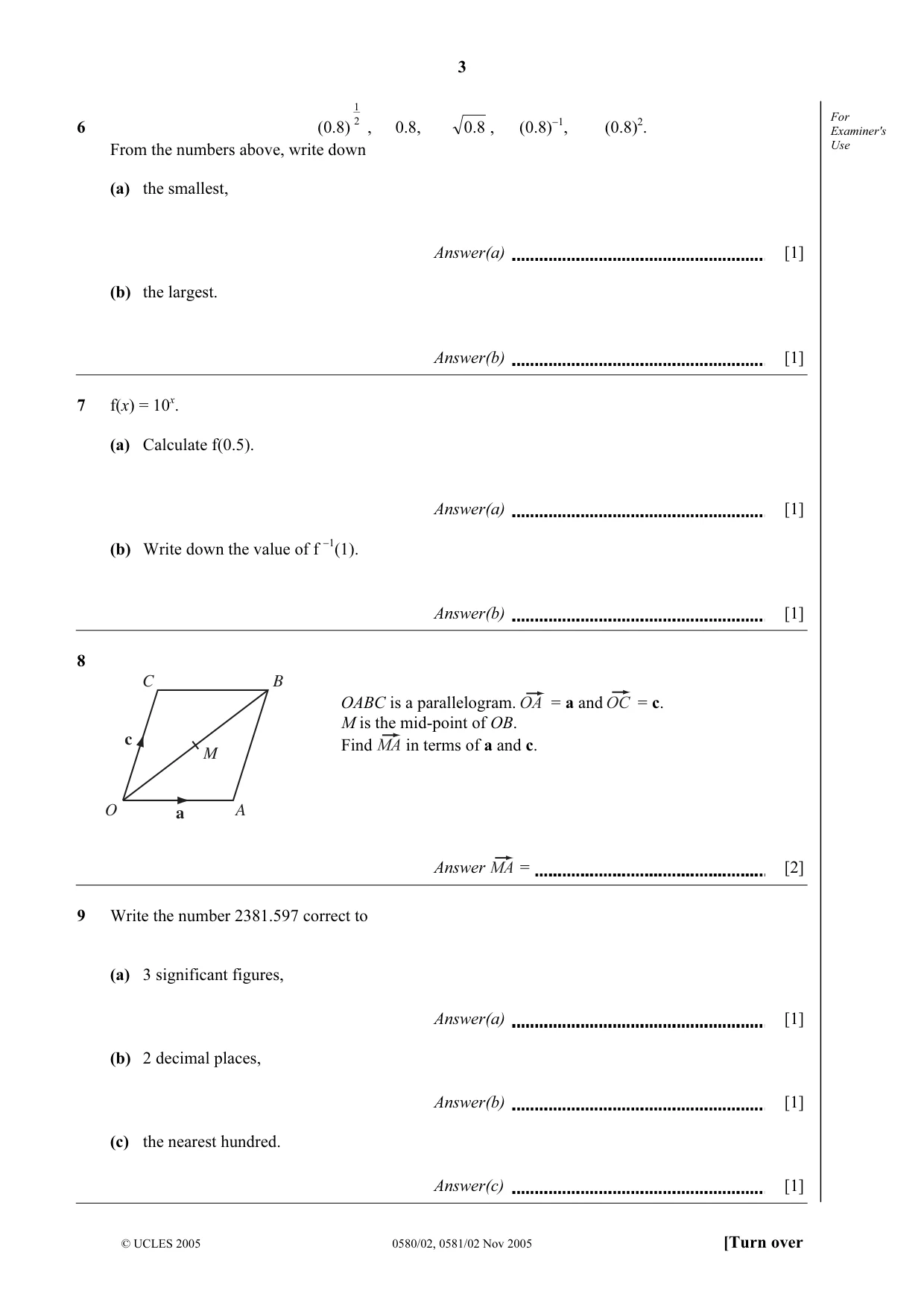
3 © UCLES 2005 0580/02, 0581/02 Nov 2005 [Turn over For Examiner's Use 6 (0.8) 2 1 , 0.8, 8.0 , (0.8)−1, (0.8)2. From the numbers above, write down (a) the smallest, Answer(a) [1] (b) the largest. Answer(b) [1] 7 f(x) = 10x. (a) Calculate f(0.5). Answer(a) [1] (b) Write down the value of f −1(1). Answer(b) [1] 8 OABC is a parallelogram. = a and = c. M is the mid-point of OB. Find in terms of a and c. Answer = [2] 9 Write the number 2381.597 correct to (a) 3 significant figures, Answer(a) [1] (b) 2 decimal places, Answer(b) [1] (c) the nearest hundred. Answer(c) [1] O A C B a c M
Question paper, page 4
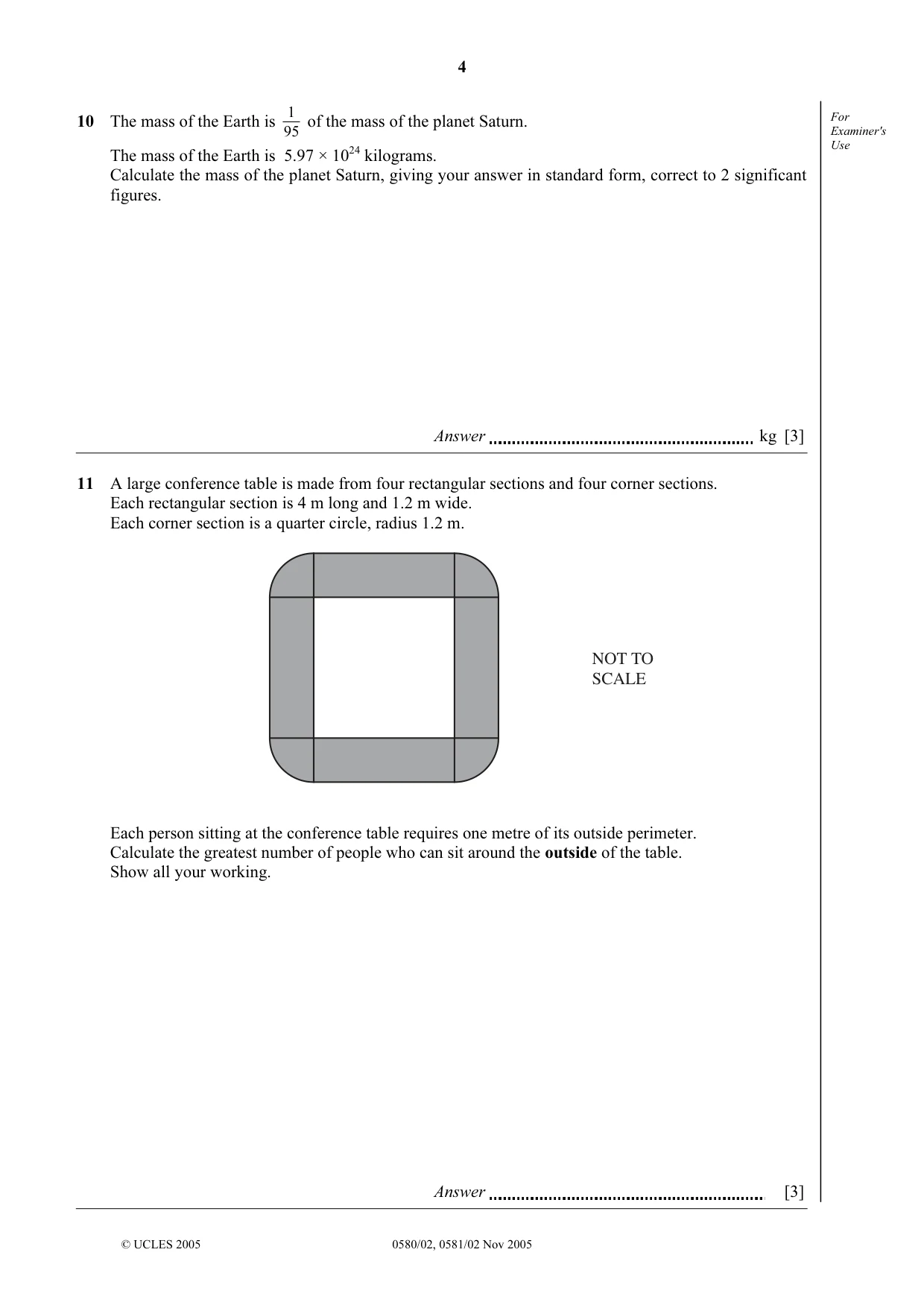
4 © UCLES 2005 0580/02, 0581/02 Nov 2005 For Examiner's Use 10 The mass of the Earth is 95 1 of the mass of the planet Saturn. The mass of the Earth is 5.97 × 1024 kilograms. Calculate the mass of the planet Saturn, giving your answer in standard form, correct to 2 significant figures. Answer kg [3] 11 A large conference table is made from four rectangular sections and four corner sections. Each rectangular section is 4 m long and 1.2 m wide. Each corner section is a quarter circle, radius 1.2 m. NOT TO SCALE Each person sitting at the conference table requires one metre of its outside perimeter. Calculate the greatest number of people who can sit around the outside of the table. Show all your working. Answer [3]
Question paper, page 5
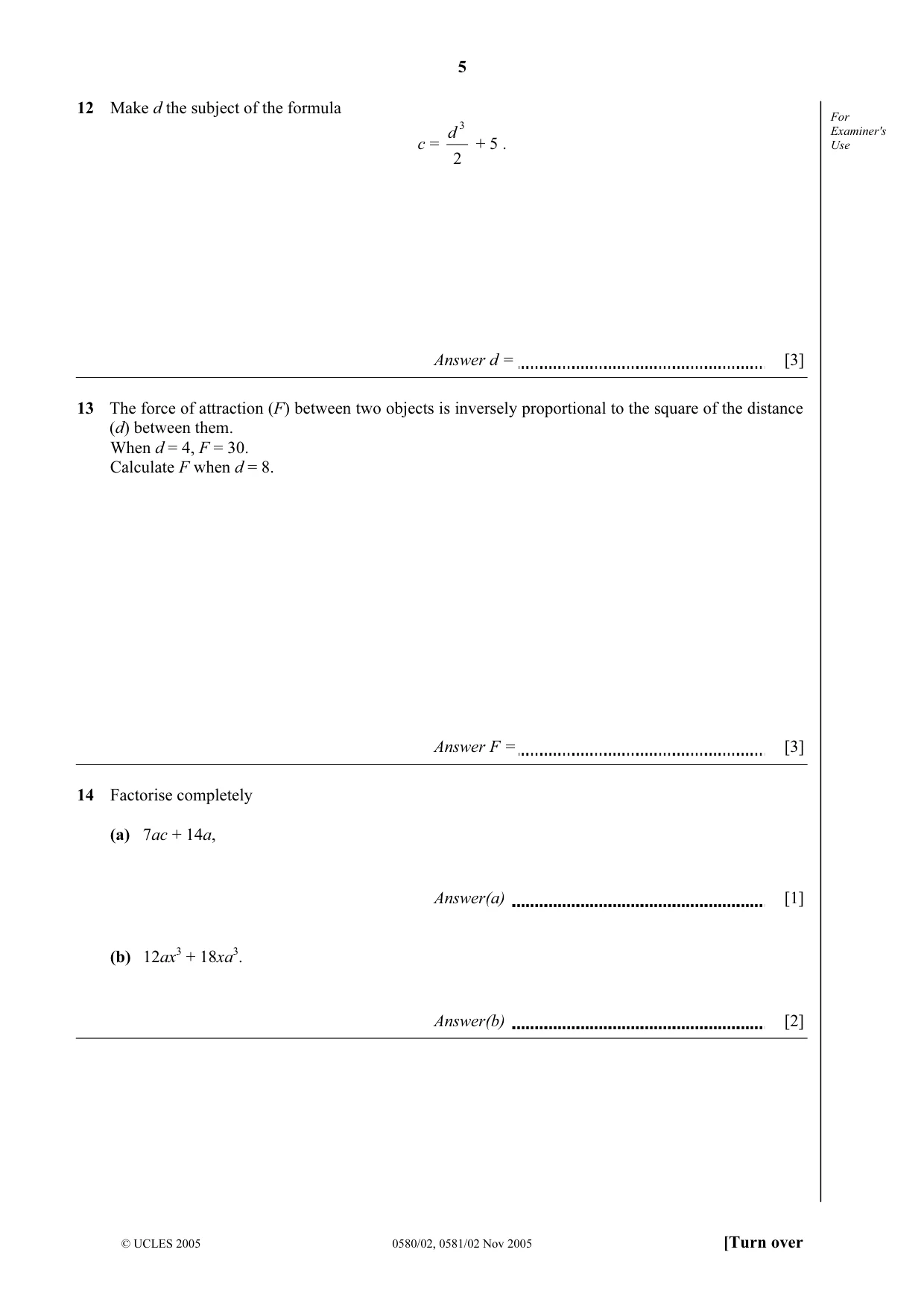
5 © UCLES 2005 0580/02, 0581/02 Nov 2005 [Turn over For Examiner's Use 12 Make d the subject of the formula c = 2 3 d + 5 . Answer d = [3] 13 The force of attraction (F) between two objects is inversely proportional to the square of the distance (d) between them. When d = 4, F = 30. Calculate F when d = 8. Answer F = [3] 14 Factorise completely (a) 7ac + 14a, Answer(a) [1] (b) 12ax3 + 18xa3. Answer(b) [2]
Question paper, page 6
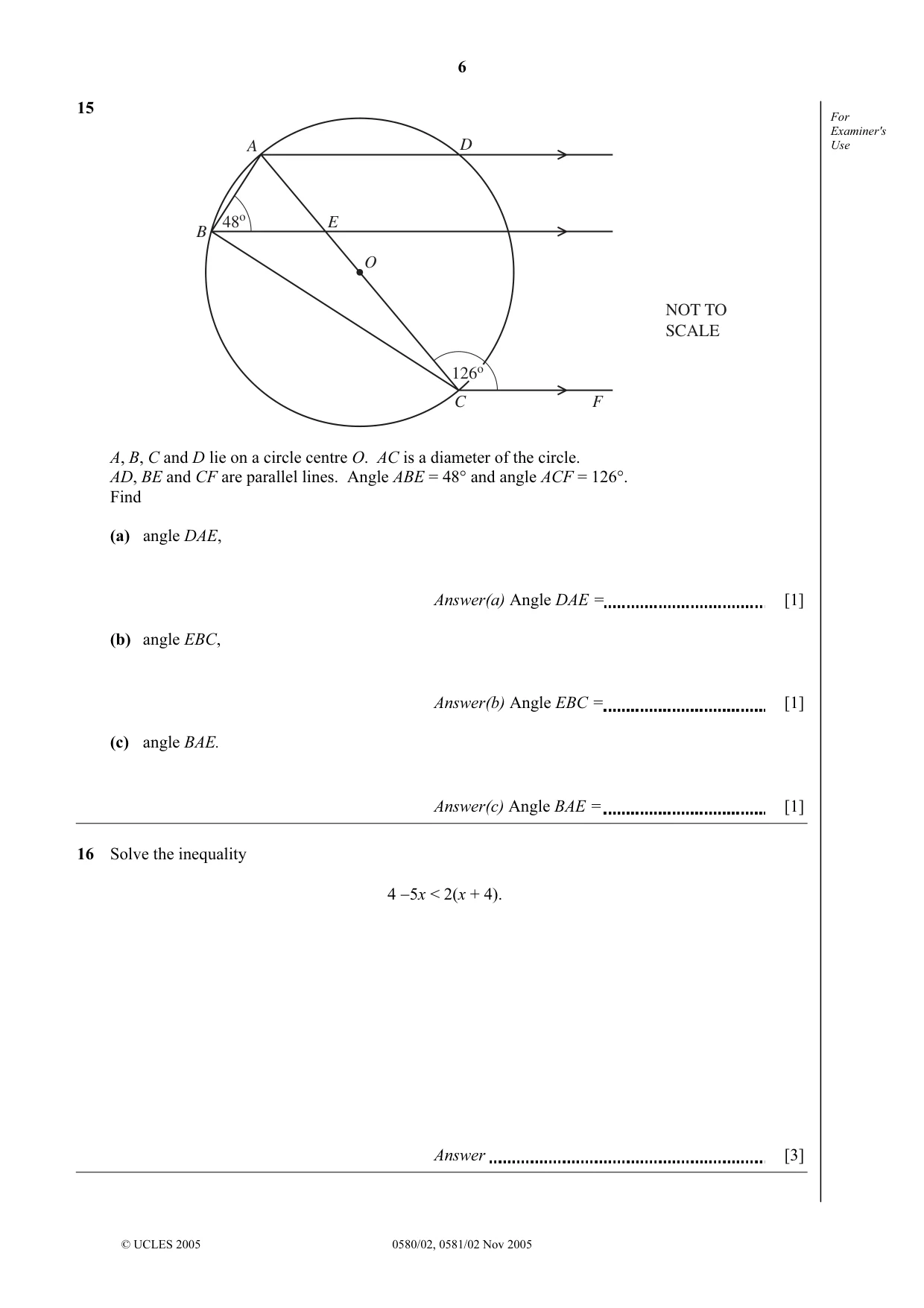
6 © UCLES 2005 0580/02, 0581/02 Nov 2005 For Examiner's Use 15 C F B A D E O NOT TO SCALE 48o 126o A, B, C and D lie on a circle centre O. AC is a diameter of the circle. AD, BE and CF are parallel lines. Angle ABE = 48° and angle ACF = 126°. Find (a) angle DAE, Answer(a) Angle DAE = [1] (b) angle EBC, Answer(b) Angle EBC = [1] (c) angle BAE. Answer(c) Angle BAE = [1] 16 Solve the inequality 4 −5x < 2(x + 4). Answer [3]
Question paper, page 7
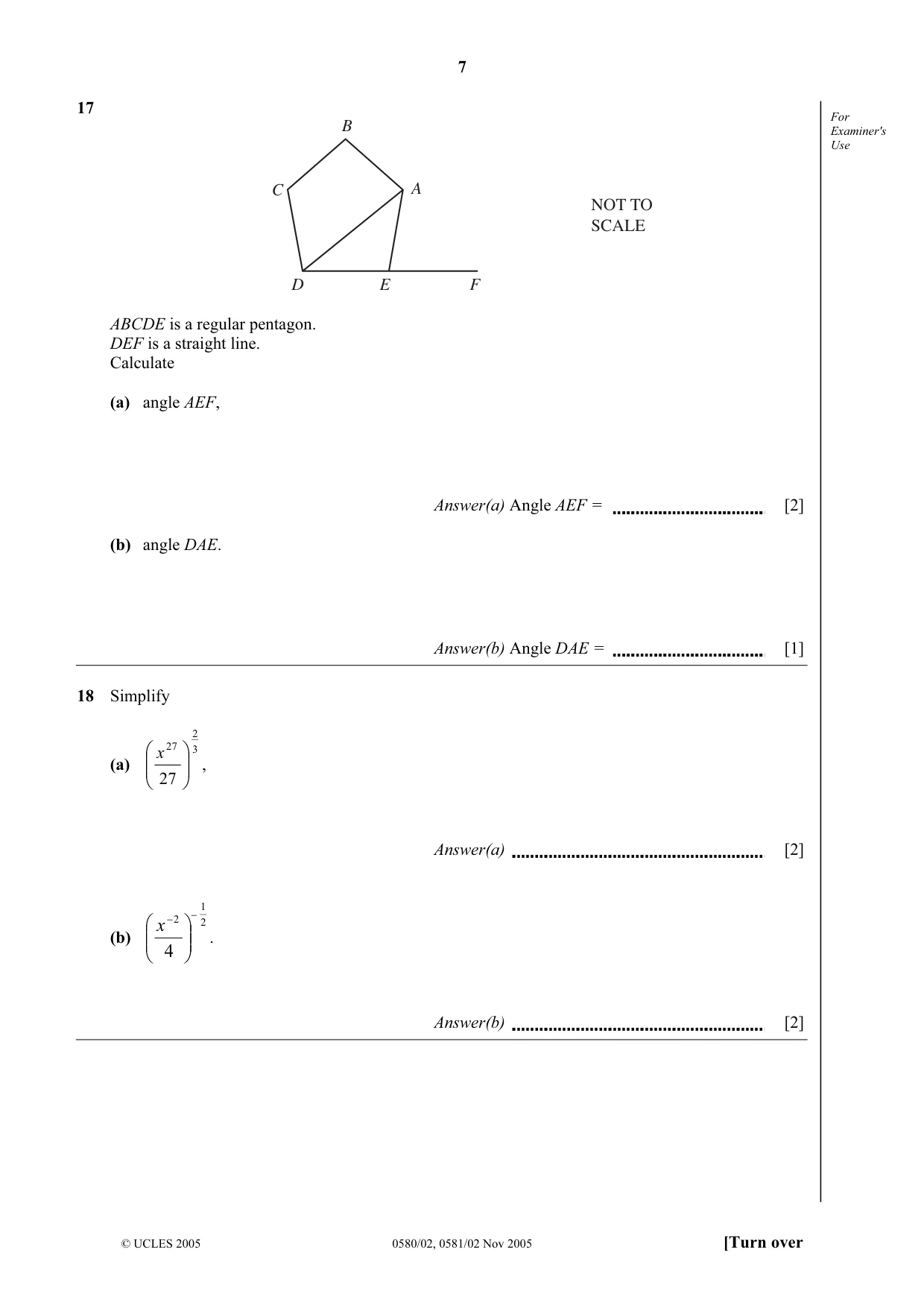
7 © UCLES 2005 0580/02, 0581/02 Nov 2005 [Turn over For Examiner's Use 17 D E F C A B NOT TO SCALE ABCDE is a regular pentagon. DEF is a straight line. Calculate (a) angle AEF, Answer(a) Angle AEF = [2] (b) angle DAE. Answer(b) Angle DAE = [1] 18 Simplify (a) 3 2 27 27 x , Answer(a) [2] (b) 2 1 2 4 − − x . Answer(b) [2]
Question paper, page 8
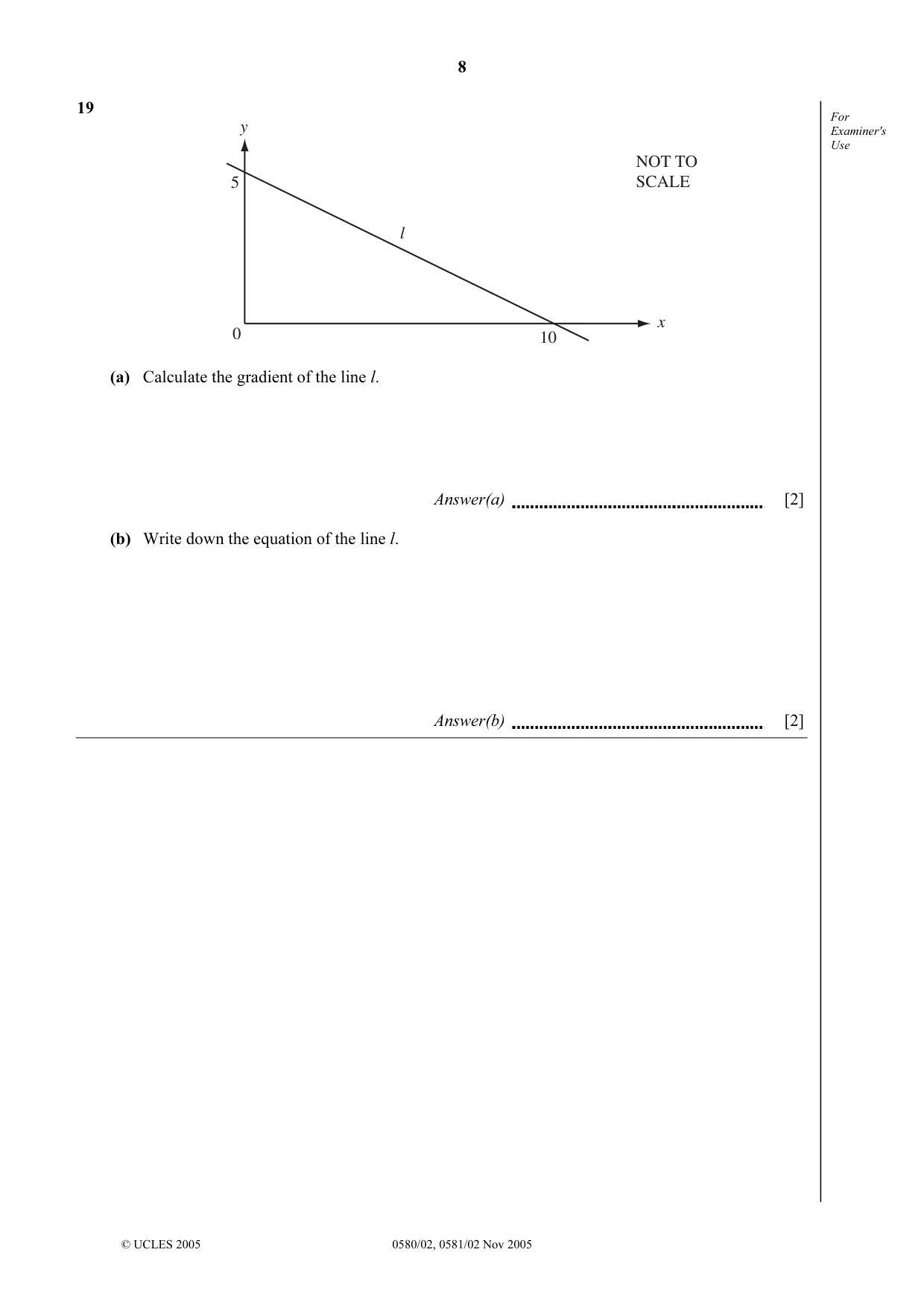
8 © UCLES 2005 0580/02, 0581/02 Nov 2005 For Examiner's Use 19 0 NOT TO SCALE 5 10 y x l (a) Calculate the gradient of the line l. Answer(a) [2] (b) Write down the equation of the line l. Answer(b) [2]
Question paper, page 9
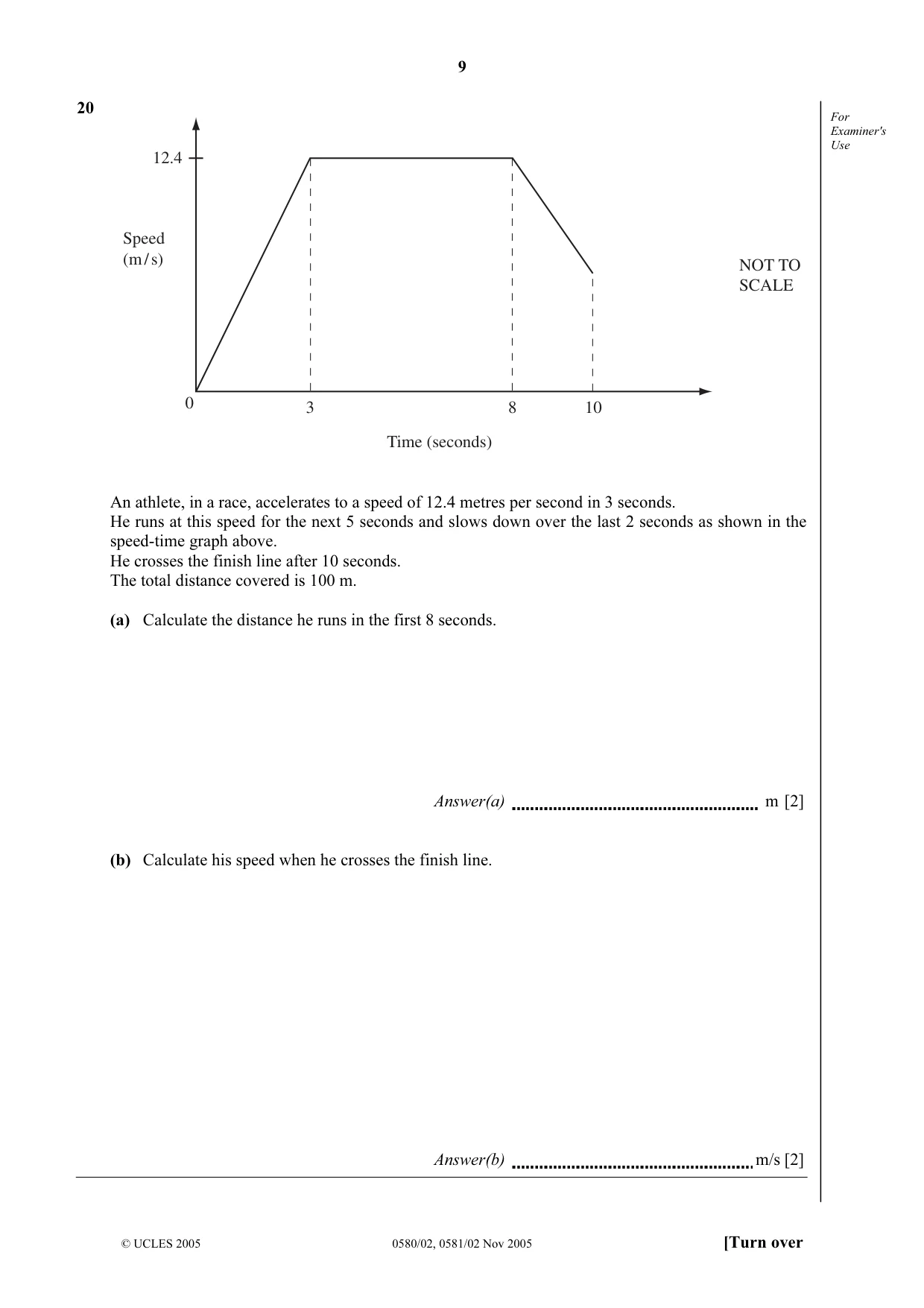
9 © UCLES 2005 0580/02, 0581/02 Nov 2005 [Turn over For Examiner's Use 20 12.4 0 3 8 10 Time (seconds) Speed (m / s) NOT TO SCALE An athlete, in a race, accelerates to a speed of 12.4 metres per second in 3 seconds. He runs at this speed for the next 5 seconds and slows down over the last 2 seconds as shown in the speed-time graph above. He crosses the finish line after 10 seconds. The total distance covered is 100 m. (a) Calculate the distance he runs in the first 8 seconds. Answer(a) m [2] (b) Calculate his speed when he crosses the finish line. Answer(b) m/s [2]
Question paper, page 10
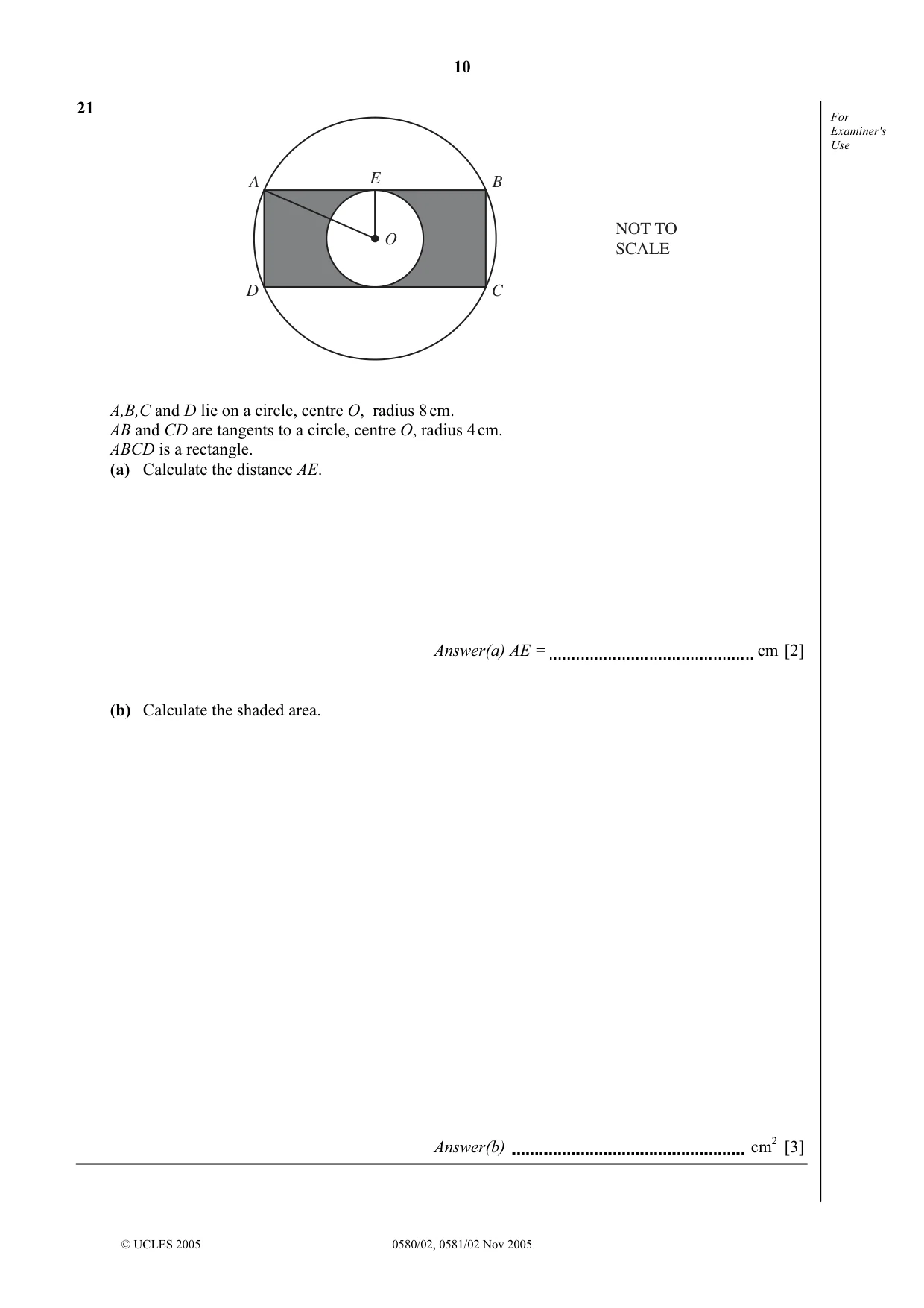
10 © UCLES 2005 0580/02, 0581/02 Nov 2005 For Examiner's Use 21 NOT TO SCALE A B D C O E A,B,C and D lie on a circle, centre O, radius 8 cm. AB and CD are tangents to a circle, centre O, radius 4 cm. ABCD is a rectangle. (a) Calculate the distance AE. Answer(a) AE = cm [2] (b) Calculate the shaded area. Answer(b) cm2 [3]
Question paper, page 11
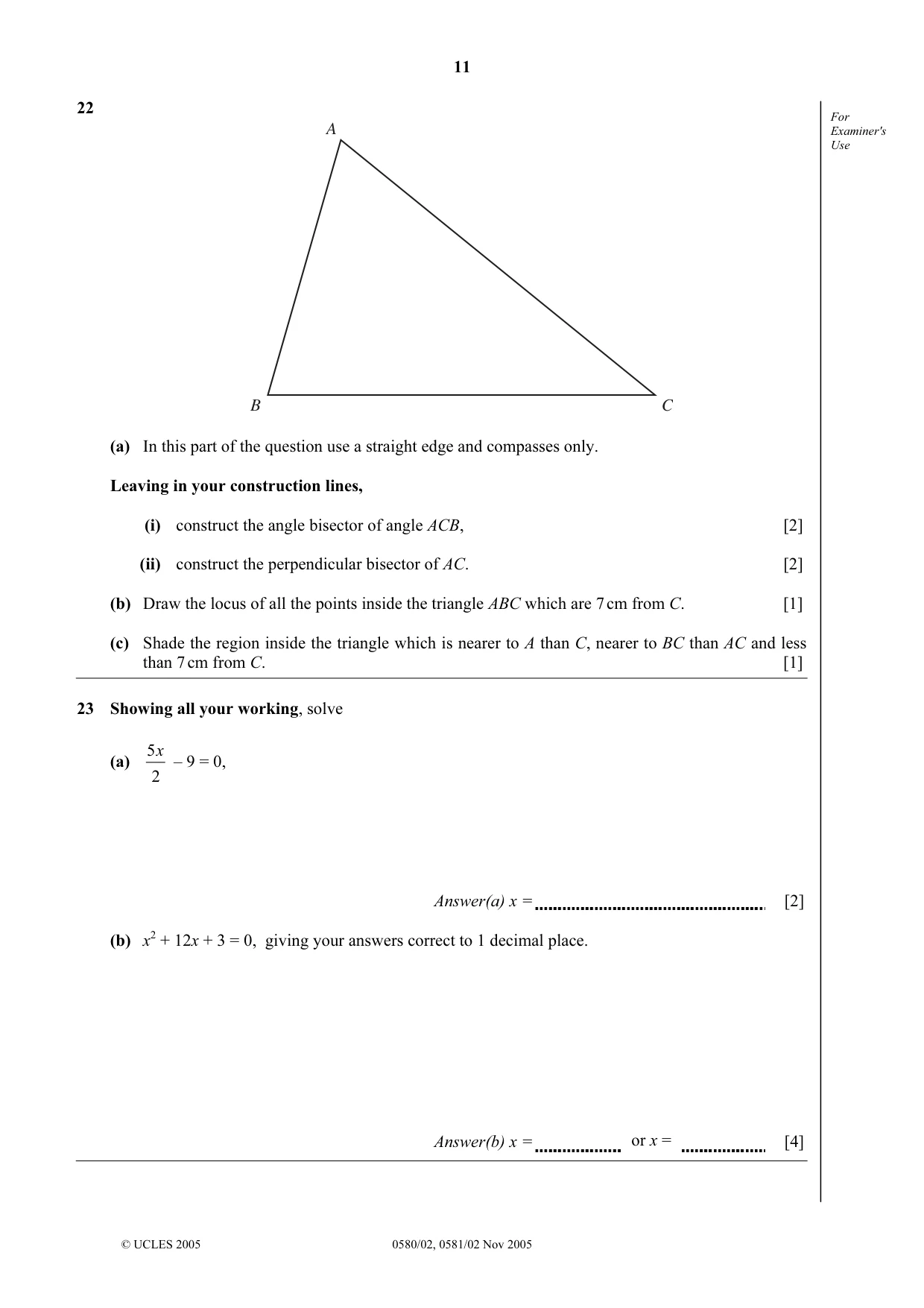
11 © UCLES 2005 0580/02, 0581/02 Nov 2005 For Examiner's Use 22 A B C (a) In this part of the question use a straight edge and compasses only. Leaving in your construction lines, (i) construct the angle bisector of angle ACB, [2] (ii) construct the perpendicular bisector of AC. [2] (b) Draw the locus of all the points inside the triangle ABC which are 7 cm from C. [1] (c) Shade the region inside the triangle which is nearer to A than C, nearer to BC than AC and less than 7 cm from C. [1] 23 Showing all your working, solve (a) 2 5x – 9 = 0, Answer(a) x = [2] (b) x2 + 12x + 3 = 0, giving your answers correct to 1 decimal place. or x = Answer(b) x = [4]
Question paper, page 12
12 Permission to reproduce items where third-party owned material protected by copyright is included has been sought and cleared where possible. Every reasonable effort has been made by the publisher (UCLES) to trace copyright holders, but if any items requiring clearance have unwittingly been included, the publisher will be pleased to make amends at the earliest possible opportunity. University of Cambridge International Examinations is part of the University of Cambridge Local Examinations Syndicate (UCLES), which is itself a department of the University of Cambridge. 0580/02, 0581/02 Nov 2005 BLANK PAGE
Mark scheme, page 1
UNIVERSITY OF CAMBRIDGE INTERNATIONAL EXAMINATIONS International General Certificate of Secondary Education MARK SCHEME for the November 2005 question paper 0580/0581 MATHEMATICS 0580/02, 0581/02 Paper 2, maximum raw mark 70 This mark scheme is published as an aid to teachers and students, to indicate the requirements of the examination. It shows the basis on which Examiners were initially instructed to award marks. It does not indicate the details of the discussions that took place at an Examiners’ meeting before marking began. Any substantial changes to the mark scheme that arose from these discussions will be recorded in the published Report on the Examination. All Examiners are instructed that alternative correct answers and unexpected approaches in candidates’ scripts must be given marks that fairly reflect the relevant knowledge and skills demonstrated. Mark schemes must be read in conjunction with the question papers and the Report on the Examination. • CIE will not enter into discussion or correspondence in connection with these mark schemes. The minimum marks in these components needed for various grades were previously published with these mark schemes, but are now instead included in the Report on the Examination for this session. CIE is publishing the mark schemes for the November 2005 question papers for most IGCSE and GCE Advanced Level and Advanced Subsidiary Level syllabuses and some Ordinary Level syllabuses. www.XtremePapers.com
Mark scheme, page 2
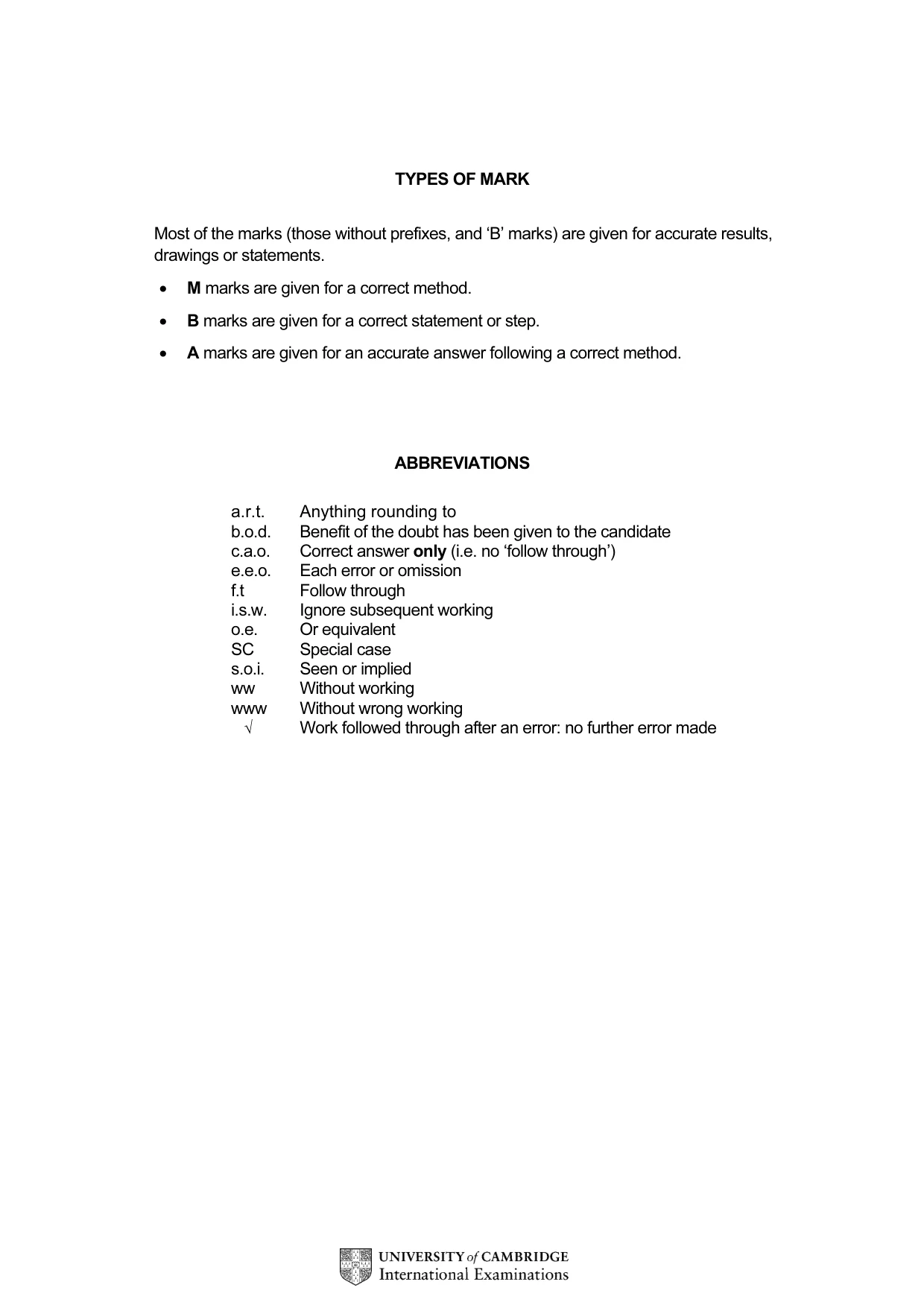
TYPES OF MARK Most of the marks (those without prefixes, and ‘B’ marks) are given for accurate results, drawings or statements. • M marks are given for a correct method. • B marks are given for a correct statement or step. • A marks are given for an accurate answer following a correct method. ABBREVIATIONS a.r.t. Anything rounding to b.o.d. Benefit of the doubt has been given to the candidate c.a.o. Correct answer only (i.e. no ‘follow through’) e.e.o. Each error or omission f.t Follow through i.s.w. Ignore subsequent working o.e. Or equivalent SC Special case s.o.i. Seen or implied ww Without working www Without wrong working √ Work followed through after an error: no further error made
Mark scheme, page 3
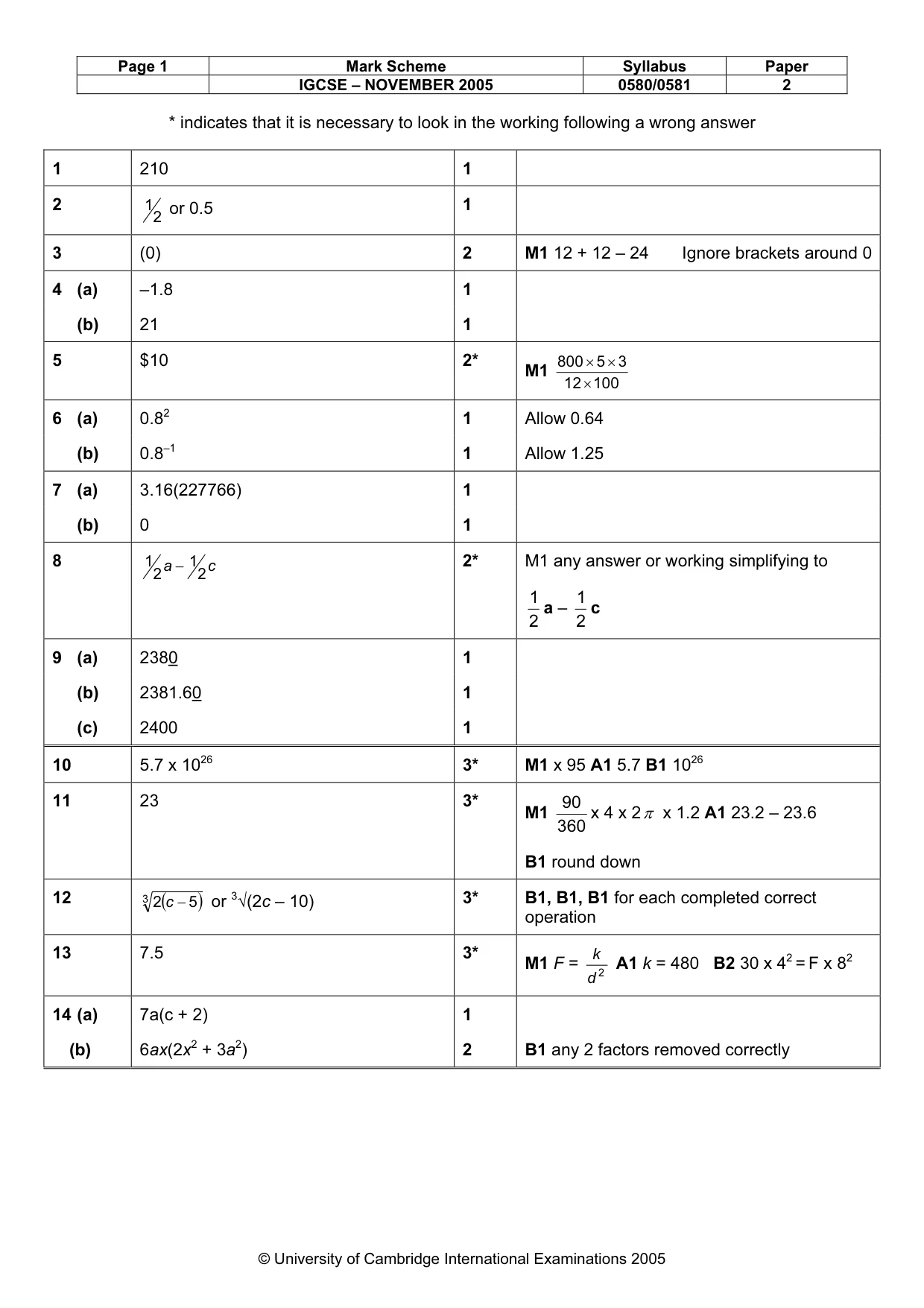
Page 1 Mark Scheme Syllabus Paper IGCSE – NOVEMBER 2005 0580/0581 2 © University of Cambridge International Examinations 2005 * indicates that it is necessary to look in the working following a wrong answer 1 210 1 2 2 1 or 0.5 1 3 (0) 2 M1 12 + 12 – 24 Ignore brackets around 0 4 (a) –1.8 1 (b) 21 1 5 $10 2* M1 100 12 3 5 800 × × × 6 (a) 0.82 1 Allow 0.64 (b) 0.8–1 1 Allow 1.25 7 (a) 3.16(227766) 1 (b) 0 1 8 c a 2 1 2 1 − 2* M1 any answer or working simplifying to 2 1 a – 2 1 c 9 (a) 2380 1 (b) 2381.60 1 (c) 2400 1 10 5.7 x 1026 3* M1 x 95 A1 5.7 B1 1026 11 23 3* M1 360 90 x 4 x 2π x 1.2 A1 23.2 – 23.6 B1 round down 12 ( ) 3 5 2 − c or 3√(2c – 10) 3* B1, B1, B1 for each completed correct operation 13 7.5 3* M1 F = 2 d k A1 k = 480 B2 30 x 42 = F x 82 14 (a) 7a(c + 2) 1 (b) 6ax(2x2 + 3a2) 2 B1 any 2 factors removed correctly
Mark scheme, page 4
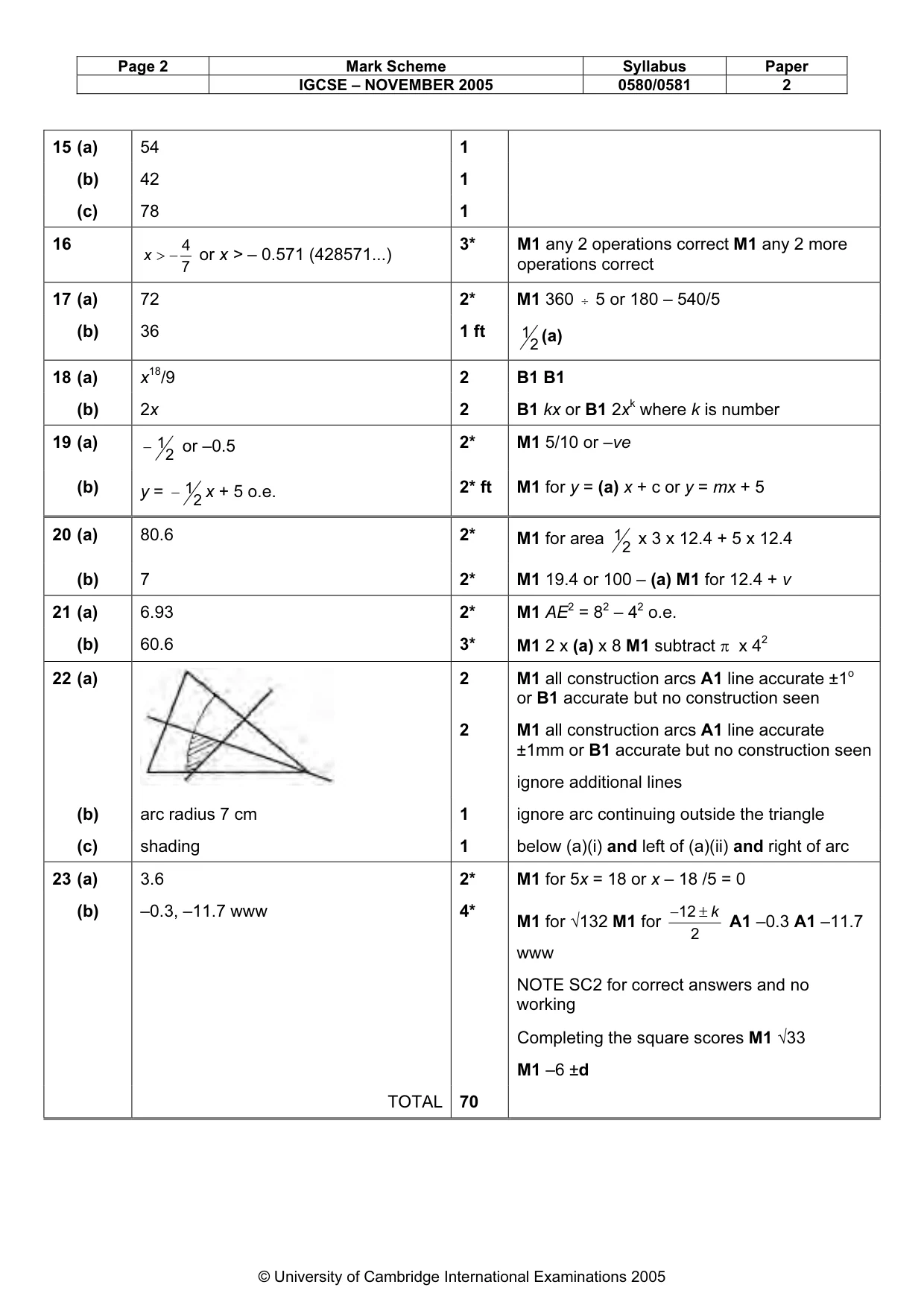
Page 2 Mark Scheme Syllabus Paper IGCSE – NOVEMBER 2005 0580/0581 2 © University of Cambridge International Examinations 2005 15 (a) 54 1 (b) 42 1 (c) 78 1 16 7 4 − > x or x > – 0.571 (428571...) 3* M1 any 2 operations correct M1 any 2 more operations correct 17 (a) 72 2* M1 360 ÷ 5 or 180 – 540/5 (b) 36 1 ft 2 1 (a) 18 (a) x18/9 2 B1 B1 (b) 2x 2 B1 kx or B1 2xk where k is number 19 (a) 2 1 − or –0.5 2* M1 5/10 or –ve (b) y = 2 1 − x + 5 o.e. 2* ft M1 for y = (a) x + c or y = mx + 5 20 (a) 80.6 2* M1 for area 2 1 x 3 x 12.4 + 5 x 12.4 (b) 7 2* M1 19.4 or 100 – (a) M1 for 12.4 + v 21 (a) 6.93 2* M1 AE2 = 82 – 42 o.e. (b) 60.6 3* M1 2 x (a) x 8 M1 subtract π x 42 22 (a) 2 2 M1 all construction arcs A1 line accurate ±1o or B1 accurate but no construction seen M1 all construction arcs A1 line accurate ±1mm or B1 accurate but no construction seen ignore additional lines (b) arc radius 7 cm 1 ignore arc continuing outside the triangle (c) shading 1 below (a)(i) and left of (a)(ii) and right of arc 23 (a) 3.6 2* M1 for 5x = 18 or x – 18 /5 = 0 (b) –0.3, –11.7 www 4* M1 for √132 M1 for 2 12 k ± − A1 –0.3 A1 –11.7 www NOTE SC2 for correct answers and no working Completing the square scores M1 √33 M1 –6 ±d TOTAL 70