Cambridge IGCSE Mathematics (with coursework) 0581 — 2004 Oct/Nov Paper 2 · Variant 1
0581/21/O/N/04
The question paper and its mark scheme, free to read here and free to download. This is Cambridge’s own paper, exactly as it was sat.
Question paper12 pages
Mark scheme7 pages
Answers below. Sit the paper first if you are practising.
Paper as text
Question paper, page 1
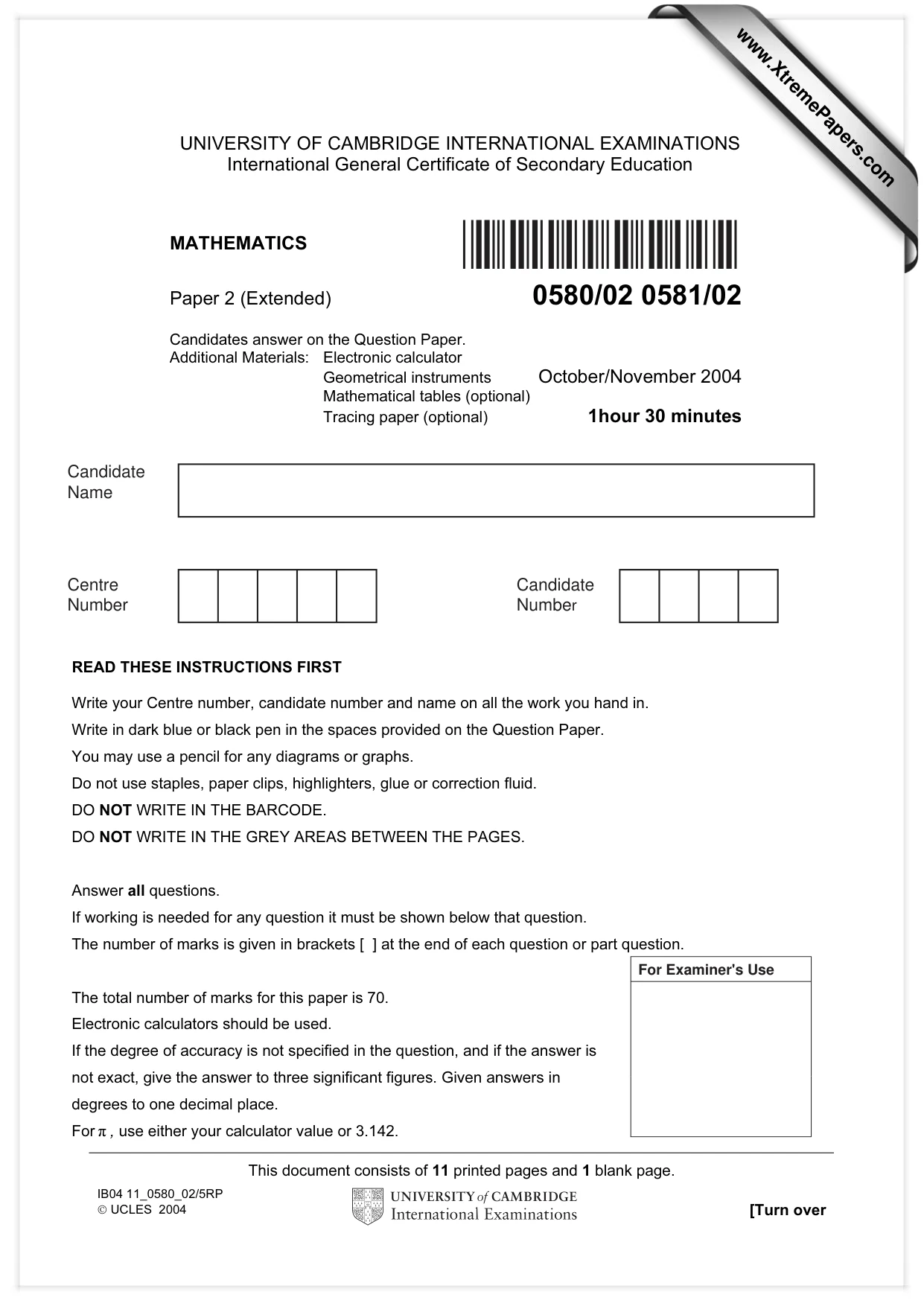
This document consists of 11 printed pages and 1 blank page. IB04 11_0580_02/5RP © UCLES 2004 [Turn over UNIVERSITY OF CAMBRIDGE INTERNATIONAL EXAMINATIONS International General Certificate of Secondary Education MATHEMATICS Paper 2 (Extended) 0580/02 0581/02 Candidates answer on the Question Paper. Additional Materials: Electronic calculator Geometrical instruments October/November 2004 Mathematical tables (optional) Tracing paper (optional) 1hour 30 minutes READ THESE INSTRUCTIONS FIRST Write your Centre number, candidate number and name on all the work you hand in. Write in dark blue or black pen in the spaces provided on the Question Paper. You may use a pencil for any diagrams or graphs. Do not use staples, paper clips, highlighters, glue or correction fluid. DO NOT WRITE IN THE BARCODE. DO NOT WRITE IN THE GREY AREAS BETWEEN THE PAGES. Answer all questions. If working is needed for any question it must be shown below that question. The number of marks is given in brackets [ ] at the end of each question or part question. The total number of marks for this paper is 70. Electronic calculators should be used. If the degree of accuracy is not specified in the question, and if the answer is not exact, give the answer to three significant figures. Given answers in degrees to one decimal place. For π , use either your calculator value or 3.142. Candidate Name Centre Number Candidate Number *058002* For Examiner's Use www.XtremePapers.com
Question paper, page 2
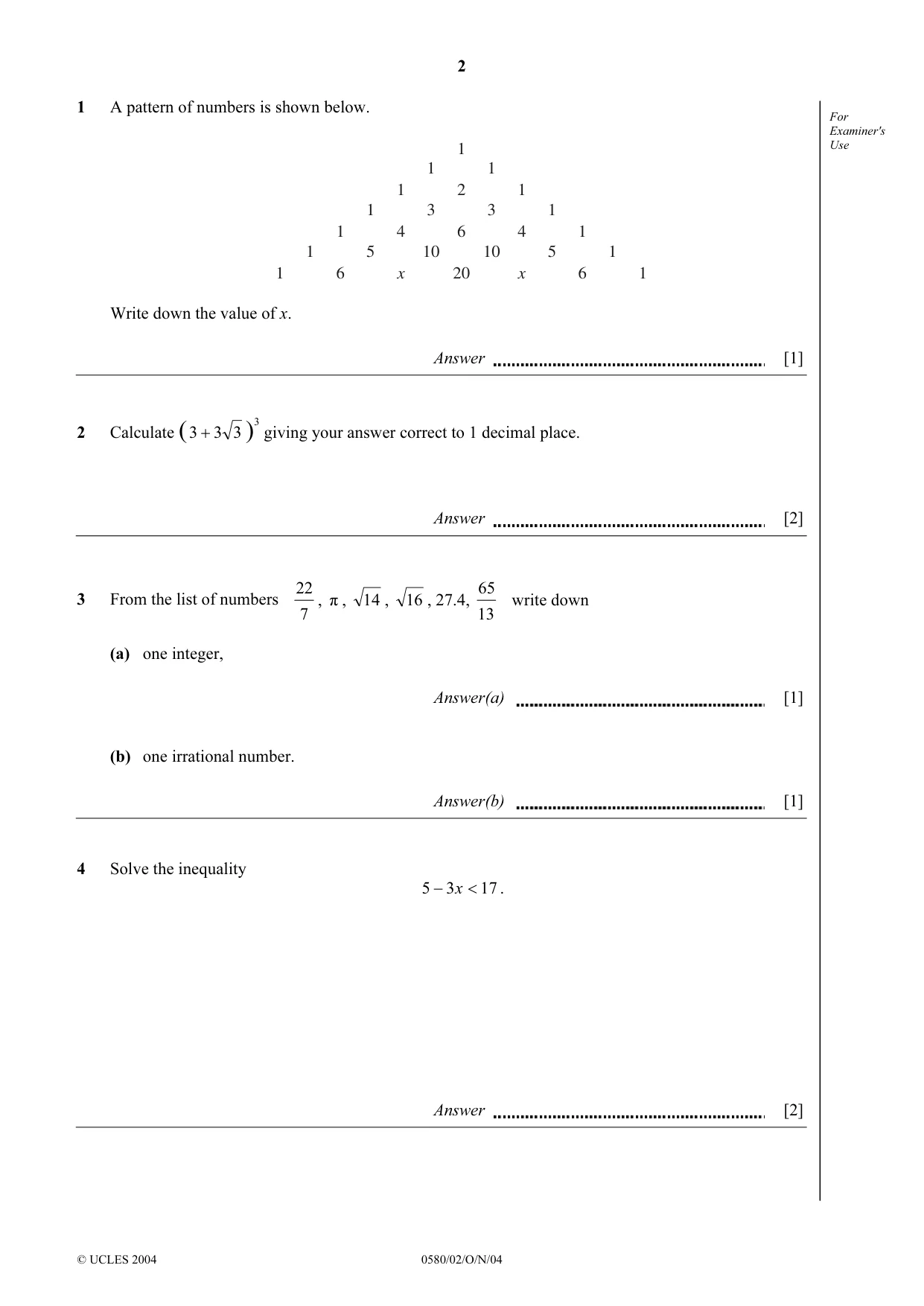
2 © UCLES 2004 0580/02/O/N/04 For Examiner's Use 1 A pattern of numbers is shown below. 1 2 6 20 1 4 x 1 6 1 1 6 1 4 x 1 1 3 10 1 3 10 1 5 1 1 5 1 Write down the value of x. Answer [1] 2 Calculate ( 3 3 3 + ) 3 giving your answer correct to 1 decimal place. Answer [2] 3 From the list of numbers 7 22 , π , 14 , 16 , 27.4, 13 65 write down (a) one integer, Answer(a) [1] (b) one irrational number. Answer(b) [1] 4 Solve the inequality 17 3 5 < −x . Answer [2]
Question paper, page 3
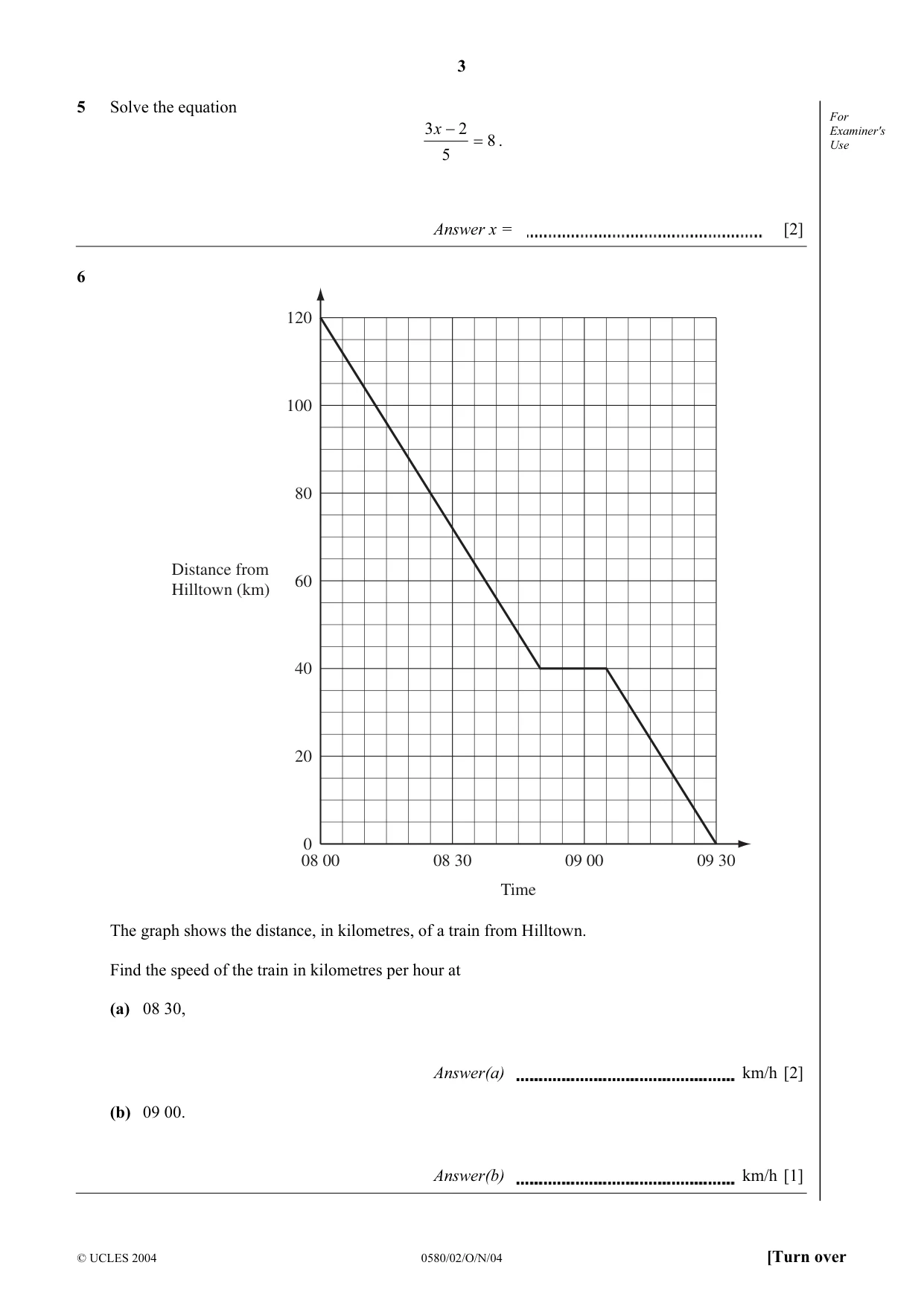
3 © UCLES 2004 0580/02/O/N/04 [Turn over For Examiner's Use 5 Solve the equation 8 5 2 3 = − x . Answer x = [2] 6 120 100 80 60 40 20 0 08 00 08 30 09 00 09 30 Distance from Hilltown (km) Time The graph shows the distance, in kilometres, of a train from Hilltown. Find the speed of the train in kilometres per hour at (a) 08 30, Answer(a) km/h [2] (b) 09 00. Answer(b) km/h [1]
Question paper, page 4
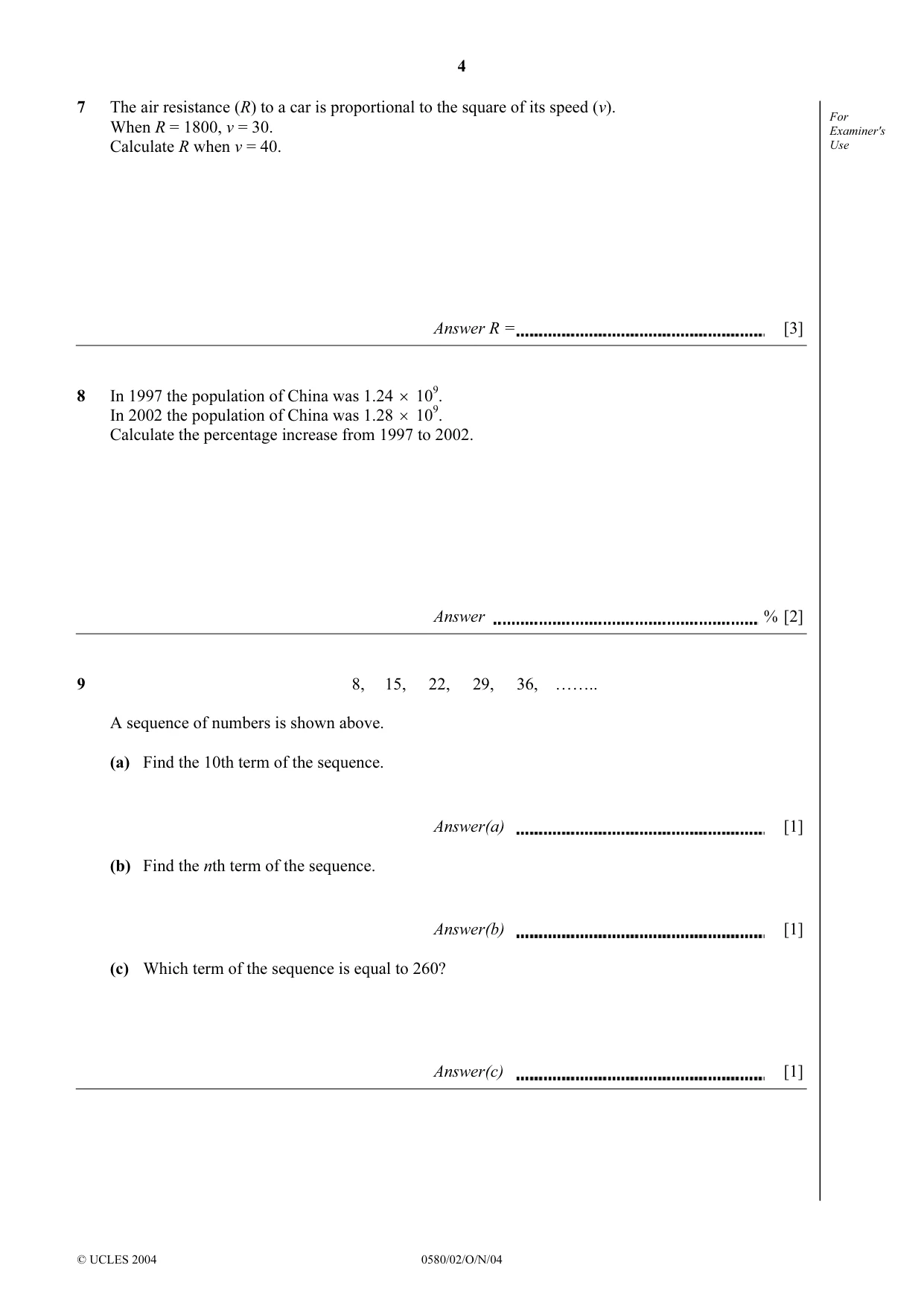
4 © UCLES 2004 0580/02/O/N/04 For Examiner's Use 7 The air resistance (R) to a car is proportional to the square of its speed (v). When R = 1800, v = 30. Calculate R when v = 40. Answer R = [3] 8 In 1997 the population of China was 1.24 × 10⁹. In 2002 the population of China was 1.28 × 10⁹. Calculate the percentage increase from 1997 to 2002. Answer % [2] 9 8, 15, 22, 29, 36, …….. A sequence of numbers is shown above. (a) Find the 10th term of the sequence. Answer(a) [1] (b) Find the nth term of the sequence. Answer(b) [1] (c) Which term of the sequence is equal to 260? Answer(c) [1]
Question paper, page 5
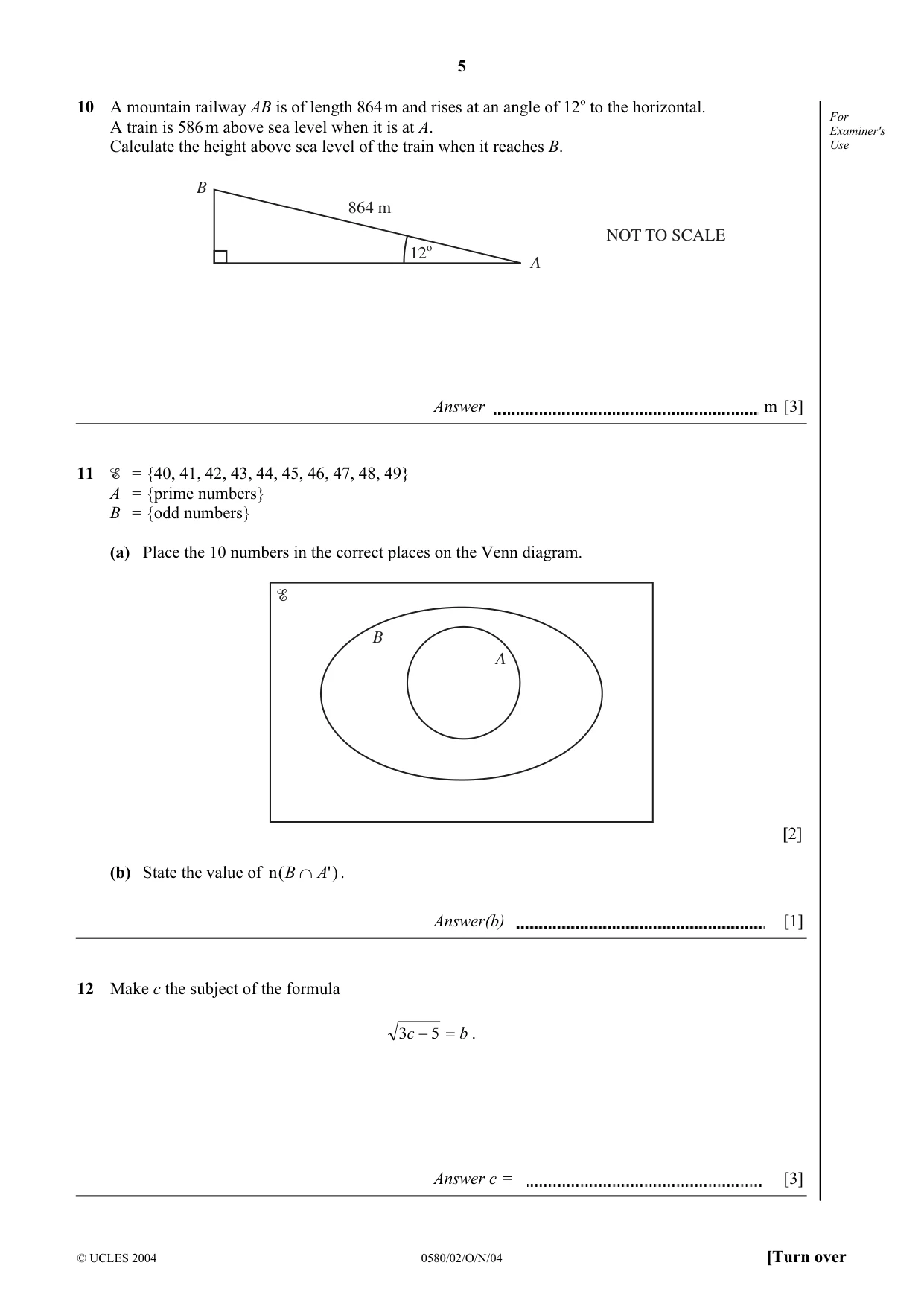
5 © UCLES 2004 0580/02/O/N/04 [Turn over For Examiner's Use 10 A mountain railway AB is of length 864 m and rises at an angle of 12o to the horizontal. A train is 586 m above sea level when it is at A. Calculate the height above sea level of the train when it reaches B. 12o 864 m A B NOT TO SCALE Answer m [3] 11 = {40, 41, 42, 43, 44, 45, 46, 47, 48, 49} A = {prime numbers} B = {odd numbers} (a) Place the 10 numbers in the correct places on the Venn diagram. A B [2] (b) State the value of )' ( n A B ∩ . Answer(b) [1] 12 Make c the subject of the formula b c = −5 3 . Answer c = [3]
Question paper, page 6
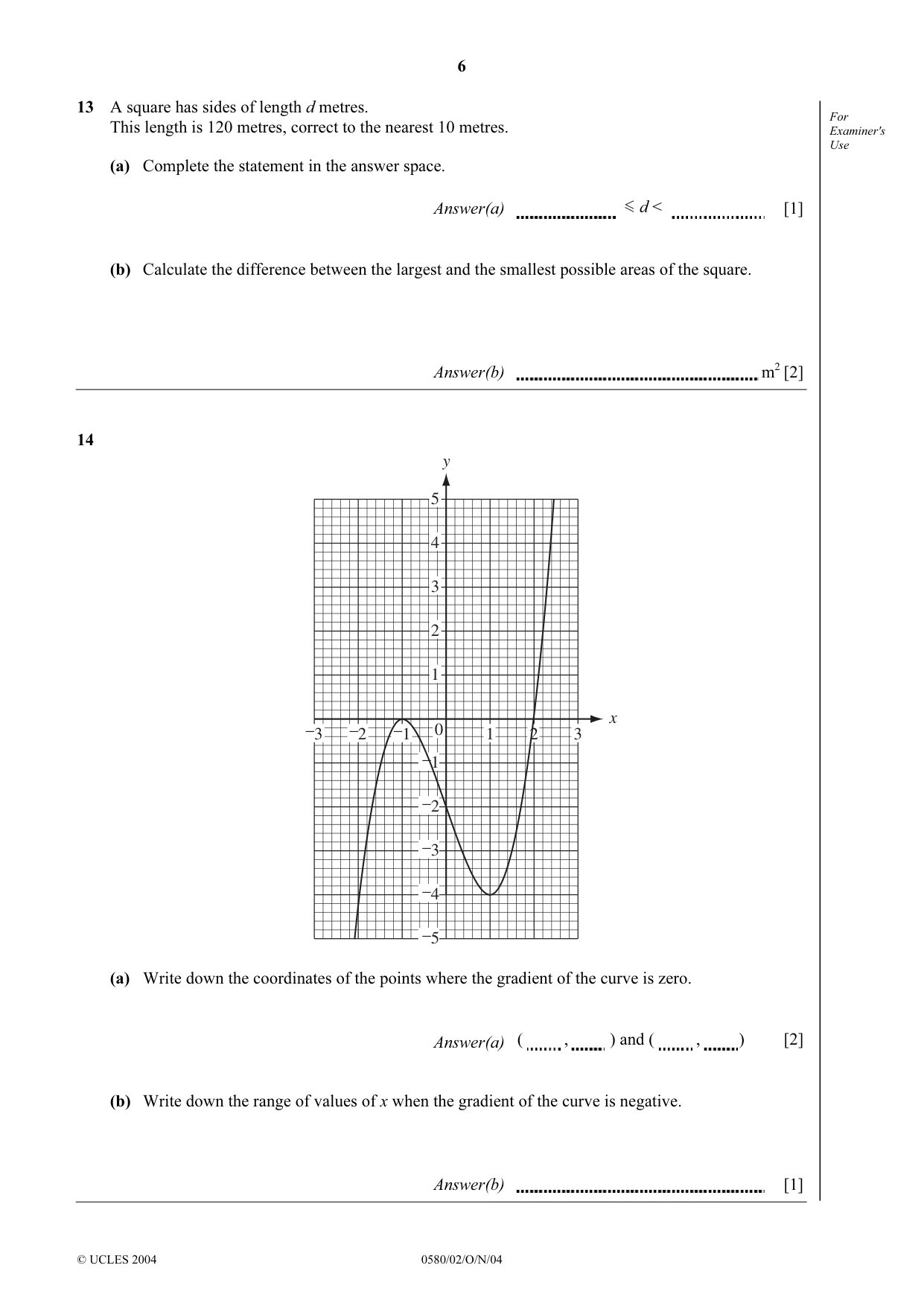
6 © UCLES 2004 0580/02/O/N/04 For Examiner's Use 13 A square has sides of length d metres. This length is 120 metres, correct to the nearest 10 metres. (a) Complete the statement in the answer space. d < Answer(a) [1] (b) Calculate the difference between the largest and the smallest possible areas of the square. Answer(b) m2 [2] 14 3 2 1 _1 _2 _3 0 5 4 3 2 1 _1 _2 _3 _4 _5 x y (a) Write down the coordinates of the points where the gradient of the curve is zero. ( , ) and ( , ) [2] Answer(a) (b) Write down the range of values of x when the gradient of the curve is negative. Answer(b) [1]
Question paper, page 7
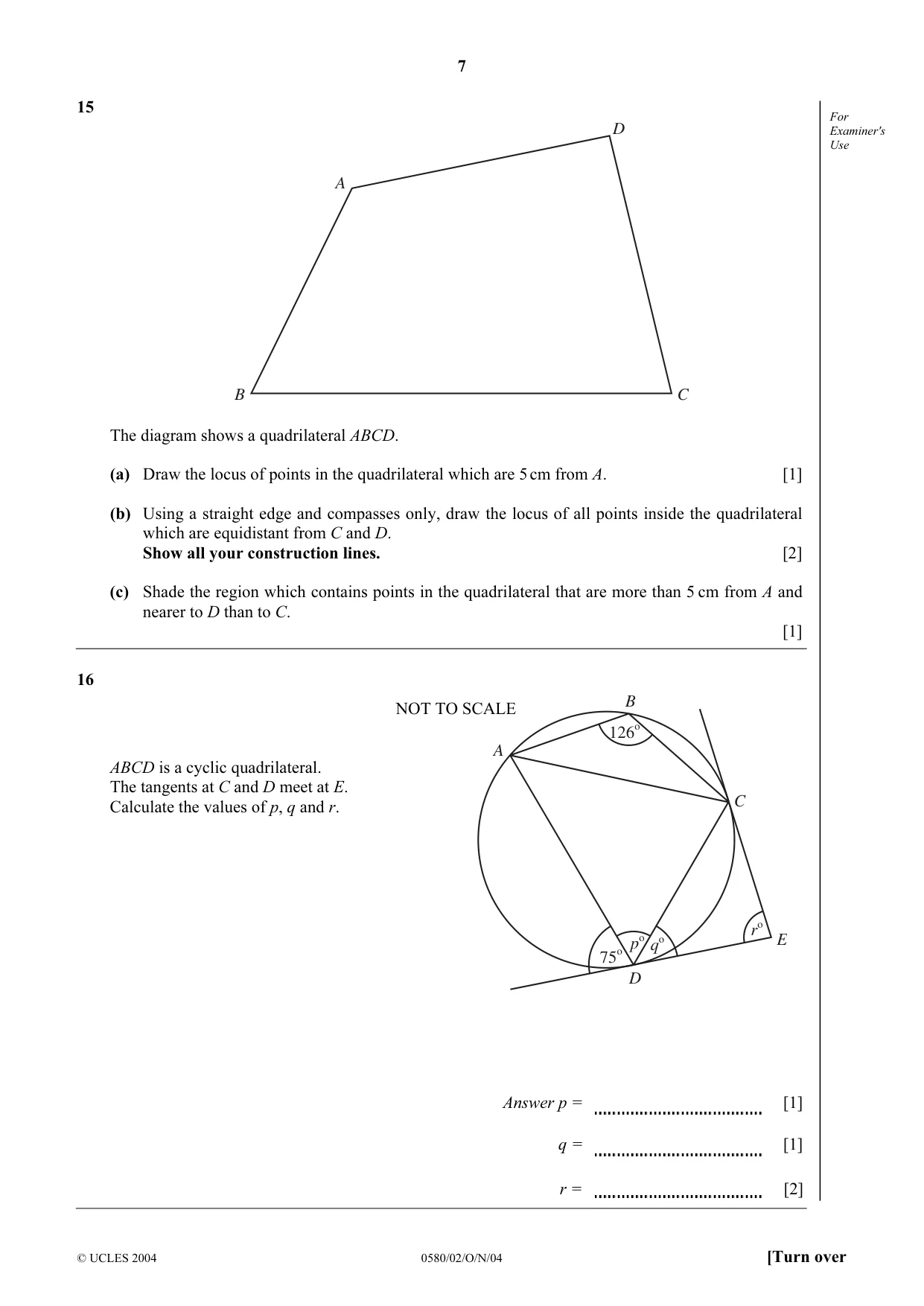
7 © UCLES 2004 0580/02/O/N/04 [Turn over For Examiner's Use 15 A B C D The diagram shows a quadrilateral ABCD. (a) Draw the locus of points in the quadrilateral which are 5 cm from A. [1] (b) Using a straight edge and compasses only, draw the locus of all points inside the quadrilateral which are equidistant from C and D. Show all your construction lines. [2] (c) Shade the region which contains points in the quadrilateral that are more than 5 cm from A and nearer to D than to C. [1] 16 NOT TO SCALE ABCD is a cyclic quadrilateral. The tangents at C and D meet at E. Calculate the values of p, q and r. Answer p = [1] q = [1] r = [2] A B C E D 126o 75o ro po qo
Question paper, page 8
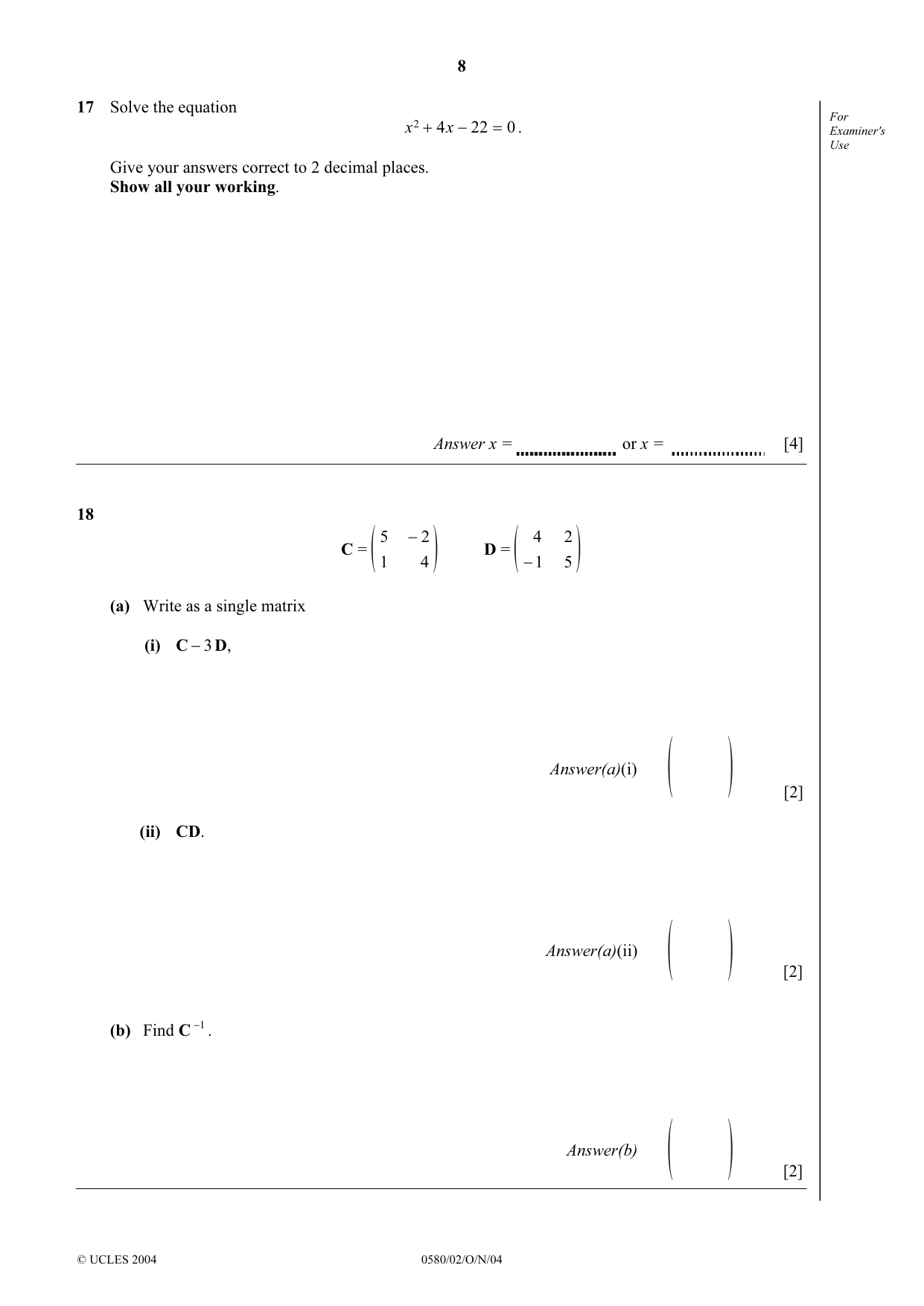
8 © UCLES 2004 0580/02/O/N/04 For Examiner's Use 17 Solve the equation 0 22 4 2 = − + x x . Give your answers correct to 2 decimal places. Show all your working. or x = Answer x = [4] 18 C = 4 2 1 5 − D = 5 2 1 4 − (a) Write as a single matrix (i) C 3 − D, Answer(a)(i) [2] (ii) CD. Answer(a)(ii) [2] (b) Find C 1 −. Answer(b) [2]
Question paper, page 9
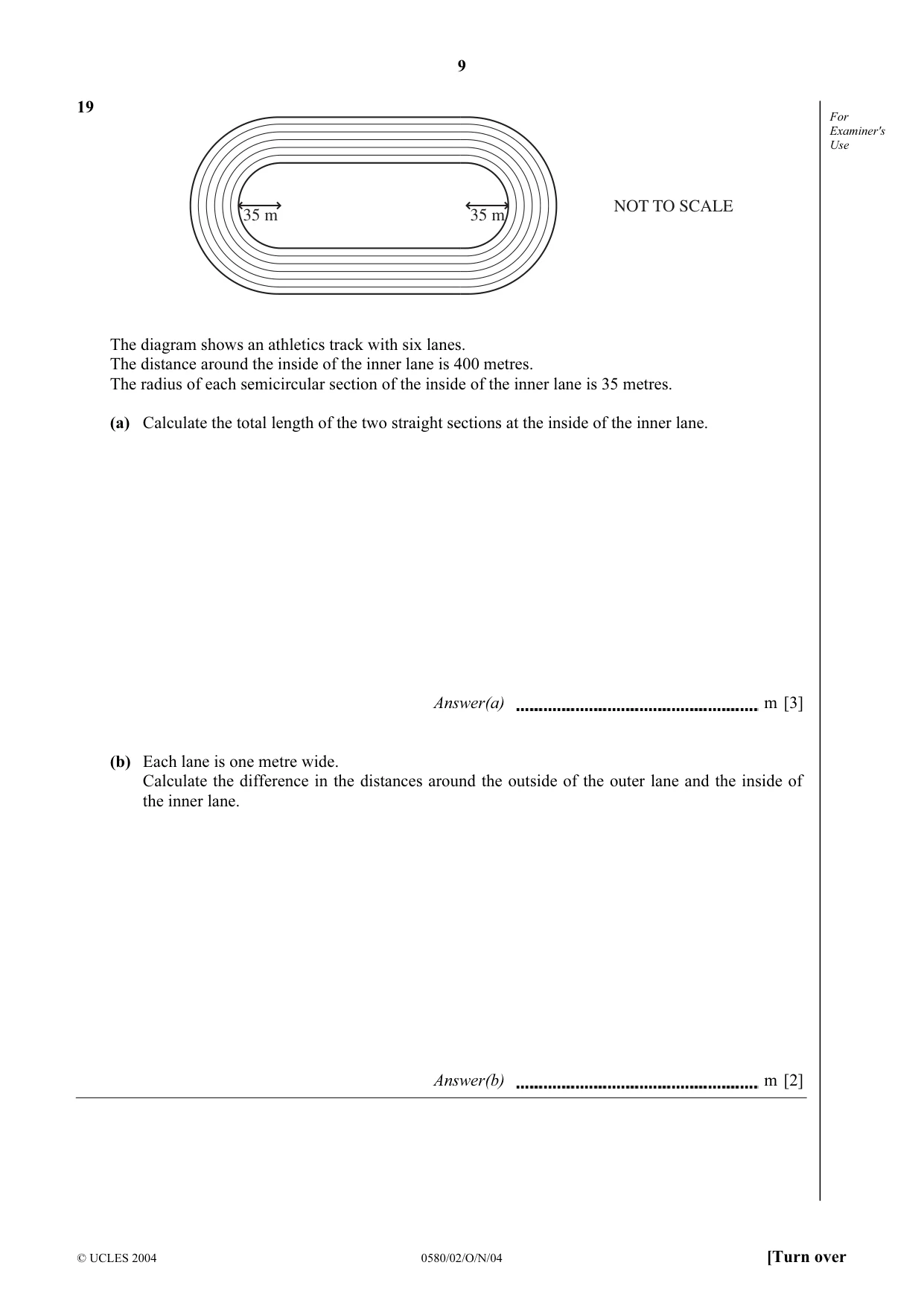
9 © UCLES 2004 0580/02/O/N/04 [Turn over For Examiner's Use 19 35 m 35 m NOT TO SCALE The diagram shows an athletics track with six lanes. The distance around the inside of the inner lane is 400 metres. The radius of each semicircular section of the inside of the inner lane is 35 metres. (a) Calculate the total length of the two straight sections at the inside of the inner lane. Answer(a) m [3] (b) Each lane is one metre wide. Calculate the difference in the distances around the outside of the outer lane and the inside of the inner lane. Answer(b) m [2]
Question paper, page 10
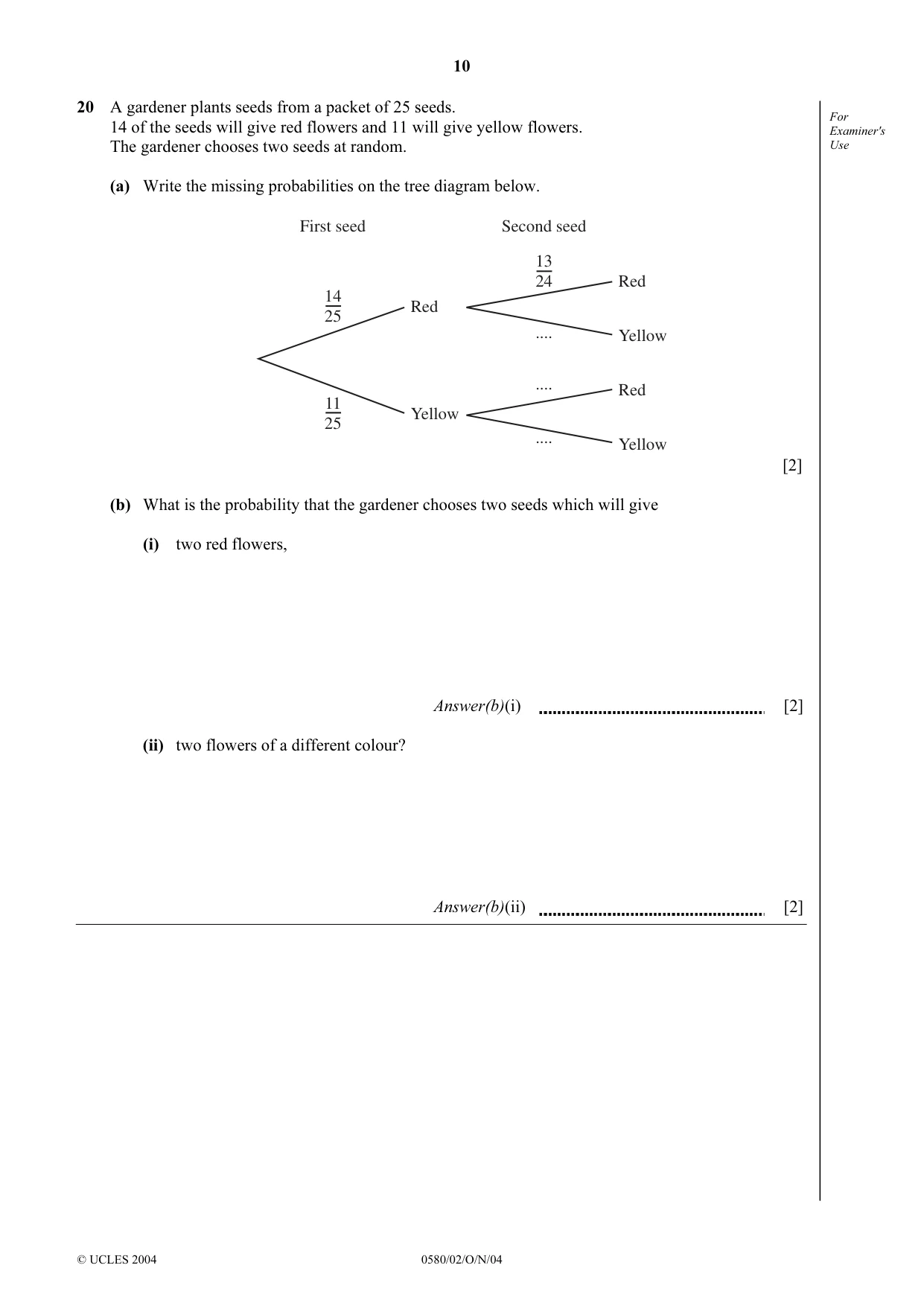
10 © UCLES 2004 0580/02/O/N/04 For Examiner's Use 20 A gardener plants seeds from a packet of 25 seeds. 14 of the seeds will give red flowers and 11 will give yellow flowers. The gardener chooses two seeds at random. (a) Write the missing probabilities on the tree diagram below. Red Yellow Red Yellow Second seed First seed Red Yellow 13 24 … … … 14 25 11 25 [2] (b) What is the probability that the gardener chooses two seeds which will give (i) two red flowers, Answer(b)(i) [2] (ii) two flowers of a different colour? Answer(b)(ii) [2]
Question paper, page 11
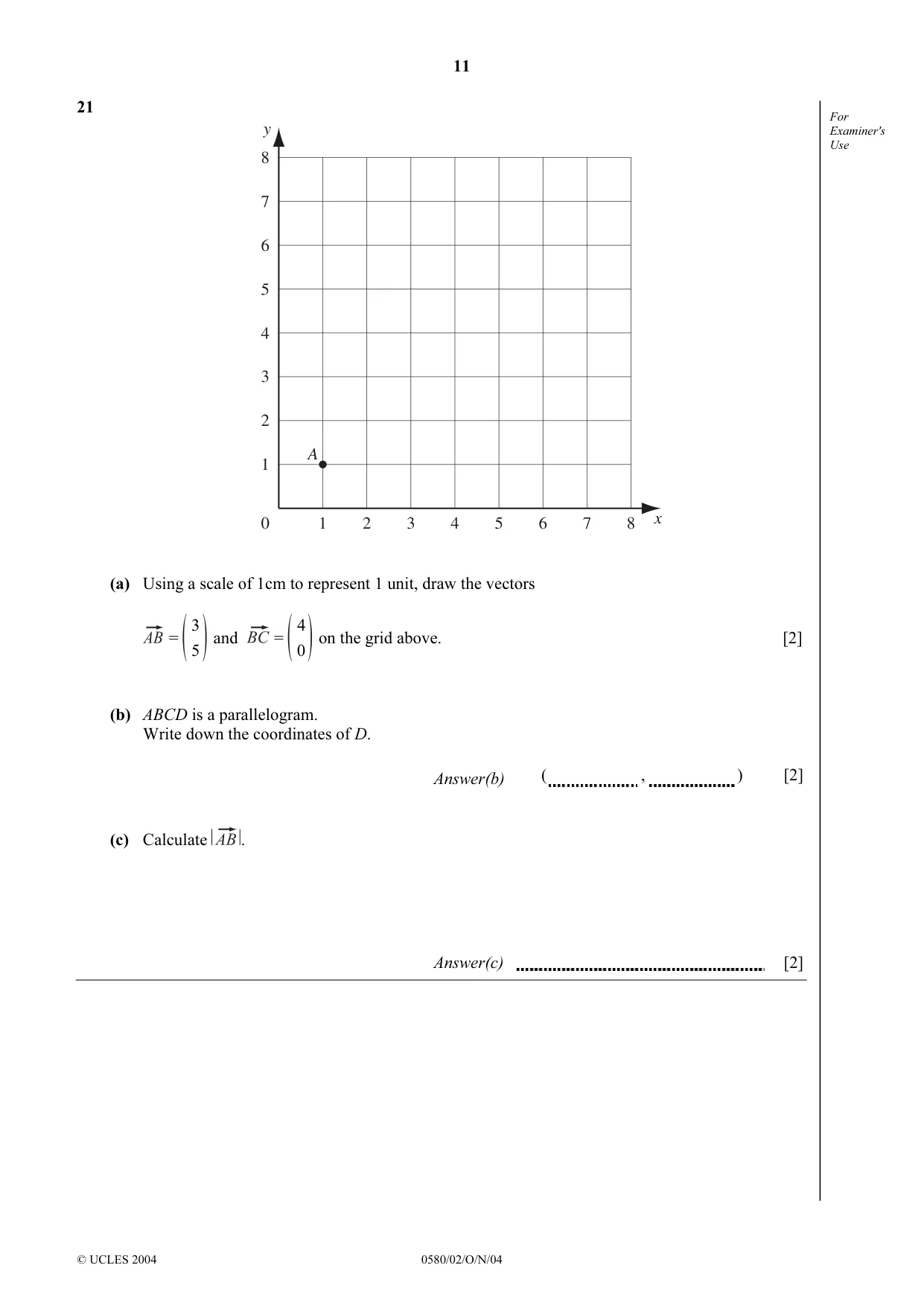
11 © UCLES 2004 0580/02/O/N/04 For Examiner's Use 21 1 2 3 4 5 6 7 8 8 7 6 5 4 3 2 1 x y A 0 (a) Using a scale of 1cm to represent 1 unit, draw the vectors = 5 3 and = 0 4 on the grid above. [2] (b) ABCD is a parallelogram. Write down the coordinates of D. ( , ) [2] Answer(b) (c) Calculate . Answer(c) [2]
Question paper, page 12
12 Every reasonable effort has been made to trace all copyright holders where the publishers (i.e. UCLES) are aware that third-party material has been reproduced. The publishers would be pleased to hear from anyone whose rights they have unwittingly infringed. University of Cambridge International Examinations is part of the University of Cambridge Local Examinations Syndicate (UCLES), which is itself a department of the University of Cambridge. 0580/02/O/N/04 BLANK PAGE
Mark scheme, page 1
CAMBRIDGE INTERNATIONAL EXAMINATIONS International General Certificate of Secondary Education MARK SCHEME for the November 2004 question papers 0580/0581 MATHEMATICS 0580/02, 0581/02 Paper 2 (Extended), maximum raw mark 70 This mark scheme is published as an aid to teachers and students, to indicate the requirements of the examination. It shows the basis on which Examiners were initialy instructed to award marks. It does not indicate the details of the discussions that took place at an Examiners’ meeting before marking began. Any substantial changes to the mark scheme that arose from these discussions will be recorded in the published Report on the Examination. All Examiners are instructed that alternative correct answers and unexpected approaches in candidates’ scripts must be given marks that fairly reflect the relevant knowledge and skills demonstrated. Mark schemes must be read in conjunction with the question papers and the Report on the Examination. • CIE will not enter into discussion or correspondence in connection with these mark schemes. CIE is publishing the mark schemes for the November 2004 question papers for most IGCSE and GCE Advanced Level syllabuses. www.XtremePapers.com
Mark scheme, page 2
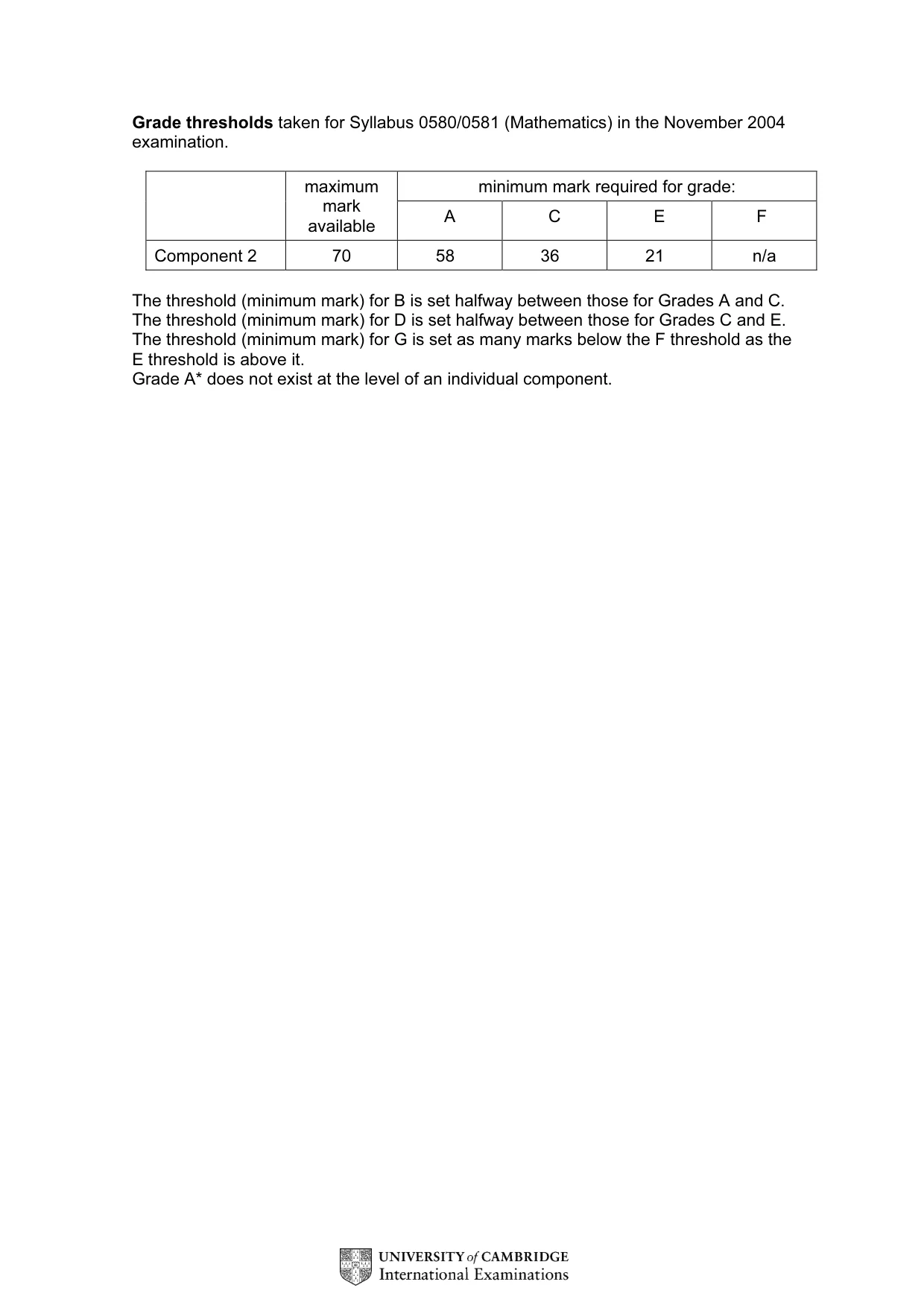
Grade thresholds taken for Syllabus 0580/0581 (Mathematics) in the November 2004 examination. minimum mark required for grade: maximum mark available A C E F Component 2 70 58 36 21 n/a The threshold (minimum mark) for B is set halfway between those for Grades A and C. The threshold (minimum mark) for D is set halfway between those for Grades C and E. The threshold (minimum mark) for G is set as many marks below the F threshold as the E threshold is above it. Grade A* does not exist at the level of an individual component.
Mark scheme, page 3
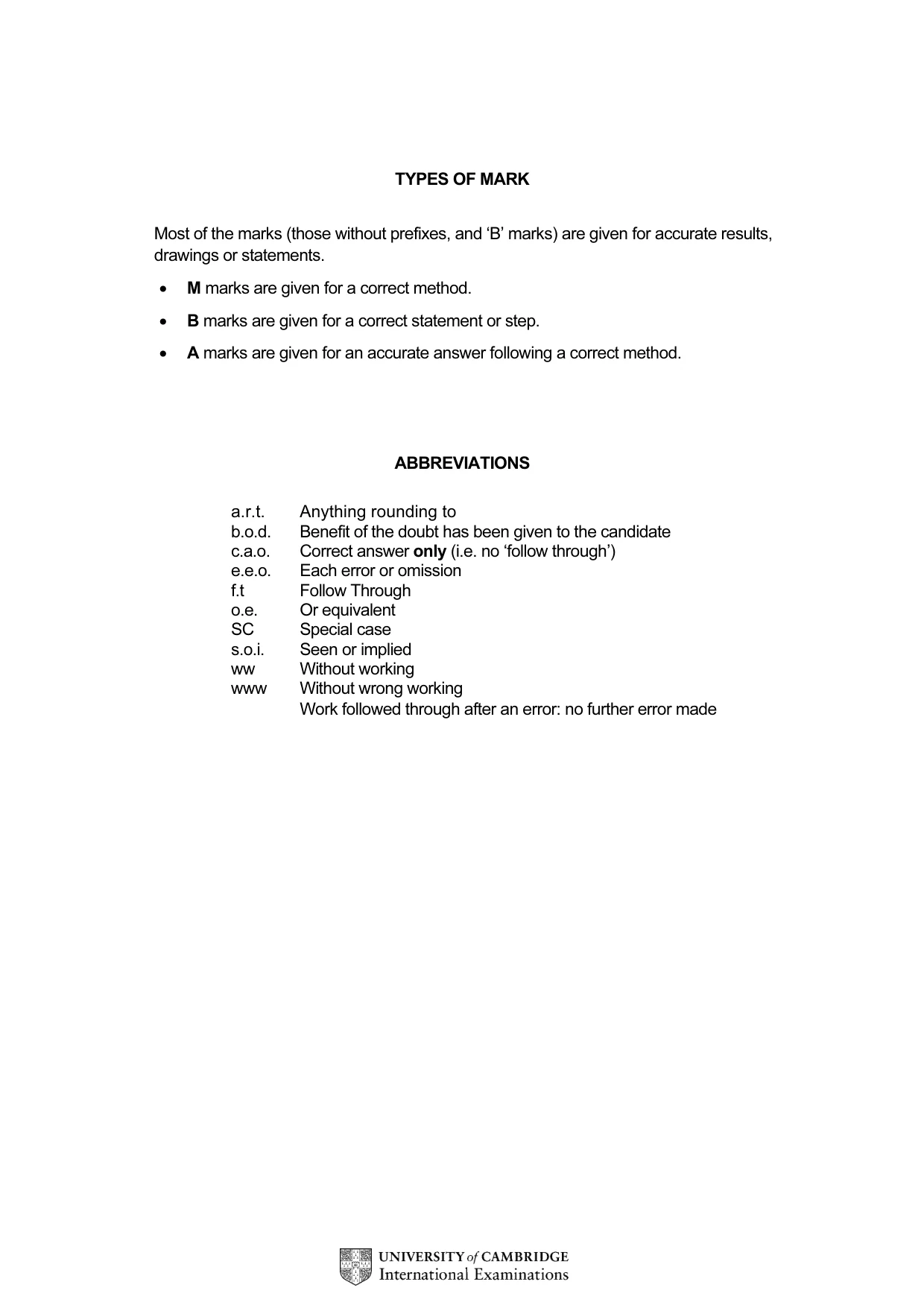
TYPES OF MARK Most of the marks (those without prefixes, and ‘B’ marks) are given for accurate results, drawings or statements. • M marks are given for a correct method. • B marks are given for a correct statement or step. • A marks are given for an accurate answer following a correct method. ABBREVIATIONS a.r.t. Anything rounding to b.o.d. Benefit of the doubt has been given to the candidate c.a.o. Correct answer only (i.e. no ‘follow through’) e.e.o. Each error or omission f.t Follow Through o.e. Or equivalent SC Special case s.o.i. Seen or implied ww Without working www Without wrong working Work followed through after an error: no further error made
Mark scheme, page 4
November 2004 INTERNATIONAL GCSE MARK SCHEME MAXIMUM MARK: 70 SYLLABUS/COMPONENT: 0580/02, 0581/02 MATHEMATICS Paper 2 (Extended)
Mark scheme, page 5
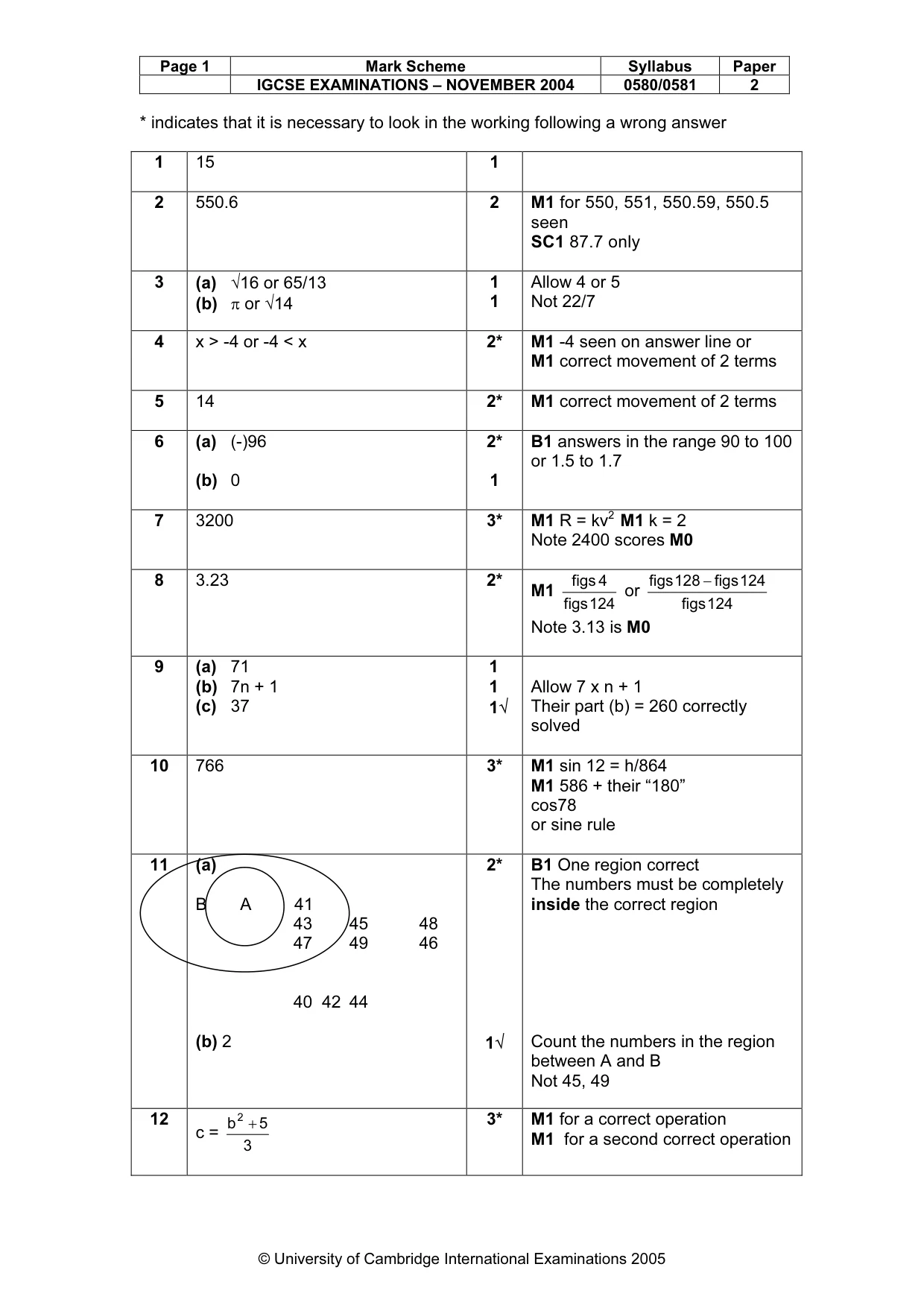
Page 1 Mark Scheme Syllabus Paper IGCSE EXAMINATIONS – NOVEMBER 2004 0580/0581 2 © University of Cambridge International Examinations 2005 * indicates that it is necessary to look in the working following a wrong answer 1 15 1 2 550.6 2 M1 for 550, 551, 550.59, 550.5 seen SC1 87.7 only 3 (a) √16 or 65/13 (b) π or √14 1 1 Allow 4 or 5 Not 22/7 4 x > -4 or -4 < x 2* M1 -4 seen on answer line or M1 correct movement of 2 terms 5 14 2* M1 correct movement of 2 terms 6 (a) (-)96 (b) 0 2* 1 B1 answers in the range 90 to 100 or 1.5 to 1.7 7 3200 3* M1 R = kv2 M1 k = 2 Note 2400 scores M0 8 3.23 2* M1 124 figs 4 figs or 124 figs 124 figs 128 figs − Note 3.13 is M0 9 (a) 71 (b) 7n + 1 (c) 37 1 1 1√ Allow 7 x n + 1 Their part (b) = 260 correctly solved 10 766 3* M1 sin 12 = h/864 M1 586 + their “180” cos78 or sine rule 11 (a) B A 41 43 45 48 47 49 46 40 42 44 (b) 2 2* 1√ B1 One region correct The numbers must be completely inside the correct region Count the numbers in the region between A and B Not 45, 49 12 c = 3 5 b2 + 3* M1 for a correct operation M1 for a second correct operation
Mark scheme, page 6
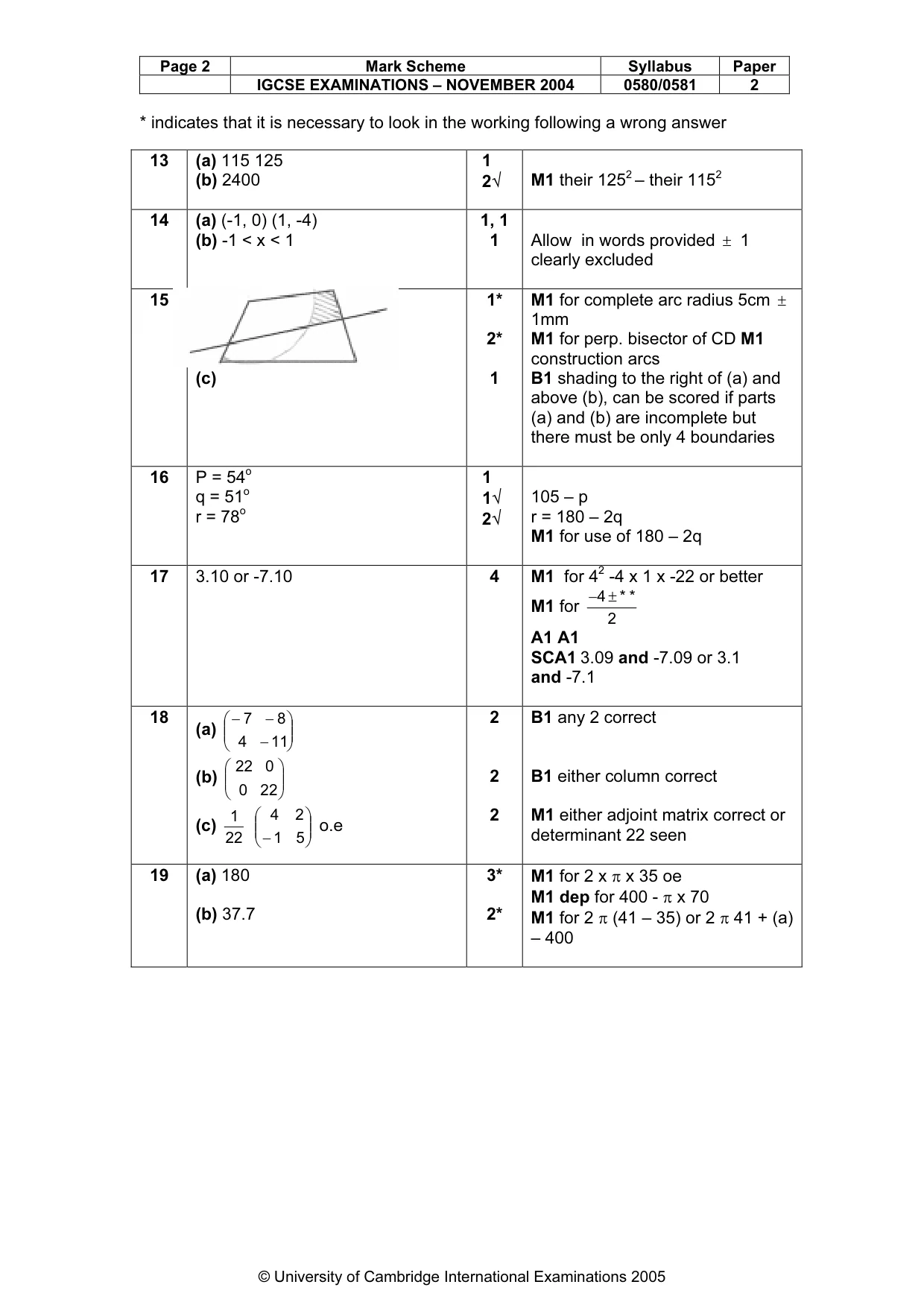
Page 2 Mark Scheme Syllabus Paper IGCSE EXAMINATIONS – NOVEMBER 2004 0580/0581 2 © University of Cambridge International Examinations 2005 * indicates that it is necessary to look in the working following a wrong answer 13 (a) 115 125 (b) 2400 1 2√ M1 their 1252 – their 1152 14 (a) (-1, 0) (1, -4) (b) -1 < x < 1 1, 1 1 Allow in words provided ± 1 clearly excluded 15 (a) (b) (c) 1* 2* 1 M1 for complete arc radius 5cm ± 1mm M1 for perp. bisector of CD M1 construction arcs B1 shading to the right of (a) and above (b), can be scored if parts (a) and (b) are incomplete but there must be only 4 boundaries 16 P = 54o q = 51o r = 78o 1 1√ 2√ 105 – p r = 180 – 2q M1 for use of 180 – 2q 17 3.10 or -7.10 4 M1 for 42 -4 x 1 x -22 or better M1 for 2 * * 4 ± − A1 A1 SCA1 3.09 and -7.09 or 3.1 and -7.1 18 (a) − − − 11 4 8 7 (b) 22 0 0 22 (c) 22 1 − 5 1 2 4 o.e 2 2 2 B1 any 2 correct B1 either column correct M1 either adjoint matrix correct or determinant 22 seen 19 (a) 180 (b) 37.7 3* 2* M1 for 2 x π x 35 oe M1 dep for 400 - π x 70 M1 for 2 π (41 – 35) or 2 π 41 + (a) – 400
Mark scheme, page 7
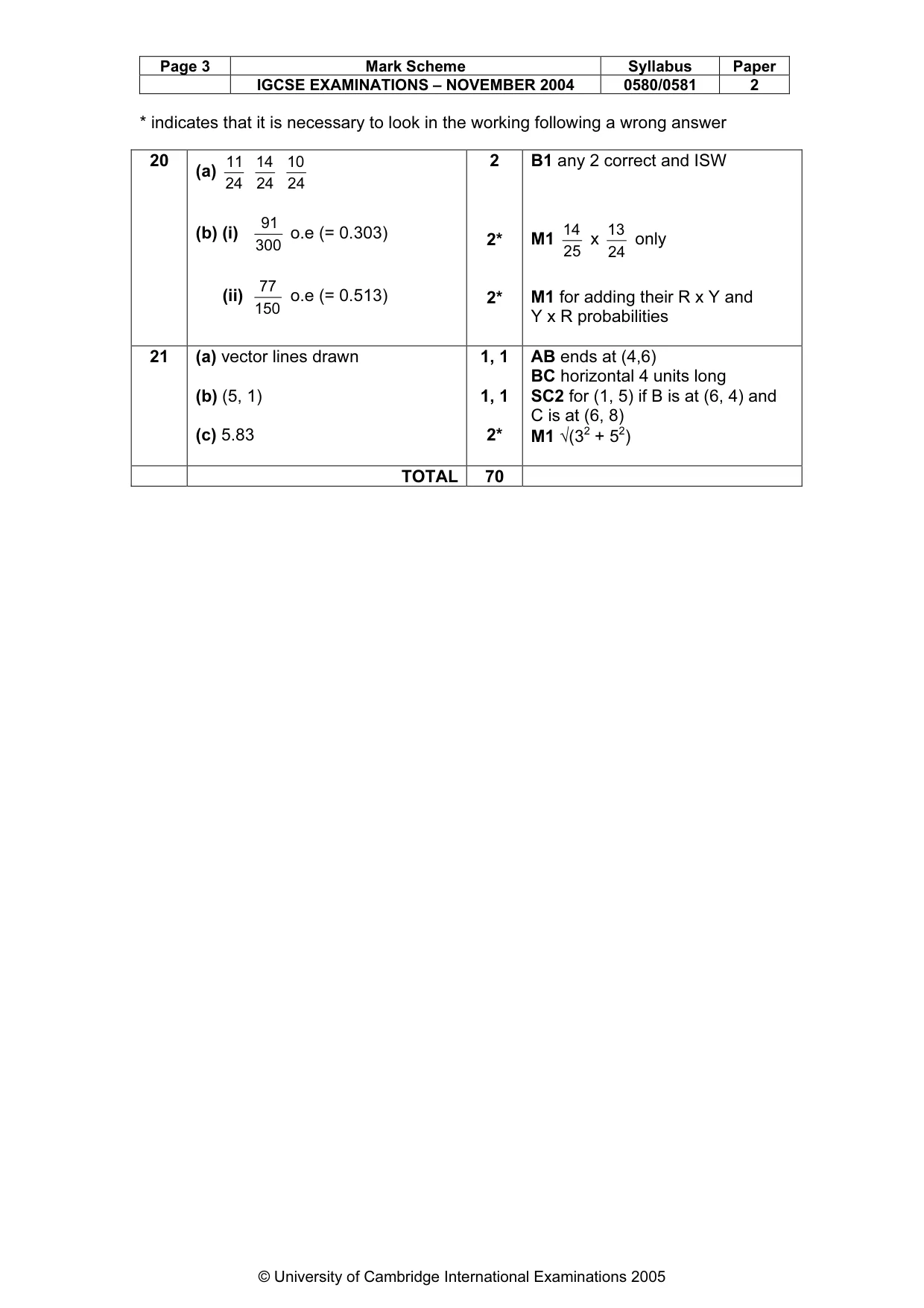
Page 3 Mark Scheme Syllabus Paper IGCSE EXAMINATIONS – NOVEMBER 2004 0580/0581 2 © University of Cambridge International Examinations 2005 * indicates that it is necessary to look in the working following a wrong answer 20 (a) 24 11 24 14 24 10 (b) (i) 300 91 o.e (= 0.303) (ii) 150 77 o.e (= 0.513) 2 2* 2* B1 any 2 correct and ISW M1 25 14 x 24 13 only M1 for adding their R x Y and Y x R probabilities 21 (a) vector lines drawn (b) (5, 1) (c) 5.83 1, 1 1, 1 2* AB ends at (4,6) BC horizontal 4 units long SC2 for (1, 5) if B is at (6, 4) and C is at (6, 8) M1 √(32 + 52) TOTAL 70