Cambridge IGCSE Mathematics - International 0607 — 2021 May/June Paper 2 · Variant 1
0607/21/M/J/21 · 40 marks · ≈45 min
The question paper and its mark scheme, free to read here and free to download. This is Cambridge’s own paper, exactly as it was sat.
Question paper8 pages
Mark scheme5 pages
Answers below. Sit the paper first if you are practising.
Paper as text
Question paper, page 1
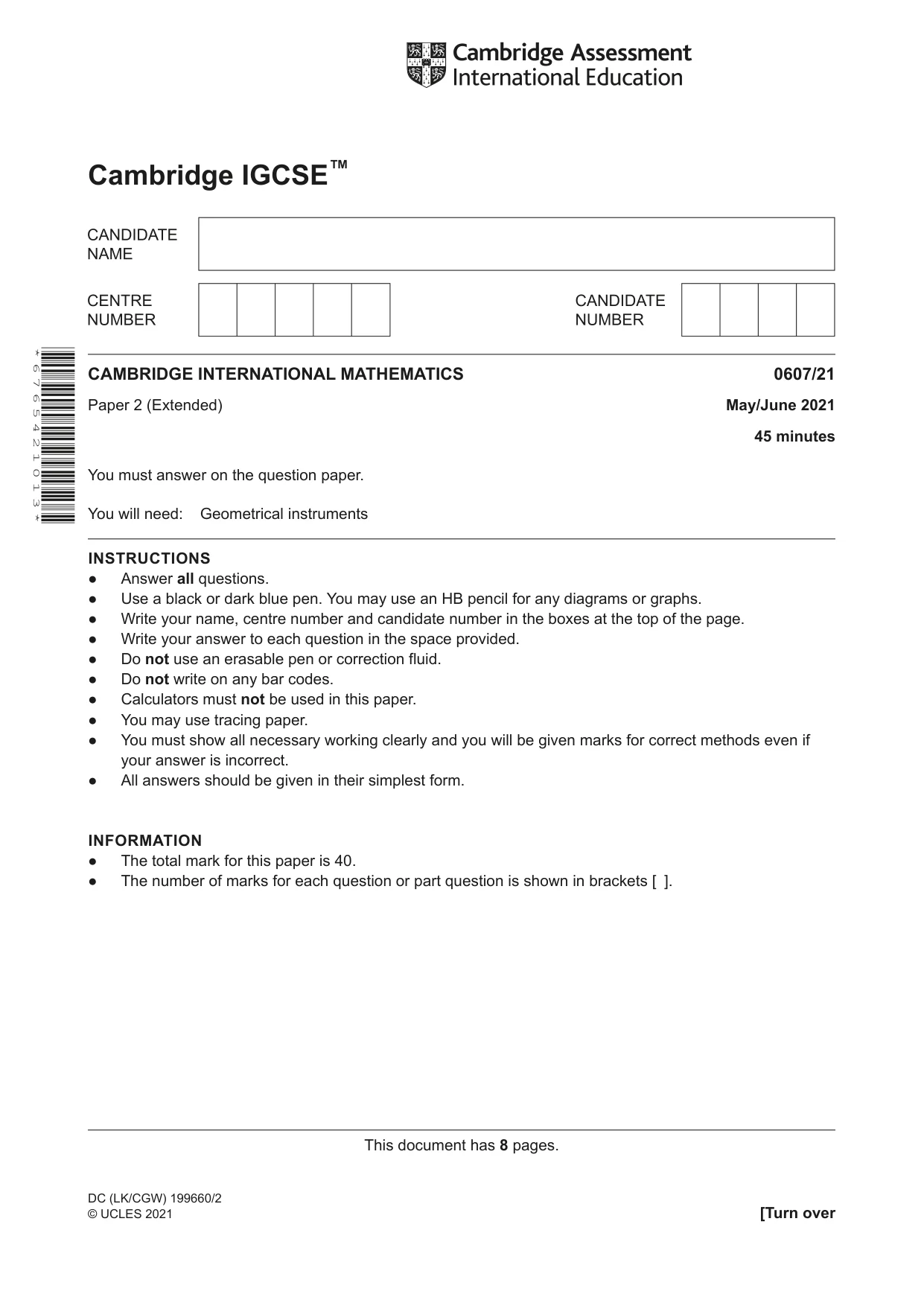
This document has 8 pages. Cambridge IGCSE™ DC (LK/CGW) 199660/2 © UCLES 2021 [Turn over * 6 7 6 5 4 2 1 0 1 3 * CAMBRIDGE INTERNATIONAL MATHEMATICS 0607/21 Paper 2 (Extended) May/June 2021 45 minutes You must answer on the question paper. You will need: Geometrical instruments INSTRUCTIONS ● Answer all questions. ● Use a black or dark blue pen. You may use an HB pencil for any diagrams or graphs. ● Write your name, centre number and candidate number in the boxes at the top of the page. ● Write your answer to each question in the space provided. ● Do not use an erasable pen or correction fluid. ● Do not write on any bar codes. ● Calculators must not be used in this paper. ● You may use tracing paper. ● You must show all necessary working clearly and you will be given marks for correct methods even if your answer is incorrect. ● All answers should be given in their simplest form. INFORMATION ● The total mark for this paper is 40. ● The number of marks for each question or part question is shown in brackets [ ].
Question paper, page 2
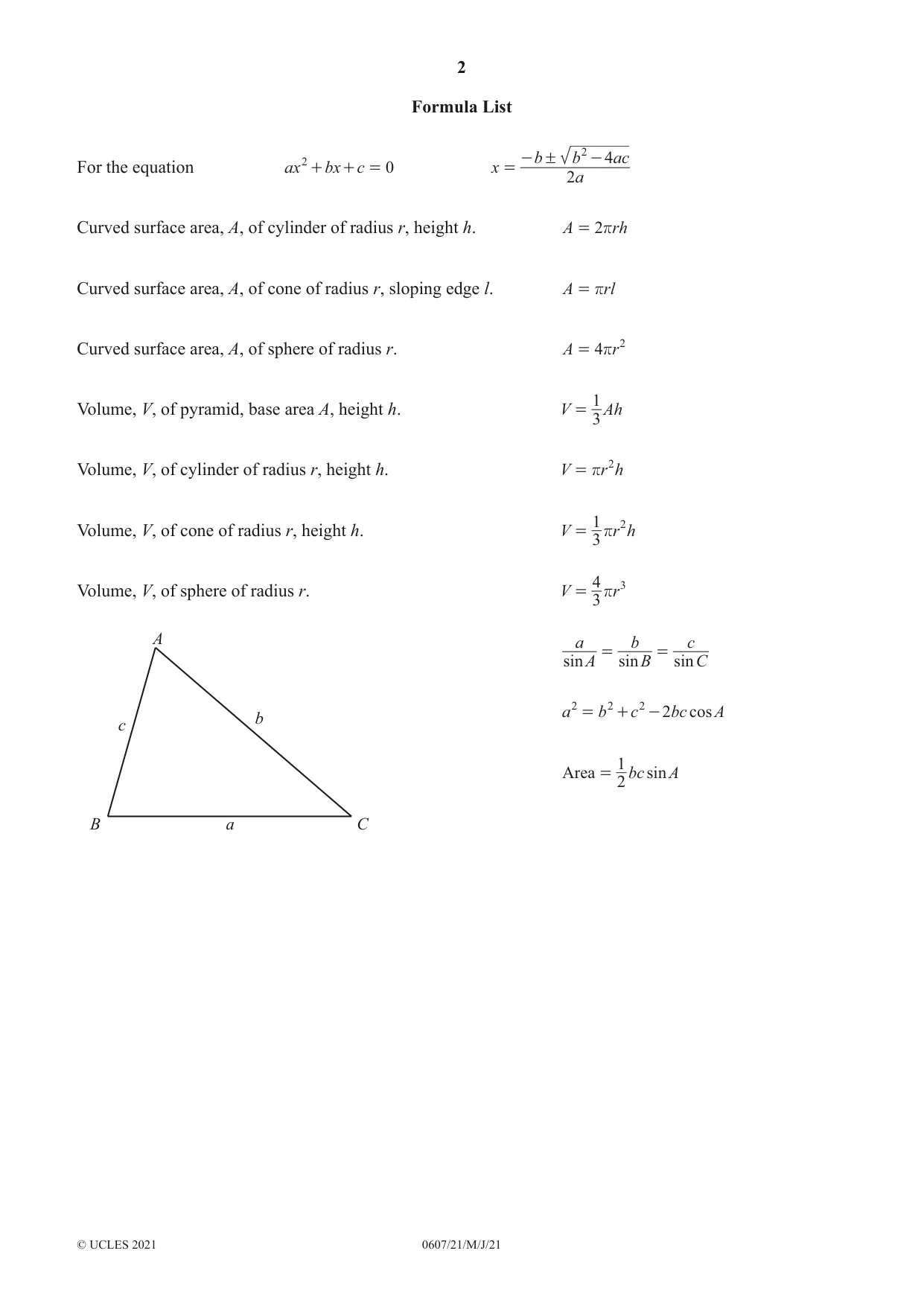
2 0607/21/M/J/21 © UCLES 2021 Formula List For the equation ax bx c 0 2 + + = x a b b ac 2 4 2 ! = - - Curved surface area, A, of cylinder of radius r, height h. r A rh 2 = Curved surface area, A, of cone of radius r, sloping edge l. r A rl = Curved surface area, A, of sphere of radius r. r A r 4 2 = Volume, V, of pyramid, base area A, height h. V Ah 3 1 = Volume, V, of cylinder of radius r, height h. r V r h 2 = Volume, V, of cone of radius r, height h. r V r h 3 1 2 = Volume, V, of sphere of radius r. r V r 3 4 3 = sin sin sin A a B b C c = = cos a b c bc A 2 2 2 2 = + - sin bc A 2 1 Area = A C B c b a
Question paper, page 3
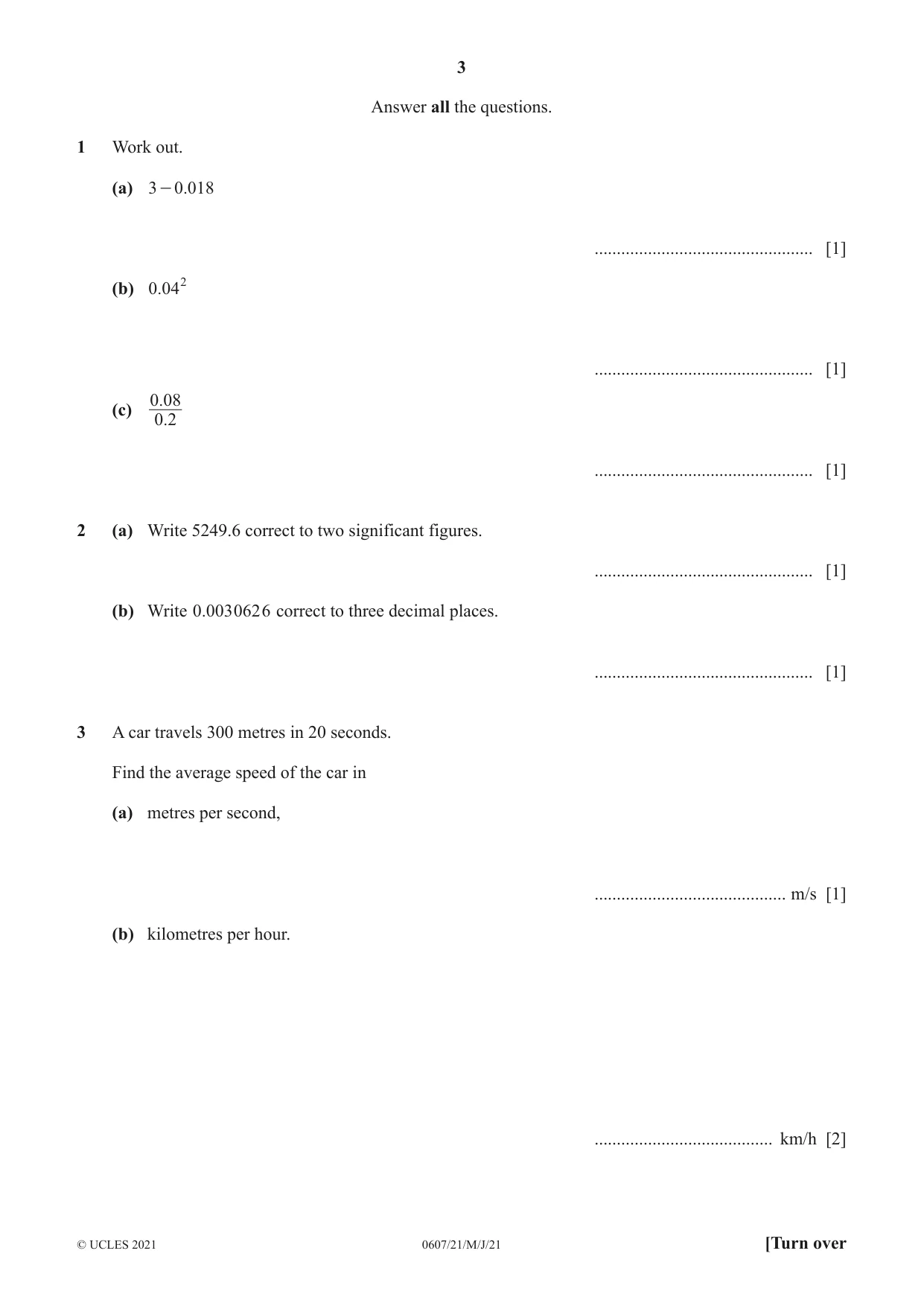
3 0607/21/M/J/21 © UCLES 2021 [Turn over Answer all the questions. 1 Work out. (a) . 3 0 018 - … [1] (b) .0 042 … [1] (c) . . 0 2 0 08 … [1] 2 (a) Write 5249.6 correct to two significant figures. … [1] (b) Write .0 0030626 correct to three decimal places. … [1] 3 A car travels 300 metres in 20 seconds. Find the average speed of the car in (a) metres per second, … m/s [1] (b) kilometres per hour. … km/h [2]
Question paper, page 4
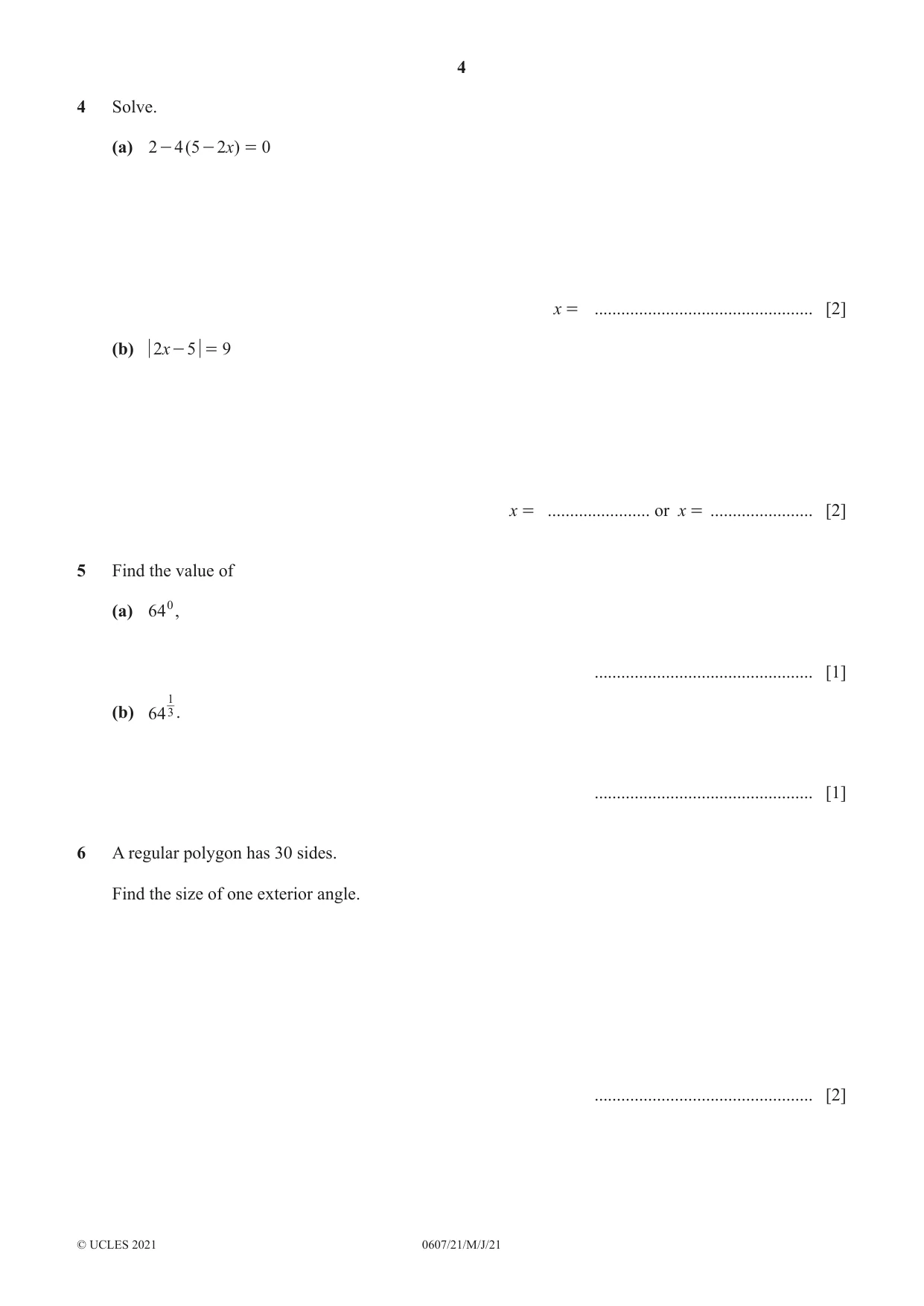
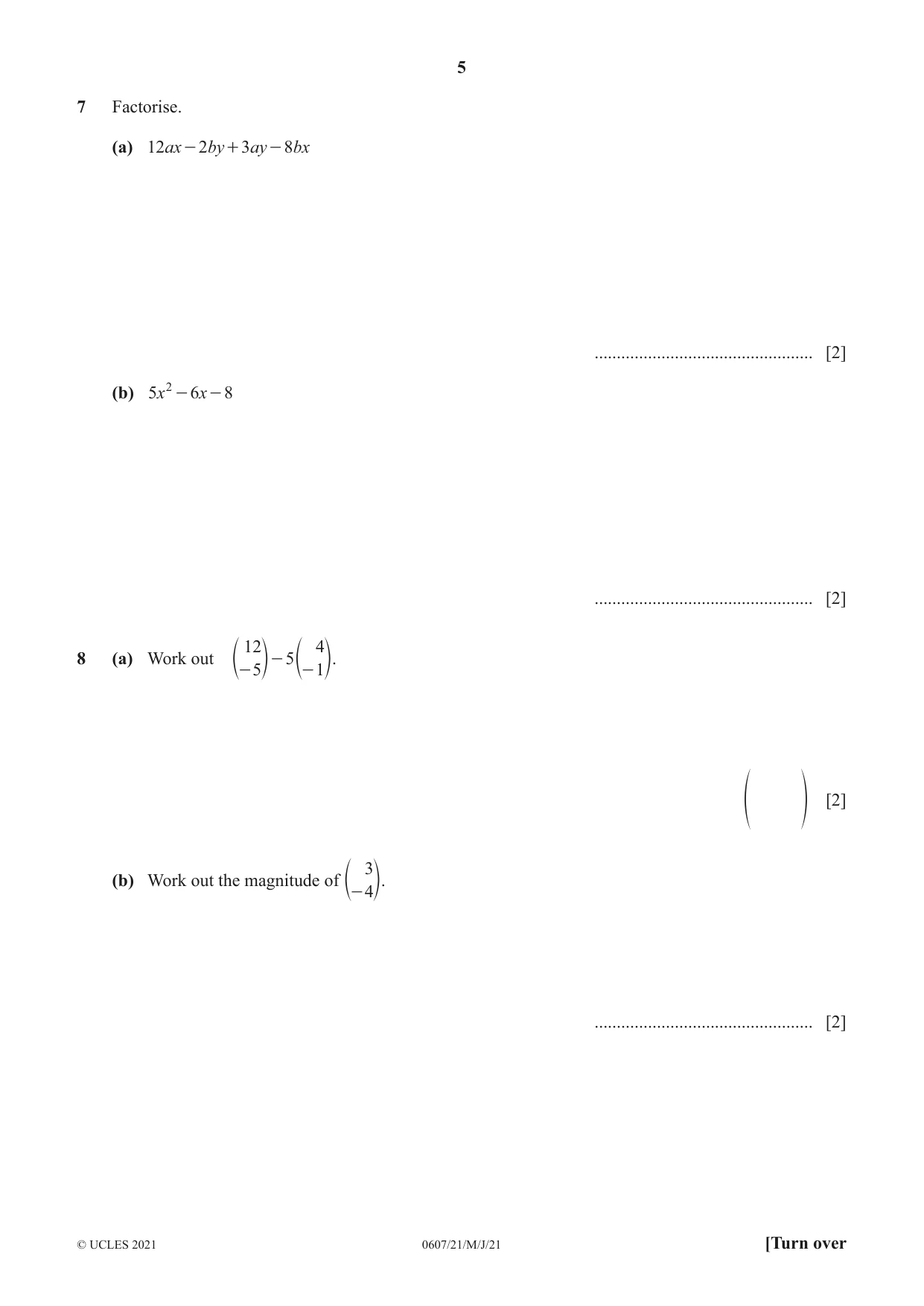
4 0607/21/M/J/21 © UCLES 2021 4 Solve. (a) ( )x 2 4 5 2 0 - - = x = … [2] (b) x 2 5 9 - = x = … or x = … [2] 5 Find the value of (a) 640, … [1] (b) 643 1 . … [1] 6 A regular polygon has 30 sides. Find the size of one exterior angle. … [2]
Question paper, page 5
5 0607/21/M/J/21 © UCLES 2021 [Turn over 7 Factorise. (a) a by ay bx x 12 2 3 8 - + - … [2] (b) x x 5 6 8 2 - - … [2] 8 (a) Work out 12 5 5 4 1 - - - e e o o. f p [2] (b) Work out the magnitude of 3 4 - e o. … [2]
Question paper, page 6
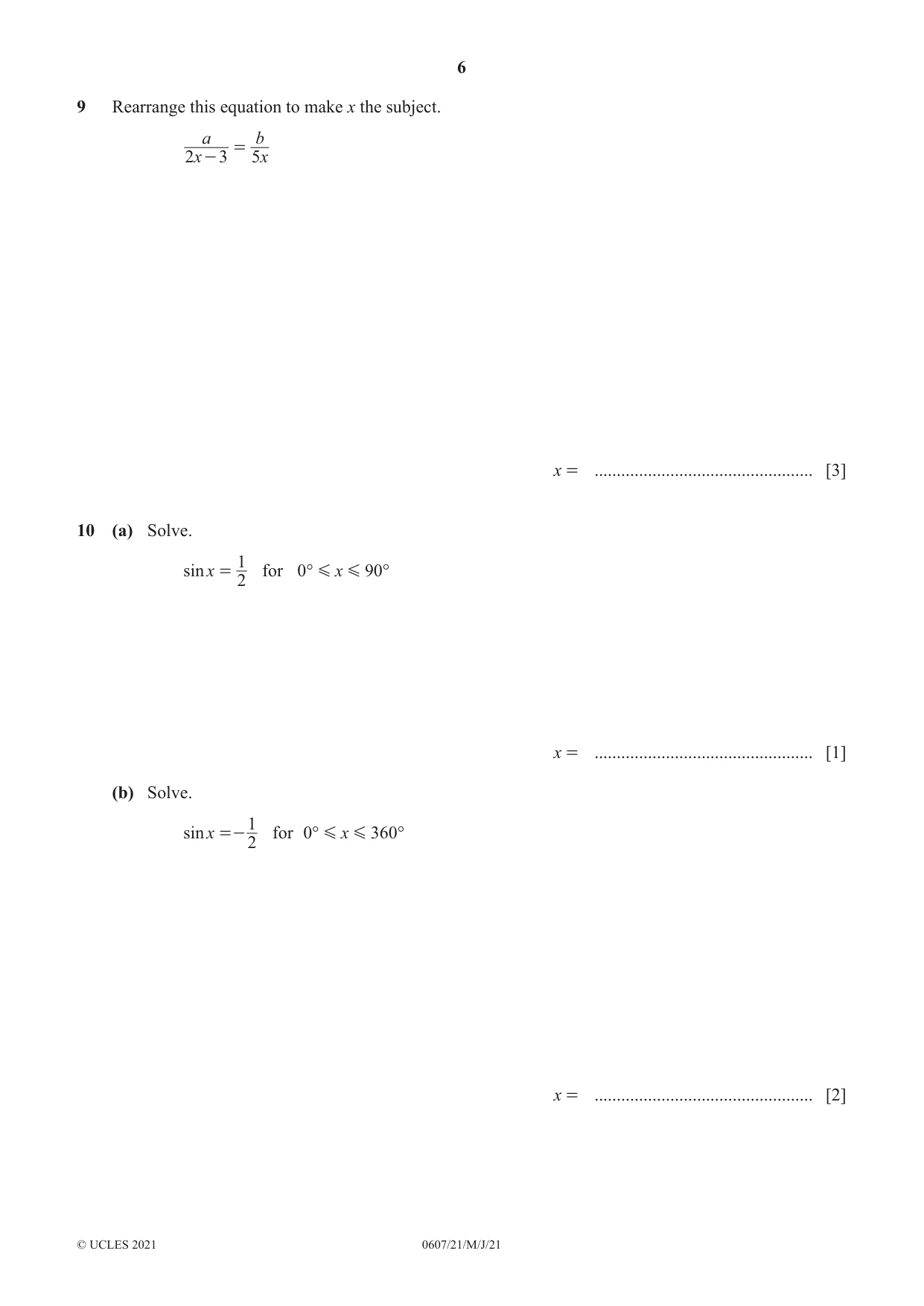
6 0607/21/M/J/21 © UCLES 2021 9 Rearrange this equation to make x the subject. x a x b 2 3 5 - = x = … [3] 10 (a) Solve. sinx 2 1 = for ° ° x 0 90 G G x = … [1] (b) Solve. sinx 2 1 =- for ° ° x 0 360 G G x = … [2]
Question paper, page 7
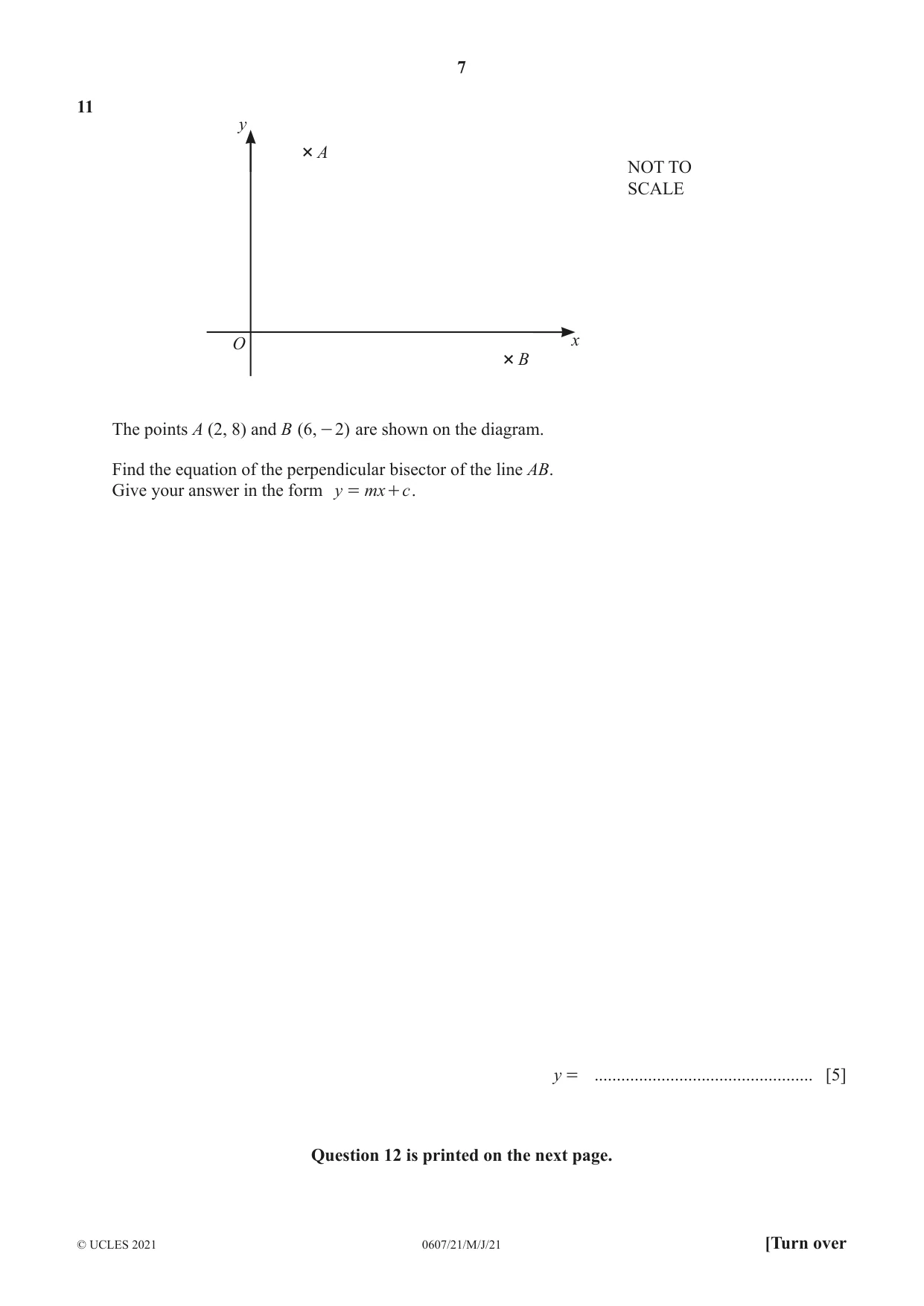
7 0607/21/M/J/21 © UCLES 2021 [Turn over 11 O B A NOT TO SCALE y x The points A (2, 8) and B ( , ) 6 2 - are shown on the diagram. Find the equation of the perpendicular bisector of the line AB. Give your answer in the form y mx c = + . y = … [5] Question 12 is printed on the next page.
Question paper, page 8
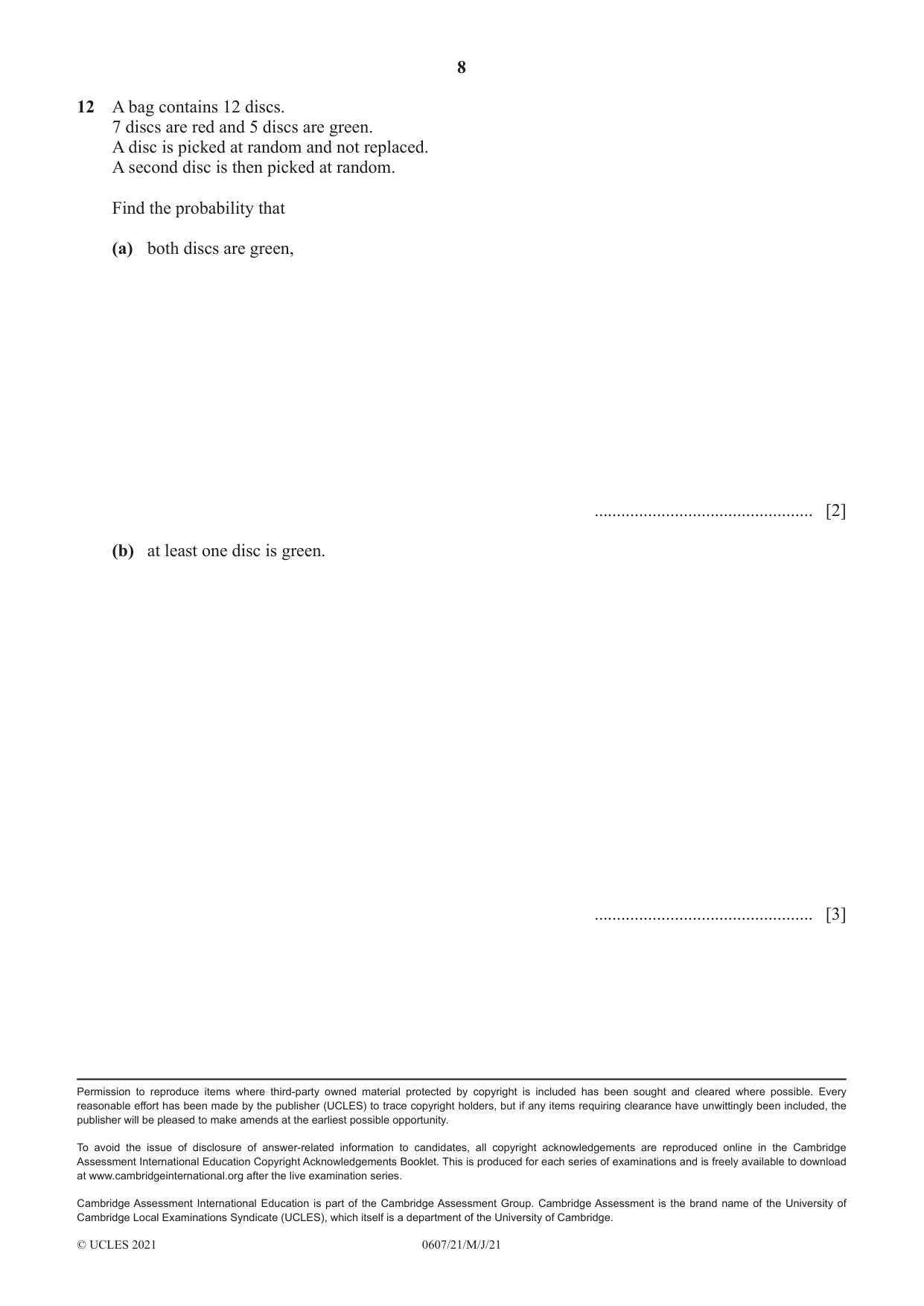
8 0607/21/M/J/21 © UCLES 2021 Permission to reproduce items where third-party owned material protected by copyright is included has been sought and cleared where possible. Every reasonable effort has been made by the publisher (UCLES) to trace copyright holders, but if any items requiring clearance have unwittingly been included, the publisher will be pleased to make amends at the earliest possible opportunity. To avoid the issue of disclosure of answer-related information to candidates, all copyright acknowledgements are reproduced online in the Cambridge Assessment International Education Copyright Acknowledgements Booklet. This is produced for each series of examinations and is freely available to download at www.cambridgeinternational.org after the live examination series. Cambridge Assessment International Education is part of the Cambridge Assessment Group. Cambridge Assessment is the brand name of the University of Cambridge Local Examinations Syndicate (UCLES), which itself is a department of the University of Cambridge. 12 A bag contains 12 discs. 7 discs are red and 5 discs are green. A disc is picked at random and not replaced. A second disc is then picked at random. Find the probability that (a) both discs are green, … [2] (b) at least one disc is green. … [3]
Mark scheme, page 1
This document consists of 5 printed pages. © UCLES 2021 [Turn over Cambridge IGCSE™ CAMBRIDGE INTERNATIONAL MATHEMATICS 0607/21 Paper 2 (Extended) May/June 2021 MARK SCHEME Maximum Mark: 40 Published This mark scheme is published as an aid to teachers and candidates, to indicate the requirements of the examination. It shows the basis on which Examiners were instructed to award marks. It does not indicate the details of the discussions that took place at an Examiners’ meeting before marking began, which would have considered the acceptability of alternative answers. Mark schemes should be read in conjunction with the question paper and the Principal Examiner Report for Teachers. Cambridge International will not enter into discussions about these mark schemes. Cambridge International is publishing the mark schemes for the May/June 2021 series for most Cambridge IGCSE™, Cambridge International A and AS Level components and some Cambridge O Level components.
Mark scheme, page 2
0607/21 Cambridge IGCSE – Mark Scheme PUBLISHED May/June 2021 © UCLES 2021 Page 2 of 5 Generic Marking Principles These general marking principles must be applied by all examiners when marking candidate answers. They should be applied alongside the specific content of the mark scheme or generic level descriptors for a question. Each question paper and mark scheme will also comply with these marking principles. GENERIC MARKING PRINCIPLE 1: Marks must be awarded in line with: • the specific content of the mark scheme or the generic level descriptors for the question • the specific skills defined in the mark scheme or in the generic level descriptors for the question • the standard of response required by a candidate as exemplified by the standardisation scripts. GENERIC MARKING PRINCIPLE 2: Marks awarded are always whole marks (not half marks, or other fractions). GENERIC MARKING PRINCIPLE 3: Marks must be awarded positively: • marks are awarded for correct/valid answers, as defined in the mark scheme. However, credit is given for valid answers which go beyond the scope of the syllabus and mark scheme, referring to your Team Leader as appropriate • marks are awarded when candidates clearly demonstrate what they know and can do • marks are not deducted for errors • marks are not deducted for omissions • answers should only be judged on the quality of spelling, punctuation and grammar when these features are specifically assessed by the question as indicated by the mark scheme. The meaning, however, should be unambiguous. GENERIC MARKING PRINCIPLE 4: Rules must be applied consistently, e.g. in situations where candidates have not followed instructions or in the application of generic level descriptors. GENERIC MARKING PRINCIPLE 5: Marks should be awarded using the full range of marks defined in the mark scheme for the question (however; the use of the full mark range may be limited according to the quality of the candidate responses seen). GENERIC MARKING PRINCIPLE 6: Marks awarded are based solely on the requirements as defined in the mark scheme. Marks should not be awarded with grade thresholds or grade descriptors in mind.
Mark scheme, page 3
0607/21 Cambridge IGCSE – Mark Scheme PUBLISHED May/June 2021 © UCLES 2021 Page 3 of 5 Maths-Specific Marking Principles 1 Unless a particular method has been specified in the question, full marks may be awarded for any correct method. However, if a calculation is required then no marks will be awarded for a scale drawing. 2 Unless specified in the question, answers may be given as fractions, decimals or in standard form. Ignore superfluous zeros, provided that the degree of accuracy is not affected. 3 Allow alternative conventions for notation if used consistently throughout the paper, e.g. commas being used as decimal points. 4 Unless otherwise indicated, marks once gained cannot subsequently be lost, e.g. wrong working following a correct form of answer is ignored (isw). 5 Where a candidate has misread a number in the question and used that value consistently throughout, provided that number does not alter the difficulty or the method required, award all marks earned and deduct just 1 mark for the misread. 6 Recovery within working is allowed, e.g. a notation error in the working where the following line of working makes the candidate’s intent clear. MARK SCHEME NOTES The following notes are intended to aid interpretation of mark schemes in general, but individual mark schemes may include marks awarded for specific reasons outside the scope of these notes. Types of mark M Method marks, awarded for a valid method applied to the problem. A Accuracy mark, awarded for a correct answer or intermediate step correctly obtained. For accuracy marks to be given, the associated Method mark must be earned or implied. B Mark for a correct result or statement independent of Method marks. When a part of a question has two or more ‘method’ steps, the M marks are in principle independent unless the scheme specifically says otherwise; and similarly where there are several B marks allocated. The notation ‘dep’ is used to indicate that a particular M or B mark is dependent on an earlier mark in the scheme. Abbreviations awrt answers which round to cao correct answer only dep dependent FT follow through after error isw ignore subsequent working nfww not from wrong working oe or equivalent rot rounded or truncated SC Special Case soi seen or implied
Mark scheme, page 4
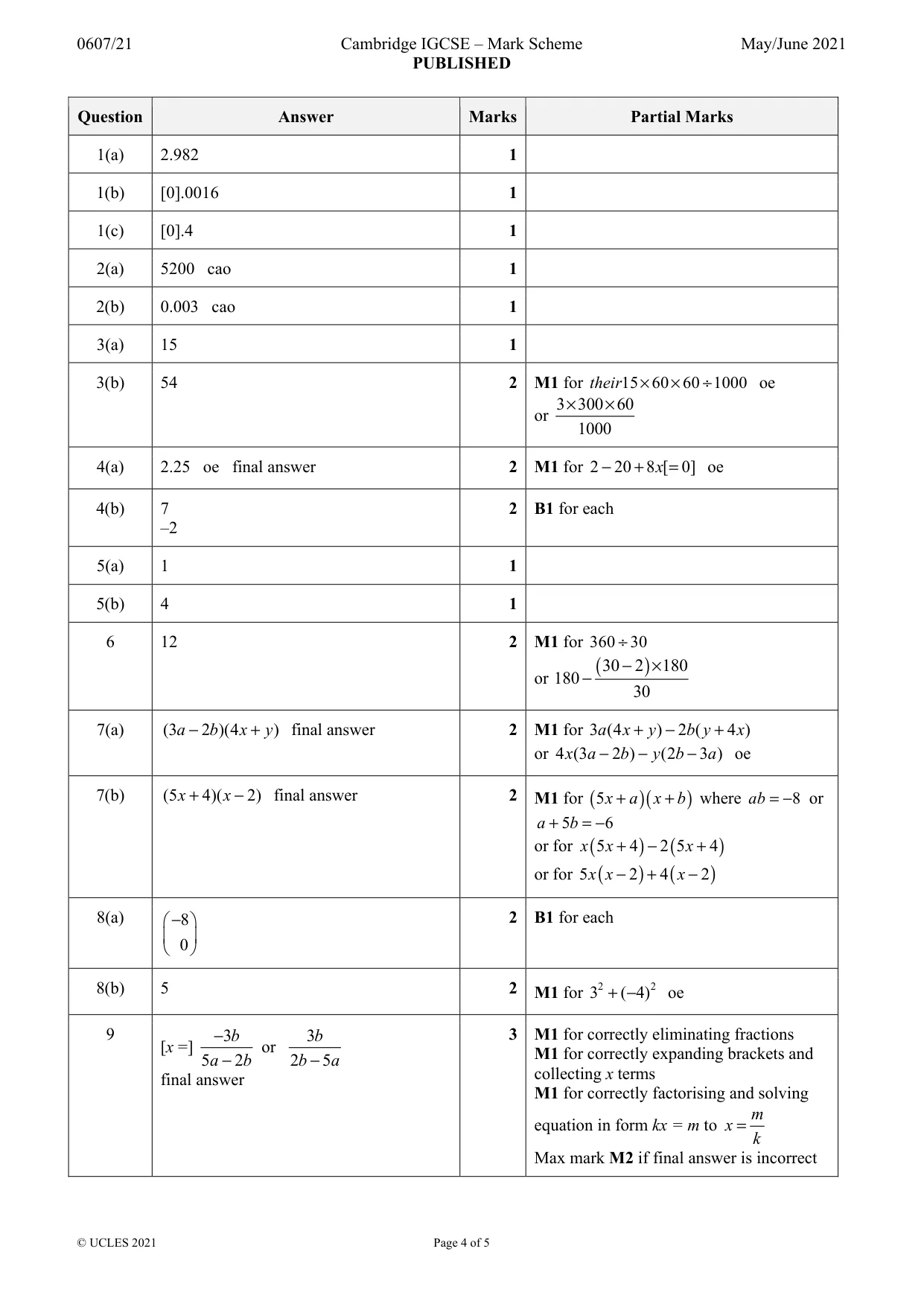
0607/21 Cambridge IGCSE – Mark Scheme PUBLISHED May/June 2021 © UCLES 2021 Page 4 of 5 Question Answer Marks Partial Marks 1(a) 2.982 1 1(b) [0].0016 1 1(c) [0].4 1 2(a) 5200 cao 1 2(b) 0.003 cao 1 3(a) 15 1 3(b) 54 2 M1 for 15 60 60 1000 × × ÷ their oe or 3 300 60 1000 × × 4(a) 2.25 oe final answer 2 M1 for 2 20 8 [ 0] − + = x oe 4(b) 7 –2 2 B1 for each 5(a) 1 1 5(b) 4 1 6 12 2 M1 for 360 30 ÷ or ( ) 30 2 180 180 30 − × − 7(a) (3 2 )(4 ) − + a b x y final answer 2 M1 for 3 (4 ) 2 ( 4 ) + − + a x y b y x or 4 (3 2 ) (2 3 ) − − − x a b y b a oe 7(b) (5 4)( 2) + − x x final answer 2 M1 for ( )( ) 5 + + x a x b where 8 = − ab or 5 6 + = − a b or for ( ) ( ) 5 4 2 5 4 + − + x x x or for ( ) ( ) 5 2 4 2 − + − x x x 8(a) 8 0 − 2 B1 for each 8(b) 5 2 M1 for 2 2 3 ( 4) + − oe 9 [x =] 3 5 2 − − b a b or 3 2 5 − b b a final answer 3 M1 for correctly eliminating fractions M1 for correctly expanding brackets and collecting x terms M1 for correctly factorising and solving equation in form kx = m to = m x k Max mark M2 if final answer is incorrect
Mark scheme, page 5
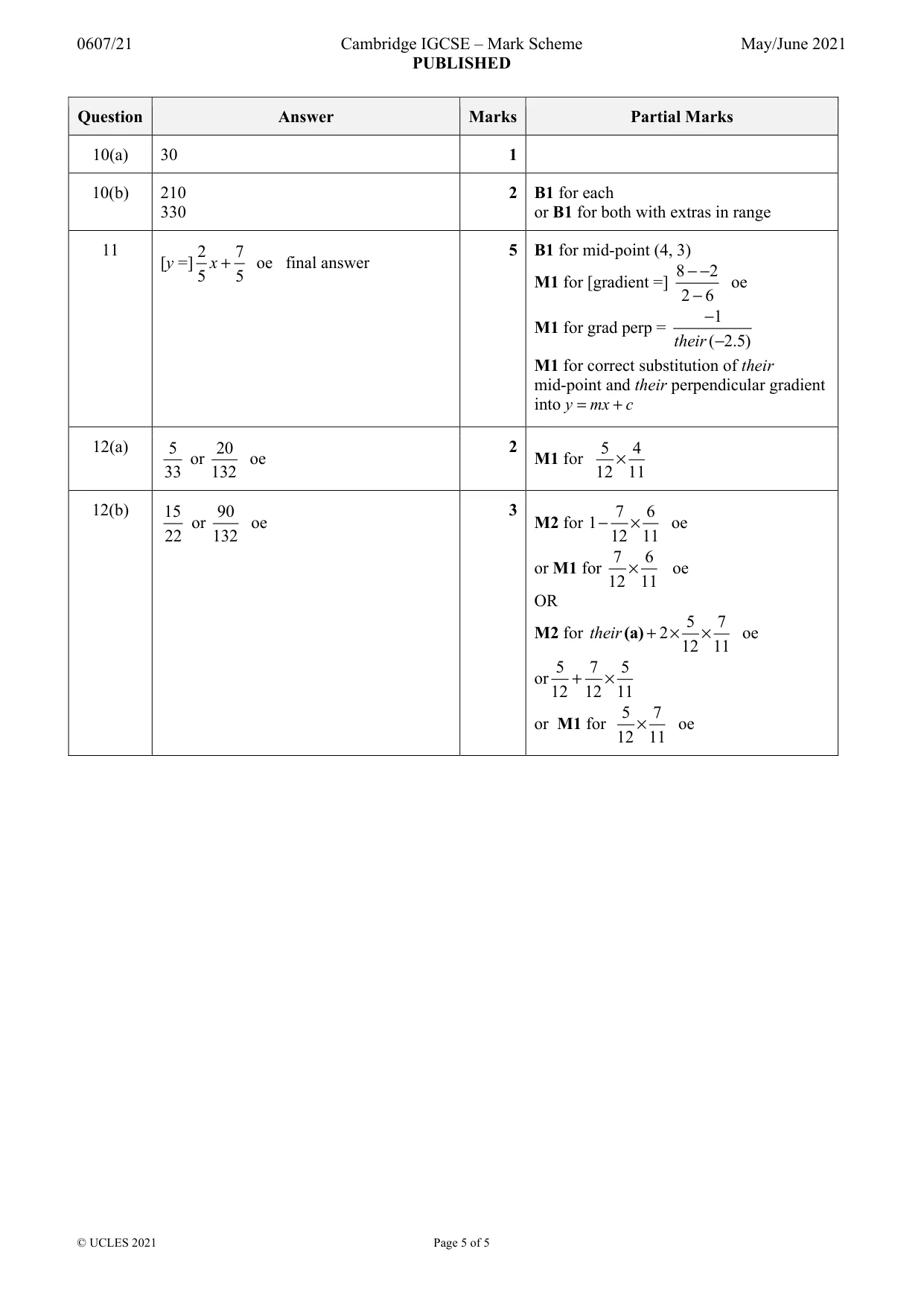
0607/21 Cambridge IGCSE – Mark Scheme PUBLISHED May/June 2021 © UCLES 2021 Page 5 of 5 Question Answer Marks Partial Marks 10(a) 30 1 10(b) 210 330 2 B1 for each or B1 for both with extras in range 11 [y =] 2 7 5 5 + x oe final answer 5 B1 for mid-point (4, 3) M1 for [gradient =] 8 2 2 6 −− − oe M1 for grad perp = 1 ( 2.5) − − their M1 for correct substitution of their mid-point and their perpendicular gradient into = + y mx c 12(a) 5 33 or 20 132 oe 2 M1 for 5 4 12 11 × 12(b) 15 22 or 90 132 oe 3 M2 for 7 6 1 12 11 − × oe or M1 for 7 6 12 11 × oe OR M2 for 5 7 2 12 11 + × × their(a) oe or 5 7 5 12 12 11 + × or M1 for 5 7 12 11 × oe
What you needed in this session
Cambridge’s own grade thresholds for 2021 May/June, Paper 2 · Variant 1. A higher threshold means an easier paper — the bar moves with how the cohort did.