Cambridge IGCSE Mathematics - International 0607 — 2025 May/June Paper 2 · Variant 1
0607/21/M/J/25 · 22 questions · 75 marks · ≈84 min
The question paper and its mark scheme, free to read here and free to download. This is Cambridge’s own paper, exactly as it was sat.
Question paper16 pages
Mark scheme10 pages
Answers below. Sit the paper first if you are practising.
Questions as text
Q1 · This is a list of numbers
1 This is a list of numbers. 2 3.142 125 125 81 7 3 From this list write down (a) a cube number ................................................. [1] (b) an irrational number. ................................................. [1]
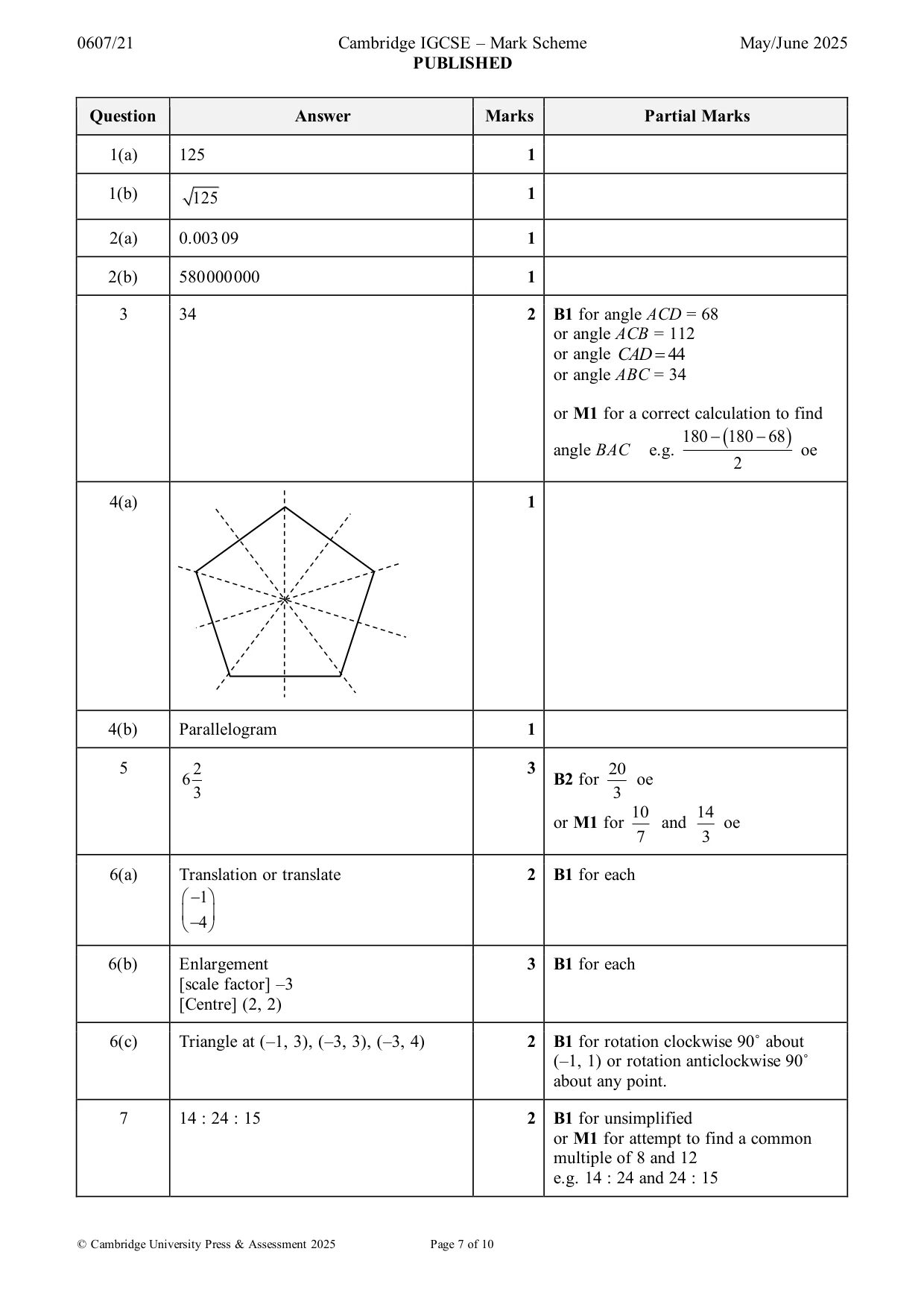
Mark scheme: Question Answer Marks Partial Marks 1(a) 125 1 1(b) 1 125
Q2 · Write 0.003 094 8 correct to 3 significant figures
2 (a) Write 0.003 094 8 correct to 3 significant figures. ................................................. [1] (b) Write 579 644 358 correct to the nearest million. ................................................. [1]
Mark scheme: 2(a) 0.003 09 1 2(b) 580 000 000 1
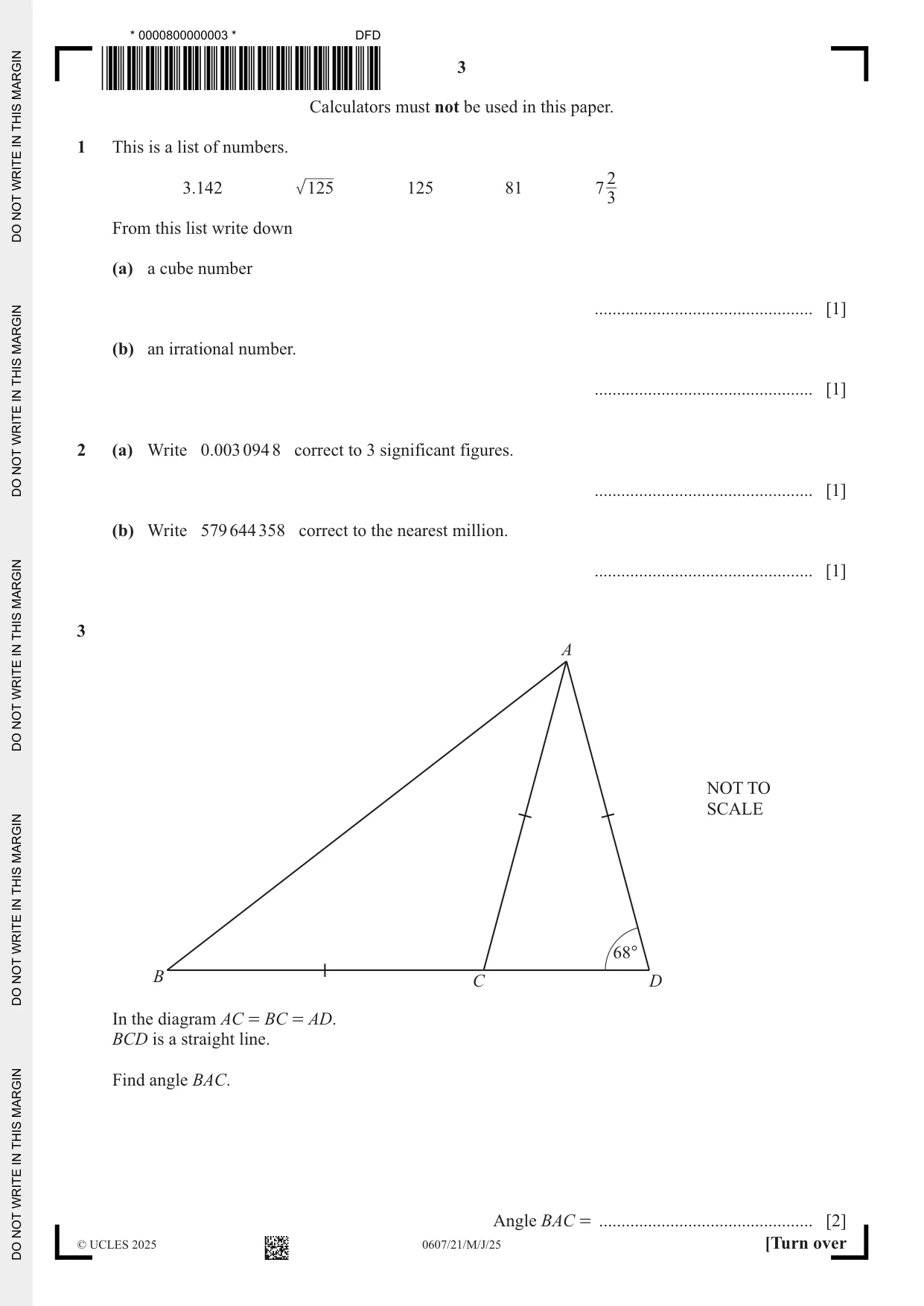
Q3 · A NOT TO SCALE 68° B C D In the diagram AC = BC = AD
3 A NOT TO SCALE 68° B C D In the diagram AC = BC = AD. BCD is a straight line. Find angle BAC. Angle BAC = ................................................ [2]
Mark scheme: 3 34 2 B1 for angle ACD = 68 or angle ACB = 112 or angle CAD = 44 or angle ABC = 34 or M1 for a correct calculation to find 180 − (180 − 68 ) angle BAC e.g. oe 2
Q4 · Draw all the lines of symmetry of this regular pentagon
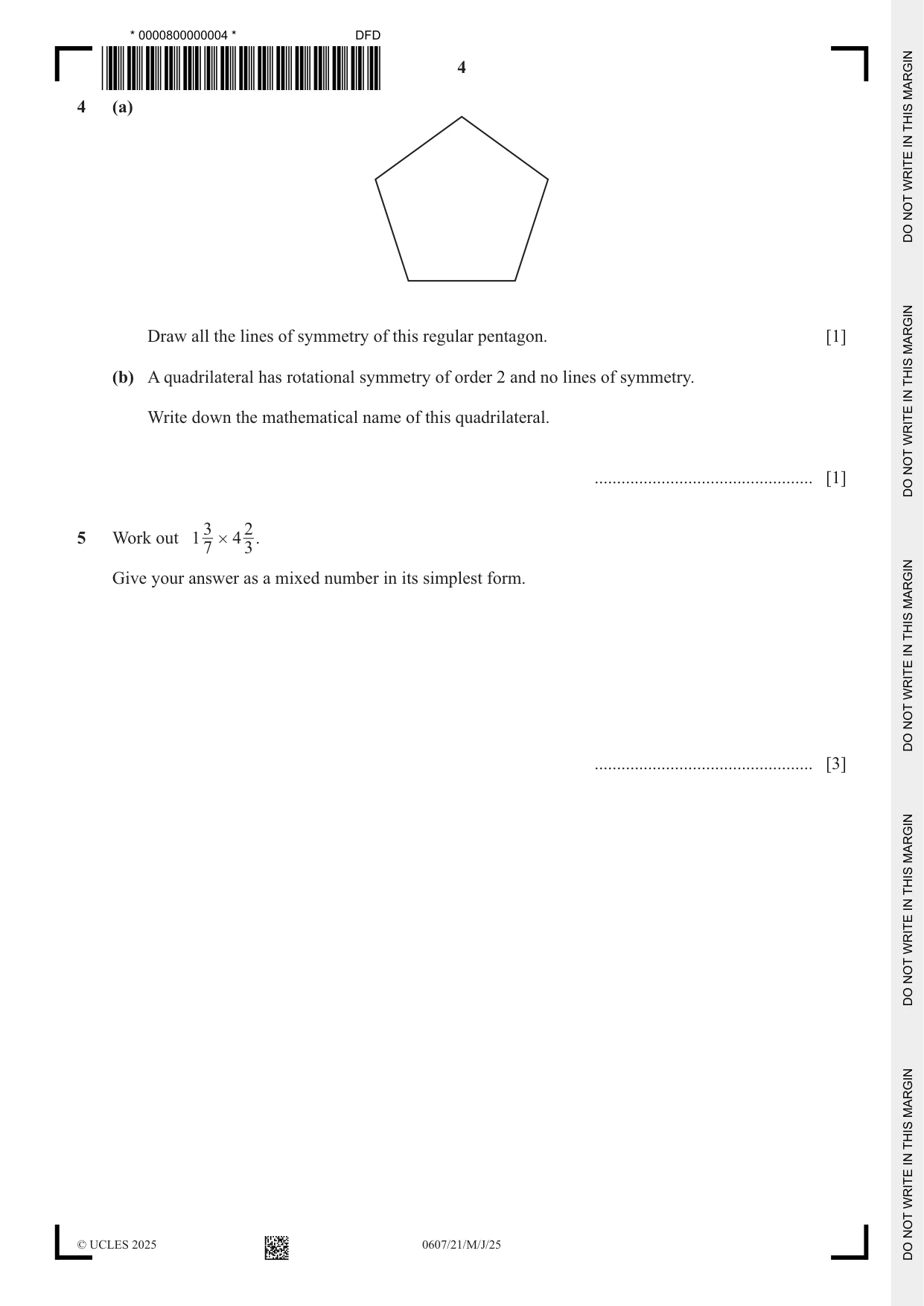
4 (a) Draw all the lines of symmetry of this regular pentagon. [1] (b) A quadrilateral has rotational symmetry of order 2 and no lines of symmetry. Write down the mathematical name of this quadrilateral. ................................................. [1]
Mark scheme: 4(a) 1 4(b) Parallelogram 1
Q5 · Work out 1 # 4
5 Work out 1 # 4 . 7 3 Give your answer as a mixed number in its simplest form. ................................................. [3]
Mark scheme: 5 2 3 20 6 B2 for oe 3 3 10 14 or M1 for and oe 7 3
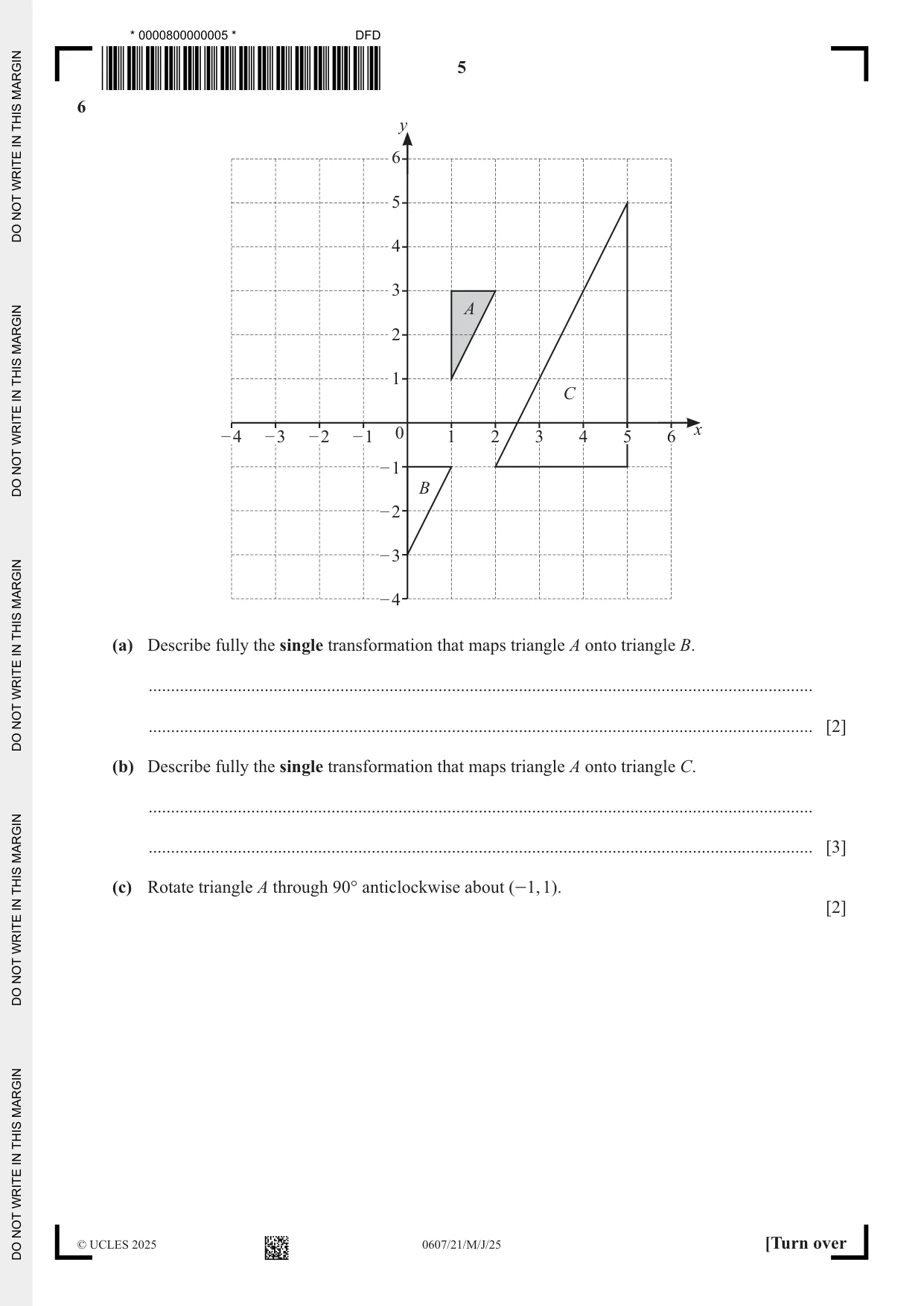
Q6 · Y 6 5 4 3 A 2 1 C – 4 – 3 – 2 – 1 0 1 2 3 4 5 6 x – 1 B – 2 – 3 – 4 (a) Describe fully…
6 y 6 5 4 3 A 2 1 C – 4 – 3 – 2 – 1 0 1 2 3 4 5 6 x – 1 B – 2 – 3 – 4 (a) Describe fully the single transformation that maps triangle A onto triangle B. ..................................................................................................................................................... ..................................................................................................................................................... [2] (b) Describe fully the single transformation that maps triangle A onto triangle C. ..................................................................................................................................................... ..................................................................................................................................................... [3] (c) Rotate triangle A through 90° anticlockwise about (-1, 1). [2]
Mark scheme: 6(a) Translation or translate 2 B1 for each −1 −4 6(b) Enlargement 3 B1 for each [scale factor] –3 [Centre] (2, 2) 6(c) Triangle at (–1, 3), (–3, 3), (–3, 4) 2 B1 for rotation clockwise 90˚ about (–1, 1) or rotation anticlockwise 90˚ about any point.
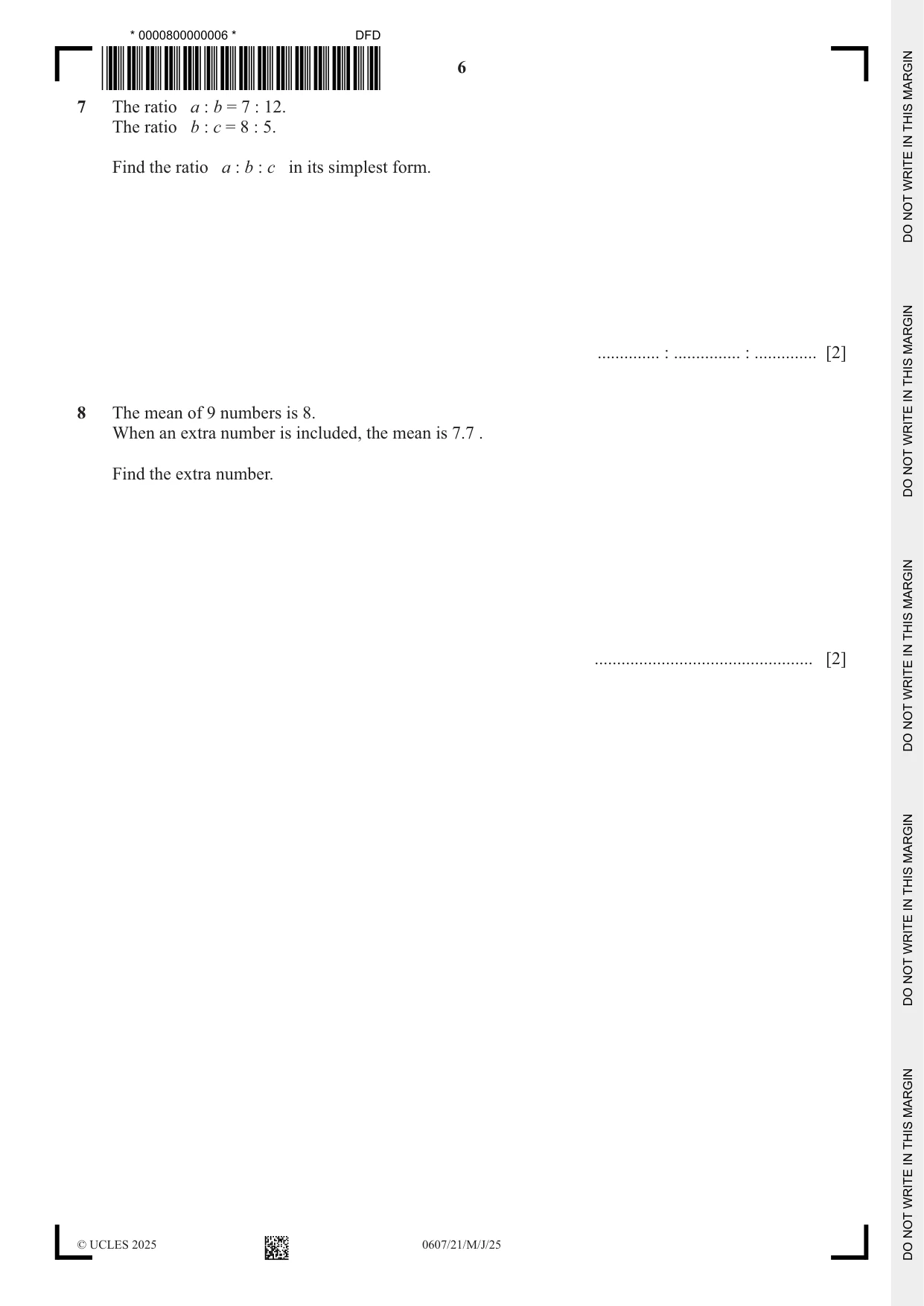
Q7 · The ratio a : b = 7 : 12
7 The ratio a : b = 7 : 12. The ratio b : c = 8 : 5. Find the ratio a : b : c in its simplest form. .............. : ............... : .............. [2]
Mark scheme: 7 14 : 24 : 15 2 B1 for unsimplified or M1 for attempt to find a common multiple of 8 and 12 e.g. 14 : 24 and 24 : 15
Q8 · The mean of 9 numbers is 8
8 The mean of 9 numbers is 8. When an extra number is included, the mean is 7.7 . Find the extra number. ................................................. [2]
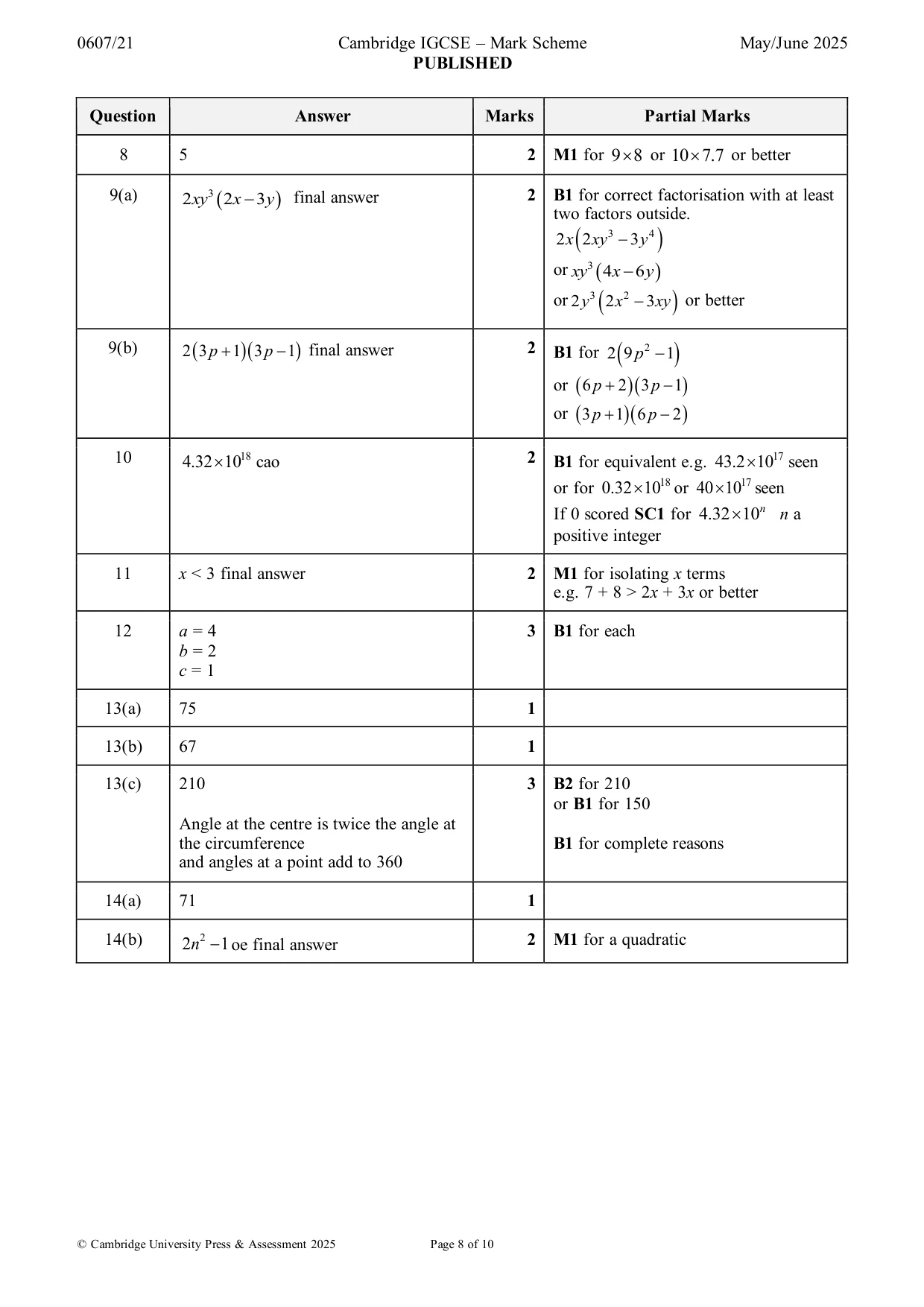
Mark scheme: 8 5 2 M1 for 9 8 or 10 7.7 or better
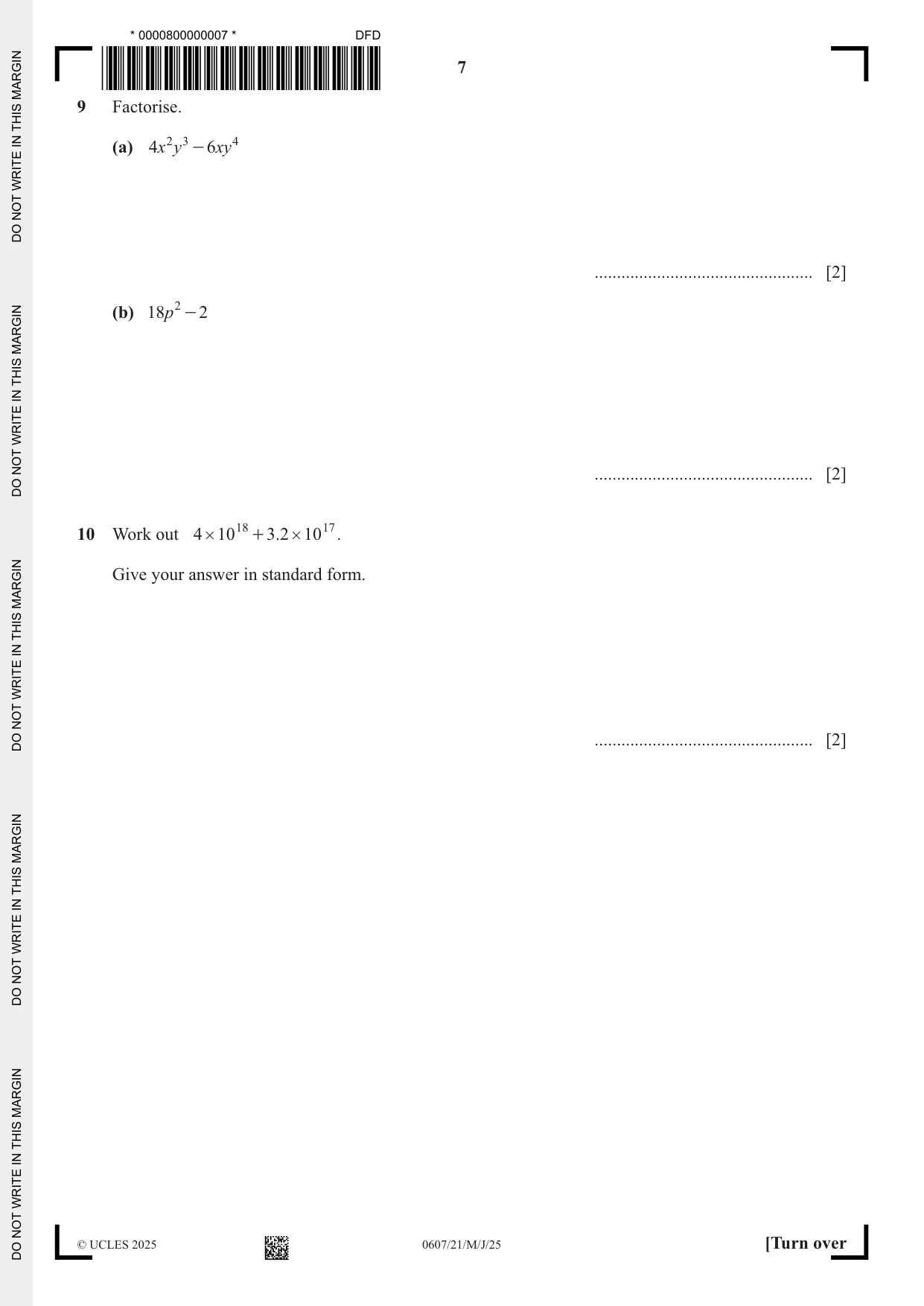
Question 9
9 Factorise. (a) 4x 2 y 3 - 6xy 4 ................................................. [2] (b) 18p 2 - 2 ................................................. [2]
Mark scheme: 9(a) 2 xy 3 ( 2 x − 3 y ) final answer 2 B1 for correct factorisation with at least two factors outside. 2 x 2 xy 3 − 3 y 4 ( ) or xy 3 ( 4 x − 6 y ) or 2 y 3 2 x 2 − 3 xy or better ( ) 9 p 2 − 19(b) 2 ( 3 p + 1)( 3 p − 1) final answer 2 B1 for 2 ( ) or ( 6 p + 2 )( 3 p − 1) or ( 3 p + 1)( 6 p − 2 )
Q10 · Work out 4 # 10 18 + 3 .2 # 10 17
10 Work out 4 # 10 18 + 3 .2 # 10 17 . Give your answer in standard form. ................................................. [2]
Mark scheme: 10 18 2 17 4.32 10 cao B1 for equivalent e.g. 43.2 10 seen or for 0.32 1018 or 40 1017 seen If 0 scored SC1 for 4.32 10 n n a positive integer
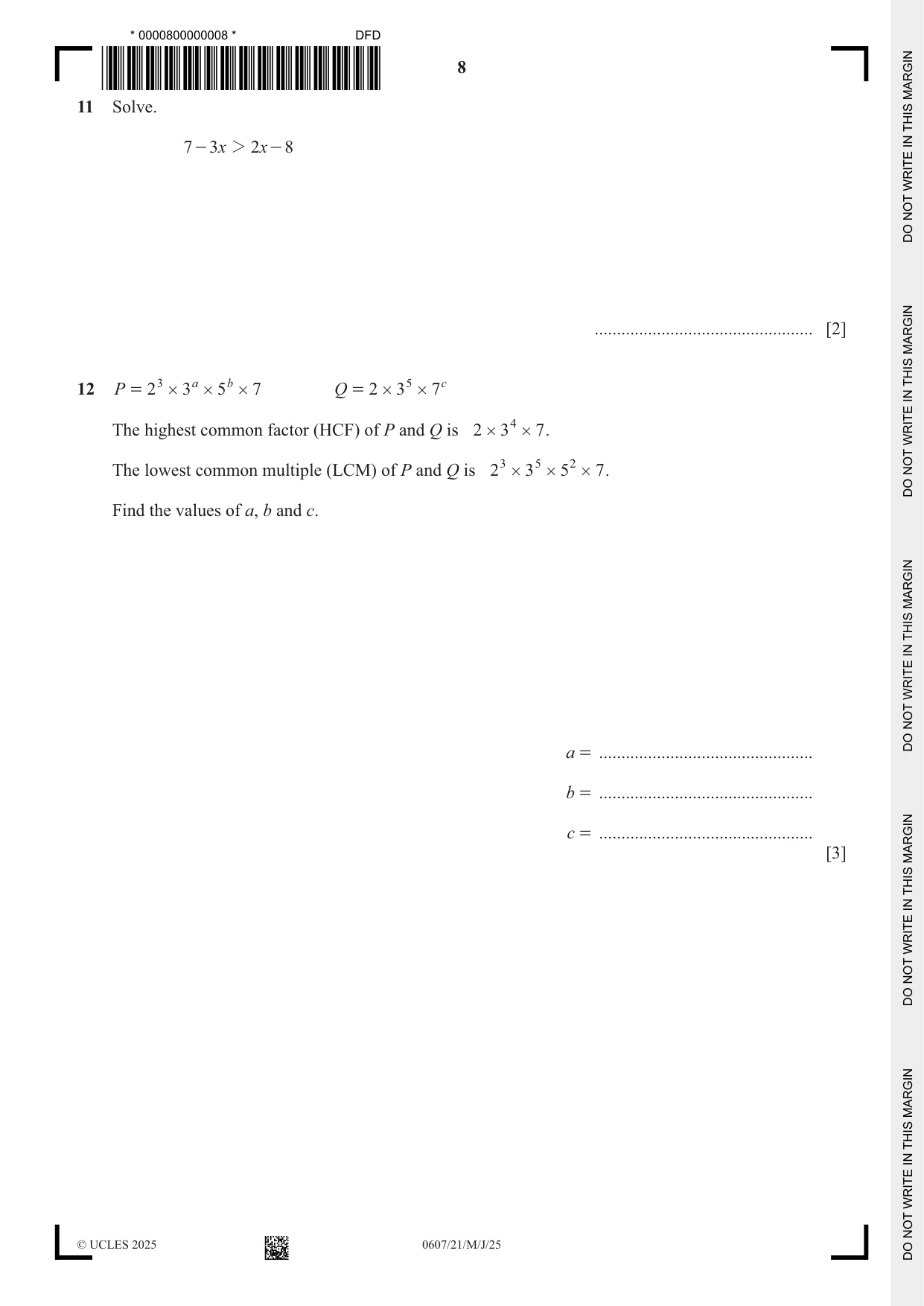
Question 11
11 Solve. 7 - 3x 2 2 x - 8 ................................................. [2]
Mark scheme: 11 x < 3 final answer 2 M1 for isolating x terms e.g. 7 + 8 > 2x + 3x or better
Q12 · P = 2 3 # 3 a # 5 b # 7 Q = 2 # 3 5 # 7c The highest common factor (HCF) of P and Q is 2…
12 P = 2 3 # 3 a # 5 b # 7 Q = 2 # 3 5 # 7c The highest common factor (HCF) of P and Q is 2 # 3 4 # 7 . The lowest common multiple (LCM) of P and Q is 2 3 # 3 5 # 5 2 # 7 . Find the values of a, b and c. a = ................................................ b = ................................................ c = ................................................ [3]
Mark scheme: 12 a = 4 3 B1 for each b = 2 c = 1
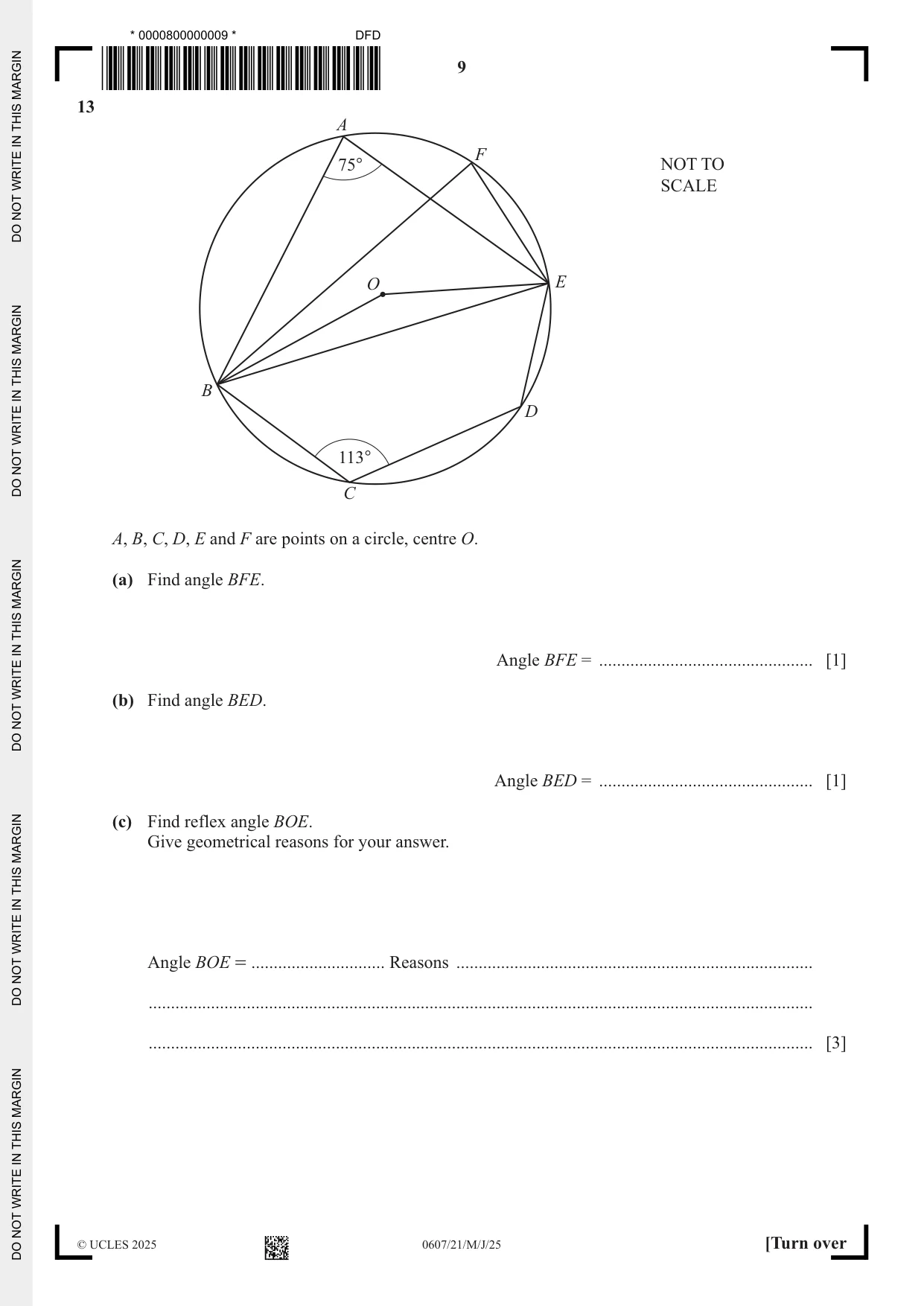
Q13 · A F 75° NOT TO SCALE O E B D 113° C A, B, C, D, E and F are points on a circle, centre O
13 A F 75° NOT TO SCALE O E B D 113° C A, B, C, D, E and F are points on a circle, centre O. (a) Find angle BFE. Angle BFE = ................................................ [1] (b) Find angle BED. Angle BED = ................................................ [1] (c) Find reflex angle BOE. Give geometrical reasons for your answer. Angle BOE = .............................. Reasons ................................................................................ ..................................................................................................................................................... ..................................................................................................................................................... [3]
Mark scheme: 13(a) 75 1 13(b) 67 1 13(c) 210 3 B2 for 210 or B1 for 150 Angle at the centre is twice the angle at the circumference B1 for complete reasons and angles at a point add to 360
Q14 · These are the first 5 terms of a sequence
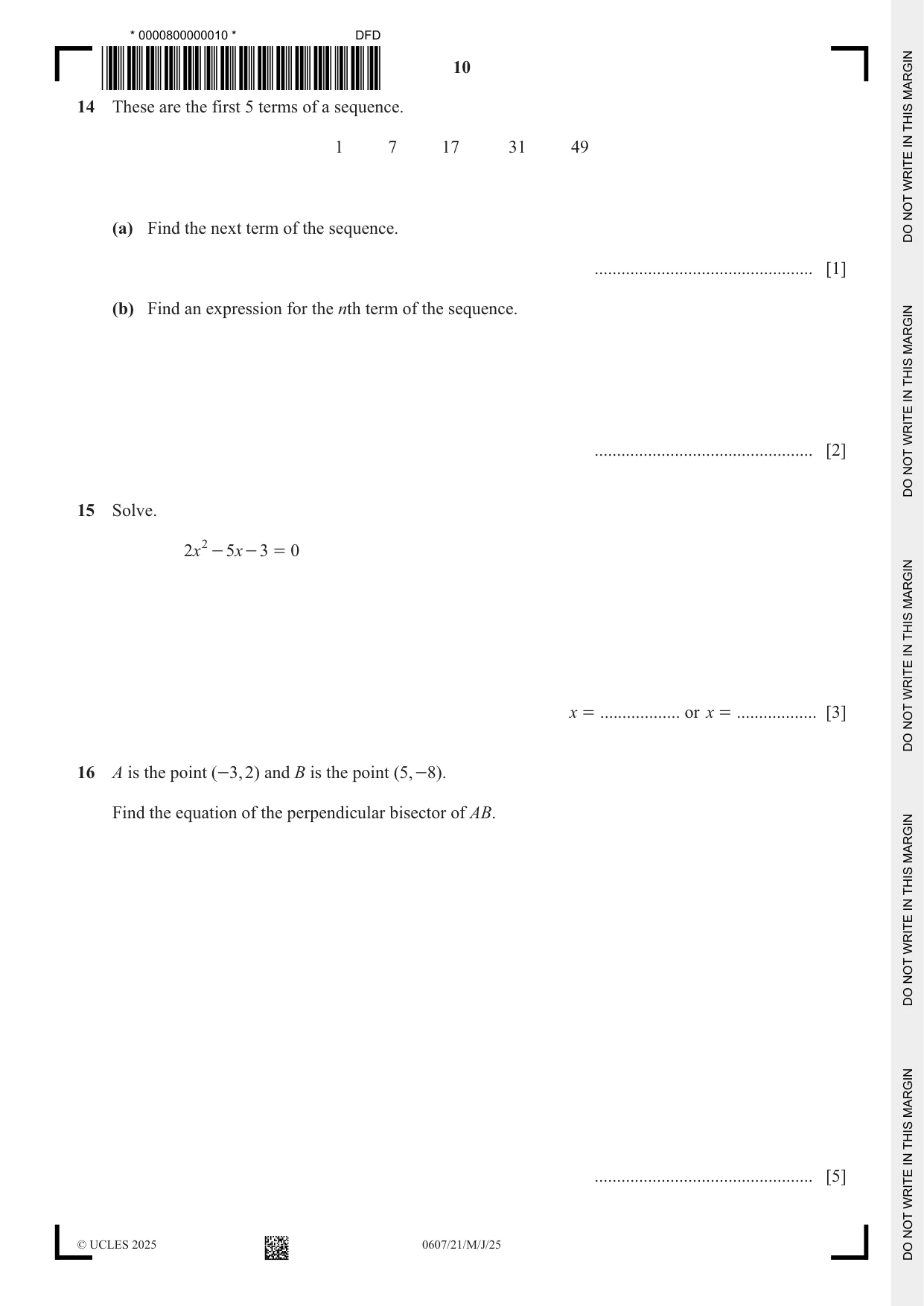
14 These are the first 5 terms of a sequence. 1 7 17 31 49 (a) Find the next term of the sequence. ................................................. [1] (b) Find an expression for the nth term of the sequence. ................................................. [2]
Mark scheme: 14(a) 71 1 14(b) 2n 2 − 1 oe final answer 2 M1 for a quadratic
Question 15
15 Solve. 2x 2 - 5 x - 3 = 0 x = .................. or x = .................. [3]
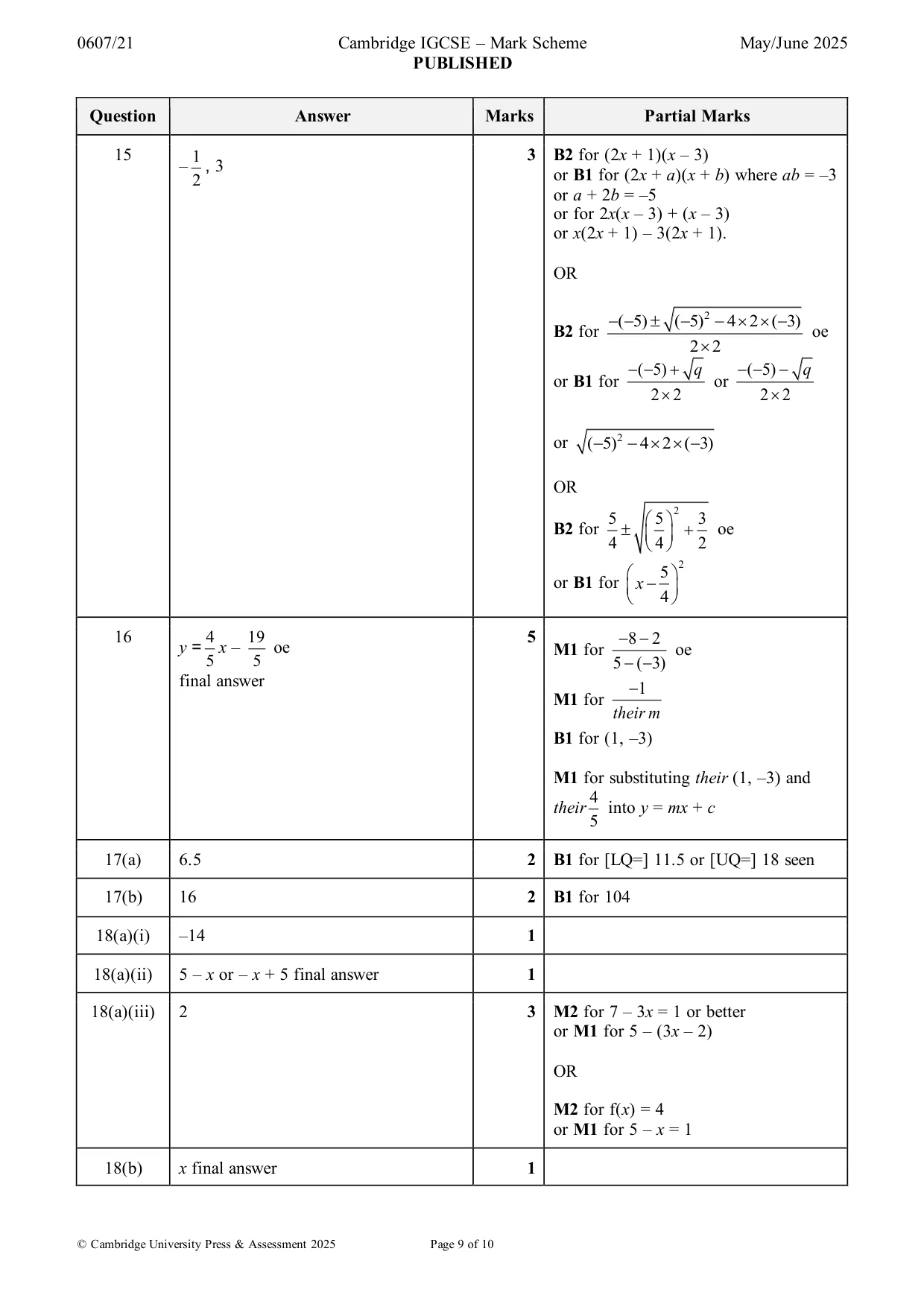
Mark scheme: 15 1 3 B2 for (2x + 1)(x – 3) – , 3 or B1 for (2x + a)(x + b) where ab = –3 2 or a + 2b = –5 or for 2x(x – 3) + (x – 3) or x(2x + 1) – 3(2x + 1). OR −−( 5) ( −5) 2 −−4 2 ( 3) B2 for oe 2 2 −−( 5) + q −−( 5) − q or B1 for or 2 2 2 2 or ( −5) 2 −−4 2 ( 3) OR 5 5 2 3 B2 for + oe 4 4 2 5 2 or B1 for x − 4
Q16 · A is the point (-3, 2) and B is the point (5, -8)
16 A is the point (-3, 2) and B is the point (5, -8). Find the equation of the perpendicular bisector of AB. ................................................. [5]
Mark scheme: 16 4 19 5 −−8 2 y = x – oe M1 for oe 5 5 5 −−( 3) final answer − 1 M1 for their m B1 for (1, –3) M1 for substituting their (1, –3) and 4 their into y = mx + c 5
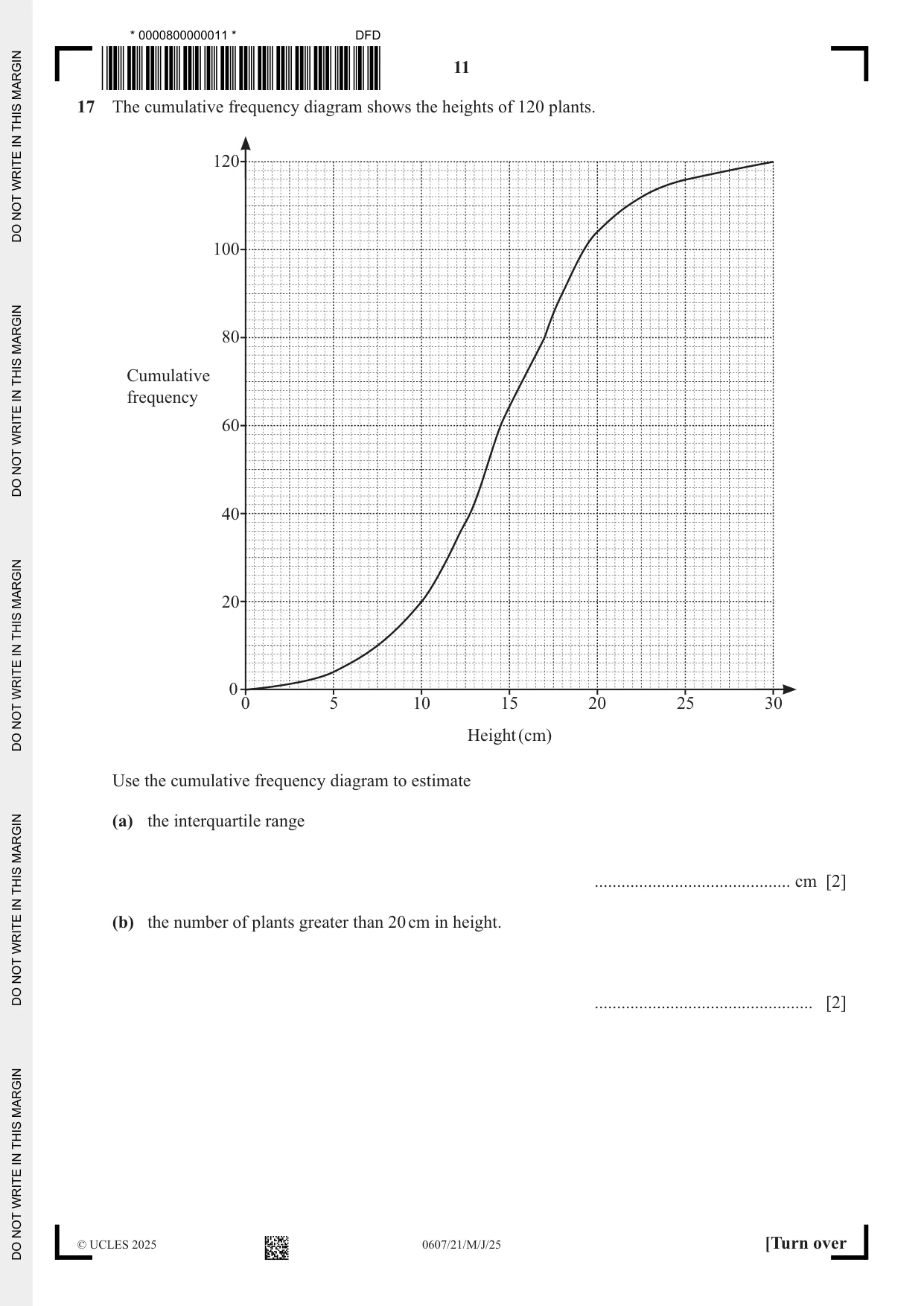
Q17 · The cumulative frequency diagram shows the heights of 120 plants
17 The cumulative frequency diagram shows the heights of 120 plants. 120 100 80 Cumulative frequency 60 40 20 0 0 5 10 15 20 25 30 Height (cm) Use the cumulative frequency diagram to estimate (a) the interquartile range ............................................ cm [2] (b) the number of plants greater than 20 cm in height. ................................................. [2]
Mark scheme: 17(a) 6.5 2 B1 for [LQ=] 11.5 or [UQ=] 18 seen 17(b) 16 2 B1 for 104
Q18 · F ( )x = 3x - 2 g ( )x = 5 - x (i) Find f ( - 4 )
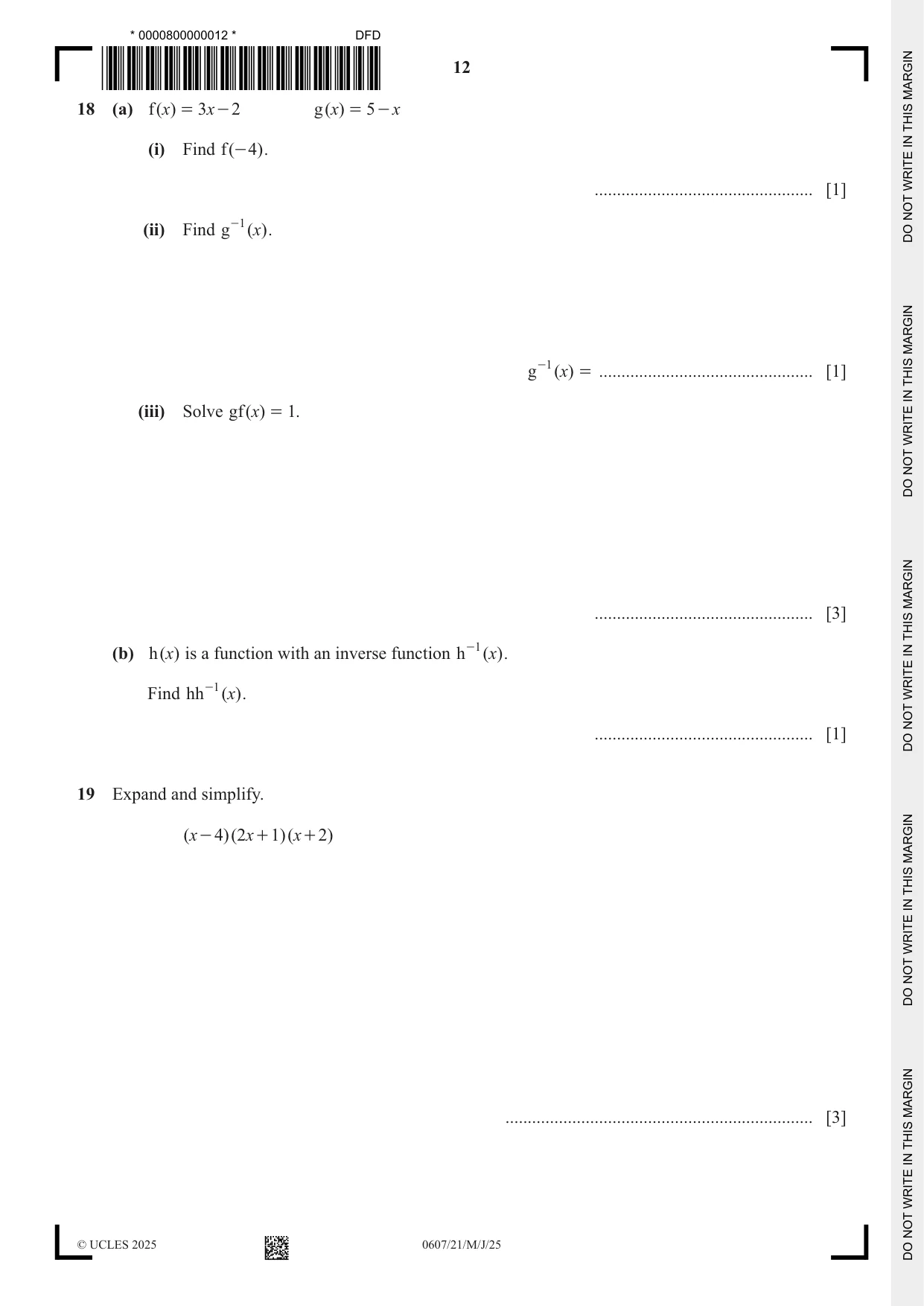
18 (a) f ( )x = 3x - 2 g ( )x = 5 - x (i) Find f ( - 4 ) . ................................................. [1] (ii) Find g -1 ( )x . g -1 ( )x = ................................................ [1] (iii) Solve gf ( )x = 1. ................................................. [3] (b) h ( )x is a function with an inverse function h -1 ( )x . Find hh -1 ( )x . ................................................. [1]
Mark scheme: 18(a)(i) –14 1 18(a)(ii) 5 – x or – x + 5 final answer 1 18(a)(iii) 2 3 M2 for 7 – 3x = 1 or better or M1 for 5 – (3x – 2) OR M2 for f(x) = 4 or M1 for 5 – x = 1 18(b) x final answer 1
Question 19
19 Expand and simplify. ( x - 4)( 2x + 1)( x + 2) ..................................................................... [3]
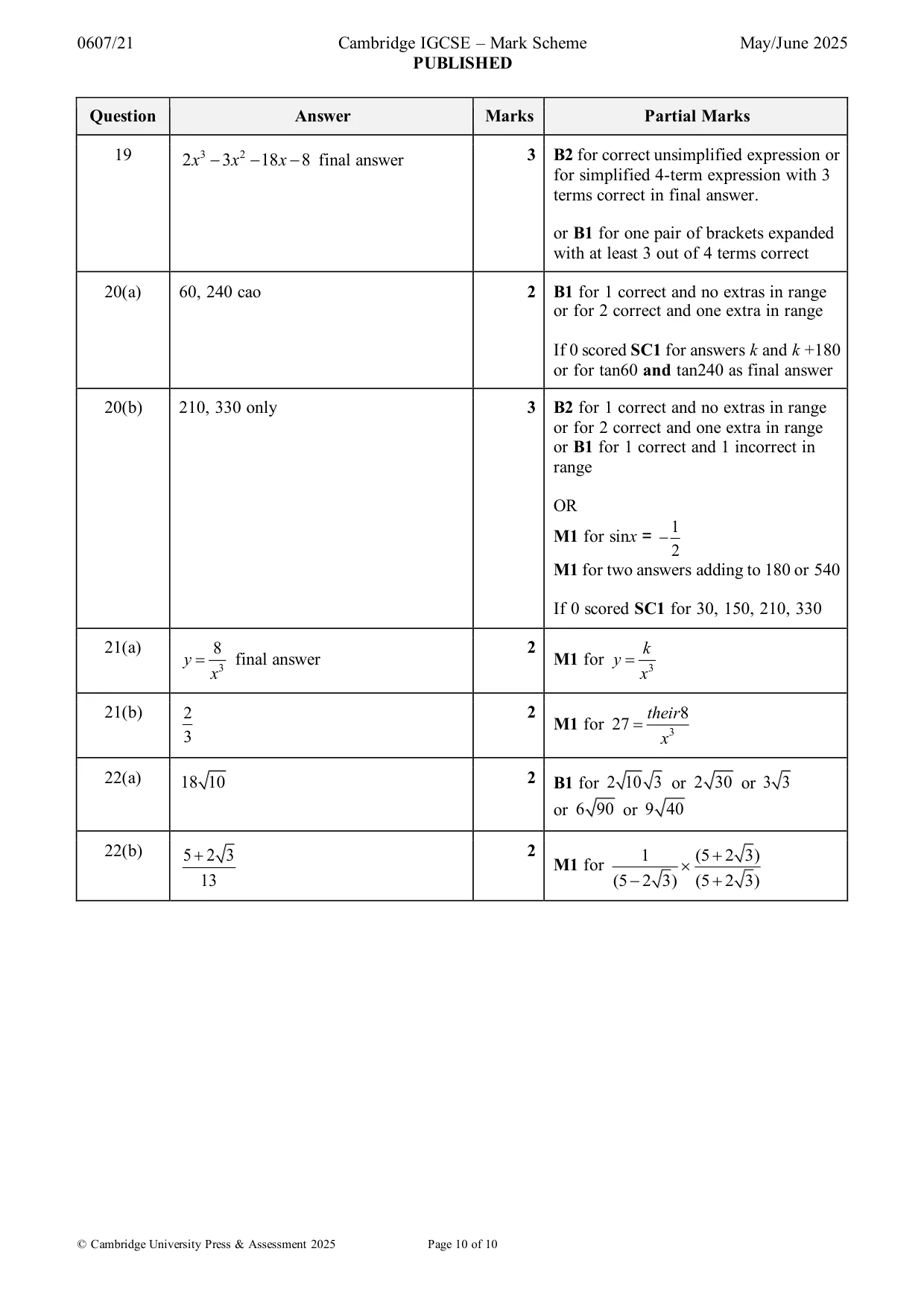
Mark scheme: 19 3 2 3 B2 for correct unsimplified expression or 2 x − 3 x − 18 x − 8 final answer for simplified 4-term expression with 3 terms correct in final answer. or B1 for one pair of brackets expanded with at least 3 out of 4 terms correct
Q20 · Solve tanx = 3 for values of x between 0° and 360°
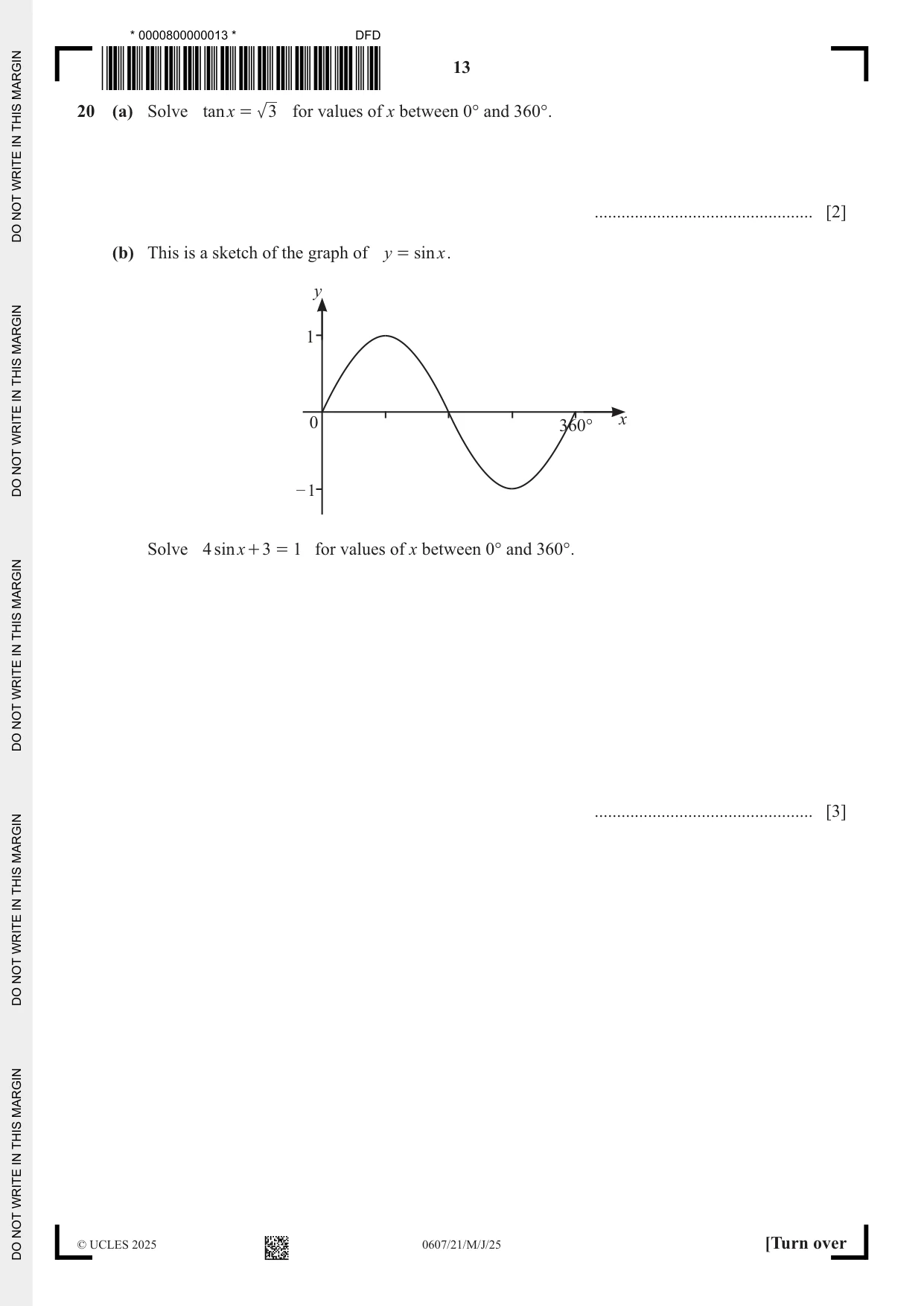
20 (a) Solve tanx = 3 for values of x between 0° and 360°. ................................................. [2] (b) This is a sketch of the graph of y = sin x . y 1 0 360° x – 1 Solve 4 sinx + 3 = 1 for values of x between 0° and 360°. ................................................. [3]
Mark scheme: 20(a) 60, 240 cao 2 B1 for 1 correct and no extras in range or for 2 correct and one extra in range If 0 scored SC1 for answers k and k +180 or for tan60 and tan240 as final answer 20(b) 210, 330 only 3 B2 for 1 correct and no extras in range or for 2 correct and one extra in range or B1 for 1 correct and 1 incorrect in range OR 1 M1 for sinx = − 2 M1 for two answers adding to 180 or 540 If 0 scored SC1 for 30, 150, 210, 330
Q21 · Y is inversely proportional to x3
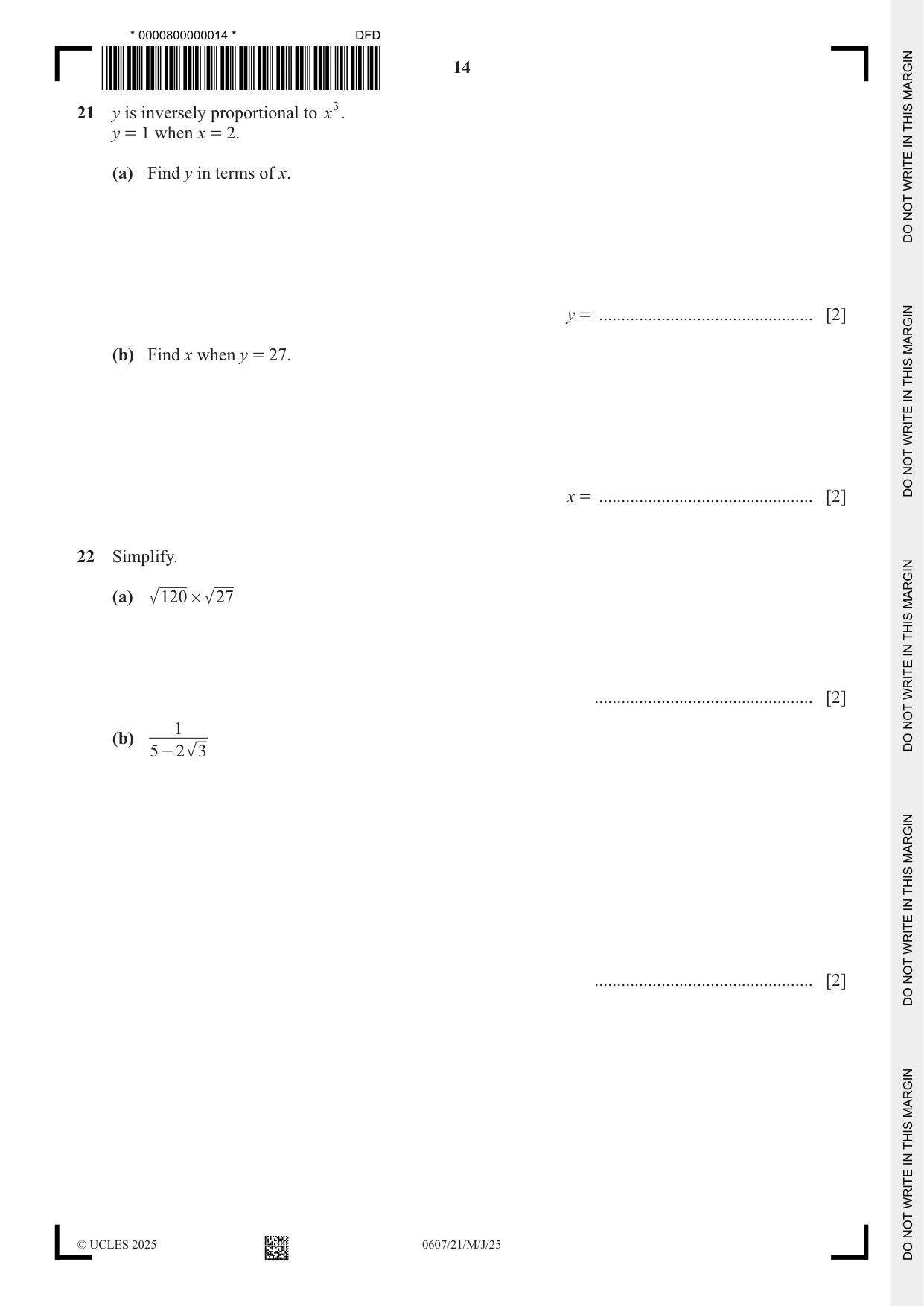
21 y is inversely proportional to x3. y = 1 when x = 2. (a) Find y in terms of x. y = ................................................ [2] (b) Find x when y = 27. x = ................................................ [2]
Mark scheme: 21(a) 8 2 k y = final answer M1 for y = x 3 x 3 21(b) 2 2 their 8 M1 for 27 = 3 x 3
Question 22
22 Simplify. (a) 120 # 27 ................................................. [2] 1 (b) 5 - 2 3 ................................................. [2]
Mark scheme: 22(a) 18 10 2 B1 for 2 10 3 or 2 30 or 3 3 or 6 90 or 9 40 22(b) 5 + 2 3 2 1 (5 + 2 3) M1 for 13 (5 − 2 3) (5 + 2 3)
What was in this paper
The subtopics covered by these 22 questions, and how many questions each got. Open one in a new tab to see every Cambridge question on it.
2Types of number2Angles1Averages and range1Circle theorems I1Cumulative frequency diagrams1Equations1Estimation1Functions1Inequalities1Perpendicular lines1Proportion1Ratio and proportion1Sequences1Standard form1Surds1Symmetry1The four operations1Transformations1Trigonometric functions1What you needed in this session
Cambridge’s own grade thresholds for 2025 May/June, Paper 2 · Variant 1. A higher threshold means an easier paper — the bar moves with how the cohort did.