Cambridge IGCSE Mathematics - International 0607 — 2018 May/June Paper 2 · Variant 3
0607/23/M/J/18 · 15 questions · 40 marks · ≈45 min
The question paper and its mark scheme, free to read here and free to download. This is Cambridge’s own paper, exactly as it was sat.
Question paper8 pages
Mark scheme5 pages
Answers below. Sit the paper first if you are practising.
Questions as text
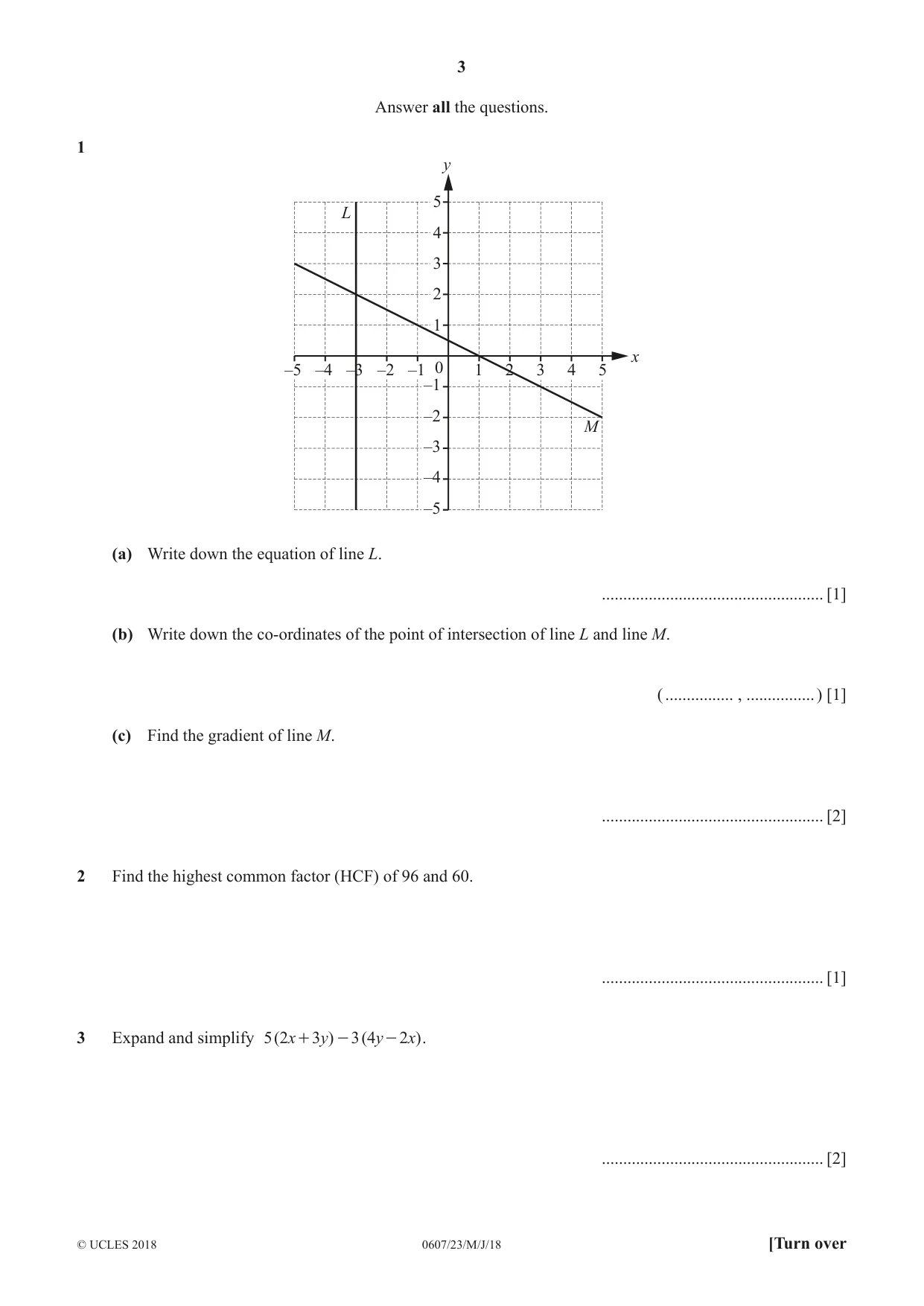
Q1 · Y 5 L 4 3 2 1 x –5 –4 –3 –2 –1 0 1 2 3 4 5 –1 –2 M –3 –4 –5 (a) Write down the equation…
1 y 5 L 4 3 2 1 x –5 –4 –3 –2 –1 0 1 2 3 4 5 –1 –2 M –3 –4 –5 (a) Write down the equation of line L. .................................................... [1] (b) Write down the co-ordinates of the point of intersection of line L and line M. ( ................ , ................ ) [1] (c) Find the gradient of line M. .................................................... [2]
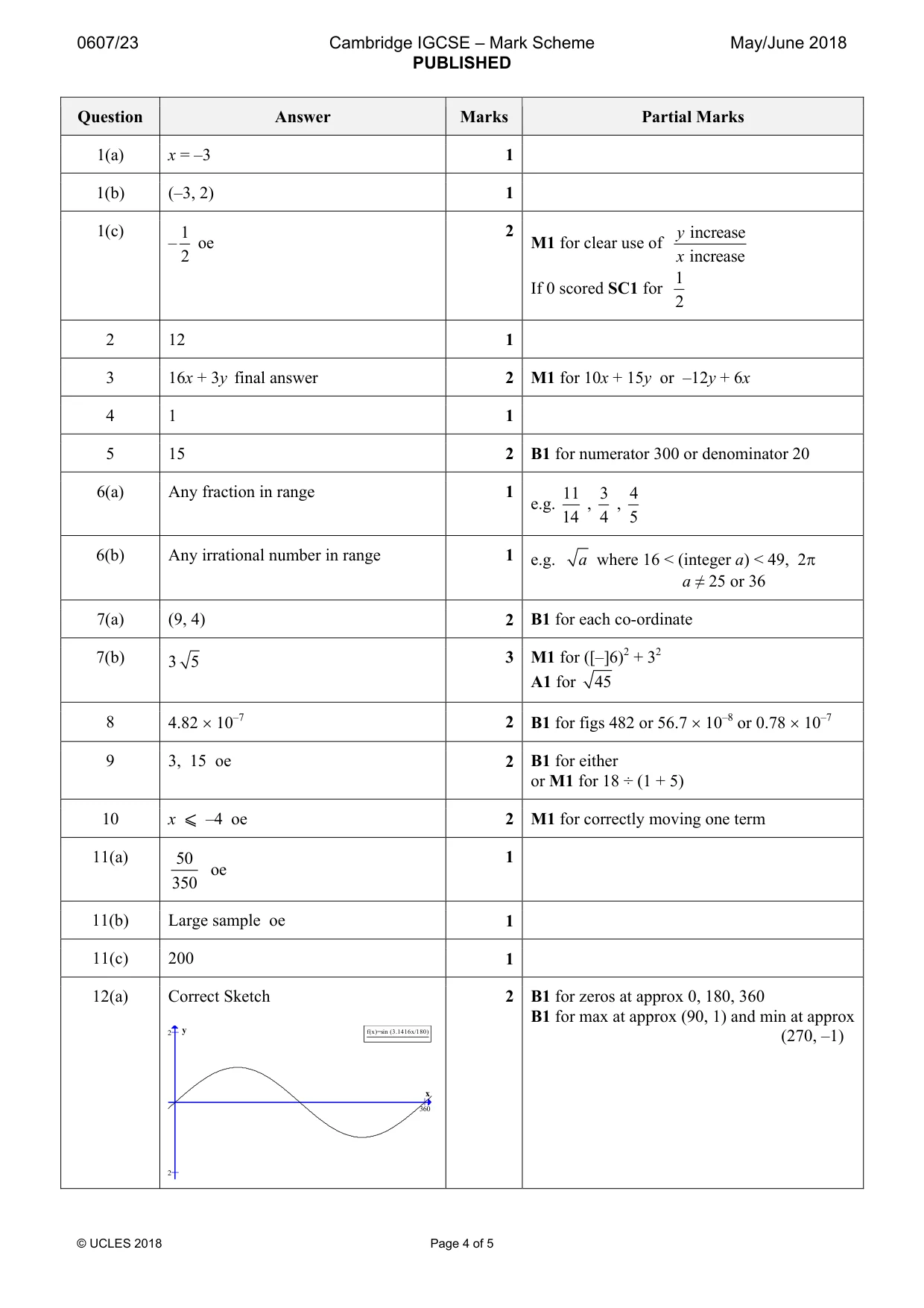
Mark scheme: Question Answer Marks Partial Marks 1(a) x = –3 1 1(b) (–3, 2) 1 1(c) 1 2 y increase – oe M1 for clear use of 2 x increase 1 If 0 scored SC1 for 2
Q2 · Find the highest common factor (HCF) of 96 and 60
2 Find the highest common factor (HCF) of 96 and 60. .................................................... [1]
Mark scheme: 2 12 1
Q3 · Expand and simplify 5 (2x + 3y) - 3 (4y - 2x)
3 Expand and simplify 5 (2x + 3y) - 3 (4y - 2x) . .................................................... [2]
Mark scheme: 3 16x + 3y final answer 2 M1 for 10x + 15y or –12y + 6x
Q4 · Write down the value of 170
4 Write down the value of 170. .................................................... [1]
Mark scheme: 4 1 1
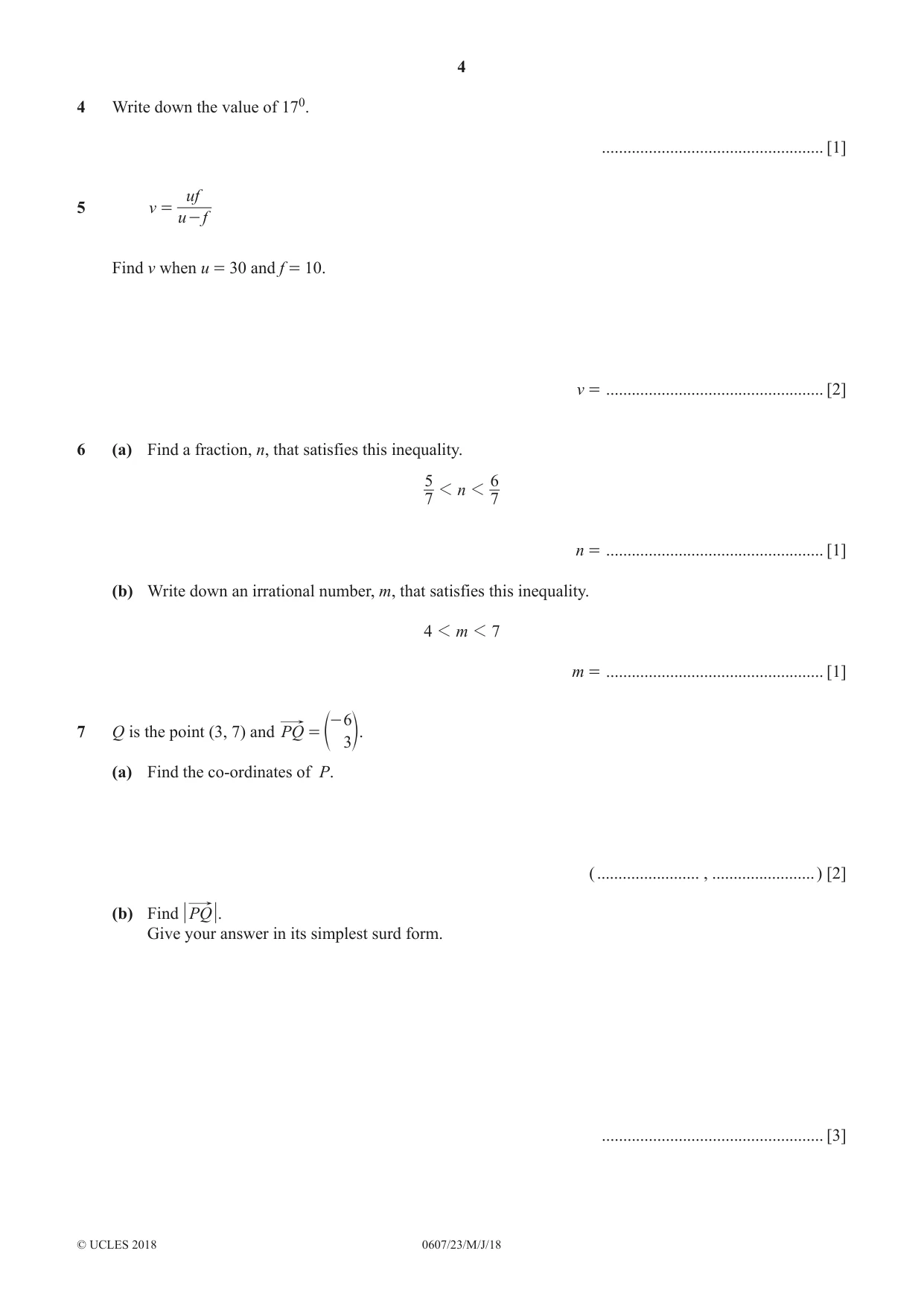
Q5 · V = u - f Find v when u = 30 and f = 10
5 v = u - f Find v when u = 30 and f = 10. v = ................................................... [2]
Mark scheme: 5 15 2 B1 for numerator 300 or denominator 20
Q6 · Find a fraction, n, that satisfies this inequality
6 (a) Find a fraction, n, that satisfies this inequality. 5 6 1 n 1 7 7 n = ................................................... [1] (b) Write down an irrational number, m, that satisfies this inequality. 4 1 m 1 7 m = ................................................... [1]
Mark scheme: 6(a) Any fraction in range 1 11 3 4 e.g. , , 14 4 5 6(b) Any irrational number in range 1 e.g. a where 16 < (integer a) < 49, 2π a ≠ 25 or 36
Q7 · Q is the point (3, 7) and PQ =
7 Q is the point (3, 7) and PQ = . 3 (a) Find the co-ordinates of P. ( ........................ , ........................ ) [2] (b) Find PQ . Give your answer in its simplest surd form. .................................................... [3]
Mark scheme: 7(a) (9, 4) 2 B1 for each co-ordinate 7(b) 3 5 3 M1 for ([–]6)2 + 32 A1 for 45
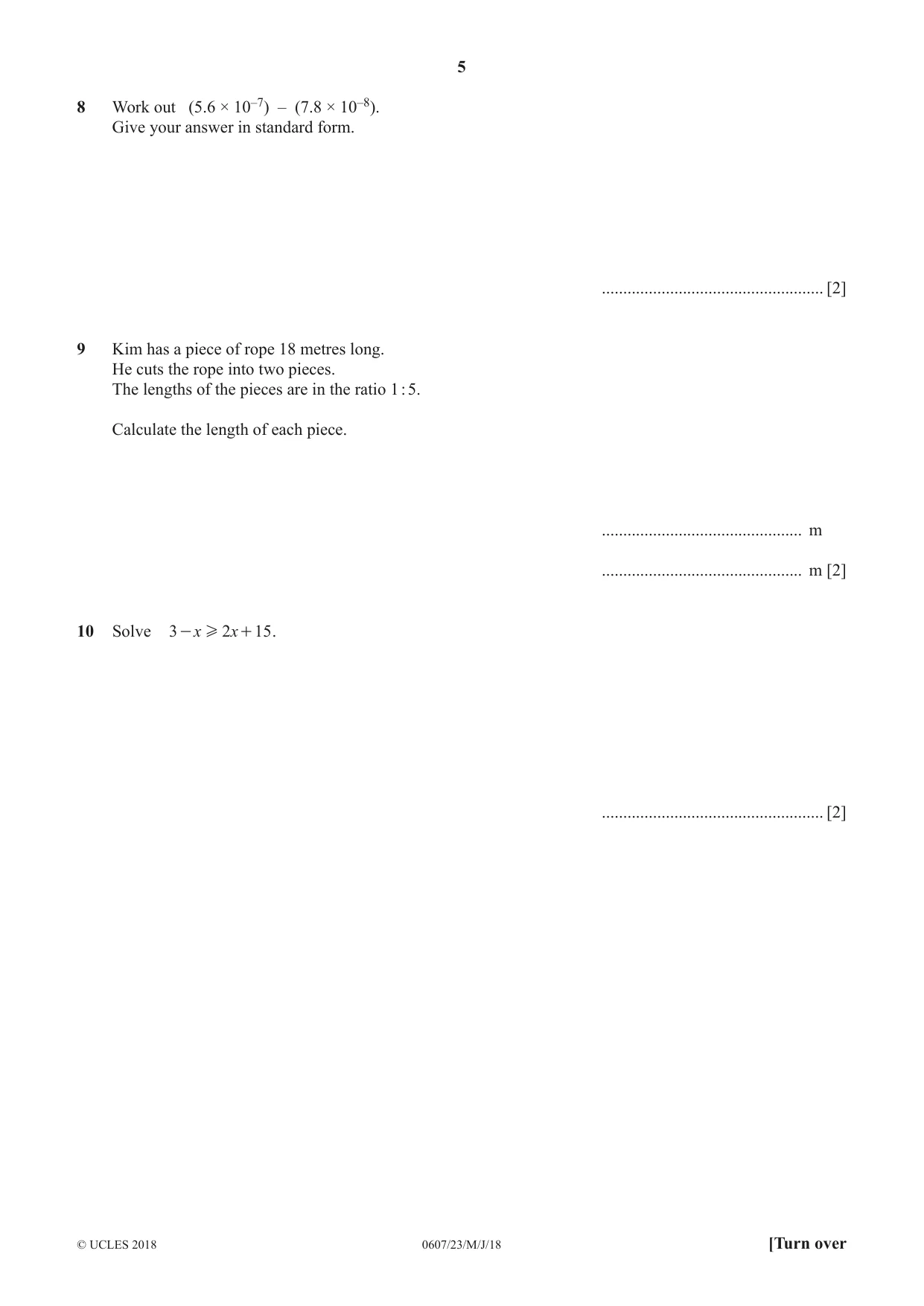
Q8 · Work out (5.6 × 10⁻⁷) – (7.8 × 10⁻⁸)
8 Work out (5.6 × 10⁻⁷) – (7.8 × 10⁻⁸). Give your answer in standard form. .................................................... [2]
Mark scheme: 8 4.82 × 10⁻⁷ 2 B1 for figs 482 or 56.7 × 10⁻⁸ or 0.78 × 10⁻⁷
Q9 · Kim has a piece of rope 18 metres long
9 Kim has a piece of rope 18 metres long. He cuts the rope into two pieces. The lengths of the pieces are in the ratio 1 : 5. Calculate the length of each piece. ............................................... m ............................................... m [2]
Mark scheme: 9 3, 15 oe 2 B1 for either or M1 for 18 ÷ (1 + 5)
Q10 · Solve 3 - x H 2x + 15
10 Solve 3 - x H 2x + 15 . .................................................... [2]
Mark scheme: 10 x ⩽ –4 oe 2 M1 for correctly moving one term
Q11 · Jamil has a biased 6-sided die
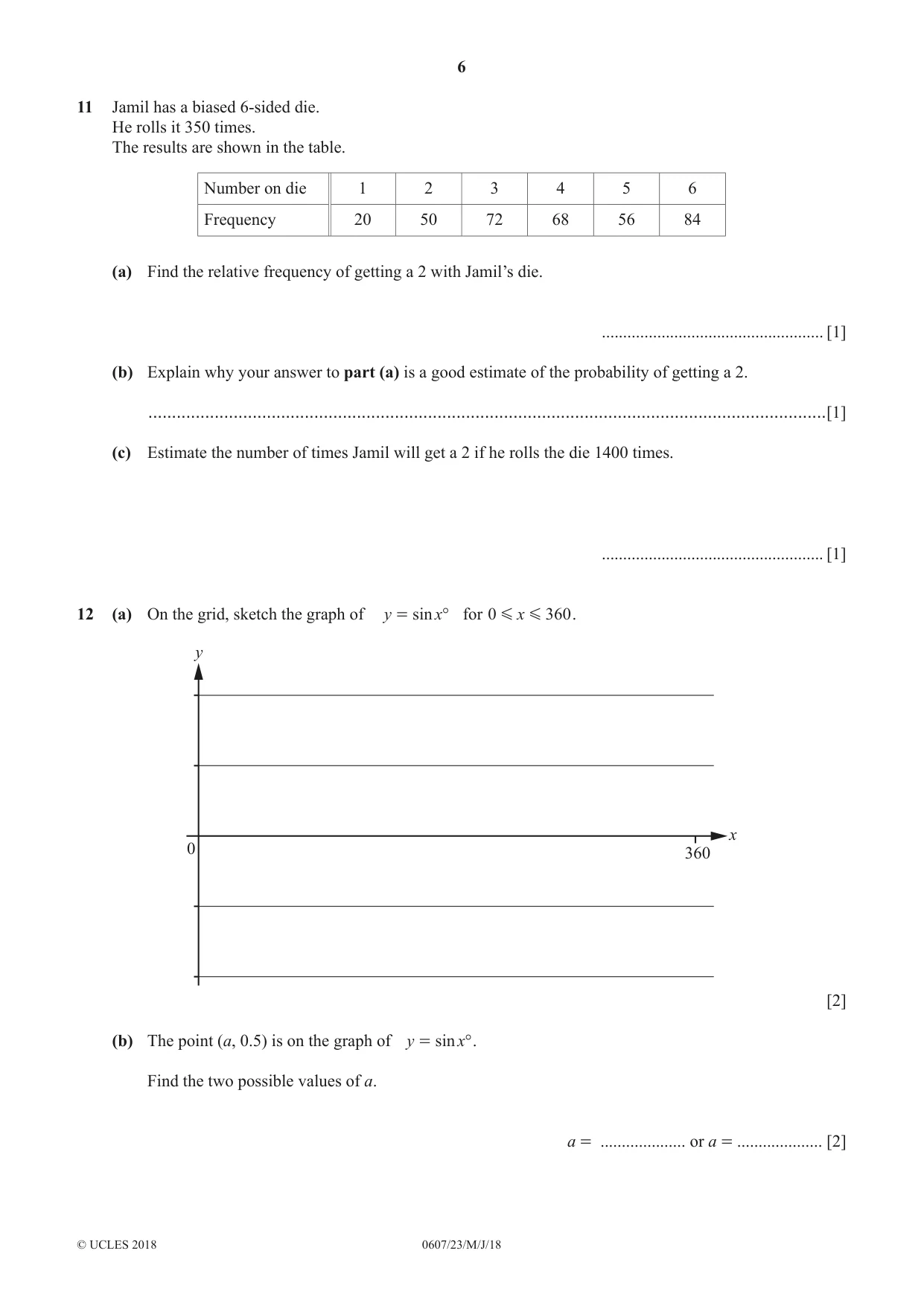
11 Jamil has a biased 6-sided die. He rolls it 350 times. The results are shown in the table. Number on die 1 2 3 4 5 6 Frequency 20 50 72 68 56 84 (a) Find the relative frequency of getting a 2 with Jamil’s die. .................................................... [1] (b) Explain why your answer to part (a) is a good estimate of the probability of getting a 2. ...............................................................................................................................................[1] (c) Estimate the number of times Jamil will get a 2 if he rolls the die 1400 times. .................................................... [1]
Mark scheme: 11(a) 50 1 oe 350 11(b) Large sample oe 1 11(c) 200 1
Q12 · On the grid, sketch the graph of y = sin x° for 0 G x G 360
12 (a) On the grid, sketch the graph of y = sin x° for 0 G x G 360 . y x 0 360 [2] (b) The point (a, 0.5) is on the graph of y = sin x° . Find the two possible values of a. a = .................... or a = .................... [2]
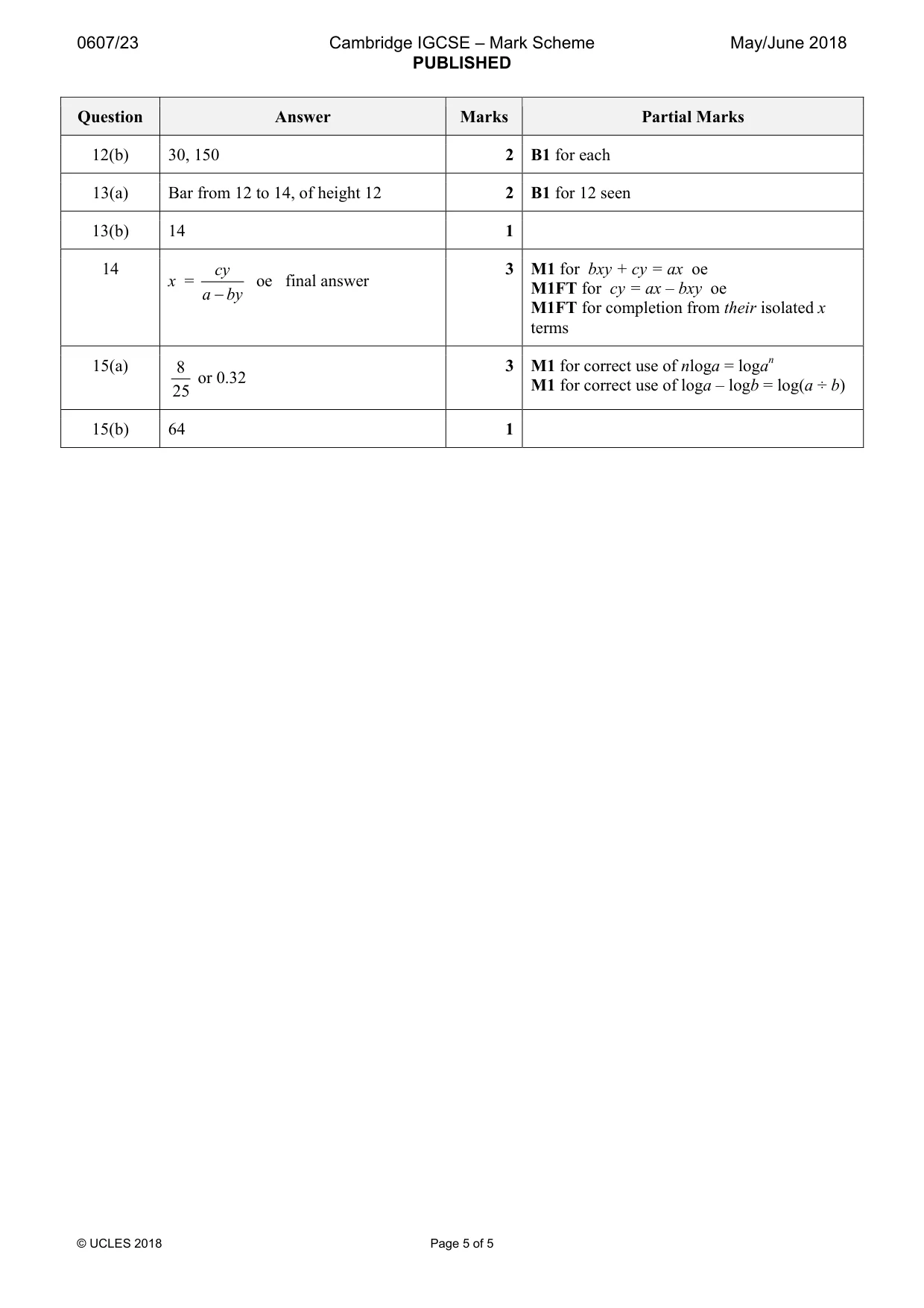
Mark scheme: 12(a) Correct Sketch 2 B1 for zeros at approx 0, 180, 360 B1 for max at approx (90, 1) and min at approx 2 y f(x)=sin (3.1416x/180) (270, –1) x 360 2 12(b) 30, 150 2 B1 for each
Q13 · The masses, m kg, of some watermelons are measured
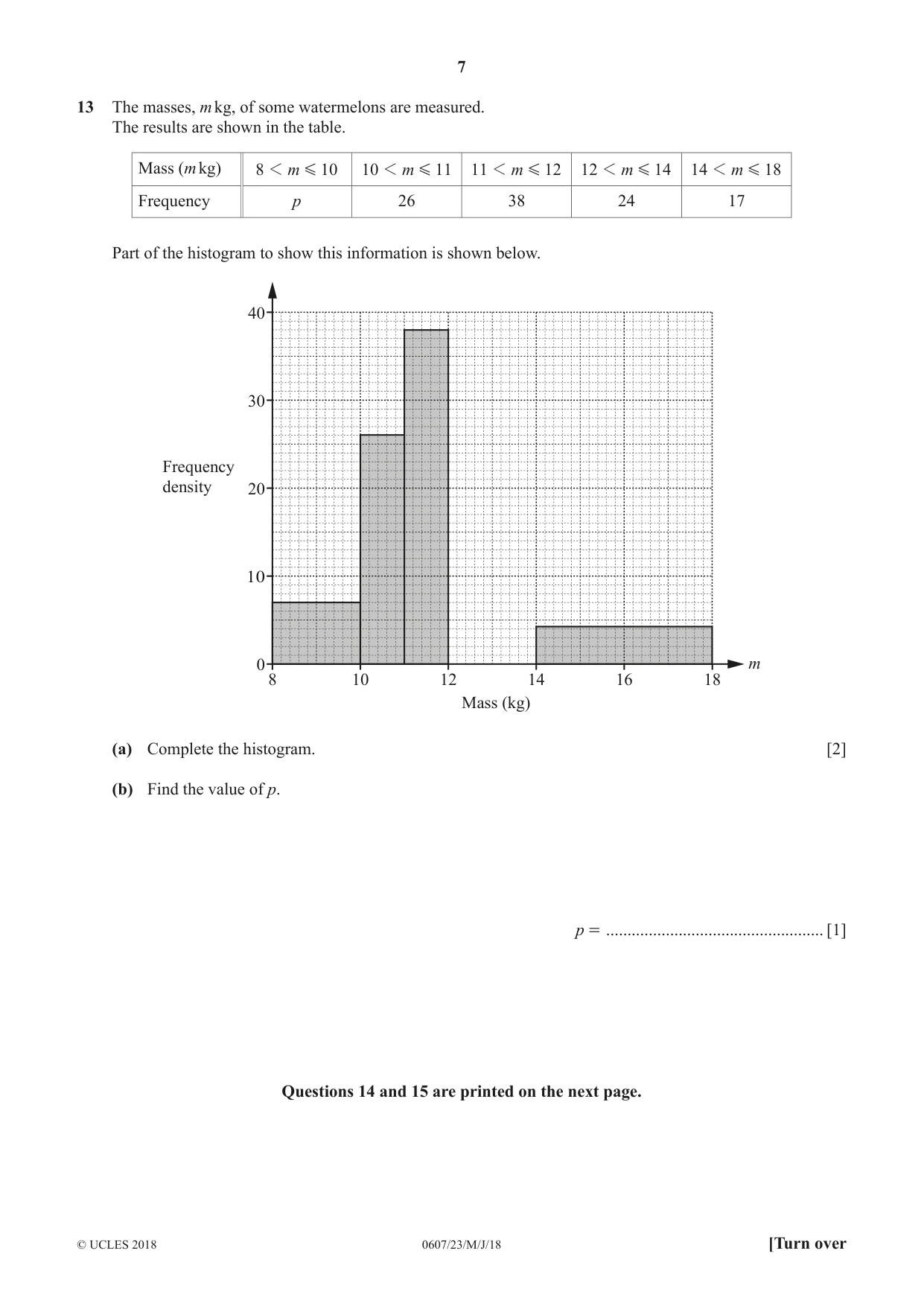
13 The masses, m kg, of some watermelons are measured. The results are shown in the table. Mass (m kg) 8 1 m G 10 10 1 m G 11 11 1 m G 12 12 1 m G 14 14 1 m G 18 Frequency p 26 38 24 17 Part of the histogram to show this information is shown below. 40 30 Frequency density 20 10 0 m 8 10 12 14 16 18 Mass (kg) (a) Complete the histogram. [2] (b) Find the value of p. p = ................................................... [1] Questions 14 and 15 are printed on the next page.
Mark scheme: 13(a) Bar from 12 to 14, of height 12 2 B1 for 12 seen 13(b) 14 1
Q14 · Rearrange this formula to make x the subject
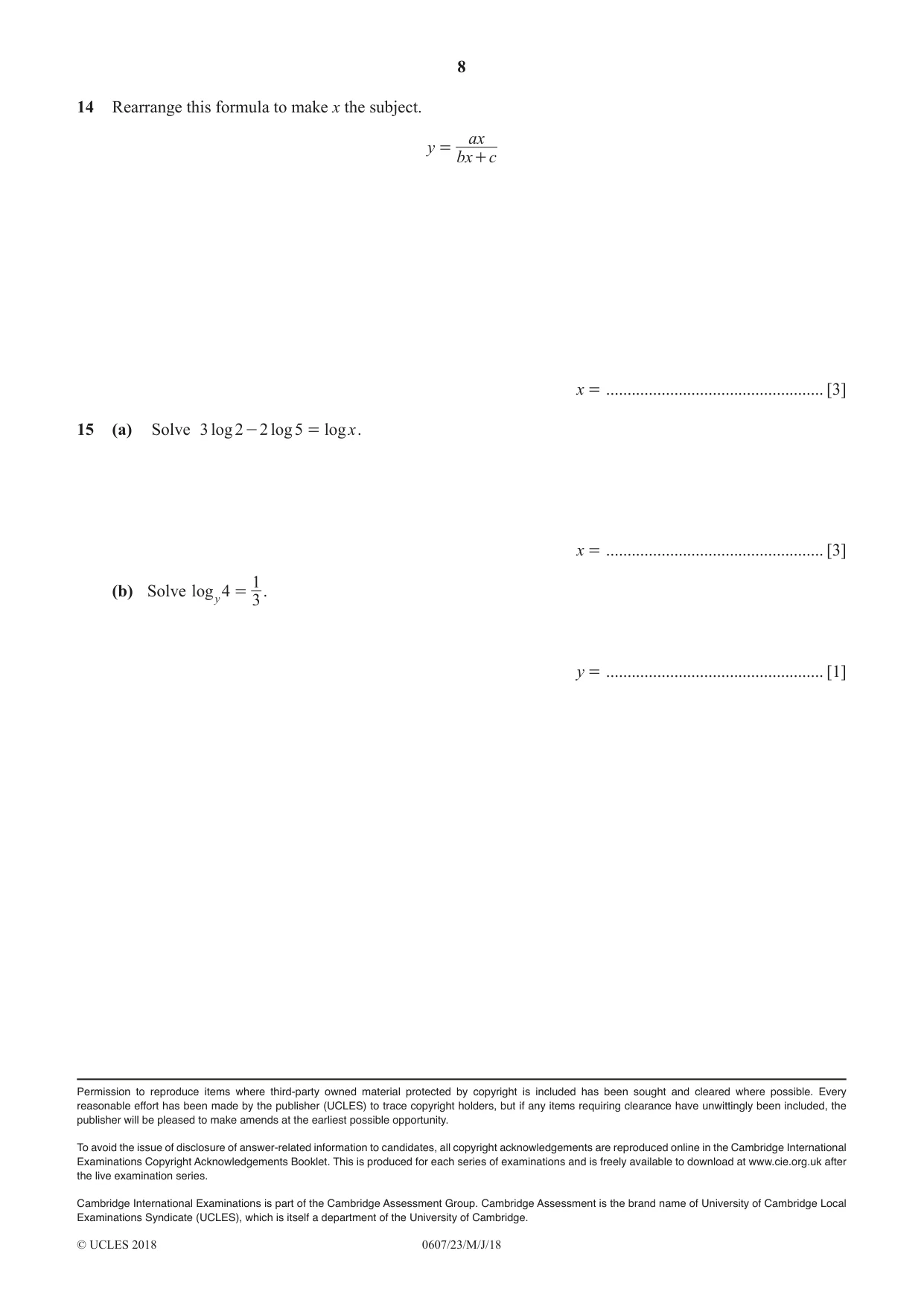
14 Rearrange this formula to make x the subject. ax y = bx + c x = ................................................... [3]
Mark scheme: 14 cy 3 M1 for bxy + cy = ax oe x = oe final answer M1FT for cy = ax – bxy oe a − by M1FT for completion from their isolated x terms
Q15 · Solve 3 log 2 - 2 log 5 = logx
15 (a) Solve 3 log 2 - 2 log 5 = logx . x = ................................................... [3] 1 (b) Solve log y 4 = . 3 y = ................................................... [1]
Mark scheme: 15(a) 8 3 M1 for correct use of nloga = logan or 0.32 M1 for correct use of loga – logb = log(a ÷ b) 25 15(b) 64 1
What was in this paper
The subtopics covered by these 15 questions, and how many questions each got. Open one in a new tab to see every Cambridge question on it.
2Equations1Fractions, decimals and percentages1Gradient of linear graphs1Indices I1Inequalities1Magnitude of a vector1Ratio and proportion1Relative and expected frequencies1Standard form1Statistical charts and diagrams1The logarithmic function1Trigonometric functions1Types of number1What you needed in this session
Cambridge’s own grade thresholds for 2018 May/June, Paper 2 · Variant 3. A higher threshold means an easier paper — the bar moves with how the cohort did.