Cambridge IGCSE Mathematics - International 0607 — 2014 Oct/Nov Paper 2 · Variant 3
0607/23/O/N/14 · 40 marks · ≈45 min
The question paper and its mark scheme, free to read here and free to download. This is Cambridge’s own paper, exactly as it was sat.
Question paper8 pages
Mark scheme3 pages
Answers below. Sit the paper first if you are practising.
Paper as text
Question paper, page 1
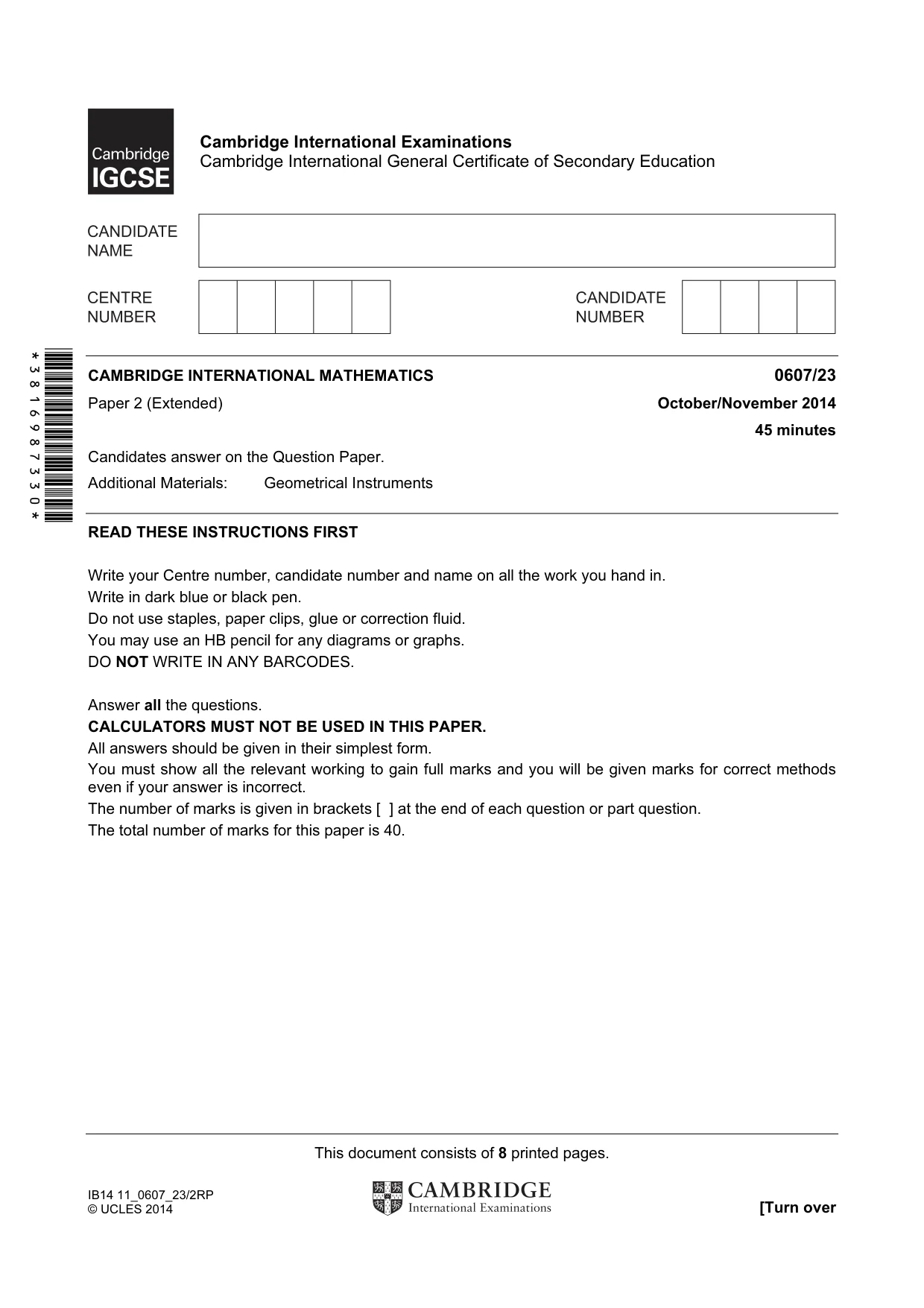
This document consists of 8 printed pages. IB14 11_0607_23/2RP © UCLES 2014 [Turn over *3816987330* Cambridge International Examinations Cambridge International General Certificate of Secondary Education CAMBRIDGE INTERNATIONAL MATHEMATICS 0607/23 Paper 2 (Extended) October/November 2014 45 minutes Candidates answer on the Question Paper. Additional Materials: Geometrical Instruments READ THESE INSTRUCTIONS FIRST Write your Centre number, candidate number and name on all the work you hand in. Write in dark blue or black pen. Do not use staples, paper clips, glue or correction fluid. You may use an HB pencil for any diagrams or graphs. DO NOT WRITE IN ANY BARCODES. Answer all the questions. CALCULATORS MUST NOT BE USED IN THIS PAPER. All answers should be given in their simplest form. You must show all the relevant working to gain full marks and you will be given marks for correct methods even if your answer is incorrect. The number of marks is given in brackets [ ] at the end of each question or part question. The total number of marks for this paper is 40.
Question paper, page 2
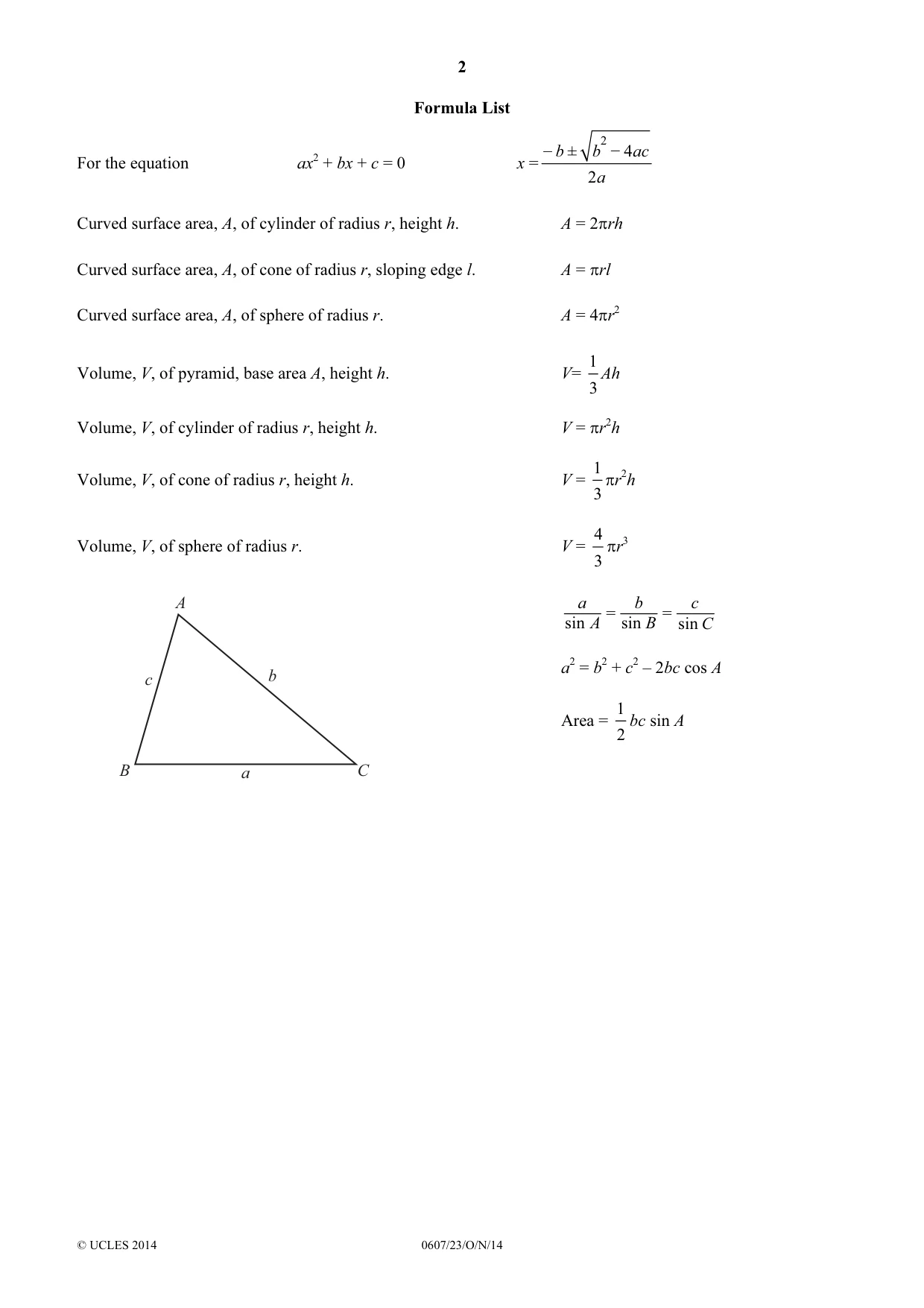
2 © UCLES 2014 0607/23/O/N/14 Formula List For the equation ax2 + bx + c = 0 x = 2 _ ± 4 2 _ b b ac a Curved surface area, A, of cylinder of radius r, height h. A = 2πrh Curved surface area, A, of cone of radius r, sloping edge l. A = πrl Curved surface area, A, of sphere of radius r. A = 4πr2 Volume, V, of pyramid, base area A, height h. V= 1 3 Ah Volume, V, of cylinder of radius r, height h. V = πr2h Volume, V, of cone of radius r, height h. V = 1 3 πr2h Volume, V, of sphere of radius r. V = 4 3 πr3 = = sin sin sin a b c A B C a2 = b2 + c2 – 2bc cos A Area = 1 2 bc sin A A a B C b c
Question paper, page 3
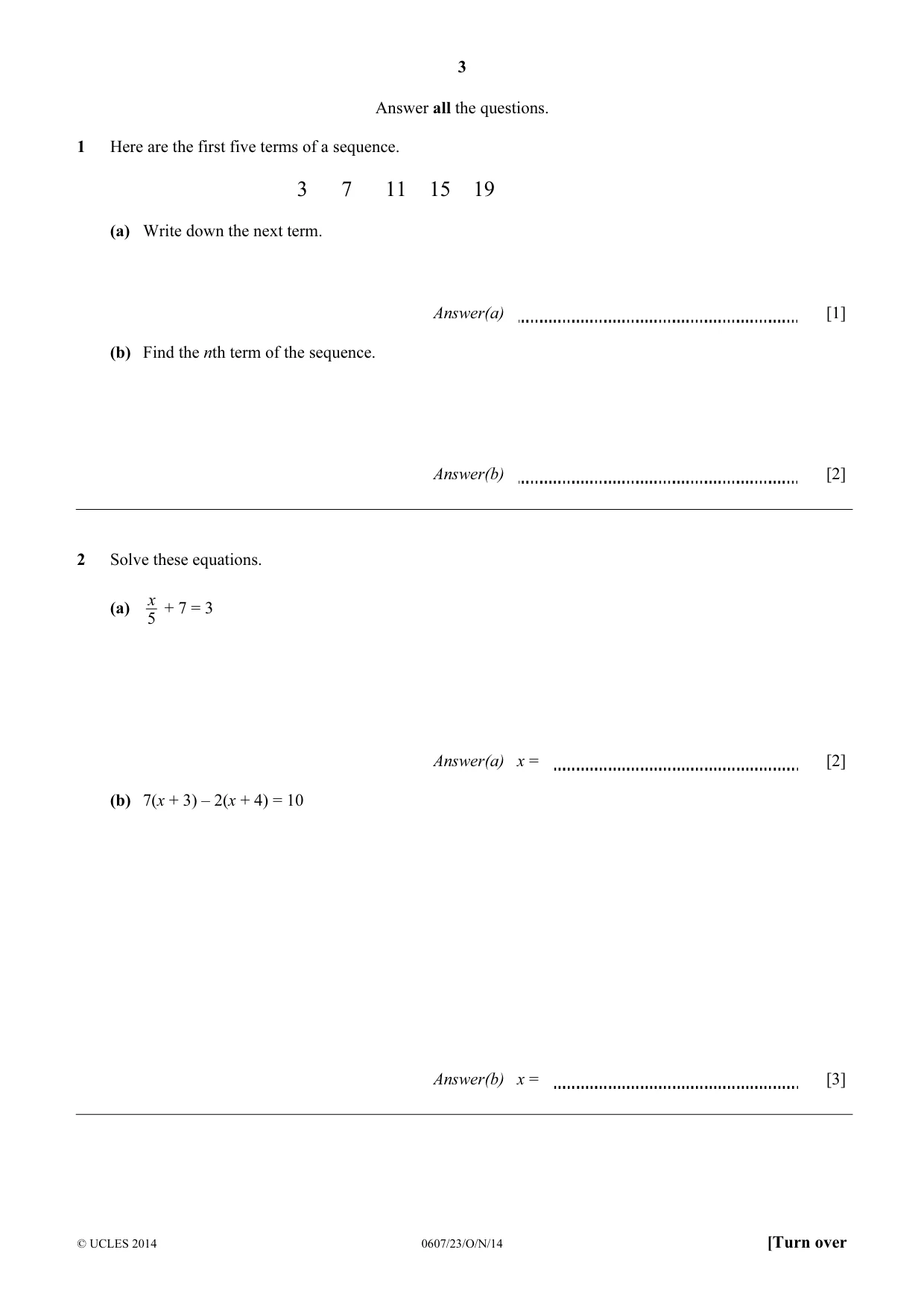
3 © UCLES 2014 0607/23/O/N/14 [Turn over Answer all the questions. 1 Here are the first five terms of a sequence. 3 7 11 15 19 (a) Write down the next term. Answer(a) [1] (b) Find the nth term of the sequence. Answer(b) [2] 2 Solve these equations. (a) 5 x + 7 = 3 Answer(a) x = [2] (b) 7(x + 3) – 2(x + 4) = 10 Answer(b) x = [3]
Question paper, page 4
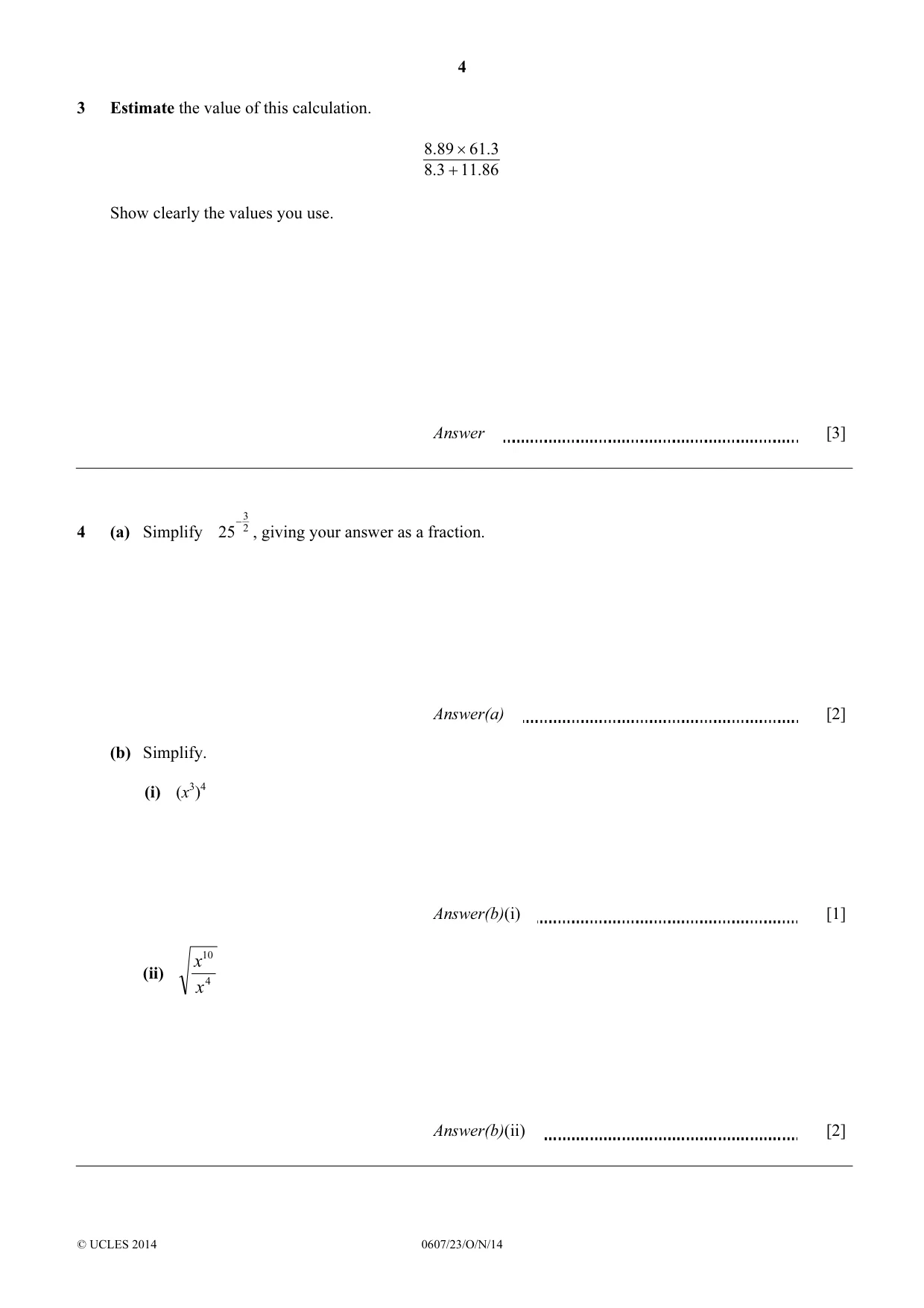
4 © UCLES 2014 0607/23/O/N/14 3 Estimate the value of this calculation. 86 . 11 3.8 3. 61 89 .8 + × Show clearly the values you use. Answer [3] 4 (a) Simplify 2 3 25 −, giving your answer as a fraction. Answer(a) [2] (b) Simplify. (i) (x3)4 Answer(b)(i) [1] (ii) 4 10 x x Answer(b)(ii) [2]
Question paper, page 5
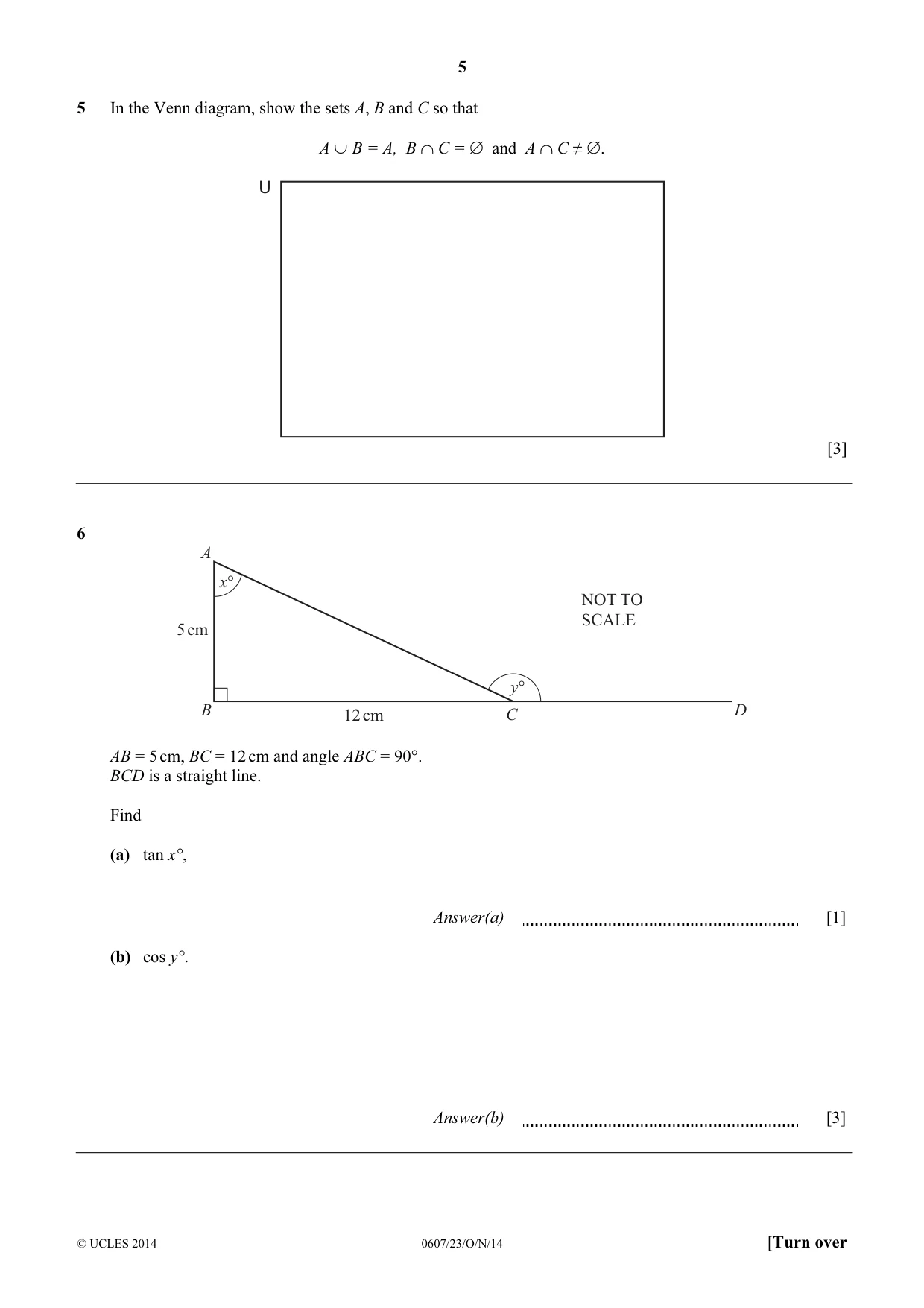
5 © UCLES 2014 0607/23/O/N/14 [Turn over 5 In the Venn diagram, show the sets A, B and C so that A ∪ B = A, B ∩ C = ∅ and A ∩ C ≠ ∅. U [3] 6 B A D C x° y° 5 cm 12 cm NOT TO SCALE AB = 5 cm, BC = 12 cm and angle ABC = 90°. BCD is a straight line. Find (a) tan x°, Answer(a) [1] (b) cos y°. Answer(b) [3]
Question paper, page 6
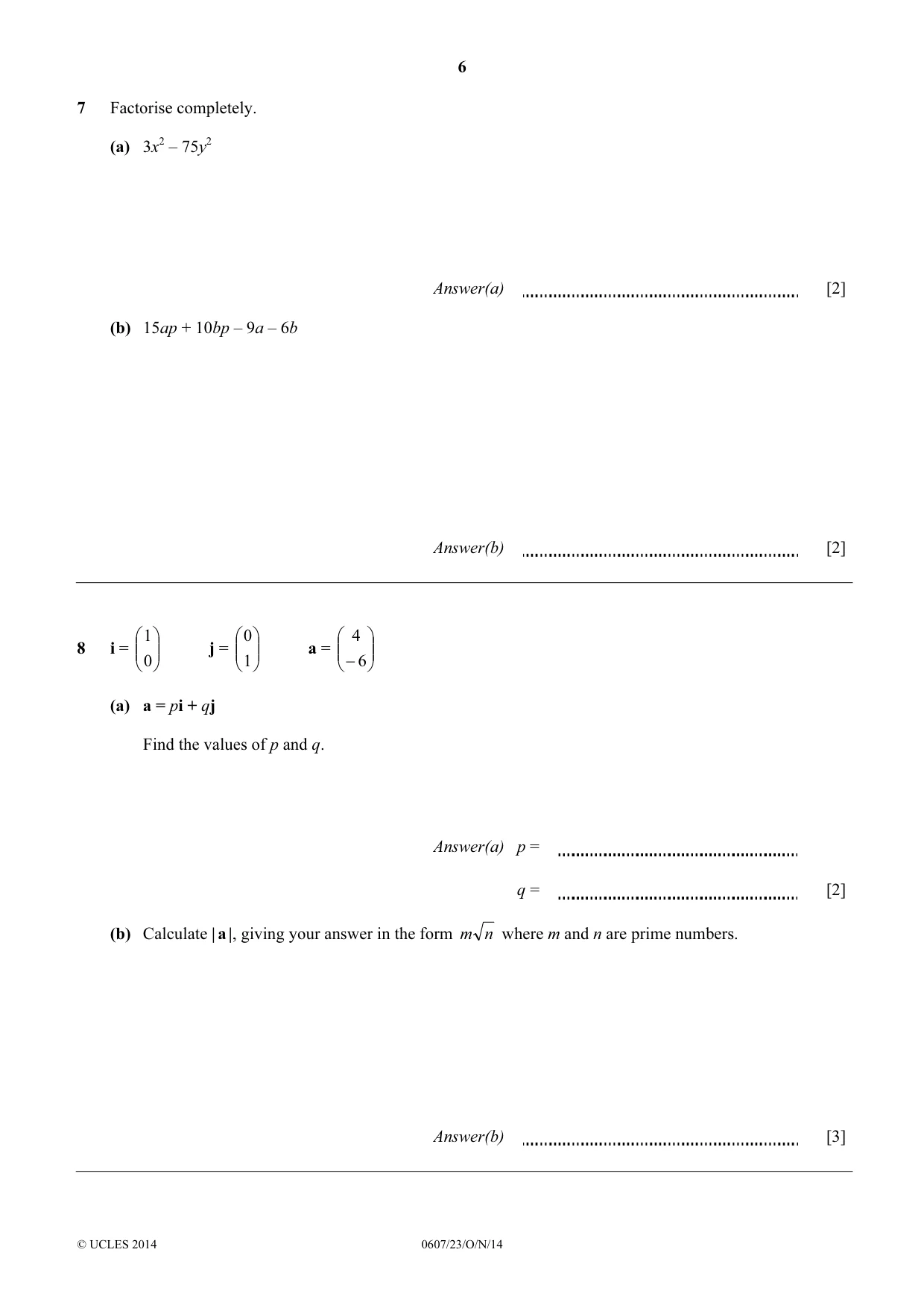
6 © UCLES 2014 0607/23/O/N/14 7 Factorise completely. (a) 3x2 – 75y2 Answer(a) [2] (b) 15ap + 10bp – 9a – 6b Answer(b) [2] 8 i = 0 1 j = 1 0 a = −6 4 (a) a = pi + qj Find the values of p and q. Answer(a) p = q = [2] (b) Calculate | a |, giving your answer in the form n m where m and n are prime numbers. Answer(b) [3]
Question paper, page 7
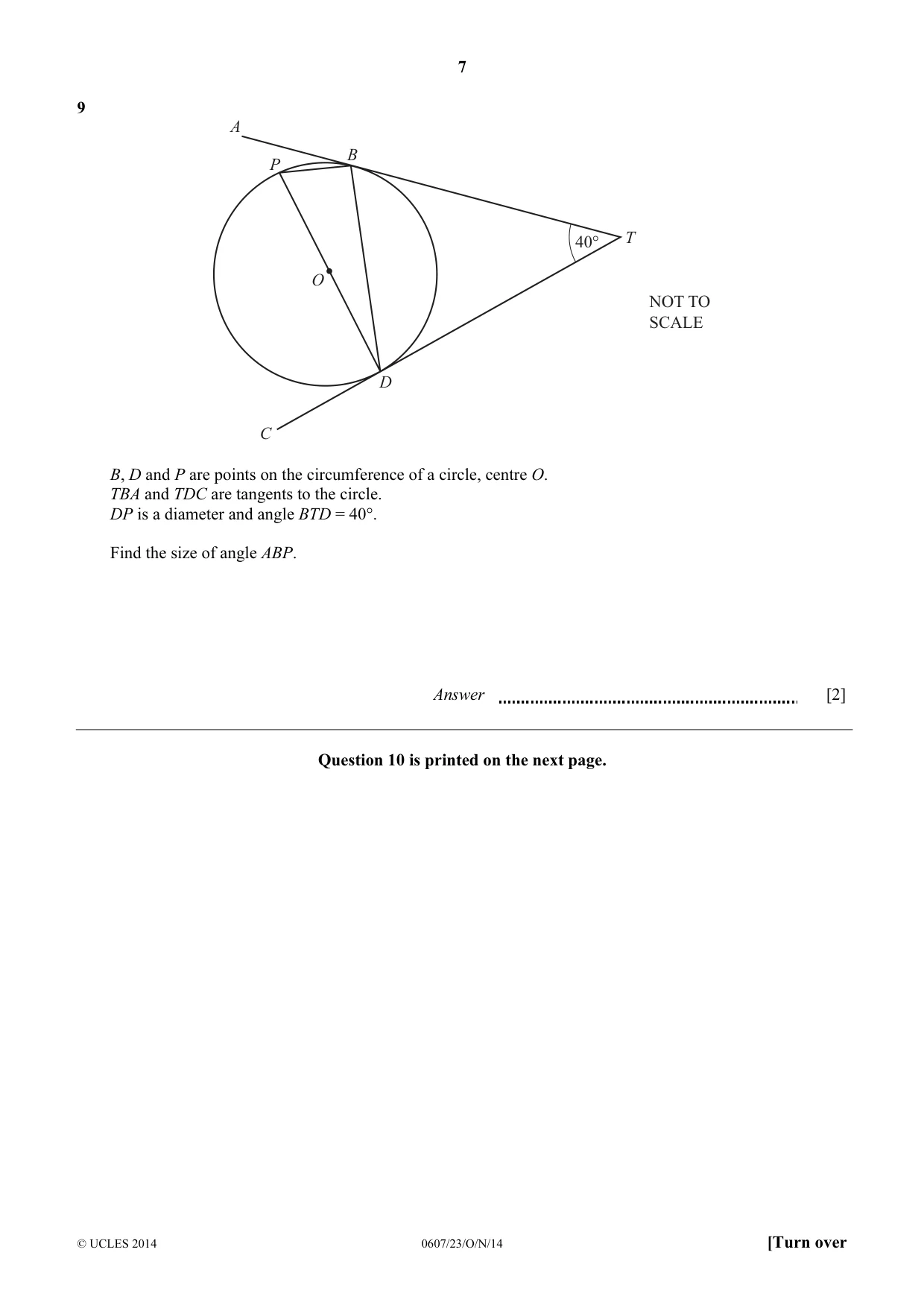
7 © UCLES 2014 0607/23/O/N/14 [Turn over 9 40° B P A O C D T NOT TO SCALE B, D and P are points on the circumference of a circle, centre O. TBA and TDC are tangents to the circle. DP is a diameter and angle BTD = 40°. Find the size of angle ABP. Answer [2] Question 10 is printed on the next page.
Question paper, page 8
8 Permission to reproduce items where third-party owned material protected by copyright is included has been sought and cleared where possible. Every reasonable effort has been made by the publisher (UCLES) to trace copyright holders, but if any items requiring clearance have unwittingly been included, the publisher will be pleased to make amends at the earliest possible opportunity. Cambridge International Examinations is part of the Cambridge Assessment Group. Cambridge Assessment is the brand name of University of Cambridge Local Examinations Syndicate (UCLES), which is itself a department of the University of Cambridge. © UCLES 2014 0607/23/O/N/14 10 f(x) = 2x + 3 g(x) = 5 – 3x (a) Find g(x) when f(x) = 11. Answer(a) [2] (b) Find and simplify an expression for f(g(x)) . Answer(b) [2] (c) Find g–1(x). Answer(c) g–1(x) = [2]
Mark scheme, page 1
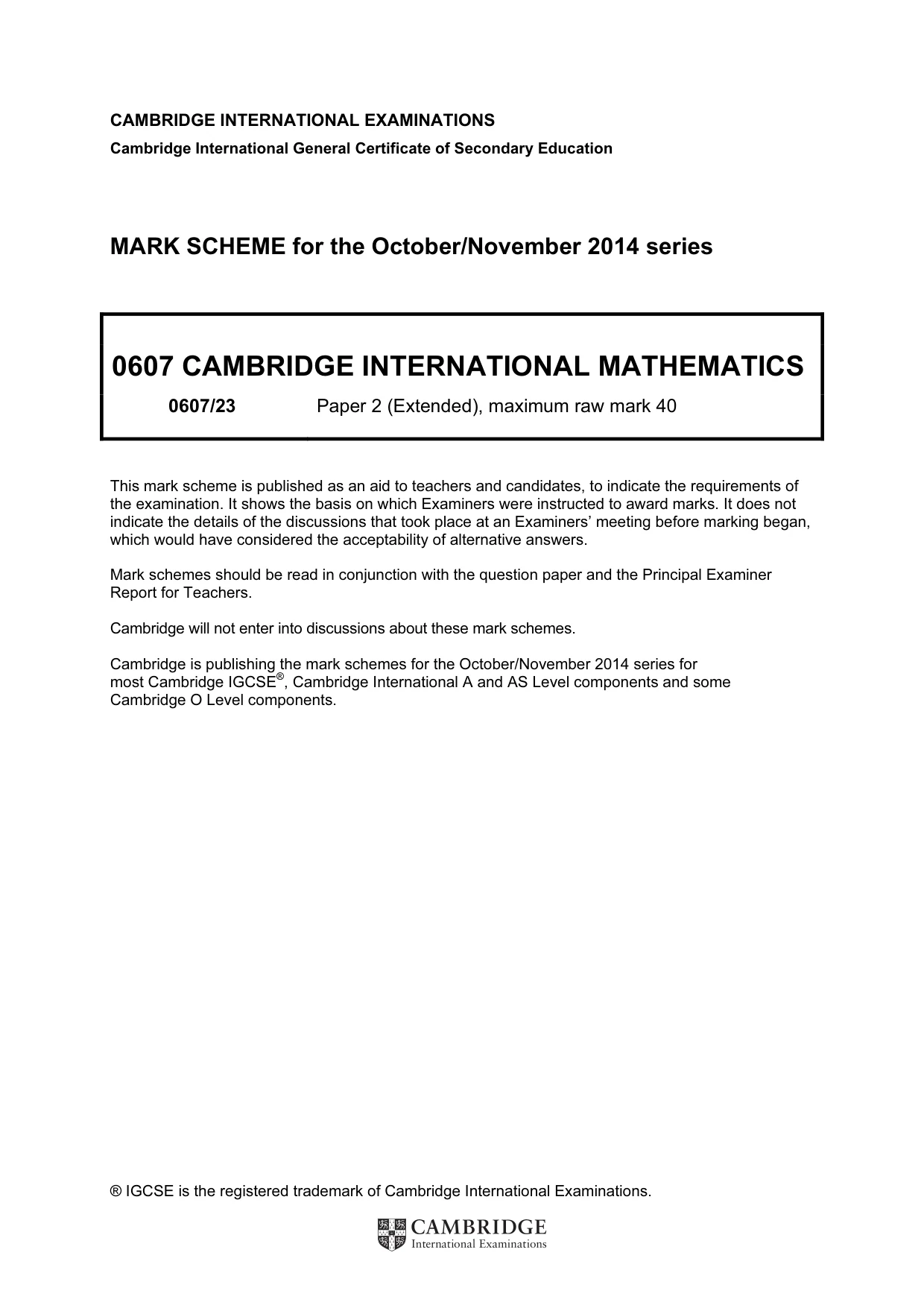
® IGCSE is the registered trademark of Cambridge International Examinations. CAMBRIDGE INTERNATIONAL EXAMINATIONS Cambridge International General Certificate of Secondary Education MARK SCHEME for the October/November 2014 series 0607 CAMBRIDGE INTERNATIONAL MATHEMATICS 0607/23 Paper 2 (Extended), maximum raw mark 40 This mark scheme is published as an aid to teachers and candidates, to indicate the requirements of the examination. It shows the basis on which Examiners were instructed to award marks. It does not indicate the details of the discussions that took place at an Examiners’ meeting before marking began, which would have considered the acceptability of alternative answers. Mark schemes should be read in conjunction with the question paper and the Principal Examiner Report for Teachers. Cambridge will not enter into discussions about these mark schemes. Cambridge is publishing the mark schemes for the October/November 2014 series for most Cambridge IGCSE®, Cambridge International A and AS Level components and some Cambridge O Level components.
Mark scheme, page 2
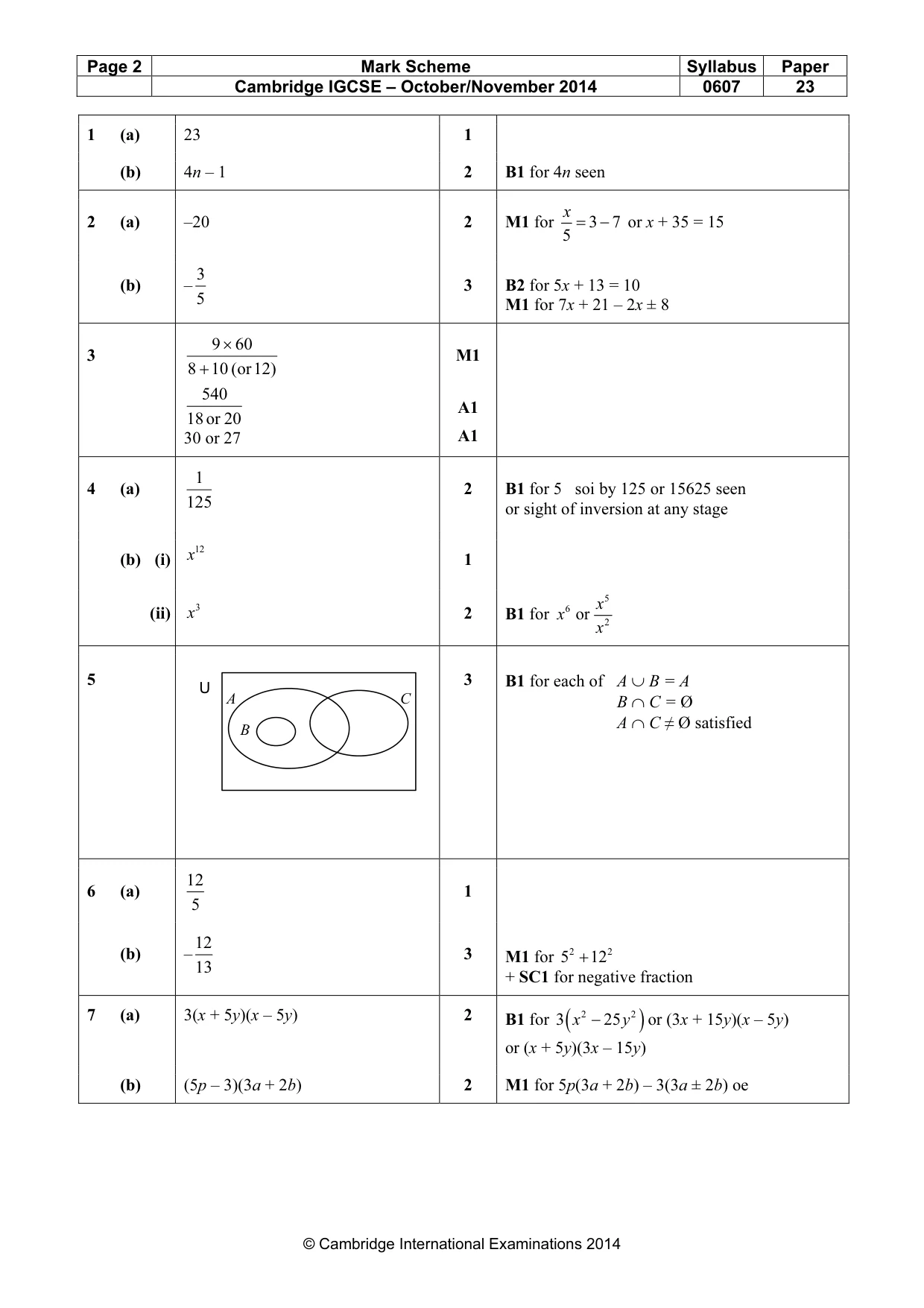
Page 2 Mark Scheme Syllabus Paper Cambridge IGCSE – October/November 2014 0607 23 © Cambridge International Examinations 2014 1 (a) 23 1 (b) 4n – 1 2 B1 for 4n seen 2 (a) –20 2 M1 for 3 7 5 x = − or x + 35 = 15 (b) – 5 3 3 B2 for 5x + 13 = 10 M1 for 7x + 21 – 2x ± 8 3 ) 12 or ( 10 8 60 9 + × 20 or 18 540 30 or 27 M1 A1 A1 4 (a) 125 1 2 B1 for 5 soi by 125 or 15625 seen or sight of inversion at any stage (b) (i) 12 x 1 (ii) 3x 2 B1 for 5 6 2 or x x x 5 3 B1 for each of A ∪ B = A B ∩ C = Ø A ∩ C ≠ Ø satisfied 6 (a) 5 12 1 (b) – 13 12 3 M1 for 2 2 5 12 + + SC1 for negative fraction 7 (a) 3(x + 5y)(x – 5y) 2 B1 for ( ) 2 2 3 25 x y − or (3x + 15y)(x – 5y) or (x + 5y)(3x – 15y) (b) (5p – 3)(3a + 2b) 2 M1 for 5p(3a + 2b) – 3(3a ± 2b) oe U C A B
Mark scheme, page 3
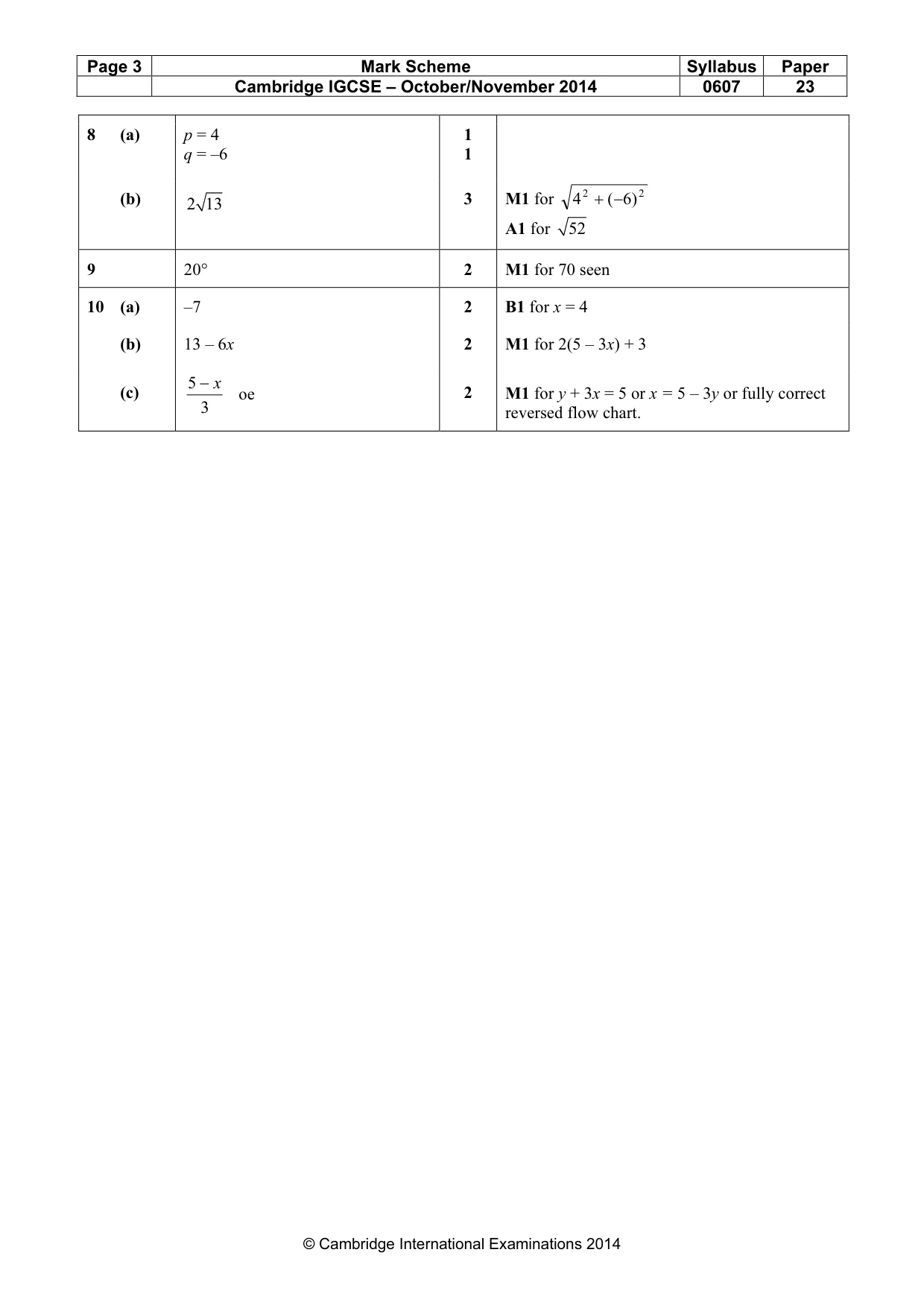
Page 3 Mark Scheme Syllabus Paper Cambridge IGCSE – October/November 2014 0607 23 © Cambridge International Examinations 2014 8 (a) p = 4 q = –6 1 1 (b) 2 13 3 M1 for 2 2 ) 6 ( 4 − + A1 for 52 9 20° 2 M1 for 70 seen 10 (a) –7 2 B1 for x = 4 (b) 13 – 6x 2 M1 for 2(5 – 3x) + 3 (c) 3 5 x − oe 2 M1 for y + 3x = 5 or x = 5 – 3y or fully correct reversed flow chart.
What you needed in this session
Cambridge’s own grade thresholds for 2014 Oct/Nov, Paper 2 · Variant 3. A higher threshold means an easier paper — the bar moves with how the cohort did.