Cambridge IGCSE Mathematics - International 0607 — 2013 Oct/Nov Paper 3 · Variant 1
0607/31/O/N/13 · 96 marks · ≈108 min
The question paper and its mark scheme, free to read here and free to download. This is Cambridge’s own paper, exactly as it was sat.
Question paper16 pages
Mark scheme6 pages
Answers below. Sit the paper first if you are practising.
Paper as text
Question paper, page 1
This document consists of 15 printed pages and 1 blank page. IB13 11_0607_03/3RP © UCLES 2013 [Turn over *7930960218* UNIVERSITY OF CAMBRIDGE INTERNATIONAL EXAMINATIONS International General Certificate of Secondary Education CAMBRIDGE INTERNATIONAL MATHEMATICS 0607/03 Paper 3 (Core) October/November 2013 1 hour 45 minutes Candidates answer on the Question Paper. Additional Materials: Geometrical Instruments Graphics Calculator READ THESE INSTRUCTIONS FIRST Write your Centre number, candidate number and name on all the work you hand in. Write in dark blue or black pen. Do not use staples, paper clips, highlighters, glue or correction fluid. You may use a pencil for any diagrams or graphs. DO NOT WRITE IN ANY BARCODES. Answer all the questions. Unless instructed otherwise, give your answers exactly or correct to three significant figures as appropriate. Answers in degrees should be given to one decimal place. For π, use your calculator value. You must show all the relevant working to gain full marks and you will be given marks for correct methods, including sketches, even if your answer is incorrect. The number of marks is given in brackets [ ] at the end of each question or part question. The total number of marks for this paper is 96. www.XtremePapers.com
Question paper, page 2
2 © UCLES 2013 0607/03/O/N/13 Formula List Area, A, of triangle, base b, height h. A = 1 2 bh Area, A, of circle, radius r. A = πr2 Circumference, C, of circle, radius r. C = 2πr Curved surface area, A, of cylinder of radius r, height h. A = 2πrh Curved surface area, A, of cone of radius r, sloping edge l. A = πrl Curved surface area, A, of sphere of radius r. A = 4πr2 Volume, V, of prism, cross-sectional area A, length l. V =Al Volume, V, of pyramid, base area A, height h. V= 1 3 Ah Volume, V, of cylinder of radius r, height h. V = πr2h Volume, V, of cone of radius r, height h. V = 1 3 πr2h Volume, V, of sphere of radius r. V = 4 3 πr3
Question paper, page 3
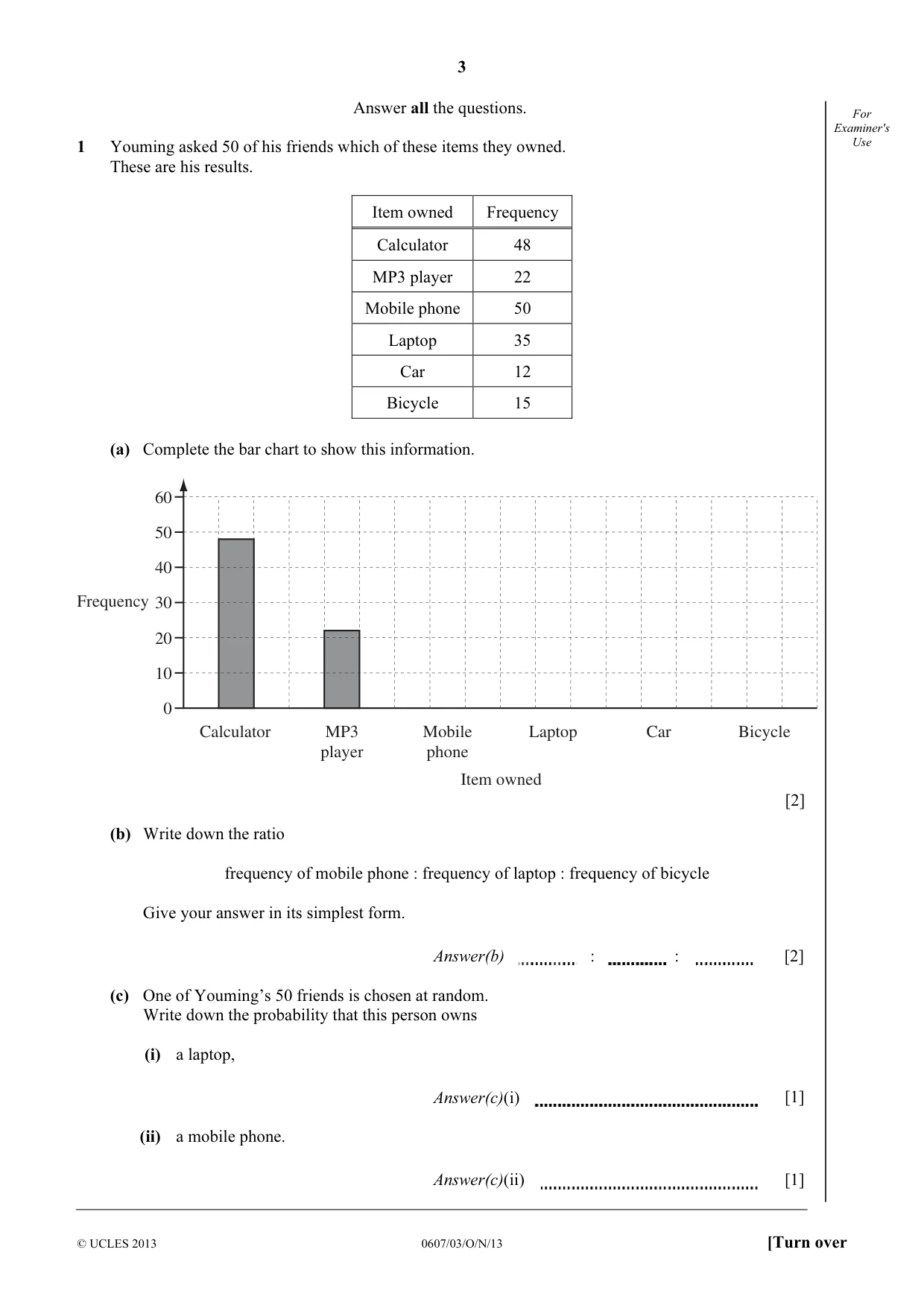
3 © UCLES 2013 0607/03/O/N/13 [Turn over For Examiner's Use Answer all the questions. 1 Youming asked 50 of his friends which of these items they owned. These are his results. Item owned Frequency Calculator 48 MP3 player 22 Mobile phone 50 Laptop 35 Car 12 Bicycle 15 (a) Complete the bar chart to show this information. 60 50 40 30 20 10 0 Frequency Calculator MP3 player Mobile phone Laptop Item owned Car Bicycle [2] (b) Write down the ratio frequency of mobile phone : frequency of laptop : frequency of bicycle Give your answer in its simplest form. Answer(b) : : [2] (c) One of Youming’s 50 friends is chosen at random. Write down the probability that this person owns (i) a laptop, Answer(c)(i) [1] (ii) a mobile phone. Answer(c)(ii) [1]
Question paper, page 4
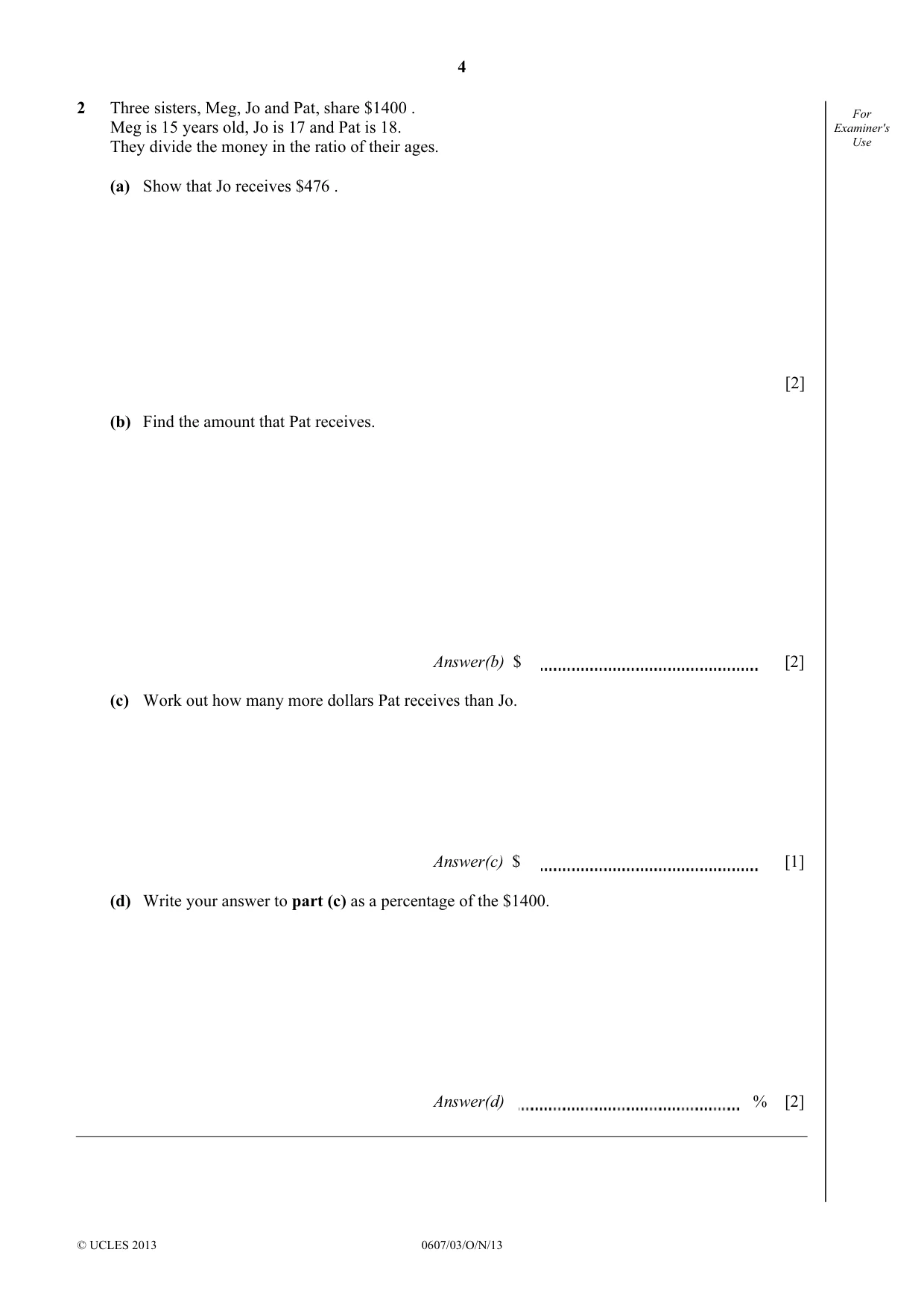
4 © UCLES 2013 0607/03/O/N/13 For Examiner's Use 2 Three sisters, Meg, Jo and Pat, share $1400 . Meg is 15 years old, Jo is 17 and Pat is 18. They divide the money in the ratio of their ages. (a) Show that Jo receives $476 . [2] (b) Find the amount that Pat receives. Answer(b) $ [2] (c) Work out how many more dollars Pat receives than Jo. Answer(c) $ [1] (d) Write your answer to part (c) as a percentage of the $1400. Answer(d) % [2]
Question paper, page 5
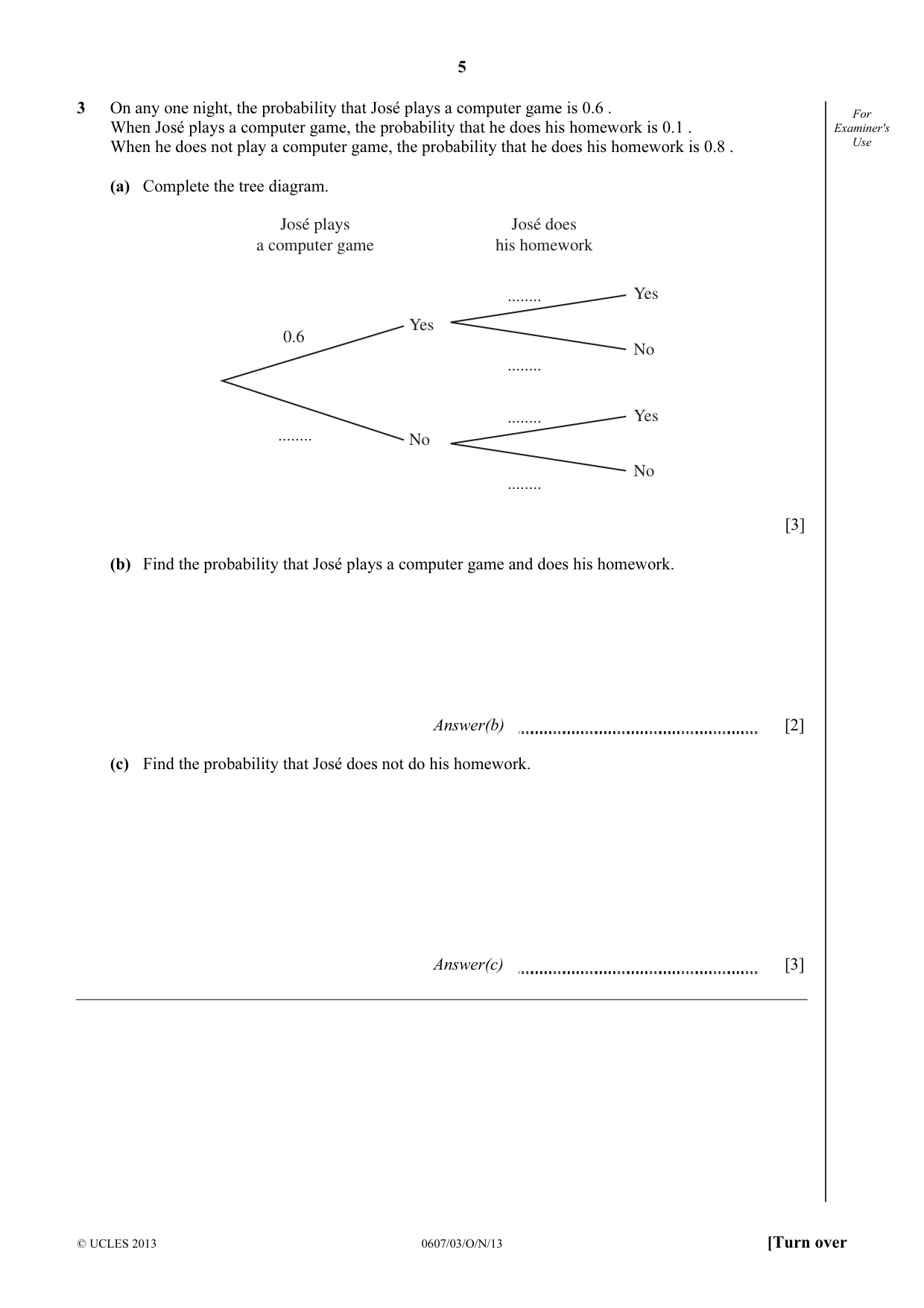
5 © UCLES 2013 0607/03/O/N/13 [Turn over For Examiner's Use 3 On any one night, the probability that José plays a computer game is 0.6 . When José plays a computer game, the probability that he does his homework is 0.1 . When he does not play a computer game, the probability that he does his homework is 0.8 . (a) Complete the tree diagram. Yes José plays a computer game José does his homework No Yes No No Yes … … … … … 0.6 [3] (b) Find the probability that José plays a computer game and does his homework. Answer(b) [2] (c) Find the probability that José does not do his homework. Answer(c) [3]
Question paper, page 6
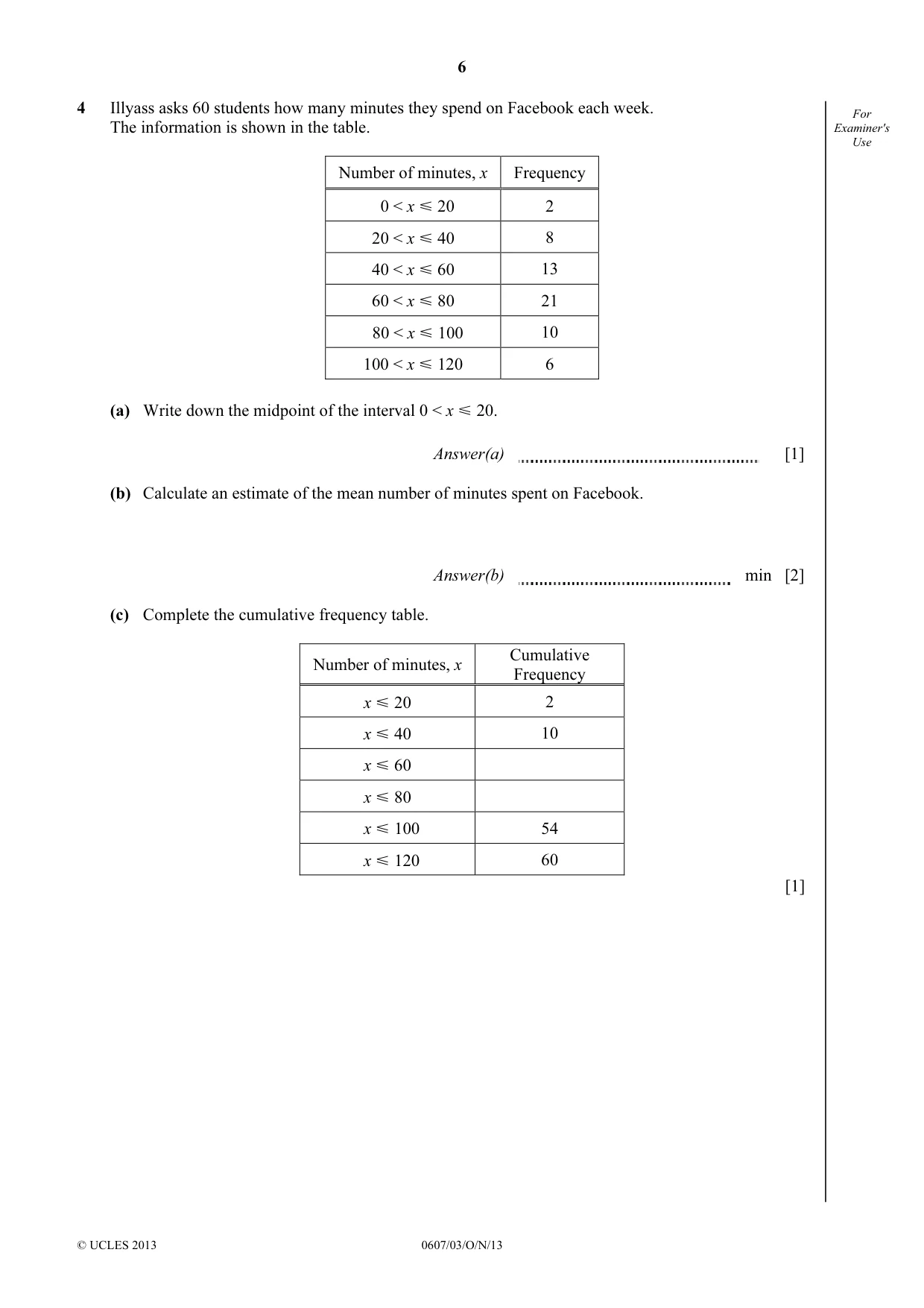
6 © UCLES 2013 0607/03/O/N/13 For Examiner's Use 4 Illyass asks 60 students how many minutes they spend on Facebook each week. The information is shown in the table. Number of minutes, x Frequency 0 < x Y=20 2 20 < x Y=40 8 40 < x Y=60 13 60 < x Y=80 21 80 < x Y=100 10 100 < x Y=120 6 (a) Write down the midpoint of the interval 0 < x Ğ 20. Answer(a) [1] (b) Calculate an estimate of the mean number of minutes spent on Facebook. Answer(b) min [2] (c) Complete the cumulative frequency table. Number of minutes, x Cumulative Frequency x Y=20 2 x Y=40 10 x Y=60 x Y=80 x Y=100 54 x Y=120 60 [1]
Question paper, page 7
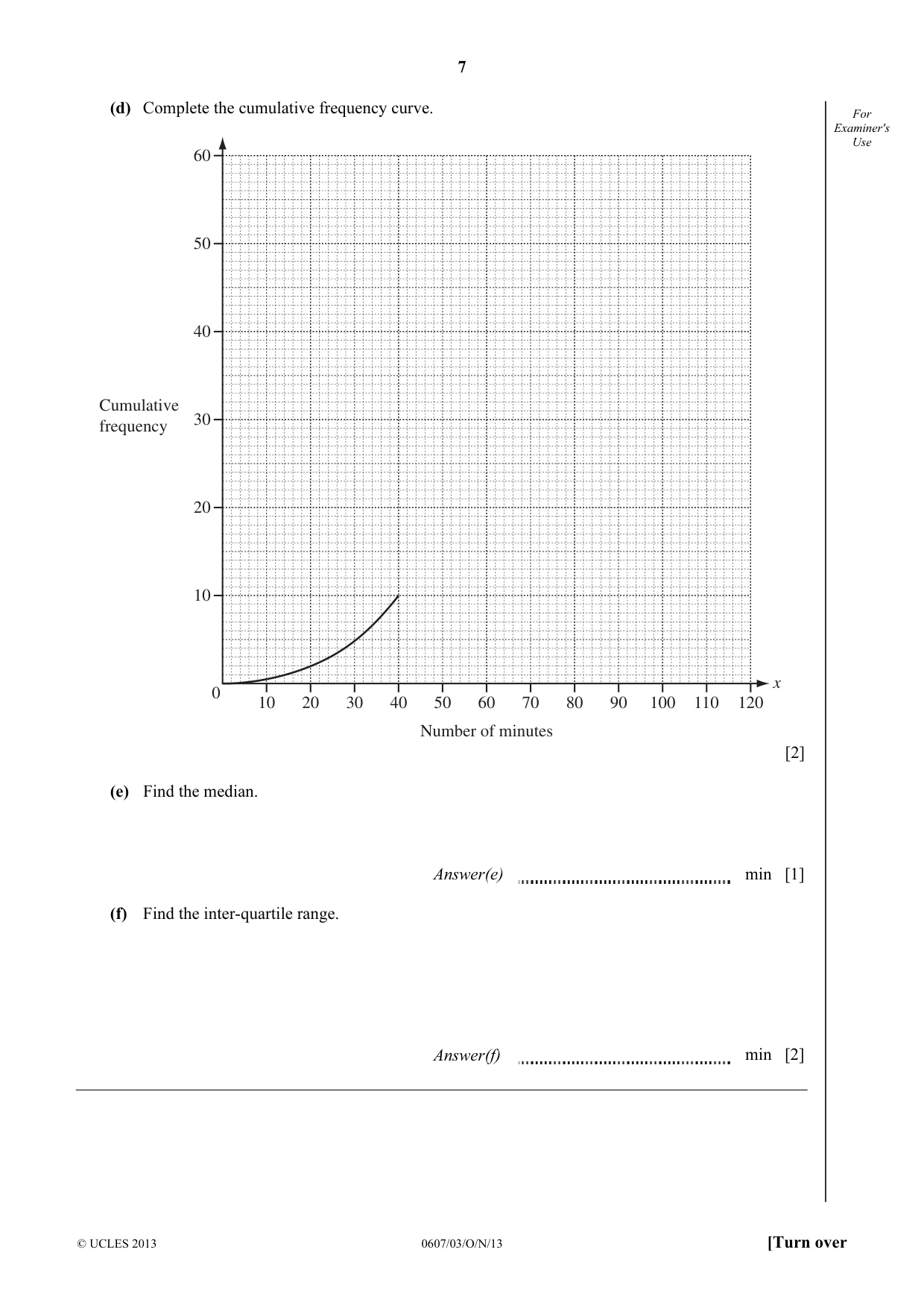
7 © UCLES 2013 0607/03/O/N/13 [Turn over For Examiner's Use (d) Complete the cumulative frequency curve. 60 50 40 30 20 10 10 20 30 40 50 60 Number of minutes 70 80 90 100 110 120 0 x Cumulative frequency [2] (e) Find the median. Answer(e) min [1] (f) Find the inter-quartile range. Answer(f) min [2]
Question paper, page 8
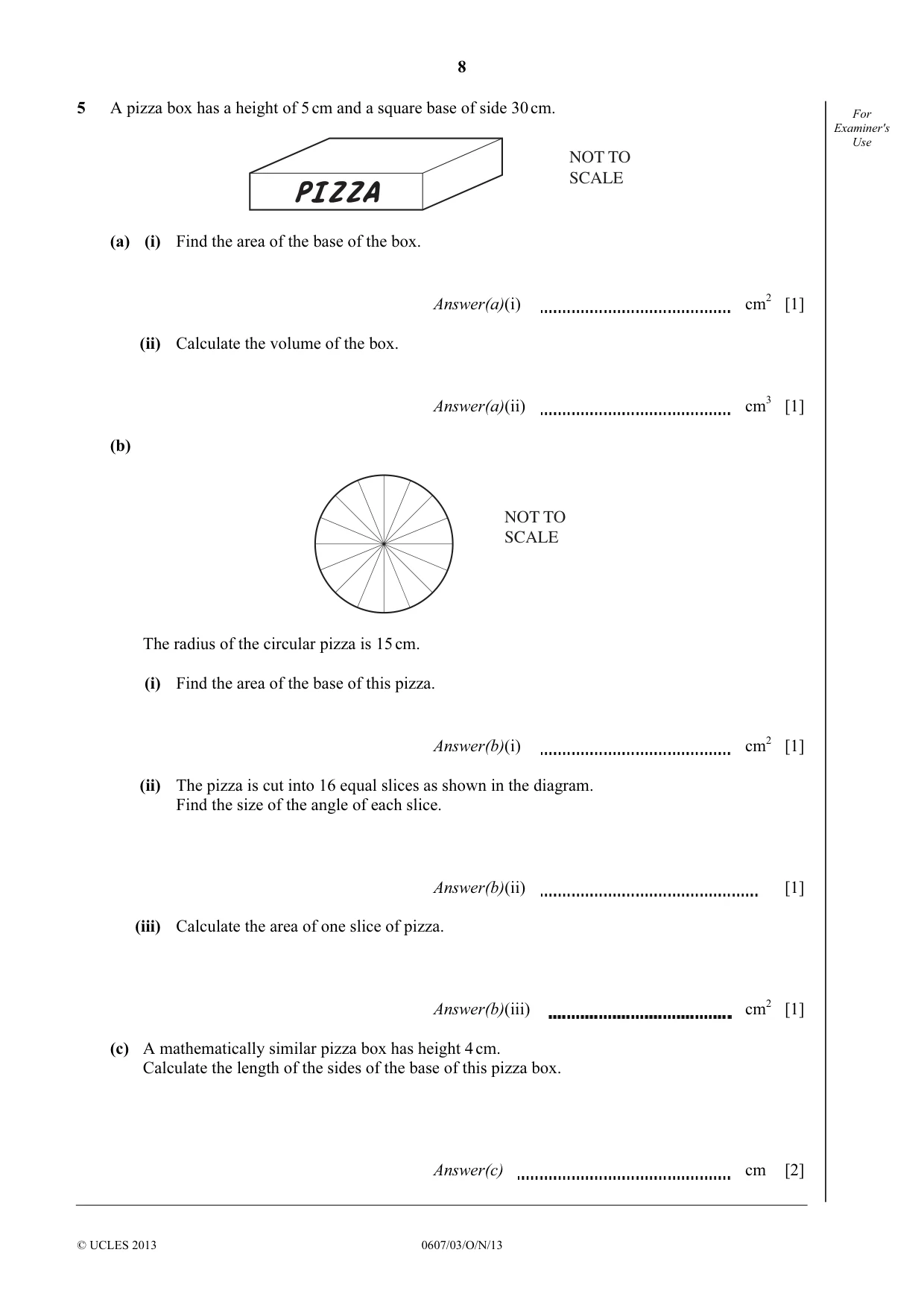
8 © UCLES 2013 0607/03/O/N/13 For Examiner's Use 5 A pizza box has a height of 5 cm and a square base of side 30 cm. NOT TO SCALE (a) (i) Find the area of the base of the box. Answer(a)(i) cm2 [1] (ii) Calculate the volume of the box. Answer(a)(ii) cm3 [1] (b) NOT TO SCALE The radius of the circular pizza is 15 cm. (i) Find the area of the base of this pizza. Answer(b)(i) cm2 [1] (ii) The pizza is cut into 16 equal slices as shown in the diagram. Find the size of the angle of each slice. Answer(b)(ii) [1] (iii) Calculate the area of one slice of pizza. Answer(b)(iii) cm2 [1] (c) A mathematically similar pizza box has height 4 cm. Calculate the length of the sides of the base of this pizza box. Answer(c) cm [2]
Question paper, page 9
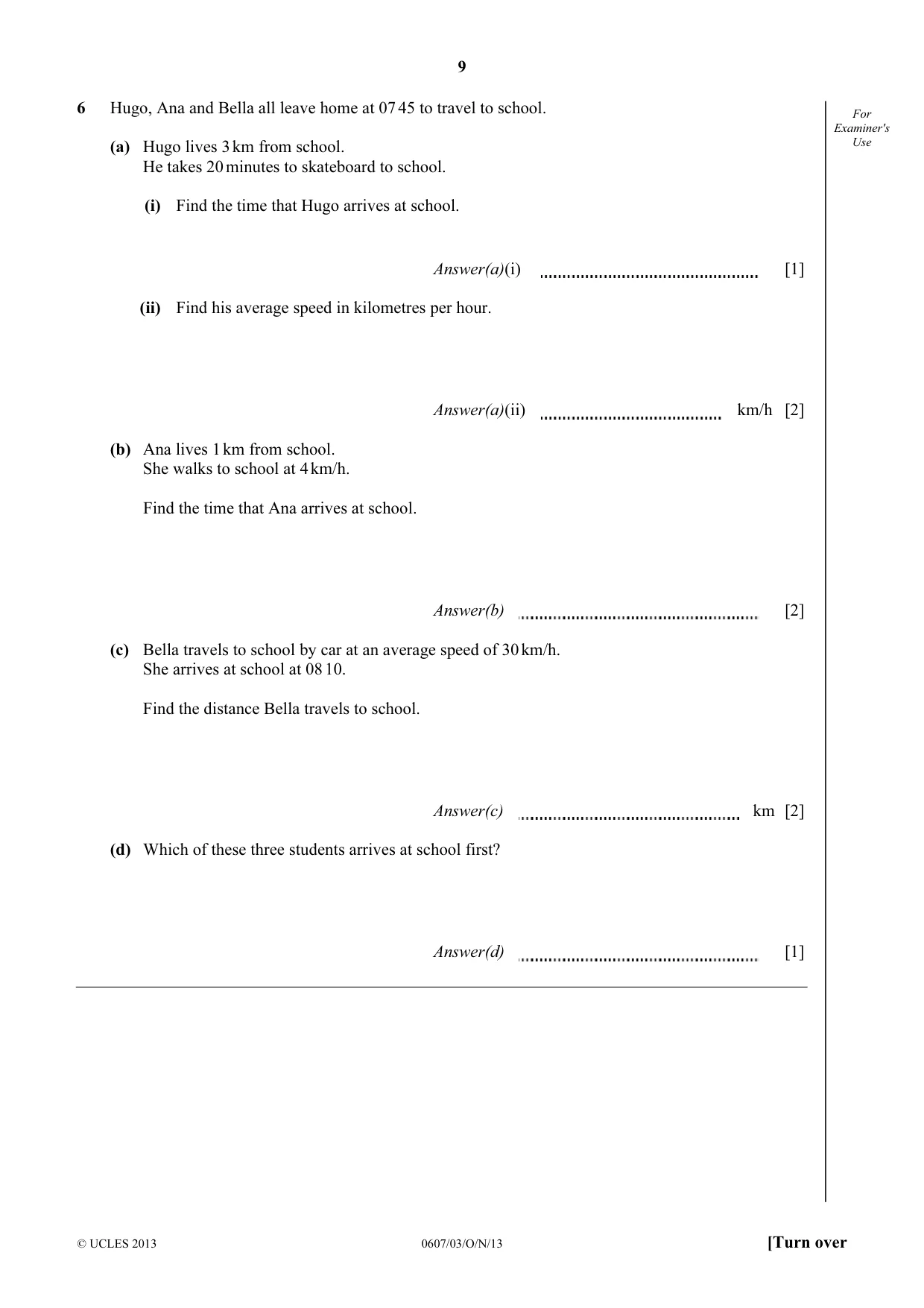
9 © UCLES 2013 0607/03/O/N/13 [Turn over For Examiner's Use 6 Hugo, Ana and Bella all leave home at 07 45 to travel to school. (a) Hugo lives 3 km from school. He takes 20 minutes to skateboard to school. (i) Find the time that Hugo arrives at school. Answer(a)(i) [1] (ii) Find his average speed in kilometres per hour. Answer(a)(ii) km/h [2] (b) Ana lives 1 km from school. She walks to school at 4 km/h. Find the time that Ana arrives at school. Answer(b) [2] (c) Bella travels to school by car at an average speed of 30 km/h. She arrives at school at 08 10. Find the distance Bella travels to school. Answer(c) km [2] (d) Which of these three students arrives at school first? Answer(d) [1]
Question paper, page 10
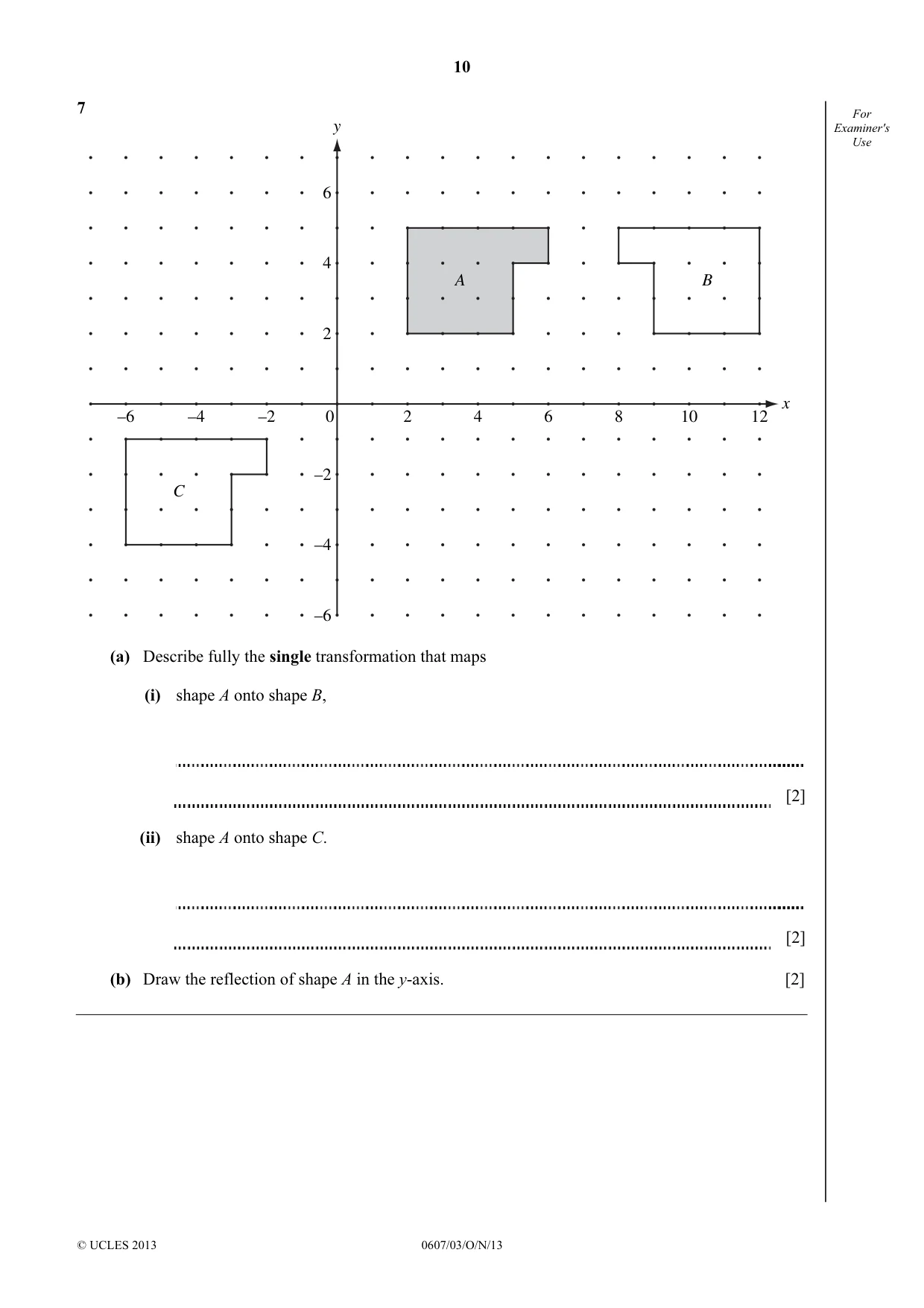
10 © UCLES 2013 0607/03/O/N/13 For Examiner's Use 7 C A B y x 6 4 2 –2 –4 –6 –6 –4 –2 2 0 4 6 8 10 12 (a) Describe fully the single transformation that maps (i) shape A onto shape B, [2] (ii) shape A onto shape C. [2] (b) Draw the reflection of shape A in the y-axis. [2]
Question paper, page 11
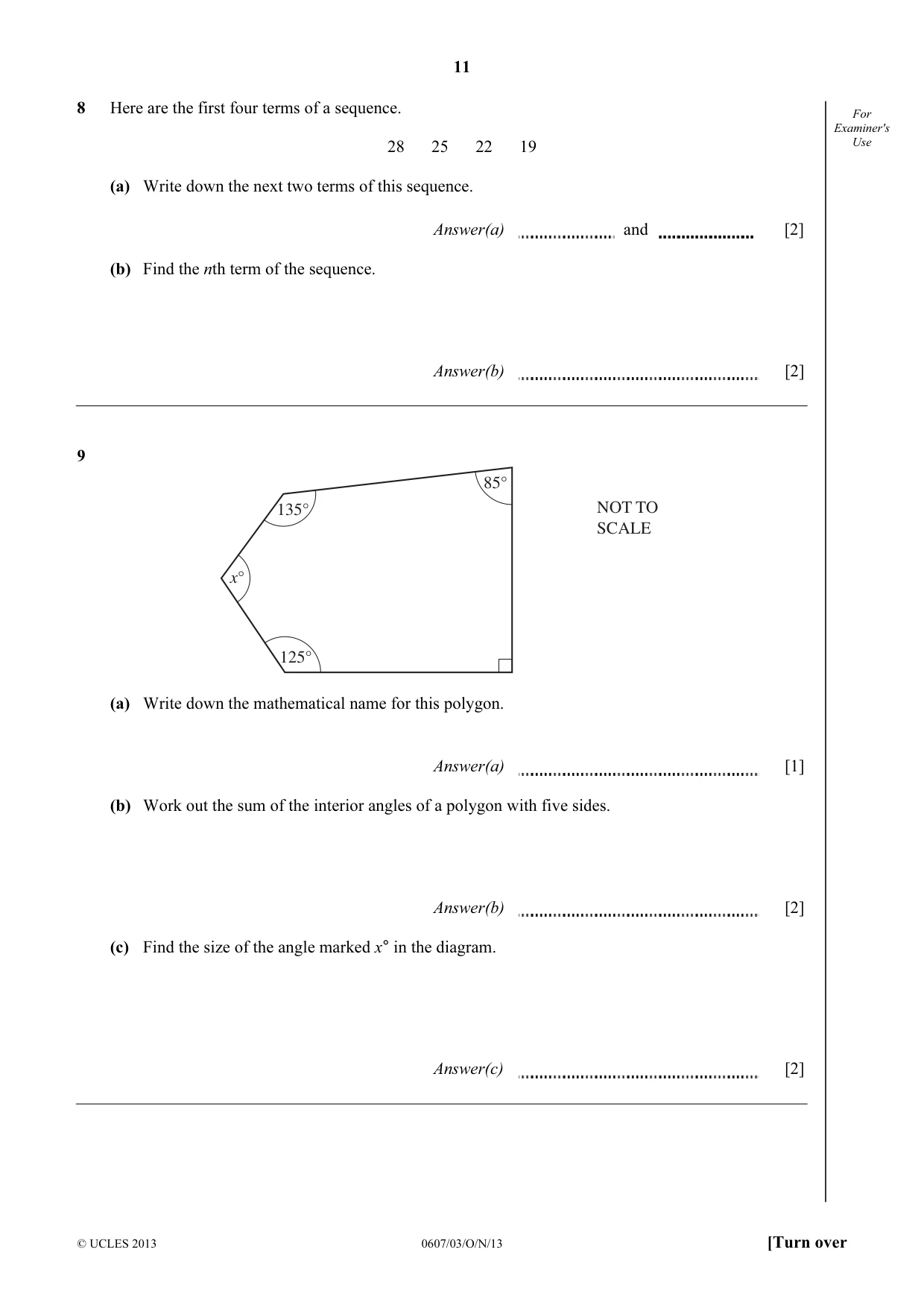
11 © UCLES 2013 0607/03/O/N/13 [Turn over For Examiner's Use 8 Here are the first four terms of a sequence. 28 25 22 19 (a) Write down the next two terms of this sequence. Answer(a) and [2] (b) Find the nth term of the sequence. Answer(b) [2] 9 85° 135° 125° x° NOT TO SCALE (a) Write down the mathematical name for this polygon. Answer(a) [1] (b) Work out the sum of the interior angles of a polygon with five sides. Answer(b) [2] (c) Find the size of the angle marked x° in the diagram. Answer(c) [2]
Question paper, page 12
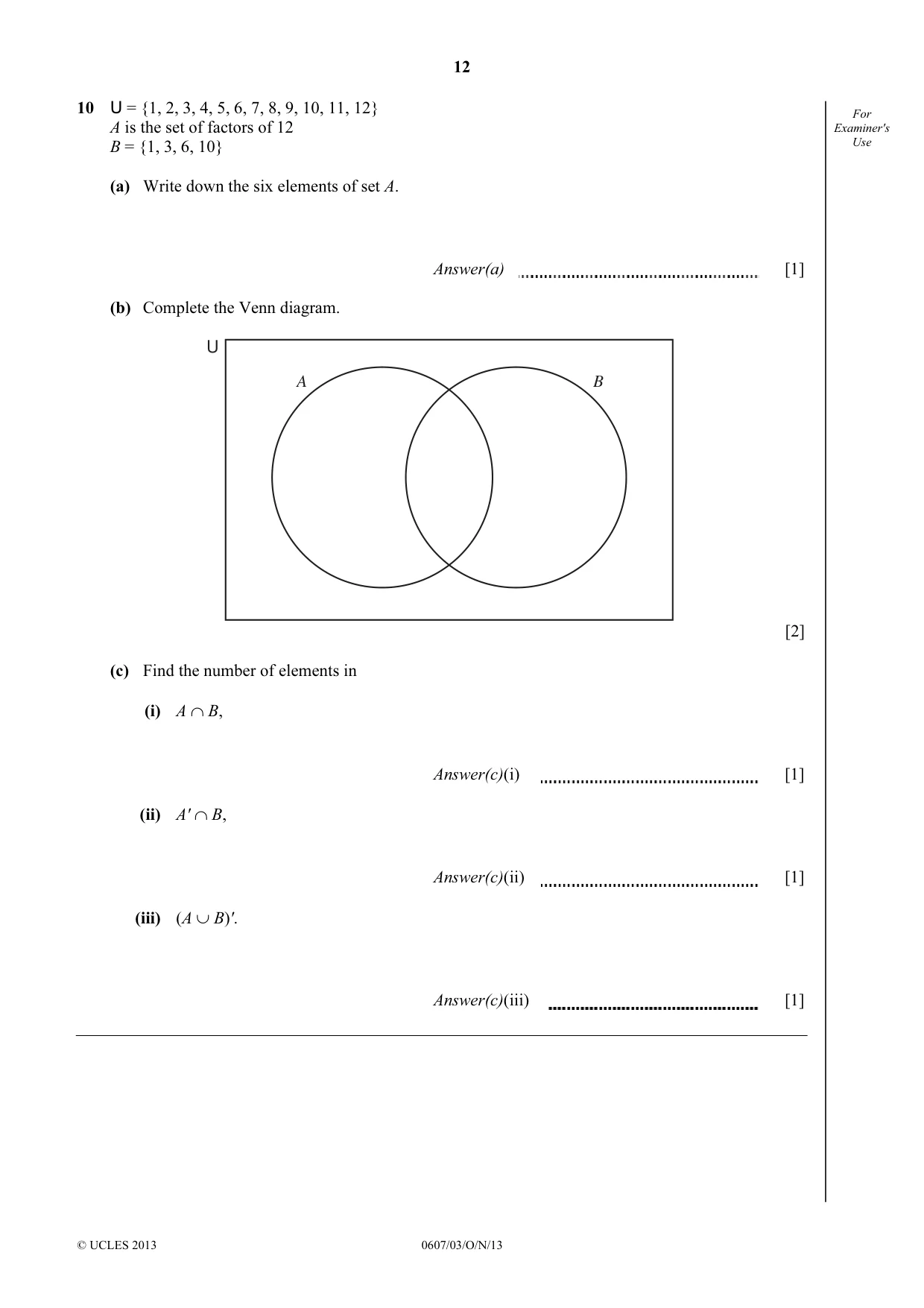
12 © UCLES 2013 0607/03/O/N/13 For Examiner's Use 10 U = {1, 2, 3, 4, 5, 6, 7, 8, 9, 10, 11, 12} A is the set of factors of 12 B = {1, 3, 6, 10} (a) Write down the six elements of set A. Answer(a) [1] (b) Complete the Venn diagram. U A B [2] (c) Find the number of elements in (i) A ∩ B, Answer(c)(i) [1] (ii) A' ∩ B, Answer(c)(ii) [1] (iii) (A ∪ B)'. Answer(c)(iii) [1]
Question paper, page 13
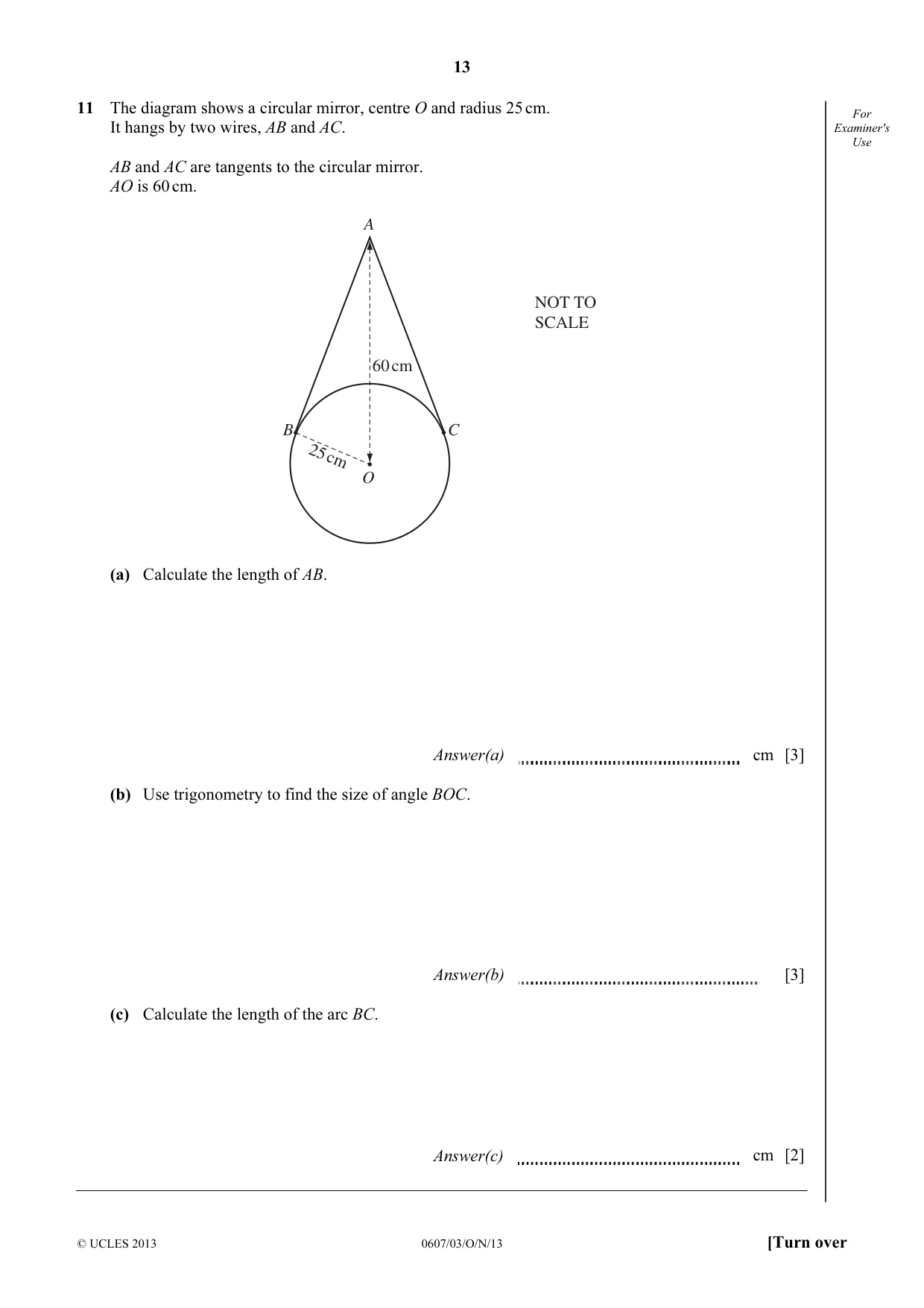
13 © UCLES 2013 0607/03/O/N/13 [Turn over For Examiner's Use 11 The diagram shows a circular mirror, centre O and radius 25 cm. It hangs by two wires, AB and AC. AB and AC are tangents to the circular mirror. AO is 60 cm. 25 cm A B C O NOT TO SCALE 60 cm (a) Calculate the length of AB. Answer(a) cm [3] (b) Use trigonometry to find the size of angle BOC. Answer(b) [3] (c) Calculate the length of the arc BC. Answer(c) cm [2]
Question paper, page 14
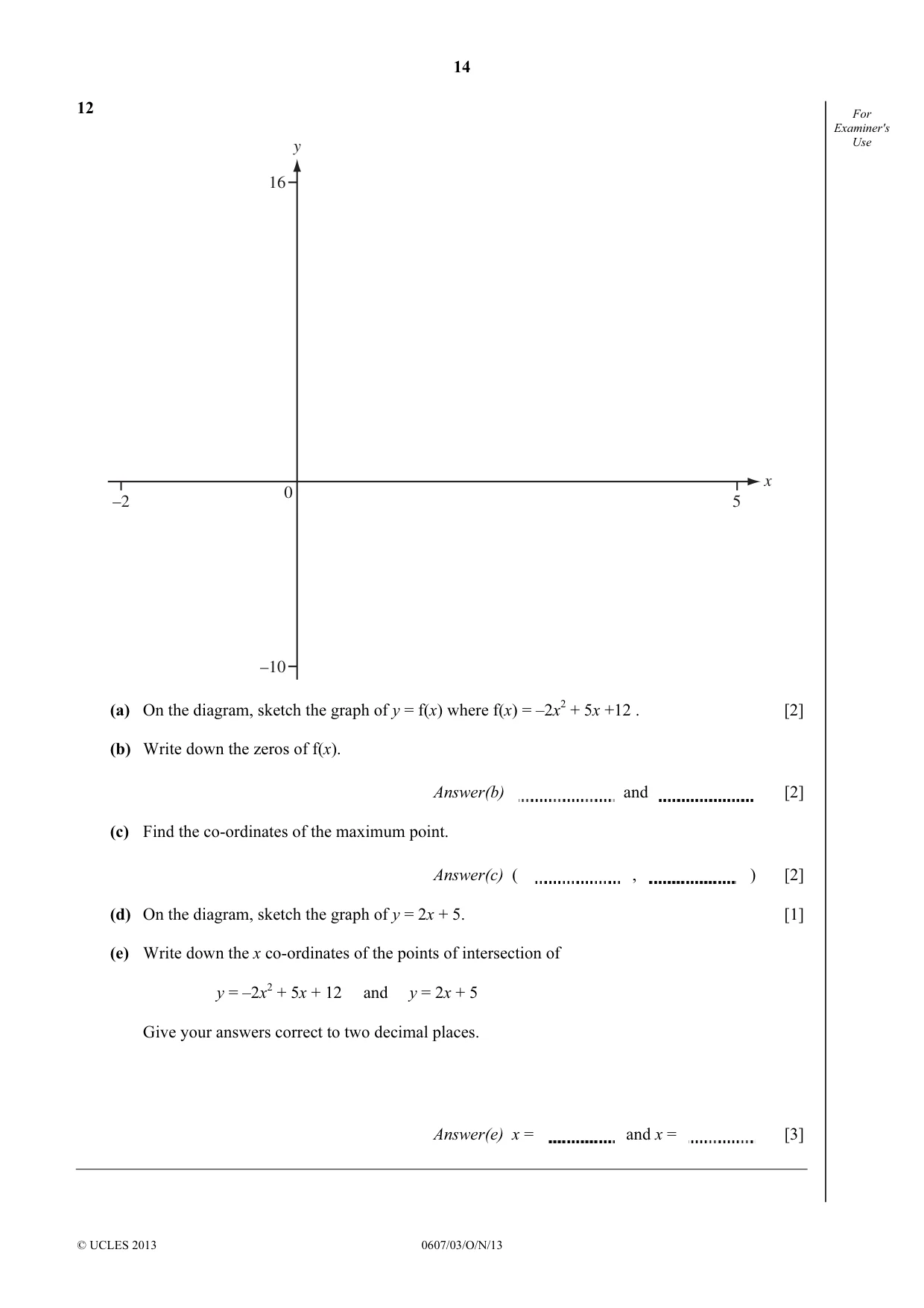
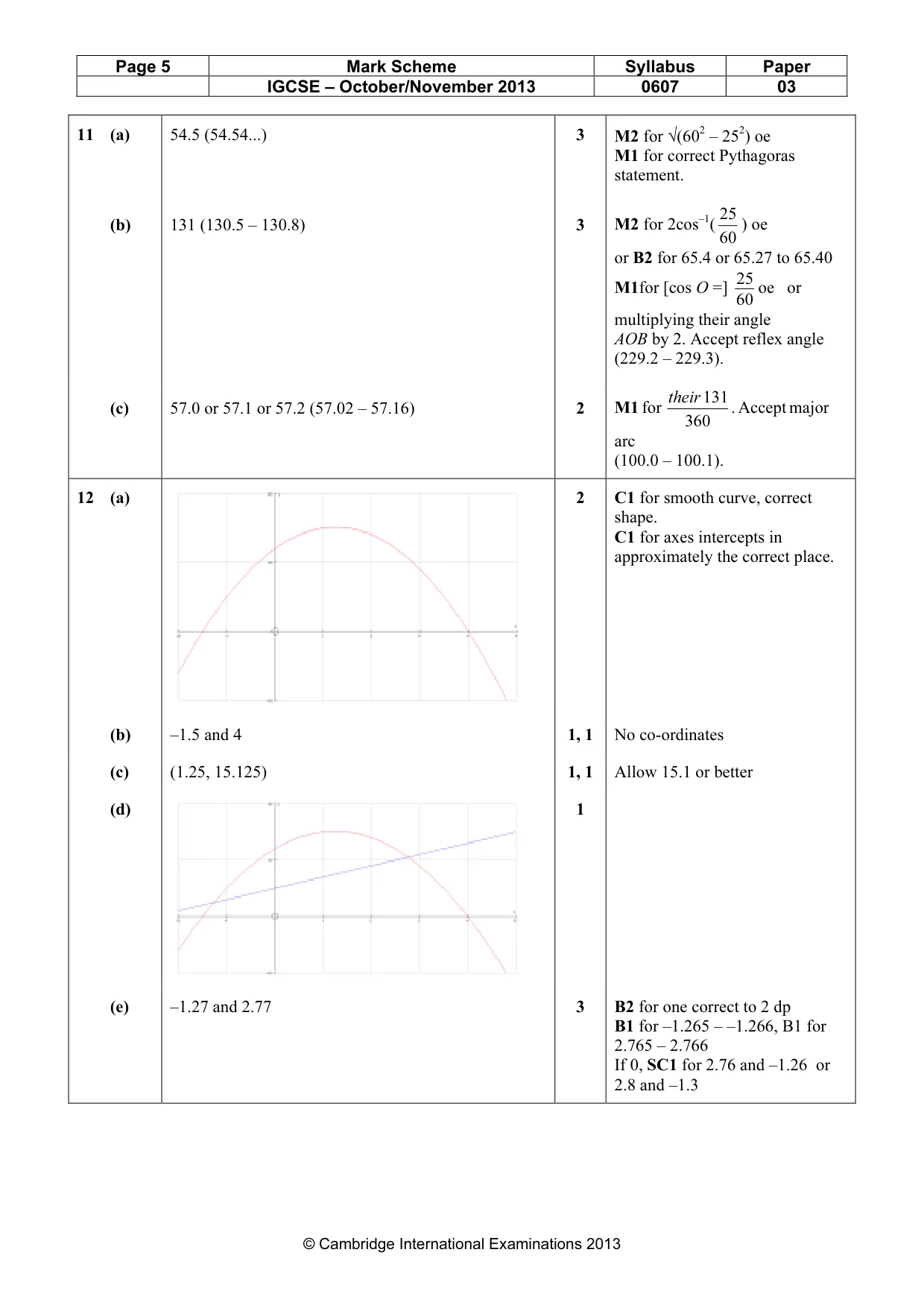
14 © UCLES 2013 0607/03/O/N/13 For Examiner's Use 12 y x 16 –10 –2 5 0 (a) On the diagram, sketch the graph of y = f(x) where f(x) = –2x2 + 5x +12 . [2] (b) Write down the zeros of f(x). Answer(b) and [2] (c) Find the co-ordinates of the maximum point. Answer(c) ( , ) [2] (d) On the diagram, sketch the graph of y = 2x + 5. [1] (e) Write down the x co-ordinates of the points of intersection of y = –2x2 + 5x + 12 and y = 2x + 5 Give your answers correct to two decimal places. Answer(e) x = and x = [3]
Question paper, page 15
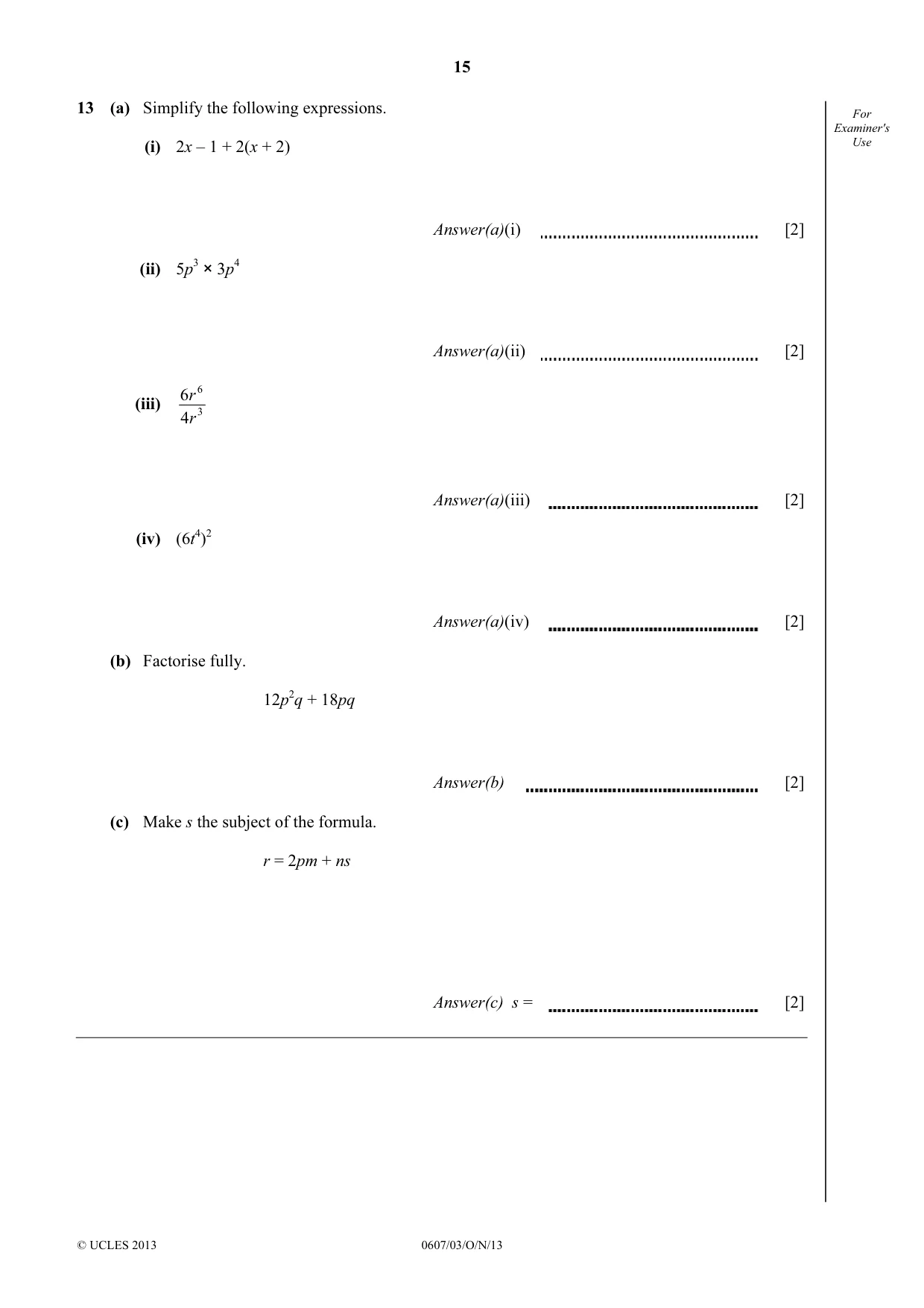
15 © UCLES 2013 0607/03/O/N/13 For Examiner's Use 13 (a) Simplify the following expressions. (i) 2x – 1 + 2(x + 2) Answer(a)(i) [2] (ii) 5p3 × 3p4 Answer(a)(ii) [2] (iii) 3 6 4 6 r r Answer(a)(iii) [2] (iv) (6t4)2 Answer(a)(iv) [2] (b) Factorise fully. 12p2q + 18pq Answer(b) [2] (c) Make s the subject of the formula. r = 2pm + ns Answer(c) s = [2]
Question paper, page 16
16 Permission to reproduce items where third-party owned material protected by copyright is included has been sought and cleared where possible. Every reasonable effort has been made by the publisher (UCLES) to trace copyright holders, but if any items requiring clearance have unwittingly been included, the publisher will be pleased to make amends at the earliest possible opportunity. University of Cambridge International Examinations is part of the Cambridge Assessment Group. Cambridge Assessment is the brand name of University of Cambridge Local Examinations Syndicate (UCLES), which is itself a department of the University of Cambridge. © UCLES 2013 0607/03/O/N/13 BLANK PAGE
Mark scheme, page 1
CAMBRIDGE INTERNATIONAL EXAMINATIONS International General Certificate of Secondary Education MARK SCHEME for the October/November 2013 series 0607 CAMBRIDGE INTERNATIONAL MATHEMATICS 0607/03 Paper 3 (Core), maximum raw mark 96 This mark scheme is published as an aid to teachers and candidates, to indicate the requirements of the examination. It shows the basis on which Examiners were instructed to award marks. It does not indicate the details of the discussions that took place at an Examiners’ meeting before marking began, which would have considered the acceptability of alternative answers. Mark schemes should be read in conjunction with the question paper and the Principal Examiner Report for Teachers. Cambridge will not enter into discussions about these mark schemes. Cambridge is publishing the mark schemes for the October/November 2013 series for most IGCSE, GCE Advanced Level and Advanced Subsidiary Level components and some Ordinary Level components. www.XtremePapers.com
Mark scheme, page 2
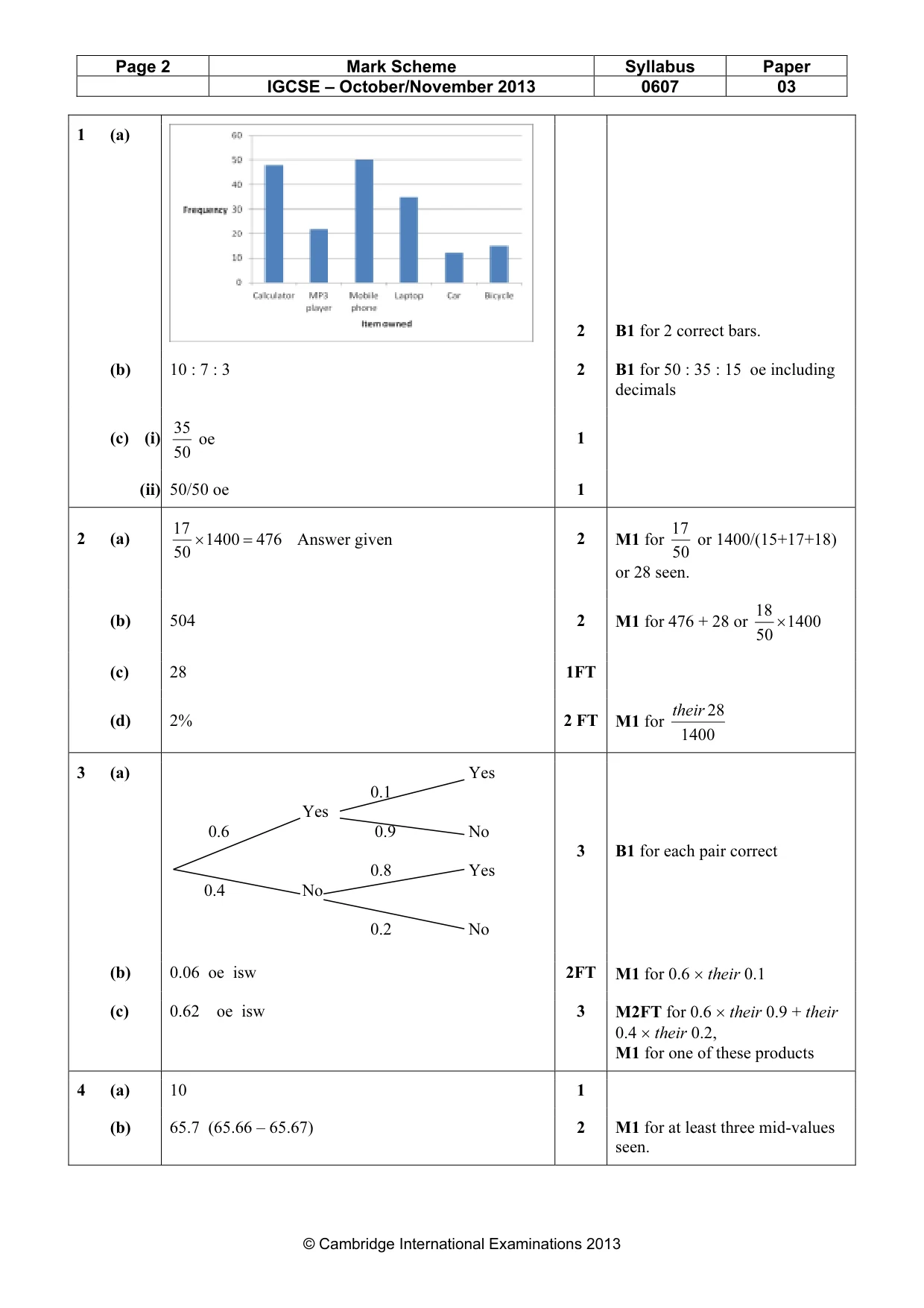
Page 2 Mark Scheme Syllabus Paper IGCSE – October/November 2013 0607 03 © Cambridge International Examinations 2013 1 (a) 2 B1 for 2 correct bars. (b) 10 : 7 : 3 2 B1 for 50 : 35 : 15 oe including decimals (c) (i) 50 35 oe 1 (ii) 50/50 oe 1 2 (a) 476 1400 50 17 = × Answer given 2 M1 for 50 17 or 1400/(15+17+18) or 28 seen. (b) 504 2 M1 for 476 + 28 or 1400 50 18 × (c) 28 1FT (d) 2% 2 FT M1 for 1400 28 their 3 (a) Yes 0.1 Yes 0.6 0.9 No 0.8 Yes 0.4 No 0.2 No 3 B1 for each pair correct (b) 0.06 oe isw 2FT M1 for 0.6 × their 0.1 (c) 0.62 oe isw 3 M2FT for 0.6 × their 0.9 + their 0.4 × their 0.2, M1 for one of these products 4 (a) 10 1 (b) 65.7 (65.66 – 65.67) 2 M1 for at least three mid-values seen.
Mark scheme, page 3
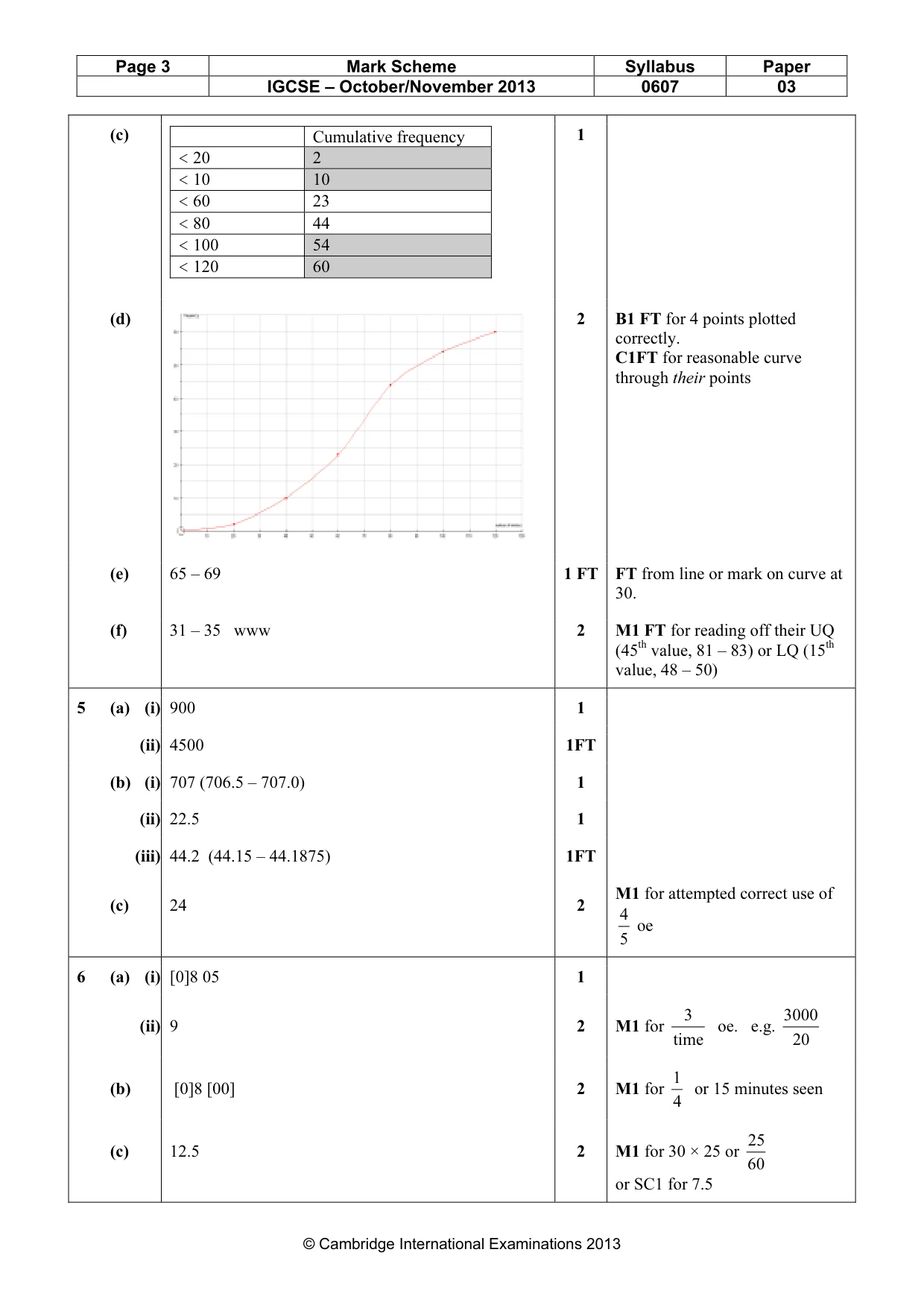
Page 3 Mark Scheme Syllabus Paper IGCSE – October/November 2013 0607 03 © Cambridge International Examinations 2013 (c) Cumulative frequency < 20 2 < 10 10 < 60 23 < 80 44 < 100 54 < 120 60 1 (d) 2 B1 FT for 4 points plotted correctly. C1FT for reasonable curve through their points (e) 65 – 69 1 FT FT from line or mark on curve at 30. (f) 31 – 35 www 2 M1 FT for reading off their UQ (45th value, 81 – 83) or LQ (15th value, 48 – 50) 5 (a) (i) 900 1 (ii) 4500 1FT (b) (i) 707 (706.5 – 707.0) 1 (ii) 22.5 1 (iii) 44.2 (44.15 – 44.1875) 1FT (c) 24 2 M1 for attempted correct use of 5 4 oe 6 (a) (i) [0]8 05 1 (ii) 9 2 M1 for time 3 oe. e.g. 20 3000 (b) [0]8 [00] 2 M1 for 4 1 or 15 minutes seen (c) 12.5 2 M1 for 30 × 25 or 60 25 or SC1 for 7.5
Mark scheme, page 4
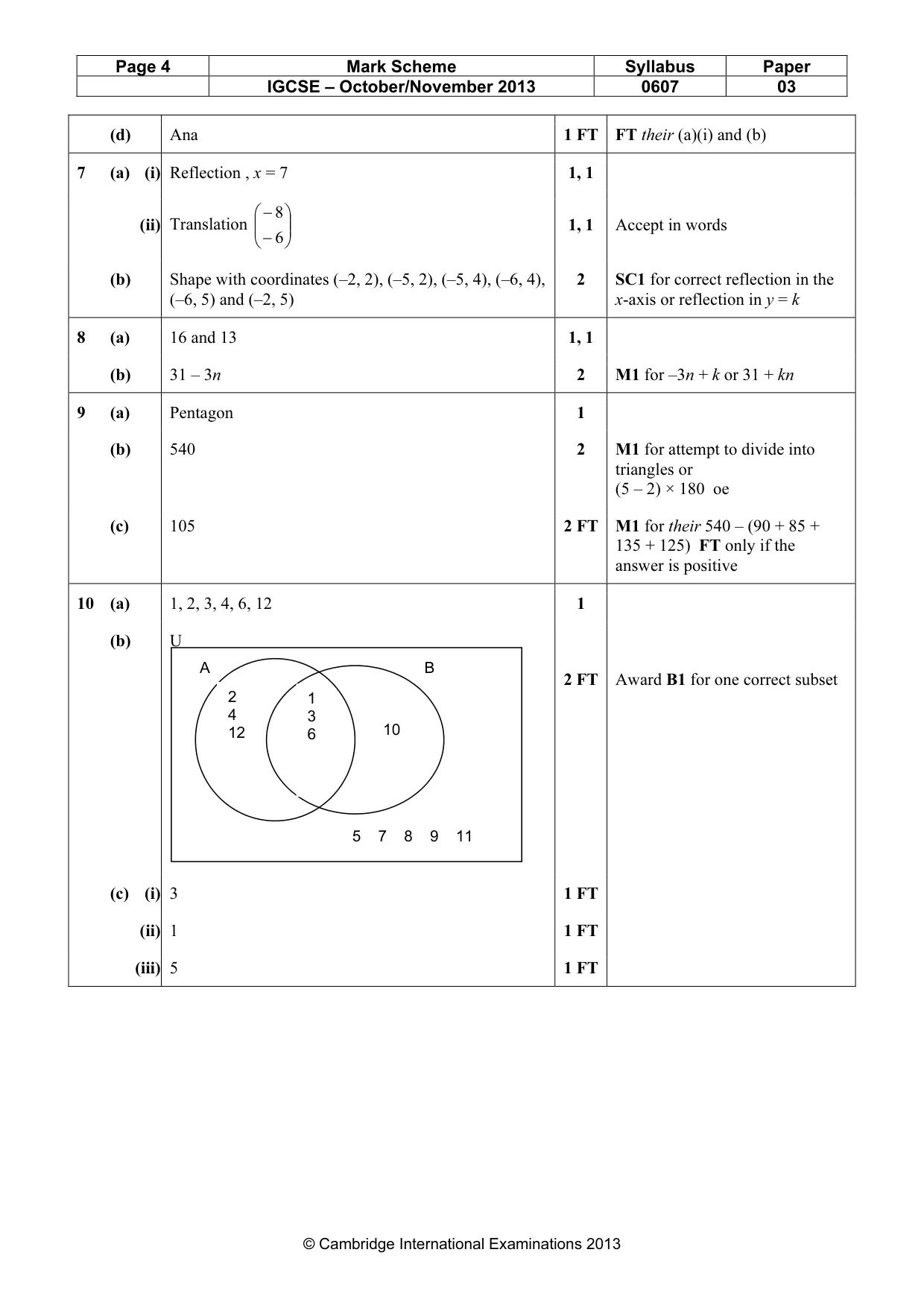
Page 4 Mark Scheme Syllabus Paper IGCSE – October/November 2013 0607 03 © Cambridge International Examinations 2013 (d) Ana 1 FT FT their (a)(i) and (b) 7 (a) (i) Reflection , x = 7 1, 1 (ii) Translation − − 6 8 1, 1 Accept in words (b) Shape with coordinates (–2, 2), (–5, 2), (–5, 4), (–6, 4), (–6, 5) and (–2, 5) 2 SC1 for correct reflection in the x-axis or reflection in y = k 8 (a) 16 and 13 1, 1 (b) 31 – 3n 2 M1 for –3n + k or 31 + kn 9 (a) Pentagon 1 (b) 540 2 M1 for attempt to divide into triangles or (5 – 2) × 180 oe (c) 105 2 FT M1 for their 540 – (90 + 85 + 135 + 125) FT only if the answer is positive 10 (a) 1, 2, 3, 4, 6, 12 1 (b) U 2 FT Award B1 for one correct subset (c) (i) 3 1 FT (ii) 1 1 FT (iii) 5 1 FT A B 1 3 6 10 2 4 12 5 7 8 9 11
Mark scheme, page 5
Page 5 Mark Scheme Syllabus Paper IGCSE – October/November 2013 0607 03 © Cambridge International Examinations 2013 11 (a) 54.5 (54.54...) 3 M2 for √(602 – 252) oe M1 for correct Pythagoras statement. (b) 131 (130.5 – 130.8) 3 M2 for 2cos–1( 60 25 ) oe or B2 for 65.4 or 65.27 to 65.40 M1for [cos O =] 60 25 oe or multiplying their angle AOB by 2. Accept reflex angle (229.2 – 229.3). (c) 57.0 or 57.1 or 57.2 (57.02 – 57.16) 2 M1 for 360 131 their . Accept major arc (100.0 – 100.1). 12 (a) 2 C1 for smooth curve, correct shape. C1 for axes intercepts in approximately the correct place. (b) –1.5 and 4 1, 1 No co-ordinates (c) (1.25, 15.125) 1, 1 Allow 15.1 or better (d) 1 (e) –1.27 and 2.77 3 B2 for one correct to 2 dp B1 for –1.265 – –1.266, B1 for 2.765 – 2.766 If 0, SC1 for 2.76 and –1.26 or 2.8 and –1.3
Mark scheme, page 6
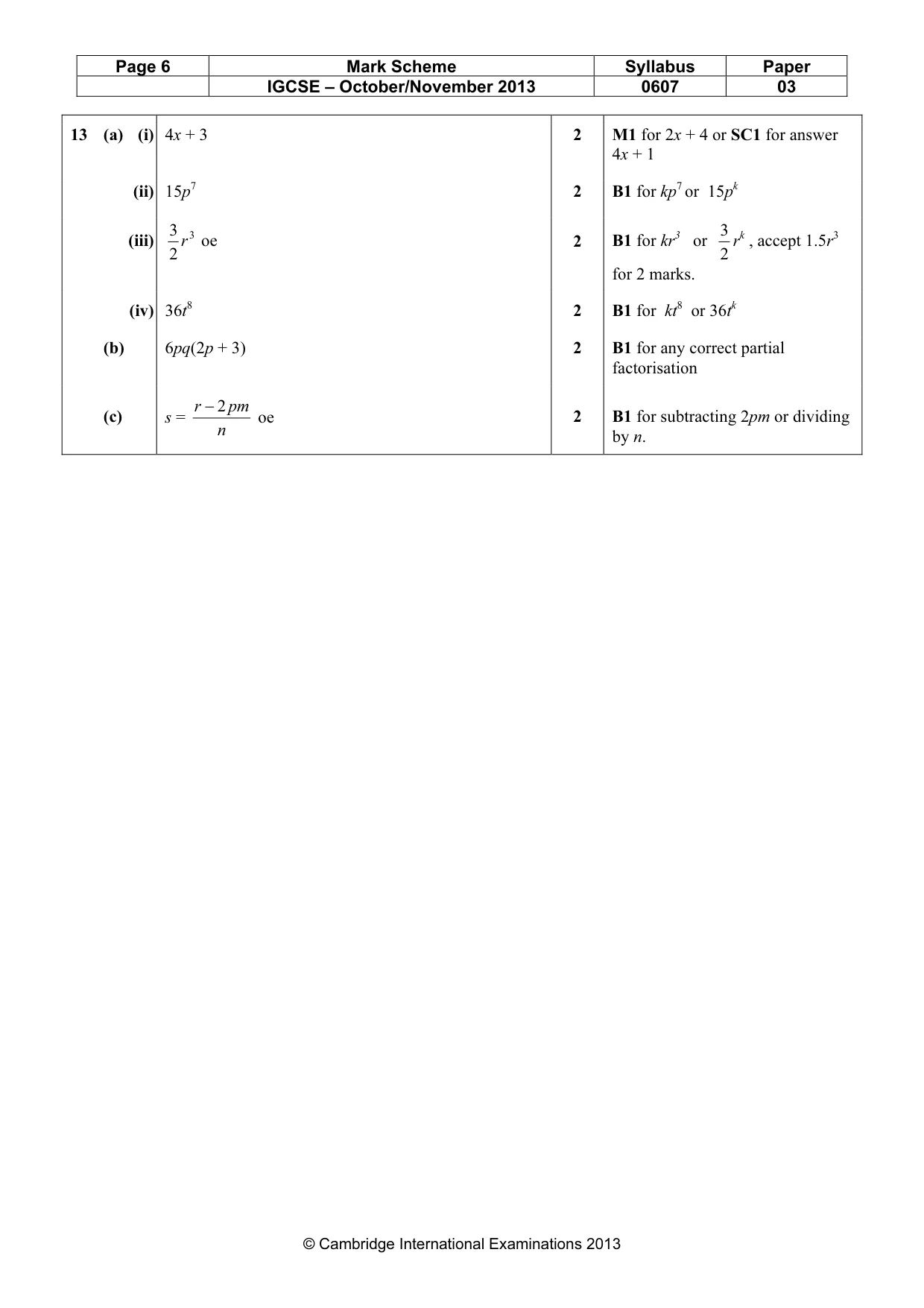
Page 6 Mark Scheme Syllabus Paper IGCSE – October/November 2013 0607 03 © Cambridge International Examinations 2013 13 (a) (i) 4x + 3 2 M1 for 2x + 4 or SC1 for answer 4x + 1 (ii) 15p7 2 B1 for kp7 or 15pk (iii) 3 2 3 r oe 2 B1 for kr3 or 2 3 rk , accept 1.5r3 for 2 marks. (iv) 36t8 2 B1 for kt8 or 36tk (b) 6pq(2p + 3) 2 B1 for any correct partial factorisation (c) s = n pm r 2 − oe 2 B1 for subtracting 2pm or dividing by n.
What you needed in this session
Cambridge’s own grade thresholds for 2013 Oct/Nov, Paper 3 · Variant 1. A higher threshold means an easier paper — the bar moves with how the cohort did.