Cambridge IGCSE Mathematics - International 0607 — 2012 May/June Paper 3 · Variant 3
0607/33/M/J/12 · 96 marks · ≈108 min
The question paper and its mark scheme, free to read here and free to download. This is Cambridge’s own paper, exactly as it was sat.
Question paper20 pages
Mark scheme5 pages
Answers below. Sit the paper first if you are practising.
Paper as text
Question paper, page 1
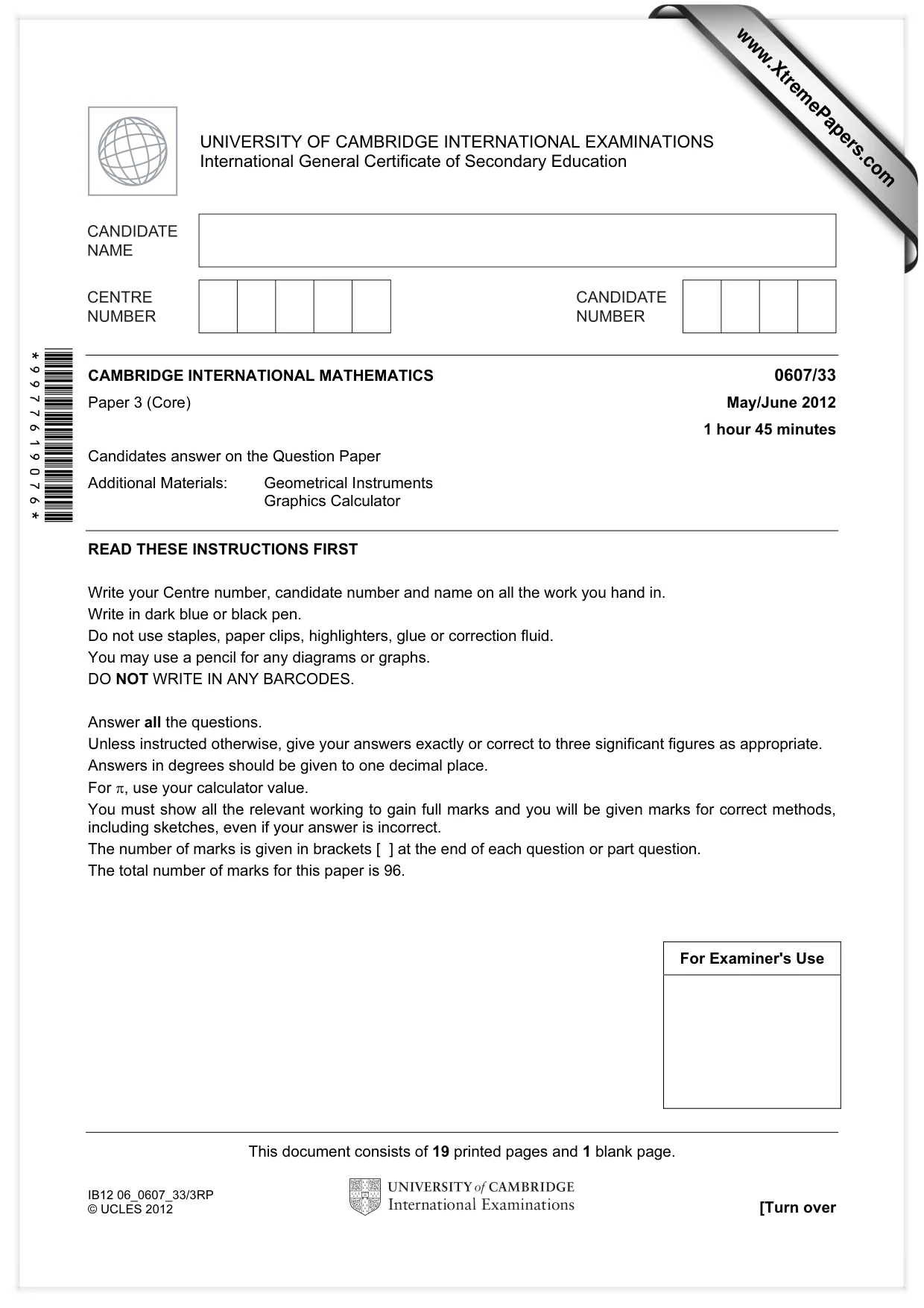
This document consists of 19 printed pages and 1 blank page. IB12 06_0607_33/3RP © UCLES 2012 [Turn over *9977619076* For Examiner's Use UNIVERSITY OF CAMBRIDGE INTERNATIONAL EXAMINATIONS International General Certificate of Secondary Education CAMBRIDGE INTERNATIONAL MATHEMATICS 0607/33 Paper 3 (Core) May/June 2012 1 hour 45 minutes Candidates answer on the Question Paper Additional Materials: Geometrical Instruments Graphics Calculator READ THESE INSTRUCTIONS FIRST Write your Centre number, candidate number and name on all the work you hand in. Write in dark blue or black pen. Do not use staples, paper clips, highlighters, glue or correction fluid. You may use a pencil for any diagrams or graphs. DO NOT WRITE IN ANY BARCODES. Answer all the questions. Unless instructed otherwise, give your answers exactly or correct to three significant figures as appropriate. Answers in degrees should be given to one decimal place. For π, use your calculator value. You must show all the relevant working to gain full marks and you will be given marks for correct methods, including sketches, even if your answer is incorrect. The number of marks is given in brackets [ ] at the end of each question or part question. The total number of marks for this paper is 96. www.XtremePapers.com
Question paper, page 2
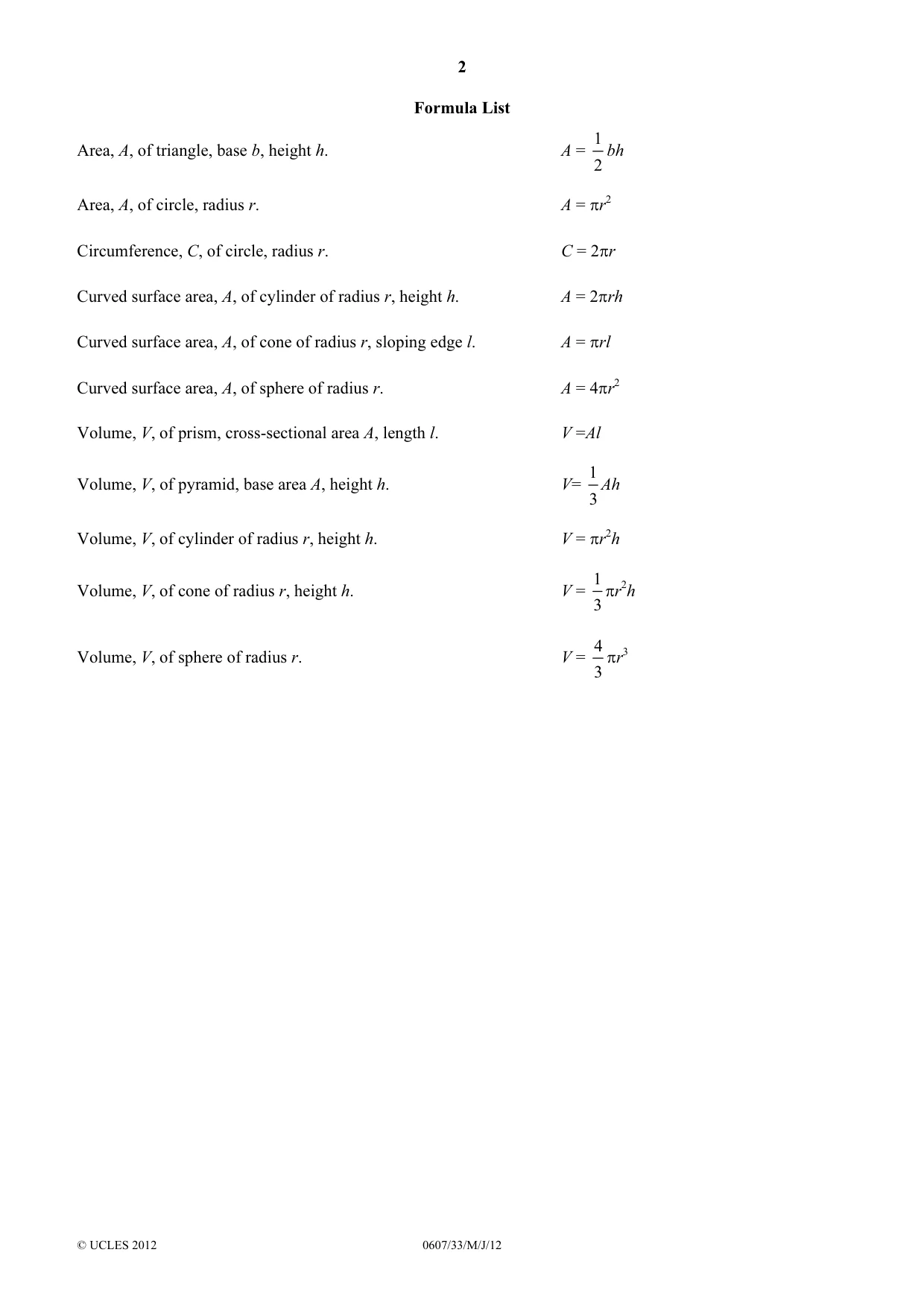
2 © UCLES 2012 0607/33/M/J/12 Formula List Area, A, of triangle, base b, height h. A = 1 2 bh Area, A, of circle, radius r. A = πr2 Circumference, C, of circle, radius r. C = 2πr Curved surface area, A, of cylinder of radius r, height h. A = 2πrh Curved surface area, A, of cone of radius r, sloping edge l. A = πrl Curved surface area, A, of sphere of radius r. A = 4πr2 Volume, V, of prism, cross-sectional area A, length l. V =Al Volume, V, of pyramid, base area A, height h. V= 1 3 Ah Volume, V, of cylinder of radius r, height h. V = πr2h Volume, V, of cone of radius r, height h. V = 1 3 πr2h Volume, V, of sphere of radius r. V = 4 3 πr3
Question paper, page 3
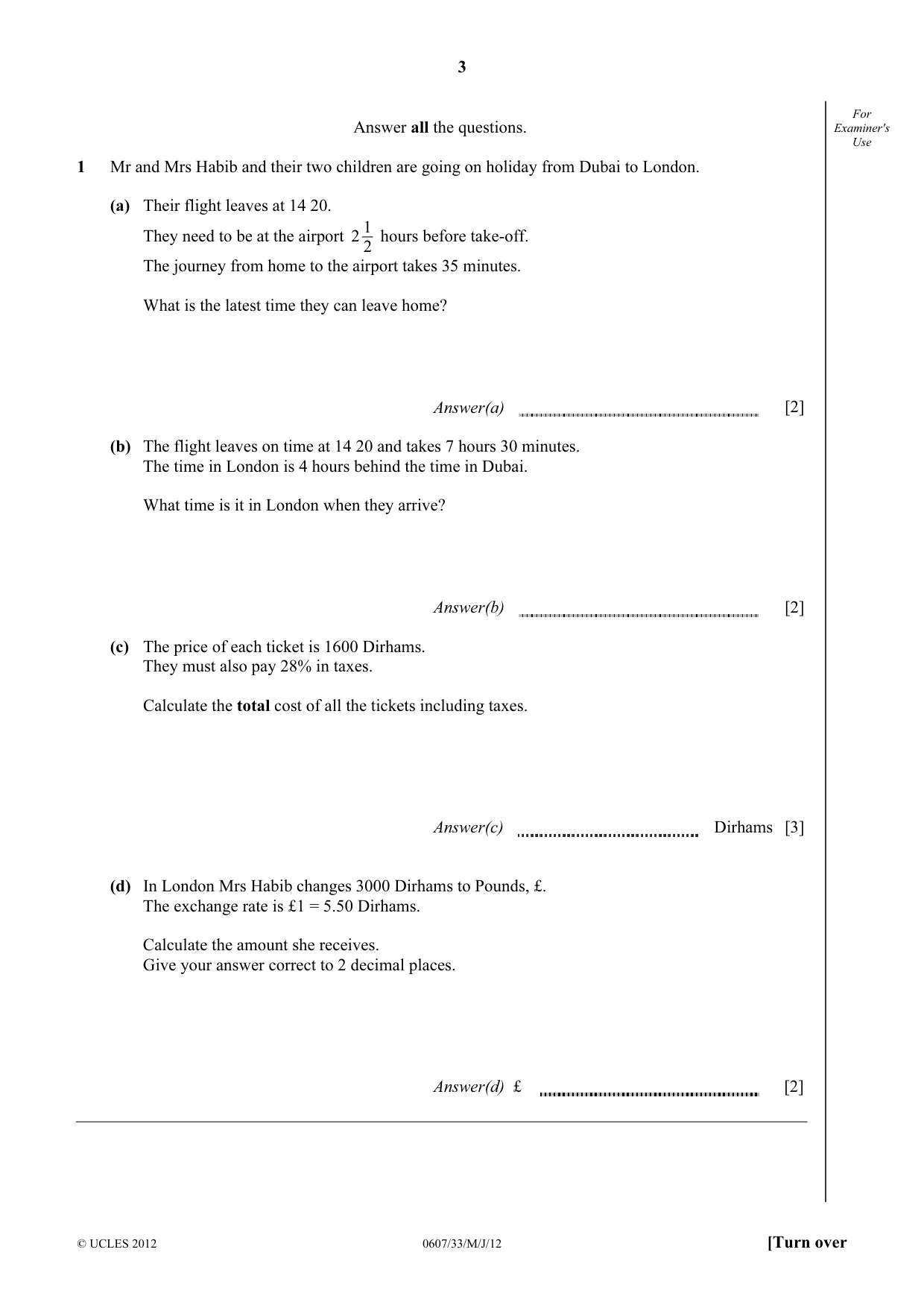
3 © UCLES 2012 0607/33/M/J/12 [Turn over For Examiner's Use Answer all the questions. 1 Mr and Mrs Habib and their two children are going on holiday from Dubai to London. (a) Their flight leaves at 14 20. They need to be at the airport 2 1 2 hours before take-off. The journey from home to the airport takes 35 minutes. What is the latest time they can leave home? Answer(a) [2] (b) The flight leaves on time at 14 20 and takes 7 hours 30 minutes. The time in London is 4 hours behind the time in Dubai. What time is it in London when they arrive? Answer(b) [2] (c) The price of each ticket is 1600 Dirhams. They must also pay 28% in taxes. Calculate the total cost of all the tickets including taxes. Answer(c) Dirhams [3] (d) In London Mrs Habib changes 3000 Dirhams to Pounds, £. The exchange rate is £1 = 5.50 Dirhams. Calculate the amount she receives. Give your answer correct to 2 decimal places. Answer(d) £ [2]
Question paper, page 4
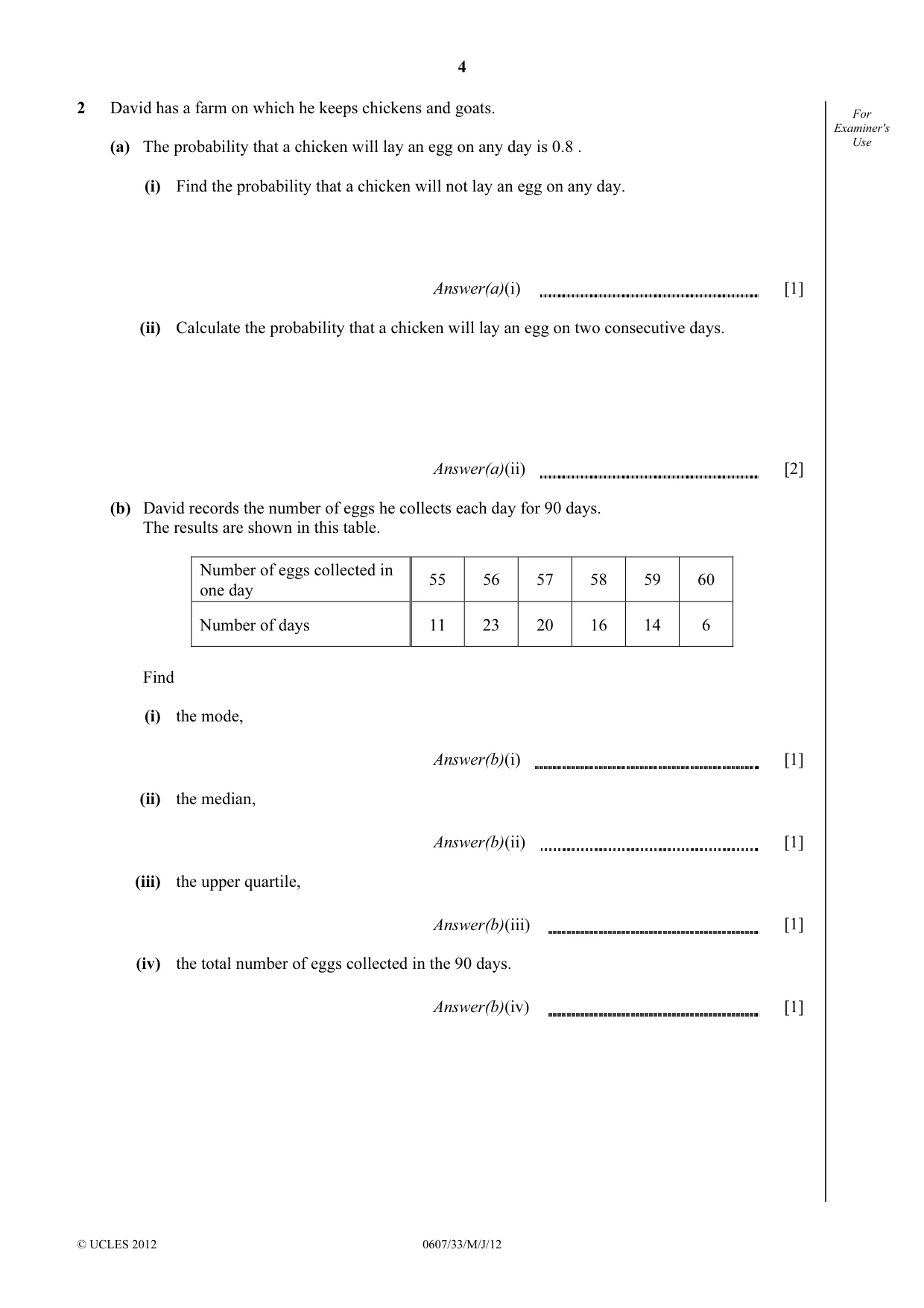
4 © UCLES 2012 0607/33/M/J/12 For Examiner's Use 2 David has a farm on which he keeps chickens and goats. (a) The probability that a chicken will lay an egg on any day is 0.8 . (i) Find the probability that a chicken will not lay an egg on any day. Answer(a)(i) [1] (ii) Calculate the probability that a chicken will lay an egg on two consecutive days. Answer(a)(ii) [2] (b) David records the number of eggs he collects each day for 90 days. The results are shown in this table. Number of eggs collected in one day 55 56 57 58 59 60 Number of days 11 23 20 16 14 6 Find (i) the mode, Answer(b)(i) [1] (ii) the median, Answer(b)(ii) [1] (iii) the upper quartile, Answer(b)(iii) [1] (iv) the total number of eggs collected in the 90 days. Answer(b)(iv) [1]
Question paper, page 5
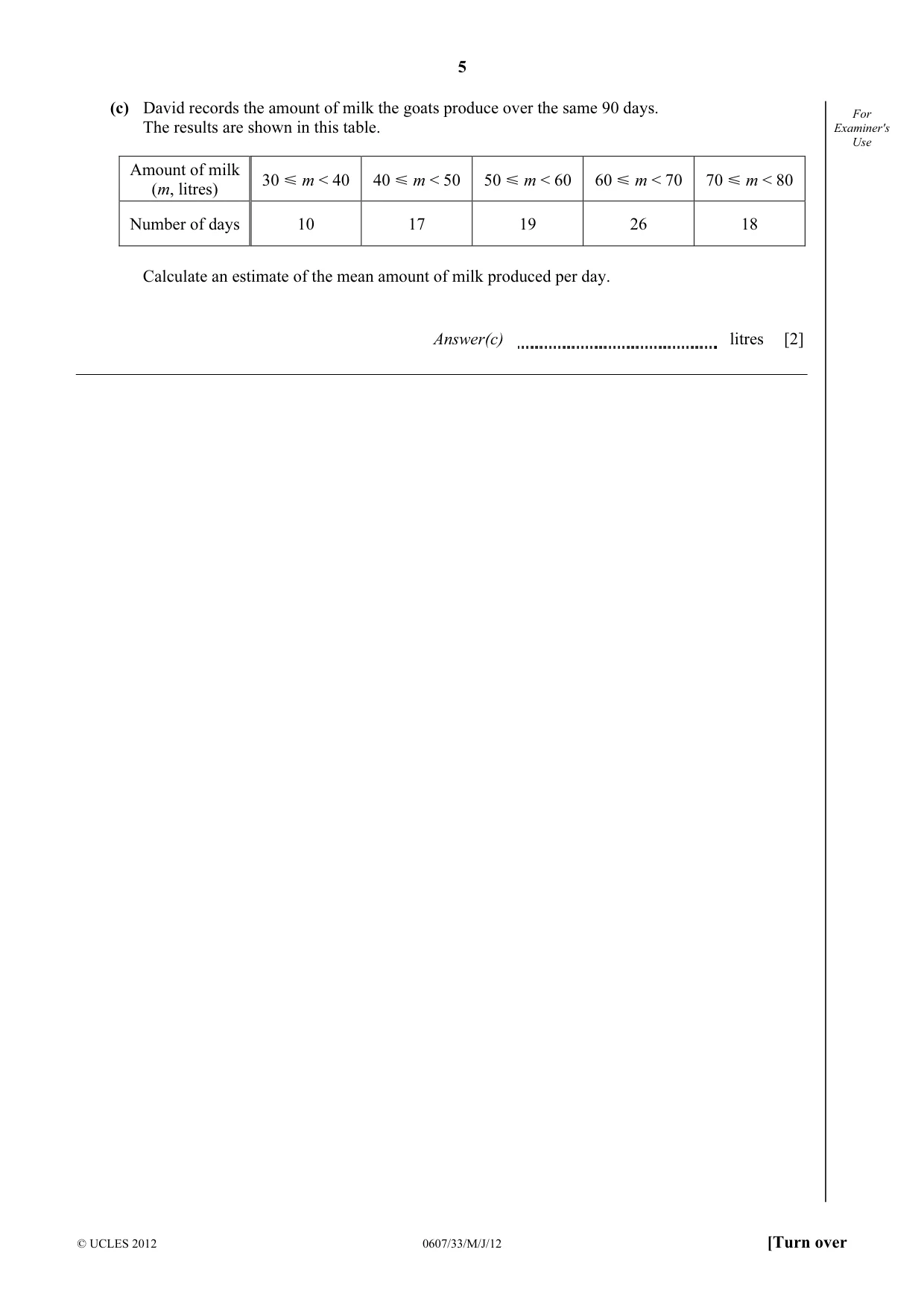
5 © UCLES 2012 0607/33/M/J/12 [Turn over For Examiner's Use (c) David records the amount of milk the goats produce over the same 90 days. The results are shown in this table. Amount of milk (m, litres) 30 Y m < 40 40 Y m < 50 50 Y m < 60 60 Y m < 70 70 Y m < 80 Number of days 10 17 19 26 18 Calculate an estimate of the mean amount of milk produced per day. Answer(c) litres [2]
Question paper, page 6
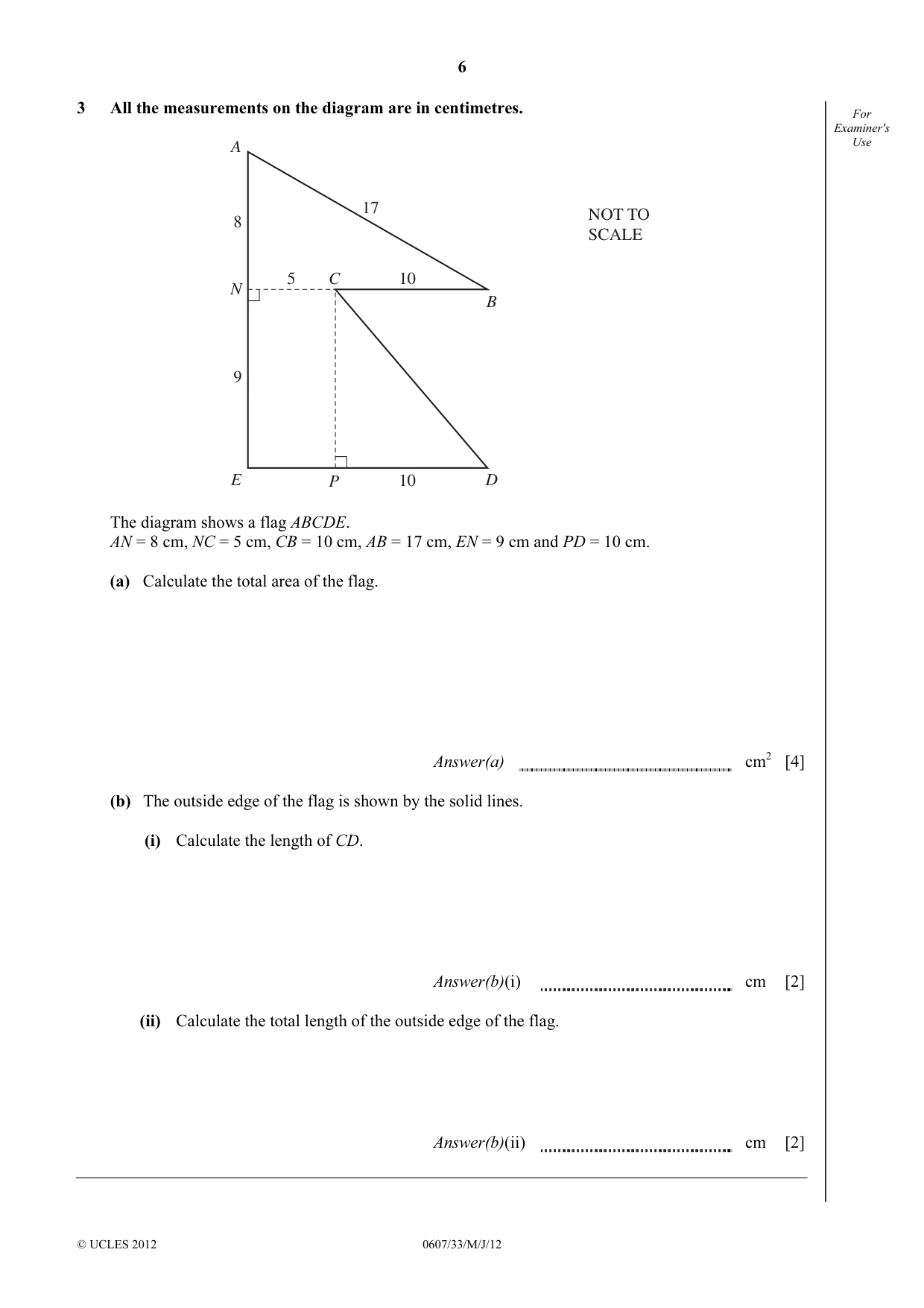
6 © UCLES 2012 0607/33/M/J/12 For Examiner's Use 3 All the measurements on the diagram are in centimetres. A N E P D B C 17 5 8 9 10 10 NOT TO SCALE The diagram shows a flag ABCDE. AN = 8 cm, NC = 5 cm, CB = 10 cm, AB = 17 cm, EN = 9 cm and PD = 10 cm. (a) Calculate the total area of the flag. Answer(a) cm2 [4] (b) The outside edge of the flag is shown by the solid lines. (i) Calculate the length of CD. Answer(b)(i) cm [2] (ii) Calculate the total length of the outside edge of the flag. Answer(b)(ii) cm [2]
Question paper, page 7
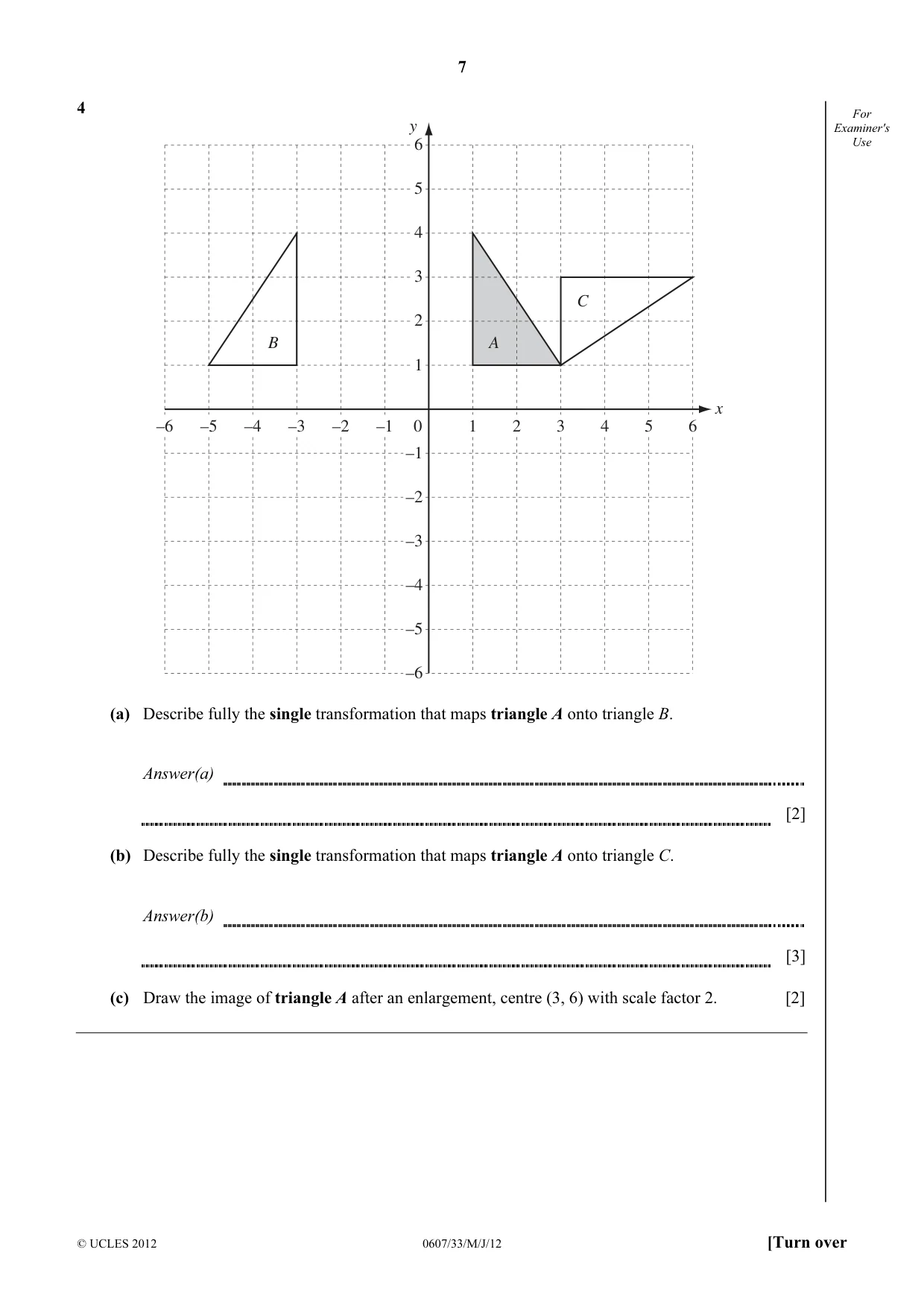
7 © UCLES 2012 0607/33/M/J/12 [Turn over For Examiner's Use 4 B A C y x –6 –5 –4 –3 –2 –1 0 1 2 3 4 5 6 6 5 4 3 2 1 –1 –2 –3 –4 –5 –6 (a) Describe fully the single transformation that maps triangle A onto triangle B. Answer(a) [2] (b) Describe fully the single transformation that maps triangle A onto triangle C. Answer(b) [3] (c) Draw the image of triangle A after an enlargement, centre (3, 6) with scale factor 2. [2]
Question paper, page 8
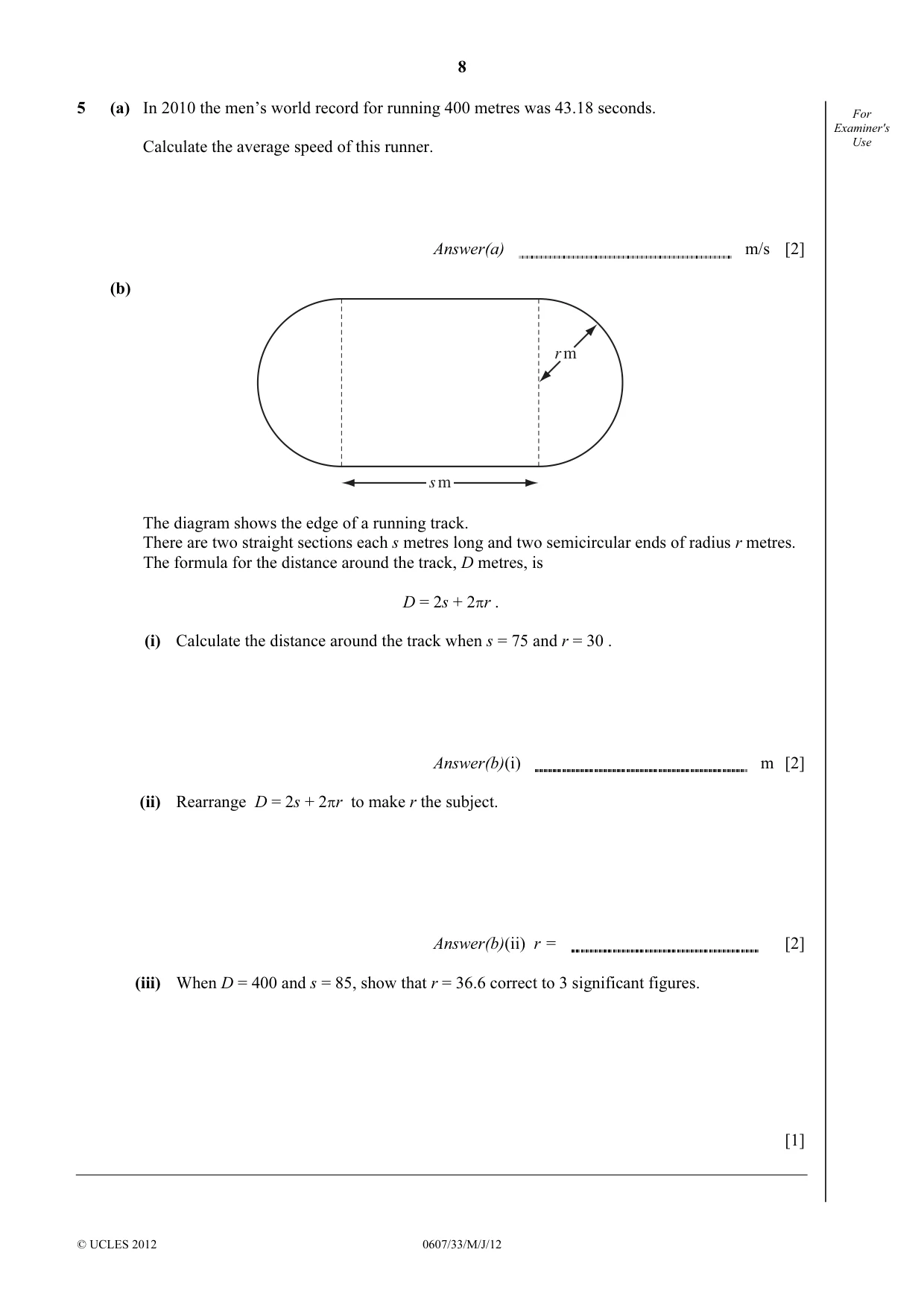
8 © UCLES 2012 0607/33/M/J/12 For Examiner's Use 5 (a) In 2010 the men’s world record for running 400 metres was 43.18 seconds. Calculate the average speed of this runner. Answer(a) m/s [2] (b) r m s m The diagram shows the edge of a running track. There are two straight sections each s metres long and two semicircular ends of radius r metres. The formula for the distance around the track, D metres, is D = 2s + 2πr . (i) Calculate the distance around the track when s = 75 and r = 30 . Answer(b)(i) m [2] (ii) Rearrange D = 2s + 2πr to make r the subject. Answer(b)(ii) r = [2] (iii) When D = 400 and s = 85, show that r = 36.6 correct to 3 significant figures. [1]
Question paper, page 9
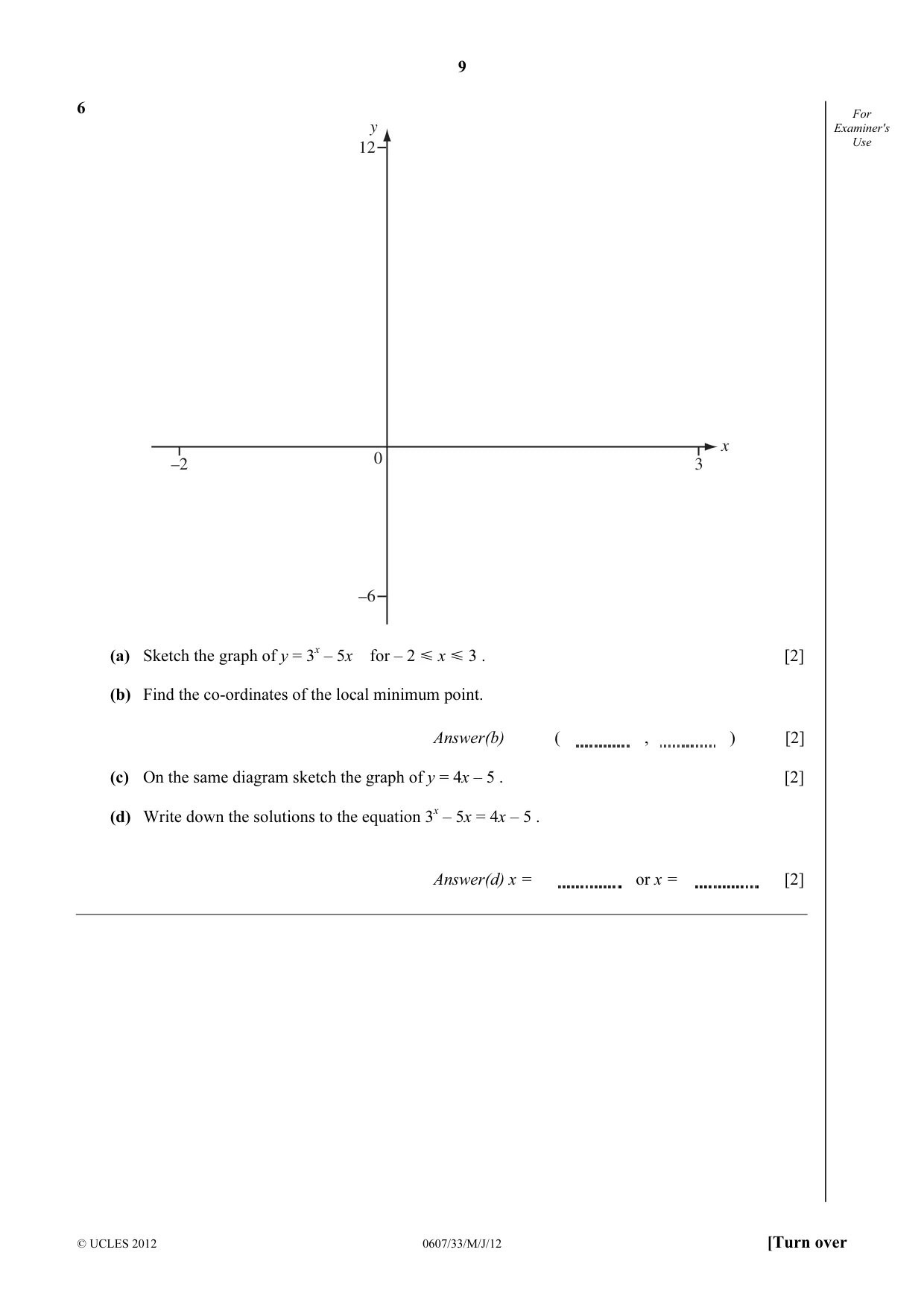
9 © UCLES 2012 0607/33/M/J/12 [Turn over For Examiner's Use 6 y x 12 –6 –2 0 3 (a) Sketch the graph of y = 3x – 5x for – 2 Y x Y 3 . [2] (b) Find the co-ordinates of the local minimum point. Answer(b) ( , ) [2] (c) On the same diagram sketch the graph of y = 4x – 5 . [2] (d) Write down the solutions to the equation 3x – 5x = 4x – 5 . Answer(d) x = or x = [2]
Question paper, page 10
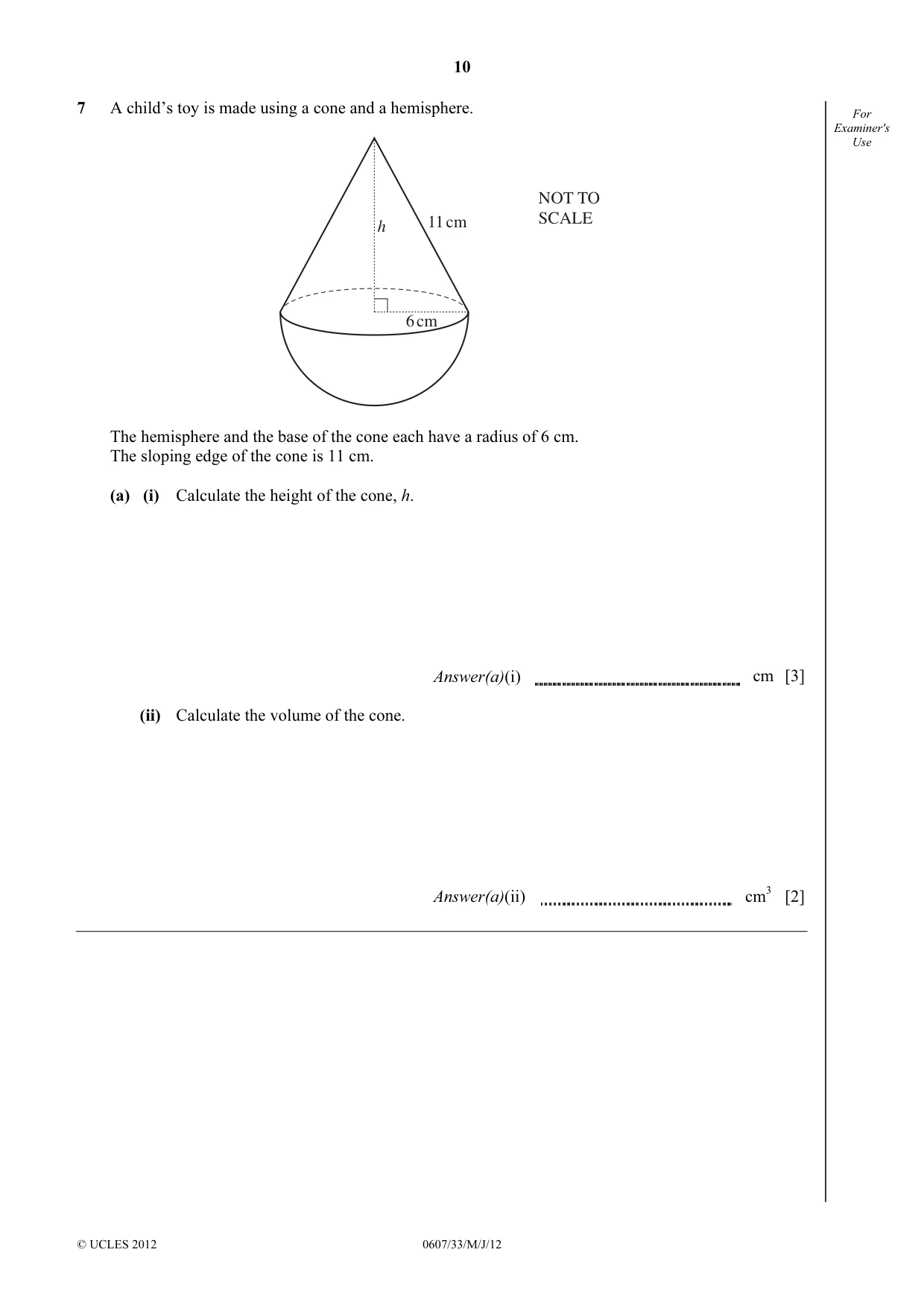
10 © UCLES 2012 0607/33/M/J/12 For Examiner's Use 7 A child’s toy is made using a cone and a hemisphere. h 11 cm 6 cm NOT TO SCALE The hemisphere and the base of the cone each have a radius of 6 cm. The sloping edge of the cone is 11 cm. (a) (i) Calculate the height of the cone, h. Answer(a)(i) cm [3] (ii) Calculate the volume of the cone. Answer(a)(ii) cm3 [2]
Question paper, page 11
11 © UCLES 2012 0607/33/M/J/12 [Turn over For Examiner's Use (b) (i) Calculate the curved surface area of the cone. Answer(b)(i) cm2 [2] (ii) Calculate the total surface area of the toy. Answer(b)(ii) cm2 [3]
Question paper, page 12
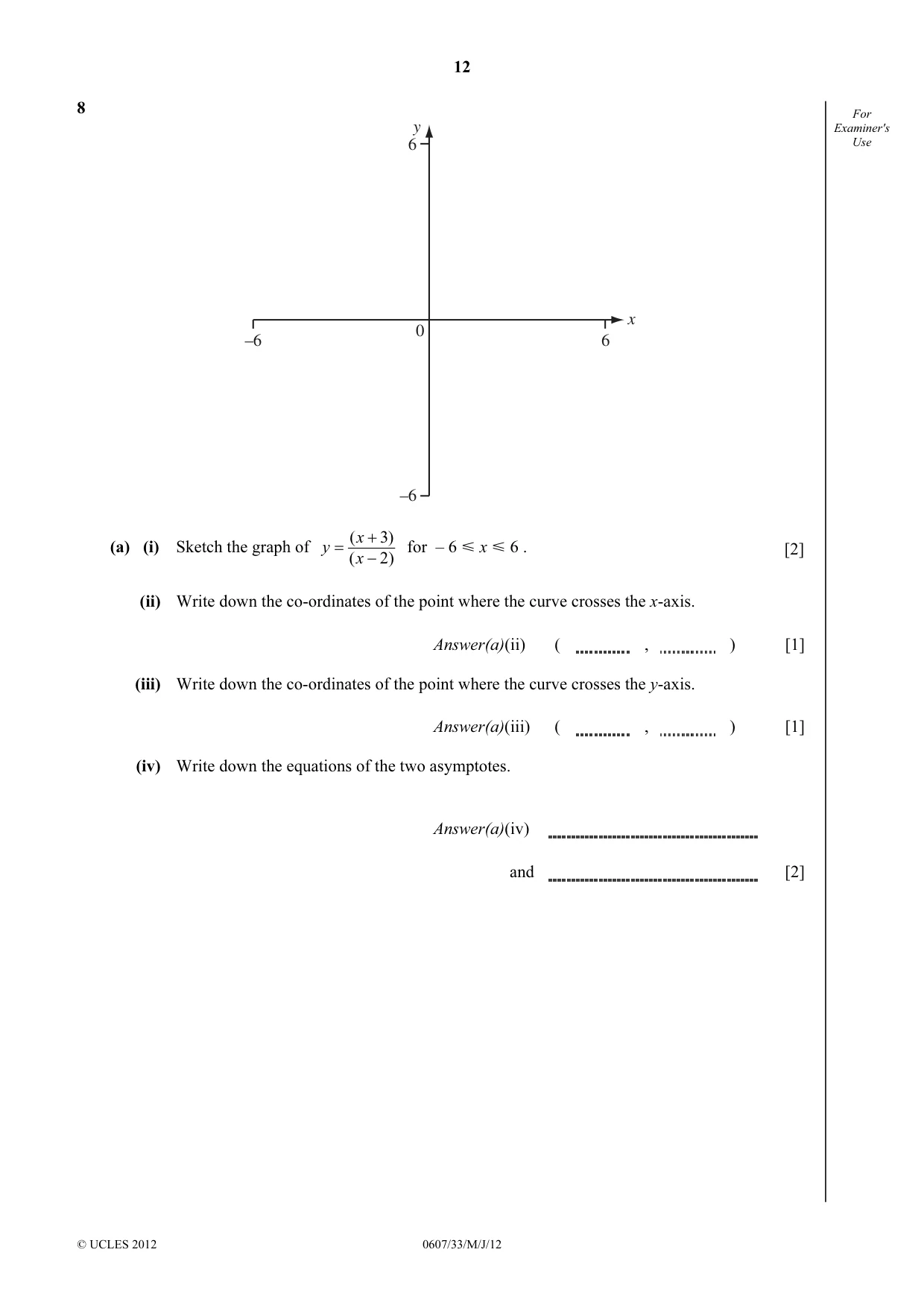
12 © UCLES 2012 0607/33/M/J/12 For Examiner's Use 8 6 6 –6 –6 0 y x (a) (i) Sketch the graph of ) 2 ( ) 3 ( − + = x x y for – 6 Y x Y 6 . [2] (ii) Write down the co-ordinates of the point where the curve crosses the x-axis. Answer(a)(ii) ( , ) [1] (iii) Write down the co-ordinates of the point where the curve crosses the y-axis. Answer(a)(iii) ( , ) [1] (iv) Write down the equations of the two asymptotes. Answer(a)(iv) and [2]
Question paper, page 13
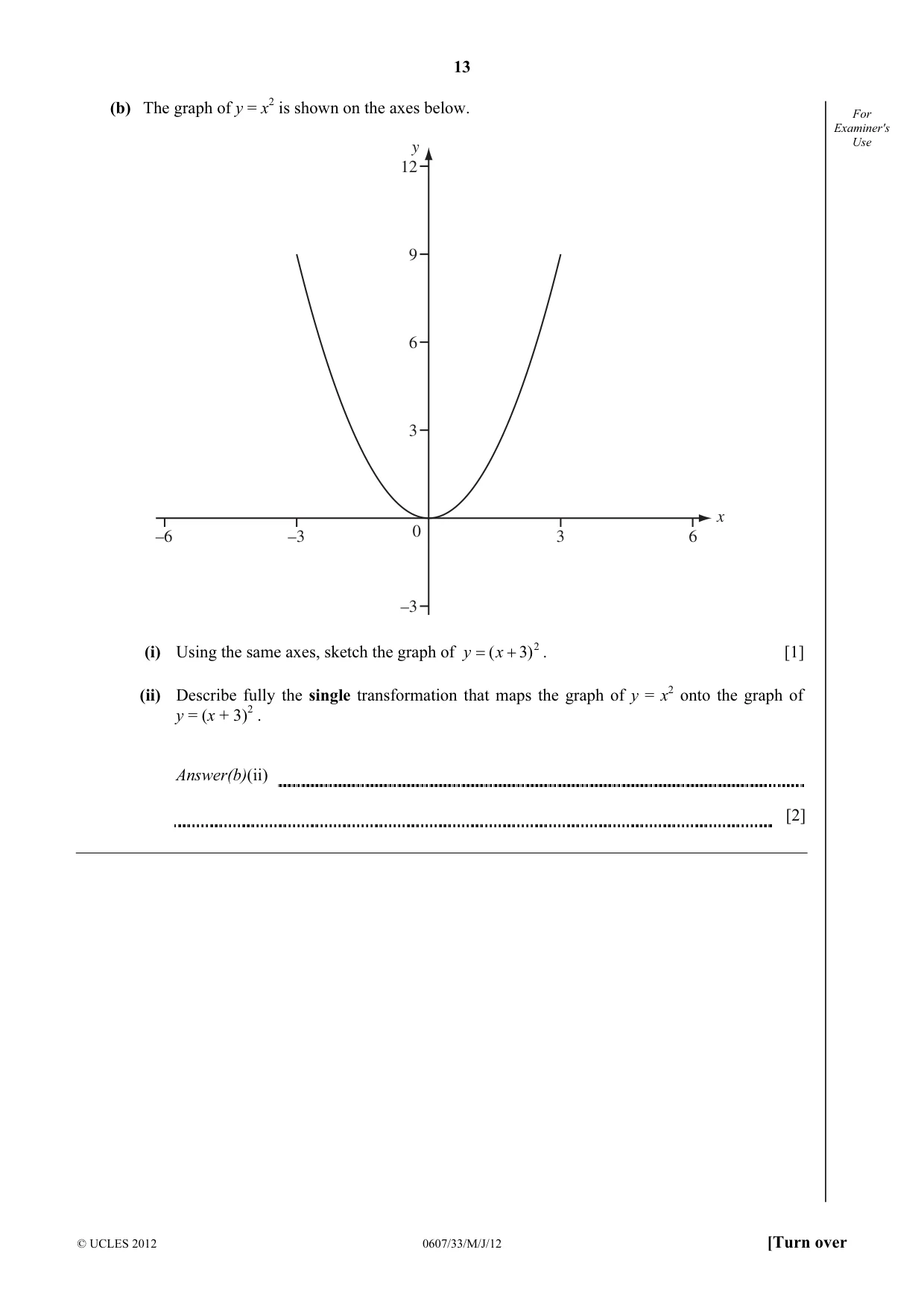
13 © UCLES 2012 0607/33/M/J/12 [Turn over For Examiner's Use (b) The graph of y = x2 is shown on the axes below. 12 9 6 3 –3 0 3 6 –6 –3 y x (i) Using the same axes, sketch the graph of 2) 3 ( + = x y . [1] (ii) Describe fully the single transformation that maps the graph of y = x2 onto the graph of y = (x + 3)2 . Answer(b)(ii) [2]
Question paper, page 14
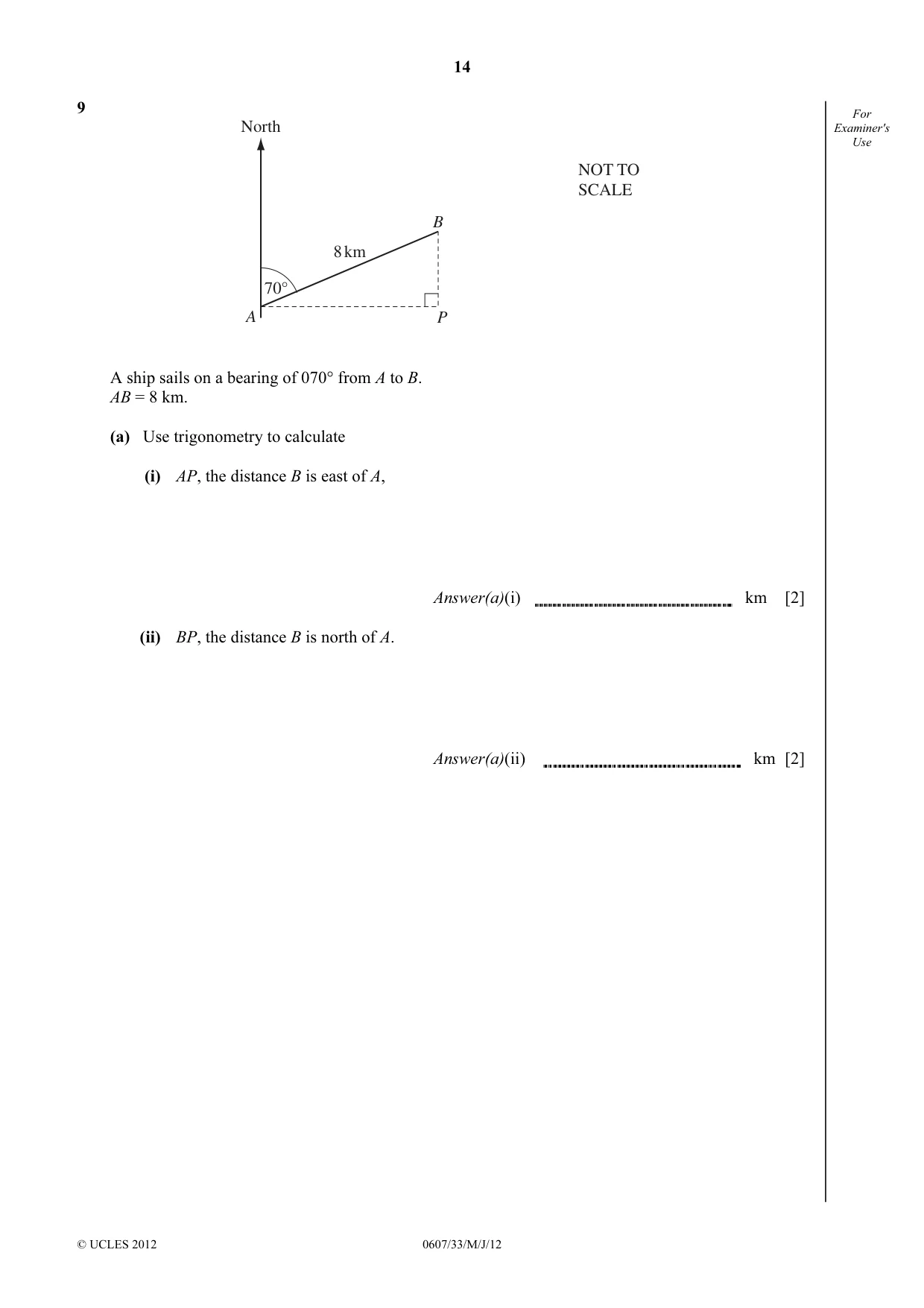
14 © UCLES 2012 0607/33/M/J/12 For Examiner's Use 9 North 70° A P B 8 km NOT TO SCALE A ship sails on a bearing of 070° from A to B. AB = 8 km. (a) Use trigonometry to calculate (i) AP, the distance B is east of A, Answer(a)(i) km [2] (ii) BP, the distance B is north of A. Answer(a)(ii) km [2]
Question paper, page 15
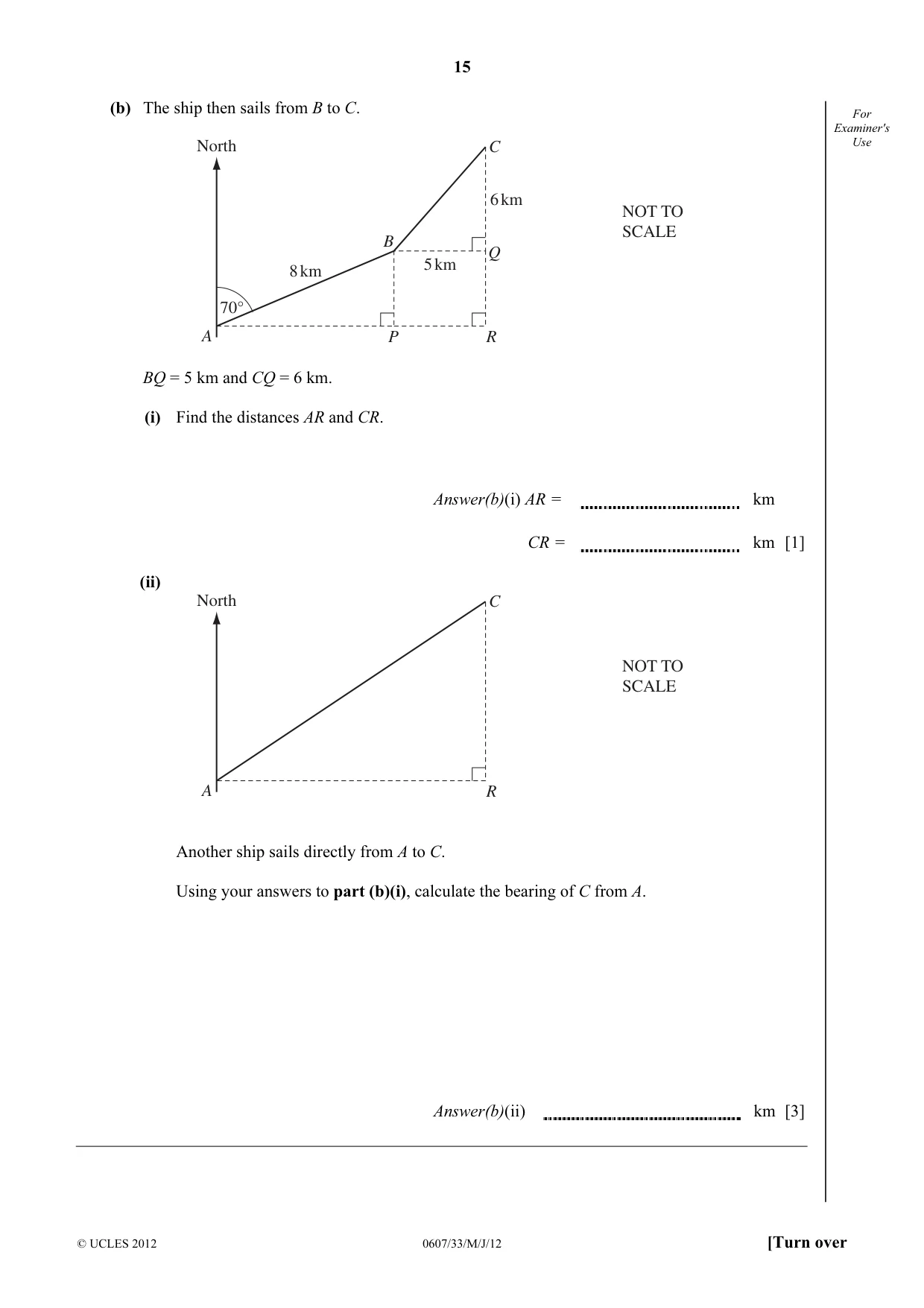
15 © UCLES 2012 0607/33/M/J/12 [Turn over For Examiner's Use (b) The ship then sails from B to C. North 70° A P R Q C B 8 km 5 km 6 km NOT TO SCALE BQ = 5 km and CQ = 6 km. (i) Find the distances AR and CR. Answer(b)(i) AR = km CR = km [1] (ii) North A R C NOT TO SCALE Another ship sails directly from A to C. Using your answers to part (b)(i), calculate the bearing of C from A. Answer(b)(ii) km [3]
Question paper, page 16
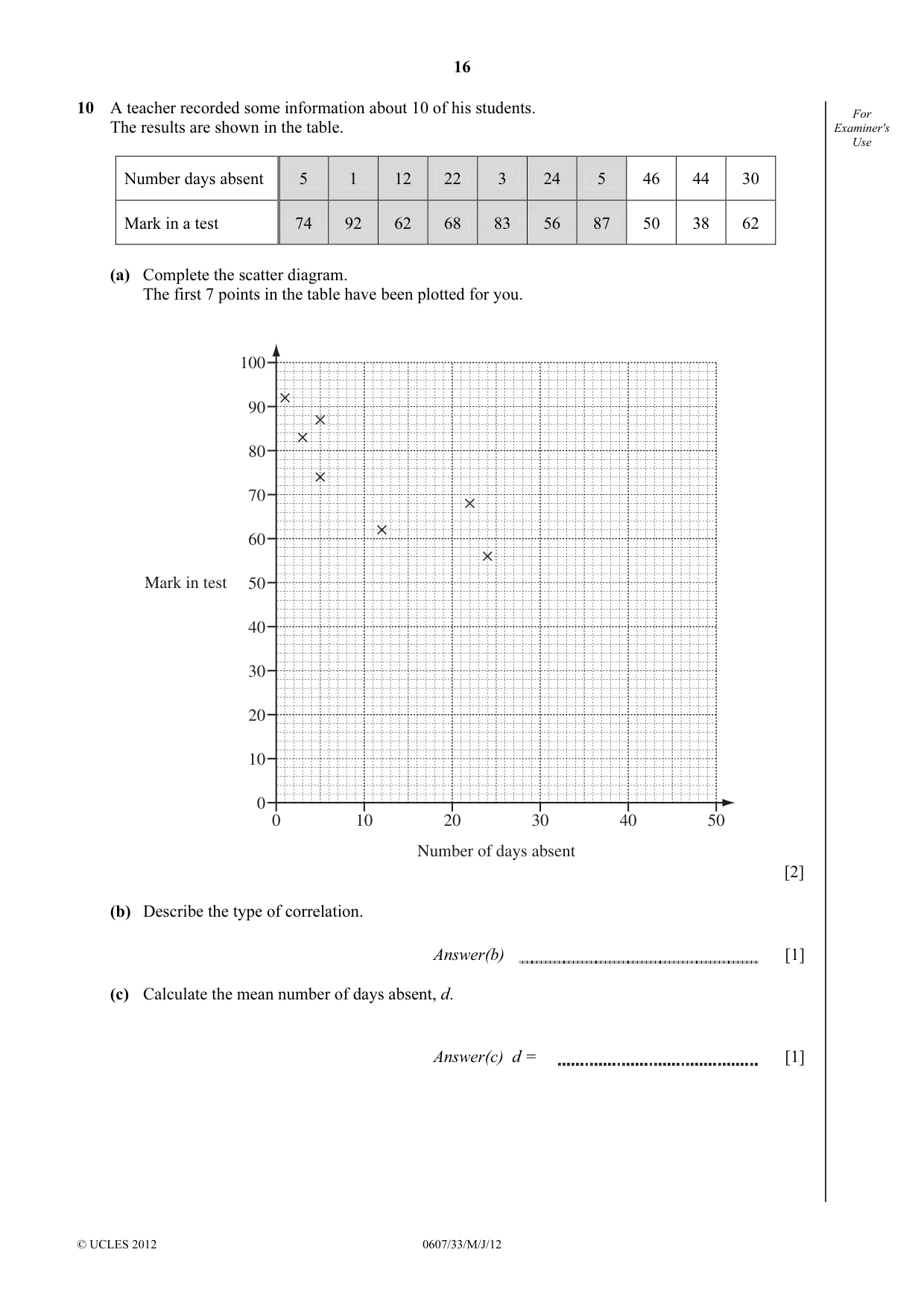
16 © UCLES 2012 0607/33/M/J/12 For Examiner's Use 10 A teacher recorded some information about 10 of his students. The results are shown in the table. Number days absent 5 1 12 22 3 24 5 46 44 30 Mark in a test 74 92 62 68 83 56 87 50 38 62 (a) Complete the scatter diagram. The first 7 points in the table have been plotted for you. 100 90 80 70 60 50 40 30 20 10 0 0 10 20 30 40 50 Mark in test Number of days absent [2] (b) Describe the type of correlation. Answer(b) [1] (c) Calculate the mean number of days absent, d. Answer(c) d = [1]
Question paper, page 17
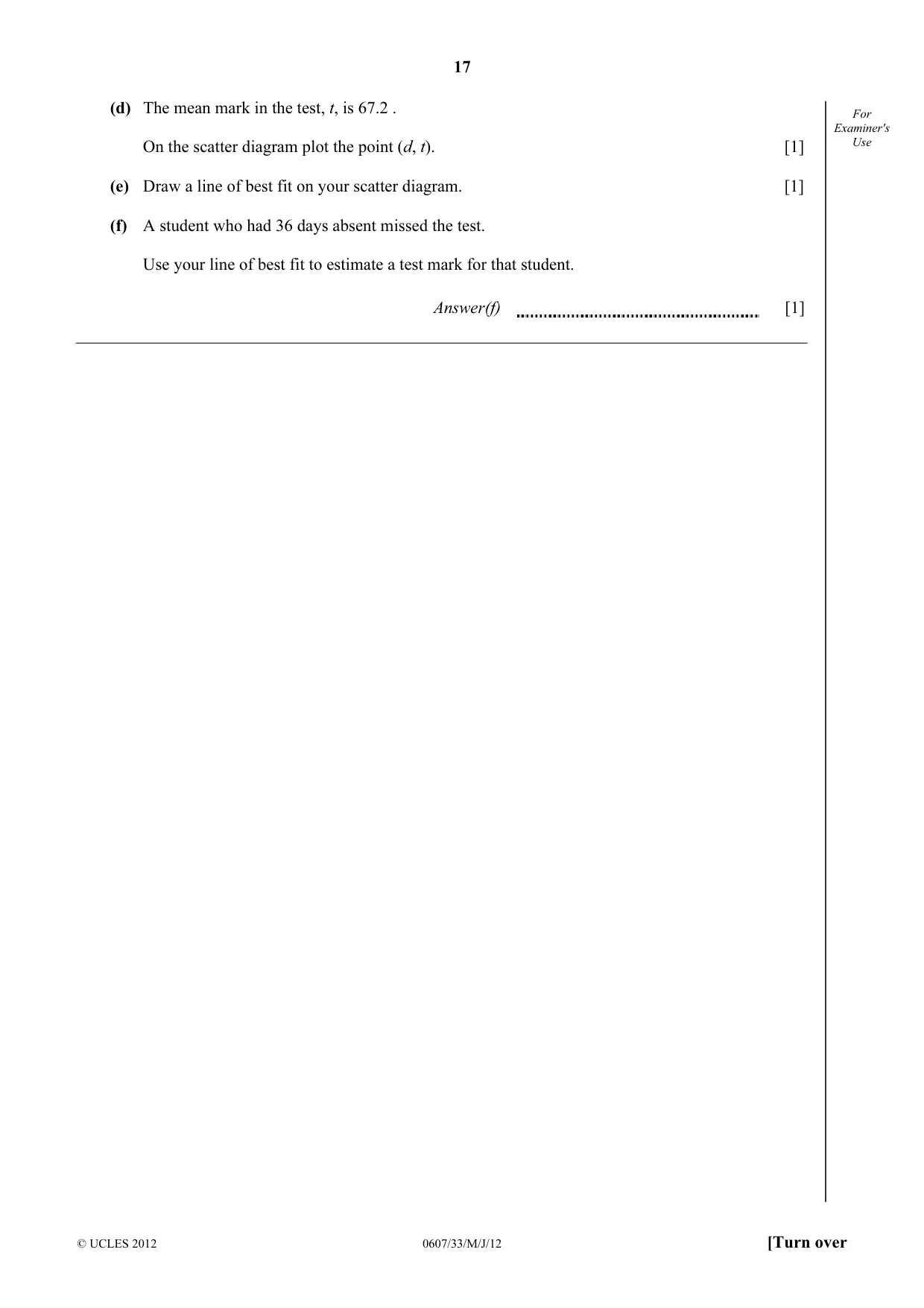
17 © UCLES 2012 0607/33/M/J/12 [Turn over For Examiner's Use (d) The mean mark in the test, t, is 67.2 . On the scatter diagram plot the point (d, t). [1] (e) Draw a line of best fit on your scatter diagram. [1] (f) A student who had 36 days absent missed the test. Use your line of best fit to estimate a test mark for that student. Answer(f) [1]
Question paper, page 18
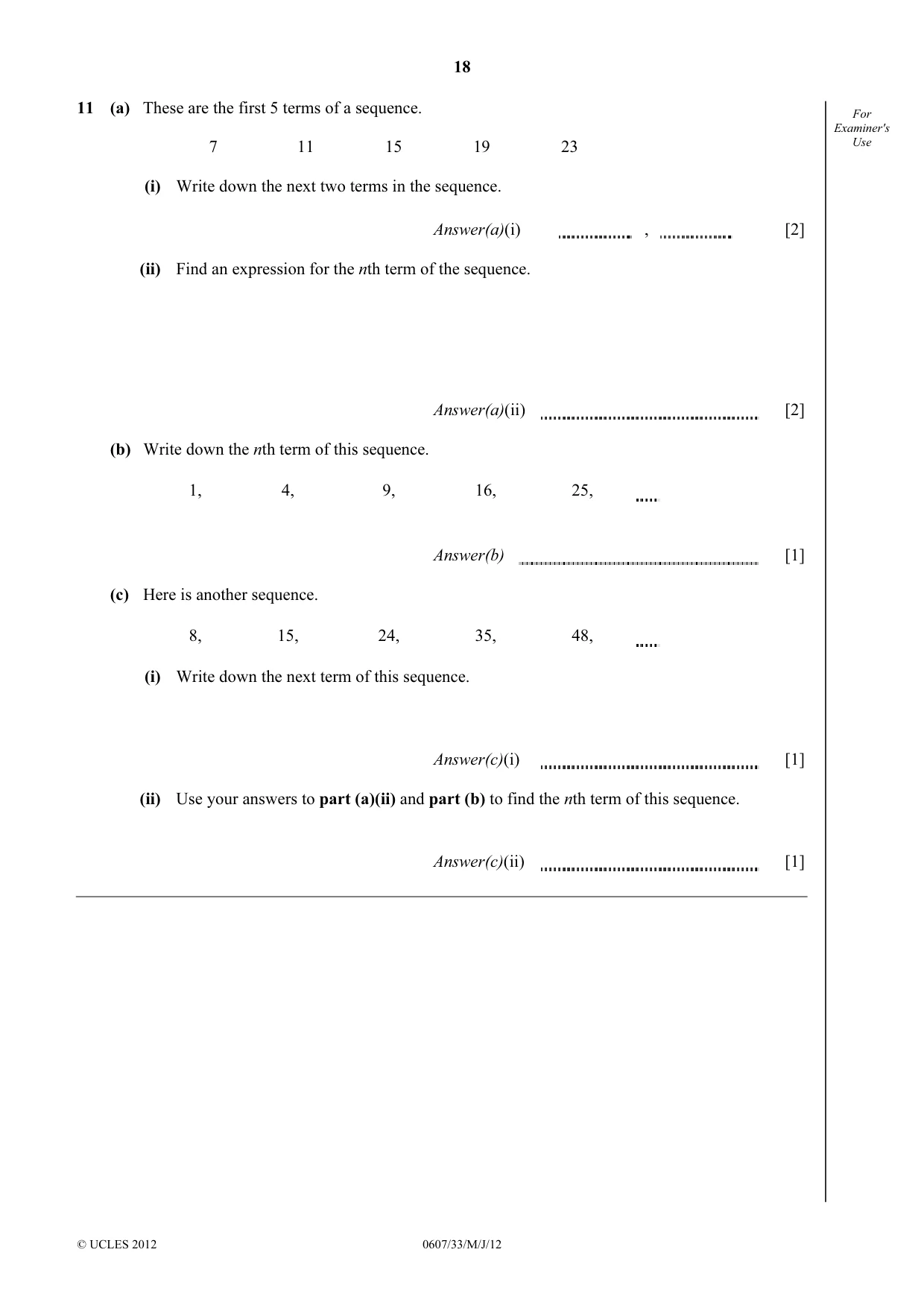
18 © UCLES 2012 0607/33/M/J/12 For Examiner's Use 11 (a) These are the first 5 terms of a sequence. 7 11 15 19 23 (i) Write down the next two terms in the sequence. Answer(a)(i) , [2] (ii) Find an expression for the nth term of the sequence. Answer(a)(ii) [2] (b) Write down the nth term of this sequence. 1, 4, 9, 16, 25, Answer(b) [1] (c) Here is another sequence. 8, 15, 24, 35, 48, (i) Write down the next term of this sequence. Answer(c)(i) [1] (ii) Use your answers to part (a)(ii) and part (b) to find the nth term of this sequence. Answer(c)(ii) [1]
Question paper, page 19
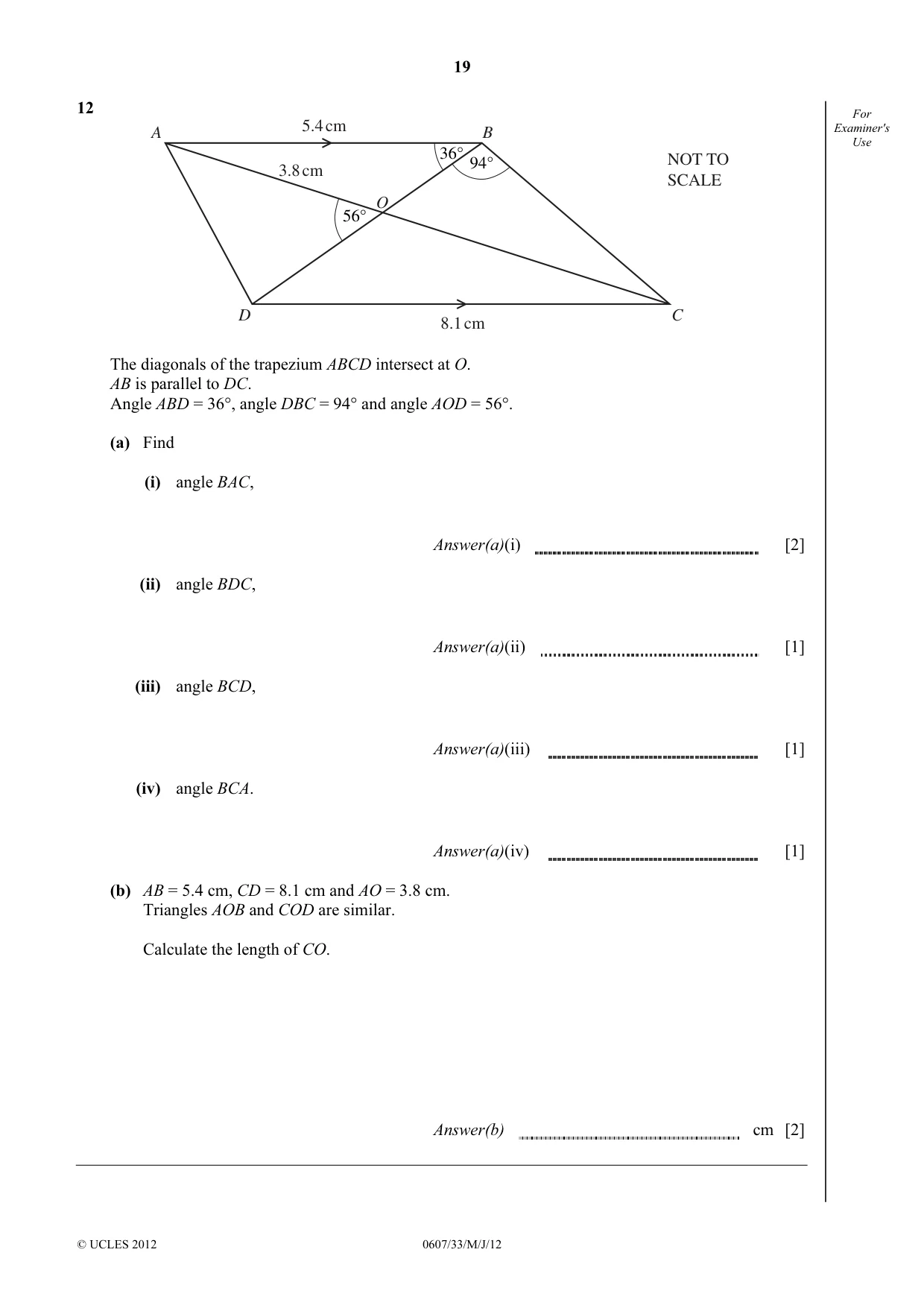
19 © UCLES 2012 0607/33/M/J/12 For Examiner's Use 12 O 36° 94° 56° 5.4 cm 3.8 cm 8.1 cm A B D C NOT TO SCALE The diagonals of the trapezium ABCD intersect at O. AB is parallel to DC. Angle ABD = 36°, angle DBC = 94° and angle AOD = 56°. (a) Find (i) angle BAC, Answer(a)(i) [2] (ii) angle BDC, Answer(a)(ii) [1] (iii) angle BCD, Answer(a)(iii) [1] (iv) angle BCA. Answer(a)(iv) [1] (b) AB = 5.4 cm, CD = 8.1 cm and AO = 3.8 cm. Triangles AOB and COD are similar. Calculate the length of CO. Answer(b) cm [2]
Question paper, page 20
20 Permission to reproduce items where third-party owned material protected by copyright is included has been sought and cleared where possible. Every reasonable effort has been made by the publisher (UCLES) to trace copyright holders, but if any items requiring clearance have unwittingly been included, the publisher will be pleased to make amends at the earliest possible opportunity. University of Cambridge International Examinations is part of the Cambridge Assessment Group. Cambridge Assessment is the brand name of University of Cambridge Local Examinations Syndicate (UCLES), which is itself a department of the University of Cambridge. © UCLES 2012 0607/33/M/J/12 BLANK PAGE
Mark scheme, page 1
UNIVERSITY OF CAMBRIDGE INTERNATIONAL EXAMINATIONS International General Certificate of Secondary Education MARK SCHEME for the May/June 2012 question paper for the guidance of teachers 0607 CAMBRIDGE INTERNATIONAL MATHEMATICS 0607/33 Paper 3 (Core), maximum raw mark 96 This mark scheme is published as an aid to teachers and candidates, to indicate the requirements of the examination. It shows the basis on which Examiners were instructed to award marks. It does not indicate the details of the discussions that took place at an Examiners’ meeting before marking began, which would have considered the acceptability of alternative answers. Mark schemes must be read in conjunction with the question papers and the report on the examination. • Cambridge will not enter into discussions or correspondence in connection with these mark schemes. Cambridge is publishing the mark schemes for the May/June 2012 question papers for most IGCSE, GCE Advanced Level and Advanced Subsidiary Level syllabuses and some Ordinary Level syllabuses. www.XtremePapers.com
Mark scheme, page 2
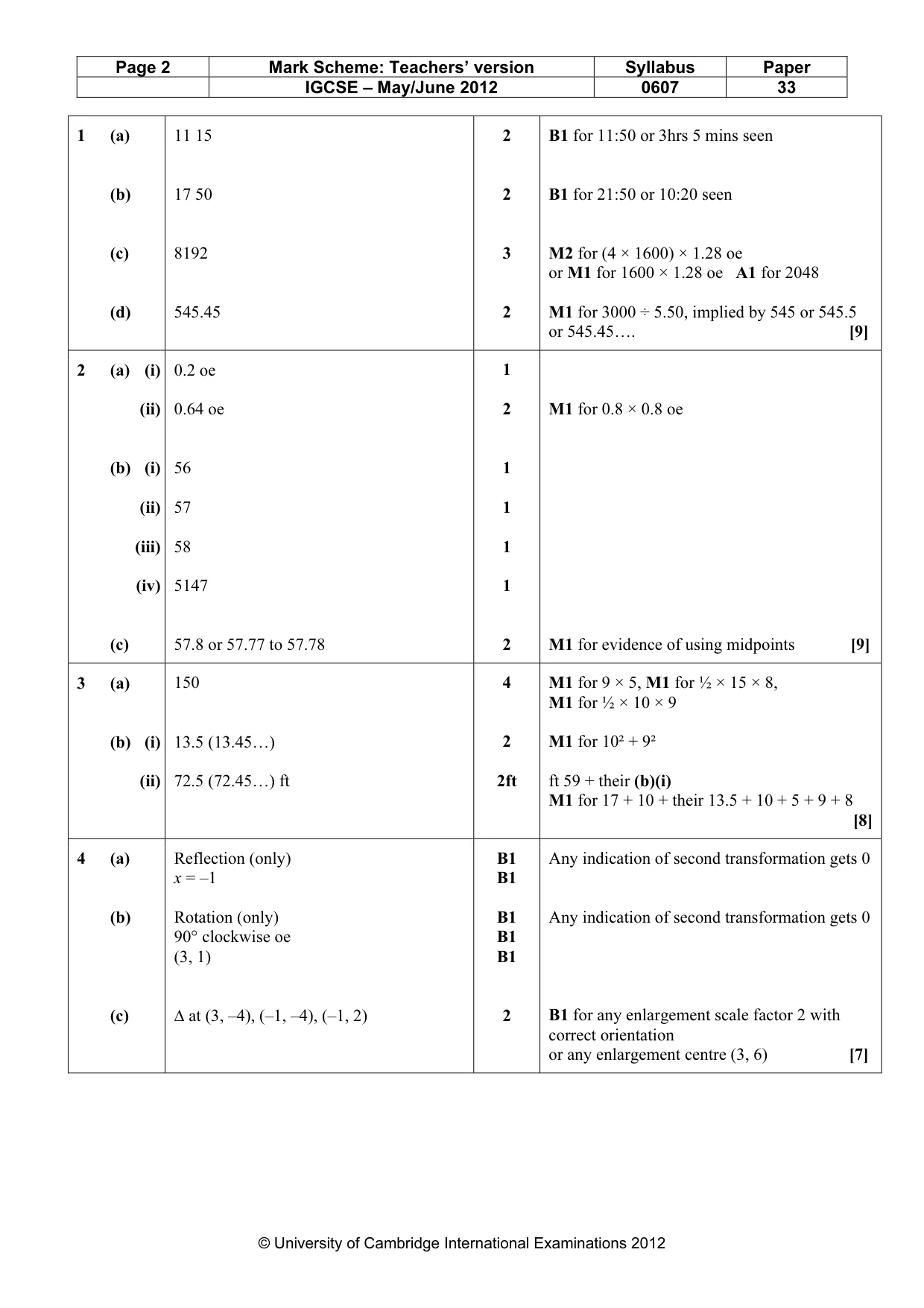
Page 2 Mark Scheme: Teachers’ version Syllabus Paper IGCSE – May/June 2012 0607 33 © University of Cambridge International Examinations 2012 1 (a) (b) (c) (d) 11 15 17 50 8192 545.45 2 2 3 2 B1 for 11:50 or 3hrs 5 mins seen B1 for 21:50 or 10:20 seen M2 for (4 × 1600) × 1.28 oe or M1 for 1600 × 1.28 oe A1 for 2048 M1 for 3000 ÷ 5.50, implied by 545 or 545.5 or 545.45…. [9] 2 (a) (i) (ii) (b) (i) (ii) (iii) (iv) (c) 0.2 oe 0.64 oe 56 57 58 5147 57.8 or 57.77 to 57.78 1 2 1 1 1 1 2 M1 for 0.8 × 0.8 oe M1 for evidence of using midpoints [9] 3 (a) (b) (i) (ii) 150 13.5 (13.45…) 72.5 (72.45…) ft 4 2 2ft M1 for 9 × 5, M1 for ½ × 15 × 8, M1 for ½ × 10 × 9 M1 for 10² + 9² ft 59 + their (b)(i) M1 for 17 + 10 + their 13.5 + 10 + 5 + 9 + 8 [8] 4 (a) (b) (c) Reflection (only) x = –1 Rotation (only) 90° clockwise oe (3, 1) ∆ at (3, –4), (–1, –4), (–1, 2) B1 B1 B1 B1 B1 2 Any indication of second transformation gets 0 Any indication of second transformation gets 0 B1 for any enlargement scale factor 2 with correct orientation or any enlargement centre (3, 6) [7]
Mark scheme, page 3
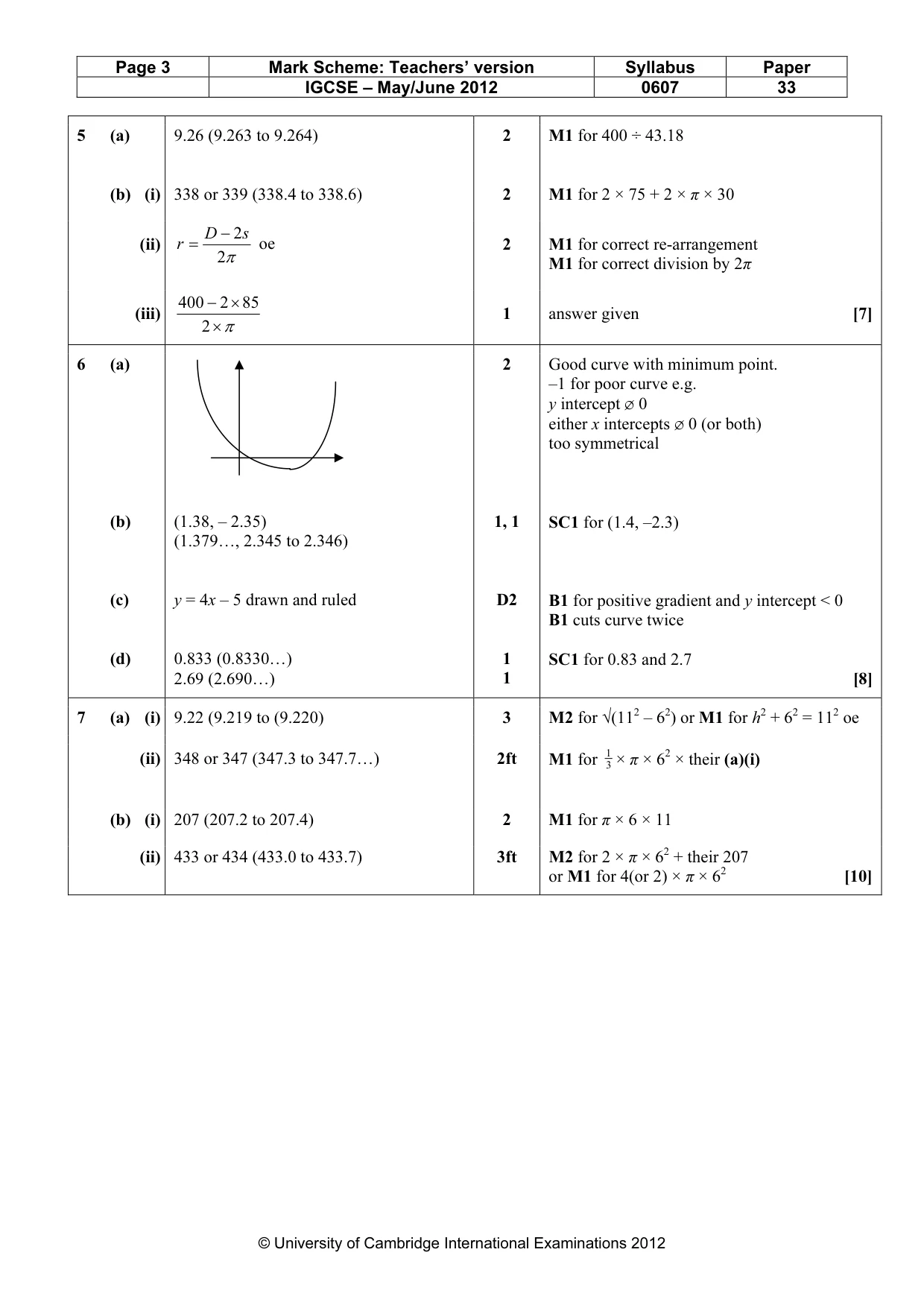
Page 3 Mark Scheme: Teachers’ version Syllabus Paper IGCSE – May/June 2012 0607 33 © University of Cambridge International Examinations 2012 5 (a) (b) (i) 9.26 (9.263 to 9.264) 338 or 339 (338.4 to 338.6) 2 2 M1 for 400 ÷ 43.18 M1 for 2 × 75 + 2 × π × 30 (ii) π 2 2s D r − = oe 2 M1 for correct re-arrangement M1 for correct division by 2π (iii) π × × − 2 85 2 400 1 answer given [7] 6 (a) (b) (c) (d) (1.38, – 2.35) (1.379…, 2.345 to 2.346) y = 4x – 5 drawn and ruled 0.833 (0.8330…) 2.69 (2.690…) 2 1, 1 D2 1 1 Good curve with minimum point. –1 for poor curve e.g. y intercept ø 0 either x intercepts ø 0 (or both) too symmetrical SC1 for (1.4, –2.3) B1 for positive gradient and y intercept < 0 B1 cuts curve twice SC1 for 0.83 and 2.7 [8] 7 (a) (i) 9.22 (9.219 to (9.220) 3 M2 for √(112 – 62) or M1 for h2 + 62 = 112 oe (ii) 348 or 347 (347.3 to 347.7…) 2ft M1 for 3 1 × π × 62 × their (a)(i) (b) (i) 207 (207.2 to 207.4) 2 M1 for π × 6 × 11 (ii) 433 or 434 (433.0 to 433.7) 3ft M2 for 2 × π × 62 + their 207 or M1 for 4(or 2) × π × 62 [10]
Mark scheme, page 4
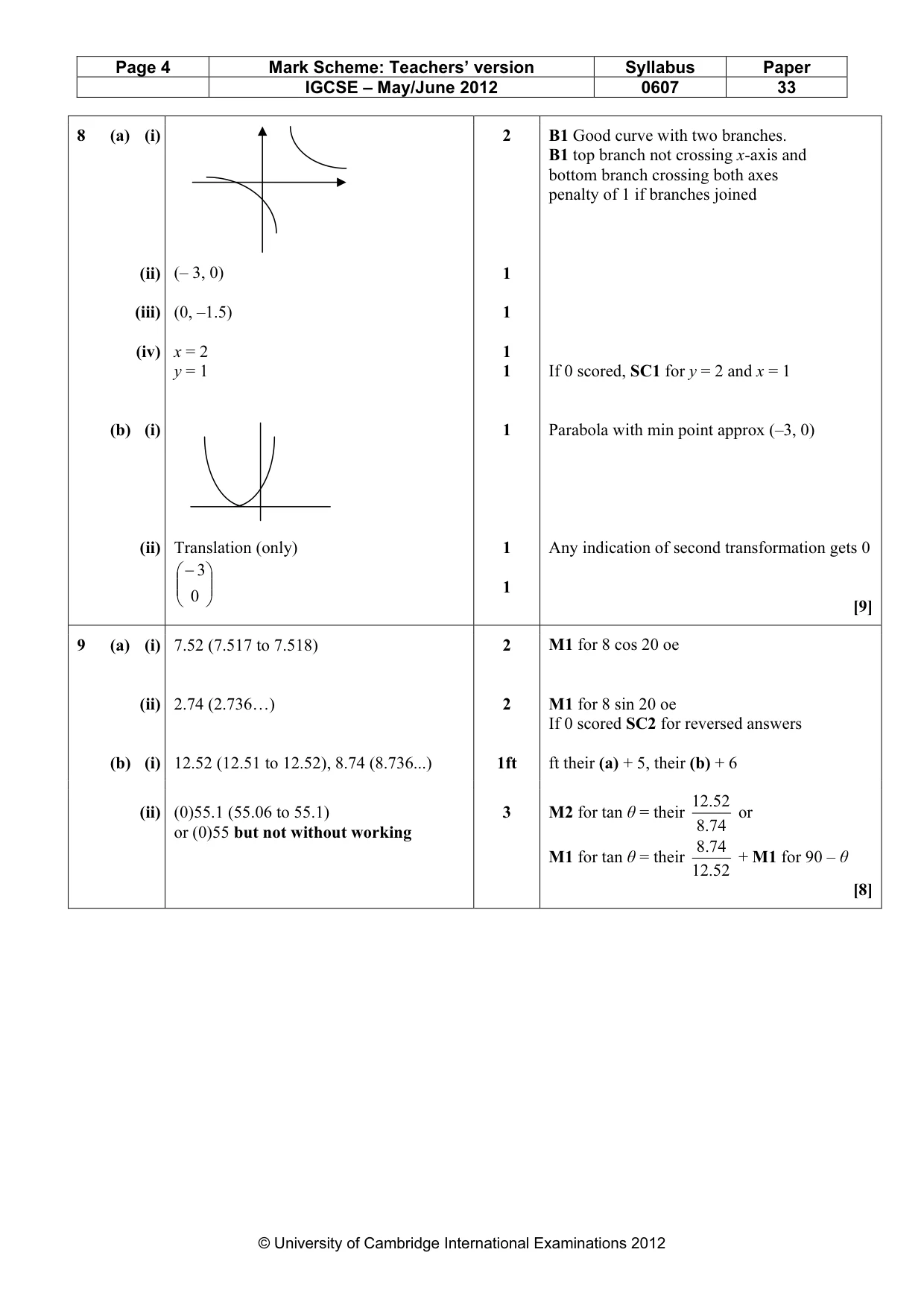
Page 4 Mark Scheme: Teachers’ version Syllabus Paper IGCSE – May/June 2012 0607 33 © University of Cambridge International Examinations 2012 8 (a) (i) (ii) (iii) (iv) (b) (i) (ii) (– 3, 0) (0, –1.5) x = 2 y = 1 Translation (only) − 0 3 2 1 1 1 1 1 1 1 B1 Good curve with two branches. B1 top branch not crossing x-axis and bottom branch crossing both axes penalty of 1 if branches joined If 0 scored, SC1 for y = 2 and x = 1 Parabola with min point approx (–3, 0) Any indication of second transformation gets 0 [9] 9 (a) (i) (ii) (b) (i) 7.52 (7.517 to 7.518) 2.74 (2.736…) 12.52 (12.51 to 12.52), 8.74 (8.736...) 2 2 1ft M1 for 8 cos 20 oe M1 for 8 sin 20 oe If 0 scored SC2 for reversed answers ft their (a) + 5, their (b) + 6 (ii) (0)55.1 (55.06 to 55.1) or (0)55 but not without working 3 M2 for tan θ = their 74 .8 52 . 12 or M1 for tan θ = their 52 . 12 74 .8 + M1 for 90 – θ [8]
Mark scheme, page 5
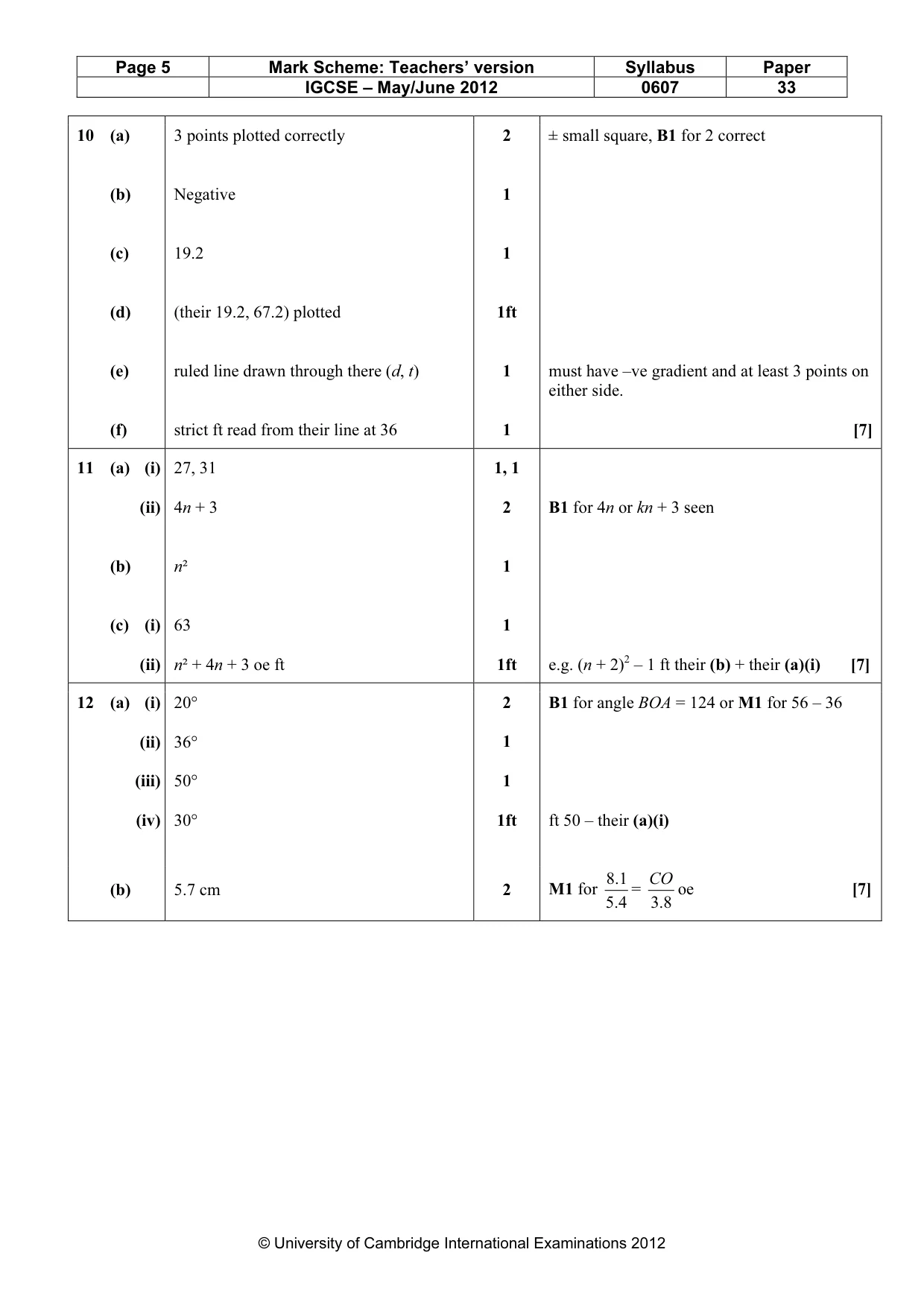
Page 5 Mark Scheme: Teachers’ version Syllabus Paper IGCSE – May/June 2012 0607 33 © University of Cambridge International Examinations 2012 10 (a) (b) (c) (d) (e) (f) 3 points plotted correctly Negative 19.2 (their 19.2, 67.2) plotted ruled line drawn through there (d, t) strict ft read from their line at 36 2 1 1 1ft 1 1 ± small square, B1 for 2 correct must have –ve gradient and at least 3 points on either side. [7] 11 (a) (i) (ii) (b) (c) (i) (ii) 27, 31 4n + 3 n² 63 n² + 4n + 3 oe ft 1, 1 2 1 1 1ft B1 for 4n or kn + 3 seen e.g. (n + 2)2 – 1 ft their (b) + their (a)(i) [7] 12 (a) (i) (ii) (iii) (iv) 20° 36° 50° 30° 2 1 1 1ft B1 for angle BOA = 124 or M1 for 56 – 36 ft 50 – their (a)(i) (b) 5.7 cm 2 M1 for 4.5 1.8 = 8.3 CO oe [7]
What you needed in this session
Cambridge’s own grade thresholds for 2012 May/June, Paper 3 · Variant 3. A higher threshold means an easier paper — the bar moves with how the cohort did.