Cambridge IGCSE Mathematics - International 0607 — 2012 May/June Paper 3 · Variant 2
0607/32/M/J/12 · 96 marks · ≈108 min
The question paper and its mark scheme, free to read here and free to download. This is Cambridge’s own paper, exactly as it was sat.
Question paper20 pages
Mark scheme6 pages
Answers below. Sit the paper first if you are practising.
Paper as text
Question paper, page 1
This document consists of 18 printed pages and 2 blank pages. IB12 06_0607_32/FP © UCLES 2012 [Turn over *5691435795* For Examiner's Use UNIVERSITY OF CAMBRIDGE INTERNATIONAL EXAMINATIONS International General Certificate of Secondary Education CAMBRIDGE INTERNATIONAL MATHEMATICS 0607/32 Paper 3 (Core) May/June 2012 1 hour 45 minutes Candidates answer on the Question Paper Additional Materials: Geometrical Instruments Graphics Calculator READ THESE INSTRUCTIONS FIRST Write your Centre number, candidate number and name on all the work you hand in. Write in dark blue or black pen. Do not use staples, paper clips, highlighters, glue or correction fluid. You may use a pencil for any diagrams or graphs. DO NOT WRITE IN ANY BARCODES. Answer all the questions. Unless instructed otherwise, give your answers exactly or correct to three significant figures as appropriate. Answers in degrees should be given to one decimal place. For π, use your calculator value. You must show all the relevant working to gain full marks and you will be given marks for correct methods, including sketches, even if your answer is incorrect. The number of marks is given in brackets [ ] at the end of each question or part question. The total number of marks for this paper is 96. www.XtremePapers.com
Question paper, page 2
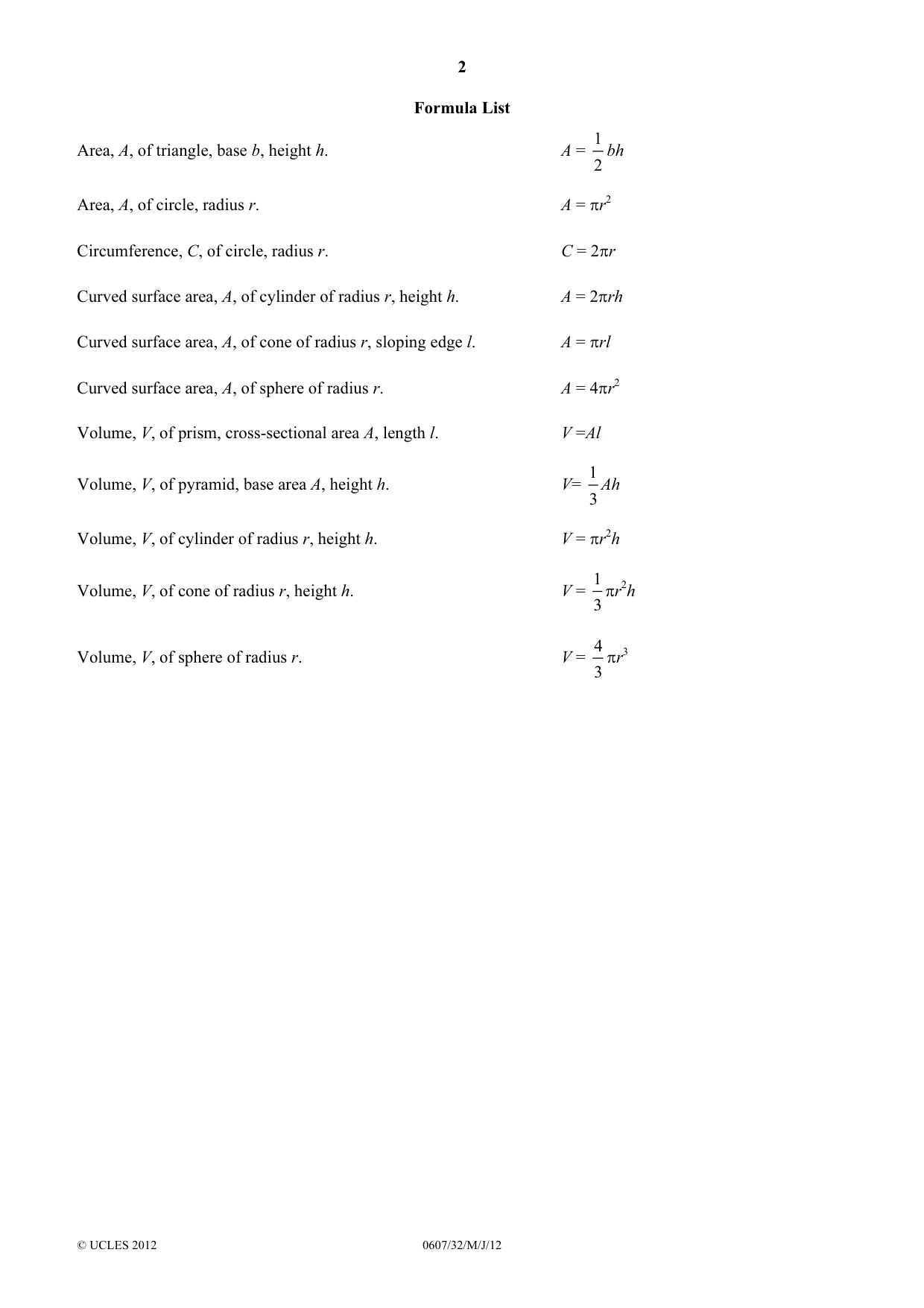
2 © UCLES 2012 0607/32/M/J/12 Formula List Area, A, of triangle, base b, height h. A = 1 2 bh Area, A, of circle, radius r. A = πr2 Circumference, C, of circle, radius r. C = 2πr Curved surface area, A, of cylinder of radius r, height h. A = 2πrh Curved surface area, A, of cone of radius r, sloping edge l. A = πrl Curved surface area, A, of sphere of radius r. A = 4πr2 Volume, V, of prism, cross-sectional area A, length l. V =Al Volume, V, of pyramid, base area A, height h. V= 1 3 Ah Volume, V, of cylinder of radius r, height h. V = πr2h Volume, V, of cone of radius r, height h. V = 1 3 πr2h Volume, V, of sphere of radius r. V = 4 3 πr3
Question paper, page 3
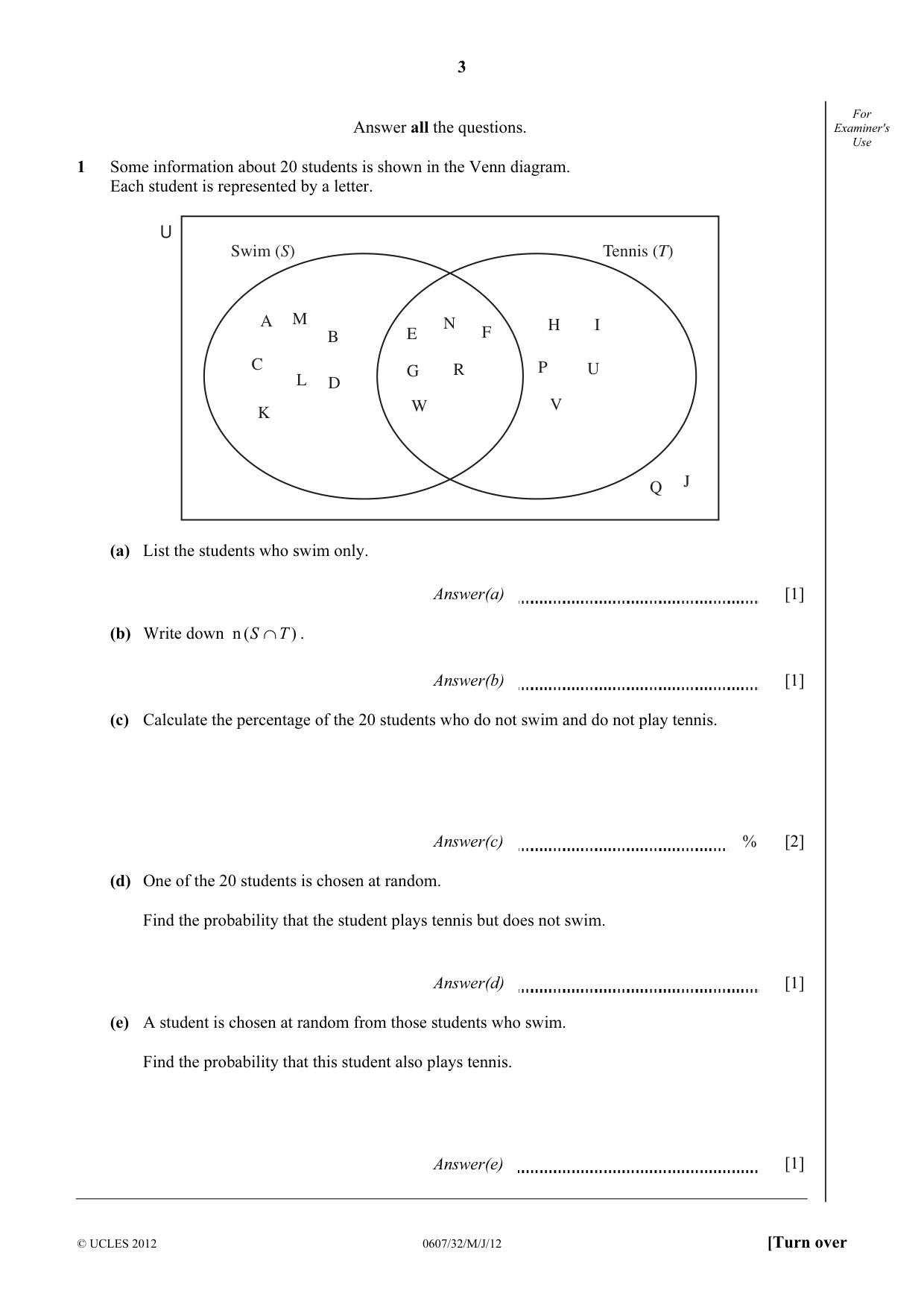
3 © UCLES 2012 0607/32/M/J/12 [Turn over For Examiner's Use Answer all the questions. 1 Some information about 20 students is shown in the Venn diagram. Each student is represented by a letter. U Swim (S) Tennis (T) A M B C L D K E N F G R W H I P U V Q J (a) List the students who swim only. Answer(a) [1] (b) Write down n ) ( T S ∩ . Answer(b) [1] (c) Calculate the percentage of the 20 students who do not swim and do not play tennis. Answer(c) % [2] (d) One of the 20 students is chosen at random. Find the probability that the student plays tennis but does not swim. Answer(d) [1] (e) A student is chosen at random from those students who swim. Find the probability that this student also plays tennis. Answer(e) [1]
Question paper, page 4
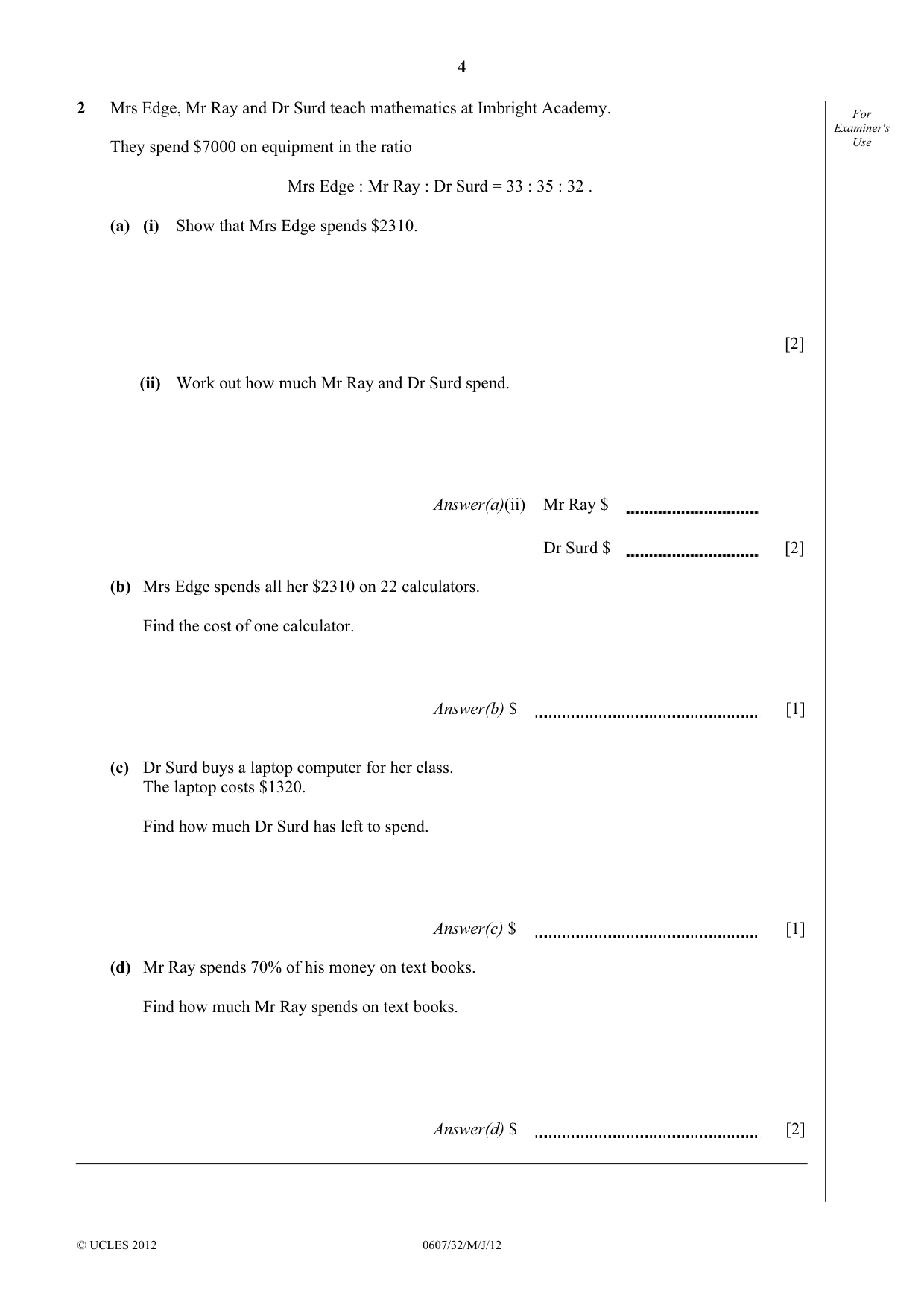
4 © UCLES 2012 0607/32/M/J/12 For Examiner's Use 2 Mrs Edge, Mr Ray and Dr Surd teach mathematics at Imbright Academy. They spend $7000 on equipment in the ratio Mrs Edge : Mr Ray : Dr Surd = 33 : 35 : 32 . (a) (i) Show that Mrs Edge spends $2310. [2] (ii) Work out how much Mr Ray and Dr Surd spend. Answer(a)(ii) Mr Ray $ Dr Surd $ [2] (b) Mrs Edge spends all her $2310 on 22 calculators. Find the cost of one calculator. Answer(b) $ [1] (c) Dr Surd buys a laptop computer for her class. The laptop costs $1320. Find how much Dr Surd has left to spend. Answer(c) $ [1] (d) Mr Ray spends 70% of his money on text books. Find how much Mr Ray spends on text books. Answer(d) $ [2]
Question paper, page 5
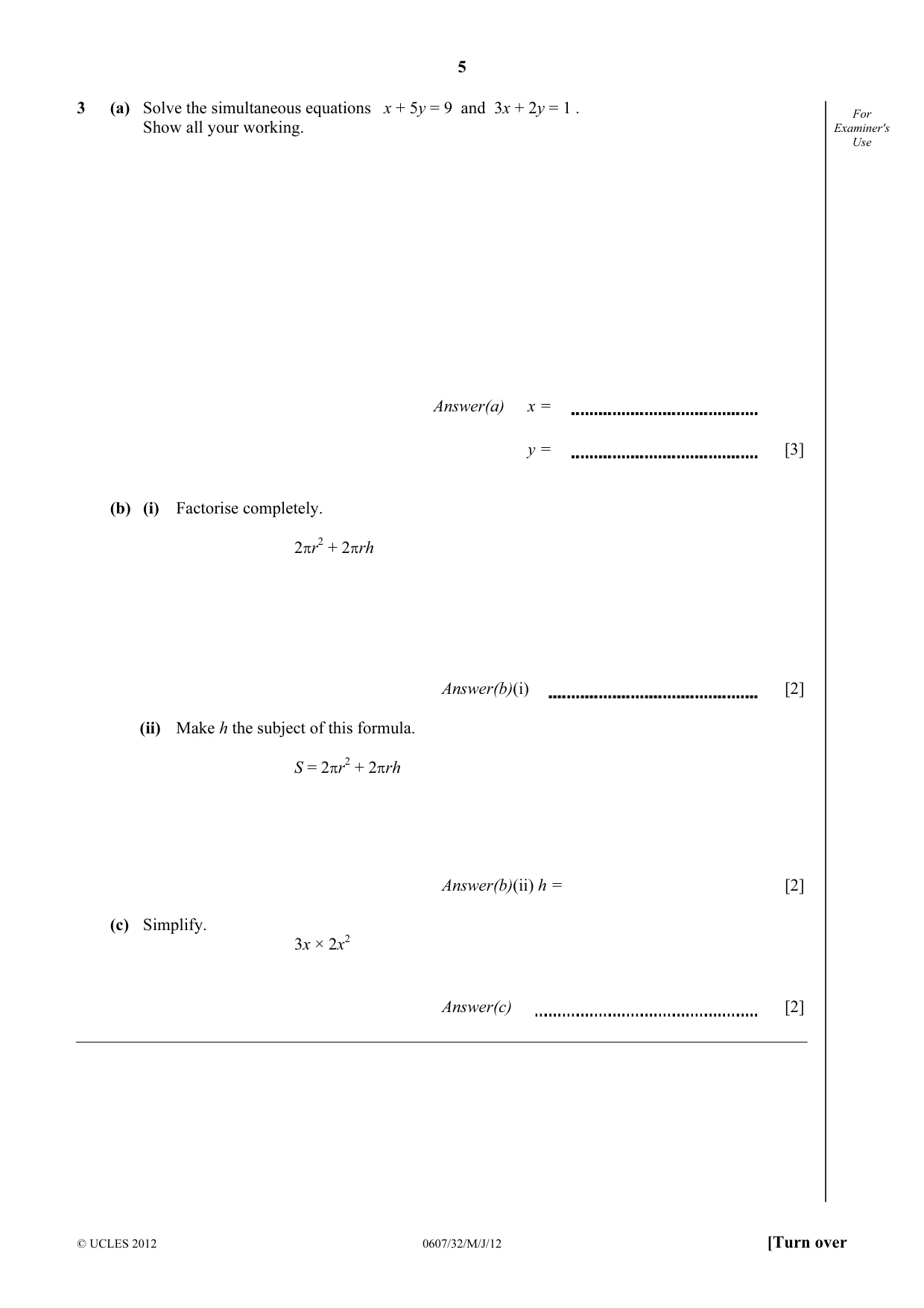
5 © UCLES 2012 0607/32/M/J/12 [Turn over For Examiner's Use 3 (a) Solve the simultaneous equations x + 5y = 9 and 3x + 2y = 1 . Show all your working. Answer(a) x = y = [3] (b) (i) Factorise completely. 2πr2 + 2πrh Answer(b)(i) [2] (ii) Make h the subject of this formula. S = 2πr2 + 2πrh Answer(b)(ii) h = [2] (c) Simplify. 3x × 2x2 Answer(c) [2]
Question paper, page 6
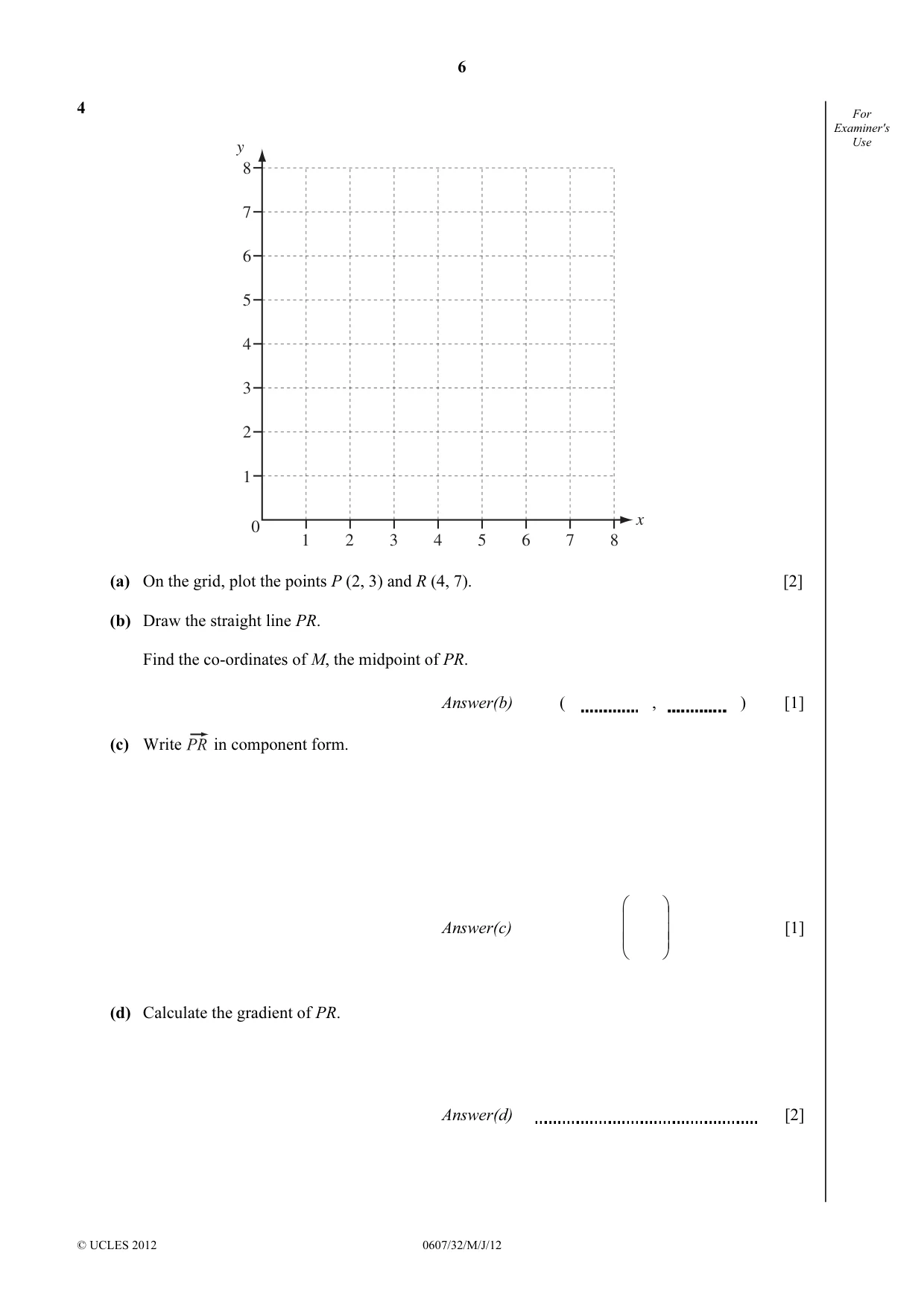
6 © UCLES 2012 0607/32/M/J/12 For Examiner's Use 4 8 7 6 5 4 3 2 1 0 1 2 3 4 5 6 7 8 y x (a) On the grid, plot the points P (2, 3) and R (4, 7). [2] (b) Draw the straight line PR. Find the co-ordinates of M, the midpoint of PR. Answer(b) ( , ) [1] (c) Write in component form. Answer(c) [1] (d) Calculate the gradient of PR. Answer(d) [2]
Question paper, page 7
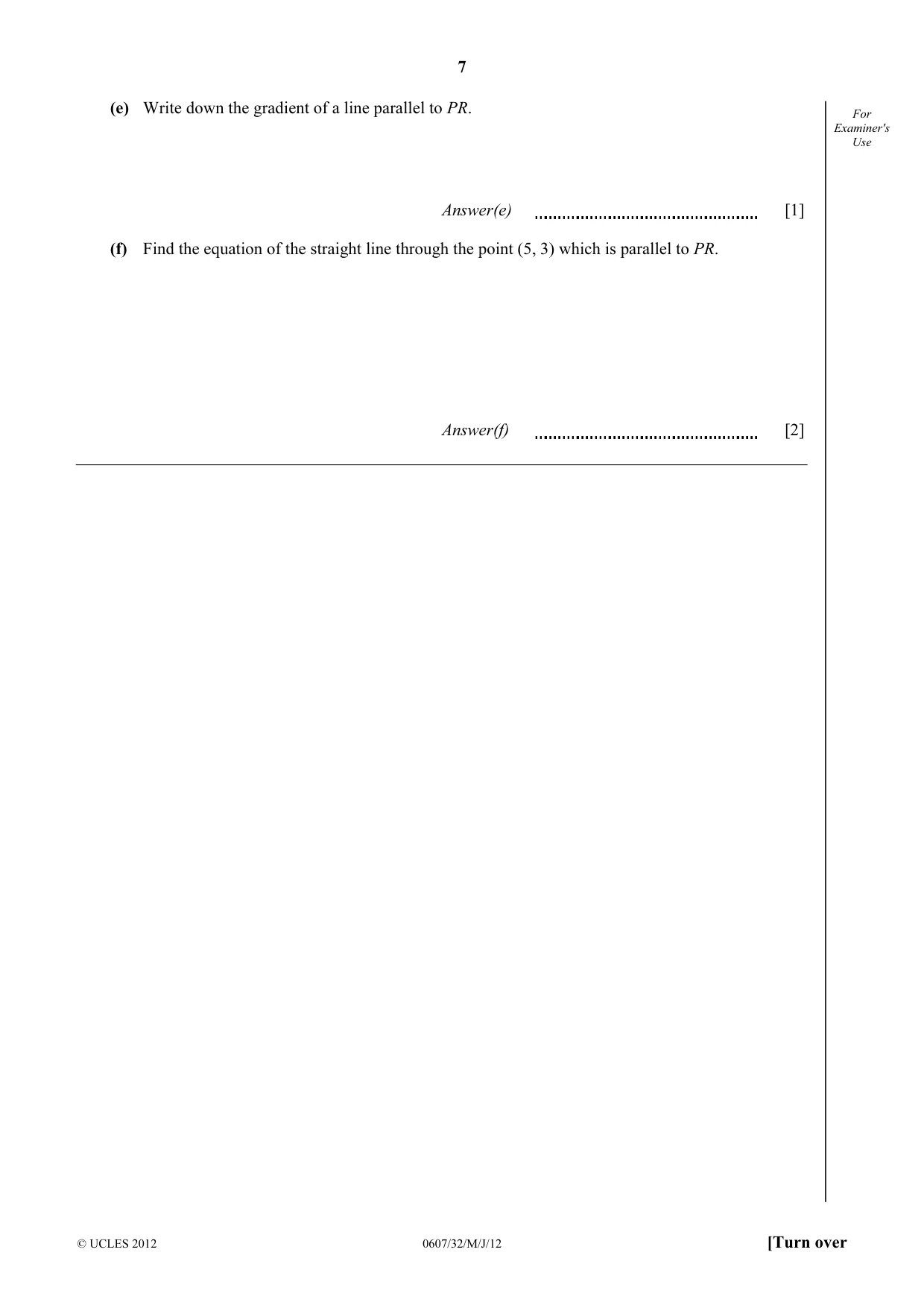
7 © UCLES 2012 0607/32/M/J/12 [Turn over For Examiner's Use (e) Write down the gradient of a line parallel to PR. Answer(e) [1] (f) Find the equation of the straight line through the point (5, 3) which is parallel to PR. Answer(f) [2]
Question paper, page 8
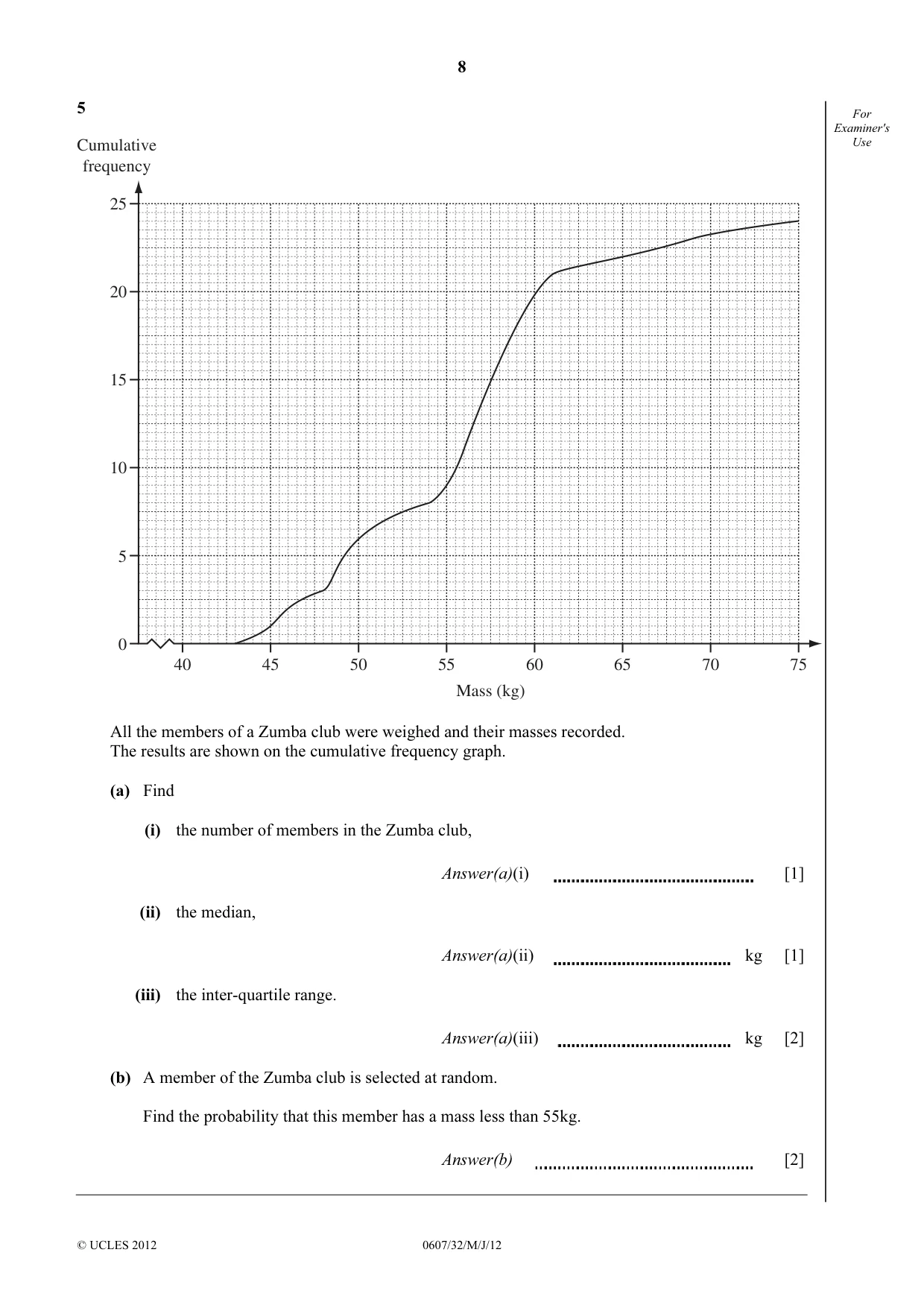
8 © UCLES 2012 0607/32/M/J/12 For Examiner's Use 5 25 20 15 10 5 0 40 45 50 55 60 65 70 75 Cumulative frequency Mass (kg) All the members of a Zumba club were weighed and their masses recorded. The results are shown on the cumulative frequency graph. (a) Find (i) the number of members in the Zumba club, Answer(a)(i) [1] (ii) the median, Answer(a)(ii) kg [1] (iii) the inter-quartile range. Answer(a)(iii) kg [2] (b) A member of the Zumba club is selected at random. Find the probability that this member has a mass less than 55kg. Answer(b) [2]
Question paper, page 9
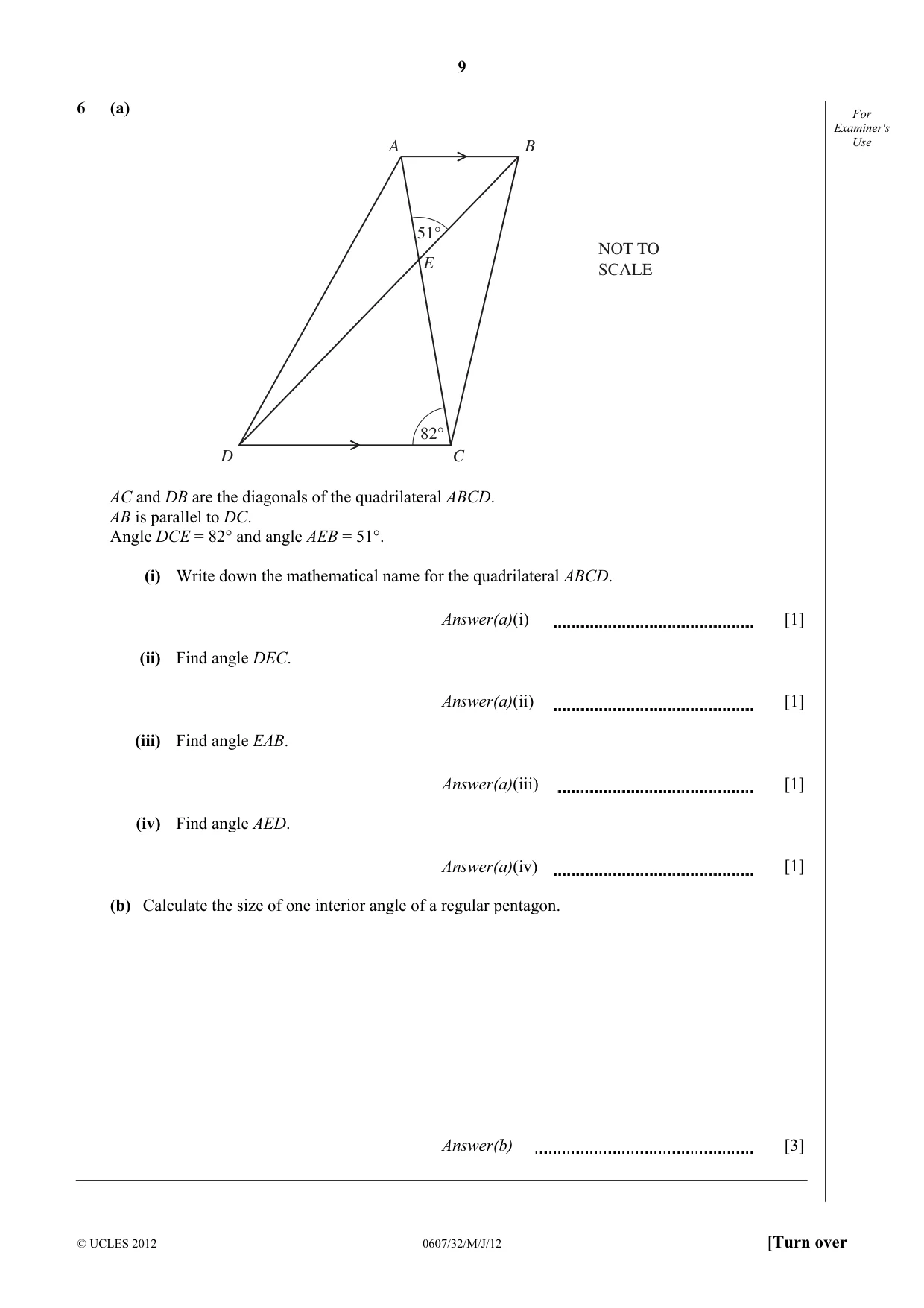
9 © UCLES 2012 0607/32/M/J/12 [Turn over For Examiner's Use 6 (a) A B E C D 51° 82° NOT TO SCALE AC and DB are the diagonals of the quadrilateral ABCD. AB is parallel to DC. Angle DCE = 82° and angle AEB = 51°. (i) Write down the mathematical name for the quadrilateral ABCD. Answer(a)(i) [1] (ii) Find angle DEC. Answer(a)(ii) [1] (iii) Find angle EAB. Answer(a)(iii) [1] (iv) Find angle AED. Answer(a)(iv) [1] (b) Calculate the size of one interior angle of a regular pentagon. Answer(b) [3]
Question paper, page 10
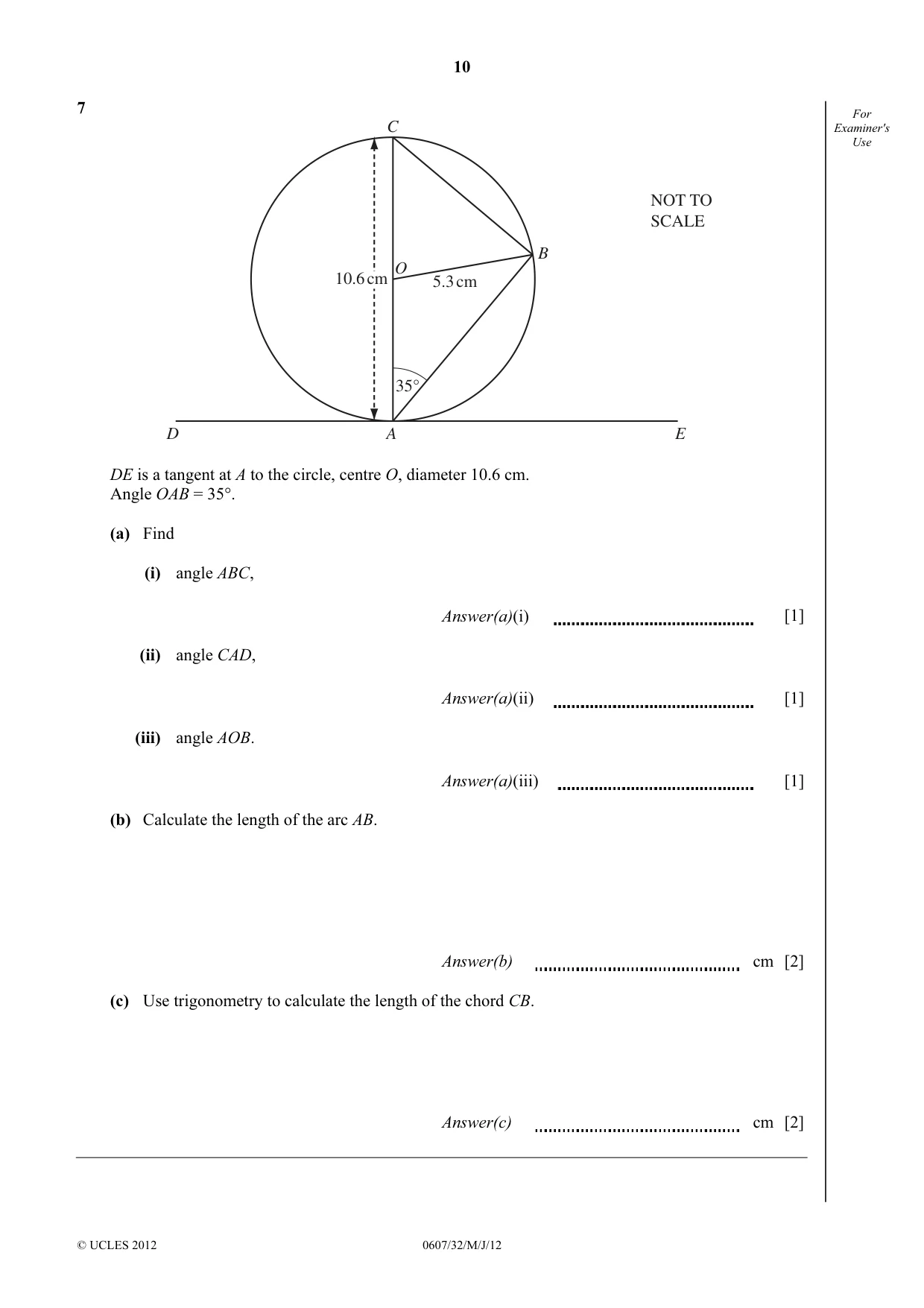
10 © UCLES 2012 0607/32/M/J/12 For Examiner's Use 7 C B A E D O 10.6 cm 5.3 cm 35° NOT TO SCALE DE is a tangent at A to the circle, centre O, diameter 10.6 cm. Angle OAB = 35°. (a) Find (i) angle ABC, Answer(a)(i) [1] (ii) angle CAD, Answer(a)(ii) [1] (iii) angle AOB. Answer(a)(iii) [1] (b) Calculate the length of the arc AB. Answer(b) cm [2] (c) Use trigonometry to calculate the length of the chord CB. Answer(c) cm [2]
Question paper, page 11
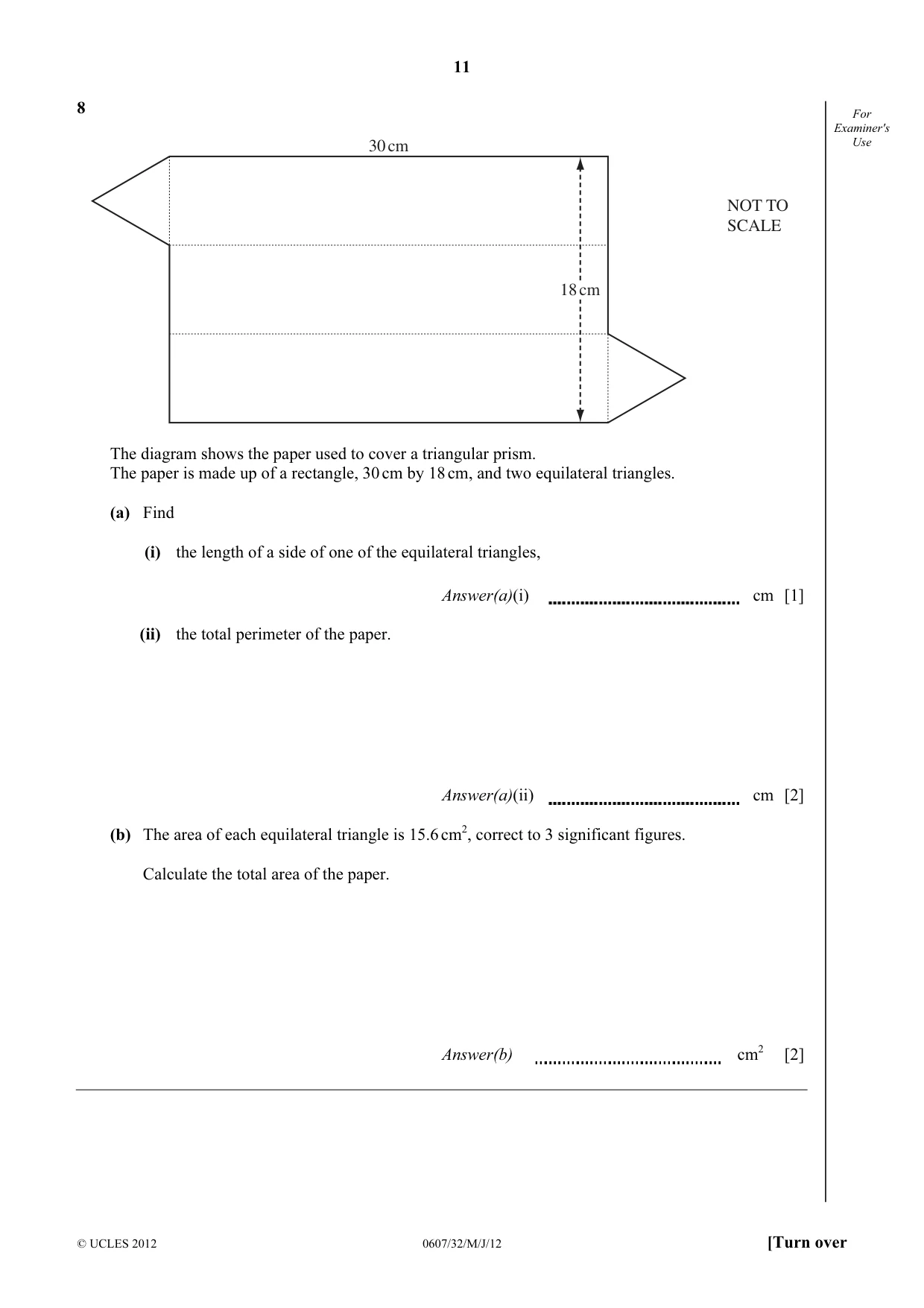
11 © UCLES 2012 0607/32/M/J/12 [Turn over For Examiner's Use 8 18 cm 30 cm NOT TO SCALE The diagram shows the paper used to cover a triangular prism. The paper is made up of a rectangle, 30 cm by 18 cm, and two equilateral triangles. (a) Find (i) the length of a side of one of the equilateral triangles, Answer(a)(i) cm [1] (ii) the total perimeter of the paper. Answer(a)(ii) cm [2] (b) The area of each equilateral triangle is 15.6 cm2, correct to 3 significant figures. Calculate the total area of the paper. Answer(b) cm2 [2]
Question paper, page 12
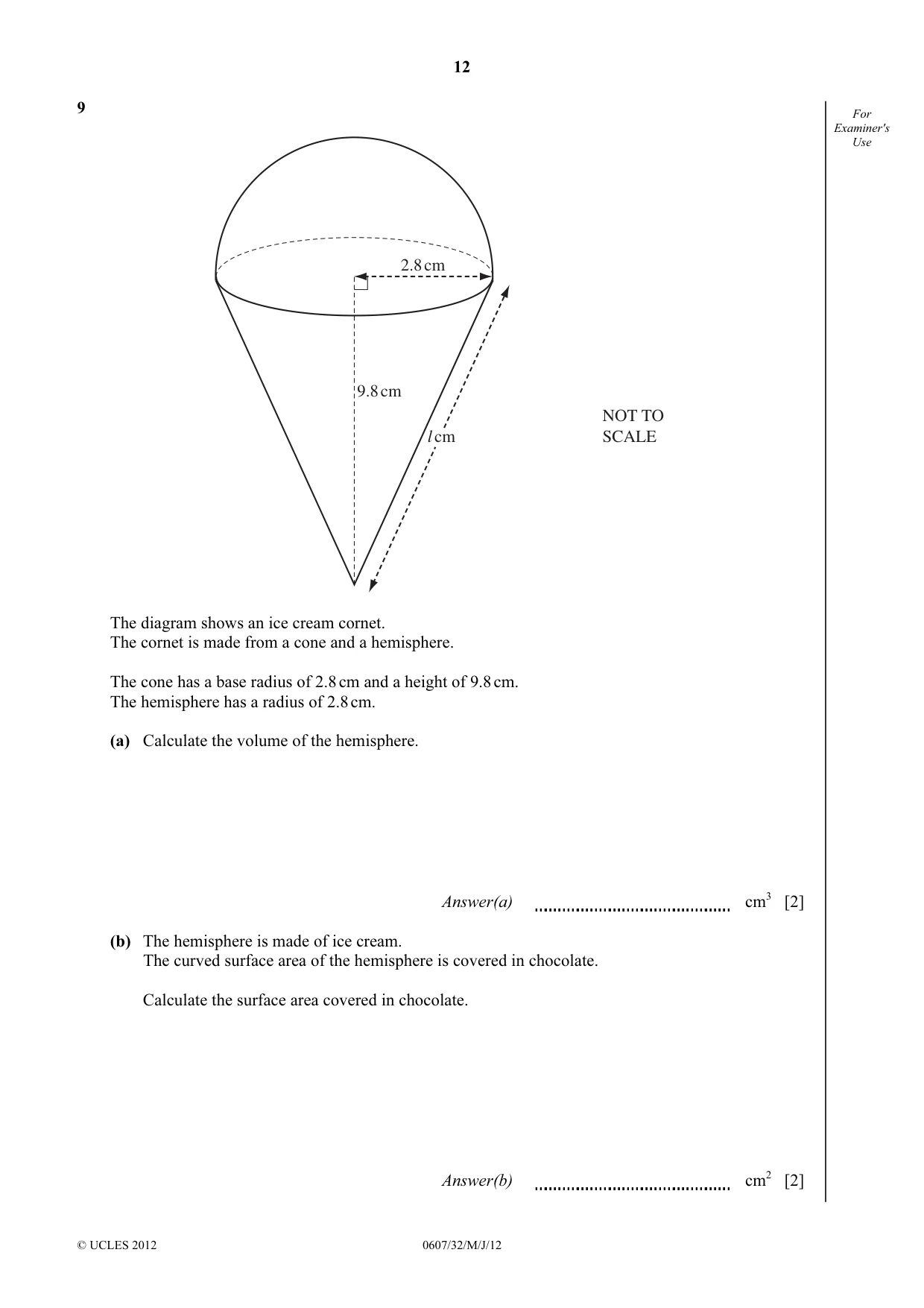
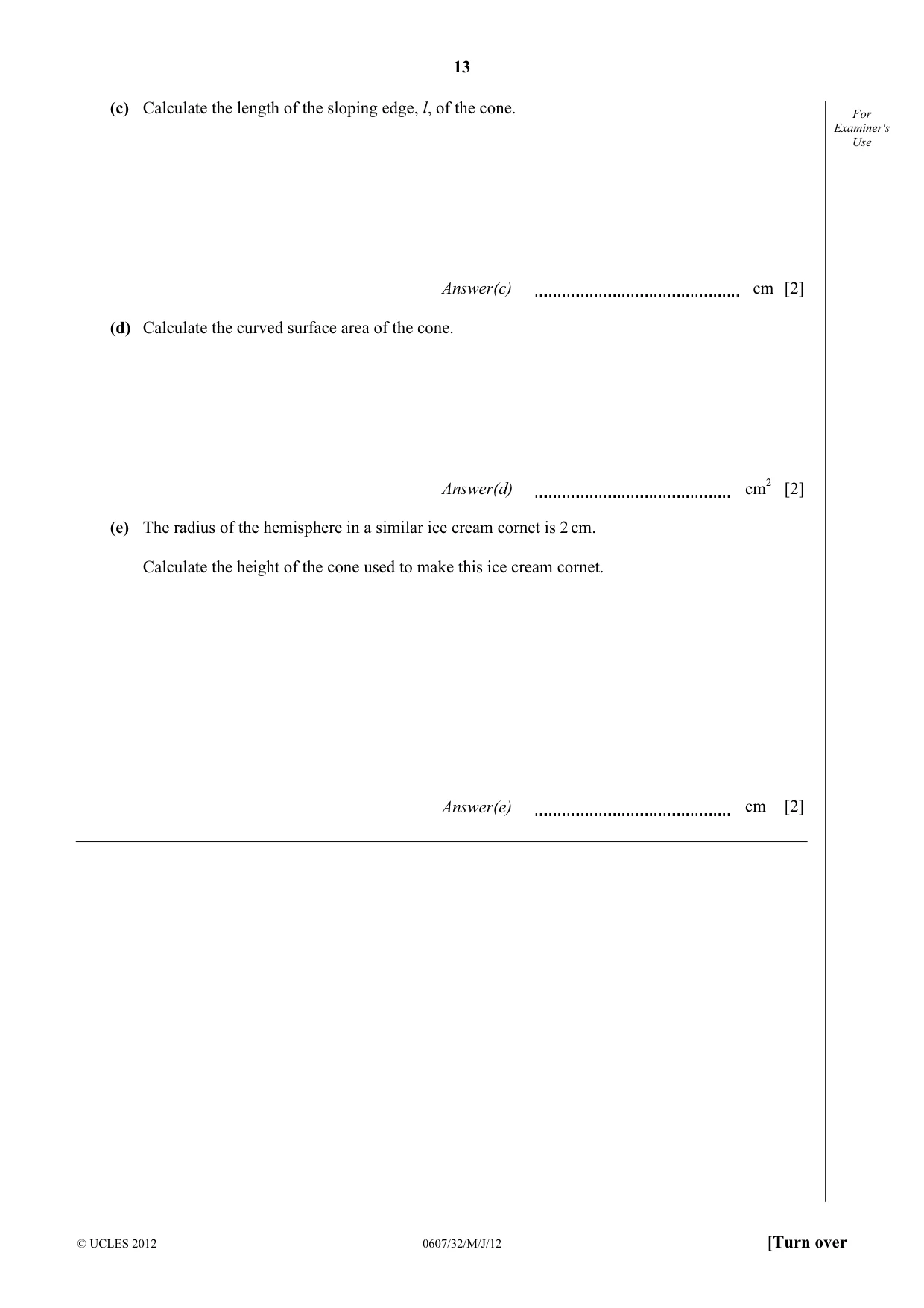
12 © UCLES 2012 0607/32/M/J/12 For Examiner's Use 9 2.8 cm 9.8 cm NOT TO SCALE l cm The diagram shows an ice cream cornet. The cornet is made from a cone and a hemisphere. The cone has a base radius of 2.8 cm and a height of 9.8 cm. The hemisphere has a radius of 2.8 cm. (a) Calculate the volume of the hemisphere. Answer(a) cm3 [2] (b) The hemisphere is made of ice cream. The curved surface area of the hemisphere is covered in chocolate. Calculate the surface area covered in chocolate. Answer(b) cm2 [2]
Question paper, page 13
13 © UCLES 2012 0607/32/M/J/12 [Turn over For Examiner's Use (c) Calculate the length of the sloping edge, l, of the cone. Answer(c) cm [2] (d) Calculate the curved surface area of the cone. Answer(d) cm2 [2] (e) The radius of the hemisphere in a similar ice cream cornet is 2 cm. Calculate the height of the cone used to make this ice cream cornet. Answer(e) cm [2]
Question paper, page 14
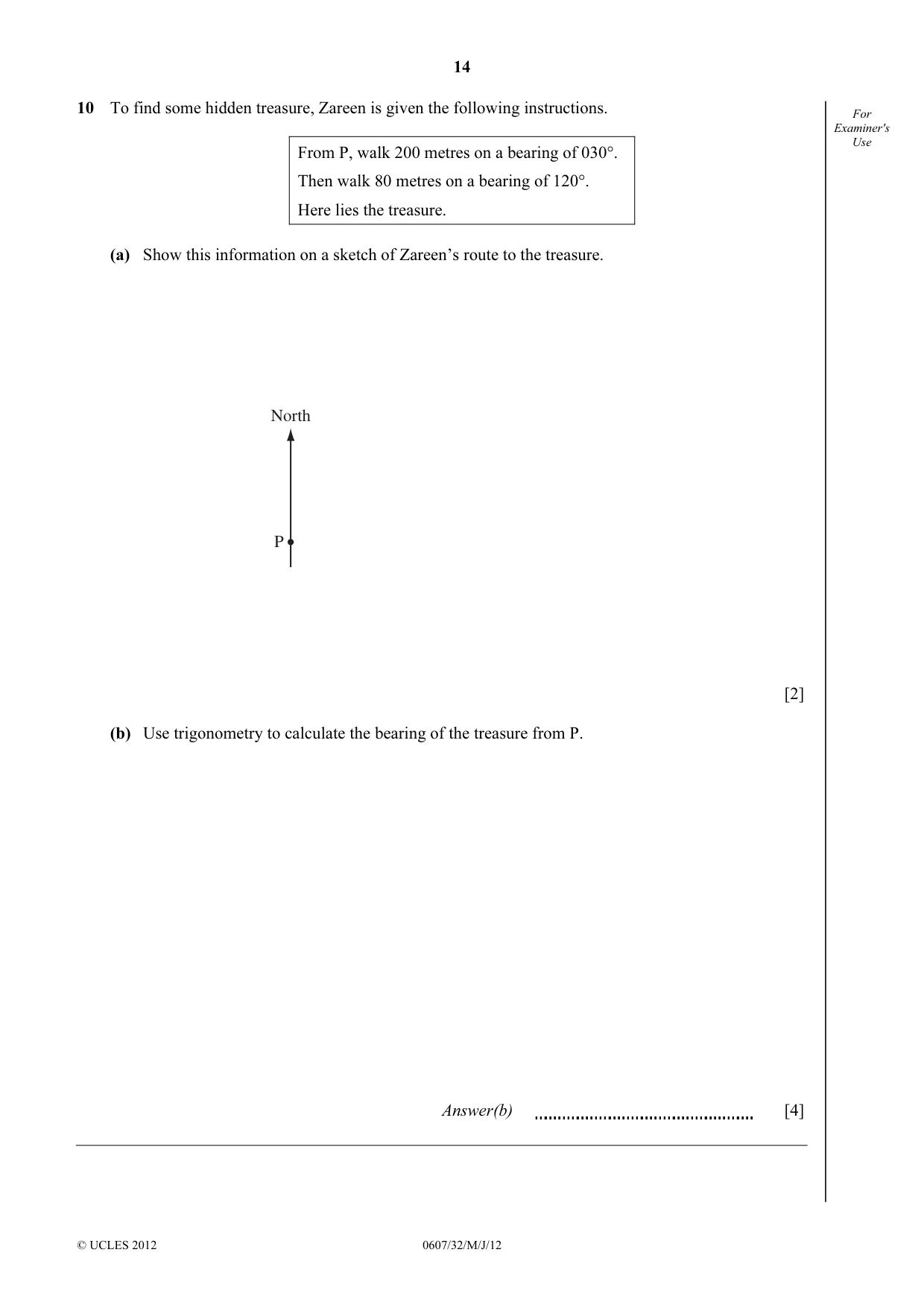
14 © UCLES 2012 0607/32/M/J/12 For Examiner's Use 10 To find some hidden treasure, Zareen is given the following instructions. From P, walk 200 metres on a bearing of 030°. Then walk 80 metres on a bearing of 120°. Here lies the treasure. (a) Show this information on a sketch of Zareen’s route to the treasure. North P [2] (b) Use trigonometry to calculate the bearing of the treasure from P. Answer(b) [4]
Question paper, page 15
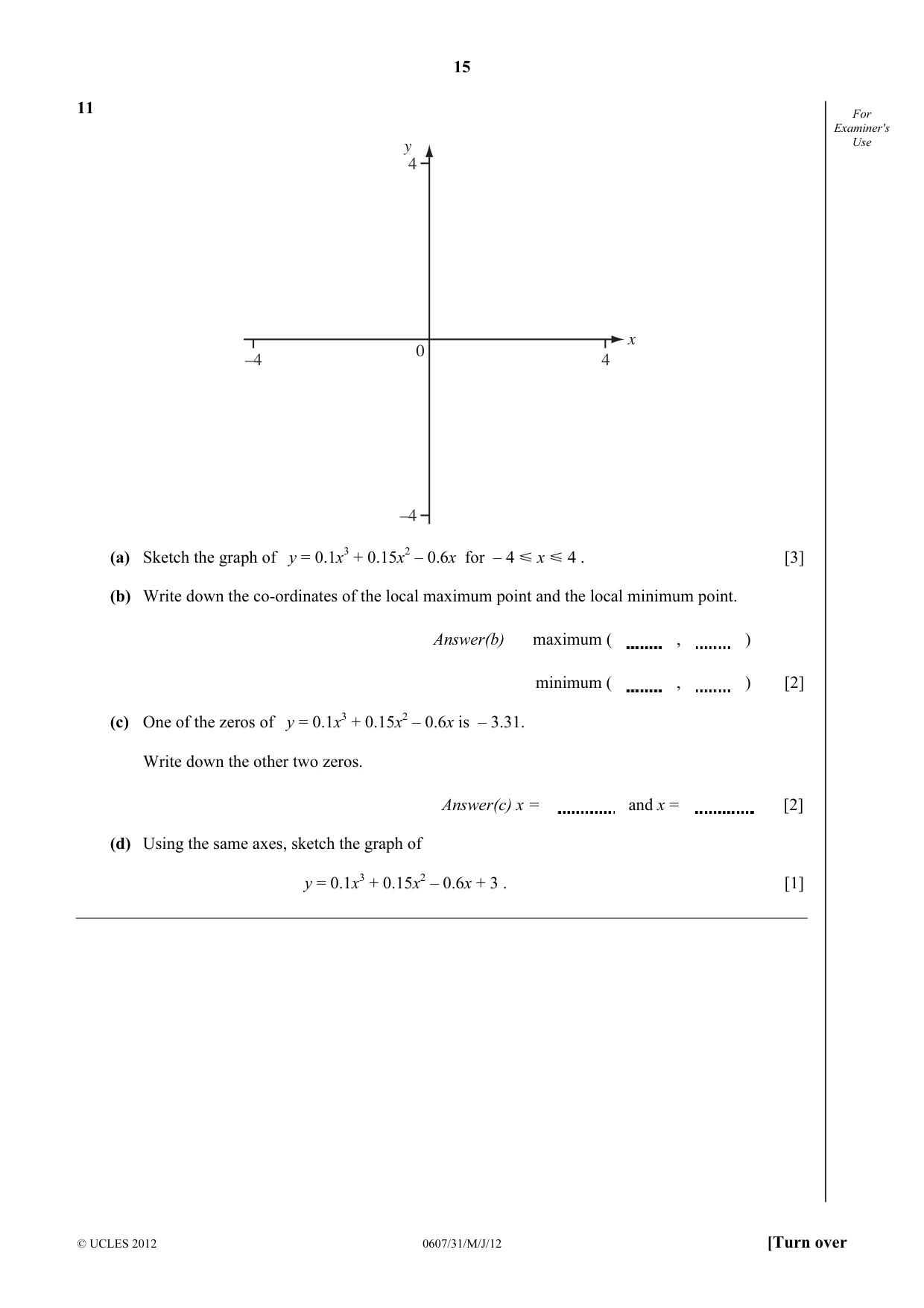
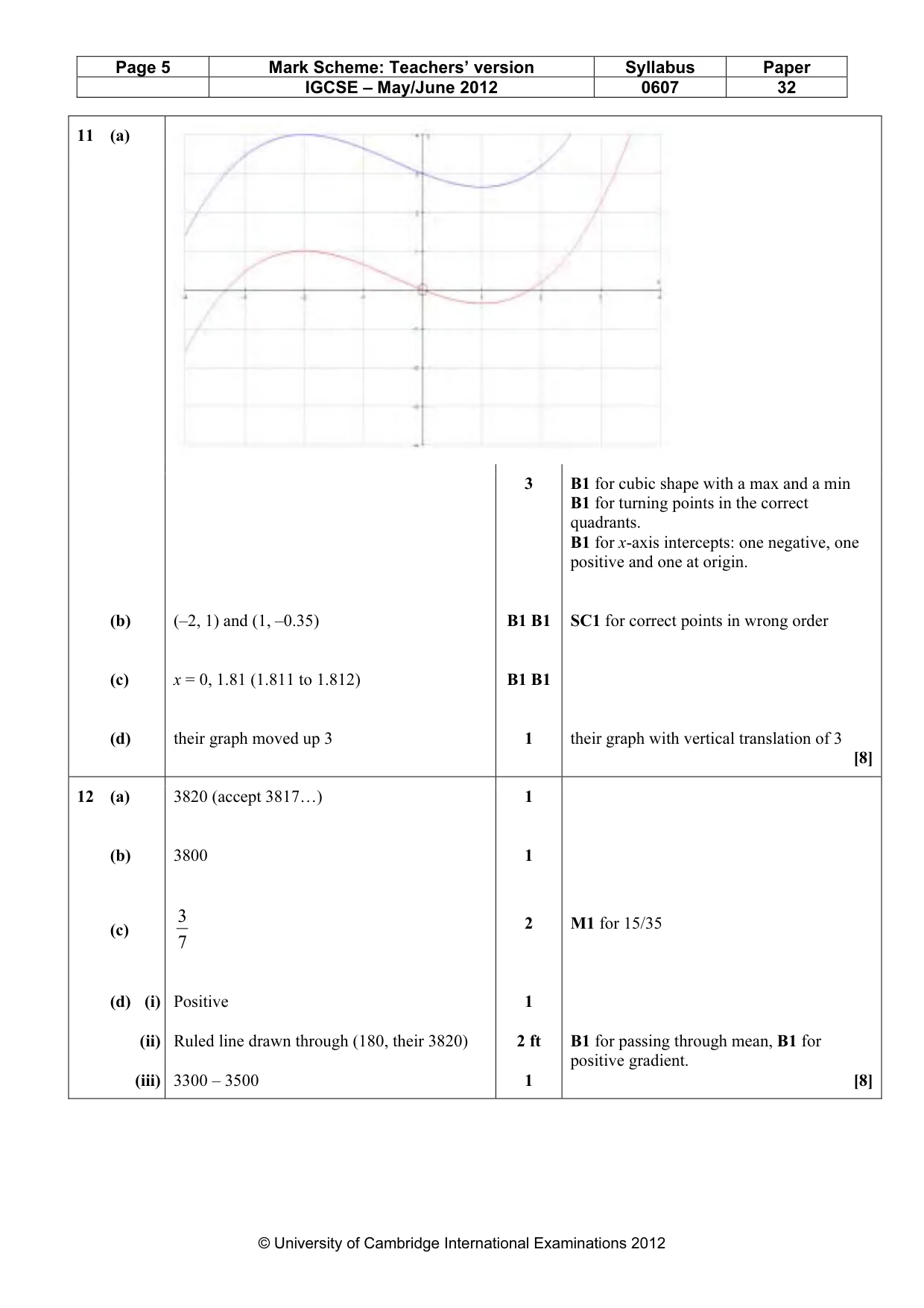
15 © UCLES 2012 0607/31/M/J/12 [Turn over For Examiner's Use 11 4 4 –4 –4 0 y x (a) Sketch the graph of y = 0.1x3 + 0.15x2 – 0.6x for – 4 Y x Y 4 . [3] (b) Write down the co-ordinates of the local maximum point and the local minimum point. Answer(b) maximum ( , ) minimum ( , ) [2] (c) One of the zeros of y = 0.1x3 + 0.15x2 – 0.6x is – 3.31. Write down the other two zeros. Answer(c) x = and x = [2] (d) Using the same axes, sketch the graph of y = 0.1x3 + 0.15x2 – 0.6x + 3 . [1]
Question paper, page 16
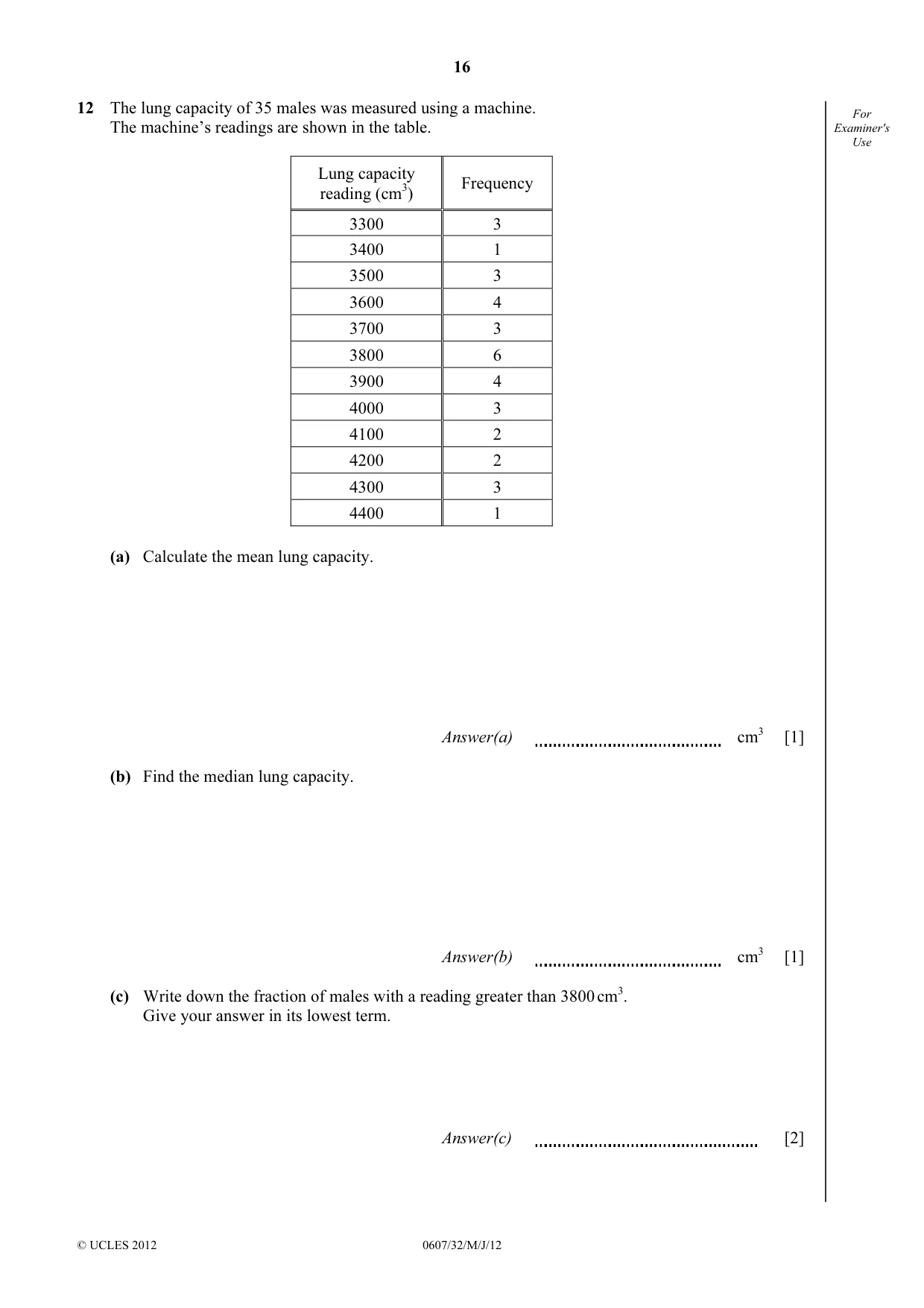
16 © UCLES 2012 0607/32/M/J/12 For Examiner's Use 12 The lung capacity of 35 males was measured using a machine. The machine’s readings are shown in the table. Lung capacity reading (cm3) Frequency 3300 3 3400 1 3500 3 3600 4 3700 3 3800 6 3900 4 4000 3 4100 2 4200 2 4300 3 4400 1 (a) Calculate the mean lung capacity. Answer(a) cm3 [1] (b) Find the median lung capacity. Answer(b) cm3 [1] (c) Write down the fraction of males with a reading greater than 3800 cm3. Give your answer in its lowest term. Answer(c) [2]
Question paper, page 17
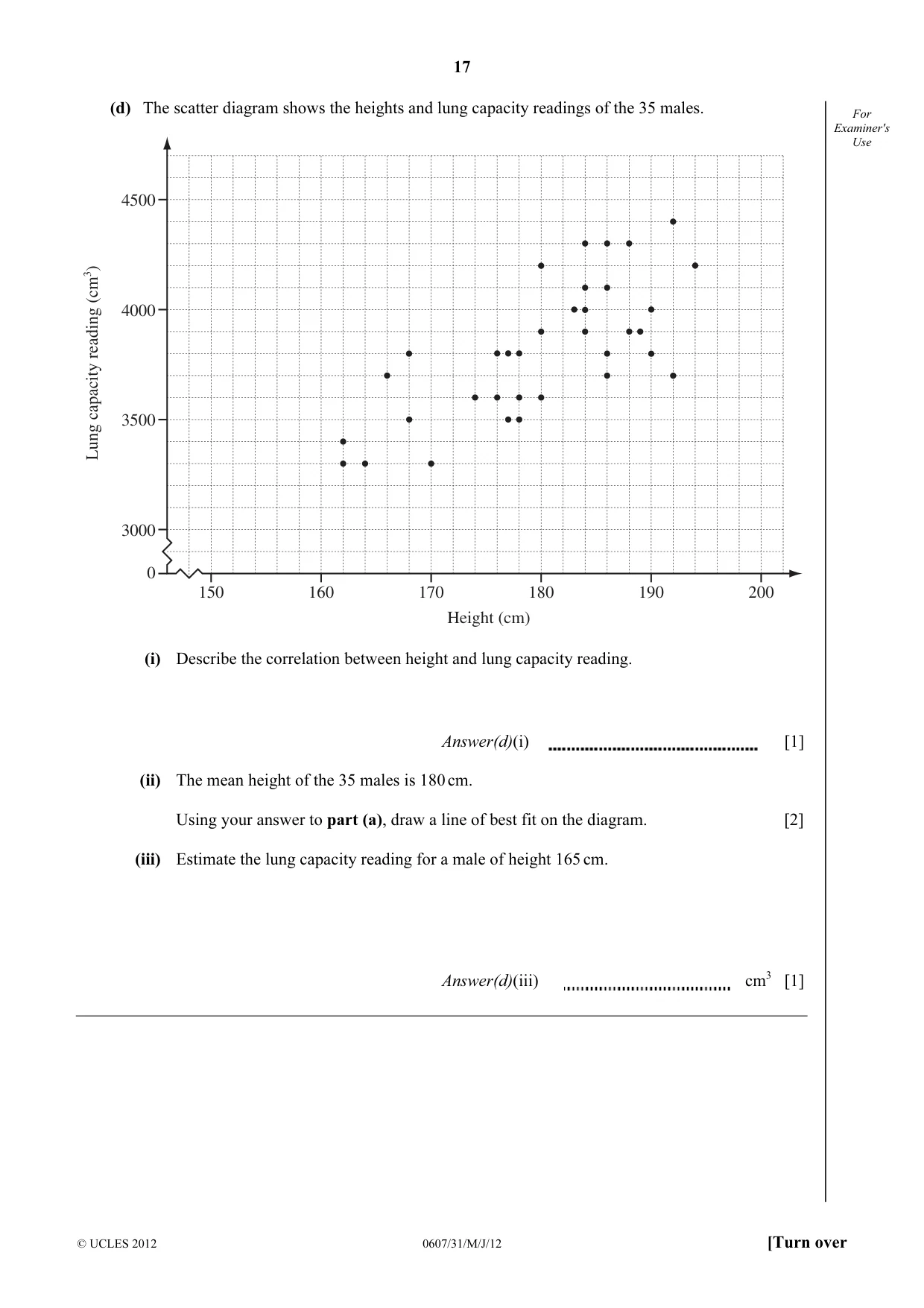
17 © UCLES 2012 0607/31/M/J/12 [Turn over For Examiner's Use (d) The scatter diagram shows the heights and lung capacity readings of the 35 males. 150 160 170 180 190 200 4500 4000 3500 3000 Lung capacity reading (cm3) Height (cm) 0 (i) Describe the correlation between height and lung capacity reading. Answer(d)(i) [1] (ii) The mean height of the 35 males is 180 cm. Using your answer to part (a), draw a line of best fit on the diagram. [2] (iii) Estimate the lung capacity reading for a male of height 165 cm. Answer(d)(iii) cm3 [1]
Question paper, page 18
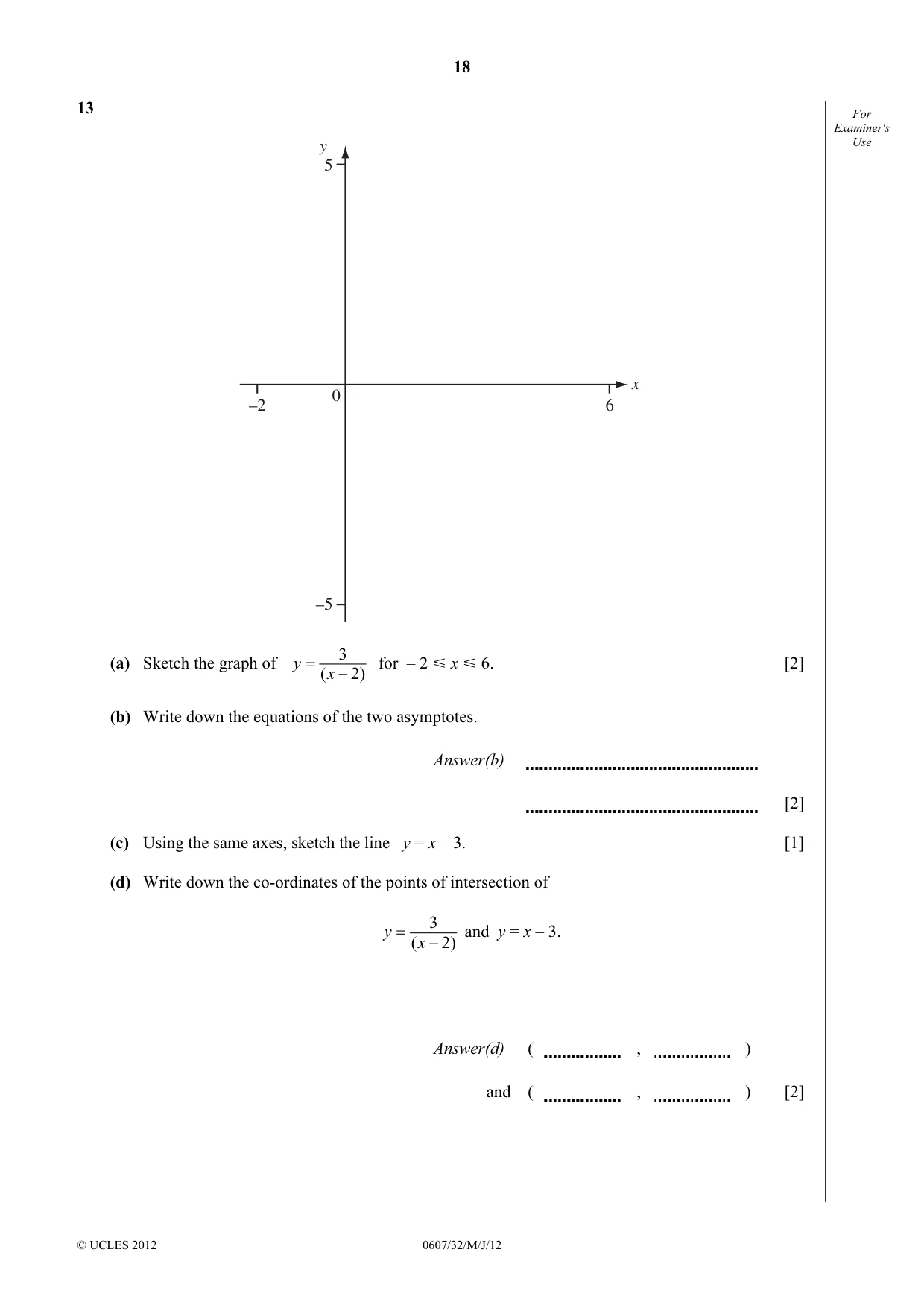
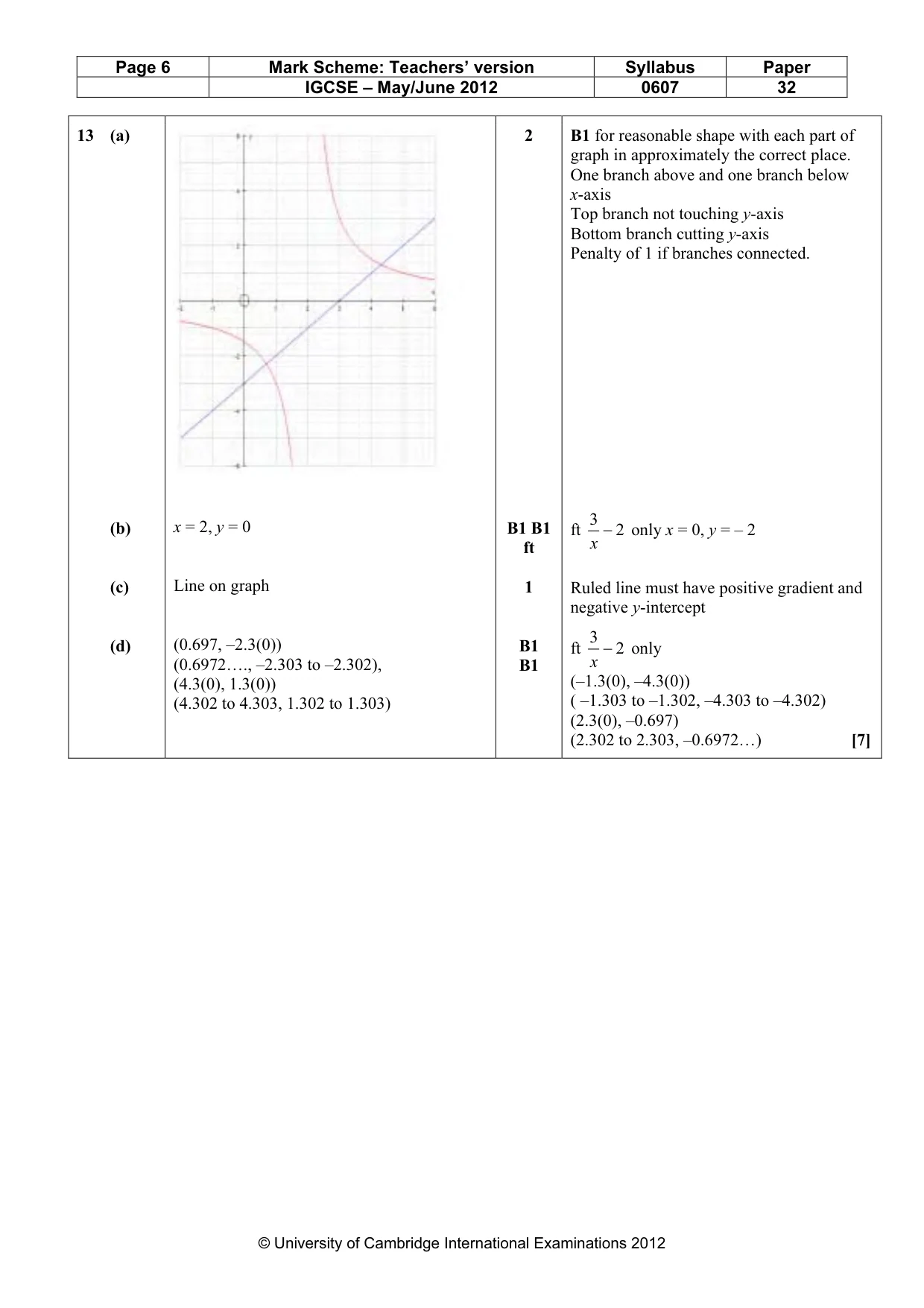
18 © UCLES 2012 0607/32/M/J/12 For Examiner's Use 13 5 6 –2 –5 0 y x (a) Sketch the graph of ) 2 ( 3 − = x y for – 2 Y x Y 6. [2] (b) Write down the equations of the two asymptotes. Answer(b) [2] (c) Using the same axes, sketch the line y = x – 3. [1] (d) Write down the co-ordinates of the points of intersection of ) 2 ( 3 − = x y and y = x – 3. Answer(d) ( , ) and ( , ) [2]
Question paper, page 19
19 © UCLES 2012 0607/32/M/J/12 BLANK PAGE
Question paper, page 20
20 Permission to reproduce items where third-party owned material protected by copyright is included has been sought and cleared where possible. Every reasonable effort has been made by the publisher (UCLES) to trace copyright holders, but if any items requiring clearance have unwittingly been included, the publisher will be pleased to make amends at the earliest possible opportunity. University of Cambridge International Examinations is part of the Cambridge Assessment Group. Cambridge Assessment is the brand name of University of Cambridge Local Examinations Syndicate (UCLES), which is itself a department of the University of Cambridge. © UCLES 2012 0607/32/M/J/12 BLANK PAGE
Mark scheme, page 1
UNIVERSITY OF CAMBRIDGE INTERNATIONAL EXAMINATIONS International General Certificate of Secondary Education MARK SCHEME for the May/June 2012 question paper for the guidance of teachers 0607 CAMBRIDGE INTERNATIONAL MATHEMATICS 0607/32 Paper 3 (Core), maximum raw mark 96 This mark scheme is published as an aid to teachers and candidates, to indicate the requirements of the examination. It shows the basis on which Examiners were instructed to award marks. It does not indicate the details of the discussions that took place at an Examiners’ meeting before marking began, which would have considered the acceptability of alternative answers. Mark schemes must be read in conjunction with the question papers and the report on the examination. • Cambridge will not enter into discussions or correspondence in connection with these mark schemes. Cambridge is publishing the mark schemes for the May/June 2012 question papers for most IGCSE, GCE Advanced Level and Advanced Subsidiary Level syllabuses and some Ordinary Level syllabuses. www.XtremePapers.com
Mark scheme, page 2
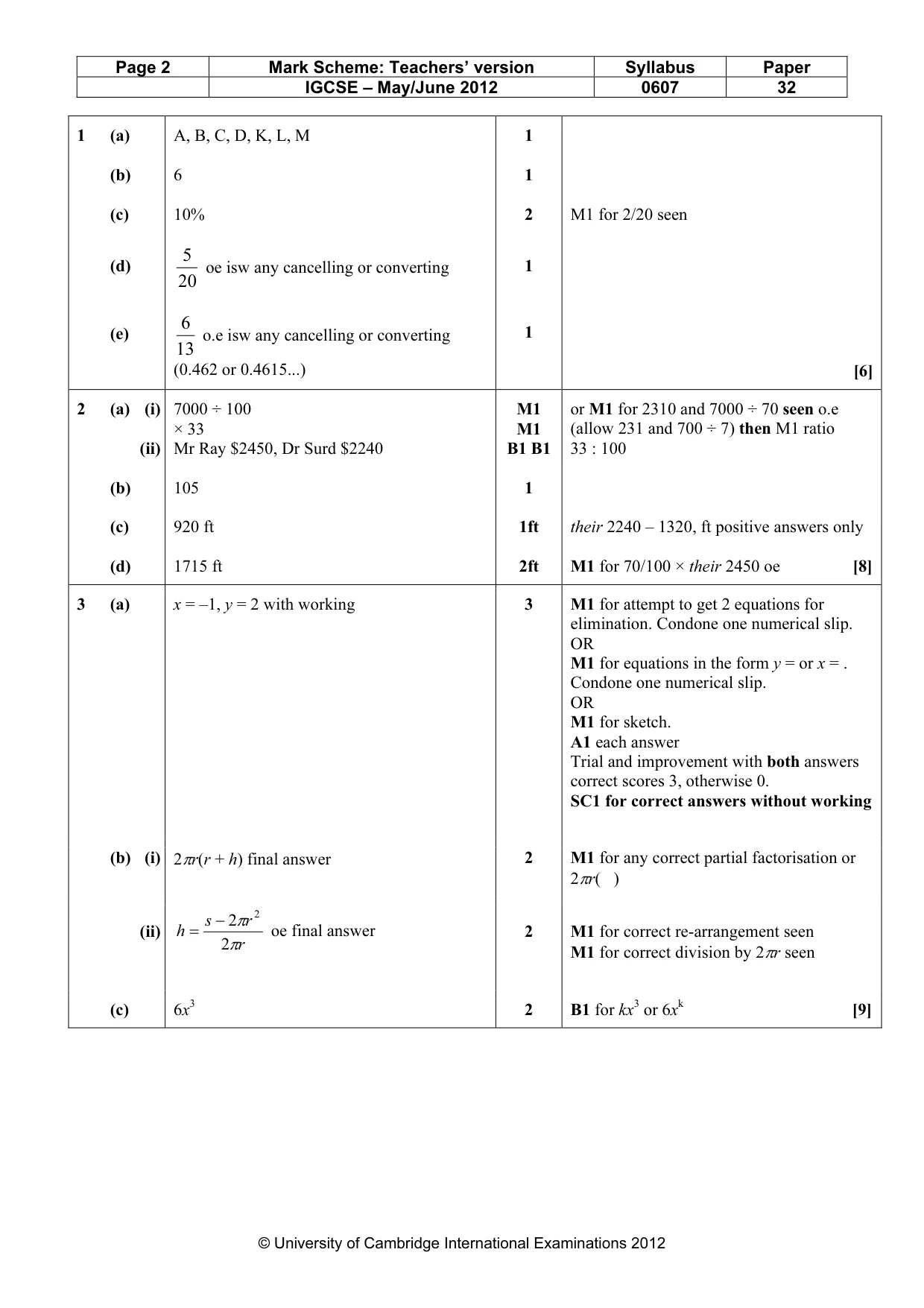
Page 2 Mark Scheme: Teachers’ version Syllabus Paper IGCSE – May/June 2012 0607 32 © University of Cambridge International Examinations 2012 1 (a) (b) (c) (d) (e) A, B, C, D, K, L, M 6 10% 20 5 oe isw any cancelling or converting 13 6 o.e isw any cancelling or converting (0.462 or 0.4615...) 1 1 2 1 1 M1 for 2/20 seen [6] 2 (a) (i) (ii) (b) (c) (d) 7000 ÷ 100 × 33 Mr Ray $2450, Dr Surd $2240 105 920 ft 1715 ft M1 M1 B1 B1 1 1ft 2ft or M1 for 2310 and 7000 ÷ 70 seen o.e (allow 231 and 700 ÷ 7) then M1 ratio 33 : 100 their 2240 – 1320, ft positive answers only M1 for 70/100 × their 2450 oe [8] 3 (a) x = –1, y = 2 with working 3 M1 for attempt to get 2 equations for elimination. Condone one numerical slip. OR M1 for equations in the form y = or x = . Condone one numerical slip. OR M1 for sketch. A1 each answer Trial and improvement with both answers correct scores 3, otherwise 0. SC1 for correct answers without working (b) (i) 2πr(r + h) final answer 2 M1 for any correct partial factorisation or 2πr( ) (ii) r r s h π π 2 2 2 − = oe final answer 2 M1 for correct re-arrangement seen M1 for correct division by 2πr seen (c) 6x3 2 B1 for kx3 or 6xk [9]
Mark scheme, page 3
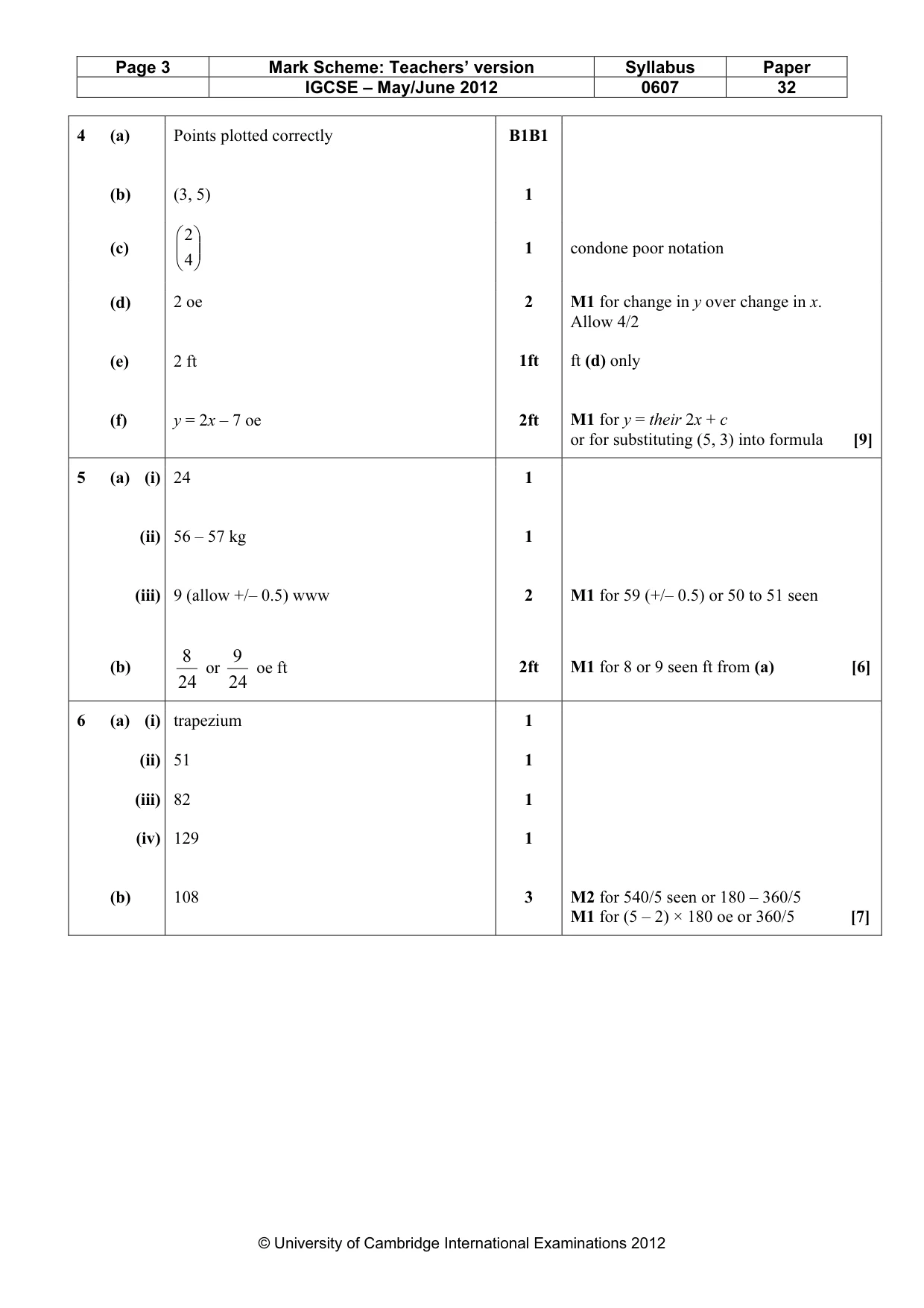
Page 3 Mark Scheme: Teachers’ version Syllabus Paper IGCSE – May/June 2012 0607 32 © University of Cambridge International Examinations 2012 4 (a) (b) Points plotted correctly (3, 5) B1B1 1 (c) 4 2 1 condone poor notation (d) (e) (f) 2 oe 2 ft y = 2x – 7 oe 2 1ft 2ft M1 for change in y over change in x. Allow 4/2 ft (d) only M1 for y = their 2x + c or for substituting (5, 3) into formula [9] 5 (a) (i) (ii) (iii) (b) 24 56 – 57 kg 9 (allow +/– 0.5) www 24 8 or 24 9 oe ft 1 1 2 2ft M1 for 59 (+/– 0.5) or 50 to 51 seen M1 for 8 or 9 seen ft from (a) [6] 6 (a) (i) (ii) (iii) (iv) (b) trapezium 51 82 129 108 1 1 1 1 3 M2 for 540/5 seen or 180 – 360/5 M1 for (5 – 2) × 180 oe or 360/5 [7]
Mark scheme, page 4
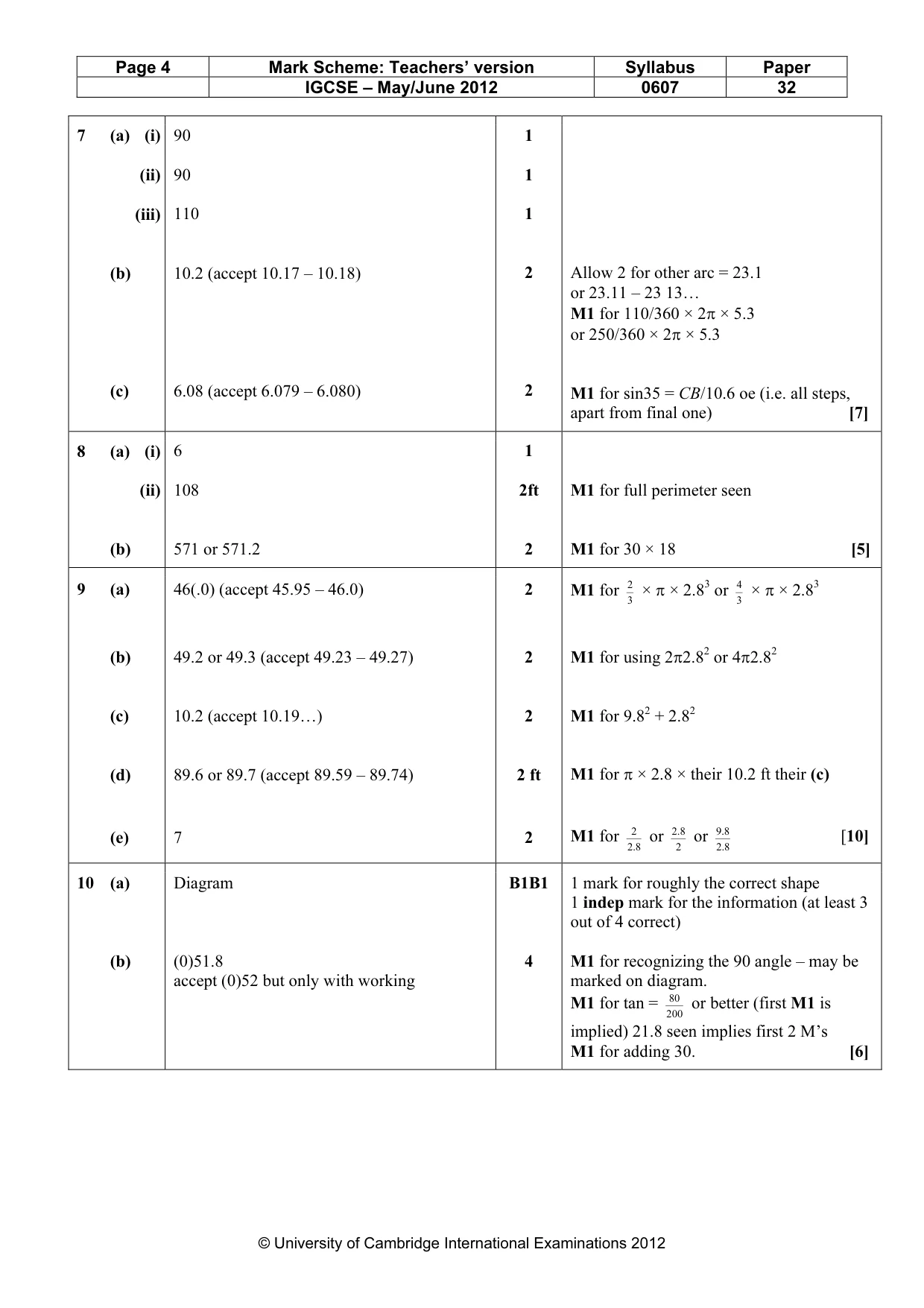
Page 4 Mark Scheme: Teachers’ version Syllabus Paper IGCSE – May/June 2012 0607 32 © University of Cambridge International Examinations 2012 7 (a) (i) (ii) (iii) (b) (c) 90 90 110 10.2 (accept 10.17 – 10.18) 6.08 (accept 6.079 – 6.080) 1 1 1 2 2 Allow 2 for other arc = 23.1 or 23.11 – 23 13… M1 for 110/360 × 2π × 5.3 or 250/360 × 2π × 5.3 M1 for sin35 = CB/10.6 oe (i.e. all steps, apart from final one) [7] 8 (a) (i) (ii) (b) 6 108 571 or 571.2 1 2ft 2 M1 for full perimeter seen M1 for 30 × 18 [5] 9 (a) (b) (c) (d) (e) 46(.0) (accept 45.95 – 46.0) 49.2 or 49.3 (accept 49.23 – 49.27) 10.2 (accept 10.19…) 89.6 or 89.7 (accept 89.59 – 89.74) 7 2 2 2 2 ft 2 M1 for 3 2 × π × 2.83 or 3 4 × π × 2.83 M1 for using 2π2.82 or 4π2.82 M1 for 9.82 + 2.82 M1 for π × 2.8 × their 10.2 ft their (c) M1 for 8.2 2 or 2 8.2 or 8.2 8.9 [10] 10 (a) (b) Diagram (0)51.8 accept (0)52 but only with working B1B1 4 1 mark for roughly the correct shape 1 indep mark for the information (at least 3 out of 4 correct) M1 for recognizing the 90 angle – may be marked on diagram. M1 for tan = 200 80 or better (first M1 is implied) 21.8 seen implies first 2 M’s M1 for adding 30. [6]
Mark scheme, page 5
Page 5 Mark Scheme: Teachers’ version Syllabus Paper IGCSE – May/June 2012 0607 32 © University of Cambridge International Examinations 2012 11 (a) (b) (c) (d) (–2, 1) and (1, –0.35) x = 0, 1.81 (1.811 to 1.812) their graph moved up 3 3 B1 B1 B1 B1 1 B1 for cubic shape with a max and a min B1 for turning points in the correct quadrants. B1 for x-axis intercepts: one negative, one positive and one at origin. SC1 for correct points in wrong order their graph with vertical translation of 3 [8] 12 (a) (b) (c) (d) (i) (ii) (iii) 3820 (accept 3817…) 3800 7 3 Positive Ruled line drawn through (180, their 3820) 3300 – 3500 1 1 2 1 2 ft 1 M1 for 15/35 B1 for passing through mean, B1 for positive gradient. [8]
Mark scheme, page 6
Page 6 Mark Scheme: Teachers’ version Syllabus Paper IGCSE – May/June 2012 0607 32 © University of Cambridge International Examinations 2012 13 (a) (b) (c) (d) x = 2, y = 0 Line on graph (0.697, –2.3(0)) (0.6972…., –2.303 to –2.302), (4.3(0), 1.3(0)) (4.302 to 4.303, 1.302 to 1.303) 2 B1 B1 ft 1 B1 B1 B1 for reasonable shape with each part of graph in approximately the correct place. One branch above and one branch below x-axis Top branch not touching y-axis Bottom branch cutting y-axis Penalty of 1 if branches connected. ft 2 3 − x only x = 0, y = – 2 Ruled line must have positive gradient and negative y-intercept ft 2 3 − x only (–1.3(0), –4.3(0)) ( –1.303 to –1.302, –4.303 to –4.302) (2.3(0), –0.697) (2.302 to 2.303, –0.6972…) [7]
What you needed in this session
Cambridge’s own grade thresholds for 2012 May/June, Paper 3 · Variant 2. A higher threshold means an easier paper — the bar moves with how the cohort did.