Cambridge IGCSE Mathematics - International 0607 — 2011 Oct/Nov Paper 3 · Variant 1
0607/31/O/N/11
The question paper and its mark scheme, free to read here and free to download. This is Cambridge’s own paper, exactly as it was sat.
Question paper16 pages
Mark scheme6 pages
Answers below. Sit the paper first if you are practising.
Paper as text
Question paper, page 1
This document consists of 16 printed pages. IB11 11_0607_03/3RP © UCLES 2011 [Turn over *6553972045* For Examiner's Use UNIVERSITY OF CAMBRIDGE INTERNATIONAL EXAMINATIONS International General Certificate of Secondary Education CAMBRIDGE INTERNATIONAL MATHEMATICS 0607/03 Paper 3 (Core) October/November 2011 1 hour 45 minutes Candidates answer on the Question Paper Additional Materials: Geometrical Instruments Graphics Calculator READ THESE INSTRUCTIONS FIRST Write your Centre number, candidate number and name on all the work you hand in. Write in dark blue or black pen. Do not use staples, paper clips, highlighters, glue or correction fluid. You may use a pencil for any diagrams or graphs. DO NOT WRITE IN ANY BARCODES. Answer all the questions. Unless instructed otherwise, give your answers exactly or correct to three significant figures as appropriate. Answers in degrees should be given to one decimal place. For π, use your calculator value. You must show all the relevant working to gain full marks and you will be given marks for correct methods, including sketches, even if your answer is incorrect. The number of marks is given in brackets [ ] at the end of each question or part question. The total number of marks for this paper is 96. www.XtremePapers.com
Question paper, page 2
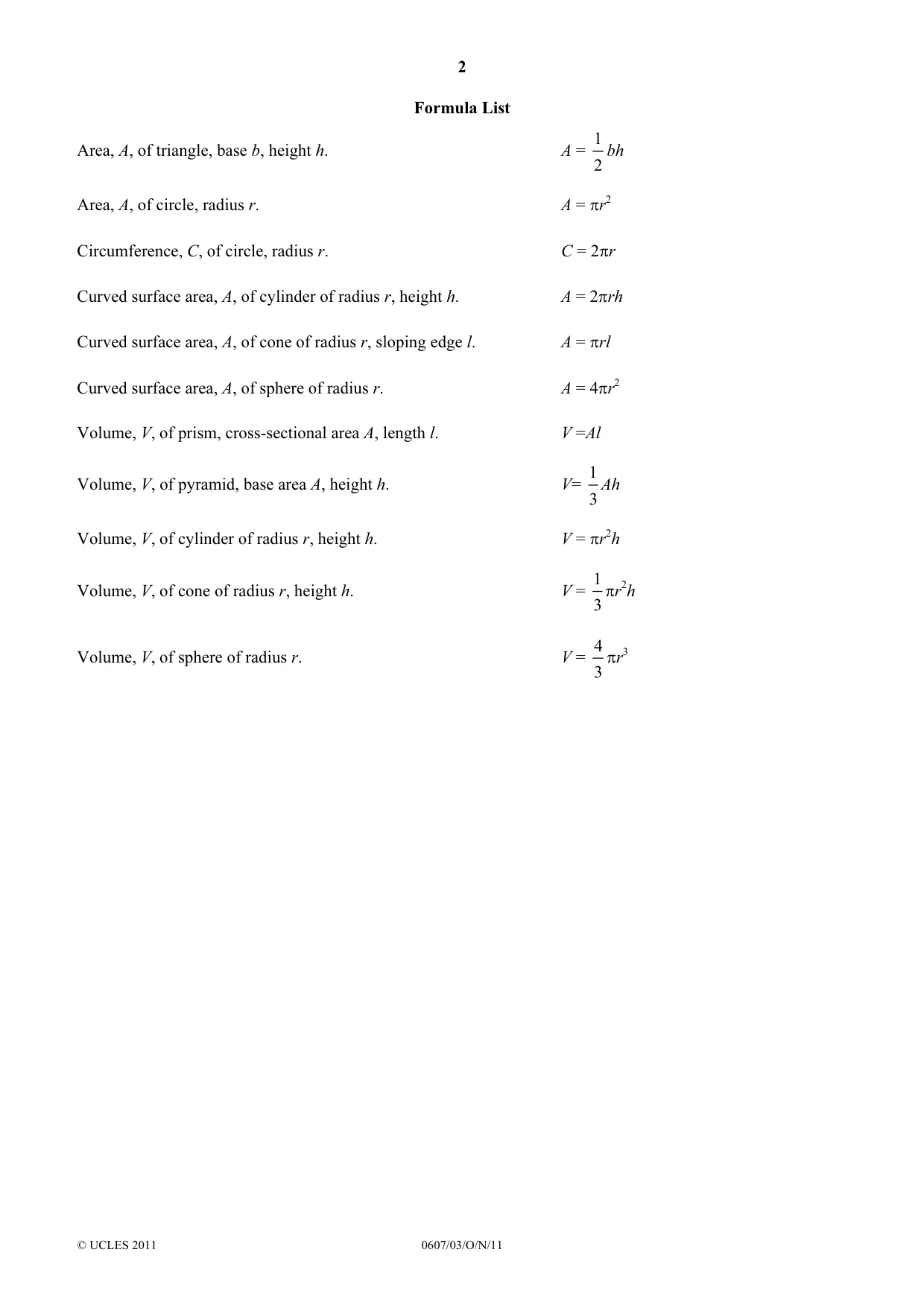
2 © UCLES 2011 0607/03/O/N/11 Formula List Area, A, of triangle, base b, height h. A = 1 2 bh Area, A, of circle, radius r. A = πr2 Circumference, C, of circle, radius r. C = 2πr Curved surface area, A, of cylinder of radius r, height h. A = 2πrh Curved surface area, A, of cone of radius r, sloping edge l. A = πrl Curved surface area, A, of sphere of radius r. A = 4πr2 Volume, V, of prism, cross-sectional area A, length l. V =Al Volume, V, of pyramid, base area A, height h. V= 1 3 Ah Volume, V, of cylinder of radius r, height h. V = πr2h Volume, V, of cone of radius r, height h. V = 1 3 πr2h Volume, V, of sphere of radius r. V = 4 3 πr3
Question paper, page 3
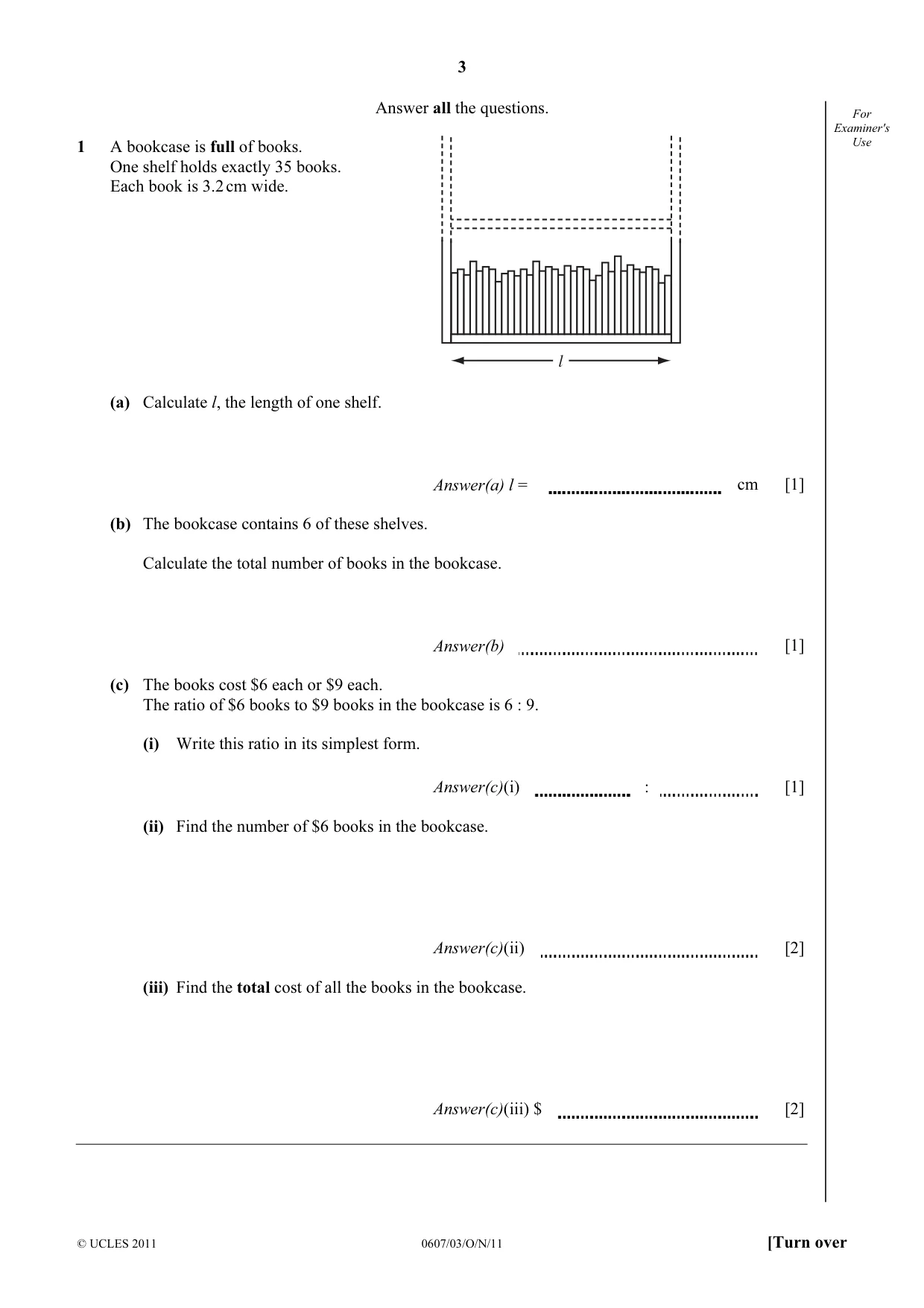
3 © UCLES 2011 0607/03/O/N/11 [Turn over For Examiner's Use Answer all the questions. 1 A bookcase is full of books. One shelf holds exactly 35 books. Each book is 3.2 cm wide. (a) Calculate l, the length of one shelf. Answer(a) l = cm [1] (b) The bookcase contains 6 of these shelves. Calculate the total number of books in the bookcase. Answer(b) [1] (c) The books cost $6 each or $9 each. The ratio of $6 books to $9 books in the bookcase is 6 : 9. (i) Write this ratio in its simplest form. Answer(c)(i) : [1] (ii) Find the number of $6 books in the bookcase. Answer(c)(ii) [2] (iii) Find the total cost of all the books in the bookcase. Answer(c)(iii) $ [2] l
Question paper, page 4
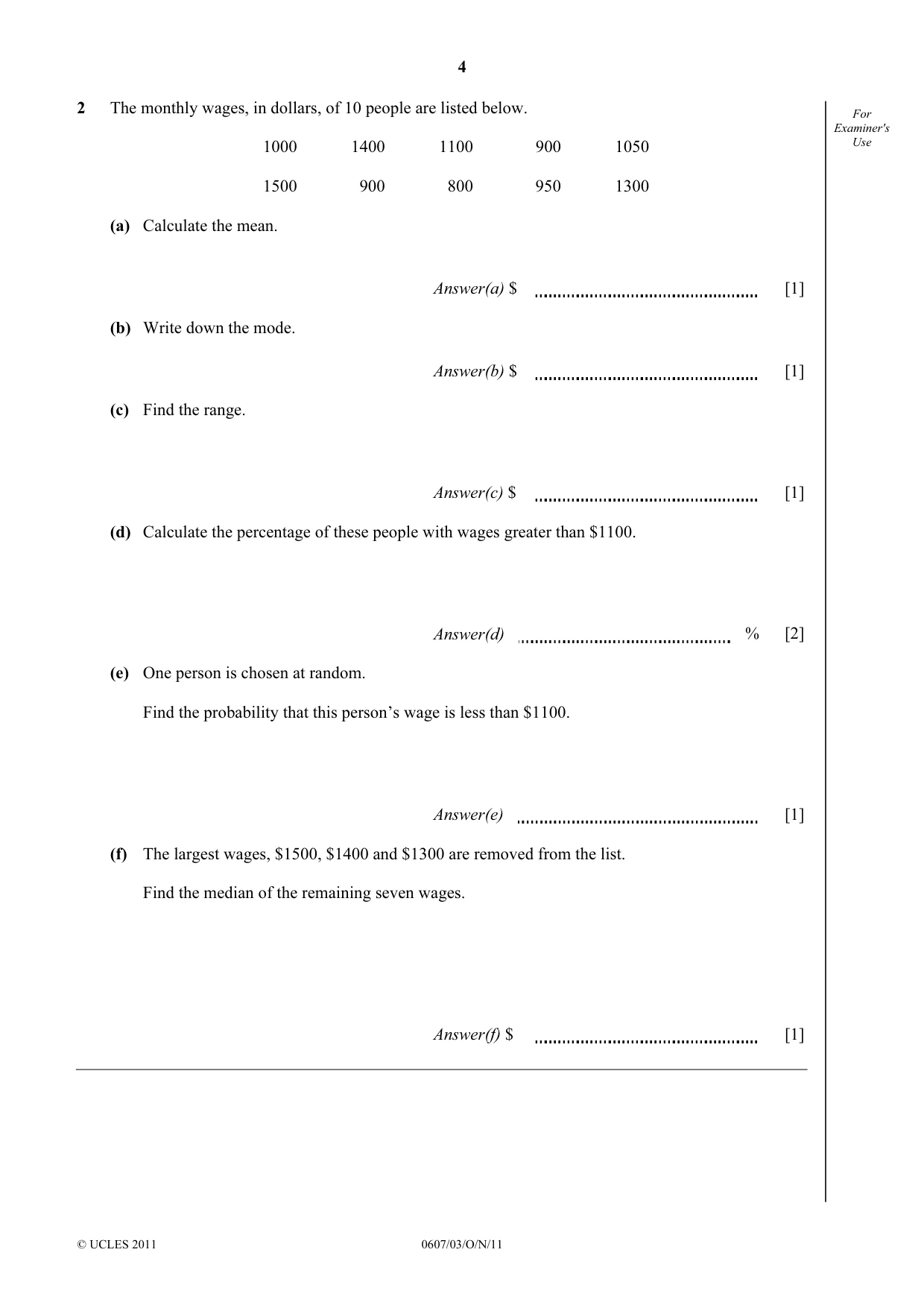
4 © UCLES 2011 0607/03/O/N/11 For Examiner's Use 2 The monthly wages, in dollars, of 10 people are listed below. 1000 1400 1100 900 1050 1500 900 800 950 1300 (a) Calculate the mean. Answer(a) $ [1] (b) Write down the mode. Answer(b) $ [1] (c) Find the range. Answer(c) $ [1] (d) Calculate the percentage of these people with wages greater than $1100. Answer(d) % [2] (e) One person is chosen at random. Find the probability that this person’s wage is less than $1100. Answer(e) [1] (f) The largest wages, $1500, $1400 and $1300 are removed from the list. Find the median of the remaining seven wages. Answer(f) $ [1]
Question paper, page 5
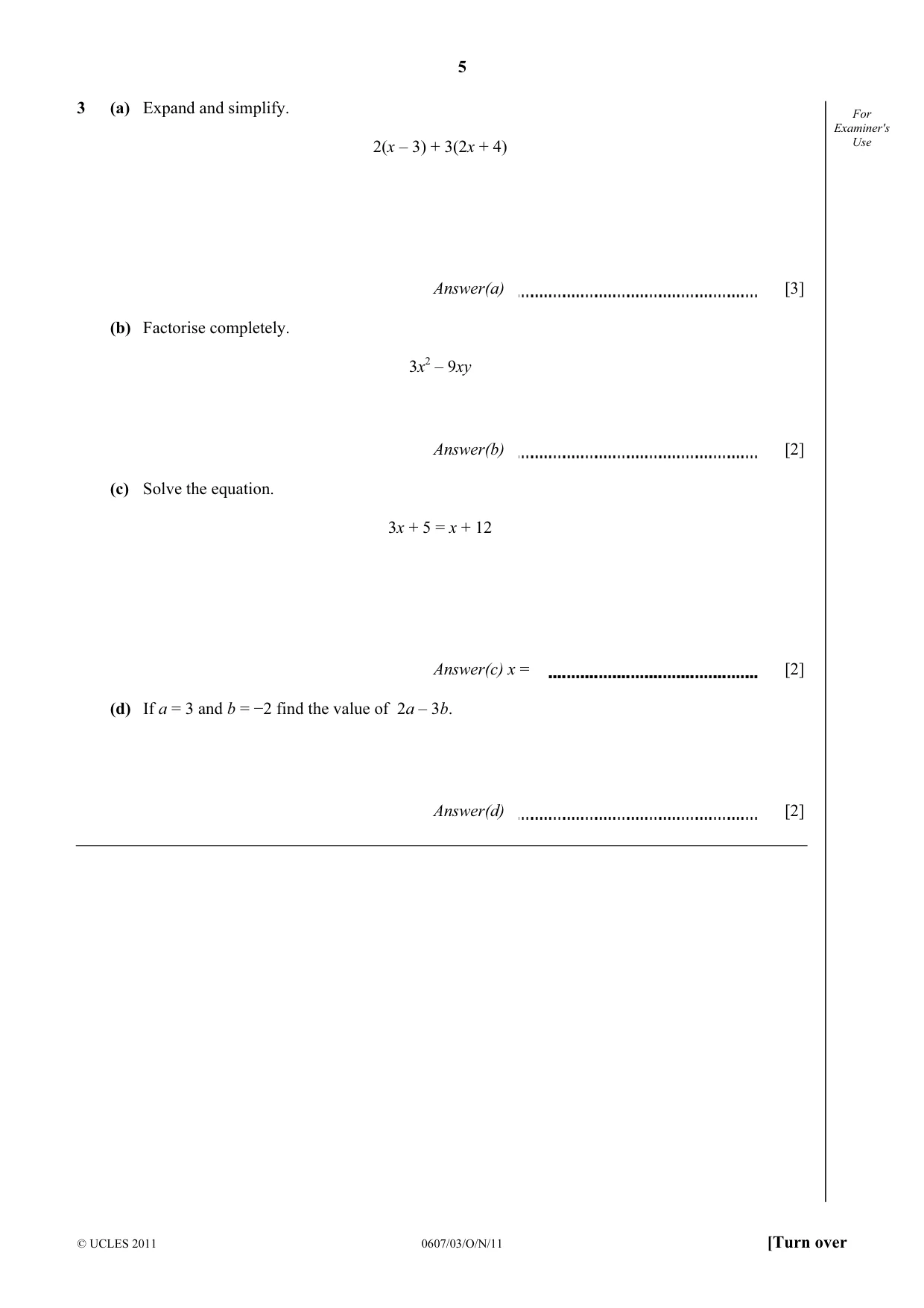
5 © UCLES 2011 0607/03/O/N/11 [Turn over For Examiner's Use 3 (a) Expand and simplify. 2(x – 3) + 3(2x + 4) Answer(a) [3] (b) Factorise completely. 3x2 – 9xy Answer(b) [2] (c) Solve the equation. 3x + 5 = x + 12 Answer(c) x = [2] (d) If a = 3 and b = −2 find the value of 2a – 3b. Answer(d) [2]
Question paper, page 6
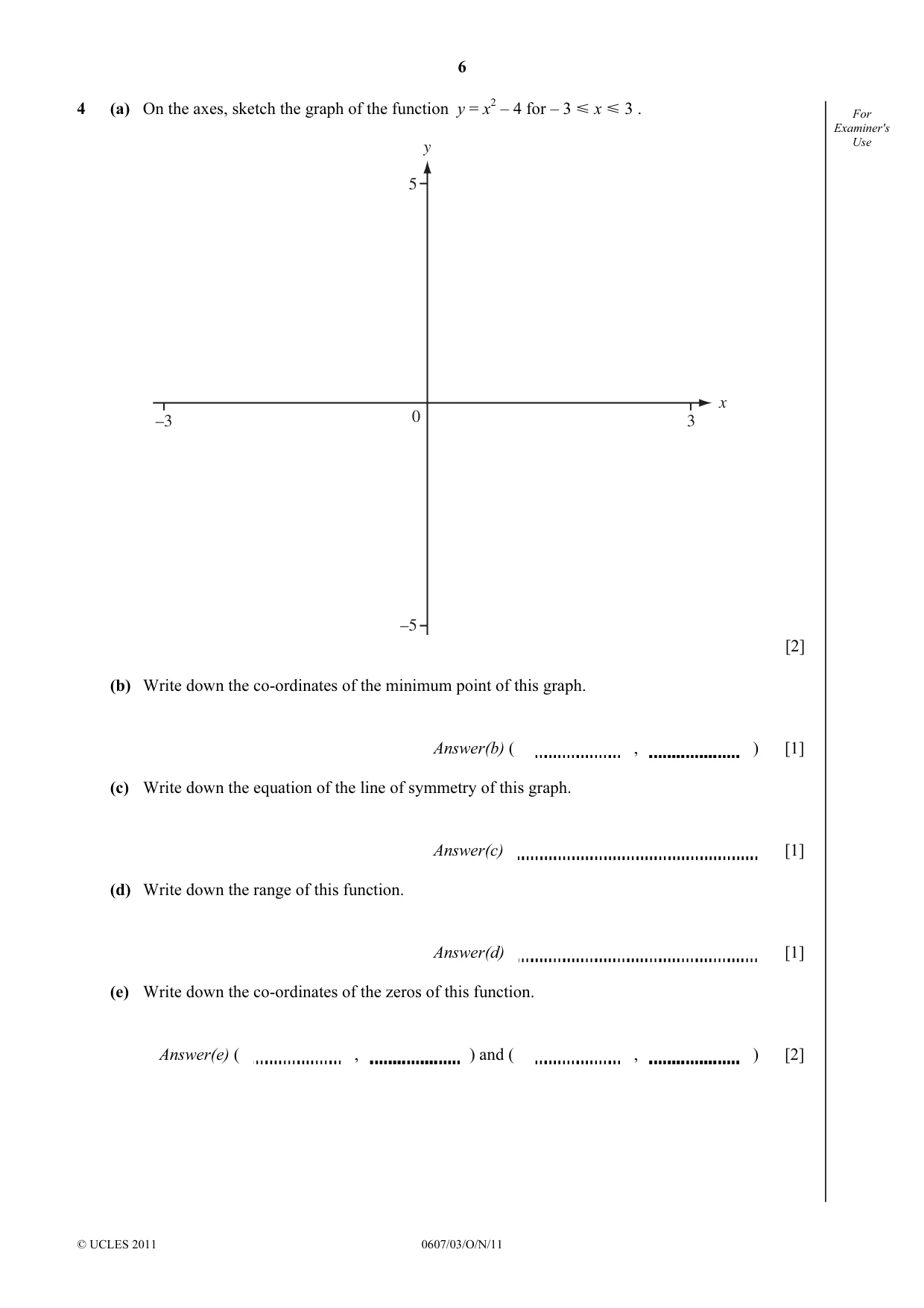
6 © UCLES 2011 0607/03/O/N/11 For Examiner's Use 4 (a) On the axes, sketch the graph of the function y = x2 – 4 for – 3 Y x Y 3 . 5 –5 –3 3 0 x y [2] (b) Write down the co-ordinates of the minimum point of this graph. Answer(b) ( , ) [1] (c) Write down the equation of the line of symmetry of this graph. Answer(c) [1] (d) Write down the range of this function. Answer(d) [1] (e) Write down the co-ordinates of the zeros of this function. Answer(e) ( , ) and ( , ) [2]
Question paper, page 7
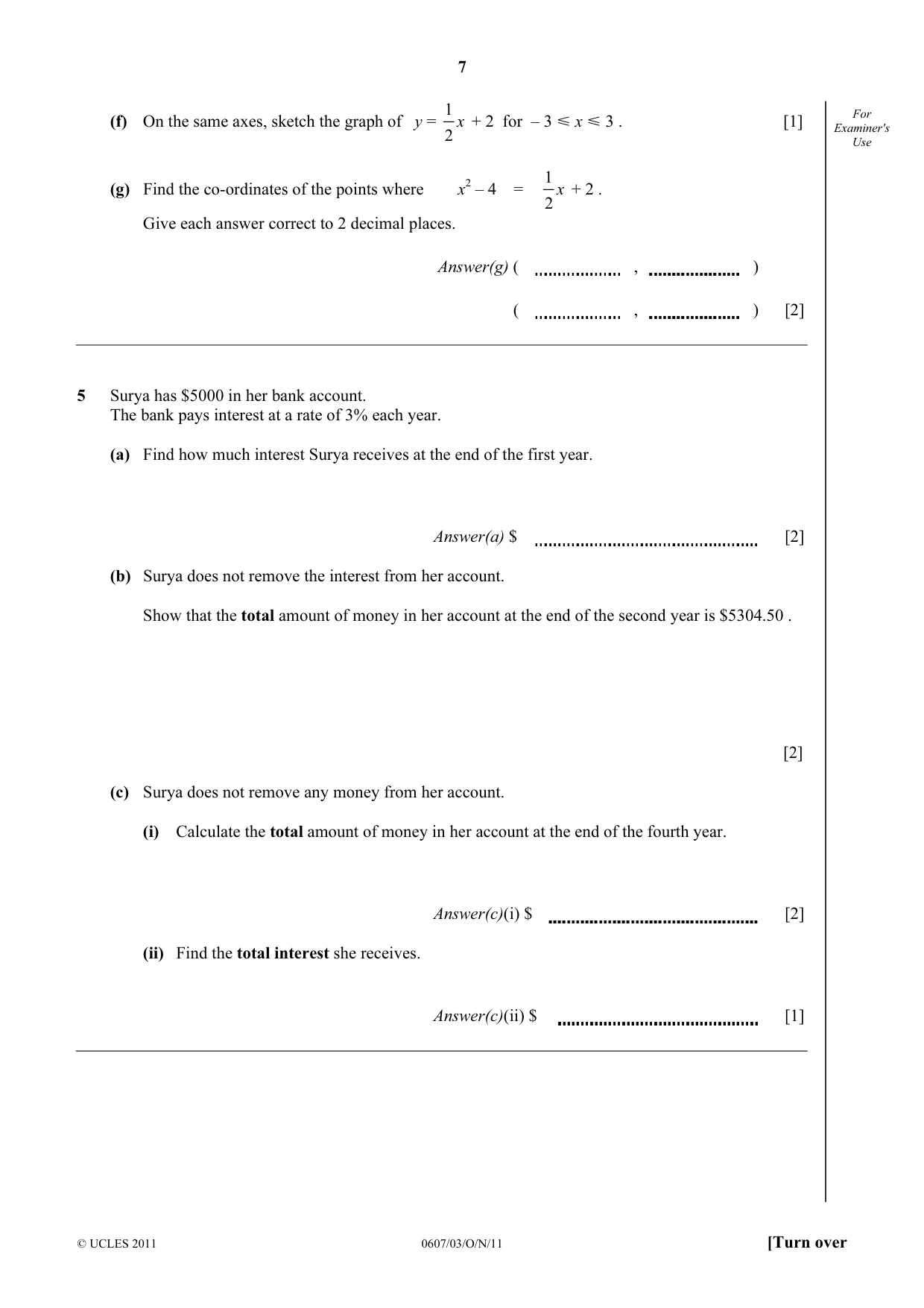
7 © UCLES 2011 0607/03/O/N/11 [Turn over For Examiner's Use (f) On the same axes, sketch the graph of y = 1 2 x + 2 for – 3 Y x Y 3 . [1] (g) Find the co-ordinates of the points where x2 – 4 = 1 2 x + 2 . Give each answer correct to 2 decimal places. Answer(g) ( , ) ( , ) [2] 5 Surya has $5000 in her bank account. The bank pays interest at a rate of 3% each year. (a) Find how much interest Surya receives at the end of the first year. Answer(a) $ [2] (b) Surya does not remove the interest from her account. Show that the total amount of money in her account at the end of the second year is $5304.50 . [2] (c) Surya does not remove any money from her account. (i) Calculate the total amount of money in her account at the end of the fourth year. Answer(c)(i) $ [2] (ii) Find the total interest she receives. Answer(c)(ii) $ [1]
Question paper, page 8
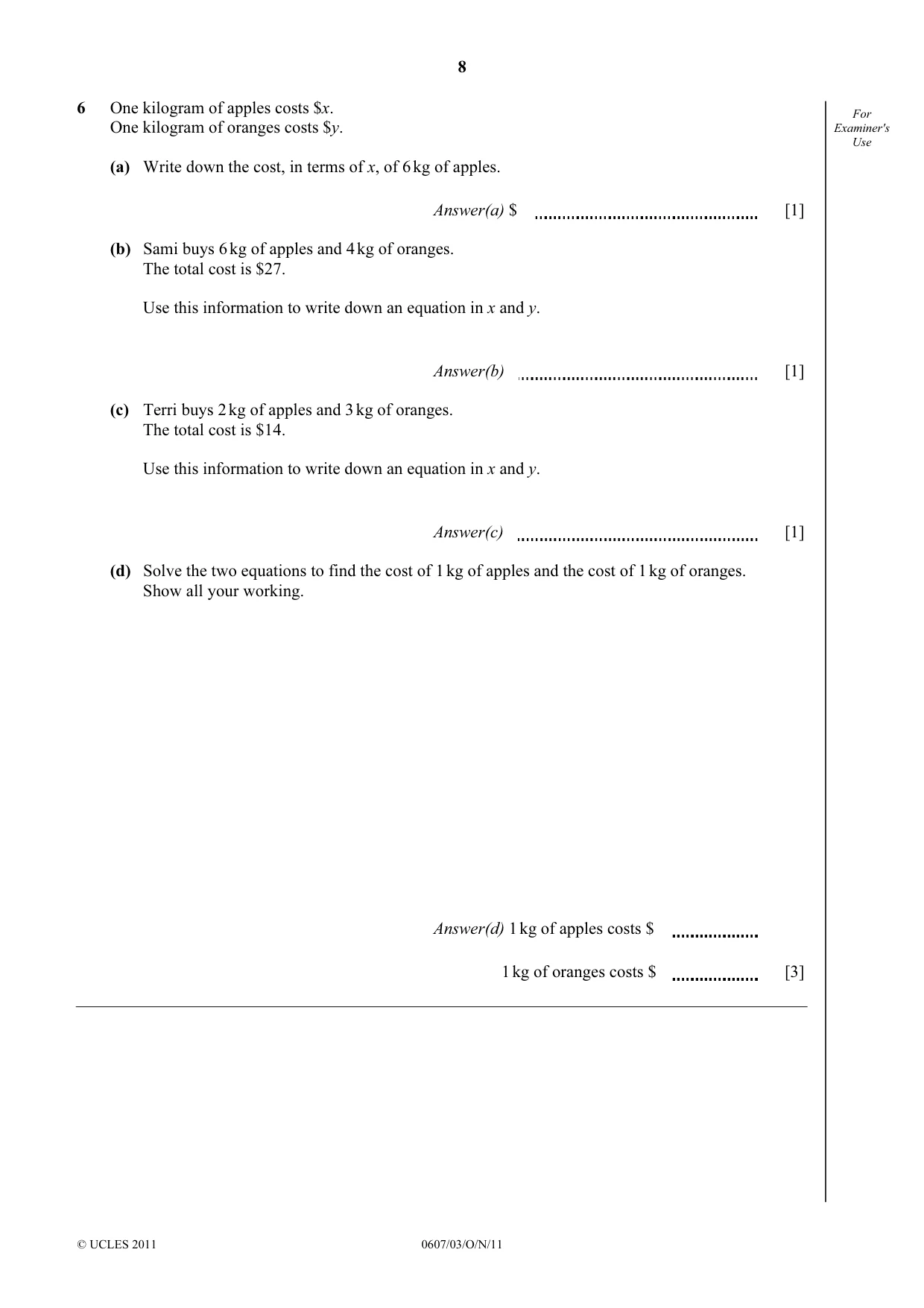
8 © UCLES 2011 0607/03/O/N/11 For Examiner's Use 6 One kilogram of apples costs $x. One kilogram of oranges costs $y. (a) Write down the cost, in terms of x, of 6 kg of apples. Answer(a) $ [1] (b) Sami buys 6 kg of apples and 4 kg of oranges. The total cost is $27. Use this information to write down an equation in x and y. Answer(b) [1] (c) Terri buys 2 kg of apples and 3 kg of oranges. The total cost is $14. Use this information to write down an equation in x and y. Answer(c) [1] (d) Solve the two equations to find the cost of 1 kg of apples and the cost of 1 kg of oranges. Show all your working. Answer(d) 1 kg of apples costs $ 1 kg of oranges costs $ [3]
Question paper, page 9
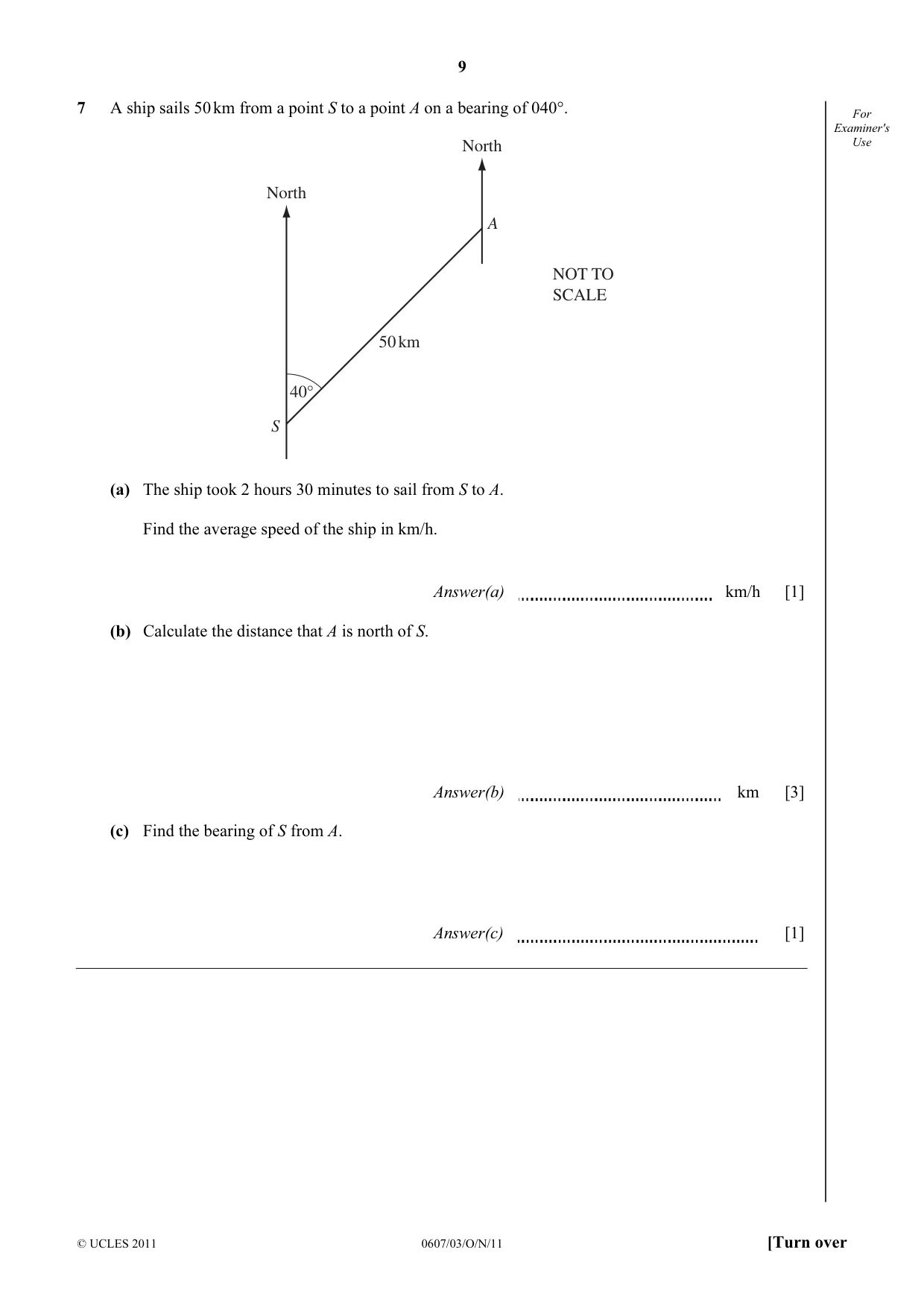
9 © UCLES 2011 0607/03/O/N/11 [Turn over For Examiner's Use 7 A ship sails 50 km from a point S to a point A on a bearing of 040°. North North S A NOT TO SCALE 40° 50 km (a) The ship took 2 hours 30 minutes to sail from S to A. Find the average speed of the ship in km/h. Answer(a) km/h [1] (b) Calculate the distance that A is north of S. Answer(b) km [3] (c) Find the bearing of S from A. Answer(c) [1]
Question paper, page 10
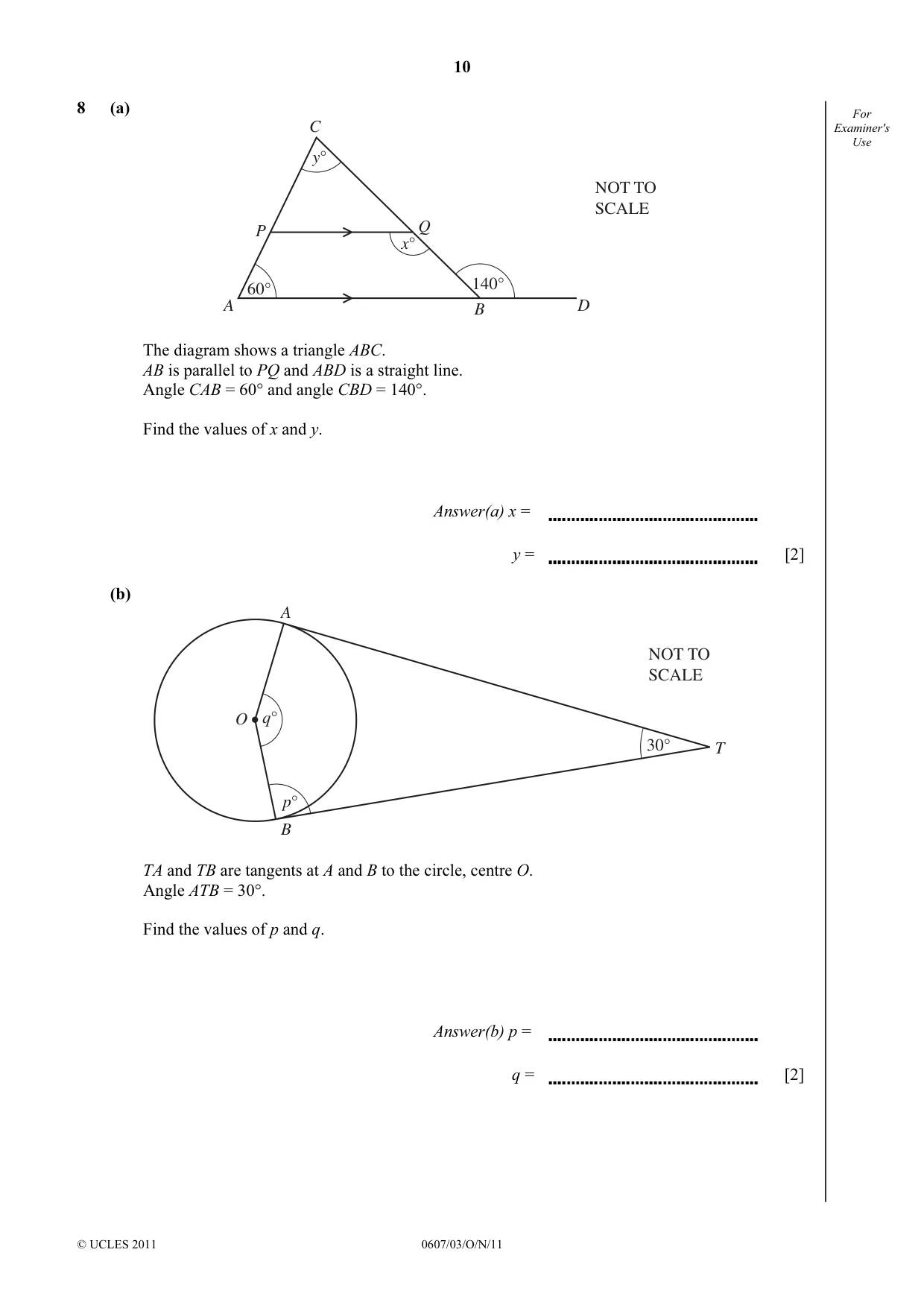
10 © UCLES 2011 0607/03/O/N/11 For Examiner's Use 8 (a) C A D B P Q y° x° 60° 140° NOT TO SCALE The diagram shows a triangle ABC. AB is parallel to PQ and ABD is a straight line. Angle CAB = 60° and angle CBD = 140°. Find the values of x and y. Answer(a) x = y = [2] (b) A B O T 30° q° p° NOT TO SCALE TA and TB are tangents at A and B to the circle, centre O. Angle ATB = 30°. Find the values of p and q. Answer(b) p = q = [2]
Question paper, page 11
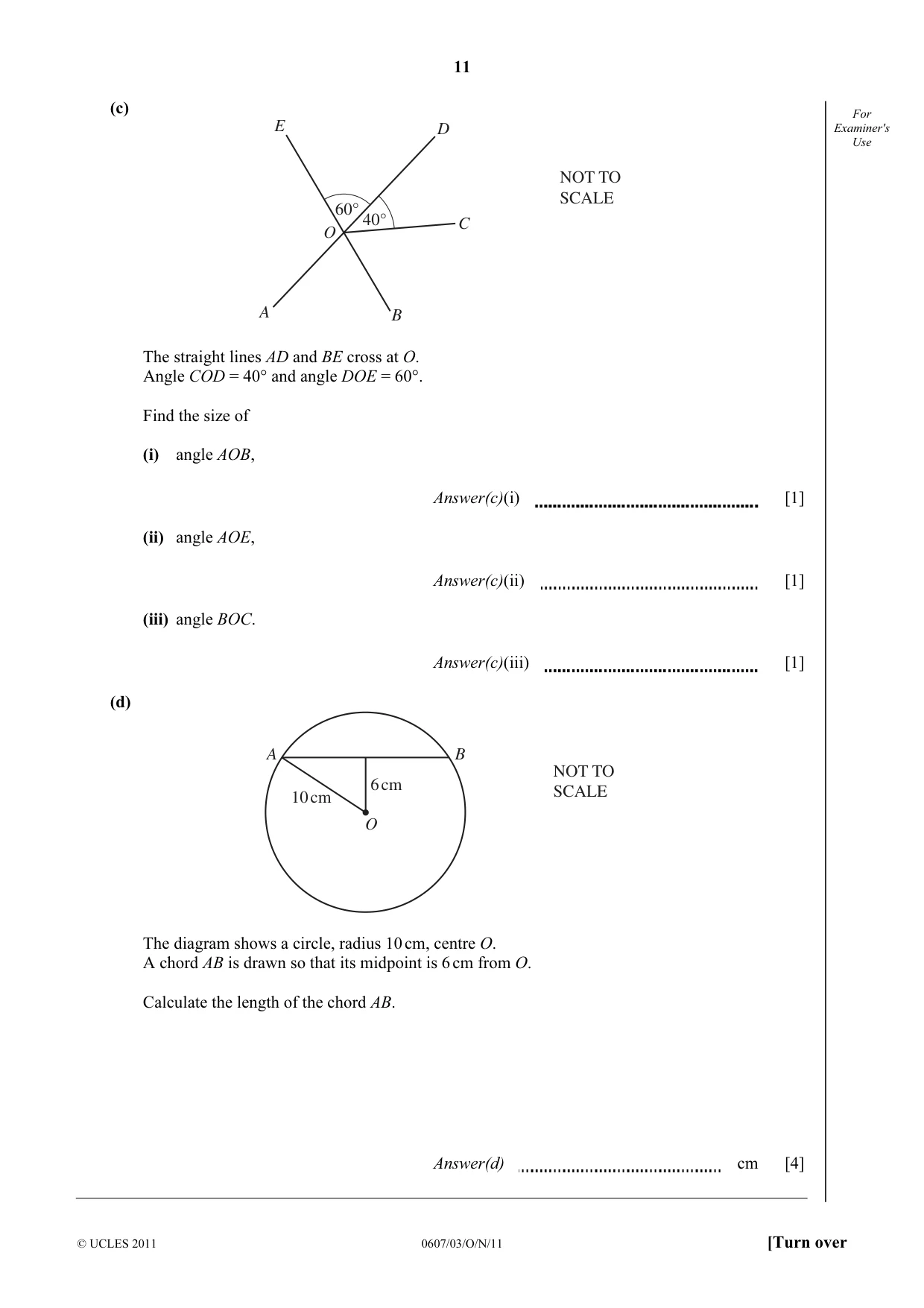
11 © UCLES 2011 0607/03/O/N/11 [Turn over For Examiner's Use (c) E D C B A O 60° 40° NOT TO SCALE The straight lines AD and BE cross at O. Angle COD = 40° and angle DOE = 60°. Find the size of (i) angle AOB, Answer(c)(i) [1] (ii) angle AOE, Answer(c)(ii) [1] (iii) angle BOC. Answer(c)(iii) [1] (d) A B O 6 cm 10 cm NOT TO SCALE The diagram shows a circle, radius 10 cm, centre O. A chord AB is drawn so that its midpoint is 6 cm from O. Calculate the length of the chord AB. Answer(d) cm [4]
Question paper, page 12
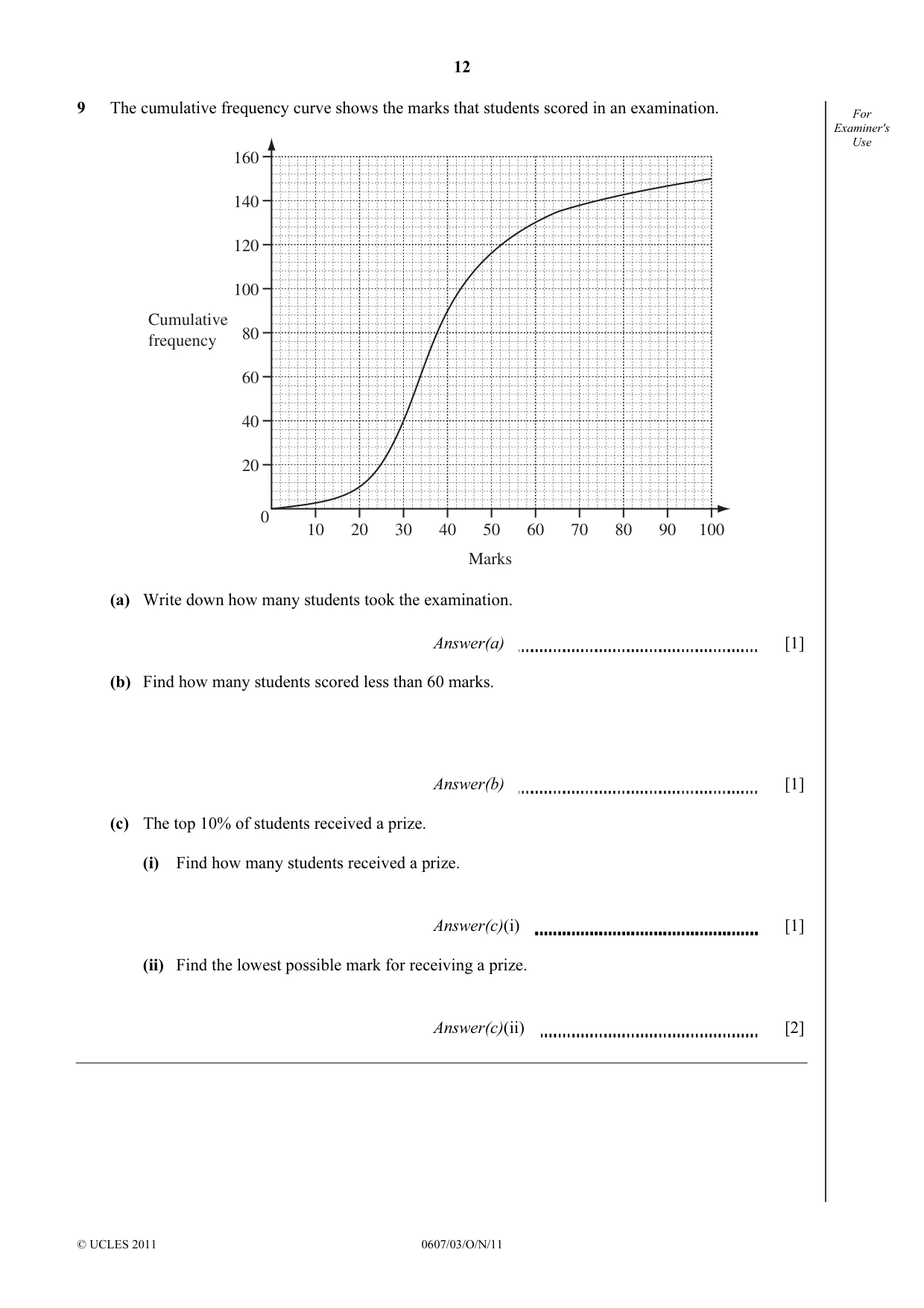
12 © UCLES 2011 0607/03/O/N/11 For Examiner's Use 9 The cumulative frequency curve shows the marks that students scored in an examination. 160 140 120 100 80 60 40 20 0 10 20 30 40 50 60 70 80 90 100 Cumulative frequency Marks (a) Write down how many students took the examination. Answer(a) [1] (b) Find how many students scored less than 60 marks. Answer(b) [1] (c) The top 10% of students received a prize. (i) Find how many students received a prize. Answer(c)(i) [1] (ii) Find the lowest possible mark for receiving a prize. Answer(c)(ii) [2]
Question paper, page 13
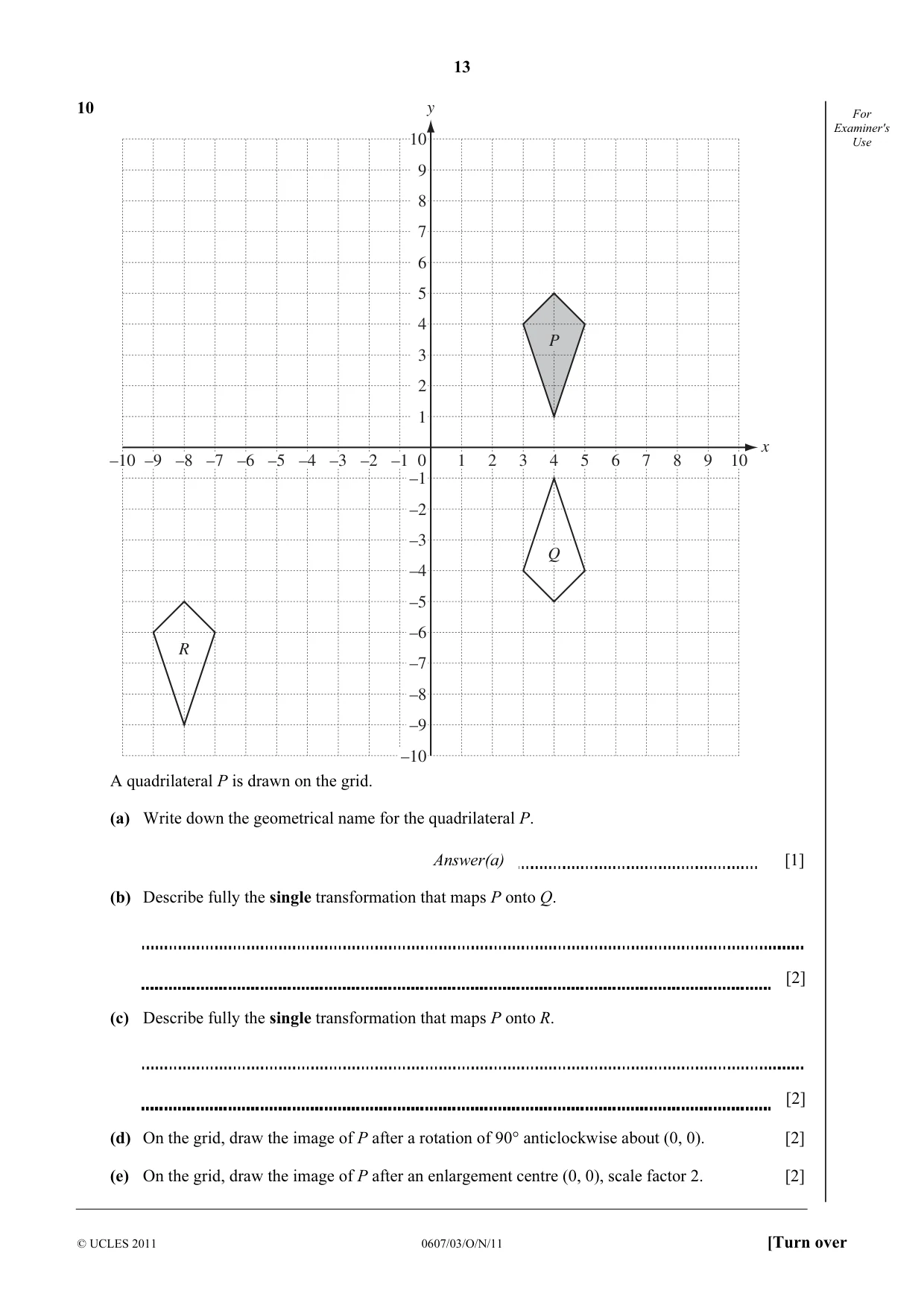
13 © UCLES 2011 0607/03/O/N/11 [Turn over For Examiner's Use 10 A quadrilateral P is drawn on the grid. (a) Write down the geometrical name for the quadrilateral P. Answer(a) [1] (b) Describe fully the single transformation that maps P onto Q. [2] (c) Describe fully the single transformation that maps P onto R. [2] (d) On the grid, draw the image of P after a rotation of 90° anticlockwise about (0, 0). [2] (e) On the grid, draw the image of P after an enlargement centre (0, 0), scale factor 2. [2] –1 –2 –3 –4 –5 –6 –7 –8 –9 –10 8 9 10 7 6 5 4 3 2 1 0 y x 10 9 8 7 6 5 4 3 2 1 –1 –2 –3 –4 –5 –6 –7 –8 –9 –10 P Q R
Question paper, page 14
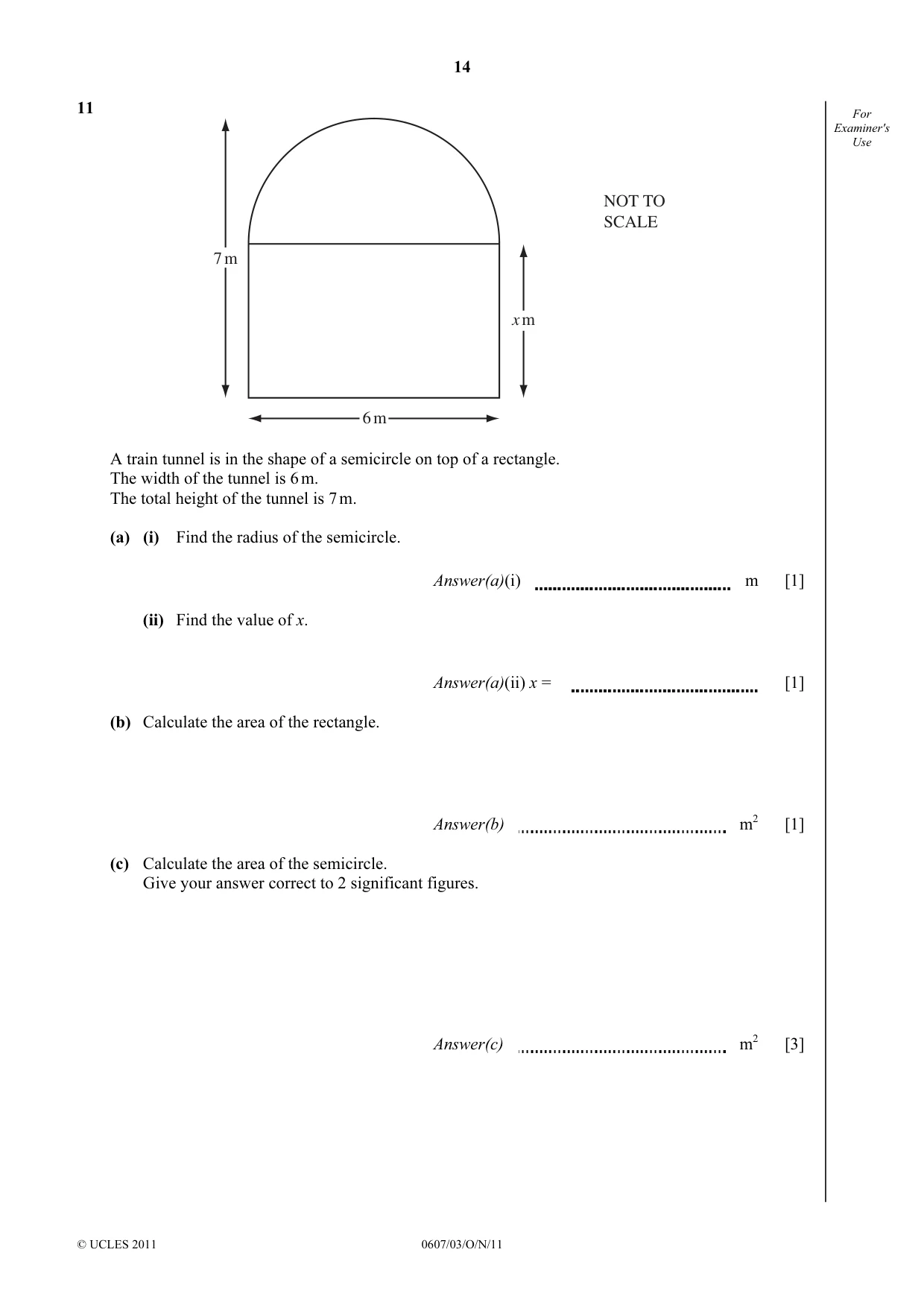
14 © UCLES 2011 0607/03/O/N/11 For Examiner's Use 11 7 m 6 m x m NOT TO SCALE A train tunnel is in the shape of a semicircle on top of a rectangle. The width of the tunnel is 6 m. The total height of the tunnel is 7 m. (a) (i) Find the radius of the semicircle. Answer(a)(i) m [1] (ii) Find the value of x. Answer(a)(ii) x = [1] (b) Calculate the area of the rectangle. Answer(b) m2 [1] (c) Calculate the area of the semicircle. Give your answer correct to 2 significant figures. Answer(c) m2 [3]
Question paper, page 15
15 © UCLES 2011 0607/03/O/N/11 [Turn over For Examiner's Use (d) The length of the tunnel is 35 kilometres. Calculate the volume of earth, in cubic metres, that was removed to make the tunnel. Answer(d) m3 [2] (e) A train travels at an average speed of 105 km/h through the tunnel. (i) Calculate the time, in minutes, it takes the train to travel through the tunnel. Answer(e)(i) minutes [2] (ii) The train enters the tunnel at 11 10. It arrives at the next station at 12 02. Find the number of minutes between the train leaving the tunnel and arriving at the station. Answer(e)(ii) minutes [2] Question 12 is printed on the next page.
Question paper, page 16
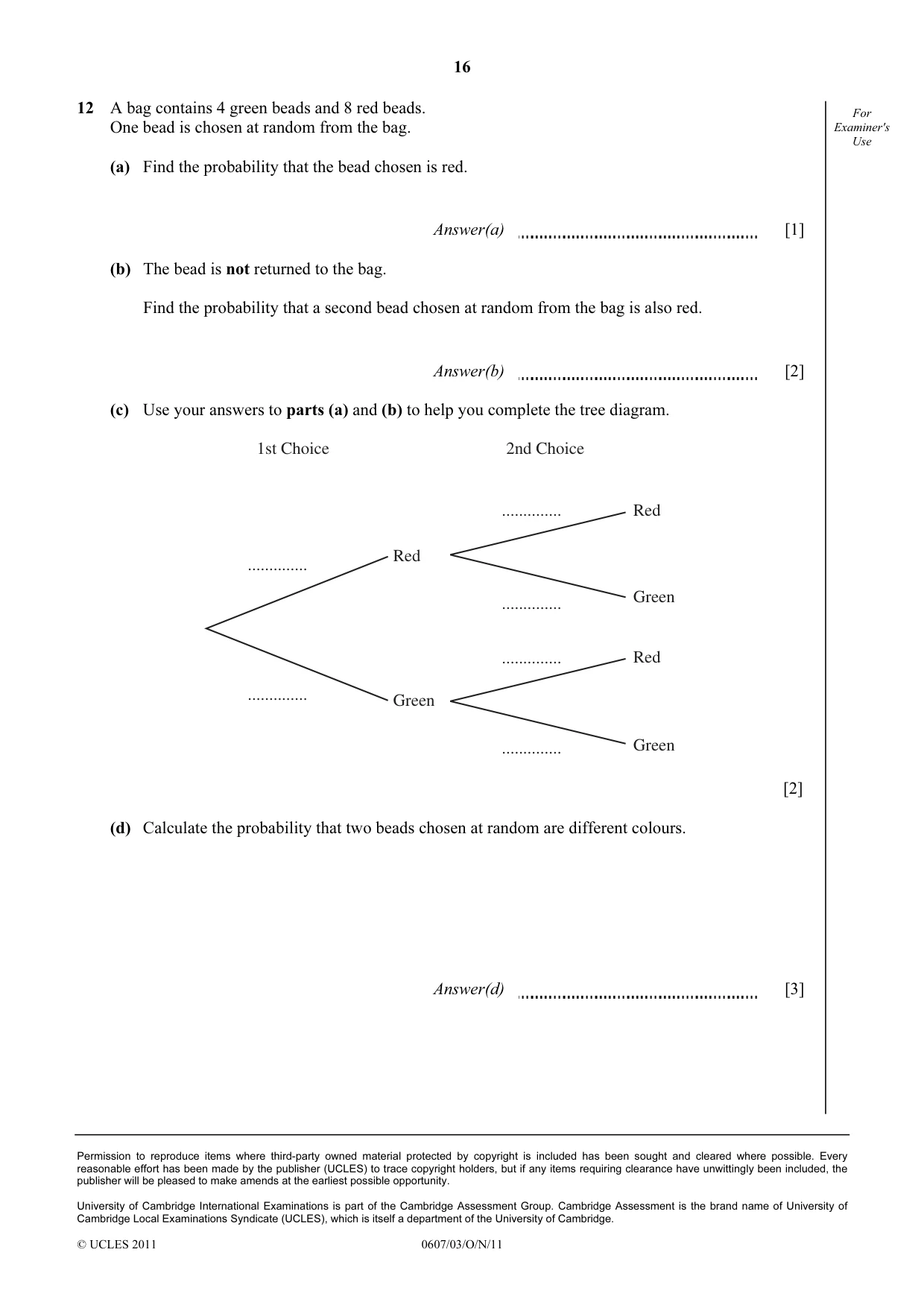
16 Permission to reproduce items where third-party owned material protected by copyright is included has been sought and cleared where possible. Every reasonable effort has been made by the publisher (UCLES) to trace copyright holders, but if any items requiring clearance have unwittingly been included, the publisher will be pleased to make amends at the earliest possible opportunity. University of Cambridge International Examinations is part of the Cambridge Assessment Group. Cambridge Assessment is the brand name of University of Cambridge Local Examinations Syndicate (UCLES), which is itself a department of the University of Cambridge. © UCLES 2011 0607/03/O/N/11 For Examiner's Use 12 A bag contains 4 green beads and 8 red beads. One bead is chosen at random from the bag. (a) Find the probability that the bead chosen is red. Answer(a) [1] (b) The bead is not returned to the bag. Find the probability that a second bead chosen at random from the bag is also red. Answer(b) [2] (c) Use your answers to parts (a) and (b) to help you complete the tree diagram. 1st Choice 2nd Choice Red Green Red Green Green Red … … … … … … [2] (d) Calculate the probability that two beads chosen at random are different colours. Answer(d) [3]
Mark scheme, page 1
UNIVERSITY OF CAMBRIDGE INTERNATIONAL EXAMINATIONS International General Certificate of Secondary Education MARK SCHEME for the October/November 2011 question paper for the guidance of teachers 0607 CAMBRIDGE INTERNATIONAL MATHEMATICS 0607/03 Paper 3 (Core), maximum raw mark 96 This mark scheme is published as an aid to teachers and candidates, to indicate the requirements of the examination. It shows the basis on which Examiners were instructed to award marks. It does not indicate the details of the discussions that took place at an Examiners’ meeting before marking began, which would have considered the acceptability of alternative answers. Mark schemes must be read in conjunction with the question papers and the report on the examination. • Cambridge will not enter into discussions or correspondence in connection with these mark schemes. Cambridge is publishing the mark schemes for the October/November 2011 question papers for most IGCSE, GCE Advanced Level and Advanced Subsidiary Level syllabuses and some Ordinary Level syllabuses. www.XtremePapers.com
Mark scheme, page 2
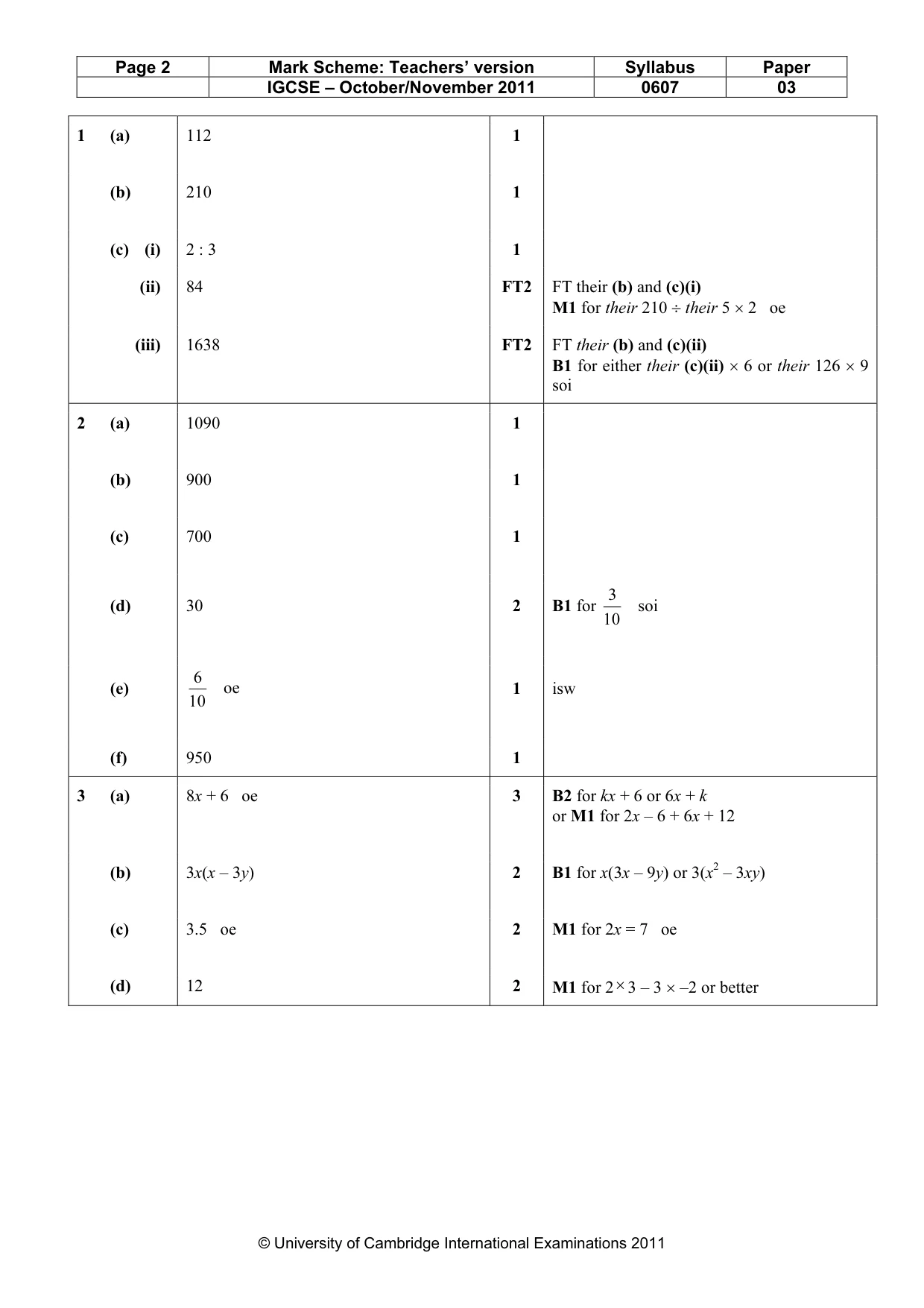
Page 2 Mark Scheme: Teachers’ version Syllabus Paper IGCSE – October/November 2011 0607 03 © University of Cambridge International Examinations 2011 1 (a) 112 1 (b) 210 1 (c) (i) 2 : 3 1 (ii) 84 FT2 FT their (b) and (c)(i) M1 for their 210 ÷ their 5 × 2 oe (iii) 1638 FT2 FT their (b) and (c)(ii) B1 for either their (c)(ii) × 6 or their 126 × 9 soi 2 (a) 1090 1 (b) 900 1 (c) 700 1 (d) 30 2 B1 for 10 3 soi (e) 10 6 oe 1 isw (f) 950 1 3 (a) 8x + 6 oe 3 B2 for kx + 6 or 6x + k or M1 for 2x – 6 + 6x + 12 (b) 3x(x – 3y) 2 B1 for x(3x – 9y) or 3(x2 – 3xy) (c) 3.5 oe 2 M1 for 2x = 7 oe (d) 12 2 M1 for 2× 3 – 3 × –2 or better
Mark scheme, page 3
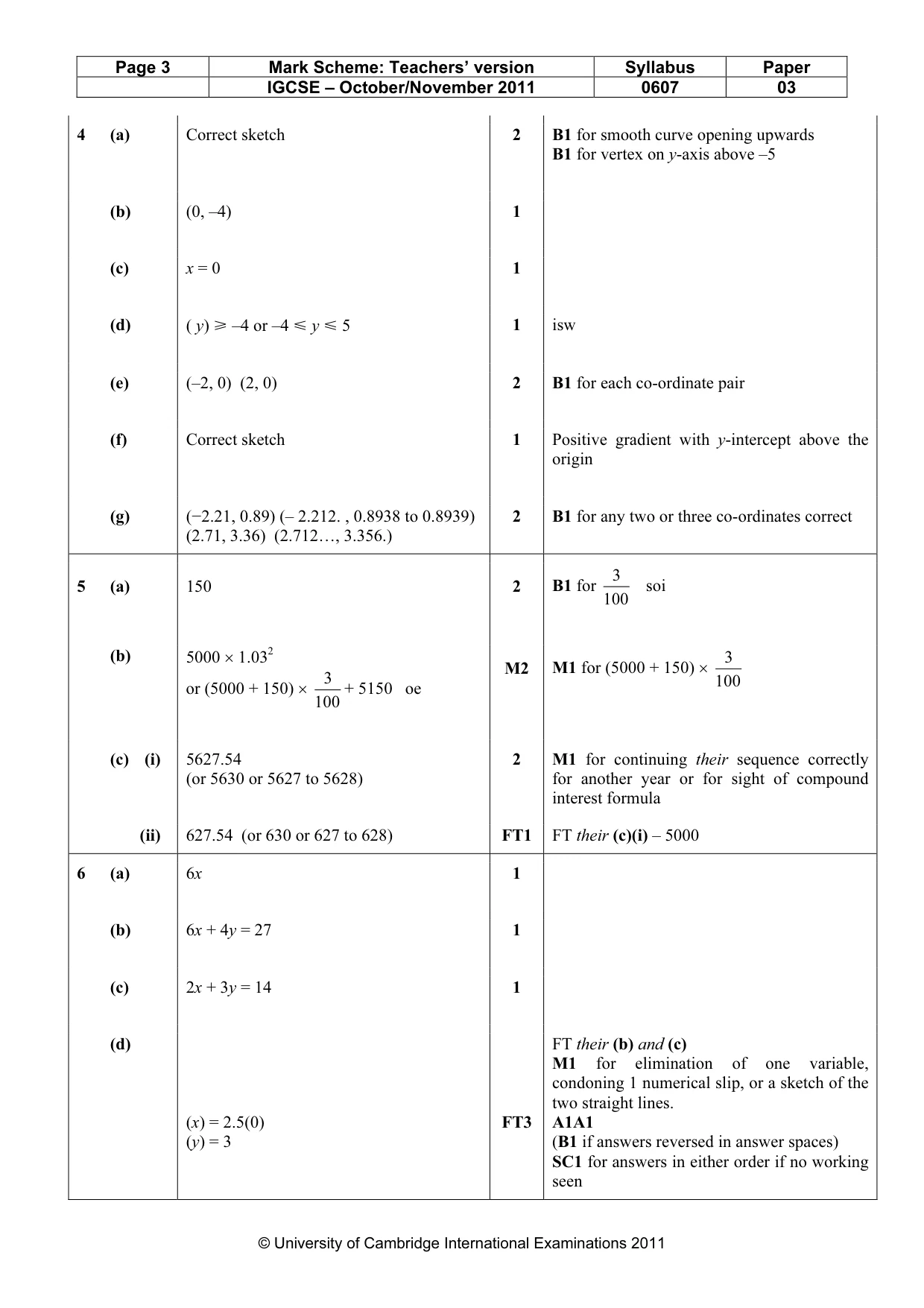
Page 3 Mark Scheme: Teachers’ version Syllabus Paper IGCSE – October/November 2011 0607 03 © University of Cambridge International Examinations 2011 4 (a) Correct sketch 2 B1 for smooth curve opening upwards B1 for vertex on y-axis above –5 (b) (0, –4) 1 (c) x = 0 1 (d) ( y) [ –4 or –4 Y y Y 5 1 isw (e) (–2, 0) (2, 0) 2 B1 for each co-ordinate pair (f) Correct sketch 1 Positive gradient with y-intercept above the origin (g) (−2.21, 0.89) (– 2.212. , 0.8938 to 0.8939) (2.71, 3.36) (2.712…, 3.356.) 2 B1 for any two or three co-ordinates correct 5 (a) 150 2 B1 for 100 3 soi (b) 5000 × 1.032 or (5000 + 150) × 100 3 + 5150 oe M2 M1 for (5000 + 150) × 100 3 (c) (i) 5627.54 (or 5630 or 5627 to 5628) 2 M1 for continuing their sequence correctly for another year or for sight of compound interest formula (ii) 627.54 (or 630 or 627 to 628) FT1 FT their (c)(i) – 5000 6 (a) 6x 1 (b) 6x + 4y = 27 1 (c) 2x + 3y = 14 1 (d) (x) = 2.5(0) (y) = 3 FT3 FT their (b) and (c) M1 for elimination of one variable, condoning 1 numerical slip, or a sketch of the two straight lines. A1A1 (B1 if answers reversed in answer spaces) SC1 for answers in either order if no working seen
Mark scheme, page 4
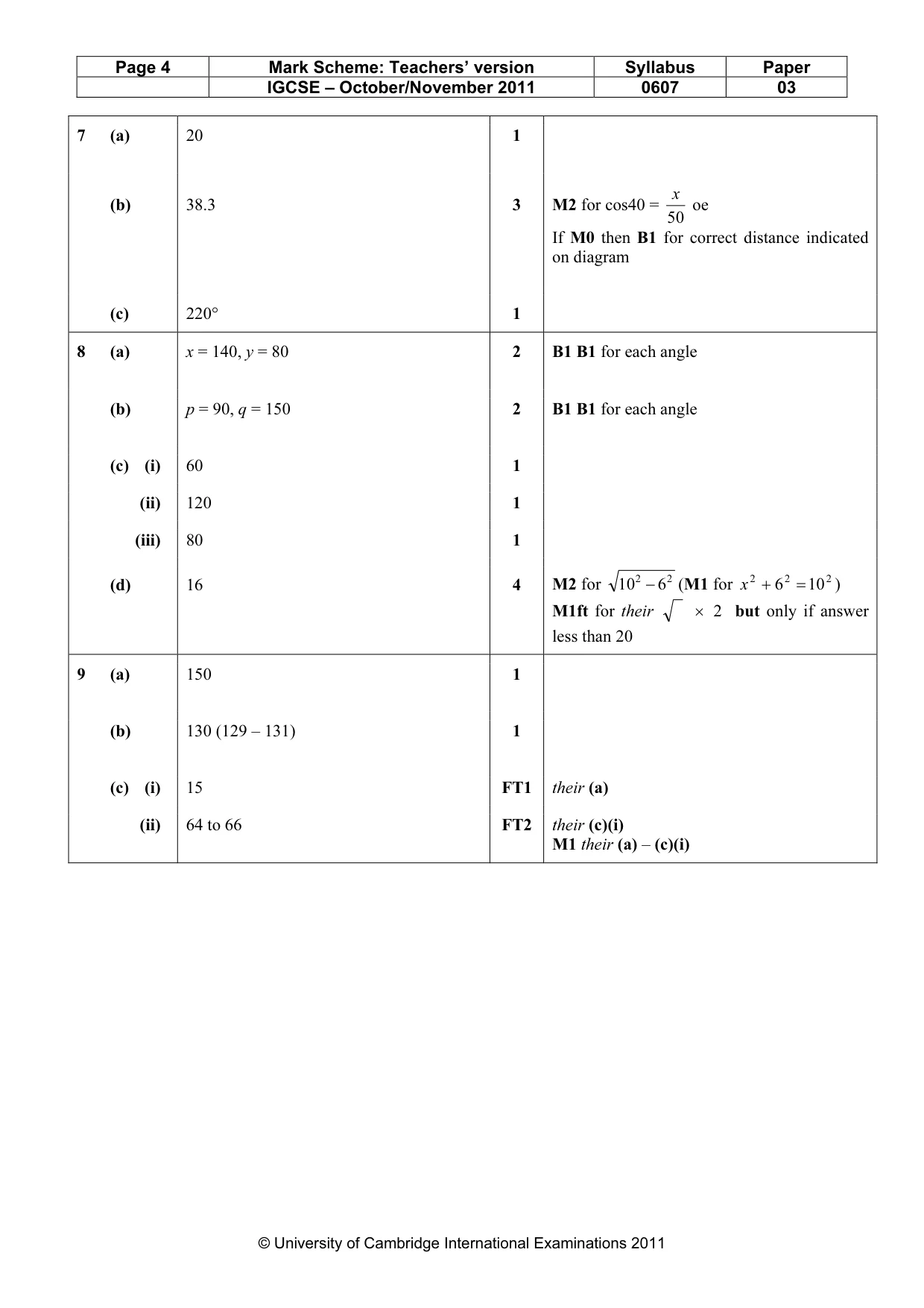
Page 4 Mark Scheme: Teachers’ version Syllabus Paper IGCSE – October/November 2011 0607 03 © University of Cambridge International Examinations 2011 7 (a) 20 1 (b) 38.3 3 M2 for cos40 = 50 x oe If M0 then B1 for correct distance indicated on diagram (c) 220° 1 8 (a) x = 140, y = 80 2 B1 B1 for each angle (b) p = 90, q = 150 2 B1 B1 for each angle (c) (i) 60 1 (ii) 120 1 (iii) 80 1 (d) 16 4 M2 for 2 2 6 10 − (M1 for 2 2 2 10 6 = + x ) M1ft for their × 2 but only if answer less than 20 9 (a) 150 1 (b) 130 (129 – 131) 1 (c) (i) 15 FT1 their (a) (ii) 64 to 66 FT2 their (c)(i) M1 their (a) – (c)(i)
Mark scheme, page 5
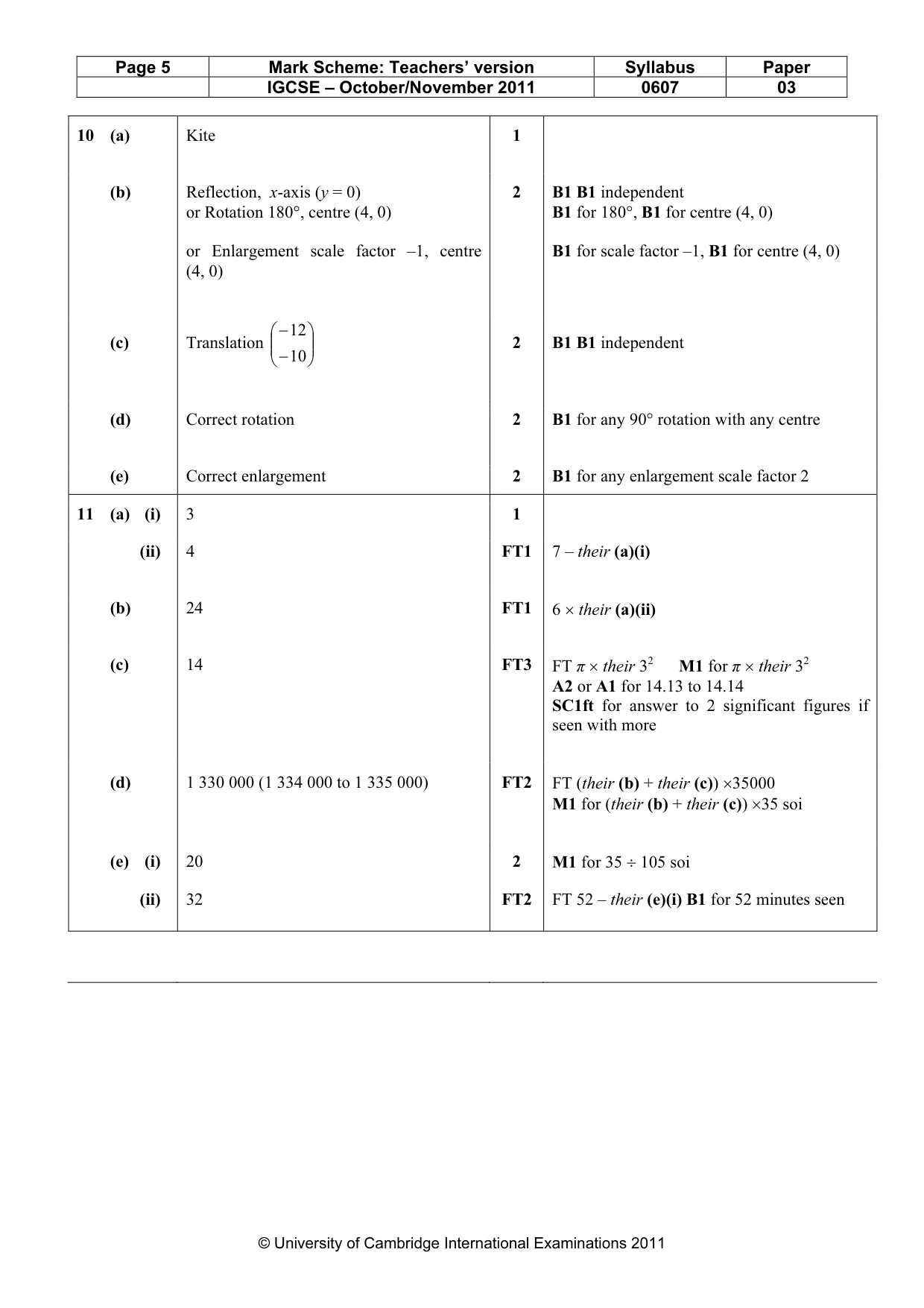
Page 5 Mark Scheme: Teachers’ version Syllabus Paper IGCSE – October/November 2011 0607 03 © University of Cambridge International Examinations 2011 10 (a) Kite 1 (b) Reflection, x-axis (y = 0) or Rotation 180°, centre (4, 0) or Enlargement scale factor –1, centre (4, 0) 2 B1 B1 independent B1 for 180°, B1 for centre (4, 0) B1 for scale factor –1, B1 for centre (4, 0) (c) Translation − − 10 12 2 B1 B1 independent (d) Correct rotation 2 B1 for any 90° rotation with any centre (e) Correct enlargement 2 B1 for any enlargement scale factor 2 11 (a) (i) 3 1 (ii) 4 FT1 7 – their (a)(i) (b) 24 FT1 6 × their (a)(ii) (c) 14 FT3 FT π × their 32 M1 for π × their 32 A2 or A1 for 14.13 to 14.14 SC1ft for answer to 2 significant figures if seen with more (d) 1 330 000 (1 334 000 to 1 335 000) FT2 FT (their (b) + their (c)) ×35000 M1 for (their (b) + their (c)) ×35 soi (e) (i) 20 2 M1 for 35 ÷ 105 soi (ii) 32 FT2 FT 52 – their (e)(i) B1 for 52 minutes seen
Mark scheme, page 6
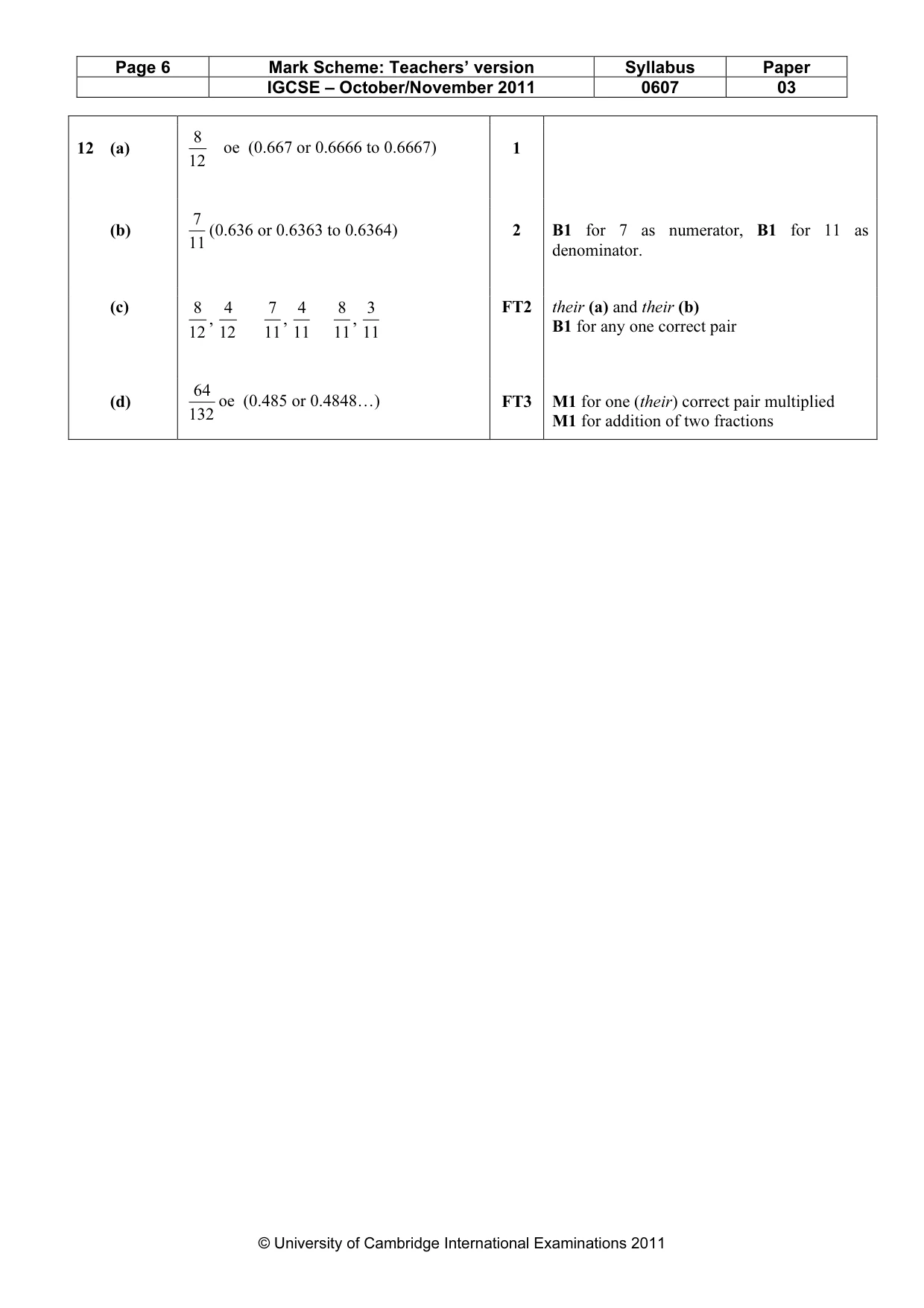
Page 6 Mark Scheme: Teachers’ version Syllabus Paper IGCSE – October/November 2011 0607 03 © University of Cambridge International Examinations 2011 12 (a) 12 8 oe (0.667 or 0.6666 to 0.6667) 1 (b) 11 7 (0.636 or 0.6363 to 0.6364) 2 B1 for 7 as numerator, B1 for 11 as denominator. (c) 11 3 , 11 8 11 4 , 11 7 12 4 , 12 8 FT2 their (a) and their (b) B1 for any one correct pair (d) 132 64 oe (0.485 or 0.4848…) FT3 M1 for one (their) correct pair multiplied M1 for addition of two fractions