Cambridge IGCSE Mathematics - International 0607 — 2010 May/June Paper 3 · Variant 1
0607/31/M/J/10
The question paper and its mark scheme, free to read here and free to download. This is Cambridge’s own paper, exactly as it was sat.
Question paper20 pages
Mark scheme5 pages
Answers below. Sit the paper first if you are practising.
Paper as text
Question paper, page 1
This document consists of 17 printed pages and 3 blank pages. IB10 06_0607_03/2RP © UCLES 2010 [Turn over *3843129279* For Examiner's Use UNIVERSITY OF CAMBRIDGE INTERNATIONAL EXAMINATIONS International General Certificate of Secondary Education CAMBRIDGE INTERNATIONAL MATHEMATICS 0607/03 Paper 3 (Core) May/June 2010 1 hour 45 minutes Candidates answer on the Question Paper Additional Materials: Geometrical Instruments Graphics Calculator READ THESE INSTRUCTIONS FIRST Write your Centre number, candidate number and name on all the work you hand in. Write in dark blue or black pen. Do not use staples, paper clips, highlighters, glue or correction fluid. You may use a pencil for any diagrams or graphs. DO NOT WRITE IN ANY BARCODES. Answer all the questions. Unless instructed otherwise, give your answers exactly or correct to three significant figures as appropriate. Answers in degrees should be given to one decimal place. For π, use your calculator value. You must show all the relevant working to gain full marks and you will be given marks for correct methods, including sketches, even if your answer is incorrect. The number of marks is given in brackets [ ] at the end of each question or part question. The total number of marks for this paper is 96. www.XtremePapers.com
Question paper, page 2
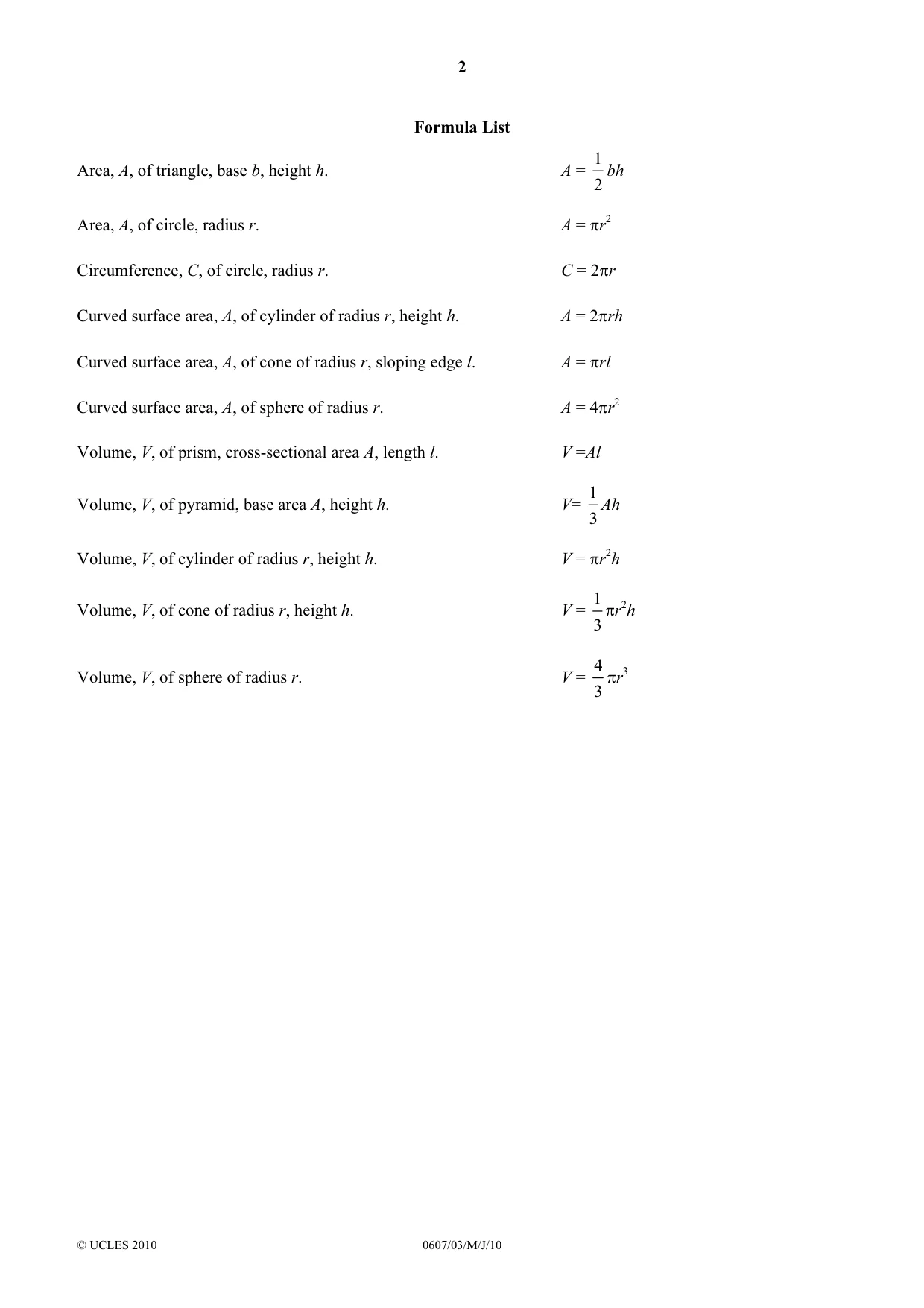
2 © UCLES 2010 0607/03/M/J/10 Formula List Area, A, of triangle, base b, height h. A = 1 2 bh Area, A, of circle, radius r. A = πr2 Circumference, C, of circle, radius r. C = 2πr Curved surface area, A, of cylinder of radius r, height h. A = 2πrh Curved surface area, A, of cone of radius r, sloping edge l. A = πrl Curved surface area, A, of sphere of radius r. A = 4πr2 Volume, V, of prism, cross-sectional area A, length l. V =Al Volume, V, of pyramid, base area A, height h. V= 1 3 Ah Volume, V, of cylinder of radius r, height h. V = πr2h Volume, V, of cone of radius r, height h. V = 1 3 πr2h Volume, V, of sphere of radius r. V = 4 3 πr3
Question paper, page 3
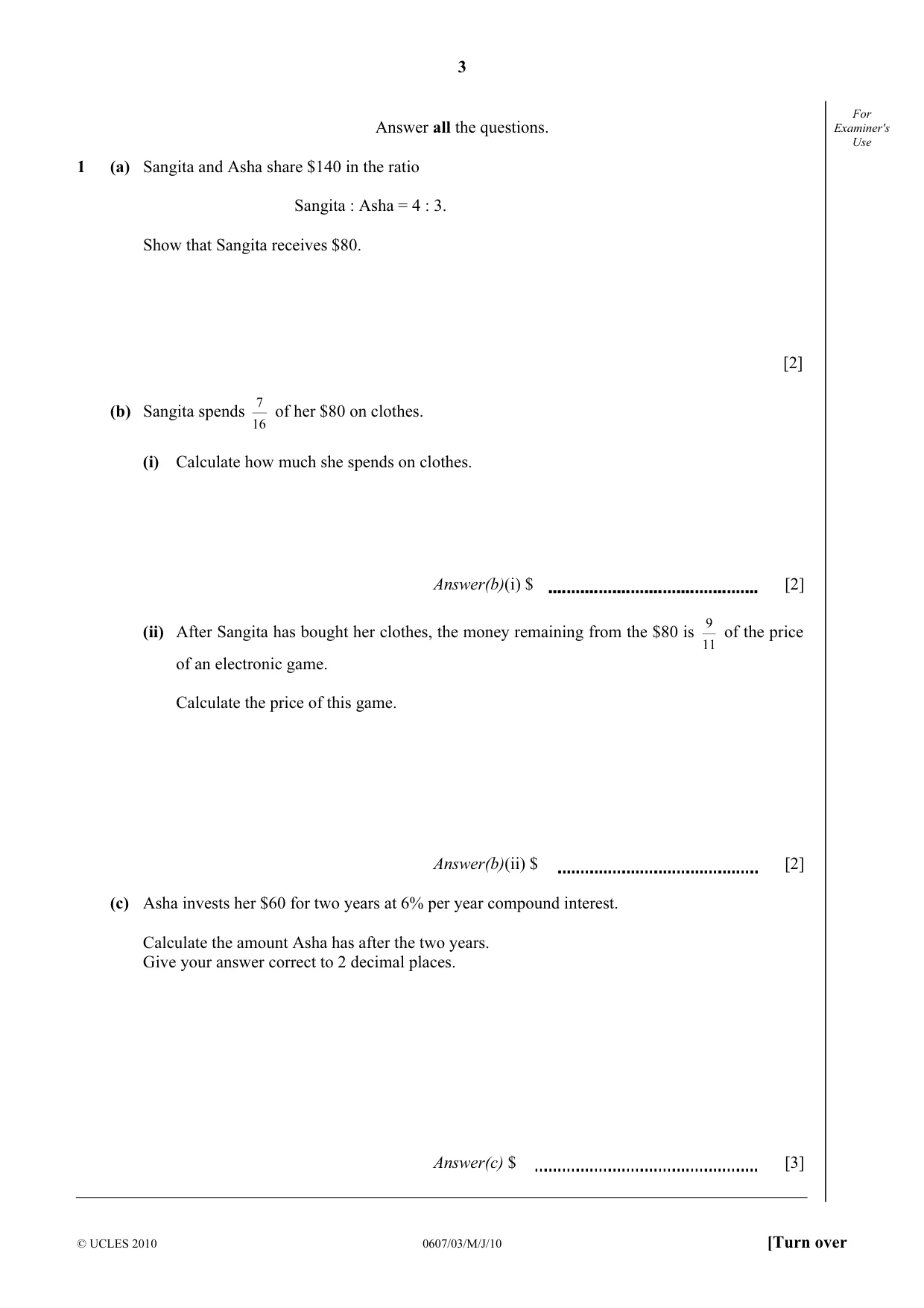
3 © UCLES 2010 0607/03/M/J/10 [Turn over For Examiner's Use Answer all the questions. 1 (a) Sangita and Asha share $140 in the ratio Sangita : Asha = 4 : 3. Show that Sangita receives $80. [2] (b) Sangita spends 7 16 of her $80 on clothes. (i) Calculate how much she spends on clothes. Answer(b)(i) $ [2] (ii) After Sangita has bought her clothes, the money remaining from the $80 is 9 11 of the price of an electronic game. Calculate the price of this game. Answer(b)(ii) $ [2] (c) Asha invests her $60 for two years at 6% per year compound interest. Calculate the amount Asha has after the two years. Give your answer correct to 2 decimal places. Answer(c) $ [3]
Question paper, page 4
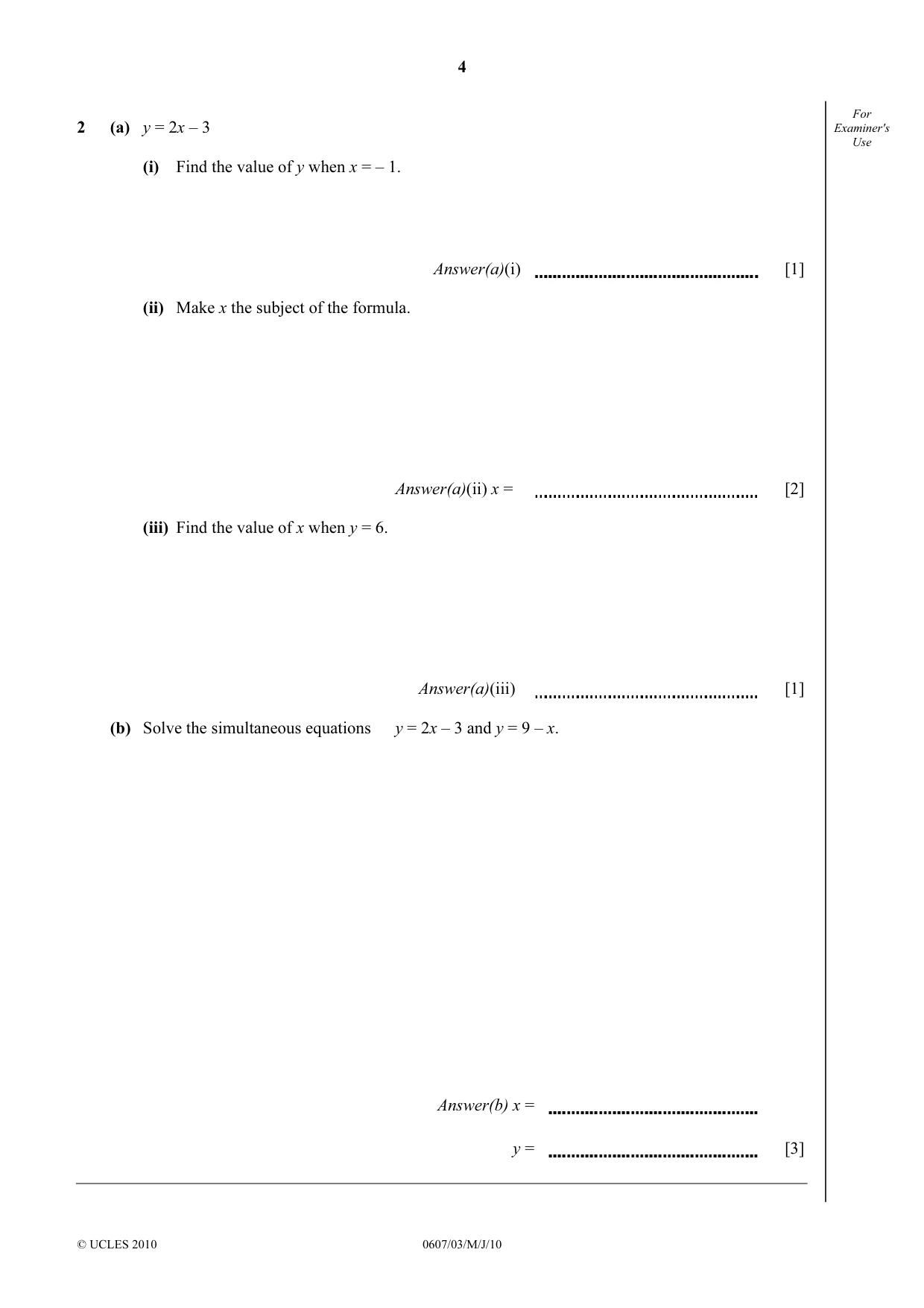
4 © UCLES 2010 0607/03/M/J/10 For Examiner's Use 2 (a) y = 2x – 3 (i) Find the value of y when x = – 1. Answer(a)(i) [1] (ii) Make x the subject of the formula. Answer(a)(ii) x = [2] (iii) Find the value of x when y = 6. Answer(a)(iii) [1] (b) Solve the simultaneous equations y = 2x – 3 and y = 9 – x. Answer(b) x = y = [3]
Question paper, page 5
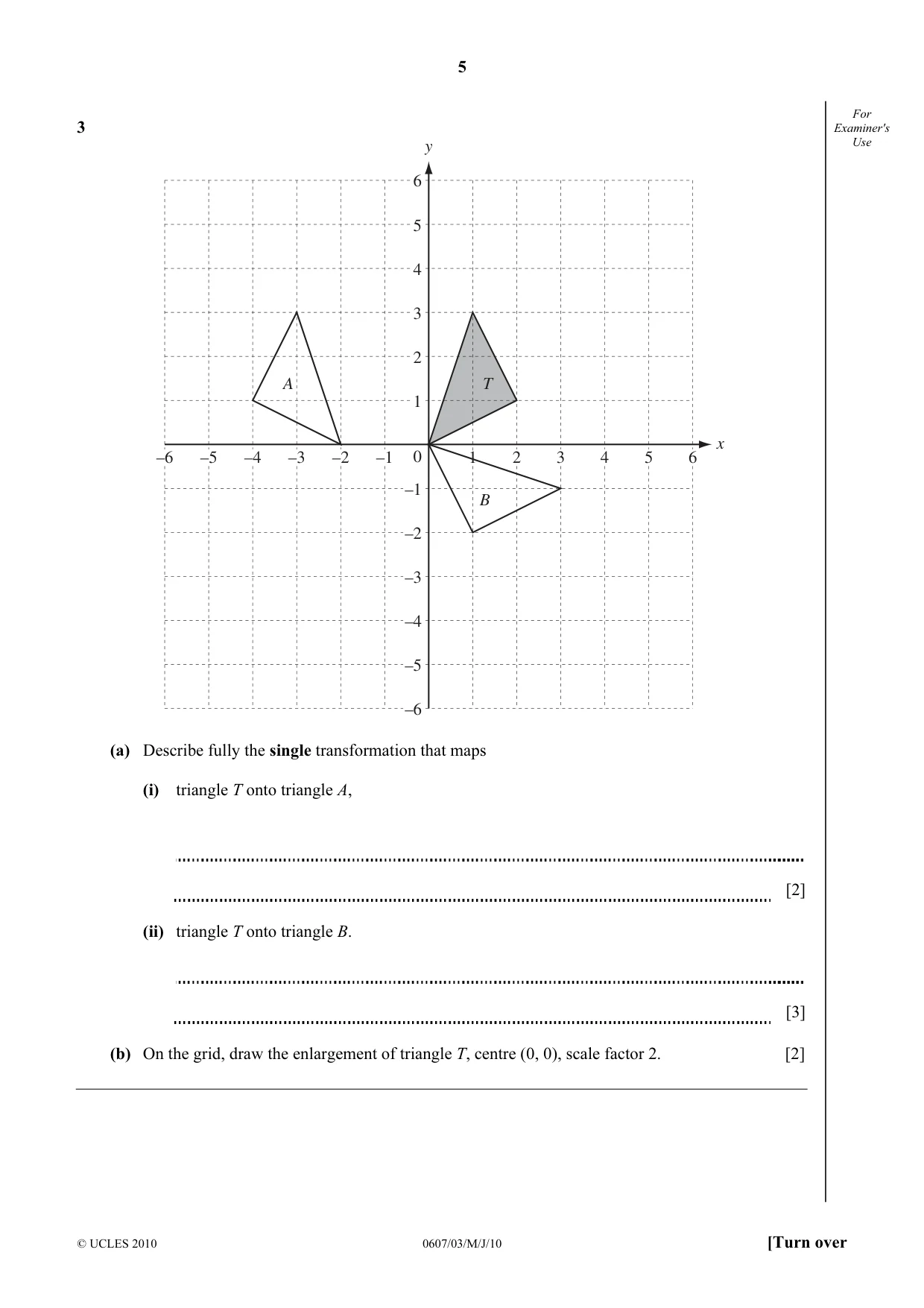
5 © UCLES 2010 0607/03/M/J/10 [Turn over For Examiner's Use 3 T B A y x 6 5 4 3 2 1 –1 –2 –3 –4 –5 –6 0 –6 –5 –4 –3 –2 –1 1 2 3 4 5 6 (a) Describe fully the single transformation that maps (i) triangle T onto triangle A, [2] (ii) triangle T onto triangle B. [3] (b) On the grid, draw the enlargement of triangle T, centre (0, 0), scale factor 2. [2]
Question paper, page 6
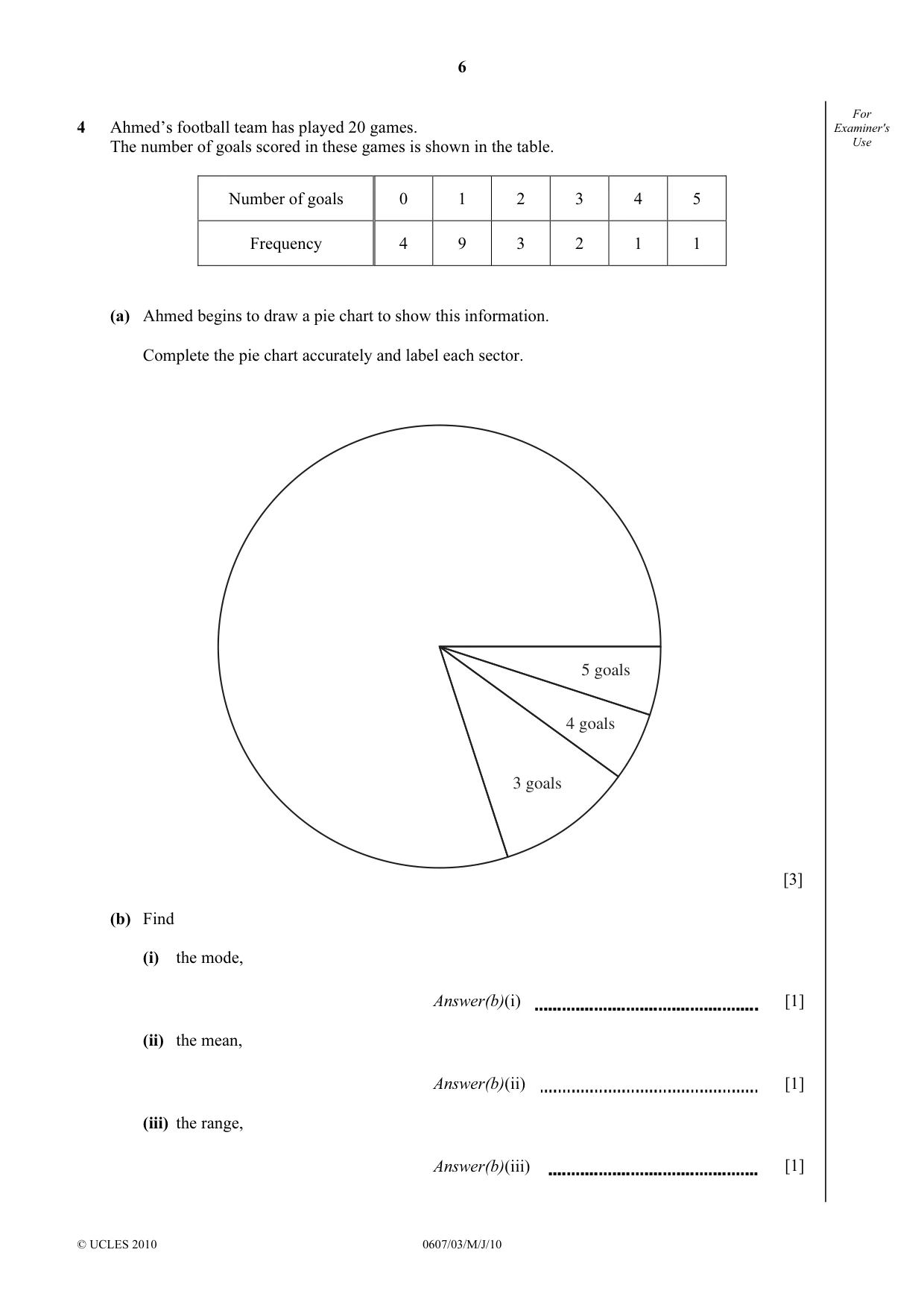
6 © UCLES 2010 0607/03/M/J/10 For Examiner's Use 4 Ahmed’s football team has played 20 games. The number of goals scored in these games is shown in the table. Number of goals 0 1 2 3 4 5 Frequency 4 9 3 2 1 1 (a) Ahmed begins to draw a pie chart to show this information. Complete the pie chart accurately and label each sector. 5 goals 4 goals 3 goals [3] (b) Find (i) the mode, Answer(b)(i) [1] (ii) the mean, Answer(b)(ii) [1] (iii) the range, Answer(b)(iii) [1]
Question paper, page 7
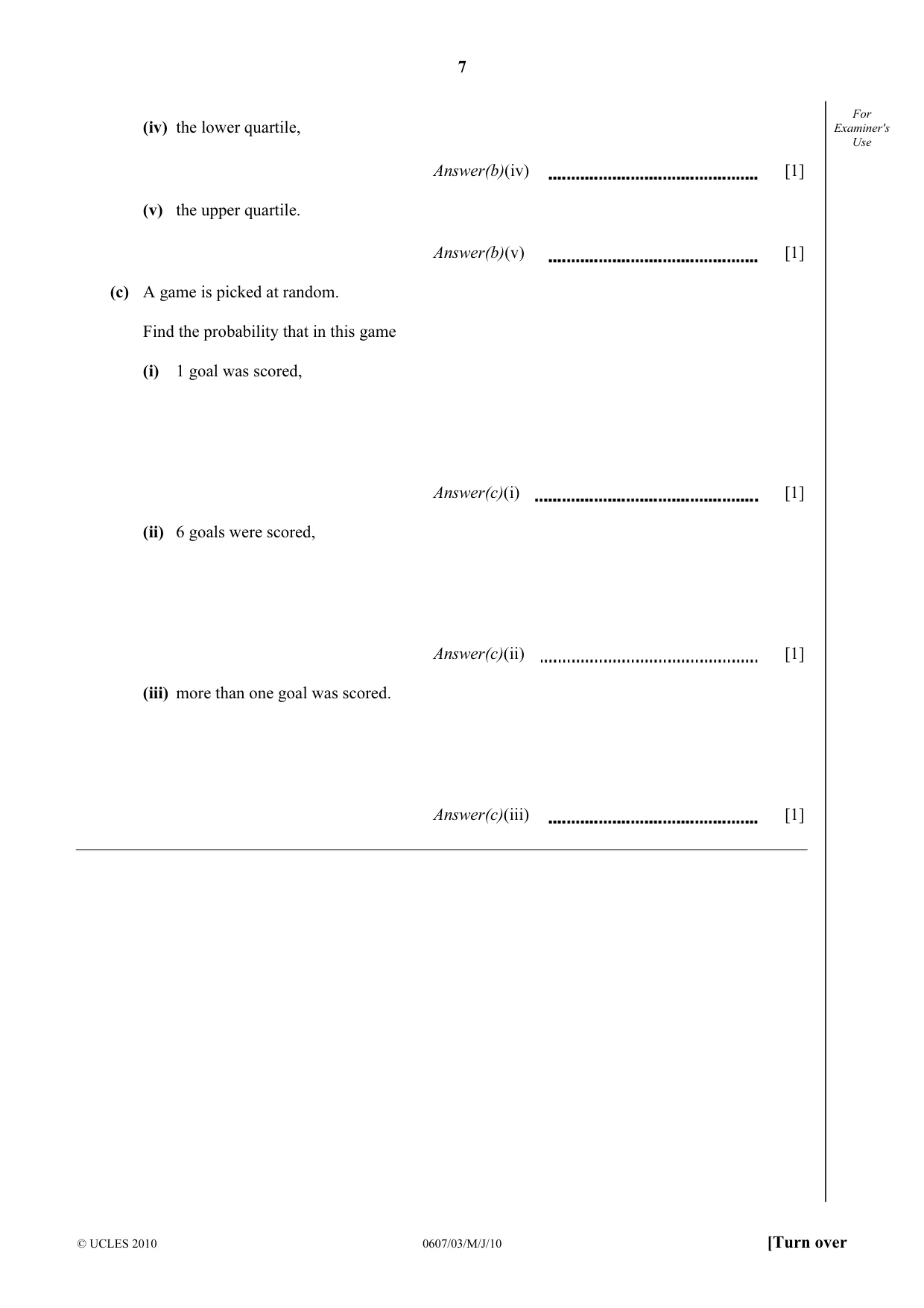
7 © UCLES 2010 0607/03/M/J/10 [Turn over For Examiner's Use (iv) the lower quartile, Answer(b)(iv) [1] (v) the upper quartile. Answer(b)(v) [1] (c) A game is picked at random. Find the probability that in this game (i) 1 goal was scored, Answer(c)(i) [1] (ii) 6 goals were scored, Answer(c)(ii) [1] (iii) more than one goal was scored. Answer(c)(iii) [1]
Question paper, page 8
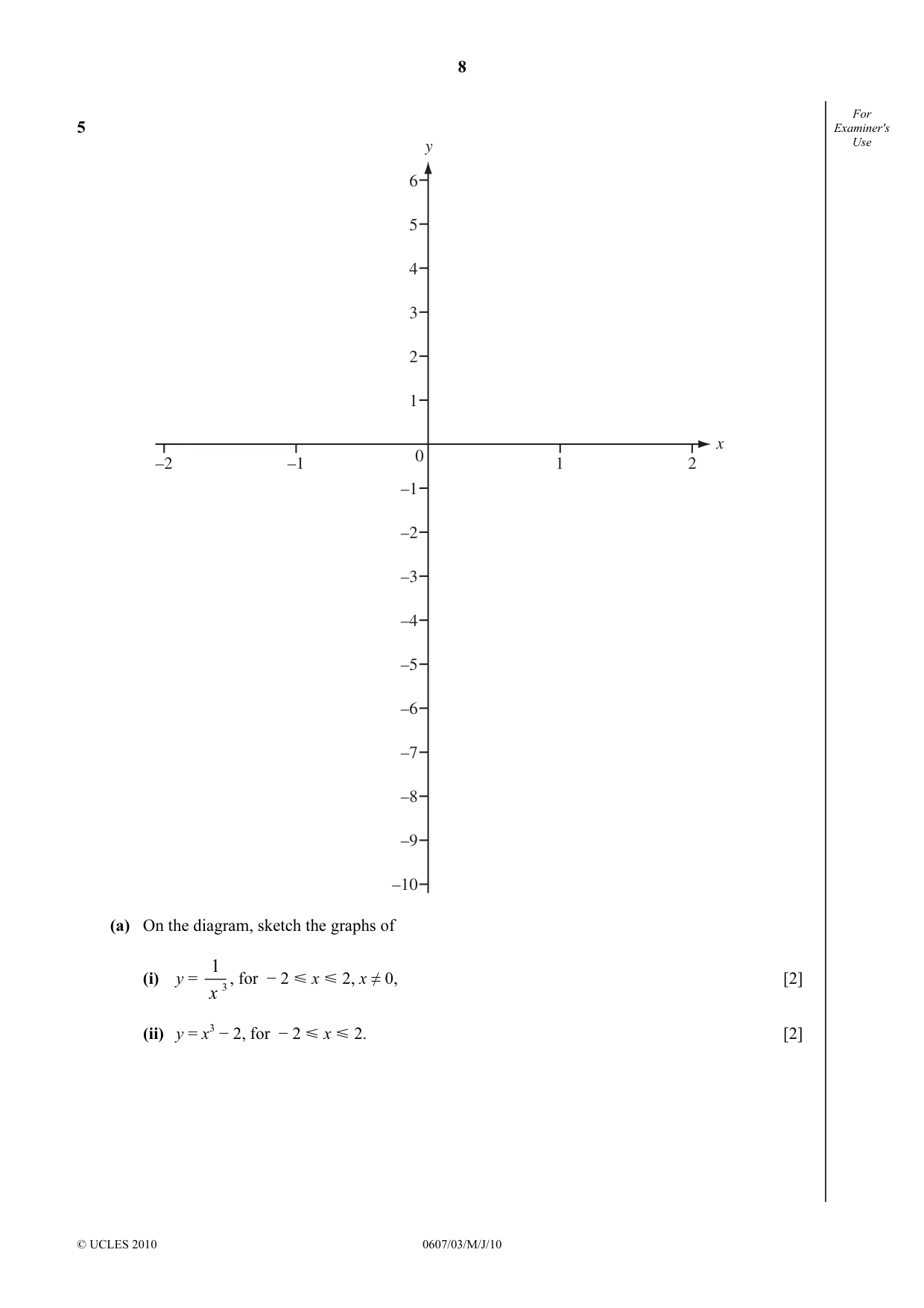
8 © UCLES 2010 0607/03/M/J/10 For Examiner's Use 5 6 5 4 3 2 1 –1 –2 –3 –4 –5 –6 –7 –8 –9 –10 –2 –1 1 2 0 y x (a) On the diagram, sketch the graphs of (i) y = 3 1 x , for − 2 Y x Y 2, x ≠ 0, [2] (ii) y = x3 − 2, for − 2 Y x Y 2. [2]
Question paper, page 9
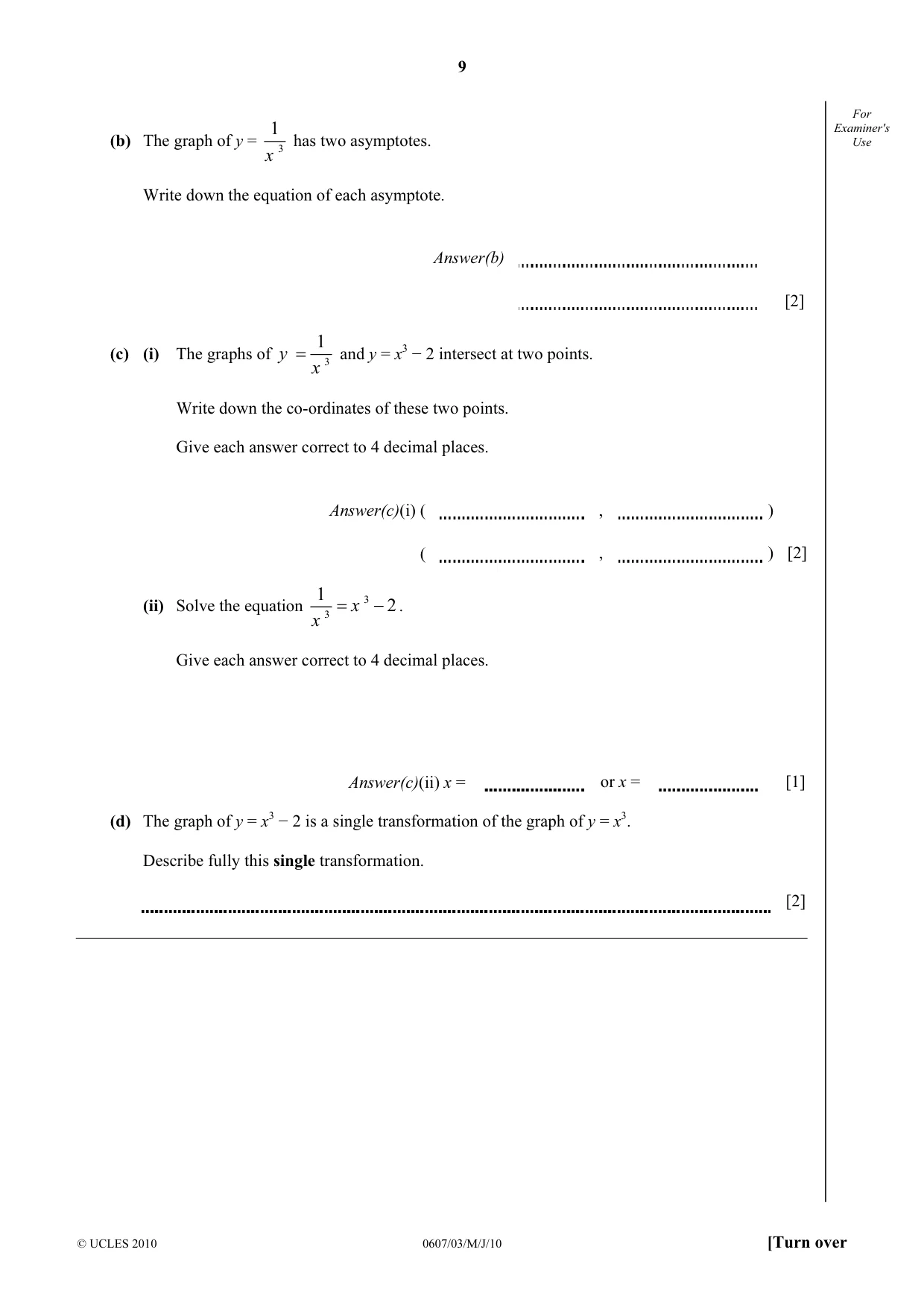
9 © UCLES 2010 0607/03/M/J/10 [Turn over For Examiner's Use (b) The graph of y = 3 1 x has two asymptotes. Write down the equation of each asymptote. Answer(b) [2] (c) (i) The graphs of 3 1 y x = and y = x3 − 2 intersect at two points. Write down the co-ordinates of these two points. Give each answer correct to 4 decimal places. Answer(c)(i) ( , ) ( , ) [2] (ii) Solve the equation 3 3 1 2 x x = − . Give each answer correct to 4 decimal places. Answer(c)(ii) x = or x = [1] (d) The graph of y = x3 − 2 is a single transformation of the graph of y = x3. Describe fully this single transformation. [2]
Question paper, page 10
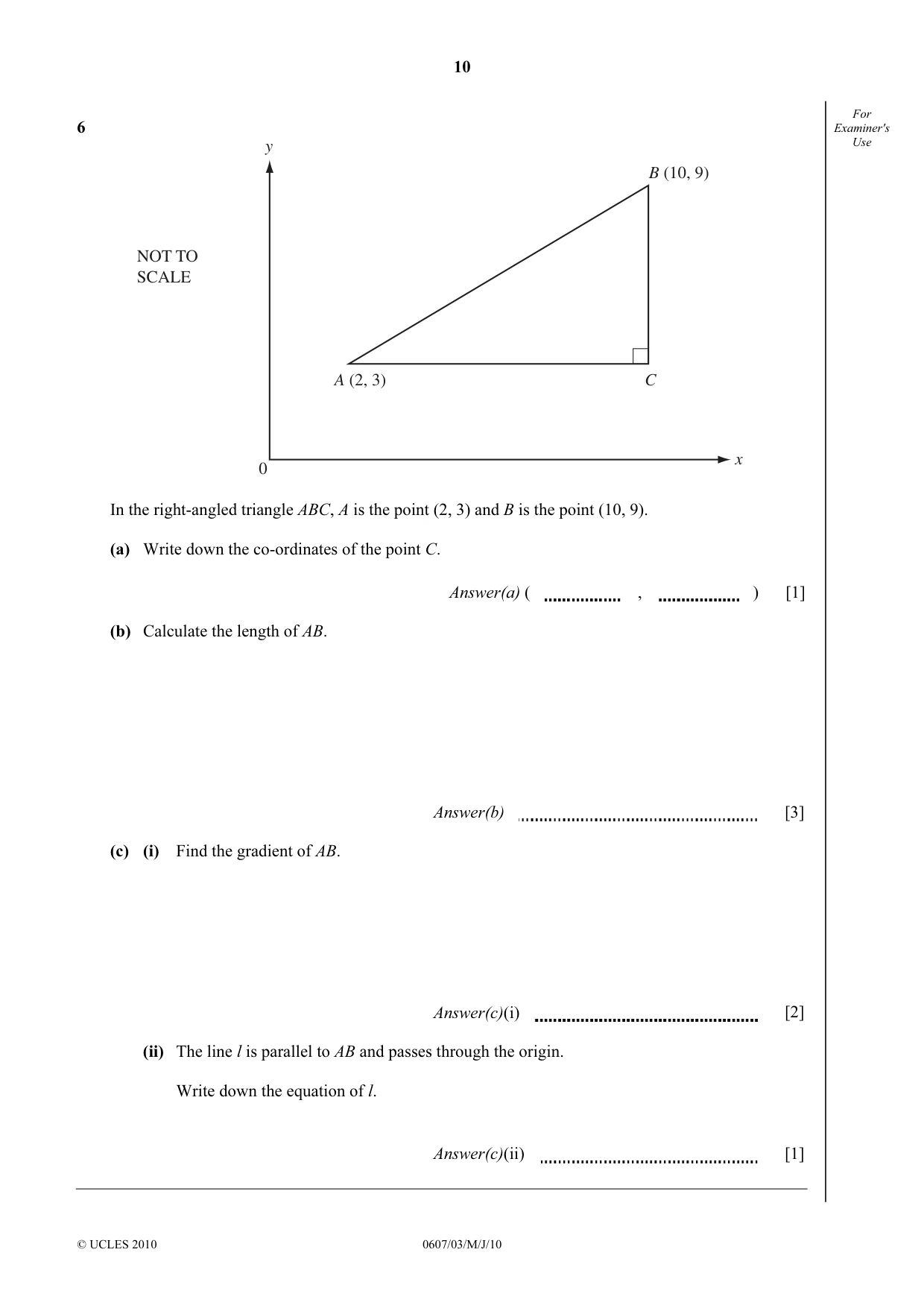
10 © UCLES 2010 0607/03/M/J/10 For Examiner's Use 6 0 y x A (2, 3) B (10, 9) C NOT TO SCALE In the right-angled triangle ABC, A is the point (2, 3) and B is the point (10, 9). (a) Write down the co-ordinates of the point C. Answer(a) ( , ) [1] (b) Calculate the length of AB. Answer(b) [3] (c) (i) Find the gradient of AB. Answer(c)(i) [2] (ii) The line l is parallel to AB and passes through the origin. Write down the equation of l. Answer(c)(ii) [1]
Question paper, page 11
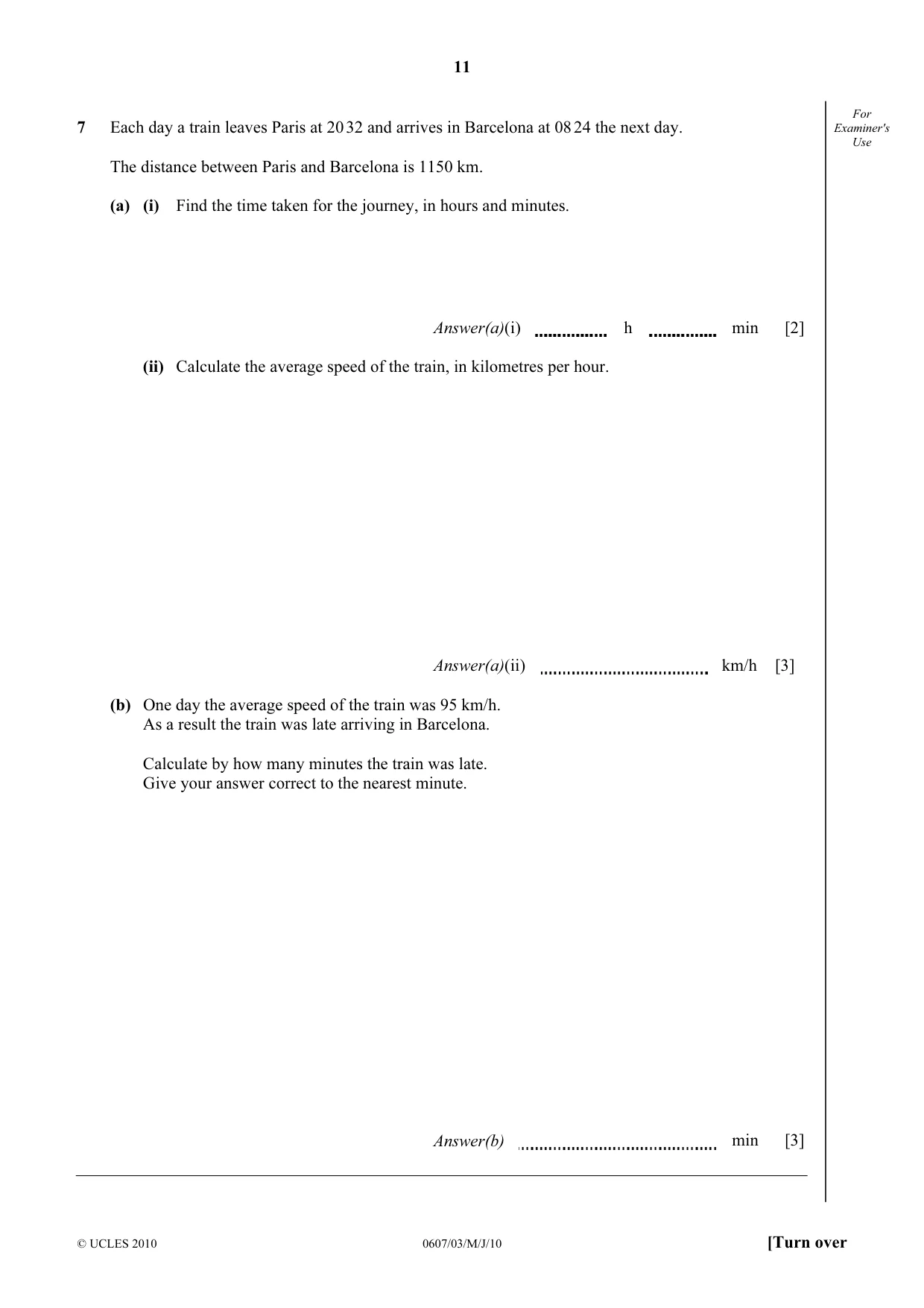
11 © UCLES 2010 0607/03/M/J/10 [Turn over For Examiner's Use 7 Each day a train leaves Paris at 20 32 and arrives in Barcelona at 08 24 the next day. The distance between Paris and Barcelona is 1150 km. (a) (i) Find the time taken for the journey, in hours and minutes. Answer(a)(i) h min [2] (ii) Calculate the average speed of the train, in kilometres per hour. Answer(a)(ii) km/h [3] (b) One day the average speed of the train was 95 km/h. As a result the train was late arriving in Barcelona. Calculate by how many minutes the train was late. Give your answer correct to the nearest minute. Answer(b) min [3]
Question paper, page 12
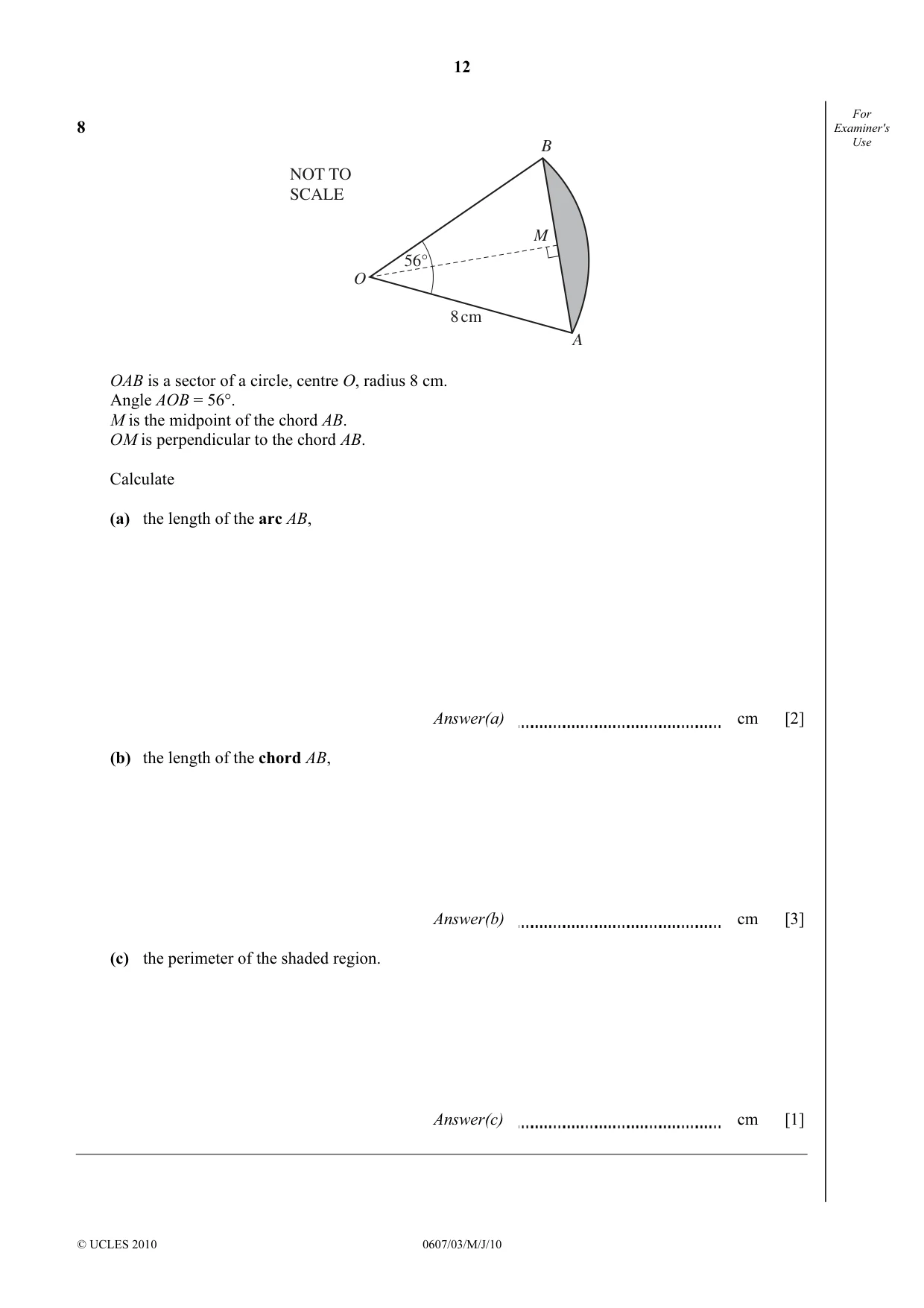
12 © UCLES 2010 0607/03/M/J/10 For Examiner's Use 8 O A B M 56° 8 cm NOT TO SCALE OAB is a sector of a circle, centre O, radius 8 cm. Angle AOB = 56°. M is the midpoint of the chord AB. OM is perpendicular to the chord AB. Calculate (a) the length of the arc AB, Answer(a) cm [2] (b) the length of the chord AB, Answer(b) cm [3] (c) the perimeter of the shaded region. Answer(c) cm [1]
Question paper, page 13
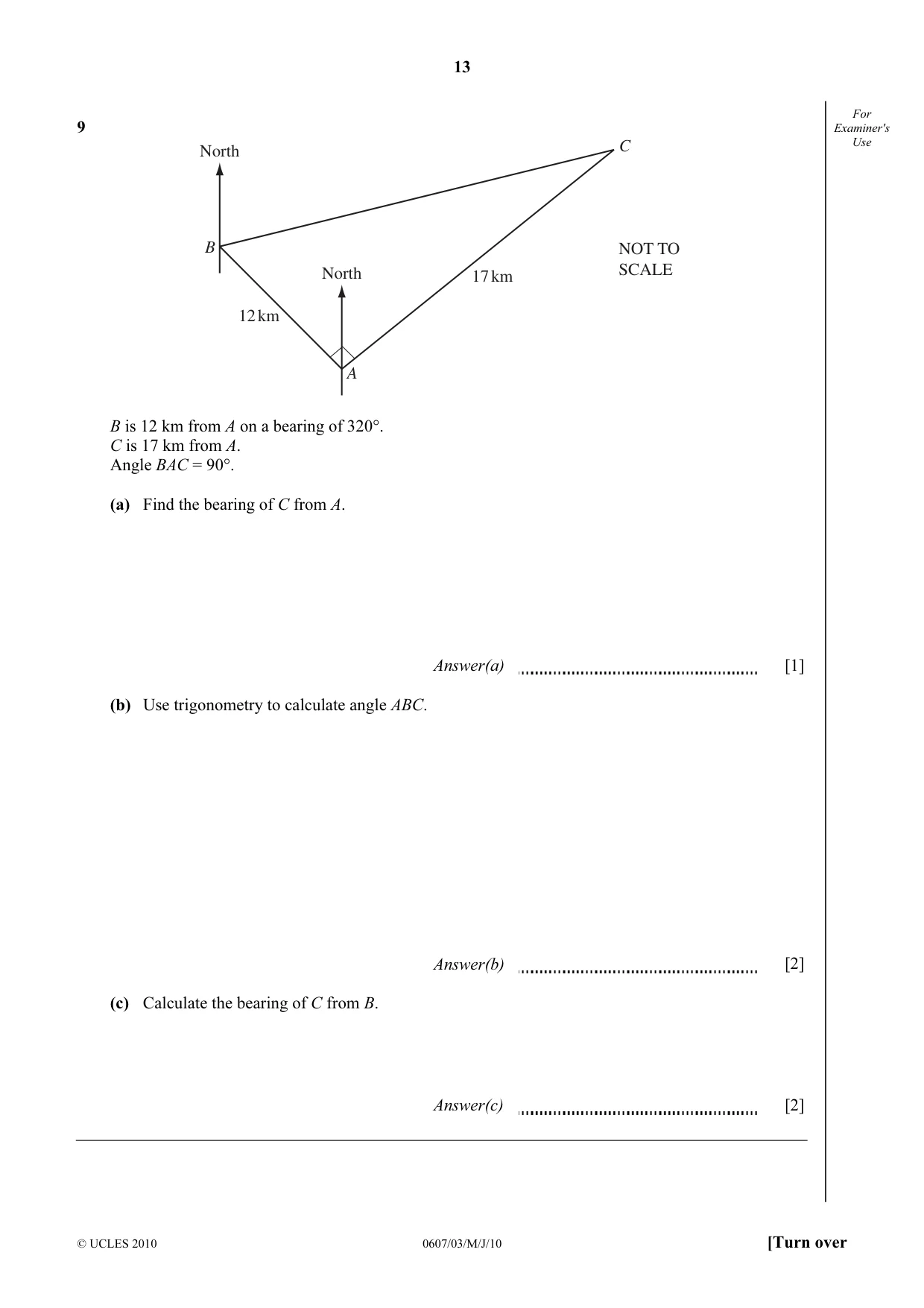
13 © UCLES 2010 0607/03/M/J/10 [Turn over For Examiner's Use 9 B A C North North 12 km 17 km NOT TO SCALE B is 12 km from A on a bearing of 320°. C is 17 km from A. Angle BAC = 90°. (a) Find the bearing of C from A. Answer(a) [1] (b) Use trigonometry to calculate angle ABC. Answer(b) [2] (c) Calculate the bearing of C from B. Answer(c) [2]
Question paper, page 14
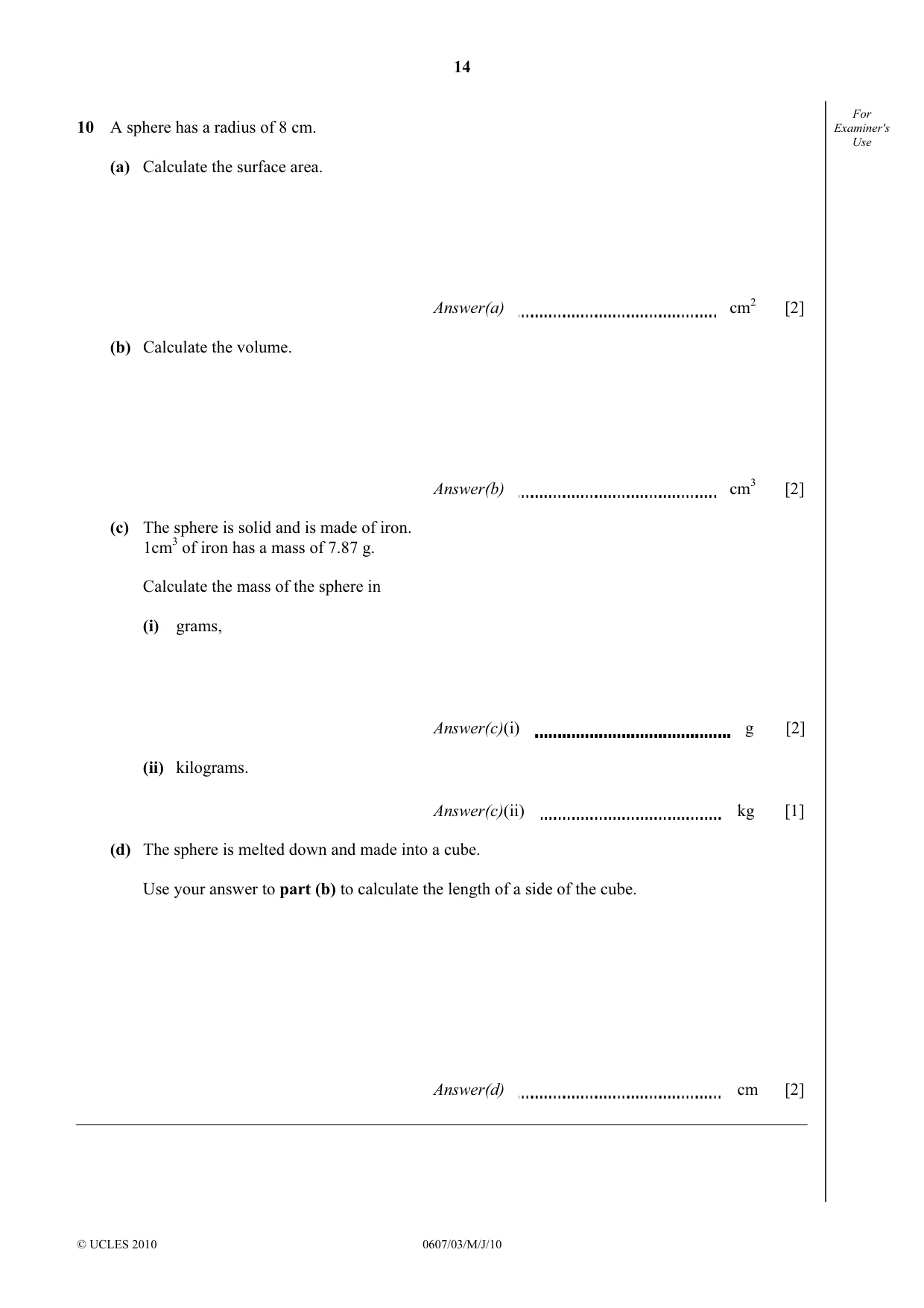
14 © UCLES 2010 0607/03/M/J/10 For Examiner's Use 10 A sphere has a radius of 8 cm. (a) Calculate the surface area. Answer(a) cm2 [2] (b) Calculate the volume. Answer(b) cm3 [2] (c) The sphere is solid and is made of iron. 1cm3 of iron has a mass of 7.87 g. Calculate the mass of the sphere in (i) grams, Answer(c)(i) g [2] (ii) kilograms. Answer(c)(ii) kg [1] (d) The sphere is melted down and made into a cube. Use your answer to part (b) to calculate the length of a side of the cube. Answer(d) cm [2]
Question paper, page 15
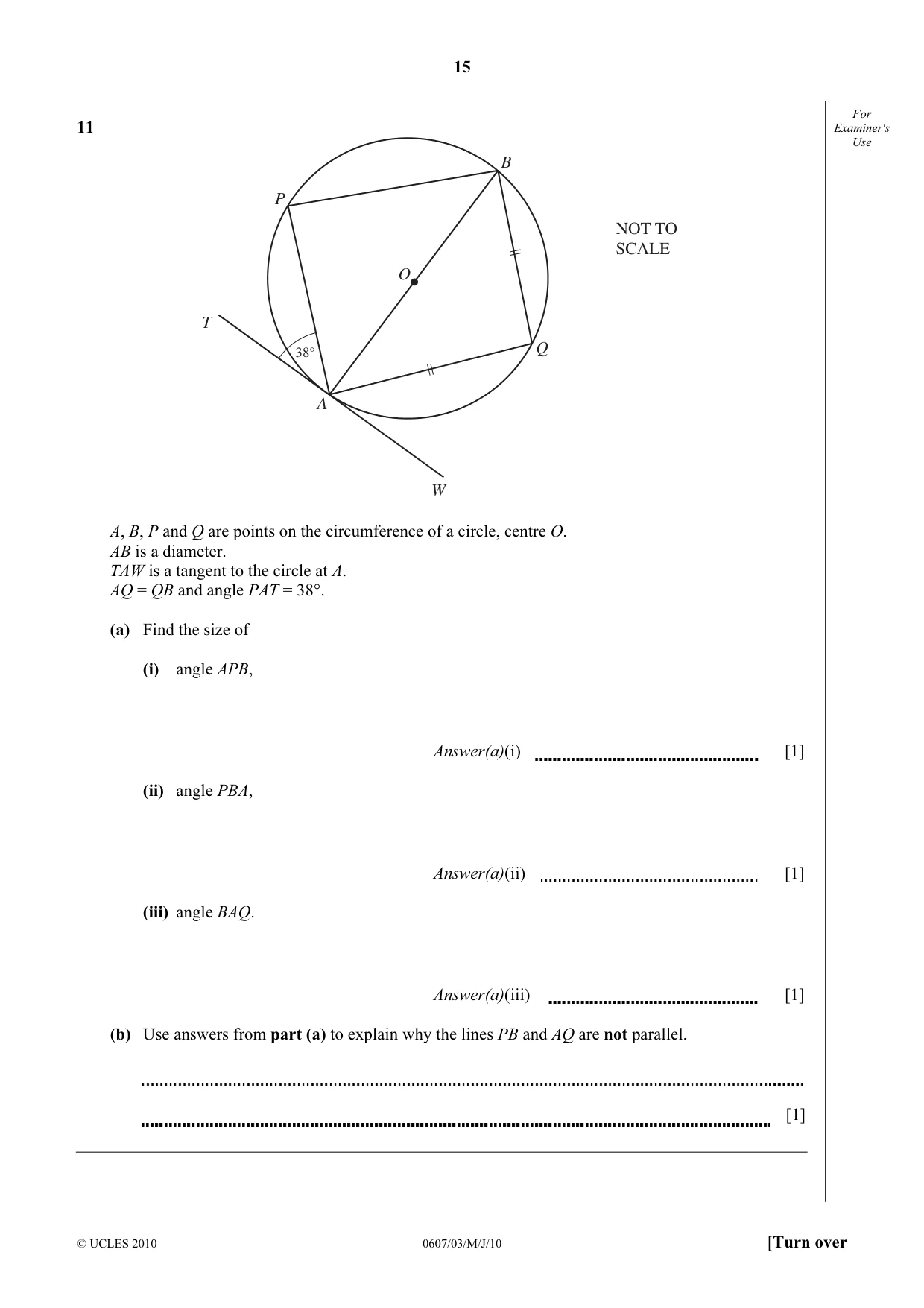
15 © UCLES 2010 0607/03/M/J/10 [Turn over For Examiner's Use 11 T A W O P B Q 38° NOT TO SCALE A, B, P and Q are points on the circumference of a circle, centre O. AB is a diameter. TAW is a tangent to the circle at A. AQ = QB and angle PAT = 38°. (a) Find the size of (i) angle APB, Answer(a)(i) [1] (ii) angle PBA, Answer(a)(ii) [1] (iii) angle BAQ. Answer(a)(iii) [1] (b) Use answers from part (a) to explain why the lines PB and AQ are not parallel. [1]
Question paper, page 16
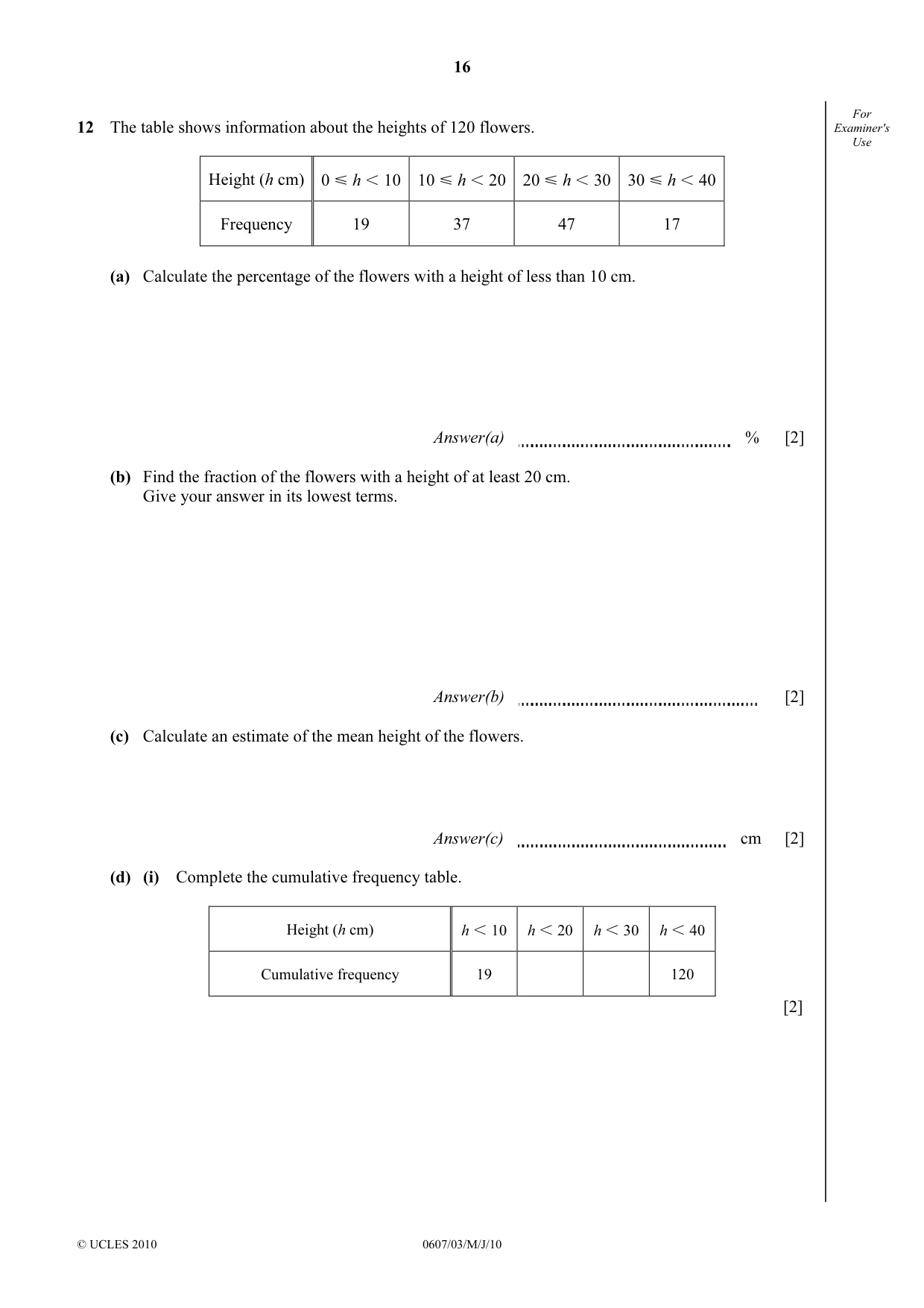
16 © UCLES 2010 0607/03/M/J/10 For Examiner's Use 12 The table shows information about the heights of 120 flowers. Height (h cm) 0 Y h I 10 10 Y h I 20 20 Y h I 30 30 Y h I 40 Frequency 19 37 47 17 (a) Calculate the percentage of the flowers with a height of less than 10 cm. Answer(a) % [2] (b) Find the fraction of the flowers with a height of at least 20 cm. Give your answer in its lowest terms. Answer(b) [2] (c) Calculate an estimate of the mean height of the flowers. Answer(c) cm [2] (d) (i) Complete the cumulative frequency table. Height (h cm) h I 10 h I 20 h I 30 h I 40 Cumulative frequency 19 120 [2]
Question paper, page 17
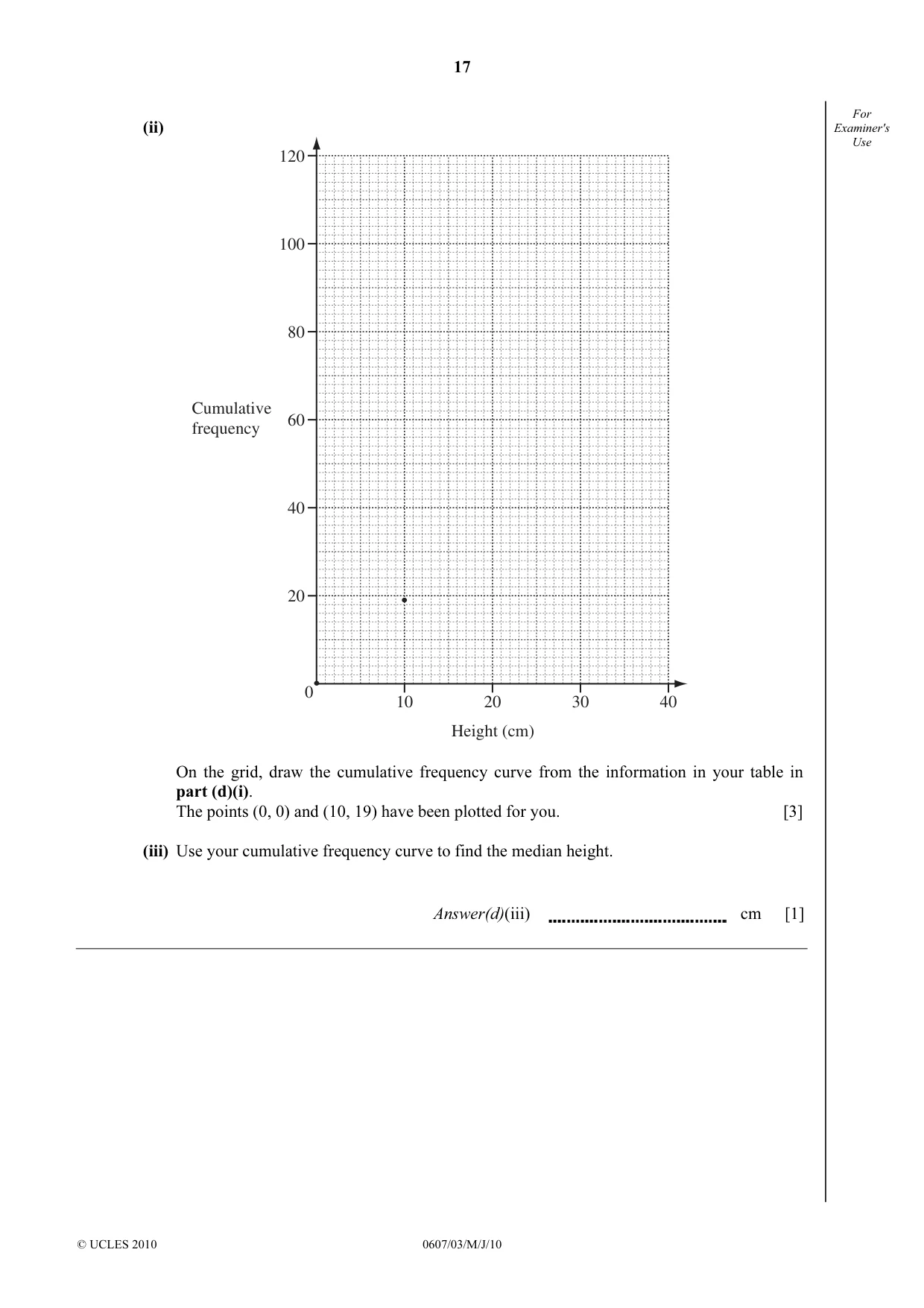
17 © UCLES 2010 0607/03/M/J/10 For Examiner's Use (ii) 120 100 80 60 40 20 0 10 20 30 40 Cumulative frequency Height (cm) On the grid, draw the cumulative frequency curve from the information in your table in part (d)(i). The points (0, 0) and (10, 19) have been plotted for you. [3] (iii) Use your cumulative frequency curve to find the median height. Answer(d)(iii) cm [1]
Question paper, page 18
18 © UCLES 2010 0607/03/M/J/10 BLANK PAGE
Question paper, page 19
19 © UCLES 2010 0607/03/M/J/10 BLANK PAGE
Question paper, page 20
20 Permission to reproduce items where third-party owned material protected by copyright is included has been sought and cleared where possible. Every reasonable effort has been made by the publisher (UCLES) to trace copyright holders, but if any items requiring clearance have unwittingly been included, the publisher will be pleased to make amends at the earliest possible opportunity. University of Cambridge International Examinations is part of the Cambridge Assessment Group. Cambridge Assessment is the brand name of University of Cambridge Local Examinations Syndicate (UCLES), which is itself a department of the University of Cambridge. © UCLES 2010 0607/03/M/J/10 BLANK PAGE
Mark scheme, page 1
UNIVERSITY OF CAMBRIDGE INTERNATIONAL EXAMINATIONS International General Certificate of Secondary Education MARK SCHEME for the May/June 2010 question paper for the guidance of teachers 0607 CAMBRIDGE INTERNATIONAL MATHEMATICS 0607/03 Paper 3 (Core), maximum raw mark 40 This mark scheme is published as an aid to teachers and candidates, to indicate the requirements of the examination. It shows the basis on which Examiners were instructed to award marks. It does not indicate the details of the discussions that took place at an Examiners’ meeting before marking began, which would have considered the acceptability of alternative answers. Mark schemes must be read in conjunction with the question papers and the report on the examination. • CIE will not enter into discussions or correspondence in connection with these mark schemes. CIE is publishing the mark schemes for the May/June 2010 question papers for most IGCSE, GCE Advanced Level and Advanced Subsidiary Level syllabuses and some Ordinary Level syllabuses. www.XtremePapers.com
Mark scheme, page 2
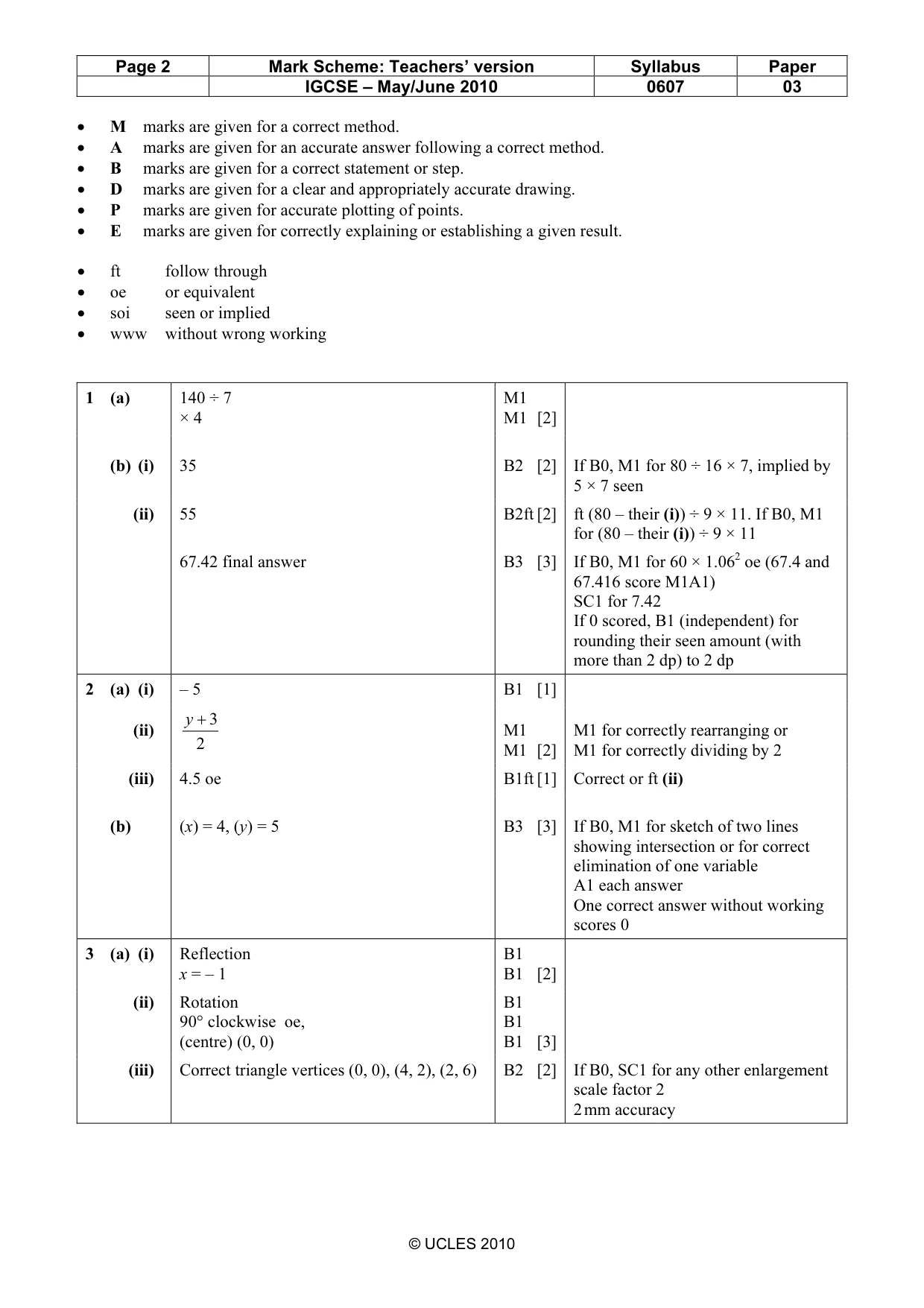
Page 2 Mark Scheme: Teachers’ version Syllabus Paper IGCSE – May/June 2010 0607 03 © UCLES 2010 • M marks are given for a correct method. • A marks are given for an accurate answer following a correct method. • B marks are given for a correct statement or step. • D marks are given for a clear and appropriately accurate drawing. • P marks are given for accurate plotting of points. • E marks are given for correctly explaining or establishing a given result. • ft follow through • oe or equivalent • soi seen or implied • www without wrong working 1 (a) 140 ÷ 7 × 4 M1 M1 [2] (b) (i) 35 B2 [2] If B0, M1 for 80 ÷ 16 × 7, implied by 5 × 7 seen (ii) 55 B2ft [2] ft (80 – their (i)) ÷ 9 × 11. If B0, M1 for (80 – their (i)) ÷ 9 × 11 67.42 final answer B3 [3] If B0, M1 for 60 × 1.062 oe (67.4 and 67.416 score M1A1) SC1 for 7.42 If 0 scored, B1 (independent) for rounding their seen amount (with more than 2 dp) to 2 dp 2 (a) (i) – 5 B1 [1] (ii) 2 3 + y M1 M1 [2] M1 for correctly rearranging or M1 for correctly dividing by 2 (iii) 4.5 oe B1ft [1] Correct or ft (ii) (b) (x) = 4, (y) = 5 B3 [3] If B0, M1 for sketch of two lines showing intersection or for correct elimination of one variable A1 each answer One correct answer without working scores 0 3 (a) (i) Reflection x = – 1 B1 B1 [2] (ii) Rotation 90° clockwise oe, (centre) (0, 0) B1 B1 B1 [3] (iii) Correct triangle vertices (0, 0), (4, 2), (2, 6) B2 [2] If B0, SC1 for any other enlargement scale factor 2 2 mm accuracy
Mark scheme, page 3
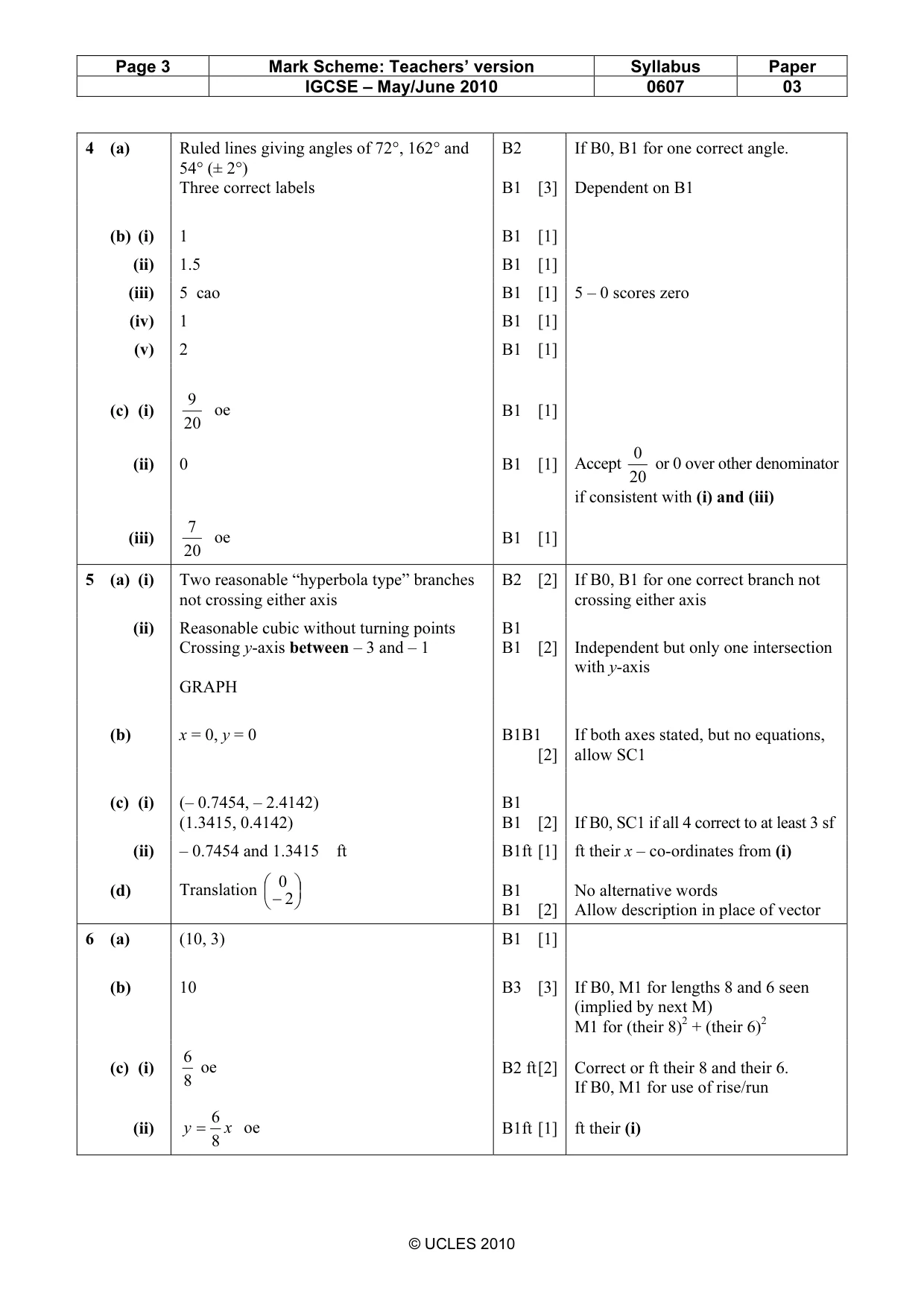
Page 3 Mark Scheme: Teachers’ version Syllabus Paper IGCSE – May/June 2010 0607 03 © UCLES 2010 4 (a) Ruled lines giving angles of 72°, 162° and 54° (± 2°) Three correct labels B2 B1 [3] If B0, B1 for one correct angle. Dependent on B1 (b) (i) 1 B1 [1] (ii) 1.5 B1 [1] (iii) 5 cao B1 [1] 5 – 0 scores zero (iv) 1 B1 [1] (v) 2 B1 [1] (c) (i) 20 9 oe B1 [1] (ii) 0 B1 [1] Accept 20 0 or 0 over other denominator if consistent with (i) and (iii) (iii) 20 7 oe B1 [1] 5 (a) (i) Two reasonable “hyperbola type” branches not crossing either axis B2 [2] If B0, B1 for one correct branch not crossing either axis (ii) Reasonable cubic without turning points Crossing y-axis between – 3 and – 1 GRAPH B1 B1 [2] Independent but only one intersection with y-axis (b) x = 0, y = 0 B1B1 [2] If both axes stated, but no equations, allow SC1 (c) (i) (– 0.7454, – 2.4142) (1.3415, 0.4142) B1 B1 [2] If B0, SC1 if all 4 correct to at least 3 sf (ii) – 0.7454 and 1.3415 ft B1ft [1] ft their x – co-ordinates from (i) (d) Translation −2 0 B1 B1 [2] No alternative words Allow description in place of vector 6 (a) (10, 3) B1 [1] (b) 10 B3 [3] If B0, M1 for lengths 8 and 6 seen (implied by next M) M1 for (their 8)2 + (their 6)2 (c) (i) 8 6 oe B2 ft [2] Correct or ft their 8 and their 6. If B0, M1 for use of rise/run (ii) x y 8 6 = oe B1ft [1] ft their (i)
Mark scheme, page 4
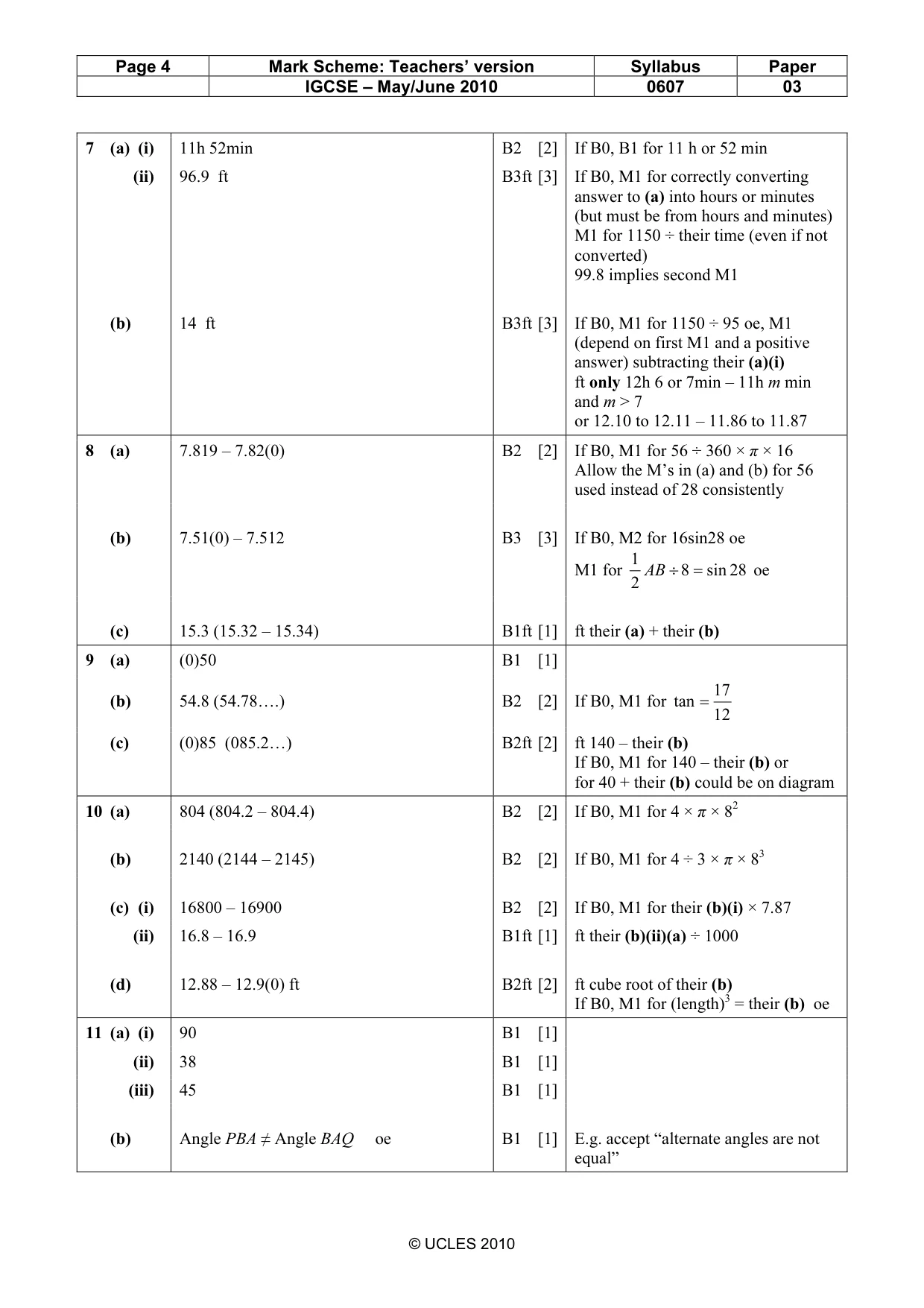
Page 4 Mark Scheme: Teachers’ version Syllabus Paper IGCSE – May/June 2010 0607 03 © UCLES 2010 7 (a) (i) 11h 52min B2 [2] If B0, B1 for 11 h or 52 min (ii) 96.9 ft B3ft [3] If B0, M1 for correctly converting answer to (a) into hours or minutes (but must be from hours and minutes) M1 for 1150 ÷ their time (even if not converted) 99.8 implies second M1 (b) 14 ft B3ft [3] If B0, M1 for 1150 ÷ 95 oe, M1 (depend on first M1 and a positive answer) subtracting their (a)(i) ft only 12h 6 or 7min – 11h m min and m > 7 or 12.10 to 12.11 – 11.86 to 11.87 8 (a) 7.819 – 7.82(0) B2 [2] If B0, M1 for 56 ÷ 360 × π × 16 Allow the M’s in (a) and (b) for 56 used instead of 28 consistently (b) 7.51(0) – 7.512 B3 [3] If B0, M2 for 16sin28 oe M1 for 28 sin 8 2 1 = ÷ AB oe (c) 15.3 (15.32 – 15.34) B1ft [1] ft their (a) + their (b) 9 (a) (0)50 B1 [1] (b) 54.8 (54.78….) B2 [2] If B0, M1 for 12 17 tan = (c) (0)85 (085.2…) B2ft [2] ft 140 – their (b) If B0, M1 for 140 – their (b) or for 40 + their (b) could be on diagram 10 (a) 804 (804.2 – 804.4) B2 [2] If B0, M1 for 4 × π × 82 (b) 2140 (2144 – 2145) B2 [2] If B0, M1 for 4 ÷ 3 × π × 83 (c) (i) 16800 – 16900 B2 [2] If B0, M1 for their (b)(i) × 7.87 (ii) 16.8 – 16.9 B1ft [1] ft their (b)(ii)(a) ÷ 1000 (d) 12.88 – 12.9(0) ft B2ft [2] ft cube root of their (b) If B0, M1 for (length)3 = their (b) oe 11 (a) (i) 90 B1 [1] (ii) 38 B1 [1] (iii) 45 B1 [1] (b) Angle PBA ≠ Angle BAQ oe B1 [1] E.g. accept “alternate angles are not equal”
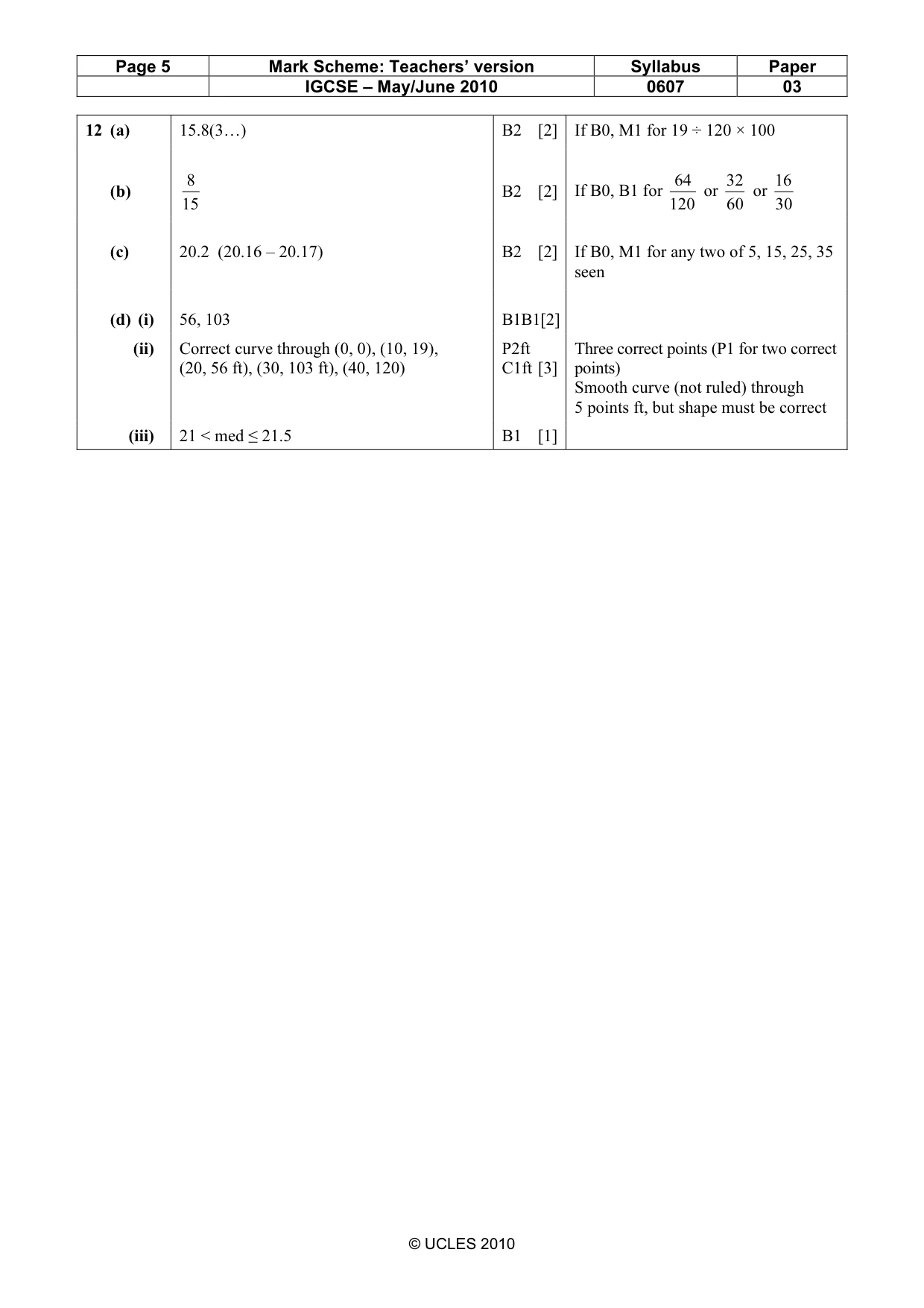
Mark scheme, page 5
Page 5 Mark Scheme: Teachers’ version Syllabus Paper IGCSE – May/June 2010 0607 03 © UCLES 2010 12 (a) 15.8(3…) B2 [2] If B0, M1 for 19 ÷ 120 × 100 (b) 15 8 B2 [2] If B0, B1 for 120 64 or 60 32 or 30 16 (c) 20.2 (20.16 – 20.17) B2 [2] If B0, M1 for any two of 5, 15, 25, 35 seen (d) (i) 56, 103 B1B1[2] (ii) Correct curve through (0, 0), (10, 19), (20, 56 ft), (30, 103 ft), (40, 120) P2ft C1ft [3] Three correct points (P1 for two correct points) Smooth curve (not ruled) through 5 points ft, but shape must be correct (iii) 21 < med ≤ 21.5 B1 [1]