Cambridge IGCSE Mathematics - Additional 0606 — 2018 Oct/Nov Paper 2 · Variant 1
0606/21/O/N/18 · 10 questions · 80 marks · ≈90 min
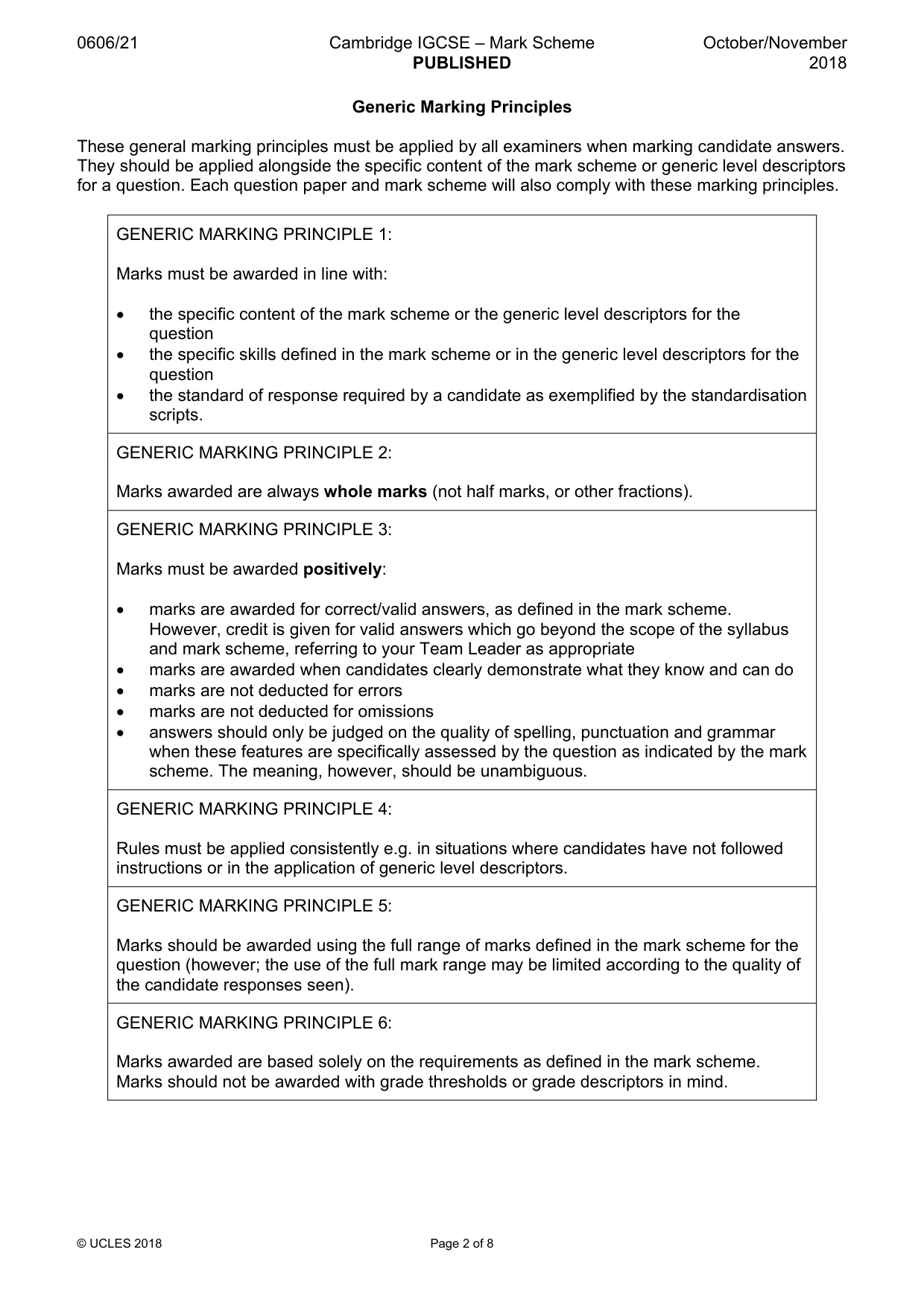
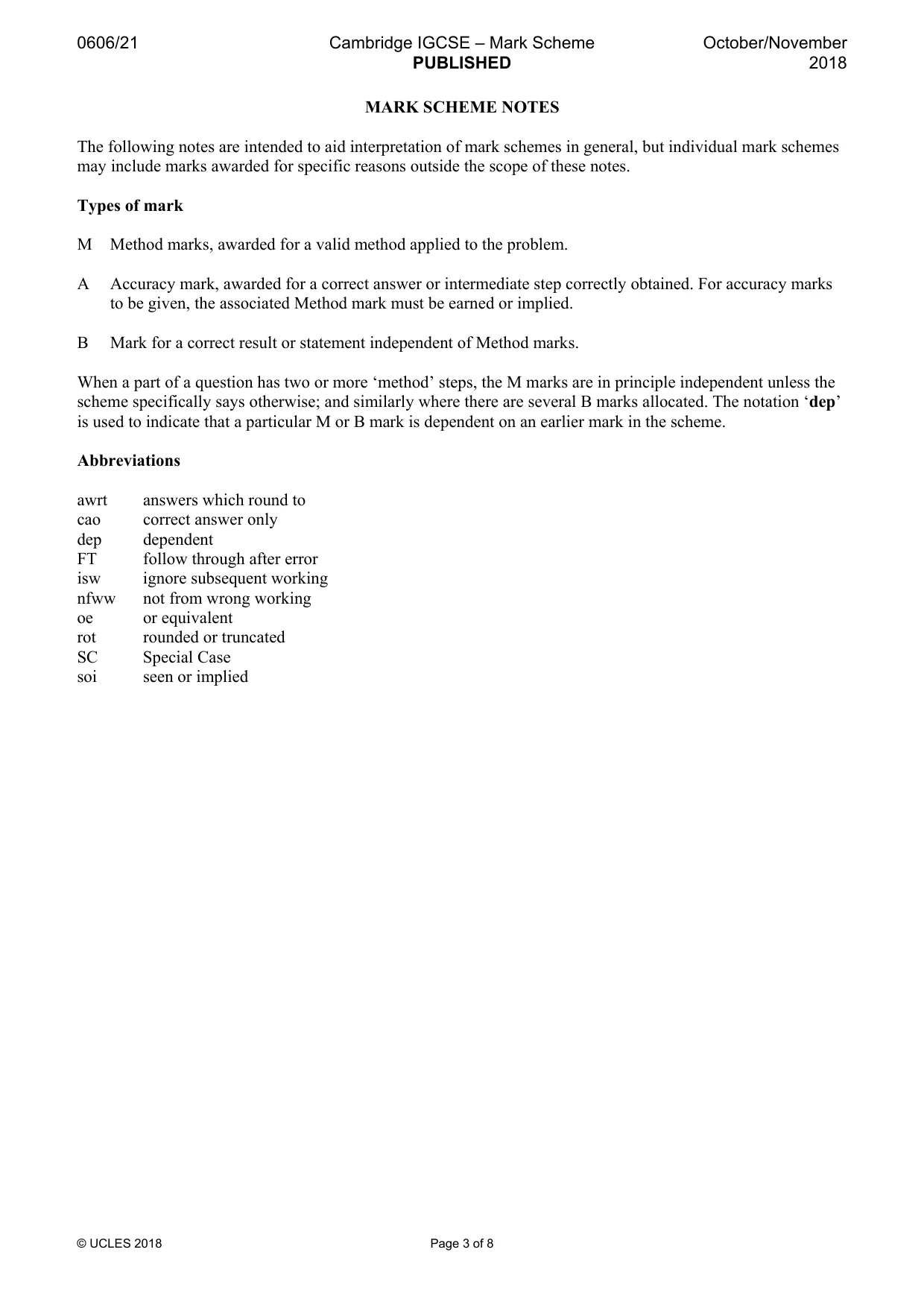
The question paper and its mark scheme, free to read here and free to download. This is Cambridge’s own paper, exactly as it was sat.
Question paper16 pages
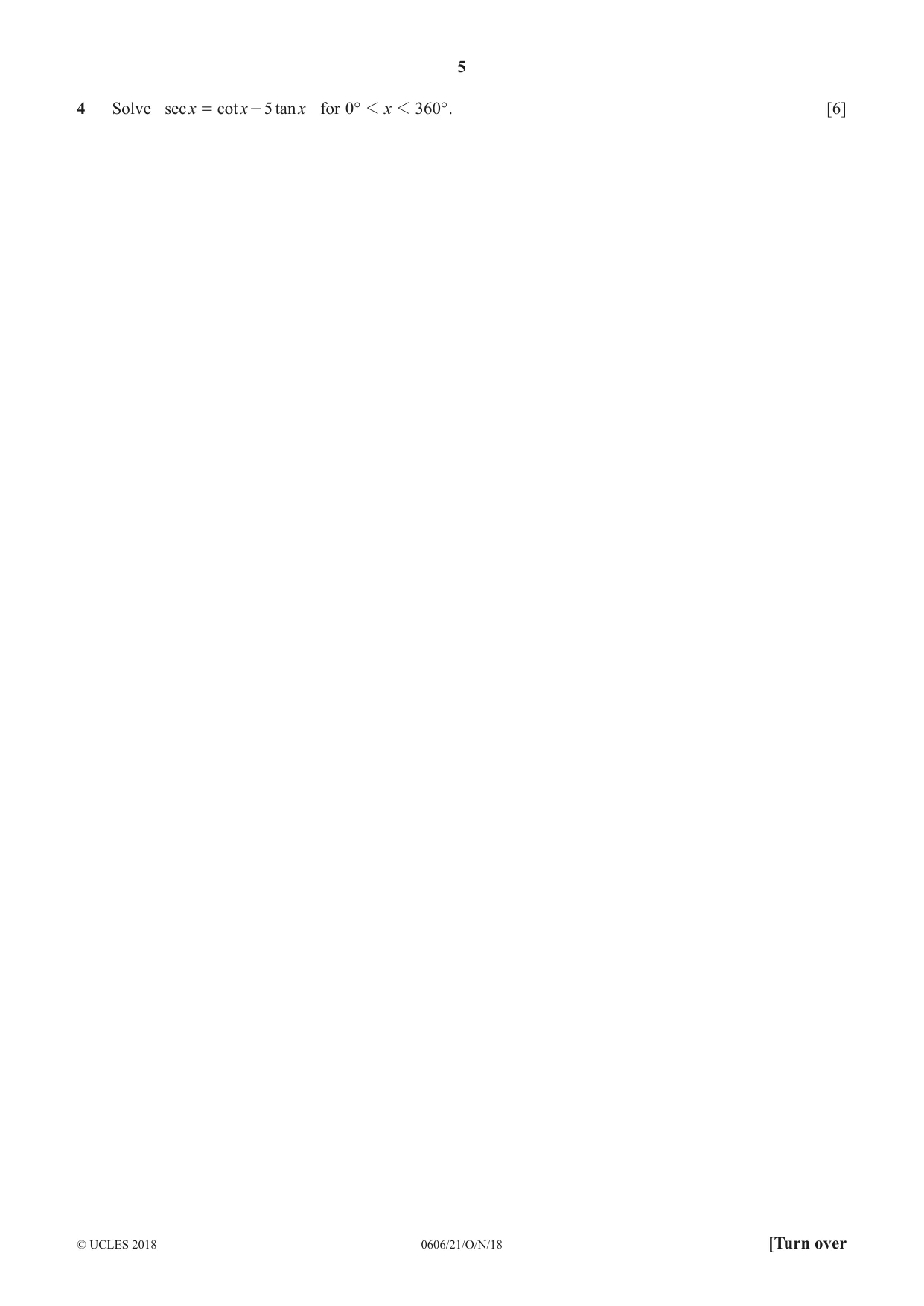

Mark scheme8 pages
Answers below. Sit the paper first if you are practising.
Questions as text
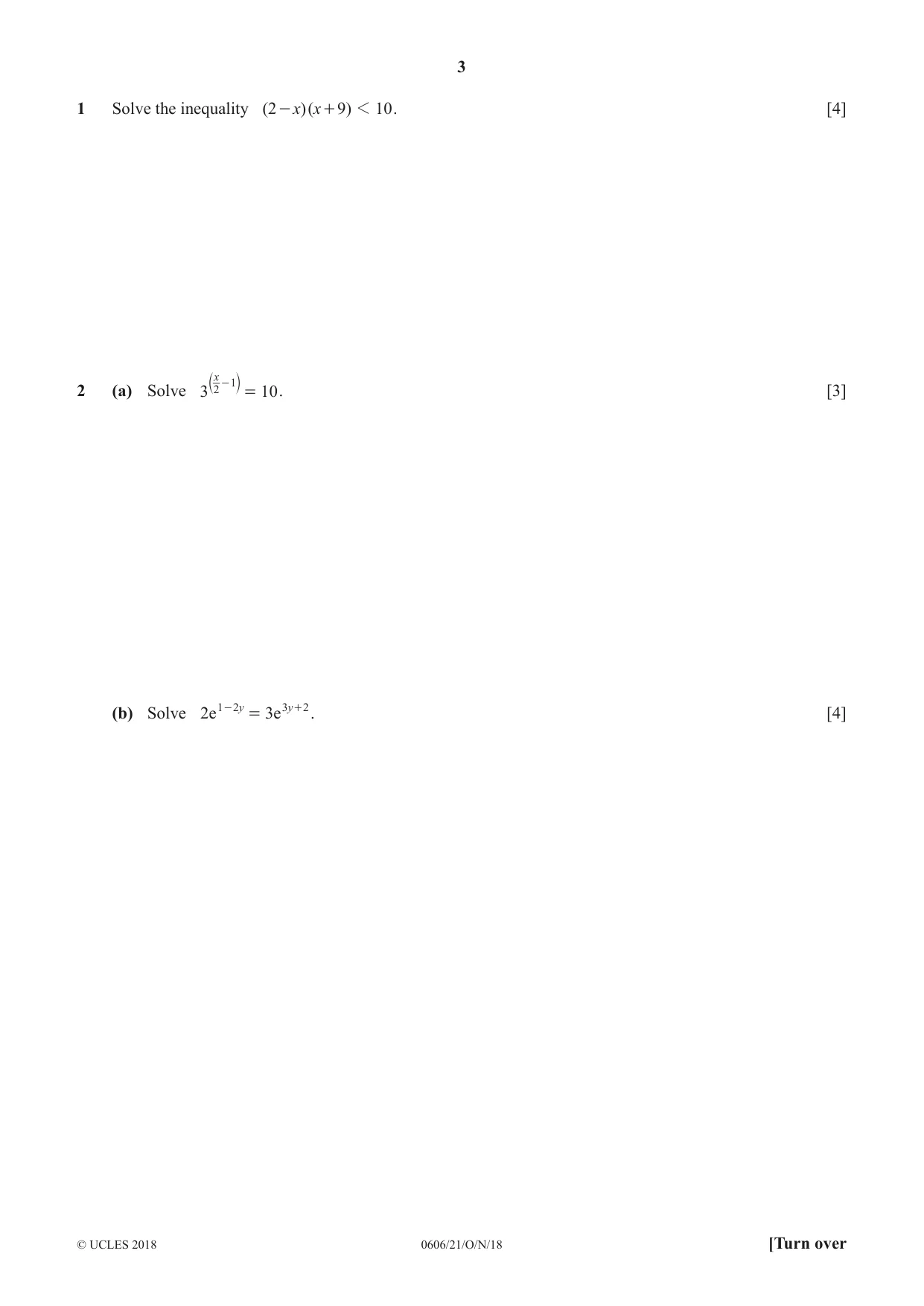
Q1 · Solve the inequality (2 - x)(x + 9) 1 10
1 Solve the inequality (2 - x)(x + 9) 1 10 . [4]
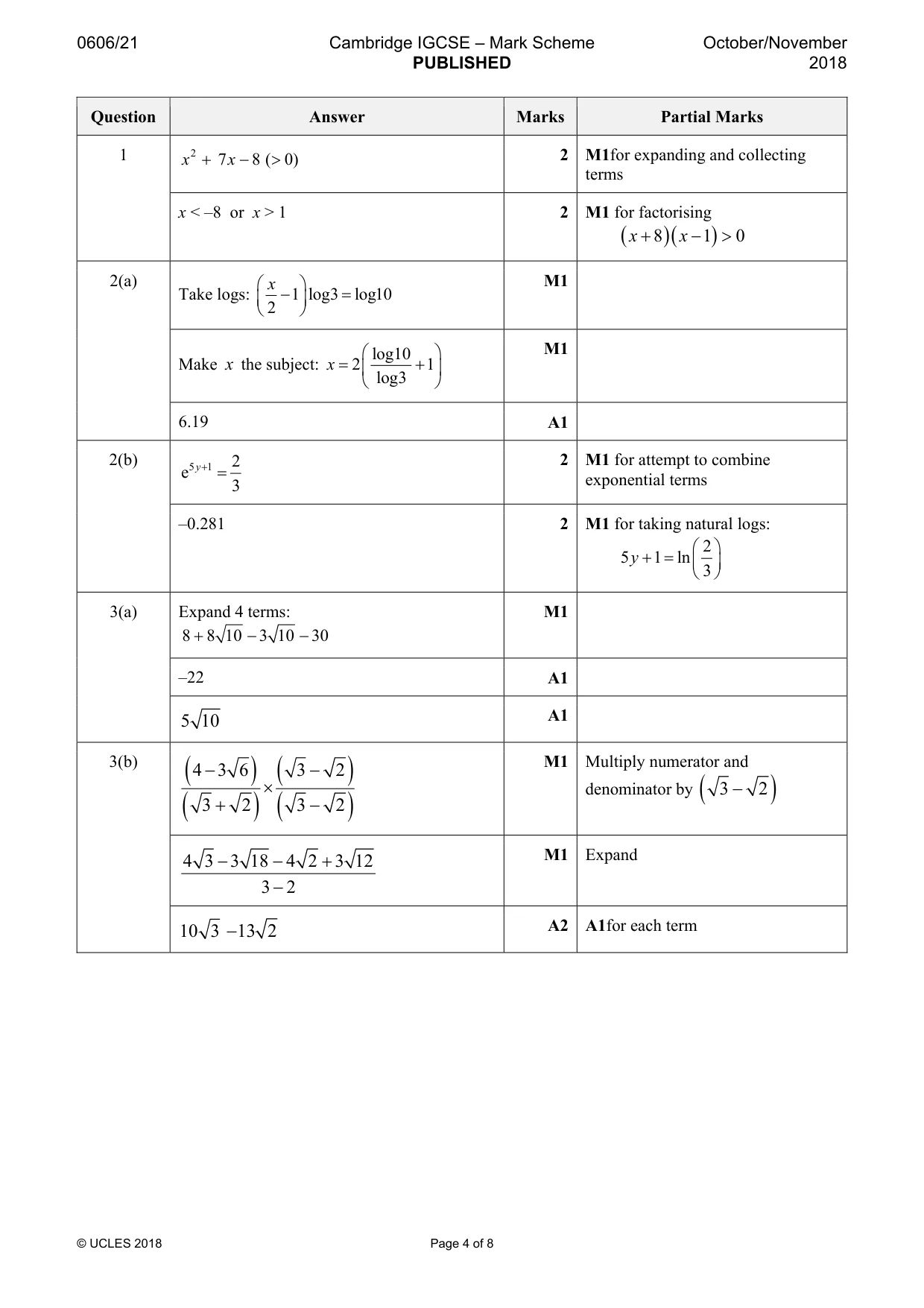
Mark scheme: Question Answer Marks Partial Marks 1 x 2 + 7 x − 8 ( > 0) 2 M1for expanding and collecting terms x < –8 or x > 1 2 M1 for factorising ( x + 8 )( x − 1) > 0
More questions on Find the solution set for quadratic inequalities
Q2 · Solve 3 - 1 2 = 10
2 (a) Solve 3 - 1 2 = 10 . [3] (b) Solve 2e 1 - 2y = 3e 3y + 2 . [4]
Mark scheme: 2(a) x M1 Take logs: − 1 log3 = log10 2 log10 M1 Make x the subject: x = 2 + 1 log3 6.19 A1 2(b) 5 y+1 2 2 M1 for attempt to combine e = exponential terms 3 –0.281 2 M1 for taking natural logs: 2 5 y + 1 = ln 3
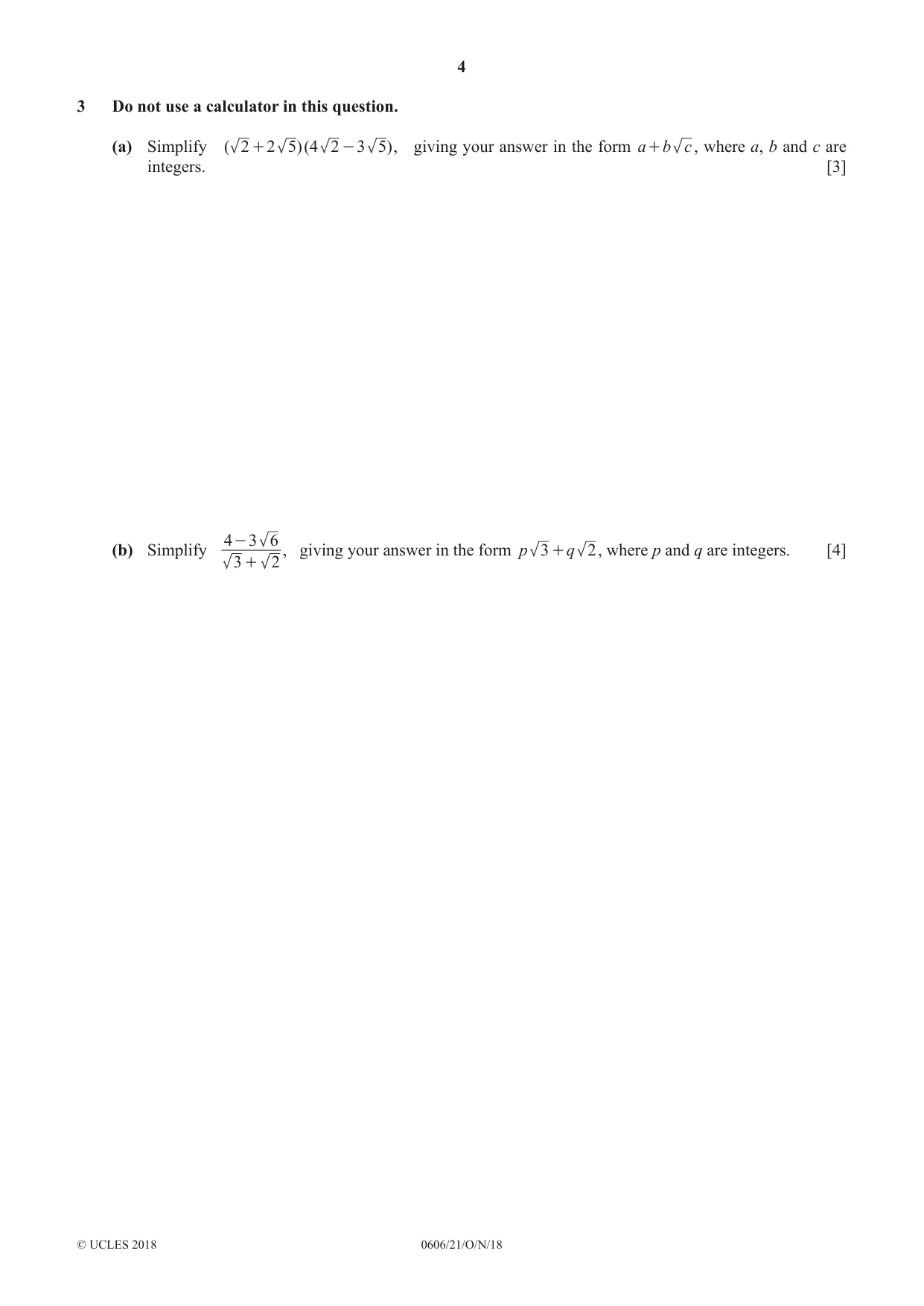
Q3 · Do not use a calculator in this question
3 Do not use a calculator in this question. (a) Simplify ( 2 + 2 5 )(4 2 - 3 5 ) , giving your answer in the form a + b c , where a, b and c are integers. [3] 4 - 3 6 (b) Simplify , giving your answer in the form p 3 + q 2 , where p and q are integers. [4] 3 + 2
Mark scheme: 3(a) Expand 4 terms: M1 8 + 8 10 − 3 10 − 30 –22 A1 5 10 A1 3(b) M1 Multiply numerator and 4 − 3 6 3 − 2 ( ) ( ) × denominator by 3 − 2 ( ) 3 + 2 3 − 2 ( ) ( ) M1 Expand 4 3 − 3 18 − 4 2 + 3 12 3 − 2 10 3 −13 2 A2 A1for each term
Question 5
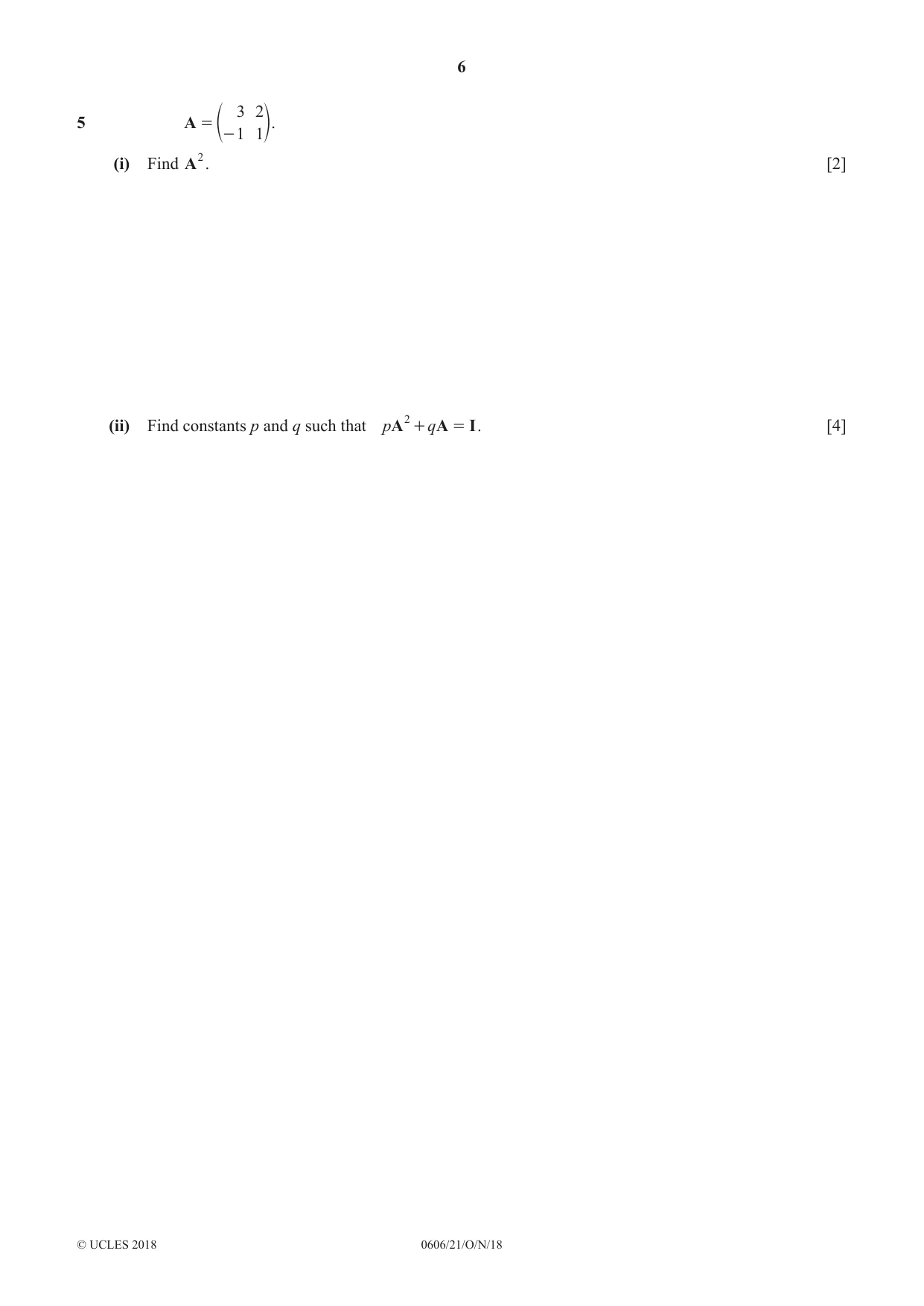
5 A = . - 1 1 (i) Find A2. [2] (ii) Find constants p and q such that pA 2 + qA = I . [4]
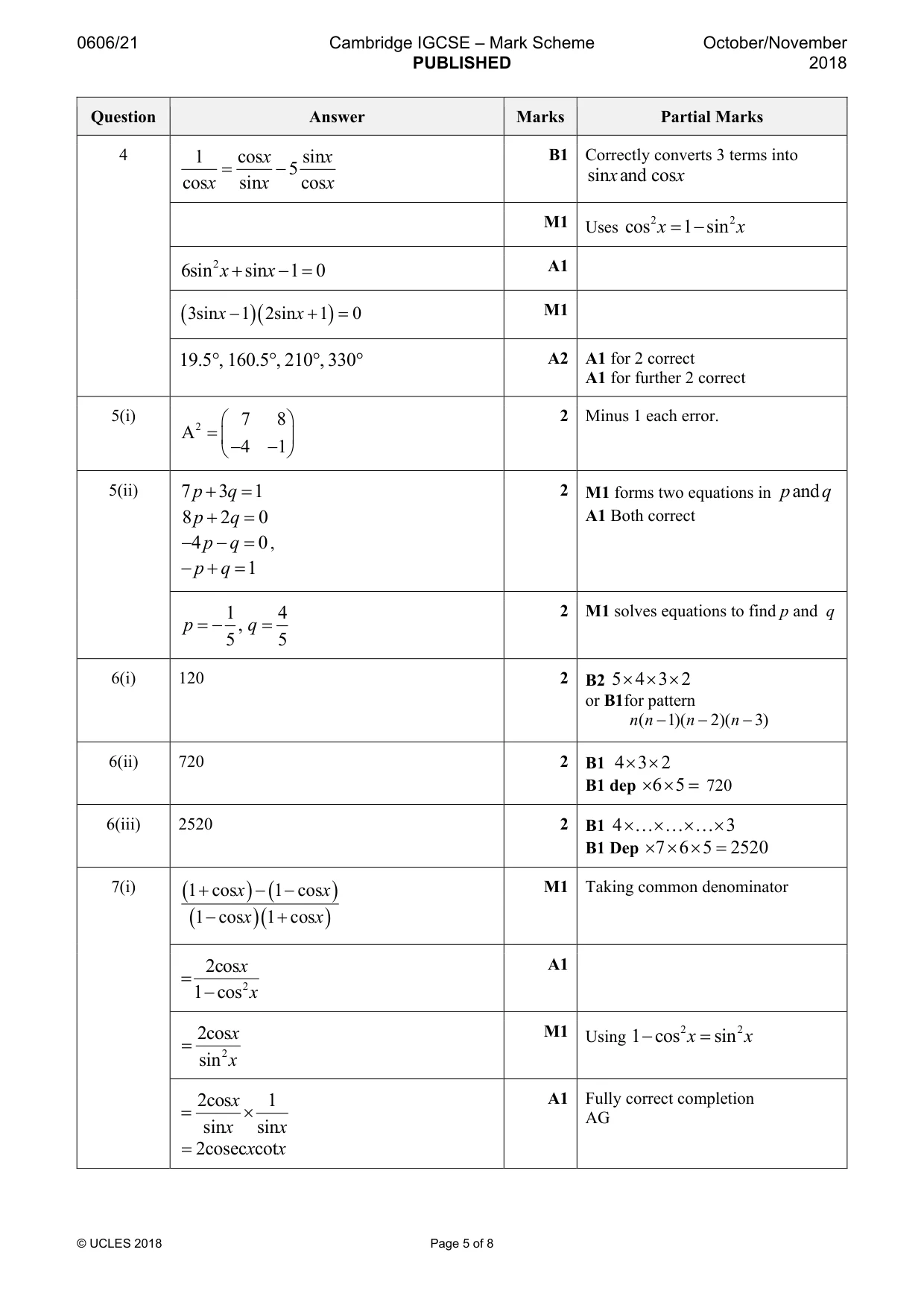
Mark scheme: 5(i) 2 7 8 2 Minus 1 each error. A = −4 −1 5(ii) 7 p + 3q = 1 2 M1 forms two equations in p and q 8 p + 2 q = 0 A1 Both correct −4 p − q = 0 , − p + q = 1 1 4 2 M1 solves equations to find p and q p = − , q = 5 5
Q6 · A 5-digit code is to be formed from the digits 1, 2, 3, 4, 5, 6, 7, 8, 9
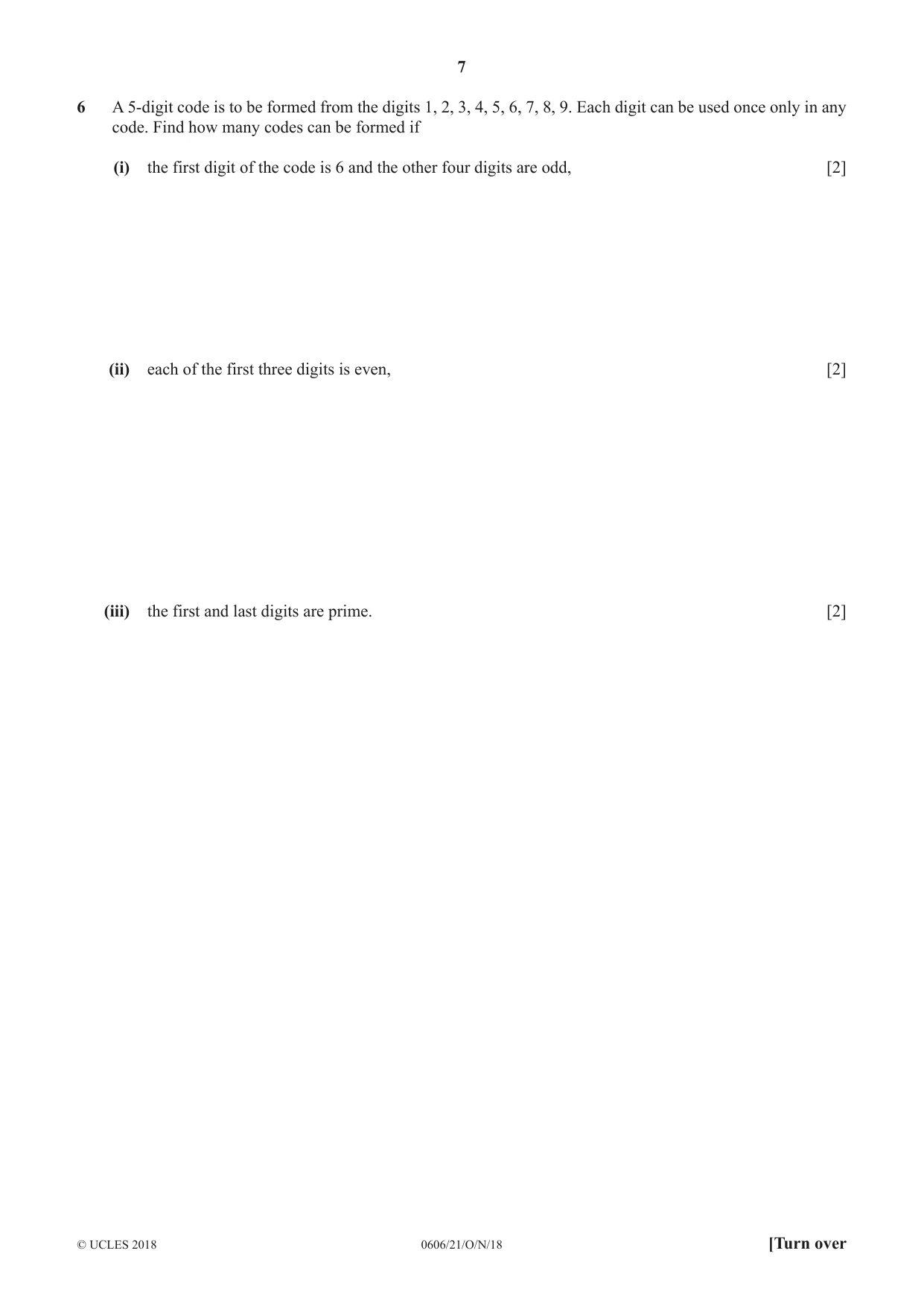
6 A 5-digit code is to be formed from the digits 1, 2, 3, 4, 5, 6, 7, 8, 9. Each digit can be used once only in any code. Find how many codes can be formed if (i) the first digit of the code is 6 and the other four digits are odd, [2] (ii) each of the first three digits is even, [2] (iii) the first and last digits are prime. [2]
Mark scheme: 6(i) 120 2 B2 5 × 4 × 3 × 2 or B1for pattern n ( n − 1)( n − 2)( n − 3) 6(ii) 720 2 B1 4 × 3 × 2 B1 dep × 6 × 5 = 720 6(iii) 2520 2 B1 4 ×…×…×…× 3 B1 Dep × 7 × 6 × 5 = 2520
More questions on Solve problems on arrangement and selection
Q7 · Show that - = 2 cosec x cot x
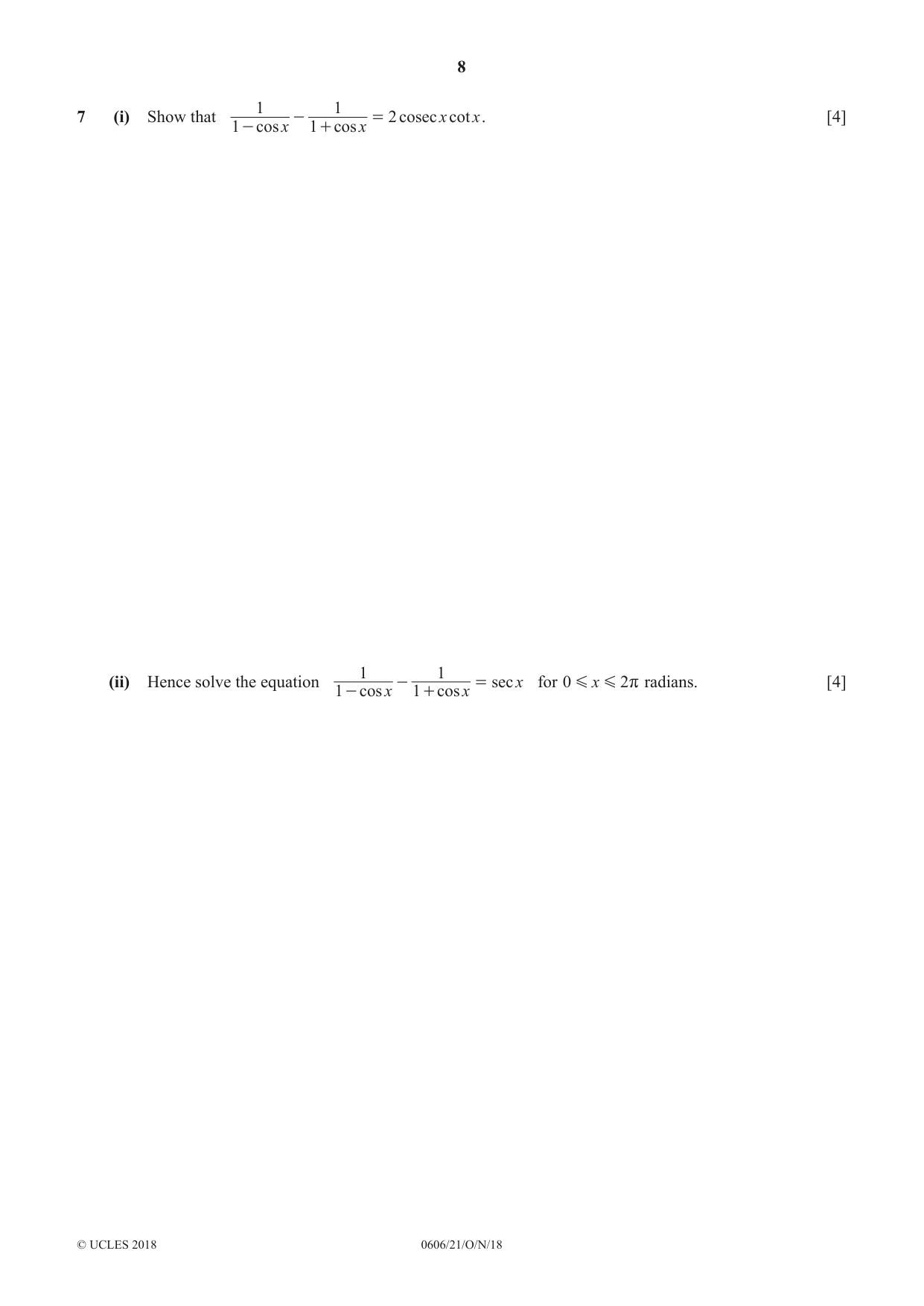
7 (i) Show that - = 2 cosec x cot x . [4] 1 - cos x 1 + cos x 1 1 (ii) Hence solve the equation - = sec x for 0 G x G 2 r radians. [4] 1 - cos x 1 + cos x
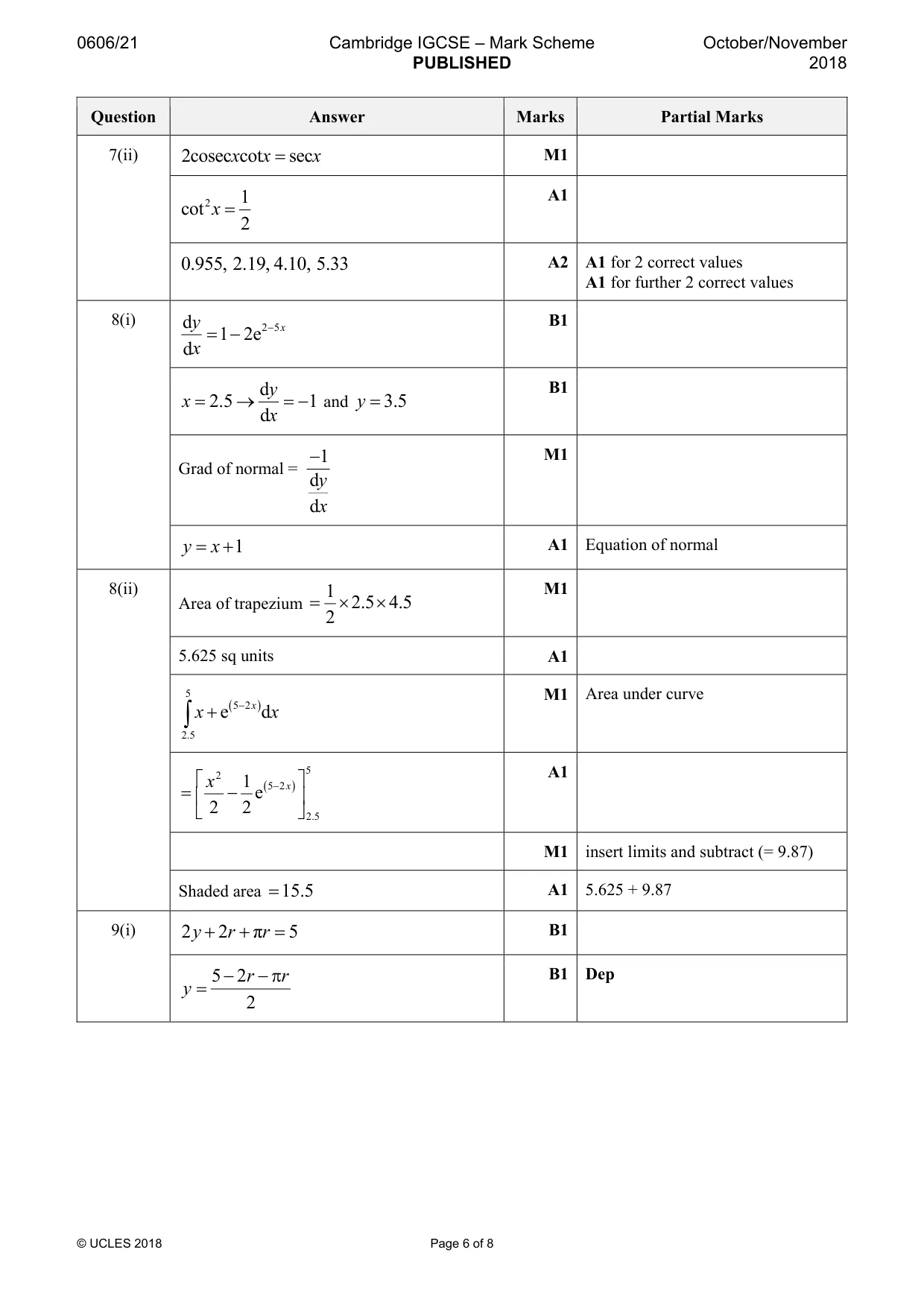
Mark scheme: 7(i) (1 + cos x ) − (1 − cos x ) M1 Taking common denominator (1 − cos x )(1 + cos x ) 2cosx A1 = 2 1 − cos x 2cosx M1 Using 1 − cos 2 x = sin 2 x = 2 sin x 2cosx 1 A1 Fully correct completion = × AG sinx sinx = 2cosecxcot x 7(ii) 2cosecxcotx = secx M1 2 1 A1 cot x = 2 0.955, 2.19, 4.10, 5.33 A2 A1 for 2 correct values A1 for further 2 correct values
More questions on Prove trigonometric relationships involving the
Q8 · Y y = x + e 5 - 2x A B 0 5 x The diagram shows part of the curve y = x + e 5 - 2x , the…
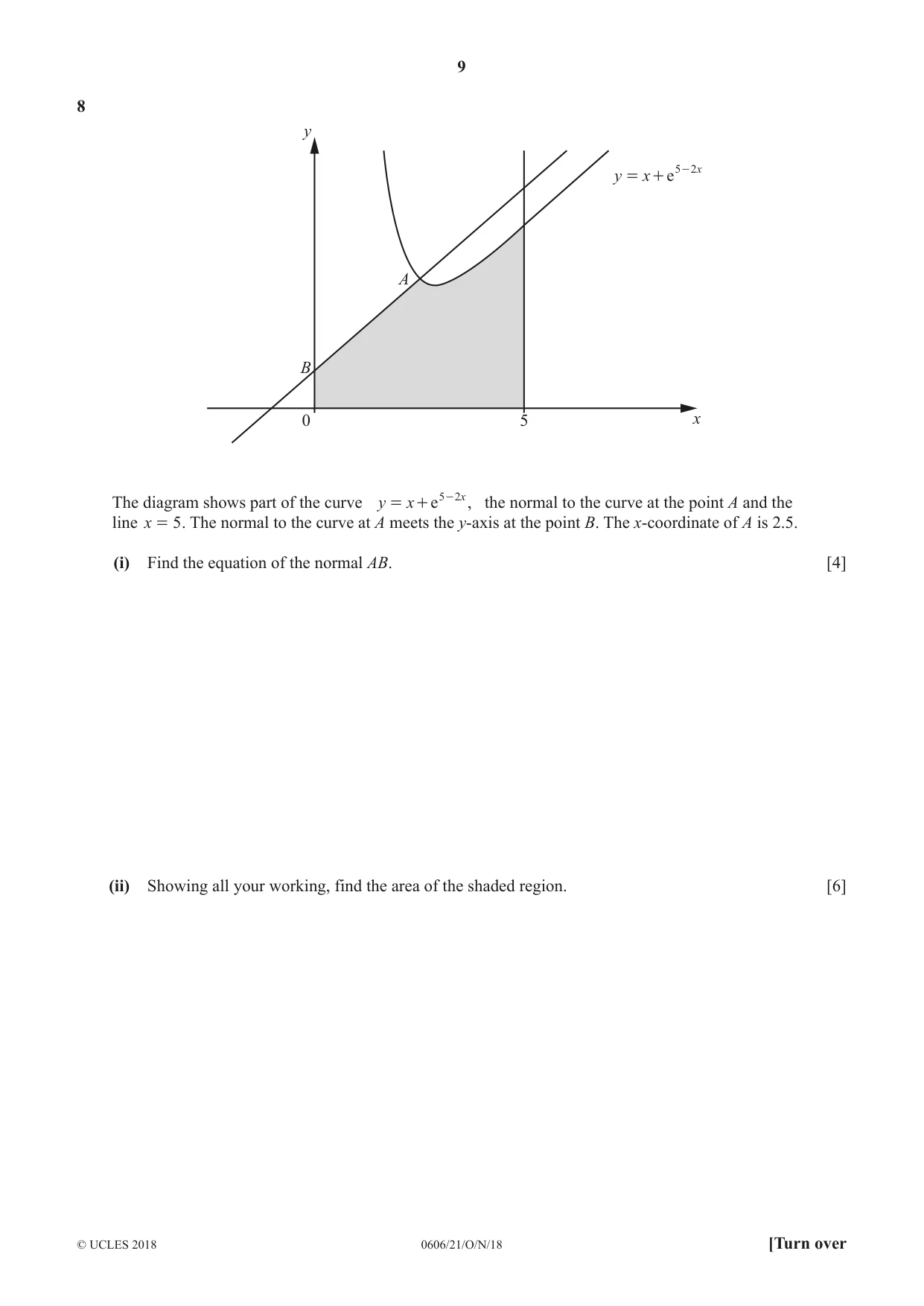
8 y y = x + e 5 - 2x A B 0 5 x The diagram shows part of the curve y = x + e 5 - 2x , the normal to the curve at the point A and the line x = 5 . The normal to the curve at A meets the y-axis at the point B. The x-coordinate of A is 2.5. (i) Find the equation of the normal AB. [4] (ii) Showing all your working, find the area of the shaded region. [6]
Mark scheme: 8(i) dy 2 − 5 x B1 = 1 − 2e dx dy B1 x = 2.5 → = −1 and y = 3.5 dx −1 M1 Grad of normal = dy dx y = x + 1 A1 Equation of normal 8(ii) 1 M1 Area of trapezium = × 2.5 × 4.5 2 5.625 sq units A1 5 M1 Area under curve x + e dx ∫ ( 5 − 2 x ) 2.5 5 A1 2 x 1 ( 5 − 2 x ) = − e 2 2 2.5 M1 insert limits and subtract (= 9.87) Shaded area = 15.5 A1 5.625 + 9.87
Q9 · In this question, all lengths are in metres
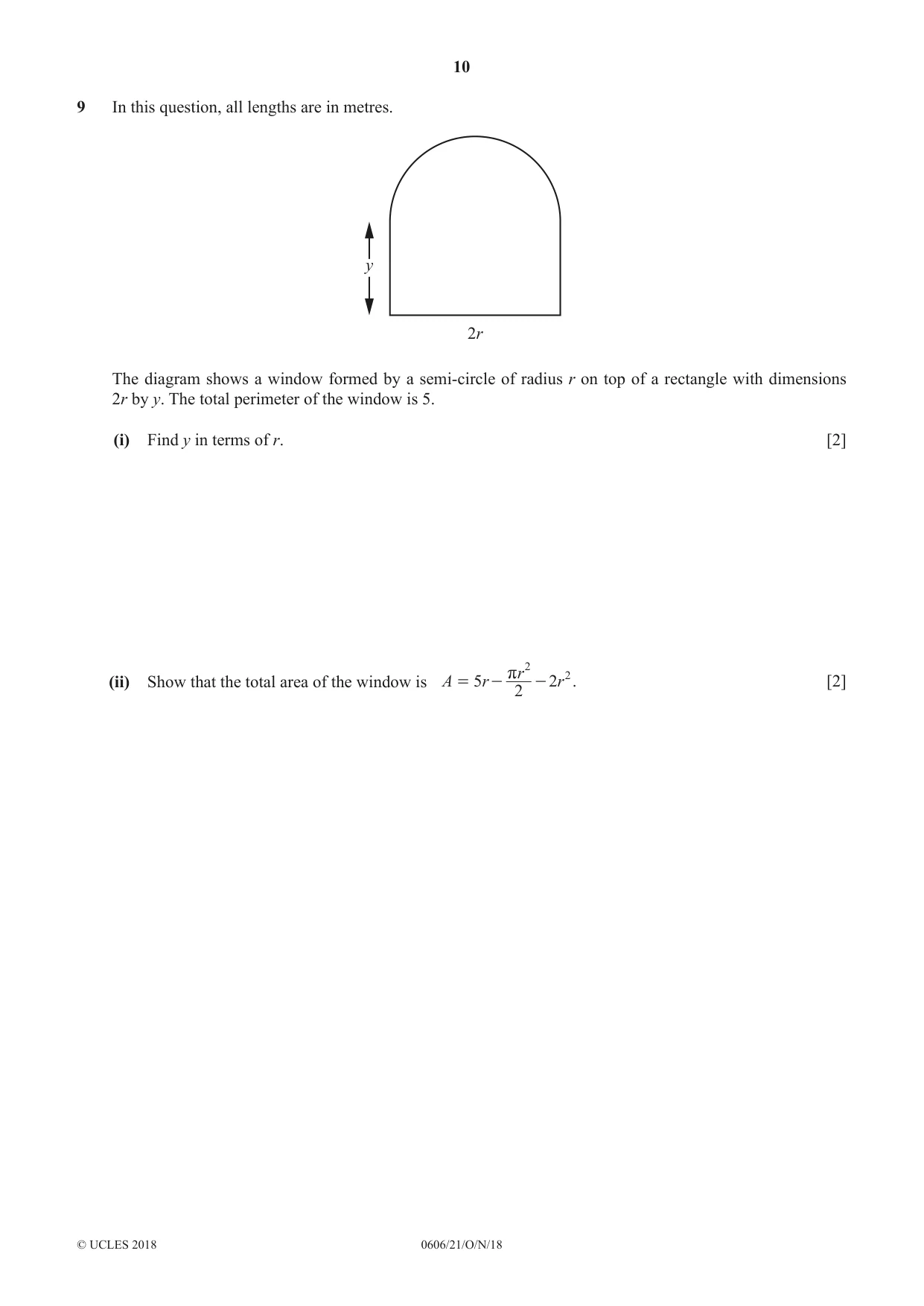
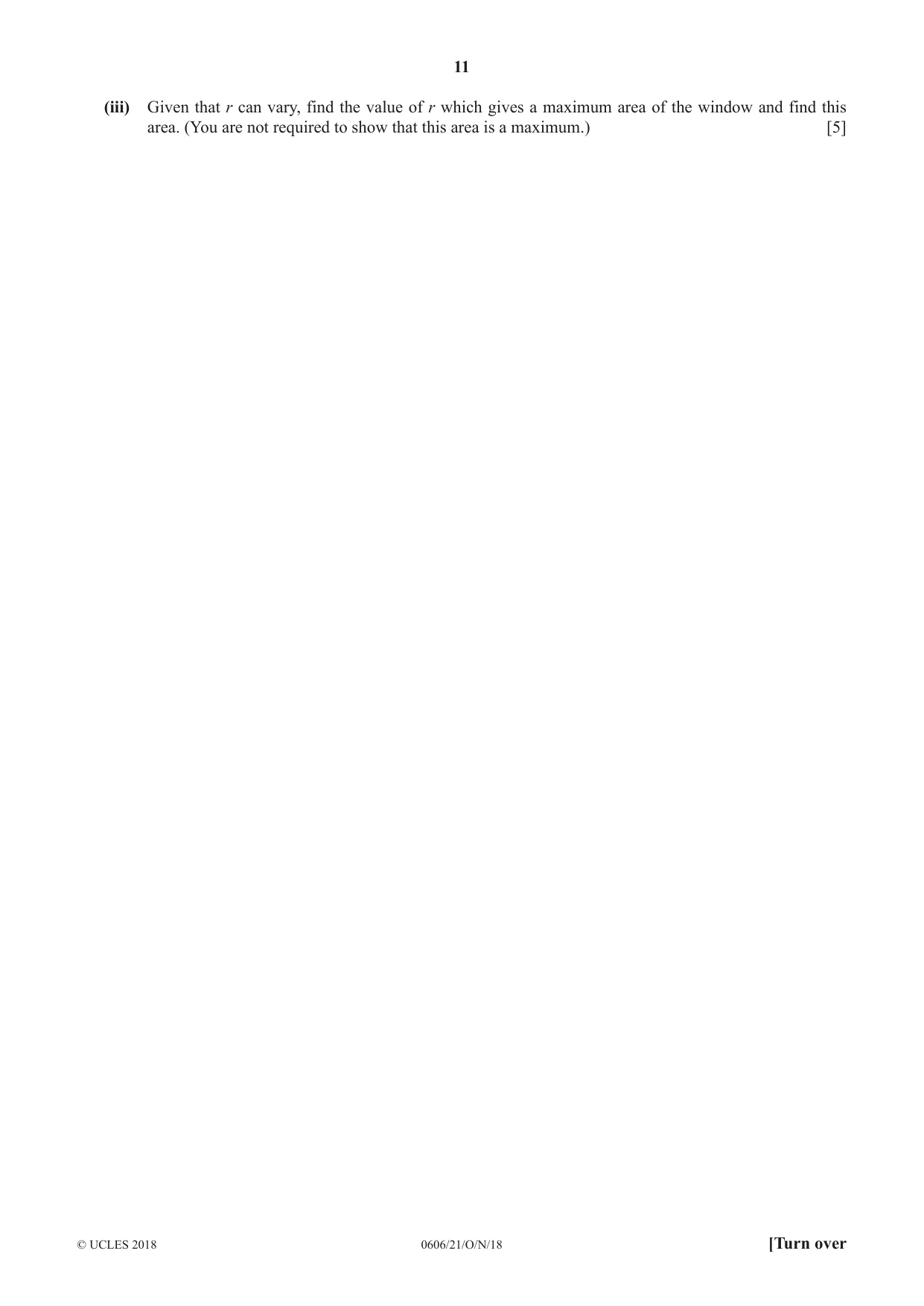
9 In this question, all lengths are in metres. y 2r The diagram shows a window formed by a semi-circle of radius r on top of a rectangle with dimensions 2r by y. The total perimeter of the window is 5. (i) Find y in terms of r. [2] 2 r r 2 (ii) Show that the total area of the window is A = 5r - - 2r . [2] 2 (iii) Given that r can vary, find the value of r which gives a maximum area of the window and find this area. (You are not required to show that this area is a maximum.) [5]
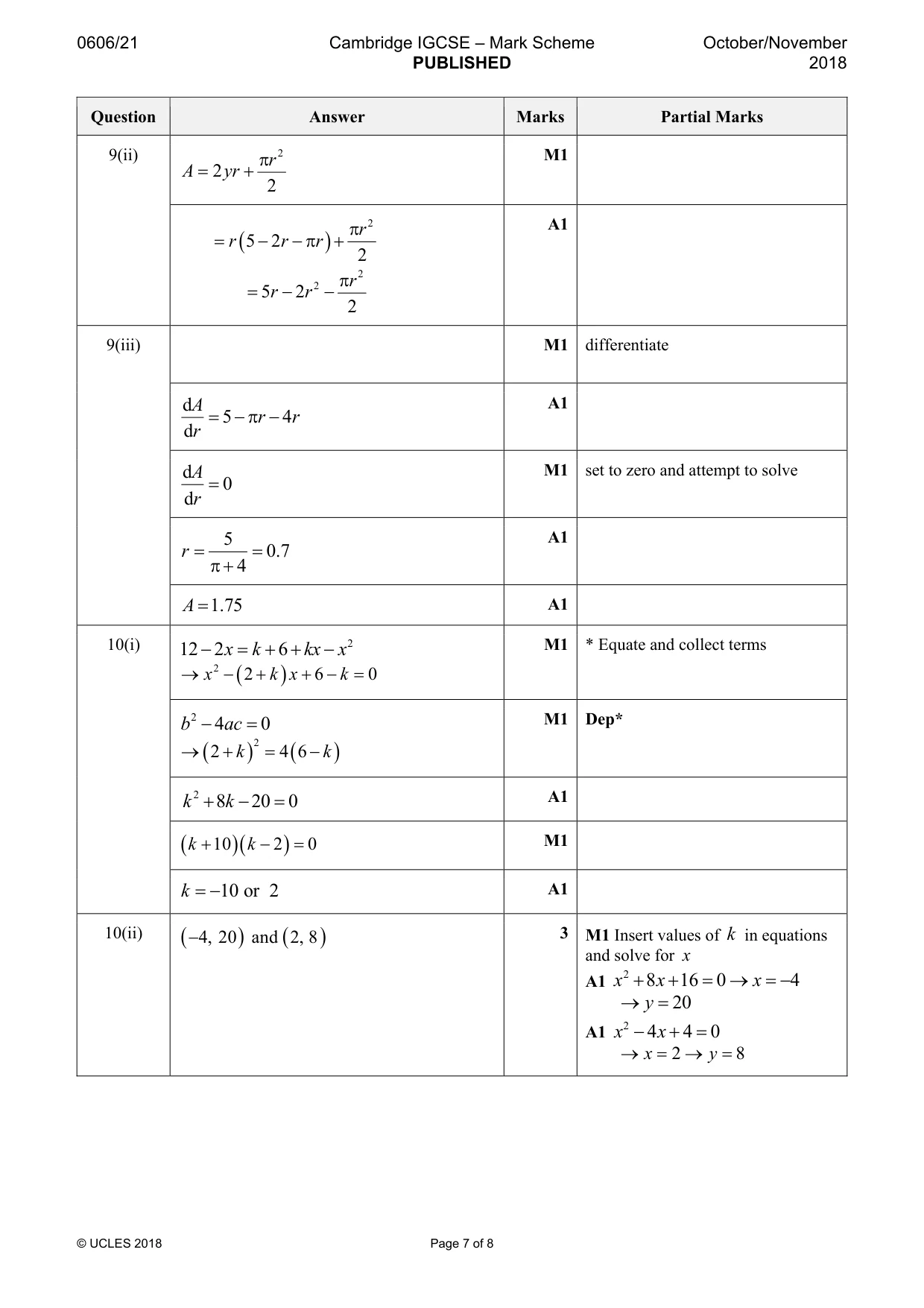
Mark scheme: 9(i) 2 y + 2r + πr = 5 B1 5 − 2 r −πr B1 Dep y = 2 9(ii) πr 2 M1 A = 2 yr + 2 πr 2 A1 = r ( 5 − 2 r −πr ) + 2 2 πr 2 = 5 r − 2 r − 2 9(iii) M1 differentiate dA A1 = 5 −πr − 4 r dr dA M1 set to zero and attempt to solve = 0 dr 5 A1 r = = 0.7 π+ 4 A = 1.75 A1
More questions on Use differentiation to find stationary points
Q10 · The line y = 12 - 2x is a tangent to two curves
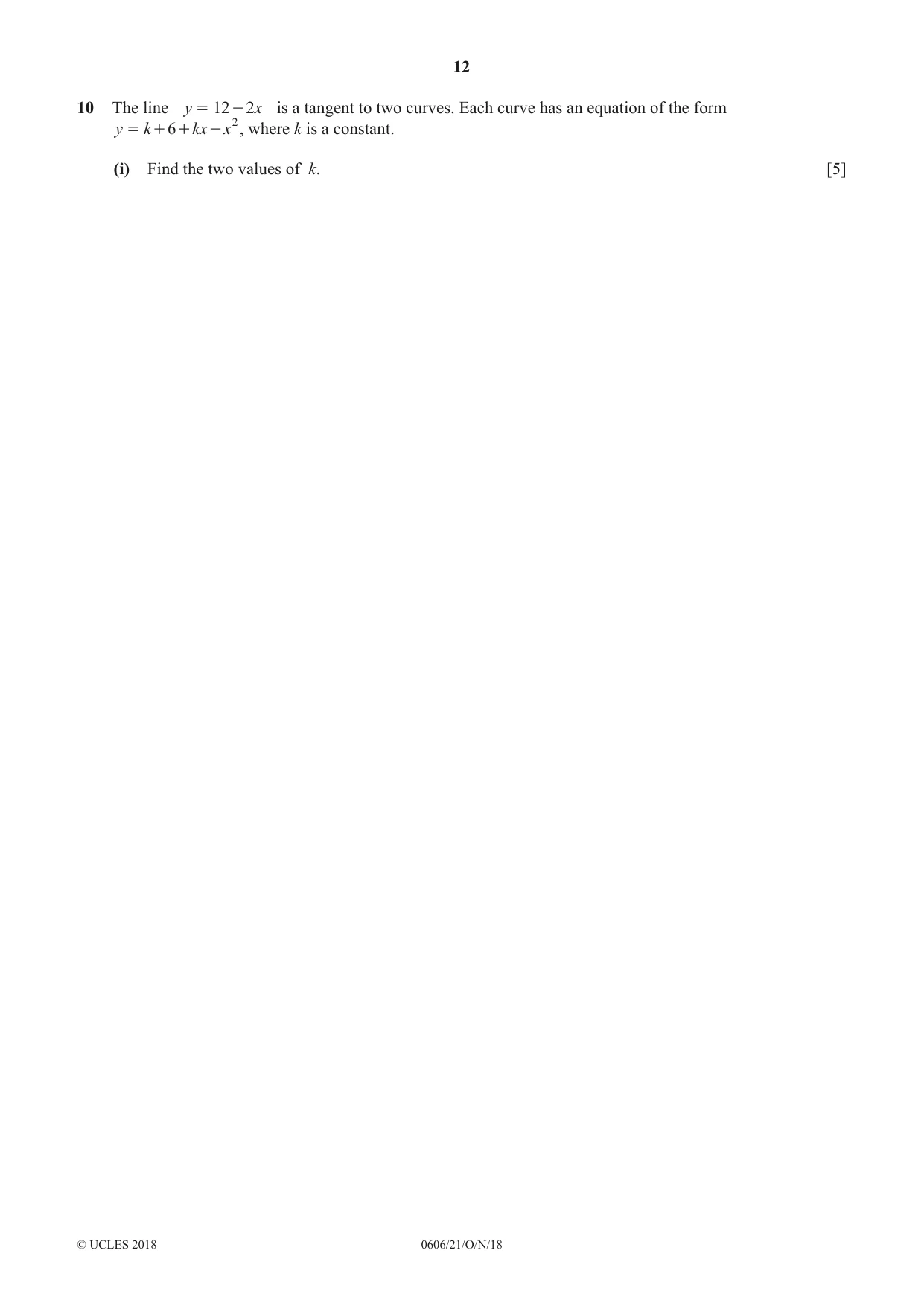
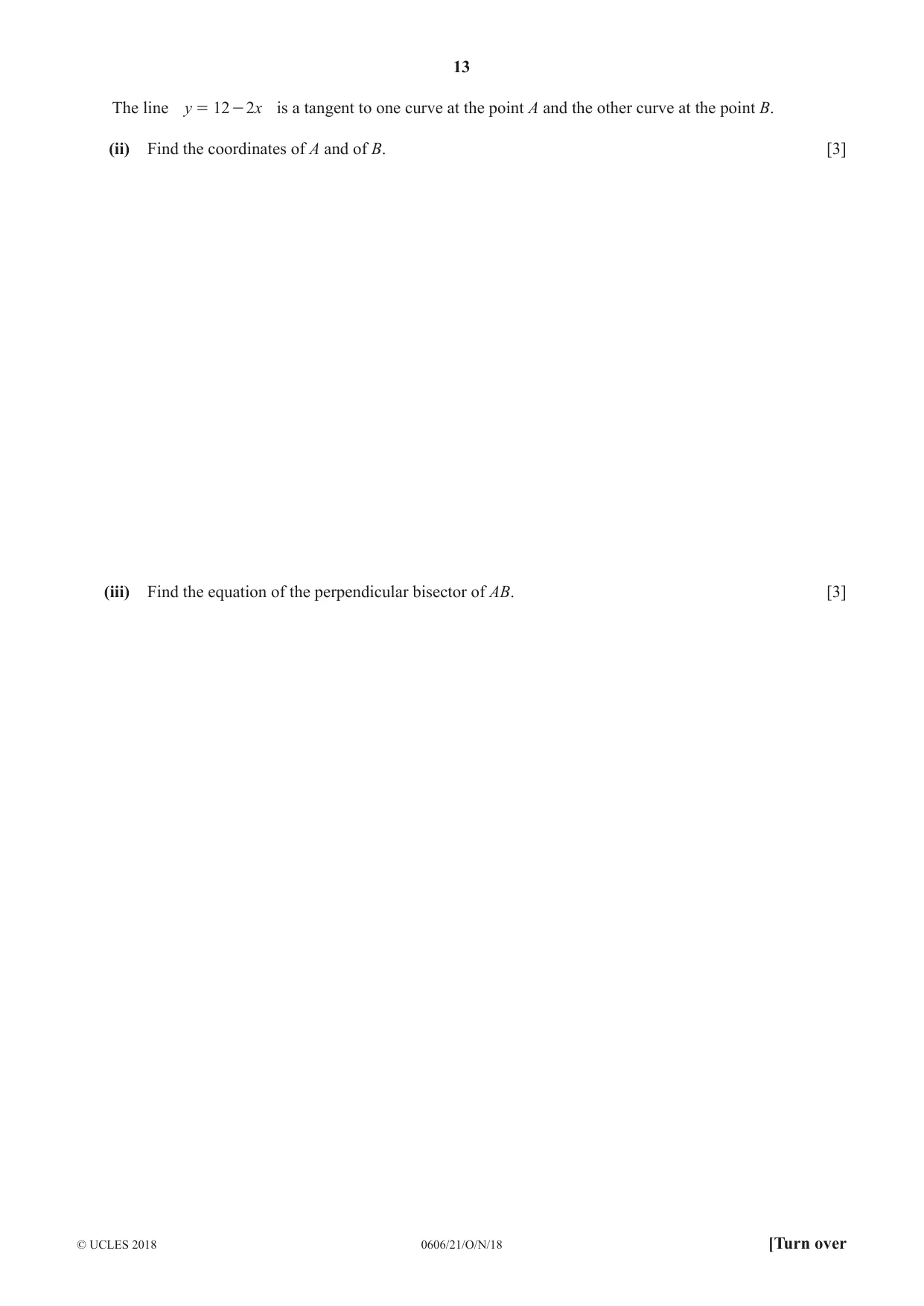
10 The line y = 12 - 2x is a tangent to two curves. Each curve has an equation of the form y = k + 6 + kx - x 2 , where k is a constant. (i) Find the two values of k. [5] The line y = 12 - 2x is a tangent to one curve at the point A and the other curve at the point B. (ii) Find the coordinates of A and of B. [3] (iii) Find the equation of the perpendicular bisector of AB. [3]
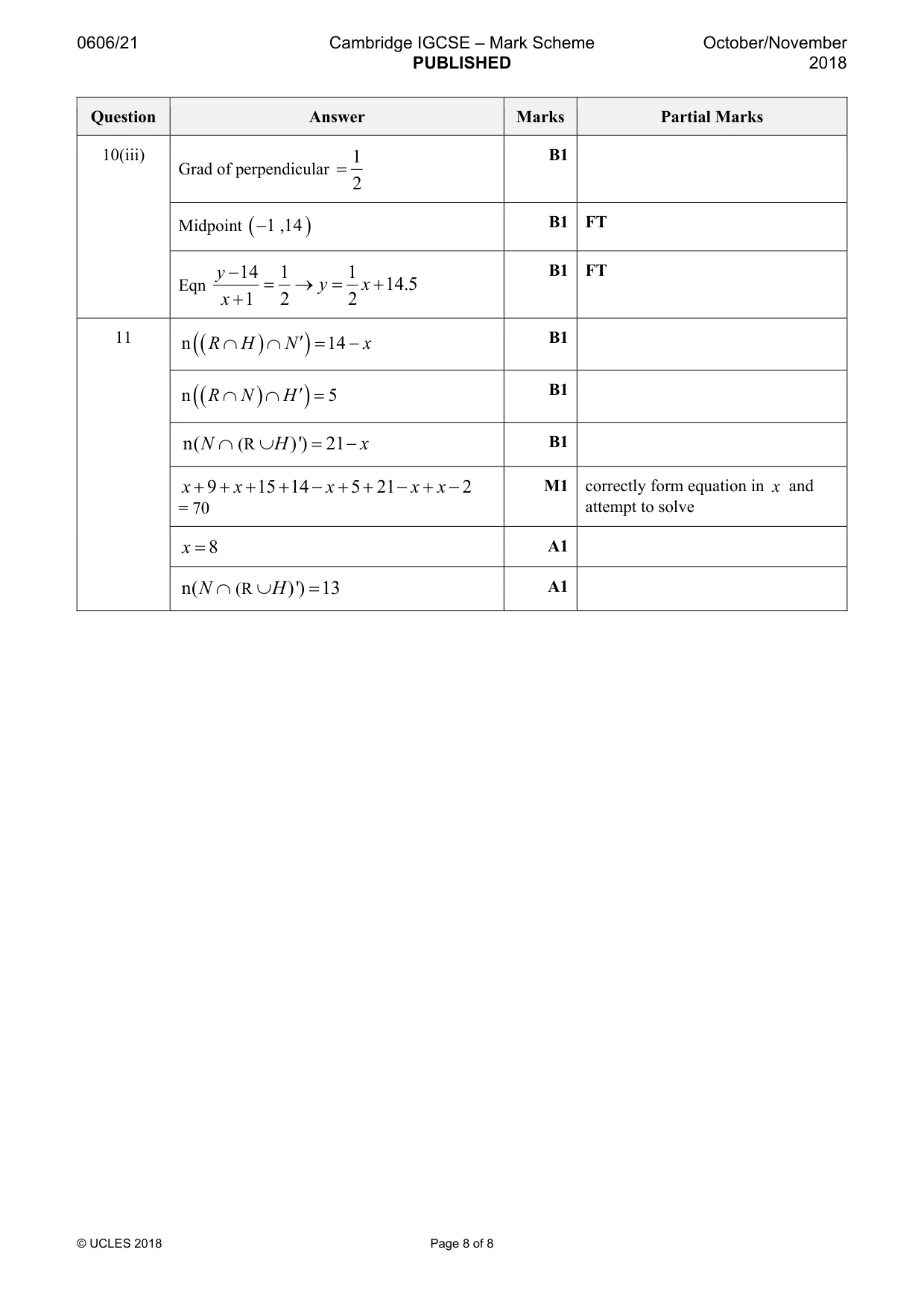
Mark scheme: 10(i) 12 − 2 x = k + 6 + kx − x 2 M1 * Equate and collect terms → x 2 − ( 2 + k ) x + 6 − k = 0 b 2 − 4ac = 0 M1 Dep* → ( 2 + k ) 2 = 4 ( 6 − k ) k 2 + 8k − 20 = 0 A1 ( k + 10 )( k − 2 ) = 0 M1 k = −10 or 2 A1 M1 Insert values of k in equations10(ii) ( − 4, 20 ) and ( 2, 8 ) 3 and solve for x A1 x 2 + 8 x + 16 = 0 → x = −4 → y = 20 A1 x 2 − 4 x + 4 = 0 → x = 2 → y = 8 10(iii) 1 B1 Grad of perpendicular = 2 Midpoint ( − 1 ,1 4 ) B1 FT y − 14 1 1 B1 FT Eqn = → y = x + 14.5 x + 1 2 2
More questions on Use differentiation to find gradients, tangents
Q11 · R H x 15 9 x x – 2 N There are 70 girls in a year group at a school
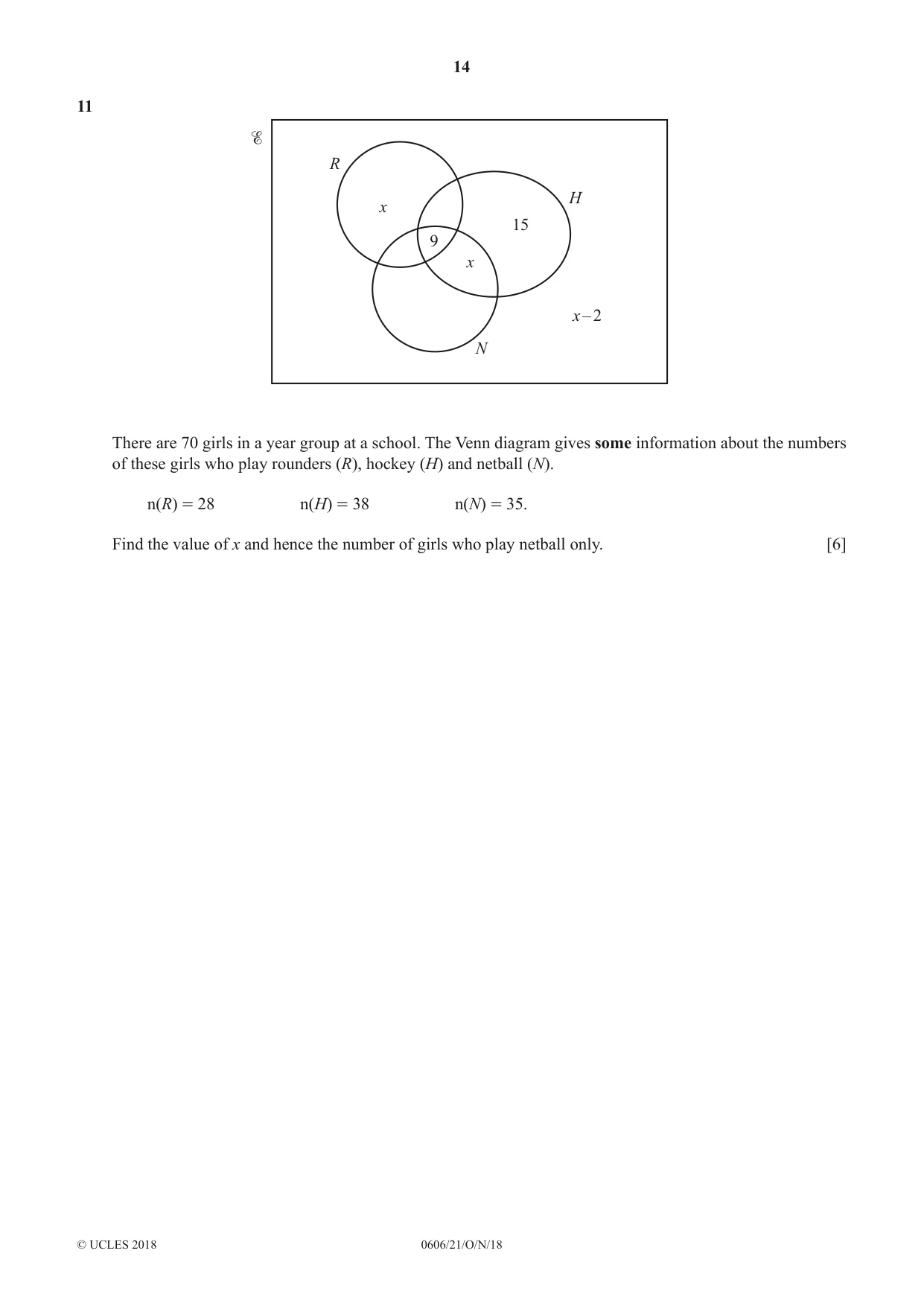
11 R H x 15 9 x x – 2 N There are 70 girls in a year group at a school. The Venn diagram gives some information about the numbers of these girls who play rounders (R), hockey (H) and netball (N). n(R) = 28 n(H) = 38 n(N) = 35. Find the value of x and hence the number of girls who play netball only. [6]
Mark scheme: B1 ′11 n ( ( R ∩ H ) ∩ N ) = 14 − x B1 ′ n ( ( R ∩ N ) ∩ H ) = 5 n( N ∩ (R ∪ H )') = 21 − x B1 x + 9 + x + 15 + 14 − x + 5 + 21 − x + x − 2 M1 correctly form equation in x and = 70 attempt to solve x = 8 A1 n( N ∩ (R ∪ H )') = 13 A1
More questions on Solve problems on arrangement and selection
What was in this paper
The subtopics covered by these 10 questions, and how many questions each got. Open one in a new tab to see every Cambridge question on it.
2Evaluate definite integrals and apply1Find the magnitude of a vector; add and1Find the solution set for quadratic inequalities1Prove trigonometric relationships involving the1Solve equations of the form ax = b1Solve equations of the type1Use differentiation to find gradients, tangents1Use differentiation to find stationary points1What you needed in this session
Cambridge’s own grade thresholds for 2018 Oct/Nov, Paper 2 · Variant 1. A higher threshold means an easier paper — the bar moves with how the cohort did.