Cambridge IGCSE Mathematics - Additional 0606 — 2015 May/June Paper 2 · Variant 3
0606/23/M/J/15 · 80 marks · ≈90 min
The question paper and its mark scheme, free to read here and free to download. This is Cambridge’s own paper, exactly as it was sat.
Question paper16 pages
Mark scheme5 pages
Answers below. Sit the paper first if you are practising.
Paper as text
Question paper, page 1
This document consists of 15 printed pages and 1 blank page. DC (NF/SW) 105994 © UCLES 2015 [Turn over Cambridge International Examinations Cambridge International General Certificate of Secondary Education * 5 7 8 8 7 7 5 7 0 7 * ADDITIONAL MATHEMATICS 0606/23 Paper 2 May/June 2015 2 hours Candidates answer on the Question Paper. Additional Materials: Electronic calculator READ THESE INSTRUCTIONS FIRST Write your Centre number, candidate number and name on all the work you hand in. Write in dark blue or black pen. You may use an HB pencil for any diagrams or graphs. Do not use staples, paper clips, glue or correction fluid. DO NOT WRITE IN ANY BARCODES. Answer all the questions. Give non-exact numerical answers correct to 3 significant figures, or 1 decimal place in the case of angles in degrees, unless a different level of accuracy is specified in the question. The use of an electronic calculator is expected, where appropriate. You are reminded of the need for clear presentation in your answers. At the end of the examination, fasten all your work securely together. The number of marks is given in brackets [ ] at the end of each question or part question. The total number of marks for this paper is 80.
Question paper, page 2
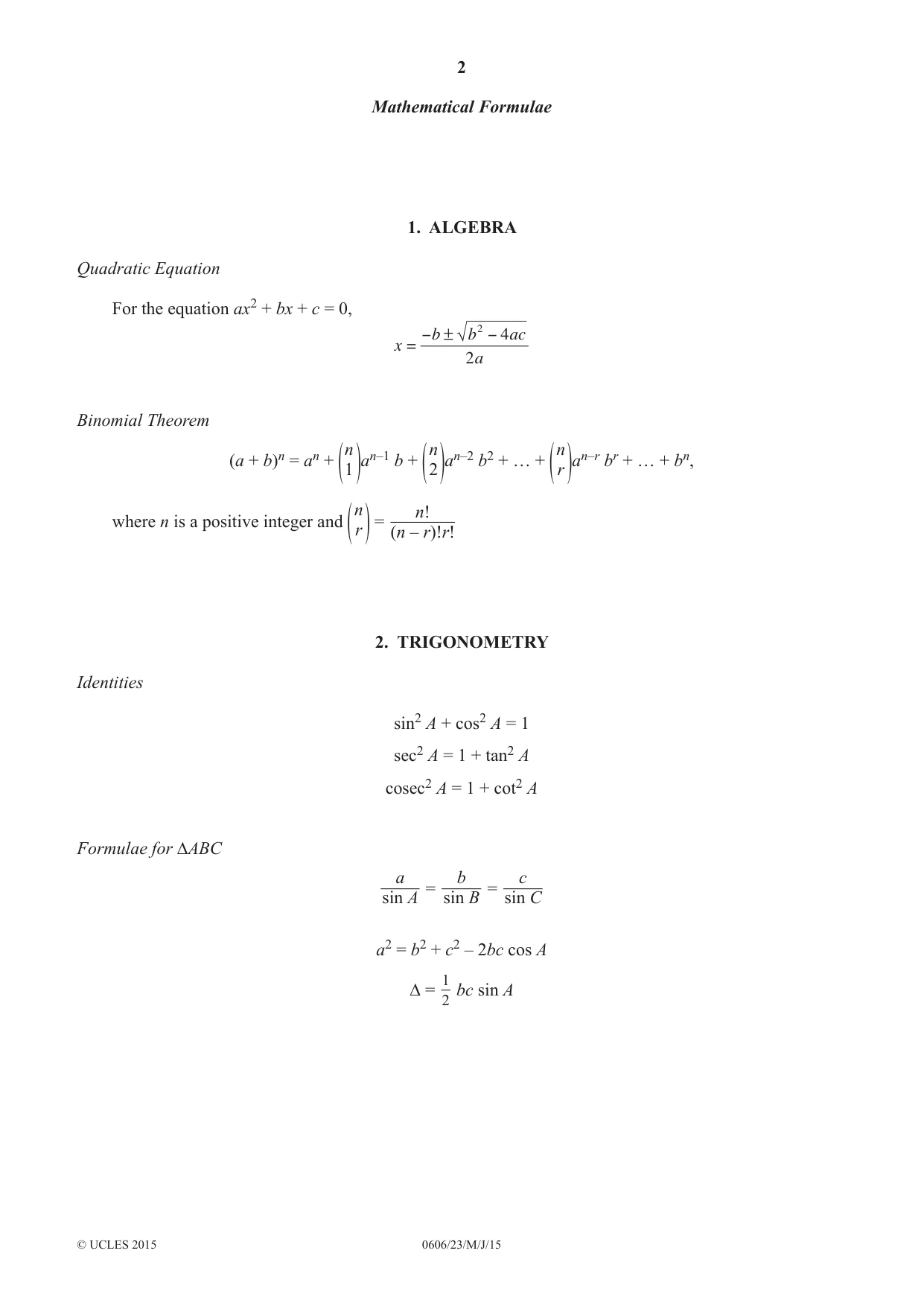
2 0606/23/M/J/15 © UCLES 2015 Mathematical Formulae 1. ALGEBRA Quadratic Equation For the equation ax2 + bx + c = 0, x b b ac a = − − 2 4 2 Binomial Theorem (a + b)n = an + ( n 1)an–1 b + ( n 2)an–2 b2 + … + ( n r)an–r br + … + bn, where n is a positive integer and ( n r) = n! (n – r)!r! 2. TRIGONOMETRY Identities sin2 A + cos2 A = 1 sec2 A = 1 + tan2 A cosec2 A = 1 + cot2 A Formulae for ∆ABC a sin A = b sin B = c sin C a2 = b2 + c2 – 2bc cos A ∆ = 1 2 bc sin A
Question paper, page 3
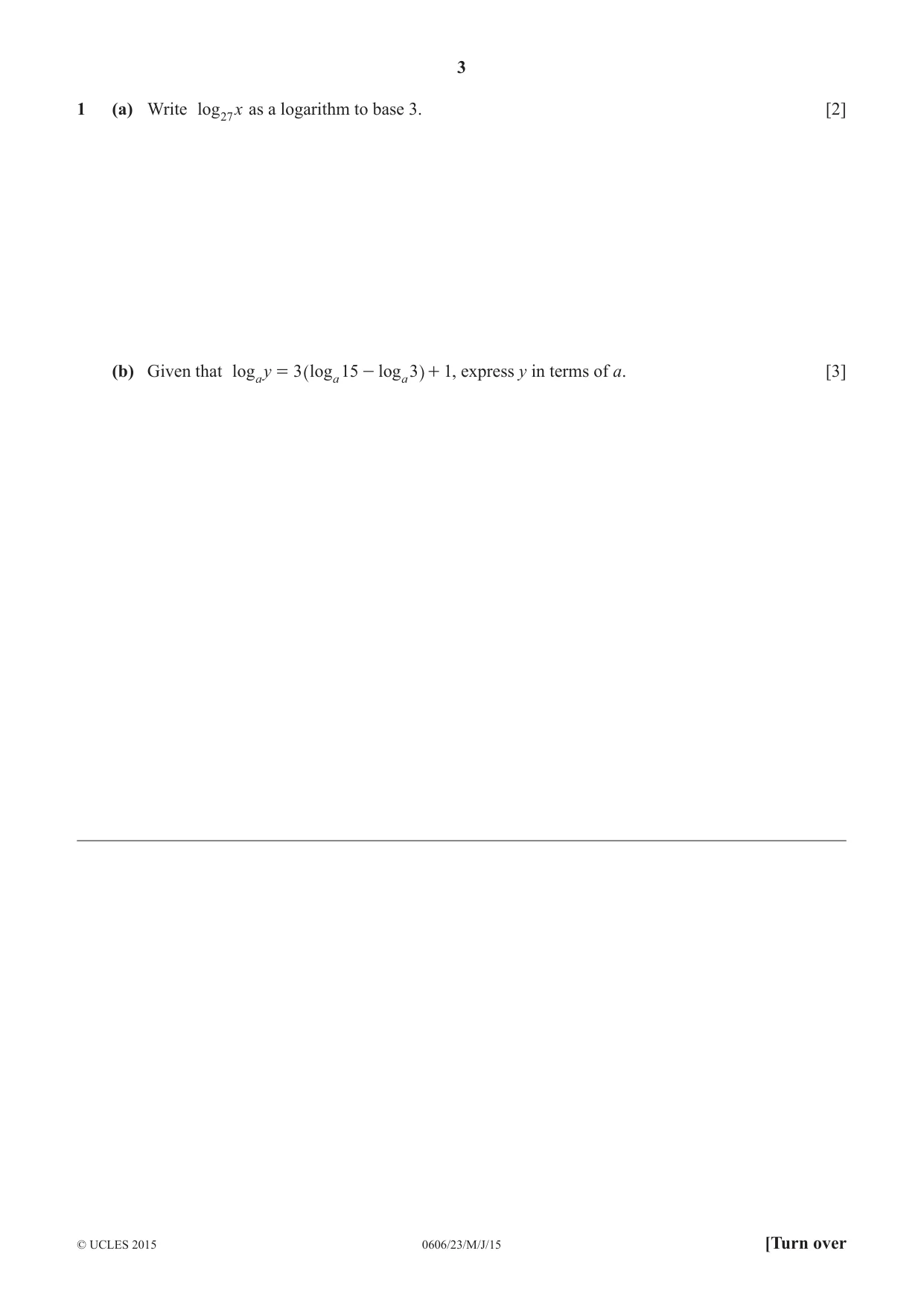
3 0606/23/M/J/15 © UCLES 2015 [Turn over 1 (a) Write log x 27 as a logarithm to base 3. [2] (b) Given that log log log y 3 15 3 1 a a a = - + ^ h , express y in terms of a. [3]
Question paper, page 4
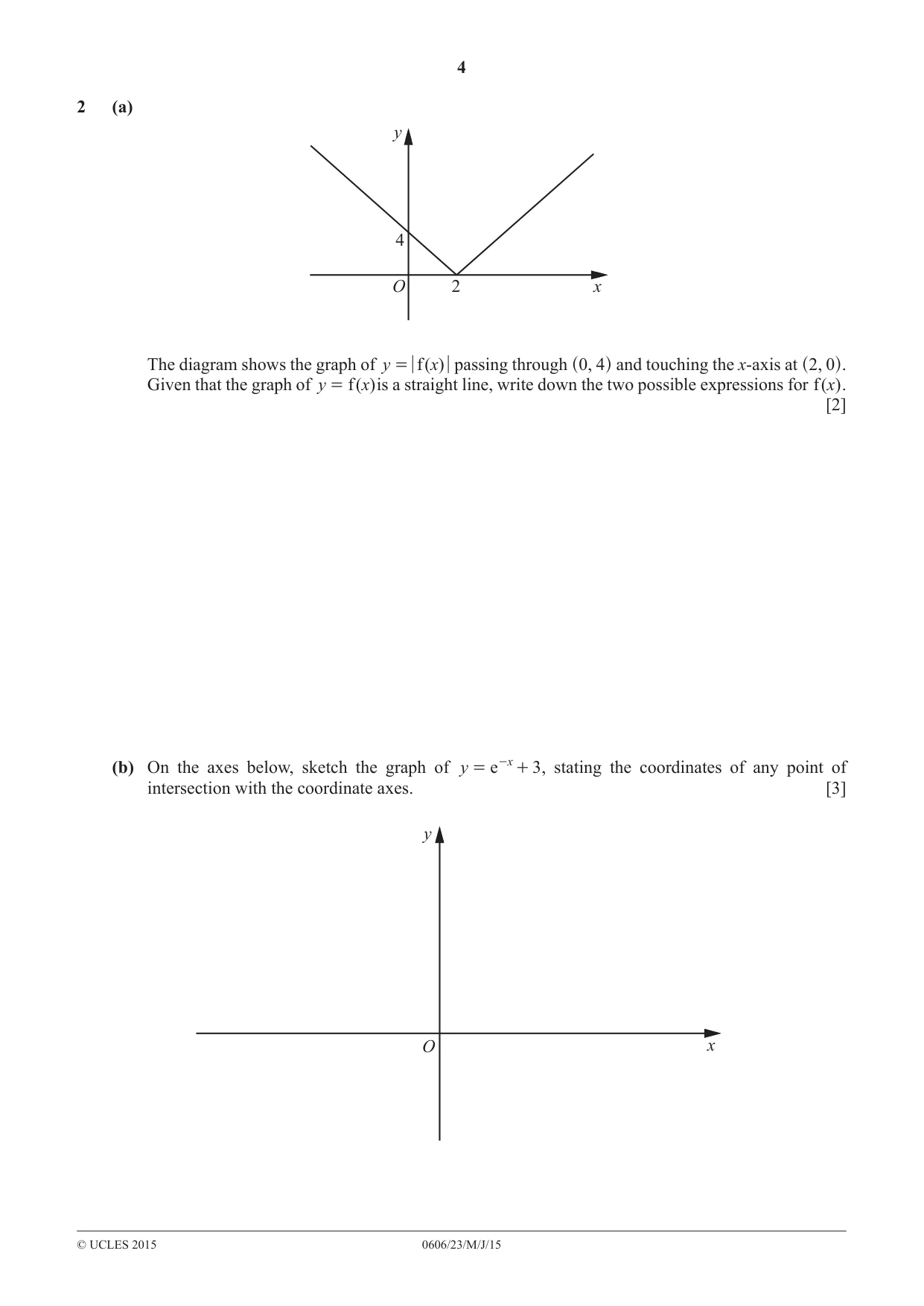
4 0606/23/M/J/15 © UCLES 2015 2 (a) O x 2 4 y The diagram shows the graph of f( ) y x = passing through 0, 4 ^ h and touching the x-axis at ,2 0 ^ h. Given that the graph of f( ) y x = is a straight line, write down the two possible expressions for f( )x . [2] (b) On the axes below, sketch the graph of e y 3 x = + - , stating the coordinates of any point of intersection with the coordinate axes. [3] O x y
Question paper, page 5
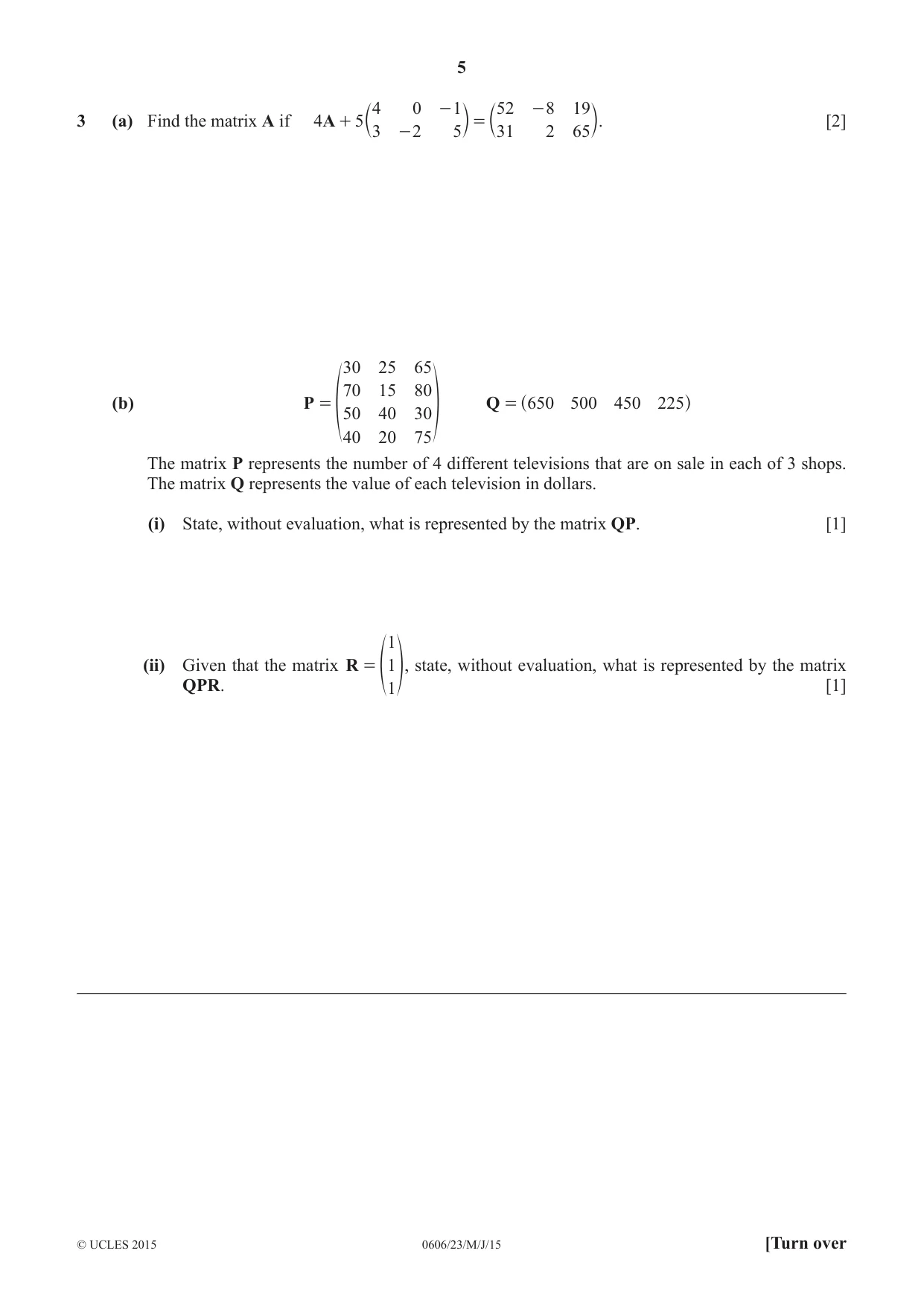
5 0606/23/M/J/15 © UCLES 2015 [Turn over 3 (a) Find the matrix A if A 4 5 4 3 0 2 1 5 65 52 31 8 2 19 + - - - = c c m m. [2] (b) P 30 70 50 40 25 15 40 20 65 80 30 75 = f p Q 650 500 450 225 = ^ h The matrix P represents the number of 4 different televisions that are on sale in each of 3 shops. The matrix Q represents the value of each television in dollars. (i) State, without evaluation, what is represented by the matrix QP. [1] (ii) Given that the matrix R 1 1 1 = f p, state, without evaluation, what is represented by the matrix QPR. [1]
Question paper, page 6
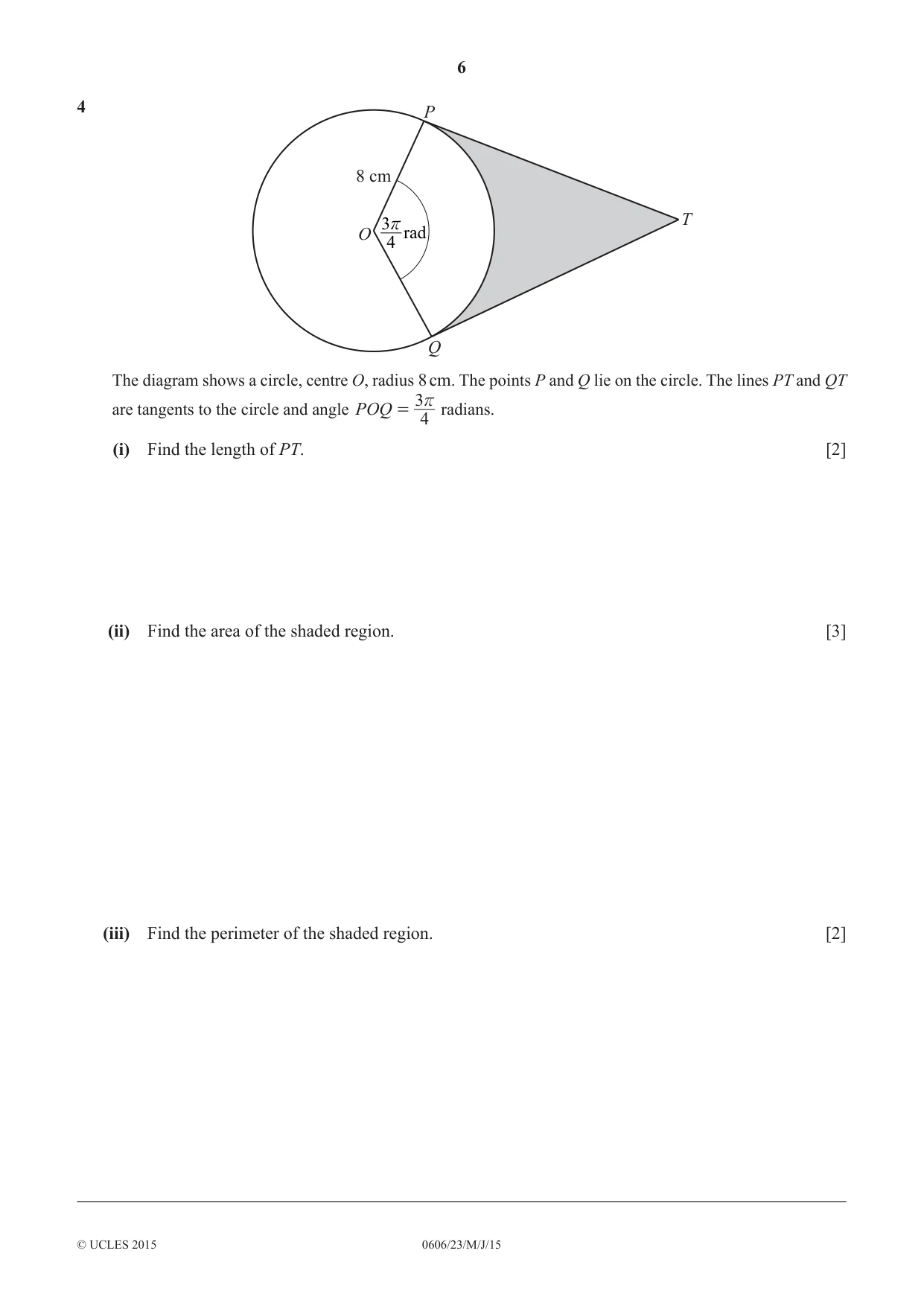
6 0606/23/M/J/15 © UCLES 2015 4 rad 4 3r 8 cm O Q P T The diagram shows a circle, centre O, radius 8 cm. The points P and Q lie on the circle. The lines PT and QT are tangents to the circle and angle POQ 4 3r = radians. (i) Find the length of PT. [2] (ii) Find the area of the shaded region. [3] (iii) Find the perimeter of the shaded region. [2]
Question paper, page 7
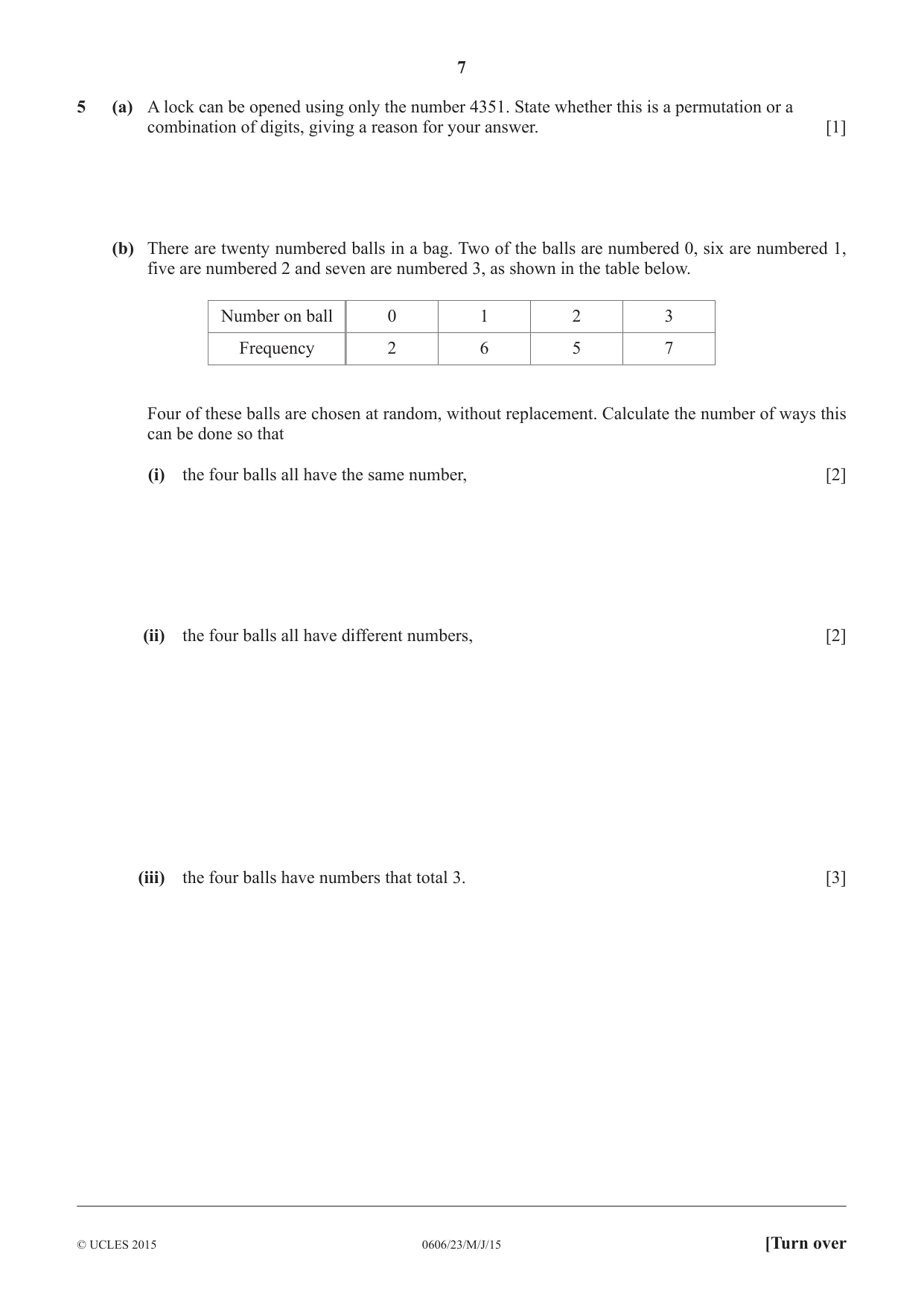
7 0606/23/M/J/15 © UCLES 2015 [Turn over 5 (a) A lock can be opened using only the number 4351. State whether this is a permutation or a combination of digits, giving a reason for your answer. [1] (b) There are twenty numbered balls in a bag. Two of the balls are numbered 0, six are numbered 1, five are numbered 2 and seven are numbered 3, as shown in the table below. Number on ball 0 1 2 3 Frequency 2 6 5 7 Four of these balls are chosen at random, without replacement. Calculate the number of ways this can be done so that (i) the four balls all have the same number, [2] (ii) the four balls all have different numbers, [2] (iii) the four balls have numbers that total 3. [3]
Question paper, page 8
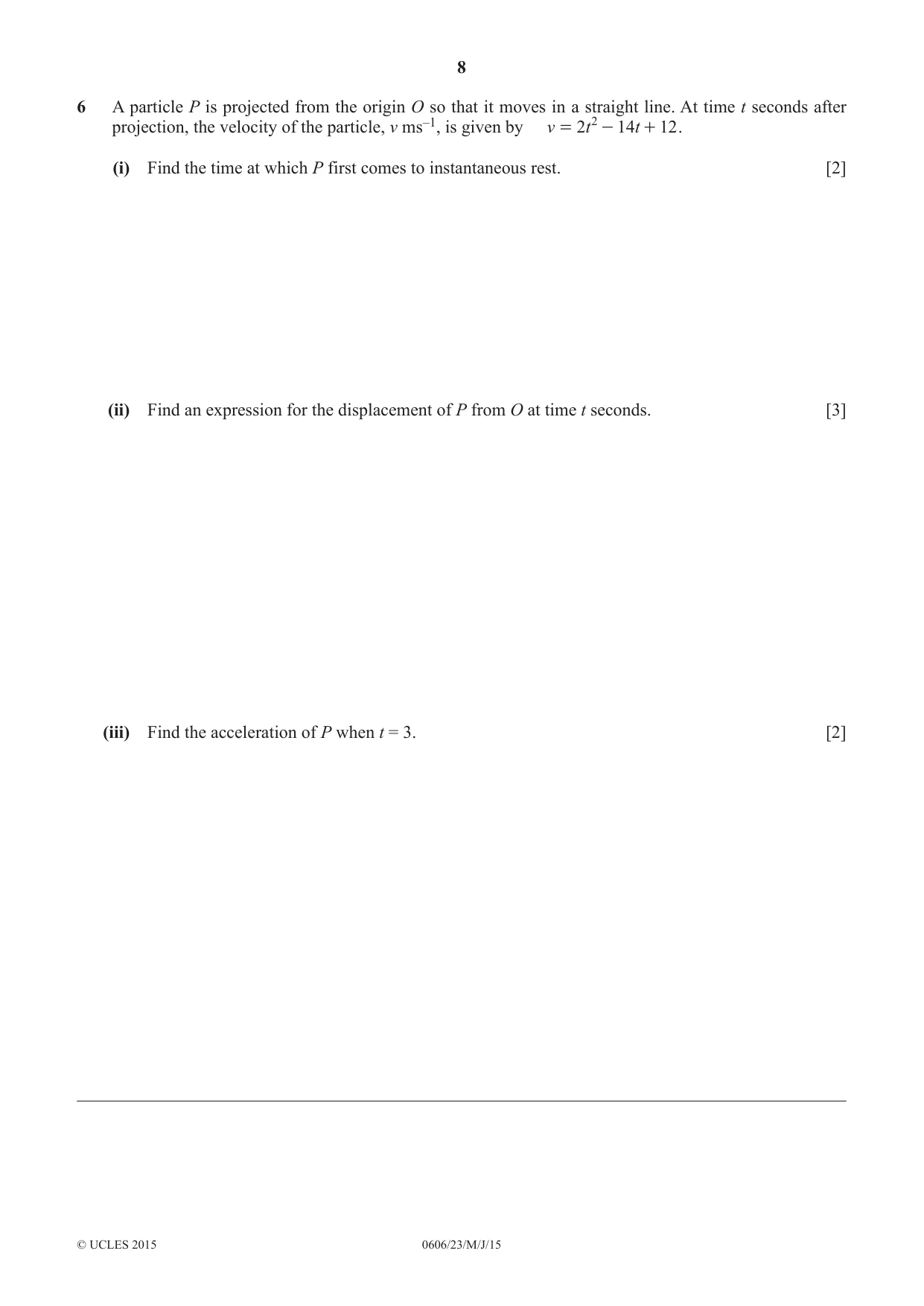
8 0606/23/M/J/15 © UCLES 2015 6 A particle P is projected from the origin O so that it moves in a straight line. At time t seconds after projection, the velocity of the particle, v ms–1, is given by v t t 2 14 12 2 = - + . (i) Find the time at which P first comes to instantaneous rest. [2] (ii) Find an expression for the displacement of P from O at time t seconds. [3] (iii) Find the acceleration of P when t = 3. [2]
Question paper, page 9
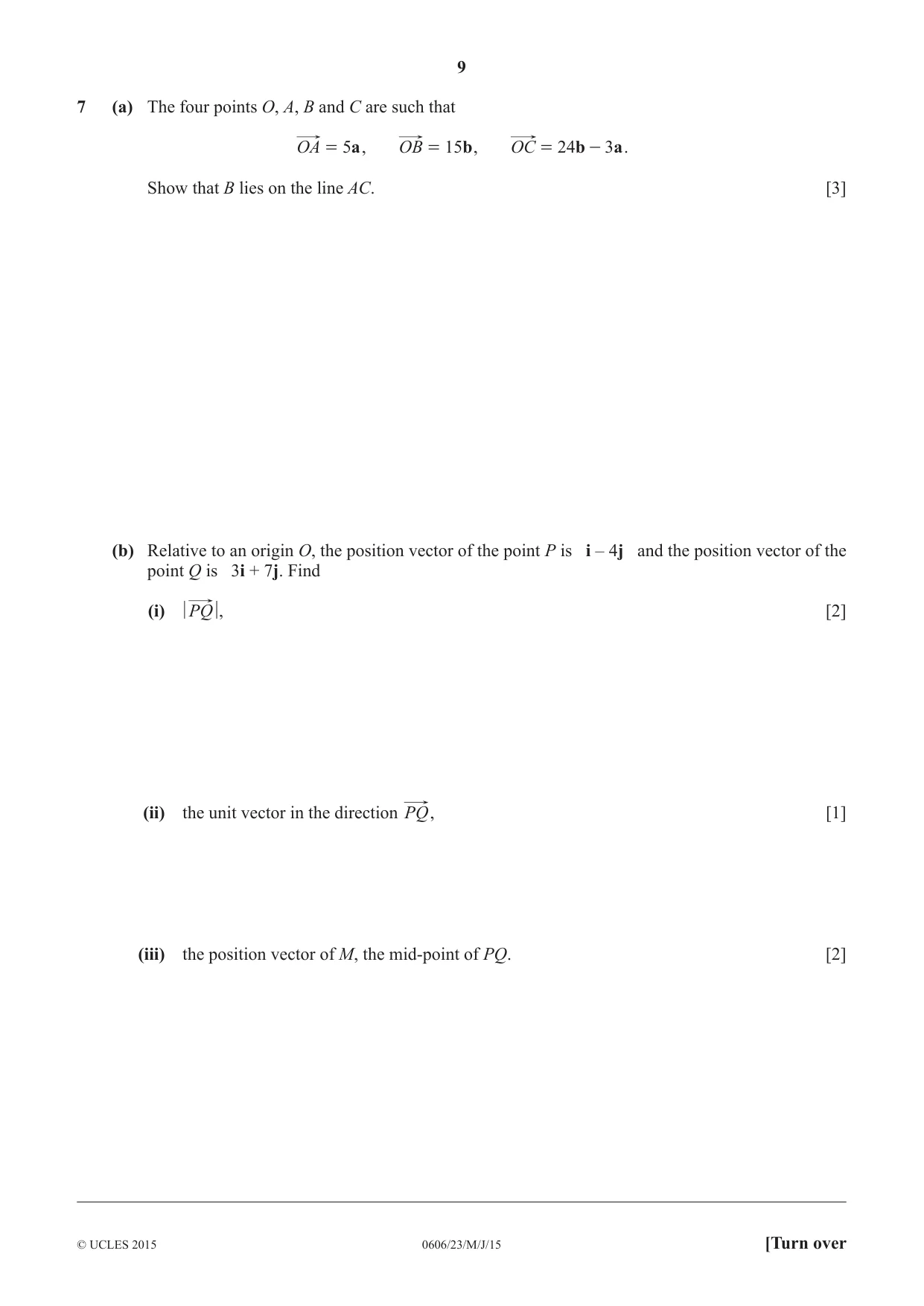
9 0606/23/M/J/15 © UCLES 2015 [Turn over 7 (a) The four points O, A, B and C are such that a OA 5 = , b OB 15 = , b a OC 24 3 = - . Show that B lies on the line AC. [3] (b) Relative to an origin O, the position vector of the point P is i – 4j and the position vector of the point Q is 3i + 7j. Find (i) PQ , [2] (ii) the unit vector in the direction PQ, [1] (iii) the position vector of M, the mid-point of PQ. [2]
Question paper, page 10
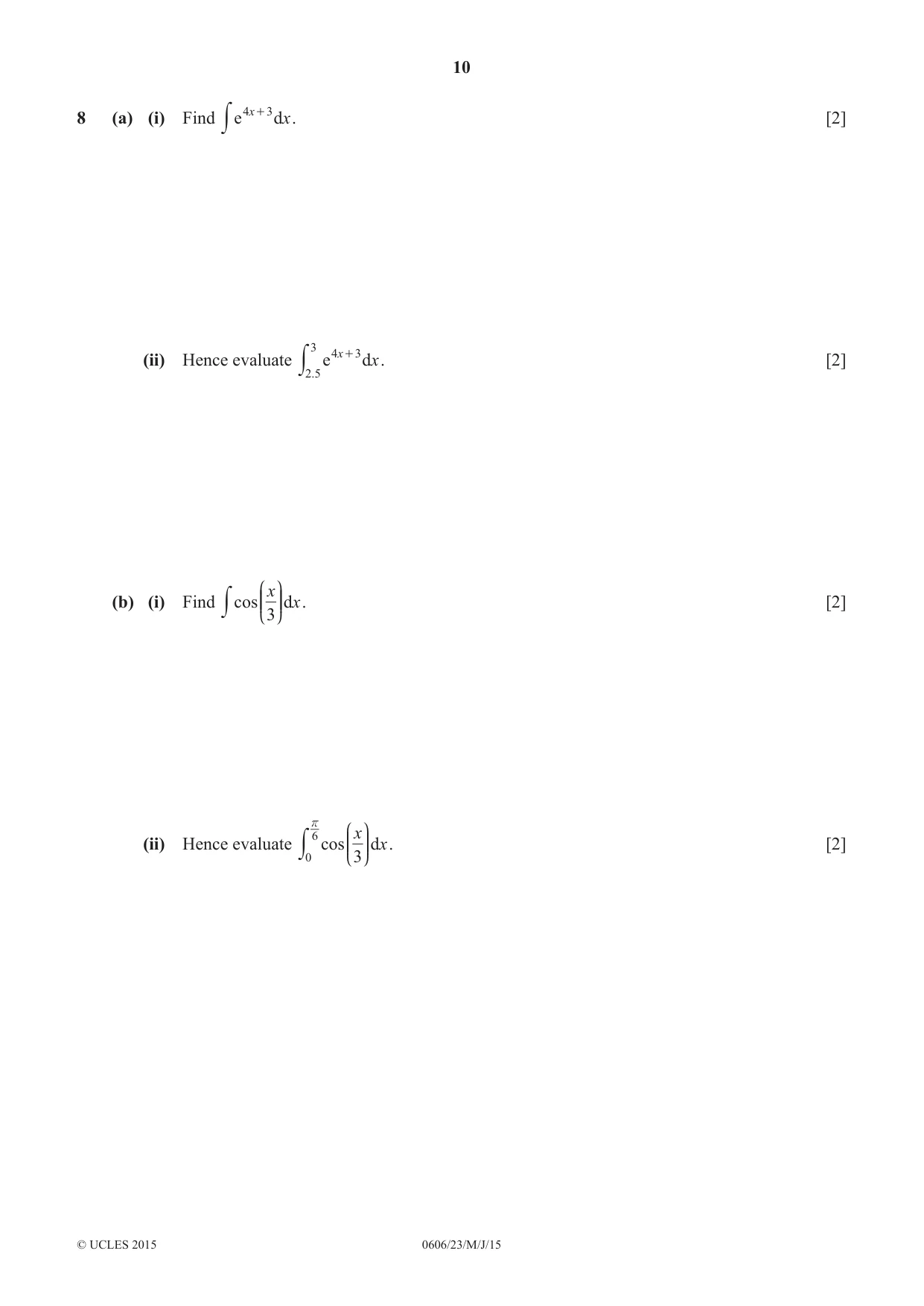
10 0606/23/M/J/15 © UCLES 2015 8 (a) (i) Find e dx x 4 3 + y . [2] (ii) Hence evaluate e dx . x 4 3 2 5 3 + y . [2] (b) (i) Find d cos x x 3 J L KK N P OO y . [2] (ii) Hence evaluate d cos x x 3 0 6 r J L KK N P OO y . [2]
Question paper, page 11
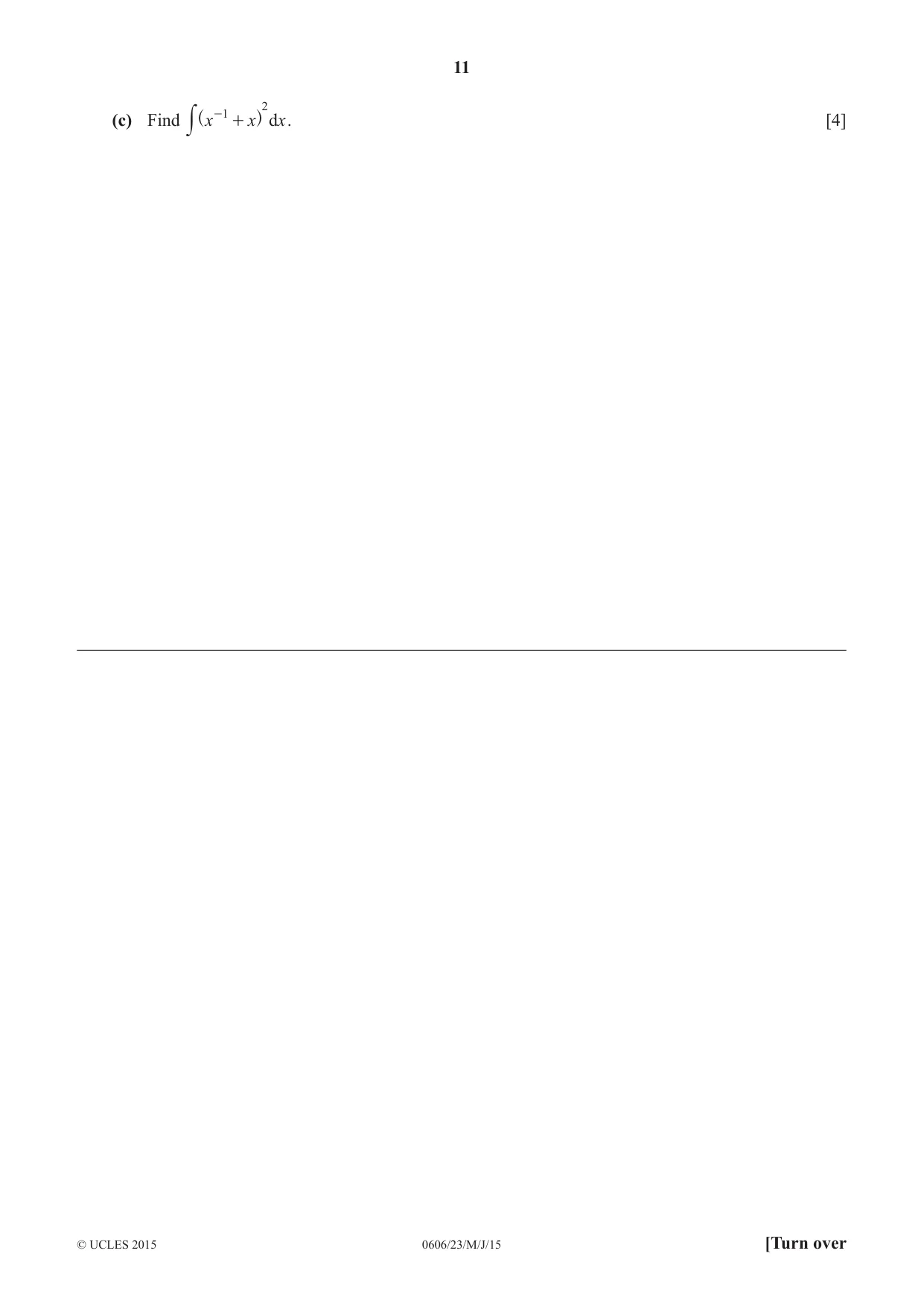
11 0606/23/M/J/15 © UCLES 2015 [Turn over (c) Find d x x x 1 2 + - ^ h y . [4]
Question paper, page 12
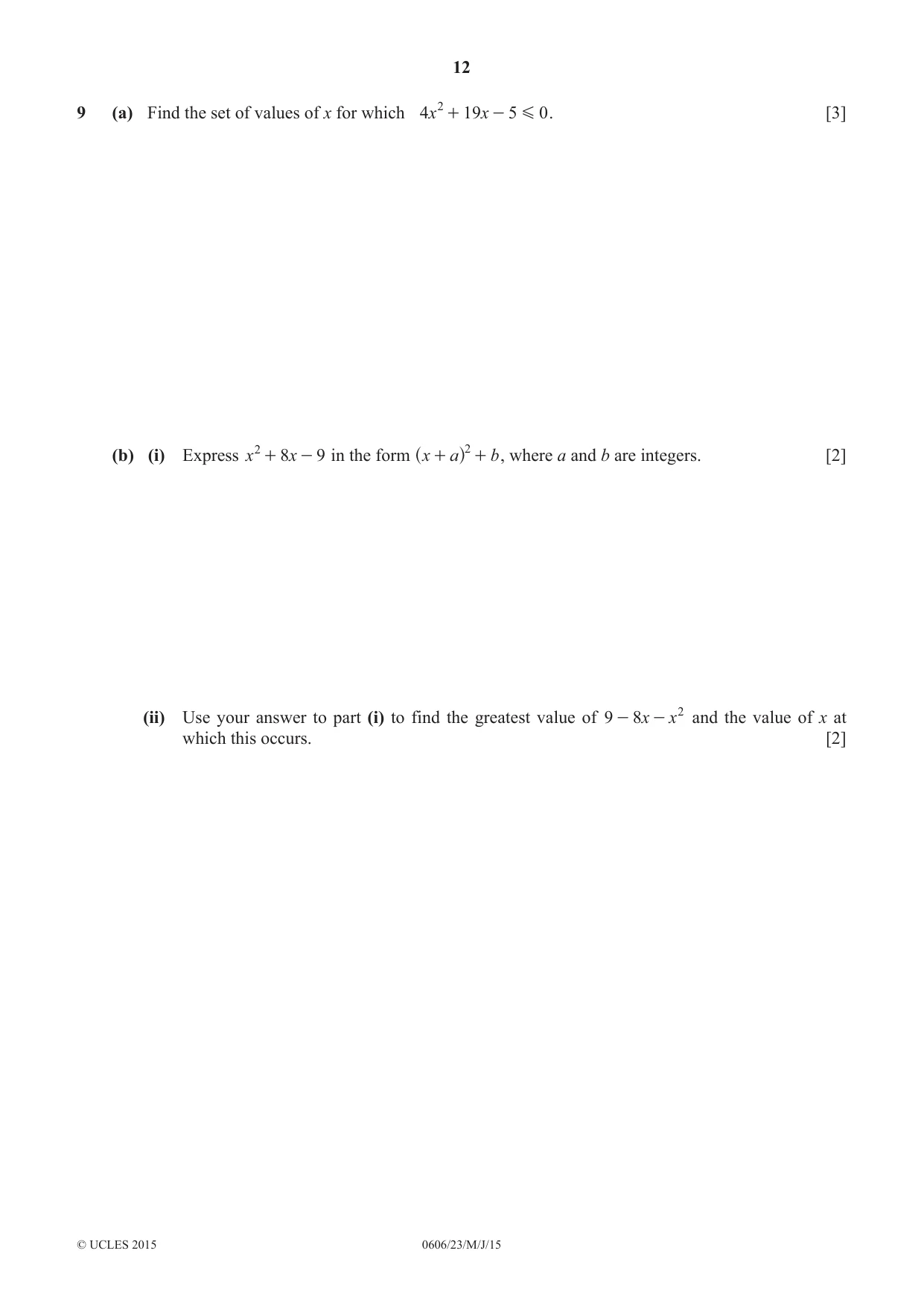
12 0606/23/M/J/15 © UCLES 2015 9 (a) Find the set of values of x for which x x 4 19 5 0 2 G + - . [3] (b) (i) Express x x 8 9 2 + - in the form x a b 2 + + ^ h , where a and b are integers. [2] (ii) Use your answer to part (i) to find the greatest value of x x 9 8 2 - - and the value of x at which this occurs. [2]
Question paper, page 13
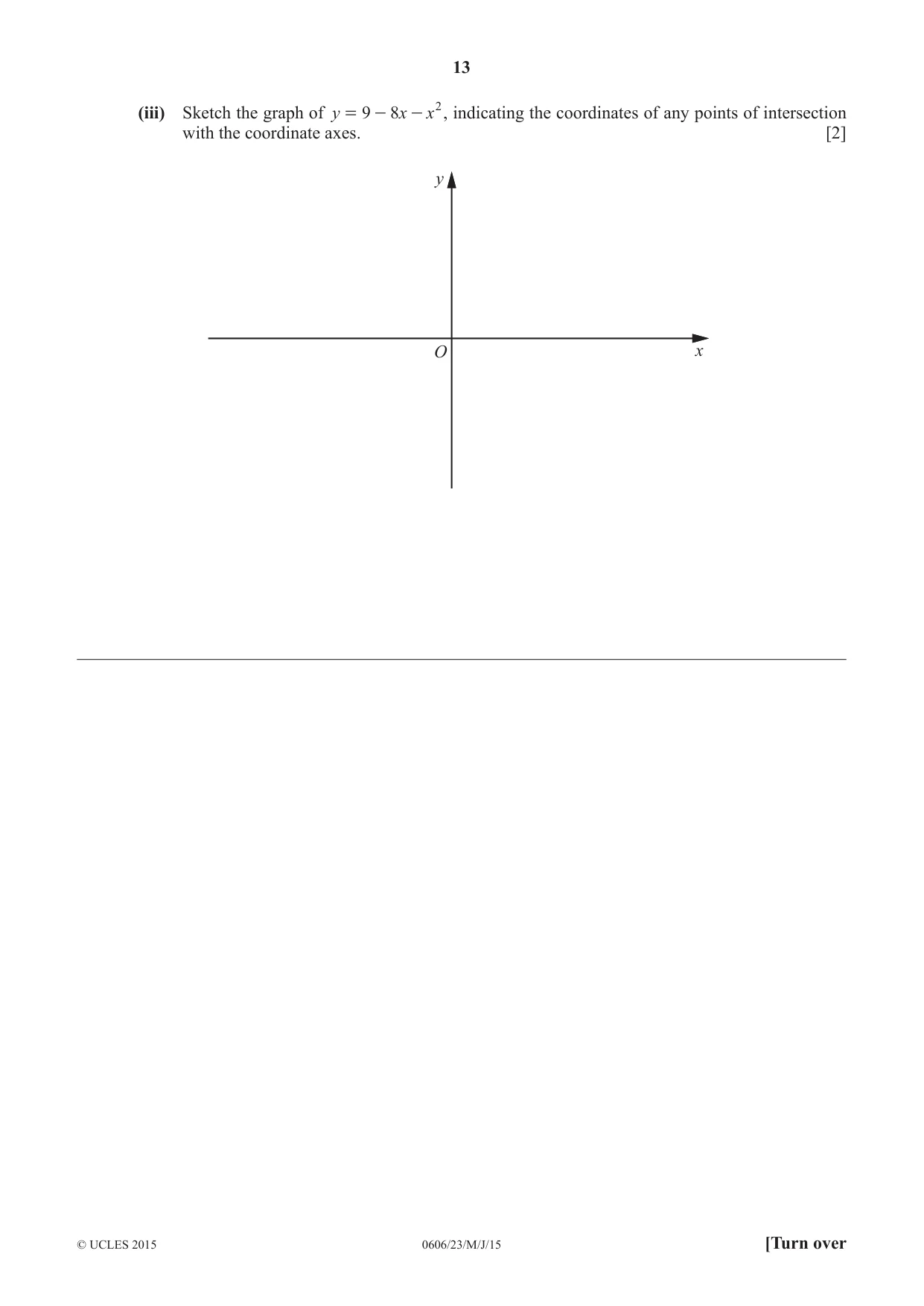
13 0606/23/M/J/15 © UCLES 2015 [Turn over (iii) Sketch the graph of y x x 9 8 2 = - - , indicating the coordinates of any points of intersection with the coordinate axes. [2] O x y
Question paper, page 14
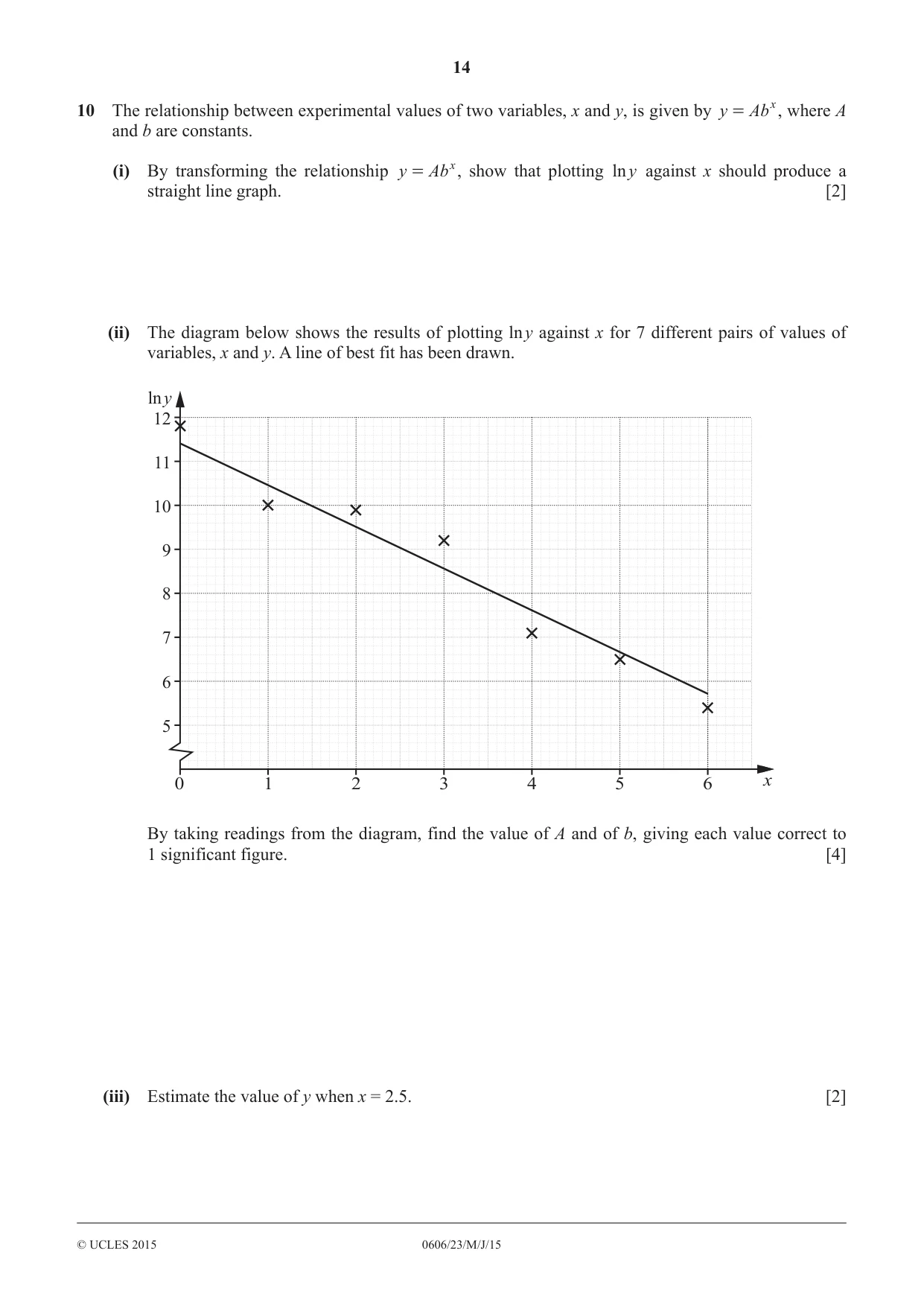
14 0606/23/M/J/15 © UCLES 2015 10 The relationship between experimental values of two variables, x and y, is given by y Abx = , where A and b are constants. (i) By transforming the relationship y Abx = , show that plotting lny against x should produce a straight line graph. [2] (ii) The diagram below shows the results of plotting ln y against x for 7 different pairs of values of variables, x and y. A line of best fit has been drawn. 6 1 0 2 3 4 5 6 x 8 10 ln y 11 12 5 7 9 By taking readings from the diagram, find the value of A and of b, giving each value correct to 1 significant figure. [4] (iii) Estimate the value of y when x = 2.5. [2]
Question paper, page 15
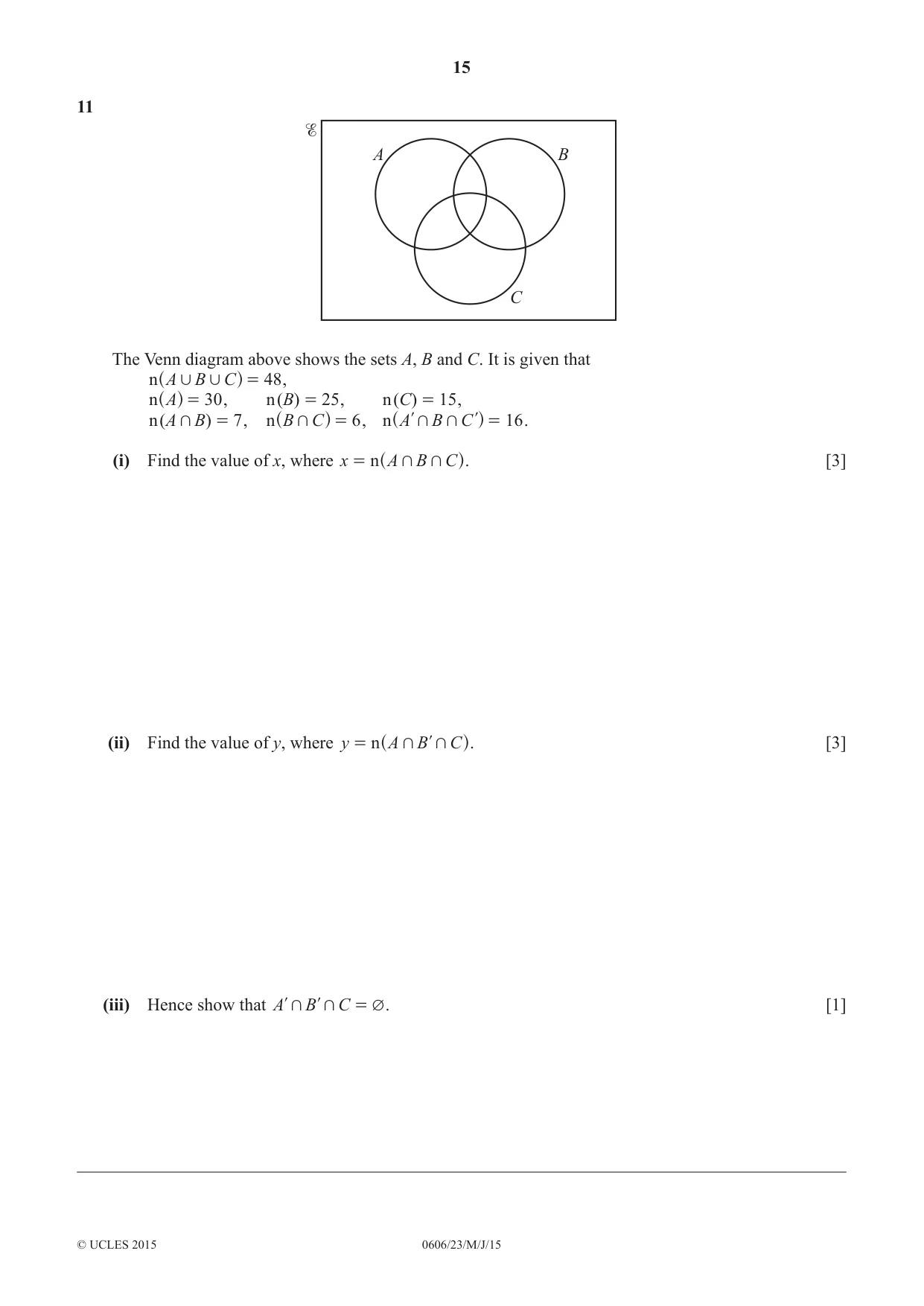
15 0606/23/M/J/15 © UCLES 2015 11 A B C The Venn diagram above shows the sets A, B and C. It is given that n A B C 48 , , = ^ h , n A 30 = ^ h , n( ) B 25 = , n( ) C 15 = , n( ) A B 7 + = , n B C 6 + = ^ h , n A B C 16 + + = l l ^ h . (i) Find the value of x, where n x A B C + + = ^ h. [3] (ii) Find the value of y, where n y A B C + + = l ^ h. [3] (iii) Hence show that A B C + + Q = l l . [1]
Question paper, page 16
16 0606/23/M/J/15 © UCLES 2015 Permission to reproduce items where third-party owned material protected by copyright is included has been sought and cleared where possible. Every reasonable effort has been made by the publisher (UCLES) to trace copyright holders, but if any items requiring clearance have unwittingly been included, the publisher will be pleased to make amends at the earliest possible opportunity. To avoid the issue of disclosure of answer-related information to candidates, all copyright acknowledgements are reproduced online in the Cambridge International Examinations Copyright Acknowledgements Booklet. This is produced for each series of examinations and is freely available to download at www.cie.org.uk after the live examination series. Cambridge International Examinations is part of the Cambridge Assessment Group. Cambridge Assessment is the brand name of University of Cambridge Local Examinations Syndicate (UCLES), which is itself a department of the University of Cambridge. BLANK PAGE
Mark scheme, page 1
® IGCSE is the registered trademark of Cambridge International Examinations. CAMBRIDGE INTERNATIONAL EXAMINATIONS Cambridge International General Certificate of Secondary Education MARK SCHEME for the May/June 2015 series 0606 ADDITIONAL MATHEMATICS 0606/23 Paper 2 (Paper 2), maximum raw mark 80 This mark scheme is published as an aid to teachers and candidates, to indicate the requirements of the examination. It shows the basis on which Examiners were instructed to award marks. It does not indicate the details of the discussions that took place at an Examiners’ meeting before marking began, which would have considered the acceptability of alternative answers. Mark schemes should be read in conjunction with the question paper and the Principal Examiner Report for Teachers. Cambridge will not enter into discussions about these mark schemes. Cambridge is publishing the mark schemes for the May/June 2015 series for most Cambridge IGCSE®, Cambridge International A and AS Level components and some Cambridge O Level components.
Mark scheme, page 2
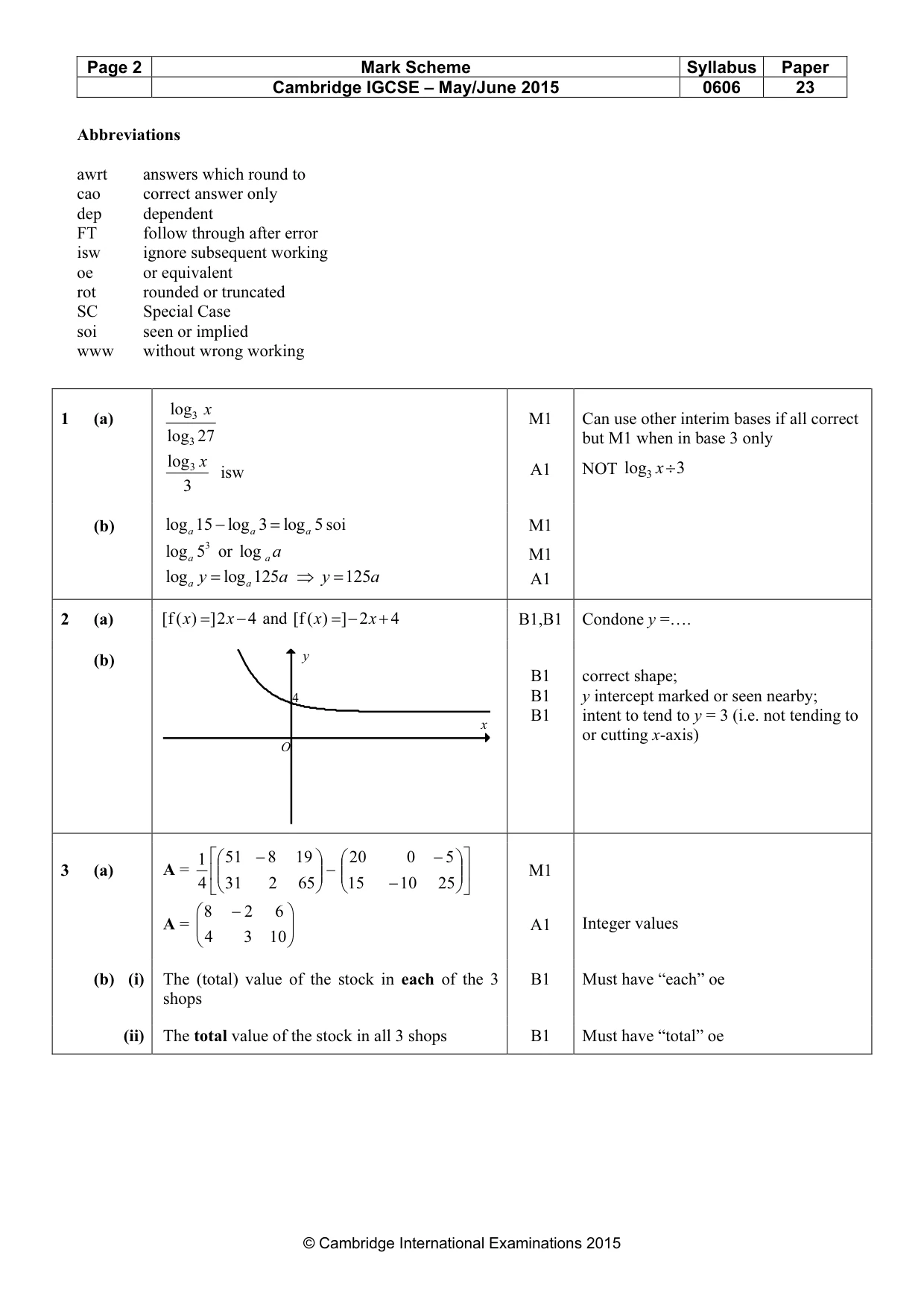
Page 2 Mark Scheme Syllabus Paper Cambridge IGCSE – May/June 2015 0606 23 © Cambridge International Examinations 2015 Abbreviations awrt answers which round to cao correct answer only dep dependent FT follow through after error isw ignore subsequent working oe or equivalent rot rounded or truncated SC Special Case soi seen or implied www without wrong working 1 (a) 27 log log 3 3 x 3 log3 x isw M1 A1 Can use other interim bases if all correct but M1 when in base 3 only NOT 3 log3 ÷ x (b) log 15 log 3 log 5 a a a − = soi 3 log 5 or log a aa log log 125 125 a a y a y a = ⇒ = M1 M1 A1 2 (a) [f ( ) ]2 4 and [f ( ) ] 2 4 x x x x = − = − + B1,B1 Condone y =…. (b) x y O 4 B1 B1 B1 correct shape; y intercept marked or seen nearby; intent to tend to y = 3 (i.e. not tending to or cutting x-axis) 3 (a) A = − − − − 25 10 15 5 0 20 65 2 31 19 8 51 4 1 A = − 10 3 4 6 2 8 M1 A1 Integer values (b) (i) The (total) value of the stock in each of the 3 shops B1 Must have “each” oe (ii) The total value of the stock in all 3 shops B1 Must have “total” oe
Mark scheme, page 3
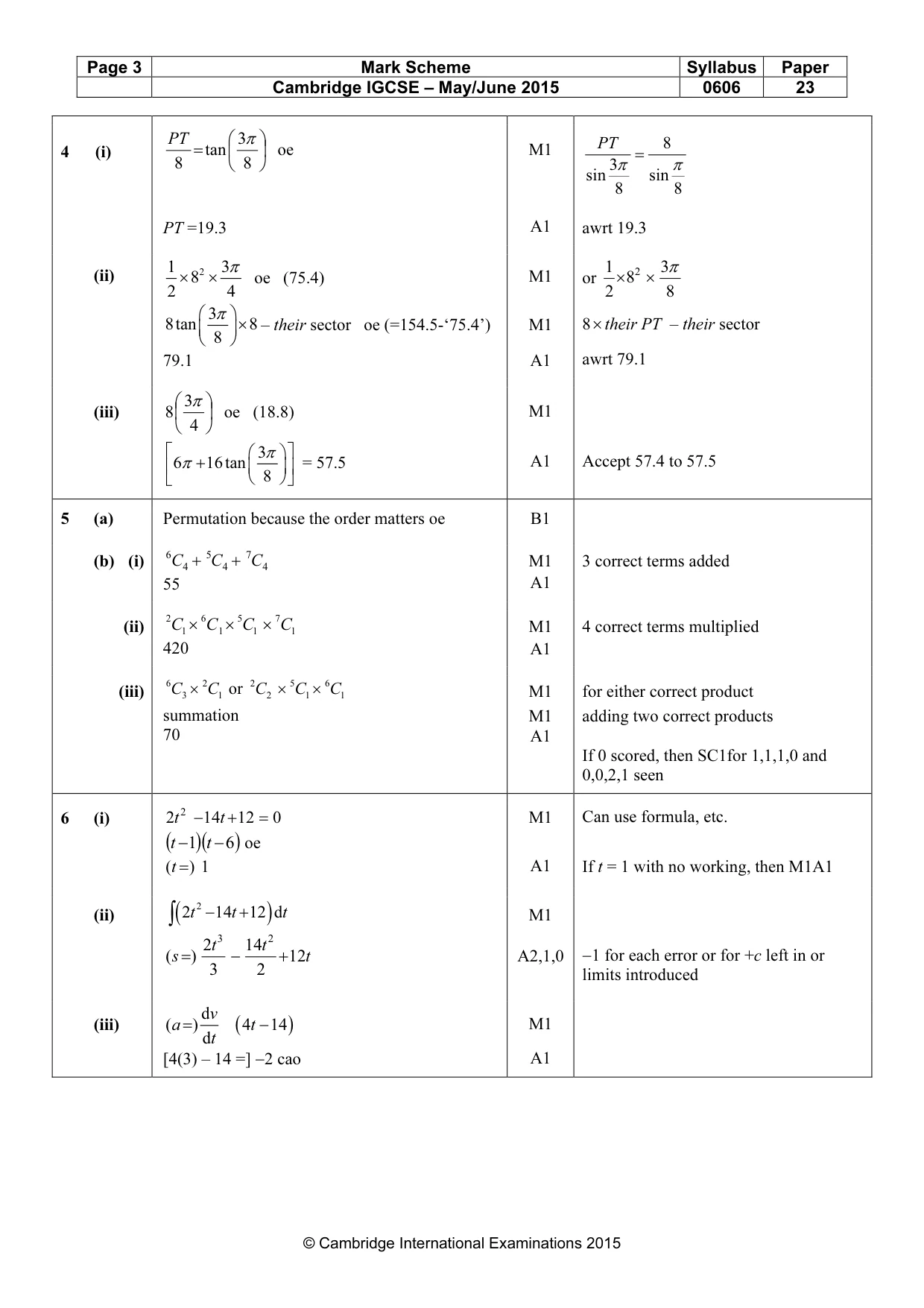
Page 3 Mark Scheme Syllabus Paper Cambridge IGCSE – May/June 2015 0606 23 © Cambridge International Examinations 2015 4 (i) = 8 3 tan 8 π PT oe PT =19.3 M1 A1 8 3 sin sin 8 8 PT π π = awrt 19.3 (ii) 2 1 3 8 2 4 π × × oe (75.4) 3 8tan 8 8 π × – their sector oe (=154.5-‘75.4’) 79.1 M1 M1 A1 or 8 3 8 2 1 2 π × × 8×their PT – their sector awrt 79.1 (iii) 4 3 8 π oe (18.8) 3 6 16tan 8 π π + = 57.5 M1 A1 Accept 57.4 to 57.5 5 (a) Permutation because the order matters oe B1 (b) (i) 4 7 4 5 4 6 C C C + + 55 M1 A1 3 correct terms added (ii) 2 6 5 7 1 1 1 1 C C C C × × × 420 M1 A1 4 correct terms multiplied (iii) 6 2 2 5 6 3 1 2 1 1 or C C C C C × × × summation 70 M1 M1 A1 for either correct product adding two correct products If 0 scored, then SC1for 1,1,1,0 and 0,0,2,1 seen 6 (i) 0 12 14 2 2 = + − t t ( )( ) 6 1 − − t t oe 1 ) ( = t M1 A1 Can use formula, etc. If t = 1 with no working, then M1A1 (ii) ( ) 2 2 14 12 d t t t − + ∫ t t t s 12 2 14 3 2 ) ( 2 3 + − = M1 A2,1,0 −1 for each error or for +c left in or limits introduced (iii) ( ) d ( ) 4 14 d v a t t = − [4(3) – 14 =] −2 cao M1 A1
Mark scheme, page 4
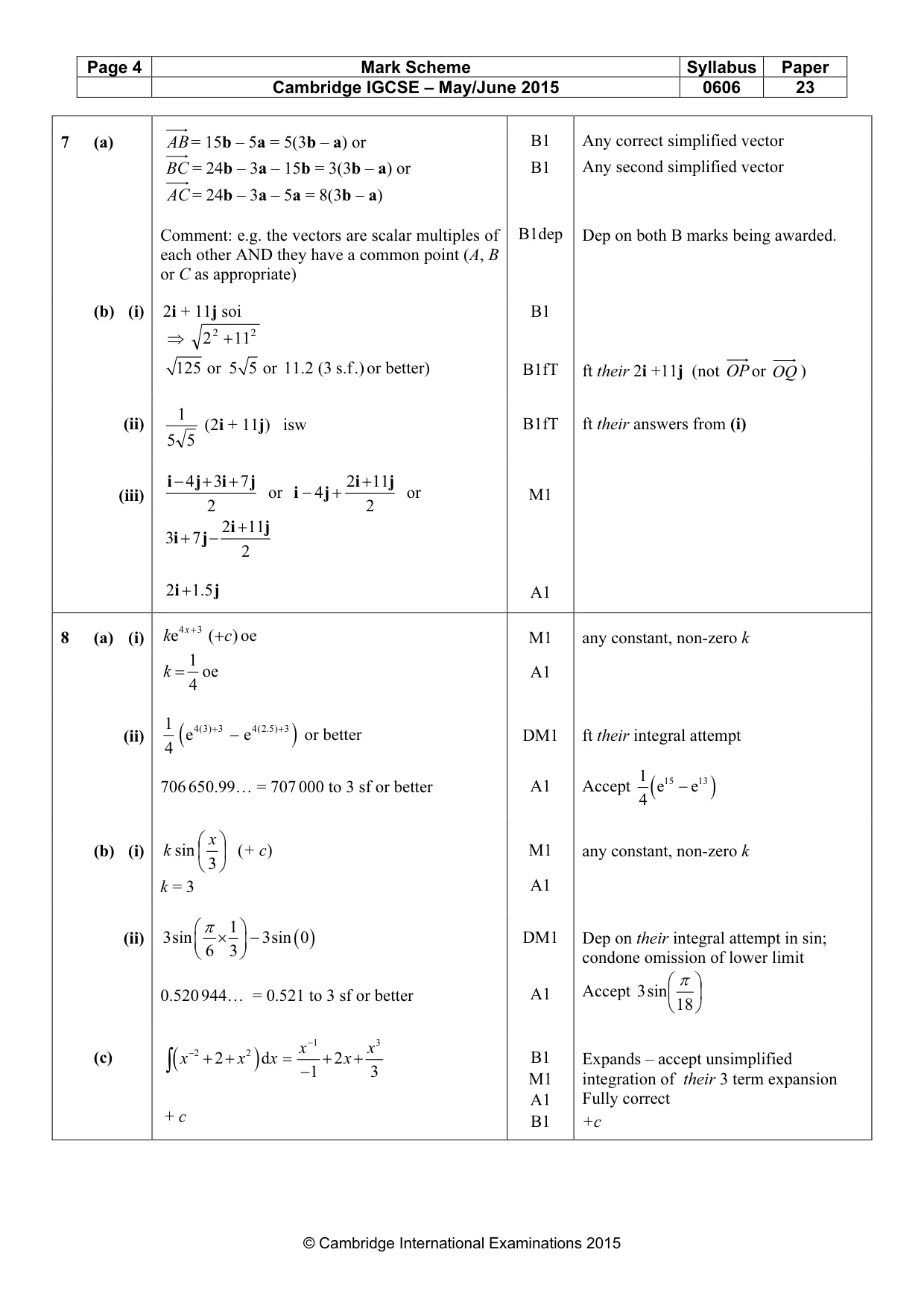
Page 4 Mark Scheme Syllabus Paper Cambridge IGCSE – May/June 2015 0606 23 © Cambridge International Examinations 2015 7 (a) AB= 15b – 5a = 5(3b – a) or BC = 24b – 3a – 15b = 3(3b – a) or AC = 24b – 3a – 5a = 8(3b – a) Comment: e.g. the vectors are scalar multiples of each other AND they have a common point (A, B or C as appropriate) B1 B1 B1dep Any correct simplified vector Any second simplified vector Dep on both B marks being awarded. (b) (i) 2i + 11j soi ⇒ 2 2 11 2 + 125 or 5 5 or 11.2 (3 s.f.)or better) B1 B1fT ft their 2i +11j (not OPor OQ ) (ii) 5 5 1 (2i + 11j) isw B1fT ft their answers from (i) (iii) 4 3 7 2 − + + i j i j or 2 11 4 2 + − + i j i j or 2 11 3 7 2 + + −i j i j 2 1.5 + i j M1 A1 8 (a) (i) 4 3 e ( ) x k c + + oe 4 1 = k oe M1 A1 any constant, non-zero k (ii) ( ) 4(3) 3 4(2.5) 3 1 e e 4 + + − or better 706 650.99… = 707 000 to 3 sf or better DM1 A1 ft their integral attempt Accept ( ) 15 13 1 e e 4 − (b) (i) 3 sin x k (+ c) k = 3 M1 A1 any constant, non-zero k (ii) ( ) 1 3sin 3sin 0 6 3 π × − 0.520 944… = 0.521 to 3 sf or better DM1 A1 Dep on their integral attempt in sin; condone omission of lower limit Accept 18 sin 3 π (c) ( ) 1 3 2 2 2 d 2 1 3 x x x x x x − −+ + = + + − ∫ + c B1 M1 A1 B1 Expands – accept unsimplified integration of their 3 term expansion Fully correct +c
Mark scheme, page 5
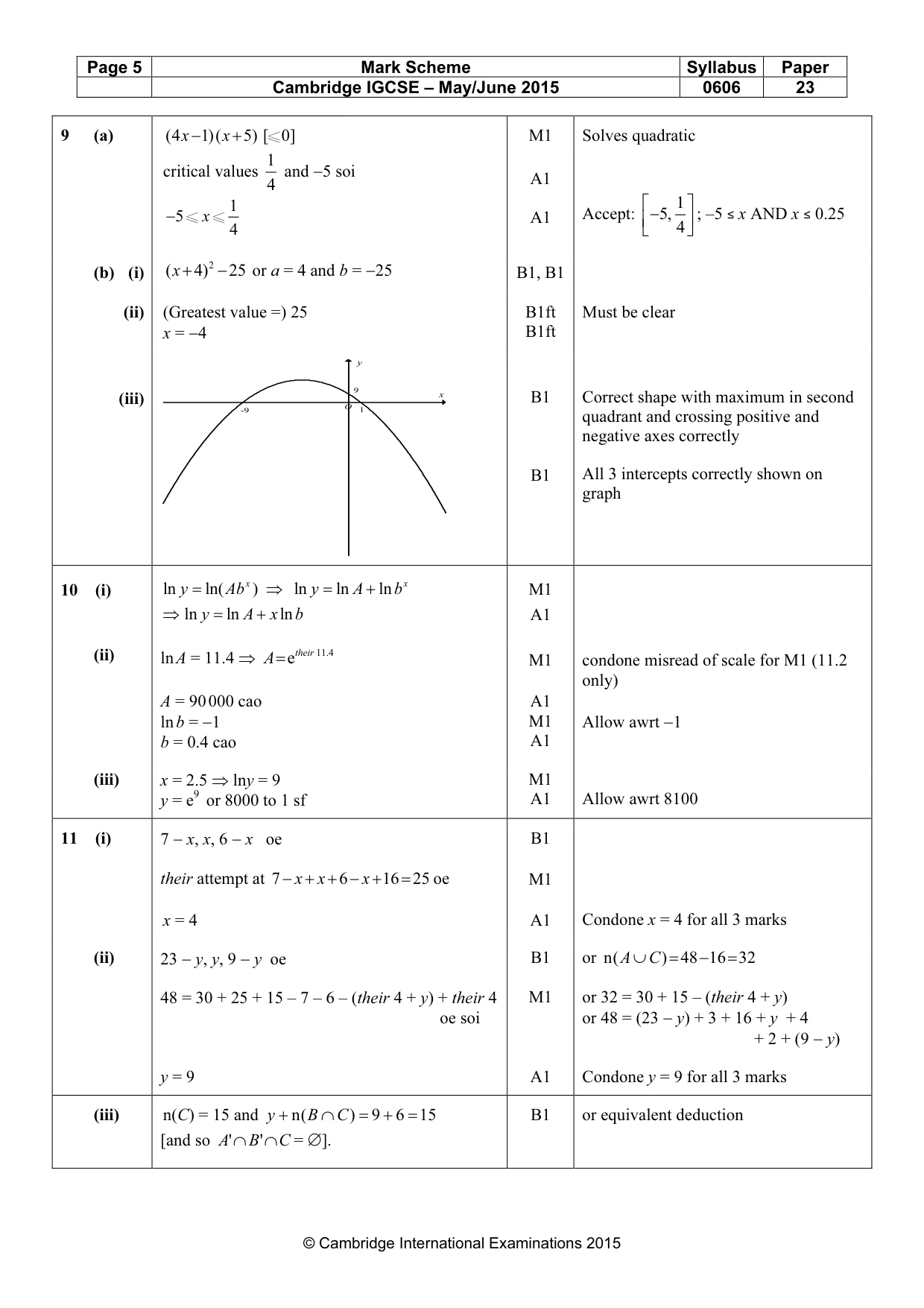
Page 5 Mark Scheme Syllabus Paper Cambridge IGCSE – May/June 2015 0606 23 © Cambridge International Examinations 2015 9 (a) (4 1)( 5) [ 0] x x − + ≤ critical values 1 4 and −5 soi 1 5 4 x − ≤ ≤ M1 A1 A1 Solves quadratic Accept: 1 5, 4 − ; –5 ≤ x AND x ≤ 0.25 (b) (i) 2 ( 4) 25 x+ − or a = 4 and b = −25 B1, B1 (ii) (Greatest value =) 25 x = −4 B1ft B1ft Must be clear (iii) x y O -9 1 9 B1 B1 Correct shape with maximum in second quadrant and crossing positive and negative axes correctly All 3 intercepts correctly shown on graph 10 (i) ln ln( ) ln ln ln ln ln ln x x y Ab y A b y A x b = ⇒ = + ⇒ = + M1 A1 (ii) ln A = 11.4 ⇒ 11.4 etheir A= A = 90 000 cao ln b = −1 b = 0.4 cao M1 A1 M1 A1 condone misread of scale for M1 (11.2 only) Allow awrt −1 (iii) x = 2.5 ⇒ lny = 9 y = e9 or 8000 to 1 sf M1 A1 Allow awrt 8100 11 (i) 7 − x, x, 6 − x oe their attempt at 25 16 6 7 = + − + + − x x x oe x = 4 B1 M1 A1 Condone x = 4 for all 3 marks (ii) 23 − y, y, 9 − y oe 48 = 30 + 25 + 15 – 7 – 6 – (their 4 + y) + their 4 oe soi y = 9 B1 M1 A1 or n( ) 48 16 32 A C ∪ = − = or 32 = 30 + 15 – (their 4 + y) or 48 = (23 − y) + 3 + 16 + y + 4 + 2 + (9 − y) Condone y = 9 for all 3 marks (iii) n(C) = 15 and n( ) 9 6 15 y B C + ∩ = + = [and so C B A ∩ ∩' ' = ∅]. B1 or equivalent deduction
What you needed in this session
Cambridge’s own grade thresholds for 2015 May/June, Paper 2 · Variant 3. A higher threshold means an easier paper — the bar moves with how the cohort did.