Cambridge IGCSE Mathematics - Additional 0606 — 2014 Oct/Nov Paper 2 · Variant 3
0606/23/O/N/14 · 80 marks · ≈90 min
The question paper and its mark scheme, free to read here and free to download. This is Cambridge’s own paper, exactly as it was sat.
Question paper16 pages
Mark scheme5 pages
Answers below. Sit the paper first if you are practising.
Paper as text
Question paper, page 1
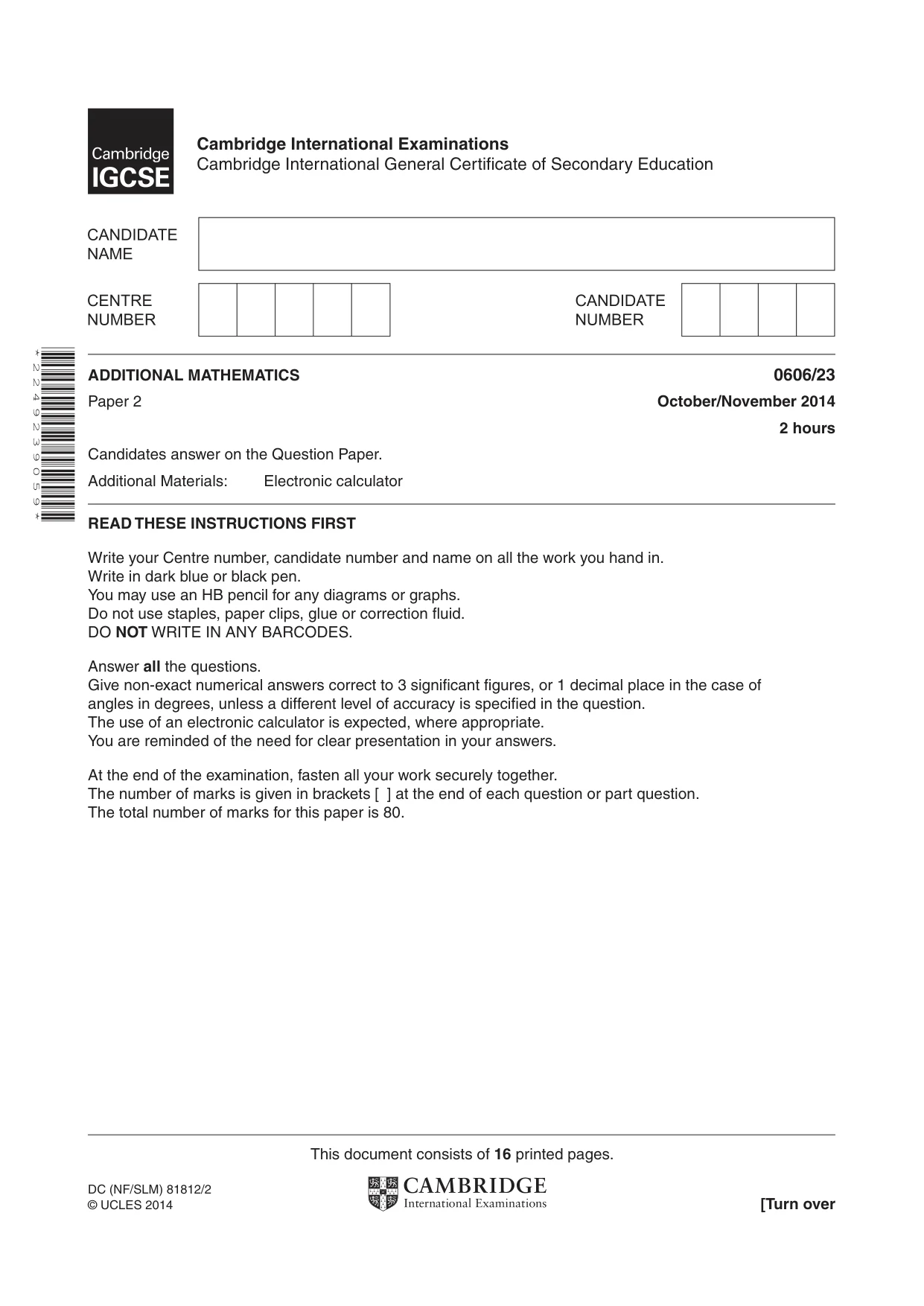
ADDITIONAL MATHEMATICS 0606/23 Paper 2 October/November 2014 2 hours Candidates answer on the Question Paper. Additional Materials: Electronic calculator READ THESE INSTRUCTIONS FIRST Write your Centre number, candidate number and name on all the work you hand in. Write in dark blue or black pen. You may use an HB pencil for any diagrams or graphs. Do not use staples, paper clips, glue or correction fluid. DO NOT WRITE IN ANY BARCODES. Answer all the questions. Give non-exact numerical answers correct to 3 significant figures, or 1 decimal place in the case of angles in degrees, unless a different level of accuracy is specified in the question. The use of an electronic calculator is expected, where appropriate. You are reminded of the need for clear presentation in your answers. At the end of the examination, fasten all your work securely together. The number of marks is given in brackets [ ] at the end of each question or part question. The total number of marks for this paper is 80. This document consists of 16 printed pages. DC (NF/SLM) 81812/2 © UCLES 2014 [Turn over Cambridge International Examinations Cambridge International General Certificate of Secondary Education * 2 2 4 9 2 3 9 0 5 9 *
Question paper, page 2
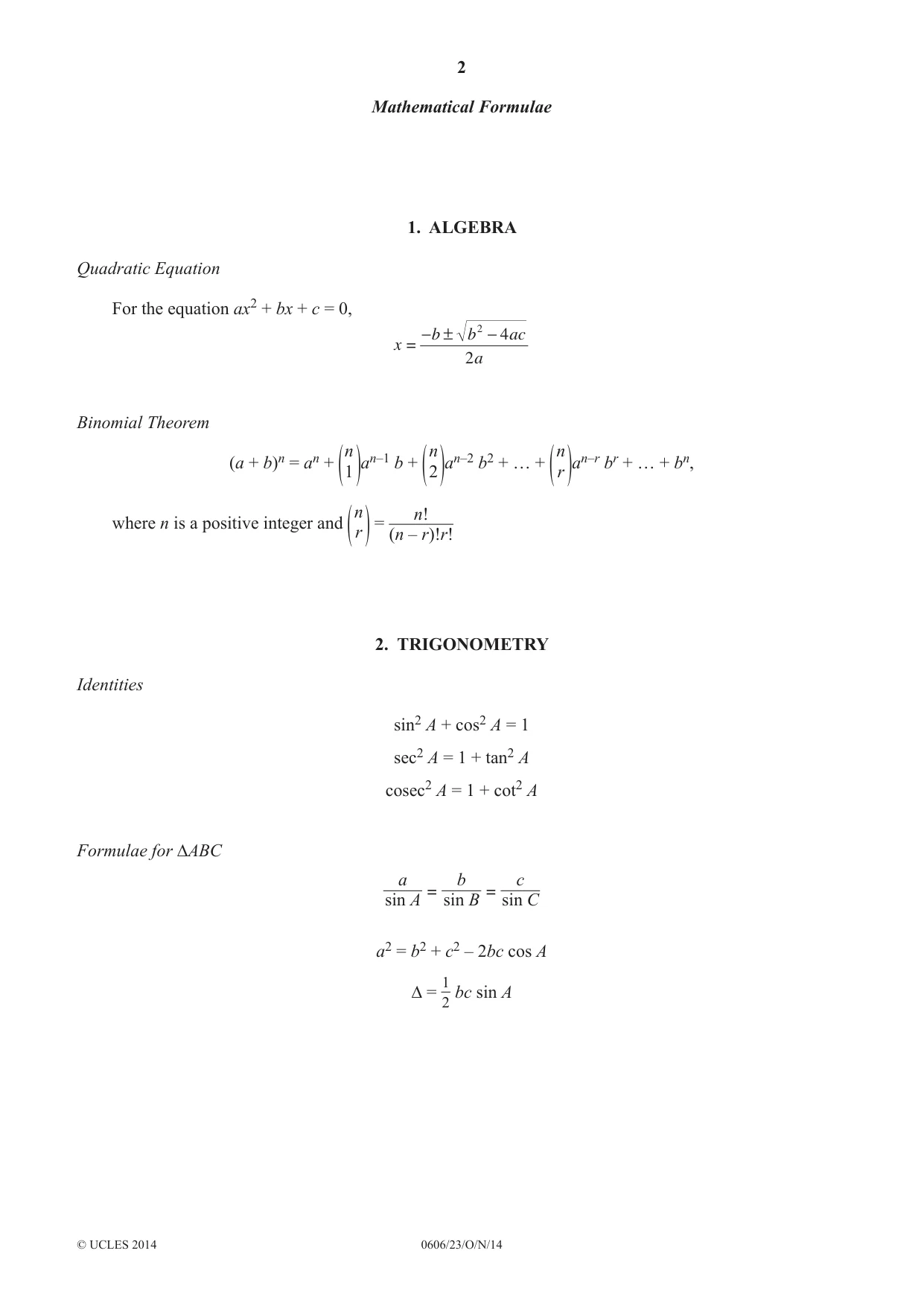
2 0606/23/O/N/14 © UCLES 2014 Mathematical Formulae 1. ALGEBRA Quadratic Equation For the equation ax2 + bx + c = 0, x b b ac a = − − 2 4 2 Binomial Theorem (a + b)n = an + ( n 1)an–1 b + ( n 2)an–2 b2 + … + ( n r)an–r br + … + bn, where n is a positive integer and ( n r) = n! (n – r)!r! 2. TRIGONOMETRY Identities sin2 A + cos2 A = 1 sec2 A = 1 + tan2 A cosec2 A = 1 + cot2 A Formulae for ∆ABC a sin A = b sin B = c sin C a2 = b2 + c2 – 2bc cos A ∆ = 1 2 bc sin A
Question paper, page 3
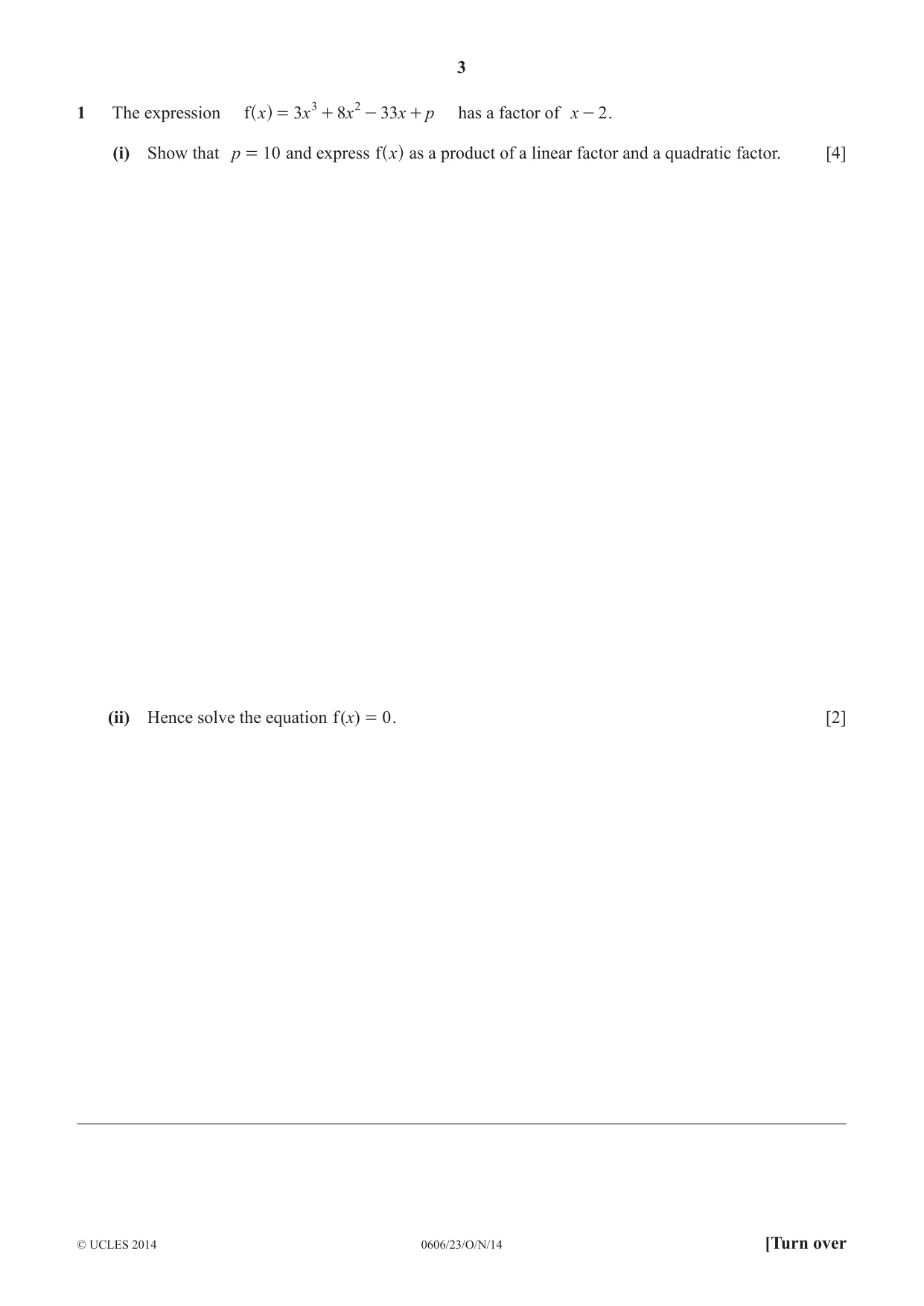
3 0606/23/O/N/14 © UCLES 2014 [Turn over 1 The expression x x x x p 3 8 33 f 3 2 = + - + ^ h has a factor of x 2 - . (i) Show that p 10 = and express x f^ h as a product of a linear factor and a quadratic factor. [4] (ii) Hence solve the equation ( )x 0 f = . [2]
Question paper, page 4
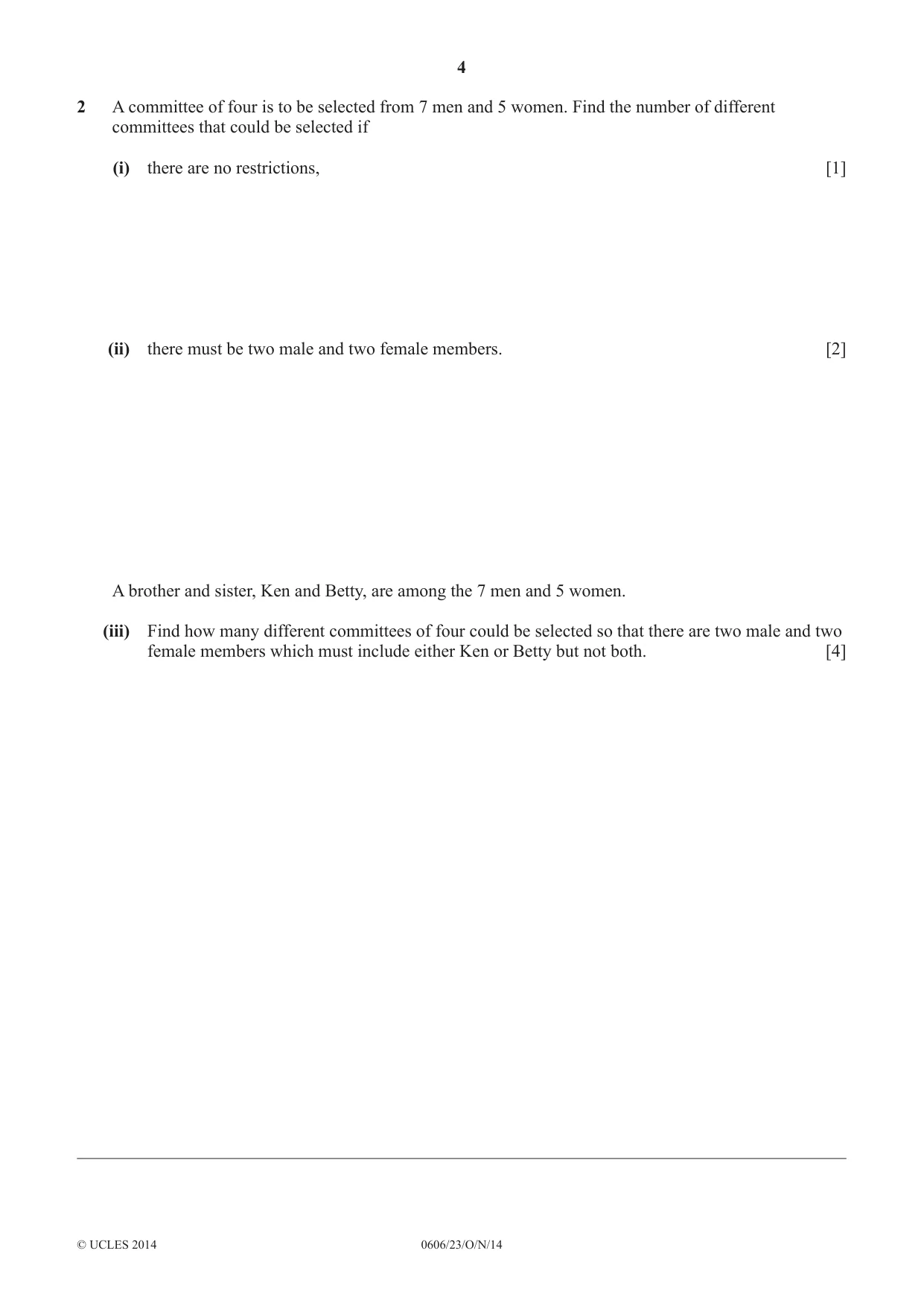
4 0606/23/O/N/14 © UCLES 2014 2 A committee of four is to be selected from 7 men and 5 women. Find the number of different committees that could be selected if (i) there are no restrictions, [1] (ii) there must be two male and two female members. [2] A brother and sister, Ken and Betty, are among the 7 men and 5 women. (iii) Find how many different committees of four could be selected so that there are two male and two female members which must include either Ken or Betty but not both. [4]
Question paper, page 5
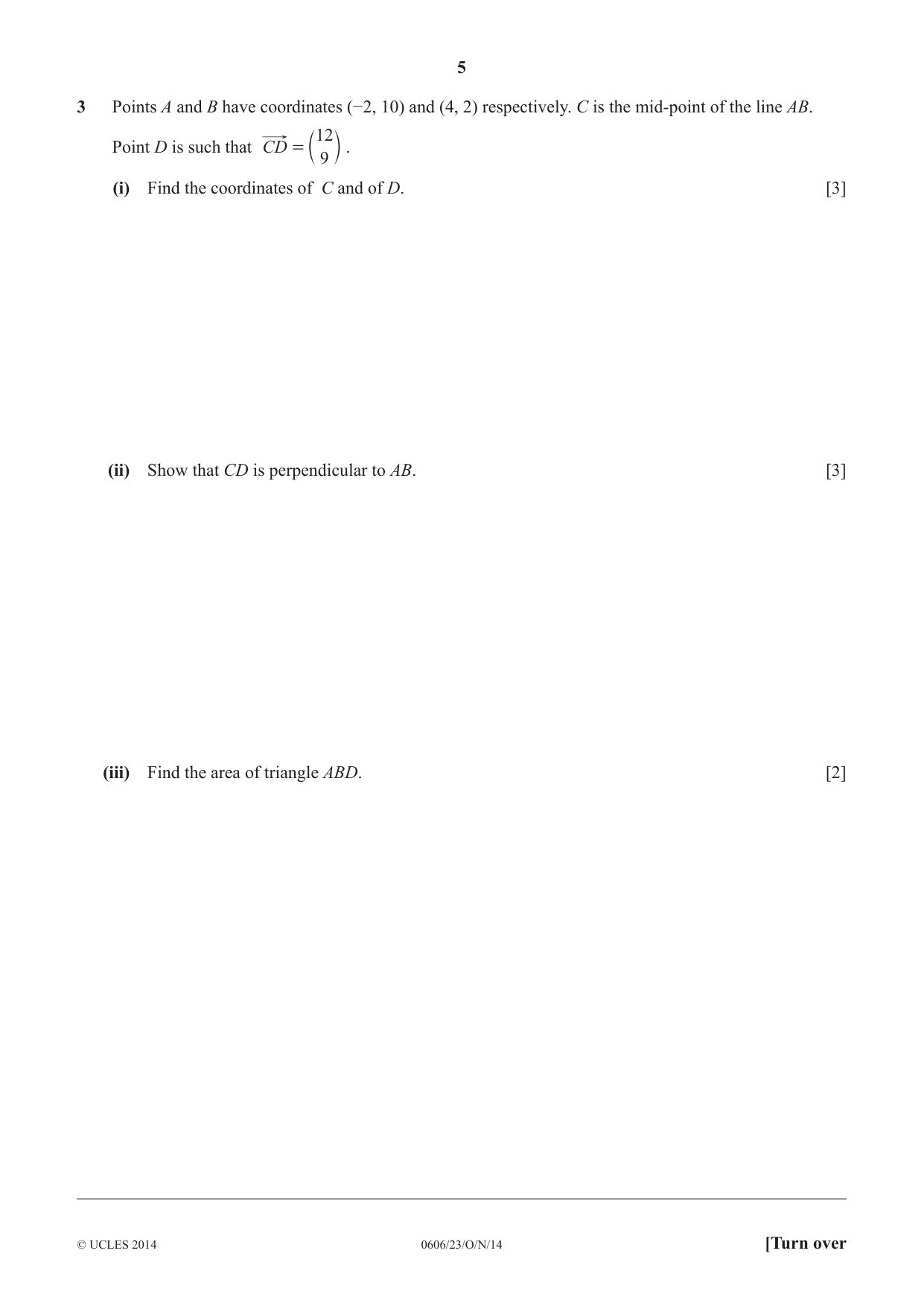
5 0606/23/O/N/14 © UCLES 2014 [Turn over 3 Points A and B have coordinates (−2, 10) and (4, 2) respectively. C is the mid-point of the line AB. Point D is such that CD 12 9 = c m . (i) Find the coordinates of C and of D. [3] (ii) Show that CD is perpendicular to AB. [3] (iii) Find the area of triangle ABD. [2]
Question paper, page 6
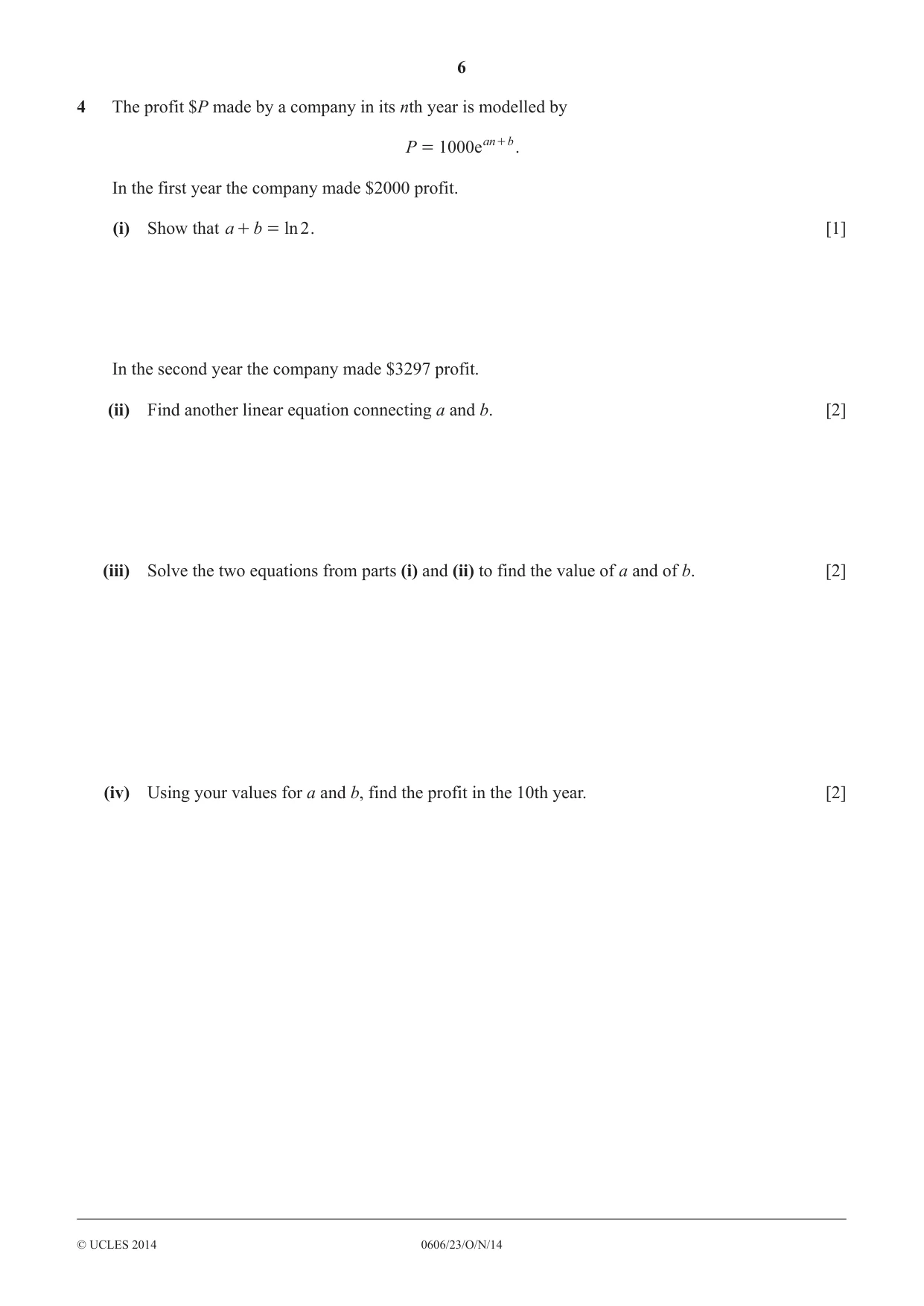
6 0606/23/O/N/14 © UCLES 2014 4 The profit $P made by a company in its nth year is modelled by P 1000ean b = + . In the first year the company made $2000 profit. (i) Show that ln a b 2 + = . [1] In the second year the company made $3297 profit. (ii) Find another linear equation connecting a and b. [2] (iii) Solve the two equations from parts (i) and (ii) to find the value of a and of b. [2] (iv) Using your values for a and b, find the profit in the 10th year. [2]
Question paper, page 7
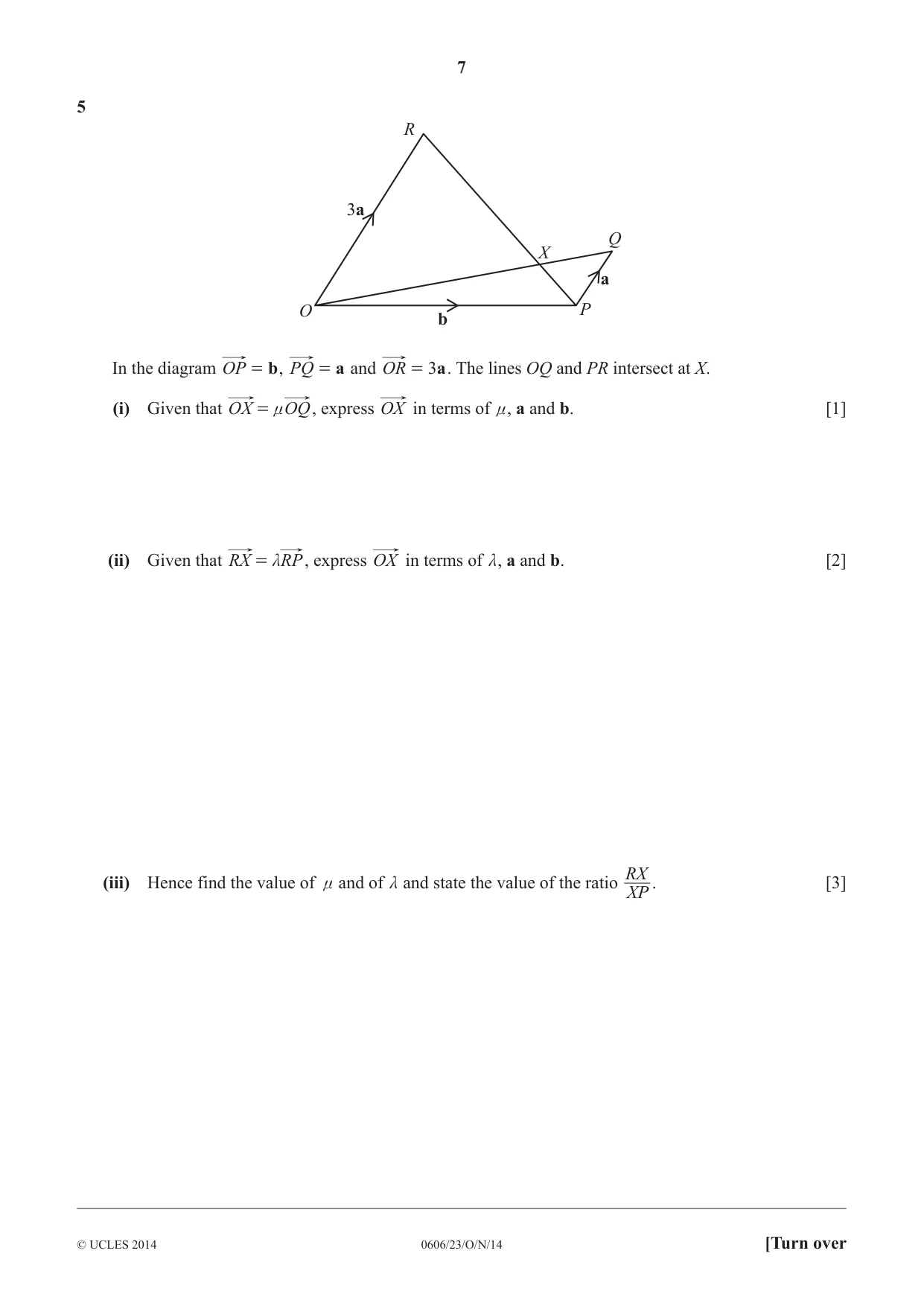
7 0606/23/O/N/14 © UCLES 2014 [Turn over 5 R O b a 3a P Q X In the diagram b OP = , a PQ = and a OR 3 = . The lines OQ and PR intersect at X. (i) Given that OX OQ n = , express OX in terms of n, a and b. [1] (ii) Given that RX RP m = , express OX in terms of m, a and b. [2] (iii) Hence find the value of n and of m and state the value of the ratio P R X X . [3]
Question paper, page 8
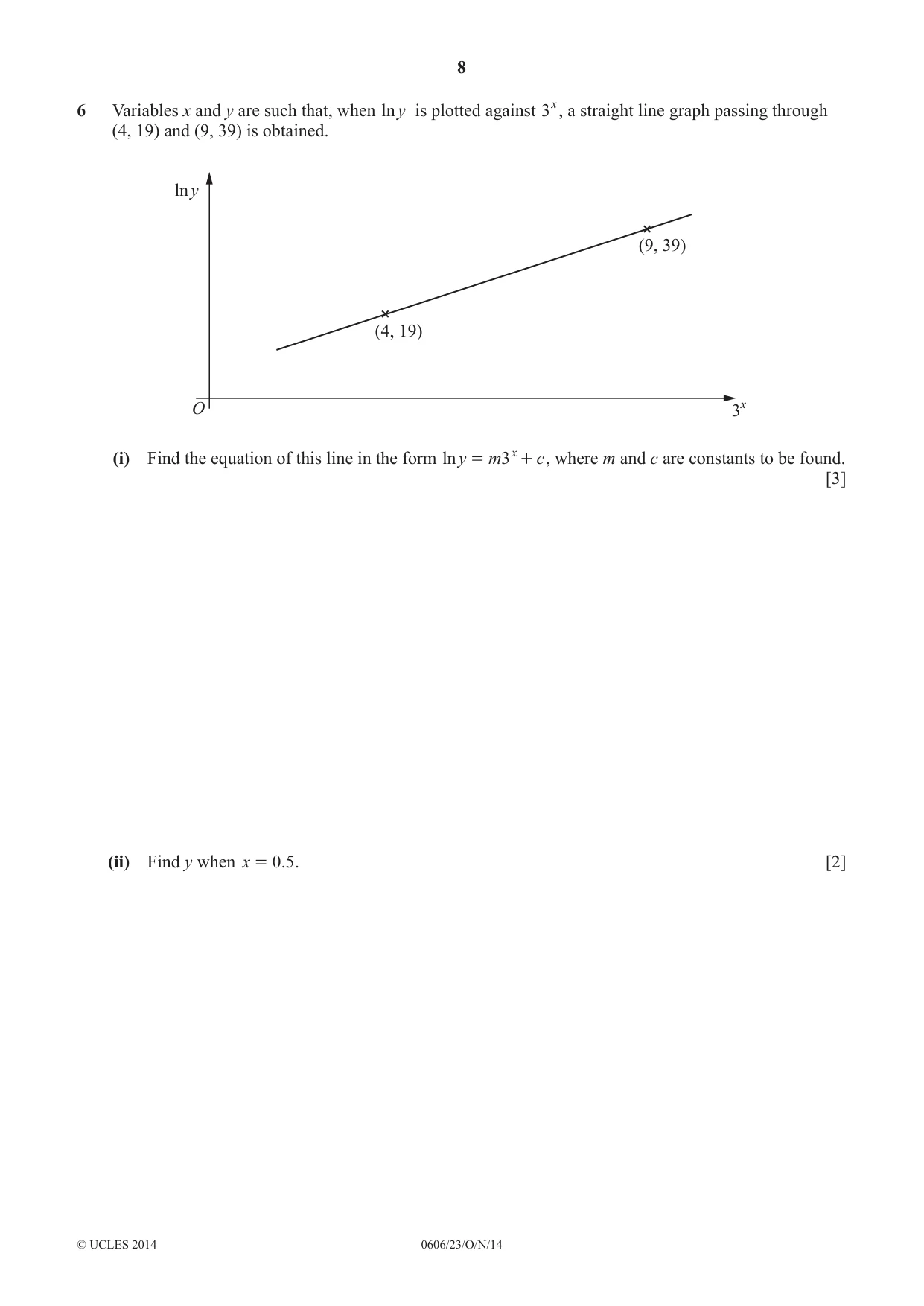
8 0606/23/O/N/14 © UCLES 2014 6 Variables x and y are such that, when lny is plotted against 3x, a straight line graph passing through (4, 19) and (9, 39) is obtained. ln y O 3x (4, 19) (9, 39) (i) Find the equation of this line in the form lny m c 3x = + , where m and c are constants to be found. [3] (ii) Find y when . x 0 5 = . [2]
Question paper, page 9
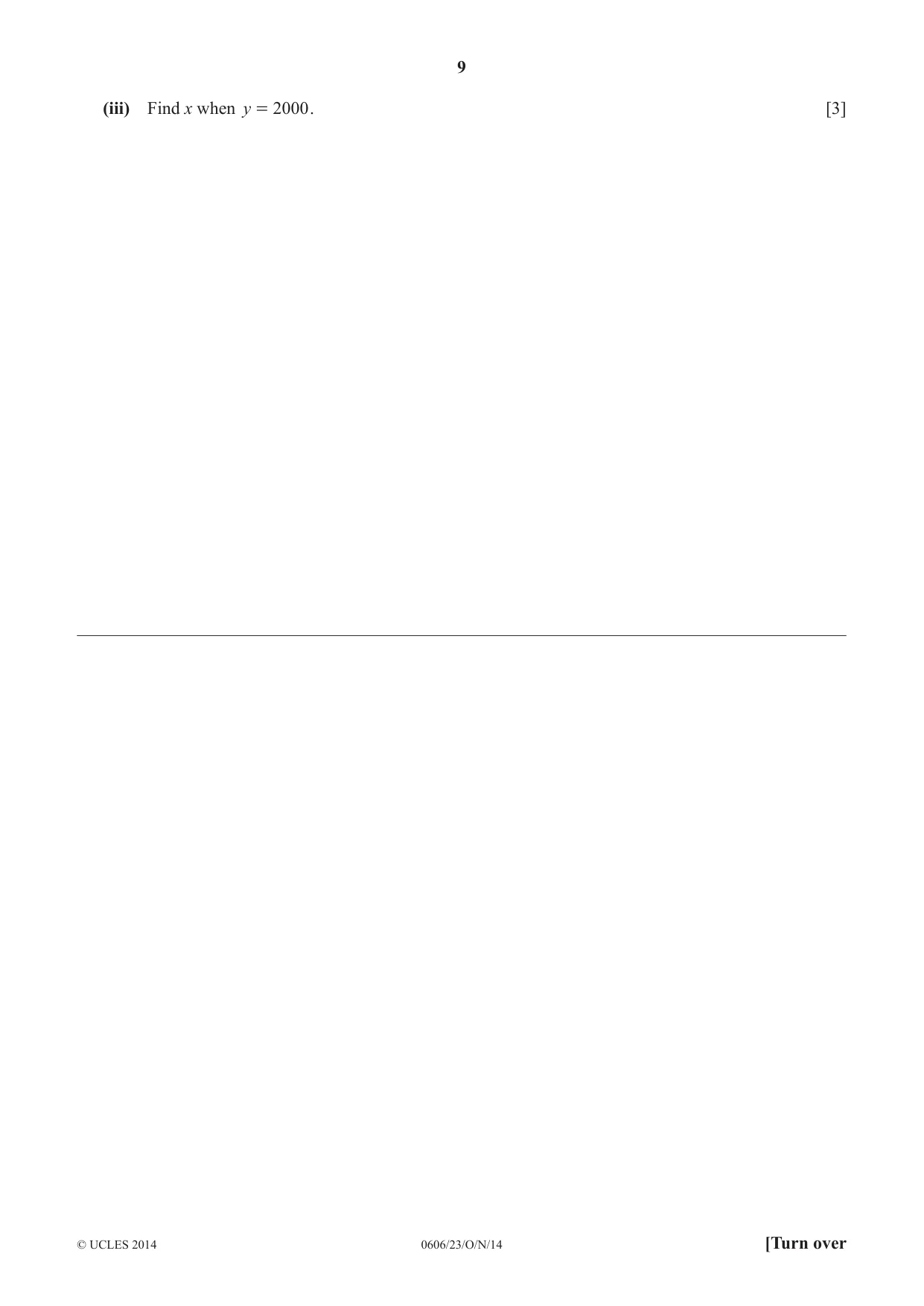
9 0606/23/O/N/14 © UCLES 2014 [Turn over (iii) Find x when y 2000 = . [3]
Question paper, page 10
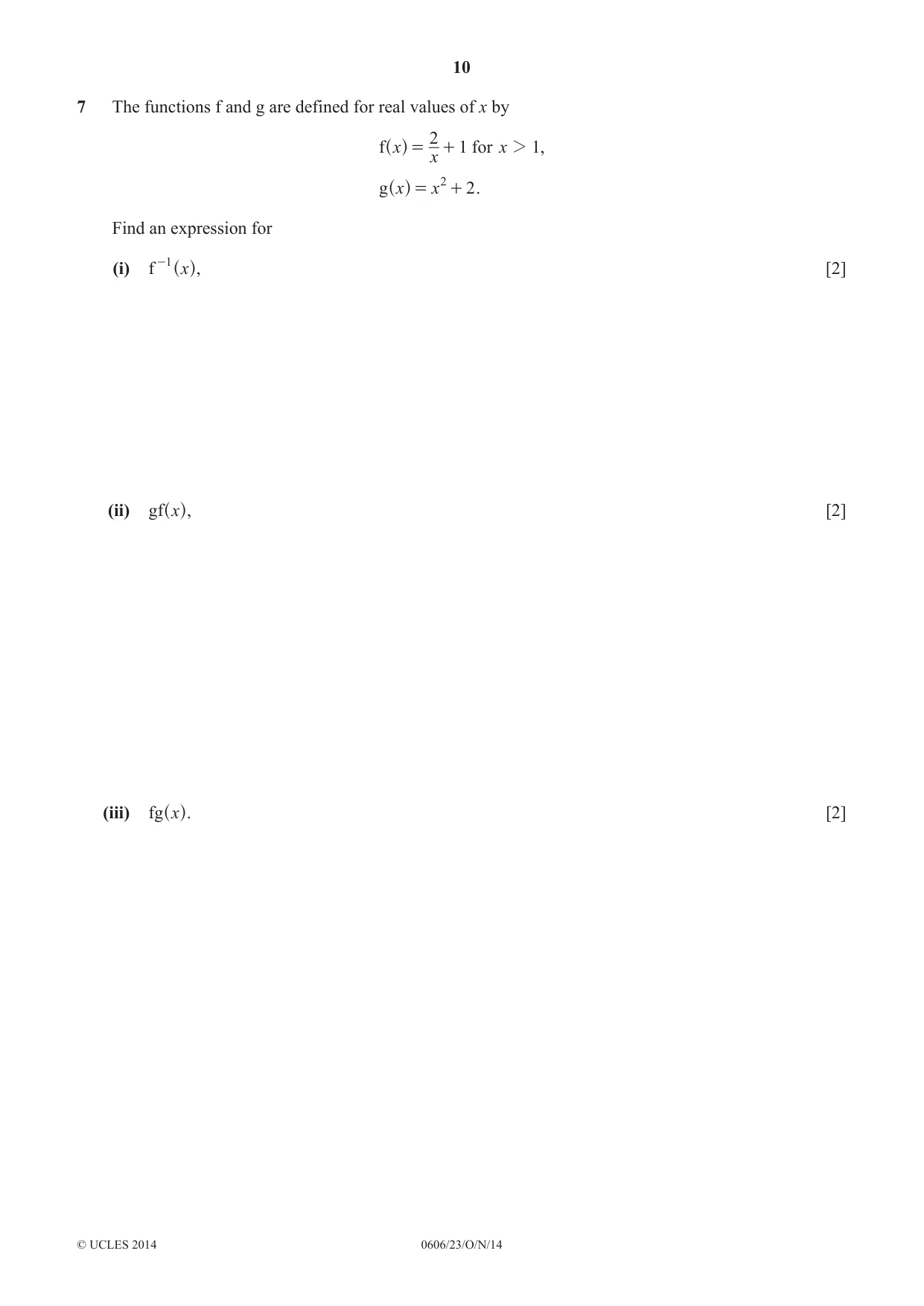
10 0606/23/O/N/14 © UCLES 2014 7 The functions f and g are defined for real values of x by x x 2 1 f = + ^ h for x 1 2 , x x 2 g 2 = + ^ h . Find an expression for (i) x f 1 - ^ h, [2] (ii) x gf^ h, [2] (iii) x fg^ h. [2]
Question paper, page 11
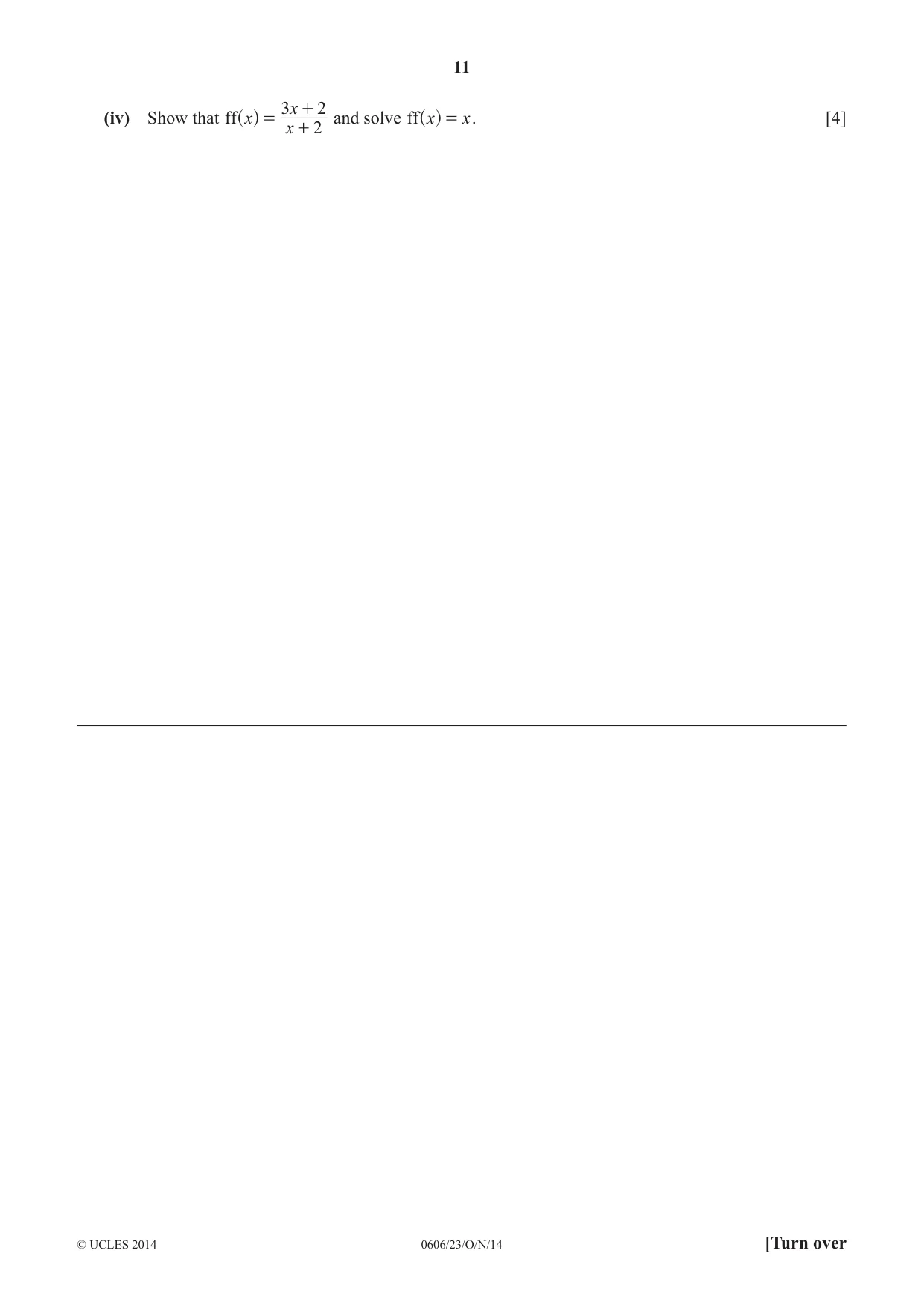
11 0606/23/O/N/14 © UCLES 2014 [Turn over (iv) Show that x x x 2 3 2 ff = + + ^ h and solve x x ff = ^ h . [4]
Question paper, page 12
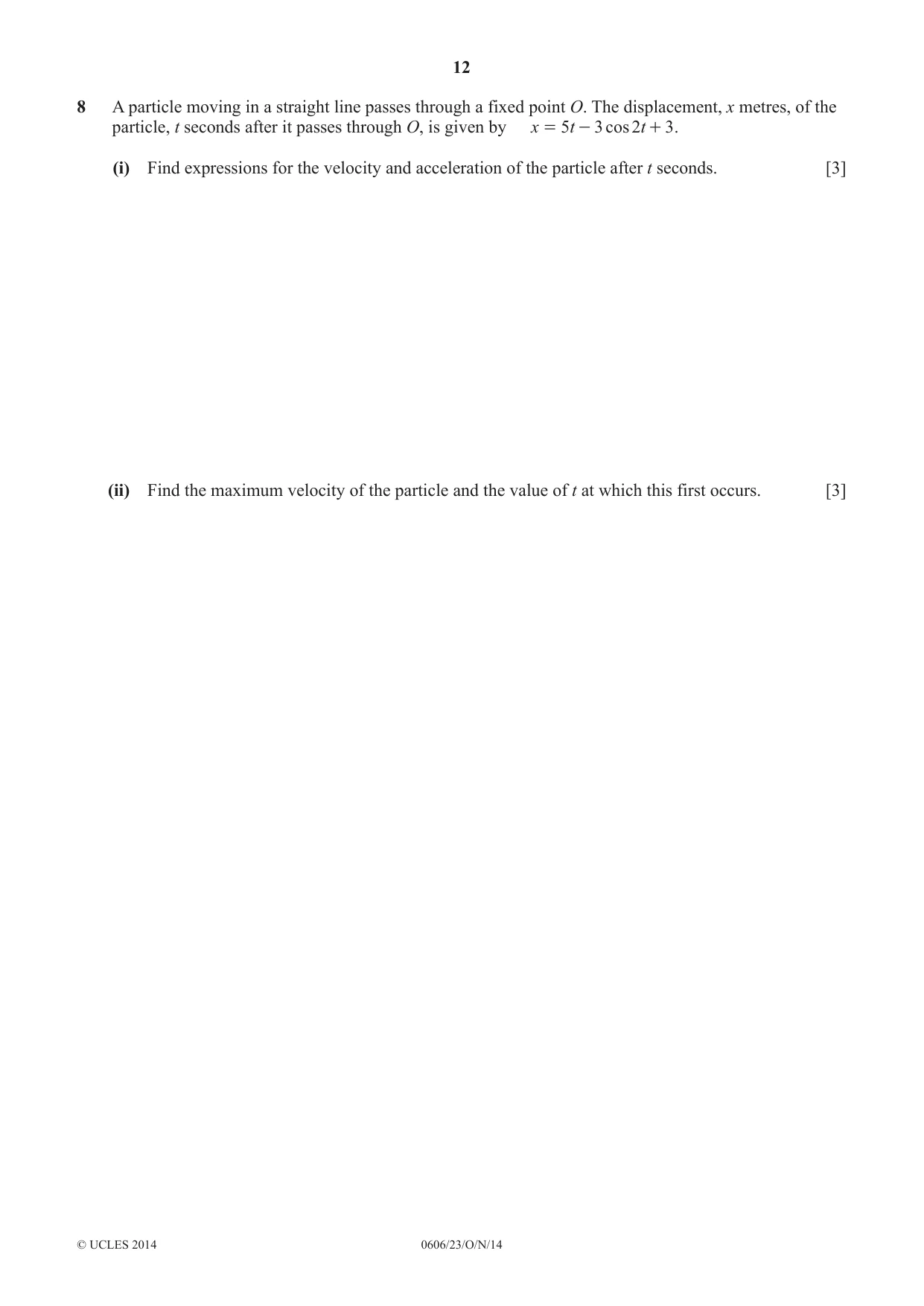
12 0606/23/O/N/14 © UCLES 2014 8 A particle moving in a straight line passes through a fixed point O. The displacement, x metres, of the particle, t seconds after it passes through O, is given by cos x t t 5 3 2 3 = - + . (i) Find expressions for the velocity and acceleration of the particle after t seconds. [3] (ii) Find the maximum velocity of the particle and the value of t at which this first occurs. [3]
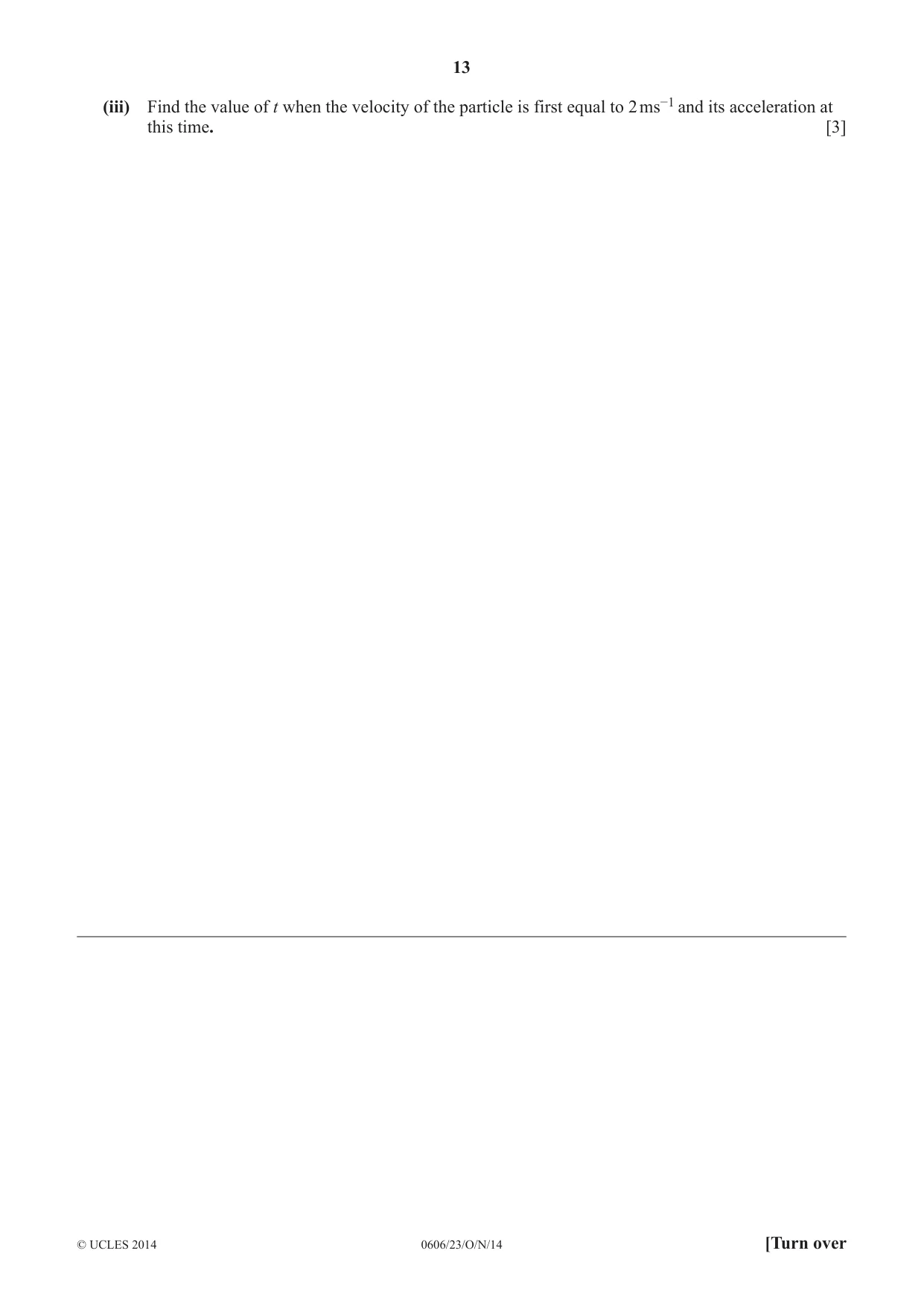
Question paper, page 13
13 0606/23/O/N/14 © UCLES 2014 [Turn over (iii) Find the value of t when the velocity of the particle is first equal to 2 ms−1 and its acceleration at this time. [3]
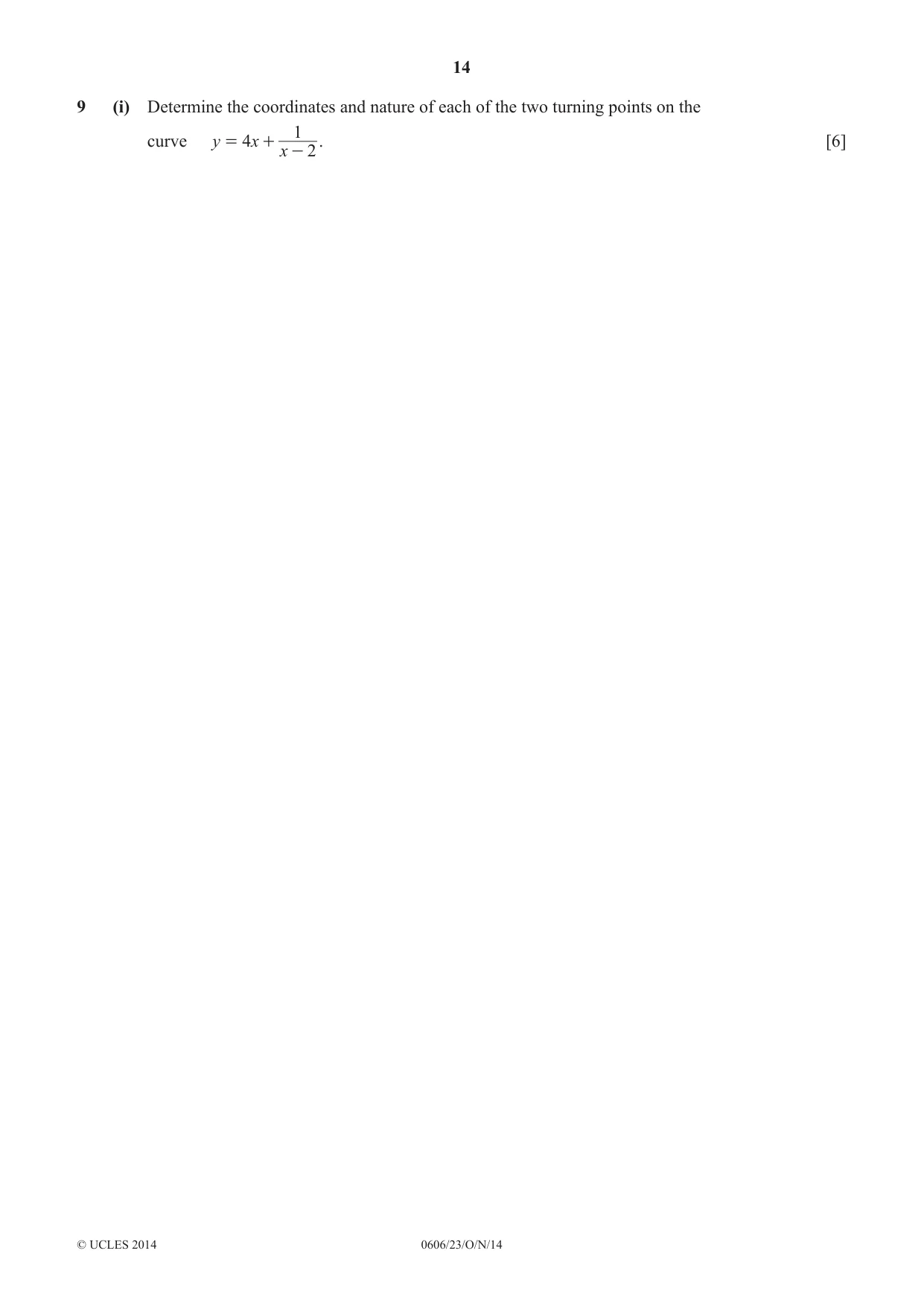
Question paper, page 14
14 0606/23/O/N/14 © UCLES 2014 9 (i) Determine the coordinates and nature of each of the two turning points on the curve y x x 4 2 1 = + - . [6]
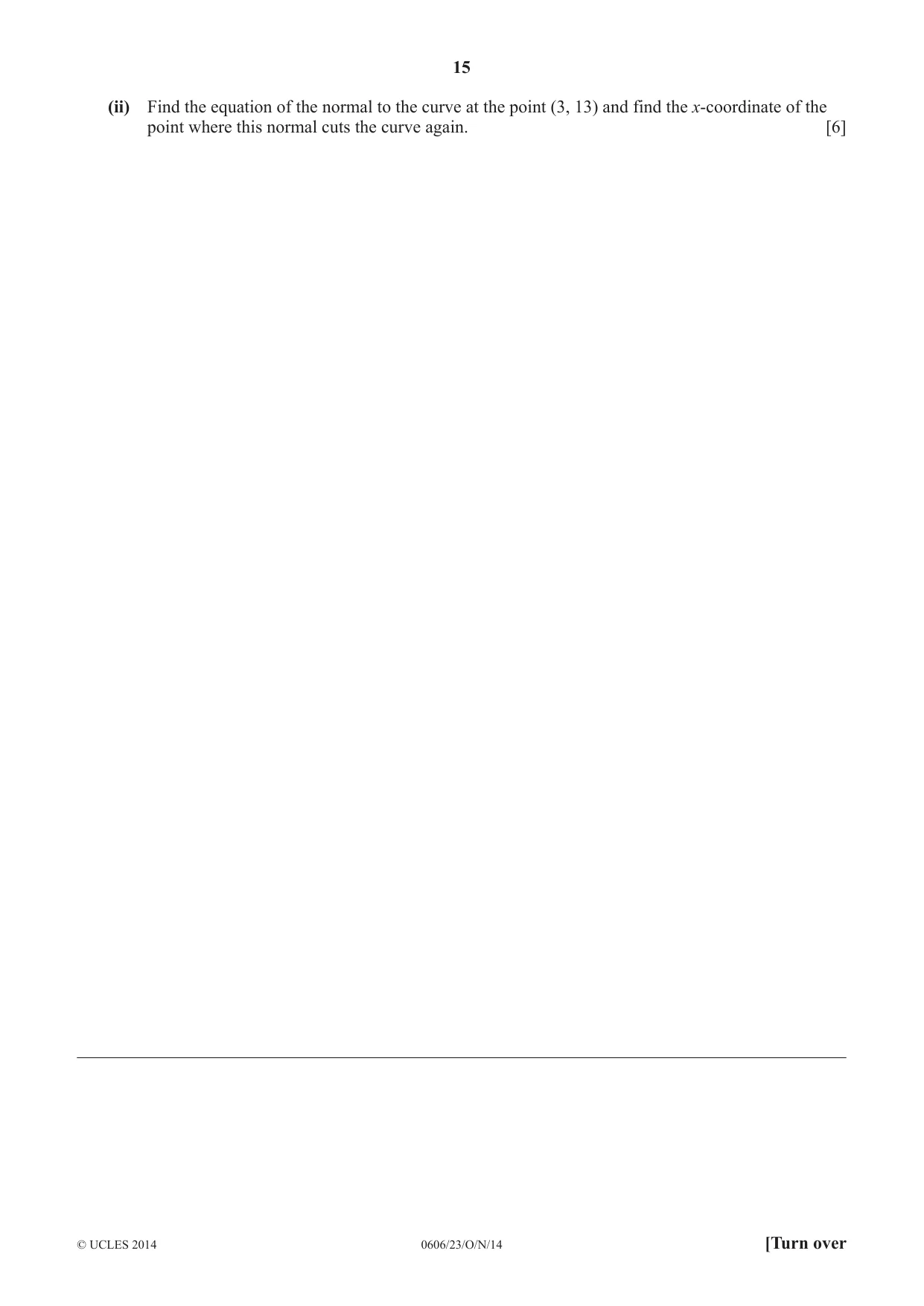
Question paper, page 15
15 0606/23/O/N/14 © UCLES 2014 [Turn over (ii) Find the equation of the normal to the curve at the point (3, 13) and find the x-coordinate of the point where this normal cuts the curve again. [6]
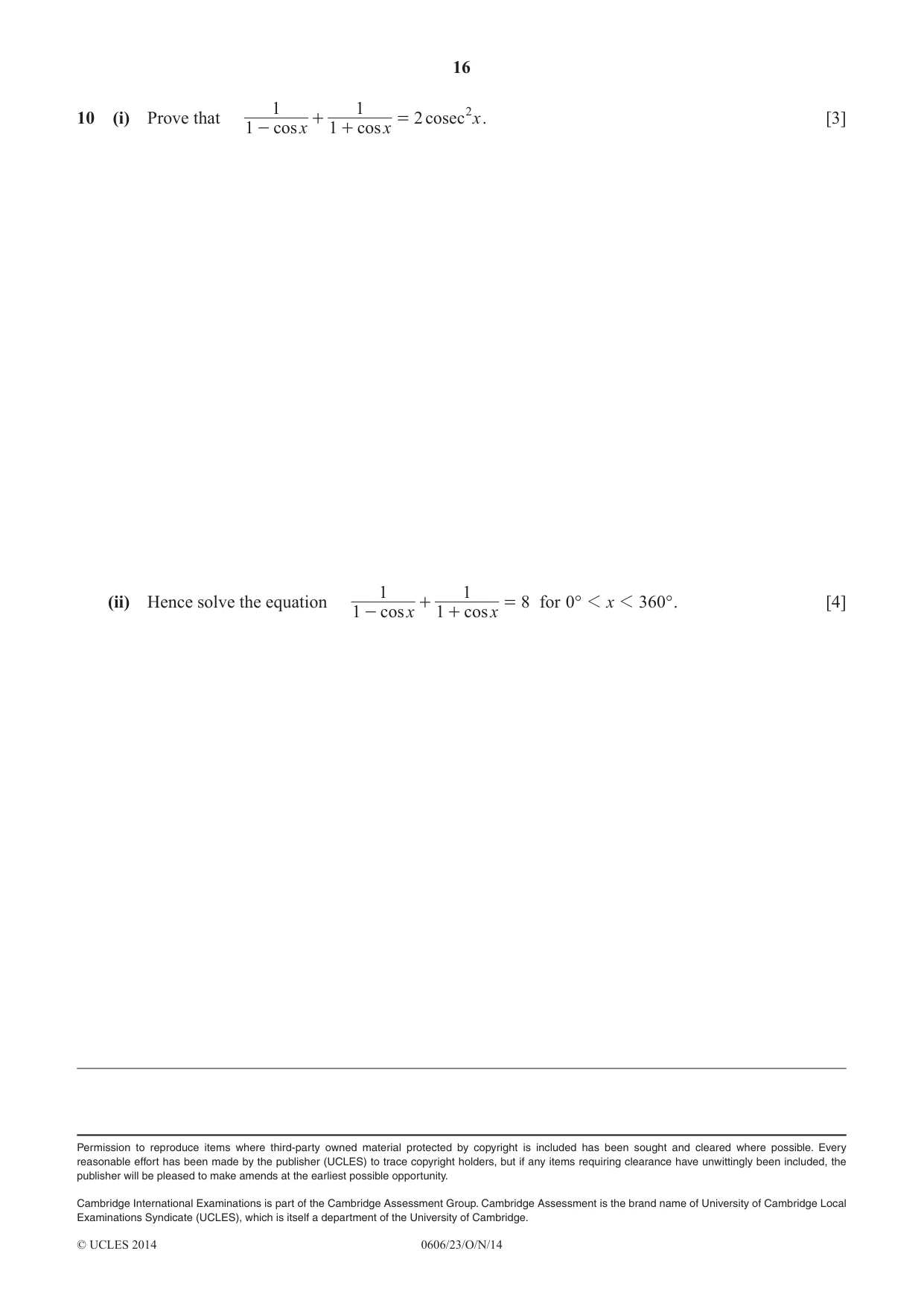
Question paper, page 16
16 0606/23/O/N/14 © UCLES 2014 10 (i) Prove that cos cos cosec x x x 1 1 1 1 2 2 - + + = . [3] (ii) Hence solve the equation cos cos x x 1 1 1 1 8 - + + = for ° ° x 0 360 1 1 . [4] Permission to reproduce items where third-party owned material protected by copyright is included has been sought and cleared where possible. Every reasonable effort has been made by the publisher (UCLES) to trace copyright holders, but if any items requiring clearance have unwittingly been included, the publisher will be pleased to make amends at the earliest possible opportunity. Cambridge International Examinations is part of the Cambridge Assessment Group. Cambridge Assessment is the brand name of University of Cambridge Local Examinations Syndicate (UCLES), which is itself a department of the University of Cambridge.
Mark scheme, page 1
® IGCSE is the registered trademark of Cambridge International Examinations. CAMBRIDGE INTERNATIONAL EXAMINATIONS Cambridge International General Certificate of Secondary Education MARK SCHEME for the October/November 2014 series 0606 ADDITIONAL MATHEMATICS 0606/23 Paper 2, maximum raw mark 80 This mark scheme is published as an aid to teachers and candidates, to indicate the requirements of the examination. It shows the basis on which Examiners were instructed to award marks. It does not indicate the details of the discussions that took place at an Examiners’ meeting before marking began, which would have considered the acceptability of alternative answers. Mark schemes should be read in conjunction with the question paper and the Principal Examiner Report for Teachers. Cambridge will not enter into discussions about these mark schemes. Cambridge is publishing the mark schemes for the October/November 2014 series for most Cambridge IGCSE®, Cambridge International A and AS Level components and some Cambridge O Level components.
Mark scheme, page 2
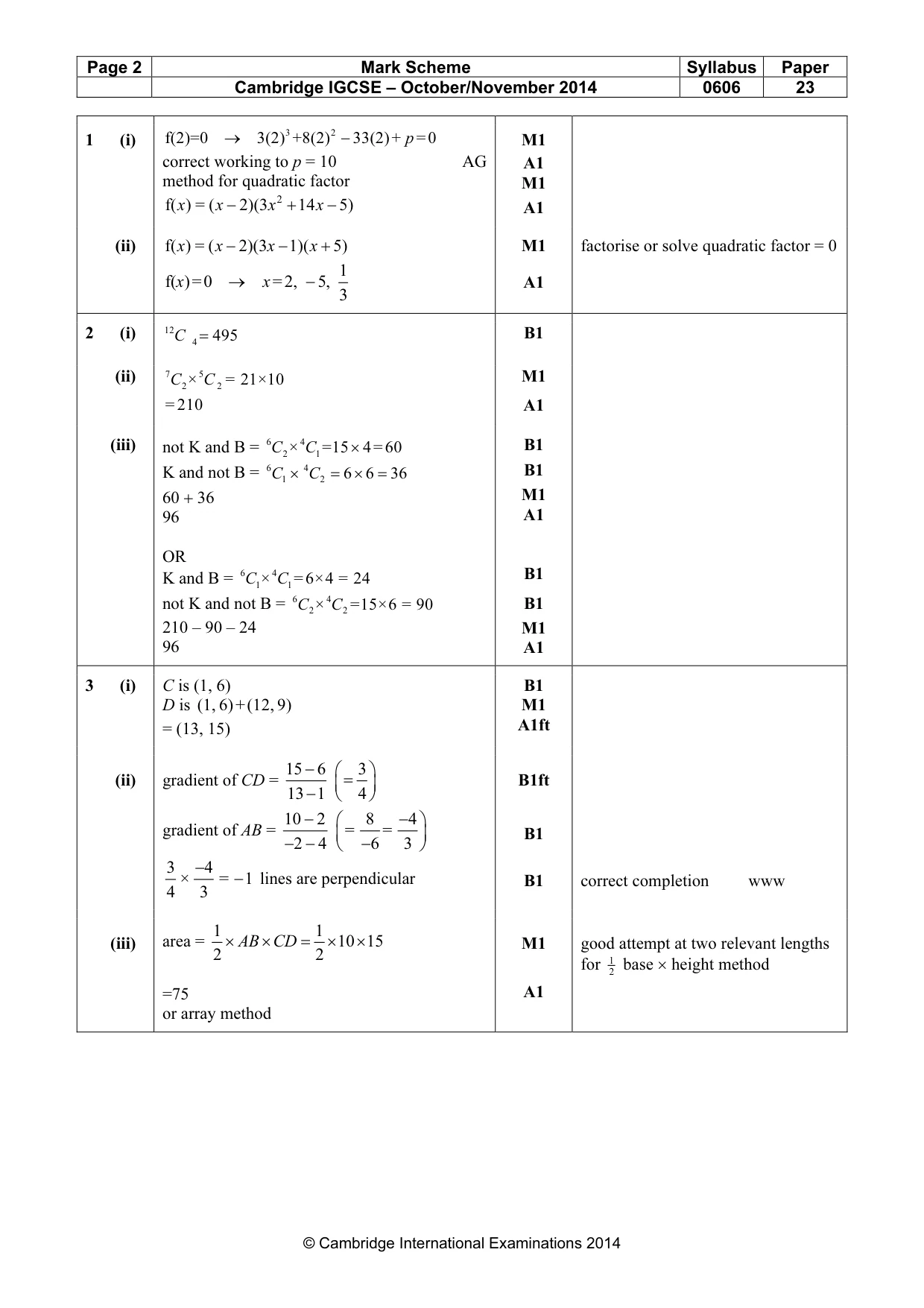
Page 2 Mark Scheme Syllabus Paper Cambridge IGCSE – October/November 2014 0606 23 © Cambridge International Examinations 2014 1 (i) 3 2 f(2)=0 3(2) +8(2) 33(2)+ =0 p → − correct working to p = 10 AG method for quadratic factor 5) 14 2)(3 ( = ) f( 2 − + − x x x x M1 A1 M1 A1 (ii) 5) 1)( 2)(3 ( = ) f( + − − x x x x 1 f( )=0 =2, 5, 3 x x → − M1 A1 factorise or solve quadratic factor = 0 2 (i) 12 4 495 C = B1 (ii) 7 5 2 2 × = 21×10 = 210 C C M1 A1 (iii) not K and B = 6 4 2 1 × =15 4=60 C C × K and not B = 6 4 1 2 6 6 36 C C × = × = 60 + 36 96 OR K and B = 6 4 1 1 × =6×4 = 24 C C not K and not B = 6 4 2 2 × =15×6 = 90 C C 210 – 90 – 24 96 B1 B1 M1 A1 B1 B1 M1 A1 3 (i) C is (1, 6) D is (1, 6)+(12, 9) = (13, 15) B1 M1 A1ft (ii) gradient of CD = 15 6 3 13 1 4 − = − gradient of AB = 10 2 8 4 = = 2 4 6 3 − − −− − 3 4 × = 1 4 3 − − lines are perpendicular B1ft B1 B1 correct completion www (iii) area = 1 1 10 15 2 2 AB CD × × = × × =75 or array method M1 A1 good attempt at two relevant lengths for 1 2 base × height method
Mark scheme, page 3
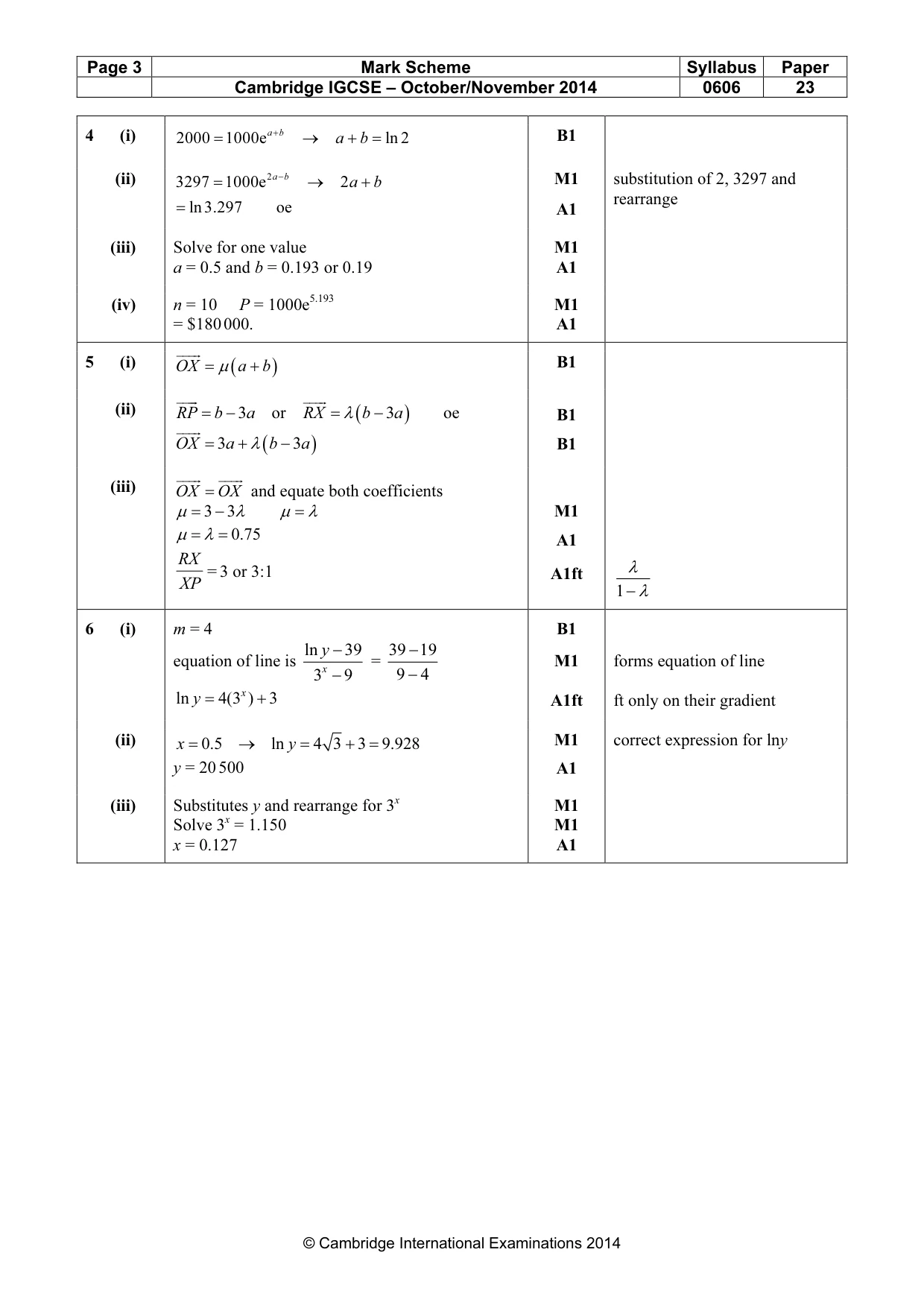
Page 3 Mark Scheme Syllabus Paper Cambridge IGCSE – October/November 2014 0606 23 © Cambridge International Examinations 2014 4 (i) 2000 1000e ln 2 a b a b + = → + = B1 (ii) 2 3297 1000e 2 ln3.297 oe a b a b − = → + = M1 A1 substitution of 2, 3297 and rearrange (iii) Solve for one value a = 0.5 and b = 0.193 or 0.19 M1 A1 (iv) n = 10 P = 1000e5.193 = $180 000. M1 A1 5 (i) ( ) OX a b µ = + uuur B1 (ii) ( ) ( ) 3 or 3 oe 3 3 RP b a RX b a OX a b a λ λ = − = − = + − uuur uuur uuur B1 B1 (iii) OX OX = uuur uuur and equate both coefficients 3 3 µ λ µ λ = − = 0.75 µ λ = = = XP RX 3 or 3:1 M1 A1 A1ft 1 λ λ − 6 (i) m = 4 equation of line is 9 3 39 ln − − x y = 4 9 19 39 − − 3 ) 4(3 ln + = x y B1 M1 A1ft forms equation of line ft only on their gradient (ii) 0.5 ln 4 3 3 9.928 x y = → = + = y = 20 500 M1 A1 correct expression for lny (iii) Substitutes y and rearrange for 3x Solve 3x = 1.150 x = 0.127 M1 M1 A1
Mark scheme, page 4
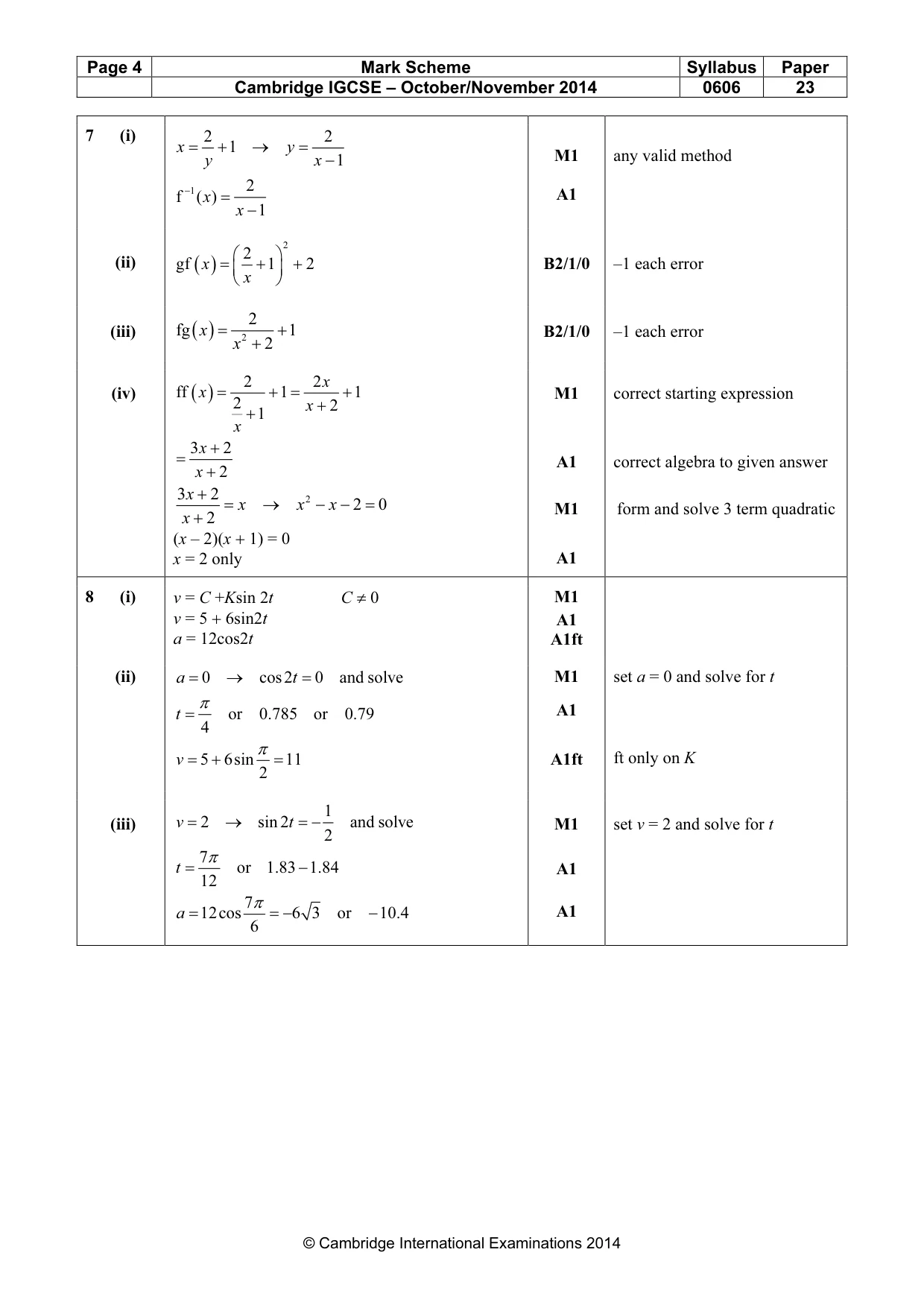
Page 4 Mark Scheme Syllabus Paper Cambridge IGCSE – October/November 2014 0606 23 © Cambridge International Examinations 2014 7 (i) 1 2 2 1 1 2 f ( ) 1 x y y x x x − = + → = − = − M1 A1 any valid method (ii) ( ) 2 2 gf 1 2 x x = + + B2/1/0 –1 each error (iii) ( ) 2 2 fg 1 2 x x = + + B2/1/0 –1 each error (iv) ( ) 2 2 ff 1 1 2 2 1 3 2 2 x x x x x x = + = + + + + = + 2 3 2 2 0 2 x x x x x + = → − − = + (x – 2)(x + 1) = 0 x = 2 only M1 A1 M1 A1 correct starting expression correct algebra to given answer form and solve 3 term quadratic 8 (i) v = C +Ksin 2t C ≠ 0 v = 5 + 6sin2t a = 12cos2t M1 A1 A1ft (ii) 0 cos2 0 and solve or 0.785 or 0.79 4 5 6sin 11 2 a t t v π π = → = = = + = M1 A1 A1ft set a = 0 and solve for t ft only on K (iii) 1 2 sin 2 and solve 2 7 or 1.83 1.84 12 7 12cos 6 3 or 10.4 6 v t t a π π = → = − = − = = − − M1 A1 A1 set v = 2 and solve for t
Mark scheme, page 5
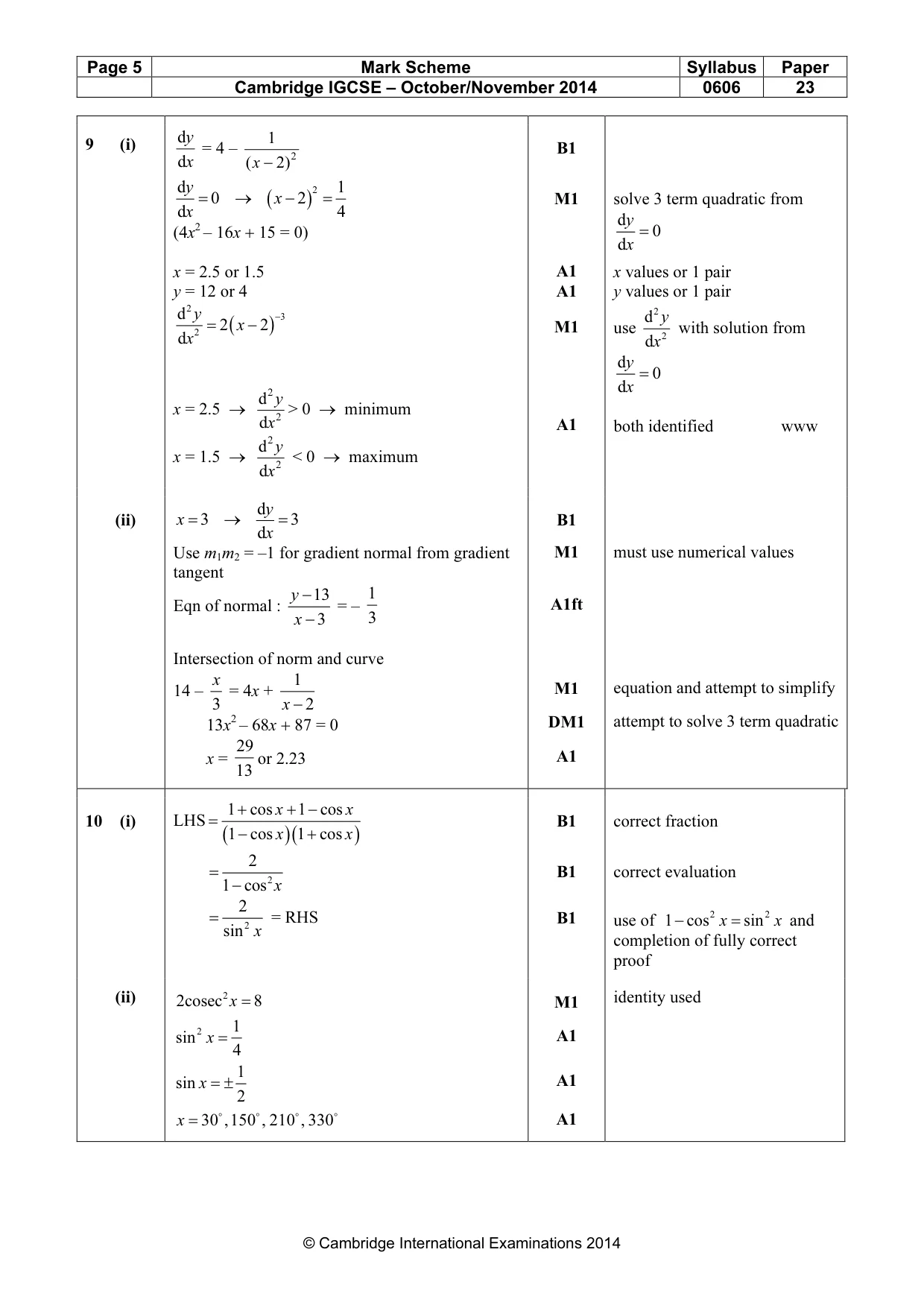
Page 5 Mark Scheme Syllabus Paper Cambridge IGCSE – October/November 2014 0606 23 © Cambridge International Examinations 2014 9 (i) x y d d = 4 – 2 2) ( 1 − x ( ) 2 d 1 0 2 d 4 y x x = → − = (4x2 – 16x + 15 = 0) x = 2.5 or 1.5 y = 12 or 4 ( ) 2 3 2 d 2 2 d y x x − = − x = 2.5 → 2 2 d d x y > 0 → minimum x = 1.5 → 2 2 d d x y < 0 → maximum B1 M1 A1 A1 M1 A1 solve 3 term quadratic from d 0 d y x = x values or 1 pair y values or 1 pair use 2 2 d d y x with solution from d 0 d y x = both identified www (ii) d 3 3 d y x x = → = Use m1m2 = –1 for gradient normal from gradient tangent Eqn of normal : 13 3 y x − − = – 3 1 Intersection of norm and curve 14 – 3 x = 4x + 2 1 − x 13x2 – 68x + 87 = 0 x = 13 29 or 2.23 B1 M1 A1ft M1 DM1 A1 must use numerical values equation and attempt to simplify attempt to solve 3 term quadratic 10 (i) LHS ( )( ) 1 cos 1 cos 1 cos 1 cos x x x x + + − = − + 2 2 1 cos x = − 2 2 sin x = = RHS B1 B1 B1 correct fraction correct evaluation use of 2 2 1 cos sin x x − = and completion of fully correct proof (ii) 2 2 2cosec 8 1 sin 4 1 sin 2 30 ,150 , 210 , 330 x x x x = = = ± = o o o o M1 A1 A1 A1 identity used
What you needed in this session
Cambridge’s own grade thresholds for 2014 Oct/Nov, Paper 2 · Variant 3. A higher threshold means an easier paper — the bar moves with how the cohort did.