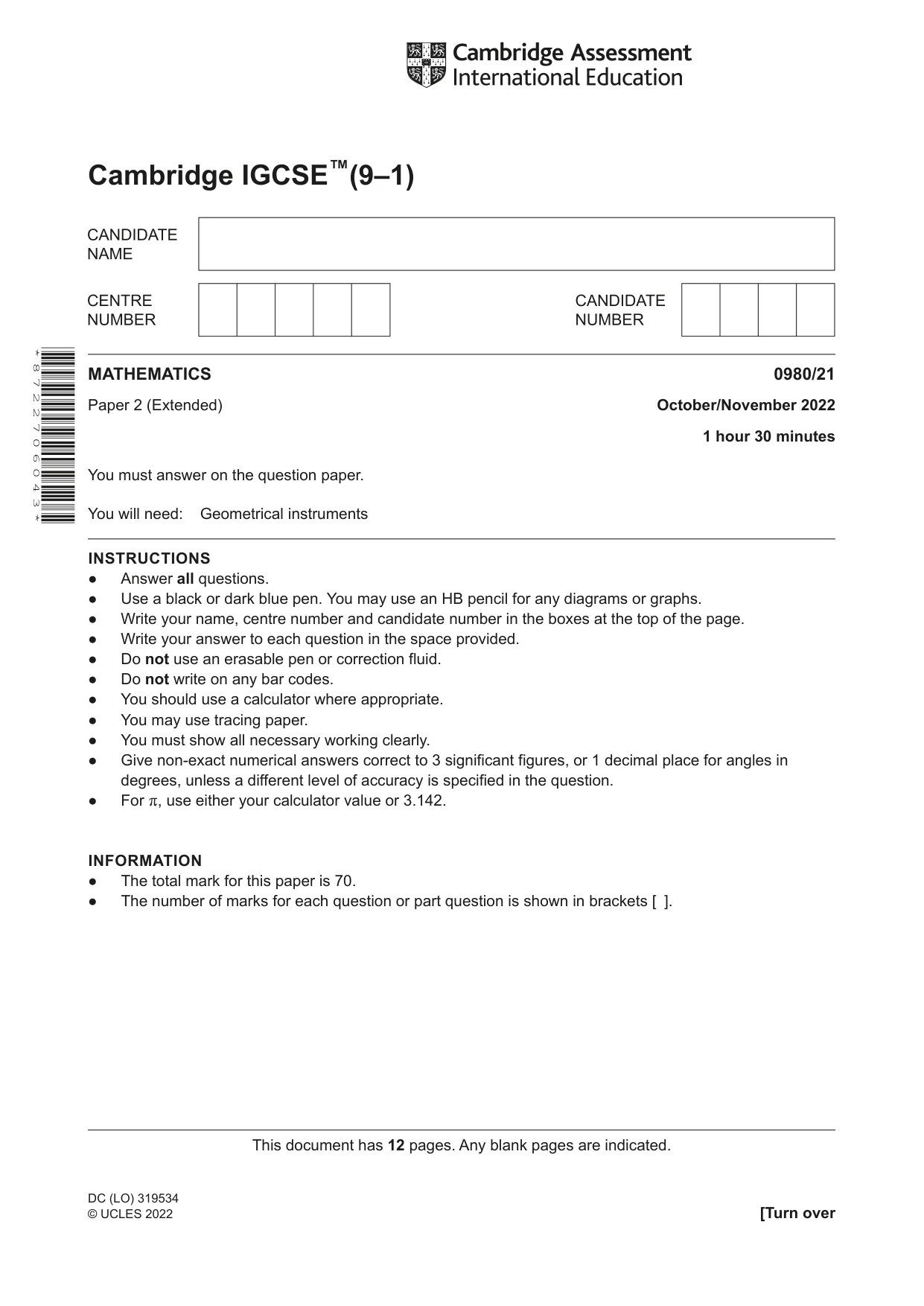
Cambridge IGCSE Mathematics (9-1) 0980 — 2022 Oct/Nov Paper 2 · Variant 1
0980/21/O/N/22 · 25 questions · 70 marks · ≈79 min
The question paper and its mark scheme, free to read here and free to download. This is Cambridge’s own paper, exactly as it was sat.
Question paper12 pages
Mark scheme7 pages
Answers below. Sit the paper first if you are practising.
Questions as text
Q1 · Write down a common multiple of 18 and 24
1 Write down a common multiple of 18 and 24. ................................................. [1]
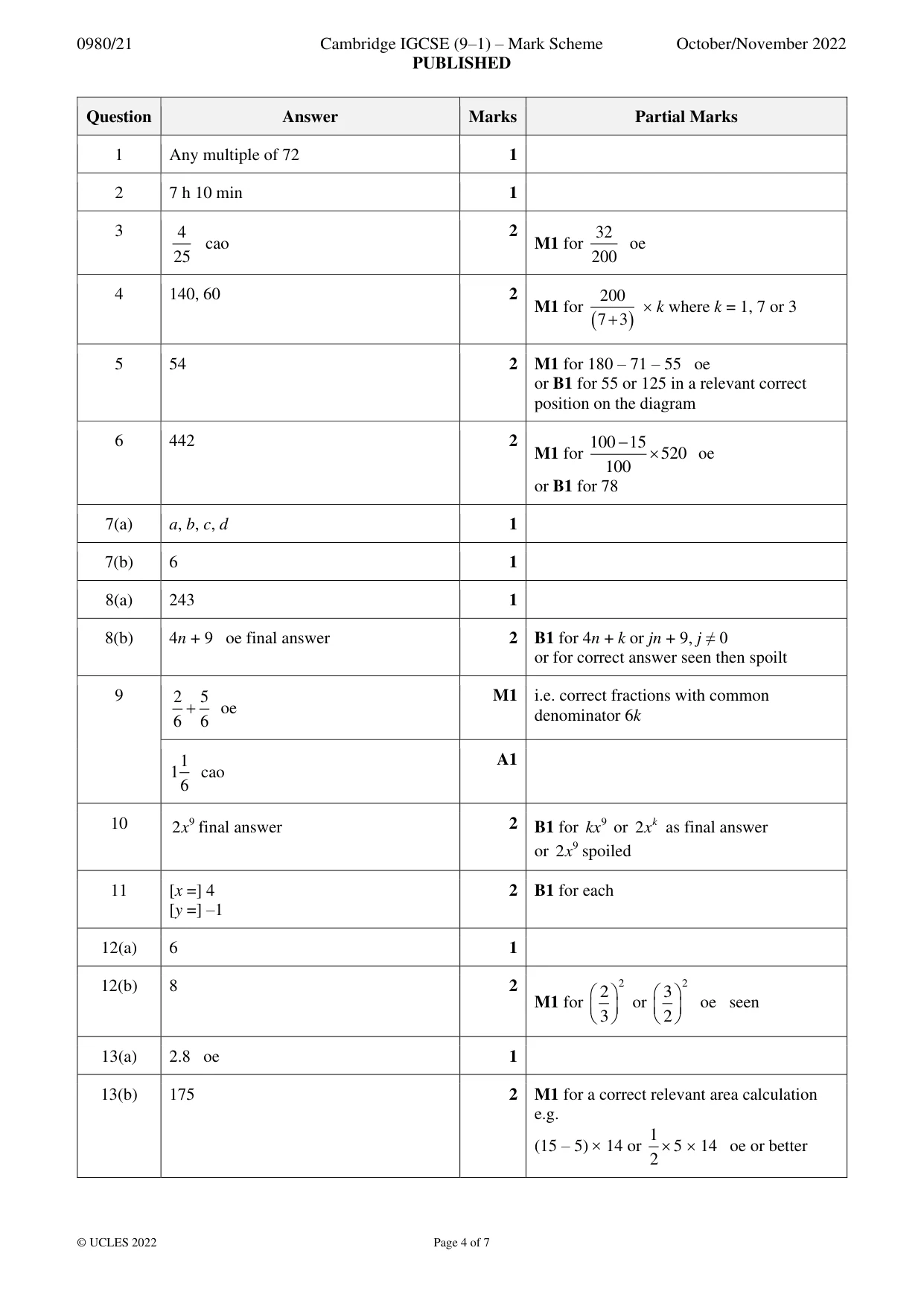
Mark scheme: Question Answer Marks Partial Marks 1 Any multiple of 72 1
Q2 · A train journey starts at 23 40 and finishes at 06 50
2 A train journey starts at 23 40 and finishes at 06 50. Work out the time taken for this journey. ................... h ................... min [1]
Mark scheme: 2 7 h 10 min 1
Q3 · Write 32 cm as a fraction of 2 m
3 Write 32 cm as a fraction of 2 m. Give your answer in its simplest form. ................................................. [2]
Mark scheme: 3 4 2 32 cao M1 for oe 25 200
Q4 · Divide $200 in the ratio 7 : 3
4 Divide $200 in the ratio 7 : 3. $ ..................... , $ ..................... [2]
Mark scheme: 4 140, 60 2 200 M1 for k where k = 1, 7 or 3 ( 7 + 3 )
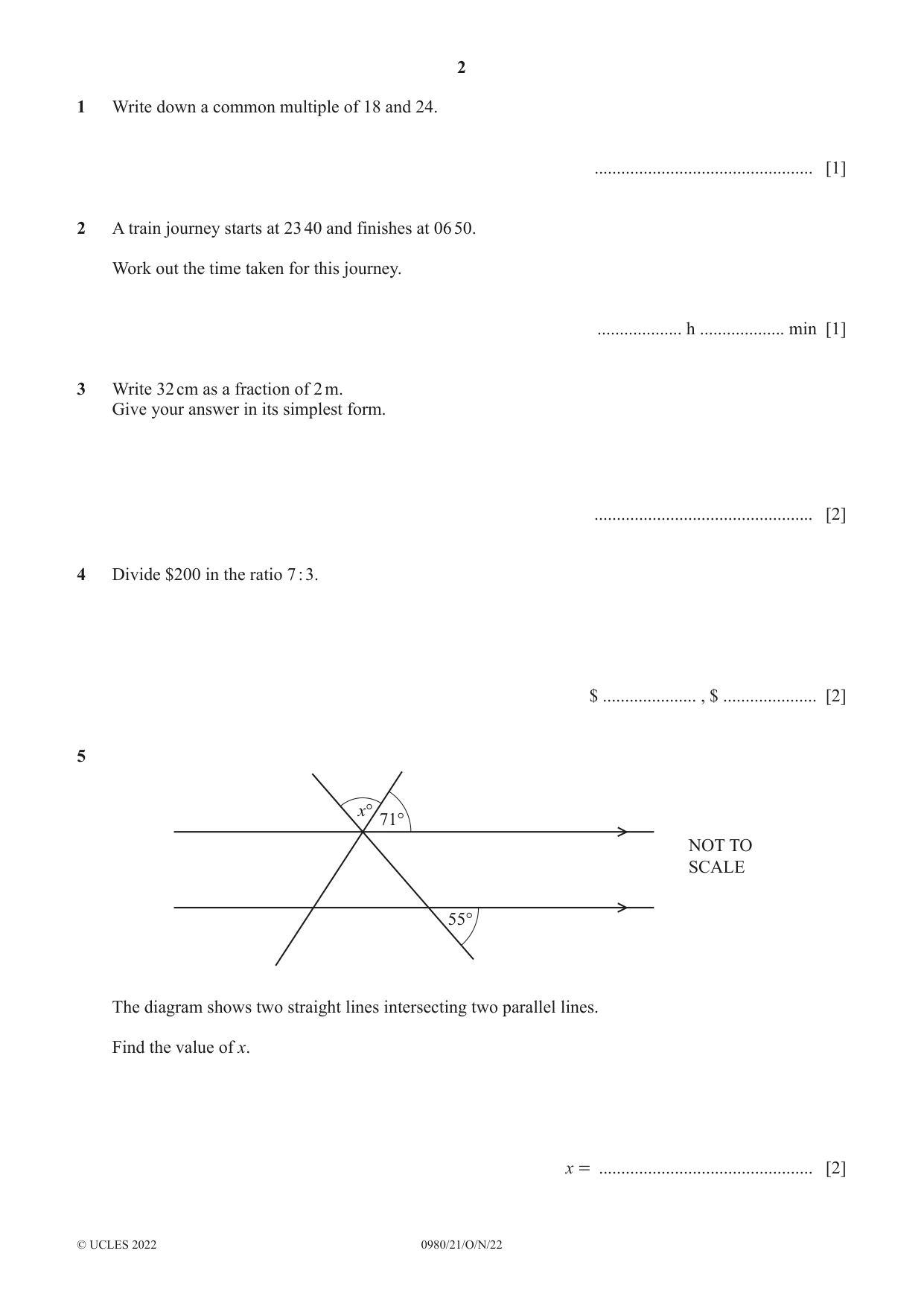
Q5 · X° 71° NOT TO SCALE 55° The diagram shows two straight lines intersecting two parallel…
5 x° 71° NOT TO SCALE 55° The diagram shows two straight lines intersecting two parallel lines. Find the value of x. x = ................................................ [2]
Mark scheme: 5 54 2 M1 for 180 – 71 – 55 oe or B1 for 55 or 125 in a relevant correct position on the diagram
Q6 · The price of a computer is $520
6 The price of a computer is $520. This price is reduced by 15% in a sale. Work out the sale price. $ ................................................ [2]
Mark scheme: 6 442 2 100 − 15 M1 for 520 oe 100 or B1 for 78
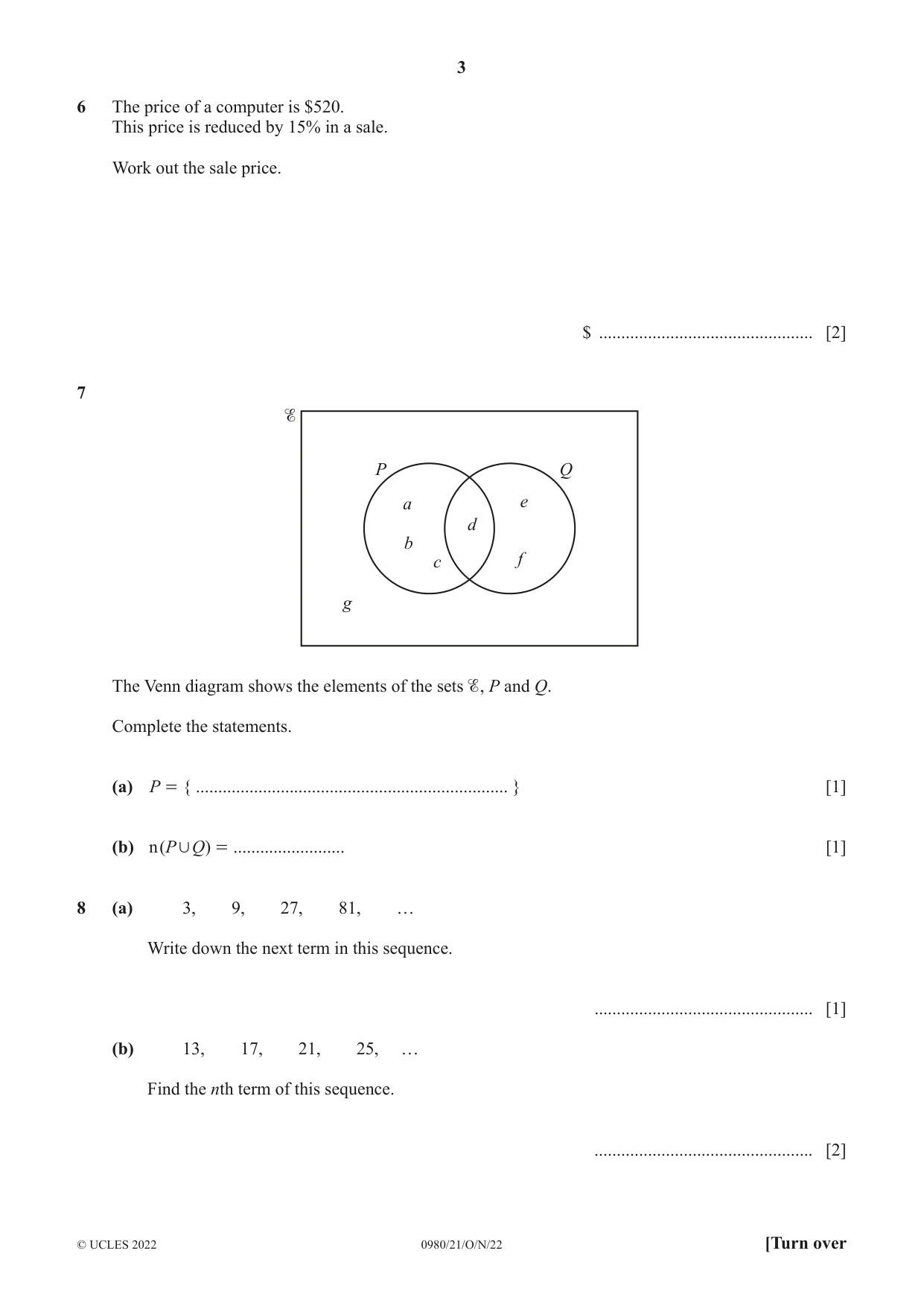
Q7 · P Q a e d b c f g The Venn diagram shows the elements of the sets , P and Q
7 P Q a e d b c f g The Venn diagram shows the elements of the sets , P and Q. Complete the statements. (a) P = { ...................................................................... } [1] (b) n ( P , Q ) = ......................... [1]
Mark scheme: 7(a) a, b, c, d 1 7(b) 6 1
Q8 · 3, 9, 27, 81, … Write down the next term in this sequence
8 (a) 3, 9, 27, 81, … Write down the next term in this sequence. ................................................. [1] (b) 13, 17, 21, 25, … Find the nth term of this sequence. ................................................. [2]
Mark scheme: 8(a) 243 1 8(b) 4n + 9 oe final answer 2 B1 for 4n + k or jn + 9, j ≠ 0 or for correct answer seen then spoilt
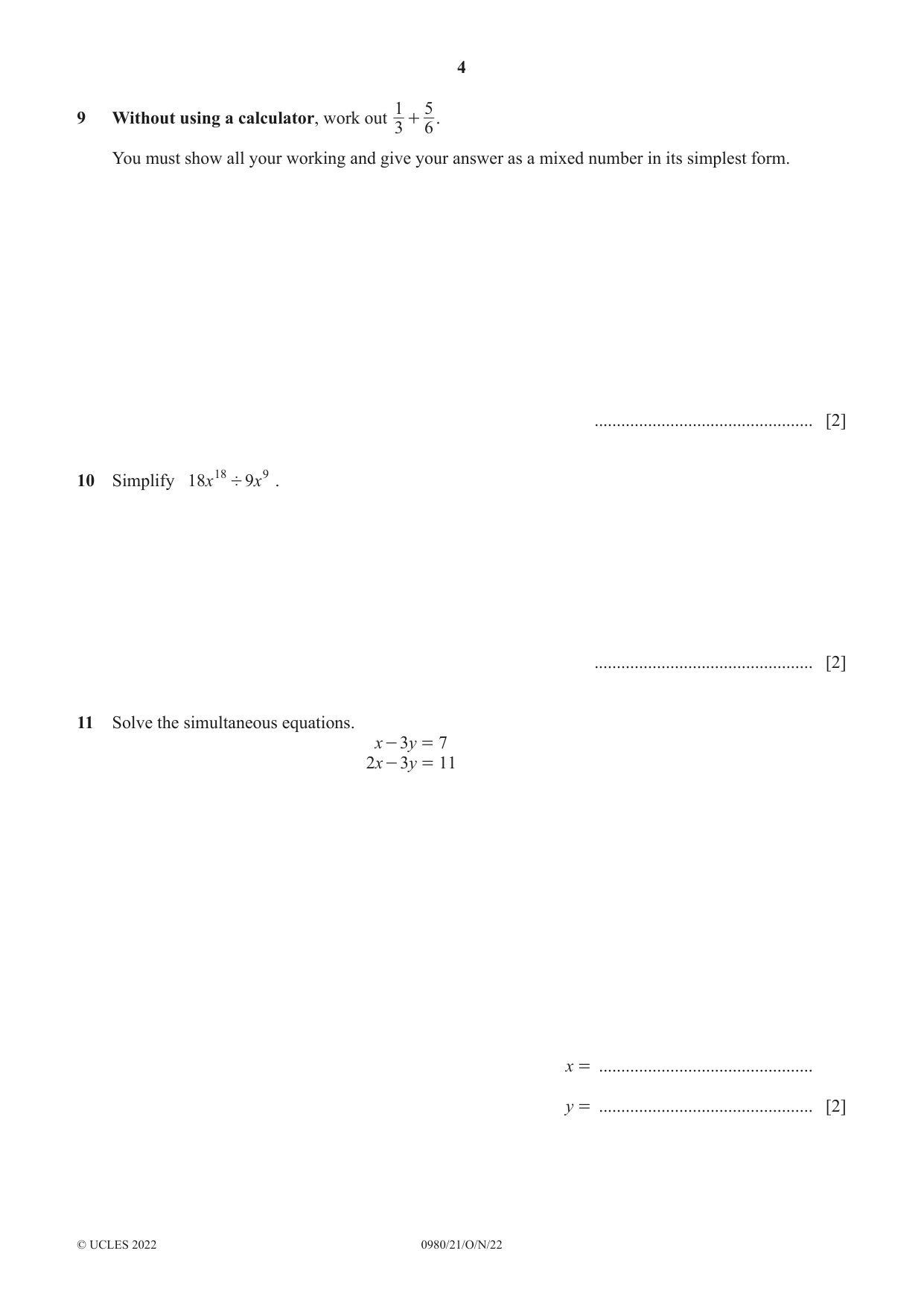
Q9 · Without using a calculator, work out +
9 Without using a calculator, work out + . 3 6 You must show all your working and give your answer as a mixed number in its simplest form. ................................................. [2]
Mark scheme: 9 2 5 M1 i.e. correct fractions with common + oe denominator 6k 6 6 1 A1 16 cao
Q10 · Simplify 18 x 18 ' 9 x 9
10 Simplify 18 x 18 ' 9 x 9 . ................................................. [2]
Mark scheme: 10 2x 9 final answer 2 B1 for kx 9 or 2 kx as final answer or 2x 9 spoiled
Q11 · Solve the simultaneous equations
11 Solve the simultaneous equations. x - 3y = 7 2x - 3y = 11 x = ................................................ y = ................................................ [2]
Mark scheme: 11 [x =] 4 2 B1 for each [y =] –1
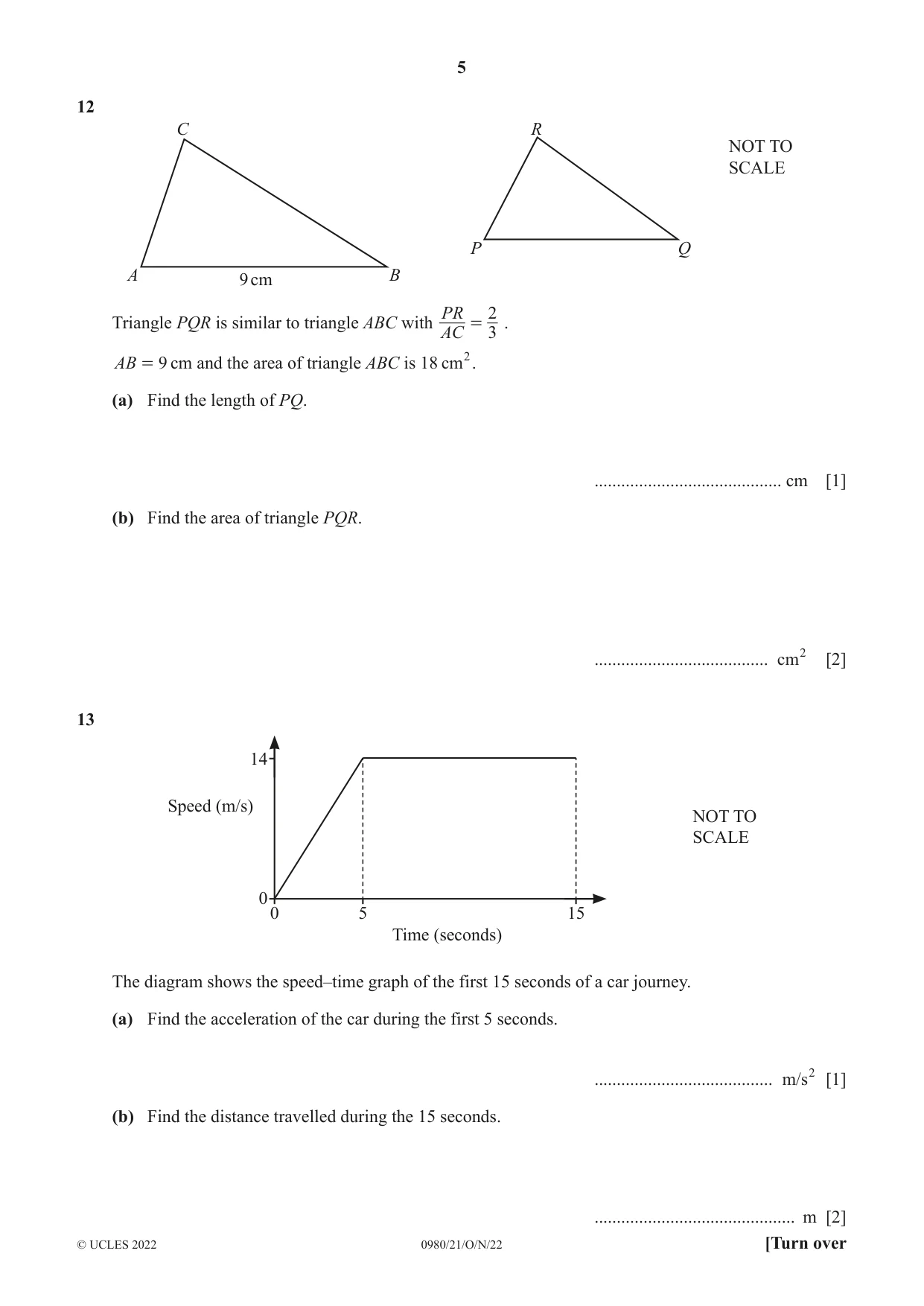
Q12 · C R NOT TO SCALE P Q A 9 cm B PR 2 Triangle PQR is similar to triangle ABC with =
12 C R NOT TO SCALE P Q A 9 cm B PR 2 Triangle PQR is similar to triangle ABC with = . AC 3 AB = 9 cm and the area of triangle ABC is 18 cm2. (a) Find the length of PQ. .......................................... cm [1] (b) Find the area of triangle PQR. ....................................... cm2 [2]
Mark scheme: 12(a) 6 1 12(b) 8 2 2 2 2 3 M1 for or oe seen 3 2
Q13 · 14 Speed (m/s) NOT TO SCALE 0 0 5 15 Time (seconds) The diagram shows the speed–time…
13 14 Speed (m/s) NOT TO SCALE 0 0 5 15 Time (seconds) The diagram shows the speed–time graph of the first 15 seconds of a car journey. (a) Find the acceleration of the car during the first 5 seconds. ........................................ m/s2 [1] (b) Find the distance travelled during the 15 seconds. ............................................. m [2]
Mark scheme: 13(a) 2.8 oe 1 13(b) 175 2 M1 for a correct relevant area calculation e.g. 1 (15 – 5) 14 or 5 14 oe or better 2
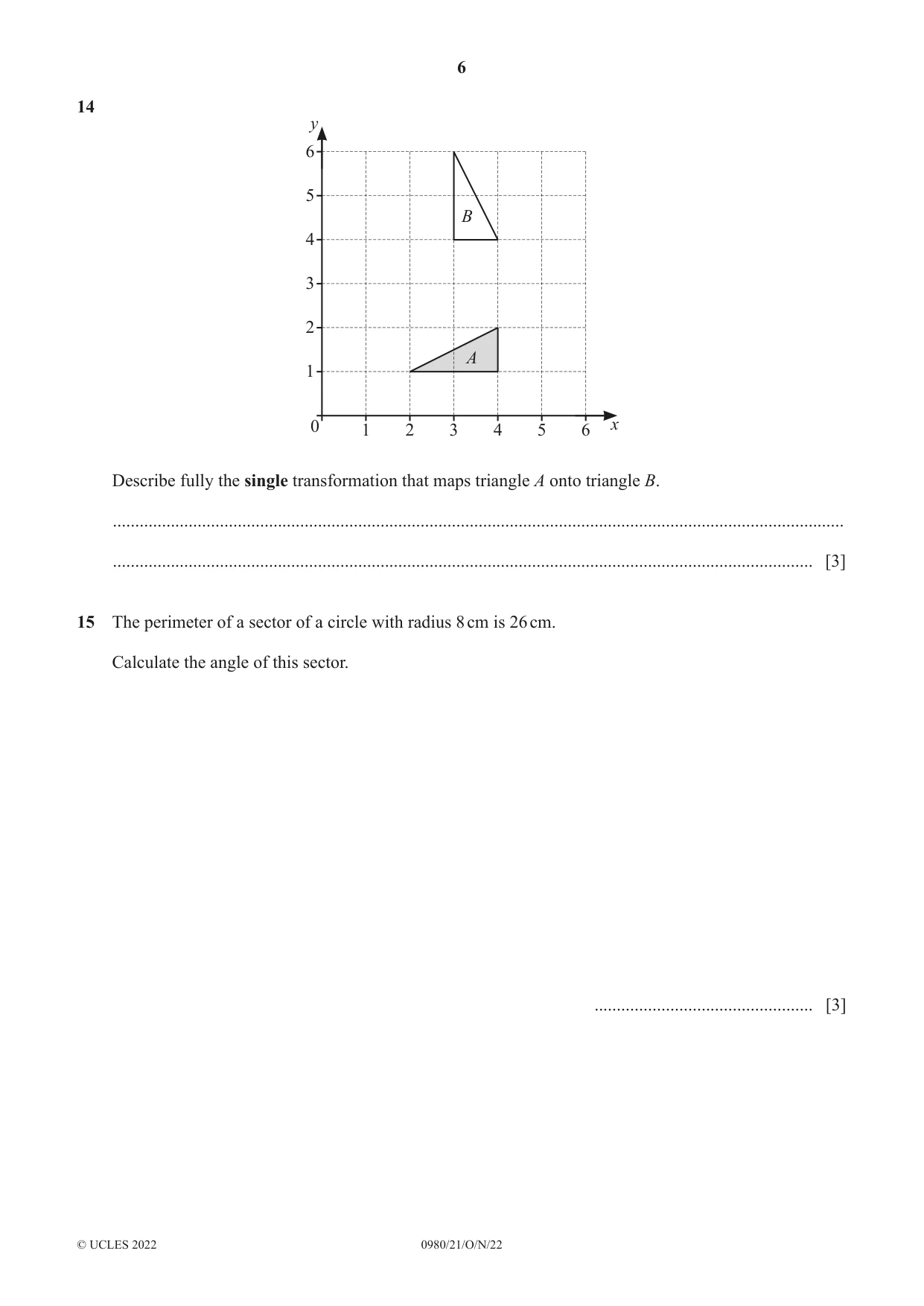
Q14 · Y 6 5 B 4 3 2 A 1 0 1 2 3 4 5 6 x Describe fully the single transformation that maps…
14 y 6 5 B 4 3 2 A 1 0 1 2 3 4 5 6 x Describe fully the single transformation that maps triangle A onto triangle B. .................................................................................................................................................................... ............................................................................................................................................................. [3]
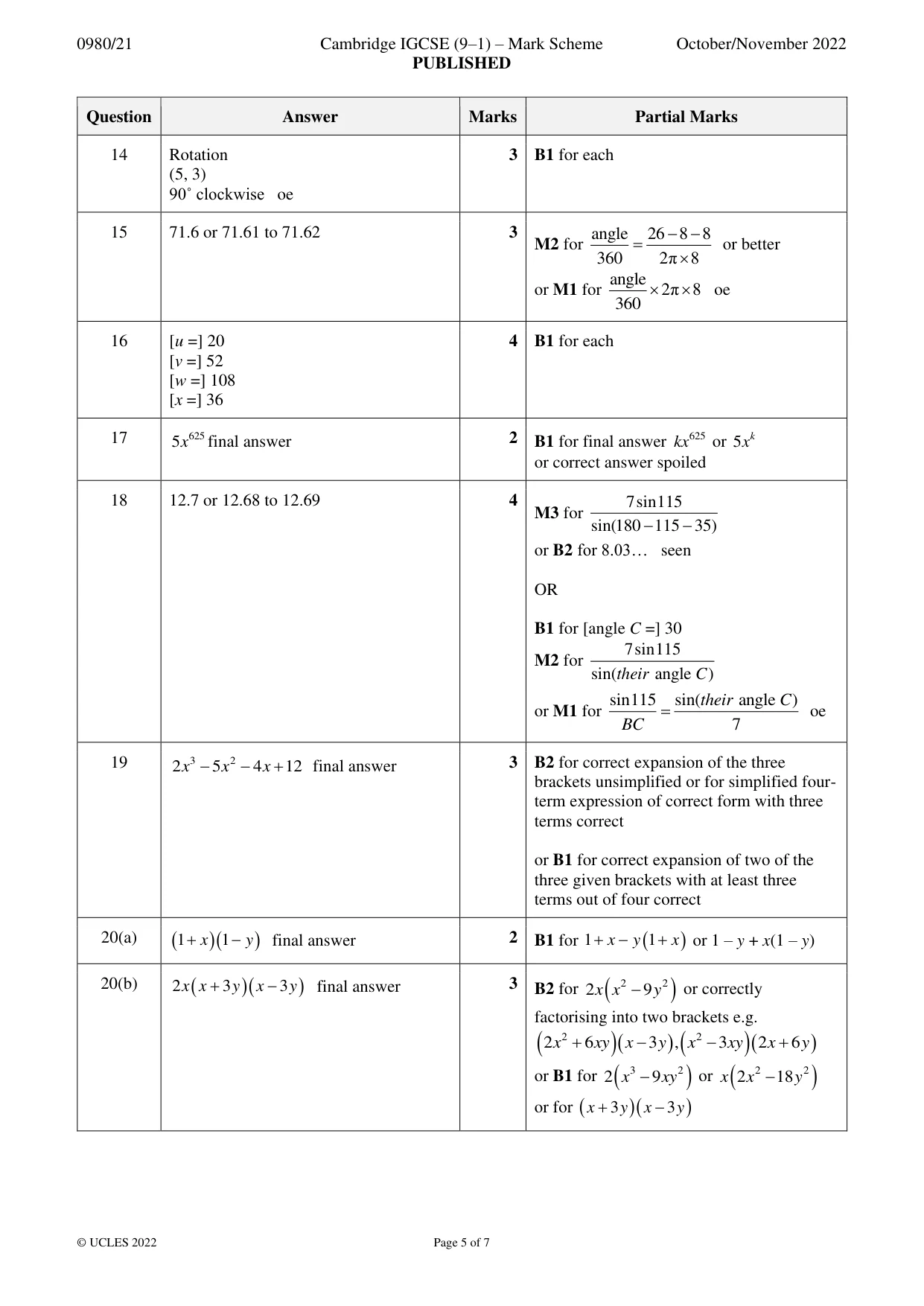
Mark scheme: 14 Rotation 3 B1 for each (5, 3) 90˚ clockwise oe
Q15 · The perimeter of a sector of a circle with radius 8 cm is 26 cm
15 The perimeter of a sector of a circle with radius 8 cm is 26 cm. Calculate the angle of this sector. ................................................. [3]
Mark scheme: 15 71.6 or 71.61 to 71.62 3 angle 26 −−8 8 M2 for = or better 360 2π 8 angle or M1 for 2π 8 oe 360
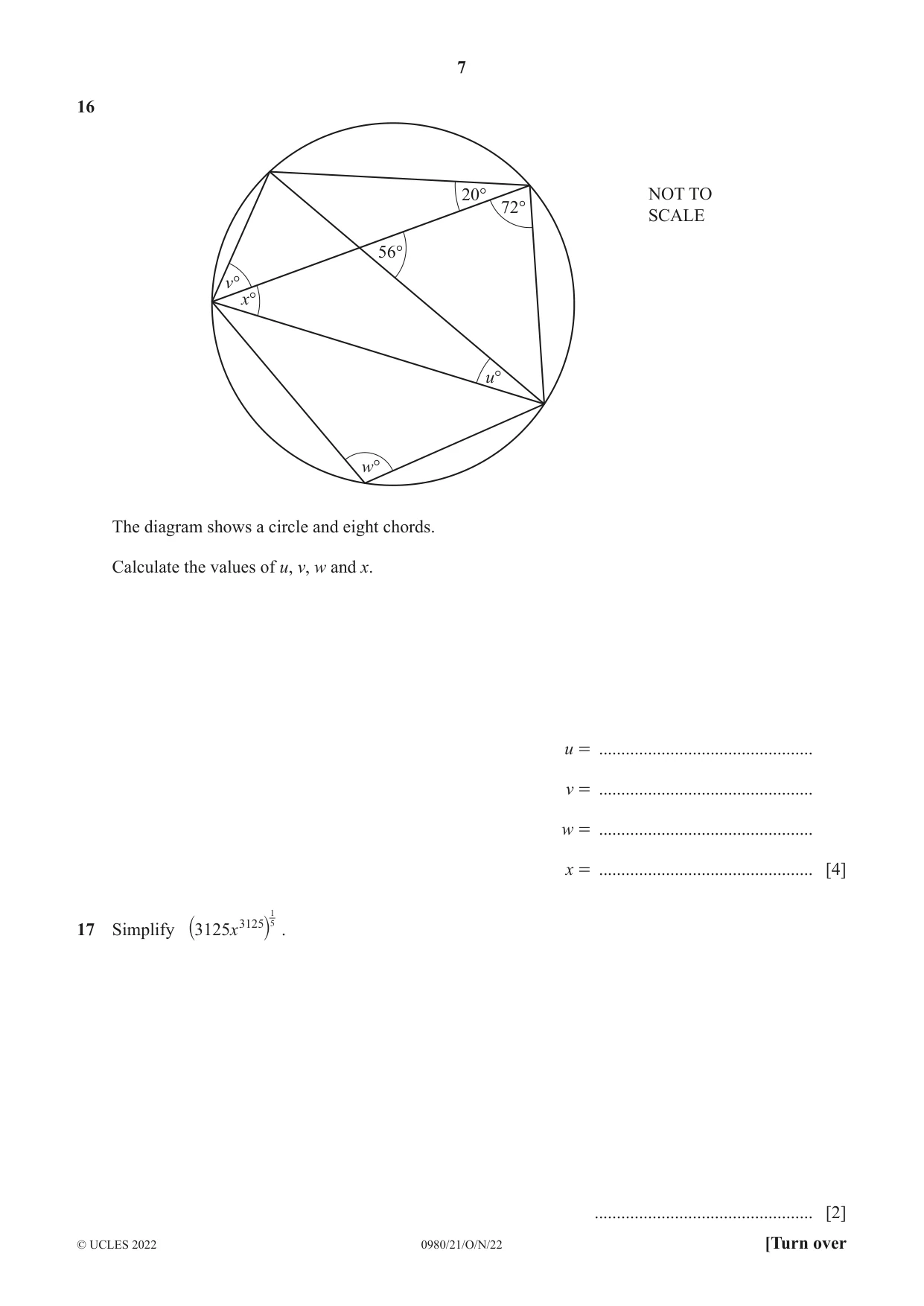
Q16 · 20° NOT TO 72° SCALE 56° v° x° u° w° The diagram shows a circle and eight chords
16 20° NOT TO 72° SCALE 56° v° x° u° w° The diagram shows a circle and eight chords. Calculate the values of u, v, w and x. u = ................................................ v = ................................................ w = ................................................ x = ................................................ [4] 1
Mark scheme: 16 [u =] 20 4 B1 for each [v =] 52 [w =] 108 [x =] 36
Q17 · Simplify 3125 x 3125 5
17 Simplify 3125 x 3125 5 . ................................................. [2]
Mark scheme: 17 5x 625 final answer 2 B1 for final answer kx 625 or 5 kx or correct answer spoiled
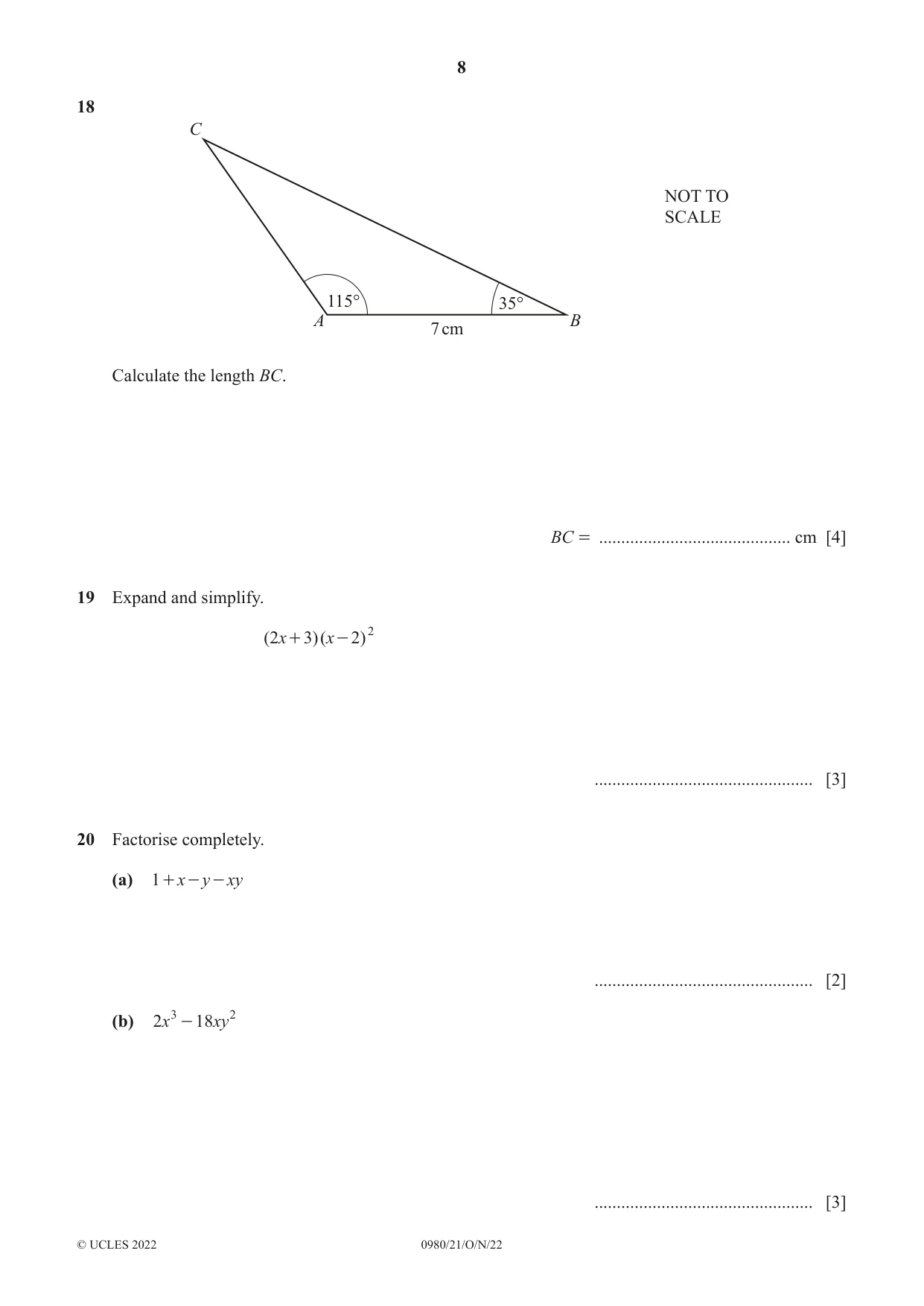
Q18 · C NOT TO SCALE 115° 35° A B 7 cm Calculate the length BC
18 C NOT TO SCALE 115° 35° A B 7 cm Calculate the length BC. BC = ........................................... cm [4]
Mark scheme: 18 12.7 or 12.68 to 12.69 4 7sin115 M3 for sin(180 − 115 − 35) or B2 for 8.03… seen OR B1 for [angle C =] 30 7sin115 M2 for sin(their angle C ) sin115 sin(their angle C ) or M1 for = oe BC 7
Question 19
19 Expand and simplify. ( 2x + 3)( x - 2) 2 ................................................. [3]
Mark scheme: 19 2 x 3 − 5 x 2 − 4 x + 12 final answer 3 B2 for correct expansion of the three brackets unsimplified or for simplified four- term expression of correct form with three terms correct or B1 for correct expansion of two of the three given brackets with at least three terms out of four correct
Question 20
20 Factorise completely. (a) 1+ x - y - xy ................................................. [2] (b) 2x 3 - 18xy 2 ................................................. [3]
Mark scheme: 20(a) (1 + x )(1 − y ) final answer 2 B1 for 1 + x − y (1 + x ) or 1 – y + x(1 – y) or correctly x 2 − 9 y 220(b) 2 x ( x + 3 y )( x − 3 y ) final answer 3 B2 for 2 x ( ) factorising into two brackets e.g. 2 x 2 + 6 xy x 2 − 3 xy 2 x + 6 y ) ( )( x − 3 y ) , ( )( or B1 for 2 x 3 − 9 xy 2 or x 2 x 2 − 18 y 2 ( ) ( ) or for ( x + 3 y )( x − 3 y )
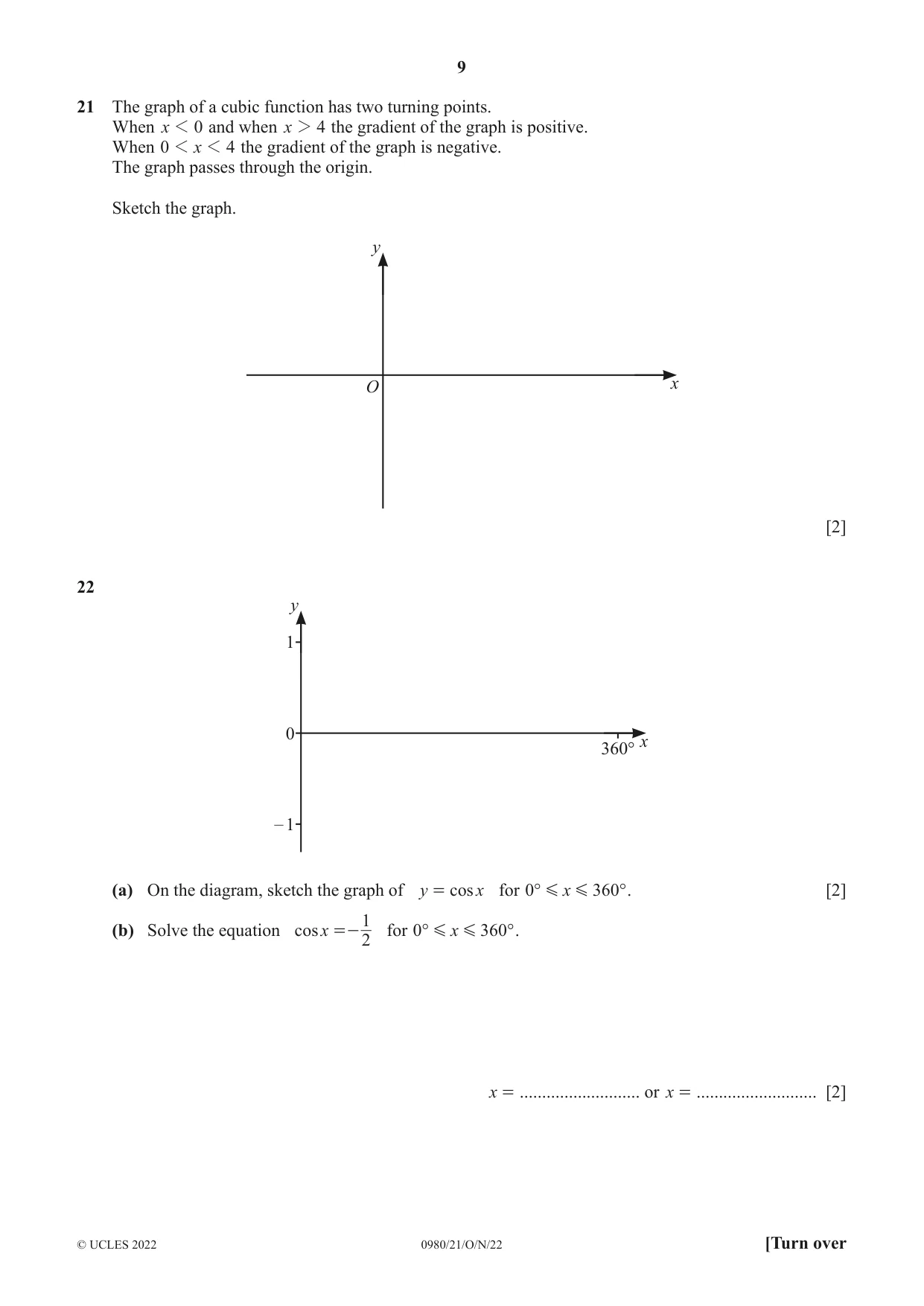
Q21 · The graph of a cubic function has two turning points
21 The graph of a cubic function has two turning points. When x 1 0 and when x 2 4 the gradient of the graph is positive. When 0 1 x 1 4 the gradient of the graph is negative. The graph passes through the origin. Sketch the graph. y O x [2]
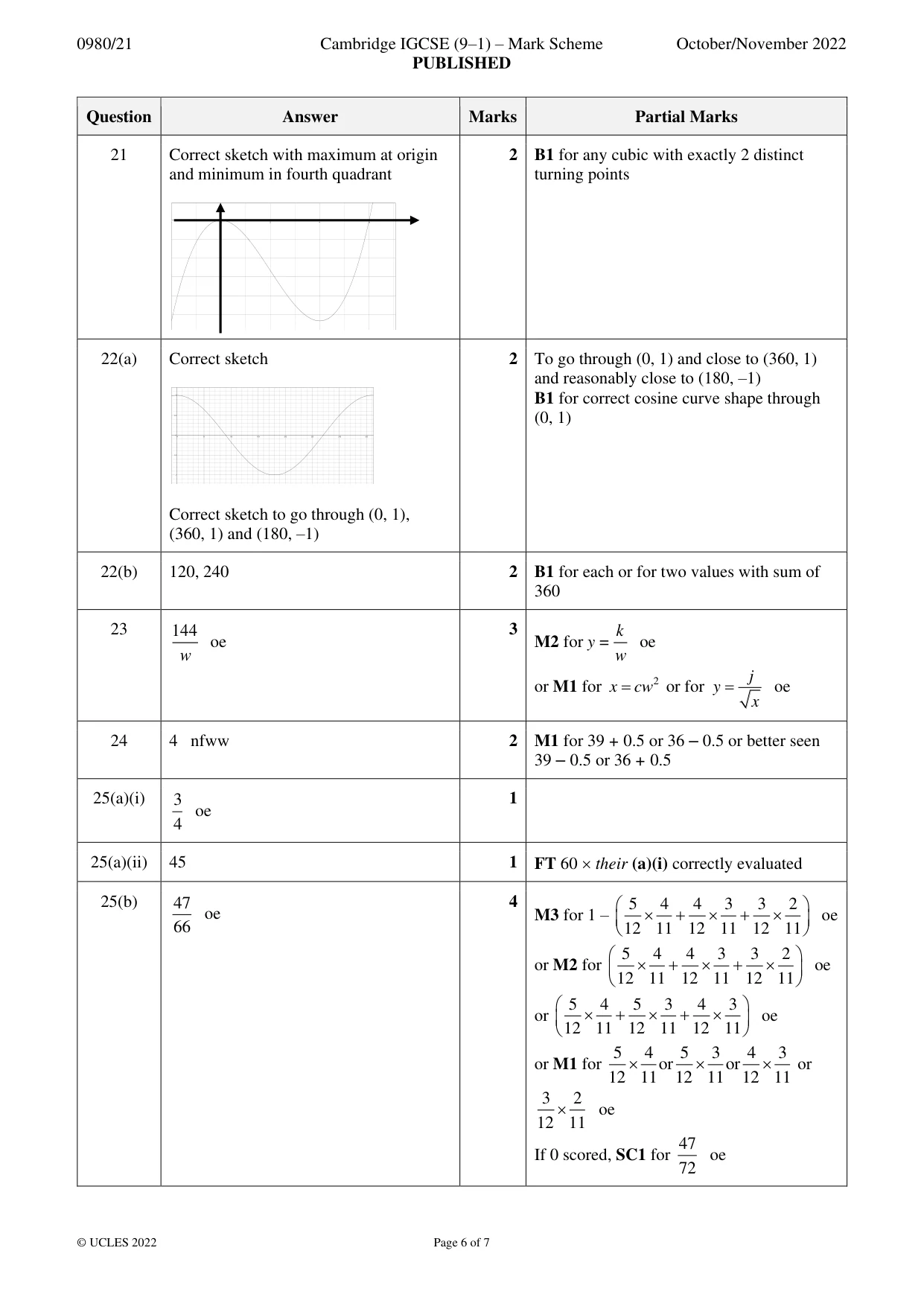
Mark scheme: 21 Correct sketch with maximum at origin 2 B1 for any cubic with exactly 2 distinct and minimum in fourth quadrant turning points 2222 0000 0000 2222 4444 6666 -1-1-1-1 -2-2-2-2 -3-3-3-3 -4-4-4-4 -5-5-5-5
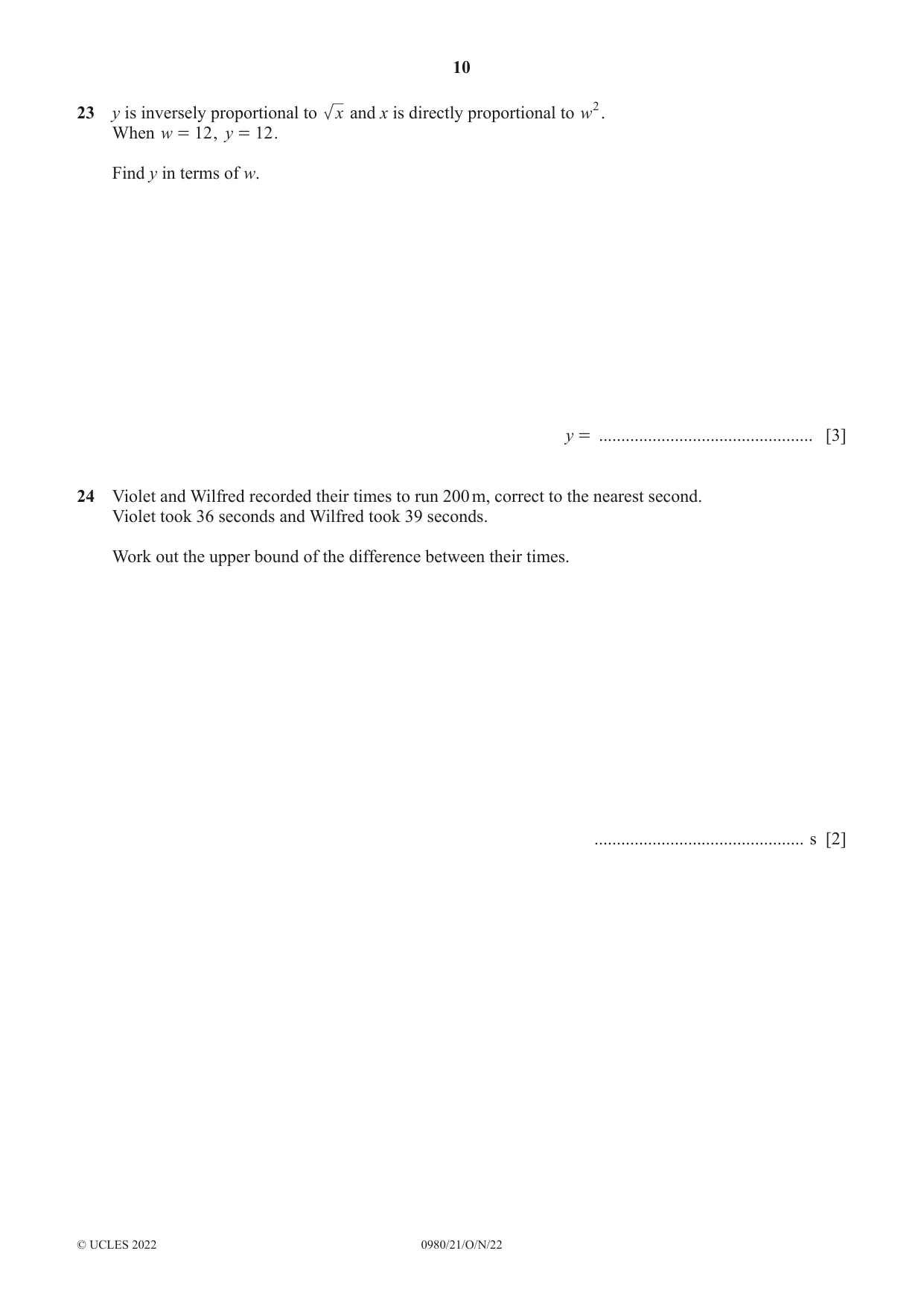
Q22 · Y 1 0 x 360° – 1 (a) On the diagram, sketch the graph of y = cos x for 0° G x G 360°
22 y 1 0 x 360° – 1 (a) On the diagram, sketch the graph of y = cos x for 0° G x G 360° . [2] 1 (b) Solve the equation cosx =- for 0° G x G 360° . 2 x = ........................... or x = ........................... [2]
Mark scheme: 22(a) Correct sketch 2 To go through (0, 1) and close to (360, 1) and reasonably close to (180, –1) 1111 B1 for correct cosine curve shape through 0.50.50.50.5 (0, 1) 0000 0000 50505050 100100100100 150150150150 200200200200 250250250250 300300300300 350350350350 -0.5-0.5-0.5-0.5 -1-1-1-1 Correct sketch to go through (0, 1), (360, 1) and (180, –1) 22(b) 120, 240 2 B1 for each or for two values with sum of 360
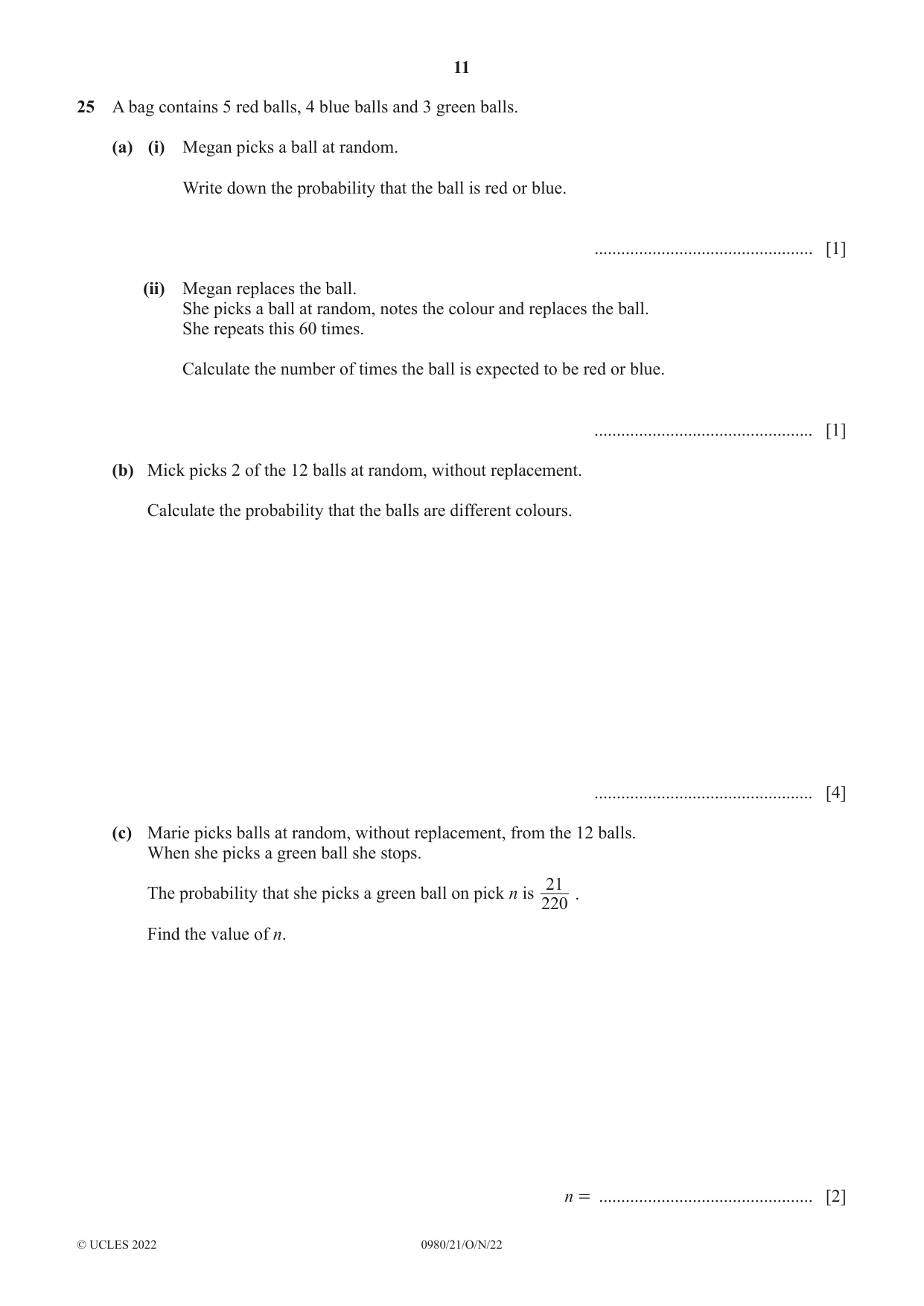
Q23 · Y is inversely proportional to x and x is directly proportional to w2
23 y is inversely proportional to x and x is directly proportional to w2. When w = 12 , y = 12 . Find y in terms of w. y = ................................................ [3]
Mark scheme: 23 144 3 k oe M2 for y = oe w w 2 j or M1 for x = cw or for y = oe x
Q24 · Violet and Wilfred recorded their times to run 200 m, correct to the nearest second
24 Violet and Wilfred recorded their times to run 200 m, correct to the nearest second. Violet took 36 seconds and Wilfred took 39 seconds. Work out the upper bound of the difference between their times. ............................................... s [2]
Mark scheme: 24 4 nfww 2 M1 for 39 + 0.5 or 36 – 0.5 or better seen 39 – 0.5 or 36 + 0.5
Q25 · A bag contains 5 red balls, 4 blue balls and 3 green balls
25 A bag contains 5 red balls, 4 blue balls and 3 green balls. (a) (i) Megan picks a ball at random. Write down the probability that the ball is red or blue. ................................................. [1] (ii) Megan replaces the ball. She picks a ball at random, notes the colour and replaces the ball. She repeats this 60 times. Calculate the number of times the ball is expected to be red or blue. ................................................. [1] (b) Mick picks 2 of the 12 balls at random, without replacement. Calculate the probability that the balls are different colours. ................................................. [4] (c) Marie picks balls at random, without replacement, from the 12 balls. When she picks a green ball she stops. 21 The probability that she picks a green ball on pick n is . 220 Find the value of n. n = ................................................ [2]
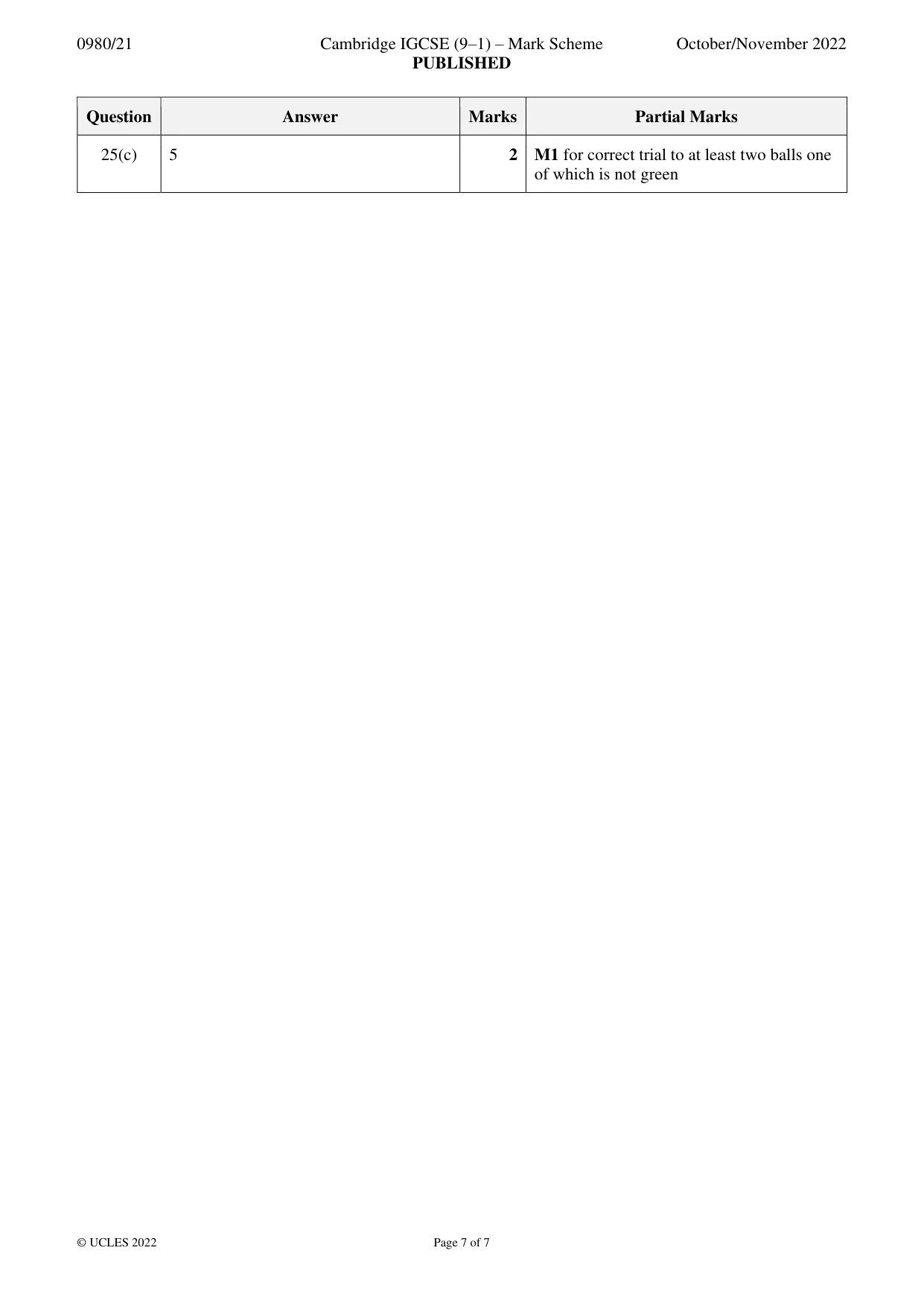
Mark scheme: 25(a)(i) 3 1 oe 4 25(a)(ii) 45 1 FT 60 their (a)(i) correctly evaluated 25(b) 47 4 5 4 4 3 3 2 oe M3 for 1 – + + oe 66 12 11 12 11 12 11 5 4 4 3 3 2 or M2 for + + oe 12 11 12 11 12 11 5 4 5 3 4 3 or + + oe 12 11 12 11 12 11 5 4 5 3 4 3 or M1 for or or or 12 11 12 11 12 11 3 2 oe 12 11 47 If 0 scored, SC1 for oe 72 25(c) 5 2 M1 for correct trial to at least two balls one of which is not green
What was in this paper
The subtopics covered by these 25 questions, and how many questions each got. Open one in a new tab to see every Cambridge question on it.
2Indices II2Angles1Circle theorems I1Circles, arcs and sectors1Equations1Fractions, decimals and percentages1Graphs in practical situations1Limits of accuracy1Non-right-angled triangles1Percentages1Proportion1Ratio and proportion1Relative and expected frequencies1Sequences1Sets1Similarity1Sketching curves1The four operations1Time1Transformations1Trigonometric functions1Types of number1What you needed in this session
Cambridge’s own grade thresholds for 2022 Oct/Nov, Paper 2 · Variant 1. A higher threshold means an easier paper — the bar moves with how the cohort did.